EP3677578A1 - (r)-3-((3s,4s)-3-fluoro-4-(4-hydroxyphenyl)piperidin-1-yl)-1-(4-methylbenzyl)pyrrolidin-2-one and its prodrugs for the treatment of psychiatric disorders - Google Patents
(r)-3-((3s,4s)-3-fluoro-4-(4-hydroxyphenyl)piperidin-1-yl)-1-(4-methylbenzyl)pyrrolidin-2-one and its prodrugs for the treatment of psychiatric disorders Download PDFInfo
- Publication number
- EP3677578A1 EP3677578A1 EP19212924.5A EP19212924A EP3677578A1 EP 3677578 A1 EP3677578 A1 EP 3677578A1 EP 19212924 A EP19212924 A EP 19212924A EP 3677578 A1 EP3677578 A1 EP 3677578A1
- Authority
- EP
- European Patent Office
- Prior art keywords
- compound
- pharmaceutically acceptable
- acceptable salt
- mmol
- alkyl
- Prior art date
- Legal status (The legal status is an assumption and is not a legal conclusion. Google has not performed a legal analysis and makes no representation as to the accuracy of the status listed.)
- Withdrawn
Links
- 229940002612 prodrug Drugs 0.000 title claims description 8
- 239000000651 prodrug Substances 0.000 title claims description 8
- UNVYDSCXINFREZ-BHDDXSALSA-N (3R)-3-[(3S,4S)-3-fluoro-4-(4-hydroxyphenyl)piperidin-1-yl]-1-[(4-methylphenyl)methyl]pyrrolidin-2-one Chemical compound F[C@@H]1CN(CC[C@H]1C1=CC=C(C=C1)O)[C@H]1C(N(CC1)CC1=CC=C(C=C1)C)=O UNVYDSCXINFREZ-BHDDXSALSA-N 0.000 title description 8
- 208000020016 psychiatric disease Diseases 0.000 title 1
- 150000001875 compounds Chemical class 0.000 claims abstract description 73
- 150000003839 salts Chemical class 0.000 claims abstract description 25
- 238000000034 method Methods 0.000 claims abstract description 22
- -1 amino acid esters Chemical group 0.000 claims description 31
- 125000000217 alkyl group Chemical group 0.000 claims description 21
- 125000005907 alkyl ester group Chemical group 0.000 claims description 18
- 125000001424 substituent group Chemical group 0.000 claims description 13
- 125000003545 alkoxy group Chemical group 0.000 claims description 9
- 125000001475 halogen functional group Chemical group 0.000 claims description 9
- 239000002253 acid Substances 0.000 claims description 7
- 125000004093 cyano group Chemical group *C#N 0.000 claims description 6
- 125000004438 haloalkoxy group Chemical group 0.000 claims description 6
- 125000001188 haloalkyl group Chemical group 0.000 claims description 6
- 125000001997 phenyl group Chemical group [H]C1=C([H])C([H])=C(*)C([H])=C1[H] 0.000 claims description 6
- 150000003009 phosphonic acids Chemical group 0.000 claims description 6
- IIACRCGMVDHOTQ-UHFFFAOYSA-N sulfamic acid Chemical class NS(O)(=O)=O IIACRCGMVDHOTQ-UHFFFAOYSA-N 0.000 claims description 6
- BYFQSSVDKAZZCU-BEDMTGONSA-N (2S)-2-amino-4-[4-[(3S,4S)-3-fluoro-1-[(3R)-1-[(4-methylphenyl)methyl]-2-oxopyrrolidin-3-yl]piperidin-4-yl]phenoxy]-4-oxobutanoic acid hydrochloride Chemical compound Cl.N[C@H](C(=O)O)CC(=O)OC1=CC=C(C=C1)[C@H]1[C@@H](CN(CC1)[C@H]1C(N(CC1)CC1=CC=C(C=C1)C)=O)F BYFQSSVDKAZZCU-BEDMTGONSA-N 0.000 claims description 5
- 208000024827 Alzheimer disease Diseases 0.000 claims description 5
- AHEPHJOEWHVSSS-BKZZESQVSA-N [4-[(3S,4S)-3-fluoro-1-[(3R)-1-[(4-methylphenyl)methyl]-2-oxopyrrolidin-3-yl]piperidin-4-yl]phenyl] (2S)-2-amino-3-methylbutanoate hydrochloride Chemical compound Cl.N[C@H](C(=O)OC1=CC=C(C=C1)[C@H]1[C@@H](CN(CC1)[C@H]1C(N(CC1)CC1=CC=C(C=C1)C)=O)F)C(C)C AHEPHJOEWHVSSS-BKZZESQVSA-N 0.000 claims description 5
- IBBDQKGDANXVOA-CXWZADJDSA-N [4-[(3S,4S)-3-fluoro-1-[(3R)-1-[(4-methylphenyl)methyl]-2-oxopyrrolidin-3-yl]piperidin-4-yl]phenyl] (2S)-2-aminopropanoate hydrochloride Chemical compound Cl.N[C@H](C(=O)OC1=CC=C(C=C1)[C@H]1[C@@H](CN(CC1)[C@H]1C(N(CC1)CC1=CC=C(C=C1)C)=O)F)C IBBDQKGDANXVOA-CXWZADJDSA-N 0.000 claims description 5
- ZPUVTBAQHJFPHE-BHDDXSALSA-N [4-[(3S,4S)-3-fluoro-1-[(3R)-1-[(4-methylphenyl)methyl]-2-oxopyrrolidin-3-yl]piperidin-4-yl]phenyl] dihydrogen phosphate Chemical compound P(=O)(OC1=CC=C(C=C1)[C@H]1[C@@H](CN(CC1)[C@H]1C(N(CC1)CC1=CC=C(C=C1)C)=O)F)(O)O ZPUVTBAQHJFPHE-BHDDXSALSA-N 0.000 claims description 5
- 208000004296 neuralgia Diseases 0.000 claims description 5
- 208000021722 neuropathic pain Diseases 0.000 claims description 5
- 208000020401 Depressive disease Diseases 0.000 claims description 4
- 208000018737 Parkinson disease Diseases 0.000 claims description 4
- 125000002887 hydroxy group Chemical group [H]O* 0.000 claims description 4
- 125000002947 alkylene group Chemical group 0.000 claims description 3
- 125000002393 azetidinyl group Chemical group 0.000 claims description 3
- 125000003392 indanyl group Chemical group C1(CCC2=CC=CC=C12)* 0.000 claims description 3
- 125000004193 piperazinyl group Chemical group 0.000 claims description 3
- 125000003386 piperidinyl group Chemical group 0.000 claims description 3
- 125000000719 pyrrolidinyl group Chemical group 0.000 claims description 3
- 239000003937 drug carrier Substances 0.000 claims description 2
- 239000008194 pharmaceutical composition Substances 0.000 claims description 2
- 239000000203 mixture Substances 0.000 abstract description 31
- 210000003169 central nervous system Anatomy 0.000 abstract description 6
- 239000003446 ligand Substances 0.000 abstract description 4
- 208000037265 diseases, disorders, signs and symptoms Diseases 0.000 abstract description 3
- 108010054200 NR2B NMDA receptor Proteins 0.000 abstract description 2
- YMWUJEATGCHHMB-UHFFFAOYSA-N Dichloromethane Chemical compound ClCCl YMWUJEATGCHHMB-UHFFFAOYSA-N 0.000 description 73
- XEKOWRVHYACXOJ-UHFFFAOYSA-N Ethyl acetate Chemical compound CCOC(C)=O XEKOWRVHYACXOJ-UHFFFAOYSA-N 0.000 description 60
- 239000000243 solution Substances 0.000 description 57
- OKKJLVBELUTLKV-UHFFFAOYSA-N Methanol Chemical compound OC OKKJLVBELUTLKV-UHFFFAOYSA-N 0.000 description 48
- WEVYAHXRMPXWCK-UHFFFAOYSA-N Acetonitrile Chemical compound CC#N WEVYAHXRMPXWCK-UHFFFAOYSA-N 0.000 description 43
- 239000000543 intermediate Substances 0.000 description 41
- RTZKZFJDLAIYFH-UHFFFAOYSA-N Diethyl ether Chemical compound CCOCC RTZKZFJDLAIYFH-UHFFFAOYSA-N 0.000 description 39
- 239000011541 reaction mixture Substances 0.000 description 39
- 238000004895 liquid chromatography mass spectrometry Methods 0.000 description 35
- XLYOFNOQVPJJNP-UHFFFAOYSA-N water Substances O XLYOFNOQVPJJNP-UHFFFAOYSA-N 0.000 description 35
- IAZDPXIOMUYVGZ-WFGJKAKNSA-N Dimethyl sulfoxide Chemical compound [2H]C([2H])([2H])S(=O)C([2H])([2H])[2H] IAZDPXIOMUYVGZ-WFGJKAKNSA-N 0.000 description 34
- 239000002904 solvent Substances 0.000 description 33
- 238000005160 1H NMR spectroscopy Methods 0.000 description 26
- 235000019439 ethyl acetate Nutrition 0.000 description 23
- 239000000047 product Substances 0.000 description 23
- 239000007787 solid Substances 0.000 description 23
- WYURNTSHIVDZCO-UHFFFAOYSA-N Tetrahydrofuran Chemical compound C1CCOC1 WYURNTSHIVDZCO-UHFFFAOYSA-N 0.000 description 22
- 239000012043 crude product Substances 0.000 description 20
- VLKZOEOYAKHREP-UHFFFAOYSA-N n-Hexane Chemical class CCCCCC VLKZOEOYAKHREP-UHFFFAOYSA-N 0.000 description 20
- 239000012044 organic layer Substances 0.000 description 20
- VHYFNPMBLIVWCW-UHFFFAOYSA-N 4-Dimethylaminopyridine Chemical compound CN(C)C1=CC=NC=C1 VHYFNPMBLIVWCW-UHFFFAOYSA-N 0.000 description 18
- VEXZGXHMUGYJMC-UHFFFAOYSA-N Hydrochloric acid Chemical compound Cl VEXZGXHMUGYJMC-UHFFFAOYSA-N 0.000 description 16
- ZMANZCXQSJIPKH-UHFFFAOYSA-N Triethylamine Chemical compound CCN(CC)CC ZMANZCXQSJIPKH-UHFFFAOYSA-N 0.000 description 16
- 239000003814 drug Substances 0.000 description 16
- 239000010410 layer Substances 0.000 description 16
- 229940079593 drug Drugs 0.000 description 15
- PMZURENOXWZQFD-UHFFFAOYSA-L Sodium Sulfate Chemical compound [Na+].[Na+].[O-]S([O-])(=O)=O PMZURENOXWZQFD-UHFFFAOYSA-L 0.000 description 14
- 229910052938 sodium sulfate Inorganic materials 0.000 description 14
- 102100022630 Glutamate receptor ionotropic, NMDA 2B Human genes 0.000 description 12
- 108010038912 Retinoid X Receptors Proteins 0.000 description 12
- HEMHJVSKTPXQMS-UHFFFAOYSA-M Sodium hydroxide Chemical compound [OH-].[Na+] HEMHJVSKTPXQMS-UHFFFAOYSA-M 0.000 description 12
- 238000003756 stirring Methods 0.000 description 12
- IAZDPXIOMUYVGZ-UHFFFAOYSA-N Dimethylsulphoxide Chemical compound CS(C)=O IAZDPXIOMUYVGZ-UHFFFAOYSA-N 0.000 description 11
- LFQSCWFLJHTTHZ-UHFFFAOYSA-N Ethanol Chemical compound CCO LFQSCWFLJHTTHZ-UHFFFAOYSA-N 0.000 description 11
- VYPSYNLAJGMNEJ-UHFFFAOYSA-N Silicium dioxide Chemical compound O=[Si]=O VYPSYNLAJGMNEJ-UHFFFAOYSA-N 0.000 description 11
- 241001465754 Metazoa Species 0.000 description 10
- UIIMBOGNXHQVGW-UHFFFAOYSA-M Sodium bicarbonate Chemical compound [Na+].OC([O-])=O UIIMBOGNXHQVGW-UHFFFAOYSA-M 0.000 description 10
- HEDRZPFGACZZDS-MICDWDOJSA-N Trichloro(2H)methane Chemical compound [2H]C(Cl)(Cl)Cl HEDRZPFGACZZDS-MICDWDOJSA-N 0.000 description 10
- 230000027455 binding Effects 0.000 description 10
- 238000006243 chemical reaction Methods 0.000 description 10
- 238000010898 silica gel chromatography Methods 0.000 description 10
- 235000001014 amino acid Nutrition 0.000 description 9
- 229940024606 amino acid Drugs 0.000 description 9
- 238000003556 assay Methods 0.000 description 9
- 239000012528 membrane Substances 0.000 description 9
- 238000004293 19F NMR spectroscopy Methods 0.000 description 8
- OKKJLVBELUTLKV-MZCSYVLQSA-N Deuterated methanol Chemical compound [2H]OC([2H])([2H])[2H] OKKJLVBELUTLKV-MZCSYVLQSA-N 0.000 description 8
- 241000699670 Mus sp. Species 0.000 description 8
- NQRYJNQNLNOLGT-UHFFFAOYSA-N Piperidine Chemical compound C1CCNCC1 NQRYJNQNLNOLGT-UHFFFAOYSA-N 0.000 description 8
- XHXFXVLFKHQFAL-UHFFFAOYSA-N phosphoryl trichloride Chemical compound ClP(Cl)(Cl)=O XHXFXVLFKHQFAL-UHFFFAOYSA-N 0.000 description 8
- 235000011152 sodium sulphate Nutrition 0.000 description 8
- 238000004808 supercritical fluid chromatography Methods 0.000 description 8
- 229960000549 4-dimethylaminophenol Drugs 0.000 description 7
- 239000008186 active pharmaceutical agent Substances 0.000 description 7
- 210000004556 brain Anatomy 0.000 description 7
- 239000012267 brine Substances 0.000 description 7
- 150000003951 lactams Chemical class 0.000 description 7
- HPALAKNZSZLMCH-UHFFFAOYSA-M sodium;chloride;hydrate Chemical compound O.[Na+].[Cl-] HPALAKNZSZLMCH-UHFFFAOYSA-M 0.000 description 7
- CSCPPACGZOOCGX-UHFFFAOYSA-N Acetone Chemical compound CC(C)=O CSCPPACGZOOCGX-UHFFFAOYSA-N 0.000 description 6
- 108091006146 Channels Proteins 0.000 description 6
- CSNNHWWHGAXBCP-UHFFFAOYSA-L Magnesium sulfate Chemical compound [Mg+2].[O-][S+2]([O-])([O-])[O-] CSNNHWWHGAXBCP-UHFFFAOYSA-L 0.000 description 6
- JGFZNNIVVJXRND-UHFFFAOYSA-N N,N-Diisopropylethylamine (DIPEA) Chemical compound CCN(C(C)C)C(C)C JGFZNNIVVJXRND-UHFFFAOYSA-N 0.000 description 6
- 239000007832 Na2SO4 Substances 0.000 description 6
- 238000012048 forced swim test Methods 0.000 description 6
- 239000003208 petroleum Substances 0.000 description 6
- 210000002381 plasma Anatomy 0.000 description 6
- 238000012360 testing method Methods 0.000 description 6
- RYHBNJHYFVUHQT-UHFFFAOYSA-N 1,4-Dioxane Chemical compound C1COCCO1 RYHBNJHYFVUHQT-UHFFFAOYSA-N 0.000 description 5
- 241000699666 Mus <mouse, genus> Species 0.000 description 5
- ZMXDDKWLCZADIW-UHFFFAOYSA-N N,N-Dimethylformamide Chemical compound CN(C)C=O ZMXDDKWLCZADIW-UHFFFAOYSA-N 0.000 description 5
- ISWSIDIOOBJBQZ-UHFFFAOYSA-N Phenol Chemical compound OC1=CC=CC=C1 ISWSIDIOOBJBQZ-UHFFFAOYSA-N 0.000 description 5
- 230000015572 biosynthetic process Effects 0.000 description 5
- 229910052796 boron Inorganic materials 0.000 description 5
- 230000000694 effects Effects 0.000 description 5
- 238000004108 freeze drying Methods 0.000 description 5
- 238000004128 high performance liquid chromatography Methods 0.000 description 5
- 238000004007 reversed phase HPLC Methods 0.000 description 5
- 229910000030 sodium bicarbonate Inorganic materials 0.000 description 5
- DTQVDTLACAAQTR-UHFFFAOYSA-N trifluoroacetic acid Substances OC(=O)C(F)(F)F DTQVDTLACAAQTR-UHFFFAOYSA-N 0.000 description 5
- IJGRMHOSHXDMSA-UHFFFAOYSA-N Atomic nitrogen Chemical compound N#N IJGRMHOSHXDMSA-UHFFFAOYSA-N 0.000 description 4
- HEDRZPFGACZZDS-UHFFFAOYSA-N Chloroform Chemical compound ClC(Cl)Cl HEDRZPFGACZZDS-UHFFFAOYSA-N 0.000 description 4
- QOSSAOTZNIDXMA-UHFFFAOYSA-N Dicylcohexylcarbodiimide Chemical compound C1CCCCC1N=C=NC1CCCCC1 QOSSAOTZNIDXMA-UHFFFAOYSA-N 0.000 description 4
- KCXVZYZYPLLWCC-UHFFFAOYSA-N EDTA Chemical compound OC(=O)CN(CC(O)=O)CCN(CC(O)=O)CC(O)=O KCXVZYZYPLLWCC-UHFFFAOYSA-N 0.000 description 4
- TWRXJAOTZQYOKJ-UHFFFAOYSA-L Magnesium chloride Chemical compound [Mg+2].[Cl-].[Cl-] TWRXJAOTZQYOKJ-UHFFFAOYSA-L 0.000 description 4
- PCLIMKBDDGJMGD-UHFFFAOYSA-N N-bromosuccinimide Chemical compound BrN1C(=O)CCC1=O PCLIMKBDDGJMGD-UHFFFAOYSA-N 0.000 description 4
- KDLHZDBZIXYQEI-UHFFFAOYSA-N Palladium Chemical compound [Pd] KDLHZDBZIXYQEI-UHFFFAOYSA-N 0.000 description 4
- JUJWROOIHBZHMG-UHFFFAOYSA-N Pyridine Chemical compound C1=CC=NC=C1 JUJWROOIHBZHMG-UHFFFAOYSA-N 0.000 description 4
- 239000000935 antidepressant agent Substances 0.000 description 4
- 229940005513 antidepressants Drugs 0.000 description 4
- 210000004027 cell Anatomy 0.000 description 4
- 230000005764 inhibitory process Effects 0.000 description 4
- FYTOCUHAQHZOGJ-LEWJYISDSA-N tert-butyl (3S,4S)-3-hydroxy-4-(4-phenylmethoxyphenyl)piperidine-1-carboxylate Chemical compound C(C1=CC=CC=C1)OC1=CC=C(C=C1)[C@H]1[C@@H](CN(CC1)C(=O)OC(C)(C)C)O FYTOCUHAQHZOGJ-LEWJYISDSA-N 0.000 description 4
- QEJCHYKXNFQQSM-QMMMGPOBSA-N (3s)-3-[tert-butyl(dimethyl)silyl]oxypyrrolidin-2-one Chemical compound CC(C)(C)[Si](C)(C)O[C@H]1CCNC1=O QEJCHYKXNFQQSM-QMMMGPOBSA-N 0.000 description 3
- PAMBPKHUMKXDLA-UHFFFAOYSA-N 1-[(4-fluorophenyl)methyl]-3-[4-(4-methoxyphenyl)piperidin-1-yl]pyrrolidin-2-one Chemical compound FC1=CC=C(CN2C(C(CC2)N2CCC(CC2)C2=CC=C(C=C2)OC)=O)C=C1 PAMBPKHUMKXDLA-UHFFFAOYSA-N 0.000 description 3
- SKGCWFWNKKTPSN-UHFFFAOYSA-N 2,4-dibromo-n-[(4-fluorophenyl)methyl]butanamide Chemical compound FC1=CC=C(CNC(=O)C(Br)CCBr)C=C1 SKGCWFWNKKTPSN-UHFFFAOYSA-N 0.000 description 3
- XTHFKEDIFFGKHM-UHFFFAOYSA-N Dimethoxyethane Chemical compound COCCOC XTHFKEDIFFGKHM-UHFFFAOYSA-N 0.000 description 3
- 102000004310 Ion Channels Human genes 0.000 description 3
- 108090000862 Ion Channels Proteins 0.000 description 3
- YQEZLKZALYSWHR-UHFFFAOYSA-N Ketamine Chemical compound C=1C=CC=C(Cl)C=1C1(NC)CCCCC1=O YQEZLKZALYSWHR-UHFFFAOYSA-N 0.000 description 3
- 102000004868 N-Methyl-D-Aspartate Receptors Human genes 0.000 description 3
- 108090001041 N-Methyl-D-Aspartate Receptors Proteins 0.000 description 3
- HOKKHZGPKSLGJE-GSVOUGTGSA-N N-Methyl-D-aspartic acid Chemical compound CN[C@@H](C(O)=O)CC(O)=O HOKKHZGPKSLGJE-GSVOUGTGSA-N 0.000 description 3
- 229910019213 POCl3 Inorganic materials 0.000 description 3
- YXFVVABEGXRONW-UHFFFAOYSA-N Toluene Chemical compound CC1=CC=CC=C1 YXFVVABEGXRONW-UHFFFAOYSA-N 0.000 description 3
- BKZYHZZKZXZMCY-QHWQHVLLSA-N [4-[(3S,4S)-3-fluoro-1-[(3R)-1-[(4-methylphenyl)methyl]-2-oxopyrrolidin-3-yl]piperidin-4-yl]phenyl] (2S)-2-[(2-methylpropan-2-yl)oxycarbonylamino]propanoate Chemical compound C(C)(C)(C)OC(=O)N[C@H](C(=O)OC1=CC=C(C=C1)[C@H]1[C@@H](CN(CC1)[C@H]1C(N(CC1)CC1=CC=C(C=C1)C)=O)F)C BKZYHZZKZXZMCY-QHWQHVLLSA-N 0.000 description 3
- PGKKJBOMKWIORG-AUAHOFGGSA-N [4-[(3S,4S)-3-fluoro-1-[(3R)-1-[(4-methylphenyl)methyl]-2-oxopyrrolidin-3-yl]piperidin-4-yl]phenyl] (2S)-3-methyl-2-[(2-methylpropan-2-yl)oxycarbonylamino]butanoate Chemical compound C(C)(C)(C)OC(=O)N[C@H](C(=O)OC1=CC=C(C=C1)[C@H]1[C@@H](CN(CC1)[C@H]1C(N(CC1)CC1=CC=C(C=C1)C)=O)F)C(C)C PGKKJBOMKWIORG-AUAHOFGGSA-N 0.000 description 3
- CCCWZHVIGUSPFM-OAQYLSRUSA-N [4-[1-[(3R)-1-[(4-fluorophenyl)methyl]-2-oxopyrrolidin-3-yl]piperidin-4-yl]phenyl] dihydrogen phosphate Chemical compound P(=O)(OC1=CC=C(C=C1)C1CCN(CC1)[C@H]1C(N(CC1)CC1=CC=C(C=C1)F)=O)(O)O CCCWZHVIGUSPFM-OAQYLSRUSA-N 0.000 description 3
- 238000004458 analytical method Methods 0.000 description 3
- 230000001430 anti-depressive effect Effects 0.000 description 3
- 210000005013 brain tissue Anatomy 0.000 description 3
- 239000003153 chemical reaction reagent Substances 0.000 description 3
- 238000010511 deprotection reaction Methods 0.000 description 3
- 238000011161 development Methods 0.000 description 3
- HPNMFZURTQLUMO-UHFFFAOYSA-N diethylamine Chemical compound CCNCC HPNMFZURTQLUMO-UHFFFAOYSA-N 0.000 description 3
- 150000002148 esters Chemical class 0.000 description 3
- 238000001914 filtration Methods 0.000 description 3
- 150000003840 hydrochlorides Chemical class 0.000 description 3
- RAXXELZNTBOGNW-UHFFFAOYSA-N imidazole Natural products C1=CNC=N1 RAXXELZNTBOGNW-UHFFFAOYSA-N 0.000 description 3
- 239000012535 impurity Substances 0.000 description 3
- 229960003299 ketamine Drugs 0.000 description 3
- 229910052943 magnesium sulfate Inorganic materials 0.000 description 3
- 238000004949 mass spectrometry Methods 0.000 description 3
- QARBMVPHQWIHKH-UHFFFAOYSA-N methanesulfonyl chloride Chemical compound CS(Cl)(=O)=O QARBMVPHQWIHKH-UHFFFAOYSA-N 0.000 description 3
- 239000012299 nitrogen atmosphere Substances 0.000 description 3
- 238000002360 preparation method Methods 0.000 description 3
- 238000012746 preparative thin layer chromatography Methods 0.000 description 3
- 210000004129 prosencephalon Anatomy 0.000 description 3
- 239000012264 purified product Substances 0.000 description 3
- 239000000741 silica gel Substances 0.000 description 3
- 229910002027 silica gel Inorganic materials 0.000 description 3
- 239000000377 silicon dioxide Substances 0.000 description 3
- 235000017557 sodium bicarbonate Nutrition 0.000 description 3
- 229910000104 sodium hydride Inorganic materials 0.000 description 3
- 239000000725 suspension Substances 0.000 description 3
- 238000003786 synthesis reaction Methods 0.000 description 3
- GSBRQFAQWICXFO-UONOGXRCSA-N tert-butyl (3S,4S)-3-fluoro-4-(4-hydroxyphenyl)piperidine-1-carboxylate Chemical compound F[C@@H]1CN(CC[C@H]1C1=CC=C(C=C1)O)C(=O)OC(C)(C)C GSBRQFAQWICXFO-UONOGXRCSA-N 0.000 description 3
- 239000003981 vehicle Substances 0.000 description 3
- KOQYBHVHTCKDIZ-OAQYLSRUSA-N (3R)-1-[(4-fluorophenyl)methyl]-3-[4-(4-hydroxyphenyl)piperidin-1-yl]pyrrolidin-2-one Chemical compound FC1=CC=C(CN2C([C@@H](CC2)N2CCC(CC2)C2=CC=C(C=C2)O)=O)C=C1 KOQYBHVHTCKDIZ-OAQYLSRUSA-N 0.000 description 2
- GCQLNUHXJBJHGL-PWRODBHTSA-N (3R)-1-[[4-(difluoromethyl)phenyl]methyl]-3-[(3S,4S)-3-fluoro-4-(4-hydroxyphenyl)piperidin-1-yl]pyrrolidin-2-one Chemical compound FC(C1=CC=C(CN2C([C@@H](CC2)N2C[C@H]([C@@H](CC2)C2=CC=C(C=C2)O)F)=O)C=C1)F GCQLNUHXJBJHGL-PWRODBHTSA-N 0.000 description 2
- WJFCVVFJMSPAOZ-JTQLQIEISA-N (3S)-1-[[4-(difluoromethyl)phenyl]methyl]-3-hydroxypyrrolidin-2-one Chemical compound FC(C1=CC=C(CN2C([C@H](CC2)O)=O)C=C1)F WJFCVVFJMSPAOZ-JTQLQIEISA-N 0.000 description 2
- GZUJTNCFQJNPBB-INIZCTEOSA-N (3S)-3-[tert-butyl(dimethyl)silyl]oxy-1-[(4-methylphenyl)methyl]pyrrolidin-2-one Chemical compound C(C)(C)(C)[Si](O[C@@H]1C(N(CC1)CC1=CC=C(C=C1)C)=O)(C)C GZUJTNCFQJNPBB-INIZCTEOSA-N 0.000 description 2
- LSLPKHXRGYTGAE-HNNXBMFYSA-N (3S)-3-[tert-butyl(dimethyl)silyl]oxy-1-[[4-(difluoromethyl)phenyl]methyl]pyrrolidin-2-one Chemical compound C(C)(C)(C)[Si](O[C@@H]1C(N(CC1)CC1=CC=C(C=C1)C(F)F)=O)(C)C LSLPKHXRGYTGAE-HNNXBMFYSA-N 0.000 description 2
- BTRFRJNFIUTECF-NSHDSACASA-N (3S)-3-hydroxy-1-[(4-methylphenyl)methyl]pyrrolidin-2-one Chemical compound O[C@@H]1C(N(CC1)CC1=CC=C(C=C1)C)=O BTRFRJNFIUTECF-NSHDSACASA-N 0.000 description 2
- PUWCNJZIFKBDJQ-YFKPBYRVSA-N (3s)-3-azaniumyl-4-[(2-methylpropan-2-yl)oxy]-4-oxobutanoate Chemical compound CC(C)(C)OC(=O)[C@@H](N)CC(O)=O PUWCNJZIFKBDJQ-YFKPBYRVSA-N 0.000 description 2
- WSLDOOZREJYCGB-UHFFFAOYSA-N 1,2-Dichloroethane Chemical compound ClCCCl WSLDOOZREJYCGB-UHFFFAOYSA-N 0.000 description 2
- WXCQASQKAPRPGO-RRGQHJHPSA-N 1-O-tert-butyl 4-O-[4-[(3S,4S)-3-fluoro-1-[(3R)-1-[(4-methylphenyl)methyl]-2-oxopyrrolidin-3-yl]piperidin-4-yl]phenyl] (2S)-2-[(2-methylpropan-2-yl)oxycarbonylamino]butanedioate Chemical compound C(C)(C)(C)OC(=O)N[C@H](C(=O)OC(C)(C)C)CC(=O)OC1=CC=C(C=C1)[C@H]1[C@@H](CN(CC1)[C@H]1C(N(CC1)CC1=CC=C(C=C1)C)=O)F WXCQASQKAPRPGO-RRGQHJHPSA-N 0.000 description 2
- OUQSGILAXUXMGI-UHFFFAOYSA-N 1-bromo-4-phenylmethoxybenzene Chemical compound C1=CC(Br)=CC=C1OCC1=CC=CC=C1 OUQSGILAXUXMGI-UHFFFAOYSA-N 0.000 description 2
- JKMHFZQWWAIEOD-UHFFFAOYSA-N 2-[4-(2-hydroxyethyl)piperazin-1-yl]ethanesulfonic acid Chemical compound OCC[NH+]1CCN(CCS([O-])(=O)=O)CC1 JKMHFZQWWAIEOD-UHFFFAOYSA-N 0.000 description 2
- APOYTRAZFJURPB-UHFFFAOYSA-N 2-methoxy-n-(2-methoxyethyl)-n-(trifluoro-$l^{4}-sulfanyl)ethanamine Chemical compound COCCN(S(F)(F)F)CCOC APOYTRAZFJURPB-UHFFFAOYSA-N 0.000 description 2
- HDTQESZNKSYXKN-UHFFFAOYSA-N 3-bromo-1-[(4-fluorophenyl)methyl]pyrrolidin-2-one Chemical compound C1=CC(F)=CC=C1CN1C(=O)C(Br)CC1 HDTQESZNKSYXKN-UHFFFAOYSA-N 0.000 description 2
- 238000004679 31P NMR spectroscopy Methods 0.000 description 2
- GTHXQDYBGATGPF-UHFFFAOYSA-N 4-(4-methoxyphenyl)piperidine;hydrochloride Chemical compound Cl.C1=CC(OC)=CC=C1C1CCNCC1 GTHXQDYBGATGPF-UHFFFAOYSA-N 0.000 description 2
- HGAPKINVUOUWJG-WDEREUQCSA-N 4-[(3S,4S)-3-fluoropiperidin-4-yl]phenol Chemical compound F[C@@H]1CNCC[C@H]1C1=CC=C(C=C1)O HGAPKINVUOUWJG-WDEREUQCSA-N 0.000 description 2
- HBAQYPYDRFILMT-UHFFFAOYSA-N 8-[3-(1-cyclopropylpyrazol-4-yl)-1H-pyrazolo[4,3-d]pyrimidin-5-yl]-3-methyl-3,8-diazabicyclo[3.2.1]octan-2-one Chemical class C1(CC1)N1N=CC(=C1)C1=NNC2=C1N=C(N=C2)N1C2C(N(CC1CC2)C)=O HBAQYPYDRFILMT-UHFFFAOYSA-N 0.000 description 2
- QGZKDVFQNNGYKY-UHFFFAOYSA-N Ammonia Chemical compound N QGZKDVFQNNGYKY-UHFFFAOYSA-N 0.000 description 2
- NLXLAEXVIDQMFP-UHFFFAOYSA-N Ammonia chloride Chemical class [NH4+].[Cl-] NLXLAEXVIDQMFP-UHFFFAOYSA-N 0.000 description 2
- USFZMSVCRYTOJT-UHFFFAOYSA-N Ammonium acetate Chemical compound N.CC(O)=O USFZMSVCRYTOJT-UHFFFAOYSA-N 0.000 description 2
- 239000005695 Ammonium acetate Substances 0.000 description 2
- KZMGYPLQYOPHEL-UHFFFAOYSA-N Boron trifluoride etherate Chemical compound FB(F)F.CCOCC KZMGYPLQYOPHEL-UHFFFAOYSA-N 0.000 description 2
- UXVMQQNJUSDDNG-UHFFFAOYSA-L Calcium chloride Chemical compound [Cl-].[Cl-].[Ca+2] UXVMQQNJUSDDNG-UHFFFAOYSA-L 0.000 description 2
- 239000007995 HEPES buffer Substances 0.000 description 2
- UFHFLCQGNIYNRP-UHFFFAOYSA-N Hydrogen Chemical compound [H][H] UFHFLCQGNIYNRP-UHFFFAOYSA-N 0.000 description 2
- MHAJPDPJQMAIIY-UHFFFAOYSA-N Hydrogen peroxide Chemical compound OO MHAJPDPJQMAIIY-UHFFFAOYSA-N 0.000 description 2
- 239000007836 KH2PO4 Substances 0.000 description 2
- WHUUTDBJXJRKMK-VKHMYHEASA-N L-glutamic acid Chemical compound OC(=O)[C@@H](N)CCC(O)=O WHUUTDBJXJRKMK-VKHMYHEASA-N 0.000 description 2
- 239000012359 Methanesulfonyl chloride Substances 0.000 description 2
- 238000005481 NMR spectroscopy Methods 0.000 description 2
- 102000038100 NR2 subfamily Human genes 0.000 description 2
- 108020002076 NR2 subfamily Proteins 0.000 description 2
- 229940124158 Protease/peptidase inhibitor Drugs 0.000 description 2
- 241000700159 Rattus Species 0.000 description 2
- KEAYESYHFKHZAL-UHFFFAOYSA-N Sodium Chemical compound [Na] KEAYESYHFKHZAL-UHFFFAOYSA-N 0.000 description 2
- CDBYLPFSWZWCQE-UHFFFAOYSA-L Sodium Carbonate Chemical compound [Na+].[Na+].[O-]C([O-])=O CDBYLPFSWZWCQE-UHFFFAOYSA-L 0.000 description 2
- FAPWRFPIFSIZLT-UHFFFAOYSA-M Sodium chloride Chemical compound [Na+].[Cl-] FAPWRFPIFSIZLT-UHFFFAOYSA-M 0.000 description 2
- WQDUMFSSJAZKTM-UHFFFAOYSA-N Sodium methoxide Chemical compound [Na+].[O-]C WQDUMFSSJAZKTM-UHFFFAOYSA-N 0.000 description 2
- SCGWFBLEWUJRHY-LBPRGKRZSA-N [(3S)-1-[(4-methylphenyl)methyl]-2-oxopyrrolidin-3-yl] methanesulfonate Chemical compound CS(=O)(=O)O[C@@H]1C(N(CC1)CC1=CC=C(C=C1)C)=O SCGWFBLEWUJRHY-LBPRGKRZSA-N 0.000 description 2
- LJKGPZONKFTKNC-NSHDSACASA-N [(3S)-1-[[4-(difluoromethyl)phenyl]methyl]-2-oxopyrrolidin-3-yl] methanesulfonate Chemical compound CS(=O)(=O)O[C@@H]1C(N(CC1)CC1=CC=C(C=C1)C(F)F)=O LJKGPZONKFTKNC-NSHDSACASA-N 0.000 description 2
- 230000003281 allosteric effect Effects 0.000 description 2
- 235000019257 ammonium acetate Nutrition 0.000 description 2
- 229940043376 ammonium acetate Drugs 0.000 description 2
- 239000005557 antagonist Substances 0.000 description 2
- 150000001501 aryl fluorides Chemical class 0.000 description 2
- 210000003050 axon Anatomy 0.000 description 2
- 230000006399 behavior Effects 0.000 description 2
- 230000003542 behavioural effect Effects 0.000 description 2
- UORVGPXVDQYIDP-UHFFFAOYSA-N borane Chemical compound B UORVGPXVDQYIDP-UHFFFAOYSA-N 0.000 description 2
- ILAHWRKJUDSMFH-UHFFFAOYSA-N boron tribromide Chemical compound BrB(Br)Br ILAHWRKJUDSMFH-UHFFFAOYSA-N 0.000 description 2
- 239000001110 calcium chloride Substances 0.000 description 2
- 229910001628 calcium chloride Inorganic materials 0.000 description 2
- 208000035475 disorder Diseases 0.000 description 2
- 239000006185 dispersion Substances 0.000 description 2
- 231100000673 dose–response relationship Toxicity 0.000 description 2
- 238000001704 evaporation Methods 0.000 description 2
- 230000008020 evaporation Effects 0.000 description 2
- 238000002474 experimental method Methods 0.000 description 2
- 229930195712 glutamate Natural products 0.000 description 2
- 238000000265 homogenisation Methods 0.000 description 2
- 239000011539 homogenization buffer Substances 0.000 description 2
- 229910052739 hydrogen Inorganic materials 0.000 description 2
- 239000001257 hydrogen Substances 0.000 description 2
- NPZTUJOABDZTLV-UHFFFAOYSA-N hydroxybenzotriazole Substances O=C1C=CC=C2NNN=C12 NPZTUJOABDZTLV-UHFFFAOYSA-N 0.000 description 2
- 239000003112 inhibitor Substances 0.000 description 2
- QWXYZCJEXYQNEI-OSZHWHEXSA-N intermediate I Chemical compound COC(=O)[C@@]1(C=O)[C@H]2CC=[N+](C\C2=C\C)CCc2c1[nH]c1ccccc21 QWXYZCJEXYQNEI-OSZHWHEXSA-N 0.000 description 2
- 229910001629 magnesium chloride Inorganic materials 0.000 description 2
- 230000014759 maintenance of location Effects 0.000 description 2
- 208000024714 major depressive disease Diseases 0.000 description 2
- 239000002480 mineral oil Substances 0.000 description 2
- 235000010446 mineral oil Nutrition 0.000 description 2
- 229910000402 monopotassium phosphate Inorganic materials 0.000 description 2
- 229910052757 nitrogen Inorganic materials 0.000 description 2
- 230000009871 nonspecific binding Effects 0.000 description 2
- 229920002113 octoxynol Polymers 0.000 description 2
- NFHFRUOZVGFOOS-UHFFFAOYSA-N palladium;triphenylphosphane Chemical compound [Pd].C1=CC=CC=C1P(C=1C=CC=CC=1)C1=CC=CC=C1.C1=CC=CC=C1P(C=1C=CC=CC=1)C1=CC=CC=C1.C1=CC=CC=C1P(C=1C=CC=CC=1)C1=CC=CC=C1.C1=CC=CC=C1P(C=1C=CC=CC=1)C1=CC=CC=C1 NFHFRUOZVGFOOS-UHFFFAOYSA-N 0.000 description 2
- 239000008188 pellet Substances 0.000 description 2
- 239000000137 peptide hydrolase inhibitor Substances 0.000 description 2
- GNSKLFRGEWLPPA-UHFFFAOYSA-M potassium dihydrogen phosphate Chemical compound [K+].OP(O)([O-])=O GNSKLFRGEWLPPA-UHFFFAOYSA-M 0.000 description 2
- UMJSCPRVCHMLSP-UHFFFAOYSA-N pyridine Natural products COC1=CC=CN=C1 UMJSCPRVCHMLSP-UHFFFAOYSA-N 0.000 description 2
- 102000005962 receptors Human genes 0.000 description 2
- 108020003175 receptors Proteins 0.000 description 2
- WRIKHQLVHPKCJU-UHFFFAOYSA-N sodium bis(trimethylsilyl)amide Chemical compound C[Si](C)(C)N([Na])[Si](C)(C)C WRIKHQLVHPKCJU-UHFFFAOYSA-N 0.000 description 2
- 239000012312 sodium hydride Substances 0.000 description 2
- AJASTZDEVUUDKP-UONOGXRCSA-N tert-butyl (3s,4s)-3-hydroxy-4-(4-hydroxyphenyl)piperidine-1-carboxylate Chemical compound O[C@@H]1CN(C(=O)OC(C)(C)C)CC[C@H]1C1=CC=C(O)C=C1 AJASTZDEVUUDKP-UONOGXRCSA-N 0.000 description 2
- VVDCRJGWILREQH-UHFFFAOYSA-N tert-butyl 4-(4,4,5,5-tetramethyl-1,3,2-dioxaborolan-2-yl)-3,6-dihydro-2h-pyridine-1-carboxylate Chemical compound C1N(C(=O)OC(C)(C)C)CCC(B2OC(C)(C)C(C)(C)O2)=C1 VVDCRJGWILREQH-UHFFFAOYSA-N 0.000 description 2
- GWYUKSDLIZJKDE-UHFFFAOYSA-N tert-butyl 4-(4-phenylmethoxyphenyl)-3,6-dihydro-2h-pyridine-1-carboxylate Chemical compound C1N(C(=O)OC(C)(C)C)CCC(C=2C=CC(OCC=3C=CC=CC=3)=CC=2)=C1 GWYUKSDLIZJKDE-UHFFFAOYSA-N 0.000 description 2
- FTNBYFFAMAJVML-UHFFFAOYSA-N tert-butyl 4-hydroxy-4-(4-methoxyphenyl)piperidine-1-carboxylate Chemical compound C1=CC(OC)=CC=C1C1(O)CCN(C(=O)OC(C)(C)C)CC1 FTNBYFFAMAJVML-UHFFFAOYSA-N 0.000 description 2
- 125000000999 tert-butyl group Chemical group [H]C([H])([H])C(*)(C([H])([H])[H])C([H])([H])[H] 0.000 description 2
- 238000004809 thin layer chromatography Methods 0.000 description 2
- ODLHGICHYURWBS-LKONHMLTSA-N trappsol cyclo Chemical compound CC(O)COC[C@H]([C@H]([C@@H]([C@H]1O)O)O[C@H]2O[C@@H]([C@@H](O[C@H]3O[C@H](COCC(C)O)[C@H]([C@@H]([C@H]3O)O)O[C@H]3O[C@H](COCC(C)O)[C@H]([C@@H]([C@H]3O)O)O[C@H]3O[C@H](COCC(C)O)[C@H]([C@@H]([C@H]3O)O)O[C@H]3O[C@H](COCC(C)O)[C@H]([C@@H]([C@H]3O)O)O3)[C@H](O)[C@H]2O)COCC(O)C)O[C@@H]1O[C@H]1[C@H](O)[C@@H](O)[C@@H]3O[C@@H]1COCC(C)O ODLHGICHYURWBS-LKONHMLTSA-N 0.000 description 2
- PYOKUURKVVELLB-UHFFFAOYSA-N trimethyl orthoformate Chemical compound COC(OC)OC PYOKUURKVVELLB-UHFFFAOYSA-N 0.000 description 2
- BSVHTRRLCAVQCZ-JDEXMCKMSA-N (2s)-1-[(2s)-1-[(2s)-1-[(2s)-1-[(2s)-1-[(2s)-1-[(2s)-2-[[(2s)-1-[(2s)-2-[[(2s)-2-amino-3-(4-hydroxyphenyl)propanoyl]amino]-3-carboxypropanoyl]pyrrolidine-2-carbonyl]amino]propanoyl]pyrrolidine-2-carbonyl]pyrrolidine-2-carbonyl]pyrrolidine-2-carbonyl]pyrro Chemical compound C([C@H](N)C(=O)N[C@@H](CC(O)=O)C(=O)N1CCC[C@H]1C(=O)N[C@@H](C)C(=O)N1[C@@H](CCC1)C(=O)N1[C@@H](CCC1)C(=O)N1[C@@H](CCC1)C(=O)N1[C@@H](CCC1)C(=O)N1[C@@H](CCC1)C(=O)N1[C@@H](CCC1)C(O)=O)C1=CC=C(O)C=C1 BSVHTRRLCAVQCZ-JDEXMCKMSA-N 0.000 description 1
- QVHJQCGUWFKTSE-YFKPBYRVSA-N (2s)-2-[(2-methylpropan-2-yl)oxycarbonylamino]propanoic acid Chemical compound OC(=O)[C@H](C)NC(=O)OC(C)(C)C QVHJQCGUWFKTSE-YFKPBYRVSA-N 0.000 description 1
- SZXBQTSZISFIAO-ZETCQYMHSA-N (2s)-3-methyl-2-[(2-methylpropan-2-yl)oxycarbonylamino]butanoic acid Chemical compound CC(C)[C@@H](C(O)=O)NC(=O)OC(C)(C)C SZXBQTSZISFIAO-ZETCQYMHSA-N 0.000 description 1
- GCQLNUHXJBJHGL-HBMCJLEFSA-N (3S)-1-[[4-(difluoromethyl)phenyl]methyl]-3-[(3S,4S)-3-fluoro-4-(4-hydroxyphenyl)piperidin-1-yl]pyrrolidin-2-one Chemical compound FC(C1=CC=C(CN2C([C@H](CC2)N2C[C@H]([C@@H](CC2)C2=CC=C(C=C2)O)F)=O)C=C1)F GCQLNUHXJBJHGL-HBMCJLEFSA-N 0.000 description 1
- FRKGSNOMLIYPSH-VKHMYHEASA-N (3s)-3-hydroxypyrrolidin-2-one Chemical compound O[C@H]1CCNC1=O FRKGSNOMLIYPSH-VKHMYHEASA-N 0.000 description 1
- RAUQRYTYJIYLTF-QMMMGPOBSA-N (3s)-4-[(2-methylpropan-2-yl)oxy]-3-[(2-methylpropan-2-yl)oxycarbonylamino]-4-oxobutanoic acid Chemical compound CC(C)(C)OC(=O)N[C@@H](CC(O)=O)C(=O)OC(C)(C)C RAUQRYTYJIYLTF-QMMMGPOBSA-N 0.000 description 1
- IIFVWLUQBAIPMJ-UHFFFAOYSA-N (4-fluorophenyl)methanamine Chemical compound NCC1=CC=C(F)C=C1 IIFVWLUQBAIPMJ-UHFFFAOYSA-N 0.000 description 1
- MVSMLXCLMRPXFA-UHFFFAOYSA-N 1-(bromomethyl)-4-(difluoromethyl)benzene Chemical compound FC(F)C1=CC=C(CBr)C=C1 MVSMLXCLMRPXFA-UHFFFAOYSA-N 0.000 description 1
- WZRKSPFYXUXINF-UHFFFAOYSA-N 1-(bromomethyl)-4-methylbenzene Chemical compound CC1=CC=C(CBr)C=C1 WZRKSPFYXUXINF-UHFFFAOYSA-N 0.000 description 1
- QEMSVZNTSXPFJA-HNAYVOBHSA-N 1-[(1s,2s)-1-hydroxy-1-(4-hydroxyphenyl)propan-2-yl]-4-phenylpiperidin-4-ol Chemical compound C1([C@H](O)[C@H](C)N2CCC(O)(CC2)C=2C=CC=CC=2)=CC=C(O)C=C1 QEMSVZNTSXPFJA-HNAYVOBHSA-N 0.000 description 1
- KOQYBHVHTCKDIZ-UHFFFAOYSA-N 1-[(4-fluorophenyl)methyl]-3-[4-(4-hydroxyphenyl)piperidin-1-yl]pyrrolidin-2-one Chemical compound FC1=CC=C(CN2C(C(CC2)N2CCC(CC2)C2=CC=C(C=C2)O)=O)C=C1 KOQYBHVHTCKDIZ-UHFFFAOYSA-N 0.000 description 1
- GCQLNUHXJBJHGL-MCOCGALXSA-N 1-[[4-(difluoromethyl)phenyl]methyl]-3-[(3S,4S)-3-fluoro-4-(4-hydroxyphenyl)piperidin-1-yl]pyrrolidin-2-one Chemical compound FC(C1=CC=C(CN2C(C(CC2)N2C[C@H]([C@@H](CC2)C2=CC=C(C=C2)O)F)=O)C=C1)F GCQLNUHXJBJHGL-MCOCGALXSA-N 0.000 description 1
- PJUPKRYGDFTMTM-UHFFFAOYSA-N 1-hydroxybenzotriazole;hydrate Chemical compound O.C1=CC=C2N(O)N=NC2=C1 PJUPKRYGDFTMTM-UHFFFAOYSA-N 0.000 description 1
- 238000001644 13C nuclear magnetic resonance spectroscopy Methods 0.000 description 1
- WYZLYWUZERABRL-UHFFFAOYSA-N 2,4-dibromobutanoyl chloride Chemical compound ClC(=O)C(Br)CCBr WYZLYWUZERABRL-UHFFFAOYSA-N 0.000 description 1
- XWENGDIACIBQQL-UHFFFAOYSA-N 4-(4-methoxyphenyl)-1,2,3,6-tetrahydropyridine Chemical compound C1=CC(OC)=CC=C1C1=CCNCC1 XWENGDIACIBQQL-UHFFFAOYSA-N 0.000 description 1
- REHFBEFMGKEPIU-UHFFFAOYSA-N 4-(4-methoxyphenyl)-1,2,3,6-tetrahydropyridine;hydrochloride Chemical compound Cl.C1=CC(OC)=CC=C1C1=CCNCC1 REHFBEFMGKEPIU-UHFFFAOYSA-N 0.000 description 1
- XWSKOHRGMGWJPH-VZXYPILPSA-N 4-[(3S,4S)-3-fluoropiperidin-4-yl]phenol hydrochloride Chemical compound Cl.Oc1ccc(cc1)[C@@H]1CCNC[C@H]1F XWSKOHRGMGWJPH-VZXYPILPSA-N 0.000 description 1
- QCQCHGYLTSGIGX-GHXANHINSA-N 4-[[(3ar,5ar,5br,7ar,9s,11ar,11br,13as)-5a,5b,8,8,11a-pentamethyl-3a-[(5-methylpyridine-3-carbonyl)amino]-2-oxo-1-propan-2-yl-4,5,6,7,7a,9,10,11,11b,12,13,13a-dodecahydro-3h-cyclopenta[a]chrysen-9-yl]oxy]-2,2-dimethyl-4-oxobutanoic acid Chemical compound N([C@@]12CC[C@@]3(C)[C@]4(C)CC[C@H]5C(C)(C)[C@@H](OC(=O)CC(C)(C)C(O)=O)CC[C@]5(C)[C@H]4CC[C@@H]3C1=C(C(C2)=O)C(C)C)C(=O)C1=CN=CC(C)=C1 QCQCHGYLTSGIGX-GHXANHINSA-N 0.000 description 1
- IXLVUUFUDRJUSL-RPBOFIJWSA-N 5-[[4-(3-acetamidophenyl)phenyl]methyl]-n-[(1s,2r)-2-phenylcyclopropyl]-1,3-oxazole-4-carboxamide Chemical compound CC(=O)NC1=CC=CC(C=2C=CC(CC3=C(N=CO3)C(=O)N[C@@H]3[C@H](C3)C=3C=CC=CC=3)=CC=2)=C1 IXLVUUFUDRJUSL-RPBOFIJWSA-N 0.000 description 1
- 206010002091 Anaesthesia Diseases 0.000 description 1
- PXGOKWXKJXAPGV-UHFFFAOYSA-N Fluorine Chemical compound FF PXGOKWXKJXAPGV-UHFFFAOYSA-N 0.000 description 1
- WQZGKKKJIJFFOK-GASJEMHNSA-N Glucose Natural products OC[C@H]1OC(O)[C@H](O)[C@@H](O)[C@@H]1O WQZGKKKJIJFFOK-GASJEMHNSA-N 0.000 description 1
- 102100029458 Glutamate receptor ionotropic, NMDA 2A Human genes 0.000 description 1
- 102100022631 Glutamate receptor ionotropic, NMDA 2C Human genes 0.000 description 1
- 102100022626 Glutamate receptor ionotropic, NMDA 2D Human genes 0.000 description 1
- 241000581650 Ivesia Species 0.000 description 1
- 241001529936 Murinae Species 0.000 description 1
- FXHOOIRPVKKKFG-UHFFFAOYSA-N N,N-Dimethylacetamide Chemical compound CN(C)C(C)=O FXHOOIRPVKKKFG-UHFFFAOYSA-N 0.000 description 1
- AYCPARAPKDAOEN-LJQANCHMSA-N N-[(1S)-2-(dimethylamino)-1-phenylethyl]-6,6-dimethyl-3-[(2-methyl-4-thieno[3,2-d]pyrimidinyl)amino]-1,4-dihydropyrrolo[3,4-c]pyrazole-5-carboxamide Chemical compound C1([C@H](NC(=O)N2C(C=3NN=C(NC=4C=5SC=CC=5N=C(C)N=4)C=3C2)(C)C)CN(C)C)=CC=CC=C1 AYCPARAPKDAOEN-LJQANCHMSA-N 0.000 description 1
- 102000034570 NR1 subfamily Human genes 0.000 description 1
- 108020001305 NR1 subfamily Proteins 0.000 description 1
- 108091008644 NR2D Proteins 0.000 description 1
- 208000012902 Nervous system disease Diseases 0.000 description 1
- 208000025966 Neurological disease Diseases 0.000 description 1
- 108010077495 Peptide oostatic hormone Proteins 0.000 description 1
- 229920002565 Polyethylene Glycol 400 Polymers 0.000 description 1
- 241000283984 Rodentia Species 0.000 description 1
- 238000006069 Suzuki reaction reaction Methods 0.000 description 1
- 208000018452 Torsade de pointes Diseases 0.000 description 1
- 208000002363 Torsades de Pointes Diseases 0.000 description 1
- 238000002441 X-ray diffraction Methods 0.000 description 1
- 230000004913 activation Effects 0.000 description 1
- 229910021529 ammonia Inorganic materials 0.000 description 1
- 230000037005 anaesthesia Effects 0.000 description 1
- 238000010171 animal model Methods 0.000 description 1
- 206010003119 arrhythmia Diseases 0.000 description 1
- 125000003118 aryl group Chemical group 0.000 description 1
- 239000012298 atmosphere Substances 0.000 description 1
- 238000010170 biological method Methods 0.000 description 1
- 229910000085 borane Inorganic materials 0.000 description 1
- 239000000872 buffer Substances 0.000 description 1
- 230000000747 cardiac effect Effects 0.000 description 1
- 239000007795 chemical reaction product Substances 0.000 description 1
- 239000003795 chemical substances by application Substances 0.000 description 1
- 238000004587 chromatography analysis Methods 0.000 description 1
- 239000007979 citrate buffer Substances 0.000 description 1
- 239000012141 concentrate Substances 0.000 description 1
- 238000001816 cooling Methods 0.000 description 1
- 239000013256 coordination polymer Substances 0.000 description 1
- 239000013058 crude material Substances 0.000 description 1
- 239000013078 crystal Substances 0.000 description 1
- 238000007405 data analysis Methods 0.000 description 1
- 230000007267 depressive like behavior Effects 0.000 description 1
- POCFBDFTJMJWLG-UHFFFAOYSA-N dihydrosinapic acid methyl ester Natural products COC(=O)CCC1=CC(OC)=C(O)C(OC)=C1 POCFBDFTJMJWLG-UHFFFAOYSA-N 0.000 description 1
- 230000007831 electrophysiology Effects 0.000 description 1
- 238000002001 electrophysiology Methods 0.000 description 1
- 238000002330 electrospray ionisation mass spectrometry Methods 0.000 description 1
- 230000008030 elimination Effects 0.000 description 1
- 238000003379 elimination reaction Methods 0.000 description 1
- 238000006345 epimerization reaction Methods 0.000 description 1
- DEFVIWRASFVYLL-UHFFFAOYSA-N ethylene glycol bis(2-aminoethyl)tetraacetic acid Chemical compound OC(=O)CN(CC(O)=O)CCOCCOCCN(CC(O)=O)CC(O)=O DEFVIWRASFVYLL-UHFFFAOYSA-N 0.000 description 1
- 230000002964 excitative effect Effects 0.000 description 1
- 238000000605 extraction Methods 0.000 description 1
- 239000004744 fabric Substances 0.000 description 1
- 230000002349 favourable effect Effects 0.000 description 1
- 239000000706 filtrate Substances 0.000 description 1
- 238000003818 flash chromatography Methods 0.000 description 1
- 238000003682 fluorination reaction Methods 0.000 description 1
- 239000011737 fluorine Substances 0.000 description 1
- 229910052731 fluorine Inorganic materials 0.000 description 1
- 239000012458 free base Substances 0.000 description 1
- 238000005227 gel permeation chromatography Methods 0.000 description 1
- 239000011521 glass Substances 0.000 description 1
- 239000008103 glucose Substances 0.000 description 1
- 108091008634 hepatocyte nuclear factors 4 Proteins 0.000 description 1
- 238000004896 high resolution mass spectrometry Methods 0.000 description 1
- 238000005984 hydrogenation reaction Methods 0.000 description 1
- 230000007062 hydrolysis Effects 0.000 description 1
- 238000006460 hydrolysis reaction Methods 0.000 description 1
- 230000002102 hyperpolarization Effects 0.000 description 1
- 230000002631 hypothermal effect Effects 0.000 description 1
- 238000011065 in-situ storage Methods 0.000 description 1
- 238000011534 incubation Methods 0.000 description 1
- 238000001802 infusion Methods 0.000 description 1
- 238000002347 injection Methods 0.000 description 1
- 239000007924 injection Substances 0.000 description 1
- 230000002452 interceptive effect Effects 0.000 description 1
- 238000002955 isolation Methods 0.000 description 1
- 239000007788 liquid Substances 0.000 description 1
- 239000012280 lithium aluminium hydride Substances 0.000 description 1
- RBWRWAUAVRMBAC-UHFFFAOYSA-M magnesium;methoxybenzene;bromide Chemical compound [Mg+2].[Br-].COC1=CC=[C-]C=C1 RBWRWAUAVRMBAC-UHFFFAOYSA-M 0.000 description 1
- 239000000463 material Substances 0.000 description 1
- 230000010534 mechanism of action Effects 0.000 description 1
- 238000002844 melting Methods 0.000 description 1
- 230000008018 melting Effects 0.000 description 1
- 230000028161 membrane depolarization Effects 0.000 description 1
- 230000004048 modification Effects 0.000 description 1
- 238000012986 modification Methods 0.000 description 1
- 229940126662 negative allosteric modulator Drugs 0.000 description 1
- 239000002858 neurotransmitter agent Substances 0.000 description 1
- 230000036963 noncompetitive effect Effects 0.000 description 1
- 239000003921 oil Substances 0.000 description 1
- 230000003647 oxidation Effects 0.000 description 1
- 238000007254 oxidation reaction Methods 0.000 description 1
- 230000036961 partial effect Effects 0.000 description 1
- 238000012402 patch clamp technique Methods 0.000 description 1
- 230000000144 pharmacologic effect Effects 0.000 description 1
- 150000002989 phenols Chemical class 0.000 description 1
- 239000002587 phosphodiesterase IV inhibitor Substances 0.000 description 1
- 239000004033 plastic Substances 0.000 description 1
- 229920003023 plastic Polymers 0.000 description 1
- 239000002985 plastic film Substances 0.000 description 1
- 239000011148 porous material Substances 0.000 description 1
- 239000000843 powder Substances 0.000 description 1
- 239000002244 precipitate Substances 0.000 description 1
- 230000008569 process Effects 0.000 description 1
- 238000000159 protein binding assay Methods 0.000 description 1
- 238000000746 purification Methods 0.000 description 1
- 238000010791 quenching Methods 0.000 description 1
- 230000000171 quenching effect Effects 0.000 description 1
- 239000002287 radioligand Substances 0.000 description 1
- 238000003653 radioligand binding assay Methods 0.000 description 1
- 239000002464 receptor antagonist Substances 0.000 description 1
- 229940044551 receptor antagonist Drugs 0.000 description 1
- 238000011084 recovery Methods 0.000 description 1
- 230000009467 reduction Effects 0.000 description 1
- 230000002829 reductive effect Effects 0.000 description 1
- 238000010992 reflux Methods 0.000 description 1
- 230000004044 response Effects 0.000 description 1
- 230000002441 reversible effect Effects 0.000 description 1
- 238000012552 review Methods 0.000 description 1
- 238000002390 rotary evaporation Methods 0.000 description 1
- 229920006395 saturated elastomer Polymers 0.000 description 1
- 238000012216 screening Methods 0.000 description 1
- 230000001568 sexual effect Effects 0.000 description 1
- 239000002002 slurry Substances 0.000 description 1
- 239000012279 sodium borohydride Substances 0.000 description 1
- 229910000033 sodium borohydride Inorganic materials 0.000 description 1
- 229910000029 sodium carbonate Inorganic materials 0.000 description 1
- 239000011780 sodium chloride Substances 0.000 description 1
- 239000012265 solid product Substances 0.000 description 1
- 238000013222 sprague-dawley male rat Methods 0.000 description 1
- 230000006641 stabilisation Effects 0.000 description 1
- 238000011105 stabilization Methods 0.000 description 1
- 239000012258 stirred mixture Substances 0.000 description 1
- 239000000126 substance Substances 0.000 description 1
- 230000002459 sustained effect Effects 0.000 description 1
- 238000010189 synthetic method Methods 0.000 description 1
- ROUYFJUVMYHXFJ-UHFFFAOYSA-N tert-butyl 4-oxopiperidine-1-carboxylate Chemical compound CC(C)(C)OC(=O)N1CCC(=O)CC1 ROUYFJUVMYHXFJ-UHFFFAOYSA-N 0.000 description 1
- BCNZYOJHNLTNEZ-UHFFFAOYSA-N tert-butyldimethylsilyl chloride Chemical compound CC(C)(C)[Si](C)(C)Cl BCNZYOJHNLTNEZ-UHFFFAOYSA-N 0.000 description 1
- 108091008646 testicular receptors Proteins 0.000 description 1
- YLQBMQCUIZJEEH-UHFFFAOYSA-N tetrahydrofuran Natural products C=1C=COC=1 YLQBMQCUIZJEEH-UHFFFAOYSA-N 0.000 description 1
- 229940124597 therapeutic agent Drugs 0.000 description 1
- 230000001225 therapeutic effect Effects 0.000 description 1
- 229950005135 traxoprodil Drugs 0.000 description 1
- 238000003828 vacuum filtration Methods 0.000 description 1
Classifications
-
- A—HUMAN NECESSITIES
- A61—MEDICAL OR VETERINARY SCIENCE; HYGIENE
- A61K—PREPARATIONS FOR MEDICAL, DENTAL OR TOILETRY PURPOSES
- A61K31/00—Medicinal preparations containing organic active ingredients
- A61K31/66—Phosphorus compounds
- A61K31/675—Phosphorus compounds having nitrogen as a ring hetero atom, e.g. pyridoxal phosphate
-
- C—CHEMISTRY; METALLURGY
- C07—ORGANIC CHEMISTRY
- C07D—HETEROCYCLIC COMPOUNDS
- C07D401/00—Heterocyclic compounds containing two or more hetero rings, having nitrogen atoms as the only ring hetero atoms, at least one ring being a six-membered ring with only one nitrogen atom
- C07D401/02—Heterocyclic compounds containing two or more hetero rings, having nitrogen atoms as the only ring hetero atoms, at least one ring being a six-membered ring with only one nitrogen atom containing two hetero rings
- C07D401/04—Heterocyclic compounds containing two or more hetero rings, having nitrogen atoms as the only ring hetero atoms, at least one ring being a six-membered ring with only one nitrogen atom containing two hetero rings directly linked by a ring-member-to-ring-member bond
-
- A—HUMAN NECESSITIES
- A61—MEDICAL OR VETERINARY SCIENCE; HYGIENE
- A61K—PREPARATIONS FOR MEDICAL, DENTAL OR TOILETRY PURPOSES
- A61K31/00—Medicinal preparations containing organic active ingredients
- A61K31/33—Heterocyclic compounds
- A61K31/395—Heterocyclic compounds having nitrogen as a ring hetero atom, e.g. guanethidine or rifamycins
- A61K31/435—Heterocyclic compounds having nitrogen as a ring hetero atom, e.g. guanethidine or rifamycins having six-membered rings with one nitrogen as the only ring hetero atom
- A61K31/44—Non condensed pyridines; Hydrogenated derivatives thereof
- A61K31/445—Non condensed piperidines, e.g. piperocaine
- A61K31/4523—Non condensed piperidines, e.g. piperocaine containing further heterocyclic ring systems
- A61K31/454—Non condensed piperidines, e.g. piperocaine containing further heterocyclic ring systems containing a five-membered ring with nitrogen as a ring hetero atom, e.g. pimozide, domperidone
-
- A—HUMAN NECESSITIES
- A61—MEDICAL OR VETERINARY SCIENCE; HYGIENE
- A61P—SPECIFIC THERAPEUTIC ACTIVITY OF CHEMICAL COMPOUNDS OR MEDICINAL PREPARATIONS
- A61P25/00—Drugs for disorders of the nervous system
-
- A—HUMAN NECESSITIES
- A61—MEDICAL OR VETERINARY SCIENCE; HYGIENE
- A61P—SPECIFIC THERAPEUTIC ACTIVITY OF CHEMICAL COMPOUNDS OR MEDICINAL PREPARATIONS
- A61P25/00—Drugs for disorders of the nervous system
- A61P25/04—Centrally acting analgesics, e.g. opioids
-
- A—HUMAN NECESSITIES
- A61—MEDICAL OR VETERINARY SCIENCE; HYGIENE
- A61P—SPECIFIC THERAPEUTIC ACTIVITY OF CHEMICAL COMPOUNDS OR MEDICINAL PREPARATIONS
- A61P25/00—Drugs for disorders of the nervous system
- A61P25/14—Drugs for disorders of the nervous system for treating abnormal movements, e.g. chorea, dyskinesia
- A61P25/16—Anti-Parkinson drugs
-
- A—HUMAN NECESSITIES
- A61—MEDICAL OR VETERINARY SCIENCE; HYGIENE
- A61P—SPECIFIC THERAPEUTIC ACTIVITY OF CHEMICAL COMPOUNDS OR MEDICINAL PREPARATIONS
- A61P25/00—Drugs for disorders of the nervous system
- A61P25/24—Antidepressants
-
- A—HUMAN NECESSITIES
- A61—MEDICAL OR VETERINARY SCIENCE; HYGIENE
- A61P—SPECIFIC THERAPEUTIC ACTIVITY OF CHEMICAL COMPOUNDS OR MEDICINAL PREPARATIONS
- A61P25/00—Drugs for disorders of the nervous system
- A61P25/28—Drugs for disorders of the nervous system for treating neurodegenerative disorders of the central nervous system, e.g. nootropic agents, cognition enhancers, drugs for treating Alzheimer's disease or other forms of dementia
-
- C—CHEMISTRY; METALLURGY
- C07—ORGANIC CHEMISTRY
- C07F—ACYCLIC, CARBOCYCLIC OR HETEROCYCLIC COMPOUNDS CONTAINING ELEMENTS OTHER THAN CARBON, HYDROGEN, HALOGEN, OXYGEN, NITROGEN, SULFUR, SELENIUM OR TELLURIUM
- C07F9/00—Compounds containing elements of Groups 5 or 15 of the Periodic Table
- C07F9/02—Phosphorus compounds
- C07F9/547—Heterocyclic compounds, e.g. containing phosphorus as a ring hetero atom
- C07F9/553—Heterocyclic compounds, e.g. containing phosphorus as a ring hetero atom having one nitrogen atom as the only ring hetero atom
- C07F9/576—Six-membered rings
- C07F9/59—Hydrogenated pyridine rings
-
- C—CHEMISTRY; METALLURGY
- C07—ORGANIC CHEMISTRY
- C07F—ACYCLIC, CARBOCYCLIC OR HETEROCYCLIC COMPOUNDS CONTAINING ELEMENTS OTHER THAN CARBON, HYDROGEN, HALOGEN, OXYGEN, NITROGEN, SULFUR, SELENIUM OR TELLURIUM
- C07F9/00—Compounds containing elements of Groups 5 or 15 of the Periodic Table
- C07F9/02—Phosphorus compounds
- C07F9/547—Heterocyclic compounds, e.g. containing phosphorus as a ring hetero atom
- C07F9/6558—Heterocyclic compounds, e.g. containing phosphorus as a ring hetero atom containing at least two different or differently substituted hetero rings neither condensed among themselves nor condensed with a common carbocyclic ring or ring system
- C07F9/65583—Heterocyclic compounds, e.g. containing phosphorus as a ring hetero atom containing at least two different or differently substituted hetero rings neither condensed among themselves nor condensed with a common carbocyclic ring or ring system each of the hetero rings containing nitrogen as ring hetero atom
Definitions
- the disclosure generally relates to compounds of formula I, including their salts, as well as compositions and methods of using the compounds.
- the compounds are ligands for the NR2B NMDA receptor and may be useful for the treatment of various disorders of the central nervous system.
- N-Methyl-D-aspartate (NMDA) receptors are ion channels which are gated by the binding of glutamate, an excitatory neurotransmitter in the central nervous system. They are thought to play a key role in the development of a number of neurological diseases, including depression, neuropathic pain, Alzheimer's disease, and Parkinson's disease.
- Functional NMDA receptors are tetrameric structures primarily composed of two NR1 and two NR2 subunits. The NR2 subunit is further subdivided into four individual subtypes: NR2A, NR2B, NR2C, and NR2D, which are differentially distributed throughout the brain.
- Antagonists or allosteric modulators of NMDA receptors, in particular NR2B subunit-containing channels, have been investigated as therapeutic agents for the treatment of major depressive disorder ( G. Sanacora, 2008, Nature Rev. Drug Disc. 7: 426-437 ).
- the NR2B receptor contains additional ligand binding sites in additon to that for glutamate.
- Non-selective NMDA antagonists such as Ketamine are pore blockers, interfering with the transport of Ca ++ through the channel. Ketamine has demonstrated rapid and enduring antidepressant properties in human clinical trials as an i.v. drug. Additionally, efficacy was maintained with repeated, intermittent infusions of Ketamine ( Zarate et al., 2006, Arch. Gen. Psychiatry 63: 856-864 ). This class of drugs, though, has limited therapeutic value because of its CNS side effects, including dissociative effects.
- Blockade of the hERG ion channel can lead to cardiac arrythmias, including the potentially fatal Torsades de pointe, thus selectivity against this channel is critical.
- NR2B-selective negative allosteric modulators which have a favorable tolerability profile.
- NR2B receptor antagonists have been disclosed in PCT publication WO 2009/006437 .
- the compounds are novel and are ligands for the NR2B receptor and may be useful for the treatment of various disorders of the central nervous system. Additionally, the compounds provide advantages for pharmaceutical uses, for example, with regard to one or more of their mechanism of action, binding, inhibition efficacy, target selectivity, solubility, safety profiles, or bioavailability.
- One aspect of the invention is a compound of formula I where:
- R is a prodrug moiety selected from the group consisting of alkyl esters, amino acid esters, alkoxy esters, phosphonic acids, phosphonic alkyl esters, alkoxyphosphononate acid, alkoxyphosphonate alkyl esters, alkyl carabamates, amino acid carbamates, alkyl phosporamidates, aryl phosphoramidates, and sulfamates; or a pharmaceutically acceptable salt thereof.
- R is a prodrug moiety selected from the group consisting of alkyl esters, amino acid esters, alkoxy esters, phosphonic acids, phosphonic alkyl esters, alkoxyphosphononate acid, alkoxyphosphonate alkyl esters, alkyl carabamates, amino acid carbamates, alkyl phosporamidates, aryl phosphoramidates, and sulfamates; or a pharmaceutically acceptable salt thereof.
- Compounds of Formula I may be made by methods known in the art including those described below and including variations within the skill of the art. Some reagents and intermediates are known in the art. Other reagents and intermediates can be made by methods known in the art using readily available materials.
- the variables (e.g. numbered "R" substituents) used to describe the synthesis of the compounds are intended only to illustrate how to make the compounds and are not to be confused with variables used in the claims or in other sections of the specification. The following methods are for illustrative purposes and are not intended to limit the scope of the invention. The schemes encompass reasonable variations known in the art.
- Scheme 1 shows an effectiv synthesis of example 1, ( R )-3-((3 S ,4 S )-3-fluoro-4-(4-hydroxyphenyl)piperidin-1-yl)-1-(4-methylbenzyl)pyrrolidin-2-one.
- Hydroxylactam 1 is available commercially in optically pure form. It can be protected and N-alkylated to form lactam 4. Deprotection and activation of he hydroxyl group with methanesulfonylchloride leads to the lactam 5.
- compound 6 can be prepared by the Suzuki coupling raction between commercial 4-benzyloxybromobenzene and commercial tert -butyl 4-(4,4,5,5-tetramethyl-1,3,2-dioxaborolan-2-yl)-5,6-dihydropyridine-1(2 H )-carboxylate.
- Treatment of 6 with in-situ prepared borane followed by oxidation results in formation of the trans racemic alcohol 7.
- the alcohol 7 can be separated in to the individual enantiomers, and the phenol can be unmasked using hydrogenation under standard conditions to the prepare the substituted phenol 8.
- Fluorination with de-oxofluor reagent provides selectively the trans aryl fluoride 9, and deprotection of the Boc group with hydrochloric acid provides the piperidine as the hydrochloride salt.
- Simple extraction under basic conditions provides the piperidine 10 as the freebase.
- Careful reaction of the piperidine 10 with the lactam 5 under mildly basic conditions provides (R)-3-((3S,4S)-3-fluoro-4-(4-hydroxyphenyl)piperidin-1-yl)-1-(4-methylbenzyl)pyrrolidin-2-one, the title compound of example 1.
- the compound of example 1 can be transformed into a variety of prodrugs using methods known in the art.
- treatment of the phenol with POCl 3 , pyridine, and DMAP followed by aqueous hydrolysis provides example 2, the dihydrogen phosphate ester of example 1.
- reaction of the compound of example 1 with a Boc-protected amino acid using a variety of methods known in the art, but preferably using dicyclohexylcarbodiimide and 4-dimethylaminopyridine provides the ester 11.
- Boc-protected aspartic acid tert-butyl ester ( 12 ) can be coupled through the unprotected sidechain to the compound of example 1 to provide the ester 13.
- Deprotection with HCl again provides the compound of example 5.
- Conditions B Phenomenex C18 2.0 X 50 mm, 5 ⁇ m column using a 0.8 mL/min flowrate gradient of 0-100% B over 4 minutes.
- Solvent A 10% MeOH/90%water/0.1% TFA
- Solvent B 90% MeOH/10% water/0.1% TFA.
- the reaction mixture was purged with nitrogen for 5 min, and then heated to 90 °C and stirred for 16 h.
- the reaction mixture was then allowed to cool to rt and diluted with 1 L of ethyl acetate.
- the layers were separated, and the aqueous layer was extracted with two additional 250 mL portions of ethyl acetate.
- the organic layers were combined, washed with 200 mL of brine, dried over sodium sulfate, and evaporated in vacuo to provide an off-white solid.
- the product was purified by silica gel chromatography eluting with 6% ethyl acetate in petroleum ether to provide 129 g (88%) of the desired product.
- Racemic rel -(3 S ,4 S )- tert -butyl 4-(4-(benzyloxy)phenyl)-3-hydroxypiperidine-1-carboxylate (112 g, intermediate B) was separated into the individual enantiomers using preparative supercritical fluid chromatography under the following conditions: A Thar SFC-250 instrument was utilized with a Lux-Cellulose-2 (250 X 21 mm), 5 ⁇ m column eluting with 60% CO 2 and 40% of a solution of 0.3% diethylamine in methanol at a flow rate of 100.0 g/min. Sample was injected at 74 mg/mL.
- Analytical SFC was carried out on Lux-Cellulose-2 (250 X 4.6 mm), 5 ⁇ m column eluting with 55% CO 2 and 45% of a solution of 0.3% diethylamine in methanol at a flow rate of 3.0 g/min. The recovery was 50.0 g of peak 1 with a retention time of 2.49 minutes, which corresponds to the desired (3S,4S)- tert -butyl 4-(4-(benzyloxy)phenyl)-3-hydroxypiperidine-1-carboxylate. Analytical data matched those from the racemate.
- Triethylamine (0.509 ml, 3.65 mmol) was added to a cooled solution of ( S )-3-hydroxy-1-(4-methylbenzyl)pyrrolidin-2-one (0.5 g, 2.436 mmol, intermediate I) in anhydrous DCM (12.18 ml) at 0 °C under a nitrogen atmosphere.
- Methanesulfonyl chloride (0.198 ml, 2.56 mmol) was then added dropwise and the reaction was allowed to stir at 0 °C for 15 min before quenching with a satd. sodium bicarbonate solution (10 mL). The mixture was allowed to warm to rt and the aqueous layer was separated and extracted with DCM (2 x).
- the reaction mixture was then allowed to cool to rt, and the volume was reduced by rotary evaporation to 80 mL.
- a satd. NH 4 Cl solution (100 mL) was then added, and the layers were separated.
- the aqueous layer was extracted with DCM (2 x 100 mL) and the organic layers were combined, dried over Na 2 SO 4 and concentrated in vacuo to give a crude product.
- Example 2 4-((3 S ,4 S )-3-Fluoro-1-(( R )-1-(4-methylbenzyl)-2-oxopyrrolidin-3-yl)piperidin-4-yl)phenyl dihydrogen phosphate.
- Step 3A ( S )-4-((3 S ,4 S )-3-Fluoro-1-(( R )-1-(4-methylbenzyl)-2-oxopyrrolidin-3-yl)piperidin-4-yl)phenyl 2-(( tert -butoxycarbonyl)amino)-3-methylbutanoate.
- the aqueous layer was extracted with DCM (3 x 10 mL) and the organic layers were combined, dried over Na 2 SO 4 , and concentrated to a crude product.
- the crude product was purified by preparative TLC eluting with 35% ethyl acetate in petroleum ether to provide the purified product ( S )-4-((3 S ,4 S )-3-fluoro-1-((R)-1-(4-methylbenzyl)-2-oxopyrrolidin-3-yl)piperidin-4-yl)phenyl 2-((tert-butoxycarbonyl)amino)-3-methylbutanoate (27 mg, 79%).
- Step 3B ( S )-4-((3 S ,4 S )-3-Fluoro-1-(( R )-1-(4-methylbenzyl)-2-oxopyrrolidin-3-yl)piperidin-4-yl)phenyl 2-amino-3-methylbutanoate hydrochloride.
- the solvent was then removed in vacuo to provide a pale yellow semisolid.
- Step 4A ( S )-4-((3 S ,4 S )-3-Fluoro-1-(( R )-1-(4-methylbenzyl)-2-oxopyrrolidin-3-yl)piperidin-4-yl)phenyl 2-(( tert -butoxycarbonyl)amino)propanoate
- the aqueous layer was extracted with DCM (3 x 15 mL) and the organic layers were combined, dried over Na 2 SO 4 , and concentrated to a crude product.
- the crude product was purified by preparative TLC eluting with 20% ethyl acetate in petroleum ether to provide the purified product ( S )-4-((3 S ,4 S )-3-fluoro-1-(( R )-1-(4-methylbenzyl)-2-oxopyrrolidin-3-yl)piperidin-4-yl)phenyl 2-((tert-butoxycarbonyl)amino)propanoate (0.032 g, 0.058 mmol, 74 % yield) as off-white semi solid.
- Step 4B ( S )-4-((3 S ,4 S )-3-Fluoro-1-(( R )-1-(4-methylbenzyl)-2-oxopyrrolidin-3-yl)piperidin-4-yl)phenyl 2-aminopropanoate hydrochloride
- Step 5A ( S )-1- tert -Butyl 4-(4-((3 S ,4 S )-3-fluoro-1-(( R )-1-(4-methylbenzyl)-2-oxopyrrolidin-3-yl)piperidin-4-yl)phenyl) 2-((tert-butoxycarbonyl)amino)succinate
- Step 5B ( S )-2-amino-4-(4-((3 S ,4 S )-3-fluoro-1-(( R )-1-(4-methylbenzyl)-2-oxopyrrolidin-3-yl)piperidin-4-yl)phenoxy)-4-oxobutanoic acid hydrochloride
- the solvent was then removed in vacuo to provide a pale yellow semisolid.
- Example 7 4-((3 S ,4 S )-3-fluoro-1-(( R )-1-(4-methylbenzyl)-2-oxopyrrolidin-3-yl)piperidin-4-yl)phenyl dihydrogen phosphate.
- Phosphorus oxychloride (1.27 mL, 13.6 mmol) was added to a round bottom flask charged with THF (10 mL). The solution was cooled below 0 °C using an ice/methanol bath. A suspension of ( R )-1-(4-fluorobenzyl)-3-(4-(4-hydroxyphenyl)piperidin-1-yl)pyrrolidin-2-one (1.00 g, 2.71 mmol, example 8) in THF (18 mL) was added. After 5 min, triethylamine (0.946 mL, 6.79 mmol) was added slowly at a bath temperature below 5 °C. The reaction mixture was stirred at 0 °C for 90 min.
- the product was presumed to be the HCl salt of ( R )-4-(1-(1-(4-fluorobenzyl)-2-oxopyrrolidin-3-yl)piperidin-4-yl)phenyl dihydrogen phosphate (560 mg, 42 %).
- a solution of 25 % sodium methoxide in methanol (250 mg, 1.16 mmol) was added to a slurry of ( R )-4-(1-(1-(4-fluorobenzyl)-2-oxopyrrolidin-3-yl)piperidin-4-yl)phenyl dihydrogen phosphate, HCl (560 mg, 1.16 mmol) in methanol.
- Radioligand binding assay Binding experiments to determine binding to NR2B-subtype NMDA receptors were performed on forebrains of 8-10 weeks old male Sprague Dawley rats (Harlan, Netherlands) using 3 H Ro 25-6981 ( Mutel V; Buchy D; Klingelschmidt A; Messer J; Bleuel Z; Kemp JA; Richards JG. Journal of Neurochemistry, 1998, 70(5):2147-2155 . Rats were decapitated without anesthesia using a Guillotine (approved by animal ethics committee) and the harvested brains were snap-frozen and stored at -80 °C for 3-6 months for membrane preparation.
- rat forebrains were thawed on ice for 20 minutes in homogenization buffer composed of 50mM KH 2 PO 4 (pH adjusted to 7.4 with KOH), 1mM EDTA, 0.005% Triton X 100 and protease inhibitor cocktail (Sigma Aldrich).
- homogenization buffer composed of 50mM KH 2 PO 4 (pH adjusted to 7.4 with KOH), 1mM EDTA, 0.005% Triton X 100 and protease inhibitor cocktail (Sigma Aldrich).
- Thawed brains were homogenized using a Dounce homogenizer and centrifuged at 48000 X g for 20 min. The pellet was resuspended in cold buffer and homogenized again using a Dounce homogenizer. Subsequently, the homogenate was aliquoted, snap-frozen and stored at -80 °C for not more than 3-4 months.
- Ex vivo occupancy assay demonstrates that the compound of example 1 occupies brain-resident NR2B-subtype receptors in animals after dosing. 7-9 weeks old male CD-1 mice were dosed intravenously in a vehicle consisting of 10% dimethylacetamide, 40% PEG-400, 30% hydroxypropyl betacyclodextrin, and 30% water with experimental compounds and the forebrains were harvested 15 minutes post-dosing by decapitation. The brain samples were immediately snap-frozen and stored at -80 °C.
- the dosed brain samples were thawed on ice for 15-20 minutes followed by homogenization using Polytron for 10 seconds in cold homogenization buffer composed of 50 mM KH 2 PO 4 (pH adjusted to 7.4 with KOH), 1mM EDTA, 0.005% Triton X 100 and protease inhibitor cocktail (Sigma Aldrich).
- the crude homogenates were further homogenized using a Dounce homogenizer and the homogenized membrane aliquots from all animals were flash-frozen and stored at -80 °C until further use. The whole homogenization process was performed on ice.
- the membrane homogenates were first thawed on ice and then needle-homogenized using a 25 gauge needle.
- the homogenized membrane (6.4 mg/ml) was added to a 96-well plate followed by addition of 3 H Ro 25-6981 (6 nM).
- the reaction mixture was incubated for 5 minutes on a shaker at 4 °C and then harvested onto GF/B filter plates (treated with 0.5% PEI for 1 hr at room temperature).
- the filter plates were dried at 50 °C for 20 mins, incubated with microscint 20 for 10 minutes and read on TopCount (Perkin Elmer).
- Each dose or compound group consisted of 4-5 animals.
- the control group of animals was dosed with vehicle alone.
- the compound of example 1 showed 95% NR2B receptor occupancy after a 3 mg/Kg i.v. dose.
- Drug levels were determined by mass spectroscopy in the usual manner. Drug levels in the blood plasma were 1106 nM in at this dose, and drug levels in the homogonized brain tissue were 1984 nM.
- the compound of example 6 showed 97% NR2B receptor occupancy after a 3 mg/Kg i.v. dose. Drug levels in the blood plasma were 1800 nM in at this dose, and drug levels in the homogonized brain tissue were 2200 nM.
- the compound of example 8 showed 96% NR2B receptor occupancy after a 3 mg/Kg i.v. dose. Drug levels in the blood plasma were 570 nM at this dose, and drug levels in the homogonized brain tissue were 900 nM.
- hERG electrophysiology assay The experimental compounds were assessed for hERG activity on HEK 293 cells stably expressing hERG channels using patch clamp technique. Coverslips plated with hERG expressing cells were placed in the experimental chamber and were perfused with a solution composed of (in mM): 140 NaCl, 4 KCl, 1.8 CaCl 2 , 1 MgCl 2 , 10 Glucose, 10 HEPES (pH 7.4, NaOH) at room temperature.
- Borosilicate patch pipettes had tip resistances of 2-4 Mohms when filled with an internal solution containing: 130 KCl, 1 MgCl 2 , 1 CaCl 2 , 10 EGTA, 10 HEPES, 5 ATP-K 2 (pH 7.2, KOH).
- the cells were clamped at -80 mV in whole cell configuration using an Axopatch 200B (Axon instruments, Union City, CA) patch clamp amplifier controlled by pClamp (Axon instruments) software.
- tail currents were recorded in presence of extracellular solution alone (control) and subsequently, in extracellular solution containing increasing compound concentrations. Each compound concentration was applied for 2-5 minutes. The percentage inhibition at each concentration was calculated as reduction in peak tail current with respect to the peak tail current recorded in the presence of control solution. Data analysis was performed in custom made software.
- the percent inhibitions at different concentrations were plotted to obtain a concentration response curve, which was subsequently fitted with a four parameter equation to calculate the hERG IC 50 value.
- FST Forced Swim Test
- mFST Mouse Forced swim test
- the FST was performed similar to the method of Porsolt et al. with modifications ( Porsolt RD, Bertin A, Jalfre M. Behavioral despair in mice: a primary screening test for antidepressants. Arch Int Pharmacodyn Thér 1977; 229:327-36 ).
- mice are forced to swim in an inescapable cylinder filled with water. Under these conditions, mice will initially try to escape and eventually develop immobility behavior; this behavior is interpreted as a passive stress-coping strategy or depression-like behavior.
- Swim tanks were positioned inside a box made of plastic.
- mice were subjected to test at a time. Swim sessions were conducted for 6 min by placing mice in individual glass cylinders (46 cm height X 20 cm diameter) containing water (20-cm deep, maintained at 24-25 °C). At this water level, the mouse tail does not touch the bottom of the container. The mouse was judged to be immobile whenever it remained floating passively without struggling in the water and only making those movements necessary to keep its nose/head above the water and to keep it afloat. The duration of immobility was evaluated during the total 6 min of the test and expressed as duration (sec) of immobility. Each mouse was tested only once.
- mice were dried with a dry cloth and returned to their home cage placed on a thermal blanket to prevent hypothermia. Water was replaced after each trial. All testing sessions were recorded with a video camera (Sony Handicam, Model: DCR-HC38E; PAL) and scoring was done using the Forced Swim Scan, Version 2.0 software (Clever Systems Inc., Reston, VA, USA; see Hayashi E, Shimamura M, Kuratani K, Kinoshita M, Hara H. Automated experimental system capturing three behavioral components during murine forced swim test. Life Sci.
- the compound of example 1 was dosed intraveneously in a vehicle of 30% hydroxypropyl betacyclodextrin / 70% citrate buffer pH 4 at a 5 mL/Kg dosing volume.
- the compound of example 1 demonstrated a statistically significant decrease in immobility time at 1 mg/Kg under these conditions.
- Drug levels were 268 +/- 128 nM in the plasma and 749 +/- 215 nM in the brain at this dose.
- the NR2B receptor occupancy was determined as reported above and was determined to be 73%.
- the compound of example 6 demonstrated a statistically significant decrease in immobility time at 1 mg/Kg under these same conditions. Drug levels were 360 nM in the plasma.
- the NR2B receptor occupancy was determined to be 79%.
Landscapes
- Health & Medical Sciences (AREA)
- Chemical & Material Sciences (AREA)
- Organic Chemistry (AREA)
- Life Sciences & Earth Sciences (AREA)
- General Health & Medical Sciences (AREA)
- Medicinal Chemistry (AREA)
- Veterinary Medicine (AREA)
- Animal Behavior & Ethology (AREA)
- Public Health (AREA)
- Pharmacology & Pharmacy (AREA)
- Bioinformatics & Cheminformatics (AREA)
- Biomedical Technology (AREA)
- Neurology (AREA)
- Neurosurgery (AREA)
- Engineering & Computer Science (AREA)
- Epidemiology (AREA)
- Molecular Biology (AREA)
- Biochemistry (AREA)
- Nuclear Medicine, Radiotherapy & Molecular Imaging (AREA)
- General Chemical & Material Sciences (AREA)
- Chemical Kinetics & Catalysis (AREA)
- Psychiatry (AREA)
- Pain & Pain Management (AREA)
- Psychology (AREA)
- Hospice & Palliative Care (AREA)
- Pharmaceuticals Containing Other Organic And Inorganic Compounds (AREA)
- Plural Heterocyclic Compounds (AREA)
- Hydrogenated Pyridines (AREA)
Abstract
Description
- This application claims priority to Provisional Patent Application USSN
61/925,405 filed January 9, 2014 - The disclosure generally relates to compounds of formula I, including their salts, as well as compositions and methods of using the compounds. The compounds are ligands for the NR2B NMDA receptor and may be useful for the treatment of various disorders of the central nervous system.
- N-Methyl-D-aspartate (NMDA) receptors are ion channels which are gated by the binding of glutamate, an excitatory neurotransmitter in the central nervous system. They are thought to play a key role in the development of a number of neurological diseases, including depression, neuropathic pain, Alzheimer's disease, and Parkinson's disease. Functional NMDA receptors are tetrameric structures primarily composed of two NR1 and two NR2 subunits. The NR2 subunit is further subdivided into four individual subtypes: NR2A, NR2B, NR2C, and NR2D, which are differentially distributed throughout the brain. Antagonists or allosteric modulators of NMDA receptors, in particular NR2B subunit-containing channels, have been investigated as therapeutic agents for the treatment of major depressive disorder (G. Sanacora, 2008, Nature Rev. Drug Disc. 7: 426-437).
- The NR2B receptor contains additional ligand binding sites in additon to that for glutamate. Non-selective NMDA antagonists such as Ketamine are pore blockers, interfering with the transport of Ca++ through the channel. Ketamine has demonstrated rapid and enduring antidepressant properties in human clinical trials as an i.v. drug. Additionally, efficacy was maintained with repeated, intermittent infusions of Ketamine (Zarate et al., 2006, Arch. Gen. Psychiatry 63: 856-864). This class of drugs, though, has limited therapeutic value because of its CNS side effects, including dissociative effects.
- An allosteric, non-competitive binding site has also been identified in the N-terminal domain of NR2B. Agents which bind selectively at this site, such as Traxoprodil, exhibited a sustained antidepressant response and improved side effect profile in human clinical trials as an i.v. drug (Preskorn et al., 2008, J. Clin. Psychopharmacol., 28: 631-637, and F. S. Menniti, et al., 1998, CNS Drug Reviews, 4, 4, 307-322). However, development of drugs from this class has been hindered by low bioavailability, poor pharmacokinetics, and lack of selectivity against other pharmacological targets including the hERG ion channel. Blockade of the hERG ion channel can lead to cardiac arrythmias, including the potentially fatal Torsades de pointe, thus selectivity against this channel is critical. Thus, in the treatment of major depressive disorder, there remains an unmet clinical need for the development of effective NR2B-selective negative allosteric modulators which have a favorable tolerability profile.
- NR2B receptor antagonists have been disclosed in
PCT publication WO 2009/006437 . - The invention provides technical advantages, for example, the compounds are novel and are ligands for the NR2B receptor and may be useful for the treatment of various disorders of the central nervous system. Additionally, the compounds provide advantages for pharmaceutical uses, for example, with regard to one or more of their mechanism of action, binding, inhibition efficacy, target selectivity, solubility, safety profiles, or bioavailability.
- One aspect of the invention is a compound of formula I

- Ar1 is phenyl or indanyl and is substituted with 0-3 substituents selected from cyano, halo, alkyl, haloalkyl, and haloalkoxy;
- Ar2 is phenyl substituted with 1 OR substituent and also substituted with 0-3 substituents selected from cyano, halo, alkyl, haloalkyl, and haloalkoxy;
- R is a prodrug moiety selected from the group consisting of alkyl esters, amino acid esters, alkoxy esters, phosphonic acids, phosphonic alkyl esters, alkoxyphosphononate acid, alkoxyphosphonate alkyl esters, alkyl carabamates, amino acid carbamates, alkyl phosporamidates, aryl phosphoramidates, and sulfamates;
- X is a bond or C1-C3 alkylene;
- n is 1 or 2; and
- ring A is azetidinyl, pyrrolidinyl, piperidinyl, piperazinyl, homopiperidinyl, or homopiperazinyl and is substituted with 0-4 substituents selected from halo, alkyl, hydroxy, or alkoxy;
- or a pharmaceutically acceptable salt thereof.
- Another aspect of the invention is a compound of the formula

- Compounds of Formula I may be made by methods known in the art including those described below and including variations within the skill of the art. Some reagents and intermediates are known in the art. Other reagents and intermediates can be made by methods known in the art using readily available materials. The variables (e.g. numbered "R" substituents) used to describe the synthesis of the compounds are intended only to illustrate how to make the compounds and are not to be confused with variables used in the claims or in other sections of the specification. The following methods are for illustrative purposes and are not intended to limit the scope of the invention. The schemes encompass reasonable variations known in the art.
- Scheme 1 shows an effectiv synthesis of example 1, (R)-3-((3S,4S)-3-fluoro-4-(4-hydroxyphenyl)piperidin-1-yl)-1-(4-methylbenzyl)pyrrolidin-2-one. Hydroxylactam 1 is available commercially in optically pure form. It can be protected and N-alkylated to form lactam 4. Deprotection and activation of he hydroxyl group with methanesulfonylchloride leads to the lactam 5. Separately, compound 6 can be prepared by the Suzuki coupling raction between commercial 4-benzyloxybromobenzene and commercial tert-butyl 4-(4,4,5,5-tetramethyl-1,3,2-dioxaborolan-2-yl)-5,6-dihydropyridine-1(2H)-carboxylate. Treatment of 6 with in-situ prepared borane followed by oxidation results in formation of the trans racemic alcohol 7. The alcohol 7 can be separated in to the individual enantiomers, and the phenol can be unmasked using hydrogenation under standard conditions to the prepare the substituted phenol 8. Fluorination with de-oxofluor reagent provides selectively the trans aryl fluoride 9, and deprotection of the Boc group with hydrochloric acid provides the piperidine as the hydrochloride salt. Simple extraction under basic conditions provides the piperidine 10 as the freebase. Careful reaction of the piperidine 10 with the lactam 5 under mildly basic conditions provides (R)-3-((3S,4S)-3-fluoro-4-(4-hydroxyphenyl)piperidin-1-yl)-1-(4-methylbenzyl)pyrrolidin-2-one, the title compound of example 1.

- The compound of example 1 can be transformed into a variety of prodrugs using methods known in the art. Thus, according to scheme 2, treatment of the phenol with POCl3, pyridine, and DMAP followed by aqueous hydrolysis provides example 2, the dihydrogen phosphate ester of example 1.

- Similarly, reaction of the compound of example 1 with a Boc-protected amino acid using a variety of methods known in the art, but preferably using dicyclohexylcarbodiimide and 4-dimethylaminopyridine provides the ester 11. Clevage of the Boc group in acid, preferably HCl, provides the esters which includude the compounds of examples 3 and 4.

- In a similar manner, Boc-protected aspartic acid tert-butyl ester (12) can be coupled through the unprotected sidechain to the compound of example 1 to provide the ester 13. Deprotection with HCl again provides the compound of example 5.


- Abbreviations used in the schemes generally follow conventions used in the art. Chemical abbreviations used in the specification and examples are defined as follows: "NaHMDS" for sodium bis(trimethylsilyl)amide; "DMF" for N,N-dimethylformamide; "MeOH" for methanol; "NBS" for N-bromosuccinimide; "Ar" for aryl; "TFA" for trifluoroacetic acid; "LAH" for lithium aluminum hydride; "BOC" for t-butoxycarbonyl, "DMSO" for dimethylsulfoxide; "h" for hours; "EtOAc" for ethyl acetate; "THF" for tetrahydrofuran; "EDTA" for ethylenediaminetetraacetic acid; "Et2O" for diethyl ether; "DMAP" for 4-dimethylaminopyridine; "DCE" for 1,2-dichloroethane; "ACN" for acetonitrile; "DME" for 1,2-dimethoxyethane; "HOBt" for 1-hydroxybenzotriazole hydrate; "DIEA" for diisopropylethylamine, "Nf" for CF3(CF2)3SO2-; and "TMOF" for trimethylorthoformate.
- Abbreviations as used herein, are defined as follows: "1 x" for once, "2 x" for twice, "3 x" for thrice, "°C" for degrees Celsius, "eq" for equivalent or equivalents, "g" for gram or grams, "mg" for milligram or milligrams, "L" for liter or liters, "mL" for milliliter or milliliters, "µL" for microliter or microliters, "N" for normal, "M" for molar, "mmol" for millimole or millimoles, "min" for minute or minutes, "h" for hour or hours, "rt" for room temperature, "RT" for retention time, "atm" for atmosphere, "psi" for pounds per square inch, "conc." for concentrate, "sat" or "satd. " for saturated, "MW" for molecular weight, "mp" for melting point, "ee" for enantiomeric excess, "MS" or "Mass Spec" for mass spectrometry, "ESI" for electrospray ionization mass spectroscopy, "HR" for high resolution, "HRMS" for high resolution mass spectrometry, "LCMS" for liquid chromatography mass spectrometry, "HPLC" for high pressure liquid chromatography, "RP HPLC" for reverse phase HPLC, "DCM" for dichloromethane, "TLC" or "tlc" for thin layer chromatography, "SFC" for supercritical fluid chromatography, "NMR" for nuclear magnetic resonance spectroscopy, "1H" for proton, "□" for delta, "s" for singlet, "d" for doublet, "t" for triplet, "q" for quartet, "m" for multiplet, "br" for broad, "Hz" for hertz, and "R", "S", "E", and "Z" are stereochemical designations familiar to one skilled in the art.
- LC/MS data were acquired using the following conditions:
Conditions A: Ascentis C18 50 X 2.1 mm, 2.7 µm column using a 1 mL/min flowrate gradient of 0-100% B over 1.7 minutes followed by 1.3 minutes at 100% B. Solvent A : 10 mM NH4COOH in water :acetonitrile (98:2); solvent B = 10 mM NH4COOH in water:acetonitrile (2:98). - Conditions B: Phenomenex C18 2.0 X 50 mm, 5 µm column using a 0.8 mL/min flowrate gradient of 0-100% B over 4 minutes. Solvent A = 10% MeOH/90%water/0.1% TFA, Solvent B = 90% MeOH/10% water/0.1% TFA.
-
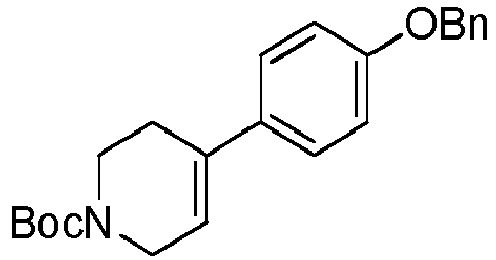
- A solution of commercial 1-(benzyloxy)-4-bromobenzene (104 g, 395 mmol) and commercial tert-butyl 4-(4,4,5,5-tetramethyl-1,3,2-dioxaborolan-2-yl)-5,6-dihydropyridine-1(2H)-carboxylate (147 g, 474 mmol) in 1100 mL of acetonitrile was purged with nitrogen for 2 min. Water (1100 mL) was added, followed by sodium carbonate (126 g, 1186 mmol) and tetrakis(triphenylphosphine)palladium (27.4 g, 23.7 mmol). The reaction mixture was purged with nitrogen for 5 min, and then heated to 90 °C and stirred for 16 h. The reaction mixture was then allowed to cool to rt and diluted with 1 L of ethyl acetate. The layers were separated, and the aqueous layer was extracted with two additional 250 mL portions of ethyl acetate. The organic layers were combined, washed with 200 mL of brine, dried over sodium sulfate, and evaporated in vacuo to provide an off-white solid. The product was purified by silica gel chromatography eluting with 6% ethyl acetate in petroleum ether to provide 129 g (88%) of the desired product. LC/MS RT (conditions A) = 2.732 min, (M-H)+ = 364.0. 1H NMR (300MHz, chloroform-d) δ 7.49 - 7.30 (m, 5H), 7.27 (d, J=10.7 Hz, 2H), 6.99 - 6.87 (m, 2H), 6.03 - 5.87 (m, 1H), 5.07 (s, 2H), 4.05 (d, J=2.6 Hz, 2H), 3.62 (t, J=5.7 Hz, 2H), 2.49 (br. s., 2H), 1.49 (s, 9H).
-

- Sodium borohydride (15.5 g, 410 mmol) was dissolved in THF, and the solution was chilled to 0 °C. Boron trifluoride etherate (52.3 mL, 424 mmol) was added to the solution and the mixture was allowed to warm to rt and stirred for 30 min. Then a solution of tert-butyl 4-(4-(benzyloxy)phenyl)-5,6-dihydropyridine-1(2H)-carboxylate (50 g, 137 mmol, intermediate A) in 500 mL of THF was added and the reaction mixture was stirred for 2 h at rt. A 100 mL portion of water was then added slowly to the mixture (Caution: effervescence is observed). The mixture was diluted with 100 mL of ethanol, and sodium hydroxide (228 mL, 10% solution in water, 0.684 mol) and hydrogen peroxide (20.5 mL, 0.684 mol) were added. The reaction mixture was heated to reflux temperature and stirred for 16 h. The mixture was cooled to 10 °C and diluted with 1 L of DCM. Then the pH was adjusted to 7 with 1.5 L of 1.5 N HCl. The layers were then separated, and the aqueous layer was extracted with an addition two 500 mL portions of DCM. The organic layers were combined, washed with 2 X 1 L of water and 200 mL of brine, dried over sodium sulfate, and evaporated in vacuo to provide an off-white solid. The solid was triturated with 500 mL of pet ether, and isolated by filtration to yield 46.5 grams of product (88%, 99.0% purity by HPLC). LC/MS RT (conditions A) = 2.372 min, (M+H)+ = 382.0. 1H NMR (400MHz, DMSO-d6) δ 7.47 - 7.42 (m, 2H), 7.42 - 7.36 (m, 2H), 7.36 - 7.28 (m, 1H), 7.14 (d, J=9.0 Hz, 2H), 6.92 (d, J=9.0 Hz, 2H), 5.07 (s, 2H), 4.74 (d, J=5.5 Hz, 1H), 4.10 (br. s., 1H), 3.94 (br. s., 1H), 3.46 - 3.35 (m, 1H), 2.47 - 2.31 (m, 2H), 1.70 - 1.61 (m, 1H), 1.55 - 1.45 (m, 2H), 1.42 (s, 9H).
-

- Racemic rel-(3S,4S)-tert-butyl 4-(4-(benzyloxy)phenyl)-3-hydroxypiperidine-1-carboxylate (112 g, intermediate B) was separated into the individual enantiomers using preparative supercritical fluid chromatography under the following conditions: A Thar SFC-250 instrument was utilized with a Lux-Cellulose-2 (250 X 21 mm), 5 µm column eluting with 60% CO2 and 40% of a solution of 0.3% diethylamine in methanol at a flow rate of 100.0 g/min. Sample was injected at 74 mg/mL. Analytical SFC was carried out on Lux-Cellulose-2 (250 X 4.6 mm), 5 µm column eluting with 55% CO2 and 45% of a solution of 0.3% diethylamine in methanol at a flow rate of 3.0 g/min. The recovery was 50.0 g of peak 1 with a retention time of 2.49 minutes, which corresponds to the desired (3S,4S)-tert-butyl 4-(4-(benzyloxy)phenyl)-3-hydroxypiperidine-1-carboxylate. Analytical data matched those from the racemate.
-

- A solution of (3S,4S)-tert-butyl 4-(4-(benzyloxy)phenyl)-3-hydroxypiperidine-1-carboxylate (26 g, 67.8 mmol, intermediate C) in 260 mL of methanol was treated with 1.6 grams of 10% palladium on carbon (13.6 mmol) in a pressure bottle. Hydrogen at 50 psi was introduced, and the reaction mixture was stirred for 16 h.
- The mixture ws filtered through celite and concentrated to a crude product (18.9 g, 64.4 mmol) which was sufficiently pure to carry forward without further purification. LC/MS RT (conditions B) = 2.970 min, (M+H with loss of t-butyl)+ = 238.0. 1H NMR (400MHz, DMSO-d6) δ 9.10 (br. s., 1H), 7.01 (d, J=8.5 Hz, 2H), 6.65 (s, 2H), 4.70 (d, J=5.0 Hz, 1H), 4.09 (br. s., 1H), 3.93 (br. s., 1H), 3.17 (s, 2H), 2.79 - 2.63 (m, 1H), 2.34 (br. s., 1H), 1.68 - 1.57 (m, 1H), 1.44 (br. s., 1H), 1.42 (s, 9H).
-

- A solution of (3S,4S)-tert-butyl 3-hydroxy-4-(4-hydroxyphenyl)piperidine-1-carboxylate (15.5 g, 61.4 mmol, intermediate D) in 270 mL of acteonitrile was chilled to 0 °C. To the stirred solution was added bis(2-methoxyethyl)aminosulfur trifluoride 50% solution in toluene (Deoxo-fluor, 58.4 mL, 159 mmol) dropwise via addition funnel over 65 min. After the addition, the reaction mixture was stirred for 30 min at 0 °C and then allowed to come to rt and stirred for an additional 2 h. A saturated ammonium chloride solution (150 mL) was then added, and the mixture was extracted with two 150 mL portions of DCM. The organic layers were combined, dried over sodium sulfate, and conentrated to afford the crude product. The product was purified by silic gel chromatography (1.5 kg of silica) eluting with a gradient of 0-15% acetone in hexanes to afford 11.9 g (75%) of the desired (3S,4S)-tert-butyl 3-fluoro-4-(4-hydroxyphenyl)piperidine-1-carboxylate. LC/MS RT (conditions B) = 3.295 min, (M+H with loss of t-butyl and elimination of fluorine)+ = 220.0. 1H NMR (400MHz, chloroform-d) δ 7.15 (d, J=8.6 Hz, 2H), 6.83 (dt, J=8.6, 2.0 Hz, 2H), 4.59 - 4.48 (m, 1H), 4.47 - 4.37 (m, 1H), 4.23 - 4.12 (m, 1H), 2.88 - 2.68 (m, 3H), 1.96 - 1.84 (m, 1H), 1.80 - 1.66 (m, 1H), 1.51 (s, 9H).
-

- A solution of (3S,4S)-tert-butyl 3-fluoro-4-(4-hydroxyphenyl)piperidine-1-carboxylate (12.0 g, 40.6 mmol, intermediate E) in anhydrous dioxane (80 mL) was treated with HCl (4 M in 1,4-dioxane, 40.6 mL, 162 mmol). The reaction mixture was allowed to stir at rt for 6 h and then evaporated in vacuo to provide the HCl salt of the desired product. Without further isolation, the HCl salt was suspended in CHCl3 and 80 mL of a satd. NaHCO3 solution was added. The organic layer was separated, and the aqueous layer was extracted with CHCl3 (2 x 100 mL). The organic layers were combined, dried over Na2SO4 and concentrated to give the title compound (7.1 g, 36.4 mmol, 90%). LC/MS RT (conditions B) = 1.008 min, LC/MS (M+H)+ = 196.2.
-

- A stirred solution of commercial (S)-3-hydroxypyrrolidin-2-one (5 g, 49.5 mmol) in DCM (198 ml) was treated with DMAP (0.199 g, 1.632 mmol), imidazole (6.73 g, 99 mmol), and TBDMS-Cl (8.94 g, 59.3 mmol). The reaction mixture was stirred at rt for 16 h, and then was washed with a satd. NaHCO3 solution. The organic layer was concentrated and the crude reaction product was purified by silica gel chromatogpraphy eluting with 50% ethyl acetate in petroleum ether. The desired product was isolated as a white solid (8.1 g, 76%). LC/MS (M+H)+ = 216.2. 1H NMR (400MHz, chloroform-d) δ 6.40 (br. s., 1H), 4.26 (t, J=7.8 Hz, 1H), 3.42 - 3.34 (m, 1H), 3.29 - 3.21 (m, 1H), 2.36 (dtd, J=12.7, 7.3, 3.3 Hz, 1H), 2.07 - 1.96 (m, 1H), 0.91 (s, 9H), 0.15 (d, J=7.0 Hz, 6H).
-

- (S)-3-((tert-butyldimethylsilyl)oxy)pyrrolidin-2-one (5 g, 23.22 mmol, intermediate G) was dissolved in anhydrous THF (46.4 ml) and the reaction mixture was cooled to 0 °C under a nitrogen atmosphere. Sodium hydride (1.393 g, 34.8 mmol) was then added in one portion and the reaction mixture was allowed to stir for 5 min before the dropwise addition of 1-(bromomethyl)-4-methylbenzene (5.37 g, 29.0 mmol) in anhydrous THF (46.4 ml). The reaction was allowed to stir at 0 °C for 5 min, then the cooling bath was removed and mixture was allowed to warm to rt overnight. The reaction was cautiously quenched with water (100 mL) and then extracted with ethyl acetate (3 x 100 mL). The combined organic layers were then washed with brine (200 mL) and dried (MgSO4). Evaporation of the solvent in vacuo gave the crude product (9.6g, oil) which was then purified by silica gel chromatography (330 g of sliica) eluting with a gradient of 0% to 20% ethyl acetate in hexanes to provide 6.53 g (88%) of the desired product. LC/MS (Conditions B), RT = 4.320 min, (M+H)+ = 320.3. 1H NMR (400MHz, chloroform-d) δ 7.15 (s, 4H), 4.42 (s, 2H), 4.37 (t, J=7.6 Hz, 1H), 3.32 - 3.18 (m, 1H), 3.10 (dt, J=9.7, 7.5 Hz, 1H), 2.36 (s, 3H), 2.29 (dtd, J=12.6, 7.6, 3.1 Hz, 1H), 1.97 - 1.84 (m, 1H), 0.95 (s, 9H), 0.20 (d, J=10.3 Hz, 6H).
-

- HCl (4 M in 1,4-dioxane, 25.5 ml, 102 mmol) was added in one portion to a solution of (S)-3-((tert-butyldimethylsilyl)oxy)-1-(4-methylbenzyl)pyrrolidin-2-one (6.53 g, 20.44 mmol, intermediate H) in anyhdrous DCM (20.4 mL) at rt. A slight exotherm was noted. The reaction mixture was allowed to stir at rt for 2 h and then evaporated in vacuo. The residue was taken up in DCM (100 mL) and washed with a satd. sodium bicarbonate solution (100 mL) and brine (50 mL), and then the solution was dried over MgSO4 and concentrated to a residue. The crude product was purified by silica gel chromatography (120 g of silica) eluting with a gradient of 40% to 100% ethyl acetate in hexanes to provide 3.73 g (89%) of the desired product. LC/MS (Conditions B), RT = 2.338 min, (M+H)+ = 206.2. 1H NMR (400 MHz, chloroform-d) δ 7.26 - 7.02 (m, 4H), 4.43 (d, J=3.5 Hz, 2H), 4.41 - 4.37 (m, 1H), 3.66 (d, J=2.6 Hz, 1H), 3.34 - 3.05 (m, 2H), 2.41 (dddd, J=12.8, 8.4, 6.6, 2.2 Hz, 1H), 2.34 (s, 3H), 1.93 (dq, J=12.8, 8.8 Hz, 1H).
-

- Triethylamine (0.509 ml, 3.65 mmol) was added to a cooled solution of (S)-3-hydroxy-1-(4-methylbenzyl)pyrrolidin-2-one (0.5 g, 2.436 mmol, intermediate I) in anhydrous DCM (12.18 ml) at 0 °C under a nitrogen atmosphere. Methanesulfonyl chloride (0.198 ml, 2.56 mmol) was then added dropwise and the reaction was allowed to stir at 0 °C for 15 min before quenching with a satd. sodium bicarbonate solution (10 mL). The mixture was allowed to warm to rt and the aqueous layer was separated and extracted with DCM (2 x). The combined oranic layers were dried over MgSO4 and evaporated in vacuo to give a white solid (0.73g) which was then purified by silica gel chromatography (40 g of silica) eluting with a gradient of 0% to 50% ethyl acetate in hexanes to provide 0.63 g (91%) of the desired product as a white solid.
-

- A 60% dispersion of sodium hydride in mineral oil (232 mg, 5.31 mmol) was added to a stirred solution of (S)-3-((tert-butyldimethylsilyl)oxy)pyrrolidin-2-one (762 mg, 3.54 mmol, intermediate G) in THF (7 mL) at 0 °C. After 15 min, a solution of 1-(bromomethyl)-4-(difluoromethyl)benzene (980 mg, 4.43 mmol) in THF (7 mL) was added to the reaction mixture. The resulting mixture was stirred at room temperature for 6 h. The reaction was carefully quenched with several grams of ice pellets. The resulting mixture was extracted with EtOAc. The combined organic layers were washed with water, dried over sodium sulfate, filtered and concentrated in vacuo. The crude reaction mixture was purified using silica gel column chromatography (0-30% EtOAc/hexanes) to afford the desired product (440 mg, 35 % yield) as a white solid: LCMS (M+H)+ 356.3; 1H NMR (500MHz, chloroform-d) δ 7.49 (d, J=8.1 Hz, 2H), 7.35 (d, J=7.9 Hz, 2H), 6.65 (br. t, J=1.0 Hz, 1H), 4.56 - 4.44 (m, 2H), 4.38 (t, J=7.5 Hz, 1H), 3.27 (ddd, J=9.7, 8.7, 3.4 Hz, 1H), 3.13 (dt, J=9.7, 7.4 Hz, 1H), 2.36 - 2.27 (m, 1H), 1.98 - 1.90 (m, 1H), 0.96 (br. s., 9H), 0.22 - 0.20 (m, 3H), 0.20 - 0.18 (m, 3H).
-

- A solution of 4 M HCl in dioxane (0.62 mL, 2.5 mmol) was added to a stirred solution of (S)-3-((tert-butyldimethylsilyl)oxy)-1-(4-(difluoromethyl)benzyl)pyrrolidin-2-one (440 mg, 1.24 mmol, intermediate K) in dichloromethane (1.24 mL) at rt. The reaction mixture was stirred for 2 h. The reaction mixture was concentrated in vacuo to afford the desired product (368 mg, quantitative yield): LC-MS (M+H)+ 242.1.
-

- Triethylamine (0.319 mL, 2.29 mmol) and methansulfonyl chloride (0.131 mL, 1.68 mmol) was added to a stirred solution of (S)-1-(4-(difluoromethyl)benzyl)-3-hydroxypyrrolidin-2-one (368 mg, 1.53 mmol, intermediate L) in dichloromethane (7.63 mL) at 0°C. The reaction mixture was stirred at 0°C for 1 h. The resulting mixture was diluted with water and the aqueous mixture was extracted with dichloromethane. The combined organic layers were washed with 10% sodium bicarbonate solution, dried over sodium sulfate, filtered, and concentrated in vacuo. The crude material was purified using silica gel column chromatography (0-100% EtOAc). The pure fractions were combined and concentrated in vacuo to afford the desired product (322 mg, 66 % yield) as a white solid: LC-MS (M+H)+ 320.1; 1H NMR (500MHz, chloroform-d) δ 7.53 (d, J=7.9 Hz, 2H), 7.38 - 7.33 (m, 2H), 6.67 (br. t, J=1.0 Hz, 1H), 5.27 (dd, J=8.2, 7.5 Hz, 1H), 4.60 - 4.49 (m, 2H), 3.41 - 3.35 (m, 1H), 3.33 (s, 3H), 3.27 (dt, J=9.9, 7.3 Hz, 1H), 2.64 - 2.55 (m, 1H), 2.27 (ddt, J=13.9, 8.9, 7.1 Hz, 1H).
-

- A mixture of commercial tert-butyl 4-oxopiperidine-1-carboxylate (2.0 g, 10.0 mmol) and diethyl ether (30 ml) was cooled to 0 °C. To this mixture was added dropwise a solution of (4-methoxyphenyl)magnesium bromide (0.5 M in diethyl ether, 30 ml, 15 mmol). After complete addition, the reaction mixture was allowed to warm to rt and stirred for 2 h. It was then slowly quenched with 150 ml of ice cold water and then the resulting mixture was extracted with 3x150 ml of DCM. The organic layers were combined, dried, filtered, and concentrated under vacuum. The crude product was purified by silica gel column chromatography (30:70 ethyl acetate:hexane) to provide the desired product (3.0 g, 100 % yield): LC-MS(ES-API): m/z 305.5 (M-H)+; 1H NMR (400 MHz, DMSO-d6) δ 7.37 (q, J=1.0 Hz, 2H), 6.86 (q, J=1.0 Hz, 2H), 4.94 (s, 1H), 3.82 (d, J=11.5 Hz, 2H), 3.73 (s, 3H), 3.13 (br. s, 2H), 1.75 (td, J=12.9, 4.8 Hz, 2H), 1.56 (d, J=12.3 Hz, 2H), 1.41 (s, 9H).
-

- A mixture of tert-butyl 4-hydroxy-4-(4-methoxyphenyl)piperidine-1-carboxylate (700 mg, 2.27 mmol, intermediate N) and HCl in dioxane (4.0 ml, 16 mmol) was stirred at rt for 3 h. The crude mass was concentrated under vacuum and the solid residue was washed with 3x10 ml of DCM to remove non-polar impurities. The desired salt was collected as a fine solid (480 mg, 93%). LCMS (ES-API) m/z 190.2 (M+H)+; 1H NMR (400 MHz, DMSO-d6) δ 7.37 (d, J=9.0 Hz, 2H), 6.98 (d, J=9.0 Hz, 2H), 6.08 - 5.98 (m, 1H), 5.11 (s, 1H), 3.97 (br. s., 1H), 3.52 (s, 1H), 3.32 (s, 3H), 2.47 - 2.37 (m, 1H).
-

- To a stirred solution of 4-(4-methoxyphenyl)-1,2,3,6-tetrahydropyridine, HCl (3.00 g, 13.3 mmol, intermediate O) in methanol (20 mL) was added 10% palladium on carbon (1.4 g) and the reaction mixture was stirred at 20 psi of hydrogen for 12 h. The reaction mixture was filtered through a pad of celite, which was washed with ethyl acetate, and the combined organic fractions were concentrated to obtain a white solid (2.0 g, 70% yield): LCMS (ES-API), m/z 192.1 (M+H)+; 1H NMR (300 MHz, DMSO-d6) δ 9.13 - 8.36 (m, 2H), 7.14 (d, J=8.7 Hz, 2H), 6.90 (d, J=8.7 Hz, 2H), 3.73 (s, 3H), 3.07 - 2.87 (m, 4H), 2.87 - 2.65 (m, 4H).
-

- TEA (8.91 mL, 63.9 mmol) and 2,4-dibromobutanoyl chloride (5.07 mL, 38.4 mmol) were sequentionall added to solution of commercial (4-fluorophenyl)methanamine (4.0 g, 32.0 mmol) in diethyl ether (15 mL) at 0 °C. The reaction mixture was allowed to warm to rt and stir for an additional 24 h. The reaction mixture was filtered. The solids were washed with diethyl ether . The filtrate was concentrated in vacuo to afford a crude mixture containing 2,4-dibromo-N-(4-fluorobenzyl)butanamide (8.0 g, 71 % yield): LCMS (ES-API), m/z 354, 356 (M+H)+.
-

- A 60% dispersion of NaH in mineral oil (1.70 g, 42.5 mmol) was added to a stirred solution of 2,4-dibromo-N-(4-fluorobenzyl)butanamide (10.0 g, 28.3 mmol, intermediate Q) in THF (25 mL) at 0 °C. The reaction mixture was allowed to warm to rt and stir for and additional 2 h. The reaction mixture was carefully quenched with ice and diluted with water. The resulting mixture was extracted with EtOAc. The combined organic layers were washed with water and then brine solution. The organic layer was over sodium sulfate, filtered, and concentrated in vacuo. The crude product was purified using silica gel column chromatography (10% EtOAc/hexanes) to afford the desired product (5.90 g, 64 % yield): LCMS (ES-API), m/z 272.4, 274.3 (M+H)+; 1H NMR (400 MHz, DMSO-d 6) δ ppm 2.12 - 2.27 (m, 1 H) 2.56 - 2.68 (m, 1 H) 3.27 (dd, J=7.78, 3.26 Hz, 2 H) 4.29 - 4.38 (m, 1 H) 4.40 - 4.57 (m, 1 H) 4.73 (dd, J=7.03, 3.01 Hz, 1 H) 7.04 - 7.35 (m, 4 H).
-

- TEA (0.768 mL, 5.51 mmol) was added to a stirred solution of 3-bromo-1-(4-fluorobenzyl)pyrrolidin-2-one (0.3 g, 1.10 mmol, intermediate R) and 4-(4-methoxyphenyl)piperidine hydrochloride (0.276 g, 1.213 mmol, intermediate P) in acetonitrile (10 mL). The reaction mixture was sealed and heated in a chemistry microwave at 100 °C for 1 h. The reaction mixture was cooled to rt and concentrated in vacuo. The residue was diluted with EtOAc. The organic mixture was washed with water and brine solution. The organic layer was dried over sodium sulfate, filtered and concentrated in vacuo to afford a crude mixture containing 1-(4-fluorobenzyl)-3-(4-(4-methoxyphenyl)piperidin-1-yl)pyrrolidin-2-one (0.35 g, 83 % yield): LCMS (ES-API), m/z 383.2 (M+H)+.
-

- A solution of 4-((3S,4S)-3-fluoropiperidin-4-yl)phenol (7.10 g, 36.4 mmol, intermediate F) and DIEA (16 mL, 92 mmol) in 100 mL of acetonitrile was heated to 80 °C. This solution was treated dropwise with a solution of (S)-1-(4-methylbenzyl)-2-oxopyrrolidin-3-yl methanesulfonate (10.5 g, 37.0 mmol, intermediate J) in acetonitrile (80 mL) over a period of 4 hours. After the addition was completed, the reaction mixture was stirred at 80 °C for 16 h. The reaction mixture was then allowed to cool to rt, and the volume was reduced by rotary evaporation to 80 mL. A satd. NH4Cl solution (100 mL) was then added, and the layers were separated. The aqueous layer was extracted with DCM (2 x 100 mL) and the organic layers were combined, dried over Na2SO4 and concentrated in vacuo to give a crude product. The crude product was purified by silica gel chromatography (750 g of silica gel) eluting with a gradient of 0% to 20% of solvent B in solvent A, where Solvent B = 20% methanol/DCM and solvent A = DCM. Fractions containing the product were combined. Evaporation of the solvents gave 9.3 grams of the desired product with 97% purity by LC/MS analysis (conditions B). The product thus obtained (8.5 g) was slurried in acetone:hexane (1:5, 200 mL) and the solid product was isolated by filtration and air dried. Careful SFC analysis showed the presence of a 2.1 % impurity in the product. Using a Cell4 0.46 X 25 cm 5 µm column and eluting with 45% methanol in CO2 at 3 mL/min, the desired product eluted at 3.800 minutes and the undesired impurity eluted at 4.848 minutes. The product was then further purified by SFC Chromatography using a Cell4 3 X 25 cm 5 µm column at 150 mL/min injecting 1.5 mL of a 80 mg/mL solution. Concentration of the active fractions provided 7.82 grams (20.4 mmol, 56%) of >99.7% pure example 1 as a white powder. LC/MS (Conditions B), RT = 2.512 min, (M+H)+ = 383.3. 19F NMR δ -182.83. 1H NMR (400MHz, chloroform-d) δ 7.20 - 7.08 (m, 6H), 6.98 - 6.78 (m, 2H), 5.68 (s, 1H), 4.77 - 4.54 (m, 1H), 4.53 - 4.34 (m, 2H), 3.68 (t, J=8.8 Hz, 1H), 3.41 - 3.29 (m, 1H), 3.28 - 3.09 (m, 2H), 2.82 (d, J=10.8 Hz, 1H), 2.74 - 2.54 (m, 2H), 2.47 (td, J=9.9, 3.6 Hz, 1H), 2.34 (s, 3H), 2.19 - 1.94 (m, 2H), 1.92 - 1.80 (m, 2H). 13C NMR (101MHz, chloroform-d) δ 172.4, 154.9, 137.5, 133.3, 133.0, 129.5, 128.7, 128.3, 115.5, 92.6, 90.8, 65.0, 54.4, 54.2, 48.7, 48.0, 47.8, 46.8, 43.7, 31.7, 31.6, 21.1, 19.6.
-

- To a suspension of (R)-3-((3S,4S)-3-fluoro-4-(4-hydroxyphenyl)piperidin-1-yl)-1-(4-methylbenzyl)pyrrolidin-2-one (100 mg, 0.261 mmol, example 1) in 10 mL of dichloromethane was added pyridine (0.106 mL, 1.31 mmol) and DMAP (160 mg, 1.31 mmol). The reaction mixtue was chilled to -20 °C. To the chilled sloution was added POCl3 (0.122 mL, 1.31 mmol) dropwise, and then the reaction mixture was allowed to warm to rt and stirreed for 1 h. Water (10 mL) was added and the mixture was stirred for 1.5 h. The layers were then separated and the organic layer was dried over Na2SO4 and evaporated to dryness. The crude product was purified by HPLC on a Symmetry C8 (300 X 17 mm) 7 mM column eluting with a gradient of 20% B to 50% B over 7 minutes at 15 mL/min where solvent A = 10 mM ammonium acetate in water pH 4.5 and solvent B = acetonitrile. The product RT = 2.2 min. The desired product (5.8 mg, 4.7%) was isolated from the appropriate fractions by lyophilization as a white solid. LCMS (Contitions A) RT = 1.720 min, (M+H)+ = 463.2. 1H NMR (400MHz, methanol-d4) δ 7.29 - 7.16 (m, 8H), 4.74 (br. s., 1H), 4.61 - 4.34 (m, 2H), 4.01 (t, J=8.3 Hz, 1H), 3.82 - 3.62 (m, 1H), 3.35 (m, 2H), 3.05 (br. s., 2H), 2.79 (br. s., 2H), 2.34 (s, 4H), 2.18 (br. s., 1H), 2.02 - 1.87 (m, 1H), 1.83 (br. s., 1H). 19F NMR (376 MHz, methanol-d4) δ -185.143. 31P NMR (162 MHz, methanol-d4) δ - 4.260.
-

-

- To a solution of (R)-3-((3S,4S)-3-fluoro-4-(4-hydroxyphenyl)piperidin-1-yl)-1-(4-methylbenzyl)pyrrolidin-2-one (0.02 g, 0.052 mmol, example 1) in DCM (3 mL) was added (S)-2-((tert-butoxycarbonyl)amino)-3-methylbutanoic acid (0.059 g, 0.272 mmol) followed by DCC (0.032 g, 0.157 mmol) and DMAP (6.39 mg, 0.052 mmol). The reaction mixture was stirred at room temperature for 18 h. Water (10 mL) was then added, and the layers were separated. The aqueous layer was extracted with DCM (3 x 10 mL) and the organic layers were combined, dried over Na2SO4, and concentrated to a crude product. The crude product was purified by preparative TLC eluting with 35% ethyl acetate in petroleum ether to provide the purified product (S)-4-((3S,4S)-3-fluoro-1-((R)-1-(4-methylbenzyl)-2-oxopyrrolidin-3-yl)piperidin-4-yl)phenyl 2-((tert-butoxycarbonyl)amino)-3-methylbutanoate (27 mg, 79%). LC/MS (Conditions A) RT = 2.523 min, (M+H)+ = 582.2. 1H NMR (400MHz, methanol-d4) δ 7.36 (d, J=8.5 Hz, 2H), 7.18 (s, 4H), 7.08 (d, J=8.5 Hz, 2H), 4.80 - 4.59 (m, J=10.0, 10.0, 5.0 Hz, 1H), 4.51 (d, J=15.0 Hz, 1H), 4.39 (d, J=15.0 Hz, 1H), 4.23 (dd, J=8.3, 6.3 Hz, 1H), 3.72 (t, J=8.8 Hz, 1H), 3.56 - 3.40 (m, 1H), 3.32 - 3.22 (m, 2H), 2.86 - 2.61 (m, 2H), 2.47 (td, J=10.0, 5.0 Hz, 1H), 2.34 (s, 3H), 2.32 - 2.23 (m, 1H), 2.22 - 2.01 (m, 2H), 1.88 (dd, J=9.5, 4.0 Hz, 2H), 1.74 (dt, J=13.4, 3.8 Hz, 1H), 1.50 (s, 9H), 1.42 - 1.30 (m, 1H), 1.09 (dd, J=10.0, 7.0 Hz, 6H). 19F NMR (376 MHz, methanol-d4) δ -184.32.
-
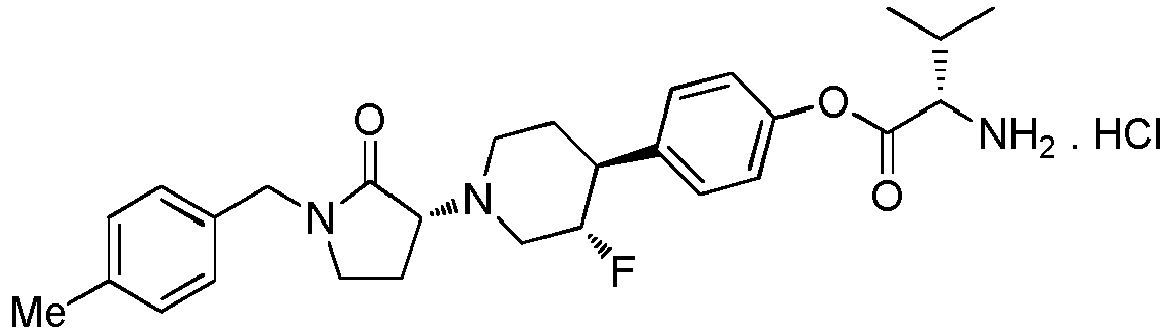
- To a solution of (S)-4-((3S,4S)-3-fluoro-1-((R)-1-(4-methylbenzyl)-2-oxopyrrolidin-3-yl)piperidin-4-yl)phenyl 2-((tert-butoxycarbonyl)amino)-3-methylbutanoate (0.025 g, 0.043 mmol) in DCM (1.5 mL) at -20 °C was added HCl in diethyl ether (2.5 ml, 2.50 mmol, 1.0 M). The reaction mixture was slowly warmed to rt over 10 min and then allowed to stir at rt for 19 h. The solvent was then removed in vacuo to provide a pale yellow semisolid. The crude product was then purified by RP-HPLC on a Sunfire C18 (250 X 20 mm) 5 µm column using a gradient of 10% solvent B to 75% solvent B over 12 minutes at 15 mL/min where solvent A = 0.05% HCl in water and solvent B = acetonitrile. Active fractions were concentrated by lyophilization to provide 10.2 mg (44%) of (S)-4-((3S,4S)-3-fluoro-1-((R)-1-(4-methylbenzyl)-2-oxopyrrolidin-3-yl)piperidin-4-yl)phenyl 2-amino-3-methylbutanoate hydrochloride, the titled compound of example 2 as an off-white solid. LC-MS (Method A) RT = 2.20 min, (M+H)+ = 482.2. 1H NMR: (400 MHz, DMSO-d6) δ ppm 8.64 - 8.78 (m, 3 H) 7.38 - 7.46 (m, 2 H) 7.23 (d, J=8.53 Hz, 2 H) 7.18 (s, 4 H) 5.04 - 5.26 (m, 1 H) 4.42 (d, J=9.54 Hz, 3 H) 4.17 - 4.23 (m, 2 H) 3.29 - 3.40 (m, 4 H) 3.19 - 3.28 (m, 2 H) 2.30 (s, 6 H) 2.04 - 2.19 (m, 2 H) 1.11 (dd, J=12.55, 7.03 Hz, 6 H). 19F NMR (376 MHz, DMSO-d6) δ -183.904.
-

-

- To a solution of (R)-3-((3S,4S)-3-fluoro-4-(4-hydroxyphenyl)piperidin-1-yl)-1-(4-methylbenzyl)pyrrolidin-2-one (0.03 g, 0.078 mmol, example 1) in DCM (5 mL) was added (S)-2-((tert-butoxycarbonyl)amino)propanoic acid (0.077 g, 0.408 mmol) followed by DCC (0.049 g, 0.235 mmol) and DMAP (9.58 mg, 0.078 mmol). The reaction mixture was stirred at rt for 18 h. Water (15 mL) was then added, and the layers were separated. The aqueous layer was extracted with DCM (3 x 15 mL) and the organic layers were combined, dried over Na2SO4, and concentrated to a crude product. The crude product was purified by preparative TLC eluting with 20% ethyl acetate in petroleum ether to provide the purified product (S)-4-((3S,4S)-3-fluoro-1-((R)-1-(4-methylbenzyl)-2-oxopyrrolidin-3-yl)piperidin-4-yl)phenyl 2-((tert-butoxycarbonyl)amino)propanoate (0.032 g, 0.058 mmol, 74 % yield) as off-white semi solid. LC-MS (Method A) RT = 2.40 min, (M+H)+ = 554.2. 1H NMR (400MHz, DMSO-d6) δ 7.51 (d, J=7.0 Hz, 1H), 7.44 - 7.32 (m, J=8.5 Hz, 2H), 7.21 - 7.09 (m, 4H), 7.07 - 6.98 (m, J=8.5 Hz, 2H), 4.62 (d, J=4.5 Hz, 1H), 4.39 (d, J=15.1 Hz, 1H), 4.30 (d, J=15.1 Hz, 1H), 4.27 - 4.17 (m, 1H), 3.58 (t, J=8.5 Hz, 1H), 3.50 - 3.40 (m, 1H), 3.22 - 3.07 (m, 2H), 2.81 - 2.64 (m, 3H), 2.39 - 2.31 (m, 1H), 2.29 (s, 3H), 2.17 - 2.04 (m, 1H), 1.93 (dd, J=12.8, 8.3 Hz, 1H), 1.78 (br. s., 1H), 1.74 - 1.59 (m, 1H), 1.41 (s, 9H), 1.39 (d, J=2.5 Hz, 3H). 19F NMR (376 MHz, DMSO-d6) δ - 180.172.
-

- To a solution of (S)-4-((3S,4S)-3-fluoro-1-((R)-1-(4-methylbenzyl)-2-oxopyrrolidin-3-yl)piperidin-4-yl)phenyl 2-((tert-butoxycarbonyl)amino)propanoate (0.032 g, 0.058 mmol) in DCM (2 mL) at -20 °C was added HCl in diethyl ether (2.0 ml, 2.0 mmol, 1.0 M). The reaction mixture was slowly warmed to rt over 10 min and then allowed to stir at rt for 19 h. The solvent was then removed in vacuo to provide a pale yellow semisolid. The crude product was then purified by RP-HPLC on a Kinetex C18 (250 X 20 mm) 5 µm column using a gradient of 10% solvent B to 40% solvent B over 7 minutes at 15 mL/min where solvent A = 0.05% HCl in water and solvent B = acetonitrile. Active fractions were concentrated by lyophilization to provide 4.7 mg (16%) of (S)-4-((3S,4S)-3-fluoro-1-((R)-1-(4-methylbenzyl)-2-oxopyrrolidin-3-yl)piperidin-4-yl)phenyl 2-aminopropanoate hydrochloride, the titled compound of example 4 as an off-white solid. LC-MS (Method A) RT = 1.762 min, (M+H)+ = 454. 1H NMR (400MHz, DMSO-d6) δ 7.41 (d, J=9.0 Hz, 2H), 7.24 - 7.10 (m, 6H), 5.10 - 4.85 (m, 1H), 4.45 - 4.22 (m, 4H), 4.04 - 3.94 (m, 1H), 3.34 - 3.18 (m, 4H), 3.06 (d, J=12.0 Hz, 2H), 2.43 - 2.31 (m, 1H), 2.27 (s, 3H), 2.24 - 2.14 (m, 1H), 2.13 - 2.01 (m, 1H), 2.01 - 1.85 (m, 1H), 1.58 (d, J=7.0 Hz, 3H). 19F NMR (376 MHz, DMSO-d6) δ -183.778.
-

-

- To a solution of (R)-3-((3S,4S)-3-fluoro-4-(4-hydroxyphenyl)piperidin-1-yl)-1-(4-methylbenzyl)pyrrolidin-2-one (0.03 g, 0.078 mmol) in DCM (5 mL) was added (S)-4-(tert-butoxy)-3-((tert-butoxycarbonyl)amino)-4-oxobutanoic acid (0.118 g, 0.408 mmol) followed by DCC (0.049 g, 0.235 mmol) and DMAP (9.58 mg, 0.078 mmol). The reaction was stirred at rt for 18 hours. Water (15 mL) was then added, and the layers were separated. The aqueous layer was extracted with DCM (3 x 15 mL) and the organic layers were combined, dried over Na2SO4, and concentrated to a crude product. The crude product was purified by preparative TLC eluting with 25% ethyl acetate in petroleum ether to provide the purified product (37 mg, 68%) as an off-white semi solid. LC-MS (Method A) RT = 2.55 min, (M+H)+ = 654.4. 1H NMR (400MHz, DMSO-d6) δ 7.46 - 7.34 (m, 2H), 7.20 - 6.98 (m, 6H), 4.82 - 4.53 (m, 1H), 4.43 - 4.24 (m, 2H), 4.11 (d, J=14.1 Hz, 1H), 3.58 (t, J=8.8 Hz, 1H), 3.48 - 3.39 (m, 1H), 3.22 - 3.07 (m, 3H), 3.02 (dd, J=16.1, 6.5 Hz, 1H), 2.87 (dd, J=15.8, 7.8 Hz, 1H), 2.78 - 2.63 (m, 2H), 2.38 - 2.31 (m, 1H), 2.29 (s, 3H), 2.17 - 2.03 (m, 1H), 1.98 - 1.86 (m, 1H), 1.78 (br. s., 1H), 1.74 - 1.58 (m, 1H), 1.42 (s, 9H), 1.39 (s, 9H). 19F NMR (376 MHz, DMSO-d6) δ -180.707.
-

- To a solution of (S)-1-tert-butyl 4-(4-((3S,4S)-3-fluoro-1-((R)-1-(4-methylbenzyl)-2-oxopyrrolidin-3-yl)piperidin-4-yl)phenyl) 2-((tert-butoxycarbonyl)amino)succinate (0.032 g, 0.049 mmol) in DCM (2 mL) at -20 °C was added HCl in diethyl ether (2.0 ml, 2. 0 mmol, 1.0 M). The reaction mixture was slowly warmed to rt over 10 min and then allowed to stir at rt for 19 h. The solvent was then removed in vacuo to provide a pale yellow semisolid. The crude product was then purified by RP-HPLC on a YMC Triart C18 (150 X 19 mm) 5 µm column using a gradient of 10% solvent B to 40% solvent B over 7 minutes at 15 mL/min where solvent A = 0.05% HCl in water and solvent B = acetonitrile. Active fractions were concentrated by lyophilization to provide 17 mg (57%) of (S)-2-amino-4-(4-((3S,4S)-3-fluoro-1-((R)-1-(4-methylbenzyl)-2-oxopyrrolidin-3-yl)piperidin-4-yl)phenoxy)-4-oxobutanoic acid hydrochloride, the titled compound of example 5 as an off-white solid. LC-MS (Method A) RT = 1.808 min, (M+H)+ = 498.2 1H NMR (400MHz, DMSO-d6) δ 7.36 (d, J=8.5 Hz, 2H), 7.21 - 7.03 (m, 8H), 6.75 (d, J=8.5 Hz, 1H), 4.95 - 4.72 (m, 1H), 4.42 - 4.24 (m, 3H), 4.10 (t, J=5.3 Hz, 1H), 4.07 - 4.01 (m, 1H), 3.93 - 3.84 (m, 1H), 3.83 - 3.68 (m, 1H), 3.33 - 3.10 (m, 5H), 3.04 (br. s., 1H), 2.93 (br. s., 1H), 2.89 - 2.71 (m, 2H), 2.26 (s, 3H), 1.96 (br. s., 1H), 1.82 (br. s., 1H). 19F NMR (376 MHz, DMSO-d6) δ -180.707.
-

- A solution of (S)-1-(4-(difluoromethyl)benzyl)-2-oxopyrrolidin-3-yl methanesulfonate (500 mg, 1.57 mmol, intermediate M) in 5.0 mL of acetonitrile was added dropwise over 1.5 h to a stirred mixture of 4-((3S,4S)-3-fluoropiperidin-4-yl)phenol, hydrochloride (363 mg, 1.57 mmol, intermediate F) and N,N-diisopropylethylamine (1.09 mL, 6.26 mmol) in 5.0 mL of acetonitrile maintained at 85 °C. After complete addition, the reaction mixture was stirred at 85 °C for 16 h. The reaction mixture was concentrated in vacuo. The residue was purified using silica gel column chromatography (0-100% EtOAc/hexanes) to afford a diasteromeric mixture (partial epimerization of the lactam stereocenter) of 1-(4-(difluoromethyl)benzyl)-3-((3S,4S)-3-fluoro-4-(4-hydroxyphenyl)piperidin-1-yl)pyrrolidin-2-one (235 mg, 35 % yield). A sample of the diastereomeric mixture (780 mg) was separated by preparative chiral SFC (column = Lux Cellulose-2 (21 x 250 mm, 5 µm); isocratic solvent = 20% methanol (with 15 mM ammonia) / 80% CO2; temp = 35 ° C; flow rate = 60 mL/min; injection volumn = 1.0 mL (∼20 mg/mL in MeOH) stacked @ 13 min intervals; λ = 210 nM; Peak 1 = 19.6 min, Peak 2 = 24.5 min) to afford the titled compounds of example 6 (Peak-1, 389 mg) and (S)-1-(4-(difluoromethyl)benzyl)-3-((3S,4S)-3-fluoro-4-(4-hydroxyphenyl)piperidin-1-yl)pyrrolidin-2-one (Peak 2, 242 mg). Data for Example 6: LC-MS m/z 419.3 (M+H+); 1H NMR (500MHz, chloroform-d) δ 7.50 (d, J=7.9 Hz, 2H), 7.34 (d, J=7.9 Hz, 2H), 7.15 (d, J=8.5 Hz, 2H), 6.91 - 6.80 (m, 2H), 6.65 (t, J=56.4 Hz, 1H), 4.96 (s, 1H), 4.77 - 4.43 (m, 3H), 3.68 (t, J=8.8 Hz, 1H), 3.42 - 3.33 (m, 1H), 3.29 - 3.14 (m, 2H), 2.85 (d, J=10.4 Hz, 1H), 2.78 - 2.69 (m, 1H), 2.69 - 2.57 (m, 1H), 2.48 (td, J=9.9, 4.9 Hz, 1H), 2.21 - 2.11 (m, 1H), 2.04 (dq, J=13.0, 8.6 Hz, 1H), 1.94 - 1.82 (m, 2H)). The relative and absolute configuration of Example 114, P-1 was confirmed by single crystal X-ray analysis.
-

- To a suspension of (R)-1-(4-(difluoromethyl)benzyl)-3-((3S,4S)-3-fluoro-4-(4-hydroxyphenyl)piperidin-1-yl)pyrrolidin-2-one (100 mg, 0.239 mmol, from example 6) in dichloromethane (10 mL) was added triethylamine (0.233 ml, 1.67 mmol) at - 20°C. To the chilled sloution was added POCl3 (0.111 ml, 1.20 mmol) at -20°C, and then the reaction mixture was stirred for 2-3 hours at -20 °C. Water (10 mL) was added and the mixture was stirred for 1.5 h. The mixture was extracted with dichloromethane. The organic layers was dried over sodium sulfate, filtered, and concentrated in vacuo. The crude product was purified by reverse phase preparatory HPLC on a LUNA C8 (250 mm x 19 mm ID) 5 µm column eluting with a gradient of solvent A = 10 mM ammonium acetate in water pH 4.5 and solvent B = acetonitrile. The titled compound of example 7 (21 mg, 18 %) was isolated from the appropriate fractions by lyophilization as a white solid. LCMS (M+H)+ = 499.2; 1H NMR (400MHz, METHANOL-d4) δ ppm 7.55 (d, J=8.03 Hz, 2 H) 7.41 (d, J=8.03 Hz, 2 H) 7.21 (s, 4 H) 6.62 - 6.92 (m, 1 H) 4.51 - 4.64 (m, 3 H) 3.76 (t, J=8.78 Hz, 1 H) 3.43 - 3.51 (m, 1 H) 3.36 (d, J=6.02 Hz, 1 H) 3.26 - 3.30 (m, 1 H) 2.81 (br. s., 1 H) 2.70 - 2.78 (m, 1 H) 2.59 - 2.69 (m, 1 H) 2.48 (td, J=9.91, 4.77 Hz, 1 H) 2.17 - 2.27 (m, 1 H) 2.06 - 2.15 (m, 1 H) 1.80 - 1.89 (m, 2 H).
-

- To a solution of 1-(4-fluorobenzyl)-3-(4-(4-methoxyphenyl)piperidin-1-yl)pyrrolidin-2-one (3 g, 7.9 mmol, intermediate S) in dry dichloromethane (100 mL) under a N2 atmosphere at -78 °C was added 1 M borontribromide in dichloromethane (39 mL, 39 mmol) and the resulting mixture was allowed to warm up to room temperature over 3 h, with stirring. The reaction was quenched with water (30 mL) and the organic layer was separated, washed with water and brine, and concentrated. The crude product was purified by flash chromatography on silica gel using 15% EtOAc in petroleum ether to yield racemic 1-(4-fluorobenzyl)-3-(4-(4-hydroxyphenyl)piperidin-1-yl)pyrrolidin-2-one (2.1g, 73% yield); 1H NMR (400 MHz, DMSO-d6) δ ppm 1.49 - 1.74 (m, 4 H) 1.90 - 2.11 (m, 2 H) 2.24 - 2.42 (m, 2 H) 2.65 - 2.80 (m, 2 H) 2.99 - 3.23 (m, 3 H) 3.40 - 3.54 (m, 1 H) 4.27 - 4.46 (m, 2 H) 6.61 - 6.70 (m, 2 H) 6.95 - 7.04 (m, 2 H) 7.17 - 7.31 (m, 4 H) 9.10 - 9.16 (m, 1 H). LCMS (ES-API) 369.2 m/z (M+H)+. A portion of the racemate (40 mg) was separated via SFC on a Chiralpak-IA 250mm X 4.6 mm, 5 µm column eluting with 35% solvent B, where solvent A = CO2 and solvent B = 0.3% DEA in methanol at a total flow of 3 mL/min. Peak 1 showed a RT of 4.35 min (11 mg) and Peak 2 showed a RT of 6.29 min (13 mg). Data for example 8 (Peak 2): LC/MS (M+H)+ = 369.2; 1H NMR (400 MHz, DMSO-d6) δ ppm 1.47 - 1.59 (m, 1 H) 1.65 - 1.75 (m, 1 H) 1.84 - 1.96 (m, 1 H) 2.03 - 2.12 (m, 1 H) 2.24 - 2.43 (m, 1 H) 2.63 - 2.72 (m, 2 H) 2.72 - 2.85 (m, 2H) 2.96 - 3.05 (m, 2 H) 3.09 - 3.23 (m, 2 H) 3.41 - 3.54 (m, 1 H) 4.23 - 4.50 (m, 2 H) 6.58 - 6.71 (m, 2 H) 6.96 - 7.10 (m, 2 H) 7.15 - 7.21 (m, 2 H) 7.26 - 7.34 (m, 2 H) 9.06 - 9.19 (m, 1 H).
-

- Phosphorus oxychloride (1.27 mL, 13.6 mmol) was added to a round bottom flask charged with THF (10 mL). The solution was cooled below 0 °C using an ice/methanol bath. A suspension of (R)-1-(4-fluorobenzyl)-3-(4-(4-hydroxyphenyl)piperidin-1-yl)pyrrolidin-2-one (1.00 g, 2.71 mmol, example 8) in THF (18 mL) was added. After 5 min, triethylamine (0.946 mL, 6.79 mmol) was added slowly at a bath temperature below 5 °C. The reaction mixture was stirred at 0 °C for 90 min. A solution of 1 N aqueous sodium hydroxide (8.69 mL, 8.69 mmol) was added dropwise. The pH was measured to be ∼0. The mixture was allowed to warm to rt and stir for 3 h. The crude reaction mixture was concentrated in vacuo at < 30 °C to afford a clear solution. The solution was triturated with 1 N aqueous NaOH to pH ∼1. The mixture was cooled in an ice bath. A semi-solid crashed out. All liquid was decanted off. The semi-solid was suspended in 90% ethanol and then a collected by vacuum filtration. The product was presumed to be the HCl salt of (R)-4-(1-(1-(4-fluorobenzyl)-2-oxopyrrolidin-3-yl)piperidin-4-yl)phenyl dihydrogen phosphate (560 mg, 42 %). A solution of 25 % sodium methoxide in methanol (250 mg, 1.16 mmol) was added to a slurry of (R)-4-(1-(1-(4-fluorobenzyl)-2-oxopyrrolidin-3-yl)piperidin-4-yl)phenyl dihydrogen phosphate, HCl (560 mg, 1.16 mmol) in methanol. The mixture was stirred until clear and then concentrated in vacuo. The residue was dissolved in 90 % ethanol/water and chilled in the freezer. The solid precipitate was collected using vaccum filtration. The solid was dried under high vacuum to afford the titled compound of example 9 (230 mg, 19 % yield): LC/MS (M+H)+ = 449.2; 1H NMR (500MHz, methanol-d4) δ 7.35 - 7.25 (m, 2H), 7.21 - 7.11 (m, 4H), 7.11 - 7.03 (m, 2H), 4.55 - 4.35 (m, 2H), 3.61 (t, J=8.8 Hz, 1H), 3.30 - 3.20 (m, 2H), 3.19 - 3.11 (m, 1H), 2.92 - 2.84 (m, 1H), 2.75 (td, J=11.1, 3.5 Hz, 1H), 2.55 - 2.41 (m, 2H), 2.23 - 2.13 (m, 1H), 2.12 - 2.00 (m, 1H), 1.84 - 1.70 (m, 4H); 31P NMR (202 MHz, methanol-d4) δ ppm -3.38.
- Radioligand binding assay. Binding experiments to determine binding to NR2B-subtype NMDA receptors were performed on forebrains of 8-10 weeks old male Sprague Dawley rats (Harlan, Netherlands) using 3H Ro 25-6981 (Mutel V; Buchy D; Klingelschmidt A; Messer J; Bleuel Z; Kemp JA; Richards JG. Journal of Neurochemistry, 1998, 70(5):2147-2155. Rats were decapitated without anesthesia using a Guillotine (approved by animal ethics committee) and the harvested brains were snap-frozen and stored at -80 °C for 3-6 months for membrane preparation.
- For membrane preparation, rat forebrains were thawed on ice for 20 minutes in homogenization buffer composed of 50mM KH2PO4 (pH adjusted to 7.4 with KOH), 1mM EDTA, 0.005% Triton X 100 and protease inhibitor cocktail (Sigma Aldrich). Thawed brains were homogenized using a Dounce homogenizer and centrifuged at 48000 X g for 20 min. The pellet was resuspended in cold buffer and homogenized again using a Dounce homogenizer. Subsequently, the homogenate was aliquoted, snap-frozen and stored at -80 °C for not more than 3-4 months.
- To perform the competition binding assay, thawed membrane homogenate was added to each well of a 96-well plate (20 µg/well). The experimental compounds were serially diluted in 100% DMSO and added to each row of the assay plate to achieve desired compound concentrations, keeping the DMSO concentration in the assay plate at 1.33 % of the final reaction volume. Next, 3H Ro 25-6981 (4 nM) was added to the assay plate. After incubation for 1 hr at room temperature, the membrane bound radioligand was harvested on to GF/B filter plates (treated with 0.5% PEI for 1 hr at room temperature). The filter plates were dried at 50 °C for 20 mins, incubated with microscint 20 for 10 minutes and finally, the counts were read on TopCount (Perkin Elmer). Non-specific binding was determined using MK-0657 (the preparation of this compound is described as example 1 in
WO 2004 108705 (40 µM). CPM values were converted to % inhibition and the concentration response curves were plotted using custom made software. Each experiment was repeated at least twice to obtain the final binding Ki values for experimental compounds. Using this assay, the compound of example 1 showed a binding Ki of 4 nM, the compound of example 6 showed a binding Ki of 4 nM, the compound of example 8 showed a binding Ki of 1.4 nM. - Ex vivo occupancy assay. This assay demonstrates that the compound of example 1 occupies brain-resident NR2B-subtype receptors in animals after dosing. 7-9 weeks old male CD-1 mice were dosed intravenously in a vehicle consisting of 10% dimethylacetamide, 40% PEG-400, 30% hydroxypropyl betacyclodextrin, and 30% water with experimental compounds and the forebrains were harvested 15 minutes post-dosing by decapitation. The brain samples were immediately snap-frozen and stored at -80 °C. On the following day, the dosed brain samples were thawed on ice for 15-20 minutes followed by homogenization using Polytron for 10 seconds in cold homogenization buffer composed of 50 mM KH2PO4 (pH adjusted to 7.4 with KOH), 1mM EDTA, 0.005% Triton X 100 and protease inhibitor cocktail (Sigma Aldrich). The crude homogenates were further homogenized using a Dounce homogenizer and the homogenized membrane aliquots from all animals were flash-frozen and stored at -80 °C until further use. The whole homogenization process was performed on ice.
- For determining occupancy, the membrane homogenates were first thawed on ice and then needle-homogenized using a 25 gauge needle. The homogenized membrane (6.4 mg/ml) was added to a 96-well plate followed by addition of 3H Ro 25-6981 (6 nM). The reaction mixture was incubated for 5 minutes on a shaker at 4 °C and then harvested onto GF/B filter plates (treated with 0.5% PEI for 1 hr at room temperature). The filter plates were dried at 50 °C for 20 mins, incubated with microscint 20 for 10 minutes and read on TopCount (Perkin Elmer). Each dose or compound group consisted of 4-5 animals. The control group of animals was dosed with vehicle alone. Membrane from each animal was added in triplicates to the assay plate. Non-specific binding was determined using 10 µM Ro 25-6981 added to the wells containing membrane homogenates from vehicle-dosed animals. Specific counts/minute was converted to % occupancy at each dose of a compound for each animal using the following equation:

- Using this procedure, the compound of example 1 showed 95% NR2B receptor occupancy after a 3 mg/Kg i.v. dose. Drug levels were determined by mass spectroscopy in the usual manner. Drug levels in the blood plasma were 1106 nM in at this dose, and drug levels in the homogonized brain tissue were 1984 nM. The compound of example 6 showed 97% NR2B receptor occupancy after a 3 mg/Kg i.v. dose. Drug levels in the blood plasma were 1800 nM in at this dose, and drug levels in the homogonized brain tissue were 2200 nM. The compound of example 8 showed 96% NR2B receptor occupancy after a 3 mg/Kg i.v. dose. Drug levels in the blood plasma were 570 nM at this dose, and drug levels in the homogonized brain tissue were 900 nM.
- hERG electrophysiology assay. The experimental compounds were assessed for hERG activity on HEK 293 cells stably expressing hERG channels using patch clamp technique. Coverslips plated with hERG expressing cells were placed in the experimental chamber and were perfused with a solution composed of (in mM): 140 NaCl, 4 KCl, 1.8 CaCl2, 1 MgCl2, 10 Glucose, 10 HEPES (pH 7.4, NaOH) at room temperature. Borosilicate patch pipettes had tip resistances of 2-4 Mohms when filled with an internal solution containing: 130 KCl, 1 MgCl2, 1 CaCl2, 10 EGTA, 10 HEPES, 5 ATP-K2 (pH 7.2, KOH). The cells were clamped at -80 mV in whole cell configuration using an Axopatch 200B (Axon instruments, Union City, CA) patch clamp amplifier controlled by pClamp (Axon instruments) software. Upon formation of a gigaseal, the following voltage protocol was repeatedly (0.05 Hz) applied to record tail currents: depolarization step from -80 mV to +20 mV for 2 seconds followed by a hyperpolarization step to -65 mV (3 seconds) to elicit tail currents and then, back to the holding potential. Compounds were applied after stabilization of tail current. First, tail currents were recorded in presence of extracellular solution alone (control) and subsequently, in extracellular solution containing increasing compound concentrations. Each compound concentration was applied for 2-5 minutes. The percentage inhibition at each concentration was calculated as reduction in peak tail current with respect to the peak tail current recorded in the presence of control solution. Data analysis was performed in custom made software. The percent inhibitions at different concentrations were plotted to obtain a concentration response curve, which was subsequently fitted with a four parameter equation to calculate the hERG IC50 value. Using this procedure, the compound of example 1 is a poor inhibitor of the hERG channel, with an IC50 = 28 µM. The compound of example 6 is a poor inhibitor of the hERG channel, with an IC50 = 13.5 µM.
- Mouse Forced swim test (mFST). Forced Swim Test (FST) is an animal model used to assess antidepressant compounds in preclinical studies. The FST was performed similar to the method of Porsolt et al. with modifications (Porsolt RD, Bertin A, Jalfre M. Behavioral despair in mice: a primary screening test for antidepressants. Arch Int Pharmacodyn Thér 1977; 229:327-36). In this paradigm, mice are forced to swim in an inescapable cylinder filled with water. Under these conditions, mice will initially try to escape and eventually develop immobility behavior; this behavior is interpreted as a passive stress-coping strategy or depression-like behavior. Swim tanks were positioned inside a box made of plastic. Each tank was separated from each other by opaque plastic sheets to the height of cylinders. Three mice were subjected to test at a time. Swim sessions were conducted for 6 min by placing mice in individual glass cylinders (46 cm height X 20 cm diameter) containing water (20-cm deep, maintained at 24-25 °C). At this water level, the mouse tail does not touch the bottom of the container. The mouse was judged to be immobile whenever it remained floating passively without struggling in the water and only making those movements necessary to keep its nose/head above the water and to keep it afloat. The duration of immobility was evaluated during the total 6 min of the test and expressed as duration (sec) of immobility. Each mouse was tested only once. At the end of each session, mice were dried with a dry cloth and returned to their home cage placed on a thermal blanket to prevent hypothermia. Water was replaced after each trial. All testing sessions were recorded with a video camera (Sony Handicam, Model: DCR-HC38E; PAL) and scoring was done using the Forced Swim Scan, Version 2.0 software (Clever Systems Inc., Reston, VA, USA; see Hayashi E, Shimamura M, Kuratani K, Kinoshita M, Hara H. Automated experimental system capturing three behavioral components during murine forced swim test. Life Sci. 2011 Feb 28;88(9-10):411-7 and Yuan P, Tragon T, Xia M, Leclair CA, Skoumbourdis AP, Zheng W, Thomas CJ, Huang R, Austin CP, Chen G, Guitart X. Phosphodiesterase 4 inhibitors enhance sexual pleasure-seeking activity in rodents. Pharmacol Biochem Behav. 2011; 98(3):349-55). For NCE testing: Test compound was administered in mice 15 min before swim session by i.v. route and immobility time was recorded for next 6min. At the end of FST, the mouse were euthanized by rapid decapitation method and plasma and brain samples were collected and stored under -80°C till further analysis. In the mouse forced swim assay, the compound of example 1 was dosed intraveneously in a vehicle of 30% hydroxypropyl betacyclodextrin / 70% citrate buffer pH 4 at a 5 mL/Kg dosing volume. The compound of example 1 demonstrated a statistically significant decrease in immobility time at 1 mg/Kg under these conditions. Drug levels were 268 +/- 128 nM in the plasma and 749 +/- 215 nM in the brain at this dose. The NR2B receptor occupancy was determined as reported above and was determined to be 73%. The compound of example 6 demonstrated a statistically significant decrease in immobility time at 1 mg/Kg under these same conditions. Drug levels were 360 nM in the plasma. The NR2B receptor occupancy was determined to be 79%.
- The following embodiments are also part of the invention:
- E1. A compound of the formula I

- Ar1 is phenyl or indanyl and is substituted with 0-3 substituents selected from cyano, halo, alkyl, haloalkyl, and haloalkoxy;
- Ar2 is phenyl substituted with 1 OR substituent and also substituted with 0-3 substituents selected from cyano, halo, alkyl, haloalkyl, and haloalkoxy;
- R is a prodrug moiety selected from the group consisting of alkyl esters, amino acid esters, alkoxy esters, phosphonic acids, phosphonic alkyl esters, alkoxyphosphononate acid, alkoxyphosphonate alkyl esters, alkyl carabamates, amino acid carbamates, alkyl phosporamidates, aryl phosphoramidates, and sulfamates;
- X is a bond or C1-C3 alkylene;
- n is 1 or 2; and
- ring A is azetidinyl, pyrrolidinyl, piperidinyl, piperazinyl, homopiperidinyl, or homopiperazinyl and is substituted with 0-4 substituents selected from halo, alkyl, hydroxy, or alkoxy;
- or a pharmaceutically acceptable salt thereof.
- E2. A compound of embodiment 1 with the formula

- E3. The compound of embodiment 2: 4-((3S,4S)-3-fluoro-1-((R)-1-(4-methylbenzyl)-2-oxopyrrolidin-3-yl)piperidin-4-yl)phenyl dihydrogen phosphate, or a pharmaceutically acceptable salt thereof;

- E4. The compound of embodiment 2: (S)-4-((3S,4S)-3-fluoro-1-((R)-1-(4-methylbenzyl)-2-oxopyrrolidin-3-yl)piperidin-4-yl)phenyl 2-amino-3-methylbutanoate hydrochloride, or a pharmaceutically acceptable salt thereof;

- E5. The compound of embodiment 2: (S)-4-((3S,4S)-3-fluoro-1-((R)-1-(4-methylbenzyl)-2-oxopyrrolidin-3-yl)piperidin-4-yl)phenyl 2-aminopropanoate hydrochloride, or a pharmaceutically acceptable salt thereof;

- E6. The compound of embodiment 2: (S)-2-amino-4-(4-((3S,4S)-3-fluoro-1-((R)-1-(4-methylbenzyl)-2-oxopyrrolidin-3-yl)piperidin-4-yl)phenoxy)-4-oxobutanoic acid hydrochloride, or a pharmaceutically acceptable salt thereof;


- E7. The compound of embodiment 1: 4-((3S,4S)-3-fluoro-1-((R)-1-(4-methylbenzyl)-2-oxopyrrolidin-3-yl)piperidin-4-yl)phenyl dihydrogen phosphate, or a pharmaceutically acceptable salt thereof;

- E8. A pharmaceutical composition comprising a compound of embodiment 1 or a pharmaceutically acceptable salt thereof and a pharmaceutically acceptable carrier.
- E9. A method for the treatment of depression, Alzheimer's disease, neuropathic pain, or Parkinson's disease, which comprises administering to a patient a therapeutically affective amount of a compound of embodiment 1.
- E10. The method of embodiment 9 directed to the treatment of depression.
- E11. The method of embodiment 9 directed to the treatment of Alzheimer's disease.
- E12. The method of embodiment 9 directed to the treatment of neuropathic pain.
Claims (12)
- A compound of the formula I
 Ar1 is phenyl or indanyl and is substituted with 0-3 substituents selected from cyano, halo, alkyl, haloalkyl, and haloalkoxy;Ar2 is phenyl substituted with 1 OR substituent and also substituted with 0-3 substituents selected from cyano, halo, alkyl, haloalkyl, and haloalkoxy;R is a prodrug moiety selected from the group consisting of alkyl esters, amino acid esters, alkoxy esters, phosphonic acids, phosphonic alkyl esters, alkoxyphosphononate acid, alkoxyphosphonate alkyl esters, alkyl carabamates, amino acid carbamates, alkyl phosporamidates, aryl phosphoramidates, and sulfamates;X is a bond or C1-C3 alkylene;n is 1 or 2; andring A is azetidinyl, pyrrolidinyl, piperidinyl, piperazinyl, homopiperidinyl, or homopiperazinyl and is substituted with 0-4 substituents selected from halo, alkyl, hydroxy, or alkoxy;or a pharmaceutically acceptable salt thereof.
 - The compound of claim 1 with the formula

- The compound of claim 2 or a pharmaceutically acceptable salt thereof, which is (S)-4-((3S,4S)-3-fluoro-1-((R)-1-(4-methylbenzyl)-2-oxopyrrolidin-3-yl)piperidin-4-yl)phenyl 2-amino-3-methylbutanoate hydrochloride

- The compound of claim 2 or a pharmaceutically acceptable salt thereof, which is (S)-4-((3S,4S)-3-fluoro-1-((R)-1-(4-methylbenzyl)-2-oxopyrrolidin-3-yl)piperidin-4-yl)phenyl 2-aminopropanoate hydrochloride

- The compound of claim 2 or a pharmaceutically acceptable salt thereof, which is (S)-2-amino-4-(4-((3S,4S)-3-fluoro-1-((R)-1-(4-methylbenzyl)-2-oxopyrrolidin-3-yl)piperidin-4-yl)phenoxy)-4-oxobutanoic acid hydrochloride

- The compound of claim 1, which is 4-((3S,4S)-3-fluoro-1-((R)-1-(4-methylbenzyl)-2-oxopyrrolidin-3-yl)piperidin-4-yl)phenyl dihydrogen phosphate

- A pharmaceutical composition comprising a compound of any of claims 1-6 or a pharmaceutically acceptable salt thereof and a pharmaceutically acceptable carrier.
- The compound of claim 1 or a pharmaceutically acceptable salt thereof for use in a method for the treatment of depression, Alzheimer's disease, neuropathic pain, or Parkinson's disease.
- The compound or pharmaceutically acceptable salt thereof for the use of claim 8 directed to the treatment of depression.
- The compound or pharmaceutically acceptable salt thereof for the use of claim 8 directed to the treatment of Alzheimer's disease.
- The compound or pharmaceutically acceptable salt thereof for the use of claim 8 directed to the treatment of neuropathic pain.
- The compound or pharmaceutically acceptable salt thereof for the use of claim 8 directed to the treatment of Parkinson's disease.
Applications Claiming Priority (3)
| Application Number | Priority Date | Filing Date | Title |
|---|---|---|---|
| US201461925405P | 2014-01-09 | 2014-01-09 | |
| EP15702312.8A EP3092223B1 (en) | 2014-01-09 | 2015-01-08 | (r)-3-((3s,4s)-3-fluoro-4-(4-hydroxyphenyl)piperidin-1-yl)-1-(4-methylbenzyl)pyrrolidin-2-one and its prodrugs for the treatment of psychiatric disorders |
| PCT/US2015/010552 WO2015105929A1 (en) | 2014-01-09 | 2015-01-08 | (r)-3-((3s,4s)-3-fluoro-4-(4-hydroxyphenyl)piperidin-1-yl)-1-(4-methylbenzyl)pyrrolidin-2-one and its prodrugs for the treatment of psychiatric disorders |
Related Parent Applications (1)
| Application Number | Title | Priority Date | Filing Date |
|---|---|---|---|
| EP15702312.8A Division EP3092223B1 (en) | 2014-01-09 | 2015-01-08 | (r)-3-((3s,4s)-3-fluoro-4-(4-hydroxyphenyl)piperidin-1-yl)-1-(4-methylbenzyl)pyrrolidin-2-one and its prodrugs for the treatment of psychiatric disorders |
Publications (1)
| Publication Number | Publication Date |
|---|---|
| EP3677578A1 true EP3677578A1 (en) | 2020-07-08 |
Family
ID=52444626
Family Applications (2)
| Application Number | Title | Priority Date | Filing Date |
|---|---|---|---|
| EP19212924.5A Withdrawn EP3677578A1 (en) | 2014-01-09 | 2015-01-08 | (r)-3-((3s,4s)-3-fluoro-4-(4-hydroxyphenyl)piperidin-1-yl)-1-(4-methylbenzyl)pyrrolidin-2-one and its prodrugs for the treatment of psychiatric disorders |
| EP15702312.8A Active EP3092223B1 (en) | 2014-01-09 | 2015-01-08 | (r)-3-((3s,4s)-3-fluoro-4-(4-hydroxyphenyl)piperidin-1-yl)-1-(4-methylbenzyl)pyrrolidin-2-one and its prodrugs for the treatment of psychiatric disorders |
Family Applications After (1)
| Application Number | Title | Priority Date | Filing Date |
|---|---|---|---|
| EP15702312.8A Active EP3092223B1 (en) | 2014-01-09 | 2015-01-08 | (r)-3-((3s,4s)-3-fluoro-4-(4-hydroxyphenyl)piperidin-1-yl)-1-(4-methylbenzyl)pyrrolidin-2-one and its prodrugs for the treatment of psychiatric disorders |
Country Status (27)
| Country | Link |
|---|---|
| US (10) | US9187506B2 (en) |
| EP (2) | EP3677578A1 (en) |
| JP (1) | JP6629738B2 (en) |
| KR (1) | KR102331120B1 (en) |
| AR (1) | AR102019A1 (en) |
| AU (1) | AU2015204785A1 (en) |
| CA (1) | CA2936338A1 (en) |
| CL (1) | CL2016001744A1 (en) |
| CY (1) | CY1122768T1 (en) |
| DK (1) | DK3092223T3 (en) |
| EA (1) | EA201691133A1 (en) |
| ES (1) | ES2771825T3 (en) |
| HR (1) | HRP20200161T1 (en) |
| HU (1) | HUE048750T2 (en) |
| IL (1) | IL246596A0 (en) |
| LT (1) | LT3092223T (en) |
| MX (1) | MX2016008715A (en) |
| PE (1) | PE20160898A1 (en) |
| PL (1) | PL3092223T3 (en) |
| PT (1) | PT3092223T (en) |
| RS (1) | RS59858B1 (en) |
| SG (1) | SG11201605620QA (en) |
| SI (1) | SI3092223T1 (en) |
| SM (1) | SMT202000094T1 (en) |
| TW (1) | TW201612169A (en) |
| UY (1) | UY35946A (en) |
| WO (1) | WO2015105929A1 (en) |
Families Citing this family (5)
| Publication number | Priority date | Publication date | Assignee | Title |
|---|---|---|---|---|
| US9187506B2 (en) * | 2014-01-09 | 2015-11-17 | Bristol-Myers Squibb Company | (R)-3-((3S,4S)-3-fluoro-4-(4-hydroxyphenyl)piperidin-1-yl)-1-(4-methylbenzyl)pyrrolidin-2-one and its prodrugs for the treatment of psychiatric disorders |
| MX2018004256A (en) | 2015-10-14 | 2018-05-16 | Squibb Bristol Myers Co | Selective nr2b antagonists. |
| CA3001894A1 (en) * | 2015-10-14 | 2017-04-20 | Bristol-Myers Squibb Company | Selective nr2b antagonists |
| US12086719B2 (en) * | 2019-10-11 | 2024-09-10 | Royal Bank Of Canada | System and method of machine learning using embedding networks |
| WO2024197289A1 (en) * | 2023-03-22 | 2024-09-26 | Gilgamesh Pharmaceuticals, Inc. | Negative allosteric modulators of glun2b receptors and methods of making and using the same |
Citations (6)
| Publication number | Priority date | Publication date | Assignee | Title |
|---|---|---|---|---|
| WO2001032615A1 (en) * | 1999-10-29 | 2001-05-10 | Merck & Co., Inc. | 1,4 substituted piperidinyl nmda/nr2b antagonists |
| WO2003035641A1 (en) * | 2001-10-22 | 2003-05-01 | Shionogi & Co., Ltd. | Novel carbamoylpyrrolidone derivative |
| WO2004108705A1 (en) | 2003-06-04 | 2004-12-16 | Merck & Co., Inc. | 3-fluoro-piperidines as nmda/nr2b antagonists |
| WO2005035523A1 (en) * | 2003-10-08 | 2005-04-21 | Pfizer Japan Inc. | Fused lactam compounds |
| EP1988077A1 (en) * | 2006-02-23 | 2008-11-05 | Shionogi & Co., Ltd. | Nirogenous heterocyclic derivatives substituted with cyclic groups |
| WO2009006437A1 (en) | 2007-06-29 | 2009-01-08 | Emory University | Nmda receptor antagonists for neuroprotection |
Family Cites Families (3)
| Publication number | Priority date | Publication date | Assignee | Title |
|---|---|---|---|---|
| MXPA02009659A (en) | 2000-04-26 | 2003-03-10 | Warner Lambert Co | Cyclohexylamine derivative as subtype selective nmda receptor antagonists. |
| CN102036985A (en) * | 2007-11-13 | 2011-04-27 | 沃泰克斯药物股份有限公司 | 4(-3-(-2-(phenyl)morpholino)-2-oxopyrrolidin-1-yl)-n-(thiazol-2-yl)benzenesulfonamide derivatives and related compounds as modulators of ion channels for the treatment of pain |
| US9187506B2 (en) * | 2014-01-09 | 2015-11-17 | Bristol-Myers Squibb Company | (R)-3-((3S,4S)-3-fluoro-4-(4-hydroxyphenyl)piperidin-1-yl)-1-(4-methylbenzyl)pyrrolidin-2-one and its prodrugs for the treatment of psychiatric disorders |
-
2015
- 2015-01-07 US US14/591,372 patent/US9187506B2/en active Active
- 2015-01-08 SG SG11201605620QA patent/SG11201605620QA/en unknown
- 2015-01-08 TW TW104100590A patent/TW201612169A/en unknown
- 2015-01-08 CA CA2936338A patent/CA2936338A1/en not_active Abandoned
- 2015-01-08 AU AU2015204785A patent/AU2015204785A1/en not_active Abandoned
- 2015-01-08 MX MX2016008715A patent/MX2016008715A/en unknown
- 2015-01-08 LT LTEP15702312.8T patent/LT3092223T/en unknown
- 2015-01-08 PE PE2016001105A patent/PE20160898A1/en unknown
- 2015-01-08 DK DK15702312.8T patent/DK3092223T3/en active
- 2015-01-08 JP JP2016545818A patent/JP6629738B2/en not_active Expired - Fee Related
- 2015-01-08 PL PL15702312T patent/PL3092223T3/en unknown
- 2015-01-08 SI SI201531064T patent/SI3092223T1/en unknown
- 2015-01-08 KR KR1020167021355A patent/KR102331120B1/en not_active Expired - Fee Related
- 2015-01-08 EP EP19212924.5A patent/EP3677578A1/en not_active Withdrawn
- 2015-01-08 HR HRP20200161TT patent/HRP20200161T1/en unknown
- 2015-01-08 RS RS20200109A patent/RS59858B1/en unknown
- 2015-01-08 ES ES15702312T patent/ES2771825T3/en active Active
- 2015-01-08 PT PT157023128T patent/PT3092223T/en unknown
- 2015-01-08 EP EP15702312.8A patent/EP3092223B1/en active Active
- 2015-01-08 WO PCT/US2015/010552 patent/WO2015105929A1/en not_active Ceased
- 2015-01-08 SM SM20200094T patent/SMT202000094T1/en unknown
- 2015-01-08 EA EA201691133A patent/EA201691133A1/en unknown
- 2015-01-08 HU HUE15702312A patent/HUE048750T2/en unknown
- 2015-01-09 AR ARP150100067A patent/AR102019A1/en unknown
- 2015-01-09 UY UY0001035946A patent/UY35946A/en unknown
- 2015-10-13 US US14/881,932 patent/US20160030456A1/en not_active Abandoned
-
2016
- 2016-07-04 IL IL246596A patent/IL246596A0/en unknown
- 2016-07-07 CL CL2016001744A patent/CL2016001744A1/en unknown
- 2016-11-21 US US15/357,102 patent/US20170065573A1/en not_active Abandoned
-
2017
- 2017-04-18 US US15/490,558 patent/US20170216325A1/en not_active Abandoned
- 2017-08-17 US US15/679,847 patent/US20170340653A1/en not_active Abandoned
- 2017-12-19 US US15/846,914 patent/US20180104265A1/en not_active Abandoned
-
2018
- 2018-05-04 US US15/971,049 patent/US20180250316A1/en not_active Abandoned
- 2018-12-19 US US16/225,631 patent/US20190125770A1/en not_active Abandoned
-
2019
- 2019-06-27 US US16/454,843 patent/US20190314392A1/en not_active Abandoned
-
2020
- 2020-01-31 US US16/778,960 patent/US20200297742A1/en not_active Abandoned
- 2020-02-07 CY CY20201100120T patent/CY1122768T1/en unknown
Patent Citations (6)
| Publication number | Priority date | Publication date | Assignee | Title |
|---|---|---|---|---|
| WO2001032615A1 (en) * | 1999-10-29 | 2001-05-10 | Merck & Co., Inc. | 1,4 substituted piperidinyl nmda/nr2b antagonists |
| WO2003035641A1 (en) * | 2001-10-22 | 2003-05-01 | Shionogi & Co., Ltd. | Novel carbamoylpyrrolidone derivative |
| WO2004108705A1 (en) | 2003-06-04 | 2004-12-16 | Merck & Co., Inc. | 3-fluoro-piperidines as nmda/nr2b antagonists |
| WO2005035523A1 (en) * | 2003-10-08 | 2005-04-21 | Pfizer Japan Inc. | Fused lactam compounds |
| EP1988077A1 (en) * | 2006-02-23 | 2008-11-05 | Shionogi & Co., Ltd. | Nirogenous heterocyclic derivatives substituted with cyclic groups |
| WO2009006437A1 (en) | 2007-06-29 | 2009-01-08 | Emory University | Nmda receptor antagonists for neuroprotection |
Non-Patent Citations (8)
| Title |
|---|
| F. S. MENNITI ET AL., CNS DRUG REVIEWS, vol. 4, no. 4, 1998, pages 307 - 322 |
| G. SANACORA, NATURE REV. DRUG DISC., vol. 7, 2008, pages 426 - 437 |
| HAYASHI ESHIMAMURA MKURATANI KKINOSHITA MHARA H: "Automated experimental system capturing three behavioral components during murine forced swim test", LIFE SCI, vol. 88, no. 9-10, 28 February 2011 (2011-02-28), pages 411 - 7 |
| MUTEL VBUCHY DKLINGELSCHMIDT AMESSER JBLEUEL ZKEMP JARICHARDS JG, JOURNAL OF NEUROCHEMISTRY, vol. 70, no. 5, 1998, pages 2147 - 2155 |
| PORSOLT RDBERTIN AJALFRE M: "Behavioral despair in mice: a primary screening test for antidepressants", ARCH INT PHARMACODYN THER, vol. 229, 1977, pages 327 - 36 |
| PRESKORN ET AL., J. CLIN. PSYCHOPHARMACOL., vol. 28, 2008, pages 631 - 637 |
| YUAN PTRAGON TXIA MLECLAIR CASKOUMBOURDIS APZHENG WTHOMAS CJHUANG RAUSTIN CPCHEN G: "Phosphodiesterase 4 inhibitors enhance sexual pleasure-seeking activity in rodents", PHARMACOL BIOCHEM BEHAV, vol. 98, no. 3, 2011, pages 349 - 55, XP028156097, DOI: 10.1016/j.pbb.2011.02.001 |
| ZARATE ET AL., ARCH. GEN. PSYCHIATRY, vol. 63, 2006, pages 856 - 864 |
Also Published As
Similar Documents
| Publication | Publication Date | Title |
|---|---|---|
| US20200297742A1 (en) | (r)-3-((3s,4s)-3-fluoro-4-(4-hydroxyphenyl)piperidin-1-yl)-1-(4-methylbenzyl)pyrrolidin-2-one and its prodrugs for the treatment of psychiatric disorders | |
| US9221796B2 (en) | Selective NR2B antagonists | |
| US10954225B2 (en) | Selective NR2B antagonists | |
| CN105873915B (en) | For treating the compound of mental illness |
Legal Events
| Date | Code | Title | Description |
|---|---|---|---|
| PUAI | Public reference made under article 153(3) epc to a published international application that has entered the european phase |
Free format text: ORIGINAL CODE: 0009012 |
|
| STAA | Information on the status of an ep patent application or granted ep patent |
Free format text: STATUS: THE APPLICATION HAS BEEN PUBLISHED |
|
| AC | Divisional application: reference to earlier application |
Ref document number: 3092223 Country of ref document: EP Kind code of ref document: P |
|
| AK | Designated contracting states |
Kind code of ref document: A1 Designated state(s): AL AT BE BG CH CY CZ DE DK EE ES FI FR GB GR HR HU IE IS IT LI LT LU LV MC MK MT NL NO PL PT RO RS SE SI SK SM TR |
|
| STAA | Information on the status of an ep patent application or granted ep patent |
Free format text: STATUS: REQUEST FOR EXAMINATION WAS MADE |
|
| 17P | Request for examination filed |
Effective date: 20210108 |
|
| RBV | Designated contracting states (corrected) |
Designated state(s): AL AT BE BG CH CY CZ DE DK EE ES FI FR GB GR HR HU IE IS IT LI LT LU LV MC MK MT NL NO PL PT RO RS SE SI SK SM TR |
|
| STAA | Information on the status of an ep patent application or granted ep patent |
Free format text: STATUS: EXAMINATION IS IN PROGRESS |
|
| STAA | Information on the status of an ep patent application or granted ep patent |
Free format text: STATUS: THE APPLICATION HAS BEEN WITHDRAWN |
|
| 17Q | First examination report despatched |
Effective date: 20210504 |
|
| 18W | Application withdrawn |
Effective date: 20210517 |