EP3676434B1 - Use of a mineral wool product - Google Patents
Use of a mineral wool product Download PDFInfo
- Publication number
- EP3676434B1 EP3676434B1 EP18759117.7A EP18759117A EP3676434B1 EP 3676434 B1 EP3676434 B1 EP 3676434B1 EP 18759117 A EP18759117 A EP 18759117A EP 3676434 B1 EP3676434 B1 EP 3676434B1
- Authority
- EP
- European Patent Office
- Prior art keywords
- weight
- percent
- hydrophobic agent
- mineral wool
- amount
- Prior art date
- Legal status (The legal status is an assumption and is not a legal conclusion. Google has not performed a legal analysis and makes no representation as to the accuracy of the status listed.)
- Active
Links
Images



Classifications
-
- C—CHEMISTRY; METALLURGY
- C09—DYES; PAINTS; POLISHES; NATURAL RESINS; ADHESIVES; COMPOSITIONS NOT OTHERWISE PROVIDED FOR; APPLICATIONS OF MATERIALS NOT OTHERWISE PROVIDED FOR
- C09D—COATING COMPOSITIONS, e.g. PAINTS, VARNISHES OR LACQUERS; FILLING PASTES; CHEMICAL PAINT OR INK REMOVERS; INKS; CORRECTING FLUIDS; WOODSTAINS; PASTES OR SOLIDS FOR COLOURING OR PRINTING; USE OF MATERIALS THEREFOR
- C09D183/00—Coating compositions based on macromolecular compounds obtained by reactions forming in the main chain of the macromolecule a linkage containing silicon, with or without sulfur, nitrogen, oxygen, or carbon only; Coating compositions based on derivatives of such polymers
- C09D183/04—Polysiloxanes
-
- D—TEXTILES; PAPER
- D04—BRAIDING; LACE-MAKING; KNITTING; TRIMMINGS; NON-WOVEN FABRICS
- D04H—MAKING TEXTILE FABRICS, e.g. FROM FIBRES OR FILAMENTARY MATERIAL; FABRICS MADE BY SUCH PROCESSES OR APPARATUS, e.g. FELTS, NON-WOVEN FABRICS; COTTON-WOOL; WADDING ; NON-WOVEN FABRICS FROM STAPLE FIBRES, FILAMENTS OR YARNS, BONDED WITH AT LEAST ONE WEB-LIKE MATERIAL DURING THEIR CONSOLIDATION
- D04H1/00—Non-woven fabrics formed wholly or mainly of staple fibres or like relatively short fibres
- D04H1/40—Non-woven fabrics formed wholly or mainly of staple fibres or like relatively short fibres from fleeces or layers composed of fibres without existing or potential cohesive properties
- D04H1/42—Non-woven fabrics formed wholly or mainly of staple fibres or like relatively short fibres from fleeces or layers composed of fibres without existing or potential cohesive properties characterised by the use of certain kinds of fibres insofar as this use has no preponderant influence on the consolidation of the fleece
- D04H1/4209—Inorganic fibres
-
- D—TEXTILES; PAPER
- D04—BRAIDING; LACE-MAKING; KNITTING; TRIMMINGS; NON-WOVEN FABRICS
- D04H—MAKING TEXTILE FABRICS, e.g. FROM FIBRES OR FILAMENTARY MATERIAL; FABRICS MADE BY SUCH PROCESSES OR APPARATUS, e.g. FELTS, NON-WOVEN FABRICS; COTTON-WOOL; WADDING ; NON-WOVEN FABRICS FROM STAPLE FIBRES, FILAMENTS OR YARNS, BONDED WITH AT LEAST ONE WEB-LIKE MATERIAL DURING THEIR CONSOLIDATION
- D04H1/00—Non-woven fabrics formed wholly or mainly of staple fibres or like relatively short fibres
- D04H1/40—Non-woven fabrics formed wholly or mainly of staple fibres or like relatively short fibres from fleeces or layers composed of fibres without existing or potential cohesive properties
- D04H1/42—Non-woven fabrics formed wholly or mainly of staple fibres or like relatively short fibres from fleeces or layers composed of fibres without existing or potential cohesive properties characterised by the use of certain kinds of fibres insofar as this use has no preponderant influence on the consolidation of the fleece
- D04H1/4209—Inorganic fibres
- D04H1/4218—Glass fibres
-
- D—TEXTILES; PAPER
- D04—BRAIDING; LACE-MAKING; KNITTING; TRIMMINGS; NON-WOVEN FABRICS
- D04H—MAKING TEXTILE FABRICS, e.g. FROM FIBRES OR FILAMENTARY MATERIAL; FABRICS MADE BY SUCH PROCESSES OR APPARATUS, e.g. FELTS, NON-WOVEN FABRICS; COTTON-WOOL; WADDING ; NON-WOVEN FABRICS FROM STAPLE FIBRES, FILAMENTS OR YARNS, BONDED WITH AT LEAST ONE WEB-LIKE MATERIAL DURING THEIR CONSOLIDATION
- D04H1/00—Non-woven fabrics formed wholly or mainly of staple fibres or like relatively short fibres
- D04H1/40—Non-woven fabrics formed wholly or mainly of staple fibres or like relatively short fibres from fleeces or layers composed of fibres without existing or potential cohesive properties
- D04H1/58—Non-woven fabrics formed wholly or mainly of staple fibres or like relatively short fibres from fleeces or layers composed of fibres without existing or potential cohesive properties by applying, incorporating or activating chemical or thermoplastic bonding agents, e.g. adhesives
- D04H1/64—Non-woven fabrics formed wholly or mainly of staple fibres or like relatively short fibres from fleeces or layers composed of fibres without existing or potential cohesive properties by applying, incorporating or activating chemical or thermoplastic bonding agents, e.g. adhesives the bonding agent being applied in wet state, e.g. chemical agents in dispersions or solutions
-
- D—TEXTILES; PAPER
- D04—BRAIDING; LACE-MAKING; KNITTING; TRIMMINGS; NON-WOVEN FABRICS
- D04H—MAKING TEXTILE FABRICS, e.g. FROM FIBRES OR FILAMENTARY MATERIAL; FABRICS MADE BY SUCH PROCESSES OR APPARATUS, e.g. FELTS, NON-WOVEN FABRICS; COTTON-WOOL; WADDING ; NON-WOVEN FABRICS FROM STAPLE FIBRES, FILAMENTS OR YARNS, BONDED WITH AT LEAST ONE WEB-LIKE MATERIAL DURING THEIR CONSOLIDATION
- D04H1/00—Non-woven fabrics formed wholly or mainly of staple fibres or like relatively short fibres
- D04H1/40—Non-woven fabrics formed wholly or mainly of staple fibres or like relatively short fibres from fleeces or layers composed of fibres without existing or potential cohesive properties
- D04H1/58—Non-woven fabrics formed wholly or mainly of staple fibres or like relatively short fibres from fleeces or layers composed of fibres without existing or potential cohesive properties by applying, incorporating or activating chemical or thermoplastic bonding agents, e.g. adhesives
- D04H1/64—Non-woven fabrics formed wholly or mainly of staple fibres or like relatively short fibres from fleeces or layers composed of fibres without existing or potential cohesive properties by applying, incorporating or activating chemical or thermoplastic bonding agents, e.g. adhesives the bonding agent being applied in wet state, e.g. chemical agents in dispersions or solutions
- D04H1/641—Non-woven fabrics formed wholly or mainly of staple fibres or like relatively short fibres from fleeces or layers composed of fibres without existing or potential cohesive properties by applying, incorporating or activating chemical or thermoplastic bonding agents, e.g. adhesives the bonding agent being applied in wet state, e.g. chemical agents in dispersions or solutions characterised by the chemical composition of the bonding agent
-
- D—TEXTILES; PAPER
- D04—BRAIDING; LACE-MAKING; KNITTING; TRIMMINGS; NON-WOVEN FABRICS
- D04H—MAKING TEXTILE FABRICS, e.g. FROM FIBRES OR FILAMENTARY MATERIAL; FABRICS MADE BY SUCH PROCESSES OR APPARATUS, e.g. FELTS, NON-WOVEN FABRICS; COTTON-WOOL; WADDING ; NON-WOVEN FABRICS FROM STAPLE FIBRES, FILAMENTS OR YARNS, BONDED WITH AT LEAST ONE WEB-LIKE MATERIAL DURING THEIR CONSOLIDATION
- D04H3/00—Non-woven fabrics formed wholly or mainly of yarns or like filamentary material of substantial length
- D04H3/002—Inorganic yarns or filaments
-
- D—TEXTILES; PAPER
- D04—BRAIDING; LACE-MAKING; KNITTING; TRIMMINGS; NON-WOVEN FABRICS
- D04H—MAKING TEXTILE FABRICS, e.g. FROM FIBRES OR FILAMENTARY MATERIAL; FABRICS MADE BY SUCH PROCESSES OR APPARATUS, e.g. FELTS, NON-WOVEN FABRICS; COTTON-WOOL; WADDING ; NON-WOVEN FABRICS FROM STAPLE FIBRES, FILAMENTS OR YARNS, BONDED WITH AT LEAST ONE WEB-LIKE MATERIAL DURING THEIR CONSOLIDATION
- D04H3/00—Non-woven fabrics formed wholly or mainly of yarns or like filamentary material of substantial length
- D04H3/002—Inorganic yarns or filaments
- D04H3/004—Glass yarns or filaments
-
- F—MECHANICAL ENGINEERING; LIGHTING; HEATING; WEAPONS; BLASTING
- F16—ENGINEERING ELEMENTS AND UNITS; GENERAL MEASURES FOR PRODUCING AND MAINTAINING EFFECTIVE FUNCTIONING OF MACHINES OR INSTALLATIONS; THERMAL INSULATION IN GENERAL
- F16L—PIPES; JOINTS OR FITTINGS FOR PIPES; SUPPORTS FOR PIPES, CABLES OR PROTECTIVE TUBING; MEANS FOR THERMAL INSULATION IN GENERAL
- F16L58/00—Protection of pipes or pipe fittings against corrosion or incrustation
- F16L58/02—Protection of pipes or pipe fittings against corrosion or incrustation by means of internal or external coatings
- F16L58/04—Coatings characterised by the materials used
-
- F—MECHANICAL ENGINEERING; LIGHTING; HEATING; WEAPONS; BLASTING
- F16—ENGINEERING ELEMENTS AND UNITS; GENERAL MEASURES FOR PRODUCING AND MAINTAINING EFFECTIVE FUNCTIONING OF MACHINES OR INSTALLATIONS; THERMAL INSULATION IN GENERAL
- F16L—PIPES; JOINTS OR FITTINGS FOR PIPES; SUPPORTS FOR PIPES, CABLES OR PROTECTIVE TUBING; MEANS FOR THERMAL INSULATION IN GENERAL
- F16L59/00—Thermal insulation in general
- F16L59/14—Arrangements for the insulation of pipes or pipe systems
Definitions
- the present invention relates to the use of a mineral wool product comprising mineral fibers bound by a binder resulting from the curing of a binder composition comprising a hydrophobic agent comprising at least one silicone compound at least one hardener and at least one emulsifier, as insulation of a metallic structure.
- the present invention is also directed to a mineral wool product comprising mineral fibers bound by a binder resulting from the curing of a binder composition.
- Corrosion is the deterioration of a metal as result of a chemical reaction between it and the surrounding environment. Corrosion involves the conversion of the metal to a more chemically stable form, such as oxide, hydroxide or sulfide.
- Corrosion of steel occurs in the presence of water and oxygen. Corrosion of steel parts is a major economic problem, which often times makes up a major part of the maintenance and renewal costs of steel structures.
- CUI corrosion under insulation
- CUI CUI-in-operability for corrosion
- CUI CUI-in-operability for corrosion
- ETT external stress corrosion tracking
- austenitic stainless steel which is a specific type of corrosion mainly caused by the action of water-soluble chloride from rain water or if the insulation is not meeting the appropriate requirements. Since the corroded surface is mostly hidden by the insulation system and will not be observed until the insulation is removed for inspection or in the event of metal failure leading to incidents, it is very important to control CUI as much as possible.
- the insulated steel structures are often covered by an additional cladding, which is to prevent the entering of water.
- an additional cladding which is to prevent the entering of water.
- experience shows that water often enters via fault or damages in the cladding system or via humid air in structures, which undergo cyclic temperature changes. Water may also come into contact with the steel structure internally from non-tight fittings or externally from events like flooding.
- WO 2008/127936 A2 relates to composite Maillard-resole binders to produce or promote cohesion in non-assembled or loosely assembled matter.
- US 2012/168054 A1 relates to dispersions of reactive polysiloxanes which are applied to fibrous products, such as construction panels to provide improved properties, like better resistance to staining and discoloration and better adhesion of facer layers.
- a mineral wool product comprising mineral fibers bound by a binder resulting from the curing of a binder composition comprising a phenol-formaldehyde-based resin, and/or a carbohydrate containing component, a hydrophobic agent comprising (i) at least one silicone compound, such as silicone resin, such as a reactive silicone resin, such as a reactive silicone resin chosen from the group of polyalkylethoxysiloxane, polymethylethoxysiloxane, polyphenylethoxysiloxane, polyphenylsiloxane, polyphenylmethylsiloxane, and (ii) at least one hardener, such as silane, such as alkyltriethoxysilane, such as octyltriethoxysilane, and (iii) at least one emulsifier, as insulation of a metallic structure, said structure having an operating temperature between 70-650 °
- a mineral wool product comprising mineral fibers bound by a binder resulting from the curing of a binder composition comprising a phenol-formaldehyde-based resin, and/or a carbohydrate-containing component, a hydrophobic agent comprising (i) at least one silicone compound, such as silicone resin, such as a reactive silicone resin, such as a reactive silicone resin chosen from the group of polyalkylethoxysiloxane, polymethylethoxysiloxane, polyphenyl-ethoxysiloxane, polyphenylsiloxane, polyphenylmethylsiloxane, and (ii) at least one hardener, such as silane, such as alkyltriethoxysilane, such as octyltriethoxysilane, and (iii) at least one emulsifier wherein the hydrophobic agent comprises (i) in an amount of 20 to 90 percent by weight,
- a very specific hydrophobic agent can impart properties to a mineral wool binder which allow the use of a mineral wool product prepared from mineral fibers bound by such a binder as an insulation of a metallic structure and at the same time avoid problems with corrosion under insulation, associated with previously-known insulation products.
- the present invention is directed to a use of a mineral wool product comprising mineral fibers bound by a binder resulting from the curing of a binder composition comprising a phenol-formaldehyde-based resin, and/or a carbohydrate containing component, a hydrophobic agent comprising (i) at least one silicone compound, such as silicone resin, such as a reactive silicone resin, such as a reactive silicone resin chosen from the group of polyalkylethoxysiloxane, polymethylethoxysiloxane, polyphenylethoxy-siloxane, polyphenylsiloxane, polyphenylmethylsiloxane, and (ii) at least one hardener, such as silane, such as alkyltriethoxysilane, such as octyltriethoxysilane, and (iii) at least one emulsifier, as insulation of a metallic structure, said structure having an operating temperature between 70-650 °C, wherein the hydropho
- the present inventors have surprisingly found that by the use of the very specific hydrophobic agent described herein, corrosion problems in form of corrosion under insulation can be avoided.
- the corrosion problems associated with the previously-known use of insulation elements for metal structures are connected to the so-called wicking-effect of such insulation products.
- This wicking effect of the insulation products causes moisture, once it has entered the system, to be retained for a prolonged period of time at the surface of the metal structure. Accordingly, such insulation materials prolong the time during which the surface of the metal structure is kept in contact with water which contributes to an increased rate of corrosion, in particular at higher temperatures
- the hydrophobic agent comprises (i) in an amount of 20 to 90 percent by weight, in particular 30 to 60 percent by weight, based on the weight of the hydrophobic agent.
- the hydrophobic agent comprises (i) in form of polymethylethoxysiloxane.
- the hydrophobic agent comprises (ii) in an amount of 0.5 to 10 percent by weight, in particular 1 to 5 percent by weight, based on the total weight of the hydrophobic agent.
- the hydrophobic agent comprises (ii) in form of octyltriethoxysilane.
- the silicone compound component (i) also serves as the hardener component (ii) of the hydrophobic agent.
- the hydrophobic agent comprises at least one silicone compound, such as silicone resin, such as a reactive silicone resin, such as a reactive silicone resin chosen from the group of polyalkylethoxysiloxane, polymethylethoxysiloxane, polyphenylethoxysiloxane, polyphenylsiloxane, polyphenylmethylsiloxane, and at least one emulsifier.
- the hardener is another compound than the silicone compound.
- the hydrophobic agent comprises (i) in an amount of 30 to 60 percent by weight, (ii) in an amount of 1 to 5 percent by weight, based on the total weight of the hydrophobic agent, the remainder being (iii) and optionally other components and trace amounts of ethanol.
- the hydrophobic agent comprises polymethylethoxysiloxane in an amount of 30 to 60 percent by weight, octyltriethoxysilane in an amount of 1 to 5 percent by weight, based on the total weight of the hydrophobic agent, the remainder being (iii) and optionally other components and trace amounts of ethanol.
- the binder composition comprises the hydrophobic agent in an amount of 0.05 to 2 percent by weight, such as 0.10 to 1 percent by weight, such as 0.15 to 0.8 percent by weight, based on the weight of the aqueous binder composition mineral wool product.
- the binder composition comprises a carbohydrate-containing binder component, wherein the binder component further comprises (a) a polycarboxylic acid component or any salt thereof and/or an inorganic acid or any salt thereof, and/or (b) a component selected from the group consisting of amine compounds, ammonia; and optionally, and/or (c) a reaction product of a polycarboxylic acid component or anhydride thereof and an alkanolamine component.
- the mineral wool product is a pipe section or a mat or wired mat.
- the mineral fibres employed for the production of the mineral wool products may be any of man-made vitreous fibres (MMVF), glass fibres, ceramic fibres, basalt fibres, slag fibres, stone fibres and others. These fibres may be present as a wool product, e.g. like a stone wool product.
- MMVF man-made vitreous fibres
- glass fibres ceramic fibres
- basalt fibres basalt fibres
- slag fibres slag fibres
- stone fibres and others.
- These fibres may be present as a wool product, e.g. like a stone wool product.
- the present invention is directed to a mineral wool product comprising mineral fibers bound by a binder resulting from the curing of a binder composition comprising a phenol-formaldehyde-based resin, and/or a carbohydrate-containing component, a hydrophobic agent comprising: (i) at least one silicone compound, such as silicone resin, such as a reactive silicone resin, such as a reactive silicone resin chosen from the group of polyalkylethoxysiloxane, polymethylethoxysiloxane, polyphenylethoxysiloxane, polyphenylsiloxane, polyphenylmethylsiloxane, and (ii) at least one hardener, such as silane, such as alkyltriethoxysilane, such as octyltriethoxysilane, and (iii) at least one emulsifier wherein the hydrophobic agent comprises (i) in an amount of 20 to 90 percent by weight, in particular 30 to 60 percent by weight,
- the hydrophobic agent comprises (i) in an amount of 20 to 90 percent by weight, in particular 30 to 60 percent by weight, based on the weight of the hydrophobic agent.
- the hydrophobic agent comprises (i) in form of polymethylethoxysiloxane.
- the hydrophobic agent comprises (ii) in an amount of 0.5 to 10 percent by weight, in particular 1 to 5 percent by weight, based on the total weight of the hydrophobic agent.
- the hydrophobic agent comprises (ii) in form of octyltriethoxysilane.
- the silicone compound component (i) also serves as the hardener component (ii) of the hydrophobic agent.
- the hydrophobic agent comprises at least one silicone compound, such as silicone resin, such as a reactive silicone resin, such as a reactive silicone resin chosen from the group of polyalkylethoxysiloxane, polymethylethoxysiloxane, polyphenylethoxysiloxane, polyphenylsiloxane, polyphenylmethylsiloxane, and at least one emulsifier.
- the hardener is another compound than the silicone compound.
- the hydrophobic agent comprises (i) in an amount of 30 to 60 percent by weight, (ii) in an amount of 1 to 5 percent by weight, based on the total weight of the hydrophobic agent, the remainder being (iii) and optionally other components and trace amounts of ethanol.
- the hydrophobic agent comprises polymethylethoxysiloxane in an amount of 30 to 60 percent by weight, octyltriethoxysilane in an amount of 1 to 5 percent by weight, based on the total weight of the hydrophobic agent, the remainder being (iii) and optionally other components and trace amounts of ethanol.
- the mineral wool product comprises the hydrophobic agent in an amount of 0.05 to 2 percent by weight, such as 0.10 to 1 percent by weight, such as 0.15 to 0.8 percent by weight, based on the weight of the mineral wool product.
- the binder composition comprises a carbohydrate-containing binder component, wherein the binder composition further comprises (a) a polycarboxylic acid component or any salt thereof and/or an inorganic acid or any salt thereof, and/or (b) a component selected from the group consisting of amine compounds, ammonia; and optionally, and/or (c) a reaction product of a polycarboxylic acid component or anhydride thereof and an alkanolamine component.
- the mineral wool product is in form of an insulation product for thermal insulation of metallic structures.
- the mineral wool product is in form of a pipe section or a mat or wired mat.
- Pipe sections are pre-formed (formed in the factory) insulation materials used for the insulation around pipes.
- a typical embodiment of such a pipe section is a mandrel wound pipe section.
- a mandrel wound pipe section is a pre-formed, full-round cylindrical pipe insulation product which is produced by wrapping an uncured mineral wool blanket around a mandrel in spiral manner for forming and subsequent curing.
- the cylindrical pipe sections are split and hinged for easy snap-on assembly.
- Mandrel wound pipe sections can be both faced and un-faced with aluminum foil.
- Figure 1 shows how such a mandrel wound pipe section is typically produced.
- the pipe section is wound from a thin web 9 of mineral wool, preferably stone wool.
- the web 9 is wound around a perforated mandrel 10 as it is known when producing wound pipe sections. After winding hot air is conventionally blown from inside the mandrel and through the wound pipe section for curing of the thermoset binder.
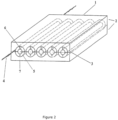
- FIG. 2 An alternative embodiment of a pre-formed pipe section is shown in figure 2 .
- Figures 2 illustrates a block (1) bonded mineral wool and a cutting string (4) by means of which pipe sections (5) having a tongue/groove-joint (6) and a T-shaped hinge slit (7) are cut out of the block in the transverse direction of the block and parallel to the main surface planes of the block. After cutting out each pipe section 5 is removed from the block.
- FIG. 3 shows a further embodiment of a pipe insulation.
- a pipe insulation is shown in figure 3 , which shows a mat of mineral wool provided with transversally extending V-grooves. Due to the V-grooves the mat can be wrapped around a pipe on site as indicated in the version shown at the front in figure 3 .
- An alternative embodiment is a mineral wool product in form of a wired mat.
- Figure 4 is an illustration of such a wired mat.
- Figure 4 illustrates in perspective view such a wired mat according to the invention where an insulation layer 1 in terms of a mineral fibre web is provided with a chicken wire 10 which is fastened to the insulating layer 1 by means of an iron thread 14 stitched through the insulating layer.
- a fixation means 5 in terms of a galvanised iron wire may be in zigzag configuration and placed under the chicken wire 10. In an alternative embodiment, no such fixation means are included.
- mats are used without any wiring.
- the mineral wool product is in form of a mineral wool mat - sometimes also called a slab.
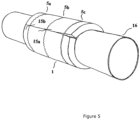
- Figure 5 shows how a wired mat according to figure 4 is mounted on a pipe as insulation material.
- Figure 5 illustrates an embodiment of the insulating product according to the invention mounted on a pipe 16, where the product comprising insulating layer 1 is adapted to fit the circumference of pipe 16 and fixation means 5a and 5b extending around the mounted product secures the product on the pipe 16 by knots 15a and 15b.
- the fixation means 5c has not yet been extended to protrude beyond the adjoining end surfaces of the product to enable the fixation thereby.
- the mineral wool product has a water absorption according to ASTM C1763-16 of less than 4.0 vol. %, such as less than 2.0 vol. %, such as less than 1.5 vol. %.
- the mineral wool product has a water absorption according to EN13472 of less than 1.0 kg/m2, such as less than 0.8 kg/m2, such as less than 0.5 kg/m2, such as less than 0.3 kg/m2.
- the mineral wool product has water absorption according to EN13472 of less than 1.0 kg/m2, such as less than 0.8 kg/m2, such as less than 0.5 kg/m2, such as less than 0.3 kg/m2, following storage of the mineral wool product at 250°C for 24 hours.
- the mineral wool product according to the present invention has a density of 20 to 150 kg/m 3 , such as 40 to 130 kg/m 3 , such as 60-120 kg/m 3 .
- Pipe sections were tested with regard to water absorption properties according to the standard EN13472.
- the pipe sections were manufactured as a mandrel wound pipe section and are from the ProRox product series and the tested specimen had a thickness of 50 mm.
- SILRES BS 45 silicon resin from Wacker had been added to the products in amount of 0.41 wt. %.
Landscapes
- Engineering & Computer Science (AREA)
- Chemical & Material Sciences (AREA)
- Textile Engineering (AREA)
- Inorganic Chemistry (AREA)
- General Engineering & Computer Science (AREA)
- Chemical Kinetics & Catalysis (AREA)
- General Chemical & Material Sciences (AREA)
- Mechanical Engineering (AREA)
- Dispersion Chemistry (AREA)
- Life Sciences & Earth Sciences (AREA)
- Materials Engineering (AREA)
- Wood Science & Technology (AREA)
- Organic Chemistry (AREA)
- Treatments For Attaching Organic Compounds To Fibrous Goods (AREA)
- Compositions Of Macromolecular Compounds (AREA)
- Thermal Insulation (AREA)
Description
- The present invention relates to the use of a mineral wool product comprising mineral fibers bound by a binder resulting from the curing of a binder composition comprising a hydrophobic agent comprising at least one silicone compound at least one hardener and at least one emulsifier, as insulation of a metallic structure. The present invention is also directed to a mineral wool product comprising mineral fibers bound by a binder resulting from the curing of a binder composition.
- Corrosion is the deterioration of a metal as result of a chemical reaction between it and the surrounding environment. Corrosion involves the conversion of the metal to a more chemically stable form, such as oxide, hydroxide or sulfide.
- Corrosion of steel occurs in the presence of water and oxygen. Corrosion of steel parts is a major economic problem, which often times makes up a major part of the maintenance and renewal costs of steel structures.
- A very specific problem is the problem of corrosion under insulation (CUI) which affects steel parts, which are thermally isolated by an insulating material. Steel structures are often insulated in order to avoid heat loss. Such a thermal insulation might be desirable for steel structures, which are much warmer or colder than their surrounding environment. CUI occurs in particular under insulation for steel structures which undergo cyclic temperature changes like e.g. pipelines in the oil and gas industry.
- Since corrosion of steel occurs in the presence of water and oxygen, the presence of water in contact with the steel structure is a major factor contributing to corrosion. Since thermal insulation, materials surrounding the steel structures in order to avoid heat loss tend to keep water in contact with the steel structure for a longer time than the contact would last without the surrounding insulating material, such insulating materials can contribute to increased corrosion. Steels are in general susceptible to CUI in the temperature range of 0 °C to 175 °C. The most frequently occurring types of CUI are general and pitting corrosion of carbon steel which may occur if wet insulation comes in contact with carbon steel, and external stress corrosion tracking (ESCT) of austenitic stainless steel, which is a specific type of corrosion mainly caused by the action of water-soluble chloride from rain water or if the insulation is not meeting the appropriate requirements. Since the corroded surface is mostly hidden by the insulation system and will not be observed until the insulation is removed for inspection or in the event of metal failure leading to incidents, it is very important to control CUI as much as possible.
- In order to avoid CUI, the insulated steel structures are often covered by an additional cladding, which is to prevent the entering of water. However, experience shows that water often enters via fault or damages in the cladding system or via humid air in structures, which undergo cyclic temperature changes. Water may also come into contact with the steel structure internally from non-tight fittings or externally from events like flooding.
- In order to avoid CUI, steel structures like pipelines in the oil and gas industries are often protected against corrosion by coating the steel parts with a protective layer, e.g. with other metals like zinc or aluminum. However, such coating layers are never a completely protecting layer and these protective measures can be extremely cost-intensive and might be economically unacceptable for extensive pipeline systems.
- There have been previous attempts to use mineral wool products as insulation of metallic structures and still protect them from CUI. The most common way to reduce CUI is by use of a mineral wool product prepared from a mineral wool binder to which a mineral oil has been added. By adding mineral oil, the water repellent requirements according to EN13472 can be met. However, for these mineral wool products, the inhibition of CUI is still not satisfactory, because the water absorption is still too high. In addition, these mineral wool products used as insulation materials suffer from the disadvantage that when exposed to higher temperatures, the water absorbance quickly raises to unacceptable levels. This is in particular a problem for the use of such insulation materials for insulating pipelines in the oil and gas industry since in these pipelines operating temperatures often exceed 150°C. Under these conditions, the water repellent properties of these insulation materials are quickly lost.
- The problems associated with CUI can be so serious, that some companies choose to avoid thermal insulation of pipelines even though this leads to a highly energy-inefficient operation.
-
WO 2008/127936 A2 relates to composite Maillard-resole binders to produce or promote cohesion in non-assembled or loosely assembled matter. -
US 2012/168054 A1 relates to dispersions of reactive polysiloxanes which are applied to fibrous products, such as construction panels to provide improved properties, like better resistance to staining and discoloration and better adhesion of facer layers. - Accordingly, it was an object of the present invention to provide an insulation of a metallic structure that allows effective thermal insulation of such a structure and at the same time minimizes maintenance costs and optimizes durability of the structure.
- In particular, it was an object of the present invention to provide an insulation of a metallic structure that allows effective thermal insulation of such a structure and at the same time minimizes corrosion of the metallic structure.
- It was a further object of the present invention to provide a mineral wool product prepared with a binder composition.
- In accordance with a first aspect of the present invention, there is provided the use of a mineral wool product comprising mineral fibers bound by a binder resulting from the curing of a binder composition comprising a phenol-formaldehyde-based resin, and/or a carbohydrate containing component, a hydrophobic agent comprising (i) at least one silicone compound, such as silicone resin, such as a reactive silicone resin, such as a reactive silicone resin chosen from the group of polyalkylethoxysiloxane, polymethylethoxysiloxane, polyphenylethoxysiloxane, polyphenylsiloxane, polyphenylmethylsiloxane, and (ii) at least one hardener, such as silane, such as alkyltriethoxysilane, such as octyltriethoxysilane, and (iii) at least one emulsifier, as insulation of a metallic structure, said structure having an operating temperature between 70-650 °C, wherein the hydrophobic agent comprises (i) in an amount of 20 to 90 percent by weight, in particular 30 to 60 percent by weight, based on the weight of the hydrophobic agent, and (ii) in an amount of 0.5 to 10 percent by weight, in particular 1 to 5 percent by weight, based on the total weight of the hydrophobic agent, and wherein the mineral wool product comprises the hydrophobic agent in an amount of 0.05 to 2 percent by weight, such as 0.10 to 1 percent by weight, such as 0.15 to 0.8 percent by weight, based on the weight of the mineral wool product.
- In accordance with a second aspect of the present invention, there is provided a mineral wool product comprising mineral fibers bound by a binder resulting from the curing of a binder composition comprising a phenol-formaldehyde-based resin, and/or a carbohydrate-containing component, a hydrophobic agent comprising (i) at least one silicone compound, such as silicone resin, such as a reactive silicone resin, such as a reactive silicone resin chosen from the group of polyalkylethoxysiloxane, polymethylethoxysiloxane, polyphenyl-ethoxysiloxane, polyphenylsiloxane, polyphenylmethylsiloxane, and (ii) at least one hardener, such as silane, such as alkyltriethoxysilane, such as octyltriethoxysilane, and (iii) at least one emulsifier wherein the hydrophobic agent comprises (i) in an amount of 20 to 90 percent by weight, in particular 30 to 60 percent by weight, based on the weight of the hydrophobic agent, and (ii) in an amount of 0.5 to 10 percent by weight, in particular 1 to 5 percent by weight, based on the total weight of the hydrophobic agent, wherein the mineral wool product comprises the hydrophobic agent in an amount of 0.05 to 2 percent by weight, such as 0.10 to 1 percent by weight, such as 0.15 to 0.8 percent by weight, based on the weight of the mineral wool product.
- The present inventors have surprisingly found that a very specific hydrophobic agent can impart properties to a mineral wool binder which allow the use of a mineral wool product prepared from mineral fibers bound by such a binder as an insulation of a metallic structure and at the same time avoid problems with corrosion under insulation, associated with previously-known insulation products.
- The present invention is directed to a use of a mineral wool product comprising mineral fibers bound by a binder resulting from the curing of a binder composition comprising a phenol-formaldehyde-based resin, and/or a carbohydrate containing component, a hydrophobic agent comprising (i) at least one silicone compound, such as silicone resin, such as a reactive silicone resin, such as a reactive silicone resin chosen from the group of polyalkylethoxysiloxane, polymethylethoxysiloxane, polyphenylethoxy-siloxane, polyphenylsiloxane, polyphenylmethylsiloxane, and (ii) at least one hardener, such as silane, such as alkyltriethoxysilane, such as octyltriethoxysilane, and (iii) at least one emulsifier, as insulation of a metallic structure, said structure having an operating temperature between 70-650 °C, wherein the hydrophobic agent comprises (i) in an amount of 20 to 90 percent by weight, in particular 30 to 60 percent by weight, based on the weight of the hydrophobic agent, and (ii) in an amount of 0.5 to 10 percent by weight, in particular 1 to 5 percent by weight, based on the total weight of the hydrophobic agent, wherein the mineral wool product comprises the hydrophobic agent in an amount of 0.05 to 2 percent by weight, such as 0.10 to 1 percent by weight, such as 0.15 to 0.8 percent by weight, based on the weight of the mineral wool product.
- The present inventors have surprisingly found that by the use of the very specific hydrophobic agent described herein, corrosion problems in form of corrosion under insulation can be avoided. Without wanting to be bound to any specific theory, the present inventors assume that the corrosion problems associated with the previously-known use of insulation elements for metal structures are connected to the so-called wicking-effect of such insulation products. This wicking effect of the insulation products causes moisture, once it has entered the system, to be retained for a prolonged period of time at the surface of the metal structure. Accordingly, such insulation materials prolong the time during which the surface of the metal structure is kept in contact with water which contributes to an increased rate of corrosion, in particular at higher temperatures
- Without wanting to be bound to any specific theory the present inventors assume that the use of the very specific hydrophobic agent described herein allows a quicker dry out time which allows an inhibition of corrosion.
- It has now surprisingly been found that by use of mineral wool products prepared from a binder containing the hydrophobic agent described herein, excellent insulation characteristics can be attained while at the same time the corrosion under insolation is effectively inhibited.
- According to the invention, the hydrophobic agent comprises (i) in an amount of 20 to 90 percent by weight, in particular 30 to 60 percent by weight, based on the weight of the hydrophobic agent.
- In one embodiment, the hydrophobic agent comprises (i) in form of polymethylethoxysiloxane.
- According to the invention, the hydrophobic agent comprises (ii) in an amount of 0.5 to 10 percent by weight, in particular 1 to 5 percent by weight, based on the total weight of the hydrophobic agent.
- In one embodiment, the hydrophobic agent comprises (ii) in form of octyltriethoxysilane.
- In an alternative embodiment not according to the invention, the silicone compound component (i) also serves as the hardener component (ii) of the hydrophobic agent. Accordingly, in this alternative embodiment, the hydrophobic agent comprises at least one silicone compound, such as silicone resin, such as a reactive silicone resin, such as a reactive silicone resin chosen from the group of polyalkylethoxysiloxane, polymethylethoxysiloxane, polyphenylethoxysiloxane, polyphenylsiloxane, polyphenylmethylsiloxane, and at least one emulsifier.
- Accordingly the hardener is another compound than the silicone compound.
- In one embodiment, the hydrophobic agent comprises (i) in an amount of 30 to 60 percent by weight, (ii) in an amount of 1 to 5 percent by weight, based on the total weight of the hydrophobic agent, the remainder being (iii) and optionally other components and trace amounts of ethanol.
- In one embodiment, the hydrophobic agent comprises polymethylethoxysiloxane in an amount of 30 to 60 percent by weight, octyltriethoxysilane in an amount of 1 to 5 percent by weight, based on the total weight of the hydrophobic agent, the remainder being (iii) and optionally other components and trace amounts of ethanol.
- According to the invention, the binder composition comprises the hydrophobic agent in an amount of 0.05 to 2 percent by weight, such as 0.10 to 1 percent by weight, such as 0.15 to 0.8 percent by weight, based on the weight of the aqueous binder composition mineral wool product.
- In one embodiment, the binder composition comprises a carbohydrate-containing binder component, wherein the binder component further comprises (a) a polycarboxylic acid component or any salt thereof and/or an inorganic acid or any salt thereof, and/or (b) a component selected from the group consisting of amine compounds, ammonia; and optionally, and/or (c) a reaction product of a polycarboxylic acid component or anhydride thereof and an alkanolamine component.
- In one embodiment, the mineral wool product is a pipe section or a mat or wired mat.
- The mineral fibres employed for the production of the mineral wool products may be any of man-made vitreous fibres (MMVF), glass fibres, ceramic fibres, basalt fibres, slag fibres, stone fibres and others. These fibres may be present as a wool product, e.g. like a stone wool product.
- The present invention is directed to a mineral wool product comprising mineral fibers bound by a binder resulting from the curing of a binder composition comprising a phenol-formaldehyde-based resin, and/or a carbohydrate-containing component, a hydrophobic agent comprising: (i) at least one silicone compound, such as silicone resin, such as a reactive silicone resin, such as a reactive silicone resin chosen from the group of polyalkylethoxysiloxane, polymethylethoxysiloxane, polyphenylethoxysiloxane, polyphenylsiloxane, polyphenylmethylsiloxane, and (ii) at least one hardener, such as silane, such as alkyltriethoxysilane, such as octyltriethoxysilane, and (iii) at least one emulsifier wherein the hydrophobic agent comprises (i) in an amount of 20 to 90 percent by weight, in particular 30 to 60 percent by weight, based on the weight of the hydrophobic agent, and (ii) in an amount of 0.5 to 10 percent by weight, in particular 1 to 5 percent by weight, based on the total weight of the hydrophobic agent, and wherein the mineral wool product comprises the hydrophobic agent in an amount of 0.05 to 2 percent by weight, such as 0.10 to 1 percent by weight, such as 0.15 to 0.8 percent by weight, based on the weight of the mineral wool product.
- According to the invention, the hydrophobic agent comprises (i) in an amount of 20 to 90 percent by weight, in particular 30 to 60 percent by weight, based on the weight of the hydrophobic agent.
- In one embodiment, the hydrophobic agent comprises (i) in form of polymethylethoxysiloxane.
- According to the invention, the hydrophobic agent comprises (ii) in an amount of 0.5 to 10 percent by weight, in particular 1 to 5 percent by weight, based on the total weight of the hydrophobic agent.
- In one embodiment, the hydrophobic agent comprises (ii) in form of octyltriethoxysilane.
- In an alternative embodiment not according to the invention, the silicone compound component (i) also serves as the hardener component (ii) of the hydrophobic agent. Accordingly, in this alternative embodiment, the hydrophobic agent comprises at least one silicone compound, such as silicone resin, such as a reactive silicone resin, such as a reactive silicone resin chosen from the group of polyalkylethoxysiloxane, polymethylethoxysiloxane, polyphenylethoxysiloxane, polyphenylsiloxane, polyphenylmethylsiloxane, and at least one emulsifier.
- Accordingly, the hardener is another compound than the silicone compound.
- In one embodiment, the hydrophobic agent comprises (i) in an amount of 30 to 60 percent by weight, (ii) in an amount of 1 to 5 percent by weight, based on the total weight of the hydrophobic agent, the remainder being (iii) and optionally other components and trace amounts of ethanol.
- In one embodiment, the hydrophobic agent comprises polymethylethoxysiloxane in an amount of 30 to 60 percent by weight, octyltriethoxysilane in an amount of 1 to 5 percent by weight, based on the total weight of the hydrophobic agent, the remainder being (iii) and optionally other components and trace amounts of ethanol.
- According to the invention, the mineral wool product comprises the hydrophobic agent in an amount of 0.05 to 2 percent by weight, such as 0.10 to 1 percent by weight, such as 0.15 to 0.8 percent by weight, based on the weight of the mineral wool product.
- In one embodiment, the binder composition comprises a carbohydrate-containing binder component, wherein the binder composition further comprises (a) a polycarboxylic acid component or any salt thereof and/or an inorganic acid or any salt thereof, and/or (b) a component selected from the group consisting of amine compounds, ammonia; and optionally, and/or (c) a reaction product of a polycarboxylic acid component or anhydride thereof and an alkanolamine component.
- In one embodiment the mineral wool product is in form of an insulation product for thermal insulation of metallic structures.
- In one embodiment the mineral wool product is in form of a pipe section or a mat or wired mat.
- Pipe sections are pre-formed (formed in the factory) insulation materials used for the insulation around pipes.
- A typical embodiment of such a pipe section is a mandrel wound pipe section.
- A mandrel wound pipe section is a pre-formed, full-round cylindrical pipe insulation product which is produced by wrapping an uncured mineral wool blanket around a mandrel in spiral manner for forming and subsequent curing. The cylindrical pipe sections are split and hinged for easy snap-on assembly. Mandrel wound pipe sections can be both faced and un-faced with aluminum foil.
-
Figure 1 shows how such a mandrel wound pipe section is typically produced. In this method, the pipe section is wound from a thin web 9 of mineral wool, preferably stone wool. The web 9 is wound around aperforated mandrel 10 as it is known when producing wound pipe sections. After winding hot air is conventionally blown from inside the mandrel and through the wound pipe section for curing of the thermoset binder. - An alternative embodiment of a pre-formed pipe section is shown in
figure 2 . -
Figures 2 illustrates a block (1) bonded mineral wool and a cutting string (4) by means of which pipe sections (5) having a tongue/groove-joint (6) and a T-shaped hinge slit (7) are cut out of the block in the transverse direction of the block and parallel to the main surface planes of the block. After cutting out eachpipe section 5 is removed from the block. - A further embodiment of a pipe insulation is shown in
figure 3 , which shows a mat of mineral wool provided with transversally extending V-grooves. Due to the V-grooves the mat can be wrapped around a pipe on site as indicated in the version shown at the front infigure 3 . - An alternative embodiment is a mineral wool product in form of a wired mat.
Figure 4 is an ilustration of such a wired mat. -
Figure 4 illustrates in perspective view such a wired mat according to the invention where aninsulation layer 1 in terms of a mineral fibre web is provided with achicken wire 10 which is fastened to the insulatinglayer 1 by means of aniron thread 14 stitched through the insulating layer. A fixation means 5 in terms of a galvanised iron wire may be in zigzag configuration and placed under thechicken wire 10. In an alternative embodiment, no such fixation means are included. - In a further alternative embodiment, mats are used without any wiring. In this alternative embodiment, the mineral wool product is in form of a mineral wool mat - sometimes also called a slab.
-
Figure 5 shows how a wired mat according tofigure 4 is mounted on a pipe as insulation material. -
Figure 5 illustrates an embodiment of the insulating product according to the invention mounted on apipe 16, where the product comprising insulatinglayer 1 is adapted to fit the circumference ofpipe 16 and fixation means 5a and 5b extending around the mounted product secures the product on thepipe 16 byknots - In one embodiment the mineral wool product has a water absorption according to ASTM C1763-16 of less than 4.0 vol. %, such as less than 2.0 vol. %, such as less than 1.5 vol. %.
- In one embodiment the mineral wool product has a water absorption according to EN13472 of less than 1.0 kg/m2, such as less than 0.8 kg/m2, such as less than 0.5 kg/m2, such as less than 0.3 kg/m2.
- In one embodiment the mineral wool product has water absorption according to EN13472 of less than 1.0 kg/m2, such as less than 0.8 kg/m2, such as less than 0.5 kg/m2, such as less than 0.3 kg/m2, following storage of the mineral wool product at 250°C for 24 hours.
- In this embodiment, in which the water absorption according to EN13472 is measured following storage of the mineral wool product at 250°C for 24 hours, the following protocol for exposing the product to 250°C for 24 hours is followed:
- Pre-heat a laboratory furnace to 250 °C, which is placed under a fume hood.
- Place the samples in the furnace for a period of 24 hours.
- The ventilation of the furnace shall be off, except from the last 30 minutes of the heating when the ventilation shall be on in order to remove fumes from the furnace in a safe way.
- Remove the samples from the furnace and let them cool down to ambient temperature.
- After that proceed with the requested test program for water absorption.
- In one embodiment, the mineral wool product according to the present invention has a density of 20 to 150 kg/m3, such as 40 to 130 kg/m3, such as 60-120 kg/m3.
- The present invention is further illustrated by the following examples:
- Different insulation products were tested with regard to water absorption properties according to the standard ASTM C1763-16 test method.
- The results of tests are stated in Table 1.
Sample Density kg/m3 Volume cm3 Mass, initial g Mass, after immersion (2 hr) g Mass, recondition (after 48 hr) g Water Abs. (WA) vol.% Recovery WA, 2 hr vol.% Recovery WA, 48 hr vol.% Roxul SL960, mat 92 4532 415.69 658.47 415.82 5.4 4.9 0.003 E-glass, pipe section 234 2755 646.09 3166.03 2599.29 22.9 22.6 17.73 Roxul, pipe section with Silicone resin BS45 73 2162 158.14 183.88 158.93 1.2 0.5 0.037 Mineral wool, pipe section 145 2427 350.88 832.86 438.04 5.0 4.8 0.898 Roxul PS980, pipe section 183 1776 325.90 806.37 556.76 6.8 6.6 3.249 Mineral wool, mat 80 7582 606.86 2040.20 1269.98 18.9 18.2 8.746 - Pipe sections were tested with regard to water absorption properties according to the standard EN13472. The pipe sections were manufactured as a mandrel wound pipe section and are from the ProRox product series and the tested specimen had a thickness of 50 mm.
- The tests were done on both untreated products and products that were aged (250°C/24h).
- SILRES BS 45 silicon resin from Wacker had been added to the products in amount of 0.41 wt. %.
- The results from a triple-determination are stated in Table 2.
Table 2. Sample Water Absorption level according to the EN13472 standard, Water Absorption level according to the EN13472 standard, Initial Aged (24h, 250°C) kg/m2 kg/m2 ProRox 960 0.09 0.08
Claims (11)
- Use of a mineral wool product comprising mineral fibers bound by a binder resulting from the curing of a binder composition comprisinga phenol-formaldehyde-based resin, and/or a carbohydrate containing component; anda hydrophobic agent comprising:(i) at least one silicone compound, such as silicone resin, such as a reactive silicone resin, such as a reactive silicone resin chosen from the group of polyalkylethoxysiloxane, polymethylethoxysiloxane, polyphenylethoxysiloxane, polyphenylsiloxane, polyphenylmethylsiloxane;(ii) at least one hardener, such as silane, such as alkyltriethoxysilane, such as octyltriethoxysilane; and(iii) at least one emulsifier;as insulation of a metallic structure, said structure having an operating temperature between 70-650 °C,wherein the hydrophobic agent comprises(i) in an amount of 20 to 90 percent by weight, in particular 30 to 60 percent by weight, based on the weight of the hydrophobic agent, and(ii) in an amount of 0.5 to 10 percent by weight, in particular 1 to 5 percent by weight, based on the total weight of the hydrophobic agent, andwherein the mineral wool product comprises the hydrophobic agent in an amount of 0.05 to 2 percent by weight, such as 0.10 to 1 percent by weight, such as 0.15 to 0.8 percent by weight, based on the weight of the mineral wool product.
- Use according to claim 1, wherein the hydrophobic agent comprises (i) in an amount of 30 to 60 percent by weight, (ii) in an amount of 1 to 5 percent by weight, based on the total weight of the hydrophobic agent, the remainder being (iii) and optionally other components and trace amounts of ethanol.
- Use according to claim 1 or 2, wherein the hydrophobic agent comprises polymethylethoxysiloxane in an amount of 30 to 60 percent by weight, octyltriethoxysilane in an amount of 1 to 5 percent by weight, based on the total weight of the hydrophobic agent, the remainder being (iii) and optionally other components and trace amounts of ethanol.
- Use according to any one of the preceding claims, wherein the binder composition comprises a carbohydrate-containing binder component, wherein the binder composition further comprises(a) a polycarboxylic acid component or any salt thereof and/or an inorganic acid or any salt thereof, and/or(b) a component selected from the group consisting of amine compounds, ammonia; and optionally, and/or(c) a reaction product of a polycarboxylic acid component or anhydride thereof and an alkanolamine component.
- Use according to any one of the preceding claims, wherein the mineral wool product is a pipe section or a mat or wired mat.
- A mineral wool product comprising mineral fibers bound by a binder resulting from the curing of a binder composition comprisinga phenol-formaldehyde-based resin, and/or a carbohydrate-containing component; anda hydrophobic agent comprising:(i) at least one silicone compound, such as silicone resin, such as a reactive silicone resin, such as a reactive silicone resin chosen from the group of polyalkylethoxysiloxane, polymethylethoxysiloxane, polyphenylethoxysiloxane, polyphenylsiloxane, polyphenylmethylsiloxane;(ii) at least one hardener, such as silane, such as alkyltriethoxysilane, such as octyltriethoxysilane; and(iii) at least one emulsifier,wherein the hydrophobic agent comprises(i) in an amount of 20 to 90 percent by weight, in particular 30 to 60 percent by weight, based on the weight of the hydrophobic agent, and(ii) in an amount of 0.5 to 10 percent by weight, in particular 1 to 5 percent by weight, based on the total weight of the hydrophobic agent, andwherein the mineral wool product comprises the hydrophobic agent in an amount of 0.05 to 2 percent by weight, such as 0.10 to 1 percent by weight, such as 0.15 to 0.8 percent by weight, based on the weight of the mineral wool product.
- A mineral wool product according to claim 6, wherein the hydrophobic agent comprises (i) in an amount of 30 to 60 percent by weight, (ii) in an amount of 1 to 5 percent by weight, based on the total weight of the hydrophobic agent, the remainder being (iii) and optionally other components and trace amounts of ethanol.
- A mineral wool product according to any one of the claims 6 or 7, wherein the hydrophobic agent comprises polymethylethoxysiloxane in an amount of 30 to 60 percent by weight, octyltriethoxysilane in an amount of 1 to 5 percent by weight, based on the total weight of the hydrophobic agent, the remainder being (iii) and optionally other components and trace amounts of ethanol.
- A mineral wool product according to any one of the claims 6 to 8, having a water absorption according to ASTM C1763-16 of less than 4.0 vol.%, such as less than 2.0 vol.%, such as less than 1.5 vol.%.
- A mineral wool product according to any one of the claims 6 to 9, having a water absorption according to EN13472 of less than 0.5 kg/m2, such as less than 0.3 kg/m2.
- A mineral wool product according to any one of the claims 6 to 10, having a water absorption according to EN13472 of less than 1.0 kg/m2, such as less than 0.8 kg/m2, such as less than 0.5 kg/m2, such as less than 0.3 kg/m2, following storage of the mineral wool product at 250°C for 24 hours.
Priority Applications (2)
| Application Number | Priority Date | Filing Date | Title |
|---|---|---|---|
| RS20250092A RS66440B1 (en) | 2017-08-30 | 2018-08-29 | USE OF MINERAL WOOL PRODUCTS |
| EP24210741.5A EP4477936A3 (en) | 2017-08-30 | 2018-08-29 | Use of a mineral wool product |
Applications Claiming Priority (2)
| Application Number | Priority Date | Filing Date | Title |
|---|---|---|---|
| EP17188636 | 2017-08-30 | ||
| PCT/EP2018/073273 WO2019043078A1 (en) | 2017-08-30 | 2018-08-29 | Use of a mineral wool product |
Related Child Applications (2)
| Application Number | Title | Priority Date | Filing Date |
|---|---|---|---|
| EP24210741.5A Division-Into EP4477936A3 (en) | 2017-08-30 | 2018-08-29 | Use of a mineral wool product |
| EP24210741.5A Division EP4477936A3 (en) | 2017-08-30 | 2018-08-29 | Use of a mineral wool product |
Publications (3)
| Publication Number | Publication Date |
|---|---|
| EP3676434A1 EP3676434A1 (en) | 2020-07-08 |
| EP3676434B1 true EP3676434B1 (en) | 2024-12-18 |
| EP3676434C0 EP3676434C0 (en) | 2024-12-18 |
Family
ID=59901336
Family Applications (2)
| Application Number | Title | Priority Date | Filing Date |
|---|---|---|---|
| EP18759117.7A Active EP3676434B1 (en) | 2017-08-30 | 2018-08-29 | Use of a mineral wool product |
| EP24210741.5A Pending EP4477936A3 (en) | 2017-08-30 | 2018-08-29 | Use of a mineral wool product |
Family Applications After (1)
| Application Number | Title | Priority Date | Filing Date |
|---|---|---|---|
| EP24210741.5A Pending EP4477936A3 (en) | 2017-08-30 | 2018-08-29 | Use of a mineral wool product |
Country Status (10)
| Country | Link |
|---|---|
| US (1) | US20210163783A1 (en) |
| EP (2) | EP3676434B1 (en) |
| CN (2) | CN115637531A (en) |
| CA (1) | CA3073841A1 (en) |
| EA (1) | EA202090538A1 (en) |
| ES (1) | ES3008273T3 (en) |
| PL (1) | PL3676434T3 (en) |
| RS (1) | RS66440B1 (en) |
| SA (1) | SA520411425B1 (en) |
| WO (1) | WO2019043078A1 (en) |
Families Citing this family (6)
| Publication number | Priority date | Publication date | Assignee | Title |
|---|---|---|---|---|
| WO2019043078A1 (en) | 2017-08-30 | 2019-03-07 | Rockwool International A/S | Use of a mineral wool product |
| US10920920B2 (en) | 2017-08-30 | 2021-02-16 | Rockwool International A/S | Use of a mineral wool product |
| US12577154B2 (en) | 2019-12-11 | 2026-03-17 | Wacker Chemie Ag | Hydrophobic mineral insulating materials |
| CN115605548B (en) | 2020-04-03 | 2025-01-14 | 洛科威有限公司 | Mineral wool product with low chloride content |
| US12601444B2 (en) | 2020-07-22 | 2026-04-14 | Rockwool A/S | Thermally insulated pipe system, thermally insulating pipe section and method for producing a thermally insulating pipe section |
| US12428346B2 (en) * | 2021-03-25 | 2025-09-30 | Rockwool A/S | Anticorrosive composition |
Citations (7)
| Publication number | Priority date | Publication date | Assignee | Title |
|---|---|---|---|---|
| GB801580A (en) | 1955-10-24 | 1958-09-17 | Shawinigan Chem Ltd | Polyvinyl acetate emulsions with positively charged particles |
| US4251590A (en) | 1979-06-18 | 1981-02-17 | Johns-Manville Corporation | High temperature pipe insulation |
| WO2008127936A2 (en) | 2007-04-13 | 2008-10-23 | Knauf Insulation Gmbh | Composite maillard-resole binders |
| JP4246293B2 (en) | 1998-08-04 | 2009-04-02 | Jfeスチール株式会社 | Mineral fiber sheet |
| CN105060737A (en) | 2015-07-21 | 2015-11-18 | 江苏科幸新材料股份有限公司 | Water repellent as well as preparation method and application thereof |
| US20170198425A1 (en) | 2014-05-28 | 2017-07-13 | Saint-Gobain Isover | Binder composition for mineral wool |
| WO2019043078A1 (en) | 2017-08-30 | 2019-03-07 | Rockwool International A/S | Use of a mineral wool product |
Family Cites Families (16)
| Publication number | Priority date | Publication date | Assignee | Title |
|---|---|---|---|---|
| US3092604A (en) * | 1961-08-14 | 1963-06-04 | Narmco Ind Inc | Curable resin system, cured epoxy resin, and process of forming the same |
| NL1008041C2 (en) * | 1998-01-16 | 1999-07-19 | Tidis B V I O | Application of a water-soluble binder system for the production of glass or rock wool. |
| GB0223471D0 (en) * | 2002-10-10 | 2002-11-13 | Kalantar Ali | Heat insulation coatings used in the prevention of corrosion under insulation |
| EP2433983A1 (en) * | 2005-07-26 | 2012-03-28 | Knauf Insulation GmbH | Binders and materials made therewith |
| DE102005056790A1 (en) * | 2005-11-28 | 2007-05-31 | Saint-Gobain Isover G+H Ag | Binder for production of formaldehyde-free bound mineral wool or glass wool product e.g. insulating board comprises aqueous curable phenol-formaldehyde resin binder dispersion containing hydroxy(alkyl)amine or diamine and activated silane |
| DE102008040986A1 (en) * | 2008-08-05 | 2010-02-11 | Evonik Goldschmidt Gmbh | Hydrophobization of mineral fiber components |
| FR2946352B1 (en) * | 2009-06-04 | 2012-11-09 | Saint Gobain Isover | MINERAL WOOL SIZING COMPOSITION COMPRISING A SACCHARIDE, A POLYCARBOXYLIC ORGANIC ACID AND A REACTIVE SILICONE, AND INSULATING PRODUCTS OBTAINED |
| US20110223364A1 (en) * | 2009-10-09 | 2011-09-15 | Hawkins Christopher M | Insulative products having bio-based binders |
| ES3035968T3 (en) * | 2010-07-23 | 2025-09-11 | Rockwool As | Use of a bonded mineral fibre product for improving fire and punking resistance |
| PL2646488T5 (en) * | 2010-11-29 | 2019-02-28 | Huntsman International Llc | Polyisocyanate-based binder |
| US20120168054A1 (en) * | 2011-01-04 | 2012-07-05 | Owens Corning Intellectual Capital, Llc | Use of silicones to improve fiberglass insulation products |
| CA2834816C (en) * | 2011-05-07 | 2020-05-12 | Knauf Insulation | Liquid high solids binder composition |
| EP2549006A1 (en) * | 2011-07-22 | 2013-01-23 | Rockwool International A/S | Urea-modified binder for mineral fibres |
| RU2545284C2 (en) * | 2013-07-17 | 2015-03-27 | Сергей Константинович Есаулов | Fire-resistant composite material and method for production thereof |
| US10920920B2 (en) * | 2017-08-30 | 2021-02-16 | Rockwool International A/S | Use of a mineral wool product |
| ES3054092T3 (en) * | 2017-08-30 | 2026-01-29 | Rockwool As | Use of a mineral wool product |
-
2018
- 2018-08-29 WO PCT/EP2018/073273 patent/WO2019043078A1/en not_active Ceased
- 2018-08-29 EP EP18759117.7A patent/EP3676434B1/en active Active
- 2018-08-29 RS RS20250092A patent/RS66440B1/en unknown
- 2018-08-29 US US16/641,482 patent/US20210163783A1/en not_active Abandoned
- 2018-08-29 CN CN202211390752.4A patent/CN115637531A/en active Pending
- 2018-08-29 CN CN201880068266.6A patent/CN111247278B/en active Active
- 2018-08-29 EP EP24210741.5A patent/EP4477936A3/en active Pending
- 2018-08-29 ES ES18759117T patent/ES3008273T3/en active Active
- 2018-08-29 PL PL18759117.7T patent/PL3676434T3/en unknown
- 2018-08-29 EA EA202090538A patent/EA202090538A1/en unknown
- 2018-08-29 CA CA3073841A patent/CA3073841A1/en active Pending
-
2020
- 2020-02-27 SA SA520411425A patent/SA520411425B1/en unknown
Patent Citations (7)
| Publication number | Priority date | Publication date | Assignee | Title |
|---|---|---|---|---|
| GB801580A (en) | 1955-10-24 | 1958-09-17 | Shawinigan Chem Ltd | Polyvinyl acetate emulsions with positively charged particles |
| US4251590A (en) | 1979-06-18 | 1981-02-17 | Johns-Manville Corporation | High temperature pipe insulation |
| JP4246293B2 (en) | 1998-08-04 | 2009-04-02 | Jfeスチール株式会社 | Mineral fiber sheet |
| WO2008127936A2 (en) | 2007-04-13 | 2008-10-23 | Knauf Insulation Gmbh | Composite maillard-resole binders |
| US20170198425A1 (en) | 2014-05-28 | 2017-07-13 | Saint-Gobain Isover | Binder composition for mineral wool |
| CN105060737A (en) | 2015-07-21 | 2015-11-18 | 江苏科幸新材料股份有限公司 | Water repellent as well as preparation method and application thereof |
| WO2019043078A1 (en) | 2017-08-30 | 2019-03-07 | Rockwool International A/S | Use of a mineral wool product |
Non-Patent Citations (33)
| Title |
|---|
| "Oxford Dictionary of Chemistry", 1 January 2008, OXFORD UNIVERSITY PRESS, Oxford, ISBN: 978-0-19-920463-2, article ANONYMOUS: "Emulsion", pages: 203, XP009563211 |
| "Oxford Dictionary of Chemistry", 1 January 2008, OXFORD UNIVERSITY PRESS, Oxford, ISBN: 978-0-19-920463-2, article ANONYMOUS: "Polyvinyl acetate, Polyvinyl alcohol", pages: 429, XP009563212 |
| "Oxford Dictionary of Chemistry", 1 January 2008, OXFORD UNIVERSITY PRESS, Oxford, ISBN: 978-0-19-920463-2, article ANONYMOUS: "Stainless steel", pages: 501, XP009563213 |
| ANONYMOUS: "ASTM C1763-16 Standard Test Method for Water Absorption by Immersion of Thermal Insulation Materials", ASTM NORM, ASTM INTERNATIONAL, 1 July 2016 (2016-07-01), pages 1 - 5, XP093318084, DOI: 10.1520/C1763-16 |
| ANONYMOUS: "Karta charakterystyki Garo 148 AS", MATERIAL SAFETY DATA SHEET MSDS GARO 148 AS, GOVI, 29 April 2015 (2015-04-29), pages 1 - 5, XP093318832, Retrieved from the Internet <URL:https://www.govi.com/> |
| ANONYMOUS: "KARTA CHARAKTERYSTYKI Prefere 72 6410M", MATERIAL SAFETY DATA SHEET (MSDS), PREFERE RESINS POLAND SP. Z O.O., POLAND, 5 October 2015 (2015-10-05), Poland, pages 1 - 18, XP093318744, Retrieved from the Internet <URL:https://prefere.com/> |
| ANONYMOUS: "KARTA CHARAKTERYSTYKI XIAMETER(R)", MATERIAL SAFETY DATA SHEET XIAMETER(R), DOW CORNING EUROPE S.A., 13 September 2011 (2011-09-13), pages 1 - 8, XP093318850, Retrieved from the Internet <URL:https://www.dowcorning.com> |
| ANONYMOUS: "Nya produktnamn VVS- och industriisolering", TEKNISK ISOLERING PRODUKT INFORMATION, PAROC AB, 1 January 2005 (2005-01-01), pages 1 - 8, XP093318892, Retrieved from the Internet <URL:http://www.paroc.se> |
| ANONYMOUS: "PAROC Pro Section WR 140 - ", PAROC - SOLUTIONS & PRODUITS - PRODUITS EN LAINE DE ROCHE PAROC, PAROC.FR, 1 March 2015 (2015-03-01), pages 1 - 2, XP093318743, Retrieved from the Internet <URL:https://web.archive.org/web/20160420034645/http://paroc.fr/solutions-produits/produits/pages/coquilles-en-laine-de-roche/paroc-pro-section-wr-140> |
| ANONYMOUS: "Product information sheet XIAMETER® MEM-1581 Emulsion", PRODUCT INFORMATION SHEET, DOW CORNING, 16 November 2011 (2011-11-16), pages 1 - 2, XP093318847, Retrieved from the Internet <URL:https://www.ulbrich.cz/chemical-technical-products/TDS_XIAMETER_MEM_1581_eng.pdf> |
| ANONYMOUS: "SAFETY DATA SHEET XIAMETER™ MEM-1581 Emulsion", SAFETY DATA SHEET XIAMETER, DOW EUROPE GMBH, 16 October 2017 (2017-10-16), pages 1 - 18, XP093318748, Retrieved from the Internet <URL:https://www.dow.com/en-us/pdp.xiameter-mem-1581-emulsion.04027124h.html#tech-content> |
| ANONYMOUS: "SFS-EN 13472 Thermal Insulating Products For Building Equipment And Industrial Installations. Determination of Short Term Water Absorption By Partial Immersion Of Preformed Pipe Insulation", FINNISH STANDARD, SUOMEN STANDARDISOIMISLIITTO SFS, 4 March 2013 (2013-03-04), pages 1 - 15, XP093318100, Retrieved from the Internet <URL:https://sales.sfs.fi/en/index/tuotteet/SFS/CEN/ID6/1/6516.html.stx> |
| ANONYMOUS: "SILRES® BS 45 Safety Data Sheet (1907/2006/EC)", SAFETY DATA SHEET (1907/2006/EC), WACKER SILICONES, 18 February 2009 (2009-02-18), pages 1 - 6, XP093318089 |
| D10 - Invoice dated 2016-08-01 from Paroc Limited to Asbestos and Insulation Supplies Ltd |
| D11 - Witness statement of Robert Williamson, Industrial Sales Manager Western Europe at Paroc Group Oy |
| D12 - Witness statement of Peter van Zandbergen, Business Director Global Industry at Paroc Group Oy |
| D13 - Paroc’s Technical Insulation Price List for the UK dated 01/02/2016 |
| D14 - Paroc’s Technical Insulation Price List for the UK dated 01/02/2017 |
| D16 - Witness statement of Charlotte Pettersson, Development Engineer at Paroc Group Oy |
| D17 - Production data for Product No. 8513201, PAROC Pro Section WR 140 |
| D18 - Production data for Product No. 8511890, PAROC Pro Section WR 140 |
| D19 - Production data for Product No. 8544052, PAROC Pro Wired Mat WR 100 |
| D20 - Production data for Product No. 8535584, PAROC Pro Slab WR 140 |
| D21 - Production data for Product No. 8534902, PAROC Pro Slab WR 140 |
| D28 - Email to Sylvain Perez, Category Manager EU Sourcing Chemicals at OCV Chambery International from Dow Chemicals of 12 September 2025 |
| D30 - Percent weight calculations for Product No. 8513201, PAROC Pro Section WR 140 |
| D31 - Percent weight calculations for Product No. 8511890, PAROC Pro Section WR 140 |
| D32 - Percent weight calculations for Product No. 8544052, PAROC Pro Wired Mat WR 100 |
| D33 - Percent weight calculations for Product No. 8535584, PAROC Pro Slab WR 140 |
| D34 - Percent weight calculations for Product No. 8534902, PAROC Pro Slab WR 140 |
| D35 - Summary of percent weight calculations from D30-D34 |
| D5 - Water absorption results for ROCKWOOL’s PROROX PS960 with WR Tech pipe section product according to EN 13472 (= D6 in this notice of opposition) and ASTM C1763-16 (= D2 in this notice of opposition) |
| IDENTYFIKATOR 1: "Karta charakterystyki BRB Silanil 989, Drum 200 kg ", SAFETY DATA SHEET BRB SILANIL 989, BRB CENTRAL EASTERN EUROPE SP. Z O.O., 17 December 2015 (2015-12-17), pages 1 - 11, XP093318753, Retrieved from the Internet <URL:http://brbbv.com/> |
Also Published As
| Publication number | Publication date |
|---|---|
| WO2019043078A1 (en) | 2019-03-07 |
| PL3676434T3 (en) | 2025-03-24 |
| CA3073841A1 (en) | 2019-03-07 |
| US20210163783A1 (en) | 2021-06-03 |
| CN115637531A (en) | 2023-01-24 |
| EP3676434C0 (en) | 2024-12-18 |
| CN111247278B (en) | 2022-10-28 |
| EA202090538A1 (en) | 2020-06-22 |
| CN111247278A (en) | 2020-06-05 |
| ES3008273T3 (en) | 2025-03-21 |
| SA520411425B1 (en) | 2023-10-04 |
| EP4477936A3 (en) | 2025-03-12 |
| EP3676434A1 (en) | 2020-07-08 |
| EP4477936A2 (en) | 2024-12-18 |
| RS66440B1 (en) | 2025-02-28 |
Similar Documents
| Publication | Publication Date | Title |
|---|---|---|
| EP4477936A2 (en) | Use of a mineral wool product | |
| US20240077167A1 (en) | Use of a mineral wool product | |
| US20090042156A1 (en) | Device for protecting metallic surfaces from high-temperature condensates of corrosive media in technical installations | |
| CN101668713A (en) | Mineral fibre board | |
| TWI422769B (en) | Method for mending thermal insulating structures and thermal insulating structure | |
| EP3676433B1 (en) | Use of a mineral wool product | |
| US20100260997A1 (en) | Phosphate coating for glass wool insulation for use as flexible duct media | |
| US20200355312A1 (en) | Insulation blanket having a deposited passivator for industrial insulation applications | |
| HK40097735A (en) | Use of a mineral wool product | |
| HK40086107A (en) | Use of a mineral wool product | |
| HK40097734A (en) | Use of a mineral wool product | |
| EA047216B1 (en) | USING MINERAL WOOL PRODUCTS | |
| EA042848B1 (en) | USING MINERAL WOOL PRODUCTS | |
| EA050283B1 (en) | MINERAL WOOL PRODUCT, ITS PRODUCTION METHOD AND APPLICATION | |
| Hansen et al. | Improving mineral wool CUI performance–next generation | |
| Wilds | Performance of Next Generation CUI Mitigation Systems | |
| RU217295U1 (en) | Hairpin for air ducts | |
| Topchy et al. | The potential for implementation of liquid thermal insulation in organizational and technological solutions | |
| EP2711599A2 (en) | Heat insulated pipe |
Legal Events
| Date | Code | Title | Description |
|---|---|---|---|
| STAA | Information on the status of an ep patent application or granted ep patent |
Free format text: STATUS: UNKNOWN |
|
| STAA | Information on the status of an ep patent application or granted ep patent |
Free format text: STATUS: THE INTERNATIONAL PUBLICATION HAS BEEN MADE |
|
| PUAI | Public reference made under article 153(3) epc to a published international application that has entered the european phase |
Free format text: ORIGINAL CODE: 0009012 |
|
| STAA | Information on the status of an ep patent application or granted ep patent |
Free format text: STATUS: REQUEST FOR EXAMINATION WAS MADE |
|
| 17P | Request for examination filed |
Effective date: 20200325 |
|
| AK | Designated contracting states |
Kind code of ref document: A1 Designated state(s): AL AT BE BG CH CY CZ DE DK EE ES FI FR GB GR HR HU IE IS IT LI LT LU LV MC MK MT NL NO PL PT RO RS SE SI SK SM TR |
|
| AX | Request for extension of the european patent |
Extension state: BA ME |
|
| DAV | Request for validation of the european patent (deleted) | ||
| DAX | Request for extension of the european patent (deleted) | ||
| RAP3 | Party data changed (applicant data changed or rights of an application transferred) |
Owner name: ROCKWOOL A/S |
|
| STAA | Information on the status of an ep patent application or granted ep patent |
Free format text: STATUS: EXAMINATION IS IN PROGRESS |
|
| 17Q | First examination report despatched |
Effective date: 20230503 |
|
| GRAP | Despatch of communication of intention to grant a patent |
Free format text: ORIGINAL CODE: EPIDOSNIGR1 |
|
| STAA | Information on the status of an ep patent application or granted ep patent |
Free format text: STATUS: GRANT OF PATENT IS INTENDED |
|
| INTG | Intention to grant announced |
Effective date: 20240712 |
|
| GRAS | Grant fee paid |
Free format text: ORIGINAL CODE: EPIDOSNIGR3 |
|
| GRAA | (expected) grant |
Free format text: ORIGINAL CODE: 0009210 |
|
| STAA | Information on the status of an ep patent application or granted ep patent |
Free format text: STATUS: THE PATENT HAS BEEN GRANTED |
|
| AK | Designated contracting states |
Kind code of ref document: B1 Designated state(s): AL AT BE BG CH CY CZ DE DK EE ES FI FR GB GR HR HU IE IS IT LI LT LU LV MC MK MT NL NO PL PT RO RS SE SI SK SM TR |
|
| REG | Reference to a national code |
Ref country code: GB Ref legal event code: FG4D |
|
| REG | Reference to a national code |
Ref country code: CH Ref legal event code: EP |
|
| REG | Reference to a national code |
Ref country code: DE Ref legal event code: R096 Ref document number: 602018077717 Country of ref document: DE |
|
| REG | Reference to a national code |
Ref country code: IE Ref legal event code: FG4D |
|
| U01 | Request for unitary effect filed |
Effective date: 20250107 |
|
| U07 | Unitary effect registered |
Designated state(s): AT BE BG DE DK EE FI FR IT LT LU LV MT NL PT RO SE SI Effective date: 20250115 |
|
| REG | Reference to a national code |
Ref country code: ES Ref legal event code: FG2A Ref document number: 3008273 Country of ref document: ES Kind code of ref document: T3 Effective date: 20250321 |
|
| PG25 | Lapsed in a contracting state [announced via postgrant information from national office to epo] |
Ref country code: HR Free format text: LAPSE BECAUSE OF FAILURE TO SUBMIT A TRANSLATION OF THE DESCRIPTION OR TO PAY THE FEE WITHIN THE PRESCRIBED TIME-LIMIT Effective date: 20241218 |
|
| PG25 | Lapsed in a contracting state [announced via postgrant information from national office to epo] |
Ref country code: GR Free format text: LAPSE BECAUSE OF FAILURE TO SUBMIT A TRANSLATION OF THE DESCRIPTION OR TO PAY THE FEE WITHIN THE PRESCRIBED TIME-LIMIT Effective date: 20250319 |
|
| PG25 | Lapsed in a contracting state [announced via postgrant information from national office to epo] |
Ref country code: SM Free format text: LAPSE BECAUSE OF FAILURE TO SUBMIT A TRANSLATION OF THE DESCRIPTION OR TO PAY THE FEE WITHIN THE PRESCRIBED TIME-LIMIT Effective date: 20241218 |
|
| PG25 | Lapsed in a contracting state [announced via postgrant information from national office to epo] |
Ref country code: IS Free format text: LAPSE BECAUSE OF FAILURE TO SUBMIT A TRANSLATION OF THE DESCRIPTION OR TO PAY THE FEE WITHIN THE PRESCRIBED TIME-LIMIT Effective date: 20250418 |
|
| PG25 | Lapsed in a contracting state [announced via postgrant information from national office to epo] |
Ref country code: SK Free format text: LAPSE BECAUSE OF FAILURE TO SUBMIT A TRANSLATION OF THE DESCRIPTION OR TO PAY THE FEE WITHIN THE PRESCRIBED TIME-LIMIT Effective date: 20241218 |
|
| PLBI | Opposition filed |
Free format text: ORIGINAL CODE: 0009260 |
|
| PLAX | Notice of opposition and request to file observation + time limit sent |
Free format text: ORIGINAL CODE: EPIDOSNOBS2 |
|
| U20 | Renewal fee for the european patent with unitary effect paid |
Year of fee payment: 8 Effective date: 20250827 |
|
| REG | Reference to a national code |
Ref country code: CH Ref legal event code: L10 Free format text: ST27 STATUS EVENT CODE: U-0-0-L10-L00 (AS PROVIDED BY THE NATIONAL OFFICE) Effective date: 20251006 |
|
| PGFP | Annual fee paid to national office [announced via postgrant information from national office to epo] |
Ref country code: ES Payment date: 20250901 Year of fee payment: 8 |
|
| PGFP | Annual fee paid to national office [announced via postgrant information from national office to epo] |
Ref country code: NO Payment date: 20250827 Year of fee payment: 8 |
|
| PGFP | Annual fee paid to national office [announced via postgrant information from national office to epo] |
Ref country code: PL Payment date: 20250801 Year of fee payment: 8 |
|
| PGFP | Annual fee paid to national office [announced via postgrant information from national office to epo] |
Ref country code: GB Payment date: 20250827 Year of fee payment: 8 |
|
| PGFP | Annual fee paid to national office [announced via postgrant information from national office to epo] |
Ref country code: CZ Payment date: 20250807 Year of fee payment: 8 Ref country code: RS Payment date: 20250801 Year of fee payment: 8 |
|
| 26 | Opposition filed |
Opponent name: PAROC GROUP OY Effective date: 20250918 |
|
| PLBB | Reply of patent proprietor to notice(s) of opposition received |
Free format text: ORIGINAL CODE: EPIDOSNOBS3 |
|
| REG | Reference to a national code |
Ref country code: CH Ref legal event code: H13 Free format text: ST27 STATUS EVENT CODE: U-0-0-H10-H13 (AS PROVIDED BY THE NATIONAL OFFICE) Effective date: 20260324 |
|
| PG25 | Lapsed in a contracting state [announced via postgrant information from national office to epo] |
Ref country code: MC Free format text: LAPSE BECAUSE OF FAILURE TO SUBMIT A TRANSLATION OF THE DESCRIPTION OR TO PAY THE FEE WITHIN THE PRESCRIBED TIME-LIMIT Effective date: 20241218 |
|
| PG25 | Lapsed in a contracting state [announced via postgrant information from national office to epo] |
Ref country code: CH Free format text: LAPSE BECAUSE OF NON-PAYMENT OF DUE FEES Effective date: 20250831 |
|
| PG25 | Lapsed in a contracting state [announced via postgrant information from national office to epo] |
Ref country code: IE Free format text: LAPSE BECAUSE OF NON-PAYMENT OF DUE FEES Effective date: 20250829 |