EP3676100B1 - Print media accumulators controlled by print job attributes - Google Patents
Print media accumulators controlled by print job attributes Download PDFInfo
- Publication number
- EP3676100B1 EP3676100B1 EP17923568.4A EP17923568A EP3676100B1 EP 3676100 B1 EP3676100 B1 EP 3676100B1 EP 17923568 A EP17923568 A EP 17923568A EP 3676100 B1 EP3676100 B1 EP 3676100B1
- Authority
- EP
- European Patent Office
- Prior art keywords
- print job
- accumulator
- instructions
- finisher
- Prior art date
- Legal status (The legal status is an assumption and is not a legal conclusion. Google has not performed a legal analysis and makes no representation as to the accuracy of the status listed.)
- Active
Links
Images


Classifications
-
- G—PHYSICS
- G06—COMPUTING OR CALCULATING; COUNTING
- G06K—GRAPHICAL DATA READING; PRESENTATION OF DATA; RECORD CARRIERS; HANDLING RECORD CARRIERS
- G06K15/00—Arrangements for producing a permanent visual presentation of the output data, e.g. computer output printers
- G06K15/40—Details not directly involved in printing, e.g. machine management, management of the arrangement as a whole or of its constitutive parts
- G06K15/4025—Managing optional units, e.g. sorters, document feeders
- G06K15/403—Managing optional units, e.g. sorters, document feeders handling the outputted documents, e.g. staplers, sorters
-
- B—PERFORMING OPERATIONS; TRANSPORTING
- B65—CONVEYING; PACKING; STORING; HANDLING THIN OR FILAMENTARY MATERIAL
- B65H—HANDLING THIN OR FILAMENTARY MATERIAL, e.g. SHEETS, WEBS, CABLES
- B65H31/00—Pile receivers
- B65H31/02—Pile receivers with stationary end support against which pile accumulates
-
- B—PERFORMING OPERATIONS; TRANSPORTING
- B42—BOOKBINDING; ALBUMS; FILES; SPECIAL PRINTED MATTER
- B42C—BOOKBINDING
- B42C1/00—Collating or gathering sheets combined with processes for permanently attaching together sheets or signatures or for interposing inserts
- B42C1/12—Machines for both collating or gathering and permanently attaching together the sheets or signatures
-
- B—PERFORMING OPERATIONS; TRANSPORTING
- B65—CONVEYING; PACKING; STORING; HANDLING THIN OR FILAMENTARY MATERIAL
- B65H—HANDLING THIN OR FILAMENTARY MATERIAL, e.g. SHEETS, WEBS, CABLES
- B65H31/00—Pile receivers
- B65H31/26—Auxiliary devices for retaining articles in the pile
-
- B—PERFORMING OPERATIONS; TRANSPORTING
- B65—CONVEYING; PACKING; STORING; HANDLING THIN OR FILAMENTARY MATERIAL
- B65H—HANDLING THIN OR FILAMENTARY MATERIAL, e.g. SHEETS, WEBS, CABLES
- B65H31/00—Pile receivers
- B65H31/30—Arrangements for removing completed piles
- B65H31/3009—Arrangements for removing completed piles by dropping, e.g. removing the pile support from under the pile
- B65H31/3018—Arrangements for removing completed piles by dropping, e.g. removing the pile support from under the pile from opposite part-support elements, e.g. operated simultaneously
-
- B—PERFORMING OPERATIONS; TRANSPORTING
- B65—CONVEYING; PACKING; STORING; HANDLING THIN OR FILAMENTARY MATERIAL
- B65H—HANDLING THIN OR FILAMENTARY MATERIAL, e.g. SHEETS, WEBS, CABLES
- B65H31/00—Pile receivers
- B65H31/30—Arrangements for removing completed piles
- B65H31/3054—Arrangements for removing completed piles by moving the surface supporting the lowermost article of the pile, e.g. by using belts or rollers
- B65H31/3063—Arrangements for removing completed piles by moving the surface supporting the lowermost article of the pile, e.g. by using belts or rollers by special supports like carriages, containers, trays, compartments, plates or bars, e.g. moved in a closed loop
-
- B—PERFORMING OPERATIONS; TRANSPORTING
- B65—CONVEYING; PACKING; STORING; HANDLING THIN OR FILAMENTARY MATERIAL
- B65H—HANDLING THIN OR FILAMENTARY MATERIAL, e.g. SHEETS, WEBS, CABLES
- B65H31/00—Pile receivers
- B65H31/34—Apparatus for squaring-up piled articles
-
- B—PERFORMING OPERATIONS; TRANSPORTING
- B65—CONVEYING; PACKING; STORING; HANDLING THIN OR FILAMENTARY MATERIAL
- B65H—HANDLING THIN OR FILAMENTARY MATERIAL, e.g. SHEETS, WEBS, CABLES
- B65H43/00—Use of control, checking, or safety devices, e.g. automatic devices comprising an element for sensing a variable
-
- G—PHYSICS
- G06—COMPUTING OR CALCULATING; COUNTING
- G06K—GRAPHICAL DATA READING; PRESENTATION OF DATA; RECORD CARRIERS; HANDLING RECORD CARRIERS
- G06K15/00—Arrangements for producing a permanent visual presentation of the output data, e.g. computer output printers
- G06K15/002—Interacting with the operator
-
- G—PHYSICS
- G06—COMPUTING OR CALCULATING; COUNTING
- G06K—GRAPHICAL DATA READING; PRESENTATION OF DATA; RECORD CARRIERS; HANDLING RECORD CARRIERS
- G06K15/00—Arrangements for producing a permanent visual presentation of the output data, e.g. computer output printers
- G06K15/40—Details not directly involved in printing, e.g. machine management, management of the arrangement as a whole or of its constitutive parts
- G06K15/4065—Managing print media, e.g. determining available sheet sizes
-
- B—PERFORMING OPERATIONS; TRANSPORTING
- B65—CONVEYING; PACKING; STORING; HANDLING THIN OR FILAMENTARY MATERIAL
- B65H—HANDLING THIN OR FILAMENTARY MATERIAL, e.g. SHEETS, WEBS, CABLES
- B65H2301/00—Handling processes for sheets or webs
- B65H2301/40—Type of handling process
- B65H2301/42—Piling, depiling, handling piles
- B65H2301/421—Forming a pile
- B65H2301/4212—Forming a pile of articles substantially horizontal
-
- B—PERFORMING OPERATIONS; TRANSPORTING
- B65—CONVEYING; PACKING; STORING; HANDLING THIN OR FILAMENTARY MATERIAL
- B65H—HANDLING THIN OR FILAMENTARY MATERIAL, e.g. SHEETS, WEBS, CABLES
- B65H2511/00—Dimensions; Position; Numbers; Identification; Occurrences
- B65H2511/40—Identification
- B65H2511/415—Identification of job
-
- B—PERFORMING OPERATIONS; TRANSPORTING
- B65—CONVEYING; PACKING; STORING; HANDLING THIN OR FILAMENTARY MATERIAL
- B65H—HANDLING THIN OR FILAMENTARY MATERIAL, e.g. SHEETS, WEBS, CABLES
- B65H2513/00—Dynamic entities; Timing aspects
- B65H2513/10—Speed
-
- B—PERFORMING OPERATIONS; TRANSPORTING
- B65—CONVEYING; PACKING; STORING; HANDLING THIN OR FILAMENTARY MATERIAL
- B65H—HANDLING THIN OR FILAMENTARY MATERIAL, e.g. SHEETS, WEBS, CABLES
- B65H2515/00—Physical entities not provided for in groups B65H2511/00 or B65H2513/00
- B65H2515/12—Density
-
- B—PERFORMING OPERATIONS; TRANSPORTING
- B65—CONVEYING; PACKING; STORING; HANDLING THIN OR FILAMENTARY MATERIAL
- B65H—HANDLING THIN OR FILAMENTARY MATERIAL, e.g. SHEETS, WEBS, CABLES
- B65H2801/00—Application field
- B65H2801/24—Post -processing devices
- B65H2801/27—Devices located downstream of office-type machines
Definitions
- Finishing operations may be used to offset stacks of document copies, staple pages of documents together, perform stitching, and the like. Finishing operations tend to require the accumulation of sheets of print media.
- Document US2017/158451 discloses a media accumulator-ejector for use with an imaging device comprising a finisher apparatus.
- Print jobs may undergo finishing operations at higher throughput with acceptable quality by operating a finisher on a job-specific basis.
- a print job attribute may be used to control an accumulator of the finisher. Attributes may include media size, orientation, ink density, media type, job size, and external factors such as environmental conditions. Attributes may be directly available to the finisher, may be measured or inferred from operation of a print engine, may be measured or inferred from operation of the finisher, or may be selected by a user. For example, a two-page print job may be processed by the accumulator with less consideration for stack appearance than a 50-page job, and thus may be completed at a higher throughput rate. Other finisher operations in addition to accumulation may be controlled based on a print job attribute.
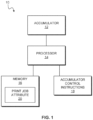
- FIG. 1 shows an example finisher apparatus 10.
- the finisher apparatus 10 includes an accumulator 12, a processor 14, memory 16, and instructions 18 to control an accumulator of the finisher based on an attribute 20 of a print job, which is be stored in the memory 16.
- the accumulator 12 is to register a print medium of a print job in preparation for a finishing operation.
- An example print medium is a sheet or stack of paper.
- Other examples of print media include plastic film, card stock, and similar.
- finishing operations include stapling, offsetting, collating, binding, stamping, embossing, coating, laminating, cutting, folding, stitching, dropping, outputting, and the like. Any number of finishing operations may be performed.
- the accumulator 12 may include an actuated component.
- An actuated component may include an actuator, such as a motor, and a component to physically manipulate print media. Examples of actuated components include a mezzanine, a channel, an edge clamp, a trailing edge clamp, a puller, and the like.
- the accumulator 12 may be controlled to bring print media to the correct position and orientation for performance of the finishing operation. Any number of actuated components may be provided.
- the processor 14 is coupled to the accumulator 12 to control operation of the accumulator 12.
- the processor 14 is coupled to the memory 16 to communicate instructions and data therebetween to provide for execution of instructions by the processor 14.
- the processor 14 may include a central processing units (CPU), a microcontroller, a microprocessor, a processing core, a field-programmable gate array (FPGA), or similar device capable of executing instructions.
- the processor 14 may be dedicated to the finisher apparatus 10 or may provide functionality to a printer or other apparatus that includes the finisher apparatus 10.
- the memory 16 may include a non-transitory machine-readable storage medium that may be any electronic, magnetic, optical, or other physical storage device that stores executable instructions.
- the machine-readable storage medium may include, for example, random access memory (RAM), read-only memory (ROM), electrically-erasable programmable read-only memory (EEPROM), flash memory, a storage drive, an optical disc, and the like.
- RAM random access memory
- ROM read-only memory
- EEPROM electrically-erasable programmable read-only memory
- flash memory a storage drive, an optical disc, and the like.
- the machine-readable storage medium may be encoded with executable instructions.
- the instructions 18 may be stored in the memory 16.
- the instructions 18 may be used to cause the processor 14 to control the accumulator 12 based on an attribute 20 of a print job comprising a page number.
- An attribute 20 of each print job may serve as a basis for controlling the accumulator 12 in addition to or as a modification to normal accumulator operation.
- job-to-job operation of the accumulator 12 may change, so as to increase throughput rate or control another aspect of job performance.
- the instructions 18 may be to control whether a component of the accumulator 12 is to be used during accumulation of the print medium based on a print job attribute 20.
- the instructions 18 may establish that a component is not to be used when the print job attribute 20 has a specific value or value range.
- the use of edge clamps to control sheet edge curl may be contingent on job size, that is, number of sheets.
- the instructions 18 may implement a job size threshold that, if the number of sheets of the job does not exceed the threshold, then edge clamps are not used during accumulation. As edge curl on smaller print jobs may be tolerated, selective use of edge clamps based on job size may increase throughput rate through the finisher apparatus 10.
- the instructions 18 are to control a speed of conveyance of the print medium by the accumulator 12 based on a print job attribute 20.
- the instructions 18 may accelerate or decelerate conveyance speed over a continuous range of speeds. Conveyance speed may have a continuous relationship with a value or value range of the print job attribute 20.
- the instructions 18 may select a discrete conveyance speed from a set of predetermined speeds. A value or value range of the print job attribute 20 may be mapped to one of the predetermined speeds.
- the print job attribute 20 is a page number, with a higher conveyance speed being selected for the first N page of the job, as edge catches and sheet friction may be less of concern when the accumulator 12 contains little or no print media.
- the instructions 18 may be to control the accumulator 12 based on a print job attribute 20 that is based on an environmental condition in or around the accumulator 12 or finisher apparatus.
- An environmental condition such as temperature or humidity, may be sensed by a sensor installed at the accumulator 12, finisher apparatus, or printer.
- the instructions 18 may be to control a finishing operation of the finisher apparatus 10 based on an attribute of the print job that is the same or different attribute as used to control the accumulator 12.
- Various finishing operations may be, for example, sped up, slowed down, or performed according to other parameters based on a print job attribute. For instance, a stapling operation may be increased in speed if page count is lower than a threshold number of pages.
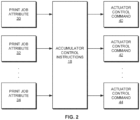
- example accumulator control instructions 18 may take as input a plurality of print job attributes 30-34.
- the instruction may process the plurality of print job attributes 30-34 to obtain an actuator control command 40-44 to control an actuated component of an accumulator 12.
- Combination logic to obtain an actuator control command 40-44 from print job attributes 30-34 may include an if-then condition, a continuous function, a lookup table or matrix, a decision tree, and similar. Any number of actuator control commands 40-44 for any number of actuated components may be obtained in this way.
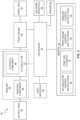
- FIG. 3 shows an example printer 50.
- the printer 50 may include a paper tray 52, a print engine 54, a finisher 56, an output area 58, a user interface 60, a network interface 62, a sensor 64, a processor 14, and memory 16.
- the printer 50 may be a multi-function device that may provide functions in addition to printing, such as scanning, copying, faxing, and the like.
- the printer 50 or a subcombination of its components may be termed a printer apparatus
- the paper tray 52 may store paper or other print medium for feeding into the print engine 54.
- the print engine 54 may include components to print documents.
- the print engine 54 may be located upstream of the finisher 56 and provide for inkjet printing, laser printing, or similar marking of print media.
- the finisher 56 may be coupled to an output of the print engine 54 to receive printed pages from the print engine 54.
- the finisher 56 may perform any number of finishing operations on printed pages.
- the finisher 56 may output documents to the output area 58, such as a tray, for retrieval by a user.
- the user interface 60 may include a keyboard, touchscreen, display device, and similar device to receive input from the user to control the printer 50 and to output information to a user in human-perceptible form, such as by rendering a graphical user interface (GUI).
- GUI graphical user interface
- the memory 16 may store print engine control instructions 70 that are executable by the processor 14 to control the print engine 54 to mark print media.
- the memory 16 may also store finisher control instructions 72 that are executable by the processor 14 to control the finisher 56 to perform a finishing operation.
- the finisher 56 may include a finishing component 80 and an accumulator 12 that may include an actuated component 82.
- the finishing component 80 is to perform a finishing operation, such as those discussed elsewhere herein.
- the actuated component 82 is to physically manipulate print media during the finishing operation, as discussed elsewhere herein. Any number of finishing components 80 and actuated components 82 may be provided to implement any number of finishing operations.
- Print job attributes 20 may be used to carry out the printing of the image data and a finishing operation.
- Print job attributes 20 may include print media type (e . g ., paper source, paper weight, paper quality, etc .), print media size (e . g ., letter, A4, legal, etc. ), print media orientation ( e.g ., portrait, landscape), a number of pages, a number of copies, ink density, an indication of copy collation, an indication of stapling, print engine throughput rate, print engine paper speed, printer throughput rate, a stack quality, an environmental condition, and the like. Examples of environmental conditions include temperature and humidity in or around the finisher.
- a print job attribute 20 may be received at the printer 50 via the network interface 62 with a print job that includes image data to be printed. For example, media type, size, and orientation may be defined by the print job as received.
- a print job attribute 20 may be generated by the processor 14, the print engine 54, the finisher 56, or other component of the printer 50 prior to or during execution of a print job. For example, an actual throughput rate (e.g., sheets per minute) or an actual paper speed ( e . g ., cm per second) of print media through the print engine 54 may be measured or computed as the print job is underway.
- the accumulator control instructions 18 may request an attribute 20 from the processor 14, print engine 54, finisher 56, or other component of the printer 50. For example, the accumulator control instructions 18 may cause the processor 14 to request a speed from the print engine 54.
- the accumulator control instructions 18 may cause the processor 14 to determine a print job attribute 20 by inspecting the print job. That is, prior to or during normal execution of the print job according to its attributes 20, the instructions may query the print job to obtain any attribute 20 relevant to control of the accumulator 12.
- the accumulator control instructions 18 may cause the processor 14 to infer a print job attribute 20 that is not provided with the print job or otherwise readily available. For example, ink density may not be readily available. In such case, the accumulator control instructions 18 may obtain print engine throughput speed and use such speed to determine ink density of a particular sheet, as slower throughput may mean more ink is being deposited. In another example, the instructions 18 may analyze image data of the print job to determine an ink density attribute 20. Image data may include graphics, text, and other content. The instructions 18 may implement any suitable technique to analyze image data, such as pixel quantification. The instructions 18 may apply a function, lookup table or matrix, or similar to obtain an ink density attribute 20 from an image of a sheet. In these and other examples, the accumulator control instructions 18 may correlate knowable attributes of the print job to attributes 20 that are used to control the accumulator 12.
- a print job attribute 20 may be specified via a user interface, such as the user interface 60 of the printer 50 or a user interface of a computer that originates a print job.
- Options for print job attributes 20 may be provided for the user to select. For example, stack quality may be provided as an option.
- a user may then select high or low stack quality, with the accumulator 12 being controlled accordingly. High stack quality may have improved appearance but may require lower speed operation of the accumulator 12. The user may choose to have print media arranged in a stack of lower quality to obtain increased throughput rate.
- a sensor 64 may be used to provide data to obtain a print job attribute 20.
- Example sensors include a humidity sensor and a temperature sensor.
- the accumulator control instructions 18 may determine a print job attribute 20 based on data from the sensor 64 to control the accumulator 12 accordingly. For example, low humidity may cause ink to dry more quickly and may allow for the accumulator 12 to be operated at a higher rate.
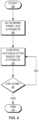
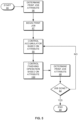
- FIG. 4 shows an example method of controlling an accumulator, such as any of the accumulators described herein, based on a print job attribute.
- the method starts at block 86 with the creation or reception of a print job that requires a finishing operation.
- an attribute of the print job may be determined.
- a sensor may be referenced if the attribute is based on an environmental condition.
- An accumulator of a finisher may be controlled during performance of the print job based on the attribute of the print job, at block 90, until the job ends via blocks 92, 94.
- Block 88 may be performed before commencement of the print job or during performance of the print job.
- FIG. 5 shows another example method of controlling an accumulator, such as any of the accumulators described herein, based on print job attribute.
- the method starts at block 95 with the creation or reception of a print job that requires a finishing operation.
- an attribute of the print job may be determined prior to commencement of the print job, that is for example, before a print engine has printed a first page.
- the print job commences.
- an attribute of the print job is determined, at block 98.
- the attribute determined during performance of the print job may be an attribute that is different from and in addition to the attribute determined prior to the start of the print job, at block 96.
- the attribute determined during the print job may be a redetermination of the same attribute determined prior to the start of the print job, at block 96. That, is a print job attribute may be initially determined and then re-determined during the print job. Ink density is an example of an attribute that may be determined in this way.
- the print job may include an initial indication of ink density, and as the job progresses, ink density may be re-determined.
- An accumulator of a finisher is controlled, at block 90, during performance of the print job based on the determined attribute or attributes of the print job, until the job ends via blocks 92, 99.
- a finishing operation may be controlled based on the determined attribute or attributes of the print job, at block 100.
- An attribute used to control the finishing operation may be the same attribute used to control the accumulator or may be a different attribute. For example, the speed of a stapling operation may be increase where accuracy or appearance of the stapling is less of a concern.
- FIGs. 6 and 7 show an example finisher apparatus 10.
- An example print-medium path P is shown in FIG. 7 .
- the finisher apparatus 10 may include a floor 102, a rear mezzanine 104, a front mezzanine 106, a rear channel 108, a front channel 110, a channel lift mechanism 111, a rear puller 112, a front puller 114, an X-axis registration mechanism 115, edge clamps 116 (also termed bar clamps), a shelf 118, leading edge clamps 120, eject pinch rollers 122, spur pinch rollers 123, a stapler 124, an end-of-sheet clamp 126, a trailing edge clamp 128, a diverter 130, and similar.
- the pullers 112, 114 may be attached to a belt to provide for movement of a print medium.
- the finisher apparatus 10 may further include actuators, such as motors, to actuate the components.
- the finisher apparatus 10 may include a floor motor 142, mezzanine motors 144, 146, a rear channel X-axis motor 148, a front channel X-axis motor 150, channel lift motor 152, a puller X-axis registration motor 154, a puller motor 155, an edge clamp motor 156, a shelf motor 158, a leading edge clamp motor 160, an eject pinch roller motor 162, a stapler motor 164, an end-of-sheet clamp motor 166, a trailing edge clamp motor 168, a diverter motor 170, and similar.
- the actuators may control linear and rotational movement and positioning of various components of the finisher apparatus 10 along or about X, Y, and Z axes.
- the stapler 124 may be actuated to move on the Y axis
- the channels 108, 110 may be actuated to move on the X and Z axes
- the mezzanines 104, 106 may be actuated to move on the X axis
- the floor 102 may be actuated to move in on the X and Y axes
- the leading edge clamps 120 may be actuated to move along the Z axis
- the shelf 118 may be actuated to rotate about the X axis
- a top plate service assembly formed of the pullers 112, 114, channels 108, 110, and edge clamps 116 may be actuated to move along the X axis. Actuation of the various components of the finisher apparatus 10 realizes the finishing operations provided by the finisher apparatus 10.
- the finisher apparatus 10 may further include sensors.
- the finisher apparatus 10 may include a channel mezzanine sensor 182, a channel X-axis registration sensor 184, a bin full sensor 186, a rear puller home sensor 188, a front puller home sensor 190, a puller entry sensor 192, an eject sensor 194, stapler sensors 196, such as a stapler motor home sensor, a low staples sensor, an out-of-staples sensor, a stapler carriage door sensor, and a media edge sensor, and similar.
- the sensors may be used to realize the finishing operations provided by the finisher apparatus 10.
- the mezzanines 104, 106, channels 108, 110, channel lift mechanism 111, pullers 112, 114, X-axis registration mechanism 115, edge clamps 116, shelf 118, leading edge clamps 120, end-of-sheet clamp 126, trailing edge clamp 128, and related actuators and sensors may be considered an accumulator 12.
- a document stack or copy may be assembled on the mezzanines 104, 106. After a sheet of print media is registered, the sheet may be clamped to the mezzanines 104, 106. When accumulation of the copy is complete, the mezzanines 104, 106 may transport the stack to the stapler 124 for stapling. After the copy is stapled, the mezzanines 104, 106 may transport the finished copy to a drop position. The copy may be clamped by the leading edge clamps 120 and both mezzanines 104, 106 may be moved outwards away from the copy, dropping it onto the output floor 102.
- the channels 108, 110 may act as paper guide surfaces for the transport of a sheet by the pullers 112, 114.
- the channel X-axis registration sensor 184 may be used to establish X-axis alignment of each sheet during the accumulation of a stack.
- the pullers 112, 114 may grip the leading edge of each sheet and pull the sheet to X and Y alignment positions.
- the edge clamps 116 may be moved along the X-axis on the edge of a sheet to control sheet curl, and may be moved to specific locations based on sheet size and orientation.
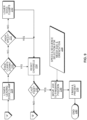
- FIGs. 8 and 9 show an example method of controlling a finisher apparatus, such as a finisher apparatus that includes the example accumulator depicted in FIGs. 6 and 7 , based on print job attributes.
- the method starts at block 210 with the creation or reception of a print job that requires a finishing operation.
- the accumulator is initialized for a new sheet of print media incoming from a print engine. This may include configuring pullers 112, 114 to accept the sheet.
- the pages are advanced toward the pullers 112, 114 and may begin transport via the pullers 112, 114 toward the alignment positions.
- positions of mezzanines 104, 106 may be adjusted for the nominal X-axis size of the sheet and the channels 108, 110 may be adjusted, at block 218.
- the leading edge clamps 120 may be lifted. Subsequent to lifting the leading edge clamps 120 or, if this is not the first page of the print job, other clamps, such as the edge clamps 116, end-of-sheet clamp 126, and trailing edge clamp 128, may be lifted, at block 221.
- the pullers 112, 114 may be advanced to a position, as determined by one or more sensors for performing X-axis registration at block 223.
- the pullers 112, 114 may reference a print job attribute, such as a speed mapping, user input, and the like.
- a print speed to puller speed mapping 244 may be used to adjust puller speed based on a speed of the print engine. That is, a relationship between print speed and puller speed may defined and then referenced when the pullers 112, 114 are advanced.
- User input 246 indicating a speed for the pullers 112, 114 may be referenced. For example, a user may indicate that speed through the finisher takes priority over an aesthetic characteristic of a printed document.
- the pullers may be stopped, channels 108, 110 may be opened, and an X-axis measurement of the sheet of print medium may be taken.
- the leading edge clamps 120 may lift to allow the pullers 112, 114 to advance for completing the Y-axis registration. This example of registration is shown as block 223.
- a print job attribute such as density
- Density may be a density of the print medium, an ink density, or a combination of such.
- Ink density may be determined from print job image data or print engine throughput rate, as discussed elsewhere herein.
- Print medium density may be determined from a thickness measurement of a sheet of print medium taken by the finisher or by user-provided information concerning the print medium, such as an indication of the kind of media loaded into a paper tray ( e.g., brochure, heavy card stock, plain paper, etc .).
- another print job attribute such as page number
- the current page number may be compared to a threshold page number. That is, finisher operational behavior may change once a certain number of pages has been exceeded.
- the edge clamps 116 and trailing edge clamp 128 may be lowered together, at block 226. Otherwise, the trailing edge clamp 128 may be lowered, at block 227.
- the pullers 112, 114 may be advanced to a position, such a position that is clear of the sheet.
- the leading edge clamps 120 may then be lowered, at block 229.
- edge clamps 116 it may be determined whether the edge clamps 116 are down. If the edge clamps 116 are down, then the channels 108, 110 may be reset, at block 234. If the edge clamps 116 are not down and a print job attribute requesting or indicating high speed finishing exists, at block 231, then the channels 108, 110 may be reset, at block 234. If the edge clamps 116 are not down and a print job attribute requesting or indicating high speed finishing has not been specified, then the edge clamps 116 may be lowered, at block 232, prior to the channels 108, 110 being reset at block 234.
- the method returns to block 214 for the next page, until it is determined that a last page is reached, at block 235.
- a print job attribute 238, such as media size or orientation, may be referenced to select a speed and sequence for moving the document to the finishing position.
- Other example print job attributes 238 include a user-specified speed and a speed determined from a print engine.
- a print job attribute may be used to control the finishing operation.
- the finishing operation is performed and the document is presented to the user as completed, at block 240, and the method ends, at block 240.
- the method may be repeated with the same print job attributes for multiple copies of a document in a particular print job.
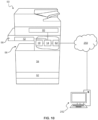
- FIG. 10 shows an example printer 50 connected to a computer network 250 via a network interface 62.
- a computer 252 may connect to the printer 50 via the network 250 to transmit print jobs to the printer 50.
- the computer 252 may output a user interface that allows user selection of an option to set an accumulator control attribute for a print job.
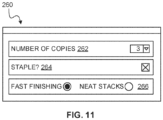
- FIG. 11 shows an example GUI 260 user selection of an option to set an attribute for a print job.
- the GUI 260 may be outputted at a user interface 60 of a printer 50 that executes print jobs.
- the GUI 260 may be outputted at a user interface of a computer 252 that creates or manages print jobs.
- the GUI 260 may include a user interface element 262 to select a printing directive, such as a number of copies of a document to print.
- the GUI 260 may include a user interface element 264 to select a finishing operation, such as whether the document is to be stapled.
- the GUI 260 may include a user interface element 266 to select an attribute for operation of a finisher. Such an option may be presented to the user in a user-friendly manner.
- One selection may control several attributes. For example, a selection of "fast finishing” may set attributes that operate pullers of the accumulator at a higher speed without the use of edge clamps. A selection of "neat stacks" may set attributes that operate the pullers at a lower speed with the use of edge clamps. A user who can tolerate a document whose pages are stacked with suboptimal appearance may benefit from faster throughput.
- the techniques described above may increase print job throughput without the need for additional finishing components or the use of an additional finisher. These techniques may be particularly suitable for inkjet printing, when compared to laser printing, as the possibility of the presence of varying amounts of drying ink on a sequence of printed sheets may lead to a tendency to design and operate accumulators conservatively.
- the techniques described herein include using density to control the accumulator, so that conservative or "one-size-fits-all" design and operation may be avoided. Small print jobs may benefit from increased throughput by using print job attributes to control the accumulator, while larger print jobs may also benefit or may not significantly suffer.
- selective use of finisher components may reduce noise of operation of the accumulator.
Landscapes
- Engineering & Computer Science (AREA)
- General Engineering & Computer Science (AREA)
- Mechanical Engineering (AREA)
- Physics & Mathematics (AREA)
- General Physics & Mathematics (AREA)
- Theoretical Computer Science (AREA)
- Accessory Devices And Overall Control Thereof (AREA)
- Control Or Security For Electrophotography (AREA)
Description
- Printing to media, such as paper, is often followed by a finishing operation. Finishing operations may be used to offset stacks of document copies, staple pages of documents together, perform stitching, and the like. Finishing operations tend to require the accumulation of sheets of print media.
- Document
US2017/158451 discloses a media accumulator-ejector for use with an imaging device comprising a finisher apparatus. - The scope of the invention is defined by the appended claims.
-
-
FIG. 1 is a block diagram of an example finisher apparatus. -
FIG. 2 is a block diagram of example accumulator control instructions. -
FIG. 3 is a block diagram of an example printer. -
FIG. 4 is a flowchart of an example method of controlling an example accumulator based on a print job attribute. -
FIG. 5 is a flowchart of another example method of controlling an example accumulator based a print job attribute. -
FIG. 6 is a schematic top view of an example finisher apparatus. -
FIG. 7 is a schematic front view of an example finisher apparatus. -
FIG. 8 is a flowchart of another example method of controlling an example accumulator based on a plurality of print job attributes. -
FIG. 9 is a continuation of the flowchart ofFIG. 8 . -
FIG. 10 is a schematic diagram of an example system. -
FIG. 11 is a diagram of an example graphical user interface. - Print jobs may undergo finishing operations at higher throughput with acceptable quality by operating a finisher on a job-specific basis. A print job attribute may be used to control an accumulator of the finisher. Attributes may include media size, orientation, ink density, media type, job size, and external factors such as environmental conditions. Attributes may be directly available to the finisher, may be measured or inferred from operation of a print engine, may be measured or inferred from operation of the finisher, or may be selected by a user. For example, a two-page print job may be processed by the accumulator with less consideration for stack appearance than a 50-page job, and thus may be completed at a higher throughput rate. Other finisher operations in addition to accumulation may be controlled based on a print job attribute.
-
FIG. 1 shows anexample finisher apparatus 10. Thefinisher apparatus 10 includes anaccumulator 12, aprocessor 14,memory 16, andinstructions 18 to control an accumulator of the finisher based on anattribute 20 of a print job, which is be stored in thememory 16. - The
accumulator 12 is to register a print medium of a print job in preparation for a finishing operation. An example print medium is a sheet or stack of paper. Other examples of print media include plastic film, card stock, and similar. Examples of finishing operations include stapling, offsetting, collating, binding, stamping, embossing, coating, laminating, cutting, folding, stitching, dropping, outputting, and the like. Any number of finishing operations may be performed. - The
accumulator 12 may include an actuated component. An actuated component may include an actuator, such as a motor, and a component to physically manipulate print media. Examples of actuated components include a mezzanine, a channel, an edge clamp, a trailing edge clamp, a puller, and the like. Theaccumulator 12 may be controlled to bring print media to the correct position and orientation for performance of the finishing operation. Any number of actuated components may be provided. - The
processor 14 is coupled to theaccumulator 12 to control operation of theaccumulator 12. Theprocessor 14 is coupled to thememory 16 to communicate instructions and data therebetween to provide for execution of instructions by theprocessor 14. Theprocessor 14 may include a central processing units (CPU), a microcontroller, a microprocessor, a processing core, a field-programmable gate array (FPGA), or similar device capable of executing instructions. Theprocessor 14 may be dedicated to thefinisher apparatus 10 or may provide functionality to a printer or other apparatus that includes thefinisher apparatus 10. - The
memory 16 may include a non-transitory machine-readable storage medium that may be any electronic, magnetic, optical, or other physical storage device that stores executable instructions. The machine-readable storage medium may include, for example, random access memory (RAM), read-only memory (ROM), electrically-erasable programmable read-only memory (EEPROM), flash memory, a storage drive, an optical disc, and the like. The machine-readable storage medium may be encoded with executable instructions. Theinstructions 18 may be stored in thememory 16. - The
instructions 18 may be used to cause theprocessor 14 to control theaccumulator 12 based on anattribute 20 of a print job comprising a page number. Anattribute 20 of each print job may serve as a basis for controlling theaccumulator 12 in addition to or as a modification to normal accumulator operation. Hence, job-to-job operation of theaccumulator 12 may change, so as to increase throughput rate or control another aspect of job performance. - The
instructions 18 may be to control whether a component of theaccumulator 12 is to be used during accumulation of the print medium based on aprint job attribute 20. Theinstructions 18 may establish that a component is not to be used when theprint job attribute 20 has a specific value or value range. For example, the use of edge clamps to control sheet edge curl may be contingent on job size, that is, number of sheets. Theinstructions 18 may implement a job size threshold that, if the number of sheets of the job does not exceed the threshold, then edge clamps are not used during accumulation. As edge curl on smaller print jobs may be tolerated, selective use of edge clamps based on job size may increase throughput rate through thefinisher apparatus 10. - The
instructions 18 are to control a speed of conveyance of the print medium by theaccumulator 12 based on aprint job attribute 20. Theinstructions 18 may accelerate or decelerate conveyance speed over a continuous range of speeds. Conveyance speed may have a continuous relationship with a value or value range of theprint job attribute 20. Theinstructions 18 may select a discrete conveyance speed from a set of predetermined speeds. A value or value range of theprint job attribute 20 may be mapped to one of the predetermined speeds. According to the invention, theprint job attribute 20 is a page number, with a higher conveyance speed being selected for the first N page of the job, as edge catches and sheet friction may be less of concern when theaccumulator 12 contains little or no print media. - The
instructions 18 may be to control theaccumulator 12 based on aprint job attribute 20 that is based on an environmental condition in or around theaccumulator 12 or finisher apparatus. An environmental condition, such as temperature or humidity, may be sensed by a sensor installed at theaccumulator 12, finisher apparatus, or printer. - The
instructions 18 may be to control a finishing operation of thefinisher apparatus 10 based on an attribute of the print job that is the same or different attribute as used to control theaccumulator 12. Various finishing operations may be, for example, sped up, slowed down, or performed according to other parameters based on a print job attribute. For instance, a stapling operation may be increased in speed if page count is lower than a threshold number of pages. - With reference to
FIG. 2 , exampleaccumulator control instructions 18 may take as input a plurality of print job attributes 30-34. The instruction may process the plurality of print job attributes 30-34 to obtain an actuator control command 40-44 to control an actuated component of anaccumulator 12. Combination logic to obtain an actuator control command 40-44 from print job attributes 30-34 may include an if-then condition, a continuous function, a lookup table or matrix, a decision tree, and similar. Any number of actuator control commands 40-44 for any number of actuated components may be obtained in this way. -
FIG. 3 shows anexample printer 50. Theprinter 50 may include apaper tray 52, aprint engine 54, afinisher 56, anoutput area 58, auser interface 60, anetwork interface 62, asensor 64, aprocessor 14, andmemory 16. Theprinter 50 may be a multi-function device that may provide functions in addition to printing, such as scanning, copying, faxing, and the like. Theprinter 50 or a subcombination of its components may be termed a printer apparatus - The
paper tray 52 may store paper or other print medium for feeding into theprint engine 54. Theprint engine 54 may include components to print documents. Theprint engine 54 may be located upstream of thefinisher 56 and provide for inkjet printing, laser printing, or similar marking of print media. Thefinisher 56 may be coupled to an output of theprint engine 54 to receive printed pages from theprint engine 54. Thefinisher 56 may perform any number of finishing operations on printed pages. Thefinisher 56 may output documents to theoutput area 58, such as a tray, for retrieval by a user. Theuser interface 60 may include a keyboard, touchscreen, display device, and similar device to receive input from the user to control theprinter 50 and to output information to a user in human-perceptible form, such as by rendering a graphical user interface (GUI). - The
memory 16 may store print engine control instructions 70 that are executable by theprocessor 14 to control theprint engine 54 to mark print media. Thememory 16 may also store finisher control instructions 72 that are executable by theprocessor 14 to control thefinisher 56 to perform a finishing operation. - The
finisher 56 may include afinishing component 80 and anaccumulator 12 that may include an actuatedcomponent 82. The finishingcomponent 80 is to perform a finishing operation, such as those discussed elsewhere herein. The actuatedcomponent 82 is to physically manipulate print media during the finishing operation, as discussed elsewhere herein. Any number of finishingcomponents 80 and actuatedcomponents 82 may be provided to implement any number of finishing operations. - Print job attributes 20 may be used to carry out the printing of the image data and a finishing operation. Print job attributes 20 may include print media type (e.g., paper source, paper weight, paper quality, etc.), print media size (e.g., letter, A4, legal, etc.), print media orientation (e.g., portrait, landscape), a number of pages, a number of copies, ink density, an indication of copy collation, an indication of stapling, print engine throughput rate, print engine paper speed, printer throughput rate, a stack quality, an environmental condition, and the like. Examples of environmental conditions include temperature and humidity in or around the finisher.
- A
print job attribute 20 may be received at theprinter 50 via thenetwork interface 62 with a print job that includes image data to be printed. For example, media type, size, and orientation may be defined by the print job as received. Aprint job attribute 20 may be generated by theprocessor 14, theprint engine 54, thefinisher 56, or other component of theprinter 50 prior to or during execution of a print job. For example, an actual throughput rate (e.g., sheets per minute) or an actual paper speed (e.g., cm per second) of print media through theprint engine 54 may be measured or computed as the print job is underway. Theaccumulator control instructions 18 may request anattribute 20 from theprocessor 14,print engine 54,finisher 56, or other component of theprinter 50. For example, theaccumulator control instructions 18 may cause theprocessor 14 to request a speed from theprint engine 54. - The
accumulator control instructions 18 may cause theprocessor 14 to determine aprint job attribute 20 by inspecting the print job. That is, prior to or during normal execution of the print job according to itsattributes 20, the instructions may query the print job to obtain anyattribute 20 relevant to control of theaccumulator 12. - The
accumulator control instructions 18 may cause theprocessor 14 to infer aprint job attribute 20 that is not provided with the print job or otherwise readily available. For example, ink density may not be readily available. In such case, theaccumulator control instructions 18 may obtain print engine throughput speed and use such speed to determine ink density of a particular sheet, as slower throughput may mean more ink is being deposited. In another example, theinstructions 18 may analyze image data of the print job to determine anink density attribute 20. Image data may include graphics, text, and other content. Theinstructions 18 may implement any suitable technique to analyze image data, such as pixel quantification. Theinstructions 18 may apply a function, lookup table or matrix, or similar to obtain an ink density attribute 20 from an image of a sheet. In these and other examples, theaccumulator control instructions 18 may correlate knowable attributes of the print job to attributes 20 that are used to control theaccumulator 12. - A
print job attribute 20 may be specified via a user interface, such as theuser interface 60 of theprinter 50 or a user interface of a computer that originates a print job. Options for print job attributes 20 may be provided for the user to select. For example, stack quality may be provided as an option. A user may then select high or low stack quality, with theaccumulator 12 being controlled accordingly. High stack quality may have improved appearance but may require lower speed operation of theaccumulator 12. The user may choose to have print media arranged in a stack of lower quality to obtain increased throughput rate. - A
sensor 64 may be used to provide data to obtain aprint job attribute 20. Example sensors include a humidity sensor and a temperature sensor. Theaccumulator control instructions 18 may determine aprint job attribute 20 based on data from thesensor 64 to control theaccumulator 12 accordingly. For example, low humidity may cause ink to dry more quickly and may allow for theaccumulator 12 to be operated at a higher rate. -
FIG. 4 shows an example method of controlling an accumulator, such as any of the accumulators described herein, based on a print job attribute. The method starts atblock 86 with the creation or reception of a print job that requires a finishing operation. Atblock 88, an attribute of the print job may be determined. A sensor may be referenced if the attribute is based on an environmental condition. An accumulator of a finisher may be controlled during performance of the print job based on the attribute of the print job, atblock 90, until the job ends viablocks Block 88 may be performed before commencement of the print job or during performance of the print job. -
FIG. 5 shows another example method of controlling an accumulator, such as any of the accumulators described herein, based on print job attribute. The method starts atblock 95 with the creation or reception of a print job that requires a finishing operation. Atblock 96, an attribute of the print job may be determined prior to commencement of the print job, that is for example, before a print engine has printed a first page. Next, atblock 97, the print job commences. During the performance of the print job an attribute of the print job is determined, atblock 98. The attribute determined during performance of the print job may be an attribute that is different from and in addition to the attribute determined prior to the start of the print job, atblock 96. The attribute determined during the print job may be a redetermination of the same attribute determined prior to the start of the print job, atblock 96. That, is a print job attribute may be initially determined and then re-determined during the print job. Ink density is an example of an attribute that may be determined in this way. The print job may include an initial indication of ink density, and as the job progresses, ink density may be re-determined. An accumulator of a finisher is controlled, atblock 90, during performance of the print job based on the determined attribute or attributes of the print job, until the job ends viablocks block 100. An attribute used to control the finishing operation may be the same attribute used to control the accumulator or may be a different attribute. For example, the speed of a stapling operation may be increase where accuracy or appearance of the stapling is less of a concern. -
FIGs. 6 and7 show anexample finisher apparatus 10. An example print-medium path P is shown inFIG. 7 . - The
finisher apparatus 10 may include afloor 102, arear mezzanine 104, afront mezzanine 106, arear channel 108, afront channel 110, a channel lift mechanism 111, arear puller 112, afront puller 114, anX-axis registration mechanism 115, edge clamps 116 (also termed bar clamps), ashelf 118, leading edge clamps 120, ejectpinch rollers 122, spurpinch rollers 123, astapler 124, an end-of-sheet clamp 126, a trailing edge clamp 128, adiverter 130, and similar. Thepullers - The
finisher apparatus 10 may further include actuators, such as motors, to actuate the components. Thefinisher apparatus 10 may include afloor motor 142,mezzanine motors X-axis motor 148, a front channelX-axis motor 150,channel lift motor 152, a pullerX-axis registration motor 154, apuller motor 155, anedge clamp motor 156, ashelf motor 158, a leadingedge clamp motor 160, an ejectpinch roller motor 162, astapler motor 164, an end-of-sheet clamp motor 166, a trailingedge clamp motor 168, adiverter motor 170, and similar. - The actuators may control linear and rotational movement and positioning of various components of the
finisher apparatus 10 along or about X, Y, and Z axes. For example, thestapler 124 may be actuated to move on the Y axis, thechannels mezzanines floor 102 may be actuated to move in on the X and Y axes, the leading edge clamps 120 may be actuated to move along the Z axis, theshelf 118 may be actuated to rotate about the X axis, and a top plate service assembly formed of thepullers channels finisher apparatus 10 realizes the finishing operations provided by thefinisher apparatus 10. - The
finisher apparatus 10 may further include sensors. Thefinisher apparatus 10 may include achannel mezzanine sensor 182, a channelX-axis registration sensor 184, a binfull sensor 186, a rear puller home sensor 188, a frontpuller home sensor 190, apuller entry sensor 192, aneject sensor 194,stapler sensors 196, such as a stapler motor home sensor, a low staples sensor, an out-of-staples sensor, a stapler carriage door sensor, and a media edge sensor, and similar. The sensors may be used to realize the finishing operations provided by thefinisher apparatus 10. - The
mezzanines channels pullers X-axis registration mechanism 115, edge clamps 116,shelf 118, leading edge clamps 120, end-of-sheet clamp 126, trailing edge clamp 128, and related actuators and sensors may be considered anaccumulator 12. - In an example operation, a document stack or copy may be assembled on the
mezzanines mezzanines mezzanines stapler 124 for stapling. After the copy is stapled, themezzanines mezzanines output floor 102. Thechannels pullers X-axis registration sensor 184 may be used to establish X-axis alignment of each sheet during the accumulation of a stack. Thepullers -
FIGs. 8 and9 show an example method of controlling a finisher apparatus, such as a finisher apparatus that includes the example accumulator depicted inFIGs. 6 and7 , based on print job attributes. The method starts atblock 210 with the creation or reception of a print job that requires a finishing operation. - At
block 212, the accumulator is initialized for a new sheet of print media incoming from a print engine. This may include configuringpullers - At
block 214, the pages are advanced toward thepullers pullers - If the current sheet of print medium is the first page of the print job, as determined at
block 216, then positions ofmezzanines channels block 218. - Subsequently, at
block 220, the leading edge clamps 120 may be lifted. Subsequent to lifting the leading edge clamps 120 or, if this is not the first page of the print job, other clamps, such as the edge clamps 116, end-of-sheet clamp 126, and trailing edge clamp 128, may be lifted, atblock 221. - At block 222, the
pullers block 223. During the advance, thepullers puller speed mapping 244 may be used to adjust puller speed based on a speed of the print engine. That is, a relationship between print speed and puller speed may defined and then referenced when thepullers pullers - At the X-axis registration point referenced previously, the pullers may be stopped,
channels pullers block 223. - At
block 224, a print job attribute, such as density, may be considered. Density may be a density of the print medium, an ink density, or a combination of such. Ink density may be determined from print job image data or print engine throughput rate, as discussed elsewhere herein. Print medium density may be determined from a thickness measurement of a sheet of print medium taken by the finisher or by user-provided information concerning the print medium, such as an indication of the kind of media loaded into a paper tray (e.g., brochure, heavy card stock, plain paper, etc.). - At
block 225, another print job attribute, such as page number, may be considered. The current page number may be compared to a threshold page number. That is, finisher operational behavior may change once a certain number of pages has been exceeded. - If the density is lower than a threshold density and the current page number is lower than a threshold page number, then the edge clamps 116 and trailing edge clamp 128 may be lowered together, at block 226. Otherwise, the trailing edge clamp 128 may be lowered, at
block 227. - Subsequently, at
block 228, thepullers block 229. - At
block 230, it may be determined whether the edge clamps 116 are down. If the edge clamps 116 are down, then thechannels block 234. If the edge clamps 116 are not down and a print job attribute requesting or indicating high speed finishing exists, atblock 231, then thechannels block 234. If the edge clamps 116 are not down and a print job attribute requesting or indicating high speed finishing has not been specified, then the edge clamps 116 may be lowered, atblock 232, prior to thechannels block 234. - The method returns to block 214 for the next page, until it is determined that a last page is reached, at
block 235. - Once the last page of the print job has been accumulated, then the document may be moved to a finishing position for a finishing operation, at block 236. A
print job attribute 238, such as media size or orientation, may be referenced to select a speed and sequence for moving the document to the finishing position. Other example print job attributes 238 include a user-specified speed and a speed determined from a print engine. A print job attribute may be used to control the finishing operation. - The finishing operation is performed and the document is presented to the user as completed, at
block 240, and the method ends, atblock 240. The method may be repeated with the same print job attributes for multiple copies of a document in a particular print job. -
FIG. 10 shows anexample printer 50 connected to acomputer network 250 via anetwork interface 62. Acomputer 252 may connect to theprinter 50 via thenetwork 250 to transmit print jobs to theprinter 50. Thecomputer 252 may output a user interface that allows user selection of an option to set an accumulator control attribute for a print job. -
FIG. 11 shows anexample GUI 260 user selection of an option to set an attribute for a print job. TheGUI 260 may be outputted at auser interface 60 of aprinter 50 that executes print jobs. TheGUI 260 may be outputted at a user interface of acomputer 252 that creates or manages print jobs. - The
GUI 260 may include auser interface element 262 to select a printing directive, such as a number of copies of a document to print. - The
GUI 260 may include auser interface element 264 to select a finishing operation, such as whether the document is to be stapled. - The
GUI 260 may include auser interface element 266 to select an attribute for operation of a finisher. Such an option may be presented to the user in a user-friendly manner. One selection may control several attributes. For example, a selection of "fast finishing" may set attributes that operate pullers of the accumulator at a higher speed without the use of edge clamps. A selection of "neat stacks" may set attributes that operate the pullers at a lower speed with the use of edge clamps. A user who can tolerate a document whose pages are stacked with suboptimal appearance may benefit from faster throughput. - The techniques described above may increase print job throughput without the need for additional finishing components or the use of an additional finisher. These techniques may be particularly suitable for inkjet printing, when compared to laser printing, as the possibility of the presence of varying amounts of drying ink on a sequence of printed sheets may lead to a tendency to design and operate accumulators conservatively. The techniques described herein include using density to control the accumulator, so that conservative or "one-size-fits-all" design and operation may be avoided. Small print jobs may benefit from increased throughput by using print job attributes to control the accumulator, while larger print jobs may also benefit or may not significantly suffer. In addition, selective use of finisher components, as discussed herein, may reduce noise of operation of the accumulator.
- It should be recognized that features and aspects of the various examples provided above can be combined into further examples that also fall within the scope of the present disclosure. In addition, the figures are not to scale and may have size and shape exaggerated for illustrative purposes.
Claims (10)
- A finisher apparatus (10) comprising:an accumulator (12) to register a print medium of a print job in preparation for a finishing operation;memory (16) to store a page number of the print job; anda processor (14) coupled to the accumulator (12) and to the memory (16), characterized in that the processor (14) is configured to execute instructions, the instructions to control a speed of conveyance of the print medium by the accumulator (12), wherein the instructions are to reduce the speed of conveyance when the page number exceeds a threshold page number.
- The apparatus of claim 1, wherein the instructions are to control whether a component of the accumulator (12) is to be used during accumulation of the print medium.
- The apparatus of claim 1, wherein the instructions are to control the accumulator (12) based on a combination of a plurality of attributes, including the page number.
- The apparatus of claim 2, wherein the instructions are to determine the page number by inspecting the print job.
- The apparatus of claim 1, wherein the instructions are to determine the page number from operation of a print engine (54) that is upstream of the finisher apparatus (10).
- The apparatus of claim 3, wherein the instructions are to determine at least one of the plurality of attributes as an ink density of a print job.
- The apparatus of claim 3, wherein the instructions are to determine at least one of the plurality of attributes from a user-selected option for the print job.
- A printer apparatus (50) comprising:a print engine (54) to print to a print medium; andthe finisher apparatus (56) of claim 1 coupled to the print engine (54), the finisher apparatus (56) to perform a finishing operation on the print medium.
- A method comprising:determining a page number of a print job, the print job to be processed by a print engine (54) and a finisher (56) that includes an accumulator (12) to register a print medium in preparation for a finishing operation; andcharacterized by reducing a speed of conveyance of the print medium by the accumulator when the page number of the print job exceeds a threshold page number during performance of the print job.
- The method of claim 9, further comprising controlling the finishing operation based on the page number and based on another determined attribute of the print job.
Applications Claiming Priority (1)
| Application Number | Priority Date | Filing Date | Title |
|---|---|---|---|
| PCT/US2017/049904 WO2019045753A1 (en) | 2017-09-01 | 2017-09-01 | Print media accumulators controlled by print job attributes |
Publications (3)
| Publication Number | Publication Date |
|---|---|
| EP3676100A1 EP3676100A1 (en) | 2020-07-08 |
| EP3676100A4 EP3676100A4 (en) | 2021-03-24 |
| EP3676100B1 true EP3676100B1 (en) | 2024-10-30 |
Family
ID=65527569
Family Applications (1)
| Application Number | Title | Priority Date | Filing Date |
|---|---|---|---|
| EP17923568.4A Active EP3676100B1 (en) | 2017-09-01 | 2017-09-01 | Print media accumulators controlled by print job attributes |
Country Status (4)
| Country | Link |
|---|---|
| US (1) | US11176432B2 (en) |
| EP (1) | EP3676100B1 (en) |
| CN (1) | CN111132848B (en) |
| WO (1) | WO2019045753A1 (en) |
Family Cites Families (25)
| Publication number | Priority date | Publication date | Assignee | Title |
|---|---|---|---|---|
| EP0941852B1 (en) * | 1991-07-30 | 2003-03-26 | Canon Kabushiki Kaisha | Ink jet recording apparatus and method |
| US7864346B2 (en) | 2000-05-16 | 2011-01-04 | Xerox Corporation | Apparatus and method for describing, planning and automatically programming complex finishing tasks |
| US6483996B2 (en) | 2001-04-02 | 2002-11-19 | Hewlett-Packard Company | Method and system for predicting print quality degradation in an image forming device |
| JP3774640B2 (en) * | 2001-05-17 | 2006-05-17 | キヤノン株式会社 | Inkjet recording apparatus and inkjet recording method |
| US7463376B2 (en) | 2002-01-30 | 2008-12-09 | Hewlett-Packard Development Company, L.P. | Print finishing method and apparatus |
| EP1355261B1 (en) * | 2002-04-16 | 2013-02-27 | Canon Kabushiki Kaisha | Print media quality assurance |
| KR100548225B1 (en) * | 2003-12-24 | 2006-02-02 | 삼성전자주식회사 | Image forming apparatus having a feeding time interval control function and method thereof |
| JP4328685B2 (en) * | 2004-07-20 | 2009-09-09 | キヤノン株式会社 | Sheet processing device |
| US7787138B2 (en) | 2005-05-25 | 2010-08-31 | Xerox Corporation | Scheduling system |
| US7510177B2 (en) * | 2005-03-01 | 2009-03-31 | Sharp Kabushiki Kaisha | Sheet post-processing apparatus and image formation apparatus |
| KR100708164B1 (en) * | 2005-07-20 | 2007-04-17 | 삼성전자주식회사 | Inkjet image forming apparatus comprising a drying apparatus and a drying method of a print medium |
| US20080079763A1 (en) | 2006-09-29 | 2008-04-03 | Weyerhaeuser Co. | Systems And Methods For Verifying The Operational Conditions Of Print Heads in a Digital Printing Environment |
| US7894739B2 (en) | 2008-06-19 | 2011-02-22 | Xerox Corporation | Tandem finishing |
| JP5355207B2 (en) * | 2009-04-30 | 2013-11-27 | キヤノン株式会社 | Image forming apparatus, image forming method, and program |
| JP5652264B2 (en) * | 2011-03-03 | 2015-01-14 | 株式会社リコー | Image forming apparatus and droplet discharge detection method in the image forming apparatus |
| JPWO2014069307A1 (en) * | 2012-10-30 | 2016-09-08 | キヤノン株式会社 | Sheet processing apparatus and image forming system |
| US8928920B2 (en) * | 2013-04-17 | 2015-01-06 | Xerox Corporation | Multi-color banner pages for print job finishing workflows |
| EP3134268B1 (en) * | 2014-04-23 | 2020-05-27 | Hewlett-Packard Development Company, L.P. | Printer and method of printing |
| JP2015221721A (en) * | 2014-04-30 | 2015-12-10 | キヤノン株式会社 | Sheet conveying apparatus and image forming apparatus |
| JP2016052766A (en) * | 2014-09-04 | 2016-04-14 | キヤノン株式会社 | Printing apparatus, printing method and program, and printing system |
| DE102015118139A1 (en) * | 2015-04-20 | 2016-10-20 | Océ Printing Systems GmbH & Co. KG | Method and device for sequencing print jobs |
| CN106610798A (en) * | 2015-10-26 | 2017-05-03 | 山东新北洋信息技术股份有限公司 | Control method, device and system for batch printing of bills |
| US9639048B1 (en) * | 2015-12-07 | 2017-05-02 | Lexmark International, Inc. | Media accumulator-ejector for use with an imaging device |
| WO2017099743A1 (en) * | 2015-12-09 | 2017-06-15 | Hewlett-Packard Development Company, L.P. | Media output system |
| JP6746326B2 (en) * | 2016-02-19 | 2020-08-26 | キヤノン株式会社 | Printing device, printing method, and program for interpreting print data by a plurality of interpreting means |
-
2017
- 2017-09-01 EP EP17923568.4A patent/EP3676100B1/en active Active
- 2017-09-01 US US16/499,250 patent/US11176432B2/en active Active
- 2017-09-01 WO PCT/US2017/049904 patent/WO2019045753A1/en not_active Ceased
- 2017-09-01 CN CN201780095399.8A patent/CN111132848B/en active Active
Also Published As
| Publication number | Publication date |
|---|---|
| US20210110224A1 (en) | 2021-04-15 |
| WO2019045753A1 (en) | 2019-03-07 |
| CN111132848A (en) | 2020-05-08 |
| EP3676100A1 (en) | 2020-07-08 |
| US11176432B2 (en) | 2021-11-16 |
| CN111132848B (en) | 2022-08-09 |
| EP3676100A4 (en) | 2021-03-24 |
Similar Documents
| Publication | Publication Date | Title |
|---|---|---|
| EP2085240B1 (en) | Printing system and method | |
| US7571904B2 (en) | Control system for indexing compiler drive shaft that senses drive torque to initiate indexing | |
| US20170146941A1 (en) | Printing system, control method thereof, control apparatus, and non-transitory computer-readable storage medium | |
| US9682841B2 (en) | Sheet folding apparatus and image forming system | |
| EP2349728B1 (en) | First sheet job offset | |
| JP2012047940A (en) | Image forming apparatus | |
| US8317185B1 (en) | Method and apparatus for feeding media sheets in an image production device | |
| US9509865B2 (en) | Device and method for processing a reprographic job | |
| US11176432B2 (en) | Print media accumulators controlled by print job attributes | |
| JP6376760B2 (en) | Print control apparatus, print control method, and program | |
| WO2017099741A1 (en) | Eject a stack of media sheets | |
| CN112074477B (en) | Variably rotatable paddle for a finisher | |
| JP4875449B2 (en) | Image forming system | |
| US8448078B2 (en) | Method and apparatus for selection of default media based on media size in an image production device | |
| US8104756B2 (en) | Method and apparatus for selecting media trays for hole punching in an image production device | |
| JP5772061B2 (en) | Folding device, image forming system, folding processing control program, and folding method | |
| CN108490748A (en) | Image formation system and control method | |
| CN111315585B (en) | Method for ejecting jammed print media, finisher device, and printer device | |
| JP2025089681A (en) | Post-processing device and image forming apparatus | |
| JP6452325B2 (en) | Image forming apparatus and image forming system | |
| JP2022092109A (en) | Sheet post-processing device, image forming apparatus and image forming system including the same, sheet conveyance device, and image forming apparatus and image forming system including the same | |
| US20100013138A1 (en) | Printing system and method | |
| JP2008055801A5 (en) | ||
| JP5817867B2 (en) | Post-processing apparatus and image forming apparatus | |
| US20170094097A1 (en) | Image formation apparatus, image formation method, and non-transitory computer readable recording medium that stores image formation program |
Legal Events
| Date | Code | Title | Description |
|---|---|---|---|
| STAA | Information on the status of an ep patent application or granted ep patent |
Free format text: STATUS: THE INTERNATIONAL PUBLICATION HAS BEEN MADE |
|
| PUAI | Public reference made under article 153(3) epc to a published international application that has entered the european phase |
Free format text: ORIGINAL CODE: 0009012 |
|
| STAA | Information on the status of an ep patent application or granted ep patent |
Free format text: STATUS: REQUEST FOR EXAMINATION WAS MADE |
|
| 17P | Request for examination filed |
Effective date: 20200225 |
|
| AK | Designated contracting states |
Kind code of ref document: A1 Designated state(s): AL AT BE BG CH CY CZ DE DK EE ES FI FR GB GR HR HU IE IS IT LI LT LU LV MC MK MT NL NO PL PT RO RS SE SI SK SM TR |
|
| AX | Request for extension of the european patent |
Extension state: BA ME |
|
| DAV | Request for validation of the european patent (deleted) | ||
| DAX | Request for extension of the european patent (deleted) | ||
| A4 | Supplementary search report drawn up and despatched |
Effective date: 20210224 |
|
| RIC1 | Information provided on ipc code assigned before grant |
Ipc: B41L 39/16 20060101ALI20210218BHEP Ipc: B41J 13/10 20060101AFI20210218BHEP Ipc: B65H 5/00 20060101ALI20210218BHEP |
|
| STAA | Information on the status of an ep patent application or granted ep patent |
Free format text: STATUS: EXAMINATION IS IN PROGRESS |
|
| 17Q | First examination report despatched |
Effective date: 20220930 |
|
| REG | Reference to a national code |
Ref country code: DE Ref legal event code: R079 Free format text: PREVIOUS MAIN CLASS: B41J0013100000 Ipc: B42C0001120000 Ref document number: 602017085862 Country of ref document: DE |
|
| GRAP | Despatch of communication of intention to grant a patent |
Free format text: ORIGINAL CODE: EPIDOSNIGR1 |
|
| STAA | Information on the status of an ep patent application or granted ep patent |
Free format text: STATUS: GRANT OF PATENT IS INTENDED |
|
| RIC1 | Information provided on ipc code assigned before grant |
Ipc: B65H 31/26 20060101ALI20240717BHEP Ipc: B65H 43/00 20060101ALI20240717BHEP Ipc: B65H 31/34 20060101ALI20240717BHEP Ipc: B65H 31/30 20060101ALI20240717BHEP Ipc: B65H 31/02 20060101ALI20240717BHEP Ipc: B42C 1/12 20060101AFI20240717BHEP |
|
| INTG | Intention to grant announced |
Effective date: 20240806 |
|
| GRAS | Grant fee paid |
Free format text: ORIGINAL CODE: EPIDOSNIGR3 |
|
| GRAA | (expected) grant |
Free format text: ORIGINAL CODE: 0009210 |
|
| STAA | Information on the status of an ep patent application or granted ep patent |
Free format text: STATUS: THE PATENT HAS BEEN GRANTED |
|
| AK | Designated contracting states |
Kind code of ref document: B1 Designated state(s): AL AT BE BG CH CY CZ DE DK EE ES FI FR GB GR HR HU IE IS IT LI LT LU LV MC MK MT NL NO PL PT RO RS SE SI SK SM TR |
|
| REG | Reference to a national code |
Ref country code: GB Ref legal event code: FG4D |
|
| REG | Reference to a national code |
Ref country code: CH Ref legal event code: EP |
|
| REG | Reference to a national code |
Ref country code: IE Ref legal event code: FG4D |
|
| REG | Reference to a national code |
Ref country code: DE Ref legal event code: R096 Ref document number: 602017085862 Country of ref document: DE |
|
| REG | Reference to a national code |
Ref country code: LT Ref legal event code: MG9D |
|
| REG | Reference to a national code |
Ref country code: NL Ref legal event code: MP Effective date: 20241030 |
|
| PG25 | Lapsed in a contracting state [announced via postgrant information from national office to epo] |
Ref country code: HR Free format text: LAPSE BECAUSE OF FAILURE TO SUBMIT A TRANSLATION OF THE DESCRIPTION OR TO PAY THE FEE WITHIN THE PRESCRIBED TIME-LIMIT Effective date: 20241030 Ref country code: IS Free format text: LAPSE BECAUSE OF FAILURE TO SUBMIT A TRANSLATION OF THE DESCRIPTION OR TO PAY THE FEE WITHIN THE PRESCRIBED TIME-LIMIT Effective date: 20250228 Ref country code: PT Free format text: LAPSE BECAUSE OF FAILURE TO SUBMIT A TRANSLATION OF THE DESCRIPTION OR TO PAY THE FEE WITHIN THE PRESCRIBED TIME-LIMIT Effective date: 20250228 |
|
| PG25 | Lapsed in a contracting state [announced via postgrant information from national office to epo] |
Ref country code: FI Free format text: LAPSE BECAUSE OF FAILURE TO SUBMIT A TRANSLATION OF THE DESCRIPTION OR TO PAY THE FEE WITHIN THE PRESCRIBED TIME-LIMIT Effective date: 20241030 Ref country code: NL Free format text: LAPSE BECAUSE OF FAILURE TO SUBMIT A TRANSLATION OF THE DESCRIPTION OR TO PAY THE FEE WITHIN THE PRESCRIBED TIME-LIMIT Effective date: 20241030 |
|
| REG | Reference to a national code |
Ref country code: AT Ref legal event code: MK05 Ref document number: 1736548 Country of ref document: AT Kind code of ref document: T Effective date: 20241030 |
|
| PG25 | Lapsed in a contracting state [announced via postgrant information from national office to epo] |
Ref country code: BG Free format text: LAPSE BECAUSE OF FAILURE TO SUBMIT A TRANSLATION OF THE DESCRIPTION OR TO PAY THE FEE WITHIN THE PRESCRIBED TIME-LIMIT Effective date: 20241030 |
|
| PG25 | Lapsed in a contracting state [announced via postgrant information from national office to epo] |
Ref country code: ES Free format text: LAPSE BECAUSE OF FAILURE TO SUBMIT A TRANSLATION OF THE DESCRIPTION OR TO PAY THE FEE WITHIN THE PRESCRIBED TIME-LIMIT Effective date: 20241030 |
|
| PG25 | Lapsed in a contracting state [announced via postgrant information from national office to epo] |
Ref country code: NO Free format text: LAPSE BECAUSE OF FAILURE TO SUBMIT A TRANSLATION OF THE DESCRIPTION OR TO PAY THE FEE WITHIN THE PRESCRIBED TIME-LIMIT Effective date: 20250130 |
|
| PG25 | Lapsed in a contracting state [announced via postgrant information from national office to epo] |
Ref country code: LV Free format text: LAPSE BECAUSE OF FAILURE TO SUBMIT A TRANSLATION OF THE DESCRIPTION OR TO PAY THE FEE WITHIN THE PRESCRIBED TIME-LIMIT Effective date: 20241030 Ref country code: GR Free format text: LAPSE BECAUSE OF FAILURE TO SUBMIT A TRANSLATION OF THE DESCRIPTION OR TO PAY THE FEE WITHIN THE PRESCRIBED TIME-LIMIT Effective date: 20250131 Ref country code: AT Free format text: LAPSE BECAUSE OF FAILURE TO SUBMIT A TRANSLATION OF THE DESCRIPTION OR TO PAY THE FEE WITHIN THE PRESCRIBED TIME-LIMIT Effective date: 20241030 |
|
| PG25 | Lapsed in a contracting state [announced via postgrant information from national office to epo] |
Ref country code: PL Free format text: LAPSE BECAUSE OF FAILURE TO SUBMIT A TRANSLATION OF THE DESCRIPTION OR TO PAY THE FEE WITHIN THE PRESCRIBED TIME-LIMIT Effective date: 20241030 |
|
| PG25 | Lapsed in a contracting state [announced via postgrant information from national office to epo] |
Ref country code: RS Free format text: LAPSE BECAUSE OF FAILURE TO SUBMIT A TRANSLATION OF THE DESCRIPTION OR TO PAY THE FEE WITHIN THE PRESCRIBED TIME-LIMIT Effective date: 20250130 |
|
| PG25 | Lapsed in a contracting state [announced via postgrant information from national office to epo] |
Ref country code: SM Free format text: LAPSE BECAUSE OF FAILURE TO SUBMIT A TRANSLATION OF THE DESCRIPTION OR TO PAY THE FEE WITHIN THE PRESCRIBED TIME-LIMIT Effective date: 20241030 |
|
| PG25 | Lapsed in a contracting state [announced via postgrant information from national office to epo] |
Ref country code: DK Free format text: LAPSE BECAUSE OF FAILURE TO SUBMIT A TRANSLATION OF THE DESCRIPTION OR TO PAY THE FEE WITHIN THE PRESCRIBED TIME-LIMIT Effective date: 20241030 |
|
| PG25 | Lapsed in a contracting state [announced via postgrant information from national office to epo] |
Ref country code: EE Free format text: LAPSE BECAUSE OF FAILURE TO SUBMIT A TRANSLATION OF THE DESCRIPTION OR TO PAY THE FEE WITHIN THE PRESCRIBED TIME-LIMIT Effective date: 20241030 |
|
| PG25 | Lapsed in a contracting state [announced via postgrant information from national office to epo] |
Ref country code: RO Free format text: LAPSE BECAUSE OF FAILURE TO SUBMIT A TRANSLATION OF THE DESCRIPTION OR TO PAY THE FEE WITHIN THE PRESCRIBED TIME-LIMIT Effective date: 20241030 |
|
| PG25 | Lapsed in a contracting state [announced via postgrant information from national office to epo] |
Ref country code: SK Free format text: LAPSE BECAUSE OF FAILURE TO SUBMIT A TRANSLATION OF THE DESCRIPTION OR TO PAY THE FEE WITHIN THE PRESCRIBED TIME-LIMIT Effective date: 20241030 |
|
| PG25 | Lapsed in a contracting state [announced via postgrant information from national office to epo] |
Ref country code: CZ Free format text: LAPSE BECAUSE OF FAILURE TO SUBMIT A TRANSLATION OF THE DESCRIPTION OR TO PAY THE FEE WITHIN THE PRESCRIBED TIME-LIMIT Effective date: 20241030 |
|
| PG25 | Lapsed in a contracting state [announced via postgrant information from national office to epo] |
Ref country code: IT Free format text: LAPSE BECAUSE OF FAILURE TO SUBMIT A TRANSLATION OF THE DESCRIPTION OR TO PAY THE FEE WITHIN THE PRESCRIBED TIME-LIMIT Effective date: 20241030 |
|
| REG | Reference to a national code |
Ref country code: DE Ref legal event code: R097 Ref document number: 602017085862 Country of ref document: DE |
|
| PLBE | No opposition filed within time limit |
Free format text: ORIGINAL CODE: 0009261 |
|
| STAA | Information on the status of an ep patent application or granted ep patent |
Free format text: STATUS: NO OPPOSITION FILED WITHIN TIME LIMIT |
|
| PG25 | Lapsed in a contracting state [announced via postgrant information from national office to epo] |
Ref country code: SE Free format text: LAPSE BECAUSE OF FAILURE TO SUBMIT A TRANSLATION OF THE DESCRIPTION OR TO PAY THE FEE WITHIN THE PRESCRIBED TIME-LIMIT Effective date: 20241030 |
|
| 26N | No opposition filed |
Effective date: 20250731 |
|
| PGFP | Annual fee paid to national office [announced via postgrant information from national office to epo] |
Ref country code: DE Payment date: 20250820 Year of fee payment: 9 |
|
| REG | Reference to a national code |
Ref country code: CH Ref legal event code: H13 Free format text: ST27 STATUS EVENT CODE: U-0-0-H10-H13 (AS PROVIDED BY THE NATIONAL OFFICE) Effective date: 20260425 |
|
| PG25 | Lapsed in a contracting state [announced via postgrant information from national office to epo] |
Ref country code: LU Free format text: LAPSE BECAUSE OF NON-PAYMENT OF DUE FEES Effective date: 20250901 |
|
| GBPC | Gb: european patent ceased through non-payment of renewal fee |
Effective date: 20250901 |
|
| REG | Reference to a national code |
Ref country code: BE Ref legal event code: MM Effective date: 20250930 |
|
| PG25 | Lapsed in a contracting state [announced via postgrant information from national office to epo] |
Ref country code: LT Free format text: LAPSE BECAUSE OF FAILURE TO SUBMIT A TRANSLATION OF THE DESCRIPTION OR TO PAY THE FEE WITHIN THE PRESCRIBED TIME-LIMIT Effective date: 20241030 |
|
| PG25 | Lapsed in a contracting state [announced via postgrant information from national office to epo] |
Ref country code: MC Free format text: LAPSE BECAUSE OF FAILURE TO SUBMIT A TRANSLATION OF THE DESCRIPTION OR TO PAY THE FEE WITHIN THE PRESCRIBED TIME-LIMIT Effective date: 20241030 |
|
| PG25 | Lapsed in a contracting state [announced via postgrant information from national office to epo] |
Ref country code: GB Free format text: LAPSE BECAUSE OF NON-PAYMENT OF DUE FEES Effective date: 20250901 |
|
| PG25 | Lapsed in a contracting state [announced via postgrant information from national office to epo] |
Ref country code: BE Free format text: LAPSE BECAUSE OF NON-PAYMENT OF DUE FEES Effective date: 20250930 Ref country code: CH Free format text: LAPSE BECAUSE OF NON-PAYMENT OF DUE FEES Effective date: 20250930 Ref country code: IE Free format text: LAPSE BECAUSE OF NON-PAYMENT OF DUE FEES Effective date: 20250901 |
|
| PG25 | Lapsed in a contracting state [announced via postgrant information from national office to epo] |
Ref country code: FR Free format text: LAPSE BECAUSE OF NON-PAYMENT OF DUE FEES Effective date: 20250930 |