EP3672952B1 - Benzimidazole derivatives as adenosine receptor antagonists - Google Patents
Benzimidazole derivatives as adenosine receptor antagonists Download PDFInfo
- Publication number
- EP3672952B1 EP3672952B1 EP18753209.8A EP18753209A EP3672952B1 EP 3672952 B1 EP3672952 B1 EP 3672952B1 EP 18753209 A EP18753209 A EP 18753209A EP 3672952 B1 EP3672952 B1 EP 3672952B1
- Authority
- EP
- European Patent Office
- Prior art keywords
- methoxy
- benzodiazol
- methyl
- carboxamide
- pyrazol
- Prior art date
- Legal status (The legal status is an assumption and is not a legal conclusion. Google has not performed a legal analysis and makes no representation as to the accuracy of the status listed.)
- Active
Links
Classifications
-
- C—CHEMISTRY; METALLURGY
- C07—ORGANIC CHEMISTRY
- C07D—HETEROCYCLIC COMPOUNDS
- C07D235/00—Heterocyclic compounds containing 1,3-diazole or hydrogenated 1,3-diazole rings, condensed with other rings
- C07D235/02—Heterocyclic compounds containing 1,3-diazole or hydrogenated 1,3-diazole rings, condensed with other rings condensed with carbocyclic rings or ring systems
- C07D235/04—Benzimidazoles; Hydrogenated benzimidazoles
- C07D235/24—Benzimidazoles; Hydrogenated benzimidazoles with hetero atoms or with carbon atoms having three bonds to hetero atoms with at the most one bond to halogen, e.g. ester or nitrile radicals, directly attached in position 2
- C07D235/30—Nitrogen atoms not forming part of a nitro radical
-
- A—HUMAN NECESSITIES
- A61—MEDICAL OR VETERINARY SCIENCE; HYGIENE
- A61K—PREPARATIONS FOR MEDICAL, DENTAL OR TOILETRY PURPOSES
- A61K31/00—Medicinal preparations containing organic active ingredients
- A61K31/33—Heterocyclic compounds
- A61K31/395—Heterocyclic compounds having nitrogen as a ring hetero atom, e.g. guanethidine or rifamycins
- A61K31/41—Heterocyclic compounds having nitrogen as a ring hetero atom, e.g. guanethidine or rifamycins having five-membered rings with two or more ring hetero atoms, at least one of which being nitrogen, e.g. tetrazole
- A61K31/4164—1,3-Diazoles
- A61K31/4184—1,3-Diazoles condensed with carbocyclic rings, e.g. benzimidazoles
-
- A—HUMAN NECESSITIES
- A61—MEDICAL OR VETERINARY SCIENCE; HYGIENE
- A61K—PREPARATIONS FOR MEDICAL, DENTAL OR TOILETRY PURPOSES
- A61K31/00—Medicinal preparations containing organic active ingredients
- A61K31/33—Heterocyclic compounds
- A61K31/395—Heterocyclic compounds having nitrogen as a ring hetero atom, e.g. guanethidine or rifamycins
- A61K31/41—Heterocyclic compounds having nitrogen as a ring hetero atom, e.g. guanethidine or rifamycins having five-membered rings with two or more ring hetero atoms, at least one of which being nitrogen, e.g. tetrazole
- A61K31/425—Thiazoles
- A61K31/427—Thiazoles not condensed and containing further heterocyclic rings
-
- A—HUMAN NECESSITIES
- A61—MEDICAL OR VETERINARY SCIENCE; HYGIENE
- A61K—PREPARATIONS FOR MEDICAL, DENTAL OR TOILETRY PURPOSES
- A61K31/00—Medicinal preparations containing organic active ingredients
- A61K31/33—Heterocyclic compounds
- A61K31/395—Heterocyclic compounds having nitrogen as a ring hetero atom, e.g. guanethidine or rifamycins
- A61K31/435—Heterocyclic compounds having nitrogen as a ring hetero atom, e.g. guanethidine or rifamycins having six-membered rings with one nitrogen as the only ring hetero atom
- A61K31/4353—Heterocyclic compounds having nitrogen as a ring hetero atom, e.g. guanethidine or rifamycins having six-membered rings with one nitrogen as the only ring hetero atom ortho- or peri-condensed with heterocyclic ring systems
- A61K31/437—Heterocyclic compounds having nitrogen as a ring hetero atom, e.g. guanethidine or rifamycins having six-membered rings with one nitrogen as the only ring hetero atom ortho- or peri-condensed with heterocyclic ring systems the heterocyclic ring system containing a five-membered ring having nitrogen as a ring hetero atom, e.g. indolizine, beta-carboline
-
- A—HUMAN NECESSITIES
- A61—MEDICAL OR VETERINARY SCIENCE; HYGIENE
- A61K—PREPARATIONS FOR MEDICAL, DENTAL OR TOILETRY PURPOSES
- A61K31/00—Medicinal preparations containing organic active ingredients
- A61K31/33—Heterocyclic compounds
- A61K31/395—Heterocyclic compounds having nitrogen as a ring hetero atom, e.g. guanethidine or rifamycins
- A61K31/435—Heterocyclic compounds having nitrogen as a ring hetero atom, e.g. guanethidine or rifamycins having six-membered rings with one nitrogen as the only ring hetero atom
- A61K31/438—The ring being spiro-condensed with carbocyclic or heterocyclic ring systems
-
- A—HUMAN NECESSITIES
- A61—MEDICAL OR VETERINARY SCIENCE; HYGIENE
- A61K—PREPARATIONS FOR MEDICAL, DENTAL OR TOILETRY PURPOSES
- A61K31/00—Medicinal preparations containing organic active ingredients
- A61K31/33—Heterocyclic compounds
- A61K31/395—Heterocyclic compounds having nitrogen as a ring hetero atom, e.g. guanethidine or rifamycins
- A61K31/435—Heterocyclic compounds having nitrogen as a ring hetero atom, e.g. guanethidine or rifamycins having six-membered rings with one nitrogen as the only ring hetero atom
- A61K31/44—Non condensed pyridines; Hydrogenated derivatives thereof
- A61K31/4427—Non condensed pyridines; Hydrogenated derivatives thereof containing further heterocyclic ring systems
- A61K31/4439—Non condensed pyridines; Hydrogenated derivatives thereof containing further heterocyclic ring systems containing a five-membered ring with nitrogen as a ring hetero atom, e.g. omeprazole
-
- A—HUMAN NECESSITIES
- A61—MEDICAL OR VETERINARY SCIENCE; HYGIENE
- A61K—PREPARATIONS FOR MEDICAL, DENTAL OR TOILETRY PURPOSES
- A61K31/00—Medicinal preparations containing organic active ingredients
- A61K31/33—Heterocyclic compounds
- A61K31/395—Heterocyclic compounds having nitrogen as a ring hetero atom, e.g. guanethidine or rifamycins
- A61K31/495—Heterocyclic compounds having nitrogen as a ring hetero atom, e.g. guanethidine or rifamycins having six-membered rings with two or more nitrogen atoms as the only ring heteroatoms, e.g. piperazine or tetrazines
- A61K31/496—Non-condensed piperazines containing further heterocyclic rings, e.g. rifampin, thiothixene or sparfloxacin
-
- A—HUMAN NECESSITIES
- A61—MEDICAL OR VETERINARY SCIENCE; HYGIENE
- A61K—PREPARATIONS FOR MEDICAL, DENTAL OR TOILETRY PURPOSES
- A61K31/00—Medicinal preparations containing organic active ingredients
- A61K31/33—Heterocyclic compounds
- A61K31/395—Heterocyclic compounds having nitrogen as a ring hetero atom, e.g. guanethidine or rifamycins
- A61K31/535—Heterocyclic compounds having nitrogen as a ring hetero atom, e.g. guanethidine or rifamycins having six-membered rings with at least one nitrogen and one oxygen as the ring hetero atoms, e.g. 1,2-oxazines
- A61K31/5375—1,4-Oxazines, e.g. morpholine
- A61K31/5377—1,4-Oxazines, e.g. morpholine not condensed and containing further heterocyclic rings, e.g. timolol
-
- A—HUMAN NECESSITIES
- A61—MEDICAL OR VETERINARY SCIENCE; HYGIENE
- A61P—SPECIFIC THERAPEUTIC ACTIVITY OF CHEMICAL COMPOUNDS OR MEDICINAL PREPARATIONS
- A61P31/00—Antiinfectives, i.e. antibiotics, antiseptics, chemotherapeutics
-
- A—HUMAN NECESSITIES
- A61—MEDICAL OR VETERINARY SCIENCE; HYGIENE
- A61P—SPECIFIC THERAPEUTIC ACTIVITY OF CHEMICAL COMPOUNDS OR MEDICINAL PREPARATIONS
- A61P35/00—Antineoplastic agents
-
- A—HUMAN NECESSITIES
- A61—MEDICAL OR VETERINARY SCIENCE; HYGIENE
- A61P—SPECIFIC THERAPEUTIC ACTIVITY OF CHEMICAL COMPOUNDS OR MEDICINAL PREPARATIONS
- A61P35/00—Antineoplastic agents
- A61P35/04—Antineoplastic agents specific for metastasis
-
- C—CHEMISTRY; METALLURGY
- C07—ORGANIC CHEMISTRY
- C07D—HETEROCYCLIC COMPOUNDS
- C07D235/00—Heterocyclic compounds containing 1,3-diazole or hydrogenated 1,3-diazole rings, condensed with other rings
- C07D235/02—Heterocyclic compounds containing 1,3-diazole or hydrogenated 1,3-diazole rings, condensed with other rings condensed with carbocyclic rings or ring systems
- C07D235/04—Benzimidazoles; Hydrogenated benzimidazoles
- C07D235/24—Benzimidazoles; Hydrogenated benzimidazoles with hetero atoms or with carbon atoms having three bonds to hetero atoms with at the most one bond to halogen, e.g. ester or nitrile radicals, directly attached in position 2
- C07D235/30—Nitrogen atoms not forming part of a nitro radical
- C07D235/32—Benzimidazole-2-carbamic acids, unsubstituted or substituted; Esters thereof; Thio-analogues thereof
-
- C—CHEMISTRY; METALLURGY
- C07—ORGANIC CHEMISTRY
- C07D—HETEROCYCLIC COMPOUNDS
- C07D401/00—Heterocyclic compounds containing two or more hetero rings, having nitrogen atoms as the only ring hetero atoms, at least one ring being a six-membered ring with only one nitrogen atom
- C07D401/02—Heterocyclic compounds containing two or more hetero rings, having nitrogen atoms as the only ring hetero atoms, at least one ring being a six-membered ring with only one nitrogen atom containing two hetero rings
- C07D401/12—Heterocyclic compounds containing two or more hetero rings, having nitrogen atoms as the only ring hetero atoms, at least one ring being a six-membered ring with only one nitrogen atom containing two hetero rings linked by a chain containing hetero atoms as chain links
-
- C—CHEMISTRY; METALLURGY
- C07—ORGANIC CHEMISTRY
- C07D—HETEROCYCLIC COMPOUNDS
- C07D401/00—Heterocyclic compounds containing two or more hetero rings, having nitrogen atoms as the only ring hetero atoms, at least one ring being a six-membered ring with only one nitrogen atom
- C07D401/14—Heterocyclic compounds containing two or more hetero rings, having nitrogen atoms as the only ring hetero atoms, at least one ring being a six-membered ring with only one nitrogen atom containing three or more hetero rings
-
- C—CHEMISTRY; METALLURGY
- C07—ORGANIC CHEMISTRY
- C07D—HETEROCYCLIC COMPOUNDS
- C07D403/00—Heterocyclic compounds containing two or more hetero rings, having nitrogen atoms as the only ring hetero atoms, not provided for by group C07D401/00
- C07D403/02—Heterocyclic compounds containing two or more hetero rings, having nitrogen atoms as the only ring hetero atoms, not provided for by group C07D401/00 containing two hetero rings
- C07D403/04—Heterocyclic compounds containing two or more hetero rings, having nitrogen atoms as the only ring hetero atoms, not provided for by group C07D401/00 containing two hetero rings directly linked by a ring-member-to-ring-member bond
-
- C—CHEMISTRY; METALLURGY
- C07—ORGANIC CHEMISTRY
- C07D—HETEROCYCLIC COMPOUNDS
- C07D403/00—Heterocyclic compounds containing two or more hetero rings, having nitrogen atoms as the only ring hetero atoms, not provided for by group C07D401/00
- C07D403/02—Heterocyclic compounds containing two or more hetero rings, having nitrogen atoms as the only ring hetero atoms, not provided for by group C07D401/00 containing two hetero rings
- C07D403/10—Heterocyclic compounds containing two or more hetero rings, having nitrogen atoms as the only ring hetero atoms, not provided for by group C07D401/00 containing two hetero rings linked by a carbon chain containing aromatic rings
-
- C—CHEMISTRY; METALLURGY
- C07—ORGANIC CHEMISTRY
- C07D—HETEROCYCLIC COMPOUNDS
- C07D403/00—Heterocyclic compounds containing two or more hetero rings, having nitrogen atoms as the only ring hetero atoms, not provided for by group C07D401/00
- C07D403/02—Heterocyclic compounds containing two or more hetero rings, having nitrogen atoms as the only ring hetero atoms, not provided for by group C07D401/00 containing two hetero rings
- C07D403/12—Heterocyclic compounds containing two or more hetero rings, having nitrogen atoms as the only ring hetero atoms, not provided for by group C07D401/00 containing two hetero rings linked by a chain containing hetero atoms as chain links
-
- C—CHEMISTRY; METALLURGY
- C07—ORGANIC CHEMISTRY
- C07D—HETEROCYCLIC COMPOUNDS
- C07D403/00—Heterocyclic compounds containing two or more hetero rings, having nitrogen atoms as the only ring hetero atoms, not provided for by group C07D401/00
- C07D403/14—Heterocyclic compounds containing two or more hetero rings, having nitrogen atoms as the only ring hetero atoms, not provided for by group C07D401/00 containing three or more hetero rings
-
- C—CHEMISTRY; METALLURGY
- C07—ORGANIC CHEMISTRY
- C07D—HETEROCYCLIC COMPOUNDS
- C07D405/00—Heterocyclic compounds containing both one or more hetero rings having oxygen atoms as the only ring hetero atoms, and one or more rings having nitrogen as the only ring hetero atom
- C07D405/02—Heterocyclic compounds containing both one or more hetero rings having oxygen atoms as the only ring hetero atoms, and one or more rings having nitrogen as the only ring hetero atom containing two hetero rings
- C07D405/04—Heterocyclic compounds containing both one or more hetero rings having oxygen atoms as the only ring hetero atoms, and one or more rings having nitrogen as the only ring hetero atom containing two hetero rings directly linked by a ring-member-to-ring-member bond
-
- C—CHEMISTRY; METALLURGY
- C07—ORGANIC CHEMISTRY
- C07D—HETEROCYCLIC COMPOUNDS
- C07D405/00—Heterocyclic compounds containing both one or more hetero rings having oxygen atoms as the only ring hetero atoms, and one or more rings having nitrogen as the only ring hetero atom
- C07D405/14—Heterocyclic compounds containing both one or more hetero rings having oxygen atoms as the only ring hetero atoms, and one or more rings having nitrogen as the only ring hetero atom containing three or more hetero rings
-
- C—CHEMISTRY; METALLURGY
- C07—ORGANIC CHEMISTRY
- C07D—HETEROCYCLIC COMPOUNDS
- C07D413/00—Heterocyclic compounds containing two or more hetero rings, at least one ring having nitrogen and oxygen atoms as the only ring hetero atoms
- C07D413/02—Heterocyclic compounds containing two or more hetero rings, at least one ring having nitrogen and oxygen atoms as the only ring hetero atoms containing two hetero rings
- C07D413/04—Heterocyclic compounds containing two or more hetero rings, at least one ring having nitrogen and oxygen atoms as the only ring hetero atoms containing two hetero rings directly linked by a ring-member-to-ring-member bond
-
- C—CHEMISTRY; METALLURGY
- C07—ORGANIC CHEMISTRY
- C07D—HETEROCYCLIC COMPOUNDS
- C07D413/00—Heterocyclic compounds containing two or more hetero rings, at least one ring having nitrogen and oxygen atoms as the only ring hetero atoms
- C07D413/14—Heterocyclic compounds containing two or more hetero rings, at least one ring having nitrogen and oxygen atoms as the only ring hetero atoms containing three or more hetero rings
-
- C—CHEMISTRY; METALLURGY
- C07—ORGANIC CHEMISTRY
- C07D—HETEROCYCLIC COMPOUNDS
- C07D417/00—Heterocyclic compounds containing two or more hetero rings, at least one ring having nitrogen and sulfur atoms as the only ring hetero atoms, not provided for by group C07D415/00
- C07D417/14—Heterocyclic compounds containing two or more hetero rings, at least one ring having nitrogen and sulfur atoms as the only ring hetero atoms, not provided for by group C07D415/00 containing three or more hetero rings
-
- C—CHEMISTRY; METALLURGY
- C07—ORGANIC CHEMISTRY
- C07D—HETEROCYCLIC COMPOUNDS
- C07D471/00—Heterocyclic compounds containing nitrogen atoms as the only ring hetero atoms in the condensed system, at least one ring being a six-membered ring with one nitrogen atom, not provided for by groups C07D451/00 - C07D463/00
- C07D471/02—Heterocyclic compounds containing nitrogen atoms as the only ring hetero atoms in the condensed system, at least one ring being a six-membered ring with one nitrogen atom, not provided for by groups C07D451/00 - C07D463/00 in which the condensed system contains two hetero rings
- C07D471/04—Ortho-condensed systems
-
- C—CHEMISTRY; METALLURGY
- C07—ORGANIC CHEMISTRY
- C07D—HETEROCYCLIC COMPOUNDS
- C07D471/00—Heterocyclic compounds containing nitrogen atoms as the only ring hetero atoms in the condensed system, at least one ring being a six-membered ring with one nitrogen atom, not provided for by groups C07D451/00 - C07D463/00
- C07D471/02—Heterocyclic compounds containing nitrogen atoms as the only ring hetero atoms in the condensed system, at least one ring being a six-membered ring with one nitrogen atom, not provided for by groups C07D451/00 - C07D463/00 in which the condensed system contains two hetero rings
- C07D471/10—Spiro-condensed systems
-
- C—CHEMISTRY; METALLURGY
- C07—ORGANIC CHEMISTRY
- C07D—HETEROCYCLIC COMPOUNDS
- C07D487/00—Heterocyclic compounds containing nitrogen atoms as the only ring hetero atoms in the condensed system, not provided for by groups C07D451/00 - C07D477/00
- C07D487/02—Heterocyclic compounds containing nitrogen atoms as the only ring hetero atoms in the condensed system, not provided for by groups C07D451/00 - C07D477/00 in which the condensed system contains two hetero rings
- C07D487/04—Ortho-condensed systems
-
- C—CHEMISTRY; METALLURGY
- C07—ORGANIC CHEMISTRY
- C07D—HETEROCYCLIC COMPOUNDS
- C07D487/00—Heterocyclic compounds containing nitrogen atoms as the only ring hetero atoms in the condensed system, not provided for by groups C07D451/00 - C07D477/00
- C07D487/02—Heterocyclic compounds containing nitrogen atoms as the only ring hetero atoms in the condensed system, not provided for by groups C07D451/00 - C07D477/00 in which the condensed system contains two hetero rings
- C07D487/10—Spiro-condensed systems
-
- C—CHEMISTRY; METALLURGY
- C07—ORGANIC CHEMISTRY
- C07D—HETEROCYCLIC COMPOUNDS
- C07D491/00—Heterocyclic compounds containing in the condensed ring system both one or more rings having oxygen atoms as the only ring hetero atoms and one or more rings having nitrogen atoms as the only ring hetero atoms, not provided for by groups C07D451/00 - C07D459/00, C07D463/00, C07D477/00 or C07D489/00
- C07D491/02—Heterocyclic compounds containing in the condensed ring system both one or more rings having oxygen atoms as the only ring hetero atoms and one or more rings having nitrogen atoms as the only ring hetero atoms, not provided for by groups C07D451/00 - C07D459/00, C07D463/00, C07D477/00 or C07D489/00 in which the condensed system contains two hetero rings
- C07D491/04—Ortho-condensed systems
- C07D491/044—Ortho-condensed systems with only one oxygen atom as ring hetero atom in the oxygen-containing ring
- C07D491/048—Ortho-condensed systems with only one oxygen atom as ring hetero atom in the oxygen-containing ring the oxygen-containing ring being five-membered
-
- C—CHEMISTRY; METALLURGY
- C07—ORGANIC CHEMISTRY
- C07D—HETEROCYCLIC COMPOUNDS
- C07D491/00—Heterocyclic compounds containing in the condensed ring system both one or more rings having oxygen atoms as the only ring hetero atoms and one or more rings having nitrogen atoms as the only ring hetero atoms, not provided for by groups C07D451/00 - C07D459/00, C07D463/00, C07D477/00 or C07D489/00
- C07D491/02—Heterocyclic compounds containing in the condensed ring system both one or more rings having oxygen atoms as the only ring hetero atoms and one or more rings having nitrogen atoms as the only ring hetero atoms, not provided for by groups C07D451/00 - C07D459/00, C07D463/00, C07D477/00 or C07D489/00 in which the condensed system contains two hetero rings
- C07D491/04—Ortho-condensed systems
- C07D491/044—Ortho-condensed systems with only one oxygen atom as ring hetero atom in the oxygen-containing ring
- C07D491/052—Ortho-condensed systems with only one oxygen atom as ring hetero atom in the oxygen-containing ring the oxygen-containing ring being six-membered
-
- C—CHEMISTRY; METALLURGY
- C07—ORGANIC CHEMISTRY
- C07D—HETEROCYCLIC COMPOUNDS
- C07D491/00—Heterocyclic compounds containing in the condensed ring system both one or more rings having oxygen atoms as the only ring hetero atoms and one or more rings having nitrogen atoms as the only ring hetero atoms, not provided for by groups C07D451/00 - C07D459/00, C07D463/00, C07D477/00 or C07D489/00
- C07D491/02—Heterocyclic compounds containing in the condensed ring system both one or more rings having oxygen atoms as the only ring hetero atoms and one or more rings having nitrogen atoms as the only ring hetero atoms, not provided for by groups C07D451/00 - C07D459/00, C07D463/00, C07D477/00 or C07D489/00 in which the condensed system contains two hetero rings
- C07D491/10—Spiro-condensed systems
- C07D491/107—Spiro-condensed systems with only one oxygen atom as ring hetero atom in the oxygen-containing ring
-
- C—CHEMISTRY; METALLURGY
- C07—ORGANIC CHEMISTRY
- C07D—HETEROCYCLIC COMPOUNDS
- C07D491/00—Heterocyclic compounds containing in the condensed ring system both one or more rings having oxygen atoms as the only ring hetero atoms and one or more rings having nitrogen atoms as the only ring hetero atoms, not provided for by groups C07D451/00 - C07D459/00, C07D463/00, C07D477/00 or C07D489/00
- C07D491/02—Heterocyclic compounds containing in the condensed ring system both one or more rings having oxygen atoms as the only ring hetero atoms and one or more rings having nitrogen atoms as the only ring hetero atoms, not provided for by groups C07D451/00 - C07D459/00, C07D463/00, C07D477/00 or C07D489/00 in which the condensed system contains two hetero rings
- C07D491/10—Spiro-condensed systems
- C07D491/113—Spiro-condensed systems with two or more oxygen atoms as ring hetero atoms in the oxygen-containing ring
-
- C—CHEMISTRY; METALLURGY
- C07—ORGANIC CHEMISTRY
- C07D—HETEROCYCLIC COMPOUNDS
- C07D498/00—Heterocyclic compounds containing in the condensed system at least one hetero ring having nitrogen and oxygen atoms as the only ring hetero atoms
- C07D498/02—Heterocyclic compounds containing in the condensed system at least one hetero ring having nitrogen and oxygen atoms as the only ring hetero atoms in which the condensed system contains two hetero rings
- C07D498/10—Spiro-condensed systems
-
- A—HUMAN NECESSITIES
- A61—MEDICAL OR VETERINARY SCIENCE; HYGIENE
- A61K—PREPARATIONS FOR MEDICAL, DENTAL OR TOILETRY PURPOSES
- A61K45/00—Medicinal preparations containing active ingredients not provided for in groups A61K31/00 - A61K41/00
- A61K45/06—Mixtures of active ingredients without chemical characterisation, e.g. antiphlogistics and cardiaca
-
- Y—GENERAL TAGGING OF NEW TECHNOLOGICAL DEVELOPMENTS; GENERAL TAGGING OF CROSS-SECTIONAL TECHNOLOGIES SPANNING OVER SEVERAL SECTIONS OF THE IPC; TECHNICAL SUBJECTS COVERED BY FORMER USPC CROSS-REFERENCE ART COLLECTIONS [XRACs] AND DIGESTS
- Y02—TECHNOLOGIES OR APPLICATIONS FOR MITIGATION OR ADAPTATION AGAINST CLIMATE CHANGE
- Y02A—TECHNOLOGIES FOR ADAPTATION TO CLIMATE CHANGE
- Y02A50/00—TECHNOLOGIES FOR ADAPTATION TO CLIMATE CHANGE in human health protection, e.g. against extreme weather
- Y02A50/30—Against vector-borne diseases, e.g. mosquito-borne, fly-borne, tick-borne or waterborne diseases whose impact is exacerbated by climate change
Definitions
- the invention relates to benzimidazole derivatives of the general formula I, and the compounds of the present invention for use as a medicament in the treatment and/or prophylaxis of hyperproliferative or infectious diseases and disorders in mammals, especially humans, and pharmaceutical compositions containing such compounds.
- Adenosine is an ubiguitous modulator of numerous physiological activities, particularly within the cardiovascular, nervous and immune systems.
- Adenosine is related both structurally and metabolically to the bioactive nucleotides adenosine triphosphate (ATP), adenosine diphosphate (ADP), adenosine monophosphate (AMP) and cyclic adenosine monophosphate (cAMP), to the biochemical methylating agent S-adenosyl-L-methione (SAM) and structurally to the coenzymes NAD, FAD and coenzym A and to RNA.
- ATP adenosine triphosphate
- ADP adenosine diphosphate
- AMP adenosine monophosphate
- cAMP cyclic adenosine monophosphate
- adenosine Via cell surface receptors, adenosine modulates diverse physiological functions including induction of sedation, vasodilatation, suppression of cardiac rate and contractility, inhibition of platelet aggregability, stimulation of gluconeogenesis and inhibition of lipolysis.
- Adenosine receptors belong to the superfamily of G-protein-coupled receptors (GPCRs).
- GPCRs G-protein-coupled receptors
- a 1 , A 2A , A 2B and A 3 G-protein-coupled receptors
- adenosine A 1 and A 3 receptors usually couple to inhibitory G-proteins referred to as G i and G 0 which inhibit adenylate cyclase and down-regulate cellular cAMP levels.
- adenosine A 2A and A 2B receptors couple to stimulatory G-proteins referred to as G S that activate adenylate cyclase and increase intracellular levels of cAMP ( Linden J., Annu. Rev. Pharmacol. Toxicol., 41: 775-87 2001 ).
- adenosine-receptor-selective ligands are substances which bind selectively to one or more subtypes of the adenosine receptors, thus either mimicking the action of adenosine (adenosine agonists) or blocking its action (adenosine antagonists).
- adenosine-receptor-selective ligands can be divided into different categories, for example ligands which bind selectively to the A 1 or A 2 receptors and in the case of the latter also, for example, those which bind selectively to the A 2A or the A 2B receptors.
- adenosine receptor ligands which bind selectively to a plurality of subtypes of the adenosine receptors, for example ligands which bind selectively to the A 1 and the A 2 , but not to the A 3 receptors.
- the abovementioned receptor selectivity can be determined by the effect of the substances on cell lines which, after stable transfection with the corresponding cDNA, express the receptor subtypes in question ( Olah, M. E. et al., J. Biol. Chem., 267: 10764-10770, 1992 ). The effect of the substances on such cell lines can be monitored by biochemical measurement of the intracellular messenger cAMP ( Klotz, K. N. et al., Naunyn Schmiedebergs Arch. Pharmacol. 357: 1-9, 1998 ).
- the A 1 receptor system include the activation of phospholipase C and modulation of both potassium and calcium ion channels.
- the A 3 subtype in addition to its association with adenylate cyclase, also stimulates phospholipase C and so activates calcium ion channels.
- the A 1 receptor (326-328 amino acids) was cloned from various species (canine, human, rat, dog, chick, bovine, guinea-pig) with 90-95 % sequence identify among the mammalian species.
- the A 2A receptor (409-412 amino acids) was cloned from canine, rat, human, guinea pig and mouse.
- the A 2B receptor (332 amino acids) was cloned from human and mouse with 45 % homology of human A 2B with human A 1 and A 2A receptors.
- the A 3 receptor (317-320 amino acids) was cloned from human, rat, dog, rabbit and sheep.
- the A 1 and A 2A receptor subtypes are proposed to play complementary roles in adenosine's regulation of the energy supply.
- Adenosine which is a metabolic product of ATP, diffuses from the cell and acts locally to activate adenosine receptors to decrease the oxygen demand (A 1 and A 3 ) or increase the oxygen supply (A 2A ) and so reinstate the balance of energy supply / demand within the tissue.
- the actions of both subtype is to increase the amount of available oxygen to tissue and to protect cells against damage caused by a short term imbalance of oxygen.
- One of the important functions of endogenous adenosine is preventing damage during traumas such as hypoxia, ischaemia, hypotension and seizure activity.
- the binding of the adenosine receptor agonist to mast cells expressing the rat A 3 receptor resulted in increased inositol triphosphate and intracellular calcium concentrations, which potentiated antigen induced secretion of inflammatory mediators. Therefore, the A 3 receptor plays a role in mediating asthmatic attacks and other allergic responses.
- adenosine receptors are encoded by distinct genes and are classified according to their affinities for adenosine analogues and methylxanthine antagonists ( Klinger et al., Cell Signal., 14 (2): 99-108, 2002 ).
- caffeine is a well-known adenosine receptor antagonist that is able to enhance the awareness and learning abilities of mammals.
- the adenosine A 2A receptor pathway is responsible for these effects ( Fredholm et al., Pharmacol. Rev., 51 (1): 83-133, 1999 ; Huang et al., Nat Neurosci., 8 (7): 858-9, 2005 ), and the effects of caffeine on the adenosine A 2A receptor signaling pathway encouraged the research of highly specific and potent adenosine A 2A antagonists.
- adenosine A 2A receptors In mammals, adenosine A 2A receptors have a limited distribution in the brain and are found in the striatum, olfactory tubercle and nucleus acumbens ( Dixon et al., Br. J. Pharmacol., 118 (6): 1461-8, 1996 ). High and intermediate levels of expression can be observed in immune cells, heart, lung and blood vessels. In the peripheral system, G 3 seems to be the major G-protein associated with adenosine A 2A receptor but in the striatum, it has been shown that striatal adenosine A 2A receptors mediate their effects through activation of a G-protein referred to as G o if ( Kull et al., Mol. Pharmacol., 58 (4): 772-7, 2000 ), which is similar to G 3 and also couples to adenylate cyclase.
- a 2A receptor is a promising therapeutic target for the treatment of central nervous system (CNS) disorders and diseases such as Parkinson's disease, Huntington's disease, attention deficit hyperactivity disorders (ADHD), stroke (ischemic brain injury), and Alzheimer's disease ( Fredholm et al., Annu. Rev. Pharmacol. Toxicol., 45: 385-412, 2005 ; Higgins et al.; Behav. Brain Res. 185: 32-42, 2007 ; Dall' Igna et al., Exp.
- CNS central nervous system
- adenosine A 2A receptor knockout mice has shown that adenosine A 2A receptor inactivation protects against neuronal cell death induced by ischemia ( Chen et al., J. Neurosci., 19 (21): 9192-200, 1999 and Monopoli et al., Neuroreport, 9 (17): 3955-9, 1998 ) and the mitochondrial toxin 3-NP ( Blum et al., J. Neurosci., 23 (12): 5361-9, 2003 ). Those results provided a basis for treating ischasmia and Huntington's disease with adenosine A 2A antagonists.
- the blockade of adenosine A 2A receptors has also an antidepressant effect ( El Yacoubi et al., Neuropharmacology, 40 (3): 424-32, 2001 ). Finally, this blockade prevents memory dysfunction ( Cunha et al., Exp. Neurol., 210 (2): 776-81, 2008 ; Takahashi et al., Front. Biosci., 13: 2614-32, 2008 ) and this could be a promising therapeutic route for the treatment and/or prevention of Alzheimer's disease.
- adenosine A 2A receptor antagonists have shown promising potential for treatment of Parkinson's disease.
- KW-6002 (Istradefylline) completed a phase III clinical trial in the USA after studies demonstrated its efficacy in alleviation of symptoms of the disease ( Bara-Himenez et al., Neurology, 61 (3): 293-6, 2003 and Hauser et al., Neurology, 61 (3): 297-303, 2003 ).
- SCH420814 Preladenant
- is now in phase II clinical trial in the USA and produces an improvement in motor function in animal models of Parkinson's disease Neustadt et al., Bioorg. Med. Chem. Lett., 17 (5): 1376-80, 2001
- human patients Hunter J. C, poster Boston 2006 - http://www.a2apd.org/Speaker abstracts/Hunter.pdf ).
- a 2A receptor antagonists to treat neurodegenerative diseases
- those compounds have been considered for complementary symptomatic indications.
- a 2A receptor activation may contribute to the pathophysiology of a range of neuropsychiatric disorders and dysfunctions such as depression, excessive daytime sleepiness, restless legs syndrome, attention deficit hyperactivity disorder, and cognitive fatigue ( Neurology, 61 (Suppl 6), 82-87, 2003 ; Behav. Pharmacol., 20 (2), 134-145, 2009 ; CNS Drug Discov., 2 (1), 1-21, 2007 ).
- a 2A antagonists for the treatment of diabetes ( WO1999035147 ; WO2001002400 ).
- Other studies suggest the involvement of A 2A adenosine receptors in wound healing or atrial fibrillation ( Am. J. Path., 6, 1774- 1778, 2007 ; Arthritis & Rheumatism, 54 (8), 2632-2642, 2006 ).
- Known A 2A inhibitors are Istradefylline (KW-6002), Preladenant (SCH420814), SCH58261, CGS15943, Tozadenant, Vipadenant (V-2006), V-81444 (CPI-444, HTL-1071, PBF-509, Medi-9447, PNQ-370, ZM-241385, ASO-5854, ST-1535, ST-4206, DT1133 and DT-0926, which are in most cases developed for Parkinson's disease.
- Adenosine A 2B receptors were cloned from rat hypothalamus (Rivkees and Reppert, 1992), human hippocampus (Pierce et al., 1992), and mouse mast cells (Marquardt et al., 1994), employing standard polymerase chain reaction techniques with degenerate oligonucleotide primers designed to recognize conserved regions of most G protein-coupled receptors.
- the human A 2B receptor shares 86 to 87% amino acid sequence homology with the rat and mouse A 2B receptors (Rivkees and Reppert, 1992; Pierce et al., 1992; Marquardt et al., 1994) and 45% amino acid sequence homology with human A 1 and A 2A receptors. As expected for closely related species, the rat and mouse A 2B receptors share 96% amino acid sequence homology. By comparison, the overall amino acid identity between A 1 receptors from various species is 87% (Palmer and Stiles, 1995).
- a 2A receptors share 90% of homology between species (Ongini and Fredholm, 1996), with most differences occurring in the 2 nd extracellular loop and the long C-terminal domain (Palmer and Stiles, 1995). The lowest (72%) degree of identity between species is observed for A 3 receptor sequences (Palmer and Stiles, 1995).
- the adenosine analog NECA remains the most potent A 2B agonist (Bruns, 1981; Feoktistov and Biaggioni, 1993, 1997; Brackett and Daly, 1994), with a concentration producing a half-maximal effect (EC 50 ) for stimulation of adenyl cyclase of approximately 2 ⁇ M. It is, however, nonselective and activates other adenosine receptors with even greater affinity, with an EC 50 in the low nanomolar (A 1 and A 2A ) or high nanomolar (A 3 ) range. The characterization of A 2B receptors, therefore, often relies on the lack of effectiveness of compounds that are potent and selective agonists of other receptor types.
- a 2B receptors have been characterized by a method of exclusion, i.e., by the lack of efficacy of agonists that are specific for other receptors.
- the A 2A selective agonist CGS-21680 (Webb et al., 1992), for example, has been useful in differentiating between A 2A and A 2B adenosine receptors (Hide et al., 1992; Chern et al., 1993; Feoktistov and Biaggioni, 1995; van der Ploeg et al., 1996). Both receptors are positively coupled to adenyl cyclase and are activated by the nonselective agonist NECA.
- CGS-21680 is virtually ineffective on A 2B receptors but is as potent as NECA in activating A 2A receptors, with an EC 50 in the low nanomolar range for both agonists (Jarvis et al., 1989; Nakane and Chiba, 1990; Webb et al., 1992; Hide et al., 1992; Feoktistov and Biaggioni, 1993; Alexander et al., 1996).
- a 2B receptors have also a very low affinity for the A 1 selective agonist R-PIA (Feoktistov and Biaggioni, 1993; Brackett and Daly, 1994) as well as for the A 3 selective agonist N 6 -(3-iodobenzyl)-N-methyl-5'-carbamoyladenosine (IB-MECA) (Feoktistov and Biaggioni, 1997).
- a 2B receptors have, in general, a lower affinity for agonists compared to other receptor subtypes, this is not true for antagonists.
- the structure activity relationship of adenosine antagonists on A 2B receptors has not been fully characterized, but at least some xanthines are as or more potent antagonists of A 2B receptor subtypes than of other subtypes.
- DPSPX (1,3-dipropyl-8-sulphophenylxanthine)
- DPCPX 1,3-diproyl-8c-yclopentylxanthine
- DPX (1,3 diethylphenylxanthine)
- the antiasthmatic drug enprofylline (3-n-propylxanthine)
- 2,4-dioxobenzopteridine alloxazine
- a 2B inhibitors are ATL801, PSB-605, PSB-1115, ISAM-140, GS6201, MRS1706 and MRS1754.
- adenosine receptors play a non-redundant role in down-regulation of inflammation in vivo by acting as a physiological "STOP" (a termination mechanism) that can limit the immune response and thereby protect normal tissues form excessive immune damage during pathogenesis of different diseases.
- STOP physiological termination mechanism
- a 2A receptor antagonists provide long term enhancement of immune responses by reducing T-cell mediated tolerance to antigenic stimuli, enhancing the induction of memory T cells and enhancing the efficacy of passive antibody administration for the treatment of cancer and infectious diseases while A 2A receptor agonists provide long term reduction of immune responses by enhancing T-cell mediated tolerance to antigenic stimuli, in particular to reduce use of immunosuppressive agents in certain conditions.
- Immune modulation is a critical aspect of the treatment of a number of diseases and disorders.
- T cells in particularly play a vital role in fighting infections and have the capability to recognize and destroy cancer cells.
- Enhancing T cell mediated responses is a key component to enhancing responses to therapeutic agents.
- it is critical in immune modulation that any enhancement of an immune response is balanced against the need to prevent autoimmunity as well as chronic inflammation.
- Chronic inflammation and self-recognition by T cells is a major cause for the pathogenesis of systemic disorders such as rheumatoid arthritis, multiple sclerosis and systemic lupus erythematosus.
- long term immunosuppression is required in preventing rejection of transplanted organs or grafts.
- Tumor-induced immunosuppression is a major hurdle to the efficacy of current cancer therapies. Because of their remarkable clinical efficacy against a broader range of cancers, recent successes with immune checkpoint blockade inhibitors such as anti-CTLA-4 and anti-PD-1/PDL1 are revolutionizing cancer treatment.
- Adenosine is one of the new promising immunosuppressive targets revealed in preclinical studies. This metabolite is produced by the ectoenzyme - CD73 expressed on host suppressor cells and tumor cells. Increased expression of CD73 correlates with poor prognosis in patients with a number of cancers, including colorectal cancer ( Liu et al, J. Surgical Oncol, 2012 ), gastric cancer ( Lu et al., World J.
- adenosine binds to four known receptors A 1 , A 2A , A 2B , and A 3 , with the activation of A 2A and A 2B receptors known to suppress the effector functions of many immune cells, i.e. A 2A and A 2B receptors induce adenylate-cyclase-dependent accumulation of cAMP leading to immunosuppression.
- a 2A and A 2B receptor activation has been demonstrated to suppress antitumor immunity and increase the spread of CD73 tumors.
- a 2A or A 2B blockade with small molecule antagonists can reduce tumor metastasis.
- Tumors have been shown to evade immune destruction by impeding T cell activation through inhibition of co-stimulatory factors in the B7-CD28 and TNF families, as well as by attracting regulatory T cells, which inhibit anti-tumor T cell responses ( Wang, Cancer. Semin. Cancer. Biol. 16: 73-79, 2006 ; Greenwald, et al., Ann. Rev. Immunol. 23: 515-48, 2005 ; Watts, Ann. Rev. Immunol. 23: 23-68, 2005 ; Sadum et al., Clin. Cane. Res. 13 (13): 4016-4025, 2007 ).
- a 2A receptor expression is increased in lymphocytes following activation, therapies that liberate lymphocyte effector responses, such as anti-CTLA-4 and anti-PD-1, may also increase the effects of A 2A -mediated immunosuppression.
- Immune checkpoint blockade in combination with A 2A or dual A 2A/2B antagonists increase the magnitude of immune responses to tumors and metastasis. Accordingly, combination of A 2A inhibition with anti-PD-1 therapy enhances IFN- ⁇ production by T-cells in a co-culture with MC38 tumor cells, improves mouse survival in 4T1 mammary tumor model and decreases tumor growth in AT-3ova dim CD73 + tumors ( Beavis et al., Cancer Immunol. Res., 2015 ; Mittal et al., Cancer Res., 2014 ).
- a 2B inhibition leads to decreased tumor growth and extended survival of mice in Lewis lung carcinoma, MB49 bladder carcinoma, ortho 4T1 mammary carcinoma models (Ryzhov et al., 2009, Cekic et al., 2012) and the combination of A 2B inhibition with anti-PD-1 therapy reduces lung metastases of B16-F10 melanoma tumors and improves mouse survival in the 4T1 mammary tumor model.
- WO 03/050241 describes the methods to increase an immune response to an antigen, increasing vaccine efficacy or increasing an immune response to a tumor antigen or immune cell-mediated tumor destruction by administering an agent that inhibits extracellular adenosine or inhibits adenosine receptors.
- WO 2004/089942 disclose benzothiazole derivatives, including Tozadenant, as A 2A inhibitors for the treatment of Parkinson's disease.
- WO 2004/092171 and WO 2005/028484 disclose similar thiazolopyridine and pyrazolopyrimidine derivatives also as A 2A inhibitors for the treatment of Parkinson's disease.
- these compounds do not show significant A 2B inhibitory activity and do only show good pharmacokinetic properties in the rat, the Parkison's disease animal model but not in the mouse, the cancer animal model.
- the compounds do not show that they are able to prevent immunosuppression and thus are able to support anti-tumor T cell induced inhibition of tumor growth, reduction or destruction of metastases and prevention of neovascularization.
- the object of the present invention was to provide methods of treatment that allow simplified treatment protocols and enhance immune responses against certain antigens. It was a specific object of the invention to provide improved methods of preventing or treating hyperproliferative and infectious diseases and disorders in a host, especially to provide effective A 2A or dual A 2A/2B antagonists for the treatment and prevention of such diseases.
- the benzimidazole derivatives according to the invention are highly effective inhibitors of the A 2A adenosine receptor or both the A 2A and A 2B adenosine receptors and at the same time have high selectivity over the A 1 and A 3 adenosine receptors, and thus the compounds of the present invention can be used for the treament of hyperproliferative diseases and disorders such as cancer and infectious diseases and disorders.
- the compounds of the present invention surprisingly show an A 2A /A 2B dual activity which is preferred for the treatment and/or prevention of hyperproliferative and infectious diseases and disorders as it is disclosed above or the compounds of the present invention show at least a high A 2A inhibitory activity together with the other surprising advantages disclosed herein leading to a high efficacy in the treatment and/or prevention of hyperproliferative and infectious diseases and disorders.
- the compounds of the present invention surprisingly show better pharmacokinetic properties in mouse as the animal model relevant for cancer, which is preferred for the treatment and/or prevention of hyperproliferative and infectious diseases and disorders as it is disclosed above.
- adenosine in tumor microenvironment can inhibit T cell activity by signaling through A 2A receptors and suppress cytokine secretion by T cells.
- a 2A specific agonists like CGS-21680 similar to adenosine, inhibit T cell cytokine secretion in vitro and in vivo.
- potential A 2A antagonists or A 2A /A 2B dual antagonists can rescue T cells from this inhibition.
- the compounds of the present invention show that they are able to rescue T cells from inhibition and are able to prevent the suppression of cyctokine secretion as induced by adenosine or A 2A specific agonists like CGS-2168, which is preferred for the treatment and/or prevention of hyperproliferative and infectious diseases and disorders as it is disclosed above. Therefore, the compounds of the present invention surprisingly are able to prevent immunosuppression and thus are able to support anti-tumor T cell induced inhibition of tumor growth, reduction or destruction of metastases and prevention of neovascularization.
- the invention relates to benzimidazole derivatives of the general formula I, wherein
- the invention preferably relates to a compound of formula I, wherein R 1 is Br or one of the following structures: which is unsubstituted or mono-. di- or trisubstituted with R 5
- the invention particularly preferably relates to a compound selected from the group consisting of: No. IUPAC-Name 2 4-Fluoro-N-(7-methoxy-4-phenyl-1H-benzoimidazol-2-yl)-benzamide 3 2-Bromo-N-(7-methoxy-4-phenyl-1H-benzoimidazol-2-yl)-isonicotinamide 4 2-Bromo-N-(4-bromo-7-methoxy-1H-benzoimidazol-2-yl)-isonicotinamide 5 6-Bromo-N-(7-methoxy-4-phenyl-1H-benzoimidazol-2-yl)-nicotinamide 6 6-Bromo-N-(4-bromo-7-methoxy-1H-benzoimidazol-2-yl)-nicotinamide 7 N-(7-Methoxy-4-phenyl-1H-benzoimidazol-2-yl)-2-morpholin
- Hal denotes fluorine, chlorine, bromine or iodine, in particular fluorine, bromine or chlorine.
- Alkyl is a saturated unbranched (linear) or branched hydrocarbon chain and has 1, 2, 3, 4, 5, 6, 7, 8, 9 or 10 C atoms.
- Alkyl preferably denotes alkenyl methyl, furthermore ethyl, propyl, isopropyl, butyl, isobutyl, sec-butyl or tert-butyl, furthermore also pentyl, 1-, 2- or 3-methylbutyl, 1,1- , 1,2- or 2,2-dimethylpropyl, 1-ethylpropyl, hexyl, 1- , 2- , 3- or 4-methylpentyl, 1,1- , 1,2- , 1,3- , 2,2- , 2,3- or 3,3-dimethylbutyl, 1- or 2-ethylbutyl, 1-ethyl-1-methylpropyl, 1-ethyl-2-methylpropyl, 1,1,2- or 1,2,2-trimethylpropyl, linear or branched heptyl,
- Cyclic alkyl or cycloalkyl is a saturated cyclic hydrocarbon chain and has 3-10, preferably 3-7 C atoms and preferably denotes cyclopropyl, cyclobutyl, cyclopentyl, cyclohexyl or cycloheptyl. Cycloalkyl also denotes a partially unsaturated cyclic akyl, such as, for example, cyclohexenyl or cyclohexynyl.
- Alkenyl denotes an unsaturated unbranched (linear) or branched hydrocarbon chain and has 1, 2, 3, 4, 5, 6, 7, 8, 9 or 10 C atoms.
- O-alkyl or OA denotes linear or branched alkoxyl having 1-6 C atoms, and is preferably methoxyl, furthermore also e.g. ethoxyl, n-propoxyl, isopropoxyl, n-butoxyl, isobutoxyl, sec-butoxyl or tert-butoxyl.
- Alkyloxycarbonyl refers to straight or branched chain esters of a carboxylic acid derivative of the present invention, i.e. methyloxycarbonyl (MeOCO-), ethyloxycarbonyl, or butyloxycarbonyl.
- Alkylcarbonyl refers to straight or branched chain alkyl and a carboxylic acid group.
- Aryl, Ar or aromatic ring denotes a mono- or polycyclic aromatic or fully unsaturated cyclic hydrocarbon chain, for example unsubstituted phenyl, naphthyl or biphenyl, furthermore preferably phenyl, naphthyl or biphenyl, each of which is mono-, di- or trisubstituted, for example, by A, fluorine, chlorine, bromine, iodine, hydroxyl, methoxy, ethoxy, propoxy, butoxy, pentyloxy, hexyloxy, nitro, cyano, formyl, acetyl, propionyl, trifluoromethyl, amino, methylamino, ethylamino, dimethylamino, diethylamino, benzyloxy, sulfonamido, methylsulfonamido, ethylsulfonamido, propylsulfonamido, buty
- Heterocycle and heterocyclyl refer to saturated or unsaturated non-aromatic rings or ring systems containing at least one heteroatom selected from O. S and N. further including the oxidized forms of sulfur, namely SO and SO 2 .
- heterocycles include tetrahydrofuran (THF), dihydrofuran, 1,4-dioxane, morpholine, 1,4-dithiane, piperazine, piperidine, 1,3-dioxolane, imidazolidine, imidazoline, pyrroline, pyrrolidine, tetrahydropyran, dihydropyran, oxathiolane, dithiolane, 1,3-dioxane, 1,3-dithiane, oxathiane, thiomorpholine, and the like.
- Heteroaryl means an aromatic or partially aromatic heterocycle that contains at least one ring heteroatom selected from O. S and N. Heteroaryls thus includes heteroaryls fused to other kinds of rings, such as aryls, cycloalkyls and heterocycles that are not aromatic.
- heteroaryl groups include: pyrrolyl, isoxazolyl, isothiazolyl, pyrazolyl, pyridyl, oxazolyl, oxadiazolyl, thiadiazolyl, thiazolyl, imidazolyl, triazolyl, tetrazolyl, furanyl, triazinyl, thienyl, pyrimidyl, benzisoxazolyl, benzoxazolyl, benzothiazolyl, benzothiadiazolyl, dihydrobenzofuranyl, indolinyl, pyridazinyl, indazolyl, isoxazolyl, isoindolyl, dihydrobenzothienyl, indolizinyl, cinnolinyl, phthalazinyl, quinazolinyl, naphthyridinyl, carbazolyl, benzdioxinyl, benzodio
- Mono- or bicyclic saturated, unsaturated or aromatic heterocycle preferably denotes unsubstituted or mono-, di- or trisubstituted 2- or 3-furyl, 2- or 3-thienyl, 1-, 2- or 3-pyrrolyl, 1-, 2, 4- or 5-imidazolyl, 1-, 3-, 4- or 5-pyrazolyl, 2-, 4- or 5-oxazolyl, 3-, 4- or 5-isoxazolyl, 2-, 4- or 5-thiazolyl, 3-, 4- or 5-isothiazolyl, 2-, 3- or 4-pyridyl, 2-, 4-, 5- or 6-pyrimidinyl, furthermore preferably 1,2,3-triazol-1-, -4- or -5-yl, 1,2,4-triazol-1-, -3- or 5-yl, 1- or 5-tetrazolyl, 1,2,3-oxadiazol-4- or -5-yl, 1,2,4-oxadiazol-3- or -5-yl, 1,3,4-thiadiazol-2- or
- the heterocyclic radicals may also be partially or fully hydrogenated and also denote, for example, 2,3-dihydro-2-, -3-, -4- or -5-furyl, 2,5-dihydro-2-, -3-, -4- or 5-furyl, tetrahydro-2- or -3-furyl, 1,3-dioxolan-4-yl, tetrahydro-2- or -3-thienyl, 2,3-dihydro-1-, -2-, -3-, -4- or -5-pyrrolyl, 2,5-dihydro-1-, -2-, -3-, -4- or -5-pyrrolyl, 1-, 2- or 3-pyrrolidinyl, tetrahydro-1-, -2- or -4-imidazolyl, 2,3-dihydro-1-, -2-, -3-, -4- or -5-pyrazolyl, tetrahydro-1-, -3- or
- Heterocycloalkyl here denotes a fully hydrogenated or saturated heterocycle
- heterocycloalkenyl one or more double bonds
- heterocycloalkynyl one or more triple bonds
- heteroaryl denotes an aromatic or fully unsaturated heterocycle
- a cyclic alkylaryl group in connection with the present invention means that and one or two aromatic rings Ar are condensed onto an unsubstituted or a mono- or disubstituted cyclic alkyl, in which one or two CH 2 groups and/or, in addition, 1-11 H atoms may be replaced, such as, for example, in the radicals depicted below: and
- the invention therefore relates to a pharmaceutical preparation comprising the compound accoirding to the present invention and/or one of its physiologically acceptable salts, solvates and stereoisomers, including mixtures thereof in all ratios.
- the invention also relates to a pharmaceutical preparation according to the invention of this type, comprising further excipients and/or adjuvants.
- the invention relates to an above pharmaceutical preparation according to the invention, comprising at least one further medicament active compound.
- the compound of the present invention can be used in its final non-salt form.
- the present invention also encompasses the use of pepstatin in the form of its pharmaceutically acceptable salts, which can be derived from various organic and inorganic bases by procedures known in the art.
- Pharmaceutically acceptable salt forms of pepstatin are for the most part prepared by conventional methods. If the compound of the present invention contains a carboxyl group, one of its suitable salts can be formed by reacting the compound of the present invention ith a suitable base to give the corresponding base-addition salt.
- Such bases are, for example, alkali metal hydroxides, including potassium hydroxide, sodium hydroxide and lithium hydroxide; alkaline-earth metal hydroxides, such as barium hydroxide and calcium hydroxide; alkali metal alkoxides, for example potassium ethoxide and sodium propoxide; and various organic bases, such as piperidine, diethanolamine and N-methylglutamine.
- alkali metal hydroxides including potassium hydroxide, sodium hydroxide and lithium hydroxide
- alkaline-earth metal hydroxides such as barium hydroxide and calcium hydroxide
- alkali metal alkoxides for example potassium ethoxide and sodium propoxide
- organic bases such as piperidine, diethanolamine and N-methylglutamine.
- the aluminium salts of pepstatin are likewise included.
- the base salts of the compound of the present invention include aluminium, ammonium, calcium, copper, iron(III), iron(II), lithium, magnesium, manganese(III), manganese(II), potassium, sodium and zinc salts, but this is not intended to represent a restriction.
- Salts of cthe ompound of the present invention which are derived from pharmaceutically acceptable organic non-toxic bases include salts of primary, secondary and tertiary amines, substituted amines, also including naturally occurring substituted amines, cyclic amines, and basic ion exchanger resins, for example arginine, betaine, caffeine, chloroprocaine, choline, N,N'-dibenzylethylenediamine (benzathine), dicyclohexylamine, diethanolamine, diethylamine, 2-diethylaminoethanol, 2-dimethylaminoethanol, ethanolamine, ethylenediamine, N-ethylmorpholine, N-ethylpiperidine, glucamine, glucosamine, histidine, hydrabamine, isoprop
- the pharmaceutically acceptable base-addition salts of pepstatin are formed with metals or amines, such as alkali metals and alkaline-earth metals or organic amines.
- metals are sodium, potassium, magnesium and calcium.
- Preferred organic amines are N,N'-dibenzylethylenediamine, chloroprocaine, choline, diethanolamine, ethylenediamine, N-methyl-D-glucamine and procaine.
- the base-addition salts of the compound of the present invention are prepared by bringing the free acid form into contact with a sufficient amount of the desired base, causing the formation of the salt in a conventional manner.
- the free acid can be regenerated by bringing the salt form into contact with an acid and isolating the free acid in a conventional manner.
- the free acid forms differ in a certain respect from the corresponding salt forms thereof with respect to certain physical properties, such as solubility in polar solvents; for the purposes of the invention, however, the salts otherwise correspond to the respective free acid forms thereof.
- the term "pharmaceutically acceptable salt” in the present connection is taken to mean an active compound which comprises the compound of the present invention in the form of one of its salts, in particular if this salt form imparts improved pharmacokinetic properties on the active compound compared with the free form of the active compound or any other salt form of the active compound used earlier.
- the pharmaceutically acceptable salt form of the active compound can also provide this active compound for the first time with a desired pharmacokinetic property which it did not have earlier and can even have a positive influence on the pharmacodynamics of this active compound with respect to its therapeutic efficacy in the body.
- Solvates of the compound of the present invention are taken to mean adductions of inert solvent molecules pepstatin which form owing to their mutual attractive force.
- Solvates are, for example, hydrates, such as monohydrates or dihydrates, or alcoholates, i.e. addition compounds with alcohols, such as, for example, with methanol or ethanol.
- Compounds of the general formula I may contain one or more centres of chirality, so that all stereoisomers, enentiomers, diastereomers, etc., of the compounds of the general formula I are also claimed in the present invention.
- the invention also relates to the optically active forms (stereoisomers), the enantiomers, the racemates, the diastereomers and hydrates and solvates of these compounds.
- Compounds of the formula I according to the invention may be chiral owing to their molecular structure and may accordingly occur in various enantiomeric forms. They may therefore be in racemic or optically active form. Since the pharmaceutical efficacy of the racemates or stereoisomers of the compounds according to the invention may differ, it may be desirable to use the enantiomers. In these cases, the end product, but also even the intermediates, may be separated into enantiomeric compounds by chemical or physical measures known to the person skilled in the art or already employed as such in the synthesis.
- compositions are taken to mean, for example, salts of the compounds according to the invention and also so-called prodrug compounds.
- Prodrug compounds are taken to mean compounds of the formula I which have been modified with, for example, alkyl or acyl groups (see also amino- and hydroxyl-protecting groups below), sugars or oligopeptides and which are rapidly cleaved or liberated in the organism to form the effective compounds according to the invention.
- These also include biodegradable polymer derivatives of the compounds according to the invention, as described, for example, in Int. J. Pharm. 115 (1995), 61-67 .
- Suitable acid-addition salts are inorganic or organic salts of all physiologically or pharmacologically acceptable acids, for example halides, in particular hydrochlorides or hydrobromides, lactates, sulfates, citrates, tartrates, maleates, fumarates, oxalates, acetates, phosphates, methylsulfonates or p-toluenesulfonates.
- Solvates of the compounds of the formula I are taken to mean adductions of inert solvent molecules onto the compounds of the formula I which form owing to their mutual attractive force.
- Solvates are, for example, hydrates, such as monohydrates or dihydrates, or alcoholates, i.e. addition compounds with alcohols, such as, for example, with methanol or ethanol.
- a compound of the formula I includes isotope-labelled forms thereof.
- An isotope-labelled form of a compound of the formula I is identical to this compound apart from the fact that one or more atoms of the compound have been replaced by an atom or atoms having an atomic mass or mass number which differs from the atomic mass or mass number of the atom which usually occurs naturally.
- isotopes which are readily commercially available and which can be incorporated into a compound of the formula I by well-known methods include isotopes of hydrogen, carbon, nitrogen, oxygen, phosphorus, fluorine and chlorine, for example 2 H, 3 H, 13 C, 14 C, 15 N, 18 O, 17 O, 31 P, 32 P, 35 S, 18 F and 36 Cl, respectively.
- a compound of the formula I, a prodrug thereof or a pharmaceutically acceptable salt of either which contains one or more of the above-mentioned isotopes and/or other isotopes of other atoms is intended to be part of the present invention.
- An isotope-labelled compound of the formula I can be used in a number of beneficial ways.
- an isotope-labelled compound of the formula I into which, for example, a radioisotope, such as 3 H or 14 C, has been incorporated is suitable for medicament and/or substrate tissue distribution assays.
- radioisotopes i.e. tritium ( 3 H) and carbon-14 ( 14 C)
- 3 H tritium
- 14 C carbon-14
- Incorporation of heavier isotopes, for example deuterium ( 2 H) into a compound of the formula I has therapeutic advantages owing to the higher metabolic stability of this isotope-labelled compound. Higher metabolic stability translates directly into an increased in-vivo half-life or lower dosages, which under most circumstances would represent a preferred embodiment of the present invention.
- An isotope-labelled compound of the formula I can usually be prepared by carrying out the procedures disclosed in the synthesis schemes and the related description, in the example part and in the preparation part in the present text, replacing a non-isotope-labelled reactant with a readily available isotope-labelled reactant.
- deuterium ( 2 H) can also be incorporated into a compound of the formula I.
- the primary kinetic isotope effect is a change in the rate of a chemical reaction that results from exchange of isotopic nuclei, which in turn is caused by the change in ground state energies necessary for covalent bond formation after this isotopic exchange.
- Exchange of a heavier isotope usually results in a lowering of the ground state energy for a chemical bond and thus causes a reduction in the rate in rate-limiting bond breakage. If the bond breakage occurs in or in the vicinity of a saddle-point region along the coordinate of a multi-product reaction, the product distribution ratios can be altered substantially.
- a compound of the formula I which has multiple potential sites of attack for oxidative metabolism for example benzylic hydrogen atoms and hydrogen atoms bonded to a nitrogen atom, is prepared as a series of analogues in which various combinations of hydrogen atoms are replaced by deuterium atoms, so that some, most or all of these hydrogen atoms have been replaced by deuterium atoms.
- Half-life determinations enable favourable and accurate determination of the extent to which the improvement in resistance to oxidative metabolism has improved. In this way, it is determined that the half-life of the parent compound can be extended by up to 100% as the result of deuterium-hydrogen exchange of this type.
- the replacement of hydrogen by deuterium in a compound of the formula I can also be used to achieve a favourable modification of the metabolite spectrum of the starting compound in order to diminish or eliminate undesired toxic metabolites.
- a toxic metabolite arises through oxidative carbon-hydrogen (C-H) bond cleavage
- C-H oxidative carbon-hydrogen
- the invention also relates to mixtures of the compounds of the formula I according to the invention, for example mixtures of two diastereomers, for example in the ratio 1:1, 1:2, 1:3, 1:4, 1:5, 1:10, 1:100 or 1:1000. These are particularly preferably mixtures of two stereoisomeric compounds. However, preference is also given to mixtures of two or more compounds of the formula I.
- the invention relates to a process for the preparation of the compounds of the formula I, characterized in that
- the starting materials or starting compounds are generally known. If they are novel, they can be prepared by methods known per se.
- the starting materials can also be formed in situ by not isolating them from the reaction mixture, but instead immediately converting them further into the compounds of the formula I.
- the compounds of the formula I are preferably obtained by liberating them from their functional derivatives by solvolysis, in particular by hydrolysis, or by hydrogenolysis.
- Preferred starting materials for the solvolysis or hydrogenolysis are those which contain correspondingly protected amino, carboxyl and/or hydroxyl groups instead of one or more free amino, carboxyl and/or hydroxyl groups, preferably those which carry an amino-protecting group instead of an H atom which is connected to an N atom.
- Preference is furthermore given to starting materials which carry a hydroxyl-protecting group instead of the H atom of a hydroxyl group.
- Preference is also given to starting materials which carry a protected carboxyl group instead of a free carboxyl group.
- amino-protecting group is generally known and relates to groups which are suitable for protecting (blocking) an amino group against chemical reactions, but which can easily be removed after the desired chemical reaction has been carried out elsewhere in the molecule.
- Typical of such groups are, in particular, unsubstituted or substituted acyl groups, furthermore unsubstituted or substituted aryl (for example 2,4-dinitophenyl) or aralkyl groups (for example benzyl, 4-nitrobenzyl, triphenylmethyl). Since the amino-protecting groups are removed after the desired reaction or reaction sequence, their type and size is, in addition, not crucial, but preference is given to those having 1-20, in particular 1-8, C atoms.
- acyl group is to be understood in the broadest sense in connection with the present process. It encompasses acyl groups derived from aliphatic, araliphatic, aromatic or heterocyclic carboxylic acids or sulfonic acids and, in particular, alkoxycarbonyl, aryloxycarbonyl and especially aralkoxycarbonyl groups.
- acyl groups are alkanoyl, such as acteyl, propionyl, buturyl, aralkanoyl, such as phenylacetyl, aroyl, such as benzoyl or toluyl, aryoxyaklkanoyl, such as phenoxyacetyl, alkyoxycarbonyyl, such as methoxycarbonyl, ethoxycarbonyl, 2,2,2-trichloroethoxycarbonyl, BOC, 2-iodoethoxycaronyl, aralkoxycarbonyl.
- CBZ 4-methoxybenzyloxycarbonyl or FMOC.
- Preferred acyl groups are CBZ, FMOC, benzyl and acetyl.
- acid-protecting group or "carboxyl-protecting group” is likewise generally known and relates to groups which are suitable for protecting a -COOH group against chemical reactions, but which can easily be removed after the desired chemical reaction has been carried out elsewhere in the molecule.
- esters instead of the free acids, for example of substituted and unsubstituted alkyl esters (such as methyl, ethyl, tert-butyl and substituted derivatives thereof), of substituted and unsubstituted benzyl esters or silyl esters, is typical.
- the type and size of the acid-protecting groups is not crucial, but preference is given to those having 1-20, in particular 1-10, C atoms.
- hydroxyl-protecting group is likewise generally known and relates to groups which are suitable for protecting a hydroxyl group against chemical reactions, but which can easily be removed after the desired chemical reaction has been carried out elsewhere in the molecule. Typical of such groups are the above-mentioned unsubstituted or substituted aryl, aralkyl or acyl groups, furthermore also alkyl groups. Their type and size of the hydroxyl-protecting groups is not crucial, but preference is given to those having 1-20, in particular 1-10, C atoms.
- hyrdoxyl-protecting groups are, inter alia, benzyl, p-nitrobenzoyl, p-toluenesulfonyl and acetyl, where benzyl and acetyl are preferred.
- the functional derivatives of the compounds of the formula I to be used as starting materials can be prepared by known methods of amino-acid and peptide synthesis, as described, for example, in the said standard works and patent applications.
- the compounds of the formula I are liberated from their functional derivatives, depending on the protecting group used, for example, with the aid of strong acids, advantageously using trifluoroacetic acid or perchloric acid, but also using other strong inorganic acids, such as hydrochloric acid or sulfuric acid, strong organic acids, such as trichloroacetic acid, or sulfonic acids, such as benzoyl- or p-toluenesulfonic acid.
- strong acids advantageously using trifluoroacetic acid or perchloric acid, but also using other strong inorganic acids, such as hydrochloric acid or sulfuric acid, strong organic acids, such as trichloroacetic acid, or sulfonic acids, such as benzoyl- or p-toluenesulfonic acid.
- strong acids advantageously using trifluoroacetic acid or perchloric acid
- other strong inorganic acids such as hydrochloric acid or sulfuric acid
- strong organic acids such as trichlor
- the starting materials can optionally be reacted in the presence of an inert solvent.
- Suitable inert solvents are, for example, heptane, hexane, petroleum ether, DMSO, benzene, toluene, xylene, trichloroethylene-, 1,2-dichloroethanecarbon tetrachloride, chloroform or dichloromethane; alcohols, such as methanol, ethanol, isopropanol, n-propanol, n-butanol or tert-butanol; ethers, such as diethyl ether, diisopropyl ether (preferably for substitution on the indole nitrogen), tetrahydrofuran (THF) or dioxane; glycol ethers, such as ethylene glycol monomethyl or monoethyl ether, ethylene glycol dimethy-l ether (diglyme); ketones, such as acetone or butanone; amides, such as acetamide, dimethylacetamide, N-methylpyr
- the amount of solvent is not crucial; 10 g to 500 g of solvent can preferably be added per g of the compound of the formula I to be reacted.
- an acid-binding agent for example an alkali metal or alkaline-earth metal hydroxide, carbonate or bicarbonate or other alkali or alkaline-earth metal salts of weak acids, preferably a potassium, sodium or calcium salt, or to add an organic base, such as, for example, on triethylamine, dimethylamine, pyridine or quinoline, or an excess of the amine component.
- an acid-binding agent for example an alkali metal or alkaline-earth metal hydroxide, carbonate or bicarbonate or other alkali or alkaline-earth metal salts of weak acids, preferably a potassium, sodium or calcium salt
- organic base such as, for example, on triethylamine, dimethylamine, pyridine or quinoline, or an excess of the amine component.
- the resultant compounds according to the invention can be separated from the corresponding solution in which they are prepared (for example by centrifugation and washing) and can be stored in another composition after separation, or they can remain directly in the preparation solution.
- the resultant compounds according to the invention can also be taken up in desired solvents for the particular use.
- the reaction duration depends on the reaction conditions selected. In general, the reaction duration is 0.5 hour to 10 days, preferably 1 to 24 hours. On use of a microwave, the reaction time can be reduced to values of 1 to 60 minutes.
- the compounds of the formula I and also the starting materials for their preparation are, in addition, prepared by known methods, as described in the literature (for example in standard works, such as Houben-Weyl, Methoden der organischen Chemie [Methods of Organic Chemistry], Georg-Thieme-Verlag, Stuttgart ), for example under reaction conditions which are known and suitable for the said reactions. Use can also be made here of variants known per se, which are not described here in greater detail.
- An acid of the formula I can be converted into the associated addition salt using a base, for example by reaction of equivalent amounts of the acid and base in an inert solvent, such as ethanol, and inclusive evaporation.
- Suitable bases for this reaction are, in particular, those which give physiologically acceptable salts.
- the acid of the formula I can be converted into the corresponding metal salt, in particular alkali or alkaline-earth metal salt, using a base (for example sodium hydroxide, potassium hydroxide, sodium carbonate or potassium carbonate) or into the corresponding ammonium salt.
- Organic bases which give physiologically acceptable salts, such as, for example, ethanolamine, are also suitable for this reaction.
- a base of the formula I can be converted into the associated acid-addition salt using an acid, for example by reaction of equivalent amounts of the base and acid in an inert solvent, such as ethanol, with subsequent evaporation.
- Suitable acids for this reaction are, in particular, those which give physiologically acceptable salts.
- inorganic acids for example sulfuric acid, nitric acid, hydrohalic acids, such as hydrochloric acid or hydrobromic acid, phosphoric acids, such as orthophosphoric acid, sulfamic acid, furthermore organic acids, in particular aliphatic, alicyclic, araliphatic, aromatic or heterocyclic, mono- or polybasic carboxylic, sulfonic or sulfuric acids, for example formic acid, acetic acid, propionic acid, pivalic acid, diethylacetic acid, malonic acid, succinic acid, pimelic acid, fumaric acid, maleic acid, lactic acid, tartaric acid, malic acid, citric acid, gluconic acid, ascorbic acid, nicotinic acid, isonicotinic acid, methane- or ethanesulfonic acid, ethanedisulfonic acid, 2-hydroxysulfonic acid, benzenesulfonic acid, p-tol
- adenosine receptors such as A 2A and A 2B , are shown to down-regulate the immune response during inflammation and protect tissues from immune damage, inhibition of signaling through adenosine receptors can be used to intensify and prolong the immune response.
- Methods are provided herein to increase an immune response.
- the method increases desirable and targeted tissue damage, such as damage of a tumor, for example cancer.
- Disclosed herein are methods of inhibiting one or more processes conducive to the production of extracellular adenosine and adenosinetriggered signaling through adenosine receptors.
- enhancement of an immune response, local tissue inflammation, and targeted tissue destruction is accomplished by: inhibiting or reducing the adenosine-producing local tissue hypoxia; by degrading (or rendering inactive) accumulated extracellular adenosine; by preventing or decreasing expression of adenosine receptors on immune cells; and or by inhibiting/antagonizing signaling by adenosine ligands through adenosine receptors.
- the results disclosed herein demonstrate that by in vivo administration of agents that disrupt the "hypoxia -> adenosine accumulation -> immunosuppressive adenosine receptor signaling to immune cells" pathway in subjects suffering from various diseases (e.g. cancer and sepsis) can result in in vivo treatment of tumors or improved immunization.
- the method includes administering one or more inhibitors of extracellular adenosine and or adenosine receptor inhibitors, such as an adenosine receptor antagonist.
- one or more adenosine receptor inhibitors and/or inhibitors of extracellular adenosine can be administered in conjunction with the vaccine.
- one or more adenosine receptor inhibitors or inhibitors of extracellular adenosine are administered to increase an immune response/inflammation.
- a method is provided to achieve targeted tissue damage, such as for tumor destruction.
- the compounds according to the invention can be used for the preparation of a medicament for the treatment and/or prophylaxis of diseases which are caused, promoted and/or propagated by adenosine or other A 2A and/or A 2B receptor agonists.
- the invention thus also relates, in particular, to a compound according to the invention and/or one of its physiologically acceptable salts, derivatives, solvates and stereoisomers, including mixtures thereof in all ratios, for use as a medicament in the treatment and/or prophylaxis of physiological and/or pathophysiological states.
- physiological and/or pathophysiological states which are connected to adenosine A 2A and/or A 2B receptors.
- Physiological and/or pathophysiological states are taken to mean physiological and/or pathophysiological states which are medically relevant, such as, for example, diseases or illnesses and medical disorders, complaints, symptoms or complications and the like, in particular diseases.
- the invention furthermore relates to a compound according to the invention and/or one of its physiologically acceptable salts, solvates and stereoisomers including mixtures thereof in all ratios, for use as a medicament in the treatment and/or prophylaxis of physiological and/or pathophysiological states selected from the group consisting of hyperproliferative and infectious diseases and disorders.
- the invention further relates to a compound according to the invention and/or one of its physiologically acceptable salts, solvates and stereoisomers including mixtures thereof in all ratios, for use as a medicament in the treatment and/or prophylaxis of physiological and/or pathophysiological states selected from the group consisting of hyperproliferative and infectious diseases and disorders, wherein the hyperproliferative disease or disorder is cancer.
- the invention thus particularly preferably relates to a compound according to the invention and/or one of its physiologically acceptable salts, solvates and stereoisomers, including mixtures thereof in all ratios, for use as a medicament in the treatment and/or prophylaxis of cancer
- the cancer is selected from the group consisting of acute and chronic lymphocytic leukemia, acute granulocytic leukemia, adrenal cortex cancer, bladder cancer, brain cancer, breast cancer, cervical cancer, cervical hyperplasia, chorio cancer, chronic granulocytic leukemia, chronic lymphocytic leukemia, colon cancer, endometrial ccancer, esophageal cancer, essential thrombocytosis, genitourinary carcinoma, glioma, glioblastoma, hairy cell leukemia, head and neck carcinoma, Hodgkin's disease, Kaposi's sarcoma, lung carcinoma, lymphoma, malignant carcinoid carcinoma, malignant hypercalcemia, malignant
- the invention further preferably relates to a compound according to the invention and/or one of its physiologically acceptable salts, solvates and stereoisomers, including mixtures thereof in all ratios, for use as a medicament in the treatment and/or prophylaxis of and/or prophylaxis of physiological and/or pathophysiological states selected from the group consisting of hyperproliferative and infectious diseases and disorders, wherein the hyperproliferative disease or disorder is selected from the group consisting of age-related macular degeneration, Crohn's disease, cirrhosis, chronic inflammatory-related disorders, proliferative diabetic retinopathy, proliferative vitreoretinopathy, retinopathy of prematurity, granulomatosis, immune hyperproliferation associated with organ or tissue transplantation and an immunoproliferative disease or disorder selected from the group comnsisting of inflammatory bowel disease, psoriasis, rheumatoid arthritis, systemic lupus erythematosus
- the invention further preferably relates to a compound according to the invention and/or one of its physiologically acceptable salts, solvates and stereoisomers, including mixtures thereof in all ratios, for use as a medicament in the treatment and/or prophylaxis of physiological and/or pathophysiological states selected from the group consisting of hyperproliferative and infectious diseases and disorders, wherein the infectious disease or disorder is selected from the group consisting of
- the medicaments disclosed above include a corresponding use of the compounds according to the invention for the preparation of a medicament for the treatment and/or prophylaxis of the above physiological and/or pathophysiological states.
- the medicaments disclosed above include a corresponding method for the treatment and/or prophylaxis of the above physiological and/or pathophysiological states in which at least one compound according to the invention is administered to a patient in need of such a treatment.
- the compounds according to the invention preferably exhibit an advantageous biological activity which can easily be demonstrated in enzyme assays and animal experiments, as described in the examples.
- the compounds according to the invention preferably exhibit and cause an inhibiting effect, which is usually documented by IC 50 values in a suitable range, preferably in the micromolar range and more preferably in the nanomolar range.
- the compounds according to the invention can be administered to humans or animals, in particular mammals, such as apes, dogs, cats, rats or mice, and can be used in the therapeutic treatment of the human or animal body and in the combating of the above-mentioned diseases. They can furthermore be used as diagnostic agents or as reagents.
- compounds according to the invention can be used for the isolation and investigation of the activity or expression of adenosine A 2A and/or A 2B receptors.
- they are particularly suitable for use in diagnostic methods for diseases in connection with disturbed adenosine A 2A and/or A 2B receptor activity.
- the invention therefore furthermore relates to the use of the compounds according to the invention for the isolation and investigation of the activity or expression of adenosine A 2A and/or A 2B receptors or as binders and inhibitors of adenosine A 2A and/or A 2B receptors.
- the compounds according to the invention can, for example, be radioactively labelled.
- radioactive labels are 3 H, 14 C, 231 I and 125 I.
- a preferred labelling method is the iodogen method (Fraker et al., 1978).
- the compounds according to the invention can be labelled by enzymes, fluorophores and chemophores.
- enzymes are alkaline phosphatase, ⁇ -galactosidase and glucose oxidase
- an example of a fluorophore is fluorescein
- an example of a chemophore is luminol
- automated detection systems for example for fluorescent colorations, are described, for example, in US 4,125,828 and US 4,207,554 .
- the present invention further relates to pharmaceutical compositions containing the compounds of the present invention and their use for the treatment and/or prophylaxis of diseases and disorders where the partial or total inactivation of adenosine A 2A and/or A 2B receptors could be beneficial.
- the compounds of the formula I can be used for the preparation of pharmaceutical preparations, in particular by non-chemical methods. In this case, they are brought into a suitable dosage form together with at least one solid, liquid and/or semi-liquid excipient or adjuvant and optionally in combination with one or more further active compound(s).
- the invention therefore furthermore relates to pharmaceutical preparations comprising at least one compound of the formula I and/or physiologically acceptable salts, derivatives, solvates and stereoisomers thereof, including mixtures thereof in all ratios.
- the invention also relates to pharmaceutical preparations which comprise further excipients and/or adjuvants, and also to pharmaceutical preparations which comprise at least one further medicament active compound.
- the invention also relates to a process for the preparation of a pharmaceutical preparation, characterised in that a compound of the formula I and/or one of its physiologically acceptable salts, solvates and stereoisomers, including mixtures thereof in all ratios, is brought into a suitable dosage form together with a solid, liquid or semi-liquid excipient or adjuvant and optionally with a further medicament active compound.
- the pharmaceutical preparations according to the invention can be used as medicaments in human or veterinary medicine.
- the patient or host can belong to any mammal species, for example a primate species, particularly humans; rodents, including mice, rats and hamsters; rabbits; horses, cattle, dogs, cats, etc. Animal models are of interest for experimental investigations, where they provide a model for the treatment of a human disease.
- Suitable carrier substances are organic or inorganic substances which are suitable for enteral (for example oral), parenteral or topical administration and do not react with the novel compounds, for example water, vegetable oils (such as sunflower oil or cod-liver oil), benzyl alcohols, polyethylene glycols, gelatine, carbohydrates, such as lactose or starch, magnesium stearate, talc, lanolin or Vaseline. Owing to his expert knowledge, the person skilled in the art is familiar with which adjuvants are suitable for the desired medicament formulation.
- solvents for example water, physiological saline solution or alcohols, such as, for example, ethanol, propanol or glycerol, sugar solutions, such as glucose or mannitol solutions, or a mixture of the said solvents, gel formers, tablet assistants and other active-ingredient carriers
- lubricants for example water, physiological saline solution or alcohols, such as, for example, ethanol, propanol or glycerol
- sugar solutions such as glucose or mannitol solutions
- gel formers such as mannitol solutions
- a mixture of the said solvents gel formers, tablet assistants and other active-ingredient carriers
- lubricants for example water, physiological saline solution or alcohols, such as, for example, ethanol, propanol or glycerol
- sugar solutions such as glucose or mannitol solutions
- emulsifiers for example, emulsifiers, salts for influencing the osmotic pressure
- antioxidants dis
- preparations or medicaments according to the invention may comprise one or more further active compounds and/or one or more action enhancers (adjuvants).
- pharmaceutically tolerated relates to medicaments, precipitation reagents, excipients, adjuvants, stabilisers, solvents and other agents which facilitate the administration of the pharmaceutical preparations obtained therefrom to a mammal without undesired physiological side effects, such as, for example, nausea, dizziness, digestion problems or the like.
- the compounds according to the invention preferably have the advantage that direct use is possible and further purification steps for the removal of toxicologically unacceptable agents, such as, for example, high concentrations of organic solvents or other toxicologically unacceptable adjuvants, are thus unnecessary before use of the compounds according to the invention in pharmaceutical formulations.
- the invention particularly preferably also relates to pharmaceutical preparations comprising at least one compound according to the invention in precipitated noncrystalline, precipitated crystalline or in dissolved or suspended form, and optionally excipients and/or adjuvants and/or further pharmaceutical active compounds.
- the compounds according to the invention preferably enable the preparation of highly concentrated formulations without unfavourable, undesired aggregation of the compounds according to the invention occurring.
- ready-to-use solutions having a high active-ingredient content can be prepared with the aid of compounds according to the invention with aqueous solvents or in aqueous media.
- the compounds and/or physiologically acceptable salts and solvates thereof can also be lyophilised and the resultant lyophilisates used, for example, for the preparation of injection preparations.
- Aqueous preparations can be prepared by dissolving or suspending compounds according to the invention in an aqueous solution and optionally adding adjuvants.
- defined volumes of stock solutions comprising the said further adjuvants in defined concentration are advantageously added to a solution or suspension having a defined concentration of compounds according to the invention, and the mixture is optionally diluted with water to the pre-calculated concentration.
- the adjuvants can be added in solid form. The amounts of stock solutions and/or water which are necessary in each case can subsequently be added to the aqueous solution or suspension obtained.
- Compounds according to the invention can also advantageously be dissolved or suspended directly in a solution comprising all further adjuvants.
- solutions or suspensions comprising compounds according to the invention and having a pH of 4 to 10, preferably having a pH of 5 to 9, and an osmolality of 250 to 350 mOsmol/kg can advantageously be prepared.
- the pharmaceutical preparation can thus be administered directly substantially without pain intravenously, intraarterially, intra-articularly, subcutaneously or percutaneously.
- the preparation may also be added to infusion solutions, such as, for example, glucose solution, isotonic saline solution or Ringer's solution, which may also contain further active compounds, thus also enabling relatively large amounts of active compound to be administered.
- compositions according to the invention may also comprise mixtures of a plurality of compounds according to the invention.
- the preparations according to the invention are physiologically well tolerated, easy to prepare, can be dispensed precisely and are preferably stable with respect to assay, decomposition products and aggregates throughout storage and transport and during multiple freezing and thawing processes. They can preferably be stored in a stable manner over a period of at least three months to two years at refrigerator temperature (2-8°C) and at room temperature (23-27°C) and 60% relative atmospheric humidity (R.H.).
- the compounds according to the invention can be stored in a stable manner by drying and when necessary converted into a ready-to-use pharmaceutical preparation by dissolution or suspension.
- Possible drying methods are, for example, without being restricted to these examples, nitrogen-gas drying, vacuum-oven drying, lyophilisation, washing with organic solvents and subsequent air drying, liquid-bed drying, fluidised-bed drying, spray drying, roller drying, layer drying, air drying at room temperature and further methods.
- the term "effective amount” denotes the amount of a medicament or of a pharmaceutical active compound which causes in a tissue, system, animal or human a biological or medical response which is sought or desired, for example, by a researcher or physician.
- terapéuticaally effective amount denotes an amount which, compared with a corresponding subject who has not received this amount, has the following consequence: improved treatment, healing, prevention or elimination of a disease, syndrome, disease state, complaint, disorder or prevention of side effects or also a reduction in the progress of a disease, complaint or disorder.
- therapeutically effective amount also encompasses the amounts which are effective for increasing normal physiological function.
- the compounds according to the invention and/or physiologically acceptable salts and solvates thereof are generally used analogously to known, commercially available preparations or preparations, preferably in dosages of between 0.1 and 500 mg, in particular 5 and 300 mg, per use unit.
- the daily dose is preferably between 0.001 and 250 mg/kg, in particular 0.01 and 100 mg/kg, of body weight.
- the preparation can be administered one or more times per day, for example two, three or four times per day.
- the individual dose for a patient depends on a large number of individual factors, such as, for example, on the efficacy of the particular compound used, on the age, body weight, general state of health, sex, nutrition, on the time and method of administration, on the excretion rate, on the combination with other medicaments and on the severity and duration of the particular disease.
- a measure of the uptake of a medicament active compound in an organism is its bioavailability. If the medicament active compound is delivered to the organism intravenously in the form of an injection solution, its absolute bioavailability, i.e. the proportion of the pharmaceutical which reaches the systemic blood, i.e. the major circulation, in unchanged form, is 100%.
- the active compound In the case of oral administration of a therapeutic active compound, the active compound is generally in the form of a solid in the formulation and must therefore first be dissolved in order that it is able to overcome the entry barriers, for example the gastrointestinal tract, the oral mucous membrane, nasal membranes or the skin, in particular the stratum corneum, or can be absorbed by the body.
- Data on the pharmacokinetics, i.e. on the bioavailability can be obtained analogously to the method of J. Shaffer et al., J. Pharm. Sciences, 88 (1999), 313-318 .
- medicaments of this type can be prepared by means of one of the processes generally known in the pharmaceutical art.
- Medicaments can be adapted for administration via any desired suitable route, for example by the oral (including buccal or sublingual), rectal, pulmonary, nasal, topical (including buccal, sublingual or transdermal), vaginal or parenteral (including subcutaneous, intramuscular, intravenous, intradermal and in particular intra-articular) routes.
- Medicaments of this type can be prepared by means of all processes known in the pharmaceutical art by, for example, combining the active compound with the excipient(s) or adjuvant(s).
- Parenteral administration is preferably suitable for administration of the medicaments according to the invention.
- intra-articular administration is particularly preferred.
- the invention thus preferably also relates to the use of a pharmaceutical preparation according to the invention for intra-articular administration in the treatment and/or prophylaxis of physiological and/or pathophysiological states selected from the group consisting of osteoarthritis, traumatic cartilage injuries, arthritis, pain, allodynia or hyperalgesia.
- Intra-articular administration has the advantage that the compound according to the invention can be administered directly into the synovial fluid in the vicinity of the joint cartilage and is also able to diffuse from there into the cartilage tissue.
- Pharmaceutical preparations according to the invention can thus also be injected directly into the joint gap and thus develop their action directly at the site of action as intended.
- the compounds according to the invention are also suitable for the preparation of medicaments to be administered parenterally having slow, sustained and/or controlled release of active compound. They are thus also suitable for the preparation of delayed-release formulations, which are advantageous for the patient since administration is only necessary at relatively large time intervals.
- the medicaments adapted to parenteral administration include aqueous and non-aqueous sterile injection solutions comprising antioxidants, buffers, bacteriostatics and solutes, by means of which the formulation is rendered isotonic with the blood or synovial fluid of the recipient to be treated; as well as aqueous and non-aqueous sterile suspensions, which can comprise suspension media and thickeners.
- the formulations can be delivered in single-dose or multi-dose containers, for example sealed ampoules and vials, and stored in the freeze-dried (lyophilised) state, so that only the addition of the sterile carrier liquid, for example water for injection purposes, immediately before use is necessary.
- Injection solutions and suspensions prepared in accordance with the formulation can be prepared from sterile powders, granules and tablets.
- the compounds according to the invention can also be administered in the form of liposome delivery systems, such as, for example, small unilamellar vesicles, large unilamellar vesicles and multilamellar vesicles.
- Liposomes can be formed from various phospholipids, such as, for example, cholesterol, stearylamine or phosphatidylcholines.
- the compounds according to the invention can also be coupled to soluble polymers as targeted medicament excipients.
- soluble polymers can encompass polyvinylpyrrolidone, pyran copolymer, polyhydroxypropylmethacrylamidophenol, polyhydroxyethylaspartamidophenol or polyethylene oxide polylysine, substituted by palmitoyl radicals.
- the compounds according to the invention can furthermore be coupled to a class of biodegradable polymers which are suitable for achieving slow release of a medicament, for example polylactic acid, poly-epsilon-caprolactone, polyhydroxybutyric acid, polyorthoesters, polyacetals, polydihydroxypyrans, polycyanoacrylates, polylactic-co-glycolic acid, polymers, such as conjugates between dextran and methacrylates, polyphosphoesters, various polysaccharides and polyamines and poly- ⁇ -caprolactone, albumin, chitosan, collagen or modified gelatine and crosslinked or amphipathic block copolymers of hydrogels.
- biodegradable polymers which are suitable for achieving slow release of a medicament
- a medicament for example polylactic acid, poly-epsilon-caprolactone, polyhydroxybutyric acid, polyorthoesters, polyacetals, polydihydroxypyrans, polycyanoacrylates, polylactic-co-g
- Suitable for enteral administration are, in particular, tablets, dragees, capsules, syrups, juices, drops or suppositories
- suitable for topical use are ointments, creams, pastes, lotions, gels, sprays, foams, aerosols, solutions (for example solutions in alcohols, such as ethanol or isopropanol, acetonitrile, DMF, dimethylacetamide, 1,2-propanediol or mixtures thereof with one another and/or with water) or powders.
- liposomal preparations are particularly suitable for topical uses.
- the active compound in the case of formulation to give an ointment, can be employed either with a paraffinic or a water-miscible cream base. Alternatively, the active compound can be formulated to a cream with an oil-in-water cream base or a water-in-oil base.
- Medicaments adapted to transdermal administration can be delivered as independent plasters for extended, close contact with the epidermis of the recipient.
- the active compound can be supplied from the plaster by means of iontophoresis, as described in general terms in Pharmaceutical Research, 3 (6), 318 (1986 ).
- the medicaments according to the invention may also comprise other agents usual in the art with respect to the particular type of pharmaceutical formulation.
- the invention also relates to a set (kit) consisting of separate packs of
- the set comprises suitable containers, such as boxes or cartons, individual bottles, bags or ampoules.
- the set may, for example, comprise separate ampoules each containing an effective amount of a compound of the formula I and/or pharmaceutically acceptable salts, derivatives, solvates, prodrugs and stereoisomers thereof, including mixtures thereof in all ratios, and an effective amount of a further medicament active compound in dissolved or lyophilised form.
- the medicaments according to the invention can be used in order to provide additive or synergistic effects in certain known therapies and/or can be used in order to restore the efficacy of certain existing therapies.
- the pharmaceutical preparations according to the invention may also comprise further medicament active compounds, for example for use in the treatment of cancer, other anti-tumor medicaments.
- the pharmaceutical preparations according to the invention may also, besides the compounds according to the invention, comprise further medicament active compounds which are known to the person skilled in the art in the treatment thereof.
- methods are provided for enhancing an immune response in a host in need thereof.
- the immune response can be enhanced by reducing T cell tolerance, including by increasing IFN- ⁇ release, by decreasing regulatory T cell production or activation, or by increasing antigen-specific memory T cell production in a host.
- the method comprises administering a compound of the present invention to a host in combination or alternation with an antibody.
- the antibody is a therapeutic antibody.
- a method of enhancing efficacy of passive antibody therapy comprising administering a compound of the present invention in combination or alternation with one or more passive antibodies.
- This method can enhance the efficacy of antibody therapy for treatment of abnormal cell proliferative disorders such as cancer, or can enhance the efficacy of therapy in the treatment or prevention of infectious diseases.
- the compound of the present invention can be administered in combination or alternation with antibodies such as rituximab, herceptin or erbitux, for example.
- a method of treating or preventing abnormal cell proliferation comprising administering a compound of the present invention to a host in need thereof substantially in the absence of another anti-cancer agent.
- a method of treating or preventing abnormal cell proliferation in a host in need thereof comprising administering a first a compound of the present invention substantially in combination with a first anti-cancer agent to the host and subsequently administering a second A 2A and/or A 2B receptor antagonist.
- the second antagonist is administered substantially in the absence of another anti-cancer agent.
- a method of treating or preventing abnormal cell proliferation in a host in need thereof comprising administering a compound of the present invention substantially in combination with a first anti-cancer agent to the host and subsequently administering a second anti-cancer agent in the absence of the antagonist.
- cancer treatment disclosed here can be carried out as therapy with a compound of the present invention or in combination with an operation, irradiation or chemotherapy.
- Chemotherapy of this type can include the use of one or more active compounds of the following categories of antitumour active compounds:
- the medicaments from table 1 can preferably, but not exclusively, be combined with the compounds of the formula I.
- Table 1 Alkylating active compounds Cyclophosphamide Lomustine Busulfan Procarbazine Ifosfamide Altretamine Melphalan Estramustine phosphate Hexamethylmelamine Mechloroethamine Thiotepa Streptozocin chloroambucil Temozolomide dacarbazine Semustine Carmustine Platinum active compounds Cisplatin Carboplatin Oxaliplatin ZD-0473 (AnorMED) Spiroplatin Lobaplatin (Aetema) Carboxyphthalatoplatinum Satraplatin (Johnson Matthey) Tetraplatin Ormiplatin BBR-3464 (Hoffrnann-La Roche) Iproplatin SM-11355 (Sumitomo) AP-5280 (Access) Antimetabolites Azacytidine Tomudex Gemcitabine Trimetrexate Capecitabine Deoxycoformycin 5-Fluorouraci
- Example 1 Examples of compounds of the present invention
- the invention especially relates to the compounds of table 2 and physiologically acceptable salts, derivatives, solvates and stereoisomers thereof, including mixtures thereof in all ratios.
- Reference compounds not comprised by the present invention are marked with * Table 2 - examples of compounds of the present invention No.
- LC-MS analyses were performed on an Agilent Technologies LC-MS 1200 series consisting of a LCMS 6110 Quadrupole MS detector.
- the column used and the conditions are described in the HPLC methods.
- the column temperature was at 40°C with the flow rate stated.
- the Diode Array detector was scanned from 200-400 nm.
- the mass spectrometer was equipped with an electro spray ion source (ES) operated in a positive or negative mode.
- ES electro spray ion source
- the mass spectrometer was scanned between m/z 90-900 with a scan time of 0.6 s.
- reaction mixture was evaporated to dryness and the residue was purified by preparative HPLC (acetonitrile/water, gradient). Three drops of 1 N HCl solution were added to the dissolved pure fraction and evaporated to dryness to yield in 13.0 mg (6%) of the hydrochloride salt of the title compound as a light beige solid.
- Example 3 Testing compounds of the present invention for inhibitory activities against human adenosine receptors in recombinant cells.
- a 2A , A 2B , A 1 and A 3 receptors were determined by quantification of cAMP, being the second messenger for adenosine receptors.
- HEK293 cells expressing either human A 2A or A 2B receptors (both Gs coupled were seeded into 394-well microtiter plates, test compounds and agonist (NECA) were added. After a 15 min incubation, HTRF reagents (cAMP dynamic 2, Cis Bio) were added and the cellular cAMP levels were determined using the ENVISION (Perkin Elmer) plate reader.
- recombinant CHO cells expressing either A 1 or A3-receptor, were used.
- the assay protocol was adapted: Cells were seeded into 384-well plates, forskolin, test compounds and agonists (CPA for A 1 - and IB-MECA for A 3 -receptor) were added. After 30 min incubation, HTRF reagents (cAMP dynamic 2, Cis Bio) were added and the cellular cAMP levels were determined using the ENVISION (Perkin Elmer) plate reader.
- Obtained raw data were normalized against the inhibitor control and the neural control (DMSO) and the normalized data were fitted using GeneData software.
- the compounds of the present invention show a high selectivity for adenosine A 2A and A 2B receptors over adenosine A 1 and A 3 receptors (see e.g. the data of some examples of the compounds of the present invention in table 4)
- the compounds of the present invention surprisingly show an A 2A /A 2B dual activity (see table 4) which is preferred for the treatment and/or prevention of hyperproliferative and infectious diseases and disorders as it is disclosed above or the compounds of the present invention show at least a high A 2A inhibitory activity together with the other surprising advantages disclosed herein leading to a high efficacy in the treatment and/or prevention of hyperproliferative and infectious diseases and disorders.
- a means IC 50 value is ⁇ 10 nM
- B means IC 50 value is ⁇ 100 nM
- C means IC 50 value is ⁇ 1 ⁇ M
- the endogenous functional activity of the Gs-coupled human A 2A receptor was measured in T cells, where this receptor is highly expressed. Determination of receptor activity was done by quantification of cAMP, which is a second messenger for adenosine receptors.
- human pan T cells were isolated from human PBMC (MACS Pan T Cell Isolation Kit, Miltenyi Biotec) that have been derived from fresh whole blood.
- the T cells were seeded in 384-well microtiter plates and treated with test compounds. After 10min incubation at room temperature, the A 2A adenosine receptor agonist CGS-21680 was added, and the plates were incubated for another 45min. Finally, HTRF reagents (cAMP Femto Kit, CisBio) were added to the wells, and after 1h cellular cAMP levels were determined using the ENVISION (Perkin Elmer) plate reader.
- ENVISION Perkin Elmer
- the obtained raw data were normalized against the inhibitor control and the neutral control (DMSO) and the normalized data were fitted using Genedata Screener software.
- the compounds of the present invention show that they are able to inhibit the A 2A receptor expressed in human T cells which incubated with the A 2A adenosine receptor agonist CGS-21680 (as measured by quantification of cAMP), which is preferred for the treatment and/or prevention of hyperproliferative and infectious diseases and disorders as it is disclosed above. Therefore, the compounds of the present invention surprisingly are able to prevent immunosuppression and thus are able to support anti-tumor T cell induced inhibition of tumor growth, reduction or destruction of metastases and prevention of neovascularization.
- Example 5 Testing the pharmacokinetic properties of the compounds of the present invention in rat and mouse
- the objective of the study was to obtain information on the pharmacokinetic properties of the compounds of the present invention in female Wistar rats/mice following single intravenous and oral administration.
- mice/mice received either a single intravenous (bolus) injection or an oral administration (by gavage) of the tested compound.
- Doses of 0,2 and 10 mg/kg (per compound) were given intravenously and per os, respectively, as a solution in DMSO (0,2%)/PEG 200 (40%)/water for iv administration and as a suspension in Methocel (0,5%)/Tween 20 (0,25%) in water for oral dosing.
- Consecutive blood samples were taken sub-lingually under isoflurane inhalation from 3 animals per route of administration after 0.1 (only iv), 0.25 (only po), 0.5, 1, 2, 4, 6 and 24 h and were further processed to obtain plasma.
- urine and feces samples of 3 rats per route of administration were collected over the time interval from 0-24 h and were pooled for analysis.
- the concentrations of the compounds in plasma, feces were quantified using an UPLC method with tandem mass spectrometric detection (LC-MS/MS) previously developed at the 'Institute of Drug Metabolism and Pharmacokinetics'.
- the LC-MS/MS system consisted of a Waters Acquity UPLC coupled to an AB Sciex mass spectrometer API 5500 Q-trap.
- the UPLC separation was carried out on a reversed phase column (HSS T3, 1.8 ⁇ M, 2.1 ⁇ 50 mm) using a mobile phase gradient with 0.1% formic acid and acetonitrile as eluents.
- the detection of the compounds was performed using multiple reaction monitoring in the positive ionization mode.
- Plasma samples were spiked with internal standard (20 ⁇ l) and the analyte was extracted from the matrix using tertiary-butyl methyl ether (tBME). The organic phase was evaporated to dryness under a stream of nitrogen. The residue was dissolved in acetonitrile/0.1% formic acid for LC-MS/MS analysis. Feces samples were homogenized with 4-times their volume of an ethanol/water mixture (4:1, v/v). Aliquots of the aqueous-ethanolic extracts were spiked with internal standard, diluted with acetonitrile/water (1:1, v/v) and directly injected into the LC-MS/MS system.
- tBME tertiary-butyl methyl ether
- Pharmacokinetic parameters C max and t max were taken from the observed data. Area under the curve (AUC), clearance (CL), volume (V), half-life (t 1/2 ), F and all dose-normalized values were calculated using the custom-made software 'DDS-TOX'. 'DDS-TOX' values were evaluated for several compounds and shown comparable to the values given by the validated software WinNonLin. AUC values were calculated by non-compartmental analysis using the linear up/log down method. Numerical data for mean plasma concentrations and derived pharmacokinetic parameters were rounded to 3 significant digits for presentation. Oral bioavailability and excretion data - expressed as % of dose - are displayed using 2 significant digits.
- the compounds of the present invention surprisingly show better pharmacokinetic properties in mouse as the animal model relevant for cancer (see table 6), which is preferred for the treatment and/or prevention of hyperproliferative and infectious diseases and disorders as it is disclosed above.
- Adenosine (Ado) in tumor microenvironment can inhibit T cell activity by signaling through A 2A receptors and suppress cytokine secretion by T cells.
- a 2A specific agonists like CGS-21680 does similar job of inhibition of T cell cytokine secretion in vitro and in vivo.
- Potential A 2A antagonists or A 2A /A 2B dual antagonists can rescue T cells from this inhibition.
- we describe the in vitro system we established using Pan T cells from mouse spleens to screen potential A 2A antagonists or A 2A /A 2B dual antagonists for their activity.
- the method described involves the use of CD3/CD28 pre-coated beads to stimulate Pan T cells purified from mouse splenocytes, combined with the addition of A 2A agonist along with potential A 2A or A 2A /A 2B dual antagonists to evaluate potentiation of T cell cytokine production.
- mouse Pan T cells are purified from spleens of BALB/c mice using Pan T cell isolation kit Mouse II (MACS Miltenyi biotech Cat# Order no. 130-095-130) according to manufacturer's protocol.
- the purified T cells are seeded in Nunc TM 96-Well Polystyrene Round Bottom Microwell Plates in RPMI medium with 10% heat inactivated fetal bovine serum.
- the cells are rested at 37°C for 1 h before activating with CD3/CD28 pre-coated beads (Dynabeads TM Mouse T-Activator CD3/CD28; Cat# 11456D). After 30 min the cells are treated with varying doses of test antagonist(s).
- the cells are incubated for additional 30 min at 37°C before treating with A 2A agonist CGS-21680 (1 ⁇ M) or neutral control (DMSO).
- a 2A agonist CGS-21680 (1 ⁇ M) or neutral control (DMSO).
- IL-2 levels in the supernatants and after 48 h incubation IFN- ⁇ levels in the supernatants are measured by ELISAs according to manufacturer's protocol (R&D systems Cat# DY402 (IL-2); DY485 (IFN- ⁇ )).
- concentrations are calculated, the difference of cytokine concentration of DMSO control and agonist alone control is calculated (called ⁇ ) and the percentage of rescue by each concentration of antagonist is calculated by using Microsoft Excel. These percentages of cytokine rescue in a dose dependent manner of antagonist is plotted in GraphPad Prism software and IC 50 is calculated.
- the compounds of the present invention show that they are able to rescue T cells from inhibition and are able to prevent the suppression of cyctokine secretion as induced by adenosine or A 2A specific agonists like CGS-2168 (see table 7), which is preferred for the treatment and/or prevention of hyperproliferative and infectious diseases and disorders as it is disclosed above. Therefore, the compounds of the present invention surprisingly are able to prevent immunosuppression and thus are able to support anti-tumor T cell induced inhibition of tumor growth, reduction or destruction of metastases and prevention of neovascularization. Table 7 No.
- a solution of 100 g of a compound of the present invention and 5 g of disodium hydrogenphosphate in 3 I of bidistilled water is adjusted to pH 6.5 using 2 N hydrochloric acid, filtered under sterile conditions, transferred into injection vials, lyophilised under sterile conditions and sealed under sterile conditions. Each injection vial contains 5 mg of a compound of the present invention.
- a solution is prepared from 1 g of a compound of the present invention, 9.38 g of NaH 2 PO 4 2 H 2 O, 28.48 g of Na 2 HPO 4 . 12 H 2 O and 0.1 g of benzalkonium chloride in 940 ml of bidistilled water. The pH is adjusted to 6.8, and the solution is made up to 1 I and sterilised by irradiation.
- a solution of 1 kg of a compound of the present invention in 60 I of bidistilled water is filtered under sterile conditions, transferred into ampoules, lyophilised under sterile conditions and sealed under sterile conditions.
- Each ampoule contains 10 mg of a compound of the present invention.
Landscapes
- Chemical & Material Sciences (AREA)
- Organic Chemistry (AREA)
- Health & Medical Sciences (AREA)
- General Health & Medical Sciences (AREA)
- Veterinary Medicine (AREA)
- Medicinal Chemistry (AREA)
- Public Health (AREA)
- Pharmacology & Pharmacy (AREA)
- Life Sciences & Earth Sciences (AREA)
- Animal Behavior & Ethology (AREA)
- Epidemiology (AREA)
- Chemical Kinetics & Catalysis (AREA)
- Nuclear Medicine, Radiotherapy & Molecular Imaging (AREA)
- General Chemical & Material Sciences (AREA)
- Oncology (AREA)
- Communicable Diseases (AREA)
- Pharmaceuticals Containing Other Organic And Inorganic Compounds (AREA)
- Plural Heterocyclic Compounds (AREA)
- Nitrogen Condensed Heterocyclic Rings (AREA)
- Nitrogen And Oxygen Or Sulfur-Condensed Heterocyclic Ring Systems (AREA)
- Medicines That Contain Protein Lipid Enzymes And Other Medicines (AREA)
- Saccharide Compounds (AREA)
Description
- The invention relates to benzimidazole derivatives of the general formula I,
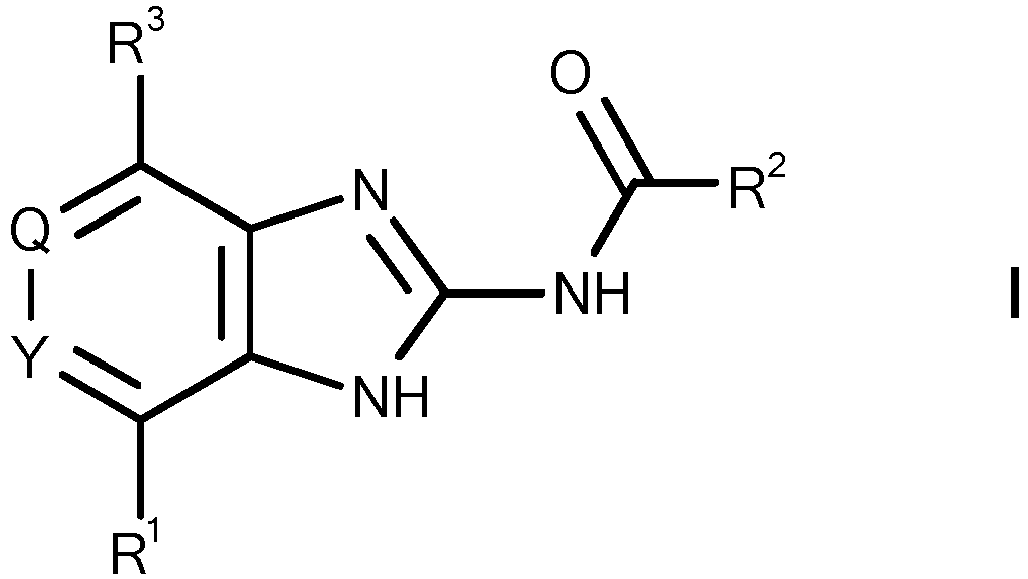
- Adenosine is an ubiguitous modulator of numerous physiological activities, particularly within the cardiovascular, nervous and immune systems. Adenosine is related both structurally and metabolically to the bioactive nucleotides adenosine triphosphate (ATP), adenosine diphosphate (ADP), adenosine monophosphate (AMP) and cyclic adenosine monophosphate (cAMP), to the biochemical methylating agent S-adenosyl-L-methione (SAM) and structurally to the coenzymes NAD, FAD and coenzym A and to RNA.
- Via cell surface receptors, adenosine modulates diverse physiological functions including induction of sedation, vasodilatation, suppression of cardiac rate and contractility, inhibition of platelet aggregability, stimulation of gluconeogenesis and inhibition of lipolysis. Studies show that adenosine is able to activate adenylate cyclases, open potassium channels, reduce flux through calcium channels, and inhibit or stimulate phosphoinositide turnover through receptor-mediated mechanisms (Muller C. E. and Stein B., Current Pharmaceutical Design, 2: 501, 1996; Muller C. E., Exp. Opin. Ther. Patents, 7(5): 419, 1997).
- Adenosine receptors belong to the superfamily of G-protein-coupled receptors (GPCRs). Four major subtypes of adenosine receptors have been pharmacologically, structurally and functionally characterized (Fredholm et al., Pharm. Rev., 46: 143-156, 1994) and referred to as A1, A2A, A2B and A3. Though the same adenosine receptor can couple to different G-proteins, adenosine A1 and A3 receptors usually couple to inhibitory G-proteins referred to as Gi and G0 which inhibit adenylate cyclase and down-regulate cellular cAMP levels. In contrast, the adenosine A2A and A2B receptors couple to stimulatory G-proteins referred to as GS that activate adenylate cyclase and increase intracellular levels of cAMP (Linden J., Annu. Rev. Pharmacol. Toxicol., 41: 775-87 2001).
- According to the invention, "adenosine-receptor-selective ligands" are substances which bind selectively to one or more subtypes of the adenosine receptors, thus either mimicking the action of adenosine (adenosine agonists) or blocking its action (adenosine antagonists). According to their receptor selectivity, adenosine-receptor-selective ligands can be divided into different categories, for example ligands which bind selectively to the A1 or A2 receptors and in the case of the latter also, for example, those which bind selectively to the A2A or the A2B receptors. Also possible are adenosine receptor ligands which bind selectively to a plurality of subtypes of the adenosine receptors, for example ligands which bind selectively to the A1 and the A2, but not to the A3 receptors. The abovementioned receptor selectivity can be determined by the effect of the substances on cell lines which, after stable transfection with the corresponding cDNA, express the receptor subtypes in question (Olah, M. E. et al., J. Biol. Chem., 267: 10764-10770, 1992). The effect of the substances on such cell lines can be monitored by biochemical measurement of the intracellular messenger cAMP (Klotz, K. N. et al., Naunyn Schmiedebergs Arch. Pharmacol. 357: 1-9, 1998).
- It is known that the A1 receptor system include the activation of phospholipase C and modulation of both potassium and calcium ion channels. The A3 subtype, in addition to its association with adenylate cyclase, also stimulates phospholipase C and so activates calcium ion channels.
- The A1 receptor (326-328 amino acids) was cloned from various species (canine, human, rat, dog, chick, bovine, guinea-pig) with 90-95 % sequence identify among the mammalian species. The A2A receptor (409-412 amino acids) was cloned from canine, rat, human, guinea pig and mouse. The A2B receptor (332 amino acids) was cloned from human and mouse with 45 % homology of human A2B with human A1 and A2A receptors. The A3 receptor (317-320 amino acids) was cloned from human, rat, dog, rabbit and sheep.
- The A1 and A2A receptor subtypes are proposed to play complementary roles in adenosine's regulation of the energy supply. Adenosine, which is a metabolic product of ATP, diffuses from the cell and acts locally to activate adenosine receptors to decrease the oxygen demand (A1 and A3) or increase the oxygen supply (A2A) and so reinstate the balance of energy supply / demand within the tissue. The actions of both subtype is to increase the amount of available oxygen to tissue and to protect cells against damage caused by a short term imbalance of oxygen. One of the important functions of endogenous adenosine is preventing damage during traumas such as hypoxia, ischaemia, hypotension and seizure activity. Furthermore, it is known that the binding of the adenosine receptor agonist to mast cells expressing the rat A3 receptor resulted in increased inositol triphosphate and intracellular calcium concentrations, which potentiated antigen induced secretion of inflammatory mediators. Therefore, the A3 receptor plays a role in mediating asthmatic attacks and other allergic responses.
- These adenosine receptors are encoded by distinct genes and are classified according to their affinities for adenosine analogues and methylxanthine antagonists (Klinger et al., Cell Signal., 14 (2): 99-108, 2002).
- Concerning the role of adenosine on the nervous system, the first observations were made on the effects of the most widely used of all psychoactive drugs being caffeine. Actually, caffeine is a well-known adenosine receptor antagonist that is able to enhance the awareness and learning abilities of mammals. The adenosine A2A receptor pathway is responsible for these effects (Fredholm et al., Pharmacol. Rev., 51 (1): 83-133, 1999; Huang et al., Nat Neurosci., 8 (7): 858-9, 2005), and the effects of caffeine on the adenosine A2A receptor signaling pathway encouraged the research of highly specific and potent adenosine A2A antagonists.
- In mammals, adenosine A2A receptors have a limited distribution in the brain and are found in the striatum, olfactory tubercle and nucleus acumbens (Dixon et al., Br. J. Pharmacol., 118 (6): 1461-8, 1996). High and intermediate levels of expression can be observed in immune cells, heart, lung and blood vessels. In the peripheral system, G3 seems to be the major G-protein associated with adenosine A2A receptor but in the striatum, it has been shown that striatal adenosine A2A receptors mediate their effects through activation of a G-protein referred to as Goif (Kull et al., Mol. Pharmacol., 58 (4): 772-7, 2000), which is similar to G3 and also couples to adenylate cyclase.
- To date, studies on genetically modified mice and pharmacological analysis suggest that A2A receptor is a promising therapeutic target for the treatment of central nervous system (CNS) disorders and diseases such as Parkinson's disease, Huntington's disease, attention deficit hyperactivity disorders (ADHD), stroke (ischemic brain injury), and Alzheimer's disease (Fredholm et al., Annu. Rev. Pharmacol. Toxicol., 45: 385-412, 2005; Higgins et al.; Behav. Brain Res. 185: 32-42, 2007; Dall' Igna et al., Exp. Neurol., 203 (1): 241-5, 2007; Arendash et al., Neuroscience, 142 (4): 941-52, 2006; Trends in Neurosci., 29 (11), 647-654, 2006; Expert Opinion Ther. Patents, 17, 979-991, 2007; Exp. Neurol., 184 (1), 285-284, 2003; Prog. Brain Res, 183, 183-208, 2010; J. Alzheimer Dis., Suppl 1, 1 17-126, 2010; J. Neurosci., 29 (47), 14741-14751, 2009; Neuroscience, 166 (2), 590-603, 2010; J. Pharmacol. Exp. Ther., 330 (1), 294-303, 2009; Frontiers Biosci., 13, 2614-2632, 2008) but also for various psychoses of organic origin (Weiss et al., Neurology, 61 (11 Suppl 6): 88-93, 2003).
- The use of adenosine A2A receptor knockout mice has shown that adenosine A2A receptor inactivation protects against neuronal cell death induced by ischemia (Chen et al., J. Neurosci., 19 (21): 9192-200, 1999 and Monopoli et al., Neuroreport, 9 (17): 3955-9, 1998) and the mitochondrial toxin 3-NP (Blum et al., J. Neurosci., 23 (12): 5361-9, 2003). Those results provided a basis for treating ischasmia and Huntington's disease with adenosine A2A antagonists. The blockade of adenosine A2A receptors has also an antidepressant effect (El Yacoubi et al., Neuropharmacology, 40 (3): 424-32, 2001). Finally, this blockade prevents memory dysfunction (Cunha et al., Exp. Neurol., 210 (2): 776-81, 2008; Takahashi et al., Front. Biosci., 13: 2614-32, 2008) and this could be a promising therapeutic route for the treatment and/or prevention of Alzheimer's disease.
- For reviews concerning A2A adenosine receptors see e.g. Moreau et al. (Brain Res. Reviews 31: 65-82, 1999) and Svenningsson et al. (Progress in Neurobiology 59: 355-396, 1999).
- To date, several adenosine A2A receptor antagonists have shown promising potential for treatment of Parkinson's disease. As an example, KW-6002 (Istradefylline) completed a phase III clinical trial in the USA after studies demonstrated its efficacy in alleviation of symptoms of the disease (Bara-Himenez et al., Neurology, 61 (3): 293-6, 2003 and Hauser et al., Neurology, 61 (3): 297-303, 2003). SCH420814 (Preladenant), which is now in phase II clinical trial in the USA and produces an improvement in motor function in animal models of Parkinson's disease (Neustadt et al., Bioorg. Med. Chem. Lett., 17 (5): 1376-80, 2001) and also in human patients (Hunter J. C, poster Boston 2006 - http://www.a2apd.org/Speaker abstracts/Hunter.pdf).
- Besides the welcome utility of A2A receptor antagonists to treat neurodegenerative diseases, those compounds have been considered for complementary symptomatic indications. These are based on the evidence that A2A receptor activation may contribute to the pathophysiology of a range of neuropsychiatric disorders and dysfunctions such as depression, excessive daytime sleepiness, restless legs syndrome, attention deficit hyperactivity disorder, and cognitive fatigue (Neurology, 61 (Suppl 6), 82-87, 2003; Behav. Pharmacol., 20 (2), 134-145, 2009; CNS Drug Discov., 2 (1), 1-21, 2007).
- Some authors suggest the application of A2A antagonists for the treatment of diabetes (
WO1999035147 ;WO2001002400 ). Other studies suggest the involvement of A2A adenosine receptors in wound healing or atrial fibrillation (Am. J. Path., 6, 1774- 1778, 2007; Arthritis & Rheumatism, 54 (8), 2632-2642, 2006). Some of the potent adenosine A2A antagonists discovered in the past by the pharmaceutical companies, have advanced into clinical trials showing positive results and demonstrating the potential of this compound class for the treatment of neurodegenerative disorders like Parkinson's, Huntington's or Alzheimer's disease, but also in other CNS related diseases like depression, restless syndrome, sleep and anxiety disorders (Clin. Neuropharmacol., 33, 55-60, 2010; J. Neurosci., 30 (48), 2010), 16284-16292; Parkinson Relat. Disord., 16 (6), 423-426, 2010; Expert Opinion Ther. Patents, 20(8), 987-1005, 2010; Current Opinion in Drug Discovery & Development, 13 (4), 466-480 ,2010 and references therein; Mov. Disorders, 25 (2), S305, 2010). - Known A2A inhibitors are Istradefylline (KW-6002), Preladenant (SCH420814), SCH58261, CGS15943, Tozadenant, Vipadenant (V-2006), V-81444 (CPI-444, HTL-1071, PBF-509, Medi-9447, PNQ-370, ZM-241385, ASO-5854, ST-1535, ST-4206, DT1133 and DT-0926, which are in most cases developed for Parkinson's disease.
- Adenosine A2B receptors were cloned from rat hypothalamus (Rivkees and Reppert, 1992), human hippocampus (Pierce et al., 1992), and mouse mast cells (Marquardt et al., 1994), employing standard polymerase chain reaction techniques with degenerate oligonucleotide primers designed to recognize conserved regions of most G protein-coupled receptors. The human A2B receptor shares 86 to 87% amino acid sequence homology with the rat and mouse A2B receptors (Rivkees and Reppert, 1992; Pierce et al., 1992; Marquardt et al., 1994) and 45% amino acid sequence homology with human A1 and A2A receptors. As expected for closely related species, the rat and mouse A2B receptors share 96% amino acid sequence homology. By comparison, the overall amino acid identity between A1 receptors from various species is 87% (Palmer and Stiles, 1995). A2A receptors share 90% of homology between species (Ongini and Fredholm, 1996), with most differences occurring in the 2nd extracellular loop and the long C-terminal domain (Palmer and Stiles, 1995). The lowest (72%) degree of identity between species is observed for A3 receptor sequences (Palmer and Stiles, 1995).
- The adenosine analog NECA remains the most potent A2B agonist (Bruns, 1981; Feoktistov and Biaggioni, 1993, 1997; Brackett and Daly, 1994), with a concentration producing a half-maximal effect (EC50) for stimulation of adenyl cyclase of approximately 2 µM. It is, however, nonselective and activates other adenosine receptors with even greater affinity, with an EC50 in the low nanomolar (A1 and A2A) or high nanomolar (A3) range. The characterization of A2B receptors, therefore, often relies on the lack of effectiveness of compounds that are potent and selective agonists of other receptor types. A2B receptors have been characterized by a method of exclusion, i.e., by the lack of efficacy of agonists that are specific for other receptors. The A2A selective agonist CGS-21680 (Webb et al., 1992), for example, has been useful in differentiating between A2A and A2B adenosine receptors (Hide et al., 1992; Chern et al., 1993; Feoktistov and Biaggioni, 1995; van der Ploeg et al., 1996). Both receptors are positively coupled to adenyl cyclase and are activated by the nonselective agonist NECA. CGS-21680 is virtually ineffective on A2B receptors but is as potent as NECA in activating A2A receptors, with an EC50 in the low nanomolar range for both agonists (Jarvis et al., 1989; Nakane and Chiba, 1990; Webb et al., 1992; Hide et al., 1992; Feoktistov and Biaggioni, 1993; Alexander et al., 1996). A2B receptors have also a very low affinity for the A1selective agonist R-PIA (Feoktistov and Biaggioni, 1993; Brackett and Daly, 1994) as well as for the A3 selective agonist N6-(3-iodobenzyl)-N-methyl-5'-carbamoyladenosine (IB-MECA) (Feoktistov and Biaggioni, 1997). The agonist profile NECA > R-PIA = IB-MECA > CGS-21680 was determined in human erythroleukemia (HEL) cells for A2B-mediated cAMP accumulation. The difference between EC50 for NECA and the rest of the agonists is approximately 2 orders of magnitude. Therefore, responses elicited by NECA at concentrations in the low micromolar range (1-10 µM), but not by R-PIA, IB-MECA or CGS-21680, are characteristic of A2B receptors.
- Whereas A2B receptors have, in general, a lower affinity for agonists compared to other receptor subtypes, this is not true for antagonists. The structure activity relationship of adenosine antagonists on A2B receptors has not been fully characterized, but at least some xanthines are as or more potent antagonists of A2B receptor subtypes than of other subtypes. In particular, DPSPX (1,3-dipropyl-8-sulphophenylxanthine), DPCPX (1,3-diproyl-8c-yclopentylxanthine), DPX (1,3 diethylphenylxanthine), the antiasthmatic drug enprofylline (3-n-propylxanthine) and the non-xanthine compound 2,4-dioxobenzopteridine (alloxazine) have affinities in the mid to high nM range.
- Other known A2B inhibitors are ATL801, PSB-605, PSB-1115, ISAM-140, GS6201, MRS1706 and MRS1754.
- It is disclosed herein that adenosine receptors play a non-redundant role in down-regulation of inflammation in vivo by acting as a physiological "STOP" (a termination mechanism) that can limit the immune response and thereby protect normal tissues form excessive immune damage during pathogenesis of different diseases.
- A2A receptor antagonists provide long term enhancement of immune responses by reducing T-cell mediated tolerance to antigenic stimuli, enhancing the induction of memory T cells and enhancing the efficacy of passive antibody administration for the treatment of cancer and infectious diseases while A2A receptor agonists provide long term reduction of immune responses by enhancing T-cell mediated tolerance to antigenic stimuli, in particular to reduce use of immunosuppressive agents in certain conditions.
- Immune modulation is a critical aspect of the treatment of a number of diseases and disorders. T cells in particularly play a vital role in fighting infections and have the capability to recognize and destroy cancer cells. Enhancing T cell mediated responses is a key component to enhancing responses to therapeutic agents. However, it is critical in immune modulation that any enhancement of an immune response is balanced against the need to prevent autoimmunity as well as chronic inflammation. Chronic inflammation and self-recognition by T cells is a major cause for the pathogenesis of systemic disorders such as rheumatoid arthritis, multiple sclerosis and systemic lupus erythematosus. Furthermore, long term immunosuppression is required in preventing rejection of transplanted organs or grafts.
- Tumor-induced immunosuppression is a major hurdle to the efficacy of current cancer therapies. Because of their remarkable clinical efficacy against a broader range of cancers, recent successes with immune checkpoint blockade inhibitors such as anti-CTLA-4 and anti-PD-1/PDL1 are revolutionizing cancer treatment. Adenosine is one of the new promising immunosuppressive targets revealed in preclinical studies. This metabolite is produced by the ectoenzyme - CD73 expressed on host suppressor cells and tumor cells. Increased expression of CD73 correlates with poor prognosis in patients with a number of cancers, including colorectal cancer (Liu et al, J. Surgical Oncol, 2012), gastric cancer (Lu et al., World J. Gastroenterol., 2013), gallbladder cancer (Xiong et al., Cell and Tissue Res., 2014). Preclinical studies demonstrated that protumor effects of CD73 can be driven (at least in part) by adenosine-mediated immunosuppression. As disclosed above, adenosine binds to four known receptors A1, A2A, A2B, and A3, with the activation of A2A and A2B receptors known to suppress the effector functions of many immune cells, i.e. A2A and A2B receptors induce adenylate-cyclase-dependent accumulation of cAMP leading to immunosuppression. Since antagonizing A1 and A3 would counteract the desired effect and A1 and A3 agonists serve as potential cardioprotective agents, selectivity towards A1 and A3 needs to be achieved (Antonioli et al., Nat. rev. Cancer, 2013, Thiel et al., Microbes and Infection, 2003). In the microenvironment of the tumor, both A2A and A2B receptor activation has been demonstrated to suppress antitumor immunity and increase the spread of CD73 tumors. In addition, either A2A or A2B blockade with small molecule antagonists can reduce tumor metastasis. It has been found that blocking of A2A receptor can overcome tumor escape mechanisms including both anergy and regulatory T cell induction caused by tumor cells and cause long-term tumor susceptibility to treatment. Ohta et al. demonstrated rejection of approximately 60% of established CL8-1 melanoma tumors in A2A receptor-deficient mice compared to no rejection in normal mice (Ohta, et al.; PNAS 103 (35): 13132-7, 2006). In agreement, the investigators also showed improved inhibition of tumor growth, destruction of metastases and prevention of neovascularization by anti-tumor T cells after treatment with an A2A receptor antagonist.
- Tumors have been shown to evade immune destruction by impeding T cell activation through inhibition of co-stimulatory factors in the B7-CD28 and TNF families, as well as by attracting regulatory T cells, which inhibit anti-tumor T cell responses (Wang, Cancer. Semin. Cancer. Biol. 16: 73-79, 2006; Greenwald, et al., Ann. Rev. Immunol. 23: 515-48, 2005; Watts, Ann. Rev. Immunol. 23: 23-68, 2005; Sadum et al., Clin. Cane. Res. 13 (13): 4016-4025, 2007). Because A2A receptor expression is increased in lymphocytes following activation, therapies that liberate lymphocyte effector responses, such as anti-CTLA-4 and anti-PD-1, may also increase the effects of A2A-mediated immunosuppression. Immune checkpoint blockade in combination with A2A or dual A2A/2B antagonists increase the magnitude of immune responses to tumors and metastasis. Accordingly, combination of A2A inhibition with anti-PD-1 therapy enhances IFN-γ production by T-cells in a co-culture with MC38 tumor cells, improves mouse survival in 4T1 mammary tumor model and decreases tumor growth in AT-3ovadim CD73+ tumors (Beavis et al., Cancer Immunol. Res., 2015; Mittal et al., Cancer Res., 2014).
- Furthermore, preclinical studies demonstrated that A2B inhibition leads to decreased tumor growth and extended survival of mice in Lewis lung carcinoma, MB49 bladder carcinoma, ortho 4T1 mammary carcinoma models (Ryzhov et al., 2009, Cekic et al., 2012) and the combination of A2B inhibition with anti-PD-1 therapy reduces lung metastases of B16-F10 melanoma tumors and improves mouse survival in the 4T1 mammary tumor model.
-
WO 03/050241 -
WO 2004/089942 ,WO 2005/000842 andWO 2006/008041 disclose benzothiazole derivatives, including Tozadenant, as A2A inhibitors for the treatment of Parkinson's disease.WO 2004/092171 andWO 2005/028484 disclose similar thiazolopyridine and pyrazolopyrimidine derivatives also as A2A inhibitors for the treatment of Parkinson's disease. However, these compounds do not show significant A2B inhibitory activity and do only show good pharmacokinetic properties in the rat, the Parkison's disease animal model but not in the mouse, the cancer animal model. Furthermore, the compounds do not show that they are able to prevent immunosuppression and thus are able to support anti-tumor T cell induced inhibition of tumor growth, reduction or destruction of metastases and prevention of neovascularization. - Thus, there remains a need for therapies that provide long term enhancement of immune responses to specific antigens, particularly for the treatment and prevention of hyperproliferative and infectious diseases and disorders and thus the object of the present invention was to provide methods of treatment that allow simplified treatment protocols and enhance immune responses against certain antigens. It was a specific object of the invention to provide improved methods of preventing or treating hyperproliferative and infectious diseases and disorders in a host, especially to provide effective A2A or dual A2A/2B antagonists for the treatment and prevention of such diseases.
- Surprisingly, it has been found that the benzimidazole derivatives according to the invention are highly effective inhibitors of the A2A adenosine receptor or both the A2A and A2B adenosine receptors and at the same time have high selectivity over the A1 and A3 adenosine receptors, and thus the compounds of the present invention can be used for the treament of hyperproliferative diseases and disorders such as cancer and infectious diseases and disorders.
- Particularly, in contrast to the known adenosine A2A receptor antagonist Tozadenant and similar benzothiazole derivatives, the compounds of the present invention surprisingly show an A2A/A2B dual activity which is preferred for the treatment and/or prevention of hyperproliferative and infectious diseases and disorders as it is disclosed above or the compounds of the present invention show at least a high A2A inhibitory activity together with the other surprising advantages disclosed herein leading to a high efficacy in the treatment and/or prevention of hyperproliferative and infectious diseases and disorders.
- Additionally, in comparison with the known adenosine A2A receptor antagonist Tozadenant and similar benzothiazole derivatives, the compounds of the present invention surprisingly show better pharmacokinetic properties in mouse as the animal model relevant for cancer, which is preferred for the treatment and/or prevention of hyperproliferative and infectious diseases and disorders as it is disclosed above.
- Furthermore, as discussed above, adenosine in tumor microenvironment can inhibit T cell activity by signaling through A2A receptors and suppress cytokine secretion by T cells. A2A specific agonists like CGS-21680, similar to adenosine, inhibit T cell cytokine secretion in vitro and in vivo. In contrast, potential A2A antagonists or A2A/A2B dual antagonists can rescue T cells from this inhibition. In contrast to the known adenosine A2A receptor antagonist Tozadenant, the compounds of the present invention show that they are able to rescue T cells from inhibition and are able to prevent the suppression of cyctokine secretion as induced by adenosine or A2A specific agonists like CGS-2168, which is preferred for the treatment and/or prevention of hyperproliferative and infectious diseases and disorders as it is disclosed above. Therefore, the compounds of the present invention surprisingly are able to prevent immunosuppression and thus are able to support anti-tumor T cell induced inhibition of tumor growth, reduction or destruction of metastases and prevention of neovascularization.
- The invention relates to benzimidazole derivatives of the general formula I,

- Q, Y
- are independently of one another CH,
- R1
- is Br or one of the following structures:

- R2
- is one of the following structures:


- R3
- is OCH3,
- R4
- is H, R5, =S, =NR5, =O, OH, COOH, Hal, NH2, SO2CH3, SO2NH2, CN, CONH2, NHCOCH3, NHCONH2, NO2, or linear or branched alkyl having 1-10 C atoms which is unsubstituted or mono-, di- or trisubstituted by R5 and in which 1-4 C atoms may be replaced, independently of one another, by O, S, SO, SO2, NH, NCH3, -OCO-, -NHCONH-, -NHCO-, -NR5SO2R6-,-COO-, -CONH-, -NCH3CO-, -CONCH3-, -C≡C- groups and/or-CH=CH- groups, and/or, in addition, 1-10 H atoms may be replaced by F and/or Cl, or mono- or bicyclic cyclic alkyl having 3-7 C atoms which is un-substituted or mono-, di- or trisubstituted by by R5 and in which 1-4 C atoms may be replaced, independently of one another, by O, S, SO, SO2, NH, NCH3, -OCO-, -NHCONH-, -NHCO-, -NRSO2R4-, -COO-, -CONH-,-NCH3CO-, -CONCH3-, -C≡C- groups and/or by -CH=CH- groups and/or, in addition, 1-10 H atoms may be replaced by F and/or Cl, or mono- or bicyclic heteroaryl, heterocyclyl, aryl or cyclic alkylaryl, containing 3 to 14 carbon atoms and 0-4 heteroatoms, independently selected from N, O and S, which is unsubstituted or mono-, di- or trisubstituted by R5,
- R5, R6
- are independently of one another selected from the group consisting of H, =S, =NH, =O, OH, COOH, Hal, NH2, SO2CH3, SO2NH2, CN, CONH2, NHCOCH3, NHCONH2, NO2 and linear or branched alkyl having 1-10 C atoms in which 1-4 C atoms may be replaced, independently of one another, by O, S, SO, SO2, NH, NCH3, -OCO-, -NHCONH-, -NHCO-,-COO-, -CONH-, -NCH3CO-, -CONCH3-, -C≡C- groups and/or-CH=CH- groups, and/or, in addition, 1-10 H atoms may be replaced by F and/or Cl,
- Hal
- is F, C, Br, or I,
- The invention preferably relates to a compound of formula I, wherein R1 is Br or one of the following structures:

- and wherein Q, Y, R2, R3, R4, R5 and R6 have the meanings as disclosed in claim 1,
- and physiologically acceptable salts, solvates and stereoisomers thereof, including mixtures thereof in all ratios.
- The invention particularly preferably relates to a compound selected from the group consisting of:
No. IUPAC-Name 2 4-Fluoro-N-(7-methoxy-4-phenyl-1H-benzoimidazol-2-yl)-benzamide 3 2-Bromo-N-(7-methoxy-4-phenyl-1H-benzoimidazol-2-yl)-isonicotinamide 4 2-Bromo-N-(4-bromo-7-methoxy-1H-benzoimidazol-2-yl)-isonicotinamide 5 6-Bromo-N-(7-methoxy-4-phenyl-1H-benzoimidazol-2-yl)-nicotinamide 6 6-Bromo-N-(4-bromo-7-methoxy-1H-benzoimidazol-2-yl)-nicotinamide 7 N-(7-Methoxy-4-phenyl-1H-benzoimidazol-2-yl)-2-morpholin-4-yl-isonicotinamide 8 N-(7-Methoxy-4-phenyl-1H-benzoimidazol-2-yl)-6-morpholin-4-yl-nicotinamide 10 4-Chloromethyl-N-(7-methoxy-4-phenyl-1H-benzoimidazol-2-yl)-benzamide 11 4-Ethylaminomethyl-N-(7-methoxy-4-phenyl-1H-benzoimidazol-2-yl)-benzamide 12 4-Hydroxy-4-methyl-piperidine-1-carboxylic acid (7-methoxy-4-phenyl-1H-benzoimidazol-2-yl)-amide 13 4-Aminomethyl-N-(7-methoxy-4-phenyl-1H-benzoimidazol-2-yl)-benzamide 15 4-Imidazol-1-ylmethyl-N-(7-methoxy-4-phenyl-1H-benzoimidazol-2-yl)-benzamide 16 4-Hydroxy-4-methyl-piperidine-1-carboxylic acid (4-cyclohexyl-7-methoxy-1H-benzoimidazol-2-yl)-amide 17 N-(4-Cyclohexyl-7-methoxy-1H-benzoimidazol-2-yl)-2-morpholin-4-yl-isonicotinamide 21 4-hydroxy-N-(7-methoxy-4-morpholino-1H-benzimidazol-2-yl)-4-methyl-pi peridine-1-carboxamide 22 4-Hydroxy-4-methyl-piperidine-1-carboxylic acid [7-methoxy-4-(1-methyl-1H-pyrazol-4-yl)-1H-benzoimidazol-2-yl]-amide 23 N-(7-Methoxy-4-morpholin-4-yl-1H-benzoimidazol-2-yl)-2-morpholin-4-yl-isonicotinamide 24 4-Hydroxy-4-methyl-piperidine-1-carboxylic acid [7-methoxy-4-(tetrahydro-pyran-4-yl)-1H-benzoimidazol-2-yl]-amide 26 N-[7-Methoxy-4-(1-methyl-1H-pyrazol-4-yl)-1H-benzoimidazol-2-yl]-2-morpholin-4-yl-isonicotinamide 28 4-Methyl-piperidine-1-carboxylic acid (7-methoxy-4-phenyl-1H-benzoimidazol-2-yl)-amide 29 N-[7-Methoxy-4-(tetrahydro-pyran-4-yl)-1H-benzoimidazol-2-yl]-6-morpholin-4-yl-nicotinamide 30 2-(3-Hydroxy-3-methyl-pyrrolidin-1-yl)-N-[7-methoxy-4-(1-methyl-1H-pyrazol-4-yl)-1H-benzoimidazol-2-yl]-isonicotinamide 31 3-Hydroxy-3-methyl-pyrrolidine-1-carboxylic acid [7 -methoxy-4-(1-methyl-1H-pyrazol-4-yl)-1H-benzoimidazol-2-yl]-amide 32 4-Hydroxy-4-trifluoromethyl-piperidine-1-carboxylic acid [7-methoxy-4-(1-methyl-1H-pyrazol-4-yl)-1H-benzoimidazol-2-yl]-amide 33 2-Oxa-7-aza-spiro[3.5]nonane-7-carboxylic acid [7-methoxy-4-(1-methyl-1H-pyrazol-4-yl)-1H-benzoimidazol-2-yl]-amide 34 4-Difluoromethyl-4-hydroxy-piperidine-1-carboxylic acid [7-methoxy-4-(1-methyl-1H-pyrazol-4-yl)-1H-benzoimidazol-2-yl]-amide 35 4-Hydroxymethyl-4-methyl-piperidine-1-carboxylic acid [7-methoxy-4-(1-methyl-1H-pyrazol-4-yl)-1H-benzoimidazol-2-yl]-amide 36 4-Fluoromethyl-4-hydroxy-piperidine-1-carboxylic acid [7-methoxy-4-(1-methyl-1H-pyrazol-4-yl)-1H-benzoimidazol-2-yl]-amide 37 4-Methoxy-piperidine-1-carboxylic acid [7-methoxy-4-(1-methyl-1H-pyrazol-4-yl)-1H-benzoimidazol-2-yl]-amide 38 3-Oxa-9-aza-spiro[5.5]undecane-9-carboxylic acid [7-methoxy-4-(1-methyl-1H-pyrazol-4-yl)-1H-benzoimidazol-2-yl]-amide 39 4-Methyl-piperidine-1-carboxylic acid [7-methoxy-4-(1-methyl-1H-pyrazol-4-yl)-1H-benzoimidazol-2-yl]-amide 40 4-Hydroxy-piperidine-1-carboxylic acid [7-methoxy-4-(1-methyl-1H-pyrazol-4-yl)-1H-benzoimidazol-2-yl]-amide 41 4-Benzyl-4-hydroxy-piperidine-1-carboxylic acid [7-methoxy-4-(1-methyl-1H-pyrazol-4-yl)-1H-benzoimidazol-2-yl]-amide 43 N-[7-methoxy-4-(1-methyl-1H-pyrazol-4-yl)-1H-1,3-benzodiazol-2-yl]-2-oxa-6-azaspiro[3.4]octane-6-carboxamide 44 N-[7-methoxy-4-(1-methyl-1H-pyrazol-4-yl)-1H-1,3-benzodiazol-2-yl]-2-oxo-1-oxa-3,8-diazaspiro[4.5]decane-8-carboxamide 45 N-[7-methoxy-4-(1-methyl-1H-pyrazol-4-yl)-1H-1,3-benzodiazol-2-yl]-1,4-dioxa-8-azaspiro[4.5]decane-8-carboxamide 46 N-[7-methoxy-4-(1-methyl-1H-pyrazol-4-yl)-1H-1,3-benzodiazol-2-yl]morpholine-4-carboxamide 47 N-[7-methoxy-4-(1-methyl-1H-pyrazol-4-yl)-1H-1,3-benzodiazol-2-yl]-3-oxo-2,8-diazaspiro[4.5]decane-8-carboxamide 48 4-[(dimethylamino)methyl]-N-[7-methoxy-4-(1-methyl-1H-pyrazol-4-yl)-1H-1,3-benzodiazol-2-yl]benzamide 49 N-[7-methoxy-4-(1-methyl-1H-pyrazol-4-yl)-1H-1,3-benzodiazol-2-yl]-4-(methoxymethyl) benzam ide 50 N-[7-methoxy-4-(1-methyl-1H-pyrazol-4-yl)-1H-1,3-benzodiazol-2-yl]-2,4-dioxo-1,3,8-triazaspiro[4.5]decane-8-carboxamide 51 N-[7-methoxy-4-(1-methyl-1H-pyrazol-4-yl)-1H-1,3-benzodiazol-2-yl]-2-oxo-1,8-diazaspiro[4.5]decane-8-carboxamide 52 4-(2-hydroxyethyl)-N-[7-methoxy-4-(1-methyl-1H-pyrazol-4-yl)-1H-1 ,3-benzodiazol-2-yl]-1 ,2,3,6-tetrahydropyridine-1-carboxamide 53 3-butyl-4-hydroxy-N-[7-methoxy-4-(1-methyl-1H-pyrazol-4-yl)-1H-1,3-benzodiazol-2-yl]piperidine-1-carboxamide 54 N-[7-methoxy-4-(1-methyl-1H-pyrazol-4-yl)-1H-1,3-benzodiazol-2-yl]-4-phenoxypiperidine-1-carboxamide 55 4-hydroxy-N-[7-methoxy-4-(1-methyl-1H-pyrazol-4-yl)-1H-1,3-benzodiazol-2-yl]-4-(pyridin-3-yl)piperidine-1-carboxamide 56 4-hydroxy-N-[7-methoxy-4-(1-methyl-1H-pyrazol-4-yl)-1H-1,3-benzodiazol-2-yl]-3-(2-methylpropyl)piperidine-1-carboxamide 57 N-[4-(2,6-dimethylpyridin-4-yl)-7-methoxy-1H-1,3-benzodiazol-2-yl]-2-(morpholin-4-yl)pyridine-4-carboxamide 58 N-[7-methoxy-4-(1-methyl-1H-pyrazol-4-yl)-1H-1,3-benzodiazol-2-yl]-4-oxopiperidine-1-carboxamide 60 N-[7-methoxy-4-(1-methyl-1H-pyrazol-4-yl)-1H-1,3-benzodiazol-2-yl]-1-oxo-2,8-diazaspiro[4.5]decane-8-carboxamide 62 N-[7-methoxy-4-(1-methyl-1H-pyrazol-4-yl)-1H-1,3-benzodiazol-2-yl]-1-methyl-5-oxo-1,4,9-triazaspiro[5.5]undecane-9-carboxamide 63 4-fluoro-N-[7-methoxy-4-(morpholin-4-yl)-1H-1,3-benzodiazol-2-yl]benzamide 64 N-[7-methoxy-4-(1-methyl-1H-pyrazol-4-yl)-1H-1,3-benzodiazol-2-yl]-6-oxaspiro[2.5]octane-1-carboxamide 65 N-[7-methoxy-4-(1-methyl-1H-pyrazol-4-yl)-1H-1,3-benzodiazol-2-yl]-5-{3H-[1,2,3]triazolo[4,5-b]pyridin-3-yloxy}pyrazine-2-carboxamide 66 (chloromethyl)({2-[(1-{[7-methoxy-4-(1-methyl-1H-pyrazol-4-yl)-1H-1,3-benzodiazol-2-yl]carbamoyl}-4-methylpiperidin-4-yl)oxy]ethyl})dimethylazanium hydrochloride 67 N-[7-methoxy-4-(1-methyl-1H-pyrazol-4-yl)-1H-1,3-benzodiazol-2-yl]-7-oxa-2-azaspiro[4.5]decane-2-carboxamide 68 N-[7-methoxy-4-(1-methyl-1H-pyrazol-4-yl)-1H-1,3-benzodiazol-2-yl]-8-oxa-2-azaspiro[4.5]decane-2-carboxamide 69 N-[7-methoxy-4-(1-methyl-1H-pyrazol-4-yl)-1H-1,3-benzodiazol-2-yl]-2-oxa-7-azaspiro[4.4]nonane-7-carboxamide 70 N-[7-methoxy-4-(1-methyl-1H-pyrazol-4-yl)-1H-1,3-benzodiazol-2-yl]-3-oxabicyclo[3.1.0]hexane-6-carboxamide 71 4-[(1H-imidazol-1-yl)methyl]-N-[7-methoxy-4-(1-methyl-1H-pyrazol-4-yl)-1H-1,3-benzodiazol-2-yl]benzamide 72 (1S,2S)-2-bromo-N-[7-methoxy-4-(1-methyl-1H-pyrazol-4-yl)-1H-1,3-benzodiazol-2-yl]cyclopropane-1-carboxamide 73 N-[7-methoxy-4-(1-methyl-1H-pyrazol-4-yl)-1H-1,3-benzodiazol-2-yl]-5-(2-methoxyethoxy)pyrazine-2-carboxamide 74 4-hydroxy-N-[7-methoxy-4-(pyridin-4-yl)-1H-1,3-benzodiazol-2-yl]-4-methylpiperidine-1-carboxamide 75 4-benzyl-4-hydroxy-N-[7-methoxy-4-(morpholin-4-yl)-1H-1,3-benzodiazol-2-yl]piperidine-1-carboxamide 76 4-[(1H-imidazol-1-yl)methyl]-N-[7-methoxy-4-(morpholin-4-yl)-1H-1,3-benzodiazol-2-yl]benzamide 77 N-[7-methoxy-4-(morpholin-4-yl)-1H-1,3-benzodiazol-2-yl]-1-benzofuran-5-carboxamide 78 4-hydroxy-N-{7-methoxy-4-[1-(oxan-2-yl)-1H-pyrazol-4-yl]-1H-1,3-benzodiazol-2-yl}-4-methylpiperidine-1-carboxamide 79 4-hydroxy-N-[7-methoxy-4-(1H-pyrazol-4-yl)-1H-1,3-benzodiazol-2-yl]-4-methylpiperidine-1-carboxamide 80 N-[7-methoxy-4-(1-methyl-1H-pyrazol-4-yl)-1H-1,3-benzodiazol-2-yl]-1-benzofuran-5-carboxamide 81 N-[7-methoxy-4-(1-methyl-1H-pyrazol-4-yl)-1H-1,3-benzodiazol-2-yl]-5-(morpholin-4-yl)pyrazine-2-carboxamide 83 4-benzyl-4-hydroxy-N-[4-methoxy-7-(1-methyl-1H-pyrazol-4-yl)-3H-imidazo[4,5-c]pyridin-2-yl]piperidine-1-carboxamide 84 N-[7-methoxy-4-(1-methyl-1H-pyrazol-4-yl)-1H-1,3-benzodiazol-2-yl]-1,2-oxazole-3-carboxamide 85 N-[7-methoxy-4-(pyridin-4-yl)-1H-1,3-benzodiazol-2-yl]-2-oxa-6-azaspiro[3.4]octane-6-carboxamide 86 1-(1-chloro-3-hydroxypropan-2-yl)-N-[7-methoxy-4-(morpholin-4-yl)-1H-1,3-benzodiazol-2-yl]-1H-pyrazole-4-carboxamide 87 N-[7-methoxy-4-(1-methyl-1H-pyrazol-4-yl)-1H-1,3-benzodiazol-2-yl]-6-(morpholin-4-yl)pyridazine-3-carboxamide 88 4-[(dimethylamino)methyl]-N-[7-methoxy-4-(oxan-4-yl)-1H-1,3-benzodiazol-2-yl]benzamide 89 4-[(dimethylamino)methyl]-N-[7-methoxy-4-(pyridin-4-yl)-1H-1,3-benzodiazol-2-yl]benzam ide 90 4-[(dimethylamino)methyl]-N-[7-methoxy-4-(morpholin-4-yl)-1H-1,3-benzodiazol-2-yl]benzam ide 91 N-[7-methoxy-4-(oxan-4-yl)-1H-1,3-benzodiazol-2-yl]-6-(morpholin-4-yl)pyridazine-3-carboxamide 92 4-hydroxy-N-[7-methoxy-4-(1-methyl-1H-pyrazol-4-yl)-1H-1,3-benzodiazol-2-yl]-4-(prop-2-yn-1-yl)piperidine-1-carboxamide 93 N4-[7-methoxy-4-(1-methyl-1H-pyrazol-4-yl)-1H-1,3-benzodiazol-2-yl]-N1,N1-dimethylbenzene-1,4-dicarboxamide 94 N-[7-methoxy-4-(1-methyl-1H-pyrazol-4-yl)-1H-1,3-benzodiazol-2-yl]-4-(trifluoromethoxy)benzamide 95 2-bromo-N-[7-methoxy-4-(1-methyl-1H-pyrazol-4-yl)-1H-1,3-benzodiazol-2-yl]pyridine-4-carboxamide 96 N-[7-methoxy-4-(1-methyl-1H-pyrazol-4-yl)-1H-1,3-benzodiazol-2-yl]-2-methyl-1,3-oxazole-4-carboxamide 97 4-[(1H-imidazol-1-yl)methyl]-N-[7-methoxy-4-(oxan-4-yl)-1H-1,3-benzodiazol-2-yl]benzamide 98 N-[7-methoxy-4-(1-methyl-1H-pyrazol-4-yl)-1H-1,3-benzodiazol-2-yl]-1,3-benzoxazole-5-carboxamide 99 3-amino-4-hydroxy-N-[7-methoxy-4-(morpholin-4-yl)-1H-1,3-benzodiazol-2-yl]benzamide 100 N-[7-methoxy-4-(1-methyl-1H-pyrazol-4-yl)-1H-1,3-benzodiazol-2-yl]-4-[(2-oxopyrrolidin-1-yl)methyl]benzamide 101 N-[7-methoxy-4-(1-methyl-1H-pyrazol-4-yl)-1H-1,3-benzodiazol-2-yl]-2,3-dihydro-1-benzofuran-5-carboxamide 102 4-hydroxy-N-[7-methoxy-4-(oxan-4-yl)-1H-1,3-benzodiazol-2-yl]-4-(prop-2-yn-1-yl)piperidine-1-carboxamide 103 4-benzyl-4-hydroxy-N-[7-methoxy-4-(oxan-4-yl)-1H-1,3-benzodiazol-2-yl]piperidine-1-carboxamide 104 2-[(3S)-3-hydroxy-3-methylpyrrolidin-1-yl]-N-[7-methoxy-4-(1-methyl-1H-pyrazol-4-yl)-1H-1,3-benzodiazol-2-yl]pyridine-4-carboxamide 105 2-(4-hydroxy-4-methylpiperidin-1-yl)-N-[7-methoxy-4-(1-methyl-1H-pyrazol-4-yl)-1H-1,3-benzodiazol-2-yl]pyridine-4-carboxamide 106 N-[7-methoxy-4-(1-methyl-1H-pyrazol-4-yl)-1H-1,3-benzodiazol-2-yl]-2-{2-oxa-7-azaspiro[4.4]nonan-7-yl}pyridine-4-carboxamide 107 2-[(3R)-3-hydroxy-3-methylpyrrolidin-1-yl]-N-[7-methoxy-4-(1-methyl-1H-pyrazol-4-yl)-1H-1,3-benzodiazol-2-yl]pyridine-4-carboxamide 108 N-[7-methoxy-4-(oxan-4-yl)-1H-1,3-benzodiazol-2-yl]-2,3-dihydro-1-benzofuran-5-carboxamide 109 N-[7-methoxy-4-(1-methyl-1H-pyrazol-4-yl)-1H-1,3-benzodiazol-2-yl]-3-(methoxymethyl)pyrrolidine-1-carboxamide 110 N-[7-methoxy-4-(oxan-4-yl)-1H-1,3-benzodiazol-2-yl]-2-oxa-7-azaspiro[4.4]nonane-7-carboxamide 111 N-[7-methoxy-4-(oxan-4-yl)-1H-1,3-benzodiazol-2-yl]-8-oxa-2-azaspiro[4.5]decane-2-carboxamide 112 N-[7-methoxy-4-(oxan-4-yl)-1H-1,3-benzodiazol-2-yl]-hexahydro-1H-furo[3,4-c]pyrrole-5-carboxamide 113 (5R)-N-[7-methoxy-4-(1-methyl-1H-pyrazol-4-yl)-1H-1,3-benzodiazol-2-yl]-7-oxa-2-azaspiro[4.5]decane-2-carboxamide 114 (5S)-N-[7-methoxy-4-(1-methyl-1H-pyrazol-4-yl)-1H-1,3-benzodiazol-2-yl]-7-oxa-2-azaspiro[4.5]decane-2-carboxamide 115 (5S)-N-[7-methoxy-4-(1-methyl-1H-pyrazol-4-yl)-1H-1,3-benzodiazol-2-yl]-2-oxa-7-azaspiro[4.4]nonane-7-carboxamide 116 (5R)-N-[7-methoxy-4-(1-methyl-1H-pyrazol-4-yl)-1H-1,3-benzodiazol-2-yl]-2-oxa-7-azaspiro[4.4]nonane-7-carboxamide 117 N-[7-methoxy-4-(oxan-4-yl)-1H-1,3-benzodiazol-2-yl]-3-(methoxymethyl) pyrrolidine-1-carboxamide 118 2-(4-hydroxy-4-methylpiperidin-1-yl)-N-[7-methoxy-4-(oxan-4-yl)-1H-1,3-benzodiazol-2-yl]pyridine-4-carboxamide 119 N-[7-methoxy-4-(oxan-4-yl)-1H-1,3-benzodiazol-2-yl]-2-{2-oxa-7-azaspiro[4.4]nonan-7-yl}pyridine-4-carboxamide 120 2-(4-fluorophenoxy)-N-[7-methoxy-4-(1-methyl-1H-pyrazol-4-yl)-1H-1,3-benzodiazol-2-yl]-2-methylpropanamide 121 N-[7-methoxy-4-(1-methyl-1H-pyrazol-4-yl)-1H-1,3-benzodiazol-2-yl]-hexahydro-1H-furo[3,4-c]pyrrole-5-carboxamide 122 2-(3-hydroxy-3-methylpyrrolidin-1-yl)-N-[7-methoxy-4-(oxan-4-yl)-1H-1,3-benzodiazol-2-yl]pyridine-4-carboxamide 123 N-[7-methoxy-4-(morpholin-4-yl)-1H-1,3-benzodiazol-2-yl]-2-oxa-7-azaspiro[4.4]nonane-7-carboxamide 124 1-{[7-methoxy-4-(1-methyl-1H-pyrazol-4-yl)-1H-1,3-benzodiazol-2-yl]carbamoyl}piperidine-4-carboxylic acid 125 N-[7-methoxy-4-(morpholin-4-yl)-1H-1,3-benzodiazol-2-yl]-8-oxa-2-azaspiro[4.5]decane-2-carboxamide 126 N1-[7-methoxy-4-(1-methyl-1H-pyrazol-4-yl)-1H-1,3-benzodiazol-2-yl]piperidine-1,4-dicarboxamide 127 4-(diethylamino)-N-[7-methoxy-4-(1-methyl-1H-pyrazol-4-yl)-1H-1,3-benzodiazol-2-yl]benzamide 128 4-hydroxy-N-{7-methoxy-4-[1-(2-methylpropyl)-1H-pyrazol-4-yl]-1H-1 ,3-benzodiazol-2-yl}-4-methylpiperidine-1-carboxamide 129 N-[7-methoxy-4-(pyridin-4-yl)-1H-1,3-benzodiazol-2-yl]-8-oxa-2-azaspiro[4.5]decane-2-carboxamide 130 2-(1-{[7-methoxy-4-(oxan-4-yl)-1H-1,3-benzodiazol-2-yl]carbamoyl}piperidin-4-yl)acetic acid 131 4-hydroxy-N-[7-methoxy-4-(2-methylphenyl)-1H-1,3-benzodiazol-2-yl]-4-methylpiperidine-1-carboxamide 132 2-(1-{[7-methoxy-4-(1-methyl-1H-pyrazol-4-yl)-1H-1,3-benzodiazol-2-yl]carbamoyl}piperidin-4-yl)acetic acid 133 N4-[7-methoxy-4-(oxan-4-yl)-1H-1,3-benzodiazol-2-yl]-N1,N1-dimethylbenzene-1,4-dicarboxamide 134 N-[7-methoxy-4-(1-methyl-1H-pyrazol-4-yl)-1H-1,3-benzodiazol-2-yl]-3-(2-methoxyethyl)pyrrolidine-1-carboxamide 135 N-[7-methoxy-4-(1-methyl-1H-pyrazol-4-yl)-1H-1,3-benzodiazol-2-yl]-5-(morpholin-4-yl)pyridine-2-carboxamide 136 N-[7-methoxy-4-(morpholin-4-yl)-1H-1,3-benzodiazol-2-yl]-1-methyl-1H-pyrazole-4-carboxamide 137 N-[7-methoxy-4-(oxan-4-yl)-1H-1,3-benzodiazol-2-yl]-3-(2-methoxyethyl)pyrrolidine-1-carboxamide 138 N-[7-methoxy-4-(oxan-4-yl)-1H-1,3-benzodiazol-2-yl]-4-[(2-oxopyrrolidin-1-yl)methyl]benzamide 139 N-[7-methoxy-4-(oxan-4-yl)-1H-1,3-benzodiazol-2-yl]-5-(morpholin-4-yl)pyridine-2-carboxamide 140 (3R)-N-[7-methoxy-4-(1-methyl-1H-pyrazol-4-yl)-1H-1,3-benzodiazol-2-yl]-3-(2-methoxyethyl)pyrrolidine-1-carboxamide 141 (3S)-N-[7-methoxy-4-(1-methyl-1H-pyrazol-4-yl)-1H-1,3-benzodiazol-2-yl]-3-(2-methoxyethyl)pyrrolidine-1-carboxamide 142 2-[(3R)-3-hydroxy-3-methylpyrrolidin-1-yl]-N-[7-methoxy-4-(oxan-4-yl)-1H-1,3-benzodiazol-2-yl]acetamide 143 2-[(3S)-3-hydroxy-3-methylpyrrolidin-1-yl]-N-[7-methoxy-4-(oxan-4-yl)-1H-1,3-benzodiazol-2-yl]acetamide 144 N-[4-(4-fluorophenyl)-7-methoxy-1H-1,3-benzodiazol-2-yl]-4-hydroxy-4-methylpiperidine-1-carboxamide 145 tert-butyl 4-(4-{2-[(4-hydroxy-4-methylpiperidine-1-carbonyl)amino]-4-methoxy-1H-1,3-benzodiazol-7-yl}-1H-pyrazol-1-yl)piperidine-1-carboxylate 146 4-{[2-amino-7-methoxy-4-(1-methyl-1H-pyrazol-4-yl)-1H-1,3-benzodiazol-1-yl]methyl}benzoic acid 147 (3S)-N-[7-methoxy-4-(1-methyl-1H-pyrazol-4-yl)-1H-1,3-benzodiazol-2-yl]-3-(methoxymethyl)pyrrolidine-1-carboxamide 148 (3R)-N-[7-methoxy-4-(1-methyl-1H-pyrazol-4-yl)-1H-1,3-benzodiazol-2-yl]-3-(methoxymethyl)pyrrolidine-1-carboxamide 149 (5S)-N-[7-methoxy-4-(oxan-4-yl)-1H-1,3-benzodiazol-2-yl]-2-oxa-7-azaspiro[4.4]nonane-7-carboxamide 150 (5R)-N-[7-methoxy-4-(oxan-4-yl)-1H-1,3-benzodiazol-2-yl]-2-oxa-7-azaspiro[4.4]nonane-7-carboxamide 151 4-hydroxy-N-{7-methoxy-4-[1-(3-methylbutyl)-1H-pyrazol-4-yl]-1H-1 ,3-benzodiazol-2-yl}-4-methylpiperidine-1-carboxamide 152 N-[7-methoxy-4-(1-methyl-1H-pyrazol-4-yl)-1H-1,3-benzodiazol-2-yl]-4-[(morpholin-4-yl)methyl]benzamide 153 N-[7-methoxy-4-(oxan-4-yl)-1H-1,3-benzodiazol-2-yl]-2-[(5R)-2-oxa-7-azaspiro[4.4]nonan-7-yl]pyridine-4-carboxamide 154 N-[7-methoxy-4-(oxan-4-yl)-1H-1,3-benzodiazol-2-yl]-2-[(5S)-2-oxa-7-azaspiro[4.4]nonan-7-yl]pyridine-4-carboxamide 155 N-[4-(3,6-dihydro-2H-pyran-4-yl)-7-methoxy-1H-1,3-benzodiazol-2-yl]-4-hydroxy-4-methylpiperidine-1-carboxamide 156 N-[7-methoxy-4-(1-methyl-1H-pyrazol-4-yl)-1H-1,3-benzodiazol-2-yl]-1-methyl-1H-1,2,3-triazole-4-carboxamide 157 4-hydroxy-N-{4-methoxy-7-[1-(piperidin-4-yl)-1H-pyrazol-4-yl]-1H-1,3-benzodiazol-2-yl}-4-methylpiperidine-1-carboxamide 158 N-[7-methoxy-4-(1-methyl-1H-pyrazol-4-yl)-1H-1,3-benzodiazol-2-yl]-5-(2-methoxyethoxy)pyridine-2-carboxamide 159 2-(1-{[7-methoxy-4-(1-methyl-1H-pyrazol-4-yl)-1H-1,3-benzodiazol-2-yl]carbamoyl}piperidin-3-yl)acetic acid 160 N-[7-methoxy-4-(1-methyl-1H-pyrazol-4-yl)-1H-1,3-benzodiazol-2-yl]-1-methyl-1H-pyrazole-4-carboxamide 161 N-[7-methoxy-4-(1-methyl-1H-pyrazol-4-yl)-1H-1,3-benzodiazol-2-yl]-1-(2-methoxyethyl)-1H-pyrazole-4-carboxamide 162 N5-[7-methoxy-4-(1-methyl-1H-pyrazol-4-yl)-1H-1,3-benzodiazol-2-yl]-N2,N2-dimethylpyridine-2,5-dicarboxamide 163 4-hydroxy-N-[4-methoxy-1-methyl-7-(1-methyl-1H-pyrazol-4-yl)-1H-1,3-benzodiazol-2-yl]-4-methylpiperidine-1-carboxamide 164 N-[7-methoxy-4-(1-methyl-1H-pyrazol-4-yl)-1H-1,3-benzodiazol-2-yl]-1-(2-methoxyethyl)-1H-1,2,3-triazole-4-carboxamide 165 N-[7-methoxy-4-(1-methyl-1H-pyrazol-4-yl)-1H-1,3-benzodiazol-2-yl]-2-methyl-1,3-thiazole-5-carboxamide 167 1-(2-Hydroxy-ethyl)-1H-pyrazole-4-carboxylic acid [7-methoxy-4-(1-methyl-1H-pyrazol-4-yl)-1H-benzoimidazol-2-yl]-amide 168 N-[7-methoxy-4-(1-methyl-1H-pyrazol-4-yl)-1H-1,3-benzodiazol-2-yl]-4-[(4-methylpiperazin-1-yl)methyl]benzamide 169 1-Methyl-1H-pyrazole-4-carboxylic acid [7-methoxy-4-(1-methyl-1H-pyrazol-4-yl)-1H-benzoimidazol-2-yl]-amide 170 5-Methyl-isoxazole-4-carboxylic acid [7-methoxy-4-(1-methyl-1H-pyrazol-4-yl)-1H-benzoimidazol-2-yl]-amide 171 5-Cyclopropyl-isoxazole-4-carboxylic acid [7-methoxy-4-(1-methyl-1H-pyrazol-4-yl)-1H-benzoimidazol-2-yl]-amide 172 1-Cyano-cyclopropanecarboxylic acid [7-methoxy-4-(1-methyl-1H-pyrazol-4-yl)-1H-benzoimidazol-2-yl]-amide 173 Thiazole-5-carboxylic acid [7-methoxy-4-(1-methyl-1H-pyrazol-4-yl)-1H-benzoimidazol-2-yl]-amide 174 5,6,7,8-Tetrahydro-imidazo[1,2-a]pyridine-3-carboxylic acid [7-methoxy-4-(1-methyl-1H-pyrazol-4-yl)-1H-benzoimidazol-2-yl]-amide 175 4-(4-Methyl-piperazin-1-yl)-but-2-ynoic acid [7-methoxy-4-(1-methyl-1H-pyrazol-4-yl)-1H-benzoimidazol-2-yl]-amide 179 (S)-3-Methanesulfonyl-pyrrolidine-1-carboxylic acid [7-methoxy-4-(1-methyl-1H-pyrazol-4-yl)-1H-benzoimidazol-2-yl]-amide 180 (S)-3-Fluoro-pyrrolidine-1-carboxylic acid [7-methoxy-4-(1-methyl-1H-pyrazol-4-yl)-1H-benzoimidazol-2-yl]-amide 181 (S)-3-Cyano-pyrrolidine-1-carboxylic acid [7-methoxy-4-(1-methyl-1H-pyrazol-4-yl)-1H-benzoimidazol-2-yl]-amide 182 (R)-3-Dimethylaminomethyl-pyrrolidine-1-carboxylic acid [7-methoxy-4-(1-methyl-1H-pyrazol-4-yl)-1H-benzoimidazol-2-yl]-amide 183 5-Methyl-isoxazole-4-carboxylic acid (7-methoxy-4-morpholin-4-yl-1H-benzoimidazol-2-yl)-amide 184 N-[7-methoxy-4-(morpholin-4-yl)-1H-1,3-benzodiazol-2-yl]-1-(2-methoxyethyl)-1H-1,2,3-triazole-4-carboxamide 185 1-Methyl-1H-[1,2,3]triazole-4-carboxylic acid (7-methoxy-4-morpholin-4-yl-1H-benzoimidazol-2-yl)-amide 186 Pyridine-2,5-dicarboxylic acid 2-dimethylamide 5-{[7-methoxy-4-(tetrahydro-pyran-4-yl)-1H-benzoimidazol-2-yl]-amide} 187 1-(2-Methoxy-ethyl)-1H-pyrazole-4-carboxylic acid [7-methoxy-4-(tetrahydro-pyran-4-yl)-1H-benzoimidazol-2-yl]-amide 188 N-[7-Methoxy-4-(tetrahydro-pyran-4-yl)-1H-benzoimidazol-2-yl]-4-morpholin-4-ylmethyl-benzamide 189 N-[7-Methoxy-4-(tetrahydro-pyran-4-yl)-1H-benzoimidazol-2-yl]-4-(4-methyl-piperazin-1-ylmethyl)-benzamide 190 1-Methyl-1H-pyrazole-4-carboxylic acid [7-methoxy-4-(tetrahydropyran-4-yl)-1H-benzoimidazol-2-yl]-amide 191 5-Methyl-isoxazole-4-carboxylic acid [7-methoxy-4-(tetrahydropyran-4-yl)-1H-benzoimidazol-2-yl]-amide 192 5-Cyclopropyl-isoxazole-4-carboxylic acid [7-methoxy-4-(tetrahydro-pyran-4-yl)-1H-benzoimidazol-2-yl]-amide 193 1-(2-Methoxy-ethyl)-1H-[1,2,3]triazole-4-carboxylic acid [7-methoxy-4-(tetrahydro-pyran-4-yl)-1H-benzoimidazol-2-yl]-amide 194 1-Methyl-1H-[1,2,3]triazole-4-carboxylic acid [7-methoxy-4-(tetrahydro-pyran-4-yl)-1H-benzoimidazol-2-yl]-amide 195 1-Cyano-cyclopropanecarboxylic acid [7-methoxy-4-(tetrahydropyran-4-yl)-1H-benzoimidazol-2-yl]-amide 196 Thiazole-5-carboxylic acid [7-methoxy-4-(tetrahydro-pyran-4-yl)-1H-benzoimidazol-2-yl]-amide 197 2-Methyl-oxazole-5-carboxylicacid [7-methoxy-4-(tetrahydropyran-4-yl)-1H-benzoimidazol-2-yl]-amide 198 2-Methyl-thiazole-5-carboxylic acid [7-methoxy-4-(tetrahydropyran-4-yl)-1H-benzoimidazol-2-yl]-amide 199 Imidazo[1,2-a]pyridine-3-carboxylic acid [7-methoxy-4-(tetrahydropyran-4-yl)-1H-benzoimidazol-2-yl]-amide 200 5-Amino-2H-[1,2,4]triazole-3-carboxylic acid [7-methoxy-4-(tetrahydro-pyran-4-yl)-1H-benzoimidazol-2-yl]-amide 201 (S)-3-Methanesulfonyl-pyrrolidine-1-carboxylic acid [7-methoxy-4-(tetrahydro-pyran-4-yl)-1H-benzoimidazol-2-yl]-amide 202 (S)-3-Fluoro-pyrrolidine-1-carboxylic acid [7-methoxy-4-(tetrahydropyran-4-yl)-1H-benzoimidazol-2-yl]-amide 203 (S)-3-Cyano-pyrrolidine-1-carboxylic acid [7-methoxy-4-(tetrahydro-pyran-4-yl)-1H-benzoimidazol-2-yl]-amide 204 (R)-3-Dimethylaminomethyl-pyrrolidine-1-carboxylic acid [7-methoxy-4-(tetrahydro-pyran-4-yl)-1H-benzoimidazol-2-yl]-amide 205 Pyrazolo[1,5-a]pyridine-3-carboxylic acid [7-methoxy-4-(tetrahydropyran-4-yl)-1H-benzoimidazol-2-yl]-amide 206 1H-[1,2,4]Triazole-3-carboxylic acid [7-methoxy-4-(tetrahydropyran-4-yl)-1H-benzoimidazol-2-yl]-amide 207 5,6,7,8-Tetrahydro-imidazo[1,2-a]pyridine-3-carboxylic acid [7-methoxy-4-(tetrahydro-pyran-4-yl)-1H-benzoimidazol-2-yl]-amide 208 2,3-Dimethyl-3H-imidazole-4-sulfonic acid [7-methoxy-4-(tetrahydro-pyran-4-yl)-1H-benzoimidazol-2-yl]-amide 209 1-[7-Methoxy-4-(tetrahydro-pyran-4-yl)-1H-benzoimidazol-2-yl]-3-thiazol-2-ylmethyl-urea 210 N-[7-methoxy-4-(morpholin-4-yl)-1H-1,3-benzodiazol-2-yl]-1-methyl-1H-1,2,3-triazole-4-carboxamide 211 N-[7-methoxy-4-(oxan-4-yl)-1H-1,3-benzodiazol-2-yl]-1-(2-methoxyethyl)-1H-1,2,3-triazole-4-carboxamide 212 N-[7-methoxy-4-(oxan-4-yl)-1H-1,3-benzodiazol-2-yl]-1-methyl-1H-1,2,3-triazole-4-carboxamide 213 1-cyano-N-[7-methoxy-4-(1-methyl-1H-pyrazol-4-yl)-1H-1,3-benzodiazol-2-yl]cyclopropane-1-carboxamide 214 N5-[7-methoxy-4-(oxan-4-yl)-1H-1,3-benzodiazol-2-yl]-N2,N2-dimethylpyridine-2,5-dicarboxamide 215 N-[7-methoxy-4-(1-methyl-1H-pyrazol-4-yl)-1H-1,3-benzodiazol-2-yl]-2-methyl-1,3-oxazole-5-carboxamide 216 N-[4-(azepan-1-yl)-7-methoxy-1H-1,3-benzodiazol-2-yl]-4-hydroxy-4-methylpiperidine-1-carboxamide 217 N-[4-(3-fluorophenyl)-7-methoxy-1H-1,3-benzodiazol-2-yl]-4-hydroxy-4-methylpiperidine-1-carboxamide 218 N-[4-(2-fluorophenyl)-7-methoxy-1H-1,3-benzodiazol-2-yl]-4-hydroxy-4-methylpiperidine-1-carboxamide 219 N-[7-methoxy-4-(1-methyl-1H-pyrazol-4-yl)-1H-1,3-benzodiazol-2-yl]-1,3-thiazole-5-carboxamide 220 (3R)-3-methanesulfonyl-N-[7-methoxy-4-(1-methyl-1H-pyrazol-4-yl)-1H-1,3-benzodiazol-2-yl]pyrrolidine-1-carboxamide 221 (3S)-3-fluoro-N-[7-methoxy-4-(1-methyl-1H-pyrazol-4-yl)-1H-1,3-benzodiazol-2-yl]pyrrolidine-1-carboxamide 222 4-hydroxy-N-[7-methoxy-4-(1-methyl-6-oxo-1,6-dihydropyridin-3-yl)-1H-1,3-benzodiazol-2-yl]-4-methylpiperidine-1-carboxamide 223 (3S)-3-(aminomethyl)-N-[7-methoxy-4-(1-methyl-1H-pyrazol-4-yl)-1H-1,3-benzodiazol-2-yl]pyrrolidine-1-carboxamide 224 N-[7-methoxy-4-(oxan-4-yl)-1H-1,3-benzodiazol-2-yl]-1-methyl-1H-pyrazole-4-carboxamide 225 N-[7-methoxy-4-(oxan-4-yl)-1H-1,3-benzodiazol-2-yl]-1-(2-methoxyethyl)-1H-pyrazole-4-carboxamide 226 1-cyano-N-[7-methoxy-4-(oxan-4-yl)-1H-1,3-benzodiazol-2-yl]cyclopropane-1-carboxamide 227 N-[7-methoxy-4-(oxan-4-yl)-1H-1,3-benzodiazol-2-yl]-2-methyl-1,3-thiazole-5-carboxamide 228 3-[7-methoxy-4-(oxan-4-yl)-1H-1,3-benzodiazol-2-yl]-1-[(1,3-thiazol-2-yl)methyl]urea 229 N-{7-[1-(difluoromethyl)-1H-pyrazol-4-yl]-4-methoxy-1H-1,3-benzodiazol-2-yl}-4-hydroxy-4-methylpiperidine-1-carboxamide 230 4-hydroxy-N-(4-methoxy-7-{1-[2-(2-methoxyethoxy)ethyl]-1H-pyrazol-4-yl}-1H-1,3-benzodiazol-2-yl)-4-methylpiperidine-1-carboxamide 231 4-hydroxy-N-{4-methoxy-7-[1-(pyridin-2-yl)-1H-pyrazol-4-yl]-1H-1,3-benzodiazol-2-yl}-4-methylpiperidine-1-carboxamide 232 N-[7-methoxy-4-(1-propylcyclopropyl)-1H-1,3-benzodiazol-2-yl]-1-methyl-1H-pyrazole-4-carboxamide 233 N-[4-(hexan-3-yl)-7-methoxy-1H-1,3-benzodiazol-2-yl]-1-methyl-1H-pyrazole-4-carboxamide 234 N-[7-methoxy-4-(oxan-4-yl)-1H-1,3-benzodiazol-2-yl]-2-methyl-1,3-oxazole-5-carboxamide 235 N-[7-methoxy-4-(1-methyl-1H-pyrazol-4-yl)-1H-1,3-benzodiazol-2-yl]-4-[(4-methylpiperazin-1-yl)methyl]benzamide 236 4-hydroxy-N-{4-methoxy-7-[3-(2-methoxyethoxy)phenyl]-1H-1,3-benzodiazol-2-yl}-4-methylpiperidine-1-carboxamide 237 4-hydroxy-N-(4-methoxy-7-{1-[(pyridin-3-yl)methyl]-1H-pyrazol-4-yl}-1H-1,3-benzodiazol-2-yl)-4-methylpiperidine-1-carboxamide 238 4-hydroxy-N-{7-[1-(2-hydroxy-2-methylpropyl)-1H-pyrazol-4-yl]-4-methoxy-1H-1,3-benzodiazol-2-yl}-4-methylpiperidine-1-carboxamide 239 N-[4-(3-fluorophenyl)-7-methoxy-1H-1,3-benzodiazol-2-yl]-1-methyl-1H-pyrazole-4-carboxamide 240 N4-[4-(3-fluorophenyl)-7-methoxy-1H-1,3-benzodiazol-2-yl]-N1,N1-dimethylbenzene-1,4-dicarboxamide 241 4-hydroxy-N-{4-methoxy-7-[1-(oxolan-3-yl)-1H-pyrazol-4-yl]-1H-1,3-benzodiazol-2-yl}-4-methylpiperidine-1-carboxamide 242 N4-[4-(2-fluorophenyl)-7-methoxy-1H-1,3-benzodiazol-2-yl]-N1,N1-dimethylbenzene-1,4-dicarboxamide 243 N-[4-(2-fluorophenyl)-7-methoxy-1H-1,3-benzodiazol-2-yl]-1-methyl-1H-pyrazole-4-carboxamide 244 N-[4-methoxy-1-methyl-7-(1-methyl-1H-pyrazol-4-yl)-1H-1,3-benzodiazol-2-yl]-1-methyl-1H-pyrazole-4-carboxamide 245 tert-butyl 3-(4-{2-[(4-hydroxy-4-methylpiperidine-1-carbonyl)amino]-4-methoxy-1H-1,3-benzodiazol-7-yl}-1H-pyrazol-1-yl)azetidine-1-carboxylate 246 N-[7-methoxy-4-(1-methyl-1H-pyrazol-4-yl)-1H-1,3-benzodiazol-2-yl]-5-oxopyrrolidine-3-carboxamide 247 3-[7-methoxy-4-(1-methyl-1H-pyrazol-4-yl)-1H-1,3-benzodiazol-2-yl]-1-[(1,3-thiazol-2-yl)methyl]urea 248 4-(2,5-dioxopyrrolidin-1-yl)-N-[7-methoxy-4-(1-methyl-1H-pyrazol-4-yl)-1H-1,3-benzodiazol-2-yl]benzamide 249 1-[(3R,4S)-4-fluoropyrrolidin-3-yl]-3-[7-methoxy-4-(1-methyl-1H-pyrazol-4-yl)-1H-1,3-benzodiazol-2-yl]urea 250 4-(2,5-dioxopyrrolidin-1-yl)-N-[7-methoxy-4-(oxan-4-yl)-1H-1,3-benzodiazol-2-yl]benzam ide 251 tert-butyl (3S,4R)-3-fluoro-4-({[7-methoxy-4-(1-methyl-1H-pyrazol-4-yl)-1H-1,3-benzodiazol-2-yl]carbamoyl}amino)pyrrolidine-1-carboxylate 252 N4-[7-methoxy-4-(1,2,3,6-tetrahydropyridin-4-yl)-1H-1,3-benzodiazol-2-yl]-N1,N1-dimethylbenzene-1,4-dicarboxamide 253 N-(7-methoxy-4-phenyl-1H-1,3-benzodiazol-2-yl)-1H-imidazole-4-carboxamide 254 N-(7-methoxy-4-phenyl-1H-1,3-benzodiazol-2-yl)-1-methyl-1H-imidazole-5-carboxamide 255 N-(7-methoxy-4-phenyl-1H-1,3-benzodiazol-2-yl)-2-methyl-1H-imidazole-4-carboxamide 256 N-(7-methoxy-4-phenyl-1H-1,3-benzodiazol-2-yl)-1,3-thiazole-5-carboxamide 257 N-(7-methoxy-4-phenyl-1H-1,3-benzodiazol-2-yl)-2-methyl-1,3-thiazole-5-carboxamide 258 2-amino-N-(7-methoxy-4-phenyl-1H-1,3-benzodiazol-2-yl)-1,3-thiazole-5-carboxamide 259 N4-[7-methoxy-4-(pyridin-3-yl)-1H-1,3-benzodiazol-2-yl]-N1,N1-dimethylbenzene-1,4-dicarboxamide 260 N-[7-methoxy-4-(pyridin-3-yl)-1H-1,3-benzodiazol-2-yl]-1-methyl-1H-pyrazole-4-carboxamide 261 N4-[4-(2,5-dihydrofuran-3-yl)-7-methoxy-1H-1,3-benzodiazol-2-yl]-N1,N1-dimethylbenzene-1,4-dicarboxamide 262 N4-[4-(3,6-dihydro-2H-pyran-4-yl)-5-fluoro-7-methoxy-1H-1,3-benzodiazol-2-yl]-N1,N1-dimethylbenzene-1,4-dicarboxamide 263 3-{[dimethyl(oxo)-lambda6-sulfanylidene]amino}-N-[7-methoxy-4-(oxan-4-yl)-1H-1,3-benzodiazol-2-yl]benzamide 264 N-[4-(3,6-dihydro-2H-pyran-4-yl)-5-fluoro-7-methoxy-1H-1,3-benzodiazol-2-yl]-1-methyl-1H-pyrazole-4-carboxamide 265 N-[7-(3-fluorophenyl)-4-methoxy-1H-1,3-benzodiazol-2-yl]-1H-imidazole-4-carboxamide 266 N-[4-methoxy-7-(pyridin-4-yl)-1H-1,3-benzodiazol-2-yl]-1H-imidazole-4-carboxamide 267 N-{4-methoxy-7-[3-(2-methoxyethoxy)phenyl]-1H-1,3-benzodiazol-2-yl}-1H-imidazole-4-carboxamide 268 N-[4-methoxy-7-(pyridin-3-yl)-1H-1,3-benzodiazol-2-yl]-1H-imidazole-4-carboxamide 269 N-(7-methoxy-4-phenyl-1H-1,3-benzodiazol-2-yl)-1,3-dimethyl-1H-pyrazole-4-carboxamide 270 4-hydroxy-N-(7-methoxy-4-{1H-pyrrolo[2,3-b]pyridin-4-yl}-1H-1,3-benzodiazol-2-yl)-4-methylpiperidine-1-carboxamide 271 4-hydroxy-N-[4-(1H-indazol-4-yl)-7-methoxy-1H-1,3-benzodiazol-2-yl]-4-methylpiperidine-1-carboxamide 272 4-hydroxy-N-[4-(1H-indol-6-yl)-7-methoxy-1H-1,3-benzodiazol-2-yl]-4-methylpiperidine-1-carboxamide 273 4-hydroxy-N-[7-methoxy-4-(1-methyl-1H-indazol-5-yl)-1H-1,3-benzodiazol-2-yl]-4-methylpiperidine-1-carboxamide 274 4-hydroxy-N-[7-methoxy-4-(3-methyl-1H-indazol-5-yl)-1H-1,3-benzodiazol-2-yl]-4-methylpiperidine-1-carboxamide 275 4-hydroxy-N-(4-{imidazo[1,2-a]pyridin-7-yl}-7-methoxy-1H-1,3-benzodiazol-2-yl)-4-methylpiperidine-1-carboxamide 277 N4-[5-fluoro-7-methoxy-4-(oxan-4-yl)-1H-1,3-benzodiazol-2-yl]-N1,N1-dimethylbenzene-1,4-dicarboxamide 278 N-(7-methoxy-4-{1H-pyrrolo[2,3-b]pyridin-4-yl}-1H-1,3-benzodiazol-2-yl)-1-(2-methoxyethyl)-1H-pyrazole-4-carboxamide 279 N-[4-(1H-indazol-4-yl)-7-methoxy-1H-1,3-benzodiazol-2-yl]-1-(2-methoxyethyl)-1H-pyrazole-4-carboxamide 280 N-[4-(1H-indol-6-yl)-7-methoxy-1H-1,3-benzodiazol-2-yl]-1-(2-methoxyethyl)-1H-pyrazole-4-carboxamide 281 N-[7-methoxy-4-(1-methyl-1H-indazol-5-yl)-1H-1,3-benzodiazol-2-yl]-1-(2-methoxyethyl)-1H-pyrazole-4-carboxamide 282 N-[7-methoxy-4-(3-methyl-1H-indazol-5-yl)-1H-1,3-benzodiazol-2-yl]-1-(2-methoxyethyl)-1H-pyrazole-4-carboxamide 283 N-[4-(2,3-dihydro-1H-indol-4-yl)-7-methoxy-1H-1,3-benzodiazol-2-yl]-1-(2-methoxyethyl)-1H-pyrazole-4-carboxamide 284 N2-(7-methoxy-4-phenyl-1H-1,3-benzodiazol-2-yl)-N5,N5-dimethylpyridine-2,5-dicarboxamide 285 4-(2,5-dioxopyrrolidin-1-yl)-N-(7-methoxy-4-phenyl-1H-1,3-benzodiazol-2-yl) benzam ide 286 N-(7-methoxy-4-phenyl-1H-1,3-benzodiazol-2-yl)imidazo[1 ,2-a]pyridine-3-carboxamide 287 4,4-difluoro-N-(7-methoxy-4-phenyl-1H-1,3-benzodiazol-2-yl)piperidine-1-carboxamide 288 N-(7-methoxy-4-phenyl-1H-1,3-benzodiazol-2-yl)imidazo[1,2-b]pyridazine-3-carboxamide 289 N-(7-methoxy-4-phenyl-1H-1,3-benzodiazol-2-yl)imidazo[1,2-a]pyrimidine-3-carboxamide 290 N-(7-methoxy-4-phenyl-1H-1,3-benzodiazol-2-yl)-2-(pyridin-4-yl)-1H-imidazole-4-carboxamide 291 N-(7-methoxy-4-phenyl-1H-1,3-benzodiazol-2-yl)-5H,6H,7H,8H-imidazo[1,2-a]pyridine-3-carboxamide 292 N-[4-(2,3-dihydro-1H-indol-4-yl)-7-methoxy-1H-1,3-benzodiazol-2-yl]-4-hydroxy-4-methylpiperidine-1-carboxamide 293 N1-(4-methoxy-7-phenyl-1H-1,3-benzodiazol-2-yl)-N4-propylbenzene-1,4-dicarboxamide 294 N-(4-methoxy-7-phenyl-1H-1,3-benzodiazol-2-yl)-4-(4-methylpiperazine-1-carbonyl)benzamide 295 N4-(4-methoxy-7-phenyl-1H-1,3-benzodiazol-2-yl)-N1-(2-methoxyethyl)-N1-methylbenzene-1,4-dicarboxamide 296 N1-[2-(dimethylamino)ethyl]-N4-(4-methoxy-7-phenyl-1H-1,3-benzodiazol-2-yl)-N1-methylbenzene-1,4-dicarboxamide 297 N4-(4-methoxy-7-phenyl-1H-1,3-benzodiazol-2-yl)-N 1-methyl-N 1-propylbenzene-1,4-dicarboxamide 298 N-(4-methoxy-7-phenyl-1H-1,3-benzodiazol-2-yl)-4-(morpholine-4-carbonyl)benzamide 299 N-[4-methoxy-7-(2-methylpyridin-4-yl)-1H-1,3-benzodiazol-2-yl]-1H-imidazole-4-carboxamide 300 N-(5-cyano-7-methoxy-4-phenyl-1H-1,3-benzodiazol-2-yl)-1-methyl-1H-pyrazole-4-carboxamide 301 N-(4-{imidazo[1,2-a]pyridin-7-yl}-7-methoxy-1H-1,3-benzodiazol-2-yl)-1-(2-methoxyethyl)-1H-pyrazole-4-carboxamide 302 N-[4-(1H-indol-5-yl)-7-methoxy-1H-1,3-benzodiazol-2-yl]-1-(2-methoxyethyl)-1H-pyrazole-4-carboxamide 303 4-hydroxy-N-[4-(1H-indol-5-yl)-7-methoxy-1H-1,3-benzodiazol-2-yl]-4-methylpiperidine-1-carboxamide 304 N-[4-(1H-indol-7-yl)-7-methoxy-1H-1,3-benzodiazol-2-yl]-1-(2-methoxyethyl)-1H-pyrazole-4-carboxamide 305 4-hydroxy-N-[4-(1H-indol-7-yl)-7-methoxy-1H-1,3-benzodiazol-2-yl]-4-methylpiperidine-1-carboxamide 306 N-(7-methoxy-4-phenyl-1H-1,3-benzodiazol-2-yl)-1-methyl-1H-pyrazole-4-carboxamide 307 N-(7-methoxy-4-phenyl-1H-1,3-benzodiazol-2-yl)-1-(2-methoxyethyl)-1H-pyrazole-4-carboxamide 308 N-(7-methoxy-4-phenyl-1H-1,3-benzodiazol-2-yl)-2-methyl-1,3-oxazole-5-carboxamide 309 N4-(7-methoxy-4-phenyl-1H-1,3-benzodiazol-2-yl)-N1,N1-dimethylbenzene-1,4-dicarboxamide 310 N-(7-methoxy-4-phenyl-1H-1,3-benzodiazol-2-yl)-8-oxa-2-azaspiro[4.5]decane-2-carboxamide 311 N-(7-methoxy-4-phenyl-1H-1,3-benzodiazol-2-yl)-4-[(2-oxopyrrolidin-1-yl)methyl]benzamide 312 N1-(2-hydroxyethyl)-N4-(4-methoxy-7-phenyl-1H-1,3-benzodiazol-2-yl)benzene-1,4-dicarboxamide 313 N4-[7-methoxy-4-(1,4-oxazepan-4-yl)-1H-1,3-benzodiazol-2-yl]-N1,N1-dimethylbenzene-1,4-dicarboxamide 314 N-[4-(3,6-dihydro-2H-pyran-4-yl)-7-methoxy-1H-1,3-benzodiazol-2-yl]cyclopropanecarboxam ide 315 N-[7-methoxy-4-(pyridin-3-yl)-1H-1,3-benzodiazol-2-yl]cyclopropanecarboxam ide 316 N4-[4-(4-fluorophenyl)-7-methoxy-1H-1,3-benzodiazol-2-yl]-N1,N1-dimethylbenzene-1,4-dicarboxamide 317 4-(2,5-dioxopyrrolidin-1-yl)-N-[4-(4-fluorophenyl)-7-methoxy-1H-1,3-benzodiazol-2-yl]benzamide 318 N-[4-(4-fluorophenyl)-7-methoxy-1H-1,3-benzodiazol-2-yl]-1-methyl-1H-pyrazole-4-carboxamide 319 N4-[4-(2,6-dimethoxypyridin-3-yl)-7-methoxy-1H-1,3-benzodiazol-2-yl]-N1,N1-dimethylbenzene-1 ,4-dicarboxamide 320 N-[4-(2,6-dimethoxypyridin-3-yl)-7-methoxy-1H-1,3-benzodiazol-2-yl]cyclopropanecarboxam ide 321 N-[7-methoxy-4-(pyridin-3-yl)-1H-1,3-benzodiazol-2-yl]-2-methyl-1,3-oxazole-5-carboxamide 322 N-[4-(2,5-dihydrofuran-3-yl)-7-methoxy-1H-1,3-benzodiazol-2-yl]-2-methyl-1,3-oxazole-5-carboxamide 323 N-[4-(4-fluorophenyl)-7-methoxy-1H-1,3-benzodiazol-2-yl]-2-methyl-1,3-oxazole-5-carboxamide 324 N4-[4-(3,6-dihydro-2H-pyran-4-yl)-7-methoxy-1H-1,3-benzodiazol-2-yl]-N1,N1-dimethylbenzene-1,4-dicarboxamide 325 N-[4-(3,6-dihydro-2H-pyran-4-yl)-7-methoxy-1H-1,3-benzodiazol-2-yl]-1-methyl-1H-pyrazole-4-carboxamide 326 (4-{2-[(4-hydroxy-4-methylpiperidine-1-carbonyl)amino]-7-methoxy-1H-1,3-benzodiazol-4-yl}morpholin-2-yl)methyl carbamate 327 (1-{2-[(4-hydroxy-4-methylpiperidine-1-carbonyl)amino]-7-methoxy-1H-1,3-benzodiazol-4-yl}piperidin-3-yl)methyl cyanate 328 (1-{2-[(4-hydroxy-4-methylpiperidine-1-carbonyl)amino]-7-methoxy-1H-1,3-benzodiazol-4-yl}piperidin-3-yl)methyl carbamate 329 N-(7-methoxy-4-phenyl-1H-1,3-benzodiazol-2-yl)-2-oxa-8-azaspiro[4.5]decane-8-carboxamide 330 N-[4-(1H-indol-6-yl)-7-methoxy-1H-1,3-benzodiazol-2-yl]-1H-imidazole-4-carboxamide 331 N-[4-(1H-indol-6-yl)-7-methoxy-1H-1,3-benzodiazol-2-yl]-1-methyl-1H-pyrazole-4-carboxamide 332 N-[4-(4-fluorophenyl)-7-methoxy-1H-1,3-benzodiazol-2-yl]-8-oxa-2-azaspiro[4.5]decane-2-carboxamide 333 N-[4-(3,6-dihydro-2H-pyran-4-yl)-7-methoxy-1H-1,3-benzodiazol-2-yl]-8-oxa-2-azaspiro[4.5]decane-2-carboxamide 334 N-[4-(3,6-dihydro-2H-pyran-4-yl)-7-methoxy-1H-1,3-benzodiazol-2-yl]-4-[(2-oxopyrrolidin-1-yl)methyl]benzamide 335 N-[4-(4-fluorophenyl)-7-methoxy-1H-1,3-benzodiazol-2-yl]-4-[(2-oxopyrrolidin-1-yl)methyl]benzamide 336 N-[4-(1H-indol-6-yl)-7-methoxy-1H-1,3-benzodiazol-2-yl]cyclopropanecarboxam ide - All above-mentioned preferred, particularly preferred and very particularly preferred meanings of the above radicals of the compounds of the formula I should be understood in such a way that these preferred particularly preferred and very particularly preferred meanings or embodiments can be combined with one another in any possible combination to give compounds of the formula I and preferred, particularly preferred and very particularly preferred compounds of the formula I of this type are likewise explicitly disclosed hereby.
- Hal denotes fluorine, chlorine, bromine or iodine, in particular fluorine, bromine or chlorine. -(C=O)- or =O denotes carbonyl oxygen and stands for bonded to a carbon atom by means of a double bond.

- Alkyl is a saturated unbranched (linear) or branched hydrocarbon chain and has 1, 2, 3, 4, 5, 6, 7, 8, 9 or 10 C atoms. Alkyl preferably denotes alkenyl methyl, furthermore ethyl, propyl, isopropyl, butyl, isobutyl, sec-butyl or tert-butyl, furthermore also pentyl, 1-, 2- or 3-methylbutyl, 1,1- , 1,2- or 2,2-dimethylpropyl, 1-ethylpropyl, hexyl, 1- , 2- , 3- or 4-methylpentyl, 1,1- , 1,2- , 1,3- , 2,2- , 2,3- or 3,3-dimethylbutyl, 1- or 2-ethylbutyl, 1-ethyl-1-methylpropyl, 1-ethyl-2-methylpropyl, 1,1,2- or 1,2,2-trimethylpropyl, linear or branched heptyl, octyl, nonyl or decyl, further preferably, for example, trifluoromethyl.
- Cyclic alkyl or cycloalkyl is a saturated cyclic hydrocarbon chain and has 3-10, preferably 3-7 C atoms and preferably denotes cyclopropyl, cyclobutyl, cyclopentyl, cyclohexyl or cycloheptyl. Cycloalkyl also denotes a partially unsaturated cyclic akyl, such as, for example, cyclohexenyl or cyclohexynyl.
- Alkenyl denotes an unsaturated unbranched (linear) or branched hydrocarbon chain and has 1, 2, 3, 4, 5, 6, 7, 8, 9 or 10 C atoms.
- O-alkyl or OA denotes linear or branched alkoxyl having 1-6 C atoms, and is preferably methoxyl, furthermore also e.g. ethoxyl, n-propoxyl, isopropoxyl, n-butoxyl, isobutoxyl, sec-butoxyl or tert-butoxyl.
- Alkyloxycarbonyl refers to straight or branched chain esters of a carboxylic acid derivative of the present invention, i.e. methyloxycarbonyl (MeOCO-), ethyloxycarbonyl, or butyloxycarbonyl.
- Alkylcarbonyl refers to straight or branched chain alkyl and a carboxylic acid group.
- Aryl, Ar or aromatic ring denotes a mono- or polycyclic aromatic or fully unsaturated cyclic hydrocarbon chain, for example unsubstituted phenyl, naphthyl or biphenyl, furthermore preferably phenyl, naphthyl or biphenyl, each of which is mono-, di- or trisubstituted, for example, by A, fluorine, chlorine, bromine, iodine, hydroxyl, methoxy, ethoxy, propoxy, butoxy, pentyloxy, hexyloxy, nitro, cyano, formyl, acetyl, propionyl, trifluoromethyl, amino, methylamino, ethylamino, dimethylamino, diethylamino, benzyloxy, sulfonamido, methylsulfonamido, ethylsulfonamido, propylsulfonamido, butylsulfonamido, dimethylsulfonamido, phenylsulfonamido, carboxyl, methoxycarbonyl, ethoxycarbonyl, aminocarbonyl.
- Heterocycle and heterocyclyl refer to saturated or unsaturated non-aromatic rings or ring systems containing at least one heteroatom selected from O. S and N. further including the oxidized forms of sulfur, namely SO and SO2. Examples of heterocycles include tetrahydrofuran (THF), dihydrofuran, 1,4-dioxane, morpholine, 1,4-dithiane, piperazine, piperidine, 1,3-dioxolane, imidazolidine, imidazoline, pyrroline, pyrrolidine, tetrahydropyran, dihydropyran, oxathiolane, dithiolane, 1,3-dioxane, 1,3-dithiane, oxathiane, thiomorpholine, and the like.
- Heteroaryl means an aromatic or partially aromatic heterocycle that contains at least one ring heteroatom selected from O. S and N. Heteroaryls thus includes heteroaryls fused to other kinds of rings, such as aryls, cycloalkyls and heterocycles that are not aromatic. Examples of heteroaryl groups include: pyrrolyl, isoxazolyl, isothiazolyl, pyrazolyl, pyridyl, oxazolyl, oxadiazolyl, thiadiazolyl, thiazolyl, imidazolyl, triazolyl, tetrazolyl, furanyl, triazinyl, thienyl, pyrimidyl, benzisoxazolyl, benzoxazolyl, benzothiazolyl, benzothiadiazolyl, dihydrobenzofuranyl, indolinyl, pyridazinyl, indazolyl, isoxazolyl, isoindolyl, dihydrobenzothienyl, indolizinyl, cinnolinyl, phthalazinyl, quinazolinyl, naphthyridinyl, carbazolyl, benzdioxinyl, benzodioxolyl, quinoxalinyl, purinyl, furazanyl, thiophenyl, isobenzylfuranyl, benzimidazolyl, benzofuranyl, benzothienyl, quinolyl, indolyl, isoquinolyl, dibenzofuranyl, and the like. For heterocyclyl and heteroaryl groups, rings and ring systems containing from 3-15 atoms are included, forming 1-3 rings.
- Mono- or bicyclic saturated, unsaturated or aromatic heterocycle preferably denotes unsubstituted or mono-, di- or trisubstituted 2- or 3-furyl, 2- or 3-thienyl, 1-, 2- or 3-pyrrolyl, 1-, 2, 4- or 5-imidazolyl, 1-, 3-, 4- or 5-pyrazolyl, 2-, 4- or 5-oxazolyl, 3-, 4- or 5-isoxazolyl, 2-, 4- or 5-thiazolyl, 3-, 4- or 5-isothiazolyl, 2-, 3- or 4-pyridyl, 2-, 4-, 5- or 6-pyrimidinyl, furthermore preferably 1,2,3-triazol-1-, -4- or -5-yl, 1,2,4-triazol-1-, -3- or 5-yl, 1- or 5-tetrazolyl, 1,2,3-oxadiazol-4- or -5-yl, 1,2,4-oxadiazol-3- or -5-yl, 1,3,4-thiadiazol-2- or -5-yl, 1,2,4-thiadiazol-3- or -5-yl, 1,2,3-thiadiazol-4- or -5-yl, 3- or 4-pyridazinyl, pyrazinyl, 1-, 2-, 3-, 4-, 5-, 6- or 7-indolyl, 4- or 5-isoindolyl, 1-, 2-, 4- or 5-benzimidazolyl, 1-, 3-, 4-, 5-, 6- or 7-benzopyrazolyl, 2-, 4-, 5-, 6- or 7-benzoxazolyl, 3-, 4-, 5-, 6- or 7- benzisoxazolyl, 2-, 4-, 5-, 6- or 7-benzothiazolyl, 2-, 4-, 5-, 6- or 7-benzisothiazolyl, 4-, 5-, 6- or 7-benz-2,1,3-oxadiazolyl, 2-, 3-, 4-, 5-, 6-, 7- or 8-quinolyl, 1-, 3-, 4-, 5-, 6-, 7- or 8-isoquinolyl, 3-, 4-, 5-, 6-, 7- or 8-cinnolinyl, 2-, 4-, 5-, 6-, 7- or 8-quinazolinyl, 5- or 6-quinoxalinyl, 2-, 3-, 5-, 6-, 7- or 8-2H-benzo-1,4-oxazinyl, further preferably 1,3-benzodioxol-5-yl, 1,4-benzodioxan-6-yl, 2,1 ,3-benzothiadiazol-4- or -5-yl or 2,1,3-benzoxadiazol-5-yl.
- The heterocyclic radicals may also be partially or fully hydrogenated and also denote, for example, 2,3-dihydro-2-, -3-, -4- or -5-furyl, 2,5-dihydro-2-, -3-, -4- or 5-furyl, tetrahydro-2- or -3-furyl, 1,3-dioxolan-4-yl, tetrahydro-2- or -3-thienyl, 2,3-dihydro-1-, -2-, -3-, -4- or -5-pyrrolyl, 2,5-dihydro-1-, -2-, -3-, -4- or -5-pyrrolyl, 1-, 2- or 3-pyrrolidinyl, tetrahydro-1-, -2- or -4-imidazolyl, 2,3-dihydro-1-, -2-, -3-, -4- or -5-pyrazolyl, tetrahydro-1-, -3- or -4-pyrazolyl, 1,4-dihydro-1-, -2-, -3- or -4-pyridyl, 1,2,3,4-tetrahydro-1-, -2-, -3-, -4-, -5- or -6-pyridyl, 1-, 2-, 3- or 4-piperidinyl, 2-, 3- or 4-morpholinyl, tetrahydro-2-, -3- or -4-pyranyl, 1,4-dioxanyl, 1,3-dioxan-2-, -4- or -5-yl, hexahydro-1-, -3- or -4-pyridazinyl, hexahydro-1-, -2-, -4- or -5-pyrimidinyl, 1-, 2- or 3-piperazinyl, 1,2,3,4-tetrahydro-1-,-2-,-3-, -4-, -5-, -6-, -7- or -8-quinolyl, 1,2,3,4-tetrahydro-1-, -2-, -3-, -4-, -5-, -6-, -7- or -8-isoquinolyl, 2-, 3-, 5-, 6-, 7- or 8- 3,4-dihydro-2H-benzo-1,4-oxazinyl, further preferably 2,3-methylenedioxyphenyl, 3,4-methylenedioxyphenyl, 2,3-ethylenedioxyphenyl, 3,4-ethylenedioxyphenyl, 3,4-(difluoromethylenedioxy)phenyl, 2,3-dihydrobenzofuran-5- or 6-yl, 2,3-(2-oxomethylenedioxy)phenyl or also 3,4-dihydro-2H-1,5-benzodioxepin-6- or -7-yl, furthermore preferably 2,3-dihydrobenzofuranyl or 2,3-dihydro-2-oxofuranyl.
- Heterocycle furthermore denotes, for example, 2-oxopiperidin-1-yl, 2-oxopyrrolidin-1-yl, 2-oxo-1H-pyridin-1-yl, 3-oxomorpholin-4-yl, 4-oxo-1H-pyridin-1-yl, 2,6-dioxopiperidin1-yl, 2-oxopiperazin-1-yl, 2,6-dioxopiperazin-1-yl, 2,5-dioxopyrrolidin-1-yl, 2-oxo-1,3-oxazolidin-3-yl, 3-oxo-2H-pyridazin-2-yl, 2-caprolactam-1-yl (= 2-oxoazepan-1-yl), 2-hydroxy-6-oxopiperazin-1-yl, 2-methoxy-6-oxopiperazin-1-yl or 2-azabicyclo[2.2.2]octan-3-on-2-yl.
- Heterocycloalkyl here denotes a fully hydrogenated or saturated heterocycle, heterocycloalkenyl (one or more double bonds) or heterocycloalkynyl (one or more triple bonds) denotes a partially or incompletely hydrogenated or unsaturated heterocycle, heteroaryl denotes an aromatic or fully unsaturated heterocycle.
- A cyclic alkylaryl group in connection with the present invention means that and one or two aromatic rings Ar are condensed onto an unsubstituted or a mono- or disubstituted cyclic alkyl, in which one or two CH2 groups and/or, in addition, 1-11 H atoms may be replaced, such as, for example, in the radicals depicted below:


- Furthermore, the abbreviations below have the following meanings:
Boc ter-butoxycarbonyl CBZ benzyloxycarbonyl DNP 2,4-dinitrophenyl FMOC 9-fluorenylmethoxycarbonyl imi-DNP 2,4-dinitrophenyl in the 1-position of the imidazole ring OMe methyl ester POA phenoxyacetyl DCCIdicyclohexylcarbodiimide HOBt1-hydroxybenzotriazole - The invention therefore relates to a pharmaceutical preparation comprising the compound accoirding to the present invention and/or one of its physiologically acceptable salts, solvates and stereoisomers, including mixtures thereof in all ratios.
- The invention also relates to a pharmaceutical preparation according to the invention of this type, comprising further excipients and/or adjuvants.
- In addition, the invention relates to an above pharmaceutical preparation according to the invention, comprising at least one further medicament active compound.
- The compound of the present invention can be used in its final non-salt form. On the other hand, the present invention also encompasses the use of pepstatin in the form of its pharmaceutically acceptable salts, which can be derived from various organic and inorganic bases by procedures known in the art. Pharmaceutically acceptable salt forms of pepstatin are for the most part prepared by conventional methods. If the compound of the present invention contains a carboxyl group, one of its suitable salts can be formed by reacting the compound of the present invention ith a suitable base to give the corresponding base-addition salt. Such bases are, for example, alkali metal hydroxides, including potassium hydroxide, sodium hydroxide and lithium hydroxide; alkaline-earth metal hydroxides, such as barium hydroxide and calcium hydroxide; alkali metal alkoxides, for example potassium ethoxide and sodium propoxide; and various organic bases, such as piperidine, diethanolamine and N-methylglutamine. The aluminium salts of pepstatin are likewise included.
- Furthermore, the base salts of the compound of the present invention include aluminium, ammonium, calcium, copper, iron(III), iron(II), lithium, magnesium, manganese(III), manganese(II), potassium, sodium and zinc salts, but this is not intended to represent a restriction.
- Of the above-mentioned salts, preference is given to ammonium; the alkali metal salts sodium and potassium, and the alkaline-earth metal salts calcium and magnesium. Salts of cthe ompound of the present invention which are derived from pharmaceutically acceptable organic non-toxic bases include salts of primary, secondary and tertiary amines, substituted amines, also including naturally occurring substituted amines, cyclic amines, and basic ion exchanger resins, for example arginine, betaine, caffeine, chloroprocaine, choline, N,N'-dibenzylethylenediamine (benzathine), dicyclohexylamine, diethanolamine, diethylamine, 2-diethylaminoethanol, 2-dimethylaminoethanol, ethanolamine, ethylenediamine, N-ethylmorpholine, N-ethylpiperidine, glucamine, glucosamine, histidine, hydrabamine, isopropylamine, lidocaine, lysine, meglumine, N-methyl-D-glucamine, morpholine, piperazine, piperidine, polyamine resins, procaine, purines, theobromine, triethanolamine, triethylamine, trimethylamine, tripropylamine and tris-(hydroxymethyl)methylamine (tromethamine), but this is not intended to represent a restriction.
- As mentioned, the pharmaceutically acceptable base-addition salts of pepstatin are formed with metals or amines, such as alkali metals and alkaline-earth metals or organic amines. Preferred metals are sodium, potassium, magnesium and calcium. Preferred organic amines are N,N'-dibenzylethylenediamine, chloroprocaine, choline, diethanolamine, ethylenediamine, N-methyl-D-glucamine and procaine.
- The base-addition salts of the compound of the present invention are prepared by bringing the free acid form into contact with a sufficient amount of the desired base, causing the formation of the salt in a conventional manner. The free acid can be regenerated by bringing the salt form into contact with an acid and isolating the free acid in a conventional manner. The free acid forms differ in a certain respect from the corresponding salt forms thereof with respect to certain physical properties, such as solubility in polar solvents; for the purposes of the invention, however, the salts otherwise correspond to the respective free acid forms thereof.
- In view of that stated above, it can be seen that the term "pharmaceutically acceptable salt" in the present connection is taken to mean an active compound which comprises the compound of the present invention in the form of one of its salts, in particular if this salt form imparts improved pharmacokinetic properties on the active compound compared with the free form of the active compound or any other salt form of the active compound used earlier. The pharmaceutically acceptable salt form of the active compound can also provide this active compound for the first time with a desired pharmacokinetic property which it did not have earlier and can even have a positive influence on the pharmacodynamics of this active compound with respect to its therapeutic efficacy in the body.
- Solvates of the compound of the present invention are taken to mean adductions of inert solvent molecules pepstatin which form owing to their mutual attractive force. Solvates are, for example, hydrates, such as monohydrates or dihydrates, or alcoholates, i.e. addition compounds with alcohols, such as, for example, with methanol or ethanol.
- All physiologically acceptable salts, derivatives, solvates and stereoisomers of these compounds, including mixtures thereof in all ratios, are also in accordance with the invention.
- Compounds of the general formula I may contain one or more centres of chirality, so that all stereoisomers, enentiomers, diastereomers, etc., of the compounds of the general formula I are also claimed in the present invention.
- The invention also relates to the optically active forms (stereoisomers), the enantiomers, the racemates, the diastereomers and hydrates and solvates of these compounds.
- Compounds of the formula I according to the invention may be chiral owing to their molecular structure and may accordingly occur in various enantiomeric forms. They may therefore be in racemic or optically active form. Since the pharmaceutical efficacy of the racemates or stereoisomers of the compounds according to the invention may differ, it may be desirable to use the enantiomers. In these cases, the end product, but also even the intermediates, may be separated into enantiomeric compounds by chemical or physical measures known to the person skilled in the art or already employed as such in the synthesis.
- Pharmaceutically or physiologically acceptable derivatives are taken to mean, for example, salts of the compounds according to the invention and also so-called prodrug compounds. Prodrug compounds are taken to mean compounds of the formula I which have been modified with, for example, alkyl or acyl groups (see also amino- and hydroxyl-protecting groups below), sugars or oligopeptides and which are rapidly cleaved or liberated in the organism to form the effective compounds according to the invention. These also include biodegradable polymer derivatives of the compounds according to the invention, as described, for example, in Int. J. Pharm. 115 (1995), 61-67.
- Suitable acid-addition salts are inorganic or organic salts of all physiologically or pharmacologically acceptable acids, for example halides, in particular hydrochlorides or hydrobromides, lactates, sulfates, citrates, tartrates, maleates, fumarates, oxalates, acetates, phosphates, methylsulfonates or p-toluenesulfonates.
- Very particular preference is given to the hydrochlorides, the trifluoroacetates or the bistrifluoroacetates of the compounds according to the invention.
- Solvates of the compounds of the formula I are taken to mean adductions of inert solvent molecules onto the compounds of the formula I which form owing to their mutual attractive force. Solvates are, for example, hydrates, such as monohydrates or dihydrates, or alcoholates, i.e. addition compounds with alcohols, such as, for example, with methanol or ethanol.
- It is furthermore intended that a compound of the formula I includes isotope-labelled forms thereof. An isotope-labelled form of a compound of the formula I is identical to this compound apart from the fact that one or more atoms of the compound have been replaced by an atom or atoms having an atomic mass or mass number which differs from the atomic mass or mass number of the atom which usually occurs naturally. Examples of isotopes which are readily commercially available and which can be incorporated into a compound of the formula I by well-known methods include isotopes of hydrogen, carbon, nitrogen, oxygen, phosphorus, fluorine and chlorine, for example 2H, 3H, 13C, 14C, 15N, 18O, 17O, 31P, 32P, 35S, 18F and 36Cl, respectively. A compound of the formula I, a prodrug thereof or a pharmaceutically acceptable salt of either which contains one or more of the above-mentioned isotopes and/or other isotopes of other atoms is intended to be part of the present invention. An isotope-labelled compound of the formula I can be used in a number of beneficial ways. For example, an isotope-labelled compound of the formula I into which, for example, a radioisotope, such as 3H or 14C, has been incorporated is suitable for medicament and/or substrate tissue distribution assays. These radioisotopes, i.e. tritium (3H) and carbon-14 (14C), are particularly preferred owing to their simple preparation and excellent detectability. Incorporation of heavier isotopes, for example deuterium (2H), into a compound of the formula I has therapeutic advantages owing to the higher metabolic stability of this isotope-labelled compound. Higher metabolic stability translates directly into an increased in-vivo half-life or lower dosages, which under most circumstances would represent a preferred embodiment of the present invention. An isotope-labelled compound of the formula I can usually be prepared by carrying out the procedures disclosed in the synthesis schemes and the related description, in the example part and in the preparation part in the present text, replacing a non-isotope-labelled reactant with a readily available isotope-labelled reactant.
- In order to manipulate the oxidative metabolism of the compound by way of the primary kinetic isotope effect, deuterium (2H) can also be incorporated into a compound of the formula I. The primary kinetic isotope effect is a change in the rate of a chemical reaction that results from exchange of isotopic nuclei, which in turn is caused by the change in ground state energies necessary for covalent bond formation after this isotopic exchange. Exchange of a heavier isotope usually results in a lowering of the ground state energy for a chemical bond and thus causes a reduction in the rate in rate-limiting bond breakage. If the bond breakage occurs in or in the vicinity of a saddle-point region along the coordinate of a multi-product reaction, the product distribution ratios can be altered substantially. For explanation: if deuterium is bonded to a carbon atom in a non-exchangeable position, rate differences of kM/kD = 2-7 are typical. If this rate difference is successfully applied to a compound of the formula I that is susceptible to oxidation, the profile of this compound in vivo can thereby be drastically modified and result in improved pharmacokinetic properties.
- When discovering and developing therapeutic agents, the person skilled in the art attempts to optimise pharmacokinetic parameters while retaining desirable in-vitro properties. It is reasonable to assume that many compounds with poor pharmacokinetic profiles are susceptible to oxidative metabolism. In-vitro liver microsomal assays currently available provide valuable information on the course of oxidative metabolism of this type, which in turn permits the rational design of deuterated compounds of the formula I with improved stability through resistance to such oxidative metabolism. Significant improvements in the pharmacokinetic profiles of the compounds of the formula I are thereby obtained and can be expressed quantitatively in terms of increases in the in-vivo half-life (T/2), concentration at maximum therapeutic effect (Cmax), area under the dose response curve (AUC), and F; and in terms of reduced clearance, dose and costs of materials.
- The following is intended to illustrate the above: a compound of the formula I which has multiple potential sites of attack for oxidative metabolism, for example benzylic hydrogen atoms and hydrogen atoms bonded to a nitrogen atom, is prepared as a series of analogues in which various combinations of hydrogen atoms are replaced by deuterium atoms, so that some, most or all of these hydrogen atoms have been replaced by deuterium atoms. Half-life determinations enable favourable and accurate determination of the extent to which the improvement in resistance to oxidative metabolism has improved. In this way, it is determined that the half-life of the parent compound can be extended by up to 100% as the result of deuterium-hydrogen exchange of this type.
- The replacement of hydrogen by deuterium in a compound of the formula I can also be used to achieve a favourable modification of the metabolite spectrum of the starting compound in order to diminish or eliminate undesired toxic metabolites. For example, if a toxic metabolite arises through oxidative carbon-hydrogen (C-H) bond cleavage, it can reasonably be assumed that the deuterated analogue will greatly diminish or eliminate production of the undesired metabolite, even if the particular oxidation is not a rate-determining step. Further information on the state of the art with respect to deuterium-hydrogen exchange is given, for example in Hanzlik et al., J. Org. Chem. 55, 3992-3997, 1990, Reider et al., J. Org. Chem. 52, 3326-3334, 1987, Foster, Adv. Drug Res. 14, 1-40, 1985, Gillette et al., Biochemistry 33(10), 2927-2937, 1994, and Jarman et al., Carcinogenesis 16(4), 683-688, 1993.
- The invention also relates to mixtures of the compounds of the formula I according to the invention, for example mixtures of two diastereomers, for example in the ratio 1:1, 1:2, 1:3, 1:4, 1:5, 1:10, 1:100 or 1:1000. These are particularly preferably mixtures of two stereoisomeric compounds. However, preference is also given to mixtures of two or more compounds of the formula I.
- In addition, the invention relates to a process for the preparation of the compounds of the formula I, characterized in that

- a) a compound of the formula II undergoes a nitration reaction, followed by a reduction to give a compound of formula IV, a compound of formula IVI is cyclized to give a compound of formula V, a compound of formula V is reacted in a Suzuki type reaction toformula VI employing the use of catalyst and base, a compound of formula VI is converted to a compound of the formula VII by standard amidation or carbamide formation conditions to give a compound of the formula I and wherein Q, Y, R1, R2 and R3 have the meanings as disclosed above,

- b) a compound of the formula III is reacted with a boronic ester or acid under Suzuki-type reaction conditions to give a compound of the formula VII or reacted with an amine in a nuclophilic substitution reaction under increased temperature to form a compound of the formula VII , a compound of formula VII is reduced to a compound of the formula Vlland cyclized to a compound of the formula VI and finally reacted with to compound of the formula I under standard amidation or carbamide formation conditions and wherein Q, Y, R1, R2 and R3 have the meanings as disclosed above,
- c) the base of a compound of the formula I is converted into one of its salts by treatment with an acid, or
- d) an acid of a compound of the formula I is converted into one of its salts by treatment with a base.
- It is also possible to carry out the reactions stepwise in each case and to modify the sequence of the linking reactions of the building blocks with adaptation of the protecting-group concept.
- The starting materials or starting compounds are generally known. If they are novel, they can be prepared by methods known per se.
- If desired, the starting materials can also be formed in situ by not isolating them from the reaction mixture, but instead immediately converting them further into the compounds of the formula I.
- The compounds of the formula I are preferably obtained by liberating them from their functional derivatives by solvolysis, in particular by hydrolysis, or by hydrogenolysis. Preferred starting materials for the solvolysis or hydrogenolysis are those which contain correspondingly protected amino, carboxyl and/or hydroxyl groups instead of one or more free amino, carboxyl and/or hydroxyl groups, preferably those which carry an amino-protecting group instead of an H atom which is connected to an N atom. Preference is furthermore given to starting materials which carry a hydroxyl-protecting group instead of the H atom of a hydroxyl group. Preference is also given to starting materials which carry a protected carboxyl group instead of a free carboxyl group. It is also possible for a plurality of identical or different protected amino, carboxyl and/or hydroxyl groups to be present in the molecule of the starting material. If the protecting groups present are different from one another, they can in many cases be cleaved off selectively.
- The term "amino-protecting group" is generally known and relates to groups which are suitable for protecting (blocking) an amino group against chemical reactions, but which can easily be removed after the desired chemical reaction has been carried out elsewhere in the molecule. Typical of such groups are, in particular, unsubstituted or substituted acyl groups, furthermore unsubstituted or substituted aryl (for example 2,4-dinitophenyl) or aralkyl groups (for example benzyl, 4-nitrobenzyl, triphenylmethyl). Since the amino-protecting groups are removed after the desired reaction or reaction sequence, their type and size is, in addition, not crucial, but preference is given to those having 1-20, in particular 1-8, C atoms. The term "acyl group" is to be understood in the broadest sense in connection with the present process. It encompasses acyl groups derived from aliphatic, araliphatic, aromatic or heterocyclic carboxylic acids or sulfonic acids and, in particular, alkoxycarbonyl, aryloxycarbonyl and especially aralkoxycarbonyl groups. Examples of such acyl groups are alkanoyl, such as acteyl, propionyl, buturyl, aralkanoyl, such as phenylacetyl, aroyl, such as benzoyl or toluyl, aryoxyaklkanoyl, such as phenoxyacetyl, alkyoxycarbonyyl, such as methoxycarbonyl, ethoxycarbonyl, 2,2,2-trichloroethoxycarbonyl, BOC, 2-iodoethoxycaronyl, aralkoxycarbonyl. such as CBZ, 4-methoxybenzyloxycarbonyl or FMOC. Preferred acyl groups are CBZ, FMOC, benzyl and acetyl.
- The term "acid-protecting group" or "carboxyl-protecting group" is likewise generally known and relates to groups which are suitable for protecting a -COOH group against chemical reactions, but which can easily be removed after the desired chemical reaction has been carried out elsewhere in the molecule. The use of esters instead of the free acids, for example of substituted and unsubstituted alkyl esters (such as methyl, ethyl, tert-butyl and substituted derivatives thereof), of substituted and unsubstituted benzyl esters or silyl esters, is typical. The type and size of the acid-protecting groups is not crucial, but preference is given to those having 1-20, in particular 1-10, C atoms.
- The term "hydroxyl-protecting group" is likewise generally known and relates to groups which are suitable for protecting a hydroxyl group against chemical reactions, but which can easily be removed after the desired chemical reaction has been carried out elsewhere in the molecule. Typical of such groups are the above-mentioned unsubstituted or substituted aryl, aralkyl or acyl groups, furthermore also alkyl groups. Their type and size of the hydroxyl-protecting groups is not crucial, but preference is given to those having 1-20, in particular 1-10, C atoms. Examples of hyrdoxyl-protecting groups are, inter alia, benzyl, p-nitrobenzoyl, p-toluenesulfonyl and acetyl, where benzyl and acetyl are preferred.
- Further typical examples of amino-, acid- and hydroxyl-protecting groups are found, for example, in "Greene's Protective Groups in Organic Synthesis", fourth edition, Wiley-Interscience, 2007.
- The functional derivatives of the compounds of the formula I to be used as starting materials can be prepared by known methods of amino-acid and peptide synthesis, as described, for example, in the said standard works and patent applications.
- The compounds of the formula I are liberated from their functional derivatives, depending on the protecting group used, for example, with the aid of strong acids, advantageously using trifluoroacetic acid or perchloric acid, but also using other strong inorganic acids, such as hydrochloric acid or sulfuric acid, strong organic acids, such as trichloroacetic acid, or sulfonic acids, such as benzoyl- or p-toluenesulfonic acid. The presence of an additional inert solvent and/or a catalyst is possible, but is not always necessary.
- Depending on the respective synthetic route, the starting materials can optionally be reacted in the presence of an inert solvent.
- Suitable inert solvents are, for example, heptane, hexane, petroleum ether, DMSO, benzene, toluene, xylene, trichloroethylene-, 1,2-dichloroethanecarbon tetrachloride, chloroform or dichloromethane; alcohols, such as methanol, ethanol, isopropanol, n-propanol, n-butanol or tert-butanol; ethers, such as diethyl ether, diisopropyl ether (preferably for substitution on the indole nitrogen), tetrahydrofuran (THF) or dioxane; glycol ethers, such as ethylene glycol monomethyl or monoethyl ether, ethylene glycol dimethy-l ether (diglyme); ketones, such as acetone or butanone; amides, such as acetamide, dimethylacetamide, N-methylpyrrolidone (NMP) or dimethylformamide (DMF); nitriles, such as acetonitrile; esters, such as ethyl acetate, carboxylic acids or acid anhydrides, such as, for example, such as acetic acid or acetic anhydride, nitro compounds, such as nitromethane or nitrobenzene, optionally also mixtures of the said solvents with one another or mixtures with water.
- The amount of solvent is not crucial; 10 g to 500 g of solvent can preferably be added per g of the compound of the formula I to be reacted.
- It may be advantageous to add an acid-binding agent, for example an alkali metal or alkaline-earth metal hydroxide, carbonate or bicarbonate or other alkali or alkaline-earth metal salts of weak acids, preferably a potassium, sodium or calcium salt, or to add an organic base, such as, for example, on triethylamine, dimethylamine, pyridine or quinoline, or an excess of the amine component.
- The resultant compounds according to the invention can be separated from the corresponding solution in which they are prepared (for example by centrifugation and washing) and can be stored in another composition after separation, or they can remain directly in the preparation solution. The resultant compounds according to the invention can also be taken up in desired solvents for the particular use.
- The reaction duration depends on the reaction conditions selected. In general, the reaction duration is 0.5 hour to 10 days, preferably 1 to 24 hours. On use of a microwave, the reaction time can be reduced to values of 1 to 60 minutes.
- The compounds of the formula I and also the starting materials for their preparation are, in addition, prepared by known methods, as described in the literature (for example in standard works, such as Houben-Weyl, Methoden der organischen Chemie [Methods of Organic Chemistry], Georg-Thieme-Verlag, Stuttgart), for example under reaction conditions which are known and suitable for the said reactions. Use can also be made here of variants known per se, which are not described here in greater detail.
- Conventional work-up steps, such as, for example, addition of water to the reaction mixture and extraction, enable the compounds to be obtained after removal of the solvent. It may be advantageous, for further purification of the product, to follow this with a distillation or crystallisation or to carry out a chromatographic purification.
- An acid of the formula I can be converted into the associated addition salt using a base, for example by reaction of equivalent amounts of the acid and base in an inert solvent, such as ethanol, and inclusive evaporation. Suitable bases for this reaction are, in particular, those which give physiologically acceptable salts. Thus, the acid of the formula I can be converted into the corresponding metal salt, in particular alkali or alkaline-earth metal salt, using a base (for example sodium hydroxide, potassium hydroxide, sodium carbonate or potassium carbonate) or into the corresponding ammonium salt. Organic bases which give physiologically acceptable salts, such as, for example, ethanolamine, are also suitable for this reaction.
- On the other hand, a base of the formula I can be converted into the associated acid-addition salt using an acid, for example by reaction of equivalent amounts of the base and acid in an inert solvent, such as ethanol, with subsequent evaporation. Suitable acids for this reaction are, in particular, those which give physiologically acceptable salts. Thus, it is possible to use inorganic acids, for example sulfuric acid, nitric acid, hydrohalic acids, such as hydrochloric acid or hydrobromic acid, phosphoric acids, such as orthophosphoric acid, sulfamic acid, furthermore organic acids, in particular aliphatic, alicyclic, araliphatic, aromatic or heterocyclic, mono- or polybasic carboxylic, sulfonic or sulfuric acids, for example formic acid, acetic acid, propionic acid, pivalic acid, diethylacetic acid, malonic acid, succinic acid, pimelic acid, fumaric acid, maleic acid, lactic acid, tartaric acid, malic acid, citric acid, gluconic acid, ascorbic acid, nicotinic acid, isonicotinic acid, methane- or ethanesulfonic acid, ethanedisulfonic acid, 2-hydroxysulfonic acid, benzenesulfonic acid, p-toluenesulfonic acid, naphthalenemom- and disulfonic acids or laurylsulfuric acid. Salts with physiologically unacceptable acids, for example picrates, can be used for the isolation and/or purification of the compounds of the formula I.
- It has been found that the compounds of the formula I are well tolerated and have valuable pharmacological properties.
- Since adenosine receptors, such as A2A and A2B, are shown to down-regulate the immune response during inflammation and protect tissues from immune damage, inhibition of signaling through adenosine receptors can be used to intensify and prolong the immune response.
- Methods are provided herein to increase an immune response. In one example, the method increases desirable and targeted tissue damage, such as damage of a tumor, for example cancer. Disclosed herein are methods of inhibiting one or more processes conducive to the production of extracellular adenosine and adenosinetriggered signaling through adenosine receptors. For example, enhancement of an immune response, local tissue inflammation, and targeted tissue destruction is accomplished by: inhibiting or reducing the adenosine-producing local tissue hypoxia; by degrading (or rendering inactive) accumulated extracellular adenosine; by preventing or decreasing expression of adenosine receptors on immune cells; and or by inhibiting/antagonizing signaling by adenosine ligands through adenosine receptors. The results disclosed herein demonstrate that by in vivo administration of agents that disrupt the "hypoxia -> adenosine accumulation -> immunosuppressive adenosine receptor signaling to immune cells" pathway in subjects suffering from various diseases (e.g. cancer and sepsis) can result in in vivo treatment of tumors or improved immunization.
- In one example, the method includes administering one or more inhibitors of extracellular adenosine and or adenosine receptor inhibitors, such as an adenosine receptor antagonist. To increase the efficacy of a vaccine, one or more adenosine receptor inhibitors and/or inhibitors of extracellular adenosine can be administered in conjunction with the vaccine. In one example, one or more adenosine receptor inhibitors or inhibitors of extracellular adenosine are administered to increase an immune response/inflammation. In another example, a method is provided to achieve targeted tissue damage, such as for tumor destruction.
- The compounds according to the invention can be used for the preparation of a medicament for the treatment and/or prophylaxis of diseases which are caused, promoted and/or propagated by adenosine or other A2A and/or A2B receptor agonists.
- The invention thus also relates, in particular, to a compound according to the invention and/or one of its physiologically acceptable salts, derivatives, solvates and stereoisomers, including mixtures thereof in all ratios, for use as a medicament in the treatment and/or prophylaxis of physiological and/or pathophysiological states. Particular preference is given, in particular, to physiological and/or pathophysiological states which are connected to adenosine A2A and/or A2B receptors.
- Physiological and/or pathophysiological states are taken to mean physiological and/or pathophysiological states which are medically relevant, such as, for example, diseases or illnesses and medical disorders, complaints, symptoms or complications and the like, in particular diseases.
- The invention furthermore relates to a compound according to the invention and/or one of its physiologically acceptable salts, solvates and stereoisomers including mixtures thereof in all ratios, for use as a medicament in the treatment and/or prophylaxis of physiological and/or pathophysiological states selected from the group consisting of hyperproliferative and infectious diseases and disorders.
- The invention further relates to a compound according to the invention and/or one of its physiologically acceptable salts, solvates and stereoisomers including mixtures thereof in all ratios, for use as a medicament in the treatment and/or prophylaxis of physiological and/or pathophysiological states selected from the group consisting of hyperproliferative and infectious diseases and disorders, wherein the hyperproliferative disease or disorder is cancer.
- The invention thus particularly preferably relates to a compound according to the invention and/or one of its physiologically acceptable salts, solvates and stereoisomers, including mixtures thereof in all ratios, for use as a medicament in the treatment and/or prophylaxis of cancer wherein the cancer is selected from the group consisting of acute and chronic lymphocytic leukemia, acute granulocytic leukemia, adrenal cortex cancer, bladder cancer, brain cancer, breast cancer, cervical cancer, cervical hyperplasia, chorio cancer, chronic granulocytic leukemia, chronic lymphocytic leukemia, colon cancer, endometrial ccancer, esophageal cancer, essential thrombocytosis, genitourinary carcinoma, glioma, glioblastoma, hairy cell leukemia, head and neck carcinoma, Hodgkin's disease, Kaposi's sarcoma, lung carcinoma, lymphoma, malignant carcinoid carcinoma, malignant hypercalcemia, malignant melanoma, malignant pancreatic insulinoma, medullary thyroid carcinoma, melanoma, multiple myeloma, mycosis fungoides, myeloid and lymphocytic leukemia, neuroblastoma, non-Hodgkin's lymphoma, non-small cell lung cancer, osteogenic sarcoma, ovarian carcinoma, pancreatic carcinoma, polycythemia vera, primary brain carcinoma, primary macroglobulinemia, prostatic cancer, renal cell cancer, rhabdomyosarcoma, skin cancer, small-cell lung cancer, soft-tissue sarcoma, squamous cell cancer, stomach cancer, testicular cancer, thyroid cancer and Wilms' tumor.
- The invention further preferably relates to a compound according to the invention and/or one of its physiologically acceptable salts, solvates and stereoisomers, including mixtures thereof in all ratios, for use as a medicament in the treatment and/or prophylaxis of and/or prophylaxis of physiological and/or pathophysiological states selected from the group consisting of hyperproliferative and infectious diseases and disorders, wherein the hyperproliferative disease or disorder is selected from the group consisting of age-related macular degeneration, Crohn's disease, cirrhosis, chronic inflammatory-related disorders, proliferative diabetic retinopathy, proliferative vitreoretinopathy, retinopathy of prematurity, granulomatosis, immune hyperproliferation associated with organ or tissue transplantation and an immunoproliferative disease or disorder selected from the group comnsisting of inflammatory bowel disease, psoriasis, rheumatoid arthritis, systemic lupus erythematosus (SLE), vascular hyperproliferation secondary to retinal hypoxia and vasculitis.
- The invention further preferably relates to a compound according to the invention and/or one of its physiologically acceptable salts, solvates and stereoisomers, including mixtures thereof in all ratios, for use as a medicament in the treatment and/or prophylaxis of physiological and/or pathophysiological states selected from the group consisting of hyperproliferative and infectious diseases and disorders, wherein the infectious disease or disorder is selected from the group consisting of
- a) virally induced infectious diseases which are caused by retroviruses, hepadnaviruses, herpesviruses, flaviviridae and/or adenoviruses wherein the retroviruses are selected from lentiviruses or oncoretroviruses, wherein the lentivirus is selected from the group consisting of HIV-1, HIV-2, FIV, BIV, SIVs, SHIV, CAEV, VMV and EIAV and the oncoretrovirus is selected from the group consisting of HTLV-I, HTLV-II and BLV, the hepadnavirus is selected from the group consisting of HBV, GSHV and WHV, the herpesivirus is selected from the group from the group consisting of HSV I, HSV II, EBV, VZV, HCMV or HHV 8 and the flaviviridae is selected from the group consisting of HCV, West nile and Yellow Fever,
- b) bacterial infectious diseases which are caused by Gram-positive bacteria wherein the Gram-positive bacteria are selected from the group consisting of methicillin-susceptible and methicillin-resistant staphylococci (including Staphylococcus aureus, Staphylococcus epidermidis, Staphylococcus haemolyticus, Staphylococcus hominis, Staphylococcus saprophyticus, and coagulase-negative staphylococci), glycopeptides-intermediate susceptible Staphylococcus aureus (GISA), penicillin-susceptible and penicillin-resistant streptococci (including Streptococcus pneumoniae, Streptococcus pyogenes, Streptococcus agalactiae, Streptococcus avium, Streptococcus bovis, Streptococcus lactis, Streptococcus sanguis and Streptococci Group C (GCS), Streptococci Group G (GGS) and viridans streptococci), enterococci (including vancomycinsusceptible and vancomycin-resistant strains such as Enterococcus faecalis and Enterococcus faecium), Clostridium difficile, listeria monocytogenes, Corynebacterium jeikeium, Chlamydia spp (including C. pneumoniae) and Mycobacterium tuberculosis,
- c) bacterial infectious diseases which are caused by Gram-negative bacteria wherein the Gram-negative bacteria are selected from the group consisting of the Genus Enterobacteriacae, including Escherichia spp. (including Escherichia coli), Klebsiella spp., Enterobacter spp., Citrobacter spp., Serratia spp., Proteus spp., Providencia spp., Salmonella spp., Shigella spp., the genus Pseudomonas (including P. aeruginosa), Moraxella spp. (including M. catarrhalis), Haemophilus spp. and Neisseria spp.,
- d) infectious diseases induced by intracellular active parasites selected from the group consisting of phylum Apicomplexa, or Sarcomastigophora (including Trypanosoma, Plasmodia, Leishmania, Babesia or Theileria), Cryptosporidia, Sacrocystida, Amoebia, Coccidia and Trichomonadia.
- It is intended that the medicaments disclosed above include a corresponding use of the compounds according to the invention for the preparation of a medicament for the treatment and/or prophylaxis of the above physiological and/or pathophysiological states.
- It is additionally intended that the medicaments disclosed above include a corresponding method for the treatment and/or prophylaxis of the above physiological and/or pathophysiological states in which at least one compound according to the invention is administered to a patient in need of such a treatment.
- The compounds according to the invention preferably exhibit an advantageous biological activity which can easily be demonstrated in enzyme assays and animal experiments, as described in the examples. In such enzyme-based assays, the compounds according to the invention preferably exhibit and cause an inhibiting effect, which is usually documented by IC50 values in a suitable range, preferably in the micromolar range and more preferably in the nanomolar range.
- The compounds according to the invention can be administered to humans or animals, in particular mammals, such as apes, dogs, cats, rats or mice, and can be used in the therapeutic treatment of the human or animal body and in the combating of the above-mentioned diseases. They can furthermore be used as diagnostic agents or as reagents.
- Furthermore, compounds according to the invention can be used for the isolation and investigation of the activity or expression of adenosine A2A and/or A2B receptors. In addition, they are particularly suitable for use in diagnostic methods for diseases in connection with disturbed adenosine A2A and/or A2B receptor activity. The invention therefore furthermore relates to the use of the compounds according to the invention for the isolation and investigation of the activity or expression of adenosine A2A and/or A2B receptors or as binders and inhibitors of adenosine A2A and/or A2B receptors.
- For diagnostic purposes, the compounds according to the invention can, for example, be radioactively labelled. Examples of radioactive labels are 3H, 14C, 231I and 125I. A preferred labelling method is the iodogen method (Fraker et al., 1978). In addition, the compounds according to the invention can be labelled by enzymes, fluorophores and chemophores. Examples of enzymes are alkaline phosphatase, β-galactosidase and glucose oxidase, an example of a fluorophore is fluorescein, an example of a chemophore is luminol, and automated detection systems, for example for fluorescent colorations, are described, for example, in
US 4,125,828 andUS 4,207,554 . - The present invention further relates to pharmaceutical compositions containing the compounds of the present invention and their use for the treatment and/or prophylaxis of diseases and disorders where the partial or total inactivation of adenosine A2A and/or A2B receptors could be beneficial.
- The compounds of the formula I can be used for the preparation of pharmaceutical preparations, in particular by non-chemical methods. In this case, they are brought into a suitable dosage form together with at least one solid, liquid and/or semi-liquid excipient or adjuvant and optionally in combination with one or more further active compound(s).
- The invention therefore furthermore relates to pharmaceutical preparations comprising at least one compound of the formula I and/or physiologically acceptable salts, derivatives, solvates and stereoisomers thereof, including mixtures thereof in all ratios. In particular, the invention also relates to pharmaceutical preparations which comprise further excipients and/or adjuvants, and also to pharmaceutical preparations which comprise at least one further medicament active compound.
- In particular, the invention also relates to a process for the preparation of a pharmaceutical preparation, characterised in that a compound of the formula I and/or one of its physiologically acceptable salts, solvates and stereoisomers, including mixtures thereof in all ratios, is brought into a suitable dosage form together with a solid, liquid or semi-liquid excipient or adjuvant and optionally with a further medicament active compound.
- The pharmaceutical preparations according to the invention can be used as medicaments in human or veterinary medicine. The patient or host can belong to any mammal species, for example a primate species, particularly humans; rodents, including mice, rats and hamsters; rabbits; horses, cattle, dogs, cats, etc. Animal models are of interest for experimental investigations, where they provide a model for the treatment of a human disease.
- Suitable carrier substances are organic or inorganic substances which are suitable for enteral (for example oral), parenteral or topical administration and do not react with the novel compounds, for example water, vegetable oils (such as sunflower oil or cod-liver oil), benzyl alcohols, polyethylene glycols, gelatine, carbohydrates, such as lactose or starch, magnesium stearate, talc, lanolin or Vaseline. Owing to his expert knowledge, the person skilled in the art is familiar with which adjuvants are suitable for the desired medicament formulation. Besides solvents, for example water, physiological saline solution or alcohols, such as, for example, ethanol, propanol or glycerol, sugar solutions, such as glucose or mannitol solutions, or a mixture of the said solvents, gel formers, tablet assistants and other active-ingredient carriers, it is also possible to use, for example, lubricants, stabilisers and/or wetting agents, emulsifiers, salts for influencing the osmotic pressure, antioxidants, dispersants, antifoams, buffer substances, flavours and/or aromas or flavour correctants, preservatives, solubilisers or dyes. If desired, preparations or medicaments according to the invention may comprise one or more further active compounds, for example one or more vitamins.
- If desired, preparations or medicaments according to the invention may comprise one or more further active compounds and/or one or more action enhancers (adjuvants).
- The terms "pharmaceutical formulation" and "pharmaceutical preparation" are used as synonyms for the purposes of the present invention.
- As used here, "pharmaceutically tolerated" relates to medicaments, precipitation reagents, excipients, adjuvants, stabilisers, solvents and other agents which facilitate the administration of the pharmaceutical preparations obtained therefrom to a mammal without undesired physiological side effects, such as, for example, nausea, dizziness, digestion problems or the like.
- In pharmaceutical preparations for parenteral administration, there is a requirement for isotonicity, euhydration and tolerability and safety of the formulation (low toxicity), of the adjuvants employed and of the primary packaging. Surprisingly, the compounds according to the invention preferably have the advantage that direct use is possible and further purification steps for the removal of toxicologically unacceptable agents, such as, for example, high concentrations of organic solvents or other toxicologically unacceptable adjuvants, are thus unnecessary before use of the compounds according to the invention in pharmaceutical formulations.
- The invention particularly preferably also relates to pharmaceutical preparations comprising at least one compound according to the invention in precipitated noncrystalline, precipitated crystalline or in dissolved or suspended form, and optionally excipients and/or adjuvants and/or further pharmaceutical active compounds.
- The compounds according to the invention preferably enable the preparation of highly concentrated formulations without unfavourable, undesired aggregation of the compounds according to the invention occurring. Thus, ready-to-use solutions having a high active-ingredient content can be prepared with the aid of compounds according to the invention with aqueous solvents or in aqueous media.
- The compounds and/or physiologically acceptable salts and solvates thereof can also be lyophilised and the resultant lyophilisates used, for example, for the preparation of injection preparations.
- Aqueous preparations can be prepared by dissolving or suspending compounds according to the invention in an aqueous solution and optionally adding adjuvants. To this end, defined volumes of stock solutions comprising the said further adjuvants in defined concentration are advantageously added to a solution or suspension having a defined concentration of compounds according to the invention, and the mixture is optionally diluted with water to the pre-calculated concentration. Alternatively, the adjuvants can be added in solid form. The amounts of stock solutions and/or water which are necessary in each case can subsequently be added to the aqueous solution or suspension obtained. Compounds according to the invention can also advantageously be dissolved or suspended directly in a solution comprising all further adjuvants.
- The solutions or suspensions comprising compounds according to the invention and having a pH of 4 to 10, preferably having a pH of 5 to 9, and an osmolality of 250 to 350 mOsmol/kg can advantageously be prepared. The pharmaceutical preparation can thus be administered directly substantially without pain intravenously, intraarterially, intra-articularly, subcutaneously or percutaneously. In addition, the preparation may also be added to infusion solutions, such as, for example, glucose solution, isotonic saline solution or Ringer's solution, which may also contain further active compounds, thus also enabling relatively large amounts of active compound to be administered.
- Pharmaceutical preparations according to the invention may also comprise mixtures of a plurality of compounds according to the invention.
- The preparations according to the invention are physiologically well tolerated, easy to prepare, can be dispensed precisely and are preferably stable with respect to assay, decomposition products and aggregates throughout storage and transport and during multiple freezing and thawing processes. They can preferably be stored in a stable manner over a period of at least three months to two years at refrigerator temperature (2-8°C) and at room temperature (23-27°C) and 60% relative atmospheric humidity (R.H.).
- For example, the compounds according to the invention can be stored in a stable manner by drying and when necessary converted into a ready-to-use pharmaceutical preparation by dissolution or suspension. Possible drying methods are, for example, without being restricted to these examples, nitrogen-gas drying, vacuum-oven drying, lyophilisation, washing with organic solvents and subsequent air drying, liquid-bed drying, fluidised-bed drying, spray drying, roller drying, layer drying, air drying at room temperature and further methods.
- The term "effective amount" denotes the amount of a medicament or of a pharmaceutical active compound which causes in a tissue, system, animal or human a biological or medical response which is sought or desired, for example, by a researcher or physician.
- In addition, the term "therapeutically effective amount" denotes an amount which, compared with a corresponding subject who has not received this amount, has the following consequence: improved treatment, healing, prevention or elimination of a disease, syndrome, disease state, complaint, disorder or prevention of side effects or also a reduction in the progress of a disease, complaint or disorder. The term "therapeutically effective amount" also encompasses the amounts which are effective for increasing normal physiological function.
- On use of preparations or medicaments according to the invention, the compounds according to the invention and/or physiologically acceptable salts and solvates thereof are generally used analogously to known, commercially available preparations or preparations, preferably in dosages of between 0.1 and 500 mg, in particular 5 and 300 mg, per use unit. The daily dose is preferably between 0.001 and 250 mg/kg, in particular 0.01 and 100 mg/kg, of body weight. The preparation can be administered one or more times per day, for example two, three or four times per day. However, the individual dose for a patient depends on a large number of individual factors, such as, for example, on the efficacy of the particular compound used, on the age, body weight, general state of health, sex, nutrition, on the time and method of administration, on the excretion rate, on the combination with other medicaments and on the severity and duration of the particular disease.
- A measure of the uptake of a medicament active compound in an organism is its bioavailability. If the medicament active compound is delivered to the organism intravenously in the form of an injection solution, its absolute bioavailability, i.e. the proportion of the pharmaceutical which reaches the systemic blood, i.e. the major circulation, in unchanged form, is 100%. In the case of oral administration of a therapeutic active compound, the active compound is generally in the form of a solid in the formulation and must therefore first be dissolved in order that it is able to overcome the entry barriers, for example the gastrointestinal tract, the oral mucous membrane, nasal membranes or the skin, in particular the stratum corneum, or can be absorbed by the body. Data on the pharmacokinetics, i.e. on the bioavailability, can be obtained analogously to the method of J. Shaffer et al., J. Pharm. Sciences, 88 (1999), 313-318.
- Furthermore, medicaments of this type can be prepared by means of one of the processes generally known in the pharmaceutical art.
- Medicaments can be adapted for administration via any desired suitable route, for example by the oral (including buccal or sublingual), rectal, pulmonary, nasal, topical (including buccal, sublingual or transdermal), vaginal or parenteral (including subcutaneous, intramuscular, intravenous, intradermal and in particular intra-articular) routes. Medicaments of this type can be prepared by means of all processes known in the pharmaceutical art by, for example, combining the active compound with the excipient(s) or adjuvant(s).
- Parenteral administration is preferably suitable for administration of the medicaments according to the invention. In the case of parenteral administration, intra-articular administration is particularly preferred.
- The invention thus preferably also relates to the use of a pharmaceutical preparation according to the invention for intra-articular administration in the treatment and/or prophylaxis of physiological and/or pathophysiological states selected from the group consisting of osteoarthritis, traumatic cartilage injuries, arthritis, pain, allodynia or hyperalgesia.
- Intra-articular administration has the advantage that the compound according to the invention can be administered directly into the synovial fluid in the vicinity of the joint cartilage and is also able to diffuse from there into the cartilage tissue. Pharmaceutical preparations according to the invention can thus also be injected directly into the joint gap and thus develop their action directly at the site of action as intended. The compounds according to the invention are also suitable for the preparation of medicaments to be administered parenterally having slow, sustained and/or controlled release of active compound. They are thus also suitable for the preparation of delayed-release formulations, which are advantageous for the patient since administration is only necessary at relatively large time intervals.
- The medicaments adapted to parenteral administration include aqueous and non-aqueous sterile injection solutions comprising antioxidants, buffers, bacteriostatics and solutes, by means of which the formulation is rendered isotonic with the blood or synovial fluid of the recipient to be treated; as well as aqueous and non-aqueous sterile suspensions, which can comprise suspension media and thickeners. The formulations can be delivered in single-dose or multi-dose containers, for example sealed ampoules and vials, and stored in the freeze-dried (lyophilised) state, so that only the addition of the sterile carrier liquid, for example water for injection purposes, immediately before use is necessary. Injection solutions and suspensions prepared in accordance with the formulation can be prepared from sterile powders, granules and tablets.
- The compounds according to the invention can also be administered in the form of liposome delivery systems, such as, for example, small unilamellar vesicles, large unilamellar vesicles and multilamellar vesicles. Liposomes can be formed from various phospholipids, such as, for example, cholesterol, stearylamine or phosphatidylcholines.
- The compounds according to the invention can also be coupled to soluble polymers as targeted medicament excipients. Such polymers can encompass polyvinylpyrrolidone, pyran copolymer, polyhydroxypropylmethacrylamidophenol, polyhydroxyethylaspartamidophenol or polyethylene oxide polylysine, substituted by palmitoyl radicals. The compounds according to the invention can furthermore be coupled to a class of biodegradable polymers which are suitable for achieving slow release of a medicament, for example polylactic acid, poly-epsilon-caprolactone, polyhydroxybutyric acid, polyorthoesters, polyacetals, polydihydroxypyrans, polycyanoacrylates, polylactic-co-glycolic acid, polymers, such as conjugates between dextran and methacrylates, polyphosphoesters, various polysaccharides and polyamines and poly-ε-caprolactone, albumin, chitosan, collagen or modified gelatine and crosslinked or amphipathic block copolymers of hydrogels.
- Suitable for enteral administration (oral or rectal) are, in particular, tablets, dragees, capsules, syrups, juices, drops or suppositories, and suitable for topical use are ointments, creams, pastes, lotions, gels, sprays, foams, aerosols, solutions (for example solutions in alcohols, such as ethanol or isopropanol, acetonitrile, DMF, dimethylacetamide, 1,2-propanediol or mixtures thereof with one another and/or with water) or powders. Also particularly suitable for topical uses are liposomal preparations.
- In the case of formulation to give an ointment, the active compound can be employed either with a paraffinic or a water-miscible cream base. Alternatively, the active compound can be formulated to a cream with an oil-in-water cream base or a water-in-oil base.
- Medicaments adapted to transdermal administration can be delivered as independent plasters for extended, close contact with the epidermis of the recipient. Thus, for example, the active compound can be supplied from the plaster by means of iontophoresis, as described in general terms in Pharmaceutical Research, 3 (6), 318 (1986).
- It goes without saying that, besides the constituents particularly mentioned above, the medicaments according to the invention may also comprise other agents usual in the art with respect to the particular type of pharmaceutical formulation.
- The invention also relates to a set (kit) consisting of separate packs of
- a) an effective amount of a compound of the formula I and/or physiologically acceptable salts, derivatives, solvates and stereoisomers thereof, including mixtures thereof in all ratios, and
- b) an effective amount of a further medicament active compound.
- The set comprises suitable containers, such as boxes or cartons, individual bottles, bags or ampoules. The set may, for example, comprise separate ampoules each containing an effective amount of a compound of the formula I and/or pharmaceutically acceptable salts, derivatives, solvates, prodrugs and stereoisomers thereof, including mixtures thereof in all ratios, and an effective amount of a further medicament active compound in dissolved or lyophilised form.
- Furthermore, the medicaments according to the invention can be used in order to provide additive or synergistic effects in certain known therapies and/or can be used in order to restore the efficacy of certain existing therapies.
- Besides the compounds according to the invention, the pharmaceutical preparations according to the invention may also comprise further medicament active compounds, for example for use in the treatment of cancer, other anti-tumor medicaments. For the treatment of the other diseases mentioned, the pharmaceutical preparations according to the invention may also, besides the compounds according to the invention, comprise further medicament active compounds which are known to the person skilled in the art in the treatment thereof.
- In one principal embodiment, methods are provided for enhancing an immune response in a host in need thereof. The immune response can be enhanced by reducing T cell tolerance, including by increasing IFN-γ release, by decreasing regulatory T cell production or activation, or by increasing antigen-specific memory T cell production in a host. In one embodiment, the method comprises administering a compound of the present invention to a host in combination or alternation with an antibody. In particular subembodiments, the antibody is a therapeutic antibody. In one particular embodiment, a method of enhancing efficacy of passive antibody therapy is provided comprising administering a compound of the present invention in combination or alternation with one or more passive antibodies. This method can enhance the efficacy of antibody therapy for treatment of abnormal cell proliferative disorders such as cancer, or can enhance the efficacy of therapy in the treatment or prevention of infectious diseases. The compound of the present invention can be administered in combination or alternation with antibodies such as rituximab, herceptin or erbitux, for example.
- In another principal embodiment, a method of treating or preventing abnormal cell proliferation is provided comprising administering a compound of the present invention to a host in need thereof substantially in the absence of another anti-cancer agent.
- In another principal embodiment, a method of treating or preventing abnormal cell proliferation in a host in need thereof is provided, comprising administering a first a compound of the present invention substantially in combination with a first anti-cancer agent to the host and subsequently administering a second A2A and/or A2B receptor antagonist. In one subembodiment, the second antagonist is administered substantially in the absence of another anti-cancer agent. In another principal embodiment, a method of treating or preventing abnormal cell proliferation in a host in need thereof is provided, comprising administering a compound of the present invention substantially in combination with a first anti-cancer agent to the host and subsequently administering a second anti-cancer agent in the absence of the antagonist.
- Thus, the cancer treatment disclosed here can be carried out as therapy with a compound of the present invention or in combination with an operation, irradiation or chemotherapy. Chemotherapy of this type can include the use of one or more active compounds of the following categories of antitumour active compounds:
- (i) antiproliferative/antineoplastic/DNA-damaging active compounds and combinations thereof, as used in medical oncology, such as alkylating active compounds (for example cis-platin, parboplatin, cyclophosphamide, nitrogen mustard, melphalan, chlorambucil, busulphan and nitrosoureas); antimetabolites (for example antifolates such as fluoropyrimidines such as 5-fluorouracil and tegafur, raltitrexed, methotrexate, cytosine arabinoside, hydroxyurea and gemcitabine); antitumour antibiotics (for example anthracyclines, such as adriamycin, bleomycin, doxorubicin, daunomycin, epirubicin, idarubicin, mitomycin-C, dactinomycin and mithramycin) ; antimitotic active compounds (for example vinca alkaloids, such as vincristine, vinblastine, vindesine and vinorelbine, and taxoids, such as taxol and taxotere) ; topoisomerase inhibitors (for example epipodophyllotoxins, such as etoposide and teniposide, amsacrine, topotecan, irinotecan and camptothecin) and celldifferentiating active compounds (for example all-trans-retinoic acid, 13-cis-retinoic acid and fenretinide);
- (ii) cytostatic active compounds, such as anti-oestrogens (for example tamoxifen, toremifene, raloxifene, droloxifene and iodoxyfene), oestrogen receptor regulators (for example fulvestrant), anti-androgens (for example bicalutamide, flutamide, nilutamide and cyproterone acetate), LHRH antagonists or LHRH agonists (for example goserelin, leuprorelin and buserelin), progesterones (for example megestrol acetate), aromatase inhibitors (for example anastrozole, letrozole, vorazole and exemestane) and inhibitors of 5α-reductase, such as finasteride;
- (iii) active compounds which inhibit cancer invasion including for example metalloproteinase inhibitors, like marimastat, and inhibitors of urokinase plasminogen activator receptor function;
- (iv) inhibitors of growth factor function, for example growth factor antibodies, growth factor receptor antibodies, for example the anti-erbb2 antibody trastuzumab [Herceptin™] and the anti-erbbl antibody cetuximab [C225]), farnesyl transferase inhibitors, tyrosine kinase inhibitors and serine/threonine kinase inhibitors, for example inhibitors of the epidermal growth factor family (for example EGFR family tyrosine kinase inhibitors, such as N-(3-chloro-4-fluorophenyl)-7-methoxy-6- (3-morpholinopropoxy) quinazolin-4-amine (gefitinib, AZD1839), N-(3-ethynylphenyl)-6,7-bis (2-methoxyethoxy)quinazolin-4-amine (erlotinib, OSI-774) and 6-acrylamido-N-(3-chloro-4-fluorophenyl)-7-(3-morpholinopropoxy)quinazolin-4-amine (CI 1033), for example inhibitors of the platelet-derived growth factor family and, for example, inhibitors of the hepatocyte growth factor family;
- (v) anti-angiogenic active compounds, such as bevacizumab, angiostatin, endostatin, linomide, batimastat, captopril, cartilage derived inhibitor, genistein, interleukin 12, lavendustin, medroxypregesterone acetate, recombinant human platelet factor 4, tecogalan, thrombospondin, TNP-470, anti-VEGF monoclonal antibody, soluble VEGF-receptor chimaeric protein, anti-VEGF receptor antibodies, anti-PDGF receptors, inhibitors of integrins, tyrosine kinase inhibitors, serine/threonine kinase inhibitors, antisense oligonucleotides, antisense oligodexoynucleotides, siRNAs, anti-VEGF aptamers, pigment epithelium derived factor and compounds which have been published in the international patent applications
WO 97/22596 WO 97/30035 WO 97/32856 WO 98/13354 - (vi) vessel-destroying agents, such as combretastatin A4 and compounds which have been published in the international patent applications
WO 99/02166 WO 00/40529 WO 00/41669 WO 01/92224 WO 02/04434 WO 02/08213 - (vii) antisense therapies, for example those directed to the targets mentioned above, such as ISIS 2503, an anti-Ras antisense;
- (viii) gene therapy approaches, including, for example, approaches for replacement of abnormal, modified genes, such as abnormal p53 or abnormal BRCA1 or BRCA2, GDEPT approaches (gene-directed enzyme pro-drug therapy), such as those which use cytosine deaminase, thymidine kinase or a bacterial nitroreductase enzyme, and approaches which increase the tolerance of a patient to chemotherapy or radiotherapy, such as multi-drug resistance therapy; and
- (ix) immunotherapy approaches, including, for example, ex-vivo and in-vivo approaches for increasing the immunogenicity of tumour cells of a patient, such as transfection with cytokines, such as interleukin 2, interleukin 4 or granulocyte macrophage colony stimulating factor, approaches for decreasing T-cell anergy, approaches using transfected immune cells, such as cytokine-transfected dendritic cells, approaches for use of cytokine-transfected tumour cells and approaches for use of anti-idiotypic antibodies
- (x) chemotherapeutic agents including foor example abarelix, aldesleukin, alemtuzumab, alitretinoin, allopurinol, altretamine, amifostine, anastrozole, arsenic trioxide, asparaginase, BCG live, bevaceizumab, bexarotene, bleomycin, bortezomib, busulfan, calusterone, camptothecin, capecitabine, carboplatin, carmustine, celecoxib, cetuximab, chlorambucil, cinacalcet, cisplatin, cladribine, cyclophosphamide, cytarabine, dacarbazine, dactinomycin, darbepoetin alfa, daunorubicin, denileukin diftitox, dexrazoxane, docetaxel, doxorubicin, dromostanolone, epirubicin, epoetin alfa, estramustine, etoposide, exemestane, filgrastim, floxuridine, fludarabine, fluorouracil, fulvestrant and gemcitabine.
- The medicaments from table 1 can preferably, but not exclusively, be combined with the compounds of the formula I.
Table 1 Alkylating active compounds Cyclophosphamide Lomustine Busulfan Procarbazine Ifosfamide Altretamine Melphalan Estramustine phosphate Hexamethylmelamine Mechloroethamine Thiotepa Streptozocin chloroambucil Temozolomide Dacarbazine Semustine Carmustine Platinum active compounds Cisplatin Carboplatin Oxaliplatin ZD-0473 (AnorMED) Spiroplatin Lobaplatin (Aetema) Carboxyphthalatoplatinum Satraplatin (Johnson Matthey) Tetraplatin Ormiplatin BBR-3464 (Hoffrnann-La Roche) Iproplatin SM-11355 (Sumitomo) AP-5280 (Access) Antimetabolites Azacytidine Tomudex Gemcitabine Trimetrexate Capecitabine Deoxycoformycin 5-Fluorouracil Fludarabine Floxuridine Pentostatin 2-Chlorodesoxyadenosine Raltitrexed 6-Mercaptopurine Hydroxyurea 6-Thioguanine Decitabine (SuperGen) Cytarabine Clofarabine (Bioenvision) 2-Fluorodesoxycytidine Irofulven (MGI Pharrna) Methotrexate DMDC (Hoffmann-La Roche) Idatrexate Ethynylcytidine (Taiho ) Topoisomerase inhibitors Amsacrine Rubitecan (SuperGen) Epirubicin Exatecan mesylate (Daiichi) Etoposide Quinamed (ChemGenex) Teniposide or mitoxantrone Gimatecan (Sigma- Tau) Irinotecan (CPT-11) Diflomotecan (Beaufour-lpsen) 7-ethyl-1 0- hydroxycamptothecin TAS-103 (Taiho) Topotecan Elsamitrucin (Spectrum) Dexrazoxanet (TopoTarget) J-107088 (Merck & Co) Pixantrone (Novuspharrna) BNP-1350 (BioNumerik) Rebeccamycin analogue CKD-602 (Chong Kun Dang) (Exelixis) KW-2170 (Kyowa Hakko) BBR-3576 (Novuspharrna) Antitumour antibiotics Dactinomycin (Actinomycin Amonafide D) Azonafide Doxorubicin (Adriamycin) Anthrapyrazole Deoxyrubicin Oxantrazole Valrubicin Losoxantrone Daunorubicin (Daunomycin) Bleomycin sulfate (Blenoxan) Epirubicin Bleomycinic acid Therarubicin Bleomycin A Idarubicin Bleomycin B Rubidazon Mitomycin C Plicamycinp MEN-10755 (Menarini) Porfiromycin GPX-100 (Gem Pharmaceuticals) Cyanomorpholinodoxorubicin Mitoxantron (Novantron) Antimitotic active compounds Paclitaxel SB 408075 Docetaxel (GlaxoSmithKline) Colchicine E7010 (Abbott) Vinblastine PG-TXL (Cell Therapeutics) Vincristine IDN 5109 (Bayer) Vinorelbine A 105972 (Abbott) Vindesine A 204197 (Abbott) Dolastatin 10 (NCI) LU 223651 (BASF) Rhizoxin (Fujisawa) D 24851 (ASTA Medica) Mivobulin (Warner-Lambert) ER-86526 (Eisai) Cemadotin (BASF) Combretastatin A4 (BMS) RPR 109881A (Aventis) Isohomohalichondrin-B (PharmaMar) TXD 258 (Aventis) Epothilone B (Novartis) ZD 6126 (AstraZeneca) T 900607 (Tularik) PEG-Paclitaxel (Enzon) T 138067 (Tularik) AZ10992 (Asahi) Cryptophycin 52 (Eli Lilly) !DN-5109 (Indena) Vinflunine (Fabre) AVLB (Prescient Auristatin PE (Teikoku NeuroPharma) Hormone) Azaepothilon B (BMS) BMS 247550 (BMS) BNP- 7787 (BioNumerik) BMS 184476 (BMS) CA-4-prodrug (OXiGENE) BMS 188797 (BMS) Dolastatin-10 (NrH) Taxoprexin (Protarga) CA-4 (OXiGENE) Aromatase inhibitors Aminoglutethimide Exemestan Letrozole Atamestan (BioMedicines) Anastrazole YM-511 (Yamanouchi) Formestan Thymidylate Pemetrexed (Eli Lilly) Nolatrexed (Eximias) Synthase ZD-9331 (BTG) CoFactor™ (BioKeys) inhibitors DNA antagonists Trabectedin (PharmaMar) Mafosfamide (Baxter International) Glufosfamide (Baxter International) Apaziquone (Spectrum Pharmaceuticals) Albumin + 32P (isotope solutions) O6-benzylguanine (Paligent) Thymectacin (NewBiotics) Edotreotid (Novartis) Farnesyl transferase inhibitors Arglabin (NuOncology Labs) Tipifarnib (Johnson & Johnson) Lonafarnib (Schering-Plough) BAY-43-9006 (Bayer) Perillyl alcohol (DOR BioPharma) Pump inhibitors CBT-1 (CBA Pharma) Zosuquidar trihydrochloride (Eli Lilly) Tariquidar (Xenova) MS-209 (Schering AG) Biricodar dicitrate (Vertex) Histone acetyl transferase inhibitors Tacedinaline (Pfizer) Pivaloyloxymethyl butyrate (Titan) SAHA (Aton Pharma) MS-275 (Schering AG) Depsipeptide (Fujisawa) Metalloproteinase Neovastat (Aeterna CMT -3 (CollaGenex) inhibitors Laboratories) BMS-275291 (Celltech) Ribonucleoside reductase inhibitors Marimastat (British Biotech) Tezacitabine (Aventis) Gallium maltolate (Titan) Triapin (Vion) Didox (Molecules for Health) TNF-alpha agonists / antagonists Virulizin (Lorus Therapeutics) Revimid (Celgene) CDC-394 (Celgene) Endothelin-A receptor antagonists Atrasentan (Abbot) YM-598 (Yamanouchi) ZD-4054 (AstraZeneca) Retinoic acid receptor agonists Fenretinide (Johnson & Johnson) Alitretinoin (Ligand) LGD-1550 (ligand) Immunomodulators Interferon Dexosome therapy (Anosys) Oncophage (Antigenics) Pentrix (Australian Cancer Technology) GMK (Progenies) Adenocarcinoma vaccine JSF-154 (Tragen) (Biomira) Cancer vaccine (Intercell) CTP-37 (AVI BioPharma) Norelin (Biostar) JRX-2 (Immuno-Rx) BLP-25 (Biomira) PEP-005 (Peplin Biotech) MGV (Progenies) Synchrovax vaccines (CTL Immuno) !3-Alethin (Dovetail) CLL-Thera (Vasogen) Melanoma vaccines (CTL Immuno) p21-RAS vaccine (GemVax) Hormonal and antihormonal active compounds Oestrogens Prednisone Conjugated oestrogens Methylprednisolone Ethynyloestradiol Prednisolone Chlorotrianisene Aminoglutethimide Idenestrol Leuprolide Hydroxyprogesterone Goserelin caproate Leuporelin Medroxyprogesterone Bicalutamide Testosterone Flutamide Testosterone propionate Octreotide Fluoxymesterone Nilutamide Methyltestosterone Mitotan Diethylstilbestrol P-04 (Novogen) Megestrol 2-Methoxyoestradiol (En_-treMed) Tamoxifen Toremofin Arzoxifen (Eli Lilly) Dexamethasone Photodynamic active compounds Talaporfin (Light Sciences) Pd bacteriopheophorbide (Yeda) Theralux (Theratechnologies) Motexafin-Gadolinium Lutetium texaphyrin (Pharmacyclics) (Pharmacyclics) Hypericin Tyrosine kinase inhibitors Imatinib (Novartis) Kahalide F (PharmaMar) Leflunomide(Sugen/Pharmacia) CEP- 701 (Cephalon) ZDI839 (AstraZeneca) CEP-751 (Cephalon) Erlotinib (Oncogene Science) MLN518 (Millenium) Canertjnib (Pfizer) PKC412 (Novartis) Squalamine (Genaera) Phenoxodiol O SU5416 (Pharmacia) Trastuzumab (Genentech) SU6668 (Pharmacia) C225 (ImClone) ZD4190 (AstraZeneca) rhu-Mab (Genentech) ZD6474 (AstraZeneca) MDX-H210 (Medarex) Vatalanib (Novartis) 2C4 (Genentech) PKI166 (Novartis) MDX-447 (Medarex) GW2016 (GlaxoSmithKline) ABX-EGF (Abgenix) EKB-509 (Wyeth) IMC-1C11 (ImClone) EKB-569 (Wyeth) Various other active compounds SR-27897 (CCK-A inhibitor, Sanofi-Synthelabo) BCX-1777 (PNP inhibitor, BioCryst) Tocladesine (cyclic AMP agonist, Ribapharm) Ranpirnase (ribonuclease stimulant, Alfacell) Alvocidib (CDK inhibitor, Aventis) Galarubicin (RNA synthesis inhibitor, Dong-A) CV-247 (COX-2 inhibitor, Ivy Medical) Tirapazamine (reducing agent, SRI International) P54 (COX-2 inhibitor, Phytopharm) N-Acetylcysteine (reducing agent, Zambon) CapCell™ (CYP450 stimulant, Bavarian Nordic) R-Flurbiprofen (NF-kappaB inhibitor, Encore) GCS-IOO (gal3 antagonist, GlycoGenesys) 3CPA (NF-kappaB inhibitor, Active Biotech) G17DT immunogen (gastrin inhibitor, Aphton) Seocalcitol (vitamin D receptor agonist, Leo) Efaproxiral (oxygenator, Allos Therapeutics) 131-I-TM-601 (DNA antagonist, TransMolecular) PI-88 (heparanase inhibitor, Progen) Eflornithin (ODC inhibitor, ILEX Oncology) Tesmilifen (histamine antagonist, YM BioSciences) Minodronic acid (osteoclast inhibitor, Yamanouchi) Histamine (histamine H2 receptor agonist, Maxim) Tiazofurin (IMPDH inhibitor, Ribapharm) Indisulam (p53 stimulant, Eisai) Cilengitide (integrin antagonist, Merck KGaA) Aplidin (PPT inhibitor, PharmaMar) SR-31747 (IL-1 antagonist, Sanofi-Synthelabo) Rituximab (CD20 antibody, Genentech) CCI-779 (mTOR kinase inhibitor, Wyeth) Gemtuzumab (CD33 antibody, Wyeth Ayerst) Exisulind (PDE-V inhibitor, Cell Pathways) PG2 (haematopoiesis promoter, Pharmagenesis) CP-461 (PDE-V inhibitor, Cell Pathways) Immunol™ (triclosan mouthwash, Endo) AG-2037 (GART inhibitor, Pfizer) Triacetyluridine (uridine prodrug, Wellstat) WX-UK1 (plasminogen activator inhibitor, Wilex) SN-4071 (sarcoma agent, Signature BioScience) PBI-1402 (PMN stimulant, ProMetic LifeSciences) TransMID-107™ (immunotoxin, KS Biomedix) Bortezomib (proteasome inhibitor, Millennium) PCK-3145 (apoptosis promoter, Procyon) SRL-172 (T-cell stimulant, SR Pharma) Doranidazole (apoptosis pro-moter, Pola) TLK-286 (glutathione-S transferase inhibitor, Telik) CHS-828 (cytotoxic agent, Leo) PT-100 (growth factor agonist, Point Therapeutics) trans-Retinoic acid ( differentiator, NIH) Midostaurin (PKC inhibitor, Novartis) MX6 (apoptosis promoter, MAXIA) Bryostatin-1 (PKC stimulant, GPC Biotech) Apomine (apoptosis promoter, ILEX Oncology) CDA-II (apoptosis promoter, Everlife) Urocidin (apoptosis promoter, Bioniche) SDX-101 (apoptosis promoter, Salmedix) Ro-31-7453 (apoptosis pro-moter, La Roche) Ceflatonin (apoptosis pro-moter, ChemGenex) Brostallicin (apoptosis promoter, Pharmacia) - Even without further embodiments, it is assumed that a person skilled in the art will be able to use the above description in the broadest scope. The preferred embodiments should therefore merely be regarded as descriptive disclosure which is absolutely not limiting in any way.
- The following examples are thus intended to explain the invention without limiting it. Unless indicated otherwise, per cent data denote per cent by weight. All temperatures are indicated in degrees Celsius. "Conventional work-up": water is added if necessary, the pH is adjusted, if necessary, to values between 2 and 10, depending on the constitution of the end product, the mixture is extracted with ethyl acetate or dichloromethane, the phases are separated, the organic phase is dried over sodium sulfate, filtered and evaporated, and the product is purified by chromatography on silica gel and/or by crystallisation.
- Rf values on silica gel; mass spectrometry: El (electron impact ionisation): M+, FAB (fast atom bombardment): (M+H)+, THF (tetrahydrofuran), NMP (N-methlpyrrolidone), DMSO (dimethyl sulfoxide), EA (ethyl acetate), MeOH (methanol), TLC (thin-layer chromatography)
-
- AUC
- Area under the plasma drug concentration-time curve
- Cmax
- Maximum plasma concentration
- CL
- Clearance
- CV
- Coefficient of variation
- CYP
- Cytochrome P450
- DMSO
- Dimethyl sulfoxide
- F
- Bioavailability
- fa
- Fraction absorbed
- iv
- Intravenous
- LC-MS/MS
- Liquid chromatography tandem mass spectrometry
- LLOQ
- Lower limit of quantification
- NC
- Not calculated
- ND
- Not determined
- PEG
- Polyethylene glycol
- Pgp
- Permeability glycoprotein
- PK
- Pharmacokinetic(s)
- po
- Per os (oral)
- t1/2
- Half-life
- tmax
- Time at which maximum plasma concentration of drug is reached
- UPLC
- Ultra performance liquid chromatography
- Vss
- Volume of distribution (at steady state)
- v/v
- Volume to volume
- The invention especially relates to the compounds of table 2 and physiologically acceptable salts, derivatives, solvates and stereoisomers thereof, including mixtures thereof in all ratios. Reference compounds not comprised by the present invention are marked with *
Table 2 - examples of compounds of the present invention No. Structure IUPAC-Name 1* 
7-Methoxy-4-phenyl-1H-benzoimidazol-2-ylamine 2 
4-Fluoro-N-(7-methoxy-4-phenyl-1 H-benzoimidazol-2-yl)-benzamide 3 
2-Bromo-N-(7-methoxy-4-phenyl-1 H-benzoimidazol-2-yl)-isonicotinamide 4 
2-Bromo-N-(4-bromo-7-methoxy-1H-benzoimidazol-2-yl)-isonicotinamide 5 
6-Bromo-N-(7-methoxy-4-phenyl-1 H-benzoimidazol-2-yl)-nicotinamide 6 
6-Bromo-N-(4-bromo-7-methoxy-1H-benzoimidazol-2-yl)-nicotinamide 7 
N-(7-Methoxy-4-phenyl-1 H-benzoimidazol-2-yl)-2-morpholin-4-yl-isonicotinamide 8 
N-(7-Methoxy-4-phenyl-1 H-benzoimidazol-2-yl)-6-morpholin-4-yl-nicotinamide 9* 
N'-(7-Methoxy-4-phenyl-1 H-benzoimidazol-2-yl)-N,N-dimethyl-formamidine 10 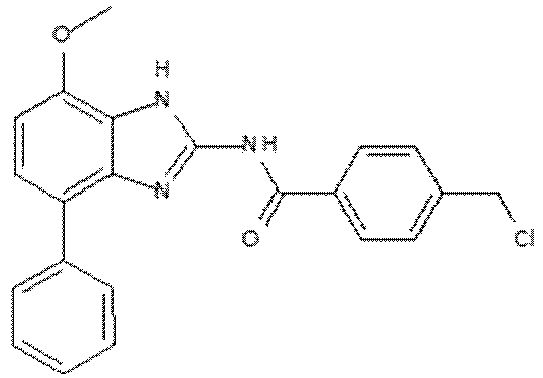
4-Chloromethyl-N-(7-methoxy-4-phenyl-1H-benzoimidazol-2-yl)-benzamide 11 
4-Ethylaminomethyl-N-(7-methoxy-4-phenyl-1 H-benzoimidazol-2-yl)-benzamide 12 
4-Hydroxy-4-methyl-piperidine-1-carboxylic acid (7-methoxy-4-phenyl-1 H-benzoimidazol-2-yl)-amide 13 
4-Aminomethyl-N-(7-methoxy-4-phenyl-1 H-benzoimidazol-2-yl)-benzamide 14* 
4-Cyclohexyl-7-methoxy-1 H-benzoimidazol-2-ylamine 15 
4-Imidazol-1-ylmethyl-N-(7-methoxy-4-phenyl-1 H-benzoimidazol-2-yl)-benzamide 16 
4-Hydroxy-4-methyl-piperidine-1-carboxylic acid (4-cyclohexyl-7-methoxy-1 H-benzoimidazol-2-yl)-amide 17 
N-(4-Cyclohexyl-7-methoxy-1 H-benzoimidazol-2-yl)-2-morpholin-4-yl-isonicotinamide 18* 
7-Methoxy-4-morpholin-4-yl-1 H-benzoimidazol-2-ylamine 19* 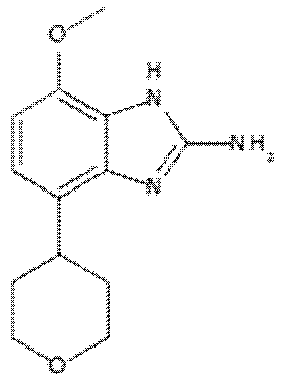
7-Methoxy-4-(tetrahydro-pyran-4-yl)-1H-benzoimidazol-2-ylamine 20* 
7-Methoxy-4-(1-methyl-1H-pyrazol-4-yl)-1 H-benzoimidazol-2-ylamine 21 
4-hydroxy-N-(7-methoxy-4-morpholino-1H-benzimidazol-2-yl)-4-methyl-piperidine-1-carboxamide 22 
4-Hydroxy-4-methyl-piperidine-1-carboxylic acid [7-methoxy-4-(1 -methyl-1H-pyrazol-4-yl)-1 H-benzoimidazol-2-yl]-amide 23 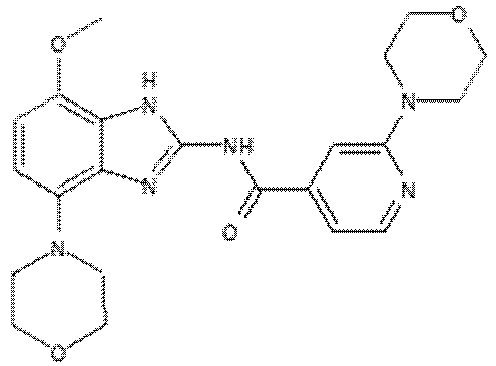
N-(7-Methoxy-4-morpholin-4-yl-1 H-benzoimidazol-2-yl)-2-morpholin-4-yl-isonicotinamide 24 
4-Hydroxy-4-methyl-piperidine-1-carboxylic acid [7-methoxy-4-(tetrahydro-pyran-4-yl)-1 H-benzoimidazol-2-yl]-amide 25* 
4-Methoxy-7-phenyl-3H-imidazo[4,5-c]pyridin-2-ylamine 26 
N-[7-Methoxy-4-(1-methyl-1H-pyrazol-4-yl)-1H-benzoimidazol-2-yl]-2-morpholin-4-yl-isonicotinamide 27* 
4-Methoxy-7-(1-methyl-1H-pyrazol-4-yl)-3H-imidazo[4,5-c]pyridin-2-ylamine 28 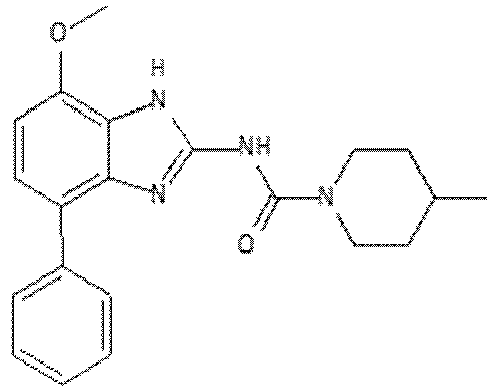
4-Methyl-piperidine-1-carboxylic acid (7-methoxy-4-phenyl-1 H-benzoimidazol-2-yl)-amide 29 
N-[7-Methoxy-4-(tetrahydropyran-4-yl)-1 H-benzoimidazol-2-yl]-6-morpholin-4-yl-nicotinamide 30 
2-(3-Hydroxy-3-methylpyrrolidin-1-yl)-N-[7-methoxy-4-(1-methyl-1H-pyrazol-4-yl)-1 H-benzoimidazol-2-yl]-isonicotinamide 31 
3-Hydroxy-3-methyl-pyrrolidine-1-carboxylic acid [7-methoxy-4-(1-methyl-1H-pyrazol-4-yl)-1 H-benzoimidazol-2-yl]-amide 32 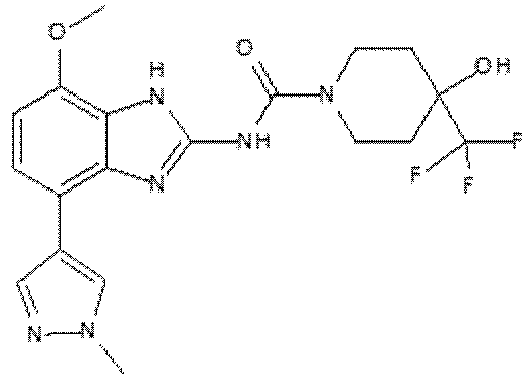
4-Hydroxy-4-trifluoromethyl-piperidine-1-carboxylic acid [7-methoxy-4-(1-methyl-1H-pyrazol-4-yl)-1 H-benzoimidazol-2-yl]-amide 33 
2-Oxa-7-aza-spiro[3.5]nonane-7-carboxylic acid [7-methoxy-4-(1 -methyl-1H-pyrazol-4-yl)-1 H-benzoimidazol-2-yl]-amide 34 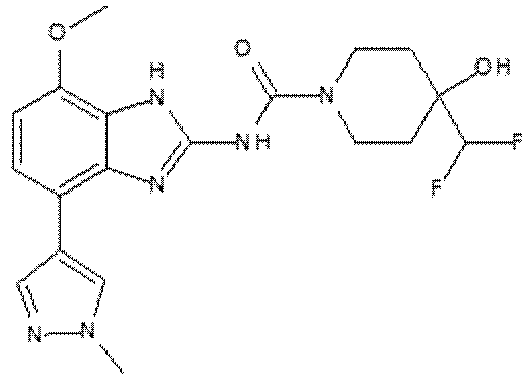
4-Difluoromethyl-4-hydroxy-piperidine-1-carboxylic acid [7-methoxy-4-(1-methyl-1 H-pyrazol-4-yl)-1 H-benzoimidazol-2-yl]-amide 35 
4-Hydroxymethyl-4-methylpiperidine-1-carboxylic acid [7-methoxy-4-(1-methyl-1 H-pyrazol-4-yl)-1 H-benzoimidazol-2-yl]-amide 36 
4-Fluoromethyl-4-hydroxy-piperidine-1-carboxylic acid [7-methoxy-4-(1-methyl-1 H-pyrazol-4-yl)-1 H-benzoimidazol-2-yl]-amide 37 
4-Methoxy-piperidine-1-carboxylic acid [7-methoxy-4-(1-methyl-1H-pyrazol-4-yl)-1 H-benzoimidazol-2-yl]-amide 38 
3-Oxa-9-aza-spiro[5.5]undecane-9-carboxylic acid [7-methoxy-4-(1-methyl-1H-pyrazol-4-yl)-1 H-benzoimidazol-2-yl]-amide 39 
4-Methyl-piperidine-1-carboxylic acid [7-methoxy-4-(1-methyl-1H-pyrazol-4-yl)-1 H-benzoimidazol-2-yl]-amide 40 
4-Hydroxy-piperidine-1-carboxylic acid [7-methoxy-4-(1-methyl-1H-pyrazol-4-yl)-1 H-benzoimidazol-2-yl]-amide 41 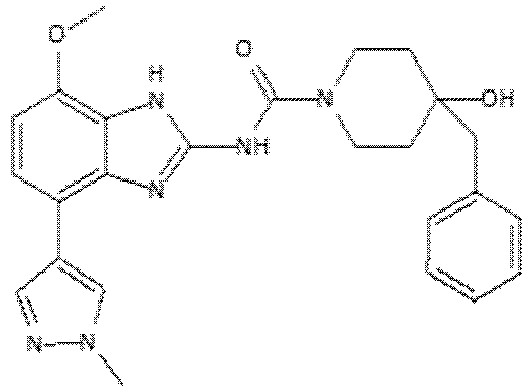
4-Benzyl-4-hydroxy-piperidine-1-carboxylic acid [7-methoxy-4-(1-methyl-1H-pyrazol-4-yl)-1 H-benzoimidazol-2-yl]-amide 42* 
N-[4-methoxy-7-(1-methyl-1H-pyrazol-4-yl)-3H-imidazo[4,5-c]pyridin-2-yl]-2-(morpholin-4-yl)pyrid ine-4-carboxamide 43 
N-[7-methoxy-4-(1-methyl-1H-pyrazol-4-yl)-1H-1,3-benzodiazol-2-yl]-2-oxa-6-azaspiro[3.4]octane-6-carboxamide 44 
N-[7-methoxy-4-(1-methyl-1H-pyrazol-4-yl)-1H-1,3-benzodiazol-2-yl]-2-oxo-1-oxa-3,8-diazaspiro[4.5]decane-8-carboxamide 45 
N-[7-methoxy-4-(1-methyl-1H-pyrazol-4-yl)-1H-1,3-benzodiazol-2-yl]-1,4-dioxa-8-azaspiro[4.5]decane-8-carboxamide 46 
N-[7-methoxy-4-(1-methyl-1H-pyrazol-4-yl)-1H-1,3-benzodiazol-2-yl]morpholine-4-carboxamide 47 
N-[7-methoxy-4-(1-methyl-1H-pyrazol-4-yl)-1H-1,3-benzodiazol-2-yl]-3-oxo-2,8-diazaspiro[4.5]decane-8-carboxamide 48 
4-[(dimethylamino)methyl]-N-[-methyl-1H-pyrazol-4-yl)-1H-1,3-benzod iazol-2-yl]benzamide 49 
N-[7-methoxy-4-(1-methyl-1H-pyrazol-4-yl)-1H-1,3-benzodiazol-2-yl]-4-(methoxymethyl) be nzamide 50 
N-[7-methoxy-4-(1-methyl-1H-pyrazol-4-yl)-1H-1,3-benzodiazol-2-yl]-2,4-dioxo-1,3,8-triazaspiro[4.5]decane-8-carboxamide 51 
N-[7-methoxy-4-(1-methyl-1H-pyrazol-4-yl)-1H-1,3-benzodiazol-2-yl]-2-oxo-1,8-diazaspiro[4.5]decane-8-carboxamide 52 
4-(2-hydroxyethyl)-N-[7-methoxy-4-(1 -methyl-1H-pyrazol-4-yl)-1H-1,3-benzodiazol-2-yl]-1,2,3,6-tetrahydropyridine-1-carboxamide 53 
3-butyl-4-hydroxy-N-[7-methoxy-4-(1-methyl-1H-pyrazol-4-yl)-1H-1,3-benzodiazol-2-yl]piperidine-1-carboxamide 54 
N-[7-methoxy-4-(1-methyl-1H-pyrazol-4-yl)-1H-1,3-benzodiazol-2-yl]-4-phenoxypiperidine-1-carboxamide 55 
4-hydroxy-N-[7-methoxy-4-(1-methyl-1 H-pyrazol-4-yl)-1 H-1,3-benzodiazol-2-yl]-4-(pyridin-3-yl)piperidine-1-carboxamide 56 
4-hydroxy-N-[7-methoxy-4-(1-methyl-1 H-pyrazol-4-yl)-1 H-1,3-benzodiazol-2-yl]-3-(2-methylpropyl)piperidine-1-carboxamide 57 
N-[4-(2,6-dimethylpyridin-4-yl)-7-methoxy-1H-1,3-benzodiazol-2-yl]-2-(morpholin-4-yl)pyridine-4-carboxamide 58 
N-[7-methoxy-4-(1-methyl-1H-pyrazol-4-yl)-1H-1,3-benzodiazol-2-yl]-4-oxopiperidine-1-carboxamide 59* 
N-[7-methoxy-4-(1-methyl-1H-pyrazol-4-yl)-1H-1,3-benzodiazol-2-yl]acetamide 60 
N-[7-methoxy-4-(1-methyl-1H-pyrazol-4-yl)-1H-1,3-benzodiazol-2-yl]-1-oxo-2,8-diazaspiro[4.5]decane-8-carboxamide 61* 
3,3-diethyl-1-[7-methoxy-4-(1-methyl-1 H-pyrazol-4-yl)-1 H-1,3-benzodiazol-2-yl]urea 62 
N-[7-methoxy-4-(1-methyl-1H-pyrazol-4-yl)-1H-1,3-benzodiazol-2-yl]-1-methyl-5-oxo-1,4,9-triazaspiro[5.5]undecane-9-carboxamide 63 
4-fluoro-N-[7-methoxy-4-(morpholin-4-yl)-1H-1,3-benzod iazol-2-yl]benzamide 64 
N-[7-methoxy-4-(1-methyl-1H-pyrazol-4-yl)-1H-1,3-benzodiazol-2-yl]-6-oxaspiro[2.5]octane-1-carboxamide 65 
N-[7-methoxy-4-(1-methyl-1H-pyrazol-4-yl)-1H-1,3-benzodiazol-2-yl]-5-{3H-[1,2,3]triazolo[4,5-b]pyridin-3-yloxy}pyrazine-2-carboxamide 66 
(chloromethyl)({2-[(1-{[7-methoxy-4-(1 -methyl-1H-pyrazol-4-yl)-1H-1,3-benzodiazol-2-yl]carbamoyl}-4-methylpiperidin-4-yl)oxy]ethyl})dimethylazanium hydrochloride 67 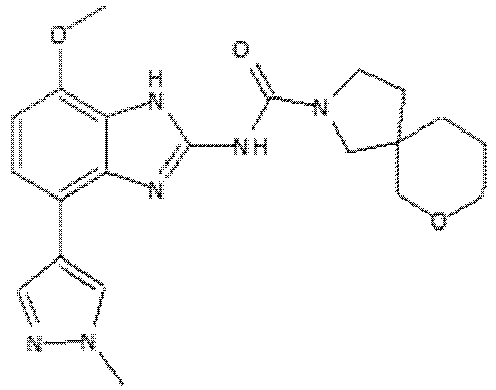
N-[7-methoxy-4-(1-methyl-1H-pyrazol-4-yl)-1H-1,3-benzodiazol-2-yl]-7-oxa-2-azaspiro[4.5]decane-2-carboxamide 68 
N-[7-methoxy-4-(1-methyl-1H-pyrazol-4-yl)-1H-1,3-benzodiazol-2-yl]-8-oxa-2-azaspiro[4.5]decane-2-carboxamide 69 
N-[7-methoxy-4-(1-methyl-1H-pyrazol-4-yl)-1H-1,3-benzodiazol-2-yl]-2-oxa-7-azaspiro[4.4]nonane-7-carboxamide 70 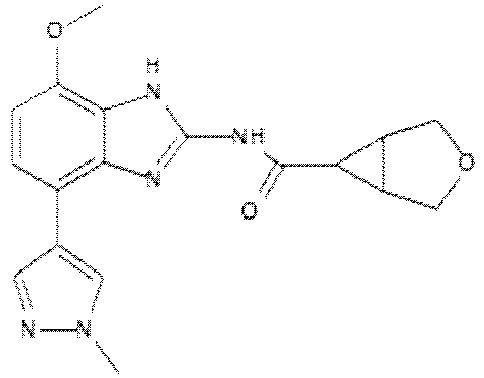
N-[7-methoxy-4-(1-methyl-1H-pyrazol-4-yl)-1H-1,3-benzodiazol-2-yl]-3-oxabicyclo[3.1.0]hexane-6-carboxamide 71 
4-[(1H-imidazol-1-yl)methyl]-N-[-methyl-1H-pyrazol-4-yl)-1H-1,3-benzodiazol-2-yl]benzamide 72 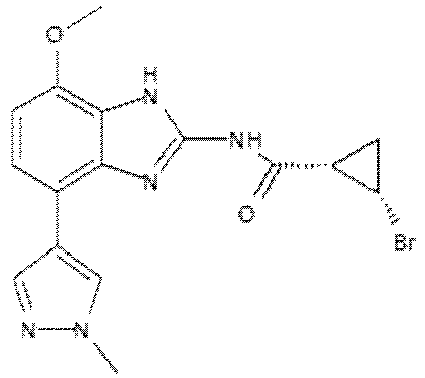
(1S,2S)-2-bromo-N-[7-methoxy-4-(1-methyl-1H-pyrazol-4-yl)-1H-1,3-benzodiazol-2-yl]cyclopropane-1-carboxamide 73 
N-[7-methoxy-4-(1-methyl-1H-pyrazol-4-yl)-1H-1,3-benzodiazol-2-yl]-5-(2-methoxyethoxy)pyrazine-2-carboxamide 74 
4-hydroxy-N-[7-methoxy-4-(pyridin-4-yl)-1H-1,3-benzodiazol-2-yl]-4-methylpiperidine-1-carboxamide 75 
4-benzyl-4-hydroxy-N-[7-methoxy-4-(morpholin-4-yl)-1 H-1,3-benzodiazol-2-yl]piperidine-1-carboxamide 76 
4-[(1 H-imidazol-1-yl)methyl]-N-[7-methoxy-4-(morpholin-4-yl)-1 H-1 ,3-benzodiazol-2-yl]benzamide 77 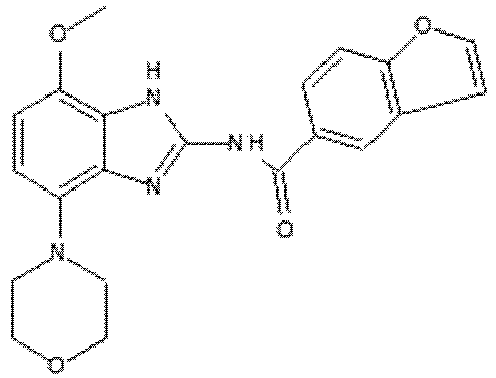
N-[7-methoxy-4-(morpholin-4-yl)-1H-1,3-benzodiazol-2-yl]-1-benzofuran-5-carboxamide 78 
4-hydroxy-N-{7-methoxy-4-[1-(oxan-2-yl)-1H-pyrazol-4-yl]-1 H-1 ,3-benzodiazol-2-yl}-4-methylpiperidine-1-carboxamide 79 
4-hydroxy-N-[7-methoxy-4-(1H-pyrazol-4-yl)-1H-1,3-benzodiazol-2-yl]-4-methylpiperidine-1-carboxamide 80 
N-[7-methoxy-4-(1-methyl-1H-pyrazol-4-yl)-1H-1,3-benzodiazol-2-yl]-1-benzofuran-5-carboxamide 81 
N-[7-methoxy-4-(1-methyl-1H-pyrazol-4-yl)-1H-1,3-benzodiazol-2-yl]-5-(morpholin-4-yl)pyrazine-2-carboxamide 82* 
4-hydroxy-N-[4-methoxy-7-(1-methyl-1H-pyrazol-4-yl)-3H-imidazo[4,5-c]pyridin-2-yl]-4-methylpiperidine-1-carboxamide 83 
4-benzyl-4-hydroxy-N-[4-methoxy-7-(1-methyl-1H-pyrazol-4-yl)-3H-imidazo[4,5-c]pyridin-2-yl]piperidine-1-carboxamide 84 
N-[7-methoxy-4-(1-methyl-1H-pyrazol-4-yl)-1H-1,3-benzodiazol-2-yl]-1,2-oxazole-3-carboxamide 85 
N-[7-methoxy-4-(pyridin-4-yl)-1H-1,3-benzodiazol-2-yl]-2-oxa-6-azaspiro[3.4]octane-6-carboxamide 86 
1-(1-chloro-3-hydroxypropan-2-yl)-N-[7-methoxy-4-(morpholin-4-yl)-1H-1 ,3-benzodiazol-2-yl]-1H-pyrazole-4-carboxamide 87 
N-[7-methoxy-4-(1-methyl-1H-pyrazol-4-yl)-1H-1,3-benzodiazol-2-yl]-6-(morpholin-4-yl)pyridazine-3-carboxamide 88 
4-[(dimethylamino)methyl]-N-[7-methoxy-4-(oxan-4-yl)-1H-1,3-benzodiazol-2-yl]benzamide 89 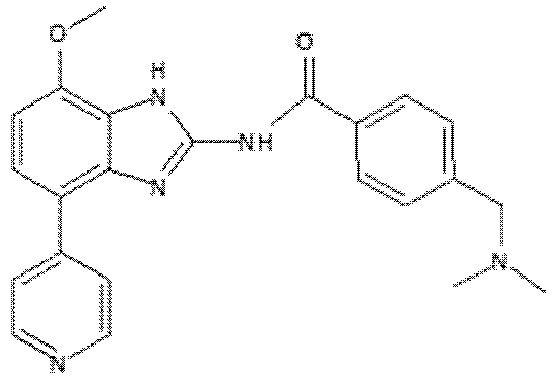
4-[(dimethylamino)methyl]-N-[7-methoxy-4-(pyridin-4-yl)-1H-1,3-benzodiazol-2-yl]benzamide 90 
4-[(dimethylamino)methyl]-N-[7-methoxy-4-(morpholin-4-yl)-1H-1,3-benzodiazol-2-yl]benzamide 91 
N-[7-methoxy-4-(oxan-4-yl)-1H-1,3-benzodiazol-2-yl]-6-(morpholin-4-yl)pyridazine-3-carboxamide 92 
4-hydroxy-N-[7-methoxy-4-(1-methyl-1H-pyrazol-4-yl)-1 H-1,3-benzodiazol-2-yl]-4-(prop-2-yn-1-yl)piperidine-1-carboxamide 93 
N4-[7-methoxy-4-(1-methyl-1H-pyrazol-4-yl)-1H-1,3-benzodiazol-2-yl]-N1,N1-dimethylbenzene-1,4-dicarboxamide 94 
N-[7-methoxy-4-(1-methyl-1H-pyrazol-4-yl)-1H-1,3-benzodiazol-2-yl]-4-(trifluoromethoxy)benzamide 95 
2-bromo-N-[7-methoxy-4-(1-methyl-1H-pyrazol-4-yl)-1 H-1,3-benzodiazol-2-yl]pyridine-4-carboxamide 96 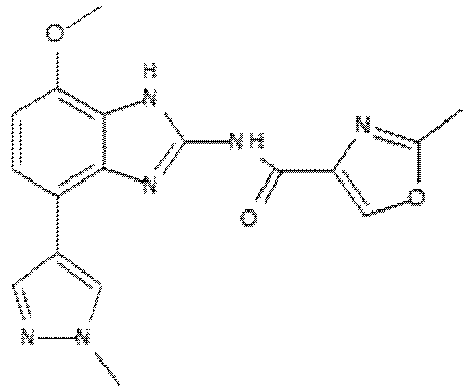
N-[7-methoxy-4-(1-methyl-1H-pyrazol-4-yl)-1H-1,3-benzodiazol-2-yl]-2-methyl-1,3-oxazole-4-carboxamide 97 
4-[(1H-imidazol-1-yl)methyl]-N-[7-methoxy-4-(oxan-4-yl)-1H-1,3-benzodiazol-2-yl]benzamide 98 
N-[7-methoxy-4-(1-methyl-1H-pyrazol-4-yl)-1H-1,3-benzodiazol-2-yl]-1,3-benzoxazole-5-carboxamide 99 
3-amino-4-hydroxy-N-[7-methoxy-4-(morpholin-4-yl)-1H-1,3-benzodiazol-2-yl]benzamide 100 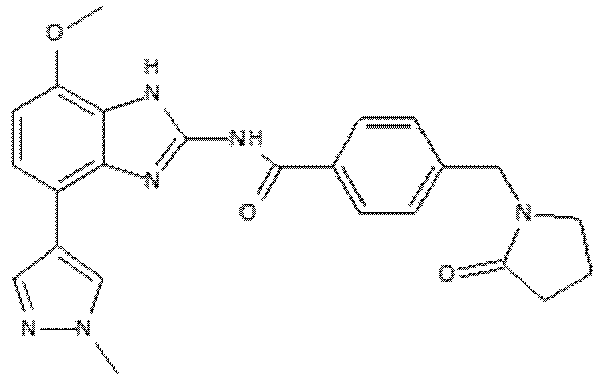
N-[7-methoxy-4-(1-methyl-1H-pyrazol-4-yl)-1H-1,3-benzodiazol-2-yl]-4-[(2-oxopyrrolidin-1-yl)methyl]benzamide 101 
N-[7-methoxy-4-(1-methyl-1H-pyrazol-4-yl)-1H-1,3-benzodiazol-2-yl]-2,3-dihydro-1-benzofuran-5-carboxamide 102 
4-hydroxy-N-[7-methoxy-4-(oxan-4-yl)-1H-1,3-benzodiazol-2-yl]-4-(prop-2-yn-1-yl)piperidine-1-carboxamide 103 
4-benzyl-4-hydroxy-N-[7-methoxy-4-(oxan-4-yl)-1H-1,3-benzodiazol-2-yl]piperidine-1-carboxamide 104 
2-[(3S)-3-hydroxy-3-methylpyrrolidin-1-yl]-N-[7-methoxy-4-(1-methyl-1H-pyrazol-4-yl)-1H-1,3-benzodiazol-2-yl]pyridine-4-carboxamide 105 
2-(4-hydroxy-4-methylpiperidin-1-yl)-N-[7-methoxy-4-(1-methyl-1H-pyrazol-4-yl)-1 H-1,3-benzodiazol-2-yl]pyridine-4-carboxamide 106 
N-[7-methoxy-4-(1-methyl-1H-pyrazol-4-yl)-1H-1,3-benzodiazol-2-yl]-2-{2-oxa-7-azaspiro[4.4]nonan-7-yl}pyridine-4-carboxamide 107 
2-[(3R)-3-hydroxy-3-methylpyrrolidin-1-yl]-N-[7-methoxy-4-(1-methyl-1H-pyrazol-4-yl)-1H-1,3-benzodiazol-2-yl]pyridine-4-carboxamide 108 
N-[7-methoxy-4-(oxan-4-yl)-1H-1,3-benzodiazol-2-yl]-2,3-dihydro-1-benzofuran-5-carboxamide 109 
N-[7-methoxy-4-(1-methyl-1H-pyrazol-4-yl)-1H-1,3-benzodiazol-2-yl]-3-(methoxymethyl)pyrrolidine-1-carboxamide 110 
N-[7-methoxy-4-(oxan-4-yl)-1H-1 ,3-benzodiazol-2-yl]-2-oxa-7-azaspiro[4.4]nonane-7-carboxamide 111 
N-[7-methoxy-4-(oxan-4-yl)-1H-1,3-benzodiazol-2-yl]-8-oxa-2-azaspiro[4.5]decane-2-carboxamide 112 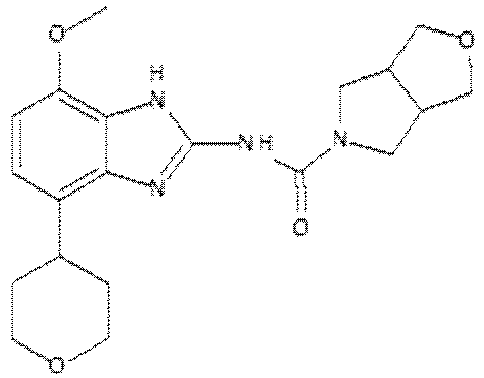
N-[7-methoxy-4-(oxan-4-yl)-1H-1,3-benzodiazol-2-yl]-hexahydro-1H-furo[3,4-c]pyrrole-5-carboxamide 113 
(5R)-N-[7-methoxy-4-(1-methyl-1H-pyrazol-4-yl)-1 H-1 ,3-benzodiazol-2-yl]-7-oxa-2-azaspiro[4.5]decane-2-carboxamide 114 
(5S)-N-[7-methoxy-4-(1-methyl-1H-pyrazol-4-yl)-1H-1,3-benzodiazol-2-yl]-7-oxa-2-azaspiro[4.5]decane-2-carboxamide 115 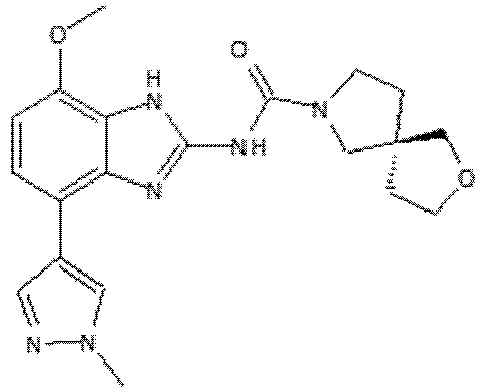
(5S)-N-[7-methoxy-4-(1-methyl-1H-pyrazol-4-yl)-1H-1,3-benzodiazol-2-yl]-2-oxa-7-azaspiro[4.4]nonane-7-carboxamide 116 
(5R)-N-[7-methoxy-4-(1-methyl-1H-pyrazol-4-yl)-1H-1 ,3-benzodiazol-2-yl]-2-oxa-7-azaspiro[4.4]nonane-7-carboxamide 117 
N-[7-methoxy-4-(oxan-4-yl)-1H-1,3-benzodiazol-2-yl]-3-(methoxymethyl)pyrrolidine-1-carboxamide 118 
2-(4-hydroxy-4-methylpiperidin-1-yl)-N-[7-methoxy-4-(oxan-4-yl)-1H-1 ,3-benzodiazol-2-yl]pyridine-4-carboxamide 119 
N-[7-methoxy-4-(oxan-4-yl)-1H-1,3-benzodiazol-2-yl]-2-{2-oxa-7-azaspiro[4.4]nonan-7-yl}pyridine-4-carboxamide 120 
2-(4-fluorophenoxy)-N-[7-methoxy-4-(1 -methyl-1H-pyrazol-4-yl)-1H-1,3-benzodiazol-2-yl]-2-methylpropanamide 121 
N-[7-methoxy-4-(1-methyl-1H-pyrazol-4-yl)-1H-1,3-benzodiazol-2-yl]-hexahydro-1H-furo[3,4-c]pyrrole-5-carboxamide 122 
2-(3-hydroxy-3-methylpyrrolidin-1-yl)-N-[7-methoxy-4-(oxan-4-yl)-1H-1,3-benzodiazol-2-yl]pyridine-4-carboxamide 123 
N-[7-methoxy-4-(morpholin-4-yl)-1H-1 ,3-benzodiazol-2-yl]-2-oxa-7-azaspiro[4.4]nonane-7-carboxamide 124 
1-{[7-methoxy-4-(1-methyl-1H-pyrazol-4-yl)-1H-1,3-benzodiazol-2-yl]carbamoyl}piperidine-4-carboxylic acid 125 
N-[7-methoxy-4-(morpholin-4-yl)-1H-1 ,3-benzodiazol-2-yl]-8-oxa-2-azaspiro[4.5]decane-2-carboxamide 126 
N1-[7-methoxy-4-(1-methyl-1H-pyrazol-4-yl)-1H-1,3-benzodiazol-2-yl]piperidine-1,4-dicarboxamide 127 
4-(diethylamino)-N-[7-methoxy-4-(1-methyl-1H-pyrazol-4-yl)-1H-1,3-benzodiazol-2-yl]benzamide 128 
4-hydroxy-N-{7-methoxy-4-[1-(2-methylpropyl)-1H-pyrazol-4-yl]-1 H-1 ,3-benzodiazol-2-yl}-4-methylpiperidine-1-carboxamide 129 
N-[7-methoxy-4-(pyridin-4-yl)-1H-1,3-benzodiazol-2-yl]-8-oxa-2-azaspiro[4.5]decane-2-carboxamide 130 
2-(1-{[7-methoxy-4-(oxan-4-yl)-1H-1,3-benzodiazol-2-yl]carbamoyl}piperidin-4-yl)acetic acid 131 
4-hydroxy-N-[7-methoxy-4-(2-methylphenyl)-1H-1,3-benzodiazol-2-yl]-4-methylpiperidine-1-carboxamide 132 
2-(1-{[7-methoxy-4-(1-methyl-1H-pyrazol-4-yl)-1H-1,3-benzodiazol-2-yl]carbamoyl}piperidin-4-yl)acetic acid 133 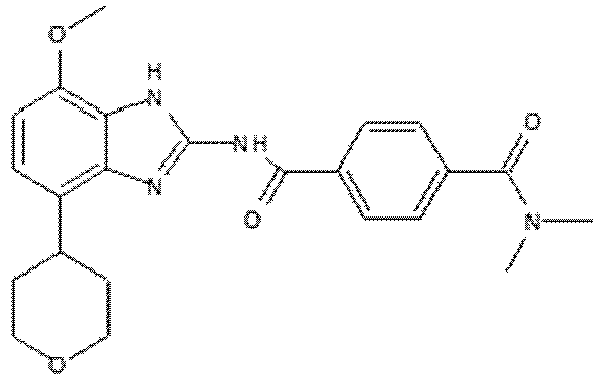
N4-[7-methoxy-4-(oxan-4-yl)-1H-1,3-benzodiazol-2-yl]-N1,N1-dimethylbenzene-1,4-dicarboxamide 134 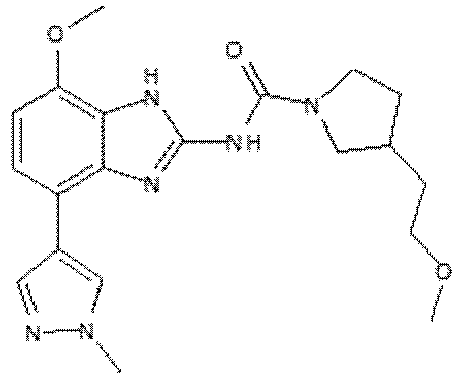
N-[7-methoxy-4-(1-methyl-1H-pyrazol-4-yl)-1H-1,3-benzodiazol-2-yl]-3-(2-methoxyethyl)pyrrolidine-1-carboxamide 135 
N-[7-methoxy-4-(1-methyl-1H-pyrazol-4-yl)-1H-1,3-benzodiazol-2-yl]-5-(morpholin-4-yl)pyridine-2-carboxamide 136 
N-[7-methoxy-4-(morpholin-4-yl)-1H-1,3-benzodiazol-2-yl]-1-methyl-1H-pyrazole-4-carboxamide 137 
N-[7-methoxy-4-(oxan-4-yl)-1H-1,3-benzodiazol-2-yl]-3-(2-methoxyethyl)pyrrolidine-1-carboxamide 138 
N-[7-methoxy-4-(oxan-4-yl)-1H-1,3-benzodiazol-2-yl]-4-[(2-oxopyrrolidin-1-yl)methyl]benzamide 139 
N-[7-methoxy-4-(oxan-4-yl)-1H-1,3-benzodiazol-2-yl]-5-(morpholin-4-yl)pyridine-2-carboxamide 140 
(3R)-N-[7-methoxy-4-(1 - methyl-1H-pyrazol-4-yl)-1H-1,3-benzodiazol-2-yl]-3-(2-methoxyethyl)pyrrolidine-1-carboxamide 141 
(3S)-N-[7-methoxy-4-(1-methyl-1H-pyrazol-4-yl)-1H-1,3-benzodiazol-2-yl]-3-(2-methoxyethyl)pyrrolidine-1-carboxamide 142 
2-[(3R)-3-hydroxy-3-methylpyrrolidin-1-yl]-N-[7-methoxy-4-(oxan-4-yl)-1H-1,3-benzodiazol-2-yl]acetamide 143 
2-[(3S)-3-hydroxy-3-methylpyrrolidin-1-yl]-N-[7-methoxy-4-(oxan-4-yl)-1H-1,3-benzodiazol-2-yl]acetamide 144 
N-[4-(4-fluorophenyl)-7-methoxy-1H-1,3-benzodiazol-2-yl]-4-hydroxy-4-methylpiperidine-1-carboxamide 145 
tert-butyl 4-(4-{2-[(4-hydroxy-4-methylpiperidine-1-carbonyl)amino]-4-methoxy-1H-1,3-benzodiazol-7-yl}-1H-pyrazol-1-yl)piperidine-1-carboxylate 146 
4-{[2-amino-7-methoxy-4-(1-methyl-1H-pyrazol-4-yl)-1H-1,3-benzodiazol-1-yl]methyl}benzoic acid 147 
(3S)-N-[7-methoxy-4-(1-methyl-1H-pyrazol-4-yl)-1H-1,3-benzodiazol-2-yl]-3-(methoxymethyl)pyrrolidine-1-carboxamide 148 
(3R)-N-[7-methoxy-4-(1-methyl-1H-pyrazol-4-yl)-1H-1,3-benzodiazol-2-yl]-3-(methoxymethyl)pyrrolidine-1-carboxamide 149 
(5S)-N-[7-methoxy-4-(oxan-4-yl)-1H-1,3-benzodiazol-2-yl]-2-oxa-7-azaspiro[4.4]nonane-7-carboxamide 150 
(5R)-N-[7-methoxy-4-(oxan-4-yl)-1H-1,3-benzodiazol-2-yl]-2-oxa-7-azaspiro[4.4]nonane-7-carboxamide 151 
4-hydroxy-N-{7-methoxy-4-[1-(3-methylbutyl)-1H-pyrazol-4-yl]-1H-1,3-benzodiazol-2-yl}-4-methylpiperidine-1-carboxamide 152 
N-[7-methoxy-4-(1-methyl-1H-pyrazol-4-yl)-1H-1,3-benzodiazol-2-yl]-4-[(morpholin-4-yl)methyl]benzamide 153 
N-[7-methoxy-4-(oxan-4-yl)-1H-1,3-benzodiazol-2-yl]-2-[(5R)-2-oxa-7-azaspiro[4.4]nonan-7-yl]pyridine-4-carboxamide 154 
N-[7-methoxy-4-(oxan-4-yl)-1H-1,3-benzodiazol-2-yl]-2-[(5S)-2-oxa-7-azaspiro[4.4]nonan-7-yl]pyridine-4-carboxamide 155 
N-[4-(3,6-dihydro-2H-pyran-4-yl)-7-methoxy-1H-1,3-benzodiazol-2-yl]-4-hydroxy-4-methylpiperidine-1-carboxamide 156 
N-[7-methoxy-4-(1-methyl-1H-pyrazol-4-yl)-1H-1,3-benzodiazol-2-yl]-1-methyl-1H-1,2,3-triazole-4-carboxamide 157 
4-hydroxy-N-{4-methoxy-7-[1-(piperidin-4-yl)-1H-pyrazol-4-yl]-1H-1,3-benzodiazol-2-yl}-4-methylpiperidine-1-carboxamide 158 
N-[7-methoxy-4-(1-methyl-1H-pyrazol-4-yl)-1H-1,3-benzodiazol-2-yl]-5-(2-methoxyethoxy)pyridine-2-carboxamide 159 
2-(1-{[7-methoxy-4-(1-methyl-1H-pyrazol-4-yl)-1H-1,3-benzodiazol-2-yl]carbamoyl}piperidin-3-yl)acetic acid 160 
N-[7-methoxy-4-(1-methyl-1H-pyrazol-4-yl)-1H-1,3-benzodiazol-2-yl]-1-methyl-1H-pyrazole-4-carboxamide 161 
N-[7-methoxy-4-(1-methyl-1H-pyrazol-4-yl)-1H-1,3-benzodiazol-2-yl]-1-(2-methoxyethyl)-1H-pyrazole-4-carboxamide 162 
N5-[7-methoxy-4-(1-methyl-1H-pyrazol-4-yl)-1H-1,3-benzodiazol-2-yl]-N2,N2-dimethylpyridine-2,5-dicarboxamide 163 
4-hydroxy-N-[4-methoxy-1-methyl-7-(1-methyl-1H-pyrazol-4-yl)-1H-1,3-benzodiazol-2-yl]-4-methylpiperidine-1-carboxamide 164 
N-[7-methoxy-4-(1-methyl-1H-pyrazol-4-yl)-1H-1,3-benzodiazol-2-yl]-1-(2-methoxyethyl)-1H-1,2,3-triazole-4-carboxamide 165 
N-[7-methoxy-4-(1-methyl-1H-pyrazol-4-yl)-1H-1,3-benzodiazol-2-yl]-2-methyl-1,3-thiazole-5-carboxamide 166* 
3-cyano-N-[7-methoxy-4-(1-methyl-1H-pyrazol-4-yl)-1H-1,3-benzodiazol-2-yl]propanamide 167 
1-(2-Hydroxy-ethyl)-1H-pyrazole-4-carboxylic acid [7-methoxy-4-(1-methyl-1H-pyrazol-4-yl)-1H-benzoimidazol-2-yl]-amide 168 
N-[7-methoxy-4-(1-methyl-1H-pyrazol-4-yl)-1H-1,3-benzodiazol-2-yl]-4-[(4-methylpiperazin-1-yl)methyl]benzamide 169 
1-Methyl-1H-pyrazole-4-carboxylic acid [7-methoxy-4-(1-methyl-1H-pyrazol-4-yl)-1H-benzoimidazol-2-yl]-amide 170 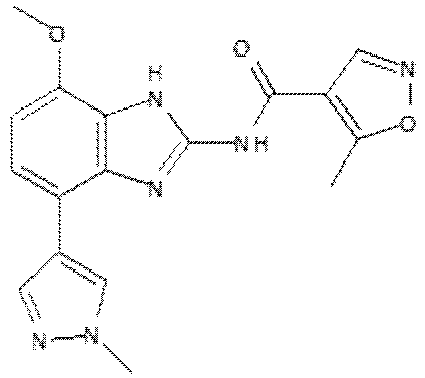
5-Methyl-isoxazole-4-carboxylic acid [7-methoxy-4-(1-methyl-1H-pyrazol-4-yl)-1H-benzoimidazol-2-yl]-amide 171 
5-Cyclopropyl-isoxazole-4-carboxylic acid [7-methoxy-4-(1-methyl-1H-pyrazol-4-yl)-1H-benzoimidazol-2-yl]-amide 172 
1-Cyano-cyclopropanecarboxylic acid [-methyl-1H-pyrazol-4-yl)-1H-benzoimidazol-2-yl]-amide 173 
Thiazole-5-carboxylic acid [7-methoxy-4-(1-methyl-1H-pyrazol-4-yl)-1H-benzoimidazol-2-yl]-amide 174 
5,6,7,8-Tetrahydro-imidazo[1,2-a]pyridine-3-carboxylic acid [7-methoxy-4-(1-methyl-1H-pyrazol-4-yl)-1H-benzoimidazol-2-yl]-amide 175 
4-(4-Methyl-piperazin-1-yl)-but-2-ynoic acid [7-methoxy-4-(1-methyl-1H-pyrazol-4-yl)-1H-benzoimidazol-2-yl]-amide 176* 
4-Hydroxy-but-2-ynoic acid [7-methoxy-4-(1-methyl-1H-pyrazol-4-yl)-1H-benzoimidazol-2-yl]-amide 177* 
4-Acetylamino-but-2-ynoic acid [-methyl-1H-pyrazol-4-yl)-1H-benzoimidazol-2-yl]-amide 178* 
4-Dimethylamino-but-2-ynoic acid [7-methoxy-4-(1-methyl-1H-pyrazol-4-yl)-1H-benzoimidazol-2-yl]-amide 179 
(S)-3-Methanesulfonyl-pyrrolidine-1-carboxylic acid [7-methoxy-4-(1-methyl-1H-pyrazol-4-yl)-1H-benzoimidazol-2-yl]-amide 180 
(S)-3-Fluoro-pyrrolidine-1-carboxylic acid [7-methoxy-4-(1-methyl-1H-pyrazol-4-yl)-1H-benzoimidazol-2-yl]-amide 181 
(S)-3-Cyano-pyrrolidine-1-carboxylic acid [7-methoxy-4-(1-methyl-1H-pyrazol-4-yl)-1H-benzoimidazol-2-yl]-amide 182 
(R)-3-Dimethylaminomethyl-pyrrolidine-1-carboxylic acid [7-methoxy-4-(1-methyl-1H-pyrazol-4-yl)-1H-benzoimidazol-2-yl]-amide 183 
5-Methyl-isoxazole-4-carboxylic acid (7-methoxy-4-morpholin-4-yl-1H-benzoimidazol-2-yl)-amide 184 
N-[7-methoxy-4-(morpholin-4-yl)-1H-1,3-benzodiazol-2-yl]-1-(2-methoxyethyl)-1H-1,2,3-triazole-4-carboxamide 185 
1-Methyl-1H-[1,2,3]triazole-4-carboxylic acid (7-methoxy-4-morpholin-4-yl-1H-benzoimidazol-2-yl)-amide 186 
Pyridine-2,5-dicarboxylic acid 2-dimethylamide 5-{[7-methoxy-4-(tetrahydro-pyran-4-yl)-1H-benzoimidazol-2-yl]-amide} 187 
1-(2-Methoxy-ethyl)-1H-pyrazole-4-carboxylic acid [7-methoxy-4-(tetrahydro-pyran-4-yl)-1H-benzoimidazol-2-yl]-amide 188 
N-[7-Methoxy-4-(tetrahydropyran-4-yl)-1H-benzoimidazol-2-yl]-4-morpholin-4-ylmethyl-benzamide 189 
N-[7-Methoxy-4-(tetrahydropyran-4-yl)-1H-benzoimidazol-2-yl]-4-(4-methyl-piperazin-1 - ylmethyl)-benzamide 190 
1-Methyl-1H-pyrazole-4-carboxylic acid [7-methoxy-4-(tetrahydro-pyran-4-yl)-1H-benzoimidazol-2-yl]-amide 191 
5-Methyl-isoxazole-4-carboxylic acid [7-methoxy-4-(tetrahydro-pyran-4-yl)-1H-benzoimidazol-2-yl]-amide 192 
5-Cyclopropyl-isoxazole-4-carboxylic acid [7-methoxy-4-(tetrahydro-pyran-4-yl)-1H-benzoimidazol-2-yl]-amide 193 
1-(2-Methoxy-ethyl)-1H-[1,2,3]triazole-4-carboxylic acid [7 -methoxy-4-(tetrahydropyran-4-yl)-1H-benzoimidazol-2-yl]-amide 194 
1-Methyl-1H-[1,2,3]triazole-4-carboxylic acid [7-methoxy-4-(tetrahydro-pyran-4-yl)-1H-benzoimidazol-2-yl]-amide 195 
1-Cyano-cyclopropanecarboxylic acid [7-methoxy-4-(tetrahydropyran-4-yl)-1H-benzoimidazol-2-yl]-amide 196 
Thiazole-5-carboxylic acid [7-methoxy-4-(tetrahydro-pyran-4-yl)-1H-benzoimidazol-2-yl]-amide 197 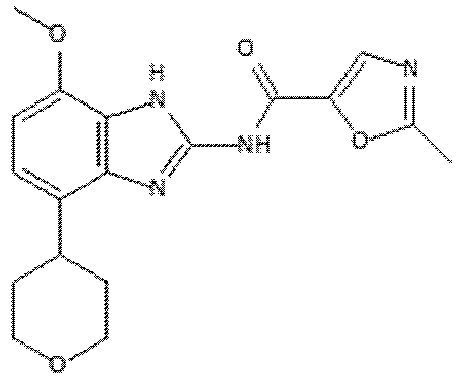
2-Methyl-oxazole-5-carboxylic acid [7 -methoxy-4-(tetrahydropyran-4-yl)-1H-benzoimidazol-2-yl]-amide 198 
2-Methyl-thiazole-5-carboxylic acid [7 -methoxy-4-(tetrahydropyran-4-yl)-1H-benzoimidazol-2-yl]-amide 199 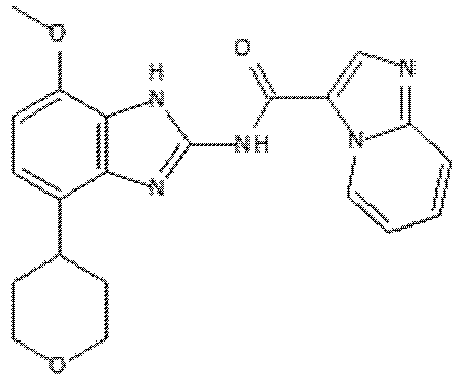
Imidazo[1,2-a]pyridine-3-carboxylic acid [7-methoxy-4-(tetrahydro-pyran-4-yl)-1H-benzoimidazol-2-yl]-amide 200 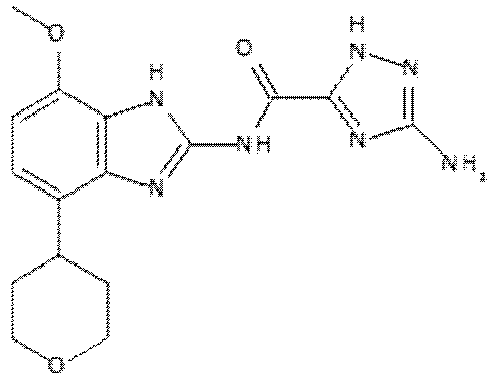
5-Amino-2H-[1,2,4]triazole-3-carboxylic acid [7-methoxy-4-(tetrahydro-pyran-4-yl)-1H-benzoimidazol-2-yl]-amide 201 
(S)-3-Methanesulfonyl-pyrrolidine-1-carboxylic acid [7-methoxy-4-(tetrahydro-pyran-4-yl)-1H-benzoimidazol-2-yl]-amide 202 
(S)-3-Fluoro-pyrrolidine-1-carboxylic acid [7-methoxy-4-(tetrahydro-pyran-4-yl)-1H-benzoimidazol-2-yl]-amide 203 
(S)-3-Cyano-pyrrolidine-1-carboxylic acid [7-methoxy-4-(tetrahydro-pyran-4-yl)-1H-benzoimidazol-2-yl]-amide 204 
(R)-3-Dimethylaminomethyl-pyrrolidine-1-carboxylic acid [7-methoxy-4-(tetrahydro-pyran-4-yl)-1H-benzoimidazol-2-yl]-amide 205 
Pyrazolo[1,5-a]pyridine-3-carboxylic acid [7-methoxy-4-(tetrahydro-pyran-4-yl)-1H-benzoimidazol-2-yl]-amide 206 
1H-[1,2,4]Triazole-3-carboxylic acid [7 -methoxy-4-(tetrahydropyran-4-yl)-1H-benzoimidazol-2-yl]-amide 207 
5,6,7,8-Tetrahydro-imidazo[1,2-a]pyridine-3-carboxylic acid [7-methoxy-4-(tetrahydro-pyran-4-yl)-1H-benzoimidazol-2-yl]-amide 208 
2,3-Dimethyl-3H-imidazole-4-sulfonic acid [7-methoxy-4-(tetrahydro-pyran-4-yl)-1H-benzoimidazol-2-yl]-amide 209 
1-[7-Methoxy-4-(tetrahydropyran-4-yl)-1H-benzoimidazol-2-yl]-3-thiazol-2-ylmethyl-urea 210 
N-[7-methoxy-4-(morpholin-4-yl)-1H-1,3-benzodiazol-2-yl]-1-methyl-1H-1,2,3-triazole-4-carboxamide 211 
N-[7-methoxy-4-(oxan-4-yl)-1H-1,3-benzodiazol-2-yl]-1-(2-methoxyethyl)-1H-1,2,3-triazole-4-carboxamide 212 
N-[7-methoxy-4-(oxan-4-yl)-1H-1,3-benzodiazol-2-yl]-1-methyl-1H-1,2,3-triazole-4-carboxamide 213 
1-cyano-N-[7-methoxy-4-(1-methyl-1H-pyrazol-4-yl)-1H-1,3-benzodiazol-2-yl]cyclopropane-1-carboxamide 214 
N5-[7-methoxy-4-(oxan-4-yl)-1H-1,3-benzodiazol-2-yl]-N2,N2-dimethylpyridine-2,5-dicarboxamide 215 
N-[7-methoxy-4-(1-methyl-1H-pyrazol-4-yl)-1H-1,3-benzodiazol-2-yl]-2-methyl-1,3-oxazole-5-carboxamide 216 
N-[4-(azepan-1-yl)-7-methoxy-1H-1,3-benzodiazol-2-yl]-4-hydroxy-4-methylpiperidine-1-carboxamide 217 
N-[4-(3-fluorophenyl)-7-methoxy-1H-1,3-benzodiazol-2-yl]-4-hydroxy-4-methylpiperidine-1-carboxamide 218 
N-[4-(2-fluorophenyl)-7-methoxy-1H-1,3-benzodiazol-2-yl]-4-hydroxy-4-methylpiperidine-1-carboxamide 219 
N-[7-methoxy-4-(1-methyl-1H-pyrazol-4-yl)-1H-1,3-benzodiazol-2-yl]-1,3-thiazole-5-carboxamide 220 
(3R)-3-methanesulfonyl-N-[7-methoxy-4-(1-methyl-1H-pyrazol-4-yl)-1H-1,3-benzodiazol-2-yl]pyrrolidine-1-carboxamide 221 
(3S)-3-fluoro-N-[7-methoxy-4-(1-methyl-1H-pyrazol-4-yl)-1H-1,3-benzodiazol-2-yl]pyrrolidine-1-carboxamide 222 
4-hydroxy-N-[7-methoxy-4-(1-methyl-6-oxo-1,6-dihydropyridin-3-yl)-1H-1,3-benzodiazol-2-yl]-4-methylpiperidine-1-carboxamide 223 
(3S)-3-(aminomethyl)-N-[7-methoxy-4-(1-methyl-1H-pyrazol-4-yl)-1H-1,3-benzodiazol-2-yl]pyrrolidine-1-carboxamide 224 
N-[7-methoxy-4-(oxan-4-yl)-1H-1,3-benzodiazol-2-yl]-1-methyl-1H-pyrazole-4-carboxamide 225 
N-[7-methoxy-4-(oxan-4-yl)-1H-1,3-benzodiazol-2-yl]-1-(2-methoxyethyl)-1H-pyrazole-4-carboxamide 226 
1-cyano-N-[7-methoxy-4-(oxan-4-yl)-1H-1,3-benzodiazol-2-yl]cyclopropane-1-carboxamide 227 
N-[7-methoxy-4-(oxan-4-yl)-1H-1,3-benzodiazol-2-yl]-2-methyl-1,3-thiazole-5-carboxamide 228 
3-[7-methoxy-4-(oxan-4-yl)-1H-1 ,3-benzodiazol-2-yl]-1-[(1 ,3-thiazol-2-yl)methyl]urea 229 
N-{7-[1-(difluoromethyl)-1H-pyrazol-4-yl]-4-methoxy-1H-1,3-benzodiazol-2-yl}-4-hydroxy-4-methylpiperidine-1-carboxamide 230 
4-hydroxy-N-(4-methoxy-7-{1-[2-(2-methoxyethoxy)ethyl]-1H-pyrazol-4-yl}-1H-1,3-benzodiazol-2-yl)-4-methylpiperidine-1-carboxamide 231 
4-hydroxy-N-{4-methoxy-7-[1-(pyridin-2-yl)-1H-pyrazol-4-yl]-1H-1,3-benzodiazol-2-yl}-4-methylpiperidine-1-carboxamide 232 
N-[7-methoxy-4-(1-propylcyclopropyl)-1H-1,3-benzodiazol-2-yl]-1-methyl-1H-pyrazole-4-carboxamide 233 
N-[4-(hexan-3-yl)-7-methoxy-1H-1,3-benzodiazol-2-yl]-1-methyl-1H-pyrazole-4-carboxamide 234 
N-[7-methoxy-4-(oxan-4-yl)-1H-1,3-benzodiazol-2-yl]-2-methyl-1,3-oxazole-5-carboxamide 235 
N-[7-methoxy-4-(1-methyl-1H-pyrazol-4-yl)-1H-1,3-benzodiazol-2-yl]-4-[(4-methylpiperazin-1-yl)methyl]benzamide 236 
4-hydroxy-N-{4-methoxy-7-[3-(2-methoxyethoxy)phenyl]-1H-1,3-benzodiazol-2-yl}-4-methylpiperidine-1-carboxamide 237 
4-hydroxy-N-(4-methoxy-7-{1-[(pyridin-3-yl)methyl]-1H-pyrazol-4-yl}-1H-1,3-benzodiazol-2-yl)-4-methylpiperidine-1-carboxamide 238 
4-hydroxy-N-{7-[1-(2-hydroxy-2-methylpropyl)-1H-pyrazol-4-yl]-4-methoxy-1H-1,3-benzodiazol-2-yl}-4-methylpiperidine-1-carboxamide 239 
N-[4-(3-fluorophenyl)-7-methoxy-1H-1,3-benzodiazol-2-yl]-1-methyl-1H-pyrazole-4-carboxamide 240 
N4-[4-(3-fluorophenyl)-7-methoxy-1H-1,3-benzodiazol-2-yl]-N1,N1-dimethylbenzene-1,4-dicarboxamide 241 
4-hydroxy-N-{4-methoxy-7-[1-(oxolan-3-yl)-1H-pyrazol-4-yl]-1H-1,3-benzodiazol-2-yl}-4-methylpiperidine-1-carboxamide 242 
N4-[4-(2-fluorophenyl)-7-methoxy-1H-1,3-benzodiazol-2-yl]-N1,N1-dimethylbenzene-1,4-dicarboxamide 243 
N-[4-(2-fluorophenyl)-7-methoxy-1H-1,3-benzodiazol-2-yl]-1-methyl-1H-pyrazole-4-carboxamide 244 
N-[4-methoxy-1-methyl-7-(1-methyl-1H-pyrazol-4-yl)-1H-1,3-benzodiazol-2-yl]-1-methyl-1H-pyrazole-4-carboxamide 245 
tert-butyl 3-(4-{2-[(4-hydroxy-4-methylpiperidine-1-carbonyl)amino]-4-methoxy-1H-1,3-benzodiazol-7-yl}-1H-pyrazol-1-yl)azetidine-1-carboxylate 246 
N-[7-methoxy-4-(1-methyl-1H-pyrazol-4-yl)-1H-1,3-benzodiazol-2-yl]-5-oxopyrrolidine-3-carboxamide 247 
3-[7-methoxy-4-(1-methyl-1H-pyrazol-4-yl)-1H-1,3-benzodiazol-2-yl]-1-[(1,3-thiazol-2-yl)methyl]urea 248 
4-(2,5-dioxopyrrolidin-1-yl)-N-[7-methoxy-4-(1-methyl-1H-pyrazol-4-yl)-1H-1,3-benzodiazol-2-yl]benzamide 249 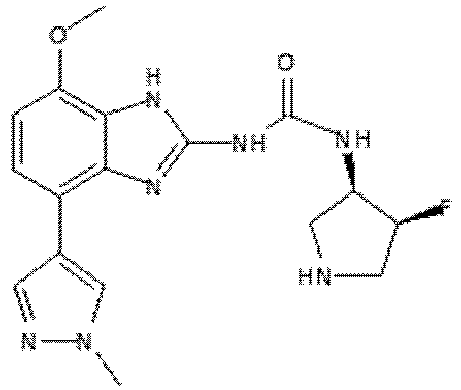
1-[(3R,4S)-4-fluoropyrrolidin-3-yl]-3-[7-methoxy-4-(1-methyl-1H-pyrazol-4-yl)-1H-1,3-benzodiazol-2-yl]urea 250 
4-(2,5-dioxopyrrolidin-1-yl)-N-[7-methoxy-4-(oxan-4-yl)-1H-1,3-benzodiazol-2-yl]benzamide 251 
tert-butyl (3S,4R)-3-fluoro-4-({[7-methoxy-4-(1-methyl-1H-pyrazol-4-yl)-1H-1,3-benzodiazol-2-yl]carbamoyl}amino)pyrrolidine-1-carboxylate 252 
N4-[7-methoxy-4-(1,2,3,6-tetrahydropyridin-4-yl)-1H-1,3-benzodiazol-2-yl]-N1,N1-dimethylbenzene-1,4-dicarboxamide 253 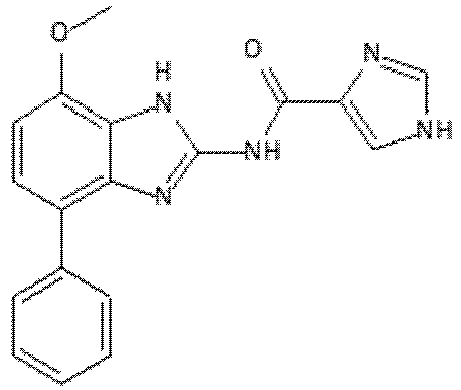
N-(7-methoxy-4-phenyl-1H-1,3-benzodiazol-2-yl)-1H-imidazole-4-carboxamide 254 
N-(7-methoxy-4-phenyl-1H-1,3-benzodiazol-2-yl)-1-methyl-1H-imidazole-5-carboxamide 255 
N-(7-methoxy-4-phenyl-1H-1,3-benzodiazol-2-yl)-2-methyl-1H-imidazole-4-carboxamide 256 
N-(7-methoxy-4-phenyl-1H-1,3-benzodiazol-2-yl)-1,3-thiazole-5-carboxamide 257 
N-(7-methoxy-4-phenyl-1H-1,3-benzodiazol-2-yl)-2-methyl-1,3-thiazole-5-carboxamide 258 
2-amino-N-(7-methoxy-4-phenyl-1H-1,3-benzodiazol-2-yl)-1,3-thiazole-5-carboxamide 259 
N4-[7-methoxy-4-(pyridin-3-yl)-1H-1,3-benzodiazol-2-yl]-N1,N1-dimethylbenzene-1,4-dicarboxamide 260 
N-[7-methoxy-4-(pyridin-3-yl)-1H-1,3-benzodiazol-2-yl]-1-methyl-1H-pyrazole-4-carboxamide 261 
N4-[4-(2,5-dihydrofuran-3-yl)-7-methoxy-1H-1,3-benzodiazol-2-yl]-N1,N1-dimethylbenzene-1,4-dicarboxamide 262 
N4-[4-(3,6-dihydro-2H-pyran-4-yl)-5-fluoro-7-methoxy-1H-1,3-benzodiazol-2-yl]-N1,N1-dimethylbenzene-1,4-dicarboxamide 263 
3-{[dimethyl(oxo)-lambda6-sulfanylidene]amino}-N-[7-methoxy-4-(oxan-4-yl)-1H-1,3-benzodiazol-2-yl]benzamide 264 
N-[4-(3,6-dihydro-2H-pyran-4-yl)-5-fluoro-7-methoxy-1H-1,3-benzodiazol-2-yl]-1-methyl-1H-pyrazole-4-carboxamide 265 
N-[7-(3-fluorophenyl)-4-methoxy-1H-1,3-benzodiazol-2-yl]-1H-imidazole-4-carboxamide 266 
N-[4-methoxy-7-(pyridin-4-yl)-1H-1,3-benzodiazol-2-yl]-1H-imidazole-4-carboxamide 267 
N-{4-methoxy-7-[3-(2-methoxyethoxy)phenyl]-1H-1,3-benzodiazol-2-yl}-1H-imidazole-4-carboxamide 268 
N-[4-methoxy-7-(pyridin-3-yl)-1H-1,3-benzodiazol-2-yl]-1H-imidazole-4-carboxamide 269 
N-(7-methoxy-4-phenyl-1H-1,3-benzodiazol-2-yl)-1,3-dimethyl-1H-pyrazole-4-carboxamide 270 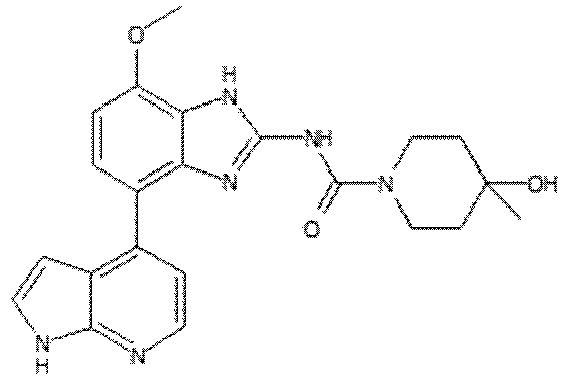
4-hydroxy-N-(7-methoxy-4-{1H-pyrrolo[2,3-b]pyridin-4-yl}-1H-1,3-benzodiazol-2-yl)-4-methylpiperidine-1-carboxamide 271 
4-hydroxy-N-[4-(1H-indazol-4-yl)-7-methoxy-1H-1,3-benzodiazol-2-yl]-4-methylpiperidine-1-carboxamide 272 
4-hydroxy-N-[4-(1H-indol-6-yl)-7-methoxy-1H-1,3-benzodiazol-2-yl]-4-methylpiperidine-1-carboxamide 273 
4-hydroxy-N-[7-methoxy-4-(1-methyl-1H-indazol-5-yl)-1H-1,3-benzodiazol-2-yl]-4-methylpiperidine-1-carboxamide 274 
4-hydroxy-N-[7-methoxy-4-(3-methyl-1H-indazol-5-yl)-1H-1,3-benzodiazol-2-yl]-4-methylpiperidine-1-carboxamide 275 
4-hydroxy-N-(4-{imidazo[1,2-a]pyridin-7-yl}-7-methoxy-1H-1,3-benzodiazol-2-yl)-4-methylpiperidine-1-carboxamide 276* 
(2Z)-2-cyano-3-hydroxy-N-(7-methoxy-4-phenyl-1H-1,3-benzodiazol-2-yl)but -2-enamide 277 
N4-[5-fluoro-7-methoxy-4-(oxan-4-yl)-1H-1,3-benzodiazol-2-yl]-N1,N1-dimethylbenzene-1,4-dicarboxamide 278 
N-(7-methoxy-4-{1H-pyrrolo[2,3-b]pyridin-4-yl}-1H-1,3-benzodiazol-2-yl)-1-(2-methoxyethyl)-1H-pyrazole-4-carboxamide 279 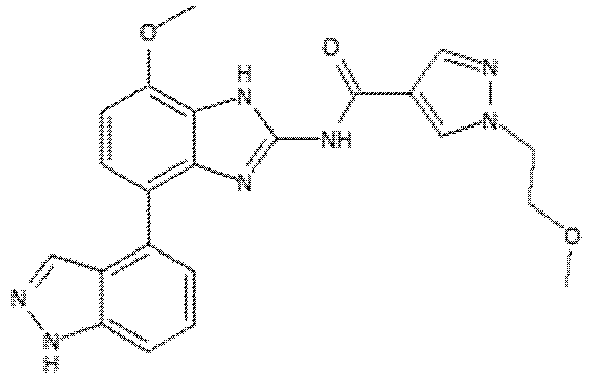
N-[4-(1H-indazol-4-yl)-7-methoxy-1H-1,3-benzodiazol-2-yl]-1-(2-methoxyethyl)-1H-pyrazole-4-carboxamide 280 
N-[4-(1H-indol-6-yl)-7-methoxy-1H-1,3-benzodiazol-2-yl]-1-(2-methoxyethyl)-1H-pyrazole-4-carboxamide 281 
N-[7-methoxy-4-(1-methyl-1H-indazol-5-yl)-1H-1,3-benzodiazol-2-yl]-1-(2-methoxyethyl)-1H-pyrazole-4-carboxamide 282 
N-[7-methoxy-4-(3-methyl-1H-indazol-5-yl)-1H-1,3-benzodiazol-2-yl]-1-(2-methoxyethyl)-1H-pyrazole-4-carboxamide 283 
N-[4-(2,3-dihydro-1H-indol-4-yl)-7-methoxy-1H-1,3-benzodiazol-2-yl]-1-(2-methoxyethyl)-1H-pyrazole-4-carboxamide 284 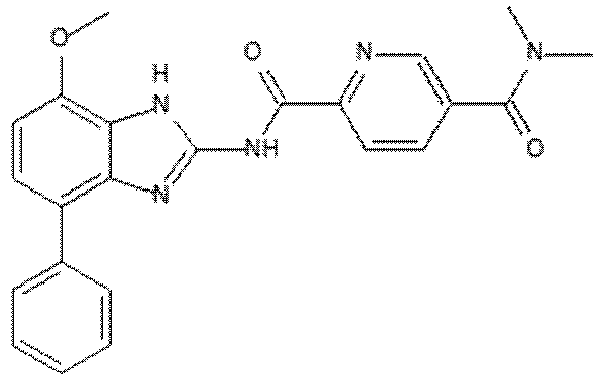
N2-(7-methoxy-4-phenyl-1H-1,3-benzodiazol-2-yl)-N5,N5-dimethylpyridine-2,5-dicarboxamide 285 
4-(2,5-dioxopyrrolidin-1-yl)-N-(7-methoxy-4-phenyl-1H-1,3-benzodiazol-2-yl)benzamide 286 
N-(7-methoxy-4-phenyl-1H-1,3-benzodiazol-2-yl)imidazo[1,2-a]pyridine-3-carboxamide 287 
4,4-difluoro-N-(7-methoxy-4-phenyl-1H-1,3-benzodiazol-2-yl)piperidine-1-carboxamide 288 
N-(7-methoxy-4-phenyl-1H-1,3-benzodiazol-2-yl)imidazo[1,2-b]pyridazine-3-carboxamide 289 
N-(7-methoxy-4-phenyl-1H-1,3-benzodiazol-2-yl)imidazo[1,2-a]pyrimidine-3-carboxamide 290 
N-(7-methoxy-4-phenyl-1H-1,3-benzodiazol-2-yl)-2-(pyridin-4-yl)-1H-imidazole-4-carboxamide 291 
N-(7-methoxy-4-phenyl-1H-1,3-benzodiazol-2-yl)-5H,6H,7H,8H-imidazo[1,2-a]pyridine-3-carboxamide 292 
N-[4-(2,3-dihydro-1H-indol-4-yl)-7-methoxy-1H-1,3-benzodiazol-2-yl]-4-hydroxy-4-methylpiperidine-1-carboxamide 293 
N1-(4-methoxy-7-phenyl-1H-1,3-benzodiazol-2-yl)-N4-propylbenzene-1,4-dicarboxamide 294 
N-(4-methoxy-7-phenyl-1H-1,3-benzodiazol-2-yl)-4-(4-methylpiperazine-1-carbonyl)benzamide 295 
N4-(4-methoxy-7-phenyl-1H-1,3-benzodiazol-2-yl)-N1-(2-methoxyethyl)-N 1-methylbenzene-1,4-dicarboxamide 296 
N1-[2-(dimethylamino)ethyl]-N4-(4-methoxy-7-phenyl-1H-1,3-benzodiazol-2-yl)-N1-methylbenzene-1,4-dicarboxamide 297 
N4-(4-methoxy-7-phenyl-1H-1,3-benzodiazol-2-yl)-N1-methyl-N 1-propylbenzene-1 ,4-dicarboxamide 298 
N-(4-methoxy-7-phenyl-1H-1,3-benzodiazol-2-yl)-4-(morpholine-4-carbonyl)benzamide 299 
N-[4-methoxy-7-(2-methylpyridin-4-yl)-1H-1,3-benzodiazol-2-yl]-1H-imidazole-4-carboxamide 300 
N-(5-cyano-7-methoxy-4-phenyl-1H-1,3-benzodiazol-2-yl)-1-methyl-1H-pyrazole-4-carboxamide 301 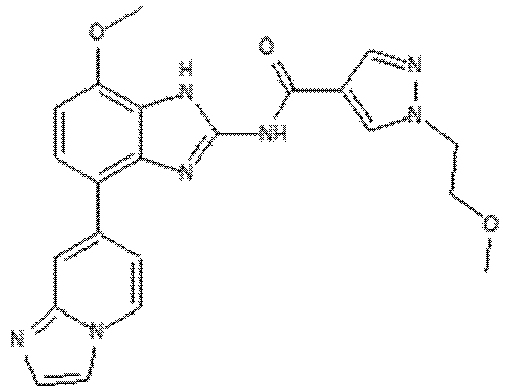
N-(4-{imidazo[1,2-a]pyridin-7-yl}-7-methoxy-1H-1,3-benzodiazol-2-yl)-1-(2-methoxyethyl)-1H-pyrazole-4-carboxamide 302 
N-[4-(1H-indol-5-yl)-7-methoxy-1H-1,3-benzodiazol-2-yl]-1-(2-methoxyethyl)-1H-pyrazole-4-carboxamide 303 
4-hydroxy-N-[4-(1H-indol-5-yl)-7-methoxy-1H-1,3-benzodiazol-2-yl]-4-methylpiperidine-1-carboxamide 304 
N-[4-(1H-indol-7-yl)-7-methoxy-1H-1,3-benzodiazol-2-yl]-1-(2-methoxyethyl)-1H-pyrazole-4-carboxamide 305 
4-hydroxy-N-[4-(1H-indol-7-yl)-7-methoxy-1H-1,3-benzodiazol-2-yl]-4-methylpiperidine-1-carboxamide 306 
N-(7-methoxy-4-phenyl-1H-1,3-benzodiazol-2-yl)-1-methyl-1H-pyrazole-4-carboxamide 307 
N-(7-methoxy-4-phenyl-1H-1,3-benzodiazol-2-yl)-1-(2-methoxyethyl)-1H-pyrazole-4-carboxamide 308 
N-(7-methoxy-4-phenyl-1H-1,3-benzodiazol-2-yl)-2-methyl-1,3-oxazole-5-carboxamide 309 
N4-(7-methoxy-4-phenyl-1H-1,3-benzodiazol-2-yl)-N1,N1-dimethylbenzene-1,4-dicarboxamide 310 
N-(7-methoxy-4-phenyl-1H-1,3-benzodiazol-2-yl)-8-oxa-2-azaspiro[4.5]decane-2-carboxamide 311 
N-(7-methoxy-4-phenyl-1H-1,3-benzodiazol-2-yl)-4-[(2-oxopyrrolidin-1-yl)methyl]benzamide 312 
N1-(2-hydroxyethyl)-N4-(4-methoxy-7-phenyl-1H-1,3-benzodiazol-2-yl)benzene-1,4-dicarboxamide 313 
N4-[7-methoxy-4-(1,4-oxazepan-4-yl)-1H-1,3-benzodiazol-2-yl]-N1,N1-dimethylbenzene-1,4-dicarboxamide 314 
N-[4-(3,6-dihydro-2H-pyran-4-yl)-7-methoxy-1H-1,3-benzodiazol-2-yl]cyclopropanecarboxamide 315 
N-[7-methoxy-4-(pyridin-3-yl)-1H-1,3-benzodiazol-2-yl]cyclopropanecarboxamide 316 
N4-[4-(4-fluorophenyl)-7-methoxy-1H-1,3-benzodiazol-2-yl]-N1,N1-dimethylbenzene-1,4-dicarboxamide 317 
4-(2,5-dioxopyrrolidin-1-yl)-N-[4-(4-fluorophenyl)-7-methoxy-1H-1,3-benzodiazol-2-yl]benzamide 318 
N-[4-(4-fluorophenyl)-7-methoxy-1H-1,3-benzodiazol-2-yl]-1-methyl-1H-pyrazole-4-carboxamide 319 
N4-[4-(2,6-dimethoxypyridin-3-yl)-7-methoxy-1H-1,3-benzodiazol-2-yl]-N1,N1-dimethylbenzene-1,4-dicarboxamide 320 
N-[4-(2,6-dimethoxypyridin-3-yl)-7-methoxy-1H-1,3-benzodiazol-2-yl]cyclopropanecarboxamide 321 
N-[7-methoxy-4-(pyridin-3-yl)-1H-1,3-benzodiazol-2-yl]-2-methyl-1,3-oxazole-5-carboxamide 322 
N-[4-(2,5-dihydrofuran-3-yl)-7-methoxy-1H-1,3-benzodiazol-2-yl]-2-methyl-1,3-oxazole-5-carboxamide 323 
N-[4-(4-fluorophenyl)-7-methoxy-1H-1,3-benzodiazol-2-yl]-2-methyl-1,3-oxazole-5-carboxamide 324 
N4-[4-(3,6-dihydro-2H-pyran-4-yl)-7-methoxy-1H-1,3-benzodiazol-2-yl]-N1,N1-dimethylbenzene-1,4-dicarboxamide 325 
N-[4-(3,6-dihydro-2H-pyran-4-yl)-7-methoxy-1H-1,3-benzodiazol-2-yl]-1-methyl-1H-pyrazole-4-carboxamide 326 
(4-{2-[(4-hydroxy-4-methylpiperidine-1-carbonyl)amino]-7-methoxy-1H-1,3-benzodiazol-4-yl}morpholin-2-yl)methyl carbamate 327 
(1-{2-[(4-hydroxy-4-methylpiperidine-1-carbonyl)amino]-7-methoxy-1H-1,3-benzodiazol-4-yl}piperidin-3-yl)methyl cyanate 328 
(1-{2-[(4-hydroxy-4-methylpiperidine-1-carbonyl)amino]-7-methoxy-1H-1,3-benzodiazol-4-yl}piperidin-3-yl)methyl carbamate 329 
N-(7-methoxy-4-phenyl-1H-1,3-benzodiazol-2-yl)-2-oxa-8-azaspiro[4.5]decane-8-carboxamide 330 
N-[4-(1H-indol-6-yl)-7-methoxy-1H-1,3-benzodiazol-2-yl]-1H-imidazole-4-carboxamide 331 
N-[4-(1H-indol-6-yl)-7-methoxy-1H-1,3-benzodiazol-2-yl]-1-methyl-1H-pyrazole-4-carboxamide 332 
N-[4-(4-fluorophenyl)-7-methoxy-1H-1,3-benzodiazol-2-yl]-8-oxa-2-azaspiro[4.5]decane-2-carboxamide 333 
N-[4-(3,6-dihydro-2H-pyran-4-yl)-7-methoxy-1H-1,3-benzodiazol-2-yl]-8-oxa-2-azaspiro[4.5]decane-2-carboxamide 334 
N-[4-(3,6-dihydro-2H-pyran-4-yl)-7-methoxy-1H-1,3-benzodiazol-2-yl]-4-[(2-oxopyrrolidin-1-yl)methyl]benzamide 335 
N-[4-(4-fluorophenyl)-7-methoxy-1H-1,3-benzodiazol-2-yl]-4-[(2-oxopyrrolidin-1 - yl)methyl]benzamide 336 
N-[4-(1H-indol-6-yl)-7-methoxy-1H-1,3-benzodiazol-2-yl]cyclopropanecarboxamide Table 3 - NMR profiles of the compounds of the present invention No. MW [M+H]+1 1 239,28 240 2 361,37 362 3 423,27 424 4 426,07 427 5 423,27 424 6 426,07 427 7 429,48 430 8 429,48 430 9 294,36 295 10 391,86 393 11 400,48 401 12 380,45 381 13 372,43 373 14 245,32 246 15 423,47 424 16 386,49 387 17 435,53 437 18 248,28 249 19 247,30 248 20 243,27 244 21 389,45 390 22 384,44 385 23 438,49 439 24 388,47 389 25 240,26 241 26 433,47 434 27 244,26 245 28 364,45 365 29 437,50 438 30 447,50 448 31 370,41 371 32 438,41 439 33 396,45 397 34 420,42 421 35 398,46 399 36 402,43 403 37 384,44 385 38 424,50 426 39 368,44 369 40 370,41 371 41 460,54 462 42 434,46 435 43 382,42 383 44 425,45 426 45 412,45 413 46 356,38 357 47 423,47 424 48 404,47 405 49 391,43 392 50 438,45 439 51 423,47 424 52 396,45 397 53 426,52 428 54 446,51 448 55 447,50 448 56 426,52 428 57 458,52 460 58 368,40 369 59 285,31 286 60 423,47 424 61 342,40 343 62 452,52 454 63 370,38 371 64 381,43 382 65 483,45 484 66 541,50 543 67 410,48 411 68 410,48 411 69 396,45 397 70 353,38 354 71 427,47 428 72 390,24 391 73 423,43 424 74 381,43 382 75 465,55 467 76 432,48 433 77 392,41 393 78 454,53 456 79 370,41 371 80 387,40 388 81 434,46 435 82 385,43 386 83 461,52 463 84 338,33 339 85 379,42 380 86 434,88 436 87 434,46 435 88 408,50 409 89 401,47 402 90 409,49 410 91 438,49 439 92 408,46 409 93 418,45 419 94 431,37 432 95 427,26 428 96 352,35 353 97 431,49 432 98 388,39 389 99 383,41 384 100 444,49 445 101 389,41 390 102 412,49 413 103 464,56 466 104 447,50 448 105 461,52 463 106 473,53 475 107 447,50 448 108 393,44 394 109 384,44 385 110 400,48 401 111 414,50 416 112 386,45 387 113 410,48 411 114 410,48 411 115 396,45 397 116 396,45 397 117 388,47 389 118 465,55 467 119 477,56 479 120 423,45 424 121 382,42 383 122 451,52 453 123 401,46 402 124 398,42 399 125 415,49 416 126 397,44 398 127 418,50 419 128 426,52 428 129 407,47 408 130 416,48 417 131 394,47 395 132 412,45 413 133 422,48 423 134 398,46 399 135 433,47 434 136 356,38 357 137 402,49 403 138 448,52 450 139 437,50 438 140 398,46 399 141 398,46 399 142 388,47 389 143 388,47 389 144 398,44 399 145 553,66 555 146 377,40 378 147 384,44 385 148 384,44 385 149 400,48 401 150 400,48 401 151 440,54 442 152 446,51 448 153 477,56 479 154 477,56 479 155 386,45 387 156 352,36 353 157 453,54 455 158 422,44 423 159 412,45 413 160 351,37 352 161 395,42 396 162 419,44 420 163 398,46 399 164 396,41 397 165 368,42 369 166 324,34 325 167 381,40 382 168 459,55 461 169 351,37 352 170 352,35 353 171 378,39 379 172 336,35 337 173 354,39 355 174 391,43 392 175 407,48 408 176 325,33 326 177 366,38 367 178 352,40 353 179 418,48 419 180 358,38 359 181 365,40 366 182 397,48 398 183 357,37 358 184 401,42 402 185 357,37 358 186 423,47 424 187 399,45 400 188 450,54 452 189 463,58 465 190 355,40 356 191 356,38 357 192 382,42 383 193 400,44 401 194 356,39 357 195 340,38 341 196 358,42 359 197 356,38 357 198 372,45 373 199 391,43 392 200 357,37 358 201 422,50 424 202 362,40 363 203 369,42 370 204 401,51 403 205 391,43 392 206 342,36 343 207 395,46 396 208 405,48 406 209 387,46 388 210 357,37 358 211 400,44 401 212 356,38 357 213 336,35 337 214 423,47 424 215 352,35 353 216 401,51 403 217 398,44 399 218 398,44 399 219 354,39 355 220 418,48 419 221 358,38 359 222 411,46 412 223 369,43 370 224 355,40 356 225 399,45 400 226 340,38 341 227 372,45 373 228 387,46 388 229 420,42 421 230 472,54 474 231 447,50 448 232 353,42 354 233 355,44 356 234 356,38 357 235 459,55 461 236 454,52 456 237 461,52 463 238 442,52 444 239 365,37 366 240 432,45 433 241 440,50 442 242 432,45 433 243 365,37 366 244 365,40 366 245 525,61 527 246 354,37 355 247 383,43 384 248 444,45 445 249 373,39 374 250 448,48 449 251 473,51 475 252 419,48 420 253 333,35 334 254 347,38 348 255 347,38 348 256 350,40 351 257 364,43 365 258 365,42 366 259 415,45 416 260 348,36 349 261 406,44 407 262 438,46 439 263 442,54 444 264 371,37 372 265 351,34 352 266 334,34 335 267 407,43 408 268 334,34 335 269 361,40 362 270 420,47 421 271 420,47 421 272 419,48 420 273 434,50 435 274 434,50 435 275 420,47 421 276 348,36 349 277 440,47 441 278 431,45 432 279 431,45 432 280 430,47 431 281 445,48 446 282 445,48 446 283 432,48 433 284 415,45 416 285 440,46 441 286 383,41 384 287 386,40 387 288 384,40 385 289 384,40 385 290 410,44 411 291 387,44 388 292 421,50 422 293 428,49 429 294 469,54 471 295 458,52 460 296 471,56 473 297 442,52 444 298 456,50 457 299 348,36 349 300 372,39 373 301 431,45 432 302 430,47 431 303 419,48 420 304 430,47 431 305 419,48 420 306 347,38 348 307 391,43 392 308 348,36 349 309 414,46 415 310 406,48 407 311 440,50 442 312 430,46 431 313 437,50 438 314 313,36 314 315 308,34 309 316 432,45 433 317 458,45 459 318 365,37 366 319 475,50 477 320 368,39 369 321 349,35 350 322 340,34 341 323 366,35 367 324 420,47 421 325 353,38 354 326 462,50 464 327 442,52 444 328 460,53 462 329 406,48 407 330 372,39 373 331 386,41 387 332 424,47 425 333 412,49 413 334 446,50 448 335 458,49 459 336 346,39 347 - The Nos. recited herein corresponds to the numbering of the compounds disclosed in table 2
No. NMR 1 NMR, but no peak listing available 2 1H NMR (400 MHz, DMSO-d6) ppm = 8.22 - 8.17 (m, 2H), 7.85 (d, J = 7.6 Hz, 2H), 7.51 - 7.46 (m, 2H), 7.42 - 7.33 (m, 3H), 7.31 (d, J = 8.3 Hz, 1H), 6.91 (d, J = 8.4 Hz, 1H), 3.99 (s, 3H). 3 1H NMR (400 MHz, DMSO-d6) ppm = 12.57 - 12.34 (m, 1H), 8.58 (d, J = 5.0 Hz, 1H), 8.22 - 8.20 (m, 1H), 8.00 (dd, J = 5.1, 1.4 Hz, 1H), 7.87 - 7.64 (m, 2H), 7.56 - 7.47 (m, 2H), 7.42 - 7.35 (m, 1H), 7.33 (d, J = 8.3 Hz, 1H), 6.97 (d, J = 8.3 Hz, 1H), 3.99 (s, 3H). 4 1H NMR (400 MHz, DMSO-d6) ppm = 12.57 - 12.34 (m, 1H), 8.58 (d, J = 5.0 Hz, 1H), 8.22 - 8.20 (m, 1H), 8.00 (dd, J = 5.1, 1.4 Hz, 1H), 7.87 - 7.64 (m, 2H), 7.56 - 7.47 (m, 2H), 7.42 - 7.35 (m, 1H), 7.33 (d, J = 8.3 Hz, 1H), 6.97 (d, J = 8.3 Hz, 1H), 3.99 (s, 3H). 5 1H NMR (400 MHz, DMSO-d6) ppm = 9.04 - 9.03 (m, 1H), 8.34 (dd, J = 8.3, 2.6 Hz, 1H), 7.86 - 7.78 (m, 3H), 7.53 - 7.48 (m, 2H), 7.39 - 7.34 (m, 1H), 7.32 (d, J = 8.3 Hz, 1H), 6.95 (d, J = 8.4 Hz, 1H), 3.99 (s, 3H). 6 1H NMR (400 MHz, DMSO-d6) ppm = 9.04 - 9.03 (m, 1H), 8.34 (dd, J = 8.3, 2.6 Hz, 1H), 7.86 - 7.78 (m, 3H), 7.53 - 7.48 (m, 2H), 7.39 - 7.34 (m, 1H), 7.32 (d, J = 8.3 Hz, 1H), 6.95 (d, J = 8.4 Hz, 1H), 3.99 (s, 3H). 7 1H NMR (400 MHz, DMSO-d6) ppm = 8.29 (d, J = 5.1 Hz, 1H), 7.89 - 7.82 (m, 2H), 7.54 - 7.52 (m, 1H), 7.51 - 7.46 (m, 2H), 7.38 - 7.30 (m, 2H), 7.26 - 7.23 (m, 1H), 6.92 (d, J = 8.4 Hz, 1H), 3.99 (s, 3H), 3.76 - 3.72 (m, 4H), 3.59 - 3.55 (m, 4H). 8 1H NMR (400 MHz, DMSO-d6) ppm = 8.87 (d, J = 2.5 Hz, 1H), 8.23 (dd, J = 9.1, 2.5 Hz, 1H), 7.88 - 7.82 (m, 2H), 7.51 - 7.46 (m, 2H), 7.37 - 7.32 (m, 1H), 7.30 (d, J = 8.3 Hz, 1H), 6.94 (d, J = 9.1 Hz, 1H), 6.90 (d, J = 8.4 Hz, 1H), 3.98 (s, 3H), 3.72 - 3.68 (m, 4H), 3.66 - 3.62 (m, 4H). 9 NMR available, but no peak listing 10 1H NMR (500 MHz, DMSO-d6) ppm = 12.82 - 11.31 (m, 1H), 8.14 - 8.11 (m, 2H), 7.87 - 7.82 (m, 2H), 7.64 - 7.60 (m, 2H), 7.52 - 7.47 (m, 2H), 7.38 - 7.34 (m, 1H), 7.33 (d, J = 8.3 Hz, 1H), 6.94 (d, J = 8.4 Hz, 1H), 4.86 (s, 2H), 4.00 (s, 3H). 11 1H NMR (400 MHz, DMSO-d6) ppm = 8.91 - 8.82 (m, 2H), 8.16 - 8.12 (m, 2H), 7.86 - 7.81 (m, 2H), 7.66 - 7.62 (m, 2H), 7.51 - 7.45 (m, 2H), 7.37 - 7.32 (m, 1H), 7.30 (d, J = 8.3 Hz, 1H), 6.91 (d, J = 8.4 Hz, 1H), 4.24 - 4.19 (m, 2H), 3.97 (s, 3H), 3.06 - 2.96 (m, 2H), 1.22 (t, J = 7.3 Hz, 3H). 12 1H NMR (400 MHz, DMSO-d6) ppm = 7.73 - 7.68 (m, 2H), 7.53 - 7.48 (m, 2H), 7.41 - 7.36 (m, 1H), 7.31 (d, J = 8.4 Hz, 1H), 6.97 (d, J = 8.5 Hz, 1H), 3.98 (s, 3H), 3.87 - 3.79 (m, 2H), 3.35 - 3.26 (m, 2H), 1.54 - 1.41 (m, 4H), 1.15 (s, 3H). 13 #NV 14 1H NMR (400 MHz, DMSO-d6) ppm = 10.72 (s, 1H), 6.62 (d, J = 8.2 Hz, 1H), 6.42 (d, J = 8.2 Hz, 1H), 5.79 - 5.69 (m, 2H), 3.81 (s, 3H), 2.93 - 2.71 (m, 1H), 1.85 - 1.67 (m, 5H), 1.54 - 1.18 (m, 5H). 15 1H NMR (400 MHz, DMSO-d6) ppm = 9.33 - 9.31 (m, 1H), 8.18 - 8.14 (m, 2H), 7.88 - 7.84 (m, 1H), 7.85 - 7.83 (m, 2H), 7.75 - 7.73 (m, 1H), 7.57 - 7.54 (m, 2H), 7.51 - 7.46 (m, 2H), 7.38 - 7.33 (m, 1H), 7.32 (d, J = 8.3 Hz, 1H), 6.92 (d, J = 8.4 Hz, 1H), 5.56 (s, 2H), 3.99 (s, 3H). 16 1H NMR (400 MHz, DMSO-d6) ppm = 7.06 (d, J = 8.4 Hz, 1H), 6.86 (d, J = 8.4 Hz, 1H), 3.91 (s, 3H), 3.87 - 3.79 (m, 2H), 3.37 - 3.27 (m, 2H), 3.05 - 2.94 (m, 1H), 1.86 - 1.70 (m, 5H), 1.56 - 1.20 (m, 9H), 1.16 (s, 3H). 17 1H NMR (400 MHz, DMSO-d6) ppm = 8.29 (d, J = 5.3 Hz, 1H), 7.55 (s, 1H), 7.28 (d, J = 5.3 Hz, 1H), 6.98 (d, J = 8.3 Hz, 1H), 6.77 (d, J = 8.3 Hz, 1H), 3.91 (s, 3H), 3.77 - 3.73 (m, 4H), 3.60 - 3.55 (m, 4H), 3.09 - 2.99 (m, 1H), 1.91 - 1.70 (m, 5H), 1.56 - 1.22 (m, 5H). 18 NMR available, but no peak listing 19 NMR available, but no peak listing 20 1H NMR (400 MHz, DMSO-d6) ppm = 12.76 - 12.40 (m, 1H), 8.12 - 8.09 (m, 1H), 7.83 - 7.80 (m, 1H), 7.67 - 7.54 (m, 2H), 7.28 - 7.20 (m, 2H), 6.92 (d, J = 8.6 Hz, 1H), 3.94 (s, 3H), 3.91 (s, 3H). 21 1H NMR (400 MHz, DMSO-d6) ppm = 7.10 - 7.04 (m, 1H), 6.86 (d, J = 8.7 Hz, 1H), 3.92 (s, 3H), 3.90 - 3.81 (m, 6H), 3.37 - 3.21 (m, 6H), 1.57 - 1.42 (m, 4H), 1.16 (s, 3H). 22 1H NMR (400 MHz, DMSO-d6) ppm = 8.23 (s, 1H), 7.93 (s, 1H), 7.38 (d, J = 8.4 Hz, 1H), 6.95 (d, J = 8.4 Hz, 1H), 3.95 (s, 3H), 3.91 (s, 3H), 3.89 - 3.82 (m, 2H), 3.39 - 3.29 (m, 2H), 1.57 - 1.44 (m, 4H), 1.17 (s, 3H). 23 1H NMR (400 MHz, DMSO-d6) ppm = 8.28 (d, J = 5.6 Hz, 1H), 7.65 - 7.61 (m, 1H), 7.31 - 7.27 (m, 1H), 7.27 - 7.18 (m, 1H), 6.84 (d, J = 8.6 Hz, 1H), 4.00 - 3.95 (m, 4H), 3.94 (s, 3H), 3.79 - 3.73 (m, 4H), 3.67 - 3.62 (m, 4H), 3.61 - 3.46 (m, 4H). 24 1H NMR (400 MHz, DMSO-d6) ppm = 7.13 (d, J = 8.5 Hz, 1H), 6.91 (d, J = 8.3 Hz, 1H), 4.00 - 3.91 (m, 5H), 3.89 - 3.82 (m, 2H), 3.53 - 3.28 (m, 5H), 1.77 - 1.69 (m, 4H), 1.57 - 1.43 (m, 4H), 1.17 (s, 3H). 25 1H NMR (400 MHz, DMSO-d6) ppm = 8.03 (s, 1H), 7.77 - 7.73 (m, 2H), 7.68 - 7.59 (m, 2H), 7.52 - 7.47 (m, 2H), 7.42 - 7.37 (m, 1H), 3.97 (s, 3H). 26 1H NMR (400 MHz, DMSO-d6) ppm = 8.30 (s, 1H), 8.26 (d, J = 5.8 Hz, 1H), 8.01 (s, 1H), 7.73 - 7.71 (m, 1H), 7.37 (d, J = 8.3 Hz, 1H), 7.35 - 7.33 (m, 1H), 6.89 (d, J = 8.4 Hz, 1H), 3.96 (s, 3H), 3.91 (s, 3H), 3.79 - 3.74 (m, 4H), 3.71 - 3.66 (m, 4H). 27 NMR available, but no peak listing 28 1H NMR (400 MHz, DMSO-d6) ppm = 7.77 - 7.70 (m, 2H), 7.52 - 7.46 (m, 2H), 7.39 - 7.34 (m, 1H), 7.27 (d, J = 8.3 Hz, 1H), 6.92 (d, J = 8.4 Hz, 1H), 4.22 - 4.13 (m, 2H), 3.97 (s, 3H), 2.91 - 2.80 (m, 2H), 1.69 - 1.54 (m, 3H), 1.12 - 1.00 (m, 2H), 0.92 (d, J = 6.3 Hz, 3H). 29 1H NMR (500 MHz, DMSO-d6) ppm = 13.34 - 11.32 (m, 1H), 8.90 (d, J = 2.4 Hz, 1H), 8.27 (dd, J = 9.1, 2.5 Hz, 1H), 7.12 (d, J = 8.3 Hz, 1H), 7.02 (d, J = 9.2 Hz, 1H), 6.90 (d, J = 8.4 Hz, 1H), 4.01 - 3.96 (m, 2H), 3.95 (s, 3H), 3.75 - 3.64 (m, 8H), 3.55 - 3.47 (m, 2H), 3.40 - 3.33 (m, 1H), 1.83 - 1.72 (m, 4H). 30 1H NMR (400 MHz, DMSO-d6) ppm = 8.29 - 8.26 (m, 1H), 8.11 (d, J = 6.5 Hz, 1H), 8.00 - 7.96 (m, 1H), 7.64 - 7.60 (m, 1H), 7.37 - 7.33 (m, 2H), 6.89 (d, J = 8.4 Hz, 1H), 3.96 (s, 3H), 3.92 (s, 3H), 3.79 - 3.73 (m, 2H), 3.63 - 3.49 (m, 2H), 2.12 - 1.97 (m, 2H), 1.42 (s, 3H). 31 1H NMR (400 MHz, DMSO-d6) ppm = 11.61 - 10.67 (m, 1H), 8.25 (s, 1H), 7.95 (s, 1H), 7.44 (d, J = 8.4 Hz, 1H), 7.02 (d, J = 8.5 Hz, 1H), 3.97 (s, 3H), 3.92 (s, 3H), 3.73 - 3.19 (m, 4H), 2.00 - 1.80 (m, 2H), 1.34 (s, 3H). 32 1H NMR (400 MHz, DMSO-d6) ppm = 8.23 (s, 1H), 7.94 (s, 1H), 7.32 (d, J = 8.4 Hz, 1H), 6.87 (d, J = 8.5 Hz, 1H), 4.25 - 4.18 (m, 2H), 3.94 (s, 3H), 3.90 (s, 3H), 3.19 - 3.10 (m, 2H), 1.77 - 1.64 (m, 4H). 33 1H NMR (400 MHz, DMSO-d6) ppm = 8.23 (s, 1H), 7.94 - 7.92 (m, 1H), 7.39 (d, J = 8.4 Hz, 1H), 6.96 (d, J = 8.5 Hz, 1H), 3.95 (s, 3H), 3.91 (s, 3H), 3.71 (s, 2H), 3.66 - 3.49 (m, 4H), 3.40 (s, 2H), 1.60 - 1.46 (m, 4H). 34 1H NMR (400 MHz, DMSO-d6) ppm = 8.24 (s, 1H), 7.94 (s, 1H), 7.34 (d, J = 8.4 Hz, 1H), 6.89 (d, J = 8.4 Hz, 1H), 5.75 (t, J = 56.0 Hz, 1H), 4.19 - 4.12 (m, 2H), 3.94 (s, 3H), 3.90 (s, 3H), 3.23 - 3.12 (m, 2H), 1.61 - 1.56 (m, 4H). 35 1H NMR (500 MHz, DMSO-d6) ppm = 11.96 - 10.14 (m, 1H), 8.24 (s, 1H), 7.94 (s, 1H), 7.36 (d, J = 8.4 Hz, 1H), 6.92 (d, J = 8.5 Hz, 1H), 3.95 (s, 3H), 3.91 (s, 3H), 3.83 - 3.76 (m, 2H), 3.38 - 3.29 (m, 2H), 3.19 (s, 2H), 1.54 - 1.45 (m, 2H), 1.29 - 1.22 (m, 2H), 0.93 (s, 3H). 36 1H NMR (400 MHz, DMSO-d6) ppm = 8.23 (s, 1H), 7.94 - 7.92 (m, 1H), 7.38 (d, J = 8.4 Hz, 1H), 6.94 (d, J = 8.5 Hz, 1H), 4.19 (d, J = 47.8 Hz, 2H), 4.07 - 4.00 (m, 2H), 3.95 (s, 3H), 3.91 (s, 3H), 3.33 - 3.22 (m, 2H), 1.64 - 1.50 (m, 4H). 37 1H NMR (500 MHz, DMSO-d6) ppm = 8.23 (s, 1H), 7.93 (s, 1H), 7.30 (d, J = 8.3 Hz, 1H), 6.85 (d, J = 8.4 Hz, 1H), 3.93 (s, 3H), 3.90 (s, 3H), 3.87 - 3.81 (m, 2H), 3.46 - 3.40 (m, 1H), 3.31 - 3.24 (m, 5H), 1.91 - 1.84 (m, 2H), 1.48 - 1.41 (m, 2H). 38 1H NMR (500 MHz, DMSO-d6) ppm = 12.48 - 10.34 (m, 1H), 8.23 (s, 1H), 7.94 - 7.92 (m, 1H), 7.40 (d, J = 8.4 Hz, 1H), 6.98 (d, J = 8.5 Hz, 1H), 3.96 (s, 3H), 3.91 (s, 3H), 3.60 - 3.55 (m, 8H), 1.57 - 1.51 (m, 4H), 1.50 - 1.45 (m, 4H). 39 1H NMR (400 MHz, DMSO-d6) ppm = 8.24 (s, 1H), 7.95 (s, 1H), 7.29 (d, J = 8.4 Hz, 1H), 6.83 (d, J = 8.4 Hz, 1H), 4.24 - 4.16 (m, 2H), 3.93 (s, 3H), 3.90 (s, 3H), 2.93 - 2.83 (m, 2H), 1.71 - 1.56 (m, 3H), 1.14 - 1.02 (m, 2H), 0.93 (d, J = 6.3 Hz, 3H). 40 1H NMR (500 MHz, DMSO-d6) ppm = 14.03 - 10.78 (m, 2H), 8.24 (s, 1H), 7.95 - 7.93 (m, 1H), 7.44 (d, J = 8.4 Hz, 1H), 7.02 (d, J = 8.5 Hz, 1H), 3.97 (s, 3H), 3.93 - 3.87 (m, 5H), 3.79 - 3.73 (m, 1H), 3.35 - 3.25 (m, 2H), 1.84 - 1.77 (m, 2H), 1.45 - 1.36 (m, 2H). 41 1H NMR (500 MHz, DMSO-d6) ppm = 13.52 - 9.93 (m, 2H), 8.23 (s, 1H), 7.94 (s, 1H), 7.34 (d, J = 8.4 Hz, 1H), 7.30 - 7.25 (m, 2H), 7.25 - 7.18 (m, 3H), 6.90 (d, J = 8.4 Hz, 1H), 3.98 - 3.93 (m, 5H), 3.90 (s, 3H), 3.27 - 3.17 (m, 2H), 2.72 (s, 2H), 1.53 - 1.41 (m, 4H). 42 NMR available, but no peak listing 43 1H NMR (400 MHz, DMSO-d6) ppm = 11.44 - 10.20 (m, 1H), 8.26 - 8.23 (m, 1H), 7.97 - 7.93 (m, 1H), 7.40 - 7.36 (m, 1H), 6.96 - 6.91 (m, 1H), 3.95 (s, 3H), 3.91 (s, 3H), 3.76 (s, 2H), 3.67 - 3.56 (m, 2H), 3.45 (s, 2H), 3.43 - 3.36 (m, 2H), 2.27 - 1.78 (m, 2H). 44 1H NMR (700 MHz, DMSO-d6) ppm = 13.26 - 11.37 (m, 1H), 11.36 - 9.74 (m, 1H), 8.24 (s, 1H), 7.94 (s, 1H), 7.56 (s, 1H), 7.29 (d, J = 8.3 Hz, 1H), 6.83 (d, J = 8.4 Hz, 1H), 3.93 (s, 3H), 3.90 (s, 3H), 3.84 - 3.80 (m, 2H), 3.48 - 3.41 (m, 2H), 3.29 (s, 2H), 1.86 - 1.81 (m, 2H), 1.81 - 1.74 (m, 2H). 45 1H NMR (500 MHz, DMSO-d6) ppm = 8.23 (s, 1H), 7.94 (s, 1H), 7.31 (d, J = 8.3 Hz, 1H), 6.86 (d, J = 8.6 Hz, 1H), 3.94 - 3.93 (m, 3H), 3.93 - 3.92 (m, 4H), 3.90 - 3.89 (m, 3H), 3.64 - 3.60 (m, 4H), 1.69 - 1.65 (m, 4H). 46 1H NMR (400 MHz, DMSO-d6) ppm = 8.23 (s, 1H), 7.94 (s, 1H), 7.35 (d, J = 8.4 Hz, 1H), 6.90 (d, J = 8.5 Hz, 1H), 3.94 (s, 3H), 3.90 (s, 3H), 3.67 - 3.62 (m, 4H), 3.60 - 3.55 (m, 4H). 47 1H NMR (500 MHz, DMSO-d6) ppm = 12.23 - 10.69 (m, 1H), 8.25 - 8.23 (m, 1H), 7.94 - 7.93 (m, 1H), 7.60 - 7.57 (m, 1H), 7.43 (d, J = 8.4 Hz, 1H), 7.01 (d, J = 8.5 Hz, 1H), 3.96 (s, 3H), 3.91 (s, 3H), 3.72 - 3.64 (m, 2H), 3.55 - 3.46 (m, 2H), 3.10 (s, 2H), 2.15 - 2.13 (m, 2H), 1.63 - 1.58 (m, 4H). 48 1H NMR (400 MHz, DMSO-d6) ppm = 10.91 - 10.81 (m, 1H), 8.33 - 8.31 (m, 1H), 8.24 - 8.20 (m, 2H), 8.05 - 8.04 (m, 1H), 7.81 - 7.76 (m, 2H), 7.38 (d, J = 8.3 Hz, 1H), 6.89 (d, J = 8.4 Hz, 1H), 4.40 - 4.37 (m, 2H), 3.97 (s, 3H), 3.91 (s, 3H), 2.75 - 2.71 (m, 6H). 49 1H NMR (400 MHz, DMSO-d6) ppm = 12.17 - 11.61 (m, 1H), 8.36 - 8.32 (m, 1H), 8.13 - 8.10 (m, 2H), 8.07 - 8.03 (m, 1H), 7.51 - 7.47 (m, 2H), 7.32 (d, J = 8.2 Hz, 1H), 6.80 (d, J = 8.3 Hz, 1H), 4.52 (s, 2H), 3.95 (s, 3H), 3.90 (s, 3H), 3.40 - 3.34 (m, 3H). 50 1H NMR (500 MHz, DMSO-d6) ppm = 12.11 - 10.86 (m, 1H), 10.78 - 10.75 (m, 1H), 8.66 - 8.63 (m, 1H), 8.23 (s, 1H), 7.93 (s, 1H), 7.40 (d, J = 8.4 Hz, 1H), 6.97 (d, J = 8.4 Hz, 1H), 4.15 - 4.08 (m, 2H), 3.96 (s, 3H), 3.91 (s, 3H), 3.42 - 3.30 (m, 2H), 1.90 - 1.81 (m, 2H), 1.70 - 1.62 (m, 2H). 51 1H NMR (500 MHz, DMSO-d6) ppm = 12.32 - 10.92 (m, 1H), 8.25 - 8.23 (m, 1H), 8.16 - 8.13 (m, 1H), 7.94 - 7.93 (m, 1H), 7.45 (d, J = 8.4 Hz, 1H), 7.03 (d, J = 8.5 Hz, 1H), 3.97 (s, 3H), 3.91 (s, 3H), 3.74 - 3.66 (m, 2H), 3.65 - 3.57 (m, 2H), 2.26 - 2.21 (m, 2H), 1.90 (t, J = 8.0 Hz, 2H), 1.69 - 1.59 (m, 4H). 52 NMR available, but no peak listing 53 1H NMR (700 MHz, DMSO-d6) ppm = 13.49 - 10.13 (m, 2H), 8.24 (s, 1H), 7.95 (s, 1H), 7.35 (d, J = 8.4 Hz, 1H), 6.90 (d, J = 8.2 Hz, 1H), 4.13 - 4.08 (m, 1H), 4.08 - 4.03 (m, 1H), 3.94 (s, 3H), 3.91 (s, 3H), 3.30 (td, J = 9.1, 4.3 Hz, 1H), 3.11 - 3.03 (m, 1H), 2.79 - 2.70 (m, 1H), 1.87 - 1.82 (m, 1H), 1.72 - 1.66 (m, 1H), 1.48 - 1.21 (m, 6H), 1.12 - 1.05 (m, 1H), 0.89 (t, J = 7.1 Hz, 3H). 54 1H NMR (400 MHz, DMSO-d6) ppm = 8.23 (s, 1H), 7.94 (s, 1H), 7.33 - 7.27 (m, 3H), 7.02 - 6.98 (m, 2H), 6.96 - 6.91 (m, 1H), 6.83 (d, J = 8.4 Hz, 1H), 4.67 - 4.60 (m, 1H), 3.93 (s, 3H), 3.90 (s, 3H), 3.47 - 3.38 (m, 4H), 2.04 - 1.96 (m, 2H), 1.69 - 1.59 (m, 2H). 55 1H NMR (700 MHz, DMSO-d6) ppm = 12.42 - 10.52 (m, 1H), 8.99 (d, J = 2.0 Hz, 1H), 8.83 - 8.81 (m, 1H), 8.70 - 8.68 (m, 1H), 8.26 (s, 1H), 8.03 (dd, J = 8.2, 5.6 Hz, 1H), 7.97 (s, 1H), 7.37 (d, J = 8.5 Hz, 1H), 6.93 (d, J = 8.4 Hz, 1H), 6.09 - 5.67 (m, 1H), 4.27 - 4.23 (m, 2H), 3.95 (s, 3H), 3.90 (s, 3H), 3.40 - 3.30 (m, 2H), 2.11 - 2.06 (m, 2H), 1.77 - 1.74 (m, 2H). 56 1H NMR (700 MHz, DMSO-d6) ppm = 13.51 - 11.54 (m, 1H), 11.52 - 10.37 (m, 1H), 8.24 (s, 1H), 7.94 (s, 1H), 7.35(d, J = 8.3 Hz, 1H), 6.90 (d, J = 8.3 Hz, 1H), 4.10 - 4.06 (m, 1H), 4.05 - 4.00 (m, 1H), 3.94 (s, 3H), 3.90 (s, 3H), 3.27 (td, J = 8.8, 4.1 Hz, 1H), 3.14 - 3.06 (m, 1H), 2.77 - 2.68 (m, 1H), 1.87 - 1.82 (m, 1H), 1.79 - 1.71 (m, 1H), 1.52 - 1.47 (m, 1H), 1.41 - 1.34 (m, 2H), 1.02 - 0.97 (m, 1H), 0.90 (d, J = 6.6 Hz, 3H), 0.86 (d, J = 6.5 Hz, 3H). 57 NMR available, but no peak listing 58 1H NMR (500 MHz, DMSO-d6) ppm = 12.18 - 10.47 (m, 1H), 8.24 (s, 1H), 7.94 (s, 1H), 7.35 (d, J = 8.4 Hz, 1H), 6.91 (d, J = 8.4 Hz, 1H), 3.95 (s, 3H), 3.91 (s, 3H), 3.90 - 3.85 (m, 4H), 2.49 - 2.45 (m, 4H). 59 1H NMR (400 MHz, DMSO-d6) ppm = 11.82 - 11.70 (m, 1H), 8.26 (s, 1H), 8.00 (s, 1H), 7.32 (d, J = 8.3 Hz, 1H), 6.81 (d, J = 8.3 Hz, 1H), 3.94 (s, 3H), 3.90 (s, 3H), 2.20 (s, 3H). 60 1H NMR (700 MHz, DMSO-d6) ppm = 12.74 - 9.93 (m, 2H), 8.25 (s, 1H), 7.95 (s, 1H), 7.62 (s, 1H), 7.28 (d, J = 8.3 Hz, 1H), 6.81 (d, J = 8.3 Hz, 1H), 4.14 - 4.09 (m, 2H), 3.92 (s, 3H), 3.90 (s, 3H), 3.20 (t, J = 6.8 Hz, 2H), 3.14 - 3.08 (m, 2H), 2.02 (t, J = 6.8 Hz, 2H), 1.67 - 1.61 (m, 2H), 1.44 - 1.40 (m, 2H). 61 1H NMR (500 MHz, DMSO-d6) ppm = 11.86 - 10.17 (m, 1H), 8.26 - 8.25 (m, 1H), 7.95 - 7.94 (m, 1H), 7.42 (d, J = 8.4 Hz, 1H), 7.00 (d, J = 8.5 Hz, 1H), 3.96 (s, 3H), 3.92 (s, 3H), 3.50 - 3.42 (m, 4H), 1.17 (t, J = 7.1 Hz, 6H). 62 1H NMR (500 MHz, DMSO-d6) ppm = 12.04 - 11.88 (m, 1H), 8.32 - 8.27 (m, 1H), 8.25 (s, 1H), 7.95 (s, 1H), 7.37 (d, J = 8.4 Hz, 1H), 6.93 (d, J = 8.5 Hz, 1H), 4.29 - 4.02 (m, 2H), 3.95 (s, 3H), 3.91 (s, 3H), 3.83 - 3.65 (m, 2H), 3.59 - 3.31 (m, 4H), 2.85 (s, 3H), 2.42 - 2.21 (m, 3H), 2.02 - 1.87 (m, 1H). 63 1H NMR (400 MHz, DMSO-d6) ppm = 8.22 - 8.16 (m, 2H), 7.44 - 7.37 (m, 2H), 7.16 - 7.09 (m, 1H), 6.82 (d, J = 8.7 Hz, 1H), 3.97 - 3.91 (m, 7H), 3.70 - 3.50 (m, 4H). 64 1H NMR (400 MHz, DMSO-d6) ppm = 12.12 - 12.02 (m, 1H), 8.28 - 8.26 (m, 1H), 8.02 - 7.99 (m, 1H), 7.33 (d, J = 8.3 Hz, 1H), 6.82 (d, J = 8.4 Hz, 1H), 3.93 (s, 3H), 3.90 (s, 3H), 3.75 - 3.55 (m, 3H), 3.48 - 3.40 (m, 1H), 2.01 - 1.95 (m, 1H), 1.77 - 1.54 (m, 3H), 1.43 - 1.35 (m, 1H), 1.19 (t, J = 4.7 Hz, 1H), 1.07 (dd, J = 7.8, 4.2 Hz, 1H). 65 NMR available, but no peak listing 66 NMR available, but no peak listing 67 1H NMR (400 MHz, DMSO-d6) ppm = 11.10 - 9.59 (m, 2H), 8.24 - 8.22 (m, 1H), 7.95 - 7.92 (m, 1H), 7.34 (d, J = 8.4 Hz, 1H), 6.90 (d, J = 8.4 Hz, 1H), 3.95 (s, 3H), 3.91 (s, 3H), 3.69 - 3.16 (m, 8H), 1.92 - 1.49 (m, 6H). 68 1H NMR (400 MHz, DMSO-d6) ppm = 11.04 - 9.94 (m, 1H), 8.24 (s, 1H), 7.94 (s, 1H), 7.36 (d, J = 8.4 Hz, 1H), 6.91 (d, J = 8.4 Hz, 1H), 3.95 (s, 3H), 3.91 (s, 3H), 3.69 - 3.33 (m, 8H), 1.94 - 1.78 (m, 2H), 1.57 - 1.50 (m, 4H). 69 1H NMR (400 MHz, DMSO-d6) ppm = 8.25 - 8.22 (m, 1H), 7.95 - 7.92 (m, 1H), 7.40 (d, J = 8.4 Hz, 1H), 6.97 (d, J = 8.5 Hz, 1H), 3.96 (s, 3H), 3.91 (s, 3H), 3.84 - 3.77 (m, 2H), 3.72 - 3.35 (m, 6H), 2.04 - 1.84 (m, 4H). 70 1H NMR (500 MHz, DMSO-d6) ppm = 11.98 - 11.84 (m, 1H), 8.27 - 8.25 (m, 1H), 8.02 - 7.99 (m, 1H), 7.29 (d, J = 8.2 Hz, 1H), 6.77 (d, J = 8.3 Hz, 1H), 3.92 (s, 3H), 3.89 (s, 3H), 3.86 (d, J = 8.8 Hz, 2H), 3.71 - 3.67 (m, 2H), 2.23 - 2.20 (m, 2H), 1.95 - 1.88 (m, 1H). 71 1H NMR (500 MHz, DMSO-d6) ppm = 15.05 - 14.13 (m, 1H), 12.69 - 11.24 (m, 1H), 9.35 - 9.33 (m, 1H), 8.33 - 8.30 (m, 1H), 8.19 - 8.16 (m, 2H), 8.06 - 8.03 (m, 1H), 7.84 (t, J = 1.7 Hz, 1H), 7.74 (t, J = 1.7 Hz, 1H), 7.59 - 7.56 (m, 2H), 7.34 (d, J = 8.3 Hz, 1H), 6.83 (d, J = 8.3 Hz, 1H), 5.57 (s, 2H), 3.95 (s, 3H), 3.90 (s, 3H). 72 1H NMR (400 MHz, DMSO-d6) ppm = 12.43 - 11.91 (m, 1H), 8.27 (s, 1H), 8.01 (s, 1H), 7.32 (d, J = 8.3 Hz, 1H), 6.79 (d, J = 8.3 Hz, 1H), 3.92 (s, 3H), 3.90 (s, 3H), 3.46 - 3.41 (m, 1H), 2.54 - 2.50 (m, 1H), 1.68 - 1.54 (m, 2H). 73 1H NMR (400 MHz, DMSO-d6) ppm = 12.11 - 11.00 (m, 1H), 8.99 (d, J = 1.3 Hz, 1H), 8.52 (d, J = 1.3 Hz, 1H), 8.34 - 8.31 (m, 1H), 8.02 - 8.00 (m, 1H), 7.41 (d, J = 8.3 Hz, 1H), 6.93 (d, J = 8.4 Hz, 1H), 4.60 - 4.55 (m, 2H), 3.97 (s, 3H), 3.92 (s, 3H), 3.76 - 3.72 (m, 2H), 3.33 (s, 3H). 74 1H NMR (500 MHz, DMSO-d6) ppm = 10.62 - 10.51 (m, 1H), 8.95 - 8.91 (m, 2H), 8.86 - 8.83 (m, 2H), 7.91 (d, J = 8.7 Hz, 1H), 6.99 (d, J = 8.7 Hz, 1H), 4.03 (s, 3H), 3.88 - 3.82 (m, 2H), 3.33 - 3.26 (m, 2H), 1.54 - 1.43 (m, 4H), 1.16 (s, 3H). 75 1H NMR (500 MHz, DMSO-d6) ppm = 11.22 - 10.61 (m, 1H), 7.29 - 7.25 (m, 2H), 7.24 - 7.18 (m, 3H), 7.07 - 6.98 (m, 1H), 6.85 (d, J = 8.6 Hz, 1H), 3.97 - 3.89 (m, 5H), 3.89 - 3.83 (m, 4H), 3.23 (d, J = 11.3 Hz, 6H), 2.72 (s, 2H), 1.54 - 1.41 (m, 4H). 76 1H NMR (400 MHz, DMSO-d6) ppm = 15.23 - 14.03 (m, 1H), 12.89 - 11.51 (m, 1H), 9.37 - 9.35 (m, 1H), 8.19 - 8.14 (m, 2H), 7.84 (t, J = 1.7 Hz, 1H), 7.74 (t, J = 1.7 Hz, 1H), 7.60 - 7.55 (m, 2H), 7.17 - 7.05 (m, 1H), 6.80 (d, J = 8.6 Hz, 1H), 5.57 (s, 2H), 3.98 - 3.90 (m, 7H), 3.55 - 3.40 (m, 4H). 77 1H NMR (400 MHz, DMSO-d6) ppm = 8.52 - 8.49 (m, 1H), 8.15 (d, J = 2.2 Hz, 1H), 8.10 (dd, J = 8.7, 1.9 Hz, 1H), 7.80 - 7.75 (m, 1H), 7.13 (dd, J = 2.3, 0.9 Hz, 1H), 7.11 - 7.01 (m, 1H), 6.81 (d, J = 8.6 Hz, 1H), 4.00 - 3.89 (m, 7H), 3.56 - 3.41 (m, 4H). 78 1H NMR (500 MHz, DMSO-d6) ppm = 12.37 - 10.91 (m, 1H), 10.91 - 9.79 (m, 1H), 8.47 (s, 1H), 8.05 (s, 1H), 7.31 (d, J = 8.3 Hz, 1H), 6.76 (d, J = 8.4 Hz, 1H), 5.43 (dd, J = 10.0, 2.1 Hz, 1H), 3.98 - 3.94 (m, 1H), 3.92 (s, 3H), 3.88 - 3.81 (m, 2H), 3.70 - 3.63 (m, 1H), 3.34 - 3.25 (m, 2H), 2.16 - 2.07 (m, 1H), 2.01 - 1.94 (m, 2H), 1.76 - 1.66 (m, 1H), 1.59 - 1.53 (m, 2H), 1.53 - 1.43 (m, 4H), 1.16 (s, 3H). 79 1H NMR (500 MHz, DMSO-d6) ppm = 12.37 - 10.91 (m, 1H), 10.91 - 9.79 (m, 1H), 8.47 (s, 1H), 8.05 (s, 1H), 7.31 (d, J = 8.3 Hz, 1H), 6.76 (d, J = 8.4 Hz, 1H), 5.43 (dd, J = 10.0, 2.1 Hz, 1H), 3.98 - 3.94 (m, 1H), 3.92 (s, 3H), 3.88 - 3.81 (m, 2H), 3.70 - 3.63 (m, 1H), 3.34 - 3.25 (m, 2H), 2.16 - 2.07 (m, 1H), 2.01 - 1.94 (m, 2H), 1.76 - 1.66 (m, 1H), 1.59 - 1.53 (m, 2H), 1.53 - 1.43 (m, 4H), 1.16 (s, 3H). 80 1H NMR (700 MHz, DMSO-d6) ppm = 12.55 - 11.83 (m, 1H), 8.53 (d, J = 1.5 Hz, 1H), 8.35 - 8.33 (m, 1H), 8.16 - 8.15 (m, 1H), 8.12 (dd, J = 8.7, 1.9 Hz, 1H), 8.06 - 8.04 (m, 1H), 7.79 (d, J = 8.6 Hz, 1H), 7.37 (d, J = 8.3 Hz, 1H), 7.16 - 7.14 (m, 1H), 6.88 (d, J = 8.4 Hz, 1H), 3.97 (s, 3H), 3.92 (s, 3H). 81 1H NMR (500 MHz, DMSO-d6) ppm = 11.73 - 11.31 (m, 1H), 8.85 (d, J = 1.2 Hz, 1H), 8.42 (d, J = 1.2 Hz, 1H), 8.32 - 8.30 (m, 1H), 7.99 - 7.98 (m, 1H), 7.44 (d, J = 8.3 Hz, 1H), 6.98 (d, J = 8.4 Hz, 1H), 3.98 (s, 3H), 3.93 (s, 3H), 3.81 - 3.78 (m, 4H), 3.76 - 3.73 (m, 4H). 82 1H NMR (400 MHz, DMSO-d6) ppm = 11.19 - 10.06 (m, 1H), 8.34 - 8.32 (m, 1H), 8.08 (s, 1H), 8.07 - 8.06 (m, 1H), 4.08 (s, 3H), 3.91 (s, 3H), 3.89 - 3.82 (m, 2H), 3.35 - 3.26 (m, 2H), 1.55 - 1.42 (m, 4H), 1.16 (s, 3H). 83 1H NMR (400 MHz, DMSO-d6) ppm = 10.83 - 10.18 (m, 1H), 8.31 (s, 1H), 8.08 - 8.04 (m, 2H), 7.30 - 7.17 (m, 5H), 4.04 (s, 3H), 3.99 - 3.92 (m, 2H), 3.90 (s, 3H), 3.24 - 3.14 (m, 2H), 2.72 (s, 2H), 1.53 - 1.39 (m, 4H). 84 1H NMR (500 MHz, DMSO-d6) ppm = 9.18 (d, J = 1.7 Hz, 1H), 8.30 (s, 1H), 8.01 (s, 1H), 7.36 (d, J = 8.3 Hz, 1H), 7.14 - 7.11 (m, 1H), 6.86 (d, J = 8.3 Hz, 1H), 3.95 (s, 3H), 3.91 (s, 3H). 85 1H NMR (700 MHz, DMSO-d6) ppm = 12.10 - 11.31 (m, 1H), 10.51 - 10.44 (m, 1H), 8.97 - 8.92 (m, 2H), 8.86 - 8.84 (m, 2H), 7.92 (d, J = 8.6 Hz, 1H), 6.99 (d, J = 8.6 Hz, 1H), 4.03 (s, 3H), 3.75 - 3.74 (m, 2H), 3.66 - 3.40 (m, 6H), 1.96 - 1.79 (m, 2H). 86 1H NMR (700 MHz, DMSO-d6) ppm = 11.94 - 11.85 (m, 1H), 8.65 (s, 1H), 8.29 (s, 1H), 7.17 - 6.83 (m, 1H), 6.79 - 6.75 (m, 1H), 4.63 - 4.58 (m, 1H), 4.11 - 4.00 (m, 2H), 3.95 - 3.88 (m, 9H), 3.82 - 3.76 (m, 4H). 87 1H NMR (500 MHz, DMSO-d6) ppm = 12.87 - 11.27 (m, 1H), 8.31 - 8.30 (m, 1H), 8.07 (d, J = 9.6 Hz, 1H), 7.99 - 7.98 (m, 1H), 7.49 - 7.45 (m, 2H), 7.01 (d, J = 8.5 Hz, 1H), 3.99 (s, 3H), 3.93 (s, 3H), 3.81 - 3.75 (m, 8H). 88 1H NMR (500 MHz, DMSO-d6) ppm = 10.58 - 10.48 (m, 1H), 8.23 - 8.20 (m, 2H), 7.75 - 7.71 (m, 2H), 7.01 (d, J = 8.3 Hz, 1H), 6.79 (d, J = 8.3 Hz, 1H), 4.37 (d, J = 5.1 Hz, 2H), 4.00 - 3.96 (m, 2H), 3.93 (s, 3H), 3.51 (td, J = 11.3, 2.8 Hz, 2H), 3.36 - 3.29 (m, 1H), 2.74 (d, J = 4.6 Hz, 6H), 1.86 - 1.74 (m, 4H). 89 1H NMR (500 MHz, DMSO-d6) ppm = 12.34 - 12.13 (m, 1H), 10.97 - 10.88 (m, 1H), 8.98 - 8.94 (m, 2H), 8.91 - 8.87 (m, 2H), 8.22 - 8.18 (m, 2H), 7.99 (d, J = 8.6 Hz, 1H), 7.80 - 7.77 (m, 2H), 7.07 (d, J = 8.7 Hz, 1H), 4.38 (d, J = 5.0 Hz, 2H), 4.08 (s, 3H), 2.73 (d, J = 4.4 Hz, 6H). 90 1H NMR (500 MHz, DMSO-d6) ppm = 12.58 - 11.92 (m, 1H), 10.99 - 10.86 (m, 1H), 8.21 - 8.18 (m, 2H), 7.79 - 7.76 (m, 2H), 7.28 - 7.13 (m, 1H), 6.83 (d, J = 8.6 Hz, 1H), 4.38 (d, J = 5.4 Hz, 2H), 3.99 - 3.95 (m, 4H), 3.95 (s, 3H), 3.62 - 3.46 (m, 4H), 2.72 (d, J = 4.8 Hz, 6H). 91 1H NMR (500 MHz, DMSO-d6) ppm = 13.15 - 11.08 (m, 1H), 8.07 (d, J = 9.6 Hz, 1H), 7.47 (d, J = 9.6 Hz, 1H), 7.20 (d, J = 8.4 Hz, 1H), 6.98 (d, J = 8.4 Hz, 1H), 3.99 (dt, J = 10.9, 3.1 Hz, 2H), 3.97 (s, 3H), 3.82 - 3.75 (m, 8H), 3.56 - 3.50 (m, 2H), 3.42 - 3.34 (m, 1H), 1.83 - 1.74 (m, 4H). 92 1H NMR (400 MHz, DMSO-d6) ppm = 8.24 - 8.22 (m, 1H), 7.93 - 7.92 (m, 1H), 7.44 (d, J = 8.4 Hz, 1H), 7.02 (d, J = 8.5 Hz, 1H), 4.05 - 3.99 (m, 2H), 3.97 (s, 3H), 3.92 (s, 3H), 3.36 - 3.19 (m, 2H), 2.83 (t, J = 2.6 Hz, 1H), 2.34 (d, J = 2.7 Hz, 2H), 1.73 - 1.56 (m, 4H). 93 1H NMR (400 MHz, DMSO-d6) ppm = 8.32 (s, 1H), 8.22 - 8.17 (m, 2H), 8.04 - 8.02 (m, 1H), 8.50 - 7.02 (m, 2H), 7.62 - 7.57 (m, 2H), 7.39 (d, J = 8.3 Hz, 1H), 6.90 (d, J = 8.4 Hz, 1H), 3.97 (s, 3H), 3.92 (s, 3H), 3.06 - 2.89 (m, 6H). 94 1H NMR (500 MHz, DMSO-d6) ppm = 13.28 - 10.50 (m, 1H), 8.31 (s, 1H), 8.28 - 8.23 (m, 2H), 8.03 (s, 1H), 7.58 - 7.53 (m, 2H), 7.33 (d, J = 8.2 Hz, 1H), 6.83 (d, J = 8.3 Hz, 1H), 3.95 (s, 3H), 3.91 (s, 3H). 95 1H NMR (400 MHz, DMSO-d6) ppm = 12.69 - 12.13 (m, 1H), 8.62 - 8.58 (m, 1H), 8.30 - 8.25 (m, 1H), 8.25 - 8.23 (m, 1H), 8.01 (dd, J = 5.0, 1.4 Hz, 1H), 8.00 - 7.97 (m, 1H), 7.33 (d, J = 8.4 Hz, 1H), 6.86 (d, J = 8.4 Hz, 1H), 3.95 (s, 3H), 3.91 (s, 3H). 96 1H NMR (400 MHz, DMSO-d6) ppm = 8.90 (s, 1H), 8.30 - 8.28 (m, 1H), 7.99 - 7.98 (m, 1H), 7.39 (d, J = 8.3 Hz, 1H), 6.92 (d, J = 8.4 Hz, 1H), 3.97 (s, 3H), 3.92 (s, 3H), 2.55 (s, 3H). 97 1H NMR (500 MHz, DMSO-d6) ppm = 15.08 - 14.12 (m, 1H), 12.94 - 11.51 (m, 1H), 9.33 - 9.31 (m, 1H), 8.19 - 8.15 (m, 2H), 7.83 (t, J = 1.7 Hz, 1H), 7.73 (t, J = 1.7 Hz, 1H), 7.58 - 7.53 (m, 2H), 6.99 (d, J = 8.3 Hz, 1H), 6.77 (d, J = 8.3 Hz, 1H), 5.55 (s, 2H), 4.00 - 3.96 (m, 2H), 3.92 (s, 3H), 3.50 (td, J = 11.4, 2.7 Hz, 2H), 3.35 - 3.28 (m, 1H), 1.86 - 1.73 (m, 4H). 98 1H NMR (400 MHz, DMSO-d6) ppm = 12.23 - 11.42 (m, 1H), 11.03 - 10.94 (m, 1H), 9.72 (s, 1H), 8.82 (d, J = 2.2 Hz, 1H), 8.35 (d, J = 1.8 Hz, 1H), 8.33 (s, 1H), 8.03 (s, 1H), 7.82 (dd, J = 8.4, 2.3 Hz, 1H), 7.34 (d, J = 8.3 Hz, 1H), 7.01 (d, J = 8.4 Hz, 1H), 6.83 (d, J = 8.3 Hz, 1H), 3.95 (s, 3H), 3.91 (s, 3H). 99 1H NMR (500 MHz, DMSO-d6/TFA) ppm = 8.21 - 8.15 (m, 2H), 7.42 - 7.39 (m, 1H), 7.23 (d, J = 8.5 Hz, 1H), 6.96 - 6.93 (m, 1H), 4.08 - 4.03 (m, 4H), 4.01 (s, 3H), 3.78 - 3.71 (m, 4H). 100 1H NMR (500 MHz, DMSO-d6) ppm = 12.66 - 11.05 (m, 1H), 8.32 (s, 1H), 8.13 - 8.10 (m, 2H), 8.03 (s, 1H), 7.42 - 7.39 (m, 2H), 7.34 (d, J = 8.3 Hz, 1H), 6.83 (d, J = 8.3 Hz, 1H), 4.47 (s, 2H), 3.96 (s, 3H), 3.91 (s, 3H), 3.29 (t, J = 7.0 Hz, 2H), 2.33 (t, J = 8.1 Hz, 2H), 2.01 - 1.93 (m, 2H). 101 1H NMR (400 MHz, DMSO-d6) ppm = 12.40 - 11.15 (m, 1H), 8.32 (s, 1H), 8.06 - 8.05 (m, 1H), 8.04 (s, 1H), 7.98 (dd, J = 8.4, 2.0 Hz, 1H), 7.35 (d, J = 8.3 Hz, 1H), 6.92 (d, J = 8.4 Hz, 1H), 6.85 (d, J = 8.3 Hz, 1H), 4.67 (t, J = 8.8 Hz, 2H), 3.95 (s, 3H), 3.91 (s, 3H), 3.28 (t, J = 8.7 Hz, 2H). 102 1H NMR (400 MHz, DMSO-d6) ppm = 7.04 (d, J = 8.4 Hz, 1H), 6.83 (d, J = 8.4 Hz, 1H), 4.04 - 3.93 (m, 4H), 3.91 (s, 3H), 3.54 - 3.45 (m, 2H), 3.34 - 3.17 (m, 3H), 2.82 (t, J = 2.6 Hz, 1H), 2.33 (d, J = 2.7 Hz, 2H), 1.81 - 1.52 (m, 8H). 103 1H NMR (400 MHz, DMSO-d6) ppm = 7.30 - 7.17 (m, 5H), 7.07 (d, J = 8.4 Hz, 1H), 6.86 (d, J = 8.4 Hz, 1H), 4.00 - 3.91 (m, 4H), 3.91 (s, 3H), 3.53 - 3.45 (m, 2H), 3.33 - 3.16 (m, 3H), 2.72 (s, 2H), 1.80 - 1.68 (m, 4H), 1.53 - 1.41 (m, 4H). 104 1H NMR (700 MHz, DMSO-d6) ppm = 12.00 (s, 1H), 11.87 (s, 1H), 8.40 (s, 1H), 8.24 - 8.20 (m, 1H), 8.11 (s, 1H), 7.38 - 7.33 (m, 1H), 7.13 - 7.06 (m, 2H), 6.82 - 6.78 (m, 1H), 4.84 (s, 1H), 3.95 (s, 3H), 3.92 - 3.88 (m, 3H), 3.62 - 3.54 (m, 2H), 3.50 - 3.45 (m, 1H), 3.36 - 3.33 (m, 1H), 2.00 - 1.90 (m, 2H), 1.38 (s, 3H). 105 1H NMR (500 MHz, DMSO-d6) ppm = 12.62 - 11.71 (m, 1H), 8.32 (s, 1H), 8.18 (d, J = 5.9 Hz, 1H), 8.06 - 8.00 (m, 1H), 7.78 - 7.73 (m, 1H), 7.35 (d, J = 8.3 Hz, 1H), 7.27 - 7.21 (m, 1H), 6.87 - 6.83 (m, 1H), 4.03 - 3.97 (m, 2H), 3.95 (s, 3H), 3.90 (s, 3H), 3.53 - 3.46 (m, 2H), 1.63 - 1.54 (m, 4H), 1.18 (s, 3H). 106 1H NMR (500 MHz, DMSO-d6) ppm = 8.30 (s, 1H), 8.13 (d, J = 6.5 Hz, 1H), 8.00 (s, 1H), 7.66 (s, 1H), 7.38 - 7.34 (m, 2H), 6.90 (d, J = 8.4 Hz, 1H), 3.98 - 3.94 (m, 3H), 3.92 (s, 3H), 3.87 - 3.82 (m, 2H), 3.77 - 3.69 (m, 2H), 3.69 (d, J = 8.6 Hz, 1H), 3.66 - 3.62 (m, 2H), 3.60 (d, J = 8.6 Hz, 1H), 2.14 - 2.09 (m, 2H), 2.04 - 1.92 (m, 2H). 107 1H NMR (700 MHz, DMSO-d6) ppm = 12.00 (s, 1H), 11.87 (s, 1H), 8.40 (s, 1H), 8.24 - 8.20 (m, 1H), 8.11 (s, 1H), 7.38 - 7.33 (m, 1H), 7.13 - 7.06 (m, 2H), 6.82 - 6.78 (m, 1H), 4.84 (s, 1H), 3.95 (s, 3H), 3.92 - 3.88 (m, 3H), 3.62 - 3.54 (m, 2H), 3.50 - 3.45 (m, 1H), 3.36 - 3.33 (m, 1H), 2.00 - 1.90 (m, 2H), 1.38 (s, 3H). 108 1H NMR (500 MHz, DMSO-d6) ppm = 12.30 - 11.36 (m, 1H), 8.04 - 8.02 (m, 1H), 7.96 (dd, J = 8.4, 2.0 Hz, 1H), 7.00 (d, J = 8.2 Hz, 1H), 6.91 (d, J = 8.4 Hz, 1H), 6.77 (d, J = 8.3 Hz, 1H), 4.66 (t, J = 8.8 Hz, 2H), 4.00 - 3.95 (m, 2H), 3.92 (s, 3H), 3.51 (td, J = 11.4, 2.8 Hz, 2H), 3.36 - 3.29 (m, 1H), 3.27 (t, J = 8.8 Hz, 2H), 1.86 - 1.73 (m, 4H). 109 1H NMR (500 MHz, DMSO-d6) ppm = 10.77 - 10.36 (m, 1H), 8.25 (s, 1H), 7.95 (s, 1H), 7.34 (d, J = 8.4 Hz, 1H), 6.88 (d, J = 8.4 Hz, 1H), 3.94 (s, 3H), 3.90 (s, 3H), 3.70 - 3.40 (m, 3H), 3.39 - 3.18 (m, 3H), 3.28 (s, 3H), 2.58 - 2.49 (m, 1H), 2.07 - 1.96 (m, 1H), 1.76 - 1.63 (m, 1H). 110 1H NMR (500 MHz, DMSO-d6) ppm = 11.25 - 9.80 (m, 1H), 7.04 (d, J = 8.4 Hz, 1H), 6.82 (d, J = 8.4 Hz, 1H), 3.99 - 3.94 (m, 2H), 3.91 (s, 3H), 3.84 - 3.76 (m, 2H), 3.59 (d, J = 8.4 Hz, 1H), 3.55 (d, J = 8.5 Hz, 1H), 3.59 - 3.38 (m, 6H), 3.33 - 3.25 (m, 1H), 2.01 - 1.83 (m, 4H), 1.81 - 1.70 (m, 4H). 111 1H NMR (500 MHz, DMSO-d6) ppm = 11.21 - 9.86 (m, 1H), 7.02 (d, J = 8.3 Hz, 1H), 6.81 (d, J = 8.3 Hz, 1H), 4.01 - 3.94 (m, 2H), 3.91 (s, 3H), 3.68 - 3.60 (m, 2H), 3.57 - 3.46 (m, 6H), 3.45 - 3.32 (m, 2H), 3.31 - 3.24 (m, 1H), 1.92 - 1.69 (m, 6H), 1.56 - 1.48 (m, 4H). 112 1H NMR (400 MHz, DMSO-d6) ppm = 7.17 (d, J = 8.4 Hz, 1H), 6.96 (d, J = 8.4 Hz, 1H), 4.00 - 3.94 (m, 2H), 3.94 (s, 3H), 3.84 - 3.79 (m, 2H), 3.77 - 3.69 (m, 2H), 3.61 - 3.55 (m, 2H), 3.55 - 3.43 (m, 4H), 3.41 - 3.31 (m, 1H), 3.06 - 2.96 (m, 2H), 1.80 - 1.69 (m, 4H). 113 1H NMR (500 MHz, DMSO-d6) ppm = 12.72 - 10.62 (m, 1H), 10.49 - 10.05 (m, 1H), 8.29 - 8.25 (m, 1H), 8.00 - 7.96 (m, 1H), 7.27 (d, J = 8.3 Hz, 1H), 6.77 (d, J = 8.4 Hz, 1H), 3.92 (s, 3H), 3.89 (s, 3H), 3.81 - 3.46 (m, 5H), 3.43 (d, J = 11.2 Hz, 1H), 3.33 (d, J = 11.2 Hz, 1H), 3.26 - 3.15 (m, 1H), 1.89 - 1.50 (m, 6H). 114 1H NMR (500 MHz, DMSO-d6) ppm = 12.72 - 10.62 (m, 1H), 10.49 - 10.05 (m, 1H), 8.29 - 8.25 (m, 1H), 8.00 - 7.96 (m, 1H), 7.27 (d, J = 8.3 Hz, 1H), 6.77 (d, J = 8.4 Hz, 1H), 3.92 (s, 3H), 3.89 (s, 3H), 3.81 - 3.46 (m, 5H), 3.43 (d, J = 11.2 Hz, 1H), 3.33 (d, J = 11.2 Hz, 1H), 3.26 - 3.15 (m, 1H), 1.89 - 1.50 (m, 6H). 115 1H NMR (500 MHz, DMSO-d6) ppm = 11.90 - 10.97 (m, 1H), 10.25 - 10.06 (m, 1H), 8.30 - 8.24 (m, 1H), 8.02 - 7.95 (m, 1H), 7.25 (d, J = 8.3 Hz, 1H), 6.74 (d, J = 8.3 Hz, 1H), 3.91 (s, 3H), 3.89 (s, 3H), 3.84 - 3.76 (m, 2H), 3.62 - 3.50 (m, 4H), 3.49 - 3.39 (m, 2H), 1.98 - 1.82 (m, 4H). 116 1H NMR (500 MHz, DMSO-d6) ppm = 11.90 - 10.97 (m, 1H), 10.25 - 10.06 (m, 1H), 8.30 - 8.24 (m, 1H), 8.02 - 7.95 (m, 1H), 7.25 (d, J = 8.3 Hz, 1H), 6.74 (d, J = 8.3 Hz, 1H), 3.91 (s, 3H), 3.89 (s, 3H), 3.84 - 3.76 (m, 2H), 3.62 - 3.50 (m, 4H), 3.49 - 3.39 (m, 2H), 1.98 - 1.82 (m, 4H). 117 1H NMR (500 MHz, DMSO-d6) ppm = 3.66 - 3.41 (m, 4H), 3.40 - 3.34 (m, 1H), 3.34 - 3.29 (m, 2H), 3.28 (s, 3H), 3.28 - 3.16 (m, 2H), 7.07 (d, J = 8.4 Hz, 1H), 6.86 (d, J = 8.4 Hz, 1H), 3.99 - 3.94 (m, 2H), 3.92 (s, 3H), 2.08 - 1.94 (m, 1H), 1.81 - 1.60 (m, 6H). 118 1H NMR (700 MHz, DMSO-d6) ppm = 13.05 - 11.77 (m, 1H), 8.19 - 8.13 (m, 1H), 7.80 - 7.68 (m, 1H), 7.32 - 7.22 (m, 1H), 7.03 (d, J = 7.9 Hz, 1H), 6.85 - 6.79 (m, 1H), 4.00 - 3.95 (m, 4H), 3.92 (s, 3H), 3.54 - 3.47 (m, 4H), 3.33 - 3.27 (m, 1H), 1.82 - 1.73 (m, 4H), 1.64 - 1.55 (m, 4H), 1.18 (s, 3H). 119 1H NMR (700 MHz, DMSO-d6) ppm = 14.36 - 11.93 (m, 2H), 8.11 (d, J = 6.4 Hz, 1H), 7.62 -7.57 (m, 1H), 7.41 -7.35 (m, 1H), 7.06 (d, J = 8.4 Hz, 1H), 6.85 (d, J = 8.3 Hz, 1H), 3.98 (dt, J = 11.0, 3.1 Hz, 2H), 3.93 (s, 3H), 3.87 - 3.81 (m, 2H), 3.77 - 3.67 (m, 3H), 3.65 - 3.61 (m, 2H), 3.60 (d, J = 8.6 Hz, 1H), 3.54 - 3.48 (m, 2H), 3.32 - 3.26 (m, 1H), 2.15 - 2.07 (m, 2H), 2.03 - 1.92 (m, 2H), 1.80 - 1.72 (m, 4H). 120 1H NMR (700 MHz, DMSO-d6) ppm = 11.66 - 11.54 (m, 1H), 8.30 (s, 1H), 8.00 (s, 1H), 7.37 (d, J = 8.2 Hz, 1H), 7.17 - 7.13 (m, 2H), 7.10 - 7.07 (m, 2H), 6.88 (d, J = 8.3 Hz, 1H), 3.95 (s, 3H), 3.89 (s, 3H), 1.56 (s, 6H). 121 1H NMR (700 MHz, DMSO-d6) ppm = 11.04 - 10.74 (m, 1H), 8.25 (s, 1H), 7.95 (s, 1H), 7.39 (d, J = 8.3 Hz, 1H), 6.95 (d, J = 8.4 Hz, 1H), 3.95 (s, 3H), 3.91 (s, 3H), 3.81 (dd, J = 8.8, 6.7 Hz, 2H), 3.76 - 3.70 (m, 2H), 3.58 (dd, J = 8.9, 3.4 Hz, 2H), 3.49 - 3.43 (m, 2H), 3.04 - 2.97 (m, 2H). 122 1H NMR (700 MHz, DMSO-d6) ppm = 14.22 - 12.03 (m, 2H), 8.09 (d, J = 6.4 Hz, 1H), 7.60 (s, 1H), 7.40 - 7.35 (m, 1H), 7.07 (d, J = 8.3 Hz, 1H), 6.85 (d, J = 8.4 Hz, 1H), 4.00 - 3.96 (m, 2H), 3.93 (s, 3H), 3.80 - 3.70 (m, 2H), 3.61 - 3.48 (m, 4H), 3.33 - 3.26 (m, 1H), 2.09 - 1.99 (m, 2H), 1.80 - 1.71 (m, 4H), 1.42 (s, 3H). 123 1H NMR (700 MHz, DMSO-d6) ppm = 11.31 - 10.27 (m, 1H), 7.07 - 6.96 (m, 1H), 6.83 (d, J = 8.6 Hz, 1H), 3.91 (s, 3H), 3.90 - 3.84 (m, 4H), 3.83 - 3.76 (m, 2H), 3.64 - 3.37 (m, 6H), 3.35 - 3.19 (m, 4H), 2.04 - 1.83 (m, 4H). 124 1H NMR (400 MHz, DMSO-d6) ppm = 8.23 (s, 1H), 7.93 (s, 1H), 7.37 (d, J = 8.4 Hz, 1H), 6.93 (d, J = 8.4 Hz, 1H), 4.15 - 4.07 (m, 2H), 3.95 (s, 3H), 3.91 (s, 3H), 3.13 - 3.04 (m, 2H), 2.60 - 2.50 (m, 1H), 1.93 - 1.85 (m, 2H), 1.60 - 1.48 (m, 2H). 125 1H NMR (700 MHz, DMSO-d6) ppm = 10.61 - 10.17 (m, 1H), 6.78 - 6.65 (m, 2H), 3.88 (s, 3H), 3.84 - 3.80 (m, 4H), 3.68 - 3.60 (m, 2H), 3.55 - 3.49 (m, 2H), 3.49 - 3.28 (m, 4H), 3.28 - 3.18 (m, 4H), 1.91 - 1.74 (m, 2H), 1.54 - 1.49 (m, 4H). 126 1H NMR (400 MHz, DMSO-d6) ppm = 8.23 (s, 1H), 7.93 (s, 1H), 7.41 (d, J = 8.4 Hz, 1H), 7.34 - 7.27 (m, 1H), 6.98 (d, J = 8.5 Hz, 1H), 6.84 - 6.76 (m, 1H), 4.23 - 4.17 (m, 2H), 3.96 (s, 3H), 3.91 (s, 3H), 3.06 - 2.96 (m, 2H), 2.44 - 2.35 (m, 1H), 1.83 - 1.76 (m, 2H), 1.59 - 1.48 (m, 2H). 127 1H NMR (400 MHz, DMSO-d6) ppm = 12.20 - 11.42 (m, 1H), 8.31 (s, 1H), 8.04 - 7.99 (m, 3H), 7.37 (d, J = 8.3 Hz, 1H), 6.90 (d, J = 8.4 Hz, 1H), 6.81 - 6.76 (m, 2H), 3.97 (s, 3H), 3.92 (s, 3H), 3.45 (q, J = 7.0 Hz, 4H), 1.14 (t, J = 7.0 Hz, 6H). 128 1H NMR (400 MHz, DMSO-d6) ppm = 8.27 (s, 1H), 7.97 (s, 1H), 7.35 (d, J = 8.4 Hz, 1H), 6.87 (d, J = 8.4 Hz, 1H), 3.96 (d, J = 7.2 Hz, 2H), 3.94 (s, 3H), 3.89 - 3.81 (m, 2H), 3.37 - 3.27 (m, 2H), 2.17 (hept, J = 6.8 Hz, 1H), 1.56 - 1.43 (m, 4H), 1.16 (s, 3H), 0.88 (d, J = 6.6 Hz, 6H). 129 1H NMR (700 MHz, DMSO-d6) ppm = 15.75 - 15.03 (m, 1H), 12.09 - 11.45 (m, 1H), 10.43 (s, 1H), 8.98 - 8.92 (m, 2H), 8.86 - 8.84 (m, 2H), 7.92 (d, J = 8.7 Hz, 1H), 6.98 (d, J = 8.7 Hz, 1H), 4.03 (s, 3H), 3.71 - 3.25 (m, 8H), 1.91 - 1.75 (m, 2H), 1.56 - 1.49 (m, 4H). 130 1H NMR (700 MHz, DMSO-d6) ppm = 12.90 - 11.39 (m, 1H), 7.09 (d, J = 8.2 Hz, 1H), 6.87 (d, J = 8.3 Hz, 1H), 4.22 - 4.15 (m, 2H), 3.99 - 3.95 (m, 2H), 3.92 (s, 3H), 3.52 - 3.47 (m, 2H), 3.33 - 3.26 (m, 1H), 2.99 - 2.88 (m, 2H), 2.20 (d, J = 7.0 Hz, 2H), 1.97 - 1.90 (m, 1H), 1.77 - 1.69 (m, 6H), 1.20 - 1.12 (m, 2H). 131 1H NMR (700 MHz, DMSO-d6) ppm = 13.55 - 11.72 (m, 1H), 11.55 - 10.37 (m, 1H), 7.37 - 7.33 (m, 2H), 7.31 - 7.28 (m, 1H), 7.26 - 7.23 (m, 1H), 7.13 - 7.09 (m, 1H), 7.03 - 6.98 (m, 1H), 4.00 (s, 3H), 3.81 - 3.76 (m, 2H), 3.32 - 3.24 (m, 2H), 2.14 (s, 3H), 1.51 - 1.47 (m, 2H), 1.46 - 1.41 (m, 2H), 1.14 (s, 3H). 132 1H NMR (700 MHz, DMSO-d6) ppm = 13.31 - 10.06 (m, 2H), 8.23 (s, 1H), 7.92 (s, 1H), 7.35 (d, J = 8.3 Hz, 1H), 6.91 (d, J = 8.4 Hz, 1H), 4.24 - 4.16 (m, 2H), 3.95 (s, 3H), 3.91 (s, 3H), 2.99 - 2.89 (m, 2H), 2.19 (d, J = 7.0 Hz, 2H), 1.98 - 1.90 (m, 1H), 1.77 - 1.72 (m, 2H), 1.21 - 1.13 (m, 2H). 133 1H NMR (400 MHz, DMSO-d6) ppm = 8.19 - 8.14 (m, 2H), 7.58 - 7.53 (m, 2H), 6.98 (d, J = 8.3 Hz, 1H), 6.76 (d, J = 8.4 Hz, 1H), 4.01 - 3.94 (m, 2H), 3.92 (s, 3H), 3.55 - 3.47 (m, 2H), 3.36 - 3.26 (m, 1H), 3.01 (s, 3H), 2.92 (s, 3H), 1.88 - 1.73 (m, 4H). 134 1H NMR (400 MHz, DMSO-d6) ppm = 8.19 (s, 1H), 7.91 (s, 1H), 7.33 - 7.29 (m, 1H), 6.88 - 6.84 (m, 1H), 3.97 (s, 3H), 3.91 (s, 3H), 3.73 (dd, J = 10.6, 7.3 Hz, 1H), 3.67 - 3.60 (m, 1H), 3.48 - 3.39 (m, 3H), 3.28 (s, 3H), 3.27 - 3.24 (m, 1H), 3.15 - 3.08 (m, 1H), 2.35 - 2.25 (m, 1H), 2.14 - 2.04 (m, 1H), 1.70 - 1.63 (m, 2H). 135 1H NMR (700 MHz, DMSO-d6) ppm = 11.90 - 11.57 (m, 1H), 8.45 (d, J = 2.9 Hz, 1H), 8.29 (s, 1H), 8.10 (d, J = 8.9 Hz, 1H), 7.96 (s, 1H), 7.54 (dd, J = 8.9, 2.9 Hz, 1H), 7.45 (d, J = 8.3 Hz, 1H), 7.01 (d, J = 8.5 Hz, 1H), 3.99 (s, 3H), 3.94 (s, 3H), 3.80 - 3.77 (m, 4H), 3.46 - 3.44 (m, 4H). 136 1H NMR (400 MHz, DMSO-d6) ppm = 11.80 - 11.70 (m, 1H), 8.47 (s, 1H), 8.18 (s, 1H), 6.67 (d, J = 8.2 Hz, 1H), 6.65 - 6.59 (m, 1H), 3.91 (s, 3H), 3.88 (s, 3H), 3.84 - 3.80 (m, 4H), 3.34 - 3.25 (m, 4H). 137 1H NMR (400 MHz, DMSO-d6) ppm = 7.02 (d, J = 8.3 Hz, 1H), 6.80 (d, J = 8.3 Hz, 1H), 4.00 - 3.94 (m, 2H), 3.91 (s, 3H), 3.73 - 3.43 (m, 5H), 3.39 - 3.27 (m, 3H), 3.25 (s, 3H), 3.18 - 2.97 (m, 1H), 2.30 - 1.99 (m, 2H), 1.83 - 1.69 (m, 4H), 1.67 - 1.51 (m, 3H). 138 1H NMR (700 MHz, DMSO-d6) ppm = 12.28 - 11.76 (m, 1H), 8.11 - 8.09 (m, 2H), 7.40 - 7.38 (m, 2H), 6.99 (d, J = 8.3 Hz, 1H), 6.77 (d, J = 8.2 Hz, 1H), 4.47 (s, 2H), 4.00 - 3.96 (m, 2H), 3.92 (s, 3H), 3.53 - 3.48 (m, 2H), 3.35 - 3.30 (m, 1H), 3.28 (t, J = 7.0 Hz, 2H), 2.33 (t, J = 8.1 Hz, 2H), 1.99 - 1.94 (m, 2H), 1.84 - 1.75 (m, 4H). 139 NMR available, but no peak listing 144 1H NMR (400 MHz, DMSO-d6, 90°C) d 11.36 - 9.96 (m, 2H), 7.90 - 7.79 (m, 2H), 7.26 - 7.19 (m, 2H), 7.18 - 7.12 (m, 1H), 6.78 (d, J = 8.3 Hz, 1H), 4.05 (s, 1H), 3.95 (s, 3H), 3.83 - 3.74 (m, 2H), 3.38 - 3.29 (m, 2H), 1.57 - 1.41 (m, 4H), 1.15 (s, 3H). 151 1H NMR (500 MHz, DMSO-d6) ppm = 11.47 - 11.27 (m, 1H), 10.35 - 10.02 (m, 1H), 8.40 - 8.24 (m, 1H), 8.13 - 7.96 (m, 1H), 7.29 - 7.16 (m, 1H), 6.71 (d, J = 8.3 Hz, 1H), 4.36 (s, 1H), 4.18 - 4.12 (m, 2H), 3.90 (s, 3H), 3.88 - 3.82 (m, 2H), 3.29 - 3.24 (m, 2H), 1.75 - 1.69 (m, 2H), 1.59 - 1.41 (m, 5H), 1.15 (s, 3H), 0.93 (d, J = 6.6 Hz, 6H). 152 1H NMR (700 MHz, DMSO-d6) d 11.46 - 11.36 (m, 1H), 8.33 (s, 1H), 8.24 - 8.21 (m, 2H), 8.05 (s, 1H), 7.85 - 7.82 (m, 2H), 7.39 (d, J = 8.3 Hz, 1H), 6.90 (d, J = 8.3 Hz, 1H), 4.45 (s, 2H), 3.97 (s, 3H), 3.97 - 3.93 (m, 2H), 3.92 (s, 3H), 3.85 - 3.79 (m, 2H), 3.28 - 3.22 (m, 2H), 3.17 - 3.10 (m, 2H). 155 1H NMR (500 MHz, DMSO-d6) ppm = 11.68 - 11.12 (m, 1H), 10.71 - 10.03 (m, 1H), 6.97 (d, J = 8.3 Hz, 1H), 6.68 (d, J = 8.4 Hz, 1H), 7.38 - 5.74 (m, 1H), 4.35 (s, 1H), 4.25 (q, J = 2.7 Hz, 2H), 3.89 (s, 3H), 3.87 - 3.81 (m, 4H), 3.30 - 3.22 (m, 2H), 2.58 - 2.50 (m, 2H), 1.50 - 1.39 (m, 4H), 1.14 (s, 3H). 156 1H NMR (400 MHz, DMSO-d6) d 8.89 (s, 1H), 8.32 - 8.30 (m, 1H), 8.02 - 8.01 (m, 1H), 7.38 (d, J = 8.3 Hz, 1H), 6.90 (d, J = 8.4 Hz, 1H), 4.17 (s, 3H), 3.97 (s, 3H), 3.92 (s, 3H). 157 1H NMR (400 MHz, DMSO-d6) ppm = 8.35 - 8.32 (m, 1H), 8.00 - 7.97 (m, 1H), 7.24 (d, J = 8.4 Hz, 1H), 6.71 (d, J = 8.4 Hz, 1H), 4.36 (s, 1H), 4.25 - 4.16 (m, 1H), 3.90 (s, 3H), 3.89 - 3.81 (m, 4H), 3.09 - 3.02 (m, 2H), 2.64 - 2.56 (m, 2H), 2.02 - 1.95 (m, 2H), 1.87 - 1.75 (m, 2H), 1.53 - 1.40 (m, 4H), 1.15 (s, 3H). 158 1H NMR (400 MHz, DMSO-d6) d 11.98 - 11.04 (m, 1H), 8.50 (d, J = 2.8 Hz, 1H), 8.33 - 8.31 (m, 1H), 8.24 - 8.20 (m, 1H), 8.01 - 8.00 (m, 1H), 7.70 (dd, J = 8.8, 2.9 Hz, 1H), 7.41 (d, J = 8.4 Hz, 1H), 6.92 (d, J = 8.4 Hz, 1H), 4.37 - 4.33 (m, 2H), 3.97 (s, 3H), 3.93 (s, 3H), 3.75 - 3.72 (m, 2H), 3.34 (s, 3H). 159 1H NMR (400 MHz, DMSO-d6) d 12.58 - 10.47 (m, 1H), 8.24 - 8.23 (m, 1H), 7.94 - 7.93 (m, 1H), 7.41 (d, J = 8.4 Hz, 1H), 6.99 (d, J = 8.5 Hz, 1H), 4.15 - 4.01 (m, 2H), 3.96 (s, 3H), 3.91 (s, 3H), 3.09 - 3.00 (m, 1H), 2.85 - 2.76 (m, 1H), 2.27 (dd, J = 15.6, 6.5 Hz, 1H), 2.16 (dd, J = 15.7, 7.2 Hz, 1H), 1.95-1.81 (m, 2H), 1.75 - 1.67 (m, 1H), 1.54 - 1.41 (m, 1H), 1.32 - 1.21 (m, 1H). 160 1H NMR (500 MHz, DMSO-d6) d 12.69 - 11.26 (m, 1H), 8.33 (s, 1H), 8.04 (s, 1H), 7.59 (d, J = 2.1 Hz, 1H), 7.35 (d, J = 8.3 Hz, 1H), 7.34 - 7.31 (m, 1H), 6.84 (d, J = 8.3 Hz, 1H), 4.17 (s, 3H), 3.95 (s, 3H), 3.90 (s, 3H). 161 1H NMR (500 MHz, DMSO-d6) d 11.78 - 11.67 (m, 1H), 8.53 - 8.52 (m, 1H), 8.34 - 8.32 (m, 1H), 8.22 - 8.21 (m, 1H), 8.07 - 8.04 (m, 1H), 7.31 (d, J = 8.2 Hz, 1H), 6.78 (d, J = 8.3 Hz, 1H), 4.34 (t, J = 5.1 Hz, 2H), 3.93 (s, 3H), 3.90 (s, 3H), 3.72 (t, J = 5.2 Hz, 2H), 3.26 (s, 3H). 162 1H NMR (500 MHz, DMSO-d6) d 9.24 - 9.22 (m, 1H), 8.53 (dd, J = 8.1, 2.3 Hz, 1H), 8.33 - 8.30 (m, 1H), 8.05 - 8.01 (m, 1H), 7.73 - 7.70 (m, 1H), 7.34 (d, J = 8.3 Hz, 1H), 6.84 (d, J = 8.4 Hz, 1H), 3.95 (s, 3H), 3.91 (s, 3H), 3.04 (s, 3H), 2.94 (s, 3H). 163 1H NMR (500 MHz, DMSO-d6) d 10.77 - 9.85 (m, 1H), 7.87 - 7.86 (m, 1H), 7.56 - 7.55 (m, 1H), 6.88 (d, J = 8.4 Hz, 1H), 6.82 (d, J = 8.5 Hz, 1H), 4.29 (s, 1H), 3.92 (s, 3H), 4.10 - 3.80 (m, 2H), 3.89 (s, 3H), 3.38 - 3.13 (m, 2H), 3.23 (s, 3H), 1.48 - 1.33 (m, 4H), 1.13 (s, 3H). 164 1H NMR (400 MHz, DMSO-d6) d 12.27 - 11.35 (m, 1H), 8.90 (s, 1H), 8.34 - 8.31 (m, 1H), 8.04 - 8.02 (m, 1H), 7.36 (d, J = 8.3 Hz, 1H), 6.86 (d, J = 8.4 Hz, 1H), 4.67 (t, J = 5.1 Hz, 2H), 3.96 (s, 3H), 3.91 (s, 3H), 3.80 (t, J = 5.2 Hz, 2H), 3.28 (s, 3H). 165 1H NMR (400 MHz, DMSO-d6) d 8.54 - 8.49 (m, 1H), 8.28 (s, 1H), 7.99 (s, 1H), 7.31 (d, J = 8.3 Hz, 1H), 6.82 (d, J = 8.4 Hz, 1H), 3.93 (s, 3H), 3.90 (s, 3H), 2.71 (s, 3H). 166 1H NMR (400 MHz, DMSO-d6) d 12.00 - 11.55 (m, 1H), 8.27 (s, 1H), 8.03 (s, 1H), 7.31 (d, J = 8.3 Hz, 1H), 6.77 (d, J = 8.4 Hz, 1H), 3.92 (s, 3H), 3.89 (s, 3H), 2.89 - 2.84 (m, 2H), 2.81 - 2.76 (m, 2H). 168 1H NMR (400 MHz, DMSO-d6,90°C) d 8.26 - 8.24 (m, 1H), 8.20 - 8.16 (m, 2H), 8.00 - 7.99 (m, 1H), 7.69 - 7.65 (m, 2H), 7.32 (d, J = 8.3 Hz, 1H), 6.85 (d, J = 8.3 Hz, 1H), 4.05 - 4.02 (m, 2H), 3.99 (s, 3H), 3.92 (s, 3H), 3.42 - 3.31 (m, 4H), 3.14 - 3.02 (m, 4H), 2.78 (s, 3H). 184 1H NMR (500 MHz, DMSO-d6) d 12.79 - 10.98 (m, 1H), 8.91 (s, 1H), 7.13 - 7.06 (m, 1H), 6.85 (d, J = 8.6 Hz, 1H), 4.67 (t, J = 5.1 Hz, 2H), 3.94 (s, 3H), 3.94 - 3.91 (m, 4H), 3.80 (t, J = 5.1 Hz, 2H), 3.48 - 3.42 (m, 4H), 3.27 (s, 3H). 210 1H NMR (400 MHz, DMSO-d6) d 12.37 - 11.35 (m, 1H), 8.89 (s, 1H), 7.29 (d, J = 8.6 Hz, 1H), 6.89 (d, J = 8.6 Hz, 1H), 4.17 (s, 3H), 4.00 - 3.96 (m, 4H), 3.95 (s, 3H), 3.55 - 3.49 (m, 4H). 211 1H NMR (500 MHz, DMSO-d6) d 12.54 - 11.12 (m, 1H), 8.87 (s, 1H), 7.03 (d, J = 8.3 Hz, 1H), 6.80 (d, J = 8.3 Hz, 1H), 4.68 - 4.65 (m, 2H), 4.00 - 3.96 (m, 2H), 3.92 (s, 3H), 3.81 - 3.78 (m, 2H), 3.50 (td, J = 11.4, 2.8 Hz, 2H), 3.34 - 3.27 (m, 1H), 3.28 (s, 3H), 1.85 - 1.73 (m, 4H). 212 1H NMR (500 MHz, DMSO-d6) d 13.05 - 10.88 (m, 1H), 8.88 (s, 1H), 7.09 (d, J = 8.3 Hz, 1H), 6.86 (d, J = 8.3 Hz, 1H), 4.17 (s, 3H), 4.01 - 3.96 (m, 2H), 3.94 (s, 3H), 3.51 (td, J = 11.2, 3.1 Hz, 2H), 3.36 - 3.29 (m, 1H), 1.84 - 1.73 (m, 4H). 213 1H NMR (500 MHz, DMSO-d6) d 14.13 - 10.81 (m, 1H), 8.18 (s, 1H), 7.85 (s, 1H), 7.29 (d, J = 8.4 Hz, 1H), 6.90 (d, J = 8.4 Hz, 1H), 3.93 (s, 3H), 3.91 (s, 3H), 1.66 - 1.60 (m, 4H). 214 1H NMR (400 MHz, DMSO-d6) d 9.26 (d, J = 2.1 Hz, 1H), 8.55 (dd, J = 8.1, 2.2 Hz, 1H), 7.72 (d, J = 8.1 Hz, 1H), 7.07 (d, J = 8.4 Hz, 1H), 6.85 (d, J = 8.3 Hz, 1H), 4.01 - 3.95 (m, 2H), 3.94 (s, 3H), 3.57 - 3.47 (m, 2H), 3.38 - 3.29 (m, 1H), 3.04 (s, 3H), 2.95 (s, 3H), 1.84 - 1.73 (m, 4H). 215 1H NMR (400 MHz, DMSO-d6) d 8.30 (s, 1H), 8.05 - 8.02 (m, 1H), 8.01 (s, 1H), 7.33 (d, J = 8.4 Hz, 1H), 6.84 (d, J = 8.4 Hz, 1H), 3.94 (s, 3H), 3.90 (s, 3H), 2.54 (s, 3H). 216 1H NMR (400 MHz, DMSO-d6) d 7.47 (d, J = 8.7 Hz, 1H), 6.80 (d, J = 8.7 Hz, 1H), 3.93 (s, 3H), 3.87 - 3.84 (m, 2H), 3.84 - 3.81 (m, 2H), 3.80 - 3.75 (m, 2H), 3.34 - 3.25 (m, 2H), 2.09 - 2.00 (m, 4H), 1.78 - 1.72 (m, 4H), 1.55 - 1.42 (m, 4H), 1.16 (s, 3H). 217 1H NMR (400 MHz, DMSO-d6) d 7.71 - 7.65 (m, 1H), 7.62 (d, J = 7.9 Hz, 1H), 7.55 - 7.48 (m, 1H), 7.37 (d, J = 8.4 Hz, 1H), 7.18 (td, J = 8.7, 2.6 Hz, 1H), 6.94 (d, J = 8.5 Hz, 1H), 3.98 (s, 3H), 3.88 - 3.80 (m, 2H), 3.35 - 3.26 (m, 2H), 1.54 - 1.41 (m, 4H), 1.15 (s, 3H). 218 1H NMR (500 MHz, DMSO-d6) d 11.73 - 10.00 (m, 1H), 7.57 (td, J = 7.7, 1.8 Hz, 1H), 7.49 - 7.44 (m, 1H), 7.37 - 7.31 (m, 2H), 7.23 (d, J = 8.4 Hz, 1H), 6.98 (d, J = 8.4 Hz, 1H), 3.98 (s, 3H), 3.84 - 3.77 (m, 2H), 3.32 - 3.24 (m, 2H), 1.52 - 1.40 (m, 4H), 1.14 (s, 3H). 219 1H NMR (500 MHz, DMSO-d6) d 9.34 (s, 1H), 8.82 - 8.75 (m, 1H), 8.30 (s, 1H), 8.00 (s, 1H), 7.33 (d, J = 8.3 Hz, 1H), 6.85 (d, J = 8.3 Hz, 1H), 3.95 (s, 3H), 3.91 (s, 3H). 220 1H NMR (700 MHz, DMSO-d6) d 11.30 - 10.03 (m, 1H), 8.25 (s, 1H), 7.95 (s, 1H), 7.32 (d, J = 8.3 Hz, 1H), 6.86 (d, J = 8.4 Hz, 1H), 4.08 - 4.02 (m, 1H), 3.93 (s, 3H), 3.95 - 3.89 (m, 1H), 3.90 (s, 3H), 3.86 - 3.81 (m, 1H), 3.70 - 3.65 (m, 1H), 3.61 - 3.54 (m, 1H), 3.08 (s, 3H), 2.40 - 2.32 (m, 2H). 221 1H NMR (400 MHz, DMSO-d6) d 8.25 (s, 1H), 7.96 (s, 1H), 7.31 (d, J = 8.3 Hz, 1H), 6.83 (d, J = 8.4 Hz, 1H), 5.49 - 5.30 (m, 1H), 3.93 (s, 3H), 3.90 (s, 3H), 3.85 - 3.68 (m, 4H), 2.29 - 2.02 (m, 2H). 222 1H NMR (400 MHz, DMSO-d6, 90 °C) d 11.21 - 9.99 (m, 1H), 8.37 - 8.29 (m, 1H), 8.05 - 7.98 (m, 1H), 7.04 (d, J = 8.3 Hz, 1H), 6.65 (d, J = 8.3 Hz, 1H), 6.45 (d, J = 9.4 Hz, 1H), 5.75 - 5.67 (m, 1H), 3.93 (s, 3H), 3.83 - 3.75 (m, 2H), 3.53 (s, 3H), 3.42 - 3.33 (m, 2H), 1.50 - 1.43 (m, 4H), 1.17 (s, 3H). 223 1H NMR (500 MHz, DMSO-d6) d 11.51 - 10.37 (m, 1H), 8.26 (s, 1H), 8.07 - 7.99 (m, 3H), 7.97 (s, 1H), 7.40 (d, J = 8.4 Hz, 1H), 6.95 (d, J = 8.4 Hz, 1H), 3.95 (s, 3H), 3.91 (s, 3H), 3.75 - 3.45 (m, 4H), 3.31 - 3.17 (m, 1H), 2.94 - 2.85 (m, 2H), 2.20 - 2.08 (m, 1H), 1.86 - 1.75 (m, 1H). 224 1H NMR (400 MHz, DMSO-d6) d 12.17 - 11.45 (m, 1H), 8.48 (s, 1H), 8.18 (s, 1H), 6.99 (d, J = 8.3 Hz, 1H), 6.76 (d, J = 8.3 Hz, 1H), 4.01 - 3.94 (m, 2H), 3.92 (s, 3H), 3.91 (s, 3H), 3.54 - 3.46 (m, 2H), 3.36 - 3.25 (m, 1H), 1.88 - 1.72 (m, 4H). 225 1H NMR (500 MHz, DMSO-d6) d 12.14 - 11.62 (m, 1H), 8.52 (s, 1H), 8.20 (s, 1H), 7.00 (d, J = 8.3 Hz, 1H), 6.77 (d, J = 8.3 Hz, 1H), 4.35 (t, J = 5.1 Hz, 2H), 4.00 - 3.95 (m, 2H), 3.92 (s, 3H), 3.73 - 3.70 (m, 2H), 3.50 (td, J = 11.4, 2.6 Hz, 2H), 3.34 - 3.27 (m, 1H), 3.25 (s, 3H), 1.86 - 1.73 (m, 4H). 226 1H NMR (400 MHz, DMSO-d6) d 13.40 - 11.58 (m, 1H), 7.04 (d, J = 8.4 Hz, 1H), 6.84 (d, J = 8.5 Hz, 1H), 3.98 - 3.93 (m, 2H), 3.89 (s, 3H), 3.53 - 3.45 (m, 2H), 3.27 - 3.18 (m, 1H), 1.73 - 1.66 (m, 4H), 1.59 - 1.55 (m, 4H). 227 1H NMR (500 MHz, DMSO-d6) d 8.52 - 8.41 (m, 1H), 7.04 (d, J = 8.3 Hz, 1H), 6.82 (d, J = 8.3 Hz, 1H), 3.99 - 3.95 (m, 2H), 3.91 (s, 3H), 3.53 - 3.46 (m, 2H), 3.32 - 3.25 (m, 1H), 2.71 (s, 3H), 1.81 - 1.71 (m, 4H). 228 1H NMR (500 MHz, Methanol-d4) delta 7.98 - 7.96 (m, 1H), 7.81 - 7.80 (m, 1H), 7.29 (d, J = 8.4 Hz, 1H), 7.03 (d, J = 8.5 Hz, 1H), 4.94 (s, 2H), 4.10 - 4.06 (m, 2H), 4.01 (s, 3H), 3.65 (td, J = 11.6, 2.5 Hz, 2H), 3.30 - 3.23 (m, 1H), 1.92 - 1.79 (m, 4H). 229 1H NMR (700 MHz, DMSO-d6) d 11.45 - 9.57 (m, 2H), 8.86 (s, 1H), 8.44 (s, 1H), 7.86 (t, J = 59.5 Hz, 1H), 7.41 (d, J = 8.3 Hz, 1H), 6.75 (d, J = 8.3 Hz, 1H), 4.38 (s, 1H), 3.92 (s, 3H), 3.87 - 3.82 (m, 2H), 3.34 - 3.25 (m, 2H), 1.52 - 1.43 (m, 4H), 1.15 (s, 3H). 230 1H NMR (500 MHz, DMSO-d6) d 11.66 - 9.66 (m, 2H), 8.34 - 8.28 (m, 1H), 8.06 - 7.99 (m, 1H), 7.23 (d, J = 8.2 Hz, 1H), 6.71 (d, J = 8.3 Hz, 1H), 4.37 (s, 1H), 4.28 (t, J = 5.4 Hz, 2H), 3.90 (s, 3H), 3.89 - 3.83 (m, 2H), 3.82 - 3.79 (m, 2H), 3.53 - 3.50 (m, 2H), 3.43 - 3.39 (m, 2H), 3.33 - 3.25 (m, 2H), 3.20 (s, 3H), 1.52 - 1.41 (m, 4H), 1.15 (s, 3H). 231 1H NMR (500 MHz, DMSO-d6) d 11.77 - 10.96 (m, 1H), 10.87 - 10.05 (m, 1H), 9.45 - 9.32 (m, 1H), 8.52 - 8.49 (m, 1H), 8.49 - 8.43 (m, 1H), 8.03 - 7.96 (m, 2H), 7.47 (d, J = 8.2 Hz, 1H), 7.38 - 7.34 (m, 1H), 6.76 (d, J = 8.4 Hz, 1H), 4.39 (s, 1H), 3.93 (s, 3H), 3.90 - 3.83 (m, 2H), 3.34 - 3.25 (m, 2H), 1.54 - 1.43 (m, 4H), 1.16 (s, 3H). 232 1H NMR (400 MHz, DMSO-d6) d 8.49 (s, 1H), 8.18 (s, 1H), 7.00 (d, J = 8.1 Hz, 1H), 6.73 (d, J = 8.1 Hz, 1H), 3.92 (s, 3H), 3.91 (s, 3H), 1.60 - 1.54 (m, 2H), 1.24 - 1.14 (m, 2H), 0.77 (t, J = 7.3 Hz, 3H), 0.75 - 0.73 (m, 4H). 233 1H NMR (400 MHz, DMSO-d6) d 12.19 - 11.46 (m, 1H), 8.48 (s, 1H), 8.17 (s, 1H), 6.94 (d, J = 8.2 Hz, 1H), 6.78 (d, J = 8.2 Hz, 1H), 3.92 (s, 3H), 3.92 (s, 3H), 3.08 - 2.99 (m, 1H), 1.76 - 1.62 (m, 4H), 1.25 - 1.03 (m, 2H), 0.81 (t, J = 7.3 Hz, 3H), 0.73 (t, J = 7.3 Hz, 3H). 234 1H NMR (500 MHz, DMSO-d6) d 12.76 - 11.68 (m, 1H), 8.00 - 7.76 (m, 1H), 6.99 (d, J = 8.3 Hz, 1H), 6.78 (d, J = 8.3 Hz, 1H), 3.99 - 3.95 (m, 2H), 3.91 (s, 3H), 3.52 - 3.46 (m, 2H), 3.29 - 3.21 (m, 1H), 2.52 (s, 3H), 1.83 - 1.68 (m, 4H). 235 1H NMR (400 MHz, DMSO-d6,90°C) d 8.26 - 8.24 (m, 1H), 8.20 - 8.16 (m, 2H), 8.00 - 7.99 (m, 1H), 7.69 - 7.65 (m, 2H), 7.32 (d, J = 8.3 Hz, 1H), 6.85 (d, J = 8.3 Hz, 1H), 4.05 - 4.02 (m, 2H), 3.99 (s, 3H), 3.92 (s, 3H), 3.42 - 3.31 (m, 4H), 3.14 - 3.02 (m, 4H), 2.78 (s, 3H). 236 1H NMR (500 MHz, DMSO-d6) d 11.89 - 11.21 (m, 1H), 10.85 - 10.21 (m, 1H), 7.61 - 7.10 (m, 4H), 6.95 - 6.86 (m, 1H), 6.79 (d, J = 8.3 Hz, 1H), 4.36 (s, 1H), 4.19 - 4.12 (m, 2H), 3.94 (s, 3H), 3.90 - 3.78 (m, 2H), 3.71 - 3.66 (m, 2H), 3.33 (s, 3H), 3.31 - 3.22 (m, 2H), 1.50 - 1.39 (m, 4H), 1.16 - 1.10 (m, 3H). 238 1H NMR (500 MHz, DMSO-d6) d 11.65 - 11.00 (m, 1H), 10.90 - 9.85 (m, 1H), 8.40 - 8.19 (m, 1H), 8.10 - 7.91 (m, 1H), 7.27 - 7.21 (m, 1H), 6.71 (d, J = 8.4 Hz, 1H), 4.75 (s, 1H), 4.40 (s, 1H), 4.04 (s, 2H), 3.90 (s, 3H), 3.88 - 3.81 (m, 2H), 3.34 - 3.25 (m, 2H), 1.52 - 1.41 (m, 4H), 1.15 (s, 3H), 1.10 (s, 6H). 239 1H NMR (700 MHz, DMSO-d6) d 11.96 - 11.80 (m, 1H), 8.51 (s, 1H), 8.20 (s, 1H), 7.88 - 7.81 (m, 1H), 7.78 - 7.74 (m, 1H), 7.52 - 7.48 (m, 1H), 7.40 (d, J = 8.3 Hz, 1H), 7.17 - 7.13 (m, 1H), 6.90 (d, J = 8.3 Hz, 1H), 3.99 (s, 3H), 3.91 (s, 3H). 240 1H NMR (700 MHz, DMSO-d6) d 12.74 - 11.46 (m, 1H), 8.18 - 8.14 (m, 2H), 7.89 - 7.82 (m, 1H), 7.79 - 7.74 (m, 1H), 7.58 - 7.55 (m, 2H), 7.53 - 7.49 (m, 1H), 7.42 (d, J = 8.4 Hz, 1H), 7.16 (td, J = 8.5, 2.7 Hz, 1H), 6.92 (d, J = 8.4 Hz, 1H), 4.00 (s, 3H), 3.02 (s, 3H), 2.91 (s, 3H). 241 1H NMR (500 MHz, DMSO-d6) d 11.54 - 11.26 (m, 1H), 10.37 - 10.07 (m, 1H), 8.48 - 8.30 (m, 1H), 8.20 - 7.99 (m, 1H), 7.27 (s, 1H), 6.71 (d, J = 8.3 Hz, 1H), 5.09 - 5.02 (m, 1H), 4.37 (s, 1H), 4.05 - 3.99 (m, 2H), 3.95 (dd, J = 9.3, 3.9 Hz, 1H), 3.90 (s, 3H), 3.88 - 3.81 (m, 3H), 2.47 - 2.25 (m, 4H), 1.52 - 1.41 (m, 4H), 1.15 (s, 3H). 242 1H NMR (500 MHz, DMSO-d6) d 8.15 - 8.12 (m, 2H), 7.63 (td, J = 7.7, 1.9 Hz, 1H), 7.56 - 7.53 (m, 2H), 7.48 - 7.43 (m, 1H), 7.37 - 7.31 (m, 2H), 7.23 - 7.20 (m, 1H), 6.94 (d, J = 8.3 Hz, 1H), 4.00 (s, 3H), 3.01 (s, 3H), 2.90 (s, 3H). 243 1H NMR (400 MHz, DMSO-d6) d 12.12 - 11.68 (m, 1H), 10.60 - 10.33 (m, 1H), 8.48 - 8.46 (m, 1H), 8.17 - 8.16 (m, 1H), 7.62 (td, J = 7.6, 1.7 Hz, 1H), 7.47 - 7.41 (m, 1H), 7.36 - 7.29 (m, 2H), 7.21 - 7.18 (m, 1H), 6.91 (d, J = 8.3 Hz, 1H), 3.99 (s, 3H), 3.90 (s, 3H). 246 1H NMR (400 MHz, DMSO-d6) d 12.07 - 11.65 (m, 1H), 8.27 (s, 1H), 8.01 (s, 1H), 7.70 - 7.67 (m, 1H), 7.33 (d, J = 8.3 Hz, 1H), 6.82 (d, J = 8.3 Hz, 1H), 3.93 (s, 3H), 3.90 (s, 3H), 3.59 - 3.51 (m, 2H), 3.44 - 3.40 (m, 1H), 2.48 - 2.44 (m, 2H). 247 1H NMR (400 MHz, DMSO-d6) delta 8.70 - 8.64 (m, 1H), 8.20 - 8.18 (m, 1H), 7.91 - 7.90 (m, 1H), 7.78 (d, J = 3.3 Hz, 1H), 7.67 (d, J = 3.2 Hz, 1H), 7.34 (d, J = 8.4 Hz, 1H), 6.92 (d, J = 8.4 Hz, 1H), 4.75 (d, J = 5.8 Hz, 2H), 3.94 (s, 3H), 3.89 (s, 3H). 248 1H NMR (400 MHz, DMSO-d6) delta 8.34 - 8.32 (m, 1H), 8.25 - 8.21 (m, 2H), 8.06 - 8.04 (m, 1H), 7.51 - 7.47 (m, 2H), 7.35 (d, J = 8.3 Hz, 1H), 6.85 (d, J = 8.4 Hz, 1H), 3.96 (s, 3H), 3.91 (s, 3H), 2.83 (s, 4H). 250 1H NMR (500 MHz, DMSO-d6) delta 8.23 - 8.20 (m, 2H), 7.49 - 7.46 (m, 2H), 7.01 (d, J = 8.2 Hz, 1H), 6.79 (d, J = 8.3 Hz, 1H), 4.00 - 3.96 (m, 2H), 3.93 (s, 3H), 3.54 - 3.48 (m, 2H), 3.36 - 3.29 (m, 1H), 2.82 (s, 4H), 1.85 - 1.75 (m, 4H). 252 1H NMR (400 MHz, DMSO-d6) delta 11.04 - 10.82 (m, 1H), 9.32 - 9.20 (m, 2H), 8.18 - 8.14 (m, 2H), 7.59 - 7.55 (m, 2H), 7.16 (d, J = 8.4 Hz, 1H), 6.84 (d, J = 8.5 Hz, 1H), 6.75 - 6.67 (m, 1H), 3.96 (s, 3H), 3.83 - 3.77 (m, 2H), 3.39 - 3.32 (m, 2H), 3.04 - 2.89 (m, 6H), 2.87 - 2.81 (m, 2H). 253 1H NMR (400 MHz, DMSO-d6) d 12.83 - 12.68 (m, 1H), 11.76 - 11.57 (m, 1H), 10.99 - 10.69 (m, 1H), 8.11 - 7.94 (m, 2H), 7.87 (s, 1H), 7.70 - 7.14 (m, 5H), 6.86 (d, J = 8.1 Hz, 1H), 3.97 (s, 3H). 254 1H NMR (400 MHz, DMSO-d6) d 12.07 - 11.85 (m, 1H), 11.73 - 11.42 (m, 1H), 8.14 - 7.94 (m, 2H), 7.91 (s, 1H), 7.73 - 7.13 (m, 5H), 6.88 (d, J = 8.3 Hz, 1H), 3.98 (s, 3H), 3.91 (s, 3H). 255 1H NMR (400 MHz, DMSO-d6) d 12.75 - 12.40 (m, 1H), 11.86 - 11.56 (m, 1H), 10.96 - 10.35 (m, 1H), 8.05 - 7.98 (m, 1H), 7.96 - 7.86 (m, 1H), 7.67 - 7.14 (m, 5H), 6.89 - 6.81 (m, 1H), 3.97 (s, 3H), 2.38 - 2.31 (m, 3H). 256 1H NMR (400 MHz, DMSO-d6) d 12.68 - 11.66 (m, 2H), 9.35 - 9.25 (m, 1H), 8.97 - 8.48 (m, 1H), 8.08 - 7.60 (m, 2H), 7.56 - 7.45 (m, 2H), 7.42 - 7.33 (m, 1H), 7.31 (d, J = 8.3 Hz, 1H), 6.93 (d, J = 8.4 Hz, 1H), 3.98 (s, 3H). 257 1H NMR (500 MHz, DMSO-d6) d 12.47 - 11.62 (m, 2H), 8.72 - 8.28 (m, 1H), 8.07 - 7.59 (m, 2H), 7.56 - 7.43 (m, 2H), 7.41 - 7.24 (m, 2H), 6.92 (d, J = 8.4 Hz, 1H), 3.97 (s, 3H), 2.71 (s, 3H). 258 1H NMR (400 MHz, DMSO-d6) d 12.02 - 11.78 (m, 1H), 11.60 - 11.37 (m, 1H), 8.22 - 7.79 (m, 4H), 7.67 - 7.14 (m, 5H), 6.86 (d, J = 8.3 Hz, 1H), 3.97 (s, 3H). 259 1H NMR (400 MHz, DMSO-d6) delta 12.36 - 12.11 (m, 1H), 9.67 - 9.59 (m, 1H), 9.23 - 9.16 (m, 1H), 8.85 - 8.79 (m, 1H), 8.19 - 8.10 (m, 3H), 7.71 (d, J = 8.4 Hz, 1H), 7.60 - 7.55 (m, 2H), 7.02 (d, J = 8.5 Hz, 1H), 4.04 (s, 3H), 3.02 (s, 3H), 2.91 (s, 3H). 260 1H NMR (500 MHz, DMSO-d6) d 11.98 - 11.87 (m, 1H), 9.62 - 9.58 (m, 1H), 9.20 - 9.15 (m, 1H), 8.81 - 8.79 (m, 1H), 8.51 - 8.50 (m, 1H), 8.21 - 8.20 (m, 1H), 8.14 - 8.09 (m, 1H), 7.68 (d, J = 8.5 Hz, 1H), 7.00 (d, J = 8.5 Hz, 1H), 4.02 (s, 3H), 3.92 (s, 3H). 261 1H NMR (400 MHz, DMSO-d6) d 12.55 - 11.32 (m, 1H), 8.19 - 8.15 (m, 2H), 7.60 - 7.55 (m, 2H), 6.99 (d, J = 8.3 Hz, 1H), 6.93 - 6.84 (m, 1H), 6.80 (d, J = 8.4 Hz, 1H), 5.06 - 5.01 (m, 2H), 4.83 - 4.78 (m, 2H), 3.96 (s, 3H), 3.02 (s, 3H), 2.92 (s, 3H). 262 1H NMR (400 MHz, DMSO-d6) d 8.17 - 8.12 (m, 2H), 7.58 - 7.54 (m, 2H), 6.77 (d, J = 13.4 Hz, 1H), 6.07 - 6.04 (m, 1H), 4.26 (q, J = 2.6 Hz, 2H), 3.95 (s, 3H), 3.86 (t, J = 5.4 Hz, 2H), 3.04 - 2.98 (m, 3H), 2.94 - 2.88 (m, 3H), 2.52 - 2.47 (m, 2H). 263 1H NMR (400 MHz, DMSO-d6) d 7.63 - 7.60 (m, 2H), 7.40 (t, J = 8.1 Hz, 1H), 7.23 - 7.19 (m, 1H), 7.14 (d, J = 8.3 Hz, 1H), 6.91 (d, J = 8.4 Hz, 1H), 4.00 - 3.95 (m, 2H), 3.94 (s, 3H), 3.55 - 3.32 (m, 3H), 3.27 (s, 6H), 1.83 - 1.73 (m, 4H). 264 1H NMR (400 MHz, DMSO-d6) d 11.97 - 11.71 (m, 1H), 8.47 (s, 1H), 8.17 - 8.16 (m, 1H), 6.71 (d, J = 13.3 Hz, 1H), 6.07 - 6.04 (m, 1H), 4.25 (q, J = 2.8 Hz, 2H), 3.93 (s, 3H), 3.91 (s, 3H), 3.85 (t, J = 5.4 Hz, 2H), 2.54 - 2.48 (m, 2H). 265 1H NMR (400 MHz, DMSO-d6) d 13.10 - 12.37 (m, 1H), 11.96 - 11.53 (m, 1H), 11.26 - 10.59 (m, 1H), 8.07 (s, 1H), 8.06 - 7.95 (m, 1H), 7.91 - 7.82 (m, 2H), 7.57 - 7.36 (m, 2H), 7.28 - 7.07 (m, 1H), 6.87 (d, J = 8.4 Hz, 1H), 3.98 (s, 3H). 266 1H NMR (500 MHz, DMSO-d6) d 11.53 - 11.19 (m, 1H), 8.91 - 8.85 (m, 2H), 8.86 - 8.83 (m, 2H), 8.21 (s, 1H), 8.18 - 8.17 (m, 1H), 7.95 (d, J = 8.6 Hz, 1H), 7.05 (d, J = 8.7 Hz, 1H), 4.06 (s, 3H). 267 1H NMR (400 MHz, DMSO-d6) d 13.30 - 12.36 (m, 1H), 11.81 - 11.52 (m, 1H), 8.10 - 8.00 (m, 1H), 7.88 (s, 1H), 7.69 - 7.51 (m, 1H), 7.48 - 7.29 (m, 2H), 7.26 - 7.12 (m, 1H), 7.01 - 6.80 (m, 2H), 4.21 - 4.14 (m, 2H), 3.97 (s, 3H), 3.73 - 3.68 (m, 2H), 3.36 - 3.30 (m, 3H). 268 1H NMR (500 MHz, DMSO-d6) d 9.42 (s, 1H), 8.85 - 8.81 (m, 1H), 8.71 (dd, J = 5.3, 1.5 Hz, 1H), 8.37 (s, 1H), 8.21 - 8.18 (m, 1H), 7.87 (dd, J = 8.1, 5.2 Hz, 1H), 7.58 (d, J = 8.4 Hz, 1H), 6.99 (d, J = 8.5 Hz, 1H), 4.02 (s, 3H). 269 1H NMR (700 MHz, DMSO-d6) delta 11.76 - 11.46 (m, 2H), 8.58 - 8.49 (m, 1H), 8.02 - 7.97 (m, 1H), 7.69 - 7.12 (m, 5H), 6.86 (d, J = 8.3 Hz, 1H), 3.97 (s, 3H), 3.82 (s, 3H), 2.43 - 2.37 (m, 3H). 270 1H NMR (700 MHz, DMSO-d6) delta 11.89 - 11.76 (m, 1H), 11.67 - 11.38 (m, 1H), 10.61 - 10.31 (m, 1H), 8.35 - 8.20 (m, 1H), 7.67 - 7.37 (m, 2H), 7.34 - 7.12 (m, 1H), 6.88 (d, J = 8.1 Hz, 1H), 6.58 - 6.34 (m, 1H), 4.34 (s, 1H), 3.98 (s, 3H), 3.89 - 3.74 (m, 2H), 3.30 - 3.17 (m, 2H), 1.51 - 1.34 (m, 4H), 1.13 (s, 3H). 271 1H NMR (700 MHz, DMSO-d6) d 13.36 - 13.11 (m, 1H), 12.52 - 9.90 (m, 1H), 7.99 (s, 1H), 7.57 (d, J = 8.3 Hz, 1H), 7.48 - 7.45 (m, 1H), 7.37 (d, J = 8.3 Hz, 1H), 7.34 - 7.30 (m, 1H), 6.98 (d, J = 8.3 Hz, 1H), 4.00 (s, 3H), 3.82 - 3.75 (m, 2H), 3.30 - 3.22 (m, 2H), 1.50 - 1.39 (m, 4H), 1.13 (s, 3H). 272 273 1H NMR (700 MHz, DMSO-d6) delta 13.53 - 9.83 (m, 2H), 8.16 - 8.08 (m, 1H), 8.09 (s, 1H), 7.80 - 7.72 (m, 1H), 7.74 (d, J = 8.1 Hz, 1H), 7.28 (d, J = 8.3 Hz, 1H), 6.91 (d, J = 8.3 Hz, 1H), 4.09 (s, 3H), 3.97 (s, 3H), 3.84 - 3.79 (m, 2H), 3.31 - 3.24 (m, 2H), 1.51 - 1.41 (m, 4H), 1.15 (s, 3H). 274 1H NMR (700 MHz, DMSO-d6) d 12.90 - 12.52 (m, 1H), 11.27 - 10.02 (m, 1H), 7.98 - 7.93 (m, 1H), 7.73 - 7.62 (m, 1H), 7.56 (d, J = 8.5 Hz, 1H), 7.28 (d, J = 8.2 Hz, 1H), 6.93 (d, J = 8.3 Hz, 1H), 3.97 (s, 3H), 3.84 - 3.78 (m, 2H), 3.33 - 3.24 (m, 2H), 2.53 (s, 3H), 1.52 - 1.41 (m, 4H), 1.15 (s, 3H). 275 1H NMR (700 MHz, DMSO-d6) d 14.34 - 13.99 (m, 1H), 12.14 - 11.43 (m, 1H), 10.54 - 10.33 (m, 1H), 8.91 - 8.89 (m, 1H), 8.84 - 8.68 (m, 1H), 8.30 - 8.28 (m, 1H), 8.32 - 8.23 (m, 1H), 8.15 (d, J = 2.1 Hz, 1H), 7.69 - 7.64 (m, 1H), 6.94 (d, J = 8.5 Hz, 1H), 4.00 (s, 3H), 3.87 - 3.82 (m, 2H), 3.32 - 3.26 (m, 2H), 1.53 - 1.43 (m, 4H), 1.16 (s, 3H). 277 1H NMR (500 MHz, DMSO-d6) d 12.54 - 11.55 (m, 1H), 8.18 - 8.13 (m, 2H), 7.59 - 7.54 (m, 2H), 6.69 (d, J = 13.6 Hz, 1H), 3.99 - 3.95 (m, 2H), 3.92 (s, 3H), 3.50 - 3.40 (m, 3H), 3.04 - 2.89 (m, 6H), 2.32 - 2.22 (m, 2H), 1.62 - 1.55 (m, 2H). 278 1H NMR (500 MHz, DMSO-d6) d 12.11 - 12.06 (m, 1H), 12.04 - 11.82 (m, 1H), 8.51 (s, 1H), 8.38 (d, J = 5.3 Hz, 1H), 8.20 - 8.18 (m, 1H), 7.70 - 7.60 (m, 1H), 7.63 - 7.61 (m, 1H), 7.52 (d, J = 8.3 Hz, 1H), 6.98 (d, J = 8.4 Hz, 1H), 6.65 - 6.60 (m, 1H), 4.33 (t, J = 5.2 Hz, 2H), 4.03 (s, 3H), 3.73 - 3.69 (m, 2H), 3.25 (s, 3H). 279 1H NMR (500 MHz, DMSO-d6) d 13.32 - 13.01 (m, 1H), 12.00 - 11.78 (m, 1H), 8.49 (s, 1H), 8.17 (s, 1H), 8.01 (d, J = 1.0 Hz, 1H), 7.56 - 7.52 (m, 1H), 7.48 - 7.44 (m, 1H), 7.46 - 7.40 (m, 1H), 7.38 (d, J = 8.2 Hz, 1H), 6.94 (d, J = 8.3 Hz, 1H), 4.32 (t, J = 5.2 Hz, 2H), 4.02 (s, 3H), 3.72 - 3.68 (m, 2H), 3.24 (s, 3H). 280 1H NMR (500 MHz, DMSO-d6) d 12.05 - 11.75 (m, 1H), 11.17 - 11.09 (m, 1H), 8.51 (s, 1H), 8.19 (s, 1H), 7.84 - 7.74 (m, 1H), 7.64 (d, J = 8.2 Hz, 1H), 7.47 - 7.38 (m, 1H), 7.38 (t, J = 2.7 Hz, 1H), 7.26 (d, J = 8.3 Hz, 1H), 6.88 (d, J = 8.3 Hz, 1H), 6.48 - 6.45 (m, 1H), 4.34 (t, J = 5.2 Hz, 2H), 3.99 (s, 3H), 3.73 - 3.70 (m, 2H), 3.25 (s, 3H). 281 1H NMR (500 MHz, DMSO-d6) d 12.01 - 11.76 (m, 1H), 8.52 (s, 1H), 8.28 - 8.23 (m, 1H), 8.21 - 8.20 (m, 1H), 8.10 - 8.09 (m, 1H), 7.93 - 7.87 (m, 1H), 7.72 (d, J = 8.7 Hz, 1H), 7.32 (d, J = 8.3 Hz, 1H), 6.89 (d, J = 8.3 Hz, 1H), 4.34 (t, J = 5.2 Hz, 2H), 4.09 (s, 3H), 3.99 (s, 3H), 3.73 - 3.70 (m, 2H), 3.25 (s, 3H). 282 1H NMR (500 MHz, DMSO-d6) d 12.88 - 12.40 (m, 1H), 12.11 - 11.66 (m, 1H), 8.51 (s, 1H), 8.21 - 8.18 (m, 1H), 8.07 - 8.03 (m, 1H), 7.87 - 7.79 (m, 1H), 7.54 (d, J = 8.6 Hz, 1H), 7.30 (d, J = 8.2 Hz, 1H), 6.89 (d, J = 8.3 Hz, 1H), 4.33 (t, J = 5.2 Hz, 2H), 3.99 (s, 3H), 3.73 - 3.69 (m, 2H), 3.25 (s, 3H), 2.54 (s, 3H). 283 1H NMR (500 MHz, DMSO-d6) d 12.10 - 11.52 (m, 1H), 8.49 - 8.48 (m, 1H), 8.18-8.16 (m, 1H), 7.40 - 7.33 (m, 2H), 7.24 - 7.18 (m, 1H), 7.13 (d, J = 8.2 Hz, 1H), 6.87 (d, J = 8.3 Hz, 1H), 4.33 (t, J = 5.2 Hz, 2H), 3.99 (s, 3H), 3.72 - 3.69 (m, 2H), 3.64 (t, J = 7.9 Hz, 2H), 3.24 (s, 3H), 3.13 (t, J = 7.9 Hz, 2H). 284 1H NMR (500 MHz, DMSO-d6) d 11.89 - 11.21 (m, 1H), 8.81 (dd, J = 2.1, 0.8 Hz, 1H), 8.25 (dd, J = 8.0, 0.8 Hz, 1H), 8.15 (dd, J = 8.0, 2.1 Hz, 1H), 7.89 - 7.85 (m, 2H), 7.52 - 7.48 (m, 2H), 7.38 - 7.34 (m, 1H), 7.35 (d, J = 8.3 Hz, 1H), 6.93 (d, J = 8.4 Hz, 1H), 4.00 (s, 3H), 3.05 (s, 3H), 2.95 (s, 3H). 285 1H NMR (500 MHz, DMSO-d6) d 12.30 - 11.76 (m, 2H), 8.23 - 8.19 (m, 2H), 8.11 - 7.60 (m, 2H), 7.57 - 7.42 (m, 4H), 7.40 - 7.24 (m, 2H), 6.90 (d, J = 8.3 Hz, 1H), 3.99 (s, 3H), 2.82 (s, 4H). 286 1H NMR (500 MHz, DMSO-d6) d 12.41 - 11.59 (m, 2H), 9.66 - 9.48 (m, 1H), 8.90 - 8.55 (m, 1H), 8.08 - 7.90 (m, 1H), 7.81 (d, J = 8.9 Hz, 1H), 7.74 - 7.16 (m, 7H), 6.90 (d, J = 8.3 Hz, 1H), 4.00 (s, 3H). 287 1H NMR (500 MHz, DMSO-d6) d 11.83 - 10.34 (m, 2H), 7.95 - 7.57 (m, 2H), 7.51 - 7.44 (m, 2H), 7.37-7.31 (m, 1H), 7.23 - 7.17 (m, 1H), 6.84 (d, J = 8.3 Hz, 1H), 3.94 (s, 3H), 3.70 - 3.63 (m, 4H), 2.04 - 1.93 (m, 4H). 288 1H NMR (500 MHz, DMSO-d6) d 11.95 - 11.63 (m, 1H), 11.63 - 11.48 (m, 1H), 8.95 - 8.91 (m, 1H), 8.63 (s, 1H), 8.44 - 8.41 (m, 1H), 8.06 - 7.62 (m, 2H), 7.58 (dd, J = 9.2, 4.5 Hz, 1H), 7.55 - 7.44 (m, 2H), 7.41 - 7.26 (m, 2H), 6.90 (d, J = 8.3 Hz, 1H), 3.99 (s, 3H). 289 1H NMR (500 MHz, DMSO-d6/TFA) d 10.35 (dd, J = 6.9, 1.9 Hz, 1H), 9.07 (dd, J = 4.4, 1.9 Hz, 1H), 8.91 (s, 1H), 7.75 (dd, J = 6.9, 4.4 Hz, 1H), 7.66 - 7.63 (m, 2H), 7.56 - 7.51 (m, 2H), 7.44 - 7.39 (m, 1H), 7.35 (d, J = 8.4 Hz, 1H), 7.05 (d, J = 8.5 Hz, 1H), 4.01 (s, 3H). 290 1H NMR (500 MHz, DMSO-d6/TFA) d 9.09 - 9.05 (m, 2H), 8.62 (s, 1H), 8.61 - 8.58 (m, 2H), 7.67 - 7.63 (m, 2H), 7.59 - 7.54 (m, 2H), 7.49 (d, J = 8.4 Hz, 1H), 7.48 - 7.44 (m, 1H), 7.18 (d, J = 8.5 Hz, 1H), 4.04 (s, 3H). 291 1H NMR (500 MHz, DMSO-d6) d 12.15 - 11.48 (m, 2H), 8.08 (s, 1H), 8.01 - 7.58 (m, 2H), 7.53 - 7.43 (m, 2H), 7.38 - 7.25 (m, 2H), 6.89 (d, J = 8.3 Hz, 1H), 4.38 - 4.30 (m, 2H), 4.00 - 3.94 (m, 3H), 2.89 - 2.84 (m, 2H), 1.99 - 1.92 (m, 2H), 1.88 - 1.82 (m, 2H). 292 1H NMR (400 MHz, DMSO-d6) d 7.50 - 7.38 (m, 3H), 7.25 (d, J = 8.4 Hz, 1H), 7.02 (d, J = 8.5 Hz, 1H), 4.00 (s, 3H), 3.87 - 3.79 (m, 2H), 3.71 (t, J = 7.8 Hz, 2H), 3.37 - 3.26 (m, 2H), 3.13 (t, J = 7.8 Hz, 2H), 1.55 - 1.41 (m, 4H), 1.15 (s, 3H). 293 1H NMR (500 MHz, DMSO-d6) d 12.28 - 12.04 (m, 1H), 11.98 - 11.76 (m, 1H), 8.64 - 8.57 (m, 1H), 8.20 - 8.16 (m, 2H), 8.06 - 7.93 (m, 3H), 7.79 - 7.18 (m, 5H), 6.90 (d, J = 8.3 Hz, 1H), 3.99 (s, 3H), 3.27 - 3.22 (m, 2H), 1.60 - 1.52 (m, 2H), 0.91 (t, J = 7.4 Hz, 3H). 294 1H NMR (500 MHz, DMSO-d6) d 12.17 - 11.97 (m, 2H), 8.19 - 8.15 (m, 2H), 7.97 - 7.77 (m, 2H), 7.56 - 7.52 (m, 2H), 7.52 - 7.45 (m, 2H), 7.37 - 7.28 (m, 2H), 6.90 (d, J = 8.3 Hz, 1H), 3.99 (s, 3H), 3.70 - 3.58 (m, 2H), 3.36 - 3.27 (m, 2H), 2.43 - 2.24 (m, 4H), 2.20 (s, 3H). 295 1H NMR (500 MHz, DMSO-d6) d 12.26 - 12.04 (m, 1H), 12.02 - 11.76 (m, 1H), 8.20 - 8.11 (m, 2H), 8.11 - 7.56(m, 2H), 7.54 - 7.50 (m, 2H), 7.57 - 7.22 (m, 4H), 6.90 (d, J = 8.3 Hz, 1H), 3.99 (s, 3H), 3.68 - 3.54 (m, 2H), 3.45 - 3.34 (m, 2H), 3.34 - 3.16 (m, 3H), 3.04 - 2.90 (m, 3H). 296 1H NMR (500 MHz, DMSO-d6) d 12.14 - 11.97 (m, 2H), 8.15 (d, J = 7.8 Hz, 2H), 7.93 - 7.81 (m, 2H), 7.54 - 7.51 (m, 2H), 7.49 (t, J = 7.6 Hz, 2H), 7.35 (t, J = 7.4 Hz, 1H), 7.31 (d, J = 8.3 Hz, 1H), 6.90 (d, J = 8.3 Hz, 1H), 3.99 (s, 3H), 3.61 - 3.52 (m, 1H), 3.32 - 3.22 (m, 1H), 3.03 - 2.87 (m, 3H), 2.55 - 2.32 (m, 2H), 2.24 (s, 3H), 1.98 (s, 3H). 297 1H NMR (500 MHz, DMSO-d6) d 12.25 - 12.04 (m, 1H), 12.03 - 11.75 (m, 1H), 8.19 - 8.13 (m, 2H), 8.09 - 7.58 (m, 2H), 7.57 - 7.20 (m, 6H), 6.90 (d, J = 8.3 Hz, 1H), 3.99 (s, 3H), 3.46 - 3.40 (m, 1H), 3.17 - 3.10 (m, 1H), 3.00 - 2.85 (m, 3H), 1.67 - 1.47 (m, 2H), 0.96 - 0.66 (m, 3H). 298 1H NMR (500 MHz, DMSO-d6) d 12.26 - 12.05 (m, 1H), 12.00 - 11.78 (m, 1H), 8.20 - 8.16 (m, 2H), 8.09 - 7.60 (m, 2H), 7.60 - 7.54 (m, 2H), 7.55 - 7.24 (m, 4H), 6.90 (d, J = 8.3 Hz, 1H), 3.99 (s, 3H), 3.72 - 3.27 (m, 8H). 299 1H NMR (500 MHz, DMSO-d6) d 13.03 - 12.47 (m, 1H), 12.01 - 11.64 (m, 1H), 11.18 - 10.68 (m, 1H), 8.51 - 8.42 (m, 1H), 8.10 - 8.05 (m, 1H), 7.90 - 7.87 (m, 1H), 8.02 - 7.27 (m, 3H), 6.90 (d, J = 8.4 Hz, 1H), 3.99 (s, 3H), 2.54 (s, 3H). 300 301 1H NMR (700 MHz, DMSO-d6) d 14.56 - 14.02 (m, 1H), 12.33 - 11.85 (m, 1H), 11.85 - 11.82 (m, 1H), 8.94 - 8.92 (m, 1H), 8.79 - 8.73 (m, 1H), 8.54 (s, 1H), 8.31 - 8.30 (m, 1H), 8.32 - 8.27 (m, 1H), 8.23 (s, 1H), 8.17 (d, J = 2.1 Hz, 1H), 7.73 (d, J = 8.3 Hz, 1H), 7.00 (d, J = 8.5 Hz, 1H), 4.35 (t, J = 5.2 Hz, 2H), 4.04 (s, 3H), 3.73 (t, J = 5.2 Hz, 2H), 3.26 (s, 3H). 302 1H NMR (700 MHz, DMSO-d6) d 12.53 - 11.05 (m, 2H), 11.16 - 11.13 (m, 1H), 8.51 (s, 1H), 8.19 (s, 1H), 8.01 - 7.91 (m, 1H), 7.52 - 7.46 (m, 2H), 7.40 - 7.38 (m, 1H), 7.26 (d, J = 8.2 Hz, 1H), 6.89 (d, J = 8.2 Hz, 1H), 6.50 - 6.48 (m, 1H), 4.34 (t, J = 5.2 Hz, 2H), 3.98 (s, 3H), 3.71 (t, J = 5.2 Hz, 2H), 3.25 (s, 3H). 303 1H NMR (700 MHz, DMSO-d6) d 11.86 - 11.14 (m, 1H), 11.19 - 11.05 (m, 1H), 10.74 - 10.10 (m, 1H), 8.20 - 7.23 (m, 2H), 7.53 - 7.45 (m, 1H), 7.38 (s, 1H), 7.19 - 7.07 (m, 1H), 6.80 (d, J = 8.3 Hz, 1H), 6.47 (s, 1H), 4.39 - 4.36 (m, 1H), 3.93 (s, 3H), 3.87 - 3.80 (m, 2H), 3.29 - 3.23 (m, 2H), 1.48 - 1.38 (m, 4H), 1.13 (s, 3H). 304 1H NMR (700 MHz, DMSO-d6) d 12.01 - 11.81 (m, 1H), 12.08 - 10.92 (m, 1H), 10.80 - 10.69 (m, 1H), 8.48 (s, 1H), 8.17 (s, 1H), 7.58 (d, J = 7.8 Hz, 1H), 7.30 - 7.28 (m, 1H), 7.28 (d, J = 8.1 Hz, 1H), 7.23 (d, J = 7.2 Hz, 1H), 7.14 - 7.10 (m, 1H), 6.94 (d, J = 8.1 Hz, 1H), 6.52 (s, 1H), 4.32 (t, J = 5.2 Hz, 2H), 4.02 (s, 3H), 3.69 (t, J = 5.2 Hz, 2H), 3.23 (s, 3H). 305 1H NMR (700 MHz, DMSO-d6) d 12.25 - 11.21 (m, 1H), 10.80 (s, 1H), 10.93 - 10.19 (m, 1H), 7.60 (d, J = 7.8 Hz, 1H), 7.30 (t, J = 2.8 Hz, 1H), 7.28 (d, J = 8.1 Hz, 1H), 7.18 (d, J = 7.1 Hz, 1H), 7.12 (t, J = 7.5 Hz, 1H), 7.00 - 6.96 (m, 1H), 6.54 - 6.52 (m, 1H), 4.00 (s, 3H), 3.80 - 3.75 (m, 2H), 3.28 - 3.22 (m, 2H), 1.49 - 1.38 (m, 4H), 1.13 (s, 3H). 306 1H NMR (700 MHz, DMSO-d6) d 11.99 - 11.80 (m, 1H), 11.66 - 11.55 (m, 1H), 8.52 - 8.46 (m, 1H), 8.21 - 8.16 (m, 1H), 8.02 - 7.98 (m, 1H), 7.65 - 7.17 (m, 5H), 6.88 - 6.84 (m, 1H), 3.97 (s, 3H), 3.91 (s, 3H). 307 1H NMR (700 MHz, DMSO-d6) d 11.99 - 11.81 (m, 1H), 11.65 - 11.56 (m, 1H), 8.55 - 8.49 (m, 1H), 8.24 - 8.18 (m, 1H), 8.01 - 7.99 (m, 1H), 7.66 - 7.17 (m, 5H), 6.88 - 6.84 (m, 1H), 4.33 (t, J = 5.2 Hz, 2H), 3.97 (s, 3H), 3.72 - 3.70 (m, 2H), 3.26 - 3.24 (m, 3H). 308 1H NMR (700 MHz, DMSO-d6) delta 12.46 - 11.63 (m, 2H), 8.16 - 7.23 (m, 7H), 6.95 - 6.89 (m, 1H), 3.98 (s, 3H), 2.52 (s, 3H). 309 1H NMR (700 MHz, DMSO-d6) delta 12.25 - 12.04 (m, 1H), 12.03 - 11.74 (m, 1H), 8.17 - 8.14 (m, 2H), 8.04 - 7.95 (m, 1H), 7.56 - 7.54 (m, 2H), 7.77 - 7.21 (m, 5H), 6.90 (d, J = 8.3 Hz, 1H), 3.99 (s, 3H), 3.02 - 2.90 (m, 6H). 310 1H NMR (700 MHz, DMSO-d6) delta 11.63 - 11.30 (m, 1H), 10.39 - 10.10 (m, 1H), 8.02 - 7.92 (m, 1H), 7.69 - 7.07 (m, 5H), 6.80 (d, J = 8.3 Hz, 1H), 3.94 (s, 3H), 3.66 - 3.37 (m, 8H), 1.88 - 1.71 (m, 2H), 1.52 - 1.47 (m, 4H). 311 1H NMR (700 MHz, DMSO-d6) delta 12.25 - 11.94 (m, 1H), 11.94 - 11.63 (m, 1H), 8.11 - 8.08 (m, 2H), 8.03 - 7.96 (m, 1H), 7.68 - 7.19 (m, 5H), 7.38 (d, J = 8.0 Hz, 2H), 6.89 (d, J = 8.3 Hz, 1H), 4.46 (s, 2H), 3.98 (s, 3H), 3.27 (t, J = 7.0 Hz, 2H), 2.32 (t, J = 8.1 Hz, 2H), 1.98 - 1.93 (m, 2H). 314 1H NMR (400 MHz, DMSO-d6) d 12.33 - 11.98 (m, 1H), 7.10 (d, J = 8.4 Hz, 1H), 6.79 (d, J = 8.4 Hz, 1H), 6.64 - 6.58 (m, 1H), 4.27 (q, J = 2.4 Hz, 2H), 3.93 (s, 3H), 3.86 (t, J = 5.4 Hz, 2H), 2.58 - 2.52 (m, 2H), 2.03 - 1.96 (m, 1H), 0.98 - 0.92 (m, 4H). 315 1H NMR (400 MHz, DMSO-d6) d 12.14 (s, 1H), 9.60 - 9.58 (m, 1H), 9.18 - 9.13 (m, 1H), 8.82 - 8.79 (m, 1H), 8.11 (dd, J = 8.3, 5.6 Hz, 1H), 7.68 (d, J = 8.5 Hz, 1H), 6.97 (d, J = 8.5 Hz, 1H), 4.00 (s, 3H), 2.04 - 1.97 (m, 1H), 0.98 - 0.92 (m, 4H). 316 1H NMR (700 MHz, DMSO-d6) delta 12.62 - 11.53 (m, 1H), 8.16 - 8.14 (m, 2H), 7.96 - 7.91 (m, 2H), 7.57 - 7.55 (m, 2H), 7.33 - 7.29 (m, 3H), 6.92 (d, J = 8.3 Hz, 1H), 3.99 (s, 3H), 3.03 - 2.90 (m, 6H). 317 1H NMR (700 MHz, DMSO-d6) delta 12.34 - 12.04 (m, 1H), 8.22 - 8.19 (m, 2H), 7.98 - 7.91 (m, 2H), 7.48 - 7.46 (m, 2H), 7.33 - 7.29 (m, 3H), 6.91 (d, J = 8.3 Hz, 1H), 3.99 (s, 3H), 2.82 (s, 4H). 318 1H NMR (500 MHz, DMSO-d6) delta 12.10 - 11.65 (m, 1H), 8.50 - 8.48 (m, 1H), 8.19 - 8.18 (m, 1H), 7.96 - 7.90 (m, 2H), 7.32 - 7.27 (m, 3H), 6.89 (d, J = 8.3 Hz, 1H), 3.98 (s, 3H), 3.91 (s, 3H). 319 1H NMR (500 MHz, DMSO-d6) d 12.37 - 12.03 (m, 1H), 11.92 - 11.38 (m, 1H), 8.17 - 8.13 (m, 2H), 7.80 - 7.73 (m, 1H), 7.55 - 7.51 (m, 2H), 7.16 - 7.08 (m, 1H), 6.89 - 6.83 (m, 1H), 6.56 - 6.50 (m, 1H), 3.97 (s, 3H), 4.02 - 3.92 (m, 6H), 3.04 - 2.88 (m, 6H). 320 1H NMR (500 MHz, DMSO-d6) d 12.04 - 11.90 (m, 1H), 11.29 - 11.07 (m, 1H), 7.97 - 7.69 (m, 1H), 7.24 - 7.00 (m, 1H), 6.78 (d, J = 8.3 Hz, 1H), 6.55 - 6.43 (m, 1H), 3.97 - 3.84 (m, 9H), 1.99 - 1.90 (m, 1H), 0.94 - 0.89 (m, 4H). 321 1H NMR (400 MHz, DMSO-d6, 90°C) d 9.29 - 9.26 (m, 1H), 8.63 (dd, J = 5.1, 1.5 Hz, 1H), 8.63 - 8.58 (m, 1H), 8.01 (s, 1H), 7.74 - 7.69 (m, 1H), 7.48 (d, J = 8.2 Hz, 1H), 6.97 (d, J = 8.4 Hz, 1H), 4.04 (s, 3H), 2.54 (s, 3H). 322 1H NMR (500 MHz, DMSO-d6) d 8.07 - 8.04 (m, 1H), 6.98 (d, J = 8.3 Hz, 1H), 6.88 - 6.83 (m, 1H), 6.79 (d, J = 8.4 Hz, 1H), 5.03 - 5.00 (m, 2H), 4.81 - 4.77 (m, 2H), 3.95 (s, 3H), 2.54 (s, 3H). 323 1H NMR (400 MHz, DMSO-d6, 90°C) d 7.95 (s, 1H), 7.91 - 7.84 (m, 2H), 7.30 - 7.23 (m, 3H), 7.75 - 6.19 (m, 2H), 6.91 (d, J = 8.4 Hz, 1H), 4.04 - 3.99 (m, 3H), 2.52 (s, 3H). 324 1H NMR (400 MHz, DMSO-d6) d 8.20 - 8.14 (m, 2H), 7.61 - 7.56 (m, 2H), 7.15 (d, J = 8.4 Hz, 1H), 6.86 (d, J = 8.4 Hz, 1H), 6.67 - 6.56 (m, 1H), 4.31 - 4.26 (m, 2H), 3.96 (s, 3H), 3.88 (t, J = 5.4 Hz, 2H), 3.04 - 2.89 (m, 6H), 2.60 - 2.54 (m, 2H). 325 1H NMR (400 MHz, DMSO-d6) d 12.18 - 11.88 (m, 1H), 8.52 (s, 1H), 8.21 (s, 1H), 7.15 (d, J = 8.4 Hz, 1H), 6.85 (d, J = 8.4 Hz, 1H), 6.63 - 6.54 (m, 1H), 4.28 (q, J = 2.7 Hz, 2H), 3.95 (s, 3H), 3.92 (s, 3H), 3.87 (t, J = 5.4 Hz, 2H), 2.58 - 2.53 (m, 2H). 329 1H NMR (700 MHz, DMSO-d6) d 12.06 - 11.36 (m, 1H), 10.63 - 10.34 (m, 1H), 8.02 - 7.93 (m, 1H), 7.65 - 7.07 (m, 5H), 6.84 - 6.79 (m, 1H), 3.94 (s, 3H), 3.75 (t, J = 7.1 Hz, 2H), 3.64 - 3.57 (m, 2H), 3.49 - 3.42 (m, 4H), 1.74 (t, J = 7.1 Hz, 2H), 1.54 - 1.46 (m, 4H). - All solvents used were commercially available and were used without further purification. Reactions were typically run using anhydrous solvents under an inert atmosphere of nitrogen. Flash column chromatography was generally carried out using Silica gel 60 (0.035-0.070 mm particle size).
- All NMR experiments were recorded either on Bruker Mercury Plus 400 NMR Spectrometer equipped with a Bruker 400 BBFO probe at 400 MHz for proton NMR or on Bruker Mercury Plus 300 NMR Spectrometer equipped with a Bruker 300 BBFO probe at 300 MHz for proton NMR. All deuterated solvents contained typically 0.03% to 0.05% v/v tetramethylsilane, which was used as the reference signal (set at ppm = 0.00 for both 1H and 13C).
- LC-MS analyses were performed on an Agilent Technologies LC-MS 1200 series consisting of a LCMS 6110 Quadrupole MS detector. The column used and the conditions are described in the HPLC methods. The column temperature was at 40°C with the flow rate stated. The Diode Array detector was scanned from 200-400 nm. The mass spectrometer was equipped with an electro spray ion source (ES) operated in a positive or negative mode. The mass spectrometer was scanned between m/z 90-900 with a scan time of 0.6 s.
-

- 4-Bromo-3-nitroanisole, 97% (10.0 g, 43.1 mmol) was nitrated by dropwise addition of 10 ml of a mixture of nitric acid, fuming 100% (40 ml) and sulfuric acid, 95-98% (6 ml). The mixture was stirred for 1 h at RT. The reaction mixture was poured onto ice water and extracted three times with ethyl acetate. The combined organic layers are washed with water and brine, dried over Na2SO4, filtered and concentrated to dryness. The crude material was purified by flash chromatography (ethyl acetate/cyclohexane) to yield in 5.30 g (44%) of the title compound as a yellow solid. HPLC/MS (purity) 100%. Rt 2.65 min (method A). [M+H]+ 276.8, 278.9.
- Into a 250-ml round-bottom flask was placed sponge-Nickel-catalyst, THF wet (2.00 g), THF (60 ml) and 1-bromo-4-methoxy-2,3-dinitro-benzene (5.30 g, 19.1 mmol). The mixture was stirred for 6 h at RT under a hydrogen atmosphere. The solids were filtered off and discarded. The filtrate was evaporated to dryness to yield in 3.90 g (94%) of 3-bromo-6-methoxy-benzene-1,2-diamine as a yellow solid, which was used without further purification. HPLC/MS (purity) 100%. Rt 1.42 min (method A). [M+H]+ 217.0, 218.9.
- To 3-bromo-6-methoxy-benzene-1,2-diamine (3.90 g, 18.0 mmol), dissolved in methanol (50 ml) and water (25 ml), was added cyanogen bromide (2.86 g, 27.0 mmol) at RT and the resulting mixture was stirred at RT for 20 h. The reaction mixture was evaporated to remove the methanol. Under cooling the aqueous solution basified with ammonia. The precipitate was filtered off and crystallized from dichloromethane to yield in 3.90 g (89%) of the title compound as a yellow solid. HPLC/MS (purity) 99%. Rt 1.72 min (method A). [M+H]+ 242.0, 243.9.
- Into pressure tank reactor purged and maintained with an inert atmosphere of argon was placed 4-bromo-7-methoxy-1H-benzoimidazol-2-ylamine, 99% (1.68 g, 7.02 mmol), benzeneboronic acid, 98% (1.05 g, 8.43 mmol), potassium carbonate, 2 M (5 ml, 49,1 mmol), Pd(dppf)Cl2 dichloromethane complex, 95% (449 mg, 0.562 mmol), ethanol (2.5 ml) and toluene (25 ml) The mixture was stirred for 20 h at 90°C, cooled to room temperature and concentrated to dryness under vacuum. The residue was purified by column chromatography (dichloromethane/ethanol, gradient) to yield in 1.22 g (70%) of the title compound as a yellow solid. HPLC/MS (purity) 97%. Rt 2.09 min (method A). [M+H]+ 240.1.
- To a stirred solution of 7-methoxy-4-phenyl-1H-benzoimidazol-2-ylamine (300 mg, 1.22 mmol) and N-ethyldiisopropylamin (1.24 ml, 7.30 mmol) in tetrahydrofuran (6 mL) at RT was added dropwise a solution of 4-(chloromethyl)benzoyl chloride, 97% (276 mg, 1.46 mmol) in dichloromethane (3 ml) and stirred for 60 h at RT. The residue was purified by column chromatography (ethyl acetate/cyclohexane, gradient). Three drops of 1 N HCl solution were added to the dissolved pure fraction and evaporated to dryness to yield in 50.0 mg (10%) of the HCl salt of the title compound as a colorless solid. 1H NMR (500 MHz, DMSO-d6) ppm = 12.82 - 11.31 (m, 1H), 8.14 - 8.11 (m, 2H), 7.87 - 7.82 (m, 2H), 7.64 - 7.60 (m, 2H), 7.52 - 7.47 (m, 2H), 7.38 - 7.34 (m, 1H), 7.33 (d, J = 8.3 Hz, 1H), 6.94 (d, J = 8.4 Hz, 1H), 4.86 (s, 2H), 4.00 (s, 3H). HPLC/MS (purity) 100%. Rt 2.92 min (method A). [M+H]+ 392.0.
- To a stirred solution of 4-chloromethyl-N-(7-methoxy-4-phenyl-1H-benzoimidazol-2-yl)-benzamide, hydrochloride (44.0 mg, 0.103 mmol) in tetrahydrofuran (2 ml), ethylamine, 2 M in THF (1 ml) was added and stirred for 20 h at RT and then for additional 20 h at 50°C. The mixture was evaporated to dryness and the residue was purified by preparative HPLC (acetonitrile/water, gradient). Five drops of 1 N HCl solution were added to the dissolved pure fraction and evaporated to dryness to yield in 10.0 mg (21%) of the dihydrochloride salt of the title compound as a colorless solid. 1H NMR (400 MHz, DMSO-d6) ppm = 8.91 - 8.82 (m, 2H), 8.16 - 8.12 (m, 2H), 7.86 - 7.81 (m, 2H), 7.66 - 7.62 (m, 2H), 7.51 - 7.45 (m, 2H), 7.37 - 7.32 (m, 1H), 7.30 (d, J = 8.3 Hz, 1H), 6.91 (d, J = 8.4 Hz, 1H), 4.24 - 4.19 (m, 2H), 3.97 (s, 3H), 3.06 - 2.96 (m, 2H), 1.22 (t, J = 7.3 Hz, 3H). HPLC/MS (purity) 100%. Rt 2.42 min (method A). [M+H]+ 401.1.
-

- Into pressure tank reactor purged and maintained with an inert atmosphere of argon was placed 1-bromo-4-methoxy-2,3-dinitro-benzene, 88% (4.00 g, 12.7 mmol), 1-methyl-1H-pyrazol-4-boronic acid, pinacol ester (3.17 g, 15.2 mmol), potassium carbonate, 2 M (16 ml, 157 mmol), Pd(dppf)Cl2 dichloromethane complex, (1.01 g, 1.27 mmol), ethanol (8 ml) and toluene (80 ml) The mixture was stirred for 2 h at 90°C, cooled to room temperature and concentrated to dryness under vacuum. The residue was purified by column chromatography (ethyl acetate/cyclohexane, gradient) to yield in 2.70 g (76%) of the title compound as a yellow solid. HPLC/MS (purity) 100%. Rt 2.38 min (method A). [M+H]+ 279.0.
- Into flask was placed Palladium/carbon, E101 R Noblyst, 5% (1.50 g, 14.1 mmol), tetrahydrofuran (30 ml) and 4-(4-methoxy-2,3-dinitro-phenyl)-1-methyl-1H-pyrazole, (2.70 g, 9.71 mmol). The mixture was stirred for 18 h at RT under a hydrogen atmosphere. The solids were filtered off and discarded. The filtrate was evaporated to dryness and the residue was used without further purification to yield in 2.10 g (91%) of title compound as a brownish solid. HPLC/MS (purity) 92%. Rt 1.44 min (method A). [M+H]+ 219.1.
- 3-Methoxy-6-(1-methyl-1H-pyrazol-4-yl)-benzene-1,2-diamine, 92% (2.10 g, 8.85 mmol) was dissolved in methanol (100 ml) and water (20 ml). Cyanogen bromide (1.44 g, 13.3 mmol) was added and the reaction stirred at RT for 2 h. The mixture was evaporated to dryness and purified by column chromatography (dichloromethane/ethanol, gradient) to yield in 2.20 g (100%) of the title compound as a yellow solid. HPLC/MS (purity) 98%. Rt 1.74 min (method A). [M+H]+ 244.1.
- To a stirred solution of 1,1'-carbonyldiimidazole (84.9 mg, 0.524 mmol) in dichloromethane (5 ml) was slowly added 7-methoxy-4-(1-methyl-1H-pyrazol-4-yl)-1H-benzoimidazol-2-ylamine, 98% (100 mg, 0.403 mmol) suspended in dichloromethane (1 ml) at 60°C. After 20 h at 70°C, 4-prop-2-ynyl-piperidin-4-ol, hydrochloride (92.0 mg, 0.524 mmol) and triethylamine (0.168 ml, 1.21 mmol) were added and the mixture was stirred for additional 2 h at 60°C. The mixture was evaporated to dryness and the residue was purified by preparative HPLC (acetonitrile/water, gradient). Five drops of 1 N HCl solution were added to the dissolved pure fraction and evaporated to dryness to yield in 30.0 mg (17%) of the hydrochloride salt of the title compound as a light beige solid. 1H NMR (400 MHz, DMSO-d6) d 8.24 - 8.22 (m, 1H), 7.93 - 7.92 (m, 1H), 7.44 (d, J = 8.4 Hz, 1H), 7.02 (d, J = 8.5 Hz, 1H), 4.05 - 3.99 (m, 2H), 3.97 (s, 3H), 3.92 (s, 3H), 3.36 - 3.19 (m, 2H), 2.83 (t, J = 2.6 Hz, 1H), 2.34 (d, J = 2.7 Hz, 2H), 1.73 - 1.56 (m, 4H). HPLC/MS (purity) 100%. Rt 2.00 min (method A). [M+H]+ 409.2.
-

- Into 3-necked round-bottom flask was placed 1-bromo-4-methoxy-2-nitrobenzene (50.0 g, 205 mmol) in sulfuric acid (100 ml). Nitric acid (24 ml, 530 mmol) was added dropwise with stirring at 0°C. The solution was stirred for 1 h at room temperature and quenched with 1000 ml of ice water. The solution was extracted twice with 1000 ml of ethyl acetate, the combined organic layers were dried over anhydrous sodium sulfate and concentrated to dryness. The crude material was recrystallized from ethyl acetate/hexane (2:3) to result in 20.0 g (32%) of 1-bromo-4-methoxy-2,3-dinitrobenzene as a yellow solid. Melting point: 150-153°C. 1H NMR (400 MHz, DMSO-d6) ppm = 8.19 (d, J = 9.3 Hz, 1H), 7.70 (d, J = 9.3 Hz, 1H), 4.02 (s, 3H). HPLC/MS (purity) 91%. [M+H]+ 276.8, 278.9.
- Into pressure tank reactor purged and maintained with an inert atmosphere of argon, was placed 1-bromo-4-methoxy-2,3-dinitrobenzene, 91% (15.7 g, 51.4 mmol), 2-(3,6-dihydro-2H-pyran-4-yl)-4,4,5,5-tetramethyl-1,3,2-dioxaborolane, 95% (13.7 g, 61.7 mmol), Pd(dppf)Cl2 dichloromethane complex, 95% (4.42 g, 5.14 mmol), potassium carbonate (8.53 g, 61.7 mmol, dissolved in water (12 ml), ethanol (31.6 ml) and toluene (316 ml). The mixture was stirred for 1 h at 100°C, cooled to room temperature and concentrated to dryness under vacuum. The residue was purified by column chromatography (ethyl acetate/petrol ether: 1/1) to yield in 13.0 g (86%) of 4-(4-methoxy-2,3-dinitrophenyl)-3,6-dihydro-2H-pyran as an orange solid. HPLC/MS (purity) 95%. [M+H]+ 281.2.
- Into a 250-ml round-bottom flask was placed Palladium/carbon, 10% (4.00 g, 3.76 mmol), methanol (100 ml) and 4-(4-methoxy-2,3-dinitrophenyl)-3,6-dihydro-2H-pyran, 95% (10.5 g, 33.9 mmol). The mixture was stirred for 15 h at 35°C under a hydrogen atmosphere. The solids were filtered off and discarded. The filtrate was evaporated to dryness and the residue was purified by column chromatography (ethyl acetate/hexane, 70/30) to yield in 4.51 g (58%) of 3-methoxy-6-(oxan-4-yl)benzene-1,2-diamine as a yellow solid. Melting point: 116-117°C. 1H NMR (400 MHz, Chloroform-d) 6.67 (d, J = 8.5 Hz, 1H), 6.45 (d, J = 8.5 Hz, 1H), 4.18 -4.09 (m, 2H), 3.86 (s, 3H), 3.65 -3.53 (m, 2H), 3.46(s, 4H), 2.82 -2.64 (m, 1H), 1.93 -1.73 (m, 4H). HPLC/MS (purity) 97%. [M+H]+ 223.1.
- To 3-bromo-6-methoxy-benzene-1,2-diamine, 97% (1.86 g, 8.10 mmol) dissolved in methanol (40 ml) and water (10 ml) was added cyanogen bromide, 98% (1.31 g, 12.2 mmol) at RT and the resulting mixture was stirred at RT for 20 h. The reaction mixture was evaporated to remove the methanol. Under cooling the aqueous solution was basified with ammonia and evaporated to dryness. The residue was taken up in water and extracted 3 times with dichloromethane. The combined organic layer was dried over Na2SO4, filtered and evaporated to dryness. The residue was purified by column chromatography (dichloromethane/ethanol, gradient) to yield in 2.11 g (100%) of the title compound as a beige solid. HPLC/MS (purity) 95%. Rt 1.74 min (method A). [M+H]+ 248.1.
- 7-Methoxy-4-(tetrahydro-pyran-4-yl)-1H-benzoimidazol-2-ylamine, 95% (1.00 g, 3.84 mmol), 2-bromopyridine-4-carboxylic acid, 97% (1.01 g, 4.99 mmol) 1-hydroxybenzotriazole hydrate (156 mg, 1.15 mmol) and [dimethylamino-([1,2,3]triazolo[4,5-b]pyridin-3-yloxy)-methylene]-dimethyl-ammonium, hexafluoro phosphate (HATU, 1.90 g, 4.99 mmol) were dissolved in N,N-dimethylformamide (30 ml). Then 4-methylmorpholine (1.27 ml, 11.5 mmol) was added at RT and the mixture stirred at RT for 3 days. The reaction mixture was evaporated to dryness, taken up in dichloromethane and stirred for 1 h. The precipitate formed was filtered off and discarded. The filtrate was evaporated to dryness and the residue was purified by column chromatography (dichloromethane/ethanol, gradient) to yield in 2.67 g (100%) of the title compound as a light yellow fine powder. HPLC/MS (purity) 62%. Rt 2.34 min (method A). [M+H]+ 201.9, 203.9.
- 2-Bromo-N-[7-methoxy-4-(tetrahydro-pyran-4-yl)-1H-benzoimidazol-2-yl]-isonicotinamide, 62% (300 mg, 0.431 mmol), 3-methylpyrrolidin-3-ol (77.2 mg, 0.561 mmol), cesium carbonate (281 mg, 0.863 mmol) and 2,6-di-tert-butyl-4-methylphenol (0.009 ml, 0.043 mmol) were dissolved in 1-methyl-2-pyrrolidone for synthesis (10 ml) and the mixture was stirred at 140°C for 3 days. The reaction mixture was evaporated to dryness and the residue was purified by preparative HPLC (acetonitrile/water, gradient). Three drops of 1 N HCl solution were added to the dissolved pure fraction and evaporated to dryness to yield in 13.0 mg (6%) of the hydrochloride salt of the title compound as a light beige solid. 1H NMR (700 MHz, DMSO-d6) ppm = 14.22 - 12.03 (m, 2H), 8.09 (d, J = 6.4 Hz, 1H), 7.60 (s, 1H), 7.40 - 7.35 (m, 1H), 7.07 (d, J = 8.3 Hz, 1H), 6.85 (d, J = 8.4 Hz, 1H), 4.00 - 3.96 (m, 2H), 3.93 (s, 3H), 3.80 - 3.70 (m, 2H), 3.61 - 3.48 (m, 4H), 3.33 - 3.26 (m, 1H), 2.09 - 1.99 (m, 2H), 1.80 - 1.71 (m, 4H), 1.42 (s, 3H). HPLC/MS (purity) 100%. Rt 2.02 min (method A). [M+H]+ 452.2.
-

- Into a pressure tank reactor was placed 1-bromo-4-methoxy-2,3-dinitrobenzene, 90% (25.0 g, 81.2 mmol), dioxane (300 ml) and morpholine, 95% (29.8 g, 325 mmol). The mixture was stirred for 15 h at 100°C. The solids were filtered off and discarded. The filtrate was concentrated under vacuum and the residue was purified by column chromatography (ethyl acetate/hexane, 60/40) to yield in 13.0 g (51%) of 4-(4-methoxy-2,3-dinitrophenyl)morpholine as a dark red solid. HPLC/MS (purity) 90%. [M+H]+ 284.0.
- Into a 250-ml round-bottom flask was placed Palladium/carbon, 10 % (3.00 g, 2.82 mmol), methanol (100 ml) and 4-(4-methoxy-2,3-dinitrophenyl)morpholine, 90% (12.7 g, 40.3 mmol). The mixture was stirred for 4 h at RT under hydrogen atmosphere. The solids were filtered off and discarded. The filtrate was evaporated to dryness and the residue was purified by column chromatography (ethyl acetate/hexane/NEt3, 69.5/29.5/1%) to yield in 7.30 g (77%) of 3-methoxy-6-(morpholin-4-yl)benzene-1,2-diamine as a pink solid. 1H NMR (500 MHz, DMSO-d6) ppm = 1H NMR (400 MHz, DMSO-d6) 6.34 (d, J = 8.6 Hz, 1H), 6.22 (d, J = 8.6 Hz, 1H), 4.22 (s, 4H), 3.75 -3.71 (m, 4H), 3.70 (s, 3H), 2.73 -2.68 (m, 4H). Melting point: 113-115°C, HPLC/MS (purity) 95%. [M+H]+ 224.1
- To 3-methoxy-6-morpholin-4-yl-benzene-1,2-diamine, 95% (4.90 g, 20.8 mmol) dissolved in methanol (40 ml) and water (10 ml) was added cyanogen bromide, 98% (3.38 g, 31.3 mmol) at RT and the resulting mixture was stirred at RT for 20 h. Under cooling the aqueous solution was basified with ammonia and evaporated to dryness. The residue purified directly by column chromatography (dichloromethane/ethanol, gradient) to yield in 5.28 g (100%) of the title compound as a yellow solid. HPLC/MS (purity) 98%. Rt 1.64 min (method A). [M+H]+ 249.1.
- 7-Methoxy-4-morpholin-4-yl-1H-benzoimidazol-2-ylamine, 98% (100 mg, 0.395 mmol), 4-[(dimethylamino)methyl]benzoic acid, hydrochloride (111 mg, 0.513 mmol), [dimethylamino-([1,2,3]triazolo[4,5-b]pyridin-3-yloxy)-methylene]-dimethylammonium, hexafluoro phosphate (HATU, 195 mg, 0.513 mmol), 4-(dimethylamino)pyridine (48.2 mg, 0.395 mmol) and 1-hydroxybenzotriazole hydrate (16.0 mg, 0.118 mmol) were dissolved in N,N-dimethylformamide (5 mL). To this mixture 4-methylmorpholine (0.13 ml, 1.18 mmol) was added and the mixture stirred at RT for 3 days. The reaction mixture was evaporated to dryness and the residue was purified by preparative HPLC (acetonitrile/water, gradient). Three drops of 1 N HCl solution were added to the dissolved pure fraction and evaporated to dryness to yield in 90.0 mg (51%) of the hydrochloride of the title compound as a colorless solid. 1H NMR (500 MHz, DMSO-d6) ppm = 12.58 - 11.92 (m, 1H), 10.99 - 10.86 (m, 1H), 8.21 - 8.18 (m, 2H), 7.79 - 7.76 (m, 2H), 7.28 - 7.13 (m, 1H), 6.83 (d, J = 8.6 Hz, 1H), 4.38 (d, J = 5.4 Hz, 2H), 3.99 - 3.95 (m, 4H), 3.95 (s, 3H), 3.62 - 3.46 (m, 4H), 2.72 (d, J = 4.8 Hz, 6H). HPLC/MS (purity) 100%. Rt 1.74 min (method A). [M+H]+ 410.1.
- Agilent Technologies 1200 series; column: Chromolith Performance RP18e; 100 x 3 mm; mobile phase A: water/0.1% TFA, mobile phase B: acetonitrile/0.1% TFA; Gradient:1%B for 0.2 min, 1%B to 100%B in 3.8 min, hold 0.4 min; flow rate: 2 mL/min, wave length: 220 nm

- The functional activities of human A2A, A2B, A1 and A3 receptors were determined by quantification of cAMP, being the second messenger for adenosine receptors.
- For this purpose recombinant HEK293 cells, expressing either human A2A or A2B receptors (both Gs coupled were seeded into 394-well microtiter plates, test compounds and agonist (NECA) were added. After a 15 min incubation, HTRF reagents (cAMP dynamic 2, Cis Bio) were added and the cellular cAMP levels were determined using the ENVISION (Perkin Elmer) plate reader.
- For human A1 and A3 receptors, recombinant CHO cells, expressing either A1 or A3-receptor, were used. As both receptors couple to Gi proteins, the assay protocol was adapted:
Cells were seeded into 384-well plates, forskolin, test compounds and agonists (CPA for A1- and IB-MECA for A3-receptor) were added. After 30 min incubation, HTRF reagents (cAMP dynamic 2, Cis Bio) were added and the cellular cAMP levels were determined using the ENVISION (Perkin Elmer) plate reader. - Obtained raw data were normalized against the inhibitor control and the neural control (DMSO) and the normalized data were fitted using GeneData software.
- The compounds of the present invention show a high selectivity for adenosine A2A and A2B receptors over adenosine A1 and A3 receptors (see e.g. the data of some examples of the compounds of the present invention in table 4)
- Particularly, in contrast to the known adenosine A2A receptor antagonist Tozadenant and similar benzothiazole derivatives, the compounds of the present invention surprisingly show an A2A/A2B dual activity (see table 4) which is preferred for the treatment and/or prevention of hyperproliferative and infectious diseases and disorders as it is disclosed above or the compounds of the present invention show at least a high A2A inhibitory activity together with the other surprising advantages disclosed herein leading to a high efficacy in the treatment and/or prevention of hyperproliferative and infectious diseases and disorders.
Table 4 No. Functional A2A receptor activity, HEK293, cAMP, IC50 [µM] Functional A2B receptor activity, HEK293, cAMP, IC50 [µM] Functional A1 receptor activity, CHO, cAMP, IC50 [µM] Functional A3 receptor activity, CHO, cAMP, IC50 [µM] 2 A B A 3 A B A 5 A B A 7 A C D B 8 A D D C 10 A B D 11 A B D D 12 A C C C 13 A C D C 15 A A C B 16 A D D C 17 A D C 26 A D D C 28 A C C 30 A D C 48 A D D D 49 A C D B 54 B C C D 63 A C D B 71 A B D C 76 A C D D 79 B C D D 80 B C D C 84 B C C C 85 B C D D 86 A D D D 88 A D D D 89 B C D 92 A C D D 93 A B D D 94 A C D C 95 A C C A 97 A B D D 98 B C D C 99 A D D D 100 A C D D 101 A C C C 102 A D D D 103 A C C D 104 A D D C 105 A C D C 106 A D D C 107 A C D C 108 A C D C 114 A D D D 118 A D D 119 A D D D 122 A D D D 133 A C D D 134 B C D D 136 A D D D 138 A C D D 144 A C C D 145 A D D D 150 A D D D 151 A D C D 152 B C D C 153 A D D D 154 A D D C 160 A B D B 161 A C D C 162 B C D D 165 A C C A 168 A D D C 215 A B 216 B D D 217 A B C D 218 A B C D 219 A A C 221 A B D D 224 A B D C 225 A B D D 226 B D D 227 A B D 228 B D 229 B D D 230 B D D 231 B C C 232 B D C 233 B D A 234 A D C 235 A C 236 A B C C 237 B B C C 238 B D 239 A A 240 A A C C 241 B D D 242 A A C C 243 A A C 245 B D D 246 B D 247 B D 248 A B D D 249 B 250 A B D 253 A A C C 254 A A C 255 A A C C 256 A A C 257 A A C 258 A A C 259 A A C D 260 A A C 261 A A D C 262 A A D C 263 B D 264 A B D C 265 A B C C 266 B B D 267 A A C 268 A B D D 269 B B D C 270 B D D 271 B B D D 272 B B D 273 B D D 277 B B D 278 B B D C 279 B B C C 280 B B 282 B B C C 283 B B D C 284 B B D D 285 B A C C 286 B B 287 B B C D 288 B B C 289 B A 290 B B 291 B B C 292 B A D 293 B B C 294 B A C 295 B B C 296 B A C 297 B B C 298 B A C 299 B B 300 B B 301 B C 302 B B 303 B D 304 B B C 305 B B D 306 B A 307 B A 308 B B 309 B A 310 B B D 311 B A C 312 A A C C 313 A D D 314 B C D C 315 B B D C 316 A A C C 317 A A C C 318 A A B B - A means IC50 value is < 10 nM, B means IC50 value is < 100 nM, C means IC50 value is < 1 µM, D means IC50 value is > 1 µM.
- The endogenous functional activity of the Gs-coupled human A2A receptor was measured in T cells, where this receptor is highly expressed. Determination of receptor activity was done by quantification of cAMP, which is a second messenger for adenosine receptors.
- In short, human pan T cells were isolated from human PBMC (MACS Pan T Cell Isolation Kit, Miltenyi Biotec) that have been derived from fresh whole blood. The T cells were seeded in 384-well microtiter plates and treated with test compounds. After 10min incubation at room temperature, the A2A adenosine receptor agonist CGS-21680 was added, and the plates were incubated for another 45min. Finally, HTRF reagents (cAMP Femto Kit, CisBio) were added to the wells, and after 1h cellular cAMP levels were determined using the ENVISION (Perkin Elmer) plate reader.
- The obtained raw data were normalized against the inhibitor control and the neutral control (DMSO) and the normalized data were fitted using Genedata Screener software.
- The compounds of the present invention show that they are able to inhibit the A2A receptor expressed in human T cells which incubated with the A2A adenosine receptor agonist CGS-21680 (as measured by quantification of cAMP), which is preferred for the treatment and/or prevention of hyperproliferative and infectious diseases and disorders as it is disclosed above. Therefore, the compounds of the present invention surprisingly are able to prevent immunosuppression and thus are able to support anti-tumor T cell induced inhibition of tumor growth, reduction or destruction of metastases and prevention of neovascularization.
- The objective of the study was to obtain information on the pharmacokinetic properties of the compounds of the present invention in female Wistar rats/mice following single intravenous and oral administration.
- Female Wistar rats/mice (n=6) received either a single intravenous (bolus) injection or an oral administration (by gavage) of the tested compound. Doses of 0,2 and 10 mg/kg (per compound) were given intravenously and per os, respectively, as a solution in DMSO (0,2%)/PEG 200 (40%)/water for iv administration and as a suspension in Methocel (0,5%)/Tween 20 (0,25%) in water for oral dosing. Consecutive blood samples were taken sub-lingually under isoflurane inhalation from 3 animals per route of administration after 0.1 (only iv), 0.25 (only po), 0.5, 1, 2, 4, 6 and 24 h and were further processed to obtain plasma. Also, urine and feces samples of 3 rats per route of administration were collected over the time interval from 0-24 h and were pooled for analysis.
- The concentrations of the compounds in plasma, feces were quantified using an UPLC method with tandem mass spectrometric detection (LC-MS/MS) previously developed at the 'Institute of Drug Metabolism and Pharmacokinetics'. The LC-MS/MS system consisted of a Waters Acquity UPLC coupled to an AB Sciex mass spectrometer API 5500 Q-trap. The UPLC separation was carried out on a reversed phase column (HSS T3, 1.8 µM, 2.1 × 50 mm) using a mobile phase gradient with 0.1% formic acid and acetonitrile as eluents. The detection of the compounds was performed using multiple reaction monitoring in the positive ionization mode. Plasma samples were spiked with internal standard (20 µl) and the analyte was extracted from the matrix using tertiary-butyl methyl ether (tBME). The organic phase was evaporated to dryness under a stream of nitrogen. The residue was dissolved in acetonitrile/0.1% formic acid for LC-MS/MS analysis. Feces samples were homogenized with 4-times their volume of an ethanol/water mixture (4:1, v/v). Aliquots of the aqueous-ethanolic extracts were spiked with internal standard, diluted with acetonitrile/water (1:1, v/v) and directly injected into the LC-MS/MS system.
- Pharmacokinetic parameters Cmax and tmax were taken from the observed data. Area under the curve (AUC), clearance (CL), volume (V), half-life (t1/2), F and all dose-normalized values were calculated using the custom-made software 'DDS-TOX'. 'DDS-TOX' values were evaluated for several compounds and shown comparable to the values given by the validated software WinNonLin. AUC values were calculated by non-compartmental analysis using the linear up/log down method. Numerical data for mean plasma concentrations and derived pharmacokinetic parameters were rounded to 3 significant digits for presentation. Oral bioavailability and excretion data - expressed as % of dose - are displayed using 2 significant digits.
- in comparison with the known adenosine A2A receptor antagonist Tozadenant and similar benzothiazole derivatives, the compounds of the present invention surprisingly show better pharmacokinetic properties in mouse as the animal model relevant for cancer (see table 6), which is preferred for the treatment and/or prevention of hyperproliferative and infectious diseases and disorders as it is disclosed above.
Table 6 - PK data in mouse Name, No. Structure CL [L/h/kg] t1/2 [h] Vss [L/kg] Feces iv [%] CMax (iv) @ 1 mg/kg [ng/ml] Tozadenant 
8,68 0,184 2,03 23@0.2 337 12 
0,681 0,71 0,568 27@0.2 1820 21 
0,763 0,839 0,508 38@0.08 2650 22 
1,17 0,867 1,02 46@0.2 1320 23 
0,619 1,72 1,54 11@0.2 733 92 
1,9 0,556 1,17 26@0.2 892 93 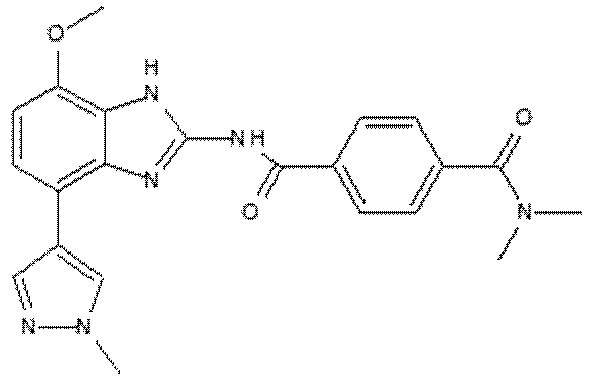
0,406 0,768 0,357 42@0.2 3160 97 
0,749 0,966 1,01 29@0.2 1050 100 
1,35 0,549 1,05 12.5@0.2 888 107 
1,9 0,622 1,54 34@0.2 718 114 
0,566 1,11 0,842 9@0.2 1440 115 
0,324 0,989 0,425 8.6@0.2 2450 116 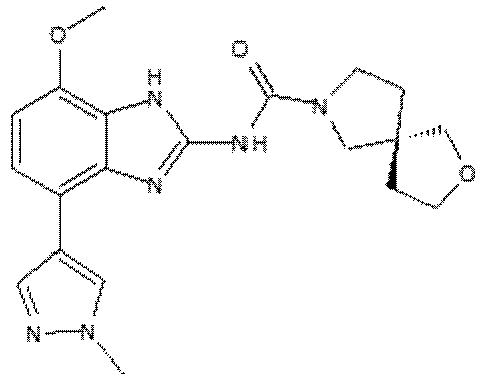
0,739 0,967 0,917 16.9@0.2 1130 133 
0,76 0,669 0,402 2.5@0.2 2640 136 
0,333 1,15 0,522 5.6@0.2 2100 138 
0,539 1,06 1,9 - Adenosine (Ado) in tumor microenvironment can inhibit T cell activity by signaling through A2A receptors and suppress cytokine secretion by T cells. A2A specific agonists like CGS-21680 does similar job of inhibition of T cell cytokine secretion in vitro and in vivo. Potential A2A antagonists or A2A/A2B dual antagonists can rescue T cells from this inhibition. Herein, we describe the in vitro system we established using Pan T cells from mouse spleens to screen potential A2A antagonists or A2A/A2B dual antagonists for their activity. The method described involves the use of CD3/CD28 pre-coated beads to stimulate Pan T cells purified from mouse splenocytes, combined with the addition of A2A agonist along with potential A2A or A2A/A2B dual antagonists to evaluate potentiation of T cell cytokine production.
- Briefly, mouse Pan T cells are purified from spleens of BALB/c mice using Pan T cell isolation kit Mouse II (MACS Miltenyi biotech Cat# Order no. 130-095-130) according to manufacturer's protocol. The purified T cells are seeded in Nunc™ 96-Well Polystyrene Round Bottom Microwell Plates in RPMI medium with 10% heat inactivated fetal bovine serum. The cells are rested at 37°C for 1 h before activating with CD3/CD28 pre-coated beads (Dynabeads™ Mouse T-Activator CD3/CD28; Cat# 11456D). After 30 min the cells are treated with varying doses of test antagonist(s). The cells are incubated for additional 30 min at 37°C before treating with A2A agonist CGS-21680 (1 µM) or neutral control (DMSO). After 24 h incubation IL-2 levels in the supernatants and after 48 h incubation IFN-γ levels in the supernatants are measured by ELISAs according to manufacturer's protocol (R&D systems Cat# DY402 (IL-2); DY485 (IFN-γ)). Once the concentrations are calculated, the difference of cytokine concentration of DMSO control and agonist alone control is calculated (called Δ) and the percentage of rescue by each concentration of antagonist is calculated by using Microsoft Excel. These percentages of cytokine rescue in a dose dependent manner of antagonist is plotted in GraphPad Prism software and IC50 is calculated.
- In contrast to the known adenosine A2A receptor antagonist Tozadenant, the compounds of the present invention show that they are able to rescue T cells from inhibition and are able to prevent the suppression of cyctokine secretion as induced by adenosine or A2A specific agonists like CGS-2168 (see table 7), which is preferred for the treatment and/or prevention of hyperproliferative and infectious diseases and disorders as it is disclosed above. Therefore, the compounds of the present invention surprisingly are able to prevent immunosuppression and thus are able to support anti-tumor T cell induced inhibition of tumor growth, reduction or destruction of metastases and prevention of neovascularization.
Table 7 No. Name Structure Mouse T-Cell IL-2 [nM] Mouse IFN-γ [nM] Tozadenant 
NA (< 50% rescue) NA (< 50% rescue) 11 4-Ethylaminomethyl-N-(7-methoxy-4-phenyl-1H-benzoimidazol-2-yl)-benzamide 
44 75 15 -Imidazol-1-ylmethyl-N-(7-methoxy-4-phenyl-1H-benzoimidazol-2-yl)-benzamide 
1111 35 4-Hydroxymethyl-4-methyl-piperidine-1-carboxylic acid [7-methoxy-4-(1-methyl-1H-pyrazol-4-yl)-1H-benzoi midazol-2-yl]-amide 
120 220 67 N-[7-methoxy-4-(1-methyl-1H-pyrazol-4-yl)-1H-1,3-benzod iazol-2-yl]-7-oxa-2-azaspiro[4.5]decane-2-carboxamide 
800 71 4-[(1H-imidazol-1-yl)methyl]-N-[7-methoxy-4-(1-methyl-1H-pyrazol-4-yl)-1H-1,3-benzodiazol-2-yl]benzamide 
40 40 92 4-hydroxy-N-[7-methoxy-4-(1-methyl-1H-pyrazol-4-yl)-1H-1,3-benzodiazol-2-yl]-4-(prop-2-yn-1-yl)piperidine-1-carboxamide 
1000 500 93 N4-[7-methoxy-4-(1-methyl-1H-pyrazol-4-yl)-1H-1,3-benzodiazol-2-yl]-N1,N1-dimethyl benzene-1,4-dicarboxamide 
111 350 94 N-[7-methoxy-4-(1-methyl-1H-pyrazol-4-yl)-1H-1,3-benzod iazol-2-yl]-4-(trifluoromethoxy) benzamide 
1000 100 N-[7-methoxy-4-(1-methyl-1H-pyrazol-4-yl)-1H-1,3-benzod iazol-2-yl]-4-[(2-oxopyrrolidin-1-yl)methyl]benzamide 
100 80 114 (5S)-N-[7-methoxy-4-(1-methyl-1H-pyrazol-4-yl)-1H-1,3-benzodiazol-2-yl]-7-oxa-2-azaspiro[4.5]decane-2-carboxamide 
900 900 - A solution of 100 g of a compound of the present invention and 5 g of disodium hydrogenphosphate in 3 I of bidistilled water is adjusted to pH 6.5 using 2 N hydrochloric acid, filtered under sterile conditions, transferred into injection vials, lyophilised under sterile conditions and sealed under sterile conditions. Each injection vial contains 5 mg of a compound of the present invention.
- A solution is prepared from 1 g of a compound of the present invention, 9.38 g of NaH2PO4 2 H2O, 28.48 g of Na2HPO4. 12 H2O and 0.1 g of benzalkonium chloride in 940 ml of bidistilled water. The pH is adjusted to 6.8, and the solution is made up to 1 I and sterilised by irradiation.
- A solution of 1 kg of a compound of the present invention in 60 I of bidistilled water is filtered under sterile conditions, transferred into ampoules, lyophilised under sterile conditions and sealed under sterile conditions. Each ampoule contains 10 mg of a compound of the present invention.
Claims (15)
- Compound of the formula I,
 Q, Y are independently of one another CH,R1 is Br or one of the following structures:
 R2 is one of the following structures:
 R3 is OCH3,R4 is H, R5, =S, =NR5, =O, OH, COOH, Hal, NH2, SO2CH3, SO2NH2, CN, CONH2, NHCOCH3, NHCONH2, NO2, or linear or branched alkyl having 1-10 C atoms which is unsubstituted or mono-, di- or trisubstituted by R5 and in which 1-4 C atoms may be replaced, independently of one another, by O, S, SO, SO2, NH, NCH3, -OCO-, -NHCONH-, -NHCO-, -NR5SO2R6-, -COO-, -CONH-,-NCH3CO-, -CONCH3-, -C≡C- groups and/or -CH=CH- groups, and/or, in addition, 1-10 H atoms may be replaced by F and/or Cl, or mono- or bicyclic cyclic alkyl having 3-7 C atoms which is un-substituted or mono-, di- or trisubstituted by by R5 and in which 1-4 C atoms may be replaced, independently of one another, by O, S, SO, SO2, NH, NCH3, -OCO-, -NHCONH-, -NHCO-, -NRSO2R4-, -COO-, -CONH-, -NCH3CO-, -CONCH3-, -C=C- groups and/or by -CH=CH- groups and/or, in addition, 1-10 H atoms may be replaced by F and/or Cl, or mono- or bicyclic heteroaryl, heterocyclyl, aryl or cyclic alkylaryl, containing 3 to 14 carbon atoms and 0-4 heteroatoms, independently selected from N, O and S, which is unsubstituted or mono-, di- or trisubstituted by R5,R5, R6 are independently of one another selected from the group consisting of H, =S, =NH, =O, OH, COOH, Hal, NH2, SO2CH3, SO2NH2, CN, CONH2, NHCOCH3, NHCONH2, NO2 and linear or branched alkyl having 1-10 C atoms in which 1-4 C atoms may be replaced, independently of one another, by O, S, SO, SO2, NH, NCH3, -OCO-, -NHCONH-, -NHCO-,-COO-, -CONH-, -NCH3CO-,-CONCH3-, -C=C- groups and/or -CH=CH- groups, and/or, in addition, 1-10 H atoms may be replaced by F and/or Cl,Hal is F, C, Br, or I,and physiologically acceptable salts, solvates and stereoisomers thereof, including mixtures thereof in all ratios.
 - Compound according to claim 1, wherein R1 is Br or one of the following structures:


and wherein Q, Y, R2, R3, R4, R5 and R6 have the meanings as disclosed in claim 1, and physiologically acceptable salts, solvates and stereoisomers thereof, including mixtures thereof in all ratios. - Compound according to claim 1, selected from the group consisting of:
No. IUPAC-Name 2 4-Fluoro-N-(7-methoxy-4-phenyl-1H-benzoimidazol-2-yl)-benzamide 3 2-Bromo-N-(7-methoxy-4-phenyl-1H-benzoimidazol-2-yl)-isonicotinamide 4 2-Bromo-N-(4-bromo-7-methoxy-1H-benzoimidazol-2-yl)-isonicotinamide 5 6-Bromo-N-(7-methoxy-4-phenyl-1H-benzoimidazol-2-yl)-nicotinamide 6 6-Bromo-N-(4-bromo-7-methoxy-1H-benzoimidazol-2-yl)-nicotinamide 7 N-(7-Methoxy-4-phenyl-1H-benzoimidazol-2-yl)-2-morpholin-4-yl-isonicotinamide 8 N-(7-Methoxy-4-phenyl-1H-benzoimidazol-2-yl)-6-morpholin-4-yl-nicotinamide 10 4-Chloromethyl-N-(7-methoxy-4-phenyl-1H-benzoimidazol-2-yl)-benzamide 11 4-Ethylaminomethyl-N-(7-methoxy-4-phenyl-1H-benzoimidazol-2-yl)-benzamide 12 4-Hydroxy-4-methyl-piperidine-1-carboxylic acid (7-methoxy-4-phenyl-1H-benzoimidazol-2-yl)-amide 13 4-Aminomethyl-N-(7-methoxy-4-phenyl-1 H-benzoimidazol-2-yl)-benzamide 15 4-Imidazol-1-ylmethyl-N-(7-methoxy-4-phenyl-1H-benzoimidazol-2-yl)-benzamide 16 4-Hydroxy-4-methyl-piperidine-1-carboxylic acid (4-cyclohexyl-7-methoxy-1H-benzoimidazol-2-yl)-amide 17 N-(4-Cyclohexyl-7-methoxy-1H-benzoimidazol-2-yl)-2-morpholin-4-yl-isonicotinamide 21 4-hydroxy-N-(7-methoxy-4-morpholino-1H-benzimidazol-2-yl)-4-methyl-piperidine-1-carboxamide 22 4-Hydroxy-4-methyl-piperidine-1-carboxylic acid [7-methoxy-4-(1-methyl-1H-pyrazol-4-yl)-1H-benzoimidazol-2-yl]-amide 23 N-(7-Methoxy-4-morpholin-4-yl-1H-benzoimidazol-2-yl)-2-morpholin-4-yl-isonicotinamide 24 4-Hydroxy-4-methyl-piperidine-1-carboxylic acid [7-methoxy-4-(tetrahydro-pyran-4-yl)-1H-benzoimidazol-2-yl]-amide 26 N-[7-Methoxy-4-(1-methyl-1H-pyrazol-4-yl)-1H-benzoimidazol-2-yl]-2-morpholin-4-yl-isonicotinamide 28 4-Methyl-piperidine-1-carboxylic acid (7-methoxy-4-phenyl-1H-benzoimidazol-2-yl)-amide 29 N-[7-Methoxy-4-(tetrahydro-pyran-4-yl)-1H-benzoimidazol-2-yl]-6-morpholin-4-yl-nicotinamide 30 2-(3-Hydroxy-3-methyl-pyrrolidin-1-yl)-N-[7-methoxy-4-(1-methyl-1H-pyrazol-4-yl)-1 H-benzoimidazol-2-yl]-isonicotinamide 31 3-Hydroxy-3-methyl-pyrrolidine-1-carboxylic acid [7-methoxy-4-(1-methyl-1H-pyrazol-4-yl)-1H-benzoimidazol-2-yl]-amide 32 4-Hydroxy-4-trifluoromethyl-piperidine-1-carboxylic acid [7-methoxy-4-(1-methyl-1H-pyrazol-4-yl)-1H-benzoimidazol-2-yl]-amide 33 2-Oxa-7-aza-spiro[3.5]nonane-7-carboxylic acid [7-methoxy-4-(1-methyl-1H-pyrazol-4-yl)-1H-benzoimidazol-2-yl]-amide 34 4-Difluoromethyl-4-hydroxy-piperidine-1-carboxylic acid [7-methoxy-4-(1-methyl-1H-pyrazol-4-yl)-1H-benzoimidazol-2-yl]-amide 35 4-Hydroxymethyl-4-methyl-piperidine-1-carboxylic acid [7-methoxy-4-(1-methyl-1H-pyrazol-4-yl)-1H-benzoimidazol-2-yl]-amide 36 4-Fluoromethyl-4-hydroxy-piperidine-1-carboxylic acid [7-methoxy-4-(1-methyl-1H-pyrazol-4-yl)-1H-benzoimidazol-2-yl]-amide 37 4-Methoxy-piperidine-1-carboxylic acid [7-methoxy-4-(1-methyl-1H-pyrazol-4-yl)-1H-benzoimidazol-2-yl]-amide 38 3-Oxa-9-aza-spiro[5.5]undecane-9-carboxylic acid [7-methoxy-4-(1-methyl-1H-pyrazol-4-yl)-1H-benzoimidazol-2-yl]-amide 39 4-Methyl-piperidine-1-carboxylic acid [7-methoxy-4-(1-methyl-1H-pyrazol-4-yl)-1H-benzoimidazol-2-yl]-amide 40 4-Hydroxy-piperidine-1-carboxylic acid [7-methoxy-4-(1-methyl-1H-pyrazol-4-yl)-1H-benzoimidazol-2-yl]-amide 41 4-Benzyl-4-hydroxy-piperidine-1-carboxylic acid [7-methoxy-4-(1-methyl-1H-pyrazol-4-yl)-1H-benzoimidazol-2-yl]-amide 43 N-[7-methoxy-4-(1-methyl-1H-pyrazol-4-yl)-1H-1,3-benzodiazol-2-yl]-2-oxa-6-azaspiro[3.4]octane-6-carboxamide 44 N-[7-methoxy-4-(1-methyl-1H-pyrazol-4-yl)-1H-1,3-benzodiazol-2-yl]-2-oxo-1-oxa-3,8-diazaspiro[4.5]decane-8-carboxamide 45 N-[7-methoxy-4-(1-methyl-1H-pyrazol-4-yl)-1H-1,3-benzodiazol-2-yl]-1,4-dioxa-8-azaspiro[4.5]decane-8-carboxamide 46 N-[7-methoxy-4-(1-methyl-1H-pyrazol-4-yl)-1H-1,3-benzodiazol-2-yl]morpholine-4-carboxamide 47 N-[7-methoxy-4-(1-methyl-1H-pyrazol-4-yl)-1H-1,3-benzodiazol-2-yl]-3-oxo-2,8-diazaspiro[4.5]decane-8-carboxamide 48 4-[(dimethylamino)methyl]-N-[7-methoxy-4-(1-methyl-1H-pyrazol-4-yl)-1H-1,3-benzodiazol-2-yl]benzamide 49 N-[7-methoxy-4-(1-methyl-1H-pyrazol-4-yl)-1H-1,3-benzodiazol-2-yl]-4-(methoxymethyl) benzam ide 50 N-[7-methoxy-4-(1-methyl-1H-pyrazol-4-yl)-1H-1,3-benzodiazol-2-yl]-2,4-dioxo-1,3,8-triazaspiro[4.5]decane-8-carboxamide 51 N-[7-methoxy-4-(1-methyl-1H-pyrazol-4-yl)-1H-1,3-benzodiazol-2-yl]-2-oxo-1,8-diazaspiro[4.5]decane-8-carboxamide 52 4-(2-hydroxyethyl)-N-[7-methoxy-4-(1-methyl-1H-pyrazol-4-yl)-1H-1,3-benzodiazol-2-yl]-1,2,3,6-tetrahydropyridine-1-carboxamide 53 3-butyl-4-hydroxy-N-[7-methoxy-4-(1-methyl-1H-pyrazol-4-yl)-1H-1,3-benzodiazol-2-yl]piperidine-1-carboxamide 54 N-[7-methoxy-4-(1-methyl-1H-pyrazol-4-yl)-1H-1,3-benzodiazol-2-yl]-4-phenoxypiperidine-1-carboxamide 55 4-hydroxy-N-[7-methoxy-4-(1-methyl-1H-pyrazol-4-yl)-1H-1,3-benzodiazol-2-yl]-4-(pyridin-3-yl)piperidine-1-carboxamide 56 4-hydroxy-N-[7-methoxy-4-(1-methyl-1H-pyrazol-4-yl)-1H-1,3-benzodiazol-2-yl]-3-(2-methylpropyl)piperidine-1-carboxamide 57 N-[4-(2,6-dimethylpyridin-4-yl)-7-methoxy-1H-1,3-benzodiazol-2-yl]-2-(morpholin-4-yl)pyridine-4-carboxamide 58 N-[7-methoxy-4-(1-methyl-1H-pyrazol-4-yl)-1H-1,3-benzodiazol-2-yl]-4-oxopiperidine-1-carboxamide 60 N-[7-methoxy-4-(1-methyl-1H-pyrazol-4-yl)-1H-1,3-benzodiazol-2-yl]-1-oxo-2,8-diazaspiro[4.5]decane-8-carboxamide 62 N-[7-methoxy-4-(1-methyl-1H-pyrazol-4-yl)-1H-1,3-benzodiazol-2-yl]-1-methyl-5-oxo-1,4,9-triazaspiro[5.5]undecane-9-carboxamide 63 4-fluoro-N-[7-methoxy-4-(morpholin-4-yl)-1H-1,3-benzodiazol-2-yl]benzamide 64 N-[7-methoxy-4-(1-methyl-1H-pyrazol-4-yl)-1H-1,3-benzodiazol-2-yl]-6-oxaspiro[2.5]octane-1-carboxamide 65 N-[7-methoxy-4-(1-methyl-1H-pyrazol-4-yl)-1H-1,3-benzodiazol-2-yl]-5-{3H-[1,2,3]triazolo[4,5-b]pyridin-3-yloxy}pyrazine-2-carboxamide 66 (chloromethyl)({2-[(1-{[7-methoxy-4-(1-methyl-1H-pyrazol-4-yl)-1H-1,3-benzodiazol-2-yl]carbamoyl}-4-methylpiperidin-4-yl)oxy]ethyl})dimethylazanium hydrochloride 67 N-[7-methoxy-4-(1-methyl-1H-pyrazol-4-yl)-1H-1,3-benzodiazol-2-yl]-7-oxa-2-azaspiro[4.5]decane-2-carboxamide 68 N-[7-methoxy-4-(1-methyl-1H-pyrazol-4-yl)-1H-1,3-benzodiazol-2-yl]-8-oxa-2-azaspiro[4.5]decane-2-carboxamide 69 N-[7-methoxy-4-(1-methyl-1H-pyrazol-4-yl)-1H-1,3-benzodiazol-2-yl]-2-oxa-7-azaspiro[4.4]nonane-7-carboxamide 70 N-[7-methoxy-4-(1-methyl-1H-pyrazol-4-yl)-1H-1,3-benzodiazol-2-yl]-3-oxabicyclo[3.1.0]hexane-6-carboxamide 71 4-[(1H-imidazol-1-yl)methyl]-N-[7-methoxy-4-(1-methyl-1H-pyrazol-4-yl)-1H-1,3-benzodiazol-2-yl]benzamide 72 (1S,2S)-2-bromo-N-[7-methoxy-4-(1-methyl-1H-pyrazol-4-yl)-1H-1,3-benzodiazol-2-yl]cyclopropane-1-carboxamide 73 N-[7-methoxy-4-(1-methyl-1H-pyrazol-4-yl)-1H-1,3-benzodiazol-2-yl]-5-(2-methoxyethoxy) pyrazine-2-carboxamide 74 4-hydroxy-N-[7-methoxy-4-(pyridin-4-yl)-1H-1 ,3-benzodiazol-2-yl]-4-methylpiperidine-1-carboxamide 75 4-benzyl-4-hydroxy-N-[7-methoxy-4-(morpholin-4-yl)-1H-1,3-benzodiazol-2-yl]piperidine-1-carboxamide 76 4-[(1H-imidazol-1-yl)methyl]-N-[7-methoxy-4-(morpholin-4-yl)-1H-1,3-benzodiazol-2-yl]benzamide 77 N-[7-methoxy-4-(morpholin-4-yl)-1H-1,3-benzodiazol-2-yl]-1-benzofuran-5-carboxamide 78 4-hydroxy-N-{7-methoxy-4-[1-(oxan-2-yl)-1H-pyrazol-4-yl]-1H-1,3-benzodiazol-2-yl}-4-methylpiperidine-1-carboxamide 79 4-hydroxy-N-[7-methoxy-4-(1H-pyrazol-4-yl)-1H-1,3-benzodiazol-2-yl]-4-methylpiperidine-1-carboxamide 80 N-[7-methoxy-4-(1-methyl-1H-pyrazol-4-yl)-1H-1,3-benzodiazol-2-yl]-1-benzofuran-5-carboxamide 81 N-[7-methoxy-4-(1-methyl-1H-pyrazol-4-yl)-1H-1,3-benzodiazol-2-yl]-5-(morpholin-4-yl)pyrazine-2-carboxamide 83 4-benzyl-4-hydroxy-N-[4-methoxy-7-(1-methyl-1H-pyrazol-4-yl)-3H-imidazo[4,5-c]pyridin-2-yl]piperidine-1-carboxamide 84 N-[7-methoxy-4-(1-methyl-1H-pyrazol-4-yl)-1H-1,3-benzodiazol-2-yl]-1,2-oxazole-3-carboxamide 85 N-[7-methoxy-4-(pyridin-4-yl)-1H-1 ,3-benzodiazol-2-yl]-2-oxa-6-azaspiro[3.4]octane-6-carboxamide 86 1-(1-chloro-3-hydroxypropan-2-yl)-N-[7-methoxy-4-(morpholin-4-yl)-1H-1,3-benzodiazol-2-yl]-1H-pyrazole-4-carboxamide 87 N-[7-methoxy-4-(1-methyl-1H-pyrazol-4-yl)-1H-1,3-benzodiazol-2-yl]-6-(morpholin-4-yl)pyridazine-3-carboxamide 88 4-[(dimethylamino)methyl]-N-[7-methoxy-4-(oxan-4-yl)-1H-1,3-benzodiazol-2-yl]benzamide 89 4-[(dimethylamino)methyl]-N-[7-methoxy-4-(pyridin-4-yl)-1H-1,3-benzodiazol-2-yl]benzamide 90 4-[(dimethylamino)methyl]-N-[7-methoxy-4-(morpholin-4-yl)-1H-1,3-benzodiazol-2-yl]benzamide 91 N-[7-methoxy-4-(oxan-4-yl)-1H-1,3-benzodiazol-2-yl]-6-(morpholin-4-yl)pyridazine-3-carboxamide 92 4-hydroxy-N-[7-methoxy-4-(1-methyl-1H-pyrazol-4-yl)-1H-1,3-benzodiazol-2-yl]-4-(prop-2-yn-1-yl)piperidine-1-carboxamide 93 N4-[7-methoxy-4-(1-methyl-1H-pyrazol-4-yl)-1H-1,3-benzodiazol-2-yl]-N1,N1-dimethylbenzene-1,4-dicarboxamide 94 N-[7-methoxy-4-(1-methyl-1H-pyrazol-4-yl)-1H-1,3-benzodiazol-2-yl]-4-(trifluoromethoxy)benzamide 95 2-bromo-N-[7-methoxy-4-(1-methyl-1H-pyrazol-4-yl)-1H-1,3-benzodiazol-2-yl]pyridine-4-carboxamide 96 N-[7-methoxy-4-(1-methyl-1H-pyrazol-4-yl)-1H-1,3-benzodiazol-2-yl]-2-methyl-1,3-oxazole-4-carboxamide 97 4-[(1H-imidazol-1-yl)methyl]-N-[7-methoxy-4-(oxan-4-yl)-1H-1,3-benzodiazol-2-yl]benzamide 98 N-[7-methoxy-4-(1-methyl-1H-pyrazol-4-yl)-1H-1,3-benzodiazol-2-yl]-1,3-benzoxazole-5-carboxamide 99 3-amino-4-hydroxy-N-[7-methoxy-4-(morpholin-4-yl)-1H-1,3-benzodiazol-2-yl]benzamide 100 N-[7-methoxy-4-(1-methyl-1H-pyrazol-4-yl)-1H-1,3-benzodiazol-2-yl]-4-[(2-oxopyrrolidin-1-yl)methyl]benzamide 101 N-[7-methoxy-4-(1-methyl-1H-pyrazol-4-yl)-1H-1,3-benzodiazol-2-yl]-2,3-dihydro-1-benzofuran-5-carboxamide 102 4-hydroxy-N-[7-methoxy-4-(oxan-4-yl)-1H-1 ,3-benzodiazol-2-yl]-4-(prop-2-yn-1-yl)piperidine-1-carboxamide 103 4-benzyl-4-hydroxy-N-[7-methoxy-4-(oxan-4-yl)-1H-1,3-benzodiazol-2-yl]piperidine-1-carboxamide 104 2-[(3S)-3-hydroxy-3-methylpyrrolidin-1-yl]-N-[7-methoxy-4-(1-methyl-1H-pyrazol-4-yl)-1H-1,3-benzodiazol-2-yl]pyridine-4-carboxamide 105 2-(4-hydroxy-4-methylpiperidin-1-yl)-N-[7-methoxy-4-(1-methyl-1H-pyrazol-4-yl)-1H-1,3-benzodiazol-2-yl]pyridine-4-carboxamide 106 N-[7-methoxy-4-(1-methyl-1H-pyrazol-4-yl)-1H-1,3-benzodiazol-2-yl]-2-{2-oxa-7-azaspiro[4.4]nonan-7-yl}pyridine-4-carboxamide 107 2-[(3R)-3-hydroxy-3-methylpyrrolidin-1-yl]-N-[7-methoxy-4-(1-methyl-1H-pyrazol-4-yl)-1H-1,3-benzodiazol-2-yl]pyridine-4-carboxamide 108 N-[7-methoxy-4-(oxan-4-yl)-1H-1,3-benzodiazol-2-yl]-2,3-dihydro-1-benzofuran-5-carboxamide 109 N-[7-methoxy-4-(1-methyl-1H-pyrazol-4-yl)-1H-1,3-benzodiazol-2-yl]-3-(methoxymethyl)pyrrolidine-1-carboxamide 110 N-[7-methoxy-4-(oxan-4-yl)-1H-1,3-benzodiazol-2-yl]-2-oxa-7-azaspiro[4.4]nonane-7-carboxamide 111 N-[7-methoxy-4-(oxan-4-yl)-1H-1,3-benzodiazol-2-yl]-8-oxa-2-azaspiro[4.5]decane-2-carboxamide 112 N-[7-methoxy-4-(oxan-4-yl)-1H-1,3-benzodiazol-2-yl]-hexahydro-1H-furo[3,4-c]pyrrole-5-carboxamide 113 (5R)-N-[7-methoxy-4-(1-methyl-1H-pyrazol-4-yl)-1H-1,3-benzodiazol-2-yl]-7-oxa-2-azaspiro[4.5]decane-2-carboxamide 114 (5S)-N-[7-methoxy-4-(1-methyl-1H-pyrazol-4-yl)-1H-1,3-benzodiazol-2-yl]-7-oxa-2-azaspiro[4.5]decane-2-carboxamide 115 (5S)-N-[7-methoxy-4-(1-methyl-1H-pyrazol-4-yl)-1H-1,3-benzodiazol-2-yl]-2-oxa-7-azaspiro[4.4]nonane-7-carboxamide 116 (5R)-N-[7-methoxy-4-(1-methyl-1H-pyrazol-4-yl)-1H-1,3-benzodiazol-2-yl]-2-oxa-7-azaspiro[4.4]nonane-7-carboxamide 117 N-[7-methoxy-4-(oxan-4-yl)-1H-1,3-benzodiazol-2-yl]-3-(methoxymethyl)pyrrolidine-1-carboxamide 118 2-(4-hydroxy-4-methylpiperidin-1-yl)-N-[7-methoxy-4-(oxan-4-yl)-1H-1 ,3-benzodiazol-2-yl]pyridine-4-carboxamide 119 N-[7-methoxy-4-(oxan-4-yl)-1H-1,3-benzodiazol-2-yl]-2-{2-oxa-7-azaspiro[4.4]nonan-7-yl}pyridine-4-carboxamide 120 2-(4-fluorophenoxy)-N-[7-methoxy-4-(1-methyl-1H-pyrazol-4-yl)-1H-1 ,3-benzodiazol-2-yl]-2-methylpropanamide 121 N-[7-methoxy-4-(1-methyl-1H-pyrazol-4-yl)-1H-1,3-benzodiazol-2-yl]-hexahydro-1H-furo[3,4-c]pyrrole-5-carboxamide 122 2-(3-hydroxy-3-methylpyrrolidin-1-yl)-N-[7-methoxy-4-(oxan-4-yl)-1H-1,3-benzodiazol-2-yl]pyridine-4-carboxamide 123 N-[7-methoxy-4-(morpholin-4-yl)-1H-1,3-benzodiazol-2-yl]-2-oxa-7-azaspiro[4.4]nonane-7-carboxamide 124 1-{[7-methoxy-4-(1-methyl-1H-pyrazol-4-yl)-1H-1,3-benzodiazol-2-yl]carbamoyl}piperidine-4-carboxylic acid 125 N-[7-methoxy-4-(morpholin-4-yl)-1H-1,3-benzodiazol-2-yl]-8-oxa-2-azaspiro[4.5]decane-2-carboxamide 126 N1-[7-methoxy-4-(1-methyl-1H-pyrazol-4-yl)-1H-1,3-benzodiazol-2-yl]piperidine-1,4-dicarboxamide 127 4-(diethylamino)-N-[7-methoxy-4-(1-methyl-1H-pyrazol-4-yl)-1H-1,3-benzodiazol-2-yl]benzamide 128 4-hydroxy-N-{7-methoxy-4-[1-(2-methylpropyl)-1H-pyrazol-4-yl]-1H-1,3-benzodiazol-2-yl}-4-methylpiperidine-1-carboxamide 129 N-[7-methoxy-4-(pyridin-4-yl)-1H-1,3-benzodiazol-2-yl]-8-oxa-2-azaspiro[4.5]decane-2-carboxamide 130 2-(1-{[7-methoxy-4-(oxan-4-yl)-1H-1,3-benzodiazol-2-yl]carbamoyl}piperidin-4-yl)acetic acid 131 4-hydroxy-N-[7-methoxy-4-(2-methylphenyl)-1H-1,3-benzodiazol-2-yl]-4-methylpiperidine-1-carboxamide 132 2-(1-{[7-methoxy-4-(1-methyl-1H-pyrazol-4-yl)-1H-1,3-benzodiazol-2-yl]carbamoyl}piperidin-4-yl)acetic acid 133 N4-[7-methoxy-4-(oxan-4-yl)-1H-1 ,3-benzodiazol-2-yl]-N1,N1-dimethylbenzene-1,4-dicarboxamide 134 N-[7-methoxy-4-(1-methyl-1H-pyrazol-4-yl)-1H-1,3-benzodiazol-2-yl]-3-(2-methoxyethyl)pyrrolidine-1-carboxamide 135 N-[7-methoxy-4-(1-methyl-1H-pyrazol-4-yl)-1H-1,3-benzodiazol-2-yl]-5-(morpholin-4-yl)pyridine-2-carboxamide 136 N-[7-methoxy-4-(morpholin-4-yl)-1H-1,3-benzodiazol-2-yl]-1-methyl-1H-pyrazole-4-carboxamide 137 N-[7-methoxy-4-(oxan-4-yl)-1H-1,3-benzodiazol-2-yl]-3-(2-methoxyethyl)pyrrolidine-1-carboxamide 138 N-[7-methoxy-4-(oxan-4-yl)-1H-1,3-benzodiazol-2-yl]-4-[(2-oxopyrrolidin-1-yl)methyl]benzamide 139 N-[7-methoxy-4-(oxan-4-yl)-1H-1,3-benzodiazol-2-yl]-5-(morpholin-4-yl)pyridine-2-carboxamide 140 (3R)-N-[7-methoxy-4-(1-methyl-1H-pyrazol-4-yl)-1H-1,3-benzodiazol-2-yl]-3-(2-methoxyethyl)pyrrolidine-1-carboxamide 141 (3S)-N-[7-methoxy-4-(1-methyl-1H-pyrazol-4-yl)-1H-1,3-benzodiazol-2-yl]-3-(2-methoxyethyl)pyrrolidine-1-carboxamide 142 2-[(3R)-3-hydroxy-3-methylpyrrolidin-1-yl]-N-[7-methoxy-4-(oxan-4-yl)-1H-1,3-benzodiazol-2-yl]acetamide 143 2-[(3S)-3-hydroxy-3-methylpyrrolidin-1-yl]-N-[7-methoxy-4-(oxan-4-yl)-1H-1,3-benzodiazol-2-yl]acetamide 144 N-[4-(4-fluorophenyl)-7-methoxy-1H-1,3-benzodiazol-2-yl]-4-hydroxy-4-methylpiperidine-1-carboxamide 145 tert-butyl 4-(4-{2-[(4-hydroxy-4-methylpiperidine-1-carbonyl)amino]-4-methoxy-1H-1,3-benzodiazol-7-yl}-1H-pyrazol-1-yl)piperidine-1-carboxylate 146 4-{[2-amino-7-methoxy-4-(1-methyl-1H-pyrazol-4-yl)-1H-1,3-benzodiazol-1-yl]methyl}benzoic acid 147 (3S)-N-[7-methoxy-4-(1-methyl-1H-pyrazol-4-yl)-1H-1,3-benzodiazol-2-yl]-3-(methoxymethyl)pyrrolidine-1-carboxamide 148 (3R)-N-[7-methoxy-4-(1-methyl-1H-pyrazol-4-yl)-1H-1,3-benzodiazol-2-yl]-3-(methoxymethyl)pyrrolidine-1-carboxamide 149 (5S)-N-[7-methoxy-4-(oxan-4-yl)-1H-1 ,3-benzodiazol-2-yl]-2-oxa-7-azaspiro[4.4]nonane-7-carboxamide 150 (5R)-N-[7-methoxy-4-(oxan-4-yl)-1H-1,3-benzodiazol-2-yl]-2-oxa-7-azaspiro[4.4]nonane-7-carboxamide 151 4-hydroxy-N-{7-methoxy-4-[1-(3-methylbutyl)-1H-pyrazol-4-yl]-1H-1,3-benzodiazol-2-yl}-4-methylpiperidine-1-carboxamide 152 N-[7-methoxy-4-(1-methyl-1H-pyrazol-4-yl)-1H-1,3-benzodiazol-2-yl]-4-[(morpholin-4-yl)methyl]benzamide 153 N-[7-methoxy-4-(oxan-4-yl)-1H-1,3-benzodiazol-2-yl]-2-[(5R)-2-oxa-7-azaspiro[4.4]nonan-7-yl]pyridine-4-carboxamide 154 N-[7-methoxy-4-(oxan-4-yl)-1H-1,3-benzodiazol-2-yl]-2-[(5S)-2-oxa-7-azaspiro[4.4]nonan-7-yl]pyridine-4-carboxamide 155 N-[4-(3,6-dihydro-2H-pyran-4-yl)-7-methoxy-1H-1,3-benzodiazol-2-yl]-4-hydroxy-4-methylpiperidine-1-carboxamide 156 N-[7-methoxy-4-(1-methyl-1H-pyrazol-4-yl)-1H-1,3-benzodiazol-2-yl]-1-methyl-1H-1,2,3-triazole-4-carboxamide 157 4-hydroxy-N-{4-methoxy-7-[1-(piperidin-4-yl)-1H-pyrazol-4-yl]-1H-1,3-benzodiazol-2-yl}-4-methylpiperidine-1-carboxamide 158 N-[7-methoxy-4-(1-methyl-1H-pyrazol-4-yl)-1H-1,3-benzodiazol-2-yl]-5-(2-methoxyethoxy)pyridine-2-carboxamide 159 2-(1-{[7-methoxy-4-(1-methyl-1H-pyrazol-4-yl)-1H-1,3-benzodiazol-2-yl]carbamoyl}piperidin-3-yl)acetic acid 160 N-[7-methoxy-4-(1-methyl-1H-pyrazol-4-yl)-1H-1,3-benzodiazol-2-yl]-1-methyl-1H-pyrazole-4-carboxamide 161 N-[7-methoxy-4-(1-methyl-1H-pyrazol-4-yl)-1H-1,3-benzodiazol-2-yl]-1-(2-methoxyethyl)-1H-pyrazole-4-carboxamide 162 N5-[7-methoxy-4-(1-methyl-1H-pyrazol-4-yl)-1H-1,3-benzodiazol-2-yl]-N2,N2-dimethylpyridine-2,5-dicarboxamide 163 4-hydroxy-N-[4-methoxy-1-methyl-7-(1-methyl-1H-pyrazol-4-yl)-1H-1 ,3-benzodiazol-2-yl]-4-methylpiperidine-1-carboxamide 164 N-[7-methoxy-4-(1-methyl-1H-pyrazol-4-yl)-1H-1,3-benzodiazol-2-yl]-1-(2-methoxyethyl)-1H-1,2,3-triazole-4-carboxam ide 165 N-[7-methoxy-4-(1-methyl-1H-pyrazol-4-yl)-1H-1,3-benzodiazol-2-yl]-2-methyl-1,3-thiazole-5-carboxamide 167 1-(2-Hydroxy-ethyl)-1H-pyrazole-4-carboxylic acid [7-methoxy-4-(1-methyl-1H-pyrazol-4-yl)-1H-benzoimidazol-2-yl]-amide 168 N-[7-methoxy-4-(1-methyl-1H-pyrazol-4-yl)-1H-1,3-benzodiazol-2-yl]-4-[(4-methylpiperazin-1-yl)methyl]benzamide 169 1-Methyl-1H-pyrazole-4-carboxylic acid [7-methoxy-4-(1-methyl-1H-pyrazol-4-yl)-1H-benzoimidazol-2-yl]-amide 170 5-Methyl-isoxazole-4-carboxylic acid [7-methoxy-4-(1-methyl-1H-pyrazol-4-yl)-1H-benzoimidazol-2-yl]-amide 171 5-Cyclopropyl-isoxazole-4-carboxylic acid [7-methoxy-4-(1-methyl-1H-pyrazol-4-yl)-1H-benzoimidazol-2-yl]-amide 172 1-Cyano-cyclopropanecarboxylic acid [7-methoxy-4-(1-methyl-1H-pyrazol-4-yl)-1H-benzoimidazol-2-yl]-amide 173 Thiazole-5-carboxylic acid [7-methoxy-4-(1-methyl-1H-pyrazol-4-yl)-1H-benzoimidazol-2-yl]-amide 174 5,6,7,8-Tetrahydro-imidazo[1,2-a]pyridine-3-carboxylic acid [7-methoxy-4-(1-methyl-1H-pyrazol-4-yl)-1H-benzoimidazol-2-yl]-amide 175 4-(4-Methyl-piperazin-1-yl)-but-2-ynoic acid [7-methoxy-4-(1-methyl-1H-pyrazol-4-yl)-1H-benzoimidazol-2-yl]-amide 179 (S)-3-Methanesulfonyl-pyrrolidine-1-carboxylic acid [7-methoxy-4-(1-methyl-1H-pyrazol-4-yl)-1H-benzoimidazol-2-yl]-amide 180 (S)-3-Fluoro-pyrrolidine-1-carboxylic acid [7-methoxy-4-(1-methyl-1H-pyrazol-4-yl)-1H-benzoimidazol-2-yl]-amide 181 (S)-3-Cyano-pyrrolidine-1-carboxylic acid [7-methoxy-4-(1-methyl-1H-pyrazol-4-yl)-1H-benzoimidazol-2-yl]-amide 182 (R)-3-Dimethylaminomethyl-pyrrolidine-1-carboxylic acid [7-methoxy-4-(1-methyl-1H-pyrazol-4-yl)-1H-benzoimidazol-2-yl]-amide 183 5-Methyl-isoxazole-4-carboxylic acid (7-methoxy-4-morpholin-4-yl-1H-benzoimidazol-2-yl)-amide 184 N-[7-methoxy-4-(morpholin-4-yl)-1H-1,3-benzodiazol-2-yl]-1-(2-methoxyethyl)-1H-1,2, 3-triazole-4-carboxam ide 185 1-Methyl-1H-[1,2,3]triazole-4-carboxylic acid (7-methoxy-4-morpholin-4-yl-1H-benzoimidazol-2-yl)-amide 186 Pyridine-2,5-dicarboxylic acid 2-dimethylamide 5-{[7-methoxy-4-(tetrahydro-pyran-4-yl)-1H-benzoimidazol-2-yl]-amide} 187 1-(2-Methoxy-ethyl)-1H-pyrazole-4-carboxylic acid [7-methoxy-4-(tetrahydro-pyran-4-yl)-1H-benzoimidazol-2-yl]-amide 188 N-[7-Methoxy-4-(tetrahydro-pyran-4-yl)-1H-benzoimidazol-2-yl]-4-morpholin-4-ylmethyl-benzamide 189 N-[7-Methoxy-4-(tetrahydro-pyran-4-yl)-1H-benzoimidazol-2-yl]-4-(4-methyl-piperazin-1-ylmethyl)-benzamide 190 1-Methyl-1H-pyrazole-4-carboxylic acid [7-methoxy-4-(tetrahydropyran-4-yl)-1H-benzoimidazol-2-yl]-amide 191 5-M ethyl-isoxazole-4-carboxylic acid [7-methoxy-4-(tetrahydropyran-4-yl)-1H-benzoimidazol-2-yl]-amide 192 5-Cyclopropyl-isoxazole-4-carboxylic acid [7-methoxy-4-(tetrahydro-pyran-4-yl)-1H-benzoimidazol-2-yl]-amide 193 1-(2-Methoxy-ethyl)-1H-[1,2,3]triazole-4-carboxylic acid [7-methoxy-4-(tetrahydro-pyran-4-yl)-1H-benzoimidazol-2-yl]-amide 194 1-Methyl-1H-[1,2,3]triazole-4-carboxylic acid [7-methoxy-4-(tetrahydro-pyran-4-yl)-1H-benzoimidazol-2-yl]-amide 195 1-Cyano-cyclopropanecarboxylic acid [7-methoxy-4-(tetrahydropyran-4-yl)-1H-benzoimidazol-2-yl]-amide 196 Thiazole-5-carboxylic acid [7-methoxy-4-(tetrahydro-pyran-4-yl)-1H-benzoimidazol-2-yl]-amide 197 2-M ethyl-oxazole-5-carboxylic acid [7 -methoxy-4-(tetrahydropyran-4-yl)-1H-benzoimidazol-2-yl]-amide 198 2-Methyl-thiazole-5-carboxylic acid [7-methoxy-4-(tetrahydropyran-4-yl)-1H-benzoimidazol-2-yl]-amide 199 Imidazo[1,2-a]pyridine-3-carboxylic acid [7-methoxy-4-(tetrahydropyran-4-yl)-1H-benzoimidazol-2-yl]-amide 200 5-Amino-2H-[1,2,4]triazole-3-carboxylic acid [7-methoxy-4-(tetrahydro-pyran-4-yl)-1H-benzoimidazol-2-yl]-amide 201 (S)-3-Methanesulfonyl-pyrrolidine-1-carboxylic acid [7-methoxy-4-(tetrahydro-pyran-4-yl)-1H-benzoimidazol-2-yl]-amide 202 (S)-3-Fluoro-pyrrolidine-1-carboxylic acid [7-methoxy-4-(tetrahydropyran-4-yl)-1H-benzoimidazol-2-yl]-amide 203 (S)-3-Cyano-pyrrolidine-1-carboxylic acid [7-methoxy-4-(tetrahydro-pyran-4-yl)-1H-benzoimidazol-2-yl]-amide 204 (R)-3-Dimethylaminomethyl-pyrrolidine-1-carboxylic acid [7-methoxy-4-(tetrahydro-pyran-4-yl)-1H-benzoimidazol-2-yl]-amide 205 Pyrazolo[1,5-a]pyridine-3-carboxylic acid [7-methoxy-4-(tetrahydropyran-4-yl)-1H-benzoimidazol-2-yl]-amide 206 1H-[1,2,4]Triazole-3-carboxylic acid [7-methoxy-4-(tetrahydropyran-4-yl)-1H-benzoimidazol-2-yl]-amide 207 5,6,7,8-Tetrahydro-imidazo[1,2-a]pyridine-3-carboxylic acid [7-methoxy-4-(tetrahydro-pyran-4-yl)-1H-benzoimidazol-2-yl]-amide 208 2,3-Dimethyl-3H-imidazole-4-sulfonic acid [7-methoxy-4-(tetrahydro-pyran-4-yl)-1H-benzoimidazol-2-yl]-amide 209 1-[7-Methoxy-4-(tetrahydro-pyran-4-yl)-1H-benzoimidazol-2-yl]-3-thiazol-2-ylmethyl-urea 210 N-[7-methoxy-4-(morpholin-4-yl)-1H-1,3-benzodiazol-2-yl]-1-methyl-1H-1,2,3-triazole-4-carboxamide 211 N-[7-methoxy-4-(oxan-4-yl)-1H-1,3-benzodiazol-2-yl]-1-(2-methoxyethyl)-1H-1,2, 3-triazole-4-carboxam ide 212 N-[7-methoxy-4-(oxan-4-yl)-1H-1,3-benzodiazol-2-yl]-1-methyl-1H-1,2,3-triazole-4-carboxamide 213 1-cyano-N-[7-methoxy-4-(1-methyl-1H-pyrazol-4-yl)-1H-1,3-benzodiazol-2-yl]cyclopropane-1-carboxam ide 214 N5-[7-methoxy-4-(oxan-4-yl)-1H-1,3-benzodiazol-2-yl]-N2,N2-dimethylpyridine-2,5-dicarboxamide 215 N-[7-methoxy-4-(1-methyl-1H-pyrazol-4-yl)-1H-1,3-benzodiazol-2-yl]-2-methyl-1 ,3-oxazole-5-carboxamide 216 N-[4-(azepan-1-yl)-7-methoxy-1H-1,3-benzodiazol-2-yl]-4-hydroxy-4-methylpiperidine-1-carboxamide 217 N-[4-(3-fluorophenyl)-7-methoxy-1H-1,3-benzodiazol-2-yl]-4-hydroxy-4-methylpiperidine-1-carboxamide 218 N-[4-(2-fluorophenyl)-7-methoxy-1H-1,3-benzodiazol-2-yl]-4-hydroxy-4-methylpiperidine-1-carboxamide 219 N-[7-methoxy-4-(1-methyl-1H-pyrazol-4-yl)-1H-1,3-benzodiazol-2-yl]-1,3-thiazole-5-carboxamide 220 (3R)-3-methanesulfonyl-N-[7-methoxy-4-(1-methyl-1H-pyrazol-4-yl)-1H-1,3-benzodiazol-2-yl]pyrrolidine-1-carboxamide 221 (3S)-3-fluoro-N-[7-methoxy-4-(1-methyl-1H-pyrazol-4-yl)-1H-1,3-benzodiazol-2-yl]pyrrolidine-1-carboxamide 222 4-hydroxy-N-[7-methoxy-4-(1-methyl-6-oxo-1,6-dihydropyridin-3-yl)-1H-1,3-benzodiazol-2-yl]-4-methylpiperidine-1-carboxamide 223 (3S)-3-(aminomethyl)-N-[7-methoxy-4-(1-methyl-1H-pyrazol-4-yl)-1H-1,3-benzodiazol-2-yl]pyrrolidine-1-carboxamide 224 N-[7-methoxy-4-(oxan-4-yl)-1H-1,3-benzodiazol-2-yl]-1-methyl-1H-pyrazole-4-carboxamide 225 N-[7-methoxy-4-(oxan-4-yl)-1H-1,3-benzodiazol-2-yl]-1-(2-methoxyethyl)-1H-pyrazole-4-carboxamide 226 1-cyano-N-[7-methoxy-4-(oxan-4-yl)-1H-1,3-benzodiazol-2-yl]cyclopropane-1-carboxamide 227 N-[7-methoxy-4-(oxan-4-yl)-1H-1,3-benzodiazol-2-yl]-2-methyl-1,3-thiazole-5-carboxamide 228 3-[7-methoxy-4-(oxan-4-yl)-1H-1 ,3-benzodiazol-2-yl]-1-[(1 ,3-thiazol-2-yl)methyl]urea 229 N-{7-[1-(difluoromethyl)-1H-pyrazol-4-yl]-4-methoxy-1H-1,3-benzodiazol-2-yl}-4-hydroxy-4-methylpiperidine-1-carboxamide 230 4-hydroxy-N-(4-methoxy-7-{1-[2-(2-methoxyethoxy)ethyl]-1H-pyrazol-4-yl}-1H-1,3-benzodiazol-2-yl)-4-methylpiperidine-1-carboxamide 231 4-hydroxy-N-{4-methoxy-7-[1-(pyridin-2-yl)-1H-pyrazol-4-yl]-1H-1,3-benzodiazol-2-yl}-4-methylpiperidine-1-carboxamide 232 N-[7-methoxy-4-(1-propylcyclopropyl)-1H-1,3-benzodiazol-2-yl]-1-methyl-1H-pyrazole-4-carboxamide 233 N-[4-(hexan-3-yl)-7-methoxy-1H-1,3-benzodiazol-2-yl]-1-methyl-1H-pyrazole-4-carboxamide 234 N-[7-methoxy-4-(oxan-4-yl)-1H-1,3-benzodiazol-2-yl]-2-methyl-1,3-oxazole-5-carboxamide 235 N-[7-methoxy-4-(1-methyl-1H-pyrazol-4-yl)-1H-1,3-benzodiazol-2-yl]-4-[(4-methylpiperazin-1-yl)methyl]benzamide 236 4-hydroxy-N-{4-methoxy-7-[3-(2-methoxyethoxy)phenyl]-1H-1,3-benzodiazol-2-yl}-4-methylpiperidine-1-carboxamide 237 4-hydroxy-N-(4-methoxy-7-{1-[(pyridin-3-yl)methyl]-1H-pyrazol-4-yl}-1H-1 ,3-benzodiazol-2-yl)-4-methylpiperidine-1-carboxamide 238 4-hydroxy-N-{7-[1-(2-hydroxy-2-methylpropyl)-1H-pyrazol-4-yl]-4-methoxy-1H-1,3-benzodiazol-2-yl}-4-methylpiperidine-1-carboxamide 239 N-[4-(3-fluorophenyl)-7-methoxy-1H-1,3-benzodiazol-2-yl]-1-methyl-1H-pyrazole-4-carboxamide 240 N4-[4-(3-fluorophenyl)-7-methoxy-1H-1,3-benzodiazol-2-yl]-N1,N1-dimethylbenzene-1,4-dicarboxamide 241 4-hydroxy-N-{4-methoxy-7-[1-(oxolan-3-yl)-1H-pyrazol-4-yl]-1H-1,3-benzodiazol-2-yl}-4-methylpiperidine-1-carboxamide 242 N4-[4-(2-fluorophenyl)-7-methoxy-1H-1,3-benzodiazol-2-yl]-N1,N1-dimethylbenzene-1,4-dicarboxamide 243 N-[4-(2-fluorophenyl)-7-methoxy-1H-1,3-benzodiazol-2-yl]-1-methyl-1H-pyrazole-4-carboxamide 244 N-[4-methoxy-1-methyl-7-(1-methyl-1H-pyrazol-4-yl)-1H-1,3-benzodiazol-2-yl]-1-methyl-1H-pyrazole-4-carboxamide 245 tert-butyl 3-(4-{2-[(4-hydroxy-4-methylpiperidine-1-carbonyl)amino]-4-methoxy-1H-1,3-benzodiazol-7-yl}-1H-pyrazol-1-yl)azetidine-1-carboxylate 246 N-[7-methoxy-4-(1-methyl-1H-pyrazol-4-yl)-1H-1,3-benzodiazol-2-yl]-5-oxopyrrolidine-3-carboxamide 247 3-[7-methoxy-4-(1-methyl-1H-pyrazol-4-yl)-1H-1,3-benzodiazol-2-yl]-1-[(1,3-thiazol-2-yl)methyl]urea 248 4-(2,5-dioxopyrrolidin-1-yl)-N-[7-methoxy-4-(1-methyl-1H-pyrazol-4-yl)-1H-1,3-benzodiazol-2-yl]benzamide 249 1-[(3R,4S)-4-fluoropyrrolidin-3-yl]-3-[7-methoxy-4-(1-methyl-1H-pyrazol-4-yl)-1H-1,3-benzodiazol-2-yl]urea 250 4-(2,5-dioxopyrrolidin-1-yl)-N-[7-methoxy-4-(oxan-4-yl)-1H-1,3-benzodiazol-2-yl]benzamide 251 tert-butyl (3S,4R)-3-fluoro-4-({[7-methoxy-4-(1-methyl-1H-pyrazol-4-yl)-1H-1,3-benzodiazol-2-yl]carbamoyl}amino)pyrrolidine-1-carboxylate 252 N4-[7-methoxy-4-(1,2,3,6-tetrahydropyridin-4-yl)-1H-1,3-benzodiazol-2-yl]-N1,N1-dimethylbenzene-1 ,4-dicarboxamide 253 N-(7-methoxy-4-phenyl-1H-1,3-benzodiazol-2-yl)-1H-imidazole-4-carboxamide 254 N-(7-methoxy-4-phenyl-1H-1,3-benzodiazol-2-yl)-1-methyl-1Himidazole-5-carboxamide 255 N-(7-methoxy-4-phenyl-1H-1,3-benzodiazol-2-yl)-2-methyl-1Himidazole-4-carboxamide 256 N-(7-methoxy-4-phenyl-1H-1,3-benzodiazol-2-yl)-1,3-thiazole-5-carboxamide 257 N-(7-methoxy-4-phenyl-1H-1,3-benzodiazol-2-yl)-2-methyl-1,3-thiazole-5-carboxamide 258 2-amino-N-(7-methoxy-4-phenyl-1H-1,3-benzodiazol-2-yl)-1,3-thiazole-5-carboxamide 259 N4-[7-methoxy-4-(pyridin-3-yl)-1H-1,3-benzodiazol-2-yl]-N1,N1-dimethylbenzene-1,4-dicarboxamide 260 N-[7-methoxy-4-(pyridin-3-yl)-1H-1 ,3-benzodiazol-2-yl]-1-methyl-1H-pyrazole-4-carboxamide 261 N4-[4-(2,5-dihydrofuran-3-yl)-7-methoxy-1H-1,3-benzodiazol-2-yl]-N1,N1-dimethylbenzene-1,4-dicarboxamide 262 N4-[4-(3,6-dihydro-2H-pyran-4-yl)-5-fluoro-7-methoxy-1H-1,3-benzodiazol-2-yl]-N1,N1-dimethylbenzene-1,4-dicarboxamide 263 3-{[dimethyl(oxo)-lambda6-sulfanylidene]amino}-N-[7-methoxy-4-(oxan-4-yl)-1H-1,3-benzodiazol-2-yl]benzamide 264 N-[4-(3,6-dihydro-2H-pyran-4-yl)-5-fluoro-7-methoxy-1H-1,3-benzodiazol-2-yl]-1-methyl-1H-pyrazole-4-carboxamide 265 N-[7-(3-fluorophenyl)-4-methoxy-1H-1,3-benzodiazol-2-yl]-1Himidazole-4-carboxamide 266 N-[4-methoxy-7-(pyridin-4-yl)-1H-1,3-benzodiazol-2-yl]-1Himidazole-4-carboxamide 267 N-{4-methoxy-7-[3-(2-methoxyethoxy)phenyl]-1H-1,3-benzodiazol-2-yl}-1H-imidazole-4-carboxamide 268 N-[4-methoxy-7-(pyridin-3-yl)-1H-1,3-benzodiazol-2-yl]-1Himidazole-4-carboxamide 269 N-(7-methoxy-4-phenyl-1H-1,3-benzodiazol-2-yl)-1,3-dimethyl-1H-pyrazole-4-carboxamide 270 4-hydroxy-N-(7-methoxy-4-{1H-pyrrolo[2,3-b]pyridin-4-yl}-1H-1,3-benzodiazol-2-yl)-4-methylpiperidine-1-carboxamide 271 4-hydroxy-N-[4-(1H-indazol-4-yl)-7-methoxy-1H-1,3-benzodiazol-2-yl]-4-methylpiperidine-1-carboxamide 272 4-hydroxy-N-[4-(1H-indol-6-yl)-7-methoxy-1H-1,3-benzodiazol-2-yl]-4-methylpiperidine-1-carboxamide 273 4-hydroxy-N-[7-methoxy-4-(1-methyl-1H-indazol-5-yl)-1H-1,3-benzodiazol-2-yl]-4-methylpiperidine-1-carboxamide 274 4-hydroxy-N-[7-methoxy-4-(3-methyl-1H-indazol-5-yl)-1H-1,3-benzodiazol-2-yl]-4-methylpiperidine-1-carboxamide 275 4-hydroxy-N-(4-{imidazo[1,2-a]pyridin-7-yl}-7-methoxy-1H-1,3-benzodiazol-2-yl)-4-methylpiperidine-1-carboxamide 277 N4-[5-fluoro-7-methoxy-4-(oxan-4-yl)-1H-1, 3-benzodiazol-2-yl]-N1,N1-dimethylbenzene-1,4-dicarboxamide 278 N-(7-methoxy-4-{1H-pyrrolo[2,3-b]pyridin-4-yl}-1H-1,3-benzodiazol-2-yl)-1-(2-methoxyethyl)-1H-pyrazole-4-carboxamide 279 N-[4-(1H-indazol-4-yl)-7-methoxy-1H-1,3-benzodiazol-2-yl]-1-(2-methoxyethyl)-1H-pyrazole-4-carboxamide 280 N-[4-(1H-indol-6-yl)-7-methoxy-1H-1,3-benzodiazol-2-yl]-1-(2-methoxyethyl)-1H-pyrazole-4-carboxamide 281 N-[7-methoxy-4-(1-methyl-1H-indazol-5-yl)-1H-1,3-benzodiazol-2-yl]-1-(2-methoxyethyl)-1H-pyrazole-4-carboxamide 282 N-[7-methoxy-4-(3-methyl-1H-indazol-5-yl)-1H-1,3-benzodiazol-2-yl]-1-(2-methoxyethyl)-1H-pyrazole-4-carboxamide 283 N-[4-(2,3-dihydro-1H-indol-4-yl)-7-methoxy-1H-1,3-benzodiazol-2-yl]-1-(2-methoxyethyl)-1H-pyrazole-4-carboxamide 284 N2-(7-methoxy-4-phenyl-1H-1,3-benzodiazol-2-yl)-N5,N5-dimethylpyridine-2,5-dicarboxamide 285 4-(2,5-dioxopyrrolidin-1-yl)-N-(7-methoxy-4-phenyl-1H-1,3-benzodiazol-2-yl)benzam ide 286 N-(7-methoxy-4-phenyl-1H-1,3-benzodiazol-2-yl)imidazo[1,2-a]pyridine-3-carboxamide 287 4,4-difluoro-N-(7-methoxy-4-phenyl-1H-1,3-benzodiazol-2-yl)piperidine-1-carboxamide 288 N-(7-methoxy-4-phenyl-1H-1,3-benzodiazol-2-yl)imidazo[1,2-b]pyridazine-3-carboxamide 289 N-(7-methoxy-4-phenyl-1H-1,3-benzodiazol-2-yl)imidazo[1,2-a]pyrimidine-3-carboxamide 290 N-(7-methoxy-4-phenyl-1H-1,3-benzodiazol-2-yl)-2-(pyridin-4-yl)-1H-imidazole-4-carboxamide 291 N-(7-methoxy-4-phenyl-1H-1,3-benzodiazol-2-yl)-5H,6H, 7H,8H-imidazo[1,2-a]pyridine-3-carboxamide 292 N-[4-(2,3-dihydro-1H-indol-4-yl)-7-methoxy-1H-1,3-benzodiazol-2-yl]-4-hydroxy-4-methylpiperidine-1-carboxamide 293 N1-(4-methoxy-7-phenyl-1H-1,3-benzodiazol-2-yl)-N4-propylbenzene-1,4-dicarboxamide 294 N-(4-methoxy-7-phenyl-1H-1,3-benzodiazol-2-yl)-4-(4-methylpiperazine-1-carbonyl)benzamide 295 N4-(4-methoxy-7-phenyl-1H-1,3-benzodiazol-2-yl)-N1-(2-methoxyethyl)-N 1-methylbenzene-1 ,4-dicarboxamide 296 N1-[2-(dimethylamino)ethyl]-N4-(4-methoxy-7-phenyl-1H-1,3-benzodiazol-2-yl)-N1-methylbenzene-1,4-dicarboxamide 297 N4-(4-methoxy-7-phenyl-1H-1,3-benzodiazol-2-yl)-N1-methyl-N1-propylbenzene-1,4-dicarboxamide 298 N-(4-methoxy-7-phenyl-1H-1,3-benzodiazol-2-yl)-4-(morpholine-4-carbonyl)benzamide 299 N-[4-methoxy-7-(2-methylpyridin-4-yl)-1H-1,3-benzodiazol-2-yl]-1H-imidazole-4-carboxamide 300 N-(5-cyano-7-methoxy-4-phenyl-1H-1,3-benzodiazol-2-yl)-1-methyl-1H-pyrazole-4-carboxamide 301 N-(4-{imidazo[1,2-a]pyridin-7-yl}-7-methoxy-1H-1,3-benzodiazol-2-yl)-1-(2-methoxyethyl)-1H-pyrazole-4-carboxamide 302 N-[4-(1H-indol-5-yl)-7-methoxy-1H-1,3-benzodiazol-2-yl]-1-(2-methoxyethyl)-1H-pyrazole-4-carboxamide 303 4-hydroxy-N-[4-(1H-indol-5-yl)-7-methoxy-1H-1,3-benzodiazol-2-yl]-4-methylpiperidine-1-carboxamide 304 N-[4-(1H-indol-7-yl)-7-methoxy-1H-1,3-benzodiazol-2-yl]-1-(2-methoxyethyl)-1H-pyrazole-4-carboxamide 305 4-hydroxy-N-[4-(1H-indol-7-yl)-7-methoxy-1H-1,3-benzodiazol-2-yl]-4-methylpiperidine-1-carboxamide 306 N-(7-methoxy-4-phenyl-1H-1,3-benzodiazol-2-yl)-1-methyl-1H-pyrazole-4-carboxamide 307 N-(7-methoxy-4-phenyl-1H-1,3-benzodiazol-2-yl)-1-(2-methoxyethyl)-1H-pyrazole-4-carboxamide 308 N-(7-methoxy-4-phenyl-1H-1 ,3-benzodiazol-2-yl)-2-methyl-1 ,3-oxazole-5-carboxamide 309 N4-(7-methoxy-4-phenyl-1H-1,3-benzodiazol-2-yl)-N1,N1-dimethylbenzene-1,4-dicarboxamide 310 N-(7-methoxy-4-phenyl-1H-1 ,3-benzodiazol-2-yl)-8-oxa-2-azaspiro[4.5]decane-2-carboxamide 311 N-(7-methoxy-4-phenyl-1H-1,3-benzodiazol-2-yl)-4-[(2-oxopyrrolidin-1-yl)methyl]benzamide 312 N1-(2-hydroxyethyl)-N4-(4-methoxy-7-phenyl-1H-1,3-benzodiazol-2-yl)benzene-1,4-dicarboxamide 313 N4-[7-methoxy-4-(1,4-oxazepan-4-yl)-1H-1,3-benzodiazol-2-yl]-N1,N1-dimethylbenzene-1,4-dicarboxamide 314 N-[4-(3,6-dihydro-2H-pyran-4-yl)-7-methoxy-1H-1,3-benzodiazol-2-yl]cyclopropanecarboxamide 315 N-[7-methoxy-4-(pyridin-3-yl)-1H-1,3-benzodiazol-2-yl]cyclopropanecarboxamide 316 N4-[4-(4-fluorophenyl)-7-methoxy-1H-1,3-benzodiazol-2-yl]-N1,N1-dimethylbenzene-1,4-dicarboxamide 317 4-(2,5-dioxopyrrolidin-1-yl)-N-[4-(4-fluorophenyl)-7-methoxy-1H-1,3-benzodiazol-2-yl]benzamide 318 N-[4-(4-fluorophenyl)-7-methoxy-1H-1,3-benzodiazol-2-yl]-1-methyl-1H-pyrazole-4-carboxamide 319 N4-[4-(2,6-dimethoxypyridin-3-yl)-7-methoxy-1H-1,3-benzodiazol-2-yl]-N1,N1-dimethylbenzene-1,4-dicarboxamide 320 N-[4-(2,6-dimethoxypyridin-3-yl)-7-methoxy-1H-1,3-benzodiazol-2-yl]cyclopropanecarboxamide 321 N-[7-methoxy-4-(pyridin-3-yl)-1H-1,3-benzodiazol-2-yl]-2-methyl-1,3-oxazole-5-carboxamide 322 N-[4-(2,5-dihydrofuran-3-yl)-7-methoxy-1H-1,3-benzodiazol-2-yl]-2-methyl-1,3-oxazole-5-carboxamide 323 N-[4-(4-fluorophenyl)-7-methoxy-1H-1,3-benzodiazol-2-yl]-2-methyl-1,3-oxazole-5-carboxamide 324 N4-[4-(3,6-dihydro-2H-pyran-4-yl)-7-methoxy-1H-1,3-benzodiazol-2-yl]-N1,N1-dimethylbenzene-1,4-dicarboxamide 325 N-[4-(3,6-dihydro-2H-pyran-4-yl)-7-methoxy-1H-1,3-benzodiazol-2-yl]-1-methyl-1H-pyrazole-4-carboxamide 326 (4-{2-[(4-hydroxy-4-methylpiperidine-1-carbonyl)amino]-7-methoxy-1H-1,3-benzodiazol-4-yl}morpholin-2-yl)methyl carbamate 327 (1-{2-[(4-hydroxy-4-methylpiperidine-1-carbonyl)amino]-7-methoxy-1H-1,3-benzodiazol-4-yl}piperidin-3-yl)methyl cyanate 328 (1-{2-[(4-hydroxy-4-methylpiperidine-1-carbonyl)amino]-7-methoxy-1H-1 ,3-benzodiazol-4-yl}piperidin-3-yl)methyl carbamate 329 N-(7-methoxy-4-phenyl-1H-1,3-benzodiazol-2-yl)-2-oxa-8-azaspiro[4.5]decane-8-carboxamide 330 N-[4-(1H-indol-6-yl)-7-methoxy-1H-1,3-benzodiazol-2-yl]-1Himidazole-4-carboxamide 331 N-[4-(1H-indol-6-yl)-7-methoxy-1H-1,3-benzodiazol-2-yl]-1-methyl-1H-pyrazole-4-carboxamide 332 N-[4-(4-fluorophenyl)-7-methoxy-1H-1,3-benzodiazol-2-yl]-8-oxa-2-azaspiro[4.5]decane-2-carboxamide 333 N-[4-(3,6-dihydro-2H-pyran-4-yl)-7-methoxy-1H-1,3-benzodiazol-2-yl]-8-oxa-2-azaspiro[4.5]decane-2-carboxamide 334 N-[4-(3,6-dihydro-2H-pyran-4-yl)-7-methoxy-1H-1,3-benzodiazol-2-yl]-4-[(2-oxopyrrolidin-1-yl)methyl]benzamide 335 N-[4-(4-fluorophenyl)-7-methoxy-1H-1,3-benzodiazol-2-yl]-4-[(2-oxopyrrolidin-1-yl)methyl]benzamide 336 N-[4-(1H-indol-6-yl)-7-methoxy-1H-1,3-benzodiazol-2-yl]cyclopropanecarboxamide and physiologically acceptable salts, derivatives, solvates and stereoisomers thereof, including mixtures thereof in all ratios. - Process for the preparation of a compound of the formula I according to claim 1, characterized in that
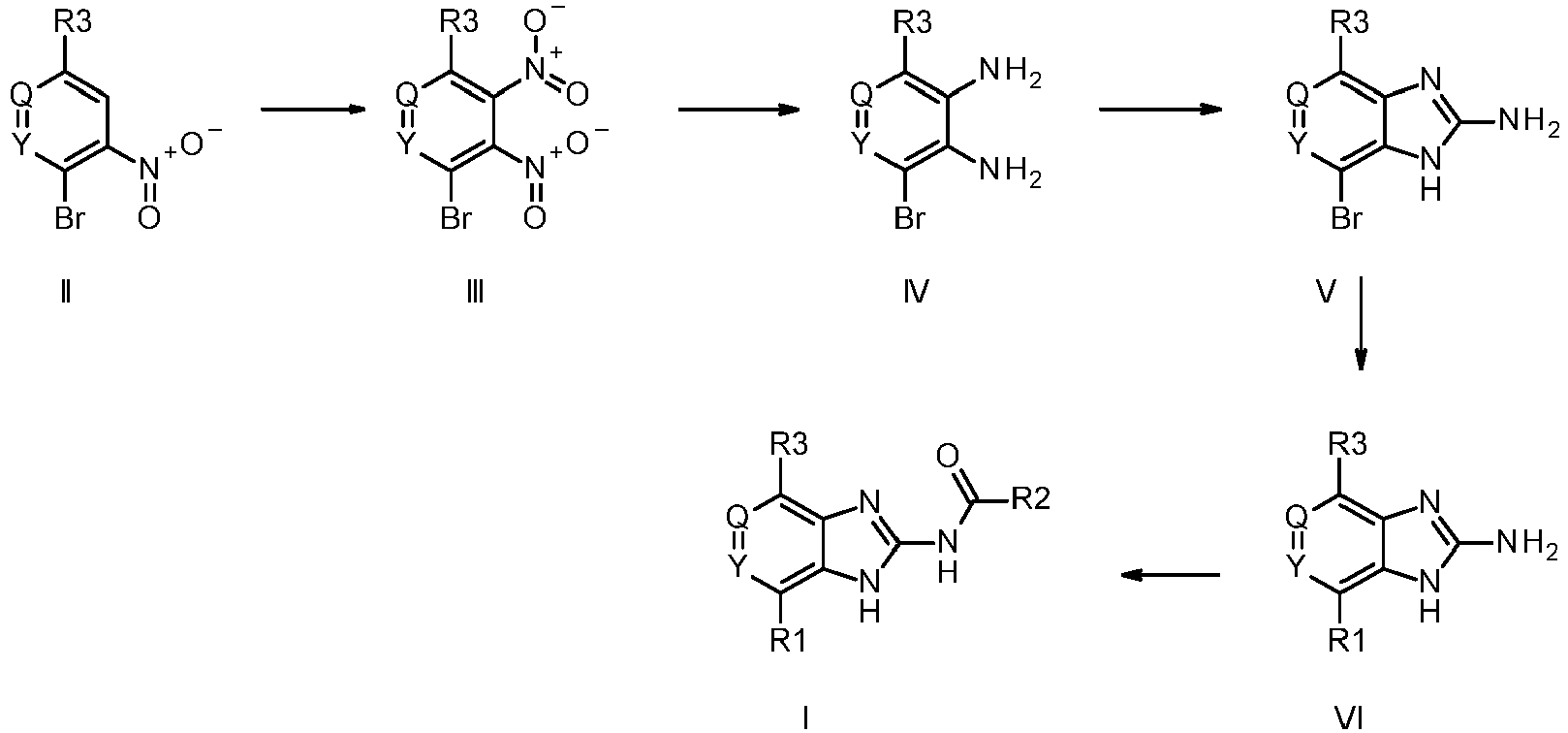 a) a compound of the formula II undergoes a nitration reaction, followed by a reduction to give a compound of formula IV, a compound of formula IVI is cyclized to give a compound of formula V, a compound of formula V is reacted in a Suzuki type reaction to formula VI employing the use of catalyst and base, a compound of formula VI is converted to a compound of the formula VII by standard amidation or carbamide formation conditions to give a compound of the formula I and wherein Q, Y, R1, R2 and R3 have the meanings as disclosed above,
 b) a compound of the formula III is reacted with a boronic ester or acid under Suzuki-type reaction conditions to give a compound of the formula VII or reacted with an amine in a nuclophilic substitution reaction under increased temperature to form a compound of the formula VII , a compound of formula VII is reduced to a compound of the formula VII and cyclized to a compound of the formula VI and finally reacted with to compound of the formula I under standard amidation or carbamide formation conditions and wherein Q, Y, R1, R2 and R3 have the meanings as disclosed above,c) the base of a compound of the formula I is converted into one of its salts by treatment with an acid, ord) an acid of a compound of the formula I is converted into one of its salts by treatment with a base.
 - Pharmaceutical preparation comprising at least one compound according to one or more of claims 1 to 3 and/or physiologically acceptable salts, solvates and stereoisomers thereof, including mixtures thereof in all ratios.
- Pharmaceutical preparation according to claim 5 comprising further excipients and/or adjuvants.
- Pharmaceutical preparation comprising at least one compound according to one or more of claims 1 to 3 and/or physiologically acceptable salts, solvates and stereoisomers thereof, including mixtures thereof in all ratios, and at least one further medicament active compound.
- Process for the preparation of a pharmaceutical preparation, characterised in that a compound according to one or more of claims 1 to 3 and/or one of its physiologically acceptable salts, solvates and stereoisomers including mixtures thereof in all ratios, is brought into a suitable dosage form together with a solid, liquid or semi-liquid excipient or adjuvant.
- Compound according to one or more of claims 1 to 3 and/or one of its physiologically acceptable salts, solvates and stereoisomers including mixtures thereof in all ratios, for use as a medicament in the treatment and/or prophylaxis of physiological and/or pathophysiological states.
- Compound according to one or more of claims 1 to 3 and/or one of its physiologically acceptable salts, solvates and stereoisomers including mixtures thereof in all ratios, for use as a medicament in the treatment and/or prophylaxis of physiological and/or pathophysiological states, selected from the group consisting of hyperproliferative and infectious diseases and disorders.
- Compound for use according to claim 10, wherein the hyperproliferative disease or disorder is cancer.
- Compound for use according to claim 11, wherein the cancer is selected from the group consisting of acute and chronic lymphocytic leukemia, acute granulocytic leukemia, adrenal cortex cancer, bladder cancer, brain cancer, breast cancer, cervical cancer, cervical hyperplasia, chorio cancer, chronic granulocytic leukemia, chronic lymphocytic leukemia, colon cancer, endometrial cancer, esophageal cancer, essential thrombocytosis, genitourinary carcinoma, glioma, glioblastoma, hairy cell leukemia, head and neck carcinoma, Hodgkin's disease, Kaposi's sarcoma, lung carcinoma, lymphoma, malignant carcinoid carcinoma, malignant hypercalcemia, malignant melanoma, malignant pancreatic insulinoma, medullary thyroid carcinoma, melanoma, multiple myeloma, mycosis fungoides, myeloid and lymphocytic leukemia, neuroblastoma, non-Hodgkin's lymphoma, non-small cell lung cancer, osteogenic sarcoma, ovarian carcinoma, pancreatic carcinoma, polycythemia vera, primary brain carcinoma, primary macroglobulinemia, prostatic cancer, renal cell cancer, rhabdomyosarcoma, skin cancer, small-cell lung cancer, soft-tissue sarcoma, squamous cell cancer, stomach cancer, testicular cancer, thyroid cancer and Wilms' tumor.
- Compound for use according to Claim 10, wherein the hyperproliferative disease or disorder is selected from the group consisting of age-related macular degeneration, Crohn's disease, cirrhosis, chronic inflammatory-related disorders, proliferative diabetic retinopathy, proliferative vitreoretinopathy, retinopathy of prematurity, granulomatosis, immune hyperproliferation associated with organ or tissue transplantation and an immunoproliferative disease or disorder selected from the group consisting of inflammatory bowel disease, psoriasis, rheumatoid arthritis, systemic lupus erythematosus (SLE), vascular hyperproliferation secondary to retinal hypoxia and vasculitis.
- Compound for use according to Claim 10, wherein the infectious disease or disorder is selected from the group consisting ofa) virally induced infectious diseases which are caused by retroviruses, hepadnaviruses, herpesviruses, flaviviridae and/or adenoviruses wherein the retroviruses are selected from lentiviruses or oncoretroviruses, wherein the lentivirus is selected from the group consisting of HIV-1, HIV-2, FIV, BIV, SIVs, SHIV, CAEV, VMV and EIAV and the oncoretrovirus is selected from the group consisting of HTLV-I, HTLV-II and BLV, the hepadnavirus is selected from the group consisting of HBV, GSHV and WHV, the herpesivirus is selected from the group from the group consisting of HSV I, HSV II, EBV, VZV, HCMV or HHV 8 and the flaviviridae is selected from the group consisting of HCV, West nile and Yellow Fever,b) bacterial infectious diseases which are caused by Gram-positive bacteria wherein the Gram-positive bacteria are selected from the group consisting of methicillin-susceptible and methicillin-resistant staphylococci (including Staphylococcus aureus, Staphylococcus epidermidis, Staphylococcus haemolyticus, Staphylococcus hominis, Staphylococcus saprophyticus, and coagulase-negative staphylococci), glycopeptides-intermediate susceptible Staphylococcus aureus (GISA), penicillin-susceptible and penicillin-resistant streptococci (including Streptococcus pneumoniae, Streptococcus pyogenes, Streptococcus agalactiae, Streptococcus avium, Streptococcus bovis, Streptococcus lactis, Streptococcus sanguis and Streptococci Group C (GCS), Streptococci Group G (GGS) and viridans streptococci), enterococci (including vancomycinsusceptible and vancomycin-resistant strains such as Enterococcus faecalis and Enterococcus faecium), Clostridium difficile, listeria monocytogenes, Corynebacterium jeikeium, Chlamydia spp (including C. pneumoniae) and Mycobacterium tuberculosis,c) bacterial infectious diseases which are caused by Gram-negative bacteria wherein the Gram-negative bacteria are selected from the group consisting of the Genus Enterobacteriacae, including Escherichia spp. (including Escherichia coli), Klebsiella spp., Enterobacter spp., Citrobacter spp., Serratia spp., Proteus spp., Providencia spp., Salmonella spp., Shigella spp., the genus Pseudomonas (including P. aeruginosa), Moraxella spp. (including M. catarrhalis), Haemophilus spp. and Neisseria spp.,d) infectious diseases induced by intracellular active parasites selected from the group consisting of phylum Apicomplexa, or Sarcomastigophora (including Trypanosoma, Plasmodia, Leishmania, Babesia or Theileria), Cryptosporidia, Sacrocystida, Amoebia, Coccidia and Trichomonadia.
- Set (kit) consisting of separate packs ofa) an effective amount of a compound according to one or more of claims 1 to 3 and/or physiologically acceptable salts, solvates and stereoisomers thereof, including mixtures thereof in all ratios, andb) an effective amount of a further medicament active compound.
Applications Claiming Priority (2)
| Application Number | Priority Date | Filing Date | Title |
|---|---|---|---|
| EP17187101 | 2017-08-21 | ||
| PCT/EP2018/072398 WO2019038215A1 (en) | 2017-08-21 | 2018-08-20 | Bezimidazole derivatives as adenosine receptor antagonists |
Publications (2)
| Publication Number | Publication Date |
|---|---|
| EP3672952A1 EP3672952A1 (en) | 2020-07-01 |
| EP3672952B1 true EP3672952B1 (en) | 2022-12-14 |
Family
ID=59677148
Family Applications (1)
| Application Number | Title | Priority Date | Filing Date |
|---|---|---|---|
| EP18753209.8A Active EP3672952B1 (en) | 2017-08-21 | 2018-08-20 | Benzimidazole derivatives as adenosine receptor antagonists |
Country Status (14)
| Country | Link |
|---|---|
| US (2) | US11453647B2 (en) |
| EP (1) | EP3672952B1 (en) |
| JP (1) | JP7287952B2 (en) |
| KR (1) | KR20200043433A (en) |
| CN (1) | CN110997662B (en) |
| AU (1) | AU2018320673B2 (en) |
| BR (1) | BR112020003594A2 (en) |
| CA (1) | CA3073333A1 (en) |
| ES (1) | ES2940408T3 (en) |
| IL (1) | IL272637B2 (en) |
| SG (1) | SG11202001337XA (en) |
| TW (1) | TWI791593B (en) |
| WO (1) | WO2019038215A1 (en) |
| ZA (1) | ZA202001780B (en) |
Families Citing this family (11)
| Publication number | Priority date | Publication date | Assignee | Title |
|---|---|---|---|---|
| US11497752B2 (en) | 2018-01-30 | 2022-11-15 | Foghorn Therapeutics Inc. | Compounds and uses thereof |
| WO2020160100A1 (en) | 2019-01-29 | 2020-08-06 | Foghorn Therapeutics Inc. | Compounds and uses thereof |
| BR112022015004A2 (en) | 2020-01-29 | 2022-09-20 | Foghorn Therapeutics Inc | COMPOUND, PHARMACEUTICAL COMPOSITION, METHODS TO DECREASE THE ACTIVITY OF A BAF COMPLEX, INDUCE APOPTOSIS, REDUCE TUMOR GROWTH, SUPPRESS PROGRESSION AND METASTATIC COLONIZATION OF CANCER, AND REDUCE THE LEVEL AND/OR ACTIVITY OF BRG1 AND/OR BRM IN A CANCER AND METHODS OF TREATMENT AND INHIBITION OF BRM AND BRG1 |
| EP4096668A4 (en) * | 2020-01-29 | 2024-02-28 | Foghorn Therapeutics Inc. | Compounds and uses thereof |
| US11618751B1 (en) | 2022-03-25 | 2023-04-04 | Ventus Therapeutics U.S., Inc. | Pyrido-[3,4-d]pyridazine amine derivatives useful as NLRP3 derivatives |
| KR102694819B1 (en) * | 2021-01-29 | 2024-08-14 | 한국화학연구원 | Benzothiazole, benzimidazole derivatives, pharmaceutically acceptable salt thereof, process for preparation thereof and pharmaceutical composition containing the same as an active ingredient |
| JP2024509268A (en) | 2021-03-09 | 2024-02-29 | フォグホーン セラピューティクス インコーポレイテッド | Crystal forms, compositions containing them, and methods of using them |
| US11319319B1 (en) | 2021-04-07 | 2022-05-03 | Ventus Therapeutics U.S., Inc. | Compounds for inhibiting NLRP3 and uses thereof |
| JP2024520764A (en) | 2021-06-07 | 2024-05-24 | アレス トレーディング ソシエテ アノニム | Combination Treatment of Cancer |
| US12331048B2 (en) | 2022-10-31 | 2025-06-17 | Ventus Therapeutics U.S., Inc. | Pyrido-[3,4-d]pyridazine amine derivatives useful as NLRP3 inhibitors |
| EP4714938A1 (en) * | 2023-05-15 | 2026-03-25 | Wigen Biomedicine Technology (Shanghai) Co., Ltd. | Hdac1/2 selective inhibitor and use thereof |
Family Cites Families (25)
| Publication number | Priority date | Publication date | Assignee | Title |
|---|---|---|---|---|
| US4207554A (en) | 1972-08-04 | 1980-06-10 | Med-El Inc. | Method and apparatus for automated classification and analysis of cells |
| US4125828A (en) | 1972-08-04 | 1978-11-14 | Med-El Inc. | Method and apparatus for automated classification and analysis of cells |
| GB9624482D0 (en) | 1995-12-18 | 1997-01-15 | Zeneca Phaema S A | Chemical compounds |
| WO1997030035A1 (en) | 1996-02-13 | 1997-08-21 | Zeneca Limited | Quinazoline derivatives as vegf inhibitors |
| ES2169355T3 (en) | 1996-03-05 | 2002-07-01 | Astrazeneca Ab | DERIVATIVES OF 4-ANILINOQUINAZOLINA. |
| GB9718972D0 (en) | 1996-09-25 | 1997-11-12 | Zeneca Ltd | Chemical compounds |
| GB9714249D0 (en) | 1997-07-08 | 1997-09-10 | Angiogene Pharm Ltd | Vascular damaging agents |
| CA2315736A1 (en) | 1998-01-05 | 1999-07-15 | Eisai Co., Ltd. | Purine compounds and adenosine a2 receptor antagonist as preventive or therapeutic for diabetes mellitus |
| GB9900334D0 (en) | 1999-01-07 | 1999-02-24 | Angiogene Pharm Ltd | Tricylic vascular damaging agents |
| GB9900752D0 (en) | 1999-01-15 | 1999-03-03 | Angiogene Pharm Ltd | Benzimidazole vascular damaging agents |
| DE60022366T2 (en) | 1999-07-02 | 2006-06-14 | Eisai Co Ltd | CONDENSED IMIDAZOLE DERIVATIVES AND MEDICAMENTS AGAINST DIABETES MELLITUS |
| IL152682A0 (en) | 2000-05-31 | 2003-06-24 | Astrazeneca Ab | Indole derivatives with vascular damaging activity |
| HUP0301742A3 (en) | 2000-07-07 | 2005-08-29 | Angiogene Pharm Ltd | Colchinol derivatives as angiogenesis inhibitors, process for producing them, pharmaceutical compositions containing them and their use |
| BR0112224A (en) | 2000-07-07 | 2003-06-10 | Angiogene Pharm Ltd | Compound, pharmaceutical composition, use of a compound or a pharmaceutically acceptable salt, solvate or prodrug thereof, and process for preparing a compound |
| WO2004089942A2 (en) | 2001-10-02 | 2004-10-21 | Acadia Pharmaceuticals Inc. | Benzimidazolidinone derivatives as muscarinic agents |
| WO2003050241A2 (en) | 2001-12-12 | 2003-06-19 | The Government Of The United States Of America As Represented By The Secretary, Department Of Healthand Human Services | Methods for using extracellular adenosine inhibitors and adenosine receptor inhibitors to enhance immune response and inflammation |
| US20080070932A1 (en) | 2003-04-09 | 2008-03-20 | Chi Vu | Triazolo[ 1,5-A] Pyrimidines And Pyrazolo[ 1,5-A] Pyrimidines And Methods Of Making And Using The Same |
| DE602004016328D1 (en) | 2003-05-13 | 2008-10-16 | Hoffmann La Roche | 2-IMIDAZO BENZOTHIAZOLE AS ADENOSINE RECEPTOR LIGANDEN |
| AU2004251814B2 (en) | 2003-05-19 | 2009-07-23 | F. Hoffmann-La Roche Ag | Benzothiazole derivatives as adenosine receptor ligands |
| EP1628662B1 (en) | 2003-05-21 | 2007-02-14 | F. Hoffmann-La Roche Ag | Benzothiazole derivatives and use thereof in the treatment of diseases related to the adenosine a2a receptor |
| AU2004274154A1 (en) | 2003-09-19 | 2005-03-31 | F. Hoffmann-La Roche Ag | Thiazolopyridine derivatives as adenosine receptor ligands |
| CN1956983B (en) * | 2004-05-24 | 2010-05-26 | 弗·哈夫曼-拉罗切有限公司 | 4-Hydroxy-4-methyl-piperidine-1-carboxylic acid (4-methoxy-7-morpholin-4-yl-benzothiazol-2-yl)-amide |
| EP1773827B1 (en) | 2004-07-22 | 2010-02-17 | F.Hoffmann-La Roche Ag | Benzothiazole derivatives |
| MX2007011234A (en) * | 2005-03-14 | 2007-11-12 | Transtech Pharma Inc | Benzazole derivatives, compositions, and methods of use as b-secretase inhibitors. |
| CN102731488A (en) * | 2011-04-02 | 2012-10-17 | 中国医学科学院药物研究所 | Benzimidazole derivatives, preparation method thereof, pharmaceutical composition thereof and application thereof |
-
2018
- 2018-08-20 CN CN201880054520.7A patent/CN110997662B/en active Active
- 2018-08-20 IL IL272637A patent/IL272637B2/en unknown
- 2018-08-20 CA CA3073333A patent/CA3073333A1/en active Pending
- 2018-08-20 AU AU2018320673A patent/AU2018320673B2/en not_active Ceased
- 2018-08-20 JP JP2020511371A patent/JP7287952B2/en active Active
- 2018-08-20 KR KR1020207007994A patent/KR20200043433A/en not_active Ceased
- 2018-08-20 SG SG11202001337XA patent/SG11202001337XA/en unknown
- 2018-08-20 EP EP18753209.8A patent/EP3672952B1/en active Active
- 2018-08-20 WO PCT/EP2018/072398 patent/WO2019038215A1/en not_active Ceased
- 2018-08-20 BR BR112020003594-7A patent/BR112020003594A2/en not_active Application Discontinuation
- 2018-08-20 ES ES18753209T patent/ES2940408T3/en active Active
- 2018-08-20 TW TW107128915A patent/TWI791593B/en not_active IP Right Cessation
- 2018-08-20 US US16/640,490 patent/US11453647B2/en active Active
-
2020
- 2020-03-20 ZA ZA2020/01780A patent/ZA202001780B/en unknown
-
2022
- 2022-03-14 US US17/693,527 patent/US20220306588A1/en active Pending
Also Published As
| Publication number | Publication date |
|---|---|
| US20200207720A1 (en) | 2020-07-02 |
| IL272637B1 (en) | 2023-11-01 |
| KR20200043433A (en) | 2020-04-27 |
| BR112020003594A2 (en) | 2020-09-01 |
| US11453647B2 (en) | 2022-09-27 |
| IL272637A (en) | 2020-03-31 |
| JP7287952B2 (en) | 2023-06-06 |
| ES2940408T3 (en) | 2023-05-08 |
| US20220306588A1 (en) | 2022-09-29 |
| CN110997662B (en) | 2023-10-31 |
| TW201920119A (en) | 2019-06-01 |
| RU2020110636A3 (en) | 2021-11-08 |
| WO2019038215A1 (en) | 2019-02-28 |
| AU2018320673B2 (en) | 2023-03-30 |
| RU2020110636A (en) | 2021-09-23 |
| CN110997662A (en) | 2020-04-10 |
| ZA202001780B (en) | 2023-09-27 |
| SG11202001337XA (en) | 2020-03-30 |
| CA3073333A1 (en) | 2019-02-28 |
| AU2018320673A1 (en) | 2020-04-02 |
| IL272637B2 (en) | 2024-03-01 |
| EP3672952A1 (en) | 2020-07-01 |
| JP2020531531A (en) | 2020-11-05 |
| TWI791593B (en) | 2023-02-11 |
Similar Documents
| Publication | Publication Date | Title |
|---|---|---|
| US11453647B2 (en) | Benzimidazole derivatives as adenosine receptor antagonists | |
| AU2020271838B2 (en) | Pyrimidinone derivatives as SHP2 antagonists | |
| US11192899B2 (en) | Quinoxaline derivatives as adenosine receptor antagonists | |
| AU2011291110B2 (en) | Pyrimidine derivatives as FAK inhibitors | |
| ES2402540T3 (en) | 2-Oxo-3-benzyl-benzoxazol-2-one derivatives and related compounds as Met-kinase inhibitors for the treatment of tumors | |
| EP3914600B1 (en) | Thiazolopyridine derivatives as adenosine receptor antagonists | |
| AU2008255328A1 (en) | Pyridazinone derivatives | |
| CA2846046A1 (en) | Bicyclic heteroaromatic compounds | |
| EP3661941B1 (en) | Thiazolopyridine derivatives as adenosine receptor antagonists |
Legal Events
| Date | Code | Title | Description |
|---|---|---|---|
| STAA | Information on the status of an ep patent application or granted ep patent |
Free format text: STATUS: UNKNOWN |
|
| STAA | Information on the status of an ep patent application or granted ep patent |
Free format text: STATUS: THE INTERNATIONAL PUBLICATION HAS BEEN MADE |
|
| PUAI | Public reference made under article 153(3) epc to a published international application that has entered the european phase |
Free format text: ORIGINAL CODE: 0009012 |
|
| STAA | Information on the status of an ep patent application or granted ep patent |
Free format text: STATUS: REQUEST FOR EXAMINATION WAS MADE |
|
| 17P | Request for examination filed |
Effective date: 20200225 |
|
| AK | Designated contracting states |
Kind code of ref document: A1 Designated state(s): AL AT BE BG CH CY CZ DE DK EE ES FI FR GB GR HR HU IE IS IT LI LT LU LV MC MK MT NL NO PL PT RO RS SE SI SK SM TR |
|
| AX | Request for extension of the european patent |
Extension state: BA ME |
|
| RIN1 | Information on inventor provided before grant (corrected) |
Inventor name: TANZER, EVA-MARIA Inventor name: SCHIEMANN, KAI Inventor name: KLEIN, MARKUS |
|
| DAV | Request for validation of the european patent (deleted) | ||
| DAX | Request for extension of the european patent (deleted) | ||
| STAA | Information on the status of an ep patent application or granted ep patent |
Free format text: STATUS: EXAMINATION IS IN PROGRESS |
|
| 17Q | First examination report despatched |
Effective date: 20210224 |
|
| RAP3 | Party data changed (applicant data changed or rights of an application transferred) |
Owner name: MERCK PATENT GMBH |
|
| GRAP | Despatch of communication of intention to grant a patent |
Free format text: ORIGINAL CODE: EPIDOSNIGR1 |
|
| STAA | Information on the status of an ep patent application or granted ep patent |
Free format text: STATUS: GRANT OF PATENT IS INTENDED |
|
| INTG | Intention to grant announced |
Effective date: 20220812 |
|
| GRAS | Grant fee paid |
Free format text: ORIGINAL CODE: EPIDOSNIGR3 |
|
| GRAA | (expected) grant |
Free format text: ORIGINAL CODE: 0009210 |
|
| STAA | Information on the status of an ep patent application or granted ep patent |
Free format text: STATUS: THE PATENT HAS BEEN GRANTED |
|
| AK | Designated contracting states |
Kind code of ref document: B1 Designated state(s): AL AT BE BG CH CY CZ DE DK EE ES FI FR GB GR HR HU IE IS IT LI LT LU LV MC MK MT NL NO PL PT RO RS SE SI SK SM TR |
|
| REG | Reference to a national code |
Ref country code: GB Ref legal event code: FG4D |
|
| REG | Reference to a national code |
Ref country code: CH Ref legal event code: EP |
|
| REG | Reference to a national code |
Ref country code: DE Ref legal event code: R096 Ref document number: 602018044264 Country of ref document: DE |
|
| REG | Reference to a national code |
Ref country code: IE Ref legal event code: FG4D |
|
| REG | Reference to a national code |
Ref country code: AT Ref legal event code: REF Ref document number: 1537616 Country of ref document: AT Kind code of ref document: T Effective date: 20230115 |
|
| REG | Reference to a national code |
Ref country code: LT Ref legal event code: MG9D |
|
| REG | Reference to a national code |
Ref country code: NL Ref legal event code: MP Effective date: 20221214 |
|
| PG25 | Lapsed in a contracting state [announced via postgrant information from national office to epo] |
Ref country code: SE Free format text: LAPSE BECAUSE OF FAILURE TO SUBMIT A TRANSLATION OF THE DESCRIPTION OR TO PAY THE FEE WITHIN THE PRESCRIBED TIME-LIMIT Effective date: 20221214 Ref country code: NO Free format text: LAPSE BECAUSE OF FAILURE TO SUBMIT A TRANSLATION OF THE DESCRIPTION OR TO PAY THE FEE WITHIN THE PRESCRIBED TIME-LIMIT Effective date: 20230314 Ref country code: LT Free format text: LAPSE BECAUSE OF FAILURE TO SUBMIT A TRANSLATION OF THE DESCRIPTION OR TO PAY THE FEE WITHIN THE PRESCRIBED TIME-LIMIT Effective date: 20221214 Ref country code: FI Free format text: LAPSE BECAUSE OF FAILURE TO SUBMIT A TRANSLATION OF THE DESCRIPTION OR TO PAY THE FEE WITHIN THE PRESCRIBED TIME-LIMIT Effective date: 20221214 |
|
| REG | Reference to a national code |
Ref country code: ES Ref legal event code: FG2A Ref document number: 2940408 Country of ref document: ES Kind code of ref document: T3 Effective date: 20230508 |
|
| REG | Reference to a national code |
Ref country code: AT Ref legal event code: MK05 Ref document number: 1537616 Country of ref document: AT Kind code of ref document: T Effective date: 20221214 |
|
| PG25 | Lapsed in a contracting state [announced via postgrant information from national office to epo] |
Ref country code: RS Free format text: LAPSE BECAUSE OF FAILURE TO SUBMIT A TRANSLATION OF THE DESCRIPTION OR TO PAY THE FEE WITHIN THE PRESCRIBED TIME-LIMIT Effective date: 20221214 Ref country code: LV Free format text: LAPSE BECAUSE OF FAILURE TO SUBMIT A TRANSLATION OF THE DESCRIPTION OR TO PAY THE FEE WITHIN THE PRESCRIBED TIME-LIMIT Effective date: 20221214 Ref country code: HR Free format text: LAPSE BECAUSE OF FAILURE TO SUBMIT A TRANSLATION OF THE DESCRIPTION OR TO PAY THE FEE WITHIN THE PRESCRIBED TIME-LIMIT Effective date: 20221214 Ref country code: GR Free format text: LAPSE BECAUSE OF FAILURE TO SUBMIT A TRANSLATION OF THE DESCRIPTION OR TO PAY THE FEE WITHIN THE PRESCRIBED TIME-LIMIT Effective date: 20230315 |
|
| P01 | Opt-out of the competence of the unified patent court (upc) registered |
Effective date: 20230519 |
|
| PG25 | Lapsed in a contracting state [announced via postgrant information from national office to epo] |
Ref country code: NL Free format text: LAPSE BECAUSE OF FAILURE TO SUBMIT A TRANSLATION OF THE DESCRIPTION OR TO PAY THE FEE WITHIN THE PRESCRIBED TIME-LIMIT Effective date: 20221214 |
|
| PG25 | Lapsed in a contracting state [announced via postgrant information from national office to epo] |
Ref country code: SM Free format text: LAPSE BECAUSE OF FAILURE TO SUBMIT A TRANSLATION OF THE DESCRIPTION OR TO PAY THE FEE WITHIN THE PRESCRIBED TIME-LIMIT Effective date: 20221214 Ref country code: RO Free format text: LAPSE BECAUSE OF FAILURE TO SUBMIT A TRANSLATION OF THE DESCRIPTION OR TO PAY THE FEE WITHIN THE PRESCRIBED TIME-LIMIT Effective date: 20221214 Ref country code: PT Free format text: LAPSE BECAUSE OF FAILURE TO SUBMIT A TRANSLATION OF THE DESCRIPTION OR TO PAY THE FEE WITHIN THE PRESCRIBED TIME-LIMIT Effective date: 20230414 Ref country code: EE Free format text: LAPSE BECAUSE OF FAILURE TO SUBMIT A TRANSLATION OF THE DESCRIPTION OR TO PAY THE FEE WITHIN THE PRESCRIBED TIME-LIMIT Effective date: 20221214 Ref country code: CZ Free format text: LAPSE BECAUSE OF FAILURE TO SUBMIT A TRANSLATION OF THE DESCRIPTION OR TO PAY THE FEE WITHIN THE PRESCRIBED TIME-LIMIT Effective date: 20221214 Ref country code: AT Free format text: LAPSE BECAUSE OF FAILURE TO SUBMIT A TRANSLATION OF THE DESCRIPTION OR TO PAY THE FEE WITHIN THE PRESCRIBED TIME-LIMIT Effective date: 20221214 |
|
| PG25 | Lapsed in a contracting state [announced via postgrant information from national office to epo] |
Ref country code: SK Free format text: LAPSE BECAUSE OF FAILURE TO SUBMIT A TRANSLATION OF THE DESCRIPTION OR TO PAY THE FEE WITHIN THE PRESCRIBED TIME-LIMIT Effective date: 20221214 Ref country code: PL Free format text: LAPSE BECAUSE OF FAILURE TO SUBMIT A TRANSLATION OF THE DESCRIPTION OR TO PAY THE FEE WITHIN THE PRESCRIBED TIME-LIMIT Effective date: 20221214 Ref country code: IS Free format text: LAPSE BECAUSE OF FAILURE TO SUBMIT A TRANSLATION OF THE DESCRIPTION OR TO PAY THE FEE WITHIN THE PRESCRIBED TIME-LIMIT Effective date: 20230414 Ref country code: AL Free format text: LAPSE BECAUSE OF FAILURE TO SUBMIT A TRANSLATION OF THE DESCRIPTION OR TO PAY THE FEE WITHIN THE PRESCRIBED TIME-LIMIT Effective date: 20221214 |
|
| REG | Reference to a national code |
Ref country code: DE Ref legal event code: R097 Ref document number: 602018044264 Country of ref document: DE |
|
| PLBE | No opposition filed within time limit |
Free format text: ORIGINAL CODE: 0009261 |
|
| STAA | Information on the status of an ep patent application or granted ep patent |
Free format text: STATUS: NO OPPOSITION FILED WITHIN TIME LIMIT |
|
| PG25 | Lapsed in a contracting state [announced via postgrant information from national office to epo] |
Ref country code: DK Free format text: LAPSE BECAUSE OF FAILURE TO SUBMIT A TRANSLATION OF THE DESCRIPTION OR TO PAY THE FEE WITHIN THE PRESCRIBED TIME-LIMIT Effective date: 20221214 |
|
| 26N | No opposition filed |
Effective date: 20230915 |
|
| PG25 | Lapsed in a contracting state [announced via postgrant information from national office to epo] |
Ref country code: SI Free format text: LAPSE BECAUSE OF FAILURE TO SUBMIT A TRANSLATION OF THE DESCRIPTION OR TO PAY THE FEE WITHIN THE PRESCRIBED TIME-LIMIT Effective date: 20221214 |
|
| PG25 | Lapsed in a contracting state [announced via postgrant information from national office to epo] |
Ref country code: MC Free format text: LAPSE BECAUSE OF FAILURE TO SUBMIT A TRANSLATION OF THE DESCRIPTION OR TO PAY THE FEE WITHIN THE PRESCRIBED TIME-LIMIT Effective date: 20221214 |
|
| PG25 | Lapsed in a contracting state [announced via postgrant information from national office to epo] |
Ref country code: MC Free format text: LAPSE BECAUSE OF FAILURE TO SUBMIT A TRANSLATION OF THE DESCRIPTION OR TO PAY THE FEE WITHIN THE PRESCRIBED TIME-LIMIT Effective date: 20221214 |
|
| PG25 | Lapsed in a contracting state [announced via postgrant information from national office to epo] |
Ref country code: LU Free format text: LAPSE BECAUSE OF NON-PAYMENT OF DUE FEES Effective date: 20230820 |
|
| PG25 | Lapsed in a contracting state [announced via postgrant information from national office to epo] |
Ref country code: LU Free format text: LAPSE BECAUSE OF NON-PAYMENT OF DUE FEES Effective date: 20230820 |
|
| REG | Reference to a national code |
Ref country code: BE Ref legal event code: MM Effective date: 20230831 |
|
| REG | Reference to a national code |
Ref country code: IE Ref legal event code: MM4A |
|
| PG25 | Lapsed in a contracting state [announced via postgrant information from national office to epo] |
Ref country code: IE Free format text: LAPSE BECAUSE OF NON-PAYMENT OF DUE FEES Effective date: 20230820 |
|
| PGFP | Annual fee paid to national office [announced via postgrant information from national office to epo] |
Ref country code: GB Payment date: 20240627 Year of fee payment: 7 |
|
| PG25 | Lapsed in a contracting state [announced via postgrant information from national office to epo] |
Ref country code: IE Free format text: LAPSE BECAUSE OF NON-PAYMENT OF DUE FEES Effective date: 20230820 |
|
| PGFP | Annual fee paid to national office [announced via postgrant information from national office to epo] |
Ref country code: FR Payment date: 20240611 Year of fee payment: 7 |
|
| PG25 | Lapsed in a contracting state [announced via postgrant information from national office to epo] |
Ref country code: BE Free format text: LAPSE BECAUSE OF NON-PAYMENT OF DUE FEES Effective date: 20230831 |
|
| PGFP | Annual fee paid to national office [announced via postgrant information from national office to epo] |
Ref country code: DE Payment date: 20240625 Year of fee payment: 7 |
|
| PGFP | Annual fee paid to national office [announced via postgrant information from national office to epo] |
Ref country code: ES Payment date: 20240902 Year of fee payment: 7 Ref country code: CH Payment date: 20240901 Year of fee payment: 7 |
|
| PGFP | Annual fee paid to national office [announced via postgrant information from national office to epo] |
Ref country code: IT Payment date: 20240710 Year of fee payment: 7 |
|
| PG25 | Lapsed in a contracting state [announced via postgrant information from national office to epo] |
Ref country code: BG Free format text: LAPSE BECAUSE OF FAILURE TO SUBMIT A TRANSLATION OF THE DESCRIPTION OR TO PAY THE FEE WITHIN THE PRESCRIBED TIME-LIMIT Effective date: 20221214 |
|
| PG25 | Lapsed in a contracting state [announced via postgrant information from national office to epo] |
Ref country code: BG Free format text: LAPSE BECAUSE OF FAILURE TO SUBMIT A TRANSLATION OF THE DESCRIPTION OR TO PAY THE FEE WITHIN THE PRESCRIBED TIME-LIMIT Effective date: 20221214 |
|
| PG25 | Lapsed in a contracting state [announced via postgrant information from national office to epo] |
Ref country code: CY Free format text: LAPSE BECAUSE OF FAILURE TO SUBMIT A TRANSLATION OF THE DESCRIPTION OR TO PAY THE FEE WITHIN THE PRESCRIBED TIME-LIMIT; INVALID AB INITIO Effective date: 20180820 |
|
| PG25 | Lapsed in a contracting state [announced via postgrant information from national office to epo] |
Ref country code: HU Free format text: LAPSE BECAUSE OF FAILURE TO SUBMIT A TRANSLATION OF THE DESCRIPTION OR TO PAY THE FEE WITHIN THE PRESCRIBED TIME-LIMIT; INVALID AB INITIO Effective date: 20180820 |
|
| PG25 | Lapsed in a contracting state [announced via postgrant information from national office to epo] |
Ref country code: TR Free format text: LAPSE BECAUSE OF FAILURE TO SUBMIT A TRANSLATION OF THE DESCRIPTION OR TO PAY THE FEE WITHIN THE PRESCRIBED TIME-LIMIT Effective date: 20221214 |
|
| REG | Reference to a national code |
Ref country code: DE Ref legal event code: R119 Ref document number: 602018044264 Country of ref document: DE |
|
| REG | Reference to a national code |
Ref country code: CH Ref legal event code: H13 Free format text: ST27 STATUS EVENT CODE: U-0-0-H10-H13 (AS PROVIDED BY THE NATIONAL OFFICE) Effective date: 20260324 |
|
| PG25 | Lapsed in a contracting state [announced via postgrant information from national office to epo] |
Ref country code: CH Free format text: LAPSE BECAUSE OF NON-PAYMENT OF DUE FEES Effective date: 20250831 |
|
| GBPC | Gb: european patent ceased through non-payment of renewal fee |
Effective date: 20250820 |