EP3672313A1 - Method for configuring duration of wake-up signal, acquisition method, network device, and terminal - Google Patents
Method for configuring duration of wake-up signal, acquisition method, network device, and terminal Download PDFInfo
- Publication number
- EP3672313A1 EP3672313A1 EP18847062.9A EP18847062A EP3672313A1 EP 3672313 A1 EP3672313 A1 EP 3672313A1 EP 18847062 A EP18847062 A EP 18847062A EP 3672313 A1 EP3672313 A1 EP 3672313A1
- Authority
- EP
- European Patent Office
- Prior art keywords
- wus
- duration
- iot
- network device
- control channel
- Prior art date
- Legal status (The legal status is an assumption and is not a legal conclusion. Google has not performed a legal analysis and makes no representation as to the accuracy of the status listed.)
- Granted
Links
Images


Classifications
-
- H—ELECTRICITY
- H04—ELECTRIC COMMUNICATION TECHNIQUE
- H04W—WIRELESS COMMUNICATION NETWORKS
- H04W52/00—Power management, e.g. Transmission Power Control [TPC] or power classes
- H04W52/02—Power saving arrangements
- H04W52/0209—Power saving arrangements in terminal devices
- H04W52/0225—Power saving arrangements in terminal devices using monitoring of external events, e.g. the presence of a signal
- H04W52/0229—Power saving arrangements in terminal devices using monitoring of external events, e.g. the presence of a signal where the received signal is a wanted signal
- H04W52/0235—Power saving arrangements in terminal devices using monitoring of external events, e.g. the presence of a signal where the received signal is a wanted signal where the received signal is a power saving command
-
- H—ELECTRICITY
- H04—ELECTRIC COMMUNICATION TECHNIQUE
- H04W—WIRELESS COMMUNICATION NETWORKS
- H04W24/00—Supervisory, monitoring or testing arrangements
-
- H—ELECTRICITY
- H04—ELECTRIC COMMUNICATION TECHNIQUE
- H04W—WIRELESS COMMUNICATION NETWORKS
- H04W24/00—Supervisory, monitoring or testing arrangements
- H04W24/02—Arrangements for optimising operational condition
-
- H—ELECTRICITY
- H04—ELECTRIC COMMUNICATION TECHNIQUE
- H04W—WIRELESS COMMUNICATION NETWORKS
- H04W4/00—Services specially adapted for wireless communication networks; Facilities therefor
- H04W4/70—Services for machine-to-machine communication [M2M] or machine type communication [MTC]
-
- H—ELECTRICITY
- H04—ELECTRIC COMMUNICATION TECHNIQUE
- H04W—WIRELESS COMMUNICATION NETWORKS
- H04W52/00—Power management, e.g. Transmission Power Control [TPC] or power classes
- H04W52/02—Power saving arrangements
- H04W52/0209—Power saving arrangements in terminal devices
- H04W52/0225—Power saving arrangements in terminal devices using monitoring of external events, e.g. the presence of a signal
- H04W52/0248—Power saving arrangements in terminal devices using monitoring of external events, e.g. the presence of a signal dependent on the time of the day, e.g. according to expected transmission activity
-
- H—ELECTRICITY
- H04—ELECTRIC COMMUNICATION TECHNIQUE
- H04W—WIRELESS COMMUNICATION NETWORKS
- H04W68/00—User notification, e.g. alerting and paging, for incoming communication, change of service or the like
- H04W68/02—Arrangements for increasing efficiency of notification or paging channel
-
- H—ELECTRICITY
- H04—ELECTRIC COMMUNICATION TECHNIQUE
- H04W—WIRELESS COMMUNICATION NETWORKS
- H04W72/00—Local resource management
- H04W72/04—Wireless resource allocation
-
- H—ELECTRICITY
- H04—ELECTRIC COMMUNICATION TECHNIQUE
- H04W—WIRELESS COMMUNICATION NETWORKS
- H04W72/00—Local resource management
- H04W72/04—Wireless resource allocation
- H04W72/044—Wireless resource allocation based on the type of the allocated resource
- H04W72/0446—Resources in time domain, e.g. slots or frames
-
- H—ELECTRICITY
- H04—ELECTRIC COMMUNICATION TECHNIQUE
- H04W—WIRELESS COMMUNICATION NETWORKS
- H04W72/00—Local resource management
- H04W72/20—Control channels or signalling for resource management
- H04W72/23—Control channels or signalling for resource management in the downlink direction of a wireless link, i.e. towards a terminal
-
- Y—GENERAL TAGGING OF NEW TECHNOLOGICAL DEVELOPMENTS; GENERAL TAGGING OF CROSS-SECTIONAL TECHNOLOGIES SPANNING OVER SEVERAL SECTIONS OF THE IPC; TECHNICAL SUBJECTS COVERED BY FORMER USPC CROSS-REFERENCE ART COLLECTIONS [XRACs] AND DIGESTS
- Y02—TECHNOLOGIES OR APPLICATIONS FOR MITIGATION OR ADAPTATION AGAINST CLIMATE CHANGE
- Y02D—CLIMATE CHANGE MITIGATION TECHNOLOGIES IN INFORMATION AND COMMUNICATION TECHNOLOGIES [ICT], I.E. INFORMATION AND COMMUNICATION TECHNOLOGIES AIMING AT THE REDUCTION OF THEIR OWN ENERGY USE
- Y02D30/00—Reducing energy consumption in communication networks
- Y02D30/70—Reducing energy consumption in communication networks in wireless communication networks
Definitions
- the present disclosure relates to the field of communication technology, in particular to a wake-up signal (WUS) duration configuration method, a WUS monitoring method, a network device, and a User Equipment (UE).
- WUS wake-up signal
- UE User Equipment
- a very long stand-by time is required, e.g., two AA batteries are provided so as to enable a UE to be in a standby mode for ten years.
- NB-IoT Narrow Band-IoT
- the UE may enter a long-term Discontinuous reception (DRX) state, so as to save energy.
- DRX Discontinuous reception
- the UE when the UE is in an energy-saving state, its delay for responding to a paging from a base station may increase.
- some applications e.g., bicycle-sharing applications, the user experience may be seriously adversely affected due to an increase in the delay.
- a lightweight signal (a WUS) is added before the detection of a paging signal.
- the UE may detect the paging signal subsequently only when the WUS has been detected.
- a relatively small volume of information is carried in the WUS, so it is able for the WUS to cover a cell merely through transmitting the WUS at few repetition times.
- the WUS when the UE is in an idle state, actually no paging message is transmitted at most of paging occasions.
- the WUS it is able to remarkably reduce the power consumption for the UE.
- the WUS needs to cover the entire cell, so it needs to be repeated several times.
- One mode includes directly configuring the repetition times (i.e., time-domain resources) for the WUS, which, however, results in a certain signaling overhead.
- An object of the present disclosure is to provide a WUS duration configuration method, a WUS monitoring method, a network device, and a UE, so as to associate information about a WUS duration with an existing coverage configuration, thereby to enable the UE in different coverage ranges to detect WUSs with different durations.
- the present disclosure provides a WUS duration configuration method, including: generating configuration information including a duration of a WUS, the WUS being used to wake up an IoT UE, the duration being associated with one or more coverage parameters configured by a network device for the IoT UE; and transmitting the configuration information to the IoT UE.
- the duration is linearly associated with the one or more coverage parameters configured by the network device for the IoT UE.
- the duration is [A/M]+K, where [] represents a rounding operation including a rounding-up operation or a rounding-down operation, A represents the coverage parameter, K is equal to 0 or a predetermined value other than 0, M represents a predetermined constant.
- the one or more coverage parameters include maximum number of repetitions of a physical downlink control channel for paging, maximum number of repetitions of a data scheduling control channel, maximum number of repetitions of a control channel for transmitting Msg2 in a random access procedure, and/or maximum number of repetitions of a control channel for transmitting Msg4 in the random access procedure.
- the transmitting the configuration information to the IoT UE includes transmitting the configuration information to the IoT UE through transmitting indication information to the IoT UE.
- the WUS duration configuration method further includes configuring a time interval configuration value between a time point when the WUS duration is ended and a time point when the detection of a physical downlink control channel for paging is started for the IoT UE.
- the configuring the time interval configuration value between the time point when the WUS duration is ended and the time point when the detection of the control channel for the paging signal is started for the IoT UE includes: configuring the time interval configuration value between the time point when the WUS duration is ended and the time point when the detection of the control channel for the paging signal is started for the IoT UE through a broadcast message from the network device; or configuring the time interval configuration value between the time point when the WUS duration is ended and the time point when the detection of the control channel for the paging signal is started for the IoT UE through transmitting indication information to the IoT UE, the indication information carrying the time interval configuration value for the IoT UE; or configuring the time interval configuration value between the time point when the WUS duration is ended and the time point when the detection of the control channel for the paging signal is started for the IoT UE in accordance with a preset time interval configuration value between the time point when the WUS duration is ended and
- the WUS duration configuration method further includes configuring a start time-domain resource position where the acquisition of the WUS is started or an end time-domain resource position where the WUS duration is ended for the IoT UE.
- the configuring the start time-domain resource position where the acquisition of the WUS is started or the end time-domain resource position where the WUS duration is ended for the IoT UE includes configuring the start time-domain resource position where the acquisition of the WUS is started or the end time-domain resource position where the WUS duration is ended for the IoT UE through the broadcast message from the network device or in a pre-configuration manner.
- the present disclosure provides in some embodiments a network device, including: a processor configured to generate configuration information including a duration of a WUS, the WUS being used to wake up an IoT UE, the duration being associated with one or more coverage parameters configured by a network device for the IoT UE; and a transceiver configured to transmit the configuration information to the IoT UE.
- the duration is linearly associated with the one or more coverage parameters configured by the network device for the IoT UE.
- the duration is [A/M]+K, where [] represents a rounding operation including a rounding-up operation or a rounding-down operation, A represents the coverage parameter, K is equal to 0 or a predetermined value other than 0, M represents a predetermined constant.
- the one or more coverage parameters include maximum number of repetitions of a physical downlink control channel for paging, maximum number of repetitions of a data scheduling control channel, maximum number of repetitions of a control channel for transmitting Msg2 in a random access procedure, and/or maximum number of repetitions of a control channel for transmitting Msg4 in the random access procedure.
- the transceiver is further configured to transmit the configuration information the IoT UE through transmitting indication information to the IoT UE.
- the transceiver is further configured to configure a time interval configuration value between a time point when the WUS duration is ended and a time point when the detection of a physical downlink control channel for paging is started for the IoT UE.
- the transceiver is further configured to: configure the time interval configuration value between the time point when the WUS duration is ended and the time point when the detection of the control channel for the paging signal is started for the IoT UE through a broadcast message from the network device; or configure the time interval configuration value between the time point when the WUS duration is ended and the time point when the detection of the control channel for the paging signal is started for the IoT UE through transmitting indication information to the IoT UE, the indication information carrying the time interval configuration value for the IoT UE; or configure the time interval configuration value between the time point when the WUS duration is ended and the time point when the detection of the control channel for the paging signal is started for the IoT UE in accordance with a preset time interval configuration value between the time point when the WUS duration is ended and the time point when the detection of the control channel for the paging signal is started.
- the transceiver is further configured to configure a start time-domain resource position where the acquisition of the WUS is started or an end time-domain resource position where the WUS duration is ended for the IoT UE.
- the transceiver is further configured to configure the start time-domain resource position where the acquisition of the WUS is started or the end time-domain resource position where the WUS duration is ended for the IoT UE through the broadcast message from the network device or in a pre-configuration manner.
- the present disclosure provides in some embodiments a WUS monitoring method, including: receiving configuration information including a duration of a WUS from a network device, the WUS being used to wake up an IoT UE, the duration being associated with one or more coverage parameters configured by a network device for the IoT UE; and monitoring the WUS in accordance with the configuration information.
- the duration is linearly associated with the one or more coverage parameters configured by the network device for the IoT UE.
- the duration is [A/M]+K, where [] represents a rounding operation including a rounding-up operation or a rounding-down operation, A represents the coverage parameter, K is equal to 0 or a predetermined value other than 0, M represents a predetermined constant.
- the one or more coverage parameters include maximum number of repetitions of a physical downlink control channel for paging, maximum number of repetitions of a data scheduling control channel, maximum number of repetitions of a control channel for transmitting Msg2 in a random access procedure, and/or maximum number of repetitions of a control channel for transmitting Msg4 in the random access procedure.
- the receiving the configuration information including the duration of the WUS from the network device includes acquiring the configuration information including the duration of the WUS through receiving indication information from the network device.
- the WUS monitoring method further includes receiving a time interval configuration value between a time point when the WUS duration is ended and a time point when the detection of a physical downlink control channel for paging is started configured by the network device for the IoT UE.
- the receiving the time interval configuration value between the time point when the WUS duration is ended and the time point when the detection of the control channel for the paging signal is started configured by the network device for the IoT UE includes receiving the time interval configuration value between the time point when the WUS duration is ended and the time point when the detection of the control channel for the paging signal is started configured for the IoT UE through receiving a broadcast message from the network device, or receiving indication information from the network device, or in accordance with a preset time interval configuration value between the time point when the WUS duration is ended and the time point when the detection of the control channel for the paging signal is started.
- the WUS monitoring method further includes acquiring a start time-domain resource position where the acquisition of the WUS is started or an end time-domain resource position where the WUS duration is ended configured for the IoT UE.
- the acquiring the start time-domain resource position where the acquisition of the WUS is started or the end time-domain resource position where the WUS duration is ended configured for the IoT UE includes acquiring the start time-domain resource position where the acquisition of the WUS is started or the end time-domain resource position where the WUS duration is ended configured for the IoT UE through the broadcast message from the network device or in a pre-configuration manner.
- the WUS monitoring method further includes: monitoring the WUS from the start time-domain resource position; and/or stopping the acquisition of the WUS at the end time-domain resource position or at L symbols before the end time-domain resource position, where L is configured by the network device through broadcasting or preset.
- the present disclosure provides in some embodiments a UE, including a transceiver configured to: receive configuration information including a duration of a WUS from a network device, the WUS being used to wake up an IoT UE, the duration being associated with one or more coverage parameters configured by a network device for the IoT UE; and acquire the WUS in accordance with the configuration information.
- the duration is linearly associated with the one or more coverage parameters configured by the network device for the IoT UE.
- the duration is [A/M]+K, where [] represents a rounding operation including a rounding-up operation or a rounding-down operation, A represents the coverage parameter, K is equal to 0 or a predetermined value other than 0, M represents a predetermined constant.
- the one or more coverage parameters include maximum number of repetitions of a physical downlink control channel for paging, maximum number of repetitions of a data scheduling control channel, maximum number of repetitions of a control channel for transmitting Msg2 in a random access procedure, and/or maximum number of repetitions of a control channel for transmitting Msg4 in the random access procedure.
- the transceiver is further configured to acquire the configuration information including the duration of the WUS through receiving indication information from the network device.
- the transceiver is further configured to receive a time interval configuration value between a time point when the WUS duration is ended and a time point when the detection of a physical downlink control channel for paging is started configured by the network device for the IoT UE.
- the transceiver is further configured to receive the time interval configuration value between the time point when the WUS duration is ended and the time point when the detection of the control channel for the paging signal is started configured for the IoT UE through receiving a broadcast message from the network device, or receiving indication information from the network device, or in accordance with a preset time interval configuration value between the time point when the WUS duration is ended and the time point when the detection of the control channel for the paging signal is started.
- the transceiver is further configured to acquire a start time-domain resource position where the acquisition of the WUS is started or an end time-domain resource position where the WUS duration is ended configured for the IoT UE.
- the transceiver is further configured to acquire the start time-domain resource position where the acquisition of the WUS is started or the end time-domain resource position where the WUS duration is ended configured for the IoT UE through the broadcast message from the network device or in a pre-configuration manner.
- the transceiver is further configured to: acquire the WUS from the start time-domain resource position; and/or stop the acquisition of the WUS at the end time-domain resource position or at L symbols before the end time-domain resource position, where L is configured by the network device through broadcasting or preset.
- the present disclosure provides in some embodiments a communication device, including a processor and a memory storing therein a computer program.
- the processor is configured to execute the computer program so as to implement the above-mentioned WUS duration configuration method or WUS monitoring method.
- the present disclosure provides in some embodiments a computer-readable storage medium storing therein a computer program instruction.
- the computer program instruction is executed by a computer so as to implement the above-mentioned WUS duration configuration method or WUS monitoring method.
- the configuration information including the duration of the WUS may be generated, the WUS may be used to wake up the IoT UE, and the duration may be associated with the one or more coverage parameters configured by the network device for the IoT UE. Then, the configuration information may be transmitted to the IoT UE, so that the IoT UE may acquire the WUS in accordance with the configuration information. As a result, it is able to associate the duration of the WUS with an existing coverage configuration, thereby to enable the UE in different coverage ranges to acquire the WUSs with different durations.
- a duration of a WUS may be associated with an existing coverage configuration.
- a channel When a channel is repeated at relatively larger repetition times, it may take a longer time for an IoT UE to acquire the duration of the WUS, and when the channel is repeated at relatively smaller repetition times, it may take a shorter time for the IoT UE to acquire the duration of the WUS.
- the IoT UE has a relatively low complexity, and after the acquisition of the WUS, it needs to take a certain time period for the IoT UE to perform subsequent signal processing.
- the IoT UE may activate the other circuits for the paging.
- a value of the time interval may be configured by a base station, or specified in the standard.
- the present disclosure provides in some embodiments a WUS duration configuration method for a network device which includes: Step 11 of generating configuration information including a duration of a WUS, the WUS being used to wake up an IoT UE, the duration being associated with one or more coverage parameters configured by the network device for the IoT UE; and Step 12 of transmitting the configuration information to the IoT UE.
- the configuration information including the duration of the WUS may be generated, the WUS may be used to wake up the IoT UE, and the duration may be associated with the one or more coverage parameters configured by the network device for the IoT UE. Then, the configuration information may be transmitted to the IoT UE, so that the IoT UE may acquire the WUS in accordance with the configuration information. As a result, it is able to associate the duration of the WUS with an existing coverage configuration, thereby to enable the UE in different coverage ranges to acquire the WUSs with different durations.
- the duration may be linearly associated with the one or more coverage parameters configured by the network device for the IoT UE.
- the duration may be [A/M]+K, where [] represents a rounding operation including a rounding-up operation or a rounding-down operation, A represents the coverage parameter, K is equal to 0 or a predetermined value other than 0, M represents a predetermined constant.
- the one or more coverage parameters may include maximum number of repetitions of a physical downlink control channel for paging, maximum number of repetitions of a data scheduling control channel, maximum number of repetitions of a control channel for transmitting Msg2 in a random access procedure, and/or maximum number of repetitions of a control channel for transmitting Msg4 in the random access procedure.
- the present disclosure further provides in some embodiments a WUS duration configuration method for a network device which includes: Step 21 of generating configuration information including a duration of a WUS, the WUS being used to wake up an IoT UE, the duration being associated with one or more coverage parameters configured by the network device for the IoT UE; Step 22 of transmitting the configuration information to the IoT UE; and Step 23 of configuring a time interval configuration value between a time point when time-domain resources for monitoring the WUS are ended and a time point when the detection of a physical downlink control channel for paging is started for the IoT UE.
- Step 23 may include: Step 231 of configuring the time interval configuration value between the time point when the time-domain resources for monitoring the WUS are ended and the time point when the detection of the control channel for the paging signal is started for the IoT UE through a broadcast message from the network device; or Step 232 of configuring the time interval configuration value between the time point when the time-domain resources for monitoring the WUS are ended and the time point when the detection of the control channel for the paging signal is started for the IoT UE through transmitting indication information to the IoT UE, the indication information carrying the time interval configuration value for the IoT UE; or Step 233 of configuring the time interval configuration value between the time point when the time-domain resources for monitoring the WUS are ended and the time point when the detection of the control channel for the paging signal is started for the IoT UE in accordance with a preset time interval configuration value between the time point when the WUS duration is ended and the time point when the detection of the control channel for the paging signal is started
- time interval there is a time interval between the time point when the time-domain resources for monitoring the WUS are ended and the time point when the detection of the control channel for the paging signal is started.
- a specific value of the time interval may be broadcast by a base station and configured at a cell level, or configured by the base station at an UE level, or specified in the standard.
- the configuration information including the duration of the WUS may be generated, the WUS may be used to wake up the IoT UE, and the duration may be associated with the one or more coverage parameters configured by the network device for the IoT UE. Then, the configuration information may be transmitted to the IoT UE, and the time interval configuration value between the time point when the time-domain resources for monitoring the WUS are ended and the time point when the detection of the control channel for the paging signal is started may be configured for the IoT UE, so that the IoT UE may acquire the WUS in accordance with the configuration information. In addition, after the acquisition of the WUS, it needs to take a certain time period for the IoT UE to perform subsequent signal processing.
- the IoT UE may activate the other circuits for the paging. As a result, it is able to associate the duration of the WUS with an existing coverage configuration, thereby to enable the UE in different coverage ranges to acquire the WUSs with different durations.
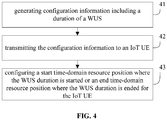
- the present disclosure further provides in some embodiments a WUS duration configuration method which includes: Step 41 of generating configuration information including a duration of a WUS, the WUS being used to wake up an IoT UE, the duration being associated with one or more coverage parameters configured by a network device for the IoT UE; Step 42 of transmitting the configuration information to the IoT UE; and Step 43 of configuring a start time-domain resource position where the acquisition of the WUS is started or an end time-domain resource position where the WUS duration is ended for the IoT UE.
- the start time-domain resource position where the acquisition of the WUS is started or the end time-domain resource position where the WUS duration is ended may be configured for the IoT UE through a broadcast message from the network device or in a pre-configuration manner.
- the IoT UE may start to acquire the WUS at the start time-domain resource position, or stop the acquisition of the WUS at the end time-domain resource position or stop the acquisition of the WUS at L symbols before the end time-domain resource position, where L may be configured by the network device through broadcasting or preset.
- the configuration information including the duration of the WUS may be generated, the WUS may be used to wake up the IoT UE, and the duration may be associated with the one or more coverage parameters configured by the network device for the IoT UE. Then, the configuration information may be transmitted to the IoT UE, and the start time-domain resource position where the acquisition of the WUS is started and the end time-domain resource position where the WUS duration is ended may be configured for the IoT UE, so that the IoT UE may acquire the WUS or stop the acquisition of the WUS in accordance with the configuration information. As a result, it is able for the IoT UE in different coverage ranges to acquire the WUSs with different durations.
- the WUSs with different durations may be configured for the UE, and each duration may be associated with the coverage parameter configured by the network device. In this way, in the case that a set of WUSs has been transmitted by the base station, it is able for the UE in different coverage ranges to acquire the WUSs with different durations.
- the present disclosure further provides in some embodiments a network device, including: a processor configured to generate configuration information including a duration of a WUS, the WUS being used to wake up an IoT UE, the duration being associated with one or more coverage parameters configured by the network device for the IoT UE; and a transceiver configured to transmit the configuration information to the IoT UE.
- a network device including: a processor configured to generate configuration information including a duration of a WUS, the WUS being used to wake up an IoT UE, the duration being associated with one or more coverage parameters configured by the network device for the IoT UE; and a transceiver configured to transmit the configuration information to the IoT UE.
- the duration may be linearly associated with the one or more coverage parameters configured by the network device for the IoT UE.
- the duration may be [A/M]+K, where [] represents a rounding operation including a rounding-up operation or a rounding-down operation, A represents the coverage parameter, K is equal to 0 or a predetermined value other than 0, M represents a predetermined constant.
- the one or more coverage parameters may include maximum number of repetitions of a physical downlink control channel for paging, maximum number of repetitions of a data scheduling control channel, maximum number of repetitions of a control channel for transmitting Msg2 in a random access procedure, and/or maximum number of repetitions of a control channel for transmitting Msg4 in the random access procedure.
- the transceiver is further configured to transmit the configuration information the IoT UE through transmitting indication information to the IoT UE.
- the transceiver is further configured to configure a time interval configuration value between a time point when the WUS duration is ended and a time point when the detection of a physical downlink control channel for paging is started for the IoT UE.
- the transceiver is further configured to: configure the time interval configuration value between the time point when the WUS duration is ended and the time point when the detection of the control channel for the paging signal is started for the IoT UE through a broadcast message from the network device; or configure the time interval configuration value between the time point when the WUS duration is ended and the time point when the detection of the control channel for the paging signal is started for the IoT UE through transmitting indication information to the IoT UE, the indication information carrying the time interval configuration value for the IoT UE; or configure the time interval configuration value between the time point when the WUS duration is ended and the time point when the detection of the control channel for the paging signal is started for the IoT UE in accordance with a preset time interval configuration value between the time point when the WUS duration is ended and the time point when the detection of the control channel for the paging signal is started.
- the transceiver is further configured to configure a start time-domain resource position where the acquisition of the WUS is started or an end time-domain resource position where the WUS duration is ended for the IoT UE.
- the transceiver is further configured to configure the start time-domain resource position where the acquisition of the WUS is started or the end time-domain resource position where the WUS duration is ended for the IoT UE through the broadcast message from the network device or in a pre-configuration manner.
- the network device may be a device corresponding to the above-mentioned method, and it may be a base station or any other device at a network side.
- the implementation of the network device may refer to that of the method mentioned hereinabove, with a same technical effect.
- the present disclosure further provides in some embodiments a WUS monitoring method for an IoT UE, including: receiving configuration information including a duration of a WUS from a network device, the WUS being used to wake up the IoT UE, the duration being associated with one or more coverage parameters configured by a network device for the IoT UE; and monitoring the WUS in accordance with the configuration information.
- the duration may be linearly associated with the one or more coverage parameters configured by the network device for the IoT UE.
- the duration may be [A/M]+K, where [] represents a rounding operation including a rounding-up operation or a rounding-down operation, A represents the coverage parameter, K is equal to 0 or a predetermined value other than 0, M represents a predetermined constant.
- the one or more coverage parameters may include maximum number of repetitions of a physical downlink control channel for paging, maximum number of repetitions of a data scheduling control channel, maximum number of repetitions of a control channel for transmitting Msg2 in a random access procedure, and/or maximum number of repetitions of a control channel for transmitting Msg4 in the random access procedure.
- the receiving the configuration information including the duration of the WUS from the network device may include acquiring the configuration information including the duration of the WUS through receiving indication information from the network device.
- the WUS monitoring method may further include receiving a time interval configuration value between a time point when the WUS duration is ended and a time point when the detection of a physical downlink control channel for paging is started configured by the network device for the IoT UE.
- the receiving the time interval configuration value between the time point when the WUS duration is ended and the time point when the detection of the control channel for the paging signal is started configured by the network device for the IoT UE may include receiving the time interval configuration value between the time point when the WUS duration is ended and the time point when the detection of the control channel for the paging signal is started configured for the IoT UE through receiving a broadcast message from the network device, or receiving indication information from the network device, or in accordance with a preset time interval configuration value between the time point when the WUS duration is ended and the time point when the detection of the control channel for the paging signal is started.
- the WUS monitoring method may further include acquiring a start time-domain resource position where the acquisition of the WUS is started or an end time-domain resource position where the WUS duration is ended configured for the IoT UE.
- the acquiring the start time-domain resource position where the acquisition of the WUS is started or the end time-domain resource position where the WUS duration is ended configured for the IoT UE may include acquiring the start time-domain resource position where the acquisition of the WUS is started or the end time-domain resource position where the WUS duration is ended configured for the IoT UE through the broadcast message from the network device or in a pre-configuration manner.
- the WUS monitoring method may further include: monitoring the WUS from the start time-domain resource position; and/or stopping the acquisition of the WUS at the end time-domain resource position or at L symbols before the end time-domain resource position, where L is configured by the network device through broadcasting or preset.
- the UE may acquire the configuration information, and acquire the WUS in accordance with the configuration information.
- the UE may acquire the configuration information, and acquire the WUS in accordance with the configuration information.
- the present disclosure further provides in some embodiments a UE, including: a transceiver configured to: receive configuration information including a duration of a WUS from a network device, the WUS being used to wake up an IoT UE, the duration being associated with one or more coverage parameters configured by a network device for the IoT UE; and acquire the WUS in accordance with the configuration information.
- a transceiver configured to: receive configuration information including a duration of a WUS from a network device, the WUS being used to wake up an IoT UE, the duration being associated with one or more coverage parameters configured by a network device for the IoT UE; and acquire the WUS in accordance with the configuration information.
- the duration may be linearly associated with the one or more coverage parameters configured by the network device for the IoT UE.
- the duration may be [A/M]+K, where [] represents a rounding operation including a rounding-up operation or a rounding-down operation, A represents the coverage parameter, K is equal to 0 or a predetermined value other than 0, M represents a predetermined constant.
- the one or more coverage parameters may include maximum number of repetitions of a physical downlink control channel for paging, maximum number of repetitions of a data scheduling control channel, maximum number of repetitions of a control channel for transmitting Msg2 in a random access procedure, and/or maximum number of repetitions of a control channel for transmitting Msg4 in the random access procedure.
- the transceiver is further configured to acquire the configuration information including the duration of the WUS through receiving indication information from the network device.
- the transceiver is further configured to receive a time interval configuration value between a time point when the WUS duration is ended and a time point when the detection of a physical downlink control channel for paging is started configured by the network device for the IoT UE.
- the transceiver is further configured to receive the time interval configuration value between the time point when the WUS duration is ended and the time point when the detection of the control channel for the paging signal is started configured for the IoT UE through receiving a broadcast message from the network device, or receiving indication information from the network device, or in accordance with a preset time interval configuration value between the time point when the WUS duration is ended and the time point when the detection of the control channel for the paging signal is started.
- the transceiver is further configured to acquire a start time-domain resource position where the acquisition of the WUS is started or an end time-domain resource position where the WUS duration is ended configured for the IoT UE.
- the transceiver is further configured to acquire the start time-domain resource position where the acquisition of the WUS is started or the end time-domain resource position where the WUS duration is ended configured for the IoT UE through the broadcast message from the network device or in a pre-configuration manner.
- the transceiver is further configured to: acquire the WUS from the start time-domain resource position; and/or stop the acquisition of the WUS at the end time-domain resource position or at L symbols before the end time-domain resource position, where L is configured by the network device through broadcasting or preset.
- the UE may be a device corresponding to the above-mentioned method for the UE, and the implementation of the UE may refer to that of the method mentioned hereinabove, with a same technical effect.
- the present disclosure further provides in some embodiments a communication device, including a processor and a memory storing therein a computer program.
- the processor is configured to execute the computer program so as to implement the above-mentioned WUS duration configuration method or WUS monitoring method.
- the processor may be coupled to the memory via an interface or a bus.
- the communication device may be the above-mentioned network device, e.g., a base station, or the above-mentioned UE, e.g., an IoT UE.
- the present disclosure further provides in some embodiments a computer-readable storage medium storing therein a computer program instruction.
- the computer program instruction is executed by a computer so as to implement the above-mentioned WUS duration configuration method or WUS monitoring method.
- the computer-readable storage medium may be a volatile computer-readable storage medium or a non-volatile computer-readable storage medium, or a transient computer-readable storage medium or a non-transient computer-readable storage medium.
- the WUSs with different durations may be configured for the UE, and each duration may be associated with the coverage parameter configured by the network device.
- each duration may be associated with the coverage parameter configured by the network device.
Landscapes
- Engineering & Computer Science (AREA)
- Computer Networks & Wireless Communication (AREA)
- Signal Processing (AREA)
- Mobile Radio Communication Systems (AREA)
- Telephonic Communication Services (AREA)
- Electric Clocks (AREA)
Abstract
Description
- The present application claims a priority of the Chinese patent application No.
201710713348.9 filed on August 18th, 2017 - The present disclosure relates to the field of communication technology, in particular to a wake-up signal (WUS) duration configuration method, a WUS monitoring method, a network device, and a User Equipment (UE).
- For Internet of Things (IoT) services, a very long stand-by time is required, e.g., two AA batteries are provided so as to enable a UE to be in a standby mode for ten years. As speculated in a conventional Narrow Band-IoT (NB-IoT) standard, the UE may enter a long-term Discontinuous reception (DRX) state, so as to save energy. However, when the UE is in an energy-saving state, its delay for responding to a paging from a base station may increase. For some applications, e.g., bicycle-sharing applications, the user experience may be seriously adversely affected due to an increase in the delay.
- In order to optimize the power consumption for the UE in the case of rapidly responding to the paging from the base station, such a concept as lightweight paging has been proposed in relevant standards, i.e., a lightweight signal (a WUS) is added before the detection of a paging signal. The UE may detect the paging signal subsequently only when the WUS has been detected. A relatively small volume of information is carried in the WUS, so it is able for the WUS to cover a cell merely through transmitting the WUS at few repetition times. In addition, when the UE is in an idle state, actually no paging message is transmitted at most of paging occasions. Hence, through the introduction of the WUS, it is able to remarkably reduce the power consumption for the UE.
- The WUS needs to cover the entire cell, so it needs to be repeated several times. One mode includes directly configuring the repetition times (i.e., time-domain resources) for the WUS, which, however, results in a certain signaling overhead.
- An object of the present disclosure is to provide a WUS duration configuration method, a WUS monitoring method, a network device, and a UE, so as to associate information about a WUS duration with an existing coverage configuration, thereby to enable the UE in different coverage ranges to detect WUSs with different durations.
- In one aspect, the present disclosure provides a WUS duration configuration method, including: generating configuration information including a duration of a WUS, the WUS being used to wake up an IoT UE, the duration being associated with one or more coverage parameters configured by a network device for the IoT UE; and transmitting the configuration information to the IoT UE.
- In some possible embodiments of the present disclosure, the duration is linearly associated with the one or more coverage parameters configured by the network device for the IoT UE.
- In some possible embodiments of the present disclosure, the duration is [A/M]+K, where [] represents a rounding operation including a rounding-up operation or a rounding-down operation, A represents the coverage parameter, K is equal to 0 or a predetermined value other than 0, M represents a predetermined constant.
- In some possible embodiments of the present disclosure, the one or more coverage parameters include maximum number of repetitions of a physical downlink control channel for paging, maximum number of repetitions of a data scheduling control channel, maximum number of repetitions of a control channel for transmitting Msg2 in a random access procedure, and/or maximum number of repetitions of a control channel for transmitting Msg4 in the random access procedure.
- In some possible embodiments of the present disclosure, the transmitting the configuration information to the IoT UE includes transmitting the configuration information to the IoT UE through transmitting indication information to the IoT UE.
- In some possible embodiments of the present disclosure, the WUS duration configuration method further includes configuring a time interval configuration value between a time point when the WUS duration is ended and a time point when the detection of a physical downlink control channel for paging is started for the IoT UE.
- In some possible embodiments of the present disclosure, the configuring the time interval configuration value between the time point when the WUS duration is ended and the time point when the detection of the control channel for the paging signal is started for the IoT UE includes: configuring the time interval configuration value between the time point when the WUS duration is ended and the time point when the detection of the control channel for the paging signal is started for the IoT UE through a broadcast message from the network device; or configuring the time interval configuration value between the time point when the WUS duration is ended and the time point when the detection of the control channel for the paging signal is started for the IoT UE through transmitting indication information to the IoT UE, the indication information carrying the time interval configuration value for the IoT UE; or configuring the time interval configuration value between the time point when the WUS duration is ended and the time point when the detection of the control channel for the paging signal is started for the IoT UE in accordance with a preset time interval configuration value between the time point when the WUS duration is ended and the time point when the detection of the control channel for the paging signal is started.
- In some possible embodiments of the present disclosure, the WUS duration configuration method further includes configuring a start time-domain resource position where the acquisition of the WUS is started or an end time-domain resource position where the WUS duration is ended for the IoT UE.
- In some possible embodiments of the present disclosure, the configuring the start time-domain resource position where the acquisition of the WUS is started or the end time-domain resource position where the WUS duration is ended for the IoT UE includes configuring the start time-domain resource position where the acquisition of the WUS is started or the end time-domain resource position where the WUS duration is ended for the IoT UE through the broadcast message from the network device or in a pre-configuration manner.
- In another aspect, the present disclosure provides in some embodiments a network device, including: a processor configured to generate configuration information including a duration of a WUS, the WUS being used to wake up an IoT UE, the duration being associated with one or more coverage parameters configured by a network device for the IoT UE; and a transceiver configured to transmit the configuration information to the IoT UE.
- In some possible embodiments of the present disclosure, the duration is linearly associated with the one or more coverage parameters configured by the network device for the IoT UE.
- In some possible embodiments of the present disclosure, the duration is [A/M]+K, where [] represents a rounding operation including a rounding-up operation or a rounding-down operation, A represents the coverage parameter, K is equal to 0 or a predetermined value other than 0, M represents a predetermined constant.
- In some possible embodiments of the present disclosure, the one or more coverage parameters include maximum number of repetitions of a physical downlink control channel for paging, maximum number of repetitions of a data scheduling control channel, maximum number of repetitions of a control channel for transmitting Msg2 in a random access procedure, and/or maximum number of repetitions of a control channel for transmitting Msg4 in the random access procedure.
- In some possible embodiments of the present disclosure, the transceiver is further configured to transmit the configuration information the IoT UE through transmitting indication information to the IoT UE.
- In some possible embodiments of the present disclosure, the transceiver is further configured to configure a time interval configuration value between a time point when the WUS duration is ended and a time point when the detection of a physical downlink control channel for paging is started for the IoT UE.
- In some possible embodiments of the present disclosure, the transceiver is further configured to: configure the time interval configuration value between the time point when the WUS duration is ended and the time point when the detection of the control channel for the paging signal is started for the IoT UE through a broadcast message from the network device; or configure the time interval configuration value between the time point when the WUS duration is ended and the time point when the detection of the control channel for the paging signal is started for the IoT UE through transmitting indication information to the IoT UE, the indication information carrying the time interval configuration value for the IoT UE; or configure the time interval configuration value between the time point when the WUS duration is ended and the time point when the detection of the control channel for the paging signal is started for the IoT UE in accordance with a preset time interval configuration value between the time point when the WUS duration is ended and the time point when the detection of the control channel for the paging signal is started.
- In some possible embodiments of the present disclosure, the transceiver is further configured to configure a start time-domain resource position where the acquisition of the WUS is started or an end time-domain resource position where the WUS duration is ended for the IoT UE.
- In some possible embodiments of the present disclosure, the transceiver is further configured to configure the start time-domain resource position where the acquisition of the WUS is started or the end time-domain resource position where the WUS duration is ended for the IoT UE through the broadcast message from the network device or in a pre-configuration manner.
- In yet another aspect, the present disclosure provides in some embodiments a WUS monitoring method, including: receiving configuration information including a duration of a WUS from a network device, the WUS being used to wake up an IoT UE, the duration being associated with one or more coverage parameters configured by a network device for the IoT UE; and monitoring the WUS in accordance with the configuration information.
- In some possible embodiments of the present disclosure, the duration is linearly associated with the one or more coverage parameters configured by the network device for the IoT UE.
- In some possible embodiments of the present disclosure, the duration is [A/M]+K, where [] represents a rounding operation including a rounding-up operation or a rounding-down operation, A represents the coverage parameter, K is equal to 0 or a predetermined value other than 0, M represents a predetermined constant.
- In some possible embodiments of the present disclosure, the one or more coverage parameters include maximum number of repetitions of a physical downlink control channel for paging, maximum number of repetitions of a data scheduling control channel, maximum number of repetitions of a control channel for transmitting Msg2 in a random access procedure, and/or maximum number of repetitions of a control channel for transmitting Msg4 in the random access procedure.
- In some possible embodiments of the present disclosure, the receiving the configuration information including the duration of the WUS from the network device includes acquiring the configuration information including the duration of the WUS through receiving indication information from the network device.
- In some possible embodiments of the present disclosure, the WUS monitoring method further includes receiving a time interval configuration value between a time point when the WUS duration is ended and a time point when the detection of a physical downlink control channel for paging is started configured by the network device for the IoT UE.
- In some possible embodiments of the present disclosure, the receiving the time interval configuration value between the time point when the WUS duration is ended and the time point when the detection of the control channel for the paging signal is started configured by the network device for the IoT UE includes receiving the time interval configuration value between the time point when the WUS duration is ended and the time point when the detection of the control channel for the paging signal is started configured for the IoT UE through receiving a broadcast message from the network device, or receiving indication information from the network device, or in accordance with a preset time interval configuration value between the time point when the WUS duration is ended and the time point when the detection of the control channel for the paging signal is started.
- In some possible embodiments of the present disclosure, the WUS monitoring method further includes acquiring a start time-domain resource position where the acquisition of the WUS is started or an end time-domain resource position where the WUS duration is ended configured for the IoT UE.
- In some possible embodiments of the present disclosure, the acquiring the start time-domain resource position where the acquisition of the WUS is started or the end time-domain resource position where the WUS duration is ended configured for the IoT UE includes acquiring the start time-domain resource position where the acquisition of the WUS is started or the end time-domain resource position where the WUS duration is ended configured for the IoT UE through the broadcast message from the network device or in a pre-configuration manner.
- In some possible embodiments of the present disclosure, the WUS monitoring method further includes: monitoring the WUS from the start time-domain resource position; and/or stopping the acquisition of the WUS at the end time-domain resource position or at L symbols before the end time-domain resource position, where L is configured by the network device through broadcasting or preset.
- In still yet another aspect, the present disclosure provides in some embodiments a UE, including a transceiver configured to: receive configuration information including a duration of a WUS from a network device, the WUS being used to wake up an IoT UE, the duration being associated with one or more coverage parameters configured by a network device for the IoT UE; and acquire the WUS in accordance with the configuration information.
- In some possible embodiments of the present disclosure, the duration is linearly associated with the one or more coverage parameters configured by the network device for the IoT UE.
- In some possible embodiments of the present disclosure, the duration is [A/M]+K, where [] represents a rounding operation including a rounding-up operation or a rounding-down operation, A represents the coverage parameter, K is equal to 0 or a predetermined value other than 0, M represents a predetermined constant.
- In some possible embodiments of the present disclosure, the one or more coverage parameters include maximum number of repetitions of a physical downlink control channel for paging, maximum number of repetitions of a data scheduling control channel, maximum number of repetitions of a control channel for transmitting Msg2 in a random access procedure, and/or maximum number of repetitions of a control channel for transmitting Msg4 in the random access procedure.
- In some possible embodiments of the present disclosure, the transceiver is further configured to acquire the configuration information including the duration of the WUS through receiving indication information from the network device.
- In some possible embodiments of the present disclosure, the transceiver is further configured to receive a time interval configuration value between a time point when the WUS duration is ended and a time point when the detection of a physical downlink control channel for paging is started configured by the network device for the IoT UE.
- In some possible embodiments of the present disclosure, the transceiver is further configured to receive the time interval configuration value between the time point when the WUS duration is ended and the time point when the detection of the control channel for the paging signal is started configured for the IoT UE through receiving a broadcast message from the network device, or receiving indication information from the network device, or in accordance with a preset time interval configuration value between the time point when the WUS duration is ended and the time point when the detection of the control channel for the paging signal is started.
- In some possible embodiments of the present disclosure, the transceiver is further configured to acquire a start time-domain resource position where the acquisition of the WUS is started or an end time-domain resource position where the WUS duration is ended configured for the IoT UE.
- In some possible embodiments of the present disclosure, the transceiver is further configured to acquire the start time-domain resource position where the acquisition of the WUS is started or the end time-domain resource position where the WUS duration is ended configured for the IoT UE through the broadcast message from the network device or in a pre-configuration manner.
- In some possible embodiments of the present disclosure, the transceiver is further configured to: acquire the WUS from the start time-domain resource position; and/or stop the acquisition of the WUS at the end time-domain resource position or at L symbols before the end time-domain resource position, where L is configured by the network device through broadcasting or preset.
- In still yet another aspect, the present disclosure provides in some embodiments a communication device, including a processor and a memory storing therein a computer program. The processor is configured to execute the computer program so as to implement the above-mentioned WUS duration configuration method or WUS monitoring method.
- In still yet another aspect, the present disclosure provides in some embodiments a computer-readable storage medium storing therein a computer program instruction. The computer program instruction is executed by a computer so as to implement the above-mentioned WUS duration configuration method or WUS monitoring method.
- The present disclosure at least has the following beneficial effect. According to the embodiments of the present disclosure, the configuration information including the duration of the WUS may be generated, the WUS may be used to wake up the IoT UE, and the duration may be associated with the one or more coverage parameters configured by the network device for the IoT UE. Then, the configuration information may be transmitted to the IoT UE, so that the IoT UE may acquire the WUS in accordance with the configuration information. As a result, it is able to associate the duration of the WUS with an existing coverage configuration, thereby to enable the UE in different coverage ranges to acquire the WUSs with different durations.
-
-
FIG. 1 is a flow chart of a WUS duration configuration method according to some embodiments of the present disclosure; -
FIG. 2 is another flow chart of the WUS duration configuration method according to some embodiments of the present disclosure; -
FIG. 3 is a schematic view showing a time interval reserved between a time point when the WUS duration is ended and a time point when the detection of a physical downlink control channel for paging is started according to some embodiments of the present disclosure; -
FIG. 4 is another flow chart of the WUS duration configuration method according to some embodiments of the present disclosure; and -
FIG. 5 is a schematic view showing a start time-domain resource position where the acquisition of the WUS is started and an end time-domain resource position where the WUS duration is ended according to some embodiments of the present disclosure. - The present disclosure will be described hereinafter in conjunction with the drawings and embodiments. The following embodiments are for illustrative purposes only, but shall not be used to limit the scope of the present disclosure. Actually, the embodiments are provided so as to facilitate the understanding of the scope of the present disclosure.
- In some embodiments of the present disclosure, a duration of a WUS may be associated with an existing coverage configuration. When a channel is repeated at relatively larger repetition times, it may take a longer time for an IoT UE to acquire the duration of the WUS, and when the channel is repeated at relatively smaller repetition times, it may take a shorter time for the IoT UE to acquire the duration of the WUS.
- In addition, the IoT UE has a relatively low complexity, and after the acquisition of the WUS, it needs to take a certain time period for the IoT UE to perform subsequent signal processing. When the WUS indicating that there is a paging has indeed been detected, the IoT UE may activate the other circuits for the paging. Hence, there is a time interval between an end time-domain resource position where the WUS duration is ended and a time point when the detection of a paging signal is started. A value of the time interval may be configured by a base station, or specified in the standard.
- As shown in
FIG. 1 , the present disclosure provides in some embodiments a WUS duration configuration method for a network device which includes: Step 11 of generating configuration information including a duration of a WUS, the WUS being used to wake up an IoT UE, the duration being associated with one or more coverage parameters configured by the network device for the IoT UE; andStep 12 of transmitting the configuration information to the IoT UE. - According to the embodiments of the present disclosure, the configuration information including the duration of the WUS may be generated, the WUS may be used to wake up the IoT UE, and the duration may be associated with the one or more coverage parameters configured by the network device for the IoT UE. Then, the configuration information may be transmitted to the IoT UE, so that the IoT UE may acquire the WUS in accordance with the configuration information. As a result, it is able to associate the duration of the WUS with an existing coverage configuration, thereby to enable the UE in different coverage ranges to acquire the WUSs with different durations.
- In the embodiments of the present disclosure, the duration may be linearly associated with the one or more coverage parameters configured by the network device for the IoT UE.
- To be specific, the duration may be [A/M]+K, where [] represents a rounding operation including a rounding-up operation or a rounding-down operation, A represents the coverage parameter, K is equal to 0 or a predetermined value other than 0, M represents a predetermined constant.
- The one or more coverage parameters may include maximum number of repetitions of a physical downlink control channel for paging, maximum number of repetitions of a data scheduling control channel, maximum number of repetitions of a control channel for transmitting Msg2 in a random access procedure, and/or maximum number of repetitions of a control channel for transmitting Msg4 in the random access procedure.
- As shown in
FIG. 2 , the present disclosure further provides in some embodiments a WUS duration configuration method for a network device which includes: Step 21 of generating configuration information including a duration of a WUS, the WUS being used to wake up an IoT UE, the duration being associated with one or more coverage parameters configured by the network device for the IoT UE; Step 22 of transmitting the configuration information to the IoT UE; andStep 23 of configuring a time interval configuration value between a time point when time-domain resources for monitoring the WUS are ended and a time point when the detection of a physical downlink control channel for paging is started for the IoT UE. - To be specific,
Step 23 may include: Step 231 of configuring the time interval configuration value between the time point when the time-domain resources for monitoring the WUS are ended and the time point when the detection of the control channel for the paging signal is started for the IoT UE through a broadcast message from the network device; or Step 232 of configuring the time interval configuration value between the time point when the time-domain resources for monitoring the WUS are ended and the time point when the detection of the control channel for the paging signal is started for the IoT UE through transmitting indication information to the IoT UE, the indication information carrying the time interval configuration value for the IoT UE; or Step 233 of configuring the time interval configuration value between the time point when the time-domain resources for monitoring the WUS are ended and the time point when the detection of the control channel for the paging signal is started for the IoT UE in accordance with a preset time interval configuration value between the time point when the WUS duration is ended and the time point when the detection of the control channel for the paging signal is started. - To be specific, as shown in
FIG. 3 , there is a time interval between the time point when the time-domain resources for monitoring the WUS are ended and the time point when the detection of the control channel for the paging signal is started. A specific value of the time interval may be broadcast by a base station and configured at a cell level, or configured by the base station at an UE level, or specified in the standard. - According to the embodiments of the present disclosure, the configuration information including the duration of the WUS may be generated, the WUS may be used to wake up the IoT UE, and the duration may be associated with the one or more coverage parameters configured by the network device for the IoT UE. Then, the configuration information may be transmitted to the IoT UE, and the time interval configuration value between the time point when the time-domain resources for monitoring the WUS are ended and the time point when the detection of the control channel for the paging signal is started may be configured for the IoT UE, so that the IoT UE may acquire the WUS in accordance with the configuration information. In addition, after the acquisition of the WUS, it needs to take a certain time period for the IoT UE to perform subsequent signal processing. When the WUS indicating that there is a paging has indeed been detected, the IoT UE may activate the other circuits for the paging. As a result, it is able to associate the duration of the WUS with an existing coverage configuration, thereby to enable the UE in different coverage ranges to acquire the WUSs with different durations.
- As shown in
FIG. 4 , the present disclosure further provides in some embodiments a WUS duration configuration method which includes: Step 41 of generating configuration information including a duration of a WUS, the WUS being used to wake up an IoT UE, the duration being associated with one or more coverage parameters configured by a network device for the IoT UE; Step 42 of transmitting the configuration information to the IoT UE; andStep 43 of configuring a start time-domain resource position where the acquisition of the WUS is started or an end time-domain resource position where the WUS duration is ended for the IoT UE. - To be specific, as shown in
FIG. 5 , the start time-domain resource position where the acquisition of the WUS is started or the end time-domain resource position where the WUS duration is ended may be configured for the IoT UE through a broadcast message from the network device or in a pre-configuration manner. In some possible embodiments of the present disclosure, the IoT UE may start to acquire the WUS at the start time-domain resource position, or stop the acquisition of the WUS at the end time-domain resource position or stop the acquisition of the WUS at L symbols before the end time-domain resource position, where L may be configured by the network device through broadcasting or preset. - According to the embodiments of the present disclosure, the configuration information including the duration of the WUS may be generated, the WUS may be used to wake up the IoT UE, and the duration may be associated with the one or more coverage parameters configured by the network device for the IoT UE. Then, the configuration information may be transmitted to the IoT UE, and the start time-domain resource position where the acquisition of the WUS is started and the end time-domain resource position where the WUS duration is ended may be configured for the IoT UE, so that the IoT UE may acquire the WUS or stop the acquisition of the WUS in accordance with the configuration information. As a result, it is able for the IoT UE in different coverage ranges to acquire the WUSs with different durations.
- As mentioned above, the WUSs with different durations may be configured for the UE, and each duration may be associated with the coverage parameter configured by the network device. In this way, in the case that a set of WUSs has been transmitted by the base station, it is able for the UE in different coverage ranges to acquire the WUSs with different durations.
- The present disclosure further provides in some embodiments a network device, including: a processor configured to generate configuration information including a duration of a WUS, the WUS being used to wake up an IoT UE, the duration being associated with one or more coverage parameters configured by the network device for the IoT UE; and a transceiver configured to transmit the configuration information to the IoT UE.
- In some possible embodiments of the present disclosure, the duration may be linearly associated with the one or more coverage parameters configured by the network device for the IoT UE.
- In some possible embodiments of the present disclosure, the duration may be [A/M]+K, where [] represents a rounding operation including a rounding-up operation or a rounding-down operation, A represents the coverage parameter, K is equal to 0 or a predetermined value other than 0, M represents a predetermined constant.
- In some possible embodiments of the present disclosure, the one or more coverage parameters may include maximum number of repetitions of a physical downlink control channel for paging, maximum number of repetitions of a data scheduling control channel, maximum number of repetitions of a control channel for transmitting Msg2 in a random access procedure, and/or maximum number of repetitions of a control channel for transmitting Msg4 in the random access procedure.
- In some possible embodiments of the present disclosure, the transceiver is further configured to transmit the configuration information the IoT UE through transmitting indication information to the IoT UE.
- In some possible embodiments of the present disclosure, the transceiver is further configured to configure a time interval configuration value between a time point when the WUS duration is ended and a time point when the detection of a physical downlink control channel for paging is started for the IoT UE.
- In some possible embodiments of the present disclosure, the transceiver is further configured to: configure the time interval configuration value between the time point when the WUS duration is ended and the time point when the detection of the control channel for the paging signal is started for the IoT UE through a broadcast message from the network device; or configure the time interval configuration value between the time point when the WUS duration is ended and the time point when the detection of the control channel for the paging signal is started for the IoT UE through transmitting indication information to the IoT UE, the indication information carrying the time interval configuration value for the IoT UE; or configure the time interval configuration value between the time point when the WUS duration is ended and the time point when the detection of the control channel for the paging signal is started for the IoT UE in accordance with a preset time interval configuration value between the time point when the WUS duration is ended and the time point when the detection of the control channel for the paging signal is started.
- In some possible embodiments of the present disclosure, the transceiver is further configured to configure a start time-domain resource position where the acquisition of the WUS is started or an end time-domain resource position where the WUS duration is ended for the IoT UE.
- In some possible embodiments of the present disclosure, the transceiver is further configured to configure the start time-domain resource position where the acquisition of the WUS is started or the end time-domain resource position where the WUS duration is ended for the IoT UE through the broadcast message from the network device or in a pre-configuration manner.
- In the embodiments of the present disclosure, the network device may be a device corresponding to the above-mentioned method, and it may be a base station or any other device at a network side. The implementation of the network device may refer to that of the method mentioned hereinabove, with a same technical effect.
- The present disclosure further provides in some embodiments a WUS monitoring method for an IoT UE, including: receiving configuration information including a duration of a WUS from a network device, the WUS being used to wake up the IoT UE, the duration being associated with one or more coverage parameters configured by a network device for the IoT UE; and monitoring the WUS in accordance with the configuration information.
- In some possible embodiments of the present disclosure, the duration may be linearly associated with the one or more coverage parameters configured by the network device for the IoT UE.
- In some possible embodiments of the present disclosure, the duration may be [A/M]+K, where [] represents a rounding operation including a rounding-up operation or a rounding-down operation, A represents the coverage parameter, K is equal to 0 or a predetermined value other than 0, M represents a predetermined constant.
- In some possible embodiments of the present disclosure, the one or more coverage parameters may include maximum number of repetitions of a physical downlink control channel for paging, maximum number of repetitions of a data scheduling control channel, maximum number of repetitions of a control channel for transmitting Msg2 in a random access procedure, and/or maximum number of repetitions of a control channel for transmitting Msg4 in the random access procedure.
- In some possible embodiments of the present disclosure, the receiving the configuration information including the duration of the WUS from the network device may include acquiring the configuration information including the duration of the WUS through receiving indication information from the network device.
- In some possible embodiments of the present disclosure, the WUS monitoring method may further include receiving a time interval configuration value between a time point when the WUS duration is ended and a time point when the detection of a physical downlink control channel for paging is started configured by the network device for the IoT UE.
- In some possible embodiments of the present disclosure, the receiving the time interval configuration value between the time point when the WUS duration is ended and the time point when the detection of the control channel for the paging signal is started configured by the network device for the IoT UE may include receiving the time interval configuration value between the time point when the WUS duration is ended and the time point when the detection of the control channel for the paging signal is started configured for the IoT UE through receiving a broadcast message from the network device, or receiving indication information from the network device, or in accordance with a preset time interval configuration value between the time point when the WUS duration is ended and the time point when the detection of the control channel for the paging signal is started.
- In some possible embodiments of the present disclosure, the WUS monitoring method may further include acquiring a start time-domain resource position where the acquisition of the WUS is started or an end time-domain resource position where the WUS duration is ended configured for the IoT UE.
- In some possible embodiments of the present disclosure, the acquiring the start time-domain resource position where the acquisition of the WUS is started or the end time-domain resource position where the WUS duration is ended configured for the IoT UE may include acquiring the start time-domain resource position where the acquisition of the WUS is started or the end time-domain resource position where the WUS duration is ended configured for the IoT UE through the broadcast message from the network device or in a pre-configuration manner.
- In some possible embodiments of the present disclosure, the WUS monitoring method may further include: monitoring the WUS from the start time-domain resource position; and/or stopping the acquisition of the WUS at the end time-domain resource position or at L symbols before the end time-domain resource position, where L is configured by the network device through broadcasting or preset.
- According to the embodiments of the present disclosure, the UE may acquire the configuration information, and acquire the WUS in accordance with the configuration information. As a result, in the case that a set of WUSs have been transmitted by the base station, it is able for the UE in different coverage ranges to acquire the WUSs with different durations.
- The present disclosure further provides in some embodiments a UE, including: a transceiver configured to: receive configuration information including a duration of a WUS from a network device, the WUS being used to wake up an IoT UE, the duration being associated with one or more coverage parameters configured by a network device for the IoT UE; and acquire the WUS in accordance with the configuration information.
- In some possible embodiments of the present disclosure, the duration may be linearly associated with the one or more coverage parameters configured by the network device for the IoT UE.
- In some possible embodiments of the present disclosure, the duration may be [A/M]+K, where [] represents a rounding operation including a rounding-up operation or a rounding-down operation, A represents the coverage parameter, K is equal to 0 or a predetermined value other than 0, M represents a predetermined constant.
- In some possible embodiments of the present disclosure, the one or more coverage parameters may include maximum number of repetitions of a physical downlink control channel for paging, maximum number of repetitions of a data scheduling control channel, maximum number of repetitions of a control channel for transmitting Msg2 in a random access procedure, and/or maximum number of repetitions of a control channel for transmitting Msg4 in the random access procedure.
- In some possible embodiments of the present disclosure, the transceiver is further configured to acquire the configuration information including the duration of the WUS through receiving indication information from the network device.
- In some possible embodiments of the present disclosure, the transceiver is further configured to receive a time interval configuration value between a time point when the WUS duration is ended and a time point when the detection of a physical downlink control channel for paging is started configured by the network device for the IoT UE.
- In some possible embodiments of the present disclosure, the transceiver is further configured to receive the time interval configuration value between the time point when the WUS duration is ended and the time point when the detection of the control channel for the paging signal is started configured for the IoT UE through receiving a broadcast message from the network device, or receiving indication information from the network device, or in accordance with a preset time interval configuration value between the time point when the WUS duration is ended and the time point when the detection of the control channel for the paging signal is started.
- In some possible embodiments of the present disclosure, the transceiver is further configured to acquire a start time-domain resource position where the acquisition of the WUS is started or an end time-domain resource position where the WUS duration is ended configured for the IoT UE.
- In some possible embodiments of the present disclosure, the transceiver is further configured to acquire the start time-domain resource position where the acquisition of the WUS is started or the end time-domain resource position where the WUS duration is ended configured for the IoT UE through the broadcast message from the network device or in a pre-configuration manner.
- In some possible embodiments of the present disclosure, the transceiver is further configured to: acquire the WUS from the start time-domain resource position; and/or stop the acquisition of the WUS at the end time-domain resource position or at L symbols before the end time-domain resource position, where L is configured by the network device through broadcasting or preset.
- In the embodiments of the present disclosure, the UE may be a device corresponding to the above-mentioned method for the UE, and the implementation of the UE may refer to that of the method mentioned hereinabove, with a same technical effect.
- The present disclosure further provides in some embodiments a communication device, including a processor and a memory storing therein a computer program. The processor is configured to execute the computer program so as to implement the above-mentioned WUS duration configuration method or WUS monitoring method. The processor may be coupled to the memory via an interface or a bus. The communication device may be the above-mentioned network device, e.g., a base station, or the above-mentioned UE, e.g., an IoT UE.
- The present disclosure further provides in some embodiments a computer-readable storage medium storing therein a computer program instruction. The computer program instruction is executed by a computer so as to implement the above-mentioned WUS duration configuration method or WUS monitoring method.
- The computer-readable storage medium may be a volatile computer-readable storage medium or a non-volatile computer-readable storage medium, or a transient computer-readable storage medium or a non-transient computer-readable storage medium.
- According to the embodiments of the present disclosure, the WUSs with different durations may be configured for the UE, and each duration may be associated with the coverage parameter configured by the network device. As a result, in the case that a set of WUSs have been transmitted by the base station, it is able for the UE in different coverage ranges to acquire the WUSs with different durations.
- The above embodiments are for illustrative purposes only, but the present disclosure is not limited thereto. Obviously, a person skilled in the art may make further modifications and improvements without departing from the spirit of the present disclosure, and these modifications and improvements shall also fall within the scope of the present disclosure.
Claims (40)
- A Wake-Up Signal (WUS) duration configuration method, comprising:generating configuration information comprising a duration of a WUS, the WUS being used to wake up an Internet of Things (IoT) User Equipment (UE), the duration being associated with one or more coverage parameters configured by a network device for the IoT UE; andtransmitting the configuration information to the IoT UE.
- The WUS duration configuration method according to claim 1, wherein the duration is linearly associated with the one or more coverage parameters configured by the network device for the IoT UE.
- The WUS duration configuration method according to claim 2, wherein the duration is [A/M]+K, where [] represents a rounding operation comprising a rounding-up operation or a rounding-down operation, A represents the coverage parameter, K is equal to 0 or a predetermined value other than 0, M represents a predetermined constant.
- The WUS duration configuration method according to any one of claims 1 to 3, wherein the one or more coverage parameters comprise maximum number of repetitions of a physical downlink control channel for paging, maximum number of repetitions of a data scheduling control channel, maximum number of repetitions of a control channel for transmitting Msg2 in a random access procedure, and/or maximum number of repetitions of a control channel for transmitting Msg4 in the random access procedure.
- The WUS duration configuration method according to claim 1, wherein the transmitting the configuration information to the IoT UE comprises:
transmitting the configuration information to the IoT UE through transmitting indication information to the IoT UE. - The WUS duration configuration method according to claim 1, further comprising:
configuring a time interval configuration value between a time point when the WUS duration is ended and a time point when the detection of a physical downlink control channel for paging is started for the IoT UE. - The WUS duration configuration method according to claim 6, wherein the configuring the time interval configuration value between the time point when the WUS duration is ended and the time point when the detection of the control channel for the paging signal is started for the IoT UE comprises:configuring the time interval configuration value between the time point when the WUS duration is ended and the time point when the detection of the control channel for the paging signal is started for the IoT UE through a broadcast message from the network device; orconfiguring the time interval configuration value between the time point when the WUS duration is ended and the time point when the detection of the control channel for the paging signal is started for the IoT UE through transmitting indication information to the IoT UE, the indication information carrying the time interval configuration value for the IoT UE; orconfiguring the time interval configuration value between the time point when the WUS duration is ended and the time point when the detection of the control channel for the paging signal is started for the IoT UE in accordance with a preset time interval configuration value between the time point when the WUS duration is ended and the time point when the detection of the control channel for the paging signal is started.
- The WUS duration configuration method according to claim 1, further comprising:
a start time-domain resource position where the acquisition of the WUS is started or an end time-domain resource position where the WUS duration is ended for the IoT UE. - The WUS duration configuration method according to claim 8, wherein the configuring the start time-domain resource position where the acquisition of the WUS is started or the end time-domain resource position where the WUS duration is ended for the IoT UE comprises:
configuring the start time-domain resource position where the acquisition of the WUS is started or the end time-domain resource position where the WUS duration is ended for the IoT UE through the broadcast message from the network device or in a pre-configuration manner. - A network device, comprising:a processor configured to generate configuration information comprising a duration of a WUS, the WUS being used to wake up an IoT UE, the duration being associated with one or more coverage parameters configured by a network device for the IoT UE; anda transceiver configured to transmit the configuration information to the IoT UE.
- The network device according to claim 10, wherein the duration is linearly associated with the one or more coverage parameters configured by the network device for the IoT UE.
- The network device according to claim 11, wherein the duration is [A/M]+K, where [] represents a rounding operation comprising a rounding-up operation or a rounding-down operation, A represents the coverage parameter, K is equal to 0 or a predetermined value other than 0, M represents a predetermined constant.
- The network device according to any one of claims 10 to 12, wherein the one or more coverage parameters comprise maximum number of repetitions of a physical downlink control channel for paging, maximum number of repetitions of a data scheduling control channel, maximum number of repetitions of a control channel for transmitting Msg2 in a random access procedure, and/or maximum number of repetitions of a control channel for transmitting Msg4 in the random access procedure.
- The network device according to claim 10, wherein the transceiver is further configured to transmit the configuration information the IoT UE through transmitting indication information to the IoT UE.
- The network device according to claim 10, wherein the transceiver is further configured to configure a time interval configuration value between a time point when the WUS duration is ended and a time point when the detection of a physical downlink control channel for paging is started for the IoT UE.
- The network device according to claim 15, wherein the transceiver is further configured to:configure the time interval configuration value between the time point when the WUS duration is ended and the time point when the detection of the control channel for the paging signal is started for the IoT UE through a broadcast message from the network device; orconfigure the time interval configuration value between the time point when the WUS duration is ended and the time point when the detection of the control channel for the paging signal is started for the IoT UE through transmitting indication information to the IoT UE, the indication information carrying the time interval configuration value for the IoT UE; orconfigure the time interval configuration value between the time point when the WUS duration is ended and the time point when the detection of the control channel for the paging signal is started for the IoT UE in accordance with a preset time interval configuration value between the time point when the WUS duration is ended and the time point when the detection of the control channel for the paging signal is started.
- The network device according to claim 10, wherein the transceiver is further configured to configure a start time-domain resource position where the acquisition of the WUS is started or an end time-domain resource position where the WUS duration is ended for the IoT UE.
- The network device according to claim 17, wherein the transceiver is further configured to configure the start time-domain resource position where the acquisition of the WUS is started or the end time-domain resource position where the WUS duration is ended for the IoT UE through the broadcast message from the network device or in a pre-configuration manner.
- A Wake-Up Signal (WUS) monitoring method, comprising:receiving configuration information comprising a duration of a WUS from a network device, the WUS being used to wake up an IoT UE, the duration being associated with one or more coverage parameters configured by a network device for the IoT UE; andmonitoring the WUS in accordance with the configuration information.
- The WUS monitoring method according to claim 19, wherein the duration is linearly associated with the one or more coverage parameters configured by the network device for the IoT UE.
- The WUS monitoring method according to claim 20, wherein the duration is [A/M]+K, where [] represents a rounding operation comprising a rounding-up operation or a rounding-down operation, A represents the coverage parameter, K is equal to 0 or a predetermined value other than 0, M represents a predetermined constant.
- The WUS monitoring method according to any one of claims 19 to 21, wherein the one or more coverage parameters comprise maximum number of repetitions of a physical downlink control channel for paging, maximum number of repetitions of a data scheduling control channel, maximum number of repetitions of a control channel for transmitting Msg2 in a random access procedure, and/or maximum number of repetitions of a control channel for transmitting Msg4 in the random access procedure.
- The WUS monitoring method according to claim 19, wherein the receiving the configuration information comprising the duration of the WUS from the network device comprises:
acquiring the configuration information comprising the duration of the WUS through receiving indication information from the network device. - The WUS monitoring method according to claim 19, further comprising:
receiving a time interval configuration value between a time point when the WUS duration is ended and a time point when the detection of a physical downlink control channel for paging is started, wherein the time interval value is configured by the network device for the IoT UE. - The WUS monitoring method according to claim 24, wherein the receiving the time interval configuration value between the time point when the WUS duration is ended and the time point when the detection of the control channel for the paging signal is started, wherein the time interval value is configured by the network device for the IoT UE comprises:
receiving the time interval configuration value between the time point when the WUS duration is ended and the time point when the detection of the control channel for the paging signal is started configured for the IoT UE through receiving a broadcast message from the network device, or receiving indication information from the network device, or in accordance with a preset time interval configuration value between the time point when the WUS duration is ended and the time point when the detection of the control channel for the paging signal is started. - The WUS monitoring method according to claim 19, further comprising:
acquiring a start time-domain resource position where the acquisition of the WUS is started or an end time-domain resource position where the WUS duration is ended configured for the IoT UE. - The WUS monitoring method according to claim 26, wherein the acquiring the start time-domain resource position where the acquisition of the WUS is started or the end time-domain resource position where the WUS duration is ended configured for the IoT UE comprises:
acquiring the start time-domain resource position where the acquisition of the WUS is started or the end time-domain resource position where the WUS duration is ended configured for the IoT UE through the broadcast message from the network device or in a pre-configuration manner. - The WUS monitoring method according to claim 27, further comprising:monitoring the WUS from the start time-domain resource position; and/orstopping the acquisition of the WUS at the end time-domain resource position or at L symbols before the end time-domain resource position, where L is configured by the network device through broadcasting or preset.
- A User Equipment (UE), comprising:
a transceiver configured to: receive configuration information comprising a duration of a WUS from a network device, the WUS being used to wake up an IoT UE, the duration being associated with one or more coverage parameters configured by a network device for the IoT UE; and acquire the WUS in accordance with the configuration information. - The UE according to claim 29, wherein the duration is linearly associated with the one or more coverage parameters configured by the network device for the IoT UE.
- The UE according to claim 30, wherein the duration is [A/M]+K, where [] represents a rounding operation comprising a rounding-up operation or a rounding-down operation, A represents the coverage parameter, K is equal to 0 or a predetermined value other than 0, M represents a predetermined constant.
- The UE according to any one of claims 29 to 31, wherein the one or more coverage parameters comprise maximum number of repetitions of a physical downlink control channel for paging, maximum number of repetitions of a data scheduling control channel, maximum number of repetitions of a control channel for transmitting Msg2 in a random access procedure, and/or maximum number of repetitions of a control channel for transmitting Msg4 in the random access procedure.
- The UE according to claim 29, wherein the transceiver is further configured to acquire the configuration information comprising the duration of the WUS through receiving indication information from the network device.
- The UE according to claim 29, wherein the transceiver is further configured to receive a time interval configuration value between a time point when the WUS duration is ended and a time point when the detection of a physical downlink control channel for paging is started, wherein the time interval value is configured by the network device for the IoT UE.
- The UE according to claim 34, wherein the transceiver is further configured to receive the time interval configuration value between the time point when the WUS duration is ended and the time point when the detection of the control channel for the paging signal is started configured for the IoT UE through receiving a broadcast message from the network device, or receiving indication information from the network device, or in accordance with a preset time interval configuration value between the time point when the WUS duration is ended and the time point when the detection of the control channel for the paging signal is started.
- The UE according to claim 29, wherein the transceiver is further configured to acquire a start time-domain resource position where the acquisition of the WUS is started or an end time-domain resource position where the WUS duration is ended configured for the IoT UE.
- The UE according to claim 36, wherein the transceiver is further configured to acquire the start time-domain resource position where the acquisition of the WUS is started or the end time-domain resource position where the WUS duration is ended configured for the IoT UE through the broadcast message from the network device or in a pre-configuration manner.
- The UE according to claim 37, wherein the transceiver is further configured to: acquire the WUS from the start time-domain resource position; and/or stop the acquisition of the WUS at the end time-domain resource position or at L symbols before the end time-domain resource position, where L is configured by the network device through broadcasting or preset.
- A communication device, comprising a processor and a memory storing therein a computer program, wherein the processor is configured to execute the computer program so as to implement the WUS duration configuration method according to any one of claims 1 to 9 or the WUS monitoring method according to any one of claims 19 to 28.
- A computer-readable storage medium storing therein a computer program instruction, wherein the computer program instruction is executed by a computer so as to implement the WUS duration configuration method according to any one of claims 1 to 9 or the WUS monitoring method according to any one of claims 19 to 28.
Applications Claiming Priority (2)
| Application Number | Priority Date | Filing Date | Title |
|---|---|---|---|
| CN201710713348.9A CN109413721B (en) | 2017-08-18 | 2017-08-18 | Configuration and detection method of wake-up signal detection time, network equipment and terminal |
| PCT/CN2018/097377 WO2019033916A1 (en) | 2017-08-18 | 2018-07-27 | Method for configuring duration of wake-up signal, acquisition method, network device, and terminal |
Publications (3)
| Publication Number | Publication Date |
|---|---|
| EP3672313A1 true EP3672313A1 (en) | 2020-06-24 |
| EP3672313A4 EP3672313A4 (en) | 2021-04-28 |
| EP3672313B1 EP3672313B1 (en) | 2025-10-15 |
Family
ID=65362673
Family Applications (1)
| Application Number | Title | Priority Date | Filing Date |
|---|---|---|---|
| EP18847062.9A Active EP3672313B1 (en) | 2017-08-18 | 2018-07-27 | Method for configuring duration of wake-up signal, acquisition method, network device, and terminal |
Country Status (5)
| Country | Link |
|---|---|
| US (1) | US20200205079A1 (en) |
| EP (1) | EP3672313B1 (en) |
| KR (1) | KR102345874B1 (en) |
| CN (1) | CN109413721B (en) |
| WO (1) | WO2019033916A1 (en) |
Cited By (2)
| Publication number | Priority date | Publication date | Assignee | Title |
|---|---|---|---|---|
| EP3691344A4 (en) * | 2017-09-25 | 2021-06-23 | LG Electronics Inc. | Method and wireless device for monitoring downlink channel or downlink signal using power saving signal |
| EP4102896A4 (en) * | 2020-02-07 | 2023-07-19 | Datang Mobile Communications Equipment Co., Ltd. | SIGNAL TRANSMISSION METHOD AND DEVICE |
Families Citing this family (16)
| Publication number | Priority date | Publication date | Assignee | Title |
|---|---|---|---|---|
| CN110557814B (en) * | 2018-06-04 | 2021-02-23 | 电信科学技术研究院有限公司 | Awakening area updating method and device |
| CN112567819B (en) * | 2018-08-09 | 2024-08-30 | Lg电子株式会社 | Method for transmitting WUS in wireless communication system and apparatus therefor |
| CN110536230A (en) * | 2018-09-28 | 2019-12-03 | 中兴通讯股份有限公司 | Wake-up signal sending and receiving method, device, base station, terminal and storage medium |
| AU2019445801A1 (en) * | 2019-05-10 | 2022-01-06 | Nokia Technologies Oy | Wake-up signal monitoring indication |
| WO2021012281A1 (en) * | 2019-07-25 | 2021-01-28 | 北京小米移动软件有限公司 | Wake-up signal alteration processing method and monitoring method, communication device and storage medium |
| US11533685B2 (en) * | 2019-08-16 | 2022-12-20 | Qualcomm Incorporated | Wake-up behavior indication for power saving |
| WO2021030974A1 (en) * | 2019-08-16 | 2021-02-25 | 北京小米移动软件有限公司 | Paging configuration method and apparatus, communication device, and storage medium |
| WO2021062792A1 (en) * | 2019-09-30 | 2021-04-08 | 华为技术有限公司 | Wakeup signal monitoring method and apparatus |
| CN116325951A (en) * | 2020-07-23 | 2023-06-23 | Tcl通讯(宁波)有限公司 | Wake-up Signals in Cellular Systems |
| JP7692664B2 (en) * | 2021-10-19 | 2025-06-16 | インターデイジタル パテント ホールディングス インコーポレイテッド | Method for positioning delegation - Patents.com |
| CN116506925B (en) * | 2022-01-19 | 2026-04-17 | 维沃移动通信有限公司 | Configuration determination method, device, terminal and network-side equipment |
| CN116781221B (en) * | 2022-03-11 | 2026-01-27 | 维沃移动通信有限公司 | Wake-up signal receiving method and device, terminal and network side equipment |
| WO2024168769A1 (en) * | 2023-02-16 | 2024-08-22 | 北京小米移动软件有限公司 | Wake-up signal transmission method and apparatus |
| CN119521244A (en) * | 2023-08-10 | 2025-02-25 | 展讯通信(上海)有限公司 | Communication method and device, network equipment and terminal equipment |
| CN120475480A (en) * | 2024-02-08 | 2025-08-12 | 大唐移动通信设备有限公司 | Low-power wake-up signal transmission method, device and equipment |
| WO2025171516A1 (en) * | 2024-02-14 | 2025-08-21 | Qualcomm Incorporated | Unsynchronized ambient internet-of-things communication |
Family Cites Families (17)
| Publication number | Priority date | Publication date | Assignee | Title |
|---|---|---|---|---|
| US20040176147A1 (en) * | 2003-03-06 | 2004-09-09 | Wilberth Escalante | Power conservation in a mobile communication device utilizing variable reacquisition time in a discontinuous reception regime |
| US9445253B2 (en) * | 2008-04-30 | 2016-09-13 | Maarten Menzo Wentink | Methods and apparatus for scanning for mesh nodes |
| US8447368B2 (en) * | 2008-11-13 | 2013-05-21 | Lantiq Deutschland Gmbh | Base station, method of operating a base station and wireless communication system |
| US8452311B1 (en) * | 2008-12-30 | 2013-05-28 | Marvell International Ltd. | Sleep estimator for cellular telephones |
| CN101946538B (en) * | 2009-05-18 | 2013-08-07 | 华为技术有限公司 | Method and terminal for monitoring network |
| US8792532B2 (en) * | 2011-02-01 | 2014-07-29 | Qualcomm Incorporated | Time-shared and concurrent multi-protocol beacon transmission design |
| US8804589B2 (en) * | 2011-10-14 | 2014-08-12 | Nokia Corporation | Adaptive awake window |
| US9402273B2 (en) * | 2013-12-23 | 2016-07-26 | Qualcomm Incorporated | DRX wakeup rule in an eICIC environment |
| CN106605431A (en) * | 2015-04-17 | 2017-04-26 | 华为技术有限公司 | Communication cycle configuration method and device |
| US9749955B2 (en) * | 2015-07-20 | 2017-08-29 | Intel Corporation | Connectivity management for mobile wireless low-power wake-up radios |
| CN105554863B (en) * | 2015-12-11 | 2018-10-16 | 上海纵行实业有限公司 | A kind of low power loss communication method and network based on paging |
| CN106900000B (en) * | 2015-12-18 | 2020-01-31 | 上海无线通信研究中心 | Hybrid monitoring sleep method of wireless sensor and wireless sensor |
| CN106937368A (en) * | 2015-12-31 | 2017-07-07 | 深圳友讯达科技股份有限公司 | Low-power communication node secondary wake-up/sleep method, node and system |
| US9992741B2 (en) * | 2016-01-11 | 2018-06-05 | Intel IP Corporation | Device and method of providing grant frame for bandwidth scheduling |
| US10841876B2 (en) * | 2017-05-15 | 2020-11-17 | Qualcomm Incorporated | Wake-up signal (WUS) and wake-up receiver (WUR) in a communication device |
| US10959175B2 (en) * | 2017-12-21 | 2021-03-23 | Qualcomm Incorporated | Wake up signal configurations for wireless communications |
| WO2019168455A1 (en) * | 2018-02-27 | 2019-09-06 | Telefonaktiebolaget Lm Ericsson (Publ) | Configuration of wake-up signal maximum transmission lengths |
-
2017
- 2017-08-18 CN CN201710713348.9A patent/CN109413721B/en active Active
-
2018
- 2018-07-27 US US16/639,772 patent/US20200205079A1/en not_active Abandoned
- 2018-07-27 EP EP18847062.9A patent/EP3672313B1/en active Active
- 2018-07-27 KR KR1020207007844A patent/KR102345874B1/en active Active
- 2018-07-27 WO PCT/CN2018/097377 patent/WO2019033916A1/en not_active Ceased
Cited By (3)
| Publication number | Priority date | Publication date | Assignee | Title |
|---|---|---|---|---|
| EP3691344A4 (en) * | 2017-09-25 | 2021-06-23 | LG Electronics Inc. | Method and wireless device for monitoring downlink channel or downlink signal using power saving signal |
| US11290995B2 (en) | 2017-09-25 | 2022-03-29 | Lg Electronics Inc. | Method and wireless device for monitoring downlink channel or downlink signal using power saving signal |
| EP4102896A4 (en) * | 2020-02-07 | 2023-07-19 | Datang Mobile Communications Equipment Co., Ltd. | SIGNAL TRANSMISSION METHOD AND DEVICE |
Also Published As
| Publication number | Publication date |
|---|---|
| EP3672313B1 (en) | 2025-10-15 |
| US20200205079A1 (en) | 2020-06-25 |
| CN109413721B (en) | 2021-01-15 |
| EP3672313A4 (en) | 2021-04-28 |
| KR20200038994A (en) | 2020-04-14 |
| CN109413721A (en) | 2019-03-01 |
| WO2019033916A1 (en) | 2019-02-21 |
| KR102345874B1 (en) | 2021-12-31 |
Similar Documents
| Publication | Publication Date | Title |
|---|---|---|
| EP3672313B1 (en) | Method for configuring duration of wake-up signal, acquisition method, network device, and terminal | |
| US11751136B2 (en) | Power optimization method and device, system, and user equipment | |
| WO2022206970A1 (en) | Transmission processing method, and terminal and network side device | |
| US11924762B2 (en) | Information sending method, information receiving method, network device and terminal | |
| CN103974391A (en) | Device wake-up method and device | |
| CN111586812A (en) | Method for receiving energy-saving signal by terminal and terminal | |
| US20160014697A1 (en) | Low Power Based LTE Receiver Architecture | |
| CN117082599A (en) | Wake-up signal transmission method, device, UE, network side equipment and medium | |
| KR20230088786A (en) | Measurement adjustment method and terminal | |
| WO2023217092A1 (en) | Monitoring method and apparatus, terminal, network side device, and readable storage medium | |
| KR20210006449A (en) | PDCCH blind detection method, terminal and network side equipment | |
| CN110876189A (en) | Information transmission method, network equipment and terminal | |
| EP4387340A1 (en) | Method and apparatus for information monitoring | |
| CN110896558A (en) | Working mode switching method, terminal and network equipment | |
| CN114124322A (en) | Transmission method, system, network terminal and terminal equipment of wireless communication reference signal | |
| CN114915987B (en) | Search space group switching method and device | |
| US20240340797A1 (en) | Drx communications method, terminal and computer readable storage medium | |
| HK40023895A (en) | Method for configuring duration of wake-up signal, acquisition method, network device, and terminal | |
| HK40023895B (en) | Method for configuring duration of wake-up signal, acquisition method, network device, and terminal | |
| CN114630400B (en) | Energy consumption management method and device | |
| CN117729613A (en) | Communication methods and related devices | |
| CN115915351B (en) | An information transmission method, communication device, chip and module equipment thereof | |
| CN117835400A (en) | Configuration determination method, configuration method, device, terminal and network side equipment | |
| WO2025171782A1 (en) | Information acquisition method and apparatus, information configuration method and apparatus, terminal, and network side device | |
| WO2025256746A1 (en) | Transmission of reoccuring beacon signals |
Legal Events
| Date | Code | Title | Description |
|---|---|---|---|
| STAA | Information on the status of an ep patent application or granted ep patent |
Free format text: STATUS: THE INTERNATIONAL PUBLICATION HAS BEEN MADE |
|
| PUAI | Public reference made under article 153(3) epc to a published international application that has entered the european phase |
Free format text: ORIGINAL CODE: 0009012 |
|
| STAA | Information on the status of an ep patent application or granted ep patent |
Free format text: STATUS: REQUEST FOR EXAMINATION WAS MADE |
|
| 17P | Request for examination filed |
Effective date: 20200225 |
|
| AK | Designated contracting states |
Kind code of ref document: A1 Designated state(s): AL AT BE BG CH CY CZ DE DK EE ES FI FR GB GR HR HU IE IS IT LI LT LU LV MC MK MT NL NO PL PT RO RS SE SI SK SM TR |
|
| AX | Request for extension of the european patent |
Extension state: BA ME |
|
| DAV | Request for validation of the european patent (deleted) | ||
| DAX | Request for extension of the european patent (deleted) | ||
| REG | Reference to a national code |
Ref country code: HK Ref legal event code: DE Ref document number: 40023895 Country of ref document: HK |
|
| A4 | Supplementary search report drawn up and despatched |
Effective date: 20210330 |
|
| RIC1 | Information provided on ipc code assigned before grant |
Ipc: H04W 24/00 20090101AFI20210324BHEP |
|
| STAA | Information on the status of an ep patent application or granted ep patent |
Free format text: STATUS: EXAMINATION IS IN PROGRESS |
|
| 17Q | First examination report despatched |
Effective date: 20221111 |
|
| GRAP | Despatch of communication of intention to grant a patent |
Free format text: ORIGINAL CODE: EPIDOSNIGR1 |
|
| STAA | Information on the status of an ep patent application or granted ep patent |
Free format text: STATUS: GRANT OF PATENT IS INTENDED |
|
| INTG | Intention to grant announced |
Effective date: 20250801 |
|
| GRAS | Grant fee paid |
Free format text: ORIGINAL CODE: EPIDOSNIGR3 |
|
| GRAA | (expected) grant |
Free format text: ORIGINAL CODE: 0009210 |
|
| STAA | Information on the status of an ep patent application or granted ep patent |
Free format text: STATUS: THE PATENT HAS BEEN GRANTED |
|
| AK | Designated contracting states |
Kind code of ref document: B1 Designated state(s): AL AT BE BG CH CY CZ DE DK EE ES FI FR GB GR HR HU IE IS IT LI LT LU LV MC MK MT NL NO PL PT RO RS SE SI SK SM TR |
|
| REG | Reference to a national code |
Ref country code: GB Ref legal event code: FG4D Ref country code: CH Ref legal event code: F10 Free format text: ST27 STATUS EVENT CODE: U-0-0-F10-F00 (AS PROVIDED BY THE NATIONAL OFFICE) Effective date: 20251015 |
|
| REG | Reference to a national code |
Ref country code: IE Ref legal event code: FG4D |
|
| REG | Reference to a national code |
Ref country code: DE Ref legal event code: R096 Ref document number: 602018086424 Country of ref document: DE |
|
| REG | Reference to a national code |
Ref country code: NL Ref legal event code: MP Effective date: 20251015 |
|
| REG | Reference to a national code |
Ref country code: AT Ref legal event code: MK05 Ref document number: 1848178 Country of ref document: AT Kind code of ref document: T Effective date: 20251015 |
|
| PG25 | Lapsed in a contracting state [announced via postgrant information from national office to epo] |
Ref country code: NL Free format text: LAPSE BECAUSE OF FAILURE TO SUBMIT A TRANSLATION OF THE DESCRIPTION OR TO PAY THE FEE WITHIN THE PRESCRIBED TIME-LIMIT Effective date: 20251015 |
|
| PG25 | Lapsed in a contracting state [announced via postgrant information from national office to epo] |
Ref country code: ES Free format text: LAPSE BECAUSE OF FAILURE TO SUBMIT A TRANSLATION OF THE DESCRIPTION OR TO PAY THE FEE WITHIN THE PRESCRIBED TIME-LIMIT Effective date: 20251015 |
|
| REG | Reference to a national code |
Ref country code: LT Ref legal event code: MG9D |
|
| PG25 | Lapsed in a contracting state [announced via postgrant information from national office to epo] |
Ref country code: NO Free format text: LAPSE BECAUSE OF FAILURE TO SUBMIT A TRANSLATION OF THE DESCRIPTION OR TO PAY THE FEE WITHIN THE PRESCRIBED TIME-LIMIT Effective date: 20260115 |
|
| PG25 | Lapsed in a contracting state [announced via postgrant information from national office to epo] |
Ref country code: AT Free format text: LAPSE BECAUSE OF FAILURE TO SUBMIT A TRANSLATION OF THE DESCRIPTION OR TO PAY THE FEE WITHIN THE PRESCRIBED TIME-LIMIT Effective date: 20251015 Ref country code: HR Free format text: LAPSE BECAUSE OF FAILURE TO SUBMIT A TRANSLATION OF THE DESCRIPTION OR TO PAY THE FEE WITHIN THE PRESCRIBED TIME-LIMIT Effective date: 20251015 Ref country code: FI Free format text: LAPSE BECAUSE OF FAILURE TO SUBMIT A TRANSLATION OF THE DESCRIPTION OR TO PAY THE FEE WITHIN THE PRESCRIBED TIME-LIMIT Effective date: 20251015 |
|
| PG25 | Lapsed in a contracting state [announced via postgrant information from national office to epo] |
Ref country code: RS Free format text: LAPSE BECAUSE OF FAILURE TO SUBMIT A TRANSLATION OF THE DESCRIPTION OR TO PAY THE FEE WITHIN THE PRESCRIBED TIME-LIMIT Effective date: 20260115 |
|
| PG25 | Lapsed in a contracting state [announced via postgrant information from national office to epo] |
Ref country code: IS Free format text: LAPSE BECAUSE OF FAILURE TO SUBMIT A TRANSLATION OF THE DESCRIPTION OR TO PAY THE FEE WITHIN THE PRESCRIBED TIME-LIMIT Effective date: 20260215 |
|
| PG25 | Lapsed in a contracting state [announced via postgrant information from national office to epo] |
Ref country code: PT Free format text: LAPSE BECAUSE OF FAILURE TO SUBMIT A TRANSLATION OF THE DESCRIPTION OR TO PAY THE FEE WITHIN THE PRESCRIBED TIME-LIMIT Effective date: 20260216 |
|
| PG25 | Lapsed in a contracting state [announced via postgrant information from national office to epo] |
Ref country code: PL Free format text: LAPSE BECAUSE OF FAILURE TO SUBMIT A TRANSLATION OF THE DESCRIPTION OR TO PAY THE FEE WITHIN THE PRESCRIBED TIME-LIMIT Effective date: 20251015 |
|
| PG25 | Lapsed in a contracting state [announced via postgrant information from national office to epo] |
Ref country code: LV Free format text: LAPSE BECAUSE OF FAILURE TO SUBMIT A TRANSLATION OF THE DESCRIPTION OR TO PAY THE FEE WITHIN THE PRESCRIBED TIME-LIMIT Effective date: 20251015 |
|
| PG25 | Lapsed in a contracting state [announced via postgrant information from national office to epo] |
Ref country code: BG Free format text: LAPSE BECAUSE OF FAILURE TO SUBMIT A TRANSLATION OF THE DESCRIPTION OR TO PAY THE FEE WITHIN THE PRESCRIBED TIME-LIMIT Effective date: 20251015 |