EP3672259A1 - Procede de detection automatique d'incidents video sur un dispositif electronique de restitution video - Google Patents
Procede de detection automatique d'incidents video sur un dispositif electronique de restitution video Download PDFInfo
- Publication number
- EP3672259A1 EP3672259A1 EP19216848.2A EP19216848A EP3672259A1 EP 3672259 A1 EP3672259 A1 EP 3672259A1 EP 19216848 A EP19216848 A EP 19216848A EP 3672259 A1 EP3672259 A1 EP 3672259A1
- Authority
- EP
- European Patent Office
- Prior art keywords
- message
- video
- incident
- module
- electronic
- Prior art date
- Legal status (The legal status is an assumption and is not a legal conclusion. Google has not performed a legal analysis and makes no representation as to the accuracy of the status listed.)
- Withdrawn
Links
Images


Classifications
-
- H—ELECTRICITY
- H04—ELECTRIC COMMUNICATION TECHNIQUE
- H04N—PICTORIAL COMMUNICATION, e.g. TELEVISION
- H04N21/00—Selective content distribution, e.g. interactive television or video on demand [VOD]
- H04N21/20—Servers specifically adapted for the distribution of content, e.g. VOD servers; Operations thereof
- H04N21/23—Processing of content or additional data; Elementary server operations; Server middleware
- H04N21/24—Monitoring of processes or resources, e.g. monitoring of server load, available bandwidth, upstream requests
- H04N21/2402—Monitoring of the downstream path of the transmission network, e.g. bandwidth available
-
- G—PHYSICS
- G06—COMPUTING OR CALCULATING; COUNTING
- G06V—IMAGE OR VIDEO RECOGNITION OR UNDERSTANDING
- G06V20/00—Scenes; Scene-specific elements
- G06V20/40—Scenes; Scene-specific elements in video content
- G06V20/41—Higher-level, semantic clustering, classification or understanding of video scenes, e.g. detection, labelling or Markovian modelling of sport events or news items
-
- G—PHYSICS
- G06—COMPUTING OR CALCULATING; COUNTING
- G06F—ELECTRIC DIGITAL DATA PROCESSING
- G06F18/00—Pattern recognition
- G06F18/20—Analysing
- G06F18/24—Classification techniques
- G06F18/241—Classification techniques relating to the classification model, e.g. parametric or non-parametric approaches
-
- G—PHYSICS
- G06—COMPUTING OR CALCULATING; COUNTING
- G06N—COMPUTING ARRANGEMENTS BASED ON SPECIFIC COMPUTATIONAL MODELS
- G06N20/00—Machine learning
-
- G—PHYSICS
- G11—INFORMATION STORAGE
- G11B—INFORMATION STORAGE BASED ON RELATIVE MOVEMENT BETWEEN RECORD CARRIER AND TRANSDUCER
- G11B27/00—Editing; Indexing; Addressing; Timing or synchronising; Monitoring; Measuring tape travel
- G11B27/10—Indexing; Addressing; Timing or synchronising; Measuring tape travel
- G11B27/34—Indicating arrangements
-
- G—PHYSICS
- G11—INFORMATION STORAGE
- G11B—INFORMATION STORAGE BASED ON RELATIVE MOVEMENT BETWEEN RECORD CARRIER AND TRANSDUCER
- G11B27/00—Editing; Indexing; Addressing; Timing or synchronising; Monitoring; Measuring tape travel
- G11B27/36—Monitoring, i.e. supervising the progress of recording or reproducing
-
- H—ELECTRICITY
- H04—ELECTRIC COMMUNICATION TECHNIQUE
- H04L—TRANSMISSION OF DIGITAL INFORMATION, e.g. TELEGRAPHIC COMMUNICATION
- H04L65/00—Network arrangements, protocols or services for supporting real-time applications in data packet communication
- H04L65/60—Network streaming of media packets
- H04L65/61—Network streaming of media packets for supporting one-way streaming services, e.g. Internet radio
- H04L65/612—Network streaming of media packets for supporting one-way streaming services, e.g. Internet radio for unicast
-
- H—ELECTRICITY
- H04—ELECTRIC COMMUNICATION TECHNIQUE
- H04L—TRANSMISSION OF DIGITAL INFORMATION, e.g. TELEGRAPHIC COMMUNICATION
- H04L65/00—Network arrangements, protocols or services for supporting real-time applications in data packet communication
- H04L65/80—Responding to QoS
-
- H—ELECTRICITY
- H04—ELECTRIC COMMUNICATION TECHNIQUE
- H04N—PICTORIAL COMMUNICATION, e.g. TELEVISION
- H04N21/00—Selective content distribution, e.g. interactive television or video on demand [VOD]
- H04N21/40—Client devices specifically adapted for the reception of or interaction with content, e.g. set-top-box [STB]; Operations thereof
- H04N21/43—Processing of content or additional data, e.g. demultiplexing additional data from a digital video stream; Elementary client operations, e.g. monitoring of home network or synchronising decoder's clock; Client middleware
- H04N21/442—Monitoring of processes or resources, e.g. detecting the failure of a recording device, monitoring the downstream bandwidth, the number of times a movie has been viewed, the storage space available from the internal hard disk
- H04N21/44209—Monitoring of downstream path of the transmission network originating from a server, e.g. bandwidth variations of a wireless network
-
- H—ELECTRICITY
- H04—ELECTRIC COMMUNICATION TECHNIQUE
- H04N—PICTORIAL COMMUNICATION, e.g. TELEVISION
- H04N21/00—Selective content distribution, e.g. interactive television or video on demand [VOD]
- H04N21/40—Client devices specifically adapted for the reception of or interaction with content, e.g. set-top-box [STB]; Operations thereof
- H04N21/43—Processing of content or additional data, e.g. demultiplexing additional data from a digital video stream; Elementary client operations, e.g. monitoring of home network or synchronising decoder's clock; Client middleware
- H04N21/442—Monitoring of processes or resources, e.g. detecting the failure of a recording device, monitoring the downstream bandwidth, the number of times a movie has been viewed, the storage space available from the internal hard disk
- H04N21/4425—Monitoring of client processing errors or hardware failure
-
- H—ELECTRICITY
- H04—ELECTRIC COMMUNICATION TECHNIQUE
- H04N—PICTORIAL COMMUNICATION, e.g. TELEVISION
- H04N21/00—Selective content distribution, e.g. interactive television or video on demand [VOD]
- H04N21/60—Network structure or processes for video distribution between server and client or between remote clients; Control signalling between clients, server and network components; Transmission of management data between server and client, e.g. sending from server to client commands for recording incoming content stream; Communication details between server and client
- H04N21/63—Control signaling related to video distribution between client, server and network components; Network processes for video distribution between server and clients or between remote clients, e.g. transmitting basic layer and enhancement layers over different transmission paths, setting up a peer-to-peer communication via Internet between remote STB's; Communication protocols; Addressing
- H04N21/647—Control signaling between network components and server or clients; Network processes for video distribution between server and clients, e.g. controlling the quality of the video stream, by dropping packets, protecting content from unauthorised alteration within the network, monitoring of network load, bridging between two different networks, e.g. between IP and wireless
- H04N21/64723—Monitoring of network processes or resources, e.g. monitoring of network load
Definitions
- the technical field of the invention is that of video reproduction.
- the present invention relates to a method for automatically detecting video incidents of a video reproduced by an electronic video reproduction device. It also relates to an electronic video reproduction device implementing this method, in particular by the implementation of an automatic learning algorithm for carrying out the detection.
- the term “electronic video reproduction device” means any electronic device allowing video content to be reproduced on a screen from an external signal.
- the term “electronic video reproduction device” will designate a decoder box, also called a TV decoder, which receives an encrypted or compressed signal for television, decodes it by decrypting and / or decompressing it and restores it on a screen.
- a decoder box also called a TV decoder, which receives an encrypted or compressed signal for television, decodes it by decrypting and / or decompressing it and restores it on a screen.
- the Anglo-Saxon designation of “set-top box” may also be used.
- the video incidents cited above can have various origins: deterioration of the signal during its transmission on the network, too low bit rate, hardware problems of the electronic video playback device (problem of cable connecting the device to the network or cable connecting the device to screen ).
- a first solution consists in directly analyzing the video stream transmitted by the electronic video reproduction device on the screen. These systems can be very precise and detect many different video incidents, and are agnostic of the restitution device used. However, these systems, practicing image processing on the video stream, require a lot of resources, and do not make it possible to trace the source of the incident. Indeed, the treatment is carried out on the final result and not upstream.
- the invention offers a solution to the problems mentioned above, by allowing automatic detection of video incidents of a video reproduced on a screen by an electronic video reproduction device requiring few resources, making it possible to detect different types of video incidents and to be able to trace their cause whether it is a network problem, a hardware problem with the video playback device, or a software problem with the video playback device.
- the invention advantageously makes it possible, by positioning the detection of video incidents at the level of the video reproduction device, to be able to go back to the cause of the incident, whether it be a network problem, a hardware problem of the video reproduction device, or a software problem with the video playback device.
- the video playback device is advantageously located on the edge of the detection content distribution network, directly connected to the screen, it therefore makes it possible to identify the user undergoing video incidents, as well as the state of the various modules of the device at the time the incident was suffered, and therefore detect problems such as network problems, problems internal to the device or problems related to video stream.
- the detection is carried out via a supervised automatic learning algorithm, which classifies the states of the restitution device.
- a device state is represented by counters, coming from an event file (“log” file) of the device or from a message sent by the device.
- log event file
- Another aspect of the invention relates to a computer program product comprising instructions which, when the program is executed by a computer, lead the latter to implement the method.
- Another aspect of the invention relates to a computer-readable recording medium comprising instructions which, when executed by a computer, lead the latter to implement the method.
- FIG. 1 represents an embodiment of the video incident detection method of a video reproduced by an electronic video reproduction device.
- the method 100 for automatically detecting a video incident comprises a step 10 for training a supervised automatic learning algorithm, a step 20 for testing an estimated model, a step 30 for acquiring a message, a step 40 of subtracting a counter included in the message acquired from a counter included in a message recorded in a database corresponding to the penultimate message acquired to obtain a transition state, a step 50 of classifying the transition state, a step 60 for detecting a video incident, a step 70 for transmitting the incident message and a step 80 for recording the acquired message in a database.
- the first step 10 of training a supervised machine learning algorithm comprises the creation of a classification model, and the storage of this model.
- Supervised machine learning algorithm is understood to mean an optimization algorithm capable of estimating a model from data selected in finite number, then using the estimated model to perform a task by taking non-selected data as input. .
- the task to be carried out is the classification of messages.
- Such an algorithm is said to be “supervised” when the data selected and supplied at the input of the algorithm during the training phase are annotated.
- messages already classified 11 that is to say annotated as belonging to a class) are provided at the input of the algorithm.
- the annotated messages 11 include counters. These counters are already existing within the electronic video playback device. By “counter” is meant a variable taking a value which represents the state of the device. When an event occurs, a counter can be incremented. For example, when a signal is lost, a counter called “signal_lost” can be incremented by the video playback device, making it possible to keep track of the number of times a signal has been lost. It is also possible, for example, to have a counter which stores a session number in memory, making it possible to link another counter to the session during which the event took place.
- counters are in no way limiting and it is possible to choose a larger number of counters in order to have a higher precision as to the origin of an incident, which will result in a greater number of data to be processed. It is also possible to choose a smaller number of counters to have less data to process, which will lead to less accuracy.
- the annotated messages 11 have been assigned a class, for example by an operator.
- the term “annotate a message” is understood to mean the creation of a new message comprising the message to be annotated and a label (or “label”) comprising the name of the class assigned to the message.
- the classes were chosen from the following: a “normal state” class, representative of a normal state of the restored video.
- the message was annotated by an operator for example, as corresponding to a normal state of the restored video, that is to say that the operator did not detect an incident in the restored video or that he has detected incidents below a threshold of acceptability that it will have determined.
- micro-freeze small area of frozen pixels on the screen
- this incident belonged to a “normal state” class of the restored video, depending on the detection accuracy that 'he will have fixed. It can also decide that this incident belongs to a “micro-freeze” class, for more precision in the detection of incidents.
- several classes representative of an incident on the rendered video may exist jointly. For example, without limitation, there may be the “micro-freeze”, “freeze” incident classes (when the screen is frozen in significant proportion, for example on half of the screen or all of it) and "Blackscreen” (when there is no image on the screen). These examples are nonlimiting because there can be many classes of incidents depending on the video incidents that one seeks to detect.
- the supervised automatic learning algorithm therefore receives as input annotated data 11, coming from a data set 101, the training data 11 comprising a message comprising counters and a class label defined for example by an operator according to the formalism explained above.
- the supervised machine learning algorithm can for example be of the “Gradient Boosting” type.
- “Boosting” is a model aggregation technique, each model having been created during a training stage and the weight of each of the models aggregated by the final model being corrected at each training iteration.
- each of the models is a "weak” decision tree.
- a model is said to be “low” when the probability of success on a forecast is slightly higher than that of a random choice.
- the Boosting technique filters the received training data: the simple training data to be processed is left to the already existing weak models, and other weak models are created to classify the residual training data that the existing models do not know not treat.
- the residual training data from the previous iteration will no longer be residual since a weak model will have been created to process them.
- the final model aggregates all weak models.
- Decision Tree Boosting it is a complex decision tree created from simple decision trees. The weight of each of the weak models in the strong model is reassessed at each iteration of the training stage according to the classification performance of each of the weak models.
- a supervised machine learning algorithm we seek to optimize (maximize or minimize depending on the case) the objective function (according to the Anglo-Saxon name "loss function”). This function compares the output predicted by the algorithm with the expected output (the label). This function is optimized by playing on the parameters of the model.
- the parameters are for example the number of “weak” trees and their size, the size of the “strong” tree or the weight of each of the weak trees. within the strong tree.
- the term “gradient” in “Gradient Boosting” refers to the use of gradient descent to optimize the objective function. The addition of a “weak” tree to process the residual training data must therefore follow a gradient descent of the objective function to optimize it. If adding a weak tree does not amount to performing a gradient descent on the objective function, then the weak tree is not added.
- XGBoost For “eXtreme Gradient Boosting” described in [ “XGBoost: A Scalable Tree Boosting System”, Tianqi Chen and Carlos Guestrin, arXiv: 1603.02754 ].
- supervised machine learning algorithms can be used, in a less advantageous variant, for example neural networks, simple decision trees, Support Vector Machines (“SVM” according to the Anglo-Saxon name “Support Vector Machine ”), the k nearest neighbors method (“ KNN ”according to the Anglo-Saxon name“ k-nearest neighbors ”).
- SVM Support Vector Machines
- KNN the k nearest neighbors method
- the model is saved for use in the following steps.
- a test step 20 the robustness of the estimated model is tested with test data 21, coming from the same data set 101 as the training data.
- the estimated model is offered as input to the non-annotated messages 21, and the prediction of the model is compared with the expected output.
- the robustness of the model will then be evaluated by a business expert, that is to say that the number of false positives (test data classified as not belonging to the "normal state” class of the restored video while they belong to it) and false negatives (test data classified as belonging to the "normal state” class of the restored video when they do not belong to it) must not exceed a certain threshold set by the expert.
- a message acquisition step 30 comprises the acquisition of a message or an event file from the electronic video reproduction device comprising at least one counter. This acquisition can for example be carried out by receiving a message comprising counters from the electronic video reproduction device, or by sending a request to obtain these counters.
- This message acquisition step 30 can comprise a not shown sub-step of reduction of dimensionality, comprising the reduction of the number of counters of the message.
- This reduction in dimensionality can be achieved, for example, by using a Principal Component Analysis, making it possible to transform the characteristics (which are correlated with each other since linked to the same events) into new characteristics uncorrelated from one another, or by using any other technique of reduction in the dimensionality of the matrix known to a person skilled in the art such as the linear discriminant analysis, the canonical analysis of the correlations, or the calculation of the F-score of each of the counters.
- a step 40 of subtracting the at least one counter included in the acquired message from at least one counter included in a message recorded in a database corresponding to the penultimate message acquired is then carried out.
- This step makes it possible to obtain a transition state of the electronic video reproduction device between two acquired messages. Indeed, it is necessary to subtract the counters of the message acquired (the last message acquired) from the counters of the message previously acquired (the penultimate message acquired) to keep only the values which have changed during the interval of time elapsed between two message acquisitions.
- the set of counters whose value has changed thus represents a “transition state” of the electronic video reproduction device, and makes it possible to detect a video incident on this transition interval. If no counter is recorded in the database, that is to say that if the message acquired is the first message acquired, it is considered that all the counters of the previous state are at a zero value.
- a step 50 of classification of the transition state is carried out by the automatic learning algorithm previously trained using the model previously estimated in step 10 and tested and validated in step 20.
- the learning algorithm automatic receives the transition state as input previously created by subtracting the counters included in two messages, and classifying it as belonging to a class representative of a normal state of the restored video, or as belonging to a class among at least one class representative of a video incident of the video returned.
- “Classifies it as belonging to a class” means the addition of a label in the transition state corresponding to the class in which it has been classified. For example, when the transition state is classified as belonging to a class representative of a normal state of the rendered video, the algorithm adds a "normal state" label to it. When the transition state is classified as belonging to a class among at least one class representative of a video incident of the restored video, the algorithm adds a label corresponding to the incident class in which it has been classified.
- a video incident detection step 60 comprises the creation of an incident message when the transition state is classified as belonging to a class among at least one class representative of a video incident of the restored video.
- This video incident message may include the transition state corresponding to a state between two acquisitions of messages from the rendering device when a video incident has been detected, the message acquired, and a label corresponding to the detected video incident.
- a step 70 of transmitting the incident message can comprise the transmission of the incident message to a device remote from the electronic video reproduction device.
- This remote device can for example be accessible via a network.
- an operator or a business expert is able to analyze the incident that has been detected thanks to the label included in the incident message, and is able to trace the problem causing the incident, thanks to the transition state included in the incident message, whether the problem is of a hardware order of the playback device, of a software order of the video playback device, or even due to a problem on the network.
- the electronic video playback device advantageously has knowledge of all of these areas thanks to the counters included in the messages or event files, since it is located at the edge of the network, directly at the user at the end of the transmission chain .
- the transition state thus makes it possible to trace all this information and to link it thereafter with a detected incident.
- a recording step 80 the acquired message is recorded in a database.
- the counters included in the saved message make it possible to subtract from step 40 the counters of the message acquired from the counters of the saved message to obtain a transition state.
- Steps 30 to 80 are repeated at least twice. This repetition advantageously makes it possible to detect video incidents on a regular basis and to follow the evolution of the state of the video reproduction device. In fact, by knowing only one state of the counters, it is not possible to know when they have been incremented previously. To detect video incidents from the state of the meters, it is necessary to know the changes in the state of the meters.
- this repetition is carried out at regular intervals, for example at intervals of 5 seconds.
- This interval determines the detection time, and therefore the accuracy of the detection. It also conditions the duration of the events to be detected. Indeed, in the case of an interval of 5 seconds, an event of 7 seconds will not be detected (its counter will not be incremented) in a first interval of 5 seconds but in a second interval of 5 seconds (its counter will have been incremented). If this event has a negative impact on the restored video, a video incident will only be detected after two 5-second intervals, i.e. after 10 seconds, although this may have started from the start of the event, i.e. 10 seconds before detection. Indeed, the machine learning algorithm will classify the messages acquired, it will therefore classify counters and their values. It is therefore necessary to adapt this fixed interval to the duration of the video incidents that one wishes to detect.
- the model detects only one event. For this, it is necessary that he knows a hierarchy in events, defined by a business expert. For example, in the Figure 2 , in the interval T1 - T0, the events “normal state (N)", “blackscreen (B)", “freeze (F)” then "normal state (N)” are linked. However, the classification model used by the supervised machine learning algorithm in step 50 only detects an event according to, for example, the following hierarchy: Blackscreen>Freeze> Normal. So we see Figure 2 that the model has detected a black screen, since it is the event that has the highest importance in the hierarchy. If, during the interval T1 - T0, only a screen freeze (F) and a normal event (N) had occurred, the model used in step 50 would have detected a screen freeze (F).
- FIG. 3 shows a second embodiment comprising an additional step 25 for monitoring the counters, which is repeated at high frequency to monitor the status of the counters.
- FIG 4 temporally represents this second embodiment, in which this repetition of steps 30 to 80 is carried out at variable time intervals, that is to say that an interval between two acquisitions will not necessarily be equal in time to an interval between two other acquisitions.
- variable time intervals that is to say that an interval between two acquisitions will not necessarily be equal in time to an interval between two other acquisitions.
- the state of the counters is monitored at high frequency during step 25 presented Figure 3 (for example several times per second).
- at least one counter starts to increment we define the start of an interval.
- it stops increasing we define the end of the interval.
- N possibly being set empirically by depending on the precision and speed of detection desired.
- a first event B black screen, according to the Anglo-Saxon name "blackscreen" is detected because at least one counter is incremented at T0 and stops being incremented at T1. Between T1 and T2, no counter is incremented, and at T2 at least one counter is incremented and stops being incremented at T3.
- the intervals T1-T0 and T2-T1 may have a different duration or may be equal in duration.
- the T2-T1 interval can be of zero duration.
- the counters representing the T1-TO transition state are acquired and classified during step 50 as belonging to a “blackscreen” incident class: a black screen event is detected.
- the counters representing the transition state T3-T2 are acquired and classified during step 50 as belonging to a “freeze” incident class: a screen freezing event is detected.
- FIG 5 represents a video incident detection system comprising an electronic video playback device 500 and a remote system 510 for receiving and analyzing incident messages.
- the electronic video reproduction device 500 comprises a module 501 for creating messages, a module 502 for reception and subtraction, a module 503 for classification, a module 504 for recording patterns and a module 505 for recording messages.
- the device 500 comprises at least one computer for processing data, a memory for storing data, a network card for receiving a video stream and a graphics card for rendering the video coming from the video stream on a screen.
- the device 500 can for example be a Set top box, a Video Sound Box, a mobile phone or a tablet.
- the module 501 for creating messages creates at least one message comprising at least one counter.
- the reception and subtraction module 502 is configured to carry out the steps 30 of acquiring a message and 40 of subtracting the acquired message from a recorded message of the method 100.
- the module 502 is connected to the module 501 for receive at least one message or to request at least one message, and it is connected to the message recording module 505.
- the message recording module 505 is configured to perform the step 80 of recording at least one message comprising at least one counter. It includes for example a memory and can be a database.
- the module 502 is capable of subtracting a message received from the module 501 with a message recorded in the module 505 to obtain a transition state of the device 500.
- the classification module 503 is configured to perform the step 50 of classification of the transition state of the device 500. To do this, the classification module 503 implements a supervised machine learning algorithm such as a boosting algorithm for gradient trees and uses a classification model stored by the model registration module 504. This model was estimated and validated during stages 10 of training and 20 of validation of process 100.
- a supervised machine learning algorithm such as a boosting algorithm for gradient trees
- the classification module 503 is further configured to carry out the step 60 of video incident detection comprising the creation of an incident message when the transition state is classified as belonging to a class among at least one representative class. of a video incident of the restored video.
- the classification module 503 is further configured to perform the step 70 of transmitting an incident message to a system 510 remote from the electronic video playback device 500.
- This remote system 510 can for example be an electronic device accessible via a network .
- the classification module 503 is further configured to transmit the acquired message to the message recording module 505, so that the message recording module 505 records the acquired message.
- the remote system 510 includes an incident message recording module 511 and an incident message display module 512.
- the incident message recording module 511 includes a memory for recording an incident message transmitted by the classification device 503.
- the incident message display module 512 is configured to receive the incident message transmitted by the classification device 503 and display it on a screen, so that a business expert or an operator can analyze it.
- the module 512 is further configured to perform an incident message request to the storage module 511 in order to display a previous incident message.
- FIG 6 shows a training system for a supervised machine learning algorithm to create a classification model.
- the training system comprises an electronic video playback device 500 and a training system 610, and is configured to perform the training steps 10 and 20 for validating the classification model of the method 100.
- the device 500 is configured to transmit messages comprising a label corresponding to a class to the drive system 610.
- the drive system 610 is remote from the device 500. It can be accessible via a network. It includes a subtraction module 611, a model creation module 612, a model recording module 613 and a message recording module 614.
- the subtraction module 611 is configured to perform the subtraction of an annotated message received from the device 600 with an annotated message recorded by the message recording device 614.
- the model creation module 612 implements the same supervised machine learning algorithm as the module 503 of the Figure 5 , for example a tree gradient boosting type algorithm.
- the model creation module 612 receives from the subtraction module 611 an annotated transition state and creates and optimizes a model which it saves progressively in the iterations in the model registration module 613.
- the system 610 is remote from the electronic video reproduction device 500 because steps 10 and 20 of the method 100 require a lot resources, which the device 500 does not necessarily have.
- the system 610 can be connected to several devices 500 in order to receive numerous annotated messages and to optimize its model as best as possible at the various incidents and counters that it may encounter.
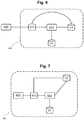
- the training steps 10 and 20 for validation can be carried out by the electronic video reproduction device 500 in a non-advantageous variant shown Figure 7 .
- [ Fig 7 ] thus represents the device 500 comprising the modules 611 for subtraction, 612 for creating a model, 613 for recording the model and 614 for recording the annotated message. It also includes the message creation module 501 shown in the Figure 5 .
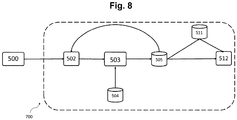
- FIG 8 represents a variant of the embodiment according to the Figure 5 , where the method 100 is carried out by a system remote from the electronic video reproduction device 500.
- the electronic video playback device 500 sends at least one message to the remote video incident detection system 700.
- the system 700 includes: the message subtraction module 502, the classification module 503 implementing a supervised machine learning algorithm , the model registration module 504, storing a model estimated and validated during steps 10 and 20 of the method 100, the message storage module 505, the incident message storage module 511, and the module 512 d display of incident messages.
- the variant presented Figure 8 is not the most advantageous because it requires sending each message comprising counters across the network to reach the remote system 500, while the embodiment according to the Figure 5 only requires the sending of incident messages, when a video incident has been detected, across the network, resulting in a lower load on the network connecting the electronic video playback device 500 and the remote system 510.
Landscapes
- Engineering & Computer Science (AREA)
- Multimedia (AREA)
- Signal Processing (AREA)
- Computer Networks & Wireless Communication (AREA)
- Theoretical Computer Science (AREA)
- Software Systems (AREA)
- Physics & Mathematics (AREA)
- Data Mining & Analysis (AREA)
- General Physics & Mathematics (AREA)
- Databases & Information Systems (AREA)
- Evolutionary Computation (AREA)
- Computer Vision & Pattern Recognition (AREA)
- General Engineering & Computer Science (AREA)
- Artificial Intelligence (AREA)
- Mathematical Physics (AREA)
- Computing Systems (AREA)
- Medical Informatics (AREA)
- Computer Security & Cryptography (AREA)
- Bioinformatics & Computational Biology (AREA)
- Life Sciences & Earth Sciences (AREA)
- Computational Linguistics (AREA)
- Bioinformatics & Cheminformatics (AREA)
- Evolutionary Biology (AREA)
- Television Signal Processing For Recording (AREA)
- Two-Way Televisions, Distribution Of Moving Picture Or The Like (AREA)
- Information Retrieval, Db Structures And Fs Structures Therefor (AREA)
Abstract
Description
- Le domaine technique de l'invention est celui de la restitution vidéo. La présente invention concerne un procédé de détection automatique d'incidents vidéo d'une vidéo restituée par un dispositif électronique de restitution vidéo. Elle concerne également un dispositif électronique de restitution vidéo mettant en œuvre ce procédé, en particulier par la mise en œuvre d'un algorithme d'apprentissage automatique pour réaliser la détection.
- Les utilisateurs de dispositifs électronique de restitution vidéo peuvent rencontrer des problèmes dits incidents vidéo lors de la restitution d'une vidéo sur un écran, par exemple: gels d'image (« freeze » selon la dénomination anglo-saxonne), écrans noirs (« blackscreen » selon la dénomination anglo-saxonne), micro-gels d'images (aussi appelé pixellisation en français, et « pixelisation » ou « micro-freeze » selon les dénominations anglo-saxonne).
- On entend par « dispositif électronique de restitution vidéo » tout dispositif électronique permettant de restituer sous forme vidéo sur un écran un contenu vidéo à partir d'un signal extérieur. On désignera par exemple par « dispositif électronique de restitution vidéo » un boîtier décodeur, aussi appelé décodeur TV, qui reçoit un signal crypté ou compressé pour la télévision, le décode en le décryptant et/ou en le décompressant et le restitue sur un écran. Pour un tel boîtier décodeur, on pourra aussi utiliser la dénomination anglo-saxonne de « set-top box ». On pourra aussi désigner par « dispositif électronique de restitution vidéo » une « video sound box », un téléphone mobile ou encore une tablette électronique.
- Un dispositif électronique de restitution vidéo restitue sur un écran un contenu à partir d'un signal extérieur pouvant provenir par exemple :
- D'une antenne satellite ou d'une antenne UHF(Ultra Haute Fréquence)/VHF(Très Haute Fréquence)
- D'un réseau public ou local via une ligne téléphonique, une fibre optique ou un câble Ethernet
- D'un moyen de stockage connecté en USB, SATA, Bluetooth ou Wifi au dispositif tel qu'une clé USB, un disque dur ou un autre dispositif électronique.
- Les incidents vidéo cités précédemment peuvent avoir des origines diverses : détérioration du signal lors de sa transmission sur le réseau, débit trop faible, problèmes matériel du dispositif électronique de restitution vidéo (problème de câble reliant le dispositif au réseau ou de câble reliant le dispositif à l'écran ...).
- Pour détecter ces incidents vidéo, plusieurs systèmes sont proposés dans l'art antérieur. Une première solution consiste à analyser directement le flux vidéo transmis par le dispositif électronique de restitution vidéo à l'écran. Ces systèmes peuvent être très précis et détecter beaucoup d'incidents vidéo différents, et sont agnostiques du dispositif de restitution utilisé. Cependant, ces systèmes, pratiquant du traitement d'image sur le flux vidéo, demandent beaucoup de ressources, et ne permettent pas de remonter à la source de l'incident. En effet, le traitement est effectué sur le résultat final et non en amont.
- Afin de remonter à la source d'un incident, d'autres systèmes analysent le réseau de diffusion de contenu (« RDC » ou « CDN » selon la dénomination anglo-saxonne « Content Delivery Network »). Cependant, ces systèmes ne permettent que de détecter des gels d'écran (« freeze ») qui proviennent uniquement d'un problème sur le réseau. Ces systèmes demandent moins de ressource que le traitement du flux vidéo final, mais ne permettent de détecter qu'un type d'incident, ne provenant que d'un type de problème : les problèmes réseau.
- Il apparaît donc nécessaire de détecter différents types d'incidents vidéo et de pouvoir remonter à leur cause, qu'elle soit un problème réseau, un problème matériel du dispositif de restitution vidéo, ou un problème logiciel du dispositif de restitution vidéo, tout en demandant peu de ressources.
- L'invention offre une solution aux problèmes évoqués précédemment, en permettant une détection automatique d'incidents vidéo d'une vidéo restituée sur un écran par un dispositif électronique de restitution vidéo demandant peu de ressources, permettant de détecter différents types d'incidents vidéo et de pouvoir remonter à leur cause qu'elle soit un problème réseau, un problème matériel du dispositif de restitution vidéo, ou un problème logiciel du dispositif de restitution vidéo.
- Pour cela, un aspect de l'invention concerne un procédé de détection automatique d'incident vidéo sur une vidéo restituée par un dispositif électronique de restitution vidéo caractérisé en ce qu'il comprend :
- Une étape d'acquisition d'un message émis par le dispositif électronique de restitution vidéo (500), ledit message comprenant au moins un compteur représentant l'état du dispositif électronique de restitution vidéo ;
- Une étape de soustraction du au moins un compteur compris dans le message précédemment acquis à au moins un compteur compris dans un message sauvegardé dans une base de données correspondant à un état précédent du dispositif électronique de restitution vidéo pour obtenir un état de transition du dispositif électronique de restitution vidéo ;
- Une étape de classification, par un algorithme d'apprentissage automatique supervisé utilisant un modèle de classification, de l'état de transition comme appartenant à une classe représentative d'un état normal de la vidéo restituée, ou comme appartenant à une classe parmi au moins une classe représentative d'un incident vidéo sur la vidéo restituée ;
- Une étape de détection d'incident vidéo comprenant la création d'un message d'incident lorsqu'un état de transition est classifié comme appartenant à une classe représentative d'un incident vidéo sur la vidéo restituée, ledit message d'incident comprenant un label correspondant à l'incident vidéo détecté, ledit état de transition et ledit message acquis ;
- Une étape de transmission du message d'incident à un système distant ;
- Une étape d'enregistrement dans la base de données du message précédemment acquis.
- L'invention permet avantageusement, en positionnant la détection d'incidents vidéo au niveau du dispositif de restitution vidéo, de pouvoir remonter à la cause de l'incident, qu'elle soit un problème réseau, un problème matériel du dispositif de restitution vidéo, ou un problème logiciel du dispositif de restitution vidéo. En effet, le dispositif de restitution vidéo est avantageusement situé en bordure du réseau de distribution de contenu la détection, directement relié à l'écran, il permet donc d'identifier l'utilisateur subissant les incidents vidéo, ainsi que l'état des différents modules du dispositif au moment où l'incident a été subi, et donc de détecter les problèmes qu'ils soient des problèmes réseau, des problèmes internes au dispositif ou encore des problèmes liés au flux vidéo.
- De plus, la détection est réalisée via un algorithme d'apprentissage automatique supervisé, qui classifie les états du dispositif de restitution. Un état du dispositif est représenté par des compteurs, provenant d'un fichier d'événement (fichier dit « log ») du dispositif ou d'un message émis par le dispositif. Ainsi, grâce à l'utilisation de ces compteurs, il est possible de définir un état du dispositif lorsqu'un incident a été détecté.
- Outre les caractéristiques qui viennent d'être évoquées dans le paragraphe précédent, le procédé selon un aspect de l'invention peut présenter une ou plusieurs caractéristiques complémentaires parmi les suivantes, considérées individuellement ou selon toutes les combinaisons techniquement possibles :
- Le procédé est répété au moins deux fois.
- La répétition du procédé est effectuée à intervalles de temps fixe.
- La répétition du procédé est effectuée à intervalles de temps variable.
- Le procédé comprend en outre une étape de réduction de dimensionalité du message comprenant la réduction du nombre de compteurs compris dans le message.
- Le procédé comprend en outre :
- Une étape d'entraînement de l'algorithme d'apprentissage automatique supervisé pour créer un modèle de classification, en utilisant un jeu de données d'entraînement comprenant au moins un message annoté comme appartenant à une classe représentative d'un état normal de la vidéo restituée, ou comme appartenant à une classe parmi au moins une classe représentative d'un incident vidéo sur la vidéo restituée, le message comprenant au moins un compteur ;
- Une étape de test du modèle de classification en utilisant un jeu de données de test comprenant au moins un message non annoté.
- Le procédé est caractérisé en ce que l'algorithme d'apprentissage automatique supervisé est un algorithme d'un type parmi ceux de boosting de gradient d'arbres, de Machines à Vecteurs de Support, de réseau de neurones, d'arbres de décision.
- Le procédé est mis en œuvre par au moins un système distant du dispositif électronique de restitution vidéo.
- Un autre aspect de l'invention concerne un dispositif électronique de restitution vidéo mettant en œuvre le procédé comprenant :
- Un module d'acquisition et de soustraction d'un message, configuré pour réaliser les étapes d'acquisition du message et de soustraction ;
- Un module de classification configuré pour réaliser les étapes de classification, de détection d'incident; et de transmission du message d'incident ;
- Un module d'enregistrement de modèle, configuré pour stocker le modèle de classification ;
- Un module d'enregistrement de message configuré pour réaliser l'étape d'enregistrement de message.
- Un autre aspect de l'invention concerne un système de détection d'incident vidéo caractérisé en ce qu'il comprend le dispositif électronique de restitution vidéo et un système distant de réception et d'affichage de message d'incident comprenant :
- Un module d'enregistrement de message d'incident ;
- Un module d'affichage de message d'incident sur un écran pour analyse par un expert métier.
- Un autre aspect de l'invention concerne un produit programme d'ordinateur comprenant des instructions qui, lorsque le programme est exécuté par un ordinateur, conduisent celui-ci à mettre en œuvre le procédé.
- Un autre aspect de l'invention concerne un support d'enregistrement lisible par ordinateur comprenant des instructions qui, lorsqu'elles sont exécutées par un ordinateur, conduisent celui-ci à mettre en œuvre le procédé.
- L'invention et ses différentes applications seront mieux comprises à la lecture de la description qui suit et à l'examen des figures qui l'accompagnent.
- Les figures sont présentées à titre indicatif et nullement limitatif de l'invention.
- La
Figure 1 montre une représentation schématique d'un premier mode de réalisation d'un procédé selon l'invention. - La
Figure 2 montre une représentation schématique temporelle du premier mode de réalisation du procédé selon l'invention. - La
Figure 3 montre une représentation schématique d'un second mode de réalisation du procédé selon l'invention. - La
Figure 4 montre une représentation schématique temporelle du second mode de réalisation du procédé selon l'invention. - La
Figure 5 montre une représentation schématique d'un premier mode de réalisation d'un système de détection d'incidents vidéo. - La
Figure 6 montre une représentation schématique d'un premier mode de réalisation d'un système d'entraînement d'un algorithme de détection d'incidents vidéo. - La
Figure 7 montre une représentation schématique d'un second mode de réalisation d'un système d'entraînement d'un algorithme de détection d'incidents vidéo. - La
Figure 8 montre une représentation schématique d'un deuxième mode de réalisation d'un système de détection d'incidents vidéo. - Sauf précision contraire, un même élément apparaissant sur des figures différentes présente une référence unique.
- [
Fig 1 ] représente un mode de réalisation du procédé de détection d'incident vidéo d'une vidéo restituée par un dispositif électronique de restitution vidéo. - Le procédé 100 de détection automatique d'incident vidéo comprend une étape 10 d'entraînement d'un algorithme d'apprentissage automatique supervisé, une étape 20 de test d'un modèle estimé, une étape 30 d'acquisition d'un message, une étape 40 de soustraction d'un compteur compris dans le message acquis à un compteur compris dans un message enregistré dans une base de données correspondant à l'avant-dernier message acquis pour obtenir un état de transition, une étape 50 de classification de l'état de transition, une étape 60 de détection d'incident vidéo, une étape 70 de transmission du message d'incident et une étape 80 d'enregistrement du message acquis dans une base de données.
- La première étape 10 d'entraînement d'un algorithme d'apprentissage automatique supervisé comprend la création d'un modèle de classification, et le stockage de ce modèle.
- On entend par « algorithme d'apprentissage automatique supervisé » un algorithme d'optimisation capable d'estimer un modèle à partir de données sélectionnées en nombre fini, puis d'utiliser le modèle estimé pour réaliser une tâche en prenant en entrée des données non sélectionnées. Dans l'invention, la tâche à réaliser est la classification de messages. Un tel algorithme est dit « supervisé » lorsque les données sélectionnées et fournies en entrée de l'algorithme lors de la phase d'entraînement sont annotées. Dans l'invention, lors de l'étape 10 d'entraînement, des messages déjà classés 11 (c'est-à-dire annotés comme appartenant à une classe) sont fournis en entrée de l'algorithme.
- Les messages annotés 11 comprennent des compteurs. Ces compteurs sont déjà existants au sein du dispositif électronique de restitution vidéo. Par « compteur », on entend une variable prenant une valeur permettant de représenter l'état du dispositif. Lorsqu'un événement arrive, un compteur peut être incrémenté. Par exemple, lors de la perte d'un signal, un compteur appelé « signal_lost » peut être incrémenter par le dispositif de restitution vidéo, permettant de garder une trace du nombre de fois où un signal a été perdu. On peut aussi par exemple avoir un compteur qui garde en mémoire un numéro de session, permettant de lier un autre compteur à la session durant laquelle l'événement a eu lieu.
- Par exemple, le message peut être au format JSON ou un autre format de données utilisant un formalisme dit « clé - valeur » et peut contenir les compteurs suivants :
 "fe": {
 "signal_lost": 0,
 "signal_recovered": 0,
 "signal_low": 0
 }
 "video": {
 "changed": 0,
 "io_changed": 0,
"ar_changed": 0,
"eotf_changed": 0,
 "not_found": 0,
"error_format": 0,
 "removed": 0}
 "resources": {
 "priority_updated": 0,
 "error": 0,
 "busy": 0,
 "no_resources": 0,
 "ok": 0,
 "earned": 0,
 "lost": 0,
 "released": 0}
- un événement normal (N), c'est-à-dire qu'un ou plusieurs compteurs ont été incrémentés suite à un événement normal (par exemple un début de réception de flux, un changement de la vidéo suite à un changement de chaîne de l'utilisateur)
- un incident « freeze » (F), c'est-à-dire qu'un ou plusieurs compteurs ont été incrémentés suite à un gel de la vidéo restitué.
- un incident « blackscreen » (B), c'est-à-dire qu'un ou plusieurs compteurs ont été incrémentés suite à un écran noir.
Claims (12)
- Procédé (100) de détection automatique d'incident vidéo sur une vidéo restituée par un dispositif électronique de restitution vidéo (500) caractérisé en ce qu'il comprend :- Une étape d'acquisition (30) d'un message émis par le dispositif électronique de restitution vidéo (500), ledit message comprenant au moins un compteur représentant l'état du dispositif électronique de restitution vidéo (500);- Une étape de soustraction (40) du au moins un compteur compris dans le message précédemment acquis à au moins un compteur compris dans un message sauvegardé dans une base de données (505) correspondant à un état précédent du dispositif électronique de restitution vidéo (500) pour obtenir un état de transition du dispositif électronique de restitution vidéo (500);- Une étape de classification (50), par un algorithme d'apprentissage automatique supervisé utilisant un modèle de classification, de l'état de transition comme appartenant à une classe représentative d'un état normal de la vidéo restituée, ou comme appartenant à une classe parmi au moins une classe représentative d'un incident vidéo sur la vidéo restituée ;- Une étape de détection d'incident vidéo (60) comprenant la création d'un message d'incident lorsqu'un état de transition est classifié comme appartenant à une classe représentative d'un incident vidéo sur la vidéo restituée, ledit message d'incident comprenant un label correspondant à l'incident vidéo détecté, ledit état de transition et ledit message acquis;- Une étape de transmission (70) du message d'incident à un système distant ;- Une étape d'enregistrement (80) dans la base de données (505) du message précédemment acquis.
- Procédé (100) de détection automatique d'incident vidéo selon la revendication 1 caractérisé en ce qu'il est répété au moins deux fois.
- Procédé (100) de détection automatique d'incident vidéo selon la revendication 2 caractérisé en ce que la répétition est effectuée à intervalles de temps fixe.
- Procédé (100) de détection automatique d'incident vidéo selon la revendication 2 caractérisé en ce que la répétition est effectuée à intervalles de temps variable.
- Procédé (100) de détection automatique d'incident vidéo selon l'une quelconque des revendications précédentes caractérisé en ce qu'il comprend en outre :- Une étape de réduction de dimensionalité du message comprenant la réduction du nombre de compteurs compris dans le message.
- Procédé (100) de détection automatique d'incident vidéo selon l'une quelconque des revendications précédentes caractérisé en ce qu'il comprend en outre :- Une étape d'entraînement (10) de l'algorithme d'apprentissage automatique supervisé pour créer un modèle de classification, en utilisant un jeu de données d'entraînement (11) comprenant au moins un message annoté comme appartenant à une classe représentative d'un état normal de la vidéo restituée, ou comme appartenant à une classe parmi au moins une classe représentative d'un incident vidéo sur la vidéo restituée, le message comprenant au moins un compteur ;- Une étape de test (20) du modèle de classification en utilisant un jeu de données de test (21) comprenant au moins un message non annoté.
- Procédé (100) de détection automatique d'incident vidéo selon l'une quelconque des revendications précédentes caractérisé en ce que l'algorithme d'apprentissage automatique supervisé est un algorithme d'un type parmi ceux de boosting de gradient d'arbres, de Machines à Vecteurs de Support, de réseau de neurones, d'arbres de décision.
- Procédé (100) de détection automatique d'incident vidéo selon l'une quelconque des revendications précédentes caractérisé en ce que le procédé (100) est mis en œuvre par au moins un système distant (700) du dispositif électronique de restitution vidéo (500).
- Dispositif électronique de restitution vidéo (500) mettant en œuvre le procédé (100) selon l'une quelconque des revendications 1 à 7 comprenant :- Un module (502) d'acquisition et de soustraction d'un message, configuré pour réaliser les étapes d'acquisition (30) du message et de soustraction (40);- Un module (503) de classification configuré pour réaliser les étapes de classification (50), de détection d'incident (60); et de transmission (70) du message d'incident ;- Un module d'enregistrement de modèle (504), configuré pour stocker le modèle de classification ;- Un module d'enregistrement de message (505) configuré pour réaliser l'étape d'enregistrement de message (80).
- Système de détection d'incident vidéo caractérisé en ce qu'il comprend le dispositif électronique de restitution vidéo (500) selon la revendication 8 et un système distant (510) de réception et d'affichage de message d'incident comprenant :- Un module d'enregistrement de message d'incident (511) ;- Un module d'affichage de message d'incident (512) sur un écran pour analyse par un expert métier.
- Produit programme d'ordinateur comprenant des instructions qui, lorsque le programme est exécuté par un ordinateur, conduisent celui-ci à mettre en oeuvre le procédé (100) selon l'une quelconque des revendications 1 à 8.
- Support d'enregistrement lisible par ordinateur comprenant des instructions qui, lorsqu'elles sont exécutées par un ordinateur, conduisent celui-ci à mettre en oeuvre le procédé (100) selon l'une quelconque des revendications 1 à 8.
Applications Claiming Priority (1)
| Application Number | Priority Date | Filing Date | Title |
|---|---|---|---|
| FR1873918A FR3091111B1 (fr) | 2018-12-21 | 2018-12-21 | Procede de detection automatique d’incidents video sur un dispositif electronique de restitution video |
Publications (1)
| Publication Number | Publication Date |
|---|---|
| EP3672259A1 true EP3672259A1 (fr) | 2020-06-24 |
Family
ID=66542438
Family Applications (1)
| Application Number | Title | Priority Date | Filing Date |
|---|---|---|---|
| EP19216848.2A Withdrawn EP3672259A1 (fr) | 2018-12-21 | 2019-12-17 | Procede de detection automatique d'incidents video sur un dispositif electronique de restitution video |
Country Status (5)
| Country | Link |
|---|---|
| US (1) | US11120841B2 (fr) |
| EP (1) | EP3672259A1 (fr) |
| CN (1) | CN111353376A (fr) |
| BR (1) | BR102019027267A2 (fr) |
| FR (1) | FR3091111B1 (fr) |
Citations (3)
| Publication number | Priority date | Publication date | Assignee | Title |
|---|---|---|---|---|
| US20150304737A1 (en) * | 2014-04-17 | 2015-10-22 | Samsung Electronics Co. Ltd. | QoE PROVISIONING METHOD AND APPARATUS FOR MOBILE VIDEO APPLICATION |
| US20170093648A1 (en) * | 2015-09-28 | 2017-03-30 | Wi-Lan Labs, Inc. | System and method for assessing streaming video quality of experience in the presence of end-to-end encryption |
| US20180367844A1 (en) * | 2015-12-18 | 2018-12-20 | Telefonaktiebolaget Lm Ericsson (Publ) | Video playback buffer control |
Family Cites Families (2)
| Publication number | Priority date | Publication date | Assignee | Title |
|---|---|---|---|---|
| US8411935B2 (en) * | 2007-07-11 | 2013-04-02 | Behavioral Recognition Systems, Inc. | Semantic representation module of a machine-learning engine in a video analysis system |
| US20110107084A1 (en) * | 2009-11-05 | 2011-05-05 | Verizon Patent And Licensing, Inc. | System for and method for relaying messages |
-
2018
- 2018-12-21 FR FR1873918A patent/FR3091111B1/fr not_active Expired - Fee Related
-
2019
- 2019-12-17 EP EP19216848.2A patent/EP3672259A1/fr not_active Withdrawn
- 2019-12-19 BR BR102019027267-8A patent/BR102019027267A2/pt not_active IP Right Cessation
- 2019-12-20 CN CN201911322526.0A patent/CN111353376A/zh active Pending
- 2019-12-20 US US16/722,648 patent/US11120841B2/en not_active Expired - Fee Related
Patent Citations (3)
| Publication number | Priority date | Publication date | Assignee | Title |
|---|---|---|---|---|
| US20150304737A1 (en) * | 2014-04-17 | 2015-10-22 | Samsung Electronics Co. Ltd. | QoE PROVISIONING METHOD AND APPARATUS FOR MOBILE VIDEO APPLICATION |
| US20170093648A1 (en) * | 2015-09-28 | 2017-03-30 | Wi-Lan Labs, Inc. | System and method for assessing streaming video quality of experience in the presence of end-to-end encryption |
| US20180367844A1 (en) * | 2015-12-18 | 2018-12-20 | Telefonaktiebolaget Lm Ericsson (Publ) | Video playback buffer control |
Non-Patent Citations (2)
| Title |
|---|
| GIORGOS DIMOPOULOS ET AL: "Measuring Video QoE from Encrypted Traffic", INTERNET MEASUREMENT CONFERENCE, ACM, 2 PENN PLAZA, SUITE 701 NEW YORK NY 10121-0701 USA, 14 November 2016 (2016-11-14), pages 513 - 526, XP058306547, ISBN: 978-1-4503-4526-2, DOI: 10.1145/2987443.2987459 * |
| ZHANG YURAN ET AL: "Predicting the Quality of Experience for Internet Video with Fuzzy Decision Tree", 2014 IEEE 17TH INTERNATIONAL CONFERENCE ON COMPUTATIONAL SCIENCE AND ENGINEERING, IEEE, 19 December 2014 (2014-12-19), pages 1181 - 1187, XP032730380, DOI: 10.1109/CSE.2014.230 * |
Also Published As
| Publication number | Publication date |
|---|---|
| FR3091111B1 (fr) | 2021-12-17 |
| BR102019027267A2 (pt) | 2020-09-29 |
| CN111353376A (zh) | 2020-06-30 |
| US20200202899A1 (en) | 2020-06-25 |
| US11120841B2 (en) | 2021-09-14 |
| FR3091111A1 (fr) | 2020-06-26 |
Similar Documents
| Publication | Publication Date | Title |
|---|---|---|
| EP2901372B1 (fr) | Utilisation d'empreintes digitales numériques, pour associer des données à un mot | |
| US11930063B2 (en) | Content completion detection for media content | |
| FR3098072A1 (fr) | Procédé de traitement d’un ensemble d’images d’une séquence vidéo | |
| CN117319707A (zh) | 视频码率调整方法、装置、电子设备、介质及产品 | |
| EP0276603B1 (fr) | Procédés de codage et de transmission d'un signal numérique, par rafraichissement temporel sélectif d'un quantificateur vectoriel | |
| FR3091111A1 (fr) | Procede de detection automatique d’incidents video sur un dispositif electronique de restitution video | |
| EP3031000B1 (fr) | Procede de fourniture d'une licence dans un systeme de fourniture de contenus multimedias | |
| FR3089648A1 (fr) | Procede de detection non supervise d’attaques internes et systeme associe | |
| WO2020126994A1 (fr) | Procede et systeme de detection d'anomalie dans un reseau de telecommunications | |
| US11398091B1 (en) | Repairing missing frames in recorded video with machine learning | |
| EP4280560A1 (fr) | Procédé pour détecter des anomalies de routage entre systèmes autonomes | |
| WO2020128246A1 (fr) | Procédé de détermination d'un chemin de transmission de données, et dispositif correspondant | |
| FR3140958A1 (fr) | Procédé de détection d’anomalie dans une série temporelle observée de valeurs d’une grandeur physique représentative des performances d’un système. | |
| FR2960371A1 (fr) | Procede et dispositif d'analyse de donnees interceptees sur un reseau ip pour la surveillance de l'activite des utilisateurs d'un site web | |
| WO2019122241A1 (fr) | Procédé de construction automatique de scénarios d'attaques informatiques, produit programme d'ordinateur et système de construction associés | |
| EP3483786B1 (fr) | Procédé de surveillance d'une scène, dispositif d'acquisition et installation associés | |
| EP3370149B1 (fr) | Procédé de contrôle de la détection en temps réel d'une scène, permettant la détermination de contexte par un appareil de communication sans fil, et appareil correspondant | |
| FR2932054A1 (fr) | Systeme de videosurveillance intelligent reconfigurable dynamiquement | |
| FR3021765A1 (fr) | Procede et dispositif d'agregation synchronisee de donnees de performance et de donnees d'exploitation | |
| FR3150677A1 (fr) | Classification d’un jeu de données multi-activités dans un réseau de télécommunications | |
| WO2023241896A1 (fr) | Détection d'anomalies pour la maintenance applicative de dispositifs | |
| FR3085498A1 (fr) | Surveillance d’acces en memoire | |
| FR3108743A1 (fr) | Procede de prevention d’incident sur une chaine applicative et dispositif informatique de prevention d’incident | |
| FR2982449A1 (fr) | Procede d'evaluation d'au moins un defaut de qualite dans un signal de donnees, dispositif et programme d'ordinateurs associes | |
| WO2022128693A1 (fr) | Procédé et passerelle pour détecter et diagnostiquer des lenteurs dans un réseau local de communication sans fil |
Legal Events
| Date | Code | Title | Description |
|---|---|---|---|
| PUAI | Public reference made under article 153(3) epc to a published international application that has entered the european phase |
Free format text: ORIGINAL CODE: 0009012 |
|
| STAA | Information on the status of an ep patent application or granted ep patent |
Free format text: STATUS: THE APPLICATION HAS BEEN PUBLISHED |
|
| AK | Designated contracting states |
Kind code of ref document: A1 Designated state(s): AL AT BE BG CH CY CZ DE DK EE ES FI FR GB GR HR HU IE IS IT LI LT LU LV MC MK MT NL NO PL PT RO RS SE SI SK SM TR |
|
| AX | Request for extension of the european patent |
Extension state: BA ME |
|
| STAA | Information on the status of an ep patent application or granted ep patent |
Free format text: STATUS: REQUEST FOR EXAMINATION WAS MADE |
|
| 17P | Request for examination filed |
Effective date: 20200925 |
|
| RBV | Designated contracting states (corrected) |
Designated state(s): AL AT BE BG CH CY CZ DE DK EE ES FI FR GB GR HR HU IE IS IT LI LT LU LV MC MK MT NL NO PL PT RO RS SE SI SK SM TR |
|
| STAA | Information on the status of an ep patent application or granted ep patent |
Free format text: STATUS: EXAMINATION IS IN PROGRESS |
|
| 17Q | First examination report despatched |
Effective date: 20210715 |
|
| STAA | Information on the status of an ep patent application or granted ep patent |
Free format text: STATUS: THE APPLICATION HAS BEEN WITHDRAWN |
|
| 18W | Application withdrawn |
Effective date: 20220204 |