EP3672141B1 - Procede de verification d'integrite et de dechiffrement d'un message chiffre, cryptomodule et terminal associes - Google Patents
Procede de verification d'integrite et de dechiffrement d'un message chiffre, cryptomodule et terminal associes Download PDFInfo
- Publication number
- EP3672141B1 EP3672141B1 EP19219015.5A EP19219015A EP3672141B1 EP 3672141 B1 EP3672141 B1 EP 3672141B1 EP 19219015 A EP19219015 A EP 19219015A EP 3672141 B1 EP3672141 B1 EP 3672141B1
- Authority
- EP
- European Patent Office
- Prior art keywords
- integrity
- cryptomodule
- data block
- memory
- key
- Prior art date
- Legal status (The legal status is an assumption and is not a legal conclusion. Google has not performed a legal analysis and makes no representation as to the accuracy of the status listed.)
- Active
Links
Images
Classifications
-
- H—ELECTRICITY
- H04—ELECTRIC COMMUNICATION TECHNIQUE
- H04L—TRANSMISSION OF DIGITAL INFORMATION, e.g. TELEGRAPHIC COMMUNICATION
- H04L9/00—Cryptographic mechanisms or cryptographic arrangements for secret or secure communications; Network security protocols
- H04L9/06—Cryptographic mechanisms or cryptographic arrangements for secret or secure communications; Network security protocols the encryption apparatus using shift registers or memories for block-wise or stream coding, e.g. DES systems or RC4; Hash functions; Pseudorandom sequence generators
- H04L9/0618—Block ciphers, i.e. encrypting groups of characters of a plain text message using fixed encryption transformation
- H04L9/0637—Modes of operation, e.g. cipher block chaining [CBC], electronic codebook [ECB] or Galois/counter mode [GCM]
-
- G—PHYSICS
- G06—COMPUTING OR CALCULATING; COUNTING
- G06F—ELECTRIC DIGITAL DATA PROCESSING
- G06F21/00—Security arrangements for protecting computers, components thereof, programs or data against unauthorised activity
- G06F21/60—Protecting data
- G06F21/64—Protecting data integrity, e.g. using checksums, certificates or signatures
-
- G—PHYSICS
- G09—EDUCATION; CRYPTOGRAPHY; DISPLAY; ADVERTISING; SEALS
- G09C—CIPHERING OR DECIPHERING APPARATUS FOR CRYPTOGRAPHIC OR OTHER PURPOSES INVOLVING THE NEED FOR SECRECY
- G09C1/00—Apparatus or methods whereby a given sequence of signs, e.g. an intelligible text, is transformed into an unintelligible sequence of signs by transposing the signs or groups of signs or by replacing them by others according to a predetermined system
-
- H—ELECTRICITY
- H04—ELECTRIC COMMUNICATION TECHNIQUE
- H04L—TRANSMISSION OF DIGITAL INFORMATION, e.g. TELEGRAPHIC COMMUNICATION
- H04L9/00—Cryptographic mechanisms or cryptographic arrangements for secret or secure communications; Network security protocols
- H04L9/06—Cryptographic mechanisms or cryptographic arrangements for secret or secure communications; Network security protocols the encryption apparatus using shift registers or memories for block-wise or stream coding, e.g. DES systems or RC4; Hash functions; Pseudorandom sequence generators
- H04L9/0643—Hash functions, e.g. MD5, SHA, HMAC or f9 MAC
-
- H—ELECTRICITY
- H04—ELECTRIC COMMUNICATION TECHNIQUE
- H04L—TRANSMISSION OF DIGITAL INFORMATION, e.g. TELEGRAPHIC COMMUNICATION
- H04L9/00—Cryptographic mechanisms or cryptographic arrangements for secret or secure communications; Network security protocols
- H04L9/32—Cryptographic mechanisms or cryptographic arrangements for secret or secure communications; Network security protocols including means for verifying the identity or authority of a user of the system or for message authentication, e.g. authorization, entity authentication, data integrity or data verification, non-repudiation, key authentication or verification of credentials
- H04L9/3236—Cryptographic mechanisms or cryptographic arrangements for secret or secure communications; Network security protocols including means for verifying the identity or authority of a user of the system or for message authentication, e.g. authorization, entity authentication, data integrity or data verification, non-repudiation, key authentication or verification of credentials using cryptographic hash functions
- H04L9/3242—Cryptographic mechanisms or cryptographic arrangements for secret or secure communications; Network security protocols including means for verifying the identity or authority of a user of the system or for message authentication, e.g. authorization, entity authentication, data integrity or data verification, non-repudiation, key authentication or verification of credentials using cryptographic hash functions involving keyed hash functions, e.g. message authentication codes [MACs], CBC-MAC or HMAC
-
- H—ELECTRICITY
- H04—ELECTRIC COMMUNICATION TECHNIQUE
- H04L—TRANSMISSION OF DIGITAL INFORMATION, e.g. TELEGRAPHIC COMMUNICATION
- H04L2209/00—Additional information or applications relating to cryptographic mechanisms or cryptographic arrangements for secret or secure communication H04L9/00
- H04L2209/12—Details relating to cryptographic hardware or logic circuitry
- H04L2209/122—Hardware reduction or efficient architectures
-
- H—ELECTRICITY
- H04—ELECTRIC COMMUNICATION TECHNIQUE
- H04L—TRANSMISSION OF DIGITAL INFORMATION, e.g. TELEGRAPHIC COMMUNICATION
- H04L2209/00—Additional information or applications relating to cryptographic mechanisms or cryptographic arrangements for secret or secure communication H04L9/00
- H04L2209/80—Wireless
- H04L2209/805—Lightweight hardware, e.g. radio-frequency identification [RFID] or sensor
Definitions
- the technical field of the invention is that of methods making it possible to verify the integrity of an encrypted message, then, if necessary, to decrypt it.
- the present invention relates to a method for verifying the integrity and decrypting an encrypted message.
- the present invention also relates to a cryptomodule, a terminal and a computer program product allowing the implementation of such a method.
- Encryption with authentication or “authenticated encryption” in English is an encryption mode that makes it possible to ensure both the confidentiality, the integrity and the authenticity of the encrypted data.
- This type of encryption is recommended by the 3rd Generation Partnership Project (3GPP) standard governing mobile networks of the "Mission Critical Services” or MCS type.
- GCM mode A classic mode of encryption with authentication is the “Galois Counter Mode” or GCM mode.
- GCM mode The decryption of a message encrypted by the GCM mode requires the storage of the entire decrypted message before being able to verify its integrity and, if necessary, to be able to deliver it in clear.
- This mode of operation is not compatible with cryptomodules, that is to say the electronic components used for cryptography, for example in mobile telephones or portable computers, which include memories with reduced storage capacities. Thus, it is impossible for the cryptomodule of a mobile phone to store an entire encrypted video.
- the invention offers a solution to the problems mentioned previously, by allowing a cryptomodule having a memory of reduced capacity to decrypt any message encrypted by an encryption mode with authentication.
- the encrypted message is divided into several blocks. Its integrity is verified block by block and it is then decrypted block by block once the integrity of the entire message has been verified.
- the memory of the cryptomodule therefore never stores more than two blocks of data.
- the method is secured by the authentication codes which make it possible to add a level of security between the step of verifying the integrity and the step of decrypting the encrypted message.
- the method according to a first aspect of the invention can have one or more additional characteristics among the following, considered individually or in all technically possible combinations.
- the method comprises a step consisting in erasing or deactivating the integrity key CI from the cryptomodule memory and in erasing the integrity codes li from the cryptomodule memory, just before the step consisting in storing or activate, in the cryptomodule memory, a CD decryption key specific to the encrypted message.
- the memory of the cryptomodule stores either the integrity key CI or the decryption key CD and not both, which makes it possible to save storage capacity.
- the method comprises a step consisting in erasing or deactivating the verification key CV and the decryption key CD.
- the cryptomodule is operational to perform the method for another encrypted message.
- the authentication codes Ai are generated by a secret key authentication algorithm using the verification key CV as the secret key.
- the secret key authentication algorithm is the HMAC SHA 256 algorithm.
- the authentication codes Ai generated and the key used require a reduced storage capacity.
- the verification key CV is generated randomly.
- the method is of the GCM type for “Galois Counter Mode”.
- the method is of the CWC type for “Carter-Wegman Counter”.
- the method uses an encryption mode with authentication.
- a data block Bi comprises 512 bits.
- a second aspect of the invention relates to a terminal comprising a cryptomodule according to a third aspect of the invention and a memory.
- the terminal is compatible with the 3GPP TS 33.180 standard.
- a third aspect of the invention relates to a cryptomodule configured to implement the steps of the method according to a first aspect of the invention, comprising a cryptomodule memory having a storage capacity smaller than the size of the encrypted message.
- the cryptomodule memory has a storage capacity chosen to substantially store the verification key CV, the integrity codes li, two data blocks Bi, Di or an encrypted data block Bi and an authentication code Ai, and the integrity key CI or the decryption key CD.
- the number of elements to be stored in the cryptomodule memory is minimized compared to an encryption mode method with conventional authentication.
- a fourth aspect of the invention relates to a computer program product comprising instructions which, when the program is executed by a computer, lead the latter to implement the method according to a first aspect of the invention.
- a first aspect of the invention relates to a method 100 for verifying the integrity and decrypting an encrypted message.
- Encrypting a message is a process of transforming the content of the message so as to make it unintelligible to anyone other than the recipient holding a decryption key allowing him to decrypt the message.
- Decryption is the reverse process of encryption, which consists of transforming the content of the message using the decryption key to make it intelligible again.
- An encrypted message is therefore a message that has undergone an encryption process and which is therefore unintelligible to third parties.
- the integrity of a message is verified if the message has not undergone any intentional or accidental alteration or destruction during its processing, that is to say, for example, during its encryption, storage or its transmission, and that the message therefore retains a format allowing it to be decrypted.
- a mode of encryption that must verify the integrity of an encrypted message before decrypting it is called encryption with authentication.
- the encryption mode is for example of the “Galois-Counter Mode” or GCM type or even the “Carter-Wegman Counter” or CWC type.
- the encrypted message comprises at least one data block Bi, the data blocks Bi being ordered for i ranging from 1 to N.
- the data block B3 is the third data block Bi of the encrypted message.
- a data block Bi comprises 512 bits.
- a third aspect of the invention relates to a cryptomodule 200 allowing the implementation of the method according to a first aspect of the invention.
- cryptomodule is understood to mean an electronic component used for cryptography, that is to say for the encryption/decryption of messages.
- the cryptomodule 200 is for example a smart card or an electronic chip.
- a second aspect of the invention relates to a terminal 300.
- the terminal 300 is for example a mobile phone or more particularly a smartphone, a tablet or even a laptop computer.
- the terminal 300 is compatible with the 3GPP TS 33.180 standard.
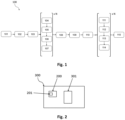
- FIG. 300 shows a schematic representation of the terminal 300.
- the terminal 300 comprises a memory 301 and the cryptomodule 200.
- the cryptomodule 200 comprises a memory 201 having a storage capacity lower than the storage capacity of the memory 301 of the terminal 300, in particular, the memory 301 of the terminal 300 has a storage capacity sufficient to store the encrypted message whereas the memory 201 of the cryptomodule 200 does not have sufficient storage capacity to store the encrypted message.
- FIG. 1 shows a block diagram of the method 100 according to a first aspect of the invention.
- the method 100 according to a first aspect of the invention comprises several steps implemented by the cryptomodule 200.
- the encrypted message is stored in the memory 301 of the terminal 300.
- the cryptomodule 200 stores or activates in its memory 201 an integrity key CI specific to the encrypted message.
- the integrity key CI of the encrypted message can either be supplied to the cryptomodule 200 at the time of the operations, or present a priori in the cryptomodule 200 and an activation is then sufficient to be able to use it.
- the first step 101 of the method 100 consists, for the cryptomodule 200, in selecting from among the CI integrity keys stored in the terminal 300, the key CI integrity corresponding to the encrypted message.
- the cryptomodule 200 can use the integrity key CI making it possible to verify the integrity of the encrypted message.
- the cryptomodule 200 During a second step 102 of the method 100, the cryptomodule 200 generates a verification key CV and stores the verification key CV in its memory 201.
- the verification key CV is for example generated randomly.
- the cryptomodule 200 calculates an initial integrity code I0 from the integrity key CI. Once calculated, the initial integrity code I0 is stored in the memory of the cryptomodule 201.
- the initial integrity code I0 is for example a constant function.
- the initial integrity code I0 is for example generated by the AES algorithm (for “Advanced Encryption Standard”) from the integrity key C1.
- the fourth 104, fifth 10, sixth 106 and seventh 107 steps of the method 100 are then performed for each data block Bi of the encrypted message.
- the cryptomodule 200 stores a data block Bi in its memory 201.
- the cryptomodule 200 calculates an intermediate integrity code li. This intermediate integrity code li is stored in the memory of the cryptomodule 201.
- the intermediate integrity code li is calculated using the integrity key CI, the stored data block Bi and the intermediate integrity code li-1 of the data block Bi-1 preceding the data block Bi in the encrypted message.
- the third integrity code I3 is calculated from the integrity key CI, from the third data block B3 and from the second intermediate integrity code I2 calculated from the second data block B2.
- the intermediate integrity code li is expressed as follows: li - (li-1 + Bi) * Cl.
- the intermediate integrity code I1 of the first data block B1 is calculated using the integrity key CI, the stored data block B1 and the initial integrity code I0.
- the cryptomodule calculates an authentication code Ai for the data block Bi depending on its rank i in the encrypted message.
- the authentication code Ai is calculated using the verification key CV.
- the authentication code Ai is calculated by a secret key authentication algorithm using the verification key CV as the secret key. This type of algorithm works with a secret key of reduced size and generates authentication codes of reduced size, which is compatible with the problem of reduced storage capacity of the cryptomodule 200.
- the secret key authentication algorithm is the HMAC SHA 256 algorithm.
- the verification key CV is 256 bits in size and the authentication codes generated are then 256 bits.
- the cryptomodule 200 then sends the authentication code Ai to the terminal 300 so that it stores it in its memory 301.
- the cryptomodule 200 erases the processed data block Bi from its memory 201.
- the cryptomodule 200 carries out an eighth step 108 of the method 100 which consists in analyzing a code of final integrity In of the terminal 300 to verify the integrity of the encrypted message.
- the final integrity code In corresponds to the intermediate integrity code In of the last data block Bn of the encrypted message.
- the final integrity code In depends on all the intermediate integrity codes li calculated for each data block Bi and therefore makes it possible to verify the integrity of all the data blocks Bi and therefore of the encrypted message as a whole.
- the analysis of the final integrity code In comprises a step of calculating an integrity value from at least a part of the final integrity code In, and a step of comparing the integrity value to a predetermined reference integrity value.
- the integrity value and the reference integrity value are for example numbers in a predefined format.
- the various possible formats are, for example, a text format or a computer format such as integer, float or even double formats.
- the integrity value is for example equal to the final integrity code In.
- the integrity is checked if the integrity value and the reference integrity value are identical and, on the contrary, not checked if the integrity value and the baseline integrity value are different.
- the encrypted message cannot be decrypted. The method 100 then stops.
- the cryptomodule 200 erases or deactivates the integrity key CI from its memory 201 and erases the integrity codes li from its memory 201.
- the cryptomodule 200 stores or activates in its memory 201 a decryption key CD specific to the encrypted message.
- the decryption key CD of the encrypted message can either be provided to the cryptomodule 200 at the time of the operations, or present a priori in the cryptomodule 200 and an activation is then sufficient to be able to use it.
- the tenth step 110 of the method 100 consists, for the cryptomodule 200, to select from among the CD decryption keys stored in the terminal 300, the CD decryption key corresponding to the encrypted message.
- the cryptomodule 200 can use the decryption key CD making it possible to decrypt the encrypted message.
- the eleventh 111, twelfth 112, thirteenth 113 and fourteenth 114 steps of the method 100 are then performed for each data block Bi of the encrypted message.
- the cryptomodule 200 stores a data block Bi in its memory 201.
- the cryptomodule 200 receives the authentication code Ai of the processed data block Bi.
- the cryptomodule 200 then verifies the authenticity and the rank i of the processed data block Bi using its authentication code Ai.
- the authenticity of the data block Bi is verified if the data block Bi has not undergone alterations since the step 106 of generation of the authentication code Ai.
- the authentication code Ai therefore makes it possible to add a level of security between the step 105 of verifying the integrity of the encrypted message and its decryption and to ensure that the message which is going to be decrypted is indeed the same message as the one whose integrity has been previously verified.
- Verification of rank i makes it possible to ensure that the data blocks Bi of the encrypted message are decrypted in the same order as the corresponding encrypted data blocks Bi in the encrypted message so that on reading the decrypted message, the decrypted Bi data blocks are in the correct order.
- the cryptomodule 200 performs the thirteenth step 113 of the method 100 which consists in decrypting the processed data block Bi using the decryption key CD.
- the decrypted data block Bi is stored in the memory 301 of the terminal 300.
- the cryptomodule 200 erases the processed data block Bi from its memory 201.
- the encrypted message is completely decrypted and the decrypted data blocks Bi are stored in the memory 301 of the terminal 300 in the same order as are the corresponding encrypted data blocks Bi in the encrypted message.
- the memory 201 of the cryptomodule 200 no longer contains any data block Bi.
- the cryptomodule 200 erases or deactivates the verification key CV and the decryption key CD from its memory 201.
- the memory 201 of the cryptomodule does not no longer contains any active key, nor any code having been used during the process 100.
- the cryptomodule 200 can then perform the process 100 again on another encrypted message.
- the memory 201 of the cryptomodule 200 never comprises more than two keys, either the verification key CV and the integrity key CI, or the verification key CV and the decryption key CD, and never more than two blocks of data Bi, Di.
- the memory of the cryptomodule 200 can have a storage capacity chosen to allow it to substantially store the verification key CV, the integrity codes li, two data blocks Bi, Di or an encrypted data block Bi and an authentication code Ai and the integrity key CI or the decryption key CD.
Landscapes
- Engineering & Computer Science (AREA)
- Computer Security & Cryptography (AREA)
- Computer Networks & Wireless Communication (AREA)
- Signal Processing (AREA)
- Theoretical Computer Science (AREA)
- Power Engineering (AREA)
- Physics & Mathematics (AREA)
- General Physics & Mathematics (AREA)
- Health & Medical Sciences (AREA)
- Bioethics (AREA)
- General Health & Medical Sciences (AREA)
- Computer Hardware Design (AREA)
- Software Systems (AREA)
- General Engineering & Computer Science (AREA)
- Storage Device Security (AREA)
- Mobile Radio Communication Systems (AREA)
Description
- Le domaine technique de l'invention est celui des procédés permettant de vérifier l'intégrité d'un message chiffré, puis le cas échéant, de le déchiffrer.
- La présente invention concerne un procédé de vérification d'intégrité et de déchiffrement d'un message chiffré. La présente invention concerne également un cryptomodule, un terminal et un produit-programme d'ordinateur permettant la mise en oeuvre d'un tel procédé.
- Le chiffrement avec authentification ou « authenticated encryption » en anglais est un mode de chiffrement permettant d'assurer à la fois la confidentialité, l'intégrité et l'authenticité des données chiffrées. Ce type de chiffrement est préconisé par la norme 3rd Génération Partnership Project (3GPP) régissant les réseaux mobiles de type « Mission Critical Services » ou MCS.
- Un mode classique de chiffrement avec authentification est le mode « Galois Counter Mode » ou GCM. Le déchiffrement d'un message chiffré par le mode GCM nécessite le stockage de l'intégralité du message déchiffré avant de pouvoir vérifier son intégrité et le cas échéant, de pouvoir le délivrer en clair.
- Ce mode de fonctionnement n'est pas compatible avec les cryptomodules, c'est-à-dire les composants électroniques utilisés pour la cryptographie, par exemple dans les téléphones portables ou les ordinateurs portables, qui comportent des mémoires ayant des capacités de stockage réduites. Ainsi, il est impossible pour le cryptomodule d'un téléphone portable de stocker l'intégralité d'une vidéo chiffrée.
- Il existe donc un besoin de pouvoir déchiffrer un message chiffré dans un cryptomodule présentant une mémoire à la capacité de stockage réduite par un mode de chiffrement avec authentification, quelle que soit la taille du message chiffré.
- L'invention offre une solution aux problèmes évoqués précédemment, en permettant à un cryptomodule ayant une mémoire de capacité réduite de déchiffrer n'importe quel message chiffré par un mode de chiffrement avec authentification.
- Un premier aspect de l'invention concerne un procédé de vérification d'intégrité et de déchiffrement d'un message chiffré comportant une pluralité de blocs de données Bi ordonnés pour i allant de 1 à N, N étant strictement supérieur à 1, le message chiffré étant stocké dans une mémoire d'un terminal, ledit terminal comportant un cryptomodule comprenant une mémoire de cryptomodule ayant une capacité de stockage inférieure à la taille du message chiffré, le procédé comportant les étapes suivantes réalisées par le cryptomodule :
- Stocker ou activer, dans la mémoire de cryptomodule, une clé d'intégrité CI propre au message chiffré ;
- Calculer un code d'intégrité initial I0 à l'aide de la clé d'intégrité CI et le stocker dans la mémoire de cryptomodule ;
- Générer une clé de vérification CV et la stocker dans la mémoire de cryptomodule ;
- Pour chaque bloc de données Bi :
- o Stocker le bloc de données Bi dans la mémoire de cryptomodule ;
- o Calculer un code d'intégrité intermédiaire li et le stocker dans la mémoire de cryptomodule :
- Si le bloc de données Bi est le premier bloc de données B1 du message chiffré, le code d'intégrité intermédiaire I1 est calculé à l'aide de la clé d'intégrité CI, du premier bloc de données B1 et du code d'intégrité initial I0 ;
- Sinon, le code d'intégrité intermédiaire li est calculé à l'aide de la clé d'intégrité CI, du bloc de données Bi et du code d'intégrité intermédiaire li-1 du bloc de données Bi-1 précédent le bloc de données Bi dans le message chiffré ;
- o Générer un code d'authentification Ai du bloc de données Bi à l'aide de la clé de vérification CV, le code d'authentification Ai dépendant du rang i du bloc de données Bi, et le transmettre au terminal ;
- o Effacer le bloc de données Bi de la mémoire de cryptomodule ;
- Analyser un code d'intégrité final In correspondant au code d'intégrité intermédiaire In du dernier bloc de données Bn du message chiffré pour vérifier l'intégrité du message chiffré, comprenant les sous-étapes suivantes :
- Calcul d'une valeur d'intégrité à partir d'au moins une partie du code d'intégrité final In ;
- Comparaison de la valeur d'intégrité à une valeur d'intégrité de référence prédéterminée, l'intégrité du message chiffré étant vérifiée si la valeur d'intégrité et la valeur d'intégrité de référence sont identiques ;
- Si l'intégrité du message chiffré est vérifiée :
- o Stocker ou activer, dans la mémoire de cryptomodule, une clé de déchiffrement CD propre au message chiffré ;
- o Pour chaque bloc de données Bi du message chiffré :
- Stocker le bloc de données Bi dans la mémoire de cryptomodule ;
- Recevoir du terminal le code d'authentification du bloc de données Bi et vérifier l'authenticité et le rang i du bloc de données Bi à l'aide de son code d'authentification Ai ;
- Si l'authenticité et le rang i du bloc de données Bi sont vérifiés, déchiffrer le bloc de données Bi à l'aide de la clé de déchiffrement CD et le transmettre au terminal pour le stocker dans la mémoire du terminal ;
- Effacer le bloc de données chiffré Bi et le bloc de données déchiffré Di de la mémoire de cryptomodule.
- Grâce à l'invention, le message chiffré est divisé en plusieurs blocs. Son intégrité est vérifiée bloc par bloc et il est ensuite déchiffré bloc par bloc une fois l'intégrité de l'intégralité du message vérifiée. La mémoire du cryptomodule ne stocke donc jamais plus de deux blocs de données. De plus, le procédé est sécurisé par les codes d'authentification qui permettent d'ajouter un niveau de sécurité entre l'étape de vérification de l'intégrité et l'étape de déchiffrement du message chiffré.
- Outre les caractéristiques qui viennent d'être évoquées dans le paragraphe précédent, le procédé selon un premier aspect de l'invention peut présenter une ou plusieurs caractéristiques complémentaires parmi les suivantes, considérées individuellement ou selon toutes les combinaisons techniquement possibles.
- Selon un mode de réalisation, le procédé comporte une étape consistant à effacer ou désactiver la clé d'intégrité CI de la mémoire de cryptomodule et à effacer les codes d'intégrité li de la mémoire de cryptomodule, juste avant l'étape consistant à stocker ou activer, dans la mémoire de cryptomodule, une clé de déchiffrement CD propre au message chiffré.
- Ainsi, la mémoire du cryptomodule stocke soit la clé d'intégrité CI, soit la clé de déchiffrement CD et non les deux, ce qui permet d'économiser de la capacité de stockage.
- Selon un mode de réalisation, le procédé comporte une étape consistant à effacer ou désactiver la clé de vérification CV et la clé de déchiffrement CD.
- Ainsi, le cryptomodule est opérationnel pour réaliser le procédé pour un autre message chiffré.
- Selon un mode de réalisation pouvant être combiné au mode de réalisation précédent, les codes d'authentification Ai sont générés par un algorithme d'authentification à clé secrète utilisant la clé de vérification CV comme clé secrète.
- Selon un exemple de ce mode de réalisation, l'algorithme d'authentification à clé secrète est l'algorithme HMAC SHA 256.
- Ainsi, les codes d'authentification Ai générés et la clé utilisée nécessitent une capacité de stockage réduite.
- Selon un mode de réalisation, la clé de vérification CV est générée aléatoirement.
- Ainsi, cela évite d'avoir à stocker plusieurs clés de vérification CV dans la mémoire du cryptomodule.
- Selon un premier mode de réalisation pouvant être combiné aux modes de réalisation précédents, le procédé est de type GCM pour « Galois Counter Mode ».
- Selon un deuxième mode de réalisation, le procédé est de type CWC pour « Carter-Wegman Counter ».
- Ainsi, le procédé utilise un mode de chiffrement avec authentification.
- Selon un mode de réalisation pouvant être combiné aux modes de réalisation précédents, un bloc de données Bi comporte 512 bits.
- Un deuxième aspect de l'invention concerne un terminal comportant un cryptomodule selon un troisième aspect de l'invention et une mémoire.
- Selon un mode de réalisation, le terminal est compatible avec la norme 3GPP TS 33.180.
- Un troisième aspect de l'invention concerne un cryptomodule configuré pour mettre en oeuvre les étapes du procédé selon un premier aspect de l'invention, comportant une mémoire de cryptomodule ayant une capacité de stockage inférieure à la taille du message chiffré.
- Selon un exemple de ce mode de réalisation, la mémoire de cryptomodule a une capacité de stockage choisie pour stocker sensiblement la clé de vérification CV, les codes d'intégrité li, deux blocs de données Bi, Di ou un bloc de données chiffré Bi et un code d'authentification Ai, et la clé d'intégrité CI ou la clé de déchiffrement CD.
- Ainsi, le nombre d'éléments à stocker dans la mémoire de cryptomodule est minimisé par rapport à un procédé à mode de chiffrement avec authentification classique.
- Un quatrième aspect de l'invention concerne un produit programme d'ordinateur comprenant des instructions qui, lorsque le programme est exécuté par un ordinateur, conduisent celui-ci à mettre en oeuvre le procédé selon un premier aspect de l'invention.
- L'invention et ses différentes applications seront mieux comprises à la lecture de la description qui suit et à l'examen des figures qui l'accompagnent.
- Les figures sont présentées à titre indicatif et nullement limitatif de l'invention.
- La
figure 1 montre un schéma synoptique du procédé selon un premier aspect de l'invention. - La
figure 2 montre une représentation schématique d'un terminal selon un deuxième aspect de l'invention comportant un cryptomodule selon un troisième aspect de l'invention. - Sauf précision contraire, un même élément apparaissant sur des figures différentes présente une référence unique.
- Un premier aspect de l'invention concerne un procédé 100 de vérification d'intégrité et de déchiffrement d'un message chiffré.
- Le chiffrement d'un message est un processus de transformation du contenu du message de façon à le rendre inintelligible à toute personne autre que le destinataire détenteur d'une clé de déchiffrement lui permettant de réaliser le déchiffrement du message.
- Le déchiffrement est le processus inverse du chiffrement qui consiste à transformer le contenu du message au moyen de la clé de déchiffrement pour le rendre à nouveau intelligible.
- Un message chiffré est donc un message ayant subi un processus de chiffrement et qui est donc inintelligible pour les tiers.
- L'intégrité d'un message est vérifiée si le message n'a subi aucune altération ou destruction volontaire ou accidentelle lors de son traitement, c'est-à-dire, par exemple, lors de son chiffrement, de son stockage ou encore de sa transmission, et que le message conserve donc un format permettant son déchiffrement.
- Un mode de chiffrement devant vérifier l'intégrité d'un message chiffré avant de le déchiffrer est appelé chiffrement avec authentification. Le mode de chiffrement est par exemple de type « Galois-Counter Mode » ou GCM ou encore le « Carter-Wegman Counter » ou CWC.
- Le message chiffré comporte au moins un bloc de données Bi, les blocs de données Bi étant ordonnés pour i allant de 1 à N. Ainsi, le bloc de données B3 est le troisième bloc de données Bi du message chiffré.
- Par exemple, un bloc de données Bi comporte 512 bits.
- Un troisième aspect de l'invention concerne un cryptomodule 200 permettant la mise en oeuvre du procédé selon un premier aspect de l'invention.
- On entend par « cryptomodule » un composant électronique utilisé pour la cryptographie, c'est-à-dire pour le chiffrement/déchiffrement de messages.
- Le cryptomodule 200 est par exemple une carte à puce ou une puce électronique.
- Un deuxième aspect de l'invention concerne un terminal 300.
- Le terminal 300 est par exemple un téléphone portable ou plus particulièrement un smartphone, une tablette ou encore un ordinateur portable.
- Par exemple, le terminal 300 est compatible avec la norme 3GPP TS 33.180.
- [
Fig 2 ] montre une représentation schématique du terminal 300. - Le terminal 300 comporte une mémoire 301 et le cryptomodule 200.
- Le cryptomodule 200 comporte une mémoire 201 ayant une capacité de stockage inférieure à la capacité de stockage de la mémoire 301 du terminal 300, en particulier, la mémoire 301 du terminal 300 a une capacité de stockage suffisante pour stocker le message chiffré alors que la mémoire 201 du cryptomodule 200 n'a pas une capacité de stockage suffisante pour stocker le message chiffré.
- [
Fig 1 ] montre un schéma synoptique du procédé 100 selon un premier aspect de l'invention. - Le procédé 100 selon un premier aspect de l'invention comporte plusieurs étapes mises en oeuvre par le cryptomodule 200.
- Initialement, le message chiffré est stocké dans la mémoire 301 du terminal 300.
- Lors d'une première étape 101 du procédé 100, le cryptomodule 200 stocke ou active dans sa mémoire 201 une clé d'intégrité CI propre au message chiffré. En effet, la clé d'intégrité CI du message chiffré peut être soit fournie au cryptomodule 200 au moment des opérations, soit présente a priori dans le cryptomodule 200 et une activation est alors suffisante pour pouvoir l'utiliser.
- Quand la clé d'intégrité CI n'est pas présente a priori dans le cryptomodule 200, la première étape 101 du procédé 100 consiste, pour le cryptomodule 200, à sélectionner parmi les clés d'intégrité CI stockées dans le terminal 300, la clé d'intégrité CI correspondant au message chiffré.
- A l'issue de la première étape 101 du procédé 100, le cryptomodule 200 peut utiliser la clé d'intégrité CI permettant de vérifier l'intégrité du message chiffré.
- Lors d'une deuxième étape 102 du procédé 100, le cryptomodule 200 génère une clé de vérification CV et stocke la clé de vérification CV dans sa mémoire 201.
- La clé de vérification CV est par exemple générée aléatoirement.
- Lors de la troisième étape 103 du procédé 100, le cryptomodule 200 calcule un code d'intégrité initial I0 à partir de la clé d'intégrité CI. Une fois calculé, le code d'intégrité initial I0 est stocké dans la mémoire du cryptomodule 201.
- Le code d'intégrité initial I0 est par exemple une fonction constante. Le code d'intégrité initial I0 est par exemple généré par l'algorithme AES (pour « Advanced Encryption Standard ») à partir de la clé d'intégrité Cl.
- Les quatrième 104, cinquième 10, sixième 106 et septième 107 étapes du procédé 100 sont ensuite réalisées pour chaque bloc de données Bi du message chiffré.
- Lors de la quatrième étape 104 du procédé 100, le cryptomodule 200 stocke un bloc de données Bi dans sa mémoire 201.
- Lors de la cinquième étape 105 du procédé 100, le cryptomodule 200 calcule un code d'intégrité intermédiaire li. Ce code d'intégrité intermédiaire li est stocké dans la mémoire du cryptomodule 201.
- Le code d'intégrité intermédiaire li est calculé à l'aide de la clé d'intégrité CI, du bloc de données Bi stocké et du code d'intégrité intermédiaire li-1 du bloc de données Bi-1 précédent le bloc de données Bi dans le message chiffré. Par exemple, le troisième code d'intégrité I3 est calculé à partir de la clé d'intégrité CI, du troisième bloc de données B3 et du deuxième code d'intégrité intermédiaire I2 calculé à partir du deuxième bloc de données B2.
- Par exemple, le code d'intégrité intermédiaire li s'exprime de la manière suivante : li - (li-1 + Bi) * Cl.
- Le code d'intégrité intermédiaire I1 du premier bloc de données B1 est calculé à l'aide de la clé d'intégrité CI, du bloc de données B1 stocké et du code d'intégrité initial I0.
- Lors de la sixième étape 106 du procédé 100, le cryptomodule calcule un code d'authentification Ai pour le bloc de données Bi dépendant de son rang i dans le message chiffré.
- Le code d'authentification Ai est calculé à l'aide de la clé de vérification CV. Par exemple, le code d'authentification Ai est calculé par un algorithme d'authentification à clé secrète utilisant la clé de vérification CV comme clé secrète. Ce type d'algorithme fonctionne avec une clé secrète de taille réduite et génère des codes d'authentification de taille réduite, ce qui est compatible avec la problématique de capacité de stockage réduite du cryptomodule 200.
- Par exemple, l'algorithme d'authentification à clé secrète est l'algorithme HMAC SHA 256. La clé de vérification CV est de taille 256 bits et les codes d'authentification générés sont alors de 256 bits.
- Le cryptomodule 200 envoie alors le code d'authentification Ai au terminal 300 pour qu'il le stocke dans sa mémoire 301.
- Lors de la septième étape 107 du procédé 100, le cryptomodule 200 efface le bloc de données Bi traité de sa mémoire 201.
- Une fois que les quatrième 104, cinquième 105, sixième 106 et septième 107 étapes du procédé 100 sont réalisées pour chaque bloc de données Bi du message chiffré, le cryptomodule 200 réalise une huitième étape 108 du procédé 100 qui consiste à analyser un code d'intégrité final In du terminal 300 pour vérifier l'intégrité du message chiffré.
- Le code d'intégrité final In correspond au code d'intégrité intermédiaire In du dernier bloc de données Bn du message chiffré. Ainsi, le code d'intégrité final In dépend de tous les codes d'intégrité intermédiaires li calculés pour chaque bloc de données Bi et permet donc de vérifier l'intégrité de l'ensemble des blocs de données Bi et donc du message chiffré dans son ensemble.
- L'analyse du code d'intégrité final In comporte une étape de calcul d'une valeur d'intégrité à partir d'au moins une partie du code d'intégrité final In, et une étape de comparaison de la valeur d'intégrité à une valeur d'intégrité de référence prédéterminée. La valeur d'intégrité et la valeur d'intégrité de référence sont par exemple des nombres dans un format prédéfini. Les différents formats possibles sont par exemple un format texte ou un format informatique tels que les formats integer, float ou encore double. La valeur d'intégrité est par exemple égale au code d'intégrité final In. L'intégrité est vérifiée si la valeur d'intégrité et la valeur d'intégrité de référence sont identiques et au contraire non vérifiée si la valeur d'intégrité et la valeur d'intégrité de référence sont différentes.
- Si l'intégrité du message chiffré n'est pas vérifiée, le message chiffré ne peut être déchiffré. Le procédé 100 s'interrompt alors.
- Si l'intégrité du message chiffré est vérifiée, il est alors possible, dans un mode de chiffrement avec authentification, de passer au déchiffrement du message chiffré.
- Lors d'une neuvième étape 109 optionnelle du procédé 100, le cryptomodule 200 efface ou désactive la clé d'intégrité CI de sa mémoire 201 et efface les codes d'intégrité li de sa mémoire 201.
- Lors d'une dixième étape 110 du procédé 100, le cryptomodule 200 stocke ou active dans sa mémoire 201 une clé de déchiffrement CD propre au message chiffré. En effet, la clé de déchiffrement CD du message chiffré peut être soit fournie au cryptomodule 200 au moment des opérations, soit présente a priori dans le cryptomodule 200 et une activation est alors suffisante pour pouvoir l'utiliser.
- Quand la clé de déchiffrement CD n'est pas présente a priori dans le cryptomodule 200, la dixième étape 110 du procédé 100 consiste, pour le cryptomodule 200, à sélectionner parmi les clés de déchiffrement CD stockées dans le terminal 300, la clé de déchiffrement CD correspondant au message chiffré.
- A l'issue de la dixième étape 110 du procédé 100, le cryptomodule 200 peut utiliser la clé de déchiffrement CD permettant de déchiffrer le message chiffré.
- Les onzième 111, douzième 112, treizième 113 et quatorzième 114 étapes du procédé 100 sont ensuite réalisées pour chaque bloc de données Bi du message chiffré.
- Lors de la onzième étape 111 du procédé 100, le cryptomodule 200 stocke un bloc de données Bi dans sa mémoire 201.
- Lors de la douzième étape 112 du procédé 100, le cryptomodule 200 reçoit le code d'authentification Ai du bloc de données Bi traité.
- Le cryptomodule 200 vérifie alors l'authenticité et le rang i du bloc de données Bi traité à l'aide de son code d'authentification Ai.
- L'authenticité du bloc de données Bi est vérifiée si le bloc de données Bi n'a pas subi d'altérations depuis l'étape 106 de génération du code d'authentification Ai. Le code d'authentification Ai permet donc d'ajouter un niveau de sécurité entre l'étape 105 de vérification de l'intégrité du message chiffré et son déchiffrement et de s'assurer que le message qui va être déchiffré est bien le même message que celui dont l'intégrité a été précédemment vérifiée.
- Si l'authenticité du bloc de données Bi n'est pas vérifiée, le message chiffré ne peut être déchiffré et le procédé 100 s'interrompt alors.
- La vérification du rang i permet de s'assurer que les blocs de données Bi du message chiffré soient déchiffrés dans le même ordre que ne le sont les blocs de données Bi chiffrés correspondants dans le message chiffré pour qu'à la lecture du message déchiffré, les blocs de données Bi déchiffrés soient dans le bon ordre.
- Si l'authenticité et le rang i du bloc de données Bi traité sont vérifiés, le cryptomodule 200 réalise la treizième étape 113 du procédé 100 qui consiste à déchiffrer le bloc de données Bi traité à l'aide de la clé de déchiffrement CD.
- A l'issue de l'étape 113 de déchiffrement du bloc de données Bi, le bloc de données Bi déchiffré est stocké dans la mémoire 301 du terminal 300.
- Lors de la quatorzième étape 114 du procédé 100, le cryptomodule 200 efface le bloc de données Bi traité de sa mémoire 201.
- A l'issue des onzième 111, douzième 112, treizième 113 et quatorzième 114 étapes du procédé 100, le message chiffré est entièrement déchiffré et les blocs de données Bi déchiffrés sont stockés dans la mémoire 301 du terminal 300 dans le même ordre que le sont les blocs de données Bi chiffrés correspondants dans le message chiffré.
- La mémoire 201 du cryptomodule 200 ne contient plus aucun bloc de données Bi.
- Lors d'une quinzième étape 115 optionnelle du procédé 100, le cryptomodule 200 efface ou désactive la clé de vérification CV et la clé de déchiffrement CD de sa mémoire 201.Ainsi, à l'issue du procédé 100, la mémoire 201 du cryptomodule ne contient plus aucune clé active, ni aucun code ayant servi lors du procédé 100. Le cryptomodule 200 peut alors réaliser à nouveau le procédé 100 sur un autre message chiffré.
- Ainsi, lors du procédé 100 illustré à la
figure 1 , la mémoire 201 du cryptomodule 200 ne comporte jamais plus de deux clés, soit la clé de vérification CV et la clé d'intégrité CI, soit la clé de vérification CV et la clé de déchiffrement CD, et jamais plus de deux blocs de données Bi, Di. - Ainsi, la mémoire du cryptomodule 200 peut avoir une capacité de stockage choisie pour lui permettre de stocker sensiblement la clé de vérification CV, les codes d'intégrité li, deux blocs de données Bi, Di ou un bloc de données chiffré Bi et un code d'authentification Ai et la clé d'intégrité CI ou la clé de déchiffrement CD.
Claims (11)
- Procédé (100) de vérification d'intégrité et de déchiffrement d'un message chiffré comportant une pluralité de blocs de données Bi ordonnés pour i allant de 1 à N, N étant strictement supérieur à 1, le message chiffré étant stocké dans une mémoire (301) d'un terminal (300), ledit terminal (300) comportant un cryptomodule (200) comprenant une mémoire de cryptomodule (201) ayant une capacité de stockage inférieure à la taille du message chiffré, le procédé (100) comportant les étapes suivantes réalisées par le cryptomodule (200) :- Stocker ou activer, dans la mémoire de cryptomodule (201), une clé d'intégrité CI propre au message chiffré (101) ;- Calculer un code d'intégrité initial I0 à l'aide de la clé d'intégrité CI et le stocker dans la mémoire de cryptomodule (201), (102) ;- Générer une clé de vérification CV et la stocker dans la mémoire de cryptomodule (201), (103) ;- Pour chaque bloc de données Bi :∘ Stocker le bloc de données Bi dans la mémoire de cryptomodule (201), (104) ;∘ Calculer un code d'intégrité intermédiaire li et le stocker dans la mémoire de cryptomodule (201), (105) :• Si le bloc de données Bi est le premier bloc de données B1 du message chiffré, le code d'intégrité intermédiaire I1 est calculé à l'aide de la clé d'intégrité CI, du premier bloc de données B1 et du code d'intégrité initial I0 ;• Sinon, le code d'intégrité intermédiaire li est calculé à l'aide de la clé d'intégrité CI, du bloc de données Bi et du code d'intégrité intermédiaire li-1 du bloc de données Bi-1 précédent le bloc de données Bi dans le message chiffré ;∘ Générer un code d'authentification Ai du bloc de données Bi à l'aide de la clé de vérification CV, le code d'authentification Ai dépendant du rang i du bloc de données Bi, et le transmettre au terminal (106) ;∘ Effacer le bloc de données Bi de la mémoire de cryptomodule (201), (107) ;- Analyser un code d'intégrité final In correspondant au code d'intégrité intermédiaire In du dernier bloc de données Bn du message chiffré pour vérifier l'intégrité du message chiffré (108), comprenant les sous-étapes suivantes :∘ Calcul d'une valeur d'intégrité à partir d'au moins une partie du code d'intégrité final In ;∘ Comparaison de la valeur d'intégrité à une valeur d'intégrité de référence prédéterminée, l'intégrité du message chiffré étant vérifiée si la valeur d'intégrité et la valeur d'intégrité de référence sont identiques ;- Si l'intégrité du message chiffré est vérifiée :∘ Stocker ou activer, dans la mémoire de cryptomodule (201), une clé de déchiffrement CD propre au message chiffré (110) ;∘ Pour chaque bloc de données Bi du message chiffré :• Stocker le bloc de données Bi dans la mémoire de cryptomodule (201), (111) ;• Recevoir du terminal (300) le code d'authentification du bloc de données Bi et vérifier l'authenticité et le rang i du bloc de données Bi à l'aide de son code d'authentification Ai (112) ;• Si l'authenticité et le rang i du bloc de données Bi sont vérifiés, déchiffrer le bloc de données Bi à l'aide de la clé de déchiffrement CD et le transmettre au terminal (300) pour le stocker dans la mémoire du terminal (301), (113) ;• Effacer le bloc de données chiffré Bi et le bloc de données déchiffré Di de la mémoire de cryptomodule (201), (114).
- Procédé (100) selon la revendication 1, caractérisé en ce qu'il comporte une étape (109) consistant à effacer ou désactiver la clé d'intégrité CI de la mémoire de cryptomodule (201) et à effacer les codes d'intégrité li de la mémoire de cryptomodule (201), juste avant l'étape (110) consistant à stocker ou activer, dans la mémoire de cryptomodule (201), une clé de déchiffrement CD propre au message chiffré.
- Procédé (100) selon l'une quelconque des revendications, caractérisé en ce qu'il comporte une étape (115) consistant à effacer ou désactiver la clé de vérification CV et la clé de déchiffrement CD.
- Procédé (100) selon l'une quelconque des revendications précédentes, caractérisé en ce que les codes d'authentification Ai sont générés par un algorithme d'authentification à clé secrète utilisant la clé de vérification CV comme clé secrète.
- Procédé (100) selon la revendication 4, caractérisé en ce que l'algorithme d'authentification à clé secrète est l'algorithme HMAC SHA 256.
- Procédé (100) selon l'une quelconque des revendications, caractérisé en ce que la clé de vérification CV est générée aléatoirement.
- Procédé (100) selon l'une quelconque des revendications précédentes, caractérisé en ce qu'il est de type GCM pour « Galois Counter Mode » ou de type CWC pour « Carter-Wegman Counter ».
- Cryptomodule (200) configuré pour mettre en oeuvre les étapes du procédé (100) selon l'une quelconque des revendications 1 à 7, comportant une mémoire de cryptomodule (201) ayant une capacité de stockage inférieure à la taille du message chiffré.
- Cryptomodule (200) selon la revendication 8, caractérisé en ce que la mémoire de cryptomodule (201) a une capacité de stockage choisie pour stocker sensiblement la clé de vérification CV, les codes d'intégrité li, deux blocs de données Bi, Di ou un bloc de données chiffré Bi et un code d'authentification Ai et la clé d'intégrité CI ou la clé de déchiffrement CD.
- Terminal (300) comportant un cryptomodule (200) selon l'une quelconque des revendications 8 à 9 et une mémoire (301).
- Terminal (300) selon la revendication 10, caractérisé en ce qu'il est compatible avec la norme 3GPP TS 33.180.
Applications Claiming Priority (1)
| Application Number | Priority Date | Filing Date | Title |
|---|---|---|---|
| FR1873777A FR3090939B1 (fr) | 2018-12-21 | 2018-12-21 | Procede de verification d’integrite et de dechiffrement d’un message chiffre, cryptomodule et terminal associes |
Publications (2)
| Publication Number | Publication Date |
|---|---|
| EP3672141A1 EP3672141A1 (fr) | 2020-06-24 |
| EP3672141B1 true EP3672141B1 (fr) | 2023-06-07 |
Family
ID=67185143
Family Applications (1)
| Application Number | Title | Priority Date | Filing Date |
|---|---|---|---|
| EP19219015.5A Active EP3672141B1 (fr) | 2018-12-21 | 2019-12-20 | Procede de verification d'integrite et de dechiffrement d'un message chiffre, cryptomodule et terminal associes |
Country Status (5)
| Country | Link |
|---|---|
| US (1) | US11533162B2 (fr) |
| EP (1) | EP3672141B1 (fr) |
| ES (1) | ES2956809T3 (fr) |
| FI (1) | FI3672141T3 (fr) |
| FR (1) | FR3090939B1 (fr) |
Families Citing this family (2)
| Publication number | Priority date | Publication date | Assignee | Title |
|---|---|---|---|---|
| US12537688B2 (en) | 2021-12-23 | 2026-01-27 | Eque Corporation | Systems configured for credential exchange with a dynamic cryptographic code and methods thereof |
| US11570180B1 (en) * | 2021-12-23 | 2023-01-31 | Eque Corporation | Systems configured for validation with a dynamic cryptographic code and methods thereof |
Family Cites Families (1)
| Publication number | Priority date | Publication date | Assignee | Title |
|---|---|---|---|---|
| US10298555B2 (en) * | 2014-04-04 | 2019-05-21 | Zettaset, Inc. | Securing files under the semi-trusted user threat model using per-file key encryption |
-
2018
- 2018-12-21 FR FR1873777A patent/FR3090939B1/fr active Active
-
2019
- 2019-12-20 ES ES19219015T patent/ES2956809T3/es active Active
- 2019-12-20 US US16/722,830 patent/US11533162B2/en active Active
- 2019-12-20 EP EP19219015.5A patent/EP3672141B1/fr active Active
- 2019-12-20 FI FIEP19219015.5T patent/FI3672141T3/fi active
Also Published As
| Publication number | Publication date |
|---|---|
| FR3090939B1 (fr) | 2021-05-21 |
| FR3090939A1 (fr) | 2020-06-26 |
| US11533162B2 (en) | 2022-12-20 |
| EP3672141A1 (fr) | 2020-06-24 |
| FI3672141T3 (fi) | 2023-09-08 |
| US20200204347A1 (en) | 2020-06-25 |
| ES2956809T3 (es) | 2023-12-28 |
Similar Documents
| Publication | Publication Date | Title |
|---|---|---|
| EP2120388B1 (fr) | Vérification d'intégrité d'une clé de chiffrement | |
| EP3928232A1 (fr) | Méthode cryptographique de vérification des données | |
| EP2892176A2 (fr) | Procédé de conversion d'un contenu a accès conditionnel et récepteur pour la mise en oeuvre de ce procédé | |
| EP1815681A2 (fr) | Unité de traitement de données audio/vidéo numériques et méthode de contrôle d'accès audites données | |
| FR3002400A1 (fr) | Generation d'une cle de session pour l'authentification et la transmission de donnees securisees | |
| FR3011653A1 (fr) | Procedes et dispositifs de masquage et demasquage | |
| EP3185468B1 (fr) | Procédé de transmission de données, procédé de réception de données, dispositifs et programmes correspondants | |
| EP3340531A1 (fr) | Procédé de restauration d'un secret d'un utilisateur | |
| CN111740815A (zh) | 基于密文的两方秘密分享方法、装置、设备及存储介质 | |
| EP0606792A1 (fr) | Procédé d'authentification d'un ensemble informatique par un autre ensemble informatique | |
| EP2457344B1 (fr) | Procede de conversion d'un premier chiffre en un deuxieme chiffre | |
| FR2893165A1 (fr) | Identification d'etiquette radiofrequence | |
| EP3672141A1 (fr) | Procede de verification d'integrite et de dechiffrement d'un message chiffre, cryptomodule et terminal associes | |
| EP2020773A2 (fr) | Masquage d'une donnée dans un calcul | |
| EP3777007A1 (fr) | Procédés, dispositifs et programmes d'ordinateur pour le chiffrement et le déchiffrement de données pour la transmission ou le stockage de données | |
| EP1867189A1 (fr) | Communication securisee entre un dispositif de traitement de donnees et un module de securite | |
| EP2614491A1 (fr) | Procede simplifie de personnalisation de carte a puce et dispositif associe | |
| FR3086417A1 (fr) | Procede cryptographique de comparaison securisee de deux donnees secretes x et y | |
| EP0172047B1 (fr) | Procédé et système pour chiffrer et déchiffrer des informations transmises entre un dispositif émetteur et un dispositif récepteur | |
| EP3842970B1 (fr) | Procédé de vérification du mot de passe d'un dongle, programme d'ordinateur, dongle et terminal utilisateur associés | |
| EP2153575B1 (fr) | Obtention de valeurs dérivées dépendant d'une valeur maîtresse secrète | |
| FR3052279A1 (fr) | ||
| CN117371051A (zh) | 数据匹配方法、装置、计算机设备和存储介质 | |
| WO2008119901A2 (fr) | Procede de dechiffrement par un algorithme cryptographique de donnees chiffrees | |
| CN120150952A (zh) | 数据加密/解密方法、密钥生成方法、电子设备 |
Legal Events
| Date | Code | Title | Description |
|---|---|---|---|
| PUAI | Public reference made under article 153(3) epc to a published international application that has entered the european phase |
Free format text: ORIGINAL CODE: 0009012 |
|
| STAA | Information on the status of an ep patent application or granted ep patent |
Free format text: STATUS: THE APPLICATION HAS BEEN PUBLISHED |
|
| AK | Designated contracting states |
Kind code of ref document: A1 Designated state(s): AL AT BE BG CH CY CZ DE DK EE ES FI FR GB GR HR HU IE IS IT LI LT LU LV MC MK MT NL NO PL PT RO RS SE SI SK SM TR |
|
| AX | Request for extension of the european patent |
Extension state: BA ME |
|
| STAA | Information on the status of an ep patent application or granted ep patent |
Free format text: STATUS: REQUEST FOR EXAMINATION WAS MADE |
|
| 17P | Request for examination filed |
Effective date: 20201130 |
|
| RBV | Designated contracting states (corrected) |
Designated state(s): AL AT BE BG CH CY CZ DE DK EE ES FI FR GB GR HR HU IE IS IT LI LT LU LV MC MK MT NL NO PL PT RO RS SE SI SK SM TR |
|
| STAA | Information on the status of an ep patent application or granted ep patent |
Free format text: STATUS: EXAMINATION IS IN PROGRESS |
|
| 17Q | First examination report despatched |
Effective date: 20210331 |
|
| GRAP | Despatch of communication of intention to grant a patent |
Free format text: ORIGINAL CODE: EPIDOSNIGR1 |
|
| STAA | Information on the status of an ep patent application or granted ep patent |
Free format text: STATUS: GRANT OF PATENT IS INTENDED |
|
| INTG | Intention to grant announced |
Effective date: 20230103 |
|
| GRAS | Grant fee paid |
Free format text: ORIGINAL CODE: EPIDOSNIGR3 |
|
| GRAA | (expected) grant |
Free format text: ORIGINAL CODE: 0009210 |
|
| STAA | Information on the status of an ep patent application or granted ep patent |
Free format text: STATUS: THE PATENT HAS BEEN GRANTED |
|
| AK | Designated contracting states |
Kind code of ref document: B1 Designated state(s): AL AT BE BG CH CY CZ DE DK EE ES FI FR GB GR HR HU IE IS IT LI LT LU LV MC MK MT NL NO PL PT RO RS SE SI SK SM TR |
|
| REG | Reference to a national code |
Ref country code: GB Ref legal event code: FG4D Free format text: NOT ENGLISH |
|
| REG | Reference to a national code |
Ref country code: CH Ref legal event code: EP Ref country code: AT Ref legal event code: REF Ref document number: 1578019 Country of ref document: AT Kind code of ref document: T Effective date: 20230615 |
|
| REG | Reference to a national code |
Ref country code: DE Ref legal event code: R096 Ref document number: 602019029972 Country of ref document: DE |
|
| REG | Reference to a national code |
Ref country code: FI Ref legal event code: FGE |
|
| REG | Reference to a national code |
Ref country code: LT Ref legal event code: MG9D |
|
| REG | Reference to a national code |
Ref country code: NL Ref legal event code: MP Effective date: 20230607 |
|
| PG25 | Lapsed in a contracting state [announced via postgrant information from national office to epo] |
Ref country code: SE Free format text: LAPSE BECAUSE OF FAILURE TO SUBMIT A TRANSLATION OF THE DESCRIPTION OR TO PAY THE FEE WITHIN THE PRESCRIBED TIME-LIMIT Effective date: 20230607 Ref country code: NO Free format text: LAPSE BECAUSE OF FAILURE TO SUBMIT A TRANSLATION OF THE DESCRIPTION OR TO PAY THE FEE WITHIN THE PRESCRIBED TIME-LIMIT Effective date: 20230907 |
|
| REG | Reference to a national code |
Ref country code: AT Ref legal event code: MK05 Ref document number: 1578019 Country of ref document: AT Kind code of ref document: T Effective date: 20230607 |
|
| PG25 | Lapsed in a contracting state [announced via postgrant information from national office to epo] |
Ref country code: RS Free format text: LAPSE BECAUSE OF FAILURE TO SUBMIT A TRANSLATION OF THE DESCRIPTION OR TO PAY THE FEE WITHIN THE PRESCRIBED TIME-LIMIT Effective date: 20230607 Ref country code: NL Free format text: LAPSE BECAUSE OF FAILURE TO SUBMIT A TRANSLATION OF THE DESCRIPTION OR TO PAY THE FEE WITHIN THE PRESCRIBED TIME-LIMIT Effective date: 20230607 Ref country code: LV Free format text: LAPSE BECAUSE OF FAILURE TO SUBMIT A TRANSLATION OF THE DESCRIPTION OR TO PAY THE FEE WITHIN THE PRESCRIBED TIME-LIMIT Effective date: 20230607 Ref country code: LT Free format text: LAPSE BECAUSE OF FAILURE TO SUBMIT A TRANSLATION OF THE DESCRIPTION OR TO PAY THE FEE WITHIN THE PRESCRIBED TIME-LIMIT Effective date: 20230607 Ref country code: HR Free format text: LAPSE BECAUSE OF FAILURE TO SUBMIT A TRANSLATION OF THE DESCRIPTION OR TO PAY THE FEE WITHIN THE PRESCRIBED TIME-LIMIT Effective date: 20230607 Ref country code: GR Free format text: LAPSE BECAUSE OF FAILURE TO SUBMIT A TRANSLATION OF THE DESCRIPTION OR TO PAY THE FEE WITHIN THE PRESCRIBED TIME-LIMIT Effective date: 20230908 |
|
| REG | Reference to a national code |
Ref country code: ES Ref legal event code: FG2A Ref document number: 2956809 Country of ref document: ES Kind code of ref document: T3 Effective date: 20231228 |
|
| PG25 | Lapsed in a contracting state [announced via postgrant information from national office to epo] |
Ref country code: SK Free format text: LAPSE BECAUSE OF FAILURE TO SUBMIT A TRANSLATION OF THE DESCRIPTION OR TO PAY THE FEE WITHIN THE PRESCRIBED TIME-LIMIT Effective date: 20230607 |
|
| PG25 | Lapsed in a contracting state [announced via postgrant information from national office to epo] |
Ref country code: IS Free format text: LAPSE BECAUSE OF FAILURE TO SUBMIT A TRANSLATION OF THE DESCRIPTION OR TO PAY THE FEE WITHIN THE PRESCRIBED TIME-LIMIT Effective date: 20231007 |
|
| PG25 | Lapsed in a contracting state [announced via postgrant information from national office to epo] |
Ref country code: SM Free format text: LAPSE BECAUSE OF FAILURE TO SUBMIT A TRANSLATION OF THE DESCRIPTION OR TO PAY THE FEE WITHIN THE PRESCRIBED TIME-LIMIT Effective date: 20230607 Ref country code: SK Free format text: LAPSE BECAUSE OF FAILURE TO SUBMIT A TRANSLATION OF THE DESCRIPTION OR TO PAY THE FEE WITHIN THE PRESCRIBED TIME-LIMIT Effective date: 20230607 Ref country code: RO Free format text: LAPSE BECAUSE OF FAILURE TO SUBMIT A TRANSLATION OF THE DESCRIPTION OR TO PAY THE FEE WITHIN THE PRESCRIBED TIME-LIMIT Effective date: 20230607 Ref country code: PT Free format text: LAPSE BECAUSE OF FAILURE TO SUBMIT A TRANSLATION OF THE DESCRIPTION OR TO PAY THE FEE WITHIN THE PRESCRIBED TIME-LIMIT Effective date: 20231009 Ref country code: IS Free format text: LAPSE BECAUSE OF FAILURE TO SUBMIT A TRANSLATION OF THE DESCRIPTION OR TO PAY THE FEE WITHIN THE PRESCRIBED TIME-LIMIT Effective date: 20231007 Ref country code: EE Free format text: LAPSE BECAUSE OF FAILURE TO SUBMIT A TRANSLATION OF THE DESCRIPTION OR TO PAY THE FEE WITHIN THE PRESCRIBED TIME-LIMIT Effective date: 20230607 Ref country code: CZ Free format text: LAPSE BECAUSE OF FAILURE TO SUBMIT A TRANSLATION OF THE DESCRIPTION OR TO PAY THE FEE WITHIN THE PRESCRIBED TIME-LIMIT Effective date: 20230607 Ref country code: AT Free format text: LAPSE BECAUSE OF FAILURE TO SUBMIT A TRANSLATION OF THE DESCRIPTION OR TO PAY THE FEE WITHIN THE PRESCRIBED TIME-LIMIT Effective date: 20230607 |
|
| PG25 | Lapsed in a contracting state [announced via postgrant information from national office to epo] |
Ref country code: PL Free format text: LAPSE BECAUSE OF FAILURE TO SUBMIT A TRANSLATION OF THE DESCRIPTION OR TO PAY THE FEE WITHIN THE PRESCRIBED TIME-LIMIT Effective date: 20230607 |
|
| REG | Reference to a national code |
Ref country code: DE Ref legal event code: R097 Ref document number: 602019029972 Country of ref document: DE |
|
| PLBE | No opposition filed within time limit |
Free format text: ORIGINAL CODE: 0009261 |
|
| STAA | Information on the status of an ep patent application or granted ep patent |
Free format text: STATUS: NO OPPOSITION FILED WITHIN TIME LIMIT |
|
| PG25 | Lapsed in a contracting state [announced via postgrant information from national office to epo] |
Ref country code: DK Free format text: LAPSE BECAUSE OF FAILURE TO SUBMIT A TRANSLATION OF THE DESCRIPTION OR TO PAY THE FEE WITHIN THE PRESCRIBED TIME-LIMIT Effective date: 20230607 |
|
| PG25 | Lapsed in a contracting state [announced via postgrant information from national office to epo] |
Ref country code: SI Free format text: LAPSE BECAUSE OF FAILURE TO SUBMIT A TRANSLATION OF THE DESCRIPTION OR TO PAY THE FEE WITHIN THE PRESCRIBED TIME-LIMIT Effective date: 20230607 |
|
| 26N | No opposition filed |
Effective date: 20240308 |
|
| PG25 | Lapsed in a contracting state [announced via postgrant information from national office to epo] |
Ref country code: SI Free format text: LAPSE BECAUSE OF FAILURE TO SUBMIT A TRANSLATION OF THE DESCRIPTION OR TO PAY THE FEE WITHIN THE PRESCRIBED TIME-LIMIT Effective date: 20230607 Ref country code: IT Free format text: LAPSE BECAUSE OF FAILURE TO SUBMIT A TRANSLATION OF THE DESCRIPTION OR TO PAY THE FEE WITHIN THE PRESCRIBED TIME-LIMIT Effective date: 20230607 |
|
| REG | Reference to a national code |
Ref country code: CH Ref legal event code: PL |
|
| PG25 | Lapsed in a contracting state [announced via postgrant information from national office to epo] |
Ref country code: LU Free format text: LAPSE BECAUSE OF NON-PAYMENT OF DUE FEES Effective date: 20231220 |
|
| PG25 | Lapsed in a contracting state [announced via postgrant information from national office to epo] |
Ref country code: MC Free format text: LAPSE BECAUSE OF FAILURE TO SUBMIT A TRANSLATION OF THE DESCRIPTION OR TO PAY THE FEE WITHIN THE PRESCRIBED TIME-LIMIT Effective date: 20230607 |
|
| REG | Reference to a national code |
Ref country code: BE Ref legal event code: MM Effective date: 20231231 |
|
| PG25 | Lapsed in a contracting state [announced via postgrant information from national office to epo] |
Ref country code: MC Free format text: LAPSE BECAUSE OF FAILURE TO SUBMIT A TRANSLATION OF THE DESCRIPTION OR TO PAY THE FEE WITHIN THE PRESCRIBED TIME-LIMIT Effective date: 20230607 Ref country code: LU Free format text: LAPSE BECAUSE OF NON-PAYMENT OF DUE FEES Effective date: 20231220 |
|
| REG | Reference to a national code |
Ref country code: IE Ref legal event code: MM4A |
|
| PG25 | Lapsed in a contracting state [announced via postgrant information from national office to epo] |
Ref country code: IE Free format text: LAPSE BECAUSE OF NON-PAYMENT OF DUE FEES Effective date: 20231220 |
|
| PG25 | Lapsed in a contracting state [announced via postgrant information from national office to epo] |
Ref country code: BE Free format text: LAPSE BECAUSE OF NON-PAYMENT OF DUE FEES Effective date: 20231231 |
|
| PG25 | Lapsed in a contracting state [announced via postgrant information from national office to epo] |
Ref country code: CH Free format text: LAPSE BECAUSE OF NON-PAYMENT OF DUE FEES Effective date: 20231231 |
|
| PG25 | Lapsed in a contracting state [announced via postgrant information from national office to epo] |
Ref country code: IE Free format text: LAPSE BECAUSE OF NON-PAYMENT OF DUE FEES Effective date: 20231220 Ref country code: CH Free format text: LAPSE BECAUSE OF NON-PAYMENT OF DUE FEES Effective date: 20231231 Ref country code: BE Free format text: LAPSE BECAUSE OF NON-PAYMENT OF DUE FEES Effective date: 20231231 |
|
| PG25 | Lapsed in a contracting state [announced via postgrant information from national office to epo] |
Ref country code: BG Free format text: LAPSE BECAUSE OF FAILURE TO SUBMIT A TRANSLATION OF THE DESCRIPTION OR TO PAY THE FEE WITHIN THE PRESCRIBED TIME-LIMIT Effective date: 20230607 |
|
| PG25 | Lapsed in a contracting state [announced via postgrant information from national office to epo] |
Ref country code: BG Free format text: LAPSE BECAUSE OF FAILURE TO SUBMIT A TRANSLATION OF THE DESCRIPTION OR TO PAY THE FEE WITHIN THE PRESCRIBED TIME-LIMIT Effective date: 20230607 |
|
| PG25 | Lapsed in a contracting state [announced via postgrant information from national office to epo] |
Ref country code: CY Free format text: LAPSE BECAUSE OF FAILURE TO SUBMIT A TRANSLATION OF THE DESCRIPTION OR TO PAY THE FEE WITHIN THE PRESCRIBED TIME-LIMIT; INVALID AB INITIO Effective date: 20191220 |
|
| PG25 | Lapsed in a contracting state [announced via postgrant information from national office to epo] |
Ref country code: HU Free format text: LAPSE BECAUSE OF FAILURE TO SUBMIT A TRANSLATION OF THE DESCRIPTION OR TO PAY THE FEE WITHIN THE PRESCRIBED TIME-LIMIT; INVALID AB INITIO Effective date: 20191220 |
|
| PG25 | Lapsed in a contracting state [announced via postgrant information from national office to epo] |
Ref country code: TR Free format text: LAPSE BECAUSE OF FAILURE TO SUBMIT A TRANSLATION OF THE DESCRIPTION OR TO PAY THE FEE WITHIN THE PRESCRIBED TIME-LIMIT Effective date: 20230607 |
|
| PGFP | Annual fee paid to national office [announced via postgrant information from national office to epo] |
Ref country code: DE Payment date: 20251126 Year of fee payment: 7 |
|
| PGFP | Annual fee paid to national office [announced via postgrant information from national office to epo] |
Ref country code: GB Payment date: 20251119 Year of fee payment: 7 |
|
| PGFP | Annual fee paid to national office [announced via postgrant information from national office to epo] |
Ref country code: FI Payment date: 20251119 Year of fee payment: 7 |
|
| PGFP | Annual fee paid to national office [announced via postgrant information from national office to epo] |
Ref country code: FR Payment date: 20251120 Year of fee payment: 7 |
|
| PGFP | Annual fee paid to national office [announced via postgrant information from national office to epo] |
Ref country code: ES Payment date: 20260102 Year of fee payment: 7 |