EP3671533A1 - Vehicle with a camera-display-system and method for operating the vehicle - Google Patents
Vehicle with a camera-display-system and method for operating the vehicle Download PDFInfo
- Publication number
- EP3671533A1 EP3671533A1 EP18214009.5A EP18214009A EP3671533A1 EP 3671533 A1 EP3671533 A1 EP 3671533A1 EP 18214009 A EP18214009 A EP 18214009A EP 3671533 A1 EP3671533 A1 EP 3671533A1
- Authority
- EP
- European Patent Office
- Prior art keywords
- image
- vehicle
- camera
- person
- output image
- Prior art date
- Legal status (The legal status is an assumption and is not a legal conclusion. Google has not performed a legal analysis and makes no representation as to the accuracy of the status listed.)
- Granted
Links
Images


Classifications
-
- G—PHYSICS
- G06—COMPUTING OR CALCULATING; COUNTING
- G06V—IMAGE OR VIDEO RECOGNITION OR UNDERSTANDING
- G06V40/00—Recognition of biometric, human-related or animal-related patterns in image or video data
- G06V40/10—Human or animal bodies, e.g. vehicle occupants or pedestrians; Body parts, e.g. hands
-
- G—PHYSICS
- G06—COMPUTING OR CALCULATING; COUNTING
- G06V—IMAGE OR VIDEO RECOGNITION OR UNDERSTANDING
- G06V20/00—Scenes; Scene-specific elements
- G06V20/20—Scenes; Scene-specific elements in augmented reality scenes
-
- G—PHYSICS
- G06—COMPUTING OR CALCULATING; COUNTING
- G06V—IMAGE OR VIDEO RECOGNITION OR UNDERSTANDING
- G06V20/00—Scenes; Scene-specific elements
- G06V20/50—Context or environment of the image
- G06V20/56—Context or environment of the image exterior to a vehicle by using sensors mounted on the vehicle
Definitions
- the invention is concerned with a vehicle comprising a camera-display-system.
- a field-of-view of a camera of the system is directed to a region which is called "viewing region" in the sequel.
- a display device of the system is also facing this viewing region, i.e. the display device is designed to display at least one output image to the viewing region.
- the at least one output image is generated on the basis of at least one camera image generated by the camera.
- the camera-display-system constitutes an electronic mirror which a person may use for regarding himself or herself.
- a vehicle sun visor system may comprise a touchscreen and a camera in a so-called "see-me" arrangement that is a person sitting in a vehicle seat looking at the sun visor system will be filmed by the camera and a display integrated in the sun visor system will show the camera images to the person sitting in the vehicle seat.
- a vehicle sun visor system may comprise a touchscreen and a camera in a so-called "see-me" arrangement that is a person sitting in a vehicle seat looking at the sun visor system will be filmed by the camera and a display integrated in the sun visor system will show the camera images to the person sitting in the vehicle seat.
- the person will only see the pure camera images without any additional information.
- a mechanical system for arranging a tablet-PC in a vehicle is described in DE 10 2016 209 168 A1 .
- an electronic mirror function could be implemented in the vehicle.
- no link to additional information would be provided.
- Document DE 10 2013 009 580 A1 illustrates a vehicle infotainment system that may integrate a tablet-PC such that the tablet-PC may receive additional information from a central storage of the vehicle such as video data for viewing a movie.
- the tablet-PC may also comprise a camera which may be used for video conferencing.
- An electronic mirror function is not described in that document.
- the invention provides a vehicle with a camera-display system.
- the system provides a combination of a camera and a display device.
- a field-of-view of the camera is directed to the already mentioned viewing region. This region may be arranged inside or outside the vehicle. In other words, the field of view of the camera may be directed to a viewing region inside the vehicle or a viewing region outside the vehicle, for example a region in front of a door of the vehicle.
- the display device of the system is designed to display at least one output image to the viewing region. In other words, while a person is standing in the viewing region, the camera may film the person while at the same time the person may view or watch the at least one output image on the display device.
- the at least one output image is based on at least one camera image generated by the camera. This results in the electronic-mirror functionality in that the person can see itself on the display device.
- the camera and the display are preferably facing into the same direction such that a person facing the camera will also see his or her face in the display.
- an image processing unit of the system is designed to receive the at least one camera image from the camera.
- the camera images are not displayed directly on the display.
- the image processing unit is further designed to perform an object recognition for detecting at least one person in the at least one camera image and to generate the at least one output image on the basis of the at least one camera image by overlaying a predefined image content in the at least one camera image for manipulating an appearance of at least one body part of the at least one person in the at least one output image.
- the camera and the display device are connected or linked via an image processing unit that manipulates the at least one camera image and forwards the respective manipulated camera image as a respective output image to the display device.
- the manipulation is done in the way that in the at least one output image the at least one person has a different appearance compared to what the person actually looks like. This is done by adding image content that is overlaid over the image of the at least one person.
- the image pixels that represent the mentioned at least one body part for example the face or the torso or a hand, are manipulated or overlaid by image pixels of the additional image content.
- the image content may picture or represent a garment (like a hat or a dress), such that in the at least one output image a person may be shown wearing that garment although the actual person standing in the viewing region is not wearing that garment at all.
- an object recognition algorithm as known from the prior art may be used.
- the invention provides the advantage that in the vehicle the camera-display system provides an augmented reality functionality to a person looking at the system. This may support a person in different situations. For example, in the case of using an authorization functionality when entering the vehicle: For example for a biometric face identification, when the person has to look into the camera, the camera-display system may provide guidance lines as the additional image content overlaid over the camera image of the face of the person such that the person may be informed how to position the face and/or where to position the eyes.
- the invention also comprises additional embodiments that provide further advantages.
- the viewing region is arranged outside the vehicle and the display device is designed to display the at least one output image in a window (for example a side window) and/or on an outside surface of the vehicle (for example on a part of a door or sidewall of the vehicle).
- a person standing next to the vehicle may use the camera-display system as an electronic mirror with augmented-reality functionality.
- the display device is arranged in a window of the vehicle, a person may look at the window from outside the vehicle and may see himself or herself in the display device with the additional image content added to the at least one camera image.
- the viewing region may be arranged inside the vehicle at at least one driver seat and/or at least one passenger seat of the vehicle.
- the camera may be facing the at least one driver seat and/or the at least one passenger seat. A person sitting in such a seat may therefore observe himself or herself in the display device while sitting on the seat.
- the display device comprises a transparent pixel matrix as a layer on a window screen and/or on a transparent carrier element.
- a transparent pixel matrix can be provided on the basis of OLED (organic light emitting diode), which is called tOLED (transparent OLED).
- a transparent carrier element may be arranged, for example, on a dashboard of the vehicle. As a material, glass or a transparent polymer may be suitable.
- the vehicle comprises a radio communication module that is designed to receive the described additional image content from at least one external data server.
- a radio communication module may be based on a mobile communication module and/or a WIFI module.
- the image content may show a product that is designed to be carried at and/or worn on the already mentioned at least one body part.
- a product may be a pair of glasses or said garment or a ring for a finger.
- the at least one external data server can be, for example, a shopping server for selling the product.
- the vehicle may be used as a platform for selling the product. If the viewing region is inside the vehicle, a person may do the shopping from inside the vehicle. If the viewing region is arranged outside the vehicle, the vehicle may be used for offering the product to at least one person passing by the vehicle.
- the vehicle comprises a locating device for determining a current geo-position of the vehicle.
- a locating device can be a receiver for a position signal of a GNSS (global navigation satellite system), e.g. the GPS (global positioning system).
- the vehicle is designed to signal the current geo-position over the said radio communication module to the at least one data server for receiving a location-specific image content.
- the image content that is overlaid over the content of the at least one camera image depends on or is a function of the current geo-position of the vehicle.
- the at least one data server may receive the geo-position of the vehicle and may choose the image content from several different image contents as a function of the received geo-position data. This provides the advantage that the image content may be adapted to the environment that the vehicle is currently in.
- the vehicle may adapt the image content to the environment by itself.
- the image processing unit is designed to choose the image content out of several image contents as a function of a current environment that the vehicle is in (as may be detected on the basis of a digital map and/or a sensor input from an environment sensor).
- the image content may be chosen as a function of a shop in front of or near which the vehicle is parked. This may be determined on the basis of the current geo-position of the vehicle and/or the vehicle may receive an identification signal or content data describing the image content from a shop or a computer server associated with the shop.
- the term "near" means less than 500 m, especially less than 250 m away.
- the image content may be chosen as a function of a driving situation.
- a driving situation may be one out of e.g. driving on a highway, driving overland, driving through a town, a parking phase.
- the image content may be chosen as a function of a driving destination as signaled by a navigation system.
- the driving destination may be programmed by a user or may be estimated by the navigation system on the basis of the current driving situation.
- the described image content for overlaying may be described by content data.
- the image content may picture or represent at least one object that is graphically overlaid over the at least one person as pictured in the at least one camera image.
- the overlay can be achieved by replacing corresponding image pixels in the at least one camera image and/or by the so-called alpha-blending.
- the image content may depict at least one object, for example a garment or an accessory that may be worn or carried by a person.
- the image processing unit is designed to detect a shape of the at least one body part whose appearance is to be changed on the basis of the additional image content.
- the image processing unit may deform or warp a shape of an object represented by the image content for adapting the shape of the object to the shape of the at least one body part.
- the object that is represented or pictured by the image content may be, for example, a dress or a garment in general. If the shape of the body part of at least one person is estimated and the shape of the pictured garment is adapted to the shape of the body part, overlaying the adapted shape of the garment will provide a better fit to the shape of the respective body part. This provides a more realistic result of the overlay.
- the technology for adapting the shape of an object that is represented by image content data is the so-called warping. Corresponding algorithms are available in the prior art.
- the image processing unit is designed to replace a background scenery in the at least one camera image by a predefined artificial scenery in the at least one output image.
- the background scenery is that part of the at least one camera image, that surrounds the at least one person pictured in the at least one camera image.
- the at least one person can also be pictured in a different, artificial scenery in the at least one output image. For example, if a child is looking at the display device while standing or sitting in the viewing region, the child may be pictured in an artificial scenery, for example a jungle, while sitting in the vehicle. Thus, the child can be distracted or entertained.
- the image processing unit is designed to provide a screenshot functionality by storing the at least one output image and/or sending the at least one output image to a predefined internet server, if a predefined user input is received.
- the user may trigger or demand the storing and/or sending of the at least one output image.
- the user may preserve the at least one output image with the appearance of the at least one body part of the at least one person manipulated or changed on the basis of the image content added by the image processing unit.
- a method is performed which is also part of the invention.
- the method is for operating a camera-display system of a vehicle.
- a field-of-view of a camera of the system is directed to a viewing region and a display device of the system displays at least one output image to the viewing region.
- the at least one output image is based on at least one camera image generated by the camera.
- the at least one output image is not identical to the at least one camera image.
- an image processing unit of the system receives the at least one camera image from the camera and performs an object recognition for detecting at least one person in the at least one camera image and generates the at least one output image on the basis of the at least one camera image by overlaying a predefined image content in the at least one camera image for manipulating an appearance of at least one body part of the at least one detected person in the at least one output image.
- an electronic mirror can be provided on the basis of the camera-display system with the additional functionality of augmenting the scenery shown in the at least one camera image.
- the method also comprises additional embodiments which provide features that have already been described in connection with the embodiments of the vehicle. Therefore, the features of the corresponding embodiments of the method are not described here again.
- the invention also comprises the combinations of the features of the described embodiments.
- Fig. 1 shows a top view of a motor vehicle 10, which can be, for example, a passenger vehicle or a van.
- the vehicle 10 may comprise a camera-display system 11 comprising of a camera 12, an image processing unit 13 and a display device 14.
- the image processing unit 13 can be a program module or software module that may be operated by an electronic control unit 15.
- Camera 12 may be arranged in the vehicle 10 in such a way that a field of view 16 of the camera 12 may be directed towards a viewing region 17 inside vehicle 10.
- Display device 14 may be arranged in a similar way that a viewing side or display side 18 of display device 14 may be facing towards the viewing region 17.
- a person 19 in viewing region 17 may regard display device 14 such that person 19 may see at least one output image 20 displayed on the viewing side 18 of display device 14 while at the same time camera 12 may generate at least one camera image 21 of the person 19 standing or sitting in the viewing region 17.
- the at least one output image 20 may be based on the at least one camera image 21.
- the at least one camera image 21 may be received by the image processing unit 13 and a predefined image content 22 may be overlaid over the at least one camera image 21 for generating the at least one output image 20.
- the at least one output image 20 will show person 19 however with the appearance of at least one body part 23 of person 19 being manipulated in its appearance due to the overlaid image content 22.
- the body part 23 can be the face of person 19 and the image content 22 can be an image of glasses such that the at least one output image 20 may show person 19 wearing glasses although in reality person 19 is not wearing glasses at all.
- the camera-display system 11 may comprise a camera 12' and a display device 14' both of which may be facing towards a viewing region 17' outside vehicle 10. Accordingly, a person 19' outside vehicle 10 is inside the field of view 16' of camera 12' when standing in the viewing region 17' while at the same time person 19' may view at least one output image 20' on display device 14'.
- Camera 12' may generate at least one camera image 21' of person 19' and the image processing unit 13 may overlay the image content 22 over the at least one camera image 21' or generating the at least one output image 20' which may be displayed by display device 14' to the viewing region 17.
- Camera 12 may be arranged next to display device 14, for example above or below or at a side of display device 14.
- Camera 12' may be arranged next to display device 14', for example above or below or at a side.
- This provides a good electronic mirror effect in that the viewing angle of camera 12, 12' on the respective person 19, 19' will generate the output image in such a way that it is very similar to a viewing angle of person 19, 19' onto a real mirror.
- a distance between the respective camera 12 and display device 14 is smaller than 1 m, preferably smaller than 50 cm.
- the distance between camera 12' and display device 14' is preferably smaller than 1 m, in particular smaller than 50 cm.
- the image plane of an image sensor of the camera and the image plane of the display have a distance in the direction perpendicular to the image plane of the display that is smaller than one meter, preferably smaller than 50 cm.
- Image content 22 may be received over a radio communication module 24, which can be, for example, a mobile communication module (GSM, UMTS, 5G), or a WIFI module.
- Communication module 24 may be linked to at least one data server 25, which can be, for example, a shopping server for internet shopping.
- Data server 25 can be part of the internet 26.
- a communication link 27 between communication module 24 and data server 25 for transferring image content data 28 for defining image content 22 can lead over a mobile communication network 29 in the case that communication module 24 is a mobile communication module.
- a locating device 30 of vehicle 10 may receive a position signal 31 from a GNSS 32, for example the GPS.
- Control unit 15 may signal geo-position data 33 indicating the current position of vehicle 10 from locating device 30 and may signal the geo-position 34 as described by geo-position data 33 to the data server 25. Data server 25 may then choose the image content data 28 as a function of the geo-position 34.
- the image content 22 used for generating the at least one output image 20, 20' may be dependent on the geo-position 34 of vehicle 10. For example, if vehicle 10 is parked in front of a specific shop, the image content 22 can be related to a product sold in the shop. Thus, display device 14, 14' may be used for advertising the product to persons 19 ,19'.
- Fig. 2 shows a perspective view of an embodiment of vehicle 10 with a camera-display system 11 for displaying to a viewing region 17' outside vehicle 10.
- camera-display system 11 may provide a display device 14' at a side or laterally of vehicle 10.
- the example shows how a person 19' may be filmed or captured by camera 12' as the field of view 16' of camera 12' covers viewing region 17'.
- image processing unit 13 may overlay an image of an object, for example a dress, over the at least one camera image 21' of person 19' standing in viewing region 17'.
- the image processing unit 13 may recognize the presence and/or contour and/or shape of at least one person 19' and may segment or recognize a body part 23, for example the torso.
- the image content 22 can be overlaid at a correct position such that in the at least one output image 20', person 19' is pictured with the image content 22 overlay, such that for example a product, for example a garment and/or an accessory, is overlaid over the camera image 21' of person 19'.
- the appearance of the at least one body part 23 is thus changed.
- person 19' appears to be wearing a dress that is the image content 22.
- Image processing unit 13 may also detect a shape of the at least one or depart 23 such that the image content 22 may be warped or adapted in shape to fit the shape of the body part 23. This makes the at least one output image 23 look more realistic.
- image content 22 may be received from data server 25 as has been described in connection with Fig. 1 .
- image content 22 may describe or picture a product 35 of a shop 36 in a predefined neighborhood or distance to vehicle 10, for example in a distance of maximum of 500 m, preferably 200 m.
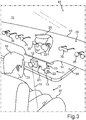
- Fig. 3 illustrates a camera-display system 11 that may be arranged inside an embodiment of vehicle 10.
- a viewing region 17 may be arranged at a seat 37, for example a driver seat or a passenger seat.
- the field of view 16 of camera 12 may be directed to seat 37 such that a person 19 sitting in seat 37 may be filmed by camera 12 and camera images 21 may be processed by image processing unit 13 to generate the at least one output image 20 for display device 14.
- Display device 14 can be, for example arranged on a dashboard 38 of vehicle 10.
- Display device 14 may be based on a transparent pixel matrix 39 on a transparent carrier element 40, for example a screen or a glass panel. Pixel matrix 39 deactivated, person 19 may look through wind screen 41.
- the at least one output image 20 may be displayed, showing person 19 as filmed by camera 12 with the image content 22 overlaid over at least one body part, for example the face.
- an image of a product 35 for example glasses, may be overlaid over the at least one body part 23, for example the face, as shown in Fig. 3 .
- person 19 may view the appearance with the product 35. The person 19 can thus experiment with changing between different product 35.
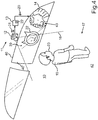
- Fig. 4 illustrates an embodiment with a camera-display system 11 where display device 14 is based on a transparent pixel matrix 39 on a transparent carrier element 40 that may be based on a window screen of a window 40' of vehicle 10.
- the viewing region 17 of camera-image system 11 may be inside or outside vehicle 10. If viewing region 17 is outside vehicle 10, a person 19, for example a child, may be animated to approach and/or enter vehicle 10.
- a viewing region 17 inside vehicle 10 may provide the advantage that a person 19, for example a child, may be entertained during a drive of vehicle 10.
- image content 22 may be used to change or manipulate the appearance of a body part 23.
- Fig. 4 additionally illustrates that a background scenery 42 of person 19 as it may be imaged or pictured in the at least one camera image 21 may be replaced by an artificial scenery 43 that is different from the real background scenery 42.
- the camera-display system 11 may also be used for an authentication functionality of vehicle 10 that may be performed during the entering of vehicle 10.
- the at least one output image 20 may signal where person 19 may have to place his or her head or face for a authentication routine, for example a biometric feature recognition.
- the camera-display system 11 By overlaying image content 22 over the at least one camera image 21 for generating the at least one output image 20, the camera-display system 11 provides at least one augmented camera image in display device 14.
- the augmentation can be provided for at least one of the following use cases: Animations and entertaining presentations for children, for example comic characters, that make entering the vehicle attractive and/or entertain a child during a drive.
- Visualization in the context of shopping for example the presentation of a product, for example clothes and/or accessories worn at the body of the customer or person ( Fig. 2 und Fig. 3 ). This can be performed for products already bought or for an online-shopping product.
- the system provides a camera and an image processing unit 13 for example with an augmented reality algorithm, and a display device.
- the camera and the display device may be arranged in such a way, that the viewing region is arranged outside the vehicle or inside the vehicle.
- Over a communication link for example an internet link, it is also possible to share a screenshot, that is at least one of the at least one output image 20, online.
Landscapes
- Engineering & Computer Science (AREA)
- Physics & Mathematics (AREA)
- General Physics & Mathematics (AREA)
- Multimedia (AREA)
- Theoretical Computer Science (AREA)
- Human Computer Interaction (AREA)
- Closed-Circuit Television Systems (AREA)
- Controls And Circuits For Display Device (AREA)
- User Interface Of Digital Computer (AREA)
Abstract
Description
- The invention is concerned with a vehicle comprising a camera-display-system. A field-of-view of a camera of the system is directed to a region which is called "viewing region" in the sequel. A display device of the system is also facing this viewing region, i.e. the display device is designed to display at least one output image to the viewing region. The at least one output image is generated on the basis of at least one camera image generated by the camera. Thus, if a person is standing inside the viewing region facing the camera, this same person will be able to see itself on the display device. In other words, the camera-display-system constitutes an electronic mirror which a person may use for regarding himself or herself.
- A vehicle comprising such an electronic mirror is described in
US 2016/0082888 A1 . According to that document, a vehicle sun visor system may comprise a touchscreen and a camera in a so-called "see-me" arrangement that is a person sitting in a vehicle seat looking at the sun visor system will be filmed by the camera and a display integrated in the sun visor system will show the camera images to the person sitting in the vehicle seat. With the known system the person will only see the pure camera images without any additional information. - A mechanical system for arranging a tablet-PC in a vehicle is described in
DE 10 2016 209 168 A1 -
Document DE 10 2013 009 580 A1 illustrates a vehicle infotainment system that may integrate a tablet-PC such that the tablet-PC may receive additional information from a central storage of the vehicle such as video data for viewing a movie. The tablet-PC may also comprise a camera which may be used for video conferencing. An electronic mirror function is not described in that document. - It is an object of the present invention to provide an enhanced electronic-mirror functionality in a vehicle.
- The object is achieved by the subject matter of the independent claims. Advantageous further embodiments are described in the dependent claims, the following description and the drawings.
- The invention provides a vehicle with a camera-display system. The system provides a combination of a camera and a display device. A field-of-view of the camera is directed to the already mentioned viewing region. This region may be arranged inside or outside the vehicle. In other words, the field of view of the camera may be directed to a viewing region inside the vehicle or a viewing region outside the vehicle, for example a region in front of a door of the vehicle. The display device of the system is designed to display at least one output image to the viewing region. In other words, while a person is standing in the viewing region, the camera may film the person while at the same time the person may view or watch the at least one output image on the display device. The at least one output image is based on at least one camera image generated by the camera. This results in the electronic-mirror functionality in that the person can see itself on the display device. The camera and the display are preferably facing into the same direction such that a person facing the camera will also see his or her face in the display.
- In order to enhance this functionality, an image processing unit of the system is designed to receive the at least one camera image from the camera. In other words, the camera images are not displayed directly on the display. The image processing unit is further designed to perform an object recognition for detecting at least one person in the at least one camera image and to generate the at least one output image on the basis of the at least one camera image by overlaying a predefined image content in the at least one camera image for manipulating an appearance of at least one body part of the at least one person in the at least one output image. In other words, the camera and the display device are connected or linked via an image processing unit that manipulates the at least one camera image and forwards the respective manipulated camera image as a respective output image to the display device. The manipulation is done in the way that in the at least one output image the at least one person has a different appearance compared to what the person actually looks like. This is done by adding image content that is overlaid over the image of the at least one person. In the at least one output image, the image pixels that represent the mentioned at least one body part, for example the face or the torso or a hand, are manipulated or overlaid by image pixels of the additional image content. For example, the image content may picture or represent a garment (like a hat or a dress), such that in the at least one output image a person may be shown wearing that garment although the actual person standing in the viewing region is not wearing that garment at all. For detecting the at least one object in the at least one camera image, an object recognition algorithm as known from the prior art may be used.
- The invention provides the advantage that in the vehicle the camera-display system provides an augmented reality functionality to a person looking at the system. This may support a person in different situations. For example, in the case of using an authorization functionality when entering the vehicle: For example for a biometric face identification, when the person has to look into the camera, the camera-display system may provide guidance lines as the additional image content overlaid over the camera image of the face of the person such that the person may be informed how to position the face and/or where to position the eyes.
- The invention also comprises additional embodiments that provide further advantages.
- In one embodiment the viewing region is arranged outside the vehicle and the display device is designed to display the at least one output image in a window (for example a side window) and/or on an outside surface of the vehicle (for example on a part of a door or sidewall of the vehicle). Thus, a person standing next to the vehicle may use the camera-display system as an electronic mirror with augmented-reality functionality. If the display device is arranged in a window of the vehicle, a person may look at the window from outside the vehicle and may see himself or herself in the display device with the additional image content added to the at least one camera image. Alternatively, the viewing region may be arranged inside the vehicle at at least one driver seat and/or at least one passenger seat of the vehicle. In other words, the camera may be facing the at least one driver seat and/or the at least one passenger seat. A person sitting in such a seat may therefore observe himself or herself in the display device while sitting on the seat.
- In one embodiment the display device comprises a transparent pixel matrix as a layer on a window screen and/or on a transparent carrier element. A transparent pixel matrix can be provided on the basis of OLED (organic light emitting diode), which is called tOLED (transparent OLED). A transparent carrier element may be arranged, for example, on a dashboard of the vehicle. As a material, glass or a transparent polymer may be suitable. Thus, when the pixel matrix is deactivated, i.e. no output image is shown, a person may view objects behind the carrier element, for example the surrounding traffic. When the pixel matrix is activated for displaying the at least one output image, the person may view or focus on the carrier element and regard the at least one output image.
- In one embodiment, the vehicle comprises a radio communication module that is designed to receive the described additional image content from at least one external data server. Such a radio communication module may be based on a mobile communication module and/or a WIFI module. The image content may show a product that is designed to be carried at and/or worn on the already mentioned at least one body part. For example, such a product may be a pair of glasses or said garment or a ring for a finger. The at least one external data server can be, for example, a shopping server for selling the product. Thus, the vehicle may be used as a platform for selling the product. If the viewing region is inside the vehicle, a person may do the shopping from inside the vehicle. If the viewing region is arranged outside the vehicle, the vehicle may be used for offering the product to at least one person passing by the vehicle.
- In one embodiment the vehicle comprises a locating device for determining a current geo-position of the vehicle. Such a locating device can be a receiver for a position signal of a GNSS (global navigation satellite system), e.g. the GPS (global positioning system). The vehicle is designed to signal the current geo-position over the said radio communication module to the at least one data server for receiving a location-specific image content. In other words, the image content that is overlaid over the content of the at least one camera image depends on or is a function of the current geo-position of the vehicle. To this end, the at least one data server may receive the geo-position of the vehicle and may choose the image content from several different image contents as a function of the received geo-position data. This provides the advantage that the image content may be adapted to the environment that the vehicle is currently in.
- In one embodiment the vehicle may adapt the image content to the environment by itself. To this end, the image processing unit is designed to choose the image content out of several image contents as a function of a current environment that the vehicle is in (as may be detected on the basis of a digital map and/or a sensor input from an environment sensor). Additionally or alternatively the image content may be chosen as a function of a shop in front of or near which the vehicle is parked. This may be determined on the basis of the current geo-position of the vehicle and/or the vehicle may receive an identification signal or content data describing the image content from a shop or a computer server associated with the shop. The term "near" means less than 500 m, especially less than 250 m away. Additionally or alternatively the image content may be chosen as a function of a driving situation. Such a driving situation may be one out of e.g. driving on a highway, driving overland, driving through a town, a parking phase. Additionally or alternatively the image content may be chosen as a function of a driving destination as signaled by a navigation system. For example, the driving destination may be programmed by a user or may be estimated by the navigation system on the basis of the current driving situation.
- The described image content for overlaying may be described by content data. The image content may picture or represent at least one object that is graphically overlaid over the at least one person as pictured in the at least one camera image. The overlay can be achieved by replacing corresponding image pixels in the at least one camera image and/or by the so-called alpha-blending. The image content may depict at least one object, for example a garment or an accessory that may be worn or carried by a person. In one embodiment the image processing unit is designed to detect a shape of the at least one body part whose appearance is to be changed on the basis of the additional image content. Once the shape is estimated or determined, the image processing unit may deform or warp a shape of an object represented by the image content for adapting the shape of the object to the shape of the at least one body part. The object that is represented or pictured by the image content may be, for example, a dress or a garment in general. If the shape of the body part of at least one person is estimated and the shape of the pictured garment is adapted to the shape of the body part, overlaying the adapted shape of the garment will provide a better fit to the shape of the respective body part. This provides a more realistic result of the overlay. The technology for adapting the shape of an object that is represented by image content data, is the so-called warping. Corresponding algorithms are available in the prior art.
- In one embodiment the image processing unit is designed to replace a background scenery in the at least one camera image by a predefined artificial scenery in the at least one output image. The background scenery is that part of the at least one camera image, that surrounds the at least one person pictured in the at least one camera image. Thus, in addition to changing the appearance of the at least one body part of the at least one person, the at least one person can also be pictured in a different, artificial scenery in the at least one output image. For example, if a child is looking at the display device while standing or sitting in the viewing region, the child may be pictured in an artificial scenery, for example a jungle, while sitting in the vehicle. Thus, the child can be distracted or entertained.
- In one embodiment the image processing unit is designed to provide a screenshot functionality by storing the at least one output image and/or sending the at least one output image to a predefined internet server, if a predefined user input is received. In other words, the user may trigger or demand the storing and/or sending of the at least one output image. Thus, the user may preserve the at least one output image with the appearance of the at least one body part of the at least one person manipulated or changed on the basis of the image content added by the image processing unit.
- By operating the inventive vehicle, a method is performed which is also part of the invention. The method is for operating a camera-display system of a vehicle. As has already been described, a field-of-view of a camera of the system is directed to a viewing region and a display device of the system displays at least one output image to the viewing region. The at least one output image is based on at least one camera image generated by the camera. However, the at least one output image is not identical to the at least one camera image. Instead, an image processing unit of the system receives the at least one camera image from the camera and performs an object recognition for detecting at least one person in the at least one camera image and generates the at least one output image on the basis of the at least one camera image by overlaying a predefined image content in the at least one camera image for manipulating an appearance of at least one body part of the at least one detected person in the at least one output image. Thus, an electronic mirror can be provided on the basis of the camera-display system with the additional functionality of augmenting the scenery shown in the at least one camera image.
- The method also comprises additional embodiments which provide features that have already been described in connection with the embodiments of the vehicle. Therefore, the features of the corresponding embodiments of the method are not described here again.
- The invention also comprises the combinations of the features of the described embodiments.
- In the following an exemplary implementation of the invention is described. The figures show:
- Fig. 1
- a schematic illustration of a vehicle according to the invention;
- Fig. 2
- a schematic illustration of a camera-display system of the vehicle of
Fig. 1 with a viewing regional arranged outside the vehicle; - Fig. 3
- a schematic illustration of a camera-display system of the vehicle with a viewing region arranged inside the vehicle; and
- Fig. 4
- a schematic illustration of a camera-display system that is displaying an output image with a manipulated background scenery.
- The embodiment explained in the following is a preferred embodiment of the invention. However, in the embodiment, the described components of the embodiment each represent individual features of the invention which are to be considered independently of each other and which each develop the invention also independently of each other and thereby are also to be regarded as a component of the invention in individual manner or in another than the shown combination. Furthermore, the described embodiment can also be supplemented by further features of the invention already described.
- In the figures identical reference signs indicate elements that provide the same function.
-
Fig. 1 shows a top view of amotor vehicle 10, which can be, for example, a passenger vehicle or a van. Thevehicle 10 may comprise a camera-display system 11 comprising of acamera 12, animage processing unit 13 and adisplay device 14. Theimage processing unit 13 can be a program module or software module that may be operated by anelectronic control unit 15.Camera 12 may be arranged in thevehicle 10 in such a way that a field ofview 16 of thecamera 12 may be directed towards aviewing region 17 insidevehicle 10.Display device 14 may be arranged in a similar way that a viewing side ordisplay side 18 ofdisplay device 14 may be facing towards theviewing region 17. Thus, aperson 19 inviewing region 17 may regarddisplay device 14 such thatperson 19 may see at least oneoutput image 20 displayed on theviewing side 18 ofdisplay device 14 while at thesame time camera 12 may generate at least onecamera image 21 of theperson 19 standing or sitting in theviewing region 17. The at least oneoutput image 20 may be based on the at least onecamera image 21. The at least onecamera image 21 may be received by theimage processing unit 13 and apredefined image content 22 may be overlaid over the at least onecamera image 21 for generating the at least oneoutput image 20. Asperson 19 is inside theviewing region 17, the at least oneoutput image 20 will showperson 19 however with the appearance of at least onebody part 23 ofperson 19 being manipulated in its appearance due to the overlaidimage content 22. For example, thebody part 23 can be the face ofperson 19 and theimage content 22 can be an image of glasses such that the at least oneoutput image 20 may showperson 19 wearing glasses although inreality person 19 is not wearing glasses at all. - Additionally or alternatively, the camera-
display system 11 may comprise a camera 12' and a display device 14' both of which may be facing towards a viewing region 17'outside vehicle 10. Accordingly, a person 19'outside vehicle 10 is inside the field of view 16' of camera 12' when standing in the viewing region 17' while at the same time person 19' may view at least one output image 20' on display device 14'. Camera 12' may generate at least one camera image 21' of person 19' and theimage processing unit 13 may overlay theimage content 22 over the at least one camera image 21' or generating the at least one output image 20' which may be displayed by display device 14' to theviewing region 17. -
Camera 12 may be arranged next to displaydevice 14, for example above or below or at a side ofdisplay device 14. Camera 12' may be arranged next to display device 14', for example above or below or at a side. This provides a good electronic mirror effect in that the viewing angle ofcamera 12, 12' on therespective person 19, 19' will generate the output image in such a way that it is very similar to a viewing angle ofperson 19, 19' onto a real mirror. Preferably, a distance between therespective camera 12 anddisplay device 14 is smaller than 1 m, preferably smaller than 50 cm. The distance between camera 12' and display device 14' is preferably smaller than 1 m, in particular smaller than 50 cm. Preferably, the image plane of an image sensor of the camera and the image plane of the display have a distance in the direction perpendicular to the image plane of the display that is smaller than one meter, preferably smaller than 50 cm. -
Image content 22 may be received over aradio communication module 24, which can be, for example, a mobile communication module (GSM, UMTS, 5G), or a WIFI module.Communication module 24 may be linked to at least onedata server 25, which can be, for example, a shopping server for internet shopping.Data server 25 can be part of theinternet 26. Acommunication link 27 betweencommunication module 24 anddata server 25 for transferringimage content data 28 for definingimage content 22 can lead over amobile communication network 29 in the case thatcommunication module 24 is a mobile communication module. For definingimage content 22 as a function of a current position ofvehicle 10, a locatingdevice 30 ofvehicle 10 may receive aposition signal 31 from aGNSS 32, for example the GPS.Control unit 15 may signal geo-position data 33 indicating the current position ofvehicle 10 from locatingdevice 30 and may signal the geo-position 34 as described by geo-position data 33 to thedata server 25.Data server 25 may then choose theimage content data 28 as a function of the geo-position 34. Thus, theimage content 22 used for generating the at least oneoutput image 20, 20' may be dependent on the geo-position 34 ofvehicle 10. For example, ifvehicle 10 is parked in front of a specific shop, theimage content 22 can be related to a product sold in the shop. Thus,display device 14, 14' may be used for advertising the product topersons 19 ,19'. -
Fig. 2 shows a perspective view of an embodiment ofvehicle 10 with a camera-display system 11 for displaying to a viewing region 17'outside vehicle 10. For example, camera-display system 11 may provide a display device 14' at a side or laterally ofvehicle 10. The example shows how a person 19' may be filmed or captured by camera 12' as the field of view 16' of camera 12' covers viewing region 17'. As animage content 22,image processing unit 13 may overlay an image of an object, for example a dress, over the at least one camera image 21' of person 19' standing in viewing region 17'. Theimage processing unit 13 may recognize the presence and/or contour and/or shape of at least one person 19' and may segment or recognize abody part 23, for example the torso. Then, theimage content 22 can be overlaid at a correct position such that in the at least one output image 20', person 19' is pictured with theimage content 22 overlay, such that for example a product, for example a garment and/or an accessory, is overlaid over the camera image 21' of person 19'. The appearance of the at least onebody part 23 is thus changed. In the example ofFig. 2 , person 19' appears to be wearing a dress that is theimage content 22.Image processing unit 13 may also detect a shape of the at least one or depart 23 such that theimage content 22 may be warped or adapted in shape to fit the shape of thebody part 23. This makes the at least oneoutput image 23 look more realistic. - The
image content 22 may be received fromdata server 25 as has been described in connection withFig. 1 . Thus,image content 22 may describe or picture aproduct 35 of ashop 36 in a predefined neighborhood or distance tovehicle 10, for example in a distance of maximum of 500 m, preferably 200 m. -
Fig. 3 illustrates a camera-display system 11 that may be arranged inside an embodiment ofvehicle 10. Aviewing region 17 may be arranged at aseat 37, for example a driver seat or a passenger seat. The field ofview 16 ofcamera 12 may be directed toseat 37 such that aperson 19 sitting inseat 37 may be filmed bycamera 12 andcamera images 21 may be processed byimage processing unit 13 to generate the at least oneoutput image 20 fordisplay device 14.Display device 14 can be, for example arranged on adashboard 38 ofvehicle 10.Display device 14 may be based on atransparent pixel matrix 39 on atransparent carrier element 40, for example a screen or a glass panel.Pixel matrix 39 deactivated,person 19 may look throughwind screen 41. Withpixel matrix 39 activated, the at least oneoutput image 20 may be displayed, showingperson 19 as filmed bycamera 12 with theimage content 22 overlaid over at least one body part, for example the face. Thus, an image of aproduct 35, for example glasses, may be overlaid over the at least onebody part 23, for example the face, as shown inFig. 3 . Thus,person 19 may view the appearance with theproduct 35. Theperson 19 can thus experiment with changing betweendifferent product 35. -
Fig. 4 illustrates an embodiment with a camera-display system 11 wheredisplay device 14 is based on atransparent pixel matrix 39 on atransparent carrier element 40 that may be based on a window screen of a window 40' ofvehicle 10. Theviewing region 17 of camera-image system 11 may be inside oroutside vehicle 10. If viewingregion 17 isoutside vehicle 10, aperson 19, for example a child, may be animated to approach and/or entervehicle 10. Aviewing region 17 insidevehicle 10 may provide the advantage that aperson 19, for example a child, may be entertained during a drive ofvehicle 10. As is shown,image content 22 may be used to change or manipulate the appearance of abody part 23.Fig. 4 additionally illustrates that abackground scenery 42 ofperson 19 as it may be imaged or pictured in the at least onecamera image 21 may be replaced by anartificial scenery 43 that is different from thereal background scenery 42. - The camera-
display system 11 may also be used for an authentication functionality ofvehicle 10 that may be performed during the entering ofvehicle 10. For example, the at least oneoutput image 20 may signal whereperson 19 may have to place his or her head or face for a authentication routine, for example a biometric feature recognition. - By overlaying
image content 22 over the at least onecamera image 21 for generating the at least oneoutput image 20, the camera-display system 11 provides at least one augmented camera image indisplay device 14. By choosingimage content 22, the augmentation can be provided for at least one of the following use cases:
Animations and entertaining presentations for children, for example comic characters, that make entering the vehicle attractive and/or entertain a child during a drive. - Visualization in the context of shopping, for example the presentation of a product, for example clothes and/or accessories worn at the body of the customer or person (
Fig. 2 undFig. 3 ). This can be performed for products already bought or for an online-shopping product. - This may support a person when deciding which product to shop.
- The system provides a camera and an
image processing unit 13 for example with an augmented reality algorithm, and a display device. The camera and the display device may be arranged in such a way, that the viewing region is arranged outside the vehicle or inside the vehicle. Over a communication link, for example an internet link, it is also possible to share a screenshot, that is at least one of the at least oneoutput image 20, online. - For detecting at least one
person 19 in the at least onecamera image 21, an algorithm as available in the prior art may be used. - Overall, the example shows how a smart electronic mirror may be provided by the invention.
Claims (10)
- Vehicle (10) with a camera-display system (11), wherein a field-of-view (16, 16') of a camera (12, 12') of the system (11) is directed to a viewing region (17, 17') and a display device (14, 14') of the system (11) is designed to display at least one output image (20, 20') to the viewing region (17, 17'), wherein the at least one output image (20, 20') is based on at least one camera image (21, 21') generated by the camera (12, 12'),
characterized in that
an image processing unit (13) of the system (11) is designed to receive the at least one camera image (21, 21') from the camera (12, 12') and to perform an object recognition for detecting at least one person (19, 19') in the at least one camera image (21, 21') and to generate the at least one output image (20, 20') on the basis of the at least one camera image (21, 21') by overlaying a predefined image content (22) of the at least one camera image (21, 21') for manipulating an appearance of at least one body part (23) of the at least one detected person (19, 19') in the at least one output image (20, 20'). - Vehicle (10) according to claim 1, wherein the viewing region (17') is arranged outside the vehicle (10) and the display device (14') is designed to display the at least one output image (20') in a window (40') and/or on an outside surface of the vehicle (10) or wherein the viewing region (17) is arranged inside the vehicle (10) at at least one driver seat (37) and/or at least one passenger seat (37) of the vehicle (10).
- Vehicle (10) according to any of the preceding claims, wherein the display device (14, 14') comprises a transparent pixel matrix (39) as a layer on a window (40') and/or on a transparent carrier element (40).
- Vehicle (10) according to any of the preceding claims, wherein the vehicle (10) comprises a communication module (24) that is designed to receive the image content (22) from at least one external data server (25), wherein the image content (22) shows a product (35) to be carried at and/or worn on the at least one body part (23).
- Vehicle (10) according to claim 4, wherein the vehicle comprises a locating device (30) for determining a current geo-position (34) of the vehicle (10) and the vehicle (10) is designed to signal the current geo-position (34) over the communication module (24) to the at least one data server (25) for receiving location specific image content (22).
- Vehicle (10) according to any of the preceding claims, wherein the image processing unit (13) is designed to choose the image content (22) out of several image contents as a function of- a current environment that the vehicle (10) is in and/or- a shop (36), if the vehicle is parked in front of the shop (36) or within a predefined distance of the shop (36), and/or- a driving situation and/or- a driving destination as signaled by a navigation system.
- Vehicle (10) according to any of the preceding claims, wherein the image processing unit (13) is designed to detect a shape of the at least one body part (23) and to deform a shape of an object represented by the image content (22) for adapting the shape of the object to the shape of the at least one body part.
- Vehicle (10) according to any of the preceding claims, wherein the image processing unit (13) is designed to replace a background scenery (42) of the at least one camera image (21, 21') by a predefined artificial scenery (43) in the at least one output image (20, 20').
- Vehicle (10) according to any of the preceding claims, wherein the image processing unit (13) is designed to provide a screenshot functionality by storing the at least one output image (20, 20') and/or by sending the at least one output image (20, 20') to a predefined internet server, if a predefined user input is received.
- Method for operating a camera-display system (11) of a vehicle (10), wherein a field-of-view (16, 16') of a camera (12, 12') of the system (11) is directed to a viewing region (17, 17') and a display device (14, 14') of the system (11) displays at least one output image (20, 20') to the viewing region (17, 17'), wherein the at least one output image (20, 20') is based on at least one camera image (21, 21') generated by the camera (12, 12'),
characterized in that
an image processing unit (13) of the system (11) receives the at least one camera image (21, 21') from the camera (12, 12') and performs an object recognition for detecting at least one person (19, 19') in the at least one camera image (21, 21') and generates the at least one output image (20, 20') on the basis of the at least one camera image (21, 21') by overlaying a predefined image content (22) for manipulating an appearance of at least one body part (23) of the at least one detected person (19, 19') in the at least one output image (20, 20').
Priority Applications (2)
| Application Number | Priority Date | Filing Date | Title |
|---|---|---|---|
| EP18214009.5A EP3671533B1 (en) | 2018-12-19 | 2018-12-19 | Vehicle with a camera-display-system and method for operating the vehicle |
| PCT/EP2019/084961 WO2020126850A1 (en) | 2018-12-19 | 2019-12-12 | Vehicle with a camera-display-system and method for operating the vehicle |
Applications Claiming Priority (1)
| Application Number | Priority Date | Filing Date | Title |
|---|---|---|---|
| EP18214009.5A EP3671533B1 (en) | 2018-12-19 | 2018-12-19 | Vehicle with a camera-display-system and method for operating the vehicle |
Publications (2)
| Publication Number | Publication Date |
|---|---|
| EP3671533A1 true EP3671533A1 (en) | 2020-06-24 |
| EP3671533B1 EP3671533B1 (en) | 2023-10-11 |
Family
ID=64746150
Family Applications (1)
| Application Number | Title | Priority Date | Filing Date |
|---|---|---|---|
| EP18214009.5A Active EP3671533B1 (en) | 2018-12-19 | 2018-12-19 | Vehicle with a camera-display-system and method for operating the vehicle |
Country Status (2)
| Country | Link |
|---|---|
| EP (1) | EP3671533B1 (en) |
| WO (1) | WO2020126850A1 (en) |
Citations (5)
| Publication number | Priority date | Publication date | Assignee | Title |
|---|---|---|---|---|
| US20030095080A1 (en) * | 2001-11-19 | 2003-05-22 | Koninklijke Philips Electronics N.V. | Method and system for improving car safety using image-enhancement |
| EP2608153A1 (en) * | 2011-12-21 | 2013-06-26 | Harman Becker Automotive Systems GmbH | Method and system for playing an augmented reality game in a motor vehicle |
| DE102013009580A1 (en) | 2013-06-07 | 2014-12-11 | Audi Ag | Car infotainment system with separate display unit |
| US20160082888A1 (en) | 2014-09-19 | 2016-03-24 | Ankit Dilip Kothari | Vehicle sun visor with a multi-functional touch screen with multiple camera views and photo video capability |
| DE102016209168A1 (en) | 2015-05-26 | 2016-12-01 | David Ecker | Tablet holder for a motor vehicle |
Family Cites Families (1)
| Publication number | Priority date | Publication date | Assignee | Title |
|---|---|---|---|---|
| US10052026B1 (en) * | 2017-03-06 | 2018-08-21 | Bao Tran | Smart mirror |
-
2018
- 2018-12-19 EP EP18214009.5A patent/EP3671533B1/en active Active
-
2019
- 2019-12-12 WO PCT/EP2019/084961 patent/WO2020126850A1/en not_active Ceased
Patent Citations (5)
| Publication number | Priority date | Publication date | Assignee | Title |
|---|---|---|---|---|
| US20030095080A1 (en) * | 2001-11-19 | 2003-05-22 | Koninklijke Philips Electronics N.V. | Method and system for improving car safety using image-enhancement |
| EP2608153A1 (en) * | 2011-12-21 | 2013-06-26 | Harman Becker Automotive Systems GmbH | Method and system for playing an augmented reality game in a motor vehicle |
| DE102013009580A1 (en) | 2013-06-07 | 2014-12-11 | Audi Ag | Car infotainment system with separate display unit |
| US20160082888A1 (en) | 2014-09-19 | 2016-03-24 | Ankit Dilip Kothari | Vehicle sun visor with a multi-functional touch screen with multiple camera views and photo video capability |
| DE102016209168A1 (en) | 2015-05-26 | 2016-12-01 | David Ecker | Tablet holder for a motor vehicle |
Non-Patent Citations (4)
| Title |
|---|
| HUTSCHINGS ET AL: "The Aeon Project: AR & Virtual Reality In Vehicles via PSFK", 3 August 2011 (2011-08-03), pages 1 - 5, XP055021769, Retrieved from the Internet <URL:http://www.psfk.com/2011/08/the-aeon-project-ar-virtual-reality-in-vehicles.html> [retrieved on 20120313] * |
| MIAOLONG YUAN ET AL: "A mixed reality system for virtual glasses try-on", PROCEEDINGS OF THE 10TH INTERNATIONAL CONFERENCE ON VIRTUAL REALITY CONTINUUM AND ITS APPLICATIONS IN INDUSTRY, VRCAI '11, 1 January 2011 (2011-01-01), New York, New York, USA, pages 363, XP055158336, ISBN: 978-1-45-031060-4, DOI: 10.1145/2087756.2087816 * |
| PHILIPP HOCK ET AL: "CarVR", PROCEEDINGS OF THE 2017 CHI CONFERENCE ON HUMAN FACTORS IN COMPUTING SYSTEMS , CHI '17, ACM PRESS, NEW YORK, NEW YORK, USA, 2 May 2017 (2017-05-02), pages 4034 - 4044, XP058337783, ISBN: 978-1-4503-4655-9, DOI: 10.1145/3025453.3025665 * |
| RON SMITH: "jaguar land rover 360 virtual urban windscreen uses heads-up display", 16 December 2014 (2014-12-16), pages 1 - 8, XP055584283, Retrieved from the Internet <URL:https://www.designboom.com/technology/jaguar-land-rover-360-virtual-urban-windscreen-12-16-2014/> [retrieved on 20190429] * |
Also Published As
| Publication number | Publication date |
|---|---|
| EP3671533B1 (en) | 2023-10-11 |
| WO2020126850A1 (en) | 2020-06-25 |
Similar Documents
| Publication | Publication Date | Title |
|---|---|---|
| CN110419063B (en) | AR display device and AR display method | |
| JP6947873B2 (en) | AR display device, AR display method, and program | |
| US9823735B2 (en) | Method for selecting an information source from a plurality of information sources for display on a display of smart glasses | |
| US11100718B2 (en) | Method for operating a display device in a motor vehicle | |
| US10589625B1 (en) | Systems and methods for augmenting an appearance of an actual vehicle component with a virtual vehicle component | |
| US11257390B2 (en) | Evaluation of a simulated vehicle-related feature | |
| CN109415018B (en) | Method and control unit for a digital rear view mirror | |
| EP3456574B1 (en) | Method and system for displaying virtual reality information in a vehicle | |
| US20100287500A1 (en) | Method and system for displaying conformal symbology on a see-through display | |
| US20150325052A1 (en) | Image superposition of virtual objects in a camera image | |
| WO2013086249A2 (en) | Vehicle vision system with customized display | |
| CN110632756A (en) | Image display system and method, non-transitory recording medium, and moving body | |
| US12296678B2 (en) | Evaluation of a simulated vehicle-related feature | |
| CN101855520A (en) | Method and device for outputting optical driving recommendations in a motor vehicle | |
| CN111902792A (en) | Method and apparatus for providing information by an augmented reality device, method and apparatus for providing information for controlling display of an augmented reality device, method and apparatus for controlling display of an augmented reality device, computer-readable storage medium having instructions for performing the method | |
| US11458985B2 (en) | Method, device, and computer program for the operation of a vehicle operation system | |
| EP3476673B1 (en) | Vehicle image displaying apparatus and method of displaying image data on a head-mounted display device disposed in a vehicle | |
| CN103782329B (en) | Method and apparatus for representing road signs information | |
| EP3671533B1 (en) | Vehicle with a camera-display-system and method for operating the vehicle | |
| US9283893B2 (en) | Vision-controlled interaction for data spectacles | |
| WO2019031291A1 (en) | Vehicle display device | |
| EP3671534B1 (en) | Electronic mirror device with a camera-display arrangement and motor vehicle and method for operating the electronic mirror device | |
| WO2024132690A1 (en) | In-vehicle immersive-reality system | |
| JP2026074222A (en) | Information processing method and information processing apparatus | |
| Schliep | Freely programmable projection cluster |
Legal Events
| Date | Code | Title | Description |
|---|---|---|---|
| PUAI | Public reference made under article 153(3) epc to a published international application that has entered the european phase |
Free format text: ORIGINAL CODE: 0009012 |
|
| STAA | Information on the status of an ep patent application or granted ep patent |
Free format text: STATUS: THE APPLICATION HAS BEEN PUBLISHED |
|
| AK | Designated contracting states |
Kind code of ref document: A1 Designated state(s): AL AT BE BG CH CY CZ DE DK EE ES FI FR GB GR HR HU IE IS IT LI LT LU LV MC MK MT NL NO PL PT RO RS SE SI SK SM TR |
|
| AX | Request for extension of the european patent |
Extension state: BA ME |
|
| STAA | Information on the status of an ep patent application or granted ep patent |
Free format text: STATUS: REQUEST FOR EXAMINATION WAS MADE |
|
| 17P | Request for examination filed |
Effective date: 20201222 |
|
| RBV | Designated contracting states (corrected) |
Designated state(s): AL AT BE BG CH CY CZ DE DK EE ES FI FR GB GR HR HU IE IS IT LI LT LU LV MC MK MT NL NO PL PT RO RS SE SI SK SM TR |
|
| STAA | Information on the status of an ep patent application or granted ep patent |
Free format text: STATUS: EXAMINATION IS IN PROGRESS |
|
| 17Q | First examination report despatched |
Effective date: 20210806 |
|
| REG | Reference to a national code |
Ref country code: DE Ref legal event code: R079 Free format text: PREVIOUS MAIN CLASS: G06K0009000000 Ipc: G06V0020200000 Ref country code: DE Ref legal event code: R079 Ref document number: 602018059090 Country of ref document: DE Free format text: PREVIOUS MAIN CLASS: G06K0009000000 Ipc: G06V0020200000 |
|
| GRAP | Despatch of communication of intention to grant a patent |
Free format text: ORIGINAL CODE: EPIDOSNIGR1 |
|
| STAA | Information on the status of an ep patent application or granted ep patent |
Free format text: STATUS: GRANT OF PATENT IS INTENDED |
|
| RIC1 | Information provided on ipc code assigned before grant |
Ipc: G06T 19/00 20110101ALI20230421BHEP Ipc: G06V 40/10 20220101ALI20230421BHEP Ipc: G06V 20/56 20220101ALI20230421BHEP Ipc: G06V 20/20 20220101AFI20230421BHEP |
|
| INTG | Intention to grant announced |
Effective date: 20230522 |
|
| P01 | Opt-out of the competence of the unified patent court (upc) registered |
Effective date: 20230529 |
|
| GRAS | Grant fee paid |
Free format text: ORIGINAL CODE: EPIDOSNIGR3 |
|
| GRAA | (expected) grant |
Free format text: ORIGINAL CODE: 0009210 |
|
| STAA | Information on the status of an ep patent application or granted ep patent |
Free format text: STATUS: THE PATENT HAS BEEN GRANTED |
|
| AK | Designated contracting states |
Kind code of ref document: B1 Designated state(s): AL AT BE BG CH CY CZ DE DK EE ES FI FR GB GR HR HU IE IS IT LI LT LU LV MC MK MT NL NO PL PT RO RS SE SI SK SM TR |
|
| REG | Reference to a national code |
Ref country code: GB Ref legal event code: FG4D |
|
| REG | Reference to a national code |
Ref country code: CH Ref legal event code: EP |
|
| REG | Reference to a national code |
Ref country code: DE Ref legal event code: R096 Ref document number: 602018059090 Country of ref document: DE |
|
| REG | Reference to a national code |
Ref country code: IE Ref legal event code: FG4D |
|
| REG | Reference to a national code |
Ref country code: LT Ref legal event code: MG9D |
|
| REG | Reference to a national code |
Ref country code: NL Ref legal event code: MP Effective date: 20231011 |
|
| REG | Reference to a national code |
Ref country code: AT Ref legal event code: MK05 Ref document number: 1620990 Country of ref document: AT Kind code of ref document: T Effective date: 20231011 |
|
| PG25 | Lapsed in a contracting state [announced via postgrant information from national office to epo] |
Ref country code: NL Free format text: LAPSE BECAUSE OF FAILURE TO SUBMIT A TRANSLATION OF THE DESCRIPTION OR TO PAY THE FEE WITHIN THE PRESCRIBED TIME-LIMIT Effective date: 20231011 |
|
| PG25 | Lapsed in a contracting state [announced via postgrant information from national office to epo] |
Ref country code: GR Free format text: LAPSE BECAUSE OF FAILURE TO SUBMIT A TRANSLATION OF THE DESCRIPTION OR TO PAY THE FEE WITHIN THE PRESCRIBED TIME-LIMIT Effective date: 20240112 |
|
| PG25 | Lapsed in a contracting state [announced via postgrant information from national office to epo] |
Ref country code: IS Free format text: LAPSE BECAUSE OF FAILURE TO SUBMIT A TRANSLATION OF THE DESCRIPTION OR TO PAY THE FEE WITHIN THE PRESCRIBED TIME-LIMIT Effective date: 20240211 |
|
| PG25 | Lapsed in a contracting state [announced via postgrant information from national office to epo] |
Ref country code: LT Free format text: LAPSE BECAUSE OF FAILURE TO SUBMIT A TRANSLATION OF THE DESCRIPTION OR TO PAY THE FEE WITHIN THE PRESCRIBED TIME-LIMIT Effective date: 20231011 |
|
| PG25 | Lapsed in a contracting state [announced via postgrant information from national office to epo] |
Ref country code: AT Free format text: LAPSE BECAUSE OF FAILURE TO SUBMIT A TRANSLATION OF THE DESCRIPTION OR TO PAY THE FEE WITHIN THE PRESCRIBED TIME-LIMIT Effective date: 20231011 |
|
| PG25 | Lapsed in a contracting state [announced via postgrant information from national office to epo] |
Ref country code: ES Free format text: LAPSE BECAUSE OF FAILURE TO SUBMIT A TRANSLATION OF THE DESCRIPTION OR TO PAY THE FEE WITHIN THE PRESCRIBED TIME-LIMIT Effective date: 20231011 |
|
| PG25 | Lapsed in a contracting state [announced via postgrant information from national office to epo] |
Ref country code: LT Free format text: LAPSE BECAUSE OF FAILURE TO SUBMIT A TRANSLATION OF THE DESCRIPTION OR TO PAY THE FEE WITHIN THE PRESCRIBED TIME-LIMIT Effective date: 20231011 Ref country code: IS Free format text: LAPSE BECAUSE OF FAILURE TO SUBMIT A TRANSLATION OF THE DESCRIPTION OR TO PAY THE FEE WITHIN THE PRESCRIBED TIME-LIMIT Effective date: 20240211 Ref country code: GR Free format text: LAPSE BECAUSE OF FAILURE TO SUBMIT A TRANSLATION OF THE DESCRIPTION OR TO PAY THE FEE WITHIN THE PRESCRIBED TIME-LIMIT Effective date: 20240112 Ref country code: ES Free format text: LAPSE BECAUSE OF FAILURE TO SUBMIT A TRANSLATION OF THE DESCRIPTION OR TO PAY THE FEE WITHIN THE PRESCRIBED TIME-LIMIT Effective date: 20231011 Ref country code: BG Free format text: LAPSE BECAUSE OF FAILURE TO SUBMIT A TRANSLATION OF THE DESCRIPTION OR TO PAY THE FEE WITHIN THE PRESCRIBED TIME-LIMIT Effective date: 20240111 Ref country code: AT Free format text: LAPSE BECAUSE OF FAILURE TO SUBMIT A TRANSLATION OF THE DESCRIPTION OR TO PAY THE FEE WITHIN THE PRESCRIBED TIME-LIMIT Effective date: 20231011 Ref country code: PT Free format text: LAPSE BECAUSE OF FAILURE TO SUBMIT A TRANSLATION OF THE DESCRIPTION OR TO PAY THE FEE WITHIN THE PRESCRIBED TIME-LIMIT Effective date: 20240212 |
|
| PG25 | Lapsed in a contracting state [announced via postgrant information from national office to epo] |
Ref country code: SE Free format text: LAPSE BECAUSE OF FAILURE TO SUBMIT A TRANSLATION OF THE DESCRIPTION OR TO PAY THE FEE WITHIN THE PRESCRIBED TIME-LIMIT Effective date: 20231011 Ref country code: RS Free format text: LAPSE BECAUSE OF FAILURE TO SUBMIT A TRANSLATION OF THE DESCRIPTION OR TO PAY THE FEE WITHIN THE PRESCRIBED TIME-LIMIT Effective date: 20231011 Ref country code: PL Free format text: LAPSE BECAUSE OF FAILURE TO SUBMIT A TRANSLATION OF THE DESCRIPTION OR TO PAY THE FEE WITHIN THE PRESCRIBED TIME-LIMIT Effective date: 20231011 Ref country code: NO Free format text: LAPSE BECAUSE OF FAILURE TO SUBMIT A TRANSLATION OF THE DESCRIPTION OR TO PAY THE FEE WITHIN THE PRESCRIBED TIME-LIMIT Effective date: 20240111 Ref country code: LV Free format text: LAPSE BECAUSE OF FAILURE TO SUBMIT A TRANSLATION OF THE DESCRIPTION OR TO PAY THE FEE WITHIN THE PRESCRIBED TIME-LIMIT Effective date: 20231011 Ref country code: HR Free format text: LAPSE BECAUSE OF FAILURE TO SUBMIT A TRANSLATION OF THE DESCRIPTION OR TO PAY THE FEE WITHIN THE PRESCRIBED TIME-LIMIT Effective date: 20231011 |
|
| PG25 | Lapsed in a contracting state [announced via postgrant information from national office to epo] |
Ref country code: DK Free format text: LAPSE BECAUSE OF FAILURE TO SUBMIT A TRANSLATION OF THE DESCRIPTION OR TO PAY THE FEE WITHIN THE PRESCRIBED TIME-LIMIT Effective date: 20231011 |
|
| REG | Reference to a national code |
Ref country code: DE Ref legal event code: R097 Ref document number: 602018059090 Country of ref document: DE |
|
| PG25 | Lapsed in a contracting state [announced via postgrant information from national office to epo] |
Ref country code: CZ Free format text: LAPSE BECAUSE OF FAILURE TO SUBMIT A TRANSLATION OF THE DESCRIPTION OR TO PAY THE FEE WITHIN THE PRESCRIBED TIME-LIMIT Effective date: 20231011 |
|
| PG25 | Lapsed in a contracting state [announced via postgrant information from national office to epo] |
Ref country code: SK Free format text: LAPSE BECAUSE OF FAILURE TO SUBMIT A TRANSLATION OF THE DESCRIPTION OR TO PAY THE FEE WITHIN THE PRESCRIBED TIME-LIMIT Effective date: 20231011 |
|
| PG25 | Lapsed in a contracting state [announced via postgrant information from national office to epo] |
Ref country code: SM Free format text: LAPSE BECAUSE OF FAILURE TO SUBMIT A TRANSLATION OF THE DESCRIPTION OR TO PAY THE FEE WITHIN THE PRESCRIBED TIME-LIMIT Effective date: 20231011 Ref country code: SK Free format text: LAPSE BECAUSE OF FAILURE TO SUBMIT A TRANSLATION OF THE DESCRIPTION OR TO PAY THE FEE WITHIN THE PRESCRIBED TIME-LIMIT Effective date: 20231011 Ref country code: RO Free format text: LAPSE BECAUSE OF FAILURE TO SUBMIT A TRANSLATION OF THE DESCRIPTION OR TO PAY THE FEE WITHIN THE PRESCRIBED TIME-LIMIT Effective date: 20231011 Ref country code: IT Free format text: LAPSE BECAUSE OF FAILURE TO SUBMIT A TRANSLATION OF THE DESCRIPTION OR TO PAY THE FEE WITHIN THE PRESCRIBED TIME-LIMIT Effective date: 20231011 Ref country code: EE Free format text: LAPSE BECAUSE OF FAILURE TO SUBMIT A TRANSLATION OF THE DESCRIPTION OR TO PAY THE FEE WITHIN THE PRESCRIBED TIME-LIMIT Effective date: 20231011 Ref country code: DK Free format text: LAPSE BECAUSE OF FAILURE TO SUBMIT A TRANSLATION OF THE DESCRIPTION OR TO PAY THE FEE WITHIN THE PRESCRIBED TIME-LIMIT Effective date: 20231011 Ref country code: CZ Free format text: LAPSE BECAUSE OF FAILURE TO SUBMIT A TRANSLATION OF THE DESCRIPTION OR TO PAY THE FEE WITHIN THE PRESCRIBED TIME-LIMIT Effective date: 20231011 |
|
| REG | Reference to a national code |
Ref country code: CH Ref legal event code: PL |
|
| PLBE | No opposition filed within time limit |
Free format text: ORIGINAL CODE: 0009261 |
|
| STAA | Information on the status of an ep patent application or granted ep patent |
Free format text: STATUS: NO OPPOSITION FILED WITHIN TIME LIMIT |
|
| PG25 | Lapsed in a contracting state [announced via postgrant information from national office to epo] |
Ref country code: LU Free format text: LAPSE BECAUSE OF NON-PAYMENT OF DUE FEES Effective date: 20231219 |
|
| PG25 | Lapsed in a contracting state [announced via postgrant information from national office to epo] |
Ref country code: MC Free format text: LAPSE BECAUSE OF FAILURE TO SUBMIT A TRANSLATION OF THE DESCRIPTION OR TO PAY THE FEE WITHIN THE PRESCRIBED TIME-LIMIT Effective date: 20231011 |
|
| REG | Reference to a national code |
Ref country code: BE Ref legal event code: MM Effective date: 20231231 |
|
| PG25 | Lapsed in a contracting state [announced via postgrant information from national office to epo] |
Ref country code: MC Free format text: LAPSE BECAUSE OF FAILURE TO SUBMIT A TRANSLATION OF THE DESCRIPTION OR TO PAY THE FEE WITHIN THE PRESCRIBED TIME-LIMIT Effective date: 20231011 Ref country code: LU Free format text: LAPSE BECAUSE OF NON-PAYMENT OF DUE FEES Effective date: 20231219 |
|
| 26N | No opposition filed |
Effective date: 20240712 |
|
| REG | Reference to a national code |
Ref country code: IE Ref legal event code: MM4A |
|
| PG25 | Lapsed in a contracting state [announced via postgrant information from national office to epo] |
Ref country code: IE Free format text: LAPSE BECAUSE OF NON-PAYMENT OF DUE FEES Effective date: 20231219 |
|
| PG25 | Lapsed in a contracting state [announced via postgrant information from national office to epo] |
Ref country code: BE Free format text: LAPSE BECAUSE OF NON-PAYMENT OF DUE FEES Effective date: 20231231 |
|
| PG25 | Lapsed in a contracting state [announced via postgrant information from national office to epo] |
Ref country code: CH Free format text: LAPSE BECAUSE OF NON-PAYMENT OF DUE FEES Effective date: 20231231 |
|
| PG25 | Lapsed in a contracting state [announced via postgrant information from national office to epo] |
Ref country code: SI Free format text: LAPSE BECAUSE OF FAILURE TO SUBMIT A TRANSLATION OF THE DESCRIPTION OR TO PAY THE FEE WITHIN THE PRESCRIBED TIME-LIMIT Effective date: 20231011 |
|
| PG25 | Lapsed in a contracting state [announced via postgrant information from national office to epo] |
Ref country code: SI Free format text: LAPSE BECAUSE OF FAILURE TO SUBMIT A TRANSLATION OF THE DESCRIPTION OR TO PAY THE FEE WITHIN THE PRESCRIBED TIME-LIMIT Effective date: 20231011 Ref country code: IE Free format text: LAPSE BECAUSE OF NON-PAYMENT OF DUE FEES Effective date: 20231219 Ref country code: CH Free format text: LAPSE BECAUSE OF NON-PAYMENT OF DUE FEES Effective date: 20231231 Ref country code: BE Free format text: LAPSE BECAUSE OF NON-PAYMENT OF DUE FEES Effective date: 20231231 |
|
| PG25 | Lapsed in a contracting state [announced via postgrant information from national office to epo] |
Ref country code: FI Free format text: LAPSE BECAUSE OF FAILURE TO SUBMIT A TRANSLATION OF THE DESCRIPTION OR TO PAY THE FEE WITHIN THE PRESCRIBED TIME-LIMIT Effective date: 20231011 |
|
| PG25 | Lapsed in a contracting state [announced via postgrant information from national office to epo] |
Ref country code: CY Free format text: LAPSE BECAUSE OF FAILURE TO SUBMIT A TRANSLATION OF THE DESCRIPTION OR TO PAY THE FEE WITHIN THE PRESCRIBED TIME-LIMIT; INVALID AB INITIO Effective date: 20181219 |
|
| PG25 | Lapsed in a contracting state [announced via postgrant information from national office to epo] |
Ref country code: HU Free format text: LAPSE BECAUSE OF FAILURE TO SUBMIT A TRANSLATION OF THE DESCRIPTION OR TO PAY THE FEE WITHIN THE PRESCRIBED TIME-LIMIT; INVALID AB INITIO Effective date: 20181219 |
|
| PG25 | Lapsed in a contracting state [announced via postgrant information from national office to epo] |
Ref country code: TR Free format text: LAPSE BECAUSE OF FAILURE TO SUBMIT A TRANSLATION OF THE DESCRIPTION OR TO PAY THE FEE WITHIN THE PRESCRIBED TIME-LIMIT Effective date: 20231011 |
|
| PGFP | Annual fee paid to national office [announced via postgrant information from national office to epo] |
Ref country code: DE Payment date: 20251217 Year of fee payment: 8 |
|
| PGFP | Annual fee paid to national office [announced via postgrant information from national office to epo] |
Ref country code: GB Payment date: 20251218 Year of fee payment: 8 |
|
| PGFP | Annual fee paid to national office [announced via postgrant information from national office to epo] |
Ref country code: FR Payment date: 20251217 Year of fee payment: 8 |