EP3671183A1 - Method for determining a composition of pigments in a hair fiber - Google Patents
Method for determining a composition of pigments in a hair fiber Download PDFInfo
- Publication number
- EP3671183A1 EP3671183A1 EP18213307.4A EP18213307A EP3671183A1 EP 3671183 A1 EP3671183 A1 EP 3671183A1 EP 18213307 A EP18213307 A EP 18213307A EP 3671183 A1 EP3671183 A1 EP 3671183A1
- Authority
- EP
- European Patent Office
- Prior art keywords
- hair
- hair fiber
- region
- electromagnetic radiation
- pigment
- Prior art date
- Legal status (The legal status is an assumption and is not a legal conclusion. Google has not performed a legal analysis and makes no representation as to the accuracy of the status listed.)
- Granted
Links
Images


Classifications
-
- G—PHYSICS
- G01—MEASURING; TESTING
- G01N—INVESTIGATING OR ANALYSING MATERIALS BY DETERMINING THEIR CHEMICAL OR PHYSICAL PROPERTIES
- G01N21/00—Investigating or analysing materials by the use of optical means, i.e. using sub-millimetre waves, infrared, visible or ultraviolet light
- G01N21/17—Systems in which incident light is modified in accordance with the properties of the material investigated
- G01N21/25—Colour; Spectral properties, i.e. comparison of effect of material on the light at two or more different wavelengths or wavelength bands
- G01N21/31—Investigating relative effect of material at wavelengths characteristic of specific elements or molecules, e.g. atomic absorption spectrometry
-
- A—HUMAN NECESSITIES
- A45—HAND OR TRAVELLING ARTICLES
- A45D—HAIRDRESSING OR SHAVING EQUIPMENT; EQUIPMENT FOR COSMETICS OR COSMETIC TREATMENTS, e.g. FOR MANICURING OR PEDICURING
- A45D44/00—Other cosmetic or toiletry articles, e.g. for hairdressers' rooms
- A45D44/005—Other cosmetic or toiletry articles, e.g. for hairdressers' rooms for selecting or displaying personal cosmetic colours or hairstyle
-
- G—PHYSICS
- G01—MEASURING; TESTING
- G01J—MEASUREMENT OF INTENSITY, VELOCITY, SPECTRAL CONTENT, POLARISATION, PHASE OR PULSE CHARACTERISTICS OF INFRARED, VISIBLE OR ULTRAVIOLET LIGHT; COLORIMETRY; RADIATION PYROMETRY
- G01J3/00—Spectrometry; Spectrophotometry; Monochromators; Measuring colours
- G01J3/02—Details
- G01J3/10—Arrangements of light sources specially adapted for spectrometry or colorimetry
- G01J3/108—Arrangements of light sources specially adapted for spectrometry or colorimetry for measurement in the infrared range
-
- G—PHYSICS
- G01—MEASURING; TESTING
- G01J—MEASUREMENT OF INTENSITY, VELOCITY, SPECTRAL CONTENT, POLARISATION, PHASE OR PULSE CHARACTERISTICS OF INFRARED, VISIBLE OR ULTRAVIOLET LIGHT; COLORIMETRY; RADIATION PYROMETRY
- G01J3/00—Spectrometry; Spectrophotometry; Monochromators; Measuring colours
- G01J3/46—Measurement of colour; Colour measuring devices, e.g. colorimeters
- G01J3/463—Colour matching
-
- G—PHYSICS
- G01—MEASURING; TESTING
- G01J—MEASUREMENT OF INTENSITY, VELOCITY, SPECTRAL CONTENT, POLARISATION, PHASE OR PULSE CHARACTERISTICS OF INFRARED, VISIBLE OR ULTRAVIOLET LIGHT; COLORIMETRY; RADIATION PYROMETRY
- G01J3/00—Spectrometry; Spectrophotometry; Monochromators; Measuring colours
- G01J3/02—Details
- G01J3/10—Arrangements of light sources specially adapted for spectrometry or colorimetry
- G01J2003/102—Plural sources
- G01J2003/104—Monochromatic plural sources
-
- G—PHYSICS
- G01—MEASURING; TESTING
- G01J—MEASUREMENT OF INTENSITY, VELOCITY, SPECTRAL CONTENT, POLARISATION, PHASE OR PULSE CHARACTERISTICS OF INFRARED, VISIBLE OR ULTRAVIOLET LIGHT; COLORIMETRY; RADIATION PYROMETRY
- G01J3/00—Spectrometry; Spectrophotometry; Monochromators; Measuring colours
- G01J3/02—Details
- G01J3/10—Arrangements of light sources specially adapted for spectrometry or colorimetry
- G01J2003/102—Plural sources
- G01J2003/106—Plural sources the two sources being alternating or selectable, e.g. in two ranges or line:continuum
-
- G—PHYSICS
- G01—MEASURING; TESTING
- G01J—MEASUREMENT OF INTENSITY, VELOCITY, SPECTRAL CONTENT, POLARISATION, PHASE OR PULSE CHARACTERISTICS OF INFRARED, VISIBLE OR ULTRAVIOLET LIGHT; COLORIMETRY; RADIATION PYROMETRY
- G01J3/00—Spectrometry; Spectrophotometry; Monochromators; Measuring colours
- G01J3/28—Investigating the spectrum
- G01J3/2823—Imaging spectrometer
- G01J2003/2826—Multispectral imaging, e.g. filter imaging
-
- G—PHYSICS
- G01—MEASURING; TESTING
- G01N—INVESTIGATING OR ANALYSING MATERIALS BY DETERMINING THEIR CHEMICAL OR PHYSICAL PROPERTIES
- G01N21/00—Investigating or analysing materials by the use of optical means, i.e. using sub-millimetre waves, infrared, visible or ultraviolet light
- G01N21/17—Systems in which incident light is modified in accordance with the properties of the material investigated
- G01N21/25—Colour; Spectral properties, i.e. comparison of effect of material on the light at two or more different wavelengths or wavelength bands
- G01N21/31—Investigating relative effect of material at wavelengths characteristic of specific elements or molecules, e.g. atomic absorption spectrometry
- G01N21/314—Investigating relative effect of material at wavelengths characteristic of specific elements or molecules, e.g. atomic absorption spectrometry with comparison of measurements at specific and non-specific wavelengths
- G01N2021/3155—Measuring in two spectral ranges, e.g. UV and visible
-
- G—PHYSICS
- G01—MEASURING; TESTING
- G01N—INVESTIGATING OR ANALYSING MATERIALS BY DETERMINING THEIR CHEMICAL OR PHYSICAL PROPERTIES
- G01N21/00—Investigating or analysing materials by the use of optical means, i.e. using sub-millimetre waves, infrared, visible or ultraviolet light
- G01N21/17—Systems in which incident light is modified in accordance with the properties of the material investigated
- G01N21/25—Colour; Spectral properties, i.e. comparison of effect of material on the light at two or more different wavelengths or wavelength bands
- G01N21/31—Investigating relative effect of material at wavelengths characteristic of specific elements or molecules, e.g. atomic absorption spectrometry
- G01N21/35—Investigating relative effect of material at wavelengths characteristic of specific elements or molecules, e.g. atomic absorption spectrometry using infrared light
- G01N21/359—Investigating relative effect of material at wavelengths characteristic of specific elements or molecules, e.g. atomic absorption spectrometry using infrared light using near infrared light
-
- G—PHYSICS
- G01—MEASURING; TESTING
- G01N—INVESTIGATING OR ANALYSING MATERIALS BY DETERMINING THEIR CHEMICAL OR PHYSICAL PROPERTIES
- G01N2201/00—Features of devices classified in G01N21/00
- G01N2201/02—Mechanical
- G01N2201/022—Casings
- G01N2201/0221—Portable; cableless; compact; hand-held
-
- G—PHYSICS
- G01—MEASURING; TESTING
- G01N—INVESTIGATING OR ANALYSING MATERIALS BY DETERMINING THEIR CHEMICAL OR PHYSICAL PROPERTIES
- G01N2201/00—Features of devices classified in G01N21/00
- G01N2201/12—Circuits of general importance; Signal processing
- G01N2201/129—Using chemometrical methods
Definitions
- the invention relates to the field of characterization of hair color, in particular the use of hyperspectral imagery to determine a pigment composition in hair, in particular human hair.
- Hair is a feature that contributes to people's looks and is most of the time exposed and visible. Hair care is an important part of a person's everyday personal care, with the use of products applied onto hair such as shampoo, mechanical handling of hair with brushes and treatments changing the general appearance of hair such as hair cuts or coloration treatments. One's age, lifestyle, diet or the use of medication can also influence the properties of hair.
- a large variety of products is available to take appropriate care of a person's hair. Products intend to target specific hair types, based on color, damage state, greyness levels for example. In order to optimize hair care, knowledge of the current state of a person's hair is needed to select the right hair treatment.
- the perceived color of hair results from light absorbed, scattered and reflected by hair fibers.
- the chemical composition of these hair fibers may comprise a large variety of chemicals in different concentrations, and different mixtures of hair pigments can lead to identical perceived colors.
- a natural medium brown hair color dyed with a lightening shade e.g. light blonde with 6% hydrogen peroxide will be significantly brighter after the dyeing process than a chemically dyed medium brown hair color.
- brown dyes from previous oxidative coloration treatments
- brown dyes receiving a first oxidative hair coloration treatment This illustrates the need to provide a more reliable way of determining the pigment composition of hair.
- the invention provides a method for determining a composition of pigments in a hair fiber, the method comprising:
- the invention adds an element of objectivity to the assessment of the chemical composition of hair fibers, in particular by making it possible to detect complex pigment compositions comprising not just one type of pigment, but virtually any combination of pigments.
- Reference spectra of hair having known pigment compositions can include both reference spectra of hair fibers having only one type of pigment, or different mixtures of pigments, in different concentrations.
- a comparison can be made using a correlation between a measured spectrum and a reference spectrum. More elaborate comparison techniques involving machine learning algorithms and the use of classification models can further improve the identification of pigment compositions. Such techniques can in particular render more accurate a quantification of the amount of pigment per pigment type, even if the determined spectrum does not match an available reference spectrum.
- the invention further improves identification of pigment compositions in hair fibers by gathering for example reflected and scattered light within a wavelength range comprising visible and infrared light.
- Signals comprising more than one wavelength are recorded, and in particular a plurality of wavelengths that can be processed as Hyperfrequency signals.
- "Hyperfrequency" signals are signals that comprise a spectrally rich information for contiguous spectral bands across a wide wavelength range. It can be a reconstructed signal based on measurements performed using several narrow-band sources or one source or plurality of sources capable of emitting light having a broad spectrum. The spectrum obtained from such signals provides a better identification opportunity of specific spectral features of pigments in the visible as well as in the infrared range.
- the electromagnetic radiation may comprise at least three wavelengths in the visible range, at least one wavelength in a first near infra-red range from 700 nm to 1200 nm and at least one wavelength in a second near-infrared range from 1300 nm to 2600 nm.
- a sampling of the visible spectrum with at least three wavelengths is preferred, as well as at least one wavelength in the first near-infrared range (in which the spectrum of natural melanin can be easily distinguished from that of artificial brown dyes due to recognizable absorption features). Gathering reflected light within the second near infrared range between 1300 nm and 2600 nm is advantageous in order to identify vibrational overtones of pigments, which can be easily recognized due to their high intensities in this range. This allows both quantitative and qualitative assessment of the pigment composition of a hair fiber.
- Accuracy of the prediction can be enhanced if reflected light is measured with devices having an acute sensitivity to wavelengths spaced 10 nm apart within the ranges described above.
- 31 wavelengths can be measured with increased spectral intensity in the visible range typically from 100 nm to 700 nm.
- sensors have a sensitivity that peaks at a specific wavelength but can still detect signals within a certain range around that peak.
- the reference spectra may comprise spectra corresponding to electromagnetic radiation in the visible range and the infrared range that has interacted with hair samples having a pigment composition including more than one pigment.
- the reference spectra may be obtained from a database comprising spectral features of hair pigments.
- Such a database can be for example accessed online, in scientific literature or via information stored from previously recorded spectra from which a pigment composition of a hair fiber was identified.
- the method may further comprise:
- Machine learning algorithms make it possible to interpret spectra of complex pigment compositions with more accuracy.
- the classification models that are generated by analyzing spectral features of reference spectra make it possible to estimate the presence of a pigment, even if it is present in small amounts in the hair fiber, and also to quantify that pigment.
- a mixture of pigments leads to spectra that do not correlate so closely with reference spectra of hair comprising only one type of pigment.
- Machine learning trained on a variety of reference spectra overcomes this challenge.
- the machine learning algorithm may use at least one method from a group of methods, wherein the group of methods includes:
- the method may further comprise:
- the type of pigments that can be identified could be found among melanins, such as eumelanin or phaeomelanin, oxidative coupling products with two nuclei such as indamines, indoanilines, indophenols, more complex coupling products comprising three or more nuclei and direct dyes such as nitro dyes, azo dyes or anthraquinones for example.
- melanins such as eumelanin or phaeomelanin
- oxidative coupling products with two nuclei such as indamines, indoanilines, indophenols
- more complex coupling products comprising three or more nuclei and direct dyes such as nitro dyes, azo dyes or anthraquinones for example.
- the method may further comprise:
- a quantitative assessment of the pigment composition in the hair fiber can for example be achieved by comparing the relative intensities of spectral features within the recorded signals with the reference spectra. Accuracy of this detection is enhanced by improving the spectral resolution of the detectors used to record the electromagnetic radiation reflected, absorbed and scattered by the hair fiber. Furthermore, in addition to the spectral resolution, pixel-based sensors having a suitable spatial resolution can provide a spatially resolved information, allowing a distinction in the composition of hair fibers in the tips, lengths or roots of a hair fiber, or in different areas of a strand of hair for example.
- the method may further comprise:
- Such a method consisting in processing information from a plurality of images can be easily implemented using a portable device such as a smartphone or a simple portable apparatus.
- a portable device such as a smartphone or a simple portable apparatus.
- substantially monochromatic light is cast on the hair fiber or hair fibers.
- This light can also be non monochromatic and comprise a wider range of wavelengths.
- Each exposure is configured to cast a different type of wavelength on the hair fiber.
- the reflected, absorbed and/or scattered light is captured by sensors and a processing of the plurality of images thus recorded is implemented to reconstruct a hyperspectral image of the hair fiber.
- This method can then be implemented using simpler and cheaper devices such a mobile phones, or a multitude of separate devices that can be used at different times and then processed to produce a Hyperspectral image of the hair fiber.
- the method may further comprise:
- the color that is determined can be parameterized in a color space such as the Lab color space, CIELab or RGB for example.
- the method may further comprise:
- hair treatment products for example shampoos, hair coloration compositions
- electromagnetic radiation that has interacted with the hair fiber during exposure of the region of the hair fiber may comprise electromagnetic radiation reflected by the region of the hair fiber and electromagnetic radiation scattered by the region of the hair fiber.
- electromagnetic radiation When interacting with the hair fiber or hair fibers, electromagnetic radiation can be either reflected at the surface of the hair, pass through the hair, be refracted and absorbed, or be scattered by the hair fiber or hair fibers.
- Absorption signals can be detected, for example by arranging a source and detector at different sides of the hair fiber.
- the method described above can advantageously easily be implemented by detecting signals reflected by the hair fiber or hair fibers.
- sources of electromagnetic radiation and detectors are advantageously located close to one another, facing the hair fiber or hair fibers.
- the invention also pertains to a system for determining the composition of pigments in a hair fiber, the system comprising:
- the number of detectors can be based on the breadth of the spectrum that is to be investigated and also on the spectral resolution that is sought. The finer the resolution and the larger the spectrum, the more accurate can the determination of the pigment composition be.
- the at least one source and the at least one detector may be arranged on a mobile portable device.
- the invention also further pertains to a non-transitory computer readable storage medium having stored thereon a computer program comprising instructions for execution of a method for determining a composition of pigments in a hair fiber as described above.
- the invention also describes a computer program product comprising instructions for execution of a method for determining a composition of pigments in a hair fiber as described above.
- the invention provides a method to determine the pigment composition of a hair fiber using a hyperspectral imagery technique.
- the invention analyzes the spectra of light reflected by hair fibers over a broad spectral range including both reflected spectra in the visible range between 400 nm and 700 nm and the infrared range, between 700 nm and 100 ⁇ m.
- the infrared range can be restricted to the most relevant portion of the near infrared between 700 nm and 2600 nm.
- Spectral features in the recorded signals can be correlated to expected spectral signatures observed in pigmented hair.
- the use of a broad spectral range with hyperspectral quality makes it possible to assert not only the presence or absence of a pigment of known spectral response in the visible and near infrared range, but also to identify a plurality of pigments, whose spectral signatures are mixed.
- Machine learning algorithms can improve this determination of overlapping spectral features that would render a direct comparison with the spectral signatures of individual pigments less reliable.
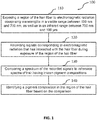
- Figure 1 provides a flowchart summarizing four possible steps of a method 100 to determine a pigment composition of a hair fiber using hyperspectral imagery.
- a first step may consist in exposing 110 a region of the hair fiber to electromagnetic radiation.
- the electromagnetic radiation can be cast either all at once using a source advantageously capable of generating a broad spectrum with a substantially homogeneous distribution of intensity peaks, or from several sources generating light within narrower spectral ranges.
- the exposure should advantageously include at least 3 wavelengths in the visible range between 400 nm and 700 nm, and wavelengths in the infrared range between 700 nm and 100 ⁇ m. More specifically, it has been observed that pigments in hair fibers have strong optical responses noticeable in recorded light reflected by hair in the near infrared range between 1300 nm and 2600 nm, as well as in the range between 700 nm and 1200 nm.
- a second step of the method may consist in recording 120 signals corresponding to electromagnetic radiation that has interacted with the hair fiber during exposure of the region of the hair fiber.
- This electromagnetic radiation is typically light reflected and scattered by the hair fiber.
- the detection can be done using one detector sensitive to light both in the visible and in the infrared range. However, a plurality of detectors can also be used to increase sensitivity across the wavelengths that are monitored.
- the detector can be any type of photodetector, a CCD (charge coupled device) camera, a QWIP (quantum well infrared photodetector), a spectrometer, the camera of a mobile device for example or an array of such devices or a combination of such devices.
- the signal that is detected can typically be recorded as a spectrum, as an image or as a waveform.
- detectors can have a high spatial resolution, and thereby provide a spatially resolved information on the composition of a region of a hair fiber. That way, it is possible to distinguish the pigment composition of roots, lengths or tips of hair fibers, and detect differences in hair pigments in different parts of a strand of hair.
- a third step typically consists in comparing 130 a spectrum of the recorded signals to reference spectra of hair having known pigment compositions.
- Reference spectra can be absorption features known to be found in known pigments based on available laboratory tests (that could for example be published in scientific publications or databases) or recorded spectra available for random hair samples whose pigment composition is known. It is also possible to use as a reference spectrum the spectrum of a previously analyzed hair fiber for which the method helped identify the pigment composition accurately. Reference spectra are advantageously also obtained via reflection measurements using Hyperspectral imagery techniques.
- reference spectra were obtained in the same wavelength ranges as those used to illuminate the region of the hair fiber under investigation. The higher the number of reference spectra available the more accurate can the qualitative as well as quantitative estimation of the pigment composition in the hair fiber be. It is also possible to include reference spectra for pigmented hair comprising only one type of pigment and/or reference spectra for pigmented hair comprising more than one type of hair pigment.
- the method may continue by identifying 140 a pigment composition in the region of the hair fiber based on the comparison.
- a machine learning algorithm can be trained to identify relevant spectral features from such reference spectra, in order to distinguish not only the mere presence or absence of a pigment in the region of a hair fiber, but also estimate the amount of pigment in the hair fiber.
- Spectral intensity information, combined with the wavelength information can be used to achieve such a quantitative assessment of the presence of pigments and the amount in which they are present.
- the result of the identification step can be outputted in the form of a qualitative information, indicating the presence of pigments by naming them and/or by mentioning what pigments are not present in the region of hair fiber investigated among a list of known pigments. It is also possible to output a more quantitative information, by indicating a range of concentrations for each identified and/or known pigment type. For example, it is possible to define low, medium and high concentration values. If the spectral features identifying the presence of a pigment hint towards a high low or medium concentration, this information can be provided in an output showed for example to a user.
- Regression approaches and machine learning algorithms can provide an even more precise identification of the concentration of each pigment type in the hair fiber.
- the output can then provide an absolute value for a concentration of each identified pigment, or else relative percentages for each pigment in the hair fiber.
- the percentages can for example be expressed as parts per weight.
- a system 200 as that illustrated on figure 2 can be used.
- Figure 2 shows hair 201 of a user.
- a hair strand comprising hair fiber 202 is illuminated with a source 210 of electromagnetic radiation 215.
- Hair region 203 of hair fiber 202 reflects and scatters this electromagnetic radiation which is then detected in its modified form by detector 220.
- detector 220 communicates wirelessly with a non-transitory data processing unit 230, which can for example be a computer 231 or a portable mobile device 232.
- the source 210 can also have communication capabilities with a data processing unit and be programmed to emit electromagnetic radiation according to a sequence.
- wired communication can also be used. All sorts of communication protocols can be used to receive and/or send information to/from the source 210, detector 220 and non-transitory data processing unit 230.
- figure 2 only represents one source 210 and one detector 220, a plurality of sources and detectors can be used, in order to cast light of different wavelengths on the region 203 of hair fiber 202.
- the electromagnetic radiation can be cast all at once, from a source 220 or plurality of sources capable of generating a broad spectrum covering the visible range with wavelengths between 400 nm and 700 nm as well as the infrared range with wavelengths from 700 nm to 100 ⁇ m and more particularly the near-infrared range with wavelengths from 700 nm to 2600 nm.
- the electromagnetic radiation can also be cast and/or recorded in sequence.
- a first round of measurements can comprise illumination using monochromatic or narrow-spectrum sources on the hair fiber 202 in the visible range. Then narrow-spectrum sources in the near infrared are used. Detectors adapted for each type of electromagnetic radiation to be detected can then be used. A reconstructed spectrum can be built using the different measurements that were made.
- a mobile device 232 such as a smartphone can be used to cast light generated by one group of light emitting sources (diodes, LED) from the screen of the mobile device on the region 203 of the hair fiber 202.
- the camera of the mobile device 232 is used to capture images in each illumination condition. These images are then processed using an algorithm to reconstruct a Hyperspectral image of the hair fiber 202, based on a limited number of wavelengths. Further use of near-infrared sources can be associated in combination with such an approach to provide more accurate results concerning spectral features modified during interaction with the hair fiber at infrared wavelengths.
- the non-transitory data processing unit 230 typically comprises components capable of storing information, in particular the signals recorded and sent by the detector 220. It may further comprise at least one processor to convert, if necessary, waveform information provided by the detector 220 into a spectrum, and compare that spectrum to features extracted from reference spectra of hair having known pigment compositions.
- the non-transitory data processing unit 230 can further possess an interface capable of receiving inputs by users and to display information, such as outputting the qualitative and or quantitative assessment of the pigment composition of the hair fiber 202.
- the interface may be capable of interacting with the user based on vocal command, using a keyboard or via a menu in which the user selects the type of pigments he wishes to use or the hair properties he would like to have taken into account when determining a suitable hair treatment product.
- the non-transitory data processing unit 230 may for example comprise a program which queries the type of information the user is willing to obtain about the hair fiber 202, or which type of hair coloration treatment he would like to undergo.
- the non-transitory data processing unit 230 may determine what coloration products or hair treatment products are compatible with the current state of the hair fiber 202, to avoid further damage or modification of the hair color from a desired hair color, A user may provide his desired hair color or hair state, to receive recommendations on the type of pigments or hair coloration products that he may use based on the determined pigment composition.
- a colorimetric measurement may be performed on the region 203 of the hair fiber 202, to determine a color of the hair fiber 202.
- the thus determined hair color can be compared to the color expected for the pigment composition that has been identified.
- a recommendation to run the method one more time may be provided.
- figures 3 and 4 provide a schematic view of spectra of light that can be cast on the hair fiber 202 and detected after interaction with the hair fiber.
- Figure 3 shows spectral intensity on vertical axis 301 versus wavelengths on a horizontal axis 302.
- the visible range 310 between 400 nm and 700 nm comprises three wavelengths with a particularly strong spectral intensity. Since most sources, even when they emit substantially monochromatic light, have a certain spectral width, it is possible to cover enough portions of the visible spectrum with few light sources. In most cases, only portions of the visible spectrum are covered in the light that is cast on the hair fiber.
- the light source or light sources is/are capable of providing enough spectrum intensity across the entire visible range so that a detection of reflected light can be achieved with a 10 nm resolution, that is to say with recorded signals having a particularly strong spectral intensity for reflected light every 10 nm between 400 nm and 700 nm, amounting to 31 input variables in the visible range.
- Figure 3 further shows a gaussian spectrum for electromagnetic radiation generated in a first near infrared range 320 between 700 nm and 1200 nm and two gaussian spectra for electromagnetic radiation generated in a second near infrared range 330 corresponding to wavelengths between 1200 nm or 1300 nm and 2600 nm.
- a gaussian spectrum for electromagnetic radiation generated in a first near infrared range 320 between 700 nm and 1200 nm
- two gaussian spectra for electromagnetic radiation generated in a second near infrared range 330 corresponding to wavelengths between 1200 nm or 1300 nm and 2600 nm.
- the second near-infrared range 330 can provide particularly strong absorption spectra in the light reflected and scattered by the hair fiber 202.
- Figure 4 schematically illustrates a spectrum that can be determined for recorded signals corresponding to electromagnetic radiation that has interacted with the hair fiber 202.
- Figure 4 therefore shows how the spectrum of figure 3 is modified after interaction (in particular reflection and scattering) in the hair fiber 202.
- Figure 4 shows spectral intensity along a vertical axis 401 versus wavelengths along a horizontal axis 402. Strong modification of the intensity of the spectrum in the second near infrared range can be seen with absorption feature 431. Another particularly noticeable feature in the visible spectrum is seen with absorption dip 411, and reduction of intensity 412. These spectral features are then compared to reference spectra, which can for example be spectra obtained in similar conditions on hair samples that have a known pigment composition.
- Reference spectra may also merely be general information on the absorption properties of individual pigments or combinations thereof, performed via traditional spectroscopic methods and available in scientific literature or in any other form of database.
- An advantage of the invention is that pigments and their amount in the hair fiber 202 can be identified even if the hair fiber comprises a complex mix of natural and or artificial pigments.
- the following chemicals might be investigated and identified in a hair fiber: melanins, such as eumelanin or phaeomelanin, oxidative coupling products with two nuclei such as indamines, indoanilines, indophenols, more complex coupling products comprising three or more nuclei and direct dyes such as nitro dyes, azo dyes or anthraquinones for example.
- melanins such as eumelanin or phaeomelanin
- oxidative coupling products with two nuclei such as indamines, indoanilines, indophenols
- more complex coupling products comprising three or more nuclei and direct dyes such as nitro dyes, azo dyes or anthraquinones for example.
- melanin can be particularly well identified as opposed to artificial pigments.
- Non-transitory computer readable storage mediums on which a computer program comprising instructions to implement the method of the invention can be used could for example comprise a processor or chip, an electronic circuit comprising several processors or chips, a hard drive, a flash or SD card, a USB stick, a CD-ROM or DVD-ROM or Blue-Ray disc, or a diskette or floppy disk.
Landscapes
- Physics & Mathematics (AREA)
- Spectroscopy & Molecular Physics (AREA)
- General Physics & Mathematics (AREA)
- Health & Medical Sciences (AREA)
- Life Sciences & Earth Sciences (AREA)
- Chemical & Material Sciences (AREA)
- Analytical Chemistry (AREA)
- Biochemistry (AREA)
- General Health & Medical Sciences (AREA)
- Immunology (AREA)
- Pathology (AREA)
- Investigating Or Analysing Materials By Optical Means (AREA)
Abstract
Description
- The invention relates to the field of characterization of hair color, in particular the use of hyperspectral imagery to determine a pigment composition in hair, in particular human hair.
- Hair is a feature that contributes to people's looks and is most of the time exposed and visible. Hair care is an important part of a person's everyday personal care, with the use of products applied onto hair such as shampoo, mechanical handling of hair with brushes and treatments changing the general appearance of hair such as hair cuts or coloration treatments. One's age, lifestyle, diet or the use of medication can also influence the properties of hair.
- A large variety of products is available to take appropriate care of a person's hair. Products intend to target specific hair types, based on color, damage state, greyness levels for example. In order to optimize hair care, knowledge of the current state of a person's hair is needed to select the right hair treatment.
- The subjective assessment of a person's hair by a hair stylist or any other person may lead to incorrect assessment of the true state of a person's hair.
- To add objectivity to this assessment, quantitative photometric determination of the current hair color of a user can be done. Separate assessment of the oxidative damage of hair or its water content can be done using further optical tools, in particular near infrared spectroscopy. However, even though photometry provides a more accurate picture of the state of hair, it fails to distinguish between identical or substantially identical colors that are obtained using different combinations of pigments.
- Indeed, the perceived color of hair results from light absorbed, scattered and reflected by hair fibers. The chemical composition of these hair fibers may comprise a large variety of chemicals in different concentrations, and different mixtures of hair pigments can lead to identical perceived colors. A distinction can be made between natural dyes (for example melanin) and dyes that have been added to the fibers via coloration treatments (artificial dyes).
- Artificial dyes are present in hair fibers in concentrations and ratios that are very difficult to predict from the mere knowledge of past coloration treatments.
- All this uncertainty leads to random assessment of the pigment composition of hair fibers using conventional color determination techniques.
- Furthermore, it is to be noted that different pigments can lead to similar or virtually identical perceived hair colors but the pigments themselves react differently to further hair treatments or further application of hair dyes. This effect is particularly true when hair is subjected to oxidative coloration treatments.
- For example, a natural medium brown hair color dyed with a lightening shade, e.g. light blonde with 6% hydrogen peroxide will be significantly brighter after the dyeing process than a chemically dyed medium brown hair color. This can be explained by the fact that brown dyes (from previous oxidative coloration treatments) are inherently more stable towards further oxidative treatments than natural dyes receiving a first oxidative hair coloration treatment. This illustrates the need to provide a more reliable way of determining the pigment composition of hair.
- In order to overcome the above drawbacks, the invention provides a method for determining a composition of pigments in a hair fiber, the method comprising:
- exposing a region of the hair fiber to electromagnetic radiation comprising wavelengths in a visible range between 400 nm and 700 nm, as well as wavelengths in an infrared range between 700 nm and 100 µm;
- recording signals corresponding to electromagnetic radiation that has interacted with the hair fiber during exposure of the region of the hair fiber;
- comparing a spectrum of the recorded signals to reference spectra of hair having known pigment compositions;
- identifying a pigment composition in the region of the hair fiber based on the comparison.
- The invention adds an element of objectivity to the assessment of the chemical composition of hair fibers, in particular by making it possible to detect complex pigment compositions comprising not just one type of pigment, but virtually any combination of pigments. Reference spectra of hair having known pigment compositions can include both reference spectra of hair fibers having only one type of pigment, or different mixtures of pigments, in different concentrations. Typically, a comparison can be made using a correlation between a measured spectrum and a reference spectrum. More elaborate comparison techniques involving machine learning algorithms and the use of classification models can further improve the identification of pigment compositions. Such techniques can in particular render more accurate a quantification of the amount of pigment per pigment type, even if the determined spectrum does not match an available reference spectrum.
- The invention further improves identification of pigment compositions in hair fibers by gathering for example reflected and scattered light within a wavelength range comprising visible and infrared light. Signals comprising more than one wavelength are recorded, and in particular a plurality of wavelengths that can be processed as Hyperfrequency signals. "Hyperfrequency" signals are signals that comprise a spectrally rich information for contiguous spectral bands across a wide wavelength range. It can be a reconstructed signal based on measurements performed using several narrow-band sources or one source or plurality of sources capable of emitting light having a broad spectrum. The spectrum obtained from such signals provides a better identification opportunity of specific spectral features of pigments in the visible as well as in the infrared range.
- According to an embodiment the electromagnetic radiation may comprise at least three wavelengths in the visible range, at least one wavelength in a first near infra-red range from 700 nm to 1200 nm and at least one wavelength in a second near-infrared range from 1300 nm to 2600 nm.
- In order to obtain accurate Hyperfrequency information from light reflected, absorbed and scattered by the hair fiber, a sampling of the visible spectrum with at least three wavelengths is preferred, as well as at least one wavelength in the first near-infrared range (in which the spectrum of natural melanin can be easily distinguished from that of artificial brown dyes due to recognizable absorption features). Gathering reflected light within the second near infrared range between 1300 nm and 2600 nm is advantageous in order to identify vibrational overtones of pigments, which can be easily recognized due to their high intensities in this range. This allows both quantitative and qualitative assessment of the pigment composition of a hair fiber. Accuracy of the prediction can be enhanced if reflected light is measured with devices having an acute sensitivity to wavelengths spaced 10 nm apart within the ranges described above. In particular, 31 wavelengths can be measured with increased spectral intensity in the visible range typically from 100 nm to 700 nm. Generally, sensors have a sensitivity that peaks at a specific wavelength but can still detect signals within a certain range around that peak. In order to obtain a better hyperspectral image of the hair fiber, it is possible to use a plurality of sensors having peak sensitivities every 10 nm in the visible range. Similar arrangements can be used to measure signals in the first and second near infrared ranges.
- According to an embodiment the reference spectra may comprise spectra corresponding to electromagnetic radiation in the visible range and the infrared range that has interacted with hair samples having a pigment composition including more than one pigment.
- It is in particular possible to use previously recorded spectra for which a pigment composition was already identified as a reference spectrum for future implementations of the method on new hair fibers.
- According to an embodiment the reference spectra may be obtained from a database comprising spectral features of hair pigments.
- Such a database can be for example accessed online, in scientific literature or via information stored from previously recorded spectra from which a pigment composition of a hair fiber was identified.
- According to an embodiment, the method may further comprise:
- identifying the pigment composition in the region of the hair fiber based on the comparison using a machine learning algorithm that generates classification models based on the reference spectra.
- Machine learning algorithms make it possible to interpret spectra of complex pigment compositions with more accuracy. The classification models that are generated by analyzing spectral features of reference spectra make it possible to estimate the presence of a pigment, even if it is present in small amounts in the hair fiber, and also to quantify that pigment. A mixture of pigments leads to spectra that do not correlate so closely with reference spectra of hair comprising only one type of pigment. Machine learning trained on a variety of reference spectra overcomes this challenge.
- According to an embodiment the machine learning algorithm may use at least one method from a group of methods, wherein the group of methods includes:
- linear or multi-linear regression,
- multiple polynomic regression,
- a neuronal network method,
- a deep learning method,
- a support vector machine method, and
- a decision tree ensemble method.
- According to an embodiment, the method may further comprise:
- outputting a qualitative value relating to the presence of pigment of known pigment types identified in the region of the hair fiber.
- Typically, the type of pigments that can be identified could be found among melanins, such as eumelanin or phaeomelanin, oxidative coupling products with two nuclei such as indamines, indoanilines, indophenols, more complex coupling products comprising three or more nuclei and direct dyes such as nitro dyes, azo dyes or anthraquinones for example.
- According to an embodiment, the method may further comprise:
- outputting a quantitative value relating to the amount of pigments of known pigment types identified in the region of the hair fiber.
- A quantitative assessment of the pigment composition in the hair fiber can for example be achieved by comparing the relative intensities of spectral features within the recorded signals with the reference spectra. Accuracy of this detection is enhanced by improving the spectral resolution of the detectors used to record the electromagnetic radiation reflected, absorbed and scattered by the hair fiber. Furthermore, in addition to the spectral resolution, pixel-based sensors having a suitable spatial resolution can provide a spatially resolved information, allowing a distinction in the composition of hair fibers in the tips, lengths or roots of a hair fiber, or in different areas of a strand of hair for example.
- According to an embodiment, the method may further comprise:
- exposing the region of the hair fiber sequentially to electromagnetic radiation of different wavelengths;
- Such a method consisting in processing information from a plurality of images can be easily implemented using a portable device such as a smartphone or a simple portable apparatus. First, substantially monochromatic light is cast on the hair fiber or hair fibers. This light can also be non monochromatic and comprise a wider range of wavelengths. Each exposure is configured to cast a different type of wavelength on the hair fiber. The reflected, absorbed and/or scattered light is captured by sensors and a processing of the plurality of images thus recorded is implemented to reconstruct a hyperspectral image of the hair fiber. This method can then be implemented using simpler and cheaper devices such a mobile phones, or a multitude of separate devices that can be used at different times and then processed to produce a Hyperspectral image of the hair fiber.
- According to an embodiment, the method may further comprise:
- determining a color of the region of the hair fiber in the visible range using colorimetry;
- comparing the determined color to a color of the identified pigment composition.
- Further determining the color of the hair fiber using traditional colorimetry, that is to say spectroscopic tools involving for example the processing of a picture of the hair fiber, can help corroborate the information provided by the spectrum analysis described above. The color that is determined can be parameterized in a color space such as the Lab color space, CIELab or RGB for example.
- In case of an incompatibility between the color determined using colorimetry and the properties of the pigment composition that is identified, further processing and comparison of the spectrum with reference spectra can be implemented to correct the identified pigment composition.
- According to an embodiment, the method may further comprise:
- obtaining a desired hair color;
- determining a hair coloration composition compatible with the identified pigment compositions in the region of the hair fiber and adapted to dye the hair fiber into the desired hair color.
- Knowing more precisely the pigment composition of the hair fiber, it is then possible to recommend hair treatment products (for example shampoos, hair coloration compositions) that are compatible with the current state of the hair fiber. This will reduce the risk of damaging hair or obtaining an undesired hair color.
- According to an embodiment electromagnetic radiation that has interacted with the hair fiber during exposure of the region of the hair fiber may comprise electromagnetic radiation reflected by the region of the hair fiber and electromagnetic radiation scattered by the region of the hair fiber.
- When interacting with the hair fiber or hair fibers, electromagnetic radiation can be either reflected at the surface of the hair, pass through the hair, be refracted and absorbed, or be scattered by the hair fiber or hair fibers. Absorption signals can be detected, for example by arranging a source and detector at different sides of the hair fiber. The method described above can advantageously easily be implemented by detecting signals reflected by the hair fiber or hair fibers. In such a case, sources of electromagnetic radiation and detectors are advantageously located close to one another, facing the hair fiber or hair fibers.
- The invention also pertains to a system for determining the composition of pigments in a hair fiber, the system comprising:
- at least one source of electromagnetic radiation capable of generating light comprising wavelengths in a visible range between 400 nm and 700 nm, as well as in an infrared range between 700 nm and 100 µm, the at least one source of electromagnetic radiation being configured to cast the light on a region of the hair fiber;
- at least one detector of electromagnetic radiation configured to record signals from electromagnetic radiation that has interacted with the hair fiber during exposure of the region of the hair fiber;
- at least one non-transitory data processing unit configured to:
- compare a spectrum of the signals recorded by the at least one detector and provided to the non-transitory data processing unit to reference spectra of hair having known pigment compositions;
- identify a pigment composition in the region of the hair fiber based on the comparison.
- It is further possible to have more than one source and more than one detector. The number of detectors can be based on the breadth of the spectrum that is to be investigated and also on the spectral resolution that is sought. The finer the resolution and the larger the spectrum, the more accurate can the determination of the pigment composition be.
- According to an embodiment, the at least one source and the at least one detector may be arranged on a mobile portable device.
- The invention also further pertains to a non-transitory computer readable storage medium having stored thereon a computer program comprising instructions for execution of a method for determining a composition of pigments in a hair fiber as described above.
- In other words, the invention also describes a computer program product comprising instructions for execution of a method for determining a composition of pigments in a hair fiber as described above.
- The present disclosure will hereinafter be described in conjunction with the following drawing figures, wherein like numerals denote like elements, and:
-
Fig. 1 is a simplified workflow of the method according to an exemplary embodiment; -
Fig. 2 is a schematic representation of a system according an exemplary embodiment; -
Fig. 3 is a schematic representation of a spectrum of electromagnetic radiation that is projected onto a region of a hair fiber; -
Fig. 4 is a schematic representation of a spectrum of recorded electromagnetic radiation that has interacted with the region of hair fiber associated withfigure 3 . - For the sake of clarity, dimensions of features represented on these figures may not necessarily correspond to the real-size proportion of the corresponding elements.
- The following detailed description is merely exemplary in nature and is not intended to limit the disclosure or the application and uses of the subject-matter as described herein. Furthermore, there is no intention to be bound by any theory presented in the preceding background or the following detailed description.
- The invention provides a method to determine the pigment composition of a hair fiber using a hyperspectral imagery technique. The invention analyzes the spectra of light reflected by hair fibers over a broad spectral range including both reflected spectra in the visible range between 400 nm and 700 nm and the infrared range, between 700 nm and 100 µm. The infrared range can be restricted to the most relevant portion of the near infrared between 700 nm and 2600 nm.
- Spectral features in the recorded signals can be correlated to expected spectral signatures observed in pigmented hair. The use of a broad spectral range with hyperspectral quality makes it possible to assert not only the presence or absence of a pigment of known spectral response in the visible and near infrared range, but also to identify a plurality of pigments, whose spectral signatures are mixed. Machine learning algorithms can improve this determination of overlapping spectral features that would render a direct comparison with the spectral signatures of individual pigments less reliable.
-
Figure 1 provides a flowchart summarizing four possible steps of amethod 100 to determine a pigment composition of a hair fiber using hyperspectral imagery. - A first step may consist in exposing 110 a region of the hair fiber to electromagnetic radiation. The electromagnetic radiation can be cast either all at once using a source advantageously capable of generating a broad spectrum with a substantially homogeneous distribution of intensity peaks, or from several sources generating light within narrower spectral ranges. The exposure should advantageously include at least 3 wavelengths in the visible range between 400 nm and 700 nm, and wavelengths in the infrared range between 700 nm and 100 µm. More specifically, it has been observed that pigments in hair fibers have strong optical responses noticeable in recorded light reflected by hair in the near infrared range between 1300 nm and 2600 nm, as well as in the range between 700 nm and 1200 nm.
- A second step of the method may consist in recording 120 signals corresponding to electromagnetic radiation that has interacted with the hair fiber during exposure of the region of the hair fiber.
- This electromagnetic radiation is typically light reflected and scattered by the hair fiber. However, it is also conceivable to record the electromagnetic radiation that is absorbed by the hair fiber in a transmission configuration instead of a reflection configuration.
- The detection can be done using one detector sensitive to light both in the visible and in the infrared range. However, a plurality of detectors can also be used to increase sensitivity across the wavelengths that are monitored. The detector can be any type of photodetector, a CCD (charge coupled device) camera, a QWIP (quantum well infrared photodetector), a spectrometer, the camera of a mobile device for example or an array of such devices or a combination of such devices.
- The signal that is detected can typically be recorded as a spectrum, as an image or as a waveform.
- It is to be noted that detectors can have a high spatial resolution, and thereby provide a spatially resolved information on the composition of a region of a hair fiber. That way, it is possible to distinguish the pigment composition of roots, lengths or tips of hair fibers, and detect differences in hair pigments in different parts of a strand of hair.
- A third step typically consists in comparing 130 a spectrum of the recorded signals to reference spectra of hair having known pigment compositions.
- These reference spectra can be absorption features known to be found in known pigments based on available laboratory tests (that could for example be published in scientific publications or databases) or recorded spectra available for random hair samples whose pigment composition is known. It is also possible to use as a reference spectrum the spectrum of a previously analyzed hair fiber for which the method helped identify the pigment composition accurately. Reference spectra are advantageously also obtained via reflection measurements using Hyperspectral imagery techniques.
- Advantageously, reference spectra were obtained in the same wavelength ranges as those used to illuminate the region of the hair fiber under investigation. The higher the number of reference spectra available the more accurate can the qualitative as well as quantitative estimation of the pigment composition in the hair fiber be. It is also possible to include reference spectra for pigmented hair comprising only one type of pigment and/or reference spectra for pigmented hair comprising more than one type of hair pigment.
- Finally the method may continue by identifying 140 a pigment composition in the region of the hair fiber based on the comparison.
- A machine learning algorithm can be trained to identify relevant spectral features from such reference spectra, in order to distinguish not only the mere presence or absence of a pigment in the region of a hair fiber, but also estimate the amount of pigment in the hair fiber. Spectral intensity information, combined with the wavelength information can be used to achieve such a quantitative assessment of the presence of pigments and the amount in which they are present. The result of the identification step can be outputted in the form of a qualitative information, indicating the presence of pigments by naming them and/or by mentioning what pigments are not present in the region of hair fiber investigated among a list of known pigments. It is also possible to output a more quantitative information, by indicating a range of concentrations for each identified and/or known pigment type. For example, it is possible to define low, medium and high concentration values. If the spectral features identifying the presence of a pigment hint towards a high low or medium concentration, this information can be provided in an output showed for example to a user.
- Regression approaches and machine learning algorithms can provide an even more precise identification of the concentration of each pigment type in the hair fiber. The output can then provide an absolute value for a concentration of each identified pigment, or else relative percentages for each pigment in the hair fiber. The percentages can for example be expressed as parts per weight.
- In order to implement the method described above in connection with
figure 1 , asystem 200 as that illustrated onfigure 2 can be used. -
Figure 2 showshair 201 of a user. A hair strand comprisinghair fiber 202 is illuminated with asource 210 ofelectromagnetic radiation 215.Hair region 203 ofhair fiber 202 reflects and scatters this electromagnetic radiation which is then detected in its modified form bydetector 220. In thesystem 200 represented onfigure 2 ,detector 220 communicates wirelessly with a non-transitorydata processing unit 230, which can for example be acomputer 231 or a portablemobile device 232. Thesource 210 can also have communication capabilities with a data processing unit and be programmed to emit electromagnetic radiation according to a sequence. As an alternative to wireless communication, wired communication can also be used. All sorts of communication protocols can be used to receive and/or send information to/from thesource 210,detector 220 and non-transitorydata processing unit 230. - Although
figure 2 only represents onesource 210 and onedetector 220, a plurality of sources and detectors can be used, in order to cast light of different wavelengths on theregion 203 ofhair fiber 202. - The electromagnetic radiation can be cast all at once, from a
source 220 or plurality of sources capable of generating a broad spectrum covering the visible range with wavelengths between 400 nm and 700 nm as well as the infrared range with wavelengths from 700 nm to 100 µm and more particularly the near-infrared range with wavelengths from 700 nm to 2600 nm. The electromagnetic radiation can also be cast and/or recorded in sequence. For example, a first round of measurements can comprise illumination using monochromatic or narrow-spectrum sources on thehair fiber 202 in the visible range. Then narrow-spectrum sources in the near infrared are used. Detectors adapted for each type of electromagnetic radiation to be detected can then be used. A reconstructed spectrum can be built using the different measurements that were made. - Another alternative may consist in using the Hawkspecs algorithm developed by Fraunhofer Institute. To do so, a
mobile device 232 such as a smartphone can be used to cast light generated by one group of light emitting sources (diodes, LED) from the screen of the mobile device on theregion 203 of thehair fiber 202. The camera of themobile device 232 is used to capture images in each illumination condition. These images are then processed using an algorithm to reconstruct a Hyperspectral image of thehair fiber 202, based on a limited number of wavelengths. Further use of near-infrared sources can be associated in combination with such an approach to provide more accurate results concerning spectral features modified during interaction with the hair fiber at infrared wavelengths. - The non-transitory
data processing unit 230 typically comprises components capable of storing information, in particular the signals recorded and sent by thedetector 220. It may further comprise at least one processor to convert, if necessary, waveform information provided by thedetector 220 into a spectrum, and compare that spectrum to features extracted from reference spectra of hair having known pigment compositions. The non-transitorydata processing unit 230 can further possess an interface capable of receiving inputs by users and to display information, such as outputting the qualitative and or quantitative assessment of the pigment composition of thehair fiber 202. The interface may be capable of interacting with the user based on vocal command, using a keyboard or via a menu in which the user selects the type of pigments he wishes to use or the hair properties he would like to have taken into account when determining a suitable hair treatment product. The non-transitorydata processing unit 230 may for example comprise a program which queries the type of information the user is willing to obtain about thehair fiber 202, or which type of hair coloration treatment he would like to undergo. - Based on the determined pigment composition of the hair fiber, the non-transitory
data processing unit 230 may determine what coloration products or hair treatment products are compatible with the current state of thehair fiber 202, to avoid further damage or modification of the hair color from a desired hair color, A user may provide his desired hair color or hair state, to receive recommendations on the type of pigments or hair coloration products that he may use based on the determined pigment composition. - In order to further corroborate the results determined by the method implemented with
system 200, a colorimetric measurement may be performed on theregion 203 of thehair fiber 202, to determine a color of thehair fiber 202. The thus determined hair color can be compared to the color expected for the pigment composition that has been identified. In case of a disagreement, a recommendation to run the method one more time may be provided. - In order to further illustrate the Hyperspectral imagery method of the invention,
figures 3 and 4 provide a schematic view of spectra of light that can be cast on thehair fiber 202 and detected after interaction with the hair fiber. -
Figure 3 shows spectral intensity onvertical axis 301 versus wavelengths on ahorizontal axis 302. In the schematic example offigure 3 , thevisible range 310 between 400 nm and 700 nm comprises three wavelengths with a particularly strong spectral intensity. Since most sources, even when they emit substantially monochromatic light, have a certain spectral width, it is possible to cover enough portions of the visible spectrum with few light sources. In most cases, only portions of the visible spectrum are covered in the light that is cast on the hair fiber. According to a preferred embodiment, the light source or light sources is/are capable of providing enough spectrum intensity across the entire visible range so that a detection of reflected light can be achieved with a 10 nm resolution, that is to say with recorded signals having a particularly strong spectral intensity for reflected light every 10 nm between 400 nm and 700 nm, amounting to 31 input variables in the visible range. -
Figure 3 further shows a gaussian spectrum for electromagnetic radiation generated in a first nearinfrared range 320 between 700 nm and 1200 nm and two gaussian spectra for electromagnetic radiation generated in a second nearinfrared range 330 corresponding to wavelengths between 1200 nm or 1300 nm and 2600 nm. Similarly to what has been described in relation with thevisible spectrum 310, more light sources can be used and a higher number of wavelengths with high spectral intensity in the near infrared range can be generated and detected. - The second near-
infrared range 330 can provide particularly strong absorption spectra in the light reflected and scattered by thehair fiber 202. -
Figure 4 schematically illustrates a spectrum that can be determined for recorded signals corresponding to electromagnetic radiation that has interacted with thehair fiber 202.Figure 4 therefore shows how the spectrum offigure 3 is modified after interaction (in particular reflection and scattering) in thehair fiber 202. -
Figure 4 shows spectral intensity along avertical axis 401 versus wavelengths along ahorizontal axis 402. Strong modification of the intensity of the spectrum in the second near infrared range can be seen withabsorption feature 431. Another particularly noticeable feature in the visible spectrum is seen withabsorption dip 411, and reduction ofintensity 412. These spectral features are then compared to reference spectra, which can for example be spectra obtained in similar conditions on hair samples that have a known pigment composition. - Reference spectra may also merely be general information on the absorption properties of individual pigments or combinations thereof, performed via traditional spectroscopic methods and available in scientific literature or in any other form of database.
- Based on this comparison, if a high correlation exists between the spectral feature identified in the spectrum that is obtained from the signals recorded by the
detector 220 and the reference spectra, a pigment and its amount in thehair fiber 202 can be identified. - An advantage of the invention is that pigments and their amount in the
hair fiber 202 can be identified even if the hair fiber comprises a complex mix of natural and or artificial pigments. For example, among known pigments, the following chemicals might be investigated and identified in a hair fiber:
melanins, such as eumelanin or phaeomelanin, oxidative coupling products with two nuclei such as indamines, indoanilines, indophenols, more complex coupling products comprising three or more nuclei and direct dyes such as nitro dyes, azo dyes or anthraquinones for example. In the spectral range comprising wavelengths between 800 nm and 1100 nm, melanin can be particularly well identified as opposed to artificial pigments. - The steps of the examples and embodiments described above can be implemented by a processor such as a computer. A computer program product comprising steps of the above-described method can be used to implement the method on a computer.
- Different types of non-transitory computer readable storage mediums on which a computer program comprising instructions to implement the method of the invention can be used. These could for example comprise a processor or chip, an electronic circuit comprising several processors or chips, a hard drive, a flash or SD card, a USB stick, a CD-ROM or DVD-ROM or Blue-Ray disc, or a diskette or floppy disk.
- While at least one exemplary embodiment has been presented in the foregoing detailed description, it should be appreciated that a vast number of variations exist. It should also be appreciated that the exemplary embodiment or exemplary embodiments are only examples, and are not intended to limit the scope, applicability, or configuration of the various embodiments in any way. Rather, the foregoing detailed description will provide those skilled in the art with a convenient road map for implementing an exemplary embodiment as contemplated herein. It being understood that various changes may be made in the function and arrangement of elements described in an exemplary embodiment without departing from the scope of the various embodiments as set forth in the appended claims.
wherein the spectral characteristic of the region of the hair fiber is determined by processing the plurality of images.
Claims (15)
- A method (100) for determining a composition of pigments in a hair fiber (202), the method comprising:- exposing (110) a region (203) of the hair fiber (202) to electromagnetic radiation (215) comprising wavelengths in a visible range (310) between 400 nm and 700 nm, as well as wavelengths in an infrared range between 700 nm and 100 µm;- recording (120) signals corresponding to electromagnetic radiation that has interacted with the hair fiber during exposure of the region of the hair fiber;- comparing (130) a spectrum of the recorded signals to reference spectra of hair having known pigment compositions;- identifying (140) a pigment composition in the region of the hair fiber based on the comparison.
- The method of claim 1, wherein the electromagnetic radiation comprises at least three wavelengths (311-313) in the visible range, at least one wavelength in a first near infra-red range (320) from 700 nm to 1200 nm and at least one wavelength in a second near-infrared range (330) from 1300 nm to 2600 nm.
- The method according to any one of the preceding claims, wherein the reference spectra comprise spectra corresponding to electromagnetic radiation in the visible range and the infrared range that has interacted with hair samples having a pigment composition including more than one pigment.
- The method according to any one of the preceding claims, wherein the reference spectra are obtained from a database comprising spectral features of hair pigments.
- The method according to any one of the preceding claims, further comprising:- identifying the pigment composition in the region of the hair fiber based on the comparison using a machine learning algorithm that generates classification models based on the reference spectra.
- The method according to claim 5, wherein the machine learning algorithm uses at least one method from a group of methods, wherein the group of methods includes:linear or multi-linear regression,multiple polynomic regression,a neuronal network method,a deep learning method,a support vector machine method, anda decision tree ensemble method.
- The method according to any one of the preceding claims, further comprising:- outputting a qualitative value relating to the presence of pigment of known pigment types identified in the region of the hair fiber.
- The method according to any one of the preceding claims, further comprising:- outputting a quantitative value relating to the amount of pigments of known pigment types identified in the region of the hair fiber.
- The method according to any one of the preceding claims, further comprising:- exposing the region of the hair fiber sequentially to electromagnetic radiation of different wavelengths;wherein the recorded signals from electromagnetic radiation that has interacted with the hair fiber during exposure of the region of the hair fiber form a plurality of images; and
wherein the spectral characteristic of the region of the hair fiber is determined by processing the plurality of images. - The method according to any one of the preceding claims, further comprising:- determining a color of the region of the hair fiber in the visible range using colorimetry;- comparing the determined color to a color of the identified pigment composition.
- The method according to any one of the preceding claims, further comprising:- obtaining a desired hair color;- determining a hair coloration composition compatible with the identified pigment compositions in the region of the hair fiber and adapted to dye the hair fiber into the desired hair color.
- The method according to any one of the preceding claims, wherein electromagnetic radiation that has interacted with the hair fiber during exposure of the region of the hair fiber comprises electromagnetic radiation reflected by the region of the hair fiber and electromagnetic radiation scattered by the region of the hair fiber.
- System (200) for determining a composition of pigments in a hair fiber (202), the system comprising:- at least one source (210) of electromagnetic radiation (215) capable of generating light comprising wavelengths in a visible range (310) between 400 nm and 700 nm, as well as in an infrared range between 700 nm and 100 µm, the at least one source of electromagnetic radiation being configured to cast the light on a region (203) of the hair fiber;- at least one detector (220) of electromagnetic radiation configured to record signals from electromagnetic radiation that has interacted with the hair fiber during exposure of the region of the hair fiber;- at least one non-transitory data processing unit (230) configured to:- compare a spectrum of the signals recorded by the at least one detector and provided to the non-transitory data processing unit to reference spectra of hair having known pigment compositions;- identify a pigment composition in the region of the hair fiber based on the comparison.
- The system of claim 13, wherein the at least one source and the at least one detector are arranged on a mobile portable device (232).
- A non-transitory computer readable storage medium having stored thereon a computer program comprising instructions for execution of a method for determining a composition of pigments in a hair fiber according to any one of claims 1 to 12.
Priority Applications (1)
| Application Number | Priority Date | Filing Date | Title |
|---|---|---|---|
| EP18213307.4A EP3671183B1 (en) | 2018-12-18 | 2018-12-18 | Method for determining a composition of pigments in a hair fiber |
Applications Claiming Priority (1)
| Application Number | Priority Date | Filing Date | Title |
|---|---|---|---|
| EP18213307.4A EP3671183B1 (en) | 2018-12-18 | 2018-12-18 | Method for determining a composition of pigments in a hair fiber |
Publications (2)
| Publication Number | Publication Date |
|---|---|
| EP3671183A1 true EP3671183A1 (en) | 2020-06-24 |
| EP3671183B1 EP3671183B1 (en) | 2025-06-18 |
Family
ID=64744567
Family Applications (1)
| Application Number | Title | Priority Date | Filing Date |
|---|---|---|---|
| EP18213307.4A Active EP3671183B1 (en) | 2018-12-18 | 2018-12-18 | Method for determining a composition of pigments in a hair fiber |
Country Status (1)
| Country | Link |
|---|---|
| EP (1) | EP3671183B1 (en) |
Citations (2)
| Publication number | Priority date | Publication date | Assignee | Title |
|---|---|---|---|---|
| US20170119130A1 (en) * | 2015-11-04 | 2017-05-04 | ColorCulture Network, LLC | System, method and device for analysis of hair and skin and providing formulated hair and skin products |
| DE102017209225A1 (en) * | 2017-05-31 | 2018-12-06 | Henkel Ag & Co. Kgaa | Hair condition detecting apparatus, hair condition detecting system and method for detecting a hair condition |
Family Cites Families (1)
| Publication number | Priority date | Publication date | Assignee | Title |
|---|---|---|---|---|
| ES2886112T3 (en) * | 2015-09-30 | 2021-12-16 | Color Grail Res | Procedure for determining the reflectance of an object and associated device |
-
2018
- 2018-12-18 EP EP18213307.4A patent/EP3671183B1/en active Active
Patent Citations (2)
| Publication number | Priority date | Publication date | Assignee | Title |
|---|---|---|---|---|
| US20170119130A1 (en) * | 2015-11-04 | 2017-05-04 | ColorCulture Network, LLC | System, method and device for analysis of hair and skin and providing formulated hair and skin products |
| DE102017209225A1 (en) * | 2017-05-31 | 2018-12-06 | Henkel Ag & Co. Kgaa | Hair condition detecting apparatus, hair condition detecting system and method for detecting a hair condition |
Also Published As
| Publication number | Publication date |
|---|---|
| EP3671183B1 (en) | 2025-06-18 |
Similar Documents
| Publication | Publication Date | Title |
|---|---|---|
| CN101563589B (en) | Device and method for inspecting a hair sample | |
| US20200221995A1 (en) | System and method for determining the condition of hair | |
| US10806234B2 (en) | Apparatus and method for analyzing hair and/or predicting an outcome of a hair-coloring treatment | |
| RU2446731C2 (en) | Optical measuring device | |
| US12064254B2 (en) | Hair condition-determining device, hair condition-determining system, and method for determining a hair condition | |
| Song et al. | Smartphone detection of minced beef adulteration | |
| WO2008103918A1 (en) | Hyperspectral imaging spectrometer for early detection of skin cancer | |
| CN106952313A (en) | Skin complexion evaluation method based on HSI and Lab blend color models | |
| WO2017094188A1 (en) | Skin glycation inspection device, skin glycation inspection device system, and skin glycation inspection method | |
| Song et al. | Authentication and quality assessment of whey protein-based sports supplements using portable near-infrared spectroscopy and hyperspectral imaging | |
| US20220053916A1 (en) | Method for determining a coloration product recommendation | |
| EP3649457B1 (en) | Method and device for computer-assisted determination of a hair colouring outcome | |
| Ezenarro et al. | Measurement errors and implications for preprocessing in miniaturised near-infrared spectrometers: Classification of sweet and bitter almonds as a case of study | |
| Noh et al. | Integration of hyperspectral reflectance and fluorescence imaging for assessing apple maturity | |
| US11950682B2 (en) | Method and device for providing a hair treatment agent | |
| US12121133B2 (en) | Method for determining a greyness level of a strand of hair | |
| EP3671183B1 (en) | Method for determining a composition of pigments in a hair fiber | |
| Zheng et al. | Hair transparency decoding in Asia: From stylists’ perception to in vitro measurement | |
| Marasco et al. | Pigment-aware: Understanding skin tone variations in digital image analysis | |
| Jolivot | Development of an imaging system dedicated to the acquisition analysis and multispectral characterisation of skin lesion | |
| KR100809553B1 (en) | Apparatus and method for evaluating color image sensors | |
| JP3454881B2 (en) | Color measurement device | |
| WO2026096961A1 (en) | Approaches to determining a target material via identification and analysis of spectral information using non-occluded illumination | |
| Galván et al. | Measuring plumage colour using different spectrophotometric techniques: a word of caution | |
| Perez et al. | Evaluation of Internal and External Starch Changes in Apples Using Hyper-Spectral Analyses in the NIR-SWIR |
Legal Events
| Date | Code | Title | Description |
|---|---|---|---|
| PUAI | Public reference made under article 153(3) epc to a published international application that has entered the european phase |
Free format text: ORIGINAL CODE: 0009012 |
|
| STAA | Information on the status of an ep patent application or granted ep patent |
Free format text: STATUS: THE APPLICATION HAS BEEN PUBLISHED |
|
| AK | Designated contracting states |
Kind code of ref document: A1 Designated state(s): AL AT BE BG CH CY CZ DE DK EE ES FI FR GB GR HR HU IE IS IT LI LT LU LV MC MK MT NL NO PL PT RO RS SE SI SK SM TR |
|
| AX | Request for extension of the european patent |
Extension state: BA ME |
|
| STAA | Information on the status of an ep patent application or granted ep patent |
Free format text: STATUS: REQUEST FOR EXAMINATION WAS MADE |
|
| 17P | Request for examination filed |
Effective date: 20201216 |
|
| RBV | Designated contracting states (corrected) |
Designated state(s): AL AT BE BG CH CY CZ DE DK EE ES FI FR GB GR HR HU IE IS IT LI LT LU LV MC MK MT NL NO PL PT RO RS SE SI SK SM TR |
|
| STAA | Information on the status of an ep patent application or granted ep patent |
Free format text: STATUS: EXAMINATION IS IN PROGRESS |
|
| 17Q | First examination report despatched |
Effective date: 20211122 |
|
| P01 | Opt-out of the competence of the unified patent court (upc) registered |
Effective date: 20230531 |
|
| GRAP | Despatch of communication of intention to grant a patent |
Free format text: ORIGINAL CODE: EPIDOSNIGR1 |
|
| STAA | Information on the status of an ep patent application or granted ep patent |
Free format text: STATUS: GRANT OF PATENT IS INTENDED |
|
| RIC1 | Information provided on ipc code assigned before grant |
Ipc: G01J 3/28 20060101ALN20250211BHEP Ipc: G01N 21/359 20140101ALN20250211BHEP Ipc: G01J 3/10 20060101ALI20250211BHEP Ipc: G01J 3/46 20060101ALI20250211BHEP Ipc: A45D 44/00 20060101ALI20250211BHEP Ipc: G01N 21/31 20060101AFI20250211BHEP |
|
| INTG | Intention to grant announced |
Effective date: 20250220 |
|
| GRAS | Grant fee paid |
Free format text: ORIGINAL CODE: EPIDOSNIGR3 |
|
| GRAA | (expected) grant |
Free format text: ORIGINAL CODE: 0009210 |
|
| STAA | Information on the status of an ep patent application or granted ep patent |
Free format text: STATUS: THE PATENT HAS BEEN GRANTED |
|
| AK | Designated contracting states |
Kind code of ref document: B1 Designated state(s): AL AT BE BG CH CY CZ DE DK EE ES FI FR GB GR HR HU IE IS IT LI LT LU LV MC MK MT NL NO PL PT RO RS SE SI SK SM TR |
|
| REG | Reference to a national code |
Ref country code: GB Ref legal event code: FG4D |
|
| REG | Reference to a national code |
Ref country code: CH Ref legal event code: EP |
|
| REG | Reference to a national code |
Ref country code: DE Ref legal event code: R096 Ref document number: 602018082632 Country of ref document: DE |
|
| REG | Reference to a national code |
Ref country code: CH Ref legal event code: EP |
|
| REG | Reference to a national code |
Ref country code: IE Ref legal event code: FG4D |
|
| PG25 | Lapsed in a contracting state [announced via postgrant information from national office to epo] |
Ref country code: FI Free format text: LAPSE BECAUSE OF FAILURE TO SUBMIT A TRANSLATION OF THE DESCRIPTION OR TO PAY THE FEE WITHIN THE PRESCRIBED TIME-LIMIT Effective date: 20250618 |
|
| REG | Reference to a national code |
Ref country code: LT Ref legal event code: MG9D |
|
| PG25 | Lapsed in a contracting state [announced via postgrant information from national office to epo] |
Ref country code: GR Free format text: LAPSE BECAUSE OF FAILURE TO SUBMIT A TRANSLATION OF THE DESCRIPTION OR TO PAY THE FEE WITHIN THE PRESCRIBED TIME-LIMIT Effective date: 20250919 Ref country code: NO Free format text: LAPSE BECAUSE OF FAILURE TO SUBMIT A TRANSLATION OF THE DESCRIPTION OR TO PAY THE FEE WITHIN THE PRESCRIBED TIME-LIMIT Effective date: 20250918 |
|
| PG25 | Lapsed in a contracting state [announced via postgrant information from national office to epo] |
Ref country code: BG Free format text: LAPSE BECAUSE OF FAILURE TO SUBMIT A TRANSLATION OF THE DESCRIPTION OR TO PAY THE FEE WITHIN THE PRESCRIBED TIME-LIMIT Effective date: 20250618 |
|
| PG25 | Lapsed in a contracting state [announced via postgrant information from national office to epo] |
Ref country code: HR Free format text: LAPSE BECAUSE OF FAILURE TO SUBMIT A TRANSLATION OF THE DESCRIPTION OR TO PAY THE FEE WITHIN THE PRESCRIBED TIME-LIMIT Effective date: 20250618 |
|
| PG25 | Lapsed in a contracting state [announced via postgrant information from national office to epo] |
Ref country code: RS Free format text: LAPSE BECAUSE OF FAILURE TO SUBMIT A TRANSLATION OF THE DESCRIPTION OR TO PAY THE FEE WITHIN THE PRESCRIBED TIME-LIMIT Effective date: 20250918 |
|
| REG | Reference to a national code |
Ref country code: NL Ref legal event code: MP Effective date: 20250618 |
|
| PG25 | Lapsed in a contracting state [announced via postgrant information from national office to epo] |
Ref country code: LV Free format text: LAPSE BECAUSE OF FAILURE TO SUBMIT A TRANSLATION OF THE DESCRIPTION OR TO PAY THE FEE WITHIN THE PRESCRIBED TIME-LIMIT Effective date: 20250618 |
|
| PG25 | Lapsed in a contracting state [announced via postgrant information from national office to epo] |
Ref country code: NL Free format text: LAPSE BECAUSE OF FAILURE TO SUBMIT A TRANSLATION OF THE DESCRIPTION OR TO PAY THE FEE WITHIN THE PRESCRIBED TIME-LIMIT Effective date: 20250618 |
|
| PG25 | Lapsed in a contracting state [announced via postgrant information from national office to epo] |
Ref country code: PT Free format text: LAPSE BECAUSE OF FAILURE TO SUBMIT A TRANSLATION OF THE DESCRIPTION OR TO PAY THE FEE WITHIN THE PRESCRIBED TIME-LIMIT Effective date: 20251020 |
|
| REG | Reference to a national code |
Ref country code: AT Ref legal event code: MK05 Ref document number: 1804580 Country of ref document: AT Kind code of ref document: T Effective date: 20250618 |
|
| PG25 | Lapsed in a contracting state [announced via postgrant information from national office to epo] |
Ref country code: IS Free format text: LAPSE BECAUSE OF FAILURE TO SUBMIT A TRANSLATION OF THE DESCRIPTION OR TO PAY THE FEE WITHIN THE PRESCRIBED TIME-LIMIT Effective date: 20251018 |
|
| PGFP | Annual fee paid to national office [announced via postgrant information from national office to epo] |
Ref country code: DE Payment date: 20251211 Year of fee payment: 8 |
|
| PGFP | Annual fee paid to national office [announced via postgrant information from national office to epo] |
Ref country code: GB Payment date: 20251219 Year of fee payment: 8 |
|
| PG25 | Lapsed in a contracting state [announced via postgrant information from national office to epo] |
Ref country code: AT Free format text: LAPSE BECAUSE OF FAILURE TO SUBMIT A TRANSLATION OF THE DESCRIPTION OR TO PAY THE FEE WITHIN THE PRESCRIBED TIME-LIMIT Effective date: 20250618 Ref country code: SM Free format text: LAPSE BECAUSE OF FAILURE TO SUBMIT A TRANSLATION OF THE DESCRIPTION OR TO PAY THE FEE WITHIN THE PRESCRIBED TIME-LIMIT Effective date: 20250618 |
|
| PGFP | Annual fee paid to national office [announced via postgrant information from national office to epo] |
Ref country code: FR Payment date: 20251229 Year of fee payment: 8 |
|
| PG25 | Lapsed in a contracting state [announced via postgrant information from national office to epo] |
Ref country code: CZ Free format text: LAPSE BECAUSE OF FAILURE TO SUBMIT A TRANSLATION OF THE DESCRIPTION OR TO PAY THE FEE WITHIN THE PRESCRIBED TIME-LIMIT Effective date: 20250618 |
|
| PG25 | Lapsed in a contracting state [announced via postgrant information from national office to epo] |
Ref country code: PL Free format text: LAPSE BECAUSE OF FAILURE TO SUBMIT A TRANSLATION OF THE DESCRIPTION OR TO PAY THE FEE WITHIN THE PRESCRIBED TIME-LIMIT Effective date: 20250618 |
|
| PG25 | Lapsed in a contracting state [announced via postgrant information from national office to epo] |
Ref country code: EE Free format text: LAPSE BECAUSE OF FAILURE TO SUBMIT A TRANSLATION OF THE DESCRIPTION OR TO PAY THE FEE WITHIN THE PRESCRIBED TIME-LIMIT Effective date: 20250618 |
|
| PG25 | Lapsed in a contracting state [announced via postgrant information from national office to epo] |
Ref country code: RO Free format text: LAPSE BECAUSE OF FAILURE TO SUBMIT A TRANSLATION OF THE DESCRIPTION OR TO PAY THE FEE WITHIN THE PRESCRIBED TIME-LIMIT Effective date: 20250618 Ref country code: SK Free format text: LAPSE BECAUSE OF FAILURE TO SUBMIT A TRANSLATION OF THE DESCRIPTION OR TO PAY THE FEE WITHIN THE PRESCRIBED TIME-LIMIT Effective date: 20250618 |
|
| PG25 | Lapsed in a contracting state [announced via postgrant information from national office to epo] |
Ref country code: ES Free format text: LAPSE BECAUSE OF FAILURE TO SUBMIT A TRANSLATION OF THE DESCRIPTION OR TO PAY THE FEE WITHIN THE PRESCRIBED TIME-LIMIT Effective date: 20250618 |
|
| REG | Reference to a national code |
Ref country code: DE Ref legal event code: R097 Ref document number: 602018082632 Country of ref document: DE |
|
| PG25 | Lapsed in a contracting state [announced via postgrant information from national office to epo] |
Ref country code: DK Free format text: LAPSE BECAUSE OF FAILURE TO SUBMIT A TRANSLATION OF THE DESCRIPTION OR TO PAY THE FEE WITHIN THE PRESCRIBED TIME-LIMIT Effective date: 20250618 |
|
| PG25 | Lapsed in a contracting state [announced via postgrant information from national office to epo] |
Ref country code: IT Free format text: LAPSE BECAUSE OF FAILURE TO SUBMIT A TRANSLATION OF THE DESCRIPTION OR TO PAY THE FEE WITHIN THE PRESCRIBED TIME-LIMIT Effective date: 20250618 |
|
| PLBE | No opposition filed within time limit |
Free format text: ORIGINAL CODE: 0009261 |
|
| STAA | Information on the status of an ep patent application or granted ep patent |
Free format text: STATUS: NO OPPOSITION FILED WITHIN TIME LIMIT |
|
| REG | Reference to a national code |
Ref country code: CH Ref legal event code: L10 Free format text: ST27 STATUS EVENT CODE: U-0-0-L10-L00 (AS PROVIDED BY THE NATIONAL OFFICE) Effective date: 20260430 |
|
| REG | Reference to a national code |
Ref country code: DE Ref legal event code: R084 Ref document number: 602018082632 Country of ref document: DE |
|
| 26N | No opposition filed |
Effective date: 20260319 |
|
| PG25 | Lapsed in a contracting state [announced via postgrant information from national office to epo] |
Ref country code: LT Free format text: LAPSE BECAUSE OF FAILURE TO SUBMIT A TRANSLATION OF THE DESCRIPTION OR TO PAY THE FEE WITHIN THE PRESCRIBED TIME-LIMIT Effective date: 20250618 |
|
| PG25 | Lapsed in a contracting state [announced via postgrant information from national office to epo] |
Ref country code: MC Free format text: LAPSE BECAUSE OF FAILURE TO SUBMIT A TRANSLATION OF THE DESCRIPTION OR TO PAY THE FEE WITHIN THE PRESCRIBED TIME-LIMIT Effective date: 20250618 |
|
| REG | Reference to a national code |
Ref country code: CH Ref legal event code: H13 Free format text: ST27 STATUS EVENT CODE: U-0-0-H10-H13 (AS PROVIDED BY THE NATIONAL OFFICE) Effective date: 20260723 |
|
| PG25 | Lapsed in a contracting state [announced via postgrant information from national office to epo] |
Ref country code: SE Free format text: LAPSE BECAUSE OF FAILURE TO SUBMIT A TRANSLATION OF THE DESCRIPTION OR TO PAY THE FEE WITHIN THE PRESCRIBED TIME-LIMIT Effective date: 20250618 |