EP3670520A1 - Organometallic compound, organic light-emitting device including the organometallic compound, and diagnostic composition including the organometallic compound - Google Patents
Organometallic compound, organic light-emitting device including the organometallic compound, and diagnostic composition including the organometallic compound Download PDFInfo
- Publication number
- EP3670520A1 EP3670520A1 EP19216417.6A EP19216417A EP3670520A1 EP 3670520 A1 EP3670520 A1 EP 3670520A1 EP 19216417 A EP19216417 A EP 19216417A EP 3670520 A1 EP3670520 A1 EP 3670520A1
- Authority
- EP
- European Patent Office
- Prior art keywords
- group
- substituted
- unsubstituted
- salt
- pentyl
- Prior art date
- Legal status (The legal status is an assumption and is not a legal conclusion. Google has not performed a legal analysis and makes no representation as to the accuracy of the status listed.)
- Granted
Links
- 0 *c1ccccc1*1C#C1 Chemical compound *c1ccccc1*1C#C1 0.000 description 31
- DGUQYDYWWGDSGO-VNAMHEHSSA-N CC(C)(C)/C(/C1CC1)=C/N=C1/[n](c(c(c2ccc3Oc4cc(-c5ccccc5)cc(C[C@H]5C6[C@@H]5N(Cc5ccccc5)c5ccccc5)c4C4)c5)ccc5-c5ccccc5)c2c3[IH]64N1 Chemical compound CC(C)(C)/C(/C1CC1)=C/N=C1/[n](c(c(c2ccc3Oc4cc(-c5ccccc5)cc(C[C@H]5C6[C@@H]5N(Cc5ccccc5)c5ccccc5)c4C4)c5)ccc5-c5ccccc5)c2c3[IH]64N1 DGUQYDYWWGDSGO-VNAMHEHSSA-N 0.000 description 1
- CUUWEZKTLOAZRS-UHFFFAOYSA-N CC(C1)(C1=C)N Chemical compound CC(C1)(C1=C)N CUUWEZKTLOAZRS-UHFFFAOYSA-N 0.000 description 1
- QKMCPQRFOFSEIV-UHFFFAOYSA-N Cc(c(-c1ccccc1)c1)ccc1-c1ccccc1 Chemical compound Cc(c(-c1ccccc1)c1)ccc1-c1ccccc1 QKMCPQRFOFSEIV-UHFFFAOYSA-N 0.000 description 1
- NDSAXPYVOVFBNT-UHFFFAOYSA-N Cc(c(-c1ccccc1)ccc1)c1-c1ccccc1 Chemical compound Cc(c(-c1ccccc1)ccc1)c1-c1ccccc1 NDSAXPYVOVFBNT-UHFFFAOYSA-N 0.000 description 1
- LYLOSHJYLNHGKL-UHFFFAOYSA-N Cc(cc1)cc2c1c(c(-c1ccccc1)ccc1)c1[n]2-c1ccccc1 Chemical compound Cc(cc1)cc2c1c(c(-c1ccccc1)ccc1)c1[n]2-c1ccccc1 LYLOSHJYLNHGKL-UHFFFAOYSA-N 0.000 description 1
- MHHHVOTZAQMJAZ-UHFFFAOYSA-N Cc(cc1c(c2ccc3)c3-c3ccccc3)ccc1[n]2-c1ccccc1 Chemical compound Cc(cc1c(c2ccc3)c3-c3ccccc3)ccc1[n]2-c1ccccc1 MHHHVOTZAQMJAZ-UHFFFAOYSA-N 0.000 description 1
- QYNZFEKRMJNVLX-UHFFFAOYSA-N Cc1c(c(cc(cc2)-c3ccccc3)c2[n]2-c3ccccc3)c2ccc1 Chemical compound Cc1c(c(cc(cc2)-c3ccccc3)c2[n]2-c3ccccc3)c2ccc1 QYNZFEKRMJNVLX-UHFFFAOYSA-N 0.000 description 1
- NPDIDUXTRAITDE-UHFFFAOYSA-N Cc1cccc(-c2ccccc2)c1 Chemical compound Cc1cccc(-c2ccccc2)c1 NPDIDUXTRAITDE-UHFFFAOYSA-N 0.000 description 1
- CSPXTZGGNWOICE-UHFFFAOYSA-N Nc(cc1)cc2c1c(cc(cc1)-c3ccccc3)c1[n]2-c1ccccc1 Chemical compound Nc(cc1)cc2c1c(cc(cc1)-c3ccccc3)c1[n]2-c1ccccc1 CSPXTZGGNWOICE-UHFFFAOYSA-N 0.000 description 1
- PBYKTJGCTGMXCX-UHFFFAOYSA-N Nc(cc1)cc2c1c(cccc1-c3ccccc3)c1[s]2 Chemical compound Nc(cc1)cc2c1c(cccc1-c3ccccc3)c1[s]2 PBYKTJGCTGMXCX-UHFFFAOYSA-N 0.000 description 1
- DMVOXQPQNTYEKQ-UHFFFAOYSA-N Nc(cc1)ccc1-c1ccccc1 Chemical compound Nc(cc1)ccc1-c1ccccc1 DMVOXQPQNTYEKQ-UHFFFAOYSA-N 0.000 description 1
- PNMHKGYPOIJCET-UHFFFAOYSA-N Nc(cc1-c2ccccc2)cc2c1[s]c1c2cccc1 Chemical compound Nc(cc1-c2ccccc2)cc2c1[s]c1c2cccc1 PNMHKGYPOIJCET-UHFFFAOYSA-N 0.000 description 1
- CHKDQLHQSURBKN-UHFFFAOYSA-N Nc(cc1c2c3ccc(-c4ccccc4)c2)ccc1[n]3-c1ccccc1 Chemical compound Nc(cc1c2c3ccc(-c4ccccc4)c2)ccc1[n]3-c1ccccc1 CHKDQLHQSURBKN-UHFFFAOYSA-N 0.000 description 1
- CEPCPXLLFXPZGW-UHFFFAOYSA-N Nc(ccc(F)c1)c1F Chemical compound Nc(ccc(F)c1)c1F CEPCPXLLFXPZGW-UHFFFAOYSA-N 0.000 description 1
- TWBPWBPGNQWFSJ-UHFFFAOYSA-N Nc(cccc1)c1-c1ccccc1 Chemical compound Nc(cccc1)c1-c1ccccc1 TWBPWBPGNQWFSJ-UHFFFAOYSA-N 0.000 description 1
- IZMZTDKLZJPFCG-UHFFFAOYSA-N Nc(cccc1[n](c2ccc3)-c4ccccc4)c1c2c3-c1ccccc1 Chemical compound Nc(cccc1[n](c2ccc3)-c4ccccc4)c1c2c3-c1ccccc1 IZMZTDKLZJPFCG-UHFFFAOYSA-N 0.000 description 1
- NEUMEBQWPRGTQD-UHFFFAOYSA-N Nc1c(c(cccc2)c2[s]2)c2cc(-c2ccccc2)c1 Chemical compound Nc1c(c(cccc2)c2[s]2)c2cc(-c2ccccc2)c1 NEUMEBQWPRGTQD-UHFFFAOYSA-N 0.000 description 1
- PWRKEYBSOWAIMY-UHFFFAOYSA-N Nc1cc(-c2ccccc2)cc(-c2ccccc2)c1 Chemical compound Nc1cc(-c2ccccc2)cc(-c2ccccc2)c1 PWRKEYBSOWAIMY-UHFFFAOYSA-N 0.000 description 1
- DYVGJFSZSVMKFA-UHFFFAOYSA-N Nc1cccc(c2c3cccc2-c2ccccc2)c1[n]3-c1ccccc1 Chemical compound Nc1cccc(c2c3cccc2-c2ccccc2)c1[n]3-c1ccccc1 DYVGJFSZSVMKFA-UHFFFAOYSA-N 0.000 description 1
- RRIGODRADAHKGQ-UHFFFAOYSA-N Nc1cccc2c1[s]c1cc(-c3ccccc3)ccc21 Chemical compound Nc1cccc2c1[s]c1cc(-c3ccccc3)ccc21 RRIGODRADAHKGQ-UHFFFAOYSA-N 0.000 description 1
- FIFNMGQMKCBUOO-UHFFFAOYSA-N Nc1cccc2c1c(cccc1-c3ccccc3)c1[s]2 Chemical compound Nc1cccc2c1c(cccc1-c3ccccc3)c1[s]2 FIFNMGQMKCBUOO-UHFFFAOYSA-N 0.000 description 1
- BMCNAHBDZUYGJG-UHFFFAOYSA-N c(cc1)ccc1-c1cccc2c1[s]c1ccccc21 Chemical compound c(cc1)ccc1-c1cccc2c1[s]c1ccccc21 BMCNAHBDZUYGJG-UHFFFAOYSA-N 0.000 description 1
- VMXRUUFRMHNVDM-UHFFFAOYSA-N c(cc1)ccc1-c1cccc2c1c(cccc1)c1[s]2 Chemical compound c(cc1)ccc1-c1cccc2c1c(cccc1)c1[s]2 VMXRUUFRMHNVDM-UHFFFAOYSA-N 0.000 description 1
Images
Classifications
-
- C—CHEMISTRY; METALLURGY
- C07—ORGANIC CHEMISTRY
- C07F—ACYCLIC, CARBOCYCLIC OR HETEROCYCLIC COMPOUNDS CONTAINING ELEMENTS OTHER THAN CARBON, HYDROGEN, HALOGEN, OXYGEN, NITROGEN, SULFUR, SELENIUM OR TELLURIUM
- C07F15/00—Compounds containing elements of Groups 8, 9, 10 or 18 of the Periodic Table
- C07F15/0006—Compounds containing elements of Groups 8, 9, 10 or 18 of the Periodic Table compounds of the platinum group
- C07F15/0086—Platinum compounds
-
- C—CHEMISTRY; METALLURGY
- C09—DYES; PAINTS; POLISHES; NATURAL RESINS; ADHESIVES; COMPOSITIONS NOT OTHERWISE PROVIDED FOR; APPLICATIONS OF MATERIALS NOT OTHERWISE PROVIDED FOR
- C09K—MATERIALS FOR MISCELLANEOUS APPLICATIONS, NOT PROVIDED FOR ELSEWHERE
- C09K11/00—Luminescent materials, e.g. electroluminescent or chemiluminescent
- C09K11/06—Luminescent materials, e.g. electroluminescent or chemiluminescent containing organic luminescent materials
-
- G—PHYSICS
- G01—MEASURING; TESTING
- G01N—INVESTIGATING OR ANALYSING MATERIALS BY DETERMINING THEIR CHEMICAL OR PHYSICAL PROPERTIES
- G01N21/00—Investigating or analysing materials by the use of optical means, i.e. using sub-millimetre waves, infrared, visible or ultraviolet light
- G01N21/62—Systems in which the material investigated is excited whereby it emits light or causes a change in wavelength of the incident light
- G01N21/63—Systems in which the material investigated is excited whereby it emits light or causes a change in wavelength of the incident light optically excited
- G01N21/64—Fluorescence; Phosphorescence
-
- H—ELECTRICITY
- H10—SEMICONDUCTOR DEVICES; ELECTRIC SOLID-STATE DEVICES NOT OTHERWISE PROVIDED FOR
- H10K—ORGANIC ELECTRIC SOLID-STATE DEVICES
- H10K50/00—Organic light-emitting devices
- H10K50/10—OLEDs or polymer light-emitting diodes [PLED]
- H10K50/11—OLEDs or polymer light-emitting diodes [PLED] characterised by the electroluminescent [EL] layers
- H10K50/12—OLEDs or polymer light-emitting diodes [PLED] characterised by the electroluminescent [EL] layers comprising dopants
-
- H—ELECTRICITY
- H10—SEMICONDUCTOR DEVICES; ELECTRIC SOLID-STATE DEVICES NOT OTHERWISE PROVIDED FOR
- H10K—ORGANIC ELECTRIC SOLID-STATE DEVICES
- H10K85/00—Organic materials used in the body or electrodes of devices covered by this subclass
- H10K85/30—Coordination compounds
- H10K85/341—Transition metal complexes, e.g. Ru(II)polypyridine complexes
- H10K85/346—Transition metal complexes, e.g. Ru(II)polypyridine complexes comprising platinum
-
- H—ELECTRICITY
- H10—SEMICONDUCTOR DEVICES; ELECTRIC SOLID-STATE DEVICES NOT OTHERWISE PROVIDED FOR
- H10K—ORGANIC ELECTRIC SOLID-STATE DEVICES
- H10K85/00—Organic materials used in the body or electrodes of devices covered by this subclass
- H10K85/40—Organosilicon compounds, e.g. TIPS pentacene
-
- C—CHEMISTRY; METALLURGY
- C09—DYES; PAINTS; POLISHES; NATURAL RESINS; ADHESIVES; COMPOSITIONS NOT OTHERWISE PROVIDED FOR; APPLICATIONS OF MATERIALS NOT OTHERWISE PROVIDED FOR
- C09K—MATERIALS FOR MISCELLANEOUS APPLICATIONS, NOT PROVIDED FOR ELSEWHERE
- C09K2211/00—Chemical nature of organic luminescent or tenebrescent compounds
- C09K2211/18—Metal complexes
- C09K2211/185—Metal complexes of the platinum group, i.e. Os, Ir, Pt, Ru, Rh or Pd
-
- H—ELECTRICITY
- H10—SEMICONDUCTOR DEVICES; ELECTRIC SOLID-STATE DEVICES NOT OTHERWISE PROVIDED FOR
- H10K—ORGANIC ELECTRIC SOLID-STATE DEVICES
- H10K2101/00—Properties of the organic materials covered by group H10K85/00
- H10K2101/10—Triplet emission
-
- H—ELECTRICITY
- H10—SEMICONDUCTOR DEVICES; ELECTRIC SOLID-STATE DEVICES NOT OTHERWISE PROVIDED FOR
- H10K—ORGANIC ELECTRIC SOLID-STATE DEVICES
- H10K50/00—Organic light-emitting devices
- H10K50/10—OLEDs or polymer light-emitting diodes [PLED]
- H10K50/11—OLEDs or polymer light-emitting diodes [PLED] characterised by the electroluminescent [EL] layers
-
- H—ELECTRICITY
- H10—SEMICONDUCTOR DEVICES; ELECTRIC SOLID-STATE DEVICES NOT OTHERWISE PROVIDED FOR
- H10K—ORGANIC ELECTRIC SOLID-STATE DEVICES
- H10K50/00—Organic light-emitting devices
- H10K50/10—OLEDs or polymer light-emitting diodes [PLED]
- H10K50/14—Carrier transporting layers
- H10K50/15—Hole transporting layers
-
- H—ELECTRICITY
- H10—SEMICONDUCTOR DEVICES; ELECTRIC SOLID-STATE DEVICES NOT OTHERWISE PROVIDED FOR
- H10K—ORGANIC ELECTRIC SOLID-STATE DEVICES
- H10K50/00—Organic light-emitting devices
- H10K50/10—OLEDs or polymer light-emitting diodes [PLED]
- H10K50/14—Carrier transporting layers
- H10K50/16—Electron transporting layers
-
- H—ELECTRICITY
- H10—SEMICONDUCTOR DEVICES; ELECTRIC SOLID-STATE DEVICES NOT OTHERWISE PROVIDED FOR
- H10K—ORGANIC ELECTRIC SOLID-STATE DEVICES
- H10K50/00—Organic light-emitting devices
- H10K50/10—OLEDs or polymer light-emitting diodes [PLED]
- H10K50/17—Carrier injection layers
-
- H—ELECTRICITY
- H10—SEMICONDUCTOR DEVICES; ELECTRIC SOLID-STATE DEVICES NOT OTHERWISE PROVIDED FOR
- H10K—ORGANIC ELECTRIC SOLID-STATE DEVICES
- H10K50/00—Organic light-emitting devices
- H10K50/10—OLEDs or polymer light-emitting diodes [PLED]
- H10K50/17—Carrier injection layers
- H10K50/171—Electron injection layers
-
- H—ELECTRICITY
- H10—SEMICONDUCTOR DEVICES; ELECTRIC SOLID-STATE DEVICES NOT OTHERWISE PROVIDED FOR
- H10K—ORGANIC ELECTRIC SOLID-STATE DEVICES
- H10K50/00—Organic light-emitting devices
- H10K50/10—OLEDs or polymer light-emitting diodes [PLED]
- H10K50/18—Carrier blocking layers
Definitions
- One or more embodiments relate to an organometallic compound, an organic light-emitting device including the organometallic compound, and a diagnostic composition including the organometallic compound.
- Organic light-emitting devices are self-emission devices, which have better characteristics in terms of a viewing angle, a response time, a brightness, a driving voltage, and a response speed, and produce full-color images.
- an organic light-emitting device includes an anode, a cathode, and an organic layer located between the anode and the cathode and including an emission layer.
- a hole transport region may be between the anode and the emission layer, and an electron transport region may be between the emission layer and the cathode.
- Holes provided from the anode may move toward the emission layer through the hole transport region, and electrons provided from the cathode may move toward the emission layer through the electron transport region.
- the holes and the electrons recombine in the emission layer to produce excitons. These excitons transit from an excited state to a ground state, thereby generating light.
- luminescent compounds may be used to monitor, sense, or detect a variety of biological materials including cells and proteins.
- An example of the luminescent compounds includes a phosphorescent luminescent compound.
- aspects of the present disclosure provide a novel organometallic compound, an organic light-emitting device including the organometallic compound, and a diagnostic composition including the organometallic compound.
- An aspect of the present disclosure provides an organometallic compound represented by Formula 1: ⁇ Formula 1> M 11 (L 11 ) n11 (L 12 ) n12 In Formulae 1 and 1-1,
- an organic light-emitting device including: a first electrode; a second electrode; an organic layer between the first electrode and the second electrode and including an emission layer, wherein the organic layer includes the organometallic compound described above.
- the organometallic compound in the emission layer may act as a dopant.
- Another aspect of the present disclosure provides a diagnostic composition including the organometallic compound described above.
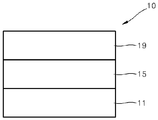
- FIGURE is a schematic view of an organic light-emitting device according to an embodiment.
- An organometallic compound according to an embodiment is represented by Formula 1: ⁇ Formula 1> M 11 (L 11 ) n11 (L 12 ) n12 .
- M 11 may be selected from a first-row transition metal, a second-row transition metal, and a third-row transition metal, of the Periodic Table of Elements.
- M 11 may be selected from platinum (Pt), palladium (Pd), copper (Cu), silver (Ag), gold (Au), rhodium (Rh), iridium (Ir), ruthenium (Ru), osmium (Os), titanium (Ti), zirconium (Zr), hafnium (Hf), europium (Eu), terbium (Tb), and thulium (Tm), but embodiments of the present disclosure are not limited thereto.
- M 11 may be selected from Pt, Pd, Cu, Ag, Au, Rh, Ir, Ru, and Os, but embodiments of the present disclosure are not limited thereto.
- M 11 may be selected from Pt and Pd, but embodiments of the present disclosure are not limited thereto.
- M 11 may be Pt, but embodiments of the present disclosure are not limited thereto.
- L 11 may be a ligand represented by Formula 1-1:
- *1 to *4 each indicate a binding site to M 11 .
- X 11 and X 13 to X 17 may each independently be C, and X 12 and X 18 may each independently be N.
- X 11 and X 12 , X 13 and X 14 , X 14 and X 15 , and X 17 and X 18 may each independently be linked via a chemical bond.
- a ring including M 11 , X 11 , X 12 , X 13 , and X 14 may be a 5-membered ring.
- a ring including M 11 , X 14 , X 15 , T 11 , and X 16 may be a 6-membered ring.
- a ring including M 11 , X 18 , X 17 , N, and X 16 may be a 6-membered ring.
- Y 11 may be selected from N(R 18 ), O, and S, and R 18 may be the same as described below.
- Y 11 may be N(R 18 ), but embodiments of the present disclosure are not limited thereto.
- a 11 may be an N-containing C 1 -C 60 heterocyclic group.
- a 11 may be selected from: a first ring; a condensed ring in which two or more first rings are condensed with each other; and a condensed ring in which one or more first rings are condensed with one or more second rings, respectively, the first ring may be selected from a pyrrole group, a pyrrolidine group, an imidazolidinegroup, a dihydropyrrole group, a dihydroimidazole group, an oxazole group, an isoxazole group, an oxadiazole group, an oxatriazole group, a thiazole group, an isothiazole group, a thiadiazole group, a thiatriazole group, a pyrazole group, an imidazole group, a triazole group, a tetrazole group, a pyridine group, a piperidine group, a tetrahydropyridine group, a di
- a 11 in Formula 1-1 may be selected from an indole group, a carbazole group, an indenopyridine group, an indolopyridine group, a benzofuropyridine group, a benzothienopyridine group, a benzosilolopyridine group, an indenopyrimidine group, an indolopyrimidine group, a benzofuropyrimidine group, a benzothienopyrimidine group, a benzosilolopyrimidine group, a pyridine group, a piperidine group, a tetrahydropyridine group, a dihydropyridine group, a pyrimidine group, a hexahydropyrimidine group, a tetrahydropyrimidine group, a dihydropyrimidine group, a pyrazine group, a piperazinegroup, a tetrahydropyrazine group, a dihydropyrazine group, a pipe
- a 11 in Formula 1-1 may be selected from an indenopyridine group, an indolopyridine group, a benzofuropyridine group, a benzothienopyridine group, a benzosilolopyridine group, an indenopyrimidine group, an indolopyrimidine group, a benzofuropyrimidine group, a benzothienopyrimidine group, a benzosilolopyrimidine group, a pyridine group, a pyrimidine group, a pyrazine group, a pyridazine group, a triazine group, a quinoline group, an isoquinoline group, a quinoxaline group, a quinazoline group, a cinnoline group, a phthalazine group, a phenanthroline group, an imidazopyridine group, an imidazopyrimidine group, and an imidazopyrazine group, but embodiment
- a 11 in Formula 1-1 may be selected from a pyridine group, a pyrimidine group, a pyrazine group, a pyridazine group, a triazine group, a quinoline group, an isoquinoline group, a quinoxaline group, and a quinazoline group, but embodiments of the present disclosure are not limited thereto.
- a moiety represented by in Formula 1-1 may be selected from Formulae 2-1 to 2-5, but embodiments of the present disclosure are not limited thereto: In Formulae 2-1 to 2-5,
- E 11 and a11 may each independently be the same as defined in connection with Formula 1-1.
- a moiety represented by in Formula 1-1 may be selected from Formulae 2-11 to 2-31, but embodiments of the present disclosure are not limited thereto: In Formulae 2-11 to 2-31,
- E 11a and E 11b may each independently be the same as defined in connection with E 11 in Formula 1-1.
- a 12 may be selected from a C 5 -C 60 carbocyclic group, and a C 1 -C 60 heterocyclic group.
- a 12 may be selected from: a first ring; a second ring; a condensed ring in which two or more first rings are condensed with each other; a condensed ring in which one or more first rings are condensed with one or more second rings, respectively; and a condensed ring in which two or more second rings are condensed with each other, the first ring may be selected from a pyrrole group, a pyrrolidine group, an imidazolidinegroup, a dihydropyrrole group, a dihydroimidazole group, an oxazole group, an isoxazole group, an oxadiazole group, an oxatriazole group, a thiazole group, an isothiazole group, a thiadiazole group, a thiatriazole group, a pyrazole group, an imidazole group, a triazole group, a tetrazole group,
- a 12 in Formula 1-1 may be selected from a benzene group, a naphthalene group, a tetrahydronaphthalene group, an anthracene group, a phenanthrene group, a triphenylene group, a pyrene group, a chrysene group, a cyclopentadiene group, a furan group, a thiophene group, a silole group, an indene group, a fluorene group, a benzofuran group, a dibenzofuran group, a benzothiophene group, a dibenzothiophene group, a benzosilole group, a dibenzosilole group, an indole group, a carbazole group, an indenopyridine group, an indolopyridine group, a benzofuropyridine group, a benzothienopyridine group, a benzosil
- a 12 in Formula 1-1 may be selected from a benzene group, a naphthalene group, an anthracene group, a phenanthrene group, a triphenylene group, a pyrene group, a chrysene group, a furan group, a thiophene group, a silole group, an indene group, a fluorene group, a benzofuran group, a dibenzofuran group, a benzothiophene group, a dibenzothiophene group, a benzosilole group, a dibenzosilole group, an indole group, a carbazole group, an indenopyridine group, an indolopyridine group, a benzofuropyridine group, a benzothienopyridine group, a benzosilolopyridine group, an indenopyrimidine group, an indolopyrimidine group
- a 12 in Formula 1-1 may be selected from a benzene group, a naphthalene group, an indene group, a fluorene group, a benzofuran group, a dibenzofuran group, a benzothiophene group, a dibenzothiophene group, a benzosilole group, a dibenzosilole group, an indole group, a carbazole group, an indenopyridine group, an indolopyridine group, a benzofuropyridine group, a benzothienopyridine group, a benzosilolopyridine group, an indenopyrimidine group, an indolopyrimidine group, a benzofuropyrimidine group, a benzothienopyrimidine group, a benzosilolopyrimidine group, a pyridine group, a pyrimidine group, a pyrazine group, a pyri
- a 12 in Formula 1-1 may be selected from a benzene group, a naphthalene group, an indene group, a fluorene group, a benzofuran group, a dibenzofuran group, a benzothiophene group, a dibenzothiophene group, a benzosilole group, and a dibenzosilole group, but embodiments of the present disclosure are not limited thereto.
- a moiety represented by in Formula 1-1 may be represented by Formula 3-1, but embodiments of the present disclosure are not limited thereto: In Formula 3-1,
- R 17 and b17 may each independently be the same as defined in connection with Formula 1-1.
- T 11 may be selected from C(R 19 )(R 20 ), Si(R 19 )(R 20 ), O, S, and N(R 19 ), wherein R 19 and R 20 will be described below.
- E 11 may be selected from a substituted or unsubstituted C 1 -C 60 alkyl group, a substituted or unsubstituted C 1 -C 60 alkoxy group, a substituted or unsubstituted C 3 -C 10 cycloalkyl group, a substituted or unsubstituted C 1 -C 10 heterocycloalkyl group, a substituted or unsubstituted C 3 -C 10 cycloalkenyl group, a substituted or unsubstituted C 1 -C 10 heterocycloalkenyl group, a substituted or unsubstituted C 6 -C 60 aryl group, a substituted or unsubstituted C 7 -C 60 alkylaryl group, a substituted or unsubstituted C 7 -C 60 arylalkyl group, a substituted or unsubstituted C 6 -C 60 aryloxy group, a substituted or
- E 11 in Formula 1-1 may be selected from:
- E 11 in Formula 1-1 may be selected from:
- E 11 in Formula 1-1 may be selected from -CH 3 , -CD 3 ,-CD 2 H, -CDH 2 , -CF 3 , -CF 2 H, -CFH 2 , groups represented by Formulae 9-1 to 9-27, groups represented by Formulae 9-1 to 9-27 of which at least one hydrogen is substituted with deuterium, and groups represented by Formulae 10-1 to 10-56, 10-220, and 10-221, but embodiments of the present disclosure are not limited thereto: In Formulae 9-1 to 9-27, 10-1 to 10-56, 10-220, and 10-221,
- G 11 to G 14 may each independently be selected from hydrogen, deuterium, -F, -Cl, -Br, and -I, but embodiments of the present disclosure are not limited thereto.
- G 11 to G 14 in Formula 1-1 may each independently be selected from hydrogen and deuterium, but embodiments of the present disclosure are not limited thereto.
- R 18 may be a group represented by *-C(Q 101 )(Q 102 )(Q 103 ), Q 101 to Q 103 may each independently be selected from hydrogen, deuterium, -F, -Cl, -Br, -I, -SF 5 , a hydroxyl group, a nitro group, an amidino group, a hydrazine group, a hydrazone group, a substituted or unsubstituted C 1 -C 60 alkyl group, a substituted or unsubstituted C 2 -C 60 alkenyl group, a substituted or unsubstituted C 2 -C 60 alkynyl group, a substituted or unsubstituted C 1 -C 60 alkoxy group, a substituted or unsubstituted C 3 -C 10 cycloalkyl group, a substituted or unsubstituted C 1 -C 10 heterocycloalkyl group, a
- R 18 may be a group represented by *-C(Q 101 )(Q 102 )(Q 103 ), wherein i) Q 101 , Q 102 , and Q 103 may be different from each other, ii) Q 101 and Q 102 may be different from each other, and Q 102 and Q 103 may be identical to each other, or iii) Q 101 to Q 103 may be identical to each other.
- Q 101 and Q 102 may be different from each other, and Q 102 and Q 103 may be identical to each other.
- R 18 may be a group represented by *-C(Q 101 )(Q 102 )(Q 103 ), wherein
- R 18 may be a group represented by *-C(Q 101 )(Q 102 )(Q 103 ), wherein at least one selected from Q 101 to Q 103 may be selected from a substituted or unsubstituted C 3 -C 10 cycloalkyl group, a substituted or unsubstituted C 1 -C 10 heterocycloalkyl group, a substituted or unsubstituted C 3 -C 10 cycloalkenyl group, a substituted or unsubstituted C 1 -C 10 heterocycloalkenyl group, a substituted or unsubstituted C 6 -C 60 aryl group, a substituted or unsubstituted C 7 -C 60 alkylaryl group, a substituted or unsubstituted C 7 -C 60 arylalkyl group, a substituted or unsubstituted C 6 -C 60 aryloxy group, a
- R 18 may be a group represented by *-C(Q 101 )(Q 102 )(Q 103 ), Q 101 to Q 103 may each independently be selected from:
- R 18 may be a group represented by *-C(Q 101 )(Q 102 )(Q 103 ), and
- R 18 may be a substituted or unsubstituted benzyl group, but embodiments of the present disclosure are not limited thereto.
- R 11 to R 17 may each independently be selected from hydrogen, deuterium, -F, -Cl, -Br, -I, -SF 5 , a hydroxyl group, a nitro group, an amidino group, a hydrazino group, a hydrazono group, a substituted or unsubstituted C 1 -C 60 alkyl group, a substituted or unsubstituted C 2 -C 60 alkenyl group, a substituted or unsubstituted C 2 -C 60 alkynyl group, a substituted or unsubstituted C 1 -C 60 alkoxy group, a substituted or unsubstituted C 3 -C 10 cycloalkyl group, a substituted or unsubstituted C 1 -C 10 heterocycloalkyl group, a substituted or unsubstituted C 3 -C 10 cycloalkenyl group, a substituted or
- R 11 to R 17 in Formula 1-1 may each independently be selected from:
- R 11 to R 17 in Formula 1-1 may each independently be selected from hydrogen, deuterium, -F, a nitro group, -SF 5 , -CH 3 , -CD 3 , -CD 2 H,-CDH 2 , -CF 3 , -CF 2 H, -CFH 2 , groups represented by Formulae 9-1 to 9-27, groups represented by Formulae 9-1 to 9-27 of which at least one hydrogen is substituted with deuterium, groups represented by Formulae 10-1 to 10-227, -Si(Q 1 )(Q 2 )(Q 3 ),-B(Q 1 )(Q 2 ), and -N(Q 1 )(Q 2 ), R 19 and R 20 may each independently be selected from hydrogen, deuterium, -F, a cyano group, a nitro group, -SF 5 , -CH 3 , -CD 3 , -CD 2 H, -CDH 2 , -CF 3 , -CF 2 H,
- R 19 and R 20 may be linked via the first linking group to form a substituted or unsubstituted C 5 -C 30 carbocyclic group or a substituted or unsubstituted C 1 -C 30 heterocyclic group
- a moiety represented by in Formula 1-1 may be selected from *-O-*', *-S-*', *-N(R 19 )-*', *-C(R 19 )(R 20 )-*, *-Si(R 19 )(R 20 )-*', and Formulae 4-1 and 4-2, but embodiments of the present disclosure are not limited thereto: In Formulae 4-1 and 4-2,
- E 11 and R 16 may not be linked to each other.
- a11 and b17 may each independently be selected from 1, 2, 3, 4, 5, 6, 7, and 8.
- two bonds selected from a bond between X 11 and M 11 , a bond between X 14 and M 11 , a bond between X 16 and M 11 , and a bond between X 18 and M 11 may each be a coordinate bond while the other to bonds may each be a covalent bond. Accordingly, the organometallic compound represented by Formula 1 may be neutral (in particular, having no (+) or (-) charge).
- L 12 may be selected from a monodentate ligand and a bidentate) ligand.
- L 12 in Formula 1 may be a ligand represented by one selected from Formulae 7-1 to 7-11, but embodiments of the present disclosure are not limited thereto: In Formulae 7-1 to 7-11,
- a 71 and A 72 in Formulae 7-1, 7-9, and 7-11 may each independently be selected from a benzene group, a naphthalene group, an imidazole group, a benzimidazole group, a pyridine group, a pyrimidine group, a triazine group, a quinoline group, and an isoquinoline group, but embodiments of the present disclosure are not limited thereto.
- X 72 and X 79 may each independently be N, but embodiments of the present disclosure are not limited thereto.
- X 73 may be C(Q 73 ), X 74 may be C(Q 74 ), X 75 may be C(Q 75 ), X 76 may be C(Q 76 ), and X 77 may be C(Q 77 ), but embodiments of the present disclosure are not limited thereto.
- X 78 may be N(Q 78 ) and X 79 may be N(Q 79 ), but embodiments of the present disclosure are not limited thereto.
- Y 71 and Y 72 may each independently be selected from a substituted or unsubstituted methylene group, and a substituted or unsubstituted phenylene group, but embodiments of the present disclosure are not limited thereto.
- Z 71 and Z 72 may each independently be O, but embodiments of the present disclosure are not limited thereto.
- Z 73 may be P, but embodiments of the present disclosure are not limited thereto.
- R 71 to R 80 and Q 73 to Q 79 may each independently be selected from:
- L 12 may be a ligand represented by one selected from Formulae 5-1 to 5-116 and 8-1 to 8-23, but embodiments of the present disclosure are not limited thereto:
- R 51 to R 53 may each independently be selected from:
- n11 may be 1
- n12 may be 0, 1, and 2.
- M 11 may be Pt, n11 may be 1, and n12 may be 0, but embodiments of the present disclosure are not limited thereto.
- the organometallic compound may be represented by Formulae 1-11 to 1-14, but embodiments of the present disclosure are not limited thereto: In Formulae 1-11 to 1-14,
- the organometallic compound may be represented by Formulae 1-21 to 1-24, but embodiments of the present disclosure are not limited thereto: In Formulae 1-21 to 1-24,
- the organometallic compound may be selected from compounds of Group I, but embodiments of the present disclosure are not limited thereto:
- the organometallic compound represented by Formula 1 may have a maximum emission wavelength (experimental value) of about 420 nm or more and about less than 520 nm, for example, in a range of about 450 nm to about 475 nm.
- a maximum emission wavelength (experimental value) of about 420 nm or more and about less than 520 nm, for example, in a range of about 450 nm to about 475 nm.
- an organic light-emitting device emitting deep blue color light may be provided.
- both the benzocarbene-A 12 part and the A 11 -carbazole part may participate in light emission.
- the benzocarbene-A 12 part participates in light emission as highest occupied natural transition orbital (HONTO)
- the A 11 -carbazole part participates in light emission as lowest unoccupied natural transition orbital (LUNTO). Therefore, a luminescent spectrum having high color purity may be provided.
- the organometallic compound represented by Formula 1 since E 11 is selected as an alkyl group or the like, the electron distribution of LUNTO is changed, and it is possible to provide an organometallic compound having improved light emission characteristics, for example, the change in the maximum emission wavelength and/or the width change in the emission wavelength. Therefore, the organometallic compound represented by Formula 1 may have high color purity and may have improved conversion efficiency when applied to the resonant device.
- E 11 is selected as an alkyl group, and thus, color coordinates (in particular, y value in CIE color coordinates) are constantly maintained and the FWHM is constantly maintained, regardless of the concentration of the organometallic compound. Therefore, it is possible to provide an organic light-emitting device emitting deep blue light, regardless of the concentration of the organometallic compound.
- the organometallic compound represented by Formula 1 includes benzocarbene, the organometallic compound may emit deep blue light having a predetermined wavelength. Since the organometallic compound including carbene instead of benzocarbene emits blue light having a shorter wavelength, luminescent efficiency in a desired wavelength range may be significantly lowered. That is, the organic light-emitting device including the organometallic compound represented by Formula 1 may have improved luminescent efficiency in a predetermined wavelength range.
- G 11 to G 14 may not be fluorescent light emitters. Therefore, it is possible to prevent the change in emission wavelength according to MADF fluorescence expression (that is, a reduction in color purity according to an increase in FWHM) and/or a reduction in conversion efficiency of the resonant device.
- R 18 may be represented by *-C(Q 101 )(Q 102 )(Q 103 ), and in this regard, electrons in luminophore may be controlled, thereby improving the efficiency of the organic light-emitting device including the organometallic compound represented by Formula 1.
- HOMO, LUMO, and T 1 energy levels of some of Compounds were evaluated by using a B3LYP density functional theory of Gaussian program (Pt was structurally optimized at a level of LanL2DZ basis set, and another atom was structurally optimized at a level of B3LYP, 6-31G(d,p)), and results thereof are shown in Table 1.
- Pt was structurally optimized at a level of LanL2DZ basis set, and another atom was structurally optimized at a level of B3LYP, 6-31G(d,p)
- Compounds represented by Formula 1 are suitable for deep blue light emission.
- Compound X2 is not suitable for deep blue light emission since Compound X2 has high T1
- Compounds X4, X5, and X6 are not suitable for deep blue light emission since Compounds X4, X5, and X6 have low T1.
- Synthesis methods of the organometallic compound represented by Formula 1 may be recognizable by one of ordinary skill in the art by referring to Synthesis Examples provided below.
- the organometallic compound represented by Formula 1 is suitable for use in an organic layer of an organic light-emitting device, for example, for use as a dopant in an emission layer of the organic layer.
- an organic light-emitting device that includes: a first electrode; a second electrode; and an organic layer that is located between the first electrode and the second electrode and includes an emission layer; and the organic layer includes at least one organometallic compound represented by Formula 1.
- the organic light-emitting device may have, due to the inclusion of an organic layer including the organometallic compound represented by Formula 1, a low driving voltage, high efficiency, high power, high quantum efficiency, a long lifespan, a low roll-off ratio, and excellent color purity.
- the organometallic compound of Formula 1 may be used between a pair of electrodes of an organic light-emitting device.
- the organometallic compound represented by Formula 1 may be included in the emission layer.
- the organometallic compound may act as a dopant
- the emission layer may further include a host (that is, an amount of the organometallic compound represented by Formula 1 is smaller than an amount of the host).
- the dopant may emit blue light.
- (an organic layer) includes at least one organometallic compound used herein may include a case in which "(an organic layer) includes identical compounds represented by Formula 1" and a case in which "(an organic layer) includes two or more different organometallic compounds represented by Formula 1.”
- the organic layer may include, as the organometallic compound, only Compound 1.
- Compound 1 may exist in an emission layer of the organic light-emitting device.
- the organic layer may include, as the organometallic compound, Compound 1 and Compound 2.
- Compound 1 and Compound 2 may exist in an identical layer (for example, Compound 1 and Compound 2 all may exist in an emission layer).
- the first electrode may be an anode, which is a hole injection electrode, and the second electrode may be a cathode, which is an electron injection electrode; or the first electrode may be a cathode, which is an electron injection electrode, and the second electrode may be an anode, which is a hole injection electrode.
- the first electrode is an anode
- the second electrode is a cathode
- the organic layer further includes a hole transport region between the first electrode and the emission layer and an electron transport region between the emission layer and the second electrode
- the hole transport region includes at least one selected from a hole injection layer, a hole transport layer, and an electron blocking layer
- the electron transport region includes at least one selected from a hole blocking layer, an electron transport layer, and an electron injection layer.
- organic layer refers to a single layer and/or a plurality of layers between the first electrode and the second electrode of the organic light-emitting device.
- the “organic layer” may include, in addition to an organic compound, an organometallic compound including metal.
- FIGURE is a schematic view of an organic light-emitting device 10 according to an embodiment.
- the organic light-emitting device 10 includes a first electrode 11, an organic layer 15, and a second electrode 19, which are sequentially stacked.
- a substrate may be additionally disposed under the first electrode 11 or above the second electrode 19.
- the substrate any substrate that is used in general organic light-emitting devices may be used, and the substrate may be a glass substrate or a transparent plastic substrate, each having excellent mechanical strength, thermal stability, transparency, surface smoothness, ease of handling, and water resistance.
- the first electrode 11 may be formed by depositing or sputtering a material for forming the first electrode 11 on the substrate.
- the first electrode 11 may be an anode.
- the material for forming the first electrode 11 may be selected from materials with a high work function to facilitate hole injection.
- the first electrode 11 may be a reflective electrode, a semi-transmissive electrode, or a transmissive electrode.
- the material for forming the first electrode 11 may be indium tin oxide (ITO), indium zinc oxide (IZO), tin oxide (SnO 2 ), or zinc oxide (ZnO).
- the material for forming the first electrode 11 may be metal, such as magnesium (Mg), aluminum (Al), aluminum-lithium (Al-Li), calcium (Ca), magnesium-indium (Mg-In), or magnesium-silver (Mg-Ag).
- metal such as magnesium (Mg), aluminum (Al), aluminum-lithium (Al-Li), calcium (Ca), magnesium-indium (Mg-In), or magnesium-silver (Mg-Ag).
- the first electrode 11 may have a single-layered structure or a multi-layered structure including two or more layers.
- the first electrode 11 may have a three-layered structure of ITO/Ag/ITO, but the structure of the first electrode 110 is not limited thereto.
- the organic layer 15 is disposed on the first electrode 11.
- the organic layer 15 may include a hole transport region, an emission layer, and an electron transport region.
- the hole transport region may be disposed between the first electrode 11 and the emission layer.
- the hole transport region may include at least one selected from a hole injection layer, a hole transport layer, an electron blocking layer, and a buffer layer.
- the hole transport region may include only either a hole injection layer or a hole transport layer.
- the hole transport region may have a hole injection layer/hole transport layer structure or a hole injection layer/hole transport layer/electron blocking layer structure, which are sequentially stacked in this stated order from the first electrode 11.
- the hole injection layer may be formed on the first electrode 11 by using one or more suitable methods, for example, vacuum deposition, spin coating, casting, and/or Langmuir-Blodgett (LB) deposition.
- suitable methods for example, vacuum deposition, spin coating, casting, and/or Langmuir-Blodgett (LB) deposition.
- the deposition conditions may vary according to a material that is used to form the hole injection layer, and the structure and thermal characteristics of the hole injection layer.
- the deposition conditions may include a deposition temperature of about 100 °C to about 500 °C, a vacuum pressure of about 10 -8 torr to about 10 -3 torr, and a deposition rate of about 0.01 ⁇ /sec to about 100 ⁇ /sec.
- the deposition conditions are not limited thereto.
- coating conditions may vary according to the material used to form the hole injection layer, and the structure and thermal properties of the hole injection layer.
- a coating speed may be from about 2,000 rpm to about 5,000 rpm
- a temperature at which a heat treatment is performed to remove a solvent after coating may be from about 80 °C to about 200 °C.
- the coating conditions are not limited thereto.
- Conditions for forming a hole transport layer and an electron blocking layer may be understood by referring to conditions for forming the hole injection layer.
- the hole transport region may include at least one selected from m-MTDATA, TDATA, 2-TNATA, NPB, ⁇ -NPB, TPD, Spiro-TPD, Spiro-NPB, methylated-NPB, TAPC, HMTPD, 4,4',4"-tris(N-carbazolyl)triphenylamine (TCTA), polyaniline/dodecylbenzenesulfonic acid (PANI/DBSA), poly(3,4-ethylenedioxythiophene)/poly(4-styrenesulfonate) (PEDOT/PSS), polyaniline/camphor sulfonic acid (PANI/CSA), polyaniline/poly(4-styrenesulfonate) (PANI/PSS), a compound represented by Formula 201 below, and a compound represented by Formula 202 below:
- Ar 101 and Ar 102 may each independently be selected from:
- xa and xb may each independently be an integer from 0 to 5, or may be 0, 1, or 2.
- xa may be 1, and xb may be 0, but embodiments of the present disclosure are not limited thereto.
- R 101 to R 108 , R 111 to R 119 , and R 121 to R 124 may each independently be selected from:
- R 109 may be selected from:
- the compound represented by Formula 201 may be represented by Formula 201A, but embodiments of the present disclosure are not limited thereto:
- the compound represented by Formula 201 and the compound represented by Formula 202 may include compounds HT1 to HT20 illustrated below, but are not limited thereto:
- a thickness of the hole transport region may be in a range of about 100 ⁇ to about 10,000 ⁇ , for example, about 100 ⁇ to about 1,000 ⁇ .
- a thickness of the hole injection layer may be in a range of about 100 ⁇ to about 10,000 ⁇ , for example, about 100 ⁇ to about 1,000 ⁇
- a thickness of the hole transport layer may be in a range of about 50 ⁇ to about 2,000 ⁇ , for example about 100 ⁇ to about 1,500 ⁇ .
- the hole transport region may further include, in addition to these materials, a charge-generation material for the improvement of conductive properties.
- the charge-generation material may be homogeneously or non-homogeneously dispersed in the hole transport region.
- the charge-generation material may be, for example, a p-dopant.
- the p-dopant may be one selected from a quinone derivative, a metal oxide, and a cyano group-containing compound, but embodiments of the present disclosure are not limited thereto.
- Non-limiting examples of the p-dopant are a quinone derivative, such as tetracyanoquinonedimethane (TCNQ) or 2,3,5,6-tetrafluoro-tetracyano-1,4-benzoquinonedimethane (F4-TCNQ); a metal oxide, such as a tungsten oxide or a molybdenium oxide; and a cyano group-containing compound, such as Compound HT-D1 or Compound HT-D2 below, but are not limited thereto:
- the hole transport region may include a buffer layer.
- the buffer layer may compensate for an optical resonance distance according to a wavelength of light emitted from the emission layer, and thus, efficiency of a formed organic light-emitting device may be improved.
- an emission layer may be formed on the hole transport region by vacuum deposition, spin coating, casting, LB deposition, or the like.
- the deposition or coating conditions may be similar to those applied in forming the hole injection layer although the deposition or coating conditions may vary according to a compound that is used to form the emission layer.
- a material for the electron blocking layer may be selected from materials for the hole transport region described above and materials for a host to be explained later.
- the material for the electron blocking layer is not limited thereto.
- a material for the electron blocking layer may be mCP, which will be explained later.
- the emission layer may include a host and a dopant, and the dopant may include the organometallic compound represented by Formula 1.
- the host may include at least one selected from TPBi, TBADN, ADN (also referred to as "DNA”), CBP, CDBP, TCP, mCP, Compound H50, Compound H51 and Compound H52:
- the host may further include a compound represented by Formula 301:
- Ar 111 and Ar 112 in Formula 301 may each independently be selected from:
- Ar 113 to Ar 113 may each independently be selected from:
- Ar 113 to Ar 116 in Formula 301 may each independently be selected from:
- the host may include a compound represented by Formula 302 below:
- the compound represented by Formula 301 and the compound represented by Formula 302 may include Compounds H1 to H42 illustrated below, but are not limited thereto:
- the emission layer may be patterned into a red emission layer, a green emission layer, and a blue emission layer.
- the emission layer may emit white light.
- an amount of the dopant may be in a range of about 0.01 parts by weight to about 15 parts by weight based on 100 parts by weight of the host, but embodiments of the present disclosure are not limited thereto.
- the dopant may include at least one of organometallic compounds represented by Formula 1.
- a thickness of the emission layer may be in a range of about 100 ⁇ to about 1,000 ⁇ , for example, about 200 ⁇ to about 600 ⁇ . When the thickness of the emission layer is within this range, excellent light-emission characteristics may be obtained without a substantial increase in driving voltage.
- an electron transport region may be located on the emission layer.
- the electron transport region may include at least one selected from a hole blocking layer, an electron transport layer, and an electron injection layer.
- the electron transport region may have a hole blocking layer/electron transport layer/electron injection layer structure or an electron transport layer/electron injection layer structure, but the structure of the electron transport region is not limited thereto.
- the electron transport layer may have a single-layered structure or a multi-layered structure including two or more different materials.
- Conditions for forming the hole blocking layer, the electron transport layer, and the electron injection layer which constitute the electron transport region may be understood by referring to the conditions for forming the hole injection layer.
- the hole blocking layer may include, for example, at least one of BCP, Bphen, and BAlq but embodiments of the present disclosure are not limited thereto:
- a thickness of the hole blocking layer may be in a range of about 20 ⁇ to about 1,000 ⁇ , for example, about 30 ⁇ to about 300 ⁇ . When the thickness of the hole blocking layer is within these ranges, the hole blocking layer may have excellent hole blocking characteristics without a substantial increase in driving voltage.
- the electron transport layer may further include at least one selected from BCP, Bphen, Alq 3 , BAlq, TAZ, and NTAZ:
- the electron transport layer may include at least one of ET1 and ET25, but are not limited thereto:
- a thickness of the electron transport layer may be in a range of about 100 ⁇ to about 1,000 ⁇ , for example, about 150 ⁇ to about 500 ⁇ . When the thickness of the electron transport layer is within the range described above, the electron transport layer may have satisfactory electron transport characteristics without a substantial increase in driving voltage.
- the electron transport layer may further include, in addition to the materials described above, a metal-containing material.
- the metal-containing material may include a Li complex.
- the Li complex may include, for example, Compound ET-D1 (lithium quinolate, LiQ) or ET-D2:
- the electron transport region may include an electron injection layer that promotes flow of electrons from the second electrode 19 thereinto.
- the electron injection layer may include at least one selected from LiF, NaCl, CsF, Li 2 O, and BaO.
- a thickness of the electron injection layer may be in a range of about 1 ⁇ to about 100 ⁇ , for example, about 3 ⁇ to about 90 ⁇ . When the thickness of the electron injection layer is within the range described above, the electron injection layer may have satisfactory electron injection characteristics without a substantial increase in driving voltage.
- the second electrode 19 is disposed on the organic layer 15.
- the second electrode 19 may be a cathode.
- a material for forming the second electrode 19 may be metal, an alloy, an electrically conductive compound, or a combination thereof, which have a relatively low work function.
- lithium (Li), magnesium (Mg), aluminum (Al), aluminum-lithium (Al-Li), calcium (Ca), magnesium-indium (Mg-In), or magnesium-silver (Mg-Ag) may be formed as the material for forming the second electrode 19.
- a transmissive electrode formed using ITO or IZO may be used as the second electrode 19.
- Another aspect of the present disclosure provides a diagnostic composition including at least one organometallic compound represented by Formula 1.
- the organometallic compound represented by Formula 1 provides high luminescence efficiency. Accordingly, a diagnostic composition including the organometallic compound may have high diagnostic efficiency.
- the diagnostic composition may be used in various applications including a diagnosis kit, a diagnosis reagent, a biosensor, and a biomarker.
- t-Bu or "tBu” as used herein indicates a tert-butyl group.
- first-row transition metal of the Periodic Table of Elements refers to a fourth-row element of the Periodic Table of Elements that is included in d-block. Specific examples include scandium (Sc), titanium (Ti), vanadium (V), chromium (Cr), manganese(Mn), iron (Fe), cobalt (Co), nickel (Ni), copper (Cu), and zinc(Zn).
- second-row transition metal of the Periodic Table of Elements refers to a fifth-row element of the Periodic Table of Elements that is included in d-block.
- Specific examples include yttrium (Y), zirconium (Zr), niobium (Nb), molybdenum (Mo), technetium (Tc), ruthenium (Ru), rhodium (Rh), palladium (Pd), silver (Ag), and cadmium (Cd).
- third-row transition metal of the Periodic Table of Elements refers to a sixth-row element of the Periodic Table of Elements that is included in d-block and f-block.
- Specific examples include lanthanum (La), samarium (Sm), europium (Eu), terbium (Tb), thulium (Tm), ytterbium (Yb), lutetium (Lu), hafnium (Hf), tantalum (Ta), tungsten(W), rhenium (Re), osmium (Os), iridium (Ir), platinum (Pr), gold (Au), and mercury (Hg).
- C 1 -C 60 alkyl group refers to a linear or branched aliphatic saturated hydrocarbon monovalent group having 1 to 60 carbon atoms, and examples thereof include a methyl group, an ethyl group, a propyl group, an isobutyl group, a sec-butyl group, a tert-butyl group, a pentyl group, an isoamyl group, and a hexyl group.
- C 1 -C 60 alkylene group refers to a divalent group having the same structure as the C 1 -C 60 alkyl group.
- C 1 -C 60 alkoxy group refers to a monovalent group represented by -OA 101 (wherein A 101 is the C 1 -C 60 alkyl group), and examples thereof include a methoxy group, an ethoxy group, and an isopropyloxy group.
- C 2 -C 60 alkenyl group refers to a hydrocarbon group formed by substituting at least one carbon-carbon double bond in the middle or at the terminus of the C 2 -C 60 alkyl group, and examples thereof include an ethenyl group, a propenyl group, and a butenyl group.
- C 2 -C 60 alkenylene group refers to a divalent group having the same structure as the C 2 -C 60 alkenyl group.
- C 2 -C 60 alkynyl group refers to a hydrocarbon group having at least one carbon-carbon triple bond in the middle or at the terminus of the C 2 -C 60 alkyl group, and examples thereof include an ethynyl group, and a propynyl group.
- C 2 -C 60 alkynylene group refers to a divalent group having the same structure as the C 2 -C 60 alkynyl group.
- C 3 -C 10 cycloalkyl group refers to a monovalent saturated hydrocarbon monocyclic group having 3 to 10 carbon atoms, and non-limiting examples thereof include a cyclopropyl group, a cyclobutyl group, a cyclopentyl group, a cyclohexyl group, and a cycloheptyl group.
- C 3 -C 10 cycloalkylene group refers to a divalent group having the same structure as the C 3 -C 10 cycloalkyl group.
- C 1 -C 10 heterocycloalkyl group refers to a monovalent saturated monocyclic group having at least one heteroatom selected from N, O, P, Si and S as a ring-forming atom and 1 to 10 carbon atoms, and non-limiting examples thereof include a tetrahydrofuranyl group, and a tetrahydrothiophenyl group.
- C 1 -C 10 heterocycloalkylene group refers to a divalent group having the same structure as the C 1 -C 10 heterocycloalkyl group.
- C 3 -C 10 cycloalkenyl group refers to a monovalent monocyclic group that has 3 to 10 carbon atoms and at least one carbon-carbon double bond in the ring thereof and no aromaticity, and non-limiting examples thereof include a cyclopentenyl group, a cyclohexenyl group, and a cycloheptenyl group.
- C 3 -C 10 cycloalkenylene group refers to a divalent group having the same structure as the C 3 -C 10 cycloalkenyl group.
- C 1 -C 10 heterocycloalkenyl group refers to a monovalent monocyclic group that has at least one heteroatom selected from N, O, P, Si, and S as a ring-forming atom, 1 to 10 carbon atoms, and at least one carbon-carbon double bond in its ring.
- Examples of the C 1 -C 10 heterocycloalkenyl group are a 2,3-dihydrofuranyl group, and a 2,3-dihydrothiophenyl group.
- C 1 -C 10 heterocycloalkenylene group refers to a divalent group having the same structure as the C 1 -C 10 heterocycloalkenyl group.
- C 6 -C 60 aryl group refers to a monovalent group having a carbocyclic aromatic system having 6 to 60 carbon atoms
- C 6 -C 60 arylene group refers to a divalent group having a carbocyclic aromatic system having 6 to 60 carbon atoms.
- Non-limiting examples of the C 6 -C 60 aryl group include a phenyl group, a naphthyl group, an anthracenyl group, a phenanthrenyl group, a pyrenyl group, and a chrysenyl group.
- the C 6 -C 60 aryl group and the C 6 -C 60 arylene group each include two or more rings, the rings may be fused to each other.
- C 1 -C 60 heteroaryl group refers to a monovalent group having a heterocyclic aromatic system that has at least one heteroatom selected from N, O, P, Si, and S as a ring-forming atom, and 1 to 60 carbon atoms.
- C 1 -C 60 heteroarylene group refers to a divalent group having a heterocyclic aromatic system that has at least one heteroatom selected from N, O, P, and S as a ring-forming atom, and 1 to 60 carbon atoms.
- Non-limiting examples of the C 1 -C 60 heteroaryl group include a pyridinyl group, a pyrimidinyl group, a pyrazinyl group, a pyridazinyl group, a triazinyl group, a quinolinyl group, and an isoquinolinyl group.
- the C 1 -C 60 heteroaryl group and the C 1 -C 60 heteroarylene group each include two or more rings, the rings may be fused to each other.
- C 6 -C 60 aryloxy group indicates -OA 102 (wherein A 102 is the C 6 -C 60 aryl group), and a C 6 -C 60 arylthio group used herein indicates-SA 103 (wherein A 103 is the C 6 -C 60 aryl group).
- C 7 -C 60 alkylaryl group indicates -A 104 A 105 (wherein A 104 is the C 6 -C 59 arylene group, and A 104 is the C 1 -C 54 alkyl group), and a C 2 -C 60 alkylheteroaryl group used herein indicates -A 106 A 107 (wherein A 106 is the C 1 -C 59 heteroarylene group, and A 107 is the C 1 -C 59 alkyl group).
- C 7 -C 60 arylalkyl group indicates -A 108 A 109 (wherein A 108 is the C 1 -C 54 alkylene group, and A 109 is the C 6 -C 59 aryl group), and a C 2 -C 60 heteroarylalkyl group used herein indicates -A 110 A 111 (wherein A 110 is the C 1 -C 59 alkylene group, and A 111 is the C 1 -C 59 heteroaryl group).
- monovalent non-aromatic condensed polycyclic group refers to a monovalent group (for example, having 8 to 60 carbon atoms) having two or more rings condensed to each other, only carbon atoms as ring-forming atoms, and no aromaticity in its entire molecular structure.
- monovalent non-aromatic condensed polycyclic group include a fluorenyl group.
- divalent non-aromatic condensed polycyclic group refers to a divalent group having the same structure as the monovalent non-aromatic condensed polycyclic group.
- the term "monovalent non-aromatic condensed heteropolycyclic group” as used herein refers to a monovalent group (for example, having 2 to 60 carbon atoms) having two or more rings condensed to each other, a heteroatom selected from N, O, P, Si, and S, other than carbon atoms, as a ring-forming atom, and no aromaticity in its entire molecular structure.
- Non-limiting examples of the monovalent non-aromatic condensed heteropolycyclic group include a carbazolyl group.
- divalent non-aromatic condensed heteropolycyclic group refers to a divalent group having the same structure as the monovalent non-aromatic condensed heteropolycyclic group.
- C 5 -C 30 carbocyclic group refers to a saturated or unsaturated cyclic group having, as a ring-forming atom, 5 to 30 carbon atoms only.
- C 5 -C 30 carbocyclic group refers to a monocyclic group or a polycyclic group, and, according to its chemical structure, a monovalent, divalent, trivalent, tetravalent, pentavalent, or hexavalent group.
- C 1 -C 30 heterocyclic group refers to a saturated or unsaturated cyclic group having, as a ring-forming atom, at least one heteroatom selected from N, O, Si, P, and S other than 1 to 30 carbon atoms.
- C 1 -C 30 heterocyclic group refers to a monocyclic group or a polycyclic group, and, according to its chemical structure, a monovalent, divalent, trivalent, tetravalent, pentavalent, or hexavalent group.
- Compound 6 was diluted in toluene at a concentration of 1 mg/10ml, and a photoluminescence (PL) spectrum was measured at room temperature by using ISC PC1 Spectrofluorometer equipped with a xenon lamp. The same experiment was repeated with respect to Compounds X1 and X6 to X8.
- Compound X2 was diluted in CH 2 Cl 2 at a concentration of 1 mg/10ml, and PL spectra were measured at room temperature in the same manner. Results thereof are shown in Table 2. [Table 2] Compound No. PL max (nm) Compound 6 457 X1 465 X2 446 X6 457 X7 460 X8 456
- CBP and Compound 6 were co-deposited at a weight ratio of 90:10 under a vacuum degree of 10 -7 torr to form a film having a thickness of 50 nm.
- the PLQY of the film was evaluated with respect to an excitation wavelength of 270 nm by using a Hamamatsu Photonics absolute PL quantum yield measurement system including a xenon light source, a monochromator, a photonic multichannel analyzer, and an intergrating sphere and employing a PLQY measurement software (Hamamatsu Photonics, Ltd, Shizuoka, Japan), and results thereof are shown in Table 3. Here, the results are described as relative values based on the value of Compound 6. [Table 3] Compound No. PLQY (%) Compound 6 100 Compound X1 82.4 Compound X6 69.1 Compound X7 53.76 Compound X8 50.9
- an organic light-emitting device including the organometallic compound may have improved driving voltage, external quantum efficiency, roll-off ratio, and color purity.
- a diagnostic composition having high diagnostic efficiency may be provided by using the organometallic compound.
Landscapes
- Chemical & Material Sciences (AREA)
- Organic Chemistry (AREA)
- Engineering & Computer Science (AREA)
- Materials Engineering (AREA)
- Crystallography & Structural Chemistry (AREA)
- Inorganic Chemistry (AREA)
- Physics & Mathematics (AREA)
- Health & Medical Sciences (AREA)
- Nuclear Medicine, Radiotherapy & Molecular Imaging (AREA)
- Life Sciences & Earth Sciences (AREA)
- Analytical Chemistry (AREA)
- Biochemistry (AREA)
- General Health & Medical Sciences (AREA)
- General Physics & Mathematics (AREA)
- Immunology (AREA)
- Pathology (AREA)
- Optics & Photonics (AREA)
- Electroluminescent Light Sources (AREA)
- Plural Heterocyclic Compounds (AREA)
Abstract
Description
- One or more embodiments relate to an organometallic compound, an organic light-emitting device including the organometallic compound, and a diagnostic composition including the organometallic compound.
- Organic light-emitting devices are self-emission devices, which have better characteristics in terms of a viewing angle, a response time, a brightness, a driving voltage, and a response speed, and produce full-color images.
- In one embodiment, an organic light-emitting device includes an anode, a cathode, and an organic layer located between the anode and the cathode and including an emission layer. A hole transport region may be between the anode and the emission layer, and an electron transport region may be between the emission layer and the cathode. Holes provided from the anode may move toward the emission layer through the hole transport region, and electrons provided from the cathode may move toward the emission layer through the electron transport region. The holes and the electrons recombine in the emission layer to produce excitons. These excitons transit from an excited state to a ground state, thereby generating light.
- Meanwhile, luminescent compounds may be used to monitor, sense, or detect a variety of biological materials including cells and proteins. An example of the luminescent compounds includes a phosphorescent luminescent compound.
- Aspects of the present disclosure provide a novel organometallic compound, an organic light-emitting device including the organometallic compound, and a diagnostic composition including the organometallic compound.
- Additional aspects will be set forth in part in the description which follows and, in part, will be apparent from the description, or may be learned by practice of the presented embodiments.
- An aspect of the present disclosure provides an organometallic compound represented by Formula 1:
<Formula 1> M11(L11)n11(L12)n12

- M11 may be selected from a first-row transition metal, a second-row transition metal, and a third-row transition metal, of the Periodic Table of Elements,
- *1 to *4 each indicate a binding site to M11,
- L11 may be a ligand represented by Formula 1-1,
- L12 may be selected from a monodentate ligand and a bidentate ligand,
- n11 may be 1,
- n12 may be selected from 0, 1, and 2,
- X11 and X13 to X17 may each independently be C,
- X12 and X18 may each independently be N,
- X11 and X12, X13 and X14, X14 and X15, and X17 and X18 may each independently be linked via a chemical bond,
- Y11 may be selected from N(R18), O, and S,
- A11 may be a N-containing C1-C60 heterocyclic group,
- A12 may be selected from a C5-C60 carbocyclic group, and a C1-C60 heterocyclic group,
- T11 may be selected from C(R19)(R20), Si(R19)(R20), O, S, and N(R19),
- E11 may be selected from a substituted or unsubstituted C1-C60 alkyl group, a substituted or unsubstituted C1-C60 alkoxy group, a substituted or unsubstituted C3-C10 cycloalkyl group, a substituted or unsubstituted C1-C10 heterocycloalkyl group, a substituted or unsubstituted C3-C10 cycloalkenyl group, a substituted or unsubstituted C1-C10 heterocycloalkenyl group, a substituted or unsubstituted C6-C60 aryl group, a substituted or unsubstituted C7-C60 alkylaryl group, a substituted or unsubstituted C7-C60 arylalkyl group, a substituted or unsubstituted C6-C60 aryloxy group, a substituted or unsubstituted C6-C60 arylthio group, a substituted or unsubstituted C1-C60 heteroaryl group, a substituted or unsubstituted C2-C60 alkylheteroaryl group, a substituted or unsubstituted C2-C60 heteroarylalkyl group, a substituted or unsubstituted C1-C60 heteroaryloxy group, a substituted or unsubstituted C1-C60 heteroarylthio group, a substituted or unsubstituted monovalent non-aromatic condensed polycyclic group, and a substituted or unsubstituted monovalent non-aromatic condensed heteropolycyclic group,
- G11 to G14 may each independently be selected from hydrogen, deuterium, -F, -Cl, -Br, and -I,
- R18 may be a group represented by *-C(Q101)(Q102)(Q103),
- R11 to R17 and Q101 to Q103 may each independently be selected from hydrogen, deuterium, -F, -Cl, -Br, -I, -SF5, a hydroxyl group, a nitro group, an amidino group, a hydrazino group, a hydrazono group, a substituted or unsubstituted C1-C60 alkyl group, a substituted or unsubstituted C2-C60 alkenyl group, a substituted or unsubstituted C2-C60 alkynyl group, a substituted or unsubstituted C1-C60 alkoxy group, a substituted or unsubstituted C3-C10 cycloalkyl group, a substituted or unsubstituted C1-C10 heterocycloalkyl group, a substituted or unsubstituted C3-C10 cycloalkenyl group, a substituted or unsubstituted C1-C10 heterocycloalkenyl group, a substituted or unsubstituted C6-C60 aryl group, a substituted or unsubstituted C7-C60 alkylaryl group, a substituted or unsubstituted C7-C60 arylalkyl group, a substituted or unsubstituted C6-C60 aryloxy group, a substituted or unsubstituted C6-C60 arylthio group, a substituted or unsubstituted C1-C60 heteroaryl group, a substituted or unsubstituted C2-C60 alkylheteroaryl group, a substituted or unsubstituted C2-C60 heteroarylalkyl group, a substituted or unsubstituted C1-C60 heteroaryloxy group, a substituted or unsubstituted C1-C60 heteroarylthio group, a substituted or unsubstituted monovalent non-aromatic condensed polycyclic group, a substituted or unsubstituted monovalent non-aromatic condensed heteropolycyclic group,-Si(Q1)(Q2)(Q3), -B(Q1)(Q2), -N(Q1)(Q2), -P(Q1)(Q2), -C(=O)(Q1), -S(=O)(Q1),-S(=O)2(Q1), -P(=O)(Q1)(Q2), and -P(=S)(Q1)(Q2),
- at least one selected from Q101 to Q103 may be selected from a substituted or unsubstituted C3-C10 cycloalkyl group, a substituted or unsubstituted C1-C10 heterocycloalkyl group, a substituted or unsubstituted C3-C10 cycloalkenyl group, a substituted or unsubstituted C1-C10 heterocycloalkenyl group, a substituted or unsubstituted C6-C60 aryl group, a substituted or unsubstituted C7-C60 alkylaryl group, a substituted or unsubstituted C7-C60 arylalkyl group, a substituted or unsubstituted C6-C60 aryloxy group, a substituted or unsubstituted C6-C60 arylthio group, a substituted or unsubstituted C1-C60 heteroaryl group, a substituted or unsubstituted C2-C60 alkylheteroaryl group, a substituted or unsubstituted C2-C60 heteroarylalkyl group, a substituted or unsubstituted C1-C60heteroaryloxy group, a substituted or unsubstituted C1-C60heteroarylthio group, a substituted or unsubstituted monovalent non-aromatic condensed polycyclic group, and a substituted or unsubstituted monovalent non-aromatic condensed heteropolycyclic group,
- R19 and R20 may each independently be selected from hydrogen, deuterium, -F, -CI, -Br, -I, -SF5, a hydroxyl group, a cyano group, a nitro group, an amidino group, a hydrazino group, a hydrazono group, a substituted or unsubstituted C1-C60 alkyl group, a substituted or unsubstituted C2-C60 alkenyl group, a substituted or unsubstituted C2-C60 alkynyl group, a substituted or unsubstituted C1-C60 alkoxy group, a substituted or unsubstituted C3-C10 cycloalkyl group, a substituted or unsubstituted C1-C10 heterocycloalkyl group, a substituted or unsubstituted C3-C10 cycloalkenyl group, a substituted or unsubstituted C1-C10 heterocycloalkenyl group, a substituted or unsubstituted C6-C60 aryl group, a substituted or unsubstituted C7-C60 alkylaryl group, a substituted or unsubstituted C7-C60 arylalkyl group, a substituted or unsubstituted C6-C60 aryloxy group, a substituted or unsubstituted C6-C60 arylthio group, a substituted or unsubstituted C1-C60 heteroaryl group, a substituted or unsubstituted C2-C60 alkylheteroaryl group, a substituted or unsubstituted C2-C60 heteroarylalkyl group, a substituted or unsubstituted C1-C60 heteroaryloxy group, a substituted or unsubstituted C1-C60 heteroarylthio group, a substituted or unsubstituted monovalent non-aromatic condensed polycyclic group, a substituted or unsubstituted monovalent non-aromatic condensed heteropolycyclic group,-Si(Q1)(Q2)(Q3), -B(Q1)(Q2), -N(Q1)(Q2), -P(Q1)(Q2), -C(=O)(Q1), -S(=O)(Q1),-S(=O)2(Q1), -P(=O)(Q1)(Q2), and -P(=S)(Q1)(Q2),
- two neighboring groups among R11 to R20 may optionally be linked to form a substituted or unsubstituted C5-C30 carbocyclic group or a substituted or unsubstituted C1-C30 heterocyclic group,
- a11 and b17 may each independently be selected from 1, 2, 3, 4, 5, 6, 7, and 8, and
- Q1 to Q3 may each independently be selected from hydrogen, deuterium, -F, -Cl, -Br, -I, a hydroxyl group, a cyano group, a nitro group, an amidino group, a hydrazino group, a hydrazono group, a C1-C60 alkyl group, a C2-C60 alkenyl group, a C2-C60 alkynyl group, a C1-C60 alkoxy group, a C3-C10 cycloalkyl group, a C1-C10 heterocycloalkyl group, a C3-C10 cycloalkenyl group, a C1-C10 heterocycloalkenyl group, a C6-C60 aryl group, a C7-C60 alkylaryl group, a C7-C60 arylalkyl group, a C6-C60 aryloxy group, a C6-C60 arylthio group, a C1-C60 heteroaryl group, a C2-C60 alkylheteroaryl group, a C2-C60 heteroarylalkyl group, a C1-C60 heteroaryloxy group, a C1-C60 heteroarylthio group, a monovalent non-aromatic condensed polycyclic group, a monovalent non-aromatic condensed heteropolycyclic group, a C1-C60 alkyl group substituted with at least one selected from deuterium, -F, a cyano group, a C1-C60 alkyl group, and a C6-C60 aryl group, and a C6-C60 aryl group substituted with at least one selected from deuterium, -F, a cyano group, a C1-C60 alkyl group, and a C6-C60 aryl group, and
- * indicates a binding site to a neighboring atom.
- Another aspect of the present disclosure provides an organic light-emitting device including: a first electrode; a second electrode; an organic layer between the first electrode and the second electrode and including an emission layer,
wherein the organic layer includes the organometallic compound described above. - The organometallic compound in the emission layer may act as a dopant.
- Another aspect of the present disclosure provides a diagnostic composition including the organometallic compound described above.
- These and/or other aspects will become apparent and more readily appreciated from the following description of the embodiments, taken in conjunction with FIGURE which is a schematic view of an organic light-emitting device according to an embodiment.
- Reference will now be made in detail to embodiments, examples of which are illustrated in the accompanying drawings, wherein like reference numerals refer to like elements throughout. In this regard, the present embodiments may have different forms and should not be construed as being limited to the descriptions set forth herein. Accordingly, the embodiments are merely described below, by referring to the figures, to explain aspects of the present description. As used herein, the term "and/or" includes any and all combinations of one or more of the associated listed items. Expressions such as "at least one of," when preceding a list of elements, modify the entire list of elements and do not modify the individual elements of the list.
- An organometallic compound according to an embodiment is represented by Formula 1:
<Formula 1> M11(L11)n11(L12)n12.
In Formula 1, M11 may be selected from a first-row transition metal, a second-row transition metal, and a third-row transition metal, of the Periodic Table of Elements. - For example, in Formula 1, M11 may be selected from platinum (Pt), palladium (Pd), copper (Cu), silver (Ag), gold (Au), rhodium (Rh), iridium (Ir), ruthenium (Ru), osmium (Os), titanium (Ti), zirconium (Zr), hafnium (Hf), europium (Eu), terbium (Tb), and thulium (Tm), but embodiments of the present disclosure are not limited thereto.
- In one embodiment, in Formula 1, M11 may be selected from Pt, Pd, Cu, Ag, Au, Rh, Ir, Ru, and Os, but embodiments of the present disclosure are not limited thereto.
- In one embodiment, in Formula 1, M11 may be selected from Pt and Pd, but embodiments of the present disclosure are not limited thereto.
- In one or more embodiments, in Formula 1, M11 may be Pt, but embodiments of the present disclosure are not limited thereto.
- In Formula 1, L11 may be a ligand represented by Formula 1-1:

- In Formula 1-1, X11 and X13 to X17 may each independently be C, and X12 and X18 may each independently be N.
- In Formula 1-1, X11 and X12, X13 and X14, X14 and X15, and X17 and X18 may each independently be linked via a chemical bond.
- In Formulae 1 and 1-1, a ring including M11, X11, X12, X13, and X14 may be a 5-membered ring.
- In Formulae 1 and 1-1, a ring including M11, X14, X15, T11, and X16 may be a 6-membered ring.
- In Formulae 1 and 1-1, a ring including M11, X18, X17, N, and X16 may be a 6-membered ring.
- In Formula 1-1, Y11 may be selected from N(R18), O, and S, and R18 may be the same as described below.
- For example, in Formula 1-1, Y11 may be N(R18), but embodiments of the present disclosure are not limited thereto.
- In Formula 1-1, A11 may be an N-containing C1-C60 heterocyclic group.
- For example, in Formula 1-1, A11 may be selected from: a first ring; a condensed ring in which two or more first rings are condensed with each other; and a condensed ring in which one or more first rings are condensed with one or more second rings, respectively,
the first ring may be selected from a pyrrole group, a pyrrolidine group, an imidazolidinegroup, a dihydropyrrole group, a dihydroimidazole group, an oxazole group, an isoxazole group, an oxadiazole group, an oxatriazole group, a thiazole group, an isothiazole group, a thiadiazole group, a thiatriazole group, a pyrazole group, an imidazole group, a triazole group, a tetrazole group, a pyridine group, a piperidine group, a tetrahydropyridine group, a dihydropyridine group, a pyrimidine group, a hexahydropyrimidine group, a tetrahydropyrimidine group, a dihydropyrimidine group, a pyrazine group, a piperazinegroup, a tetrahydropyrazine group, a dihydropyrazine group, a pyridazine group, a tetrahydropyridazine group, a dihydropyridazine group, and a triazine group, and
the second ring may be selected from a cyclopentane group, a cyclopentene group, a cyclopentadiene group, a furan group, a thiophene group, a silole group, a cyclohexane group, a cyclohexene group, a cyclohexadiene group, a benzene group, an adamantane group, a norbornane group, and a norbornene group, but embodiments of the present disclosure are not limited thereto. - In one embodiment, A11 in Formula 1-1 may be selected from an indole group, a carbazole group, an indenopyridine group, an indolopyridine group, a benzofuropyridine group, a benzothienopyridine group, a benzosilolopyridine group, an indenopyrimidine group, an indolopyrimidine group, a benzofuropyrimidine group, a benzothienopyrimidine group, a benzosilolopyrimidine group, a pyridine group, a piperidine group, a tetrahydropyridine group, a dihydropyridine group, a pyrimidine group, a hexahydropyrimidine group, a tetrahydropyrimidine group, a dihydropyrimidine group, a pyrazine group, a piperazinegroup, a tetrahydropyrazine group, a dihydropyrazine group, a pyridazine group, a tetrahydropyridazine group, a dihydropyridazine group, a triazine group, a quinoline group, an isoquinoline group, a quinoxaline group, a quinazoline group, a cinnoline group, a phthalazine group, a phenanthroline group, a pyrrole group, a pyrazole group, an imidazole group, a dihydroimidazole group, a triazole group, a dihydrotriazole group, an oxazole group, an isoxazole group, a thiazole group, an isothiazole group, an oxadiazole group, a thiadiazole group, a benzopyrazole group, a benzimidazole group, a dihydrobenzimidazole group, an imidazopyridine group, a dihydroimidazopyridine group, an imidazopyrimidine group, a dihydroimidazopyrimidine group, an imidazopyrazine group, a dihydroimidazopyrazine group, a benzoxazole group, a benzothiazole group, a benzoxadiazole group, a benzothiadiazole group, a tetrahydroisoquinoline group, a tetrahydroquinoline group, a tetrahydrophthalazine group, and a tetrahydrocinnoline group, but embodiments of the present disclosure are not limited thereto.
- In one or more embodiments, A11 in Formula 1-1 may be selected from an indenopyridine group, an indolopyridine group, a benzofuropyridine group, a benzothienopyridine group, a benzosilolopyridine group, an indenopyrimidine group, an indolopyrimidine group, a benzofuropyrimidine group, a benzothienopyrimidine group, a benzosilolopyrimidine group, a pyridine group, a pyrimidine group, a pyrazine group, a pyridazine group, a triazine group, a quinoline group, an isoquinoline group, a quinoxaline group, a quinazoline group, a cinnoline group, a phthalazine group, a phenanthroline group, an imidazopyridine group, an imidazopyrimidine group, and an imidazopyrazine group, but embodiments of the present disclosure are not limited thereto.
- In one or more embodiments, A11 in Formula 1-1 may be selected from a pyridine group, a pyrimidine group, a pyrazine group, a pyridazine group, a triazine group, a quinoline group, an isoquinoline group, a quinoxaline group, and a quinazoline group, but embodiments of the present disclosure are not limited thereto.
- In one embodiment, a moiety represented by


- *3 indicates a binding site to M11,
- *' indicates a binding site to a neighboring atom, and
- E11 and a11 may each independently be the same as defined in connection with Formula 1-1.
- In one or more embodiment, a moiety represented by


- *3 indicates a binding site to M11,
- *' indicates a binding site to a neighboring atom, and
- E11a and E11b may each independently be the same as defined in connection with E11 in Formula 1-1.
- In Formula 1-1, A12 may be selected from a C5-C60 carbocyclic group, and a C1-C60 heterocyclic group.
- For example, in Formula 1-1, A12 may be selected from: a first ring; a second ring; a condensed ring in which two or more first rings are condensed with each other; a condensed ring in which one or more first rings are condensed with one or more second rings, respectively; and a condensed ring in which two or more second rings are condensed with each other,
the first ring may be selected from a pyrrole group, a pyrrolidine group, an imidazolidinegroup, a dihydropyrrole group, a dihydroimidazole group, an oxazole group, an isoxazole group, an oxadiazole group, an oxatriazole group, a thiazole group, an isothiazole group, a thiadiazole group, a thiatriazole group, a pyrazole group, an imidazole group, a triazole group, a tetrazole group, a pyridine group, a piperidine group, a tetrahydropyridine group, a dihydropyridine group, a pyrimidine group, a hexahydropyrimidine group, a tetrahydropyrimidine group, a dihydropyrimidine group, a pyrazine group, a piperazinegroup, a tetrahydropyrazine group, a dihydropyrazine group, a pyridazine group, a tetrahydropyridazine group, a dihydropyridazine group, and a triazine group, and
the second ring may be selected from a cyclopentane group, a cyclopentene group, a cyclopentadiene group, a furan group, a thiophene group, a silole group, a cyclohexane group, a cyclohexene group, a cyclohexadiene group, a benzene group, an adamantane group, a norbornane group, and a norbornene group, but embodiments of the present disclosure are not limited thereto. - In one embodiment, A12 in Formula 1-1 may be selected from a benzene group, a naphthalene group, a tetrahydronaphthalene group, an anthracene group, a phenanthrene group, a triphenylene group, a pyrene group, a chrysene group, a cyclopentadiene group, a furan group, a thiophene group, a silole group, an indene group, a fluorene group, a benzofuran group, a dibenzofuran group, a benzothiophene group, a dibenzothiophene group, a benzosilole group, a dibenzosilole group, an indole group, a carbazole group, an indenopyridine group, an indolopyridine group, a benzofuropyridine group, a benzothienopyridine group, a benzosilolopyridine group, an indenopyrimidine group, an indolopyrimidine group, a benzofuropyrimidine group, a benzothienopyrimidine group, a benzosilolopyrimidine group, a pyridine group, a piperidine group, a tetrahydropyridine group, a dihydropyridine group, a pyrimidine group, a hexahydropyrimidine group, a tetrahydropyrimidine group, a dihydropyrimidine group, a pyrazine group, a piperazinegroup, a tetrahydropyrazine group, a dihydropyrazine group, a pyridazine group, a tetrahydropyridazine group, a dihydropyridazine group, a triazine group, a quinoline group, an isoquinoline group, a quinoxaline group, a quinazoline group, a cinnoline group, a phthalazine group, a phenanthroline group, a pyrrole group, a pyrazole group, an imidazole group, a dihydroimidazole group, a triazole group, a dihydrotriazole group, an oxazole group, an isoxazole group, a thiazole group, an isothiazole group, an oxadiazole group, a thiadiazole group, a benzopyrazole group, a benzimidazole group, a dihydrobenzimidazole group, an imidazopyridine group, a dihydroimidazopyridine group, an imidazopyrimidine group, a dihydroimidazopyrimidine group, an imidazopyrazine group, a dihydroimidazopyrazine group, a benzoxazole group, a benzothiazole group, a benzoxadiazole group, a benzothiadiazole group, a tetrahydroisoquinoline group, a tetrahydroquinoline group, a tetrahydrophthalazine group, and a tetrahydrocinnoline group, but embodiments of the present disclosure are not limited thereto.
- In one embodiment, A12 in Formula 1-1 may be selected from a benzene group, a naphthalene group, an anthracene group, a phenanthrene group, a triphenylene group, a pyrene group, a chrysene group, a furan group, a thiophene group, a silole group, an indene group, a fluorene group, a benzofuran group, a dibenzofuran group, a benzothiophene group, a dibenzothiophene group, a benzosilole group, a dibenzosilole group, an indole group, a carbazole group, an indenopyridine group, an indolopyridine group, a benzofuropyridine group, a benzothienopyridine group, a benzosilolopyridine group, an indenopyrimidine group, an indolopyrimidine group, a benzofuropyrimidine group, a benzothienopyrimidine group, a benzosilolopyrimidine group, a pyridine group, a pyrimidine group, a pyrazine group, a pyridazine group, a triazine group, a quinoline group, an isoquinoline group, a quinoxaline group, a quinazoline group, a cinnoline group, a phthalazine group, a phenanthroline group, a pyrrole group, a pyrazole group, an imidazole group, a triazole group, an oxazole group, an isoxazole group, a thiazole group, an isothiazole group, an oxadiazole group, a thiadiazole group, a benzopyrazole group, a benzimidazole group, an imidazopyridine group, an imidazopyrimidine group, an imidazopyrazine group, a benzoxazole group, a benzothiazole group, a benzoxadiazole group, and a benzothiadiazole group, but embodiments of the present disclosure are not limited thereto.
- In one embodiment, A12 in Formula 1-1 may be selected from a benzene group, a naphthalene group, an indene group, a fluorene group, a benzofuran group, a dibenzofuran group, a benzothiophene group, a dibenzothiophene group, a benzosilole group, a dibenzosilole group, an indole group, a carbazole group, an indenopyridine group, an indolopyridine group, a benzofuropyridine group, a benzothienopyridine group, a benzosilolopyridine group, an indenopyrimidine group, an indolopyrimidine group, a benzofuropyrimidine group, a benzothienopyrimidine group, a benzosilolopyrimidine group, a pyridine group, a pyrimidine group, a pyrazine group, a pyridazine group, a triazine group, a quinoline group, an isoquinoline group, a quinoxaline group, a quinazoline group, a benzopyrazole group, a benzimidazole group, an imidazopyridine group, an imidazopyrimidine group, an imidazopyrazine group, a benzoxazole group, a benzothiazole group, a benzoxadiazole group, and a benzothiadiazole group, but embodiments of the present disclosure are not limited thereto.
- In one embodiment, A12 in Formula 1-1 may be selected from a benzene group, a naphthalene group, an indene group, a fluorene group, a benzofuran group, a dibenzofuran group, a benzothiophene group, a dibenzothiophene group, a benzosilole group, and a dibenzosilole group, but embodiments of the present disclosure are not limited thereto.
- In one or more embodiments, a moiety represented by


- *1 indicates a binding site to M11,
- *' and *" each indicate a binding site to a neighboring atom, and
- R17 and b17 may each independently be the same as defined in connection with Formula 1-1.
- In Formula 1-1, T11 may be selected from C(R19)(R20), Si(R19)(R20), O, S, and N(R19), wherein R19 and R20 will be described below.
- In Formula 1-1, E11 may be selected from a substituted or unsubstituted C1-C60 alkyl group, a substituted or unsubstituted C1-C60 alkoxy group, a substituted or unsubstituted C3-C10 cycloalkyl group, a substituted or unsubstituted C1-C10 heterocycloalkyl group, a substituted or unsubstituted C3-C10 cycloalkenyl group, a substituted or unsubstituted C1-C10 heterocycloalkenyl group, a substituted or unsubstituted C6-C60 aryl group, a substituted or unsubstituted C7-C60 alkylaryl group, a substituted or unsubstituted C7-C60 arylalkyl group, a substituted or unsubstituted C6-C60 aryloxy group, a substituted or unsubstituted C6-C60 arylthio group, a substituted or unsubstituted C1-C60 heteroaryl group, a substituted or unsubstituted C2-C60 alkylheteroaryl group, a substituted or unsubstituted C2-C60 heteroarylalkyl group, a substituted or unsubstituted C1-C60 heteroaryloxy group, a substituted or unsubstituted C1-C60 heteroarylthio group, a substituted or unsubstituted monovalent non-aromatic condensed polycyclic group, and a substituted or unsubstituted monovalent non-aromatic condensed heteropolycyclic group.
- For example, E11 in Formula 1-1 may be selected from:
- a C1-C20 alkyl group, and a C1-C20 alkoxy group;
- a C1-C20 alkyl group, and a C1-C20 alkoxy group, each substituted with at least one selected from deuterium, -F, -Cl, -Br, -I, -CD3, -CD2H, -CDH2, -CF3, -CF2H, -CFH2, a hydroxyl group, a cyano group, a nitro group, an amino group, an amidino group, a hydrazine group, a hydrazone group, a carboxylic acid group or a salt thereof, a sulfonic acid group or a salt thereof, a phosphoric acid group or a salt thereof, a C1-C10 alkyl group, a cyclopentyl group, a cyclohexyl group, a cycloheptyl group, a cycloctyl group, a bicyclo[2.2.1]heptanyl group, an adamantanyl group, a norbornanyl group, a norbornenyl group, a cyclopentenyl group, a cyclohexenyl group, a cycloheptenyl group, a phenyl group, a biphenyl group, a naphthyl group, a pyridinyl group, and a pyrimidinyl group;
- a cyclopentyl group, a cyclohexyl group, a cycloheptyl group, a cycloctyl group, a bicyclo[2.2.1]heptanyl group, an adamantanyl group, a norbornanyl group, a norbornenyl group, a cyclopentenyl group, a cyclohexenyl group, a cycloheptenyl group, a phenyl group, a biphenyl group, a C1-C20 alkylphenyl group, a naphthyl group, a fluorenyl group, a phenanthrenyl group, an anthracenyl group, a fluoranthenyl group, a triphenylenyl group, a pyrenyl group, a chrysenyl group, a pyrrolyl group, a thiophenyl group, a furanyl group, an imidazolyl group, a pyrazolyl group, a thiazolyl group, an isothiazolyl group, an oxazolyl group, an isoxazolyl group, a pyridinyl group, a pyrazinyl group, a pyrimidinyl group, a pyridazinyl group, an isoindolyl group, an indolyl group, an indazolyl group, a purinyl group, a quinolinyl group, an isoquinolinyl group, a benzoquinolinyl group, a quinoxalinyl group, a quinazolinyl group, a cinnolinyl group, a carbazolyl group, a phenanthrolinyl group, a benzimidazolyl group, a benzofuranyl group, a benzothiophenyl group, an isobenzothiazolyl group, a benzoxazolyl group, an isobenzoxazolyl group, a triazolyl group, a tetrazolyl group, an oxadiazolyl group, a triazinyl group, a dibenzofuranyl group, a dibenzothiophenyl group, a benzocarbazolyl group, a dibenzocarbazolyl group, an imidazopyridinyl group, and an imidazopyrimidinyl group; and
- a cyclopentyl group, a cyclohexyl group, a cycloheptyl group, a cycloctyl group, a bicyclo[2.2.1]heptanyl group, an adamantanyl group, a norbornanyl group, a norbornenyl group, a cyclopentenyl group, a cyclohexenyl group, a cycloheptenyl group, a phenyl group, a biphenyl group, a C1-C20 alkylphenyl group, a naphthyl group, a fluorenyl group, a phenanthrenyl group, an anthracenyl group, a fluoranthenyl group, a triphenylenyl group, a pyrenyl group, a chrysenyl group, a pyrrolyl group, a thiophenyl group, a furanyl group, an imidazolyl group, a pyrazolyl group, a thiazolyl group, an isothiazolyl group, an oxazolyl group, an isoxazolyl group, a pyridinyl group, a pyrazinyl group, a pyrimidinyl group, a pyridazinyl group, an isoindolyl group, an indolyl group, an indazolyl group, a purinyl group, a quinolinyl group, an isoquinolinyl group, a benzoquinolinyl group, a quinoxalinyl group, a quinazolinyl group, a cinnolinyl group, a carbazolyl group, a phenanthrolinyl group, a benzimidazolyl group, a benzofuranyl group, a benzothiophenyl group, an isobenzothiazolyl group, a benzoxazolyl group, an isobenzoxazolyl group, a triazolyl group, a tetrazolyl group, an oxadiazolyl group, a triazinyl group, a dibenzofuranyl group, a dibenzothiophenyl group, a benzocarbazolyl group, a dibenzocarbazolyl group, an imidazopyridinyl group, and an imidazopyrimidinyl group, each substituted with at least one selected from deuterium, -F, -Cl, -Br, -I, -CD3, -CD2H, -CDH2, -CF3, -CF2H, -CFH2, a hydroxyl group, a cyano group, a nitro group, an amino group, an amidino group, a hydrazine group, a hydrazone group, a carboxylic acid group or a salt thereof, a sulfonic acid group or a salt thereof, a phosphoric acid group or a salt thereof, a C1-C20 alkyl group, a C1-C20 alkoxy group, a cyclopentyl group, a cyclohexyl group, a cycloheptyl group, a cycloctyl group, a bicyclo[2.2.1]heptanyl group, an adamantanyl group, a norbornanyl group, a norbornenyl group, a cyclopentenyl group, a cyclohexenyl group, a cycloheptenyl group, a phenyl group, a biphenyl group, a C1-C20 alkylphenyl group, a naphthyl group, a fluorenyl group, a phenanthrenyl group, an anthracenyl group, a fluoranthenyl group, a triphenylenyl group, a pyrenyl group, a chrysenyl group, a pyrrolyl group, a thiophenyl group, a furanyl group, an imidazolyl group, a pyrazolyl group, a thiazolyl group, an isothiazolyl group, an oxazolyl group, an isoxazolyl group, a pyridinyl group, a pyrazinyl group, a pyrimidinyl group, a pyridazinyl group, an isoindolyl group, an indolyl group, an indazolyl group, a purinyl group, a quinolinyl group, an isoquinolinyl group, a benzoquinolinyl group, a quinoxalinyl group, a quinazolinyl group, a cinnolinyl group, a carbazolyl group, a phenanthrolinyl group, a benzimidazolyl group, a benzofuranyl group, a benzothiophenyl group, an isobenzothiazolyl group, a benzoxazolyl group, an isobenzoxazolyl group, a triazolyl group, a tetrazolyl group, an oxadiazolyl group, a triazinyl group, a dibenzofuranyl group, a dibenzothiophenyl group, a benzocarbazolyl group, a dibenzocarbazolyl group, an imidazopyridinyl group, and an imidazopyrimidinyl group, but embodiments of the present disclosure are not limited thereto.
- In one embodiment, E11 in Formula 1-1 may be selected from:
- a methyl group, an ethyl group, an n-propyl group, an isopropyl group, an n-butyl group, an isobutyl group, a sec-butyl group, a tert-butyl group, an n-pentyl group, an isopentyl group, a 2-methylbutyl group, a sec-pentyl group, a tert-pentyl group, a neo-pentyl group, a 3-pentyl group, a 3-methyl-2-butyl group, an n-hexyl group, an isohexyl group, a sec-hexyl group, a tert-hexyl group, an n-heptyl group, an isoheptyl group, a sec-heptyl group, a tert-heptyl group, an n-octyl group, an isooctyl group, a sec-octyl group, a tert-octyl group, an n-nonyl group, an isononyl group, a sec-nonyl group, a tert-nonyl group, an n-decyl group, an isodecyl group, a sec-decyl group, a tert-decyl group, a methoxy group, an ethoxy group, a propoxy group, a butoxy group, and a pentoxy group;
- a methyl group, an ethyl group, an n-propyl group, an isopropyl group, an n-butyl group, an isobutyl group, a sec-butyl group, a tert-butyl group, an n-pentyl group, an isopentyl group, a 2-methylbutyl group, a sec-pentyl group, a tert-pentyl group, a neo-pentyl group, a 3-pentyl group, a 3-methyl-2-butyl group, an n-hexyl group, an isohexyl group, a sec-hexyl group, a tert-hexyl group, an n-heptyl group, an isoheptyl group, a sec-heptyl group, a tert-heptyl group, an n-octyl group, an isooctyl group, a sec-octyl group, a tert-octyl group, an n-nonyl group, an isononyl group, a sec-nonyl group, a tert-nonyl group, an n-decyl group, an isodecyl group, a sec-decyl group, a tert-decyl group, a methoxy group, an ethoxy group, a propoxy group, a butoxy group, and a pentoxy group, each substituted with at least one selected from deuterium, -F, -Cl, -Br, -I, -CD3, -CD2H, -CDH2, -CF3, -CF2H, -CFH2, a cyano group, a phenyl group, a biphenyl group, a C1-C20 alkylphenyl group, a naphthyl group, a pyridinyl group, and a pyrimidinyl group;
- a phenyl group, a biphenyl group, a C1-C20 alkylphenyl group, a naphthyl group, a pyridinyl group, a pyrimidinyl group, a pyridazinyl group, and a triazinyl group;
- a phenyl group, a biphenyl group, a C1-C20 alkylphenyl group, a naphthyl group, a pyridinyl group, a pyrimidinyl group, a pyridazinyl group, and a triazinyl group, each substituted with at least one selected from deuterium, -F, -Cl, -Br, -I,-CD3, -CD2H, -CDH2, -CF3, -CF2H, -CFH2, a cyano group, a phenyl group, a biphenyl group, a C1-C20 alkylphenyl group, a naphthyl group, a pyridinyl group, a pyrimidinyl group, a pyridazinyl group, and a triazinyl group, but embodiments of the present disclosure are not limited thereto.
- In one embodiment, E11 in Formula 1-1 may be selected from -CH3, -CD3,-CD2H, -CDH2, -CF3, -CF2H, -CFH2, groups represented by Formulae 9-1 to 9-27, groups represented by Formulae 9-1 to 9-27 of which at least one hydrogen is substituted with deuterium, and groups represented by Formulae 10-1 to 10-56, 10-220, and 10-221, but embodiments of the present disclosure are not limited thereto:


- * indicates a binding site to a neighboring atom,
- i-Pr indicates an isopropyl group,
- t-Bu indicates a tert-butyl group, and
- Ph indicates a phenyl group.
- In Formula 1-1, G11 to G14 may each independently be selected from hydrogen, deuterium, -F, -Cl, -Br, and -I, but embodiments of the present disclosure are not limited thereto.
- For example, G11 to G14 in Formula 1-1 may each independently be selected from hydrogen and deuterium, but embodiments of the present disclosure are not limited thereto.
- In Formula 1-1, R18 may be a group represented by *-C(Q101)(Q102)(Q103),
Q101 to Q103 may each independently be selected from hydrogen, deuterium, -F, -Cl, -Br, -I, -SF5, a hydroxyl group, a nitro group, an amidino group, a hydrazine group, a hydrazone group, a substituted or unsubstituted C1-C60 alkyl group, a substituted or unsubstituted C2-C60 alkenyl group, a substituted or unsubstituted C2-C60 alkynyl group, a substituted or unsubstituted C1-C60 alkoxy group, a substituted or unsubstituted C3-C10 cycloalkyl group, a substituted or unsubstituted C1-C10 heterocycloalkyl group, a substituted or unsubstituted C3-C10 cycloalkenyl group, a substituted or unsubstituted C1-C10 heterocycloalkenyl group, a substituted or unsubstituted C6-C60 aryl group, a substituted or unsubstituted C7-C60 alkylaryl group, a substituted or unsubstituted C7-C60 arylalkyl group, a substituted or unsubstituted C6-C60 aryloxy group, a substituted or unsubstituted C6-C60 arylthio group, a substituted or unsubstituted C1-C60 heteroaryl group, a substituted or unsubstituted C2-C60 alkylheteroaryl group, a substituted or unsubstituted C2-C60 heteroarylalkyl group, a substituted or unsubstituted C1-C60heteroaryloxy group, a substituted or unsubstituted C1-C60heteroarylthio group, a substituted or unsubstituted monovalent non-aromatic condensed polycyclic group, a substituted or unsubstituted monovalent non-aromatic condensed heteropolycyclic group, -Si(Q1)(Q2)(Q3), -B(Q1)(Q2),-N(Q1)(Q2), -P(Q1)(Q2), -C(=O)(Q1), -S(=O)(Q1), -S(=O)2(Q1), -P(=O)(Q1)(Q2), and-P(=S)(Q1)(Q2),
at least one selected from Q101 to Q103 may be selected from a substituted or unsubstituted C3-C10 cycloalkyl group, a substituted or unsubstituted C1-C10 heterocycloalkyl group, a substituted or unsubstituted C3-C10 cycloalkenyl group, a substituted or unsubstituted C1-C10 heterocycloalkenyl group, a substituted or unsubstituted C6-C60 aryl group, a substituted or unsubstituted C7-C60 alkylaryl group, a substituted or unsubstituted C7-C60 arylalkyl group, a substituted or unsubstituted C6-C60 aryloxy group, a substituted or unsubstituted C6-C60 arylthio group, a substituted or unsubstituted C1-C60 heteroaryl group, a substituted or unsubstituted C2-C60 alkylheteroaryl group, a substituted or unsubstituted C2-C60 heteroarylalkyl group, a substituted or unsubstituted C1-C60heteroaryloxy group, a substituted or unsubstituted C1-C60heteroarylthio group, a substituted or unsubstituted monovalent non-aromatic condensed polycyclic group, and a substituted or unsubstituted monovalent non-aromatic condensed heteropolycyclic group,
Q1 to Q3 may each independently be selected from hydrogen, deuterium, -F, -Cl, -Br, -I, a hydroxyl group, a cyano group, a nitro group, an amidino group, a hydrazine group, a hydrazone group, a C1-C60 alkyl group, a C2-C60 alkenyl group, a C2-C60 alkynyl group, a C1-C60 alkoxy group, a C3-C10 cycloalkyl group, a C1-C10 heterocycloalkyl group, a C3-C10 cycloalkenyl group, a C1-C10 heterocycloalkenyl group, a C6-C60 aryl group, a C7-C60 alkylaryl group, a C7-C60 arylalkyl group, a C6-C60 aryloxy group, a C6-C60 arylthio group, a C1-C60 heteroaryl group, a C2-C60 alkylheteroaryl group, a C2-C60 heteroarylalkyl group, a C1-C60heteroaryloxy group, a C1-C60heteroarylthio group, a monovalent non-aromatic condensed polycyclic group, a monovalent non-aromatic condensed heteropolycyclic group, a C1-C60 alkyl group substituted with at least one selected from deuterium, -F, a cyano group, a C1-C60 alkyl group, and a C6-C60 aryl group, and a C6-C60 aryl group substituted with at least one selected from deuterium, -F, a cyano group, a C1-C60 alkyl group, and a C6-C60 aryl group, and
* indicates a binding site to a neighboring atom. - For example, in Formula 1-1, R18 may be a group represented by *-C(Q101)(Q102)(Q103), wherein i) Q101, Q102, and Q103 may be different from each other, ii) Q101 and Q102 may be different from each other, and Q102 and Q103 may be identical to each other, or iii) Q101 to Q103 may be identical to each other.
- In detail, in Formula 1-1, Q101 and Q102 may be different from each other, and Q102 and Q103 may be identical to each other.
- In one or more embodiments, in Formula 1-1, R18 may be a group represented by *-C(Q101)(Q102)(Q103),
wherein - i) one substituent selected from Q101 to Q103 may be selected from a substituted or unsubstituted C3-C10 cycloalkyl group, a substituted or unsubstituted C1-C10 heterocycloalkyl group, a substituted or unsubstituted C3-C10 cycloalkenyl group, a substituted or unsubstituted C1-C10 heterocycloalkenyl group, a substituted or unsubstituted C6-C60 aryl group, a substituted or unsubstituted C7-C60 alkylaryl group, a substituted or unsubstituted C7-C60 arylalkyl group, a substituted or unsubstituted C6-C60 aryloxy group, a substituted or unsubstituted C6-C60 arylthio group, a substituted or unsubstituted C1-C60 heteroaryl group, a substituted or unsubstituted C2-C60 alkylheteroaryl group, a substituted or unsubstituted C2-C60 heteroarylalkyl group, a substituted or unsubstituted C1-C60heteroaryloxy group, a substituted or unsubstituted C1-C60heteroarylthio group, a substituted or unsubstituted monovalent non-aromatic condensed polycyclic group, and a substituted or unsubstituted monovalent non-aromatic condensed heteropolycyclic group,
- ii) two substituents selected from Q101 to Q103 may each be selected from a substituted or unsubstituted C3-C10 cycloalkyl group, a substituted or unsubstituted C1-C10 heterocycloalkyl group, a substituted or unsubstituted C3-C10 cycloalkenyl group, a substituted or unsubstituted C1-C10 heterocycloalkenyl group, a substituted or unsubstituted C6-C60 aryl group, a substituted or unsubstituted C7-C60 alkylaryl group, a substituted or unsubstituted C7-C60 arylalkyl group, a substituted or unsubstituted C6-C60 aryloxy group, a substituted or unsubstituted C6-C60 arylthio group, a substituted or unsubstituted C1-C60 heteroaryl group, a substituted or unsubstituted C2-C60 alkylheteroaryl group, a substituted or unsubstituted C2-C60 heteroarylalkyl group, a substituted or unsubstituted C1-C60heteroaryloxy group, a substituted or unsubstituted C1-C60heteroarylthio group, a substituted or unsubstituted monovalent non-aromatic condensed polycyclic group, and a substituted or unsubstituted monovalent non-aromatic condensed heteropolycyclic group, or
- iii) all substituents selected from Q101 to Q103 may each be selected from a substituted or unsubstituted C3-C10 cycloalkyl group, a substituted or unsubstituted C1-C10 heterocycloalkyl group, a substituted or unsubstituted C3-C10 cycloalkenyl group, a substituted or unsubstituted C1-C10 heterocycloalkenyl group, a substituted or unsubstituted C6-C60 aryl group, a substituted or unsubstituted C7-C60 alkylaryl group, a substituted or unsubstituted C7-C60 arylalkyl group, a substituted or unsubstituted C6-C60 aryloxy group, a substituted or unsubstituted C6-C60 arylthio group, a substituted or unsubstituted C1-C60 heteroaryl group, a substituted or unsubstituted C2-C60 alkylheteroaryl group, a substituted or unsubstituted C2-C60 heteroarylalkyl group, a substituted or unsubstituted C1-C60heteroaryloxy group, a substituted or unsubstituted C1-C60heteroarylthio group, a substituted or unsubstituted monovalent non-aromatic condensed polycyclic group, and a substituted or unsubstituted monovalent non-aromatic condensed heteropolycyclic group.
- In one or more embodiments, in Formula 1-1, R18 may be a group represented by *-C(Q101)(Q102)(Q103), wherein at least one selected from Q101 to Q103 may be selected from a substituted or unsubstituted C3-C10 cycloalkyl group, a substituted or unsubstituted C1-C10 heterocycloalkyl group, a substituted or unsubstituted C3-C10 cycloalkenyl group, a substituted or unsubstituted C1-C10 heterocycloalkenyl group, a substituted or unsubstituted C6-C60 aryl group, a substituted or unsubstituted C7-C60 alkylaryl group, a substituted or unsubstituted C7-C60 arylalkyl group, a substituted or unsubstituted C6-C60 aryloxy group, a substituted or unsubstituted C6-C60 arylthio group, a substituted or unsubstituted C1-C60 heteroaryl group, a substituted or unsubstituted C2-C60 alkylheteroaryl group, a substituted or unsubstituted C2-C60 heteroarylalkyl group, a substituted or unsubstituted C1-C60 heteroaryloxy group, a substituted or unsubstituted C1-C60 heteroarylthio group, a substituted or unsubstituted monovalent non-aromatic condensed polycyclic group, and a substituted or unsubstituted monovalent non-aromatic condensed heteropolycyclic group.
- For example, in Formula 1-1, R18 may be a group represented by *-C(Q101)(Q102)(Q103),
Q101 to Q103 may each independently be selected from: - hydrogen, deuterium, -F, -Cl, -Br, -I, -SF5, a hydroxyl group, a nitro group, an amino group, an amidino group, a hydrazine group, a hydrazone group, C1-C20 alkyl group, and a C1-C20 alkoxy group;
- a C1-C20 alkyl group and a C1-C20 alkoxy group, each substituted with at least one selected from deuterium, -F, -Cl, -Br, -I, -CD3, -CD2H, -CDH2, -CF3, -CF2H,-CFH2, a hydroxyl group, a cyano group, a nitro group, an amino group, an amidino group, a hydrazine group, a hydrazone group, a carboxylic acid group or a salt thereof, a sulfonic acid group or a salt thereof, a phosphoric acid group or a salt thereof, a C1-C10 alkyl group, a cyclopentyl group, a cyclohexyl group, a cycloheptyl group, a cycloctyl group, a bicyclo[2.2.1]heptanyl group, an adamantanyl group, a norbornanyl group, a norbornenyl group, a cyclopentenyl group, a cyclohexenyl group, a cycloheptenyl group, a phenyl group, a biphenyl group, a C1-C20 alkylphenyl group, a naphthyl group, a pyridinyl group, and a pyrimidinyl group;
- a cyclopentyl group, a cyclohexyl group, a cycloheptyl group, a cycloctyl group, a bicyclo[2.2.1]heptanyl group, an adamantanyl group, a norbornanyl group, a norbornenyl group, a cyclopentenyl group, a cyclohexenyl group, a cycloheptenyl group, a phenyl group, a biphenyl group, a C1-C20 alkylphenyl group, a naphthyl group, a fluorenyl group, a phenanthrenyl group, an anthracenyl group, a fluoranthenyl group, a triphenylenyl group, a pyrenyl group, a chrysenyl group, a pyrrolyl group, a thiophenyl group, a furanyl group, an imidazolyl group, a pyrazolyl group, a thiazolyl group, an isothiazolyl group, an oxazolyl group, an isoxazolyl group, a pyridinyl group, a pyrazinyl group, a pyrimidinyl group, a pyridazinyl group, an isoindolyl group, an indolyl group, an indazolyl group, a purinyl group, a quinolinyl group, an isoquinolinyl group, a benzoquinolinyl group, a quinoxalinyl group, a quinazolinyl group, a cinnolinyl group, a carbazolyl group, a phenanthrolinyl group, a benzimidazolyl group, a benzofuranyl group, a benzothiophenyl group, an isobenzothiazolyl group, a benzoxazolyl group, an isobenzoxazolyl group, a triazolyl group, a tetrazolyl group, an oxadiazolyl group, a triazinyl group, a dibenzofuranyl group, a dibenzothiophenyl group, a dibenzosilolyl group, a benzocarbazolyl group, a dibenzocarbazolyl group, an imidazopyridinyl group, and an imidazopyrimidinyl group; and
- -Si(Q1)(Q2)(Q3), -B(Q1)(Q2), and -N(Q1)(Q2),
- at least one selected from Q101 to Q103 may be selected from:
- a cyclopentyl group, a cyclohexyl group, a cycloheptyl group, a cycloctyl group, a bicyclo[2.2.1]heptanyl group, an adamantanyl group, a norbornanyl group, a norbornenyl group, a cyclopentenyl group, a cyclohexenyl group, a cycloheptenyl group, a phenyl group, a biphenyl group, a C1-C20 alkylphenyl group, a naphthyl group, a fluorenyl group, a phenanthrenyl group, an anthracenyl group, a fluoranthenyl group, a triphenylenyl group, a pyrenyl group, a chrysenyl group, a pyrrolyl group, a thiophenyl group, a furanyl group, an imidazolyl group, a pyrazolyl group, a thiazolyl group, an isothiazolyl group, an oxazolyl group, an isoxazolyl group, a pyridinyl group, a pyrazinyl group, a pyrimidinyl group, a pyridazinyl group, an isoindolyl group, an indolyl group, an indazolyl group, a purinyl group, a quinolinyl group, an isoquinolinyl group, a benzoquinolinyl group, a quinoxalinyl group, a quinazolinyl group, a cinnolinyl group, a carbazolyl group, a phenanthrolinyl group, a benzimidazolyl group, a benzofuranyl group, a benzothiophenyl group, an isobenzothiazolyl group, a benzoxazolyl group, an isobenzoxazolyl group, a triazolyl group, a tetrazolyl group, an oxadiazolyl group, a triazinyl group, a dibenzofuranyl group, a dibenzothiophenyl group, a dibenzosilolyl group, a benzocarbazolyl group, a dibenzocarbazolyl group, an imidazopyridinyl group, and an imidazopyrimidinyl group; and
- a cyclopentyl group, a cyclohexyl group, a cycloheptyl group, a cycloctyl group, a bicyclo[2.2.1]heptanyl group, an adamantanyl group, a norbornanyl group, a norbornenyl group, a cyclopentenyl group, a cyclohexenyl group, a cycloheptenyl group, a phenyl group, a biphenyl group, a C1-C20 alkylphenyl group, a naphthyl group, a fluorenyl group, a phenanthrenyl group, an anthracenyl group, a fluoranthenyl group, a triphenylenyl group, a pyrenyl group, a chrysenyl group, a pyrrolyl group, a thiophenyl group, a furanyl group, an imidazolyl group, a pyrazolyl group, a thiazolyl group, an isothiazolyl group, an oxazolyl group, an isoxazolyl group, a pyridinyl group, a pyrazinyl group, a pyrimidinyl group, a pyridazinyl group, an isoindolyl group, an indolyl group, an indazolyl group, a purinyl group, a quinolinyl group, an isoquinolinyl group, a benzoquinolinyl group, a quinoxalinyl group, a quinazolinyl group, a cinnolinyl group, a carbazolyl group, a phenanthrolinyl group, a benzimidazolyl group, a benzofuranyl group, a benzothiophenyl group, an isobenzothiazolyl group, a benzoxazolyl group, an isobenzoxazolyl group, a triazolyl group, a tetrazolyl group, an oxadiazolyl group, a triazinyl group, a dibenzofuranyl group, a dibenzothiophenyl group, a dibenzosilolyl group, a benzocarbazolyl group, a dibenzocarbazolyl group, an imidazopyridinyl group, and an imidazopyrimidinyl group, each substituted with at least one selected from deuterium, -F, -Cl, -Br, -I,-CD3, -CD2H, -CDH2, -CF3, -CF2H, -CFH2, a hydroxyl group, a cyano group, a nitro group, an amino group, an amidino group, a hydrazine group, a hydrazone group, a carboxylic acid group or a salt thereof, a sulfonic acid group or a salt thereof, a phosphoric acid group or a salt thereof, a C1-C20 alkyl group, a C1-C20 alkoxy group, a cyclopentyl group, a cyclohexyl group, a cycloheptyl group, a cycloctyl group, a bicyclo[2.2.1]heptanyl group, an adamantanyl group, a norbornanyl group, a norbornenyl group, a cyclopentenyl group, a cyclohexenyl group, a cycloheptenyl group, a phenyl group, a biphenyl group, a C1-C20 alkylphenyl group, a naphthyl group, a fluorenyl group, a phenanthrenyl group, an anthracenyl group, a fluoranthenyl group, a triphenylenyl group, a pyrenyl group, a chrysenyl group, a pyrrolyl group, a thiophenyl group, a furanyl group, an imidazolyl group, a pyrazolyl group, a thiazolyl group, an isothiazolyl group, an oxazolyl group, an isoxazolyl group, a pyridinyl group, a pyrazinyl group, a pyrimidinyl group, a pyridazinyl group, an isoindolyl group, an indolyl group, an indazolyl group, a purinyl group, a quinolinyl group, an isoquinolinyl group, a benzoquinolinyl group, a quinoxalinyl group, a quinazolinyl group, a cinnolinyl group, a carbazolyl group, a phenanthrolinyl group, a benzimidazolyl group, a benzofuranyl group, a benzothiophenyl group, an isobenzothiazolyl group, a benzoxazolyl group, an isobenzoxazolyl group, a triazolyl group, a tetrazolyl group, an oxadiazolyl group, a triazinyl group, a dibenzofuranyl group, a dibenzothiophenyl group, a dibenzosilolyl group, a benzocarbazolyl group, a dibenzocarbazolyl group, an imidazopyridinyl group, an imidazopyrimidinyl group,-Si(Q11)(Q12)(Q13), -B(Q11)(Q12), and -N(Q11)(Q12), and
- Q1 to Q3 and Q11 to Q13 may each independently be selected from:
- a methyl group, an ethyl group, an n-propyl group, an isopropyl group, an n-butyl group, an isobutyl group, a sec-butyl group, a tert-butyl group, an n-pentyl group, an isopentyl group, a 2-methylbutyl group, a sec-pentyl group, a tert-pentyl group, a neo-pentyl group, a 3-pentyl group, a 3-methyl-2-butyl group, a phenyl group, a biphenyl group, a C1-C20 alkylphenyl group, and a naphthyl group; and
- a methyl group, an ethyl group, an n-propyl group, an isopropyl group, an n-butyl group, an isobutyl group, a sec-butyl group, a tert-butyl group, an n-pentyl group, an isopentyl group, a 2-methylbutyl group, a sec-pentyl group, a tert-pentyl group, a neo-pentyl group, a 3-pentyl group, a 3-methyl-3-butyl group, a phenyl group, and a naphthyl group, each substituted with at least one selected from deuterium and a phenyl group.
- In one embodiment, in Formula 1-1, R18 may be a group represented by *-C(Q101)(Q102)(Q103), and
- i) one substituent selected from Q101 to Q103 may be selected from:
a phenyl group, a biphenyl group, a C1-C20 alkylphenyl group, a naphthyl group, a fluorenyl group, a phenanthrenyl group, an anthracenyl group, a fluoranthenyl group, a triphenylenyl group, a pyrenyl group, a chrysenyl group, a pyrrolyl group, a thiophenyl group, a furanyl group, an imidazolyl group, a pyrazolyl group, a thiazolyl group, an isothiazolyl group, an oxazolyl group, an isoxazolyl group, a pyridinyl group, a pyrazinyl group, a pyrimidinyl group, a pyridazinyl group, an isoindolyl group, an indolyl group, an indazolyl group, a purinyl group, a quinolinyl group, an isoquinolinyl group, a benzoquinolinyl group, a quinoxalinyl group, a quinazolinyl group, a cinnolinyl group, a carbazolyl group, a phenanthrolinyl group, a benzimidazolyl group, a benzofuranyl group, a benzothiophenyl group, an isobenzothiazolyl group, a benzoxazolyl group, an isobenzoxazolyl group, a triazolyl group, a tetrazolyl group, an oxadiazolyl group, a triazinyl group, a dibenzofuranyl group, a dibenzothiophenyl group, a dibenzosilolyl group, a benzocarbazolyl group, a dibenzocarbazolyl group, an imidazopyridinyl group, and an imidazopyrimidinyl group; and
a phenyl group, a biphenyl group, a C1-C20 alkylphenyl group, a naphthyl group, a fluorenyl group, a phenanthrenyl group, an anthracenyl group, a fluoranthenyl group, a triphenylenyl group, a pyrenyl group, a chrysenyl group, a pyrrolyl group, a thiophenyl group, a furanyl group, an imidazolyl group, a pyrazolyl group, a thiazolyl group, an isothiazolyl group, an oxazolyl group, an isoxazolyl group, a pyridinyl group, a pyrazinyl group, a pyrimidinyl group, a pyridazinyl group, an isoindolyl group, an indolyl group, an indazolyl group, a purinyl group, a quinolinyl group, an isoquinolinyl group, a benzoquinolinyl group, a quinoxalinyl group, a quinazolinyl group, a cinnolinyl group, a carbazolyl group, a phenanthrolinyl group, a benzimidazolyl group, a benzofuranyl group, a benzothiophenyl group, an isobenzothiazolyl group, a benzoxazolyl group, an isobenzoxazolyl group, a triazolyl group, a tetrazolyl group, an oxadiazolyl group, a triazinyl group, a dibenzofuranyl group, a dibenzothiophenyl group, a dibenzosilolyl group, a benzocarbazolyl group, a dibenzocarbazolyl group, an imidazopyridinyl group, and an imidazopyrimidinyl group, each substituted with at least one selected from deuterium, -F, -Cl, -Br, -I,-CD3, -CD2H, -CDH2, -CF3, -CF2H, -CFH2, a hydroxyl group, a cyano group, a nitro group, an amino group, an amidino group, a hydrazine group, a hydrazone group, a carboxylic acid group or a salt thereof, a sulfonic acid group or a salt thereof, a phosphoric acid group or a salt thereof, a C1-C20 alkyl group, a C1-C20 alkoxy group, a cyclopentyl group, a cyclohexyl group, a cycloheptyl group, a cycloctyl group, a bicyclo[2.2.1]heptanyl group, an adamantanyl group, a norbornanyl group, a norbornenyl group, a cyclopentenyl group, a cyclohexenyl group, a cycloheptenyl group, a phenyl group, a biphenyl group, a C1-C20 alkylphenyl group, a naphthyl group, a fluorenyl group, a phenanthrenyl group, an anthracenyl group, a fluoranthenyl group, a triphenylenyl group, a pyrenyl group, a chrysenyl group, a pyrrolyl group, a thiophenyl group, a furanyl group, an imidazolyl group, a pyrazolyl group, a thiazolyl group, an isothiazolyl group, an oxazolyl group, an isoxazolyl group, a pyridinyl group, a pyrazinyl group, a pyrimidinyl group, a pyridazinyl group, an isoindolyl group, an indolyl group, an indazolyl group, a purinyl group, a quinolinyl group, an isoquinolinyl group, a benzoquinolinyl group, a quinoxalinyl group, a quinazolinyl group, a cinnolinyl group, a carbazolyl group, a phenanthrolinyl group, a benzimidazolyl group, a benzofuranyl group, a benzothiophenyl group, an isobenzothiazolyl group, a benzoxazolyl group, an isobenzoxazolyl group, a triazolyl group, a tetrazolyl group, an oxadiazolyl group, a triazinyl group, a dibenzofuranyl group, a dibenzothiophenyl group, a dibenzosilolyl group, a benzocarbazolyl group, a dibenzocarbazolyl group, an imidazopyridinyl group, an imidazopyrimidinyl group,-Si(Q11)(Q12)(Q13), -B(Q11)(Q12), and -N(Q11)(Q12), and
the remaining two substituents selected from Q101 to Q103 may each independently be selected from:- hydrogen, deuterium, -F, -Cl, -Br, -I, -SF5, a hydroxyl group, a nitro group, an amino group, an amidino group, a hydrazine group, a hydrazone group, a C1-C20 alkyl group, and a C1-C20 alkoxy group; and
- a C1-C20 alkyl group, and a C1-C20 alkoxy group, each substituted with at least one selected from deuterium, -F, -Cl, -Br, -I, -CD3, -CD2H, -CDH2, -CF3, -CF2H, -CFH2, a hydroxyl group, a cyano group, a nitro group, an amino group, an amidino group, a hydrazine group, a hydrazone group, a carboxylic acid group or a salt thereof, a sulfonic acid group or a salt thereof, a phosphoric acid group or a salt thereof, a C1-C10 alkyl group, a cyclopentyl group, a cyclohexyl group, a cycloheptyl group, a cycloctyl group, a bicyclo[2.2.1]heptanyl group, an adamantanyl group, a norbornanyl group, a norbornenyl group, a cyclopentenyl group, a cyclohexenyl group, a cycloheptenyl group, a phenyl group, a biphenyl group, a C1-C20 alkylphenyl group, a naphthyl group, a pyridinyl group, and a pyrimidinyl group; or
- ii) two substituents selected from Q101 to Q103 may each independently be selected from:
- a phenyl group, a biphenyl group, a C1-C20 alkylphenyl group, a naphthyl group, a fluorenyl group, a phenanthrenyl group, an anthracenyl group, a fluoranthenyl group, a triphenylenyl group, a pyrenyl group, a chrysenyl group, a pyrrolyl group, a thiophenyl group, a furanyl group, an imidazolyl group, a pyrazolyl group, a thiazolyl group, an isothiazolyl group, an oxazolyl group, an isoxazolyl group, a pyridinyl group, a pyrazinyl group, a pyrimidinyl group, a pyridazinyl group, an isoindolyl group, an indolyl group, an indazolyl group, a purinyl group, a quinolinyl group, an isoquinolinyl group, a benzoquinolinyl group, a quinoxalinyl group, a quinazolinyl group, a cinnolinyl group, a carbazolyl group, a phenanthrolinyl group, a benzimidazolyl group, a benzofuranyl group, a benzothiophenyl group, an isobenzothiazolyl group, a benzoxazolyl group, an isobenzoxazolyl group, a triazolyl group, a tetrazolyl group, an oxadiazolyl group, a triazinyl group, a dibenzofuranyl group, a dibenzothiophenyl group, a dibenzosilolyl group, a benzocarbazolyl group, a dibenzocarbazolyl group, an imidazopyridinyl group, and an imidazopyrimidinyl group; and
- a phenyl group, a biphenyl group, a C1-C20 alkylphenyl group, a naphthyl group, a fluorenyl group, a phenanthrenyl group, an anthracenyl group, a fluoranthenyl group, a triphenylenyl group, a pyrenyl group, a chrysenyl group, a pyrrolyl group, a thiophenyl group, a furanyl group, an imidazolyl group, a pyrazolyl group, a thiazolyl group, an isothiazolyl group, an oxazolyl group, an isoxazolyl group, a pyridinyl group, a pyrazinyl group, a pyrimidinyl group, a pyridazinyl group, an isoindolyl group, an indolyl group, an indazolyl group, a purinyl group, a quinolinyl group, an isoquinolinyl group, a benzoquinolinyl group, a quinoxalinyl group, a quinazolinyl group, a cinnolinyl group, a carbazolyl group, a phenanthrolinyl group, a benzimidazolyl group, a benzofuranyl group, a benzothiophenyl group, an isobenzothiazolyl group, a benzoxazolyl group, an isobenzoxazolyl group, a triazolyl group, a tetrazolyl group, an oxadiazolyl group, a triazinyl group, a dibenzofuranyl group, a dibenzothiophenyl group, a dibenzosilolyl group, a benzocarbazolyl group, a dibenzocarbazolyl group, an imidazopyridinyl group, and an imidazopyrimidinyl group, each substituted with at least one selected from deuterium, -F, -CI, -Br, -I, - CD3, -CD2H, -CDH2, -CF3, -CF2H, -CFH2, a hydroxyl group, a cyano group, a nitro group, an amino group, an amidino group, a hydrazine group, a hydrazone group, a carboxylic acid group or a salt thereof, a sulfonic acid group or a salt thereof, a phosphoric acid group or a salt thereof, a C1-C20 alkyl group, a C1-C20 alkoxy group, a cyclopentyl group, a cyclohexyl group, a cycloheptyl group, a cycloctyl group, a bicyclo[2.2.1]heptanyl group, an adamantanyl group, a norbornanyl group, a norbornenyl group, a cyclopentenyl group, a cyclohexenyl group, a cycloheptenyl group, a phenyl group, a biphenyl group, a C1-C20 alkylphenyl group, a naphthyl group, a fluorenyl group, a phenanthrenyl group, an anthracenyl group, a fluoranthenyl group, a triphenylenyl group, a pyrenyl group, a chrysenyl group, a pyrrolyl group, a thiophenyl group, a furanyl group, an imidazolyl group, a pyrazolyl group, a thiazolyl group, an isothiazolyl group, an oxazolyl group, an isoxazolyl group, a pyridinyl group, a pyrazinyl group, a pyrimidinyl group, a pyridazinyl group, an isoindolyl group, an indolyl group, an indazolyl group, a purinyl group, a quinolinyl group, an isoquinolinyl group, a benzoquinolinyl group, a quinoxalinyl group, a quinazolinyl group, a cinnolinyl group, a carbazolyl group, a phenanthrolinyl group, a benzimidazolyl group, a benzofuranyl group, a benzothiophenyl group, an isobenzothiazolyl group, a benzoxazolyl group, an isobenzoxazolyl group, a triazolyl group, a tetrazolyl group, an oxadiazolyl group, a triazinyl group, a dibenzofuranyl group, a dibenzothiophenyl group, a dibenzosilolyl group, a benzocarbazolyl group, a dibenzocarbazolyl group, an imidazopyridinyl group, an imidazopyrimidinyl group,-Si(Q11)(Q12)(Q13), -B(Q11)(Q12), and -N(Q11)(Q12), and
- the remaining one substituent selected from Q101 to Q103 may be selected from:
- hydrogen, deuterium, -F, -CI, -Br, -I, -SF5, a hydroxyl group, a nitro group, an amino group, an amidino group, a hydrazine group, a hydrazone group, a C1-C20 alkyl group, and a C1-C20 alkoxy group; and
- a C1-C20 alkyl group and a C1-C20 alkoxy group, each substituted with at least one selected from deuterium, -F, -Cl, -Br, -I, -CD3, -CD2H, -CDH2, -CF3, -CF2H,-CFH2, a hydroxyl group, a cyano group, a nitro group, an amino group, an amidino group, a hydrazine group, a hydrazone group, a carboxylic acid group or a salt thereof, a sulfonic acid group or a salt thereof, a phosphoric acid group or a salt thereof, a C1-C10 alkyl group, a cyclopentyl group, a cyclohexyl group, a cycloheptyl group, a cycloctyl group, a bicyclo[2.2.1]heptanyl group, an adamantanyl group, a norbornanyl group, a norbornenyl group, a cyclopentenyl group, a cyclohexenyl group, a cycloheptenyl group, a phenyl group, a biphenyl group, a C1-C20 alkylphenyl group, a naphthyl group, a pyridinyl group, and a pyrimidinyl group, and
- Q11 to Q13 may each independently be selected from:
- a methyl group, an ethyl group, an n-propyl group, an isopropyl group, an n-butyl group, an isobutyl group, a sec-butyl group, a tert-butyl group, an n-pentyl group, an isopentyl group, a 2-methylbutyl group, a sec-pentyl group, a tert-pentyl group, a neo-pentyl group, a 3-pentyl group, a 3-methyl-2-butyl group, a phenyl group, a biphenyl group, a C1-C20 alkylphenyl group, and a naphthyl group; and
- a methyl group, an ethyl group, an n-propyl group, an isopropyl group, an n-butyl group, an isobutyl group, a sec-butyl group, a tert-butyl group, an n-pentyl group, an isopentyl group, a 2-methylbutyl group, a sec-pentyl group, a tert-pentyl group, a neo-pentyl group, a 3-pentyl group, a 3-methyl-2-butyl group, a phenyl group, and a naphthyl group, each substituted with at least one selected from deuterium and a phenyl group.
- In one embodiment, in Formula 1-1, R18 may be a substituted or unsubstituted benzyl group, but embodiments of the present disclosure are not limited thereto.
- In Formula 1-1, R11 to R17 may each independently be selected from hydrogen, deuterium, -F, -Cl, -Br, -I, -SF5, a hydroxyl group, a nitro group, an amidino group, a hydrazino group, a hydrazono group, a substituted or unsubstituted C1-C60 alkyl group, a substituted or unsubstituted C2-C60 alkenyl group, a substituted or unsubstituted C2-C60 alkynyl group, a substituted or unsubstituted C1-C60 alkoxy group, a substituted or unsubstituted C3-C10 cycloalkyl group, a substituted or unsubstituted C1-C10 heterocycloalkyl group, a substituted or unsubstituted C3-C10 cycloalkenyl group, a substituted or unsubstituted C1-C10 heterocycloalkenyl group, a substituted or unsubstituted C6-C60 aryl group, a substituted or unsubstituted C7-C60 alkylaryl group, a substituted or unsubstituted C7-C60 arylalkyl group, a substituted or unsubstituted C6-C60 aryloxy group, a substituted or unsubstituted C6-C60 arylthio group, a substituted or unsubstituted C1-C60 heteroaryl group, a substituted or unsubstituted C2-C60 alkylheteroaryl group, a substituted or unsubstituted C2-C60 heteroarylalkyl group, a substituted or unsubstituted C1-C60 heteroaryloxy group, a substituted or unsubstituted C1-C60 heteroarylthio group, a substituted or unsubstituted monovalent non-aromatic condensed polycyclic group, a substituted or unsubstituted monovalent non-aromatic condensed heteropolycyclic group,-Si(Q1)(Q2)(Q3), -B(Q1)(Q2), -N(Q1)(Q2), -P(Q1)(Q2), -C(=O)(Q1), -S(=O)(Q1),-S(=O)2(Q1), -P(=O)(Q1)(Q2), and -P(=S)(Q1)(Q2),
R19 and R20 may each independently be selected from hydrogen, deuterium, -F, -Cl, -Br, -I, -SF5, a hydroxyl group, a cyano group, a nitro group, an amidino group, a hydrazino group, a hydrazono group, a substituted or unsubstituted C1-C60 alkyl group, a substituted or unsubstituted C2-C60 alkenyl group, a substituted or unsubstituted C2-C60 alkynyl group, a substituted or unsubstituted C1-C60 alkoxy group, a substituted or unsubstituted C3-C10 cycloalkyl group, a substituted or unsubstituted C1-C10 heterocycloalkyl group, a substituted or unsubstituted C3-C10 cycloalkenyl group, a substituted or unsubstituted C1-C10 heterocycloalkenyl group, a substituted or unsubstituted C6-C60 aryl group, a substituted or unsubstituted C7-C60 alkylaryl group, a substituted or unsubstituted C7-C60 arylalkyl group, a substituted or unsubstituted C6-C60 aryloxy group, a substituted or unsubstituted C6-C60 arylthio group, a substituted or unsubstituted C1-C60 heteroaryl group, a substituted or unsubstituted C2-C60 alkylheteroaryl group, a substituted or unsubstituted C2-C60 heteroarylalkyl group, a substituted or unsubstituted C1-C60 heteroaryloxy group, a substituted or unsubstituted C1-C60 heteroarylthio group, a substituted or unsubstituted monovalent non-aromatic condensed polycyclic group, a substituted or unsubstituted monovalent non-aromatic condensed heteropolycyclic group,-Si(Q1)(Q2)(Q3), -B(Q1)(Q2), -N(Q1)(Q2), -P(Q1)(Q2), -C(=O)(Q1), -S(=O)(Q1),-S(=O)2(Q1), -P(=O)(Q1)(Q2), and -P(=S)(Q1)(Q2),
two neighboring rings among R11 to R20 may optionally be linked to form a substituted or unsubstituted C5-C30 carbocyclic group or a substituted or unsubstituted C1-C30 heterocyclic group, and
Q1 to Q3 may each independently be selected from hydrogen, deuterium, -F, -Cl, -Br, -I, a hydroxyl group, a cyano group, a nitro group, an amidino group, a hydrazino group, a hydrazono group, a C1-C60 alkyl group, a C2-C60 alkenyl group, a C2-C60 alkynyl group, a C1-C60 alkoxy group, a C3-C10 cycloalkyl group, a C1-C10 heterocycloalkyl group, a C3-C10 cycloalkenyl group, a C1-C10 heterocycloalkenyl group, a C6-C60 aryl group, a C7-C60 alkylaryl group, a C7-C60 arylalkyl group, a C6-C60 aryloxy group, a C6-C60 arylthio group, a C1-C60 heteroaryl group, a C2-C60 alkylheteroaryl group, a C2-C60 heteroarylalkyl group, a C1-C60 heteroaryloxy group, a C1-C60 heteroarylthio group, a monovalent non-aromatic condensed polycyclic group, a monovalent non-aromatic condensed heteropolycyclic group, a C1-C60 alkyl group substituted with at least one selected from deuterium, -F, a cyano group, a C1-C60 alkyl group, and a C6-C60 aryl group, and a C6-C60 aryl group substituted with at least one selected from deuterium, -F, a cyano group, a C1-C60 alkyl group, and a C6-C60 aryl group. - For example, R11 to R17 in Formula 1-1 may each independently be selected from:
- hydrogen, deuterium, -F, -Cl, -Br, -I, a hydroxyl group, a nitro group, an amino group, an amidino group, a hydrazine group, a hydrazone group, a carboxylic acid group or a salt thereof, a sulfonic acid group or a salt thereof, a phosphoric acid group or a salt thereof, -SF5, a C1-C20 alkyl group, and a C1-C20 alkoxy group;
- a C1-C20 alkyl group, and a C1-C20 alkoxy group, each substituted with at least one selected from deuterium, -F, -Cl, -Br, -I, -CD3, -CD2H, -CDH2, -CF3, -CF2H, -CFH2, a hydroxyl group, a cyano group, a nitro group, an amino group, an amidino group, a hydrazine group, a hydrazone group, a carboxylic acid group or a salt thereof, a sulfonic acid group or a salt thereof, a phosphoric acid group or a salt thereof, a C1-C10 alkyl group, a cyclopentyl group, a cyclohexyl group, a cycloheptyl group, a cycloctyl group, a bicyclo[2.2.1]heptanyl group, an adamantanyl group, a norbornanyl group, a norbornenyl group, a cyclopentenyl group, a cyclohexenyl group, a cycloheptenyl group, a phenyl group, a biphenyl group, a C1-C20 alkylphenyl group, a naphthyl group, a pyridinyl group, and a pyrimidinyl group;
- a cyclopentyl group, a cyclohexyl group, a cycloheptyl group, a cycloctyl group, a bicyclo[2.2.1]heptanyl group, an adamantanyl group, a norbornanyl group, a norbornenyl group, a cyclopentenyl group, a cyclohexenyl group, a cycloheptenyl group, a phenyl group, a biphenyl group, a C1-C20 alkylphenyl group, a naphthyl group, a fluorenyl group, a phenanthrenyl group, an anthracenyl group, a fluoranthenyl group, a triphenylenyl group, a pyrenyl group, a chrysenyl group, a pyrrolyl group, a thiophenyl group, a furanyl group, an imidazolyl group, a pyrazolyl group, a thiazolyl group, an isothiazolyl group, an oxazolyl group, an isoxazolyl group, a pyridinyl group, a pyrazinyl group, a pyrimidinyl group, a pyridazinyl group, an isoindolyl group, an indolyl group, an indazolyl group, a purinyl group, a quinolinyl group, an isoquinolinyl group, a benzoquinolinyl group, a quinoxalinyl group, a quinazolinyl group, a cinnolinyl group, a carbazolyl group, a phenanthrolinyl group, a benzimidazolyl group, a benzofuranyl group, a benzothiophenyl group, an isobenzothiazolyl group, a benzoxazolyl group, an isobenzoxazolyl group, a triazolyl group, a tetrazolyl group, an oxadiazolyl group, a triazinyl group, a dibenzofuranyl group, a dibenzothiophenyl group, a dibenzosilolyl group, a benzocarbazolyl group, a dibenzocarbazolyl group, an imidazopyridinyl group, and an imidazopyrimidinyl group;
- a cyclopentyl group, a cyclohexyl group, a cycloheptyl group, a cycloctyl group, a bicyclo[2.2.1]heptanyl group, an adamantanyl group, a norbornanyl group, a norbornenyl group, a cyclopentenyl group, a cyclohexenyl group, a cycloheptenyl group, a phenyl group, a biphenyl group, a C1-C20 alkylphenyl group, a naphthyl group, a fluorenyl group, a phenanthrenyl group, an anthracenyl group, a fluoranthenyl group, a triphenylenyl group, a pyrenyl group, a chrysenyl group, a pyrrolyl group, a thiophenyl group, a furanyl group, an imidazolyl group, a pyrazolyl group, a thiazolyl group, an isothiazolyl group, an oxazolyl group, an isoxazolyl group, a pyridinyl group, a pyrazinyl group, a pyrimidinyl group, a pyridazinyl group, an isoindolyl group, an indolyl group, an indazolyl group, a purinyl group, a quinolinyl group, an isoquinolinyl group, a benzoquinolinyl group, a quinoxalinyl group, a quinazolinyl group, a cinnolinyl group, a carbazolyl group, a phenanthrolinyl group, a benzimidazolyl group, a benzofuranyl group, a benzothiophenyl group, an isobenzothiazolyl group, a benzoxazolyl group, an isobenzoxazolyl group, a triazolyl group, a tetrazolyl group, an oxadiazolyl group, a triazinyl group, a dibenzofuranyl group, a dibenzothiophenyl group, a dibenzosilolyl group, a benzocarbazolyl group, a dibenzocarbazolyl group, an imidazopyridinyl group, and an imidazopyrimidinyl group, each substituted with at least one selected from deuterium, -F, -Cl, -Br, -I,-CD3, -CD2H, -CDH2, -CF3, -CF2H, -CFH2, a hydroxyl group, a cyano group, a nitro group, an amino group, an amidino group, a hydrazine group, a hydrazone group, a carboxylic acid group or a salt thereof, a sulfonic acid group or a salt thereof, a phosphoric acid group or a salt thereof, a C1-C20 alkyl group, a C1-C20 alkoxy group, a cyclopentyl group, a cyclohexyl group, a cycloheptyl group, a cycloctyl group, a bicyclo[2.2.1]heptanyl group, an adamantanyl group, a norbornanyl group, a norbornenyl group, a cyclopentenyl group, a cyclohexenyl group, a cycloheptenyl group, a phenyl group, a biphenyl group, a C1-C20 alkylphenyl group, a naphthyl group, a fluorenyl group, a phenanthrenyl group, an anthracenyl group, a fluoranthenyl group, a triphenylenyl group, a pyrenyl group, a chrysenyl group, a pyrrolyl group, a thiophenyl group, a furanyl group, an imidazolyl group, a pyrazolyl group, a thiazolyl group, an isothiazolyl group, an oxazolyl group, an isoxazolyl group, a pyridinyl group, a pyrazinyl group, a pyrimidinyl group, a pyridazinyl group, an isoindolyl group, an indolyl group, an indazolyl group, a purinyl group, a quinolinyl group, an isoquinolinyl group, a benzoquinolinyl group, a quinoxalinyl group, a quinazolinyl group, a cinnolinyl group, a carbazolyl group, a phenanthrolinyl group, a benzimidazolyl group, a benzofuranyl group, a benzothiophenyl group, an isobenzothiazolyl group, a benzoxazolyl group, an isobenzoxazolyl group, a triazolyl group, a tetrazolyl group, an oxadiazolyl group, a triazinyl group, a dibenzofuranyl group, a dibenzothiophenyl group, a dibenzosilolyl group, a benzocarbazolyl group, a dibenzocarbazolyl group, an imidazopyridinyl group, an imidazopyrimidinyl group,-Si(Q11)(Q12)(Q13), -B(Q11)(Q12), and -N(Q11)(Q12); and
- -Si(Q1)(Q2)(Q3), -B(Q1)(Q2), and -N(Q1)(Q2),
- R19 and R20 may each independently be selected from:
- hydrogen, deuterium, -F, -Cl, -Br, -I, a hydroxyl group, a cyano group, a nitro group, an amino group, an amidino group, a hydrazine group, a hydrazone group, a carboxylic acid group or a salt thereof, a sulfonic acid group or a salt thereof, a phosphoric acid group or a salt thereof, -SF5, a C1-C20 alkyl group, and a C1-C20 alkoxy group;
- a C1-C20 alkyl group, and a C1-C20 alkoxy group, each substituted with at least one selected from deuterium, -F, -Cl, -Br, -I, -CD3, -CD2H, -CDH2, -CF3, -CF2H, -CFH2, a hydroxyl group, a cyano group, a nitro group, an amino group, an amidino group, a hydrazine group, a hydrazone group, a carboxylic acid group or a salt thereof, a sulfonic acid group or a salt thereof, a phosphoric acid group or a salt thereof, a C1-C10 alkyl group, a cyclopentyl group, a cyclohexyl group, a cycloheptyl group, a cycloctyl group, a bicyclo[2.2.1]heptanyl group, an adamantanyl group, a norbornanyl group, a norbornenyl group, a cyclopentenyl group, a cyclohexenyl group, a cycloheptenyl group, a phenyl group, a biphenyl group, a C1-C20 alkylphenyl group, a naphthyl group, a pyridinyl group, and a pyrimidinyl group;
- a cyclopentyl group, a cyclohexyl group, a cycloheptyl group, a cycloctyl group, a bicyclo[2.2.1]heptanyl group, an adamantanyl group, a norbornanyl group, a norbornenyl group, a cyclopentenyl group, a cyclohexenyl group, a cycloheptenyl group, a phenyl group, a biphenyl group, a C1-C20 alkylphenyl group, a naphthyl group, a fluorenyl group, a phenanthrenyl group, an anthracenyl group, a fluoranthenyl group, a triphenylenyl group, a pyrenyl group, a chrysenyl group, a pyrrolyl group, a thiophenyl group, a furanyl group, an imidazolyl group, a pyrazolyl group, a thiazolyl group, an isothiazolyl group, an oxazolyl group, an isoxazolyl group, a pyridinyl group, a pyrazinyl group, a pyrimidinyl group, a pyridazinyl group, an isoindolyl group, an indolyl group, an indazolyl group, a purinyl group, a quinolinyl group, an isoquinolinyl group, a benzoquinolinyl group, a quinoxalinyl group, a quinazolinyl group, a cinnolinyl group, a carbazolyl group, a phenanthrolinyl group, a benzimidazolyl group, a benzofuranyl group, a benzothiophenyl group, an isobenzothiazolyl group, a benzoxazolyl group, an isobenzoxazolyl group, a triazolyl group, a tetrazolyl group, an oxadiazolyl group, a triazinyl group, a dibenzofuranyl group, a dibenzothiophenyl group, a dibenzosilolyl group, a benzocarbazolyl group, a dibenzocarbazolyl group, an imidazopyridinyl group, and an imidazopyrimidinyl group;
- a cyclopentyl group, a cyclohexyl group, a cycloheptyl group, a cycloctyl group, a bicyclo[2.2.1]heptanyl group, an adamantanyl group, a norbornanyl group, a norbornenyl group, a cyclopentenyl group, a cyclohexenyl group, a cycloheptenyl group, a phenyl group, a biphenyl group, a C1-C20 alkylphenyl group, a naphthyl group, a fluorenyl group, a phenanthrenyl group, an anthracenyl group, a fluoranthenyl group, a triphenylenyl group, a pyrenyl group, a chrysenyl group, a pyrrolyl group, a thiophenyl group, a furanyl group, an imidazolyl group, a pyrazolyl group, a thiazolyl group, an isothiazolyl group, an oxazolyl group, an isoxazolyl group, a pyridinyl group, a pyrazinyl group, a pyrimidinyl group, a pyridazinyl group, an isoindolyl group, an indolyl group, an indazolyl group, a purinyl group, a quinolinyl group, an isoquinolinyl group, a benzoquinolinyl group, a quinoxalinyl group, a quinazolinyl group, a cinnolinyl group, a carbazolyl group, a phenanthrolinyl group, a benzimidazolyl group, a benzofuranyl group, a benzothiophenyl group, an isobenzothiazolyl group, a benzoxazolyl group, an isobenzoxazolyl group, a triazolyl group, a tetrazolyl group, an oxadiazolyl group, a triazinyl group, a dibenzofuranyl group, a dibenzothiophenyl group, a dibenzosilolyl group, a benzocarbazolyl group, a dibenzocarbazolyl group, an imidazopyridinyl group, and an imidazopyrimidinyl group, each substituted with at least one selected from deuterium, -F, -Cl, -Br, -I,-CD3, -CD2H, -CDH2, -CF3, -CF2H, -CFH2, a hydroxyl group, a cyano group, a nitro group, an amino group, an amidino group, a hydrazine group, a hydrazone group, a carboxylic acid group or a salt thereof, a sulfonic acid group or a salt thereof, a phosphoric acid group or a salt thereof, a C1-C20 alkyl group, a C1-C20 alkoxy group, a cyclopentyl group, a cyclohexyl group, a cycloheptyl group, a cycloctyl group, a bicyclo[2.2.1]heptanyl group, an adamantanyl group, a norbornanyl group, a norbornenyl group, a cyclopentenyl group, a cyclohexenyl group, a cycloheptenyl group, a phenyl group, a biphenyl group, a C1-C20 alkylphenyl group, a naphthyl group, a fluorenyl group, a phenanthrenyl group, an anthracenyl group, a fluoranthenyl group, a triphenylenyl group, a pyrenyl group, a chrysenyl group, a pyrrolyl group, a thiophenyl group, a furanyl group, an imidazolyl group, a pyrazolyl group, a thiazolyl group, an isothiazolyl group, an oxazolyl group, an isoxazolyl group, a pyridinyl group, a pyrazinyl group, a pyrimidinyl group, a pyridazinyl group, an isoindolyl group, an indolyl group, an indazolyl group, a purinyl group, a quinolinyl group, an isoquinolinyl group, a benzoquinolinyl group, a quinoxalinyl group, a quinazolinyl group, a cinnolinyl group, a carbazolyl group, a phenanthrolinyl group, a benzimidazolyl group, a benzofuranyl group, a benzothiophenyl group, an isobenzothiazolyl group, a benzoxazolyl group, an isobenzoxazolyl group, a triazolyl group, a tetrazolyl group, an oxadiazolyl group, a triazinyl group, a dibenzofuranyl group, a dibenzothiophenyl group, a dibenzosilolyl group, a benzocarbazolyl group, a dibenzocarbazolyl group, an imidazopyridinyl group, an imidazopyrimidinyl group,-Si(Q11)(Q12)(Q13), -B(Q11)(Q12), and -N(Q11)(Q12); and
- -Si(Q1)(Q2)(Q3), -B(Q1)(Q2), and -N(Q1)(Q2), and
- Q1 to Q3 and Q11 to Q13 may each independently be selected from:
- a methyl group, an ethyl group, an n-propyl group, an isopropyl group, an n-butyl group, an isobutyl group, a sec-butyl group, a tert-butyl group, an n-pentyl group, an isopentyl group, a 2-methylbutyl group, a sec-pentyl group, a tert-pentyl group, a neo-pentyl group, a 3-pentyl group, a 3-methyl-2-butyl group, a phenyl group, a biphenyl group, a C1-C20 alkylphenyl group, and a naphthyl group; and
- a methyl group, an ethyl group, an n-propyl group, an isopropyl group, an n-butyl group, an isobutyl group, a sec-butyl group, a tert-butyl group, an n-pentyl group, an isopentyl group, a 2-methylbutyl group, a sec-pentyl group, a tert-pentyl group, a neo-pentyl group, a 3-pentyl group, a 3-methyl-2-butyl group, a phenyl group, and a naphthyl group, each substituted with at least one selected from deuterium and a phenyl group, but embodiments of the present disclosure are not limited thereto.
- In one embodiment, R11 to R17 in Formula 1-1 may each independently be selected from hydrogen, deuterium, -F, a nitro group, -SF5, -CH3, -CD3, -CD2H,-CDH2, -CF3, -CF2H, -CFH2, groups represented by Formulae 9-1 to 9-27, groups represented by Formulae 9-1 to 9-27 of which at least one hydrogen is substituted with deuterium, groups represented by Formulae 10-1 to 10-227, -Si(Q1)(Q2)(Q3),-B(Q1)(Q2), and -N(Q1)(Q2),
R19 and R20 may each independently be selected from hydrogen, deuterium, -F, a cyano group, a nitro group, -SF5, -CH3, -CD3, -CD2H, -CDH2, -CF3, -CF2H,-CFH2, represented by Formulae 9-1 to 9-27, groups represented by Formulae 9-1 to 9-27 of which at least one hydrogen is substituted with deuterium, groups represented by Formulae 10-1 to 10-227, -Si(Q1)(Q2)(Q3), -B(Q1)(Q2), and -N(Q1)(Q2), but embodiments of the present disclosure are not limited thereto:











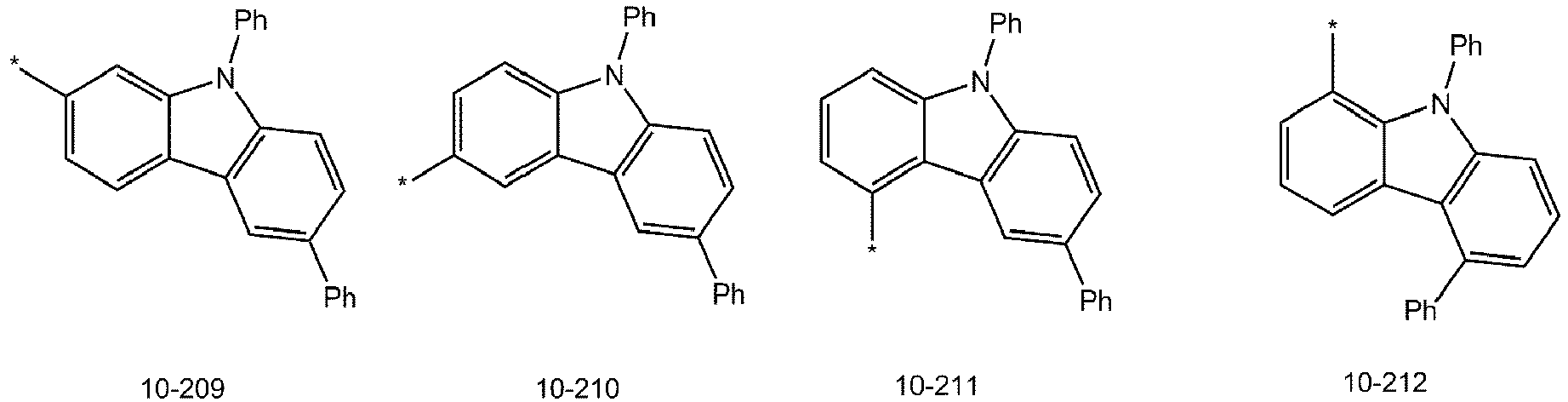




- * indicates a binding site to a neighboring atom,
- i-Pr indicates an isopropyl group,
- t-Bu indicates a tert-butyl group,
- Ph indicates a phenyl group,
- 1-Nph indicates a 1-naphthyl group and 2-Nph indicates a 2-naphthyl group,
- 2-Pyr indicates a 2-pyridyl group, 3-Pyr indicates a 3-pyridyl group, and 4-Pyr indicates a 4-pyridyl group, and
- Q1 to Q3 may each independently be selected from:
- a methyl group, an ethyl group, an n-propyl group, an isopropyl group, an n-butyl group, an isobutyl group, a sec-butyl group, a tert-butyl group, an n-pentyl group, an isopentyl group, a 2-methylbutyl group, a sec-pentyl group, a tert-pentyl group, a neo-pentyl group, a 3-pentyl group, a 3-methyl-2-butyl group, a phenyl group, a biphenyl group, a C1-C20 alkylphenyl group, and a naphthyl group; and
- a methyl group, an ethyl group, an n-propyl group, an isopropyl group, an n-butyl group, an isobutyl group, a sec-butyl group, a tert-butyl group, an n-pentyl group, an isopentyl group, a 2-methylbutyl group, a sec-pentyl group, a tert-pentyl group, a neo-pentyl group, a 3-pentyl group, a 3-methyl-2-butyl group, a phenyl group, and a naphthyl group, each substituted with at least one selected from deuterium and a phenyl group.
- In one embodiment, in Formula 1-1, R19 and R20 may be linked via the first linking group to form a substituted or unsubstituted C5-C30 carbocyclic group or a substituted or unsubstituted C1-C30 heterocyclic group,
the first linking group may be selected from a single bond, *-O-*', *-S-*', *-[C(R101)(R102)]k11-*', *-C(R101)=*', *=C(R101)-*', *-C(R101)=C(R102)-*', *-C(=O)-*', *-C(=S)-*', *-C≡C-*', *-N(R101)-*', *-P(R101)-*', *-[Si(R101)(R102)]kn-*', and *-P(R101)(R102)-*',
R101 and R102 may each independently be the same as defined in connection with R11,
k11 may be selected from 1, 2, 3, and 4,
* and *' each indicate a binding site to a neighboring atom, but embodiments of the present disclosure are not limited thereto. - In one or more embodiments, a moiety represented by


- J11 to J18 may each independently be selected from hydrogen, deuterium, -F, -Cl, -Br, -I, -CD3, -CD2H, -CDH2, -CF3, -CF2H, -CFH2, a hydroxyl group, a cyano group, a nitro group, an amino group, an amidino group, a hydrazine group, a hydrazone group, a carboxylic acid group or a salt thereof, a sulfonic acid group or a salt thereof, a phosphoric acid group or a salt thereof, a C1-C20 alkyl group, a C1-C20 alkoxy group, a cyclopentyl group, a cyclohexyl group, a cycloheptyl group, a cycloctyl group, a bicyclo[2.2.1]heptanyl group, an adamantanyl group, a norbornanyl group, a norbornenyl group, a cyclopentenyl group, a cyclohexenyl group, a cycloheptenyl group, a phenyl group, a biphenyl group, a C1-C20 alkylphenyl group, a naphthyl group, a fluorenyl group, a phenanthrenyl group, an anthracenyl group, a fluoranthenyl group, a triphenylenyl group, a pyrenyl group, a chrysenyl group, a pyrrolyl group, a thiophenyl group, a furanyl group, an imidazolyl group, a pyrazolyl group, a thiazolyl group, an isothiazolyl group, an oxazolyl group, an isoxazolyl group, a pyridinyl group, a pyrazinyl group, a pyrimidinyl group, a pyridazinyl group, an isoindolyl group, an indolyl group, an indazolyl group, a purinyl group, a quinolinyl group, an isoquinolinyl group, a benzoquinolinyl group, a quinoxalinyl group, a quinazolinyl group, a cinnolinyl group, a carbazolyl group, a phenanthrolinyl group, a benzimidazolyl group, a benzofuranyl group, a benzothiophenyl group, an isobenzothiazolyl group, a benzoxazolyl group, an isobenzoxazolyl group, a triazolyl group, a tetrazolyl group, an oxadiazolyl group, a triazinyl group, a dibenzofuranyl group, a dibenzothiophenyl group, a dibenzosilolyl group, a benzocarbazolyl group, a dibenzocarbazolyl group, an imidazopyridinyl group, an imidazopyrimidinyl group, -Si(Q11)(Q12)(Q13), -B(Q11)(Q12), and-N(Q11)(Q12),
- Q11 to Q13 may each independently be selected from:
- a methyl group, an ethyl group, an n-propyl group, an isopropyl group, an n-butyl group, an isobutyl group, a sec-butyl group, a tert-butyl group, an n-pentyl group, an isopentyl group, a 2-methylbutyl group, a sec-pentyl group, a tert-pentyl group, a neo-pentyl group, a 3-pentyl group, a 3-methyl-2-butyl group, a phenyl group, a biphenyl group, a C1-C20 alkylphenyl group, and a naphthyl group; and
- a methyl group, an ethyl group, an n-propyl group, an isopropyl group, an n-butyl group, an isobutyl group, a sec-butyl group, a tert-butyl group, an n-pentyl group, an isopentyl group, a 2-methylbutyl group, a sec-pentyl group, a tert-pentyl group, a neo-pentyl group, a 3-pentyl group, a 3-methyl-2-butyl group, a phenyl group, and a naphthyl group, each substituted with at least one selected from deuterium and a phenyl group, and
- * and *' each indicate a binding site to a neighboring atom.
- In one embodiment, E11 and R16 may not be linked to each other.
- In Formula 1-1, a11 and b17 may each independently be selected from 1, 2, 3, 4, 5, 6, 7, and 8.
- In Formulae 1 and 1-1, two bonds selected from a bond between X11 and M11, a bond between X14 and M11, a bond between X16 and M11, and a bond between X18 and M11 may each be a coordinate bond while the other to bonds may each be a covalent bond. Accordingly, the organometallic compound represented by Formula 1 may be neutral (in particular, having no (+) or (-) charge).
- In Formula 1, L12 may be selected from a monodentate ligand and a bidentate) ligand.
- For example, L12 in Formula 1 may be a ligand represented by one selected from Formulae 7-1 to 7-11, but embodiments of the present disclosure are not limited thereto:


- A71 and A72 may each independently be selected from a C5-C20 carbocyclic group, and a C1-C20 heterocyclic group,
- X71 and X72 may each independently be selected from C and N,
- X73 may be N or C(Q73), X74 may be N or C(Q74), X75 may be N or C(Q75), X76 may be N or C(Q76), and X77 may be N or C(Q77),
- X78 may be O, S, or N(Q78), and X79 may be O, S, or N(Q79),
- Y71 and Y72 may each independently be selected from a single bond, a double bond, a substituted or unsubstituted C1-C5 alkylene group, a substituted or unsubstituted C2-C5 alkenylene group, and a substituted or unsubstituted C6-C10 arylene group,
- Z71 and Z72 may each independently be selected from N, O, N(R74), P(R75)(R76), and As(R75)(R76),
- Z73 may be selected from P and As,
- Z74 may be selected from C(=O) and CH2,
- R71 to R80 and Q73 to Q79 may each independently be selected from hydrogen, deuterium, -F, -Cl, -Br, -I, a hydroxyl group, a cyano group, a nitro group, an amino group, an amidino group, a hydrazine group, a hydrazone group, a carboxylic acid group or a salt thereof, a sulfonic acid group or a salt thereof, a phosphoric acid group or a salt thereof, a substituted or unsubstituted C1-C60 alkyl group, a substituted or unsubstituted C2-C60 alkenyl group, a substituted or unsubstituted C2-C60 alkynyl group, a substituted or unsubstituted C1-C60 alkoxy group, a substituted or unsubstituted C3-C10 cycloalkyl group, a substituted or unsubstituted C1-C10 heterocycloalkyl group, a substituted or unsubstituted C3-C10 cycloalkenyl group, a substituted or unsubstituted C1-C10 heterocycloalkenyl group, a substituted or unsubstituted C6-C60 aryl group, a substituted or unsubstituted C6-C60 aryloxy group, a substituted or unsubstituted C6-C60 arylthio group, a substituted or unsubstituted C1-C60 heteroaryl group, a substituted or unsubstituted monovalent non-aromatic condensed polycyclic group, and a substituted or unsubstituted monovalent non-aromatic condensed heteropolycyclic group,
- R71 and R72 may optionally be linked to form a ring,
- R77 and R78 may optionally be linked to form a ring,
- R78 and R79 may optionally be linked to form a ring,
- R79 and R80 may optionally be linked to form a ring,
- b71 and b72 may each independently be selected from 1, 2, and 3, and
- * and *' each indicate a binding site to a neighboring atom.
- For example, A71 and A72 in Formulae 7-1, 7-9, and 7-11 may each independently be selected from a benzene group, a naphthalene group, an imidazole group, a benzimidazole group, a pyridine group, a pyrimidine group, a triazine group, a quinoline group, and an isoquinoline group, but embodiments of the present disclosure are not limited thereto.
- For example, in Formulae 7-1, 7-9, and 7-11, X72 and X79 may each independently be N, but embodiments of the present disclosure are not limited thereto.
- For example, in Formula 7-7, X73 may be C(Q73), X74 may be C(Q74), X75 may be C(Q75), X76 may be C(Q76), and X77 may be C(Q77), but embodiments of the present disclosure are not limited thereto.
- For example, in Formula 7-8, X78 may be N(Q78) and X79 may be N(Q79), but embodiments of the present disclosure are not limited thereto.
- For example, in Formulae 7-2, 7-3, and 7-8, Y71 and Y72 may each independently be selected from a substituted or unsubstituted methylene group, and a substituted or unsubstituted phenylene group, but embodiments of the present disclosure are not limited thereto.
- For example, in Formulae 7-1 and 7-2, Z71 and Z72 may each independently be O, but embodiments of the present disclosure are not limited thereto.
- For example, in Formula 7-4, Z73 may be P, but embodiments of the present disclosure are not limited thereto.
- For example, in Formulae 7-1 to 7-11, R71 to R80 and Q73 to Q79 may each independently be selected from:
- hydrogen, deuterium, -F, -Cl, -Br, -I, a hydroxyl group, a cyano group, a nitro group, an amino group, an amidino group, a hydrazine group, a hydrazone group, a carboxylic acid group or a salt thereof, a sulfonic acid group or a salt thereof, a phosphoric acid group or a salt thereof, -SF5, a C1-C20 alkyl group, and a C1-C20 alkoxy group;
- a C1-C20 alkyl group, and a C1-C20 alkoxy group, each substituted with at least one selected from deuterium, -F, -Cl, -Br, -I, -CD3, -CD2H, -CDH2, -CF3, -CF2H, -CFH2, a hydroxyl group, a cyano group, a nitro group, an amino group, an amidino group, a hydrazine group, a hydrazone group, a carboxylic acid group or a salt thereof, a sulfonic acid group or a salt thereof, a phosphoric acid group or a salt thereof, a C1-C10 alkyl group, a cyclopentyl group, a cyclohexyl group, a cycloheptyl group, a cycloctyl group, a bicyclo[2.2.1]heptanyl group, an adamantanyl group, a norbornanyl group, a norbornenyl group, a cyclopentenyl group, a cyclohexenyl group, a cycloheptenyl group, a phenyl group, a biphenyl group, a C1-C20 alkylphenyl group, a naphthyl group, a pyridinyl group, and a pyrimidinyl group;
- a cyclopentyl group, a cyclohexyl group, a cycloheptyl group, a cycloctyl group, a bicyclo[2.2.1]heptanyl group, an adamantanyl group, a norbornanyl group, a norbornenyl group, a cyclopentenyl group, a cyclohexenyl group, a cycloheptenyl group, a phenyl group, a biphenyl group, a C1-C20 alkylphenyl group, a naphthyl group, a fluorenyl group, a phenanthrenyl group, an anthracenyl group, a fluoranthenyl group, a triphenylenyl group, a pyrenyl group, a chrysenyl group, a pyrrolyl group, a thiophenyl group, a furanyl group, an imidazolyl group, a pyrazolyl group, a thiazolyl group, an isothiazolyl group, an oxazolyl group, an isoxazolyl group, a pyridinyl group, a pyrazinyl group, a pyrimidinyl group, a pyridazinyl group, an isoindolyl group, an indolyl group, an indazolyl group, a purinyl group, a quinolinyl group, an isoquinolinyl group, a benzoquinolinyl group, a quinoxalinyl group, a quinazolinyl group, a cinnolinyl group, a carbazolyl group, a phenanthrolinyl group, a benzimidazolyl group, a benzofuranyl group, a benzothiophenyl group, an isobenzothiazolyl group, a benzoxazolyl group, an isobenzoxazolyl group, a triazolyl group, a tetrazolyl group, an oxadiazolyl group, a triazinyl group, a dibenzofuranyl group, a dibenzothiophenyl group, a dibenzosilolyl group, a benzocarbazolyl group, a dibenzocarbazolyl group, an imidazopyridinyl group, and an imidazopyrimidinyl group;
- a cyclopentyl group, a cyclohexyl group, a cycloheptyl group, a cycloctyl group, a bicyclo[2.2.1]heptanyl group, an adamantanyl group, a norbornanyl group, a norbornenyl group, a cyclopentenyl group, a cyclohexenyl group, a cycloheptenyl group, a phenyl group, a biphenyl group, a C1-C20 alkylphenyl group, a naphthyl group, a fluorenyl group, a phenanthrenyl group, an anthracenyl group, a fluoranthenyl group, a triphenylenyl group, a pyrenyl group, a chrysenyl group, a pyrrolyl group, a thiophenyl group, a furanyl group, an imidazolyl group, a pyrazolyl group, a thiazolyl group, an isothiazolyl group, an oxazolyl group, an isoxazolyl group, a pyridinyl group, a pyrazinyl group, a pyrimidinyl group, a pyridazinyl group, an isoindolyl group, an indolyl group, an indazolyl group, a purinyl group, a quinolinyl group, an isoquinolinyl group, a benzoquinolinyl group, a quinoxalinyl group, a quinazolinyl group, a cinnolinyl group, a carbazolyl group, a phenanthrolinyl group, a benzimidazolyl group, a benzofuranyl group, a benzothiophenyl group, an isobenzothiazolyl group, a benzoxazolyl group, an isobenzoxazolyl group, a triazolyl group, a tetrazolyl group, an oxadiazolyl group, a triazinyl group, a dibenzofuranyl group, a dibenzothiophenyl group, a dibenzosilolyl group, a benzocarbazolyl group, a dibenzocarbazolyl group, an imidazopyridinyl group, and an imidazopyrimidinyl group, each substituted with at least one selected from deuterium, -F, -Cl, -Br, -I,-CD3, -CD2H, -CDH2, -CF3, -CF2H, -CFH2, a hydroxyl group, a cyano group, a nitro group, an amino group, an amidino group, a hydrazine group, a hydrazone group, a carboxylic acid group or a salt thereof, a sulfonic acid group or a salt thereof, a phosphoric acid group or a salt thereof, a C1-C20 alkyl group, a C1-C20 alkoxy group, a cyclopentyl group, a cyclohexyl group, a cycloheptyl group, a cycloctyl group, a bicyclo[2.2.1]heptanyl group, an adamantanyl group, a norbornanyl group, a norbornenyl group, a cyclopentenyl group, a cyclohexenyl group, a cycloheptenyl group, a phenyl group, a biphenyl group, a C1-C20 alkylphenyl group, a naphthyl group, a fluorenyl group, a phenanthrenyl group, an anthracenyl group, a fluoranthenyl group, a triphenylenyl group, a pyrenyl group, a chrysenyl group, a pyrrolyl group, a thiophenyl group, a furanyl group, an imidazolyl group, a pyrazolyl group, a thiazolyl group, an isothiazolyl group, an oxazolyl group, an isoxazolyl group, a pyridinyl group, a pyrazinyl group, a pyrimidinyl group, a pyridazinyl group, an isoindolyl group, an indolyl group, an indazolyl group, a purinyl group, a quinolinyl group, an isoquinolinyl group, a benzoquinolinyl group, a quinoxalinyl group, a quinazolinyl group, a cinnolinyl group, a carbazolyl group, a phenanthrolinyl group, a benzimidazolyl group, a benzofuranyl group, a benzothiophenyl group, an isobenzothiazolyl group, a benzoxazolyl group, an isobenzoxazolyl group, a triazolyl group, a tetrazolyl group, an oxadiazolyl group, a triazinyl group, a dibenzofuranyl group, a dibenzothiophenyl group, a dibenzosilolyl group, a benzocarbazolyl group, a dibenzocarbazolyl group, an imidazopyridinyl group, an imidazopyrimidinyl group,-Si(Q11)(Q12)(Q13), -B(Q11)(Q12), and -N(Q11)(Q12); and
- -Si(Q1)(Q2)(Q3), -B(Q1)(Q2), and -N(Q1)(Q2), and
- Q1 to Q3 and Q11 to Q13 may each independently be selected from:
- a methyl group, an ethyl group, an n-propyl group, an isopropyl group, an n-butyl group, an isobutyl group, a sec-butyl group, a tert-butyl group, an n-pentyl group, an isopentyl group, a 2-methylbutyl group, a sec-pentyl group, a tert-pentyl group, a neo-pentyl group, a 3-pentyl group, a 3-methyl-2-butyl group, a phenyl group, a biphenyl group, a C1-C20 alkylphenyl group, and a naphthyl group; and
- a methyl group, an ethyl group, an n-propyl group, an isopropyl group, an n-butyl group, an isobutyl group, a sec-butyl group, a tert-butyl group, an n-pentyl group, an isopentyl group, a 2-methylbutyl group, a sec-pentyl group, a tert-pentyl group, a neo-pentyl group, a 3-pentyl group, a 3-methyl-2-butyl group, a phenyl group, and a naphthyl group, each substituted with at least one selected from deuterium and a phenyl group, but embodiments of the present disclosure are not limited thereto.
- In Formula 1, L12 may be a ligand represented by one selected from Formulae 5-1 to 5-116 and 8-1 to 8-23, but embodiments of the present disclosure are not limited thereto:


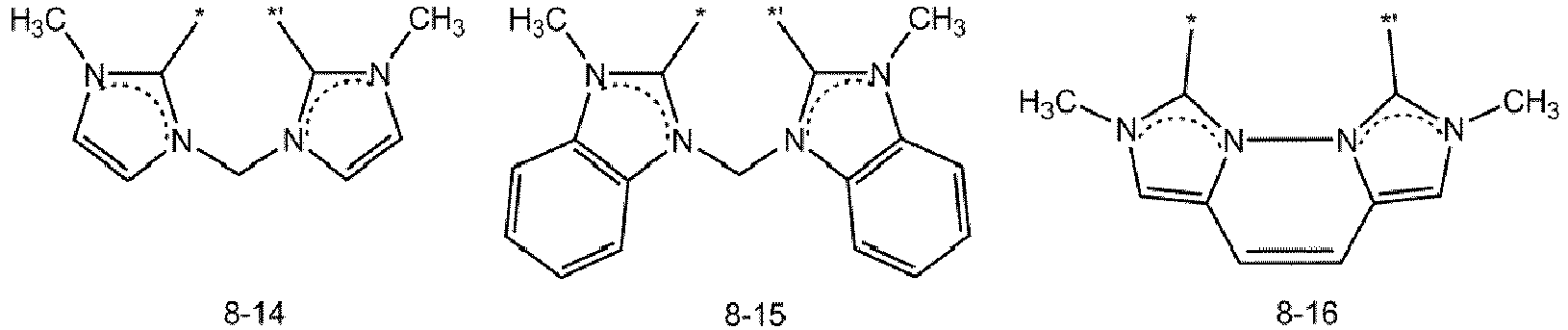


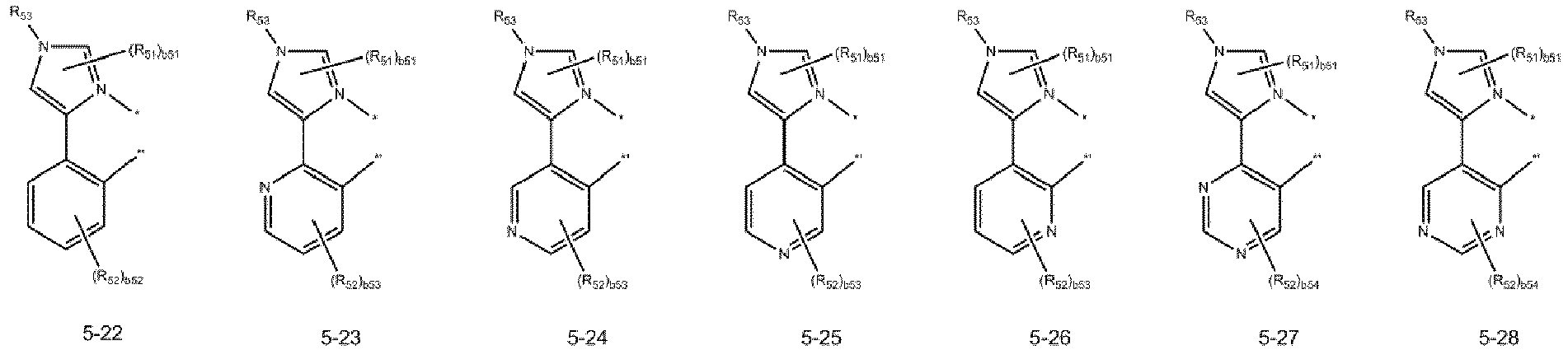


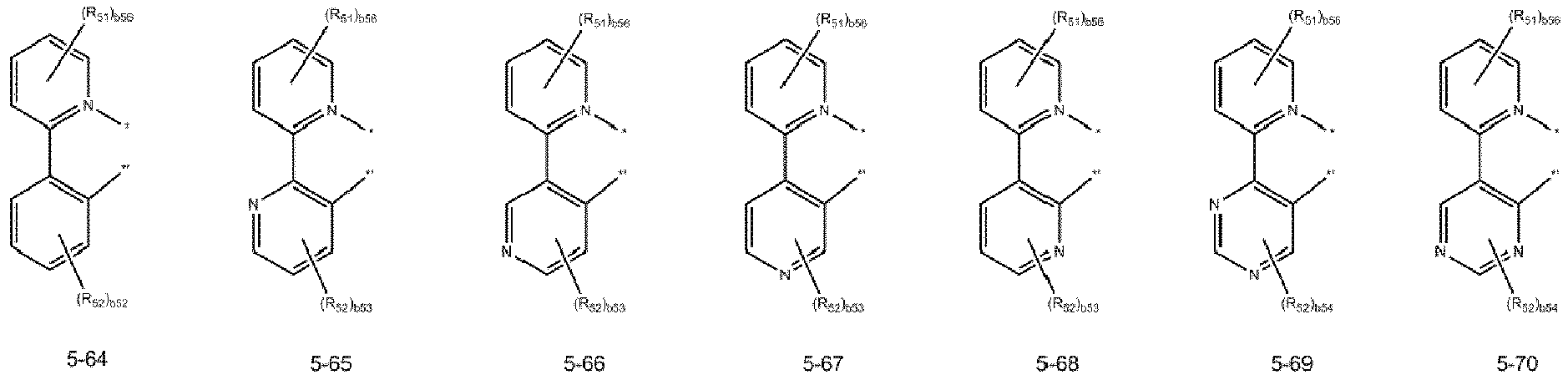


R51 to R53 may each independently be selected from: - hydrogen, deuterium, -F, -Cl, -Br, -I, a hydroxyl group, a cyano group, a nitro group, an amino group, an amidino group, a hydrazine group, a hydrazone group, a carboxylic acid group or a salt thereof, a sulfonic acid group or a salt thereof, a phosphoric acid group or a salt thereof, -SF5, a C1-C20 alkyl group, and a C1-C20 alkoxy group;
- a C1-C20 alkyl group, and a C1-C20 alkoxy group, each substituted with at least one selected from deuterium, -F, -Cl, -Br, -I, -CD3, -CD2H, -CDH2, -CF3, -CF2H, -CFH2, a hydroxyl group, a cyano group, a nitro group, an amino group, an amidino group, a hydrazine group, a hydrazone group, a carboxylic acid group or a salt thereof, a sulfonic acid group or a salt thereof, a phosphoric acid group or a salt thereof, a C1-C10 alkyl group, a cyclopentyl group, a cyclohexyl group, a cycloheptyl group, a cycloctyl group, a bicyclo[2.2.1]heptanyl group, an adamantanyl group, a norbornanyl group, a norbornenyl group, a cyclopentenyl group, a cyclohexenyl group, a cycloheptenyl group, a phenyl group, a biphenyl group, a C1-C20 alkylphenyl group, a naphthyl group, a pyridinyl group, and a pyrimidinyl group;
- a cyclopentyl group, a cyclohexyl group, a cycloheptyl group, a cycloctyl group, a bicyclo[2.2.1]heptanyl group, an adamantanyl group, a norbornanyl group, a norbornenyl group, a cyclopentenyl group, a cyclohexenyl group, a cycloheptenyl group, a phenyl group, a biphenyl group, a C1-C20 alkylphenyl group, a naphthyl group, a fluorenyl group, a phenanthrenyl group, an anthracenyl group, a fluoranthenyl group, a triphenylenyl group, a pyrenyl group, a chrysenyl group, a pyrrolyl group, a thiophenyl group, a furanyl group, an imidazolyl group, a pyrazolyl group, a thiazolyl group, an isothiazolyl group, an oxazolyl group, an isoxazolyl group, a pyridinyl group, a pyrazinyl group, a pyrimidinyl group, a pyridazinyl group, an isoindolyl group, an indolyl group, an indazolyl group, a purinyl group, a quinolinyl group, an isoquinolinyl group, a benzoquinolinyl group, a quinoxalinyl group, a quinazolinyl group, a cinnolinyl group, a carbazolyl group, a phenanthrolinyl group, a benzimidazolyl group, a benzofuranyl group, a benzothiophenyl group, an isobenzothiazolyl group, a benzoxazolyl group, an isobenzoxazolyl group, a triazolyl group, a tetrazolyl group, an oxadiazolyl group, a triazinyl group, a dibenzofuranyl group, a dibenzothiophenyl group, a dibenzosilolyl group, a benzocarbazolyl group, a dibenzocarbazolyl group, an imidazopyridinyl group, and an imidazopyrimidinyl group;
- a cyclopentyl group, a cyclohexyl group, a cycloheptyl group, a cycloctyl group, a bicyclo[2.2.1]heptanyl group, an adamantanyl group, a norbornanyl group, a norbornenyl group, a cyclopentenyl group, a cyclohexenyl group, a cycloheptenyl group, a phenyl group, a biphenyl group, a C1-C20 alkylphenyl group, a naphthyl group, a fluorenyl group, a phenanthrenyl group, an anthracenyl group, a fluoranthenyl group, a triphenylenyl group, a pyrenyl group, a chrysenyl group, a pyrrolyl group, a thiophenyl group, a furanyl group, an imidazolyl group, a pyrazolyl group, a thiazolyl group, an isothiazolyl group, an oxazolyl group, an isoxazolyl group, a pyridinyl group, a pyrazinyl group, a pyrimidinyl group, a pyridazinyl group, an isoindolyl group, an indolyl group, an indazolyl group, a purinyl group, a quinolinyl group, an isoquinolinyl group, a benzoquinolinyl group, a quinoxalinyl group, a quinazolinyl group, a cinnolinyl group, a carbazolyl group, a phenanthrolinyl group, a benzimidazolyl group, a benzofuranyl group, a benzothiophenyl group, an isobenzothiazolyl group, a benzoxazolyl group, an isobenzoxazolyl group, a triazolyl group, a tetrazolyl group, an oxadiazolyl group, a triazinyl group, a dibenzofuranyl group, a dibenzothiophenyl group, a dibenzosilolyl group, a benzocarbazolyl group, a dibenzocarbazolyl group, an imidazopyridinyl group, and an imidazopyrimidinyl group, each substituted with at least one selected from deuterium, -F, -CI, -Br, -I, - CD3, -CD2H, -CDH2, -CF3, -CF2H, -CFH2, a hydroxyl group, a cyano group, a nitro group, an amino group, an amidino group, a hydrazine group, a hydrazone group, a carboxylic acid group or a salt thereof, a sulfonic acid group or a salt thereof, a phosphoric acid group or a salt thereof, a C1-C20 alkyl group, a C1-C20 alkoxy group, a cyclopentyl group, a cyclohexyl group, a cycloheptyl group, a cycloctyl group, a bicyclo[2.2.1]heptanyl group, an adamantanyl group, a norbornanyl group, a norbornenyl group, a cyclopentenyl group, a cyclohexenyl group, a cycloheptenyl group, a phenyl group, a biphenyl group, a C1-C20 alkylphenyl group, a naphthyl group, a fluorenyl group, a phenanthrenyl group, an anthracenyl group, a fluoranthenyl group, a triphenylenyl group, a pyrenyl group, a chrysenyl group, a pyrrolyl group, a thiophenyl group, a furanyl group, an imidazolyl group, a pyrazolyl group, a thiazolyl group, an isothiazolyl group, an oxazolyl group, an isoxazolyl group, a pyridinyl group, a pyrazinyl group, a pyrimidinyl group, a pyridazinyl group, an isoindolyl group, an indolyl group, an indazolyl group, a purinyl group, a quinolinyl group, an isoquinolinyl group, a benzoquinolinyl group, a quinoxalinyl group, a quinazolinyl group, a cinnolinyl group, a carbazolyl group, a phenanthrolinyl group, a benzimidazolyl group, a benzofuranyl group, a benzothiophenyl group, an isobenzothiazolyl group, a benzoxazolyl group, an isobenzoxazolyl group, a triazolyl group, a tetrazolyl group, an oxadiazolyl group, a triazinyl group, a dibenzofuranyl group, a dibenzothiophenyl group, a dibenzosilolyl group, a benzocarbazolyl group, a dibenzocarbazolyl group, an imidazopyridinyl group, an imidazopyrimidinyl group, - Si(Q11)(Q12)(Q13), -B(Q11)(Q12), and -N(Q11)(Q12); and
- -Si(Q1)(Q2)(Q3), -B(Q1)(Q2), and -N(Q1)(Q2), and
- Q1 to Q3 and Q11 to Q13 may each independently be selected from:
- a methyl group, an ethyl group, an n-propyl group, an isopropyl group, an n-butyl group, an isobutyl group, a sec-butyl group, a tert-butyl group, an n-pentyl group, an isopentyl group, a 2-methylbutyl group, a sec-pentyl group, a tert-pentyl group, a neo-pentyl group, a 3-pentyl group, a 3-methyl-2-butyl group, a phenyl group, a biphenyl group, a C1-C20 alkylphenyl group, and a naphthyl group; and
- a methyl group, an ethyl group, an n-propyl group, an isopropyl group, an n-butyl group, an isobutyl group, a sec-butyl group, a tert-butyl group, an n-pentyl group, an isopentyl group, a 2-methylbutyl group, a sec-pentyl group, a tert-pentyl group, a neo-pentyl group, a 3-pentyl group, a 3-methyl-2-butyl group, a phenyl group, and a naphthyl group, each substituted with at least one selected from deuterium and a phenyl group,
- b51 and b54 may each independently be selected from 1 and 2,
- b53 and b55 may each independently be selected from 1, 2, and 3,
- b52 may be selected from 1, 2, 3, and 4,
- Ph indicates a phenyl group,
- Ph-d5 indicates a phenyl group in which all hydrogen atoms are substituted with deuterium, and
- * and *' each indicate a binding site to a neighboring atom.
- In Formula 1, n11 may be 1, and n12 may be 0, 1, and 2.
- In one embodiment, in Formula 1, M11 may be Pt, n11 may be 1, and n12 may be 0, but embodiments of the present disclosure are not limited thereto.
- In one embodiment, the organometallic compound may be represented by Formulae 1-11 to 1-14, but embodiments of the present disclosure are not limited thereto:


- M11 may be the same as defined in connection with Formula 1,
- Y11, T11, G11 to G14, R11 to R17, and b17 may each independently be the same as defined in connection with Formula 1-1, and
- E11a and E11b may each independently be the same as defined in connection with E11 in Formula 1-1.
- In one or more embodiments, the organometallic compound may be represented by Formulae 1-21 to 1-24, but embodiments of the present disclosure are not limited thereto:
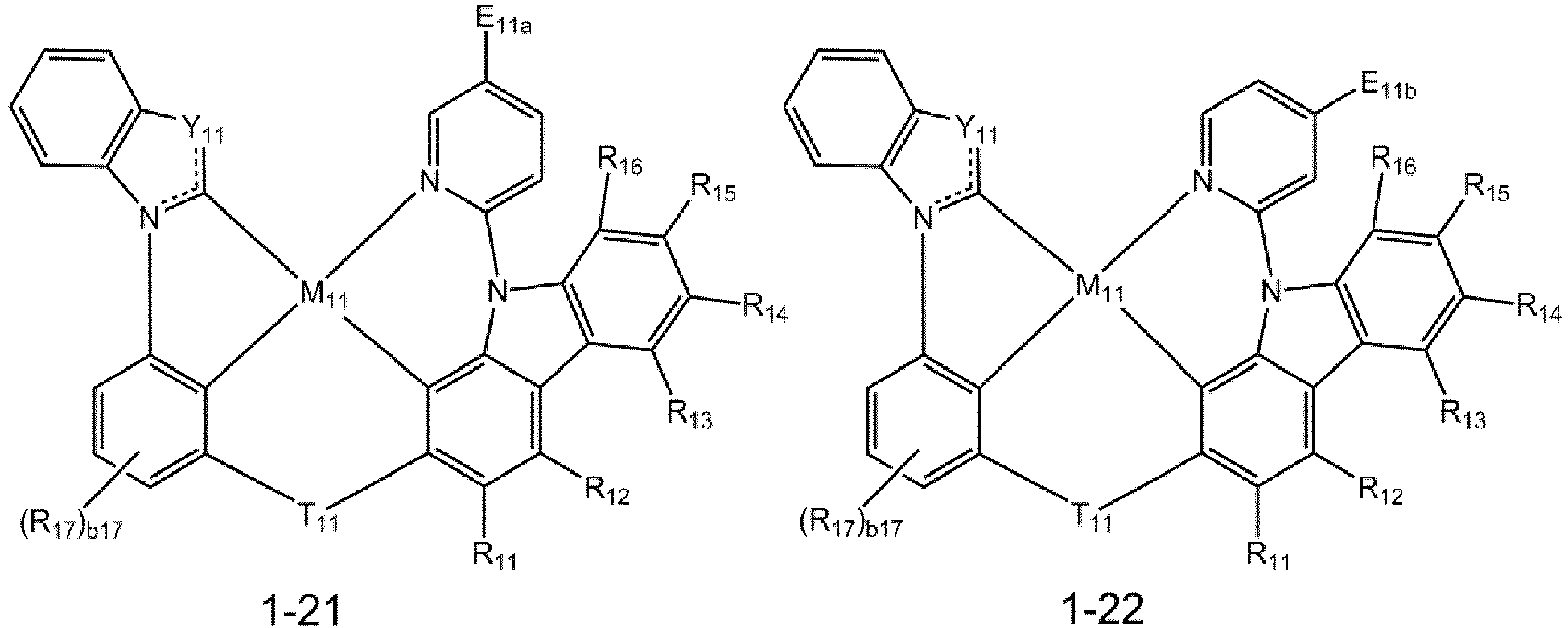

- M11 may be the same as defined in connection with Formula 1,
- Y11, T11, R11 to R17, and b17 may each independently be the same as defined in connection with Formula 1-1, and
- E11a and E11b may each independently be the same as defined in connection with E11 in Formula 1-1.
- In one or more embodiments, the organometallic compound may be selected from compounds of Group I, but embodiments of the present disclosure are not limited thereto:


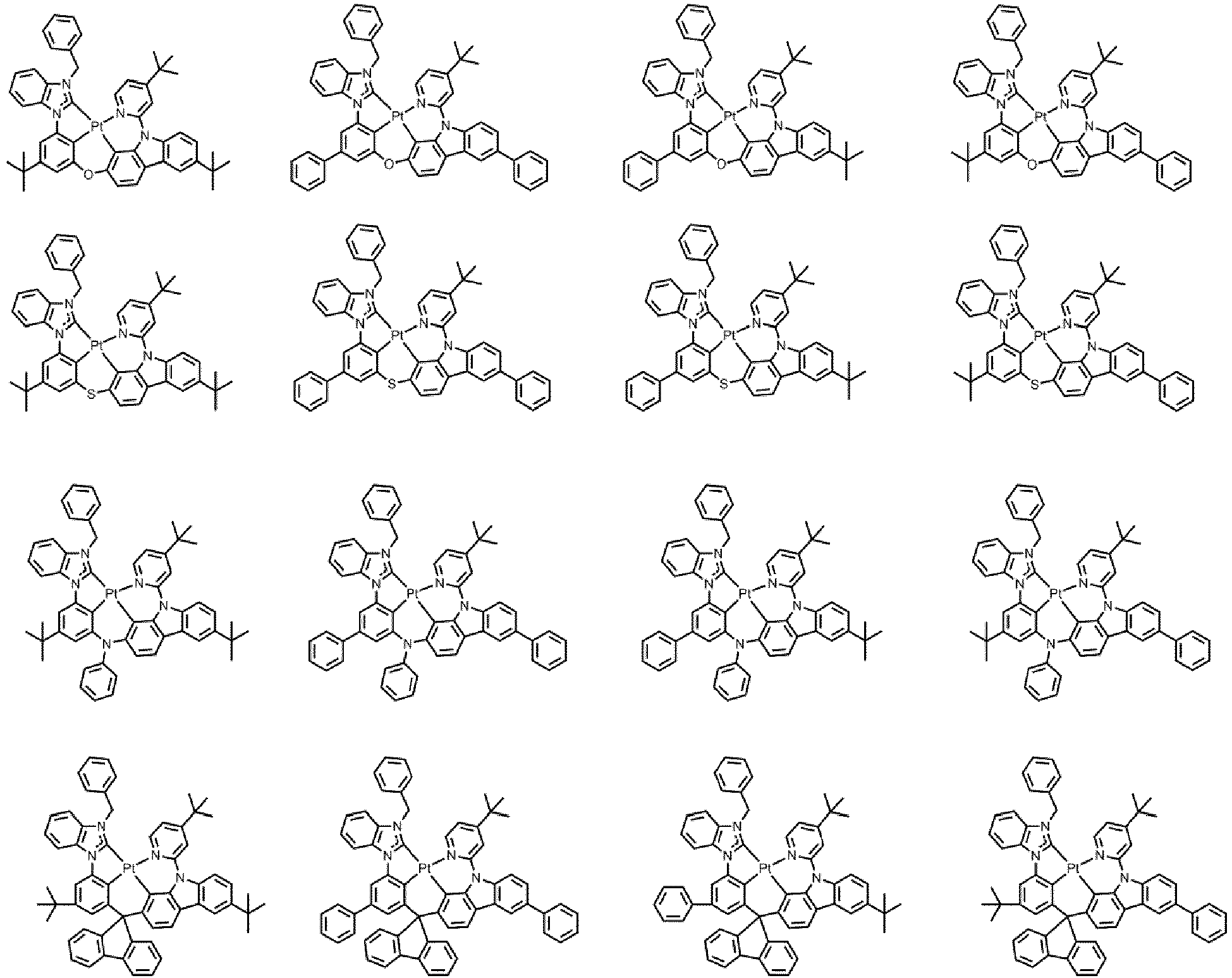

- The organometallic compound represented by Formula 1 may have a maximum emission wavelength (experimental value) of about 420 nm or more and about less than 520 nm, for example, in a range of about 450 nm to about 475 nm. In particular, when the maximum emission wavelength is in a range of about 455 nm to about 465 nm, an organic light-emitting device emitting deep blue color light may be provided.
- In the organometallic compound represented by Formula 1, both the benzocarbene-A12 part and the A11-carbazole part may participate in light emission. Specifically, the benzocarbene-A12 part participates in light emission as highest occupied natural transition orbital (HONTO), and the A11-carbazole part participates in light emission as lowest unoccupied natural transition orbital (LUNTO). Therefore, a luminescent spectrum having high color purity may be provided.
- In the organometallic compound represented by Formula 1, since E11 is selected as an alkyl group or the like, the electron distribution of LUNTO is changed, and it is possible to provide an organometallic compound having improved light emission characteristics, for example, the change in the maximum emission wavelength and/or the width change in the emission wavelength. Therefore, the organometallic compound represented by Formula 1 may have high color purity and may have improved conversion efficiency when applied to the resonant device.
- In the organometallic compound represented by Formula 1. Due to steric hindrance or electron effect of E11, E11 is selected as an alkyl group, and thus, color coordinates (in particular, y value in CIE color coordinates) are constantly maintained and the FWHM is constantly maintained, regardless of the concentration of the organometallic compound. Therefore, it is possible to provide an organic light-emitting device emitting deep blue light, regardless of the concentration of the organometallic compound.
- Since the organometallic compound represented by Formula 1 includes benzocarbene, the organometallic compound may emit deep blue light having a predetermined wavelength. Since the organometallic compound including carbene instead of benzocarbene emits blue light having a shorter wavelength, luminescent efficiency in a desired wavelength range may be significantly lowered. That is, the organic light-emitting device including the organometallic compound represented by Formula 1 may have improved luminescent efficiency in a predetermined wavelength range.
- In the organometallic compound represented by Formula 1, G11 to G14 may not be fluorescent light emitters. Therefore, it is possible to prevent the change in emission wavelength according to MADF fluorescence expression (that is, a reduction in color purity according to an increase in FWHM) and/or a reduction in conversion efficiency of the resonant device.
- In the organometallic compound represented by Formula 1, R18 may be represented by *-C(Q101)(Q102)(Q103), and in this regard, electrons in luminophore may be controlled, thereby improving the efficiency of the organic light-emitting device including the organometallic compound represented by Formula 1.
- For example, HOMO, LUMO, and T1 energy levels of some of Compounds were evaluated by using a B3LYP density functional theory of Gaussian program (Pt was structurally optimized at a level of LanL2DZ basis set, and another atom was structurally optimized at a level of B3LYP, 6-31G(d,p)), and results thereof are shown in Table 1.
[Table 1] Compound No. HOMO (eV) LUMO (eV) T1 (eV) Compound 6 -4.68 -1.27 2.67 Compound X1 -4.75 -1.43 2.60 Compound X2 -4.58 -1.20 2.69 Compound X3 -4.75 -1.52 2.58 Compound X4 -4.66 -1.23 2.61 Compound X5 -4.44 -1.40 2.35 Compound X6 -4.69 -1.32 2.65 Compound X7 -4.67 -1.24 2.63 Compound X8 -4.68 -1.31 2.67 


- From Table 1, it is confirmed that Compounds represented by Formula 1 are suitable for deep blue light emission. On the other hand, Compound X2 is not suitable for deep blue light emission since Compound X2 has high T1, and Compounds X4, X5, and X6 are not suitable for deep blue light emission since Compounds X4, X5, and X6 have low T1.
- Synthesis methods of the organometallic compound represented by Formula 1 may be recognizable by one of ordinary skill in the art by referring to Synthesis Examples provided below.
- The organometallic compound represented by Formula 1 is suitable for use in an organic layer of an organic light-emitting device, for example, for use as a dopant in an emission layer of the organic layer. Thus, another aspect provides an organic light-emitting device that includes: a first electrode; a second electrode; and an organic layer that is located between the first electrode and the second electrode and includes an emission layer; and the organic layer includes at least one organometallic compound represented by Formula 1.
- The organic light-emitting device may have, due to the inclusion of an organic layer including the organometallic compound represented by Formula 1, a low driving voltage, high efficiency, high power, high quantum efficiency, a long lifespan, a low roll-off ratio, and excellent color purity.
- The organometallic compound of Formula 1 may be used between a pair of electrodes of an organic light-emitting device. For example, the organometallic compound represented by Formula 1 may be included in the emission layer. In this regard, the organometallic compound may act as a dopant, and the emission layer may further include a host (that is, an amount of the organometallic compound represented by Formula 1 is smaller than an amount of the host). In this regard, the dopant may emit blue light.
- The expression "(an organic layer) includes at least one organometallic compound" used herein may include a case in which "(an organic layer) includes identical compounds represented by Formula 1" and a case in which "(an organic layer) includes two or more different organometallic compounds represented by Formula 1."
- For example, the organic layer may include, as the organometallic compound, only Compound 1. In this regard, Compound 1 may exist in an emission layer of the organic light-emitting device. In one or more embodiments, the organic layer may include, as the organometallic compound, Compound 1 and Compound 2. In this regard, Compound 1 and Compound 2 may exist in an identical layer (for example, Compound 1 and Compound 2 all may exist in an emission layer).
- The first electrode may be an anode, which is a hole injection electrode, and the second electrode may be a cathode, which is an electron injection electrode; or the first electrode may be a cathode, which is an electron injection electrode, and the second electrode may be an anode, which is a hole injection electrode.
- In one embodiment, in the organic light-emitting device, the first electrode is an anode, and the second electrode is a cathode, and the organic layer further includes a hole transport region between the first electrode and the emission layer and an electron transport region between the emission layer and the second electrode, and the hole transport region includes at least one selected from a hole injection layer, a hole transport layer, and an electron blocking layer, and the electron transport region includes at least one selected from a hole blocking layer, an electron transport layer, and an electron injection layer.
- The term "organic layer" as used herein refers to a single layer and/or a plurality of layers between the first electrode and the second electrode of the organic light-emitting device. The "organic layer" may include, in addition to an organic compound, an organometallic compound including metal.
- FIGURE is a schematic view of an organic light-emitting
device 10 according to an embodiment. Hereinafter, the structure of an organic light-emitting device according to an embodiment and a method of manufacturing an organic light-emitting device according to an embodiment will be described in connection with the FIGURE. The organic light-emittingdevice 10 includes afirst electrode 11, anorganic layer 15, and asecond electrode 19, which are sequentially stacked. - A substrate may be additionally disposed under the
first electrode 11 or above thesecond electrode 19. For use as the substrate, any substrate that is used in general organic light-emitting devices may be used, and the substrate may be a glass substrate or a transparent plastic substrate, each having excellent mechanical strength, thermal stability, transparency, surface smoothness, ease of handling, and water resistance. - In one or more embodiments, the
first electrode 11 may be formed by depositing or sputtering a material for forming thefirst electrode 11 on the substrate. Thefirst electrode 11 may be an anode. The material for forming thefirst electrode 11 may be selected from materials with a high work function to facilitate hole injection. Thefirst electrode 11 may be a reflective electrode, a semi-transmissive electrode, or a transmissive electrode. The material for forming thefirst electrode 11 may be indium tin oxide (ITO), indium zinc oxide (IZO), tin oxide (SnO2), or zinc oxide (ZnO). In one or more embodiments, the material for forming thefirst electrode 11 may be metal, such as magnesium (Mg), aluminum (Al), aluminum-lithium (Al-Li), calcium (Ca), magnesium-indium (Mg-In), or magnesium-silver (Mg-Ag). - The
first electrode 11 may have a single-layered structure or a multi-layered structure including two or more layers. For example, thefirst electrode 11 may have a three-layered structure of ITO/Ag/ITO, but the structure of the first electrode 110 is not limited thereto. - The
organic layer 15 is disposed on thefirst electrode 11. - The
organic layer 15 may include a hole transport region, an emission layer, and an electron transport region. - The hole transport region may be disposed between the
first electrode 11 and the emission layer. - The hole transport region may include at least one selected from a hole injection layer, a hole transport layer, an electron blocking layer, and a buffer layer.
- The hole transport region may include only either a hole injection layer or a hole transport layer. In one or more embodiments, the hole transport region may have a hole injection layer/hole transport layer structure or a hole injection layer/hole transport layer/electron blocking layer structure, which are sequentially stacked in this stated order from the
first electrode 11. - When the hole transport region includes a hole injection layer, the hole injection layer may be formed on the
first electrode 11 by using one or more suitable methods, for example, vacuum deposition, spin coating, casting, and/or Langmuir-Blodgett (LB) deposition. - When a hole injection layer is formed by vacuum deposition, the deposition conditions may vary according to a material that is used to form the hole injection layer, and the structure and thermal characteristics of the hole injection layer. For example, the deposition conditions may include a deposition temperature of about 100 °C to about 500 °C, a vacuum pressure of about 10-8 torr to about 10-3 torr, and a deposition rate of about 0.01 Å/sec to about 100 Å/sec. However, the deposition conditions are not limited thereto.
- When the hole injection layer is formed using spin coating, coating conditions may vary according to the material used to form the hole injection layer, and the structure and thermal properties of the hole injection layer. For example, a coating speed may be from about 2,000 rpm to about 5,000 rpm, and a temperature at which a heat treatment is performed to remove a solvent after coating may be from about 80 °C to about 200 °C. However, the coating conditions are not limited thereto.
- Conditions for forming a hole transport layer and an electron blocking layer may be understood by referring to conditions for forming the hole injection layer.
- The hole transport region may include at least one selected from m-MTDATA, TDATA, 2-TNATA, NPB, β-NPB, TPD, Spiro-TPD, Spiro-NPB, methylated-NPB, TAPC, HMTPD, 4,4',4"-tris(N-carbazolyl)triphenylamine (TCTA), polyaniline/dodecylbenzenesulfonic acid (PANI/DBSA), poly(3,4-ethylenedioxythiophene)/poly(4-styrenesulfonate) (PEDOT/PSS), polyaniline/camphor sulfonic acid (PANI/CSA), polyaniline/poly(4-styrenesulfonate) (PANI/PSS), a compound represented by Formula 201 below, and a compound represented by Formula 202 below:


- a phenylene group, a pentalenylene group, an indenylene group, a naphthylene group, an azulenylene group, a heptalenylene group, an acenaphthylene group, a fluorenylene group, a phenalenylene group, a phenanthrenylene group, an anthracenylene group, a fluoranthenylene group, a triphenylenylene group, a pyrenylene group, a chrysenylenylene group, a naphthacenylene group, a picenylene group, a perylenylene group, and a pentacenylene group; and
- a phenylene group, a pentalenylene group, an indenylene group, a naphthylene group, an azulenylene group, a heptalenylene group, an acenaphthylene group, a fluorenylene group, a phenalenylene group, a phenanthrenylene group, an anthracenylene group, a fluoranthenylene group, a triphenylenylene group, a pyrenylene group, a chrysenylenylene group, a naphthacenylene group, a picenylene group, a perylenylene group, and a pentacenylene group, each substituted with at least one selected from deuterium, -F, -CI, -Br, -I, a hydroxyl group, a cyano group, a nitro group, an amino group, an amidino group, a hydrazine group, a hydrazone group, a carboxylic acid group or a salt thereof, a sulfonic acid group or a salt thereof, a phosphoric acid group or a salt thereof, a C1-C60 alkyl group, a C2-C60 alkenyl group, a C2-C60 alkynyl group, a C1-C60 alkoxy group, a C3-C10 cycloalkyl group, a C3-C10 cycloalkenyl group, a C1-C10 heterocycloalkyl group, a C1-C10 heterocycloalkenyl group, a C6-C60 aryl group, a C6-C60 aryloxy group, a C6-C60 arylthio group, a C1-C60 heteroaryl group, a monovalent non-aromatic condensed polycyclic group, and a monovalent non-aromatic condensed heteropolycyclic group.
- In Formula 201, xa and xb may each independently be an integer from 0 to 5, or may be 0, 1, or 2. For example, xa may be 1, and xb may be 0, but embodiments of the present disclosure are not limited thereto.
- In Formulae 201 and 202, R101 to R108, R111 to R119, and R121 to R124 may each independently be selected from:
- hydrogen, deuterium, -F, -Cl, -Br, -I, a hydroxyl group, a cyano group, a nitro group, an amino group, an amidino group, a hydrazine group, a hydrazone group, a carboxylic acid group or a salt thereof, a sulfonic acid group or a salt thereof, a phosphoric acid group or a salt thereof, a C1-C10 alkyl group (for example, a methyl group, an ethyl group, a propyl group, a butyl group, pentyl group, a hexyl group, or the like), and a C1-C10 alkoxy group (for example, a methoxy group, an ethoxy group, a propoxy group, a butoxy group, a pentoxy group, or the like);
- a C1-C10 alkyl group, and a C1-C10 alkoxy group, each substituted with at least one selected from deuterium, -F, -Cl, -Br, -I, a hydroxyl group, a cyano group, a nitro group, an amino group, an amidino group, a hydrazine group, a hydrazone group, a carboxylic acid group or a salt thereof, a sulfonic acid group or a salt thereof, and a phosphoric acid group or a salt thereof;
- a phenyl group, a naphthyl group, an anthracenyl group, a fluorenyl group, and a pyrenyl group; and
- a phenyl group, a naphthyl group, an anthracenyl group, a fluorenyl group, and a pyrenyl group, each substituted with at least one selected from deuterium, -F,-Cl, -Br, -I, a hydroxyl group, a cyano group, a nitro group, an amino group, an amidino group, a hydrazine group, a hydrazone group, a carboxylic acid group or a salt thereof, a sulfonic acid group or a salt thereof, a phosphoric acid group or a salt thereof, a C1-C10 alkyl group, and a C1-C10 alkoxy group, but embodiments of the present disclosure are not limited thereto.
- In Formula 201, R109 may be selected from:
- a phenyl group, a naphthyl group, an anthracenyl group, and a pyridinyl group; and
- a phenyl group, a naphthyl group, an anthracenyl group, and a pyridinyl group, each substituted with at least one selected from deuterium, -F, -Cl, -Br, -I, a hydroxyl group, a cyano group, a nitro group, an amino group, an amidino group, a hydrazine group, a hydrazone group, a carboxylic acid group or a salt thereof, a sulfonic acid group or a salt thereof, a phosphoric acid group or a salt thereof, a C1-C20 alkyl group, a C1-C20 alkoxy group, a phenyl group, a naphthyl group, an anthracenyl group, and a pyridinyl group.
- In one embodiment, the compound represented by Formula 201 may be represented by Formula 201A, but embodiments of the present disclosure are not limited thereto:

- Detailed descriptions about R101, R111, R112, and R109 in Formula 201A are already described above.
- For example, the compound represented by Formula 201, and the compound represented by Formula 202 may include compounds HT1 to HT20 illustrated below, but are not limited thereto:


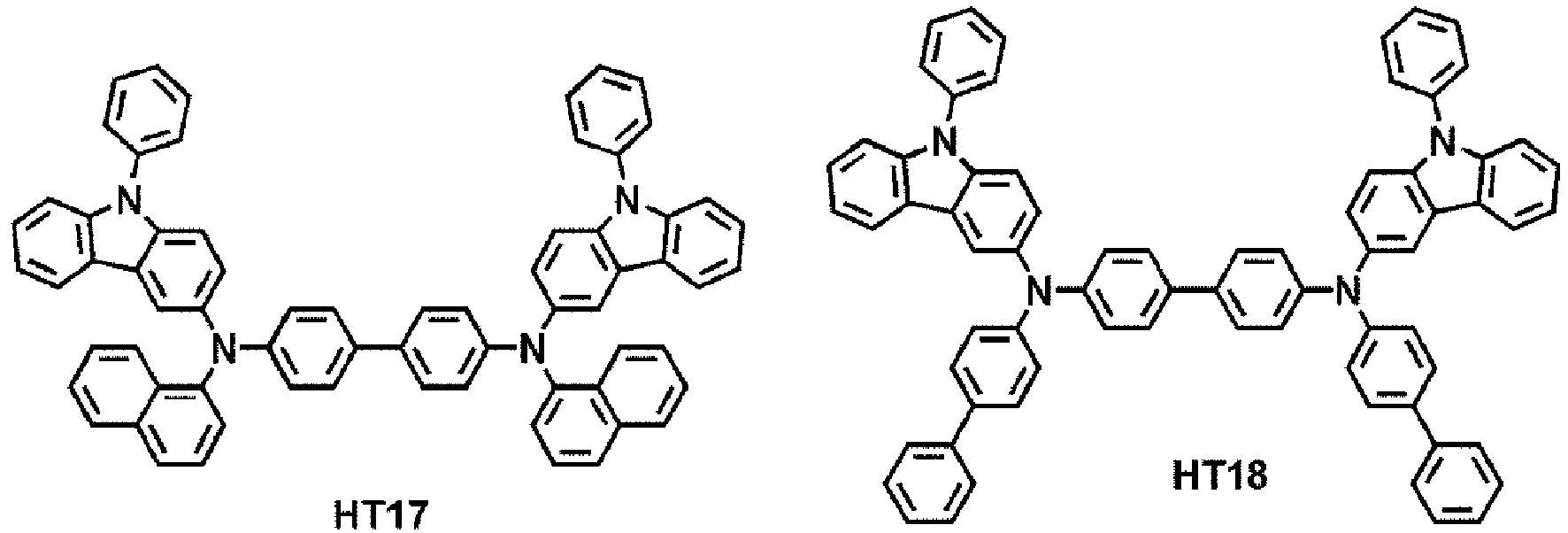

- A thickness of the hole transport region may be in a range of about 100 Å to about 10,000 Å, for example, about 100 Å to about 1,000 Å. When the hole transport region includes both a hole injection layer and a hole transport layer, a thickness of the hole injection layer may be in a range of about 100 Å to about 10,000 Å, for example, about 100 Å to about 1,000 Å, and a thickness of the hole transport layer may be in a range of about 50 Å to about 2,000 Å, for example about 100 Å to about 1,500 Å. When the thicknesses of the hole transport region, the hole injection layer, and the hole transport layer are within these ranges, satisfactory hole transporting characteristics may be obtained without a substantial increase in driving voltage.
- The hole transport region may further include, in addition to these materials, a charge-generation material for the improvement of conductive properties. The charge-generation material may be homogeneously or non-homogeneously dispersed in the hole transport region.
- The charge-generation material may be, for example, a p-dopant. The p-dopant may be one selected from a quinone derivative, a metal oxide, and a cyano group-containing compound, but embodiments of the present disclosure are not limited thereto. Non-limiting examples of the p-dopant are a quinone derivative, such as tetracyanoquinonedimethane (TCNQ) or 2,3,5,6-tetrafluoro-tetracyano-1,4-benzoquinonedimethane (F4-TCNQ); a metal oxide, such as a tungsten oxide or a molybdenium oxide; and a cyano group-containing compound, such as Compound HT-D1 or Compound HT-D2 below, but are not limited thereto:


- The hole transport region may include a buffer layer.
- Also, the buffer layer may compensate for an optical resonance distance according to a wavelength of light emitted from the emission layer, and thus, efficiency of a formed organic light-emitting device may be improved.
- Then, an emission layer may be formed on the hole transport region by vacuum deposition, spin coating, casting, LB deposition, or the like. When the emission layer is formed by vacuum deposition or spin coating, the deposition or coating conditions may be similar to those applied in forming the hole injection layer although the deposition or coating conditions may vary according to a compound that is used to form the emission layer.
- Meanwhile, when the hole transport region includes an electron blocking layer, a material for the electron blocking layer may be selected from materials for the hole transport region described above and materials for a host to be explained later. However, the material for the electron blocking layer is not limited thereto. For example, when the hole transport region includes an electron blocking layer, a material for the electron blocking layer may be mCP, which will be explained later.
- The emission layer may include a host and a dopant, and the dopant may include the organometallic compound represented by Formula 1.
- The host may include at least one selected from TPBi, TBADN, ADN (also referred to as "DNA"), CBP, CDBP, TCP, mCP, Compound H50, Compound H51 and Compound H52:


- In one or more embodiments, the host may further include a compound represented by Formula 301:
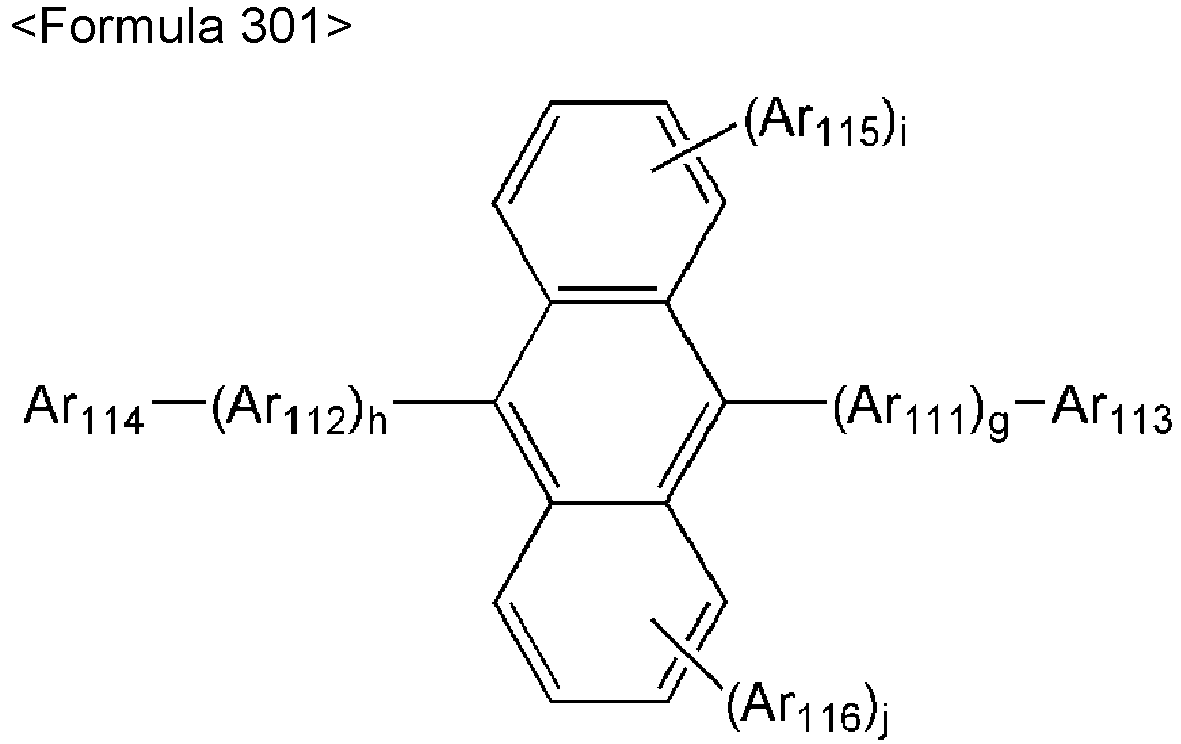
- Ar111 and Ar112 in Formula 301 may each independently be selected from:
- a phenylene group, a naphthylene group, a phenanthrenylene group, and a pyrenylene group; and
- a phenylene group, a naphthylene group, a phenanthrenylene group, and a pyrenylene group, each substituted with at least one selected from a phenyl group, a naphthyl group, and an anthracenyl group.
- In Formula 301, Ar113 to Ar113 may each independently be selected from:
- a C1-C10 alkyl group, a phenyl group, a naphthyl group, a phenanthrenyl group, and a pyrenyl group; and
- a phenyl group, a naphthyl group, a phenanthrenyl group, and a pyrenyl group, each substituted with at least one selected from a phenyl group, a naphthyl group, and an anthracenyl group.
- g, h, i, and j in Formula 301 may each independently be an integer from 0 to 4, and for example, may be 0, 1, or 2.
- Ar113 to Ar116 in Formula 301 may each independently be selected from:
- a C1-C10 alkyl group substituted with at least one selected from a phenyl group, a naphthyl group, and an anthracenyl group;
- a phenyl group, a naphthyl group, an anthracenyl group, a pyrenyl group, a phenanthrenyl group, and a fluorenyl group;
- a phenyl group, a naphthyl group, an anthracenyl group, a pyrenyl group, a phenanthrenyl group, and a fluorenyl group, each substituted with at least one selected from deuterium, -F, -Cl, -Br, -I, a hydroxyl group, a cyano group, a nitro group, an amino group, an amidino group, a hydrazine group, a hydrazone group, a carboxylic acid group or a salt thereof, a sulfonic acid group or a salt thereof, a phosphoric acid group or a salt thereof, a C1-C60 alkyl group, a C2-C60 alkenyl group, a C2-C60 alkynyl group, a C1-C60 alkoxy group, a phenyl group, a naphthyl group, an anthracenyl group, a pyrenyl group, a phenanthrenyl group, and a fluorenyl group; and

- In one or more embodiments, the host may include a compound represented by Formula 302 below:

- Ar122 to Ar125 in Formula 302 are the same as described in detail in connection with Ar113 in Formula 301.
- Ar126 and Ar127 in Formula 302 may each independently be a C1-C10 alkyl group (for example, a methyl group, an ethyl group, or a propyl group).
- k and I in Formula 302 may each independently be an integer from 0 to 4. For example, k and I may be 0, 1, or 2.
- The compound represented by Formula 301 and the compound represented by Formula 302 may include Compounds H1 to H42 illustrated below, but are not limited thereto:


- When the organic light-emitting device is a full-color organic light-emitting device, the emission layer may be patterned into a red emission layer, a green emission layer, and a blue emission layer. In one or more embodiments, due to a stacked structure including a red emission layer, a green emission layer, and/or a blue emission layer, the emission layer may emit white light.
- When the emission layer includes a host and a dopant, an amount of the dopant may be in a range of about 0.01 parts by weight to about 15 parts by weight based on 100 parts by weight of the host, but embodiments of the present disclosure are not limited thereto.
- The dopant may include at least one of organometallic compounds represented by Formula 1.
- A thickness of the emission layer may be in a range of about 100 Å to about 1,000 Å, for example, about 200 Å to about 600 Å. When the thickness of the emission layer is within this range, excellent light-emission characteristics may be obtained without a substantial increase in driving voltage.
- Then, an electron transport region may be located on the emission layer.
- The electron transport region may include at least one selected from a hole blocking layer, an electron transport layer, and an electron injection layer.
- For example, the electron transport region may have a hole blocking layer/electron transport layer/electron injection layer structure or an electron transport layer/electron injection layer structure, but the structure of the electron transport region is not limited thereto. The electron transport layer may have a single-layered structure or a multi-layered structure including two or more different materials.
- Conditions for forming the hole blocking layer, the electron transport layer, and the electron injection layer which constitute the electron transport region may be understood by referring to the conditions for forming the hole injection layer.
- When the electron transport region includes a hole blocking layer, the hole blocking layer may include, for example, at least one of BCP, Bphen, and BAlq but embodiments of the present disclosure are not limited thereto:

- A thickness of the hole blocking layer may be in a range of about 20 Å to about 1,000 Å, for example, about 30 Å to about 300 Å. When the thickness of the hole blocking layer is within these ranges, the hole blocking layer may have excellent hole blocking characteristics without a substantial increase in driving voltage.
- The electron transport layer may further include at least one selected from BCP, Bphen, Alq3, BAlq, TAZ, and NTAZ:


- In one or more embodiments, the electron transport layer may include at least one of ET1 and ET25, but are not limited thereto:


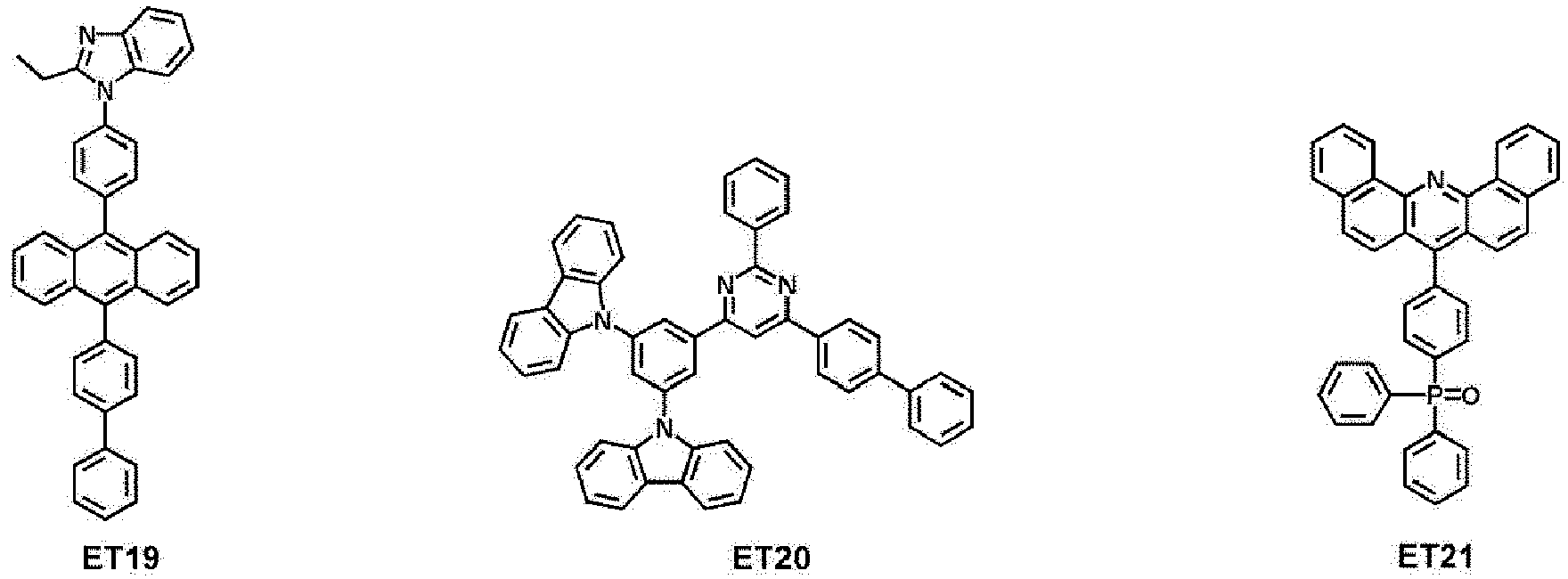

- A thickness of the electron transport layer may be in a range of about 100 Å to about 1,000 Å, for example, about 150 Å to about 500 Å. When the thickness of the electron transport layer is within the range described above, the electron transport layer may have satisfactory electron transport characteristics without a substantial increase in driving voltage.
- Also, the electron transport layer may further include, in addition to the materials described above, a metal-containing material.
- The metal-containing material may include a Li complex. The Li complex may include, for example, Compound ET-D1 (lithium quinolate, LiQ) or ET-D2:

- The electron transport region may include an electron injection layer that promotes flow of electrons from the
second electrode 19 thereinto. - The electron injection layer may include at least one selected from LiF, NaCl, CsF, Li2O, and BaO.
- A thickness of the electron injection layer may be in a range of about 1 Å to about 100 Å, for example, about 3 Å to about 90 Å. When the thickness of the electron injection layer is within the range described above, the electron injection layer may have satisfactory electron injection characteristics without a substantial increase in driving voltage.
- The
second electrode 19 is disposed on theorganic layer 15. Thesecond electrode 19 may be a cathode. A material for forming thesecond electrode 19 may be metal, an alloy, an electrically conductive compound, or a combination thereof, which have a relatively low work function. For example, lithium (Li), magnesium (Mg), aluminum (Al), aluminum-lithium (Al-Li), calcium (Ca), magnesium-indium (Mg-In), or magnesium-silver (Mg-Ag) may be formed as the material for forming thesecond electrode 19. To manufacture a top-emission type light-emitting device, a transmissive electrode formed using ITO or IZO may be used as thesecond electrode 19. - Hereinbefore, the organic light-emitting device has been described with reference to the FIGURE, but embodiments of the present disclosure are not limited thereto.
- Another aspect of the present disclosure provides a diagnostic composition including at least one organometallic compound represented by Formula 1.
- The organometallic compound represented by Formula 1 provides high luminescence efficiency. Accordingly, a diagnostic composition including the organometallic compound may have high diagnostic efficiency.
- The diagnostic composition may be used in various applications including a diagnosis kit, a diagnosis reagent, a biosensor, and a biomarker.
- The term "t-Bu" or "tBu" as used herein indicates a tert-butyl group.
- The term "first-row transition metal of the Periodic Table of Elements" as used herein refers to a fourth-row element of the Periodic Table of Elements that is included in d-block. Specific examples include scandium (Sc), titanium (Ti), vanadium (V), chromium (Cr), manganese(Mn), iron (Fe), cobalt (Co), nickel (Ni), copper (Cu), and zinc(Zn).
- The term "second-row transition metal of the Periodic Table of Elements" as used herein refers to a fifth-row element of the Periodic Table of Elements that is included in d-block. Specific examples include yttrium (Y), zirconium (Zr), niobium (Nb), molybdenum (Mo), technetium (Tc), ruthenium (Ru), rhodium (Rh), palladium (Pd), silver (Ag), and cadmium (Cd).
- The term "third-row transition metal of the Periodic Table of Elements" as used herein refers to a sixth-row element of the Periodic Table of Elements that is included in d-block and f-block. Specific examples include lanthanum (La), samarium (Sm), europium (Eu), terbium (Tb), thulium (Tm), ytterbium (Yb), lutetium (Lu), hafnium (Hf), tantalum (Ta), tungsten(W), rhenium (Re), osmium (Os), iridium (Ir), platinum (Pr), gold (Au), and mercury (Hg).
- The term "C1-C60 alkyl group" as used herein refers to a linear or branched aliphatic saturated hydrocarbon monovalent group having 1 to 60 carbon atoms, and examples thereof include a methyl group, an ethyl group, a propyl group, an isobutyl group, a sec-butyl group, a tert-butyl group, a pentyl group, an isoamyl group, and a hexyl group. The term "C1-C60 alkylene group" as used herein refers to a divalent group having the same structure as the C1-C60 alkyl group.
- The term "C1-C60 alkoxy group" used herein refers to a monovalent group represented by -OA101 (wherein A101 is the C1-C60 alkyl group), and examples thereof include a methoxy group, an ethoxy group, and an isopropyloxy group.
- The term "C2-C60 alkenyl group" as used herein refers to a hydrocarbon group formed by substituting at least one carbon-carbon double bond in the middle or at the terminus of the C2-C60 alkyl group, and examples thereof include an ethenyl group, a propenyl group, and a butenyl group. The term "C2-C60 alkenylene group" as used herein refers to a divalent group having the same structure as the C2-C60 alkenyl group.
- The term "C2-C60 alkynyl group" as used herein refers to a hydrocarbon group having at least one carbon-carbon triple bond in the middle or at the terminus of the C2-C60 alkyl group, and examples thereof include an ethynyl group, and a propynyl group. The term "C2-C60 alkynylene group" as used herein refers to a divalent group having the same structure as the C2-C60 alkynyl group.
- The term "C3-C10 cycloalkyl group" as used herein refers to a monovalent saturated hydrocarbon monocyclic group having 3 to 10 carbon atoms, and non-limiting examples thereof include a cyclopropyl group, a cyclobutyl group, a cyclopentyl group, a cyclohexyl group, and a cycloheptyl group. The term "C3-C10 cycloalkylene group" as used herein refers to a divalent group having the same structure as the C3-C10 cycloalkyl group.
- The term "C1-C10 heterocycloalkyl group" as used herein refers to a monovalent saturated monocyclic group having at least one heteroatom selected from N, O, P, Si and S as a ring-forming atom and 1 to 10 carbon atoms, and non-limiting examples thereof include a tetrahydrofuranyl group, and a tetrahydrothiophenyl group. The term "C1-C10 heterocycloalkylene group" as used herein refers to a divalent group having the same structure as the C1-C10 heterocycloalkyl group.
- The term "C3-C10 cycloalkenyl group" as used herein refers to a monovalent monocyclic group that has 3 to 10 carbon atoms and at least one carbon-carbon double bond in the ring thereof and no aromaticity, and non-limiting examples thereof include a cyclopentenyl group, a cyclohexenyl group, and a cycloheptenyl group. The term "C3-C10 cycloalkenylene group" as used herein refers to a divalent group having the same structure as the C3-C10 cycloalkenyl group.
- The term "C1-C10 heterocycloalkenyl group" as used herein refers to a monovalent monocyclic group that has at least one heteroatom selected from N, O, P, Si, and S as a ring-forming atom, 1 to 10 carbon atoms, and at least one carbon-carbon double bond in its ring. Examples of the C1-C10 heterocycloalkenyl group are a 2,3-dihydrofuranyl group, and a 2,3-dihydrothiophenyl group. The term "C1-C10 heterocycloalkenylene group" as used herein refers to a divalent group having the same structure as the C1-C10 heterocycloalkenyl group.
- The term "C6-C60 aryl group" as used herein refers to a monovalent group having a carbocyclic aromatic system having 6 to 60 carbon atoms, and the term "C6-C60 arylene group" as used herein refers to a divalent group having a carbocyclic aromatic system having 6 to 60 carbon atoms. Non-limiting examples of the C6-C60 aryl group include a phenyl group, a naphthyl group, an anthracenyl group, a phenanthrenyl group, a pyrenyl group, and a chrysenyl group. When the C6-C60 aryl group and the C6-C60 arylene group each include two or more rings, the rings may be fused to each other.
- The term "C1-C60 heteroaryl group" as used herein refers to a monovalent group having a heterocyclic aromatic system that has at least one heteroatom selected from N, O, P, Si, and S as a ring-forming atom, and 1 to 60 carbon atoms. The term "C1-C60 heteroarylene group" as used herein refers to a divalent group having a heterocyclic aromatic system that has at least one heteroatom selected from N, O, P, and S as a ring-forming atom, and 1 to 60 carbon atoms. Non-limiting examples of the C1-C60 heteroaryl group include a pyridinyl group, a pyrimidinyl group, a pyrazinyl group, a pyridazinyl group, a triazinyl group, a quinolinyl group, and an isoquinolinyl group. When the C1-C60 heteroaryl group and the C1-C60 heteroarylene group each include two or more rings, the rings may be fused to each other.
- The term "C6-C60 aryloxy group" as used herein indicates -OA102 (wherein A102 is the C6-C60 aryl group), and a C6-C60 arylthio group used herein indicates-SA103 (wherein A103 is the C6-C60 aryl group).
- The term " C7-C60 alkylaryl group" as used herein indicates -A104A105 (wherein A104 is the C6-C59 arylene group, and A104 is the C1-C54 alkyl group), and a C2-C60 alkylheteroaryl group used herein indicates -A106A107 (wherein A106 is the C1-C59 heteroarylene group, and A107 is the C1-C59 alkyl group).
- The term " C7-C60 arylalkyl group" as used herein indicates -A108A109 (wherein A108 is the C1-C54 alkylene group, and A109 is the C6-C59 aryl group), and a C2-C60 heteroarylalkyl group used herein indicates -A110A111 (wherein A110 is the C1-C59 alkylene group, and A111 is the C1-C59 heteroaryl group).
- The term "monovalent non-aromatic condensed polycyclic group" as used herein refers to a monovalent group (for example, having 8 to 60 carbon atoms) having two or more rings condensed to each other, only carbon atoms as ring-forming atoms, and no aromaticity in its entire molecular structure. Examples of the monovalent non-aromatic condensed polycyclic group include a fluorenyl group. The term "divalent non-aromatic condensed polycyclic group" as used herein refers to a divalent group having the same structure as the monovalent non-aromatic condensed polycyclic group.
- The term "monovalent non-aromatic condensed heteropolycyclic group" as used herein refers to a monovalent group (for example, having 2 to 60 carbon atoms) having two or more rings condensed to each other, a heteroatom selected from N, O, P, Si, and S, other than carbon atoms, as a ring-forming atom, and no aromaticity in its entire molecular structure. Non-limiting examples of the monovalent non-aromatic condensed heteropolycyclic group include a carbazolyl group. The term "divalent non-aromatic condensed heteropolycyclic group" as used herein refers to a divalent group having the same structure as the monovalent non-aromatic condensed heteropolycyclic group.
- The term "C5-C30 carbocyclic group" as used herein refers to a saturated or unsaturated cyclic group having, as a ring-forming atom, 5 to 30 carbon atoms only. The term "C5-C30 carbocyclic group" as used herein refers to a monocyclic group or a polycyclic group, and, according to its chemical structure, a monovalent, divalent, trivalent, tetravalent, pentavalent, or hexavalent group.
- The term "C1-C30 heterocyclic group" as used herein refers to a saturated or unsaturated cyclic group having, as a ring-forming atom, at least one heteroatom selected from N, O, Si, P, and S other than 1 to 30 carbon atoms. The term "C1-C30 heterocyclic group" as used herein refers to a monocyclic group or a polycyclic group, and, according to its chemical structure, a monovalent, divalent, trivalent, tetravalent, pentavalent, or hexavalent group.
- In the present specification, at least one substituent of the substituted C5-C30 carbocyclic group, the substituted C1-C30 heterocyclic group, the substituted C1-C60 alkyl group, the substituted C2-C60 alkenyl group, the substituted C2-C60 alkynyl group, the substituted C1-C60 alkoxy group, the substituted C3-C10 cycloalkyl group, the substituted C1-C10 heterocycloalkyl group, the substituted C3-C10 cycloalkenyl group, the substituted C1-C10 heterocycloalkenyl group, the substituted C6-C60 aryl group, the substituted C7-C60 alkylaryl group, the substituted C7-C60 arylalkyl group, the substituted C6-C60 aryloxy group, the substituted C6-C60 arylthio group, the substituted C1-C60 heteroaryl group, the substituted C2-C60 alkylheteroaryl group, the substituted C2-C60 heteroarylalkyl group, the substituted monovalent non-aromatic condensed polycyclic group, and the substituted monovalent non-aromatic condensed heteropolycyclic group may be selected from:
- deuterium, -F, -Cl, -Br, -I, -CD3, -CD2H, -CDH2, -CF3, -CF2H, -CFH2, a hydroxyl group, a cyano group, a nitro group, an amino group, an amidino group, a hydrazine group, a hydrazone group, a carboxylic acid group or a salt thereof, a sulfonic acid group or a salt thereof, a phosphoric acid group or a salt thereof, a C1-C60 alkyl group, a C2-C60 alkenyl group, a C2-C60 alkynyl group, and a C1-C60 alkoxy group;
- a C1-C60 alkyl group, a C2-C60 alkenyl group, a C2-C60 alkynyl group, and a C1-C60 alkoxy group, each substituted with at least one selected from deuterium, -F,-Cl, -Br, -I, -CD3, -CD2H, -CDH2, -CF3, -CF2H, -CFH2, a hydroxyl group, a cyano group, a nitro group, an amidino group, a hydrazine group, a hydrazone group, a carboxylic acid group or a salt thereof, a sulfonic acid group or a salt thereof, a phosphoric acid group or a salt thereof, a C3-C10 cycloalkyl group, a C1-C10 heterocycloalkyl group, a C3-C10 cycloalkenyl group, a C1-C10 heterocycloalkenyl group, a C6-C60 aryl group, a C7-C60 alkylaryl group, a C7-C60 arylalkyl group, a C6-C60 aryloxy group, a C6-C60 arylthio group, a C1-C60 heteroaryl group, a C2-C60 alkylheteroaryl group, a C2-C60 heteroarylalkyl group, a monovalent non-aromatic condensed polycyclic group, a monovalent non-aromatic condensed heteropolycyclic group, -N(Q11)(Q12), -Si(Q13)(Q14)(Q15), -B(Q16)(Q17), and -P(=O)(Q18)(Q19);
- a C3-C10 cycloalkyl group, a C1-C10 heterocycloalkyl group, a C3-C10 cycloalkenyl group, a C1-C10 heterocycloalkenyl group, a C6-C60 aryl group, a C7-C60 alkylaryl group, a C7-C60 arylalkyl group, a C6-C60 aryloxy group, a C6-C60 arylthio group, a C1-C60 heteroaryl group, a C2-C60 alkylheteroaryl group, a C2-C60 heteroarylalkyl group, a C1-C60 heteroaryloxy group, a C1-C60 heteroarylthio group, a monovalent non-aromatic condensed polycyclic group, and a monovalent non-aromatic condensed heteropolycyclic group;
- a C3-C10 cycloalkyl group, a C1-C10 heterocycloalkyl group, a C3-C10 cycloalkenyl group, a C1-C10 heterocycloalkenyl group, a C6-C60 aryl group, a C7-C60 alkylaryl group, a C7-C60 arylalkyl group, a C6-C60 aryloxy group, a C6-C60 arylthio group, a C1-C60 heteroaryl group, a C2-C60 alkylheteroaryl group, a C2-C60 heteroarylalkyl group, a C1-C60 heteroaryloxy group, a C1-C60 heteroarylthio group, a monovalent non-aromatic condensed polycyclic group, and a monovalent non-aromatic condensed heteropolycyclic group, each substituted with at least one selected from deuterium, -F, -Cl, -Br, -I, -CD3, -CD2H, -CDH2, -CF3, -CF2H, -CFH2, a hydroxyl group, a cyano group, a nitro group, an amino group, an amidino group, a hydrazine group, a hydrazone group, a carboxylic acid group or a salt thereof, a sulfonic acid group or a salt thereof, a phosphoric acid group or a salt thereof, a C1-C60 alkyl group, a C2-C60 alkenyl group, a C2-C60 alkynyl group, a C1-C60 alkoxy group, a C3-C10 cycloalkyl group, a C1-C10 heterocycloalkyl group, a C3-C10 cycloalkenyl group, a C1-C10 heterocycloalkenyl group, a C6-C60 aryl group, a C7-C60 alkylaryl group, a C7-C60 arylalkyl group, a C6-C60 aryloxy group, a C6-C60 arylthio group, a C1-C60 heteroaryl group, a C2-C60 alkylheteroaryl group, a C2-C60 heteroarylalkyl group, a monovalent non-aromatic condensed polycyclic group, a monovalent non-aromatic condensed heteropolycyclic group, -N(Q21)(Q22),-Si(Q23)(Q24)(Q25), -B(Q26)(Q27), and -P(=O)(Q28)(Q29); and
- -N(Q31)(Q32), -Si(Q33)(Q34)(Q35), -B(Q36)(Q37), and -P(=O)(Q38)(Q39), and
- Q1 to Q9, Q11 to Q19, Q21 to Q29, and Q31 to Q39 may each independently be selected from hydrogen, deuterium, -F, -Cl, -Br, -I, a hydroxyl group, a cyano group, a nitro group, an amino group, an amidino group, a hydrazine group, a hydrazone group, a carboxylic acid group or a salt thereof, a sulfonic acid group or a salt thereof, a phosphoric acid group or a salt thereof, a C1-C60 alkyl group, a C2-C60 alkenyl group, a C2-C60 alkynyl group, a C1-C60 alkoxy group, a C3-C10 cycloalkyl group, a C1-C10 heterocycloalkyl group, a C3-C10 cycloalkenyl group, a C1-C10 heterocycloalkenyl group, a C6-C60 aryl group, a C6-C60 aryl group substituted with at least one selected from a C1-C60 alkyl group, and a C6-C60 aryl group, a C7-C60 alkylaryl group, a C7-C60 arylalkyl group, a C6-C60 aryloxy group, a C6-C60 arylthio group, a C1-C60 heteroaryl group, a C2-C60 alkylheteroaryl group, a C2-C60 heteroarylalkyl group, a C1-C60 heteroaryloxy group, a C1-C60 heteroarylthio group, a monovalent non-aromatic condensed polycyclic group, and a monovalent non-aromatic condensed heteropolycyclic group.
- Hereinafter, a compound and an organic light-emitting device according to embodiments are described in detail with reference to Synthesis Example and Examples. However, the organic light-emitting device is not limited thereto. The wording " 'B' was used instead of 'A' " used in describing Synthesis Examples means that a molar equivalent of 'A' was identical to a molar equivalent of 'B'.
-

- 2-(3-(1H-benzo[d]imidazol-1-yl)phenoxy)-9-(4-(tert-butyl)pyridin-2-yl)-9H-carbazole (1.0 eq) and benzyl bromide (2.2eq) were added to DMF (0.3M), and the mixed solution was heated and stirred at a temperature of 150 °C for 18 hours. When the reaction was completed, the solvent was removed therefrom by using a rotavapor, and then, the resulting product was purified by flash column chromatography using acetone and methylene chloride, thereby obtaining Intermediate 6(1).
- 3-benzyl-1-(3-((9-(4-(tert-butyl)pyridin-2-yl)-9H-carbazol-2-yl)oxy)phenyl)-1H-benzo[d]imidazol-3-ium bromide (1.0eq), bis(benzonitrile)dichloroplatinum (II) (1.1 eq), and sodium acetate (3.0eq) were added to benzonitrile (0.02M), and the mixed solution was heated and stirred at a temperature of 200 °C for 1day. When the reaction was completed, the reaction solution was cooled to room temperature, and benzonitrile was removed therefrom by using vacuum distillation to obtain a solid. The obtained solid was dissolved by using 100 ml of dichloromethane and removed through a celite filter, and a filtered solution was concentrated and purified by flash column chromatography using methylenechloride and hexane, thereby obtaining Compound 6 (0.80g) was identified by LC-MS.
C41H32N4OPt : M+ 792.2122. - Compound 6 was diluted in toluene at a concentration of 1 mg/10ml, and a photoluminescence (PL) spectrum was measured at room temperature by using ISC PC1 Spectrofluorometer equipped with a xenon lamp. The same experiment was repeated with respect to Compounds X1 and X6 to X8. In addition, Compound X2 was diluted in CH2Cl2 at a concentration of 1 mg/10ml, and PL spectra were measured at room temperature in the same manner. Results thereof are shown in Table 2.
[Table 2] Compound No. PL max (nm) Compound 6 457 X1 465 X2 446 X6 457 X7 460 X8 456 

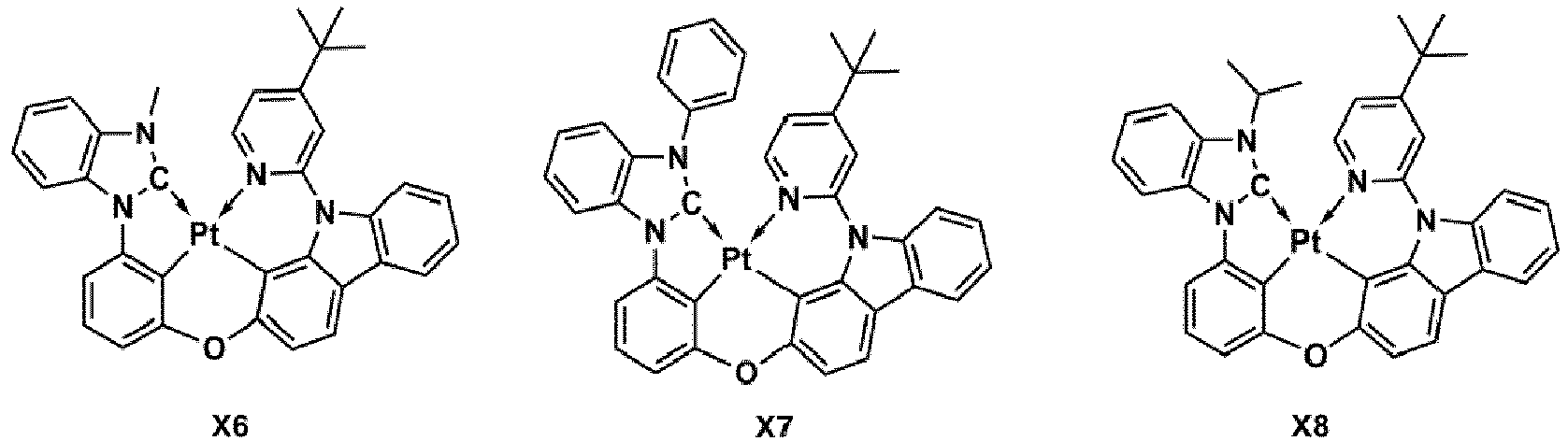
- From Table 2, it is confirmed that Compound 6 emits deeper blue color light than Compound X2.
- CBP and Compound 6 were co-deposited at a weight ratio of 90:10 under a vacuum degree of 10-7 torr to form a film having a thickness of 50 nm.
- The PLQY of the film was evaluated with respect to an excitation wavelength of 270 nm by using a Hamamatsu Photonics absolute PL quantum yield measurement system including a xenon light source, a monochromator, a photonic multichannel analyzer, and an intergrating sphere and employing a PLQY measurement software (Hamamatsu Photonics, Ltd, Shizuoka, Japan), and results thereof are shown in Table 3. Here, the results are described as relative values based on the value of Compound 6.
[Table 3] Compound No. PLQY (%) Compound 6 100 Compound X1 82.4 Compound X6 69.1 Compound X7 53.76 Compound X8 50.9 - From Table 3, it was confirmed that Compound 6 has a high PLQY value, as compared with that of Compounds X1 and X6 to X8.
- Since the organometallic compound emits light having a relatively small full width at half maximum (FWHM), has a relatively small change in emission wavelength according to concentration, and has relatively high thermal stability, an organic light-emitting device including the organometallic compound may have improved driving voltage, external quantum efficiency, roll-off ratio, and color purity. In addition, since the organometallic compound has excellent phosphorescence characteristics, a diagnostic composition having high diagnostic efficiency may be provided by using the organometallic compound.
- It should be understood that embodiments described herein should be considered in a descriptive sense only and not for purposes of limitation. Descriptions of features or aspects within each embodiment should typically be considered as available for other similar features or aspects in other embodiments.
- While one or more embodiments have been described with reference to the figures, it will be understood by those of ordinary skill in the art that various changes in form and details may be made therein without departing from the scope as defined by the following claims.
Claims (15)
- An organometallic compound represented by Formula 1:
<Formula 1> M11(L11)n11(L12)n12
 M11 is selected from a first-row transition metal, a second-row transition metal, and a third-row transition metal, of the Periodic Table of Elements,*1 to *4 each indicate a binding site to M11,L11 is a ligand represented by Formula 1-1,L12 is selected from a monodentate ligand and a bidentate ligand,n11 is 1,n12 is selected from 0, 1, and 2,X11 and X13 to X17 are each independently C,X12 and X18 are each independently N,X11 and X12, X13 and X14, X14 and X15, and X17 and X18 are each independently linked to each other via a chemical bond,Y11 is selected from N(R18), O, and S,A11 is a N-containing C1-C60 heterocyclic group,A12 is selected from a C5-C60 carbocyclic group, and a C1-C60 heterocyclic group,T11 is selected from C(R19)(R20), Si(R19)(R20), O, S, and N(R19),E11 is selected from a substituted or unsubstituted C1-C60 alkyl group, a substituted or unsubstituted C1-C60 alkoxy group, a substituted or unsubstituted C3-C10 cycloalkyl group, a substituted or unsubstituted C1-C10 heterocycloalkyl group, a substituted or unsubstituted C3-C10 cycloalkenyl group, a substituted or unsubstituted C1-C10 heterocycloalkenyl group, a substituted or unsubstituted C6-C60 aryl group, a substituted or unsubstituted C7-C60 alkylaryl group, a substituted or unsubstituted C7-C60 arylalkyl group, a substituted or unsubstituted C6-C60 aryloxy group, a substituted or unsubstituted C6-C60 arylthio group, a substituted or unsubstituted C1-C60 heteroaryl group, a substituted or unsubstituted C2-C60 alkylheteroaryl group, a substituted or unsubstituted C2-C60 heteroarylalkyl group, a substituted or unsubstituted C1-C60 heteroaryloxy group, a substituted or unsubstituted C1-C60 heteroarylthio group, a substituted or unsubstituted monovalent non-aromatic condensed polycyclic group, and a substituted or unsubstituted monovalent non-aromatic condensed heteropolycyclic group,G11 to G14 are each independently selected from hydrogen, deuterium, -F, -CI, -Br, and -I,R18 is a group represented by *-C(Q101)(Q102)(Q103),R11 to R17 and Q101 to Q103 are each independently selected from hydrogen, deuterium, -F, -CI, -Br, -I, -SF5, a hydroxyl group, a nitro group, an amidino group, a hydrazino group, a hydrazono group, a substituted or unsubstituted C1-C60 alkyl group, a substituted or unsubstituted C2-C60 alkenyl group, a substituted or unsubstituted C2-C60 alkynyl group, a substituted or unsubstituted C1-C60 alkoxy group, a substituted or unsubstituted C3-C10 cycloalkyl group, a substituted or unsubstituted C1-C10 heterocycloalkyl group, a substituted or unsubstituted C3-C10 cycloalkenyl group, a substituted or unsubstituted C1-C10 heterocycloalkenyl group, a substituted or unsubstituted C6-C60 aryl group, a substituted or unsubstituted C7-C60 alkylaryl group, a substituted or unsubstituted C7-C60 arylalkyl group, a substituted or unsubstituted C6-C60 aryloxy group, a substituted or unsubstituted C6-C60 arylthio group, a substituted or unsubstituted C1-C60 heteroaryl group, a substituted or unsubstituted C2-C60 alkylheteroaryl group, a substituted or unsubstituted C2-C60 heteroarylalkyl group, a substituted or unsubstituted C1-C60 heteroaryloxy group, a substituted or unsubstituted C1-C60 heteroarylthio group, a substituted or unsubstituted monovalent non-aromatic condensed polycyclic group, a substituted or unsubstituted monovalent non-aromatic condensed heteropolycyclic group,-Si(Q1)(Q2)(Q3), -B(Q1)(Q2), -N(Q1)(Q2), -P(Q1)(Q2), -C(=O)(Q1), -S(=O)(Q1),-S(=O)2(Q1), -P(=O)(Q1)(Q2), and -P(=S)(Q1)(Q2),at least one selected from Q101 to Q103 is selected from a substituted or unsubstituted C3-C10 cycloalkyl group, a substituted or unsubstituted C1-C10 heterocycloalkyl group, a substituted or unsubstituted C3-C10 cycloalkenyl group, a substituted or unsubstituted C1-C10 heterocycloalkenyl group, a substituted or unsubstituted C6-C60 aryl group, a substituted or unsubstituted C7-C60 alkylaryl group, a substituted or unsubstituted C7-C60 arylalkyl group, a substituted or unsubstituted C6-C60 aryloxy group, a substituted or unsubstituted C6-C60 arylthio group, a substituted or unsubstituted C1-C60 heteroaryl group, a substituted or unsubstituted C2-C60 alkylheteroaryl group, a substituted or unsubstituted C2-C60 heteroarylalkyl group, a substituted or unsubstituted C1-C60 heteroaryloxy group, a substituted or unsubstituted C1-C60 heteroarylthio group, a substituted or unsubstituted monovalent non-aromatic condensed polycyclic group, and a substituted or unsubstituted monovalent non-aromatic condensed heteropolycyclic group,R19 and R20 are each independently selected from hydrogen, deuterium, -F, - Cl, -Br, -I, -SF5, a hydroxyl group, a cyano group, a nitro group, an amidino group, a hydrazino group, a hydrazono group, a substituted or unsubstituted C1-C60 alkyl group, a substituted or unsubstituted C2-C60 alkenyl group, a substituted or unsubstituted C2-C60 alkynyl group, a substituted or unsubstituted C1-C60 alkoxy group, a substituted or unsubstituted C3-C10 cycloalkyl group, a substituted or unsubstituted C1-C10 heterocycloalkyl group, a substituted or unsubstituted C3-C10 cycloalkenyl group, a substituted or unsubstituted C1-C10 heterocycloalkenyl group, a substituted or unsubstituted C6-C60 aryl group, a substituted or unsubstituted C7-C60 alkylaryl group, a substituted or unsubstituted C7-C60 arylalkyl group, a substituted or unsubstituted C6-C60 aryloxy group, a substituted or unsubstituted C6-C60 arylthio group, a substituted or unsubstituted C1-C60 heteroaryl group, a substituted or unsubstituted C2-C60 alkylheteroaryl group, a substituted or unsubstituted C2-C60 heteroarylalkyl group, a substituted or unsubstituted C1-C60 heteroaryloxy group, a substituted or unsubstituted C1-C60 heteroarylthio group, a substituted or unsubstituted monovalent non-aromatic condensed polycyclic group, a substituted or unsubstituted monovalent non-aromatic condensed heteropolycyclic group,-Si(Q1)(Q2)(Q3), -B(Q1)(Q2), -N(Q1)(Q2), -P(Q1)(Q2), -C(=O)(Q1), -S(=O)(Q1),-S(=O)2(Q1), -P(=O)(Q1)(Q2), and -P(=S)(Q1)(Q2),two neighboring groups among R11 to R20 are optionally linked to each other to form a substituted or unsubstituted C5-C30 carbocyclic group or a substituted or unsubstituted C1-C30 heterocyclic group,a11 and b17 are each independently selected from 1, 2, 3, 4, 5, 6, 7, and 8, andQ1 to Q3 are each independently selected from hydrogen, deuterium, -F, -CI,-Br, -I, a hydroxyl group, a cyano group, a nitro group, an amidino group, a hydrazino group, a hydrazono group, a C1-C60 alkyl group, a C2-C60 alkenyl group, a C2-C60 alkynyl group, a C1-C60 alkoxy group, a C3-C10 cycloalkyl group, a C1-C10 heterocycloalkyl group, a C3-C10 cycloalkenyl group, a C1-C10 heterocycloalkenyl group, a C6-C60 aryl group, a C7-C60 alkylaryl group, a C7-C60 arylalkyl group, a C6-C60 aryloxy group, a C6-C60 arylthio group, a C1-C60 heteroaryl group, a C2-C60 alkylheteroaryl group, a C2-C60 heteroarylalkyl group, a C1-C60 heteroaryloxy group, a C1-C60 heteroarylthio group, a monovalent non-aromatic condensed polycyclic group, a monovalent non-aromatic condensed heteropolycyclic group, a C1-C60 alkyl group substituted with at least one selected from deuterium, -F, a cyano group, a C1-C60 alkyl group, and a C6-C60 aryl group, and a C6-C60 aryl group substituted with at least one selected from deuterium, -F, a cyano group, a C1-C60 alkyl group, and a C6-C60 aryl group, and* indicates a binding site to a neighboring atom.
 - The organometallic compound of claim 1, wherein M11 is selected from Pt and Pd; and/or
wherein
A11 is selected from: a first ring; a condensed ring in which two or more first rings are condensed with each other; and a condensed ring in which one or more first rings are condensed with one or more second rings,
the first ring is selected from a pyrrole group, a pyrrolidine group, an imidazolidinegroup, a dihydropyrrole group, a dihydroimidazole group, an oxazole group, an isoxazole group, an oxadiazole group, an oxatriazole group, a thiazole group, an isothiazole group, a thiadiazole group, a thiatriazole group, a pyrazole group, an imidazole group, a triazole group, a tetrazole group, a pyridine group, a piperidine group, a tetrahydropyridine group, a dihydropyridine group, a pyrimidine group, a hexahydropyrimidine group, a tetrahydropyrimidine group, a dihydropyrimidine group, a pyrazine group, a piperazinegroup, a tetrahydropyrazine group, a dihydropyrazine group, a pyridazine group, a tetrahydropyridazine group, a dihydropyridazine group, and a triazine group, and
the second ring is selected from a cyclopentane group, a cyclopentene group, a cyclopentadiene group, a furan group, a thiophene group, a silole group, a cyclohexane group, a cyclohexene group, a cyclohexadiene group, a benzene group, an adamantane group, a norbornane group, and a norbornene group. - The organometallic compound of claims 1 or 2, wherein
A11 is selected from a pyridine group, a pyrimidine group, a pyrazine group, a pyridazine group, a triazine group, a quinoline group, an isoquinoline group, a quinoxaline group, and a quinazoline group; and/or
wherein
a moiety represented by
 *3 indicates a binding site to M11,*' indicates a binding site to a neighboring atom, andE11 and a11 are each independently the same as defined in connection with Formula 1-1.
 - The organometallic compound of any of claims 1-3, wherein
A12 is selected from: a first ring; a second ring; a condensed ring in which two or more first rings are condensed with each other; a condensed ring in which one or more first rings are condensed with one or more second rings; and a condensed ring in which two or more second rings are condensed with each other,
the first ring is selected from a pyrrole group, a pyrrolidine group, an imidazolidinegroup, a dihydropyrrole group, a dihydroimidazole group, an oxazole group, an isoxazole group, an oxadiazole group, an oxatriazole group, a thiazole group, an isothiazole group, a thiadiazole group, a thiatriazole group, a pyrazole group, an imidazole group, a triazole group, a tetrazole group, a pyridine group, a piperidine group, a tetrahydropyridine group, a dihydropyridine group, a pyrimidine group, a hexahydropyrimidine group, a tetrahydropyrimidine group, a dihydropyrimidine group, a pyrazine group, a piperazinegroup, a tetrahydropyrazine group, a dihydropyrazine group, a pyridazine group, a tetrahydropyridazine group, a dihydropyridazine group, and a triazine group, and
the second ring is selected from a cyclopentane group, a cyclopentene group, a cyclopentadiene group, a furan group, a thiophene group, a silole group, a cyclohexane group, a cyclohexene group, a cyclohexadiene group, a benzene group, an adamantane group, a norbornane group, and a norbornene group. - The organometallic compound of any of claims 1-4, wherein
A12 is selected from a benzene group, a naphthalene group, an indene group, a fluorene group, a benzofuran group, a dibenzofuran group, a benzothiophene group, a dibenzothiophene group, a benzosilole group, and a dibenzosilole group. - The organometallic compound of any of claims 1-5, wherein
a moiety represented by
 *1 indicates a binding site to M11,*' and *" each indicate a binding site to a neighboring atom, andR17 and b17 are each independently the same as defined in connection with Formula 1-1.
 - The organometallic compound of any of claims 1-6, wherein
E11 is selected from:a C1-C20 alkyl group, and a C1-C20 alkoxy group;a C1-C20 alkyl group, and a C1-C20 alkoxy group, each substituted with at least one selected from with at least one selected from deuterium, -F, -CI, -Br, -I, -CD3, - CD2H, -CDH2, -CF3, -CF2H, -CFH2, a hydroxyl group, a cyano group, a nitro group, an amino group, an amidino group, a hydrazine group, a hydrazone group, a carboxylic acid group or a salt thereof, a sulfonic acid group or a salt thereof, a phosphoric acid group or a salt thereof, a C1-C10 alkyl group, a cyclopentyl group, a cyclohexyl group, a cycloheptyl group, a cycloctyl group, a bicyclo[2.2.1]heptanyl group, an adamantanyl group, a norbornanyl group, a norbornenyl group, a cyclopentenyl group, a cyclohexenyl group, a cycloheptenyl group, a phenyl group, a biphenyl group, a naphthyl group, a pyridinyl group, and a pyrimidinyl group;a cyclopentyl group, a cyclohexyl group, a cycloheptyl group, a cycloctyl group, a bicyclo[2.2.1]heptanyl group, an adamantanyl group, a norbornanyl group, a norbornenyl group, a cyclopentenyl group, a cyclohexenyl group, a cycloheptenyl group, a phenyl group, a biphenyl group, a C1-C20 alkylphenyl group, a naphthyl group, a fluorenyl group, a phenanthrenyl group, an anthracenyl group, a fluoranthenyl group, a triphenylenyl group, a pyrenyl group, a chrysenyl group, a pyrrolyl group, a thiophenyl group, a furanyl group, an imidazolyl group, a pyrazolyl group, a thiazolyl group, an isothiazolyl group, an oxazolyl group, an isoxazolyl group, a pyridinyl group, a pyrazinyl group, a pyrimidinyl group, a pyridazinyl group, an isoindolyl group, an indolyl group, an indazolyl group, a purinyl group, a quinolinyl group, an isoquinolinyl group, a benzoquinolinyl group, a quinoxalinyl group, a quinazolinyl group, a cinnolinyl group, a carbazolyl group, a phenanthrolinyl group, a benzimidazolyl group, a benzofuranyl group, a benzothiophenyl group, an isobenzothiazolyl group, a benzoxazolyl group, an isobenzoxazolyl group, a triazolyl group, a tetrazolyl group, an oxadiazolyl group, a triazinyl group, a dibenzofuranyl group, a dibenzothiophenyl group, a benzocarbazolyl group, a dibenzocarbazolyl group, an imidazopyridinyl group, and an imidazopyrimidinyl group; anda cyclopentyl group, a cyclohexyl group, a cycloheptyl group, a cycloctyl group, a bicyclo[2.2.1]heptanyl group, an adamantanyl group, a norbornanyl group, a norbornenyl group, a cyclopentenyl group, a cyclohexenyl group, a cycloheptenyl group, a phenyl group, a biphenyl group, a C1-C20 alkylphenyl group, a naphthyl group, a fluorenyl group, a phenanthrenyl group, an anthracenyl group, a fluoranthenyl group, a triphenylenyl group, a pyrenyl group, a chrysenyl group, a pyrrolyl group, a thiophenyl group, a furanyl group, an imidazolyl group, a pyrazolyl group, a thiazolyl group, an isothiazolyl group, an oxazolyl group, an isoxazolyl group, a pyridinyl group, a pyrazinyl group, a pyrimidinyl group, a pyridazinyl group, an isoindolyl group, an indolyl group, an indazolyl group, a purinyl group, a quinolinyl group, an isoquinolinyl group, a benzoquinolinyl group, a quinoxalinyl group, a quinazolinyl group, a cinnolinyl group, a carbazolyl group, a phenanthrolinyl group, a benzimidazolyl group, a benzofuranyl group, a benzothiophenyl group, an isobenzothiazolyl group, a benzoxazolyl group, an isobenzoxazolyl group, a triazolyl group, a tetrazolyl group, an oxadiazolyl group, a triazinyl group, a dibenzofuranyl group, a dibenzothiophenyl group, a benzocarbazolyl group, a dibenzocarbazolyl group, an imidazopyridinyl group, and an imidazopyrimidinyl group, each substituted with at least one selected from deuterium, -F, -CI, -Br, -I, -CD3, -CD2H, -CDH2, -CF3, -CF2H, -CFH2, a hydroxyl group, a cyano group, a nitro group, an amino group, an amidino group, a hydrazine group, a hydrazone group, a carboxylic acid group or a salt thereof, a sulfonic acid group or a salt thereof, a phosphoric acid group or a salt thereof, a C1-C20 alkyl group, a C1-C20 alkoxy group, a cyclopentyl group, a cyclohexyl group, a cycloheptyl group, a cycloctyl group, a bicyclo[2.2.1]heptanyl group, an adamantanyl group, a norbornanyl group, a norbornenyl group, a cyclopentenyl group, a cyclohexenyl group, a cycloheptenyl group, a phenyl group, a biphenyl group, a C1-C20 alkylphenyl group, a naphthyl group, a fluorenyl group, a phenanthrenyl group, an anthracenyl group, a fluoranthenyl group, a triphenylenyl group, a pyrenyl group, a chrysenyl group, a pyrrolyl group, a thiophenyl group, a furanyl group, an imidazolyl group, a pyrazolyl group, a thiazolyl group, an isothiazolyl group, an oxazolyl group, an isoxazolyl group, a pyridinyl group, a pyrazinyl group, a pyrimidinyl group, a pyridazinyl group, an isoindolyl group, an indolyl group, an indazolyl group, a purinyl group, a quinolinyl group, an isoquinolinyl group, a benzoquinolinyl group, a quinoxalinyl group, a quinazolinyl group, a cinnolinyl group, a carbazolyl group, a phenanthrolinyl group, a benzimidazolyl group, a benzofuranyl group, a benzothiophenyl group, an isobenzothiazolyl group, a benzoxazolyl group, an isobenzoxazolyl group, a triazolyl group, a tetrazolyl group, an oxadiazolyl group, a triazinyl group, a dibenzofuranyl group, a dibenzothiophenyl group, a benzocarbazolyl group, a dibenzocarbazolyl group, an imidazopyridinyl group, and an imidazopyrimidinyl group. - The organometallic compound of any of claims 1-7, wherein
E11 is selected from:a methyl group, an ethyl group, an n-propyl group, an isopropyl group, an n-butyl group, an isobutyl group, a sec-butyl group, a tert-butyl group, an n-pentyl group, an isopentyl group, a 2-methylbutyl group, a sec-pentyl group, a tert-pentyl group, a neo-pentyl group, a 3-pentyl group, a 3-methyl-2-butyl group, an n-hexyl group, an isohexyl group, a sec-hexyl group, a tert-hexyl group, an n-heptyl group, an isoheptyl group, a sec-heptyl group, a tert-heptyl group, an n-octyl group, an isooctyl group, a sec-octyl group, a tert-octyl group, an n-nonyl group, an isononyl group, a sec-nonyl group, a tert-nonyl group, an n-decyl group, an isodecyl group, a sec-decyl group, a tert-decyl group, a methoxy group, an ethoxy group, a propoxy group, a butoxy group, and a pentoxy group;a methyl group, an ethyl group, an n-propyl group, an isopropyl group, an n-butyl group, an isobutyl group, a sec-butyl group, a tert-butyl group, an n-pentyl group, an isopentyl group, a 2-methylbutyl group, a sec-pentyl group, a tert-pentyl group, a neo-pentyl group, a 3-pentyl group, a 3-methyl-2-butyl group, an n-hexyl group, an isohexyl group, a sec-hexyl group, a tert-hexyl group, an n-heptyl group, an isoheptyl group, a sec-heptyl group, a tert-heptyl group, an n-octyl group, an isooctyl group, a sec-octyl group, a tert-octyl group, an n-nonyl group, an isononyl group, a sec-nonyl group, a tert-nonyl group, an n-decyl group, an isodecyl group, a sec-decyl group, a tert-decyl group, a methoxy group, an ethoxy group, a propoxy group, a butoxy group, and a pentoxy group, each substituted with at least one selected from deuterium, -F, -CI, -Br, -I, -CD3, -CD2H, -CDH2, -CF3, -CF2H, -CFH2, a cyano group, a phenyl group, a biphenyl group, a C1-C20 alkylphenyl group, a naphthyl group, a pyridinyl group, and a pyrimidinyl group;a phenyl group, a biphenyl group, a C1-C20 alkylphenyl group, a naphthyl group, a pyridinyl group, a pyrimidinyl group, a pyridazinyl group, and a triazinyl group;a phenyl group, a biphenyl group, a C1-C20 alkylphenyl group, a naphthyl group, a pyridinyl group, a pyrimidinyl group, a pyridazinyl group, and a triazinyl group, each substituted with at least one selected from deuterium, -F, -CI, -Br, -I, - CD3, -CD2H, -CDH2, -CF3, -CF2H, -CFH2, a cyano group, a phenyl group, a biphenyl group, a C1-C20 alkylphenyl group, a naphthyl group, a pyridinyl group, a pyrimidinyl group, a pyridazinyl group, and a triazinyl group. - The organometallic compound of any of claims 1-8, wherein
G11 to G14 are each independently selected from hydrogen and deuterium; and/or
wherein
R11 to R17 are each independently selected from:hydrogen, deuterium, -F, -CI, -Br, -I, a hydroxyl group, a nitro group, an amino group, an amidino group, a hydrazine group, a hydrazone group, a carboxylic acid group or a salt thereof, a sulfonic acid group or a salt thereof, a phosphoric acid group or a salt thereof, -SF5, a C1-C20 alkyl group, and a C1-C20 alkoxy group;a C1-C20 alkyl group, and a C1-C20 alkoxy group, each substituted with at least one selected from deuterium, -F, -CI, -Br, -I, -CD3, -CD2H, -CDH2, -CF3, -CF2H,-CFH2, a hydroxyl group, a cyano group, a nitro group, an amino group, an amidino group, a hydrazine group, a hydrazone group, a carboxylic acid group or a salt thereof, a sulfonic acid group or a salt thereof, a phosphoric acid group or a salt thereof, a C1-C10 alkyl group, a cyclopentyl group, a cyclohexyl group, a cycloheptyl group, a cycloctyl group, a bicyclo[2.2.1]heptanyl group, an adamantanyl group, a norbornanyl group, a norbornenyl group, a cyclopentenyl group, a cyclohexenyl group, a cycloheptenyl group, a phenyl group, a biphenyl group, a C1-C20 alkylphenyl group, a naphthyl group, a pyridinyl group, and a pyrimidinyl group;a cyclopentyl group, a cyclohexyl group, a cycloheptyl group, a cycloctyl group, a bicyclo[2.2.1]heptanyl group, an adamantanyl group, a norbornanyl group, a norbornenyl group, a cyclopentenyl group, a cyclohexenyl group, a cycloheptenyl group, a phenyl group, a biphenyl group, a C1-C20 alkylphenyl group, a naphthyl group, a fluorenyl group, a phenanthrenyl group, an anthracenyl group, a fluoranthenyl group, a triphenylenyl group, a pyrenyl group, a chrysenyl group, a pyrrolyl group, a thiophenyl group, a furanyl group, an imidazolyl group, a pyrazolyl group, a thiazolyl group, an isothiazolyl group, an oxazolyl group, an isoxazolyl group, a pyridinyl group, a pyrazinyl group, a pyrimidinyl group, a pyridazinyl group, an isoindolyl group, an indolyl group, an indazolyl group, a purinyl group, a quinolinyl group, an isoquinolinyl group, a benzoquinolinyl group, a quinoxalinyl group, a quinazolinyl group, a cinnolinyl group, a carbazolyl group, a phenanthrolinyl group, a benzimidazolyl group, a benzofuranyl group, a benzothiophenyl group, an isobenzothiazolyl group, a benzoxazolyl group, an isobenzoxazolyl group, a triazolyl group, a tetrazolyl group, an oxadiazolyl group, a triazinyl group, a dibenzofuranyl group, a dibenzothiophenyl group, a dibenzosilolyl group, a benzocarbazolyl group, a dibenzocarbazolyl group, an imidazopyridinyl group, and an imidazopyrimidinyl group;a cyclopentyl group, a cyclohexyl group, a cycloheptyl group, a cycloctyl group, a bicyclo[2.2.1]heptanyl group, an adamantanyl group, a norbornanyl group, a norbornenyl group, a cyclopentenyl group, a cyclohexenyl group, a cycloheptenyl group, a phenyl group, a biphenyl group, a C1-C20 alkylphenyl group, a naphthyl group, a fluorenyl group, a phenanthrenyl group, an anthracenyl group, a fluoranthenyl group, a triphenylenyl group, a pyrenyl group, a chrysenyl group, a pyrrolyl group, a thiophenyl group, a furanyl group, an imidazolyl group, a pyrazolyl group, a thiazolyl group, an isothiazolyl group, an oxazolyl group, an isoxazolyl group, a pyridinyl group, a pyrazinyl group, a pyrimidinyl group, a pyridazinyl group, an isoindolyl group, an indolyl group, an indazolyl group, a purinyl group, a quinolinyl group, an isoquinolinyl group, a benzoquinolinyl group, a quinoxalinyl group, a quinazolinyl group, a cinnolinyl group, a carbazolyl group, a phenanthrolinyl group, a benzimidazolyl group, a benzofuranyl group, a benzothiophenyl group, an isobenzothiazolyl group, a benzoxazolyl group, an isobenzoxazolyl group, a triazolyl group, a tetrazolyl group, an oxadiazolyl group, a triazinyl group, a dibenzofuranyl group, a dibenzothiophenyl group, a dibenzosilolyl group, a benzocarbazolyl group, a dibenzocarbazolyl group, an imidazopyridinyl group, and an imidazopyrimidinyl group, each substituted with at least one selected from deuterium, -F, -CI, -Br, -I, - CD3, -CD2H, -CDH2, -CF3, -CF2H, -CFH2, a hydroxyl group, a cyano group, a nitro group, an amino group, an amidino group, a hydrazine group, a hydrazone group, a carboxylic acid group or a salt thereof, a sulfonic acid group or a salt thereof, a phosphoric acid group or a salt thereof, a C1-C20 alkyl group, a C1-C20 alkoxy group, a cyclopentyl group, a cyclohexyl group, a cycloheptyl group, a cycloctyl group, a bicyclo[2.2.1]heptanyl group, an adamantanyl group, a norbornanyl group, a norbornenyl group, a cyclopentenyl group, a cyclohexenyl group, a cycloheptenyl group, a phenyl group, a biphenyl group, a C1-C20 alkylphenyl group, a naphthyl group, a fluorenyl group, a phenanthrenyl group, an anthracenyl group, a fluoranthenyl group, a triphenylenyl group, a pyrenyl group, a chrysenyl group, a pyrrolyl group, a thiophenyl group, a furanyl group, an imidazolyl group, a pyrazolyl group, a thiazolyl group, an isothiazolyl group, an oxazolyl group, an isoxazolyl group, a pyridinyl group, a pyrazinyl group, a pyrimidinyl group, a pyridazinyl group, an isoindolyl group, an indolyl group, an indazolyl group, a purinyl group, a quinolinyl group, an isoquinolinyl group, a benzoquinolinyl group, a quinoxalinyl group, a quinazolinyl group, a cinnolinyl group, a carbazolyl group, a phenanthrolinyl group, a benzimidazolyl group, a benzofuranyl group, a benzothiophenyl group, an isobenzothiazolyl group, a benzoxazolyl group, an isobenzoxazolyl group, a triazolyl group, a tetrazolyl group, an oxadiazolyl group, a triazinyl group, a dibenzofuranyl group, a dibenzothiophenyl group, a dibenzosilolyl group, a benzocarbazolyl group, a dibenzocarbazolyl group, an imidazopyridinyl group, an imidazopyrimidinyl group, - Si(Q11)(Q12)(Q13), -B(Q11)(Q12), and -N(Q11)(Q12); and-Si(Q1)(Q2)(Q3), -B(Q1)(Q2), and -N(Q1)(Q2),R19 and R20 are each independently selected from:hydrogen, deuterium, -F, -CI, -Br, -I, a hydroxyl group, a cyano group, a nitro group, an amino group, an amidino group, a hydrazine group, a hydrazone group, a carboxylic acid group or a salt thereof, a sulfonic acid group or a salt thereof, a phosphoric acid group or a salt thereof, -SF5, a C1-C20 alkyl group, and a C1-C20 alkoxy group;a C1-C20 alkyl group, and a C1-C20 alkoxy group, each substituted with at least one selected from deuterium, -F, -CI, -Br, -I, -CD3, -CD2H, -CDH2, -CF3, -CF2H, - CFH2, a hydroxyl group, a cyano group, a nitro group, an amino group, an amidino group, a hydrazine group, a hydrazone group, a carboxylic acid group or a salt thereof, a sulfonic acid group or a salt thereof, a phosphoric acid group or a salt thereof, a C1-C10 alkyl group, a cyclopentyl group, a cyclohexyl group, a cycloheptyl group, a cycloctyl group, a bicyclo[2.2.1]heptanyl group, an adamantanyl group, a norbornanyl group, a norbornenyl group, a cyclopentenyl group, a cyclohexenyl group, a cycloheptenyl group, a phenyl group, a biphenyl group, a C1-C20 alkylphenyl group, a naphthyl group, a pyridinyl group, and a pyrimidinyl group;a cyclopentyl group, a cyclohexyl group, a cycloheptyl group, a cycloctyl group, a bicyclo[2.2.1]heptanyl group, an adamantanyl group, a norbornanyl group, a norbornenyl group, a cyclopentenyl group, a cyclohexenyl group, a cycloheptenyl group, a phenyl group, a biphenyl group, a C1-C20 alkylphenyl group, a naphthyl group, a fluorenyl group, a phenanthrenyl group, an anthracenyl group, a fluoranthenyl group, a triphenylenyl group, a pyrenyl group, a chrysenyl group, a pyrrolyl group, a thiophenyl group, a furanyl group, an imidazolyl group, a pyrazolyl group, a thiazolyl group, an isothiazolyl group, an oxazolyl group, an isoxazolyl group, a pyridinyl group, a pyrazinyl group, a pyrimidinyl group, a pyridazinyl group, an isoindolyl group, an indolyl group, an indazolyl group, a purinyl group, a quinolinyl group, an isoquinolinyl group, a benzoquinolinyl group, a quinoxalinyl group, a quinazolinyl group, a cinnolinyl group, a carbazolyl group, a phenanthrolinyl group, a benzimidazolyl group, a benzofuranyl group, a benzothiophenyl group, an isobenzothiazolyl group, a benzoxazolyl group, an isobenzoxazolyl group, a triazolyl group, a tetrazolyl group, an oxadiazolyl group, a triazinyl group, a dibenzofuranyl group, a dibenzothiophenyl group, a dibenzosilolyl group, a benzocarbazolyl group, a dibenzocarbazolyl group, an imidazopyridinyl group, and an imidazopyrimidinyl group;a cyclopentyl group, a cyclohexyl group, a cycloheptyl group, a cycloctyl group, a bicyclo[2.2.1]heptanyl group, an adamantanyl group, a norbornanyl group, a norbornenyl group, a cyclopentenyl group, a cyclohexenyl group, a cycloheptenyl group, a phenyl group, a biphenyl group, a C1-C20 alkylphenyl group, a naphthyl group, a fluorenyl group, a phenanthrenyl group, an anthracenyl group, a fluoranthenyl group, a triphenylenyl group, a pyrenyl group, a chrysenyl group, a pyrrolyl group, a thiophenyl group, a furanyl group, an imidazolyl group, a pyrazolyl group, a thiazolyl group, an isothiazolyl group, an oxazolyl group, an isoxazolyl group, a pyridinyl group, a pyrazinyl group, a pyrimidinyl group, a pyridazinyl group, an isoindolyl group, an indolyl group, an indazolyl group, a purinyl group, a quinolinyl group, an isoquinolinyl group, a benzoquinolinyl group, a quinoxalinyl group, a quinazolinyl group, a cinnolinyl group, a carbazolyl group, a phenanthrolinyl group, a benzimidazolyl group, a benzofuranyl group, a benzothiophenyl group, an isobenzothiazolyl group, a benzoxazolyl group, an isobenzoxazolyl group, a triazolyl group, a tetrazolyl group, an oxadiazolyl group, a triazinyl group, a dibenzofuranyl group, a dibenzothiophenyl group, a dibenzosilolyl group, a benzocarbazolyl group, a dibenzocarbazolyl group, an imidazopyridinyl group, and an imidazopyrimidinyl group, each substituted with at least one selected from deuterium, -F, -CI, -Br, -I,-CD3, -CD2H, -CDH2, -CF3, -CF2H, -CFH2, a hydroxyl group, a cyano group, a nitro group, an amino group, an amidino group, a hydrazine group, a hydrazone group, a carboxylic acid group or a salt thereof, a sulfonic acid group or a salt thereof, a phosphoric acid group or a salt thereof, a C1-C20 alkyl group, a C1-C20 alkoxy group, a cyclopentyl group, a cyclohexyl group, a cycloheptyl group, a cycloctyl group, a bicyclo[2.2.1]heptanyl group, an adamantanyl group, a norbornanyl group, a norbornenyl group, a cyclopentenyl group, a cyclohexenyl group, a cycloheptenyl group, a phenyl group, a biphenyl group, a C1-C20 alkylphenyl group, a naphthyl group, a fluorenyl group, a phenanthrenyl group, an anthracenyl group, a fluoranthenyl group, a triphenylenyl group, a pyrenyl group, a chrysenyl group, a pyrrolyl group, a thiophenyl group, a furanyl group, an imidazolyl group, a pyrazolyl group, a thiazolyl group, an isothiazolyl group, an oxazolyl group, an isoxazolyl group, a pyridinyl group, a pyrazinyl group, a pyrimidinyl group, a pyridazinyl group, an isoindolyl group, an indolyl group, an indazolyl group, a purinyl group, a quinolinyl group, an isoquinolinyl group, a benzoquinolinyl group, a quinoxalinyl group, a quinazolinyl group, a cinnolinyl group, a carbazolyl group, a phenanthrolinyl group, a benzimidazolyl group, a benzofuranyl group, a benzothiophenyl group, an isobenzothiazolyl group, a benzoxazolyl group, an isobenzoxazolyl group, a triazolyl group, a tetrazolyl group, an oxadiazolyl group, a triazinyl group, a dibenzofuranyl group, a dibenzothiophenyl group, a dibenzosilolyl group, a benzocarbazolyl group, a dibenzocarbazolyl group, an imidazopyridinyl group, an imidazopyrimidinyl group, - Si(Q11)(Q12)(Q13), -B(Q11)(Q12), and -N(Q11)(Q12); and-Si(Q1)(Q2)(Q3), -B(Q1)(Q2), and -N(Q1)(Q2), andQ1 to Q3 and Q11 to Q13 are each independently selected from:a methyl group, an ethyl group, an n-propyl group, an isopropyl group, an n-butyl group, an isobutyl group, a sec-butyl group, a tert-butyl group, an n-pentyl group, an isopentyl group, a 2-methylbutyl group, a sec-pentyl group, a tert-pentyl group, a neo-pentyl group, a 3-pentyl group, a 3-methyl-2-butyl group, a phenyl group, a biphenyl group, a C1-C20 alkylphenyl group, and a naphthyl group; anda methyl group, an ethyl group, an n-propyl group, an isopropyl group, an n-butyl group, an isobutyl group, a sec-butyl group, a tert-butyl group, an n-pentyl group, an isopentyl group, a 2-methylbutyl group, a sec-pentyl group, a tert-pentyl group, a neo-pentyl group, a 3-pentyl group, a 3-methyl-2-butyl group, a phenyl group, and a naphthyl group, each substituted with at least one selected from deuterium and a phenyl group. - The organometallic compound of any of claims 1-9, wherein
Q101 to Q103 are each independently selected from:hydrogen, deuterium, -F, -Cl, -Br, -I, -SF5, a hydroxyl group, a nitro group, an amino group, an amidino group, a hydrazine group, a hydrazone group, a C1-C20 alkyl group, and a C1-C20 alkoxy group;a C1-C20 alkyl group, and a C1-C20 alkoxy group, each substituted with at least one selected from deuterium, -F, -Cl, -Br, -I, -CD3, -CD2H, -CDH2, -CF3, -CF2H,-CFH2, a hydroxyl group, a cyano group, a nitro group, an amino group, an amidino group, a hydrazine group, a hydrazone group, a carboxylic acid group or a salt thereof, a sulfonic acid group or a salt thereof, a phosphoric acid group or a salt thereof, a C1-C10 alkyl group, a cyclopentyl group, a cyclohexyl group, a cycloheptyl group, a cycloctyl group, a bicyclo[2.2.1]heptanyl group, an adamantanyl group, a norbornanyl group, a norbornenyl group, a cyclopentenyl group, a cyclohexenyl group, a cycloheptenyl group, a phenyl group, a biphenyl group, a C1-C20 alkylphenyl group, a naphthyl group, a pyridinyl group, and a pyrimidinyl group;a cyclopentyl group, a cyclohexyl group, a cycloheptyl group, a cycloctyl group, a bicyclo[2.2.1]heptanyl group, an adamantanyl group, a norbornanyl group, a norbornenyl group, a cyclopentenyl group, a cyclohexenyl group, a cycloheptenyl group, a phenyl group, a biphenyl group, a C1-C20 alkylphenyl group, a naphthyl group, a fluorenyl group, a phenanthrenyl group, an anthracenyl group, a fluoranthenyl group, a triphenylenyl group, a pyrenyl group, a chrysenyl group, a pyrrolyl group, a thiophenyl group, a furanyl group, an imidazolyl group, a pyrazolyl group, a thiazolyl group, an isothiazolyl group, an oxazolyl group, an isoxazolyl group, a pyridinyl group, a pyrazinyl group, a pyrimidinyl group, a pyridazinyl group, an isoindolyl group, an indolyl group, an indazolyl group, a purinyl group, a quinolinyl group, an isoquinolinyl group, a benzoquinolinyl group, a quinoxalinyl group, a quinazolinyl group, a cinnolinyl group, a carbazolyl group, a phenanthrolinyl group, a benzimidazolyl group, a benzofuranyl group, a benzothiophenyl group, an isobenzothiazolyl group, a benzoxazolyl group, an isobenzoxazolyl group, a triazolyl group, a tetrazolyl group, an oxadiazolyl group, a triazinyl group, a dibenzofuranyl group, a dibenzothiophenyl group, a dibenzosilolyl group, a benzocarbazolyl group, a dibenzocarbazolyl group, an imidazopyridinyl group, and an imidazopyrimidinyl group; and-Si(Q1)(Q2)(Q3), -B(Q1)(Q2), and -N(Q1)(Q2),at least one selected from Q101 to Q103 is selected from a cyclopentyl group, a cyclohexyl group, a cycloheptyl group, a cycloctyl group, a bicyclo[2.2.1]heptanyl group, an adamantanyl group, a norbornanyl group, a norbornenyl group, a cyclopentenyl group, a cyclohexenyl group, a cycloheptenyl group, a phenyl group, a biphenyl group, a C1-C20 alkylphenyl group, a naphthyl group, a fluorenyl group, a phenanthrenyl group, an anthracenyl group, a fluoranthenyl group, a triphenylenyl group, a pyrenyl group, a chrysenyl group, a pyrrolyl group, a thiophenyl group, a furanyl group, an imidazolyl group, a pyrazolyl group, a thiazolyl group, an isothiazolyl group, an oxazolyl group, an isoxazolyl group, a pyridinyl group, a pyrazinyl group, a pyrimidinyl group, a pyridazinyl group, an isoindolyl group, an indolyl group, an indazolyl group, a purinyl group, a quinolinyl group, an isoquinolinyl group, a benzoquinolinyl group, a quinoxalinyl group, a quinazolinyl group, a cinnolinyl group, a carbazolyl group, a phenanthrolinyl group, a benzimidazolyl group, a benzofuranyl group, a benzothiophenyl group, an isobenzothiazolyl group, a benzoxazolyl group, an isobenzoxazolyl group, a triazolyl group, a tetrazolyl group, an oxadiazolyl group, a triazinyl group, a dibenzofuranyl group, a dibenzothiophenyl group, a dibenzosilolyl group, a benzocarbazolyl group, a dibenzocarbazolyl group, an imidazopyridinyl group, and an imidazopyrimidinyl group; anda cyclopentyl group, a cyclohexyl group, a cycloheptyl group, a cycloctyl group, a bicyclo[2.2.1]heptanyl group, an adamantanyl group, a norbornanyl group, a norbornenyl group, a cyclopentenyl group, a cyclohexenyl group, a cycloheptenyl group, a phenyl group, a biphenyl group, a C1-C20 alkylphenyl group, a naphthyl group, a fluorenyl group, a phenanthrenyl group, an anthracenyl group, a fluoranthenyl group, a triphenylenyl group, a pyrenyl group, a chrysenyl group, a pyrrolyl group, a thiophenyl group, a furanyl group, an imidazolyl group, a pyrazolyl group, a thiazolyl group, an isothiazolyl group, an oxazolyl group, an isoxazolyl group, a pyridinyl group, a pyrazinyl group, a pyrimidinyl group, a pyridazinyl group, an isoindolyl group, an indolyl group, an indazolyl group, a purinyl group, a quinolinyl group, an isoquinolinyl group, a benzoquinolinyl group, a quinoxalinyl group, a quinazolinyl group, a cinnolinyl group, a carbazolyl group, a phenanthrolinyl group, a benzimidazolyl group, a benzofuranyl group, a benzothiophenyl group, an isobenzothiazolyl group, a benzoxazolyl group, an isobenzoxazolyl group, a triazolyl group, a tetrazolyl group, an oxadiazolyl group, a triazinyl group, a dibenzofuranyl group, a dibenzothiophenyl group, a dibenzosilolyl group, a benzocarbazolyl group, a dibenzocarbazolyl group, an imidazopyridinyl group, and an imidazopyrimidinyl group, each substituted with at least one selected from deuterium, -F, -Cl, -Br, -I,-CD3, -CD2H, -CDH2, -CF3, -CF2H, -CFH2, a hydroxyl group, a cyano group, a nitro group, an amino group, an amidino group, a hydrazine group, a hydrazone group, a carboxylic acid group or a salt thereof, a sulfonic acid group or a salt thereof, a phosphoric acid group or a salt thereof, a C1-C20 alkyl group, a C1-C20 alkoxy group, a cyclopentyl group, a cyclohexyl group, a cycloheptyl group, a cycloctyl group, a bicyclo[2.2.1]heptanyl group, an adamantanyl group, a norbornanyl group, a norbornenyl group, a cyclopentenyl group, a cyclohexenyl group, a cycloheptenyl group, a phenyl group, a biphenyl group, a C1-C20 alkylphenyl group, a naphthyl group, a fluorenyl group, a phenanthrenyl group, an anthracenyl group, a fluoranthenyl group, a triphenylenyl group, a pyrenyl group, a chrysenyl group, a pyrrolyl group, a thiophenyl group, a furanyl group, an imidazolyl group, a pyrazolyl group, a thiazolyl group, an isothiazolyl group, an oxazolyl group, an isoxazolyl group, a pyridinyl group, a pyrazinyl group, a pyrimidinyl group, a pyridazinyl group, an isoindolyl group, an indolyl group, an indazolyl group, a purinyl group, a quinolinyl group, an isoquinolinyl group, a benzoquinolinyl group, a quinoxalinyl group, a quinazolinyl group, a cinnolinyl group, a carbazolyl group, a phenanthrolinyl group, a benzimidazolyl group, a benzofuranyl group, a benzothiophenyl group, an isobenzothiazolyl group, a benzoxazolyl group, an isobenzoxazolyl group, a triazolyl group, a tetrazolyl group, an oxadiazolyl group, a triazinyl group, a dibenzofuranyl group, a dibenzothiophenyl group, a dibenzosilolyl group, a benzocarbazolyl group, a dibenzocarbazolyl group, an imidazopyridinyl group, an imidazopyrimidinyl group, - Si(Q11)(Q12)(Q13), -B(Q11)(Q12). and -N(Q11)(Q12), andQ1 to Q3 and Q11 to Q13 are each independently selected from:a methyl group, an ethyl group, an n-propyl group, an isopropyl group, an n-butyl group, an isobutyl group, a sec-butyl group, a tert-butyl group, an n-pentyl group, an isopentyl group, a 2-methylbutyl group, a sec-pentyl group, a tert-pentyl group, a neo-pentyl group, a 3-pentyl group, a 3-methyl-2-butyl group, a phenyl group, a biphenyl group, a C1-C20 alkylphenyl group, and a naphthyl group; anda methyl group, an ethyl group, an n-propyl group, an isopropyl group, an n-butyl group, an isobutyl group, a sec-butyl group, a tert-butyl group, an n-pentyl group, an isopentyl group, a 2-methylbutyl group, a sec-pentyl group, a tert-pentyl group, a neo-pentyl group, a 3-pentyl group, a 3-methyl-2-butyl group, a phenyl group, and a naphthyl group, each substituted with at least one selected from deuterium and a phenyl group. - The organometallic compound of any of claims 1-10, wherein
the organometallic compound is represented by Formulae 1-11 to 1-14:
 M11 is the same as defined in connection with Formula 1,Y11, T11, G11 to G14, R11 to R17, and b17 are each independently the same as defined in connection with Formula 1-1, andE11a and E11b are each independently the same as defined in connection with E11 in Formula 1-1.
 - The organometallic compound of claim 1, wherein
the organometallic compound is selected from compounds of Group I:


- An organic light-emitting device comprising:a first electrode;a second electrode; andan organic layer between the first electrode and the second electrode and comprising an emission layer,wherein the organic layer comprises at least one of the organometallic compound of any of claims 1-12;preferably whereinthe first electrode is an anode,the second electrode is a cathode,the organic layer further comprises a hole transport region between the first electrode and the emission layer and an electron transport region between the emission layer and the second electrode,the hole transport region comprises a hole injection layer, a hole transport layer, an electron blocking layer, or any combination thereof, andthe electron transport region comprises a hole blocking layer, an electron transport layer, an electron injection layer, or any combination thereof.
- The organic light-emitting device of claim 13, wherein
the emission layer comprises the organometallic compound;
preferably wherein
the emission layer further comprises a host, and an amount of the host is larger than an amount of the organometallic compound. - A diagnostic composition comprising at least one of the organometallic compound of any of claims 1-12.
Applications Claiming Priority (2)
| Application Number | Priority Date | Filing Date | Title |
|---|---|---|---|
| KR20180165470 | 2018-12-19 | ||
| KR1020190148082A KR20200076583A (en) | 2018-12-19 | 2019-11-18 | Organometallic compound, organic light emitting device including the same and a composition for diagnosing including the same |
Publications (2)
| Publication Number | Publication Date |
|---|---|
| EP3670520A1 true EP3670520A1 (en) | 2020-06-24 |
| EP3670520B1 EP3670520B1 (en) | 2022-01-12 |
Family
ID=68917530
Family Applications (1)
| Application Number | Title | Priority Date | Filing Date |
|---|---|---|---|
| EP19216417.6A Not-in-force EP3670520B1 (en) | 2018-12-19 | 2019-12-16 | Organometallic compound, organic light-emitting device including the organometallic compound, and diagnostic composition including the organometallic compound |
Country Status (3)
| Country | Link |
|---|---|
| US (1) | US20200203635A1 (en) |
| EP (1) | EP3670520B1 (en) |
| CN (1) | CN111333682A (en) |
Cited By (1)
| Publication number | Priority date | Publication date | Assignee | Title |
|---|---|---|---|---|
| EP4450589A1 (en) | 2023-04-18 | 2024-10-23 | Samsung Electronics Co., Ltd. | Blue luminescent compound and organic light-emitting device |
Families Citing this family (1)
| Publication number | Priority date | Publication date | Assignee | Title |
|---|---|---|---|---|
| KR102824584B1 (en) | 2019-05-10 | 2025-06-24 | 삼성전자주식회사 | Organometallic compound, organic light emitting device including the same and a composition for diagnosing including the same |
Citations (3)
| Publication number | Priority date | Publication date | Assignee | Title |
|---|---|---|---|---|
| US20150349279A1 (en) * | 2014-06-02 | 2015-12-03 | Arizona Board Of Regents On Behalf Of Arizona State University | Tetradentate Cyclometalated Platinum Complexes Containing 9,10-Dihydroacridine And Its Analogues |
| US20180305385A1 (en) * | 2017-04-21 | 2018-10-25 | Universal Display Corporation | Organic electroluminescent materials and device |
| EP3435438A2 (en) * | 2017-07-26 | 2019-01-30 | Universal Display Corporation | Organic electroluminescent materials and devices |
Family Cites Families (4)
| Publication number | Priority date | Publication date | Assignee | Title |
|---|---|---|---|---|
| CN110003280A (en) * | 2012-08-09 | 2019-07-12 | Udc 爱尔兰有限责任公司 | Transient metal complex with carbene ligands and its purposes in OLED |
| JP6804823B2 (en) * | 2013-10-14 | 2020-12-23 | アリゾナ・ボード・オブ・リージェンツ・オン・ビハーフ・オブ・アリゾナ・ステイト・ユニバーシティーArizona Board of Regents on behalf of Arizona State University | Platinum complex and device |
| US11152579B2 (en) * | 2016-12-28 | 2021-10-19 | Universal Display Corporation | Organic electroluminescent materials and devices |
| US11552261B2 (en) * | 2017-06-23 | 2023-01-10 | Universal Display Corporation | Organic electroluminescent materials and devices |
-
2019
- 2019-12-16 EP EP19216417.6A patent/EP3670520B1/en not_active Not-in-force
- 2019-12-18 US US16/718,353 patent/US20200203635A1/en not_active Abandoned
- 2019-12-19 CN CN201911314973.1A patent/CN111333682A/en active Pending
Patent Citations (3)
| Publication number | Priority date | Publication date | Assignee | Title |
|---|---|---|---|---|
| US20150349279A1 (en) * | 2014-06-02 | 2015-12-03 | Arizona Board Of Regents On Behalf Of Arizona State University | Tetradentate Cyclometalated Platinum Complexes Containing 9,10-Dihydroacridine And Its Analogues |
| US20180305385A1 (en) * | 2017-04-21 | 2018-10-25 | Universal Display Corporation | Organic electroluminescent materials and device |
| EP3435438A2 (en) * | 2017-07-26 | 2019-01-30 | Universal Display Corporation | Organic electroluminescent materials and devices |
Non-Patent Citations (2)
| Title |
|---|
| HSIAO-FAN CHEN: "Organic electroluminescent material and device", US20180305385 A1, vol. 0846, 25 October 2018 (2018-10-25), pages 1 - 2, XP055665673 * |
| J LI: "Tetradentate cyclometalated platinum complexes containing 9,10-dihydroacridine and its analogs and emitters containing the complexes and organic light-emitting devices using the emitters", US2015349279 A1, 1 January 2015 (2015-01-01), pages 1 - 11, XP055665674 * |
Cited By (1)
| Publication number | Priority date | Publication date | Assignee | Title |
|---|---|---|---|---|
| EP4450589A1 (en) | 2023-04-18 | 2024-10-23 | Samsung Electronics Co., Ltd. | Blue luminescent compound and organic light-emitting device |
Also Published As
| Publication number | Publication date |
|---|---|
| EP3670520B1 (en) | 2022-01-12 |
| US20200203635A1 (en) | 2020-06-25 |
| CN111333682A (en) | 2020-06-26 |
Similar Documents
| Publication | Publication Date | Title |
|---|---|---|
| EP3960747B1 (en) | Organometallic compound and organic light-emitting device including the same | |
| EP3750901B1 (en) | Organometallic compound, organic light-emitting device including the same, and diagnostic composition including the organometallic compound | |
| EP3450441B1 (en) | Organometallic compound, organic light-emitting device including the organometallic compound, and diagnostic composition including the organometallic compound | |
| JP6751287B2 (en) | Organic metal compound and organic light emitting device containing the same | |
| KR102395780B1 (en) | Organometallic compound, organic light emitting device including the same | |
| EP3750900A1 (en) | Organometallic compound, organic light-emitting device including the same, and diagnostic composition including the organometallic compound | |
| KR20200076583A (en) | Organometallic compound, organic light emitting device including the same and a composition for diagnosing including the same | |
| EP3705483B1 (en) | Organometallic compound, organic light-emitting device including the same, and electronic apparatus including the organic light-emitting device | |
| EP3750898A1 (en) | Organometallic compound, organic light-emitting device including the same, and diagnostic composition including the organometallic compound | |
| EP3712145A1 (en) | Condensed cyclic compound and organic light-emitting device including such compound | |
| EP3381926B1 (en) | Organometallic compound, organic light-emitting device including the organometallic compound, and diagnostic compound including the organometallic compound | |
| JP2017039713A (en) | Organometallic compound, and organic light-emitting device and diagnosis composition including the same | |
| EP3865553A1 (en) | Organometallic compound, organic light-emitting device including the same, and electronic apparatus including the organic light-emitting device | |
| KR20200033015A (en) | Organometallic compound, organic light emitting device including the same and a composition for diagnosing including the same | |
| KR102824584B1 (en) | Organometallic compound, organic light emitting device including the same and a composition for diagnosing including the same | |
| KR20200143236A (en) | Organometallic compound, organic light emitting device including the same and a composition for diagnosing including the same | |
| CN115701262A (en) | organic light emitting device | |
| EP3715352B1 (en) | Organometallic compound, organic light-emitting device including the same, and electronic apparatus including the organic light-emitting device | |
| EP3617216B1 (en) | Organometallic compound, organic light-emitting device including the same, and diagnostic composition including the organometallic compound | |
| EP4186913B1 (en) | Organometallic compound and organic light-emitting device including the same | |
| EP3670520B1 (en) | Organometallic compound, organic light-emitting device including the organometallic compound, and diagnostic composition including the organometallic compound | |
| KR102217188B1 (en) | Organometallic compound and organic light emitting device including the same | |
| KR102903025B1 (en) | Organometallic compound, organic light emitting device including the same and a composition for diagnosing including the same | |
| EP4495127A1 (en) | Organometallic compound, organic light-emitting device including the same, and electronic apparatus including the organic light-emitting device | |
| KR102452950B1 (en) | Organometallic compound and organic light emitting device including the same |
Legal Events
| Date | Code | Title | Description |
|---|---|---|---|
| PUAI | Public reference made under article 153(3) epc to a published international application that has entered the european phase |
Free format text: ORIGINAL CODE: 0009012 |
|
| STAA | Information on the status of an ep patent application or granted ep patent |
Free format text: STATUS: THE APPLICATION HAS BEEN PUBLISHED |
|
| AK | Designated contracting states |
Kind code of ref document: A1 Designated state(s): AL AT BE BG CH CY CZ DE DK EE ES FI FR GB GR HR HU IE IS IT LI LT LU LV MC MK MT NL NO PL PT RO RS SE SI SK SM TR |
|
| AX | Request for extension of the european patent |
Extension state: BA ME |
|
| STAA | Information on the status of an ep patent application or granted ep patent |
Free format text: STATUS: REQUEST FOR EXAMINATION WAS MADE |
|
| 17P | Request for examination filed |
Effective date: 20201216 |
|
| RBV | Designated contracting states (corrected) |
Designated state(s): AL AT BE BG CH CY CZ DE DK EE ES FI FR GB GR HR HU IE IS IT LI LT LU LV MC MK MT NL NO PL PT RO RS SE SI SK SM TR |
|
| STAA | Information on the status of an ep patent application or granted ep patent |
Free format text: STATUS: EXAMINATION IS IN PROGRESS |
|
| 17Q | First examination report despatched |
Effective date: 20210215 |
|
| GRAP | Despatch of communication of intention to grant a patent |
Free format text: ORIGINAL CODE: EPIDOSNIGR1 |
|
| STAA | Information on the status of an ep patent application or granted ep patent |
Free format text: STATUS: GRANT OF PATENT IS INTENDED |
|
| RIC1 | Information provided on ipc code assigned before grant |
Ipc: C07F 15/00 20060101AFI20210607BHEP Ipc: C09K 11/06 20060101ALI20210607BHEP Ipc: H01L 51/00 20060101ALI20210607BHEP Ipc: H05B 33/14 20060101ALI20210607BHEP Ipc: H01L 51/50 20060101ALI20210607BHEP |
|
| INTG | Intention to grant announced |
Effective date: 20210712 |
|
| GRAS | Grant fee paid |
Free format text: ORIGINAL CODE: EPIDOSNIGR3 |
|
| GRAA | (expected) grant |
Free format text: ORIGINAL CODE: 0009210 |
|
| STAA | Information on the status of an ep patent application or granted ep patent |
Free format text: STATUS: THE PATENT HAS BEEN GRANTED |
|
| AK | Designated contracting states |
Kind code of ref document: B1 Designated state(s): AL AT BE BG CH CY CZ DE DK EE ES FI FR GB GR HR HU IE IS IT LI LT LU LV MC MK MT NL NO PL PT RO RS SE SI SK SM TR |
|
| REG | Reference to a national code |
Ref country code: GB Ref legal event code: FG4D |
|
| REG | Reference to a national code |
Ref country code: CH Ref legal event code: EP |
|
| REG | Reference to a national code |
Ref country code: DE Ref legal event code: R096 Ref document number: 602019010855 Country of ref document: DE |
|
| REG | Reference to a national code |
Ref country code: IE Ref legal event code: FG4D |
|
| REG | Reference to a national code |
Ref country code: AT Ref legal event code: REF Ref document number: 1462325 Country of ref document: AT Kind code of ref document: T Effective date: 20220215 |
|
| REG | Reference to a national code |
Ref country code: LT Ref legal event code: MG9D |
|
| REG | Reference to a national code |
Ref country code: NL Ref legal event code: MP Effective date: 20220112 |
|
| REG | Reference to a national code |
Ref country code: AT Ref legal event code: MK05 Ref document number: 1462325 Country of ref document: AT Kind code of ref document: T Effective date: 20220112 |
|
| PG25 | Lapsed in a contracting state [announced via postgrant information from national office to epo] |
Ref country code: NL Free format text: LAPSE BECAUSE OF FAILURE TO SUBMIT A TRANSLATION OF THE DESCRIPTION OR TO PAY THE FEE WITHIN THE PRESCRIBED TIME-LIMIT Effective date: 20220112 |
|
| PG25 | Lapsed in a contracting state [announced via postgrant information from national office to epo] |
Ref country code: SE Free format text: LAPSE BECAUSE OF FAILURE TO SUBMIT A TRANSLATION OF THE DESCRIPTION OR TO PAY THE FEE WITHIN THE PRESCRIBED TIME-LIMIT Effective date: 20220112 Ref country code: RS Free format text: LAPSE BECAUSE OF FAILURE TO SUBMIT A TRANSLATION OF THE DESCRIPTION OR TO PAY THE FEE WITHIN THE PRESCRIBED TIME-LIMIT Effective date: 20220112 Ref country code: PT Free format text: LAPSE BECAUSE OF FAILURE TO SUBMIT A TRANSLATION OF THE DESCRIPTION OR TO PAY THE FEE WITHIN THE PRESCRIBED TIME-LIMIT Effective date: 20220512 Ref country code: NO Free format text: LAPSE BECAUSE OF FAILURE TO SUBMIT A TRANSLATION OF THE DESCRIPTION OR TO PAY THE FEE WITHIN THE PRESCRIBED TIME-LIMIT Effective date: 20220412 Ref country code: LT Free format text: LAPSE BECAUSE OF FAILURE TO SUBMIT A TRANSLATION OF THE DESCRIPTION OR TO PAY THE FEE WITHIN THE PRESCRIBED TIME-LIMIT Effective date: 20220112 Ref country code: HR Free format text: LAPSE BECAUSE OF FAILURE TO SUBMIT A TRANSLATION OF THE DESCRIPTION OR TO PAY THE FEE WITHIN THE PRESCRIBED TIME-LIMIT Effective date: 20220112 Ref country code: ES Free format text: LAPSE BECAUSE OF FAILURE TO SUBMIT A TRANSLATION OF THE DESCRIPTION OR TO PAY THE FEE WITHIN THE PRESCRIBED TIME-LIMIT Effective date: 20220112 Ref country code: BG Free format text: LAPSE BECAUSE OF FAILURE TO SUBMIT A TRANSLATION OF THE DESCRIPTION OR TO PAY THE FEE WITHIN THE PRESCRIBED TIME-LIMIT Effective date: 20220412 |
|
| PG25 | Lapsed in a contracting state [announced via postgrant information from national office to epo] |
Ref country code: PL Free format text: LAPSE BECAUSE OF FAILURE TO SUBMIT A TRANSLATION OF THE DESCRIPTION OR TO PAY THE FEE WITHIN THE PRESCRIBED TIME-LIMIT Effective date: 20220112 Ref country code: LV Free format text: LAPSE BECAUSE OF FAILURE TO SUBMIT A TRANSLATION OF THE DESCRIPTION OR TO PAY THE FEE WITHIN THE PRESCRIBED TIME-LIMIT Effective date: 20220112 Ref country code: GR Free format text: LAPSE BECAUSE OF FAILURE TO SUBMIT A TRANSLATION OF THE DESCRIPTION OR TO PAY THE FEE WITHIN THE PRESCRIBED TIME-LIMIT Effective date: 20220413 Ref country code: FI Free format text: LAPSE BECAUSE OF FAILURE TO SUBMIT A TRANSLATION OF THE DESCRIPTION OR TO PAY THE FEE WITHIN THE PRESCRIBED TIME-LIMIT Effective date: 20220112 Ref country code: AT Free format text: LAPSE BECAUSE OF FAILURE TO SUBMIT A TRANSLATION OF THE DESCRIPTION OR TO PAY THE FEE WITHIN THE PRESCRIBED TIME-LIMIT Effective date: 20220112 |
|
| PG25 | Lapsed in a contracting state [announced via postgrant information from national office to epo] |
Ref country code: IS Free format text: LAPSE BECAUSE OF FAILURE TO SUBMIT A TRANSLATION OF THE DESCRIPTION OR TO PAY THE FEE WITHIN THE PRESCRIBED TIME-LIMIT Effective date: 20220512 |
|
| REG | Reference to a national code |
Ref country code: DE Ref legal event code: R097 Ref document number: 602019010855 Country of ref document: DE |
|
| PG25 | Lapsed in a contracting state [announced via postgrant information from national office to epo] |
Ref country code: SM Free format text: LAPSE BECAUSE OF FAILURE TO SUBMIT A TRANSLATION OF THE DESCRIPTION OR TO PAY THE FEE WITHIN THE PRESCRIBED TIME-LIMIT Effective date: 20220112 Ref country code: SK Free format text: LAPSE BECAUSE OF FAILURE TO SUBMIT A TRANSLATION OF THE DESCRIPTION OR TO PAY THE FEE WITHIN THE PRESCRIBED TIME-LIMIT Effective date: 20220112 Ref country code: RO Free format text: LAPSE BECAUSE OF FAILURE TO SUBMIT A TRANSLATION OF THE DESCRIPTION OR TO PAY THE FEE WITHIN THE PRESCRIBED TIME-LIMIT Effective date: 20220112 Ref country code: EE Free format text: LAPSE BECAUSE OF FAILURE TO SUBMIT A TRANSLATION OF THE DESCRIPTION OR TO PAY THE FEE WITHIN THE PRESCRIBED TIME-LIMIT Effective date: 20220112 Ref country code: DK Free format text: LAPSE BECAUSE OF FAILURE TO SUBMIT A TRANSLATION OF THE DESCRIPTION OR TO PAY THE FEE WITHIN THE PRESCRIBED TIME-LIMIT Effective date: 20220112 Ref country code: CZ Free format text: LAPSE BECAUSE OF FAILURE TO SUBMIT A TRANSLATION OF THE DESCRIPTION OR TO PAY THE FEE WITHIN THE PRESCRIBED TIME-LIMIT Effective date: 20220112 |
|
| PLBE | No opposition filed within time limit |
Free format text: ORIGINAL CODE: 0009261 |
|
| STAA | Information on the status of an ep patent application or granted ep patent |
Free format text: STATUS: NO OPPOSITION FILED WITHIN TIME LIMIT |
|
| PG25 | Lapsed in a contracting state [announced via postgrant information from national office to epo] |
Ref country code: AL Free format text: LAPSE BECAUSE OF FAILURE TO SUBMIT A TRANSLATION OF THE DESCRIPTION OR TO PAY THE FEE WITHIN THE PRESCRIBED TIME-LIMIT Effective date: 20220112 |
|
| 26N | No opposition filed |
Effective date: 20221013 |
|
| PGFP | Annual fee paid to national office [announced via postgrant information from national office to epo] |
Ref country code: FR Payment date: 20221208 Year of fee payment: 4 Ref country code: DE Payment date: 20221207 Year of fee payment: 4 |
|
| PG25 | Lapsed in a contracting state [announced via postgrant information from national office to epo] |
Ref country code: SI Free format text: LAPSE BECAUSE OF FAILURE TO SUBMIT A TRANSLATION OF THE DESCRIPTION OR TO PAY THE FEE WITHIN THE PRESCRIBED TIME-LIMIT Effective date: 20220112 |
|
| P01 | Opt-out of the competence of the unified patent court (upc) registered |
Effective date: 20230530 |
|
| PG25 | Lapsed in a contracting state [announced via postgrant information from national office to epo] |
Ref country code: IT Free format text: LAPSE BECAUSE OF FAILURE TO SUBMIT A TRANSLATION OF THE DESCRIPTION OR TO PAY THE FEE WITHIN THE PRESCRIBED TIME-LIMIT Effective date: 20220112 |
|
| REG | Reference to a national code |
Ref country code: CH Ref legal event code: PL |
|
| REG | Reference to a national code |
Ref country code: BE Ref legal event code: MM Effective date: 20221231 |
|
| PG25 | Lapsed in a contracting state [announced via postgrant information from national office to epo] |
Ref country code: LU Free format text: LAPSE BECAUSE OF NON-PAYMENT OF DUE FEES Effective date: 20221216 |
|
| PG25 | Lapsed in a contracting state [announced via postgrant information from national office to epo] |
Ref country code: LI Free format text: LAPSE BECAUSE OF NON-PAYMENT OF DUE FEES Effective date: 20221231 Ref country code: IE Free format text: LAPSE BECAUSE OF NON-PAYMENT OF DUE FEES Effective date: 20221216 Ref country code: CH Free format text: LAPSE BECAUSE OF NON-PAYMENT OF DUE FEES Effective date: 20221231 |
|
| PG25 | Lapsed in a contracting state [announced via postgrant information from national office to epo] |
Ref country code: BE Free format text: LAPSE BECAUSE OF NON-PAYMENT OF DUE FEES Effective date: 20221231 |
|
| PG25 | Lapsed in a contracting state [announced via postgrant information from national office to epo] |
Ref country code: HU Free format text: LAPSE BECAUSE OF FAILURE TO SUBMIT A TRANSLATION OF THE DESCRIPTION OR TO PAY THE FEE WITHIN THE PRESCRIBED TIME-LIMIT; INVALID AB INITIO Effective date: 20191216 |
|
| PG25 | Lapsed in a contracting state [announced via postgrant information from national office to epo] |
Ref country code: CY Free format text: LAPSE BECAUSE OF FAILURE TO SUBMIT A TRANSLATION OF THE DESCRIPTION OR TO PAY THE FEE WITHIN THE PRESCRIBED TIME-LIMIT Effective date: 20220112 |
|
| PG25 | Lapsed in a contracting state [announced via postgrant information from national office to epo] |
Ref country code: MK Free format text: LAPSE BECAUSE OF FAILURE TO SUBMIT A TRANSLATION OF THE DESCRIPTION OR TO PAY THE FEE WITHIN THE PRESCRIBED TIME-LIMIT Effective date: 20220112 |
|
| PG25 | Lapsed in a contracting state [announced via postgrant information from national office to epo] |
Ref country code: MC Free format text: LAPSE BECAUSE OF FAILURE TO SUBMIT A TRANSLATION OF THE DESCRIPTION OR TO PAY THE FEE WITHIN THE PRESCRIBED TIME-LIMIT Effective date: 20220112 |
|
| PG25 | Lapsed in a contracting state [announced via postgrant information from national office to epo] |
Ref country code: TR Free format text: LAPSE BECAUSE OF FAILURE TO SUBMIT A TRANSLATION OF THE DESCRIPTION OR TO PAY THE FEE WITHIN THE PRESCRIBED TIME-LIMIT Effective date: 20220112 Ref country code: MC Free format text: LAPSE BECAUSE OF FAILURE TO SUBMIT A TRANSLATION OF THE DESCRIPTION OR TO PAY THE FEE WITHIN THE PRESCRIBED TIME-LIMIT Effective date: 20220112 |
|
| REG | Reference to a national code |
Ref country code: DE Ref legal event code: R119 Ref document number: 602019010855 Country of ref document: DE |
|
| GBPC | Gb: european patent ceased through non-payment of renewal fee |
Effective date: 20231216 |
|
| PG25 | Lapsed in a contracting state [announced via postgrant information from national office to epo] |
Ref country code: MT Free format text: LAPSE BECAUSE OF FAILURE TO SUBMIT A TRANSLATION OF THE DESCRIPTION OR TO PAY THE FEE WITHIN THE PRESCRIBED TIME-LIMIT Effective date: 20220112 |
|
| PG25 | Lapsed in a contracting state [announced via postgrant information from national office to epo] |
Ref country code: DE Free format text: LAPSE BECAUSE OF NON-PAYMENT OF DUE FEES Effective date: 20240702 |
|
| PG25 | Lapsed in a contracting state [announced via postgrant information from national office to epo] |
Ref country code: GB Free format text: LAPSE BECAUSE OF NON-PAYMENT OF DUE FEES Effective date: 20231216 |
|
| PG25 | Lapsed in a contracting state [announced via postgrant information from national office to epo] |
Ref country code: FR Free format text: LAPSE BECAUSE OF NON-PAYMENT OF DUE FEES Effective date: 20231231 |
|
| PG25 | Lapsed in a contracting state [announced via postgrant information from national office to epo] |
Ref country code: GB Free format text: LAPSE BECAUSE OF NON-PAYMENT OF DUE FEES Effective date: 20231216 Ref country code: FR Free format text: LAPSE BECAUSE OF NON-PAYMENT OF DUE FEES Effective date: 20231231 Ref country code: DE Free format text: LAPSE BECAUSE OF NON-PAYMENT OF DUE FEES Effective date: 20240702 |