EP3670518A1 - Crystal of tricyclic compound - Google Patents
Crystal of tricyclic compound Download PDFInfo
- Publication number
- EP3670518A1 EP3670518A1 EP18845759.2A EP18845759A EP3670518A1 EP 3670518 A1 EP3670518 A1 EP 3670518A1 EP 18845759 A EP18845759 A EP 18845759A EP 3670518 A1 EP3670518 A1 EP 3670518A1
- Authority
- EP
- European Patent Office
- Prior art keywords
- crystal
- compound
- formula
- present application
- ray powder
- Prior art date
- Legal status (The legal status is an assumption and is not a legal conclusion. Google has not performed a legal analysis and makes no representation as to the accuracy of the status listed.)
- Withdrawn
Links
- 239000013078 crystal Substances 0.000 title claims abstract description 88
- 150000001875 compounds Chemical class 0.000 title claims abstract description 82
- 239000000203 mixture Substances 0.000 claims abstract description 26
- 238000000634 powder X-ray diffraction Methods 0.000 claims abstract description 21
- RAXXELZNTBOGNW-UHFFFAOYSA-N imidazole Natural products C1=CNC=N1 RAXXELZNTBOGNW-UHFFFAOYSA-N 0.000 claims abstract description 16
- 238000001228 spectrum Methods 0.000 claims abstract description 15
- 239000008194 pharmaceutical composition Substances 0.000 claims abstract description 13
- 150000002460 imidazoles Chemical class 0.000 claims abstract description 8
- 238000000034 method Methods 0.000 claims description 25
- 102000006639 indoleamine 2,3-dioxygenase Human genes 0.000 claims description 18
- 108020004201 indoleamine 2,3-dioxygenase Proteins 0.000 claims description 18
- LFQSCWFLJHTTHZ-UHFFFAOYSA-N Ethanol Chemical compound CCO LFQSCWFLJHTTHZ-UHFFFAOYSA-N 0.000 claims description 16
- 239000007788 liquid Substances 0.000 claims description 15
- WEVYAHXRMPXWCK-UHFFFAOYSA-N Acetonitrile Chemical compound CC#N WEVYAHXRMPXWCK-UHFFFAOYSA-N 0.000 claims description 12
- OKKJLVBELUTLKV-UHFFFAOYSA-N Methanol Chemical compound OC OKKJLVBELUTLKV-UHFFFAOYSA-N 0.000 claims description 12
- 238000000113 differential scanning calorimetry Methods 0.000 claims description 11
- 239000003960 organic solvent Substances 0.000 claims description 11
- 238000001035 drying Methods 0.000 claims description 9
- 239000003814 drug Substances 0.000 claims description 8
- 239000000126 substance Substances 0.000 claims description 8
- CSCPPACGZOOCGX-UHFFFAOYSA-N Acetone Chemical compound CC(C)=O CSCPPACGZOOCGX-UHFFFAOYSA-N 0.000 claims description 6
- WYURNTSHIVDZCO-UHFFFAOYSA-N Tetrahydrofuran Chemical compound C1CCOC1 WYURNTSHIVDZCO-UHFFFAOYSA-N 0.000 claims description 6
- 201000010099 disease Diseases 0.000 claims description 6
- 208000037265 diseases, disorders, signs and symptoms Diseases 0.000 claims description 6
- 230000001506 immunosuppresive effect Effects 0.000 claims description 6
- 239000002904 solvent Substances 0.000 claims description 6
- 239000000706 filtrate Substances 0.000 claims description 5
- 238000010438 heat treatment Methods 0.000 claims description 5
- 238000004519 manufacturing process Methods 0.000 claims description 5
- 230000001404 mediated effect Effects 0.000 claims description 5
- 238000010992 reflux Methods 0.000 claims description 5
- ZWEHNKRNPOVVGH-UHFFFAOYSA-N 2-Butanone Chemical compound CCC(C)=O ZWEHNKRNPOVVGH-UHFFFAOYSA-N 0.000 claims description 4
- 238000010521 absorption reaction Methods 0.000 claims description 4
- 238000002425 crystallisation Methods 0.000 claims description 4
- 230000008025 crystallization Effects 0.000 claims description 4
- 238000010586 diagram Methods 0.000 claims description 4
- 238000001914 filtration Methods 0.000 claims description 4
- YLQBMQCUIZJEEH-UHFFFAOYSA-N tetrahydrofuran Natural products C=1C=COC=1 YLQBMQCUIZJEEH-UHFFFAOYSA-N 0.000 claims description 3
- RYHBNJHYFVUHQT-UHFFFAOYSA-N 1,4-Dioxane Chemical compound C1COCCO1 RYHBNJHYFVUHQT-UHFFFAOYSA-N 0.000 claims description 2
- 238000001816 cooling Methods 0.000 claims description 2
- 239000012046 mixed solvent Substances 0.000 claims description 2
- 230000002401 inhibitory effect Effects 0.000 abstract description 5
- 238000002360 preparation method Methods 0.000 abstract description 4
- 230000002503 metabolic effect Effects 0.000 abstract description 3
- 230000000704 physical effect Effects 0.000 abstract description 2
- 239000000243 solution Substances 0.000 description 18
- IAZDPXIOMUYVGZ-UHFFFAOYSA-N Dimethylsulphoxide Chemical compound CS(C)=O IAZDPXIOMUYVGZ-UHFFFAOYSA-N 0.000 description 17
- 210000004027 cell Anatomy 0.000 description 16
- XEKOWRVHYACXOJ-UHFFFAOYSA-N Ethyl acetate Chemical compound CCOC(C)=O XEKOWRVHYACXOJ-UHFFFAOYSA-N 0.000 description 15
- 101001037256 Homo sapiens Indoleamine 2,3-dioxygenase 1 Proteins 0.000 description 9
- QIVBCDIJIAJPQS-VIFPVBQESA-N L-tryptophane Chemical compound C1=CC=C2C(C[C@H](N)C(O)=O)=CNC2=C1 QIVBCDIJIAJPQS-VIFPVBQESA-N 0.000 description 9
- 238000006243 chemical reaction Methods 0.000 description 9
- 102100040061 Indoleamine 2,3-dioxygenase 1 Human genes 0.000 description 8
- 241000124008 Mammalia Species 0.000 description 7
- 239000003112 inhibitor Substances 0.000 description 7
- XLYOFNOQVPJJNP-UHFFFAOYSA-N water Substances O XLYOFNOQVPJJNP-UHFFFAOYSA-N 0.000 description 7
- IJGRMHOSHXDMSA-UHFFFAOYSA-N Atomic nitrogen Chemical compound N#N IJGRMHOSHXDMSA-UHFFFAOYSA-N 0.000 description 6
- CURLTUGMZLYLDI-UHFFFAOYSA-N Carbon dioxide Chemical compound O=C=O CURLTUGMZLYLDI-UHFFFAOYSA-N 0.000 description 6
- 239000002552 dosage form Substances 0.000 description 6
- 239000001963 growth medium Substances 0.000 description 6
- 238000002844 melting Methods 0.000 description 6
- 230000008018 melting Effects 0.000 description 6
- 239000007787 solid Substances 0.000 description 6
- 229960004799 tryptophan Drugs 0.000 description 6
- 238000005160 1H NMR spectroscopy Methods 0.000 description 5
- 102000004190 Enzymes Human genes 0.000 description 5
- 108090000790 Enzymes Proteins 0.000 description 5
- PMZURENOXWZQFD-UHFFFAOYSA-L Sodium Sulfate Chemical compound [Na+].[Na+].[O-]S([O-])(=O)=O PMZURENOXWZQFD-UHFFFAOYSA-L 0.000 description 5
- 239000012267 brine Substances 0.000 description 5
- 229910002092 carbon dioxide Inorganic materials 0.000 description 5
- 239000000969 carrier Substances 0.000 description 5
- 230000000694 effects Effects 0.000 description 5
- 230000005764 inhibitory process Effects 0.000 description 5
- 239000012074 organic phase Substances 0.000 description 5
- HPALAKNZSZLMCH-UHFFFAOYSA-M sodium;chloride;hydrate Chemical compound O.[Na+].[Cl-] HPALAKNZSZLMCH-UHFFFAOYSA-M 0.000 description 5
- 108010074328 Interferon-gamma Proteins 0.000 description 4
- ZMXDDKWLCZADIW-UHFFFAOYSA-N N,N-Dimethylformamide Chemical compound CN(C)C=O ZMXDDKWLCZADIW-UHFFFAOYSA-N 0.000 description 4
- 206010028980 Neoplasm Diseases 0.000 description 4
- HEDRZPFGACZZDS-MICDWDOJSA-N Trichloro(2H)methane Chemical compound [2H]C(Cl)(Cl)Cl HEDRZPFGACZZDS-MICDWDOJSA-N 0.000 description 4
- 102000004142 Trypsin Human genes 0.000 description 4
- 108090000631 Trypsin Proteins 0.000 description 4
- QIVBCDIJIAJPQS-UHFFFAOYSA-N Tryptophan Natural products C1=CC=C2C(CC(N)C(O)=O)=CNC2=C1 QIVBCDIJIAJPQS-UHFFFAOYSA-N 0.000 description 4
- 230000008859 change Effects 0.000 description 4
- 239000003937 drug carrier Substances 0.000 description 4
- YGPSJZOEDVAXAB-UHFFFAOYSA-N kynurenine Chemical compound OC(=O)C(N)CC(=O)C1=CC=CC=C1N YGPSJZOEDVAXAB-UHFFFAOYSA-N 0.000 description 4
- 238000010898 silica gel chromatography Methods 0.000 description 4
- 239000012588 trypsin Substances 0.000 description 4
- OZFAFGSSMRRTDW-UHFFFAOYSA-N (2,4-dichlorophenyl) benzenesulfonate Chemical compound ClC1=CC(Cl)=CC=C1OS(=O)(=O)C1=CC=CC=C1 OZFAFGSSMRRTDW-UHFFFAOYSA-N 0.000 description 3
- ZADWXFSZEAPBJS-JTQLQIEISA-N 1-methyl-L-tryptophan Chemical compound C1=CC=C2N(C)C=C(C[C@H](N)C(O)=O)C2=C1 ZADWXFSZEAPBJS-JTQLQIEISA-N 0.000 description 3
- RTZKZFJDLAIYFH-UHFFFAOYSA-N Diethyl ether Chemical compound CCOCC RTZKZFJDLAIYFH-UHFFFAOYSA-N 0.000 description 3
- 239000012591 Dulbecco’s Phosphate Buffered Saline Substances 0.000 description 3
- PEDCQBHIVMGVHV-UHFFFAOYSA-N Glycerine Chemical compound OCC(O)CO PEDCQBHIVMGVHV-UHFFFAOYSA-N 0.000 description 3
- 102000008070 Interferon-gamma Human genes 0.000 description 3
- 239000004480 active ingredient Substances 0.000 description 3
- PFKFTWBEEFSNDU-UHFFFAOYSA-N carbonyldiimidazole Chemical compound C1=CN=CN1C(=O)N1C=CN=C1 PFKFTWBEEFSNDU-UHFFFAOYSA-N 0.000 description 3
- 230000002380 cytological effect Effects 0.000 description 3
- UAOMVDZJSHZZME-UHFFFAOYSA-N diisopropylamine Chemical compound CC(C)NC(C)C UAOMVDZJSHZZME-UHFFFAOYSA-N 0.000 description 3
- 229940079593 drug Drugs 0.000 description 3
- 238000006911 enzymatic reaction Methods 0.000 description 3
- 238000002474 experimental method Methods 0.000 description 3
- 229940044627 gamma-interferon Drugs 0.000 description 3
- 238000000338 in vitro Methods 0.000 description 3
- 238000001727 in vivo Methods 0.000 description 3
- 208000015181 infectious disease Diseases 0.000 description 3
- 239000000463 material Substances 0.000 description 3
- 239000002609 medium Substances 0.000 description 3
- 229910052757 nitrogen Inorganic materials 0.000 description 3
- ZADWXFSZEAPBJS-UHFFFAOYSA-N racemic N-methyl tryptophan Natural products C1=CC=C2N(C)C=C(CC(N)C(O)=O)C2=C1 ZADWXFSZEAPBJS-UHFFFAOYSA-N 0.000 description 3
- 230000002829 reductive effect Effects 0.000 description 3
- 238000012360 testing method Methods 0.000 description 3
- ZBFCCUIWRODOPE-UHFFFAOYSA-N (3-bromothiophen-2-yl)-(4,4-difluorocyclohexyl)methanol Chemical compound BrC1=C(SC=C1)C(O)C1CCC(CC1)(F)F ZBFCCUIWRODOPE-UHFFFAOYSA-N 0.000 description 2
- JRCOBTXZWCYSBI-UHFFFAOYSA-N 1-[(3-bromothiophen-2-yl)-(4,4-difluorocyclohexyl)methyl]imidazole Chemical compound BrC1=C(SC=C1)C(N1C=NC=C1)C1CCC(CC1)(F)F JRCOBTXZWCYSBI-UHFFFAOYSA-N 0.000 description 2
- QGDRGVWTVHQUOL-UHFFFAOYSA-N 4,4-difluoro-n-methoxy-n-methylcyclohexane-1-carboxamide Chemical compound CON(C)C(=O)C1CCC(F)(F)CC1 QGDRGVWTVHQUOL-UHFFFAOYSA-N 0.000 description 2
- DNSDOTKSZMHDOR-UHFFFAOYSA-N 4,4-difluorocyclohexane-1-carbaldehyde Chemical compound FC1(F)CCC(C=O)CC1 DNSDOTKSZMHDOR-UHFFFAOYSA-N 0.000 description 2
- NLXLAEXVIDQMFP-UHFFFAOYSA-N Ammonia chloride Chemical compound [NH4+].[Cl-] NLXLAEXVIDQMFP-UHFFFAOYSA-N 0.000 description 2
- 208000035473 Communicable disease Diseases 0.000 description 2
- 241000701022 Cytomegalovirus Species 0.000 description 2
- 239000007821 HATU Substances 0.000 description 2
- 241000711549 Hepacivirus C Species 0.000 description 2
- 241000701044 Human gammaherpesvirus 4 Species 0.000 description 2
- 241000725303 Human immunodeficiency virus Species 0.000 description 2
- 241000701806 Human papillomavirus Species 0.000 description 2
- VEXZGXHMUGYJMC-UHFFFAOYSA-N Hydrochloric acid Chemical compound Cl VEXZGXHMUGYJMC-UHFFFAOYSA-N 0.000 description 2
- JGFZNNIVVJXRND-UHFFFAOYSA-N N,N-Diisopropylethylamine (DIPEA) Chemical group CCN(C(C)C)C(C)C JGFZNNIVVJXRND-UHFFFAOYSA-N 0.000 description 2
- MZRVEZGGRBJDDB-UHFFFAOYSA-N N-Butyllithium Chemical compound [Li]CCCC MZRVEZGGRBJDDB-UHFFFAOYSA-N 0.000 description 2
- PVNIIMVLHYAWGP-UHFFFAOYSA-N Niacin Chemical compound OC(=O)C1=CC=CN=C1 PVNIIMVLHYAWGP-UHFFFAOYSA-N 0.000 description 2
- CTQNGGLPUBDAKN-UHFFFAOYSA-N O-Xylene Chemical group CC1=CC=CC=C1C CTQNGGLPUBDAKN-UHFFFAOYSA-N 0.000 description 2
- 241000700605 Viruses Species 0.000 description 2
- 238000002441 X-ray diffraction Methods 0.000 description 2
- 150000001298 alcohols Chemical class 0.000 description 2
- 238000003556 assay Methods 0.000 description 2
- 201000011510 cancer Diseases 0.000 description 2
- 238000012937 correction Methods 0.000 description 2
- 238000007405 data analysis Methods 0.000 description 2
- 238000013480 data collection Methods 0.000 description 2
- 239000000839 emulsion Substances 0.000 description 2
- 238000001952 enzyme assay Methods 0.000 description 2
- 208000014829 head and neck neoplasm Diseases 0.000 description 2
- 238000004895 liquid chromatography mass spectrometry Methods 0.000 description 2
- 238000011068 loading method Methods 0.000 description 2
- HQKMJHAJHXVSDF-UHFFFAOYSA-L magnesium stearate Chemical compound [Mg+2].CCCCCCCCCCCCCCCCCC([O-])=O.CCCCCCCCCCCCCCCCCC([O-])=O HQKMJHAJHXVSDF-UHFFFAOYSA-L 0.000 description 2
- 239000002207 metabolite Substances 0.000 description 2
- 238000007911 parenteral administration Methods 0.000 description 2
- 239000008363 phosphate buffer Substances 0.000 description 2
- BWHMMNNQKKPAPP-UHFFFAOYSA-L potassium carbonate Chemical compound [K+].[K+].[O-]C([O-])=O BWHMMNNQKKPAPP-UHFFFAOYSA-L 0.000 description 2
- -1 pulvis Substances 0.000 description 2
- 239000002994 raw material Substances 0.000 description 2
- 238000007789 sealing Methods 0.000 description 2
- 238000000926 separation method Methods 0.000 description 2
- QZAYGJVTTNCVMB-UHFFFAOYSA-N serotonin Chemical compound C1=C(O)C=C2C(CCN)=CNC2=C1 QZAYGJVTTNCVMB-UHFFFAOYSA-N 0.000 description 2
- 239000012453 solvate Substances 0.000 description 2
- 238000003860 storage Methods 0.000 description 2
- 239000000758 substrate Substances 0.000 description 2
- 239000006228 supernatant Substances 0.000 description 2
- 239000000725 suspension Substances 0.000 description 2
- 239000006188 syrup Substances 0.000 description 2
- 235000020357 syrup Nutrition 0.000 description 2
- 230000007704 transition Effects 0.000 description 2
- YNJBWRMUSHSURL-UHFFFAOYSA-N trichloroacetic acid Chemical compound OC(=O)C(Cl)(Cl)Cl YNJBWRMUSHSURL-UHFFFAOYSA-N 0.000 description 2
- SEULWJSKCVACTH-UHFFFAOYSA-N 1-phenylimidazole Chemical compound C1=NC=CN1C1=CC=CC=C1 SEULWJSKCVACTH-UHFFFAOYSA-N 0.000 description 1
- RBTBFTRPCNLSDE-UHFFFAOYSA-N 3,7-bis(dimethylamino)phenothiazin-5-ium Chemical compound C1=CC(N(C)C)=CC2=[S+]C3=CC(N(C)C)=CC=C3N=C21 RBTBFTRPCNLSDE-UHFFFAOYSA-N 0.000 description 1
- XCMISAPCWHTVNG-UHFFFAOYSA-N 3-bromothiophene Chemical compound BrC=1C=CSC=1 XCMISAPCWHTVNG-UHFFFAOYSA-N 0.000 description 1
- HYIUDFLDFSIXTR-UHFFFAOYSA-N 4,4-difluorocyclohexane-1-carboxylic acid Chemical compound OC(=O)C1CCC(F)(F)CC1 HYIUDFLDFSIXTR-UHFFFAOYSA-N 0.000 description 1
- GUBGYTABKSRVRQ-XLOQQCSPSA-N Alpha-Lactose Chemical compound O[C@@H]1[C@@H](O)[C@@H](O)[C@@H](CO)O[C@H]1O[C@@H]1[C@@H](CO)O[C@H](O)[C@H](O)[C@H]1O GUBGYTABKSRVRQ-XLOQQCSPSA-N 0.000 description 1
- CIWBSHSKHKDKBQ-JLAZNSOCSA-N Ascorbic acid Natural products OC[C@H](O)[C@H]1OC(=O)C(O)=C1O CIWBSHSKHKDKBQ-JLAZNSOCSA-N 0.000 description 1
- 241000283690 Bos taurus Species 0.000 description 1
- 108091003079 Bovine Serum Albumin Proteins 0.000 description 1
- 208000003174 Brain Neoplasms Diseases 0.000 description 1
- 206010006187 Breast cancer Diseases 0.000 description 1
- 208000026310 Breast neoplasm Diseases 0.000 description 1
- 241000283707 Capra Species 0.000 description 1
- 241000283884 Caprinae Species 0.000 description 1
- 102100035882 Catalase Human genes 0.000 description 1
- 108010053835 Catalase Proteins 0.000 description 1
- 206010008342 Cervix carcinoma Diseases 0.000 description 1
- 241000606153 Chlamydia trachomatis Species 0.000 description 1
- 206010009944 Colon cancer Diseases 0.000 description 1
- 241000709687 Coxsackievirus Species 0.000 description 1
- OKKJLVBELUTLKV-MZCSYVLQSA-N Deuterated methanol Chemical compound [2H]OC([2H])([2H])[2H] OKKJLVBELUTLKV-MZCSYVLQSA-N 0.000 description 1
- 239000004375 Dextrin Substances 0.000 description 1
- 229920001353 Dextrin Polymers 0.000 description 1
- 241000991587 Enterovirus C Species 0.000 description 1
- 241000283073 Equus caballus Species 0.000 description 1
- 241000282326 Felis catus Species 0.000 description 1
- 108010010803 Gelatin Proteins 0.000 description 1
- 208000007514 Herpes zoster Diseases 0.000 description 1
- 101000652482 Homo sapiens TBC1 domain family member 8 Proteins 0.000 description 1
- 102100037850 Interferon gamma Human genes 0.000 description 1
- 208000008839 Kidney Neoplasms Diseases 0.000 description 1
- GUBGYTABKSRVRQ-QKKXKWKRSA-N Lactose Natural products OC[C@H]1O[C@@H](O[C@H]2[C@H](O)[C@@H](O)C(O)O[C@@H]2CO)[C@H](O)[C@@H](O)[C@H]1O GUBGYTABKSRVRQ-QKKXKWKRSA-N 0.000 description 1
- 206010058467 Lung neoplasm malignant Diseases 0.000 description 1
- 206010025323 Lymphomas Diseases 0.000 description 1
- 241001465754 Metazoa Species 0.000 description 1
- FBKMWOJEPMPVTQ-UHFFFAOYSA-N N'-(3-bromo-4-fluorophenyl)-N-hydroxy-4-[2-(sulfamoylamino)ethylamino]-1,2,5-oxadiazole-3-carboximidamide Chemical compound NS(=O)(=O)NCCNC1=NON=C1C(=NO)NC1=CC=C(F)C(Br)=C1 FBKMWOJEPMPVTQ-UHFFFAOYSA-N 0.000 description 1
- BYHJHXPTQMMKCA-QMMMGPOBSA-N N-formyl-L-kynurenine Chemical compound [O-]C(=O)[C@@H]([NH3+])CC(=O)C1=CC=CC=C1NC=O BYHJHXPTQMMKCA-QMMMGPOBSA-N 0.000 description 1
- YGACXVRLDHEXKY-WXRXAMBDSA-N O[C@H](C[C@H]1c2c(cccc2F)-c2cncn12)[C@H]1CC[C@H](O)CC1 Chemical compound O[C@H](C[C@H]1c2c(cccc2F)-c2cncn12)[C@H]1CC[C@H](O)CC1 YGACXVRLDHEXKY-WXRXAMBDSA-N 0.000 description 1
- 241000283973 Oryctolagus cuniculus Species 0.000 description 1
- 206010033128 Ovarian cancer Diseases 0.000 description 1
- 206010061535 Ovarian neoplasm Diseases 0.000 description 1
- 206010061902 Pancreatic neoplasm Diseases 0.000 description 1
- 241001494479 Pecora Species 0.000 description 1
- 241000009328 Perro Species 0.000 description 1
- BELBBZDIHDAJOR-UHFFFAOYSA-N Phenolsulfonephthalein Chemical compound C1=CC(O)=CC=C1C1(C=2C=CC(O)=CC=2)C2=CC=CC=C2S(=O)(=O)O1 BELBBZDIHDAJOR-UHFFFAOYSA-N 0.000 description 1
- 229920001213 Polysorbate 20 Polymers 0.000 description 1
- 206010060862 Prostate cancer Diseases 0.000 description 1
- 208000000236 Prostatic Neoplasms Diseases 0.000 description 1
- 239000012980 RPMI-1640 medium Substances 0.000 description 1
- 206010038389 Renal cancer Diseases 0.000 description 1
- 229920002472 Starch Polymers 0.000 description 1
- CZMRCDWAGMRECN-UGDNZRGBSA-N Sucrose Chemical compound O[C@H]1[C@H](O)[C@@H](CO)O[C@@]1(CO)O[C@@H]1[C@H](O)[C@@H](O)[C@H](O)[C@@H](CO)O1 CZMRCDWAGMRECN-UGDNZRGBSA-N 0.000 description 1
- 229930006000 Sucrose Natural products 0.000 description 1
- 241000282898 Sus scrofa Species 0.000 description 1
- 102100030302 TBC1 domain family member 8 Human genes 0.000 description 1
- 208000024313 Testicular Neoplasms Diseases 0.000 description 1
- 206010057644 Testis cancer Diseases 0.000 description 1
- DHXVGJBLRPWPCS-UHFFFAOYSA-N Tetrahydropyran Chemical compound C1CCOCC1 DHXVGJBLRPWPCS-UHFFFAOYSA-N 0.000 description 1
- 241000223997 Toxoplasma gondii Species 0.000 description 1
- 208000006105 Uterine Cervical Neoplasms Diseases 0.000 description 1
- DPXJVFZANSGRMM-UHFFFAOYSA-N acetic acid;2,3,4,5,6-pentahydroxyhexanal;sodium Chemical compound [Na].CC(O)=O.OCC(O)C(O)C(O)C(O)C=O DPXJVFZANSGRMM-UHFFFAOYSA-N 0.000 description 1
- 230000009471 action Effects 0.000 description 1
- 230000004913 activation Effects 0.000 description 1
- 239000013543 active substance Substances 0.000 description 1
- 229930013930 alkaloid Natural products 0.000 description 1
- 150000003797 alkaloid derivatives Chemical class 0.000 description 1
- 230000000735 allogeneic effect Effects 0.000 description 1
- 235000019270 ammonium chloride Nutrition 0.000 description 1
- 238000004458 analytical method Methods 0.000 description 1
- 230000001028 anti-proliverative effect Effects 0.000 description 1
- 235000010323 ascorbic acid Nutrition 0.000 description 1
- 229960005070 ascorbic acid Drugs 0.000 description 1
- 239000011668 ascorbic acid Substances 0.000 description 1
- 239000011230 binding agent Substances 0.000 description 1
- 230000000975 bioactive effect Effects 0.000 description 1
- 230000008033 biological extinction Effects 0.000 description 1
- 230000015572 biosynthetic process Effects 0.000 description 1
- SIPUZPBQZHNSDW-UHFFFAOYSA-N bis(2-methylpropyl)aluminum Chemical compound CC(C)C[Al]CC(C)C SIPUZPBQZHNSDW-UHFFFAOYSA-N 0.000 description 1
- 239000002775 capsule Substances 0.000 description 1
- 229910052799 carbon Inorganic materials 0.000 description 1
- 239000001569 carbon dioxide Substances 0.000 description 1
- 239000001768 carboxy methyl cellulose Substances 0.000 description 1
- 230000015556 catabolic process Effects 0.000 description 1
- 238000004113 cell culture Methods 0.000 description 1
- 210000000170 cell membrane Anatomy 0.000 description 1
- 239000006285 cell suspension Substances 0.000 description 1
- 230000001413 cellular effect Effects 0.000 description 1
- 239000001913 cellulose Substances 0.000 description 1
- 229920002678 cellulose Polymers 0.000 description 1
- 235000010980 cellulose Nutrition 0.000 description 1
- 238000005119 centrifugation Methods 0.000 description 1
- 201000010881 cervical cancer Diseases 0.000 description 1
- 229940038705 chlamydia trachomatis Drugs 0.000 description 1
- 208000029742 colonic neoplasm Diseases 0.000 description 1
- 230000002860 competitive effect Effects 0.000 description 1
- 238000013270 controlled release Methods 0.000 description 1
- 238000002447 crystallographic data Methods 0.000 description 1
- 238000000354 decomposition reaction Methods 0.000 description 1
- 238000006731 degradation reaction Methods 0.000 description 1
- 230000003111 delayed effect Effects 0.000 description 1
- 230000001419 dependent effect Effects 0.000 description 1
- 238000001514 detection method Methods 0.000 description 1
- 235000019425 dextrin Nutrition 0.000 description 1
- HPNMFZURTQLUMO-UHFFFAOYSA-N diethylamine Chemical compound CCNCC HPNMFZURTQLUMO-UHFFFAOYSA-N 0.000 description 1
- 238000002050 diffraction method Methods 0.000 description 1
- 229940043279 diisopropylamine Drugs 0.000 description 1
- 238000006073 displacement reaction Methods 0.000 description 1
- 238000005516 engineering process Methods 0.000 description 1
- 239000003797 essential amino acid Substances 0.000 description 1
- 235000020776 essential amino acid Nutrition 0.000 description 1
- UEKKREMMIOJMRO-RUZDIDTESA-O exiguamine A Chemical compound O=C1N(C)C(=O)N(C)[C@@]11C(C(=O)C2=C(NC=C2CCN)C2=O)=C2C2=C(CC[N+]3(C)C)C3=CC(O)=C2O1 UEKKREMMIOJMRO-RUZDIDTESA-O 0.000 description 1
- 230000003631 expected effect Effects 0.000 description 1
- 239000012091 fetal bovine serum Substances 0.000 description 1
- 239000000945 filler Substances 0.000 description 1
- 239000012065 filter cake Substances 0.000 description 1
- 239000000796 flavoring agent Substances 0.000 description 1
- 239000007850 fluorescent dye Substances 0.000 description 1
- 235000013355 food flavoring agent Nutrition 0.000 description 1
- 238000009472 formulation Methods 0.000 description 1
- 239000003517 fume Substances 0.000 description 1
- 150000002240 furans Chemical class 0.000 description 1
- 239000008273 gelatin Substances 0.000 description 1
- 229920000159 gelatin Polymers 0.000 description 1
- 235000019322 gelatine Nutrition 0.000 description 1
- 235000011852 gelatine desserts Nutrition 0.000 description 1
- 239000008187 granular material Substances 0.000 description 1
- 210000005260 human cell Anatomy 0.000 description 1
- 102000012427 human indoleamine 2,3-dioxygenase 1 Human genes 0.000 description 1
- 230000007062 hydrolysis Effects 0.000 description 1
- 238000006460 hydrolysis reaction Methods 0.000 description 1
- 239000012052 hydrophilic carrier Substances 0.000 description 1
- 239000012051 hydrophobic carrier Substances 0.000 description 1
- 125000001041 indolyl group Chemical group 0.000 description 1
- 230000006698 induction Effects 0.000 description 1
- 239000004615 ingredient Substances 0.000 description 1
- 238000002347 injection Methods 0.000 description 1
- 239000007924 injection Substances 0.000 description 1
- 238000011081 inoculation Methods 0.000 description 1
- 238000003046 intermediate neglect of differential overlap Methods 0.000 description 1
- 238000007918 intramuscular administration Methods 0.000 description 1
- 238000001990 intravenous administration Methods 0.000 description 1
- 230000007794 irritation Effects 0.000 description 1
- 150000002576 ketones Chemical class 0.000 description 1
- 201000010982 kidney cancer Diseases 0.000 description 1
- TYQCGQRIZGCHNB-JLAZNSOCSA-N l-ascorbic acid Chemical compound OC[C@H](O)[C@H]1OC(O)=C(O)C1=O TYQCGQRIZGCHNB-JLAZNSOCSA-N 0.000 description 1
- 239000008101 lactose Substances 0.000 description 1
- 208000032839 leukemia Diseases 0.000 description 1
- 230000000670 limiting effect Effects 0.000 description 1
- 239000007937 lozenge Substances 0.000 description 1
- 239000000314 lubricant Substances 0.000 description 1
- 201000005202 lung cancer Diseases 0.000 description 1
- 208000020816 lung neoplasm Diseases 0.000 description 1
- 235000019359 magnesium stearate Nutrition 0.000 description 1
- 208000015486 malignant pancreatic neoplasm Diseases 0.000 description 1
- 208000026037 malignant tumor of neck Diseases 0.000 description 1
- 239000011159 matrix material Substances 0.000 description 1
- 238000005259 measurement Methods 0.000 description 1
- 230000007246 mechanism Effects 0.000 description 1
- 201000001441 melanoma Diseases 0.000 description 1
- 238000010309 melting process Methods 0.000 description 1
- QSHDDOUJBYECFT-UHFFFAOYSA-N mercury Chemical compound [Hg] QSHDDOUJBYECFT-UHFFFAOYSA-N 0.000 description 1
- 229910052753 mercury Inorganic materials 0.000 description 1
- 229920000609 methyl cellulose Polymers 0.000 description 1
- 239000001923 methylcellulose Substances 0.000 description 1
- 235000010981 methylcellulose Nutrition 0.000 description 1
- 229960000907 methylthioninium chloride Drugs 0.000 description 1
- 238000002156 mixing Methods 0.000 description 1
- 230000004048 modification Effects 0.000 description 1
- 238000012986 modification Methods 0.000 description 1
- KRKPYFLIYNGWTE-UHFFFAOYSA-N n,o-dimethylhydroxylamine Chemical compound CNOC KRKPYFLIYNGWTE-UHFFFAOYSA-N 0.000 description 1
- 239000002858 neurotransmitter agent Substances 0.000 description 1
- 235000001968 nicotinic acid Nutrition 0.000 description 1
- 229960003512 nicotinic acid Drugs 0.000 description 1
- 239000011664 nicotinic acid Substances 0.000 description 1
- 150000002825 nitriles Chemical class 0.000 description 1
- 230000036963 noncompetitive effect Effects 0.000 description 1
- 231100000252 nontoxic Toxicity 0.000 description 1
- 230000003000 nontoxic effect Effects 0.000 description 1
- 229940078552 o-xylene Drugs 0.000 description 1
- 239000003921 oil Substances 0.000 description 1
- 230000003647 oxidation Effects 0.000 description 1
- 238000007254 oxidation reaction Methods 0.000 description 1
- 238000012856 packing Methods 0.000 description 1
- YJVFFLUZDVXJQI-UHFFFAOYSA-L palladium(ii) acetate Chemical compound [Pd+2].CC([O-])=O.CC([O-])=O YJVFFLUZDVXJQI-UHFFFAOYSA-L 0.000 description 1
- 201000002528 pancreatic cancer Diseases 0.000 description 1
- 208000008443 pancreatic carcinoma Diseases 0.000 description 1
- 239000002245 particle Substances 0.000 description 1
- 244000052769 pathogen Species 0.000 description 1
- 239000012071 phase Substances 0.000 description 1
- 229960003531 phenolsulfonphthalein Drugs 0.000 description 1
- 239000006187 pill Substances 0.000 description 1
- 239000000256 polyoxyethylene sorbitan monolaurate Substances 0.000 description 1
- 235000010486 polyoxyethylene sorbitan monolaurate Nutrition 0.000 description 1
- 239000001267 polyvinylpyrrolidone Substances 0.000 description 1
- 229920000036 polyvinylpyrrolidone Polymers 0.000 description 1
- 235000013855 polyvinylpyrrolidone Nutrition 0.000 description 1
- 229910000027 potassium carbonate Inorganic materials 0.000 description 1
- 239000000843 powder Substances 0.000 description 1
- 230000008569 process Effects 0.000 description 1
- 102000004169 proteins and genes Human genes 0.000 description 1
- 108090000623 proteins and genes Proteins 0.000 description 1
- 238000000746 purification Methods 0.000 description 1
- 238000009790 rate-determining step (RDS) Methods 0.000 description 1
- 239000011535 reaction buffer Substances 0.000 description 1
- 235000019812 sodium carboxymethyl cellulose Nutrition 0.000 description 1
- 229920001027 sodium carboxymethylcellulose Polymers 0.000 description 1
- 239000008107 starch Substances 0.000 description 1
- 235000019698 starch Nutrition 0.000 description 1
- 230000000638 stimulation Effects 0.000 description 1
- 238000003756 stirring Methods 0.000 description 1
- 229960005322 streptomycin Drugs 0.000 description 1
- 238000007920 subcutaneous administration Methods 0.000 description 1
- 239000005720 sucrose Substances 0.000 description 1
- 239000000829 suppository Substances 0.000 description 1
- 239000000375 suspending agent Substances 0.000 description 1
- 239000003826 tablet Substances 0.000 description 1
- 239000007885 tablet disintegrant Substances 0.000 description 1
- 239000000454 talc Substances 0.000 description 1
- 229910052623 talc Inorganic materials 0.000 description 1
- 238000010998 test method Methods 0.000 description 1
- 201000003120 testicular cancer Diseases 0.000 description 1
- 230000010512 thermal transition Effects 0.000 description 1
- 238000002834 transmittance Methods 0.000 description 1
- WLPUWLXVBWGYMZ-UHFFFAOYSA-N tricyclohexylphosphine Chemical compound C1CCCCC1P(C1CCCCC1)C1CCCCC1 WLPUWLXVBWGYMZ-UHFFFAOYSA-N 0.000 description 1
- 210000004881 tumor cell Anatomy 0.000 description 1
- 241000712461 unidentified influenza virus Species 0.000 description 1
- 239000003981 vehicle Substances 0.000 description 1
Images


Classifications
-
- C—CHEMISTRY; METALLURGY
- C07—ORGANIC CHEMISTRY
- C07D—HETEROCYCLIC COMPOUNDS
- C07D495/00—Heterocyclic compounds containing in the condensed system at least one hetero ring having sulfur atoms as the only ring hetero atoms
- C07D495/12—Heterocyclic compounds containing in the condensed system at least one hetero ring having sulfur atoms as the only ring hetero atoms in which the condensed system contains three hetero rings
- C07D495/14—Ortho-condensed systems
-
- A—HUMAN NECESSITIES
- A61—MEDICAL OR VETERINARY SCIENCE; HYGIENE
- A61P—SPECIFIC THERAPEUTIC ACTIVITY OF CHEMICAL COMPOUNDS OR MEDICINAL PREPARATIONS
- A61P37/00—Drugs for immunological or allergic disorders
- A61P37/02—Immunomodulators
- A61P37/06—Immunosuppressants, e.g. drugs for graft rejection
-
- A—HUMAN NECESSITIES
- A61—MEDICAL OR VETERINARY SCIENCE; HYGIENE
- A61K—PREPARATIONS FOR MEDICAL, DENTAL OR TOILETRY PURPOSES
- A61K31/00—Medicinal preparations containing organic active ingredients
- A61K31/33—Heterocyclic compounds
- A61K31/395—Heterocyclic compounds having nitrogen as a ring hetero atom, e.g. guanethidine or rifamycins
- A61K31/41—Heterocyclic compounds having nitrogen as a ring hetero atom, e.g. guanethidine or rifamycins having five-membered rings with two or more ring hetero atoms, at least one of which being nitrogen, e.g. tetrazole
- A61K31/4164—1,3-Diazoles
- A61K31/4188—1,3-Diazoles condensed with other heterocyclic ring systems, e.g. biotin, sorbinil
-
- C—CHEMISTRY; METALLURGY
- C07—ORGANIC CHEMISTRY
- C07B—GENERAL METHODS OF ORGANIC CHEMISTRY; APPARATUS THEREFOR
- C07B2200/00—Indexing scheme relating to specific properties of organic compounds
- C07B2200/13—Crystalline forms, e.g. polymorphs
Definitions
- the present application belongs to the field of pharmaceutical technology, and relates to a crystal of a tricyclic compound, and more specifically to a crystal of (S)-8-(4,4-difluorocyclohexyl)-8 H -thieno[3,4]pyrrolo[1,5-a]imidazole.
- This application also relates to a preparation method for the crystal of (S)-8-(4,4-difluorocyclo-hexyl)-8 H -thieno[3,4]pyrrolo[1,5-a]imidazole, as well as a crystal composition, a pharmaceutical composition and use thereof.
- Tryptophan is an essential amino acid required for the biosynthesis of proteins, nicotinic acid and neurotransmitter 5-hydroxytryptamine.
- Indoleamine 2,3-dioxygenase also known as INDO or IDO
- IDO is an enzyme in the first rate-limiting step of catalyzing the degradation of L-tryptophan to N-formylkynurenine.
- IFN- ⁇ stimulation induces activation of IDO, which leads to a depletion of tryptophan, thereby arresting the growth of tryptophan-dependent cellular pathogens such as Toxoplasma gondii and Chlamydia trachomatis.
- IDO activity also has an antiproliferative effect on many tumor cells, and IDO induction has been observed in vivo during rejection of allogeneic tumors, indicating a possible role for this enzyme in the tumor rejection process.
- the existing IDO inhibitors are mainly divided into the following categories: 1) competitive inhibitors, such as tryptophan derivative 1-MT; 2) non-competitive inhibitors, such as phenylimidazole; 3) anti-competitive inhibitors, such as alkaloid exiguamine A; 4) inhibitors which act through other action mechanisms. These categories of inhibitors generally have problems such as low inhibitory efficiency, inability to penetrate cell membranes, and producing indole ring structure metabolites.
- the derivative 1-methyltryptophan (1-MT) which is obtained through structural modification of tryptophan (a substrate of IDO) as a template, is commonly used IDO inhibitor in experiments in vivo and in vitro, with an inhibition constant (Ki) of 34 ⁇ M.
- Ki inhibition constant
- the chemical stability, solid state stability, metabolic properties in vivo, and storage life of the active ingredient are all very important factors. Therefore, it is very important for drug production and storage to provide a drug with the above required properties.
- a tricyclic compound represented by formula I the chemical name of which is (S)-8-(4,4-difluorocyclohexyl)-8 H -thieno[3,4]pyrrolo[1,5-a]imidazole, has a structural formula as follows:
- the present application provides a crystal of the compound of formula I.
- the crystal may be in the form of a non-solvate or a solvate, such as a hydrate.
- the crystal of the compound of formula I has better IDO inhibitory activity and higher stability exhibited by the crystal, and therefore has higher medicinal value in terms of physical properties, safety and metabolic stability.
- the crystal of the compound of formula I in the present application is characterized in that an X-ray powder diffraction spectrum thereof has diffraction peaks expressed by 2- ⁇ values at about 11.49°, 11.99°, 15.05°, 20.14°, 21.53°, or 21.79°; typically, the X-ray powder diffraction spectrum thereof has diffraction peaks expressed by 2- ⁇ values at about 11.49°, 11.99°, 15.05°, 17.99°, 18.24°, 19.44°, 20.14°, 21.53°, 21.79°, 25.09°, 27.20° or 28.00°; more typically, the X-ray powder diffraction spectrum thereof has diffraction peaks expressed by 2- ⁇ values at about 11.49°, 11.99°, 15.05°, 17.99°, 18.24°, 19.44°, 20.14°, 21.53°, 21.79°, 23.64°, 23.98°, 25.09°, 27.20°, 28.00°, 29.35°, 31.22°,
- the X-ray powder diffraction spectrum thereof has diffraction peaks expressed by 2- ⁇ values at about 11.49°, 11.99°, 13.89°, 15.05°, 17.99°, 18.24°, 19.44°, 20.14°, 21.02°, 21.53°, 21.79°, 23.64°, 23.98°, 25.09°, 25.64°, 26.84°, 27.20°, 28.00°, 28.46°, 29.35°, 31.22°, 32.01°, 32.21°, 32.89°, 34.18°, 35.02°, 35.81°, 36.70° or 38.87°.
- the peak positions and intensities of the characteristic peaks in the X-ray powder diffraction spectrum of the crystal of the compound of formula I in the present application have the characteristics shown in Table 1.
- Table 1 No. 2- ⁇ (° ) Relative intensity (I/I 0 ) 1 11.49 29.7 2 11.99 10.4 3 13.89 3.5 4 15.05 41.0 5 17.99 18.1 6 18.24 10.1 7 19.44 12.0 8 20.14 47.7 9 21.02 4.4 10 21.53 92.1 11 21.79 100.0 12 23.64 6.6 13 23.98 9.8 14 25.09 12.5 15 25.64 4.3 16 26.84 3.1 17 27.20 12.9 18 28.00 12.0 19 28.46 1.8 20 29.35 7.1 21 31.22 9.2 22 32.01 6.3 23 32.21 7.8 24 32.89 4.9 25 34.18 3.0 26 35.02 1.2 27 35.81 2.0 28 36.70 5.3 29 38.87 7.2
- an X-ray powder diffraction spectrum of the crystal of the compound of formula I in the present application is shown in figure 1 .
- a differential scanning calorimetry (DSC) diagram of the crystal of the compound of formula I in the present application has an absorption peak at about 207°C.
- a differential scanning calorimetry (DSC) diagram of the crystal of the compound of formula I in the present application is shown in figure 2 .
- the present application provides a crystal composition, wherein the crystal of the compound of formula I accounts for 50% or more, preferably 80% or more, more preferably 90% or more, and most preferably 95% or more by weight of the crystal composition.
- Other ingredients in the composition are amorphous forms, or other forms of crystals of the compound of formula I.
- the present application provides a pharmaceutical composition, comprising a therapeutically effective amount of a crystal of the compound of formula I, or the above-mentioned crystal composition.
- the pharmaceutical composition may contain at least one pharmaceutically acceptable carrier or other vehicles.
- a pharmaceutically acceptable carrier can be a solid or a liquid.
- the solid carrier may include one or more substances of a flavoring agent, a lubricant, a solubilizer, a suspending agent, a filler, a binder, a tablet disintegrant, or an encapsulated material.
- Suitable solid carriers include, for example, magnesium stearate, talc, sucrose, lactose, dextrin, starch, gelatin, cellulose, methyl cellulose, sodium carboxymethyl cellulose, polyvinylpyrrolidone.
- Liquid carriers are used to prepare a composition such as solution, suspension, emulsion, syrup and the like.
- Suitable liquid carriers for oral and parenteral administration include water, alcohols, oils and the like.
- the above pharmaceutical composition can be prepared into a certain dosage form, and the administration route is preferably oral administration, parenteral (including subcutaneous, intramuscular and intravenous) administration, rectal administration and the like.
- dosage forms suitable for oral administration include tablet, capsule, granule, pulvis, pill, powder, lozenge, syrup or suspension;
- dosage forms suitable for parenteral administration include aqueous or nonaqueous injection solution or emulsion;
- dosage forms suitable for rectal administration include suppository using hydrophilic or hydrophobic carriers.
- the above dosage forms can also be prepared into dosage forms suitable for rapid release, delayed release or controlled release of the active ingredient.
- the present application provides use of the crystal of the compound of formula I, the above-mentioned crystal composition, or the above-mentioned pharmaceutical composition in manufacture of a medicament for treating indoleamine 2,3-dioxygenase (IDO)-mediated immunosuppressive disease(s).
- the crystal of the compound of formula I, the above-mentioned crystal composition, or the above-mentioned pharmaceutical composition of the present application can be used alone or in combination with other medicaments, to manufacture a medicament for treating indoleamine 2,3-dioxygenase (IDO)-mediated immunosuppressive disease(s).
- the present application provides a method for treating indoleamine 2,3-dioxygenase (IDO)-mediated immunosuppressive disease(s), comprising administering a therapeutically effective amount of the crystal of the compound of formula I, the above-mentioned crystal composition, or the above-mentioned pharmaceutical composition to a mammal in need thereof.
- the mammal is preferably human.
- the present application provides a crystal of the compound of formula I, the above-mentioned crystal composition, or the above-mentioned pharmaceutical composition for use in the treatment of indoleamine 2,3-dioxygenase (IDO)-mediated immunosuppressive disease(s).
- IDO indoleamine 2,3-dioxygenase
- the immunosuppressive disease is associated with infectious disease or cancer.
- the infectious disease is selected from infections of the following viruses: influenza virus, hepatitis C virus (HCV), human papilloma virus (HPV), cytomegalovirus (CMV), polio virus, herpes zoster virus, human immunodeficiency virus (HIV), Epstein-Barr virus (EBV) or Coxsackie virus.
- the cancer is selected from colon cancer, pancreatic cancer, breast cancer, prostate cancer, lung cancer, brain cancer, ovarian cancer, cervical cancer, testicular cancer, kidney cancer, head or neck cancer, lymphoma, leukemia or melanoma.
- the present application provides a method for preparing a crystal of the compound of formula I, comprising: (1) dissolving the compound of formula I in an organic solvent until solution being clear, which is filtered to remove insoluble substance; (2) concentrating the filtrate obtained in step (1) to a solid-liquid mixed state, producing a solid-liquid mixture which is dissolved by heating, stirred with refluxing for 1 to 2 hours, and cooled for crystallization.
- the organic solvent in step (1) is one or more solvents selected from C1-C4 alcohols, nitriles, ketones, furans, and oxane solvents.
- the organic solvent in step (1) is one solvent or a mixed solvent selected from methanol, ethanol, acetonitrile, acetone, butanone, tetrahydrofuran, and 1,4-dioxane; preferably methanol or ethanol.
- a molar volume ratio of the compound of formula I to the organic solvent in step (1) is 1 mmol: 5-10 mL; preferably 1 mmol: 8-10 mL; further preferably 1 mmol: 9-10 mL.
- step (2) when the filtrate is concentrated to a solid-liquid mixed state, a volume of the organic solvent in the solid-liquid mixture accounts for 15% to 30%, preferably 15% to 20% of a total volume of the organic solvent in step (1).
- a temperature of the refluxing in step (2) is 50 °C to 80 °C, preferably 65 °C to 80 °C.
- a temperature of cooling for crystallization in step (2) is 20 °C to 30 °C, preferably 20 °C to 25 °C.
- the above-mentioned method for preparing the crystal of the compound of formula I further comprises: (3) filtering; (4) drying.
- conditions for the drying in step (4) comprise drying at normal temperature, drying under reduced pressure or air-blast drying, and preferably drying under reduced pressure.
- Equipment for drying is a fume hood, a vacuum oven or an air-blast oven, preferably a vacuum oven.
- the temperature for drying is 50 °C to 80 °C, preferably 60 °C to 70 °C.
- crystal refers to a solid having a highly regular chemical structure.
- the crystal in this application at least has a crystalline form in a specific weight percentage.
- the specific percentage is 10%, 20%, 30%, 40%, 50%, 60%, 70%, 75%, 80%, 85%, 87%, 88%, 89%, 90%, 91%, 92%, 93%, 94%, 95%, 96%, 97%, 98%, 99%, 99.5%, 99.9%, or any percentage between 10% and 99.9%.
- the specific percentage is 50%, 60%, 70%, 75%, 80%, 85%, 87%, 88%, 89%, 90%, 91%, 92%, 93%, 94%, 95%, 96%, 97%, 98%, 99%, 99.5%, 99.9%, or any percentage between 50% and 99.9%.
- the specific percentage is 80%, 85%, 87%, 88%, 89%, 90%, 91%, 92%, 93%, 94%, 95%, 96%, 97%, 98%, 99%, 99.5%, 99.9%, or any percentage between 80% and 99.9%.
- the specific percentage is 90%, 91%, 92%, 93%, 94%, 95%, 96%, 97%, 98%, 99%, 99.5%, 99.9%, or any percentage between 90% and 99.9%.
- the X-ray powder diffraction spectrum of a sample is measured under the following conditions: instrument model: Bruker D8 Advance X-ray diffractometer (PDS-PF-XRD-01); test method: using approximately 10 to 20 mg samples for XRPD detection.
- a DSC spectrum is measured under the following conditions: instrument: Q2000 DSC Differential Scanning Calorimeter (PDS-PF-DSC-02); temperature range: 30 °C to 300 °C; heating rate: 10 °C/min.
- instrument Q2000 DSC Differential Scanning Calorimeter (PDS-PF-DSC-02); temperature range: 30 °C to 300 °C; heating rate: 10 °C/min.
- a diffraction pattern obtained from a crystal compound is usually characteristic for a specific crystal form.
- relative intensities of bands can vary depending upon preferential orientation effects resulting from the differences of crystal conditions, particle sizes, and other measuring conditions. Therefore, the relative intensities of diffraction peaks are not characteristic for the aimed crystal form. It is the relative positions of peaks rather than relative intensities thereof that should be paid more attention when judging whether a crystal form is the same as a known crystal form.
- there may be a slight error in the positions of peaks which is also well known in the field of crystallography.
- the position of a peak may shift due to the change of a temperature, the movement of a sample or the calibration of an instrument and so on when analyzing the sample, and the measurement error of 2- ⁇ value is sometimes about ⁇ 0.2°. Accordingly, this error should be taken into consideration when determining each crystalline structure.
- DSC is used to measure a transition temperature when a crystal absorbs or releases heat due to the change of the crystal structure thereof or the crystal melting.
- the error of a thermal transition temperature and a melting point is typically within about 5 °C, usually within about 3 °C.
- DSC peak or melting point is varied ⁇ 5 °C.
- DSC provides an auxiliary method to distinguish different crystal forms. Different crystal morphologies can be identified based on different transition temperature characteristics thereof. It should be pointed out that for mixtures, the DSC peak or melting point thereof may vary within a larger range.
- the melting temperature is related to the heating rate.
- “Mammal” includes human; domestic animal, such as laboratory mammal; domestic pet (such as cat, dog, pig, caprinae, cattle, sheep, goat, horse, or rabbit); and non-domestic mammal, such as wild mammal and the like.
- composition refers to a formulation of a compound of the present application and a medium generally accepted in the art for delivering a bioactive compound to a mammal, such as human.
- the medium comprises all pharmaceutically acceptable carriers for its use.
- a pharmaceutical composition facilitates administration of a compound to an organism.
- terapéuticaally effective amount refers to the amount of a medicament or drug which is non-toxic but sufficient to achieve the expected effect.
- the effective amount may be determined individually, and depends on the age and general condition of the subject as well as the specific active substance.
- the effective amount in specific case can be determined by a person skilled in the art through conventional test.
- pharmaceutically acceptable carrier refers to those carriers which are administered together with active ingredient, have no apparent irritation and will not impair the bioactivity and property of the active compound.
- Other information regarding the carriers may be referred to Remington: The Science and Practice of Pharmacy, 21st Ed., Lippincott, Williams & Wilkins (2005 ), the contents of which are incorporated herein by reference.
- room temperature means 20 °C to 25 °C.
- DMF represents N,N-dimethylformamide
- HATU represents O-(7-azabenzotriazol-1-yl)-N,N,N',N'-tetramethyluronium hexafluorophosphate
- DIEA represents N,N-diisopropylethylamine
- DIBAL-H represents diisobutylaluminum hydride
- CDI represents carbonyldiimidazole
- DMSO represents dimethyl sulfoxide.
- N -methoxymethylamine (653.42 mg, 6.70 mmol), HATU (2.55 g, 6.70 mmol) and DIEA (1.57 g, 12.18 mmol, 2.13 mL) were added into a solution of 4,4-difluorocyclohexanecarboxylic acid (1 g, 6.09 mmol) in DMF (10 mL), and the mixture was stirred for 16 hours.
- the reaction solution was dispersed in ethyl acetate (30 mL) and water (30 mL). The organic phase was separated out, washed with brine (30 mL ⁇ 3), dried over anhydrous sodium sulfate, filtered and evaporated.
- CDI (1.82 g, 11.25 mmol) was added into a solution of (3-bromothien-2-yl)-(4,4-difluorocyclohexyl)methanol (700 mg, 2.25 mmol) in acetonitrile (10 mL).
- the reaction system was stirred at 80 °C for 16 hours.
- the reaction solution was dispersed in ethyl acetate (20 mL) and water (20 mL).
- the organic phase was separated out, washed with brine (20 mL ⁇ 3), dried over anhydrous sodium sulfate, filtered and evaporated.
- the residue was purified by a silica gel column chromatography to give 460 mg of the title compound.
- Racemic 8-(4,4-difluorocyclohexyl)-8 H -thieno[3,4]pyrrolo[1,5-a]imidazole (190.00 mg, 677.75 ⁇ mol) was subjected to a chiral separation (chiral separation conditions: ChiralPak AD-3 150 ⁇ 4.6mm I.D., 3 ⁇ m, mobile phase: A: carbon dioxide B: ethanol (0.05% diethylamine)) to give the title compound (53.00 mg, RT 4.619 min).
- Example 4 Single crystal calculated X-ray powder diffraction data of the crystal of the compound of formula I
- the change of NFK production was detected by using the NFK greenTM fluorescent molecule, which is the metabolite of the IDO1 enzyme, and the IC 50 value of the compound was used as an index, to evaluate the inhibitory effect of the compound of formula I on the recombinant human IDO1 enzyme.
- the compound of formula I was diluted to 1 mM with DMSO, and then diluted 3-fold in duplicate wells, with 10 gradients. 48 ⁇ L of 50 mM phosphate buffer (pH 6.5) was transferred and added to the compound plate via Bravo automated liquid handling platform. 2 ⁇ L of the diluted solution of the compound in DMSO was then added thereto and mixed, followed by transferring 10 ⁇ L thereof to an enzyme reaction plate.
- the IDO1 enzyme was diluted to 20 nM in the reaction buffer (50 mM phosphate buffer (pH 6.5), 0.1% Tween-20, 2% glycerol, 20 mM ascorbic acid, 20 ⁇ g/mL catalase and 20 ⁇ M methylene blue), 20 ⁇ L of which was transferred to an enzyme reaction plate and incubated at 23 °C for 30 min.
- the reaction was started by adding 10 ⁇ L of 400 ⁇ M L-tryptophan substrate and incubated at 23°C for 90 min.
- NFK greenTM fluorescent dye 10 ⁇ L was added thereto, and the plate was sealed with the microplate sealing film, incubated at 37°C for 4 h, and then read on Envision Multimode Microplate Reader (Ex 400 nm/Em 510 nm).
- the reference wells having the IDO1 enzyme but without compound of formula I were set as 0% inhibition rate, and the reference wells without the IDO1 enzyme were set as 100% inhibition rate, and the IC 50 value of the compound was calculated by analyzing the data with XLFit 5.
- the change of kynurenine in HeLa cells was detected by the LC-MS method, and the IC 50 value of the compound was used as an index to evaluate the inhibitory effect of the compound of formula I on IDO1 enzyme.
- the culture medium, trypsin and DPBS were pre-heated in a 37 °C water bath.
- the culture medium for cell culture was sucked out and washed with 10 mL of DPBS; the pre-heated trypsin was added into the culture flask, and the flask was rotated to allow the trypsin to uniformly cover it, and then placed in a 37°C, 5% CO 2 incubator to digest for 1-2 min; in each T150, cells were dispersed with 10-15 mL of the culture medium, centrifuged at 800 rpm for 5 min, and then resuspended with 10 mL of medium; 1 mL of cell suspension was pipetted and cells were counted with Vi-cell; HeLa cells were diluted with the culture medium to 5 ⁇ 10 5 /mL, 80 ⁇ L of the solution was added to a 96-cell plate, and cultured at 37°C for 5-6 h in a 5% CO 2 incubator.
- the compound was diluted to 1 mM with DMSO, and then diluted 3-fold in duplicate wells, with 9 gradients. 5 ⁇ L of the diluted solution of the compound in DMSO was added to the compound plate containing 95 ⁇ L of the culture medium, and mixed, followed by transferring 10 ⁇ L thereof to a cell plate.
- the reference wells having ⁇ -interferon but without compound of formula I were set as 0% inhibition rate, and the reference wells without HeLa cell were set as 100% inhibition rate, and the IC 50 value of the compound of formula I was calculated by analyzing the data with XLFit 5.
Landscapes
- Chemical & Material Sciences (AREA)
- Health & Medical Sciences (AREA)
- Organic Chemistry (AREA)
- Immunology (AREA)
- Life Sciences & Earth Sciences (AREA)
- Pharmacology & Pharmacy (AREA)
- Veterinary Medicine (AREA)
- Public Health (AREA)
- Medicinal Chemistry (AREA)
- General Health & Medical Sciences (AREA)
- Animal Behavior & Ethology (AREA)
- Engineering & Computer Science (AREA)
- Bioinformatics & Cheminformatics (AREA)
- Epidemiology (AREA)
- Transplantation (AREA)
- Nuclear Medicine, Radiotherapy & Molecular Imaging (AREA)
- General Chemical & Material Sciences (AREA)
- Chemical Kinetics & Catalysis (AREA)
- Pharmaceuticals Containing Other Organic And Inorganic Compounds (AREA)
Abstract
Description
- This application claims the benefits of the Chinese patent application No.
201710714247.3, filed on August 18, 2017 - The present application belongs to the field of pharmaceutical technology, and relates to a crystal of a tricyclic compound, and more specifically to a crystal of (S)-8-(4,4-difluorocyclohexyl)-8H-thieno[3,4]pyrrolo[1,5-a]imidazole. This application also relates to a preparation method for the crystal of (S)-8-(4,4-difluorocyclo-hexyl)-8H-thieno[3,4]pyrrolo[1,5-a]imidazole, as well as a crystal composition, a pharmaceutical composition and use thereof.
- Tryptophan (Trp) is an essential amino acid required for the biosynthesis of proteins, nicotinic acid and neurotransmitter 5-hydroxytryptamine. Indoleamine 2,3-dioxygenase (also known as INDO or IDO) is an enzyme in the first rate-limiting step of catalyzing the degradation of L-tryptophan to N-formylkynurenine. In human cells, IFN-γ stimulation induces activation of IDO, which leads to a depletion of tryptophan, thereby arresting the growth of tryptophan-dependent cellular pathogens such as Toxoplasma gondii and Chlamydia trachomatis. IDO activity also has an antiproliferative effect on many tumor cells, and IDO induction has been observed in vivo during rejection of allogeneic tumors, indicating a possible role for this enzyme in the tumor rejection process.
- The existing IDO inhibitors are mainly divided into the following categories: 1) competitive inhibitors, such as tryptophan derivative 1-MT; 2) non-competitive inhibitors, such as phenylimidazole; 3) anti-competitive inhibitors, such as alkaloid exiguamine A; 4) inhibitors which act through other action mechanisms. These categories of inhibitors generally have problems such as low inhibitory efficiency, inability to penetrate cell membranes, and producing indole ring structure metabolites. In the 1990s, the derivative 1-methyltryptophan (1-MT), which is obtained through structural modification of tryptophan (a substrate of IDO) as a template, is commonly used IDO inhibitor in experiments in vivo and in vitro, with an inhibition constant (Ki) of 34 µM. Up to now, compound NLG919 from New Link Genetics in the United States and compound INCB024360 from Incyte in the United States have entered clinical trials.
- With regard to an active compound with identified commercial use, the chemical stability, solid state stability, metabolic properties in vivo, and storage life of the active ingredient are all very important factors. Therefore, it is very important for drug production and storage to provide a drug with the above required properties.
- A tricyclic compound represented by formula I, the chemical name of which is (S)-8-(4,4-difluorocyclohexyl)-8H-thieno[3,4]pyrrolo[1,5-a]imidazole, has a structural formula as follows:

- In one aspect, the present application provides a crystal of the compound of formula I.
- The crystal may be in the form of a non-solvate or a solvate, such as a hydrate.
- The crystal of the compound of formula I has better IDO inhibitory activity and higher stability exhibited by the crystal, and therefore has higher medicinal value in terms of physical properties, safety and metabolic stability.
- The crystal of the compound of formula I in the present application is characterized in that an X-ray powder diffraction spectrum thereof has diffraction peaks expressed by 2-θ values at about 11.49°, 11.99°, 15.05°, 20.14°, 21.53°, or 21.79°; typically, the X-ray powder diffraction spectrum thereof has diffraction peaks expressed by 2-θ values at about 11.49°, 11.99°, 15.05°, 17.99°, 18.24°, 19.44°, 20.14°, 21.53°, 21.79°, 25.09°, 27.20° or 28.00°; more typically, the X-ray powder diffraction spectrum thereof has diffraction peaks expressed by 2-θ values at about 11.49°, 11.99°, 15.05°, 17.99°, 18.24°, 19.44°, 20.14°, 21.53°, 21.79°, 23.64°, 23.98°, 25.09°, 27.20°, 28.00°, 29.35°, 31.22°, 32.01°, 32.21°, 36.70° or 38.87°.
- More typically, the X-ray powder diffraction spectrum thereof has diffraction peaks expressed by 2-θ values at about 11.49°, 11.99°, 13.89°, 15.05°, 17.99°, 18.24°, 19.44°, 20.14°, 21.02°, 21.53°, 21.79°, 23.64°, 23.98°, 25.09°, 25.64°, 26.84°, 27.20°, 28.00°, 28.46°, 29.35°, 31.22°, 32.01°, 32.21°, 32.89°, 34.18°, 35.02°, 35.81°, 36.70° or 38.87°.
- In one embodiment of the present application, the peak positions and intensities of the characteristic peaks in the X-ray powder diffraction spectrum of the crystal of the compound of formula I in the present application have the characteristics shown in Table 1.
Table 1 No. 2-θ (° ) Relative intensity (I/I0) 1 11.49 29.7 2 11.99 10.4 3 13.89 3.5 4 15.05 41.0 5 17.99 18.1 6 18.24 10.1 7 19.44 12.0 8 20.14 47.7 9 21.02 4.4 10 21.53 92.1 11 21.79 100.0 12 23.64 6.6 13 23.98 9.8 14 25.09 12.5 15 25.64 4.3 16 26.84 3.1 17 27.20 12.9 18 28.00 12.0 19 28.46 1.8 20 29.35 7.1 21 31.22 9.2 22 32.01 6.3 23 32.21 7.8 24 32.89 4.9 25 34.18 3.0 26 35.02 1.2 27 35.81 2.0 28 36.70 5.3 29 38.87 7.2 - In one embodiment of the present application, an X-ray powder diffraction spectrum of the crystal of the compound of formula I in the present application is shown in
figure 1 . - In one embodiment of the present application, a differential scanning calorimetry (DSC) diagram of the crystal of the compound of formula I in the present application has an absorption peak at about 207°C.
- In one embodiment of the present application, a differential scanning calorimetry (DSC) diagram of the crystal of the compound of formula I in the present application is shown in
figure 2 . - In another aspect, the present application provides a crystal composition, wherein the crystal of the compound of formula I accounts for 50% or more, preferably 80% or more, more preferably 90% or more, and most preferably 95% or more by weight of the crystal composition. Other ingredients in the composition are amorphous forms, or other forms of crystals of the compound of formula I.
- The present application provides a pharmaceutical composition, comprising a therapeutically effective amount of a crystal of the compound of formula I, or the above-mentioned crystal composition. The pharmaceutical composition may contain at least one pharmaceutically acceptable carrier or other vehicles. A pharmaceutically acceptable carrier can be a solid or a liquid. The solid carrier may include one or more substances of a flavoring agent, a lubricant, a solubilizer, a suspending agent, a filler, a binder, a tablet disintegrant, or an encapsulated material. Suitable solid carriers include, for example, magnesium stearate, talc, sucrose, lactose, dextrin, starch, gelatin, cellulose, methyl cellulose, sodium carboxymethyl cellulose, polyvinylpyrrolidone. Liquid carriers are used to prepare a composition such as solution, suspension, emulsion, syrup and the like. Suitable liquid carriers for oral and parenteral administration include water, alcohols, oils and the like.
- The above pharmaceutical composition can be prepared into a certain dosage form, and the administration route is preferably oral administration, parenteral (including subcutaneous, intramuscular and intravenous) administration, rectal administration and the like. For example, dosage forms suitable for oral administration include tablet, capsule, granule, pulvis, pill, powder, lozenge, syrup or suspension; dosage forms suitable for parenteral administration include aqueous or nonaqueous injection solution or emulsion; dosage forms suitable for rectal administration include suppository using hydrophilic or hydrophobic carriers. According to the need, the above dosage forms can also be prepared into dosage forms suitable for rapid release, delayed release or controlled release of the active ingredient.
- In another aspect, the present application provides use of the crystal of the compound of formula I, the above-mentioned crystal composition, or the above-mentioned pharmaceutical composition in manufacture of a medicament for treating indoleamine 2,3-dioxygenase (IDO)-mediated immunosuppressive disease(s). The crystal of the compound of formula I, the above-mentioned crystal composition, or the above-mentioned pharmaceutical composition of the present application can be used alone or in combination with other medicaments, to manufacture a medicament for treating indoleamine 2,3-dioxygenase (IDO)-mediated immunosuppressive disease(s).
- In another aspect, the present application provides a method for treating indoleamine 2,3-dioxygenase (IDO)-mediated immunosuppressive disease(s), comprising administering a therapeutically effective amount of the crystal of the compound of formula I, the above-mentioned crystal composition, or the above-mentioned pharmaceutical composition to a mammal in need thereof. The mammal is preferably human.
- In another aspect, the present application provides a crystal of the compound of formula I, the above-mentioned crystal composition, or the above-mentioned pharmaceutical composition for use in the treatment of indoleamine 2,3-dioxygenase (IDO)-mediated immunosuppressive disease(s).
- The immunosuppressive disease is associated with infectious disease or cancer.
- The infectious disease is selected from infections of the following viruses: influenza virus, hepatitis C virus (HCV), human papilloma virus (HPV), cytomegalovirus (CMV), polio virus, herpes zoster virus, human immunodeficiency virus (HIV), Epstein-Barr virus (EBV) or Coxsackie virus. The cancer is selected from colon cancer, pancreatic cancer, breast cancer, prostate cancer, lung cancer, brain cancer, ovarian cancer, cervical cancer, testicular cancer, kidney cancer, head or neck cancer, lymphoma, leukemia or melanoma.
- In another aspect, the present application provides a method for preparing a crystal of the compound of formula I, comprising: (1) dissolving the compound of formula I in an organic solvent until solution being clear, which is filtered to remove insoluble substance; (2) concentrating the filtrate obtained in step (1) to a solid-liquid mixed state, producing a solid-liquid mixture which is dissolved by heating, stirred with refluxing for 1 to 2 hours, and cooled for crystallization.
- In one embodiment of the method for preparing a crystal of the compound of formula I of the present application, the organic solvent in step (1) is one or more solvents selected from C1-C4 alcohols, nitriles, ketones, furans, and oxane solvents.
- In one embodiment of the method for preparing a crystal of the compound of formula I of the present application, the organic solvent in step (1) is one solvent or a mixed solvent selected from methanol, ethanol, acetonitrile, acetone, butanone, tetrahydrofuran, and 1,4-dioxane; preferably methanol or ethanol.
- In one embodiment of the method for preparing a crystal of the compound of formula I in the present application, a molar volume ratio of the compound of formula I to the organic solvent in step (1) is 1 mmol: 5-10 mL; preferably 1 mmol: 8-10 mL; further preferably 1 mmol: 9-10 mL.
- In one embodiment of the method for preparing a crystal of the compound of formula I of the present application, in step (2), when the filtrate is concentrated to a solid-liquid mixed state, a volume of the organic solvent in the solid-liquid mixture accounts for 15% to 30%, preferably 15% to 20% of a total volume of the organic solvent in step (1).
- In one embodiment of the method for preparing a crystal of the compound of formula I of the present application, a temperature of the refluxing in step (2) is 50 °C to 80 °C, preferably 65 °C to 80 °C.
- In one embodiment of the method for preparing a crystal of the compound of formula I of the present application, a temperature of cooling for crystallization in step (2) is 20 °C to 30 °C, preferably 20 °C to 25 °C.
- In one embodiment of the present application, the above-mentioned method for preparing the crystal of the compound of formula I further comprises: (3) filtering; (4) drying.
- In one embodiment of the method for preparing a crystal of the compound of formula I of the present application, conditions for the drying in step (4) comprise drying at normal temperature, drying under reduced pressure or air-blast drying, and preferably drying under reduced pressure. Equipment for drying is a fume hood, a vacuum oven or an air-blast oven, preferably a vacuum oven. The temperature for drying is 50 °C to 80 °C, preferably 60 °C to 70 °C.
- In the present application, "crystal" refers to a solid having a highly regular chemical structure. The crystal in this application at least has a crystalline form in a specific weight percentage. The specific percentage is 10%, 20%, 30%, 40%, 50%, 60%, 70%, 75%, 80%, 85%, 87%, 88%, 89%, 90%, 91%, 92%, 93%, 94%, 95%, 96%, 97%, 98%, 99%, 99.5%, 99.9%, or any percentage between 10% and 99.9%. Preferably, the specific percentage is 50%, 60%, 70%, 75%, 80%, 85%, 87%, 88%, 89%, 90%, 91%, 92%, 93%, 94%, 95%, 96%, 97%, 98%, 99%, 99.5%, 99.9%, or any percentage between 50% and 99.9%. Further preferably, the specific percentage is 80%, 85%, 87%, 88%, 89%, 90%, 91%, 92%, 93%, 94%, 95%, 96%, 97%, 98%, 99%, 99.5%, 99.9%, or any percentage between 80% and 99.9%. Still further preferably, the specific percentage is 90%, 91%, 92%, 93%, 94%, 95%, 96%, 97%, 98%, 99%, 99.5%, 99.9%, or any percentage between 90% and 99.9%.
- In this application, the X-ray powder diffraction spectrum of a sample is measured under the following conditions: instrument model: Bruker D8 Advance X-ray diffractometer (PDS-PF-XRD-01); test method: using approximately 10 to 20 mg samples for XRPD detection. The detailed XRPD parameters are as follows: light tube: Cu, Kα, (λ = 1.54056Å); light tube voltage: 40 kV, light tube current: 40 mA; divergence slit: 0.60 mm; detector slit: 10.50 mm; anti-scatter slit: 7.10 mm; scanning range: 4°-40°; step diameter: 0.02°; step length: 0.12 seconds; sample disc rotation speed: 15 rpm.
- In this application, a DSC spectrum is measured under the following conditions: instrument: Q2000 DSC Differential Scanning Calorimeter (PDS-PF-DSC-02); temperature range: 30 °C to 300 °C; heating rate: 10 °C/min.
- It should be noted that, in an X-ray powder diffraction spectrum, a diffraction pattern obtained from a crystal compound is usually characteristic for a specific crystal form. Wherein, relative intensities of bands (especially at low angles) can vary depending upon preferential orientation effects resulting from the differences of crystal conditions, particle sizes, and other measuring conditions. Therefore, the relative intensities of diffraction peaks are not characteristic for the aimed crystal form. It is the relative positions of peaks rather than relative intensities thereof that should be paid more attention when judging whether a crystal form is the same as a known crystal form. In addition, for any given crystal form, there may be a slight error in the positions of peaks, which is also well known in the field of crystallography. For example, the position of a peak may shift due to the change of a temperature, the movement of a sample or the calibration of an instrument and so on when analyzing the sample, and the measurement error of 2-θ value is sometimes about ±0.2°. Accordingly, this error should be taken into consideration when determining each crystalline structure. Usually, the position of a peak is expressed by 2-θ angle or interplanar spacing d in an XRD pattern, and there is a simple conversion relationship therebetween: d=λ/2sinθ, wherein d represents the interplanar spacing, λ represents the wavelength of incident X-ray, and θ represents the diffraction angle. For the same crystal form of the same compound, the positions of peaks in XRD spectra thereof have similarity as a whole, and the errors of relative intensities may be larger. It should also be pointed out that due to factors such as reduced contents, parts of diffraction lines may be absent during the identification of a mixture. At this time, even one band may be characteristic for a given crystal, without depending upon all the bands observed in a high purity sample.
- DSC is used to measure a transition temperature when a crystal absorbs or releases heat due to the change of the crystal structure thereof or the crystal melting. For the same crystal form of the same compound, during a continuous analysis, the error of a thermal transition temperature and a melting point is typically within about 5 °C, usually within about 3 °C. When it is said that a compound has a given DSC peak or melting point, it means that the DSC peak or melting point is varied ±5 °C. DSC provides an auxiliary method to distinguish different crystal forms. Different crystal morphologies can be identified based on different transition temperature characteristics thereof. It should be pointed out that for mixtures, the DSC peak or melting point thereof may vary within a larger range. In addition, since the melting process of the substance is accompanied by the decomposition, the melting temperature is related to the heating rate.
- When used in the Description and the appended claims of the present application, unless indicated to the contrary, the following terms shall have the indicated meanings.
- "Mammal" includes human; domestic animal, such as laboratory mammal; domestic pet (such as cat, dog, pig, caprinae, cattle, sheep, goat, horse, or rabbit); and non-domestic mammal, such as wild mammal and the like.
- The term "pharmaceutical composition" refers to a formulation of a compound of the present application and a medium generally accepted in the art for delivering a bioactive compound to a mammal, such as human. The medium comprises all pharmaceutically acceptable carriers for its use. A pharmaceutical composition facilitates administration of a compound to an organism.
- The term "therapeutically effective amount" refers to the amount of a medicament or drug which is non-toxic but sufficient to achieve the expected effect. The effective amount may be determined individually, and depends on the age and general condition of the subject as well as the specific active substance. The effective amount in specific case can be determined by a person skilled in the art through conventional test.
- In the present application, "pharmaceutically acceptable carrier" refers to those carriers which are administered together with active ingredient, have no apparent irritation and will not impair the bioactivity and property of the active compound. Other information regarding the carriers may be referred to Remington: The Science and Practice of Pharmacy, 21st Ed., Lippincott, Williams & Wilkins (2005), the contents of which are incorporated herein by reference.
- In the present application, "molar ratio" and "mole ratio" are equivalent to each other.
- In the present application, "room temperature" means 20 °C to 25 °C.
-
-
Figure 1 is an X-ray powder diffraction pattern (XRPD) of the crystal in Example 2. -
Figure 2 is a differential scanning calorimetry (DSC) curve of the crystal in Example 2. -
Figure 3 is a cell packing diagram of the crystal of the compound of formula I along the a-axis direction. -
Figure 4 is an X-ray powder diffraction pattern calculated from a single crystal of the crystal of the compound of formula I. - The following specific examples are intended to enable those skilled in the art to understand and implement the present application more clearly. They should not be considered as limits to the scope of this application, but are merely an exemplary illustration and typical representative of this application. Those skilled in the art will understand that there are other synthetic routes for forming the compounds of the present application, and the follows are provided as non-limiting examples.
- All operations involving raw materials that are susceptible to oxidation or hydrolysis are performed under nitrogen protection. Unless otherwise stated, the raw materials used in this application are all commercially available and used without further purification. The solvents used in this application are all commercially available and used directly without special treatment. The compounds are named manually or via the ChemDraw® software, and the supplier's catalog names are adopted for the commercially available compounds.
- The following abbreviations are used in the present application: DMF represents N,N-dimethylformamide; HATU represents O-(7-azabenzotriazol-1-yl)-N,N,N',N'-tetramethyluronium hexafluorophosphate; DIEA represents N,N-diisopropylethylamine; DIBAL-H represents diisobutylaluminum hydride; CDI represents carbonyldiimidazole; DMSO represents dimethyl sulfoxide.
-
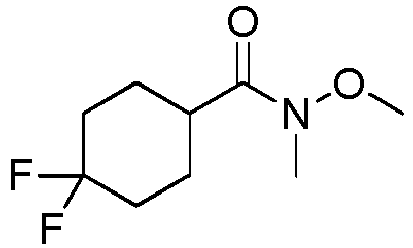
- At 16 °C, N-methoxymethylamine (653.42 mg, 6.70 mmol), HATU (2.55 g, 6.70 mmol) and DIEA (1.57 g, 12.18 mmol, 2.13 mL) were added into a solution of 4,4-difluorocyclohexanecarboxylic acid (1 g, 6.09 mmol) in DMF (10 mL), and the mixture was stirred for 16 hours. The reaction solution was dispersed in ethyl acetate (30 mL) and water (30 mL). The organic phase was separated out, washed with brine (30 mL × 3), dried over anhydrous sodium sulfate, filtered and evaporated.
- The residue was purified by a silica gel column chromatography to give 1.2 g of the title compound.
1H NMR (400MHz, CHLOROFORM-d) δ = 3.69 (s, 3H), 3.17 (s, 3H), 2.72 (brd, J = 5.8 Hz, 1H), 2.22-2.09 (m, 2H), 1.87-1.77 (m, 5H), 1.76-1.65 (m, 1H). -

- At -78 °C, DIBAL-H (1 M, 12.74 mL) was slowly added into a solution of 4,4-difluoro-N-methoxy-N-methyl-cyclohexanecarboxamide (1.20 g, 5.79 mmol) in tetrahydrofuran (12.00 mL) under nitrogen protection. Then the reaction solution was stirred at -78 °C for 4 hours. The reaction solution was quenched with 1 N hydrochloric acid (5 mL), diluted with water (20 mL), and extracted with ethyl acetate (20 mL × 3). The combined organic phases were washed with brine (20 mL × 3), dried over anhydrous sodium sulfate, filtered and evaporated to give 780 mg of the title compound.
1H NMR (400MHz, CHLOROFORM-d) δ = 9.66 (s, 1H), 2.39-2.28 (m, 1H), 2.07-1.98 (m, 4H), 1.84-1.73 (m, 4H). -
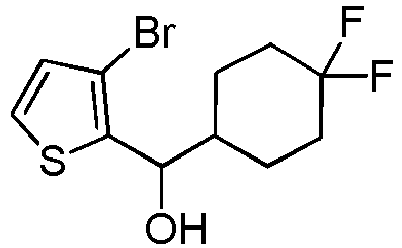
- A solution of n-butyllithium (2.5 M, 2.29 mL) in diethyl ether (10.00 mL) was cooled to -78 °C, and diisopropylamine (663.06 mg, 6.26 mmol) was slowly added thereto, and 3-bromothiophene (850 mg, 5.21 mmol) was added thereto 1 hour later, which was stirred for another 1 hour when being kept at -78 °C. Then, 4,4-difluorocyclohexane carboxaldehyde (772.37 mg, 5.21 mmol) was added thereto, and the reaction system was stirred at -78 °C for 1 hour, which was quenched by adding ammonium chloride solution (30 mL), diluted with water (30 mL), and extracted with ethyl acetate (30 mL × 3). The organic phase was washed with brine (30 mL × 3), dried over anhydrous sodium sulfate, filtered and evaporated. The residue was purified by a silica gel column chromatography to give 700 mg of the title compound.
1H NMR (400MHz, CHLOROFORM-d) δ = 7.30 (d, J = 5.3 Hz, 1H), 6.94 (d, J = 5.3 Hz, 1H), 4.86 (dd, J = 2.4, 7.9 Hz, 1H), 2.29 (d, J = 3.0 Hz, 1H), 2.19-2.07 (m, 3H), 1.82-1.63 (m, 4H), 1.52-1.46 (m, 2H). -

- CDI (1.82 g, 11.25 mmol) was added into a solution of (3-bromothien-2-yl)-(4,4-difluorocyclohexyl)methanol (700 mg, 2.25 mmol) in acetonitrile (10 mL). The reaction system was stirred at 80 °C for 16 hours. The reaction solution was dispersed in ethyl acetate (20 mL) and water (20 mL). The organic phase was separated out, washed with brine (20 mL × 3), dried over anhydrous sodium sulfate, filtered and evaporated. The residue was purified by a silica gel column chromatography to give 460 mg of the title compound.
MS-ESI (m/z): 361/363 (M+H)+.
1H NMR (400MHz, CHLOROFORM-d) δ = 7.65 (s, 1H), 7.34 (d, J = 5.3 Hz, 1H), 7.08 (d, J = 5.0 Hz, 2H), 6.95 (d, J = 5.3 Hz , 1H), 5.28 (d, J = 11.0 Hz, 1H), 2.21 (brd, J = 11.5 Hz, 1H), 2.14-2.06 (m, 2H), 1.83-1.59 (m, 4H), 1.42-1.30 (m, 2H). -

- Under nitrogen protection, a solution of a mixture of 1-[(3-bromothien-2-yl)-(4,4-difluorocyclohexyl)methyl]-1H-imidazole (460 mg, 1.27 mmol), palladium acetate (28.51 mg, 127.00 µmol), tricyclohexyl phosphine (71.23 mg, 254.00 µmol), potassium carbonate (351.05 mg, 2.54 mmol) in o-xylene (5.00 mL) was stirred at 140 °C for 16 hours. The reaction solution was dispersed in ethyl acetate (20 mL) and water (20 mL). The organic phase was separated out, washed with brine (20 mL × 3), dried over anhydrous sodium sulfate, filtered and evaporated. The residue was purified by a preparative silica gel column chromatography to give 190 mg of racemic 8-(4,4-difluorocyclohexyl)-8H-thieno[3,4]pyrrolo[1,5-a]imidazole.
MS-ESI (m/z): 281 (M+H)+. - Racemic 8-(4,4-difluorocyclohexyl)-8H-thieno[3,4]pyrrolo[1,5-a]imidazole (190.00 mg, 677.75 µmol) was subjected to a chiral separation (chiral separation conditions: ChiralPak AD-3 150 × 4.6mm I.D., 3 µm, mobile phase: A: carbon dioxide B: ethanol (0.05% diethylamine)) to give the title compound (53.00 mg, RT = 4.619 min).
1H NMR (400MHz, METHANOL-d4) δ = 9.21 (s, 1H), 7.72 (d, J = 5.0 Hz, 1H), 7.53 (s, 1H), 7.38 (d, J = 5.0 Hz, 1H), 5.80 (d, J = 3.8 Hz, 1H), 2.50 (dt, J = 3.0, 12.2 Hz, 1H), 2.23-2.11 (m, 1H), 2.04-1.96 (m, 2H), 1.95-1.68 (m, 2H), 1.65-1.52 (m, 1H), 1.36-1.26 (m, 1H), 1.05 (dq, J = 3.4, 13.1 Hz, 1H). - 5.64 g of the compound of formula I prepared in Example 1 was dissolved in 180 mL of anhydrous ethanol. Until the solution was clarified, the insoluble substance was removed by filtration, and the filtrate was concentrated to obtain a solid-liquid mixture containing 35 mL of anhydrous ethanol. The solid-liquid mixture was heated to dissolve, and stirred under reflux for 1 hour. After stopping the heating, it was cooled down to room temperature with stirring to precipitate a solid. After filtration, the filter cake was dried under vacuum at 60 °C to give 4.34 g of the crystal of the compound of formula I.
- The crystallographic data and atomic coordinates and the like of the crystal of the compound of formula I are shown in Tables 2 and 3.
Table 2 Crystal data and structure refinement Experimental molecular formula C14H14F2N2S Molecular weight 280.33 Temperature 296(2) K Wavelength 1.54178 Å Crystal system orthorhombic crystal system Space group P21 21 21 Cell parameters a = 8.5036(17) Å b = 9.809(2) Å c = 15.604(3) Å α = 90° β = 90° γ = 90° Cell volume 1301.6(5) Å3 Z 4 Calculated density 1.431 mg/m3 Absorption correction parameter 2.329 mm-1 F(000) 584 Crystal size 0.16×0.12×0.10 mm Data collection angle 5.33° to 67.72° Indicator collection range of hkl -10≤h≤7, -11≤k≤11, -18≤l≤18 Reflection data collection / independent 6158/2301 [R(int)=0.0319] Data integrity of theta=67.72 99.1% Absorption correction method Semiempirical equation Maximum and minimum transmittances 0.7530 and 0.5738 Refinement method F^2 full matrix least square method Number of data / Number of usage limitations / Number of parameters 2301/0/173 F^2 fitting degree 1.032 Final R index [I>2sigma(I)] R1 =0.0331, wR2=0.0820 R index (all data) R1 =0.0369, wR2=0.0850 Absolute configuration parameters 0.05(2) Extinction coefficient 0.0080(7) Maximum difference Peak and valley 0.161 and -0.180 e.Å-3 Table 3 Atomic coordinates (×104) and equivalent isotropic displacement parameters (Å2×10³) Atom X Y Z U(eq) S(1) 8395(1) 7625(1) 9962(1) 61(1) F(1) 11043(2) 6653(1) 12565(1) 74(1) F(2) 11244(2) 5083(2) 13539(1) 83(1) N(1) 8806(2) 3616(2) 9736(1) 47(1) N(2) 9767(3) 1849(2) 9042(1) 64(1) C(1) 8176(2) 4661(2) 10334(1) 45(1) C(2) 8663(2) 5912(2) 9834(1) 48(1) C(3) 9425(3) 7945(3) 9029(2) 64(1) C(4) 9934(3) 6801(3) 8647(1) 59(1) C(5) 9496(2) 5620(2) 9111(1) 48(1) C(6) 9622(3) 4145(2) 9049(1) 48(1) C(7) 10205(3) 3033(3) 8627(2) 60(1) C(8) 8941(3) 2252(2) 9710(2) 57(1) C(9) 8898(2) 4481(2) 11228(1) 43(1) C(10) 8154(3) 5432(2) 11879(1) 53(1) C(11) 8870(3) 5224(2) 12770(1) 57(1) C(12) 10629(3) 5324(2) 12739(1) 53(1) C(13) 11397(3) 4422(2) 12098(1) 52(1) C(14) 10683(2) 4638(2) 11213(1) 50(1) H(1A) 7028 4600 10365 54 H(3A) 9607 8816 8815 77 H(4A) 10505 6787 8139 70 H(7A) 10809 3068 8131 72 H(8A) 8505 1665 10113 68 H(9A) 8670 3546 11412 52 H(10A) 7031 5263 11903 63 H(10B) 8311 6369 11700 63 H(11A) 8461 5910 13158 69 H(11B) 8569 4336 12988 69 H(13A) 11265 3477 12268 62 H(13B) 12515 4617 12079 62 H(14A) 11128 3982 10817 60 H(14B) 10950 5544 11010 60 -
- 1. Calculation software: Mercury 3.8 (Build RC2); wavelength: 1.54056 Å.
- 2. X-ray powder diffraction data
- The peak positions and intensities of the characteristic peaks in the X-ray powder diffraction spectrum calculated from the single crystal of the crystal of the compound of formula I are shown in Table 4.
Table 4 No. 2-θ (degree) relative intensity (I/I0) 1 11.34 8.6 2 11.84 12.1 3 13.78 4.2 4 14.90 38.3 5 17.86 14.1 6 19.30 4.4 7 20.00 53.0 8 20.88 9.8 9 21.38 22.8 10 21.66 100.0 11 23.48 6.0 12 23.82 4.8 13 24.94 3.2 14 25.10 2.8 15 25.50 4.0 16 26.72 2.2 17 27.08 12.1 18 27.86 4.0 19 28.34 1.9 20 29.24 3.7 21 31.08 10.0 22 32.06 6.3 23 32.74 6.0 24 34.02 2.3 25 34.86 1.3 26 35.66 1.7 27 36.50 2.2 28 38.78 1.9 - The change of NFK production was detected by using the NFK green™ fluorescent molecule, which is the metabolite of the IDO1 enzyme, and the IC50 value of the compound was used as an index, to evaluate the inhibitory effect of the compound of formula I on the recombinant human IDO1 enzyme.
-
- IDO1 Enzyme Activity Assay Kit, NTRC # NTRC-hIDO-10K;
- 384-well enzyme reaction plate, PerkinElmer # 6007279;
- 384-well compound plate, Greiner # 781280;
- Microplate sealing film, PerkinElmer # 6050185;
- Envision Multimode Microplate Reader, PerkinElmer;
- Bravo automated liquid handling platform, Agilent.
- The compound of formula I was diluted to 1 mM with DMSO, and then diluted 3-fold in duplicate wells, with 10 gradients. 48 µL of 50 mM phosphate buffer (pH 6.5) was transferred and added to the compound plate via Bravo automated liquid handling platform. 2 µL of the diluted solution of the compound in DMSO was then added thereto and mixed, followed by transferring 10 µL thereof to an enzyme reaction plate.
- The IDO1 enzyme was diluted to 20 nM in the reaction buffer (50 mM phosphate buffer (pH 6.5), 0.1% Tween-20, 2% glycerol, 20 mM ascorbic acid, 20 µg/mL catalase and 20 µM methylene blue), 20 µL of which was transferred to an enzyme reaction plate and incubated at 23 °C for 30 min. The reaction was started by adding 10 µL of 400 µM L-tryptophan substrate and incubated at 23°C for 90 min. 10 µL of NFK green™ fluorescent dye was added thereto, and the plate was sealed with the microplate sealing film, incubated at 37°C for 4 h, and then read on Envision Multimode Microplate Reader (Ex 400 nm/Em 510 nm).
- The reference wells having the IDO1 enzyme but without compound of formula I were set as 0% inhibition rate, and the reference wells without the IDO1 enzyme were set as 100% inhibition rate, and the IC50 value of the compound was calculated by analyzing the data with
XLFit 5. - The change of kynurenine in HeLa cells was detected by the LC-MS method, and the IC50 value of the compound was used as an index to evaluate the inhibitory effect of the compound of formula I on IDO1 enzyme.
-
- Cell line: HeLa cells;
- Culture medium: RPMI 1640 phenol red free, Invitrogen #11835030
- 10% fetal bovine serum, Gibco #10099141
- 1X Penicillin-Streptomycin, Gibco #15140-122;
- Precipitant: 4 µM L-kynurenine-d4 dissolved in 100% acetonitrile, CacheSyn #CSTK008002;
- Trypsin, Invitrogen #25200-072;
- DPBS, Hyclone #SH30028.01B;
- Recombinant human γ-interferon, Invitrogen #PHC4033;
- 5% (w/v) trichloroacetic acid, Alfa Aesar # A11156;
- 96-well cell plate, Corning #3357;
- 96-well compound plate, Greiner # 781280;
- 96-well V-bottom plate, Axygen #WIPP02280;
- CO2 incubator, Thermo#371;
- Centrifuge, Eppendorf #5810R;
- Vi-cell cell counter, Beckman Coulter;
- Labcyte FLIPR, Molecular Device.
- The culture medium, trypsin and DPBS were pre-heated in a 37 °C water bath. The culture medium for cell culture was sucked out and washed with 10 mL of DPBS; the pre-heated trypsin was added into the culture flask, and the flask was rotated to allow the trypsin to uniformly cover it, and then placed in a 37°C, 5% CO2 incubator to digest for 1-2 min; in each T150, cells were dispersed with 10-15 mL of the culture medium, centrifuged at 800 rpm for 5 min, and then resuspended with 10 mL of medium; 1 mL of cell suspension was pipetted and cells were counted with Vi-cell; HeLa cells were diluted with the culture medium to 5×10⁵/mL, 80 µL of the solution was added to a 96-cell plate, and cultured at 37°C for 5-6 h in a 5% CO2 incubator.
- The compound was diluted to 1 mM with DMSO, and then diluted 3-fold in duplicate wells, with 9 gradients. 5 µL of the diluted solution of the compound in DMSO was added to the compound plate containing 95 µL of the culture medium, and mixed, followed by transferring 10 µL thereof to a cell plate.
- 10 µL of recombinant human γ-interferon was added to a final concentration of 100 ng/mL to induce IDO1 expression. The cells were incubated at 37°C for 20 h in a 5% CO2 incubator. 4 µL of 5% (w/v) trichloroacetic acid was added thereto, mixed and incubated at 50°C for 30 min. After centrifugation at 2400 rpm for 10 min, 40 µL of the supernatant was taken and placed in a 96-well V-bottom plate, and then a precipitant was added thereto. After mixing, it was centrifuged at 4000 rpm for 10 min. 100 µL of the supernatant was transferred to a new 96-well V-bottom plate. The content of kynurenine was detected by LC-MS.
- The reference wells having γ-interferon but without compound of formula I were set as 0% inhibition rate, and the reference wells without HeLa cell were set as 100% inhibition rate, and the IC50 value of the compound of formula I was calculated by analyzing the data with
XLFit 5. - The experimental results were found in Table 5.
Table 5 IC50 test results of hIDO1 enzyme activity in vitro Tested sample hIDO1 Enzyme activity (nM) Cytological active (nM) Compound of formula I 48.05 74.93
Claims (15)
- A crystal of (S)-8-(4,4-difluorocyclohexyl)-8H-thieno[3,4]pyrrolo[1,5-a]imidazole represented by formula I,

- The crystal according to claim 1, wherein the X-ray powder diffraction spectrum thereof has diffraction peaks expressed by 2-θ values at about 11.49°, 11.99°, 15.05°, 17.99°, 18.24°, 19.44°, 20.14°, 21.53°, 21.79°, 25.09°, 27.20° or 28.00°.
- The crystal according to claim 2, wherein the X-ray powder diffraction spectrum thereof has diffraction peaks expressed by 2-θ values at about 11.49°, 11.99°, 15.05°, 17.99°, 18.24°, 19.44°, 20.14°, 21.53°, 21.79°, 23.64°, 23.98°, 25.09°, 27.20°, 28.00°, 29.35°, 31.22°, 32.01°, 32.21°, 36.70° or 38.87°.
- The crystal according to claim 3, wherein the X-ray powder diffraction spectrum thereof has diffraction peaks expressed by 2-θ values at about 11.49°, 11.99°, 13.89°, 15.05°, 17.99°, 18.24°, 19.44°, 20.14°, 21.02°, 21.53°, 21.79°, 23.64°, 23.98°, 25.09°, 25.64°, 26.84°, 27.20°, 28.00°, 28.46°, 29.35°, 31.22°, 32.01°, 32.21°, 32.89°, 34.18°, 35.02°, 35.81°, 36.70° or 38.87°.
- The crystal according to any one of claims 1 to 4, wherein the differential scanning calorimetry diagram has an absorption peak at about 207 °C.
- A crystal composition, wherein the crystal according to any one of claims 1 to 4 accounts for 50% or more, preferably 80% or more, more preferably 90% or more, and most preferably 95% or more by weight of the crystal composition.
- A pharmaceutical composition, comprising the crystal according to any one of claims 1 to 4 or the crystal composition according to claim 6.
- Use of the crystal according to any one of claims 1 to 4, the crystal composition according to claim 6, or the pharmaceutical composition according to claim 7 in manufacture of a medicament for treating indoleamine 2,3-dioxygenase-mediated immunosuppressive disease.
- A method for preparing the crystal according to any one of claims 1 to 4, comprising: (1) dissolving the compound of formula I in an organic solvent until solution being clear, which is filtered to remove insoluble substance; (2) concentrating filtrate obtained in step (1) to a solid-liquid mixed state, producing a solid-liquid mixture which is dissolved by heating, stirred with refluxing for 1 to 2 hours, and cooled for crystallization.
- The method according to claim 9, wherein the organic solvent in step (1) is one solvent or a mixed solvent selected from methanol, ethanol, acetonitrile, acetone, butanone, tetrahydrofuran, and 1,4-dioxane; preferably methanol or ethanol.
- The method according to claim 9, wherein a molar volume ratio of the compound of formula I to the organic solvent in step (1) is 1 mmol: 5-10 mL; preferably 1 mmol: 8-10 mL.
- The method according to claim 9, wherein, in step (2), when the filtrate is concentrated to a solid-liquid mixed state, a volume of the organic solvent in the solid-liquid mixture accounts for 15% to 30%, preferably 15% to 20% of a total volume of the organic solvent in step (1).
- The method according to claim 9, wherein a temperature of the refluxing in step (2) is 50 °C to 80 °C, preferably 65 °C to 80 °C.
- The method according to claim 9, wherein a temperature of cooling for crystallization in step (2) is 20 °C to 30 °C, preferably 20 °C to 25 °C.
- The method according to any one of claims 9 to 14, further comprising: (3) filtering; (4) drying.
Applications Claiming Priority (2)
| Application Number | Priority Date | Filing Date | Title |
|---|---|---|---|
| CN201710714247 | 2017-08-18 | ||
| PCT/CN2018/100988 WO2019034139A1 (en) | 2017-08-18 | 2018-08-17 | Crystal of tricyclic compound |
Publications (2)
| Publication Number | Publication Date |
|---|---|
| EP3670518A1 true EP3670518A1 (en) | 2020-06-24 |
| EP3670518A4 EP3670518A4 (en) | 2021-01-06 |
Family
ID=65362728
Family Applications (1)
| Application Number | Title | Priority Date | Filing Date |
|---|---|---|---|
| EP18845759.2A Withdrawn EP3670518A4 (en) | 2017-08-18 | 2018-08-17 | Crystal of tricyclic compound |
Country Status (4)
| Country | Link |
|---|---|
| US (1) | US11236107B2 (en) |
| EP (1) | EP3670518A4 (en) |
| CN (1) | CN111263763B (en) |
| WO (1) | WO2019034139A1 (en) |
Family Cites Families (4)
| Publication number | Priority date | Publication date | Assignee | Title |
|---|---|---|---|---|
| NO2694640T3 (en) | 2011-04-15 | 2018-03-17 | ||
| GB201418300D0 (en) * | 2014-10-15 | 2014-11-26 | Redx Pharma Ltd | Compounds |
| CN105884828A (en) * | 2015-02-16 | 2016-08-24 | 上海迪诺医药科技有限公司 | Polycyclic compound, pharmaceutical composition and application thereof |
| EP3418282A4 (en) * | 2016-02-19 | 2019-01-09 | Chai Tai Tianqing Pharmaceutical Group Co., Ltd. | TRICYCLIC COMPOUND AS IMMUNOMODULATOR |
-
2018
- 2018-08-17 CN CN201880053356.8A patent/CN111263763B/en active Active
- 2018-08-17 US US16/639,395 patent/US11236107B2/en not_active Expired - Fee Related
- 2018-08-17 WO PCT/CN2018/100988 patent/WO2019034139A1/en not_active Ceased
- 2018-08-17 EP EP18845759.2A patent/EP3670518A4/en not_active Withdrawn
Also Published As
| Publication number | Publication date |
|---|---|
| CN111263763A (en) | 2020-06-09 |
| US11236107B2 (en) | 2022-02-01 |
| WO2019034139A1 (en) | 2019-02-21 |
| US20200255449A1 (en) | 2020-08-13 |
| EP3670518A4 (en) | 2021-01-06 |
| CN111263763B (en) | 2021-02-19 |
Similar Documents
| Publication | Publication Date | Title |
|---|---|---|
| CN111601791B (en) | EZH2 inhibitors, pharmaceutically acceptable salts and polymorphs thereof, and uses thereof | |
| CN107922425B (en) | Methods of preparing PARP inhibitors, crystalline forms and uses thereof | |
| EP3176173B1 (en) | Crystalline free bases of c-met inhibitor or crystalline acid salts thereof, and preparation methods and uses thereof | |
| CN114605406A (en) | Crystal form of AMG510 compound and preparation method and application thereof | |
| CN110494423B (en) | Novel crystal form of lenvatinib mesylate and preparation method thereof | |
| TWI738748B (en) | Crystalline forms of 2-[(2s)-1-azabicyclo[2.2.2]oct-2-yl]-6-(3-methyl-1h-pyrazol-4-yl)thieno[3,2-d]pyrimidin-4(3h)-one hemihydrate | |
| JP7100625B2 (en) | Crystal form, salt type and method for producing the substituted 2-H-pyrazole derivative | |
| TWI845819B (en) | Compounds used as kinase inhibitors and their applications | |
| CA2821211A1 (en) | Polymorphic forms of asenapine maleate and processes for their preparation | |
| CA2673510C (en) | Maleic acid monosalt of antiviral agent and pharmaceutical composition containing the same | |
| WO2013027227A1 (en) | Novel polymorphic form i of rifaximin | |
| CN117295739B (en) | Crystals and salts of tricyclic heterocyclic compounds and their applications | |
| WO2023193563A1 (en) | Crystal form a of thienopyridine compound, and preparation method therefor and pharmaceutical composition thereof | |
| AU2018337153B2 (en) | Crystalline sulfamide compound | |
| US11236107B2 (en) | Crystal of tricyclic compound | |
| WO2025082550A2 (en) | Crystal forms of n-(3-fluorophenyl)-6-(6,7-dimethoxyquinolin-4-oxy)-3,4-dihydroquinoline-1(2h)-carboxamide methanesulfonate and preparation method thereof | |
| CN120787223A (en) | Aromatic amide derivative and preparation method and application thereof | |
| US20230123104A1 (en) | Crystal of tricyclic compound acting on crbn protein and preparation method therefor | |
| TWI919884B (en) | Crystal form of a pyrimidine-azo heterocyclic compound, its preparation method and application | |
| CN106632322B (en) | Pyrazole indolizine compounds and preparation method thereof and purposes | |
| CN112125910A (en) | Alvatinib crystal form and preparation method thereof | |
| EP3677581A1 (en) | Deuterated indoleamine 2,3-dioxygenase inhibitor and application thereof | |
| WO2024199167A1 (en) | Salt of triaromatic ring derivative, crystal form thereof, preparation method therefor, and use thereof | |
| WO2017140272A1 (en) | Tricyclic compound acting as immunomodulator | |
| TW202547508A (en) | Crystal form of a pyrimidine-azo heterocyclic compound, its preparation method and application |
Legal Events
| Date | Code | Title | Description |
|---|---|---|---|
| STAA | Information on the status of an ep patent application or granted ep patent |
Free format text: STATUS: THE INTERNATIONAL PUBLICATION HAS BEEN MADE |
|
| PUAI | Public reference made under article 153(3) epc to a published international application that has entered the european phase |
Free format text: ORIGINAL CODE: 0009012 |
|
| STAA | Information on the status of an ep patent application or granted ep patent |
Free format text: STATUS: REQUEST FOR EXAMINATION WAS MADE |
|
| 17P | Request for examination filed |
Effective date: 20200218 |
|
| AK | Designated contracting states |
Kind code of ref document: A1 Designated state(s): AL AT BE BG CH CY CZ DE DK EE ES FI FR GB GR HR HU IE IS IT LI LT LU LV MC MK MT NL NO PL PT RO RS SE SI SK SM TR |
|
| AX | Request for extension of the european patent |
Extension state: BA ME |
|
| DAV | Request for validation of the european patent (deleted) | ||
| DAX | Request for extension of the european patent (deleted) | ||
| A4 | Supplementary search report drawn up and despatched |
Effective date: 20201204 |
|
| RIC1 | Information provided on ipc code assigned before grant |
Ipc: C07D 495/14 20060101AFI20201130BHEP Ipc: A61K 31/381 20060101ALI20201130BHEP Ipc: A61P 37/06 20060101ALI20201130BHEP |
|
| STAA | Information on the status of an ep patent application or granted ep patent |
Free format text: STATUS: THE APPLICATION IS DEEMED TO BE WITHDRAWN |
|
| 18D | Application deemed to be withdrawn |
Effective date: 20230301 |