EP3670511A1 - Tetrahydroprotoberberine compound, preparation method therefor and uses thereof, and pharmaceutical composition - Google Patents
Tetrahydroprotoberberine compound, preparation method therefor and uses thereof, and pharmaceutical composition Download PDFInfo
- Publication number
- EP3670511A1 EP3670511A1 EP18846464.8A EP18846464A EP3670511A1 EP 3670511 A1 EP3670511 A1 EP 3670511A1 EP 18846464 A EP18846464 A EP 18846464A EP 3670511 A1 EP3670511 A1 EP 3670511A1
- Authority
- EP
- European Patent Office
- Prior art keywords
- alkyl
- tetrahydro
- quinolizine
- dibenzo
- trimethoxy
- Prior art date
- Legal status (The legal status is an assumption and is not a legal conclusion. Google has not performed a legal analysis and makes no representation as to the accuracy of the status listed.)
- Withdrawn
Links
- -1 Tetrahydroprotoberberine compound Chemical class 0.000 title claims abstract description 199
- 238000002360 preparation method Methods 0.000 title claims abstract description 13
- 239000008194 pharmaceutical composition Substances 0.000 title claims description 8
- 150000001875 compounds Chemical class 0.000 claims abstract description 250
- 239000000203 mixture Substances 0.000 claims abstract description 137
- 238000000034 method Methods 0.000 claims abstract description 56
- 150000003839 salts Chemical class 0.000 claims abstract description 26
- 239000012453 solvate Substances 0.000 claims abstract description 19
- 150000004677 hydrates Chemical class 0.000 claims abstract description 18
- HBAQYPYDRFILMT-UHFFFAOYSA-N 8-[3-(1-cyclopropylpyrazol-4-yl)-1H-pyrazolo[4,3-d]pyrimidin-5-yl]-3-methyl-3,8-diazabicyclo[3.2.1]octan-2-one Chemical class C1(CC1)N1N=CC(=C1)C1=NNC2=C1N=C(N=C2)N1C2C(N(CC1CC2)C)=O HBAQYPYDRFILMT-UHFFFAOYSA-N 0.000 claims abstract description 17
- 239000003814 drug Substances 0.000 claims abstract description 17
- 208000015114 central nervous system disease Diseases 0.000 claims abstract description 9
- 125000004169 (C1-C6) alkyl group Chemical group 0.000 claims description 197
- 125000000623 heterocyclic group Chemical group 0.000 claims description 65
- 125000002924 primary amino group Chemical group [H]N([H])* 0.000 claims description 63
- 238000006243 chemical reaction Methods 0.000 claims description 60
- 125000001589 carboacyl group Chemical group 0.000 claims description 54
- 125000001424 substituent group Chemical group 0.000 claims description 54
- 125000004191 (C1-C6) alkoxy group Chemical group 0.000 claims description 47
- 229910052736 halogen Inorganic materials 0.000 claims description 47
- 150000002367 halogens Chemical class 0.000 claims description 47
- 125000005605 benzo group Chemical group 0.000 claims description 39
- 125000002950 monocyclic group Chemical group 0.000 claims description 39
- 229910052739 hydrogen Inorganic materials 0.000 claims description 33
- 239000001257 hydrogen Substances 0.000 claims description 32
- 125000003917 carbamoyl group Chemical group [H]N([H])C(*)=O 0.000 claims description 29
- 125000003172 aldehyde group Chemical group 0.000 claims description 26
- 125000004432 carbon atom Chemical group C* 0.000 claims description 26
- 125000005842 heteroatom Chemical group 0.000 claims description 26
- 125000004043 oxo group Chemical group O=* 0.000 claims description 26
- 229910052760 oxygen Inorganic materials 0.000 claims description 26
- 125000001997 phenyl group Chemical group [H]C1=C([H])C([H])=C(*)C([H])=C1[H] 0.000 claims description 26
- 125000000446 sulfanediyl group Chemical group *S* 0.000 claims description 26
- 229910052717 sulfur Inorganic materials 0.000 claims description 26
- 125000004739 (C1-C6) alkylsulfonyl group Chemical group 0.000 claims description 24
- 239000003795 chemical substances by application Substances 0.000 claims description 21
- 125000006700 (C1-C6) alkylthio group Chemical group 0.000 claims description 19
- 125000005913 (C3-C6) cycloalkyl group Chemical group 0.000 claims description 19
- 125000000882 C2-C6 alkenyl group Chemical group 0.000 claims description 19
- 125000003601 C2-C6 alkynyl group Chemical group 0.000 claims description 19
- 239000002904 solvent Substances 0.000 claims description 16
- UFHFLCQGNIYNRP-UHFFFAOYSA-N Hydrogen Chemical compound [H][H] UFHFLCQGNIYNRP-UHFFFAOYSA-N 0.000 claims description 15
- WGQKYBSKWIADBV-UHFFFAOYSA-N benzylamine Chemical compound NCC1=CC=CC=C1 WGQKYBSKWIADBV-UHFFFAOYSA-N 0.000 claims description 14
- 125000000000 cycloalkoxy group Chemical group 0.000 claims description 13
- 150000002431 hydrogen Chemical class 0.000 claims description 13
- 125000004178 (C1-C4) alkyl group Chemical group 0.000 claims description 12
- 125000004435 hydrogen atom Chemical group [H]* 0.000 claims description 12
- 239000002994 raw material Substances 0.000 claims description 12
- 238000006722 reduction reaction Methods 0.000 claims description 12
- 125000003396 thiol group Chemical class [H]S* 0.000 claims description 12
- 239000000460 chlorine Substances 0.000 claims description 11
- 208000037265 diseases, disorders, signs and symptoms Diseases 0.000 claims description 11
- BRLDZKPJJNASGG-UHFFFAOYSA-N berbine Chemical group C1=CC=C2CN3CCC4=CC=CC=C4C3CC2=C1 BRLDZKPJJNASGG-UHFFFAOYSA-N 0.000 claims description 10
- 125000006766 (C2-C6) alkynyloxy group Chemical group 0.000 claims description 9
- 125000003320 C2-C6 alkenyloxy group Chemical group 0.000 claims description 9
- ZAMOUSCENKQFHK-UHFFFAOYSA-N Chlorine atom Chemical compound [Cl] ZAMOUSCENKQFHK-UHFFFAOYSA-N 0.000 claims description 9
- 229910052799 carbon Inorganic materials 0.000 claims description 9
- 229910052801 chlorine Inorganic materials 0.000 claims description 9
- 239000011737 fluorine Substances 0.000 claims description 9
- 229910052731 fluorine Inorganic materials 0.000 claims description 9
- 201000000980 schizophrenia Diseases 0.000 claims description 9
- 125000004454 (C1-C6) alkoxycarbonyl group Chemical group 0.000 claims description 8
- 208000017194 Affective disease Diseases 0.000 claims description 8
- WKBOTKDWSSQWDR-UHFFFAOYSA-N Bromine atom Chemical compound [Br] WKBOTKDWSSQWDR-UHFFFAOYSA-N 0.000 claims description 8
- 125000005947 C1-C6 alkylsulfonyloxy group Chemical group 0.000 claims description 8
- 208000019022 Mood disease Diseases 0.000 claims description 8
- GDTBXPJZTBHREO-UHFFFAOYSA-N bromine Substances BrBr GDTBXPJZTBHREO-UHFFFAOYSA-N 0.000 claims description 8
- 229910052794 bromium Inorganic materials 0.000 claims description 8
- 238000005859 coupling reaction Methods 0.000 claims description 8
- 125000001449 isopropyl group Chemical group [H]C([H])([H])C([H])(*)C([H])([H])[H] 0.000 claims description 8
- 125000000999 tert-butyl group Chemical group [H]C([H])([H])C(*)(C([H])([H])[H])C([H])([H])[H] 0.000 claims description 8
- PXGOKWXKJXAPGV-UHFFFAOYSA-N Fluorine Chemical compound FF PXGOKWXKJXAPGV-UHFFFAOYSA-N 0.000 claims description 7
- 208000018737 Parkinson disease Diseases 0.000 claims description 7
- 125000002777 acetyl group Chemical group [H]C([H])([H])C(*)=O 0.000 claims description 7
- 239000003153 chemical reaction reagent Substances 0.000 claims description 7
- 125000004218 chloromethyl group Chemical group [H]C([H])(Cl)* 0.000 claims description 7
- 125000002485 formyl group Chemical group [H]C(*)=O 0.000 claims description 7
- 125000006533 methyl amino methyl group Chemical group [H]N(C([H])([H])[H])C([H])([H])* 0.000 claims description 7
- 125000002496 methyl group Chemical group [H]C([H])([H])* 0.000 claims description 7
- 230000000802 nitrating effect Effects 0.000 claims description 7
- 125000001501 propionyl group Chemical group O=C([*])C([H])([H])C([H])([H])[H] 0.000 claims description 7
- 125000004044 trifluoroacetyl group Chemical group FC(C(=O)*)(F)F 0.000 claims description 7
- 125000000876 trifluoromethoxy group Chemical group FC(F)(F)O* 0.000 claims description 7
- 125000002023 trifluoromethyl group Chemical group FC(F)(F)* 0.000 claims description 7
- 125000000391 vinyl group Chemical group [H]C([*])=C([H])[H] 0.000 claims description 7
- 229920002554 vinyl polymer Polymers 0.000 claims description 7
- 125000002861 (C1-C4) alkanoyl group Chemical group 0.000 claims description 6
- 208000036864 Attention deficit/hyperactivity disease Diseases 0.000 claims description 6
- 125000006222 dimethylaminomethyl group Chemical group [H]C([H])([H])N(C([H])([H])[H])C([H])([H])* 0.000 claims description 6
- 208000035475 disorder Diseases 0.000 claims description 6
- 125000004705 ethylthio group Chemical group C(C)S* 0.000 claims description 6
- 125000002816 methylsulfanyl group Chemical group [H]C([H])([H])S[*] 0.000 claims description 6
- 125000001436 propyl group Chemical group [H]C([*])([H])C([H])([H])C([H])([H])[H] 0.000 claims description 6
- 238000007363 ring formation reaction Methods 0.000 claims description 6
- 125000000753 cycloalkyl group Chemical group 0.000 claims description 5
- 125000001559 cyclopropyl group Chemical group [H]C1([H])C([H])([H])C1([H])* 0.000 claims description 5
- 201000010099 disease Diseases 0.000 claims description 5
- 238000003541 multi-stage reaction Methods 0.000 claims description 5
- JLISVVSIBRHFAX-SFHVURJKSA-N (13aS)-2,3,10-trimethoxy-6,8,13,13a-tetrahydro-5H-isoquinolino[2,1-b]isoquinoline-9-carbaldehyde Chemical compound COC=1C(=CC2=C([C@@H]3CC4=C(CN3CC2)C(=C(C=C4)OC)C=O)C=1)OC JLISVVSIBRHFAX-SFHVURJKSA-N 0.000 claims description 4
- KPDGZFRGXUTSQP-SFHVURJKSA-N (13aS)-2,3,10-trimethoxy-6,8,13,13a-tetrahydro-5H-isoquinolino[2,1-b]isoquinoline-9-carbonitrile Chemical compound COC=1C(=CC2=C([C@@H]3CC4=C(CN3CC2)C(=C(C=C4)OC)C#N)C=1)OC KPDGZFRGXUTSQP-SFHVURJKSA-N 0.000 claims description 4
- URIBEVFPFFNKNX-SFHVURJKSA-N (13aS)-2,3,9-trimethoxy-6,8,13,13a-tetrahydro-5H-isoquinolino[2,1-b]isoquinoline-10-carbonitrile Chemical compound COC=1C(=CC2=C([C@@H]3CC4=C(CN3CC2)C(=C(C=C4)C#N)OC)C=1)OC URIBEVFPFFNKNX-SFHVURJKSA-N 0.000 claims description 4
- LYWYKFQJUFDYPM-KRWDZBQOSA-N (13aS)-2,3,9-trimethoxy-6,8,13,13a-tetrahydro-5H-isoquinolino[2,1-b]isoquinoline-10-carboxamide Chemical compound COC=1C(=CC2=C([C@@H]3CC4=C(CN3CC2)C(=C(C=C4)C(N)=O)OC)C=1)OC LYWYKFQJUFDYPM-KRWDZBQOSA-N 0.000 claims description 4
- FBFJNQNWRKZBDU-AWEZNQCLSA-N (1S)-8,16,17-trimethoxy-4,6,13-triazapentacyclo[11.8.0.02,10.03,7.015,20]henicosa-2,7,9,15(20),16,18-hexaen-5-one Chemical compound COc1ccc2C[C@@H]3N(CCc4cc(OC)c5[nH]c(=O)[nH]c5c34)Cc2c1OC FBFJNQNWRKZBDU-AWEZNQCLSA-N 0.000 claims description 4
- 208000006096 Attention Deficit Disorder with Hyperactivity Diseases 0.000 claims description 4
- 208000027534 Emotional disease Diseases 0.000 claims description 4
- RGQXUXXZATUGFK-SFHVURJKSA-N [(13aS)-2,3,9-trimethoxy-6,8,13,13a-tetrahydro-5H-isoquinolino[2,1-b]isoquinolin-10-yl]methanol Chemical compound COC=1C(=CC2=C([C@@H]3CC4=C(CN3CC2)C(=C(C=C4)CO)OC)C=1)OC RGQXUXXZATUGFK-SFHVURJKSA-N 0.000 claims description 4
- 239000002168 alkylating agent Substances 0.000 claims description 4
- 229940100198 alkylating agent Drugs 0.000 claims description 4
- 230000002152 alkylating effect Effects 0.000 claims description 4
- 210000003169 central nervous system Anatomy 0.000 claims description 4
- 206010013663 drug dependence Diseases 0.000 claims description 4
- 125000001495 ethyl group Chemical group [H]C([H])([H])C([H])([H])* 0.000 claims description 4
- AWJUIBRHMBBTKR-UHFFFAOYSA-N isoquinoline Chemical compound C1=NC=CC2=CC=CC=C21 AWJUIBRHMBBTKR-UHFFFAOYSA-N 0.000 claims description 4
- 208000024714 major depressive disease Diseases 0.000 claims description 4
- 208000019906 panic disease Diseases 0.000 claims description 4
- 208000011117 substance-related disease Diseases 0.000 claims description 4
- ARWGQESPNBPKBG-IBGZPJMESA-N (13aS)-10-cyclopropyloxy-2,3,9-trimethoxy-6,8,13,13a-tetrahydro-5H-isoquinolino[2,1-b]isoquinoline Chemical compound COC=1C(=CC2=C([C@@H]3CC4=C(CN3CC2)C(=C(C=C4)OC2CC2)OC)C=1)OC ARWGQESPNBPKBG-IBGZPJMESA-N 0.000 claims description 3
- DRNRNFYNBAWQQT-INIZCTEOSA-N (13aS)-2,3,10-trimethoxy-6,8,13,13a-tetrahydro-5H-isoquinolino[2,1-b]isoquinoline-9-carboxamide Chemical compound COC=1C(=CC2=C([C@@H]3CC4=C(CN3CC2)C(=C(C=C4)OC)C(N)=O)C=1)OC DRNRNFYNBAWQQT-INIZCTEOSA-N 0.000 claims description 3
- LNIGAMLUNMGOHQ-SFHVURJKSA-N (13aS)-2,3,9-trimethoxy-10-methyl-6,8,13,13a-tetrahydro-5H-isoquinolino[2,1-b]isoquinoline Chemical compound COC=1C(=CC2=C([C@@H]3CC4=C(CN3CC2)C(=C(C=C4)C)OC)C=1)OC LNIGAMLUNMGOHQ-SFHVURJKSA-N 0.000 claims description 3
- LUCWFZCDOHYALM-SFHVURJKSA-N (13aS)-2,3,9-trimethoxy-6,8,13,13a-tetrahydro-5H-isoquinolino[2,1-b]isoquinoline-10-carbaldehyde Chemical compound COC=1C(=CC2=C([C@@H]3CC4=C(CN3CC2)C(=C(C=C4)C=O)OC)C=1)OC LUCWFZCDOHYALM-SFHVURJKSA-N 0.000 claims description 3
- HUXRZUWIYGADFC-INIZCTEOSA-N (13aS)-2-(difluoromethoxy)-3,9,10-trimethoxy-6,8,13,13a-tetrahydro-5H-isoquinolino[2,1-b]isoquinoline Chemical compound COc1cc2CCN3Cc4c(C[C@H]3c2cc1OC(F)F)ccc(OC)c4OC HUXRZUWIYGADFC-INIZCTEOSA-N 0.000 claims description 3
- VGDTWJZZYUYAGD-KRWDZBQOSA-N (13aS)-2-bromo-3,9,10-trimethoxy-6,8,13,13a-tetrahydro-5H-isoquinolino[2,1-b]isoquinoline Chemical compound BrC=1C(=CC2=C([C@@H]3CC4=C(CN3CC2)C(=C(C=C4)OC)OC)C=1)OC VGDTWJZZYUYAGD-KRWDZBQOSA-N 0.000 claims description 3
- ISKPHZUUMQGVJU-KRWDZBQOSA-N (13aS)-2-chloro-3,9,10-trimethoxy-6,8,13,13a-tetrahydro-5H-isoquinolino[2,1-b]isoquinoline Chemical compound ClC=1C(=CC2=C([C@@H]3CC4=C(CN3CC2)C(=C(C=C4)OC)OC)C=1)OC ISKPHZUUMQGVJU-KRWDZBQOSA-N 0.000 claims description 3
- XPWPQVRQUAWQDM-IBGZPJMESA-N (13aS)-2-ethenyl-3,9,10-trimethoxy-6,8,13,13a-tetrahydro-5H-isoquinolino[2,1-b]isoquinoline Chemical compound C(=C)C=1C(=CC2=C([C@@H]3CC4=C(CN3CC2)C(=C(C=C4)OC)OC)C=1)OC XPWPQVRQUAWQDM-IBGZPJMESA-N 0.000 claims description 3
- PXVCVAUKCCWSTQ-NRFANRHFSA-N (13aS)-3,9,10-trimethoxy-2-(2-methylpropyl)-6,8,13,13a-tetrahydro-5H-isoquinolino[2,1-b]isoquinoline Chemical compound C(C(C)C)C=1C(=CC2=C([C@@H]3CC4=C(CN3CC2)C(=C(C=C4)OC)OC)C=1)OC PXVCVAUKCCWSTQ-NRFANRHFSA-N 0.000 claims description 3
- JMXDCWLHHLMRSR-SFHVURJKSA-N (13aS)-3,9,10-trimethoxy-2-methyl-6,8,13,13a-tetrahydro-5H-isoquinolino[2,1-b]isoquinoline Chemical compound CC=1C(=CC2=C([C@@H]3CC4=C(CN3CC2)C(=C(C=C4)OC)OC)C=1)OC JMXDCWLHHLMRSR-SFHVURJKSA-N 0.000 claims description 3
- SEGVPQYWKOYMTK-FQEVSTJZSA-N (13aS)-3,9,10-trimethoxy-2-propyl-6,8,13,13a-tetrahydro-5H-isoquinolino[2,1-b]isoquinoline Chemical compound C(CC)C=1C(=CC2=C([C@@H]3CC4=C(CN3CC2)C(=C(C=C4)OC)OC)C=1)OC SEGVPQYWKOYMTK-FQEVSTJZSA-N 0.000 claims description 3
- SJJRBDCSDLSBCJ-SFHVURJKSA-N (13aS)-3,9,10-trimethoxy-6,8,13,13a-tetrahydro-5H-isoquinolino[2,1-b]isoquinoline-2-carbaldehyde Chemical compound C(=O)C=1C(=CC2=C([C@@H]3CC4=C(CN3CC2)C(=C(C=C4)OC)OC)C=1)OC SJJRBDCSDLSBCJ-SFHVURJKSA-N 0.000 claims description 3
- YRDGVPNAFPYJSN-SFHVURJKSA-N (13aS)-3,9,10-trimethoxy-6,8,13,13a-tetrahydro-5H-isoquinolino[2,1-b]isoquinoline-2-carbonitrile Chemical compound C(#N)C=1C(=CC2=C([C@@H]3CC4=C(CN3CC2)C(=C(C=C4)OC)OC)C=1)OC YRDGVPNAFPYJSN-SFHVURJKSA-N 0.000 claims description 3
- KAACWBWKFBYRJV-KRWDZBQOSA-N (13aS)-3,9,10-trimethoxy-6,8,13,13a-tetrahydro-5H-isoquinolino[2,1-b]isoquinoline-2-carboxamide Chemical compound C(N)(=O)C=1C(=CC2=C([C@@H]3CC4=C(CN3CC2)C(=C(C=C4)OC)OC)C=1)OC KAACWBWKFBYRJV-KRWDZBQOSA-N 0.000 claims description 3
- UETQDDSUNHJOPN-KRWDZBQOSA-N (13aS)-3,9,10-trimethoxy-6,8,13,13a-tetrahydro-5H-isoquinolino[2,1-b]isoquinoline-2-carboxylic acid Chemical compound C(=O)(O)C=1C(=CC2=C([C@@H]3CC4=C(CN3CC2)C(=C(C=C4)OC)OC)C=1)OC UETQDDSUNHJOPN-KRWDZBQOSA-N 0.000 claims description 3
- DXRWGPRFZMUDJF-KRWDZBQOSA-N (13aS)-3,9-dimethoxy-6,8,13,13a-tetrahydro-5H-isoquinolino[2,1-b]isoquinoline-2,10-diamine Chemical compound NC=1C(=CC2=C([C@@H]3CC4=C(CN3CC2)C(=C(C=C4)N)OC)C=1)OC DXRWGPRFZMUDJF-KRWDZBQOSA-N 0.000 claims description 3
- XXBNYOAURMRBAW-IBGZPJMESA-N (13aS)-3,9-dimethoxy-6,8,13,13a-tetrahydro-5H-isoquinolino[2,1-b]isoquinoline-2,10-dicarbonitrile Chemical compound C(#N)C=1C(=CC2=C([C@@H]3CC4=C(CN3CC2)C(=C(C=C4)C#N)OC)C=1)OC XXBNYOAURMRBAW-IBGZPJMESA-N 0.000 claims description 3
- SVENBOVIYNLYHU-KRWDZBQOSA-N (13aS)-3,9-dimethoxy-6,8,13,13a-tetrahydro-5H-isoquinolino[2,1-b]isoquinoline-2,10-dicarboxamide Chemical compound C(N)(=O)C=1C(=CC2=C([C@@H]3CC4=C(CN3CC2)C(=C(C=C4)C(N)=O)OC)C=1)OC SVENBOVIYNLYHU-KRWDZBQOSA-N 0.000 claims description 3
- ZDNQWLIARBBJSG-NRFANRHFSA-N (13aS)-9-cyclopentyloxy-2,3,10-trimethoxy-6,8,13,13a-tetrahydro-5H-isoquinolino[2,1-b]isoquinoline Chemical compound COC=1C(=CC2=C([C@@H]3CC4=C(CN3CC2)C(=C(C=C4)OC)OC2CCCC2)C=1)OC ZDNQWLIARBBJSG-NRFANRHFSA-N 0.000 claims description 3
- ZWPWFTRVWBEFFC-AWEZNQCLSA-N (1S)-8,16,17-trimethoxy-4,5,6,13-tetrazapentacyclo[11.8.0.02,10.03,7.015,20]henicosa-2(10),3,6,8,15(20),16,18-heptaene Chemical compound COc1ccc2C[C@@H]3N(CCc4cc(OC)c5n[nH]nc5c34)Cc2c1OC ZWPWFTRVWBEFFC-AWEZNQCLSA-N 0.000 claims description 3
- RVBZUGWKBIFQEV-AWEZNQCLSA-N (1S)-8,16,17-trimethoxy-4,6,13-triazapentacyclo[11.8.0.02,10.03,7.015,20]henicosa-2,7,9,15(20),16,18-hexaene-5-thione Chemical compound COc1ccc2C[C@@H]3N(CCc4cc(OC)c5[nH]c(=S)[nH]c5c34)Cc2c1OC RVBZUGWKBIFQEV-AWEZNQCLSA-N 0.000 claims description 3
- NXIAFQDSWNRZEY-SFHVURJKSA-N 1-[(13aS)-2,3,10-trimethoxy-6,8,13,13a-tetrahydro-5H-isoquinolino[2,1-b]isoquinolin-9-yl]ethanone Chemical compound COC=1C(=CC2=C([C@@H]3CC4=C(CN3CC2)C(=C(C=C4)OC)C(C)=O)C=1)OC NXIAFQDSWNRZEY-SFHVURJKSA-N 0.000 claims description 3
- UDQYBQBHCAINCF-IBGZPJMESA-N 1-[(13aS)-3,9,10-trimethoxy-6,8,13,13a-tetrahydro-5H-isoquinolino[2,1-b]isoquinolin-2-yl]ethanone Chemical compound C(C)(=O)C=1C(=CC2=C([C@@H]3CC4=C(CN3CC2)C(=C(C=C4)OC)OC)C=1)OC UDQYBQBHCAINCF-IBGZPJMESA-N 0.000 claims description 3
- NKSBTWMRAMPRCN-UHFFFAOYSA-N 16,17-dimethoxy-5,7,13-triazapentacyclo[11.8.0.02,10.04,8.015,20]henicosa-2,4(8),5,9,15(20),16,18-heptaene Chemical compound COC1=C(C=CC=2CC3N(CCC4=CC5=C(C=C34)NC=N5)CC1=2)OC NKSBTWMRAMPRCN-UHFFFAOYSA-N 0.000 claims description 3
- BCIHQAANVDTGBJ-UHFFFAOYSA-N 16,17-dimethoxy-5-oxa-7,13-diazapentacyclo[11.8.0.02,10.04,8.015,20]henicosa-2,4(8),6,9,15(20),16,18-heptaene Chemical compound COC1=C(C=CC=2CC3N(CCC4=CC5=C(C=C34)OC=N5)CC1=2)OC BCIHQAANVDTGBJ-UHFFFAOYSA-N 0.000 claims description 3
- HATLWQJSNFMWBM-UHFFFAOYSA-N 16,17-dimethoxy-5-oxa-7,13-diazapentacyclo[11.8.0.02,10.04,8.015,20]henicosa-2,4(8),9,15(20),16,18-hexaen-6-one Chemical compound COC1=C(C=CC=2CC3N(CCC4=CC5=C(C=C34)OC(N5)=O)CC1=2)OC HATLWQJSNFMWBM-UHFFFAOYSA-N 0.000 claims description 3
- ACWNYSVPIOPZAB-UHFFFAOYSA-N 16,17-dimethoxy-6,13-diazapentacyclo[11.8.0.02,10.04,8.015,20]henicosa-2,4(8),9,15(20),16,18-hexaene-5,7-dione Chemical compound COc1ccc2CC3N(CCc4cc5C(=O)NC(=O)c5cc34)Cc2c1OC ACWNYSVPIOPZAB-UHFFFAOYSA-N 0.000 claims description 3
- WQDGRWAAPZXIHS-UHFFFAOYSA-N 16,17-dimethoxy-6-oxa-4,13-diazapentacyclo[11.8.0.02,10.03,7.015,20]henicosa-2(10),3(7),4,8,15(20),16,18-heptaene Chemical compound COC1=C(C=CC=2CC3N(CCC=4C=CC5=C(C3=4)N=CO5)CC1=2)OC WQDGRWAAPZXIHS-UHFFFAOYSA-N 0.000 claims description 3
- YVIZYOUDNYJEAM-UHFFFAOYSA-N 16,17-dimethoxy-6-oxa-4,13-diazapentacyclo[11.8.0.02,10.03,7.015,20]henicosa-2(10),3(7),8,15(20),16,18-hexaen-5-one Chemical compound COC1=C(C=CC=2CC3N(CCC=4C=CC5=C(C3=4)NC(O5)=O)CC1=2)OC YVIZYOUDNYJEAM-UHFFFAOYSA-N 0.000 claims description 3
- FCQGEPCDXBOSPP-UHFFFAOYSA-N 17,18-dimethoxy-5-oxa-8,14-diazapentacyclo[12.8.0.02,11.04,9.016,21]docosa-2,4(9),10,16(21),17,19-hexaen-7-one Chemical compound COc1ccc2CC3N(CCc4cc5NC(=O)COc5cc34)Cc2c1OC FCQGEPCDXBOSPP-UHFFFAOYSA-N 0.000 claims description 3
- AAIJZWSGXMMMMF-IBGZPJMESA-N 2-[(13aS)-3,9,10-trimethoxy-6,8,13,13a-tetrahydro-5H-isoquinolino[2,1-b]isoquinolin-1-yl]ethanol Chemical compound OCCC1=CC(=CC2=C1[C@@H]1CC3=C(CN1CC2)C(=C(C=C3)OC)OC)OC AAIJZWSGXMMMMF-IBGZPJMESA-N 0.000 claims description 3
- JIIIAEDSKZTUAX-SFHVURJKSA-N 2-[[(13aS)-2,3,10-trimethoxy-6,8,13,13a-tetrahydro-5H-isoquinolino[2,1-b]isoquinolin-9-yl]oxy]ethanol Chemical compound COC=1C(=CC2=C([C@@H]3CC4=C(CN3CC2)C(=C(C=C4)OC)OCCO)C=1)OC JIIIAEDSKZTUAX-SFHVURJKSA-N 0.000 claims description 3
- USELZJRJNNXKGH-IBGZPJMESA-N 2-[[(13aS)-2-(2-hydroxyethoxy)-3,9-dimethoxy-6,8,13,13a-tetrahydro-5H-isoquinolino[2,1-b]isoquinolin-10-yl]oxy]ethanol Chemical compound COc1cc2CCN3Cc4c(C[C@H]3c2cc1OCCO)ccc(OCCO)c4OC USELZJRJNNXKGH-IBGZPJMESA-N 0.000 claims description 3
- ZGOLCAAQUXHLLV-UHFFFAOYSA-N 9,10-dimethoxy-6,8,13,13a-tetrahydro-5H-isoquinolino[2,1-b]isoquinoline-2,3-dicarbonitrile Chemical compound C(#N)C=1C(=CC2=C(C3CC4=C(CN3CC2)C(=C(C=C4)OC)OC)C=1)C#N ZGOLCAAQUXHLLV-UHFFFAOYSA-N 0.000 claims description 3
- KDWBOVJZXWIHSX-UHFFFAOYSA-N 9,10-dimethoxy-6,8,13,13a-tetrahydro-5H-isoquinolino[2,1-b]isoquinoline-2,3-dicarboxamide Chemical compound C(N)(=O)C=1C(=CC2=C(C3CC4=C(CN3CC2)C(=C(C=C4)OC)OC)C=1)C(N)=O KDWBOVJZXWIHSX-UHFFFAOYSA-N 0.000 claims description 3
- 208000019901 Anxiety disease Diseases 0.000 claims description 3
- 206010026749 Mania Diseases 0.000 claims description 3
- 208000026139 Memory disease Diseases 0.000 claims description 3
- LBKVAJBOOILPRB-SFHVURJKSA-N N-[(13aS)-3,9,10-trimethoxy-6,8,13,13a-tetrahydro-5H-isoquinolino[2,1-b]isoquinolin-2-yl]methanesulfonamide Chemical compound CS(=O)(=O)NC=1C(=CC2=C([C@@H]3CC4=C(CN3CC2)C(=C(C=C4)OC)OC)C=1)OC LBKVAJBOOILPRB-SFHVURJKSA-N 0.000 claims description 3
- SQTQMUDZXRBWMM-FQEVSTJZSA-N N-[[(13aS)-2,3,10-trimethoxy-6,8,13,13a-tetrahydro-5H-isoquinolino[2,1-b]isoquinolin-9-yl]methyl]acetamide Chemical compound COC=1C(=CC2=C([C@@H]3CC4=C(CN3CC2)C(=C(C=C4)OC)CNC(C)=O)C=1)OC SQTQMUDZXRBWMM-FQEVSTJZSA-N 0.000 claims description 3
- QHNJNDCRSGMUQH-FQEVSTJZSA-N N-[[(13aS)-2,3,9-trimethoxy-6,8,13,13a-tetrahydro-5H-isoquinolino[2,1-b]isoquinolin-10-yl]methyl]acetamide Chemical compound COC=1C(=CC2=C([C@@H]3CC4=C(CN3CC2)C(=C(C=C4)CNC(C)=O)OC)C=1)OC QHNJNDCRSGMUQH-FQEVSTJZSA-N 0.000 claims description 3
- SNYDCINAUJZCFF-FQEVSTJZSA-N N-[[(13aS)-3,9,10-trimethoxy-6,8,13,13a-tetrahydro-5H-isoquinolino[2,1-b]isoquinolin-2-yl]methyl]acetamide Chemical compound C(C)(=O)NCC=1C(=CC2=C([C@@H]3CC4=C(CN3CC2)C(=C(C=C4)OC)OC)C=1)OC SNYDCINAUJZCFF-FQEVSTJZSA-N 0.000 claims description 3
- BAGQPVWGYBVLIB-SFHVURJKSA-N [(13aS)-2,3,10-trimethoxy-6,8,13,13a-tetrahydro-5H-isoquinolino[2,1-b]isoquinolin-9-yl]methanamine Chemical compound COC=1C(=CC2=C([C@@H]3CC4=C(CN3CC2)C(=C(C=C4)OC)CN)C=1)OC BAGQPVWGYBVLIB-SFHVURJKSA-N 0.000 claims description 3
- ILGQYQIHGUORSK-SFHVURJKSA-N [(13aS)-2,3,10-trimethoxy-6,8,13,13a-tetrahydro-5H-isoquinolino[2,1-b]isoquinolin-9-yl]methanol Chemical compound COC=1C(=CC2=C([C@@H]3CC4=C(CN3CC2)C(=C(C=C4)OC)CO)C=1)OC ILGQYQIHGUORSK-SFHVURJKSA-N 0.000 claims description 3
- MSYYUPAMDBCFQO-SFHVURJKSA-N [(13aS)-2,3,9-trimethoxy-6,8,13,13a-tetrahydro-5H-isoquinolino[2,1-b]isoquinolin-10-yl]methanamine Chemical compound COC=1C(=CC2=C([C@@H]3CC4=C(CN3CC2)C(=C(C=C4)CN)OC)C=1)OC MSYYUPAMDBCFQO-SFHVURJKSA-N 0.000 claims description 3
- WXYOSUKVSDCRFK-SFHVURJKSA-N [(13aS)-3,9,10-trimethoxy-6,8,13,13a-tetrahydro-5H-isoquinolino[2,1-b]isoquinolin-2-yl]methanamine Chemical compound NCC=1C(=CC2=C([C@@H]3CC4=C(CN3CC2)C(=C(C=C4)OC)OC)C=1)OC WXYOSUKVSDCRFK-SFHVURJKSA-N 0.000 claims description 3
- 125000003302 alkenyloxy group Chemical group 0.000 claims description 3
- 125000004414 alkyl thio group Chemical group 0.000 claims description 3
- 125000005133 alkynyloxy group Chemical group 0.000 claims description 3
- 125000005997 bromomethyl group Chemical group 0.000 claims description 3
- 230000008878 coupling Effects 0.000 claims description 3
- 238000010168 coupling process Methods 0.000 claims description 3
- 239000003937 drug carrier Substances 0.000 claims description 3
- WTRJXIAUMKLNGP-IBGZPJMESA-N ethyl (13aS)-3,9,10-trimethoxy-6,8,13,13a-tetrahydro-5H-isoquinolino[2,1-b]isoquinoline-2-carboxylate Chemical compound C(C)OC(=O)C=1C(=CC2=C([C@@H]3CC4=C(CN3CC2)C(=C(C=C4)OC)OC)C=1)OC WTRJXIAUMKLNGP-IBGZPJMESA-N 0.000 claims description 3
- 125000000524 functional group Chemical group 0.000 claims description 3
- 238000006396 nitration reaction Methods 0.000 claims description 3
- 230000002265 prevention Effects 0.000 claims description 3
- 230000009467 reduction Effects 0.000 claims description 3
- WVCPOFHLUBFHGA-NRFANRHFSA-N (13aS)-2-cyclopentyloxy-3,9,10-trimethoxy-6,8,13,13a-tetrahydro-5H-isoquinolino[2,1-b]isoquinoline Chemical compound C1(CCCC1)OC=1C(=CC2=C([C@@H]3CC4=C(CN3CC2)C(=C(C=C4)OC)OC)C=1)OC WVCPOFHLUBFHGA-NRFANRHFSA-N 0.000 claims description 2
- LYPUXPCEOBWZRI-IBGZPJMESA-N (13aS)-2-cyclopropyloxy-3,9,10-trimethoxy-6,8,13,13a-tetrahydro-5H-isoquinolino[2,1-b]isoquinoline Chemical compound C1(CC1)OC=1C(=CC2=C([C@@H]3CC4=C(CN3CC2)C(=C(C=C4)OC)OC)C=1)OC LYPUXPCEOBWZRI-IBGZPJMESA-N 0.000 claims description 2
- XWWUSFAVDCLMAL-KRWDZBQOSA-N (13aS)-3,9,10-trimethoxy-6,8,13,13a-tetrahydro-5H-isoquinolino[2,1-b]isoquinolin-2-amine Chemical compound NC=1C(=CC2=C([C@@H]3CC4=C(CN3CC2)C(=C(C=C4)OC)OC)C=1)OC XWWUSFAVDCLMAL-KRWDZBQOSA-N 0.000 claims description 2
- GIJVYANNHHMDQK-IBGZPJMESA-N (13aS)-9-cyclopropyloxy-2,3,10-trimethoxy-6,8,13,13a-tetrahydro-5H-isoquinolino[2,1-b]isoquinoline Chemical compound COC=1C(=CC2=C([C@@H]3CC4=C(CN3CC2)C(=C(C=C4)OC)OC2CC2)C=1)OC GIJVYANNHHMDQK-IBGZPJMESA-N 0.000 claims description 2
- 125000004769 (C1-C4) alkylsulfonyl group Chemical group 0.000 claims description 2
- 125000006656 (C2-C4) alkenyl group Chemical group 0.000 claims description 2
- 125000006650 (C2-C4) alkynyl group Chemical group 0.000 claims description 2
- SDKJXXGGKGBXOL-UHFFFAOYSA-N 2,3,10-trimethoxy-6,8,13,13a-tetrahydro-5H-isoquinolino[2,1-b]isoquinolin-9-amine Chemical compound COC=1C(=CC2=C(C3CC4=C(CN3CC2)C(=C(C=C4)OC)N)C=1)OC SDKJXXGGKGBXOL-UHFFFAOYSA-N 0.000 claims description 2
- VWUZLWRZFQSOJN-UHFFFAOYSA-N 2,3,9,10-tetramethyl-6,8,13,13a-tetrahydro-5H-isoquinolino[2,1-b]isoquinoline Chemical compound Cc1ccc2CC3N(CCc4cc(C)c(C)cc34)Cc2c1C VWUZLWRZFQSOJN-UHFFFAOYSA-N 0.000 claims description 2
- KRZNUEXGHXVZPD-UHFFFAOYSA-N 2,3,9-trimethoxy-10-nitro-6,8,13,13a-tetrahydro-5H-isoquinolino[2,1-b]isoquinoline Chemical compound COc1cc2CCN3Cc4c(CC3c2cc1OC)ccc(c4OC)[N+]([O-])=O KRZNUEXGHXVZPD-UHFFFAOYSA-N 0.000 claims description 2
- ZFRRRAACEYAZSI-UHFFFAOYSA-N 9,10-dimethoxy-3-(methoxymethoxy)-6,8,13,13a-tetrahydro-5H-isoquinolino[2,1-b]isoquinoline Chemical compound COCOC1=CC2=C(C3CC4=C(CN3CC2)C(=C(C=C4)OC)OC)C=C1 ZFRRRAACEYAZSI-UHFFFAOYSA-N 0.000 claims description 2
- PRDNGFIKZARQQH-UHFFFAOYSA-N 9,10-dimethoxy-6,8,13,13a-tetrahydro-5H-isoquinolino[2,1-b]isoquinoline Chemical compound COc1ccc2CC3N(CCc4ccccc34)Cc2c1OC PRDNGFIKZARQQH-UHFFFAOYSA-N 0.000 claims description 2
- 208000024827 Alzheimer disease Diseases 0.000 claims description 2
- 208000000103 Anorexia Nervosa Diseases 0.000 claims description 2
- 206010003805 Autism Diseases 0.000 claims description 2
- 208000020706 Autistic disease Diseases 0.000 claims description 2
- 208000028698 Cognitive impairment Diseases 0.000 claims description 2
- 206010012289 Dementia Diseases 0.000 claims description 2
- 208000020401 Depressive disease Diseases 0.000 claims description 2
- 206010019233 Headaches Diseases 0.000 claims description 2
- 208000023105 Huntington disease Diseases 0.000 claims description 2
- 208000004356 Hysteria Diseases 0.000 claims description 2
- HAGHRUFGRMAFIE-IBGZPJMESA-N N-[(13aS)-3,9,10-trimethoxy-6,8,13,13a-tetrahydro-5H-isoquinolino[2,1-b]isoquinolin-2-yl]acetamide Chemical compound C(C)(=O)NC=1C(=CC2=C([C@@H]3CC4=C(CN3CC2)C(=C(C=C4)OC)OC)C=1)OC HAGHRUFGRMAFIE-IBGZPJMESA-N 0.000 claims description 2
- 206010033664 Panic attack Diseases 0.000 claims description 2
- 206010041250 Social phobia Diseases 0.000 claims description 2
- 208000031674 Traumatic Acute Stress disease Diseases 0.000 claims description 2
- 208000026345 acute stress disease Diseases 0.000 claims description 2
- 230000003044 adaptive effect Effects 0.000 claims description 2
- 150000001299 aldehydes Chemical class 0.000 claims description 2
- 125000004453 alkoxycarbonyl group Chemical group 0.000 claims description 2
- 208000015802 attention deficit-hyperactivity disease Diseases 0.000 claims description 2
- 230000003542 behavioural effect Effects 0.000 claims description 2
- 208000010877 cognitive disease Diseases 0.000 claims description 2
- 208000012839 conversion disease Diseases 0.000 claims description 2
- 239000007822 coupling agent Substances 0.000 claims description 2
- 201000003104 endogenous depression Diseases 0.000 claims description 2
- 125000001153 fluoro group Chemical group F* 0.000 claims description 2
- 231100000869 headache Toxicity 0.000 claims description 2
- VDBNYAPERZTOOF-UHFFFAOYSA-N isoquinolin-1(2H)-one Chemical compound C1=CC=C2C(=O)NC=CC2=C1 VDBNYAPERZTOOF-UHFFFAOYSA-N 0.000 claims description 2
- DHCYLIHQAVKDER-UHFFFAOYSA-N methyl 2,3,10-trimethoxy-6,8,13,13a-tetrahydro-5H-isoquinolino[2,1-b]isoquinoline-9-carboxylate Chemical compound COC=1C(=CC2=C(C3CC4=C(CN3CC2)C(=C(C=C4)OC)C(=O)OC)C=1)OC DHCYLIHQAVKDER-UHFFFAOYSA-N 0.000 claims description 2
- 230000000926 neurological effect Effects 0.000 claims description 2
- 208000028173 post-traumatic stress disease Diseases 0.000 claims description 2
- 208000020016 psychiatric disease Diseases 0.000 claims description 2
- 208000019116 sleep disease Diseases 0.000 claims description 2
- YMWUJEATGCHHMB-UHFFFAOYSA-N Dichloromethane Chemical compound ClCCl YMWUJEATGCHHMB-UHFFFAOYSA-N 0.000 description 95
- 239000000047 product Substances 0.000 description 85
- HEDRZPFGACZZDS-MICDWDOJSA-N Trichloro(2H)methane Chemical compound [2H]C(Cl)(Cl)Cl HEDRZPFGACZZDS-MICDWDOJSA-N 0.000 description 82
- OKKJLVBELUTLKV-UHFFFAOYSA-N Methanol Chemical compound OC OKKJLVBELUTLKV-UHFFFAOYSA-N 0.000 description 78
- 238000002330 electrospray ionisation mass spectrometry Methods 0.000 description 72
- 238000005160 1H NMR spectroscopy Methods 0.000 description 66
- KDLHZDBZIXYQEI-UHFFFAOYSA-N Palladium Chemical compound [Pd] KDLHZDBZIXYQEI-UHFFFAOYSA-N 0.000 description 59
- HEMHJVSKTPXQMS-UHFFFAOYSA-M Sodium hydroxide Chemical group [OH-].[Na+] HEMHJVSKTPXQMS-UHFFFAOYSA-M 0.000 description 57
- LFQSCWFLJHTTHZ-UHFFFAOYSA-N Ethanol Chemical compound CCO LFQSCWFLJHTTHZ-UHFFFAOYSA-N 0.000 description 51
- 238000004440 column chromatography Methods 0.000 description 47
- YDVNLQGCLLPHAH-UHFFFAOYSA-N dichloromethane;hydrate Chemical compound O.ClCCl YDVNLQGCLLPHAH-UHFFFAOYSA-N 0.000 description 44
- ZMANZCXQSJIPKH-UHFFFAOYSA-N Triethylamine Chemical compound CCN(CC)CC ZMANZCXQSJIPKH-UHFFFAOYSA-N 0.000 description 42
- ZMXDDKWLCZADIW-UHFFFAOYSA-N N,N-Dimethylformamide Chemical compound CN(C)C=O ZMXDDKWLCZADIW-UHFFFAOYSA-N 0.000 description 40
- HPALAKNZSZLMCH-UHFFFAOYSA-M sodium;chloride;hydrate Chemical class O.[Na+].[Cl-] HPALAKNZSZLMCH-UHFFFAOYSA-M 0.000 description 37
- KWYUFKZDYYNOTN-UHFFFAOYSA-M Potassium hydroxide Chemical compound [OH-].[K+] KWYUFKZDYYNOTN-UHFFFAOYSA-M 0.000 description 36
- YXFVVABEGXRONW-UHFFFAOYSA-N Toluene Chemical compound CC1=CC=CC=C1 YXFVVABEGXRONW-UHFFFAOYSA-N 0.000 description 36
- CSCPPACGZOOCGX-UHFFFAOYSA-N Acetone Chemical compound CC(C)=O CSCPPACGZOOCGX-UHFFFAOYSA-N 0.000 description 33
- 239000000243 solution Substances 0.000 description 33
- 238000012360 testing method Methods 0.000 description 33
- BWHMMNNQKKPAPP-UHFFFAOYSA-L potassium carbonate Chemical compound [K+].[K+].[O-]C([O-])=O BWHMMNNQKKPAPP-UHFFFAOYSA-L 0.000 description 32
- JKPISQIIWUONPB-HNNXBMFYSA-N (-)-stepholidine Chemical compound C1CN2CC(C(=C(O)C=C3)OC)=C3C[C@H]2C2=C1C=C(OC)C(O)=C2 JKPISQIIWUONPB-HNNXBMFYSA-N 0.000 description 29
- 230000002194 synthesizing effect Effects 0.000 description 27
- QTBSBXVTEAMEQO-UHFFFAOYSA-N Acetic acid Chemical compound CC(O)=O QTBSBXVTEAMEQO-UHFFFAOYSA-N 0.000 description 24
- CDBYLPFSWZWCQE-UHFFFAOYSA-L Sodium Carbonate Chemical compound [Na+].[Na+].[O-]C([O-])=O CDBYLPFSWZWCQE-UHFFFAOYSA-L 0.000 description 24
- 102000005962 receptors Human genes 0.000 description 23
- 108020003175 receptors Proteins 0.000 description 23
- JUJWROOIHBZHMG-UHFFFAOYSA-N Pyridine Chemical compound C1=CC=NC=C1 JUJWROOIHBZHMG-UHFFFAOYSA-N 0.000 description 22
- VYFYYTLLBUKUHU-UHFFFAOYSA-N dopamine Chemical compound NCCC1=CC=C(O)C(O)=C1 VYFYYTLLBUKUHU-UHFFFAOYSA-N 0.000 description 22
- XEKOWRVHYACXOJ-UHFFFAOYSA-N Ethyl acetate Chemical compound CCOC(C)=O XEKOWRVHYACXOJ-UHFFFAOYSA-N 0.000 description 21
- MHAJPDPJQMAIIY-UHFFFAOYSA-N Hydrogen peroxide Chemical compound OO MHAJPDPJQMAIIY-UHFFFAOYSA-N 0.000 description 21
- WYURNTSHIVDZCO-UHFFFAOYSA-N Tetrahydrofuran Chemical compound C1CCOC1 WYURNTSHIVDZCO-UHFFFAOYSA-N 0.000 description 20
- 238000010992 reflux Methods 0.000 description 20
- 235000011121 sodium hydroxide Nutrition 0.000 description 19
- VEXZGXHMUGYJMC-UHFFFAOYSA-N Hydrochloric acid Chemical compound Cl VEXZGXHMUGYJMC-UHFFFAOYSA-N 0.000 description 18
- MFRIHAYPQRLWNB-UHFFFAOYSA-N sodium tert-butoxide Chemical compound [Na+].CC(C)(C)[O-] MFRIHAYPQRLWNB-UHFFFAOYSA-N 0.000 description 18
- FJDQFPXHSGXQBY-UHFFFAOYSA-L caesium carbonate Chemical compound [Cs+].[Cs+].[O-]C([O-])=O FJDQFPXHSGXQBY-UHFFFAOYSA-L 0.000 description 16
- 229910000024 caesium carbonate Inorganic materials 0.000 description 16
- 229910000027 potassium carbonate Inorganic materials 0.000 description 16
- WFDIJRYMOXRFFG-UHFFFAOYSA-N Acetic anhydride Chemical compound CC(=O)OC(C)=O WFDIJRYMOXRFFG-UHFFFAOYSA-N 0.000 description 15
- PIBWKRNGBLPSSY-UHFFFAOYSA-L palladium(II) chloride Chemical compound Cl[Pd]Cl PIBWKRNGBLPSSY-UHFFFAOYSA-L 0.000 description 15
- IJGRMHOSHXDMSA-UHFFFAOYSA-N Atomic nitrogen Chemical compound N#N IJGRMHOSHXDMSA-UHFFFAOYSA-N 0.000 description 14
- OKKJLVBELUTLKV-MZCSYVLQSA-N Deuterated methanol Chemical compound [2H]OC([2H])([2H])[2H] OKKJLVBELUTLKV-MZCSYVLQSA-N 0.000 description 14
- GRYLNZFGIOXLOG-UHFFFAOYSA-N Nitric acid Chemical compound O[N+]([O-])=O GRYLNZFGIOXLOG-UHFFFAOYSA-N 0.000 description 14
- BDAGIHXWWSANSR-UHFFFAOYSA-N methanoic acid Natural products OC=O BDAGIHXWWSANSR-UHFFFAOYSA-N 0.000 description 14
- 229910017604 nitric acid Inorganic materials 0.000 description 14
- PMZURENOXWZQFD-UHFFFAOYSA-L Sodium Sulfate Chemical compound [Na+].[Na+].[O-]S([O-])(=O)=O PMZURENOXWZQFD-UHFFFAOYSA-L 0.000 description 13
- WEVYAHXRMPXWCK-UHFFFAOYSA-N Acetonitrile Chemical compound CC#N WEVYAHXRMPXWCK-UHFFFAOYSA-N 0.000 description 12
- JGFZNNIVVJXRND-UHFFFAOYSA-N N,N-Diisopropylethylamine (DIPEA) Chemical compound CCN(C(C)C)C(C)C JGFZNNIVVJXRND-UHFFFAOYSA-N 0.000 description 12
- JLTDJTHDQAWBAV-UHFFFAOYSA-N N,N-dimethylaniline Chemical compound CN(C)C1=CC=CC=C1 JLTDJTHDQAWBAV-UHFFFAOYSA-N 0.000 description 12
- 230000000694 effects Effects 0.000 description 12
- 150000007529 inorganic bases Chemical group 0.000 description 12
- 150000007530 organic bases Chemical class 0.000 description 12
- 235000011118 potassium hydroxide Nutrition 0.000 description 12
- 229910000029 sodium carbonate Inorganic materials 0.000 description 12
- FPGGTKZVZWFYPV-UHFFFAOYSA-M tetrabutylammonium fluoride Chemical compound [F-].CCCC[N+](CCCC)(CCCC)CCCC FPGGTKZVZWFYPV-UHFFFAOYSA-M 0.000 description 12
- 229960003638 dopamine Drugs 0.000 description 11
- 229940079593 drug Drugs 0.000 description 11
- UMJSCPRVCHMLSP-UHFFFAOYSA-N pyridine Natural products COC1=CC=CN=C1 UMJSCPRVCHMLSP-UHFFFAOYSA-N 0.000 description 11
- 239000007787 solid Substances 0.000 description 11
- XLYOFNOQVPJJNP-UHFFFAOYSA-N water Substances O XLYOFNOQVPJJNP-UHFFFAOYSA-N 0.000 description 11
- 230000003042 antagnostic effect Effects 0.000 description 10
- YJVFFLUZDVXJQI-UHFFFAOYSA-L palladium(ii) acetate Chemical group [Pd+2].CC([O-])=O.CC([O-])=O YJVFFLUZDVXJQI-UHFFFAOYSA-L 0.000 description 10
- LPXPTNMVRIOKMN-UHFFFAOYSA-M sodium nitrite Chemical compound [Na+].[O-]N=O LPXPTNMVRIOKMN-UHFFFAOYSA-M 0.000 description 10
- QAOWNCQODCNURD-UHFFFAOYSA-N sulfuric acid Substances OS(O)(=O)=O QAOWNCQODCNURD-UHFFFAOYSA-N 0.000 description 10
- PYOKUURKVVELLB-UHFFFAOYSA-N trimethyl orthoformate Chemical compound COC(OC)OC PYOKUURKVVELLB-UHFFFAOYSA-N 0.000 description 10
- RIOQSEWOXXDEQQ-UHFFFAOYSA-N triphenylphosphine Chemical compound C1=CC=CC=C1P(C=1C=CC=CC=1)C1=CC=CC=C1 RIOQSEWOXXDEQQ-UHFFFAOYSA-N 0.000 description 10
- 241000699670 Mus sp. Species 0.000 description 9
- UIIMBOGNXHQVGW-UHFFFAOYSA-M Sodium bicarbonate Chemical class [Na+].OC([O-])=O UIIMBOGNXHQVGW-UHFFFAOYSA-M 0.000 description 9
- 239000003054 catalyst Substances 0.000 description 9
- NFHFRUOZVGFOOS-UHFFFAOYSA-N palladium;triphenylphosphane Chemical compound [Pd].C1=CC=CC=C1P(C=1C=CC=CC=1)C1=CC=CC=C1.C1=CC=CC=C1P(C=1C=CC=CC=1)C1=CC=CC=C1.C1=CC=CC=C1P(C=1C=CC=CC=1)C1=CC=CC=C1.C1=CC=CC=C1P(C=1C=CC=CC=1)C1=CC=CC=C1 NFHFRUOZVGFOOS-UHFFFAOYSA-N 0.000 description 9
- LPNYRYFBWFDTMA-UHFFFAOYSA-N potassium tert-butoxide Chemical compound [K+].CC(C)(C)[O-] LPNYRYFBWFDTMA-UHFFFAOYSA-N 0.000 description 9
- KZPYGQFFRCFCPP-UHFFFAOYSA-N 1,1'-bis(diphenylphosphino)ferrocene Chemical compound [Fe+2].C1=CC=C[C-]1P(C=1C=CC=CC=1)C1=CC=CC=C1.C1=CC=C[C-]1P(C=1C=CC=CC=1)C1=CC=CC=C1 KZPYGQFFRCFCPP-UHFFFAOYSA-N 0.000 description 8
- VTYYLEPIZMXCLO-UHFFFAOYSA-L Calcium carbonate Chemical compound [Ca+2].[O-]C([O-])=O VTYYLEPIZMXCLO-UHFFFAOYSA-L 0.000 description 8
- HEDRZPFGACZZDS-UHFFFAOYSA-N Chloroform Chemical compound ClC(Cl)Cl HEDRZPFGACZZDS-UHFFFAOYSA-N 0.000 description 8
- KFZMGEQAYNKOFK-UHFFFAOYSA-N Isopropanol Chemical compound CC(C)O KFZMGEQAYNKOFK-UHFFFAOYSA-N 0.000 description 8
- JRNVZBWKYDBUCA-UHFFFAOYSA-N N-chlorosuccinimide Chemical compound ClN1C(=O)CCC1=O JRNVZBWKYDBUCA-UHFFFAOYSA-N 0.000 description 8
- 229910006074 SO2NH2 Inorganic materials 0.000 description 8
- KEAYESYHFKHZAL-UHFFFAOYSA-N Sodium Chemical compound [Na] KEAYESYHFKHZAL-UHFFFAOYSA-N 0.000 description 8
- 235000011054 acetic acid Nutrition 0.000 description 8
- 229910052763 palladium Inorganic materials 0.000 description 8
- JTJMJGYZQZDUJJ-UHFFFAOYSA-N phencyclidine Chemical compound C1CCCCN1C1(C=2C=CC=CC=2)CCCCC1 JTJMJGYZQZDUJJ-UHFFFAOYSA-N 0.000 description 8
- RYHBNJHYFVUHQT-UHFFFAOYSA-N 1,4-Dioxane Chemical compound C1COCCO1 RYHBNJHYFVUHQT-UHFFFAOYSA-N 0.000 description 7
- OSWFIVFLDKOXQC-UHFFFAOYSA-N 4-(3-methoxyphenyl)aniline Chemical compound COC1=CC=CC(C=2C=CC(N)=CC=2)=C1 OSWFIVFLDKOXQC-UHFFFAOYSA-N 0.000 description 7
- 241000700159 Rattus Species 0.000 description 7
- 230000008485 antagonism Effects 0.000 description 7
- 239000000706 filtrate Substances 0.000 description 7
- 235000019253 formic acid Nutrition 0.000 description 7
- 229910052757 nitrogen Inorganic materials 0.000 description 7
- 229960001412 pentobarbital Drugs 0.000 description 7
- WEXRUCMBJFQVBZ-UHFFFAOYSA-N pentobarbital Chemical compound CCCC(C)C1(CC)C(=O)NC(=O)NC1=O WEXRUCMBJFQVBZ-UHFFFAOYSA-N 0.000 description 7
- 239000012312 sodium hydride Substances 0.000 description 7
- 229910000104 sodium hydride Inorganic materials 0.000 description 7
- FYSNRJHAOHDILO-UHFFFAOYSA-N thionyl chloride Chemical compound ClS(Cl)=O FYSNRJHAOHDILO-UHFFFAOYSA-N 0.000 description 7
- WJKHJLXJJJATHN-UHFFFAOYSA-N triflic anhydride Chemical compound FC(F)(F)S(=O)(=O)OS(=O)(=O)C(F)(F)F WJKHJLXJJJATHN-UHFFFAOYSA-N 0.000 description 7
- FAFGMAGIYHHRKN-UHFFFAOYSA-N 2-diphenylphosphanylethyl(diphenyl)phosphane;palladium Chemical compound [Pd].C=1C=CC=CC=1P(C=1C=CC=CC=1)CCP(C=1C=CC=CC=1)C1=CC=CC=C1.C=1C=CC=CC=1P(C=1C=CC=CC=1)CCP(C=1C=CC=CC=1)C1=CC=CC=C1 FAFGMAGIYHHRKN-UHFFFAOYSA-N 0.000 description 6
- IAZDPXIOMUYVGZ-WFGJKAKNSA-N Dimethyl sulfoxide Chemical compound [2H]C([2H])([2H])S(=O)C([2H])([2H])[2H] IAZDPXIOMUYVGZ-WFGJKAKNSA-N 0.000 description 6
- NIGWMJHCCYYCSF-UHFFFAOYSA-N Fenclonine Chemical compound OC(=O)C(N)CC1=CC=C(Cl)C=C1 NIGWMJHCCYYCSF-UHFFFAOYSA-N 0.000 description 6
- 229910002666 PdCl2 Inorganic materials 0.000 description 6
- WQDUMFSSJAZKTM-UHFFFAOYSA-N Sodium methoxide Chemical compound [Na+].[O-]C WQDUMFSSJAZKTM-UHFFFAOYSA-N 0.000 description 6
- VZTDIZULWFCMLS-UHFFFAOYSA-N ammonium formate Chemical compound [NH4+].[O-]C=O VZTDIZULWFCMLS-UHFFFAOYSA-N 0.000 description 6
- MWPLVEDNUUSJAV-UHFFFAOYSA-N anthracene Chemical compound C1=CC=CC2=CC3=CC=CC=C3C=C21 MWPLVEDNUUSJAV-UHFFFAOYSA-N 0.000 description 6
- MUALRAIOVNYAIW-UHFFFAOYSA-N binap Chemical compound C1=CC=CC=C1P(C=1C(=C2C=CC=CC2=CC=1)C=1C2=CC=CC=C2C=CC=1P(C=1C=CC=CC=1)C=1C=CC=CC=1)C1=CC=CC=C1 MUALRAIOVNYAIW-UHFFFAOYSA-N 0.000 description 6
- FFUAGWLWBBFQJT-UHFFFAOYSA-N hexamethyldisilazane Chemical compound C[Si](C)(C)N[Si](C)(C)C FFUAGWLWBBFQJT-UHFFFAOYSA-N 0.000 description 6
- 238000005984 hydrogenation reaction Methods 0.000 description 6
- 239000003446 ligand Substances 0.000 description 6
- 239000012074 organic phase Substances 0.000 description 6
- 239000013641 positive control Substances 0.000 description 6
- SCVFZCLFOSHCOH-UHFFFAOYSA-M potassium acetate Chemical compound [K+].CC([O-])=O SCVFZCLFOSHCOH-UHFFFAOYSA-M 0.000 description 6
- NROKBHXJSPEDAR-UHFFFAOYSA-M potassium fluoride Chemical compound [F-].[K+] NROKBHXJSPEDAR-UHFFFAOYSA-M 0.000 description 6
- NTTOTNSKUYCDAV-UHFFFAOYSA-N potassium hydride Chemical compound [KH] NTTOTNSKUYCDAV-UHFFFAOYSA-N 0.000 description 6
- 229910000105 potassium hydride Inorganic materials 0.000 description 6
- PUZPDOWCWNUUKD-UHFFFAOYSA-M sodium fluoride Chemical compound [F-].[Na+] PUZPDOWCWNUUKD-UHFFFAOYSA-M 0.000 description 6
- LWIHDJKSTIGBAC-UHFFFAOYSA-K tripotassium phosphate Chemical compound [K+].[K+].[K+].[O-]P([O-])([O-])=O LWIHDJKSTIGBAC-UHFFFAOYSA-K 0.000 description 6
- COIOYMYWGDAQPM-UHFFFAOYSA-N tris(2-methylphenyl)phosphane Chemical compound CC1=CC=CC=C1P(C=1C(=CC=CC=1)C)C1=CC=CC=C1C COIOYMYWGDAQPM-UHFFFAOYSA-N 0.000 description 6
- BWHDROKFUHTORW-UHFFFAOYSA-N tritert-butylphosphane Chemical compound CC(C)(C)P(C(C)(C)C)C(C)(C)C BWHDROKFUHTORW-UHFFFAOYSA-N 0.000 description 6
- CXNIUSPIQKWYAI-UHFFFAOYSA-N xantphos Chemical compound C=12OC3=C(P(C=4C=CC=CC=4)C=4C=CC=CC=4)C=CC=C3C(C)(C)C2=CC=CC=1P(C=1C=CC=CC=1)C1=CC=CC=C1 CXNIUSPIQKWYAI-UHFFFAOYSA-N 0.000 description 6
- NLXLAEXVIDQMFP-UHFFFAOYSA-N Ammonia chloride Chemical class [NH4+].[Cl-] NLXLAEXVIDQMFP-UHFFFAOYSA-N 0.000 description 5
- PCLIMKBDDGJMGD-UHFFFAOYSA-N N-bromosuccinimide Chemical compound BrN1C(=O)CCC1=O PCLIMKBDDGJMGD-UHFFFAOYSA-N 0.000 description 5
- 230000001270 agonistic effect Effects 0.000 description 5
- 125000000217 alkyl group Chemical group 0.000 description 5
- LKXYJYDRLBPHRS-UHFFFAOYSA-N bromocyclopropane Chemical compound BrC1CC1 LKXYJYDRLBPHRS-UHFFFAOYSA-N 0.000 description 5
- 239000007810 chemical reaction solvent Substances 0.000 description 5
- 238000000605 extraction Methods 0.000 description 5
- FUKUFMFMCZIRNT-UHFFFAOYSA-N hydron;methanol;chloride Chemical compound Cl.OC FUKUFMFMCZIRNT-UHFFFAOYSA-N 0.000 description 5
- QARBMVPHQWIHKH-UHFFFAOYSA-N methanesulfonyl chloride Chemical compound CS(Cl)(=O)=O QARBMVPHQWIHKH-UHFFFAOYSA-N 0.000 description 5
- 238000006400 oxidative hydrolysis reaction Methods 0.000 description 5
- NXJCBFBQEVOTOW-UHFFFAOYSA-L palladium(2+);dihydroxide Chemical compound O[Pd]O NXJCBFBQEVOTOW-UHFFFAOYSA-L 0.000 description 5
- 238000010898 silica gel chromatography Methods 0.000 description 5
- 239000011734 sodium Substances 0.000 description 5
- 229910000033 sodium borohydride Inorganic materials 0.000 description 5
- 239000012279 sodium borohydride Substances 0.000 description 5
- 235000010288 sodium nitrite Nutrition 0.000 description 5
- YLQBMQCUIZJEEH-UHFFFAOYSA-N tetrahydrofuran Natural products C=1C=COC=1 YLQBMQCUIZJEEH-UHFFFAOYSA-N 0.000 description 5
- AYKYOOPFBCOXSL-UHFFFAOYSA-N (4-hydroxyphenyl)acetonitrile Chemical compound OC1=CC=C(CC#N)C=C1 AYKYOOPFBCOXSL-UHFFFAOYSA-N 0.000 description 4
- PFKFTWBEEFSNDU-UHFFFAOYSA-N 1,1'-Carbonyldiimidazole Substances C1=CN=CN1C(=O)N1C=CN=C1 PFKFTWBEEFSNDU-UHFFFAOYSA-N 0.000 description 4
- LMDZBCPBFSXMTL-UHFFFAOYSA-N 1-ethyl-3-(3-dimethylaminopropyl)carbodiimide Chemical compound CCN=C=NCCCN(C)C LMDZBCPBFSXMTL-UHFFFAOYSA-N 0.000 description 4
- MFGOFGRYDNHJTA-UHFFFAOYSA-N 2-amino-1-(2-fluorophenyl)ethanol Chemical compound NCC(O)C1=CC=CC=C1F MFGOFGRYDNHJTA-UHFFFAOYSA-N 0.000 description 4
- QOSSAOTZNIDXMA-UHFFFAOYSA-N Dicylcohexylcarbodiimide Chemical compound C1CCCCC1N=C=NC1CCCCC1 QOSSAOTZNIDXMA-UHFFFAOYSA-N 0.000 description 4
- RTZKZFJDLAIYFH-UHFFFAOYSA-N Diethyl ether Chemical compound CCOCC RTZKZFJDLAIYFH-UHFFFAOYSA-N 0.000 description 4
- 102000015554 Dopamine receptor Human genes 0.000 description 4
- 108050004812 Dopamine receptor Proteins 0.000 description 4
- DGAQECJNVWCQMB-PUAWFVPOSA-M Ilexoside XXIX Chemical compound C[C@@H]1CC[C@@]2(CC[C@@]3(C(=CC[C@H]4[C@]3(CC[C@@H]5[C@@]4(CC[C@@H](C5(C)C)OS(=O)(=O)[O-])C)C)[C@@H]2[C@]1(C)O)C)C(=O)O[C@H]6[C@@H]([C@H]([C@@H]([C@H](O6)CO)O)O)O.[Na+] DGAQECJNVWCQMB-PUAWFVPOSA-M 0.000 description 4
- AFVFQIVMOAPDHO-UHFFFAOYSA-N Methanesulfonic acid Chemical compound CS(O)(=O)=O AFVFQIVMOAPDHO-UHFFFAOYSA-N 0.000 description 4
- 208000013738 Sleep Initiation and Maintenance disease Diseases 0.000 description 4
- XSQUKJJJFZCRTK-UHFFFAOYSA-N Urea Chemical compound NC(N)=O XSQUKJJJFZCRTK-UHFFFAOYSA-N 0.000 description 4
- RQPZNWPYLFFXCP-UHFFFAOYSA-L barium dihydroxide Chemical compound [OH-].[OH-].[Ba+2] RQPZNWPYLFFXCP-UHFFFAOYSA-L 0.000 description 4
- 229910001863 barium hydroxide Inorganic materials 0.000 description 4
- UORVGPXVDQYIDP-UHFFFAOYSA-N borane Chemical compound B UORVGPXVDQYIDP-UHFFFAOYSA-N 0.000 description 4
- HUCVOHYBFXVBRW-UHFFFAOYSA-M caesium hydroxide Inorganic materials [OH-].[Cs+] HUCVOHYBFXVBRW-UHFFFAOYSA-M 0.000 description 4
- 229910000019 calcium carbonate Inorganic materials 0.000 description 4
- 239000003638 chemical reducing agent Substances 0.000 description 4
- YNHIGQDRGKUECZ-UHFFFAOYSA-N dichloropalladium;triphenylphosphanium Chemical compound Cl[Pd]Cl.C1=CC=CC=C1[PH+](C=1C=CC=CC=1)C1=CC=CC=C1.C1=CC=CC=C1[PH+](C=1C=CC=CC=1)C1=CC=CC=C1 YNHIGQDRGKUECZ-UHFFFAOYSA-N 0.000 description 4
- VAYGXNSJCAHWJZ-UHFFFAOYSA-N dimethyl sulfate Chemical compound COS(=O)(=O)OC VAYGXNSJCAHWJZ-UHFFFAOYSA-N 0.000 description 4
- 125000005843 halogen group Chemical group 0.000 description 4
- 230000000147 hypnotic effect Effects 0.000 description 4
- 206010022437 insomnia Diseases 0.000 description 4
- KWGKDLIKAYFUFQ-UHFFFAOYSA-M lithium chloride Chemical compound [Li+].[Cl-] KWGKDLIKAYFUFQ-UHFFFAOYSA-M 0.000 description 4
- KTMKRRPZPWUYKK-UHFFFAOYSA-N methylboronic acid Chemical compound CB(O)O KTMKRRPZPWUYKK-UHFFFAOYSA-N 0.000 description 4
- 238000007254 oxidation reaction Methods 0.000 description 4
- XHXFXVLFKHQFAL-UHFFFAOYSA-N phosphoryl trichloride Chemical compound ClP(Cl)(Cl)=O XHXFXVLFKHQFAL-UHFFFAOYSA-N 0.000 description 4
- FGIUAXJPYTZDNR-UHFFFAOYSA-N potassium nitrate Chemical compound [K+].[O-][N+]([O-])=O FGIUAXJPYTZDNR-UHFFFAOYSA-N 0.000 description 4
- 238000006798 ring closing metathesis reaction Methods 0.000 description 4
- 230000004622 sleep time Effects 0.000 description 4
- 229910052708 sodium Inorganic materials 0.000 description 4
- VWDWKYIASSYTQR-UHFFFAOYSA-N sodium nitrate Chemical compound [Na+].[O-][N+]([O-])=O VWDWKYIASSYTQR-UHFFFAOYSA-N 0.000 description 4
- 238000003756 stirring Methods 0.000 description 4
- 208000024891 symptom Diseases 0.000 description 4
- WTVXIBRMWGUIMI-UHFFFAOYSA-N trifluoro($l^{1}-oxidanylsulfonyl)methane Chemical group [O]S(=O)(=O)C(F)(F)F WTVXIBRMWGUIMI-UHFFFAOYSA-N 0.000 description 4
- GTLDTDOJJJZVBW-UHFFFAOYSA-N zinc cyanide Chemical compound [Zn+2].N#[C-].N#[C-] GTLDTDOJJJZVBW-UHFFFAOYSA-N 0.000 description 4
- CYPYTURSJDMMMP-WVCUSYJESA-N (1e,4e)-1,5-diphenylpenta-1,4-dien-3-one;palladium Chemical compound [Pd].[Pd].C=1C=CC=CC=1\C=C\C(=O)\C=C\C1=CC=CC=C1.C=1C=CC=CC=1\C=C\C(=O)\C=C\C1=CC=CC=C1.C=1C=CC=CC=1\C=C\C(=O)\C=C\C1=CC=CC=C1 CYPYTURSJDMMMP-WVCUSYJESA-N 0.000 description 3
- UKSZBOKPHAQOMP-SVLSSHOZSA-N (1e,4e)-1,5-diphenylpenta-1,4-dien-3-one;palladium Chemical compound [Pd].C=1C=CC=CC=1\C=C\C(=O)\C=C\C1=CC=CC=C1.C=1C=CC=CC=1\C=C\C(=O)\C=C\C1=CC=CC=C1 UKSZBOKPHAQOMP-SVLSSHOZSA-N 0.000 description 3
- QFMZQPDHXULLKC-UHFFFAOYSA-N 1,2-bis(diphenylphosphino)ethane Chemical compound C=1C=CC=CC=1P(C=1C=CC=CC=1)CCP(C=1C=CC=CC=1)C1=CC=CC=C1 QFMZQPDHXULLKC-UHFFFAOYSA-N 0.000 description 3
- LDLCZOVUSADOIV-UHFFFAOYSA-N 2-bromoethanol Chemical compound OCCBr LDLCZOVUSADOIV-UHFFFAOYSA-N 0.000 description 3
- LDFBXJODFADZBN-UHFFFAOYSA-L 3-diphenylphosphanylpropyl(diphenyl)phosphane;palladium(2+);dichloride Chemical compound Cl[Pd]Cl.C=1C=CC=CC=1P(C=1C=CC=CC=1)CCCP(C=1C=CC=CC=1)C1=CC=CC=C1 LDFBXJODFADZBN-UHFFFAOYSA-L 0.000 description 3
- 108091032151 5-hydroxytryptamine receptor family Proteins 0.000 description 3
- LEJZSJOCZPUTJH-UHFFFAOYSA-N C1(=CC=CC=C1)C1=C(C2=CC=CC=C2C=C1[PH2]=O)C1=C(C=CC2=CC=CC=C12)C1=CC=CC=C1 Chemical group C1(=CC=CC=C1)C1=C(C2=CC=CC=C2C=C1[PH2]=O)C1=C(C=CC2=CC=CC=C12)C1=CC=CC=C1 LEJZSJOCZPUTJH-UHFFFAOYSA-N 0.000 description 3
- QGJOPFRUJISHPQ-UHFFFAOYSA-N Carbon disulfide Chemical compound S=C=S QGJOPFRUJISHPQ-UHFFFAOYSA-N 0.000 description 3
- KZBUYRJDOAKODT-UHFFFAOYSA-N Chlorine Chemical compound ClCl KZBUYRJDOAKODT-UHFFFAOYSA-N 0.000 description 3
- IAZDPXIOMUYVGZ-UHFFFAOYSA-N Dimethylsulphoxide Chemical compound CS(C)=O IAZDPXIOMUYVGZ-UHFFFAOYSA-N 0.000 description 3
- 102000014630 G protein-coupled serotonin receptor activity proteins Human genes 0.000 description 3
- OFOBLEOULBTSOW-UHFFFAOYSA-N Malonic acid Chemical compound OC(=O)CC(O)=O OFOBLEOULBTSOW-UHFFFAOYSA-N 0.000 description 3
- 241000699666 Mus <mouse, genus> Species 0.000 description 3
- MUBZPKHOEPUJKR-UHFFFAOYSA-N Oxalic acid Chemical compound OC(=O)C(O)=O MUBZPKHOEPUJKR-UHFFFAOYSA-N 0.000 description 3
- VMHLLURERBWHNL-UHFFFAOYSA-M Sodium acetate Chemical compound [Na+].CC([O-])=O VMHLLURERBWHNL-UHFFFAOYSA-M 0.000 description 3
- HCHKCACWOHOZIP-UHFFFAOYSA-N Zinc Chemical compound [Zn] HCHKCACWOHOZIP-UHFFFAOYSA-N 0.000 description 3
- YIMUMKVZUBHTPB-UHFFFAOYSA-N [2-diphenylphosphorylethyl(phenyl)phosphoryl]benzene Chemical compound C=1C=CC=CC=1P(C=1C=CC=CC=1)(=O)CCP(=O)(C=1C=CC=CC=1)C1=CC=CC=C1 YIMUMKVZUBHTPB-UHFFFAOYSA-N 0.000 description 3
- WUHFTNFXBQUQGP-UHFFFAOYSA-N [3-diphenylphosphorylpropyl(phenyl)phosphoryl]benzene Chemical compound C=1C=CC=CC=1P(C=1C=CC=CC=1)(=O)CCCP(=O)(C=1C=CC=CC=1)C1=CC=CC=C1 WUHFTNFXBQUQGP-UHFFFAOYSA-N 0.000 description 3
- 238000005903 acid hydrolysis reaction Methods 0.000 description 3
- 238000005917 acylation reaction Methods 0.000 description 3
- BHELZAPQIKSEDF-UHFFFAOYSA-N allyl bromide Chemical compound BrCC=C BHELZAPQIKSEDF-UHFFFAOYSA-N 0.000 description 3
- 150000008064 anhydrides Chemical class 0.000 description 3
- 230000002932 anti-schizophrenic effect Effects 0.000 description 3
- MLWPJXZKQOPTKZ-UHFFFAOYSA-N benzenesulfonyl benzenesulfonate Chemical compound C=1C=CC=CC=1S(=O)(=O)OS(=O)(=O)C1=CC=CC=C1 MLWPJXZKQOPTKZ-UHFFFAOYSA-N 0.000 description 3
- CSKNSYBAZOQPLR-UHFFFAOYSA-N benzenesulfonyl chloride Chemical compound ClS(=O)(=O)C1=CC=CC=C1 CSKNSYBAZOQPLR-UHFFFAOYSA-N 0.000 description 3
- 239000004305 biphenyl Substances 0.000 description 3
- SIPUZPBQZHNSDW-UHFFFAOYSA-N bis(2-methylpropyl)aluminum Chemical compound CC(C)C[Al]CC(C)C SIPUZPBQZHNSDW-UHFFFAOYSA-N 0.000 description 3
- BRTFVKHPEHKBQF-UHFFFAOYSA-N bromocyclopentane Chemical compound BrC1CCCC1 BRTFVKHPEHKBQF-UHFFFAOYSA-N 0.000 description 3
- 230000003491 cAMP production Effects 0.000 description 3
- 238000009903 catalytic hydrogenation reaction Methods 0.000 description 3
- KRKNYBCHXYNGOX-UHFFFAOYSA-N citric acid Chemical compound OC(=O)CC(O)(C(O)=O)CC(O)=O KRKNYBCHXYNGOX-UHFFFAOYSA-N 0.000 description 3
- 239000012043 crude product Substances 0.000 description 3
- NXQGGXCHGDYOHB-UHFFFAOYSA-L cyclopenta-1,4-dien-1-yl(diphenyl)phosphane;dichloropalladium;iron(2+) Chemical compound [Fe+2].Cl[Pd]Cl.[CH-]1C=CC(P(C=2C=CC=CC=2)C=2C=CC=CC=2)=C1.[CH-]1C=CC(P(C=2C=CC=CC=2)C=2C=CC=CC=2)=C1 NXQGGXCHGDYOHB-UHFFFAOYSA-L 0.000 description 3
- 238000001914 filtration Methods 0.000 description 3
- 230000006870 function Effects 0.000 description 3
- 150000002430 hydrocarbons Chemical group 0.000 description 3
- 230000002401 inhibitory effect Effects 0.000 description 3
- 239000007928 intraperitoneal injection Substances 0.000 description 3
- 239000012046 mixed solvent Substances 0.000 description 3
- 238000002156 mixing Methods 0.000 description 3
- 239000012452 mother liquor Substances 0.000 description 3
- QYCQIUHHERJURX-UHFFFAOYSA-N naphthalen-1-ylsulfonyl naphthalene-1-sulfonate Chemical compound C1=CC=C2C(S(=O)(OS(=O)(=O)C=3C4=CC=CC=C4C=CC=3)=O)=CC=CC2=C1 QYCQIUHHERJURX-UHFFFAOYSA-N 0.000 description 3
- DASJFYAPNPUBGG-UHFFFAOYSA-N naphthalene-1-sulfonyl chloride Chemical compound C1=CC=C2C(S(=O)(=O)Cl)=CC=CC2=C1 DASJFYAPNPUBGG-UHFFFAOYSA-N 0.000 description 3
- 239000012044 organic layer Substances 0.000 description 3
- QJPQVXSHYBGQGM-UHFFFAOYSA-N palladium;triphenylphosphane Chemical compound [Pd].C1=CC=CC=C1P(C=1C=CC=CC=1)C1=CC=CC=C1.C1=CC=CC=C1P(C=1C=CC=CC=1)C1=CC=CC=C1 QJPQVXSHYBGQGM-UHFFFAOYSA-N 0.000 description 3
- 230000000144 pharmacologic effect Effects 0.000 description 3
- 239000002504 physiological saline solution Substances 0.000 description 3
- 235000011056 potassium acetate Nutrition 0.000 description 3
- 239000011698 potassium fluoride Substances 0.000 description 3
- 235000003270 potassium fluoride Nutrition 0.000 description 3
- NLKNQRATVPKPDG-UHFFFAOYSA-M potassium iodide Chemical compound [K+].[I-] NLKNQRATVPKPDG-UHFFFAOYSA-M 0.000 description 3
- 229910000160 potassium phosphate Inorganic materials 0.000 description 3
- 235000011009 potassium phosphates Nutrition 0.000 description 3
- 230000028527 righting reflex Effects 0.000 description 3
- 230000004620 sleep latency Effects 0.000 description 3
- 239000001632 sodium acetate Substances 0.000 description 3
- 235000017281 sodium acetate Nutrition 0.000 description 3
- QDRKDTQENPPHOJ-UHFFFAOYSA-N sodium ethoxide Chemical compound [Na+].CC[O-] QDRKDTQENPPHOJ-UHFFFAOYSA-N 0.000 description 3
- 239000011775 sodium fluoride Substances 0.000 description 3
- 235000013024 sodium fluoride Nutrition 0.000 description 3
- 239000001488 sodium phosphate Substances 0.000 description 3
- 229910000162 sodium phosphate Inorganic materials 0.000 description 3
- 230000008925 spontaneous activity Effects 0.000 description 3
- GRGCWBWNLSTIEN-UHFFFAOYSA-N trifluoromethanesulfonyl chloride Chemical compound FC(F)(F)S(Cl)(=O)=O GRGCWBWNLSTIEN-UHFFFAOYSA-N 0.000 description 3
- UCPYLLCMEDAXFR-UHFFFAOYSA-N triphosgene Chemical compound ClC(Cl)(Cl)OC(=O)OC(Cl)(Cl)Cl UCPYLLCMEDAXFR-UHFFFAOYSA-N 0.000 description 3
- RYFMWSXOAZQYPI-UHFFFAOYSA-K trisodium phosphate Chemical compound [Na+].[Na+].[Na+].[O-]P([O-])([O-])=O RYFMWSXOAZQYPI-UHFFFAOYSA-K 0.000 description 3
- AEQDJSLRWYMAQI-QGZVFWFLSA-N (13ar)-2,3,9,10-tetramethoxy-6,8,13,13a-tetrahydro-5h-isoquinolino[2,1-b]isoquinoline Chemical compound C1CN2CC(C(=C(OC)C=C3)OC)=C3C[C@@H]2C2=C1C=C(OC)C(OC)=C2 AEQDJSLRWYMAQI-QGZVFWFLSA-N 0.000 description 2
- NDQXKKFRNOPRDW-UHFFFAOYSA-N 1,1,1-triethoxyethane Chemical compound CCOC(C)(OCC)OCC NDQXKKFRNOPRDW-UHFFFAOYSA-N 0.000 description 2
- ZAZPDOYUCVFPOI-UHFFFAOYSA-N 2-methylpropylboronic acid Chemical compound CC(C)CB(O)O ZAZPDOYUCVFPOI-UHFFFAOYSA-N 0.000 description 2
- QGZKDVFQNNGYKY-UHFFFAOYSA-N Ammonia Chemical compound N QGZKDVFQNNGYKY-UHFFFAOYSA-N 0.000 description 2
- 229910015844 BCl3 Inorganic materials 0.000 description 2
- ZOXJGFHDIHLPTG-UHFFFAOYSA-N Boron Chemical compound [B] ZOXJGFHDIHLPTG-UHFFFAOYSA-N 0.000 description 2
- QEDAKZRCPRLPOA-AWEZNQCLSA-N COc1ccc(C[C@@H](c(c([N+]([O-])=O)c2O)c(CC3)cc2OC)N3C2)c2c1OC Chemical compound COc1ccc(C[C@@H](c(c([N+]([O-])=O)c2O)c(CC3)cc2OC)N3C2)c2c1OC QEDAKZRCPRLPOA-AWEZNQCLSA-N 0.000 description 2
- VGCXGMAHQTYDJK-UHFFFAOYSA-N Chloroacetyl chloride Chemical compound ClCC(Cl)=O VGCXGMAHQTYDJK-UHFFFAOYSA-N 0.000 description 2
- VOPWNXZWBYDODV-UHFFFAOYSA-N Chlorodifluoromethane Chemical compound FC(F)Cl VOPWNXZWBYDODV-UHFFFAOYSA-N 0.000 description 2
- KRHYYFGTRYWZRS-UHFFFAOYSA-N Fluorane Chemical compound F KRHYYFGTRYWZRS-UHFFFAOYSA-N 0.000 description 2
- VZCYOOQTPOCHFL-OWOJBTEDSA-N Fumaric acid Chemical compound OC(=O)\C=C\C(O)=O VZCYOOQTPOCHFL-OWOJBTEDSA-N 0.000 description 2
- 238000003747 Grignard reaction Methods 0.000 description 2
- CPELXLSAUQHCOX-UHFFFAOYSA-N Hydrogen bromide Chemical compound Br CPELXLSAUQHCOX-UHFFFAOYSA-N 0.000 description 2
- 208000019695 Migraine disease Diseases 0.000 description 2
- YGYAWVDWMABLBF-UHFFFAOYSA-N Phosgene Chemical compound ClC(Cl)=O YGYAWVDWMABLBF-UHFFFAOYSA-N 0.000 description 2
- NBIIXXVUZAFLBC-UHFFFAOYSA-N Phosphoric acid Chemical compound OP(O)(O)=O NBIIXXVUZAFLBC-UHFFFAOYSA-N 0.000 description 2
- ZLMJMSJWJFRBEC-UHFFFAOYSA-N Potassium Chemical compound [K] ZLMJMSJWJFRBEC-UHFFFAOYSA-N 0.000 description 2
- UIIMBOGNXHQVGW-DEQYMQKBSA-M Sodium bicarbonate-14C Chemical compound [Na+].O[14C]([O-])=O UIIMBOGNXHQVGW-DEQYMQKBSA-M 0.000 description 2
- FAPWRFPIFSIZLT-UHFFFAOYSA-M Sodium chloride Chemical class [Na+].[Cl-] FAPWRFPIFSIZLT-UHFFFAOYSA-M 0.000 description 2
- DTQVDTLACAAQTR-UHFFFAOYSA-N Trifluoroacetic acid Chemical compound OC(=O)C(F)(F)F DTQVDTLACAAQTR-UHFFFAOYSA-N 0.000 description 2
- WETWJCDKMRHUPV-UHFFFAOYSA-N acetyl chloride Chemical compound CC(Cl)=O WETWJCDKMRHUPV-UHFFFAOYSA-N 0.000 description 2
- 239000012346 acetyl chloride Substances 0.000 description 2
- 230000008484 agonism Effects 0.000 description 2
- 125000003545 alkoxy group Chemical group 0.000 description 2
- 125000004390 alkyl sulfonyl group Chemical group 0.000 description 2
- 125000003277 amino group Chemical group 0.000 description 2
- 238000004458 analytical method Methods 0.000 description 2
- 230000000648 anti-parkinson Effects 0.000 description 2
- 239000000939 antiparkinson agent Substances 0.000 description 2
- VMWNQDUVQKEIOC-CYBMUJFWSA-N apomorphine Chemical compound C([C@H]1N(C)CC2)C3=CC=C(O)C(O)=C3C3=C1C2=CC=C3 VMWNQDUVQKEIOC-CYBMUJFWSA-N 0.000 description 2
- 229960004046 apomorphine Drugs 0.000 description 2
- 229910000085 borane Inorganic materials 0.000 description 2
- 229910052796 boron Inorganic materials 0.000 description 2
- UWTDFICHZKXYAC-UHFFFAOYSA-N boron;oxolane Chemical compound [B].C1CCOC1 UWTDFICHZKXYAC-UHFFFAOYSA-N 0.000 description 2
- 238000005893 bromination reaction Methods 0.000 description 2
- 239000004202 carbamide Substances 0.000 description 2
- 238000005660 chlorination reaction Methods 0.000 description 2
- 238000009833 condensation Methods 0.000 description 2
- 230000005494 condensation Effects 0.000 description 2
- VRSRXLJTYQVOHC-YEJXKQKISA-N corydaline Chemical compound C=1([C@H]2[C@H]3C)C=C(OC)C(OC)=CC=1CCN2CC1=C3C=CC(OC)=C1OC VRSRXLJTYQVOHC-YEJXKQKISA-N 0.000 description 2
- 238000007333 cyanation reaction Methods 0.000 description 2
- 238000006264 debenzylation reaction Methods 0.000 description 2
- XBDQKXXYIPTUBI-UHFFFAOYSA-N dimethylselenoniopropionate Natural products CCC(O)=O XBDQKXXYIPTUBI-UHFFFAOYSA-N 0.000 description 2
- 238000005886 esterification reaction Methods 0.000 description 2
- 238000002474 experimental method Methods 0.000 description 2
- 238000006460 hydrolysis reaction Methods 0.000 description 2
- 239000005457 ice water Substances 0.000 description 2
- 239000007924 injection Substances 0.000 description 2
- 238000002347 injection Methods 0.000 description 2
- 125000000959 isobutyl group Chemical group [H]C([H])([H])C([H])(C([H])([H])[H])C([H])([H])* 0.000 description 2
- NXPHGHWWQRMDIA-UHFFFAOYSA-M magnesium;carbanide;bromide Chemical compound [CH3-].[Mg+2].[Br-] NXPHGHWWQRMDIA-UHFFFAOYSA-M 0.000 description 2
- 229940098779 methanesulfonic acid Drugs 0.000 description 2
- 125000000956 methoxy group Chemical group [H]C([H])([H])O* 0.000 description 2
- 206010027599 migraine Diseases 0.000 description 2
- BQJCRHHNABKAKU-KBQPJGBKSA-N morphine Chemical compound O([C@H]1[C@H](C=C[C@H]23)O)C4=C5[C@@]12CCN(C)[C@@H]3CC5=CC=C4O BQJCRHHNABKAKU-KBQPJGBKSA-N 0.000 description 2
- 125000004123 n-propyl group Chemical group [H]C([H])([H])C([H])([H])C([H])([H])* 0.000 description 2
- 230000003647 oxidation Effects 0.000 description 2
- 239000003208 petroleum Substances 0.000 description 2
- 239000011591 potassium Substances 0.000 description 2
- 229910052700 potassium Inorganic materials 0.000 description 2
- 239000004323 potassium nitrate Substances 0.000 description 2
- 235000010333 potassium nitrate Nutrition 0.000 description 2
- JAQOMSTTXPGKTN-UHFFFAOYSA-N propylboronic acid Chemical compound CCCB(O)O JAQOMSTTXPGKTN-UHFFFAOYSA-N 0.000 description 2
- 230000004044 response Effects 0.000 description 2
- 229930195734 saturated hydrocarbon Natural products 0.000 description 2
- 239000000932 sedative agent Substances 0.000 description 2
- 230000001624 sedative effect Effects 0.000 description 2
- 239000004317 sodium nitrate Substances 0.000 description 2
- 235000010344 sodium nitrate Nutrition 0.000 description 2
- 230000002269 spontaneous effect Effects 0.000 description 2
- 239000007858 starting material Substances 0.000 description 2
- 230000002739 subcortical effect Effects 0.000 description 2
- 239000000126 substance Substances 0.000 description 2
- HJUGFYREWKUQJT-UHFFFAOYSA-N tetrabromomethane Chemical compound BrC(Br)(Br)Br HJUGFYREWKUQJT-UHFFFAOYSA-N 0.000 description 2
- VZCYOOQTPOCHFL-UHFFFAOYSA-N trans-butenedioic acid Natural products OC(=O)C=CC(O)=O VZCYOOQTPOCHFL-UHFFFAOYSA-N 0.000 description 2
- QIWRFOJWQSSRJZ-UHFFFAOYSA-N tributyl(ethenyl)stannane Chemical compound CCCC[Sn](CCCC)(CCCC)C=C QIWRFOJWQSSRJZ-UHFFFAOYSA-N 0.000 description 2
- FAQYAMRNWDIXMY-UHFFFAOYSA-N trichloroborane Chemical compound ClB(Cl)Cl FAQYAMRNWDIXMY-UHFFFAOYSA-N 0.000 description 2
- RIOQSEWOXXDEQQ-UHFFFAOYSA-O triphenylphosphanium Chemical compound C1=CC=CC=C1[PH+](C=1C=CC=CC=1)C1=CC=CC=C1 RIOQSEWOXXDEQQ-UHFFFAOYSA-O 0.000 description 2
- OKEWVXUJLGSMRW-BOXHHOBZSA-N (13aS)-2-cyclopentyloxy-3,9,10-trimethoxy-6,8,13,13a-tetrahydro-5H-isoquinolino[2,1-b]isoquinoline hydrochloride Chemical compound Cl.C1(CCCC1)OC=1C(=CC2=C([C@@H]3CC4=C(CN3CC2)C(=C(C=C4)OC)OC)C=1)OC OKEWVXUJLGSMRW-BOXHHOBZSA-N 0.000 description 1
- SANPYJPALDFFGW-FYZYNONXSA-N (13aS)-2-cyclopropyloxy-3,9,10-trimethoxy-6,8,13,13a-tetrahydro-5H-isoquinolino[2,1-b]isoquinoline hydrochloride Chemical compound Cl.C1(CC1)OC=1C(=CC2=C([C@@H]3CC4=C(CN3CC2)C(=C(C=C4)OC)OC)C=1)OC SANPYJPALDFFGW-FYZYNONXSA-N 0.000 description 1
- PPZUHLGUIAOMOQ-FYZYNONXSA-N (13aS)-9-cyclopropyloxy-2,3,10-trimethoxy-6,8,13,13a-tetrahydro-5H-isoquinolino[2,1-b]isoquinoline hydrochloride Chemical compound Cl.COC=1C(=CC2=C([C@@H]3CC4=C(CN3CC2)C(=C(C=C4)OC)OC2CC2)C=1)OC PPZUHLGUIAOMOQ-FYZYNONXSA-N 0.000 description 1
- IEFOLDVBBUHMAL-HNNXBMFYSA-N (1S)-8,16,17-trimethoxy-4,6,13-triazapentacyclo[11.8.0.02,10.03,7.015,20]henicosa-2,4,7,9,15(20),16,18-heptaene Chemical compound COc1ccc2C[C@@H]3N(CCc4cc(OC)c5[nH]cnc5c34)Cc2c1OC IEFOLDVBBUHMAL-HNNXBMFYSA-N 0.000 description 1
- BJEPYKJPYRNKOW-REOHCLBHSA-N (S)-malic acid Chemical compound OC(=O)[C@@H](O)CC(O)=O BJEPYKJPYRNKOW-REOHCLBHSA-N 0.000 description 1
- FGHVSEXHEAUJBT-HFNHQGOYSA-N (z)-but-2-enedioic acid;(5r)-8-chloro-3-methyl-5-phenyl-1,2,4,5-tetrahydro-3-benzazepin-7-ol Chemical compound OC(=O)\C=C/C(O)=O.C1([C@@H]2C3=CC(O)=C(Cl)C=C3CCN(C2)C)=CC=CC=C1 FGHVSEXHEAUJBT-HFNHQGOYSA-N 0.000 description 1
- HDPNBNXLBDFELL-UHFFFAOYSA-N 1,1,1-trimethoxyethane Chemical compound COC(C)(OC)OC HDPNBNXLBDFELL-UHFFFAOYSA-N 0.000 description 1
- ILROLYQPRYHHFG-UHFFFAOYSA-N 1-$l^{1}-oxidanylprop-2-en-1-one Chemical group [O]C(=O)C=C ILROLYQPRYHHFG-UHFFFAOYSA-N 0.000 description 1
- MPPPKRYCTPRNTB-UHFFFAOYSA-N 1-bromobutane Chemical compound CCCCBr MPPPKRYCTPRNTB-UHFFFAOYSA-N 0.000 description 1
- MNDIARAMWBIKFW-UHFFFAOYSA-N 1-bromohexane Chemical compound CCCCCCBr MNDIARAMWBIKFW-UHFFFAOYSA-N 0.000 description 1
- YZWKKMVJZFACSU-UHFFFAOYSA-N 1-bromopentane Chemical compound CCCCCBr YZWKKMVJZFACSU-UHFFFAOYSA-N 0.000 description 1
- 125000004973 1-butenyl group Chemical group C(=CCC)* 0.000 description 1
- 125000006039 1-hexenyl group Chemical group 0.000 description 1
- 125000006019 1-methyl-1-propenyl group Chemical group 0.000 description 1
- 125000006023 1-pentenyl group Chemical group 0.000 description 1
- 125000006017 1-propenyl group Chemical group 0.000 description 1
- LSTRKXWIZZZYAS-UHFFFAOYSA-N 2-bromoacetyl bromide Chemical compound BrCC(Br)=O LSTRKXWIZZZYAS-UHFFFAOYSA-N 0.000 description 1
- SYZRZLUNWVNNNV-UHFFFAOYSA-N 2-bromoacetyl chloride Chemical compound ClC(=O)CBr SYZRZLUNWVNNNV-UHFFFAOYSA-N 0.000 description 1
- NAMYKGVDVNBCFQ-UHFFFAOYSA-N 2-bromopropane Chemical compound CC(C)Br NAMYKGVDVNBCFQ-UHFFFAOYSA-N 0.000 description 1
- 125000004974 2-butenyl group Chemical group C(C=CC)* 0.000 description 1
- 125000000069 2-butynyl group Chemical group [H]C([H])([H])C#CC([H])([H])* 0.000 description 1
- 125000000143 2-carboxyethyl group Chemical group [H]OC(=O)C([H])([H])C([H])([H])* 0.000 description 1
- SZIFAVKTNFCBPC-UHFFFAOYSA-N 2-chloroethanol Chemical compound OCCCl SZIFAVKTNFCBPC-UHFFFAOYSA-N 0.000 description 1
- 125000001731 2-cyanoethyl group Chemical group [H]C([H])(*)C([H])([H])C#N 0.000 description 1
- 125000006040 2-hexenyl group Chemical group 0.000 description 1
- 125000006020 2-methyl-1-propenyl group Chemical group 0.000 description 1
- 125000006022 2-methyl-2-propenyl group Chemical group 0.000 description 1
- 125000006024 2-pentenyl group Chemical group 0.000 description 1
- 125000003903 2-propenyl group Chemical group [H]C([*])([H])C([H])=C([H])[H] 0.000 description 1
- 125000001494 2-propynyl group Chemical group [H]C#CC([H])([H])* 0.000 description 1
- BMYNFMYTOJXKLE-UHFFFAOYSA-N 3-azaniumyl-2-hydroxypropanoate Chemical compound NCC(O)C(O)=O BMYNFMYTOJXKLE-UHFFFAOYSA-N 0.000 description 1
- 125000004975 3-butenyl group Chemical group C(CC=C)* 0.000 description 1
- 125000000474 3-butynyl group Chemical group [H]C#CC([H])([H])C([H])([H])* 0.000 description 1
- 125000006041 3-hexenyl group Chemical group 0.000 description 1
- 125000005917 3-methylpentyl group Chemical group 0.000 description 1
- 125000006042 4-hexenyl group Chemical group 0.000 description 1
- 125000006043 5-hexenyl group Chemical group 0.000 description 1
- ZCYVEMRRCGMTRW-UHFFFAOYSA-N 7553-56-2 Chemical compound [I] ZCYVEMRRCGMTRW-UHFFFAOYSA-N 0.000 description 1
- ASXGJMSKWNBENU-UHFFFAOYSA-N 8-OH-DPAT Chemical compound C1=CC(O)=C2CC(N(CCC)CCC)CCC2=C1 ASXGJMSKWNBENU-UHFFFAOYSA-N 0.000 description 1
- AMKGKYQBASDDJB-UHFFFAOYSA-N 9$l^{2}-borabicyclo[3.3.1]nonane Chemical compound C1CCC2CCCC1[B]2 AMKGKYQBASDDJB-UHFFFAOYSA-N 0.000 description 1
- FEJUGLKDZJDVFY-UHFFFAOYSA-N 9-borabicyclo[3.3.1]nonane Substances C1CCC2CCCC1B2 FEJUGLKDZJDVFY-UHFFFAOYSA-N 0.000 description 1
- 102000012440 Acetylcholinesterase Human genes 0.000 description 1
- 108010022752 Acetylcholinesterase Proteins 0.000 description 1
- 208000020925 Bipolar disease Diseases 0.000 description 1
- SPLJCKHPFMDPFZ-UHFFFAOYSA-N C1Nc(ccc(C2Oc(ccc(-c3nc4ccccc4[o]3)c3)c3N2)c2)c2OC1 Chemical compound C1Nc(ccc(C2Oc(ccc(-c3nc4ccccc4[o]3)c3)c3N2)c2)c2OC1 SPLJCKHPFMDPFZ-UHFFFAOYSA-N 0.000 description 1
- 0 CC1(C2)C=CC(*)=C(*)C1CN1C2c2c(*)c(*)c(*)c(*)c2CC1 Chemical compound CC1(C2)C=CC(*)=C(*)C1CN1C2c2c(*)c(*)c(*)c(*)c2CC1 0.000 description 1
- URKPLRWTXKVADG-HNNXBMFYSA-N CNc(c(N)c([C@H](C1)N(CC2)Cc3c1ccc(OC)c3OC)c2c1)c1OC Chemical compound CNc(c(N)c([C@H](C1)N(CC2)Cc3c1ccc(OC)c3OC)c2c1)c1OC URKPLRWTXKVADG-HNNXBMFYSA-N 0.000 description 1
- KDFKJOFJHSVROC-INIZCTEOSA-N COc(ccc(C1)c2CN(CCc3c4)[C@@H]1c3cc(O)c4OC)c2OC Chemical compound COc(ccc(C1)c2CN(CCc3c4)[C@@H]1c3cc(O)c4OC)c2OC KDFKJOFJHSVROC-INIZCTEOSA-N 0.000 description 1
- CIXKQOVKBXOIGT-NRFANRHFSA-N COc1ccc(C[C@@H](c(c(CC2)cc(OC)c3NCc4ccccc4)c3[N+]([O-])=O)N2C2)c2c1OC Chemical compound COc1ccc(C[C@@H](c(c(CC2)cc(OC)c3NCc4ccccc4)c3[N+]([O-])=O)N2C2)c2c1OC CIXKQOVKBXOIGT-NRFANRHFSA-N 0.000 description 1
- OYPRJOBELJOOCE-UHFFFAOYSA-N Calcium Chemical compound [Ca] OYPRJOBELJOOCE-UHFFFAOYSA-N 0.000 description 1
- CURLTUGMZLYLDI-UHFFFAOYSA-N Carbon dioxide Chemical compound O=C=O CURLTUGMZLYLDI-UHFFFAOYSA-N 0.000 description 1
- GTPWDGDINROIJW-LMOVPXPDSA-N Cl.NC=1C(=CC2=C([C@@H]3CC4=C(CN3CC2)C(=C(C=C4)OC)OC)C=1)OC Chemical compound Cl.NC=1C(=CC2=C([C@@H]3CC4=C(CN3CC2)C(=C(C=C4)OC)OC)C=1)OC GTPWDGDINROIJW-LMOVPXPDSA-N 0.000 description 1
- VRSRXLJTYQVOHC-UHFFFAOYSA-N Corydaline Natural products CC1C2C=3C=C(OC)C(OC)=CC=3CCN2CC2=C1C=CC(OC)=C2OC VRSRXLJTYQVOHC-UHFFFAOYSA-N 0.000 description 1
- 206010011224 Cough Diseases 0.000 description 1
- FEWJPZIEWOKRBE-JCYAYHJZSA-N Dextrotartaric acid Chemical compound OC(=O)[C@H](O)[C@@H](O)C(O)=O FEWJPZIEWOKRBE-JCYAYHJZSA-N 0.000 description 1
- 239000007818 Grignard reagent Substances 0.000 description 1
- FFEARJCKVFRZRR-BYPYZUCNSA-N L-methionine Chemical compound CSCC[C@H](N)C(O)=O FFEARJCKVFRZRR-BYPYZUCNSA-N 0.000 description 1
- 208000020358 Learning disease Diseases 0.000 description 1
- 241001465754 Metazoa Species 0.000 description 1
- 239000012359 Methanesulfonyl chloride Substances 0.000 description 1
- 208000016285 Movement disease Diseases 0.000 description 1
- MFYZKZSGJKCLCR-NRFANRHFSA-N N-[(13aS)-2-acetamido-3,9-dimethoxy-6,8,13,13a-tetrahydro-5H-isoquinolino[2,1-b]isoquinolin-10-yl]acetamide Chemical compound C(C)(=O)NC=1C(=CC2=C([C@@H]3CC4=C(CN3CC2)C(=C(C=C4)NC(C)=O)OC)C=1)OC MFYZKZSGJKCLCR-NRFANRHFSA-N 0.000 description 1
- HJNBNFFITPKNGP-FYZYNONXSA-N N-[(13aS)-3,9,10-trimethoxy-6,8,13,13a-tetrahydro-5H-isoquinolino[2,1-b]isoquinolin-2-yl]acetamide hydrochloride Chemical compound Cl.C(C)(=O)NC=1C(=CC2=C([C@@H]3CC4=C(CN3CC2)C(=C(C=C4)OC)OC)C=1)OC HJNBNFFITPKNGP-FYZYNONXSA-N 0.000 description 1
- 208000026251 Opioid-Related disease Diseases 0.000 description 1
- 241000700157 Rattus norvegicus Species 0.000 description 1
- 206010039897 Sedation Diseases 0.000 description 1
- 239000004280 Sodium formate Substances 0.000 description 1
- 239000012317 TBTU Substances 0.000 description 1
- FEWJPZIEWOKRBE-UHFFFAOYSA-N Tartaric acid Natural products [H+].[H+].[O-]C(=O)C(O)C(O)C([O-])=O FEWJPZIEWOKRBE-UHFFFAOYSA-N 0.000 description 1
- AEQDJSLRWYMAQI-UHFFFAOYSA-N Tetrahydropalmatine Natural products C1CN2CC(C(=C(OC)C=C3)OC)=C3CC2C2=C1C=C(OC)C(OC)=C2 AEQDJSLRWYMAQI-UHFFFAOYSA-N 0.000 description 1
- YOAUKNYXWBTMMF-KRWDZBQOSA-N Xylopinine Chemical compound C1C2=CC(OC)=C(OC)C=C2C[C@@H]2N1CCC1=C2C=C(OC)C(OC)=C1 YOAUKNYXWBTMMF-KRWDZBQOSA-N 0.000 description 1
- YOAUKNYXWBTMMF-UHFFFAOYSA-N Xylopinine Natural products C1C2=CC(OC)=C(OC)C=C2CC2N1CCC1=C2C=C(OC)C(OC)=C1 YOAUKNYXWBTMMF-UHFFFAOYSA-N 0.000 description 1
- OYCFUISTJRUGQB-SFHVURJKSA-N [(13aS)-3,9,10-trimethoxy-6,8,13,13a-tetrahydro-5H-isoquinolino[2,1-b]isoquinolin-2-yl]methanol Chemical compound OCC=1C(=CC2=C([C@@H]3CC4=C(CN3CC2)C(=C(C=C4)OC)OC)C=1)OC OYCFUISTJRUGQB-SFHVURJKSA-N 0.000 description 1
- CLZISMQKJZCZDN-UHFFFAOYSA-N [benzotriazol-1-yloxy(dimethylamino)methylidene]-dimethylazanium Chemical compound C1=CC=C2N(OC(N(C)C)=[N+](C)C)N=NC2=C1 CLZISMQKJZCZDN-UHFFFAOYSA-N 0.000 description 1
- 230000021736 acetylation Effects 0.000 description 1
- 238000006640 acetylation reaction Methods 0.000 description 1
- 229940022698 acetylcholinesterase Drugs 0.000 description 1
- 239000002253 acid Substances 0.000 description 1
- 239000000443 aerosol Substances 0.000 description 1
- 239000000556 agonist Substances 0.000 description 1
- 229930013930 alkaloid Natural products 0.000 description 1
- 150000001336 alkenes Chemical group 0.000 description 1
- 238000005804 alkylation reaction Methods 0.000 description 1
- 125000000304 alkynyl group Chemical group 0.000 description 1
- HSFWRNGVRCDJHI-UHFFFAOYSA-N alpha-acetylene Natural products C#C HSFWRNGVRCDJHI-UHFFFAOYSA-N 0.000 description 1
- BJEPYKJPYRNKOW-UHFFFAOYSA-N alpha-hydroxysuccinic acid Natural products OC(=O)C(O)CC(O)=O BJEPYKJPYRNKOW-UHFFFAOYSA-N 0.000 description 1
- 229910000147 aluminium phosphate Inorganic materials 0.000 description 1
- 229910021529 ammonia Inorganic materials 0.000 description 1
- 150000003863 ammonium salts Chemical class 0.000 description 1
- 230000036592 analgesia Effects 0.000 description 1
- 230000000202 analgesic effect Effects 0.000 description 1
- 238000010171 animal model Methods 0.000 description 1
- 230000003288 anthiarrhythmic effect Effects 0.000 description 1
- 230000000844 anti-bacterial effect Effects 0.000 description 1
- 230000001430 anti-depressive effect Effects 0.000 description 1
- 230000000259 anti-tumor effect Effects 0.000 description 1
- 239000000935 antidepressant agent Substances 0.000 description 1
- 229940005513 antidepressants Drugs 0.000 description 1
- 230000036506 anxiety Effects 0.000 description 1
- 239000007864 aqueous solution Substances 0.000 description 1
- 208000006673 asthma Diseases 0.000 description 1
- 230000006399 behavior Effects 0.000 description 1
- 230000009286 beneficial effect Effects 0.000 description 1
- AGEZXYOZHKGVCM-UHFFFAOYSA-N benzyl bromide Chemical compound BrCC1=CC=CC=C1 AGEZXYOZHKGVCM-UHFFFAOYSA-N 0.000 description 1
- 239000012267 brine Substances 0.000 description 1
- RDHPKYGYEGBMSE-UHFFFAOYSA-N bromoethane Chemical compound CCBr RDHPKYGYEGBMSE-UHFFFAOYSA-N 0.000 description 1
- 125000000484 butyl group Chemical group [H]C([*])([H])C([H])([H])C([H])([H])C([H])([H])[H] 0.000 description 1
- 125000004063 butyryl group Chemical group O=C([*])C([H])([H])C([H])([H])C([H])([H])[H] 0.000 description 1
- 239000011575 calcium Substances 0.000 description 1
- 229910052791 calcium Inorganic materials 0.000 description 1
- AXCZMVOFGPJBDE-UHFFFAOYSA-L calcium dihydroxide Chemical compound [OH-].[OH-].[Ca+2] AXCZMVOFGPJBDE-UHFFFAOYSA-L 0.000 description 1
- 239000000920 calcium hydroxide Substances 0.000 description 1
- 229910001861 calcium hydroxide Inorganic materials 0.000 description 1
- 239000002775 capsule Substances 0.000 description 1
- 235000013877 carbamide Nutrition 0.000 description 1
- QGJOPFRUJISHPQ-NJFSPNSNSA-N carbon disulfide-14c Chemical compound S=[14C]=S QGJOPFRUJISHPQ-NJFSPNSNSA-N 0.000 description 1
- 125000003178 carboxy group Chemical group [H]OC(*)=O 0.000 description 1
- 125000002057 carboxymethyl group Chemical group [H]OC(=O)C([H])([H])[*] 0.000 description 1
- 210000003710 cerebral cortex Anatomy 0.000 description 1
- 239000012320 chlorinating reagent Substances 0.000 description 1
- VXIVSQZSERGHQP-UHFFFAOYSA-N chloroacetamide Chemical compound NC(=O)CCl VXIVSQZSERGHQP-UHFFFAOYSA-N 0.000 description 1
- FOCAUTSVDIKZOP-UHFFFAOYSA-N chloroacetic acid Chemical compound OC(=O)CCl FOCAUTSVDIKZOP-UHFFFAOYSA-N 0.000 description 1
- 229940106681 chloroacetic acid Drugs 0.000 description 1
- 125000002603 chloroethyl group Chemical group [H]C([*])([H])C([H])([H])Cl 0.000 description 1
- 230000001143 conditioned effect Effects 0.000 description 1
- 239000006071 cream Substances 0.000 description 1
- 125000004093 cyano group Chemical group *C#N 0.000 description 1
- 125000004122 cyclic group Chemical group 0.000 description 1
- 125000001995 cyclobutyl group Chemical group [H]C1([H])C([H])([H])C([H])(*)C1([H])[H] 0.000 description 1
- 125000000113 cyclohexyl group Chemical group [H]C1([H])C([H])([H])C([H])([H])C([H])(*)C([H])([H])C1([H])[H] 0.000 description 1
- 125000001511 cyclopentyl group Chemical group [H]C1([H])C([H])([H])C([H])([H])C([H])(*)C1([H])[H] 0.000 description 1
- WLVKDFJTYKELLQ-UHFFFAOYSA-N cyclopropylboronic acid Chemical compound OB(O)C1CC1 WLVKDFJTYKELLQ-UHFFFAOYSA-N 0.000 description 1
- AAOVKJBEBIDNHE-UHFFFAOYSA-N diazepam Chemical group N=1CC(=O)N(C)C2=CC=C(Cl)C=C2C=1C1=CC=CC=C1 AAOVKJBEBIDNHE-UHFFFAOYSA-N 0.000 description 1
- VILAVOFMIJHSJA-UHFFFAOYSA-N dicarbon monoxide Chemical compound [C]=C=O VILAVOFMIJHSJA-UHFFFAOYSA-N 0.000 description 1
- 125000004774 dichlorofluoromethyl group Chemical group FC(Cl)(Cl)* 0.000 description 1
- 125000001028 difluoromethyl group Chemical group [H]C(F)(F)* 0.000 description 1
- 238000010790 dilution Methods 0.000 description 1
- 239000012895 dilution Substances 0.000 description 1
- 239000002552 dosage form Substances 0.000 description 1
- 231100000673 dose–response relationship Toxicity 0.000 description 1
- 230000004064 dysfunction Effects 0.000 description 1
- 239000003480 eluent Substances 0.000 description 1
- DZGCGKFAPXFTNM-UHFFFAOYSA-N ethanol;hydron;chloride Chemical compound Cl.CCO DZGCGKFAPXFTNM-UHFFFAOYSA-N 0.000 description 1
- PQJJJMRNHATNKG-UHFFFAOYSA-N ethyl bromoacetate Chemical compound CCOC(=O)CBr PQJJJMRNHATNKG-UHFFFAOYSA-N 0.000 description 1
- WBJINCZRORDGAQ-UHFFFAOYSA-N ethyl formate Chemical compound CCOC=O WBJINCZRORDGAQ-UHFFFAOYSA-N 0.000 description 1
- 125000006260 ethylaminocarbonyl group Chemical group [H]N(C(*)=O)C([H])([H])C([H])([H])[H] 0.000 description 1
- 125000006125 ethylsulfonyl group Chemical group 0.000 description 1
- 125000002534 ethynyl group Chemical group [H]C#C* 0.000 description 1
- 125000005290 ethynyloxy group Chemical group C(#C)O* 0.000 description 1
- KTWOOEGAPBSYNW-UHFFFAOYSA-N ferrocene Chemical compound [Fe+2].C=1C=C[CH-]C=1.C=1C=C[CH-]C=1 KTWOOEGAPBSYNW-UHFFFAOYSA-N 0.000 description 1
- 239000012065 filter cake Substances 0.000 description 1
- 125000004216 fluoromethyl group Chemical group [H]C([H])(F)* 0.000 description 1
- 239000001530 fumaric acid Substances 0.000 description 1
- 235000011087 fumaric acid Nutrition 0.000 description 1
- 239000007789 gas Substances 0.000 description 1
- 238000003304 gavage Methods 0.000 description 1
- 239000008187 granular material Substances 0.000 description 1
- 150000004795 grignard reagents Chemical class 0.000 description 1
- 238000010438 heat treatment Methods 0.000 description 1
- 125000003104 hexanoyl group Chemical group O=C([*])C([H])([H])C([H])([H])C([H])([H])C([H])([H])C([H])([H])[H] 0.000 description 1
- 125000004051 hexyl group Chemical group [H]C([H])([H])C([H])([H])C([H])([H])C([H])([H])C([H])([H])C([H])([H])* 0.000 description 1
- XMBWDFGMSWQBCA-UHFFFAOYSA-N hydrogen iodide Chemical compound I XMBWDFGMSWQBCA-UHFFFAOYSA-N 0.000 description 1
- 229940071870 hydroiodic acid Drugs 0.000 description 1
- 125000002887 hydroxy group Chemical group [H]O* 0.000 description 1
- CBOIHMRHGLHBPB-UHFFFAOYSA-N hydroxymethyl Chemical compound O[CH2] CBOIHMRHGLHBPB-UHFFFAOYSA-N 0.000 description 1
- 230000000055 hyoplipidemic effect Effects 0.000 description 1
- 230000006698 induction Effects 0.000 description 1
- 230000005764 inhibitory process Effects 0.000 description 1
- 239000011630 iodine Substances 0.000 description 1
- 229910052740 iodine Inorganic materials 0.000 description 1
- INQOMBQAUSQDDS-UHFFFAOYSA-N iodomethane Chemical compound IC INQOMBQAUSQDDS-UHFFFAOYSA-N 0.000 description 1
- 125000004491 isohexyl group Chemical group C(CCC(C)C)* 0.000 description 1
- 125000001972 isopentyl group Chemical group [H]C([H])([H])C([H])(C([H])([H])[H])C([H])([H])C([H])([H])* 0.000 description 1
- ULYZAYCEDJDHCC-UHFFFAOYSA-N isopropyl chloride Chemical compound CC(C)Cl ULYZAYCEDJDHCC-UHFFFAOYSA-N 0.000 description 1
- 229930013397 isoquinoline alkaloid Natural products 0.000 description 1
- 150000002611 lead compounds Chemical class 0.000 description 1
- 201000003723 learning disability Diseases 0.000 description 1
- XKPJKVVZOOEMPK-UHFFFAOYSA-M lithium;formate Chemical compound [Li+].[O-]C=O XKPJKVVZOOEMPK-UHFFFAOYSA-M 0.000 description 1
- 230000005923 long-lasting effect Effects 0.000 description 1
- CCERQOYLJJULMD-UHFFFAOYSA-M magnesium;carbanide;chloride Chemical compound [CH3-].[Mg+2].[Cl-] CCERQOYLJJULMD-UHFFFAOYSA-M 0.000 description 1
- VXWPONVCMVLXBW-UHFFFAOYSA-M magnesium;carbanide;iodide Chemical compound [CH3-].[Mg+2].[I-] VXWPONVCMVLXBW-UHFFFAOYSA-M 0.000 description 1
- 238000012423 maintenance Methods 0.000 description 1
- VZCYOOQTPOCHFL-UPHRSURJSA-N maleic acid Chemical compound OC(=O)\C=C/C(O)=O VZCYOOQTPOCHFL-UPHRSURJSA-N 0.000 description 1
- 239000011976 maleic acid Substances 0.000 description 1
- 239000001630 malic acid Substances 0.000 description 1
- 235000011090 malic acid Nutrition 0.000 description 1
- 230000002503 metabolic effect Effects 0.000 description 1
- 230000004060 metabolic process Effects 0.000 description 1
- 229930182817 methionine Natural products 0.000 description 1
- YDCHPLOFQATIDS-UHFFFAOYSA-N methyl 2-bromoacetate Chemical compound COC(=O)CBr YDCHPLOFQATIDS-UHFFFAOYSA-N 0.000 description 1
- 125000006261 methyl amino sulfonyl group Chemical group [H]N(C([H])([H])[H])S(*)(=O)=O 0.000 description 1
- 125000000250 methylamino group Chemical group [H]N(*)C([H])([H])[H] 0.000 description 1
- 125000004458 methylaminocarbonyl group Chemical group [H]N(C(*)=O)C([H])([H])[H] 0.000 description 1
- 238000007069 methylation reaction Methods 0.000 description 1
- 125000004170 methylsulfonyl group Chemical group [H]C([H])([H])S(*)(=O)=O 0.000 description 1
- 150000007522 mineralic acids Chemical class 0.000 description 1
- 229960005181 morphine Drugs 0.000 description 1
- 125000004108 n-butyl group Chemical group [H]C([H])([H])C([H])([H])C([H])([H])C([H])([H])* 0.000 description 1
- 125000001298 n-hexoxy group Chemical group [H]C([H])([H])C([H])([H])C([H])([H])C([H])([H])C([H])([H])C([H])([H])O* 0.000 description 1
- 125000001280 n-hexyl group Chemical group C(CCCCC)* 0.000 description 1
- 125000004718 n-hexylthio group Chemical group C(CCCCC)S* 0.000 description 1
- 125000000740 n-pentyl group Chemical group [H]C([H])([H])C([H])([H])C([H])([H])C([H])([H])C([H])([H])* 0.000 description 1
- 125000001971 neopentyl group Chemical group [H]C([*])([H])C(C([H])([H])[H])(C([H])([H])[H])C([H])([H])[H] 0.000 description 1
- 239000012299 nitrogen atmosphere Substances 0.000 description 1
- 239000002674 ointment Substances 0.000 description 1
- 238000001543 one-way ANOVA Methods 0.000 description 1
- 150000007524 organic acids Chemical class 0.000 description 1
- 235000005985 organic acids Nutrition 0.000 description 1
- 235000006408 oxalic acid Nutrition 0.000 description 1
- 239000007800 oxidant agent Substances 0.000 description 1
- 230000001590 oxidative effect Effects 0.000 description 1
- 125000006340 pentafluoro ethyl group Chemical group FC(F)(F)C(F)(F)* 0.000 description 1
- 125000003538 pentan-3-yl group Chemical group [H]C([H])([H])C([H])([H])C([H])(*)C([H])([H])C([H])([H])[H] 0.000 description 1
- 239000000825 pharmaceutical preparation Substances 0.000 description 1
- UHZYTMXLRWXGPK-UHFFFAOYSA-N phosphorus pentachloride Chemical compound ClP(Cl)(Cl)(Cl)Cl UHZYTMXLRWXGPK-UHFFFAOYSA-N 0.000 description 1
- 239000006187 pill Substances 0.000 description 1
- NNFCIKHAZHQZJG-UHFFFAOYSA-N potassium cyanide Chemical compound [K+].N#[C-] NNFCIKHAZHQZJG-UHFFFAOYSA-N 0.000 description 1
- 239000000843 powder Substances 0.000 description 1
- 210000002442 prefrontal cortex Anatomy 0.000 description 1
- RZWZRACFZGVKFM-UHFFFAOYSA-N propanoyl chloride Chemical compound CCC(Cl)=O RZWZRACFZGVKFM-UHFFFAOYSA-N 0.000 description 1
- 235000019260 propionic acid Nutrition 0.000 description 1
- WYVAMUWZEOHJOQ-UHFFFAOYSA-N propionic anhydride Chemical compound CCC(=O)OC(=O)CC WYVAMUWZEOHJOQ-UHFFFAOYSA-N 0.000 description 1
- 238000010791 quenching Methods 0.000 description 1
- IUVKMZGDUIUOCP-BTNSXGMBSA-N quinbolone Chemical compound O([C@H]1CC[C@H]2[C@H]3[C@@H]([C@]4(C=CC(=O)C=C4CC3)C)CC[C@@]21C)C1=CCCC1 IUVKMZGDUIUOCP-BTNSXGMBSA-N 0.000 description 1
- 230000035484 reaction time Effects 0.000 description 1
- 239000000018 receptor agonist Substances 0.000 description 1
- 229940044601 receptor agonist Drugs 0.000 description 1
- 238000001953 recrystallisation Methods 0.000 description 1
- 238000011160 research Methods 0.000 description 1
- RAPZEAPATHNIPO-UHFFFAOYSA-N risperidone Chemical compound FC1=CC=C2C(C3CCN(CC3)CCC=3C(=O)N4CCCCC4=NC=3C)=NOC2=C1 RAPZEAPATHNIPO-UHFFFAOYSA-N 0.000 description 1
- 229960001534 risperidone Drugs 0.000 description 1
- 125000002914 sec-butyl group Chemical group [H]C([H])([H])C([H])([H])C([H])(*)C([H])([H])[H] 0.000 description 1
- 230000036280 sedation Effects 0.000 description 1
- 235000017557 sodium bicarbonate Nutrition 0.000 description 1
- 229910000030 sodium bicarbonate Inorganic materials 0.000 description 1
- 239000011780 sodium chloride Substances 0.000 description 1
- HLBBKKJFGFRGMU-UHFFFAOYSA-M sodium formate Chemical compound [Na+].[O-]C=O HLBBKKJFGFRGMU-UHFFFAOYSA-M 0.000 description 1
- 235000019254 sodium formate Nutrition 0.000 description 1
- KKVTYAVXTDIPAP-UHFFFAOYSA-M sodium;methanesulfonate Chemical compound [Na+].CS([O-])(=O)=O KKVTYAVXTDIPAP-UHFFFAOYSA-M 0.000 description 1
- 239000000829 suppository Substances 0.000 description 1
- 239000000725 suspension Substances 0.000 description 1
- 238000001308 synthesis method Methods 0.000 description 1
- 238000003786 synthesis reaction Methods 0.000 description 1
- 239000003826 tablet Substances 0.000 description 1
- 239000011975 tartaric acid Substances 0.000 description 1
- 235000002906 tartaric acid Nutrition 0.000 description 1
- 125000004213 tert-butoxy group Chemical group [H]C([H])([H])C(O*)(C([H])([H])[H])C([H])([H])[H] 0.000 description 1
- ZWZVWGITAAIFPS-UHFFFAOYSA-N thiophosgene Chemical compound ClC(Cl)=S ZWZVWGITAAIFPS-UHFFFAOYSA-N 0.000 description 1
- 231100000331 toxic Toxicity 0.000 description 1
- 230000002588 toxic effect Effects 0.000 description 1
- REDSKZBUUUQMSK-UHFFFAOYSA-N tributyltin Chemical compound CCCC[Sn](CCCC)CCCC.CCCC[Sn](CCCC)CCCC REDSKZBUUUQMSK-UHFFFAOYSA-N 0.000 description 1
- 125000001889 triflyl group Chemical group FC(F)(F)S(*)(=O)=O 0.000 description 1
- JFJZZMVDLULRGK-URLMMPGGSA-O tubocurarine Chemical compound C([C@H]1[N+](C)(C)CCC=2C=C(C(=C(OC3=CC=C(C=C3)C[C@H]3C=4C=C(C(=CC=4CCN3C)OC)O3)C=21)O)OC)C1=CC=C(O)C3=C1 JFJZZMVDLULRGK-URLMMPGGSA-O 0.000 description 1
- 229930195735 unsaturated hydrocarbon Natural products 0.000 description 1
- 125000003774 valeryl group Chemical group O=C([*])C([H])([H])C([H])([H])C([H])([H])C([H])([H])[H] 0.000 description 1
- UGOMMVLRQDMAQQ-UHFFFAOYSA-N xphos Chemical compound CC(C)C1=CC(C(C)C)=CC(C(C)C)=C1C1=CC=CC=C1P(C1CCCCC1)C1CCCCC1 UGOMMVLRQDMAQQ-UHFFFAOYSA-N 0.000 description 1
Images

Classifications
-
- C—CHEMISTRY; METALLURGY
- C07—ORGANIC CHEMISTRY
- C07D—HETEROCYCLIC COMPOUNDS
- C07D471/00—Heterocyclic compounds containing nitrogen atoms as the only ring hetero atoms in the condensed system, at least one ring being a six-membered ring with one nitrogen atom, not provided for by groups C07D451/00 - C07D463/00
- C07D471/12—Heterocyclic compounds containing nitrogen atoms as the only ring hetero atoms in the condensed system, at least one ring being a six-membered ring with one nitrogen atom, not provided for by groups C07D451/00 - C07D463/00 in which the condensed system contains three hetero rings
- C07D471/14—Ortho-condensed systems
-
- C—CHEMISTRY; METALLURGY
- C07—ORGANIC CHEMISTRY
- C07D—HETEROCYCLIC COMPOUNDS
- C07D455/00—Heterocyclic compounds containing quinolizine ring systems, e.g. emetine alkaloids, protoberberine; Alkylenedioxy derivatives of dibenzo [a, g] quinolizines, e.g. berberine
- C07D455/03—Heterocyclic compounds containing quinolizine ring systems, e.g. emetine alkaloids, protoberberine; Alkylenedioxy derivatives of dibenzo [a, g] quinolizines, e.g. berberine containing quinolizine ring systems directly condensed with at least one six-membered carbocyclic ring, e.g. protoberberine; Alkylenedioxy derivatives of dibenzo [a, g] quinolizines, e.g. berberine
-
- A—HUMAN NECESSITIES
- A61—MEDICAL OR VETERINARY SCIENCE; HYGIENE
- A61P—SPECIFIC THERAPEUTIC ACTIVITY OF CHEMICAL COMPOUNDS OR MEDICINAL PREPARATIONS
- A61P25/00—Drugs for disorders of the nervous system
-
- A—HUMAN NECESSITIES
- A61—MEDICAL OR VETERINARY SCIENCE; HYGIENE
- A61P—SPECIFIC THERAPEUTIC ACTIVITY OF CHEMICAL COMPOUNDS OR MEDICINAL PREPARATIONS
- A61P25/00—Drugs for disorders of the nervous system
- A61P25/06—Antimigraine agents
-
- A—HUMAN NECESSITIES
- A61—MEDICAL OR VETERINARY SCIENCE; HYGIENE
- A61P—SPECIFIC THERAPEUTIC ACTIVITY OF CHEMICAL COMPOUNDS OR MEDICINAL PREPARATIONS
- A61P25/00—Drugs for disorders of the nervous system
- A61P25/14—Drugs for disorders of the nervous system for treating abnormal movements, e.g. chorea, dyskinesia
-
- A—HUMAN NECESSITIES
- A61—MEDICAL OR VETERINARY SCIENCE; HYGIENE
- A61P—SPECIFIC THERAPEUTIC ACTIVITY OF CHEMICAL COMPOUNDS OR MEDICINAL PREPARATIONS
- A61P25/00—Drugs for disorders of the nervous system
- A61P25/14—Drugs for disorders of the nervous system for treating abnormal movements, e.g. chorea, dyskinesia
- A61P25/16—Anti-Parkinson drugs
-
- A—HUMAN NECESSITIES
- A61—MEDICAL OR VETERINARY SCIENCE; HYGIENE
- A61P—SPECIFIC THERAPEUTIC ACTIVITY OF CHEMICAL COMPOUNDS OR MEDICINAL PREPARATIONS
- A61P25/00—Drugs for disorders of the nervous system
- A61P25/18—Antipsychotics, i.e. neuroleptics; Drugs for mania or schizophrenia
-
- A—HUMAN NECESSITIES
- A61—MEDICAL OR VETERINARY SCIENCE; HYGIENE
- A61P—SPECIFIC THERAPEUTIC ACTIVITY OF CHEMICAL COMPOUNDS OR MEDICINAL PREPARATIONS
- A61P25/00—Drugs for disorders of the nervous system
- A61P25/20—Hypnotics; Sedatives
-
- A—HUMAN NECESSITIES
- A61—MEDICAL OR VETERINARY SCIENCE; HYGIENE
- A61P—SPECIFIC THERAPEUTIC ACTIVITY OF CHEMICAL COMPOUNDS OR MEDICINAL PREPARATIONS
- A61P25/00—Drugs for disorders of the nervous system
- A61P25/22—Anxiolytics
-
- A—HUMAN NECESSITIES
- A61—MEDICAL OR VETERINARY SCIENCE; HYGIENE
- A61P—SPECIFIC THERAPEUTIC ACTIVITY OF CHEMICAL COMPOUNDS OR MEDICINAL PREPARATIONS
- A61P25/00—Drugs for disorders of the nervous system
- A61P25/24—Antidepressants
-
- A—HUMAN NECESSITIES
- A61—MEDICAL OR VETERINARY SCIENCE; HYGIENE
- A61P—SPECIFIC THERAPEUTIC ACTIVITY OF CHEMICAL COMPOUNDS OR MEDICINAL PREPARATIONS
- A61P25/00—Drugs for disorders of the nervous system
- A61P25/28—Drugs for disorders of the nervous system for treating neurodegenerative disorders of the central nervous system, e.g. nootropic agents, cognition enhancers, drugs for treating Alzheimer's disease or other forms of dementia
-
- A—HUMAN NECESSITIES
- A61—MEDICAL OR VETERINARY SCIENCE; HYGIENE
- A61P—SPECIFIC THERAPEUTIC ACTIVITY OF CHEMICAL COMPOUNDS OR MEDICINAL PREPARATIONS
- A61P25/00—Drugs for disorders of the nervous system
- A61P25/30—Drugs for disorders of the nervous system for treating abuse or dependence
-
- C—CHEMISTRY; METALLURGY
- C07—ORGANIC CHEMISTRY
- C07D—HETEROCYCLIC COMPOUNDS
- C07D498/00—Heterocyclic compounds containing in the condensed system at least one hetero ring having nitrogen and oxygen atoms as the only ring hetero atoms
- C07D498/12—Heterocyclic compounds containing in the condensed system at least one hetero ring having nitrogen and oxygen atoms as the only ring hetero atoms in which the condensed system contains three hetero rings
- C07D498/14—Ortho-condensed systems
Definitions
- the invention relates to the fields of medical chemistry and chemical synthesis.
- the present invention relates to a class of a tetrahydroprotoberberine compound with novel structures, the preparation thereof, a pharmaceutical compositions and the use thereof in the preparation of a medicament for the treatment of dopamine and 5-HT receptor-related central nervous system diseases, in particular central nervous system diseases such as Parkinson's disease, schizophrenia, drug addiction, ADHD, migraine.
- Tetrahydroprotoberberine compounds are a class of an isoquinoline alkaloid having a structure of four condensed ring. This class of natural alkaloids has a wide range of pharmacological activities, such as antagonistic effect on DA receptors, antitumor, antibacterial, anti-arrhythmia, hypolipidemic, antidepressant and analgesic effect.
- tetrahydropalmatine can be used in analgesia, hypnosis
- xylopinine can be used in relieving cough and asthma
- corydaline has an activity of inhibiting acetylcholinesterase.
- the structures of some of the tetrahydroprotoberberine compounds are as follows:
- DA imbalance The etiological argument of DA imbalance in schizophrenia indicates that the target areas of positive symptoms in patients are subcortical structures, and D 2 receptors in these areas are hyperactive, producing positive symptoms.
- the patient's negative symptoms are caused by hypofunction of the D 1 receptor in the prefrontal cortex (mPFC) of the cerebral cortex.
- D 1 receptor agonists can improve learning and memory disorders. Therefore, non-classical anti-schizophrenic drugs having both D 1 receptor agonism and D 2 receptor antagonism function could match both improving the D 1 receptor dysfunction of mPFC, and inhibiting D 2 receptor hyperfunction of subcortical regions, and is one of the research directions of new anti-schizophrenics.
- L-Stepholidine ( l -SPD) researched by the academician JIN Guozhang is the first anti-schizophrenia drug lead compound in the world with both D 1 agonistic-D 2 antagonistic function.
- Preliminary clinical trials have confirmed that l -SPD has the characteristics of non-classical anti-schizophrenic drugs, and it can quickly improve the negative symptoms of schizophrenia without obvious EPS and sedation effects.
- l -SPD also has anti-Parkinson's disease effect.
- Unilateral 6-OHDA-lesioned rats is a common animal model of Parkinson's disease.
- l -SPD was able to induce the intact side rotation behavior in a dose-dependent manner, although its maximum rotation response was significantly lower than that of the D 1 agonist apomorphine (APO).
- APO D 1 agonist apomorphine
- l -SPD used in combination with anti-Parkinson's disease drugs can significantly reduce movement disorder side effects occurred in PD patients.
- studies have shown that l -SPD can inhibit the establishment, maintenance, and reconstruction of conditioned place preference (CPP) induced by morphine, and has the potential to treat opioid addiction.
- CPP conditioned place preference
- L-12-chloroscoulerine ( l -CSL) as a derivative of l-SPD also has both D 1 agonistic-D 2 antagonistic function, and has a stronger dopamine receptor activity.
- both have the problems of low oral bioavailability, poor physical and chemical properties etc., which limit its clinical application. Therefore, their derivatives are worthy of further study.
- It is another object of the present invention is to provide a preparation method of the compound of the above formula (I).
- It is another object of the present invention is to provide a pharmaceutical composition, comprising a therapeutically effective amount of the compound of the above formula (I), enantiomers, diastereomers, racemates and mixtures thereof, and pharmaceutically acceptable salts, crystalline hydrates and solvates thereof, or the mixtures thereof.
- It is still another object of the present invention is to provide use of the compound of the above formula (I), enantiomers, diastereomers, racemates and mixtures thereof, and pharmaceutically acceptable salts, crystalline hydrates and solvates thereof in the preparation of a medicament for the treatment of dopamine and 5-HT receptor-related central nervous system diseases.
- the present invention relates to a tetrahydroprotoberberine compound represented by the formula (I), enantiomers, diastereomers, racemates and mixtures thereof, and pharmaceutically acceptable salts, crystalline hydrates and solvates thereof, wherein,
- R1 to R4 are each independently selected from hydrogen, fluorine, chlorine, bromine, mercapto, methoxy, ethoxy, trifluoromethoxy, -SCH 3 , -SCH 2 CH 3 , propyl, cyclopropyl, isopropyl, t-butyl, trifluoromethyl, difluoromethoxy, bromomethyl, chloromethyl, vinyl, vinylmethyl, amino, N-methylamino, N-ethylamino, N,N-dimethylamino, N,N-diethylamino, cyano, carboxyl, aldehyde group, -CH 2 NH 2 , -CH 2 CH 2 NH 2 , -CH 2 OH, -CH 2 CH 2 OH, -CH 2 CN, -CH 2 CH 2 CN, formyl, acetyl, propionyl, trifluoroacetyl, sulfo amido (-SO 2 NH
- R1-R6 are C1-C6 alkoxy; more preferably, 2 or 3 of R1-R6 are methoxy.
- the compound of the formula (I) is a compound represented by the following formulae (I-A) to (I-G), wherein,
- the compound of the formula (I) is selected from a compound represented by formulae (I-A-1),
- R2 is selected from halogen, mercapto, halo-C1-C6 alkoxy, hydroxy-C1-C6 alkoxy, C1-C6 alkylthio, C1-C6 alkyl, C3-C6 cycloalkyl, C3-C6 cycloalkoxy, C2-C6 alkenyl, C2-C6 alkenyloxy, C2-C6 alkynyl, C2-C6 alkynyloxy, halo-C1-C6 alkyl, amino, C1-C6 alkyl substituted amino, C1-C6 alkanoyl substituted amino, C1-C6 alkyl sulfonyl substituted amino, cyano, carboxy, aldehyde group, amino-C1-C6 alkyl, hydroxy-C1-C6 alkyl, cyano-C1-C6 alkyl, C1-C6 alkanoyl, halo-C1-C1-
- the compound of the formula (I) of the present invention is selected from the following compounds,
- the present invention also provides a preparation method of the compound of formula (I) and the intermediate thereof.
- the preparation method can be conducted through one of the following method I to method VI, and the starting materials used in the present invention are commercially purchased or prepared according to known synthesis method of similar compounds:
- the functional group conversing reaction is, for example, an oxidative hydrolysis reaction, borohydride-oxidation reaction, condensation acylation reaction, reduction reaction, acylation reaction, esterification reaction, Grignard reaction, chlorination reaction or bromination reaction, and the like.
- the oxidative hydrolysis reaction is performed in the presence of an oxidant and a base.
- the oxidative hydrolysis system includes, but is not limited to, hydrogen peroxide/sodium hydroxide, hydrogen peroxide/potassium hydroxide, hydrogen peroxide/potassium carbonate, and hydrogen peroxide/sodium carbonate and so on.
- the borohydride-oxidation reaction is that an olefin group is first added with a boron reagent, and then is oxidized and hydrolyzed to an alcohol;
- the boron reagent includes, but is not limited to, borane, 9-BBN, etc.;
- the oxidative hydrolysis system includes but not limited to: hydrogen peroxide/sodium hydroxide, hydrogen peroxide/potassium hydroxide, hydrogen peroxide/potassium carbonate, and hydrogen peroxide/sodium carbonate and so on.
- the condensation acylation reaction is conducted in presence of a condensing agent which includes, but not limited to: N,N'-dicyclohexyl carbodiimide (DCC), 1-ethyl-3- (3-dimethyl aminopropyl) carbodiimide (EDCI), O-benzotriazolyl-N,N,N',N'- tetramethyl urea tetrafluoroborate (TBTU) and the like.
- a condensing agent which includes, but not limited to: N,N'-dicyclohexyl carbodiimide (DCC), 1-ethyl-3- (3-dimethyl aminopropyl) carbodiimide (EDCI), O-benzotriazolyl-N,N,N',N'- tetramethyl urea tetrafluoroborate (TBTU) and the like.
- the reduction reaction is performed in the presence of a reducing agent.
- the reducing agent includes, but is not limited to, hydrogen, ammonium formate, sodium borohydride, potassium borohydride, diisobutylaluminum hydride (DIBAL), borane, and the like.
- the acylating reaction is carried out in the presence of an acylating agent
- the acylating agents include, but are not limited to: acetyl chloride, acetic anhydride, propionyl chloride, propionic anhydride, methylsulfonyl chloride and the like.
- the esterification reaction system includes, but is not limited to, thionyl chloride/methanol, thionyl chloride/ethanol, and the like.
- the chlorination reaction is performed in the presence of a chlorinating reagent, which includes but is not limited to: thionyl chloride, phosphorus pentachloride, N-chlorosuccinimide (NCS), and the like.
- a chlorinating reagent which includes but is not limited to: thionyl chloride, phosphorus pentachloride, N-chlorosuccinimide (NCS), and the like.
- the Grignard reaction is performed in the presence of a Grignard reagent, which includes but is not limited to: methyl magnesium bromide, methyl magnesium chloride, methyl magnesium iodide, and the like.
- the bromination reaction is performed in the presence of a brominating reagent, and the brominating reagent includes, but is not limited to, elemental bromine, N-bromosuccinimide (NBS), and the like.
- a brominating reagent includes, but is not limited to, elemental bromine, N-bromosuccinimide (NBS), and the like.
- the "pharmaceutically acceptable inorganic or organic salt” in the present invention is a salt formed by reacting the compound represented by the formula (I) with an inorganic acid such as hydrochloric acid, hydrobromic acid, hydroiodic acid, hydrofluoric acid, sulfuric acid, nitric acid, or phosphoric acid, with organic acids such as formic acid, acetic acid, propionic acid, oxalic acid, malonic acid, maleic acid, tartaric acid, malic acid, fumaric acid, methanesulfonic acid or citric acid, or sodium, potassium, calcium or ammonium salts formed by reacting the compound represented by the formula (I) with base such as sodium hydroxide, of potassium hydroxide, calcium hydroxide or ammonia.
- “Pharmaceutically acceptable salts” also include their solvates. Examples of the solvates include hydrates and alcoholates .
- the present invention also provides use of the tetrahydroprotoberberine compound of formula (I) of the present invention, enantiomers, diastereomers, racemates and mixtures thereof, and pharmaceutically acceptable salts, crystalline hydrates and solvates thereof in the preparation of a medicament for the prevention and/or treatment of diseases of the central nervous system.
- the present invention further provides a method for the prevention and/or treatment of diseases of the central nervous system, comprising: administrating one of the tetrahydroprotoberberine compound of formula (I) of the present invention, enantiomers, diastereomers, racemates and mixtures thereof, and pharmaceutically acceptable salts, crystalline hydrates, solvates thereof, or the mixture of the above, to a person or an animal.
- the present invention further provides a pharmaceutical composition, comprising a therapeutically effective amount of the tetrahydroprotoberberine compound of the formula (I), enantiomers, diastereomers, racemates and mixtures thereof, and pharmaceutically acceptable salts, crystalline hydrates and solvates thereof, and optionally a pharmaceutically acceptable carrier.
- the pharmaceutical composition can be used to prevent and/or treat of diseases of the central nervous system
- the present invention further provides a preparation method of the pharmaceutical composition, comprising the step of mixing the one or more of a) tetrahydroprotoberberine compound of the formula (I), enantiomers, diastereomers, racemates and mixtures thereof, and pharmaceutically acceptable salts, crystalline hydrates and solvates thereof, with b) a pharmaceutically acceptable carrier.
- compositions of the present invention a variety of pharmaceutical preparation dosage forms can be selected according to the purpose of treatment, generally including: tablets, pills, capsules, granules, suspensions, solutions, creams, ointments, powders, suppositories, gas aerosols and injections.
- the aforementioned central nervous system disease is selected from schizophrenia; insectious, unmanageable or chronic schizophrenia; affective disorder; mental disorder; emotional disorder; Type I bipolar affective disorder; type II bipolar affective disorder; depression; endogenous depression; major depression; rebellious depression; severe emotional disorder; circulatory affective disorder; panic attack; panic disorder; social phobia; obsessive-compulsive attitudes and behavioral disorders; impulsive disorders; post-traumatic stress disorder; anxiety disorder; acute stress disorder; hysteria; anorexia nervosa; adaptive disorder; cognitive impairment; autism; neurological headache; mania; Parkinson's disease; Huntington's disease; Alzheimer's disease; dementia; memory disorders; attention deficit hyperactivity disorder; drug addiction; sleep disorders; attention deficit / hyperactivity diseases and tic.
- the 1 -a (300 mg, 0.72 mmol) was dissolved in DMF (4 mL). Thereto, dimethyl sulfate (0.07 mL, 0.72 mmol), sodium hydride (69 mg, 2.88 mmol) were added. The reaction was performed for 6 h while stirring. The resultant was extracted with dichloromethane, and washed with a saturated ammonium chloride solution. The organic phase was combined, washed with saturated brine, dried over anhydrous sodium sulfate, concentrated, and subjected to silica gel column chromatography to obtain 1-b (60 mg, yield: 19%).
- the 1-b (60 mg, 0.14 mmol) was dissolved in ethyl acetate (2 mL). Thereto, the palladium on carbon (10 mg) was added. The hydrogenation reaction was carried out for 10 h. The mixture was filtered, and the mother liquor was concentrated. The resultant was slurried in petroleum ether, filtered to obtain 1-c (12 mg, yield: 25%).
- the title compound was prepared from 1-d and propylboronic acid, with reference to the method for synthesizing the product of Example 1. That is, methylboronic acid (76 mg, 1.27 mmol) was replaced with propylboronic acid (111.6 mg, 1.27 mmol). The yield was 25%.
- the title compound was prepared from 1-d and isobutylboronic acid, with reference to the method for synthesizing the product of Example 1. That is, methylboronic acid (76 mg, 1.27 mmol) was replaced with isobutylboronic acid (129.5 mg, 1.27 mmol). The yield was 28%. ESI-MS m/z 382.29 (M+H) + .
- Example 13 The title compound was prepared from the product of Example 13 and acetic anhydride, with reference to the method for synthesizing the product of Example 11. That is, the product of Example 10 (75 mg, 0.21 mmol) was replaced with the product of Example 13 (72 mg, 0.21 mmol). The yield was 38%.
- Lithium chloride (135 mg, 3.15 mmol), tetrakis(triphenylphosphine)palladium (80 mg, 0.063 mmol), hexabutylditin (0.65 ml, 1.26 mmol) and 1,4-dioxane (2 ml) were added into 1-d (300 mg, 0.63 mmol). The mixture was heated to reflux overnight after nitrogen replacement. The solvent was distilled off. The resulting mixture was extracted with dichloromethane-water, dried, concentrated, and subjected to column chromatography to obtain 15-a (132 mg, yield: 33%). ESI-MS m/z 615.4 (M+H) + .
- the title compound was prepared by reacting 15-a with NCS, with reference to the method for synthesizing the product of Example 15. That is, NBS (40 mg, 0.22 mmol) was replaced with NCS (29 mg, 0.22 mmol). The yield was 35%. ESI-MS m/z 360.7 (M+H) + .
- D-Tetrahydropalmatine 19-a (10 g, 28.1 mmol) was dissolved in methanesulfonic acid (12 mL). Thereto, methionine (5 g, 30.9 mmol) was added. The reaction was performed at 30 °C for 3 h. The reaction solution was slowly added to the NaOH solution under an ice bath, and the pH of the mixture was adjusted to 13. The raw materials were filtered off with suction. The filtrate was extracted with dichloromethane several times. The organic phase was combined, and washed with water, brine, dried over anhydrous sodium sulfate, and concentrated.
- the title compound was prepared from the product of Example 19 via cyanation reduction, with reference to the method for synthesizing the product of Example 10. That is, the product of Example 4 (150 mg, 0.42 mmol) was replaced with the product of Example 19 (150 mg, 0.42 mmol). The yield was 50 %.
- the title compound was prepared from the product of Example 22 via acetylation, with reference to the method for synthesizing the product of Example 11. That is, the product of Example 10 (75 mg, 0.21 mmol) was replaced with the product of Example 22 (75 mg, 0.21) mmol). The yield was 80 %.
- Example 19 The title compound was prepared from the product of Example 19, with reference to the method for synthesizing the product of Example 6. That is, the product of Example 4 (500 mg, 1.42 mmol) was replaced with the product of Example 19 (500 mg, 1.42 mmol). The yield was 49%.
- Example 24 The title compound was prepared from the product of Example 24, with reference to the method for synthesizing the product of Example 7. That is, the product of Example 6 (390 mg, 1.10 mmol) was replaced with the product of Example 24 (390 mg, 1.10 mmol). The yield was 69%.
- 1 H NMR 300MHz, CD 3 OD
- ESI-MS m/z 356.1 (M+H) + .
- 26-a (500 mg, 0.91 mmol) was placed in a three-necked flask. Thereto, methylboronic acid (218 mg, 3.64 mmol), potassium carbonate (502 mg, 3.64 mmol), and tetrakis(triphenylphosphonium)palladium (210 mg , 0.182 mmol) and 1,4-dioxane (5 mL) were added. The mixture was refluxed at 100 °C overnight after nitrogen replacement. The reaction solution was filtered, and the filtrate was concentrated and subjected to column chromatography to obtain 26-b (75 mg, yield: 20%).
- 26-b (75 mg, 0.180 mmol) was dissolved in ethyl acetate (2 mL). Thereto, palladium on carbon (10 mg) was added. The hydrogenation reaction was performed for 10 h. The resulting mixture was filtered and the mother liquor was concentrated to give 26-c (53 mg, yield: 90%).
- the title compound was prepared from the product of Example 27 via oxidative hydrolysis, in reference to the method for synthesizing the product of Example 5. That is, the product of Example 4 (320 mg, 0.91 mmol) was replaced with the product of Example 27 (320 mg, 0.91 mmol). The yield was 54%.
- the title compound was prepared from the product of Example 27 via reduction reaction, in reference to the method for synthesizing the product of Example 6. That is, the product of Example 4 (500 mg, 1.42 mmol) was replaced with the product of Example 27 (500 mg, 1.42 mmol). The yield was 64%.
- Example 29 The title compound was prepared from the product of Example 29 via reduction reaction, in reference to the method for synthesizing the product of Example 7. That is, the product of Example 6 (390 mg, 1.10 mmol) was replaced with the product of Example 29 (390 mg, 1.10 mmol). The yield was 80%.
- 1 H NMR 300MHz, CD 3 OD
- ESI-MS m/z 356.0 (M+H) + .
- Example 27 The title compound was prepared from the product of Example 27 via reduction reaction, in reference to the method for synthesizing the product of Example 10. That is, the product of Example 4 (150 mg, 0.42 mmol) was replaced with the product of Example 27 (150 mg, 0.42 mmol). The yield was 60%.
- ESI-MS m/z 355.0 (M+H) + .
- the title compound was prepared by reacting the product of Example 31 with acetic anhydride, in reference to the method for synthesizing the product of Example 11. That is, the product of Example 10 (75 mg, 0.21 mmol) was replaced with the product of Example 31 (75 mg, 0.21 mmol). The yield was 67%.
- the title compound was prepared from the product of Example 33 and acetic anhydride, in reference to the method for synthesizing the product of Example 11. That is, the product of Example 10 (75 mg, 0.21 mmol) was replaced with the product of Example 33 (69 mg, 0.21 mmol). The yield was 34%.
- 35-b (9 g, 27.5 mmol) was suspended in dichloromethane (100 ml). Thereto, pyridine (20 ml) was added, and then trifluoromethanesulfonic anhydride (10 ml) was added dropwise under an ice bath, and the mixture was stirred at room temperature for 5h. Dichloromethane was added for dilution. The mixture was washed with a 1M HCl solution and saturated brine. The organic layer was dried and concentrated, and subjected to column chromatography to obtain 35-c (3 g, 17% of yield in two steps).
- Zinc cyanide (1.6 g, 13.6 mmol), 1,1-bisdiphenylphosphine ferrocene (383 mg, 0.69 mmol), zinc powder (110 mg, 1.69 mmol), Pd 2 (dba) 3 (273 mg, 0.47 mmol) and DMAc (10 ml) were added into 35-c (2.7 g, 4.5 mmol).
- the mixture was refluxed at 160 °C for 2h after nitrogen replacement, and cooled to room temperature. Thereto, water and ethyl acetate were added for extraction. The organic layer was combined, washed with saturated brine, dried, concentrated and subjected to column chromatography to obtain the title compound (1 g, yield: 63%).
- the sodium metal (170 mg, 7.3 mmol) was added to absolute ethanol (10 ml). After completely dissolved, the product of Example 35 (200 mg, 0.57 mmol) was added. The mixture was heated at 50 °C for 2 h. The reaction solution was poured into a 10% HNO 3 solution (10 ml), and stirred for 30 minutes. The solid was gradually precipitated therefrom. The mixture was filtered to obtain the product. The mother liquor was concentrated, extracted with ethyl acetate, and washed with saturated brine. The organic layer was dried, concentrated, subjected to column chromatographyto give the title compound (110 mg when combined with the filter cake, yield: 52%).
- the raw material 44-h can be prepared from p-hydroxyphenylacetonitrile via multi-step reaction, with reference to the patent document CN102399166B or non-patent documents such as J. Org. Chem, 2009, 74, 9225-8228 ; Bioorg. Med. Chem. 2013, 21, 856-868 .
- the title compound was prepared from the compound 44-h via method 5 (reaction formula 11). The specific operations are as follows:
- the sodium borohydride (1.3 g) was suspended in THF (5 ml). 2.66 ml of trifluoroacetic acid (diluted with 5 ml of THF) was slowly added dropwise to the sodium borohydride solution under an ice bath. After completion of addition, the mixture was increased to room temperature. 44-b (2 g) was dissolved in THF (5 ml), which was then slowly injected into the reaction system. Reaction was performed at room temperature for 4h. The reaction solution was slowly added dropwise into ice water and stirred.
- Formic acid (2.5 ml) was added into 44-1 (108 mg, 0.30 mmol). The mixture was heated to reflux for 1 h. Formic acid was distilled off, and a saturated sodium bicarbonate solution was added. The resulting mixture was extracted with dichloromethane-water, dried, concentrated, and subjected to column chromatography to obtain the title compound (50 mg, yield: 50%).
- Trimethyl orthoformate (1.5 ml) was added into 45-a (85 mg, 0.23 mmol). The mixture was heated to reflux for 2 h. Trimethyl orthoformate was distilled off. The resulting mixture was subjected to silica gel column chromatography to obtain the title compound (60 mg, yield: 76%).
- Tetrahydrofuran (2 ml) and CDI (90 mg, 0.54 mmol) were added into 45-a (90 mg, 0.27 mmol). The reaction was performed at room temperature for 5h. The resultant was extracted with dichloromethane-water, dried, concentrated and subjected to column chromatography to give the title compound as a white solid (62 mg, yield: 63%).
- Acetone (3 ml) and potassium carbonate (53 mg) were added into 47-a (100 mg, 0.24 mmol). The mixture was heated to reflux for 5 h. Acetone was distilled off, and the mixture was extracted with dichloromethane-water, washed with saturated brine, dried, concentrated, and subjected to column chromatography to give the title compound as a pure white solid (60 mg, yield: 66%).
- Trimethyl orthoformate (1.5 ml) was added into 48-b (85 mg, 0.23 mmol). The mixture was heated to reflux for 2h. Trimethyl orthoformate was distilled off, and the resultant was subjected to silica gel column chromatography to give the title compound (42 mg, yield: 53%).
- LANCETM cAMP 384 Kit (PerkinElmer, USA) was used to test the antagonism of the compound against the D 1 receptor using the HEK293 cells expressing human recombinant D 1 receptor.
- the D 1 antagonism of the compound was evaluated by testing the antagonistic action of the compounds against dopamine on the induction of cAMP production in HEK293 cells.
- the cAMP concentration test was performed according to the method described in the kit instructions.
- the test concentration of the compound was 0.1 nM to 10000 nM.
- SCH23390 was used as a positive control.
- the IC 50 was calculated by Excelfit software. The test results of some compounds were shown in Table 1.
- LANCETM cAMP 384 Kit (PerkinElmer, USA) was used to test the antagonism of the compound against the D 2 receptor using the HEK293 cells expressing human recombinant D 2 receptor.
- the D 2 antagonism of the compound was evaluated by testing the antagonistic action of the compounds against dopamine on the inhibition of cAMP production in HEK293 cells.
- the cAMP concentration test was performed according to the method described in the kit instructions.
- the test concentration of the compound was 0.1 nM to 10000 nM. Risperidone was used as a positive control.
- the IC 50 was calculated by Excelfit software.
- the test results of some compounds were shown in Table 1 (ND means the test was not performed).
- Table 1 Test Compound D 1 Antagonistic Activity (IC 50 , nmol/L) D 2 Antagonistic Activity (IC 50 , nmol/L) Compound of Example 1 34.9 620 Compound of Example 2 ND 280 Compound of Example 4 310 950 Compound of Example 5 170 35 Compound of Example 6 49 210 Compound of Example 7 61 770 Compound of Example 11 500 750 Compound of Example 12 240 500 Compound of Example 13 140 280 Compound of Example 15 120 550 Compound of Example 17 240 150 Compound of Example 18 390 610 Compound of Example 19 1300 ND Compound of Example 21 1500 ND Compound of Example 24 1300 ND Compound of Example 25 1700 2300 Compound of Example 26 ND 940 Compound of Example 27 311 1000 Compound of Example 28 2160 ND Compound of Example 29 ND 2500 Compound of Example 30 1080 510 Compound of Example 32 ND 663 Compound of Example 33 270 440 Compound of Example 36 26.2 427 Compound of Example 37 211 19
- LANCETM cAMP 384 Kit (PerkinElmer, USA) was used to test the agonistic effect of the compound on 5-HT 1A receptor using the HEK293 cells expressing human recombinant 5-HT 1A receptor.
- the 5-HT 1A agonistic effect of the compound was evaluated by testing the the inhibitory effect of the compound on cAMP production in HEK293 cells.
- the cAMP concentration test was performed according to the method described in the kit instructions.
- the test concentration of the compound was 0.1 nM to 10000 nM. 8-OH-DPAT was used as a positive control.
- the EC 50 was calculated by Excelfit software. The results were shown in Table 2.
- Table 2 Test Compound 5-HT 1A Agonistic Activity (EC 50 , nmol/L) Compound of Example 5 450 Compound of Example 11 1700 Compound of Example 12 2300 Compound of Example 14 514 Compound of Example 21 238 Compound of Example 23 1900 Compound of Example 27 1200 Compound of Example 35 5900 Compound of Example 37 3030 Compound of Example 38 4580 Compound of Example 56 150 Compound of Example 57 110 Positive Control 12.0
- the tested compounds have good antagonistic activity on the dopamine D 1 and D 2 receptors, and have an agonistic effect on the 5-HT 1A receptor. They can be used to prepare a medicament for treating the central nervous system disease, especially D 1 , D 2 , 5-HT 1A receptor-related diseases.
- Example 60 The sedative and hypnotic effects of Example 60 were evaluated using a model of insomnia induced by injection with 4-Chlorophenylalanine (PCPA) in rats. The results were shown in Figures 1 to 2 .
- PCPA 4-Chlorophenylalanine
- PCPA was administered at a dose of 150 mg/kg.
- PCP was administered by a single intraperitoneal injection at 72 hours before the experiment in all Wistar rats.
- the diazepam group (DI) was administered at a dose of 2 mg/kg and 4 mg/kg, a single intraperitoneal injection;
- the test drug group was administered at a dose of 1 mg/kg and 3 mg/kg, a single intragastric administration;
- sodium pentobarbital was administered at a dose of 25 mg/kg, a single intraperitoneal injection.
- the administration volume was 10 ml/kg.
- the model group was given sodium pentobarbital 30 minutes after the same volume of physiological saline was given; the DI group was given sodium pentobarbital 30 minutes after DI was administered; the test drug group was given sodium pentobarbital 60 minutes after the drug was administered.
- Index observation After the administration of sodium pentobarbital, the rats' response was closely observed. The time from the administration to 1 minute after the righting reflex disappeared is the sleep latency.
- Example 60 can significantly prolong the sleep time of model rats at a dose of 1 mg/kg, and can significantly reduce the sleep latency and prolong the sleep time of insomnia rats induced by PCPA at a dose of 3 mg/kg.
- Example 60 had a good hypnotic effect.
- PCP phencylidine
- the test compound was formulated with a 0.5% CMC-Na solution to a solution with suitable concentration, ready-to-use.
- Male ICR mice were 18-22g. Mice were randomly divided into a solvent control group, a model control group, a positive control group, and each test drug group during the test. There were 8 mice in each group. Mice in each group were given each test drug by gavage. 45 minutes after the test drug was administered, mice were injected with a PCP (7 mg/kg) solution intraperitoneally.
- the spontaneous, open field video analysis system was used to record the mouse movement trajectory within 45 min after administration of test drug or saline, and then the mouse movement trajectory within 75 min after PCP administration.
- Spontaneous, open field video analysis system was used to analyze the mouse's movement trajectory, and the total distance of the movement of the mice in each group was counted. The result was expressed as mean ⁇ SD. Results were analyzed by one-way analysis of variance.
- mice After administration of PCP, the spontaneous activity of mice increased significantly compared with the physiological saline group.
- the test compounds at the following doses (Table 3) can significantly reduce the high spontaneous activity of mice induced by PCP, which is significantly different from the model group.
- the compound of the present invention is orally effective, its effective dose is lower than that of l -stepholidine, and its efficacy is maintained for a long time.
- l -stepholidine has a high effective dose, fast metabolism, and short duration of effect.
- Table 3 Test Compound Effective Dose (mg/kg) Compound of Example 1 20 Compound of Example 2 20 Compound of Example 5 10 Compound of Example 7 10 Compound of Example 11 10 Compound of Example 13 10 Compound of Example 14 10 Compound of Example 17 20 Compound of Example 18 20 Compound of Example 19 20 Compound of Example 21 20 Compound of Example 25 20 Compound of Example 33 20 Compound of Example 34 20 Compound of Example 36 10 Compound of Example 40 20 Compound of Example 41 3 Compound of Example 42 10 Compound of Example 46 10 Compound of Example 47 10 Compound of Example 49 10 Compound of Example 50 10 Compound of Example 52 20 Compound of Example 53 20 Compound of Example 56 20 Compound of Example 57 20 l -stepholidine >100
Landscapes
- Health & Medical Sciences (AREA)
- Organic Chemistry (AREA)
- Chemical & Material Sciences (AREA)
- Engineering & Computer Science (AREA)
- Bioinformatics & Cheminformatics (AREA)
- Neurosurgery (AREA)
- Neurology (AREA)
- Biomedical Technology (AREA)
- General Health & Medical Sciences (AREA)
- Public Health (AREA)
- Medicinal Chemistry (AREA)
- Nuclear Medicine, Radiotherapy & Molecular Imaging (AREA)
- Veterinary Medicine (AREA)
- Pharmacology & Pharmacy (AREA)
- Life Sciences & Earth Sciences (AREA)
- Animal Behavior & Ethology (AREA)
- Chemical Kinetics & Catalysis (AREA)
- General Chemical & Material Sciences (AREA)
- Psychiatry (AREA)
- Psychology (AREA)
- Anesthesiology (AREA)
- Pain & Pain Management (AREA)
- Addiction (AREA)
- Hospice & Palliative Care (AREA)
- Pharmaceuticals Containing Other Organic And Inorganic Compounds (AREA)
- Nitrogen Condensed Heterocyclic Rings (AREA)
- Nitrogen And Oxygen Or Sulfur-Condensed Heterocyclic Ring Systems (AREA)
Abstract
Description
- The invention relates to the fields of medical chemistry and chemical synthesis. In particular, the present invention relates to a class of a tetrahydroprotoberberine compound with novel structures, the preparation thereof, a pharmaceutical compositions and the use thereof in the preparation of a medicament for the treatment of dopamine and 5-HT receptor-related central nervous system diseases, in particular central nervous system diseases such as Parkinson's disease, schizophrenia, drug addiction, ADHD, migraine.
- Tetrahydroprotoberberine compounds (THPBs) are a class of an isoquinoline alkaloid having a structure of four condensed ring. This class of natural alkaloids has a wide range of pharmacological activities, such as antagonistic effect on DA receptors, antitumor, antibacterial, anti-arrhythmia, hypolipidemic, antidepressant and analgesic effect. For example, tetrahydropalmatine can be used in analgesia, hypnosis; xylopinine can be used in relieving cough and asthma; corydaline has an activity of inhibiting acetylcholinesterase. The structures of some of the tetrahydroprotoberberine compounds are as follows:


- The etiological argument of DA imbalance in schizophrenia indicates that the target areas of positive symptoms in patients are subcortical structures, and D2 receptors in these areas are hyperactive, producing positive symptoms. The patient's negative symptoms are caused by hypofunction of the D1 receptor in the prefrontal cortex (mPFC) of the cerebral cortex. D1 receptor agonists can improve learning and memory disorders. Therefore, non-classical anti-schizophrenic drugs having both D1 receptor agonism and D2 receptor antagonism function could match both improving the D1 receptor dysfunction of mPFC, and inhibiting D2 receptor hyperfunction of subcortical regions, and is one of the research directions of new anti-schizophrenics. L-Stepholidine (l-SPD) researched by the academician JIN Guozhang is the first anti-schizophrenia drug lead compound in the world with both D1 agonistic-D2 antagonistic function. Preliminary clinical trials have confirmed that l-SPD has the characteristics of non-classical anti-schizophrenic drugs, and it can quickly improve the negative symptoms of schizophrenia without obvious EPS and sedation effects. l-SPD also has anti-Parkinson's disease effect. Unilateral 6-OHDA-lesioned rats is a common animal model of Parkinson's disease. In the dose range of 0.5-8 mg/kg, l-SPD was able to induce the intact side rotation behavior in a dose-dependent manner, although its maximum rotation response was significantly lower than that of the D1 agonist apomorphine (APO). Early clinical trials showed that l-SPD used in combination with anti-Parkinson's disease drugs can significantly reduce movement disorder side effects occurred in PD patients. In addition, studies have shown that l-SPD can inhibit the establishment, maintenance, and reconstruction of conditioned place preference (CPP) induced by morphine, and has the potential to treat opioid addiction.
- s, L-12-chloroscoulerine (l-CSL) as a derivative of l-SPD also has both D1 agonistic-D2 antagonistic function, and has a stronger dopamine receptor activity. However, both have the problems of low oral bioavailability, poor physical and chemical properties etc., which limit its clinical application. Therefore, their derivatives are worthy of further study.
- It is one object of the present invention to provide a tetrahydroprotoberberine compound represented by the formula (I), enantiomers, diastereomers, racemates and mixtures thereof, and pharmaceutically acceptable salts, crystalline hydrates and solvates thereof.
- It is another object of the present invention is to provide a preparation method of the compound of the above formula (I).
- It is another object of the present invention is to provide a pharmaceutical composition, comprising a therapeutically effective amount of the compound of the above formula (I), enantiomers, diastereomers, racemates and mixtures thereof, and pharmaceutically acceptable salts, crystalline hydrates and solvates thereof, or the mixtures thereof.
- It is still another object of the present invention is to provide use of the compound of the above formula (I), enantiomers, diastereomers, racemates and mixtures thereof, and pharmaceutically acceptable salts, crystalline hydrates and solvates thereof in the preparation of a medicament for the treatment of dopamine and 5-HT receptor-related central nervous system diseases.
- Based on the above object, the present invention relates to a tetrahydroprotoberberine compound represented by the formula (I), enantiomers, diastereomers, racemates and mixtures thereof, and pharmaceutically acceptable salts, crystalline hydrates and solvates thereof,

- R1 to R4 are each independently selected from hydrogen, halogen, mercapto, C1-C6 alkoxy, halo-C1-C6 alkoxy, hydroxy-C1-C6 alkoxy, C1-C6 alkylthio, C1-C6 alkyl, C3-C6 cycloalkyl, C3-C6 cycloalkoxy, C2-C6 alkenyl, C2-C6 alkenyloxy, C2-C6 alkynyl, C2-C6 alkynyloxy, halo-C1-C6 alkyl, amino, C1-C6 alkyl substituted amino, C1-C6 alkanoyl substituted amino, C1-C6 alkyl sulfonyl substituted amino, cyano, carboxy, aldehyde group, amino-C1-C6 alkyl, hydroxy-C1-C6 alkyl, cyano-C1-C6 alkyl, C1-C6 alkanoyl, halo-C1-C6 alkanoyl, sulfoamido (-SO2NH2), C1-C6 alkyl substituted sulfoamido, carbamoyl (-CONH2), C1-C6 alkyl substituted carbamoyl, carboxy-C1-C6 alkyl, C1-C6 alkyl sulfonyl, halo-C1-C6 alkansulfonyl, C1-C6 alkyl substituted amino-C1-C6 alkyl, C1-C6 alkanoyl substituted amino-C1-C6 alkyl, C1-C6 alkoxycarbonyl, carbamoyl-C1-C6 alkyl, or C1-C6 alkyl substituted carbamoyl-C1-C6 alkyl;
- Or any two adjacent substituents of R1, R2, R3, and R4, as well as the adjacent benzene ring together may form an unsubstituted or 1-4 substituents substituted benzo[5-6 membered monocyclic heterocyclic ring], the substituent is selected from halogen, hydroxy, mercapto, oxo, thio, C1-C6 alkyl; the heterocyclic ring contains 1 to 3 heteroatoms selected from N, O, and S; specifically, the benzo[5-6 membered monocyclic heterocyclic ring] is selected from:


- R5 to R6 are each independently selected from halogen, mercapto, C1-C6 alkoxy, halo-C1-C6 alkoxy, hydroxy-C1-C6 alkoxy, C1-C6 alkylthio, C1-C6 alkyl, C3-C6 cycloalkyl, C3-C6 cycloalkoxy, C2-C6 alkenyl, C2-C6 alkenyloxy, C2-C6 alkynyl, C2-C6 alkynyloxy, halo-C1-C6 alkyl, amino, C1-C6 alkyl substituted amino, C1-C6 alkanoyl substituted amino, C1-C6 alkyl sulfonyl substituted amino, cyano, carboxy, aldehyde group, amino-C1-C6 alkyl, hydroxy-C1-C6 alkyl, cyano-C1-C6 alkyl, C1-C6 alkanoyl, halo-C1-C6 alkanoyl, sulfoamido (-SO2NH2), C1-C6 alkyl substituted sulfoamido, carbamoyl (-CONH2), C1-C6 alkyl substituted carbamoyl, carboxy-C1-C6 alkyl, C1-C6 alkyl sulfonyl, halo-C1-C6 alkansulfonyl, C1-C6 alkyl substituted amino-C1-C6 alkyl, C1-C6 alkanoyl substituted amino-C1-C6 alkyl, C1-C6 alkoxycarbonyl, carbamoyl-C1-C6 alkyl, or C1-C6 alkyl substituted carbamoyl-C1-C6 alkyl;
- And R1-R6 cannot simultaneously have 4 or more of C1-C6 alkoxy;
- The configuration of the chiral carbon atom (*) at the C14 position in the compound of formula (I) is R or S; and the formula (I) does not include the following compounds:
- 1) 2,3,9,10-tetramethyl-6,8,13,13a-tetrahydro-5H-dibenzo[a,g] quinolizine;
- 2) 9,10-dimethoxy-6,8,13,13a-tetrahydro-5H-dibenzo[a,g] quinolizine;
- 3) 2,3,10-trimethoxy-9-amino-6,8,13,13a-tetrahydro-5H-dibenzo[a,g] quinolizine;
- 4) 3-methoxymethoxy-9,10-dimethoxy-6,8,13,13a-tetrahydro-5H-dibenzo[a,g] quinolizine;
- 5) 2,9,10-trimethoxy-3-allyloxy-6,8,13,13a-tetrahydro-5H-dibenzo[a,g] quinolizine;
- 6) 2,3,9-trimethoxy-10-nitro-6,8,13,13a-tetrahydro-5H-dibenzo[a,g]quinolizine;
- 7) 2,3,10-trimethoxy-9-methoxycarbonyl-6,8,13,13a-tetrahydro-5H-dibenzo [a,g] quinolizine.
- Preferably, R1 to R4 are each independently selected from hydrogen, fluorine, chlorine, bromine, mercapto, methoxy, ethoxy, trifluoromethoxy, -SCH3, -SCH2CH3, propyl, cyclopropyl, isopropyl, t-butyl, trifluoromethyl, difluoromethoxy, bromomethyl, chloromethyl, vinyl, vinylmethyl, amino, N-methylamino, N-ethylamino, N,N-dimethylamino, N,N-diethylamino, cyano, carboxyl, aldehyde group, -CH2NH2, -CH2CH2NH2, -CH2OH, -CH2CH2OH, -CH2CN, -CH2CH2CN, formyl, acetyl, propionyl, trifluoroacetyl, sulfo amido (-SO2NH2), carbamoyl, N-methylcarbamoyl, N,N-dimethylcarbamoyl, N-ethylcarbamoyl, N,N-diethylcarbamoyl, -CH2CO2H, -CH2CH2CO2H, -SO2CH3, -SO2CF3, -CH2NHMe, -CH2NMe2, -CH2CONH2, -NHCOCH3, -CH2NHCOCH3, -CH2CONHMe or -CH2CONMe2;
Or R1 and R2, as well as the adjacent benzene ring together may form an unsubstituted or 1-2 substituents substituted benzo[5-6 membered monocyclic heterocyclic ring], the substituent is selected from halogen, hydroxy, mercapto, oxo (=O), thio (=S), C1-C6 alkyl; the heterocyclic ring contains 1 to 3 heteroatoms selected from N, O, and S;
Or R2 and R3, as well as the adjacent benzene ring together may form an unsubstituted or 1-2 substituents substituted benzo[5-6 membered monocyclic heterocyclic ring], the substituent is selected from halogen, hydroxy, mercapto, oxo (=O), thio (=S), C1-C6 alkyl; the heterocyclic ring contains 1 to 3 heteroatoms selected from N, O, and S;
Or R3 and R4, as well as the adjacent benzene ring together may form an unsubstituted or 1-2 substituents substituted benzo[5-6 membered monocyclic heterocyclic ring], the substituent is selected from halogen, hydroxy, mercapto, oxo(=O), thio(=S), C1-C6 alkyl; the heterocyclic ring contains 1 to 3 heteroatoms selected from N, O, and S;
R5 to R6 are each independently selected from fluorine, chlorine, bromine, mercapto, methoxy, ethoxy, trifluoromethoxy, -SCH3, -SCH2CH3, propyl, cyclopropyl, isopropyl, t-butyl, trifluoromethyl, difluoromethoxy, bromomethyl, chloromethyl, vinyl, vinylmethyl, amino, N-methylamino, N-ethylamino, N,N-dimethylamino, N,N-diethylamino, cyano, carboxyl, aldehyde group, -CH2NH2, -CH2CH2NH2, -CH2OH, -CH2CH2OH, -CH2CN, -CH2CH2CN, formyl, acetyl, propionyl, trifluoroacetyl, sulfo amido (-SO2NH2), carbamoyl, N-methylcarbamoyl, N,N-dimethylcarbamoyl, N-ethylcarbamoyl, N,N-diethylcarbamoyl, -CH2CO2H, -CH2CH2CO2H, -SO2CH3, -SO2CF3, -CH2NHMe, -CH2NMe2, -CH2CONH2, -NHCOCH3, -CH2NHCOCH3, -CH2CONHMe or -CH2CONMe2. - Preferably, 2 or 3 of R1-R6 are C1-C6 alkoxy; more preferably, 2 or 3 of R1-R6 are methoxy.
- Preferably, the compound of the formula (I) is a compound represented by the following formulae (I-A) to (I-G),


- R1 to R4 are each independently selected from hydrogen, halogen, mercapto, C1-C6 alkoxy, halo-C1-C6 alkoxy, hydroxy-C1-C6 alkoxy, C1-C6 alkylthio, C1-C6 alkyl, C3-C6 cycloalkyl, C3-C6 cycloalkoxy, C2-C6 alkenyl, C2-C6 alkenyloxy, C2-C6 alkynyl, C2-C6 alkynyloxy, halo-C1-C6 alkyl, amino, C1-C6 alkyl substituted amino, C1-C6 alkanoyl substituted amino, C1-C6 alkyl sulfonyl substituted amino, cyano, carboxy, aldehyde group, amino-C1-C6 alkyl, hydroxy-C1-C6 alkyl, cyano-C1-C6 alkyl, C1-C6 alkanoyl, halo-C1-C6 alkanoyl, sulfoamido (-SO2NH2), C1-C6 alkyl substituted sulfoamido, carbamoyl (-CONH2), C1-C6 alkyl substituted carbamoyl, carboxy-C1-C6 alkyl, C1-C6 alkyl sulfonyl, halo-C1-C6 alkyl sulfonyl, C1-C6 alkyl substituted amino-C1-C6 alkyl, C1-C6 alkanoyl substituted amino-C1-C6 alkyl, C1-C6 alkoxycarbonyl, C1-C6 alkoxycarbonyl-C1-C6 alkoxy, carbamoyl-C1-C6 alkyl, or C1-C6 alkyl substituted carbamoyl-C1-C6 alkyl;
- Or R1 and R2, as well as the adjacent benzene ring together may form an unsubstituted or 1-4 substituents substituted benzo[5-6 membered monocyclic heterocyclic ring], the substituent is selected from halogen, hydroxy, mercapto, oxo (=O), thio (=S), C1-C6 alkyl; the heterocyclic ring contains 1 to 3 heteroatoms selected from N, O, and S;
- Or R2 and R3, as well as the adjacent benzene ring together may form an unsubstituted or 1-4 substituents substituted benzo[5-6 membered monocyclic heterocyclic ring], the substituent is selected from halogen, hydroxy, mercapto, oxo (=O), thio (=S), C1-C6 alkyl; the heterocyclic ring contains 1 to 3 heteroatoms selected from N, O, and S;
- Or R3 and R4, as well as the adjacent benzene ring together may form an unsubstituted or 1-4 substituents substituted benzo[5-6 membered monocyclic heterocyclic ring], the substituent is selected from halogen, hydroxy, mercapto, oxo (=O), thio (=S), C1-C6 alkyl; the heterocyclic ring contains 1 to 3 heteroatoms selected from N, O, and S;
- R5 to R6 is selected from cyano, carbamoyl, C1-C6 alkanoyl, C1-C6 alkanoyl substituted amino, C1-C6 alkyl sulfonyl substituted amino, C1-C6 alkanoyl substituted amino-C1-C6 alkyl, aldehyde, hydroxy-C1-C6 alkyl, amino-C1-C6 alkyl, C1-C6 alkyl, amino, hydroxy-C1-C6 alkoxy, C3-C6 cycloalkoxy, C3-C5 cycloalkyl.
- Preferably, the compound of the formula (I) is selected from a compound represented by formulae (I-A-1),

- Wherein, R2 is selected from halogen, mercapto, halo-C1-C6 alkoxy, hydroxy-C1-C6 alkoxy, C1-C6 alkylthio, C1-C6 alkyl, C3-C6 cycloalkyl, C3-C6 cycloalkoxy, C2-C6 alkenyl, C2-C6 alkenyloxy, C2-C6 alkynyl, C2-C6 alkynyloxy, halo-C1-C6 alkyl, amino, C1-C6 alkyl substituted amino, C1-C6 alkanoyl substituted amino, C1-C6 alkyl sulfonyl substituted amino, cyano, carboxy, aldehyde group, amino-C1-C6 alkyl, hydroxy-C1-C6 alkyl, cyano-C1-C6 alkyl, C1-C6 alkanoyl, halo-C1-C6 alkanoyl, sulfoamido (-SO2NH2), C1-C6 alkyl substituted sulfoamido, carbamoyl (-CONH2), C1-C6 alkyl substituted carbamoyl, carboxy-C1-C6 alkyl, C1-C6 alkyl sulfonyl, halo-C1-C6 alkyl sulfonyl, C1-C6 alkyl substituted amino-C1-C6 alkyl, C1-C6 alkanoyl substituted amino-C1-C6 alkyl, C1-C6 alkoxycarbonyl, carbamoyl-C1-C6 alkyl, or C1-C6 alkyl substituted carbamoyl-C1-C6 alkyl;
Preferably, R2 is selected from halogen, mercapto, halo-C1-C4 alkoxy, hydroxy-C1-C4 alkoxy, C1-C4 alkylthio, C1-C4 alkyl, C3-C5 cycloalkyl, C3-C5 cycloalkoxy, C2-C4 alkenyl, C2-C4 alkenyloxy, C2-C4 alkynyl, C2-C4 alkynyloxy, halo-C1-C4 alkyl, amino, C1-C4 alkyl substituted amino, C1-C4 alkanoyl substituted amino, C1-C4 alkyl sulfonyl substituted amino, cyano, carboxy, aldehyde group, amino-C1-C4 alkyl group, hydroxy-C1-C4 alkyl, cyano-C1-C4 alkyl group, C1-C4 alkanoyl, halo-C1-C4 alkanoyl, sulfoamido (-SO2NH2), C1-C4 alkyl substituted sulfoamido, carbamoyl (-CONH2), C1-C4 alkyl substituted carbamoyl, carboxy-C1-C4 alkyl, C1-C4 alkansulfonyl, halo-C1-C4 alkansulfonyl, C1-C4 alkyl substituted amino-C1-C4 alkyl, C1-C4 alkanoyl substituted amino-C1-C4 alkyl, C1-C4 alkoxycarbonyl, carbamoyl-C1-C4 alkyl, or C1-C4 alkyl substituted carbamoyl-C1-C4 alkyl;
More preferably, R2 is selected from fluorine, chlorine, bromine, mercapto, trifluoromethoxy, -SCH3, -SCH2CH3, methyl, ethyl, propyl, isopropyl, t-butyl, trifluoromethyl, bromomethyl, chloromethyl, vinyl, amino, N-methylamino, N-ethylamino, N,N-dimethylamino, N,N-diethylamino, cyano, carboxyl, aldehyde group, -CH2NH2, -CH2CH2NH2, -CH2OH, -CH2CH2OH, -CH2CN, -CH2CH2CN, formyl, acetyl, propionyl, trifluoroacetyl, sulfo amido (-SO2NH2), carbamoyl, N-methylcarbamoyl, N,N-dimethylcarbamoyl, N-ethylcarbamoyl, N,N-diethylcarbamoyl, -CH2CO2H, -CH2CH2CO2H, -SO2CH3, -SO2CF3, -CH2NHMe, -CH2NMe2, -CH2CONH2, -CH2CONHMe or -CH2CONMe2. - Preferably, the compound of the formula (I) of the present invention is selected from the following compounds,
- (1) (S)-2-methyl-3,9,10-trimethoxy-6,8,13,13a-tetrahydro-5H-dibenzo[a,g] quinolizine;
- (2) (S)-2-n-propyl-3,9,10-trimethoxy-6,8,13,13a-tetrahydro-5H-dibenzo[a,g] quinolizine;
- (3) (S)-2-isobutyl-3,9,10-trimethoxy-6,8,13,13a-tetrahydro-5H-dibenzo[a,g] quinolizine;
- (4) (S)-2-cyano-3,9,10-trimethoxy-6,8,13,13a-tetrahydro-5H-dibenzo[a,g] quinolizine;
- (5) (S)-2-carbamoyl-3,9,10-trimethoxy-6,8,13,13a-tetrahydro-5H-dibenzo[a,g] quinolizine;
- (6) (S)-2-formyl-3,9,10-trimethoxy-6,8,13,13a-tetrahydro-5H-dibenzo[a,g] quinolizine;
- (7) (S)-2-hydroxymethy-3,9,10-trimethoxy-6,8,13,13a-tetrahydro-5H-dibenzo [a,g] quinolizine;
- (8) (S)-2-carboxy-3,9,10-trimethoxy-6,8,13,13a-tetrahydro-5H-dibenzo[a,g] quinolizine;
- (9) (S)-2-ethoxycarbonyl-3,9,10-trimethoxy-6,8,13,13a-tetrahydro-5H-dibenzo [a,g] quinolizine;
- (10) (S)-2-aminomethyl-3,9,10-trimethoxy-6,8,13,13a-tetrahydro-5H-dibenzo [a,g] quinolizine;
- (11) (S)-2-acetaminomethyl-3,9,10-trimethoxy-6,8,13,13a-tetrahydro-5H-dibenzo[a,g] quinolizine;
- (12) (S)-2-acetyl-3,9,10-trimethoxy-6,8,13,13a-tetrahydro-5H-dibenzo[a,g] quinolizine;
- (13) (S)-2-amino-3,9,10-trimethoxy-6,8,13,13a-tetrahydro-5H-dibenzo[a,g] quinolizine;
- (14) (S)-2-acetylamino-3,9,10-trimethoxy-6,8,13,13a-tetrahydro-5H-dibenzo[a,g] quinolizine;
- (15) (S)-2-bromo-3,9,10-trimethoxy-6,8,13,13a-tetrahydro-5H-dibenzo[a,g] quinolizine;
- (16) (S)-2-chloro-3,9,10-trimethoxy-6,8,13,13a-tetrahydro-5H-dibenzo[a,g] quinolizine;
- (17) (S)-2-vinyl-3,9,10-trimethoxy-6,8,13,13a-tetrahydro-5H-dibenzo[a,g] quinolizine;
- (18) (S)-2-hydroxyethyl-3,9,10-trimethoxy-6,8,13,13a-tetrahydro-5H-dibenzo [a,g] quinolizine;
- (19) (S)-2,3,10-trimethoxy-9-cyano-6,8,13,13a-tetrahydro-5H-dibenzo[a,g] quinolizine;
- (20) (S)-2,3,10-trimethoxy-9-carbamoyl-6,8,13,13a-tetrahydro-5H-dibenzo[a,g] quinolizine;
- (21) (S)-2,3,10-trimethoxy-9-acetyl-6,8,13,13a-tetrahydro-5H-dibenzo[a,g] quinolizine;
- (22) (S)-2,3,10-trimethoxy-9-aminomethyl-6,8,13,13a-tetrahydro-5H-dibenzo [a,g] quinolizine;
- (23) (S)-2,3,10-trimethoxy-9-acetylaminomethyl-6,8,13,13a-tetrahydro-5H-dibenzo[a,g] quinolizine;
- (24) (S)-2,3,10-trimethoxy-9-formyl-6,8,13,13a-tetrahydro-5H-dibenzo[a,g] quinolizine;
- (25) (S)-2,3,10-trimethoxy-9-hydroxymethyl-6,8,13,13a-tetrahydro-5H-dibenzo [a,g] quinolizine;
- (26) (S)-2,3,9-trimethoxy-10-methyl-6,8,13,13a-tetrahydro-5H-dibenzo[a,g] quinolizine;
- (27) (S)-2,3,9-trimethoxy-10-cyano-6,8,13,13a-tetrahydro-5H-dibenzo[a,g] quinolizine;
- (28) (S)-2,3,9-trimethoxy-10-carbamoyl-6,8,13,13a-tetrahydro-5H-dibenzo[a,g] quinolizine;
- (29) (S)-2,3,9-trimethoxy-10-formyl-6,8,13,13a-tetrahydro-5H-dibenzo[a,g] quinolizine;
- (30) (S)-2,3,9-trimethoxy-10-hydroxymethyl-6,8,13,13a-tetrahydro-5H-dibenzo [a,g] quinolizine;
- (31) (S)-2,3,9-trimethoxy-10-aminomethyl-6,8,13,13a-tetrahydro-5H-dibenzo [a,g] quinolizine;
- (32) (S)-2,3,9-trimethoxy-10-acetaminomethyl-6,8,13,13a-tetrahydro-5H-dibenzo[a,g] quinolizine;
- (33) (S)-2,10-diamino-3,9-dimethoxy-6,8,13,13a-tetrahydro-5H-dibenzo[a,g] quinolizine;
- (34) (S)-2,10-diacetylamido-3,9-dimethoxy-6,8,13,13a-tetrahydro-5H-dibenzo [a,g] quinolizine;
- (35) 2,3-dicyano-9,10-dimethoxy-6,8,13,13a-tetrahydro-5H-dibenzo[a,g] quinolizine;
- (36)
9,10-dimethoxy-5,6,13,13a-tetrahydroisoquinolino[3,2-a]pyrrolo[3,4-g]isoquinoline-1 ,3(2H,8H)-dione; - (37) (S)-2,10-dicyano-3,9-dimethoxy-6,8,13,13a-tetrahydro-5H-dibenzo[a,g] quinolizine;
- (38) (S)-2,10-dicarbamoyl-3,9-dimethoxy-6,8,13,13a-tetrahydro-5H-dibenzo[a,g] quinolizine;
- (39) 2,3-dicarbamoyl-9,10-dimethoxy-6,8,13,13a-tetrahydro-5H-dibenzo[a,g] quinolizine;
- (40) (S)-4,10,11-trimethoxy-3,6,7,9,14,14a-hexahydroimidazo[4,5-h] isoquinolino [3,2-a]isoquinolin-2(1H)-one;
- (41) (S)-4,10,11-trimethoxy-3,6,7,9,14,14a-Hexahydroimidazo[4,5-h] isoquinolino [3,2-a]isoquinoline-2(1H)-thione;
- (42) (S)-4,10,11-trimethoxy-1,6,7,9,14,14a-hexahydroimidazo[4,5-h] isoquinolino [3,2 a]isoquinoline;
- (43) (S)-4,10,11-trimethoxy-1,6,7,9,14,14a-hexahydroisoquinolino[3,2-a][1,2,3] triazolo [4,5-h]isoquinoline;
- (44) 9,10-dimethoxy-1,5,6,8,13,13a-hexahydroimidazo[4,5-g]isoquinolino[3,2-a] isoquinoline;
- (45) 9,10-dimethoxy-6,8,13,13a-tetrahydro-5H-isoquino[3,2-a]oxazolo[4,5-g] isoquinolin;
- (46) 9,10-dimethoxy-3,5,6,8,13,13a-hexahydro-2H-isoquino[3,2-a]oxazolo[4,5-g] isoquinolin-2-one;
- (47) 10,11-dimethoxy-4,6,7,9,14,14a-hexahydroisoquinolino[3,2-a][1,4]oxazino [3,2-g] isoquinolin-3(2H)-one;
- (48) 10,11-dimethoxy-7,9,14,14a-tetrahydro-6H-isoquino[3,2-a]oxazolo[5,4-h] isoquinoline;
- (49) 10,11-dimethoxy-6,7,14,14a-tetrahydro-1H-isoquino[3,2-a]oxazolo[5,4-h] isoquinolin-2(9H)-one;
- (50) 11,12-dimethoxy-3,7,8,10,15,15a-hexahydroisoquinolino[3,2-a][1,4]oxazino [2,3-h] isoquinolin-2(1H)-one;
- (51) (S)-2-(difluoromethoxy)-3,9,10-trimethoxy-6,8,13,13a-tetrahydro-5H-dibenzo[a,g] quinolizine;
- (52) (S)-2-allyloxy-3,9,10-trimethoxy-6,8,13,13a-tetrahydro-5H-dibenzo[a,g] quinolizine;
- (53) (S)-2-cyclopropoxy-3,9,10-trimethoxy-6,8,13,13a-tetrahydro-5H-dibenzo [a,g] quinolizine;
- (54) (S)-2-cyclopentyloxy-3,9,10-trimethoxy-6,8,13,13a-tetrahydro-5H-dibenzo [a,g] quinolizine;
- (55) (S)-2,10-di(hydroxyethoxy)-3,9-dimethoxy-6,8,13,13a-tetrahydro-5H-dibenzo[a,g] quinolizine;
- (56) (S)-2,3,10-trimethoxy-9-hydroxyethoxy-6,8,13,13a-tetrahydro-5H-dibenzo [a,g] quinolizine;
- (57) (S)-2,3,10-trimethoxy-9-cyclopropyloxy-6,8,13,13a-tetrahydro-5H-dibenzo [a,g] quinolizine;
- (58) (S)-2,3,10-trimethoxy-9-cyclopentyloxy-6,8,13,13a-tetrahydro-5H-dibenzo [a,g] quinolizine;
- (59) (S)-2,3,9-trimethoxy-10-cyclopropyloxy-6,8,13,13a-tetrahydro-5H-dibenzo [a,g] quinolizine;
- (60) (S)-2-methanesulphonylamino -3,9,10-trimethoxy-6,8,13,13a-tetrahydro-5H- dibenzo [a,g] quinolizine.
- The present invention also provides a preparation method of the compound of formula (I) and the intermediate thereof. The preparation method can be conducted through one of the following method I to method VI, and the starting materials used in the present invention are commercially purchased or prepared according to known synthesis method of similar compounds:
- Method I: using a tetrahydroprotoberberine substituted with a phenol hydroxy as a raw material, alkylating with an alkylating agent to obtain the title compound; the specific reaction conditions can be referred to the patent application
CN1900076A . The alkylating agent includes, but is not limited to, bromocyclopropane, bromocyclopentane, bromoethanol, chloroethanol, 3-bromopropene, and monochlorodifluoromethane. - Method II: using a tetrahydroprotoberberine substituted with a phenol hydroxy (I-1a) to (I-4a) as a raw material, reacting with a sulfonylating agent in the presence of a base to obtain compounds (I-1b) to (I-4b); the (I-1b) to (I-4b) compounds and coupling reagent conducting a coupling reaction to obtain compounds of formula (1-1) to (1-4), as shown in reaction schemes 1-4:

or:
or:
or:

- wherein R2 and R3 are simultaneously selected from hydrogen, halogen, C1-C6 alkylthio, C1-C6 alkyl, C3-C6 cycloalkyl, C2-C6 alkenyl, C2-C6 alkynyl, amino, C1-C6 alkyl substituted amino, benzylamino, cyano, carboxyl, aldehyde group, C1-C6 alkanoyl; R1 and R4 are selected from hydrogen or C1-C6 alkoxy; R5 and R6 are C1-C6 alkoxy;
- L in the reaction schemes 1 to 4 represents a leaving group which is selected from C1-C6 alkyl sulfonyloxy, halo-C1-C6 alkyl sulfonyloxy, phenylsulfonyloxy, naphthyl sulfonyloxy; preferably methylsulfonyloxy and trifluoromethyl sulfonyloxy.
The sulfonylating agent is selected from C1-C6 alkyl sulfonyl chloride, C1 ∼ C6 alkyl sulfonic anhydride, benzene sulfonyl chloride, benzene sulfonic anhydride, naphthalene sulfonyl chloride, naphthalene sulfonic anhydride, preferably methyl sulfonyl chloride, methanesulfonyl acid anhydride, trifluoromethyl sulfonyl chloride and trifluoromethyl sulfonic anhydride. The solvent is selected from the group consisting of dichloromethane, tetrahydrofuran, N,N-dimethylformamide, methanol, ethanol, acetonitrile, toluene, acetone, dioxane, and chloroform.
The base is selected from inorganic or organic base, the inorganic base is selected from sodium hydroxide, potassium hydroxide, cesium hydroxide, barium hydroxide, potassium hydride, sodium hydride, sodium tert-butoxide, potassium tert-butoxide, potassium carbonate, sodium carbonate, and calcium carbonate, the organic base is selected from the group consisting of pyridine, triethylamine, diisopropylethylamine, N,N-dimethylaniline, and N,N-dimethylpyridine.
The coupling reaction is performed in the presence of a palladium catalyst and a base. The palladium catalyst is selected from palladium acetate (Pd(OAc)2), di(triphenyl phosphine) palladium dichloride ((Ph3P)2PdCl2), bis(phenylcarbonitrile) palladium chloride ((PhCN)2PdCl2), tetra(triphenylphosphine) palladium (Pd(PPh3).4), bis(triphenylphosphine) palladium acetate ((Ph.3P)2Pd(OAc)2), 1,2-di(diphenylphosphinyl) ethane palladium dichloride ((PdCl2(DPPE)2)), bis(1,2-bis(diphenylphosphino)ethane)palladium(Pd(Dppe)2), bis(dibenzylideneacetone) palladium(Pd(dba)2), tris(dibenzylideneacetone) dipalladium (Pd2(dba).3), [1,3-bis(diphenyl-phosphinyl)propane] palladium dichloride (PdCl2(dippp)) and [1,1'-bis(diphenylphosphino)ferrocene] palladium dichloride (Pd(dppf)Cl2); the base is one or more of sodium bis (trimethylsilyl) amine, potassium tert-butoxide, sodium tert-butoxide, cesium carbonate, potassium phosphate, sodium phosphate, sodium methoxide, sodium ethoxide, potassium hydroxide, sodium hydroxide, potassium fluoride, sodium fluoride, tetrabutylammonium fluoride (TBAF), sodium acetate, potassium acetate, cesium carbonate, potassium carbonate, and sodium carbonate. The reaction solvent is not particularly limited as long as it does not interfere with the reaction. If necessary, a suitable ligand may be added as a reaction accelerator to perform the above-mentioned reaction. Suitable ligands are selected from 2,2'- diphenyl phosphinyl-1,1'-binaphthyl (BINAP), tri-tert-butylphosphine (P(t-Bu)3), 1,1'-di-(diphenyl phosphinyl) ferrocene (dppf), 2-dicyclohexyl phosphate-2,4,6-triisopropylbiphenyl (x-phos), 4,5-bis-diphenyl phosphine-9,9-dimethyl-oxa anthracene (Xantphos), tri-tert-butyl phosphine tetrafluoroborate and tris(2-methylphenyl) phosphine (P(o-tolyl)3). The coupling reagent includes, but is not limited to, C1-C6 alkylboronic acid, cyclopropylboronic acid, benzyl amine, potassium cyanide, zinc cyanide, tributyl vinyl tin, CO, CO2, formic acid, sodium formate, lithium formate, C1-C6 alkyl sodium thiomethoxide, sodium methylsulfonate. - Method III: using a tetrahydroprotoberberine I-5a as a raw material, conducting a multi-step reaction to obtain the compound of formula (1-5), as shown in
reaction scheme 5,

The method III comprises the following steps:- 1) reacting compound of formula (I-5a) in the presence of a base with a sulfonylating agent to obtain the compound of formula (I-5b);
- 2) reacting compound of formula (I-5b) with a coupling agent to obtain a compound of formula (I-5c);
- 3) conducting a debenzylating reaction of formula (I-5c) to obtain a compound of formula (I-5d);
- 4) conducting a alkylating reaction of formula (I-5d) in a solvent in the presence of a base to obtain a compound of formula (1-5);
wherein R6 is selected from halogen, C1-C6 alkylthio, C1-C6 alkyl, C3-C6 cycloalkyl, C2-C6 alkenyl, C2-C6 alkynyl, C1-C6 alkyl substituted amino, cyano, carboxyl, aldehyde group, C1-C6 alkanoyl; R1, R3 and R5 are selected from hydrogen or C1-C6 alkoxy; R2 is C1-C6 alkoxy; L represents a leaving group and is selected from C1-C6 alkyl sulfonyloxy, halo-C1-C6 alkyl sulfonyloxy, phenyl sulfonyloxy, naphthyl sulfonyloxy; preferably methylsulfonyloxy and trifluoromethylsulfonyloxy.
The sulfonylating agent in the step 1) is selected from C1-C6 alkyl sulfonyl chloride, C1-C6 alkyl sulfonic anhydride, benzene sulfonyl chloride, benzene sulfonic anhydride , naphthalene sulfonyl chloride, naphthalene sulfonic anhydride, preferably methyl sulfonyl chloride, methanesulfonyl acid anhydride , trifluoromethyl sulfonyl chloride and trifluoromethyl sulfonic anhydride. The solvent is selected from the group consisting of dichloromethane, tetrahydrofuran, N,N-dimethylformamide, methanol, ethanol, acetonitrile, toluene, acetone, dioxane, and chloroform. The base is selected from inorganic or organic base, the inorganic base is selected from sodium hydroxide, potassium hydroxide, cesium hydroxide, barium hydroxide, potassium hydride, sodium hydride, sodium tert-butoxide, potassium tert-butoxide, potassium carbonate, sodium carbonate, and calcium carbonate, the organic base is selected from the group consisting of pyridine, triethylamine, diisopropylethylamine, N,N-dimethylaniline, and N,N-dimethylpyridine.
The coupling reaction of step 2) is performed in the presence of a palladium catalyst and a base. The palladium catalyst is selected from palladium acetate (Pd(OAc)2), di(triphenyl phosphine) palladium dichloride ((Ph3P)2PdCl2), bis(phenylcarbonitrile)palladium chloride ((PhCN)2PdCl2), tetra(triphenylphosphine)palladium (Pd(PPh3)4), bis(triphenylphosphine) palladium acetate((Ph3P)2Pd(OAc)2), 1,2-di(diphenylphosphinyl) ethane palladium dichloride ((PdCl2(dppe)2)), bis(1,2-bis(diphenylphosphino)ethane)palladium(Pd(dppe)2), bis(dibenzylideneacetone)palladium(Pd(dba)2), tris(dibenzylideneacetone)dipalladium(Pd2(dba).3), [1,3-bis(diphenyl-phosphinyl)propane]palladium dichloride(PdCl2(dippp)) and [1,1'-bis(diphenylphosphino)ferrocene] palladium dichloride (Pd(dppf)Cl2); the base is one or more of sodium bis (trimethylsilyl) amine, potassium tert-butoxide, sodium tert-butoxide, cesium carbonate, potassium phosphate, sodium phosphate, sodium methoxide, sodium ethoxide, potassium hydroxide, sodium hydroxide, potassium fluoride, sodium fluoride, tetrabutylammonium fluoride (TBAF), sodium acetate, potassium acetate, cesium carbonate, potassium carbonate, and sodium carbonate. The reaction solvent is not particularly limited as long as it does not interfere with the reaction. If necessary, a suitable ligand may be added as a reaction accelerator to perform the above-mentioned reaction. Suitable ligands are selected from 2,2'-diphenyl phosphinyl-1,1'-binaphthyl (BINAP), tri-tert-butylphosphine (P(t-Bu)3), 1,1'-di-(diphenyl phosphinyl) ferrocene (dppf), 2-dicyclohexyl phosphate-2,4,6-triisopropylbiphenyl (x-phos), 4,5-bis-diphenyl phosphine-9,9-dimethyl-oxa anthracene (Xantphos), tri-tert-butyl phosphine tetrafluoroborate and tris(2-methylphenyl) phosphine (P(o-tolyl)3).
The debenzylation reaction of Step 3) can be conducted by catalytic hydrogenation or acid hydrolysis. The catalytic hydrogenation applies Pd/C, palladium hydroxide or palladium hydroxide/carbon as the catalyst, and hydrogen is the reducing agent. The acid hydrolysis can be conducted in hydrochloride, hydrobromide or acetic acid. The debenzylation reaction is conducted by catalytic hydrogenation or acid hydrolysis in a lower alcohol such as methanol, ethanol, isopropanol or a mixed solvent of lower alcohol-water or ethyl acetate, and the reaction is carried out at a normal pressure in the range of 20 to 100 °C;
Step 4) The solvent of alkylation reaction is selected from the group consisting of dichloromethane, tetrahydrofuran, N,N-dimethylformamide, methanol, ethanol, acetonitrile, toluene, acetone, dioxane, and chloroform. The base is selected from inorganic or organic base, the inorganic base is selected from sodium hydroxide, potassium hydroxide, cesium hydroxide, barium hydroxide, potassium hydride, sodium hydride, sodium tert-butoxide, potassium tert-butoxide, potassium carbonate, sodium carbonate, and calcium carbonate, the organic base is selected from the group consisting of pyridine, triethylamine, diisopropylethylamine, N,N-dimethylaniline, and N,N-dimethylpyridine. The alkylating agents include, but are not limited to methyl iodide, ethyl bromide, 2-bromopropane, 2-chloropropane, bromo-n-butane, bromo-n-pentane, bromo-n-hexane. - Method IV: using a tetrahydroprotoberberine substituted with a phenol hydroxy (I-6a) to (I-9a) as a raw material, conducting a nitration, reduction, ring closure reaction to obtain the compound of formula (I -6) to (1-9), as shown in reaction schemes 6-9:


or:

or,

or,

The nitrating agent in the nitration reaction may be selected from nitric acid with various concentrations, a mixture of concentrated sulfuric acid and nitric acid, a mixture of nitric acid, sodium nitrate and concentrated sulfuric acid, a mixture of potassium nitrate and concentrated sulfuric acid, a mixture of sodium nitrite and concentrated sulfuric acid, a mixture of acetic acid and nitric acid, preferably a mixture of acetic acid and nitric acid. When the nitrating agent is a mixture, the mixing ratio is not limited, and the reaction temperature is between -20 °C and room temperature.
The reduction reaction is conducted by using Pd/C as catalyst, and is conducted in a lower-alcohol such as methanol, ethanol, isopropyl alcohol or a mixed solvent of a lower-alcohol-water. The hydrogenation is conducted in a range of 0 to 40 °C and a normal pressure.
The ring-closure reaction is performed in the presence of a ring-closure agent in the presence or absence of a base. The ring-closure agent includes, but is not limited to, phosgene, triphosgene, 1,1'-carbonyldiimidazole (CDI), urea, carbon tetrabromide, formic acid, trimethyl orthoformate, trimethyl orthoacetate, triethyl orthoacetate, acetyl chloride, chloroacetyl chloride, bromoacetyl bromide, bromoacetyl chloride, and the like. The base is selected from inorganic or organic base, the inorganic base is selected from sodium hydroxide, potassium hydroxide, potassium hydride, sodium hydride, sodium tert-butoxide, potassium tert-butoxide, potassium carbonate, sodium carbonate, cesium carbonate, and sodium bicarbonate, the organic base is selected from the group consisting of pyridine, triethylamine, diisopropylethylamine, N,N-dimethylaniline and N,N-dimethylpyridine; the reaction solvent is not particularly limited as long as it does not affect the reaction. - Method V: using a compound of formula (I-10a) or (I-7a) as a raw material, conducting a multi-step reaction to obtain the compound of formula (I -10) or (I-11), as shown in
reaction scheme 10 and 11,


or:


the method V comprises the following steps:- 1) the compound of formula (I-10a) or (I-7a) and a nitrating agent conducting an ortho nitrating reaction to obtain a compound of formula (I-10b) or (I-7b);
- 2) reacting the compound of formula (I-10b) or (I-7b) and a sulfonylating agent in the presence of a base in a suitable solvent to obtain the compound of formula (I-10c) or (I-11a);
- 3) the compound of formula (I-10c) or (I-11a) and benzylamine conducting a Buchwald-Hartig reaction to obtain a compound of formula (I-10d) or (I-11b);
- 4) conducting a reduction reaction of the compound of formula (I-10d) or (I-11b) to obtain a compound of formula (1-10e) or (I-11c);
- 5) conducting a ring-closure reaction of the compound of formula (I-10e) or (I-11c) to obtain a compound of formula (I-10) or (I-11);
The nitrating agent in the step 1) may be a mixture of concentrated sulfuric acid and nitric acid, a mixture of nitric acid, sodium nitrate and concentrated sulfuric acid, a mixture of potassium nitrate and concentrated sulfuric acid, a mixture of sodium nitrite and concentrated sulfuric acid, a mixture of acetic acid and nitric acid, preferably a mixture of acetic acid and nitric acid. The mixing ratio is not limited, and the reaction temperature is between -20 °C and room temperature, the reaction time is 10 minutes to 12 hours.
The sulfonylating agent in the step 2) is selected from C1-C6 alkyl sulfonyl chloride, C1-C6 alkyl sulfonic anhydride, benzene sulfonyl chloride, benzene sulfonic anhydride, naphthalene sulfonyl chloride, naphthalene sulfonic anhydride, preferably methyl sulfonyl chloride, methanesulfonyl acid anhydride, trifluoromethyl sulfonyl chloride and trifluoromethyl sulfonic anhydride. The solvent is selected from the group consisting of dichloromethane, tetrahydrofuran, N,N-dimethylformamide, methanol, ethanol, acetonitrile, toluene, acetone, dioxane, and chloroform. The base is selected from inorganic or organic base, the inorganic base is selected from sodium hydroxide, potassium hydroxide, cesium hydroxide, barium hydroxide, potassium hydride, sodium hydride, sodium tert-butoxide, potassium tert-butoxide, potassium carbonate, sodium carbonate, and calcium carbonate, the organic base is selected from the group consisting of pyridine, triethylamine, diisopropylethylamine, N,N-dimethylaniline, and N,N-dimethylpyridine.
The coupling reaction of step 3) is performed in the presence of a palladium catalyst and a base. The palladium catalyst is selected from palladium acetate (Pd(OAc)2), di(triphenyl phosphine) palladium dichloride ((Ph3P)2PdCl2), bis(phenylcarbonitrile)palladium chloride ((PhCN)2PdCl2), tetra(triphenylphosphine)palladium (Pd(PPh3)4), bis(triphenylphosphine) palladium acetate((Ph3P)2Pd(OAc)2), 1,2-di(diphenylphosphinyl) ethane palladium dichloride (PdCl2(dppe)2), bis(1,2-bis(diphenylphosphino)ethane)palladium(Pd(dppe)2), bis(dibenzylideneacetone)palladium(Pd(dba)2), tris(dibenzylideneacetone)dipalladium(Pd2(dba)3), [1,3-bis(diphenyl-phosphinyl)propane]palladium dichloride(PdCl2(dippp)) and [1,1'-bis(diphenylphosphino)ferrocene] palladium dichloride (Pd(dppf)Cl2); the base is one or more of sodium bis (trimethylsilyl) amine, potassium tert-butoxide, sodium tert-butoxide, cesium carbonate, potassium phosphate, sodium phosphate, sodium methoxide, sodium ethoxide, potassium hydroxide, sodium hydroxide, potassium fluoride, sodium fluoride, tetrabutylammonium fluoride (TBAF), sodium acetate, potassium acetate, cesium carbonate, potassium carbonate, and sodium carbonate. The reaction solvent is not particularly limited as long as it does not interfere with the reaction. If necessary, a suitable ligand may be added as a reaction accelerator to perform the above-mentioned reaction. Suitable ligands are selected from 2,2'-diphenyl phosphinyl-1,1'-binaphthyl (BINAP), tri-tert-butylphosphine (P(t-Bu)3), 1,1'-di-(diphenyl phosphinyl) ferrocene (dppf), 2-dicyclohexyl phosphate-2,4,6-triisopropylbiphenyl (x-phos), 4,5-bis-diphenyl phosphine-9,9-dimethyl-oxa anthracene (Xantphos), tri-tert-butyl phosphine tetrafluoroborate and tris(2-methylphenyl) phosphine (P(o-tolyl)3).
The reduction reaction of step 4) is conducted by using Pd/C, palladium hydroxide or palladium hydroxide/carbon as catalyst, using ammonium formate or hydrogen as reducing agent, and is conducted in a lower-alcohols such as methanol, ethanol, isopropyl alcohol or a mixed solvent of a lower-alcohol-water, and is conducted in a range of 20 to 100 °C and a normal pressure.
The ring-closure reaction of step 5) is performed in the presence of a ring-closure agent in the presence or absence of a base. The ring-closure agent includes, but is not limited to, phosgene, triphosgene, 1,1'-carbonyldiimidazole (CDI), urea, formic acid, sodium nitrite, carbon disulfide, thiophosgene, triethyl orthoacetate, chloroacetic acid, bromoacetic acid, ethyl bromoacetate, methyl bromoacetate, chloroacetamide, and the like. The base is selected from inorganic or organic base, the inorganic base is selected from sodium hydroxide, potassium hydroxide, potassium hydride, sodium hydride, sodium tert-butoxide, potassium tert-butoxide, potassium carbonate, sodium carbonate, cesium carbonate, and sodium bicarbonate, the organic base is selected from the group consisting of pyridine, triethylamine, diisopropylethylamine, N,N-dimethylaniline and N,N-dimethylpyridine; the reaction solvent is not particularly limited as long as it does not affect the reaction. - Method VI:
Conducting a functional group conversing of the compounds of the formulae (I-1) to (I-11) obtained by the methods I to V to obtain the title compound. - The functional group conversing reaction is, for example, an oxidative hydrolysis reaction, borohydride-oxidation reaction, condensation acylation reaction, reduction reaction, acylation reaction, esterification reaction, Grignard reaction, chlorination reaction or bromination reaction, and the like.
- The oxidative hydrolysis reaction is performed in the presence of an oxidant and a base. The oxidative hydrolysis system includes, but is not limited to, hydrogen peroxide/sodium hydroxide, hydrogen peroxide/potassium hydroxide, hydrogen peroxide/potassium carbonate, and hydrogen peroxide/sodium carbonate and so on.
- The borohydride-oxidation reaction is that an olefin group is first added with a boron reagent, and then is oxidized and hydrolyzed to an alcohol; the boron reagent includes, but is not limited to, borane, 9-BBN, etc.; the oxidative hydrolysis system includes but not limited to: hydrogen peroxide/sodium hydroxide, hydrogen peroxide/potassium hydroxide, hydrogen peroxide/potassium carbonate, and hydrogen peroxide/sodium carbonate and so on.
- The condensation acylation reaction is conducted in presence of a condensing agent which includes, but not limited to: N,N'-dicyclohexyl carbodiimide (DCC), 1-ethyl-3- (3-dimethyl aminopropyl) carbodiimide (EDCI), O-benzotriazolyl-N,N,N',N'- tetramethyl urea tetrafluoroborate (TBTU) and the like.
- The reduction reaction is performed in the presence of a reducing agent. The reducing agent includes, but is not limited to, hydrogen, ammonium formate, sodium borohydride, potassium borohydride, diisobutylaluminum hydride (DIBAL), borane, and the like.
- The acylating reaction is carried out in the presence of an acylating agent, the acylating agents include, but are not limited to: acetyl chloride, acetic anhydride, propionyl chloride, propionic anhydride, methylsulfonyl chloride and the like.
- The esterification reaction system includes, but is not limited to, thionyl chloride/methanol, thionyl chloride/ethanol, and the like.
- The chlorination reaction is performed in the presence of a chlorinating reagent, which includes but is not limited to: thionyl chloride, phosphorus pentachloride, N-chlorosuccinimide (NCS), and the like.
- The Grignard reaction is performed in the presence of a Grignard reagent, which includes but is not limited to: methyl magnesium bromide, methyl magnesium chloride, methyl magnesium iodide, and the like.
- The bromination reaction is performed in the presence of a brominating reagent, and the brominating reagent includes, but is not limited to, elemental bromine, N-bromosuccinimide (NBS), and the like.
- The "pharmaceutically acceptable inorganic or organic salt" in the present invention is a salt formed by reacting the compound represented by the formula (I) with an inorganic acid such as hydrochloric acid, hydrobromic acid, hydroiodic acid, hydrofluoric acid, sulfuric acid, nitric acid, or phosphoric acid, with organic acids such as formic acid, acetic acid, propionic acid, oxalic acid, malonic acid, maleic acid, tartaric acid, malic acid, fumaric acid, methanesulfonic acid or citric acid, or sodium, potassium, calcium or ammonium salts formed by reacting the compound represented by the formula (I) with base such as sodium hydroxide, of potassium hydroxide, calcium hydroxide or ammonia. "Pharmaceutically acceptable salts" also include their solvates. Examples of the solvates include hydrates and alcoholates .
- The present invention also provides use of the tetrahydroprotoberberine compound of formula (I) of the present invention, enantiomers, diastereomers, racemates and mixtures thereof, and pharmaceutically acceptable salts, crystalline hydrates and solvates thereof in the preparation of a medicament for the prevention and/or treatment of diseases of the central nervous system.
- The present invention further provides a method for the prevention and/or treatment of diseases of the central nervous system, comprising: administrating one of the tetrahydroprotoberberine compound of formula (I) of the present invention, enantiomers, diastereomers, racemates and mixtures thereof, and pharmaceutically acceptable salts, crystalline hydrates, solvates thereof, or the mixture of the above, to a person or an animal.
- The present invention further provides a pharmaceutical composition, comprising a therapeutically effective amount of the tetrahydroprotoberberine compound of the formula (I), enantiomers, diastereomers, racemates and mixtures thereof, and pharmaceutically acceptable salts, crystalline hydrates and solvates thereof, and optionally a pharmaceutically acceptable carrier. The pharmaceutical composition can be used to prevent and/or treat of diseases of the central nervous system
- The present invention further provides a preparation method of the pharmaceutical composition, comprising the step of mixing the one or more of a) tetrahydroprotoberberine compound of the formula (I), enantiomers, diastereomers, racemates and mixtures thereof, and pharmaceutically acceptable salts, crystalline hydrates and solvates thereof, with b) a pharmaceutically acceptable carrier.
- In the pharmaceutical composition of the present invention, a variety of pharmaceutical preparation dosage forms can be selected according to the purpose of treatment, generally including: tablets, pills, capsules, granules, suspensions, solutions, creams, ointments, powders, suppositories, gas aerosols and injections.
- The aforementioned central nervous system disease is selected from schizophrenia; rebellious, unmanageable or chronic schizophrenia; affective disorder; mental disorder; emotional disorder; Type I bipolar affective disorder; type II bipolar affective disorder; depression; endogenous depression; major depression; rebellious depression; severe emotional disorder; circulatory affective disorder; panic attack; panic disorder; social phobia; obsessive-compulsive attitudes and behavioral disorders; impulsive disorders; post-traumatic stress disorder; anxiety disorder; acute stress disorder; hysteria; anorexia nervosa; adaptive disorder; cognitive impairment; autism; neurological headache; mania; Parkinson's disease; Huntington's disease; Alzheimer's disease; dementia; memory disorders; attention deficit hyperactivity disorder; drug addiction; sleep disorders; attention deficit / hyperactivity diseases and tic.
- The definition of each group in the formula (I) is as follows:
- The term halogen generally refers to fluorine, chlorine, bromine and iodine; preferably fluorine, chlorine or bromine; more preferably fluorine or chlorine;
- C1-C6 alkyl means a linear or branched saturated hydrocarbon group containing 1-6 carbon atoms, for example, methyl, ethyl, n-propyl , isopropyl, n-butyl, isobutyl, tert-butyl, sec-butyl, n-pentyl, 1-ethylpropyl, isopentyl, neopentyl, isohexyl, 3 -methylpentyl or n-hexyl, etc., preferably methyl, ethyl, n-propyl, isopropyl, butyl, isobutyl or tert-butyl;
- Halo-C1-C6 alkyl means the hydrogen atom of a linear or branched saturated hydrocarbon group containing 1-6 carbon atoms is substituted with one or more identical or different halogen atoms, such as trifluoromethyl, fluoromethyl, difluoromethyl, chloromethyl, bromomethyl, dichlorofluoromethyl, chloroethyl, bromopropyl, 2- chloro-butyl or pentafluoroethyl group and the like;
- C1-C6 alkoxy means a linear or branched alkoxy group containing 1-6 carbon atoms, for example, methoxy, ethoxy, n-propoxy, isopropoxy, n-butoxy, iso-butoxy, tert-butoxy, sec-butoxy, n-pentyloxy, isopentyloxy, neopentyloxy, isohexyloxy, 3-methylpentyloxy or n-hexyloxy, etc., preferably methoxy group, ethoxy, n-propoxy , isopropoxy, n-butoxy, iso- butoxy or tert-butoxy group;
- Halo-C1-C6 alkoxy means the hydrogen atom of a linear or branched alkoxy containing 1-6 carbon atoms is substituted with one or more identical or different halogen atoms, such as -OCF3, -OCH2CH2Cl, -OCHBrCH2Cl or -OCF2CF3, etc.;
- C1-C6 alkylthio means a linear or branched alkylthio containing 1-6 carbon atoms, such as methylthio, ethylthio, n-propylthio, isopropylthio, n-butylthio, iso butylthio, tert-butylthio, sec-butylthio, n-pentylthio, isopentylthio, neopentylthio or n-hexylthio, etc., preferably methylthio, ethylthio, n-propylthio , isopropylthio, n-butylthio, isobutylthio or tert-butylthio;
- C2-C6 alkenyl refers to a linear or branched unsaturated hydrocarbon group containing 1 to 3 double bonds and 2 to 6 carbon atoms, including both cis configuration and trans configuration. For example, vinyl, 1-propenyl, 2-propenyl, 1 -methyl-1-propenyl, 2-methyl-1-propenyl, 2-methyl-2-propenyl, 1-butenyl, 2-butenyl, 3-butenyl, 1-pentenyl, 2-pentenyl, 3-pentenyl, 4-pentenyl, 1,3-butadienyl, 1,3-pentadienyl, 1-hexenyl, 2-hexenyl, 3-hexenyl, 4-hexenyl, 5-hexenyl, 3,3-dimethyl-1-propenyl or 2-ethyl-1-propenyl, etc.;
- C2-C6 alkynyl means a linear or branched alkynyl containing 2-6 carbon atoms, e.g., ethynyl, 2-propynyl group, 2-butynyl group, 3-butynyl group, 1-methyl-2 -propynyl, 2-pentynyl , 2-pentynyl or 2-hexynyl, etc.;
- C2-C6 alkenyloxy means a linear or branched alkenyloxy containing 1 to 3 double bonds and 2-6 carbon atoms, such as vinyloxy, 1-propenyloxy, 1-methyl-1-propenyloxy, 2-methyl-1-propenyloxy, 1-pentenyloxy, 1,3-pentadienyloxy or 2 -pentenyloxy, etc.;
- C2-C6 alkynyloxy means a linear or branched alkynyloxy containing 2-6 carbon atoms, e.g., ethynyloxy, 2-propynyloxy, 2-butynyloxy, 3-butynyloxy, 1-methyl-2 -propynyloxy, 2-pentynyloxy or 2-hexynyloxy, etc.;
- C1-C6 alkanoyl means a linear or branched alkanoyl containing 1-6 carbon atoms, such as formyl, acetyl, propanoyl, butanoyl, isobutanoyl, pentanoyl, tert-butanoyl of hexanoyl etc.;
- Halo-C1-C6 alkanoyl means the hydrogen of a linear or branched alkanoyl containing 1-6 is substitueted by one or more identical or different halogen atoms, such as trifluoroacetyl group and the like;
- C1-C6 alkyl-substituted carbamoyl means the hydrogen of the carbamoyl is substitueted by one or two same or different C1-C6 alkyl, e.g. -CONHMe, -CONHEt, -CON(Me)Et, -CONEt2 or -CONMe2 etc.;
- C1-C6 alkyl-substituted sulfoamido means the hydrogen of the sulfoamido is substitueted by one or two same or different C1-C6 alkyl, e.g. -SO2NHMe, or -SO2NHEt etc.;
- Hydroxy-C1-C6 alkyl means a carbon atom of a linear or branched alkyl containing 1-6 carbon atoms is connected with a hydroxy, such as -CH2OH, -CH2CH2OH, -CH(OH)CH3, -CH2CH2CH2OH, -CH2CH2CH2CH2OH or -CH2CH(CH3)CH2OH and the like;
- Amino-C1-C6 alkyl means a carbon atom of a linear or branched alkyl containing 1-6 carbon atoms is connected with an amino group, such as -CH2NH2, -CH2CH2NH2, -CH(NH2)CH3, -CH2CH2CH2NH2 or -CH2CH2CH2CH2NH2 and the like;
- C1-C6 alkyl-substituted amino-C1-C6 alkyl means the hydrogen atom of the amino group is substituted by 1 or 2 same or different C1-C6 alkyl group, e.g. -CH2NHMe or -CH2CH2NEt2 etc.
- Carbamoyl-C1-C6 alkyl means the carbon atom of a linear or branched alkyl containing 1-6 carbon atoms is connected with a carbonyl carbon of carbamoyl group, e.g. -CH2CONH2, -CH2CH2CONH2, -CH(CONH2)CH3 or -CH2CH2CH2CONH2 etc.;
- C1-C6 alkyl-substituted carbamoyl-C1-C6 alkyl means the hydrogen atom of the amino of the carbamoyl-C1-C6 alkyl is substituted with 1 or 2 same or different C1-C6 alkyl, for example -CH2CONHMe, -CH2CH2CONHEt, -CH2CH2CONMe2 or-CH2CONEt2 and the like;
- Cyano-C1-C6 alkyl means that a carbon atom of a linear or branched alkyl containing 1-6 carbon atom is connected to cyano, such as cyanomethyl (-CH2CN), 2-cyanoethyl, 1-cyanoethyl, 3-cyanopropyl, 4-cyanobutyl or 5-cyanopentyl, etc.;
- Carboxyl-C1-C6 alkyl means a carbon atom of a linear or branched alkyl containing 1-6 carbon atom is connected to a carboxyl, such as carboxymethyl (-CH2COOH), 2-carboxyethyl, 1-carboxyethyl, 3-carboxypropyl, 4-carboxybutyl or 5-carboxypentyl, etc.;
- C1-C6 alkyl sulfonyl means a linear or branched alkyl sulfonyl containing 1-6 carbon atoms, such as methyl sulfonyl, ethyl sulfonyl or propyl sulfonyl and the like;
- Halo-C1-C6 alkyl sulfonyl means the hydrogen atom of a linear or branched alkyl sulfonyl containing 1-6 carbon atoms is substituted with one or more identical or different halogen atoms, such as trifluoromethyl sulfonyl;
- C1-C6 alkyl substituted amino means the hydrogen atom of the amino is substituted by 1 or 2 same or different C1-C6 alkyl, such as -NHMe or -NEt2 and the like;
- C1-C6 alkanoyl substituted amino means the hydrogen atom of the amino is substituted by 1 or 2 same or different C1-C6 alkanoyl, such as -NHCOMe, or -NHCOEt and the like;
- C1-C6 alkylsulfonyl substituted amino means the hydrogen atom of the amino is substituted by 1 or 2 same or different C1-C6 alkylsulfonyl, such as -NHSO2Me, or -NHSO2Et and the like;
- C3-C6 cycloalkyl means a saturated cyclic hydrocarbon group containing 3-6 carbon atoms, such as cyclopropyl, cyclobutyl, cyclopentyl, cyclohexyl, etc.;
- C3-C6 cycloalkoxy means a saturated cyclic hydrocarbonyloxy containing 3-6 carbon atoms, such as cyclopropoxy, cyclobutoxy, cyclopentoxy , cyclohexoxy and the like.
- The compound of the present invention has the following beneficial effects:
- 1) The compounds of the present invention have good activity on dopamine D1 receptor and/or dopamine D2 receptor; antagonism IC50 of some compounds against dopamine D1 receptor or dopamine D2 receptor even reach a level of 1-10 nM. The compounds of the invention also have a certain activity on the 5-HT receptor.
- 2) Some compounds of the present invention have both effects of dopamine D2 receptor agonism and antagonism, which is D2 receptor modulators, and can be better used for treating central nervous system diseases related to dopamine D2 receptor.
- 3) The compound of the present invention does not contain a phenolic hydroxyl, has good solubility, good physical and chemical properties, good metabolic properties, high oral bioavailability, and long-lasting efficacy.
- 4) The compounds of the present invention are not only highly active, but also orally effective, with low pharmacological dosage and low toxic and side effects. They can be used to treat central nervous system diseases related to dopamine receptors, such as Parkinson's disease, schizophrenia, bipolar disorder, depression, anxiety, mania, ADHD, drug addiction or migraine,, and have good clinical application prospects.
-
-
Figure 1 is a bar graph of the effect of a single-dose administration of Example 60 on the sleep latency of PCPA-induced insomnia model in rats treated with sodium pentobarbital (* P <0.05 vs model group); and -
Figure 2 is a bar graph of the effect of a single-dose administration of Example 60 on the sleep time of PCPA-induced insomnia model in rats treated with sodium pentobarbital. -

- The preparation of compound 1-a can be referred to the previous patent
CN102399166B of the same applicant. - The 1-a (300 mg, 0.72 mmol) was dissolved in DMF (4 mL). Thereto, dimethyl sulfate (0.07 mL, 0.72 mmol), sodium hydride (69 mg, 2.88 mmol) were added. The reaction was performed for 6 h while stirring. The resultant was extracted with dichloromethane, and washed with a saturated ammonium chloride solution. The organic phase was combined, washed with saturated brine, dried over anhydrous sodium sulfate, concentrated, and subjected to silica gel column chromatography to obtain 1-b (60 mg, yield: 19%). 1H-NMR (300Hz, CDCl3) δ 2.53-2.79 (m, 3H), 3.03-3.23 (m, 3H), 3.42-3.56 (m, 2H), 3.84 (s, 6H), 3.87 (s, 3H), 4.22 (d, 1H), 5.14 (s, 2H), 6.64 (s, 1H), 6.74 (s, 1H), 6.81 (m, 2H), 7.29-7.49 (m, 5H). ESI-MS m/z 432.3 (M+H)+.
- The 1-b (60 mg, 0.14 mmol) was dissolved in ethyl acetate (2 mL). Thereto, the palladium on carbon (10 mg) was added. The hydrogenation reaction was carried out for 10 h. The mixture was filtered, and the mother liquor was concentrated. The resultant was slurried in petroleum ether, filtered to obtain 1-c (12 mg, yield: 25%). 1H-NMR (300Hz, CDCl3) δ 2.57-2.71 (m, 2H), 2.80 (dd, 1H), 3.07-3.29 (m, 3H), 3.47-3.57 (d, 2H), 3.84 (s, 6H), 3.87 (s, 3H), 4.24 (d, 1H), 6.59 (s, 1H), 6.78 (d, 1H), 6.81 (s, 1H), 6.87 (d, 1H). ESI-MS m/z 342.33 (M+H)+.
- Dichloromethane (5 ml) and triethylamine (0.82 ml, 5.8 mmol) were added into 1-c (1 g, 2.9 mmol) and then Tf2O (0.58 ml, 3.48 mmol) was slowly added dropwise under an ice bath. After completion of addition, the mixture was stirred for 3h at room temperature. The resultant was extracted with dichloromethane-water, washed with saturated brine, dried over anhydrous sodium sulfate, concentrated, and subjected to column chromatography to obtain 1-d (0.8 g, yield: 57%).
- 1-d (150 mg, 0.317 mmol) was placed in a three-necked flask, and methylboronic acid (76 mg, 1.27 mmol), potassium carbonate (175 mg, 1.27 mmol), and tetrakis (triphenylphosphonium) palladium (79 mg, 0.063 mmol) and 1,4-dioxane (3 mL) were added thereto. The mixture was refluxed at 100 °C overnight under a nitrogen atmosphere. The resulting reaction solution was filtered, and the filtrate was concentrated and subjected to column chromatography to obtain the title compound (10 mg, yield: 9%). 1H NMR (300MHz, CDCl3) δ 2.20 (s, 3H), 2.57-2.86 (m, 3H), 3.11-3.34 (m, 3H), 3.48-3.58 (m, 2H), 3.81 (s, 3H), 3.84 (s, 6H), 4.24 (d, 1H), 6.56 (s, 1H), 6.78 (d, 1H), 6.87 (d, 1H), 7.01 (s, 1H). ESI-MS m/z 340.1 (M+H)+.
-
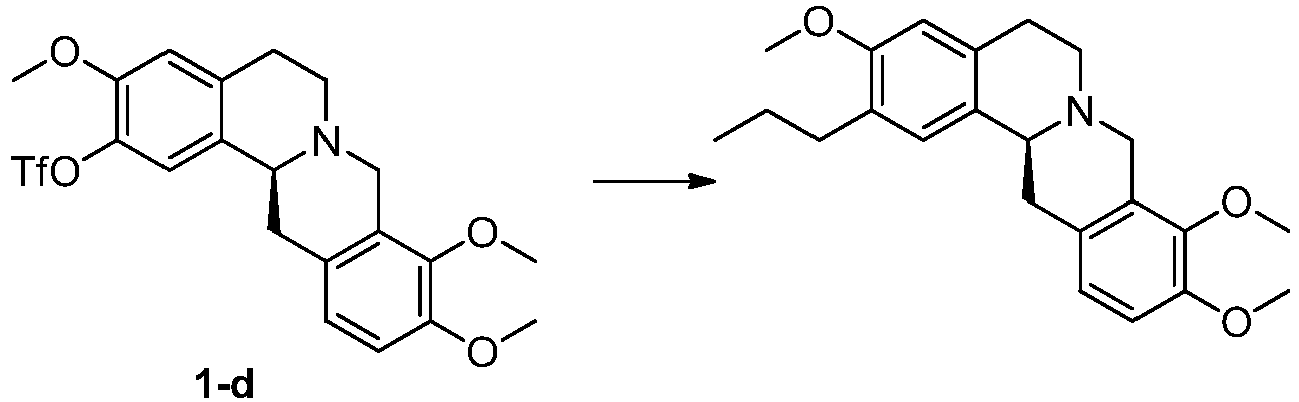
- The title compound was prepared from 1-d and propylboronic acid, with reference to the method for synthesizing the product of Example 1. That is, methylboronic acid (76 mg, 1.27 mmol) was replaced with propylboronic acid (111.6 mg, 1.27 mmol). The yield was 25%. 1H NMR (300MHz, CDCl3) δ 0.96 (t, 3H), 1.54-1.65 (m, 2H), 2.52-2.90 (m, 5H), 3.11-3.35 (m, 3H), 3.49-3.63 (m, 2H), 3.80 (s, 3H), 3.85 (s, 6H), 4.27 (d, 1H), 6.58 (s, 1H), 6.79 (d, 1H), 6.88 (d, 1H), 7.00 (s, 1H). ESI-MS m/z 368.2 (M+H)+.
-

- The title compound was prepared from 1-d and isobutylboronic acid, with reference to the method for synthesizing the product of Example 1. That is, methylboronic acid (76 mg, 1.27 mmol) was replaced with isobutylboronic acid (129.5 mg, 1.27 mmol). The yield was 28%. ESI-MS m/z 382.29 (M+H)+.
-

- DMAc (15 ml), zinc cyanide (328 mg, 2.78 mmol), zinc powder (28 mg, 0.41 mmol), DPPF (155 mg, 0.27 mmol) and Pd2(dba)3 (80 mg, 0.13 mmol) were added into 1-d (660 mg, 1.39 mmol). The mixture was heated at 160 °C overnight. DMAc was concentrated, and the resultant was extracted with dichloromethane-water, washed with saturated brine, dried, concentrated, and subjected to column chromatography to obtain the title compound (450 mg, yield: 92%). 1H NMR (300MHz, DMSO-d6) δ 2.42-2.62(m, 2H), 2.81(d, 1H), 2.97-3.20(m, 2H), 3.35-3.50(m, 3H), 3.72(s, 3H), 3.77(s, 3H), 3.88(s, 3H), 4.07(d, 1H), 6.87(two d peaks), 7.01 (s, 1H), 7.74(s, 1H). ESI-MS m/z 350.7 (M+H)+.
-

- DMSO (3 ml), hydrogen peroxide (3 ml) and sodium hydroxide (75 mg, 1.82 mmol) were added into the product of Example 4 (320 mg, 0.91 mmol). The mixture was heated at 70 °C for 2 h. The saturated ammonium chloride solution was used to adjust the pH of the mixture to alkalescency. The resulting mixture was extracted with dichloromethane-water, washed with saturated brine, dried, concentrated, and subjected to column chromatography to obtain the title compound (130 mg, yield: 38%). 1H NMR (300MHz, CD3OD) δ 2.59-2.95(m, 3H), 3.11-3.29(m, 2H), 3.40-3.61(m, 3H), 3.81(s, 3H), 3.82(s, 3H), 3.95(s, 3H), 4.21(d, 1H), 6.91(m, 3H), 7.97(s, 1H). ESI-MS m/z 369.1 (M+H)+.
-

- Dichloromethane (2 ml) was added into the product of Example 4 (500 mg, 1.42 mmol), and then DIBAL (2.8 ml) was added under an ice bath. The reaction was kept under an ice bath for 3h. 1M hydrochloric acid was used to adjust the pH of the mixture to around 5. The resulting mixture was extracted with dichloromethane-water, washed with saturated brine, dried, concentrated, and subjected to column chromatography to obtain the title compound (390 mg, yield: 77%). 1H NMR (300MHz, DMSO-d6) δ 2.59-2.87 (m, 3H), 3.17-3.28 (m, 2H), 3.39 (dd, 1H), 3.48-3.61 (m, 2H), 3.85 (s, 6H), 3.92 (s, 3H), 6.73 (s, 1H), 6.79 (d, 1H), 6.88 (d, 1H), 7.75 (s, 1H), 10.42 (s, 1H).
-

- Methanol (3 ml) and sodium borohydride (84 mg) were added into the product of Example 6 (390 mg, 1.10 mmol). The mixture was stirred at room temperature for 30 min. Methanol was concentrated, and the resulting mixture was extracted with dichloromethane-water, washed with saturated brine, dried, concentrated, and subjected to column chromatography to obtain the title compound (210 mg, yield: 53%). 1H NMR (300MHz, DMSO-d 6) δ 2.41-2.75 (m, 3H), 2.91-3.17 (m, 2H), 3.24-3.47 (m, 3H), 3.72 (s, 3H), 3.74 (s, 3H), 3.77 (s, 3H), 4.07 (d, 1H), 4.45 (d, 1H), 4.94 (t, 1H), 6.67 (s, 1H), 6.88 (s, 2H), 7.28 (s, 1H). ESI-MS m/z 355.6 (M+H)+.
-

- 30% hydrogen peroxide solution (10 ml), 10M sodium hydroxide solution (5 ml) and ethanol (5 ml) were added into the product of Example 4 (400 mg, 1.14 mmol). The mixture was heated to reflux for 72 h. Most parts of the solvent were distilled off, and the concentrated hydrochloric acid was used to adjust the pH of the mixture to subacidity. The resulting mixture was extracted with dichloromethane-water, washed with saturated brine, dried, concentrated, and subjected to column chromatography to obtain the title compound (150 mg, yield: 35%). 1H NMR (300MHz, CDCl3) δ 2.59-2.89 (m, 3H), 3.17-3.32 (m, 2H), 3.42 (dd, 1H), 3.50-3.63 (m, 2H), 3.85 (s, 6H), 4.07 (s, 3H), 4.26 (d, 1H), 6.77-6.83 (m, 2H), 6.88 (d, 1H), 8.10 (s, 1H). ESI-MS m/z 369.5 (M+H)+, 367.8 (M-H)-.
-

- Ethanol (3 ml) was added into the product of Example 8 (137 mg, 0.37 mmol), and sulfoxide chloride (0.08 ml, 1.11 mmol) was added at room temperature. The mixture was heated to reflux for 2 h. The solvents were distilled off. The resulting mixture was extracted with dichloromethane-saturated sodium bicarbonate solution, washed with saturated brine, dried, concentrated, and subjected to column chromatography to obtain the title compound (50 mg, yield: 34%). 1H NMR (300MHz, CDCl3) δ 1.39 (t, 3H), 2.57-2.87 (m, 3H), 3.14-3.27 (m, 2H), 3.33 (dd, 1H), 3.48-3.60 (m, 2H), 3.85 (s, 6H), 3.88 (s, 3H), 4.24 (d, 1H), 4.36 (q, 2H), 6.71 (s, 1H), 6.78 (d, 1H), 6.89 (d, 1H), 7.71 (s, 1H). ESI-MS m/z 398.1 (M+H)+.
-

- THF (2 ml) and borane-tetrahydrofuran solution (1.2 ml) were added into the product of Example 4 (150 mg, 0.42 mmol). The mixture was heated to reflux overnight. 1M hydrochloric acid was added thereto to adjust pH to around 2. The mixture was heated at 100 °C for 1h. The sodium bicarbonate solution was used to adjust the pH of the mixture to alkalescency. The resulting mixture was extracted with dichloromethane-water, dried, concentrated, and subjected to column chromatography to obtain the title compound (50 mg, yield: 33%). 1H NMR (300MHz, DMSO-d 6) δ 2.98 (d, 1H), 3.26 (t, 1H), 3.69-4.04 (m, 13H), 4.24-4.79 (m, 3H), 6.96 (s, 1H), 6.97 (d, 1H), 7.08 (d, 1H), 7.63 (s, 1H), 8.42 (brs, 2H), 12.08 (s, 1H). ESI-MS m/z 355.0 (M+H)+.
-

- Dichloromethane (1.5 ml), triethylamine (0.09 ml, 0.63 mmol) and acetic anhydride (0.04 ml, 0.42 mmol) were added into the product of Example 10 (75 mg, 0.21 mmol). The mixture was stirred at room temperature for 1h. The resulting mixture was extracted with dichloromethane-water, dried, concentrated, and subjected to column chromatography to obtain the title compound (20 mg, yield: 24%). 1H NMR (300MHz, CDCl3) δ 1.97 (s, 3H), 2.56-2.85 (m, 3H), 3.12-3.37 (m, 3H), 3.47-3.59 (m, 2H), 3.85 (s, 9H), 4.24 (d, 1H), 4.41 (d, 2H), 6.01 (brs, 1H), 6.62 (s, 1H), 6.79 (d, 1H), 6.88 (d, 1H), 7.17 (s, 1H). ESI-MS m/z 397.0 (M+H)+.
-

- 1M methyl magnesium bromide (5 ml) was added into the product of Example 4 (250 mg, 0.71 mmol). The mixture was heated to reflux overnight. The resulting mixture was extracted with dichloromethane-water, washed with saturated brine, dried, concentrated, and subjected to column chromatography to obtain the title compound (20 mg, yield: 7%). 1H NMR (300MHz, CDCl3) δ 2.57-2.86 (m, 3H), 2.62 (s, 3H), 3.15-3.31 (m, 3H), 3.39 (dd, 1H), 3.48-3.62 (m, 2H), 3.85 (s, 6H), 3.90 (s, 3H), 4.26 (d, 1H), 6.71 (s, 1H), 6.79 (d, 1H), 6.88 (d, 1H), 7.70 (s, 1H). ESI-MS m/z 368.2 (M+H)+.
-

- 1-d (2 g, 4.22 mmol) was place in a double-necked flask. Thereto, cesium carbonate (3.4 g, 10.5 mmol), palladium acetate (189 mg, 0.84 mmol), BINAP (789 mg, 1.26 mmol), and toluene (15 ml) were added. After completion of nitrogen replacement for 15 min, benzylamine (0.92 ml, 8.44 mmol) was added thereto. The reaction was performed at 110 °C overnight. Toluene was concentrated. Dichloromethane was added to dissolve the product. The insoluble matter was removed by filtration. The filtrate was extracted with dichloromethane-water, washed with saturated brine, dried, concentrated, and subjected to column chromatography to obtain 13-a (400 mg, yield: 22%). ESI-MS m/z 430.8 (M+H)+.
- Methanol (5 ml), palladium on carbon (40 mg) and ammonium formate (293 mg, 4.65 mmol) were added into 13-a (400 mg, 0.93 mmol). The mixture was heated to reflux for 2 h. The palladium on carbon was filtered off, and the methanol was distilled off. The resulting mixture was extracted with dichloromethane-water, washed with saturated brine, dried, concentrated, and subjected to column chromatography to obtain oily product. HCl-EtOH was added thereto to form a salt so as to obtain the title compound as a yellow solid (225 mg, yield: 64%). 1H NMR (300MHz, DMSO-d 6) δ 2.98 (d, 1H), 3.17 (t, 1H), 3.48 (m, 2H), 3.69-3.96 (m, 11H), 4.38 (d, 1H), 4.62 (d, 1H), 4.75 (d, 1H), 6.94-7.15 (m, 3H), 7.45 (s, 1H), 9.75 (brs, 2H), 11.99 (s, 1H). ESI-MS m/z 341.3 (M+H)+.
-

- The title compound was prepared from the product of Example 13 and acetic anhydride, with reference to the method for synthesizing the product of Example 11. That is, the product of Example 10 (75 mg, 0.21 mmol) was replaced with the product of Example 13 (72 mg, 0.21 mmol). The yield was 38%. 1H NMR (300MHz, CDCl3) δ 2.19 (s, 3H), 2.61-2.93 (m, 3H), 3.15-3.31 (m, 2H), 3.39 (dd, 1H), 3.51-3.69 (m, 2H), 3.83 (s, 6H), 3.86 (s, 3H), 6.60 (s, 1H), 6.78 (d, 1H), 6.87 (d, 1H), 7.72 (brs, 1H), 8.32 (s, 1H). ESI-MS m/z 383.1 (M+H)+.
-

- Lithium chloride (135 mg, 3.15 mmol), tetrakis(triphenylphosphine)palladium (80 mg, 0.063 mmol), hexabutylditin (0.65 ml, 1.26 mmol) and 1,4-dioxane (2 ml) were added into 1-d (300 mg, 0.63 mmol). The mixture was heated to reflux overnight after nitrogen replacement. The solvent was distilled off. The resulting mixture was extracted with dichloromethane-water, dried, concentrated, and subjected to column chromatography to obtain 15-a (132 mg, yield: 33%). ESI-MS m/z 615.4 (M+H)+.
- Dichloromethane (3 ml) was added into 15-a (110 mg, 0.17 mmol), and then NBS (40 mg, 0.22 mmol) was added under an ice bath. The mixture was stirred for 5 min. Dichloromethane and water were added for extraction, and the mixture was washed with saturated brine, dried, and concentrated and subjected to column chromatography to obtain the title compound (56 mg, yield: 77%). 1H NMR (300MHz, CDCl3) δ 2.56-2.87 (m, 3H), 3.09-3.31 (m, 3H), 3.48-3.58 (m, 2H), 3.85 (s, 6H), 3.88 (s, 3H), 4.24 (d, 1H), 6.65 (s, 1H), 6.79 (d, 1H), 6.88 (d, 1H), 7.42 (s, 1H). ESI-MS m/z 403.6 (M+H)+.
-
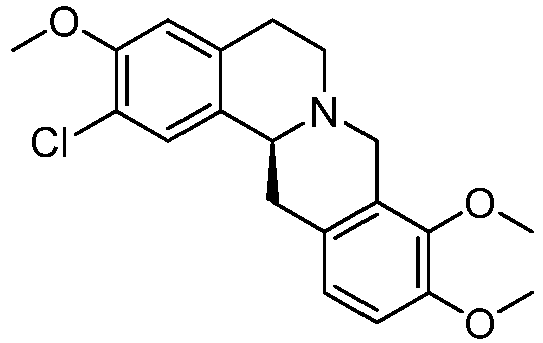
- The title compound was prepared by reacting 15-a with NCS, with reference to the method for synthesizing the product of Example 15. That is, NBS (40 mg, 0.22 mmol) was replaced with NCS (29 mg, 0.22 mmol). The yield was 35%. ESI-MS m/z 360.7 (M+H)+.
-

- Dry DMF (15 ml), lithium chloride (270 mg, 5.07 mmol), bis(triphenylphosphine)palladium dichloride (25 mg, 0.03 mmol) and tributylvinyltin (0.6 ml, 2.02 mmol) were added into 1-d (800 mg, 1.69 mmol). The mixture was heated to reflux overnight after nitrogen replacement. DMF was distilled off. The resultant was extracted with dichloromethane-water, dried, concentrated, and subjected to column chromatography to obtain the title compound (275 mg, yield: 46%). 1H NMR (300MHz, CDCl3) δ 2.62-2.92 (m, 3H), 3.15-3.29 (m, 2H), 3.35 (dd, 1H), 3.51-3.65 (m, 2H), 3.84 (s, 3H), 3.86 (s, 6H), 4.27 (d, 1H), 5.25 (d, 1H), 5.73 (d, 1H), 6.62 (s, 1H), 6.80 (d, 1H), 6.90 (d, 1H), 7.02 (dd, 1H), 7.34 (s, 1H). ESI-MS m/z 352.0 (M+H)+.
-

- THF (1 ml) and a 1M borane-tetrahydrofuran solution (1.7 ml, 1.68 mmol) were added into the product of Example 17 (200 mg, 0.56 mmol). The mixture was stirred at room temperature overnight. Water (2 ml), 1M sodium hydroxide solution (6 ml) and 30% hydrogen peroxide (1.2 ml) were added thereto. The mixture was heated at 65 °C for 2 h. The saturated ammonium chloride solution was used to adjust the pH of the mixture to alkalescency. The resulting mixture was extracted with dichloromethane-water, dried over anhydrous sodium sulfate, concentrated, and subjected to column chromatography to obtain the title compound (60 mg, yield: 28%). 1H NMR (300MHz, CDCl3) δ 2.58-2.93 (m, 5H), 3.12-3.36 (m, 3H), 3.49-3.60 (m, 2H), 3.83 (s, 3H), 3.86 (s, 6H), 3.80-3.88 (m, 2H), 4.25 (d, 1H), 6.62 (s, 1H), 6.80 (d, 1H), 6.89 (d, 1H), 7.05 (s, 1H). ESI-MS m/z 370.1 (M+H)+.
-

- D-Tetrahydropalmatine 19-a (10 g, 28.1 mmol) was dissolved in methanesulfonic acid (12 mL). Thereto, methionine (5 g, 30.9 mmol) was added. The reaction was performed at 30 °C for 3 h. The reaction solution was slowly added to the NaOH solution under an ice bath, and the pH of the mixture was adjusted to 13. The raw materials were filtered off with suction. The filtrate was extracted with dichloromethane several times. The organic phase was combined, and washed with water, brine, dried over anhydrous sodium sulfate, and concentrated. The crude product was subjected to recrystallization in methanol to give 19-b as a white solid (1.59 g, 16% yield). 1H NMR (300MHz, CDCl3) δ 2.58-2.72 (m, 2H), 2.83 (dd, 1H), 3.07-3.30 (m, 3H), 3.47-3.62 (m, 2H), 3.87 (s, 6H), 3.89 (s, 3H), 4.24 (d, 1H), 5.68 (s, 1H), 6.62 (s, 1H), 6.68 (d, 1H), 6.74 (m, 2H). ESI-MS m/z 342.3 (M+H)+.
- Dichloromethane (5 ml) and triethylamine (0.82 ml, 5.8 mmol) were added into 19-b (1 g, 2.9 mmol), and then Tf2O (0.58 ml, 3.48 mmol) was slowly added dropwise under an ice bath. After completion of addition, the mixture was stirred for 3h at room temperature. The resultant was extracted with dichloromethane-water, washed with saturated brine, dried over anhydrous sodium sulfate, concentrated, and subjected to column chromatography to obtain 19-c (0.8 g, yield: 57%).
- The title compound was prepared from the 19-c via cyanation reaction, with reference to the method for synthesizing the product of Example 4. That is, 1-d (660 mg, 1.39 mmol) was replaced with 19-c (660 mg, 1.39 mmol). The yield was 50 %. 1H NMR (300MHz, CDCl3) δ 2.60-2.73 (m, 2H), 2.82 (dd, 1H), 3.05-3.32 (m, 3H), 3.60 (dd, 1H), 3.73 (d, 1H), 3.87 (s, 3H), 3.88 (s, 3H), 3.92 (s, 3H), 6.63 (s, 1H), 6.70 (s, 1H), 6.81 (d, 1H), 7.33 (d, 1H). ESI-MS m/z 351.0 (M+H)+.
-

- The title compound was prepared from the product of Example 19, with reference to the method for synthesizing the product of Example 5. That is, the product of Example 4 (320 mg, 0.91 mmol) was replaced with the product of Example 19 (320 mg, 0.91 mmol). The yield was 40 %. 1H NMR (300MHz, CDCl3) δ 2.63 (m, 2H), 2.83 (dd, 1H), 3.10 (m, 2H), 3.30 (dd, 1H), 3.58 (dd, 1H), 3.85 (m, 10H), 4.13 (d, 1H), 5.86 (s, 1H), 6.08 (s, 1H), 6.60 (s, 1H), 6.72 (s, 1H), 6.80 (d, 1H), 7.17 (d, 1H). ESI-MS m/z 369.2 (M+H)+.
-

- The title compound was prepared from the product of Example 19, with reference to the method for synthesizing the product of Example 12. That is, the product of Example 4 (250 mg, 0.71 mmol) was replaced with the product of Example 19 (250 mg, 0.71 mmol). The yield was 33%. 1H NMR (300MHz, CDCl3) δ 2.51 (s, 3H), 2.63 (m, 2H), 2.84 (dd, 1H), 3.11 (m, 2H), 3.30 (dd, 1H), 3.57 (dd, 1H), 3.68 (d, 1H), 3.85 (m, 10H), 6.60 (s, 1H), 6.72 (s, 1H), 6.80 (d, 1H), 7.16 (d, 1H). ESI-MS m/z 368.1 (M+H)+.
-

- The title compound was prepared from the product of Example 19 via cyanation reduction, with reference to the method for synthesizing the product of Example 10. That is, the product of Example 4 (150 mg, 0.42 mmol) was replaced with the product of Example 19 (150 mg, 0.42 mmol). The yield was 50 %.
-

- The title compound was prepared from the product of Example 22 via acetylation, with reference to the method for synthesizing the product of Example 11. That is, the product of Example 10 (75 mg, 0.21 mmol) was replaced with the product of Example 22 (75 mg, 0.21) mmol). The yield was 80 %. 1H NMR (300MHz, CDCl3) δ 1.93 (s, 3H), 2.64 (m, 2H), 2.84 (dd, 1H), 3.04-3.32 (m, 3H), 3.54 (d, 1H), 3.66 (d, 1H), 3.84 (s, 3H), 3.86 (s, 3H), 3.88 (s, 3H), 4.32 (d, 1H), 4.44 (m, 2H), 5.77 (t, 1H), 6.61 (s, 1H), 6.71 (s, 1H), 6.77 (d, 1H), 7.10 (d, 1H). ESI-MS m/z 397.1 (M+H)+.
-

- The title compound was prepared from the product of Example 19, with reference to the method for synthesizing the product of Example 6. That is, the product of Example 4 (500 mg, 1.42 mmol) was replaced with the product of Example 19 (500 mg, 1.42 mmol). The yield was 49%. 1H NMR (300MHz, CDCl3) δ 2.58-2.75 (m, 2H), 2.87 (t, 1H), 3.02-3.33 (m, 4H), 3.57 (d, 1H), 3.86 (s, 3H), 3.87 (s, 3H), 3.90 (s, 3H), 4.61 (d, 1H), 6.61 (s, 1H), 6.71 (s, 1H), 6.87 (d, 1H), 7.35 (d, 1H), 10.63 (s, 1H). ESI-MS m/z 354.3 (M+H)+.
-
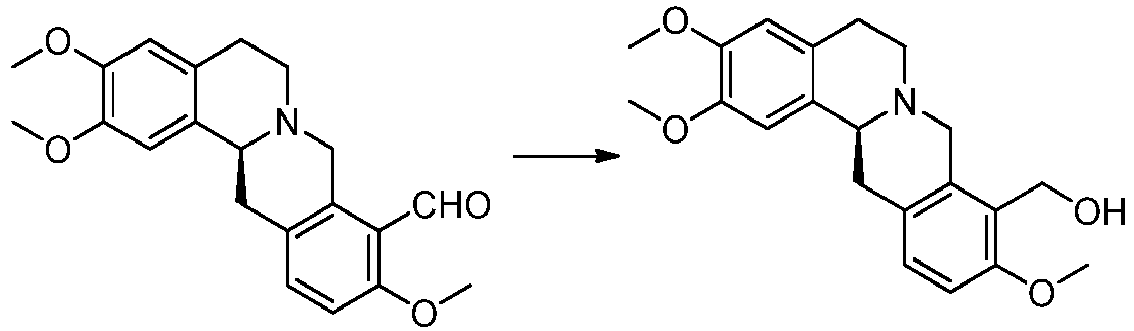
- The title compound was prepared from the product of Example 24, with reference to the method for synthesizing the product of Example 7. That is, the product of Example 6 (390 mg, 1.10 mmol) was replaced with the product of Example 24 (390 mg, 1.10 mmol). The yield was 69%. 1H NMR (300MHz, CD3OD) δ 3.10 (t, 2H), 3.27 (m, 2H), 3.58 (td, 1H), 3.78-3.97 (m, 11H), 4.67 (m, 2H), 4.74-4.84 (m, 2H), 6.84 (s, 1H), 6.98 (s, 1H), 7.06 (d, 1H), 7.30 (d, 1H). ESI-MS m/z 356.1 (M+H)+.
-

- Dichloromethane (5 ml) and triethylamine (0.67 ml, 4.8 mmol) were added into 1-a (1 g, 2.4 mmol), and then Tf2O (0.48 ml, 2.88 mmol) was slowly added dropwise under an ice bath. After completion of addition, the mixture was stirred for 3h at room temperature. The resultant was extracted with dichloromethane-water, washed with saturated brine, dried over anhydrous sodium sulfate, concentrated, and subjected to column chromatography to obtain 26-a (0.74 g, yield: 56%).
- 26-a (500 mg, 0.91 mmol) was placed in a three-necked flask. Thereto, methylboronic acid (218 mg, 3.64 mmol), potassium carbonate (502 mg, 3.64 mmol), and tetrakis(triphenylphosphonium)palladium (210 mg , 0.182 mmol) and 1,4-dioxane (5 mL) were added. The mixture was refluxed at 100 °C overnight after nitrogen replacement. The reaction solution was filtered, and the filtrate was concentrated and subjected to column chromatography to obtain 26-b (75 mg, yield: 20%).
- 26-b (75 mg, 0.180 mmol) was dissolved in ethyl acetate (2 mL). Thereto, palladium on carbon (10 mg) was added. The hydrogenation reaction was performed for 10 h. The resulting mixture was filtered and the mother liquor was concentrated to give 26-c (53 mg, yield: 90%). 1H NMR (300MHz, CDCl3) δ 2.27 (s, 3H), 2.59-2.71 (m, 2H), 2.85 (dd, 1H), 3.08-3.23 (m, 2H), 3.27 (dd, 1H), 3.55 (d, 2H), 3.75 (s, 3H), 3.88 (s, 3H), 4.23 (d, 1H), 6.60 (s, 1H), 6.82 (s, 1H), 6.84 (d, 1H), 7.00 (d, 1H). ESI-MS m/z 326.2 (M+H)+.
- The title compound was prepared from the 26-c and dimethyl sulfate via methylation reaction, with reference to the method for synthesizing the compound 1-b. That is, 1-a was replaced with 26-c. The yield was 40%. 1H NMR (300MHz, CDCl3) δ 2.27 (s, 3H), 2.61-2.72 (m, 2H), 2.87 (dd, 1H), 3.11-3.25 (m, 2H), 3.29 (dd, 1H), 3.58 (d, 2H), 3.76 (s, 3H), 3.87 (s, 3H), 3.89 (s, 3H), 4.24 (d, 1H), 6.62 (s, 1H), 6.74 (s, 1H), 6.86 (d, 1H), 7.01 (d, 1H). ESI-MS m/z 340.3 (M+H)+.
-

- DMAc (15 ml), zinc cyanide (214 mg, 1.82 mmol), zinc powder (18 mg, 0.27 mmol), DPPF (101 mg, 0.18 mmol) and Pd2(dba)3 (83 mg, 0.09 mmol) were added into 26-a (500 mg, 0.91 mmol). The mixture was heated at 160 °C overnight. DMAc was distilled off, and the resulting mixture was extracted with dichloromethane-water, washed with saturated brine, dried, concentrated and subjected to column chromatography to give 27-a (348 mg, yield: 92%).
- 27-a (300 mg, 0.70 mmol) was dissolved in ethanol (4 mL). Thereto, 2 ml of concentrated hydrochloric acid was added, and the reaction was performed at 100 °C for 1 h. The solvent was directly distilled off to obtain compound 27-b (236 mg, yield: 90%).
- 27-b (250 mg, 0.67 mmol) was dissolved in acetone (4 mL). Thereto, dimethyl sulfate (0.095 mL, 1.01 mmol) and sodium hydroxide (107 mg, 2.68 mmol) were added. The reaction was performed at room temperature for 6 hours while stirring. The resultant was extracted with dichloromethane, washed with a saturated ammonium chloride solution. The organic phase was combined, washed with saturated brine, dried over anhydrous sodium sulfate, concentrated, and subjected to silica gel column chromatography to obtain the title compound (200 mg, yield: 85%). 1H NMR (300MHz, CDCl3) δ 2.60-2.73 (m, 2H), 2.91 (dd, 1H), 3.05-3.24 (m, 2H), 3.34 (dd, 1H), 3.49 (d, 1H), 3.59 (dd, 1H), 3.87 (s, 3H), 3.88 (s, 3H), 4.08 (s, 3H), 4.19 (d, 1H), 6.62 (s, 1H), 6.69 (s, 1H), 6.96 (d, 1H), 7.38 (d, 1H). ESI-MS m/z 351.0 (M+H)+.
-

- The title compound was prepared from the product of Example 27 via oxidative hydrolysis, in reference to the method for synthesizing the product of Example 5. That is, the product of Example 4 (320 mg, 0.91 mmol) was replaced with the product of Example 27 (320 mg, 0.91 mmol). The yield was 54%. 1H NMR (300MHz, CDCl3) δ 2.69 (m, 2H), 2.94 (m, 1H), 3.06-3.28 (m, 2H), 3.38 (dd, 1H), 3.60 (m, 2H), 3.84 (s, 3H), 3.87 (s, 3H), 3.89 (s, 3H), 4.26 (d, 1H), 5.87 (s, 1H), 6.63 (s, 1H), 6.72 (s, 1H), 7.08 (d, 1H), 7.57 (s, 1H), 7.90 (d, 1H). ESI-MS m/z 369.0 (M+H)+.
-

- The title compound was prepared from the product of Example 27 via reduction reaction, in reference to the method for synthesizing the product of Example 6. That is, the product of Example 4 (500 mg, 1.42 mmol) was replaced with the product of Example 27 (500 mg, 1.42 mmol). The yield was 64%. 1H NMR (300MHz, CD3OD) δ 2.62-2.78 (m, 2H), 2.85 (dd, 1H), 3.02-3.27 (m, 2H), 3.54-3.72 (m, 3H), 3.80 (s, 3H), 3.83 (s, 3H), 3.93 (s, 3H), 4.27 (d, 1H), 6.71 (s, 1H), 6.89 (s, 1H), 7.16 (d, 1H), 7.67 (d, 1H), 10.27 (s, 1H). ESI-MS m/z 354.0 (M+H)+.
-

- The title compound was prepared from the product of Example 29 via reduction reaction, in reference to the method for synthesizing the product of Example 7. That is, the product of Example 6 (390 mg, 1.10 mmol) was replaced with the product of Example 29 (390 mg, 1.10 mmol). The yield was 80%. 1H NMR (300MHz, CD3OD) δ 2.60-2.87 (m, 3H), 3.02-3.28 (m, 2H), 3.46-3.66 (m, 3H), 3.78 (s, 3H), 3.80 (s, 3H), 3.82 (s, 3H), 4.22 (d, 1H), 4.64 (s, 2H), 6.71 (s, 1H), 6.88 (s, 1H), 7.01 (d, 1H), 7.28 (d, 1H). ESI-MS m/z 356.0 (M+H)+.
-

- The title compound was prepared from the product of Example 27 via reduction reaction, in reference to the method for synthesizing the product of Example 10. That is, the product of Example 4 (150 mg, 0.42 mmol) was replaced with the product of Example 27 (150 mg, 0.42 mmol). The yield was 60%. 1H NMR (300MHz, CDCl3) δ 2.64∼2.88 (m, 3H), 3.10∼3.30 (m, 3H), 3.60 (d, 2H), 3.74 (d, 1H), 3.82 (s, 3H), 3.86 (s, 3H), 3.88 (s, 3H), 4.31-4.51 (m, 3H), 6.61 (s, 1H), 6.72 (s, 1H), 6.77 (d, 1H), 7.11 (d, 1H). ESI-MS m/z 355.0 (M+H)+.
-

- The title compound was prepared by reacting the product of Example 31 with acetic anhydride, in reference to the method for synthesizing the product of Example 11. That is, the product of Example 10 (75 mg, 0.21 mmol) was replaced with the product of Example 31 (75 mg, 0.21 mmol). The yield was 67%. 1H NMR (300MHz, CDCl3) δ 1.99 (s, 3H), 2.68 (m, 2H), 2.88 (dd, 1H), 3.14-3.37 (m, 3H), 3.59 (m, 2H), 3.79 (s, 3H), 3.87 (s, 3H), 3.89 (s, 3H), 4.23 (d, 1H), 4.45 (m, 2H), 5.86 (t, 1H), 6.62 (s, 1H), 6.72 (s, 1H), 6.93 (d, 1H), 7.12 (d, 1H). ESI-MS m/z 397.0 (M+H)+.
-

- Dichloromethane (5 ml) and pyridine (1.25 ml, 15 mmol) were added into l-SPD (1 g, 3.0 mmol), and then Tf2O (1.5 ml, 9.0 mmol) was slowly added dropwise under an ice bath. After completion of addition, the mixture was stirred for 1h at room temperature. Pyridine was washed off with 1M hydrochloric acid. The resultant was extracted with dichloromethane-water, dried, concentrated, and subjected to column chromatography to obtain 33-a (1 g, yield: 60%). 1H-NMR (300Hz, CDC13) δ 2.59-2.94 (m, 3H), 3.10-3.31 (m, 3H), 3.58 (m, 2H), 3.90 (s, 6H), 4.23 (d, 1H), 6.78 (s, 1H), 6.98 (d, 1H), 7.06 (s, 1H), 7.09 (d, 1H). ESI-MS m/z 592.0 (M+H)+.
- DMF (10 ml), cesium carbonate (1.32 g), palladium acetate (184 mg) and X-phos (132 mg) were added into 33-a (800 mg, 1.35 mmol). After completion of nitrogen replacement for 15 min, benzylamine (0.372 ml) was added thereto. The reaction was performed at 150 °C for 3h while heating. DMF was distilled off. The resultant was extracted with dichloromethane-water, washed with saturated brine, dried, concentrated, and subjected to column chromatography to obtain 33-b (180 mg, yield: 26%). ESI-MS m/z 506.4 (M+H)+.
- Palladium on carbon (40 mg), methanol (3 ml) and ammonium formate (436 mg, 6.8 mmol) were added into 33-b (175 mg, 0.34 mmol). The mixture was heated to reflux overnight. The palladium on carbon was filtered off, and methanol was distilled off. The resulting mixture was extracted with dichloromethane-water, dried, concentrated, and subjected to column chromatography to obtain the title compound (53 mg, yield: 47%). 1H-NMR (300Hz, CD3OD) δ 2.72-2.95 (m, 3H), 3.06-3.28 (m, 3H), 3.42 (m, 2H), 3.77 (s, 3H), 3.85 (s, 3H), 4.35 (d, 1H), 6.64 (s, 1H), 6.75 (m, 2H), 6.81 (d, 1H). ESI-MS m/z 326.2 (M+H)+.
-

- The title compound was prepared from the product of Example 33 and acetic anhydride, in reference to the method for synthesizing the product of Example 11. That is, the product of Example 10 (75 mg, 0.21 mmol) was replaced with the product of Example 33 (69 mg, 0.21 mmol). The yield was 34%. 1H-NMR (300Hz, CDC13) δ 2.20 (s, 6H), 2.57-2.89 (m, 3H), 3.09-3.26 (m, 2H), 3.41 (d, 1H), 3.51-3.65 (m, 2H), 3.78 (s, 3H), 3.87 (s, 3H), 4.20 (d, 1H), 6.61 (s, 1H), 6.94 (d, 1H), 7.58 (s, 1H), 7.73 (s, 1H), 8.09 (d, 1H), 8.32 (s, 1H). ESI-MS m/z 409.9 (M+H)+.
-

- 35-a (10 g, 29.4 mmol) was dissolved in dichloromethane (300 ml). Thereto, a solution of BCl3 in dichloromethane (59 ml, 58.8 mmol) was added dropwise under an ice bath. The mixture was stirred at room temperature overnight. The next day, methanol (100 ml) was added dropwise to quench the excessive BCl3. The solvent was evaporated and the resultant was directly subjected to the next reaction.
- 35-b (9 g, 27.5 mmol) was suspended in dichloromethane (100 ml). Thereto, pyridine (20 ml) was added, and then trifluoromethanesulfonic anhydride (10 ml) was added dropwise under an ice bath, and the mixture was stirred at room temperature for 5h. Dichloromethane was added for dilution. The mixture was washed with a 1M HCl solution and saturated brine. The organic layer was dried and concentrated, and subjected to column chromatography to obtain 35-c (3 g, 17% of yield in two steps).
- Zinc cyanide (1.6 g, 13.6 mmol), 1,1-bisdiphenylphosphine ferrocene (383 mg, 0.69 mmol), zinc powder (110 mg, 1.69 mmol), Pd2(dba)3 (273 mg, 0.47 mmol) and DMAc (10 ml) were added into 35-c (2.7 g, 4.5 mmol). The mixture was refluxed at 160 °C for 2h after nitrogen replacement, and cooled to room temperature. Thereto, water and ethyl acetate were added for extraction. The organic layer was combined, washed with saturated brine, dried, concentrated and subjected to column chromatography to obtain the title compound (1 g, yield: 63%). 1H NMR (300MHz, CDCl3) δ 2.59-2.71 (m, 1H), 2.77-2.94 (m, 2H), 3.17-3.33 (m, 3H), 3.58 (d, 1H), 3.67 (dd, 1H), 3.85 (s, 6H), 4.26 (d, 1H), 6.81 (d, 1H), 6.89 (d, 1H), 7.59 (s, 1H), 7.71 (s, 1H). ESI-MS m/z 346.3 (M+H)+.
-

- The sodium metal (170 mg, 7.3 mmol) was added to absolute ethanol (10 ml). After completely dissolved, the product of Example 35 (200 mg, 0.57 mmol) was added. The mixture was heated at 50 °C for 2 h. The reaction solution was poured into a 10% HNO3 solution (10 ml), and stirred for 30 minutes. The solid was gradually precipitated therefrom. The mixture was filtered to obtain the product. The mother liquor was concentrated, extracted with ethyl acetate, and washed with saturated brine. The organic layer was dried, concentrated, subjected to column chromatographyto give the title compound (110 mg when combined with the filter cake, yield: 52%). 1H NMR (300MHz, CDCl3) δ 2.16-2.39 (m, 2H), 2.65 (t, 1H), 2.75-2.95 (m, 2H), 3.17 (t, 2H), 3.35 (d, 1H), 3.44 (s, 3H), 3.49 (s, 3H),3.82 (d, 1H), 6.60 (s, 2H), 7.30 (s, 1H), 7.51 (s, 1H), 10.93 (s, 1H). ESI-MS m/z 365.2 (M+H)+.
-

- The title compound was prepared from 33-a, in reference to the method for synthesizing the product of Example 35. That is, 35-c was replaced with 33-a. The yield was 74%. 1H NMR (300MHz, CDCl3) δ 2.58-2.94 (m, 3H), 3.13-3.38 (m, 3H), 3.48 (d, 1H), 3.58 (d, 1H), 3.91 (s, 3H), 4.09 (s, 3H), 4.19 (d, 1H), 6.71 (s, 1H), 6.96 (d, 1H), 7.41 (m, 2H). ESI-MS m/z 346.5 (M+H)+.
-

- The title compound was prepared from the product of Example 37 via oxidation hydrolysis reaction, in reference to the method for synthesizing the product of Example 5. That is, the product of Example 4 (0.91 mmol) was replaced with the product of Example 37 (0.91 mmol). The yield was 40%. 1H NMR (300MHz, CD3OD) δ 2.64-2.97 (m, 3H), 3.12-3.38 (m, 2H), 3.50-3.74 (m, 3H), 3.84 (s, 3H), 3.97 (s, 3H), 4.28 (d, 1H), 6.95 (s, 1H), 7.11 (d, 1H), 7.65 (d, 1H), 7.99 (s, 1H). ESI-MS m/z 382.1 (M+H)+.
-

- The title compound was prepared from the product of Example 35 via oxidation hydrolysis reaction, in reference to the method for synthesizing the product of Example 5. That is, the product of Example 4 (0.91 mmol) was replaced with the product of Example 35 (0.91 mmol). The yield was 42%. 1H NMR (300MHz, CD3OD) δ 2.61-2.92 (m, 3H), 3.18 (m, 2H), 3.47 (dd, 1H), 3.55 (d, 1H), 3.68 (dd, 1H), 3.82 (s, 3H), 3.83 (s, 3H), 4.23 (d, 1H),6.88 (d, 1H), 6.93 (d, 1H), 7.39 (s, 1H), 7.58 (s, 1H). ESI-MS m/z 382.1 (M+H)+.
-

- Dichloromethane (20 ml) and acetic acid (10 ml) were added into 1-c (4 g, 11.7 mmol), and then 30% nitric acid (4.6 ml) was added dropwise under an ice bath. The mixture was stirred at room temperature for 5 h. Dichloromethane-water was added for extraction. The organic phase was combined, washed three times with saturated brine, dried, and concentrated to obtain crude product 40-a (5 g), which was directly used in the next step.
- Dichloromethane (40 ml) and triethylamine (2.86 ml, 20.6 mmol) were added into 40-a (4 g, 10.3 mmol), and then Tf2O (1.7 ml, 10.3 mmol) was added dropwise under an ice bath. After completion of addition, the mixture was stirred at room temperature for 3h. Dichloromethane-water was added for extraction, and the mixture was washed with saturated brine, dried, concentrated, and subjected to column chromatography to give 40-b (2.4 g, 49% of yield in two steps). 1H NMR (300MHz, DMSO-d 6) δ 2.69-2.83 (m, 3H), 2.91-3.20 (m, 3H), 3.84 (d, 6H), 3.91 (d, 1H), 3.97 (s, 3H), 4.10 (t, 1H), 4.20 (d, 1H), 6.77 (s, 2H), 6.97 (s, 1H).
- Dry toluene (20 ml), cesium carbonate (2.26 g, 6.9 mmol), palladium acetate (104 mg, 0.46 mmol), BINAP (289 mg, 0.46 mmol) were added into 40-b (2.4 g, 4.6 mmol). After completion of nitrogen replacement, benzylamine (1 ml, 9.2 mmol) was added thereto. The mixture was heated to reflux for 3h. Toluene was distilled off. The resulting mixture was extracted with dichloromethane-water, washed with saturated brine, dried, concentrated, and subjected to column chromatography to obtain 40-c (1.4 g, yield: 63%).
- Methanol (15 ml), palladium on carbon (140 mg) and ammonium formate (1.85 g, 29 mmol) were added into 40-c (1.4 g, 2.9 mmol). The mixture was heated to reflux for 2h. The palladium on carbon was filtered, and methanol was distilled off. The resulting mixture was extracted with dichloromethane-water, washed with saturated brine, dried, concentrated, and formed into a salt by addition of HCl-MeOH to give 40-d as pale yellow solid (1 g, yield: 87%).
- Dichloromethane (2.5 ml) and triethylamine (0.3 ml, 2.1 mmol) were added into 40-d (164 mg, 0.42 mmol).Triphosgene (50 mg, 0.16 mmol) was dissolved in toluene (2.5 ml), and the mixture was slowly added into the above reaction solution by using a constant pressure dropping funnel. The mixture was stirred at room temperature for 2h. An appropriate amount of a saturated sodium bicarbonate solution was added thereto. Then the resulting mixture was extracted with dichloromethane-water, washed with saturated brine, dried, concentrated, and subjected to column chromatography to obtain the title compound (75 mg, yield: 46%). 1H NMR (300MHz, DMSO-d 6) δ 2.31-2.74 (m, 3H), 2.90-3.12 (m, 2H), 3.28-3.42 (m, 1H), 3.63 (t, 2H), 3.73 (s, 3H), 3.77 (s, 3H), 3.79 (s, 3H), 4.05 (d, 1H), 6.43 (s, 1H), 6.84 (d, 1H), 6.89 (d, 1H), 10.51 (s, 1H), 10.63 (s, 1H). ESI-MS m/z 382.2 (M+H)+, 380.2 (M-H)-.
-

- Water (2 ml), sodium hydroxide (51 mg, 1.26 mmol) and carbon disulfide (0.051 ml, 0.84 mmol) were added into 40-d (150 mg, 0.42 mmol). The mixture was heated at 80 °C for 1 h. Dichloromethane-water was added for extraction, and the mixture was washed with saturated brine, dried, concentrated, and subjected to column chromatography to obtain the title compound (100 mg, yield: 59%). 1H NMR (300MHz, CDCl3) δ 2.61-2.85 (m, 3H), 3.10-3.30 (m, 3H), 3.76 (m, 2H), 3.84 (s, 3H), 3.87 (s, 3H), 3.89 (s, 3H), 4.20 (d, 1H), 6.46 (s, 1H), 6.77 (m, 2H). ESI-MS m/z 398.3 (M+H)+.
-
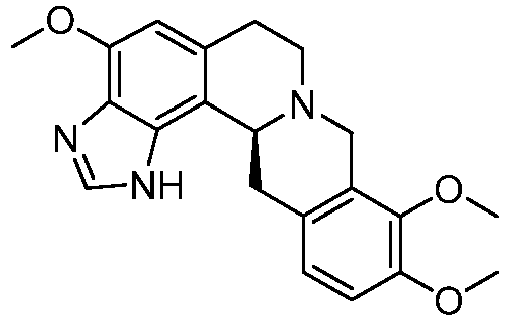
- Formic acid (3 ml) was added into 40-d (200 mg, 0.56 mmol). The mixture was heated to reflux for 1 h. The solvent was distilled off. The mixture was adjusted to be alkalescency by adding saturated sodium bicarbonate. The resulting mixture was extracted with dichloromethane-water, dried, concentrated, and subjected to column chromatography to obtain the title compound (90 mg, yield: 43%). 1H NMR (300MHz, CDC13) δ 2.68-2.88 (m, 3H), 3.19-3.39(m, 2H), 3.72(d, 1H), 3.84(s, 3H), 3.85(s, 3H), 3.95(s, 3H), 4.07(d, 2H), 4.29(d, 1H), 6.49(s, 1H), 6.76(d, 1H), 6.87(d, 1H), 7.93(s, 1H). ESI-MS m/z 366.1 (M+H)+.
-

- Water (2 ml) and acetic acid (0.42 ml, 7.28 mmol) were added into 40-d (200 mg, 0.56 mmol). The mixture was cooled to 0 °C under an ice bath. Sodium nitrite aqueous solution (containing 50 mg sodium nitrite) was added dropwise thereto. After reacting for 1h under an ice bath, the mixture was heated to 85 °C for 1 h. The mixture was adjusted to be alkalescency by adding saturated sodium bicarbonate. The resulting mixture was extracted with dichloromethane-water, dried, concentrated, and subjected to column chromatography to obtain the title compound (80 mg, yield: 38%). 1H NMR (300MHz, CDCl3) δ 2.70-2.87 (m, 3H), 3.22-3.39 (m, 2H), 3.69 (d, 1H), 3.85 (d, 6H), 3.99 (s, 3H), 4.05 (d, 1H), 4.14 (d, 1H), 4.30 (d, 1H), 6.53 (s, 1H), 6.77 (d, 1H), 6.88 (d, 1H). ESI-MS m/z 367.2 (M+H)+.
-

- The raw material 44-h can be prepared from p-hydroxyphenylacetonitrile via multi-step reaction, with reference to the patent document
CN102399166B or non-patent documents such as J. Org. Chem, 2009, 74, 9225-8228; Bioorg. Med. Chem. 2013, 21, 856-868. The title compound was prepared from the compound 44-h via method 5 (reaction formula 11). The specific operations are as follows: - Acetone (30 ml), potassium carbonate (6.2 g, 45 mmol) and benzyl bromide (3.2 ml) were added into p-hydroxyphenylacetonitrile 44-a (3 g, 22 mmol). The mixture was heated to reflux for 2h. Acetone was distilled off. The resulting mixture was extracted with dichloromethane-water, washed with saturated brine, dried, concentrated, and slurried in methanol, filtered to obtain 44-b as a white solid (3.8 g, yield: 76%). 1H NMR (300MHz, CDCl3) δ 3.68 (s, 2H), 5.07 (s, 2H), 6.97 (d, 2H), 7.23 (d, 2H), 7.29-7.47 (m, 5H).
- The sodium borohydride (1.3 g) was suspended in THF (5 ml). 2.66 ml of trifluoroacetic acid (diluted with 5 ml of THF) was slowly added dropwise to the sodium borohydride solution under an ice bath. After completion of addition, the mixture was increased to room temperature. 44-b (2 g) was dissolved in THF (5 ml), which was then slowly injected into the reaction system. Reaction was performed at room temperature for 4h. The reaction solution was slowly added dropwise into ice water and stirred. The resulting mixture was extracted with dichloromethane-water, dried, concentrated, formed into a salt by adding HCl-MeOH, concentrated, and slurried in acetone, filtered to obtain 44-c as a white solid (1 g, yield: 42%).
- Ethanol (20 ml) and triethylamine (2.4 ml) were added into 44-c (1.15 g, 4.4 mmol) and 44-d (0.92 g). The mixture was heated to reflux for 12 h. Ethanol was distilled off. The resulting mixture was extracted with dichloromethane-water, dried, concentrated, and slurried in petroleum ether/ethyl acetate, filtered to obtain 44-e (1.3 g, yield: 68%). ESI-MS m/z 436.3 (M+H)+.
- Toluene (30 ml) and phosphorus oxychloride (26 ml) were added into 44-e (10 g, 23.0 mmol). The mixture was heated to reflux for 4 h. The phosphorus oxychloride and toluene were distilled off. The residue was poured into ice water. Sodium carbonate solution was added to adjust pH = 7. The resulting mixture was extracted with ethyl acetate, dried, and concentrated. Thereto, methanol was added, and then sodium borohydride (3 g) was added under an ice bath condition. After completion of addition, the mixture was stirred overnight at room temperature. Methanol was distilled off. The resulting mixture was extracted with dichloromethane-water, dried, concentrated, and subjected to column chromatography to obtain 44-g (0.7 g, two-step yield: 7%). 1H NMR (300MHz, CDCl3) δ 2.56-2.93 (m, 3H), 3.05-3.32 (m,3H), 3.56 (m, 2H), 3.86 (s, 6H), 4.26 (d, 1H), 5.06 (s, 2H), 6.74-6.92 (m, 4H), 7.06 (d, 1H), 7.29-7.50 (m, 5H). ESI-MS m/z 402.7 (M+H)+.
- Ethanol (5 ml) and palladium on carbon (70 mg) were added into 44-g (1.4 g). The hydrogenation reaction was performed at room temperature for 12 h. The resultant was filtered and the filtrate was concentrated to dryness to give 44-h (1.2 g, 100% yield).
- Dichloromethane (5 ml) was added into 44-h (0.9 g, 2.8 mmol), and then 65% concentrated nitric acid (0.33 ml) was added under an ice bath. After completion of addition, the mixture was stirred at room temperature for 2h. Saturated sodium bicarbonate solution was added to adjust pH>7. The resulting mixture was extracted with dichloromethane-water, dried, concentrated, and subjected to column chromatography to obtain 44-i (0.3 g). 1H NMR (300MHz, CDC13) δ 2.56-2.95 (m, 3H), 3.06-3.33 (m, 3H), 3.50-3.66 (m, 2H), 3.86 (s, 6H), 4.26 (d, 1H), 6.81 (d, 1H), 6.88 (d, 1H), 7.06 (s, 1H), 7.90 (s, 1H), 10.38 (brs, 1H). ESI-MS m/z 357.3 (M+H)+.
- Dichloromethane (5 ml), pyridine (0.34 ml, 4.2 mmol) and trifluoromethanesulfonic anhydride (0.28 ml, 1.68 mmol) were added into 44-i (300 mg, 0.84 mmol). The mixture was stirred overnight at room temperature. 1M hydrochloric acid (4 ml) was added, and the mixture was extracted with saturated brine, dried, concentrated, and subjected to column chromatography to obtain 44-j (330 mg, yield: 80%). ESI-MS m/z 489.1 (M+H)+.
- Toluene (3 ml), palladium acetate (15 mg, 0.067 mmol), BINAP (42 mg, 0.067 mmol), cesium carbonate (330 mg, 1.00 mmol) and benzylamine (0.15 ml, 1.34 mmol) were added into 44-j (330 mg, 0.67 mmol). The mixture was heated to reflux for 2h. The resulting mixture was extracted with dichloromethane-water, dried, concentrated, and subjected to column chromatography to obtain 44-k (250 mg, yield: 83%). ESI-MS m/z 446.3 (M+H)+.
- Methanol (5 ml), palladium hydroxide (25 mg) and ammonium formate (360 mg) were added into 44-k (250 mg, 0.56 mmol). The mixture was heated to reflux for 2h. Methanol was concentrated, and the mixture was extracted with dichloromethane-water, dried, and concentrated. Thereto, ethanol was added, and then HCl-MeOH was added dropwise to form a salt to obtain 44-1 as a pale yellow solid (180 mg, yield: 88%).
- Formic acid (2.5 ml) was added into 44-1 (108 mg, 0.30 mmol). The mixture was heated to reflux for 1 h. Formic acid was distilled off, and a saturated sodium bicarbonate solution was added. The resulting mixture was extracted with dichloromethane-water, dried, concentrated, and subjected to column chromatography to obtain the title compound (50 mg, yield: 50%). 1H NMR (300MHz, CDC13) δ 2.64-2.78 (m, 1H), 2.86-2.98 (m, 2H), 3.21-3.46 (m, 3H), 3.59 (d, 1H), 3.79 (d, 1H), 3.85 (s, 6H), 4.28 (d, 1H), 5.34 (brs, 1H), 6.80 (d, 1H), 6.90 (d, 1H), 7.38 (s, 1H), 7.59 (s, 1H), 7.99 (s, 1H). ESI-MS m/z 336.2 (M+H)+.
-

- Methanol (20 ml) and palladium on carbon (40 mg) were added into 44-i (520 mg, 1.46 mmol). The hydrogenation reaction was performed at room temperature for 3h. After filtration, the filtrate was added into HCl-MeOH to form a salt, and a pale yellow solid was precipitated. The mixture was filtered, and dried to obtain 45-a (480 mg, yield: 91%).
- Trimethyl orthoformate (1.5 ml) was added into 45-a (85 mg, 0.23 mmol). The mixture was heated to reflux for 2 h. Trimethyl orthoformate was distilled off. The resulting mixture was subjected to silica gel column chromatography to obtain the title compound (60 mg, yield: 76%).
1H NMR (300MHz, CDCl3) δ 2.63-2.74 (m, 1H), 2.86-2.99 (m, 2H), 3.21-3.41 (m, 3H), 3.58 (d, 1H), 3.76 (dd, 1H), 3.86 (d, 6H), 6.80 (d, 1H), 6.89 (d, 1H), 7.49 (s, 1H), 7.54 (s, 1H), 8.04 (s, 1H). ESI-MS m/z 337.2 (M+H)+. -
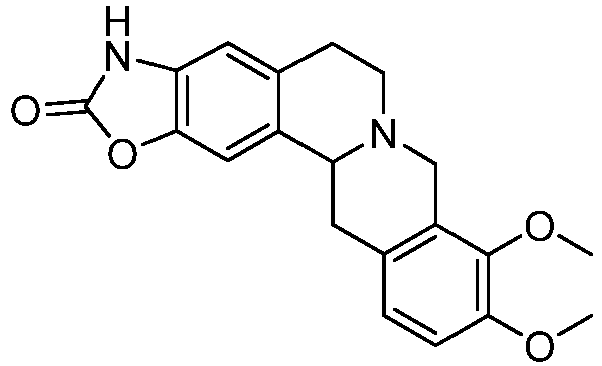
- Tetrahydrofuran (2 ml) and CDI (90 mg, 0.54 mmol) were added into 45-a (90 mg, 0.27 mmol). The reaction was performed at room temperature for 5h. The resultant was extracted with dichloromethane-water, dried, concentrated and subjected to column chromatography to give the title compound as a white solid (62 mg, yield: 63%). 1H NMR (300MHz, DMSO-d 6) δ 2.41-2.64 (m, 2H), 2.73 (d,1H), 2.92-3.17 (m, 2H), 3.26-3.44 (m, 2H), 3.49 (d, 1H), 3.72 (s, 3H), 3.77 (s, 3H), 4.07 (d, 1H), 6.82 (s, 1H), 6.87 (dd, 1H), 7.29 (s, 1H), 11.50 (s, 1H). ESI-MS m/z 353.3 (M+H)+.
-

- Dichloromethane (5 ml), triethylamine (0.18 ml) and chloroacetyl chloride (0.038 ml) were added into 45-a (150 mg, 0.46 mmol). The mixture was stirred at room temperature overnight. The resulting mixture was extracted with dichloromethane-water, washed with saturated brine, dried, concentrated, and subjected to column chromatography to obtain 47-a (100 mg, yield: 54%). ESI-MS m/z 403.2 (M+H)+.
- Acetone (3 ml) and potassium carbonate (53 mg) were added into 47-a (100 mg, 0.24 mmol). The mixture was heated to reflux for 5 h. Acetone was distilled off, and the mixture was extracted with dichloromethane-water, washed with saturated brine, dried, concentrated, and subjected to column chromatography to give the title compound as a pure white solid (60 mg, yield: 66%). 1H NMR (300MHz, DMSO-d6) δ 2.37-2.68 (m, 3H), 2.89 (t, 1H), 3.09 (d, 1H), 3.24-3.45 (m, 3H), 3.71 (s, 3H), 3.76 (s, 3H), 4.05 (d, 1H), 4.52 (s, 2H), 6.61 (s, 1H), 6.80-6.98 (m, 3H), 10.66 (s, 1H). ESI-MS m/z 367.2 (M+H)+, 365.2 (M-H)-.
-

- Dichloromethane (5 ml) was added into 44-h (0.9 g, 2.8 mmol), and then 65% concentrated nitric acid (0.33 ml) was added under an ice bath. After completion of addition, the mixture was stirred at room temperature for 2 h. Saturated sodium bicarbonate solution was added to adjust pH>7. The resulting mixture was extracted with dichloromethane-water, dried, concentrated, and subjected to column chromatography to give 48-a (0.5 g). 1H NMR (300MHz, CDC13) δ 2.66-2.94 (m, 4H), 2.98-3.18 (m, 2H), 3.85 (s, 6H), 3.93 (d, 1H), 4.22 (d, 1H), 4.63 (dd, 1H), 6.76 (d, 2H), 7.01 (d, 1H), 7.29 (d, 1H). ESI-MS m/z 357.3 (M+H)+.
- Methanol (20 ml) and palladium on carbon (40 mg) were added into 48-a (400 mg, 1.12 mmol). The hydrogenation reaction was performed at room temperature for 3h. After filtration, the filtrate was added into HCl-MeOH to form a salt, and a pale yellow solid was precipitated. The resultant was filtered, and dried to obtain 48-b (410 mg, yield: 100%).
- Trimethyl orthoformate (1.5 ml) was added into 48-b (85 mg, 0.23 mmol). The mixture was heated to reflux for 2h. Trimethyl orthoformate was distilled off, and the resultant was subjected to silica gel column chromatography to give the title compound (42 mg, yield: 53%). 1H NMR (300MHz, DMSO-d 6) δ 2.66-3.00 (m, 3H), 3.17 (t, 1H), 3.42 (d, 1H), 3.75 (s, 3H), 3.78 (s, 3H), 3.88 (dd, 1H), 4.16 (d, 1H), 4.34 (d, 2H), 6.93 (m, 2H), 7.26 (d, 1H), 7.64 (d, 1H), 8.75 (s, 1H). ESI-MS m/z 337.2 (M+H)+.
-

- The title compound was prepared from 48-b, in reference with the method for synthesizing the product of Example 46. That is, 45-a was replaced with 48-b. The yield was 75%. 1H NMR (300MHz, CDCl3) δ 2.60-2.87 (m, 3H), 3.09-3.25 (m, 3H), 3.68 (t, 2H), 3.85 (s, 6H), 4.17 (d, 1H), 6.73-6.81 (dd, 2H), 6.90 (d, 1H), 7.03 (d, 1H), 9.41 (s, 1H). ESI-MS m/z 353.2 (M+H)+.
-

- The title compound was prepared from 48-b, in reference with the method for synthesizing the product of Example 47. That is, 45-a was replaced with 48-b. The yield: 59%. 1H NMR (300MHz, CDCl3) δ 2.61-2.90 (m, 3H), 2.93-3.19 (m, 3H), 3.84 (s, 3H), 3.85 (s, 3H), 3.91 (m, 2H), 4.20 (d, 1H), 4.31 (d, 1H), 4.48 (d, 1H), 6.69-6.89 (m, 4H), 8.14 (brs, 1H). ESI-MS m/z 367.2 (M+H)+, 365.2 (M-H)-.
-
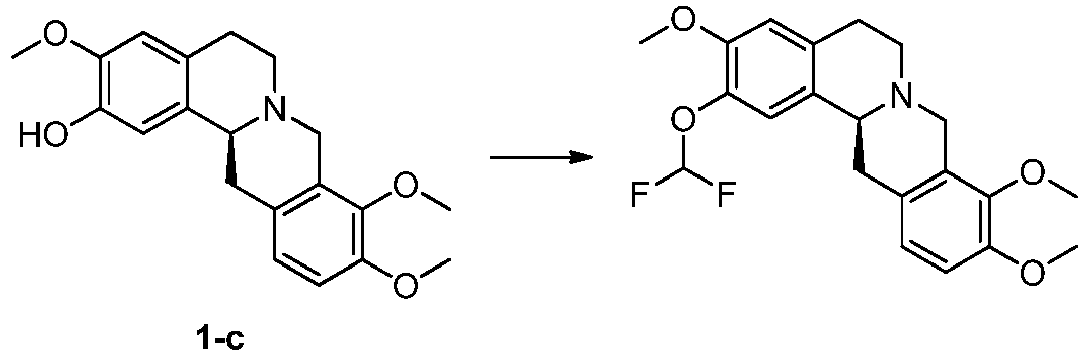
- 1-c (200 mg, 0.58 mmol) was dissolved in DMF (5 ml). Thereto, cesium carbonate (378 mg, 1.16 mmol) was added. The mixture was heated to 100 °C. Monochlorodifluoromethane was passed into the reaction system for 5 to 6 hours until TLC shows the reaction of the starting materials was completed. The reaction was stopped, and DMF was distilled off. The resultant was extracted with dichloromethane-water, washed with saturated brine, dried over anhydrous sodium sulfate, concentrated, and subjected to column chromatography to obtain the title compound (69 mg, yield: 30%). 1H NMR (300MHz, CDCl3) δ 2.58-2.88 (m, 3H), 3.12-3.29 (m, 3H), 3.54 (d, 2H), 3.85 (s, 6H), 3.86 (s, 3H), 4.25 (d, 1H), 6.54 (t, 1H), 6.70 (s, 1H), 6.79 (d, 1H), 6.88 (d, 1H), 7.05 (s, 1H). ESI-MS m/z 392.3 (M+H)+.
-

- 1-c (200 mg, 0.58 mmol) was dissolved in DMF (5 ml). Thereto, cesium carbonate (378 mg, 1.16 mmol) and 3-bromopropene (0.073 ml, 0.87 mmol) were added. The mixture was stirred at room temperature for 3h. DMF was distilled off. The resultant was extracted with dichloromethane-water, washed with saturated brine, dried over anhydrous sodium sulfate, concentrated, and subjected to column chromatography to obtain the title compound (112 mg, yield: 50%). 1H NMR (300MHz, DMSO-d 6) δ 2.96 (m, 2H), 3.38 (m, 2H), 3.77 (s, 3H), 3.79 (s, 3H), 3.82 (s, 3H), 3.84 (m, 2H), 4.33-4.72 (m, 5H), 5.27 (dd, 1H), 5.42 (dd, 1H), 6.05 (m, 1H), 6.84 (s, 1H), 7.03 (d, 1H), 7.05 (s, 1H), 7.09 (d, 1H), 11.06 (brs, 1H). ESI-MS m/z 382.2 (M+H)+.
-

- 1-c (200 mg, 0.58 mmol) was dissolved in DMF (5 ml). Thereto, cesium carbonate (378 mg, 1.16 mmol) and bromocyclopropane (0.070 ml, 0.87 mmol) were added. The mixture was stirred at 150 °C for 3h. DMF was distilled off, and the resultant was extracted with dichloromethane-water, washed with saturated brine, dried over anhydrous sodium sulfate, concentrated, and subjected to column chromatography to obtain the title compound (141 mg, yield: 63%). 1H NMR (300MHz, DMSO-d 6) δ 0.56-0.87 (m, 4H), 2.89 (d, 1H), 3.06 (t, 1H), 3.37 (m, 2H), 3.74 (s, 3H), 3.80 (s, 3H), 3.82 (s, 3H), 3.84 (m, 3H), 4.39 (dd, 1H), 4.66 (m, 2H), 6.83 (s, H), 7.04 (d, 1H), 7.09 (d, 1H), 7.26 (s, 1H), 11.27 (brs, 1H). ESI-MS m/z 382.2 (M+H)+.
-

- The title compound was prepared from 1-c and bromocyclopentane, with reference to the method for synthesizing the product of Example 52. That is, 3-bromopropene was replaced with bromocyclopentane. The yield: 42%. 1H NMR (300MHz, CDCl3) δ 1.89 (m, 8H), 2.56-2.72 (m, 2H), 2.82 (dd, 1H), 3.05-3.28 (m, 3H), 3.54 (d, 2H), 3.83 (s, 3H), 3.85 (s, 6H), 4.24 (d, 1H), 4.76 (m, 1H), 6.61(s, 1H), 6.74 (s, 1H), 6.79 (d, 1H), 6.88 (d, 1H).
-

- DMF (3 ml), potassium carbonate (1.26 g, 9.1 mmol), bromoethanol (0.13 ml, 1.82 mmol), potassium iodide (75 mg, 0.45 mmol) were added into l-SPD (300 mg, 0.91 mmol). The reaction was performed at 120 °C for 3h. The resultant was extracted with dichloromethane, and washed three times with water. DMF was washed off, and the organic phase was combined, washed with saturated brine, dried over anhydrous sodium sulfate, concentrated, and subjected to column chromatography to obtain the title compound (10 mg, yield: 2%). 1H NMR (300Hz, DMSO-d 6) δ 2.85 (d, 1H), 3.01 (t, 1H), 3.35 (m, 2H), 3.64-3.88 (m, 12H), 4.00 (m, 4H), 4.36 (dd, 1H), 4.60 (m, 2H), 4.92 (brs, 2H), 6.81 (s, 1H), 6.97 (d, 1H), 7.02 (s, 1H), 7.06 (d, 1H). ESI-MS m/z 416.0 (M+H)+.
-

- The title compound was prepared from 19-b and bromoethanol, with reference to the method for synthesizing the product of Example 55. That is, l-SPD was replaced with 19-b. The yield: 44%. 1H NMR (300MHz, CDCl3) δ 2.56-2.74 (m, 2H), 2.83 (dd, 1H), 3.06-3.33 (m, 3H), 3.56 (d, 2H), 3.80-3.95 (m, 11H), 3.99-4.20 (m, 2H), 4.27 (d, 1H), 6.61 (s, 1H), 6.72 (s, 1H), 6.79 (d, 1H), 6.91 (d, 1H). ESI-MS m/z 386.0 (M+H)+.
-

- The title compound was prepared from 19-b and bromocyclopropane, with reference to the method for synthesizing the product of Example 53. That is, 1-c was replaced with 19-b. The yield: 65%. 1H NMR (300MHz, DMSO-d 6) δ 0.53 (m, 2H), 0.77 (m, 2H), 2.86 (d, 1H), 3.04 (dd, 1H), 3.37 (m, 2H), 3.76 (s, 3H), 3.78 (s, 3H), 3.80-3.90 (m, 5H), 4.25 (dd, 1H), 4.34 (m, 1H), 4.41 (d, 1H), 4.66 (t, 1H), 6.82 (s, 1H), 7.02 (s, 1H), 7.03 (d, 1H), 7.10 (d, 1H), 11.59 (brs, 1H). ESI-MS m/z 382.1 (M+H)+.
-

- The title compound was prepared from 19-b and bromocyclopropane, with reference to the method for synthesizing the product of Example 54. That is, 1-c was replaced with 19-b. The yield: 33%. 1H NMR (300MHz, CDCl3) δ 1.85 (m, 8H), 2.55-2.73 (m, 2H), 2.84 (dd, 1H), 2.06-3.30 (m, 3H), 3.51 (m, 2H), 3.82 (s, 3H), 3.87 (s, 3H), 3.88 (s, 3H), 4.20 (d, 1H), 4.95 (m, 1H), 6.61 (s, 1H), 6.73 (s, 1H), 6.77 (d, 1H), 6.84 (d, 1H). ESI-MS m/z 410.3 (M+H)+.
-

- 1-a (500 mg, 1.20 mmol) was dissolved in DMF (8 ml). Thereto, cesium carbonate (782 mg, 2.40 mmol) and bromocyclopropane (0.12 ml, 1.80 mmol) were added. The mixture was stirred at 150 °C for 3h. DMF was distilled off, and the resultant was extracted with dichloromethane-water, washed with saturated saline solution, dried over anhydrous sodium sulfate, concentrated, and subjected to column chromatography to give 59-a (356 mg, yield: 65%).
- 59-a (300 mg, 0.65 mmol) was dissolved in ethanol (4 mL). Thereto, 2 ml of concentrated hydrochloric acid was added. The reaction was performed at 100 °C for 1 h. The solvent was directly distilled off to obtain compound 59-b (233 mg, yield: 88%).
- 59-b (200 mg, 0.49 mmol) was dissolved in acetone (4 mL). Thereto, dimethyl sulfate (0.070 mL, 0.74 mmol) and sodium hydroxide (80 mg, 1.98 mmol) were added. The reaction was performed at room temperature for 6h while stirring. The resultant was extracted with dichloromethane, and washed with a saturated ammonium chloride solution. The organic phase was combined, washed with saturated brine, dried over anhydrous sodium sulfate, concentrated, and subjected to silica gel column chromatography to obtain the title compound (155 mg, yield: 82%). 1H NMR (300MHz, DMSO-d 6) δ 0.55-0.81 (m, 4H), 2.35-2.69 (m, 3H), 2.83-3.16 (m, 3H), 3.34 (m, 2H), 3.68 (s, 3H), 3.73 (d, 6H), 3.85 (m, 1H), 4.04 (d, 1H), 6.67 (s, 1H), 6.86 (s, 1H), 6.89 (d, 1H), 7.13 (d, 1H). ESI-MS m/z 382.3 (M+H)+.
-

- The product of Example 13 (40 mg) was added to 2 ml of dichloromethane, and one drop of pyridine (about 1.5 eq) was added thereto. One drop of methanesulfonyl chloride (about 1.5 eq) was added dropwise under an ice bath. The mixture was kept inan ice bath for 10 minutes while stirring, and moved to room temperature for reaction for 3 hours. The system was extracted with dichloromethane and water, washed with saturated brine, dried and concentrated to obtain 40 mg of a crude product. The residue was subjected to column chromatography (eluent: DCM/MeOH = 100:1) to obtain the title compound (20 mg). ESI-MS m/z 419.24 (M+H)+.
- LANCE™ cAMP 384 Kit (PerkinElmer, USA) was used to test the antagonism of the compound against the D1 receptor using the HEK293 cells expressing human recombinant D1 receptor. The D1 antagonism of the compound was evaluated by testing the antagonistic action of the compounds against dopamine on the induction of cAMP production in HEK293 cells. The cAMP concentration test was performed according to the method described in the kit instructions. The test concentration of the compound was 0.1 nM to 10000 nM. SCH23390 was used as a positive control. The IC50 was calculated by Excelfit software. The test results of some compounds were shown in Table 1.
- LANCE™ cAMP 384 Kit (PerkinElmer, USA) was used to test the antagonism of the compound against the D2 receptor using the HEK293 cells expressing human recombinant D2 receptor. The D2 antagonism of the compound was evaluated by testing the antagonistic action of the compounds against dopamine on the inhibition of cAMP production in HEK293 cells. The cAMP concentration test was performed according to the method described in the kit instructions. The test concentration of the compound was 0.1 nM to 10000 nM. Risperidone was used as a positive control. The IC50 was calculated by Excelfit software. The test results of some compounds were shown in Table 1 (ND means the test was not performed).
Table 1: Test Compound D1 Antagonistic Activity (IC50, nmol/L) D2 Antagonistic Activity (IC50, nmol/L) Compound of Example 1 34.9 620 Compound of Example 2 ND 280 Compound of Example 4 310 950 Compound of Example 5 170 35 Compound of Example 6 49 210 Compound of Example 7 61 770 Compound of Example 11 500 750 Compound of Example 12 240 500 Compound of Example 13 140 280 Compound of Example 15 120 550 Compound of Example 17 240 150 Compound of Example 18 390 610 Compound of Example 19 1300 ND Compound of Example 21 1500 ND Compound of Example 24 1300 ND Compound of Example 25 1700 2300 Compound of Example 26 ND 940 Compound of Example 27 311 1000 Compound of Example 28 2160 ND Compound of Example 29 ND 2500 Compound of Example 30 1080 510 Compound of Example 32 ND 663 Compound of Example 33 270 440 Compound of Example 36 26.2 427 Compound of Example 37 211 19 Compound of Example 38 3400 620 Compound of Example 40 4.0 27 Compound of Example 41 ND 20 Compound of Example 42 31.1 291 Compound of Example 43 ND 54 Compound of Example 44 672 139 Compound of Example 45 116 ND Compound of Example 46 378 184 Compound of Example 47 19.9 146 Compound of Example 49 219 ND Compound of Example 50 855 ND Compound of Example 51 ND 390 Compound of Example 52 220 450 Compound of Example 53 960 1300 Compound of Example 55 443 ND Compound of Example 56 1050 2800 Compound of Example 60 525 6.2 l-SPD 7.7 37 Positive Control 0.92 2.8 - LANCE™ cAMP 384 Kit (PerkinElmer, USA) was used to test the agonistic effect of the compound on 5-HT1A receptor using the HEK293 cells expressing human recombinant 5-HT1A receptor. The 5-HT1A agonistic effect of the compound was evaluated by testing the the inhibitory effect of the compound on cAMP production in HEK293 cells. The cAMP concentration test was performed according to the method described in the kit instructions. The test concentration of the compound was 0.1 nM to 10000 nM. 8-OH-DPAT was used as a positive control. The EC50 was calculated by Excelfit software. The results were shown in Table 2.
Table 2: Test Compound 5-HT1A Agonistic Activity (EC50, nmol/L) Compound of Example 5 450 Compound of Example 11 1700 Compound of Example 12 2300 Compound of Example 14 514 Compound of Example 21 238 Compound of Example 23 1900 Compound of Example 27 1200 Compound of Example 35 5900 Compound of Example 37 3030 Compound of Example 38 4580 Compound of Example 56 150 Compound of Example 57 110 Positive Control 12.0 - It can be seen from the above that the tested compounds have good antagonistic activity on the dopamine D1 and D2 receptors, and have an agonistic effect on the 5-HT1A receptor. They can be used to prepare a medicament for treating the central nervous system disease, especially D1, D2, 5-HT1A receptor-related diseases.
- The sedative and hypnotic effects of Example 60 were evaluated using a model of insomnia induced by injection with 4-Chlorophenylalanine (PCPA) in rats. The results were shown in
Figures 1 to 2 . - Dosage and method of administration: PCPA was administered at a dose of 150 mg/kg. PCP was administered by a single intraperitoneal injection at 72 hours before the experiment in all Wistar rats. The diazepam group (DI) was administered at a dose of 2 mg/kg and 4 mg/kg, a single intraperitoneal injection; the test drug group was administered at a dose of 1 mg/kg and 3 mg/kg, a single intragastric administration; sodium pentobarbital was administered at a dose of 25 mg/kg, a single intraperitoneal injection. The administration volume was 10 ml/kg. On the day of the test, the model group was given
sodium pentobarbital 30 minutes after the same volume of physiological saline was given; the DI group was givensodium pentobarbital 30 minutes after DI was administered; the test drug group was givensodium pentobarbital 60 minutes after the drug was administered.Index observation: After the administration of sodium pentobarbital, the rats' response was closely observed. The time from the administration to 1 minute after the righting reflex disappeared is the sleep latency. The time from 1 minute after the righting reflex disappeared to the point that the righting reflex returned is sleep time.It can be seen fromFigures 1-2 that Example 60 can significantly prolong the sleep time of model rats at a dose of 1 mg/kg, and can significantly reduce the sleep latency and prolong the sleep time of insomnia rats induced by PCPA at a dose of 3 mg/kg. Example 60 had a good hypnotic effect. - PCP (phencylidine) was dissolved in physiological saline to prepare a 7 mg/kg solution. The test compound was formulated with a 0.5% CMC-Na solution to a solution with suitable concentration, ready-to-use. Male ICR mice were 18-22g. Mice were randomly divided into a solvent control group, a model control group, a positive control group, and each test drug group during the test. There were 8 mice in each group. Mice in each group were given each test drug by gavage. 45 minutes after the test drug was administered, mice were injected with a PCP (7 mg/kg) solution intraperitoneally. The spontaneous, open field video analysis system was used to record the mouse movement trajectory within 45 min after administration of test drug or saline, and then the mouse movement trajectory within 75 min after PCP administration. Spontaneous, open field video analysis system was used to analyze the mouse's movement trajectory, and the total distance of the movement of the mice in each group was counted. The result was expressed as mean ± SD. Results were analyzed by one-way analysis of variance.
- After administration of PCP, the spontaneous activity of mice increased significantly compared with the physiological saline group. The test compounds at the following doses (Table 3) can significantly reduce the high spontaneous activity of mice induced by PCP, which is significantly different from the model group. The compound of the present invention is orally effective, its effective dose is lower than that of l-stepholidine, and its efficacy is maintained for a long time. However, l-stepholidine has a high effective dose, fast metabolism, and short duration of effect.
Table 3: Test Compound Effective Dose (mg/kg) Compound of Example 1 20 Compound of Example 2 20 Compound of Example 5 10 Compound of Example 7 10 Compound of Example 11 10 Compound of Example 13 10 Compound of Example 14 10 Compound of Example 17 20 Compound of Example 18 20 Compound of Example 19 20 Compound of Example 21 20 Compound of Example 25 20 Compound of Example 33 20 Compound of Example 34 20 Compound of Example 36 10 Compound of Example 40 20 Compound of Example 41 3 Compound of Example 42 10 Compound of Example 46 10 Compound of Example 47 10 Compound of Example 49 10 Compound of Example 50 10 Compound of Example 52 20 Compound of Example 53 20 Compound of Example 56 20 Compound of Example 57 20 l-stepholidine >100
Claims (10)
- A tetrahydroprotoberberine compound represented by the formula (I), enantiomers, diastereomers, racemates and mixtures thereof, and pharmaceutically acceptable salts, crystalline hydrates and solvates thereof,
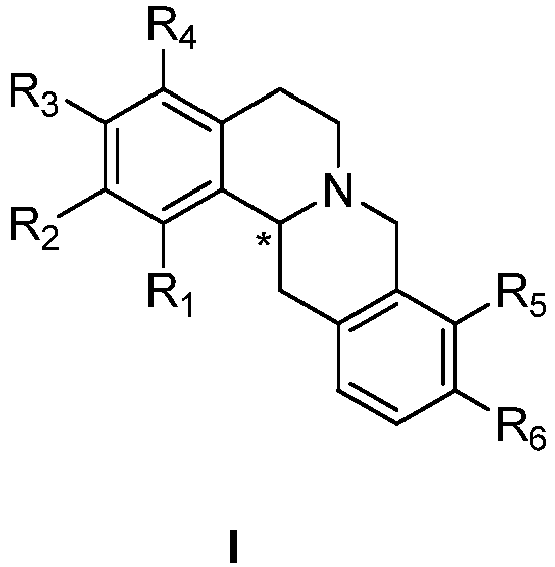 R1 to R4 are each independently selected from hydrogen, halogen, mercapto, C1-C6 alkoxy, halo-C1-C6 alkoxy, hydroxy-C1-C6 alkoxy, C1-C6 alkylthio, C1-C6 alkyl, C3-C6 cycloalkyl, C3-C6 cycloalkoxy, C2-C6 alkenyl, C2-C6 alkenyloxy, C2-C6 alkynyl, C2-C6 alkynyloxy, halo-C1-C6 alkyl, amino, C1-C6 alkyl substituted amino, C1-C6 alkanoyl substituted amino, C1-C6 alkyl sulfonyl substituted amino, cyano, carboxy, aldehyde group, amino-C1-C6 alkyl, hydroxy-C1-C6 alkyl, cyano-C1-C6 alkyl, C1-C6 alkanoyl, halo-C1-C6 alkanoyl, sulfoamido, C1-C6 alkyl substituted sulfoamido, carbamoyl, C1-C6 alkyl substituted carbamoyl, carboxy-C1-C6 alkyl, C1-C6 alkyl sulfonyl, halo-C1-C6 alkansulfonyl, C1-C6 alkyl substituted amino-C1-C6 alkyl, C1-C6 alkanoyl substituted amino-C1-C6 alkyl, C1-C6 alkoxycarbonyl, carbamoyl-C1-C6 alkyl, or C1-C6 alkyl substituted carbamoyl-C1-C6 alkyl;Or any two adjacent substituents of R1, R2, R3, and R4, as well as the adjacent benzene ring together may form an unsubstituted or 1-4 substituents substituted benzo[5-6 membered monocyclic heterocyclic ring], the substituent is selected from halogen, hydroxy, mercapto, oxo, thio, C1-C6 alkyl; the heterocyclic ring contains 1 to 3 heteroatoms selected from N, O, and S;R5 to R6 are each independently selected from halogen, mercapto, C1-C6 alkoxy, halo-C1-C6 alkoxy, hydroxy-C1-C6 alkoxy, C1-C6 alkylthio, C1-C6 alkyl, C3-C6 cycloalkyl, C3-C6 cycloalkoxy, C2-C6 alkenyl, C2-C6 alkenyloxy, C2-C6 alkynyl, C2-C6 alkynyloxy, halo-C1-C6 alkyl, amino, C1-C6 alkyl substituted amino, C1-C6 alkanoyl substituted amino, C1-C6 alkyl sulfonyl substituted amino, cyano, carboxy, aldehyde group, amino-C1-C6 alkyl, hydroxy-C1-C6 alkyl, cyano-C1-C6 alkyl, C1-C6 alkanoyl, halo-C1-C6 alkanoyl, sulfoamido, C1-C6 alkyl substituted sulfoamido, carbamoyl, C1-C6 alkyl substituted carbamoyl, carboxy-C1-C6 alkyl, C1-C6 alkyl sulfonyl, halo-C1-C6 alkansulfonyl, C1-C6 alkyl substituted amino-C1-C6 alkyl, C1-C6 alkanoyl substituted amino-C1-C6 alkyl, C1-C6 alkoxycarbonyl, carbamoyl-C1-C6 alkyl, or C1-C6 alkyl substituted carbamoyl-C1-C6 alkyl;And R1-R6 cannot simultaneously have 4 or more of C1-C6 alkoxy;The configuration of the chiral carbon atom (*) at the C14 position in the compound of formula (I) is R or S; and the formula (I) does not include the following compounds:1) 2,3,9,10-tetramethyl-6,8,13,13a-tetrahydro-5H-dibenzo[a,g] quinolizine;2) 9,10-dimethoxy-6,8,13,13a-tetrahydro-5H-dibenzo[a,g] quinolizine;3) 2,3,10-trimethoxy-9-amino-6,8,13,13a-tetrahydro-5H-dibenzo[a,g] quinolizine;4) 3-methoxymethoxy-9,10-dimethoxy-6,8,13,13a-tetrahydro-5H-dibenzo[a,g] quinolizine;5) 2,9,10-trimethoxy-3-allyloxy-6,8,13,13a-tetrahydro-5H-dibenzo[a,g] quinolizine;6) 2,3,9-trimethoxy-10-nitro-6,8,13,13a-tetrahydro-5H-dibenzo[a,g]quinolizine;7) 2,3,10-trimethoxy-9-methoxycarbonyl-6,8,13,13a-tetrahydro-5H-dibenzo [a,g] quinolizine.
 - The tetrahydroprotoberberine compound, enantiomers, diastereomers, racemates and mixtures thereof, and pharmaceutically acceptable salts, crystalline hydrates and solvates thereof according to claim 1, characterized in that,
R1 to R4 are each independently selected from hydrogen, fluorine, chlorine, bromine, mercapto, methoxy, ethoxy, trifluoromethoxy, -SCH3, -SCH2CH3, propyl, cyclopropyl, isopropyl, t-butyl, trifluoromethyl, difluoromethoxy, bromomethyl, chloromethyl, vinyl, vinylmethyl, amino, N-methylamino, N-ethylamino, N,N-dimethylamino, N,N-diethylamino, cyano, carboxyl, aldehyde group, -CH2NH2, -CH2CH2NH2, -CH2OH, -CH2CH2OH, -CH2CN, -CH2CH2CN, formyl, acetyl, propionyl, trifluoroacetyl, sulfo amido, carbamoyl, N-methylcarbamoyl, N,N-dimethylcarbamoyl, N-ethylcarbamoyl, N,N-diethylcarbamoyl, -CH2CO2H, -CH2CH2CO2H, -SO2CH3, -SO2CF3, -CH2NHMe, -CH2NMe2, -CH2CONH2, -NHCOCH3, -CH2NHCOCH3, -CH2CONHMe or -CH2CONMe2;
Or R1 and R2, as well as the adjacent benzene ring together may form an unsubstituted or 1-2 substituents substituted benzo[5-6 membered monocyclic heterocyclic ring], the substituent is selected from halogen, hydroxy, mercapto, oxo, thio, C1-C6 alkyl; the heterocyclic ring contains 1 to 3 heteroatoms selected from N, O, and S;
Or R2 and R3, as well as the adjacent benzene ring together may form an unsubstituted or 1-2 substituents substituted benzo[5-6 membered monocyclic heterocyclic ring], the substituent is selected from halogen, hydroxy, mercapto, oxo, thio, C1-C6 alkyl; the heterocyclic ring contains 1 to 3 heteroatoms selected from N, O, and S;
Or R3 and R4, as well as the adjacent benzene ring together may form an unsubstituted or 1-2 substituents substituted benzo[5-6 membered monocyclic heterocyclic ring], the substituent is selected from halogen, hydroxy, mercapto, oxo, thio, C1-C6 alkyl; the heterocyclic ring contains 1 to 3 heteroatoms selected from N, O, and S;
R5 to R6 are each independently selected from fluorine, chlorine, bromine, mercapto, methoxy, ethoxy, trifluoromethoxy, -SCH3, -SCH2CH3, propyl, cyclopropyl, isopropyl, t-butyl, trifluoromethyl, difluoromethoxy, bromomethyl, chloromethyl, vinyl, vinylmethyl, amino, N-methylamino, N-ethylamino, N,N-dimethylamino, N,N-diethylamino, cyano, carboxyl, aldehyde group, -CH2NH2, -CH2CH2NH2, -CH2OH, -CH2CH2OH, -CH2CN, -CH2CH2CN, formyl, acetyl, propionyl, trifluoroacetyl, sulfo amido, carbamoyl, N-methylcarbamoyl, N,N-dimethylcarbamoyl, N-ethylcarbamoyl, N,N-diethylcarbamoyl, -CH2CO2H, -CH2CH2CO2H, -SO2CH3, -SO2CF3, -CH2NHMe, -CH2NMe2, -CH2CONH2, -NHCOCH3, -CH2NHCOCH3, -CH2CONHMe or -CH2CONMe2. - The tetrahydroprotoberberine compound, enantiomers, diastereomers, racemates and mixtures thereof, and pharmaceutically acceptable salts, crystalline hydrates and solvates thereof according to claim 1, characterized in that, 2 or 3 of R1-R6 are C1-C6 alkoxy.
- The tetrahydroprotoberberine compound, enantiomers, diastereomers, racemates and mixtures thereof, and pharmaceutically acceptable salts, crystalline hydrates and solvates thereof according to claim 1, characterized in that, the compound of the formula (I) is a compound represented by the following formulae (I-A) to (I-G),

 R1 to R4 are each independently selected from hydrogen, halogen, mercapto, C1-C6 alkoxy, halo-C1-C6 alkoxy, hydroxy-C1-C6 alkoxy, C1-C6 alkylthio, C1-C6 alkyl, C3-C6 cycloalkyl, C3-C6 cycloalkoxy, C2-C6 alkenyl, C2-C6 alkenyloxy, C2-C6 alkynyl, C2-C6 alkynyloxy, halo-C1-C6 alkyl, amino, C1-C6 alkyl substituted amino, C1-C6 alkanoyl substituted amino, C1-C6 alkyl sulfonyl substituted amino, cyano, carboxy, aldehyde group, amino-C1-C6 alkyl, hydroxy-C1-C6 alkyl, cyano-C1-C6 alkyl, C1-C6 alkanoyl, halo-C1-C6 alkanoyl, sulfoamido, C1-C6 alkyl substituted sulfoamido, carbamoyl, C1-C6 alkyl substituted carbamoyl, carboxy-C1-C6 alkyl, C1-C6 alkyl sulfonyl, halo-C1-C6 alkyl sulfonyl, C1-C6 alkyl substituted amino-C1-C6 alkyl, C1-C6 alkanoyl substituted amino-C1-C6 alkyl, C1-C6 alkoxycarbonyl, C1-C6 alkoxycarbonyl-C1-C6 alkoxy, carbamoyl-C1-C6 alkyl, or C1-C6 alkyl substituted carbamoyl-C1-C6 alkyl;Or R1 and R2, as well as the adjacent benzene ring together may form an unsubstituted or 1-4 substituents substituted benzo[5-6 membered monocyclic heterocyclic ring], the substituent is selected from halogen, hydroxy, mercapto, oxo, thio, C1-C6 alkyl; the heterocyclic ring contains 1 to 3 heteroatoms selected from N, O, and S;Or R2 and R3, as well as the adjacent benzene ring together may form an unsubstituted or 1-4 substituents substituted benzo[5-6 membered monocyclic heterocyclic ring], the substituent is selected from halogen, hydroxy, mercapto, oxo, thio, C1-C6 alkyl; the heterocyclic ring contains 1 to 3 heteroatoms selected from N, O, and S;Or R3 and R4, as well as the adjacent benzene ring together may form an unsubstituted or 1-4 substituents substituted benzo[5-6 membered monocyclic heterocyclic ring], the substituent is selected from halogen, hydroxy, mercapto, oxo, thio, C1-C6 alkyl; the heterocyclic ring contains 1 to 3 heteroatoms selected from N, O, and S;R5 to R6 is selected from cyano, carbamoyl, C1-C6 alkanoyl, C1-C6 alkanoyl substituted amino, C1-C6 alkyl sulfonyl substituted amino, C1-C6 alkanoyl substituted amino-C1-C6 alkyl, aldehyde, hydroxy-C1-C6 alkyl, amino-C1-C6 alkyl, C1-C6 alkyl, amino, hydroxy-C1-C6 alkoxy, C3-C6 cycloalkoxy, C3-C5 cycloalkyl.
 - The tetrahydroprotoberberine compound, enantiomers, diastereomers, racemates and mixtures thereof, and pharmaceutically acceptable salts, crystalline hydrates and solvates thereof according to claim 1, characterized in that, the compound of the formula (I) is selected from a compound represented by formulae (I-A-1),
 Wherein, R2 is selected from halogen, mercapto, halo-C1-C6 alkoxy, hydroxy-C1-C6 alkoxy, C1-C6 alkylthio, C1-C6 alkyl, C3-C6 cycloalkyl, C3-C6 cycloalkoxy, C2-C6 alkenyl, C2-C6 alkenyloxy, C2-C6 alkynyl, C2-C6 alkynyloxy, halo-C1-C6 alkyl, amino, C1-C6 alkyl substituted amino, C1-C6 alkanoyl substituted amino, C1-C6 alkyl sulfonyl substituted amino, cyano, carboxy, aldehyde group, amino-C1-C6 alkyl, hydroxy-C1-C6 alkyl, cyano-C1-C6 alkyl, C1-C6 alkanoyl, halo-C1-C6 alkanoyl, sulfoamido, C1-C6 alkyl substituted sulfoamido, carbamoyl, C1-C6 alkyl substituted carbamoyl, carboxy-C1-C6 alkyl, C1-C6 alkyl sulfonyl, halo-C1-C6 alkyl sulfonyl, C1-C6 alkyl substituted amino-C1-C6 alkyl, C1-C6 alkanoyl substituted amino-C1-C6 alkyl, C1-C6 alkoxycarbonyl, carbamoyl-C1-C6 alkyl, or C1-C6 alkyl substituted carbamoyl-C1-C6 alkyl;Preferably, R2 is selected from halogen, mercapto, halo-C1-C4 alkoxy, hydroxy-C1-C4 alkoxy, C1-C4 alkylthio, C1-C4 alkyl, C3-C5 cycloalkyl, C3-C5 cycloalkoxy, C2-C4 alkenyl, C2-C4 alkenyloxy, C2-C4 alkynyl, C2-C4 alkynyloxy, halo-C1-C4 alkyl, amino, C1-C4 alkyl substituted amino, C1-C4 alkanoyl substituted amino, C1-C4 alkyl sulfonyl substituted amino, cyano, carboxy, aldehyde group, amino-C1-C4 alkyl group, hydroxy-C1-C4 alkyl, cyano-C1-C4 alkyl group, C1-C4 alkanoyl, halo-C1-C4 alkanoyl, sulfoamido, C1-C4 alkyl substituted sulfoamido, carbamoyl, C1-C4 alkyl substituted carbamoyl, carboxy-C1-C4 alkyl, C1-C4 alkansulfonyl, halo-C1-C4 alkansulfonyl, C1-C4 alkyl substituted amino-C1-C4 alkyl, C1-C4 alkanoyl substituted amino-C1-C4 alkyl, C1-C4 alkoxycarbonyl, carbamoyl-C1-C4 alkyl, or C1-C4 alkyl substituted carbamoyl-C1-C4 alkyl;More preferably, R2 is selected from fluorine, chlorine, bromine, mercapto, trifluoromethoxy, -SCH3, -SCH2CH3, methyl, ethyl, propyl, isopropyl, t-butyl, trifluoromethyl, bromomethyl, chloromethyl, vinyl, amino, N-methylamino, N-ethylamino, N,N-dimethylamino, N,N-diethylamino, cyano, carboxyl, aldehyde group, -CH2NH2, -CH2CH2NH2, -CH2OH, -CH2CH2OH, -CH2CN, -CH2CH2CN, formyl, acetyl, propionyl, trifluoroacetyl, sulfo amido, carbamoyl, N-methylcarbamoyl, N,N-dimethylcarbamoyl, N-ethylcarbamoyl, N,N-diethylcarbamoyl, -CH2CO2H, -CH2CH2CO2H, -SO2CH3, -SO2CF3, -CH2NHMe, -CH2NMe2, -CH2CONH2, -CH2CONHMe or -CH2CONMe2.
 - The tetrahydroprotoberberine compound, enantiomers, diastereomers, racemates and mixtures thereof, and pharmaceutically acceptable salts, crystalline hydrates and solvates thereof according to claim 1, characterized in that, the compound of the formula (I) is selected from the following compounds,(1) (S)-2-methyl-3,9,10-trimethoxy-6,8,13,13a-tetrahydro-5H-dibenzo[a,g] quinolizine;(2) (S)-2-n-propyl-3,9,10-trimethoxy-6,8,13,13a-tetrahydro-5H-dibenzo[a,g] quinolizine;(3) (S)-2-isobutyl-3,9,10-trimethoxy-6,8,13,13a-tetrahydro-5H-dibenzo[a,g] quinolizine;(4) (S)-2-cyano-3,9,10-trimethoxy-6,8,13,13a-tetrahydro-5H-dibenzo[a,g] quinolizine;(5) (S)-2-carbamoyl-3,9,10-trimethoxy-6,8,13,13a-tetrahydro-5H-dibenzo[a,g] quinolizine;(6) (S)-2-formyl-3,9,10-trimethoxy-6,8,13,13a-tetrahydro-5H-dibenzo[a,g] quinolizine;(7) (S)-2-hydroxymethy-3,9,10-trimethoxy-6,8,13,13a-tetrahydro-5H-dibenzo[a,g] quinolizine;(8) (S)-2-carboxy-3,9,10-trimethoxy-6,8,13,13a-tetrahydro-5H-dibenzo[a,g] quinolizine;(9) (S)-2-ethoxycarbonyl-3,9,10-trimethoxy-6,8,13,13a-tetrahydro-5H-dibenzo[a,g] quinolizine;(10) (S)-2-aminomethyl-3,9,10-trimethoxy-6,8,13,13a-tetrahydro-5H-dibenzo[a,g] quinolizine;(11) (S)-2-acetaminomethyl-3,9,10-trimethoxy-6,8,13,13a-tetrahydro-5H- dibenzo[a,g] quinolizine;(12) (S)-2-acetyl-3,9,10-trimethoxy-6,8,13,13a-tetrahydro-5H-dibenzo[a,g] quinolizine;(13) (S)-2-amino-3,9,10-trimethoxy-6,8,13,13a-tetrahydro-5H-dibenzo[a,g] quinolizine;(14) (S)-2-acetylamino-3,9,10-trimethoxy-6,8,13,13a-tetrahydro-5H-dibenzo[a,g] quinolizine;(15) (S)-2-bromo-3,9,10-trimethoxy-6,8,13,13a-tetrahydro-5H-dibenzo[a,g] quinolizine;(16) (S)-2-chloro-3,9,10-trimethoxy-6,8,13,13a-tetrahydro-5H-dibenzo[a,g] quinolizine;(17) (S)-2-vinyl-3,9,10-trimethoxy-6,8,13,13a-tetrahydro-5H-dibenzo[a,g]quinolizine;(18) (S)-2-hydroxyethyl-3,9,10-trimethoxy-6,8,13,13a-tetrahydro-5H-dibenzo[a,g] quinolizine;(19) (S)-2,3,10-trimethoxy-9-cyano-6,8,13,13a-tetrahydro-5H-dibenzo[a,g] quinolizine;(20) (S)-2,3,10-trimethoxy-9-carbamoyl-6,8,13,13a-tetrahydro-5H-dibenzo[a,g] quinolizine;(21) (S)-2,3,10-trimethoxy-9-acetyl-6,8,13,13a-tetrahydro-5H-dibenzo[a,g] quinolizine;(22) (S)-2,3,10-trimethoxy-9-aminomethyl-6,8,13,13a-tetrahydro-5H-dibenzo[a,g] quinolizine;(23) (S)-2,3,10-trimethoxy-9-acetylaminomethyl-6,8,13,13a-tetrahydro-5H-dibenzo[a,g] quinolizine;(24) (S)-2,3,10-trimethoxy-9-formyl-6,8,13,13a-tetrahydro-5H-dibenzo[a,g] quinolizine;(25) (S)-2,3,10-trimethoxy-9-hydroxymethyl-6,8,13,13a-tetrahydro-5H-dibenzo[a,g] quinolizine;(26) (S)-2,3,9-trimethoxy-10-methyl-6,8,13,13a-tetrahydro-5H-dibenzo[a,g] quinolizine;(27) (S)-2,3,9-trimethoxy-10-cyano-6,8,13,13a-tetrahydro-5H-dibenzo[a,g] quinolizine;(28) (S)-2,3,9-trimethoxy-10-carbamoyl-6,8,13,13a-tetrahydro-5H-dibenzo[a,g] quinolizine;(29) (S)-2,3,9-trimethoxy-10-formyl-6,8,13,13a-tetrahydro-5H-dibenzo[a,g] quinolizine;(30) (S)-2,3,9-trimethoxy-10-hydroxymethyl-6,8,13,13a-tetrahydro-5H-dibenzo[a,g] quinolizine;(31) (S)-2,3,9-trimethoxy-10-aminomethyl-6,8,13,13a-tetrahydro-5H-dibenzo[a,g] quinolizine;(32) (S)-2,3,9-trimethoxy-10-acetaminomethyl-6,8,13,13a-tetrahydro-5H- dibenzo[a,g] quinolizine;(33) (S)-2,10-diamino-3,9-dimethoxy-6,8,13,13a-tetrahydro-5H-dibenzo[a,g] quinolizine;(34) (S)-2,10-diacetylamido-3,9-dimethoxy-6,8,13,13a-tetrahydro-5H-dibenzo[a,g] quinolizine;(35) 2,3-dicyano-9,10-dimethoxy-6,8,13,13a-tetrahydro-5H-dibenzo[a,g] quinolizine;(36)
9,10-dimethoxy-5,6,13,13a-tetrahydroisoquinolino[3,2-a]pyrrolo[3,4-g]isoquinoline-1 ,3(2H,8H)-dione;(37) (S)-2,10-dicyano-3,9-dimethoxy-6,8,13,13a-tetrahydro-5H-dibenzo[a,g] quinolizine;(38) (S)-2,10-dicarbamoyl-3,9-dimethoxy-6,8,13,13a-tetrahydro-5H-dibenzo[a,g] quinolizine;(39) 2,3-dicarbamoyl-9,10-dimethoxy-6,8,13,13a-tetrahydro-5H-dibenzo[a,g] quinolizine;(40) (S)-4,10,11-trimethoxy-3,6,7,9,14,14a-hexahydroimidazo[4,5-h]isoquinolino [3,2-a]isoquinolin-2(1H)-one;(41) (S)-4,10,11-trimethoxy-3,6,7,9,14,14a-Hexahydroimidazo[4,5-h] isoquinolino [3,2-a]isoquinoline-2(1H)-thione;(42) (S)-4,10,11-trimethoxy-1,6,7,9,14,14a-hexahydroimidazo[4,5-h]isoquinolino [3,2 a]isoquinoline;(43) (S)-4,10,11-trimethoxy-1,6,7,9,14,14a-hexahydroisoquinolino[3,2-a][1,2,3] triazolo [4,5-h]isoquinoline;(44) 9,10-dimethoxy-1,5,6,8,13,13a-hexahydroimidazo[4,5-g]isoquinolino[3,2-a] isoquinoline;(45) 9,10-dimethoxy-6,8,13,13a-tetrahydro-5H-isoquino[3,2-a]oxazolo[4,5-g] isoquinolin;(46) 9,10-dimethoxy-3,5,6,8,13,13a-hexahydro-2H-isoquino[3,2-a]oxazolo[4,5-g] isoquinolin-2-one;(47) 10,11-dimethoxy-4,6,7,9,14,14a-hexahydroisoquinolino[3,2-a][1,4]oxazino[3,2-g] isoquinolin-3(2H)-one;(48) 10,11-dimethoxy-7,9,14,14a-tetrahydro-6H-isoquino[3,2-a]oxazolo[5,4-h] isoquinoline;(49) 10,11-dimethoxy-6,7,14,14a-tetrahydro-1H-isoquino[3,2-a]oxazolo[5,4-h] isoquinolin-2(9H)-one;(50) 11,12-dimethoxy-3,7,8,10,15,15a-hexahydroisoquinolino[3,2-a][1,4]oxazino [2,3-h]isoquinolin-2(1H)-one;(51) (S)-2-(difluoromethoxy)-3,9,10-trimethoxy-6,8,13,13a-tetrahydro-5H-dibenzo[a,g] quinolizine;(52) (S)-2-allyloxy-3,9,10-trimethoxy-6,8,13,13a-tetrahydro-5H-dibenzo[a,g] quinolizine;(53) (S)-2-cyclopropoxy-3,9,10-trimethoxy-6,8,13,13a-tetrahydro-5H-dibenzo[a,g] quinolizine;(54) (S)-2-cyclopentyloxy-3,9,10-trimethoxy-6,8,13,13a-tetrahydro-5H-dibenzo[a,g] quinolizine;(55) (S)-2,10-di(hydroxyethoxy)-3,9-dimethoxy-6,8,13,13a-tetrahydro-5H-dibenzo[a,g] quinolizine;(56) (S)-2,3,10-trimethoxy-9-hydroxyethoxy-6,8,13,13a-tetrahydro-5H-dibenzo[a,g] quinolizine;(57) (S)-2,3,10-trimethoxy-9-cyclopropyloxy-6,8,13,13a-tetrahydro-5H-dibenzo[a,g] quinolizine;(58) (S)-2,3,10-trimethoxy-9-cyclopentyloxy-6,8,13,13a-tetrahydro-5H-dibenzo[a,g] quinolizine;(59) (S)-2,3,9-trimethoxy-10-cyclopropyloxy-6,8,13,13a-tetrahydro-5H-dibenzo [a,g] quinolizine;(60) (S)-2-methanesulphonylamino -3,9,10-trimethoxy-6,8,13,13a-tetrahydro-5H-dibenzo [a,g] quinolizine. - The preparation method of the tetrahydroprotoberberine compound as in any one of claims 1 to 6, which is one selected from the following methods:Method I: using a tetrahydroprotoberberine substituted with a phenol hydroxy as a raw material, alkylating with an alkylating agent to obtain the title compound;Method II: using a tetrahydroprotoberberine substituted with a phenol hydroxy (I-1a) to (I-4a) as a raw material, reacting with a sulfonylating agent in the presence of a base to obtain compound (I-1b) to (I- 4b); the (I-1b) to (I-4b) compound and coupling reagent conducting a coupling reaction to obtain compounds of formula (I-1) to (I-4), as shown in reaction schemes 1-4:

or:
or:

or: wherein R2 and R3 are simultaneously selected from hydrogen, halogen, C1-C6 alkylthio, C1-C6 alkyl, C3-C6 cycloalkyl, C2-C6 alkenyl, C2-C6 alkynyl, amino, C1-C6 alkyl substituted amino, benzylamino, cyano, carboxyl, aldehyde group, C1-C6 alkanoyl; R1 and R4 are selected from hydrogen or C1-C6 alkoxy; R5 and R6 are C1-C6 alkoxy;L in the reaction schemes 1 to 4 represents a leaving group selected from C1-C6 alkyl sulfonyloxy, halo-C1-C6 alkyl sulfonyloxy, phenylsulfonyloxy, naphthyl sulfonyloxy;Method III: using a tetrahydroprotoberberine I-5a as a raw material, conducting a multi-step reaction to obtain the compound of formula (1-5), as shown in reaction scheme 5,
 1) reacting compound of formula (I-5a) in the presence of a base with a sulfonylating agent to obtain the compound of formula (I-5b);2) reacting compound of formula (I-5b) with a coupling agent to obtain a compound of formula (I-5c);3) conducting a debenzylating reaction of formula (I-5c) to obtain a compound of formula (I-5d);4) conducting a alkylating reaction of formula (I-5d) in a solvent in the presence of a base to obtain a compound of formula (1-5);
wherein R6 is selected from halogen, C1-C6 alkylthio, C1-C6 alkyl, C3-C6 cycloalkyl, C2-C6 alkenyl, C2-C6 alkynyl, C1-C6 alkyl substituted amino, cyano, carboxyl, aldehyde group, C1-C6 alkanoyl; R1, R3 and R5 are selected from hydrogen or C1-C6 alkoxy; R2 is C1-C6 alkoxy; L represents a leaving group and is selected from C1-C6 alkyl sulfonyloxy, halo-C1-C6 alkyl sulfonyloxy, phenyl sulfonyloxy, naphthyl sulfonyloxy;Method IV: using a tetrahydroprotoberberine substituted with a phenol hydroxy (I-6a) to (I-9a) as a raw material, conducting a nitration, reduction, ring closure reaction to obtain the compound of formula (I -6) to (1-9), as shown in reaction schemes 6-9:


or:

or,

or,

 Method V: using a compound of formula (I-10a) or (I-7a) as a raw material, conducting a multi-step reaction to obtain the compound of formula (I -10) or (I-11), respectively, as shown in reaction scheme 10 and 11,


or:
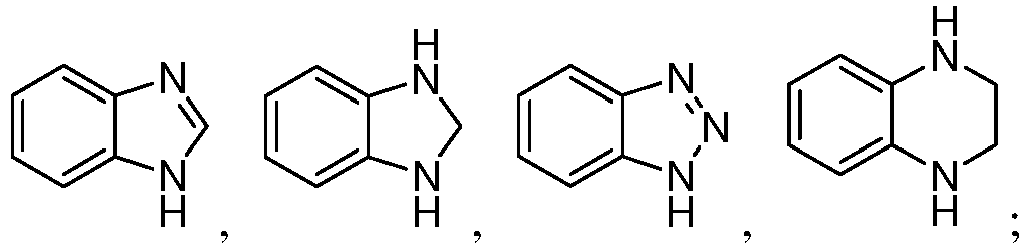
the method V comprises the following steps:1) the compound of formula (I-10a) or (I-7a) and a nitrating agent conducting an ortho nitrating reaction to obtain a compound of formula (I-10b) or (I-7b);2) reacting the compound of formula (I-10b) or (I-7b) and a sulfonylating agent in the presence of a base in a suitable solvent to obtain the compound of formula (I-10c), or (I-11a);3) the compound of formula (I-10c) or (I-11a) and benzylamine conducting a Buchwald-Hartig reaction to obtain a compound of formula (I-10d) or (I-11b);4) conducting a reduction reaction of the compound of formula (I-10d) or (I-11b) to obtain a compound of formula (I-10e) or (I-11c);5) conducting a ring-closure reaction of the compound of formula (I-10e) or (I-11c) to obtain a compound of formula (I-10) or (I-11);Method VI:
Conducting a functional group conversing of the compounds of the formulae (I-1) to (I-11) obtained by the methods I to V to obtain the title compound. - Use of the tetrahydroprotoberberine compound, enantiomers, diastereomers, racemates and mixtures thereof, and pharmaceutically acceptable salts, crystalline hydrates and solvates thereof as in any one of claims 1 to 6 in the preparation of a medicament for the prevention and/or treatment of diseases of the central nervous system.
- The use according to claim 8, characterized in that: the central nervous system disease is selected from schizophrenia; rebellious, unmanageable or chronic schizophrenia; affective disorder; mental disorder; emotional disorder; Type I bipolar affective disorder; type II bipolar affective disorder; depression; endogenous depression; major depression; rebellious depression; severe emotional disorder; circulatory affective disorder; panic attack; panic disorder; social phobia; obsessive-compulsive attitudes and behavioral disorders; impulsive disorders; post-traumatic stress disorder; anxiety disorder; acute stress disorder; hysteria; anorexia nervosa; adaptive disorder; cognitive impairment; autism; neurological headache; mania; Parkinson's disease; Huntington's disease; Alzheimer's disease; dementia; memory disorders; attention deficit hyperactivity disorder; drug addiction; sleep disorders; attention deficit / hyperactivity diseases and tic.
- A pharmaceutical composition, comprising a therapeutically effective amount of the tetrahydroprotoberberine compound, enantiomers, diastereomers, racemates and mixtures thereof, and pharmaceutically acceptable salts, crystalline hydrates and solvates thereof as in any one of claims 1 to 6, and optionally a pharmaceutically acceptable carrier.
Applications Claiming Priority (2)
| Application Number | Priority Date | Filing Date | Title |
|---|---|---|---|
| CN201710693250 | 2017-08-14 | ||
| PCT/CN2018/100340 WO2019034031A1 (en) | 2017-08-14 | 2018-08-14 | Tetrahydroprotoberberine compound, preparation method therefor and uses thereof, and pharmaceutical composition |
Publications (2)
| Publication Number | Publication Date |
|---|---|
| EP3670511A1 true EP3670511A1 (en) | 2020-06-24 |
| EP3670511A4 EP3670511A4 (en) | 2020-09-02 |
Family
ID=65361802
Family Applications (1)
| Application Number | Title | Priority Date | Filing Date |
|---|---|---|---|
| EP18846464.8A Withdrawn EP3670511A4 (en) | 2017-08-14 | 2018-08-14 | TETRAHYDROPROTOBERBERIN COMPOUND, METHOD OF MANUFACTURING AND USING IT, AND PHARMACEUTICAL COMPOSITION |
Country Status (5)
| Country | Link |
|---|---|
| US (1) | US11731965B2 (en) |
| EP (1) | EP3670511A4 (en) |
| JP (1) | JP7100693B2 (en) |
| CN (1) | CN109384780B (en) |
| WO (1) | WO2019034031A1 (en) |
Cited By (1)
| Publication number | Priority date | Publication date | Assignee | Title |
|---|---|---|---|---|
| EP4606800A4 (en) * | 2022-10-18 | 2026-01-21 | Beijing Tide Pharmaceutical Co Ltd | Connection based on an orydal structure and use thereof |
Families Citing this family (7)
| Publication number | Priority date | Publication date | Assignee | Title |
|---|---|---|---|---|
| CN110372469B (en) * | 2019-07-23 | 2020-09-08 | 清华大学 | Hydrogenated cyclo [12] arene compound and preparation method thereof |
| CN112043700B (en) * | 2020-09-23 | 2023-04-11 | 中国药科大学 | Application of demethylenetetrahydroberberine hydrochloride in preparation of medicines for preventing or treating neurodegenerative diseases |
| CN112851662B (en) * | 2021-01-21 | 2022-09-23 | 中国药科大学 | Isoquinoline alkaloid and derivatives thereof, preparation method, pharmaceutical composition and application |
| CN114315823B (en) * | 2022-01-05 | 2023-07-18 | 西南交通大学 | Intermediates of berberine hydrochloride and analogues thereof and preparation methods thereof |
| CN119143749B (en) * | 2023-06-14 | 2026-03-10 | 北京理工大学 | Berberine derivative, pharmaceutical composition and application thereof |
| TW202511260A (en) * | 2023-09-04 | 2025-03-16 | 中國商北京泰德製藥股份有限公司 | Tetrahydroisoquinoline derivative and use thereof |
| CN118126034B (en) * | 2024-05-06 | 2024-07-05 | 云南省药物研究所 | Comprehensive utilization method of rotundine splitting mother liquor |
Family Cites Families (15)
| Publication number | Priority date | Publication date | Assignee | Title |
|---|---|---|---|---|
| NL129028C (en) | 1964-02-13 | |||
| JPS5295655A (en) | 1976-02-04 | 1977-08-11 | Mitsubishi Chem Ind Ltd | Preparation of cyclic ethers |
| JPS5295699A (en) * | 1976-02-05 | 1977-08-11 | Dainippon Pharmaceut Co Ltd | Tetrahydroprotoberberine derivatives and their preparation |
| JP2000256326A (en) * | 1999-01-04 | 2000-09-19 | Toray Ind Inc | Sigma receptor agonist comprising an alkaloid compound |
| US8501762B2 (en) | 2005-07-08 | 2013-08-06 | Shanghai Institute Of Materia Medica, Chinese Academy Of Sciences | Tetrahydroprotoberberine compounds, the synthetic method and the use thereof |
| CN1900076B (en) | 2005-07-08 | 2011-06-22 | 中国科学院上海药物研究所 | Tetrahydro proto-berberine compounds, and their preparing method and use |
| CN100528872C (en) | 2006-07-26 | 2009-08-19 | 中国科学院上海药物研究所 | Tetrahydro-proto-berberine compounds, their preparing method, composition and use |
| CN101037436B (en) | 2007-04-18 | 2010-08-11 | 中国科学院上海药物研究所 | L-Stepheridine (l-SPD) derivative, its preparation method and use |
| US8003795B2 (en) | 2007-06-22 | 2011-08-23 | Cvi Pharmaceuticals Limited | Compounds and compositions for reducing lipid levels |
| CN102256973B (en) | 2008-12-23 | 2014-06-11 | 西威埃医药技术(上海)有限公司 | Corydaline derivatives useful for reducing lipid levels |
| US20110009628A1 (en) * | 2009-07-08 | 2011-01-13 | Haiyan Liu | Compounds and Compositions for Modulating Lipid Levels and Methods of Preparing Same |
| CN102399166B (en) | 2010-09-10 | 2016-04-27 | 山东特珐曼药业有限公司 | The Stopholidine of optical siomerism and the preparation method of derivative thereof |
| CN102796096B (en) | 2011-05-27 | 2016-09-14 | 中国科学院上海药物研究所 | Hexahydro dibenzo [a, g] quinolizine compounds, its preparation method, pharmaceutical composition and application thereof |
| CN103387583B (en) | 2012-05-09 | 2018-04-13 | 中国科学院上海药物研究所 | Diaryl simultaneously [a, g] quinolizine class compound, its preparation method, pharmaceutical composition and its application |
| CN105418601A (en) | 2014-09-17 | 2016-03-23 | 成都贝斯凯瑞生物科技有限公司 | Tetrahydrocoptisine derivative and applications thereof |
-
2018
- 2018-08-14 EP EP18846464.8A patent/EP3670511A4/en not_active Withdrawn
- 2018-08-14 WO PCT/CN2018/100340 patent/WO2019034031A1/en not_active Ceased
- 2018-08-14 JP JP2020509452A patent/JP7100693B2/en active Active
- 2018-08-14 US US16/639,394 patent/US11731965B2/en active Active
- 2018-08-14 CN CN201810924124.7A patent/CN109384780B/en active Active
Cited By (1)
| Publication number | Priority date | Publication date | Assignee | Title |
|---|---|---|---|---|
| EP4606800A4 (en) * | 2022-10-18 | 2026-01-21 | Beijing Tide Pharmaceutical Co Ltd | Connection based on an orydal structure and use thereof |
Also Published As
| Publication number | Publication date |
|---|---|
| WO2019034031A1 (en) | 2019-02-21 |
| JP2020530483A (en) | 2020-10-22 |
| CN109384780B (en) | 2022-04-08 |
| EP3670511A4 (en) | 2020-09-02 |
| CN109384780A (en) | 2019-02-26 |
| US20200255421A1 (en) | 2020-08-13 |
| US11731965B2 (en) | 2023-08-22 |
| JP7100693B2 (en) | 2022-07-13 |
Similar Documents
| Publication | Publication Date | Title |
|---|---|---|
| US11731965B2 (en) | Tetrahydroprotoberberine compound, preparation method therefor and uses thereof, and pharmaceutical composition | |
| AU2004260738B2 (en) | Triazolopyrimidine derivatives as glycogen synthase kinase 3 inhibitors | |
| JP6395850B2 (en) | Heterocyclic compounds, methods for their production and use | |
| TWI478920B (en) | Aryl, heteroaryl, and heterocycle substituted tetrahydroisoquinolines and use thereof | |
| RU2732576C2 (en) | Pyrimidine compound with condensed rings, its intermediate compound, method of producing, composition and use | |
| CN103476776B (en) | 2,4-diaminourea-6,7-dihydro-5H-pyrrolo-[2,3] pyrimidine derivatives as FAK/Pyk2 inhibitor | |
| KR20130122778A (en) | 2,4-diamino-6,7-dihydro-5h-pyrrolo[2,3]pyrimidine derivatives as fak/pyk2 inhibitors | |
| CN106565706B (en) | A kind of sulfamide derivative and its application in pharmacy | |
| ES2816005T3 (en) | Combination treatments comprising imidazopyrazinones for the treatment of psychiatric and / or cognitive disorders | |
| CN102796096B (en) | Hexahydro dibenzo [a, g] quinolizine compounds, its preparation method, pharmaceutical composition and application thereof | |
| JP2019500389A (en) | Nitrogen-containing fused heterocyclic compounds, production methods, intermediates, compositions and uses | |
| TW200936141A (en) | Substituted heteroarylamide oxazepinopyrimidone derivatives | |
| TWI860797B (en) | Novel acc inhibitors | |
| KR20170132278A (en) | Tricyclic fused derivatives of 1- (cyclo) alkylpyridin-2-ones useful for the treatment of cancer | |
| JP7170663B2 (en) | Method for preparing indolinobenzodiazepine derivatives | |
| WO2016187028A1 (en) | Heteroaryl compounds, synthesis thereof, and intermediates thereto | |
| CN103387583A (en) | Diaryl [a, g] quinolizidine compound, preparation method thereof, pharmaceutical composition, and uses thereof | |
| EP3560927B1 (en) | Azepine derivatives acting as 5-ht7 receptor modulators | |
| CA2989161C (en) | Ethynylxanthines, preparation and use for cancer treatment | |
| BR122025017416A2 (en) | Selective estrogen receptor degrading compounds | |
| TW202540108A (en) | Compounds as myt1 kinase inhibitors, pharmaceutical compositions and uses thereof | |
| BR122025017409A2 (en) | Selective estrogen receptor degrading compounds | |
| HK40122984A (en) | Novel acc inhibitors | |
| CN104529866A (en) | Indole derivatives and their application in medicine | |
| EP2017277A1 (en) | Thiophene-imidazopyridines |
Legal Events
| Date | Code | Title | Description |
|---|---|---|---|
| STAA | Information on the status of an ep patent application or granted ep patent |
Free format text: STATUS: THE INTERNATIONAL PUBLICATION HAS BEEN MADE |
|
| PUAI | Public reference made under article 153(3) epc to a published international application that has entered the european phase |
Free format text: ORIGINAL CODE: 0009012 |
|
| STAA | Information on the status of an ep patent application or granted ep patent |
Free format text: STATUS: REQUEST FOR EXAMINATION WAS MADE |
|
| 17P | Request for examination filed |
Effective date: 20200224 |
|
| AK | Designated contracting states |
Kind code of ref document: A1 Designated state(s): AL AT BE BG CH CY CZ DE DK EE ES FI FR GB GR HR HU IE IS IT LI LT LU LV MC MK MT NL NO PL PT RO RS SE SI SK SM TR |
|
| AX | Request for extension of the european patent |
Extension state: BA ME |
|
| A4 | Supplementary search report drawn up and despatched |
Effective date: 20200731 |
|
| RIC1 | Information provided on ipc code assigned before grant |
Ipc: A61P 25/16 20060101ALI20200727BHEP Ipc: A61P 25/18 20060101ALI20200727BHEP Ipc: A61P 25/06 20060101ALI20200727BHEP Ipc: A61K 31/4375 20060101ALI20200727BHEP Ipc: A61P 25/30 20060101ALI20200727BHEP Ipc: C07D 455/03 20060101AFI20200727BHEP |
|
| DAV | Request for validation of the european patent (deleted) | ||
| DAX | Request for extension of the european patent (deleted) | ||
| STAA | Information on the status of an ep patent application or granted ep patent |
Free format text: STATUS: EXAMINATION IS IN PROGRESS |
|
| 17Q | First examination report despatched |
Effective date: 20220812 |
|
| GRAP | Despatch of communication of intention to grant a patent |
Free format text: ORIGINAL CODE: EPIDOSNIGR1 |
|
| STAA | Information on the status of an ep patent application or granted ep patent |
Free format text: STATUS: GRANT OF PATENT IS INTENDED |
|
| INTG | Intention to grant announced |
Effective date: 20230606 |
|
| STAA | Information on the status of an ep patent application or granted ep patent |
Free format text: STATUS: THE APPLICATION HAS BEEN WITHDRAWN |
|
| 18W | Application withdrawn |
Effective date: 20230908 |