EP3670334A1 - Hand-operable man-machine interface for aircraft, drone remote control systems, flight simulators, spacecraft and the like - Google Patents
Hand-operable man-machine interface for aircraft, drone remote control systems, flight simulators, spacecraft and the like Download PDFInfo
- Publication number
- EP3670334A1 EP3670334A1 EP19219059.3A EP19219059A EP3670334A1 EP 3670334 A1 EP3670334 A1 EP 3670334A1 EP 19219059 A EP19219059 A EP 19219059A EP 3670334 A1 EP3670334 A1 EP 3670334A1
- Authority
- EP
- European Patent Office
- Prior art keywords
- hand
- operable
- avionic
- machine interface
- user interface
- Prior art date
- Legal status (The legal status is an assumption and is not a legal conclusion. Google has not performed a legal analysis and makes no representation as to the accuracy of the status listed.)
- Granted
Links
Images



Classifications
-
- B—PERFORMING OPERATIONS; TRANSPORTING
- B64—AIRCRAFT; AVIATION; COSMONAUTICS
- B64C—AEROPLANES; HELICOPTERS
- B64C13/00—Control systems or transmitting systems for actuating flying-control surfaces, lift-increasing flaps, air brakes, or spoilers
- B64C13/02—Initiating means
- B64C13/04—Initiating means actuated personally
-
- Y—GENERAL TAGGING OF NEW TECHNOLOGICAL DEVELOPMENTS; GENERAL TAGGING OF CROSS-SECTIONAL TECHNOLOGIES SPANNING OVER SEVERAL SECTIONS OF THE IPC; TECHNICAL SUBJECTS COVERED BY FORMER USPC CROSS-REFERENCE ART COLLECTIONS [XRACs] AND DIGESTS
- Y02—TECHNOLOGIES OR APPLICATIONS FOR MITIGATION OR ADAPTATION AGAINST CLIMATE CHANGE
- Y02T—CLIMATE CHANGE MITIGATION TECHNOLOGIES RELATED TO TRANSPORTATION
- Y02T50/00—Aeronautics or air transport
- Y02T50/40—Weight reduction
Definitions
- the present invention relates to a hand-operable Man-Machine Interface (MMI) for use on board aircraft, in drone remote control systems, in flight simulators, on board spacecraft, and for similar applications.
- MMI Man-Machine Interface
- the present invention concerns the specific technical sector of avionic MMIs based on hand-operable control sticks.
- MMIs Man-Machine Interfaces
- aircraft e.g., airplanes and helicopters
- spacecraft spacecraft
- drone remote control systems to allow users to:
- MMIs include control sticks that are designed to be gripped and moved by a user with one or two hands and that are fitted with one or more User Interface (UI) devices of the hard-key type (such as buttons, switches, levers, etc.) designed to be operated by the user with one or more fingers.
- UI User Interface
- An MMI of the above type allow a user (e.g., a pilot) to control many different functions (e.g., flight-related functions) by means of a combined use of the control stick and of the hard-key-type UI devices installed thereon (typically, provided on a handgrip arranged at an upper end of the control stick).
- a user e.g., a pilot
- many different functions e.g., flight-related functions
- an MMI of the above type may be advantageously exploited:
- HTAS Hands On Throttle-And-Stick
- avionics i.e., the concept of providing buttons and switches on the throttle lever and the flight control stick in an aircraft's cockpit so as to allow pilots to access vital cockpit functions and fly the aircraft without having to remove their hands from the controls.
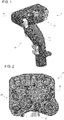
- Figures 1-3 show three traditional HOTAS devices fitted with hard-key-type UI devices.
- Figures 1-3 show, respectively, a first handgrip (denoted as a whole by 1), a second handgrip (denoted as a whole by 2) and a third handgrip (denoted as a whole by 3) for cyclic and collective control sticks of helicopters.
- first, second and third handgrips 1, 2 and 3 include, each,
- the respective elongated portions 11 and 31 are fitted, each, with respective second hard-key-type UI devices 14, 34.
- MMIs of the above type are typically used also in flight simulators to control a virtual aircraft and/or one or more respective virtual onboard systems/devices/apparatus/equipment in a simulated flight scenario.
- MMIs of the above type follow the general trend of greater integration of functions (activatable/deactivatable/controllable by means of hard-key-type UI devices of various kinds, such as buttons, switches, levers, etc.) and, hence, of an increasing number of elements integrated on control sticks.
- more functions means a larger amount of more complex hard-key-type UI devices, which in turn means the necessity for more space in a physically limited volume (i.e., larger dimensions and increased weight of MMIs' body), whereby problems of space and weight and, hence, safety and ergonomic issues arise.
- any switch has a non-negligible cost, especially customized switches that are typically very expensive with a delivery time of about several months.
- object of the prevent invention is that of providing an hand-operable Man-Machine Interface (MMI) for use on board aircraft, in drone remote control systems, in flight simulators, on board spacecraft, and for similar applications, which hand-operable MMI allows to overcome, at least in part, the above technical drawbacks of currently known solutions.
- MMI Man-Machine Interface
- a first specific object of the present invention is that of providing an avionic hand-operable MMI that is more easily reconfigurable/modifiable than existing avionic hand-operable MMIs.
- a second specific object of the present invention is that of providing an avionic hand-operable MMI affected by fewer problems of space and weight and fewer safety and ergonomic issues than current avionic hand-operable MMIs.
- MMI Man-Machine Interface
- the present invention concerns an avionic hand-operable MMI including a hand-operable control stick that is:
- the avionic hand-operable MMI includes also a control electronics that is coupled to the haptic touch screen means and is configured to:
- the present invention stems from Applicant's idea of using haptic touch screen technology in avionic hand-operable Man-Machine Interfaces (MMIs) to replace, completely or partially, traditional hard-key-type User Interface (UI) devices.
- MMIs Man-Machine Interfaces
- UI User Interface
- the present invention concerns an avionic hand-operable Man-Machine Interface (MMI) including a hand-operable control stick that is:
- the haptic touch screen means are coupled to a control electronics configured to:
- control electronics can be further configured to allow a user (e.g., by means of a predefined selection menu (and, if necessary, also respective sub-menus) displayed on the haptic touch screen means) to select and/or set up:
- the control stick includes, at an upper end thereof, a handgrip, wherein said UI means are provided on said handgrip.
- the handgrip may conveniently include an elongated portion and an upper portion arranged at an upper end of the elongated portion, wherein the haptic touch screen means are conveniently provided on the upper portion of the handgrip.
- the UI means may conveniently include also hard-key-type UI devices (such as buttons, switches, levers, etc.) that can be conveniently provided on the elongated portion and/or the upper portion of the handgrip.
- an avionic hand-operable control stick of touch screen means to replace traditional hard-key-type UI devices (such as buttons, switches, levers, etc.) with corresponding virtual (but physically and individually discernible) GUI items enables substantially-unlimited configuration, reconfiguration and customization of the control functions implementable via said avionic hand-operable control stick.
- any configuration, reconfiguration and customization can be easily managed via software and/or firmware changes (e.g., by suitably reprogramming the control electronics), thereby avoiding any impact on size and weight of the avionic hand-operable control stick and, hence, any safety and ergonomic issue.
- any request for an increase (or, more in general, a variation) in the number and/or type of control functions to be implemented via an avionic hand-operable control stick can be easily managed, with the present invention, via software/firmware changes with no impact on size and weight of the avionic hand-operable control stick.
- a preferred embodiment of the present invention enables also user configuration/reconfiguration/customization of the control functions to be implemented via the haptic touch screen means and/or of the corresponding GUI items.
- touch screen means provided with haptic technology allows adding sensory feedbacks (in particular, touch feedbacks) in bidirectional communications between a user and the MMI, thereby enriching/improving such communications and, hence, user experience (additionally, the avionic hand-operable MMI might be conveniently equipped also with means for providing users with additional sensory feedbacks, for example sound feedbacks, so as to further enrich/improve user experience).
- the present invention allows enhancing user experience through:
- haptic touch screen means with the capability to provide users with realistic haptic feedbacks allows facilitating seamless transition from traditional avionic hand-operable MMIs fitted with hard-key-type UI devices to the innovative MMI according to the present invention, since haptic technology allows to realistically simulate touch interactions typical of hard-key-type UI devices, to which users are currently accustomed.
- haptic and touch screen technologies allows implementing virtual (but physically and individually discernible) GUI items that can have different shapes and/or aspects, and that can be associated with different haptic feedbacks. Therefore, the present invention provides the capability to simulate almost any type of hard-key-type UI device (e.g., toggle switches, push buttons, sliding sensors, etc.) along with the corresponding haptic feedback.
- hard-key-type UI device e.g., toggle switches, push buttons, sliding sensors, etc.
- the avionic hand-operable MMI according to the present invention can be advantageously exploited on board an aircraft (such as an airplane or a rotorcraft/helicopter) or a spacecraft, whereby the main and secondary control functions can be, conveniently, functions for controlling operation of:
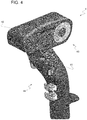
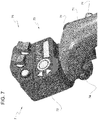
- Figures 4-7 show four examples of HOTAS devices according to four illustrative, non-limiting embodiments of the present invention.
- Figures 4-7 show, respectively, a fourth handgrip (denoted as a whole by 4), a fifth handgrip (denoted as a whole by 5), a sixth handgrip (denoted as a whole by 6) and a seventh handgrip (denoted as a whole by 7) for cyclic and collective control sticks of helicopters.
- the fourth, fifth, sixth and seventh handgrips 4, 5, 6 and 7 include, each,
- the respective upper portion 52 is fitted, in addition to the respective haptic touch screen means 53, also with additional hard-key-type UI devices 55.
- the respective upper portion 72 is fitted, in addition to the respective haptic touch screen means 73, also with additional hard-key-type UI devices 75.
- fourth and fifth handgrips 4 and 5 represent innovative versions of the first handgrip 1, wherein:
- the sixth handgrip 6 represents an innovative version of the second handgrip 2, wherein the first hard-key-type UI devices 23 of the second handgrip 2 have been completely replaced, in the sixth handgrip 6, with the haptic touch screen means 63.
- the seventh handgrip 7 represents an innovative version of the third handgrip 3, wherein the first hard-key-type UI devices 33 of the third handgrip 3 have been partially replaced, in the seventh handgrip 7, with the haptic touch screen means 73 (while hard-key-type UI devices 75 are still provided on the upper portion 72 of the seventh handgrip 7).
- the avionic hand-operable MMI according to the present invention can be advantageously exploited also in a drone remote control system, whereby the main and secondary control functions can be, conveniently, functions for remotely controlling operation of:
- the avionic hand-operable MMI according to the present invention can be advantageously exploited also in a flight simulator, whereby the main and secondary control functions can be, conveniently, functions for controlling operation, in a simulated flight scenario, of:
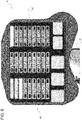
- Figure 8 schematically illustrates (in particular, by means of a block diagram) an example of functional architecture of haptic touch screen means (denoted by 81) and a control electronics (denoted by 82) of an avionic hand-operable MMI according to an illustrative, non-limiting embodiment of the present invention.
- the haptic touch screen means 81 (e.g., the haptic touch screen means 43, 53, 63, 73) include:
- the control electronics 82 is configured to:
- the control electronics 82 detects position of the user's touch along with respective touch-related features (e.g., exerted force) based on the data/signals received from the touch sensors 813, and accordingly operates the haptic actuators 814 to generate a constructive superposition of sound waves (bending waves) at the touched point, thereby inducing, in the user, a feeling of having actually touched/pushed a hard-key-type UI device (e.g., a button).
- touch-related features e.g., exerted force
- control electronics 82 can be further configured to:
- the haptic effect may be added by integrating standing wave generators and pressure sensors into a conventional touch screen so as to receive touch-related geometrical information items from the conventional touch screen and touch-force-related information items from the pressure sensors.
- a single set of touch sensors 813 e.g., pressure sensors
- the haptic touch screen means 81 may be conveniently implemented, for example, by means of a haptic Liquid-Crystal Display (LCD).
- LCD haptic Liquid-Crystal Display
- the avionic hand-operable MMI according to the present invention is more easily reconfigurable/modifiable and is affected by fewer problems of space and weight and fewer safety and ergonomic issues than existing avionic hand-operable MMIs fitted with hard-key-type UI devices.
- the present invention has the additional advantage of merging modern, pervasive habit of using touch screens (due to universal use of smartphones, tablets, etc.) with the request/necessity for more and more functions to be implemented via one and the same MMI.
Landscapes
- Engineering & Computer Science (AREA)
- Automation & Control Theory (AREA)
- Aviation & Aerospace Engineering (AREA)
- User Interface Of Digital Computer (AREA)
- Position Input By Displaying (AREA)
Abstract
Description
- This patent application claims priority from European patent application no.
18425104.9 filed on 21/12/2018 102019000001799 - The present invention relates to a hand-operable Man-Machine Interface (MMI) for use on board aircraft, in drone remote control systems, in flight simulators, on board spacecraft, and for similar applications.
- In particular, the present invention concerns the specific technical sector of avionic MMIs based on hand-operable control sticks.
- As is known, Man-Machine Interfaces (MMIs) are typically used on board aircraft (e.g., airplanes and helicopters) and spacecraft, and in drone remote control systems to allow users to:
- control operation of
- the aircraft/spacecraft/drones (e.g., to pilot them), or
- onboard systems/devices/apparatus/equipment; and/or
- activate/deactivate/control execution of one or more predefined functions performable by the aircraft/spacecraft/drones and/or by onboard systems/devices/apparatus/equipment.
- Generally, such MMIs include control sticks that are designed to be gripped and moved by a user with one or two hands and that are fitted with one or more User Interface (UI) devices of the hard-key type (such as buttons, switches, levers, etc.) designed to be operated by the user with one or more fingers.
- An MMI of the above type allow a user (e.g., a pilot) to control many different functions (e.g., flight-related functions) by means of a combined use of the control stick and of the hard-key-type UI devices installed thereon (typically, provided on a handgrip arranged at an upper end of the control stick).
- For example, an MMI of the above type may be advantageously exploited:
- on board an aircraft to enable attitude/flight control (e.g., for controlling ailerons, elevator, rudder, flaps, etc. of an airplane, or for controlling cyclic pitch of rotor blades of a rotorcraft/helicopter);
- on board a military combat aircraft (e.g., a fighter plane or a military combat helicopter) to allow controlling an external sight system and/or a weapon aiming and firing system;
- on board a spacecraft for controlling attitude/flight thereof; and
- in a drone remote control system to enable remote control of attitude/flight of an Unmanned Aerial Vehicle (UAV - commonly known as drone).
- In this context, it is worth drawing attention on the fact that the concept of "HOTAS" (which stands for Hands On Throttle-And-Stick) is broadly known in avionics, i.e., the concept of providing buttons and switches on the throttle lever and the flight control stick in an aircraft's cockpit so as to allow pilots to access vital cockpit functions and fly the aircraft without having to remove their hands from the controls.
-
Figures 1-3 show three traditional HOTAS devices fitted with hard-key-type UI devices. In particular,Figures 1-3 show, respectively, a first handgrip (denoted as a whole by 1), a second handgrip (denoted as a whole by 2) and a third handgrip (denoted as a whole by 3) for cyclic and collective control sticks of helicopters. - In detail, the first, second and
third handgrips - a respective
elongated portion - a respective
upper portion elongated portion type UI devices - Moreover, in the first and
third handgrips elongated portions type UI devices - Moreover, MMIs of the above type are typically used also in flight simulators to control a virtual aircraft and/or one or more respective virtual onboard systems/devices/apparatus/equipment in a simulated flight scenario.
- MMIs of the above type follow the general trend of greater integration of functions (activatable/deactivatable/controllable by means of hard-key-type UI devices of various kinds, such as buttons, switches, levers, etc.) and, hence, of an increasing number of elements integrated on control sticks.
- Nowadays, traditional hard-key-type UI devices are no longer sufficient to satisfy requests typical of avionic sector for ever-increasing numbers of functions requiring larger amounts and more types of complex components, such as toggles, potentiometers, Hall effect switches and customized expensive components.
- In fact, more functions means a larger amount of more complex hard-key-type UI devices, which in turn means the necessity for more space in a physically limited volume (i.e., larger dimensions and increased weight of MMIs' body), whereby problems of space and weight and, hence, safety and ergonomic issues arise.
- Moreover, it is worth noting that any switch has a non-negligible cost, especially customized switches that are typically very expensive with a delivery time of about several months.
- Additionally, it is important to note also that it typically takes a long time (e.g., months or even years) to design, develop, test and validate a new avionic hand-operable MMI. Thence, if a request for integration of one or more additional functions comes up when the design, development, testing and validation process has already started (or, even worse, ended), it is usually necessary to begin anew, thereby resulting in additional/new non-negligible costs and times of design, development, testing and validation.
- In other words, the reconfiguration/modification of an existing avionic hand-operable MMI or of an avionic hand-operable MMI already under development is a difficult task that typically requires long times and extremely high costs to be accomplished.
- In general, object of the prevent invention is that of providing an hand-operable Man-Machine Interface (MMI) for use on board aircraft, in drone remote control systems, in flight simulators, on board spacecraft, and for similar applications, which hand-operable MMI allows to overcome, at least in part, the above technical drawbacks of currently known solutions.
- In particular, a first specific object of the present invention is that of providing an avionic hand-operable MMI that is more easily reconfigurable/modifiable than existing avionic hand-operable MMIs.
- Moreover, a second specific object of the present invention is that of providing an avionic hand-operable MMI affected by fewer problems of space and weight and fewer safety and ergonomic issues than current avionic hand-operable MMIs.
- These and other objects are achieved by the present invention in that it relates to avionic hand-operable Man-Machine Interface (MMI), as defined in the appended claims.
- More specifically, the present invention concerns an avionic hand-operable MMI including a hand-operable control stick that is:
- designed to be gripped and moved by a user with one or two hands to carry out a main control function related to an aircraft/spacecraft/drone; and
- fitted with User Interface (UI) means designed to be operated by the user with one or more fingers to perform secondary control functions related to the aircraft/spacecraft/drone, wherein said UI means include haptic touch screen means.
- Preferably, the avionic hand-operable MMI includes also a control electronics that is coupled to the haptic touch screen means and is configured to:
- display a plurality of Graphical User Interface (GUI) items on said haptic touch screen means, wherein each displayed GUI item is associated with a respective secondary control function; and,
- in response to, and based on, a touch of the user on a displayed GUI item,
- provide the user with a corresponding haptic feedback and
- activate/deactivate/control execution of the respective secondary control function associated with the touched GUI item.
- For a better understanding of the present invention, preferred embodiments, which are intended purely by way of non-limiting examples, will now be described with reference to the attached drawings (all not to scale), where:
-
Figures 1-3 show three traditional handgrips for cyclic and collective control sticks of helicopters; -
Figures 4-7 show four examples of handgrips for cyclic and collective control sticks of helicopters according to four illustrative, non-limiting embodiments of the present invention; and -
Figure 8 schematically illustrates an example of functional architecture of haptic touch screen means and a control electronics of an avionic hand-operable MMI according to an illustrative, non-limiting embodiment of the present invention. - The following discussion is presented to enable a person skilled in the art to make and use the invention. Various modifications to the embodiments shown and described will be readily apparent to those skilled in the art, without departing from the scope of the present invention as claimed. Thence, the present invention is not intended to be limited to the embodiments shown and described, but is to be accorded the widest scope of protection consistent with the principles and features disclosed herein and defined in the appended claims.
- The present invention stems from Applicant's idea of using haptic touch screen technology in avionic hand-operable Man-Machine Interfaces (MMIs) to replace, completely or partially, traditional hard-key-type User Interface (UI) devices.
- In particular, the present invention concerns an avionic hand-operable Man-Machine Interface (MMI) including a hand-operable control stick that is:
- designed to be gripped and moved by a user with one or two hands to carry out a main control function related to an aircraft/spacecraft/drone; and
- fitted with User Interface (UI) means designed to be operated by the user with one or more fingers to perform secondary control functions related to the aircraft/spacecraft/drone, wherein said UI means include haptic touch screen means.
- Preferably, the haptic touch screen means are coupled to a control electronics configured to:
- display a plurality of Graphical User Interface (GUI) items on said haptic touch screen means, wherein each displayed GUI item is associated with a respective secondary control function; and,
- in response to, and based/depending on, a touch of the user on a displayed GUI item,
- provide the user (in particular, the user's finger(s)) with a corresponding haptic feedback and
- activate/deactivate/control execution of the respective secondary control function associated with the touched GUI item.
- Conveniently, the control electronics can be further configured to allow a user (e.g., by means of a predefined selection menu (and, if necessary, also respective sub-menus) displayed on the haptic touch screen means) to select and/or set up:
- the secondary control functions for which corresponding GUI items have to be displayed on the haptic touch screen means; and/or
- positions on the haptic touch screen means and/or operating features of the GUI items to be displayed.
- Conveniently, the control stick includes, at an upper end thereof, a handgrip, wherein said UI means are provided on said handgrip. In this case, the handgrip may conveniently include an elongated portion and an upper portion arranged at an upper end of the elongated portion, wherein the haptic touch screen means are conveniently provided on the upper portion of the handgrip. Moreover, the UI means may conveniently include also hard-key-type UI devices (such as buttons, switches, levers, etc.) that can be conveniently provided on the elongated portion and/or the upper portion of the handgrip.
- The integration on an avionic hand-operable control stick of touch screen means to replace traditional hard-key-type UI devices (such as buttons, switches, levers, etc.) with corresponding virtual (but physically and individually discernible) GUI items enables substantially-unlimited configuration, reconfiguration and customization of the control functions implementable via said avionic hand-operable control stick. In fact, any configuration, reconfiguration and customization can be easily managed via software and/or firmware changes (e.g., by suitably reprogramming the control electronics), thereby avoiding any impact on size and weight of the avionic hand-operable control stick and, hence, any safety and ergonomic issue. In other words, any request for an increase (or, more in general, a variation) in the number and/or type of control functions to be implemented via an avionic hand-operable control stick can be easily managed, with the present invention, via software/firmware changes with no impact on size and weight of the avionic hand-operable control stick. Additionally, it is worth noting that, as previously explained, a preferred embodiment of the present invention enables also user configuration/reconfiguration/customization of the control functions to be implemented via the haptic touch screen means and/or of the corresponding GUI items.
- Moreover, the fact of using touch screen means provided with haptic technology allows adding sensory feedbacks (in particular, touch feedbacks) in bidirectional communications between a user and the MMI, thereby enriching/improving such communications and, hence, user experience (additionally, the avionic hand-operable MMI might be conveniently equipped also with means for providing users with additional sensory feedbacks, for example sound feedbacks, so as to further enrich/improve user experience).
- In particular, it is worth noting that the present invention allows enhancing user experience through:
- improved usability (in fact, by restoring the sense of touch to otherwise flat, cold surfaces, haptic technology enables multisensory experience (e.g., based on sight, sound and touch), thereby improving usability of the MMI by a user; in particular, the confidence a user receives through touch feedback when selecting a virtual button improves usability by better involving user's senses);
- enhanced realism (in fact, haptic technology allows increasing the degree of realism in user experience by stimulating a larger number of user's senses; this is particularly relevant in simulation applications that traditionally rely only on visual and sound inputs; the addition of touch feedbacks, that can be different from point to point on the touch screen, allows enhancing the sense of realism felt by a user);
- restoration of mechanical feel (existing touch-screen-based devices lack physical feedbacks that humans frequently need to fully understand the context of their interactions; by providing users with intuitive and unmistakable touch feedbacks, haptic technology allows creating a more confident user experience and also improving safety by overcoming distractions; this is especially important when sound or visual feedbacks are insufficient, for example in industrial applications or in applications that may suffer from users' distractions, e.g., during a flight of an aircraft/spacecraft/drone).
- Furthermore, the use of haptic touch screen means with the capability to provide users with realistic haptic feedbacks allows facilitating seamless transition from traditional avionic hand-operable MMIs fitted with hard-key-type UI devices to the innovative MMI according to the present invention, since haptic technology allows to realistically simulate touch interactions typical of hard-key-type UI devices, to which users are currently accustomed.
- In addition, it is worth noting also that the combined use of haptic and touch screen technologies allows implementing virtual (but physically and individually discernible) GUI items that can have different shapes and/or aspects, and that can be associated with different haptic feedbacks. Therefore, the present invention provides the capability to simulate almost any type of hard-key-type UI device (e.g., toggle switches, push buttons, sliding sensors, etc.) along with the corresponding haptic feedback.
- The avionic hand-operable MMI according to the present invention can be advantageously exploited on board an aircraft (such as an airplane or a rotorcraft/helicopter) or a spacecraft, whereby the main and secondary control functions can be, conveniently, functions for controlling operation of:
- the aircraft/spacecraft (e.g., for attitude/flight control), and/or
- systems/devices/apparatus/equipment installed on board said aircraft/spacecraft (e.g., an external sight system and/or a weapon aiming and firing system).
- In this connection,
Figures 4-7 show four examples of HOTAS devices according to four illustrative, non-limiting embodiments of the present invention. In particular,Figures 4-7 show, respectively, a fourth handgrip (denoted as a whole by 4), a fifth handgrip (denoted as a whole by 5), a sixth handgrip (denoted as a whole by 6) and a seventh handgrip (denoted as a whole by 7) for cyclic and collective control sticks of helicopters. - In detail, the fourth, fifth, sixth and
seventh handgrips - a respective
elongated portion - a respective
upper portion elongated portion - Moreover, in the fourth, fifth and
seventh handgrips elongated portions type UI devices - Furthermore, in the
fifth handgrip 5, the respectiveupper portion 52 is fitted, in addition to the respective haptic touch screen means 53, also with additional hard-key-type UI devices 55. - Similarly, in the
seventh handgrip 7, the respectiveupper portion 72 is fitted, in addition to the respective haptic touch screen means 73, also with additional hard-key-type UI devices 75. - It is worth noting that the fourth and
fifth handgrips first handgrip 1, wherein: - the first hard-key-
type UI devices 13 of thefirst handgrip 1 have been completely replaced, in thefourth handgrip 4, with the haptic touch screen means 43; and - the first hard-key-
type UI devices 13 of thefirst handgrip 1 have been partially replaced, in thefifth handgrip 5, with the haptic touch screen means 53 (while hard-key-type UI devices 55 are still provided on theupper portion 52 of the fifth handgrip 5). - Similarly, the
sixth handgrip 6 represents an innovative version of thesecond handgrip 2, wherein the first hard-key-type UI devices 23 of thesecond handgrip 2 have been completely replaced, in thesixth handgrip 6, with the haptic touch screen means 63. - Additionally, the
seventh handgrip 7 represents an innovative version of thethird handgrip 3, wherein the first hard-key-type UI devices 33 of thethird handgrip 3 have been partially replaced, in theseventh handgrip 7, with the haptic touch screen means 73 (while hard-key-type UI devices 75 are still provided on theupper portion 72 of the seventh handgrip 7). - The avionic hand-operable MMI according to the present invention can be advantageously exploited also in a drone remote control system, whereby the main and secondary control functions can be, conveniently, functions for remotely controlling operation of:
- a drone (e.g., for attitude/flight control), and/or
- onboard systems/devices/apparatus/equipment of said drone (e.g., an external sight system and/or a weapon aiming and firing system).
- Additionally, the avionic hand-operable MMI according to the present invention can be advantageously exploited also in a flight simulator, whereby the main and secondary control functions can be, conveniently, functions for controlling operation, in a simulated flight scenario, of:
- a virtual aircraft/spacecraft (e.g., for attitude/flight control), and/or
- virtual onboard systems/devices/apparatus/equipment of said virtual aircraft/spacecraft.
-
Figure 8 schematically illustrates (in particular, by means of a block diagram) an example of functional architecture of haptic touch screen means (denoted by 81) and a control electronics (denoted by 82) of an avionic hand-operable MMI according to an illustrative, non-limiting embodiment of the present invention. - In particular, the haptic touch screen means 81 (e.g., the haptic touch screen means 43, 53, 63, 73) include:
- a
screen 811 and adisplay electronics 812 operable to display GUI items on thescreen 811; - touch sensors 813 (e.g., pressure sensors) configured to sense touches of a user on the
screen 811 and to provide data/signals indicative of user's touches sensed and of respective touch-related features (e.g., positions of touched points, touch forces exerted on thescreen 811, movement(s) of user's finger(s) on thescreen 811, etc.); and - haptic actuators 814 (e.g., standing wave generators) operable to provide haptic feedbacks on the
screen 811. - The
control electronics 82 is configured to: - operate the
display electronics 812 to display GUI items on thescreen 811; - receive from the
touch sensors 813 the data/signals indicative of user's touches sensed and of respective touch-related features; and, - based/depending on the data/signals received from the
touch sensors 813,- detect a touch of a user on a displayed GUI item,
- operate the
haptic actuators 814 to provide the user (in particular, the user's finger(s)) with a corresponding haptic feedback, and - generate corresponding activation/deactivation/control data/signals/commands related to the respective secondary control function associated with the touched GUI item (wherein the generated activation/deactivation/control data/signals/commands are, then, sent/provided by the
control electronics 82 to relevant onboard systems/devices/apparatus/equipment to activate/deactivate/control execution of the respective secondary control function associated with the touched GUI item).
- In other words, when the
screen 811 is touched, thecontrol electronics 82 detects position of the user's touch along with respective touch-related features (e.g., exerted force) based on the data/signals received from thetouch sensors 813, and accordingly operates thehaptic actuators 814 to generate a constructive superposition of sound waves (bending waves) at the touched point, thereby inducing, in the user, a feeling of having actually touched/pushed a hard-key-type UI device (e.g., a button). - Conveniently, the
control electronics 82 can be further configured to: - operate the
display electronics 812 to display one or more predefined selection/setting GUI items on thescreen 811; - based/depending on the data/signals received from the
touch sensors 813, detect one or more touches of a user on the displayed selection/setting GUI item(s) indicative of one or more user's instructions to select/set up- the secondary control functions for which corresponding GUI items have to be displayed on the
screen 811, and/or - positions on the
screen 811 and/or operating features of the GUI items to be displayed; and
- the secondary control functions for which corresponding GUI items have to be displayed on the
- operate the
display electronics 812 according to the user's instruction(s). - Conveniently, the haptic effect may be added by integrating standing wave generators and pressure sensors into a conventional touch screen so as to receive touch-related geometrical information items from the conventional touch screen and touch-force-related information items from the pressure sensors. Otherwise, as shown in
Figure 8 , a single set of touch sensors 813 (e.g., pressure sensors) may be advantageously used to provide both information types (i.e., touch-related geometrical information items and touch-force-related information items). - The haptic touch screen means 81 may be conveniently implemented, for example, by means of a haptic Liquid-Crystal Display (LCD).
- From the foregoing, the technical advantages and the innovative features of the present invention are immediately clear to those skilled in the art.
- In particular, it is important to stress the point that the avionic hand-operable MMI according to the present invention is more easily reconfigurable/modifiable and is affected by fewer problems of space and weight and fewer safety and ergonomic issues than existing avionic hand-operable MMIs fitted with hard-key-type UI devices.
- Furthermore, additional technical advantages of the present invention are:
- almost unlimited possibilities of configuring, reconfiguring and customizing the control functions implemented by the MMI, without increasing dimensions and weight thereof;
- control functions and haptic feedbacks are customizable via software/firmware modifications, whereby it is no longer necessary to manufacture and qualify prototypes of hard-key-type UI devices (e.g., switches and buttons);
- no more need to buy and store single components, thereby reducing costs and delivery times of components;
- backlight panels are no longer necessary; in fact, labels and indications are provided directly by the displayed GUI items;
- dramatic weight reduction due to reduction in cabling and in amount of switches/push buttons;
- customizable graphics; and
- high design flexibility as for number and type of implemented functions.
- Additionally, it is worth noting also that the present invention has the additional advantage of merging modern, pervasive habit of using touch screens (due to universal use of smartphones, tablets, etc.) with the request/necessity for more and more functions to be implemented via one and the same MMI.
- In conclusion, it is clear that numerous modifications and variants can be made to the present invention, all falling within the scope of the invention, as defined in the appended claims.
Claims (10)
- Avionic hand-operable man-machine interface including a hand-operable control stick that is:• designed to be gripped and moved by a user with one or two hands to carry out a main control function related to an aircraft/spacecraft/drone; and• fitted with user interface means designed to be operated by the user with one or more fingers to perform secondary control functions related to the aircraft/spacecraft/drone;characterized in that the user interface means include haptic touch screen means (43, 53, 63, 73, 81).
- The avionic hand-operable man-machine interface of claim 1, further including a control electronics (82) that is coupled to the haptic touch screen means (43, 53, 63, 73, 81) and is configured to:• display a plurality of graphical user interface items on said haptic touch screen means (43, 53, 63, 73, 81), wherein each displayed graphical user interface item is associated with a respective secondary control function; and,• in response to, and based on, a touch of the user on a displayed graphical user interface item,- provide the user with a corresponding haptic feedback and- activate/deactivate/control execution of the respective secondary control function associated with the touched graphical user interface item.
- The avionic hand-operable man-machine interface of claim 2, wherein the control electronics (82) is further configured to allow a user to select and/or set up:• the secondary control functions for which corresponding graphical user interface items have to be displayed on the haptic touch screen means (43, 53, 63, 73, 81); and/or• positions on the haptic touch screen means (43, 53, 63, 73, 81) and/or operating features of the graphical user interface items to be displayed.
- The avionic hand-operable man-machine interface according to any claim 1-3, wherein the hand-operable control stick includes, at an upper end thereof, a handgrip (4, 5, 6, 7); wherein the user interface means are provided on said handgrip (4, 5, 6, 7).
- The avionic hand-operable man-machine interface of claim 4, wherein the handgrip (4, 5, 6, 7) includes an elongated portion (41, 51, 61, 71) and an upper portion (42, 52, 62, 72) arranged at an upper end of the elongated portion (41, 51, 61, 71); wherein the haptic touch screen means (43, 53, 63, 73, 81) are provided on the upper portion (42, 52, 62, 72) of the handgrip (4, 5, 6, 7).
- The avionic hand-operable man-machine interface of claim 5, wherein the user interface means include also hard-key-type user interface devices provided on the elongated portion (41, 51, 61, 71) and/or the upper portion (42, 52, 62, 72) of the handgrip (4, 5, 6, 7).
- Aircraft equipped with the avionic hand-operable man-machine interface as claimed in any preceding claim.
- Drone remote control system including the avionic hand-operable man-machine interface as claimed in any claim 1-6.
- Flight simulator comprising the avionic hand-operable man-machine interface as claimed in any claim 1-6.
- Spacecraft equipped with the avionic hand-operable man-machine interface as claimed in any claim 1-6.
Priority Applications (1)
| Application Number | Priority Date | Filing Date | Title |
|---|---|---|---|
| HRP20210664TT HRP20210664T1 (en) | 2018-12-21 | 2021-04-27 | Hand-operable man-machine interface for aircraft, drone remote control systems, flight simulators, spacecraft and the like |
Applications Claiming Priority (2)
| Application Number | Priority Date | Filing Date | Title |
|---|---|---|---|
| EP18425104 | 2018-12-21 | ||
| IT102019000001799A IT201900001799A1 (en) | 2018-12-21 | 2019-02-07 | MANUALLY OPERATED HUMAN-MACHINE INTERFACE FOR AIRCRAFT, DRONE REMOTE CONTROL SYSTEMS, FLIGHT SIMULATORS, SPACE VEHICLES AND SIMILAR |
Publications (2)
| Publication Number | Publication Date |
|---|---|
| EP3670334A1 true EP3670334A1 (en) | 2020-06-24 |
| EP3670334B1 EP3670334B1 (en) | 2021-03-10 |
Family
ID=69005437
Family Applications (1)
| Application Number | Title | Priority Date | Filing Date |
|---|---|---|---|
| EP19219059.3A Active EP3670334B1 (en) | 2018-12-21 | 2019-12-20 | Hand-operable man-machine interface for aircraft, drone remote control systems, flight simulators, spacecraft and the like |
Country Status (1)
| Country | Link |
|---|---|
| EP (1) | EP3670334B1 (en) |
Cited By (2)
| Publication number | Priority date | Publication date | Assignee | Title |
|---|---|---|---|---|
| KR20230083211A (en) * | 2021-12-02 | 2023-06-09 | 한국항공우주연구원 | Aircraft control input device and command input method using the same |
| US12473075B2 (en) | 2021-12-02 | 2025-11-18 | Korea Aerospace Research Institute | Aircraft control input device and command input method using the same |
Citations (3)
| Publication number | Priority date | Publication date | Assignee | Title |
|---|---|---|---|---|
| US5472156A (en) * | 1994-03-28 | 1995-12-05 | The United States Of America As Represented By The Secretary Of The Army | Air combat collective control head |
| US20170308113A1 (en) * | 2016-04-26 | 2017-10-26 | Airbus Helicopters | Haptic device for vibrating a control stick |
| KR20180094553A (en) * | 2017-02-16 | 2018-08-24 | 염동진 | Flight yoke capable of recognizing biometric information |
-
2019
- 2019-12-20 EP EP19219059.3A patent/EP3670334B1/en active Active
Patent Citations (3)
| Publication number | Priority date | Publication date | Assignee | Title |
|---|---|---|---|---|
| US5472156A (en) * | 1994-03-28 | 1995-12-05 | The United States Of America As Represented By The Secretary Of The Army | Air combat collective control head |
| US20170308113A1 (en) * | 2016-04-26 | 2017-10-26 | Airbus Helicopters | Haptic device for vibrating a control stick |
| KR20180094553A (en) * | 2017-02-16 | 2018-08-24 | 염동진 | Flight yoke capable of recognizing biometric information |
Cited By (2)
| Publication number | Priority date | Publication date | Assignee | Title |
|---|---|---|---|---|
| KR20230083211A (en) * | 2021-12-02 | 2023-06-09 | 한국항공우주연구원 | Aircraft control input device and command input method using the same |
| US12473075B2 (en) | 2021-12-02 | 2025-11-18 | Korea Aerospace Research Institute | Aircraft control input device and command input method using the same |
Also Published As
| Publication number | Publication date |
|---|---|
| EP3670334B1 (en) | 2021-03-10 |
Similar Documents
| Publication | Publication Date | Title |
|---|---|---|
| EP2624238B1 (en) | Virtual mock up with haptic hand held aid | |
| US20140132528A1 (en) | Aircraft haptic touch screen and method for operating same | |
| US8330732B2 (en) | Method and apparatus for avionic touchscreen operation providing sensible feedback | |
| JP4523346B2 (en) | Display system | |
| US8768541B2 (en) | Device for interaction with a display system, in particular for an avionics display system | |
| US9261965B2 (en) | Touch surface overlay panel | |
| EP3670334B1 (en) | Hand-operable man-machine interface for aircraft, drone remote control systems, flight simulators, spacecraft and the like | |
| EP2022040B1 (en) | Multi-functional mission grip for a vehicle | |
| EP3015959B1 (en) | Touch screen interface device | |
| KR20140079895A (en) | Avionics and Part Task Trainer and Controlling Method for the Same | |
| Thomas et al. | State-of-the-art and future concepts for interaction in aircraft cockpits | |
| US8083186B2 (en) | Input/steering mechanisms and aircraft control systems for use on aircraft | |
| US9619082B2 (en) | Method and a device for controlling at least one piece of equipment | |
| US12148322B2 (en) | Head tracking with virtual avionics training products | |
| US20160077671A1 (en) | Rapid prototyping and machine vision for reconfigurable interfaces | |
| Dodd et al. | Touch on the flight deck: The impact of display location, size, touch technology & turbulence on pilot performance | |
| EP3971870B1 (en) | Advanced haptics in touchscreen avionics lower level device simulators | |
| EP4200205B1 (en) | Aircraft flight control | |
| ES2863983T3 (en) | Manually operable human-machine interface for aircraft, drone remote control systems, flight simulators, spacecraft and the like | |
| US20160085367A1 (en) | Systeme d'entree de donnee multimode | |
| EP2189371B1 (en) | Input/steering mechanisms and aircraft control systems | |
| KR102631397B1 (en) | Real and virtual reality based system for flight training of various type of aircraft | |
| US11604575B2 (en) | Systems and methods for managing configurations of multiple displays of a vehicle | |
| CN112241228A (en) | Electronic display device for a vehicle glass cockpit, vehicle and associated display method | |
| US10338885B1 (en) | Aural and visual feedback of finger positions |
Legal Events
| Date | Code | Title | Description |
|---|---|---|---|
| PUAI | Public reference made under article 153(3) epc to a published international application that has entered the european phase |
Free format text: ORIGINAL CODE: 0009012 |
|
| STAA | Information on the status of an ep patent application or granted ep patent |
Free format text: STATUS: THE APPLICATION HAS BEEN PUBLISHED |
|
| AK | Designated contracting states |
Kind code of ref document: A1 Designated state(s): AL AT BE BG CH CY CZ DE DK EE ES FI FR GB GR HR HU IE IS IT LI LT LU LV MC MK MT NL NO PL PT RO RS SE SI SK SM TR |
|
| AX | Request for extension of the european patent |
Extension state: BA ME |
|
| STAA | Information on the status of an ep patent application or granted ep patent |
Free format text: STATUS: REQUEST FOR EXAMINATION WAS MADE |
|
| 17P | Request for examination filed |
Effective date: 20200707 |
|
| RBV | Designated contracting states (corrected) |
Designated state(s): AL AT BE BG CH CY CZ DE DK EE ES FI FR GB GR HR HU IE IS IT LI LT LU LV MC MK MT NL NO PL PT RO RS SE SI SK SM TR |
|
| GRAP | Despatch of communication of intention to grant a patent |
Free format text: ORIGINAL CODE: EPIDOSNIGR1 |
|
| STAA | Information on the status of an ep patent application or granted ep patent |
Free format text: STATUS: GRANT OF PATENT IS INTENDED |
|
| RIC1 | Information provided on ipc code assigned before grant |
Ipc: B64C 13/04 20060101AFI20200911BHEP |
|
| INTG | Intention to grant announced |
Effective date: 20201007 |
|
| GRAS | Grant fee paid |
Free format text: ORIGINAL CODE: EPIDOSNIGR3 |
|
| GRAA | (expected) grant |
Free format text: ORIGINAL CODE: 0009210 |
|
| STAA | Information on the status of an ep patent application or granted ep patent |
Free format text: STATUS: THE PATENT HAS BEEN GRANTED |
|
| AK | Designated contracting states |
Kind code of ref document: B1 Designated state(s): AL AT BE BG CH CY CZ DE DK EE ES FI FR GB GR HR HU IE IS IT LI LT LU LV MC MK MT NL NO PL PT RO RS SE SI SK SM TR |
|
| REG | Reference to a national code |
Ref country code: GB Ref legal event code: FG4D |
|
| REG | Reference to a national code |
Ref country code: CH Ref legal event code: EP Ref country code: AT Ref legal event code: REF Ref document number: 1369566 Country of ref document: AT Kind code of ref document: T Effective date: 20210315 |
|
| REG | Reference to a national code |
Ref country code: PT Ref legal event code: SC4A Ref document number: 3670334 Country of ref document: PT Date of ref document: 20210331 Kind code of ref document: T Free format text: AVAILABILITY OF NATIONAL TRANSLATION Effective date: 20210324 Ref country code: IE Ref legal event code: FG4D |
|
| REG | Reference to a national code |
Ref country code: DE Ref legal event code: R096 Ref document number: 602019003121 Country of ref document: DE |
|
| REG | Reference to a national code |
Ref country code: NL Ref legal event code: FP |
|
| REG | Reference to a national code |
Ref country code: HR Ref legal event code: TUEP Ref document number: P20210664T Country of ref document: HR |
|
| REG | Reference to a national code |
Ref country code: FI Ref legal event code: FGE |
|
| REG | Reference to a national code |
Ref country code: CH Ref legal event code: NV Representative=s name: BOVARD AG PATENT- UND MARKENANWAELTE, CH |
|
| REG | Reference to a national code |
Ref country code: RO Ref legal event code: EPE Ref country code: SE Ref legal event code: TRGR |
|
| REG | Reference to a national code |
Ref country code: DK Ref legal event code: T3 Effective date: 20210504 |
|
| REG | Reference to a national code |
Ref country code: HR Ref legal event code: T1PR Ref document number: P20210664 Country of ref document: HR |
|
| REG | Reference to a national code |
Ref country code: LT Ref legal event code: MG9D |
|
| PG25 | Lapsed in a contracting state [announced via postgrant information from national office to epo] |
Ref country code: BG Free format text: LAPSE BECAUSE OF FAILURE TO SUBMIT A TRANSLATION OF THE DESCRIPTION OR TO PAY THE FEE WITHIN THE PRESCRIBED TIME-LIMIT Effective date: 20210610 Ref country code: GR Free format text: LAPSE BECAUSE OF FAILURE TO SUBMIT A TRANSLATION OF THE DESCRIPTION OR TO PAY THE FEE WITHIN THE PRESCRIBED TIME-LIMIT Effective date: 20210611 Ref country code: NO Free format text: LAPSE BECAUSE OF FAILURE TO SUBMIT A TRANSLATION OF THE DESCRIPTION OR TO PAY THE FEE WITHIN THE PRESCRIBED TIME-LIMIT Effective date: 20210610 Ref country code: LT Free format text: LAPSE BECAUSE OF FAILURE TO SUBMIT A TRANSLATION OF THE DESCRIPTION OR TO PAY THE FEE WITHIN THE PRESCRIBED TIME-LIMIT Effective date: 20210310 |
|
| PG25 | Lapsed in a contracting state [announced via postgrant information from national office to epo] |
Ref country code: RS Free format text: LAPSE BECAUSE OF FAILURE TO SUBMIT A TRANSLATION OF THE DESCRIPTION OR TO PAY THE FEE WITHIN THE PRESCRIBED TIME-LIMIT Effective date: 20210310 Ref country code: LV Free format text: LAPSE BECAUSE OF FAILURE TO SUBMIT A TRANSLATION OF THE DESCRIPTION OR TO PAY THE FEE WITHIN THE PRESCRIBED TIME-LIMIT Effective date: 20210310 |
|
| REG | Reference to a national code |
Ref country code: ES Ref legal event code: FG2A Ref document number: 2863983 Country of ref document: ES Kind code of ref document: T3 Effective date: 20211013 |
|
| PG25 | Lapsed in a contracting state [announced via postgrant information from national office to epo] |
Ref country code: EE Free format text: LAPSE BECAUSE OF FAILURE TO SUBMIT A TRANSLATION OF THE DESCRIPTION OR TO PAY THE FEE WITHIN THE PRESCRIBED TIME-LIMIT Effective date: 20210310 Ref country code: SM Free format text: LAPSE BECAUSE OF FAILURE TO SUBMIT A TRANSLATION OF THE DESCRIPTION OR TO PAY THE FEE WITHIN THE PRESCRIBED TIME-LIMIT Effective date: 20210310 |
|
| REG | Reference to a national code |
Ref country code: AT Ref legal event code: UEP Ref document number: 1369566 Country of ref document: AT Kind code of ref document: T Effective date: 20210310 |
|
| PG25 | Lapsed in a contracting state [announced via postgrant information from national office to epo] |
Ref country code: SK Free format text: LAPSE BECAUSE OF FAILURE TO SUBMIT A TRANSLATION OF THE DESCRIPTION OR TO PAY THE FEE WITHIN THE PRESCRIBED TIME-LIMIT Effective date: 20210310 Ref country code: PL Free format text: LAPSE BECAUSE OF FAILURE TO SUBMIT A TRANSLATION OF THE DESCRIPTION OR TO PAY THE FEE WITHIN THE PRESCRIBED TIME-LIMIT Effective date: 20210310 Ref country code: IS Free format text: LAPSE BECAUSE OF FAILURE TO SUBMIT A TRANSLATION OF THE DESCRIPTION OR TO PAY THE FEE WITHIN THE PRESCRIBED TIME-LIMIT Effective date: 20210710 |
|
| REG | Reference to a national code |
Ref country code: DE Ref legal event code: R097 Ref document number: 602019003121 Country of ref document: DE |
|
| PLBE | No opposition filed within time limit |
Free format text: ORIGINAL CODE: 0009261 |
|
| STAA | Information on the status of an ep patent application or granted ep patent |
Free format text: STATUS: NO OPPOSITION FILED WITHIN TIME LIMIT |
|
| REG | Reference to a national code |
Ref country code: HR Ref legal event code: ODRP Ref document number: P20210664 Country of ref document: HR Payment date: 20211201 Year of fee payment: 3 |
|
| PG25 | Lapsed in a contracting state [announced via postgrant information from national office to epo] |
Ref country code: AL Free format text: LAPSE BECAUSE OF FAILURE TO SUBMIT A TRANSLATION OF THE DESCRIPTION OR TO PAY THE FEE WITHIN THE PRESCRIBED TIME-LIMIT Effective date: 20210310 |
|
| 26N | No opposition filed |
Effective date: 20211213 |
|
| PG25 | Lapsed in a contracting state [announced via postgrant information from national office to epo] |
Ref country code: IS Free format text: LAPSE BECAUSE OF FAILURE TO SUBMIT A TRANSLATION OF THE DESCRIPTION OR TO PAY THE FEE WITHIN THE PRESCRIBED TIME-LIMIT Effective date: 20210710 |
|
| PG25 | Lapsed in a contracting state [announced via postgrant information from national office to epo] |
Ref country code: MC Free format text: LAPSE BECAUSE OF FAILURE TO SUBMIT A TRANSLATION OF THE DESCRIPTION OR TO PAY THE FEE WITHIN THE PRESCRIBED TIME-LIMIT Effective date: 20210310 |
|
| REG | Reference to a national code |
Ref country code: BE Ref legal event code: MM Effective date: 20211231 |
|
| PG25 | Lapsed in a contracting state [announced via postgrant information from national office to epo] |
Ref country code: LU Free format text: LAPSE BECAUSE OF NON-PAYMENT OF DUE FEES Effective date: 20211220 Ref country code: IE Free format text: LAPSE BECAUSE OF NON-PAYMENT OF DUE FEES Effective date: 20211220 |
|
| PG25 | Lapsed in a contracting state [announced via postgrant information from national office to epo] |
Ref country code: BE Free format text: LAPSE BECAUSE OF NON-PAYMENT OF DUE FEES Effective date: 20211231 |
|
| REG | Reference to a national code |
Ref country code: HR Ref legal event code: ODRP Ref document number: P20210664 Country of ref document: HR Payment date: 20221202 Year of fee payment: 4 |
|
| PG25 | Lapsed in a contracting state [announced via postgrant information from national office to epo] |
Ref country code: CY Free format text: LAPSE BECAUSE OF FAILURE TO SUBMIT A TRANSLATION OF THE DESCRIPTION OR TO PAY THE FEE WITHIN THE PRESCRIBED TIME-LIMIT Effective date: 20210310 |
|
| PG25 | Lapsed in a contracting state [announced via postgrant information from national office to epo] |
Ref country code: HU Free format text: LAPSE BECAUSE OF FAILURE TO SUBMIT A TRANSLATION OF THE DESCRIPTION OR TO PAY THE FEE WITHIN THE PRESCRIBED TIME-LIMIT; INVALID AB INITIO Effective date: 20191220 |
|
| PG25 | Lapsed in a contracting state [announced via postgrant information from national office to epo] |
Ref country code: SI Free format text: LAPSE BECAUSE OF FAILURE TO SUBMIT A TRANSLATION OF THE DESCRIPTION OR TO PAY THE FEE WITHIN THE PRESCRIBED TIME-LIMIT Effective date: 20210310 |
|
| REG | Reference to a national code |
Ref country code: HR Ref legal event code: ODRP Ref document number: P20210664 Country of ref document: HR Payment date: 20231204 Year of fee payment: 5 |
|
| PG25 | Lapsed in a contracting state [announced via postgrant information from national office to epo] |
Ref country code: MK Free format text: LAPSE BECAUSE OF FAILURE TO SUBMIT A TRANSLATION OF THE DESCRIPTION OR TO PAY THE FEE WITHIN THE PRESCRIBED TIME-LIMIT Effective date: 20210310 |
|
| PG25 | Lapsed in a contracting state [announced via postgrant information from national office to epo] |
Ref country code: MT Free format text: LAPSE BECAUSE OF FAILURE TO SUBMIT A TRANSLATION OF THE DESCRIPTION OR TO PAY THE FEE WITHIN THE PRESCRIBED TIME-LIMIT Effective date: 20210310 |
|
| REG | Reference to a national code |
Ref country code: HR Ref legal event code: ODRP Ref document number: P20210664 Country of ref document: HR Payment date: 20241129 Year of fee payment: 6 |
|
| PG25 | Lapsed in a contracting state [announced via postgrant information from national office to epo] |
Ref country code: TR Free format text: LAPSE BECAUSE OF FAILURE TO SUBMIT A TRANSLATION OF THE DESCRIPTION OR TO PAY THE FEE WITHIN THE PRESCRIBED TIME-LIMIT Effective date: 20210310 |
|
| PGFP | Annual fee paid to national office [announced via postgrant information from national office to epo] |
Ref country code: PT Payment date: 20251202 Year of fee payment: 7 |
|
| REG | Reference to a national code |
Ref country code: CH Ref legal event code: U11 Free format text: ST27 STATUS EVENT CODE: U-0-0-U10-U11 (AS PROVIDED BY THE NATIONAL OFFICE) Effective date: 20260101 |
|
| REG | Reference to a national code |
Ref country code: HR Ref legal event code: ODRP Ref document number: P20210664 Country of ref document: HR Payment date: 20251202 Year of fee payment: 7 |
|
| PGFP | Annual fee paid to national office [announced via postgrant information from national office to epo] |
Ref country code: GB Payment date: 20251223 Year of fee payment: 7 |
|
| PGFP | Annual fee paid to national office [announced via postgrant information from national office to epo] |
Ref country code: AT Payment date: 20251218 Year of fee payment: 7 |
|
| PGFP | Annual fee paid to national office [announced via postgrant information from national office to epo] |
Ref country code: IT Payment date: 20251112 Year of fee payment: 7 Ref country code: FI Payment date: 20251222 Year of fee payment: 7 Ref country code: DK Payment date: 20251222 Year of fee payment: 7 |
|
| PGFP | Annual fee paid to national office [announced via postgrant information from national office to epo] |
Ref country code: HR Payment date: 20251202 Year of fee payment: 7 Ref country code: NL Payment date: 20251222 Year of fee payment: 7 Ref country code: FR Payment date: 20251223 Year of fee payment: 7 |
|
| PGFP | Annual fee paid to national office [announced via postgrant information from national office to epo] |
Ref country code: SE Payment date: 20251222 Year of fee payment: 7 |
|
| PGFP | Annual fee paid to national office [announced via postgrant information from national office to epo] |
Ref country code: CZ Payment date: 20251208 Year of fee payment: 7 |
|
| PGFP | Annual fee paid to national office [announced via postgrant information from national office to epo] |
Ref country code: RO Payment date: 20251210 Year of fee payment: 7 |
|
| PGFP | Annual fee paid to national office [announced via postgrant information from national office to epo] |
Ref country code: ES Payment date: 20260122 Year of fee payment: 7 |
|
| PGFP | Annual fee paid to national office [announced via postgrant information from national office to epo] |
Ref country code: DE Payment date: 20251229 Year of fee payment: 7 |
|
| PGFP | Annual fee paid to national office [announced via postgrant information from national office to epo] |
Ref country code: CH Payment date: 20260101 Year of fee payment: 7 |