EP3668877B1 - Indole derivatives as histone demethylase inhibitors - Google Patents
Indole derivatives as histone demethylase inhibitors Download PDFInfo
- Publication number
- EP3668877B1 EP3668877B1 EP18755821.8A EP18755821A EP3668877B1 EP 3668877 B1 EP3668877 B1 EP 3668877B1 EP 18755821 A EP18755821 A EP 18755821A EP 3668877 B1 EP3668877 B1 EP 3668877B1
- Authority
- EP
- European Patent Office
- Prior art keywords
- indol
- methylthieno
- pyrrol
- methanone
- ethyl
- Prior art date
- Legal status (The legal status is an assumption and is not a legal conclusion. Google has not performed a legal analysis and makes no representation as to the accuracy of the status listed.)
- Active
Links
Classifications
-
- A—HUMAN NECESSITIES
- A61—MEDICAL OR VETERINARY SCIENCE; HYGIENE
- A61K—PREPARATIONS FOR MEDICAL, DENTAL OR TOILETRY PURPOSES
- A61K31/00—Medicinal preparations containing organic active ingredients
- A61K31/33—Heterocyclic compounds
- A61K31/395—Heterocyclic compounds having nitrogen as a ring hetero atom, e.g. guanethidine or rifamycins
- A61K31/40—Heterocyclic compounds having nitrogen as a ring hetero atom, e.g. guanethidine or rifamycins having five-membered rings with one nitrogen as the only ring hetero atom, e.g. sulpiride, succinimide, tolmetin, buflomedil
- A61K31/407—Heterocyclic compounds having nitrogen as a ring hetero atom, e.g. guanethidine or rifamycins having five-membered rings with one nitrogen as the only ring hetero atom, e.g. sulpiride, succinimide, tolmetin, buflomedil condensed with other heterocyclic ring systems, e.g. ketorolac, physostigmine
-
- C—CHEMISTRY; METALLURGY
- C07—ORGANIC CHEMISTRY
- C07D—HETEROCYCLIC COMPOUNDS
- C07D495/00—Heterocyclic compounds containing in the condensed system at least one hetero ring having sulfur atoms as the only ring hetero atoms
- C07D495/02—Heterocyclic compounds containing in the condensed system at least one hetero ring having sulfur atoms as the only ring hetero atoms in which the condensed system contains two hetero rings
- C07D495/04—Ortho-condensed systems
-
- A—HUMAN NECESSITIES
- A61—MEDICAL OR VETERINARY SCIENCE; HYGIENE
- A61K—PREPARATIONS FOR MEDICAL, DENTAL OR TOILETRY PURPOSES
- A61K31/00—Medicinal preparations containing organic active ingredients
- A61K31/33—Heterocyclic compounds
- A61K31/395—Heterocyclic compounds having nitrogen as a ring hetero atom, e.g. guanethidine or rifamycins
- A61K31/40—Heterocyclic compounds having nitrogen as a ring hetero atom, e.g. guanethidine or rifamycins having five-membered rings with one nitrogen as the only ring hetero atom, e.g. sulpiride, succinimide, tolmetin, buflomedil
- A61K31/403—Heterocyclic compounds having nitrogen as a ring hetero atom, e.g. guanethidine or rifamycins having five-membered rings with one nitrogen as the only ring hetero atom, e.g. sulpiride, succinimide, tolmetin, buflomedil condensed with carbocyclic rings, e.g. carbazole
- A61K31/404—Indoles, e.g. pindolol
- A61K31/4045—Indole-alkylamines; Amides thereof, e.g. serotonin, melatonin
-
- A—HUMAN NECESSITIES
- A61—MEDICAL OR VETERINARY SCIENCE; HYGIENE
- A61K—PREPARATIONS FOR MEDICAL, DENTAL OR TOILETRY PURPOSES
- A61K45/00—Medicinal preparations containing active ingredients not provided for in groups A61K31/00 - A61K41/00
- A61K45/06—Mixtures of active ingredients without chemical characterisation, e.g. antiphlogistics and cardiaca
-
- A—HUMAN NECESSITIES
- A61—MEDICAL OR VETERINARY SCIENCE; HYGIENE
- A61P—SPECIFIC THERAPEUTIC ACTIVITY OF CHEMICAL COMPOUNDS OR MEDICINAL PREPARATIONS
- A61P25/00—Drugs for disorders of the nervous system
- A61P25/24—Antidepressants
-
- A—HUMAN NECESSITIES
- A61—MEDICAL OR VETERINARY SCIENCE; HYGIENE
- A61P—SPECIFIC THERAPEUTIC ACTIVITY OF CHEMICAL COMPOUNDS OR MEDICINAL PREPARATIONS
- A61P3/00—Drugs for disorders of the metabolism
-
- A—HUMAN NECESSITIES
- A61—MEDICAL OR VETERINARY SCIENCE; HYGIENE
- A61P—SPECIFIC THERAPEUTIC ACTIVITY OF CHEMICAL COMPOUNDS OR MEDICINAL PREPARATIONS
- A61P31/00—Antiinfectives, i.e. antibiotics, antiseptics, chemotherapeutics
-
- A—HUMAN NECESSITIES
- A61—MEDICAL OR VETERINARY SCIENCE; HYGIENE
- A61P—SPECIFIC THERAPEUTIC ACTIVITY OF CHEMICAL COMPOUNDS OR MEDICINAL PREPARATIONS
- A61P35/00—Antineoplastic agents
Definitions
- the present application relates to indole derivatives, pharmaceutical compositions containing such compounds and to their use in therapy.
- Histone lysine demethylases represent attractive targets for epigenetic drugs, since their expression and/or activities are often misregulated in cancer ( Varier, R. A. et al. Biochim. Biophys. Acta. 2011, 1815, 75-89 ).
- a lysine can be mono-, di-, and tri-methylated and each modification, even on the same amino acid, can have different biological effects.
- Histone lysine demethylases exert their activity through two different type of mechanism ( Anand, R. et al. J. Biol. Chem. 2007, 282, 35425-35429 ; Metzger, E. et al. Nat. Struct. Mol. Biol. 2007, 14, 252-254 ). While the Jumonji domain-containing histone demethylases, which are iron and 2-oxoglutarate dependent oxygenases, act on mono-, di- and trimethylated lysines, the flavin-dependent (FAD) histone demethylases catalyse the cleavage of mono and dimethylated lysine residues.
- FAD flavin-dependent histone demethylases
- LSD1A also known as KDM1A
- KDM1B FAD dependent demethylases
- KDM1A is a constituent in several chromatin-remodeling complexes and is often associated with the co-repressor protein CoREST. KDM1A specifically removes the methyl groups from mono- and di-methyl Lys4 of histone H3, which is a well-characterized gene activation mark. KDM1A represents an interesting target for epigenetic drugs due to its over-expression in solid and hematological tumors ( Schulte, J. H. et al. Cancer Res. 2009, 69, 2065-2071 ; Lim, S. et al. Carcinogenesis 2010, 31, 512-520 ; Hayami, S. et al. Int. J. Cancer 2011, 128, 574-586 ; Schildhaus, H. U. et al. Hum.
- KDM1A is further involved in the regulation of cellular energy expenditure ( Hino S. Et al. Nat Commun. 2012, doi: 10.1038/ncomms1755 ), in the regulation of thermogenesis and oxidative metabolism in adipose tissue ( Duteil et al. Nat Commun. 2014 Jun 10; 5:4093.
- KDM1A has been found to be relevant in the control of other important cellular processes, such as DNA methylation ( Wang, J. et al. Nat. Genet. 2009, 41(1):125-129 ), cell proliferation ( Scoumanne, A. et al. J. Biol. Chem. 2007, 282, 15471-15475 ; Cho, H. S. et al. Cancer Res. 2011, 71, 655-660 ), epithelial mesenchimal transition ( Lin, T. et al. Oncogene. 2010, 29, 4896-4904 ) and chromosome segregation ( Lv, S. et al. Eur. J. Cell Biol. 2010, 89, 557-563 ).
- DNA methylation Wang, J. et al. Nat. Genet. 2009, 41(1):125-129
- cell proliferation Scoumanne, A. et al. J. Biol. Chem. 2007, 282, 15471-15475 ; Cho, H. S. et al. Cancer
- KDM1A inhibitors were able to reactivate silenced tumor suppressor genes ( Huang, Y. et al. Proc. Natl. Acad. Sci. U S A. 2007, 104, 8023-8028 ; Huang, Y. et al. Clin. Cancer Res. 2009, 15, 7217-7228 ), to target selectively cancer cells with pluripotent stem cell properties ( Wang, J. et al. Cancer Res. 2011, 71, 7238-7249 ), as well as to reactivate the all-trans-retinoic acid differentiation pathway in acute myeloid leukemia ( Schenk, T. et al. Nat Med. 2012, 18, 605-611 ).
- KDM1A has a clear role in sustaining the oncogenic potential of MLL-AF9 translocation in leukaemia stem cells ( Harris et al. Cancer Cell, 21 (2012), 473-487 ), as well as in the stem-like tumor propagating cells of human glioblastoma ( Suvà et al. Cell 2014, 157, 580-594 ).
- KDM1B The more recently discovered demethylase KDM1B (LSD2) displays similarly to KDM1A specificity for mono- and di-methylated Lys4 of histone H3.
- KDM1B differently from KDM1A, does not bind CoREST and it has not been found up to now in any of KDM1A-containing protein complexes ( Karytinos, A. et al. J. Biol. Chem. 2009, 284, 17775-17782 ).
- KDM1B forms active complexes with euchromatic histone methyltransferases G9a and NSD3 as well as with cellular factors involved in transcription elongation.
- KDM1B has been reported to have a role as regulator of transcription elongation rather than that of a transcriptional repressor as proposed for KDM1A ( Fang, R. et al. Mol. Cell 2010, 39, 222-233 ).
- KDM1A and KDM1B are both flavo amino oxidase dependent proteins sharing a FAD coenzyme-binding motif, a SWIRM domain and an amine oxidase domain, all of which are integral to the enzymatic activity of KDM1 family members.
- both KDM1A and KDM1B show a structural similarity with the monoamine oxidases MAO-A and MAO-B.
- tranylcypromine a MAO inhibitor used as antidepressant agent, was found to be also able to inhibit KDM1A.
- the compound acts as an irreversible inhibitor forming a covalent adduct with the FAD cofactor.
- Tranylcypromine analogs and their KDM1A inhibitory activity have been described in Bioorg. Med. Chem. Lett. 2008, 18, 3047-3051 , in Bioorg. Med. Chem. 2011, 19, 3709-3716 , and in J. Am. Chem. Soc. 2011, 132, 6827-6833 .
- arylcyclopropylamine and heteroarylcyclopropylamine derivatives as KDM1A, MAO-A and/or MAO-B enzyme inhibitors are disclosed in US2010/324147 , in WO2012/045883 , in WO2013/022047 and in WO2011/131576 .
- Reversible KDM1A inhibitors are not so common and no clinical data for them are so far available.
- Examples of reversible inhibitors are aminothiazoles as described in Med. Chem. Commun. 2013, 4, 1513-1522 , a N '-(1-phenylethylidene)-benzohydrazide series ( J. Med. Chem. 2013, 56, 9496-9508 , WO2013025805 ), or thienopyrrole derivatives ( WO2016/034946 ).
- reversible inhibitors are aminothiazoles as described in Med. Chem. Commun. 2013, 4, 1513-1522 , a N '-(1-phenylethylidene)-benzohydrazide series ( J. Med. Chem. 2013, 56, 9496-9508 , WO2013025805 ), or thienopyrrole derivatives ( WO2016/034946 ).
- EP 2 993 175 A1 discloses thienopyrroles as histone demethylase inhibitors.
- the application pertains to a compound of formula ( I ) as defined in claim 1, wherein A is
- R 3 is methyl or ethyl.
- R 6 is piperidinyl or pyrrolidinyl.
- the compound of formula ( I ), above is selected from the group consisting of:
- the application pertains to a compound of formula ( I ) as defined in claim 7, wherein
- the compound is:
- the application pertains to a pharmaceutical composition
- a pharmaceutical composition comprising a compound as defined above together with a pharmaceutically acceptable excipient and/or diluent.
- the pharmaceutical composition further comprises at least one therapeutic agent, preferably selected from the group consisting of histone deacetylase inhibitors, retinoid receptor modulators, antiproliferative/antineoplastic agents, cytostatic agents, agents which inhibit cancer cell invasion, inhibitors of growth factor function, antiangiogenic agents, cell cycle inhibitors, proteasome inhibitors, HSP90 inhibitors, selective COX-2 inhibitors or a chemotherapeutic agent.
- at least one therapeutic agent preferably selected from the group consisting of histone deacetylase inhibitors, retinoid receptor modulators, antiproliferative/antineoplastic agents, cytostatic agents, agents which inhibit cancer cell invasion, inhibitors of growth factor function, antiangiogenic agents, cell cycle inhibitors, proteasome inhibitors, HSP90 inhibitors, selective COX-2 inhibitors or a chemotherapeutic agent.
- the pharmaceutical composition is in the form of tablets, capsules, oral preparations, powders, granules, pills, injectable or infusible liquid, solutions, suspensions, emulsions, suppositories, ointments, creams, lotions, gels, pastes, or transdermal delivery devices.
- the pharmaceutical composition further comprises at least one therapeutic agent, preferably selected from the group consisting of histone deacetylase inhibitors, retinoid receptor modulators, antiproliferative/antineoplastic agents, cytostatic agents, agents which inhibit cancer cell invasion, inhibitors of growth factor function, antiangiogenic agents, cell cycle inhibitors, proteasome inhibitors, HSP90 inhibitors, selective COX-2 inhibitors or a chemotherapeutic agent, and is in the form of tablets, capsules, oral preparations, powders, granules, pills, injectable or infusible liquid, solutions, suspensions, emulsions, suppositories, ointments, creams, lotions, gels, pastes, or transdermal delivery devices.
- at least one therapeutic agent preferably selected from the group consisting of histone deacetylase inhibitors, retinoid receptor modulators, antiproliferative/antineoplastic agents, cytostatic agents, agents which inhibit cancer cell invasion, inhibitors of growth factor function, antiangi
- the application pertains to a compound as defined above for use as a medicament.
- the application pertains to a compound as defined above for use in a method of treatment and/or prevention of cancer, infectious diseases or a disease characterized by aberration of cellular energy metabolism, such as obesity.
- the application pertains to a compound as defined above for use in a method of treatment and/or prevention of leukemia, non-small cell lung cancer, hepatocellular carcinoma, or glioblastomas.
- the application pertains to a compound as defined above for use in a method of treatment of leukemia, non-small cell lung cancer, hepatocellular carcinoma, or glioblastomas.
- the application pertains to a compound as defined above for use in a method of prevention of leukemia, non-small cell lung cancer, hepatocellular carcinoma, or glioblastomas.
- the application pertains to a compound as defined above for use in a method of treatment and/or prevention of acute myeloid leukemia.
- the application pertains to a compound as defined above for use in a method of treating acute myeloid leukemia.
- the application pertains to a compound as defined above for use in a method of preventing acute myeloid leukemia.
- the methods further comprise administering a therapeutically effective amount of at least one therapeutic agent, preferably selected from the group consisting of histone deacetylase inhibitors, retinoid receptor modulators, antiproliferative/antineoplastic agents, cytostatic agents, agents which inhibit cancer cell invasion, inhibitors of growth factor function, antiangiogenic agents, cell cycle inhibitors, proteasome inhibitors, HSP90 inhibitors, selective COX-2 inhibitors or a chemotherapeutic agent.
- at least one therapeutic agent preferably selected from the group consisting of histone deacetylase inhibitors, retinoid receptor modulators, antiproliferative/antineoplastic agents, cytostatic agents, agents which inhibit cancer cell invasion, inhibitors of growth factor function, antiangiogenic agents, cell cycle inhibitors, proteasome inhibitors, HSP90 inhibitors, selective COX-2 inhibitors or a chemotherapeutic agent.
- the application pertains to a process for obtaining a compound of formula ( I ) as defined in claim 1, wherein R is hydrogen, the process comprising the preparation of the acyl chloride of formula A2 by reaction of the carboxylic acid of formula A1 with thionyl chloride, and the preparation of the indole anion A4 by reaction of indole A3 with methyl magnesium bromide, and the condensation of the acyl chloride of formula A2 with indole anion A4 to obtain a compound of formula ( I ), as represented below: A is wherein A, R 1 , R 2 and R 3 are as defined in claim 1.
- the application pertains to a process for obtaining a compound of formula ( I ) according to claim 1 or claim 7, wherein R is L 1 -R 5 , the process comprising the reaction of a compound of formula B1 with a compound of formula B2 in presence of a base, as represented below:
- A is wherein R is L 1 -R 5 , and A, R 1 , R 2 , R 3 , R 4 , L 1 , and R 5 are as defined in claim 1 or claim 7, and LG is a leaving group. In some embodiments, LG is bromine.
- the present application relates to substituted indole derivatives having highly potent inhibitory activities of the KDM1A enzyme and selective over monoamine oxidases (MAOs), useful in the prevention or therapy of diseases and conditions associated with the activity of the histone demethylases.
- MAOs monoamine oxidases
- R 3 is methyl or ethyl.
- R is hydrogen
- R is L 1 -R 5 .
- R 1 and R 2 are both hydrogen.
- R 1 and R 2 are both methyl.
- R 1 and R 2 are independently hydrogen or C1-C4-alkyl.
- R 1 and R 2 are independently hydrogen or methyl.
- L 1 is -(CH2)j- Y - or -(CH2)k-.
- L 1 is -(CH2)j- Y -.
- L 1 is -(CH2)k-.
- j is 2, 3, 4, or 5.
- j is 2.
- j is 3.
- j is 4.
- j is 5.
- k is 1, 2, 3, 4, or 5.
- k is 1.
- k is 2.
- k is 3.
- k is 4.
- k is 5.
- R 5 is methyl, or phenyl substituted by one or two substituents chosen from L 2 -R 6 .
- R 5 is methyl
- R 5 is phenyl substituted by one or two substituents chosen from L 2 -R 6 .
- R 5 is phenyl substituted by one substituent chosen from L 2 -R 6 .
- R 5 is phenyl substituted by two substituents each chosen from L 2 -R 6 .
- L 2 is -(CH2) m -.
- L 2 is -(CH2) n-W -(CH2) p -.
- W is oxygen
- W is NH
- W is CH 2 .
- m is 0, 1, 2, 3, 4, or 5.
- m is 0.
- m is 1.
- n is 2.
- m is 3.
- m is 4.
- m is 5.
- n 0, 1, 2, 3, 4, or 5.
- n 0.
- n 1
- n is 2.
- n 3.
- n 4.
- n is 5.
- p is 0, 1, 2, 3, 4, or 5.
- p is 0.
- p is 1.
- p is 2.
- p is 3.
- p is 4.
- p is 5.
- R 6 is pyrrolidyl, pyrrolidinyl, piperidyl, piperidinyl, piperazinyl, tetrahydrofuranyl, tetrahydropyranyl, morpholinyl, thiomorpholinyl, tetrahydroquinolinyl, tetrahydroisoquinolinyl, tetrahydroquinoxalinyl, benzodioxolyl, 2,3-dihydro-benzodioxinyl, benzoxazolyl, azetidyl, azepinyl, and diazapinyl, optionally substituted by C 1 -C 6 -alkyl.
- R 6 is piperidinyl or pyrrolidinyl, optionally substituted by C 1 -C 6 -alkyl.
- R 6 is piperidinyl, optionally substituted by C 1 -C 6 -alkyl.
- R 6 is pyrrolidinyl, optionally substituted by C 1 -C 6 -alkyl.
- R 6 is unsubstituted piperidinyl.
- R 6 is unsubstituted pyrrolidinyl.
- the application provides the compounds as defined above for use as medicament.
- the application provides the compounds as defined above for use in a method of treatment and/or prevention of cancer, infectious diseases or a disease characterized by aberration of cellular energy metabolism, such as obesity.
- the compounds are for use in a method of treatment and/or prevention of leukemia (e.g., acute myeloid leukemia), non-small cell lung cancer, hepatocellular carcinoma, or glioblastomas.
- leukemia e.g., acute myeloid leukemia
- non-small cell lung cancer e.g., hepatocellular carcinoma
- glioblastomas are giant cell glioblastoma or gliosarcoma.
- the method further comprises administering a therapeutically effective amount of at least one therapeutic agent selected from the group consisting of histone deacetylase inhibitors, retinoid receptor modulators, anti proliferative/antineoplastic agents, cytostatic agents, agents which inhibit cancer cell invasion, inhibitors of growth factor function, antiangiogenic agents, cell cycle inhibitors, proteasome inhibitors, HSP90 inhibitors, selective COX-2 inhibitors or a chemotherapeutic agent.
- at least one therapeutic agent selected from the group consisting of histone deacetylase inhibitors, retinoid receptor modulators, anti proliferative/antineoplastic agents, cytostatic agents, agents which inhibit cancer cell invasion, inhibitors of growth factor function, antiangiogenic agents, cell cycle inhibitors, proteasome inhibitors, HSP90 inhibitors, selective COX-2 inhibitors or a chemotherapeutic agent.
- a further aspect of the application is a pharmaceutical composition
- a pharmaceutical composition comprising a compound as defined above, together with a pharmaceutically acceptable excipient and/or diluent
- the pharmaceutical composition further comprises at least one further therapeutic agent, preferably selected from the group consisting of histone deacetylase inhibitors, retinoid receptor modulators, antiproliferative/antineoplastic agents, cytostatic agents, agents which inhibit cancer cell invasion, inhibitors of growth factor function, anti-angiogenic agents, cell cycle inhibitors, proteasome inhibitors, HSP90 inhibitors, selective COX-2 inhibitors or a chemotherapeutic agent.
- at least one further therapeutic agent preferably selected from the group consisting of histone deacetylase inhibitors, retinoid receptor modulators, antiproliferative/antineoplastic agents, cytostatic agents, agents which inhibit cancer cell invasion, inhibitors of growth factor function, anti-angiogenic agents, cell cycle inhibitors, proteasome inhibitors, HSP90 inhibitors, selective COX-2 inhibitors or a chemotherapeutic agent.
- aryl includes groups with aromaticity, including “conjugated,” or multicyclic systems with one or more aromatic rings and do not contain any heteroatom in the ring structure. Examples include phenyl, naphthalenyl, etc.
- arylene refers to the corresponding divalent groups, such as phenylene.
- aryl represents a mono or bicyclic aromatic ring system of 6 atoms, or 9 or 10 atoms, respectively. Examples of such an aryl are phenyl, indenyl, indanyl and naphthyl and tetrahydronaphthalenyl. Substituted aryl means that the hydrogen atoms on independently each carbon atom may be independently replaced by a substituent as defined herein above.
- heteroaryl groups are aryl groups, as defined above, except having from one to four heteroatoms in the ring structure, and may also be referred to as “aryl heterocycles” or “heteroaromatics.”
- heteroaryl is intended to include a stable aromatic heterocyclic ring, such as a stable 5-, 6-, or 7-membered monocyclic or 7-, 8-, 9-, 10-, 11- or 12-membered bicyclic aromatic heterocyclic ring which consists of carbon atoms and one or more heteroatoms, e.g. , 1 or 1-2 or 1-3 or 1-4 or 1-5 or 1-6 heteroatoms, or e.g.
- heteroatoms independently selected from the group consisting of nitrogen, oxygen and sulfur.
- the nitrogen atom may be substituted or unsubstituted ( i.e. , N or NR wherein R is H or other substituents, as defined).
- heteroaryl groups examples include pyrrole, furan, thiophene, thiazole, isothiazole, imidazole, triazole, tetrazole, pyrazole, oxazole, isoxazole, pyridine, pyrazine, pyridazine, pyrimidine, and the like.
- heteroarylene refers to the corresponding divalent groups.
- aryl and heteroaryl include multicyclic aryl and heteroaryl groups, e.g., tricyclic, bicyclic, e.g., naphthalene, benzoxazole, benzodioxazole, benzothiazole, benzoimidazole, benzothiophene, quinoline, isoquinoline, naphthyridine, indole, benzofuran, purine, benzofuran, deazapurine, indolizine.
- the cycloalkyl, heterocycloalkyl, aryl, or heteroaryl ring can be substituted at one or more ring positions (e.g., the ring-forming carbon or heteroatom such as N) with such substituents as described above, e.g., alkyl, alkenyl, alkynyl, halogen, hydroxyl, alkoxy, alkylcarbonyloxy, arylcarbonyloxy, alkoxycarbonyloxy, aryloxycarbonyloxy, carboxylate, alkylcarbonyl, alkylaminocarbonyl, aralkylaminocarbonyl, alkenylaminocarbonyl, alkylcarbonyl, arylcarbonyl, aralkylcarbonyl, alkenylcarbonyl, alkoxycarbonyl, aminocarbonyl, alkylthiocarbonyl, phosphate, phosphonato, phosphinato, amino (including alkylamino, dialkylamino
- Aryl and heteroaryl groups can also be fused or bridged with alicyclic or heterocyclic rings, which are not aromatic so as to form a multicyclic system (e.g., tetralin, methylenedioxyphenyl such as benzo[d][1,3]dioxole-5-yl).
- alicyclic or heterocyclic rings which are not aromatic so as to form a multicyclic system (e.g., tetralin, methylenedioxyphenyl such as benzo[d][1,3]dioxole-5-yl).
- Heterocyclyl represents a mono, bicyclic or a spirocyclic saturated or partially saturated non-aromatic ring system of 4 to 12 members (e.g. 4, 5, 6, 7, 8, 9, 10, 11 or 12 members), which contains one, two, or three heteroatoms selected from nitrogen, oxygen, and sulphur and three to eleven carbon atoms (e.g. 3, 4, 5, 6, 7, 8, 9, 10 or 11 carbon atoms).
- heterocycles include, but are not limited to: pyrrolidyl, pyrrolidinyl, piperidyl, piperidinyl, piperazinyl, tetrahydrofuranyl, tetrahydropyranyl, morpholinyl, thiomorpholinyl, tetrahydroquinolinyl, tetrahydroisoquinolinyl, tetrahydroquinoxalinyl, benzodioxolyl, 2,3-dihydro-benzodioxinyl, benzoxazolyl, azetidyl, azepinyl, and diazapinyl.
- C 1 -C 6 alkyl refers to a straight or branched hydrocarbon chain radical, consisting solely of carbon and hydrogen atoms, having from one to six carbon atoms. This term encompasses straight or branched hydrocarbon chain radicals, consisting solely of carbon and hydrogen atoms, having 1, 2, 3, 4, 5 or 6 carbon atoms.
- the "C 1 -C 6 alkyl” group is preferably a linear or branched C 1 -C 4 alkyl group, more preferably a C 1 -C 2 alkyl group.
- C 1 -C 6 alkyl examples include methyl, ethyl, n-propyl, isopropyl, butyl, tert -butyl, pentyl, and hexyl.
- C 1 -C 4 alkyl refers to a straight or branched hydrocarbon chain radical, consisting solely of carbon and hydrogen atoms, having from one to four carbon atoms. This term encompasses straight or branched hydrocarbon chain radicals, consisting solely of carbon and hydrogen atoms, having 1, 2, 3 or 4 carbon atoms.
- C 3-7 cycloalkyl refers to a saturated monocyclic hydrocarbon ring system having three to seven carbon atoms. This term encompasses saturated monocyclic hydrocarbon ring systems having 3, 4, 5, 6 or 7 carbon atoms. Suitable examples of C 3-6 -cycloalkyl groups include cyclopropyl, cyclobutyl, cyclopentyl, and cyclohexyl.
- halogen refers to fluoro, chloro, bromo, or iodo.
- Halogens are preferably fluorine, chlorine or bromine, being in particular fluorine or chlorine.
- Leaving group refers to halogen, preferably to chloride, bromide or iodide.
- reversible inhibitor refers to an inhibiting molecular entity that interacts with an enzyme by non-covalent interactions and is able to associate/dissociate to the enzyme.
- Pharmaceutically acceptable salts comprise conventional non-toxic salts obtained by salification of a compound of formula ( I ) with inorganic acids (e.g. hydrochloric, hydrobromic, sulphuric, or phosphoric acids), or with organic acids (e.g. acetic, propionic, succinic, benzoic, sulfanilic, 2-acetoxy-benzoic, cinnamic, mandelic, salicylic, glycolic, lactic, oxalic, malic, maleic, malonic, fumaric, tartaric, citric, p- toluenesulfonic, methanesulfonic, ethanesulfonic, or naphthalensulfonic acids).
- inorganic acids e.g. hydrochloric, hydrobromic, sulphuric, or phosphoric acids
- organic acids e.g. acetic, propionic, succinic, benzoic, sulfanilic, 2-acetoxy
- the compounds of formula ( I ) may exist in unsolvated as well as in solvated forms with pharmaceutically acceptable solvents such as water, EtOH and the like.
- Certain compounds of formula ( I ) may exist in stereoisomeric forms (e.g. they may contain one or more asymmetric carbon atoms).
- the individual stereoisomers (enantiomers and diastereomers) and mixtures of these are included within the scope of the present application.
- the present application also covers the individual isomers of the compounds represented by formula ( I ) as mixtures with isomers thereof in which one or more chiral centres are inverted.
- the application also includes all suitable isotopic variations of a compound of the application.
- isotopes that can be incorporated into compounds of the application include isotopes such as 2 H, 3 H, 13 C, 14 C, 15 N, 17 O, 18 O, 31 P, 32 P, 35 S, 18 F and 36 Cl, respectively.
- Certain isotopic variations of the application e.g ., those in which a radioactive isotope such as 3 H or 14 C is incorporated, are useful in drug and/or substrate tissue distribution studies. Further, substitution with isotopes such as deuterium 2 H, may afford certain therapeutic advantages resulting from greater metabolic stability.
- Isotopic variations of the compounds of the application can generally be prepared by conventional procedures such as by the illustrative methods or by the preparations described in the examples hereafter using appropriate isotopic variations of suitable reagents.
- Carboxylic acids of formula A1 are known compounds or can be prepared as described in PCT application WO2016/034946 starting from commercially available ethyl 4H-thieno[3,2-b]pyrrole-5-carboxylate (Fluorochem, Cat No. 067104) or ethyl 6H-thieno[2,3-b]pyrrole-5-carboxylate (Sigma Aldrich, cat. number PH011284). Indoles of formula A3 are known compounds.
- the formation of the acyl chloride of formula A2 can be carried out in a suitable solvent such as polar aprotic solvents, for instance, tetrahydrofuran, 1,4-dioxane, dimethylformamide, dichloromethane, or mixtures thereof, at a temperature ranging from about 0 °C to reflux and for a time varying from about 30 minutes up to 96 hours.
- a suitable solvent such as diethylether, preferably at a temperature ranging from about 0 °C to room temperature.
- the reaction is carried out under nitrogen atmosphere.
- the coupling reaction of an acyl chloride of formula A2 with a compound of formula A4 is carried out in a suitable solvent such as diethylether at a temperature ranging from about 0 °C to reflux.
- a compound of formula ( I ) can be obtained according to a Friedel-Crafts reaction by reaction of an acyl chloride of formula A2 with an indole of formula A3 in presence of a Lewis acid, for instance AlCl 3 , ZrCl 4 , or diethylaluminium chloride, in a suitable solvent, for instance hexane, dichloromethane, or mixtures thereof.
- a Lewis acid for instance AlCl 3 , ZrCl 4 , or diethylaluminium chloride
- Compounds of formula B1 can be prepared as described in Scheme A .
- Compounds of formula B2 are known compounds or can be prepared by known methods.
- a compound of formula C5, where LG and R 6 are as defined above, Y and L 2 are oxygen can be obtained by the reaction of a diol derivative of formula C1 with an alcohol of formula C2, that is carried out under the standard conditions of the Mitsunobu reaction, for instance by reaction with triphenylphosphine and diethylazodicarboxylate, at a temperature ranging from about 0 °C to 80 °C, in a suitable solvent, such as tetrahydrofuran or toluene or dichloromethane, for a time varying from about 30 min up to 72 h, to give a compound of formula C3.
- Reaction of a compound of formula C3 with an alcohol of formula C4 under the standard condition of the Mitsunobu reaction provides the intermediate C5 as represented in Scheme C below: wherein p, R 6 and LG
- Compounds of formula C1, C2, and C4 are known compounds or can be prepared by known methods.
- reaction of a compound of formula D1 with an alcohol of formula D2 under the standard conditions of the Mitsunobu reaction provides the intermediate D3 as represented in Scheme D below: wherein p, R 6 and LG are as defined above.
- Compounds of formula D1 and D2 are known compounds or can be prepared by known methods.
- Salification of the compounds of formula ( I ), and preparation of compounds of formula ( I ), free of their salts, can be carried out by known conventional methods.
- the compounds of the present application are useful in the prevention or treatment of tumor type diseases, including, but not limited to: acute myeloid leukaemia, chronic myeloid leukaemia, acute lymphoblastic leukaemia, chronic lymphoblastic leukaemia, myelodysplastic syndromes, multiple myeloma, Hodgkin's disease, non-Hodgkin's lymphomas, cutaneous and peripheral T-cell lymphoma, adult T-cell leukemia, large B-cell lymphoma; mammary tumors; pulmonary tumors and pleural mesotheliomas, adenocarcinoma, non-small lung cancer, small-cell lung cancer; skin tumors including basal cell carcinomas (basaliomas), melanomas, squamous cell carcinoma, Kaposi's sarcoma, keratocanthomas, osteosarcomas, fibrosarcomas, rhabdomyosarcomas
- tumor type diseases including, but not
- the compounds of the application are also useful in the prevention or treatment of infections, including, but not limited to: infections caused by protozoa, fungi, phytotoxic agents, viruses and parasites, e.g., HIV or herpes virus infections.
- the compounds of the application are also useful in the prevention or treatment of obesity.
- therapeutically effective amount refers to an amount of formula ( I ), composition, or pharmaceutical composition thereof effective to treat or prevent an identified disease or condition, or to exhibit a detectable therapeutic or inhibitory effect.
- the effect can be detected by any assay method known in the art.
- the precise effective amount for a subject will depend upon the subject's body weight, size, and health; the nature and extent of the condition; and the therapeutic or combination of therapeutics selected for administration.
- Therapeutically effective amounts for a given situation can be determined by routine experimentation that is within the skill and judgment of the clinician.
- the compounds of formula ( I ), can also be used in combination with additional agents, in particular anti-tumor and differentiating agents, either by separate administrations, or by including the two active principles in the same pharmaceutical formulation.
- additional agents include:
- compositions comprising one or more compounds of formula ( I ) as defined above, and one or more pharmaceutically acceptable excipient and/or diluent.
- the pharmaceutical compositions can be chosen on the basis of the treatment requirements.
- Such compositions are prepared by blending and are suitably adapted to oral or parenteral administration, and as such can be administered in the form of tablets, capsules, oral preparations, powders, granules, pills, injectable or infusible liquid, solutions, suspensions, emulsions, suppositories, ointments, creams, lotions, gels, pastes, or transdermal delivery devices.
- Tablets and capsules for oral administration are normally presented in unit dose form and contain conventional excipients such as binders, fillers (including cellulose, mannitol, lactose), diluents, tableting agents, lubricants (including magnesium stearate), detergents, disintegrants (e.g. polyvinylpyrrolidone and starch derivatives such as sodium glycolate starch), coloring agents, flavoring agents, and wetting agents (e.g., sodium lauryl sulfate).
- excipients such as binders, fillers (including cellulose, mannitol, lactose), diluents, tableting agents, lubricants (including magnesium stearate), detergents, disintegrants (e.g. polyvinylpyrrolidone and starch derivatives such as sodium glycolate starch), coloring agents, flavoring agents, and wetting agents (e.g., sodium lauryl sulfate).
- the oral solid compositions can be prepared by conventional methods of blending, filling or tableting.
- the blending operation can be repeated to distribute the active principle throughout compositions containing large quantities of fillers. Such operations are conventional.
- Oral liquid preparations can be in the form of, e.g., aqueous or oily suspensions, solutions, emulsions, syrups or elixirs, or can be presented as a dry product for reconstitution with water or with a suitable vehicle before use.
- Such liquid preparations can contain conventional additives such as suspending agents, e.g., sorbitol, syrup, methyl cellulose, gelatin, hydroxyethyl cellulose, carboxymethyl cellulose, aluminium stearate gel, or hydrogenated edible fats; emulsifying agents, such as lecithin, sorbitan monooleate, or acacia; non-aqueous vehicles (which can include edible oils), such as almond oil, fractionated coconut oil, oily esters such as esters of glycerine, propylene glycol, or ethyl alcohol; preservatives, such as methyl or propyl p -hydroxybenzoate or sorbic acid, and if desired, conventional flavoring or coloring agents.
- Oral formulations also include conventional slow-release formulations such as enterically coated tablets or granules.
- composition for administration by inhalation can be delivered from an insufflator or a nebulizer pressurized pack.
- parenteral administration fluid unit dosages can be prepared, containing the compound and a sterile vehicle.
- the compound can be either suspended or dissolved, depending on the vehicle and concentration.
- the parenteral solutions are normally prepared by dissolving the compound in a vehicle, sterilising by filtration, filling suitable vials and sealing.
- adjuvants such as local anaesthetics, preservatives and buffering agents can also be dissolved in the vehicle.
- the composition can be frozen after having filled the vials and removed the water under vacuum.
- Parenteral suspensions are prepared in substantially the same manner, except that the compound can be suspended in the vehicle instead of being dissolved, and sterilized by exposure to ethylene oxide before suspending in the sterile vehicle.
- a surfactant or wetting agent can be included in the composition to facilitate uniform distribution of the compound of the application.
- compositions may be tablets, lozenges, pastilles, or gel.
- the compounds can be pharmaceutically formulated as suppositories or retention enemas, e.g. containing conventional suppositories bases such as cocoa butter, polyethylene glycol, or other glycerides, for a rectal administration.
- suppositories or retention enemas e.g. containing conventional suppositories bases such as cocoa butter, polyethylene glycol, or other glycerides, for a rectal administration.
- Topical formulations can contain, e.g., ointments, creams, lotions, gels, solutions, pastes and/or can contain liposomes, micelles and/or microspheres.
- ointments include oleaginous ointments such as vegetable oils, animal fats, semisolid hydrocarbons, emulsifiable ointments such as hydroxystearin sulfate, anhydrous lanolin, hydrophilic petrolatum, cetyl alcohol, glycerol monostearate, stearic acid, water soluble ointments containing polyethylene glycols of various molecular weights.
- Creams are viscous liquids or semisolid emulsions, and contain an oil phase, an emulsifier and an aqueous phase.
- the oil phase generally contains petrolatum and an alcohol such as cetyl or stearic alcohol.
- Formulations suitable for topical administration to the eye also include eye drops, wherein the active ingredient is dissolved or suspended in a suitable carrier, especially an aqueous solvent for the active ingredient.
- transdermal delivery A further method of administering the compounds of the application regards transdermal delivery.
- Typical transdermal formulations comprise conventional aqueous and non-aqueous vectors, such as creams, oils, lotions or pastes or can be in the form of membranes or medicated patches.
- the compounds of the present application may be employed alone as a sole therapy or in combination with other therapeutic agents for the treatment of the above-mentioned conditions.
- the combination can be administered as separate compositions (simultaneous, sequential) of the individual components of the treatment or as a single dosage form containing both agents.
- the active ingredients may be separately formulated into single-ingredient preparations of one of the above-described forms and then provided as combined preparations, which are given at the same time or different times, or may be formulated together into a two- or more- ingredient preparation.
- Compounds of general formula ( I ) may be administered to a patient in a total daily dose of, e.g., from 0.001 to 1000 mg/kg body weight daily. Dosage unit compositions may contain such amounts of submultiples thereof to make up the daily dose. The determination of optimum dosages for a particular patient is well known to one skilled in the art.
- compositions are normally accompanied by written or printed instructions for use in the treatment in question.
- the 1 H-NMR spectra were acquired with a Varian 500 MHz instrument.
- the chemical shifts are expressed in parts per million (ppm, ⁇ units).
- the coupling constants are expressed in Hertz (Hz) and the splitting patterns are described as s (singlet), bs (broad signal), d (doublet), t (triplet), q (quartet), quint (quintet), m (multiplet).
- the LC-MS analyses were carried out on a Waters Acquity UPLC or Waters Acquity UPLC H-Class linked to with a SQD Single quadrupole (Waters) using an Acquity UPLC BEH C18 (50 x 2.1 mm, 1.7 ⁇ m) or Acquity UPLC HSS T3 (50 x 2.1 mm, 1.8 ⁇ m) column.
- Phase A was composed by either Milli-Q water/CH 3 CN 95/5 (vol/vol) + 0.07% formic acid (by volume) or Milli-Q water + 0.07% formic acid (by volume); Phase B by CH 3 CN + 0.05% formic acid (by volume); flow rate: 0.6 mL/min; UV detection (DIODE array) from 210 to 400 nm; ESI+ detection in the 100-2000 m/z range. The yields were calculated assuming that products were 100% pure if not stated otherwise.
- tert-butyl 3-[[2-(2-bromoethoxy)phenoxylmethyl]pyrrolidine-1-carboxylate 0.16 g (0.74 mmol, 0.15 mL) of DIAD (Sigma-Aldrich, Cat. No. 225541) were added dropwise to a solution comprising 0.145 g (0.494 mmol) of tert -butyl 3-[(2-hydroxyphenoxy)methyl]pyrrolidine-1-carboxylate, 0.098 g (0.74 mmol, 0.055 mL) of 2-bromoethanol (Sigma-Aldrich, Cat. No. B65586) and 0.20 g (0.74 mmol) of PPh 3 (Sigma-Aldrich, Cat.
- tert-butyl (3S)-3-[(3-hydroxyphenoxy)methyl]pyrrolidine-1-carboxylate was prepared according to the procedure for Intermediate 5, step 1, starting from 0.3 g (2.7 mmol) of resorcinol (Sigma-Aldrich, Cat. No. 398047) and 0.38 g (1.8 mmol) of tert -butyl (3S)-3-(hydroxymethyl)pyrrolidine-1-carboxylate (Fluorochem, Cat. No. 048621) (yield: 25%).
- tert-butyl (3S)-3-[[3-(2-bromoethoxy)phenoxy]methyl]pyrrolidine-1-carboxylate was prepared according to the procedure for Intermediate 5 , step 2, starting from 0.13 g (0.44 mmol) of tert -butyl (3S)-3-[(3-hydroxyphenoxy)methyl]pyrrolidine-1-carboxylate and 0.088 g (0.67 mmol, 0.05 mL) of 2-bromoethanol (yield: 56%).
- tert -butyl (3R)-3-[(3-hydroxyphenoxy)methyl]pyrrolidine-1-carboxylate was prepared according to the procedure for Intermediate 5, step 1, starting from 0.5 g (4.5 mmol) of resorcinol (Sigma-Aldrich, Cat. No. 398047) and 0.636 g (3 mmol) of tert -butyl (3R)-3-(hydroxymethyl)pyrrolidine-1-carboxylate (Fluorochem, Cat. No. 048622) (yield: 40%).
- tert-butyl (3R)-3-[[3-(2-bromoethoxy)phenoxy]methyl]pyrrolidine-1-carboxylate was prepared according to the procedure for Intermediate 5 , step 2, starting from 0.18 g (0.60 mmol) of tert -butyl (3R)-3-[(3-hydroxyphenoxy)methyl]pyrrolidine-1-carboxylate and 0.12 g (0.90 mmol, 0.067 mL) of 2-bromoethanol (yield: 67%).
- tert -butyl 3-[(4-hydroxyphenoxy)methyl]pyrrolidine-1-carboxylate was prepared according to the procedure for Intermediate 5, step 1, starting from 0.22 g (2.0 mmol) of hydroquinone (Sigma-Aldrich, Cat. No. H9003) and 0.219 g (1 mmol) of tert-butyl 3-(hydroxymethyl)pyrrolidine-1-carboxylate (Fluorochem, Cat. No. 048620) (yield: 25%).
- 0.053 g of tert -butyl 3-[[4-(2-bromoethoxy)phenoxy]methyl]pyrrolidine-1-carboxylate was prepared according to the procedure for Intermediate 5, step 2, starting from 0.073 g (0.25 mmol) of tert -butyl 3-[(4-hydroxyphenoxy)methyl]pyrrolidine-1-carboxylate and 0.049 g (0.37 mmol, 0.028 mL) of 2-bromoethanol (yield: 53%).
- tert -butyl 4-(4-benzyloxyphenoxy)piperidine-1-carboxylate was prepared according to the procedure for Intermediate 9 , step 1 starting from 0.60 g (3.0 mmol) of 4-benzyloxyphenol (Sigma-Aldrich, Cat. No. 158348) and 0.93 g (4.5 mmol) of tert -butyl 4-hydroxypiperidine-1-carboxylate (Apollo, Cat. No. OR5404) (yield: 70%).
- tert -Butyl 4-[4-(2-bromoethoxy)phenoxy]piperidine-1-carboxylate was prepared according to the procedure for Intermediate 9 , step 2, starting from 0.320 g (1.09 mmol) of tert -butyl 4-(4-hydroxyphenoxy)piperidine-1-carboxylate and 0.214 g (1.63 mmol, 0.122 mL) of 2-bromoethanol (yield: 38%).
- tert -butyl 4-[(4-hydroxyphenoxy)methyl]pyrrolidine-1-carboxylate was prepared according to the procedure for Intermediate 9, step 1, starting from 0.50 g (4.5 mmol) of hydroquinone (Sigma-Aldrich, Cat. No. H9003) and 0.65 g (3.0 mmol) of tert -butyl 4-(hydroxymethyl)piperidine-1-carboxylate (Sigma-Aldrich, Cat. No. 556017) (yield: 31%).
- tert-butyl 4-(3-hydroxyphenoxy)azepane-1-carboxylate was prepared according to the procedure for Intermediate 9 , step 1, starting from 0.50 g (4.5 mmol) of resorcinol (Sigma-Aldrich, Cat. No. 398047) and 0.65 g (3.0 mmol) of tert -butyl 4-hydroxyazepane-1-carboxylate (Sigma-Aldrich, Cat. No. CDS009029) (yield: 46%).
- tert -butyl 4-(4-benzyloxyphenoxy)azepane-1-carboxylate was prepared according to the procedure for Intermediate 9 , step 1, starting from 0.60 g (3.0 mmol) of 4-benzyloxyphenol and 0.97 g (4.5 mmol) of tert -butyl 4-hydroxyazepane-1-carboxylate (Sigma-Aldrich, Cat. No. CDS009029) (yield: 62%).
- tert -butyl 4-[[4-(3-bromopropyl)phenoxy]methyl]piperidine-1-carboxylate was prepared according to the procedure for Intermediate 5 , step 1, starting from 0.20 g (0.91 mmol) of 4-(3-bromopropyl)phenol ( US5204018 ) and 0.29 g (1.36 mmol) of tert -butyl 4-(hydroxymethyl)piperidine-1-carboxylate (Sigma-Aldrich, Cat. No. 556017) (yield: 76%).
- tert- Butyl 4-[4-(3-bromopropyl)phenoxy]piperidine-1-carboxylate was prepared according to the procedure for Intermediate 5, step 1, starting from 0.215 g (1 mmol) of 4-(3-bromopropyl)phenol ( US5204018 ) and 0.300 g (1.50 mmol) of tert- butyl 4-hydroxypiperidine-1-carboxylate (Apollo, Cat. No. OR5404) (yield: 82%).
- tert- butyl 4-[4-(2-bromoethyl)phenoxy]piperidine-1-carboxylate was prepared according to the procedure for Intermediate 5 , step 1, starting from 0.40 g (2.0 mmol) of 4-(2-bromoethyl)phenol (Fluorochem, Cat. No. 233801) and 0.61 g (3.0 mmol) of tert- butyl 4-hydroxypiperidine-1-carboxylate (Apollo, Cat. No. OR5404) (yield: 73%).
- tert- butyl 4-[4-(2-bromoethyl)phenoxy]methyl]piperidine-1-carboxylate was prepared according to the procedure for Intermediate 5 , step 1, starting from 0.30 g (1.5 mmol) of 4-(2-bromoethyl)phenol (Fluorochem, Cat. No. 233801) and 0.48 g (2.25 mmol) of tert- butyl 4-(hydroxymethyl)piperidine-1-carboxylate (Sigma-Aldrich, Cat. No. 556017) (yield: 65%).
- tert- butyl 4-[4-(2-bromoethyl)phenoxy]ethyl]piperidine-1-carboxylate was prepared according to the procedure for Intermediate 5 , step 1, starting from 0.27 g (1.32 mmol) of 4-(2-bromoethyl)phenol (Fluorochem, Cat. No. 233801) and 0.47 g (1.98 mmol) of tert- butyl 4-(hydroxyethyl)piperidine-1-carboxylate (Sigma-Aldrich, Cat. No. 547247) (yield: 96%).
- the compound was purified by preparative HPLC providing the product as trifluoroacetate salt.
- the solution was treated with a saturated aqueous NaHCOs solution, and the product was then obtained by extraction with CH 2 Cl 2 , drying over Na 2 SO 4 and removing of the solvent in vacuo.
- Compounds 29 and 30 were obtained as free bases after filtration on a bicarbonate SPE cartridge (200 mg) and purification by column chromatography on silica gel (CH 2 Cl 2 /MeOH/NH 3 ). No.
- the KDM1A inhibiting activity was determined using a TR-FRET assay (time resolved fluorescence resonance energy transfer, Lance ® Ultra Demethylase technology (Perkin Elmer, Waltham, MA, USA)), which comprises a Europium chelate donor dye (TRF0404, Perkin Elmer, Waltham, MA, USA) together with U Light TM (TR0102, Perkin Elmer, Waltham, MA, USA), a small molecular weight acceptor dye with a red-shifted fluorescent emission, and a biotinylated 21 amino acids histone H3-derived monomethylated peptide (H3K4me) [Lys(Me1)4]-Histone H3 (1-21)-GGK(biotin), (64355, Anaspec, Fremont, CA, USA) as substrate.
- TR-FRET assay time resolved fluorescence resonance energy transfer, Lance ® Ultra Demethylase technology (Perkin Elmer, Waltham, MA, USA)
- TRF0404 Europium chelate donor dye
- the intensity of the light emission is proportional to the level of biotinylated reaction product.
- the complex of human recombinant KDM1A/CoREST protein was produced in E . coli as separate proteins and co-purified as previously described.( Forneris, F. et al. Trends Biochem, Sci, 2008, 33, 181-189 ) ( Forneris, F. et al. J. Biol. Chem. 2007, 282, 20070-20074 ).
- Demethylase Assay conditions 0.25 nM KDM1A/CoREST protein and compound in 100% DMSO were added in a final volume of 48 ⁇ L assay buffer (Tris HCl 50 mM pH 8.8, NaCl 50 mM, DTT 1 mM, Tween-20 0.01% (by volume)) to each well of a 96 well half area flat bottom white plate (3693 Costar, Sigma-Aldrich, St. Louis, M, USA).
- Demethylase reaction was started by the addition of 50nM histone H3K4 monomethylated. After 20 min at RT, 300 ⁇ M tranylcypromine (P8511-1G, Sigma-Aldrich, St. Louis, MO 63103) was added to stop the reaction.
- Detection step conditions 10 ⁇ L of the assay mixture was transferred from the original plate into a 384 well white plate (6007290 OptiPlate TM , Perkin Elmer, Waltham, MA, USA) and 10 ⁇ L of the detection Mix containing 2 nM Eu-antibody and 10 nM U-Light-Streptavidin in 1X Lance Detection Buffer (TRF0404, TR0102, CR97100, Perkin Elmer, Waltham, MA, USA). The resulting mixture was incubated in the dark for 1 h at RT.
- TR-FRET signal was read by a fluorimeter (Infinite ® F200, Tecan, Switzerland) (Excitation 320nm, Emission 665 nm and 620 nm, delay time 50 ⁇ s, window time 100 ⁇ s).
- IC 50 determination The inhibitor concentrations ranged from 0.025 to 500 ⁇ M (serial 1:3 dilutions). The IC 50 was calculated using GraphPad Software.
- Compounds 1-2, 5-6, and 8 exhibit IC 50 values of less than 50 ⁇ M
- Compound 11 exhibits an IC 50 value of less than 5 ⁇ M
- Compounds 12-30 exhibit IC 50 values of less than 0.5 ⁇ M.
- CellTiter-Flor ® (Promega) is as a nonlytic, single-reagent-addition fluorescence assay that measures the relative number of living cells in a culture population after experimental manipulation.
- the CellTiter-Fluor TM Cell Viability Assay measures the conserved and constitutive protease activity within live cells and therefore acts as a marker for cell viability.
- Human leukemia MV4-11 cells (obtained from the Deutsche Sammlung von Mikroorganismen und Zellkulturen, ACC 102 ) or NB4 cells, (obtained from the Deutsche Sammlung von Mikroorganismen und Zellkulturen) in exponential growth, were incubated for 48 h with different concentrations of the inhibitors. After 48 h a volume of CellTiter-Fluor ® Reagent equal to one fifth of volume of cell culture medium was added. The content was mixed and incubates for at least 90 min at 37 °C degree to obtain a stable signal. The fluorescence was recorded using an excitation wavelength of 360 nm and an emission at 535 nm. The IC 50 was calculated using GraphPad Software. Compounds 11 and 13-19 exhibit IC 50 values of less than 10 ⁇ M against human leukemia MV4-11 cells, compounds 11 and 13-24 IC 50 values of less than 10 ⁇ M against human leukemia NB4 cells.
- the MAO Glo Assay from Promega (cat. V1402, Promega, Madison, WI) was used to measure the effect of inhibitors on MAO A and MAO B activity. Human recombinant MAO A and MAO B were expressed in Pichia pastoris and purified as published ( Binda C. et al. Proc. Natl. Acad. Sci. USA, 2003, 9750-9755 ). The assay was performed at RT in 50 ⁇ L (25 ⁇ L reaction solution + 25 ⁇ L detection reagent) in 96 well half area white plates (cat. 3693, Corning, Corning, NY).
- Luminescence was measured after 20 min incubation in the dark using a microplate reader (Infinite F200, Tecan Group, Switzerland) with an integration time of 0.25 s per well. 50 nM MAO A or 125 nM MAO B were incubated with five different inhibitor concentrations (from 0.004 ⁇ M to 100 ⁇ M) for 15 min at RT in Promega MAO Buffer or Promega MAO B Buffer (MAO Glo Assay kit, catalogue number V1402, Promega, Madison, WI). After 30 min of incubation the reaction was stopped with the Promega detection reagent. All compounds were tested twice and IC 50 values were calculated using GraphPad Prism version 4.0 (GraphPad Software, San Diego, CA).
- Compounds 13-14, and 17-18 were at least 10 times more active against KDM1A (LSD1) compared to both MAO A and MAO B.
Landscapes
- Health & Medical Sciences (AREA)
- Chemical & Material Sciences (AREA)
- Organic Chemistry (AREA)
- Medicinal Chemistry (AREA)
- Pharmacology & Pharmacy (AREA)
- Life Sciences & Earth Sciences (AREA)
- Animal Behavior & Ethology (AREA)
- General Health & Medical Sciences (AREA)
- Public Health (AREA)
- Veterinary Medicine (AREA)
- Chemical Kinetics & Catalysis (AREA)
- General Chemical & Material Sciences (AREA)
- Nuclear Medicine, Radiotherapy & Molecular Imaging (AREA)
- Epidemiology (AREA)
- Engineering & Computer Science (AREA)
- Bioinformatics & Cheminformatics (AREA)
- Hematology (AREA)
- Communicable Diseases (AREA)
- Diabetes (AREA)
- Oncology (AREA)
- Obesity (AREA)
- Pain & Pain Management (AREA)
- Psychiatry (AREA)
- Biomedical Technology (AREA)
- Neurology (AREA)
- Neurosurgery (AREA)
- Pharmaceuticals Containing Other Organic And Inorganic Compounds (AREA)
Description
- This application claims priority to, and the benefit of,
U.S. Application No. 62/547,433, filed August 18, 2017 - The present application relates to indole derivatives, pharmaceutical compositions containing such compounds and to their use in therapy.
- Alterations in the structural and functional states of chromatin, mainly determined by post-translational modifications of histone components, are involved in the pathogenesis of a variety of diseases. The enzymatic processes, which govern these post-translational modifications on the nucleosomes, have become potential targets for the so-called epigenetic therapies (Portela, A. et al. Nat. Biotechnol. 2010, 28, 1057-1068).
- The discovery of an increasing number of histone lysine demethylases has highlighted the dynamic nature of the regulation of histone methylation, a key chromatin modification that is involved in eukaryotic genome and gene regulation. Histone lysine demethylases represent attractive targets for epigenetic drugs, since their expression and/or activities are often misregulated in cancer (Varier, R. A. et al. Biochim. Biophys. Acta. 2011, 1815, 75-89). A lysine can be mono-, di-, and tri-methylated and each modification, even on the same amino acid, can have different biological effects.
- Histone lysine demethylases exert their activity through two different type of mechanism (Anand, R. et al. J. Biol. Chem. 2007, 282, 35425-35429; Metzger, E. et al. Nat. Struct. Mol. Biol. 2007, 14, 252-254). While the Jumonji domain-containing histone demethylases, which are iron and 2-oxoglutarate dependent oxygenases, act on mono-, di- and trimethylated lysines, the flavin-dependent (FAD) histone demethylases catalyse the cleavage of mono and dimethylated lysine residues. Currently, two FAD dependent demethylases have been identified: LSD1, also known as KDM1A, and LSD2, also known as KDM1B. (Culhane, J. C. et al. Curr. Opin. Chem. Biol. 2007, 11, 561-568, Ciccone, D. N. et al. Nature 2009, 461, 415-418).
- KDM1A is a constituent in several chromatin-remodeling complexes and is often associated with the co-repressor protein CoREST. KDM1A specifically removes the methyl groups from mono- and di-methyl Lys4 of histone H3, which is a well-characterized gene activation mark. KDM1A represents an interesting target for epigenetic drugs due to its over-expression in solid and hematological tumors (Schulte, J. H. et al. Cancer Res. 2009, 69, 2065-2071; Lim, S. et al. Carcinogenesis 2010, 31, 512-520; Hayami, S. et al. Int. J. Cancer 2011, 128, 574-586; Schildhaus, H. U. et al. Hum. Pathol. 2011, 42, 1667-1675; Bennani-Baiti, I. M. et al. Hum. Pathol. 2012, 43, 1300-1307). Its over-expression correlates to tumor recurrence in prostate cancer (Kahl, P. et al. Cancer Res. 2006, 66, 11341-11347), and KDM1A has a role in various differentiation processes, such as adipogenesis (Musri, M. M. et al. J. Biol. Chem. 2010, 285, 30034-30041), muscle skeletal differentiation (Choi, J. et al. Biochem. Biophys. Res. Commun. 2010, 401, 327-332), and hematopoiesis (Hu, X. et al. Proc. Natl. Acad. Sci. USA 2009, 106, 10141-10146; Li, Y. et al. Oncogene. 2012, 31, 5007-5018). KDM1A is further involved in the regulation of cellular energy expenditure (Hino S. Et al. Nat Commun. 2012, doi: 10.1038/ncomms1755), in the regulation of thermogenesis and oxidative metabolism in adipose tissue (Duteil et al. Nat Commun. 2014 Jun 10; 5:4093. doi: 10.1038/ncomms5093.), in the control of checkpoints of viral gene expression in productive and latent infections (Roizman, B. J. Virol. 2011, 85, 7474-7482), and more specifically in the control of herpes virus infection (Gu, H. J. Virol. 2009, 83, 4376-4385) and HIV transcription (Sakane, N. et al. PLoS Pathog. 2011, 7(8):e1002184). The role of KDM1A in the regulation of neural stem cell proliferation (Sun, G. et al. Mol. Cell Biol. 2010, 30, 1997-2005) and in the control of neuritis morphogenesis (Zibetti, C. et al. J. Neurosci. 2010, 30, 2521-2532) suggests its possible involvement in neurodegenerative diseases.
- Furthermore, KDM1A has been found to be relevant in the control of other important cellular processes, such as DNA methylation (Wang, J. et al. Nat. Genet. 2009, 41(1):125-129), cell proliferation (Scoumanne, A. et al. J. Biol. Chem. 2007, 282, 15471-15475; Cho, H. S. et al. Cancer Res. 2011, 71, 655-660), epithelial mesenchimal transition (Lin, T. et al. Oncogene. 2010, 29, 4896-4904) and chromosome segregation (Lv, S. et al. Eur. J. Cell Biol. 2010, 89, 557-563). Moreover, KDM1A inhibitors were able to reactivate silenced tumor suppressor genes (Huang, Y. et al. Proc. Natl. Acad. Sci. U S A. 2007, 104, 8023-8028; Huang, Y. et al. Clin. Cancer Res. 2009, 15, 7217-7228), to target selectively cancer cells with pluripotent stem cell properties (Wang, J. et al. Cancer Res. 2011, 71, 7238-7249), as well as to reactivate the all-trans-retinoic acid differentiation pathway in acute myeloid leukemia (Schenk, T. et al. Nat Med. 2012, 18, 605-611). Moreover, KDM1A has a clear role in sustaining the oncogenic potential of MLL-AF9 translocation in leukaemia stem cells (Harris et al. Cancer Cell, 21 (2012), 473-487), as well as in the stem-like tumor propagating cells of human glioblastoma (Suvà et al. Cell 2014, 157, 580-594).
- The more recently discovered demethylase KDM1B (LSD2) displays similarly to KDM1A specificity for mono- and di-methylated Lys4 of histone H3. KDM1B, differently from KDM1A, does not bind CoREST and it has not been found up to now in any of KDM1A-containing protein complexes (Karytinos, A. et al. J. Biol. Chem. 2009, 284, 17775-17782). On the contrary, KDM1B forms active complexes with euchromatic histone methyltransferases G9a and NSD3 as well as with cellular factors involved in transcription elongation. KDM1B has been reported to have a role as regulator of transcription elongation rather than that of a transcriptional repressor as proposed for KDM1A (Fang, R. et al. Mol. Cell 2010, 39, 222-233).
- KDM1A and KDM1B are both flavo amino oxidase dependent proteins sharing a FAD coenzyme-binding motif, a SWIRM domain and an amine oxidase domain, all of which are integral to the enzymatic activity of KDM1 family members. Moreover, both KDM1A and KDM1B show a structural similarity with the monoamine oxidases MAO-A and MAO-B. Indeed, tranylcypromine, a MAO inhibitor used as antidepressant agent, was found to be also able to inhibit KDM1A. The compound acts as an irreversible inhibitor forming a covalent adduct with the FAD cofactor. (Lee, M. G. et al. Chem. Biol. 2006, 13, 563; Schmidt, D. M. Z. et al. Biochemistry 2007, 46, 4408). Tranylcypromine analogs and their KDM1A inhibitory activity have been described in Bioorg. Med. Chem. Lett. 2008, 18, 3047-3051, in Bioorg. Med. Chem. 2011, 19, 3709-3716, and in J. Am. Chem. Soc. 2011, 132, 6827-6833. Further arylcyclopropylamine and heteroarylcyclopropylamine derivatives as KDM1A, MAO-A and/or MAO-B enzyme inhibitors are disclosed in
US2010/324147 , inWO2012/045883 , inWO2013/022047 and inWO2011/131576 . - Reversible KDM1A inhibitors are not so common and no clinical data for them are so far available. Examples of reversible inhibitors are aminothiazoles as described in Med. Chem. Commun. 2013, 4, 1513-1522, a N'-(1-phenylethylidene)-benzohydrazide series (J. Med. Chem. 2013, 56, 9496-9508,
WO2013025805 ), or thienopyrrole derivatives (WO2016/034946 ). Thus, there is still a need for further reversible inhibitors having useful antitumor properties, adequate selectivity and stability of action, and showing a higher activity with respect to specific subclasses thereof. -
EP 2 993 175 A1 discloses thienopyrroles as histone demethylase inhibitors. - In one aspect, the application pertains to a compound of formula (I)


- R
- is hydrogen or L1-R5;
- R1, R2
- are independently, hydrogen, OH, C1-C4-alkyl, C3-C7 cycloalkyl, aryl, or heteroaryl;
- R3
- is hydrogen or C1-C4-alkyl;
- L1
- is a bond, -(CH2)j-Y- or -(CH2)k-,
- j
- is an integer from 2 to 6;
- k
- is an integer from 1 to 6;
- Y
- is oxygen;
- R5
- is C1-C4-alkyl or aryl, wherein the aryl is optionally substituted by one or two substituents chosen from halogen, C1-C6-alkyl, or L2-R6;
- L2
- is -(CH2)m-; or -(CH2)n-W-(CH2)p-;
- R6
- is heterocyclyl, wherein the heterocyclyl is optionally substituted by C1-C6-alkyl;
- m, n, p
- are, independently, zero or an integer from 1 to 6;
- W
- is oxygen, NH, or CH2;
- In some embodiments, R3 is methyl or ethyl.
- In one embodiment of the compound of formula (I), above:
- R
- is hydrogen or L1-R5;
- R1, R2
- are independently, hydrogen, OH, or C1-C4-alkyl;
- R3
- is methyl or ethyl;
- L1
- is a bond, -(CH2)2-Y- or -(CH2)k-;
- k
- is an integer from 1 to 4;
- Y
- is oxygen;
- R5
- is C1-C4-alkyl or phenyl substituted by one or two substituents chosen from L2-R6;
- L2
- is -W-(CH2)p-;
- R6
- is heterocyclyl, wherein the heterocyclyl is optionally substituted by C1-C6-alkyl;
- p
- is zero or 1;
- W
- is oxygen;
- In one embodiment of the compound of formula (I), above:
- R
- is hydrogen or L1-R5;
- R1, R2
- are independently H or methyl;
- R3
- is methyl or ethyl;
- L1
- is -(CH2)j-Y- or -(CH2)k-;
- j
- is 2;
- k
- is 3;
- Y
- is oxygen;
- R5
- is methyl, or phenyl substituted by one or two substituents chosen from L2-R6;
- L2
- is -(CH2)n-W-(CH2)p-;
- n
- is 0;
- p
- is 0 or1;
- W
- is oxygen;
- In one embodiment of the compound of formula (I), above:
- R
- is L1-R5;
- R1, R2
- are hydrogen;
- R3
- is methyl or ethyl;
- L1
- is -(CH2)j-Y- or -(CH2)k-;
- j
- is 2;
- k
- is 3;
- Y
- is oxygen;
- R5
- is phenyl substituted by one or two substituents chosen from L2-R6;
- L2
- is -(CH2)n-W-(CH2)p-;
- n
- is 0;
- p
- is 0 or1;
- W
- is oxygen;
- In one embodiment of the above compound of formula (I), above:
- R
- is L1-R5;
- R1, R2
- are hydrogen;
- R3
- is methyl;
- L1
- is -(CH2)j-Y-
- j
- is 2;
- Y
- is oxygen;
- R5
- is phenyl substituted by one L2-R6 substituent;
- L2
- is -(CH2)n-W-(CH2)p-;
- n
- is 0;
- p
- is 0 or 1;
- W
- is oxygen;
- In some embodiments, R6 is piperidinyl or pyrrolidinyl.
- In one embodiment, the compound of formula (I), above, is selected from the group consisting of:
- 1H-indol-3-yl-(4-methylthieno[3,2-b]pyrrol-5-yl)methanone;
- (5-methyl-1H-indol-3-yl)-(4-methylthieno[3,2-b]pyrrol-5-yl)methanone;
- (5-ethyl-1H-indol-3-yl)-(4-methylthieno[3,2-b]pyrrol-5-yl)methanone;
- (5-bromo-1H-indol-3-yl)-(4-methylthieno[3,2-b]pyrrol-5-yl)methanone;
- (4-ethylthieno[3,2-b]pyrrol-5-yl)-(1H-indol-3-yl)methanone;
- (1-methylindol-3-yl)-(4-methylthieno[3,2-b]pyrrol-5-yl)methanone;
- [1-(2-methoxyethyl)indol-3-yl]-(4-methylthieno[3,2-b]pyrrol-5-yl)methanone;
- (4-methylthieno[3,2-b]pyrrol-5-yl)-[1-(2-phenoxyethyl)indol-3-yl]methanone;
- (4-methylthieno[3,2-b]pyrrol-5-yl)-[1-[2-[2-(pyrrolidin-3-ylmethoxy)phenoxy]ethyl]indol-3-yl]methanone;
- (4-methylthieno[3,2-b]pyrrol-5-yl)-[1-[2-[3-(pyrrolidin-3-ylmethoxy)phenoxy]ethyl]indol-3-yl]methanone;
- (4-methylthieno[3,2-b]pyrrol-5-yl)-[1-[2-[3-[[(3S)-pyrrolidin-3-yl]methoxy]phenoxy]ethyl]indol-3-yl]methanone;
- (4-methylthieno[3,2-b]pyrrol-5-yl)-[1-[2-[3-[[(3R)-pyrrolidin-3-yl]methoxy]phenoxy]ethyl]indol-3-yl]methanone;
- (4-methylthieno[3,2-b]pyrrol-5-yl)-[1-[2-[4-(pyrrolidin-3-ylmethoxy)phenoxy]ethyl]indol-3-yl]methanone;
- (4-methylthieno[3,2-b]pyrrol-5-yl)-[1-[2-[3-(4-piperidyloxy)phenoxy]ethyl]indol-3-yl]methanone;
- (4-methylthieno[3,2-b]pyrrol-5-yl)-[1-[2-[4-(4-piperidyloxy)phenoxy]ethyl]indol-3-yl]methanone;
- (4-methylthieno[3,2-b]pyrrol-5-yl)-[1-[2-[3-(4-piperidylmethoxy)phenoxy]ethyl]indol-3-yl]methanone;
- (4-methylthieno[3,2-b]pyrrol-5-yl)-[1-[2-[4-(4-piperidylmethoxy)phenoxy]ethyl]indol-3-yl]methanone;
- [1-[2-[3-(azepan-4-yloxy)phenoxy]ethyl]indol-3-yl]-(4-methylthieno[3,2-b]pyrrol-5-yl)methanone;
- [1-[2-[4-(azepan-4-yloxy)phenoxy]ethyl]indol-3-yl]-(4-methylthieno[3,2-b]pyrrol-5-yl)methanone;
- (4-methylthieno[3,2-b]pyrrol-5-yl)-[1-[3-[4-(pyrrolidin-3-ylmethoxy)phenyl]propyl]indol-3-yl]methanone;
- (4-methylthieno[3,2-b]pyrrol-5-yl)-[1-[3-[4-(4-piperidylmethoxy)phenyl]propyl]indol-3-yl]methanone;
- (4-methylthieno[3,2-b]pyrrol-5-yl)-[1-[3-[4-(4-piperidyloxy)phenyl]propyl]indol-3-yl]methanone;
- [1-[3-[4-(azepan-4-yloxy)phenyl]propyl]indol-3-yl]-(4-methylthieno[3,2-b]pyrrol-5-yl)methanone;
- [1-[3-[3,4-bis(4-piperidylmethoxy)phenyl]propyl]indol-3-yl]-(4-methylthieno[3,2-b]pyrrol-5-yl)methanone;
- (4-ethylthieno[3,2-b]pyrrol-5-yl)-[1-[3-[4-(4-piperidyloxy)phenyl]propyl]indol-3-yl]methanone;
- (4-ethylthieno[3,2-b]pyrrol-5-yl)-[1-[3-[4-(pyrrolidin-3-ylmethoxy)phenyl]propyl]indol-3-yl]methanone;
- [5-ethyl-1-[3-[4-(4-piperidyloxy)phenyl]propyl]indol-3-yl]-(4-methylthieno[3,2-b]pyrrol-5-yl)methanone; and
- [5-methyl-1-[3-[4-(4-piperidyloxy)phenyl]propyl]indol-3-yl]-(4-methylthieno[3,2-b]pyrrol-5-yl)methanone;
- In another aspect, the application pertains to a compound of formula (I)

- A
- is

- R
- is L1-R5;
- R1, R2
- are hydrogen;
- R4
- is methyl or ethyl;
- L1
- is -(CH2)j-Y- or -(CH2)k-,
- j
- is 2-,
- k
- is 3;
- Y
- is oxygen;
- R5
- is phenyl substituted by one or two substituents chosen from L2-R6;
- L2
- is -(CH2)n-W-(CH2)p-;
- R6
- is heterocyclyl, wherein the heterocyclyl is optionally substituted by C1-C6-alkyl;
- n
- is 0;
- p
- is 0 or 1;
- W
- is oxygen;
- In some embodiments, the compound is:
- (6-methylthieno[2,3-b]pyrrol-5-yl)-[1-[3-[4-(pyrrolidin-3-ylmethoxy)phenyl]propyl]indol-3-yl]methanone; or
- (6-methylthieno[2,3-b]pyrrol-5-yl)-[1-[3-[4-(4-piperidyloxy)phenyl]propyl]indol-3-yl]methanone.
- In another aspect, the application pertains to a pharmaceutical composition comprising a compound as defined above together with a pharmaceutically acceptable excipient and/or diluent.
- In one embodiment, the pharmaceutical composition further comprises at least one therapeutic agent, preferably selected from the group consisting of histone deacetylase inhibitors, retinoid receptor modulators, antiproliferative/antineoplastic agents, cytostatic agents, agents which inhibit cancer cell invasion, inhibitors of growth factor function, antiangiogenic agents, cell cycle inhibitors, proteasome inhibitors, HSP90 inhibitors, selective COX-2 inhibitors or a chemotherapeutic agent.
- In one embodiment, the pharmaceutical composition is in the form of tablets, capsules, oral preparations, powders, granules, pills, injectable or infusible liquid, solutions, suspensions, emulsions, suppositories, ointments, creams, lotions, gels, pastes, or transdermal delivery devices.
- In one embodiment, the pharmaceutical composition further comprises at least one therapeutic agent, preferably selected from the group consisting of histone deacetylase inhibitors, retinoid receptor modulators, antiproliferative/antineoplastic agents, cytostatic agents, agents which inhibit cancer cell invasion, inhibitors of growth factor function, antiangiogenic agents, cell cycle inhibitors, proteasome inhibitors, HSP90 inhibitors, selective COX-2 inhibitors or a chemotherapeutic agent, and is in the form of tablets, capsules, oral preparations, powders, granules, pills, injectable or infusible liquid, solutions, suspensions, emulsions, suppositories, ointments, creams, lotions, gels, pastes, or transdermal delivery devices.
- In another aspect, the application pertains to a compound as defined above for use as a medicament.
- In another aspect, the application pertains to a compound as defined above for use in a method of treatment and/or prevention of cancer, infectious diseases or a disease characterized by aberration of cellular energy metabolism, such as obesity.
- In another aspect, the application pertains to a compound as defined above for use in a method of treatment and/or prevention of leukemia, non-small cell lung cancer, hepatocellular carcinoma, or glioblastomas.
- In one embodiment, the application pertains to a compound as defined above for use in a method of treatment of leukemia, non-small cell lung cancer, hepatocellular carcinoma, or glioblastomas.
- In one embodiment, the application pertains to a compound as defined above for use in a method of prevention of leukemia, non-small cell lung cancer, hepatocellular carcinoma, or glioblastomas.
- In another aspect, the application pertains to a compound as defined above for use in a method of treatment and/or prevention of acute myeloid leukemia.
- In one embodiment, the application pertains to a compound as defined above for use in a method of treating acute myeloid leukemia.
- In one embodiment, the application pertains to a compound as defined above for use in a method of preventing acute myeloid leukemia.
- In some embodiments, the methods further comprise administering a therapeutically effective amount of at least one therapeutic agent, preferably selected from the group consisting of histone deacetylase inhibitors, retinoid receptor modulators, antiproliferative/antineoplastic agents, cytostatic agents, agents which inhibit cancer cell invasion, inhibitors of growth factor function, antiangiogenic agents, cell cycle inhibitors, proteasome inhibitors, HSP90 inhibitors, selective COX-2 inhibitors or a chemotherapeutic agent.
- In another aspect, the application pertains to a process for obtaining a compound of formula (I) as defined in claim 1, wherein R is hydrogen, the process comprising the preparation of the acyl chloride of formula A2 by reaction of the carboxylic acid of formula A1 with thionyl chloride, and the preparation of the indole anion A4 by reaction of indole A3 with methyl magnesium bromide, and the condensation of the acyl chloride of formula A2 with indole anion A4 to obtain a compound of formula (I), as represented below:


- In one embodiment, the application pertains to a process for obtaining a compound of formula (I) according to claim 1 or claim 7, wherein R is L1-R5, the process comprising the reaction of a compound of formula B1 with a compound of formula B2 in presence of a base, as represented below:


- The present application relates to substituted indole derivatives having highly potent inhibitory activities of the KDM1A enzyme and selective over monoamine oxidases (MAOs), useful in the prevention or therapy of diseases and conditions associated with the activity of the histone demethylases.
- According to the present application there are provided compounds of formula (I):

A is
- R
- is hydrogen or L1-R5;
- R1, R2
- are independently, hydrogen, OH, C1-C4-alkyl, C3-C7 cycloalkyl, aryl, or heteroaryl;
- R3
- is hydrogen or C1-C4-alkyl;
- L1
- is a bond, -(CH2)j-Y- or -(CH2)k-,
- j
- is an integer from 2 to 6 (e.g. 2, 3, 4, 5 or 6);
- k
- is an integer from 1 to 6 (e.g. 1, 2, 3, 4, 5 or 6);
- Y
- is oxygen;
- R5
- is C1-C4-alkyl or aryl, wherein the aryl is optionally substituted by one or two substituents chosen from halogen, C1-C6-alkyl, or L2-R6;
- L2
- is -(CH2)m- or -(CH2)n-W-(CH2)p-;
- R6
- is heterocyclyl, wherein the heterocyclyl is optionally substituted by C1-C6-alkyl;
- m, n, p
- are, independently, zero or an integer from 1 to 6 (e.g. 1, 2, 3, 4, 5 or 6);
- W
- is oxygen, NH, or CH2;
- In one embodiment, R3 is methyl or ethyl.
- In one embodiment:
- R
- is hydrogen or L1-R5;
- R1, R
- are independently, hydrogen, OH, or C1-C4-alkyl,
- R3
- is methyl or ethyl
- L1
- is a bond, -(CH2)2-Y- or -(CH2)k-
- k
- is an integer form 1 to 4 (e.g. 1, 2, 3 or 4
- Y
- is oxygen
- R5
- is C1-C4-alkyl or phenyl substituted by one or two substituents chosen from L2-R6;
- L2
- is -W-(CH2)p;
- R6
- is heterocyclyc, wherein the heterocyclyl is optionally substituted by C1-C6-alkyl;
- p
- is zero or 1;
- W
- is oxygen;
- In one embodiment, R is hydrogen.
- In one embodiment, R is L1-R5.
- In one embodiment, R1 and R2 are both hydrogen.
- In one embodiment, R1 and R2 are both methyl.
- In one embodiment, R1 and R2 are independently hydrogen or C1-C4-alkyl.
- In one embodiment, R1 and R2 are independently hydrogen or methyl.
- In one embodiment, L1 is -(CH2)j-Y- or -(CH2)k-.
- In one embodiment, L1 is -(CH2)j-Y-.
- In one embodiment, L1 is -(CH2)k-.
- In one embodiment, j is 2, 3, 4, or 5.
- In one embodiment, j is 2.
- In one embodiment, j is 3.
- In one embodiment, j is 4.
- In one embodiment, j is 5.
- In one embodiment, k is 1, 2, 3, 4, or 5.
- In one embodiment, k is 1.
- In one embodiment, k is 2.
- In one embodiment, k is 3.
- In one embodiment, k is 4.
- In one embodiment, k is 5.
- In one embodiment, R5 is methyl, or phenyl substituted by one or two substituents chosen from L2-R6 .
- In one embodiment, R5 is methyl.
- In one embodiment, R5 is phenyl substituted by one or two substituents chosen from L2-R6 .
- In one embodiment, R5 is phenyl substituted by one substituent chosen from L2-R6 .
- In one embodiment, R5 is phenyl substituted by two substituents each chosen from L2-R6 .
- In one embodiment, L2 is -(CH2)m-.
- In one embodiment, L2 is -(CH2)n-W-(CH2)p-.
- In one embodiment, W is oxygen.
- In one embodiment, W is NH.
- In one embodiment, W is CH2.
- In one embodiment, m is 0, 1, 2, 3, 4, or 5.
- In one embodiment, m is 0.
- In one embodiment, m is 1.
- In one embodiment, m is 2.
- In one embodiment, m is 3.
- In one embodiment, m is 4.
- In one embodiment, m is 5.
- In one embodiment, n is 0, 1, 2, 3, 4, or 5.
- In one embodiment, n is 0.
- In one embodiment, n is 1.
- In one embodiment, n is 2.
- In one embodiment, n is 3.
- In one embodiment, n is 4.
- In one embodiment, n is 5.
- In one embodiment, p is 0, 1, 2, 3, 4, or 5.
- In one embodiment, p is 0.
- In one embodiment, p is 1.
- In one embodiment, p is 2.
- In one embodiment, p is 3.
- In one embodiment, p is 4.
- In one embodiment, p is 5.
- In one embodiment, R6 is pyrrolidyl, pyrrolidinyl, piperidyl, piperidinyl, piperazinyl, tetrahydrofuranyl, tetrahydropyranyl, morpholinyl, thiomorpholinyl, tetrahydroquinolinyl, tetrahydroisoquinolinyl, tetrahydroquinoxalinyl, benzodioxolyl, 2,3-dihydro-benzodioxinyl, benzoxazolyl, azetidyl, azepinyl, and diazapinyl, optionally substituted by C1-C6-alkyl.
- In one embodiment, R6 is piperidinyl or pyrrolidinyl, optionally substituted by C1-C6-alkyl.
- In one embodiment, R6 is piperidinyl, optionally substituted by C1-C6-alkyl.
- In one embodiment, R6 is pyrrolidinyl, optionally substituted by C1-C6-alkyl.
- In one embodiment, R6 is unsubstituted piperidinyl.
- In one embodiment, R6 is unsubstituted pyrrolidinyl.
- According to the present application there are also provided compounds of formula (I)
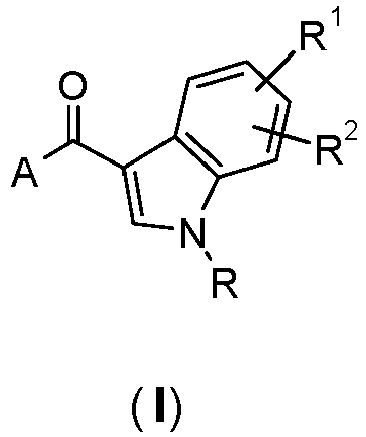
- A
- is

- R
- is L1-R5;
- R1, R2
- are hydrogen;
- R4
- is methyl or ethyl;
- L1
- is -(CH2)j-Y- or -(CH2)k-,
- j
- is 2-,
- k
- is 3;
- Y
- is oxygen;
- R5
- is phenyl substituted by one or two substituents chosen from L2-R6;
- L2
- is -(CH2)n-W-(CH2)p-;
- R6
- is heterocyclyl, wherein the heterocyclyl is optionally substituted by C1-C6-alkyl;
- n
- is 0;
- p
- is 0 or 1;
- W
- is oxygen;
- Compounds of formula (I) according to claim 1 include:
- 1H-indol-3-yl-(4-methylthieno[3,2-b]pyrrol-5-yl)methanone;
- (5-methyl-1H-indol-3-yl)-(4-methylthieno[3,2-b]pyrrol-5-yl)methanone;
- (5-ethyl-1H-indol-3-yl)-(4-methylthieno[3,2-b]pyrrol-5-yl)methanone;
- (5-bromo-1H-indol-3-yl)-(4-methylthieno[3,2-b]pyrrol-5-yl)methanone;
- (4-ethylthieno[3,2-b]pyrrol-5-yl)-(1H-indol-3-yl)methanone;
- (1-methylindol-3-yl)-(4-methylthieno[3,2-b]pyrrol-5-yl)methanone;
- [1-(2-methoxyethyl)indol-3-yl]-(4-methylthieno[3,2-b]pyrrol-5-yl)methanone;
- (4-methylthieno[3,2-b]pyrrol-5-yl)-[1-(2-phenoxyethyl)indol-3-yl]methanone;
- (4-methylthieno[3,2-b]pyrrol-5-yl)-[1-[2-[2-(pyrrolidin-3-ylmethoxy)phenoxy]ethyl]indol-3-yl]methanone;
- (4-methylthieno[3,2-b]pyrrol-5-yl)-[1-[2-[3-(pyrrolidin-3-ylmethoxy)phenoxy]ethyl]indol-3-yl]methanone;
- (4-methylthieno[3,2-b]pyrrol-5-yl)-[1-[2-[3-[[(3S)-pyrrolidin-3-yl]methoxy]phenoxy]ethyl]indol-3-yl]methanone;
- (4-methylthieno[3,2-b]pyrrol-5-yl)-[1-[2-[3-[[(3R)-pyrrolidin-3-yl]methoxy]phenoxy]ethyl]indol-3-yl]methanone;
- (4-methylthieno[3,2-b]pyrrol-5-yl)-[1-[2-[4-(pyrrolidin-3-ylmethoxy)phenoxy]ethyl]indol-3-yl]methanone;
- (4-methylthieno[3,2-b]pyrrol-5-yl)-[1-[2-[3-(4-piperidyloxy)phenoxy]ethyl]indol-3-yl]methanone;
- (4-methylthieno[3,2-b]pyrrol-5-yl)-[1-[2-[4-(4-piperidyloxy)phenoxy]ethyl]indol-3-yl]methanone;
- (4-methylthieno[3,2-b]pyrrol-5-yl)-[1-[2-[3-(4-piperidylmethoxy)phenoxy]ethyl]indol-3-yl]methanone;
- (4-methylthieno[3,2-b]pyrrol-5-yl)-[1-[2-[4-(4-piperidylmethoxy)phenoxy]ethyl]indol-3-yl]methanone;
- [1-[2-[3-(azepan-4-yloxy)phenoxy]ethyl]indol-3-yl]-(4-methylthieno[3,2-b]pyrrol-5-yl)methanone;
- [1-[2-[4-(azepan-4-yloxy)phenoxy]ethyl]indol-3-yl]-(4-methylthieno[3,2-b]pyrrol-5-yl)methanone;
- (4-methylthieno[3,2-b]pyrrol-5-yl)-[1-[3-[4-(pyrrolidin-3-ylmethoxy)phenyl]propyl]indol-3-yl]methanone;
- (4-methylthieno[3,2-b]pyrrol-5-yl)-[1-[3-[4-(4-piperidylmethoxy)phenyl]propyl]indol-3-yl]methanone;
- (4-methylthieno[3,2-b]pyrrol-5-yl)-[1-[3-[4-(4-piperidyloxy)phenyl]propyl]indol-3-yl]methanone;
- [1-[3-[4-(azepan-4-yloxy)phenyl]propyl]indol-3-yl]-(4-methylthieno[3,2-b]pyrrol-5-yl)methanone;
- [1-[3-[3,4-bis(4-piperidylmethoxy)phenyl]propyl]indol-3-yl]-(4-methylthieno[3,2-b]pyrrol-5-yl)methanone;
- (4-ethylthieno[3,2-b]pyrrol-5-yl)-[1-[3-[4-(4-piperidyloxy)phenyl]propyl]indol-3-yl]methanone;
- (4-ethylthieno[3,2-b]pyrrol-5-yl)-[1-[3-[4-(pyrrolidin-3-ylmethoxy)phenyl]propyl]indol-3-yl]methanone;
- [5-ethyl-1-[3-[4-(4-piperidyloxy)phenyl]propyl]indol-3-yl]-(4-methylthieno[3,2-b]pyrrol-5-yl)methanone;
- [5-methyl-1-[3-[4-(4-piperidyloxy)phenyl]propyl]indol-3-yl]-(4-methylthieno[3,2-b]pyrrol-5-yl)methanone;
- 4-methylthieno[3,2-b]pyrrol-5-yl)-[1-[2-[4-(4-piperidylmethoxy)phenyl]ethyl]indol-3-yl]methanone hydrochloride;
- (4-methylthieno[3,2-b]pyrrol-5-yl)-[1-[2-[4-(4-piperidyloxy)phenyl]ethyl]indol-3-yl]methanone hydrochloride;
- (4-methylthieno[3,2-b]pyrrol-5-yl)-[1-[2-[4-[2-(4-piperidyl)ethoxy]phenyl]ethyl]indol-3-yl]methanone hydrochloride;
- or stereoisomers or pharmaceutically acceptable salts thereof.
- Compounds of formula (I) according to claim 7 include:
- (6-methylthieno[2,3-b]pyrrol-5-yl)-[1-[3-[4-(pyrrolidin-3-ylmethoxy)phenyl]propyl]indol-3-yl]methanone;
- (6-methylthieno[2,3-b]pyrrol-5-yl)-[1-[3-[4-(4-piperidyloxy)phenyl]propyl]indol-3-yl]methanone;
- or stereoisomers or pharmaceutically acceptable salts thereof.
- In another aspect, the application provides the compounds as defined above for use as medicament.
- In another aspect, the application provides the compounds as defined above for use in a method of treatment and/or prevention of cancer, infectious diseases or a disease characterized by aberration of cellular energy metabolism, such as obesity. Preferably, the compounds are for use in a method of treatment and/or prevention of leukemia (e.g., acute myeloid leukemia), non-small cell lung cancer, hepatocellular carcinoma, or glioblastomas. Still preferably the glioblastomas are giant cell glioblastoma or gliosarcoma.
- In some embodiments, the method further comprises administering a therapeutically effective amount of at least one therapeutic agent selected from the group consisting of histone deacetylase inhibitors, retinoid receptor modulators, anti proliferative/antineoplastic agents, cytostatic agents, agents which inhibit cancer cell invasion, inhibitors of growth factor function, antiangiogenic agents, cell cycle inhibitors, proteasome inhibitors, HSP90 inhibitors, selective COX-2 inhibitors or a chemotherapeutic agent.
- A further aspect of the application is a pharmaceutical composition comprising a compound as defined above, together with a pharmaceutically acceptable excipient and/or diluent
- In some embodiments, the pharmaceutical composition further comprises at least one further therapeutic agent, preferably selected from the group consisting of histone deacetylase inhibitors, retinoid receptor modulators, antiproliferative/antineoplastic agents, cytostatic agents, agents which inhibit cancer cell invasion, inhibitors of growth factor function, anti-angiogenic agents, cell cycle inhibitors, proteasome inhibitors, HSP90 inhibitors, selective COX-2 inhibitors or a chemotherapeutic agent.
- In the present application, "aryl" includes groups with aromaticity, including "conjugated," or multicyclic systems with one or more aromatic rings and do not contain any heteroatom in the ring structure. Examples include phenyl, naphthalenyl, etc. The term "arylene" refers to the corresponding divalent groups, such as phenylene. In one embodiment, "aryl" represents a mono or bicyclic aromatic ring system of 6 atoms, or 9 or 10 atoms, respectively. Examples of such an aryl are phenyl, indenyl, indanyl and naphthyl and tetrahydronaphthalenyl. Substituted aryl means that the hydrogen atoms on independently each carbon atom may be independently replaced by a substituent as defined herein above.
- In the present application, "heteroaryl" groups are aryl groups, as defined above, except having from one to four heteroatoms in the ring structure, and may also be referred to as "aryl heterocycles" or "heteroaromatics." As used herein, the term "heteroaryl" is intended to include a stable aromatic heterocyclic ring, such as a stable 5-, 6-, or 7-membered monocyclic or 7-, 8-, 9-, 10-, 11- or 12-membered bicyclic aromatic heterocyclic ring which consists of carbon atoms and one or more heteroatoms, e.g., 1 or 1-2 or 1-3 or 1-4 or 1-5 or 1-6 heteroatoms, or e.g.,1, 2, 3, 4, 5, or 6 heteroatoms, independently selected from the group consisting of nitrogen, oxygen and sulfur. The nitrogen atom may be substituted or unsubstituted (i.e., N or NR wherein R is H or other substituents, as defined). The nitrogen and sulfur heteroatoms may optionally be oxidized (i.e., N→O and S(O)p, where p = 1 or 2). It is to be noted that total number of S and O atoms in the aromatic heterocycle is not more than 1.
- Examples of heteroaryl groups include pyrrole, furan, thiophene, thiazole, isothiazole, imidazole, triazole, tetrazole, pyrazole, oxazole, isoxazole, pyridine, pyrazine, pyridazine, pyrimidine, and the like. The term "heteroarylene" refers to the corresponding divalent groups.
- Furthermore, the terms "aryl" and "heteroaryl" include multicyclic aryl and heteroaryl groups, e.g., tricyclic, bicyclic, e.g., naphthalene, benzoxazole, benzodioxazole, benzothiazole, benzoimidazole, benzothiophene, quinoline, isoquinoline, naphthyridine, indole, benzofuran, purine, benzofuran, deazapurine, indolizine.
- The cycloalkyl, heterocycloalkyl, aryl, or heteroaryl ring can be substituted at one or more ring positions (e.g., the ring-forming carbon or heteroatom such as N) with such substituents as described above, e.g., alkyl, alkenyl, alkynyl, halogen, hydroxyl, alkoxy, alkylcarbonyloxy, arylcarbonyloxy, alkoxycarbonyloxy, aryloxycarbonyloxy, carboxylate, alkylcarbonyl, alkylaminocarbonyl, aralkylaminocarbonyl, alkenylaminocarbonyl, alkylcarbonyl, arylcarbonyl, aralkylcarbonyl, alkenylcarbonyl, alkoxycarbonyl, aminocarbonyl, alkylthiocarbonyl, phosphate, phosphonato, phosphinato, amino (including alkylamino, dialkylamino, arylamino, diarylamino and alkylarylamino), acylamino (including alkylcarbonylamino, arylcarbonylamino, carbamoyl and ureido), amidino, imino, sulfhydryl, alkylthio, arylthio, thiocarboxylate, sulfates, alkylsulfinyl, sulfonato, sulfamoyl, sulfonamido, nitro, trifluoromethyl, cyano, azido, heterocyclyl, alkylaryl, or an aromatic or heteroaromatic moiety. Aryl and heteroaryl groups can also be fused or bridged with alicyclic or heterocyclic rings, which are not aromatic so as to form a multicyclic system (e.g., tetralin, methylenedioxyphenyl such as benzo[d][1,3]dioxole-5-yl).
- "Heterocyclyl" represents a mono, bicyclic or a spirocyclic saturated or partially saturated non-aromatic ring system of 4 to 12 members (e.g. 4, 5, 6, 7, 8, 9, 10, 11 or 12 members), which contains one, two, or three heteroatoms selected from nitrogen, oxygen, and sulphur and three to eleven carbon atoms (e.g. 3, 4, 5, 6, 7, 8, 9, 10 or 11 carbon atoms). Examples of such heterocycles include, but are not limited to: pyrrolidyl, pyrrolidinyl, piperidyl, piperidinyl, piperazinyl, tetrahydrofuranyl, tetrahydropyranyl, morpholinyl, thiomorpholinyl, tetrahydroquinolinyl, tetrahydroisoquinolinyl, tetrahydroquinoxalinyl, benzodioxolyl, 2,3-dihydro-benzodioxinyl, benzoxazolyl, azetidyl, azepinyl, and diazapinyl.
- The term "C1-C6 alkyl" refers to a straight or branched hydrocarbon chain radical, consisting solely of carbon and hydrogen atoms, having from one to six carbon atoms. This term encompasses straight or branched hydrocarbon chain radicals, consisting solely of carbon and hydrogen atoms, having 1, 2, 3, 4, 5 or 6 carbon atoms. The "C1-C6 alkyl" group is preferably a linear or branched C1-C4 alkyl group, more preferably a C1-C2 alkyl group. Suitable examples of C1-C6 alkyl include methyl, ethyl, n-propyl, isopropyl, butyl, tert-butyl, pentyl, and hexyl. The term "C1-C4 alkyl" refers to a straight or branched hydrocarbon chain radical, consisting solely of carbon and hydrogen atoms, having from one to four carbon atoms. This term encompasses straight or branched hydrocarbon chain radicals, consisting solely of carbon and hydrogen atoms, having 1, 2, 3 or 4 carbon atoms.
- The term "C3-7 cycloalkyl" refers to a saturated monocyclic hydrocarbon ring system having three to seven carbon atoms. This term encompasses saturated monocyclic hydrocarbon ring systems having 3, 4, 5, 6 or 7 carbon atoms. Suitable examples of C3-6-cycloalkyl groups include cyclopropyl, cyclobutyl, cyclopentyl, and cyclohexyl.
- The term "halogen" refers to fluoro, chloro, bromo, or iodo. "Halogens" are preferably fluorine, chlorine or bromine, being in particular fluorine or chlorine.
- The term "Leaving group" refers to halogen, preferably to chloride, bromide or iodide.
- The phrase "reversible inhibitor" refers to an inhibiting molecular entity that interacts with an enzyme by non-covalent interactions and is able to associate/dissociate to the enzyme.
- Pharmaceutically acceptable salts comprise conventional non-toxic salts obtained by salification of a compound of formula (I) with inorganic acids (e.g. hydrochloric, hydrobromic, sulphuric, or phosphoric acids), or with organic acids (e.g. acetic, propionic, succinic, benzoic, sulfanilic, 2-acetoxy-benzoic, cinnamic, mandelic, salicylic, glycolic, lactic, oxalic, malic, maleic, malonic, fumaric, tartaric, citric, p-toluenesulfonic, methanesulfonic, ethanesulfonic, or naphthalensulfonic acids). For reviews on suitable pharmaceutical salts see Berge S. M. et al., J. Pharm. Sci. 1977, 66, 1-19; Gould P. L. Int. J. Pharm 1986, 33, 201-217; and Bighley et al. Encyclopedia of Pharmaceutical Technology, Marcel Dekker Inc, New York 1996, Volume 13, page 453-497. Other salts, which are not pharmaceutically acceptable, e.g., the trifluoroacetate salt, may be useful in the preparation of compounds of this application and these form a further aspect of the application. The application includes within its scope all possible stoichiometric and non-stoichiometric forms of the salts of the compounds of formula (I).
- In addition, the compounds of formula (I) may exist in unsolvated as well as in solvated forms with pharmaceutically acceptable solvents such as water, EtOH and the like.
- Certain compounds of formula (I) may exist in stereoisomeric forms (e.g. they may contain one or more asymmetric carbon atoms). The individual stereoisomers (enantiomers and diastereomers) and mixtures of these are included within the scope of the present application. The present application also covers the individual isomers of the compounds represented by formula (I) as mixtures with isomers thereof in which one or more chiral centres are inverted.
- The application also includes all suitable isotopic variations of a compound of the application. Examples of isotopes that can be incorporated into compounds of the application include isotopes such as 2H, 3H, 13C, 14C, 15N, 17O, 18O, 31P, 32P, 35S, 18F and 36Cl, respectively. Certain isotopic variations of the application, e.g., those in which a radioactive isotope such as 3H or 14C is incorporated, are useful in drug and/or substrate tissue distribution studies. Further, substitution with isotopes such as deuterium 2H, may afford certain therapeutic advantages resulting from greater metabolic stability. Isotopic variations of the compounds of the application can generally be prepared by conventional procedures such as by the illustrative methods or by the preparations described in the examples hereafter using appropriate isotopic variations of suitable reagents.
- It is a further embodiment of the application a process for obtaining a compound of formula (I) as defined in claim 1, wherein R is hydrogen, the process comprising the preparation of the acyl chloride of formula A2 by reaction of the carboxylic acid of formula A1 with thionyl chloride, and the preparation of the indole anion A4 by reaction of indole A3 with methyl magnesium bromide, and the condensation of the acyl chloride of formula A2 with indole anion A4 to obtain a compound of formula (I), as represented in Scheme A below:


- Carboxylic acids of formula A1 are known compounds or can be prepared as described in
PCT application WO2016/034946 starting from commercially available ethyl 4H-thieno[3,2-b]pyrrole-5-carboxylate (Fluorochem, Cat No. 067104) or ethyl 6H-thieno[2,3-b]pyrrole-5-carboxylate (Sigma Aldrich, cat. number PH011284). Indoles of formula A3 are known compounds. - The formation of the acyl chloride of formula A2 can be carried out in a suitable solvent such as polar aprotic solvents, for instance, tetrahydrofuran, 1,4-dioxane, dimethylformamide, dichloromethane, or mixtures thereof, at a temperature ranging from about 0 °C to reflux and for a time varying from about 30 minutes up to 96 hours. The formation of indole anion A4 can be carried out in a suitable solvent such as diethylether, preferably at a temperature ranging from about 0 °C to room temperature. Preferably, the reaction is carried out under nitrogen atmosphere. The coupling reaction of an acyl chloride of formula A2 with a compound of formula A4 is carried out in a suitable solvent such as diethylether at a temperature ranging from about 0 °C to reflux.
- Alternatively, a compound of formula (I) can be obtained according to a Friedel-Crafts reaction by reaction of an acyl chloride of formula A2 with an indole of formula A3 in presence of a Lewis acid, for instance AlCl3, ZrCl4, or diethylaluminium chloride, in a suitable solvent, for instance hexane, dichloromethane, or mixtures thereof.
- Compounds of formula (I) according to claim 1 or claim 7, wherein R is L1 -R5 and L1 and R5 are as defined above, can obtained by reaction of compounds of formula B1 with compounds of formula B2, wherein LG is a leaving group, for instance bromine, in a suitable solvent, for instance dimethylformamide or dimethylacetamide, and in presence of a base, for instance sodium hydride, at a temperature ranging from about 0 °C to reflux, as represented in Scheme B below:


- Compounds of formula B1 can be prepared as described in Scheme A. Compounds of formula B2 are known compounds or can be prepared by known methods. For instance a compound of formula C5, where LG and R6 are as defined above, Y and L2 are oxygen can be obtained by the reaction of a diol derivative of formula C1 with an alcohol of formula C2, that is carried out under the standard conditions of the Mitsunobu reaction, for instance by reaction with triphenylphosphine and diethylazodicarboxylate, at a temperature ranging from about 0 °C to 80 °C, in a suitable solvent, such as tetrahydrofuran or toluene or dichloromethane, for a time varying from about 30 min up to 72 h, to give a compound of formula C3. Reaction of a compound of formula C3 with an alcohol of formula C4 under the standard condition of the Mitsunobu reaction provides the intermediate C5 as represented in Scheme C below:

- Compounds of formula C1, C2, and C4 are known compounds or can be prepared by known methods.
- Alternatively, reaction of a compound of formula D1 with an alcohol of formula D2 under the standard conditions of the Mitsunobu reaction provides the intermediate D3 as represented in Scheme D below:

- Compounds of formula D1 and D2 are known compounds or can be prepared by known methods.
- In the case it is necessary to protect a chemical group of a compound of the present application and/or an intermediate thereof, before carrying out one of the before described reactions, said chemical group can be protected and deprotected according to known methods. A thorough discussion for protection/deprotection steps is provided in Greene and Wuts (Greene, T.W.; Wuts, P.G.M. "Protective Groups in Organic Synthesis", John Wiley & Sons Inc., 2006) and in Kocienski (Kocienski, P.J. "Protecting Groups", George Thieme Verlag, 2005).
- Salification of the compounds of formula (I), and preparation of compounds of formula (I), free of their salts, can be carried out by known conventional methods.
- In view of the above described mechanisms of action, the compounds of the present application are useful in the prevention or treatment of tumor type diseases, including, but not limited to: acute myeloid leukaemia, chronic myeloid leukaemia, acute lymphoblastic leukaemia, chronic lymphoblastic leukaemia, myelodysplastic syndromes, multiple myeloma, Hodgkin's disease, non-Hodgkin's lymphomas, cutaneous and peripheral T-cell lymphoma, adult T-cell leukemia, large B-cell lymphoma; mammary tumors; pulmonary tumors and pleural mesotheliomas, adenocarcinoma, non-small lung cancer, small-cell lung cancer; skin tumors including basal cell carcinomas (basaliomas), melanomas, squamous cell carcinoma, Kaposi's sarcoma, keratocanthomas, osteosarcomas, fibrosarcomas, rhabdomyosarcomas, neuroblastomas, glioblastomas, cerebral tumors, head and neck cancer, testicular and ovarian tumors, cervical carcinoma, endometrial and prostate tumors (e.g., advanced prostate cancer), thyroid carcinomas (e.g., thyroid follicular cancer), colon cancers (e.g., colon adenocarcinoma, colon adenoma), gastric tumors and gastrointestinal adenocarcinomas, hepatocellular carcinomas, pancreatic carcinomas (e.g., exocrine pancreatic carcinoma), renal tumors, teratocarcinomas and embryonic carcinomas.
- The compounds of the application are also useful in the prevention or treatment of infections, including, but not limited to: infections caused by protozoa, fungi, phytotoxic agents, viruses and parasites, e.g., HIV or herpes virus infections.
- Furthermore, the compounds of the application are also useful in the prevention or treatment of obesity.
- The term "therapeutically effective amount", as used herein, refers to an amount of formula (I), composition, or pharmaceutical composition thereof effective to treat or prevent an identified disease or condition, or to exhibit a detectable therapeutic or inhibitory effect. The effect can be detected by any assay method known in the art. The precise effective amount for a subject will depend upon the subject's body weight, size, and health; the nature and extent of the condition; and the therapeutic or combination of therapeutics selected for administration. Therapeutically effective amounts for a given situation can be determined by routine experimentation that is within the skill and judgment of the clinician.
- The compounds of formula (I), can also be used in combination with additional agents, in particular anti-tumor and differentiating agents, either by separate administrations, or by including the two active principles in the same pharmaceutical formulation. Non-exhaustive examples of suitable additional agents include:
- a) histone deacetylase inhibitors (e.g., but not limited to: SAHA, PXD101, JNJ-26481585, SB939, ITF-2357, LBH589, PCI-24781, valproic acid, butyric acid, MS-275, MGCD0103 and FK-228);
- b) retinoid receptor modulators such as 13-cis-retinoic acid, 9-cis-retinoic acid, bexarotene, alitretinoin, or tretinoin; vitamin D;
- c) antiproliferative/antineoplastic drugs and combinations thereof, as used in medical oncology, such as alkylating agents (e.g., platin derivatives like cis-platin, carboplatin, oxaliplatin, lobaplatin, satraplatin, nedaplatin, heptaplatin; nitrogen mustard such as chlorambucil, melphalan, chlormethine, cyclophosphamide, ifosfamide, trofosfamide, uramustine, bendamustine, estramustine; busulphan, temozolomide or nitrosoureas); antimetabolites (e.g., antifolates such as aminopterin, methotrexate, pemetrexed, raltitrexed); purines such as cladribine, clofarabine, fludarabine, mercaptopurine, pentostatin, thioguanine; pyrimidines like capecitabine, cytarabine, fluorouracil, floxuridine, gemcitabine; azacitidine, decitabine; cytosine arabinoside or hydroxyurea; antitumour antibiotics (e.g., anthracyclines like aclarubicin, amrubicin, daunomycin, doxorubicin, epirubicin, idarabicin, valrubicin, zorubicine; mitoxantrone; or antibiotics from streptomyces like actinomycin, bleomycin, mitomycin, or plicamycin); antimitotic agents (e.g., vinca alkaloids like vincristine, vinblastine, vindesine or vinorelbine; taxoids like docetaxel, paclitaxel or tesetaxel; epothilones like ixabepilone) and topoisomerase inhibitors (e.g., epipodophyllotoxins like etoposide and teniposide; amsacrine, camptothecin, irinotecan, rubitecan, and topotecan);
- d) cytostatic agents such as antioestrogens (e.g., but not limited to: tamoxifen, toremifene, raloxifene, droloxifene and idoxifene), oestrogen receptor down regulators (e.g., but not limited to: fulvestrant), antiandrogens (e.g., but not limited to: bicalutamide, flutamide, nilutamide, liarozole or cyproterone acetate), LHRH antagonists or LHRH agonists (e.g., but not limited to: goserelin, leuprorelin or buserelin), progestogens (e.g., but not limited to, megestrol acetate), aromatase inhibitors (e.g., but not limited to: anastrozole, letrozole, vorazole and exemestane) and inhibitors of 5-alpha-reductase such as finasteride;
- e) agents which inhibit cancer cell invasion (e.g., metalloproteinase inhibitors and inhibitors of urokinase plasminogen activator receptor function);
- f) inhibitors of growth factor function, e.g., growth factor antibodies, growth factor receptor antibodies (e.g., but not limited to: the anti-erbb2 antibody trastuzumab, the anti-erbbl antibody cetuximab and panitumumab, the anti IGF1R antibody figitumumab), farnesyl transferase inhibitors, MEK inhibitors, tyrosine kinase inhibitors and serine/threonine kinase inhibitors, e.g., enzastaurin, dasatinib, erlotinib, gefitinib, imatinib, lapatinib, nilotinib, sorafenib, sunitinib, everolimus, sirolimus or temsirolimus;
- g) antiangiogenic agents such as those which inhibit the effects of vascular endothelial growth factor, e.g., the anti-vascular endothelial cell growth factor antibody bevacizumab, lenalidomide or thalidomide;
- h) cell cycle inhibitors including, e.g., CDK inhibitors (e.g., but not limited to: flavopiridol, roscovitine) and other inhibitors of cell cycle checkpoints; inhibitors of aurora kinase and other kinases involved in mitosis and cytokinesis regulation;
- i) proteasome inhibitors (e.g., but not limited to: lactacystin, bortezomib, epoxomicin);
- j) HSP90 inhibitors (e.g., but not limited to: AT-13387, KOS-953, KOS-1022, CNF-1010, CNF-2024, SNX 5422, STA-9090, NVP-HSP990, NVP-AUY922, PU-H17 and XL-888)
- k) Selective COX-2 inhibitors (e.g., but not limited to, celecoxib), or non-selective NSAIDs (e.g., but not limited to: diclofenac, flurbiprofen, ibuprofen, ketoprofen, or naproxen).
- The application also provides pharmaceutical compositions comprising one or more compounds of formula (I) as defined above, and one or more pharmaceutically acceptable excipient and/or diluent. The pharmaceutical compositions can be chosen on the basis of the treatment requirements. Such compositions are prepared by blending and are suitably adapted to oral or parenteral administration, and as such can be administered in the form of tablets, capsules, oral preparations, powders, granules, pills, injectable or infusible liquid, solutions, suspensions, emulsions, suppositories, ointments, creams, lotions, gels, pastes, or transdermal delivery devices.
- Tablets and capsules for oral administration are normally presented in unit dose form and contain conventional excipients such as binders, fillers (including cellulose, mannitol, lactose), diluents, tableting agents, lubricants (including magnesium stearate), detergents, disintegrants (e.g. polyvinylpyrrolidone and starch derivatives such as sodium glycolate starch), coloring agents, flavoring agents, and wetting agents (e.g., sodium lauryl sulfate).
- The oral solid compositions can be prepared by conventional methods of blending, filling or tableting. The blending operation can be repeated to distribute the active principle throughout compositions containing large quantities of fillers. Such operations are conventional.
- Oral liquid preparations can be in the form of, e.g., aqueous or oily suspensions, solutions, emulsions, syrups or elixirs, or can be presented as a dry product for reconstitution with water or with a suitable vehicle before use. Such liquid preparations can contain conventional additives such as suspending agents, e.g., sorbitol, syrup, methyl cellulose, gelatin, hydroxyethyl cellulose, carboxymethyl cellulose, aluminium stearate gel, or hydrogenated edible fats; emulsifying agents, such as lecithin, sorbitan monooleate, or acacia; non-aqueous vehicles (which can include edible oils), such as almond oil, fractionated coconut oil, oily esters such as esters of glycerine, propylene glycol, or ethyl alcohol; preservatives, such as methyl or propyl p-hydroxybenzoate or sorbic acid, and if desired, conventional flavoring or coloring agents. Oral formulations also include conventional slow-release formulations such as enterically coated tablets or granules.
- Pharmaceutical preparation for administration by inhalation can be delivered from an insufflator or a nebulizer pressurized pack.
- For parenteral administration fluid unit dosages can be prepared, containing the compound and a sterile vehicle. The compound can be either suspended or dissolved, depending on the vehicle and concentration. The parenteral solutions are normally prepared by dissolving the compound in a vehicle, sterilising by filtration, filling suitable vials and sealing. Advantageously, adjuvants such as local anaesthetics, preservatives and buffering agents can also be dissolved in the vehicle. To increase the stability, the composition can be frozen after having filled the vials and removed the water under vacuum. Parenteral suspensions are prepared in substantially the same manner, except that the compound can be suspended in the vehicle instead of being dissolved, and sterilized by exposure to ethylene oxide before suspending in the sterile vehicle. Advantageously, a surfactant or wetting agent can be included in the composition to facilitate uniform distribution of the compound of the application.
- For buccal or sublingual administration the compositions may be tablets, lozenges, pastilles, or gel.
- The compounds can be pharmaceutically formulated as suppositories or retention enemas, e.g. containing conventional suppositories bases such as cocoa butter, polyethylene glycol, or other glycerides, for a rectal administration.
- Another means of administering the compounds of the application regards topical treatment. Topical formulations can contain, e.g., ointments, creams, lotions, gels, solutions, pastes and/or can contain liposomes, micelles and/or microspheres. Examples of ointments include oleaginous ointments such as vegetable oils, animal fats, semisolid hydrocarbons, emulsifiable ointments such as hydroxystearin sulfate, anhydrous lanolin, hydrophilic petrolatum, cetyl alcohol, glycerol monostearate, stearic acid, water soluble ointments containing polyethylene glycols of various molecular weights. Creams, as known to formulation experts, are viscous liquids or semisolid emulsions, and contain an oil phase, an emulsifier and an aqueous phase. The oil phase generally contains petrolatum and an alcohol such as cetyl or stearic alcohol. Formulations suitable for topical administration to the eye also include eye drops, wherein the active ingredient is dissolved or suspended in a suitable carrier, especially an aqueous solvent for the active ingredient.
- A further method of administering the compounds of the application regards transdermal delivery. Typical transdermal formulations comprise conventional aqueous and non-aqueous vectors, such as creams, oils, lotions or pastes or can be in the form of membranes or medicated patches.
- A reference for the formulations is the book by Remington ("Remington: The Science and Practice of Pharmacy", Lippincott Williams & Wilkins, 2000).
- The compounds of the present application may be employed alone as a sole therapy or in combination with other therapeutic agents for the treatment of the above-mentioned conditions. The combination can be administered as separate compositions (simultaneous, sequential) of the individual components of the treatment or as a single dosage form containing both agents. When the compounds of this application are in combination with others active ingredients, the active ingredients may be separately formulated into single-ingredient preparations of one of the above-described forms and then provided as combined preparations, which are given at the same time or different times, or may be formulated together into a two- or more- ingredient preparation.
- Compounds of general formula (I) may be administered to a patient in a total daily dose of, e.g., from 0.001 to 1000 mg/kg body weight daily. Dosage unit compositions may contain such amounts of submultiples thereof to make up the daily dose. The determination of optimum dosages for a particular patient is well known to one skilled in the art.
- As is common practice, the compositions are normally accompanied by written or printed instructions for use in the treatment in question.
- The following Examples are presented in order to further illustrate the application.
- Unless otherwise indicated, commercially available reagents and solvents (HPLC grade) were used without further purification. Specifically, the following abbreviations may have been used in the descriptions of the experimental methods:
NMR (Nuclear Magnetic Resonance) 1H (proton) MHz (Megahertz) Hz (Hertz) HPLC (High Performance Liquid Chromatography) LC-MS (Liquid Chromatography Mass Spectrum) s (seconds) min (minutes) h (hours) mg (milligrams) g (grams) µL (microlitres) mL (millilitres) mmol (millimoles) nm (nanometers) µM (micromolar) M (molarity) RT (room temperature) AcOH (acetic acid) BOC or boc (tert-butyloxycarbonyl) CBr4 (carbon tetrabromide) CDCl3 (deuterated chloroform) CH2Cl2 (dichloromethane) Cs2CO3 (cesium carbonate) CH3CN (acetonitrile) DIAD (diisopropyl azodicarboxylate) DMA (dimethylacetamide) DMF (dimethylformamide) DMSO (dimethyl sulfoxide) DMSO-d6 (deuterated dimethyl sulfoxide) DTT (dithiothreitol) Et2O (diethyl ether) EtOAc (ethyl acetate) EtOH (ethanol) HCl (hydrochloric acid) MAO A (monoamine oxidase A) MAO B (monoamine oxidase B) MeOH (methanol) NaH (sodium hydride) NaCl (sodium chloride) NaHCOs (sodium bicarbonate) Na2SO4 (sodium sulphate) NH4Cl (ammonium chloride) Pd (palladium) PPh3 (triphenylphosphine) SOCl2 (thionyl chloride ) TBAF (tetra-n-butylammonium fluoride) TBDMSCI (tert-butyldimethylchlorosilane) THF (tetrahydrofuran) Tris (tris(hydroxymethyl)aminomethane) - Except where indicated otherwise, all temperatures are expressed in °C (degrees centigrade) or K (Kelvin).
- The 1H-NMR spectra were acquired with a Varian 500 MHz instrument. The chemical shifts are expressed in parts per million (ppm, δ units). The coupling constants are expressed in Hertz (Hz) and the splitting patterns are described as s (singlet), bs (broad signal), d (doublet), t (triplet), q (quartet), quint (quintet), m (multiplet).
- The LC-MS analyses were carried out on a Waters Acquity UPLC or Waters Acquity UPLC H-Class linked to with a SQD Single quadrupole (Waters) using an Acquity UPLC BEH C18 (50 x 2.1 mm, 1.7 µm) or Acquity UPLC HSS T3 (50 x 2.1 mm, 1.8 µm) column. Phase A was composed by either Milli-Q water/CH3CN 95/5 (vol/vol) + 0.07% formic acid (by volume) or Milli-Q water + 0.07% formic acid (by volume); Phase B by CH3CN + 0.05% formic acid (by volume); flow rate: 0.6 mL/min; UV detection (DIODE array) from 210 to 400 nm; ESI+ detection in the 100-2000 m/z range. The yields were calculated assuming that products were 100% pure if not stated otherwise.
-
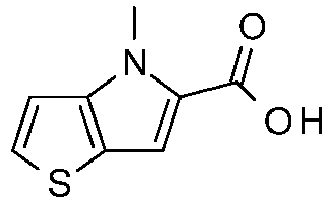
- 1.5 g (7.7 mmol) of ethyl 4H-thieno[3,2-b]pyrrole-5-carboxylate (Fluorochem, Cat No. 067104) was added at RT portion wise to a suspension of 0.46 g (12 mmol) of NaH in 35 mL of dry DMF. After stirring for 20 min at RT 3.3 g (23 mmol) of CH3I was added in one portion and the mixture was stirred for additional 30 min. The reaction mixture was then poured into a saturated NH4Cl solution and extracted with Et2O. The combined organic layers were dried over Na2SO4, filtered and the solvent evaporated to give 1.6 g of ethyl 4-methylthieno[3,2-b]pyrrole-5-carboxylate (99%) as a brown oil. 1H NMR (CDCl3) δ (ppm): 7.34 (d, J=5.4 Hz, 1 H), 7.20 (s, 1 H), 6.95 (d, J=5.4 Hz, 1 H), 4.34 (q, J=7.3 Hz, 2 H), 4.07 (s, 3 H), 1.39 (t, J=7.1 Hz, 3 H); MS (ESI): m/z: 210 [M+H]+
- 0.92 g (38 mmol) of LiOH in 11 mL of H2O was added at RT to a solution of 1.6 g (7.7 mmol) of ethyl 4-methylthieno[3,2-b]pyrrole-5-carboxylate in 11 mL of EtOH. The mixture was stirred for 30 min at reflux. The solvent was evaporated, then H2O was added and the solution was brought to a pH value of about 2 with 2 M HCl. The mixture was extracted with EtOAc, the combined organic layers were dried over Na2SO4 and the solvent was evaporated to give 1.39 g of 4-methylthieno[3,2-b]pyrrole-5-carboxylate (99%) as a beige solid. 1H NMR (CDCl3) δ (ppm): 12.45 (bs, 1 H), 7.54 (d, J=5.4 Hz, 1 H), 7.20 (d, J=5.4 Hz, 1 H), 7.12 (s, 1 H), 3.99 (s, 3 H); MS (ESI): m/z: 182 [M+H]+.
-

- 1.00 g (5.12 mmol) of ethyl 4H-thieno[3,2-b]pyrrole-5-carboxylate was added at RT to a suspension of 0.31 g (7.7 mmol) of NaH in 50 mL of dry DMF. After stirring for 20 min at RT 2.39 g (15.4 mmol) of ethyl iodide was added and the mixture was stirred for further 30 min at RT. The reaction mixture was then poured into a saturated NH4Cl solution and extracted with Et2O. The combined organic layers were dried over Na2SO4 and the solvent evaporated to give 1.10 g (96%) of ethyl 4-ethylthieno[3,2-b]pyrrole-5-carboxylate as a brown oil. 1H NMR (CDCl3) δ (ppm): 7.34 (d, J=5.4 Hz, 1 H), 7.20 (s, 1 H), 6.96 (d, J=5.4 Hz, 1 H), 4.56 (q, J=7.3 Hz, 2 H), 4.34 (q, J=7.3 Hz, 2 H), 1.46-1.34 (m, 6 H); MS (ESI): m/z: 224 [M+H]+.
- 0.21 g (9.0 mmol) of LiOH in 4 mL of H2O was added at RT to a solution of 0.40 g (1.8 mmol) of ethyl 4-ethylthieno[3,2-b]pyrrole-5-carboxylate in 4 mL of EtOH. The mixture was stirred for 30 min at reflux, then EtOH was evaporated, water was added and the pH was brought to about 2 with 2 M HCl. The mixture extracted with EtOAc, the combined organic layers dried over Na2SO4 and the solvent evaporated to give 0.35 g (quantitative) of 4-ethylthieno[3,2-b]pyrrole-5-carboxylic acid as a beige solid. 1H NMR (DMSO-d6) δ (ppm): 12.47 (bs, 1 H), 7.56 (d, J=5.4 Hz, 1 H), 7.24 (d, J=5.4 Hz, 1 H), 7.13 (s, 1 H), 4.51 (q, J=7.3 Hz, 2 H), 1.28 (t, J=7.3 Hz, 3 H); MS (ESI): m/z: 196 [M+H]+.
-

- Ethyl 6-methylthieno[2,3-b]pyrrole-5-carboxylate was obtained as yellow solid starting from ethyl 6H-thieno[2,3-b]pyrrole-5-carboxylate (Eras J. et al. J. Het. Chemistry 1984, 21, 215-217) according to the procedure for Intermediate 1, Step 1. 1H NMR (CDCl3) δ (ppm): 7.34 (d, J=5.4 Hz, 1 H), 7.20 (s, 1 H), 6.95 (d, J=5.4 Hz, 1 H), 4.34 (q, J=7.3 Hz, 2 H), 4.07 (s, 3 H), 1.39 (t, J=7.1 Hz, 3 H); MS (ESI): m/z: 210 [M+H]+
- 6-methylthieno[2,3-b]pyrrole-5-carboxylic acid was obtained as a white solid from ethyl 6-methylthieno[2,3-b]pyrrole-5-carboxylate according to the procedure for Intermediate 1, Step 2. 1H NMR (DMSO-d6 δ (ppm): 12.49 (bs, 1 H), 7.17 (d, J = 5.4 Hz, 1 H), 7.08-7.00 (m, 2 H), 3.95 (s, 3 H); MS (ESI): m/z: 182 [M+H]+
-

- 0.26 mL (3.5 mmol) of SOCl2 and 3 drops of DMF were added to a solution of 0.49 g (2.70 mmol) of 4-methylthieno[3,2-b]pyrrole-5-carboxylic acid (Intermediate 1) in 9 mL of THF and the mixture was heated to reflux for about 3 h. Then, the solvent was evaporated and the formed acyl chloride was used in the next step without any further purification.
- 0.972 mL of a 3 M methyl magnesium bromide solution in Et2O was slowly added to an ice-cooled solution of 0.287 g (2.43 mmol) indole (Sigma-Aldrich Cat. Nbr. I3408) in 3.5 mL of Et2O under nitrogen atmosphere. After the addition the reaction mixture was allowed to reach RT, stirred for 2 h and then again cooled down to 0°C and a solution of 4-methylthieno[3,2-b]pyrrole-5-carbonyl chloride in 5 mL of Et2O was added. The resulting mixture was warmed up to RT and stirred for 2 h followed by slow addition of 6 mL of a saturated NH4Cl solution. The mixture was stirred at room temperature for additional 1 h and then partitioned between CH2Cl2 and water. The combined organic phases were dried over Na2SO4, filtered, concentrated and purified by column chromatography (eluent: hexane/acetone, 0% to 15% of acetone (by volume)) to afford 276 mg (yield: 41%) of 1H-indol-3-yl-(4-methylthieno[3,2-b]pyrrol-5-yl)methanone as a mustard-coloured solid. 1H NMR (DMSO-d6) δ (ppm): 11.99 (bs, 1 H), 8.25-8.20 (m, 1 H), 8.13 (s, 1 H), 7.58 (d, J=5.4 Hz, 1 H), 7.52-7.48 (m, 1 H), 7.27 (d, J=5.4 Hz, 1 H), 7.26-7.17 (m, 2 H), 7.16 (s, 1 H), 4.02 (s, 3 H); MS (ESI): m/z: 281 [M+H]+.
- The following compounds (see Table 1) were prepared starting from 4-methylthieno[3,2-b]pyrrole-5-carboxylic acid (Intermediate 1: Compounds 2-4), 4-ethylthieno[3,2-b]pyrrole-5-carboxylic acid (Intermediate 2: Compound 5), or 6-methylthieno[2,3-b]pyrrole-5-carboxylic acid (Intermediate 3: Compound 6) and the appropriate indoles according to the procedure described for Compound 1.
Table 1. No. Name indole Structure Analytical Data 2 (5-methyl-1H-indol-3-yl)-(4-methylthieno[3 ,2-b]pyrrol-5-yl)methanone 

1H NMR (DMSO-d6) δ (ppm): 11.88 (s, 1 H), 8.07 (s, 1 H), 8.06-8.04 (m, 1 H), 7.57 (d, J=5.4 Hz, 1 H), 7.40-7.36 (m, 1 H), 7.27 (d, J=5.4 Hz, 1 H), 7.14 (s, 1 H), 7.08-7.04 (m, 1 H), 4.01 (s, 3 H), 2.42 (s, 3 H); MS (ESI): m/z: 295 [M+H]+. 3 (5-ethyl-1H-indol-3-yl)-(4-methylthieno[3 ,2-b]pyrrol-5-yl)methanone 

1H NMR (DMSO-d6) δ (ppm): 11.87 (bs, 1 H), 8.15-8.01 (m, 2 H), 7.57 (d, J=5.4 Hz, 1 H), 7.43-7.37 (m, 1 H), 7.27 (d, J=5.4 Hz, 1 H), 7.13 (s, 1 H), 7.12-7.07 (m, 1 H), 4.01 (s, 3 H), 2.72 (q, J=7.6 Hz, 2 H), 1.24 (t, J=7.6 Hz, 3 H); MS (ESI): m/z: 309 [M+H]+. 4 (5-bromo-1H-indol-3-yl)-(4-methylthieno[3 ,2-b]pyrrol-5-yl)methanone 

1H NMR (DMSO-d6) δ (ppm): 12.13 (bs, 1 H), 8.37 (d, J=2.0 Hz, 1 H), 8.21 (s, 1 H), 7.60 (d, J=5.4 Hz, 1 H), 7.48 (d, J=8.3 Hz, 1 H), 7.37 (dd, J=2.0, 8.3 Hz, 1 H), 7.28 (d, J=5.4 Hz, 1 H), 7.21 (s, 1 H), 4.02 (s, 3 H); MS (ESI): m/z: 359 [M+H]+. 5 (4-ethylthieno[3,2 -b]pyrrol-5-yl)-(1H-indol-3-yl)methanone 

1H NMR (DMSO-d6) δ (ppm): 11.96 (bs, 1 H), 8.25-8.20 (m, 1 H), 8.12 (s, 1 H), 7.58 (d, J=5.4 Hz, 1 H), 7.52-7.47 (m, 1 H), 7.29 (d, J=5.4 Hz, 1 H), 7.26-7.17 (m, 2 H), 7.14 (s, 1 H), 4.51 (q, J=7.3 Hz, 2 H), 1.35 (t, J=7.3 Hz, 3 H); MS (ESI): m/z: 295 [M+H]+. 6 1H-indol-3-yl-(6-methylthieno[2 ,3-b]pyrrol-5-yl)methanone (not in accordance with the present invention) 

1H NMR (DMSO-d6) δ (ppm): 11.95 (bs, 1 H), 8.24-8.19 (m, 1 H), 8.13 (d, J=2.4 Hz, 1 H), 7.52-7.48 (m, 1 H), 7.27-7.17 (m, 3 H), 7.10 (d, J=5.4 Hz, 1 H), 7.08 (s, 1 H), 3.98 (s, 3 H); MS (ESI): m/z: 281 [M+H]+. -

- 0.414 g (1.57 mmol) of tert-butyl 3-(bromomethyl)pyrrolidine-1-carboxylate in 1 mL of DMF were added under nitrogen atmosphere to a solution of 0.219 g (1.99 mmol) of catechol (Sigma-Aldrich, Cat. No. 135011) and 0.649 g (1.99 mmol) of Cs2CO3 in 3 mL of dry DMF. The reaction mixture was stirred overnight at 80°C. The reaction solution was then diluted with brine and the product was extracted with EtOAc. The combined organic phases were dried over Na2SO4, the solvent was removed and the crude mixture was purified by flash chromatography on silica gel (hexane/acetone, 0% to 10% of acetone (by volume)) to give 0.112 g of tert-butyl 3-[(2-hydroxyphenoxy)methyl]pyrrolidine-1-carboxylate (yield: 30%). 1H NMR (CDCl3) δ (ppm): 6.98-6.83 (m, 4 H), 5.55 (s, 1 H), 4.07-3.98 (m, 2 H), 3.66-3.58 (m, 1 H), 3.55-3.47 (m, 1 H), 3.45-3.35 (m, 1 H), 3.27-3.18 (m, 1 H), 2.78-2.67 (m, 1 H), 2.17-2.05 (m, 1 H), 1.88-1.74 (m, 1 H), 1.48 (s, 9 H); MS (ESI): m/z: 238 [M-56+H]+.
- tert-butyl 3-[[2-(2-bromoethoxy)phenoxylmethyl]pyrrolidine-1-carboxylate 0.16 g (0.74 mmol, 0.15 mL) of DIAD (Sigma-Aldrich, Cat. No. 225541) were added dropwise to a solution comprising 0.145 g (0.494 mmol) of tert-butyl 3-[(2-hydroxyphenoxy)methyl]pyrrolidine-1-carboxylate, 0.098 g (0.74 mmol, 0.055 mL) of 2-bromoethanol (Sigma-Aldrich, Cat. No. B65586) and 0.20 g (0.74 mmol) of PPh3 (Sigma-Aldrich, Cat. No. T84409) in 5 mL of dry THF at 0°C. The solution was allowed to reach RT and was stirred overnight. Then, further 0.055 mL of 2-bromoethanol, 0.20 mg of PPh3 and 0.153 mL of DIAD were added to the reaction mixture cooled down to 0°C and the mixture was stirred at RT for further 24 h. The solvent was removed and the crude product was purified by flash chromatography on silica gel (hexane/acetone, 0% to 5% of acetone (by volume)) to provide 0.113 g of tert-butyl 3-[[2-(2-bromoethoxy)phenoxy]methyl]pyrrolidine-1-carboxylate (yield: 57%) as colourless oil. 1H NMR (CDCl3) δ (ppm): 7.05-6.84 (m, 4 H), 4.32 (t, J=6.4 Hz, 2 H), 4.04-3.93 (m, 2 H), 3.69-3.59 (m, 3 H), 3.52-3.45 (m, 1 H), 3.42-3.33 (m, 1 H), 3.28-3.20 (m, 1 H), 2.82-2.68 (m, 1 H), 2.15-2.05 (m, 1 H), 1.87-1.76 (m, 1 H), 1.48 (s, 9 H); MS (ESI): m/z: 344 [M-56+H]+.
-

- 0.64 g (3.0 mmol, 0.62 mL) of DIAD (Sigma-Aldrich, Cat. No. 225541) were added dropwise to a solution of 0.33 g (3.0 mmol) of resorcinol (Sigma-Aldrich, Cat. No. 398047), 0.40 g (2.0 mmol) of tert-butyl 3-(hydroxymethyl)pyrrolidine-1-carboxylate (Fluorochem, Cat. No. 048620) and 0.80 g (3.0 mmol) of PPh3 (Sigma-Aldrich, Cat. No. T84409) in 20 mL of dry THF at 0°C. The reaction mixture was allowed to reach RT and was stirred overnight. The solvent was then removed and the crude mixture was purified by flash chromatography on silica gel (hexane/acetone, 0% to 15% of acetone (by volume)) to give 0.26 g of tert-butyl 3-[(3-hydroxyphenoxy)methyl]pyrrolidine-1-carboxylate (yield: 29%). 1H NMR (CDCl3) δ (ppm): 7.18-7.10 (m, 1 H), 6.53-6.39 (m, 3 H), 3.96-3.84 (m, 2 H), 3.63-3.55 (m, 1 H), 3.53-3.44 (m, 1 H), 3.42-3.32 (m, 1 H), 3.26-3.16 (m, 1 H), 2.74-2.61 (m, 1 H), 2.14-2.02 (m, 1 H), 1.85-1.74 (m, 1 H), 1.48 (s, 9 H); MS (ESI): m/z: 238 [M-56+H]+.
- 0.17 g (0.79 mmol, 0.16 mL) of DIAD (Sigma-Aldrich, Cat. No. 225541) were added dropwise to a solution comprising 0.154 g (0.525 mmol) of tert-butyl 3-[(3-hydroxyphenoxy)methyl]pyrrolidine-1-carboxylate, 0.085 g (0.79 mmol, 0.059 mL) of 2-bromoethanol (Sigma-Aldrich, Cat. No. B65586) and 0.209 g (0.79 mmol) of PPh3 (Sigma-Aldrich, Cat. No. T84409) in 5 mL of dry THF at 0°C. The solution was allowed to reach RT and was stirred overnight. Then further 0.032 mL of 2-bromoethanol, 0.114 mg of PPh3 and 0.089 mL of DIAD were added to the reaction mixture cooled down to 0°C and the mixture was stirred at RT for further 24 h. The solvent was removed and the crude product was purified by flash chromatography on silica gel (hexane/acetone, 0% to 5% of acetone (by volume)) to provide 0.128 g of tert-butyl 3-[[3-(2-bromoethoxy)phenoxy]methyl]pyrrolidine-1-carboxylate (yield: 61%) as colourless oil. 1H NMR (CDCl3) δ (ppm): 7.23-7.15 (m, 1 H), 6.56-6.50 (m, 2 H), 6.49-6.45 (m, 1 H), 4.29 (t, J=6.4 Hz, 2 H), 3.96-3.84 (m, 2 H), 3.65 (t, J=6.1 Hz, 2 H), 3.62-3.56 (m, 1 H), 3.53-3.44 (m, 1 H), 3.41-3.33 (m, 1 H), 3.24-3.17 (m, 1 H), 2.74-2.62 (m, 1 H), 2.13-2.02 (m, 1 H), 1.85-1.73 (m, 1 H), 1.48 (s, 9 H); MS (ESI): m/z: 344 [M-56+H]+.
-

- 0.13 g of tert-butyl (3S)-3-[(3-hydroxyphenoxy)methyl]pyrrolidine-1-carboxylate was prepared according to the procedure for Intermediate 5, step 1, starting from 0.3 g (2.7 mmol) of resorcinol (Sigma-Aldrich, Cat. No. 398047) and 0.38 g (1.8 mmol) of tert-butyl (3S)-3-(hydroxymethyl)pyrrolidine-1-carboxylate (Fluorochem, Cat. No. 048621) (yield: 25%). 1H NMR (CDCl3) δ (ppm): = 7.17-7.08 (m, 1 H), 6.52-6.37 (m, 3 H), 4.85 (s, 1 H), 3.98-3.82 (m, 2 H), 3.66-3.55 (m, 1 H), 3.54-3.44 (m, 1 H), 3.42-3.32 (m, 1 H), 3.26-3.14 (m, 1 H), 2.75-2.61 (m, 1 H), 2.13-2.00 (m, 1 H), 1.87-1.71 (m, 1 H), 1.48 (s, 9 H); MS (ESI): m/z: 238 [M-56+H]+.
- 0.10 g of tert-butyl (3S)-3-[[3-(2-bromoethoxy)phenoxy]methyl]pyrrolidine-1-carboxylate was prepared according to the procedure for Intermediate 5, step 2, starting from 0.13 g (0.44 mmol) of tert-butyl (3S)-3-[(3-hydroxyphenoxy)methyl]pyrrolidine-1-carboxylate and 0.088 g (0.67 mmol, 0.05 mL) of 2-bromoethanol (yield: 56%). 1H NMR (CDCl3) δ (ppm): 7.24-7.15 (m, 1 H), 6.57-6.50 (m, 2 H), 6.49-6.45 (m, 1 H), 4.29 (t, J=6.4 Hz, 2 H), 3.97-3.85 (m, 2 H), 3.64 (t, J=6.4 Hz, 2 H), 3.62-3.57 (m, 1 H), 3.53-3.45 (m, 1 H), 3.41-3.33 (m, 1 H), 3.25-3.17 (m, 1 H), 2.72-2.63 (m, 1 H), 2.12-2.03 (m, 1 H), 1.85-1.74 (m, 1 H), 1.48 (s, 9 H); MS (ESI): m/z: 344 [M-56+H]+.
-

- 0.35 g of tert-butyl (3R)-3-[(3-hydroxyphenoxy)methyl]pyrrolidine-1-carboxylate was prepared according to the procedure for Intermediate 5, step 1, starting from 0.5 g (4.5 mmol) of resorcinol (Sigma-Aldrich, Cat. No. 398047) and 0.636 g (3 mmol) of tert-butyl (3R)-3-(hydroxymethyl)pyrrolidine-1-carboxylate (Fluorochem, Cat. No. 048622) (yield: 40%). 1H NMR (CDCl3) δ (ppm): 7.18-7.09 (m, 1 H), 6.51-6.39 (m, 3 H), 5.06 (s, 1 H), 3.95-3.84 (m, 2 H), 3.64-3.55 (m, 1 H), 3.54-3.44 (m, 1 H), 3.42-3.33 (m, 1 H), 3.24-3.16 (m, 1 H), 2.73-2.61 (m, 1 H), 2.13-2.02 (m, 1 H), 1.87-1.73 (m, 1 H), 1.48 (s, 9 H); MS (ESI): m/z: 238 [M-56+H]+.
- 0.16 g of tert-butyl (3R)-3-[[3-(2-bromoethoxy)phenoxy]methyl]pyrrolidine-1-carboxylate was prepared according to the procedure for Intermediate 5, step 2, starting from 0.18 g (0.60 mmol) of tert-butyl (3R)-3-[(3-hydroxyphenoxy)methyl]pyrrolidine-1-carboxylate and 0.12 g (0.90 mmol, 0.067 mL) of 2-bromoethanol (yield: 67%). 1H NMR (CDCl3) δ (ppm): 7.23-7.15 (m, 1 H), 6.55-6.50 (m, 2 H), 6.49-6.46 (m, 1 H), 4.29 (t, J=6.4 Hz, 2 H), 3.97-3.84 (m, 2 H), 3.64 (t, J=6.4 Hz, 2 H), 3.62-3.57 (m, 1 H), 3.53-3.45 (m, 1 H), 3.42-3.33 (m, 1 H), 3.25-3.16 (m, 1 H), 2.72-2.61 (m, 1 H), 2.12-2.01 (m, 1 H), 1.86-1.73 (m, 1 H), 1.48 (s, 9 H); MS (ESI): m/z: 344 [M-56+H]+.
-

- 0.073 g of tert-butyl 3-[(4-hydroxyphenoxy)methyl]pyrrolidine-1-carboxylate was prepared according to the procedure for Intermediate 5, step 1, starting from 0.22 g (2.0 mmol) of hydroquinone (Sigma-Aldrich, Cat. No. H9003) and 0.219 g (1 mmol) of tert-butyl 3-(hydroxymethyl)pyrrolidine-1-carboxylate (Fluorochem, Cat. No. 048620) (yield: 25%). 1H NMR (CDCl3) δ (ppm): 6.82-6.73 (m, 4 H), 4.59 (s, 1 H), 3.94-3.80 (m, 2 H), 3.63-3.55 (m, 1 H), 3.53-3.44 (m, 1 H), 3.42-3.32 (m, 1 H), 3.24-3.14 (m, 1 H), 2.70-2.60 (m, 1 H), 2.12-2.00 (m, 1 H), 1.87-1.73 (m, 1 H), 1.47 (s, 9 H); MS (ESI): m/z: 238 [M-56+H]+.
- 0.053 g of tert-butyl 3-[[4-(2-bromoethoxy)phenoxy]methyl]pyrrolidine-1-carboxylate was prepared according to the procedure for Intermediate 5, step 2, starting from 0.073 g (0.25 mmol) of tert-butyl 3-[(4-hydroxyphenoxy)methyl]pyrrolidine-1-carboxylate and 0.049 g (0.37 mmol, 0.028 mL) of 2-bromoethanol (yield: 53%). 1H NMR (CDCl3) δ (ppm): 6.92-6.79 (m, 4 H), 4.25 (t, J=6.4 Hz, 2 H), 3.97-3.81 (m, 2 H), 3.62 (t, J=6.1 Hz, 2 H), 3.60-3.56 (m, 1 H), 3.51-3.44 (m, 1 H), 3.41-3.32 (m, 1 H), 3.23-3.16 (m, 1 H), 2.70-2.61 (m, 1 H), 2.11-2.02 (m, 1 H), 1.85-1.74 (m, 1 H), 1.47 (s, 9 H); MS (ESI): m/z: 344 [M-56+H]+.
-

- 0.64 g (3.0 mmol, 0.62 mL) of DIAD (Sigma-Aldrich, Cat. No. 225541) were added dropwise to a solution of 0.33 g (3.0 mmol) of resorcinol (Sigma-Aldrich, Cat. No. 398047), 0.42 g (2.0 mmol) of tert-butyl 4-hydroxypiperidine-1-carboxylate (Apollo, Cat. No. OR5404) and 0.80 g (3.0 mmol) of PPh3 (Sigma-Aldrich, Cat. No. T84409) in 20 mL of dry THF at 0°C. The reaction mixture was allowed to reach RT and was stirred overnight. The solvent was then removed and the crude mixture was purified by flash chromatography on silica gel (hexane/acetone, 0% to 15% of acetone, v/v) to give 0.217 g of tert-butyl 4-(3-hydroxyphenoxy)piperidine-1-carboxylate (yield: 37%) as white solid. 1H NMR (CDCl3) δ (ppm): 7.16-7.11 (m, 1 H), 6.52-6.48 (m, 1 H), 6.46-6.41 (m, 2 H), 4.96 (bs, 1 H), 4.50-4.38 (m, 1 H), 3.75-3.65 (m, 2 H), 3.39-3.29 (m, 2 H), 1.97-1.86 (m, 2 H), 1.81-1.69 (m, 2 H), 1.48 (s, 9 H); MS (ESI): m/z: 238 [M-56+H]+.
- 0.16 g (0.76 mmol, 0.158 mL) of DIAD (Sigma-Aldrich, Cat. No. 225541) were added dropwise to a solution comprising 0.150 g (0.51 mmol) of tert-butyl 4-(3-hydroxyphenoxy)piperidine-1-carboxylate, 0.100 g (0.76 mmol, 0.057 mL) of 2-bromoethanol (Sigma-Aldrich, Cat. No. B65586) and 0.203 g (0.76 mmol) of PPh3 (Sigma-Aldrich, Cat. No. T84409) in 5 mL of dry THF at 0°C. The solution was allowed to reach RT and was stirred overnight. Then further 0.028 mL of 2-bromoethanol, 0.101 mg of PPh3 and 0.079 mL of DIAD were added to the reaction mixture cooled down to 0°C and the mixture was stirred at RT for further 24 h. The solvent was removed and the crude product was purified by flash chromatography on silica gel (hexane/acetone, 0% to 5% of acetone (by volume)) to provide 0.105 g of tert-butyl 4-[3-(2-bromoethoxy)phenoxy]piperidine-1-carboxylate (yield: 51%) as colourless oil. 1H NMR (CDCl3) δ (ppm): 7.23-7.15 (m, 1 H), 6.58-6.47 (m, 3 H), 4.50-4.43 (m, 1 H), 4.28 (t, J=6.4 Hz, 2 H), 3.75-3.67 (m, 2 H), 3.64 (t, J=6.4 Hz, 2 H), 3.38-3.28 (m, 2 H), 1.96-1.86 (m, 2 H), 1.81-1.69 (m, 2 H), 1.48 (s, 9 H); MS (ESI): m/z: 344 [M-56+H]+.
-

- 0.8 g of tert-butyl 4-(4-benzyloxyphenoxy)piperidine-1-carboxylate was prepared according to the procedure for Intermediate 9, step 1 starting from 0.60 g (3.0 mmol) of 4-benzyloxyphenol (Sigma-Aldrich, Cat. No. 158348) and 0.93 g (4.5 mmol) of tert-butyl 4-hydroxypiperidine-1-carboxylate (Apollo, Cat. No. OR5404) (yield: 70%). 1H NMR (CDCl3) δ (ppm): 7.46-7.42 (m, 2 H), 7.42-7.37 (m, 2 H), 7.36-7.31 (m, 1 H), 6.93-6.84 (m, 4 H), 5.03 (s, 2 H), 4.38-4.28 (m, 1 H), 3.76-3.68 (m, 2 H), 3.35-3.24 (m, 2 H), 1.95-1.84 (m, 2 H), 1.78-1.67 (m, 2 H), 1.48 (s, 9 H); MS (ESI): m/z: 328 [M-56+H]+.
- 0.454 g (1.18 mmol) of tert-butyl 4-(4-benzyloxyphenoxy)piperidine-1-carboxylate dissolved in 47 mL of dry EtOH were hydrogenated in an H-Cube apparatus using a 10% Pd/C (by weight) cartridge at 25°C, at atmospheric pressure and with a flow of 0.5 mL/min for 5 h. The solution was then concentrated to provide 0.34 g of tert-butyl 4-(4-hydroxyphenoxy)piperidine-1-carboxylate (yield: 98%) as a white solid. 1H NMR (CDCl3) δ (ppm): 6.87-6.71 (m, 4 H), 4.58 (bs, 1 H), 4.36-4.27 (m, 1 H), 3.76-3.67 (m, 2 H), 3.37-3.24 (m, 2 H), 1.95-1.82 (m, 2 H), 1.78-1.66 (m, 2 H), 1.48 (s, 9 H); MS (ESI): m/z: 238 [M-56+H]+.
- 0.168 g (0.419 mmol), tert-Butyl 4-[4-(2-bromoethoxy)phenoxy]piperidine-1-carboxylate was prepared according to the procedure for Intermediate 9, step 2, starting from 0.320 g (1.09 mmol) of tert-butyl 4-(4-hydroxyphenoxy)piperidine-1-carboxylate and 0.214 g (1.63 mmol, 0.122 mL) of 2-bromoethanol (yield: 38%). 1H NMR (CDCl3) δ (ppm): 6.92-6.80 (m, 4 H), 4.37-4.31 (m, 1 H), 4.25 (t, J=6.1 Hz, 2 H), 3.76-3.67 (m, 2 H), 3.63 (t, J=6.4 Hz, 2 H), 3.35-3.26 (m, 2 H), 1.95-1.85 (m, 2 H), 1.77-1.67 (m, 2 H), 1.48 (s, 9 H); MS (ESI): m/z: 344 [M-56+H]+.
-

- 0.197 g (0.640 mmol) of tert-butyl 4-[(3-hydroxyphenoxy)methyl]piperidine-1-carboxylate was prepared according to the procedure for Intermediate 9, step 1, starting from 0.333 g (3.00 mmol) of resorcinol (Sigma-Aldrich, Cat. No. 398047) and 0.431 g (2.00 mmol) of tert-butyl 4-(hydroxymethyl)piperidine-1-carboxylate (Sigma-Aldrich, Cat. No. 556017) (yield: 32%). 1H NMR (CDCl3) δ (ppm): 7.18-7.09 (m, 1 H), 6.51-6.37 (m, 3 H), 4.86 (bs, 1 H), 4.23-4.10 (m, 2 H), 3.78 (d, J=6.4 Hz, 2 H), 2.80-2.69 (m, 2 H), 2.02-1.90 (m, 1 H), 1.86-1.76 (m, 2 H), 1.48 (s, 9 H), 1.32-1.19 (m, 2 H); MS (ESI): m/z: 252 [M-56+H]+.
- 0.107 g (0.258 mmol) of tert-butyl 4-[[3-(2-bromoethoxy)phenoxy]methyl]piperidine-1-carboxylate was prepared according to the procedure for Intermediate 9, step 2, starting from 0.152 g (0.490 mmol) of tert-butyl 4-[(3-hydroxyphenoxy)methyl]piperidine-1-carboxylate and 0.097 g (0.74 mmol, 0.055 mL) of 2-bromoethanol (yield: 52%). 1H NMR (CDCl3) δ (ppm): 7.23-7.14 (m, 1 H), 6.57-6.45 (m, 3 H), 4.29 (t, J=6.4 Hz, 2 H), 4.21-4.10 (m, 2 H), 3.79 (d, J=6.4 Hz, 2 H), 3.64 (t, J=6.4 Hz, 2 H), 2.81-2.70 (m, 2 H), 2.02-1.90 (m, 1 H), 1.87-1.78 (m, 2 H), 1.48 (s, 9 H), 1.34-1.21 (m, 2 H); MS (ESI): m/z: 358 [M-56+H]+.
-

- 0.28 g of tert-butyl 4-[(4-hydroxyphenoxy)methyl]pyrrolidine-1-carboxylate was prepared according to the procedure for Intermediate 9, step 1, starting from 0.50 g (4.5 mmol) of hydroquinone (Sigma-Aldrich, Cat. No. H9003) and 0.65 g (3.0 mmol) of tert-butyl 4-(hydroxymethyl)piperidine-1-carboxylate (Sigma-Aldrich, Cat. No. 556017) (yield: 31%). 1H NMR (CDCl3) δ (ppm): 6.83-6.70 (m, 4 H), 4.58 (bs, 1 H), 4.22-4.10 (m, 2 H), 3.75 (d, J=6.4 Hz, 2 H), 2.81-2.69 (m, 2 H), 2.00-1.88 (m, 1 H), 1.86-1.77 (m, 2 H), 1.48 (s, 9 H), 1.31-1.23 (m, 2 H); MS (ESI): m/z: 252 [M-56+H]+.
- 0.11 g of tert-butyl 4-[[4-(2-bromoethoxy)phenoxy]methyl]piperidine-1-carboxylate was prepared according to the procedure for Intermediate 9, step 2, starting from 0.28 g (0.90 mmol) of tert-butyl 4-[(4-hydroxyphenoxy)methyl]pyrrolidine-1-carboxylate and 0.18 g (1.35 mmol, 0.101 mL) of 2-bromoethanol (yield: 29%). 1H NMR (CDCl3) δ (ppm): 6.89-6.79 (m, 4 H), 4.25 (t, J=6.4 Hz, 2 H), 4.20-4.11 (m, 2 H), 3.76 (d, J=6.4 Hz, 2 H), 3.62 (t, J=6.4 Hz, 2 H), 2.81-2.70 (m, 2 H), 2.00-1.88 (m, 1 H), 1.87-1.77 (m, 2 H), 1.47 (s, 9 H), 1.32-1.23 (m, 2 H); MS (ESI): m/z: 358 [M-56+H]+.
-

- 0.43 g of tert-butyl 4-(3-hydroxyphenoxy)azepane-1-carboxylate was prepared according to the procedure for Intermediate 9, step 1, starting from 0.50 g (4.5 mmol) of resorcinol (Sigma-Aldrich, Cat. No. 398047) and 0.65 g (3.0 mmol) of tert-butyl 4-hydroxyazepane-1-carboxylate (Sigma-Aldrich, Cat. No. CDS009029) (yield: 46%). 1H NMR (CDCl3 and D2O) δ (ppm): 7.19-7.05 (m, 1 H), 6.52-6.33 (m, 3 H), 4.48-4.32 (m, 1 H), 3.68-3.15 (m, 4 H), 2.16-1.81 (m, 5 H), 1.72-1.61 (m, 1 H), 1.48 (s, 9 H); MS (ESI): m/z: 252 [M-56+H]+.
- 0.13 g of tert-butyl 3-[[4-(2-bromoethoxy)phenoxy]methyl]pyrrolidine-1-carboxylate was prepared according to the procedure for Intermediate 9, step 2, starting from 0.19 g (0.61 mmol) of tert-butyl 4-(3-hydroxyphenoxy)azepane-1-carboxylate and 0.12 g (0.90 mmol, 0.067 mL) of 2-bromoethanol (yield: 51%). 1H NMR (CDCl3) δ (ppm): 7.23-7.14 (m, 1 H), 6.55-6.48 (m, 2 H), 6.48-6.44 (m, 1 H), 4.48-4.38 (m, 1 H), 4.28 (t, J=6.4 Hz, 2 H), 3.64 (t, J=6.1 Hz, 2 H), 3.60-3.20 (m, 4 H), 2.13-1.86 (m, 5 H), 1.71-1.60 (m, 1 H), 1.49 (s, 9 H); MS (ESI): m/z: 358 [M-56+H]+.
-

- 0.74 g of tert-butyl 4-(4-benzyloxyphenoxy)azepane-1-carboxylate was prepared according to the procedure for Intermediate 9, step 1, starting from 0.60 g (3.0 mmol) of 4-benzyloxyphenol and 0.97 g (4.5 mmol) of tert-butyl 4-hydroxyazepane-1-carboxylate (Sigma-Aldrich, Cat. No. CDS009029) (yield: 62%). 1H NMR (CDCl3) δ (ppm): 7.46-7.42 (m, 2 H), 7.42-7.37 (m, 2 H), 7.36-7.31 (m, 1 H), 6.92-6.80 (m, 4 H), 5.02 (s, 2 H), 4.37-4.26 (m, 1 H), 3.65-3.23 (m, 4 H), 2.09-1.84 (m, 5 H), 1.70-1.59 (m, 1 H), 1.48 (s, 9 H); MS (ESI): m/z: 342 [M-56+H]+.
- 0.51 g of tert-butyl 4-(4-hydroxyphenoxy)azepane-1-carboxylate was prepared according to the procedure for Intermediate 10, step 2, starting from 0.71 g (1.8 mmol) of tert-butyl 4-(4-benzyloxyphenoxy)azepane-1-carboxylate (yield: 92%). 1H NMR (CDCl3) δ (ppm): 6.82-6.72 (m, 4 H), 4.58 (bs, 1 H), 4.36-4.25 (m, 1 H), 3.65-3.22 (m, 4 H), 2.12-1.83 (m, 5 H), 1.70-1.59 (m, 1 H), 1.48 (s, 9 H); MS (ESI): m/z: 252 [M-56+H]+.
- 0.22 g of tert-butyl 4-[4-(2-bromoethoxy)phenoxy]azepane-1-carboxylate was prepared according to the procedure for Intermediate 9, step 2, starting from 0.354 g (1.15 mmol) of tert-butyl 4-(4-hydroxyphenoxy)azepane-1-carboxylate and 0.227 g (1.73 mmol, 0.129 mL) of 2-bromoethanol (yield: 47%). 1H NMR (CDCl3) δ (ppm): 6.92-6.76 (m, 4 H), 4.38-4.29 (m, 1 H), 4.25 (t, J=6.4 Hz, 2 H), 3.67-3.22 (m, 6 H), 2.11-1.84 (m, 5 H), 1.70-1.59 (m, 1 H), 1.48 (s, 9 H); MS (ESI): m/z: 358 [M-56+H]+.
-
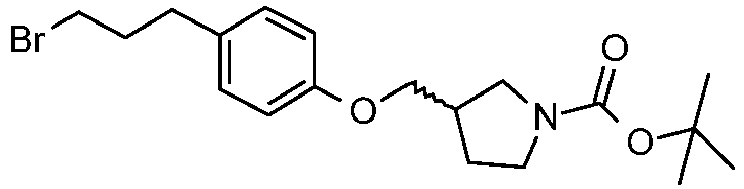
- 0.37 g of tert-butyl 3-[[4-(3-bromopropyl)phenoxy]methyl]pyrrolidine-1-carboxylate was prepared according to the procedure for Intermediate 5, step 1, starting from 0.39 g (1.8 mmol) of 4-(3-bromopropyl)phenol (
US5204018 ) and 0.57 g (2.7 mmol) of tert-butyl 3-(hydroxymethyl)pyrrolidine-1-carboxylate (Fluorochem, Cat. No. 048620) (yield: 52%). 1H NMR (CDCl3) δ (ppm): 7.16-7.07 (m, 2 H), 6.87-6.78 (m, 2 H), 3.95-3.85 (m, 2 H), Part AB of ABX System: VA=3.6, VB=3.21, JAB= 10.9 Hz, JAX= 7.6 Hz, JBX= 6.8 Hz, 3.52-3.44 (m, 1 H), 3.42-3.33 (m, 3 H), 2.76-2.62 (m, 3 H), 2.17-2.03 (m, 3 H), 1.85-1.75 (m, 1 H), 1.47 (s, 9 H); MS (ESI): m/z: 342 [M-56+H]+. -

- 0.28 g of tert-butyl 4-[[4-(3-bromopropyl)phenoxy]methyl]piperidine-1-carboxylate was prepared according to the procedure for Intermediate 5, step 1, starting from 0.20 g (0.91 mmol) of 4-(3-bromopropyl)phenol (
US5204018 ) and 0.29 g (1.36 mmol) of tert-butyl 4-(hydroxymethyl)piperidine-1-carboxylate (Sigma-Aldrich, Cat. No. 556017) (yield: 76%). 1H NMR (CDCl3) δ (ppm): 7.17-7.07 (m, 2 H), 6.87-6.76 (m, 2 H), 4.21-4.11 (m, 2 H), 3.79 (d, J=6.4 Hz, 2 H), 3.39 (t, J=6.6 Hz, 2 H), 2.83-2.69 (m, 4 H), 2.19-2.09 (m, 2 H), 2.01-1.90 (m, 1 H), 1.88-1.76 (m, 2 H), 1.47 (s, 9 H), 1.34-1.19 (m, 2 H); MS (ESI): m/z: 356 [M-56+H]+. -

- 0.327 g tert-Butyl 4-[4-(3-bromopropyl)phenoxy]piperidine-1-carboxylate was prepared according to the procedure for Intermediate 5, step 1, starting from 0.215 g (1 mmol) of 4-(3-bromopropyl)phenol (
US5204018 ) and 0.300 g (1.50 mmol) of tert-butyl 4-hydroxypiperidine-1-carboxylate (Apollo, Cat. No. OR5404) (yield: 82%). 1H NMR (CDCl3) δ (ppm): 7.17-7.08 (m, 2 H), 6.89-6.81 (m, 2 H), 4.49-4.38 (m, 1 H), 3.78-3.65 (m, 2 H), 3.40 (t, J=6.6 Hz, 2 H), 3.37-3.30 (m, 2 H), 2.73 (t, J=7.3 Hz, 2 H), 2.18-2.10 (m, 2 H), 1.95-1.87 (m, 2 H), 1.80-1.69 (m, 2 H), 1.47 (s, 9 H); MS (ESI): m/z: 342 [M-56+H]+. -

- 0.28 g of tert-butyl 4-[4-(3-bromopropyl)phenoxy]azepane-1 -carboxylate was prepared according to the procedure for Intermediate 5, step 1, starting from 0.20 g (0.91 mmol) of 4-(3-bromopropyl)phenol (
US5204018 ) and 0.29 g (1.4 mmol) of tert-butyl 4-hydroxyazepane-1-carboxylate (Intermediate 14, Step 2) (yield: 75%). 1H NMR (CDCl3) δ (ppm): 7.14-7.07 (m, 2 H), 6.85-6.77 (m, 2 H), 4.45-4.38 (m, 1 H), 3.65-3.24 (m, 6 H), 2.72 (t, J=7.3 Hz, 2 H), 2.18-2.10 (m, 2 H), 2.10-2.02 (m, 1 H), 1.99-1.85 (m, 4 H), 1.70-1.59 (m, 1 H), 1.48 (s, 9 H); MS (ESI): m/z: 356 [M-56+H]+. -

- 0.079 g (0.47 mmol) of 4-(3-hydroxypropyl)benzene-1,2-diol (Yang, J. et al. Biorg. Med. Chem Lett. 2014, 24, 2680-2684), 0.03 g (0.2 mmol) of NaI and 0.61 g (1.9 mmol) of Cs2CO3 were suspended in 1.5 mL dry DMF under nitrogen atmosphere. 0.46 g (1.6 mmol) of tert-butyl 4-(bromomethyl)piperidine-1-carboxylate (Sigma-Aldrich, Cat. No. 796719) in 0.8 mL dry DMF was added and the suspension was stirred at 80 °C for 7 h.
- The mixture was cooled down to RT and a further portion of NaI (0.014 g, 0.09 mmol), Cs2CO3 (0.23 g, 0.72 mmol) and tert-butyl 4-(bromomethyl)piperidine-1-carboxylate (0.2 g, 0.72 mmol) were added. The resulting mixture was heated at 80 °C overnight, then cooled down to RT and a saturated aqueous NH4Cl solution and EtOAc were added. The organic phase was separated, dried over Na2SO4 and purified by column chromatography over silica gel (eluent: hexane/acetone, 0% to 18% of acetone (by volume)) providing 148 mg (yield: 56%) of tert-butyl 4-[[2-[(1-tert-butoxycarbonyl-4-piperidyl)methoxy]-4-(3-hydroxypropyl)phenoxy]methyl]piperidine-1-carboxylate as a pale yellow oil. 1H NMR (CDCl3) δ (ppm): 6.85-6.69 (m, 3 H), 4.22-4.08 (m, 4 H), 3.86-3.78 (m, 4 H), 3.69 (t, J=7.3 Hz, 2 H), 2.82-2.71 (m, 4 H), 2.65 (t, J=7.3 Hz, 2 H), 2.06-1.94 (m, 2 H), 1.92-1.78 (m, 6 H), 1.48 (s, 9 H), 1.47 (s, 9 H), 1.33-1.19 (m, 4 H); MS (ESI): m/z: 585 [M+Na]+.
- A solution of 0.11 g (0.31 mmol) CBr4 in 0.75 mL CH2Cl2 was added dropwise at -18 °C to a solution of 0.144 g (0.256 mmol) of tert-butyl 4-[[2-[(1-tert-butoxycarbonyl-4-piperidyl)methoxy]-4-(3-hydroxypropyl)phenoxy]methyl]piperidine-1-carboxylate and 0.081 g (0.31 mmol) of PPh3 in 1.75 mL CH2Cl2. The reaction mixture was stirred at RT for 4 h. Then, the solution was concentrated and the residue was purified by column chromatography eluent: hexane/acetone, 0% to 7% of acetone (by volume)) affording 118 mg (yield: 74%) of tert-butyl 4-[[4-(3-bromopropyl)-2-[(1-tert-butoxycarbonyl-4-piperidyl)methoxy]phenoxy]methyl]piperidine-1-carboxylate as a pale yellow oil. 1H NMR (CDCl3) δ (ppm): 6.85-6.67 (m, 3 H), 4.24-4.05 (m, 4 H), 3.87-3.75 (m, 4 H), 3.39 (t, J=6.6 Hz, 2 H), 2.83-2.63 (m, 6 H), 2.19-2.10 (m, 2 H), 2.05-1.93 (m, 2 H), 1.88-1.79 (m, 4 H), 1.48 (s, 9 H), 1.47 (s, 9 H), 1.32-1.18 (m, 4 H); MS (ESI): m/z: 647 [M+Na]+.
-

- 0.56 g of tert-butyl 4-[4-(2-bromoethyl)phenoxy]piperidine-1-carboxylate was prepared according to the procedure for Intermediate 5, step 1, starting from 0.40 g (2.0 mmol) of 4-(2-bromoethyl)phenol (Fluorochem, Cat. No. 233801) and 0.61 g (3.0 mmol) of tert-butyl 4-hydroxypiperidine-1-carboxylate (Apollo, Cat. No. OR5404) (yield: 73%). 1H NMR (CDCl3) δ (ppm): 7.18-7.08 (m, 2 H), 6.91-6.81 (m, 2 H), 4.50-4.37 (m, 1 H), 3.76-3.65 (m, 2 H), 3.54 (t, J=7.6 Hz, 2 H), 3.39-3.28 (m, 2 H), 3.11 (t, J=7.6 Hz, 2 H), 1.99-1.85 (m, 2 H), 1.80-1.68 (m, 2 H), 1.48 (s, 9 H); MS (ESI): m/z: 328 [M-56+H]+.
-

- 0.39 g of tert-butyl 4-[4-(2-bromoethyl)phenoxy]methyl]piperidine-1-carboxylate was prepared according to the procedure for Intermediate 5, step 1, starting from 0.30 g (1.5 mmol) of 4-(2-bromoethyl)phenol (Fluorochem, Cat. No. 233801) and 0.48 g (2.25 mmol) of tert-butyl 4-(hydroxymethyl)piperidine-1-carboxylate (Sigma-Aldrich, Cat. No. 556017) (yield: 65%). 1H NMR (CDCl3) δ (ppm): 7.17 - 7.09 (m, 2 H), 6.88 - 6.78 (m, 2 H), 4.23 - 4.07 (m, 2 H), 3.79 (d, J = 6.4 Hz, 2 H), 3.54 (t, J = 7.6 Hz, 2 H), 3.11 (t, J = 7.6 Hz, 2 H), 2.80 - 2.70 (m, 2 H), 2.01 - 1.89 (m, 1 H), 1.87 - 1.79 (m, 2 H), 1.47 (s, 9 H), 1.32 - 1.22 (m, 2 H); MS (ESI): m/z: 342 [M-56+H]+.
-

- 0.52 g of tert-butyl 4-[4-(2-bromoethyl)phenoxy]ethyl]piperidine-1-carboxylate was prepared according to the procedure for Intermediate 5, step 1, starting from 0.27 g (1.32 mmol) of 4-(2-bromoethyl)phenol (Fluorochem, Cat. No. 233801) and 0.47 g (1.98 mmol) of tert-butyl 4-(hydroxyethyl)piperidine-1-carboxylate (Sigma-Aldrich, Cat. No. 547247) (yield: 96%). 1H NMR (CDCl3) δ (ppm): 7.17 - 7.09 (m, 2 H), 6.88 - 6.81 (m, 2 H), 4.16 - 4.05 (m, 2 H), 4.00 (t, J = 6.1 Hz, 2 H), 3.54 (t, J = 7.8 Hz, 2 H), 3.11 (t, J = 7.8 Hz, 2 H), 2.76 - 2.65 (m, 2 H), 1.77 - 1.65 (m, 5 H), 1.47 (s, 9 H), 1.23 - 1.12 (m, 2 H); MS (ESI): m/z: 356 [M-56+H]+.
-

- 0.307 mL (2.2 mmol) of TEA and 0.01 g (0.8 mmol) of DMAP were added to an ice-cooled solution of 0.28 g (2.0 mmol) of 1H-indol-7-ol in 30 mL of dry CH2Cl2. After 10 min 0.34 mg (2.2 mmol) of TBDMSCI were added and the mixture was allowed to warm to RT and stirred overnight. Then water was added (50 mL) and the reaction mixture was extracted with CH2Cl2 (3×100 mL). The combined organic phases were dried over Na2SO4, filtered, concentrated and purified by column chromatography (eluent: hexane/acetone, 0% to 5% of acetone (by volume)) to afford 403 mg (yield: 81%) of tert-butyl-(1H-indol-7-yloxy]-dimethyl-silane as a pale yellow oil. 1H NMR (DMSO-d6) δ (ppm): 10.78-10.62 (b s, 1 H), 7.28-7.22 (m, 1 H), 7.15-7.09 (m, 1 H), 6.86-6.79 (m, 1 H), 6.56-6.50 (m, 1 H), 6.41-6.36 (m, 1 H), 1.00 (s, 9 H), 0.25 (s, 6 H); MS (ESI): m/z: 248 [M+H]+.
-

- 0.13 mL (1.79 mmol) of SOCl2 and 3 drops of DMF were added to a solution of 0.25 g (1.4 mmol) of 4-methylthieno[3,2-b]pyrrole-5-carboxylic acid (Intermediate 1) in 4 mL of THF and the mixture was heated to reflux for about 3 h. Then, the solvent was evaporated and the formed acyl chloride was used in the next step without any further purification.
- 0.660 mL of a 300 M methyl magnesium bromide solution in Et2O were slowly added to an ice-cooled solution of 0.376 g (1.52 mmol) of tert-butyl-(1H-indol-7-yloxy]-dimethyl-silane in 3 mL of Et2O under nitrogen atmosphere. The reaction mixture was allowed to reach RT, stirred for 2 h and then again cooled down to 0°C. A solution of (quantity) of 4-methylthieno[3,2-b]pyrrole-5-carbonyl chloride in 5 mL of Et2O was added and the resulting mixture was warmed up to RT and stirred for 2 h followed by slow addition of 6 mL of a saturated NH4Cl solution. The mixture was stirred at RT for a further 1 h and then partitioned between CH2Cl2 and water. The combined organic phases were dried over Na2SO4, filtered, concentrated and purified by column chromatography (eluent: hexane/acetone, 0% to 12% of acetone (by volume)) to afford 160 mg (yield: 28%) of [7-[tert-butyl(dimethyl)silyl]oxy-1H-indol-3-yl]-(4-methylthieno[3,2-b]pyrrol-5-yl)methanone as a beige solid. 1H NMR (CDCl3) δ (ppm): 8.54 (b s, 1 H), 7.99-7.96 (m, 1 H), 7.86-7.83 (m, 1 H), 7.37 (d, J=5.4 Hz, 1 H), 7.18-7.13 (m, 1 H), 7.05 (s, 1 H), 7.02 (d, J=5.4 Hz, 1 H), 6.78-6.73 (m, 1 H), 4.13 (s, 3 H), 1.06 (s, 9 H), 0.32 (s, 6 H); MS (ESI): m/z: 411 [M+H]+.
-

- 0.034 g (0.12 mmol) of 1H-indol-3-yl-(4-methylthieno[3,2-b]pyrrol-5-yl)methanone (Compound 1) were added to a suspension of 0.0058 g (0.15 mmol) of NaH (60% dispersion in mineral oil (by weight)) in dry DMF (0.5 mL) cooled down to 0°C. The mixture was stirred at 0°C for 20 min, then a solution of 0.080 g (0.15 mmol) of tert-butyl 3-[[2-(2-bromoethoxy)phenoxy]methyl]pyrrolidine-1-carboxylate (Intermediate 4) in 1 mL of dry DMF was added at 0°C and the mixture was stirred for 5 h at RT. The reaction was stopped by adding saturated aqueous NaHCOs solution and the product was extracted with EtOAc. The combined organic layers were dried over Na2SO4, filtered and evaporated to dryness. The crude product was purified by flash chromatography on silica gel (CH2Cl2/acetone, 0% to 4% of acetone (by volume)) to afford 0.053 g of tert- butyl 3-[[2-[2-[3-(4-methylthieno[3,2-b]pyrrole-5-carbonyl)indol-1-yl]ethoxy]phenoxy]methyl]pyrrolidine-1-carboxylate (Intermediate 25, yield: 73%) as a pale yellow solid. 1H NMR (CDCl3) δ (ppm): 8.47-8.37 (m, 1 H), 8.02 (s, 1 H), 7.51-7.43 (m, 1 H), 7.39-7.30 (m, 3 H), 7.01 (d, J=5.4 Hz, 1 H), 6.99-6.91 (m, 2 H), 6.90-6.85 (m, 2 H), 6.82-6.77 (m, 1 H), 4.62 (t, J=4.9 Hz, 2 H), 4.39 (t, J=4.9 Hz, 2 H), 4.12 (s, 3 H), 3.82-3.75 (m, 2 H), 3.47-3.40 (m, 1 H), 3.39-3.29 (m, 1 H), 3.26-3.15 (m, 1 H), 3.12-3.02 (m, 1 H), 2.45-2.35 (m, 1 H), 1.88-1.77 (m, 1 H), 1.55-1.51 (m, 1 H), 1.45 (s, 9 H); MS (ESI): m/z: 600 [M+H]+.
- The following BOC-intermediates were obtained starting from Intermediates 1, 5 or 6 and the corresponding bromo derivatives according to the procedure described Intermediate 22 using as solvent DMF or DMA:
Int. Name Structure Analytical Data 26 tert-butyl 3-[[3-[2-[3-(4-methylthieno[3,2-b]pyrrole-5-carbonyl)indol-1-yl]ethoxy]phenoxy] methyl]pyrrolidine-1-carboxylate 
1H NMR (CDCl3) δ (ppm): 8.46-8.39 (m, 1 H), 7.93 (s, 1 H), 7.50-7.44 (m, 1 H), 7.40-7.31 (m, 3 H), 7.20-7.14 (m, 1 H), 7.02 (d, J=5.4 Hz, 1 H), 6.96 (s, 1 H), 6.54-6.44 (m, 2 H), 6.40-6.35 (m, 1 H), 4.59 (t, J=4.9 Hz, 2 H), 4.34 (t, J=4.9 Hz, 2 H), 4.13 (s, 3 H), 3.90-3.75 (m, 2 H), 3.61-3.54 (m, 1 H), 3.51-3.42 (m, 1 H), 3.40-3.31 (m, 1 H), 3.24-3.11 (m, 1 H), 2.70-2.57 (m, 1 H), 2.11-1.98 (m, 1 H), 1.83-1.69 (m, 1 H), 1.47 (s, 9 H); MS (ESI): m/z: 600 [M+H]+. 27 tert-butyl (3S)-3-[[3-[2-[3-(4-methylthieno[3,2-b]pyrrole-5-carbonyl)indol-1-yl]ethoxy]phenoxy] methyl]pyrrolidine-1-carboxylate 
1H NMR (CDCl3) δ (ppm): 8.44-8.39 (m, 1 H), 7.93 (s, 1 H), 7.49-7.44 (m, 1 H), 7.40-7.31 (m, 3 H), 7.20-7.15 (m, 1 H), 7.02 (d, J=5.4 Hz, 1 H), 6.96 (s, 1 H), 6.54-6.44 (m, 2 H), 6.39-6.34 (m, 1 H), 4.59 (t, J=5.4 Hz, 2 H), 4.34 (t, J=5.1 Hz, 2 H), 4.13 (s, 3 H), 3.89-3.77 (m, 2 H), 3.62-3.53 (m, 1 H), 3.51-3.42 (m, 1 H), 3.41-3.30 (m, 1 H), 3.22-3.13 (m, 1 H), 2.69-2.55 (m, 1 H), 2.10-1.98 (m, 1 H), 1.83-1.71 (m, 1 H), 1.47 (s, 9 H); MS (ESI): m/z: 600 [M+H]+. 28 tert-butyl (3R)-3-[[3-[2-[3-(4-methylthieno[3,2-b]pyrrole-5-carbonyl)indol-1-yl]ethoxy]phenoxy] methyl]pyrrolidine-1-carboxylate 
1H NMR (CDCl3) δ (ppm): 8.45-8.39 (m, 1 H), 7.93 (s, 1 H), 7.49-7.44 (m, 1 H), 7.40-7.31 (m, 3 H), 7.20-7.14 (m, 1 H), 7.02 (d, J=5.4 Hz, 1 H), 6.96 (s, 1 H), 6.53-6.44 (m, 2 H), 6.39-6.35 (m, 1 H), 4.59 (t, J=5.1 Hz, 2 H), 4.34 (t, J=5.1 Hz, 2 H), 4.13 (s, 3 H), 3.88-3.79 (m, 2 H), 3.61-3.53 (m, 1 H), 3.51-3.42 (m, 1 H), 3.39-3.31 (m, 1 H), 3.22-3.14 (m, 1 H), 2.69-2.59 (m, 1 H), 2.09-2.00 (m, 1 H), 1.82-1.72 (m, 1 H), 1.47 (s, 9 H); MS (ESI): m/z: 600 [M+H]+. 29 tert-butyl 3-[[4-[2-[3-(4-methylthieno[3,2-b]pyrrole-5-carbonyl)indol-1-yl]ethoxy]phenoxy] methyl]pyrrolidine-1-carboxylate 
1H NMR (CDCl3) δ (ppm): 8.47-8.37 (m, 1 H), 7.94 (s, 1 H), 7.49-7.44 (m, 1 H), 7.40-7.31 (m, 3 H), 7.02 (d, J=5.4 Hz, 1 H), 6.97 (s, 1 H), 6.84-6.75 (m, 4 H), 4.57 (t, J=5.4 Hz, 2 H), 4.30 (t, J=5.1 Hz, 2 H), 4.13 (s, 3 H), 3.90-3.81 (m, 2 H), 3.61-3.54 (m, 1 H), 3.51-3.42 (m, 1 H), 3.39-3.31 (m, 1 H), 3.23-3.14 (m, 1 H), 2.69-2.56 (m, 1 H), 2.10-2.00 (m, 1 H), 1.82-1.72 (m, 1 H), 1.47 (s, 9 H); MS (ESI): m/z: 622 [M+Na]+. 30 tert-butyl 4-[3-[2-[3-(4-methylthieno[3,2-b]pyrrole-5-carbonyl)indol-1-yl]ethoxy]phenoxy] piperidine-1-carboxylate 
1H NMR (CDCl3) δ (ppm): ): 8.45-8.38 (m, 1 H), 7.93 (s, 1 H), 7.49-7.43 (m, 1 H), 7.40-7.31 (m, 3 H), 7.21-7.14 (m, 1 H), 7.02 (d, J=5.4 Hz, 1 H), 6.96 (s, 1 H), 6.56-6.44 (m, 2 H), 6.39 (s, 1 H), 4.59 (t, J=4.9 Hz, 2 H), 4.42-4.36 (m, 1 H), 4.33 (t, J=4.9 Hz, 2 H), 4.13 (s, 3 H), 3.71-3.58 (m, 2 H), 3.38-3.25 (m, 2 H), 1.92-1.81 (m, 2 H), 1.77-1.63 (m, 2 H), 1.47 (s, 9 H); MS (ESI): m/z: 600 [M+H]+. 31 tert-butyl 4-[4-[2-[3-(4-methylthieno[3,2-b]pyrrole-5-carbonyl)indol-1-yl]ethoxy]phenoxy] piperidine-1-carboxylate 
1H NMR (CDCl3) δ (ppm): 8.46-8.37 (m, 1 H), 7.95 (s, 1 H), 7.49-7.44 (m, 1 H), 7.40-7.31 (m, 3 H), 7.02 (d, J=5.4 Hz, 1 H), 6.97 (s, 1 H), 6.87-6.82 (m, 2 H), 6.80-6.75 (m, 2 H), 4.57 (t, J=5.1 Hz, 2 H), 4.38-4.28 (m, 3 H), 4.13 (s, 3 H), 3.73-3.63 (m, 2 H), 3.33-3.23 (m, 2 H), 1.93-1.82 (m, 2 H), 1.74-1.64 (m, 2 H), 1.47 (s, 9 H); MS (ESI): m/z: 600 [M+H]+. 32 tert-butyl 4-[[3-[2-[3-(4-methylthieno[3,2-b]pyrrole-5-carbonyl)indol-1-yl]ethoxy]phenoxy] methyl]piperidine-1-carboxylate 
1H NMR (CDCl3) δ (ppm): 8.46-8.37 (m, 1 H), 7.93 (s, 1 H), 7.49-7.44 (m, 1 H), 7.41-7.30 (m, 3 H), 7.21-7.13 (m, 1 H), 7.02 (d, J=5.4 Hz, 1 H), 6.96 (s, 1 H), 6.53-6.43 (m, 2 H), 6.39-6.34 (m, 1 H), 4.59 (t, J=5.1 Hz, 2 H), 4.34 (t, J=5.1 Hz, 2 H), 4.21-4.07 (m, 5 H), 3.72 (d, J=6.4 Hz, 2 H), 2.80-2.64 (m, 2 H), 1.99-1.86 (m, 1 H), 1.84-1.74 (m, 2 H), 1.47 (s, 9 H), 1.31-1.18 (m, 2 H); MS (ESI): m/z: 614 [M+H]+. 33 tert-butyl 4-[[4-[2-[3-(4-methylthieno[3,2-b]pyrrole-5-carbonyl)indol-1-yl]ethoxy]phenoxy] methyl]piperidine-1-carboxylate 
1H NMR (CDCl3) δ (ppm): 8.46-8.39 (m, 1 H), 7.94 (s, 1 H), 7.49-7.43 (m, 1 H), 7.39-7.30 (m, 3 H), 7.02 (d, J=5.4 Hz, 1 H), 6.97 (s, 1 H), 6.83-6.74 (m, 4 H), 4.57 (t, J=5.4 Hz, 2 H), 4.30 (t, J=5.1 Hz, 2 H), 4.19-4.10 (m, 5 H), 3.74 (d, J=6.4 Hz, 2 H), 2.79-2.68 (m, 2 H), 1.98-1.86 (m, 1 H), 1.84-1.76 (m, 2 H), 1.47 (s, 9 H), 1.31-1.18 (m, 2 H); MS (ESI): m/z: 614 [M+H]+. 34 tert-butyl 4-[3-[2-[3-(4-methylthieno[3,2-b]pyrrole-5-carbonyl)indol-1-yl]ethoxy]phenoxy] azepane-1-carboxylate 
1H NMR (CDCl3) δ (ppm): 8.49-8.35 (m, 1 H), 7.93 (s, 1 H), 7.51-7.42 (m, 1 H), 7.41-7.31 (m, 3 H), 7.21-7.13 (m, 1 H), 7.02 (d, J=5.4 Hz, 1 H), 6.97 (s, 1 H), 6.54-6.43 (m, 2 H), 6.39-6.32 (m, 1 H), 4.59 (t, J=5.1 Hz, 2 H), 4.42-4.30 (m, 3 H), 4.12 (s, 3 H), 3.63-3.22 (m, 4 H), 2.10-1.78 (m, 5 H), 1.66-1.55 (m, 1 H), 1.47 (s, 9 H); MS (ESI): m/z: 614 [M+H]+. 35 tert-butyl 4-[4-[2-[3-(4-methylthieno[3,2-b]pyrrole-5-carbonyl)indol-1-yl]ethoxy]phenoxy] azepane-1-carboxylate 
1H NMR (CDCl3) δ (ppm): 8.49-8.31 (m, 1 H), 7.95 (s, 1 H), 7.49-7.44 (m, 1 H), 7.40-7.31 (m, 3 H), 7.03 (d, J=5.4 Hz, 1 H), 6.98 (s, 1 H), 6.84-6.73 (m, 4 H), 4.57 (t, J=5.1 Hz, 2 H), 4.30 (t, J=5.1 Hz, 3 H), 4.13 (s, 3 H), 3.64-3.23 (m, 4 H), 2.07-1.98 (m, 1 H), 1.97-1.81 (m, 4 H), 1.69-1.62 (m, 1 H), 1.47 (s, 9 H); MS (ESI): m/z: 614 [M+H]+. 36 tert-butyl 3-[[4-[3-[3-(4-methylthieno[3,2-b]pyrrole-5-carbonyl)indol-1-yl]propyl]phenoxy] methyl]pyrrolidine-1-carboxylate 
1H NMR (CDCl3) δ (ppm): 8.48-8.38 (m, 1 H), 7.77 (s, 1 H), 7.39-7.31 (m, 4 H), 7.11-7.06 (m, 2 H), 7.03 (d, J=5.4 Hz, 1 H), 7.00 (s, 1 H), 6.86-6.81 (m, 2 H), 4.20 (t, J=7.1 Hz, 2 H), 4.13 (s, 3 H), 3.95-3.84 (m, 2 H), Part AB of ABX System: VA=3.6, VB=3.21, JAB= 11.3 Hz, JAX= 7.3 Hz, JBX= 6.8 Hz, 3.52-3.45 (m, 1 H), 3.42-3.33 (m, 1 H), 2.73-2.59 (m, 3 H), 2.28-2.19 (m, 2 H), 2.11-2.02 (m, 1 H), 1.86-1.74 (m, 1 H), 1.48 (s, 9 H); MS (ESI): m/z: 598 [M+H]+. 37 tert-butyl 4-[[4-[3-[3-(4-methylthieno[3,2-b]pyrrole-5-carbonyl)indol-1-yl]propyl]phenoxy] methyl]piperidine-1-carboxylate 
1H NMR (CDCl3) δ (ppm): 8.51-8.33 (m, 1 H), 7.76 (s, 1 H), 7.39-7.30 (m, 4 H), 7.11-7.06 (m, 2 H), 7.02 (d, J=5.4 Hz, 1 H), 7.00 (s, 1 H), 6.86-6.80 (m, 2 H), 4.23-4.10 (m, 7 H), 3.79 (d, J=6.4 Hz, 2 H), 2.79-2.71 (m, 2 H), 2.64 (t, J=7.3 Hz, 2 H), 2.27-2.19 (m, 2 H), 2.02-1.90 (m, 1 H), 1.87-1.78 (m, 2 H), 1.47 (s, 9 H), 1.31-1.20 (m, 2 H); MS (ESI): m/z: 612 [M+H]+. 38 tert-butyl 4-[4-[3-[3-(4-methylthieno[3,2-b]pyrrole-5-carbonyl)indol-1-yl]propyl]phenoxy] piperidine-1-carboxylate 
1H NMR (CDCl3) δ (ppm): 8.48-8.34 (m, 1 H), 7.77 (s, 1 H), 7.38-7.30 (m, 4 H), 7.11-7.05 (m, 2 H), 7.02 (d, J=5.4 Hz, 1 H), 7.00 (s, 1 H), 6.87-6.83 (m, 2 H), 4.47-4.39 (m, 1 H), 4.20 (t, J=7.1 Hz, 2 H), 4.13 (s, 3 H), 3.75-3.66 (m, 2 H), 3.38-3.27 (m, 2 H), 2.64 (t, J=7.3 Hz, 2 H), 2.28-2.19 (m, 2 H), 1.96-1.85 (m, 2 H), 1.79-1.67 (m, 2 H), 1.48 (s, 9 H); MS (ESI): m/z: 598 [M+H]+. 39 tert-butyl 4-[4-[3-[3-(4-methylthieno[3,2-b]pyrrole-5-carbonyl)indol-1-yl]propyl]phenoxy] azepane-1-carboxylate 
1H NMR (CDCl3) δ (ppm): 8.48-8.37 (m, 1 H), 7.78 (s, 1 H), 7.37 (d, J=5.4 Hz, 1 H), 7.35-7.31 (m, 3 H), 7.10-7.05 (m, 2 H), 7.03 (d, J=5.4 Hz, 1 H), 7.00 (s, 1 H), 6.85-6.79 (m, 2 H), 4.45-4.37 (m, 1 H), 4.20 (t, J=7.3 Hz, 2 H), 4.13 (s, 3 H), 3.63-3.26 (m, 4 H), 2.64 (t, J=7.3 Hz, 2 H), 2.28-2.19 (m, 2 H), 2.11-2.02 (m, 1 H), 2.01-1.86 (m, 4 H), 1.70-1.61 (m, 1 H), 1.48 (s, 9 H); MS (ESI): m/z: 612 [M+H]+. 40 tert-butyl 4-[[2-[(1-tert-butoxycarbonyl-4-piperidyl)methoxy]-4-[3-[3-(4-methylthieno[3,2-b]pyrrole-5-carbonyl)indol-1-yl]propyl]phenoxy] methyl]piperidine-1-carboxylate 
1H NMR (CDCl3) δ (ppm): 8.48-8.33 (m, 1 H), 7.77 (s, 1 H), 7.39-7.30 (m, 4 H), 7.03 (d, J=5.4 Hz, 1 H), 6.99 (s, 1 H), 6.80 (d, J=8.3 Hz, 1H), 6.70 (dd, J=2.0, 8.3 Hz, 1 H), 6.63 (d, J=2.0 Hz, 1 H), 4.20 (t, J=6.8 Hz, 2 H), 4.17-4.09 (m, 7 H), 3.80 (d, J=6.4 Hz, 2 H), 3.74 (d, J=6.4 Hz, 2 H), 2.81-2.69 (m, 4 H), 2.60 (t, J=7.3 Hz, 2 H), 2.27-2.18 (m, 2 H), 2.03-1.91 (m, 2 H), 1.87-1.76 (m, 4 H), 1.47 (s, 18 H), 1.29-1.17 (m, 4 H); MS (ESI): m/z: 825 [M+H]+. 41 tert-butyl 4-[4-[3-[3-(4-ethylthieno[3,2-b]pyrrole-5-carbonyl)indol-1-yl]propyl]phenoxy] piperidine-1-carboxylate 
1H NMR (CDCl3) δ (ppm): 8.47-8.39 (m, 1 H), 7.76 (s, 1 H), 7.38-7.30 (m, 4 H), 7.11-7.06 (m, 2 H), 7.04 (d, J=5.4 Hz, 1H), 6.98 (s, 1 H), 6.88-6.82 (m, 2 H), 4.59 (q, J=7.3 Hz, 2 H), 4.48-4.39 (m, 1 H), 4.20 (t, J=7.3 Hz, 2 H), 3.76-3.65 (m, 2 H), 3.39-3.27 (m, 2 H), 2.64 (t, J=7.3 Hz, 2 H), 2.28-2.20 (m, 2 H), 1.96-1.86 (m, 2 H), 1.79-1.69 (m, 2 H), 1.51 (t, J=7.1 Hz, 3 H), 1.48 (s, 9 H); MS (ESI): m/z: 612 [M+H]+. 42 tert-butyl 3-[[4-[3-[3-(4-ethylthieno[3,2-b]pyrrole-5-carbonyl)indol-1-yl]propyl]phenoxy] methyl]pyrrolidine-1-carboxylate 
1H NMR (CDCl3) δ (ppm): 8.52-8.32 (m, 1 H), 7.75 (s, 1 H), 7.38-7.30 (m, 4 H), 7.11-7.06 (m, 2 H), 7.04 (d, J=4.9 Hz, 1 H), 6.98 (s, 1 H), 6.86-6.81 (m, 2 H), 4.59 (q, J=7.3 Hz, 2 H), 4.19 (t, J=7.1 Hz, 2 H), 3.97-3.84 (m, 2 H), Part AB of ABX System: VA=3.6, VB=3.21, JAB= 10.9 Hz, JAX= 7.6 Hz, JBX= 6.8 Hz, 3.50-3.44 (m, 1 H), 3.41-3.33 (m, 1 H), 2.72-2.60 (m, 3 H), 2.29-2.19 (m, 2 H), 2.12-2.03 (m, 1 H), 1.86-1.73 (m, 1 H), 1.51 (t, J=7.3 Hz, 3 H), 1.48 (s, 9 H); MS (ESI): m/z: 612 [M+H]+. 43 tert-butyl 3-[[4-[3-[3-(6-methylthieno[2,3-b]pyrrole-5-carbonyl)indol-1-yl]propyl]phenoxy]methyl]pyrrolidine-1-carboxylate 
1H NMR (CDCl3) δ (ppm): 8.46-8.37 (m, 1 H), 7.77 (s, 1 H), 7.37-7.30 (m, 3 H), 7.11-7.06 (m, 2 H), 7.05 (d, J=5.4 Hz, 1 H), 6.99-6.95 (m, 2 H), 6.86-6.80 (m, 2 H), 4.20 (t, J=7.3 Hz, 2 H), 4.10 (s, 3 H), 3.95-3.84 (m, 2 H), Part AB of ABX System: VA=3.6, VB=3.21, JAB= 10.8 Hz, JAX= 7.4 Hz, JBX= 6.8 Hz, 3.53-3.44 (m, 1 H), 3.41-3.33 (m, 1 H), 2.72-2.58 (m, 3 H), 2.28-2.19 (m, 2 H), 2.13-2.02 (m, 1 H), 1.85-1.74 (m, 1 H), 1.48 (s, 9 H); MS (ESI): m/z: 598 [M+H]+. 44 tert-butyl 4-[4-[3-[3-(6-methylthieno[2,3-b]pyrrole-5-carbonyl)indol-1-yl]propyl]phenoxy] piperidine-1-carboxylate 
1H NMR (CDCl3) δ (ppm): 8.49-8.33 (m, 1 H), 7.77 (s, 1 H), 7.38-7.30 (m, 3 H), 7.11-7.06 (m, 2 H), 7.05 (d, J=5.4 Hz, 1 H), 6.99-6.95 (m, 2 H), 6.88-6.83 (m, 2 H), 4.47-4.39 (m, 1 H), 4.21 (t, J=7.1 Hz, 2 H), 4.10 (s, 3 H), 3.76-3.65 (m, 2 H), 3.37-3.28 (m, 2 H), 2.64 (t, J=7.6 Hz, 2 H), 2.27-2.19 (m, 2 H), 1.96-1.86 (m, 2 H), 1.79-1.69 (m, 2 H), 1.48 (s, 9 H); MS (ESI): m/z: 598 [M+H]+. 45 tert-butyl 4-[4-[3-[5-ethyl-3-(4-methylthieno[3,2-b]pyrrole-5-carbonyl)indol-1-yl]propyl]phenoxy] piperidine-1-carboxylate 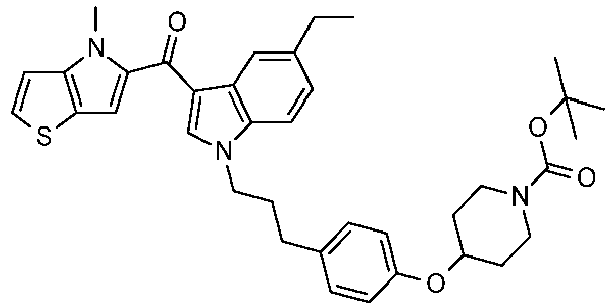
1H NMR (CDCl3) δ (ppm): 8.32-8.22 (m, 1 H), 7.73 (s, 1 H), 7.36 (d, J=5.4 Hz, 1 H), 7.27-7.25 (m, 1 H), 7.21-7.17 (m, 1 H), 7.10-7.05 (m, 2 H), 7.02 (d, J=5.4 Hz, 1 H), 6.98 (s, 1 H), 6.88-6.82 (m, 2 H), 4.47-4.37 (m, 1 H), 4.18 (t, J=7.1 Hz, 2 H), 4.13 (s, 3 H), 3.75-3.67 (m, 2 H), 3.37-3.29 (m, 2 H), 2.81 (q, J=7.8 Hz, 2 H), 2.63 (t, J=7.3 Hz, 2 H), 2.26-2.16 (m, 2 H), 1.96-1.86 (m, 2 H), 1.78-1.68 (m, 2 H), 1.48 (s, 9 H), 1.32 (t, J=7.8 Hz, 3 H); MS (ESI): m/z: 626 [M+H]+. 46 tert-butyl 4-[4-[3-[5-methyl-3-(4-methylthieno[3,2-b]pyrrole-5-carbonyl)indol-1-yl]propyl]phenoxy] piperidine-1-carboxylate 
1H NMR (CDCl3) δ (ppm): 8.29-8.23 (m, 1 H), 7.72 (s, 1 H), 7.36 (d, J=5.4 Hz, 1 H), 7.25-7.21 (m, 1 H), 7.17-7.14 (m, 1 H), 7.10-7.05 (m, 2 H), 7.02 (d, J=5.4 Hz, 1 H), 6.99 (s, 1 H), 6.88-6.82 (m, 2 H), 4.49-4.38 (m, 1 H), 4.17 (t, J=7.1 Hz, 2 H), 4.12 (s, 3 H), 3.75-3.66 (m, 2 H), 3.37-3.28 (m, 2 H), 2.62 (t, J=7.3 Hz, 2 H), 2.52 (s, 3 H), 2.25-2.16 (m, 2 H), 1.95-1.86 (m, 2 H), 1.79-1.68 (m, 2 H), 1.48 (s, 9 H); MS (ESI): m/z: 612 [M+H]+. 47 tert-butyl 4-[[4-[2-[3-(4-methylthieno[3,2-b]pyrrole-5-carbonyl)indol-1-yl]ethyl]phenoxy]met hyl]piperidine-1-carboxylate 
1H NMR (CDCl3) δ (ppm): 8.48 - 8.37 (m, 1 H), 7.47 - 7.43 (m, 1 H), 7.40 - 7.32 (m, 4 H), 6.99 (d, J = 5.4 Hz, 1 H), 6.94 - 6.90 (m, 2 H), 6.86 - 6.81 (m, 2 H), 6.55 (s, 1 H), 4.40 (t, J = 6.6 Hz, 2 H), 4.20 - 4.12 (m, 2 H), 4.08 (s, 3 H), 3.80 (d, J = 6.4 Hz, 2 H), 3.11 (t, J = 6.6 Hz, 2 H), 2.80 - 2.70 (m, 2 H), 2.05 - 1.92 (m, 1 H), 1.87 - 1.78 (m, 2 H), 1.47 (s, 9 H), 1.32 - 1.22 (m, 2 H); MS (ESI): m/z: 598 [M+H]+. 48 tert-butyl 4-[4-[2-[3-(4-methylthieno[3,2-b]pyrrole-5-carbonyl)indol-1-yl]ethyl]phenoxy]pip eridine-1-carboxylate 
1H NMR (CDCl3) δ (ppm): 8.47 - 8.34 (m, 1 H), 7.46 - 7.39 (m, 2 H), 7.38 - 7.31 (m, 3 H), 7.00 (d, J = 5.4 Hz, 1 H), 6.95 - 6.90 (m, 2 H), 6.87 - 6.81 (m, 2 H), 6.59 (s, 1 H), 4.48 - 4.31 (m, 3 H), 4.09 (s, 3 H), 3.76 - 3.66 (m, 2 H), 3.36 - 3.24 (m, 2 H), 3.12 (t, J = 6.6 Hz, 2 H), 1.97 - 1.85 (m, 2 H), 1.81 - 1.68 (m, 2 H), 1.48 (s, 9 H); MS (ESI): m/z: 584 [M+H]+. 49 tert-butyl 4-[2-[4-[2-[3-(4-methylthieno[3,2-b]pyrrole-5-carbonyl)indol-1-yl]ethyl]phenoxy]eth yl]piperidine-1-carboxylate 
1H NMR (CDCl3) δ (ppm): 8.49 - 8.34 (m, 1 H), 7.47 - 7.43 (m, 1 H), 7.40 - 7.31 (m, 4 H), 6.99 (d, J = 5.4 Hz, 1 H), 6.95 - 6.90 (m, 2 H), 6.86 - 6.81 (m, 2 H), 6.53 (s, 1 H), 4.41 (t, J = 6.6 Hz, 2 H), 4.12 - 4.04 (m, 5 H), 4.00 (t, J = 6.4 Hz, 2 H), 3.11 (t, J = 6.6 Hz, 2 H), 2.74 - 2.62 (m, 2 H), 1.80 - 1.65 (m, 5 H), 1.46 (s, 9 H), 1.23 - 1.10 (m, 2 H); MS (ESI): m/z: 612 [M+H]+. -

- 0.016 g (0.057 mmol) of 1H-indol-3-yl-(4-methylthieno[3,2-b]pyrrol-5-yl)methanone (Compound 1) was added to a solution of 0.0027 g (0.068 mmol) of NaH in 1 mL of DMF and the mixture was stirred for 20 min. 0.0043 mL (0.068 mmol) of methyl iodide was added and the resulting mixture was stirred at RT for 30 min and then partitioned between EtOAc and water. The combined organic phases were dried over Na2SO4, filtered, concentrated and purified by column chromatography (eluent: hexane/acetone hexane/acetone, 85:15, v/v) to afford 9 mg (yield: 54%) of (1-methylindol-3-yl)-(4-methylthieno[3,2-b]pyrrol-5-yl)methanone as a pale yellow solid. 1H NMR (CDCl3) δ (ppm): 8.48-8.36 (m, 1 H), 7.77 (s, 1 H), 7.44-7.31 (m, 4 H), 7.05-6.98 (m, 2 H), 4.12 (s, 3 H), 3.90 (s, 3 H); MS (ESI): m/z: 295 [M+H]+.
-

- 0.029 g of [1-(2-methoxyethyl)indol-3-yl]-(4-methylthieno[3,2-b]pyrrol-5-yl)methanone was prepared starting from 0.034 g (0.12 mmol) of 1H-indol-3-yl-(4-methylthieno[3,2-b]pyrrol-5-yl)methanone (Compound 1) and 0.058 g (0.17 mmol, 0.016 mL) of 1-bromo-2-methoxy-ethane (Sigma-Aldrich, Cat. No. 238155) according to the procedure described for Compound 7 (yield: 71%). 1H NMR (CDCl3) δ (ppm): 8.49-8.37 (m, 1 H), 7.87 (s, 1 H), 7.44-7.39 (m, 1 H), 7.38-7.30 (m, 3 H), 7.05-6.98 (m, 2 H), 4.37 (t, J=5.4 Hz, 2 H), 4.13 (s, 3 H), 3.76 (t, J=5.1 Hz, 2 H), 3.34 (s, 3 H); MS (ESI): m/z: 339 [M+H]+.
-

- 0.031 g of (4-methylthieno[3,2-b]pyrrol-5-yl)-[1-(2-phenoxyethyl)indol-3-yl]methanone was prepared starting from 0.034 g (0.12 mmol) of 1H-indol-3-yl-(4-methylthieno[3,2-b]pyrrol-5-yl)methanone (Compound 1) and 0.030 g (0.14 mmol) of 2-bromoethoxybenzene (Sigma-Aldrich, Cat. No. B75506-25G) according to the procedure described for Compound 7 (yield: 64%). 1H NMR (DMSO-d6) δ (ppm): 8.31-8.17 (m, 2 H), 7.76-7.67 (m, 1 H), 7.60 (d, J=5.4 Hz, 1 H), 7.36-7.20 (m, 5 H), 7.12 (s, 1 H), 6.96-6.85 (m, 3 H), 4.71 (t, J=5.1 Hz, 2 H), 4.38 (t, J=5.1 Hz, 2 H), 4.02 (s, 3 H); MS (ESI): m/z: 401 [M+H]+.
-

- 0.396 mL of a 1 M TBAF solution in THF were added at RT to a solution of 0.158 g (0.380 mmol) of [7-[tert-butyl(dimethyl)silyl]oxy-1H-indol-3-yl]-(4-methylthieno[3,2-b]pyrrol-5-yl)methanone in 3 mL of dry THF and stirred for 15 min. Then, the solvent was evaporated and the crude mixture was partitioned between EtOAc and water. The organic phase was dried over Na2SO4, filtered, concentrated and purified by column chromatography (eluent: hexane/acetone, 0% to 30% of acetone (by volume)) to afford 98 mg (yield: 86%) of (7-hydroxy-1H-indol-3-yl)-(4-methylthieno[3,2-b]pyrrol-5-yl)methanone as a yellow solid. 1H NMR (DMSO-d6) δ (ppm): 11.91 (bs, 1 H), 9.86 (bs, 1 H), 7.92 (s, 1 H), 7.70-7.63 (m, 1 H), 7.56 (d, J=4.9 Hz, 1 H), 7.26 (d, J=4.9 Hz, 1 H), 7.12 (s, 1 H), 7.02-6.93 (m, 1 H), 6.68-6.58 (m, 1 H), 4.00 (s, 3 H); MS (ESI): m/z: 297 [M+H]+.
-

- 0.21 mL of 4 M HCl in dioxane was added to a solution of 0.050 g (0.083 mmol) of tert-butyl 3-[[2-[2-[3-(4-methylthieno[3,2-b]pyrrole-5-carbonyl)indol-1-yl]ethoxy]phenoxy]methyl]pyrrolidine-1-carboxylate (Intermediate 23) dissolved in 1.0 mL of dioxane and 0.2 mL of MeOH. The mixture was stirred at RT for 6 h, then the solvent was removed, the residue was taken up first in MeOH and concentrated, and then in Et2O. After further concentration the solid was triturated with Et2O/MeOH and dried to afford 0.042 g of (4-methylthieno[3,2-b]pyrrol-5-yl)-[1-[2-[2-(pyrrolidin-3-ylmethoxy)phenoxy]ethyl]indol-3-yl]methanone hydrochloride (yield: 87%) as a brownish powder. 1H NMR (DMSO-d6) δ (ppm): 8.75 (bs, 2 H), 8.30-8.16 (m, 2 H), 7.74-7.66 (m, 1 H), 7.60 (d, J=4.9 Hz, 1 H), 7.38-7.21 (m, 3 H), 7.13 (s, 1 H), 7.02-6.83 (m, 4 H), 4.71 (t, J=4.9 Hz, 2 H), 4.39 (t, J=4.9 Hz, 2 H), 4.02 (s, 3 H), 3.81-3.70 (m, 2 H), 3.21-3.03 (m, 2 H), 3.02-2.90 (m, 1 H), 2.88-2.76 (m, 1 H), 2.46-2.33 (m, 1 H), 1.87-1.75 (m, 1 H), 1.59-1.43 (m, 1 H); MS (ESI): m/z: 500 [M+H]+.
- The following compounds were obtained starting from the corresponding Boc-intermediates according to the procedure described Compound 11.
- In case of the Compound 26, the compound was purified by preparative HPLC providing the product as trifluoroacetate salt. The solution was treated with a saturated aqueous NaHCOs solution, and the product was then obtained by extraction with CH2Cl2, drying over Na2SO4 and removing of the solvent in vacuo. Compounds 29 and 30 were obtained as free bases after filtration on a bicarbonate SPE cartridge (200 mg) and purification by column chromatography on silica gel (CH2Cl2/MeOH/NH3).
No. Name Structure Analytical Data 12 (4-methylthieno[3,2-b]pyrrol-5-yl)-[1-[2-[3-(pyrrolidin-3-ylmethoxy)phenox y]ethyl]indol-3-yl]methanone 
1H NMR (DMSO-d6) δ (ppm): 8.84 (br. s, 2 H), 8.28-8.19 (m, 2 H), 7.75-7.68 (m, 1 H), 7.60 (d, J=5.4 Hz, 1 H), 7.35-7.22 (m, 3 H), 7.19-7.13 (m, 1 H), 7.10 (s, 1 H), 6.54-6.48 (m, 2 H), 6.44-6.39 (m, 1 H), 4.70 (t, J=4.9 Hz, 2 H), 4.38 (t, J=4.9 Hz, 2 H), 4.02 (s, 3 H), 3.94-3.82 (m, 2 H), 3.30-3.27 (m, 1 H), 3.26-3.18 (m, 1 H), 3.17-3.10 (m, 1 H), 2.99-2.91 (m, 1 H), 2.71-2.60 (m, 1 H), 2.09-1.99 (m, 1 H), 1.74-1.64 (m, 1 H); MS (ESI): m/z: 500 [M+H]+. 13 (4-methylthieno[3,2-b]pyrrol-5-yl)-[1-[2-[3-[[(3S)-pyrrolidin-3-yl]methoxy]phenox y]ethyl]indol-3-yl]methanone hydrochloride 
1H NMR (DMSO-d6) δ (ppm): 8.78 (br. s, 2 H), 8.28-8.15 (m, 2 H), 7.75-7.67 (m, 1 H), 7.60 (d, J=5.4 Hz, 1 H), 7.35-7.22 (m, 3 H), 7.19-7.13 (m, 1 H), 7.10 (s, 1 H), 6.54-6.47 (m, 2 H), 6.44-6.38 (m, 1 H), 4.69 (t, J=4.9 Hz, 2 H), 4.37 (t, J=4.9 Hz, 2 H), 4.02 (s, 3 H), 3.95-3.81 (m, 2 H), 3.30-3.26 (m, 1 H), 3.25-3.18 (m, 1 H), 3.17-3.10 (m, 1 H), 2.99-2.89 (m, 1 H), 2.71-2.60 (m, 1 H), 2.09-1.99 (m, 1 H), 1.75-1.63 (m, 1 H), MS (ESI): m/z: 500 [M+H]+. 14 (4-methylthieno[3,2-b]pyrrol-5-yl)-[1-[2-[3-[[(3R)-pyrrolidin-3-yl]methoxy]phenox y]ethyl]indol-3-yl]methanone hydrochloride 
1H NMR (DMSO-d6) δ (ppm): 8.81 (br. s, 2 H), 8.28-8.19 (m, 2 H), 7.74-7.68 (m, 1 H), 7.60 (d, J=5.4 Hz, 1 H), 7.35-7.21 (m, 3 H), 7.19-7.12 (m, 1 H), 7.10 (s, 1 H), 6.55-6.46 (m, 2 H), 6.44-6.37 (m, 1 H), 4.70 (t, J=4.9 Hz, 2 H), 4.37 (t, J=4.9 Hz, 2 H), 4.02 (s, 3 H), 3.95-3.81 (m, 2 H), 3.30-3.27 (m, 1 H), 3.25-3.19 (m, 1 H), 3.17-3.09 (m, 1 H), 2.98-2.89 (m, 1 H), 2.71-2.61 (m, 1 H), 2.10-1.97 (m, 1 H), 1.76-1.63 (m, 1 H); MS (ESI): m/z: 500 [M+H]+. 15 (4-methylthieno[3,2-b]pyrrol-5-yl)-[1-[2-[4-(pyrrolidin-3-ylmethoxy)phenox y]ethyl]indol-3-yl]methanone hydrochloride 
1H NMR (DMSO-d6 + D2O) δ (ppm): 8.29-8.11 (m, 2 H), 7.74-7.66 (m, 1 H), 7.59 (d, J=5.4 Hz, 1 H), 7.34-7.21 (m, 3 H), 7.10 (s, 1 H), 6.88-6.77 (m, 4 H), 4.67 (t, J=4.9 Hz, 2 H), 4.29 (t, J=4.9 Hz, 2 H), 4.00 (s, 3 H), 3.93-3.78 (m, 2 H), 3.33-3.27 (m, 1 H), 3.26-3.18 (m, 1 H), 3.17-3.09 (m, 1 H), 3.02-2.90 (m, 1 H), 2.72-2.59 (m, 1 H), 2.13-1.99 (m, 1 H), 1.77-1.62 (m, 1 H); MS (ESI): m/z: 500 [M+H]+. 16 (4-methylthieno[3,2-b]pyrrol-5-yl)-[1-[2-[3-(4-piperidyloxy)pheno xy]ethyl]indol-3-yl]methanone hydrochloride 
1H NMR (DMSO-d6) δ (ppm): 8.48 (br. s, 2 H), 8.27-8.21 (m, 2 H), 7.73-7.69 (m, 1 H), 7.60 (d, J=5.4 Hz, 1 H), 7.35-7.23 (m, 3 H), 7.19-7.13 (m, 1 H), 7.09 (s, 1 H), 6.59-6.48 (m, 2 H), 6.47-6.42 (m, 1 H), 4.70 (t, J=4.9 Hz, 2 H), 4.59-4.49 (m, 1 H), 4.38 (t, J=5.4 Hz, 2 H), 4.02 (s, 3 H), 3.22-3.11 (m, 2 H), 3.07-2.93 (m, 2 H), 2.05-1.95 (m, 2 H), 1.78-1.67 (m, 2 H); MS (ESI): m/z: 500 [M+H]+. 17 (4-methylthieno[3,2-b]pyrrol-5-yl)-[1-[2-[4-(4-piperidyloxy)pheno xy]ethyl]indol-3-yl]methanone hydrochloride 
1H NMR (DMSO-d6) δ (ppm): 8.42 (br. s., 2 H), 8.26-8.21 (m, 2 H), 7.74-7.67 (m, 1 H), 7.60 (d, J=5.4 Hz, 1 H), 7.35-7.21 (m, 3 H), 7.12 (s, 1 H), 6.92-6.85 (m, 2 H), 6.84-6.78 (m, 2 H), 4.67 (t, J=4.9 Hz, 2 H), 4.48-4.40 (m, 1 H), 4.32 (t, J=5.4 Hz, 2 H), 4.02 (s, 3 H), 3.23-3.14 (m, 2 H), 3.06-2.94 (m, 2 H), 2.03-1.94 (m, 2 H), 1.77-1.67 (m, 2 H); MS (ESI): m/z: 500 [M+H]+. 18 (4-methylthieno[3,2-b]pyrrol-5-yl)-[1-[2-[3-(4-piperidylmethoxy)p henoxy]ethyl]indol-3-yl]methanone hydrochloride 
1H NMR (DMSO-d6) δ (ppm): 8.58 (br. s, 1 H), 8.34-8.15 (m, 3 H), 7.75-7.68 (m, 1 H), 7.60 (d, J=5.4 Hz, 1 H), 7.35-7.21 (m, J=5.4 Hz, 3 H), 7.18-7.11 (m, 1 H), 7.09 (s, 1 H), 6.51-6.45 (m, 2 H), 6.40-6.33 (m, 1 H), 4.69 (t, J=4.9 Hz, 2 H), 4.38 (t, J=4.9 Hz, 2 H), 4.02 (s, 3 H), 3.74 (d, J=6.4 Hz, 2 H), 3.30-3.22 (m, 2 H), 2.93-2.79 (m, 2 H), 2.04-1.93 (m, 1 H), 1.89-1.80 (m, 2 H), 1.46-1.33 (m, 2 H); MS (ESI): m/z: 514 [M+H]+. 19 (4-methylthieno[3,2-b]pyrrol-5-yl)-[1-[2-[4-(4-piperidylmethoxy)p henoxy]ethyl]indol-3-yl]methanone hydrochloride 
1H NMR (DMSO-d6) δ (ppm): 8.39 (br. s, 2 H), 8.26-8.22 (m, 2 H), 7.73-7.67 (m, 1 H), 7.60 (d, J=5.4 Hz, 1 H), 7.36-7.21 (m, 3 H), 7.11 (s, 1 H), 6.86-6.76 (m, 4 H), 4.68 (t, J=5.4 Hz, 2 H), 4.32 (t, J=5.4 Hz, 2 H), 4.02 (s, 3 H), 3.75 (d, J=6.4 Hz, 2 H), 3.30-3.22 (m, 2 H), 2.93-2.77 (m, 2 H), 2.05-1.92 (m, 1 H), 1.89-1.80 (m, 2 H), 1.48-1.35 (m, 2 H); MS (ESI): m/z: 514 [M+H]+. 20 [1-[2-[3-(azepan-4-yloxy)phenoxy]eth yl]indol-3-yl]-(4-methylthieno[3,2-b]pyrrol-5-yl)methanone hydrochloride 
1H NMR (DMSO-d6) δ (ppm): 8.55 (br. s, 2 H), 8.31-8.13 (m, 2 H), 7.74-7.68 (m, 1 H), 7.59 (d, J=5.4 Hz, 1 H), 7.35-7.22 (m, 3 H), 7.18-7.11 (m, 1 H), 7.08 (s, 1 H), 6.54-6.46 (m, 2 H), 6.42-6.36 (m, 1 H), 4.69 (t, J=4.9 Hz, 2 H), 4.63-4.54 (m, 1 H), 4.37 (t, J=4.9 Hz, 2 H), 4.02 (s, 3 H), 3.21-2.98 (m, 4 H), 2.12-1.58 (m, 6 H); MS (ESI): m/z: 514 [M+H]+. 21 [1-[2-[4-(azepan-4-yloxy)phenoxy]eth yl]indol-3-yl]-(4-methylthieno[3,2-b]pyrrol-5-yl)methanone hydrochloride 
1H NMR (DMSO-d6) δ (ppm): 8.59 (br. s, 2 H), 8.29-8.19 (m, 2 H), 7.75-7.68 (m, 1 H), 7.60 (d, J=5.4 Hz, 1 H), 7.35-7.21 (m, 3 H), 7.12 (s, 1 H), 6.88-6.71 (m, 4 H), 4.68 (t, J=5.1 Hz, 2 H), 4.54-4.47 (m, 1 H), 4.32 (t, J=5.1 Hz, 2 H), 4.02 (s, 3 H), 3.22-2.99 (m, 4 H), 2.12-1.57 (m, 6 H); MS (ESI): m/z: 514 [M+H]+. 22 (4-methylthieno[3,2-b]pyrrol-5-yl)-[1-[3-[4-(pyrrolidin-3-ylmethoxy)phenyl] propyl]indol-3-yl]methanone hydrochloride 
1H NMR (DMSO-d6) δ (ppm): 8.80 (br. s, 2 H), 8.28-8.24 (m, 1 H), 8.21 (s, 1 H), 7.61-7.55 (m, 2 H), 7.32-7.22 (m, 3 H), 7.18 (s, 1 H), 7.14-7.09 (m, 2 H), 6.87-6.81 (m, 2 H), 4.31 (t, J=7.3 Hz, 2 H), 4.02 (s, 3 H), Part AB of ABX System: VA=3.96, VB=3.9, JAB= 9.4 Hz, JAX= 6.1 Hz, JBX= 7.4 Hz, 3.36-3.34 (m, 1 H), 3.28-3.21 (m, 1 H), 3.19-3.11 (m, 1 H), 3.02-2.95 (m, 1 H), 2.73-2.65 (m, 1 H), 2.55 (t, J=7.3 Hz, 2 H), 2.14-2.03 (m, 3 H), 1.77-1.67 (m, 1 H); MS (ESI): m/z: 498 [M+H]+. 23 (4-methylthieno[3,2-b]pyrrol-5-yl)-[1-[3-[4-(4-piperidylmethoxy)p henyl]propyl]indol-3-yl]methanone hydrochloride 
1H NMR (DMSO-d6) δ (ppm): 8.64 (br. s, 1 H), 8.37-8.24 (m, 2 H), 8.21 (s, 1 H), 7.61-7.55 (m, 2 H), 7.32-7.21 (m, 3 H), 7.18 (s, 1 H), 7.13-7.07 (m, 2 H), 6.86-6.77 (m, 2 H), 4.31 (t, J=7.3 Hz, 2 H), 4.02 (s, 3 H), 3.80 (d, J=6.4 Hz, 2 H), 3.29-3.24 (m, 2 H), 2.95-2.80 (m, 2 H), 2.55 (t, J=7.3 Hz, 2 H), 2.14-2.06 (m, 2 H), 2.06-1.96 (m, 1 H), 1.92-1.84 (m, 2 H), 1.50-1.38 (m, 2 H); MS (ESI): m/z: 512 [M+H]+. 24 (4-methylthieno[3,2-b]pyrrol-5-yl)-[1-[3-[4-(4-piperidyloxy)pheny l]propyl]indol-3-yl]methanone hydrochloride 
1H NMR (DMSO-d6) δ (ppm): 8.57 (br. s, 2 H), 8.28-8.24 (m, 1 H), 8.22 (s, 1 H), 7.61-7.55 (m, 2 H), 7.32-7.21 (m, 3 H), 7.18 (s, 1 H), 7.14-7.08 (m, 2 H), 6.91-6.84 (m, 2 H), 4.61-4.51 (m, 1 H), 4.32 (t, J=7.1 Hz, 2 H), 4.02 (s, 3 H), 3.25-3.15 (m, 2 H), 3.09-2.98 (m, 2 H), 2.56 (t, J=7.3 Hz, 2 H), 2.16-1.98 (m, 4 H), 1.83-1.69 (m, 2 H); MS (ESI): m/z: 498 [M+H]+. 25 [1-[3-[4-(azepan-4-yloxy)phenyl]propy l]indol-3-yl]-(4-methylthieno[3,2-b]pyrrol-5-yl)methanone hydrochloride 
1H NMR (DMSO-d6) δ (ppm): 8.68 (br. s, 2 H), 8.28-8.23 (m, 1 H), 8.21 (s, 1 H), 7.61-7.54 (m, 2 H), 7.31-7.21 (m, 3 H), 7.18 (s, 1 H), 7.13-7.07 (m, 2 H), 6.86-6.80 (m, 2 H), 4.67-4.55 (m, 1 H), 4.32 (t, J=7.3 Hz, 2 H), 4.02 (s, 3 H), 3.25-3.00 (m, 4 H), 2.55 (t, J=7.3 Hz, 2 H), 2.16-2.05 (m, 3 H), 2.03-1.93 (m, 2 H), 1.91-1.76 (m, 2 H), 1.75-1.63 (m, 1 H); MS (ESI): m/z: 512 [M+H]+. 26 [1-[3-[3,4-bis(4-piperidylmethoxy)p henyl]propyl]indol-3-yl]-(4-methylthieno[3,2-b]pyrrol-5-yl)methanone 
1H NMR (DMSO-d6 +DCI 1N) δ (ppm): 8.24-8.16 (m, 1 H), 8.08 (s, 1 H), 7.59-7.48 (m, 2 H), 7.33-7.17 (m, 3 H), 7.08 (s, 1 H), 6.85-6.76 (m, 1 H), 6.71-6.61 (m, 2 H), 4.27 (t, J=6.8 Hz, 2 H), 3.96 (s, 3 H), 3.73 (d, J=6.3 Hz, 2 H), 3.66 (d, J=6.3 Hz, 2 H), 3.29-3.19 (m, 4 H), 2.90-2.77 (m, 4 H), 2.48-2.42 (m, 2 H), 2.14-2.03 (m, 2 H), 2.01-1.78 (m, 6 H), 1.51-1.36 (m, 4 H); MS (ESI): m/z: 625 [M+H]+. 27 (4-ethylthieno[3,2-b]pyrrol-5-yl)-[1-[3-[4-(4-piperidyloxy)pheny l]propyl]indol-3-yl]methanone hydrochloride 
1H NMR (DMSO-d6) δ (ppm): 8.61 (br. s, 2 H), 8.28-8.23 (m, 1 H), 8.21 (s, 1 H), 7.62-7.53 (m, 2 H), 7.32-7.20 (m, 3 H), 7.16 (s, 1 H), 7.14-7.08 (m, 2 H), 6.91-6.84 (m, 2 H), 4.61-4.45 (m, 3 H), 4.31 (t, J=7.1 Hz, 2 H), 3.26-3.13 (m, 2 H), 3.09-2.96 (m, 2 H), 2.56 (t, J=7.3 Hz, 2 H), 2.17-1.97 (m, 4 H), 1.83-1.70 (m, 2 H), 1.35 (t, J=7.1 Hz, 3 H); MS (ESI): m/z: 512 [M+H]+. 28 (4-ethylthieno[3,2-b]pyrrol-5-yl)-[1-[3-[4-(pyrrolidin-3-ylmethoxy)phenyl] propyl]indol-3-yl]methanone hydrochloride 
1H NMR (DMSO-d6 + D2O) δ (ppm): 8.31-8.22 (m, 1 H), 8.17 (s, 1 H), 7.60-7.51 (m, 2 H), 7.33-7.19 (m, 3 H), 7.15 (s, 1 H), 7.13-7.08 (m, 2 H), 6.86-6.81 (m, 2 H), 4.50 (q, J=7.3 Hz, 2 H), 4.30 (t, J=7.3 Hz, 2 H), 3.99-3.85 (m, 2 H), Part AB of ABX System: VA=3.33, VB=2.98, JAB= 11.8 Hz, JAX= 8.3 Hz, JBX= 7.3 Hz, 3.27-3.21 (m, 1 H), 3.19-3.11 (m, 1 H), 2.73-2.65 (m, 1 H), 2.55 (t, J=7.8 Hz, 2 H), 2.15-2.01 (m, 3 H), 1.79-1.67 (m, 1 H), 1.34 (t, J=7.3 Hz, 3 H); MS (ESI): m/z: 512 [M+H]+. 29 (6-methylthieno[2,3-b]pyrrol-5-yl)-[1-[3-[4-(pyrrolidin-3-ylmethoxy)phenyl] propyl]indol-3-yl]methanone 
1H NMR (CDCl3) δ (ppm): 8.50-8.31 (m, 1 H), 7.76 (s, 1 H), 7.39-7.30 (m, 3 H), 7.11-7.02 (m, 3 H), 6.99-6.92 (m, 2 H), 6.86-6.81 (m, 2 H), 4.20 (t, J=7.1 Hz, 2 H), 4.10 (s, 3 H), 3.97-3.80 (m, 2 H), Part AB of ABX System: VA=3.92, VB=3.86, JAB= 9.1 Hz, JAX= 5.8 Hz, JBX= 7.4 Hz, Part AB of ABX System: VA=3.25, VB=2.94, JAB= 11.4 Hz, JAX= 7.9 Hz, JBX= 6.1 Hz, 3.19-3.12 (m, 1 H), 3.09-3.01 (m, 1 H), 2.67-2.61 (m, 3 H), 2.27-2.17 (m, 2 H), 2.11-2.01 (m, 1 H), 1.75-1.60 (m, 1 H); MS (ESI): m/z: 498 [M+H]+. 30 (6-methylthieno[2,3-b]pyrrol-5-yl)-[1-[3-[4-(4-piperidyloxy)pheny l]propyl]indol-3-yl]methanone 
1H NMR (CDCl3) δ (ppm): 8.48-8.36 (m, 1 H), 7.77 (s, 1 H), 7.38-7.30 (m, 3 H), 7.11-7.06 (m, 2 H), 7.05 (d, J=4.9 Hz, 1 H), 6.99-6.95 (m, 2 H), 6.87-6.82 (m, 2 H), 4.45-4.35 (m, 1 H), 4.20 (t, J=7.1 Hz, 2 H), 4.10 (s, 3 H), 3.25-3.15 (m, 2 H), 2.91-2.80 (m, 2 H), 2.64 (t, J=7.3 Hz, 2 H), 2.29-2.18 (m, 2 H), 2.12-2.02 (m, 2 H), 1.84-1.71 (m, 2 H); MS (ESI): m/z: 498 [M+H]+. 31 [5-ethyl-1-[3-[4-(4-piperidyloxy)pheny l]propyl]indol-3-yl]-(4-methylthieno[3,2-b]pyrrol-5-yl)methanone hydrochloride 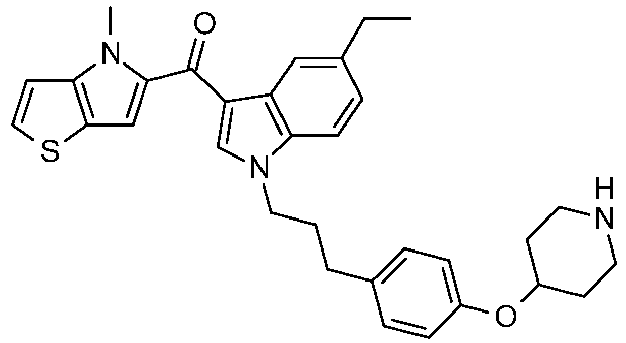
1H NMR (DMSO-d6) δ (ppm): 8.58 (bs, 2 H), 8.17 (s, 1 H), 8.12-8.08 (m, 1 H), 7.58 (d, J=5.4 Hz, 1 H), 7.50-7.44 (m, 1 H), 7.28 (d, J=5.4 Hz, 1 H), 7.18-7.08 (m, 4 H), 6.91-6.83 (m, 2 H), 4.61-4.52 (m, 1 H), 4.29 (t, J=7.1 Hz, 2 H), 4.01 (s, 3 H), 3.26-3.15 (m, 2 H), 3.10-2.99 (m, 2 H), 2.73 (q, J=7.8 Hz, 2 H), 2.55 (t, J=7.3 Hz, 2 H), 2.14-1.98 (m, 4 H), 1.83-1.72 (m, 2 H), 1.24 (t, J=7.8 Hz, 3 H); MS (ESI): m/z: 526 [M+H]+. 32 [5-methyl-1-[3-[4-(4-piperidyloxy)pheny l]propyl]indol-3-yl]-(4-methylthieno[3,2-b]pyrrol-5-yl)methanone hydrochloride 
1H NMR (DMSO-d6) δ (ppm): 8.51 (bs, 2 H), 8.16 (s, 1 H), 8.09-8.05 (m, 1 H), 7.58 (d, J=5.4 Hz, 1 H), 7.47-7.42 (m, 1 H), 7.28 (d, J=5.4 Hz, 1 H), 7.16 (s, 1 H), 7.13-7.07 (m, 3 H), 6.91-6.84 (m, 2 H), 4.59-4.52 (m, 1 H), 4.28 (t, J=7.1 Hz, 2 H), 4.01 (s, 3 H), 3.26-3.16 (m, 2 H), 3.10-2.99 (m, 2 H), 2.55 (t, J=7.3 Hz, 2 H), 2.43 (s, 3 H), 2.14-1.97 (m, 4 H), 1.82-1.71 (m, 2 H); MS (ESI): m/z: 512 [M+H]+. 33 (4-methylthieno[3,2-b]pyrrol-5-yl)-[1-[2-[4-(4-piperidylmethoxy)ph enyl]ethyl]indol-3-yl]methanone hydrochloride 
1H NMR (DMSO-d6) δ (ppm): 8.38 (br. s, 2 H), 8.25 - 8.19 (m, 1 H), 7.88 (s, 1 H), 7.70 - 7.64 (m, 1 H), 7.58 (d, J = 5.4 Hz, 1 H), 7.33 - 7.19 (m, 3 H), 7.09 - 7.04 (m, 2 H), 6.88 - 6.80 (m, 2 H), 6.69 (s, 1 H), 4.51 (t, J = 6.8 Hz, 2 H), 3.98 (s, 3 H), 3.81 (d, J = 5.9 Hz, 2 H), 3.29 - 3.21 (m, 2 H), 3.06 (t, J = 6.8 Hz, 2 H), 2.94 - 2.80 (m, 2 H), 2.09 - 1.95 (m, 1 H), 1.92 - 1.83 (m, 2 H), 1.51 - 1.36 (m, 2 H); MS (ESI): m/z: 498 [M+H]+. 34 (4-methylthieno[3,2-b]pyrrol-5-yl)-[1-[2-[4-(4-piperidyloxy)phenyl] ethyl]indol-3-yl]methanone hydrochloride 
1H NMR (DMSO-d6) δ (ppm): 8.51 (br. s, 2 H), 8.27 - 8.14 (m, 1 H), 7.91 (s, 1 H), 7.68 - 7.62 (m, 1 H), 7.58 (d, J = 5.4 Hz, 1 H), 7.31 - 7.20 (m, 3 H), 7.11 - 7.03 (m, 2 H), 6.93 - 6.86 (m, 2 H), 6.71 (s, 1 H), 4.61 - 4.45 (m, 3 H), 3.99 (s, 3 H), 3.24 - 3.13 (m, 2 H), 3.09 - 2.92 (m, 4 H), 2.11 - 1.97 (m, 2 H), 1.81 - 1.70 (m, 2 H); MS (ESI): m/z: 484 [M+H]+. 35 (4-methylthieno[3,2-b]pyrrol-5-yl)-[1-[2-[4-[2-(4-piperidyl)ethoxy]phe nyl]ethyl]indol-3-yl]methanone hydrochloride 
1H NMR (CDCl3) δ (ppm): 8.49 - 8.15 (m, 3 H), 7.85 (s, 1 H), 7.69 - 7.64 (m, 1 H), 7.58 (d, J = 5.4 Hz, 1 H), 7.34 - 7.18 (m, 3 H), 7.08 - 7.01 (m, 2 H), 6.87 - 6.79 (m, 2 H), 6.65 (s, 1 H), 4.50 (t, J = 6.8 Hz, 2 H), 4.03 - 3.88 (m, 5 H), 3.24 - 3.14 (m, 2 H), 3.06 (t, J = 6.8 Hz, 2 H), 2.86 - 2.74 (m, 2 H), 1.87 - 1.59 (m, 5 H), 1.37 - 1.22 (m, 2 H); MS (ESI): m/z: 512 [M+H]+. - The KDM1A inhibiting activity was determined using a TR-FRET assay (time resolved fluorescence resonance energy transfer, Lance® Ultra Demethylase technology (Perkin Elmer, Waltham, MA, USA)), which comprises a Europium chelate donor dye (TRF0404, Perkin Elmer, Waltham, MA, USA) together with ULight ™ (TR0102, Perkin Elmer, Waltham, MA, USA), a small molecular weight acceptor dye with a red-shifted fluorescent emission, and a biotinylated 21 amino acids histone H3-derived monomethylated peptide (H3K4me) [Lys(Me1)4]-Histone H3 (1-21)-GGK(biotin), (64355, Anaspec, Fremont, CA, USA) as substrate. The intensity of the light emission is proportional to the level of biotinylated reaction product. The complex of human recombinant KDM1A/CoREST protein was produced in E. coli as separate proteins and co-purified as previously described.(Forneris, F. et al. Trends Biochem, Sci, 2008, 33, 181-189) (Forneris, F. et al. J. Biol. Chem. 2007, 282, 20070-20074).
- Demethylase Assay conditions: 0.25 nM KDM1A/CoREST protein and compound in 100% DMSO were added in a final volume of 48 µL assay buffer (Tris HCl 50 mM pH 8.8, NaCl 50 mM, DTT 1 mM, Tween-20 0.01% (by volume)) to each well of a 96 well half area flat bottom white plate (3693 Costar, Sigma-Aldrich, St. Louis, M, USA).
- Demethylase reaction was started by the addition of 50nM histone H3K4 monomethylated. After 20 min at RT, 300 µM tranylcypromine (P8511-1G, Sigma-Aldrich, St. Louis, MO 63103) was added to stop the reaction.
- Detection step conditions: 10 µL of the assay mixture was transferred from the original plate into a 384 well white plate (6007290 OptiPlate™, Perkin Elmer, Waltham, MA, USA) and 10 µL of the detection Mix containing 2 nM Eu-antibody and 10 nM U-Light-Streptavidin in 1X Lance Detection Buffer (TRF0404, TR0102, CR97100, Perkin Elmer, Waltham, MA, USA). The resulting mixture was incubated in the dark for 1 h at RT. Then, TR-FRET signal was read by a fluorimeter (Infinite® F200, Tecan, Männedorf, Switzerland) (Excitation 320nm, Emission 665 nm and 620 nm, delay time 50µs, window time 100µs).
- IC50 determination: The inhibitor concentrations ranged from 0.025 to 500 µM (serial 1:3 dilutions). The IC50 was calculated using GraphPad Software.
- Compounds 1-2, 5-6, and 8 exhibit IC50 values of less than 50 µM, Compound 11 exhibits an IC50 value of less than 5 µM, and Compounds 12-30 exhibit IC50 values of less than 0.5 µM.
- CellTiter-Flor® (Promega) is as a nonlytic, single-reagent-addition fluorescence assay that measures the relative number of living cells in a culture population after experimental manipulation. The CellTiter-Fluor™ Cell Viability Assay measures the conserved and constitutive protease activity within live cells and therefore acts as a marker for cell viability.
- Human leukemia MV4-11 cells, (obtained from the Deutsche Sammlung von Mikroorganismen und Zellkulturen, ACC 102) or NB4 cells, (obtained from the Deutsche Sammlung von Mikroorganismen und Zellkulturen) in exponential growth, were incubated for 48 h with different concentrations of the inhibitors. After 48 h a volume of CellTiter-Fluor® Reagent equal to one fifth of volume of cell culture medium was added. The content was mixed and incubates for at least 90 min at 37 °C degree to obtain a stable signal. The fluorescence was recorded using an excitation wavelength of 360 nm and an emission at 535 nm. The IC50was calculated using GraphPad Software. Compounds 11 and 13-19 exhibit IC50 values of less than 10 µM against human leukemia MV4-11 cells, compounds 11 and 13-24 IC50 values of less than 10 µM against human leukemia NB4 cells.
- The MAO Glo Assay from Promega (cat. V1402, Promega, Madison, WI) was used to measure the effect of inhibitors on MAO A and MAO B activity. Human recombinant MAO A and MAO B were expressed in Pichia pastoris and purified as published (Binda C. et al. Proc. Natl. Acad. Sci. USA, 2003, 9750-9755). The assay was performed at RT in 50 µL (25 µL reaction solution + 25 µL detection reagent) in 96 well half area white plates (cat. 3693, Corning, Corning, NY). Luminescence was measured after 20 min incubation in the dark using a microplate reader (Infinite F200, Tecan Group, Switzerland) with an integration time of 0.25 s per well. 50 nM MAO A or 125 nM MAO B were incubated with five different inhibitor concentrations (from 0.004 µM to 100 µM) for 15 min at RT in Promega MAO Buffer or Promega MAO B Buffer (MAO Glo Assay kit, catalogue number V1402, Promega, Madison, WI). After 30 min of incubation the reaction was stopped with the Promega detection reagent. All compounds were tested twice and IC50 values were calculated using GraphPad Prism version 4.0 (GraphPad Software, San Diego, CA).
- Compounds 13-14, and 17-18 were at least 10 times more active against KDM1A (LSD1) compared to both MAO A and MAO B.
Claims (15)
- A compound of formula (I)

A is R is hydrogen or L1-R5;R1, R2 are independently, hydrogen, OH, C1-C4-alkyl, C3-C7 cycloalkyl, aryl, or heteroaryl;R3 is hydrogen or C1-C4-alkyl;L1 is a bond, -(CH2)j-Y- or -(CH2)k-,j is an integer from 2 to 6;k is an integer from 1 to 6;Y is oxygen;R5 is C1-C4-alkyl or aryl, wherein the aryl is optionally substituted by one or two substituents chosen from halogen, C1-C6-alkyl, or L2-R6;L2 is -(CH2)m-; or -(CH2)n-W-(CH2)p-;R6 is heterocyclyl, wherein the heterocyclyl is optionally substituted by C1-C6-alkyl;m, n, p are, independently, zero or an integer from 1 to 6;W is oxygen, NH, or CH2;or a stereoisomer or a pharmaceutically acceptable salt thereof.
 - The compound according to claim 1, wherein R3 is methyl or ethyl.
- The compound according to claim 1 or 2, whereinR is hydrogen or L1-R5;R1, R2 are independently, hydrogen, OH, or C1-C4-alkyl;R3 is methyl or ethyl;L1 is a bond, -(CH2)2-Y- or -(CH2)k-;k is an integer from 1 to 4;Y is oxygen;R5 is C1-C4-alkyl or phenyl substituted by one or two substituents chosen from L2-R6;L2 is -W-(CH2) p -;R6 is heterocyclyl, wherein the heterocyclyl is optionally substituted by C1-C6-alkyl;p is zero or 1;W is oxygen;or a stereoisomer or a pharmaceutically acceptable salt thereof.
- The compound according to claim 1 or 2, whereinR is hydrogen or L1-R5;R1, R2 are independently H or methyl;R3 is methyl or ethyl;L1 is -(CH2)j-Y- or -(CH2)k-;j is 2;k is 3;Y is oxygen;R5 is methyl, or phenyl substituted by one or two substituents chosen from L2-R6;L2 is -(CH2)n-W-(CH2)p-;n is 0;p is 0 or 1;W is oxygen;or a stereoisomer or a pharmaceutically acceptable salt thereof;
optionally whereinR is L1-R5;R1, R2 are hydrogen;R5 is phenyl substituted by one or two substituents chosen from L2-R6;further optionally whereinR3 is methyl;L1 is -(CH2)j-Y-R5 is phenyl substituted by one L2-R6 substituent. - The compound according to any one of claims 1-4, wherein R6 is piperidinyl or pyrrolidinyl.
- A compound according to claim 1 selected from:1H-indol-3-yl-(4-methylthieno[3,2-b]pyrrol-5-yl)methanone;(5-methyl-1H-indol-3-yl)-(4-methylthieno[3,2-b]pyrrol-5-yl)methanone;(5-ethyl-1H-indol-3-yl)-(4-methylthieno[3,2-b]pyrrol-5-yl)methanone;(5-bromo-1H-indol-3-yl)-(4-methylthieno[3,2-b]pyrrol-5-yl)methanone;(4-ethylthieno[3,2-b]pyrrol-5-yl)-(1H-indol-3-yl)methanone;(1-methylindol-3-yl)-(4-methylthieno[3,2-b]pyrrol-5-yl)methanone;[1-(2-methoxyethyl)indol-3-yl]-(4-methylthieno[3,2-b]pyrrol-5-yl)methanone;(4-methylthieno[3,2-b]pyrrol-5-yl)-[1-(2-phenoxyethyl)indol-3-yl]methanone;(4-methylthieno[3,2-b]pyrrol-5-yl)-[1-[2-[2-(pyrrolidin-3-ylmethoxy)phenoxy]ethyl]indol-3-yl]methanone;(4-methylthieno[3,2-b]pyrrol-5-yl)-[1-[2-[3-(pyrrolidin-3-ylmethoxy)phenoxy]ethyl]indol-3-yl]methanone;(4-methylthieno[3,2-b]pyrrol-5-yl)-[1-[2-[3-[[(3S)-pyrrolidin-3-yl]methoxy]phenoxy]ethyl]indol-3-yl]methanone;(4-methylthieno[3,2-b]pyrrol-5-yl)-[1-[2-[3-[[(3R)-pyrrolidin-3-yl]methoxy]phenoxy]ethyl]indol-3-yl]methanone;(4-methylthieno[3,2-b]pyrrol-5-yl)-[1-[2-[4-(pyrrolidin-3-ylmethoxy)phenoxy]ethyl]indol-3-yl]methanone;(4-methylthieno[3,2-b]pyrrol-5-yl)-[1-[2-[3-(4-piperidyloxy)phenoxy]ethyl]indol-3-yl]methanone;(4-methylthieno[3,2-b]pyrrol-5-yl)-[1-[2-[4-(4-piperidyloxy)phenoxy]ethyl]indol-3-yl]methanone;(4-methylthieno[3,2-b]pyrrol-5-yl)-[1-[2-[3-(4-piperidylmethoxy)phenoxy]ethyl]indol-3-yl]methanone;(4-methylthieno[3,2-b]pyrrol-5-yl)-[1-[2-[4-(4-piperidylmethoxy)phenoxy]ethyl]indol-3-yl]methanone;[1-[2-[3-(azepan-4-yloxy)phenoxy]ethyl]indol-3-yl]-(4-methylthieno[3,2-b]pyrrol-5-yl)methanone;[1-[2-[4-(azepan-4-yloxy)phenoxy]ethyl]indol-3-yl]-(4-methylthieno[3,2-b]pyrrol-5-yl)methanone;(4-methylthieno[3,2-b]pyrrol-5-yl)-[1-[3-[4-(pyrrolidin-3-ylmethoxy)phenyl]propyl]indol-3-yl]methanone;(4-methylthieno[3,2-b]pyrrol-5-yl)-[1-[3-[4-(4-piperidylmethoxy)phenyl]propyl]indol-3-yl]methanone;(4-methylthieno[3,2-b]pyrrol-5-yl)-[1-[3-[4-(4-piperidyloxy)phenyl]propyl]indol-3-yl]methanone;[1-[3-[4-(azepan-4-yloxy)phenyl]propyl]indol-3-yl]-(4-methylthieno[3,2-b]pyrrol-5-yl)methanone;[1-[3-[3,4-bis(4-piperidylmethoxy)phenyl]propyl]indol-3-yl]-(4-methylthieno[3,2-b]pyrrol-5-yl)methanone;(4-ethylthieno[3,2-b]pyrrol-5-yl)-[1-[3-[4-(4-piperidyloxy)phenyl]propyl]indol-3-yl]methanone;(4-ethylthieno[3,2-b]pyrrol-5-yl)-[1-[3-[4-(pyrrolidin-3-ylmethoxy)phenyl]propyl]indol-3-yl]methanone;[5-ethyl-1-[3-[4-(4-piperidyloxy)phenyl]propyl]indol-3-yl]-(4-methylthieno[3,2-b]pyrrol-5-yl)methanone; and[5-methyl-1-[3-[4-(4-piperidyloxy)phenyl]propyl]indol-3-yl]-(4-methylthieno[3,2-b]pyrrol-5-yl)methanone;or a stereoisomer or a pharmaceutically acceptable salt thereof.
- A compound of formula (I)
 A is
A is R is L1-R5;R1, R2 are hydrogen;R4 is methyl or ethyl;L1 is -(CH2)j-Y- or -(CH2)k-,j is 2;k is 3;Y is oxygen;R5 is phenyl substituted by one or two substituents chosen from L2-R6;L2 is -(CH2)n-W-(CH2)p-;R6 is heterocyclyl, wherein the heterocyclyl is optionally substituted by C1-C6-alkyl;n is 0;p is 0 or 1;W is oxygen;or a stereoisomer or a pharmaceutically acceptable salt thereof.
 - The compound of claim 7, wherein said compound is:(6-methylthieno[2,3-b]pyrrol-5-yl)-[1-[3-[4-(pyrrolidin-3-ylmethoxy)phenyl]propyl]indol-3-yl]methanone; or(6-methylthieno[2,3-b]pyrrol-5-yl)-[1-[3-[4-(4-piperidyloxy)phenyl]propyl]indol-3-yl]methanone.
- A pharmaceutical composition comprising a compound as defined in any one of claims 1-8 together with a pharmaceutically acceptable excipient and/or diluent,
optionally wherein the pharmaceutical composition further comprises at least one therapeutic agent, preferably selected from the group consisting of histone deacetylase inhibitors, retinoid receptor modulators, antiproliferative/antineoplastic agents, cytostatic agents, agents which inhibit cancer cell invasion, inhibitors of growth factor function, antiangiogenic agents, cell cycle inhibitors, proteasome inhibitors, HSP90 inhibitors, selective COX-2 inhibitors or a chemotherapeutic agent. - The pharmaceutical composition according to claim 9 in the form of tablets, capsules, oral preparations, powders, granules, pills, injectable or infusible liquid, solutions, suspensions, emulsions, suppositories, ointments, creams, lotions, gels, pastes, or transdermal delivery devices.
- The compound according to any one of claims 1-8 for use as a medicament.
- The compound according to any one of claims 1-8 for use in:(a) a method of treatment and/or prevention of cancer, infectious diseases or a disease characterized by aberration of cellular energy metabolism, such as obesity;(b) a method of treatment and/or prevention of leukemia, non-small cell lung cancer, hepatocellular carcinoma, or glioblastomas; or(c) a method of treatment and/or prevention of acute myeloid leukemia.
- The compound for use according to claim 12, wherein the method further comprises administering a therapeutically effective amount of at least one therapeutic agent, preferably selected from the group consisting of histone deacetylase inhibitors, retinoid receptor modulators, anti proliferative/antineoplastic agents, cytostatic agents, agents which inhibit cancer cell invasion, inhibitors of growth factor function, antiangiogenic agents, cell cycle inhibitors, proteasome inhibitors, HSP90 inhibitors, selective COX-2 inhibitors or a chemotherapeutic agent.
- A process for obtaining a compound of formula (I) according to claim 1, wherein R is hydrogen, the process comprising the preparation of the acyl chloride of formula A2 by reaction of the carboxylic acid of formula A1 with thionyl chloride, and the preparation of the indole anion A4 by reaction of indole A3 with methyl magnesium bromide, and the condensation of the acyl chloride of formula A2 with indole anion A4 to obtain a compound of formula (I), as represented below:


- A process for obtaining a compound of formula (I) according to claim 1 or claim 7, wherein R is L1-R5, the process comprising the reaction of a compound of formula B1 with a compound of formula B2 in presence of a base, as represented below:


Applications Claiming Priority (2)
| Application Number | Priority Date | Filing Date | Title |
|---|---|---|---|
| US201762547433P | 2017-08-18 | 2017-08-18 | |
| PCT/EP2018/072319 WO2019034774A1 (en) | 2017-08-18 | 2018-08-17 | Indole derivatives as histone demethylase inhibitors |
Publications (2)
| Publication Number | Publication Date |
|---|---|
| EP3668877A1 EP3668877A1 (en) | 2020-06-24 |
| EP3668877B1 true EP3668877B1 (en) | 2024-05-01 |
Family
ID=63244622
Family Applications (1)
| Application Number | Title | Priority Date | Filing Date |
|---|---|---|---|
| EP18755821.8A Active EP3668877B1 (en) | 2017-08-18 | 2018-08-17 | Indole derivatives as histone demethylase inhibitors |
Country Status (5)
| Country | Link |
|---|---|
| US (1) | US10980777B2 (en) |
| EP (1) | EP3668877B1 (en) |
| AU (1) | AU2018316542B2 (en) |
| ES (1) | ES2986559T3 (en) |
| WO (1) | WO2019034774A1 (en) |
Families Citing this family (6)
| Publication number | Priority date | Publication date | Assignee | Title |
|---|---|---|---|---|
| IT202000007873A1 (en) | 2020-04-14 | 2021-10-14 | St Europeo Di Oncologia S R L | Molecules for use in the treatment of viral infections |
| WO2022058405A2 (en) | 2020-09-16 | 2022-03-24 | Ifom - Istituto Firc Di Oncologia Molecolare | Histone deacetylase inhibitors and uses thereof |
| CA3231846A1 (en) | 2021-04-08 | 2022-10-13 | Tamara Maes | Combinations of lsd1 inhibitors for treating myeloid cancers |
| EP4522136A1 (en) | 2022-05-09 | 2025-03-19 | Oryzon Genomics, S.A. | Methods of treating malignant peripheral nerve sheath tumor (mpnst) using lsd1 inhibitors |
| CN119497613A (en) | 2022-05-09 | 2025-02-21 | 奥莱松基因组股份有限公司 | Methods of treating NF1-mutated tumors using LSD1 inhibitors |
| WO2024110649A1 (en) | 2022-11-24 | 2024-05-30 | Oryzon Genomics, S.A. | Combinations of lsd1 inhibitors and menin inhibitors for treating cancer |
Family Cites Families (8)
| Publication number | Priority date | Publication date | Assignee | Title |
|---|---|---|---|---|
| US5204018A (en) | 1990-02-01 | 1993-04-20 | Hoffmann-La Roche Inc. | Liquid crystals |
| US8389580B2 (en) | 2009-06-02 | 2013-03-05 | Duke University | Arylcyclopropylamines and methods of use |
| US20130178453A1 (en) | 2010-02-09 | 2013-07-11 | Ironwood Pharmaceuticals, Inc. | Cannabinoid Agonists |
| AU2011244478B2 (en) | 2010-04-20 | 2014-07-17 | Fondazione IEO-CCM | Tranylcypromine derivatives as inhibitors of histone demethylase LSD1 and/or LSD2 |
| WO2012045883A1 (en) | 2010-10-08 | 2012-04-12 | Oryzon Genomics S.A. | Cyclopropylamine inhibitors of oxidases |
| UA114406C2 (en) | 2011-08-09 | 2017-06-12 | Такеда Фармасьютікал Компані Лімітед | CYCLOPROPANAMINE DERIVATIVES AS LSD1 INHIBITORS |
| SG2014009609A (en) | 2011-08-15 | 2014-05-29 | Univ Utah Res Found | Substituted (e)-n'-(1-phenylethylidene) benzohydrazide analogs as histone demethylase inhiitors |
| EP2993175A1 (en) | 2014-09-05 | 2016-03-09 | IEO - Istituto Europeo di Oncologia Srl | Thienopyrroles as histone demethylase inhibitors |
-
2018
- 2018-08-17 ES ES18755821T patent/ES2986559T3/en active Active
- 2018-08-17 US US16/640,030 patent/US10980777B2/en active Active
- 2018-08-17 EP EP18755821.8A patent/EP3668877B1/en active Active
- 2018-08-17 AU AU2018316542A patent/AU2018316542B2/en active Active
- 2018-08-17 WO PCT/EP2018/072319 patent/WO2019034774A1/en not_active Ceased
Also Published As
| Publication number | Publication date |
|---|---|
| US20200289463A1 (en) | 2020-09-17 |
| AU2018316542A1 (en) | 2020-04-09 |
| US10980777B2 (en) | 2021-04-20 |
| EP3668877A1 (en) | 2020-06-24 |
| ES2986559T3 (en) | 2024-11-11 |
| WO2019034774A1 (en) | 2019-02-21 |
| AU2018316542B2 (en) | 2023-02-16 |
Similar Documents
| Publication | Publication Date | Title |
|---|---|---|
| US10961255B2 (en) | Imidazoles as histone demethylase inhibitors | |
| EP3189059B1 (en) | Thienopyrroles as histone demethylase inhibitors | |
| US10980777B2 (en) | Indole derivatives as histone demethylase inhibitors | |
| JP7553450B2 (en) | Compositions for inhibiting ubiquitin-specific protease 1 | |
| EP3833662B1 (en) | Inhibitors of keap1-nrf2 protein-protein interaction | |
| EP4129996A1 (en) | Novel aminopyrimidine egfr inhibitor | |
| JP2011526586A (en) | Heterocyclic derivatives as HDAC inhibitors | |
| TW202237597A (en) | Novel degraders of egfr | |
| EP3191483B1 (en) | Compounds as crth2 antagonist and uses thereof | |
| US20240262821A1 (en) | PKC-Theta Modulators | |
| CA3214088A1 (en) | Pkc-theta modulators | |
| CA3116141C (en) | Cycloalkane-1,3-diamine derivative | |
| TW202417444A (en) | Inhibitors of cyclin-dependent kinase (cdk) 12 and/or cdk13 and uses thereof | |
| WO2016001077A1 (en) | Compounds inhibiting the enzyme monopolar spindle 1 kinase,pharmaceutical compositions and uses thereof | |
| CN118684666A (en) | KIF18A inhibitors and uses thereof | |
| CN116419753B (en) | Heterocyclic compounds as BCL-2 inhibitors | |
| WO2023209090A1 (en) | Bicyclic heteroaromatic compounds and their application in the treatment of cancer | |
| CN112661751B (en) | Heterocyclic compounds as BCL-2 inhibitors | |
| EP2949648A1 (en) | Cyclopropylamine derivatives as histone demethylase inhibitors | |
| HK40054771B (en) | Inhibitors of keap1-nrf2 protein-protein interaction | |
| HK40054771A (en) | Inhibitors of keap1-nrf2 protein-protein interaction |
Legal Events
| Date | Code | Title | Description |
|---|---|---|---|
| STAA | Information on the status of an ep patent application or granted ep patent |
Free format text: STATUS: UNKNOWN |
|
| STAA | Information on the status of an ep patent application or granted ep patent |
Free format text: STATUS: THE INTERNATIONAL PUBLICATION HAS BEEN MADE |
|
| PUAI | Public reference made under article 153(3) epc to a published international application that has entered the european phase |
Free format text: ORIGINAL CODE: 0009012 |
|
| STAA | Information on the status of an ep patent application or granted ep patent |
Free format text: STATUS: REQUEST FOR EXAMINATION WAS MADE |
|
| 17P | Request for examination filed |
Effective date: 20200318 |
|
| AK | Designated contracting states |
Kind code of ref document: A1 Designated state(s): AL AT BE BG CH CY CZ DE DK EE ES FI FR GB GR HR HU IE IS IT LI LT LU LV MC MK MT NL NO PL PT RO RS SE SI SK SM TR |
|
| AX | Request for extension of the european patent |
Extension state: BA ME |
|
| DAV | Request for validation of the european patent (deleted) | ||
| DAX | Request for extension of the european patent (deleted) | ||
| STAA | Information on the status of an ep patent application or granted ep patent |
Free format text: STATUS: EXAMINATION IS IN PROGRESS |
|
| 17Q | First examination report despatched |
Effective date: 20220704 |
|
| P01 | Opt-out of the competence of the unified patent court (upc) registered |
Effective date: 20230428 |
|
| RIC1 | Information provided on ipc code assigned before grant |
Ipc: A61P 25/24 20060101ALI20230630BHEP Ipc: A61P 31/00 20060101ALI20230630BHEP Ipc: A61P 3/00 20060101ALI20230630BHEP Ipc: A61P 35/00 20060101ALI20230630BHEP Ipc: A61K 31/4045 20060101ALI20230630BHEP Ipc: C07D 495/04 20060101AFI20230630BHEP |
|
| GRAP | Despatch of communication of intention to grant a patent |
Free format text: ORIGINAL CODE: EPIDOSNIGR1 |
|
| STAA | Information on the status of an ep patent application or granted ep patent |
Free format text: STATUS: GRANT OF PATENT IS INTENDED |
|
| INTG | Intention to grant announced |
Effective date: 20230817 |
|
| RIN1 | Information on inventor provided before grant (corrected) |
Inventor name: MERCURIO, CIRO Inventor name: SARTORI, LUCA Inventor name: MORETTI, LORIS Inventor name: VIANELLO, PAOLA Inventor name: CAPPA, ANNA Inventor name: VARASI, MARIO |
|
| GRAJ | Information related to disapproval of communication of intention to grant by the applicant or resumption of examination proceedings by the epo deleted |
Free format text: ORIGINAL CODE: EPIDOSDIGR1 |
|
| STAA | Information on the status of an ep patent application or granted ep patent |
Free format text: STATUS: EXAMINATION IS IN PROGRESS |
|
| GRAP | Despatch of communication of intention to grant a patent |
Free format text: ORIGINAL CODE: EPIDOSNIGR1 |
|
| STAA | Information on the status of an ep patent application or granted ep patent |
Free format text: STATUS: GRANT OF PATENT IS INTENDED |
|
| INTC | Intention to grant announced (deleted) | ||
| INTG | Intention to grant announced |
Effective date: 20231122 |
|
| GRAS | Grant fee paid |
Free format text: ORIGINAL CODE: EPIDOSNIGR3 |
|
| GRAA | (expected) grant |
Free format text: ORIGINAL CODE: 0009210 |
|
| STAA | Information on the status of an ep patent application or granted ep patent |
Free format text: STATUS: THE PATENT HAS BEEN GRANTED |
|
| AK | Designated contracting states |
Kind code of ref document: B1 Designated state(s): AL AT BE BG CH CY CZ DE DK EE ES FI FR GB GR HR HU IE IS IT LI LT LU LV MC MK MT NL NO PL PT RO RS SE SI SK SM TR |
|
| REG | Reference to a national code |
Ref country code: GB Ref legal event code: FG4D |
|
| REG | Reference to a national code |
Ref country code: CH Ref legal event code: EP |
|
| REG | Reference to a national code |
Ref country code: IE Ref legal event code: FG4D |
|
| REG | Reference to a national code |
Ref country code: DE Ref legal event code: R096 Ref document number: 602018068917 Country of ref document: DE |
|
| REG | Reference to a national code |
Ref country code: LT Ref legal event code: MG9D |
|
| REG | Reference to a national code |
Ref country code: NL Ref legal event code: MP Effective date: 20240501 |
|
| PG25 | Lapsed in a contracting state [announced via postgrant information from national office to epo] |
Ref country code: IS Free format text: LAPSE BECAUSE OF FAILURE TO SUBMIT A TRANSLATION OF THE DESCRIPTION OR TO PAY THE FEE WITHIN THE PRESCRIBED TIME-LIMIT Effective date: 20240901 |
|
| PG25 | Lapsed in a contracting state [announced via postgrant information from national office to epo] |
Ref country code: BG Free format text: LAPSE BECAUSE OF FAILURE TO SUBMIT A TRANSLATION OF THE DESCRIPTION OR TO PAY THE FEE WITHIN THE PRESCRIBED TIME-LIMIT Effective date: 20240501 |
|
| PG25 | Lapsed in a contracting state [announced via postgrant information from national office to epo] |
Ref country code: FI Free format text: LAPSE BECAUSE OF FAILURE TO SUBMIT A TRANSLATION OF THE DESCRIPTION OR TO PAY THE FEE WITHIN THE PRESCRIBED TIME-LIMIT Effective date: 20240501 Ref country code: HR Free format text: LAPSE BECAUSE OF FAILURE TO SUBMIT A TRANSLATION OF THE DESCRIPTION OR TO PAY THE FEE WITHIN THE PRESCRIBED TIME-LIMIT Effective date: 20240501 |
|
| PG25 | Lapsed in a contracting state [announced via postgrant information from national office to epo] |
Ref country code: GR Free format text: LAPSE BECAUSE OF FAILURE TO SUBMIT A TRANSLATION OF THE DESCRIPTION OR TO PAY THE FEE WITHIN THE PRESCRIBED TIME-LIMIT Effective date: 20240802 |
|
| PG25 | Lapsed in a contracting state [announced via postgrant information from national office to epo] |
Ref country code: PT Free format text: LAPSE BECAUSE OF FAILURE TO SUBMIT A TRANSLATION OF THE DESCRIPTION OR TO PAY THE FEE WITHIN THE PRESCRIBED TIME-LIMIT Effective date: 20240902 |
|
| REG | Reference to a national code |
Ref country code: AT Ref legal event code: MK05 Ref document number: 1682243 Country of ref document: AT Kind code of ref document: T Effective date: 20240501 |
|
| PG25 | Lapsed in a contracting state [announced via postgrant information from national office to epo] |
Ref country code: NL Free format text: LAPSE BECAUSE OF FAILURE TO SUBMIT A TRANSLATION OF THE DESCRIPTION OR TO PAY THE FEE WITHIN THE PRESCRIBED TIME-LIMIT Effective date: 20240501 |
|
| PG25 | Lapsed in a contracting state [announced via postgrant information from national office to epo] |
Ref country code: AT Free format text: LAPSE BECAUSE OF FAILURE TO SUBMIT A TRANSLATION OF THE DESCRIPTION OR TO PAY THE FEE WITHIN THE PRESCRIBED TIME-LIMIT Effective date: 20240501 |
|
| PG25 | Lapsed in a contracting state [announced via postgrant information from national office to epo] |
Ref country code: PL Free format text: LAPSE BECAUSE OF FAILURE TO SUBMIT A TRANSLATION OF THE DESCRIPTION OR TO PAY THE FEE WITHIN THE PRESCRIBED TIME-LIMIT Effective date: 20240501 |
|
| PG25 | Lapsed in a contracting state [announced via postgrant information from national office to epo] |
Ref country code: LV Free format text: LAPSE BECAUSE OF FAILURE TO SUBMIT A TRANSLATION OF THE DESCRIPTION OR TO PAY THE FEE WITHIN THE PRESCRIBED TIME-LIMIT Effective date: 20240501 |
|
| PG25 | Lapsed in a contracting state [announced via postgrant information from national office to epo] |
Ref country code: PT Free format text: LAPSE BECAUSE OF FAILURE TO SUBMIT A TRANSLATION OF THE DESCRIPTION OR TO PAY THE FEE WITHIN THE PRESCRIBED TIME-LIMIT Effective date: 20240902 Ref country code: PL Free format text: LAPSE BECAUSE OF FAILURE TO SUBMIT A TRANSLATION OF THE DESCRIPTION OR TO PAY THE FEE WITHIN THE PRESCRIBED TIME-LIMIT Effective date: 20240501 Ref country code: NO Free format text: LAPSE BECAUSE OF FAILURE TO SUBMIT A TRANSLATION OF THE DESCRIPTION OR TO PAY THE FEE WITHIN THE PRESCRIBED TIME-LIMIT Effective date: 20240801 Ref country code: NL Free format text: LAPSE BECAUSE OF FAILURE TO SUBMIT A TRANSLATION OF THE DESCRIPTION OR TO PAY THE FEE WITHIN THE PRESCRIBED TIME-LIMIT Effective date: 20240501 Ref country code: LV Free format text: LAPSE BECAUSE OF FAILURE TO SUBMIT A TRANSLATION OF THE DESCRIPTION OR TO PAY THE FEE WITHIN THE PRESCRIBED TIME-LIMIT Effective date: 20240501 Ref country code: IS Free format text: LAPSE BECAUSE OF FAILURE TO SUBMIT A TRANSLATION OF THE DESCRIPTION OR TO PAY THE FEE WITHIN THE PRESCRIBED TIME-LIMIT Effective date: 20240901 Ref country code: HR Free format text: LAPSE BECAUSE OF FAILURE TO SUBMIT A TRANSLATION OF THE DESCRIPTION OR TO PAY THE FEE WITHIN THE PRESCRIBED TIME-LIMIT Effective date: 20240501 Ref country code: GR Free format text: LAPSE BECAUSE OF FAILURE TO SUBMIT A TRANSLATION OF THE DESCRIPTION OR TO PAY THE FEE WITHIN THE PRESCRIBED TIME-LIMIT Effective date: 20240802 Ref country code: FI Free format text: LAPSE BECAUSE OF FAILURE TO SUBMIT A TRANSLATION OF THE DESCRIPTION OR TO PAY THE FEE WITHIN THE PRESCRIBED TIME-LIMIT Effective date: 20240501 Ref country code: BG Free format text: LAPSE BECAUSE OF FAILURE TO SUBMIT A TRANSLATION OF THE DESCRIPTION OR TO PAY THE FEE WITHIN THE PRESCRIBED TIME-LIMIT Effective date: 20240501 Ref country code: AT Free format text: LAPSE BECAUSE OF FAILURE TO SUBMIT A TRANSLATION OF THE DESCRIPTION OR TO PAY THE FEE WITHIN THE PRESCRIBED TIME-LIMIT Effective date: 20240501 Ref country code: RS Free format text: LAPSE BECAUSE OF FAILURE TO SUBMIT A TRANSLATION OF THE DESCRIPTION OR TO PAY THE FEE WITHIN THE PRESCRIBED TIME-LIMIT Effective date: 20240801 |
|
| REG | Reference to a national code |
Ref country code: ES Ref legal event code: FG2A Ref document number: 2986559 Country of ref document: ES Kind code of ref document: T3 Effective date: 20241111 |
|
| PG25 | Lapsed in a contracting state [announced via postgrant information from national office to epo] |
Ref country code: DK Free format text: LAPSE BECAUSE OF FAILURE TO SUBMIT A TRANSLATION OF THE DESCRIPTION OR TO PAY THE FEE WITHIN THE PRESCRIBED TIME-LIMIT Effective date: 20240501 |
|
| PG25 | Lapsed in a contracting state [announced via postgrant information from national office to epo] |
Ref country code: EE Free format text: LAPSE BECAUSE OF FAILURE TO SUBMIT A TRANSLATION OF THE DESCRIPTION OR TO PAY THE FEE WITHIN THE PRESCRIBED TIME-LIMIT Effective date: 20240501 |
|
| PG25 | Lapsed in a contracting state [announced via postgrant information from national office to epo] |
Ref country code: CZ Free format text: LAPSE BECAUSE OF FAILURE TO SUBMIT A TRANSLATION OF THE DESCRIPTION OR TO PAY THE FEE WITHIN THE PRESCRIBED TIME-LIMIT Effective date: 20240501 |
|
| PG25 | Lapsed in a contracting state [announced via postgrant information from national office to epo] |
Ref country code: SK Free format text: LAPSE BECAUSE OF FAILURE TO SUBMIT A TRANSLATION OF THE DESCRIPTION OR TO PAY THE FEE WITHIN THE PRESCRIBED TIME-LIMIT Effective date: 20240501 Ref country code: RO Free format text: LAPSE BECAUSE OF FAILURE TO SUBMIT A TRANSLATION OF THE DESCRIPTION OR TO PAY THE FEE WITHIN THE PRESCRIBED TIME-LIMIT Effective date: 20240501 |
|
| PG25 | Lapsed in a contracting state [announced via postgrant information from national office to epo] |
Ref country code: SM Free format text: LAPSE BECAUSE OF FAILURE TO SUBMIT A TRANSLATION OF THE DESCRIPTION OR TO PAY THE FEE WITHIN THE PRESCRIBED TIME-LIMIT Effective date: 20240501 |
|
| PG25 | Lapsed in a contracting state [announced via postgrant information from national office to epo] |
Ref country code: SM Free format text: LAPSE BECAUSE OF FAILURE TO SUBMIT A TRANSLATION OF THE DESCRIPTION OR TO PAY THE FEE WITHIN THE PRESCRIBED TIME-LIMIT Effective date: 20240501 Ref country code: SK Free format text: LAPSE BECAUSE OF FAILURE TO SUBMIT A TRANSLATION OF THE DESCRIPTION OR TO PAY THE FEE WITHIN THE PRESCRIBED TIME-LIMIT Effective date: 20240501 Ref country code: RO Free format text: LAPSE BECAUSE OF FAILURE TO SUBMIT A TRANSLATION OF THE DESCRIPTION OR TO PAY THE FEE WITHIN THE PRESCRIBED TIME-LIMIT Effective date: 20240501 Ref country code: EE Free format text: LAPSE BECAUSE OF FAILURE TO SUBMIT A TRANSLATION OF THE DESCRIPTION OR TO PAY THE FEE WITHIN THE PRESCRIBED TIME-LIMIT Effective date: 20240501 Ref country code: DK Free format text: LAPSE BECAUSE OF FAILURE TO SUBMIT A TRANSLATION OF THE DESCRIPTION OR TO PAY THE FEE WITHIN THE PRESCRIBED TIME-LIMIT Effective date: 20240501 Ref country code: CZ Free format text: LAPSE BECAUSE OF FAILURE TO SUBMIT A TRANSLATION OF THE DESCRIPTION OR TO PAY THE FEE WITHIN THE PRESCRIBED TIME-LIMIT Effective date: 20240501 |
|
| REG | Reference to a national code |
Ref country code: DE Ref legal event code: R097 Ref document number: 602018068917 Country of ref document: DE |
|
| PLBE | No opposition filed within time limit |
Free format text: ORIGINAL CODE: 0009261 |
|
| STAA | Information on the status of an ep patent application or granted ep patent |
Free format text: STATUS: NO OPPOSITION FILED WITHIN TIME LIMIT |
|
| REG | Reference to a national code |
Ref country code: CH Ref legal event code: PL |
|
| 26N | No opposition filed |
Effective date: 20250204 |
|
| PG25 | Lapsed in a contracting state [announced via postgrant information from national office to epo] |
Ref country code: LU Free format text: LAPSE BECAUSE OF NON-PAYMENT OF DUE FEES Effective date: 20240817 |
|
| PG25 | Lapsed in a contracting state [announced via postgrant information from national office to epo] |
Ref country code: CH Free format text: LAPSE BECAUSE OF NON-PAYMENT OF DUE FEES Effective date: 20240831 Ref country code: SI Free format text: LAPSE BECAUSE OF FAILURE TO SUBMIT A TRANSLATION OF THE DESCRIPTION OR TO PAY THE FEE WITHIN THE PRESCRIBED TIME-LIMIT Effective date: 20240501 Ref country code: MC Free format text: LAPSE BECAUSE OF FAILURE TO SUBMIT A TRANSLATION OF THE DESCRIPTION OR TO PAY THE FEE WITHIN THE PRESCRIBED TIME-LIMIT Effective date: 20240501 |
|
| REG | Reference to a national code |
Ref country code: BE Ref legal event code: MM Effective date: 20240831 |
|
| PG25 | Lapsed in a contracting state [announced via postgrant information from national office to epo] |
Ref country code: BE Free format text: LAPSE BECAUSE OF NON-PAYMENT OF DUE FEES Effective date: 20240831 |
|
| PG25 | Lapsed in a contracting state [announced via postgrant information from national office to epo] |
Ref country code: IE Free format text: LAPSE BECAUSE OF NON-PAYMENT OF DUE FEES Effective date: 20240817 |
|
| PG25 | Lapsed in a contracting state [announced via postgrant information from national office to epo] |
Ref country code: SE Free format text: LAPSE BECAUSE OF FAILURE TO SUBMIT A TRANSLATION OF THE DESCRIPTION OR TO PAY THE FEE WITHIN THE PRESCRIBED TIME-LIMIT Effective date: 20240501 |
|
| PG25 | Lapsed in a contracting state [announced via postgrant information from national office to epo] |
Ref country code: CY Free format text: LAPSE BECAUSE OF FAILURE TO SUBMIT A TRANSLATION OF THE DESCRIPTION OR TO PAY THE FEE WITHIN THE PRESCRIBED TIME-LIMIT; INVALID AB INITIO Effective date: 20180817 |
|
| PG25 | Lapsed in a contracting state [announced via postgrant information from national office to epo] |
Ref country code: HU Free format text: LAPSE BECAUSE OF FAILURE TO SUBMIT A TRANSLATION OF THE DESCRIPTION OR TO PAY THE FEE WITHIN THE PRESCRIBED TIME-LIMIT; INVALID AB INITIO Effective date: 20180817 |
|
| PGFP | Annual fee paid to national office [announced via postgrant information from national office to epo] |
Ref country code: GB Payment date: 20260123 Year of fee payment: 8 |
|
| PGFP | Annual fee paid to national office [announced via postgrant information from national office to epo] |
Ref country code: ES Payment date: 20260130 Year of fee payment: 8 |
|
| PGFP | Annual fee paid to national office [announced via postgrant information from national office to epo] |
Ref country code: DE Payment date: 20260121 Year of fee payment: 8 |
|
| PGFP | Annual fee paid to national office [announced via postgrant information from national office to epo] |
Ref country code: IT Payment date: 20260126 Year of fee payment: 8 |
|
| PGFP | Annual fee paid to national office [announced via postgrant information from national office to epo] |
Ref country code: FR Payment date: 20260123 Year of fee payment: 8 |