EP3668247A1 - Random access method and device, user equipment and base station - Google Patents
Random access method and device, user equipment and base station Download PDFInfo
- Publication number
- EP3668247A1 EP3668247A1 EP17921092.7A EP17921092A EP3668247A1 EP 3668247 A1 EP3668247 A1 EP 3668247A1 EP 17921092 A EP17921092 A EP 17921092A EP 3668247 A1 EP3668247 A1 EP 3668247A1
- Authority
- EP
- European Patent Office
- Prior art keywords
- preamble
- preamble transmission
- random access
- current
- frequency resource
- Prior art date
- Legal status (The legal status is an assumption and is not a legal conclusion. Google has not performed a legal analysis and makes no representation as to the accuracy of the status listed.)
- Granted
Links
Images



Classifications
-
- H—ELECTRICITY
- H04—ELECTRIC COMMUNICATION TECHNIQUE
- H04B—TRANSMISSION
- H04B7/00—Radio transmission systems, i.e. using radiation field
- H04B7/02—Diversity systems; Multi-antenna system, i.e. transmission or reception using multiple antennas
- H04B7/04—Diversity systems; Multi-antenna system, i.e. transmission or reception using multiple antennas using two or more spaced independent antennas
- H04B7/0413—MIMO systems
-
- H—ELECTRICITY
- H04—ELECTRIC COMMUNICATION TECHNIQUE
- H04W—WIRELESS COMMUNICATION NETWORKS
- H04W74/00—Wireless channel access
- H04W74/08—Non-scheduled access, e.g. ALOHA
- H04W74/0833—Random access procedures, e.g. with 4-step access
Definitions
- the present disclosure relates to the field of communication technology, and in particular, to a random access method and a random access device, user equipment and a base station.
- a base station transmits a broadcast by covering a whole sector with a beam.
- the base station can cover a sector by narrow beam scanning, that is, the base station transmits only a narrow beam in a certain direction at a certain moment, and then continuously changes the direction of the beam to reach and cover a sector.
- This type of scenario is called a multi-beam scenario.
- UE user equipment
- Tx-Rx transmission-reception
- the UE can determine the most suitable uplink beam by receiving the downlink beam.
- the UE may not determine its own uplink beam, which requires the UE to try to transmit by using different beams to determine the most suitable uplink beam.
- the UE that does not have the Tx-Rx correspondence capability can ensure that the base station receives a preamble by transmitting multiple preambles, which is multi-preamble transmission in a multi-beam scenario. Since the multi-preamble transmission resources provided by the base station for the UE are limited, only the UE having a specific service requirement can use multi-preamble transmission resources provided by the base station.
- the present application discloses a random access method and a random access device, user equipment, a base station, and a computer readable storage medium to select UE that can use multi-preamble transmission resources, thereby saving limited transmission resources.
- a random access method including:
- judging whether or not to use multi-preamble transmission includes at least one of:
- judging whether a multi-preamble transmission function is enabled includes:
- judging whether the current UE is a preset type of UE includes:
- transmitting a preamble through an acquired multi-preamble transmission opportunity, to perform random access includes:
- the multi-preamble transmission opportunity includes a starting time-frequency resource location, a repetition period, and a number of repetitions of the PRACH, and starting transmitting a preamble from the first time-frequency resource location of the next multi-preamble transmission opportunity includes:
- determining a transmission beam that the RAR responds to includes: determining the transmission beam that the RAR responds to according to a random access radio network temporary identifier RA-RNTI corresponding to the RAR.
- the method further includes: if the RAR is not received in the RAR reception window or the MSG4 returned by the base station is not received, and the current UE does not reach the maximum transmission power, raising the transmission power of the current UE, and proceeding to perform starting transmitting a preamble from the first time-frequency resource location of the next multi-preamble transmission opportunity.
- the PRACH resource includes at least one of a preamble identifier and a size of the RAR reception window.
- the method further includes: receiving a broadcast message transmitted by the base station before judging whether to use multi-preamble transmission, where the broadcast message carries a PRACH resource for multi-preamble transmission of each beam.
- the method further includes: associating to a downlink beam with a downlink measurement signal before acquiring the PRACH resource of the multi-preamble transmission from a currently associated downlink beam.
- a random access method including:
- the method further includes: after returning an RAR for the preamble and for the time-frequency resource location in the multi-preamble transmission opportunity, receiving a third message MSG3 transmitted by the UE and returning a fourth message MSG4 to the UE according to the MSG3.
- the multi-preamble transmission opportunity includes a starting time-frequency resource location, a repetition period, and a number of repetitions of a physical random access channel PRACH, and returning an RAR for the preamble and for a time-frequency resource location in the multi-preamble transmission opportunity according to the time-frequency resource location in the multi-preamble transmission opportunity in which the received preamble is located includes:
- the time-frequency resource location where the preamble with the best signal quality is located includes at least one of an Orthogonal Frequency Division Multiplexing OFDM symbol location, a subframe location, and a frequency domain location where the preamble with the best signal quality is located, and the at least one of an OFDM symbol location, a subframe location, and a frequency domain location where the preamble with the best signal quality is located is represented by a random access radio network temporary identifier RA-RNTI.
- RA-RNTI random access radio network temporary identifier
- the method further includes: before receiving the preamble transmitted by user equipment UE through the multi-preamble transmission opportunity, transmitting a broadcast message to the UE, where the broadcast message carries a PRACH resource for multi-preamble transmission of each beam.
- the PRACH resource is used to indicate a multi-preamble transmission opportunity
- the multi-preamble transmission opportunity includes a starting time-frequency resource location, a repetition period, and a number of repetitions of the PRACH.
- the PRACH resource includes at least one of a preamble identifier and a size of an RAR reception window.
- a random access device including:
- the judging module includes:
- the second judging submodule includes:
- the fourth judging submodule is configured to, if the UE type indicated in the received PRACH resource of the multi-preamble transmission from the base station is a preset type, determine that the current UE is a preset type of UE; or the fourth judging submodule is configured to, if the received access type indicated in the PRACH resource of multi-preamble transmission from the base station is a preset access type, determine that that the random access is a preset access type.
- the transmission determining module includes:
- the multi-preamble transmission opportunity includes a starting time-frequency resource location, a repetition period, and a number of repetitions of the PRACH
- the transmitting-monitoring submodule includes:
- the determining-transmitting-receiving submodule is configured to, determine the transmission beam that the RAR responds to according to a random access radio network temporary identifier RA-RNTI corresponding to the RAR.
- the device further includes: a raising module configured to, if the RAR is not received in the RAR reception window or the MSG4 returned by the base station is not received by the determining-transmitting-receiving submodule, and the current UE does not reach the maximum transmission power, raise the transmission power of the current UE, and invoke the transmitting-monitoring submodule start transmitting the preamble from the first time-frequency resource location of the next multi-preamble transmission opportunity.
- a raising module configured to, if the RAR is not received in the RAR reception window or the MSG4 returned by the base station is not received by the determining-transmitting-receiving submodule, and the current UE does not reach the maximum transmission power, raise the transmission power of the current UE, and invoke the transmitting-monitoring submodule start transmitting the preamble from the first time-frequency resource location of the next multi-preamble transmission opportunity.
- the PRACH resource includes at least one of a preamble identifier and a size of the RAR reception window.
- the device further includes: a receiving module configured to receive a broadcast message transmitted by the base station before the judging module judges whether to use multi-preamble transmission, where the broadcast message carries a PRACH resource for multi-preamble transmission of each beam.
- the device further includes: an association module configured to associate to a downlink beam with a downlink measurement signal before the acquiring submodule acquires the PRACH resource of the multi-preamble transmission from the currently associated downlink beam.
- a random access device including:
- the device further includes: a receiving-returning module configured to, after the returning module returns an RAR for the preamble and for the time-frequency resource location in the multi-preamble transmission opportunity, receive a third message MSG3 transmitted by the UE and return a fourth message MSG4 to the UE according to the MSG3.
- a receiving-returning module configured to, after the returning module returns an RAR for the preamble and for the time-frequency resource location in the multi-preamble transmission opportunity, receive a third message MSG3 transmitted by the UE and return a fourth message MSG4 to the UE according to the MSG3.
- the multi-preamble transmission opportunity includes a starting time-frequency resource location, a repetition period, and a number of repetitions of a physical random access channel PRACH
- the returning module includes:
- the time-frequency resource location where the preamble with the best signal quality is located includes at least one of an Orthogonal Frequency Division Multiplexing OFDM symbol location, a subframe location, and a frequency domain location where the preamble with the best signal quality is located, and the at least one of an OFDM symbol location, a subframe location, and a frequency domain location where the preamble with the best signal quality is located is represented by a random access radio network temporary identifier RA-RNTI.
- RA-RNTI random access radio network temporary identifier
- the device further includes: a transmitting module configured to, before the receiving module receives the preamble transmitted by user equipment UE through the multi-preamble transmission opportunity, transmit a broadcast message to the UE, where the broadcast message carries a PRACH resource for multi-preamble transmission of each beam.
- a transmitting module configured to, before the receiving module receives the preamble transmitted by user equipment UE through the multi-preamble transmission opportunity, transmit a broadcast message to the UE, where the broadcast message carries a PRACH resource for multi-preamble transmission of each beam.
- the PRACH resource is used to indicate a multi-preamble transmission opportunity
- the multi-preamble transmission opportunity includes a starting time-frequency resource location, a repetition period, and a number of repetitions of the PRACH.
- the PRACH resource includes at least one of a preamble identifier and a size of an RAR reception window.
- user equipment including:
- a base station including:
- a computer readable storage medium having stored thereon a computer program, wherein the program is executed by a processor to implement the steps of the random access method described above.
- a computer readable storage medium having stored thereon a computer program, wherein the program is executed by a processor to implement the steps of the random access method described above.
- Whether the UE uses multi-preamble transmission can be decided in multiple manners, and the implementation manner is flexible and diverse.
- Whether the multi-preamble transmission function is enabled or not can be decided in various manners, and the implementation manner is flexible and diverse.
- the current UE is determined as a preset type of UE; and if the received access type indicated in the PRACH resource of multi-preamble transmission from the base station is a preset access type, the random access is determined as a preset access type.
- the implementing manner is simple.
- the preamble is transmitted from the first time-frequency resource location of the next multi-preamble transmission opportunity, and the RAR reception window is monitored at the end of all preamble transmissions, and then a transmission beam that the RAR responds to is determined, a MSG3 is transmitted to the base station through the transmission beam, and a MSG4 returned by the receiving base station is waited for, thereby completing the random access procedure.
- the selected preamble is transmitted from the first time-frequency resource location of the next multi-preamble transmission opportunity, and the time-frequency resource location for transmitting the preamble is selected according to the size relationship between the number of transmission beams supported by the current UE and the number of repetitions, so that the base station can return an RAR at the time-frequency resource location where the received preamble is located.
- the transmission power of the current UE may be raised to try to receive the RAR or MSG4, thereby increasing the probability to implement the random access.
- he PRACH resource includes at least one of a preamble identifier and a size of the RAR reception window, it can provide possibility for subsequently implementing random access.
- the base station By receiving a broadcast message transmitted by the base station, it provides a possibility for subsequently transmitting a preamble according to the PRACH resource carried in the broadcast message.
- a downlink beam is associated, which provides a possibility for subsequently acquiring a PRACH resource of the multi-preamble transmission from a currently associated downlink beam.
- the preamble transmitted by the UE through a multi-preamble transmission opportunity is received, and an RAR for the preamble and for the time-frequency resource location in the multi-preamble transmission opportunity is returned according to the time-frequency resource location in the multi-preamble transmission opportunity in which the received preamble is located, for the UE to perform random access.
- an RAR for the preamble and for the time-frequency resource location in the multi-preamble transmission opportunity is returned according to the time-frequency resource location in the multi-preamble transmission opportunity in which the received preamble is located, for the UE to perform random access.
- the third message MSG3 transmitted by the UE is received, and the fourth message MSG4 is returned to the UE according to the MSG3, thereby completing the random access procedure.
- the time-frequency resource location where the preamble with the best signal quality is located includes at least one of an Orthogonal Frequency Division Multiplexing OFDM symbol location, a subframe location, and a frequency domain location where the preamble with the best signal quality is located, and the at least one of an OFDM symbol location, a subframe location, and a frequency domain location where the preamble with the best signal quality is located is represented by a random access radio network temporary identifier RA-RNTI, it can provide possibility for the UE to determine the transmission beam that the RAR responds to according to the RA-RNTI corresponding to the RAR.
- RA-RNTI random access radio network temporary identifier
- the PRACH resource is used to indicate a multi-preamble transmission opportunity, and the multi-preamble transmission opportunity includes a starting time-frequency resource location, a repetition period, and a number of repetitions of the PRACH, it can provide possibility for the UE to transmit the preamble according to the PRACH resource.
- he PRACH resource includes at least one of a preamble identifier and a size of the RAR reception window, it can provide possibility for subsequently implementing random access.
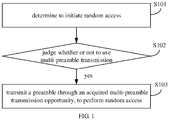
- FIG. 1 is a flowchart of a random access method according to an exemplary embodiment of the present application. The embodiment is described from the UE side. As shown in FIG. 1 , the random access method includes the following steps.
- step S101 it is determined to initiate random access.
- the UE when the UE has uplink data to be transmitted, it may be necessary to initiate random access.
- step S102 it is judged whether or not to use multi-preamble transmission.
- the UE may use, but is not limited to, one or more of the following manners to judge whether the UE uses multi-preamble transmission.
- the service that triggers the random access is a preset type of service, and if it is a preset type of service, it may be determined to use multi-preamble transmission.
- the preset type of service may include, but is not limited to, a delay sensitive service, such as an Ultra Reliable Low Latency Communication (URLLC) service.
- a delay sensitive service such as an Ultra Reliable Low Latency Communication (URLLC) service.
- URLLC Ultra Reliable Low Latency Communication
- the multi-preamble transmission function is enabled. If the multi-preamble transmission function is enabled, it may be determined to use multi-preamble transmission.
- Whether the multi-preamble transmission function is enabled may be judged by, but not limited to, any one of the following manners.
- a third manner it is judged whether the current UE determines to transmit an uplink beam of the preamble. If the current UE does not determine to transmit an uplink beam of the preamble, it may be determined to use multi-preamble transmission.
- a fourth manner it is judged whether the current UE is a preset type of UE, and if the current UE is a preset type of UE, it may be determined to use multi-preamble transmission.
- the UE type indicated in the received PRACH resource of the multi-preamble transmission from the base station is a preset type
- the preset type of UE may include but is not limited to an internet terminal.
- a fifth manner it is judged whether the random access is a preset access type, and if the random access is a preset access type, it may be determined to use multi-preamble transmission.
- the received access type indicated in the PRACH resource of multi-preamble transmission from the base station is a preset access type
- it is determined that the random access is a preset access type.
- the current UE has a multiple input multiple output (MIMO) capability or a multi-beam transmission capability. If the current UE has a MIMO capability or a multi-beam transmission capability, it may be determined to use multi-preamble transmission.
- MIMO multiple input multiple output
- a seventh manner it is judged whether the current UE has the Tx-Rx correspondence capability. If the current UE does not have a Tx-Rx correspondence capability, it may be determined to use multi-preamble transmission.
- step S103 if it is determined to use multi-preamble transmission, the preamble is transmitted through an acquired multi-preamble transmission opportunity, to perform random access.
- the preamble is transmitted through the acquired multi-preamble transmission opportunity to perform random access, which may include the following steps.
- step S1031 the PRACH resource of the multi-preamble transmission is acquired from a currently associated downlink beam, wherein the PRACH resource is used to indicate a multi-preamble transmission opportunity.
- the multi-preamble transmission opportunity may include a starting time-frequency resource location, a repetition period, and a number of repetitions of the PRACH.
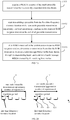
- FIG. 2B is a schematic diagram showing the starting time-frequency resource location, the repetition period and the number of repetitions of the PRACH of one multi-preamble transmission opportunity.
- step S 1032 transmitting the preamble is started from the first time-frequency resource location of the next multi-preamble transmission opportunity, and monitoring a random access response (RAR) reception window is started at the end of all preamble transmissions.
- RAR random access response
- the starting location of the RAR reception window is at a predetermined interval, for example, is turned on at 1 subframe since the end of the multi-preamble transmission opportunity.
- transmitting the preamble from the first time-frequency resource location of the next multi-preamble transmission opportunity may include: selecting a preamble from a preamble resource pool, and starting to transmit the selected preamble from the first time-frequency resource location of the next multi-preamble transmission opportunity; if the number of transmission beams supported by the current UE is less than the number of repetitions, transmitting the selected preamble at a first preset number of time-frequency resource locations after the first time-frequency resource location, or repeatedly transmitting a second preset number of transmission beams, where the first preset number is equal to the number of transmission beams minus one, and the second preset number is equal to a difference between the number of repetitions and the number of transmission beams; if the number of transmission beams supported by the current UE is greater than the number of repetitions, transmitting the selected preamble by selecting the same number of transmission beams as the number of repetitions.
- the multi-preamble transmission opportunity shown in FIG. 2B is taken as an example.
- the number of repetitions of the PRACH resource of one preamble transmission opportunity in FIG. 2B is 4, and it is assumed that the UE is currently in a multi-preamble transmission opportunity 41.
- the UE may start transmitting the selected preamble from the first time-frequency resource location 421 of the next multi-preamble transmission opportunity, i.e. a multi-preamble transmission opportunity 42.
- the selected preamble is transmitted on two time-frequency resource locations after the first time-frequency resource location 421, that is, at a time-frequency resource location 422 and a time-frequency resource location 423, or one transmission beam is repeatedly transmitted. If the number of transmission beams supported by the current UE is 5, greater than the number of repetitions of 4, then 4 transmission beams are selected to transmit the selected preamble.
- step S1033 if an RAR is received in the RAR reception window, a transmission beam that the RAR responds to is determined, a third message (MSG3) is transmitted to the base station through the transmitting beam, and a fourth message (MSG4) returned by the receiving base station is waited for.
- MSG3 third message
- MSG4 fourth message
- a transmission beam that the RAR responds to may be determined according to a random access radio network temporary identifier (RA-RNTI) corresponding to the RAR, and then a MSG3 is transmitted to the base station through the transmission beam, and a MSG4 returned by the receiving base station is waited for.
- RA-RNTI random access radio network temporary identifier
- the preamble is transmitted from the first time-frequency resource location of the next multi-preamble transmission opportunity, and the RAR reception window is monitored at the end of all preamble transmissions, and then a transmission beam that the RAR responds to is determined, a MSG3 is transmitted to the base station through the transmission beam, and a MSG4 returned by the receiving base station is waited for, thereby completing the random access procedure.
- the preamble is transmitted through a multi-preamble transmission opportunity, thereby saving limited multi-preamble transmission resources.
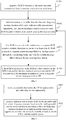
- FIG. 3 is a flowchart of another random access methodaccording to an exemplary embodiment of the present application. As shown in FIG. 3 , after the above step SI033, the method may further include the following steps.
- step S1034 if the RAR is not received in the RAR reception window or the MSG4 returned by the base station is not received, and the current UE does not reach the maximum transmission power, the transmission power of the current UE is raised, and the process proceeds to step S1032.
- the UE transmits the same preamble in one multi-preamble transmission opportunity, and after completing one multi-preamble transmission, if the RAR is not received in the RAR reception window or the MSG4 returned by the base station is not received, and if the current UE does not reach the maximum transmission power, the transmission power of the current UE may be raised to try to receive the RAR or the MSG4, so that random access can be implemented.
- the transmission power of the current UE may be raised to try to receive the RAR or MSG4, thereby increasing the probability to implement the random access.
- FIG. 4 is a flowchart of still another random access method according to an exemplary embodiment of the present application. The embodiment is described from the base station side. As shown in FIG. 4 , the random access method includes the following steps.
- step S401 a preamble transmitted by UE through a multi-preamble transmission opportunity is received.
- the multi-preamble transmission opportunity may include a starting time-frequency resource location, a repetition period, and a number of repetitions of the PRACH.
- FIG. 2B is a schematic diagram showing the starting time-frequency resource location, the repetition period and the number of repetitions of the PRACH of one multi-preamble transmission opportunity.
- the UE may transmit the preamble through an acquired multi-preamble transmission opportunity, and the base station receives the preamble transmitted by the UE through the multi-preamble transmission opportunity.
- step S402 an RAR for the preamble and for the time-frequency resource location in the multi-preamble transmission opportunity is returned according to the time-frequency resource location in the multi-preamble transmission opportunity in which the received preamble is located, for the UE to perform random access.
- the RAR fed back by the base station is based on the time-frequency resource location in the multi-preamble transmission opportunity in which the received preamble is located.
- the time-frequency resource location where the preamble is located may be represented by RA-RNTI.
- the calculation of the RA-RNTI may take into account the OFDM symbol and the like in which the preamble is located.
- the base station feeds back the RAR for the RA-RNTI, and the RAR includes the preamble identifier (ID) transmitted by the RA-RNTI.
- ID preamble identifier
- a base station if a base station receives a preamble in an RA-RNTI, it will feed back an RAR to the RA-RNTI, but it must be noted that the base station does not have to respond with an RAR to all received preambles, depending on whether the base station is currently in a busy service state.
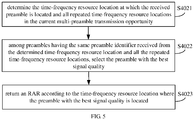
- the step S402 may include the following steps.
- step S4021 the time-frequency resource location at which the received preamble is located and all repeated time-frequency resource locations in the current multi-preamble transmission opportunity are determined.
- the UE may start transmitting the selected preamble from the next multi-preamble transmission opportunity, for example, the first time-frequency resource location 421 of the multi-preamble transmission opportunity 42 shown in FIG. 2B . If the number of transmission beams supported by the UE is 3, that is, the number of transmission beams supported by the UE is less than the number of repetitions, the selected preamble is transmitted on two time-frequency resource locations after the first time-frequency resource location 421, that is, at a time-frequency resource location 422 and a time-frequency resource location 423.
- the base station may determine that the time-frequency resource location at which the received preamble is located and all repeated time-frequency resource locations in the current multi-preamble transmission opportunity are respectively the first time-frequency resource location 421 and the time-frequency resource locations 422 and 423.
- step S4022 among preambles having the same preamble identifier received from the determined time-frequency resource location and all the repeated time-frequency resource locations, the preamble with the best signal quality is selected.
- the UE selects the preamble with the best signal quality from the preambles with the same preamble identifier received at the first time-frequency resource location 421 and the time-frequency resource locations 422 and 423.
- step S4023 an RAR is returned according to the time-frequency resource location where the preamble with the best signal quality is located, where the RAR carries the preamble identifier corresponding to the preamble with the best signal quality.
- the time-frequency resource location where the preamble with the best signal quality is located may include at least one of an Orthogonal Frequency Division Multiplexing (OFDM) symbol location, a subframe location, and a frequency domain location where the preamble with the best signal quality is located.
- OFDM Orthogonal Frequency Division Multiplexing
- At least one of an Orthogonal Frequency Division Multiplexing (OFDM) symbol location, a subframe location, and a frequency domain location where the preamble with the best signal quality is located may be represented by an RA-RNTI.
- an RAR may be returned according to the time-frequency resource location where the preamble with the best signal quality is located, for the UE to determine a transmission beam that the RAR responds to.
- the preamble transmitted by the UE through a multi-preamble transmission opportunity is received, and an RAR for the preamble and for the time-frequency resource location in the multi-preamble transmission opportunity is returned according to the time-frequency resource location in the multi-preamble transmission opportunity in which the received preamble is located, for the UE to perform random access.
- FIG. 6 is a flowchart of a random access method according to an exemplary embodiment of the present application. The embodiment is described from the perspective of interaction between UE and a base station. As shown in FIG. 6 , the random access method includes the following steps.
- step S601 the base station transmits a broadcast message to the UE, where the broadcast message carries a PRACH resource for multi-preamble transmission of each beam.
- the PRACH resource is used to indicate a multi-preamble transmission opportunity, and the dedicated PRACH resource of multi-preamble transmission of each beam is different.
- the multi-preamble transmission opportunity may include a starting time-frequency resource location, a repetition period, and a number of repetitions of the PRACH.
- the PRACH resource may further include a preamble identifier.
- the PRACH resource may further include a size of the RAR reception window.
- step S602 the UE is associated with a downlink beam based on a downlink measurement signal.
- step S603 the UE determines to initiate random access and judges whether to use multi-preamble transmission.
- step S604 the UE determines to use multi-preamble transmission, and acquires a PRACH resource of the multi-preamble transmission from a currently associated downlink beam, where the PRACH resource is used to indicate a multi-preamble transmission opportunity.
- step S605 the UE starts transmitting the preamble from the first time-frequency resource location of the next multi-preamble transmission opportunity, and starts monitoring the RAR reception window at the end of all preamble transmissions.
- step S606 the base station receives the preamble transmitted by the UE, and returns an RAR for the preamble and for the time-frequency resource location in the multi-preamble transmission opportunity according to the time-frequency resource location in the multi-preamble transmission opportunity in which the received preamble is located.
- step S607 if the UE receives the RAR in the RAR reception window, it determines the transmission beam that the RAR responds to, and transmits the MSG3 to the base station through the transmission beam.
- step S608 the base station receives the MSG3 transmitted by the UE, and returns a MSG4 to the UE.
- step S609 the UE receives the MSG4 returned by the base station.
- the UE determines whether it can use multi-preamble transmission by judging whether to use multi-preamble transmission, and when determining that the UE can use multi-preamble transmission, the UE uses a multi-preamble transmission opportunity provided by the base station to transmit the preamble.
- the base station may return an RAR for the preamble and for the time-frequency resource location in the multi-preamble transmission opportunity according to the time-frequency resource location in the multi-preamble transmission opportunity in which the received preamble is located, for the UE to perform random access. Thereby, it can achieve the objective of providing transmission resource for a qualified UE and saving transmission resources.
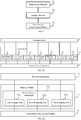
- FIG. 7 is a block diagram of a random access device according to an exemplary embodiment. As shown in FIG. 7 , the random access device includes a determining module 71, a judging module 72, and a transmission determining module 73.
- the determination module 71 is configured to determine to initiate random access.
- the UE when the UE has uplink data to transmit, it may be necessary to initiate random access.
- the judging module 72 is configured to judge whether or not to use multi-preamble transmission after the determining module 71 determines to initiate random access.
- the transmission determining module 73 is configured to, if the judging module 72 determines to use multi-preamble transmission, transmit the preamble through an acquired multi-preamble transmission opportunity, to perform random access.
- the preamble is transmitted through a multi-preamble transmission opportunity, thereby saving limited multi-preamble transmission resources.
- FIG. 8A is a block diagram of another random access device according to an exemplary embodiment.
- the judging module 72 may include at least one of the following submodule: a first judging submodule 721, a second judging submodule 722, a third judging submodule 723, a fourth judging submodule 724, a fifth judging submodule 725, a sixth judging submodule 726, and a seventh judging submodule 727.
- the first judging submodule 721 is configured to judge whether the service that triggers the random access is a preset type of service, and if it is a preset type of service, determine to use multi-preamble transmission.
- the preset type of service may include, but not limited to, a delay sensitive service, such as an Ultra Reliable Low Latency Communication (URLLC) service.
- a delay sensitive service such as an Ultra Reliable Low Latency Communication (URLLC) service.
- URLLC Ultra Reliable Low Latency Communication
- the second judging submodule 722 is configured to judge whether the multi-preamble transmission function is enabled, and if the multi-preamble transmission function is enabled, determine to use multi-preamble transmission.
- Whether the multi-preamble transmission function is enabled may be judged by, but not limited to, any one of the following manners.
- the third judging submodule 723 is configured to judge whether the current UE determines to transmit an uplink beam of the preamble, and if the current UE does not determine to transmit an uplink beam of the preamble, determine to use multi-preamble transmission.
- the fourth judging submodule 724 is configured to judge whether the current UE is a preset type of UE, and if the current UE is a preset type of UE, determine to use multi-preamble transmission.
- the UE type indicated in the received PRACH resource of the multi-preamble transmission from the base station is a preset type
- the preset type of UE may include but not limited to an internet terminal.
- the fifth judging submodule 725 is configured to judge whether the random access is a preset access type, and if the random access is a preset access type, determine to use multi-preamble transmission.
- the received access type indicated in the PRACH resource of multi-preamble transmission from the base station is a preset access type
- it is determined that the random access is a preset access type.
- the sixth judging submodule 726 is configured to judge whether the current UE has a multiple input multiple output (MIMO) capability or a multi-beam transmission capability, and if the current UE has a MIMO capability or a multi-beam transmission capability, determine to use multi-preamble transmission.
- MIMO multiple input multiple output
- the seventh judging submodule 727 is configured to judge whether the current UE has the Tx-Rx correspondence capability, and if the current UE does not have a Tx-Rx correspondence capability, determine to use multi-preamble transmission.
- whether the UE uses multi-preamble transmission can be determined in multiple manners, and the implementation manner is flexible and diverse.
- FIG. 8B is a block diagram of another random access device according to an exemplary embodiment.
- the second judging submodule 722 may include a first judging unit 7221, a second judging unit 7222, or a third judging unit 7223.
- the first judging unit 7221 is configured to, if the physical random access channel PRACH resource of the multi-preamble transmission is configured in a received system message, determine that the multi-preamble transmission function of the current UE is enabled.
- the second judging unit 7222 is configured to, if the current UE is UE in a disabled state or a connected state and the base station configuration turns on the multi-preamble transmission function of the current UE, determine that the multi-preamble transmission function of the current UE is enabled.
- the third judging unit 7223 is configured to, if the base station configuration turns on a data bearer (DRB) of the current UE or a multi-preamble transmission function of a logical channel, and the random access is triggered by the DRB or the logical channel that has the multi-preamble transmission function turned on, and the random access is competitive random access, determine that the multi-preamble transmission function of the current UE is enabled.
- DRB data bearer
- whether the multi-preamble transmission function is enabled or not can be determined in various manners, and the implementation manner is flexible and diverse.
- FIG. 8C is a block diagram of another random access device according to an exemplary embodiment.
- the transmission determining module 73 may include: an acquiring submodule 731, a transmitting-monitoring submodule 732, and a determining-transmitting-receiving submodule 733.
- the acquiring submodule 731 is configured to acquire a PRACH resource of the multi-preamble transmission from a currently associated downlink beam, where the PRACH resource is used to indicate a multi-preamble transmission opportunity.
- the multi-preamble transmission opportunity may include a starting time-frequency resource location, a repetition period, and a number of repetitions of the PRACH.
- FIG. 2B is a schematic diagram showing the starting time-frequency resource location, the repetition period and the number of repetitions of the PRACH of one multi-preamble transmission opportunity.
- the transmitting-monitoring submodule 732 is configured to start transmitting a preamble from the first time-frequency resource location of the next multi-preamble transmission opportunity indicated by the PRACH resource acquired by the acquiring submodule 731, and start monitoring a random access response (RAR) reception window at the end of all preamble transmissions.
- RAR random access response
- the starting location of the RAR reception window is at a predetermined interval, for example, is turned on at 1 subframe since the end of the multi-preamble transmission opportunity.
- the determining-transmitting-receiving submodule 733 is configured to, if the transmitting-monitoring submodule 732 receives an RAR in the random access response RAR reception window, determine a transmission beam that the RAR responds to, transmit a third message (MSG3) to the base station through the transmitting beam, and wait for a fourth message (MSG4) returned by the receiving base station.
- MSG3 third message
- MSG4 fourth message
- a transmission beam that the RAR responds to may be determined according to a random access radio network temporary identifier (RA-RNTI) corresponding to the RAR, and then a MSG3 is transmitted to the base station through the transmission beam, and a MSG4 returned by the receiving base station is waited for.
- RA-RNTI random access radio network temporary identifier
- the preamble is transmitted from the first time-frequency resource location of the next multi-preamble transmission opportunity, and the RAR reception window is monitored at the end of all preamble transmissions, and then a transmission beam that the RAR responds to is determined, a MSG3 is transmitted to the base station through the transmission beam, and a MSG4 returned by the receiving base station is waited for, thereby completing the random access procedure.
- FIG. 8D is a block diagram of another random access device according to an exemplary embodiment.
- a multi-preamble transmission opportunity includes a starting time-frequency resource location, a repetition period, and a number of repetitions of the PRACH.
- the transmitting-monitoring submodule 732 may include a selecting-transmitting unit 7321, a first transmitting unit 7322, and a second transmitting unit 7323.
- the selecting-transmitting unit 7321 is configured to select a preamble from a preamble resource pool, and start transmitting the selected preamble from the first time-frequency resource location of the next multi-preamble transmission opportunity.
- the first transmitting unit 7322 is configured to, if the number of transmission beams supported by the current UE is less than the number of repetitions, transmit the selected preamble at a first preset number of time-frequency resource locations after the first time-frequency resource location, or repeatedly transmit a second preset number of transmission beams, where the first preset number is equal to the number of transmission beams minus one, and the second preset number is equal to a difference between the number of repetitions and the number of transmission beams.
- the second transmitting unit 7323 is configured to, if the number of transmission beams supported by the current UE is greater than the number of repetitions, transmit the preamble selected by the selecting-transmitting unit 7321 by selecting the same number of transmission beams as the number of repetitions.
- the multi-preamble transmission opportunity shown in FIG. 2B is taken as an example.
- the number of repetitions of the PRACH resource of one preamble transmission opportunity in FIG. 2B is 4, and it is assumed that the UE is currently in a multi-preamble transmission opportunity 41.
- the UE may start transmitting the selected preamble from the first time-frequency resource location 421 of the next multi-preamble transmission opportunity, i.e. a multi-preamble transmission opportunity 42.
- the selected preamble is transmitted on two time-frequency resource locations after the first time-frequency resource location 421, that is, at a time-frequency resource location 422 and a time-frequency resource location 423, or one transmission beam is repeatedly transmitted. If the number of transmission beams supported by the current UE is 5, greater than the number of repetitions of 4, then 4 transmission beams are selected to transmit the selected preamble.
- the selected preamble is transmitted from the first time-frequency resource location of the next multi-preamble transmission opportunity, and the time-frequency resource location for transmitting the preamble is selected according to the size relationship between the number of transmission beams supported by the current UE and the number of repetitions, so that the base station can return an RAR at the time-frequency resource location where the received preamble is located.
- FIG. 8E is a block diagram of another random access device according to an exemplary embodiment. As shown in FIG. 8E , on the basis of the embodiment shown in FIG. 8C , the device may further include a raising module 74.
- the raising module 74 is configured to, if the RAR is not received in the RAR reception window or the MSG4 returned by the base station is not received by the determining-transmitting-receiving submodule 733, and the current UE does not reach the maximum transmission power, raise the transmission power of the current UE, and invoke the transmitting-monitoring submodule 732 to start transmitting the preamble from the first time-frequency resource location of the next multi-preamble transmission opportunity.
- the UE transmits the same preamble in one multi-preamble transmission opportunity, and after completing one multi-preamble transmission, if the RAR is not received in the RAR reception window or the MSG4 returned by the base station is not received, and if the current UE does not reach the maximum transmission power, the transmission power of the current UE may be raised to try to receive the RAR or the MSG4, so that random access can be implemented.
- the transmission power of the current UE may be raised to try to receive the RAR or MSG4, thereby increasing the probability to implement the random access.
- FIG. 8F is a block diagram of another random access device according to an exemplary embodiment. As shown in FIG. 8F , on the basis of the above embodiment shown in FIG. 7 , the device may further include a receiving module 75.
- the receiving module 75 is configured to receive a broadcast message transmitted by the base station before the judging module 72 judges whether to use multi-preamble transmission, where the broadcast message carries a PRACH resource for multi-preamble transmission of each beam.
- the PRACH resource is used to indicate a multiple preamble transmission opportunity, and the dedicated PRACH resource of multiple preamble transmission of each beam is different.
- the multi-preamble transmission opportunity may include a starting time-frequency resource location, a repetition period, and a number of repetitions of the PRACH.
- the PRACH resource may further include a preamble identifier.
- the PRACH resource may further include a size of the RAR reception window.
- FIG. 8G is a block diagram of another random access device according to an exemplary embodiment. As shown in FIG. 8G , on the basis of the embodiment shown in FIG. 8C , the device may further include: an association module 76 configured to associate with a downlink beam based on a downlink measurement signal before the acquiring submodule 731 acquires the PRACH resource of the multi-preamble transmission from a currently associated downlink beam.
- an association module 76 configured to associate with a downlink beam based on a downlink measurement signal before the acquiring submodule 731 acquires the PRACH resource of the multi-preamble transmission from a currently associated downlink beam.
- a downlink beam is associated, which provides a possibility for subsequently acquiring a PRACH resource of the multi-preamble transmission from a currently associated downlink beam.
- FIG. 9 is a block diagram of still another random access device according to an exemplary embodiment. As shown in FIG. 9 , the random access device includes: a receiving module 91 and a returning module 92.
- the receiving module 91 is configured to receive a preamble transmitted by user equipment UE through a multi-preamble transmission opportunity.
- the multi-preamble transmission opportunity may include a starting time-frequency resource location, a repetition period, and a number of repetitions of the PRACH.
- FIG. 2B is a schematic diagram showing the starting time-frequency resource location, the repetition period and the number of repetitions of the PRACH of one multi-preamble transmission opportunity.
- the UE may transmit the preamble through an acquired multi-preamble transmission opportunity, and the base station receives the preamble transmitted by the UE through the multi-preamble transmission opportunity.
- the returning module 92 is configured to return a random access response RAR for the preamble and for the time-frequency resource location in the multi-preamble transmission opportunity according to the time-frequency resource location in the multi-preamble transmission opportunity in which the preamble received by the receiving module 91 is located, for the UE to perform random access.
- the preamble transmitted by the UE through a multi-preamble transmission opportunity is received, and an RAR for the preamble and for the time-frequency resource location in the multi-preamble transmission opportunity is returned according to the time-frequency resource location in the multi-preamble transmission opportunity in which the received preamble is located, for the UE to perform random access.
- FIG. 10 is a block diagram of another random access device according to an exemplary embodiment. As shown in FIG. 10 , on the basis of the above embodiment shown in FIG. 9 , the device may further include: a receiving-returning module 93.
- the receiving-returning module 93 is configured to, after the returning module 92 returns an RAR for the preamble and for the time-frequency resource location in the multi-preamble transmission opportunity, receive a third message MSG3 transmitted by the UE and return a fourth message MSG4 to the UE according to the MSG3.
- the third message MSG3 transmitted by the UE is received, and the fourth message MSG4 is returned to the UE according to the MSG3, thereby completing the random access procedure.
- FIG. 11A is a block diagram of another random access device according to an exemplary embodiment.
- a multi-preamble transmission opportunity includes a starting time-frequency resource location, a repetition period, and a number of repetitions of a physical random access channel PRACH.
- the returning module 92 may include a determining submodule 921, a selecting submodule 922, and a returning submodule 923.
- the determining submodule 921 is configured to determine the time-frequency resource location at which the received preamble is located and all repeated time-frequency resource locations in the current multi-preamble transmission opportunity.
- the UE may start transmitting the selected preamble from the next multi-preamble transmission opportunity, that is, the first time-frequency resource location 421 of the multi-preamble transmission opportunity 42 shown in FIG. 2B . If the number of transmission beams supported by the UE is 3, that is, the number of transmission beams supported by the UE is less than the number of repetitions, the selected preamble is transmitted on two time-frequency resource locations after the first time-frequency resource location 421, that is, at a time-frequency resource location 422 and a time-frequency resource location 423.
- the base station may determine that the time-frequency resource location at which the received preamble is located and all repeated time-frequency resource locations in the current multi-preamble transmission opportunity are respectively the first time-frequency resource location 421 and the time-frequency resource locations 422 and 423.
- the selecting submodule 922 is configured to, among preambles having the same preamble identifier received from the time-frequency resource location and all the repeated time-frequency resource locations determined by the determining submodule 921, select the preamble with the best signal quality.
- the UE selects the preamble with the best signal quality from the preamble with the same preamble identifier received by the first time-frequency resource location 421 and the time-frequency resource locations 422 and 423.
- the returning submodule 923 is configured to return an RAR according to the time-frequency resource location where the preamble with the best signal quality is located, where the RAR carries the preamble identifier corresponding to the preamble with the best signal quality.
- the time-frequency resource location where the preamble with the best signal quality is located may include at least one of an Orthogonal Frequency Division Multiplexing (OFDM) symbol location, a subframe location, and a frequency domain location where the preamble with the best signal quality is located.
- OFDM Orthogonal Frequency Division Multiplexing
- At least one of an Orthogonal Frequency Division Multiplexing (OFDM) symbol location, a subframe location, and a frequency domain location where the preamble with the best signal quality is located may be represented by an RA-RNTI.
- an RAR may be returned according to the time-frequency resource location where the preamble with the best signal quality is located, for the UE to determine a transmission beam that the RAR responds to.
- FIG. 11B is a block diagram of another random access device according to an exemplary embodiment. As shown in FIG. 11B , on the basis of the above embodiment shown in FIG. 9 , the device may further include a transmitting module 90.
- the transmitting module 90 is configured to, before the receiving module 91 receives the preamble transmitted by user equipment UE through the multi-preamble transmission opportunity, transmit a broadcast message to the UE, where the broadcast message carries a PRACH resource for multi-preamble transmission of each beam.
- FIG. 12 is a block diagram of a random access device according to an exemplary embodiment.
- the device 1200 may be a mobile phone, a computer, a digital broadcast terminal, a messaging device, a game console, a tablet device, a medical device, a fitness device, a personal digital assistant, and the like.
- the device 1200 may include one or more of the following components: a processing component 1202, a memory 1204, a power component 1206, a multimedia component 1208, an audio component 1210, an input/output (I/O) interface 1212, a sensor component 1214, and a communication component 1216.
- a processing component 1202 a memory 1204, a power component 1206, a multimedia component 1208, an audio component 1210, an input/output (I/O) interface 1212, a sensor component 1214, and a communication component 1216.
- the processing component 1202 typically controls overall operations of the device 1200, such as the operations associated with display, phone call, data communications, camera operations, and recording operations.
- the processing component 1202 may include one or more processors 1220 to execute instructions, to perform all or part of the steps of the above method.
- the processing component 1202 may include one or more modules which facilitate the interaction between the processing component 1202 and other components.
- the processing component 1202 may include a multimedia module to facilitate the interaction between the multimedia component 1208 and the processing component 1202.
- the memory 1204 is configured to store various types of data to support the operation of the device 1200. Examples of such data include instructions for any applications or methods operated on the device 1200, contact data, telephone directory data, messages, pictures, video, etc.
- the memory 1204 may be implemented using any type of volatile or non-volatile memory devices, or a combination thereof, such as a static random access memory (SRAM), an electrically erasable programmable read-only memory (EEPROM), an erasable programmable read-only memory (EPROM), a programmable read-only memory (PROM), a read-only memory (ROM), a magnetic memory, a flash memory, a magnetic or optical disk.
- SRAM static random access memory
- EEPROM electrically erasable programmable read-only memory
- EPROM erasable programmable read-only memory
- PROM programmable read-only memory
- ROM read-only memory
- magnetic memory a magnetic memory
- flash memory a flash memory
- magnetic or optical disk a magnetic
- the power component 1206 provides power to various components of the device 1200.
- the power component 1206 may include a power management system, one or more power sources, and any other components associated with the generation, management, and distribution of power in the device 1200.
- the multimedia component 1208 includes a screen providing an output interface between the device 1200 and the user.
- the screen may include a liquid crystal display (LCD) and a touch panel (TP). If the screen includes the touch panel, the screen may be implemented as a touch screen to receive input signals from the user.
- the touch panel includes one or more touch sensors to sense touches, swipes, and gestures on the touch panel. The touch sensors may not only sense a boundary of a touch or swipe action, but also sense a period of time and a pressure associated with the touch or swipe action.
- the multimedia component 1208 includes a front camera and/or a rear camera. When the device 1200 is in an operation mode, such as a shooting mode or a video mode, the front camera and/or the rear camera can receive external multimedia data. Each front and rear camera can be a fixed optical lens system or have focal length and optical zoom capability.
- the audio component 1210 is configured to output and/or input audio signals.
- the audio component 1210 includes a microphone ("MIC") configured to receive an external audio signal when the device 1200 is in an operation mode, such as a call mode, a recording mode, and a voice recognition mode.
- the received audio signal may be further stored in the memory 1204 or transmitted via the communication component 1216.
- the audio component 1210 further includes a speaker to output audio signals.
- the I/O interface 1212 provides an interface between the processing component 1202 and peripheral interface modules, such as a keyboard, a click wheel, buttons, and the like. These buttons may include, but are not limited to, a home button, a volume button, a start button, and a lock button.
- the sensor component 1214 includes one or more sensors to provide status assessments of various aspects of the device 1200. For instance, the sensor component 1214 may detect an on/off status of the device 1200, relative positioning of components, e.g., the display and the keypad, of the device 1200, a change in position of the device 1200 or a component of the device 1200, a presence or absence of user contact with the device 1200, an orientation or an acceleration/deceleration of the device 1200, and a change in temperature of the device 1200.
- the sensor component 1214 may include a proximity sensor configured to detect the presence of nearby objects without any physical contact.
- the sensor component 1214 may also include a light sensor, such as a CMOS or CCD image sensor, for use in imaging applications.
- the sensor component 1214 may also include an accelerometer sensor, a gyroscope sensor, a magnetic sensor, a pressure sensor, or a temperature sensor.
- the communication component 1216 is configured to facilitate communication, wired or wirelessly, between the device 1200 and other devices.
- the device 1200 can access a wireless network based on a communication standard, such as WiFi, 2G, or 3G, or a combination thereof.
- the communication component 1216 receives a broadcast signal or broadcast associated information from an external broadcast management system via a broadcast channel.
- the communication component 1216 further includes a near field communication (NFC) module to facilitate short-range communications.
- the NFC module may be implemented based on a radio frequency identification (RFID) technology, an infrared data association (IrDA) technology, an ultra-wideband (UWB) technology, a Bluetooth (BT) technology, and other technologies.
- RFID radio frequency identification
- IrDA infrared data association
- UWB ultra-wideband
- BT Bluetooth
- the device 1200 may be implemented with one or more application specific integrated circuits (ASICs), digital signal processors (DSPs), digital signal processing devices (DSPDs), programmable logic devices (PLDs), field programmable gate arrays (FPGAs), controllers, micro-controllers, microprocessors, or other electronic components, to perform the above described methods.
- ASICs application specific integrated circuits
- DSPs digital signal processors
- DSPDs digital signal processing devices
- PLDs programmable logic devices
- FPGAs field programmable gate arrays
- controllers micro-controllers, microprocessors, or other electronic components, to perform the above described methods.
- non-transitory computer-readable storage medium including instructions, such as included in the memory 1204, executable by the processor 1220 in the device 1200 to perform the abovedescribed methods.
- the non-transitory computer-readable storage medium may be a ROM, a random access memory (RAM), a CD-ROM, a magnetic tape, a floppy disc, an optical data storage device, and the like.
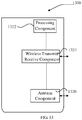
- FIG. 13 is a block diagram of another random access device according to an exemplary embodiment.
- the device 1300 can be provided as a base station.
- the device 1300 includes a processing component 1322, a wireless transmit/receive component 1324, an antenna component 1326, and a signal processing portion specific to the wireless interface.
- the processing component 1322 can further include one or more processors.
- One processor of the processing component 1322 can be configured to:
- non-transitory computer readable storage medium including instructions executable by processing component 1322 of the device 1300 to perform the random access method described above.
- the non-transitory computer readable storage medium can be a ROM, a random access memory (RAM), a CD-ROM, a magnetic tape, a floppy disk, and an optical data storage device.
- the device embodiments basically correspond to the method embodiments, and reference may be made to the description of the method embodiments.
- the device embodiments described above are merely illustrative, wherein the modules/units described as separate components may or may not be physically separate, and the components displayed as modules/units may or may not be physical modules/units. That is, they may be located at one place, or may be distributed to multiple networks. Some or all of the modules may be selected according to actual needs to achieve the objective of the solution of the embodiment. Those of ordinary skill in the art can understand and implement without any creative effort.
Landscapes
- Engineering & Computer Science (AREA)
- Computer Networks & Wireless Communication (AREA)
- Signal Processing (AREA)
- Mobile Radio Communication Systems (AREA)
Abstract
Description
- The present disclosure relates to the field of communication technology, and in particular, to a random access method and a random access device, user equipment and a base station.
- In a Long Term Evolution (LTE) system, a base station transmits a broadcast by covering a whole sector with a beam. In New Radio (NR), the base station can cover a sector by narrow beam scanning, that is, the base station transmits only a narrow beam in a certain direction at a certain moment, and then continuously changes the direction of the beam to reach and cover a sector. This type of scenario is called a multi-beam scenario.
- In a multi-beam scenario, user equipment (UE) first correlates to the best downlink beam by measuring downlink signals. For UE having a transmission-reception (Tx-Rx) correspondence capability, the UE can determine the most suitable uplink beam by receiving the downlink beam. However, for UE that does not have the Tx-Rx correspondence capability, the UE may not determine its own uplink beam, which requires the UE to try to transmit by using different beams to determine the most suitable uplink beam.
- For random access, the UE that does not have the Tx-Rx correspondence capability can ensure that the base station receives a preamble by transmitting multiple preambles, which is multi-preamble transmission in a multi-beam scenario. Since the multi-preamble transmission resources provided by the base station for the UE are limited, only the UE having a specific service requirement can use multi-preamble transmission resources provided by the base station.
- In view of this, the present application discloses a random access method and a random access device, user equipment, a base station, and a computer readable storage medium to select UE that can use multi-preamble transmission resources, thereby saving limited transmission resources.
- According to a first aspect of an embodiment of the present disclosure, there is provided a random access method, including:
- determining to initiate random access;
- judging whether or not to use multi-preamble transmission; and
- when determining to use multi-preamble transmission, transmitting a preamble through an acquired multi-preamble transmission opportunity, to perform random access.
- In an embodiment, judging whether or not to use multi-preamble transmission includes at least one of:
- judging whether a service that triggers the random access is a preset type of service, and if it is a preset type of service, determining to use multi-preamble transmission;
- judging whether a multi-preamble transmission function is enabled, and if the multi-preamble transmission function is enabled, determining to use multi-preamble transmission;
- judging whether the current UE determines to transmit an uplink beam of the preamble, and if the current UE does not determine to transmit an uplink beam of the preamble, determining to use multi-preamble transmission;
- judging whether the current UE is a preset type of UE, and if the current UE is a preset type of UE, determining to use multi-preamble transmission;
- judging whether the random access is a preset access type, and if the random access is a preset access type, determining to use multi-preamble transmission;
- judging whether the current UE has a multiple input multiple output MIMO capability or a multi-beam transmission capability, and if the current UE has a MIMO capability or a multi-beam transmission capability, determining to use multi-preamble transmission; and
- judging whether the current UE has a Tx-Rx correspondence capability, and if the current UE does not have a Tx-Rx correspondence capability, determining to use multi-preamble transmission.
- In an embodiment, judging whether a multi-preamble transmission function is enabled includes:
- if a physical random access channel PRACH resource of the multi-preamble transmission is configured in a received system message, determining that the multi-preamble transmission function of the current UE is enabled;
- if the current UE is UE in a disabled state or a connected state and the base station configuration turns on the multi-preamble transmission function of the current UE, determining that the multi-preamble transmission function of the current UE is enabled; and
- if the base station configuration turns on a data bearer DRB of the current UE or a multi-preamble transmission function of a logical channel, and the random access is triggered by the DRB or the logical channel that has the multi-preamble transmission function turned on, and the random access is competitive random access, determining that the multi-preamble transmission function of the current UE is enabled.
- In an embodiment, judging whether the current UE is a preset type of UE includes:
- if the UE type indicated in the received PRACH resource of the multi-preamble transmission from the base station is a preset type, determining that the current UE is a preset type of UE; and
- judging whether the random access is a preset access type includes:
- if the received access type indicated in the PRACH resource of multi-preamble transmission from the base station is a preset access type, determining that that the random access is a preset access type.
- In an embodiment, transmitting a preamble through an acquired multi-preamble transmission opportunity, to perform random access includes:
- acquiring a PRACH resource of the multi-preamble transmission from a currently associated downlink beam, where the PRACH resource is used to indicate a multi-preamble transmission opportunity;
- starting transmitting a preamble from the first time-frequency resource location of the next multi-preamble transmission opportunity, and starting monitoring a random access response RAR reception window at the end of all preamble transmissions; and
- if an RAR is received in the random access response RAR reception window, determining a transmission beam that the RAR responds to, transmitting a third message MSG3 to the base station through the transmitting beam, and waiting for a fourth message MSG4 returned by the receiving base station.
- In an embodiment, the multi-preamble transmission opportunity includes a starting time-frequency resource location, a repetition period, and a number of repetitions of the PRACH, and starting transmitting a preamble from the first time-frequency resource location of the next multi-preamble transmission opportunity includes:
- selecting a preamble from a preamble resource pool, and starting transmitting the selected preamble from the first time-frequency resource location of the next multi-preamble transmission opportunity;
- if the number of transmission beams supported by the current UE is less than the number of repetitions, transmitting the selected preamble at a first preset number of time-frequency resource locations after the first time-frequency resource location, or repeatedly transmitting a second preset number of transmission beams, where the first preset number is equal to the number of transmission beams minus one, and the second preset number is equal to a difference between the number of repetitions and the number of transmission beams; and
- if the number of transmission beams supported by the current UE is greater than the number of repetitions, transmitting the selected preamble by selecting the same number of transmission beams as the number of repetitions.
- In an embodiment, determining a transmission beam that the RAR responds to includes:
determining the transmission beam that the RAR responds to according to a random access radio network temporary identifier RA-RNTI corresponding to the RAR. - In an embodiment, the method further includes:
if the RAR is not received in the RAR reception window or the MSG4 returned by the base station is not received, and the current UE does not reach the maximum transmission power, raising the transmission power of the current UE, and proceeding to perform starting transmitting a preamble from the first time-frequency resource location of the next multi-preamble transmission opportunity. - In an embodiment, the PRACH resource includes at least one of a preamble identifier and a size of the RAR reception window.
- In an embodiment, the method further includes:
receiving a broadcast message transmitted by the base station before judging whether to use multi-preamble transmission, where the broadcast message carries a PRACH resource for multi-preamble transmission of each beam. - In an embodiment, the method further includes:
associating to a downlink beam with a downlink measurement signal before acquiring the PRACH resource of the multi-preamble transmission from a currently associated downlink beam. - According to a second aspect of an embodiment of the present disclosure, there is provided a random access method, including:
- receiving a preamble transmitted by user equipment UE through a multi-preamble transmission opportunity; and
- returning a random access response RAR for the preamble and for a time-frequency resource location in the multi-preamble transmission opportunity according to the time-frequency resource location in the multi-preamble transmission opportunity in which the received preamble is located, for the UE to perform random access.
- In an embodiment, the method further includes:
after returning an RAR for the preamble and for the time-frequency resource location in the multi-preamble transmission opportunity, receiving a third message MSG3 transmitted by the UE and returning a fourth message MSG4 to the UE according to the MSG3. - In an embodiment, the multi-preamble transmission opportunity includes a starting time-frequency resource location, a repetition period, and a number of repetitions of a physical random access channel PRACH, and returning an RAR for the preamble and for a time-frequency resource location in the multi-preamble transmission opportunity according to the time-frequency resource location in the multi-preamble transmission opportunity in which the received preamble is located includes:
- determining the time-frequency resource location at which the received preamble is located and all repeated time-frequency resource locations in the current multi-preamble transmission opportunity;
- among preambles having the same preamble identifier received from the determined time-frequency resource location and all the repeated time-frequency resource locations, selecting the preamble with the best signal quality; and
- returning an RAR according to the time-frequency resource location where the preamble with the best signal quality is located, where the RAR carries the preamble identifier corresponding to the preamble with the best signal quality.
- In an embodiment, the time-frequency resource location where the preamble with the best signal quality is located includes at least one of an Orthogonal Frequency Division Multiplexing OFDM symbol location, a subframe location, and a frequency domain location where the preamble with the best signal quality is located, and the at least one of an OFDM symbol location, a subframe location, and a frequency domain location where the preamble with the best signal quality is located is represented by a random access radio network temporary identifier RA-RNTI.
- In an embodiment, the method further includes:
before receiving the preamble transmitted by user equipment UE through the multi-preamble transmission opportunity, transmitting a broadcast message to the UE, where the broadcast message carries a PRACH resource for multi-preamble transmission of each beam. - In an embodiment, the PRACH resource is used to indicate a multi-preamble transmission opportunity, and the multi-preamble transmission opportunity includes a starting time-frequency resource location, a repetition period, and a number of repetitions of the PRACH.
- In an embodiment, the PRACH resource includes at least one of a preamble identifier and a size of an RAR reception window.
- According to a third aspect of an embodiment of the present disclosure, there is provided a random access device, including:
- a determining module configured to determine to initiate random access;
- a judging module configured to judge whether or not to use multi-preamble transmission after the determining module determines to initiate random access; and
- a transmission determining module configured to, if the judging module determines to use multi-preamble transmission, transmit the preamble through an acquired multi-preamble transmission opportunity, to perform random access..
- In an embodiment, the judging module includes:
- a first judging submodule configured to judge whether a service that triggers the random access is a preset type of service, and if it is a preset type of service, determine to use multi-preamble transmission;
- a second judging submodule configured to judge whether a multi-preamble transmission function is enabled, and if the multi-preamble transmission function is enabled, determine to use multi-preamble transmission;
- a third judging submodule configured to judge whether the current UE determines to transmit an uplink beam of the preamble, and if the current UE does not determine to transmit an uplink beam of the preamble, determine to use multi-preamble transmission;
- a fourth judging submodule configured to judge whether the current UE is a preset type of UE, and if the current UE is a preset type of UE, determine to use multi-preamble transmission;
- a fifth judging submodule configured to judge whether the random access is a preset access type, and if the random access is a preset access type, determine to use multi-preamble transmission;
- a sixth judging submodule configured to determine whether the current UE has a multi-input multi-output MIMO capability or a multi-beam transmitting capability, and if the current UE has a MIMO capability or a multi-beam transmitting capability, determining to use multi-preamble transmission; and
- a seventh judging submodule configured to judge whether the current UE has a Tx-Rx correspondence capability, and if the current UE does not have a Tx-Rx correspondence capability, determine to use multi-preamble transmission.
- In an embodiment, the second judging submodule includes:
- a first judging unit configured to, if a physical random access channel PRACH resource of the multi-preamble transmission is configured in a received system message, determine that the multi-preamble transmission function of the current UE is enabled.; or
- a second judging unit configured to, if the current UE is UE in a disabled state or a connected state and the base station configuration turns on the multi-preamble transmission function of the current UE, determine that the multi-preamble transmission function of the current UE is enabled; or
- a third judging unit configured to, if the base station configuration turns on a data bearer DRB of the current UE or a multi-preamble transmission function of a logical channel, and the random access is triggered by the DRB or the logical channel that has the multi-preamble transmission function turned on, and the random access is competitive random access, determine that the multi-preamble transmission function of the current UE is enabled.
- In an embodiment, the fourth judging submodule is configured to,
if the UE type indicated in the received PRACH resource of the multi-preamble transmission from the base station is a preset type, determine that the current UE is a preset type of UE; or
the fourth judging submodule is configured to,
if the received access type indicated in the PRACH resource of multi-preamble transmission from the base station is a preset access type, determine that that the random access is a preset access type. - In an embodiment, the transmission determining module includes:
- an acquiring submodule configured to acquire a PRACH resource of the multi-preamble transmission from a currently associated downlink beam, where the PRACH resource is used to indicate a multi-preamble transmission opportunity;
- a transmitting-monitoring submodule configured to start transmitting a preamble from the first time-frequency resource location of the next multi-preamble transmission opportunity indicated by the PRACH resource acquired by the acquiring submodule, and start monitoring an RAR reception window at the end of all preamble transmissions; and
- a determining-transmitting-receiving submodule configured to, if the transmitting-monitoring submodule receives an RAR in the random access response RAR reception window, determine a transmission beam that the RAR responds to, transmit a third message MSG3 to the base station through the transmitting beam, and wait for a fourth message MSG4 returned by the receiving base station.
- In an embodiment, the multi-preamble transmission opportunity includes a starting time-frequency resource location, a repetition period, and a number of repetitions of the PRACH, and the transmitting-monitoring submodule includes:
- a selecting-transmitting unit configured to select a preamble from a preamble resource pool, and start transmitting the selected preamble from the first time-frequency resource location of the next multi-preamble transmission opportunity;
- a first transmitting unit configured to, if the number of transmission beams supported by the current UE is less than the number of repetitions, transmit the selected preamble at a first preset number of time-frequency resource locations after the first time-frequency resource location, or repeatedly transmit a second preset number of transmission beams, where the first preset number is equal to the number of transmission beams minus one, and the second preset number is equal to a difference between the number of repetitions and the number of transmission beams; and
- a second transmitting unit configured to, if the number of transmission beams supported by the current UE is greater than the number of repetitions, transmit the preamble selected by the selecting-transmitting unit by selecting the same number of transmission beams as the number of repetitions.
- In an embodiment, the determining-transmitting-receiving submodule is configured to,
determine the transmission beam that the RAR responds to according to a random access radio network temporary identifier RA-RNTI corresponding to the RAR. - In an embodiment, the device further includes:
a raising module configured to, if the RAR is not received in the RAR reception window or the MSG4 returned by the base station is not received by the determining-transmitting-receiving submodule, and the current UE does not reach the maximum transmission power, raise the transmission power of the current UE, and invoke the transmitting-monitoring submodule start transmitting the preamble from the first time-frequency resource location of the next multi-preamble transmission opportunity. - In an embodiment, the PRACH resource includes at least one of a preamble identifier and a size of the RAR reception window.
- In an embodiment, the device further includes:
a receiving module configured to receive a broadcast message transmitted by the base station before the judging module judges whether to use multi-preamble transmission, where the broadcast message carries a PRACH resource for multi-preamble transmission of each beam.. - In an embodiment, the device further includes:
an association module configured to associate to a downlink beam with a downlink measurement signal before the acquiring submodule acquires the PRACH resource of the multi-preamble transmission from the currently associated downlink beam. - According to a fourth aspect of an embodiment of the present disclosure, there is provided a random access device, including:
- a receiving module configured to receive a preamble transmitted by user equipment UE through a multi-preamble transmission opportunity; and
- a returning module configured to return a random access response RAR for the preamble and for a time-frequency resource location in the multi-preamble transmission opportunity according to the time-frequency resource location in the multi-preamble transmission opportunity in which the preamble received by the receiving module is located, for the UE to perform random access.
- In an embodiment, the device further includes:
a receiving-returning module configured to, after the returning module returns an RAR for the preamble and for the time-frequency resource location in the multi-preamble transmission opportunity, receive a third message MSG3 transmitted by the UE and return a fourth message MSG4 to the UE according to the MSG3. - In an embodiment, the multi-preamble transmission opportunity includes a starting time-frequency resource location, a repetition period, and a number of repetitions of a physical random access channel PRACH, and the returning module includes:
- a determining submodule configured to determine the time-frequency resource location at which the received preamble is located and all repeated time-frequency resource locations in the current multi-preamble transmission opportunity;
- a selecting submodule configured to, among preambles having the same preamble identifier received from the time-frequency resource location and all the repeated time-frequency resource locations determined by the determining submodule, select the preamble with the best signal quality; and
- a returning submodule configured to return an RAR according to the time-frequency resource location where the preamble with the best signal quality is located, where the RAR carries the preamble identifier corresponding to the preamble with the best signal quality.
- In an embodiment, the time-frequency resource location where the preamble with the best signal quality is located includes at least one of an Orthogonal Frequency Division Multiplexing OFDM symbol location, a subframe location, and a frequency domain location where the preamble with the best signal quality is located, and the at least one of an OFDM symbol location, a subframe location, and a frequency domain location where the preamble with the best signal quality is located is represented by a random access radio network temporary identifier RA-RNTI.
- In an embodiment, the device further includes:
a transmitting module configured to, before the receiving module receives the preamble transmitted by user equipment UE through the multi-preamble transmission opportunity, transmit a broadcast message to the UE, where the broadcast message carries a PRACH resource for multi-preamble transmission of each beam. - In an embodiment, the PRACH resource is used to indicate a multi-preamble transmission opportunity, and the multi-preamble transmission opportunity includes a starting time-frequency resource location, a repetition period, and a number of repetitions of the PRACH..
- In an embodiment, the PRACH resource includes at least one of a preamble identifier and a size of an RAR reception window.
- According to a fifth aspect of an embodiment of the present disclosure, there is provided user equipment, including:
- a processor;
- a memory for storing processor executable instructions;
- wherein the processor is configured to
- determine to initiate random access;
- decide whether or not to use multi-preamble transmission; and
- when determining to use multi-preamble transmission, transmit a preamble through an acquired multi-preamble transmission opportunity, to perform random access.
- According to a sixth aspect of an embodiment of the present disclosure, there is provided a base station, including:
- a processor;
- a memory for storing processor executable instructions;
- wherein the processor is configured to
- receive a preamble transmitted by user equipment UE through a multi-preamble transmission opportunity; and
- return a random access response RAR for the preamble and for a time-frequency resource location in the multi-preamble transmission opportunity according to the time-frequency resource location in the multi-preamble transmission opportunity in which the received preamble is located, for the UE to perform random access.
- According to a seventh aspect of an embodiment of the present disclosure, there is provided a computer readable storage medium having stored thereon a computer program, wherein the program is executed by a processor to implement the steps of the random access method described above.
- According to an eighth aspect of an embodiment of the present disclosure, there is provided a computer readable storage medium having stored thereon a computer program, wherein the program is executed by a processor to implement the steps of the random access method described above.
- The technical solutions provided by the embodiments of the present disclosure can include the following beneficial effects.
- It is determined whether the current UE can use multi-preamble transmission by judging whether to use multi-preamble transmission. If it is determined that the UE can use multi-preamble transmission, the preamble is transmitted through a multi-preamble transmission opportunity, thereby saving limited multi-preamble transmission resources.
- Whether the UE uses multi-preamble transmission can be decided in multiple manners, and the implementation manner is flexible and diverse.
- Whether the multi-preamble transmission function is enabled or not can be decided in various manners, and the implementation manner is flexible and diverse.
- If the UE type indicated in the received PRACH resource of the multi-preamble transmission from the base station is a preset type, the current UE is determined as a preset type of UE; and if the received access type indicated in the PRACH resource of multi-preamble transmission from the base station is a preset access type, the random access is determined as a preset access type. The implementing manner is simple.
- After determining to use multi-preamble transmission, the preamble is transmitted from the first time-frequency resource location of the next multi-preamble transmission opportunity, and the RAR reception window is monitored at the end of all preamble transmissions, and then a transmission beam that the RAR responds to is determined, a MSG3 is transmitted to the base station through the transmission beam, and a MSG4 returned by the receiving base station is waited for, thereby completing the random access procedure.
- The selected preamble is transmitted from the first time-frequency resource location of the next multi-preamble transmission opportunity, and the time-frequency resource location for transmitting the preamble is selected according to the size relationship between the number of transmission beams supported by the current UE and the number of repetitions, so that the base station can return an RAR at the time-frequency resource location where the received preamble is located.
- By determining the transmission beam that the RAR responds to according to a random access radio network temporary identifier RA-RNTI corresponding to the RAR, it can provide possibility for subsequently transmitting the third message (MSG3) through the transmission beam.
- If the RAR is not received in the RAR reception window or the MSG4 returned by the base station is not received, and the current UE does not reach the maximum transmission power, the transmission power of the current UE may be raised to try to receive the RAR or MSG4, thereby increasing the probability to implement the random access.
- By limiting that he PRACH resource includes at least one of a preamble identifier and a size of the RAR reception window, it can provide possibility for subsequently implementing random access.
- By receiving a broadcast message transmitted by the base station, it provides a possibility for subsequently transmitting a preamble according to the PRACH resource carried in the broadcast message.
- With a downlink measurement signal, a downlink beam is associated, which provides a possibility for subsequently acquiring a PRACH resource of the multi-preamble transmission from a currently associated downlink beam.
- The preamble transmitted by the UE through a multi-preamble transmission opportunity is received, and an RAR for the preamble and for the time-frequency resource location in the multi-preamble transmission opportunity is returned according to the time-frequency resource location in the multi-preamble transmission opportunity in which the received preamble is located, for the UE to perform random access. Thereby, it can achieve the objective of providing transmission resource for a qualified UE and saving transmission resources.
- The third message MSG3 transmitted by the UE is received, and the fourth message MSG4 is returned to the UE according to the MSG3, thereby completing the random access procedure.
- By selecting a preamble with the best signal quality and returning an RAR according to the time-frequency resource location where the best preamble of the signal quality is located, it can save resource consumption.
- By limiting that the time-frequency resource location where the preamble with the best signal quality is located includes at least one of an Orthogonal Frequency Division Multiplexing OFDM symbol location, a subframe location, and a frequency domain location where the preamble with the best signal quality is located, and the at least one of an OFDM symbol location, a subframe location, and a frequency domain location where the preamble with the best signal quality is located is represented by a random access radio network temporary identifier RA-RNTI, it can provide possibility for the UE to determine the transmission beam that the RAR responds to according to the RA-RNTI corresponding to the RAR.
- By transmitting a broadcast message to the UE, so that the UE can transmit the preamble according to the PRACH resource carried in the broadcast message.
- By limiting that the PRACH resource is used to indicate a multi-preamble transmission opportunity, and the multi-preamble transmission opportunity includes a starting time-frequency resource location, a repetition period, and a number of repetitions of the PRACH, it can provide possibility for the UE to transmit the preamble according to the PRACH resource.
- By limiting that he PRACH resource includes at least one of a preamble identifier and a size of the RAR reception window, it can provide possibility for subsequently implementing random access.
- It should be understood that both the above general description and the following detailed description are exemplary and explanatory only and are not restrictive of the disclosure.
- The accompanying drawings, which are incorporated in and constitute a part of this specification, illustrate embodiments consistent with the disclosure and, together with the description, serve to explain the principles of the disclosure.
-
FIG. 1 is a flowchart of a random access method according to an exemplary embodiment of the present application; -
FIG. 2A is a flowchart of a random access procedure according to an exemplary embodiment of the present application; -
FIG. 2B is a schematic diagram of a multi-preamble transmission opportunity according to an exemplary embodiment of the present application; -
FIG. 3 is a flowchart of another random access procedure according to an exemplary embodiment of the present application; -
FIG. 4 is a flowchart of still another random access method according to an exemplary embodiment of the present application; -
FIG. 5 is a flowchart of a return random access response according to an exemplary embodiment of the present application; -
FIG. 6 is a signaling flowchart of a random access method according to an exemplary embodiment of the present application; -
FIG. 7 is a block diagram of a random access device according to an exemplary embodiment; -
FIG. 8A is a block diagram of another random access device according to an exemplary embodiment; -
FIG. 8B is a block diagram of another random access device according to an exemplary embodiment; -
FIG. 8C is a block diagram of another random access device according to an exemplary embodiment; -
FIG. 8D is a block diagram of another random access device according to an exemplary embodiment; -
FIG. 8E is a block diagram of another random access device according to an exemplary embodiment; -
FIG. 8F is a block diagram of another random access device according to an exemplary embodiment; -
FIG. 8G is a block diagram of another random access device according to an exemplary embodiment; -
FIG. 9 is a block diagram of still another random access device according to an exemplary embodiment; -
FIG. 10 is a block diagram of another random access device according to an exemplary embodiment; -
FIG. 11A is a block diagram of another random access device according to an exemplary embodiment; -
FIG. 11B is a block diagram of another random access device according to an exemplary embodiment; -
FIG. 12 is a block diagram of a random access device according to an exemplary embodiment; and -
FIG. 13 is a block diagram of another random access device according to an exemplary embodiment. - Exemplary embodiments will be described in detail herein, with treference to the accompanying drawings. When the following description refers to the drawings, the same numbers in different drawings represent the same or similar elements unless otherwise indicated. The embodiments described in the following exemplary embodiments do not represent all embodiments consistent with the present disclosure. Rather, they are merely examples of apparatuses and methods consistent with some aspects of the present disclosure as recited in the appended claims.
-
FIG. 1 is a flowchart of a random access method according to an exemplary embodiment of the present application. The embodiment is described from the UE side. As shown inFIG. 1 , the random access method includes the following steps. - In step S101, it is determined to initiate random access.
- For example, when the UE has uplink data to be transmitted, it may be necessary to initiate random access.
- In step S102, it is judged whether or not to use multi-preamble transmission.
- In this embodiment, the UE may use, but is not limited to, one or more of the following manners to judge whether the UE uses multi-preamble transmission.
- In a first manner, it is judged whether the service that triggers the random access is a preset type of service, and if it is a preset type of service, it may be determined to use multi-preamble transmission.
- The preset type of service may include, but is not limited to, a delay sensitive service, such as an Ultra Reliable Low Latency Communication (URLLC) service.
- In a second manner, it is judged whether the multi-preamble transmission function is enabled. If the multi-preamble transmission function is enabled, it may be determined to use multi-preamble transmission.
- Whether the multi-preamble transmission function is enabled may be judged by, but not limited to, any one of the following manners.
- 1) If the physical random access channel PRACH resource of the multi-preamble transmission is configured in a received system message, the multi-preamble transmission function of the current UE is enabled.
- 2) If the current UE is in a disabled state or a connected state and the base station configuration turns on the multi-preamble transmission function of the current UE, the multi-preamble transmission function of the current UE is enabled; or
- 3) if the base station configuration turns on a data bearer (DRB) of the current UE or a multi-preamble transmission function of a logical channel, and the random access is triggered by the DRB or the logical channel that has the multi-preamble transmission function turned on, and the random access is competitive random access, the multi-preamble transmission function of the current UE is enabled.
- In a third manner, it is judged whether the current UE determines to transmit an uplink beam of the preamble. If the current UE does not determine to transmit an uplink beam of the preamble, it may be determined to use multi-preamble transmission.
- In a fourth manner, it is judged whether the current UE is a preset type of UE, and if the current UE is a preset type of UE, it may be determined to use multi-preamble transmission.
- For example, if the UE type indicated in the received PRACH resource of the multi-preamble transmission from the base station is a preset type, it may be determined that the current UE is a preset type of UE.
- The preset type of UE may include but is not limited to an internet terminal.
- In a fifth manner, it is judged whether the random access is a preset access type, and if the random access is a preset access type, it may be determined to use multi-preamble transmission.
- For example, if the received access type indicated in the PRACH resource of multi-preamble transmission from the base station is a preset access type, it is determined that the random access is a preset access type.
- In a sixth manner, it is judged whether the current UE has a multiple input multiple output (MIMO) capability or a multi-beam transmission capability. If the current UE has a MIMO capability or a multi-beam transmission capability, it may be determined to use multi-preamble transmission.
- In a seventh manner, it is judged whether the current UE has the Tx-Rx correspondence capability. If the current UE does not have a Tx-Rx correspondence capability, it may be determined to use multi-preamble transmission.
- In step S103, if it is determined to use multi-preamble transmission, the preamble is transmitted through an acquired multi-preamble transmission opportunity, to perform random access.
- As shown in
FIG. 2A , the preamble is transmitted through the acquired multi-preamble transmission opportunity to perform random access, which may include the following steps. - In step S1031, the PRACH resource of the multi-preamble transmission is acquired from a currently associated downlink beam, wherein the PRACH resource is used to indicate a multi-preamble transmission opportunity.
- The multi-preamble transmission opportunity may include a starting time-frequency resource location, a repetition period, and a number of repetitions of the PRACH. For example,
FIG. 2B is a schematic diagram showing the starting time-frequency resource location, the repetition period and the number of repetitions of the PRACH of one multi-preamble transmission opportunity. - In
step S 1032, transmitting the preamble is started from the first time-frequency resource location of the next multi-preamble transmission opportunity, and monitoring a random access response (RAR) reception window is started at the end of all preamble transmissions. - The starting location of the RAR reception window is at a predetermined interval, for example, is turned on at 1 subframe since the end of the multi-preamble transmission opportunity.
- In this embodiment, transmitting the preamble from the first time-frequency resource location of the next multi-preamble transmission opportunity may include:
selecting a preamble from a preamble resource pool, and starting to transmit the selected preamble from the first time-frequency resource location of the next multi-preamble transmission opportunity; if the number of transmission beams supported by the current UE is less than the number of repetitions, transmitting the selected preamble at a first preset number of time-frequency resource locations after the first time-frequency resource location, or repeatedly transmitting a second preset number of transmission beams, where the first preset number is equal to the number of transmission beams minus one, and the second preset number is equal to a difference between the number of repetitions and the number of transmission beams; if the number of transmission beams supported by the current UE is greater than the number of repetitions, transmitting the selected preamble by selecting the same number of transmission beams as the number of repetitions. - The multi-preamble transmission opportunity shown in
FIG. 2B is taken as an example. The number of repetitions of the PRACH resource of one preamble transmission opportunity inFIG. 2B is 4, and it is assumed that the UE is currently in amulti-preamble transmission opportunity 41. Then, after selecting one preamble from the preamble resource pool, the UE may start transmitting the selected preamble from the first time-frequency resource location 421 of the next multi-preamble transmission opportunity, i.e. amulti-preamble transmission opportunity 42. If the number of transmission beams supported by the UE is 3, that is, the number of transmission beams supported by the UE is less than the number of repetitions, the selected preamble is transmitted on two time-frequency resource locations after the first time-frequency resource location 421, that is, at a time-frequency resource location 422 and a time-frequency resource location 423, or one transmission beam is repeatedly transmitted. If the number of transmission beams supported by the current UE is 5, greater than the number of repetitions of 4, then 4 transmission beams are selected to transmit the selected preamble. - In step S1033, if an RAR is received in the RAR reception window, a transmission beam that the RAR responds to is determined, a third message (MSG3) is transmitted to the base station through the transmitting beam, and a fourth message (MSG4) returned by the receiving base station is waited for.
- In this embodiment, after receiving an RAR in the RAR reception window, a transmission beam that the RAR responds to may be determined according to a random access radio network temporary identifier (RA-RNTI) corresponding to the RAR, and then a MSG3 is transmitted to the base station through the transmission beam, and a MSG4 returned by the receiving base station is waited for.
- In this embodiment, after determining to use multi-preamble transmission, the preamble is transmitted from the first time-frequency resource location of the next multi-preamble transmission opportunity, and the RAR reception window is monitored at the end of all preamble transmissions, and then a transmission beam that the RAR responds to is determined, a MSG3 is transmitted to the base station through the transmission beam, and a MSG4 returned by the receiving base station is waited for, thereby completing the random access procedure.
- In the above embodiment, it is determined whether the current UE can use multi-preamble transmission by judging whether to use multi-preamble transmission. If it is determined that the UE can use multi-preamble transmission, the preamble is transmitted through a multi-preamble transmission opportunity, thereby saving limited multi-preamble transmission resources.
-
FIG. 3 is a flowchart of another random access methodaccording to an exemplary embodiment of the present application. As shown inFIG. 3 , after the above step SI033, the method may further include the following steps. - In step S1034, if the RAR is not received in the RAR reception window or the MSG4 returned by the base station is not received, and the current UE does not reach the maximum transmission power, the transmission power of the current UE is raised, and the process proceeds to step S1032.
- In this embodiment, the UE transmits the same preamble in one multi-preamble transmission opportunity, and after completing one multi-preamble transmission, if the RAR is not received in the RAR reception window or the MSG4 returned by the base station is not received, and if the current UE does not reach the maximum transmission power, the transmission power of the current UE may be raised to try to receive the RAR or the MSG4, so that random access can be implemented.
- In the above embodiment, if the RAR is not received in the RAR reception window or the MSG4 returned by the base station is not received, and the current UE does not reach the maximum transmission power, the transmission power of the current UE may be raised to try to receive the RAR or MSG4, thereby increasing the probability to implement the random access.
-
FIG. 4 is a flowchart of still another random access method according to an exemplary embodiment of the present application. The embodiment is described from the base station side. As shown inFIG. 4 , the random access method includes the following steps. - In step S401, a preamble transmitted by UE through a multi-preamble transmission opportunity is received.
- The multi-preamble transmission opportunity may include a starting time-frequency resource location, a repetition period, and a number of repetitions of the PRACH. For example,
FIG. 2B is a schematic diagram showing the starting time-frequency resource location, the repetition period and the number of repetitions of the PRACH of one multi-preamble transmission opportunity. - In this embodiment, after the UE determines to use multi-preamble transmission, the UE may transmit the preamble through an acquired multi-preamble transmission opportunity, and the base station receives the preamble transmitted by the UE through the multi-preamble transmission opportunity.
- In step S402, an RAR for the preamble and for the time-frequency resource location in the multi-preamble transmission opportunity is returned according to the time-frequency resource location in the multi-preamble transmission opportunity in which the received preamble is located, for the UE to perform random access.
- In this embodiment, the RAR fed back by the base station is based on the time-frequency resource location in the multi-preamble transmission opportunity in which the received preamble is located. The time-frequency resource location where the preamble is located may be represented by RA-RNTI. The calculation of the RA-RNTI may take into account the OFDM symbol and the like in which the preamble is located. The base station feeds back the RAR for the RA-RNTI, and the RAR includes the preamble identifier (ID) transmitted by the RA-RNTI. Generally, if a base station receives a preamble in an RA-RNTI, it will feed back an RAR to the RA-RNTI, but it must be noted that the base station does not have to respond with an RAR to all received preambles, depending on whether the base station is currently in a busy service state.
- As shown in
FIG. 5 , the step S402 may include the following steps. - In step S4021, the time-frequency resource location at which the received preamble is located and all repeated time-frequency resource locations in the current multi-preamble transmission opportunity are determined.
- It is assumed that after selecting a preamble from the preamble resource pool, the UE may start transmitting the selected preamble from the next multi-preamble transmission opportunity, for example, the first time-
frequency resource location 421 of themulti-preamble transmission opportunity 42 shown inFIG. 2B . If the number of transmission beams supported by the UE is 3, that is, the number of transmission beams supported by the UE is less than the number of repetitions, the selected preamble is transmitted on two time-frequency resource locations after the first time-frequency resource location 421, that is, at a time-frequency resource location 422 and a time-frequency resource location 423. After receiving the preamble, the base station may determine that the time-frequency resource location at which the received preamble is located and all repeated time-frequency resource locations in the current multi-preamble transmission opportunity are respectively the first time-frequency resource location 421 and the time-frequency resource locations - In step S4022, among preambles having the same preamble identifier received from the determined time-frequency resource location and all the repeated time-frequency resource locations, the preamble with the best signal quality is selected.
- The UE selects the preamble with the best signal quality from the preambles with the same preamble identifier received at the first time-
frequency resource location 421 and the time-frequency resource locations - In step S4023, an RAR is returned according to the time-frequency resource location where the preamble with the best signal quality is located, where the RAR carries the preamble identifier corresponding to the preamble with the best signal quality.
- The time-frequency resource location where the preamble with the best signal quality is located may include at least one of an Orthogonal Frequency Division Multiplexing (OFDM) symbol location, a subframe location, and a frequency domain location where the preamble with the best signal quality is located. At least one of an Orthogonal Frequency Division Multiplexing (OFDM) symbol location, a subframe location, and a frequency domain location where the preamble with the best signal quality is located may be represented by an RA-RNTI.
- After determining the preamble with the best signal quality, an RAR may be returned according to the time-frequency resource location where the preamble with the best signal quality is located, for the UE to determine a transmission beam that the RAR responds to.
- In this embodiment, by selecting a preamble with the best signal quality and returning an RAR according to the time-frequency resource location where the best preamble of the signal quality is located, it can save resource consumption.
- In the above embodiment, the preamble transmitted by the UE through a multi-preamble transmission opportunity is received, and an RAR for the preamble and for the time-frequency resource location in the multi-preamble transmission opportunity is returned according to the time-frequency resource location in the multi-preamble transmission opportunity in which the received preamble is located, for the UE to perform random access. Thereby, it can achieve the objective of providing transmission resource for a qualified UE and saving transmission resources.
-
FIG. 6 is a flowchart of a random access method according to an exemplary embodiment of the present application. The embodiment is described from the perspective of interaction between UE and a base station. As shown inFIG. 6 , the random access method includes the following steps. - In step S601, the base station transmits a broadcast message to the UE, where the broadcast message carries a PRACH resource for multi-preamble transmission of each beam.
- The PRACH resource is used to indicate a multi-preamble transmission opportunity, and the dedicated PRACH resource of multi-preamble transmission of each beam is different. The multi-preamble transmission opportunity may include a starting time-frequency resource location, a repetition period, and a number of repetitions of the PRACH. In addition, optionally, the PRACH resource may further include a preamble identifier. Further, the PRACH resource may further include a size of the RAR reception window.
- In step S602, the UE is associated with a downlink beam based on a downlink measurement signal.
- In step S603, the UE determines to initiate random access and judges whether to use multi-preamble transmission.
- In step S604, the UE determines to use multi-preamble transmission, and acquires a PRACH resource of the multi-preamble transmission from a currently associated downlink beam, where the PRACH resource is used to indicate a multi-preamble transmission opportunity.
- In step S605, the UE starts transmitting the preamble from the first time-frequency resource location of the next multi-preamble transmission opportunity, and starts monitoring the RAR reception window at the end of all preamble transmissions.
- In step S606, the base station receives the preamble transmitted by the UE, and returns an RAR for the preamble and for the time-frequency resource location in the multi-preamble transmission opportunity according to the time-frequency resource location in the multi-preamble transmission opportunity in which the received preamble is located.
- In step S607, if the UE receives the RAR in the RAR reception window, it determines the transmission beam that the RAR responds to, and transmits the MSG3 to the base station through the transmission beam.
- In step S608, the base station receives the MSG3 transmitted by the UE, and returns a MSG4 to the UE.
- In step S609, the UE receives the MSG4 returned by the base station.
- In the above embodiment, through the interaction between the UE and the base station, the UE determines whether it can use multi-preamble transmission by judging whether to use multi-preamble transmission, and when determining that the UE can use multi-preamble transmission, the UE uses a multi-preamble transmission opportunity provided by the base station to transmit the preamble. After receiving the preamble transmitted by the UE through the multi-preamble transmission opportunity, the base station may return an RAR for the preamble and for the time-frequency resource location in the multi-preamble transmission opportunity according to the time-frequency resource location in the multi-preamble transmission opportunity in which the received preamble is located, for the UE to perform random access. Thereby, it can achieve the objective of providing transmission resource for a qualified UE and saving transmission resources.
-
FIG. 7 is a block diagram of a random access device according to an exemplary embodiment. As shown inFIG. 7 , the random access device includes a determiningmodule 71, a judgingmodule 72, and atransmission determining module 73. - The
determination module 71 is configured to determine to initiate random access. - For example, when the UE has uplink data to transmit, it may be necessary to initiate random access.
- The judging
module 72 is configured to judge whether or not to use multi-preamble transmission after the determiningmodule 71 determines to initiate random access. - The
transmission determining module 73 is configured to, if the judgingmodule 72 determines to use multi-preamble transmission, transmit the preamble through an acquired multi-preamble transmission opportunity, to perform random access. - In the above embodiment, it is determined whether the current UE can use multi-preamble transmission by judging whether to use multi-preamble transmission. If it is determined that the UE can use multi-preamble transmission, the preamble is transmitted through a multi-preamble transmission opportunity, thereby saving limited multi-preamble transmission resources.
-
FIG. 8A is a block diagram of another random access device according to an exemplary embodiment. As shown inFIG. 8A , on the basis of the above embodiment shown inFIG. 7 , the judgingmodule 72 may include at least one of the following submodule: a first judgingsubmodule 721, a second judgingsubmodule 722, a third judgingsubmodule 723, a fourth judgingsubmodule 724, a fifth judgingsubmodule 725, a sixth judgingsubmodule 726, and a seventh judgingsubmodule 727. - The first judging
submodule 721 is configured to judge whether the service that triggers the random access is a preset type of service, and if it is a preset type of service, determine to use multi-preamble transmission. - The preset type of service may include, but not limited to, a delay sensitive service, such as an Ultra Reliable Low Latency Communication (URLLC) service.
- The second judging
submodule 722 is configured to judge whether the multi-preamble transmission function is enabled, and if the multi-preamble transmission function is enabled, determine to use multi-preamble transmission. - Whether the multi-preamble transmission function is enabled may be judged by, but not limited to, any one of the following manners.
- 1) If the physical random access channel PRACH resource of the multi-preamble transmission is configured in a received system message, the multi-preamble transmission function of the current UE is enabled.
- 2) If the current UE is UE in a disabled state or a connected state and the base station configuration turns on the multi-preamble transmission function of the current UE, the multi-preamble transmission function of the current UE is enabled; or
- 3) if the base station configuration turns on a data bearer (DRB) of the current UE or a multi-preamble transmission function of a logical channel, and the random access is triggered by the DRB or the logical channel that has the multi-preamble transmission function turned on, and the random access is competitive random access, the multi-preamble transmission function of the current UE is enabled.
- The third judging
submodule 723 is configured to judge whether the current UE determines to transmit an uplink beam of the preamble, and if the current UE does not determine to transmit an uplink beam of the preamble, determine to use multi-preamble transmission. - The fourth judging
submodule 724 is configured to judge whether the current UE is a preset type of UE, and if the current UE is a preset type of UE, determine to use multi-preamble transmission. - For example, if the UE type indicated in the received PRACH resource of the multi-preamble transmission from the base station is a preset type, it may be determined that the current UE is a preset type of UE.
- The preset type of UE may include but not limited to an internet terminal.
- The fifth judging
submodule 725 is configured to judge whether the random access is a preset access type, and if the random access is a preset access type, determine to use multi-preamble transmission. - For example, if the received access type indicated in the PRACH resource of multi-preamble transmission from the base station is a preset access type, it is determined that the random access is a preset access type.
- The sixth judging
submodule 726 is configured to judge whether the current UE has a multiple input multiple output (MIMO) capability or a multi-beam transmission capability, and if the current UE has a MIMO capability or a multi-beam transmission capability, determine to use multi-preamble transmission. - The seventh judging
submodule 727 is configured to judge whether the current UE has the Tx-Rx correspondence capability, and if the current UE does not have a Tx-Rx correspondence capability, determine to use multi-preamble transmission. - In the above embodiment, whether the UE uses multi-preamble transmission can be determined in multiple manners, and the implementation manner is flexible and diverse.
-
FIG. 8B is a block diagram of another random access device according to an exemplary embodiment. As shown inFIG. 8B , based on the above embodiment shown inFIG. 8A , the second judgingsubmodule 722 may include afirst judging unit 7221, asecond judging unit 7222, or athird judging unit 7223. - The
first judging unit 7221 is configured to, if the physical random access channel PRACH resource of the multi-preamble transmission is configured in a received system message, determine that the multi-preamble transmission function of the current UE is enabled. - The
second judging unit 7222 is configured to, if the current UE is UE in a disabled state or a connected state and the base station configuration turns on the multi-preamble transmission function of the current UE, determine that the multi-preamble transmission function of the current UE is enabled. - The
third judging unit 7223 is configured to, if the base station configuration turns on a data bearer (DRB) of the current UE or a multi-preamble transmission function of a logical channel, and the random access is triggered by the DRB or the logical channel that has the multi-preamble transmission function turned on, and the random access is competitive random access, determine that the multi-preamble transmission function of the current UE is enabled. - In the above embodiment, whether the multi-preamble transmission function is enabled or not can be determined in various manners, and the implementation manner is flexible and diverse.
-
FIG. 8C is a block diagram of another random access device according to an exemplary embodiment. As shown inFIG. 8C , on the basis of the above embodiment shown inFIG. 7 , thetransmission determining module 73 may include: an acquiringsubmodule 731, a transmitting-monitoring submodule 732, and a determining-transmitting-receivingsubmodule 733. - The acquiring
submodule 731 is configured to acquire a PRACH resource of the multi-preamble transmission from a currently associated downlink beam, where the PRACH resource is used to indicate a multi-preamble transmission opportunity. - The multi-preamble transmission opportunity may include a starting time-frequency resource location, a repetition period, and a number of repetitions of the PRACH. For example,
FIG. 2B is a schematic diagram showing the starting time-frequency resource location, the repetition period and the number of repetitions of the PRACH of one multi-preamble transmission opportunity. - The transmitting-
monitoring submodule 732 is configured to start transmitting a preamble from the first time-frequency resource location of the next multi-preamble transmission opportunity indicated by the PRACH resource acquired by the acquiringsubmodule 731, and start monitoring a random access response (RAR) reception window at the end of all preamble transmissions. - The starting location of the RAR reception window is at a predetermined interval, for example, is turned on at 1 subframe since the end of the multi-preamble transmission opportunity.
- The determining-transmitting-receiving
submodule 733 is configured to, if the transmitting-monitoring submodule 732 receives an RAR in the random access response RAR reception window, determine a transmission beam that the RAR responds to, transmit a third message (MSG3) to the base station through the transmitting beam, and wait for a fourth message (MSG4) returned by the receiving base station. - In this embodiment, after receiving an RAR in the RAR reception window, a transmission beam that the RAR responds to may be determined according to a random access radio network temporary identifier (RA-RNTI) corresponding to the RAR, and then a MSG3 is transmitted to the base station through the transmission beam, and a MSG4 returned by the receiving base station is waited for.
- In the above embodiment, after determining to use multi-preamble transmission, the preamble is transmitted from the first time-frequency resource location of the next multi-preamble transmission opportunity, and the RAR reception window is monitored at the end of all preamble transmissions, and then a transmission beam that the RAR responds to is determined, a MSG3 is transmitted to the base station through the transmission beam, and a MSG4 returned by the receiving base station is waited for, thereby completing the random access procedure.
-
FIG. 8D is a block diagram of another random access device according to an exemplary embodiment. As shown inFIG. 8D , on the basis of the above embodiment shown inFIG. 8C , a multi-preamble transmission opportunity includes a starting time-frequency resource location, a repetition period, and a number of repetitions of the PRACH. The transmitting-monitoring submodule 732 may include a selecting-transmittingunit 7321, afirst transmitting unit 7322, and asecond transmitting unit 7323. - The selecting-transmitting
unit 7321 is configured to select a preamble from a preamble resource pool, and start transmitting the selected preamble from the first time-frequency resource location of the next multi-preamble transmission opportunity. - The
first transmitting unit 7322 is configured to, if the number of transmission beams supported by the current UE is less than the number of repetitions, transmit the selected preamble at a first preset number of time-frequency resource locations after the first time-frequency resource location, or repeatedly transmit a second preset number of transmission beams, where the first preset number is equal to the number of transmission beams minus one, and the second preset number is equal to a difference between the number of repetitions and the number of transmission beams. - The
second transmitting unit 7323 is configured to, if the number of transmission beams supported by the current UE is greater than the number of repetitions, transmit the preamble selected by the selecting-transmittingunit 7321 by selecting the same number of transmission beams as the number of repetitions. - The multi-preamble transmission opportunity shown in
FIG. 2B is taken as an example. The number of repetitions of the PRACH resource of one preamble transmission opportunity inFIG. 2B is 4, and it is assumed that the UE is currently in amulti-preamble transmission opportunity 41. Then, after selecting one preamble from the preamble resource pool, the UE may start transmitting the selected preamble from the first time-frequency resource location 421 of the next multi-preamble transmission opportunity, i.e. amulti-preamble transmission opportunity 42. If the number of transmission beams supported by the UE is 3, that is, the number of transmission beams supported by the UE is less than the number of repetitions, the selected preamble is transmitted on two time-frequency resource locations after the first time-frequency resource location 421, that is, at a time-frequency resource location 422 and a time-frequency resource location 423, or one transmission beam is repeatedly transmitted. If the number of transmission beams supported by the current UE is 5, greater than the number of repetitions of 4, then 4 transmission beams are selected to transmit the selected preamble. - In the above embodiment, the selected preamble is transmitted from the first time-frequency resource location of the next multi-preamble transmission opportunity, and the time-frequency resource location for transmitting the preamble is selected according to the size relationship between the number of transmission beams supported by the current UE and the number of repetitions, so that the base station can return an RAR at the time-frequency resource location where the received preamble is located.
-
FIG. 8E is a block diagram of another random access device according to an exemplary embodiment. As shown inFIG. 8E , on the basis of the embodiment shown inFIG. 8C , the device may further include a raisingmodule 74. - The raising
module 74 is configured to, if the RAR is not received in the RAR reception window or the MSG4 returned by the base station is not received by the determining-transmitting-receivingsubmodule 733, and the current UE does not reach the maximum transmission power, raise the transmission power of the current UE, and invoke the transmitting-monitoring submodule 732 to start transmitting the preamble from the first time-frequency resource location of the next multi-preamble transmission opportunity. - In this embodiment, the UE transmits the same preamble in one multi-preamble transmission opportunity, and after completing one multi-preamble transmission, if the RAR is not received in the RAR reception window or the MSG4 returned by the base station is not received, and if the current UE does not reach the maximum transmission power, the transmission power of the current UE may be raised to try to receive the RAR or the MSG4, so that random access can be implemented.
- In the above embodiment, if the RAR is not received in the RAR reception window or the MSG4 returned by the base station is not received, and the current UE does not reach the maximum transmission power, the transmission power of the current UE may be raised to try to receive the RAR or MSG4, thereby increasing the probability to implement the random access.
-
FIG. 8F is a block diagram of another random access device according to an exemplary embodiment. As shown inFIG. 8F , on the basis of the above embodiment shown inFIG. 7 , the device may further include a receivingmodule 75. - The receiving
module 75 is configured to receive a broadcast message transmitted by the base station before the judgingmodule 72 judges whether to use multi-preamble transmission, where the broadcast message carries a PRACH resource for multi-preamble transmission of each beam. - The PRACH resource is used to indicate a multiple preamble transmission opportunity, and the dedicated PRACH resource of multiple preamble transmission of each beam is different. The multi-preamble transmission opportunity may include a starting time-frequency resource location, a repetition period, and a number of repetitions of the PRACH. In addition, optionally, the PRACH resource may further include a preamble identifier. Further, the PRACH resource may further include a size of the RAR reception window.
- In the above embodiment, by receiving a broadcast message transmitted by the base station, it provides a possibility for subsequently transmitting a preamble according to the PRACH resource carried in the broadcast message.
-
FIG. 8G is a block diagram of another random access device according to an exemplary embodiment. As shown inFIG. 8G , on the basis of the embodiment shown inFIG. 8C , the device may further include:
anassociation module 76 configured to associate with a downlink beam based on a downlink measurement signal before the acquiringsubmodule 731 acquires the PRACH resource of the multi-preamble transmission from a currently associated downlink beam. - In the above embodiment, with a downlink measurement signal, a downlink beam is associated, which provides a possibility for subsequently acquiring a PRACH resource of the multi-preamble transmission from a currently associated downlink beam.
-
FIG. 9 is a block diagram of still another random access device according to an exemplary embodiment. As shown inFIG. 9 , the random access device includes: a receivingmodule 91 and a returningmodule 92. - The receiving
module 91 is configured to receive a preamble transmitted by user equipment UE through a multi-preamble transmission opportunity. - The multi-preamble transmission opportunity may include a starting time-frequency resource location, a repetition period, and a number of repetitions of the PRACH. For example,
FIG. 2B is a schematic diagram showing the starting time-frequency resource location, the repetition period and the number of repetitions of the PRACH of one multi-preamble transmission opportunity. - In this embodiment, after the UE determines to use multi-preamble transmission, the UE may transmit the preamble through an acquired multi-preamble transmission opportunity, and the base station receives the preamble transmitted by the UE through the multi-preamble transmission opportunity.
- The returning
module 92 is configured to return a random access response RAR for the preamble and for the time-frequency resource location in the multi-preamble transmission opportunity according to the time-frequency resource location in the multi-preamble transmission opportunity in which the preamble received by the receivingmodule 91 is located, for the UE to perform random access. - In the above embodiment, the preamble transmitted by the UE through a multi-preamble transmission opportunity is received, and an RAR for the preamble and for the time-frequency resource location in the multi-preamble transmission opportunity is returned according to the time-frequency resource location in the multi-preamble transmission opportunity in which the received preamble is located, for the UE to perform random access. Thereby, it can achieve the objective of providing transmission resource for a qualified UE and saving transmission resources.
-
FIG. 10 is a block diagram of another random access device according to an exemplary embodiment. As shown inFIG. 10 , on the basis of the above embodiment shown inFIG. 9 , the device may further include: a receiving-returningmodule 93. - The receiving-returning
module 93 is configured to, after the returningmodule 92 returns an RAR for the preamble and for the time-frequency resource location in the multi-preamble transmission opportunity, receive a third message MSG3 transmitted by the UE and return a fourth message MSG4 to the UE according to the MSG3. - In the above embodiment, the third message MSG3 transmitted by the UE is received, and the fourth message MSG4 is returned to the UE according to the MSG3, thereby completing the random access procedure.
-
FIG. 11A is a block diagram of another random access device according to an exemplary embodiment. As shown inFIG. 11A , on the basis of the above embodiment shown inFIG. 9 , a multi-preamble transmission opportunity includes a starting time-frequency resource location, a repetition period, and a number of repetitions of a physical random access channel PRACH. The returningmodule 92 may include a determiningsubmodule 921, a selectingsubmodule 922, and a returningsubmodule 923. - The determining
submodule 921 is configured to determine the time-frequency resource location at which the received preamble is located and all repeated time-frequency resource locations in the current multi-preamble transmission opportunity. - It is assumed that after selecting a preamble from the preamble resource pool, the UE may start transmitting the selected preamble from the next multi-preamble transmission opportunity, that is, the first time-
frequency resource location 421 of themulti-preamble transmission opportunity 42 shown inFIG. 2B . If the number of transmission beams supported by the UE is 3, that is, the number of transmission beams supported by the UE is less than the number of repetitions, the selected preamble is transmitted on two time-frequency resource locations after the first time-frequency resource location 421, that is, at a time-frequency resource location 422 and a time-frequency resource location 423. After receiving the preamble, the base station may determine that the time-frequency resource location at which the received preamble is located and all repeated time-frequency resource locations in the current multi-preamble transmission opportunity are respectively the first time-frequency resource location 421 and the time-frequency resource locations - The selecting
submodule 922 is configured to, among preambles having the same preamble identifier received from the time-frequency resource location and all the repeated time-frequency resource locations determined by the determiningsubmodule 921, select the preamble with the best signal quality. - The UE selects the preamble with the best signal quality from the preamble with the same preamble identifier received by the first time-
frequency resource location 421 and the time-frequency resource locations - The returning
submodule 923 is configured to return an RAR according to the time-frequency resource location where the preamble with the best signal quality is located, where the RAR carries the preamble identifier corresponding to the preamble with the best signal quality. - The time-frequency resource location where the preamble with the best signal quality is located may include at least one of an Orthogonal Frequency Division Multiplexing (OFDM) symbol location, a subframe location, and a frequency domain location where the preamble with the best signal quality is located. At least one of an Orthogonal Frequency Division Multiplexing (OFDM) symbol location, a subframe location, and a frequency domain location where the preamble with the best signal quality is located may be represented by an RA-RNTI.
- After determining the preamble with the best signal quality, an RAR may be returned according to the time-frequency resource location where the preamble with the best signal quality is located, for the UE to determine a transmission beam that the RAR responds to.
- In the above embodiment, by selecting a preamble with the best signal quality and returning an RAR according to the time-frequency resource location where the best preamble of the signal quality is located, it can save resource consumption.
-
FIG. 11B is a block diagram of another random access device according to an exemplary embodiment. As shown inFIG. 11B , on the basis of the above embodiment shown inFIG. 9 , the device may further include a transmittingmodule 90. - The transmitting
module 90 is configured to, before the receivingmodule 91 receives the preamble transmitted by user equipment UE through the multi-preamble transmission opportunity, transmit a broadcast message to the UE, where the broadcast message carries a PRACH resource for multi-preamble transmission of each beam. - In the above embodiment, by transmitting a broadcast message to the UE, so that the UE can transmit the preamble according to the PRACH resource carried in the broadcast message.
-
FIG. 12 is a block diagram of a random access device according to an exemplary embodiment. For example, thedevice 1200 may be a mobile phone, a computer, a digital broadcast terminal, a messaging device, a game console, a tablet device, a medical device, a fitness device, a personal digital assistant, and the like.. - Referring to
FIG. 12 , thedevice 1200 may include one or more of the following components: aprocessing component 1202, amemory 1204, apower component 1206, amultimedia component 1208, anaudio component 1210, an input/output (I/O)interface 1212, asensor component 1214, and acommunication component 1216. - The
processing component 1202 typically controls overall operations of thedevice 1200, such as the operations associated with display, phone call, data communications, camera operations, and recording operations. Theprocessing component 1202 may include one ormore processors 1220 to execute instructions, to perform all or part of the steps of the above method. Moreover, theprocessing component 1202 may include one or more modules which facilitate the interaction between theprocessing component 1202 and other components. For instance, theprocessing component 1202 may include a multimedia module to facilitate the interaction between themultimedia component 1208 and theprocessing component 1202. - The
memory 1204 is configured to store various types of data to support the operation of thedevice 1200. Examples of such data include instructions for any applications or methods operated on thedevice 1200, contact data, telephone directory data, messages, pictures, video, etc. Thememory 1204 may be implemented using any type of volatile or non-volatile memory devices, or a combination thereof, such as a static random access memory (SRAM), an electrically erasable programmable read-only memory (EEPROM), an erasable programmable read-only memory (EPROM), a programmable read-only memory (PROM), a read-only memory (ROM), a magnetic memory, a flash memory, a magnetic or optical disk. - The
power component 1206 provides power to various components of thedevice 1200. Thepower component 1206 may include a power management system, one or more power sources, and any other components associated with the generation, management, and distribution of power in thedevice 1200. - The
multimedia component 1208 includes a screen providing an output interface between thedevice 1200 and the user. In some embodiments, the screen may include a liquid crystal display (LCD) and a touch panel (TP). If the screen includes the touch panel, the screen may be implemented as a touch screen to receive input signals from the user. The touch panel includes one or more touch sensors to sense touches, swipes, and gestures on the touch panel. The touch sensors may not only sense a boundary of a touch or swipe action, but also sense a period of time and a pressure associated with the touch or swipe action. In some embodiments, themultimedia component 1208 includes a front camera and/or a rear camera. When thedevice 1200 is in an operation mode, such as a shooting mode or a video mode, the front camera and/or the rear camera can receive external multimedia data. Each front and rear camera can be a fixed optical lens system or have focal length and optical zoom capability. - The
audio component 1210 is configured to output and/or input audio signals. For example, theaudio component 1210 includes a microphone ("MIC") configured to receive an external audio signal when thedevice 1200 is in an operation mode, such as a call mode, a recording mode, and a voice recognition mode. The received audio signal may be further stored in thememory 1204 or transmitted via thecommunication component 1216. In some embodiments, theaudio component 1210 further includes a speaker to output audio signals. - The I/
O interface 1212 provides an interface between theprocessing component 1202 and peripheral interface modules, such as a keyboard, a click wheel, buttons, and the like. These buttons may include, but are not limited to, a home button, a volume button, a start button, and a lock button. - The
sensor component 1214 includes one or more sensors to provide status assessments of various aspects of thedevice 1200. For instance, thesensor component 1214 may detect an on/off status of thedevice 1200, relative positioning of components, e.g., the display and the keypad, of thedevice 1200, a change in position of thedevice 1200 or a component of thedevice 1200, a presence or absence of user contact with thedevice 1200, an orientation or an acceleration/deceleration of thedevice 1200, and a change in temperature of thedevice 1200. Thesensor component 1214 may include a proximity sensor configured to detect the presence of nearby objects without any physical contact. Thesensor component 1214 may also include a light sensor, such as a CMOS or CCD image sensor, for use in imaging applications. In some embodiments, thesensor component 1214 may also include an accelerometer sensor, a gyroscope sensor, a magnetic sensor, a pressure sensor, or a temperature sensor. - The
communication component 1216 is configured to facilitate communication, wired or wirelessly, between thedevice 1200 and other devices. Thedevice 1200 can access a wireless network based on a communication standard, such as WiFi, 2G, or 3G, or a combination thereof. In one exemplary embodiment, thecommunication component 1216 receives a broadcast signal or broadcast associated information from an external broadcast management system via a broadcast channel. In one exemplary embodiment, thecommunication component 1216 further includes a near field communication (NFC) module to facilitate short-range communications. For example, the NFC module may be implemented based on a radio frequency identification (RFID) technology, an infrared data association (IrDA) technology, an ultra-wideband (UWB) technology, a Bluetooth (BT) technology, and other technologies. - In exemplary embodiments, the
device 1200 may be implemented with one or more application specific integrated circuits (ASICs), digital signal processors (DSPs), digital signal processing devices (DSPDs), programmable logic devices (PLDs), field programmable gate arrays (FPGAs), controllers, micro-controllers, microprocessors, or other electronic components, to perform the above described methods. - In exemplary embodiments, there is also provided a non-transitory computer-readable storage medium including instructions, such as included in the
memory 1204, executable by theprocessor 1220 in thedevice 1200 to perform the abovedescribed methods. For example, the non-transitory computer-readable storage medium may be a ROM, a random access memory (RAM), a CD-ROM, a magnetic tape, a floppy disc, an optical data storage device, and the like. -
FIG. 13 is a block diagram of another random access device according to an exemplary embodiment. Thedevice 1300 can be provided as a base station. Referring toFIG. 13 , thedevice 1300 includes aprocessing component 1322, a wireless transmit/receivecomponent 1324, anantenna component 1326, and a signal processing portion specific to the wireless interface. Theprocessing component 1322 can further include one or more processors. - One processor of the
processing component 1322 can be configured to: - receive a preamble transmitted by user equipment UE through a multi-preamble transmission opportunity; and
- return a random access response RAR for the preamble and for the time-frequency resource location in the multi-preamble transmission opportunity according to the time-frequency resource location in the multi-preamble transmission opportunity in which the received preamble is located, for the UE to perform random access.
- In an exemplary embodiment, there is also provided a non-transitory computer readable storage medium including instructions executable by
processing component 1322 of thedevice 1300 to perform the random access method described above. For example, the non-transitory computer readable storage medium can be a ROM, a random access memory (RAM), a CD-ROM, a magnetic tape, a floppy disk, and an optical data storage device. - The device embodiments basically correspond to the method embodiments, and reference may be made to the description of the method embodiments. The device embodiments described above are merely illustrative, wherein the modules/units described as separate components may or may not be physically separate, and the components displayed as modules/units may or may not be physical modules/units. That is, they may be located at one place, or may be distributed to multiple networks. Some or all of the modules may be selected according to actual needs to achieve the objective of the solution of the embodiment. Those of ordinary skill in the art can understand and implement without any creative effort.
- It should be noted that, relational terms such as "first" and "second" herein are used merely to distinguish one entity or operation from another entity or operation, and do not necessarily require or imply that there is any such actual relationship or order among these entities or operations. The terms "including", "comprising" or any other variants are intended to include a non-exclusive inclusion, such that a process, a method, an article, or a device that includes a plurality of elements includes not only those elements but also other elements not specifically listed, or elements that are inherent to such a process, method, item, or device. An element that is defined by the phrase "comprising a ..." does not exclude the presence of additional equivalent elements in the process, method, item, or device that comprises the element.
- Other embodiments of the disclosure will be apparent to those skilled in the art from consideration of the specification and practice of the disclosure disclosed here. This application is intended to cover any variations, uses, or adaptations of the disclosure following the general principles thereof and including such departures from the present disclosure as come within known or customary practice in the art. It is intended that the specification and examples be considered as exemplary only, with a true scope and spirit of the disclosure being indicated by the following claims.
- It will be appreciated that the present disclosure is not limited to the exact construction that has been described above and illustrated in the accompanying drawings, and that various modifications and changes may be made without departing from the scope thereof. It is intended that the scope of the disclosure only be limited by the appended claims.
Claims (40)
- A random access method, comprising:determining to initiate random access;judging whether or not to use multi-preamble transmission; andwhen determining to use multi-preamble transmission, transmitting a preamble through an acquired multi-preamble transmission opportunity, to perform random access.
- The method according to claim 1, wherein judging whether or not to use multi-preamble transmission comprises at least one of:judging whether a service that triggers the random access is a preset type of service, and if it is the preset type of service, determining to use multi-preamble transmission;judging whether a multi-preamble transmission function is enabled, and if the multi-preamble transmission function is enabled, determining to use multi-preamble transmission;judging whether the current UE determines to transmit an uplink beam of the preamble, and if the current UE does not determine to transmit an uplink beam of the preamble, determining to use multi-preamble transmission;judging whether the current UE is a preset type of UE, and if the current UE is the preset type of UE, determining to use multi-preamble transmission;judging whether the random access is a preset access type, and if the random access is the preset access type, determining to use multi-preamble transmission;judging whether the current UE has a multiple input multiple output (MIMO) capability or a multi-beam transmission capability, and if the current UE has the MIMO capability or the multi-beam transmission capability, determining to use multi-preamble transmission; andjudging whether the current UE has a transmission-reception (Tx-Rx) correspondence capability, and if the current UE does not have the Tx-Rx correspondence capability, determining to use multi-preamble transmission.
- The method according to claim 2, wherein judging whether a multi-preamble transmission function is enabled comprises:if a physical random access channel (PRACH) resource of the multi-preamble transmission is configured in a received system message, determining that the multi-preamble transmission function of the current UE is enabled;if the current UE is in a disabled state or a connected state and a base station configuration turns on the multi-preamble transmission function of the current UE, determining that the multi-preamble transmission function of the current UE is enabled; andif the base station configuration turns on a data bearer (DRB) of the current UE or a multi-preamble transmission function of a logical channel, and the random access is triggered by the DRB or the logical channel that has the multi-preamble transmission function turned on, and the random access is competitive random access, determining that the multi-preamble transmission function of the current UE is enabled.
- The method according to claim 2, wherein judging whether the current UE is a preset type of UE comprises:if a UE type indicated in a received PRACH resource of the multi-preamble transmission from a base station is the preset type, determining that the current UE is the preset type of UE; andjudging whether the random access is a preset access type comprises:
if an access type indicated in the received PRACH resource of multi-preamble transmission from the base station is the preset access type, determining that the random access is the preset access type. - The method according to claim 1, wherein transmitting a preamble through an acquired multi-preamble transmission opportunity, to perform random access comprises:acquiring a PRACH resource of the multi-preamble transmission from a currently associated downlink beam, wherein the PRACH resource indicates a multi-preamble transmission opportunity;starting transmitting a preamble from a first time-frequency resource location of a next multi-preamble transmission opportunity, and starting monitoring a random access response (RAR) reception window at the end of all preamble transmissions; andif an random access response RAR is received in the RAR reception window, determining a transmission beam that the RAR responds to, transmitting a message MSG3 to the base station through the transmitting beam, and waiting for a message MSG4 returned by the receiving base station.
- The method according to claim 5, wherein the multi-preamble transmission opportunity comprises a starting time-frequency resource location, a repetition period, and a number of repetitions of the PRACH, and starting transmitting a preamble from the first time-frequency resource location of the next multi-preamble transmission opportunity comprises:selecting a preamble from a preamble resource pool, and starting transmitting the selected preamble from the first time-frequency resource location of the next multi-preamble transmission opportunity;if a number of transmission beams supported by the current UE is less than the number of repetitions, transmitting the selected preamble at a first preset number of time-frequency resource locations after the first time-frequency resource location, or repeatedly transmitting a second preset number of transmission beams, wherein the first preset number is equal to the number of transmission beams minus one, and the second preset number is equal to a difference between the number of repetitions and the number of transmission beams; andif the number of transmission beams supported by the current UE is greater than the number of repetitions, transmitting the selected preamble by selecting the same number of transmission beams as the number of repetitions.
- The method according to claim 6, wherein determining a transmission beam that the RAR responds to comprises:
determining the transmission beam that the RAR responds to according to a random access radio network temporary identifier RA-RNTI corresponding to the RAR. - The method according to claim 5, further comprising:
if the RAR is not received in the RAR reception window or the message MSG4 returned by the base station is not received, and the current UE does not reach a maximum transmission power, raising a transmission power of the current UE, and proceeding to perform starting transmitting a preamble from the first time-frequency resource location of the next multi-preamble transmission opportunity. - The method according to claim 7, wherein the PRACH resource comprises at least one of a preamble identifier and a size of the RAR reception window.
- The method according to any one of claims 1 to 9, further comprising:
receiving a broadcast message transmitted by the base station before judging whether to use multi-preamble transmission, where the broadcast message carries a PRACH resource for multi-preamble transmission of each beam. - The method according to claim 5, further comprising:
associating to a downlink beam with a downlink measurement signal before acquiring the PRACH resource of the multi-preamble transmission from a currently associated downlink beam. - A random access method, comprising:receiving a preamble transmitted by user equipment UE through a multi-preamble transmission opportunity; andreturning a random access response RAR for the preamble and for a time-frequency resource location in the multi-preamble transmission opportunity according to the time-frequency resource location in the multi-preamble transmission opportunity in which the received preamble is located, for the UE to perform random access.
- The method according to claim 12, further comprising:
after returning an RAR for the preamble and for the time-frequency resource location in the multi-preamble transmission opportunity, receiving a third message MSG3 transmitted by the UE and returning a fourth message MSG4 to the UE according to the MSG3. - The method according to claim 12, wherein the multi-preamble transmission opportunity comprises a starting time-frequency resource location, a repetition period, and a number of repetitions of a physical random access channel PRACH, and returning an RAR for the preamble and for a time-frequency resource location in the multi-preamble transmission opportunity according to the time-frequency resource location in the multi-preamble transmission opportunity in which the received preamble is located comprises:determining the time-frequency resource location at which the received preamble is located and all repeated time-frequency resource locations in the current multi-preamble transmission opportunity;among preambles having the same preamble identifier received from the determined time-frequency resource location and all the repeated time-frequency resource locations, selecting the preamble with the best signal quality; andreturning an RAR according to the time-frequency resource location where the preamble with the best signal quality is located, where the RAR carries the preamble identifier corresponding to the preamble with the best signal quality.
- The method according to claim 14, wherein the time-frequency resource location where the preamble with the best signal quality is located comprises at least one of an Orthogonal Frequency Division Multiplexing OFDM symbol location, a subframe location, and a frequency domain location where the preamble with the best signal quality is located, and the at least one of an OFDM symbol location, a subframe location, and a frequency domain location where the preamble with the best signal quality is located is represented by a random access radio network temporary identifier RA-RNTI.
- The method according to claim 12, further comprising:
before receiving the preamble transmitted by user equipment UE through the multi-preamble transmission opportunity, transmitting a broadcast message to the UE, where the broadcast message carries a PRACH resource for multi-preamble transmission of each beam. - The method according to claim 16, wherein the PRACH resource is used to indicate a multi-preamble transmission opportunity, and the multi-preamble transmission opportunity comprises a starting time-frequency resource location, a repetition period, and a number of repetitions of the PRACH.
- The method according to claim 17, wherein the PRACH resource comprises at least one of a preamble identifier and a size of an RAR reception window.
- A random access device, comprising:a determining module configured to determine to initiate random access;a judging module configured to judge whether or not to use multi-preamble transmission after the determining module determines to initiate random access; anda transmission determining module configured to, if the judging module determines to use multi-preamble transmission, transmit the preamble through an acquired multi-preamble transmission opportunity, to perform random access..
- The device according to claim 19, wherein the judging module comprises:a first judging submodule configured to judge whether a service that triggers the random access is a preset type of service, and if it is the preset type of service, determine to use multi-preamble transmission;a second judging submodule configured to judge whether a multi-preamble transmission function is enabled, and if the multi-preamble transmission function is enabled, determine to use multi-preamble transmission;a third judging submodule configured to judge whether the current UE determines to transmit an uplink beam of the preamble, and if the current UE does not determine to transmit an uplink beam of the preamble, determine to use multi-preamble transmission;a fourth judging submodule configured to judge whether the current UE is a preset type of UE, and if the current UE is the preset type of UE, determine to use multi-preamble transmission;a fifth judging submodule configured to judge whether the random access is a preset access type, and if the random access is the preset access type, determine to use multi-preamble transmission;a sixth judging submodule configured to determine whether the current UE has a multi-input multi-output MIMO capability or a multi-beam transmitting capability, and if the current UE has the MIMO capability or the multi-beam transmitting capability, determining to use multi-preamble transmission; anda seventh judging submodule configured to judge whether the current UE has a Tx-Rx correspondence capability, and if the current UE does not have, the Tx-Rx correspondence capability determine to use multi-preamble transmission.
- The device according to claim 20, wherein the second judging submodule comprises:a first judging unit configured to, if a physical random access channel PRACH resource of the multi-preamble transmission is configured in a received system message, determining that the multi-preamble transmission function of the current UE is enabled.; ora second judging unit configured to, if the current UE is UE in a disabled state or a connected state and the base station configuration turns on the multi-preamble transmission function of the current UE, determining that the multi-preamble transmission function of the current UE is enabled; ora third judging unit configured to, if the base station configuration turns on a data bearer DRB of the current UE or a multi-preamble transmission function of a logical channel, and the random access is triggered by the DRB or the logical channel that has the multi-preamble transmission function turned on, and the random access is competitive random access, determining the multi-preamble transmission function of the current UE is enabled.
- The device according to claim 20, wherein the fourth judging submodule is configured to,
if the UE type indicated in a received PRACH resource of the multi-preamble transmission from the base station is a preset type, determine that the current UE is the preset type of UE; or
the fourth judging submodule is configured to,
if the received access type indicated in the PRACH resource of multi-preamble transmission from the base station is a preset access type, determine that that the random access is the preset access type. - The device according to claim 19, wherein the transmission determining module comprises:an acquiring submodule configured to acquire a PRACH resource of the multi-preamble transmission from a currently associated downlink beam, where the PRACH resource is used to indicate a multi-preamble transmission opportunity;a transmitting-monitoring submodule configured to start transmitting a preamble from the first time-frequency resource location of the next multi-preamble transmission opportunity indicated by the PRACH resource acquired by the acquiring submodule, and start monitoring a RAR reception window at the end of all preamble transmissions; anda determining-transmitting-receiving submodule configured to, if the transmitting-monitoring submodule receives an RAR in the random access response RAR reception window, determine a transmission beam that the RAR responds to, transmit a third message MSG3 to the base station through the transmitting beam, and wait for a fourth message MSG4 returned by the receiving base station.
- The device according to claim 23, wherein the multi-preamble transmission opportunity comprises a starting time-frequency resource location, a repetition period, and a number of repetitions of the PRACH, and the transmitting-monitoring submodule comprises:a selecting-transmitting unit configured to select a preamble from a preamble resource pool, and start transmitting the selected preamble from the first time-frequency resource location of the next multi-preamble transmission opportunity;a first transmitting unit configured to, if the number of transmission beams supported by the current UE is less than the number of repetitions, transmit the selected preamble at a first preset number of time-frequency resource locations after the first time-frequency resource location, or repeatedly transmit a second preset number of transmission beams, where the first preset number is equal to the number of transmission beams minus one, and the second preset number is equal to a difference between the number of repetitions and the number of transmission beams; anda second transmitting unit configured to, if the number of transmission beams supported by the current UE is greater than the number of repetitions, transmit the preamble selected by the selecting-transmitting unit by selecting the same number of transmission beams as the number of repetitions.
- The device according to claim 24, wherein the determining-transmitting-receiving submodule is configured to,
determine the transmission beam that the RAR responds to according to a random access radio network temporary identifier RA-RNTI corresponding to the RAR. - The device according to claim 23, further comprising:
a raising module configured to, if the RAR is not received in the RAR reception window or the MSG4 returned by the base station is not received by the determining-transmitting-receiving submodule, and the current UE does not reach the maximum transmission power, raise the transmission power of the current UE, and invoke the transmitting-monitoring submodule start transmitting the preamble from the first time-frequency resource location of the next multi-preamble transmission opportunity. - The device according to claim 25, wherein the PRACH resource comprises at least one of a preamble identifier and a size of the RAR reception window.
- The device according to any one of claims 19-27, further comprising:
a receiving module configured to receive a broadcast message transmitted by the base station before the judging module judges whether to use multi-preamble transmission, where the broadcast message carries a PRACH resource for multi-preamble transmission of each beam.. - The device according to claim 23, further comprising:
an association module configured to associate to a downlink beam with a downlink measurement signal before the acquiring submodule acquires the PRACH resource of the multi-preamble transmission from the currently associated downlink beam. - A random access device, comprising:a receiving module configured to receive a preamble transmitted by user equipment UE through a multi-preamble transmission opportunity; anda returning module configured to return a random access response RAR for the preamble and for a time-frequency resource location in the multi-preamble transmission opportunity according to the time-frequency resource location in the multi-preamble transmission opportunity in which the preamble received by the receiving module is located, for the UE to perform random access.
- The device according to claim 30, further comprising:
a receiving-returning module configured to, after the returning module returns an RAR for the preamble and for the time-frequency resource location in the multi-preamble transmission opportunity, receive a third message MSG3 transmitted by the UE and return a fourth message MSG4 to the UE according to the MSG3. - The device according to claim 30, wherein the multi-preamble transmission opportunity comprises a starting time-frequency resource location, a repetition period, and a number of repetitions of a physical random access channel PRACH, and the returning module comprises:a determining submodule configured to determine the time-frequency resource location at which the received preamble is located and all repeated time-frequency resource locations in the current multi-preamble transmission opportunity;a selecting submodule configured to, among preambles having the same preamble identifier received from the time-frequency resource location and all the repeated time-frequency resource locations determined by the determining submodule, select the preamble with the best signal quality; anda returning submodule configured to return an RAR according to the time-frequency resource location where the preamble with the best signal quality is located, where the RAR carries the preamble identifier corresponding to the preamble with the best signal quality.
- The device according to claim 32, wherein the time-frequency resource location where the preamble with the best signal quality is located comprises at least one of an Orthogonal Frequency Division Multiplexing (OFDM) symbol location, a subframe location, and a frequency domain location where the preamble with the best signal quality is located, and the at least one of an OFDM symbol location, a subframe location, and a frequency domain location where the preamble with the best signal quality is located is represented by a random access radio network temporary identifier (RA-RNTI).
- The device according to claim 30, further comprising:
a transmitting module configured to, before the receiving module receives the preamble transmitted by user equipment UE through the multi-preamble transmission opportunity, transmit a broadcast message to the UE, wherein the broadcast message carries a physical random access channel (PRACH) resource for multi-preamble transmission of each beam. - The device according to claim 34, wherein the PRACH resource indicates a multi-preamble transmission opportunity, and the multi-preamble transmission opportunity comprises a starting time-frequency resource location, a repetition period, and a number of repetitions of the PRACH..
- The device according to claim 35, wherein the PRACH resource comprises at least one of a preamble identifier and a size of an RAR reception window.
- User equipment, comprising:a processor;a memory for storing processor executable instructions;wherein the processor is configured todetermine to initiate random access;judge whether or not to use multi-preamble transmission; andwhen determining to use multi-preamble transmission, transmit a preamble through an acquired multi-preamble transmission opportunity, to perform random access.
- Abase station, comprising:a processor;a memory for storing processor executable instructions;wherein the processor is configured toreceive a preamble transmitted by user equipment UE through a multi-preamble transmission opportunity; andreturn a random access response RAR for the preamble and for a time-frequency resource location in the multi-preamble transmission opportunity according to the time-frequency resource location in the multi-preamble transmission opportunity in which the received preamble is located, for the UE to perform random access.
- A computer readable storage medium having stored thereon a computer program, wherein the program is executed by a processor to implement the steps of the random access method according to claim 1.
- A computer readable storage medium having stored thereon a computer program, wherein the program is executed by a processor to implement the steps of the random access method according to claim 12.
Applications Claiming Priority (1)
| Application Number | Priority Date | Filing Date | Title |
|---|---|---|---|
| PCT/CN2017/096909 WO2019028772A1 (en) | 2017-08-10 | 2017-08-10 | Random access method and device, user equipment and base station |
Publications (3)
| Publication Number | Publication Date |
|---|---|
| EP3668247A1 true EP3668247A1 (en) | 2020-06-17 |
| EP3668247A4 EP3668247A4 (en) | 2021-03-10 |
| EP3668247B1 EP3668247B1 (en) | 2025-11-12 |
Family
ID=63434472
Family Applications (1)
| Application Number | Title | Priority Date | Filing Date |
|---|---|---|---|
| EP17921092.7A Active EP3668247B1 (en) | 2017-08-10 | 2017-08-10 | Random access method and device, user equipment and base station |
Country Status (4)
| Country | Link |
|---|---|
| US (1) | US11337254B2 (en) |
| EP (1) | EP3668247B1 (en) |
| CN (1) | CN108521889B (en) |
| WO (1) | WO2019028772A1 (en) |
Cited By (1)
| Publication number | Priority date | Publication date | Assignee | Title |
|---|---|---|---|---|
| EP3668248A4 (en) * | 2017-08-16 | 2021-03-31 | Beijing Xiaomi Mobile Software Co., Ltd. | RANDOM ACCESS PROCESS AND DEVICE, USER EQUIPMENT AND BASE STATION |
Families Citing this family (10)
| Publication number | Priority date | Publication date | Assignee | Title |
|---|---|---|---|---|
| CN109644426B (en) * | 2018-09-27 | 2020-09-22 | Oppo广东移动通信有限公司 | Method and device for receiving and sending information |
| CN110972239B (en) * | 2018-09-28 | 2022-11-22 | 中兴通讯股份有限公司 | Information sending method and device and information receiving method and device |
| CN112753179B (en) * | 2018-09-28 | 2022-06-14 | 华为技术有限公司 | Random access method and random access device |
| CN109644326B (en) * | 2018-10-31 | 2023-01-10 | 北京小米移动软件有限公司 | Method and device for transmitting random access indication information |
| CN111278151B (en) * | 2018-12-24 | 2021-09-28 | 维沃移动通信有限公司 | Random access method, network side equipment and terminal |
| WO2022077141A1 (en) * | 2020-10-12 | 2022-04-21 | Oppo广东移动通信有限公司 | Method and apparatus for determining random access response receiving window, device, and medium |
| CN115968035B (en) * | 2021-10-09 | 2026-04-21 | 维沃软件技术有限公司 | PRACH retransmission method, terminal and network-side equipment |
| CN115988672B (en) * | 2021-10-15 | 2025-11-11 | 维沃移动通信有限公司 | Random access processing method, device, terminal, network side equipment and storage medium |
| US20250113382A1 (en) * | 2022-01-28 | 2025-04-03 | Sharp Kabushiki Kaisha | Apparatus and method for performing uplink transmissions for random access |
| CN119893694A (en) * | 2023-10-25 | 2025-04-25 | 成都鼎桥通信技术有限公司 | Communication method, device, equipment and computer readable storage medium |
Family Cites Families (9)
| Publication number | Priority date | Publication date | Assignee | Title |
|---|---|---|---|---|
| US20150036622A1 (en) * | 2013-08-05 | 2015-02-05 | Qualcomm Incorporated | Uplink pilot channel transmission to reduce latency of circuit switched fall back |
| BR112017006696A2 (en) * | 2014-10-03 | 2017-12-26 | Ericsson Telefon Ab L M | method for performing a random access procedure, wireless terminal and network node apparatus, computer program product, and non-transient computer readable medium. |
| CN107079493B (en) * | 2014-12-03 | 2023-03-28 | 杜塞尔多夫华为技术有限公司 | Method for distinguishing random access order using preamble coding |
| ES2850174T3 (en) * | 2015-01-26 | 2021-08-26 | Asustek Comp Inc | Procedure and apparatus for beam detection in a wireless communication system |
| EP3357292B1 (en) * | 2015-09-28 | 2019-07-10 | Telefonaktiebolaget LM Ericsson (PUBL) | Random access preamble for minimizing pa backoff |
| CN106922033B (en) * | 2015-12-28 | 2020-09-25 | 上海诺基亚贝尔股份有限公司 | A method and device for performing uplink random access in a base station |
| US10791541B2 (en) * | 2016-06-22 | 2020-09-29 | Lg Electronics Inc. | Method for performing random access and terminal for performing same |
| BR112019001471A2 (en) * | 2016-09-28 | 2019-05-07 | Sony Corporation | wireless transmission / reception unit and data transmission method |
| CN109952808B (en) * | 2016-09-29 | 2023-06-27 | 株式会社Ntt都科摩 | Terminal, base station, wireless communication system, and wireless communication method |
-
2017
- 2017-08-10 WO PCT/CN2017/096909 patent/WO2019028772A1/en not_active Ceased
- 2017-08-10 EP EP17921092.7A patent/EP3668247B1/en active Active
- 2017-08-10 CN CN201780000852.2A patent/CN108521889B/en active Active
-
2020
- 2020-02-04 US US16/781,425 patent/US11337254B2/en active Active
Cited By (2)
| Publication number | Priority date | Publication date | Assignee | Title |
|---|---|---|---|---|
| EP3668248A4 (en) * | 2017-08-16 | 2021-03-31 | Beijing Xiaomi Mobile Software Co., Ltd. | RANDOM ACCESS PROCESS AND DEVICE, USER EQUIPMENT AND BASE STATION |
| US11363639B2 (en) | 2017-08-16 | 2022-06-14 | Beijing Xiaomi Mobile Software Co., Ltd. | Random access method and device, user equipment and base station |
Also Published As
| Publication number | Publication date |
|---|---|
| EP3668247B1 (en) | 2025-11-12 |
| US20200178310A1 (en) | 2020-06-04 |
| EP3668247A4 (en) | 2021-03-10 |
| CN108521889A (en) | 2018-09-11 |
| US11337254B2 (en) | 2022-05-17 |
| WO2019028772A1 (en) | 2019-02-14 |
| CN108521889B (en) | 2021-12-28 |
Similar Documents
| Publication | Publication Date | Title |
|---|---|---|
| US11337254B2 (en) | Random access method and device, user equipment and base station | |
| US11363639B2 (en) | Random access method and device, user equipment and base station | |
| US11197318B2 (en) | Method and apparatus for transmitting system information | |
| US12089256B2 (en) | Random access method and device, electronic device and computer-readable storage medium | |
| US11546867B2 (en) | Transmission configuration method and apparatus | |
| US11665733B2 (en) | Preamble and scheduling request transmitting method and device | |
| EP3905804A1 (en) | Direct-connection resource configuration method and apparatus | |
| EP4429350A1 (en) | Resource configuration method and device, resource determination method and device, communication device, and storage medium | |
| WO2020097757A1 (en) | Bandwidth part configuration method and device | |
| EP3684107B1 (en) | Random access method and apparatus, and electronic device and computer-readable storage medium | |
| US11956755B2 (en) | Method and apparatus for transmitting paging signaling | |
| CN109618564B (en) | Method and device for indicating transmission direction | |
| US20240064708A1 (en) | Resource configuration method and apparatus, and resource determination method and apparatus | |
| US11871430B2 (en) | Downlink control channel receiving and transmitting method and device | |
| US11641674B2 (en) | Random access method and device, user equipment and computer-readable storage medium | |
| EP4482233A1 (en) | Trigger condition determination method and apparatus, and resource partition configuration method and apparatus | |
| US11950254B2 (en) | Method and device for configuring data transmission mode, and method and device for data transmission | |
| US12063630B2 (en) | Method and device for indicating resource occupation state, and method and device for determining resource occupation state | |
| US20220167410A1 (en) | Method and device for random access | |
| US12308943B2 (en) | Method and apparatus for receiving analog signal | |
| WO2021087952A1 (en) | Occupancy time determination method and apparatus and electronic device |
Legal Events
| Date | Code | Title | Description |
|---|---|---|---|
| STAA | Information on the status of an ep patent application or granted ep patent |
Free format text: STATUS: THE INTERNATIONAL PUBLICATION HAS BEEN MADE |
|
| PUAI | Public reference made under article 153(3) epc to a published international application that has entered the european phase |
Free format text: ORIGINAL CODE: 0009012 |
|
| STAA | Information on the status of an ep patent application or granted ep patent |
Free format text: STATUS: REQUEST FOR EXAMINATION WAS MADE |
|
| 17P | Request for examination filed |
Effective date: 20200227 |
|
| AK | Designated contracting states |
Kind code of ref document: A1 Designated state(s): AL AT BE BG CH CY CZ DE DK EE ES FI FR GB GR HR HU IE IS IT LI LT LU LV MC MK MT NL NO PL PT RO RS SE SI SK SM TR |
|
| AX | Request for extension of the european patent |
Extension state: BA ME |
|
| RAP1 | Party data changed (applicant data changed or rights of an application transferred) |
Owner name: BEIJING XIAOMI MOBILE SOFTWARE CO., LTD. |
|
| RIN1 | Information on inventor provided before grant (corrected) |
Inventor name: JIANG, XIAOWEI |
|
| DAV | Request for validation of the european patent (deleted) | ||
| DAX | Request for extension of the european patent (deleted) | ||
| A4 | Supplementary search report drawn up and despatched |
Effective date: 20210204 |
|
| RIC1 | Information provided on ipc code assigned before grant |
Ipc: H04W 74/08 20090101AFI20210129BHEP |
|
| STAA | Information on the status of an ep patent application or granted ep patent |
Free format text: STATUS: EXAMINATION IS IN PROGRESS |
|
| 17Q | First examination report despatched |
Effective date: 20230220 |
|
| REG | Reference to a national code |
Ref country code: DE Ref legal event code: R079 Free format text: PREVIOUS MAIN CLASS: H04W0074080000 Ipc: H04W0074083300 Ref country code: DE Ref legal event code: R079 Ref document number: 602017092712 Country of ref document: DE Free format text: PREVIOUS MAIN CLASS: H04W0074080000 Ipc: H04W0074083300 |
|
| GRAP | Despatch of communication of intention to grant a patent |
Free format text: ORIGINAL CODE: EPIDOSNIGR1 |
|
| STAA | Information on the status of an ep patent application or granted ep patent |
Free format text: STATUS: GRANT OF PATENT IS INTENDED |
|
| RIC1 | Information provided on ipc code assigned before grant |
Ipc: H04W 74/0833 20240101AFI20250606BHEP Ipc: H04W 74/08 20090101ALI20250606BHEP |
|
| INTG | Intention to grant announced |
Effective date: 20250625 |
|
| GRAS | Grant fee paid |
Free format text: ORIGINAL CODE: EPIDOSNIGR3 |
|
| GRAA | (expected) grant |
Free format text: ORIGINAL CODE: 0009210 |
|
| STAA | Information on the status of an ep patent application or granted ep patent |
Free format text: STATUS: THE PATENT HAS BEEN GRANTED |
|
| P01 | Opt-out of the competence of the unified patent court (upc) registered |
Free format text: CASE NUMBER: UPC_APP_6902_3668247/2025 Effective date: 20250912 |
|
| AK | Designated contracting states |
Kind code of ref document: B1 Designated state(s): AL AT BE BG CH CY CZ DE DK EE ES FI FR GB GR HR HU IE IS IT LI LT LU LV MC MK MT NL NO PL PT RO RS SE SI SK SM TR |
|
| REG | Reference to a national code |
Ref country code: CH Ref legal event code: F10 Free format text: ST27 STATUS EVENT CODE: U-0-0-F10-F00 (AS PROVIDED BY THE NATIONAL OFFICE) Effective date: 20251112 Ref country code: GB Ref legal event code: FG4D |
|
| REG | Reference to a national code |
Ref country code: DE Ref legal event code: R096 Ref document number: 602017092712 Country of ref document: DE |
|
| REG | Reference to a national code |
Ref country code: IE Ref legal event code: FG4D |
|
| REG | Reference to a national code |
Ref country code: NL Ref legal event code: FP |
|
| PG25 | Lapsed in a contracting state [announced via postgrant information from national office to epo] |
Ref country code: ES Free format text: LAPSE BECAUSE OF FAILURE TO SUBMIT A TRANSLATION OF THE DESCRIPTION OR TO PAY THE FEE WITHIN THE PRESCRIBED TIME-LIMIT Effective date: 20251112 |
|
| REG | Reference to a national code |
Ref country code: LT Ref legal event code: MG9D |
|
| PG25 | Lapsed in a contracting state [announced via postgrant information from national office to epo] |
Ref country code: NO Free format text: LAPSE BECAUSE OF FAILURE TO SUBMIT A TRANSLATION OF THE DESCRIPTION OR TO PAY THE FEE WITHIN THE PRESCRIBED TIME-LIMIT Effective date: 20260212 |
|
| PG25 | Lapsed in a contracting state [announced via postgrant information from national office to epo] |
Ref country code: FI Free format text: LAPSE BECAUSE OF FAILURE TO SUBMIT A TRANSLATION OF THE DESCRIPTION OR TO PAY THE FEE WITHIN THE PRESCRIBED TIME-LIMIT Effective date: 20251112 Ref country code: AT Free format text: LAPSE BECAUSE OF FAILURE TO SUBMIT A TRANSLATION OF THE DESCRIPTION OR TO PAY THE FEE WITHIN THE PRESCRIBED TIME-LIMIT Effective date: 20251112 Ref country code: HR Free format text: LAPSE BECAUSE OF FAILURE TO SUBMIT A TRANSLATION OF THE DESCRIPTION OR TO PAY THE FEE WITHIN THE PRESCRIBED TIME-LIMIT Effective date: 20251112 |
|
| REG | Reference to a national code |
Ref country code: AT Ref legal event code: MK05 Ref document number: 1857919 Country of ref document: AT Kind code of ref document: T Effective date: 20251112 |
|
| PG25 | Lapsed in a contracting state [announced via postgrant information from national office to epo] |
Ref country code: RS Free format text: LAPSE BECAUSE OF FAILURE TO SUBMIT A TRANSLATION OF THE DESCRIPTION OR TO PAY THE FEE WITHIN THE PRESCRIBED TIME-LIMIT Effective date: 20260212 |
|
| PG25 | Lapsed in a contracting state [announced via postgrant information from national office to epo] |
Ref country code: IS Free format text: LAPSE BECAUSE OF FAILURE TO SUBMIT A TRANSLATION OF THE DESCRIPTION OR TO PAY THE FEE WITHIN THE PRESCRIBED TIME-LIMIT Effective date: 20260312 |
|
| PG25 | Lapsed in a contracting state [announced via postgrant information from national office to epo] |
Ref country code: PT Free format text: LAPSE BECAUSE OF FAILURE TO SUBMIT A TRANSLATION OF THE DESCRIPTION OR TO PAY THE FEE WITHIN THE PRESCRIBED TIME-LIMIT Effective date: 20260312 |
|
| PG25 | Lapsed in a contracting state [announced via postgrant information from national office to epo] |
Ref country code: PL Free format text: LAPSE BECAUSE OF FAILURE TO SUBMIT A TRANSLATION OF THE DESCRIPTION OR TO PAY THE FEE WITHIN THE PRESCRIBED TIME-LIMIT Effective date: 20251112 |
|
| PG25 | Lapsed in a contracting state [announced via postgrant information from national office to epo] |
Ref country code: LV Free format text: LAPSE BECAUSE OF FAILURE TO SUBMIT A TRANSLATION OF THE DESCRIPTION OR TO PAY THE FEE WITHIN THE PRESCRIBED TIME-LIMIT Effective date: 20251112 |
|
| PG25 | Lapsed in a contracting state [announced via postgrant information from national office to epo] |
Ref country code: BG Free format text: LAPSE BECAUSE OF FAILURE TO SUBMIT A TRANSLATION OF THE DESCRIPTION OR TO PAY THE FEE WITHIN THE PRESCRIBED TIME-LIMIT Effective date: 20251112 |