EP3667991A1 - Information transmission method, terminal and base station - Google Patents
Information transmission method, terminal and base station Download PDFInfo
- Publication number
- EP3667991A1 EP3667991A1 EP18844981.3A EP18844981A EP3667991A1 EP 3667991 A1 EP3667991 A1 EP 3667991A1 EP 18844981 A EP18844981 A EP 18844981A EP 3667991 A1 EP3667991 A1 EP 3667991A1
- Authority
- EP
- European Patent Office
- Prior art keywords
- information
- control region
- uplink control
- grant
- domain resource
- Prior art date
- Legal status (The legal status is an assumption and is not a legal conclusion. Google has not performed a legal analysis and makes no representation as to the accuracy of the status listed.)
- Granted
Links
Images






Classifications
-
- H—ELECTRICITY
- H04—ELECTRIC COMMUNICATION TECHNIQUE
- H04L—TRANSMISSION OF DIGITAL INFORMATION, e.g. TELEGRAPHIC COMMUNICATION
- H04L5/00—Arrangements affording multiple use of the transmission path
- H04L5/003—Arrangements for allocating sub-channels of the transmission path
- H04L5/0053—Allocation of signalling, i.e. of overhead other than pilot signals
- H04L5/0055—Physical resource allocation for ACK/NACK
-
- H—ELECTRICITY
- H04—ELECTRIC COMMUNICATION TECHNIQUE
- H04L—TRANSMISSION OF DIGITAL INFORMATION, e.g. TELEGRAPHIC COMMUNICATION
- H04L5/00—Arrangements affording multiple use of the transmission path
- H04L5/0091—Signalling for the administration of the divided path, e.g. signalling of configuration information
- H04L5/0094—Indication of how sub-channels of the path are allocated
-
- H—ELECTRICITY
- H04—ELECTRIC COMMUNICATION TECHNIQUE
- H04L—TRANSMISSION OF DIGITAL INFORMATION, e.g. TELEGRAPHIC COMMUNICATION
- H04L5/00—Arrangements affording multiple use of the transmission path
- H04L5/0001—Arrangements for dividing the transmission path
- H04L5/0003—Two-dimensional division
- H04L5/0005—Time-frequency
-
- H—ELECTRICITY
- H04—ELECTRIC COMMUNICATION TECHNIQUE
- H04L—TRANSMISSION OF DIGITAL INFORMATION, e.g. TELEGRAPHIC COMMUNICATION
- H04L5/00—Arrangements affording multiple use of the transmission path
- H04L5/003—Arrangements for allocating sub-channels of the transmission path
- H04L5/0053—Allocation of signalling, i.e. of overhead other than pilot signals
-
- H—ELECTRICITY
- H04—ELECTRIC COMMUNICATION TECHNIQUE
- H04L—TRANSMISSION OF DIGITAL INFORMATION, e.g. TELEGRAPHIC COMMUNICATION
- H04L5/00—Arrangements affording multiple use of the transmission path
- H04L5/003—Arrangements for allocating sub-channels of the transmission path
- H04L5/0053—Allocation of signalling, i.e. of overhead other than pilot signals
- H04L5/0057—Physical resource allocation for CQI
-
- H—ELECTRICITY
- H04—ELECTRIC COMMUNICATION TECHNIQUE
- H04W—WIRELESS COMMUNICATION NETWORKS
- H04W72/00—Local resource management
- H04W72/20—Control channels or signalling for resource management
- H04W72/21—Control channels or signalling for resource management in the uplink direction of a wireless link, i.e. towards the network
-
- H—ELECTRICITY
- H04—ELECTRIC COMMUNICATION TECHNIQUE
- H04W—WIRELESS COMMUNICATION NETWORKS
- H04W72/00—Local resource management
- H04W72/20—Control channels or signalling for resource management
- H04W72/23—Control channels or signalling for resource management in the downlink direction of a wireless link, i.e. towards a terminal
-
- H—ELECTRICITY
- H04—ELECTRIC COMMUNICATION TECHNIQUE
- H04L—TRANSMISSION OF DIGITAL INFORMATION, e.g. TELEGRAPHIC COMMUNICATION
- H04L5/00—Arrangements affording multiple use of the transmission path
- H04L5/0001—Arrangements for dividing the transmission path
- H04L5/0003—Two-dimensional division
- H04L5/0005—Time-frequency
- H04L5/0007—Time-frequency the frequencies being orthogonal, e.g. OFDM(A) or DMT
-
- H—ELECTRICITY
- H04—ELECTRIC COMMUNICATION TECHNIQUE
- H04W—WIRELESS COMMUNICATION NETWORKS
- H04W72/00—Local resource management
- H04W72/20—Control channels or signalling for resource management
Definitions
- the present disclosure relates to the field of communication technology, and in particular to an information transmission method, a terminal and a base station.
- the 5 th Generation (5G) mobile communication system needs to adapt to more diverse scenarios and service requirements.
- the major scenarios of the New Radio (NR) include mobile broadband enhancement (eMBB), massive Machine Type Communication (mMTC), and Ultra-Reliable and Low-Latency Communication (URLLC). These scenarios require the system to have high reliability, low latency, wide bandwidth, wide coverage, and so on. For services of certain scenarios, transmission of low latency and highly reliability are required.
- the NR supports grant-free transmission to reduce signaling interaction processes, and guaranteeing low latency requirement.
- a grant-free resource can be semi-statically configured through a Radio Resource Control (RRC) signaling.
- RRC Radio Resource Control
- the NR defines two transmission modes for the grant-free transmission:
- the present disclosure provides an information transmission method, a terminal and a base station.
- some embodiments of the present disclosure provides an information transmission method applied to a terminal including: carrying uplink control information on at least one control region of a grant-free resource; and transmitting the uplink control information carried on the grant-free resource to a base station.
- some embodiments of the present disclosure further provides an information transmission method applied to a terminal including: receiving uplink control information carried on a grant-free resource transmitted by a terminal; wherein the uplink control information is carried on at least one control region of the grant-free resource.
- some embodiments of the present disclosure further provides a terminal including: a carrying module for carrying uplink control information on at least one control region of a grant-free resource; and a transmission module for transmitting the uplink control information carried on the grant-free resource to a base station.
- some embodiments of the present disclosure further provides a terminal including: a storage, a processor and a computer program stored in the storage and running in the processor, the computer program, when executed by the processor, is capable of causing the processor to perform the steps of the above information transmission method applied to a terminal.
- some embodiments of the present disclosure further provides a computer readable storage medium, wherein the computer readable storage medium stores thereon a computer program which, when executed by a processor, is capable of causing the processor to perform the steps of the above information transmission method applied to a terminal.
- some embodiments of the present disclosure further provides a base station including: a receiving module for receiving uplink control information carried on a grant-free resource transmitted by a terminal; wherein the uplink control information is carried on at least one control region of the grant-free resource.
- some embodiments of the present disclosure further provides a base station including: a storage, a processor and a computer program stored in the storage and running in the processor, the computer program, when executed by the processor, is capable of causing the processor to perform the steps of the above information transmission method applied to a terminal.
- some embodiments of the present disclosure further provides a computer readable storage medium, wherein the computer readable storage medium stores thereon a computer program which, when executed by a processor, is capable of causing the processor to perform the steps of the above information transmission method applied to a terminal.
- the present disclosure provides an information transmission method, a terminal and a base station.
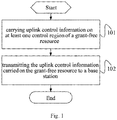
- some embodiments of the present disclosure provide an information transmission method which is applied to a terminal and includes steps 101 to 102.
- Step 101 carrying uplink control information on at least one control region of a grant-free resource.
- the uplink control information is UCI.
- the types of UCI which can be transmitted on the grant-free resource includes one or more of the following:
- Step 102 transmitting the uplink control information carried on the grant-free resource to a base station.
- Step 101 may include: acquiring first configuration information of the control region;
- one manner of acquiring the first configuration information is: it is configured by the base station for the terminal and sent to the terminal. Specifically, the terminal receives the first configuration information of the control region sent by the base station through a first predetermined message.
- the first predetermined message comprises at least one of: a radio resource control (RRC) message, a physical layer signaling, and a medium access control (MAC) layer control element (CE).
- RRC radio resource control
- MAC medium access control
- CE medium access control element
- Another manner of acquiring the first configuration information is: it is predefined by a communication protocol. Specifically, the terminal acquires the first configuration information of the control region predefined by the communication protocol.
- the UCI is carried on at least one control region of the grant-free resource according to the first configuration information.
- the first configuration information includes time-frequency domain resource allocation information of the control region, and/or a carrying manner of the UCI on the control region.
- the time-frequency domain resource allocation information of the control region includes at least one of: a size of the time-frequency domain resource of the control region, allocation of the time domain resource of the control region, and allocation of the frequency domain resource of the control region.
- each grant-free resource is configured with one or more control regions.
- the number of the control regions is N control
- the size of the time-frequency domain resource of the control region is N time *N freq
- N time is a size of the time domain
- N freq is a size of the frequency domain, where Ncontroi, N time , and N freq are configured by the network or predefined; the above three may be group-specific, or may be UE-specific, or may be grant-free resource-specific.
- the allocation of the time domain resource of the control region includes that: a time domain resource position of the control region is adjacent to a time domain position of a reference signal of the grant-free resource; and/or in a case that there are at least two control regions, the time domain resources of at least two control regions are overlapped with or orthogonal to each other.
- the time domain position of the control region may be at any position in the grant-free resource, and the size of the time domain is pre-configured or predefined.
- the time domain position of the control region is adjacent to the time domain position of the reference signal.
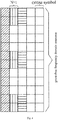
- the positions of the reference signals (RSs, i.e., the regions filled with slashes in the figure) of the grant-free resource are at the beginning of the data, and the control regions (i.e., the regions filled with vertical lines in the figure) are distributed in the time domain over the N symbols after the RSs; in Fig.
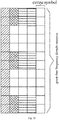
- the positions of the RSs (or additional RSs, i.e., the regions filled with slashes in the figure) of the grant-free resource are in the middle of the data, and the control regions (i.e., the regions filled with vertical lines in the figure) are distributed in the time domain over the N symbols before and after the (additional) RSs.
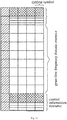
- the time domain resources of multiple control regions may be orthogonal to each other, as shown in Fig. 4 , a region filled with vertical lines represents a first control region, a region filled with horizontal lines represents a second control region, and the time domain position of the first control region is arranged before the time domain position of the second control region; the time domain resources of multiple regions may overlap, as shown in Fig. 5 .
- the allocation of the frequency domain resource of the control region includes at least one of that:
- the frequency domain position of the control region may be at any position in the grant-free resource, and the size of the frequency domain is pre-configured or predefined.
- a control region can contain multiple components, each of which is spaced apart in the frequency domain; specifically, the multiple components of the control region are located on (parts of) subcarriers where the reference signal is located; when there are multiple control regions, the multiple control regions may be distributed alternately in a comb structure.
- the positions of the RSs are at the beginning of the data, the control regions are distributed in the time domain over the N symbols after the RSs, and different control regions are distributed alternately in a comb structure.
- the carrying manner of the UCI on the control region includes at least one of that:
- the UCI transmission parameters include a size of the time-frequency domain resource of the control region, a transmission power parameter, a modulation and coding scheme, etc.
- mapping manner of the UCI on the control region may be as follows:
- At least one piece of UCI may be mapped to different control regions according to the priorities of the control regions.
- the priority may be determined according to the size of the time-frequency domain resource of the control region, the modulation and coding scheme of the control region, the transmission power, and the like. For example, the mapping of some important UCIs which have a higher priority are preferentially ensured, for example, the UCI related to the transmission on the grant-free resource is mapped to the control region with a higher priority, and other UCI is mapped to the control region with a lower priority. As shown in Fig.
- a region filled with grid is a control region 1 to which the UCI with a higher priority is mapped
- a region filled with horizontal lines is a control region 2 to which the UCI with a lower priority is mapped.
- the grant-free resource generally needs to carry data therein.
- the UCI is configured to be multiplexed with the data in the grant-free resource.
- the terminal is configured to acquire second configuration information of a multiplexing manner of the UCI and the data on the grant-free resource, and perform the multiplexing of the UCI and the data on the grant-free resource according to the second configuration information, so as to carry the UCI in at least one control region of the grant-free resource; then, the terminal transmits the UCI and the data carried on the grant-free resource to the base station.
- a first manner for the terminal to acquire the second configuration information is: the base station configures the second configuration information for the terminal and sends it to the terminal. Specifically, the terminal receives the second configuration information sent by the base station through a third predetermined message.
- the third predetermined message includes at least one of: an RRC message, a physical layer signaling, and a MAC CE.
- Another manner to acquire the second configuration information is: the communication protocol predefines the second configuration information. Specifically, the terminal acquires the second configuration information predefined by the communication protocol.
- the second configuration information includes: a multiplexing manner of puncturing the data and/or a multiplexing manner of rate matching the UCI and the data.
- the UCI is multiplexed with the data in a puncturing multiplexing manner or a rate-matching multiplexing manner according to a pre-configured method or a predefined rule.
- the terminal may select one of the following manners to perform the multiplexing of the UCI and the data:
- B3 includes at least one of the following:
- Step 101 may include: acquiring the format information of the UCI; and carrying, according to the format information of the UCI, the uplink control information (UCI) on at least one control region of the grant-free resource.
- UCI uplink control information
- a first manner for the terminal to acquire the format information of the UCI is: the base station configures the format information for the terminal and sends it to the terminal. Specifically, the terminal receives the format information of the UCI sent by the base station through a second predetermined message.
- the second predetermined message includes at least one of: an RRC message, a physical layer signaling, and a MAC CE.
- Another manner to acquire the format information of the UCI is: the communication protocol predefines the format information. Specifically, the terminal acquires the format information of the UCI predefined by the communication protocol.
- the format information of the UCI includes: using at least one of frequency division multiplexing (FDM), time division multiplexing (TDM), and code division multiplexing (CDM) to perform multiplexing of the UCI of different terminals on the grant-free resource.
- FDM frequency division multiplexing
- TDM time division multiplexing
- CDM code division multiplexing
- the format information of the uplink control information includes using the frequency division multiplexing and/or the time division multiplexing to perform multiplexing of the uplink control information of different terminals on the grant-free resource
- the time domain resource and/or the frequency domain resource used by the uplink control information of different terminals are resources shared with data in the grant-free resources, or the time domain resource and/or the frequency domain resource used by the uplink control information of different terminals are dedicated resources in the grant-free resources.
- a part of time-frequency domain resource is reserved for the UCI of a group of terminals. If there is no UCI transmitted on the reserved resource, data may be transmitted (to improve resource utilization; however, this will cause mutual interference between the data and the UCI of users), or data may not be transmitted (to ensure the UCI transmission and improve reliability; however, the resource utilization will be reduced).
- a part of resource not carrying data on the grant-free resource may be reserved, and different terminals are differentiated by FDM or TDM of the resource. As shown in Fig. 11 , a region filled with grid is used to carry the UCI of the terminal A, and a region filled with horizontal lines is used to carry the UCI of the terminal B.
- Another manner is to reserve a part of the resource inside the grant-free resource, and distinguish different terminals by FDM or TDM of the resource.
- a region filled with vertical lines is the control region 1 for carrying the UCI of the terminal A
- a region filled with horizontal lines is the control region 2 for carrying the UCI of the terminal B.
- the format information of the UCI includes using the code division multiplexing to perform multiplexing of the UCI of different terminals on the grant-free resource
- sequences used by the UCI of different terminals are different from each other; or payload of the UCI of different terminals is processed by a predetermined sequence; wherein the predetermined sequence includes: an orthogonal cover code (OCC) and/or a scrambling sequence.
- OCC orthogonal cover code
- the UCI of different terminals needs to be distinguishable or capable of being demodulated/decoded independently. Specifically, at least one of the following manners may be adopted:
- the terminal in order to improve the receiving performance of the base station, the terminal retransmit the data in the grant-free resource. If the UCI is carried on each retransmission, the UCI has a large overhead, and the number of retransmissions of the UCI carried by the control region may be configured to be different from the number of retransmissions of the data.
- Step 102 is: to acquire retransmission configuration information of the uplink control information of the control region; and retransmit the UCI and the data carried on the grant-free resource to the base station; wherein the retransmission configuration information includes that: the number of retransmissions of the uplink control information of the control region is less than or equal to the number of retransmissions of the data in the grant-free resource.
- the base station misses the grant-free transmission carrying the UCI, it will lead to an error of grant-free transmission.
- a lower coding rate is adopted for the UCI; if time hopping or frequency hopping is supported during the retransmission, the hopping may also be performed on the UCI during the repeated multiple transmissions.
- the terminal For example, if the terminal is configured to transmit data multiple times, the number of times is K1, and the UCI transmission is also repeated multiple times, the number of repeating times is K2, and K2 is less than or equal to K1.
- K2 ⁇ K1 the terminal carries the UCI in the first K2 transmissions in the grant-free resource.
- the terminal configures 4 retransmissions, the number of retransmissions of the UCI is 2, and the terminal carries the UCI in the first two transmissions in the grant-free resource.
- the information transmission method in some embodiments of the present disclosure can realize fast and reliable decoding of the UCI while improving the communication process and ensuring the reliability of the network communication by multiplexing the UCI on the grant-free resource.
- some embodiments of the present disclosure provides an information transmission method which is applied to a base station and includes Step 1401.
- Step 1401 receiving the uplink control information carried on the grant-free resource transmitted by the terminal; wherein the uplink control information is carried on at least one control region of the grant-free resource.
- the method includes: sending a first configuration information of the control region to the terminal through a first predetermined message; wherein the first predetermined message includes at least one of: a radio resource control (RRC) message, a physical layer signaling, and a medium access control (MAC) layer control element (CE).
- RRC radio resource control
- MAC medium access control
- the first configuration information includes: time-frequency domain resource allocation information of the control region, and/or a carrying manner of the uplink control information on the control region.
- the time-frequency domain resource allocation information of the control region includes at least one of: a size of the time-frequency domain resource of the control region, allocation of time domain resource of the control region, and allocation of frequency domain resource of the control region.
- time-frequency domain resource allocation information of the control region includes the allocation of the time domain resource of the control region
- the allocation of the time domain resource of the control region includes that: a time domain resource position of the control region is adjacent to a time domain position of a reference signal of the grant-free resource; and/or, in a case that there are at least two control regions, the time domain resources of at least two control regions are overlapped with or orthogonal to each other.
- time-frequency domain resource allocation information of the control region includes the allocation of the frequency domain resource of the control region
- the allocation of the frequency domain resource of the control region includes at least one of that: the frequency domain resource of the control region is centralized or distributed; the frequency domain resource of the control region are located on a frequency domain resource position of a reference signal of the grant-free resource; and, in a case that the frequency domain resource of the control region is distributed, the frequency resources of at least two control regions are allocated in a comb manner.
- the carrying manner of the uplink control information on the control region includes at least one of that: at least one piece of uplink control information is mapped to different time-frequency domain resource positions of one control region; in a case that there are at least two control regions, at least one piece of uplink control information is mapped to different control region; in a case that there are at least two control regions, different control regions carry uplink control information with different transmission parameters.
- an implementation of mapping at least one piece of uplink control information to different control region is: mapping at least one piece of uplink control information to different control region according to a priority of the control region; wherein, the priority of the control region is determined according to a predetermined parameter, and the predetermined parameter includes at least one of: a size of the time-frequency domain resource of the control region, a modulation and coding scheme, and a transmission power.
- the method includes: sending format information of the uplink control information to the terminal through a second predetermined message; wherein the second predetermined message comprises at least one of: an RRC message, a physical layer signaling, and a MAC CE.
- the format information of the uplink control information includes: using at least one of frequency division multiplexing, time division multiplexing, and code division multiplexing to perform multiplexing of the uplink control information of different terminals on the grant-free resource.
- the format information of the uplink control information includes using the frequency division multiplexing and/or the time division multiplexing to perform multiplexing of the uplink control information of different terminals on the grant-free resource
- the time domain resource and/or the frequency domain resource used by the uplink control information of different terminals are resources shared with data in the grant-free resources, or the time domain resource and/or the frequency domain resource used by the uplink control information of different terminals are dedicated resources in the grant-free resources.
- the format information of the uplink control information includes using the code division multiplexing to perform multiplexing of the uplink control information of different terminals on the grant-free resource
- sequences used by the uplink control information of different terminals are different from each other; or payload of the uplink control information of different terminals is processed by a predetermined sequence; wherein the predetermined sequence includes: an orthogonal cover code (OCC) and/or a scrambling sequence.
- OCC orthogonal cover code
- Step 1401 receiving the uplink control information and data carried on the grant-free resource transmitted by the terminal.
- the method before the step of receiving the uplink control information and the data carried on the grant-free resource transmitted by the terminal, the method includes: sending a second configuration information of a multiplexing manner of the uplink control information and the data on the grant-free resource to the terminal through a third predetermined message; wherein the third predetermined message includes at least one of: an RRC message, a physical layer signaling, and a MAC CE.
- the second configuration information includes: a multiplexing manner of puncturing the data and/or a multiplexing manner of rate matching the uplink control information and the data.
- the step of receiving the uplink control information and the data carried on the grant-free resource transmitted by the terminal includes: sending retransmission configuration information of the uplink control information of the control region to the terminal; receiving the uplink control information and the data carried on the grant-free resource retransmitted by the terminal; wherein the retransmission configuration information includes that: the number of retransmissions of the uplink control information of the control region is less than or equal to the number of retransmissions of the data in the grant-free resource.
- some embodiments of the present disclosure provides a terminal which includes: a carrying module 1501 for carrying uplink control information on at least one control region of a grant-free resource; and a transmission module 1502 for transmitting the uplink control information carried on the grant-free resource to a base station.
- the carrying module 1501 includes: a first acquisition unit for acquiring first configuration information of the control region; a first carrying unit for carrying the uplink control information on at least one control region of the grant-free resource according to the first configuration information.
- the first acquisition unit is configured to: receive the first configuration information of the control region sent by the base station through a first predetermined message; or acquire the first configuration information of the control region predefined by a communication protocol; wherein the first predetermined message includes at least one of: a radio resource control (RRC) message, a physical layer signaling, and a medium access control (MAC) layer control element (CE).
- RRC radio resource control
- MAC medium access control
- the first configuration information includes: time-frequency domain resource allocation information of the control region, and/or a carrying manner of the uplink control information on the control region.
- the time-frequency domain resource allocation information of the control region includes at least one of: a size of the time-frequency domain resource of the control region, allocation of time domain resource of the control region, and allocation of frequency domain resource of the control region.
- time-frequency domain resource allocation information of the control region includes the allocation of the time domain resource of the control region
- the allocation of the time domain resource of the control region includes that: a time domain resource position of the control region is adjacent to a time domain position of a reference signal of the grant-free resource; and/or in a case that there are at least two control regions, the time domain resources of at least two control regions are overlapped with or orthogonal to each other.
- time-frequency domain resource allocation information of the control region includes the allocation of the frequency domain resource of the control region
- the allocation of the frequency domain resource of the control region includes at least one of that: the frequency domain resource of the control region is centralized or distributed; the frequency domain resource of the control region is located on a frequency domain resource position of a reference signal of the grant-free resource; and in a case that the frequency domain resource of the control region is distributed, the frequency resources of at least two control regions are allocated in a comb manner.
- the carrying manner of the uplink control information on the control region includes at least one of that: at least one piece of uplink control information is mapped to different time-frequency domain resource positions of one control region; in a case that there are at least two control regions, at least one piece of uplink control information is mapped to different control region; in a case that there are at least two control regions, different control regions carry uplink control information with different transmission parameters.
- At least one piece of uplink control information is mapped to different control regions by: mapping at least one piece of uplink control information to different control regions according to a priority of each control region; wherein, the priority of the control region is determined according to a predetermined parameter, and the predetermined parameter includes at least one of: a size of the time-frequency domain resource of the control region, a modulation and coding scheme, and a transmission power.
- the carrying module 1501 includes: a second acquisition unit for acquiring format information of the uplink control information; and a second carrying unit for carrying the uplink control information on at least one control region of the grant-free resource according to the format information of the uplink control information.
- the second acquisition unit is configured to: acquire the format information of the uplink control information sent by the base station through a second predetermined message; or acquire the format information of the uplink control information predefined by a communication protocol; wherein the second predetermined message includes at least one of: an RRC message, a physical layer signaling, and a MAC CE.
- the format information of the uplink control information includes: using at least one of frequency division multiplexing, time division multiplexing, and code division multiplexing to perform multiplexing of the uplink control information of different terminals on the grant-free resource.
- the transmission module 1502 is configured to: transmit the uplink control information and data carried on the grant-free resource to the base station.
- the carrying module 1501 includes: a third acquisition unit for acquiring second configuration information of a multiplexing manner of the uplink control information and the data on the grant-free resource; a third carrying unit for performing multiplexing of the uplink control information and the data on the grant-free resource according to the second configuration information, so as to carry the uplink control information in at least one control region of the grant-free resource.
- the third acquisition unit is configured to: acquire the second configuration information of the multiplexing manner of the uplink control information and the data on the grant-free resource sent by the base station through a third predetermined message; or acquire the second configuration information of the multiplexing manner of the uplink control information and the data on the grant-free resource predefined by a communication protocol; wherein the third predetermined message comprises at least one of: an RRC message, a physical layer signaling, and a MAC CE.
- the second configuration information includes: a multiplexing manner of puncturing the data and/or a multiplexing manner of rate matching the uplink control information and the data.
- the transmission module includes: a fourth acquisition unit for acquiring retransmission configuration information of the uplink control information of the control region; a transmission unit for retransmitting the uplink control information and the data carried on the grant-free resource to the base station according to the retransmission configuration information; wherein the retransmission configuration information includes that: the number of retransmissions of the uplink control information of the control region is less than or equal to the number of retransmissions of the data in the grant-free resource.
- the terminal embodiment is a terminal corresponding to the above information transmission method applied to the terminal side. All the implementations of the foregoing embodiment are applicable to the terminal embodiment, and the same technical effects can also be achieved.
- Some embodiments of the present disclosure further provide a terminal which includes: a storage, a processor and a computer program stored in the storage and running in the processor, the computer program, when executed by the processor, is capable of causing the processor to achieve the processes in the forgoing information transmission method applied to the terminal side, the same technical effects can also be achieved, and will not be repeated here in order to avoid repetition.
- Some embodiments of the present disclosure further provide a computer readable storage medium, wherein the computer readable storage medium stores thereon a computer program which, when executed by a processor, is capable of causing the processor to achieve the processes in the forgoing information transmission method applied to the terminal side, the same technical effects can also be achieved, and will not be repeated here in order to avoid repetition.
- the computer readable storage medium may be a volatile computer readable storage medium or a nonvolatile computer readable storage medium or a transient computer readable storage medium such as a read-only memory (ROM), a random access memory (RAM), a magnetic disk or an optical disk or the like.
- FIG. 16 it is a structural block diagram of a terminal according to the present disclosure.
- An application entity of the information transmission method of the present disclosure will be specifically described below in conjunction with the figure.
- the terminal 1600 shown in Fig. 16 includes: at least one processor 1601, a storage 1602, at least one network interface 1604, and a user interface 1603.
- the components in the terminal 1600 are coupled with each other by a bus system 1605.
- the bus system 1605 is used to achieve the connection communication between these components.
- the bus system 1605 includes a power bus, a control bus, and a status signal bus in addition to the data bus.
- various buses are labeled as bus system 1605 in Fig. 16 .
- the user interface 1603 may include a display, a keyboard or a pointing device (e.g., a mouse, a track ball, a touch pad or a touch screen, etc).
- a pointing device e.g., a mouse, a track ball, a touch pad or a touch screen, etc.
- the storage 1602 in some embodiments of the present disclosure may be either a volatile memory or a non-volatile memory, or may include both.
- the non-volatile memory may be a read-only memory (ROM), a Programmable ROM (PROM), an Erasable PROM (EPROM), an Electrically EPROM (EEPROM) or a flash memory.
- the volatile memory may be a Random Access Memory (RAM) that acts as an external cache.
- RAMs of many forms are available, such as Static RAM (SRAM), Dynamic RAM (DRAM), Synchronous DRAM (SDRAM), Double Data Rate SDRAM (DDRSDRAM), Enhanced SDRAM (ESDRAM), Synchlink DRAM (SDRAM), and Direct Rambus RAM (DRRAM).
- SRAM Static RAM
- DRAM Dynamic RAM
- SDRAM Synchronous DRAM
- DDRSDRAM Double Data Rate SDRAM
- ESDRAM Enhanced SDRAM
- SDRAM Synchlink DRAM
- DRRAM Direct Rambus RAM
- the storage 1602 of the systems and methods described herein is intended to include, without being limited to, these and any other suitable types of memories.
- the storage 1602 stores the following elements, executable modules or data structures, or a subset thereof, or extended set thereof: an operating system 16021 and an application 16022.
- the operation system 16021 includes various system programs, such as a framework layer, a core library layer, a driver layer, and the like, for implementing various basic services and processing hardware-based tasks.
- the application 16022 includes various applications, such as a media player, a browser, and the like, for implementing various application services. Programs that implement the methods of some embodiments of the present disclosure may be included in the application 16022.
- the mobile terminal 1600 further includes a computer program stored on the storage 1602 and running on the processor 1601; specifically, it may be a computer control program in the application 16022 which, when executed by the processor 1601, causing the processor 1601 to perform the following steps: carrying uplink control information on at least one control region of a grant-free resource; and transmitting the uplink control information carried on the grant-free resource to a base station.
- the above method disclosed by some embodiments of the present disclosure may be applied in the processor 1601, or implemented by the processor 1601.
- the processor 1601 may be an integrated circuit chip having a signal-processing capability. During the implementation process, the steps of the above method may be implemented by the hardware integrated logic circuit in the processor 1601 or software instructions.
- the above processor 1601 may be a general-purpose processor, a digital signal processor (DSP), an application specific integrated circuit (ASIC), a field programmable gate array (FPGA), or other programmable logic device, discrete gate or transistor logic device, discrete hardware component.
- DSP digital signal processor
- ASIC application specific integrated circuit
- FPGA field programmable gate array
- the methods, steps, and logical block diagrams disclosed in some embodiments of the present disclosure may be implemented or performed.
- the general purpose processor may be a microprocessor, or the processor may be any conventional processor or the like.
- the steps of the methods disclosed in connection with some embodiments of the present disclosure may be directly embodied by the hardware decoding processor, or by a combination of hardware and software modules in the decoding processor.
- the software modules can be located in a conventional computer readable storage medium of the art, such as random access memory, a flash memory, a read only memory, a programmable read only memory or an electrically erasable programmable memory, a register, and the like.
- the computer readable storage medium is located in the storage 1602, and the processor 1601 reads the information in the storage 1602 to perform the steps of the above method in conjunction with its hardware.
- the computer readable storage medium stores thereon a computer program which, when executed by the processor 1601, causes the processor 1601 to implement the following steps.
- the processing unit can be implemented in one or more application specific integrated circuits (ASICs), digital signal processors (DSPs), digital signal processing devices (DSPDs), programmable logic devices (PLDs), field-programmable gate arrays (FPGAs), general purpose processors, controllers, micro-controllers, microprocessors, other electronic units for performing the functions described in this disclosure or a combination thereof.
- ASICs application specific integrated circuits
- DSPs digital signal processors
- DSPDs digital signal processing devices
- PLDs programmable logic devices
- FPGAs field-programmable gate arrays
- general purpose processors controllers, micro-controllers, microprocessors, other electronic units for performing the functions described in this disclosure or a combination thereof.
- the techniques described herein may be implemented by modules (e.g., procedures, functions, and so on) that perform the functions described herein.
- Software codes may be stored in the storage and executed by the processor.
- the storage may be implemented in the processor or external to the processor.
- the processor 1601 achieves: acquiring first configuration information of the control region; carrying the uplink control information on at least one control region of the grant-free resource according to the first configuration information.
- the processor 1601 achieves: receiving the first configuration information of the control region sent by the base station through a first predetermined message; or acquiring the first configuration information of the control region predefined by a communication protocol; wherein the first predetermined message includes at least one of: a radio resource control (RRC) message, a physical layer signaling, and a medium access control (MAC) layer control element (CE).
- RRC radio resource control
- MAC medium access control
- the first configuration information includes: time-frequency domain resource allocation information of the control region, and/or a carrying manner of the uplink control information on the control region.
- the time-frequency domain resource allocation information of the control region includes at least one of: a size of the time-frequency domain resource of the control region, allocation of time domain resource of the control region, and allocation of frequency domain resource of the control region.
- time-frequency domain resource allocation information of the control region includes the allocation of the time domain resource of the control region
- the allocation of the time domain resource of the control region includes that: a time domain resource position of the control region is adjacent to a time domain position of a reference signal of the grant-free resource; and/or in a case that there are at least two control regions, the time domain resources of at least two control regions are overlapped with or orthogonal to each other.
- time-frequency domain resource allocation information of the control region includes the allocation of the frequency domain resource of the control region
- the allocation of the frequency domain resource of the control region includes at least one of that: the frequency domain resource of the control region is centralized or distributed; the frequency domain resource of the control region are located on a frequency domain resource position of a reference signal of the grant-free resource; and in a case that the frequency domain resource of the control region is distributed, the frequency resources of at least two control regions are allocated in a comb manner.
- the carrying manner of the uplink control information on the control region includes at least one of that: at least one piece of uplink control information is mapped to different time-frequency domain resource positions of one control region; in a case that there are at least two control regions, at least one piece of uplink control information is mapped to different control region; in a case that there are at least two control regions, different control regions carry uplink control information with different transmission parameters.
- the processor 1601 achieves: mapping at least one piece of uplink control information to different control region according to a priority of the control region; wherein, the priority of the control region is determined according to a predetermined parameter, and the predetermined parameter includes at least one of: a size of the time-frequency domain resource of the control region, a modulation and coding scheme, and a transmission power.
- the processor 1601 achieves: acquiring format information of the uplink control information; and carrying the uplink control information on at least one control region of the grant-free resource according to the format information of the uplink control information.
- the processor 1601 achieves: acquiring the format information of the uplink control information sent by the base station through a second predetermined message; or acquiring the format information of the uplink control information predefined by a communication protocol; wherein the second predetermined message includes at least one of: an RRC message, a physical layer signaling, and a MAC CE.
- the format information of the uplink control information includes: using at least one of frequency division multiplexing, time division multiplexing, and code division multiplexing to perform multiplexing of the uplink control information of different terminals on the grant-free resource.
- the processor 1601 achieves: transmitting the uplink control information and data carried on the grant-free resource to the base station.
- the processor 1601 achieves: acquiring second configuration information of a multiplexing manner of the uplink control information and the data on the grant-free resource; performing multiplexing of the uplink control information and the data on the grant-free resource according to the second configuration information, so as to carry the uplink control information in at least one control region of the grant-free resource.
- the processor 1601 achieves: acquiring the second configuration information of the multiplexing manner of the uplink control information and the data on the grant-free resource sent by the base station through a third predetermined message; or acquiring the second configuration information of the multiplexing manner of the uplink control information and the data on the grant-free resource predefined by a communication protocol; wherein the third predetermined message comprises at least one of: an RRC message, a physical layer signaling, and a MAC CE.
- the second configuration information includes: a multiplexing manner of puncturing the data and/or a multiplexing manner of rate matching the uplink control information and the data.
- the processor 1601 achieves: acquiring retransmission configuration information of the uplink control information of the control region; retransmitting the uplink control information and the data carried on the grant-free resource to the base station according to the retransmission configuration information; wherein the retransmission configuration information includes that: the number of retransmissions of the uplink control information of the control region is less than or equal to the number of retransmissions of the data in the grant-free resource.
- the terminal 1600 can implement the processes implemented by the terminal in the above embodiment, which will not be repeated here in order to avoid repetition.
- the terminal transmits the uplink control information carried on the grant-free resource to the base station by carrying the uplink control information on at least one control region of the grant-free resource, thereby achieving the multiplexing of the uplink control information on the grant-free resource, improving the communication process and ensuring the reliability of the network communication.
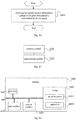
- some embodiments of the present disclosure provides a base station which includes a receiving module 1701 for receiving uplink control information carried on a grant-free resource transmitted by a terminal; wherein the uplink control information is carried on at least one control region of the grant-free resource.
- the base station includes: a first sending module for sending a first configuration information of the control region to the terminal through a first predetermined message; wherein the first predetermined message comprises at least one of: a radio resource control (RRC) message, a physical layer signaling, and a medium access control (MAC) layer control element (CE).
- RRC radio resource control
- MAC medium access control
- the first configuration information includes: time-frequency domain resource allocation information of the control region, and/or a carrying manner of the uplink control information on the control region.
- the time-frequency domain resource allocation information of the control region includes at least one of: a size of the time-frequency domain resource of the control region, allocation of time domain resource of the control region, and allocation of frequency domain resource of the control region.
- time-frequency domain resource allocation information of the control region includes the allocation of the time domain resource of the control region
- the allocation of the time domain resource of the control region comprises that: a time domain resource position of the control region is adjacent to a time domain position of a reference signal of the grant-free resource; and/or in a case that there are at least two control regions, the time domain resources of at least two control regions are overlapped with or orthogonal to each other.
- time-frequency domain resource allocation information of the control region includes the allocation of the frequency domain resource of the control region
- the allocation of the frequency domain resource of the control region includes at least one of that: the frequency domain resource of the control region is centralized or distributed; the frequency domain resource of the control region are located on a frequency domain resource position of a reference signal of the grant-free resource; and in a case that the frequency domain resource of the control region is distributed, the frequency resources of at least two control regions are allocated in a comb manner.
- the carrying manner of the uplink control information on the control region includes at least one of that: at least one piece of uplink control information is mapped to different time-frequency domain resource positions of one control region; in a case that there are at least two control regions, at least one piece of uplink control information is mapped to different control region; in a case that there are at least two control regions, different control regions carry uplink control information with different transmission parameters.
- At least one piece of uplink control information is mapped to different control region by: mapping at least one piece of uplink control information to different control region according to a priority of the control region; wherein, the priority of the control region is determined according to a predetermined parameter, and the predetermined parameter includes at least one of: a size of the time-frequency domain resource of the control region, a modulation and coding scheme, and a transmission power.
- the base station includes: a second sending module for sending format information of the uplink control information to the terminal through a second predetermined message; wherein the second predetermined message includes at least one of: an RRC message, a physical layer signaling, and a MAC CE.
- the format information of the uplink control information includes: using at least one of frequency division multiplexing, time division multiplexing, and code division multiplexing to perform multiplexing of the uplink control information of different terminals on the grant-free resource.
- the format information of the uplink control information includes using the frequency division multiplexing and/or the time division multiplexing to perform multiplexing of the uplink control information of different terminals on the grant-free resource
- the time domain resource and/or the frequency domain resource used by the uplink control information of different terminals are resources shared with data in the grant-free resources, or the time domain resource and/or the frequency domain resource used by the uplink control information of different terminals are dedicated resources in the grant-free resources.
- the format information of the uplink control information includes using the code division multiplexing to perform multiplexing of the uplink control information of different terminals on the grant-free resource
- sequences used by the uplink control information of different terminals are different from each other; or payload of the uplink control information of different terminals is processed by a predetermined sequence; wherein the predetermined sequence includes: an orthogonal cover code (OCC) and/or a scrambling sequence.
- OCC orthogonal cover code
- the receiving module is configured to: receive the uplink control information and data carried on the grant-free resource transmitted by the terminal.
- the base station includes: a third sending module for sending a second configuration information of a multiplexing manner of the uplink control information and the data on the grant-free resource to the terminal through a third predetermined message; wherein the third predetermined message includes at least one of: an RRC message, a physical layer signaling, and a MAC CE.
- the second configuration information includes: a multiplexing manner of puncturing the data and/or a multiplexing manner of rate matching the uplink control information and the data.
- the receiving module includes: a sending unit for sending retransmission configuration information of the uplink control information of the control region to the terminal; a receiving unit for receiving the uplink control information and the data carried on the grant-free resource retransmitted by the terminal; wherein the retransmission configuration information includes that: the number of retransmissions of the uplink control information of the control region is less than or equal to the number of retransmissions of the data in the grant-free resource.
- the base station embodiment is a base station corresponding to the information transmission method applied to the base station side. All the implementations of the foregoing embodiment are applicable to the base station embodiment, and the same technical effects can also be achieved.
- Some embodiments of the present disclosure further provide a base station which includes a storage, a processor and a computer program stored in the storage and running in the processor, the computer program, when executed by the processor, is capable of causing the processor to achieve the processes in the above embodiment of the information transmission method applied to the base station side, and the same technical effects can also be achieved, which will not be repeated in order to avoid repetition.
- Some embodiments of the present disclosure further provide a computer readable storage medium, wherein the computer readable storage medium stores thereon a computer program which, when executed by a processor, is capable of causing the processor to achieve the processes in the above embodiment of the information transmission method applied to the base station side, and the same technical effects can also be achieved, which will not be repeated in order to avoid repetition.
- the computer readable storage medium may be a volatile computer readable storage medium or a nonvolatile computer readable storage medium or a transient computer readable storage medium such as a read-only memory (ROM), a random access memory (RAM), a magnetic disk or an optical disk or the like.
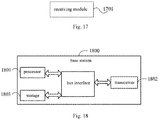
- Fig. 18 is a structural diagram of a base station according to the present disclosure capable of implementing the details of the above information transmission method applied to the base station side, and achieving the same technical effects.
- the base station 1800 includes: a processor 1801, a transceiver 1802, a storage 1803 and a bus interface, wherein the processor 1801 is configured to read a program stored in the storage 1803 and perform the following process: receiving, through the transceiver 1802, uplink control information carried on a grant-free resource transmitted by a terminal; wherein the uplink control information is carried on at least one control region of the grant-free resource.
- the bus architecture may include any number of interconnected buses and bridges, which are specifically linked by various circuits including one or more processors represented by the processor 1801 and storages represented by the storage 1803.
- the bus architecture can also link various other circuits such as peripherals, voltage regulators, and power management circuits, which are well known in the art and, therefore, will not be further described herein.
- the bus interface provides an interface.
- the transceiver 1802 may be multiple components, i.e., including a transmitter and a receiver, providing units for communicating with various other devices on a transmission medium.
- the processor 1801 is responsible for managing the bus architecture and general processing, and the storage 1803 may store data used by the processor 1801 in performing operations.
- the processor 1801 reads the program in the storage 1803 to further perform: sending a first configuration information of the control region to the terminal through a first predetermined message; wherein the first predetermined message includes at least one of: a radio resource control (RRC) message, a physical layer signaling, and a medium access control (MAC) layer control element (CE).
- RRC radio resource control
- MAC medium access control
- the first configuration information includes: time-frequency domain resource allocation information of the control region, and/or a carrying manner of the uplink control information on the control region.
- the time-frequency domain resource allocation information of the control region includes at least one of: a size of the time-frequency domain resource of the control region, allocation of time domain resource of the control region, and allocation of frequency domain resource of the control region.
- time-frequency domain resource allocation information of the control region includes the allocation of the time domain resource of the control region
- the allocation of the time domain resource of the control region includes that: a time domain resource position of the control region is adjacent to a time domain position of a reference signal of the grant-free resource; and/or in a case that there are at least two control regions, the time domain resources of at least two control regions are overlapped with or orthogonal to each other.
- time-frequency domain resource allocation information of the control region includes the allocation of the frequency domain resource of the control region
- the allocation of the frequency domain resource of the control region includes at least one of that: the frequency domain resource of the control region is centralized or distributed; the frequency domain resource of the control region are located on a frequency domain resource position of a reference signal of the grant-free resource; and in a case that the frequency domain resource of the control region is distributed, the frequency resources of at least two control regions are allocated in a comb manner.
- the carrying manner of the uplink control information on the control region includes at least one of that: at least one piece of uplink control information is mapped to different time-frequency domain resource positions of one control region; in a case that there are at least two control regions, at least one piece of uplink control information is mapped to different control region; in a case that there are at least two control regions, different control regions carry uplink control information with different transmission parameters.
- the processor 1801 reads the program in the storage 1803 to further perform: mapping at least one piece of uplink control information to different control region according to a priority of the control region; wherein, the priority of the control region is determined according to a predetermined parameter, and the predetermined parameter includes at least one of: a size of the time-frequency domain resource of the control region, a modulation and coding scheme, and a transmission power.
- the processor 1801 reads the program in the storage 1803 to further perform: sending format information of the uplink control information to the terminal through a second predetermined message; wherein the second predetermined message comprises at least one of: an RRC message, a physical layer signaling, and a MAC CE.
- the format information of the uplink control information includes: using at least one of frequency division multiplexing, time division multiplexing, and code division multiplexing to perform multiplexing of the uplink control information of different terminals on the grant-free resource.
- the format information of the uplink control information includes using the frequency division multiplexing and/or the time division multiplexing to perform multiplexing of the uplink control information of different terminals on the grant-free resource
- the time domain resource and/or the frequency domain resource used by the uplink control information of different terminals are resources shared with data among the grant-free resources, or the time domain resource and/or the frequency domain resource used by the uplink control information of different terminals are dedicated resources among the grant-free resources.
- the format information of the uplink control information includes using the code division multiplexing to perform multiplexing of the uplink control information of different terminals on the grant-free resource
- sequences used by the uplink control information of different terminals are different from each other; or payload of the uplink control information of different terminals is processed by a predetermined sequence; wherein the predetermined sequence comprises: an orthogonal cover code (OCC) and/or a scrambling sequence.
- OCC orthogonal cover code
- the processor 1801 reads the program in the storage 1803 to further perform: receiving the uplink control information and data carried on the grant-free resource transmitted by the terminal.
- the processor 1801 reads the program in the storage 1803 to further perform: sending a second configuration information of a multiplexing manner of the uplink control information and the data on the grant-free resource to the terminal through a third predetermined message; wherein the third predetermined message comprises at least one of: an RRC message, a physical layer signaling, and a MAC CE.
- the second configuration information includes: a multiplexing manner of puncturing the data and/or a multiplexing manner of rate matching the uplink control information and the data.
- the processor 1801 reads the program in the storage 1803 to further perform: sending retransmission configuration information of the uplink control information of the control region to the terminal through the transceiver 1802; receiving the uplink control information and the data carried on the grant-free resource retransmitted by the terminal; wherein the retransmission configuration information includes that: the number of retransmissions of the uplink control information of the control region is less than or equal to the number of retransmissions of the data in the grant-free resource.
- the base station achieves the multiplexing of the uplink control information on the grant-free resource, which improves the communication process and ensures the reliability of the network communication.
- the multiplexing of the uplink control information on the grant-free resource is achieved, which improves the communication process and ensures the reliability of the network communication.
- some embodiments of the present disclosure may be provided as a method, a device, or a computer program product. Therefore, some embodiments of the present disclosure may take the form of an entirely hardware embodiment, an entirely software embodiment, or an embodiment combining software and hardware. Moreover, some embodiments of the present disclosure may employ computer program products implemented on one or more computer-usable storage media (including but not limited to disk storage, CD-ROM, optical storage, etc.) containing computer-usable program code.
- computer-usable storage media including but not limited to disk storage, CD-ROM, optical storage, etc.
- These computer program instructions may also be stored in a computer-readable storage capable of directing a computer or other programmable data processing terminal equipment to work in a specific manner, such that the instructions stored in the computer-readable storage produce a manufactured article including the instruction means which implements the functions specified in one or more of the processes in the flowcharts and/or one or more of the blocks in the block diagrams.
- These computer program instructions may also be loaded on a computer or other programmable data processing terminal equipment, so that a series of operation steps can be performed on the computer or other programmable terminal equipment to produce a computer-implemented process, so that the instructions executed on the computer or other programmable terminal equipment provide the steps for implementing the functions specified in one or more of the processes in the flowcharts and/or one or more of the blocks in the block diagrams.
Landscapes
- Engineering & Computer Science (AREA)
- Signal Processing (AREA)
- Computer Networks & Wireless Communication (AREA)
- Mobile Radio Communication Systems (AREA)
Abstract
Description
- The present application claims the priority of Chinese Patent Application No.
201710687278.4 filed on August 11th, 2017 - The present disclosure relates to the field of communication technology, and in particular to an information transmission method, a terminal and a base station.
- The 5th Generation (5G) mobile communication system needs to adapt to more diverse scenarios and service requirements. The major scenarios of the New Radio (NR) include mobile broadband enhancement (eMBB), massive Machine Type Communication (mMTC), and Ultra-Reliable and Low-Latency Communication (URLLC). These scenarios require the system to have high reliability, low latency, wide bandwidth, wide coverage, and so on. For services of certain scenarios, transmission of low latency and highly reliability are required. For such service requirements, the NR supports grant-free transmission to reduce signaling interaction processes, and guaranteeing low latency requirement. A grant-free resource can be semi-statically configured through a Radio Resource Control (RRC) signaling. When a service with a high priority (such as URLLC service data) arrives, the user equipment (UE, also called a terminal) can perform data transmission on the grant-free resource.
- The NR defines two transmission modes for the grant-free transmission:
- Mode 1: the grant-free resource is configured/reconfigured only based on the RRC without any L1 signaling for activating and deactivating.
- Mode 2: the grant-free resource is configured/reconfigured based on both the RRC and the L1 signaling (which is used for activating and deactivating).
- When performing transmission on the grant-free resource, some control information may be carried to assist the base station to take effective measures for performing data decoding or retransmission processing. However, in the related art, there is no solution about how to multiplex the UCI to perform transmission on the grant-free resource, and the integrity of the communication process and the reliability of network communication cannot be ensured.
- The present disclosure provides an information transmission method, a terminal and a base station.
- In a first aspect, some embodiments of the present disclosure provides an information transmission method applied to a terminal including: carrying uplink control information on at least one control region of a grant-free resource; and transmitting the uplink control information carried on the grant-free resource to a base station.
- In a second aspect, some embodiments of the present disclosure further provides an information transmission method applied to a terminal including: receiving uplink control information carried on a grant-free resource transmitted by a terminal; wherein the uplink control information is carried on at least one control region of the grant-free resource.
- In a third aspect, some embodiments of the present disclosure further provides a terminal including: a carrying module for carrying uplink control information on at least one control region of a grant-free resource; and a transmission module for transmitting the uplink control information carried on the grant-free resource to a base station.
- In a fourth aspect, some embodiments of the present disclosure further provides a terminal including: a storage, a processor and a computer program stored in the storage and running in the processor, the computer program, when executed by the processor, is capable of causing the processor to perform the steps of the above information transmission method applied to a terminal.
- In a fifth aspect, some embodiments of the present disclosure further provides a computer readable storage medium, wherein the computer readable storage medium stores thereon a computer program which, when executed by a processor, is capable of causing the processor to perform the steps of the above information transmission method applied to a terminal.
- In a sixth aspect, some embodiments of the present disclosure further provides a base station including: a receiving module for receiving uplink control information carried on a grant-free resource transmitted by a terminal; wherein the uplink control information is carried on at least one control region of the grant-free resource.
- In a seventh aspect, some embodiments of the present disclosure further provides a base station including: a storage, a processor and a computer program stored in the storage and running in the processor, the computer program, when executed by the processor, is capable of causing the processor to perform the steps of the above information transmission method applied to a terminal.
- In an eighth aspect, some embodiments of the present disclosure further provides a computer readable storage medium, wherein the computer readable storage medium stores thereon a computer program which, when executed by a processor, is capable of causing the processor to perform the steps of the above information transmission method applied to a terminal.
-
-
Fig.1 illustrates a first schematic flow chart showing an information transmission method according to some embodiments of the present disclosure; -
Fig. 2 illustrates a first schematic diagram of a time domain setting position of a control region; -
Fig. 3 illustrates a second schematic diagram of a time domain setting position of a control region; -
Fig. 4 illustrates a first schematic diagram of a time domain setting position of a different control region; -
Fig. 5 illustrates a second schematic diagram of a time domain setting position of a different control region; -
Fig. 6 illustrates a schematic diagram of setting positions of different UCI on the frequency domain; -
Fig. 7 illustrates a schematic diagram of setting positions of different UCI on the time domain; -
Fig. 8 illustrates a schematic diagram of setting positions of different UCI in the control region; -
Fig. 9 illustrates a schematic diagram of setting positions of UCI of different priorities in the control region; -
Fig. 10 illustrates a schematic diagram of the setting of a multiplexing manner of UCI and data in different control regions; -
Fig. 11 illustrates a schematic diagram of setting positions of UCI of different terminals in the time-frequency domain; -
Fig. 12 illustrates a schematic diagram of setting positions of UCI of different terminals in the control region; -
Fig. 13 illustrates a schematic diagram of a relationship between UCI retransmission and data retransmission; -
Fig. 14 illustrates a second schematic flow chart showing an information transmission method according to some embodiments of the present disclosure; -
Fig. 15 illustrates a schematic diagram of modules of a terminal according to some embodiments of the present disclosure; -
Fig. 16 illustrates a structural block diagram of a terminal according to some embodiments of the present disclosure; -
Fig. 17 illustrates a schematic diagram of modules of a base station according to some embodiments of the present disclosure; and -
Fig. 18 illustrates a structural block diagram of a base station according to some embodiments of the present disclosure. - The present disclosure will be described in detail below with reference to the drawings and specific embodiments in order to make the objects, technical solutions and advantages of the present disclosure more clear.
- In view of the above problem that there is no solution for multiplexing UCI to perform transmission on the grant-free resource in the related art, and the integrity of the communication process and the reliability of network communication cannot be ensured, the present disclosure provides an information transmission method, a terminal and a base station.
- As shown in
Fig 1 , some embodiments of the present disclosure provide an information transmission method which is applied to a terminal and includessteps 101 to 102. -
Step 101, carrying uplink control information on at least one control region of a grant-free resource. - It should be noted that the uplink control information is UCI.
- The types of UCI which can be transmitted on the grant-free resource includes one or more of the following:
- 1.1 Hybrid automatic repeat request (HARQ) process ID, which is an ID for indicating a grant-free transmission of an HARQ process currently used;
- 1.2 New data indication, which is used to indicate a repetition of initial transmission;
- 1.3 Other UCI:
1.3.1 HARQ acknowledgment/negative acknowledgment (ACK/NACK);
for example, an acknowledgment forlayer 1 activating/deactivating signaling; or an acknowledgment for downlink data transmission; - 1.3.2 Channel quality indication (CQI);
If the modulation and coding scheme (MCS) set supported by the URLLC service is different from the eMBB service, for example, the URLLC service supports only the low-order modulation and the low bit rate MCS, the CQI reported by the UE may be calculated based on the MCS supported by the URLLC service; - 1.3.3 Beam related information.
- Step 102, transmitting the uplink control information carried on the grant-free resource to a base station.
- It should be noted that a specific implementation of
Step 101 may include:
acquiring first configuration information of the control region; - Specifically, one manner of acquiring the first configuration information is: it is configured by the base station for the terminal and sent to the terminal. Specifically, the terminal receives the first configuration information of the control region sent by the base station through a first predetermined message. The first predetermined message comprises at least one of: a radio resource control (RRC) message, a physical layer signaling, and a medium access control (MAC) layer control element (CE). Another manner of acquiring the first configuration information is: it is predefined by a communication protocol. Specifically, the terminal acquires the first configuration information of the control region predefined by the communication protocol.
- The UCI is carried on at least one control region of the grant-free resource according to the first configuration information.
- Specifically, the first configuration information includes time-frequency domain resource allocation information of the control region, and/or a carrying manner of the UCI on the control region.
- Different contents of the first configuration information are respectively described as follows.
- 1. The time-frequency domain resource allocation information of the control region includes at least one of: a size of the time-frequency domain resource of the control region, allocation of the time domain resource of the control region, and allocation of the frequency domain resource of the control region.
- It should be noted that, each grant-free resource is configured with one or more control regions. The number of the control regions is Ncontrol, the size of the time-frequency domain resource of the control region is Ntime*Nfreq, Ntime is a size of the time domain, and Nfreq is a size of the frequency domain, where Ncontroi, Ntime, and Nfreq are configured by the network or predefined; the above three may be group-specific, or may be UE-specific, or may be grant-free resource-specific.
- Specifically, the allocation of the time domain resource of the control region includes that: a time domain resource position of the control region is adjacent to a time domain position of a reference signal of the grant-free resource; and/or
in a case that there are at least two control regions, the time domain resources of at least two control regions are overlapped with or orthogonal to each other. - It should be noted that, the time domain position of the control region may be at any position in the grant-free resource, and the size of the time domain is pre-configured or predefined.
- In order to ensure the performance of the UCI, the time domain position of the control region is adjacent to the time domain position of the reference signal. Referring to
Figs. 2 and3 , inFig. 2 , the positions of the reference signals (RSs, i.e., the regions filled with slashes in the figure) of the grant-free resource are at the beginning of the data, and the control regions (i.e., the regions filled with vertical lines in the figure) are distributed in the time domain over the N symbols after the RSs; inFig. 3 , the positions of the RSs (or additional RSs, i.e., the regions filled with slashes in the figure) of the grant-free resource are in the middle of the data, and the control regions (i.e., the regions filled with vertical lines in the figure) are distributed in the time domain over the N symbols before and after the (additional) RSs. - The time domain resources of multiple control regions may be orthogonal to each other, as shown in
Fig. 4 , a region filled with vertical lines represents a first control region, a region filled with horizontal lines represents a second control region, and the time domain position of the first control region is arranged before the time domain position of the second control region; the time domain resources of multiple regions may overlap, as shown inFig. 5 . - Specifically, the allocation of the frequency domain resource of the control region includes at least one of that:
- the frequency domain resource of the control region is centralized or di stri buted;
- a frequency domain resource position of the control region is located on a frequency domain resource position of a reference signal of the grant-free resource; and
- in a case that the frequency domain resource of the control region is distributed, the frequency domain resources of at least two control regions are allocated in a comb manner.
- It should be noted that, the frequency domain position of the control region may be at any position in the grant-free resource, and the size of the frequency domain is pre-configured or predefined.
- It should also be noted that, in order to obtain frequency diversity, a control region can contain multiple components, each of which is spaced apart in the frequency domain; specifically, the multiple components of the control region are located on (parts of) subcarriers where the reference signal is located; when there are multiple control regions, the multiple control regions may be distributed alternately in a comb structure. As shown in
Fig. 5 , the positions of the RSs are at the beginning of the data, the control regions are distributed in the time domain over the N symbols after the RSs, and different control regions are distributed alternately in a comb structure. - 2. The carrying manner of the UCI on the control region includes at least one of that:
- at least one piece of uplink control information is mapped to different positions of time-frequency domain resource of one control region;
- in a case that there are at least two control regions, at least one piece of uplink control information is mapped to different control regions;
- in a case that there are at least two control regions, different control regions carry uplink control information with different transmission parameters.
- It should be noted that different control regions may be configured with different UCI transmission parameters. The UCI transmission parameters include a size of the time-frequency domain resource of the control region, a transmission power parameter, a modulation and coding scheme, etc.
- Specifically, the mapping manner of the UCI on the control region may be as follows:
- A1. one or more pieces of UCI is mapped to one control region, and different pieces of UCI are differentiated by different time-frequency domain resources; as shown in
Figs. 6 and7 ,Fig. 6 illustrates that different pieces of UCI have different positions on the frequency domain, andFig. 7 illustrates that different pieces of UCI have different positions on the time domain; - A2. one or more pieces of UCI are mapped to multiple control regions, and different pieces of UCI are differentiated by the control regions; as shown in
Fig. 8, Fig. 8 illustrates that different pieces of UCI are mapped to different control regions, a region filled with grid is acontrol region 1 to which a first piece of UCI is mapped, and a region filled with horizontal lines is acontrol region 2 to which a second piece of UCI is mapped. - It should be noted that at least one piece of UCI may be mapped to different control regions according to the priorities of the control regions.
- Since the priorities of the control regions may be different, the priority may be determined according to the size of the time-frequency domain resource of the control region, the modulation and coding scheme of the control region, the transmission power, and the like. For example, the mapping of some important UCIs which have a higher priority are preferentially ensured, for example, the UCI related to the transmission on the grant-free resource is mapped to the control region with a higher priority, and other UCI is mapped to the control region with a lower priority. As shown in
Fig. 9 , it illustrates that the UCI of different priorities are mapped to different control regions, a region filled with grid is acontrol region 1 to which the UCI with a higher priority is mapped, and a region filled with horizontal lines is acontrol region 2 to which the UCI with a lower priority is mapped. - It should be noted that the grant-free resource generally needs to carry data therein. In order to be able to be carried on a control region of the grant-free resource, the UCI is configured to be multiplexed with the data in the grant-free resource. Specifically, the terminal is configured to acquire second configuration information of a multiplexing manner of the UCI and the data on the grant-free resource, and perform the multiplexing of the UCI and the data on the grant-free resource according to the second configuration information, so as to carry the UCI in at least one control region of the grant-free resource; then, the terminal transmits the UCI and the data carried on the grant-free resource to the base station.
- Specifically, a first manner for the terminal to acquire the second configuration information is: the base station configures the second configuration information for the terminal and sends it to the terminal. Specifically, the terminal receives the second configuration information sent by the base station through a third predetermined message. The third predetermined message includes at least one of: an RRC message, a physical layer signaling, and a MAC CE. Another manner to acquire the second configuration information is: the communication protocol predefines the second configuration information. Specifically, the terminal acquires the second configuration information predefined by the communication protocol.
- Specifically, the second configuration information includes: a multiplexing manner of puncturing the data and/or a multiplexing manner of rate matching the UCI and the data.
- It should be noted that, in the control region of the grant-free resource, the UCI is multiplexed with the data in a puncturing multiplexing manner or a rate-matching multiplexing manner according to a pre-configured method or a predefined rule. In a specific application, the terminal may select one of the following manners to perform the multiplexing of the UCI and the data:
- B1: puncturing the data on a corresponding resource of the control region, and transmitting the UCI by the punctured region;
- B2: rate-matching the data and the UCI, and transmitting the UCI on the corresponding resource of the control region;
- B3: some of the UCI is multiplexed with the data in the puncturing multiplexing manner, while other UCI in the rate-matching multiplexing manner. As shown in
Fig. 10 , a region filled with grid is acontrol region 1 in which the UCI is carried on the puncturing multiplexing manner, and a region filled with horizontal lines is acontrol region 2 in which the UCI is carried on the rate-matching multiplexing manner. - Specifically, the further implementation of B3 includes at least one of the following:
- B31: selecting one of the two multiplexing manners according to the predefined priority of the UCI;
for example, the puncturing multiplexing manner is applied to the UCI with a higher priority (such as the HARQ process identification, HPID), while the rate-matching multiplexing manner is applied to the UCI with a lower priority (such as the CQI); - B32: selecting one of the two multiplexing manners according to the pre-configured or predefined size of the time-frequency domain resources of the UCI, and/or the ratio of the number of resources occupied by the UCI to the number of grant-free resources;
for example, when the UCI occupies a small size of the time-frequency domain resources during transmission or the UCI requires a small percentage of the total number of the grant-free resources, the UCI is carried on the resource block of the data in the puncturing multiplexing manner; when the UCI occupies a large size of the time-frequency domain resources during transmission or the UCI requires a large percentage of the total number of the grant-free resources, the UCI is multiplexed with the data in the rate-matching multiplexing manner;
for example, assuming that the size of time domain and the size of frequency domain of the grant-free resource are A and B, the size of time domain and the size of frequency domain of the resource required by the UCI are N and M (N<=A, M<=B). If (N∗M)/(A∗B) < p (for example, ρ=1/4), the UCI is multiplexed in the puncturing multiplexing manner on the grant-free resource; if (N∗M)/(A∗B) > p (for example, ρ=1/4), the UCI is multiplexed in the rate-matching multiplexing manner on the grant-free resource; where p may be predefined or pre-configured. - It should be noted that, in order to achieve resource multiplexing, one grant-free resource may be shared by multiple terminals. Therefore, one grant-free resource may carry the UCI of multiple terminals. Accordingly, when a terminal performs carrying of the UCI, it needs to know format information of the UCI first. Specifically, a specific implementation of
Step 101 may include: acquiring the format information of the UCI; and carrying, according to the format information of the UCI, the uplink control information (UCI) on at least one control region of the grant-free resource. - Specifically, a first manner for the terminal to acquire the format information of the UCI is: the base station configures the format information for the terminal and sends it to the terminal. Specifically, the terminal receives the format information of the UCI sent by the base station through a second predetermined message. The second predetermined message includes at least one of: an RRC message, a physical layer signaling, and a MAC CE. Another manner to acquire the format information of the UCI is: the communication protocol predefines the format information. Specifically, the terminal acquires the format information of the UCI predefined by the communication protocol.
- Specifically, the format information of the UCI includes: using at least one of frequency division multiplexing (FDM), time division multiplexing (TDM), and code division multiplexing (CDM) to perform multiplexing of the UCI of different terminals on the grant-free resource.
- Further, in a case that the format information of the uplink control information includes using the frequency division multiplexing and/or the time division multiplexing to perform multiplexing of the uplink control information of different terminals on the grant-free resource, the time domain resource and/or the frequency domain resource used by the uplink control information of different terminals are resources shared with data in the grant-free resources, or the time domain resource and/or the frequency domain resource used by the uplink control information of different terminals are dedicated resources in the grant-free resources.
- It should be noted that, when performing configuration, a part of time-frequency domain resource is reserved for the UCI of a group of terminals. If there is no UCI transmitted on the reserved resource, data may be transmitted (to improve resource utilization; however, this will cause mutual interference between the data and the UCI of users), or data may not be transmitted (to ensure the UCI transmission and improve reliability; however, the resource utilization will be reduced). Specifically, in a reserving manner: a part of resource not carrying data on the grant-free resource may be reserved, and different terminals are differentiated by FDM or TDM of the resource. As shown in
Fig. 11 , a region filled with grid is used to carry the UCI of the terminal A, and a region filled with horizontal lines is used to carry the UCI of the terminal B. Another manner is to reserve a part of the resource inside the grant-free resource, and distinguish different terminals by FDM or TDM of the resource. As shown inFig. 12 , a region filled with vertical lines is thecontrol region 1 for carrying the UCI of the terminal A, and a region filled with horizontal lines is thecontrol region 2 for carrying the UCI of the terminal B. - Further, in a case that the format information of the UCI includes using the code division multiplexing to perform multiplexing of the UCI of different terminals on the grant-free resource, sequences used by the UCI of different terminals are different from each other; or
payload of the UCI of different terminals is processed by a predetermined sequence;
wherein the predetermined sequence includes: an orthogonal cover code (OCC) and/or a scrambling sequence. - It should be noted that, when the grant-free resource is shared by multiple terminals, the UCI of different terminals needs to be distinguishable or capable of being demodulated/decoded independently. Specifically, at least one of the following manners may be adopted:
- C1: the UCI of different terminals uses different sequences;
if the UCI is transmitted by using different sequences, S different sequences can carry information of up to log2S bits, and the sequences adopted by the UCI of different terminals can be differentiated by different OCCs or cyclic shift; - C2: the UCI payload is differentiated using orthogonal code in the time domain or frequency domain;
if the UCI is transmitted by the payload method, the payload of S bits can carry information of up to log2S bits, and the coded bits or modulation symbols of the UCI payload of different terminals are differentiated by orthogonal codes; - C3: different scrambling sequences are used for UCI payload;
for example, the payload sequence is scrambled directly, or scrambled with a cyclic redundancy check (CRC) (i.e., adding a CRC to the payload). - It should be noted that, in order to improve the receiving performance of the base station, the terminal retransmit the data in the grant-free resource. If the UCI is carried on each retransmission, the UCI has a large overhead, and the number of retransmissions of the UCI carried by the control region may be configured to be different from the number of retransmissions of the data.
- Thus, a specific implementation of Step 102 is: to acquire retransmission configuration information of the uplink control information of the control region; and retransmit the UCI and the data carried on the grant-free resource to the base station;
wherein the retransmission configuration information includes that: the number of retransmissions of the uplink control information of the control region is less than or equal to the number of retransmissions of the data in the grant-free resource. - It should be noted that, if the base station misses the grant-free transmission carrying the UCI, it will lead to an error of grant-free transmission. In order to increase the reliability of the UCI, for example, a lower coding rate is adopted for the UCI; if time hopping or frequency hopping is supported during the retransmission, the hopping may also be performed on the UCI during the repeated multiple transmissions.
- For example, if the terminal is configured to transmit data multiple times, the number of times is K1, and the UCI transmission is also repeated multiple times, the number of repeating times is K2, and K2 is less than or equal to K1. When K2=K1, the terminal carries the UCI in each transmission of the grant-free resource. When K2<K1, the terminal carries the UCI in the first K2 transmissions in the grant-free resource. For example, referring to
Fig. 13 , inFig. 13 , the terminal configures 4 retransmissions, the number of retransmissions of the UCI is 2, and the terminal carries the UCI in the first two transmissions in the grant-free resource. - It should be noted that, the information transmission method in some embodiments of the present disclosure can realize fast and reliable decoding of the UCI while improving the communication process and ensuring the reliability of the network communication by multiplexing the UCI on the grant-free resource.
- As shown in
Fig. 14 , some embodiments of the present disclosure provides an information transmission method which is applied to a base station and includesStep 1401. -
Step 1401, receiving the uplink control information carried on the grant-free resource transmitted by the terminal; wherein the uplink control information is carried on at least one control region of the grant-free resource. - Further, before
Step 1401, the method includes: sending a first configuration information of the control region to the terminal through a first predetermined message; wherein the first predetermined message includes at least one of: a radio resource control (RRC) message, a physical layer signaling, and a medium access control (MAC) layer control element (CE). - Specifically, the first configuration information includes: time-frequency domain resource allocation information of the control region, and/or a carrying manner of the uplink control information on the control region.
- Further, in a case that the first configuration information includes the time-frequency domain resource allocation information of the control region, the time-frequency domain resource allocation information of the control region includes at least one of: a size of the time-frequency domain resource of the control region, allocation of time domain resource of the control region, and allocation of frequency domain resource of the control region.
- Further, in a case that time-frequency domain resource allocation information of the control region includes the allocation of the time domain resource of the control region, the allocation of the time domain resource of the control region includes that: a time domain resource position of the control region is adjacent to a time domain position of a reference signal of the grant-free resource; and/or, in a case that there are at least two control regions, the time domain resources of at least two control regions are overlapped with or orthogonal to each other.
- Further, in a case that time-frequency domain resource allocation information of the control region includes the allocation of the frequency domain resource of the control region, the allocation of the frequency domain resource of the control region includes at least one of that: the frequency domain resource of the control region is centralized or distributed; the frequency domain resource of the control region are located on a frequency domain resource position of a reference signal of the grant-free resource; and, in a case that the frequency domain resource of the control region is distributed, the frequency resources of at least two control regions are allocated in a comb manner.
- Specifically, in a case that the first configuration information includes the carrying manner of the uplink control information on the control region, the carrying manner of the uplink control information on the control region includes at least one of that: at least one piece of uplink control information is mapped to different time-frequency domain resource positions of one control region; in a case that there are at least two control regions, at least one piece of uplink control information is mapped to different control region; in a case that there are at least two control regions, different control regions carry uplink control information with different transmission parameters.
- Specifically, in a case that there are at least two control regions, an implementation of mapping at least one piece of uplink control information to different control region is: mapping at least one piece of uplink control information to different control region according to a priority of the control region; wherein, the priority of the control region is determined according to a predetermined parameter, and the predetermined parameter includes at least one of: a size of the time-frequency domain resource of the control region, a modulation and coding scheme, and a transmission power.
- Further, before
Step 1401, the method includes: sending format information of the uplink control information to the terminal through a second predetermined message; wherein the second predetermined message comprises at least one of: an RRC message, a physical layer signaling, and a MAC CE. - Specifically, the format information of the uplink control information includes: using at least one of frequency division multiplexing, time division multiplexing, and code division multiplexing to perform multiplexing of the uplink control information of different terminals on the grant-free resource.
- Further, in a case that the format information of the uplink control information includes using the frequency division multiplexing and/or the time division multiplexing to perform multiplexing of the uplink control information of different terminals on the grant-free resource, the time domain resource and/or the frequency domain resource used by the uplink control information of different terminals are resources shared with data in the grant-free resources, or the time domain resource and/or the frequency domain resource used by the uplink control information of different terminals are dedicated resources in the grant-free resources.
- Further, in a case that the format information of the uplink control information includes using the code division multiplexing to perform multiplexing of the uplink control information of different terminals on the grant-free resource, sequences used by the uplink control information of different terminals are different from each other; or payload of the uplink control information of different terminals is processed by a predetermined sequence; wherein the predetermined sequence includes: an orthogonal cover code (OCC) and/or a scrambling sequence.
- Further, an implementation of
Step 1401 is: receiving the uplink control information and data carried on the grant-free resource transmitted by the terminal. - Further, before the step of receiving the uplink control information and the data carried on the grant-free resource transmitted by the terminal, the method includes: sending a second configuration information of a multiplexing manner of the uplink control information and the data on the grant-free resource to the terminal through a third predetermined message; wherein the third predetermined message includes at least one of: an RRC message, a physical layer signaling, and a MAC CE.
- Specifically, the second configuration information includes: a multiplexing manner of puncturing the data and/or a multiplexing manner of rate matching the uplink control information and the data.
- Specifically, the step of receiving the uplink control information and the data carried on the grant-free resource transmitted by the terminal includes: sending retransmission configuration information of the uplink control information of the control region to the terminal; receiving the uplink control information and the data carried on the grant-free resource retransmitted by the terminal; wherein the retransmission configuration information includes that: the number of retransmissions of the uplink control information of the control region is less than or equal to the number of retransmissions of the data in the grant-free resource.
- It should be noted that, all the descriptions on the base station side in the foregoing embodiments are applicable to the embodiment of the information transmission method applied to the base station side, and the same technical effects can also be achieved.
- As shown in
Fig. 15 , some embodiments of the present disclosure provides a terminal which includes: a carryingmodule 1501 for carrying uplink control information on at least one control region of a grant-free resource; and atransmission module 1502 for transmitting the uplink control information carried on the grant-free resource to a base station. - Further, the carrying
module 1501 includes: a first acquisition unit for acquiring first configuration information of the control region; a first carrying unit for carrying the uplink control information on at least one control region of the grant-free resource according to the first configuration information. - Optionally, the first acquisition unit is configured to: receive the first configuration information of the control region sent by the base station through a first predetermined message; or acquire the first configuration information of the control region predefined by a communication protocol;
wherein the first predetermined message includes at least one of: a radio resource control (RRC) message, a physical layer signaling, and a medium access control (MAC) layer control element (CE). - Specifically, the first configuration information includes: time-frequency domain resource allocation information of the control region, and/or a carrying manner of the uplink control information on the control region.
- Further, in a case that the first configuration information includes the time-frequency domain resource allocation information of the control region, the time-frequency domain resource allocation information of the control region includes at least one of: a size of the time-frequency domain resource of the control region, allocation of time domain resource of the control region, and allocation of frequency domain resource of the control region.
- Further, in a case that time-frequency domain resource allocation information of the control region includes the allocation of the time domain resource of the control region, the allocation of the time domain resource of the control region includes that: a time domain resource position of the control region is adjacent to a time domain position of a reference signal of the grant-free resource; and/or in a case that there are at least two control regions, the time domain resources of at least two control regions are overlapped with or orthogonal to each other.
- Further, in a case that time-frequency domain resource allocation information of the control region includes the allocation of the frequency domain resource of the control region, the allocation of the frequency domain resource of the control region includes at least one of that: the frequency domain resource of the control region is centralized or distributed; the frequency domain resource of the control region is located on a frequency domain resource position of a reference signal of the grant-free resource; and in a case that the frequency domain resource of the control region is distributed, the frequency resources of at least two control regions are allocated in a comb manner.
- Further, in a case that the first configuration information includes the carrying manner of the uplink control information on the control region, the carrying manner of the uplink control information on the control region includes at least one of that: at least one piece of uplink control information is mapped to different time-frequency domain resource positions of one control region; in a case that there are at least two control regions, at least one piece of uplink control information is mapped to different control region; in a case that there are at least two control regions, different control regions carry uplink control information with different transmission parameters.
- Further, in a case that there are at least two control regions, at least one piece of uplink control information is mapped to different control regions by: mapping at least one piece of uplink control information to different control regions according to a priority of each control region; wherein, the priority of the control region is determined according to a predetermined parameter, and the predetermined parameter includes at least one of: a size of the time-frequency domain resource of the control region, a modulation and coding scheme, and a transmission power.
- Specifically, the carrying
module 1501 includes: a second acquisition unit for acquiring format information of the uplink control information; and a second carrying unit for carrying the uplink control information on at least one control region of the grant-free resource according to the format information of the uplink control information. - Optionally, the second acquisition unit is configured to: acquire the format information of the uplink control information sent by the base station through a second predetermined message; or acquire the format information of the uplink control information predefined by a communication protocol; wherein the second predetermined message includes at least one of: an RRC message, a physical layer signaling, and a MAC CE.
- Specifically, the format information of the uplink control information includes: using at least one of frequency division multiplexing, time division multiplexing, and code division multiplexing to perform multiplexing of the uplink control information of different terminals on the grant-free resource.
- Specifically, the
transmission module 1502 is configured to: transmit the uplink control information and data carried on the grant-free resource to the base station. - Further, the carrying
module 1501 includes: a third acquisition unit for acquiring second configuration information of a multiplexing manner of the uplink control information and the data on the grant-free resource; a third carrying unit for performing multiplexing of the uplink control information and the data on the grant-free resource according to the second configuration information, so as to carry the uplink control information in at least one control region of the grant-free resource. - Optionally, the third acquisition unit is configured to: acquire the second configuration information of the multiplexing manner of the uplink control information and the data on the grant-free resource sent by the base station through a third predetermined message; or acquire the second configuration information of the multiplexing manner of the uplink control information and the data on the grant-free resource predefined by a communication protocol; wherein the third predetermined message comprises at least one of: an RRC message, a physical layer signaling, and a MAC CE.
- Specifically, the second configuration information includes: a multiplexing manner of puncturing the data and/or a multiplexing manner of rate matching the uplink control information and the data.
- Further, the transmission module includes: a fourth acquisition unit for acquiring retransmission configuration information of the uplink control information of the control region; a transmission unit for retransmitting the uplink control information and the data carried on the grant-free resource to the base station according to the retransmission configuration information; wherein the retransmission configuration information includes that: the number of retransmissions of the uplink control information of the control region is less than or equal to the number of retransmissions of the data in the grant-free resource.
- It should be noted that, the terminal embodiment is a terminal corresponding to the above information transmission method applied to the terminal side. All the implementations of the foregoing embodiment are applicable to the terminal embodiment, and the same technical effects can also be achieved.
- Some embodiments of the present disclosure further provide a terminal which includes: a storage, a processor and a computer program stored in the storage and running in the processor, the computer program, when executed by the processor, is capable of causing the processor to achieve the processes in the forgoing information transmission method applied to the terminal side, the same technical effects can also be achieved, and will not be repeated here in order to avoid repetition.
- Some embodiments of the present disclosure further provide a computer readable storage medium, wherein the computer readable storage medium stores thereon a computer program which, when executed by a processor, is capable of causing the processor to achieve the processes in the forgoing information transmission method applied to the terminal side, the same technical effects can also be achieved, and will not be repeated here in order to avoid repetition. The computer readable storage medium may be a volatile computer readable storage medium or a nonvolatile computer readable storage medium or a transient computer readable storage medium such as a read-only memory (ROM), a random access memory (RAM), a magnetic disk or an optical disk or the like.
- As shown in
Fig. 16 , it is a structural block diagram of a terminal according to the present disclosure. An application entity of the information transmission method of the present disclosure will be specifically described below in conjunction with the figure. - The terminal 1600 shown in
Fig. 16 includes: at least oneprocessor 1601, astorage 1602, at least onenetwork interface 1604, and auser interface 1603. The components in the terminal 1600 are coupled with each other by abus system 1605. It will be appreciated that thebus system 1605 is used to achieve the connection communication between these components. Thebus system 1605 includes a power bus, a control bus, and a status signal bus in addition to the data bus. However, for clarity of description, various buses are labeled asbus system 1605 inFig. 16 . - Wherein, the
user interface 1603 may include a display, a keyboard or a pointing device (e.g., a mouse, a track ball, a touch pad or a touch screen, etc). - It will be appreciated that, the
storage 1602 in some embodiments of the present disclosure may be either a volatile memory or a non-volatile memory, or may include both. Wherein the non-volatile memory may be a read-only memory (ROM), a Programmable ROM (PROM), an Erasable PROM (EPROM), an Electrically EPROM (EEPROM) or a flash memory. The volatile memory may be a Random Access Memory (RAM) that acts as an external cache. By way of example and not limitation, RAMs of many forms are available, such as Static RAM (SRAM), Dynamic RAM (DRAM), Synchronous DRAM (SDRAM), Double Data Rate SDRAM (DDRSDRAM), Enhanced SDRAM (ESDRAM), Synchlink DRAM (SDRAM), and Direct Rambus RAM (DRRAM). Thestorage 1602 of the systems and methods described herein is intended to include, without being limited to, these and any other suitable types of memories. - In some implementations, the
storage 1602 stores the following elements, executable modules or data structures, or a subset thereof, or extended set thereof: anoperating system 16021 and anapplication 16022. - The
operation system 16021 includes various system programs, such as a framework layer, a core library layer, a driver layer, and the like, for implementing various basic services and processing hardware-based tasks. Theapplication 16022 includes various applications, such as a media player, a browser, and the like, for implementing various application services. Programs that implement the methods of some embodiments of the present disclosure may be included in theapplication 16022. - In some embodiments of the present disclosure, the mobile terminal 1600 further includes a computer program stored on the
storage 1602 and running on theprocessor 1601; specifically, it may be a computer control program in theapplication 16022 which, when executed by theprocessor 1601, causing theprocessor 1601 to perform the following steps: carrying uplink control information on at least one control region of a grant-free resource; and transmitting the uplink control information carried on the grant-free resource to a base station. - The above method disclosed by some embodiments of the present disclosure may be applied in the
processor 1601, or implemented by theprocessor 1601. Theprocessor 1601 may be an integrated circuit chip having a signal-processing capability. During the implementation process, the steps of the above method may be implemented by the hardware integrated logic circuit in theprocessor 1601 or software instructions. Theabove processor 1601 may be a general-purpose processor, a digital signal processor (DSP), an application specific integrated circuit (ASIC), a field programmable gate array (FPGA), or other programmable logic device, discrete gate or transistor logic device, discrete hardware component. The methods, steps, and logical block diagrams disclosed in some embodiments of the present disclosure may be implemented or performed. The general purpose processor may be a microprocessor, or the processor may be any conventional processor or the like. The steps of the methods disclosed in connection with some embodiments of the present disclosure may be directly embodied by the hardware decoding processor, or by a combination of hardware and software modules in the decoding processor. The software modules can be located in a conventional computer readable storage medium of the art, such as random access memory, a flash memory, a read only memory, a programmable read only memory or an electrically erasable programmable memory, a register, and the like. The computer readable storage medium is located in thestorage 1602, and theprocessor 1601 reads the information in thestorage 1602 to perform the steps of the above method in conjunction with its hardware. Specifically, the computer readable storage medium stores thereon a computer program which, when executed by theprocessor 1601, causes theprocessor 1601 to implement the following steps. - It will be appreciated that these embodiments described herein may be implemented in hardware, software, firmware, middleware, microcode, or a combination thereof. For a hardware implementation, the processing unit can be implemented in one or more application specific integrated circuits (ASICs), digital signal processors (DSPs), digital signal processing devices (DSPDs), programmable logic devices (PLDs), field-programmable gate arrays (FPGAs), general purpose processors, controllers, micro-controllers, microprocessors, other electronic units for performing the functions described in this disclosure or a combination thereof.
- For a software implementation, the techniques described herein may be implemented by modules (e.g., procedures, functions, and so on) that perform the functions described herein. Software codes may be stored in the storage and executed by the processor. The storage may be implemented in the processor or external to the processor.
- Optionally, when the computer program is executed by the
processor 1601, theprocessor 1601 achieves: acquiring first configuration information of the control region; carrying the uplink control information on at least one control region of the grant-free resource according to the first configuration information. - Optionally, when the computer program is executed by the
processor 1601, theprocessor 1601 achieves: receiving the first configuration information of the control region sent by the base station through a first predetermined message; or acquiring the first configuration information of the control region predefined by a communication protocol; wherein the first predetermined message includes at least one of: a radio resource control (RRC) message, a physical layer signaling, and a medium access control (MAC) layer control element (CE). - Specifically, the first configuration information includes: time-frequency domain resource allocation information of the control region, and/or a carrying manner of the uplink control information on the control region.
- Further, in a case that the first configuration information includes the time-frequency domain resource allocation information of the control region, the time-frequency domain resource allocation information of the control region includes at least one of: a size of the time-frequency domain resource of the control region, allocation of time domain resource of the control region, and allocation of frequency domain resource of the control region.
- Further, in a case that time-frequency domain resource allocation information of the control region includes the allocation of the time domain resource of the control region, the allocation of the time domain resource of the control region includes that: a time domain resource position of the control region is adjacent to a time domain position of a reference signal of the grant-free resource; and/or in a case that there are at least two control regions, the time domain resources of at least two control regions are overlapped with or orthogonal to each other.
- Further, in a case that time-frequency domain resource allocation information of the control region includes the allocation of the frequency domain resource of the control region, the allocation of the frequency domain resource of the control region includes at least one of that: the frequency domain resource of the control region is centralized or distributed; the frequency domain resource of the control region are located on a frequency domain resource position of a reference signal of the grant-free resource; and in a case that the frequency domain resource of the control region is distributed, the frequency resources of at least two control regions are allocated in a comb manner.
- Further, in a case that the first configuration information includes the carrying manner of the uplink control information on the control region, the carrying manner of the uplink control information on the control region includes at least one of that: at least one piece of uplink control information is mapped to different time-frequency domain resource positions of one control region; in a case that there are at least two control regions, at least one piece of uplink control information is mapped to different control region; in a case that there are at least two control regions, different control regions carry uplink control information with different transmission parameters.
- Optionally, when the computer program is executed by the
processor 1601, theprocessor 1601 achieves: mapping at least one piece of uplink control information to different control region according to a priority of the control region; wherein, the priority of the control region is determined according to a predetermined parameter, and the predetermined parameter includes at least one of: a size of the time-frequency domain resource of the control region, a modulation and coding scheme, and a transmission power. - Optionally, when the computer program is executed by the
processor 1601, theprocessor 1601 achieves: acquiring format information of the uplink control information; and carrying the uplink control information on at least one control region of the grant-free resource according to the format information of the uplink control information. - Optionally, when the computer program is executed by the
processor 1601, theprocessor 1601 achieves: acquiring the format information of the uplink control information sent by the base station through a second predetermined message; or acquiring the format information of the uplink control information predefined by a communication protocol; wherein the second predetermined message includes at least one of: an RRC message, a physical layer signaling, and a MAC CE. - Specifically, the format information of the uplink control information includes: using at least one of frequency division multiplexing, time division multiplexing, and code division multiplexing to perform multiplexing of the uplink control information of different terminals on the grant-free resource.
- Optionally, when the computer program is executed by the
processor 1601, theprocessor 1601 achieves: transmitting the uplink control information and data carried on the grant-free resource to the base station. - Optionally, when the computer program is executed by the
processor 1601, theprocessor 1601 achieves: acquiring second configuration information of a multiplexing manner of the uplink control information and the data on the grant-free resource; performing multiplexing of the uplink control information and the data on the grant-free resource according to the second configuration information, so as to carry the uplink control information in at least one control region of the grant-free resource. - Optionally, when the computer program is executed by the
processor 1601, theprocessor 1601 achieves: acquiring the second configuration information of the multiplexing manner of the uplink control information and the data on the grant-free resource sent by the base station through a third predetermined message; or acquiring the second configuration information of the multiplexing manner of the uplink control information and the data on the grant-free resource predefined by a communication protocol; wherein the third predetermined message comprises at least one of: an RRC message, a physical layer signaling, and a MAC CE. - Specifically, the second configuration information includes: a multiplexing manner of puncturing the data and/or a multiplexing manner of rate matching the uplink control information and the data.
- Optionally, when the computer program is executed by the
processor 1601, theprocessor 1601 achieves: acquiring retransmission configuration information of the uplink control information of the control region; retransmitting the uplink control information and the data carried on the grant-free resource to the base station according to the retransmission configuration information; wherein the retransmission configuration information includes that: the number of retransmissions of the uplink control information of the control region is less than or equal to the number of retransmissions of the data in the grant-free resource. - The terminal 1600 can implement the processes implemented by the terminal in the above embodiment, which will not be repeated here in order to avoid repetition.
- The terminal according to some embodiments of the present disclosure transmits the uplink control information carried on the grant-free resource to the base station by carrying the uplink control information on at least one control region of the grant-free resource, thereby achieving the multiplexing of the uplink control information on the grant-free resource, improving the communication process and ensuring the reliability of the network communication.
- As shown in
Fig. 17 , some embodiments of the present disclosure provides a base station which includes areceiving module 1701 for receiving uplink control information carried on a grant-free resource transmitted by a terminal; wherein the uplink control information is carried on at least one control region of the grant-free resource. - Further, the base station includes: a first sending module for sending a first configuration information of the control region to the terminal through a first predetermined message; wherein the first predetermined message comprises at least one of: a radio resource control (RRC) message, a physical layer signaling, and a medium access control (MAC) layer control element (CE).
- Specifically, the first configuration information includes: time-frequency domain resource allocation information of the control region, and/or a carrying manner of the uplink control information on the control region.
- Further, in a case that the first configuration information includes the time-frequency domain resource allocation information of the control region, the time-frequency domain resource allocation information of the control region includes at least one of: a size of the time-frequency domain resource of the control region, allocation of time domain resource of the control region, and allocation of frequency domain resource of the control region.
- Further, in a case that time-frequency domain resource allocation information of the control region includes the allocation of the time domain resource of the control region, the allocation of the time domain resource of the control region comprises that: a time domain resource position of the control region is adjacent to a time domain position of a reference signal of the grant-free resource; and/or in a case that there are at least two control regions, the time domain resources of at least two control regions are overlapped with or orthogonal to each other.
- Further, in a case that time-frequency domain resource allocation information of the control region includes the allocation of the frequency domain resource of the control region, the allocation of the frequency domain resource of the control region includes at least one of that: the frequency domain resource of the control region is centralized or distributed; the frequency domain resource of the control region are located on a frequency domain resource position of a reference signal of the grant-free resource; and in a case that the frequency domain resource of the control region is distributed, the frequency resources of at least two control regions are allocated in a comb manner.
- Further, in a case that the first configuration information includes the carrying manner of the uplink control information on the control region, the carrying manner of the uplink control information on the control region includes at least one of that: at least one piece of uplink control information is mapped to different time-frequency domain resource positions of one control region; in a case that there are at least two control regions, at least one piece of uplink control information is mapped to different control region; in a case that there are at least two control regions, different control regions carry uplink control information with different transmission parameters.
- Further, in a case that there are at least two control regions, at least one piece of uplink control information is mapped to different control region by: mapping at least one piece of uplink control information to different control region according to a priority of the control region; wherein, the priority of the control region is determined according to a predetermined parameter, and the predetermined parameter includes at least one of: a size of the time-frequency domain resource of the control region, a modulation and coding scheme, and a transmission power.
- Further, the base station includes: a second sending module for sending format information of the uplink control information to the terminal through a second predetermined message; wherein the second predetermined message includes at least one of: an RRC message, a physical layer signaling, and a MAC CE.
- Specifically, the format information of the uplink control information includes: using at least one of frequency division multiplexing, time division multiplexing, and code division multiplexing to perform multiplexing of the uplink control information of different terminals on the grant-free resource.
- Further, in a case that the format information of the uplink control information includes using the frequency division multiplexing and/or the time division multiplexing to perform multiplexing of the uplink control information of different terminals on the grant-free resource, the time domain resource and/or the frequency domain resource used by the uplink control information of different terminals are resources shared with data in the grant-free resources, or the time domain resource and/or the frequency domain resource used by the uplink control information of different terminals are dedicated resources in the grant-free resources.
- Further, in a case that the format information of the uplink control information includes using the code division multiplexing to perform multiplexing of the uplink control information of different terminals on the grant-free resource, sequences used by the uplink control information of different terminals are different from each other; or payload of the uplink control information of different terminals is processed by a predetermined sequence; wherein the predetermined sequence includes: an orthogonal cover code (OCC) and/or a scrambling sequence.
- Specifically, the receiving module is configured to: receive the uplink control information and data carried on the grant-free resource transmitted by the terminal.
- Further, the base station includes: a third sending module for sending a second configuration information of a multiplexing manner of the uplink control information and the data on the grant-free resource to the terminal through a third predetermined message; wherein the third predetermined message includes at least one of: an RRC message, a physical layer signaling, and a MAC CE.
- Specifically, the second configuration information includes: a multiplexing manner of puncturing the data and/or a multiplexing manner of rate matching the uplink control information and the data.
- Further, the receiving module includes: a sending unit for sending retransmission configuration information of the uplink control information of the control region to the terminal; a receiving unit for receiving the uplink control information and the data carried on the grant-free resource retransmitted by the terminal; wherein the retransmission configuration information includes that: the number of retransmissions of the uplink control information of the control region is less than or equal to the number of retransmissions of the data in the grant-free resource.
- It should be noted that, the base station embodiment is a base station corresponding to the information transmission method applied to the base station side. All the implementations of the foregoing embodiment are applicable to the base station embodiment, and the same technical effects can also be achieved.
- Some embodiments of the present disclosure further provide a base station which includes a storage, a processor and a computer program stored in the storage and running in the processor, the computer program, when executed by the processor, is capable of causing the processor to achieve the processes in the above embodiment of the information transmission method applied to the base station side, and the same technical effects can also be achieved, which will not be repeated in order to avoid repetition.
- Some embodiments of the present disclosure further provide a computer readable storage medium, wherein the computer readable storage medium stores thereon a computer program which, when executed by a processor, is capable of causing the processor to achieve the processes in the above embodiment of the information transmission method applied to the base station side, and the same technical effects can also be achieved, which will not be repeated in order to avoid repetition. The computer readable storage medium may be a volatile computer readable storage medium or a nonvolatile computer readable storage medium or a transient computer readable storage medium such as a read-only memory (ROM), a random access memory (RAM), a magnetic disk or an optical disk or the like.
-
Fig. 18 is a structural diagram of a base station according to the present disclosure capable of implementing the details of the above information transmission method applied to the base station side, and achieving the same technical effects. As shown inFig. 18 , thebase station 1800 includes: aprocessor 1801, atransceiver 1802, astorage 1803 and a bus interface, wherein theprocessor 1801 is configured to read a program stored in thestorage 1803 and perform the following process: receiving, through thetransceiver 1802, uplink control information carried on a grant-free resource transmitted by a terminal; wherein the uplink control information is carried on at least one control region of the grant-free resource. - In
Fig. 18 , the bus architecture may include any number of interconnected buses and bridges, which are specifically linked by various circuits including one or more processors represented by theprocessor 1801 and storages represented by thestorage 1803. The bus architecture can also link various other circuits such as peripherals, voltage regulators, and power management circuits, which are well known in the art and, therefore, will not be further described herein. The bus interface provides an interface. Thetransceiver 1802 may be multiple components, i.e., including a transmitter and a receiver, providing units for communicating with various other devices on a transmission medium. - The
processor 1801 is responsible for managing the bus architecture and general processing, and thestorage 1803 may store data used by theprocessor 1801 in performing operations. - Optionally, the
processor 1801 reads the program in thestorage 1803 to further perform: sending a first configuration information of the control region to the terminal through a first predetermined message; wherein the first predetermined message includes at least one of: a radio resource control (RRC) message, a physical layer signaling, and a medium access control (MAC) layer control element (CE). - Specifically, the first configuration information includes: time-frequency domain resource allocation information of the control region, and/or a carrying manner of the uplink control information on the control region.
- Further, in a case that the first configuration information includes the time-frequency domain resource allocation information of the control region, the time-frequency domain resource allocation information of the control region includes at least one of: a size of the time-frequency domain resource of the control region, allocation of time domain resource of the control region, and allocation of frequency domain resource of the control region.
- Further, in a case that time-frequency domain resource allocation information of the control region includes the allocation of the time domain resource of the control region, the allocation of the time domain resource of the control region includes that: a time domain resource position of the control region is adjacent to a time domain position of a reference signal of the grant-free resource; and/or in a case that there are at least two control regions, the time domain resources of at least two control regions are overlapped with or orthogonal to each other.
- Further, in a case that time-frequency domain resource allocation information of the control region includes the allocation of the frequency domain resource of the control region, the allocation of the frequency domain resource of the control region includes at least one of that: the frequency domain resource of the control region is centralized or distributed; the frequency domain resource of the control region are located on a frequency domain resource position of a reference signal of the grant-free resource; and in a case that the frequency domain resource of the control region is distributed, the frequency resources of at least two control regions are allocated in a comb manner.
- Further, in a case that the first configuration information includes the carrying manner of the uplink control information on the control region, the carrying manner of the uplink control information on the control region includes at least one of that: at least one piece of uplink control information is mapped to different time-frequency domain resource positions of one control region; in a case that there are at least two control regions, at least one piece of uplink control information is mapped to different control region; in a case that there are at least two control regions, different control regions carry uplink control information with different transmission parameters.
- Optionally, the
processor 1801 reads the program in thestorage 1803 to further perform: mapping at least one piece of uplink control information to different control region according to a priority of the control region; wherein, the priority of the control region is determined according to a predetermined parameter, and the predetermined parameter includes at least one of: a size of the time-frequency domain resource of the control region, a modulation and coding scheme, and a transmission power. - Optionally, the
processor 1801 reads the program in thestorage 1803 to further perform: sending format information of the uplink control information to the terminal through a second predetermined message; wherein the second predetermined message comprises at least one of: an RRC message, a physical layer signaling, and a MAC CE. - Specifically, the format information of the uplink control information includes: using at least one of frequency division multiplexing, time division multiplexing, and code division multiplexing to perform multiplexing of the uplink control information of different terminals on the grant-free resource.
- Further, in a case that the format information of the uplink control information includes using the frequency division multiplexing and/or the time division multiplexing to perform multiplexing of the uplink control information of different terminals on the grant-free resource, the time domain resource and/or the frequency domain resource used by the uplink control information of different terminals are resources shared with data among the grant-free resources, or the time domain resource and/or the frequency domain resource used by the uplink control information of different terminals are dedicated resources among the grant-free resources.
- Further, in a case that the format information of the uplink control information includes using the code division multiplexing to perform multiplexing of the uplink control information of different terminals on the grant-free resource, sequences used by the uplink control information of different terminals are different from each other; or payload of the uplink control information of different terminals is processed by a predetermined sequence; wherein the predetermined sequence comprises: an orthogonal cover code (OCC) and/or a scrambling sequence.
- Optionally, the
processor 1801 reads the program in thestorage 1803 to further perform: receiving the uplink control information and data carried on the grant-free resource transmitted by the terminal. - Optionally, the
processor 1801 reads the program in thestorage 1803 to further perform: sending a second configuration information of a multiplexing manner of the uplink control information and the data on the grant-free resource to the terminal through a third predetermined message; wherein the third predetermined message comprises at least one of: an RRC message, a physical layer signaling, and a MAC CE. - Specifically, the second configuration information includes: a multiplexing manner of puncturing the data and/or a multiplexing manner of rate matching the uplink control information and the data.
- Optionally, the
processor 1801 reads the program in thestorage 1803 to further perform: sending retransmission configuration information of the uplink control information of the control region to the terminal through thetransceiver 1802; receiving the uplink control information and the data carried on the grant-free resource retransmitted by the terminal; wherein the retransmission configuration information includes that: the number of retransmissions of the uplink control information of the control region is less than or equal to the number of retransmissions of the data in the grant-free resource. - The base station according to some embodiments of the present disclosure achieves the multiplexing of the uplink control information on the grant-free resource, which improves the communication process and ensures the reliability of the network communication.
- In the above solution, by carrying the uplink control information on at least one control region of the grant-free resource and transmitting the uplink control information to the base station, the multiplexing of the uplink control information on the grant-free resource is achieved, which improves the communication process and ensures the reliability of the network communication.
- The embodiments in this specification are described in a progressive manner. Each embodiment focuses on the differences from other embodiments, and the same or similar parts between the various embodiments may refer to each other.
- Those skilled in the art will be appreciated that some embodiments of the present disclosure may be provided as a method, a device, or a computer program product. Therefore, some embodiments of the present disclosure may take the form of an entirely hardware embodiment, an entirely software embodiment, or an embodiment combining software and hardware. Moreover, some embodiments of the present disclosure may employ computer program products implemented on one or more computer-usable storage media (including but not limited to disk storage, CD-ROM, optical storage, etc.) containing computer-usable program code.
- Some embodiments of the present disclosure are described with reference to flowcharts and/or block diagrams of methods, terminal equipments (systems), and computer program products according to some embodiments of the present disclosure. It will be appreciated that each process and/or block in the flowcharts and/or block diagrams, and combinations of processes and blocks in the flowcharts and block diagrams. These computer program instructions may be provided to a processor of a general purpose computer, special purpose computer, embedded processor, or other programmable data processing terminal equipment to produce a machine, such that the instructions executed by the processor of the computer or other programmable data processing terminal equipment generate means for implementing the functions specified in one or more of the processes in the flowcharts and/or one or more of the blocks in the block diagrams.
- These computer program instructions may also be stored in a computer-readable storage capable of directing a computer or other programmable data processing terminal equipment to work in a specific manner, such that the instructions stored in the computer-readable storage produce a manufactured article including the instruction means which implements the functions specified in one or more of the processes in the flowcharts and/or one or more of the blocks in the block diagrams.
- These computer program instructions may also be loaded on a computer or other programmable data processing terminal equipment, so that a series of operation steps can be performed on the computer or other programmable terminal equipment to produce a computer-implemented process, so that the instructions executed on the computer or other programmable terminal equipment provide the steps for implementing the functions specified in one or more of the processes in the flowcharts and/or one or more of the blocks in the block diagrams.
- Although alternative embodiments of some embodiments of the present disclosure have been described, those skilled in the art can make additional changes and modifications to these embodiments once they know the basic inventive concepts. Therefore, the appended claims are intended to be construed to include alternative embodiments and all changes and modifications that fall within the scope of some embodiments of the present disclosure.
- It should also be noted that, herein, relational terms such as first and second are used only to distinguish one entity or operation from another, and do not necessarily require or imply there is any such actual relationship or order among these entities or operations. Moreover, the terms "including", "comprising", or any other variation thereof are intended to encompass non-exclusive inclusion, such that a process, method, article, or terminal equipment that includes a series of elements includes not only those elements but also those that are not explicitly listed. Without more restrictions, the elements defined by the sentence "including a ..." do not exclude the existence of other identical elements in the process, method, article, or terminal equipment including said elements.
- The above are optional implementations of the present disclosure. It should be noted that, for those of ordinary skill in the art, improvements and refinements can be made without departing from the principles described in the present disclosure. These improvements and refinements may also fall into the scope of this disclosure.
Claims (70)
- An information transmission method applied to a terminal, comprising:carrying uplink control information on at least one control region of a grant-free resource; andtransmitting the uplink control information carried on the grant-free resource to a base station.
- The information transmission method according to claim 1, wherein the step of carrying the uplink control information on at least one control region of the grant-free resource comprises:acquiring first configuration information of the control region;carrying the uplink control information on at least one control region of the grant-free resource according to the first configuration information.
- The information transmission method according to claim 2, wherein the step of acquiring the first configuration information of the control region comprises:receiving the first configuration information of the control region sent by the base station through a first predetermined message; oracquiring the first configuration information of the control region predefined by a communication protocol;wherein the first predetermined message comprises at least one of: a radio resource control (RRC) message, a physical layer signaling, and a medium access control (MAC) layer control element (CE).
- The information transmission method according to claim 2, wherein the first configuration information comprises: time-frequency domain resource allocation information of the control region, and/or a carrying manner of the uplink control information on the control region.
- The information transmission method according to claim 4, wherein, the first configuration information comprises the time-frequency domain resource allocation information of the control region, the time-frequency domain resource allocation information of the control region comprises at least one of: a size of the time-frequency domain resource of the control region, allocation of time domain resource of the control region, and allocation of frequency domain resource of the control region.
- The information transmission method according to claim 5, wherein, the time-frequency domain resource allocation information of the control region comprises allocation of the time domain resource of the control region, the allocation of the time domain resource of the control region comprises that:a time domain resource position of the control region is adjacent to a time domain position of a reference signal of the grant-free resource; and/orin a case that there are at least two control regions, the time domain resources of at least two control regions are overlapped with or orthogonal to each other.
- The information transmission method according to claim 5, wherein, the time-frequency domain resource allocation information of the control region comprises allocation of the frequency domain resource of the control region, the allocation of the frequency domain resource of the control region comprises at least one of that:the frequency domain resource of the control region is centralized or distributed;a frequency domain resource position of the control region is located on a frequency domain resource position of a reference signal of the grant-free resource; andin a case that the frequency domain resource of the control region is distributed, the frequency resources of at least two control regions are allocated in a comb manner.
- The information transmission method according to claim 4, wherein, the first configuration information comprises the carrying manner of the uplink control information on the control region, the carrying manner of the uplink control information on the control region comprises at least one of that:at least one piece of uplink control information is mapped to different positions of time-frequency domain resources of one control region;in a case that there are at least two control regions, at least one piece of uplink control information is mapped to different control regions;in a case that there are at least two control regions, different control regions carry uplink control information with different transmission parameters.
- The information transmission method according to claim 8, wherein, in a case that there are at least two control regions, at least one piece of uplink control information is mapped to different control regions by:mapping at least one piece of uplink control information to different control regions according to a priority of each control region;wherein, the priority of the control region is determined according to a predetermined parameter, and the predetermined parameter comprises at least one of: a size of the time-frequency domain resource of the control region, a modulation and coding scheme, and a transmission power.
- The information transmission method according to claim 1, wherein the step of carrying the uplink control information on at least one control region of the grant-free resource comprises:acquiring format information of the uplink control information; andcarrying the uplink control information on at least one control region of the grant-free resource according to the format information of the uplink control information.
- The information transmission method according to claim 10, wherein the step of acquiring the format information of the uplink control information comprises:acquiring the format information of the uplink control information sent by the base station through a second predetermined message; oracquiring the format information of the uplink control information predefined by a communication protocol;wherein the second predetermined message comprises at least one of: an RRC message, a physical layer signaling, and a MAC CE.
- The information transmission method according to claim 10, wherein the format information of the uplink control information comprises: using at least one of frequency division multiplexing, time division multiplexing, and code division multiplexing to perform multiplexing of the uplink control information of different terminals on the grant-free resource.
- The information transmission method according to claim 1, wherein the step of transmitting the uplink control information carried on the grant-free resource to the base station comprises:
transmitting the uplink control information and data carried on the grant-free resource to the base station. - The information transmission method according to claim 13, wherein the step of carrying the uplink control information on at least one control region of the grant-free resource comprises:acquiring second configuration information of a multiplexing manner of the uplink control information and the data on the grant-free resource;performing multiplexing of the uplink control information and the data on the grant-free resource according to the second configuration information, so as to carry the uplink control information in at least one control region of the grant-free resource.
- The information transmission method according to claim 14, wherein the step of acquiring the second configuration information of the multiplexing manner of the uplink control information and the data on the grant-free resource comprises:acquiring the second configuration information of the multiplexing manner of the uplink control information and the data on the grant-free resource sent by the base station through a third predetermined message; oracquiring the second configuration information of the multiplexing manner of the uplink control information and the data on the grant-free resource predefined by a communication protocol;wherein the third predetermined message comprises at least one of: an RRC message, a physical layer signaling, and a MAC CE.
- The information transmission method according to claim 14, wherein the second configuration information comprises: a multiplexing manner of puncturing the data and/or a multiplexing manner of rate matching the uplink control information and the data.
- The information transmission method according to claim 13, wherein the step of transmitting the uplink control information and the data carried on the grant-free resource to the base station comprises:acquiring retransmission configuration information of the uplink control information of the control region;retransmitting the uplink control information and the data carried on the grant-free resource to the base station according to the retransmission configuration information;wherein the retransmission configuration information comprises that: the number of retransmissions of the uplink control information of the control region is less than or equal to the number of retransmissions of the data in the grant-free resource.
- An information transmission method applied to a base station, comprising:receiving uplink control information carried on a grant-free resource transmitted by a terminal;wherein the uplink control information is carried on at least one control region of the grant-free resource.
- The information transmission method according to claim 18, wherein the method, before the step of receiving the uplink control information carried on the grant-free resource transmitted by the terminal, further comprises:sending a first configuration information of the control region to the terminal through a first predetermined message;wherein the first predetermined message comprises at least one of: a radio resource control (RRC) message, a physical layer signaling, and a medium access control (MAC) layer control element (CE).
- The information transmission method according to claim 19, wherein the first configuration information comprises: time-frequency domain resource allocation information of the control region, and/or a carrying manner of the uplink control information on the control region.
- The information transmission method according to claim 20, wherein, the first configuration information comprises the time-frequency domain resource allocation information of the control region, the time-frequency domain resource allocation information of the control region comprises at least one of: a size of the time-frequency domain resource of the control region, allocation of time domain resource of the control region, and allocation of frequency domain resource of the control region.
- The information transmission method according to claim 21, wherein, the time-frequency domain resource allocation information of the control region comprises allocation of the time domain resource of the control region, the allocation of the time domain resource of the control region comprises that:a time domain resource position of the control region is adjacent to a time domain position of a reference signal of the grant-free resource; and/orin a case that there are at least two control regions, the time domain resources of at least two control regions are overlapped or orthogonal to each other.
- The information transmission method according to claim 21, wherein, the time-frequency domain resource allocation information of the control region comprises allocation of the frequency domain resource of the control region, the allocation of the frequency domain resource of the control region comprises at least one of that:the frequency domain resource of the control region is centralized or distributed;a frequency domain resource position of the control region is located on a frequency domain resource position of a reference signal of the grant-free resource; andin a case that the frequency domain resource of the control region is distributed, the frequency resources of at least two control regions are allocated in a comb manner.
- The information transmission method according to claim 20, wherein, the first configuration information comprises the carrying manner of the uplink control information on the control region, the carrying manner of the uplink control information on the control region comprises at least one of that:at least one piece of uplink control information is mapped to different positions of time-frequency domain resource of one control region;in a case that there are at least two control regions, at least one piece of uplink control information is mapped to different control regions;in a case that there are at least two control regions, different control regions carry uplink control information with different transmission parameters.
- The information transmission method according to claim 24, wherein, in a case that there are at least two control regions, at least one piece of uplink control information is mapped to different control regions by:mapping at least one piece of uplink control information to different control regions according to a priority of each control region;wherein, the priority of the control region is determined according to a predetermined parameter, and the predetermined parameter comprises at least one of: a size of the time-frequency domain resource of the control region, a modulation and coding scheme, and a transmission power.
- The information transmission method according to claim 18, prior to the step of receiving the uplink control information carried on the grant-free resource transmitted by the terminal, further comprising:sending format information of the uplink control information to the terminal through a second predetermined message;wherein the second predetermined message comprises at least one of: an RRC message, a physical layer signaling, and a MAC CE.
- The information transmission method according to claim 26, wherein the format information of the uplink control information comprises: using at least one of frequency division multiplexing, time division multiplexing, and code division multiplexing to perform multiplexing of the uplink control information of different terminals on the grant-free resource.
- The information transmission method according to claim 27, wherein, the format information of the uplink control information comprises using the frequency division multiplexing and/or the time division multiplexing to perform multiplexing of the uplink control information of different terminals on the grant-free resource, the time domain resource and/or the frequency domain resource used by the uplink control information of different terminals are resources shared with data in the grant-free resource, or the time domain resource and/or the frequency domain resource used by the uplink control information of different terminals are dedicated resources in the grant-free resource.
- The information transmission method according to claim 27, wherein, the format information of the uplink control information comprises using the code division multiplexing to perform multiplexing of the uplink control information of different terminals on the grant-free resource, sequences used by the uplink control information of different terminals are different from each other; or
payload of the uplink control information of different terminals is processed by a predetermined sequence;
wherein the predetermined sequence comprises: an orthogonal cover code (OCC) and/or a scrambling sequence. - The information transmission method according to claim 18, wherein the step of receiving the uplink control information carried on the grant-free resource transmitted by the terminal comprises:
receiving the uplink control information and data carried on the grant-free resource transmitted by the terminal. - The information transmission method according to claim 30, prior to the step of receiving the uplink control information and the data carried on the grant-free resource transmitted by the terminal, further comprising:sending a second configuration information of a multiplexing manner of the uplink control information and the data on the grant-free resource to the terminal through a third predetermined message;wherein the third predetermined message comprises at least one of: an RRC message, a physical layer signaling, and a MAC CE.
- The information transmission method according to claim 31, wherein the second configuration information comprises: a multiplexing manner of puncturing the data and/or a multiplexing manner of rate matching the uplink control information and the data.
- The information transmission method according to claim 30, wherein the step of receiving the uplink control information and the data carried on the grant-free resource transmitted by the terminal comprises:sending retransmission configuration information of the uplink control information of the control region to the terminal;receiving the uplink control information and the data carried on the grant-free resource retransmitted by the terminal;wherein the retransmission configuration information comprises that: the number of retransmissions of the uplink control information of the control region is less than or equal to the number of retransmissions of the data in the grant-free resource.
- A terminal comprising:a carrying module for carrying uplink control information on at least one control region of a grant-free resource; anda transmission module for transmitting the uplink control information carried on the grant-free resource to a base station.
- The terminal according to claim 34, wherein the carrying module comprises:a first acquisition unit for acquiring first configuration information of the control region;a first carrying unit for carrying the uplink control information on at least one control region of the grant-free resource according to the first configuration information.
- The terminal according to claim 35, wherein the first acquisition unit is configured to:receive the first configuration information of the control region sent by the base station through a first predetermined message; oracquire the first configuration information of the control region predefined by a communication protocol;wherein the first predetermined message comprises at least one of: a radio resource control (RRC) message, a physical layer signaling, and a medium access control (MAC) layer control element (CE).
- The terminal according to claim 35, wherein the first configuration information comprises: time-frequency domain resource allocation information of the control region, and/or a carrying manner of the uplink control information on the control region.
- The terminal according to claim 37, wherein, the first configuration information comprises the time-frequency domain resource allocation information of the control region, the time-frequency domain resource allocation information of the control region comprises at least one of: a size of the time-frequency domain resource of the control region, allocation of time domain resource of the control region, and allocation of frequency domain resource of the control region.
- The terminal according to claim 38, wherein, the time-frequency domain resource allocation information of the control region comprises allocation of the time domain resource of the control region, the allocation of the time domain resource of the control region comprises that:a time domain resource position of the control region is adjacent to a time domain position of a reference signal of the grant-free resource; and/orin a case that there are at least two control regions, the time domain resources of at least two control regions are overlapped or orthogonal to each other.
- The terminal according to claim 38, wherein, the time-frequency domain resource allocation information of the control region comprises allocation of the frequency domain resource of the control region, the allocation of the frequency domain resource of the control region comprises at least one of that:the frequency domain resource of the control region is centralized or distributed;a frequency domain resource position of the control region is located on a frequency domain resource position of a reference signal of the grant-free resource; andin a case that the frequency domain resource of the control region is distributed, the frequency resources of at least two control regions are allocated in a comb manner.
- The terminal according to claim 37, wherein, the first configuration information comprises the carrying manner of the uplink control information on the control region, the carrying manner of the uplink control information on the control region comprises at least one of that:at least one piece of uplink control information is mapped to different positions of time-frequency domain resource of one control region;in a case that there are at least two control regions, at least one piece of uplink control information is mapped to different control regions;in a case that there are at least two control regions, different control regions carry uplink control information with different transmission parameters.
- The terminal according to claim 41, wherein, in a case that there are at least two control regions, at least one piece of uplink control information is mapped to different control regions by:mapping at least one piece of uplink control information to different control regions according to a priority of each control region;wherein, the priority of the control region is determined according to a predetermined parameter, and the predetermined parameter comprises at least one of: a size of the time-frequency domain resource of the control region, a modulation and coding scheme, and a transmission power.
- The terminal according to claim 34, wherein the carrying module comprises:a second acquisition unit for acquiring format information of the uplink control information; anda second carrying unit for carrying the uplink control information on at least one control region of the grant-free resource according to the format information of the uplink control information.
- The terminal according to claim 43, wherein the second acquisition unit is configured to:acquire the format information of the uplink control information sent by the base station through a second predetermined message; oracquire the format information of the uplink control information predefined by a communication protocol;wherein the second predetermined message comprises at least one of: an RRC message, a physical layer signaling, and a MAC CE.
- The terminal according to claim 43, wherein the format information of the uplink control information comprises: using at least one of frequency division multiplexing, time division multiplexing, and code division multiplexing to perform multiplexing of the uplink control information of different terminals on the grant-free resource.
- The terminal according to claim 34, wherein the transmission module is configured to:
transmit the uplink control information and data carried on the grant-free resource to the base station. - The terminal according to claim 46, wherein the carrying module comprises:a third acquisition unit for acquiring second configuration information of a multiplexing manner of the uplink control information and the data on the grant-free resource;a third carrying unit for performing multiplexing of the uplink control information and the data on the grant-free resource according to the second configuration information, so as to carry the uplink control information in at least one control region of the grant-free resource.
- The terminal according to claim 47, wherein the third acquisition unit is configured to:acquire the second configuration information of the multiplexing manner of the uplink control information and the data on the grant-free resource sent by the base station through a third predetermined message; oracquire the second configuration information of the multiplexing manner of the uplink control information and the data on the grant-free resource predefined by a communication protocol;wherein the third predetermined message comprises at least one of: an RRC message, a physical layer signaling, and a MAC CE.
- The terminal according to claim 47, wherein the second configuration information comprises: a multiplexing manner of puncturing the data and/or a multiplexing manner of rate matching the uplink control information and the data.
- The terminal according to claim 46, wherein the transmission module comprises:a fourth acquisition unit for acquiring retransmission configuration information of the uplink control information of the control region;a transmission unit for retransmitting the uplink control information and the data carried on the grant-free resource to the base station according to the retransmission configuration information;wherein the retransmission configuration information comprises that: the number of retransmissions of the uplink control information of the control region is less than or equal to the number of retransmissions of the data in the grant-free resource.
- A terminal comprising: a storage, a processor and a computer program stored in the storage and running in the processor, the computer program, when executed by the processor, is capable of causing the processor to perform the steps of the information transmission method according to any one of claims 1 to 17.
- A computer readable storage medium, wherein the computer readable storage medium stores thereon a computer program which, when executed by a processor, is capable of causing the processor to perform the steps of the information transmission method according to any one of claims 1 to 17.
- Abase station comprising:a receiving module for receiving uplink control information carried on a grant-free resource transmitted by a terminal;wherein the uplink control information is carried on at least one control region of the grant-free resource.
- The base station according to claim 53, further comprising:a first sending module for sending a first configuration information of the control region to the terminal through a first predetermined message;wherein the first predetermined message comprises at least one of: a radio resource control (RRC) message, a physical layer signaling, and a medium access control (MAC) layer control element (CE).
- The base station according to claim 54, wherein the first configuration information comprises: time-frequency domain resource allocation information of the control region, and/or a carrying manner of the uplink control information on the control region.
- The base station according to claim 55, wherein, the first configuration information comprises the time-frequency domain resource allocation information of the control region, the time-frequency domain resource allocation information of the control region comprises at least one of: a size of the time-frequency domain resource of the control region, allocation of time domain resource of the control region, and allocation of frequency domain resource of the control region.
- The base station according to claim 56, wherein, the time-frequency domain resource allocation information of the control region comprises allocation of the time domain resource of the control region, the allocation of the time domain resource of the control region comprises that:a time domain resource position of the control region is adjacent to a time domain position of a reference signal of the grant-free resource; and/orin a case that there are at least two control regions, the time domain resources of at least two control regions are overlapped or orthogonal to each other.
- The base station according to claim 56, wherein, the time-frequency domain resource allocation information of the control region comprises allocation of the frequency domain resource of the control region, the allocation of the frequency domain resource of the control region comprises at least one of that:the frequency domain resource of the control region is centralized or distributed;a frequency domain resource position of the control region is located on a frequency domain resource position of a reference signal of the grant-free resource; andin a case that the frequency domain resource of the control region is distributed, the frequency domain resources of at least two control regions are allocated in a comb manner.
- The base station according to claim 55, wherein, the first configuration information comprises the carrying manner of the uplink control information on the control region, the carrying manner of the uplink control information on the control region comprises at least one of that:at least one piece of uplink control information is mapped to different positions of time-frequency domain resource of one control region;in a case that there are at least two control regions, at least one piece of uplink control information is mapped to different control regions;in a case that there are at least two control regions, different control regions carry uplink control information with different transmission parameters.
- The base station according to claim 59, wherein, in a case that there are at least two control regions, at least one piece of uplink control information is mapped to different control regions by:mapping at least one piece of uplink control information to different control regions according to a priority of each control region;wherein, the priority of the control region is determined according to a predetermined parameter, and the predetermined parameter comprises at least one of: a size of the time-frequency domain resource of the control region, a modulation and coding scheme, and a transmission power.
- The base station according to claim 53, further comprising:a second sending module for sending format information of the uplink control information to the terminal through a second predetermined message;wherein the second predetermined message comprises at least one of: an RRC message, a physical layer signaling, and a MAC CE.
- The base station according to claim 61, wherein the format information of the uplink control information comprises: using at least one of frequency division multiplexing, time division multiplexing, and code division multiplexing to perform multiplexing of the uplink control information of different terminals on the grant-free resource.
- The base station according to claim 62, wherein, the format information of the uplink control information comprises using the frequency division multiplexing and/or the time division multiplexing to perform multiplexing of the uplink control information of different terminals on the grant-free resource, the time domain resource and/or the frequency domain resource used by the uplink control information of different terminals are resources shared with data in the grant-free resource, or the time domain resource and/or the frequency domain resource used by the uplink control information of different terminals are dedicated resources in the grant-free resource.
- The base station according to claim 62, wherein, the format information of the uplink control information comprises using the code division multiplexing to perform multiplexing of the uplink control information of different terminals on the grant-free resource, sequences used by the uplink control information of different terminals are different from each other; or
payload of the uplink control information of different terminals is processed by a predetermined sequence;
wherein the predetermined sequence comprises: an orthogonal cover code (OCC) and/or a scrambling sequence. - The base station according to claim 53, wherein the receiving module is configured to:
receive the uplink control information and data carried on the grant-free resource transmitted by the terminal. - The base station according to claim 65, further comprising:a third sending module for sending a second configuration information of a multiplexing manner of the uplink control information and the data on the grant-free resource to the terminal through a third predetermined message;wherein the third predetermined message comprises at least one of: an RRC message, a physical layer signaling, and a MAC CE.
- The base station according to claim 66, wherein the second configuration information comprises: a multiplexing manner of puncturing the data and/or a multiplexing manner of rate matching the uplink control information and the data.
- The base station according to claim 65, wherein the receiving module comprises:a sending unit for sending retransmission configuration information of the uplink control information of the control region to the terminal;a receiving unit for receiving the uplink control information and the data carried on the grant-free resource retransmitted by the terminal;wherein the retransmission configuration information comprises that: the number of retransmissions of the uplink control information of the control region is less than or equal to the number of retransmissions of the data in the grant-free resource.
- A base station comprising: a storage, a processor and a computer program stored in the storage and running in the processor, the computer program, when executed by the processor, is capable of causing the processor to perform the steps of the information transmission method according to any one of claims 18 to 33.
- A computer readable storage medium, wherein the computer readable storage medium stores thereon a computer program which, when executed by a processor, is capable of causing the processor to perform the steps of the information transmission method according to any one of claims 18 to 33.
Applications Claiming Priority (2)
| Application Number | Priority Date | Filing Date | Title |
|---|---|---|---|
| CN201710687278.4A CN109391428B (en) | 2017-08-11 | 2017-08-11 | Information transmission method, terminal and base station |
| PCT/CN2018/099577 WO2019029611A1 (en) | 2017-08-11 | 2018-08-09 | Information transmission method, terminal and base station |
Publications (3)
| Publication Number | Publication Date |
|---|---|
| EP3667991A1 true EP3667991A1 (en) | 2020-06-17 |
| EP3667991A4 EP3667991A4 (en) | 2020-08-12 |
| EP3667991B1 EP3667991B1 (en) | 2022-10-05 |
Family
ID=65270916
Family Applications (1)
| Application Number | Title | Priority Date | Filing Date |
|---|---|---|---|
| EP18844981.3A Active EP3667991B1 (en) | 2017-08-11 | 2018-08-09 | Information transmission method, terminal and base station |
Country Status (7)
| Country | Link |
|---|---|
| US (1) | US11272485B2 (en) |
| EP (1) | EP3667991B1 (en) |
| CN (1) | CN109391428B (en) |
| ES (1) | ES2928922T3 (en) |
| HU (1) | HUE060236T2 (en) |
| PT (1) | PT3667991T (en) |
| WO (1) | WO2019029611A1 (en) |
Families Citing this family (7)
| Publication number | Priority date | Publication date | Assignee | Title |
|---|---|---|---|---|
| US11863315B2 (en) | 2017-12-04 | 2024-01-02 | Qualcomm Incorporated | Techniques and apparatuses for avoiding collisions on an uplink data channel and a cell-specific or UE-specific uplink control channel |
| US11044129B2 (en) * | 2017-12-21 | 2021-06-22 | Qualcomm Incorporated | Hierarchical communication for device-to-device communications |
| US11509427B2 (en) * | 2018-01-19 | 2022-11-22 | Lenovo (Beijing) Limited | Uplink control information retransmission |
| CN111756473B (en) * | 2019-03-29 | 2023-06-23 | 中国移动通信有限公司研究院 | Information transmission method and terminal |
| CN111800222B (en) * | 2019-08-09 | 2022-09-23 | 维沃移动通信有限公司 | Data receiving method and equipment |
| US12519580B2 (en) * | 2020-10-02 | 2026-01-06 | Qualcomm Incorporated | Uplink control information reporting |
| KR20230157396A (en) * | 2021-05-11 | 2023-11-16 | 엘지전자 주식회사 | Method and device for transmitting and receiving wireless signals in a wireless communication system |
Family Cites Families (16)
| Publication number | Priority date | Publication date | Assignee | Title |
|---|---|---|---|---|
| WO2011016691A2 (en) * | 2009-08-06 | 2011-02-10 | 엘지전자 주식회사 | Method and apparatus for transmitting uplink signals in wireless communication system for supporting multiple antenna transmission |
| US9100155B2 (en) | 2010-05-03 | 2015-08-04 | Qualcomm Incorporated | Method and apparatus for control and data multiplexing in wireless communication |
| US8989156B2 (en) * | 2010-06-18 | 2015-03-24 | Sharp Kabushiki Kaisha | Selecting a codeword and determining a symbol length for uplink control information |
| WO2011162568A2 (en) * | 2010-06-24 | 2011-12-29 | 엘지전자 주식회사 | Method and device for transmitting uplink control information in a wireless communication system |
| US8934440B2 (en) * | 2011-01-07 | 2015-01-13 | Pantech Co., Ltd. | Method and device for transmitting response information, and resource allocation for response information transmission according to transmission conditions in a wireless communication system |
| CN104683080B (en) * | 2013-12-02 | 2019-06-25 | 中国移动通信集团公司 | Carrier wave polymerize implementation method, carrier availability detection method and device |
| CN106507486B (en) * | 2015-09-08 | 2020-04-28 | 华为技术有限公司 | Method, network equipment and terminal equipment for uplink data transmission |
| CN106550439A (en) * | 2015-09-23 | 2017-03-29 | 华为技术有限公司 | A kind of method and terminal unit of discontinuous reception |
| EP3411976B1 (en) * | 2016-02-05 | 2021-06-23 | Telefonaktiebolaget LM Ericsson (PUBL) | Methods for determining the number of repetitions of pucch for mtc ues |
| CN109644089B (en) * | 2016-06-15 | 2022-04-26 | 康维达无线有限责任公司 | Unlicensed uplink transmission for new radio |
| CN106793091B (en) | 2016-11-03 | 2019-03-12 | 北京展讯高科通信技术有限公司 | Base station, user equipment and data transmission method |
| CN106788912B (en) | 2016-11-04 | 2019-06-07 | 北京展讯高科通信技术有限公司 | Base station, user equipment and uplink data transmission method |
| US11291031B2 (en) * | 2017-02-05 | 2022-03-29 | Lg Electronics Inc. | Method and device for transmitting/receiving signal associated with grant-free resource in wireless communication system |
| BR112019016073A2 (en) * | 2017-02-05 | 2020-03-31 | Lg Electronics Inc. | METHOD FOR TRANSMISSING CONTROL INFORMATION FROM UPLINK BY TERMINAL IN A WIRELESS COMMUNICATION SYSTEM AND APPLIANCE THAT SUPPORTS THE SAME |
| US11483810B2 (en) * | 2017-04-03 | 2022-10-25 | Huawei Technologies Co., Ltd. | Methods and systems for resource configuration of wireless communication systems |
| CN116095854B (en) * | 2017-06-27 | 2026-04-07 | 苹果公司 | Uplink control information transmission and hybrid automatic repeat request processing identifier |
-
2017
- 2017-08-11 CN CN201710687278.4A patent/CN109391428B/en active Active
-
2018
- 2018-08-09 HU HUE18844981A patent/HUE060236T2/en unknown
- 2018-08-09 EP EP18844981.3A patent/EP3667991B1/en active Active
- 2018-08-09 PT PT188449813T patent/PT3667991T/en unknown
- 2018-08-09 WO PCT/CN2018/099577 patent/WO2019029611A1/en not_active Ceased
- 2018-08-09 US US16/638,118 patent/US11272485B2/en active Active
- 2018-08-09 ES ES18844981T patent/ES2928922T3/en active Active
Also Published As
| Publication number | Publication date |
|---|---|
| ES2928922T3 (en) | 2022-11-23 |
| CN109391428B (en) | 2020-08-28 |
| US11272485B2 (en) | 2022-03-08 |
| US20200245319A1 (en) | 2020-07-30 |
| HUE060236T2 (en) | 2023-02-28 |
| PT3667991T (en) | 2022-10-18 |
| WO2019029611A1 (en) | 2019-02-14 |
| EP3667991A4 (en) | 2020-08-12 |
| CN109391428A (en) | 2019-02-26 |
| EP3667991B1 (en) | 2022-10-05 |
Similar Documents
| Publication | Publication Date | Title |
|---|---|---|
| US11272485B2 (en) | Information transmission method, terminal and base station | |
| US12342344B2 (en) | Method for multiplexing uplink control information and apparatus | |
| US11647503B2 (en) | Information transmission method, terminal device, and network device | |
| EP3619876B1 (en) | User equipments, base stations and methods | |
| RU2746224C1 (en) | Method and equipment for transmission and reception of signal in mobile communication system | |
| US10341998B2 (en) | User equipments, base stations and methods | |
| US12082238B2 (en) | Control information transmission method and device in wireless communication system | |
| US10015780B2 (en) | Control channel transmission, transmission processing method and apparatus, network side device and terminal | |
| US11219049B2 (en) | Method and apparatus for transmitting and receiving signal in mobile communication system | |
| US9160493B2 (en) | Method and apparatus for transmitting ACK/NACK | |
| JP6837564B2 (en) | Feedback methods, devices, and systems | |
| EP2944116B1 (en) | A wireless communication system, a base station and a method therein | |
| US20180324770A1 (en) | User equipments, base stations and methods | |
| KR20180102974A (en) | Control and data information resource mapping method and apparatus in wirelss cellular communication system | |
| US20200068556A1 (en) | Communication system | |
| KR20180047886A (en) | Method and apparatus for data transmission in wirelss cellular communication system | |
| CN104767595A (en) | HARQ-ACK (Hybrid Automatic Repeated Request Acknowledge) feedback information transmission method, system, terminal and base station | |
| KR20190129491A (en) | Method and apparatus for transmission and reception of control information in wireless communication system | |
| WO2010115295A1 (en) | Method for requesting retransmission, method for retransmission and devices thereof | |
| CN111031580B (en) | Method and apparatus for transmitting feedback information | |
| US20250015958A1 (en) | Joint operation of deferred sps harq-ack and cell switching | |
| KR20200088415A (en) | Control transmission method and device | |
| EP3958637A1 (en) | Control information transmission method and device in wireless communication system | |
| WO2018175597A1 (en) | User equipments, base stations and methods | |
| US20240405951A1 (en) | Joint operation of deferred sps harq-ack and repetitions |
Legal Events
| Date | Code | Title | Description |
|---|---|---|---|
| STAA | Information on the status of an ep patent application or granted ep patent |
Free format text: STATUS: THE INTERNATIONAL PUBLICATION HAS BEEN MADE |
|
| PUAI | Public reference made under article 153(3) epc to a published international application that has entered the european phase |
Free format text: ORIGINAL CODE: 0009012 |
|
| STAA | Information on the status of an ep patent application or granted ep patent |
Free format text: STATUS: REQUEST FOR EXAMINATION WAS MADE |
|
| 17P | Request for examination filed |
Effective date: 20200310 |
|
| AK | Designated contracting states |
Kind code of ref document: A1 Designated state(s): AL AT BE BG CH CY CZ DE DK EE ES FI FR GB GR HR HU IE IS IT LI LT LU LV MC MK MT NL NO PL PT RO RS SE SI SK SM TR |
|
| AX | Request for extension of the european patent |
Extension state: BA ME |
|
| A4 | Supplementary search report drawn up and despatched |
Effective date: 20200715 |
|
| RIC1 | Information provided on ipc code assigned before grant |
Ipc: H04L 5/00 20060101AFI20200709BHEP |
|
| DAV | Request for validation of the european patent (deleted) | ||
| DAX | Request for extension of the european patent (deleted) | ||
| REG | Reference to a national code |
Ref country code: DE Ref legal event code: R079 Ref document number: 602018041510 Country of ref document: DE Free format text: PREVIOUS MAIN CLASS: H04L0005000000 Ipc: H04W0072040000 |
|
| GRAP | Despatch of communication of intention to grant a patent |
Free format text: ORIGINAL CODE: EPIDOSNIGR1 |
|
| STAA | Information on the status of an ep patent application or granted ep patent |
Free format text: STATUS: GRANT OF PATENT IS INTENDED |
|
| RIC1 | Information provided on ipc code assigned before grant |
Ipc: H04L 5/00 20060101ALI20220329BHEP Ipc: H04W 72/04 20090101AFI20220329BHEP |
|
| INTG | Intention to grant announced |
Effective date: 20220425 |
|
| GRAS | Grant fee paid |
Free format text: ORIGINAL CODE: EPIDOSNIGR3 |
|
| GRAA | (expected) grant |
Free format text: ORIGINAL CODE: 0009210 |
|
| STAA | Information on the status of an ep patent application or granted ep patent |
Free format text: STATUS: THE PATENT HAS BEEN GRANTED |
|
| AK | Designated contracting states |
Kind code of ref document: B1 Designated state(s): AL AT BE BG CH CY CZ DE DK EE ES FI FR GB GR HR HU IE IS IT LI LT LU LV MC MK MT NL NO PL PT RO RS SE SI SK SM TR |
|
| REG | Reference to a national code |
Ref country code: GB Ref legal event code: FG4D |
|
| REG | Reference to a national code |
Ref country code: CH Ref legal event code: EP |
|
| REG | Reference to a national code |
Ref country code: AT Ref legal event code: REF Ref document number: 1523561 Country of ref document: AT Kind code of ref document: T Effective date: 20221015 |
|
| REG | Reference to a national code |
Ref country code: PT Ref legal event code: SC4A Ref document number: 3667991 Country of ref document: PT Date of ref document: 20221018 Kind code of ref document: T Free format text: AVAILABILITY OF NATIONAL TRANSLATION Effective date: 20221012 |
|
| REG | Reference to a national code |
Ref country code: DE Ref legal event code: R096 Ref document number: 602018041510 Country of ref document: DE |
|
| REG | Reference to a national code |
Ref country code: IE Ref legal event code: FG4D |
|
| REG | Reference to a national code |
Ref country code: NL Ref legal event code: FP Ref country code: ES Ref legal event code: FG2A Ref document number: 2928922 Country of ref document: ES Kind code of ref document: T3 Effective date: 20221123 |
|
| REG | Reference to a national code |
Ref country code: SK Ref legal event code: T3 Ref document number: E 40654 Country of ref document: SK |
|
| REG | Reference to a national code |
Ref country code: LT Ref legal event code: MG9D |
|
| REG | Reference to a national code |
Ref country code: HU Ref legal event code: AG4A Ref document number: E060236 Country of ref document: HU |
|
| REG | Reference to a national code |
Ref country code: AT Ref legal event code: MK05 Ref document number: 1523561 Country of ref document: AT Kind code of ref document: T Effective date: 20221005 |
|
| PG25 | Lapsed in a contracting state [announced via postgrant information from national office to epo] |
Ref country code: SE Free format text: LAPSE BECAUSE OF FAILURE TO SUBMIT A TRANSLATION OF THE DESCRIPTION OR TO PAY THE FEE WITHIN THE PRESCRIBED TIME-LIMIT Effective date: 20221005 Ref country code: NO Free format text: LAPSE BECAUSE OF FAILURE TO SUBMIT A TRANSLATION OF THE DESCRIPTION OR TO PAY THE FEE WITHIN THE PRESCRIBED TIME-LIMIT Effective date: 20230105 Ref country code: LT Free format text: LAPSE BECAUSE OF FAILURE TO SUBMIT A TRANSLATION OF THE DESCRIPTION OR TO PAY THE FEE WITHIN THE PRESCRIBED TIME-LIMIT Effective date: 20221005 Ref country code: FI Free format text: LAPSE BECAUSE OF FAILURE TO SUBMIT A TRANSLATION OF THE DESCRIPTION OR TO PAY THE FEE WITHIN THE PRESCRIBED TIME-LIMIT Effective date: 20221005 Ref country code: AT Free format text: LAPSE BECAUSE OF FAILURE TO SUBMIT A TRANSLATION OF THE DESCRIPTION OR TO PAY THE FEE WITHIN THE PRESCRIBED TIME-LIMIT Effective date: 20221005 |
|
| PG25 | Lapsed in a contracting state [announced via postgrant information from national office to epo] |
Ref country code: RS Free format text: LAPSE BECAUSE OF FAILURE TO SUBMIT A TRANSLATION OF THE DESCRIPTION OR TO PAY THE FEE WITHIN THE PRESCRIBED TIME-LIMIT Effective date: 20221005 Ref country code: PL Free format text: LAPSE BECAUSE OF FAILURE TO SUBMIT A TRANSLATION OF THE DESCRIPTION OR TO PAY THE FEE WITHIN THE PRESCRIBED TIME-LIMIT Effective date: 20221005 Ref country code: LV Free format text: LAPSE BECAUSE OF FAILURE TO SUBMIT A TRANSLATION OF THE DESCRIPTION OR TO PAY THE FEE WITHIN THE PRESCRIBED TIME-LIMIT Effective date: 20221005 Ref country code: IS Free format text: LAPSE BECAUSE OF FAILURE TO SUBMIT A TRANSLATION OF THE DESCRIPTION OR TO PAY THE FEE WITHIN THE PRESCRIBED TIME-LIMIT Effective date: 20230205 Ref country code: HR Free format text: LAPSE BECAUSE OF FAILURE TO SUBMIT A TRANSLATION OF THE DESCRIPTION OR TO PAY THE FEE WITHIN THE PRESCRIBED TIME-LIMIT Effective date: 20221005 Ref country code: GR Free format text: LAPSE BECAUSE OF FAILURE TO SUBMIT A TRANSLATION OF THE DESCRIPTION OR TO PAY THE FEE WITHIN THE PRESCRIBED TIME-LIMIT Effective date: 20230106 |
|
| REG | Reference to a national code |
Ref country code: DE Ref legal event code: R097 Ref document number: 602018041510 Country of ref document: DE |
|
| PG25 | Lapsed in a contracting state [announced via postgrant information from national office to epo] |
Ref country code: SM Free format text: LAPSE BECAUSE OF FAILURE TO SUBMIT A TRANSLATION OF THE DESCRIPTION OR TO PAY THE FEE WITHIN THE PRESCRIBED TIME-LIMIT Effective date: 20221005 Ref country code: RO Free format text: LAPSE BECAUSE OF FAILURE TO SUBMIT A TRANSLATION OF THE DESCRIPTION OR TO PAY THE FEE WITHIN THE PRESCRIBED TIME-LIMIT Effective date: 20221005 Ref country code: EE Free format text: LAPSE BECAUSE OF FAILURE TO SUBMIT A TRANSLATION OF THE DESCRIPTION OR TO PAY THE FEE WITHIN THE PRESCRIBED TIME-LIMIT Effective date: 20221005 Ref country code: DK Free format text: LAPSE BECAUSE OF FAILURE TO SUBMIT A TRANSLATION OF THE DESCRIPTION OR TO PAY THE FEE WITHIN THE PRESCRIBED TIME-LIMIT Effective date: 20221005 Ref country code: CZ Free format text: LAPSE BECAUSE OF FAILURE TO SUBMIT A TRANSLATION OF THE DESCRIPTION OR TO PAY THE FEE WITHIN THE PRESCRIBED TIME-LIMIT Effective date: 20221005 |
|
| PLBE | No opposition filed within time limit |
Free format text: ORIGINAL CODE: 0009261 |
|
| STAA | Information on the status of an ep patent application or granted ep patent |
Free format text: STATUS: NO OPPOSITION FILED WITHIN TIME LIMIT |
|
| P01 | Opt-out of the competence of the unified patent court (upc) registered |
Effective date: 20230712 |
|
| PG25 | Lapsed in a contracting state [announced via postgrant information from national office to epo] |
Ref country code: AL Free format text: LAPSE BECAUSE OF FAILURE TO SUBMIT A TRANSLATION OF THE DESCRIPTION OR TO PAY THE FEE WITHIN THE PRESCRIBED TIME-LIMIT Effective date: 20221005 |
|
| 26N | No opposition filed |
Effective date: 20230706 |
|
| PG25 | Lapsed in a contracting state [announced via postgrant information from national office to epo] |
Ref country code: SI Free format text: LAPSE BECAUSE OF FAILURE TO SUBMIT A TRANSLATION OF THE DESCRIPTION OR TO PAY THE FEE WITHIN THE PRESCRIBED TIME-LIMIT Effective date: 20221005 |
|
| PG25 | Lapsed in a contracting state [announced via postgrant information from national office to epo] |
Ref country code: MC Free format text: LAPSE BECAUSE OF FAILURE TO SUBMIT A TRANSLATION OF THE DESCRIPTION OR TO PAY THE FEE WITHIN THE PRESCRIBED TIME-LIMIT Effective date: 20221005 |
|
| REG | Reference to a national code |
Ref country code: CH Ref legal event code: PL |
|
| PG25 | Lapsed in a contracting state [announced via postgrant information from national office to epo] |
Ref country code: MC Free format text: LAPSE BECAUSE OF FAILURE TO SUBMIT A TRANSLATION OF THE DESCRIPTION OR TO PAY THE FEE WITHIN THE PRESCRIBED TIME-LIMIT Effective date: 20221005 |
|
| PG25 | Lapsed in a contracting state [announced via postgrant information from national office to epo] |
Ref country code: LU Free format text: LAPSE BECAUSE OF NON-PAYMENT OF DUE FEES Effective date: 20230809 |
|
| PG25 | Lapsed in a contracting state [announced via postgrant information from national office to epo] |
Ref country code: LU Free format text: LAPSE BECAUSE OF NON-PAYMENT OF DUE FEES Effective date: 20230809 Ref country code: CH Free format text: LAPSE BECAUSE OF NON-PAYMENT OF DUE FEES Effective date: 20230831 |
|
| REG | Reference to a national code |
Ref country code: BE Ref legal event code: MM Effective date: 20230831 |
|
| REG | Reference to a national code |
Ref country code: IE Ref legal event code: MM4A |
|
| PG25 | Lapsed in a contracting state [announced via postgrant information from national office to epo] |
Ref country code: IE Free format text: LAPSE BECAUSE OF NON-PAYMENT OF DUE FEES Effective date: 20230809 |
|
| PG25 | Lapsed in a contracting state [announced via postgrant information from national office to epo] |
Ref country code: IE Free format text: LAPSE BECAUSE OF NON-PAYMENT OF DUE FEES Effective date: 20230809 |
|
| PG25 | Lapsed in a contracting state [announced via postgrant information from national office to epo] |
Ref country code: BE Free format text: LAPSE BECAUSE OF NON-PAYMENT OF DUE FEES Effective date: 20230831 |
|
| PG25 | Lapsed in a contracting state [announced via postgrant information from national office to epo] |
Ref country code: BG Free format text: LAPSE BECAUSE OF FAILURE TO SUBMIT A TRANSLATION OF THE DESCRIPTION OR TO PAY THE FEE WITHIN THE PRESCRIBED TIME-LIMIT Effective date: 20221005 |
|
| PG25 | Lapsed in a contracting state [announced via postgrant information from national office to epo] |
Ref country code: BG Free format text: LAPSE BECAUSE OF FAILURE TO SUBMIT A TRANSLATION OF THE DESCRIPTION OR TO PAY THE FEE WITHIN THE PRESCRIBED TIME-LIMIT Effective date: 20221005 |
|
| PGFP | Annual fee paid to national office [announced via postgrant information from national office to epo] |
Ref country code: GB Payment date: 20250626 Year of fee payment: 8 |
|
| PG25 | Lapsed in a contracting state [announced via postgrant information from national office to epo] |
Ref country code: CY Free format text: LAPSE BECAUSE OF FAILURE TO SUBMIT A TRANSLATION OF THE DESCRIPTION OR TO PAY THE FEE WITHIN THE PRESCRIBED TIME-LIMIT; INVALID AB INITIO Effective date: 20180809 |
|
| PGFP | Annual fee paid to national office [announced via postgrant information from national office to epo] |
Ref country code: NL Payment date: 20250704 Year of fee payment: 8 |
|
| PGFP | Annual fee paid to national office [announced via postgrant information from national office to epo] |
Ref country code: HU Payment date: 20250728 Year of fee payment: 8 |
|
| PGFP | Annual fee paid to national office [announced via postgrant information from national office to epo] |
Ref country code: ES Payment date: 20250905 Year of fee payment: 8 Ref country code: PT Payment date: 20250807 Year of fee payment: 8 |
|
| PGFP | Annual fee paid to national office [announced via postgrant information from national office to epo] |
Ref country code: DE Payment date: 20250702 Year of fee payment: 8 |
|
| PGFP | Annual fee paid to national office [announced via postgrant information from national office to epo] |
Ref country code: IT Payment date: 20250722 Year of fee payment: 8 |
|
| PGFP | Annual fee paid to national office [announced via postgrant information from national office to epo] |
Ref country code: FR Payment date: 20250703 Year of fee payment: 8 |
|
| PGFP | Annual fee paid to national office [announced via postgrant information from national office to epo] |
Ref country code: SK Payment date: 20250714 Year of fee payment: 8 |
|
| PG25 | Lapsed in a contracting state [announced via postgrant information from national office to epo] |
Ref country code: TR Free format text: LAPSE BECAUSE OF FAILURE TO SUBMIT A TRANSLATION OF THE DESCRIPTION OR TO PAY THE FEE WITHIN THE PRESCRIBED TIME-LIMIT Effective date: 20221005 |