EP3667853B1 - Power management device, power management system, power management method, and control program - Google Patents
Power management device, power management system, power management method, and control program Download PDFInfo
- Publication number
- EP3667853B1 EP3667853B1 EP18844553.0A EP18844553A EP3667853B1 EP 3667853 B1 EP3667853 B1 EP 3667853B1 EP 18844553 A EP18844553 A EP 18844553A EP 3667853 B1 EP3667853 B1 EP 3667853B1
- Authority
- EP
- European Patent Office
- Prior art keywords
- power
- request
- information
- management device
- power consumption
- Prior art date
- Legal status (The legal status is an assumption and is not a legal conclusion. Google has not performed a legal analysis and makes no representation as to the accuracy of the status listed.)
- Active
Links
Images





Classifications
-
- H—ELECTRICITY
- H02—GENERATION; CONVERSION OR DISTRIBUTION OF ELECTRIC POWER
- H02J—ELECTRIC POWER NETWORKS; CIRCUIT ARRANGEMENTS OR SYSTEMS FOR SUPPLYING OR DISTRIBUTING ELECTRIC POWER; SYSTEMS FOR STORING ELECTRIC ENERGY
- H02J3/00—Circuit arrangements for AC mains or AC distribution networks
- H02J3/17—Demand-responsive operation of AC power transmission or distribution networks
-
- G—PHYSICS
- G05—CONTROLLING; REGULATING
- G05B—CONTROL OR REGULATING SYSTEMS IN GENERAL; FUNCTIONAL ELEMENTS OF SUCH SYSTEMS; MONITORING OR TESTING ARRANGEMENTS FOR SUCH SYSTEMS OR ELEMENTS
- G05B15/00—Systems controlled by a computer
- G05B15/02—Systems controlled by a computer electric
-
- G—PHYSICS
- G05—CONTROLLING; REGULATING
- G05B—CONTROL OR REGULATING SYSTEMS IN GENERAL; FUNCTIONAL ELEMENTS OF SUCH SYSTEMS; MONITORING OR TESTING ARRANGEMENTS FOR SUCH SYSTEMS OR ELEMENTS
- G05B19/00—Program-control systems
- G05B19/02—Program-control systems electric
- G05B19/04—Program control other than numerical control, i.e. in sequence controllers or logic controllers
- G05B19/042—Program control other than numerical control, i.e. in sequence controllers or logic controllers using digital processors
-
- G—PHYSICS
- G05—CONTROLLING; REGULATING
- G05F—SYSTEMS FOR REGULATING ELECTRIC OR MAGNETIC VARIABLES
- G05F1/00—Automatic systems in which deviations of an electric quantity from one or more predetermined values are detected at the output of the system and fed back to a device within the system to restore the detected quantity to its predetermined value or values, i.e. retroactive systems
- G05F1/66—Regulating electric power
-
- G—PHYSICS
- G06—COMPUTING OR CALCULATING; COUNTING
- G06F—ELECTRIC DIGITAL DATA PROCESSING
- G06F1/00—Details not covered by groups G06F3/00 - G06F13/00 and G06F21/00
- G06F1/26—Power supply means, e.g. regulation thereof
-
- G—PHYSICS
- G06—COMPUTING OR CALCULATING; COUNTING
- G06F—ELECTRIC DIGITAL DATA PROCESSING
- G06F1/00—Details not covered by groups G06F3/00 - G06F13/00 and G06F21/00
- G06F1/26—Power supply means, e.g. regulation thereof
- G06F1/266—Arrangements to supply power to external peripherals either directly from the computer or under computer control, e.g. supply of power through the communication port, computer controlled power-strips
-
- G—PHYSICS
- G06—COMPUTING OR CALCULATING; COUNTING
- G06F—ELECTRIC DIGITAL DATA PROCESSING
- G06F1/00—Details not covered by groups G06F3/00 - G06F13/00 and G06F21/00
- G06F1/26—Power supply means, e.g. regulation thereof
- G06F1/28—Supervision thereof, e.g. detecting power-supply failure by out of limits supervision
-
- G—PHYSICS
- G06—COMPUTING OR CALCULATING; COUNTING
- G06F—ELECTRIC DIGITAL DATA PROCESSING
- G06F1/00—Details not covered by groups G06F3/00 - G06F13/00 and G06F21/00
- G06F1/26—Power supply means, e.g. regulation thereof
- G06F1/32—Means for saving power
- G06F1/3203—Power management, i.e. event-based initiation of a power-saving mode
-
- G—PHYSICS
- G06—COMPUTING OR CALCULATING; COUNTING
- G06F—ELECTRIC DIGITAL DATA PROCESSING
- G06F1/00—Details not covered by groups G06F3/00 - G06F13/00 and G06F21/00
- G06F1/26—Power supply means, e.g. regulation thereof
- G06F1/32—Means for saving power
- G06F1/3203—Power management, i.e. event-based initiation of a power-saving mode
- G06F1/3206—Monitoring of events, devices or parameters that trigger a change in power modality
-
- G—PHYSICS
- G06—COMPUTING OR CALCULATING; COUNTING
- G06F—ELECTRIC DIGITAL DATA PROCESSING
- G06F1/00—Details not covered by groups G06F3/00 - G06F13/00 and G06F21/00
- G06F1/26—Power supply means, e.g. regulation thereof
- G06F1/32—Means for saving power
- G06F1/3203—Power management, i.e. event-based initiation of a power-saving mode
- G06F1/3206—Monitoring of events, devices or parameters that trigger a change in power modality
- G06F1/3209—Monitoring remote activity, e.g. over telephone lines or network connections
-
- G—PHYSICS
- G06—COMPUTING OR CALCULATING; COUNTING
- G06F—ELECTRIC DIGITAL DATA PROCESSING
- G06F1/00—Details not covered by groups G06F3/00 - G06F13/00 and G06F21/00
- G06F1/26—Power supply means, e.g. regulation thereof
- G06F1/32—Means for saving power
- G06F1/3203—Power management, i.e. event-based initiation of a power-saving mode
- G06F1/3234—Power saving characterised by the action undertaken
-
- G—PHYSICS
- G06—COMPUTING OR CALCULATING; COUNTING
- G06F—ELECTRIC DIGITAL DATA PROCESSING
- G06F1/00—Details not covered by groups G06F3/00 - G06F13/00 and G06F21/00
- G06F1/26—Power supply means, e.g. regulation thereof
- G06F1/32—Means for saving power
- G06F1/3203—Power management, i.e. event-based initiation of a power-saving mode
- G06F1/3234—Power saving characterised by the action undertaken
- G06F1/3287—Power saving characterised by the action undertaken by switching off individual functional units in the computer system
-
- G—PHYSICS
- G06—COMPUTING OR CALCULATING; COUNTING
- G06Q—INFORMATION AND COMMUNICATION TECHNOLOGY [ICT] SPECIALLY ADAPTED FOR ADMINISTRATIVE, COMMERCIAL, FINANCIAL, MANAGERIAL OR SUPERVISORY PURPOSES; SYSTEMS OR METHODS SPECIALLY ADAPTED FOR ADMINISTRATIVE, COMMERCIAL, FINANCIAL, MANAGERIAL OR SUPERVISORY PURPOSES, NOT OTHERWISE PROVIDED FOR
- G06Q50/00—Information and communication technology [ICT] specially adapted for implementation of business processes of specific business sectors, e.g. utilities or tourism
- G06Q50/06—Energy or water supply
-
- H—ELECTRICITY
- H02—GENERATION; CONVERSION OR DISTRIBUTION OF ELECTRIC POWER
- H02J—ELECTRIC POWER NETWORKS; CIRCUIT ARRANGEMENTS OR SYSTEMS FOR SUPPLYING OR DISTRIBUTING ELECTRIC POWER; SYSTEMS FOR STORING ELECTRIC ENERGY
- H02J3/00—Circuit arrangements for AC mains or AC distribution networks
- H02J3/003—Load forecast, e.g. methods or systems for forecasting future load demand
-
- H—ELECTRICITY
- H02—GENERATION; CONVERSION OR DISTRIBUTION OF ELECTRIC POWER
- H02J—ELECTRIC POWER NETWORKS; CIRCUIT ARRANGEMENTS OR SYSTEMS FOR SUPPLYING OR DISTRIBUTING ELECTRIC POWER; SYSTEMS FOR STORING ELECTRIC ENERGY
- H02J3/00—Circuit arrangements for AC mains or AC distribution networks
- H02J3/12—Arrangements for adjusting voltage in AC networks by changing a characteristic of the network load
- H02J3/14—Arrangements for adjusting voltage in AC networks by changing a characteristic of the network load by switching loads on to, or off from, the networks, e.g. progressively balanced loading
-
- H—ELECTRICITY
- H02—GENERATION; CONVERSION OR DISTRIBUTION OF ELECTRIC POWER
- H02J—ELECTRIC POWER NETWORKS; CIRCUIT ARRANGEMENTS OR SYSTEMS FOR SUPPLYING OR DISTRIBUTING ELECTRIC POWER; SYSTEMS FOR STORING ELECTRIC ENERGY
- H02J3/00—Circuit arrangements for AC mains or AC distribution networks
- H02J3/28—Arrangements for balancing of the load in networks by storage of energy
- H02J3/32—Arrangements for balancing of the load in networks by storage of energy using batteries or super capacitors with converting means
-
- H—ELECTRICITY
- H04—ELECTRIC COMMUNICATION TECHNIQUE
- H04W—WIRELESS COMMUNICATION NETWORKS
- H04W52/00—Power management, e.g. Transmission Power Control [TPC] or power classes
- H04W52/02—Power saving arrangements
- H04W52/0209—Power saving arrangements in terminal devices
- H04W52/0251—Power saving arrangements in terminal devices using monitoring of local events, e.g. events related to user activity
- H04W52/0258—Power saving arrangements in terminal devices using monitoring of local events, e.g. events related to user activity controlling an operation mode according to history or models of usage information, e.g. activity schedule or time of day
-
- G—PHYSICS
- G05—CONTROLLING; REGULATING
- G05B—CONTROL OR REGULATING SYSTEMS IN GENERAL; FUNCTIONAL ELEMENTS OF SUCH SYSTEMS; MONITORING OR TESTING ARRANGEMENTS FOR SUCH SYSTEMS OR ELEMENTS
- G05B2219/00—Program-control systems
- G05B2219/20—Pc systems
- G05B2219/26—Pc applications
- G05B2219/2639—Energy management, use maximum of cheap power, keep peak load low
-
- H—ELECTRICITY
- H02—GENERATION; CONVERSION OR DISTRIBUTION OF ELECTRIC POWER
- H02J—ELECTRIC POWER NETWORKS; CIRCUIT ARRANGEMENTS OR SYSTEMS FOR SUPPLYING OR DISTRIBUTING ELECTRIC POWER; SYSTEMS FOR STORING ELECTRIC ENERGY
- H02J2105/00—Networks for supplying or distributing electric power characterised by their spatial reach or by the load
- H02J2105/40—Networks for supplying or distributing electric power characterised by their spatial reach or by the load characterised by the loads connecting to the networks or being supplied by the networks
- H02J2105/42—Home appliances
-
- H—ELECTRICITY
- H02—GENERATION; CONVERSION OR DISTRIBUTION OF ELECTRIC POWER
- H02J—ELECTRIC POWER NETWORKS; CIRCUIT ARRANGEMENTS OR SYSTEMS FOR SUPPLYING OR DISTRIBUTING ELECTRIC POWER; SYSTEMS FOR STORING ELECTRIC ENERGY
- H02J2105/00—Networks for supplying or distributing electric power characterised by their spatial reach or by the load
- H02J2105/50—Networks for supplying or distributing electric power characterised by their spatial reach or by the load for selectively controlling the operation of the loads
- H02J2105/54—Networks for supplying or distributing electric power characterised by their spatial reach or by the load for selectively controlling the operation of the loads according to a non-electrical condition, e.g. temperature
- H02J2105/55—Networks for supplying or distributing electric power characterised by their spatial reach or by the load for selectively controlling the operation of the loads according to a non-electrical condition, e.g. temperature according to an economic condition, e.g. tariff-based load management
-
- H—ELECTRICITY
- H02—GENERATION; CONVERSION OR DISTRIBUTION OF ELECTRIC POWER
- H02J—ELECTRIC POWER NETWORKS; CIRCUIT ARRANGEMENTS OR SYSTEMS FOR SUPPLYING OR DISTRIBUTING ELECTRIC POWER; SYSTEMS FOR STORING ELECTRIC ENERGY
- H02J2105/00—Networks for supplying or distributing electric power characterised by their spatial reach or by the load
- H02J2105/50—Networks for supplying or distributing electric power characterised by their spatial reach or by the load for selectively controlling the operation of the loads
- H02J2105/57—Networks for supplying or distributing electric power characterised by their spatial reach or by the load for selectively controlling the operation of the loads according to a pre-established time schedule
-
- Y—GENERAL TAGGING OF NEW TECHNOLOGICAL DEVELOPMENTS; GENERAL TAGGING OF CROSS-SECTIONAL TECHNOLOGIES SPANNING OVER SEVERAL SECTIONS OF THE IPC; TECHNICAL SUBJECTS COVERED BY FORMER USPC CROSS-REFERENCE ART COLLECTIONS [XRACs] AND DIGESTS
- Y02—TECHNOLOGIES OR APPLICATIONS FOR MITIGATION OR ADAPTATION AGAINST CLIMATE CHANGE
- Y02B—CLIMATE CHANGE MITIGATION TECHNOLOGIES RELATED TO BUILDINGS, e.g. HOUSING, HOUSE APPLIANCES OR RELATED END-USER APPLICATIONS
- Y02B70/00—Technologies for an efficient end-user side electric power management and consumption
- Y02B70/30—Systems integrating technologies related to power network operation and communication or information technologies for improving the carbon footprint of the management of residential or tertiary loads, i.e. smart grids as climate change mitigation technology in the buildings sector, including also the last stages of power distribution and the control, monitoring or operating management systems at local level
-
- Y—GENERAL TAGGING OF NEW TECHNOLOGICAL DEVELOPMENTS; GENERAL TAGGING OF CROSS-SECTIONAL TECHNOLOGIES SPANNING OVER SEVERAL SECTIONS OF THE IPC; TECHNICAL SUBJECTS COVERED BY FORMER USPC CROSS-REFERENCE ART COLLECTIONS [XRACs] AND DIGESTS
- Y02—TECHNOLOGIES OR APPLICATIONS FOR MITIGATION OR ADAPTATION AGAINST CLIMATE CHANGE
- Y02B—CLIMATE CHANGE MITIGATION TECHNOLOGIES RELATED TO BUILDINGS, e.g. HOUSING, HOUSE APPLIANCES OR RELATED END-USER APPLICATIONS
- Y02B70/00—Technologies for an efficient end-user side electric power management and consumption
- Y02B70/30—Systems integrating technologies related to power network operation and communication or information technologies for improving the carbon footprint of the management of residential or tertiary loads, i.e. smart grids as climate change mitigation technology in the buildings sector, including also the last stages of power distribution and the control, monitoring or operating management systems at local level
- Y02B70/3225—Demand response systems, e.g. load shedding, peak shaving
-
- Y—GENERAL TAGGING OF NEW TECHNOLOGICAL DEVELOPMENTS; GENERAL TAGGING OF CROSS-SECTIONAL TECHNOLOGIES SPANNING OVER SEVERAL SECTIONS OF THE IPC; TECHNICAL SUBJECTS COVERED BY FORMER USPC CROSS-REFERENCE ART COLLECTIONS [XRACs] AND DIGESTS
- Y02—TECHNOLOGIES OR APPLICATIONS FOR MITIGATION OR ADAPTATION AGAINST CLIMATE CHANGE
- Y02B—CLIMATE CHANGE MITIGATION TECHNOLOGIES RELATED TO BUILDINGS, e.g. HOUSING, HOUSE APPLIANCES OR RELATED END-USER APPLICATIONS
- Y02B90/00—Enabling technologies or technologies with a potential or indirect contribution to GHG emissions mitigation
- Y02B90/20—Smart grids as enabling technology in buildings sector
-
- Y—GENERAL TAGGING OF NEW TECHNOLOGICAL DEVELOPMENTS; GENERAL TAGGING OF CROSS-SECTIONAL TECHNOLOGIES SPANNING OVER SEVERAL SECTIONS OF THE IPC; TECHNICAL SUBJECTS COVERED BY FORMER USPC CROSS-REFERENCE ART COLLECTIONS [XRACs] AND DIGESTS
- Y04—INFORMATION OR COMMUNICATION TECHNOLOGIES HAVING AN IMPACT ON OTHER TECHNOLOGY AREAS
- Y04S—SYSTEMS INTEGRATING TECHNOLOGIES RELATED TO POWER NETWORK OPERATION, COMMUNICATION OR INFORMATION TECHNOLOGIES FOR IMPROVING THE ELECTRICAL POWER GENERATION, TRANSMISSION, DISTRIBUTION, MANAGEMENT OR USAGE, i.e. SMART GRIDS
- Y04S20/00—Management or operation of end-user stationary applications or the last stages of power distribution; Controlling, monitoring or operating thereof
-
- Y—GENERAL TAGGING OF NEW TECHNOLOGICAL DEVELOPMENTS; GENERAL TAGGING OF CROSS-SECTIONAL TECHNOLOGIES SPANNING OVER SEVERAL SECTIONS OF THE IPC; TECHNICAL SUBJECTS COVERED BY FORMER USPC CROSS-REFERENCE ART COLLECTIONS [XRACs] AND DIGESTS
- Y04—INFORMATION OR COMMUNICATION TECHNOLOGIES HAVING AN IMPACT ON OTHER TECHNOLOGY AREAS
- Y04S—SYSTEMS INTEGRATING TECHNOLOGIES RELATED TO POWER NETWORK OPERATION, COMMUNICATION OR INFORMATION TECHNOLOGIES FOR IMPROVING THE ELECTRICAL POWER GENERATION, TRANSMISSION, DISTRIBUTION, MANAGEMENT OR USAGE, i.e. SMART GRIDS
- Y04S20/00—Management or operation of end-user stationary applications or the last stages of power distribution; Controlling, monitoring or operating thereof
- Y04S20/20—End-user application control systems
- Y04S20/222—Demand response systems, e.g. load shedding, peak shaving
-
- Y—GENERAL TAGGING OF NEW TECHNOLOGICAL DEVELOPMENTS; GENERAL TAGGING OF CROSS-SECTIONAL TECHNOLOGIES SPANNING OVER SEVERAL SECTIONS OF THE IPC; TECHNICAL SUBJECTS COVERED BY FORMER USPC CROSS-REFERENCE ART COLLECTIONS [XRACs] AND DIGESTS
- Y04—INFORMATION OR COMMUNICATION TECHNOLOGIES HAVING AN IMPACT ON OTHER TECHNOLOGY AREAS
- Y04S—SYSTEMS INTEGRATING TECHNOLOGIES RELATED TO POWER NETWORK OPERATION, COMMUNICATION OR INFORMATION TECHNOLOGIES FOR IMPROVING THE ELECTRICAL POWER GENERATION, TRANSMISSION, DISTRIBUTION, MANAGEMENT OR USAGE, i.e. SMART GRIDS
- Y04S20/00—Management or operation of end-user stationary applications or the last stages of power distribution; Controlling, monitoring or operating thereof
- Y04S20/20—End-user application control systems
- Y04S20/242—Home appliances
-
- Y—GENERAL TAGGING OF NEW TECHNOLOGICAL DEVELOPMENTS; GENERAL TAGGING OF CROSS-SECTIONAL TECHNOLOGIES SPANNING OVER SEVERAL SECTIONS OF THE IPC; TECHNICAL SUBJECTS COVERED BY FORMER USPC CROSS-REFERENCE ART COLLECTIONS [XRACs] AND DIGESTS
- Y04—INFORMATION OR COMMUNICATION TECHNOLOGIES HAVING AN IMPACT ON OTHER TECHNOLOGY AREAS
- Y04S—SYSTEMS INTEGRATING TECHNOLOGIES RELATED TO POWER NETWORK OPERATION, COMMUNICATION OR INFORMATION TECHNOLOGIES FOR IMPROVING THE ELECTRICAL POWER GENERATION, TRANSMISSION, DISTRIBUTION, MANAGEMENT OR USAGE, i.e. SMART GRIDS
- Y04S50/00—Market activities related to the operation of systems integrating technologies related to power network operation or related to communication or information technologies
- Y04S50/10—Energy trading, including energy flowing from end-user application to grid
Definitions
- the present invention relates to a power management device, a power management system, a power management method, and a control program.
- HEMS Home Energy Management System
- BEMS Building Energy Management System
- distributed-type energy management systems in which, in accordance with the power supply and demand status, HEMS and BEMS are caused to operate in coordination so as to maintain the balance between the power supply and demand of the entirety of a power system, have been studied for realization.
- DR demand response
- PATENT LITERATURE 1 discloses a technology for presenting, to a power customer, monetary effects, environmental effects, etc., obtained by complying with a request for power saving.
- JP 2015 216760 A describes an electric power consumption management apparatus for managing the electric power consumption in an electric power demanding facility.
- a target information acquisition section acquires a piece of target information representing a target of the electric power consumption from the power circuit side.
- a determination section determines the achievement level of the target in the electric power demanding facility.
- a response section notifies a piece of determination information representing the determination result made by the determination section to the power circuit side.
- a term management section determines the elapse of a term relevant to the target information. When the term management section determines that the term has elapsed, the determination section determines that the target cannot be achieved.
- PATENT LITERATURE 1 International Publication No. 2016/071956
- a power management device configured to manage power consumption in a building of a power customer.
- the power management device includes: a power-consumption-information acquisition unit configured to acquire power consumption information indicating the power consumption in the building; a storage unit having stored therein history information including at least the power consumption information acquired by the power-consumption-information acquisition unit, and time information indicating a time frame in which power according to the power consumption information has been consumed in the building, the power consumption information and the time information being associated with each other in the history information; a request reception unit configured to receive a request based on power supply and demand; a determination unit configured to, when the request reception unit has received the request, determine ease or difficulty in management of the power consumption according to the request, on the basis of the history information stored in the storage unit, and power-management-required time frame information indicating a time frame for which power management according to the request is required; a notification unit configured to notify the power customer of a determination result by the determination unit; a reception unit configured to receive acceptance or rejection of
- a power management system includes: the power management device; a power supply-demand management device configured to transmit the request based on power supply and demand to the power management device; and a communication terminal configured to perform communication with the power management device.
- the power management device notifies the power customer of the determination result via the communication terminal, receives acceptance or rejection of the request, and transmits the response information corresponding to a received content to the power supply-demand management device.
- a power management method is for managing power consumption in a building of a power customer.
- the power management method includes: acquiring power consumption information indicating the power consumption in the building; storing history information including at least the acquired power consumption information, and time information indicating a time frame in which power according to the power consumption information has been consumed in the building, the power consumption information and the time information being associated with each other in the history information; receiving a request based on power supply and demand; determining, when having received the request, ease or difficulty in management of the power consumption according to the request, on the basis of the history information, and power-management-required time frame information indicating a time frame for which power management according to the request is required; notifying the power customer of a determination result; receiving acceptance or rejection of the request; and transmitting response information corresponding to a received content, to a request source.
- a control program is for causing a computer configured to manage power consumption in a building of a power customer, to operate and perform the processes of: acquiring power consumption information indicating the power consumption in the building; storing history information including at least the acquired power consumption information, and time information indicating a time frame in which power according to the power consumption information has been consumed in the building, the power consumption information and the time information being associated with each other in the history information; receiving a request based on power supply and demand; determining, when having received the request, ease or difficulty in management of the power consumption according to the request, on the basis of the history information, and power-management-required time frame information indicating a time frame for which power management according to the request is required; notifying the power customer of a determination result; receiving acceptance or rejection of the request; and transmitting response information corresponding to a received content, to a request source.
- the power management device mentioned above has a technological problem as follows. That is, information for determining whether or not a request regarding demand response should be accepted, in particular, information for determining the degree of difficulty in achieving the power saving target, cannot be provided to the power customer, and the balance between power supply and demand cannot be maintained in a reasonable and effective manner.
- An object of the present disclosure is to provide a power management device, a power management system, a power management method, and a control program that enable providing to the power customer, as information for determining whether or not a request regarding demand response should be accepted, information regarding ease or difficulty in power management according to the request.
- a power management device a power management system, a power management method, and a control program that enable providing to the power customer, as information for determining whether or not a request regarding demand response should be accepted, information regarding ease or difficulty in power management according to the request.
- the power management device When having received a request based on power supply and demand, the power management device determines ease or difficulty in management of the power consumption according to the request, and notifies the power customer of the determination result.
- the request based on power supply and demand is, for example, a power saving request that requires suppression of power consumption.
- the power management device determines ease or difficulty in the power saving and notifies the power customer of the determination result. Therefore, it is possible to cause the power customer to recognize the degree of difficulty in the power management according to the request.
- the power management device receives an instruction on whether or not to accept the request from the power customer, and transmits response information corresponding to the received content, to the request source.
- the power customer can comply with the request based on power supply and demand after grasping the degree of difficulty in the power management. Therefore, the power consumption can be managed in a reasonable and effective manner.
- the request based on power supply and demand is not limited to a power saving request, and may be a request regarding provision of power obtained through power generation in a building.
- the power management device includes: a weather information acquisition unit configured to acquire weather information indicating a weather in a vicinity of the building; and a prediction information acquisition unit configured to acquire weather prediction information indicating a predicted weather in the vicinity of the building.
- the history information further includes the weather information acquired by the weather information acquisition unit, and at least the power consumption information, the time information, and the weather information are associated with one another in the history information.
- the determination unit determines the ease or difficulty in the management of the power consumption according to the request, on the basis of the history information stored in the storage unit, the weather prediction information acquired by the prediction information acquisition unit, and the power-management-required time frame information indicating the time frame for which the power management according to the request is required.
- the power management device can determine the ease or difficulty in the management of the power consumption according to the request based on power supply and demand, in consideration of the weather information such as temperature and humidity.
- the weather prediction information includes information indicating the predicted weather in the vicinity of the building.
- the power management device includes a power generation amount prediction unit configured to predict a power generation amount of a generator configured to generate power by use of energy of sunlight, on the basis of the weather prediction information acquired by the prediction information acquisition unit.
- the determination unit determines the ease or difficulty in the management of the power consumption according to the request, on the basis of the history information stored in the storage unit, the weather prediction information acquired by the prediction information acquisition unit, the power-management-required time frame information indicating the time frame for which the power management according to the request is required, and a prediction result of the power generation amount prediction unit.
- the power management device can determine the ease or difficulty in the management of the power consumption according to the request based on power supply and demand, in consideration of the power generation amount of the generator.
- the power management device includes a power storage amount information acquisition unit configured to acquire power storage amount information indicating a power storage amount of a storage battery provided in the building.
- the determination unit determines the ease or difficulty in the management of the power consumption according to the request, on the basis of the history information stored in the storage unit, the power-management-required time frame information indicating the time frame for which the power management according to the request is required, and the power storage amount information acquired by the power storage amount information acquisition unit.
- the power management device can determine the ease or difficulty in the management of the power consumption according to the request based on power supply and demand, in consideration of the power storage amount of the storage battery.
- the storage unit has stored therein a relationship between an operation manner of a power consuming apparatus provided in the building and an apparatus power consumption indicating power consumed by the power consuming apparatus in the operation manner.
- the power management device further includes: a specifying unit configured to specify the operation manner of the power consuming apparatus for enabling the management of the power consumption according to the request, on the basis of the history information stored in the storage unit, and the relationship between the operation manner and the apparatus power consumption; and an operation manner notification unit configured to notify the power customer of the operation manner specified by the specifying unit.
- the power management device specifies an operation manner, of the power consuming apparatus, that realizes the management of the power consumption according to the request based on power supply and demand, and notifies the power customer of the specified operation manner. Therefore, with reference to the operation manner, the power customer can more specifically consider whether or not the power management according to the request can be achieved, and can determine whether or not to accept the request. Therefore, the power consumption can be managed in a reasonable and effective manner.
- the power management device includes an operation information acquisition unit configured to acquire operation information indicating an operation manner of a power consuming apparatus provided in the building.
- the history information further includes the operation information acquired by the operation information acquisition unit, and at least the power consumption information, the time information, and the operation information are associated with one another in the history information.
- the power management device further includes: a specifying unit configured to specify the operation manner of the power consuming apparatus for enabling the management of the power consumption according to the request, on the basis of the history information stored in the storage unit; and an operation manner notification unit configured to notify the power customer of the operation manner specified by the specifying unit.
- the power management device On the basis of the history information, the power management device notifies the power customer of an operation manner, of the power consuming apparatus, that realizes the management of the power consumption according to the request based on power supply and demand. Therefore, with reference to the operation manner, the power customer can more specifically consider whether or not the power management according to the request can be achieved, and can determine whether or not to accept the request. Therefore, the power consumption can be managed in a reasonable and effective manner.
- the power management device includes a notification-omitted response setting reception unit configured to receive a notification-omitted response setting in which, when the request reception unit has received the request, if the determination unit has made a determination of being easy, the notification of the determination result by the notification unit is omitted, and the response information indicating that, with respect to the request, the request is to be accepted is transmitted to the request source.
- the notification-omitted response setting when the determination unit has made a determination of being easy, the response transmission unit transmits the response information indicating that the request is to be accepted, and when the determination unit has made a determination of being difficult, the notification unit notifies the power customer of the determination result irrespective of the notification-omitted response setting.
- the power management device transmits, to the request source, response information indicating acceptance of the request, without notifying the determination result as to the ease or difficulty in the power management according to the request. Therefore, a wasteful notification of the presence of the request to the power customer can be avoided.
- the power management device notifies the power customer of the difficulty, receives selection of acceptance or rejection of the request, and transmits response information corresponding to the received result, to the request source. Therefore, acceptance of a problematic request against the will of the power customer can be avoided.
- the power management device includes a selection response setting reception unit configured to receive a selection response setting in which determination by the power customer with respect to the request is required every time. Under operation in the selection response setting, every time the request is received, the notification unit notifies the power customer of the determination result by the determination unit.
- the power management device When a request based on power supply and demand is received, a determination result as to the ease or difficulty in the power management according to the request is notified of to the power customer, irrespective of the determination result. Therefore, the power customer can recognize the presence of the request based on power supply and demand, and the ease or difficulty of the achievement. Then, the power management device receives a selection of acceptance or rejection of the request from the power customer, and transmits response information corresponding to the received result, to the request source. Therefore, the power customer can confirm the ease or difficulty in the power management according to the request every time, and can manage the power consumption in the building in a reasonable and effective manner.
- the power customer Before a setting of a response method to the request is received, information related to a predetermined request and information according to the history information stored in the storage unit are notified of to the power customer. Therefore, the power customer can recognize the outline of the predetermined request to be requested in the future, the state of the power consumption in the past in the building, and the like, and can set a response method on the basis of the recognition.
- the power management device includes a notification time frame storage unit having stored therein a notification-permitted time frame for which a notification to the power customer is permitted, or a notification-prohibited time frame for which a notification to the power customer is prohibited.
- the notification unit performs a notification in the notification-permitted time frame stored in the notification time frame storage unit or in a time frame other than the notification-prohibited time frame stored in the notification time frame storage unit.
- a notification regarding the request is made to the power customer. Therefore, the notification is not made to the customer in a time frame other than the notification-permitted time frame, or in the notification-prohibited time frame.
- the power management device is provided and operates in the building of the power customer.
- the power consumption in the building can be managed on the building side.
- the notification unit makes a notification to a communication terminal of the power customer.
- the power management device can make a notification regarding the request through the communication terminal of the power customer.
- a power management system includes: the power management device according to aspect (12); a power supply-demand management device configured to transmit the request based on power supply and demand to the power management device; and the communication terminal configured to perform communication with the power management device.
- the power management device notifies the power customer of the determination result via the communication terminal, receives acceptance or rejection of the request, and transmits the response information corresponding to a received content to the power supply-demand management device.
- the power management device when the power management device has received a request based on power supply and demand transmitted from the power supply-demand management device, the power management device determines the ease or difficulty in management of the power consumption according to the request, and notifies the power customer of the determination result through the communication terminal. Then, the power management device receives, through the communication terminal, an instruction on whether or not to accept the request, and transmits response information corresponding to the received content, to the power supply-demand management device.
- the power customer can comply with the request based on power supply and demand after grasping the degree of difficulty in the power management. Therefore, the power consumption can be managed in a reasonable and effective manner.
- a power management method is for managing power consumption in a building of a power customer.
- the power management method includes: acquiring power consumption information indicating the power consumption in the building; storing history information including at least the acquired power consumption information, and time information indicating a time frame in which power according to the power consumption information has been consumed in the building, the power consumption information and the time information being associated with each other in the history information; receiving a request based on power supply and demand; determining, when having received the request, ease or difficulty in management of the power consumption according to the request, on the basis of the history information, and power-management-required time frame information indicating a time frame for which power management according to the request is required; notifying the power customer of a determination result; receiving acceptance or rejection of the request; and transmitting response information corresponding to a received content, to a request source.
- a control program is for causing a computer configured to manage power consumption in a building of a power customer, to operate and perform the processes of: acquiring power consumption information indicating the power consumption in the building; storing history information including at least the acquired power consumption information, and time information indicating a time frame in which power according to the power consumption information has been consumed in the building, the power consumption information and the time information being associated with each other in the history information; receiving a request based on power supply and demand; determining, when having received the request, ease or difficulty in management of the power consumption according to the request, on the basis of the history information, and power-management-required time frame information indicating a time frame for which power management according to the request is required; notifying the power customer of a determination result; receiving acceptance or rejection of the request; and transmitting response information corresponding to a received content, to a request source.
- FIG. 1 is a schematic diagram showing a configuration example of a power management system according to the present embodiment.
- the power management system according to the present embodiment includes: a power management device 1 provided in a building such as a house or an office building of a power customer 10; a power supply-demand management device 2 connected to the power management device 1 via a communication network; a weather information providing device 3, and a communication terminal 4 of the power customer 10.
- a power management device 1 provided in one building is shown in FIG. 1 .
- a plurality of power management devices 1 respectively provided in a large number of buildings are connected to the power supply-demand management device 2 via the communication network.
- the power management system is a distributed-type energy management system in which the balance between power supply and demand is adjusted by causing the power management devices 1 in respective buildings to operate in coordination.
- the outline of the power management system is as follows.
- the power management device 1 is a HEMS or a BEMS that performs energy management of a house or an office building.
- a watt-hour meter 5, a thermometer-hygrometer 6, power consuming apparatuses 7, a generator 8, and a storage battery 9 are connected to the power management device 1.
- the power supply-demand management device 2 receives a power consumption reduction request transmitted from a power system monitoring device A of a power supplier when the power supply and demand is tight. Then, the power supply-demand management device 2 transmits a DR (Demand Response) request regarding power saving, to the power management device 1 of each power customer 10.
- DR Demand Response
- the DR request includes information of: a DR identifier that identifies the DR request; a power-saving-required time frame in which power consumption should be suppressed; a power saving target that indicates power consumption that should be suppressed; a response deadline for the DR request; and the like.
- the information indicating the power-saving-required time frame corresponds to power-management-required time frame information of the present aspect above.
- the power saving target may be expressed in terms of an upper limit value of power consumption in a building, a reduction amount or reduction proportion of power consumption, or the like.
- Each power management device 1 receives a selection of acceptance or rejection of a DR request via the communication terminal 4, and transmits, to the power supply-demand management device 2, response information indicating acceptance or rejection of the DR request.
- the power management device 1 of the power customer 10 having accepted the DR request performs control of suppressing power consumption in the building such that the power saving target is achieved.
- the power supply-demand management device 2 adjusts the balance between power supply and demand of the entirety of the power system by causing the power management devices 1 in the houses and office buildings to operate in coordination in this manner.
- FIG. 2 is a block diagram showing a configuration example of the power management device 1 according to the present embodiment.
- the power management device 1 is a computer including a control unit 11 that controls operations of components.
- a storage unit 12, a clock unit 13, a first communication unit 14, and a second communication unit 15 are connected to the control unit 11.
- control unit 11 is a microcomputer having a CPU (Central Processing Unit), a ROM (Read Only Memory), a RAM (Random Access Memory), and the like.
- the control unit 11 operates as the power management device 1 by executing a control program 12a stored in the storage unit 12, and by controlling operations of the respective components.
- the microcomputer is an example of the control unit 11, and the control unit 11 may be implemented as a DSP (Digital Signal Processor).
- the control unit 11 may be implemented as a combination of a general purpose microcomputer and a DSP.
- the storage unit 12 is a nonvolatile storage device such as an EEPROM (Electrically Erasable Programmable ROM), a flash memory, or a hard disk.
- the storage unit 12 has stored therein the control program 12a for causing the control unit 11 to execute processes regarding the DR request.
- the storage unit 12 has stored therein a power generation amount table 12b, a power consumption table 12c, and a response setting table 12d.
- the power generation amount table 12b retains information for predicting a power generation amount of the generator 8 on the basis of the season (month), time frame, weather, etc.
- the power consumption table 12c retains the relationship between an operation manner of the power consuming apparatus 7, and apparatus power consumption indicating power consumed by the power consuming apparatus 7 in the operation manner.
- the response setting table 12d retains a response method to a DR request, in association with each DR identifier.
- the storage unit 12 has stored therein history information 12e in which the power consumption in the building, the temperature, the humidity, the operation manner of the power consuming apparatus 7, the power generation amount, the power storage amount, and the like are associated with time information. Details of each table and the history information 12e will be described later.
- the clock unit 13 measures the current year, month, day, day of the week, and time.
- the clock unit 13 outputs, to the control unit 11, time information necessary for recording the history information 12e such as power consumption in the building.
- the first communication unit 14 is connected to the power supply-demand management device 2, the weather information providing device 3, and the communication terminal 4 via the communication network, whereby the power management device 1 can perform communication with each device.
- the power supply-demand management device 2 manages: the power management devices 1 of a plurality of power customers 10 who have a will to cooperate for reduction of power consumption; power consumption that can be reduced; information of the power customers 10; and the like.
- the power supply-demand management device 2 is connected to the power system monitoring device A of the power supplier.
- the power supply-demand management device 2 transmits a DR request regarding power saving, to the power management device 1.
- the weather information providing device 3 is connected to the power management device 1 via the communication network, and performs communication with the power management device 1. Periodically, or in response to a request from the power management device 1, the weather information providing device 3 transmits, to the power management device 1, information of the current and future air temperature, humidity, weather, and the like in the vicinity of the building.
- the communication terminal 4 is a smart phone, a tablet terminal having a wireless communication function, or the like of a power customer 10, and is wirelessly connected to the power management device 1 via the communication network.
- the communication terminal 4 includes: a communication unit that performs communication with at least the power management device 1; a display unit for outputting information that is communicated; an output device such as a speaker; and an input device such as a touch panel and operation buttons.
- the communication terminal 4 can perform communication with the power management device 1 via the communication network.
- the power management device 1 is configured such that, when having received a DR request, the power management device 1 transmits, as necessary, request notification information related to the DR request, to the communication terminal 4.
- the communication terminal 4 receives the request notification information and outputs the information related to the DR request.
- the communication terminal 4 receives acceptance or rejection of the DR request, and transmits, to the power management device 1, selection information indicating the received selection content.
- the power management device 1 is configured to receive, through the communication terminal 4, a setting of a response method to the DR request.
- FIG. 1 shows a state in which the communication terminal 4 is outside the building
- the location of the communication terminal 4 is not limited in particular, and the communication terminal 4 may be located indoors or outdoors.
- a portable wireless communication device such as a smart phone is an example of the communication terminal 4, and it is sufficient that the communication terminal 4 functions as an interface.
- the communication terminal 4 may be a controller having a monitor screen provided in the building.
- the power management device 1 may be configured to perform communication with the communication terminal 4 via the power supply-demand management device 2.
- the power supply-demand management device 2 can perform secure communication by performing authentication of the power management device 1 and the communication terminal 4, and can relay the communication between the power management device 1 and the communication terminal 4.
- the second communication unit 15 is connected to the watt-hour meter 5, the thermometer-hygrometer 6, the power consuming apparatuses 7, the generator 8, and the storage battery 9, via a wired or wireless intra-building communication network, and transmits and receives various information in accordance with a predetermined communication protocol.
- the second communication unit 15 performs wireless communication with each power consuming apparatus 7, the generator 8, and the storage battery 9, through wireless communication in accordance with a Wi-Fi standard.
- the second communication unit 15 performs wireless communication with the watt-hour meter 5 through wireless communication in accordance with a Wi-SUN standard.
- the second communication unit 15 may perform wireless communication with various apparatuses via a wireless LAN router, a gateway, or the like connected to an internal LAN of the power customer.
- the watt-hour meter 5 is a sensor that detects power being consumed in the building, and calculates the total amount of power having been consumed from a reference time point to the current time point.
- the watt-hour meter 5 is a smart meter, for example.
- the watt-hour meter 5 is connected to the power management device 1 in a wired or wireless manner, and can perform communication with the power management device 1.
- the watt-hour meter 5 transmits, to the power management device 1, power consumption information indicating the power or the total amount of power being consumed in the building.
- the power management device 1 can grasp the power or the total amount of power currently being consumed in the building, by receiving the power consumption information transmitted from the watt-hour meter 5.
- the thermometer-hygrometer 6 is a sensor that detects the air temperature and the humidity outside the building.
- the thermometer-hygrometer 6 is connected to the power management device 1 in a wired or wireless manner, and can perform communication with the power management device 1.
- the thermometer-hygrometer 6 Periodically or in response to a request from the power management device 1, transmits, to the power management device 1, weather information indicating the air temperature and the humidity in the vicinity of the building, i.e., outside the building.
- the power management device 1 can grasp the current air temperature and humidity outside the building, by receiving the weather information transmitted from the thermometer-hygrometer 6.
- Each power consuming apparatus 7 is an apparatus that consumes power supplied from the power supplier, such as an air conditioner 72, a television 73, a lighting apparatus 71, a refrigerator (not shown), or a heat pump water heater (not shown), for example.
- the power consuming apparatus 7 has a normal operation mode in which power consumption is not suppressed, and a power saving operation mode in which operation is performed with power consumption suppressed.
- the power consuming apparatus 7 is connected to the power management device 1 in a wired or wireless manner, and can perform communication with the power management device 1.
- the power management device 1 can transmit apparatus control information that instructs switching between operation modes, turning on and off a power source, or the like to each power consuming apparatus 7, individually.
- the power consuming apparatus 7 controls switching between operation modes, turning on and off the power source, or the like in accordance with the apparatus control information.
- Each power consuming apparatus 7 can transmit, to the power management device 1, operation information indicating the operation mode, the on/off state, and the like of the power consuming apparatus 7 itself.
- the power management device 1 can recognize the operation mode, the on/off state, and the like of each power consuming apparatus 7, by receiving the operation information transmitted from the power consuming apparatus 7. In this manner, the power management device 1 recognizes the operation mode of each power consuming apparatus 7 and controls switching between the operation modes, thereby managing the power consumption in the building.
- the generator 8 is a photovoltaic power generation apparatus that generates power by use of solar energy, a water heater that generates power by use of combustion waste heat of gas, an emergency power source that generates power with use of a gas turbine engine, or the like.
- the generator 8 is assumed to be a photovoltaic power generation apparatus.
- the generator 8 is connected to the power management device 1 in a wired or wireless manner, and can perform communication with the power management device 1.
- the generator 8 can transmit, to the power management device 1, power generation amount information indicating a power generation amount.
- the power management device 1 can recognize the amount of power generated by the generator 8 and supplied to the building, by receiving the power generation amount information transmitted from the generator 8.
- the storage battery 9 is a lithium ion storage battery, a nickel hydrogen battery, a lead storage battery, or the like that stores surplus power in the building or inexpensive nighttime power.
- the storage battery 9 may be a storage battery provided in the building or a storage battery installed in an electric automobile.
- the storage battery 9 is connected to the power management device 1 in a wired or wireless manner, and can perform communication with the power management device 1.
- the storage battery 9 can transmit, to the power management device 1, power storage amount information indicating a power storage amount.
- the power management device 1 can recognize the power storage amount in the storage battery 9, by receiving the power storage amount information transmitted from the storage battery 9.
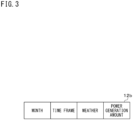
- FIG. 3 is a conceptual diagram of the power generation amount table 12b.
- the power generation amount table 12b retains a month, a time frame, and a weather, and a power generation amount of the generator 8 expected in these conditions, in association with one another.
- FIG. 4 is a conceptual diagram of the power consumption table 12c.
- the power consumption table 12c retains an apparatus identifier for identifying each power consuming apparatus 7, the name of each apparatus, an operation manner, and apparatus power consumption in the operation manner, in association with one another.
- the operation manner is information indicating a specific operation state such as whether the operation mode is a normal operation mode or a power saving operation mode, or a set temperature of the air conditioner 72.
- FIG. 5 is a flow chart showing a processing procedure of response setting.
- the power management device 1 performs the following process for response setting for the DR request.
- the control unit 11 of the power management device 1 transmits, to the communication terminal 4 via the first communication unit 14, information regarding a setting screen for receiving a response setting for the DR request, and causes the setting screen to be displayed on the display unit of the communication terminal 4 (step S11).
- control unit 11 transmits, to the communication terminal 4 via the first communication unit 14, an outline of the history information 12e such as a power consumption amount in the building, and information related to the newly contracted DR request (step S12).
- the communication terminal 4 having received the information displays information related to a predetermined DR request and the tendency of past power consumption in the building.
- control unit 11 receives a response setting of a response method to be employed when the DR request is made (step S13), stores in the storage unit 12 the received setting content in association with a DR identifier (step S14), and ends the process.
- FIG. 6 is a conceptual diagram of a response setting content.
- the setting content of the response setting is roughly classified into two categories.
- a first setting "Always accept in principle” is a setting in which, in response to a DR request, response information indicating that the DR request is accepted is automatically transmitted without confirmation by the power customer 10, in principle.
- a second setting "Always select acceptance or rejection” is a setting in which, with respect to a DR request, confirmation by the power customer 10 is always performed, and in accordance with the selection by the power customer 10, response information indicating that the DR request is accepted or rejected is transmitted.
- the first setting corresponds to "notification-omitted response setting” in the present aspect above
- the second setting corresponds to "selection response setting” in the present aspect above.
- the power customer 10 may select "Always accept in principle". In a situation in which disadvantages are caused at a high frequency by rejecting the DR request, the power customer 10 may select "Always accept in principle”. In a case where advantages can be obtained if the DR request is accepted, but comfort could be impaired, "Always select" may be selected.
- a notification-permitted time frame in which a notification to the power customer 10 of the presence of a DR request is permitted, or a notification-prohibited time frame can be set.
- the power customer 10 can set a time frame in which the power customer 10 does not want to receive a notification regarding a DR request, such as midnight.
- step S13 and step S14 the setting contents described above are stored in the response setting table 12d.
- FIG. 7 is a sequence diagram showing a processing procedure regarding accumulation of the history information 12e of power consumption, weather information, and the like.
- FIG. 8 is a schematic diagram indicating the history information 12e stored in the storage unit 12.
- the power management device 1 collects information of the power consumption, weather, and power generation amount in the building periodically at predetermined timings, and accumulates the information as the history information 12e. The details are as follows.
- the control unit 11 of the power management device 1 performs communication with the watt-hour meter 5, and acquires, from the watt-hour meter 5, power consumption information indicating the power, the total amount of power, or the like consumed in the building (step S31).
- the control unit 11 performs communication with the thermometer-hygrometer 6, and acquires weather information indicating the air temperature and the humidity outside the building (step S32). Further, the control unit 11 performs communication with each power consuming apparatus 7, and acquires operation information indicating the operation manner of the power consuming apparatus 7 (step S33). Further, the control unit 11 performs communication with the generator 8, and acquires power generation amount information indicating the amount of power generated by the generator 8 (step S34).
- control unit 11 performs communication with the storage battery 9, and acquires power storage amount information indicating the current power storage amount (step S35). Then, as shown in FIG. 8 , the control unit 11 associates the power consumption information, the weather information, the operation information, the power generation amount information, and the power storage amount information acquired in step S31 to step S35, with the current year, month, day, and time frame, and stores the resultant information in the storage unit 12, as the history information 12e (step S36).
- FIG. 9 is a sequence diagram showing a processing procedure of response to a DR request.
- the power supply-demand management device 2 having received a power consumption reduction request transmitted from the power system monitoring device A of the power supplier transmits a DR request to the power management device 1 of each building in order to achieve the reduction request for power consumption (step S51).
- the power management device 1 When having received the DR request transmitted from the power supply-demand management device 2, the power management device 1 performs communication with the weather information providing device 3, and acquires weather prediction information indicating the air temperature, the humidity, or the like in a power-saving-required time frame (step S52). Next, on the basis of the history information 12e stored in the storage unit 12, the control unit 11 of the power management device 1 determines the ease or difficulty in power management to achieve the power saving target in the power-saving-required time frame indicated by the DR request (step S53).
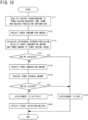
- FIG. 10 is a flow chart showing a processing procedure regarding determination of the ease or difficulty in achieving a power saving target.
- the control unit 11 reads out a record similar to the time frame and the weather (step S71). That is, from the storage unit 12, the control unit 11 reads out, from the history information 12e in which the past power consumption amount and the like are recorded, records that have the same time frame as the power-saving-required time frame requested by the DR request and in which the temperature and humidity in the time frame are close to prediction values of the temperature and humidity in the power-saving-required time frame.
- the control unit 11 predicts a power consumption amount in the power-saving-required time frame (step S72). For example, as a power consumption amount in the power-saving-required time frame, the control unit 11 predicts a statistic amount such as an average value, a modal value, or the like of a plurality of records of power consumption amounts having been read out.
- control unit 11 calculates the difference between the prediction value of the power consumption amount and the amount of power of the power saving target of the DR request (step S73), and determines whether or not the power saving target can be achieved (step S74).
- step S74 determines that the power saving target is easy to be achieved (step S78), and ends the determination process.
- the control unit 11 predicts a power generation amount of the generator 8 on the basis of the weather prediction information in the power-saving-required time frame, in particular, on the basis of the weather information (step S75). Specifically, on the basis of the weather prediction information, and the information of the year, month, day, and time frame for which power saving according to the DR request is required, the control unit 11 reads out a corresponding power generation amount from the power generation amount table 12b, thereby predicting a power generation amount of the generator 8.
- control unit 11 performs communication with the storage battery 9, and acquires the current power storage amount of the storage battery 9 (step S76).
- control unit 11 determines whether or not the difference calculated in step S73 can be covered by the power generation amount of the generator 8 and discharge by the storage battery 9 (step S77).
- step S77 determines that the difference can be covered
- step S78 determines that the power saving target is easy to be achieved
- step S77 When having determined that the difference cannot be covered (step S77: NO), i.e., the power saving target cannot be achieved even in consideration of the power generation amount and the power storage amount, the control unit 11 determines that the power saving target is difficult to be achieved (step S79). Next, with reference to the power consumption table 12c, the control unit 11 specifies a method for achieving the power saving target (step S80).
- the control unit 11 specifies an operation manner of each power consuming apparatus 7. Then, the control unit 11 specifies an operation mode or an operation manner of each power consuming apparatus 7 for enabling suppression of power consumption necessary for achieving the power saving target. For example, in a case where the past set temperature of the air conditioner 72 referred to was 25°C and a normal operation mode was set, when the power consumption needs to be further suppressed by 0.5 [kW] in order to achieve the power saving target, the control unit 11 specifies switching to "set at 29°C" or "power saving mode" as the operation mode of the air conditioner 72.
- the ease or difficulty in achieving the power saving target and the operation manner of each power consuming apparatus 7 necessary for achieving the power saving target can be specified.
- a method for determining the ease or difficulty in achieving the power saving target an example has been described in which it is determined whether or not the above-described difference can be covered by power generation and discharge.
- the above-described method is merely an example.
- the control unit 11 of the power management device 1 reads out, from the response setting table 12d, a response setting that corresponds to the DR identifier included in a DR request, and performs the following process in accordance with the read out response setting.
- the power management device 1 transmits, to the communication terminal 4, information indicating the ease or difficulty in achieving the power saving target of the DR request and information indicating an operation manner and the like of each power consuming apparatus 7 necessary for achieving the power saving target (step S54).
- a message is displayed on the display unit of the communication terminal 4, such as "Acceptance of the DR request is difficult. If the air conditioner is not used from 13:00 to 15:00 in the power-saving-required time frame, the power saving target can be achieved. There is no penalty for rejection of the DR request. Do you accept?" When the power saving target is easy to be achieved, a message is displayed on the display unit of the communication terminal 4, such as "The power saving target of the DR request can probably be achieved. Do you accept?" Through notification of these messages, the power customer 10 can recognize the degree of difficulty in achieving the power saving target, and then select acceptance or rejection of the DR request.
- the power management device 1 waits until the notification-permitted time frame arrives or the notification-prohibited time frame ends, and after the end of the time frame, the power management device 1 transmits information related to the DR request, and information indicating the operation manner, etc., to the communication terminal 4.
- the power management device 1 performs communication with the communication terminal 4, and receives selection of acceptance or rejection of the DR request (step S55). Then, in accordance with the received content, the power management device 1 transmits, to the power supply-demand management device 2, response information indicating acceptance or rejection of the DR request (step S56).
- the power management device 1 transmits, to the power supply-demand management device 2, response information indicating acceptance or rejection of the DR request, in accordance with the setting content set as the response setting in advance (step S57).
- the power management device 1 transmits, to the power supply-demand management device 2, response information indicating acceptance of the DR request (step S58).
- the power management device 1 detects the current power consumption in the building by performing communication with the watt-hour meter 5, and controls the operation of each power consuming apparatus 7, etc., thereby managing the power consumption so that the power saving target is achieved (step S59). For example, when the current power consumption is greater than the power consumption of the power saving target, the power management device 1 transmits apparatus control information to each power consuming apparatus 7, to switch each power consuming apparatus 7 into a power saving operation mode. When the power storage amount of the storage battery 9 is not less than a predetermined amount, the power management device 1 transmits, to the storage battery 9, apparatus control information that instructs discharge.
- the storage battery 9 When having received the apparatus control information, the storage battery 9 performs discharge, thereby supplying power to each power consuming apparatus 7. In a case where the power consumption is greater than the power consumption of the power saving target even after the operation mode has been switched, the storage battery 9 has discharged, and switching to the power saving operation mode has been performed, the power management device 1 transmits, to a predetermined power consuming apparatus 7, apparatus control information for stopping the operation. When having received the apparatus control information, the power consuming apparatus 7 stops the operation.
- the power management device 1 transmits a power management result, i.e., a power saving result to the power supply-demand management device 2 (step S60).
- a power management result for example, the information such as the following is transmitted: the DR identifier, whether or not the power saving target of the DR request has been achieved, the power consumption amount in the power-saving-required time frame, the power consumption amount having been reduced, the identifier of the power management device 1, and the like.
- the power management device 1 configured as above, as the information for determining whether or not a request based on demand response should be accepted, information regarding the ease or difficulty in the power management according to the DR request can be provided to the power customer 10.
- the power management device 1 can determine the ease or difficulty in management of the power consumption according to the DR request, in consideration of the weather information such as the temperature and the humidity.
- the power management device 1 can determine the ease or difficulty in management of the power consumption according to the DR request, in consideration of the power generation amount of the generator 8.
- the power management device 1 can determine the ease or difficulty in management in the power consumption according to the DR request, in consideration of the power storage amount of the storage battery 9.
- the power management device 1 can specify an operation manner of each power consuming apparatus 7 necessary for achieving the power saving target of the DR request, with reference to the power consumption table 12c, and can notify the power customer 10 of the operation manner.
- the power customer 10 can determine whether or not to accept the DR request in consideration of the operation manner. Therefore, the power consumption can be managed in a reasonable and effective manner.
- the power management device 1 when the power management device 1 has received a DR request and it is easy to achieve the power saving target of the DR request, the power management device automatically transmits response information indicating acceptance of the DR request, to the power supply-demand management device 2. Therefore, a wasteful notification of the presence of the DR request to the power customer 10 can be avoided.
- the power management device 1 notifies the power customer 10 of the difficulty, receives selection of acceptance or rejection of the DR request, and transmits response information corresponding to the received result, to the power supply-demand management device 2. Therefore, automatic acceptance of a problematic DR request can be avoided.
- the power customer 10 can confirm the presence of the DR request and the ease or difficulty in achieving the power saving target every time, and can manage the power consumption in the building in a reasonable and effective manner.
- the power customer 10 can recognize the outline of the DR request to be requested in the future, the state of the power consumption in the past in the building, and the like, and can set a response method on the basis of the recognition.
- a notification regarding the DR request is made to the power customer 10. Therefore, it is possible to avoid making a notification regarding the DR request in a time frame in which the power customer 10 does not wish to receive the notification.
- the power management device 1 is provided in the building of the power customer 10, the power consumption in the building can be managed on the building side.
- the power management device 1 can make a notification regarding the DR request through the communication terminal 4 of the power customer 10.
- the power customer 10 can receive the notification of the DR request through the communication terminal 4 and select acceptance or rejection of the DR request.
- the power generation amount of the generator 8 is predicted with use of the power generation amount table 12b.
- the power generation amount may be predicted on the basis of the history information 12e. That is, the control unit 11 stores the weather in addition to the air temperature and the humidity as the history information 12e. Then, in step S74, from the history information 12e, the control unit 11 may read out a record that includes weather information similar to the weather prediction information in the power-saving-required time frame, in particular, a similar weather, and on the basis of the record, the control unit 11 may predict a power generation amount of the generator 8.
- Modification 1 when the history information 12e has been sufficiently accumulated, the power generation amount of the generator 8 can be more accurately predicted, and the degree of difficulty in achieving the power saving target of the DR request can be determined.
- the operation manner may be specified on the basis of the history information 12e. For example, only records that have the same power-saving-required time frame and the same weather information, and that have power saving targets having been achieved, are extracted, and the operation manners of the respective power consuming apparatuses 7 stored in the records are extracted, whereby operation manners of the respective power consuming apparatuses 7 for enabling achievement of the power saving target may be specified.
- the watt-hour meter 5 may detect the power consumption of each power consuming apparatus 7, and may store, in the storage unit 12, the power consumption and the operation manner of each power consuming apparatus 7, as the history information 12e.
- the power management device 1 can specify the relationship between the operation manner and the power consumption of each power consuming apparatus 7 on the basis of the history information 12e. By using the specified relationship between the operation manner and the power consumption, the power management device 1 can specify an operation manner necessary for achieving the power saving target.
- the power management device 1 can specify an operation manner of each power consuming apparatus 7 necessary for achieving the power saving target of the DR request, and can notify the power customer 10 of the operation manner.
- the power customer 10 can determine whether or not to accept the DR request, in consideration of the operation manner. Therefore, the power consumption can be managed in a reasonable and effective manner.
- control program 12a is stored in the storage unit 12
- a mode may be employed in which the control program 12a according to the present embodiment is recorded in a computer readable storage medium (not shown).
- the control program 12a read out from the storage medium by a reading device (not shown) is stored in the storage unit 12.
- the storage medium is an optical disk such as a CD (Compact Disc)-ROM, a DVD (Digital Versatile Disc)-ROM, or a BD (Blu-ray (registered trade mark) Disc), a magnetic disk such as a flexible disk or a hard disk, a magnetic optical disk, a semiconductor memory, or the like.
- the control program 12a according to the present embodiment may be downloaded from an external computer (not shown) connected to a communication network (not shown), and may be stored in the storage unit 12.
Landscapes
- Engineering & Computer Science (AREA)
- Theoretical Computer Science (AREA)
- Physics & Mathematics (AREA)
- General Physics & Mathematics (AREA)
- General Engineering & Computer Science (AREA)
- Power Engineering (AREA)
- Automation & Control Theory (AREA)
- Business, Economics & Management (AREA)
- Health & Medical Sciences (AREA)
- Computer Hardware Design (AREA)
- Economics (AREA)
- Water Supply & Treatment (AREA)
- Marketing (AREA)
- Computer Networks & Wireless Communication (AREA)
- Radar, Positioning & Navigation (AREA)
- Electromagnetism (AREA)
- Public Health (AREA)
- Signal Processing (AREA)
- General Health & Medical Sciences (AREA)
- Human Resources & Organizations (AREA)
- Computing Systems (AREA)
- Primary Health Care (AREA)
- Strategic Management (AREA)
- Tourism & Hospitality (AREA)
- General Business, Economics & Management (AREA)
- Remote Monitoring And Control Of Power-Distribution Networks (AREA)
- Supply And Distribution Of Alternating Current (AREA)
- Management, Administration, Business Operations System, And Electronic Commerce (AREA)
Description
- The present invention relates to a power management device, a power management system, a power management method, and a control program.
- Associated with advancement of power deregulation, HEMS (Home Energy Management System) and BEMS (Building Energy Management System) in which energy management is performed on the power customer side such as houses and office buildings are increasingly being used. In addition, distributed-type energy management systems in which, in accordance with the power supply and demand status, HEMS and BEMS are caused to operate in coordination so as to maintain the balance between the power supply and demand of the entirety of a power system, have been studied for realization.
- As a scheme for maintaining the balance between power supply and demand, "demand response" (DR) is attracting attention. Demand response is a scheme in which, when the power supply and demand is tight, a power supplier requests a power customer to save power, and the power customer adjusts power consumption in accordance with the request so that the balance between the power supply and demand is maintained. There are various forms for agreements (DR program) regarding the demand response. For example, a power customer who has accepted a request can obtain a predetermined consideration when the power customer has achieved a reduction target of power consumption. When the power customer fails in achieving the reduction target, a penalty is imposed, and the power customer has to pay penalty money. PATENT LITERATURE 1 discloses a technology for presenting, to a power customer, monetary effects, environmental effects, etc., obtained by complying with a request for power saving.
-
JP 2015 216760 A - PATENT LITERATURE 1: International Publication No.
2016/071956 - A power management device according to the present aspect is configured to manage power consumption in a building of a power customer. The power management device includes: a power-consumption-information acquisition unit configured to acquire power consumption information indicating the power consumption in the building; a storage unit having stored therein history information including at least the power consumption information acquired by the power-consumption-information acquisition unit, and time information indicating a time frame in which power according to the power consumption information has been consumed in the building, the power consumption information and the time information being associated with each other in the history information; a request reception unit configured to receive a request based on power supply and demand; a determination unit configured to, when the request reception unit has received the request, determine ease or difficulty in management of the power consumption according to the request, on the basis of the history information stored in the storage unit, and power-management-required time frame information indicating a time frame for which power management according to the request is required; a notification unit configured to notify the power customer of a determination result by the determination unit; a reception unit configured to receive acceptance or rejection of the request; and a response transmission unit configured to transmit, to a request source, response information corresponding to a content received by the reception unit.
- A power management system according to the present aspect includes: the power management device; a power supply-demand management device configured to transmit the request based on power supply and demand to the power management device; and a communication terminal configured to perform communication with the power management device. The power management device notifies the power customer of the determination result via the communication terminal, receives acceptance or rejection of the request, and transmits the response information corresponding to a received content to the power supply-demand management device.
- A power management method according to the present aspect is for managing power consumption in a building of a power customer. The power management method includes: acquiring power consumption information indicating the power consumption in the building; storing history information including at least the acquired power consumption information, and time information indicating a time frame in which power according to the power consumption information has been consumed in the building, the power consumption information and the time information being associated with each other in the history information; receiving a request based on power supply and demand; determining, when having received the request, ease or difficulty in management of the power consumption according to the request, on the basis of the history information, and power-management-required time frame information indicating a time frame for which power management according to the request is required; notifying the power customer of a determination result; receiving acceptance or rejection of the request; and transmitting response information corresponding to a received content, to a request source.
- A control program according to the present aspect is for causing a computer configured to manage power consumption in a building of a power customer, to operate and perform the processes of: acquiring power consumption information indicating the power consumption in the building; storing history information including at least the acquired power consumption information, and time information indicating a time frame in which power according to the power consumption information has been consumed in the building, the power consumption information and the time information being associated with each other in the history information; receiving a request based on power supply and demand; determining, when having received the request, ease or difficulty in management of the power consumption according to the request, on the basis of the history information, and power-management-required time frame information indicating a time frame for which power management according to the request is required; notifying the power customer of a determination result; receiving acceptance or rejection of the request; and transmitting response information corresponding to a received content, to a request source.
-
-
FIG. 1 is a schematic diagram showing a configuration example of a power management system according to the present embodiment. -
FIG. 2 is a block diagram showing a configuration example of a power management device according to the present embodiment. -
FIG. 3 is a conceptual diagram of a power generation amount table. -
FIG. 4 is a conceptual diagram of a power consumption table. -
FIG. 5 is a flow chart showing a processing procedure of response setting. -
FIG. 6 is a conceptual diagram of a response setting content. -
FIG. 7 is a sequence diagram showing a processing procedure regarding accumulation of history information of power consumption, weather information, and the like. -
FIG. 8 is a schematic diagram indicating the history information stored in a storage unit. -
FIG. 9 is a sequence diagram showing a processing procedure of response to a DR request. -
FIG. 10 is a flow chart showing a processing procedure regarding determination of the ease or difficulty in achieving a power saving target. - The power management device mentioned above has a technological problem as follows. That is, information for determining whether or not a request regarding demand response should be accepted, in particular, information for determining the degree of difficulty in achieving the power saving target, cannot be provided to the power customer, and the balance between power supply and demand cannot be maintained in a reasonable and effective manner.
- An object of the present disclosure is to provide a power management device, a power management system, a power management method, and a control program that enable providing to the power customer, as information for determining whether or not a request regarding demand response should be accepted, information regarding ease or difficulty in power management according to the request.
- According to the present disclosure, it becomes possible to provide a power management device, a power management system, a power management method, and a control program that enable providing to the power customer, as information for determining whether or not a request regarding demand response should be accepted, information regarding ease or difficulty in power management according to the request.
- First, embodiments of the present disclosure are listed and described. At least some parts of the embodiment described below may be combined as desired.
-
- (1) A power management device according to the present aspect is configured to manage power consumption in a building of a power customer. The power management device includes: a power-consumption-information acquisition unit configured to acquire power consumption information indicating the power consumption in the building; a storage unit having stored therein history information including at least the power consumption information acquired by the power-consumption-information acquisition unit, and time information indicating a time frame in which power according to the power consumption information has been consumed in the building, the power consumption information and the time information being associated with each other in the history information; a request reception unit configured to receive a request based on power supply and demand; a determination unit configured to, when the request reception unit has received the request, determine ease or difficulty in management of the power consumption according to the request, on the basis of the history information stored in the storage unit, and power-management-required time frame information indicating a time frame for which power management according to the request is required; a notification unit configured to notify the power customer of a determination result by the determination unit; a reception unit configured to receive acceptance or rejection of the request; and a response transmission unit configured to transmit, to a request source, response information corresponding to a content received by the reception unit.
- When having received a request based on power supply and demand, the power management device determines ease or difficulty in management of the power consumption according to the request, and notifies the power customer of the determination result. The request based on power supply and demand is, for example, a power saving request that requires suppression of power consumption. The power management device determines ease or difficulty in the power saving and notifies the power customer of the determination result. Therefore, it is possible to cause the power customer to recognize the degree of difficulty in the power management according to the request.
- Then, the power management device receives an instruction on whether or not to accept the request from the power customer, and transmits response information corresponding to the received content, to the request source. As described above, according to the present aspect, the power customer can comply with the request based on power supply and demand after grasping the degree of difficulty in the power management. Therefore, the power consumption can be managed in a reasonable and effective manner.
- The request based on power supply and demand is not limited to a power saving request, and may be a request regarding provision of power obtained through power generation in a building.
- (2) Preferably, the power management device includes: a weather information acquisition unit configured to acquire weather information indicating a weather in a vicinity of the building; and a prediction information acquisition unit configured to acquire weather prediction information indicating a predicted weather in the vicinity of the building. The history information further includes the weather information acquired by the weather information acquisition unit, and at least the power consumption information, the time information, and the weather information are associated with one another in the history information. The determination unit determines the ease or difficulty in the management of the power consumption according to the request, on the basis of the history information stored in the storage unit, the weather prediction information acquired by the prediction information acquisition unit, and the power-management-required time frame information indicating the time frame for which the power management according to the request is required.
- The power management device can determine the ease or difficulty in the management of the power consumption according to the request based on power supply and demand, in consideration of the weather information such as temperature and humidity.
- (3) Preferably, the weather prediction information includes information indicating the predicted weather in the vicinity of the building. The power management device includes a power generation amount prediction unit configured to predict a power generation amount of a generator configured to generate power by use of energy of sunlight, on the basis of the weather prediction information acquired by the prediction information acquisition unit. The determination unit determines the ease or difficulty in the management of the power consumption according to the request, on the basis of the history information stored in the storage unit, the weather prediction information acquired by the prediction information acquisition unit, the power-management-required time frame information indicating the time frame for which the power management according to the request is required, and a prediction result of the power generation amount prediction unit.
- The power management device can determine the ease or difficulty in the management of the power consumption according to the request based on power supply and demand, in consideration of the power generation amount of the generator.
- (4) Preferably, the power management device includes a power storage amount information acquisition unit configured to acquire power storage amount information indicating a power storage amount of a storage battery provided in the building. The determination unit determines the ease or difficulty in the management of the power consumption according to the request, on the basis of the history information stored in the storage unit, the power-management-required time frame information indicating the time frame for which the power management according to the request is required, and the power storage amount information acquired by the power storage amount information acquisition unit.
- The power management device can determine the ease or difficulty in the management of the power consumption according to the request based on power supply and demand, in consideration of the power storage amount of the storage battery.
- (5) Preferably, the storage unit has stored therein a relationship between an operation manner of a power consuming apparatus provided in the building and an apparatus power consumption indicating power consumed by the power consuming apparatus in the operation manner. The power management device further includes: a specifying unit configured to specify the operation manner of the power consuming apparatus for enabling the management of the power consumption according to the request, on the basis of the history information stored in the storage unit, and the relationship between the operation manner and the apparatus power consumption; and an operation manner notification unit configured to notify the power customer of the operation manner specified by the specifying unit.
- On the basis of the relationship between the operation manner of the power consuming apparatus and the apparatus power consumption stored in the storage unit, the power management device specifies an operation manner, of the power consuming apparatus, that realizes the management of the power consumption according to the request based on power supply and demand, and notifies the power customer of the specified operation manner. Therefore, with reference to the operation manner, the power customer can more specifically consider whether or not the power management according to the request can be achieved, and can determine whether or not to accept the request. Therefore, the power consumption can be managed in a reasonable and effective manner.
- (6) Preferably, the power management device includes an operation information acquisition unit configured to acquire operation information indicating an operation manner of a power consuming apparatus provided in the building. The history information further includes the operation information acquired by the operation information acquisition unit, and at least the power consumption information, the time information, and the operation information are associated with one another in the history information. The power management device further includes: a specifying unit configured to specify the operation manner of the power consuming apparatus for enabling the management of the power consumption according to the request, on the basis of the history information stored in the storage unit; and an operation manner notification unit configured to notify the power customer of the operation manner specified by the specifying unit.
- On the basis of the history information, the power management device notifies the power customer of an operation manner, of the power consuming apparatus, that realizes the management of the power consumption according to the request based on power supply and demand. Therefore, with reference to the operation manner, the power customer can more specifically consider whether or not the power management according to the request can be achieved, and can determine whether or not to accept the request. Therefore, the power consumption can be managed in a reasonable and effective manner.
- (7) Preferably, the power management device includes a notification-omitted response setting reception unit configured to receive a notification-omitted response setting in which, when the request reception unit has received the request, if the determination unit has made a determination of being easy, the notification of the determination result by the notification unit is omitted, and the response information indicating that, with respect to the request, the request is to be accepted is transmitted to the request source. Under operation in the notification-omitted response setting, when the determination unit has made a determination of being easy, the response transmission unit transmits the response information indicating that the request is to be accepted, and when the determination unit has made a determination of being difficult, the notification unit notifies the power customer of the determination result irrespective of the notification-omitted response setting.
- When the power management according to the request is easy, the power management device transmits, to the request source, response information indicating acceptance of the request, without notifying the determination result as to the ease or difficulty in the power management according to the request. Therefore, a wasteful notification of the presence of the request to the power customer can be avoided.
- Meanwhile, when the power management according to the request is difficult to be achieved, the power management device notifies the power customer of the difficulty, receives selection of acceptance or rejection of the request, and transmits response information corresponding to the received result, to the request source. Therefore, acceptance of a problematic request against the will of the power customer can be avoided.
- (8) Preferably, the power management device includes a selection response setting reception unit configured to receive a selection response setting in which determination by the power customer with respect to the request is required every time. Under operation in the selection response setting, every time the request is received, the notification unit notifies the power customer of the determination result by the determination unit.
- When a request based on power supply and demand is received, a determination result as to the ease or difficulty in the power management according to the request is notified of to the power customer, irrespective of the determination result. Therefore, the power customer can recognize the presence of the request based on power supply and demand, and the ease or difficulty of the achievement. Then, the power management device receives a selection of acceptance or rejection of the request from the power customer, and transmits response information corresponding to the received result, to the request source. Therefore, the power customer can confirm the ease or difficulty in the power management according to the request every time, and can manage the power consumption in the building in a reasonable and effective manner.
- (9) Preferably, information related to a predetermined request based on power supply and demand, and information according to the history information stored in the storage unit are notified of to the power customer.
- Before a setting of a response method to the request is received, information related to a predetermined request and information according to the history information stored in the storage unit are notified of to the power customer. Therefore, the power customer can recognize the outline of the predetermined request to be requested in the future, the state of the power consumption in the past in the building, and the like, and can set a response method on the basis of the recognition.
- (10) Preferably, the power management device includes a notification time frame storage unit having stored therein a notification-permitted time frame for which a notification to the power customer is permitted, or a notification-prohibited time frame for which a notification to the power customer is prohibited. The notification unit performs a notification in the notification-permitted time frame stored in the notification time frame storage unit or in a time frame other than the notification-prohibited time frame stored in the notification time frame storage unit.
- In the present aspect, only in a notification-permitted time frame, a notification regarding the request is made to the power customer. Therefore, the notification is not made to the customer in a time frame other than the notification-permitted time frame, or in the notification-prohibited time frame.
- (11) Preferably, the power management device is provided and operates in the building of the power customer.
- In the present aspect, the power consumption in the building can be managed on the building side.
- (12) Preferably, the notification unit makes a notification to a communication terminal of the power customer.
- The power management device can make a notification regarding the request through the communication terminal of the power customer.
- (13) A power management system according to the present aspect includes: the power management device according to aspect (12); a power supply-demand management device configured to transmit the request based on power supply and demand to the power management device; and the communication terminal configured to perform communication with the power management device. The power management device notifies the power customer of the determination result via the communication terminal, receives acceptance or rejection of the request, and transmits the response information corresponding to a received content to the power supply-demand management device.
- In the present aspect, when the power management device has received a request based on power supply and demand transmitted from the power supply-demand management device, the power management device determines the ease or difficulty in management of the power consumption according to the request, and notifies the power customer of the determination result through the communication terminal. Then, the power management device receives, through the communication terminal, an instruction on whether or not to accept the request, and transmits response information corresponding to the received content, to the power supply-demand management device.
- Therefore, the power customer can comply with the request based on power supply and demand after grasping the degree of difficulty in the power management. Therefore, the power consumption can be managed in a reasonable and effective manner.
- (14) A power management method according to the present aspect is for managing power consumption in a building of a power customer. The power management method includes: acquiring power consumption information indicating the power consumption in the building; storing history information including at least the acquired power consumption information, and time information indicating a time frame in which power according to the power consumption information has been consumed in the building, the power consumption information and the time information being associated with each other in the history information; receiving a request based on power supply and demand; determining, when having received the request, ease or difficulty in management of the power consumption according to the request, on the basis of the history information, and power-management-required time frame information indicating a time frame for which power management according to the request is required; notifying the power customer of a determination result; receiving acceptance or rejection of the request; and transmitting response information corresponding to a received content, to a request source.
- In the present aspect, similar to aspect (1), as the information for determining whether or not a request regarding demand response should be accepted, information regarding the ease or difficulty in the power management according to the request can be provided to the power customer.
- (15) A control program according to the present aspect is for causing a computer configured to manage power consumption in a building of a power customer, to operate and perform the processes of: acquiring power consumption information indicating the power consumption in the building; storing history information including at least the acquired power consumption information, and time information indicating a time frame in which power according to the power consumption information has been consumed in the building, the power consumption information and the time information being associated with each other in the history information; receiving a request based on power supply and demand; determining, when having received the request, ease or difficulty in management of the power consumption according to the request, on the basis of the history information, and power-management-required time frame information indicating a time frame for which power management according to the request is required; notifying the power customer of a determination result; receiving acceptance or rejection of the request; and transmitting response information corresponding to a received content, to a request source.
- In the present aspect, similar to aspect (1), as the information for determining whether or not a request regarding demand response should be accepted, information regarding the ease or difficulty in the power management according to the request can be provided to the power customer.
- In the following, specific examples of a power management system according to an embodiment of the present disclosure will be described with reference to the drawings. The present disclosure is not limited to these examples and is indicated by the claims, and is intended to include meaning equivalent to the claims and all modifications within the scope of the claims.
-
FIG. 1 is a schematic diagram showing a configuration example of a power management system according to the present embodiment. The power management system according to the present embodiment includes: a power management device 1 provided in a building such as a house or an office building of apower customer 10; a power supply-demand management device 2 connected to the power management device 1 via a communication network; a weatherinformation providing device 3, and a communication terminal 4 of thepower customer 10. One power management device 1 provided in one building is shown inFIG. 1 . However, in actuality, a plurality of power management devices 1 respectively provided in a large number of buildings (not shown) are connected to the power supply-demand management device 2 via the communication network. - The power management system is a distributed-type energy management system in which the balance between power supply and demand is adjusted by causing the power management devices 1 in respective buildings to operate in coordination. The outline of the power management system is as follows.
- The power management device 1 is a HEMS or a BEMS that performs energy management of a house or an office building. A watt-
hour meter 5, a thermometer-hygrometer 6, power consuming apparatuses 7, a generator 8, and astorage battery 9 are connected to the power management device 1. The power supply-demand management device 2 receives a power consumption reduction request transmitted from a power system monitoring device A of a power supplier when the power supply and demand is tight. Then, the power supply-demand management device 2 transmits a DR (Demand Response) request regarding power saving, to the power management device 1 of eachpower customer 10. The DR request includes information of: a DR identifier that identifies the DR request; a power-saving-required time frame in which power consumption should be suppressed; a power saving target that indicates power consumption that should be suppressed; a response deadline for the DR request; and the like. The information indicating the power-saving-required time frame corresponds to power-management-required time frame information of the present aspect above. The power saving target may be expressed in terms of an upper limit value of power consumption in a building, a reduction amount or reduction proportion of power consumption, or the like. Each power management device 1 receives a selection of acceptance or rejection of a DR request via the communication terminal 4, and transmits, to the power supply-demand management device 2, response information indicating acceptance or rejection of the DR request. The power management device 1 of thepower customer 10 having accepted the DR request performs control of suppressing power consumption in the building such that the power saving target is achieved. - The power supply-demand management device 2 adjusts the balance between power supply and demand of the entirety of the power system by causing the power management devices 1 in the houses and office buildings to operate in coordination in this manner.
-
FIG. 2 is a block diagram showing a configuration example of the power management device 1 according to the present embodiment. The power management device 1 is a computer including acontrol unit 11 that controls operations of components. Astorage unit 12, aclock unit 13, afirst communication unit 14, and asecond communication unit 15 are connected to thecontrol unit 11. - For example, the
control unit 11 is a microcomputer having a CPU (Central Processing Unit), a ROM (Read Only Memory), a RAM (Random Access Memory), and the like. Thecontrol unit 11 operates as the power management device 1 by executing acontrol program 12a stored in thestorage unit 12, and by controlling operations of the respective components. The microcomputer is an example of thecontrol unit 11, and thecontrol unit 11 may be implemented as a DSP (Digital Signal Processor). Thecontrol unit 11 may be implemented as a combination of a general purpose microcomputer and a DSP. - The
storage unit 12 is a nonvolatile storage device such as an EEPROM (Electrically Erasable Programmable ROM), a flash memory, or a hard disk. Thestorage unit 12 has stored therein thecontrol program 12a for causing thecontrol unit 11 to execute processes regarding the DR request. - In addition, the
storage unit 12 has stored therein a power generation amount table 12b, a power consumption table 12c, and a response setting table 12d. The power generation amount table 12b retains information for predicting a power generation amount of the generator 8 on the basis of the season (month), time frame, weather, etc. As information for specifying an operation control method for each power consuming apparatus 7 for achieving a power saving target, the power consumption table 12c retains the relationship between an operation manner of the power consuming apparatus 7, and apparatus power consumption indicating power consumed by the power consuming apparatus 7 in the operation manner. The response setting table 12d retains a response method to a DR request, in association with each DR identifier. Further, thestorage unit 12 has stored thereinhistory information 12e in which the power consumption in the building, the temperature, the humidity, the operation manner of the power consuming apparatus 7, the power generation amount, the power storage amount, and the like are associated with time information. Details of each table and thehistory information 12e will be described later. - The
clock unit 13 measures the current year, month, day, day of the week, and time. Theclock unit 13 outputs, to thecontrol unit 11, time information necessary for recording thehistory information 12e such as power consumption in the building. - The
first communication unit 14 is connected to the power supply-demand management device 2, the weatherinformation providing device 3, and the communication terminal 4 via the communication network, whereby the power management device 1 can perform communication with each device. - The power supply-demand management device 2 manages: the power management devices 1 of a plurality of
power customers 10 who have a will to cooperate for reduction of power consumption; power consumption that can be reduced; information of thepower customers 10; and the like. The power supply-demand management device 2 is connected to the power system monitoring device A of the power supplier. When the power supply-demand management device 2 has received a power consumption reduction request transmitted from the power system monitoring device A, the power supply-demand management device 2 transmits a DR request regarding power saving, to the power management device 1. - The weather
information providing device 3 is connected to the power management device 1 via the communication network, and performs communication with the power management device 1. Periodically, or in response to a request from the power management device 1, the weatherinformation providing device 3 transmits, to the power management device 1, information of the current and future air temperature, humidity, weather, and the like in the vicinity of the building. - The communication terminal 4 is a smart phone, a tablet terminal having a wireless communication function, or the like of a
power customer 10, and is wirelessly connected to the power management device 1 via the communication network. The communication terminal 4 includes: a communication unit that performs communication with at least the power management device 1; a display unit for outputting information that is communicated; an output device such as a speaker; and an input device such as a touch panel and operation buttons. The communication terminal 4 can perform communication with the power management device 1 via the communication network. - The power management device 1 is configured such that, when having received a DR request, the power management device 1 transmits, as necessary, request notification information related to the DR request, to the communication terminal 4. The communication terminal 4 receives the request notification information and outputs the information related to the DR request.
- In addition, the communication terminal 4 receives acceptance or rejection of the DR request, and transmits, to the power management device 1, selection information indicating the received selection content.
- Further, the power management device 1 is configured to receive, through the communication terminal 4, a setting of a response method to the DR request.
- Although
FIG. 1 shows a state in which the communication terminal 4 is outside the building, the location of the communication terminal 4 is not limited in particular, and the communication terminal 4 may be located indoors or outdoors. In addition, a portable wireless communication device such as a smart phone is an example of the communication terminal 4, and it is sufficient that the communication terminal 4 functions as an interface. For example, the communication terminal 4 may be a controller having a monitor screen provided in the building. Further, the power management device 1 may be configured to perform communication with the communication terminal 4 via the power supply-demand management device 2. The power supply-demand management device 2 can perform secure communication by performing authentication of the power management device 1 and the communication terminal 4, and can relay the communication between the power management device 1 and the communication terminal 4. - The
second communication unit 15 is connected to the watt-hour meter 5, the thermometer-hygrometer 6, the power consuming apparatuses 7, the generator 8, and thestorage battery 9, via a wired or wireless intra-building communication network, and transmits and receives various information in accordance with a predetermined communication protocol. For example, thesecond communication unit 15 performs wireless communication with each power consuming apparatus 7, the generator 8, and thestorage battery 9, through wireless communication in accordance with a Wi-Fi standard. Thesecond communication unit 15 performs wireless communication with the watt-hour meter 5 through wireless communication in accordance with a Wi-SUN standard. As a matter of course, thesecond communication unit 15 may perform wireless communication with various apparatuses via a wireless LAN router, a gateway, or the like connected to an internal LAN of the power customer. - The watt-
hour meter 5 is a sensor that detects power being consumed in the building, and calculates the total amount of power having been consumed from a reference time point to the current time point. The watt-hour meter 5 is a smart meter, for example. The watt-hour meter 5 is connected to the power management device 1 in a wired or wireless manner, and can perform communication with the power management device 1. Periodically or in response to a request from the power management device 1, the watt-hour meter 5 transmits, to the power management device 1, power consumption information indicating the power or the total amount of power being consumed in the building. The power management device 1 can grasp the power or the total amount of power currently being consumed in the building, by receiving the power consumption information transmitted from the watt-hour meter 5. - The thermometer-
hygrometer 6 is a sensor that detects the air temperature and the humidity outside the building. The thermometer-hygrometer 6 is connected to the power management device 1 in a wired or wireless manner, and can perform communication with the power management device 1. Periodically or in response to a request from the power management device 1, the thermometer-hygrometer 6 transmits, to the power management device 1, weather information indicating the air temperature and the humidity in the vicinity of the building, i.e., outside the building. The power management device 1 can grasp the current air temperature and humidity outside the building, by receiving the weather information transmitted from the thermometer-hygrometer 6. - Each power consuming apparatus 7 is an apparatus that consumes power supplied from the power supplier, such as an
air conditioner 72, atelevision 73, alighting apparatus 71, a refrigerator (not shown), or a heat pump water heater (not shown), for example. For example, the power consuming apparatus 7 has a normal operation mode in which power consumption is not suppressed, and a power saving operation mode in which operation is performed with power consumption suppressed. The power consuming apparatus 7 is connected to the power management device 1 in a wired or wireless manner, and can perform communication with the power management device 1. The power management device 1 can transmit apparatus control information that instructs switching between operation modes, turning on and off a power source, or the like to each power consuming apparatus 7, individually. When having received the apparatus control information transmitted from the power management device 1, the power consuming apparatus 7 controls switching between operation modes, turning on and off the power source, or the like in accordance with the apparatus control information. - Each power consuming apparatus 7 can transmit, to the power management device 1, operation information indicating the operation mode, the on/off state, and the like of the power consuming apparatus 7 itself. The power management device 1 can recognize the operation mode, the on/off state, and the like of each power consuming apparatus 7, by receiving the operation information transmitted from the power consuming apparatus 7. In this manner, the power management device 1 recognizes the operation mode of each power consuming apparatus 7 and controls switching between the operation modes, thereby managing the power consumption in the building.
- For example, the generator 8 is a photovoltaic power generation apparatus that generates power by use of solar energy, a water heater that generates power by use of combustion waste heat of gas, an emergency power source that generates power with use of a gas turbine engine, or the like. Hereinafter, in the present embodiment, the generator 8 is assumed to be a photovoltaic power generation apparatus. The generator 8 is connected to the power management device 1 in a wired or wireless manner, and can perform communication with the power management device 1. The generator 8 can transmit, to the power management device 1, power generation amount information indicating a power generation amount. The power management device 1 can recognize the amount of power generated by the generator 8 and supplied to the building, by receiving the power generation amount information transmitted from the generator 8.
- The
storage battery 9 is a lithium ion storage battery, a nickel hydrogen battery, a lead storage battery, or the like that stores surplus power in the building or inexpensive nighttime power. Thestorage battery 9 may be a storage battery provided in the building or a storage battery installed in an electric automobile. Thestorage battery 9 is connected to the power management device 1 in a wired or wireless manner, and can perform communication with the power management device 1. Thestorage battery 9 can transmit, to the power management device 1, power storage amount information indicating a power storage amount. The power management device 1 can recognize the power storage amount in thestorage battery 9, by receiving the power storage amount information transmitted from thestorage battery 9. -
FIG. 3 is a conceptual diagram of the power generation amount table 12b. For example, the power generation amount table 12b retains a month, a time frame, and a weather, and a power generation amount of the generator 8 expected in these conditions, in association with one another. -
FIG. 4 is a conceptual diagram of the power consumption table 12c. For example, the power consumption table 12c retains an apparatus identifier for identifying each power consuming apparatus 7, the name of each apparatus, an operation manner, and apparatus power consumption in the operation manner, in association with one another. For example, the operation manner is information indicating a specific operation state such as whether the operation mode is a normal operation mode or a power saving operation mode, or a set temperature of theair conditioner 72. -
FIG. 5 is a flow chart showing a processing procedure of response setting. When a contract of a DR request service is concluded, the power management device 1 performs the following process for response setting for the DR request. Thecontrol unit 11 of the power management device 1 transmits, to the communication terminal 4 via thefirst communication unit 14, information regarding a setting screen for receiving a response setting for the DR request, and causes the setting screen to be displayed on the display unit of the communication terminal 4 (step S11). - Next, the
control unit 11 transmits, to the communication terminal 4 via thefirst communication unit 14, an outline of thehistory information 12e such as a power consumption amount in the building, and information related to the newly contracted DR request (step S12). The communication terminal 4 having received the information displays information related to a predetermined DR request and the tendency of past power consumption in the building. - Then, the
control unit 11 receives a response setting of a response method to be employed when the DR request is made (step S13), stores in thestorage unit 12 the received setting content in association with a DR identifier (step S14), and ends the process. - Although an example in which response setting is performed at the time of conclusion of a contract of a DR request service has been described, it is needless to say that the setting of a response method may be received at any timing.
-
FIG. 6 is a conceptual diagram of a response setting content. The setting content of the response setting is roughly classified into two categories. A first setting "Always accept in principle" is a setting in which, in response to a DR request, response information indicating that the DR request is accepted is automatically transmitted without confirmation by thepower customer 10, in principle. A second setting "Always select acceptance or rejection" is a setting in which, with respect to a DR request, confirmation by thepower customer 10 is always performed, and in accordance with the selection by thepower customer 10, response information indicating that the DR request is accepted or rejected is transmitted. The first setting corresponds to "notification-omitted response setting" in the present aspect above, and the second setting corresponds to "selection response setting" in the present aspect above. - In a situation in which advantages can be obtained at a high frequency by accepting the DR request, the
power customer 10 may select "Always accept in principle". In a situation in which disadvantages are caused at a high frequency by rejecting the DR request, thepower customer 10 may select "Always accept in principle". In a case where advantages can be obtained if the DR request is accepted, but comfort could be impaired, "Always select" may be selected. - Further, with respect to the first setting "Always accept in principle", it is possible to set the same in a way such that, when the power saving target is difficult to be achieved, a notification is made to the
power customer 10 as an exception, and whether or not to confirm acceptance or rejection of the DR request is set. - Further, a notification-permitted time frame in which a notification to the
power customer 10 of the presence of a DR request is permitted, or a notification-prohibited time frame can be set. For example, thepower customer 10 can set a time frame in which thepower customer 10 does not want to receive a notification regarding a DR request, such as midnight. - Further, it is possible to set whether or not to automatically accept a DR request when the response deadline for the DR request has elapsed before the notification-permitted time frame comes.
- Through the processes of step S13 and step S14, the setting contents described above are stored in the response setting table 12d.
-
FIG. 7 is a sequence diagram showing a processing procedure regarding accumulation of thehistory information 12e of power consumption, weather information, and the like.FIG. 8 is a schematic diagram indicating thehistory information 12e stored in thestorage unit 12. The power management device 1 collects information of the power consumption, weather, and power generation amount in the building periodically at predetermined timings, and accumulates the information as thehistory information 12e. The details are as follows. - The
control unit 11 of the power management device 1 performs communication with the watt-hour meter 5, and acquires, from the watt-hour meter 5, power consumption information indicating the power, the total amount of power, or the like consumed in the building (step S31). Thecontrol unit 11 performs communication with the thermometer-hygrometer 6, and acquires weather information indicating the air temperature and the humidity outside the building (step S32). Further, thecontrol unit 11 performs communication with each power consuming apparatus 7, and acquires operation information indicating the operation manner of the power consuming apparatus 7 (step S33). Further, thecontrol unit 11 performs communication with the generator 8, and acquires power generation amount information indicating the amount of power generated by the generator 8 (step S34). Still further, thecontrol unit 11 performs communication with thestorage battery 9, and acquires power storage amount information indicating the current power storage amount (step S35). Then, as shown inFIG. 8 , thecontrol unit 11 associates the power consumption information, the weather information, the operation information, the power generation amount information, and the power storage amount information acquired in step S31 to step S35, with the current year, month, day, and time frame, and stores the resultant information in thestorage unit 12, as thehistory information 12e (step S36). - The processing procedure described above is an example, and the flow of the process and the program structure are not limited to the process of the sequence diagram shown in
FIG. 7 . -
FIG. 9 is a sequence diagram showing a processing procedure of response to a DR request. The power supply-demand management device 2 having received a power consumption reduction request transmitted from the power system monitoring device A of the power supplier transmits a DR request to the power management device 1 of each building in order to achieve the reduction request for power consumption (step S51). - When having received the DR request transmitted from the power supply-demand management device 2, the power management device 1 performs communication with the weather
information providing device 3, and acquires weather prediction information indicating the air temperature, the humidity, or the like in a power-saving-required time frame (step S52). Next, on the basis of thehistory information 12e stored in thestorage unit 12, thecontrol unit 11 of the power management device 1 determines the ease or difficulty in power management to achieve the power saving target in the power-saving-required time frame indicated by the DR request (step S53). -
FIG. 10 is a flow chart showing a processing procedure regarding determination of the ease or difficulty in achieving a power saving target. On the basis of the power-saving-required time frame for which power saving is requested by the DR request and weather prediction information that corresponds to the power-saving-required time frame, thecontrol unit 11 reads out a record similar to the time frame and the weather (step S71). That is, from thestorage unit 12, thecontrol unit 11 reads out, from thehistory information 12e in which the past power consumption amount and the like are recorded, records that have the same time frame as the power-saving-required time frame requested by the DR request and in which the temperature and humidity in the time frame are close to prediction values of the temperature and humidity in the power-saving-required time frame. - Then, on the basis of the read out records, the
control unit 11 predicts a power consumption amount in the power-saving-required time frame (step S72). For example, as a power consumption amount in the power-saving-required time frame, thecontrol unit 11 predicts a statistic amount such as an average value, a modal value, or the like of a plurality of records of power consumption amounts having been read out. - Next, the
control unit 11 calculates the difference between the prediction value of the power consumption amount and the amount of power of the power saving target of the DR request (step S73), and determines whether or not the power saving target can be achieved (step S74). When having determined that the power saving target can be achieved (step S74: YES), thecontrol unit 11 determines that the power saving target is easy to be achieved (step S78), and ends the determination process. - When having determined that the power saving target cannot be achieved (step S74: NO), the
control unit 11 predicts a power generation amount of the generator 8 on the basis of the weather prediction information in the power-saving-required time frame, in particular, on the basis of the weather information (step S75). Specifically, on the basis of the weather prediction information, and the information of the year, month, day, and time frame for which power saving according to the DR request is required, thecontrol unit 11 reads out a corresponding power generation amount from the power generation amount table 12b, thereby predicting a power generation amount of the generator 8. - Next, the
control unit 11 performs communication with thestorage battery 9, and acquires the current power storage amount of the storage battery 9 (step S76). - Then, the
control unit 11 determines whether or not the difference calculated in step S73 can be covered by the power generation amount of the generator 8 and discharge by the storage battery 9 (step S77). When having determined that the difference can be covered (step S77: YES), thecontrol unit 11 determines that the power saving target is easy to be achieved (step S78), and ends the determination process. - When having determined that the difference cannot be covered (step S77: NO), i.e., the power saving target cannot be achieved even in consideration of the power generation amount and the power storage amount, the
control unit 11 determines that the power saving target is difficult to be achieved (step S79). Next, with reference to the power consumption table 12c, thecontrol unit 11 specifies a method for achieving the power saving target (step S80). - For example, with reference to the records having been used in predicting the power consumption, the
control unit 11 specifies an operation manner of each power consuming apparatus 7. Then, thecontrol unit 11 specifies an operation mode or an operation manner of each power consuming apparatus 7 for enabling suppression of power consumption necessary for achieving the power saving target. For example, in a case where the past set temperature of theair conditioner 72 referred to was 25°C and a normal operation mode was set, when the power consumption needs to be further suppressed by 0.5 [kW] in order to achieve the power saving target, thecontrol unit 11 specifies switching to "set at 29°C" or "power saving mode" as the operation mode of theair conditioner 72. - Through the above processes, the ease or difficulty in achieving the power saving target and the operation manner of each power consuming apparatus 7 necessary for achieving the power saving target can be specified. As a method for determining the ease or difficulty in achieving the power saving target, an example has been described in which it is determined whether or not the above-described difference can be covered by power generation and discharge. However, the above-described method is merely an example.
- With reference back to
FIG. 9 , a process regarding a response method to a DR request is described. Thecontrol unit 11 of the power management device 1 reads out, from the response setting table 12d, a response setting that corresponds to the DR identifier included in a DR request, and performs the following process in accordance with the read out response setting. - In a case where "Always accept in principle" has been set as the response method but it has been determined that the power saving target is difficult to be achieved, or in a case where "Always select" has been set, when the current time is in the notification-permitted time frame, the power management device 1 transmits, to the communication terminal 4, information indicating the ease or difficulty in achieving the power saving target of the DR request and information indicating an operation manner and the like of each power consuming apparatus 7 necessary for achieving the power saving target (step S54).
- For example, when the power saving target is difficult to be achieved, a message is displayed on the display unit of the communication terminal 4, such as "Acceptance of the DR request is difficult. If the air conditioner is not used from 13:00 to 15:00 in the power-saving-required time frame, the power saving target can be achieved. There is no penalty for rejection of the DR request. Do you accept?" When the power saving target is easy to be achieved, a message is displayed on the display unit of the communication terminal 4, such as "The power saving target of the DR request can probably be achieved. Do you accept?" Through notification of these messages, the
power customer 10 can recognize the degree of difficulty in achieving the power saving target, and then select acceptance or rejection of the DR request. - When the current time is not in the notification-permitted time frame or in the notification-prohibited time frame, the power management device 1 waits until the notification-permitted time frame arrives or the notification-prohibited time frame ends, and after the end of the time frame, the power management device 1 transmits information related to the DR request, and information indicating the operation manner, etc., to the communication terminal 4.
- Next, the power management device 1 performs communication with the communication terminal 4, and receives selection of acceptance or rejection of the DR request (step S55). Then, in accordance with the received content, the power management device 1 transmits, to the power supply-demand management device 2, response information indicating acceptance or rejection of the DR request (step S56).
- Meanwhile, in a case where "Always accept in principle" has been set but it has been determined that the power saving target is difficult to be achieved, or in a case where "Always select" has been set, when the response deadline for the DR request has passed before the notification-permitted time frame arrives, the power management device 1 transmits, to the power supply-demand management device 2, response information indicating acceptance or rejection of the DR request, in accordance with the setting content set as the response setting in advance (step S57).
- In a case where "Always accept in principle" has been set and it has been determined that the power saving target is easy to be achieved, or in a case where "Always select" has been set, the power management device 1 transmits, to the power supply-demand management device 2, response information indicating acceptance of the DR request (step S58).
- Then, when the DR request is accepted and time measured by the
clock unit 13 has come to be in the power-saving-required time frame, the power management device 1 detects the current power consumption in the building by performing communication with the watt-hour meter 5, and controls the operation of each power consuming apparatus 7, etc., thereby managing the power consumption so that the power saving target is achieved (step S59). For example, when the current power consumption is greater than the power consumption of the power saving target, the power management device 1 transmits apparatus control information to each power consuming apparatus 7, to switch each power consuming apparatus 7 into a power saving operation mode. When the power storage amount of thestorage battery 9 is not less than a predetermined amount, the power management device 1 transmits, to thestorage battery 9, apparatus control information that instructs discharge. When having received the apparatus control information, thestorage battery 9 performs discharge, thereby supplying power to each power consuming apparatus 7. In a case where the power consumption is greater than the power consumption of the power saving target even after the operation mode has been switched, thestorage battery 9 has discharged, and switching to the power saving operation mode has been performed, the power management device 1 transmits, to a predetermined power consuming apparatus 7, apparatus control information for stopping the operation. When having received the apparatus control information, the power consuming apparatus 7 stops the operation. - When the power-saving-required time frame has elapsed, the power management device 1 transmits a power management result, i.e., a power saving result to the power supply-demand management device 2 (step S60). As the power management result, for example, the information such as the following is transmitted: the DR identifier, whether or not the power saving target of the DR request has been achieved, the power consumption amount in the power-saving-required time frame, the power consumption amount having been reduced, the identifier of the power management device 1, and the like.
- According to the power management device 1 configured as above, as the information for determining whether or not a request based on demand response should be accepted, information regarding the ease or difficulty in the power management according to the DR request can be provided to the
power customer 10. - In addition, the power management device 1 can determine the ease or difficulty in management of the power consumption according to the DR request, in consideration of the weather information such as the temperature and the humidity.
- Further, the power management device 1 can determine the ease or difficulty in management of the power consumption according to the DR request, in consideration of the power generation amount of the generator 8.
- Still further, the power management device 1 can determine the ease or difficulty in management in the power consumption according to the DR request, in consideration of the power storage amount of the
storage battery 9. - Still further, the power management device 1 can specify an operation manner of each power consuming apparatus 7 necessary for achieving the power saving target of the DR request, with reference to the power consumption table 12c, and can notify the
power customer 10 of the operation manner. Thepower customer 10 can determine whether or not to accept the DR request in consideration of the operation manner. Therefore, the power consumption can be managed in a reasonable and effective manner. - Still further, in a case where "Always accept in principle" has been selected as the response setting, when the power management device 1 has received a DR request and it is easy to achieve the power saving target of the DR request, the power management device automatically transmits response information indicating acceptance of the DR request, to the power supply-demand management device 2. Therefore, a wasteful notification of the presence of the DR request to the
power customer 10 can be avoided. - Meanwhile, when the power saving target of the DR request is difficult to be achieved, the power management device 1 notifies the
power customer 10 of the difficulty, receives selection of acceptance or rejection of the DR request, and transmits response information corresponding to the received result, to the power supply-demand management device 2. Therefore, automatic acceptance of a problematic DR request can be avoided. - Still further, in a case where "Always select" has been selected as the response setting, when a DR request has been made, a message indicating the presence of the DR request is notified of to the
power customer 10, together with the degree of difficulty in achieving the power saving target of the DR request. Therefore, thepower customer 10 can confirm the presence of the DR request and the ease or difficulty in achieving the power saving target every time, and can manage the power consumption in the building in a reasonable and effective manner. - Still further, before a setting for a response method to a DR request is received, information related to the contracted DR request, and information according to the
history information 12e are notified of to thepower customer 10. Therefore, thepower customer 10 can recognize the outline of the DR request to be requested in the future, the state of the power consumption in the past in the building, and the like, and can set a response method on the basis of the recognition. - Still further, only in a time frame other than the notification-prohibited time frame, or only in the notification-permitted time frame, a notification regarding the DR request is made to the
power customer 10. Therefore, it is possible to avoid making a notification regarding the DR request in a time frame in which thepower customer 10 does not wish to receive the notification. - Still further, since the power management device 1 is provided in the building of the
power customer 10, the power consumption in the building can be managed on the building side. - Still further, the power management device 1 can make a notification regarding the DR request through the communication terminal 4 of the
power customer 10. Thepower customer 10 can receive the notification of the DR request through the communication terminal 4 and select acceptance or rejection of the DR request. - An example has been described in which the power generation amount of the generator 8 is predicted with use of the power generation amount table 12b. However, the power generation amount may be predicted on the basis of the
history information 12e. That is, thecontrol unit 11 stores the weather in addition to the air temperature and the humidity as thehistory information 12e. Then, in step S74, from thehistory information 12e, thecontrol unit 11 may read out a record that includes weather information similar to the weather prediction information in the power-saving-required time frame, in particular, a similar weather, and on the basis of the record, thecontrol unit 11 may predict a power generation amount of the generator 8. - According to Modification 1, when the
history information 12e has been sufficiently accumulated, the power generation amount of the generator 8 can be more accurately predicted, and the degree of difficulty in achieving the power saving target of the DR request can be determined. - In the above embodiment, a method for specifying, on the basis of information of the power consumption table 12c, an operation manner necessary for achieving the power saving target has been described. However, the operation manner may be specified on the basis of the
history information 12e. For example, only records that have the same power-saving-required time frame and the same weather information, and that have power saving targets having been achieved, are extracted, and the operation manners of the respective power consuming apparatuses 7 stored in the records are extracted, whereby operation manners of the respective power consuming apparatuses 7 for enabling achievement of the power saving target may be specified. - The watt-
hour meter 5 may detect the power consumption of each power consuming apparatus 7, and may store, in thestorage unit 12, the power consumption and the operation manner of each power consuming apparatus 7, as thehistory information 12e. In this case, the power management device 1 can specify the relationship between the operation manner and the power consumption of each power consuming apparatus 7 on the basis of thehistory information 12e. By using the specified relationship between the operation manner and the power consumption, the power management device 1 can specify an operation manner necessary for achieving the power saving target. - According to Modification 2, on the basis of the
history information 12e, the power management device 1 can specify an operation manner of each power consuming apparatus 7 necessary for achieving the power saving target of the DR request, and can notify thepower customer 10 of the operation manner. Thepower customer 10 can determine whether or not to accept the DR request, in consideration of the operation manner. Therefore, the power consumption can be managed in a reasonable and effective manner. - In the above embodiment, a mode in which the
control program 12a is stored in thestorage unit 12 has been described. However, a mode may be employed in which thecontrol program 12a according to the present embodiment is recorded in a computer readable storage medium (not shown). Thecontrol program 12a read out from the storage medium by a reading device (not shown) is stored in thestorage unit 12. The storage medium is an optical disk such as a CD (Compact Disc)-ROM, a DVD (Digital Versatile Disc)-ROM, or a BD (Blu-ray (registered trade mark) Disc), a magnetic disk such as a flexible disk or a hard disk, a magnetic optical disk, a semiconductor memory, or the like. Alternatively, thecontrol program 12a according to the present embodiment may be downloaded from an external computer (not shown) connected to a communication network (not shown), and may be stored in thestorage unit 12. -
- 1
- power management device
- 2
- power supply-demand management device
- 3
- weather information providing device
- 4
- communication terminal
- 5
- watt-hour meter
- 6
- thermometer-hygrometer
- 7
- power consuming apparatus
- 8
- generator
- 9
- storage battery
- 10
- power customer
- 11
- control unit
- 12
- storage unit
- 12a
- control program
- 12b
- power generation amount table
- 12c
- power consumption table
- 12d
- response setting table
- 12e
- history information
- 13
- clock unit
- 14
- first communication unit
- 15
- second communication unit
- 71
- lighting apparatus
- 72
- air conditioner
- 73
- television
- A
- power system monitoring device
Claims (15)
- A power management device (1) configured to manage power consumption in a building of a power customer (10), the power management device comprising:a power-consumption-information acquisition unit (5) configured to acquire power consumption information indicating the power consumption in the building;a storage unit (12) having stored therein history information (12e) including at least the power consumption information acquired by the power-consumption-information acquisition unit (5), and time information indicating a time frame in which power according to the power consumption information has been consumed in the building, the power consumption information and the time information being associated with each other in the history information (12e);a request reception unit configured to receive a request based on power supply and demand;a determination unit (11) configured to, when the request reception unit has received the request, determine ease or difficulty in management of the power consumption according to the request, on the basis of the history information (12e) stored in the storage unit (12), and power-management-required time frame information indicating a time frame for which power management according to the request is required;a notification unit configured to notify the power customer (10) of a determination result by the determination unit (11), the notified determination result comprising information regarding the determined ease or difficulty in management of the power consumption according to the request;a reception unit configured to receive acceptance or rejection of the request from the power customer (10); anda response transmission unit configured to transmit, to a request source (2), response information corresponding to a content received by the reception unit.
- The power management device according to claim 1, further comprising:a weather information acquisition unit configured to acquire weather information indicating a weather in a vicinity of the building; anda prediction information acquisition unit configured to acquire weather prediction information indicating a predicted weather in the vicinity of the building, whereinthe history information (12e) further includes the weather information acquired by the weather information acquisition unit, and at least the power consumption information, the time information, and the weather information are associated with one another in the history information (12e), andthe determination unit (11) determines the ease or difficulty in the management of the power consumption according to the request, on the basis of the history information (12e) stored in the storage unit (12), the weather prediction information acquired by the prediction information acquisition unit, and the power-management-required time frame information indicating the time frame for which the power management according to the request is required.
- The power management device according to claim 2, whereinthe weather prediction information includes information indicating the predicted weather in the vicinity of the building,the power management device further includes a power generation amount prediction unit configured to predict a power generation amount of a generator configured to generate power by use of energy of sunlight, on the basis of the weather prediction information acquired by the prediction information acquisition unit, andthe determination unit (11) determines the ease or difficulty in the management of the power consumption according to the request, on the basis of the history information (12e) stored in the storage unit (12), the weather prediction information acquired by the prediction information acquisition unit, the power-management-required time frame information indicating the time frame for which the power management according to the request is required, and a prediction result of the power generation amount prediction unit.
- The power management device according to any one of claims 1 to 3, further comprisinga power storage amount information acquisition unit configured to acquire power storage amount information indicating a power storage amount of a storage battery (9) provided in the building, whereinthe determination unit (11) determines the ease or difficulty in the management of the power consumption according to the request, on the basis of the history information (12e) stored in the storage unit (12), the power-management-required time frame information indicating the time frame for which the power management according to the request is required, and the power storage amount information acquired by the power storage amount information acquisition unit.
- The power management device according to any one of claims 1 to 4, whereinthe storage unit (12) has stored therein a relationship between an operation manner of a power consuming apparatus provided in the building and an apparatus power consumption indicating power consumed by the power consuming apparatus in the operation manner, andthe power management device further includes:a specifying unit configured to specify the operation manner of the power consuming apparatus for enabling the management of the power consumption according to the request, on the basis of the history information (12e) stored in the storage unit (12), and the relationship between the operation manner and the apparatus power consumption; andan operation manner notification unit configured to notify the power customer (10) of the operation manner specified by the specifying unit.
- The power management device according to any one of claims 1 to 4, further comprisingan operation information acquisition unit configured to acquire operation information indicating an operation manner of a power consuming apparatus provided in the building, whereinthe history information (12e) further includes the operation information acquired by the operation information acquisition unit, and at least the power consumption information, the time information, and the operation information are associated with one another in the history information (12e), andthe power management device further includes:a specifying unit configured to specify the operation manner of the power consuming apparatus for enabling the management of the power consumption according to the request, on the basis of the history information (12e) stored in the storage unit (12); andan operation manner notification unit configured to notify the power customer (10) of the operation manner specified by the specifying unit.
- The power management device according to any one of claims 1 to 6, further comprisinga notification-omitted response setting reception unit configured to receive a notification-omitted response setting in which, when the request reception unit has received the request, if the determination unit (11) has made a determination of being easy, the notification of the determination result by the notification unit is omitted, and the response information indicating that, with respect to the request, the request is to be accepted is transmitted to the request source (2), whereinunder operation in the notification-omitted response setting, when the determination unit (11) has made a determination of being easy, the response transmission unit transmits the response information indicating that the request is to be accepted, and when the determination unit (11) has made a determination of being difficult, the notification unit notifies the power customer (10) of the determination result irrespective of the notification-omitted response setting.
- The power management device according to any one of claims 1 to 7, further comprisinga selection response setting reception unit configured to receive a selection response setting in which determination by the power customer (10) with respect to the request is required every time, whereinunder operation in the selection response setting, every time the request is received, the notification unit notifies the power customer (10) of the determination result by the determination unit (11).
- The power management device according to claim 7 or 8, wherein
information related to a predetermined request based on power supply and demand, and information according to the history information (12e) stored in the storage unit (12) are notified of to the power customer (10). - The power management device according to any one of claims 1 to 9, further comprisinga notification time frame storage unit having stored therein a notification-permitted time frame for which a notification to the power customer (10) is permitted, or a notification-prohibited time frame for which a notification to the power customer (10) is prohibited, whereinthe notification unit performs a notification in the notification-permitted time frame stored in the notification time frame storage unit or in a time frame other than the notification-prohibited time frame stored in the notification time frame storage unit.
- The power management device according to any one of claims 1 to 10, wherein
the power management device (1) is provided and operates in the building of the power customer (10). - The power management device according to any one of claims 1 to 11, wherein
the notification unit makes a notification to a communication terminal (4) of the power customer (10). - A power management system comprising:the power management device (1) according to claim 12;a power supply-demand management device (2) configured to transmit the request based on power supply and demand to the power management device (1); andthe communication terminal (4) configured to perform communication with the power management device (1), whereinthe power management device (1) notifies the power customer (10) of the determination result via the communication terminal (4), receives acceptance or rejection of the request, and transmits the response information corresponding to a received content to the power supply-demand management device (2).
- A power management method for managing power consumption in a building of a power customer (10), the power management method comprising:acquiring power consumption information indicating the power consumption in the building;storing history information (12e) including at least the acquired power consumption information, and time information indicating a time frame in which power according to the power consumption information has been consumed in the building, the power consumption information and the time information being associated with each other in the history information (12e);receiving a request based on power supply and demand;determining, when having received the request, ease or difficulty in management of the power consumption according to the request, on the basis of the history information (12e), and power-management-required time frame information indicating a time frame for which power management according to the request is required;notifying the power customer (10) of a determination result, the notified determination result comprising information regarding the determined ease or difficulty in management of the power consumption according to the request;receiving acceptance or rejection of the request from the power customer (10); andtransmitting response information corresponding to a received content, to a request source (2).
- A control program for causing a computer configured to manage power consumption in a building of a power customer (10), to operate and perform the processes of:acquiring power consumption information indicating the power consumption in the building;storing history information (12e) including at least the acquired power consumption information, and time information indicating a time frame in which power according to the power consumption information has been consumed in the building, the power consumption information and the time information being associated with each other in the history information (12e);receiving a request based on power supply and demand;determining, when having received the request, ease or difficulty in management of the power consumption according to the request, on the basis of the history information (12e), and power-management-required time frame information indicating a time frame for which power management according to the request is required;notifying the power customer (10) of a determination result, the notified determination result comprising information regarding the determined ease or difficulty in management of the power consumption according to the request;receiving acceptance or rejection of the request from the power customer (10); andtransmitting response information corresponding to a received content, to a request source (2).
Applications Claiming Priority (2)
| Application Number | Priority Date | Filing Date | Title |
|---|---|---|---|
| JP2017154376 | 2017-08-09 | ||
| PCT/JP2018/015655 WO2019030986A1 (en) | 2017-08-09 | 2018-04-16 | Power management device, power management system, power management method, and control program |
Publications (3)
| Publication Number | Publication Date |
|---|---|
| EP3667853A1 EP3667853A1 (en) | 2020-06-17 |
| EP3667853A4 EP3667853A4 (en) | 2021-01-20 |
| EP3667853B1 true EP3667853B1 (en) | 2024-12-25 |
Family
ID=65271114
Family Applications (1)
| Application Number | Title | Priority Date | Filing Date |
|---|---|---|---|
| EP18844553.0A Active EP3667853B1 (en) | 2017-08-09 | 2018-04-16 | Power management device, power management system, power management method, and control program |
Country Status (4)
| Country | Link |
|---|---|
| US (1) | US11056882B2 (en) |
| EP (1) | EP3667853B1 (en) |
| JP (1) | JP7024793B2 (en) |
| WO (1) | WO2019030986A1 (en) |
Families Citing this family (8)
| Publication number | Priority date | Publication date | Assignee | Title |
|---|---|---|---|---|
| WO2019030986A1 (en) * | 2017-08-09 | 2019-02-14 | 住友電気工業株式会社 | Power management device, power management system, power management method, and control program |
| JP7261983B2 (en) * | 2019-08-02 | 2023-04-21 | パナソニックIpマネジメント株式会社 | POWER SUPPLY DEVICE, POWER SUPPLY SYSTEM, POWER SUPPLY METHOD, PROGRAM |
| WO2021188515A1 (en) | 2020-03-16 | 2021-09-23 | Altus Thermal, Inc. | Method and system for implementing advanced operating modes in electric resistance water heaters and heat pump water heaters |
| JP7414601B2 (en) * | 2020-03-17 | 2024-01-16 | シャープ株式会社 | Power management device and power management method |
| JP7643099B2 (en) * | 2021-03-11 | 2025-03-11 | オムロン株式会社 | Management fee calculation device and management fee calculation method |
| CN115802453B (en) * | 2021-09-09 | 2025-11-14 | 上海华为技术有限公司 | Power consumption control methods, devices and systems for electrical equipment |
| WO2025105071A1 (en) * | 2023-11-15 | 2025-05-22 | パナソニックIpマネジメント株式会社 | Refrigerator control system, refrigerator, and program |
| JP7688300B1 (en) * | 2024-01-18 | 2025-06-04 | ダイキン工業株式会社 | Equipment Control System |
Citations (2)
| Publication number | Priority date | Publication date | Assignee | Title |
|---|---|---|---|---|
| US20170133866A1 (en) * | 2014-07-03 | 2017-05-11 | Sharp Kabushiki Kaisha | Power control system, method, and power control apparatus |
| US20170302077A1 (en) * | 2014-11-04 | 2017-10-19 | Mitsubishi Electric Corporation | Controller, device control method, and program |
Family Cites Families (27)
| Publication number | Priority date | Publication date | Assignee | Title |
|---|---|---|---|---|
| JPH10150491A (en) * | 1996-11-19 | 1998-06-02 | Ricoh Co Ltd | Facsimile machine |
| US6598029B1 (en) * | 1997-02-24 | 2003-07-22 | Geophonic Networks, Inc. | Bidding for energy supply with request for service |
| US7188260B1 (en) * | 2001-08-29 | 2007-03-06 | Cisco Technology, Inc. | Apparatus and method for centralized power management |
| JP2006293621A (en) | 2005-04-08 | 2006-10-26 | Matsushita Electric Ind Co Ltd | Communication terminal |
| JP5025807B1 (en) | 2011-03-25 | 2012-09-12 | 株式会社東芝 | Reserve power calculation device and method, and computer program |
| JP6042184B2 (en) | 2012-11-21 | 2016-12-14 | 株式会社東芝 | Energy management system, energy management method, program, server device, and local server |
| US20140371942A1 (en) * | 2013-01-11 | 2014-12-18 | Nitto Denko Corporation | On-demand power control system, on-demand power control system program, and computer-readable recording medium recording the same program |
| JP6170729B2 (en) * | 2013-05-21 | 2017-07-26 | 株式会社Nttファシリティーズ | Power saving support system, power saving support device, and power saving support method |
| JP5594397B1 (en) * | 2013-05-31 | 2014-09-24 | ダイキン工業株式会社 | Demand response system |
| JP5664726B1 (en) * | 2013-08-28 | 2015-02-04 | ダイキン工業株式会社 | Control device |
| JP2015057001A (en) | 2013-09-13 | 2015-03-23 | アズビル株式会社 | Power suppression control apparatus and method |
| EP3065248A4 (en) * | 2013-10-31 | 2017-11-01 | Nec Corporation | Power control system, power control method and recording medium |
| WO2015075794A1 (en) * | 2013-11-20 | 2015-05-28 | 株式会社 東芝 | Power demand prediction system, power demand prediction method, customer profiling system, and customer profiling method |
| JP2015216760A (en) | 2014-05-09 | 2015-12-03 | 住友電気工業株式会社 | Power consumption management device, power consumption management system, system side management device, power consumption management method, and power consumption management program |
| US10243364B2 (en) * | 2014-05-19 | 2019-03-26 | Nec Corporation | Control device, control method, and program |
| CA2959435A1 (en) * | 2014-08-26 | 2016-03-24 | Embertec Pty Ltd | Standby power controller for computer installation |
| US9324843B2 (en) | 2014-09-05 | 2016-04-26 | International Business Machines Corporation | High germanium content silicon germanium fins |
| WO2016076008A1 (en) * | 2014-11-10 | 2016-05-19 | 日本電気株式会社 | Device for controlling electrical power supply and demand, method for controlling electrical power supply and demand, and program |
| JP6431388B2 (en) | 2015-01-23 | 2018-11-28 | 日立ジョンソンコントロールズ空調株式会社 | Demand control device |
| JP2016158369A (en) * | 2015-02-24 | 2016-09-01 | 住友電気工業株式会社 | Power consumption management apparatus, user apparatus, power consumption management system, power consumption management method, and power consumption management program |
| WO2016136260A1 (en) * | 2015-02-25 | 2016-09-01 | 京セラ株式会社 | Power management device, power management system, and power management method |
| JP6385857B2 (en) | 2015-02-27 | 2018-09-05 | 京セラ株式会社 | Power management apparatus and control method thereof |
| JP6548175B2 (en) * | 2015-05-18 | 2019-07-24 | パナソニックIpマネジメント株式会社 | POWER MANAGEMENT DEVICE, POWER MANAGEMENT SYSTEM, AND PROGRAM |
| US10222119B2 (en) * | 2015-11-20 | 2019-03-05 | Mohsen Rezayat | Deployable temperature controlled shed with remote management |
| JP6437139B2 (en) | 2015-12-25 | 2018-12-12 | 三菱電機株式会社 | Power management apparatus, server, power management system, power management method, and program |
| JP2017154376A (en) | 2016-03-02 | 2017-09-07 | 京セラドキュメントソリューションズ株式会社 | Image forming apparatus |
| WO2019030986A1 (en) * | 2017-08-09 | 2019-02-14 | 住友電気工業株式会社 | Power management device, power management system, power management method, and control program |
-
2018
- 2018-04-16 WO PCT/JP2018/015655 patent/WO2019030986A1/en not_active Ceased
- 2018-04-16 EP EP18844553.0A patent/EP3667853B1/en active Active
- 2018-04-16 JP JP2019535589A patent/JP7024793B2/en active Active
- 2018-04-16 US US16/636,739 patent/US11056882B2/en active Active
Patent Citations (2)
| Publication number | Priority date | Publication date | Assignee | Title |
|---|---|---|---|---|
| US20170133866A1 (en) * | 2014-07-03 | 2017-05-11 | Sharp Kabushiki Kaisha | Power control system, method, and power control apparatus |
| US20170302077A1 (en) * | 2014-11-04 | 2017-10-19 | Mitsubishi Electric Corporation | Controller, device control method, and program |
Also Published As
| Publication number | Publication date |
|---|---|
| JP7024793B2 (en) | 2022-02-24 |
| US20200371485A1 (en) | 2020-11-26 |
| EP3667853A4 (en) | 2021-01-20 |
| JPWO2019030986A1 (en) | 2020-07-09 |
| EP3667853A1 (en) | 2020-06-17 |
| WO2019030986A1 (en) | 2019-02-14 |
| US11056882B2 (en) | 2021-07-06 |
Similar Documents
| Publication | Publication Date | Title |
|---|---|---|
| EP3667853B1 (en) | Power management device, power management system, power management method, and control program | |
| US8412387B2 (en) | Apparatus for controlling a power using a smart device and method thereof | |
| JP6249895B2 (en) | Power control system, method, and power control apparatus | |
| US10298056B2 (en) | Power control system, power control method, and recording medium | |
| US20180262003A1 (en) | Power control device, operation plan planning method, and recording medium | |
| CN105359369A (en) | Energy management device and its associated method | |
| JPWO2015122196A1 (en) | Home status determination device, delivery system, home status determination method, home status determination program, and delivery terminal | |
| US20180276768A1 (en) | Information processing apparatus, information processing method, and program | |
| JP2021065097A (en) | Demand monitoring device, demand monitoring system, demand monitoring method, and demand monitoring program | |
| EP3509185A1 (en) | Electric power management method, electric power management server, local control device, and electric power management system | |
| JP2016015857A (en) | Power control system and power control apparatus | |
| US10031496B2 (en) | Control system, control apparatus, information equipment, and control method | |
| JP2020061800A (en) | Charging method and control device | |
| EP3355439B1 (en) | Power control apparatus, power control system, and power control method | |
| EP2849302A1 (en) | Energy management device, energy management method and program | |
| JP7078358B2 (en) | Controls, power management systems, control methods and programs | |
| KR20140045888A (en) | End-user-based backup management | |
| JP2017005912A (en) | Power management system, power management method, and program | |
| JP6953882B2 (en) | Information providing device, information providing system, information providing method and computer program | |
| JP6631870B2 (en) | Power management system, power management device, power management method, and program | |
| JP2024141758A (en) | Distributed power supply control system and distributed power supply control method | |
| JP2015191695A (en) | power supply system and power supply method | |
| KR20150109133A (en) | Energy management device and operating method thereof | |
| JP2021051689A (en) | Power management system and power management method | |
| KR20120000021A (en) | Network system and its control method |
Legal Events
| Date | Code | Title | Description |
|---|---|---|---|
| STAA | Information on the status of an ep patent application or granted ep patent |
Free format text: STATUS: THE INTERNATIONAL PUBLICATION HAS BEEN MADE |
|
| PUAI | Public reference made under article 153(3) epc to a published international application that has entered the european phase |
Free format text: ORIGINAL CODE: 0009012 |
|
| STAA | Information on the status of an ep patent application or granted ep patent |
Free format text: STATUS: REQUEST FOR EXAMINATION WAS MADE |
|
| 17P | Request for examination filed |
Effective date: 20200305 |
|
| AK | Designated contracting states |
Kind code of ref document: A1 Designated state(s): AL AT BE BG CH CY CZ DE DK EE ES FI FR GB GR HR HU IE IS IT LI LT LU LV MC MK MT NL NO PL PT RO RS SE SI SK SM TR |
|
| AX | Request for extension of the european patent |
Extension state: BA ME |
|
| DAV | Request for validation of the european patent (deleted) | ||
| DAX | Request for extension of the european patent (deleted) | ||
| A4 | Supplementary search report drawn up and despatched |
Effective date: 20201218 |
|
| RIC1 | Information provided on ipc code assigned before grant |
Ipc: H02J 13/00 20060101ALI20201214BHEP Ipc: H02J 3/00 20060101ALI20201214BHEP Ipc: H02J 3/14 20060101AFI20201214BHEP Ipc: H02J 3/38 20060101ALI20201214BHEP Ipc: H02J 3/32 20060101ALI20201214BHEP |
|
| STAA | Information on the status of an ep patent application or granted ep patent |
Free format text: STATUS: EXAMINATION IS IN PROGRESS |
|
| 17Q | First examination report despatched |
Effective date: 20210820 |
|
| GRAP | Despatch of communication of intention to grant a patent |
Free format text: ORIGINAL CODE: EPIDOSNIGR1 |
|
| STAA | Information on the status of an ep patent application or granted ep patent |
Free format text: STATUS: GRANT OF PATENT IS INTENDED |
|
| INTG | Intention to grant announced |
Effective date: 20240802 |
|
| P01 | Opt-out of the competence of the unified patent court (upc) registered |
Free format text: CASE NUMBER: APP_51231/2024 Effective date: 20240910 |
|
| GRAS | Grant fee paid |
Free format text: ORIGINAL CODE: EPIDOSNIGR3 |
|
| GRAA | (expected) grant |
Free format text: ORIGINAL CODE: 0009210 |
|
| STAA | Information on the status of an ep patent application or granted ep patent |
Free format text: STATUS: THE PATENT HAS BEEN GRANTED |
|
| AK | Designated contracting states |
Kind code of ref document: B1 Designated state(s): AL AT BE BG CH CY CZ DE DK EE ES FI FR GB GR HR HU IE IS IT LI LT LU LV MC MK MT NL NO PL PT RO RS SE SI SK SM TR |
|
| REG | Reference to a national code |
Ref country code: GB Ref legal event code: FG4D |
|
| REG | Reference to a national code |
Ref country code: CH Ref legal event code: EP |
|
| REG | Reference to a national code |
Ref country code: DE Ref legal event code: R096 Ref document number: 602018077995 Country of ref document: DE |
|
| REG | Reference to a national code |
Ref country code: IE Ref legal event code: FG4D |
|
| REG | Reference to a national code |
Ref country code: LT Ref legal event code: MG9D |
|
| PG25 | Lapsed in a contracting state [announced via postgrant information from national office to epo] |
Ref country code: HR Free format text: LAPSE BECAUSE OF FAILURE TO SUBMIT A TRANSLATION OF THE DESCRIPTION OR TO PAY THE FEE WITHIN THE PRESCRIBED TIME-LIMIT Effective date: 20241225 |
|
| PG25 | Lapsed in a contracting state [announced via postgrant information from national office to epo] |
Ref country code: FI Free format text: LAPSE BECAUSE OF FAILURE TO SUBMIT A TRANSLATION OF THE DESCRIPTION OR TO PAY THE FEE WITHIN THE PRESCRIBED TIME-LIMIT Effective date: 20241225 |
|
| PG25 | Lapsed in a contracting state [announced via postgrant information from national office to epo] |
Ref country code: BG Free format text: LAPSE BECAUSE OF FAILURE TO SUBMIT A TRANSLATION OF THE DESCRIPTION OR TO PAY THE FEE WITHIN THE PRESCRIBED TIME-LIMIT Effective date: 20241225 |
|
| PG25 | Lapsed in a contracting state [announced via postgrant information from national office to epo] |
Ref country code: NO Free format text: LAPSE BECAUSE OF FAILURE TO SUBMIT A TRANSLATION OF THE DESCRIPTION OR TO PAY THE FEE WITHIN THE PRESCRIBED TIME-LIMIT Effective date: 20250325 |
|
| PG25 | Lapsed in a contracting state [announced via postgrant information from national office to epo] |
Ref country code: LV Free format text: LAPSE BECAUSE OF FAILURE TO SUBMIT A TRANSLATION OF THE DESCRIPTION OR TO PAY THE FEE WITHIN THE PRESCRIBED TIME-LIMIT Effective date: 20241225 Ref country code: GR Free format text: LAPSE BECAUSE OF FAILURE TO SUBMIT A TRANSLATION OF THE DESCRIPTION OR TO PAY THE FEE WITHIN THE PRESCRIBED TIME-LIMIT Effective date: 20250326 |
|
| PGFP | Annual fee paid to national office [announced via postgrant information from national office to epo] |
Ref country code: FR Payment date: 20250310 Year of fee payment: 8 |
|
| PGFP | Annual fee paid to national office [announced via postgrant information from national office to epo] |
Ref country code: GB Payment date: 20250227 Year of fee payment: 8 |
|
| PG25 | Lapsed in a contracting state [announced via postgrant information from national office to epo] |
Ref country code: RS Free format text: LAPSE BECAUSE OF FAILURE TO SUBMIT A TRANSLATION OF THE DESCRIPTION OR TO PAY THE FEE WITHIN THE PRESCRIBED TIME-LIMIT Effective date: 20250325 |
|
| REG | Reference to a national code |
Ref country code: NL Ref legal event code: MP Effective date: 20241225 |
|
| PG25 | Lapsed in a contracting state [announced via postgrant information from national office to epo] |
Ref country code: NL Free format text: LAPSE BECAUSE OF FAILURE TO SUBMIT A TRANSLATION OF THE DESCRIPTION OR TO PAY THE FEE WITHIN THE PRESCRIBED TIME-LIMIT Effective date: 20241225 |
|
| REG | Reference to a national code |
Ref country code: AT Ref legal event code: MK05 Ref document number: 1755011 Country of ref document: AT Kind code of ref document: T Effective date: 20241225 |
|
| PG25 | Lapsed in a contracting state [announced via postgrant information from national office to epo] |
Ref country code: SM Free format text: LAPSE BECAUSE OF FAILURE TO SUBMIT A TRANSLATION OF THE DESCRIPTION OR TO PAY THE FEE WITHIN THE PRESCRIBED TIME-LIMIT Effective date: 20241225 |
|
| PG25 | Lapsed in a contracting state [announced via postgrant information from national office to epo] |
Ref country code: PL Free format text: LAPSE BECAUSE OF FAILURE TO SUBMIT A TRANSLATION OF THE DESCRIPTION OR TO PAY THE FEE WITHIN THE PRESCRIBED TIME-LIMIT Effective date: 20241225 |
|
| PGFP | Annual fee paid to national office [announced via postgrant information from national office to epo] |
Ref country code: DE Payment date: 20250305 Year of fee payment: 8 |
|
| PG25 | Lapsed in a contracting state [announced via postgrant information from national office to epo] |
Ref country code: ES Free format text: LAPSE BECAUSE OF FAILURE TO SUBMIT A TRANSLATION OF THE DESCRIPTION OR TO PAY THE FEE WITHIN THE PRESCRIBED TIME-LIMIT Effective date: 20241225 |
|
| PG25 | Lapsed in a contracting state [announced via postgrant information from national office to epo] |
Ref country code: IS Free format text: LAPSE BECAUSE OF FAILURE TO SUBMIT A TRANSLATION OF THE DESCRIPTION OR TO PAY THE FEE WITHIN THE PRESCRIBED TIME-LIMIT Effective date: 20250425 |
|
| PG25 | Lapsed in a contracting state [announced via postgrant information from national office to epo] |
Ref country code: PT Free format text: LAPSE BECAUSE OF FAILURE TO SUBMIT A TRANSLATION OF THE DESCRIPTION OR TO PAY THE FEE WITHIN THE PRESCRIBED TIME-LIMIT Effective date: 20250428 |
|
| PG25 | Lapsed in a contracting state [announced via postgrant information from national office to epo] |
Ref country code: EE Free format text: LAPSE BECAUSE OF FAILURE TO SUBMIT A TRANSLATION OF THE DESCRIPTION OR TO PAY THE FEE WITHIN THE PRESCRIBED TIME-LIMIT Effective date: 20241225 |
|
| PG25 | Lapsed in a contracting state [announced via postgrant information from national office to epo] |
Ref country code: AT Free format text: LAPSE BECAUSE OF FAILURE TO SUBMIT A TRANSLATION OF THE DESCRIPTION OR TO PAY THE FEE WITHIN THE PRESCRIBED TIME-LIMIT Effective date: 20241225 Ref country code: RO Free format text: LAPSE BECAUSE OF FAILURE TO SUBMIT A TRANSLATION OF THE DESCRIPTION OR TO PAY THE FEE WITHIN THE PRESCRIBED TIME-LIMIT Effective date: 20241225 |
|
| PG25 | Lapsed in a contracting state [announced via postgrant information from national office to epo] |
Ref country code: SK Free format text: LAPSE BECAUSE OF FAILURE TO SUBMIT A TRANSLATION OF THE DESCRIPTION OR TO PAY THE FEE WITHIN THE PRESCRIBED TIME-LIMIT Effective date: 20241225 |
|
| PG25 | Lapsed in a contracting state [announced via postgrant information from national office to epo] |
Ref country code: CZ Free format text: LAPSE BECAUSE OF FAILURE TO SUBMIT A TRANSLATION OF THE DESCRIPTION OR TO PAY THE FEE WITHIN THE PRESCRIBED TIME-LIMIT Effective date: 20241225 |
|
| PG25 | Lapsed in a contracting state [announced via postgrant information from national office to epo] |
Ref country code: IT Free format text: LAPSE BECAUSE OF FAILURE TO SUBMIT A TRANSLATION OF THE DESCRIPTION OR TO PAY THE FEE WITHIN THE PRESCRIBED TIME-LIMIT Effective date: 20241225 |
|
| PG25 | Lapsed in a contracting state [announced via postgrant information from national office to epo] |
Ref country code: SE Free format text: LAPSE BECAUSE OF FAILURE TO SUBMIT A TRANSLATION OF THE DESCRIPTION OR TO PAY THE FEE WITHIN THE PRESCRIBED TIME-LIMIT Effective date: 20241225 |
|
| REG | Reference to a national code |
Ref country code: DE Ref legal event code: R097 Ref document number: 602018077995 Country of ref document: DE |
|
| PG25 | Lapsed in a contracting state [announced via postgrant information from national office to epo] |
Ref country code: DK Free format text: LAPSE BECAUSE OF FAILURE TO SUBMIT A TRANSLATION OF THE DESCRIPTION OR TO PAY THE FEE WITHIN THE PRESCRIBED TIME-LIMIT Effective date: 20241225 |
|
| PLBE | No opposition filed within time limit |
Free format text: ORIGINAL CODE: 0009261 |
|
| STAA | Information on the status of an ep patent application or granted ep patent |
Free format text: STATUS: NO OPPOSITION FILED WITHIN TIME LIMIT |
|
| REG | Reference to a national code |
Ref country code: CH Ref legal event code: L10 Free format text: ST27 STATUS EVENT CODE: U-0-0-L10-L00 (AS PROVIDED BY THE NATIONAL OFFICE) Effective date: 20251105 |
|
| REG | Reference to a national code |
Ref country code: CH Ref legal event code: H13 Free format text: ST27 STATUS EVENT CODE: U-0-0-H10-H13 (AS PROVIDED BY THE NATIONAL OFFICE) Effective date: 20251125 |
|
| 26N | No opposition filed |
Effective date: 20250926 |
|
| PG25 | Lapsed in a contracting state [announced via postgrant information from national office to epo] |
Ref country code: LU Free format text: LAPSE BECAUSE OF NON-PAYMENT OF DUE FEES Effective date: 20250416 |
|
| PG25 | Lapsed in a contracting state [announced via postgrant information from national office to epo] |
Ref country code: MC Free format text: LAPSE BECAUSE OF FAILURE TO SUBMIT A TRANSLATION OF THE DESCRIPTION OR TO PAY THE FEE WITHIN THE PRESCRIBED TIME-LIMIT Effective date: 20241225 |
|
| REG | Reference to a national code |
Ref country code: BE Ref legal event code: MM Effective date: 20250430 |
|
| PG25 | Lapsed in a contracting state [announced via postgrant information from national office to epo] |
Ref country code: BE Free format text: LAPSE BECAUSE OF NON-PAYMENT OF DUE FEES Effective date: 20250430 |
|
| PG25 | Lapsed in a contracting state [announced via postgrant information from national office to epo] |
Ref country code: CH Free format text: LAPSE BECAUSE OF NON-PAYMENT OF DUE FEES Effective date: 20250430 |
|
| PG25 | Lapsed in a contracting state [announced via postgrant information from national office to epo] |
Ref country code: IE Free format text: LAPSE BECAUSE OF NON-PAYMENT OF DUE FEES Effective date: 20250416 |