EP3667784A1 - Anode and electrochemical apparatus and electronic apparatus using the anode - Google Patents
Anode and electrochemical apparatus and electronic apparatus using the anode Download PDFInfo
- Publication number
- EP3667784A1 EP3667784A1 EP19178251.5A EP19178251A EP3667784A1 EP 3667784 A1 EP3667784 A1 EP 3667784A1 EP 19178251 A EP19178251 A EP 19178251A EP 3667784 A1 EP3667784 A1 EP 3667784A1
- Authority
- EP
- European Patent Office
- Prior art keywords
- anode
- substrate
- active material
- silicon
- diffraction pattern
- Prior art date
- Legal status (The legal status is an assumption and is not a legal conclusion. Google has not performed a legal analysis and makes no representation as to the accuracy of the status listed.)
- Pending
Links
- 239000000758 substrate Substances 0.000 claims abstract description 70
- OKTJSMMVPCPJKN-UHFFFAOYSA-N Carbon Chemical compound [C] OKTJSMMVPCPJKN-UHFFFAOYSA-N 0.000 claims abstract description 69
- 239000010410 layer Substances 0.000 claims abstract description 64
- 239000011247 coating layer Substances 0.000 claims abstract description 34
- 229910052799 carbon Inorganic materials 0.000 claims abstract description 28
- 239000011149 active material Substances 0.000 claims abstract description 21
- 210000002858 crystal cell Anatomy 0.000 claims abstract description 12
- 238000002441 X-ray diffraction Methods 0.000 claims abstract description 10
- HBBGRARXTFLTSG-UHFFFAOYSA-N Lithium ion Chemical compound [Li+] HBBGRARXTFLTSG-UHFFFAOYSA-N 0.000 claims description 28
- 229910001416 lithium ion Inorganic materials 0.000 claims description 28
- 229910052710 silicon Inorganic materials 0.000 claims description 26
- XUIMIQQOPSSXEZ-UHFFFAOYSA-N Silicon Chemical compound [Si] XUIMIQQOPSSXEZ-UHFFFAOYSA-N 0.000 claims description 25
- 239000010703 silicon Substances 0.000 claims description 25
- RYGMFSIKBFXOCR-UHFFFAOYSA-N Copper Chemical compound [Cu] RYGMFSIKBFXOCR-UHFFFAOYSA-N 0.000 claims description 19
- PXHVJJICTQNCMI-UHFFFAOYSA-N Nickel Chemical compound [Ni] PXHVJJICTQNCMI-UHFFFAOYSA-N 0.000 claims description 15
- 238000000576 coating method Methods 0.000 claims description 12
- 239000002409 silicon-based active material Substances 0.000 claims description 12
- 239000011248 coating agent Substances 0.000 claims description 11
- 229910052759 nickel Inorganic materials 0.000 claims description 9
- 229910021383 artificial graphite Inorganic materials 0.000 claims description 6
- 229910052802 copper Inorganic materials 0.000 claims description 6
- 239000010949 copper Substances 0.000 claims description 6
- 229910021382 natural graphite Inorganic materials 0.000 claims description 5
- 229910000881 Cu alloy Inorganic materials 0.000 claims description 4
- 229910000990 Ni alloy Inorganic materials 0.000 claims description 4
- 229910021385 hard carbon Inorganic materials 0.000 claims description 4
- 229910021384 soft carbon Inorganic materials 0.000 claims description 4
- HMDDXIMCDZRSNE-UHFFFAOYSA-N [C].[Si] Chemical compound [C].[Si] HMDDXIMCDZRSNE-UHFFFAOYSA-N 0.000 claims description 3
- 229910000676 Si alloy Inorganic materials 0.000 claims description 2
- OBNDGIHQAIXEAO-UHFFFAOYSA-N [O].[Si] Chemical compound [O].[Si] OBNDGIHQAIXEAO-UHFFFAOYSA-N 0.000 claims description 2
- 210000004027 cell Anatomy 0.000 abstract description 8
- 238000005452 bending Methods 0.000 abstract description 3
- 229910002804 graphite Inorganic materials 0.000 description 40
- 239000010439 graphite Substances 0.000 description 40
- 239000000203 mixture Substances 0.000 description 19
- -1 polytetrafluoroethylene Polymers 0.000 description 16
- 239000011889 copper foil Substances 0.000 description 14
- 239000006182 cathode active material Substances 0.000 description 11
- 239000012528 membrane Substances 0.000 description 10
- 229920000642 polymer Polymers 0.000 description 10
- 238000002360 preparation method Methods 0.000 description 10
- 239000008151 electrolyte solution Substances 0.000 description 9
- 238000000034 method Methods 0.000 description 9
- 239000002245 particle Substances 0.000 description 9
- 239000011572 manganese Substances 0.000 description 8
- 239000000463 material Substances 0.000 description 8
- 239000000853 adhesive Substances 0.000 description 7
- 230000001070 adhesive effect Effects 0.000 description 7
- 229910052744 lithium Inorganic materials 0.000 description 7
- 229910052748 manganese Inorganic materials 0.000 description 7
- 229910052782 aluminium Inorganic materials 0.000 description 6
- 239000003792 electrolyte Substances 0.000 description 6
- 238000010998 test method Methods 0.000 description 6
- 229910001290 LiPF6 Inorganic materials 0.000 description 5
- 239000004698 Polyethylene Substances 0.000 description 5
- 239000004743 Polypropylene Substances 0.000 description 5
- 238000009826 distribution Methods 0.000 description 5
- 239000007770 graphite material Substances 0.000 description 5
- 229910003002 lithium salt Inorganic materials 0.000 description 5
- 159000000002 lithium salts Chemical class 0.000 description 5
- 229920001155 polypropylene Polymers 0.000 description 5
- 239000002210 silicon-based material Substances 0.000 description 5
- 229910052720 vanadium Inorganic materials 0.000 description 5
- 229910013098 LiBF2 Inorganic materials 0.000 description 4
- 229910013880 LiPF4 Inorganic materials 0.000 description 4
- WHXSMMKQMYFTQS-UHFFFAOYSA-N Lithium Chemical compound [Li] WHXSMMKQMYFTQS-UHFFFAOYSA-N 0.000 description 4
- MUBZPKHOEPUJKR-UHFFFAOYSA-N Oxalic acid Chemical compound OC(=O)C(O)=O MUBZPKHOEPUJKR-UHFFFAOYSA-N 0.000 description 4
- 239000002033 PVDF binder Substances 0.000 description 4
- 229910052804 chromium Inorganic materials 0.000 description 4
- 230000000052 comparative effect Effects 0.000 description 4
- 239000002131 composite material Substances 0.000 description 4
- 150000001875 compounds Chemical class 0.000 description 4
- 229910052731 fluorine Inorganic materials 0.000 description 4
- XEEYBQQBJWHFJM-UHFFFAOYSA-N iron Substances [Fe] XEEYBQQBJWHFJM-UHFFFAOYSA-N 0.000 description 4
- 229920000058 polyacrylate Polymers 0.000 description 4
- 229920000573 polyethylene Polymers 0.000 description 4
- 239000000126 substance Substances 0.000 description 4
- XAGFODPZIPBFFR-UHFFFAOYSA-N aluminium Chemical compound [Al] XAGFODPZIPBFFR-UHFFFAOYSA-N 0.000 description 3
- 238000005056 compaction Methods 0.000 description 3
- 239000004020 conductor Substances 0.000 description 3
- 239000004744 fabric Substances 0.000 description 3
- 229910052742 iron Inorganic materials 0.000 description 3
- 229910000625 lithium cobalt oxide Inorganic materials 0.000 description 3
- 229910001386 lithium phosphate Inorganic materials 0.000 description 3
- 229910001496 lithium tetrafluoroborate Inorganic materials 0.000 description 3
- BFZPBUKRYWOWDV-UHFFFAOYSA-N lithium;oxido(oxo)cobalt Chemical compound [Li+].[O-][Co]=O BFZPBUKRYWOWDV-UHFFFAOYSA-N 0.000 description 3
- 229910052749 magnesium Inorganic materials 0.000 description 3
- 239000011777 magnesium Substances 0.000 description 3
- 238000002156 mixing Methods 0.000 description 3
- 229920002981 polyvinylidene fluoride Polymers 0.000 description 3
- 229920000036 polyvinylpyrrolidone Polymers 0.000 description 3
- 239000001267 polyvinylpyrrolidone Substances 0.000 description 3
- 235000013855 polyvinylpyrrolidone Nutrition 0.000 description 3
- 239000002904 solvent Substances 0.000 description 3
- TWQULNDIKKJZPH-UHFFFAOYSA-K trilithium;phosphate Chemical compound [Li+].[Li+].[Li+].[O-]P([O-])([O-])=O TWQULNDIKKJZPH-UHFFFAOYSA-K 0.000 description 3
- XKRFYHLGVUSROY-UHFFFAOYSA-N Argon Chemical compound [Ar] XKRFYHLGVUSROY-UHFFFAOYSA-N 0.000 description 2
- YCKRFDGAMUMZLT-UHFFFAOYSA-N Fluorine atom Chemical compound [F] YCKRFDGAMUMZLT-UHFFFAOYSA-N 0.000 description 2
- 229910000552 LiCF3SO3 Inorganic materials 0.000 description 2
- 229910052493 LiFePO4 Inorganic materials 0.000 description 2
- 229910013131 LiN Inorganic materials 0.000 description 2
- 229910018060 Ni-Co-Mn Inorganic materials 0.000 description 2
- 229910018209 Ni—Co—Mn Inorganic materials 0.000 description 2
- 229910019142 PO4 Inorganic materials 0.000 description 2
- 239000004952 Polyamide Substances 0.000 description 2
- 229920002125 Sokalan® Polymers 0.000 description 2
- XLOMVQKBTHCTTD-UHFFFAOYSA-N Zinc monoxide Chemical compound [Zn]=O XLOMVQKBTHCTTD-UHFFFAOYSA-N 0.000 description 2
- 239000006183 anode active material Substances 0.000 description 2
- 239000006256 anode slurry Substances 0.000 description 2
- TZCXTZWJZNENPQ-UHFFFAOYSA-L barium sulfate Chemical compound [Ba+2].[O-]S([O-])(=O)=O TZCXTZWJZNENPQ-UHFFFAOYSA-L 0.000 description 2
- 230000004888 barrier function Effects 0.000 description 2
- 230000008901 benefit Effects 0.000 description 2
- MTAZNLWOLGHBHU-UHFFFAOYSA-N butadiene-styrene rubber Chemical compound C=CC=C.C=CC1=CC=CC=C1 MTAZNLWOLGHBHU-UHFFFAOYSA-N 0.000 description 2
- 239000003990 capacitor Substances 0.000 description 2
- 239000003575 carbonaceous material Substances 0.000 description 2
- 239000006257 cathode slurry Substances 0.000 description 2
- 239000011651 chromium Substances 0.000 description 2
- 229920001940 conductive polymer Polymers 0.000 description 2
- 230000003247 decreasing effect Effects 0.000 description 2
- 238000010586 diagram Methods 0.000 description 2
- GNTDGMZSJNCJKK-UHFFFAOYSA-N divanadium pentaoxide Chemical compound O=[V](=O)O[V](=O)=O GNTDGMZSJNCJKK-UHFFFAOYSA-N 0.000 description 2
- 238000005516 engineering process Methods 0.000 description 2
- 239000000835 fiber Substances 0.000 description 2
- 239000011737 fluorine Substances 0.000 description 2
- 239000010954 inorganic particle Substances 0.000 description 2
- ACFSQHQYDZIPRL-UHFFFAOYSA-N lithium;bis(1,1,2,2,2-pentafluoroethylsulfonyl)azanide Chemical compound [Li+].FC(F)(F)C(F)(F)S(=O)(=O)[N-]S(=O)(=O)C(F)(F)C(F)(F)F ACFSQHQYDZIPRL-UHFFFAOYSA-N 0.000 description 2
- QSZMZKBZAYQGRS-UHFFFAOYSA-N lithium;bis(trifluoromethylsulfonyl)azanide Chemical compound [Li+].FC(F)(F)S(=O)(=O)[N-]S(=O)(=O)C(F)(F)F QSZMZKBZAYQGRS-UHFFFAOYSA-N 0.000 description 2
- 229910052751 metal Inorganic materials 0.000 description 2
- 239000002184 metal Substances 0.000 description 2
- 239000007769 metal material Substances 0.000 description 2
- VNWKTOKETHGBQD-UHFFFAOYSA-N methane Chemical compound C VNWKTOKETHGBQD-UHFFFAOYSA-N 0.000 description 2
- 229910052698 phosphorus Inorganic materials 0.000 description 2
- 239000004584 polyacrylic acid Substances 0.000 description 2
- 229920002239 polyacrylonitrile Polymers 0.000 description 2
- 229920002647 polyamide Polymers 0.000 description 2
- 229920001343 polytetrafluoroethylene Polymers 0.000 description 2
- 239000004810 polytetrafluoroethylene Substances 0.000 description 2
- 229920001289 polyvinyl ether Polymers 0.000 description 2
- 238000003825 pressing Methods 0.000 description 2
- 239000002002 slurry Substances 0.000 description 2
- 229910052712 strontium Inorganic materials 0.000 description 2
- 229910052717 sulfur Inorganic materials 0.000 description 2
- 239000002335 surface treatment layer Substances 0.000 description 2
- 229910052719 titanium Inorganic materials 0.000 description 2
- 239000010936 titanium Substances 0.000 description 2
- RIUWBIIVUYSTCN-UHFFFAOYSA-N trilithium borate Chemical compound [Li+].[Li+].[Li+].[O-]B([O-])[O-] RIUWBIIVUYSTCN-UHFFFAOYSA-N 0.000 description 2
- LVGUZGTVOIAKKC-UHFFFAOYSA-N 1,1,1,2-tetrafluoroethane Chemical compound FCC(F)(F)F LVGUZGTVOIAKKC-UHFFFAOYSA-N 0.000 description 1
- NSGXIBWMJZWTPY-UHFFFAOYSA-N 1,1,1,3,3,3-hexafluoropropane Chemical compound FC(F)(F)CC(F)(F)F NSGXIBWMJZWTPY-UHFFFAOYSA-N 0.000 description 1
- IKHGUXGNUITLKF-UHFFFAOYSA-N Acetaldehyde Chemical compound CC=O IKHGUXGNUITLKF-UHFFFAOYSA-N 0.000 description 1
- 229920002134 Carboxymethyl cellulose Polymers 0.000 description 1
- 229910052684 Cerium Inorganic materials 0.000 description 1
- 229910016855 F9SO2 Inorganic materials 0.000 description 1
- 229910005143 FSO2 Inorganic materials 0.000 description 1
- 229920002153 Hydroxypropyl cellulose Polymers 0.000 description 1
- 229910010878 LiIO2 Inorganic materials 0.000 description 1
- 229910013164 LiN(FSO2)2 Inorganic materials 0.000 description 1
- 229910013124 LiNiVO4 Inorganic materials 0.000 description 1
- 229910021466 LiQS2 Inorganic materials 0.000 description 1
- 229910012423 LiSO3F Inorganic materials 0.000 description 1
- 229910012946 LiV2O5 Inorganic materials 0.000 description 1
- 229910021448 LiaA1-bXbD2 Inorganic materials 0.000 description 1
- 229910021462 LiaCoGbO2 Inorganic materials 0.000 description 1
- 229910021451 LiaE1-bXbO2-cDc Inorganic materials 0.000 description 1
- 229910021452 LiaE2-bXbO4-cDc Inorganic materials 0.000 description 1
- 229910021464 LiaMn2GbO4 Inorganic materials 0.000 description 1
- 229910021453 LiaNi1-b-cCobXcDα Inorganic materials 0.000 description 1
- 229910021455 LiaNi1-b-cCobXcO2-αT2 Inorganic materials 0.000 description 1
- 229910021454 LiaNi1-b-cCobXcO2-αTα Inorganic materials 0.000 description 1
- 229910021458 LiaNi1-b-cMnbXcO2-αT2 Inorganic materials 0.000 description 1
- 229910021457 LiaNi1-b-cMnbXcO2-αTα Inorganic materials 0.000 description 1
- 229910021461 LiaNiGbO2 Inorganic materials 0.000 description 1
- 229910021460 LiaNibCocMndGeO2 Inorganic materials 0.000 description 1
- 229910021459 LiaNibEcGdO2 Inorganic materials 0.000 description 1
- OFOBLEOULBTSOW-UHFFFAOYSA-N Malonic acid Chemical compound OC(=O)CC(O)=O OFOBLEOULBTSOW-UHFFFAOYSA-N 0.000 description 1
- PWHULOQIROXLJO-UHFFFAOYSA-N Manganese Chemical compound [Mn] PWHULOQIROXLJO-UHFFFAOYSA-N 0.000 description 1
- SECXISVLQFMRJM-UHFFFAOYSA-N N-Methylpyrrolidone Chemical compound CN1CCCC1=O SECXISVLQFMRJM-UHFFFAOYSA-N 0.000 description 1
- 239000004677 Nylon Substances 0.000 description 1
- 239000002202 Polyethylene glycol Substances 0.000 description 1
- 239000004642 Polyimide Substances 0.000 description 1
- 229920000265 Polyparaphenylene Polymers 0.000 description 1
- 239000004372 Polyvinyl alcohol Substances 0.000 description 1
- VYPSYNLAJGMNEJ-UHFFFAOYSA-N Silicium dioxide Chemical compound O=[Si]=O VYPSYNLAJGMNEJ-UHFFFAOYSA-N 0.000 description 1
- BQCADISMDOOEFD-UHFFFAOYSA-N Silver Chemical compound [Ag] BQCADISMDOOEFD-UHFFFAOYSA-N 0.000 description 1
- GWEVSGVZZGPLCZ-UHFFFAOYSA-N Titan oxide Chemical compound O=[Ti]=O GWEVSGVZZGPLCZ-UHFFFAOYSA-N 0.000 description 1
- DPXJVFZANSGRMM-UHFFFAOYSA-N acetic acid;2,3,4,5,6-pentahydroxyhexanal;sodium Chemical compound [Na].CC(O)=O.OCC(O)C(O)C(O)C(O)C=O DPXJVFZANSGRMM-UHFFFAOYSA-N 0.000 description 1
- 239000006230 acetylene black Substances 0.000 description 1
- NIXOWILDQLNWCW-UHFFFAOYSA-N acrylic acid group Chemical group C(C=C)(=O)O NIXOWILDQLNWCW-UHFFFAOYSA-N 0.000 description 1
- 230000002411 adverse Effects 0.000 description 1
- WNROFYMDJYEPJX-UHFFFAOYSA-K aluminium hydroxide Chemical compound [OH-].[OH-].[OH-].[Al+3] WNROFYMDJYEPJX-UHFFFAOYSA-K 0.000 description 1
- 229910052786 argon Inorganic materials 0.000 description 1
- 229910052785 arsenic Inorganic materials 0.000 description 1
- 230000015572 biosynthetic process Effects 0.000 description 1
- 229910001593 boehmite Inorganic materials 0.000 description 1
- 229910052796 boron Inorganic materials 0.000 description 1
- 229910052791 calcium Inorganic materials 0.000 description 1
- 239000011575 calcium Substances 0.000 description 1
- AXCZMVOFGPJBDE-UHFFFAOYSA-L calcium dihydroxide Chemical compound [OH-].[OH-].[Ca+2] AXCZMVOFGPJBDE-UHFFFAOYSA-L 0.000 description 1
- 239000000920 calcium hydroxide Substances 0.000 description 1
- 229910001861 calcium hydroxide Inorganic materials 0.000 description 1
- BRPQOXSCLDDYGP-UHFFFAOYSA-N calcium oxide Chemical compound [O-2].[Ca+2] BRPQOXSCLDDYGP-UHFFFAOYSA-N 0.000 description 1
- 239000000292 calcium oxide Substances 0.000 description 1
- ODINCKMPIJJUCX-UHFFFAOYSA-N calcium oxide Inorganic materials [Ca]=O ODINCKMPIJJUCX-UHFFFAOYSA-N 0.000 description 1
- JYYOBHFYCIDXHH-UHFFFAOYSA-N carbonic acid;hydrate Chemical compound O.OC(O)=O JYYOBHFYCIDXHH-UHFFFAOYSA-N 0.000 description 1
- NKCVNYJQLIWBHK-UHFFFAOYSA-N carbonodiperoxoic acid Chemical compound OOC(=O)OO NKCVNYJQLIWBHK-UHFFFAOYSA-N 0.000 description 1
- 239000001768 carboxy methyl cellulose Substances 0.000 description 1
- 235000010948 carboxy methyl cellulose Nutrition 0.000 description 1
- 239000005466 carboxylated polyvinylchloride Substances 0.000 description 1
- 229920006184 cellulose methylcellulose Polymers 0.000 description 1
- CETPSERCERDGAM-UHFFFAOYSA-N ceric oxide Chemical compound O=[Ce]=O CETPSERCERDGAM-UHFFFAOYSA-N 0.000 description 1
- 229940044927 ceric oxide Drugs 0.000 description 1
- 229910000422 cerium(IV) oxide Inorganic materials 0.000 description 1
- 229910017052 cobalt Inorganic materials 0.000 description 1
- 239000010941 cobalt Substances 0.000 description 1
- GUTLYIVDDKVIGB-UHFFFAOYSA-N cobalt atom Chemical compound [Co] GUTLYIVDDKVIGB-UHFFFAOYSA-N 0.000 description 1
- 239000006258 conductive agent Substances 0.000 description 1
- 229920001577 copolymer Polymers 0.000 description 1
- 229920005994 diacetyl cellulose Polymers 0.000 description 1
- QHGJSLXSVXVKHZ-UHFFFAOYSA-N dilithium;dioxido(dioxo)manganese Chemical compound [Li+].[Li+].[O-][Mn]([O-])(=O)=O QHGJSLXSVXVKHZ-UHFFFAOYSA-N 0.000 description 1
- 230000000694 effects Effects 0.000 description 1
- 238000003487 electrochemical reaction Methods 0.000 description 1
- 238000004146 energy storage Methods 0.000 description 1
- 239000003822 epoxy resin Substances 0.000 description 1
- 239000011888 foil Substances 0.000 description 1
- 239000000446 fuel Substances 0.000 description 1
- 229910052733 gallium Inorganic materials 0.000 description 1
- 229910052732 germanium Inorganic materials 0.000 description 1
- 229910000449 hafnium oxide Inorganic materials 0.000 description 1
- WIHZLLGSGQNAGK-UHFFFAOYSA-N hafnium(4+);oxygen(2-) Chemical compound [O-2].[O-2].[Hf+4] WIHZLLGSGQNAGK-UHFFFAOYSA-N 0.000 description 1
- XLYOFNOQVPJJNP-UHFFFAOYSA-M hydroxide Chemical compound [OH-] XLYOFNOQVPJJNP-UHFFFAOYSA-M 0.000 description 1
- FAHBNUUHRFUEAI-UHFFFAOYSA-M hydroxidooxidoaluminium Chemical compound O[Al]=O FAHBNUUHRFUEAI-UHFFFAOYSA-M 0.000 description 1
- 239000001863 hydroxypropyl cellulose Substances 0.000 description 1
- 235000010977 hydroxypropyl cellulose Nutrition 0.000 description 1
- 229940071676 hydroxypropylcellulose Drugs 0.000 description 1
- 238000005470 impregnation Methods 0.000 description 1
- 230000002687 intercalation Effects 0.000 description 1
- 238000009830 intercalation Methods 0.000 description 1
- 239000003273 ketjen black Substances 0.000 description 1
- 229910052746 lanthanum Inorganic materials 0.000 description 1
- 239000004973 liquid crystal related substance Substances 0.000 description 1
- 238000006138 lithiation reaction Methods 0.000 description 1
- 229910001547 lithium hexafluoroantimonate(V) Inorganic materials 0.000 description 1
- 229910001540 lithium hexafluoroarsenate(V) Inorganic materials 0.000 description 1
- GELKBWJHTRAYNV-UHFFFAOYSA-K lithium iron phosphate Chemical compound [Li+].[Fe+2].[O-]P([O-])([O-])=O GELKBWJHTRAYNV-UHFFFAOYSA-K 0.000 description 1
- MHCFAGZWMAWTNR-UHFFFAOYSA-M lithium perchlorate Chemical compound [Li+].[O-]Cl(=O)(=O)=O MHCFAGZWMAWTNR-UHFFFAOYSA-M 0.000 description 1
- 229910001486 lithium perchlorate Inorganic materials 0.000 description 1
- VTHJTEIRLNZDEV-UHFFFAOYSA-L magnesium dihydroxide Chemical compound [OH-].[OH-].[Mg+2] VTHJTEIRLNZDEV-UHFFFAOYSA-L 0.000 description 1
- 239000000347 magnesium hydroxide Substances 0.000 description 1
- 229910001862 magnesium hydroxide Inorganic materials 0.000 description 1
- 239000000395 magnesium oxide Substances 0.000 description 1
- CPLXHLVBOLITMK-UHFFFAOYSA-N magnesium oxide Inorganic materials [Mg]=O CPLXHLVBOLITMK-UHFFFAOYSA-N 0.000 description 1
- AXZKOIWUVFPNLO-UHFFFAOYSA-N magnesium;oxygen(2-) Chemical compound [O-2].[Mg+2] AXZKOIWUVFPNLO-UHFFFAOYSA-N 0.000 description 1
- 238000004519 manufacturing process Methods 0.000 description 1
- 238000005259 measurement Methods 0.000 description 1
- 230000003446 memory effect Effects 0.000 description 1
- 229910021645 metal ion Inorganic materials 0.000 description 1
- 238000012986 modification Methods 0.000 description 1
- 230000004048 modification Effects 0.000 description 1
- 229910052750 molybdenum Inorganic materials 0.000 description 1
- 229910000480 nickel oxide Inorganic materials 0.000 description 1
- 229920001778 nylon Polymers 0.000 description 1
- 230000003287 optical effect Effects 0.000 description 1
- HXQOOYKLTKQCRR-UHFFFAOYSA-N oxalyl fluoride Chemical compound FC(=O)C(F)=O HXQOOYKLTKQCRR-UHFFFAOYSA-N 0.000 description 1
- TWNQGVIAIRXVLR-UHFFFAOYSA-N oxo(oxoalumanyloxy)alumane Chemical compound O=[Al]O[Al]=O TWNQGVIAIRXVLR-UHFFFAOYSA-N 0.000 description 1
- SIWVEOZUMHYXCS-UHFFFAOYSA-N oxo(oxoyttriooxy)yttrium Chemical compound O=[Y]O[Y]=O SIWVEOZUMHYXCS-UHFFFAOYSA-N 0.000 description 1
- GNRSAWUEBMWBQH-UHFFFAOYSA-N oxonickel Chemical compound [Ni]=O GNRSAWUEBMWBQH-UHFFFAOYSA-N 0.000 description 1
- 229910052760 oxygen Inorganic materials 0.000 description 1
- RVTZCBVAJQQJTK-UHFFFAOYSA-N oxygen(2-);zirconium(4+) Chemical compound [O-2].[O-2].[Zr+4] RVTZCBVAJQQJTK-UHFFFAOYSA-N 0.000 description 1
- 229920003229 poly(methyl methacrylate) Polymers 0.000 description 1
- 229920005569 poly(vinylidene fluoride-co-hexafluoropropylene) Polymers 0.000 description 1
- 229920000647 polyepoxide Polymers 0.000 description 1
- 229920001223 polyethylene glycol Polymers 0.000 description 1
- 229920001721 polyimide Polymers 0.000 description 1
- 239000004926 polymethyl methacrylate Substances 0.000 description 1
- 229920002635 polyurethane Polymers 0.000 description 1
- 239000004814 polyurethane Substances 0.000 description 1
- 229920002451 polyvinyl alcohol Polymers 0.000 description 1
- 229920000915 polyvinyl chloride Polymers 0.000 description 1
- 239000004800 polyvinyl chloride Substances 0.000 description 1
- 229920002620 polyvinyl fluoride Polymers 0.000 description 1
- 229920000973 polyvinylchloride carboxylated Polymers 0.000 description 1
- 229910052700 potassium Inorganic materials 0.000 description 1
- 239000000843 powder Substances 0.000 description 1
- 238000007639 printing Methods 0.000 description 1
- 230000005855 radiation Effects 0.000 description 1
- 229910052761 rare earth metal Inorganic materials 0.000 description 1
- 229910052706 scandium Inorganic materials 0.000 description 1
- HBMJWWWQQXIZIP-UHFFFAOYSA-N silicon carbide Chemical compound [Si+]#[C-] HBMJWWWQQXIZIP-UHFFFAOYSA-N 0.000 description 1
- 229910010271 silicon carbide Inorganic materials 0.000 description 1
- 229910052814 silicon oxide Inorganic materials 0.000 description 1
- 229910052709 silver Inorganic materials 0.000 description 1
- 239000004332 silver Substances 0.000 description 1
- 229910052708 sodium Inorganic materials 0.000 description 1
- 239000011734 sodium Substances 0.000 description 1
- 235000019812 sodium carboxymethyl cellulose Nutrition 0.000 description 1
- 229920001027 sodium carboxymethylcellulose Polymers 0.000 description 1
- 238000005507 spraying Methods 0.000 description 1
- 238000003860 storage Methods 0.000 description 1
- KKEYFWRCBNTPAC-UHFFFAOYSA-L terephthalate(2-) Chemical compound [O-]C(=O)C1=CC=C(C([O-])=O)C=C1 KKEYFWRCBNTPAC-UHFFFAOYSA-L 0.000 description 1
- 229910052718 tin Inorganic materials 0.000 description 1
- XOLBLPGZBRYERU-UHFFFAOYSA-N tin dioxide Chemical compound O=[Sn]=O XOLBLPGZBRYERU-UHFFFAOYSA-N 0.000 description 1
- 229910001887 tin oxide Inorganic materials 0.000 description 1
- OGIDPMRJRNCKJF-UHFFFAOYSA-N titanium oxide Inorganic materials [Ti]=O OGIDPMRJRNCKJF-UHFFFAOYSA-N 0.000 description 1
- 229910052727 yttrium Inorganic materials 0.000 description 1
- 239000011787 zinc oxide Substances 0.000 description 1
- 229910052726 zirconium Inorganic materials 0.000 description 1
- 229910001928 zirconium oxide Inorganic materials 0.000 description 1
Images



Classifications
-
- H—ELECTRICITY
- H01—ELECTRIC ELEMENTS
- H01M—PROCESSES OR MEANS, e.g. BATTERIES, FOR THE DIRECT CONVERSION OF CHEMICAL ENERGY INTO ELECTRICAL ENERGY
- H01M4/00—Electrodes
- H01M4/02—Electrodes composed of, or comprising, active material
- H01M4/64—Carriers or collectors
- H01M4/66—Selection of materials
- H01M4/665—Composites
- H01M4/667—Composites in the form of layers, e.g. coatings
-
- H—ELECTRICITY
- H01—ELECTRIC ELEMENTS
- H01M—PROCESSES OR MEANS, e.g. BATTERIES, FOR THE DIRECT CONVERSION OF CHEMICAL ENERGY INTO ELECTRICAL ENERGY
- H01M10/00—Secondary cells; Manufacture thereof
- H01M10/05—Accumulators with non-aqueous electrolyte
- H01M10/052—Li-accumulators
- H01M10/0525—Rocking-chair batteries, i.e. batteries with lithium insertion or intercalation in both electrodes; Lithium-ion batteries
-
- H—ELECTRICITY
- H01—ELECTRIC ELEMENTS
- H01M—PROCESSES OR MEANS, e.g. BATTERIES, FOR THE DIRECT CONVERSION OF CHEMICAL ENERGY INTO ELECTRICAL ENERGY
- H01M4/00—Electrodes
- H01M4/02—Electrodes composed of, or comprising, active material
- H01M4/13—Electrodes for accumulators with non-aqueous electrolyte, e.g. for lithium-accumulators; Processes of manufacture thereof
- H01M4/134—Electrodes based on metals, Si or alloys
-
- H—ELECTRICITY
- H01—ELECTRIC ELEMENTS
- H01M—PROCESSES OR MEANS, e.g. BATTERIES, FOR THE DIRECT CONVERSION OF CHEMICAL ENERGY INTO ELECTRICAL ENERGY
- H01M4/00—Electrodes
- H01M4/02—Electrodes composed of, or comprising, active material
- H01M4/36—Selection of substances as active materials, active masses, active liquids
- H01M4/38—Selection of substances as active materials, active masses, active liquids of elements or alloys
- H01M4/386—Silicon or alloys based on silicon
-
- H—ELECTRICITY
- H01—ELECTRIC ELEMENTS
- H01M—PROCESSES OR MEANS, e.g. BATTERIES, FOR THE DIRECT CONVERSION OF CHEMICAL ENERGY INTO ELECTRICAL ENERGY
- H01M4/00—Electrodes
- H01M4/02—Electrodes composed of, or comprising, active material
- H01M4/36—Selection of substances as active materials, active masses, active liquids
- H01M4/48—Selection of substances as active materials, active masses, active liquids of inorganic oxides or hydroxides
- H01M4/483—Selection of substances as active materials, active masses, active liquids of inorganic oxides or hydroxides for non-aqueous cells
-
- H—ELECTRICITY
- H01—ELECTRIC ELEMENTS
- H01M—PROCESSES OR MEANS, e.g. BATTERIES, FOR THE DIRECT CONVERSION OF CHEMICAL ENERGY INTO ELECTRICAL ENERGY
- H01M4/00—Electrodes
- H01M4/02—Electrodes composed of, or comprising, active material
- H01M4/62—Selection of inactive substances as ingredients for active masses, e.g. binders, fillers
- H01M4/624—Electric conductive fillers
- H01M4/625—Carbon or graphite
-
- H—ELECTRICITY
- H01—ELECTRIC ELEMENTS
- H01M—PROCESSES OR MEANS, e.g. BATTERIES, FOR THE DIRECT CONVERSION OF CHEMICAL ENERGY INTO ELECTRICAL ENERGY
- H01M4/00—Electrodes
- H01M4/02—Electrodes composed of, or comprising, active material
- H01M4/64—Carriers or collectors
- H01M4/66—Selection of materials
- H01M4/661—Metal or alloys, e.g. alloy coatings
-
- H—ELECTRICITY
- H01—ELECTRIC ELEMENTS
- H01M—PROCESSES OR MEANS, e.g. BATTERIES, FOR THE DIRECT CONVERSION OF CHEMICAL ENERGY INTO ELECTRICAL ENERGY
- H01M4/00—Electrodes
- H01M4/02—Electrodes composed of, or comprising, active material
- H01M4/64—Carriers or collectors
- H01M4/66—Selection of materials
- H01M4/663—Selection of materials containing carbon or carbonaceous materials as conductive part, e.g. graphite, carbon fibres
-
- H—ELECTRICITY
- H01—ELECTRIC ELEMENTS
- H01M—PROCESSES OR MEANS, e.g. BATTERIES, FOR THE DIRECT CONVERSION OF CHEMICAL ENERGY INTO ELECTRICAL ENERGY
- H01M4/00—Electrodes
- H01M4/02—Electrodes composed of, or comprising, active material
- H01M2004/021—Physical characteristics, e.g. porosity, surface area
-
- H—ELECTRICITY
- H01—ELECTRIC ELEMENTS
- H01M—PROCESSES OR MEANS, e.g. BATTERIES, FOR THE DIRECT CONVERSION OF CHEMICAL ENERGY INTO ELECTRICAL ENERGY
- H01M4/00—Electrodes
- H01M4/02—Electrodes composed of, or comprising, active material
- H01M2004/026—Electrodes composed of, or comprising, active material characterised by the polarity
- H01M2004/027—Negative electrodes
-
- H—ELECTRICITY
- H01—ELECTRIC ELEMENTS
- H01M—PROCESSES OR MEANS, e.g. BATTERIES, FOR THE DIRECT CONVERSION OF CHEMICAL ENERGY INTO ELECTRICAL ENERGY
- H01M2220/00—Batteries for particular applications
- H01M2220/30—Batteries in portable systems, e.g. mobile phone, laptop
-
- H—ELECTRICITY
- H01—ELECTRIC ELEMENTS
- H01M—PROCESSES OR MEANS, e.g. BATTERIES, FOR THE DIRECT CONVERSION OF CHEMICAL ENERGY INTO ELECTRICAL ENERGY
- H01M4/00—Electrodes
- H01M4/02—Electrodes composed of, or comprising, active material
- H01M4/13—Electrodes for accumulators with non-aqueous electrolyte, e.g. for lithium-accumulators; Processes of manufacture thereof
- H01M4/133—Electrodes based on carbonaceous material, e.g. graphite-intercalation compounds or CFx
-
- H—ELECTRICITY
- H01—ELECTRIC ELEMENTS
- H01M—PROCESSES OR MEANS, e.g. BATTERIES, FOR THE DIRECT CONVERSION OF CHEMICAL ENERGY INTO ELECTRICAL ENERGY
- H01M4/00—Electrodes
- H01M4/02—Electrodes composed of, or comprising, active material
- H01M4/36—Selection of substances as active materials, active masses, active liquids
- H01M4/362—Composites
- H01M4/366—Composites as layered products
-
- H—ELECTRICITY
- H01—ELECTRIC ELEMENTS
- H01M—PROCESSES OR MEANS, e.g. BATTERIES, FOR THE DIRECT CONVERSION OF CHEMICAL ENERGY INTO ELECTRICAL ENERGY
- H01M4/00—Electrodes
- H01M4/02—Electrodes composed of, or comprising, active material
- H01M4/36—Selection of substances as active materials, active masses, active liquids
- H01M4/58—Selection of substances as active materials, active masses, active liquids of inorganic compounds other than oxides or hydroxides, e.g. sulfides, selenides, tellurides, halogenides or LiCoFy; of polyanionic structures, e.g. phosphates, silicates or borates
- H01M4/583—Carbonaceous material, e.g. graphite-intercalation compounds or CFx
- H01M4/587—Carbonaceous material, e.g. graphite-intercalation compounds or CFx for inserting or intercalating light metals
-
- Y—GENERAL TAGGING OF NEW TECHNOLOGICAL DEVELOPMENTS; GENERAL TAGGING OF CROSS-SECTIONAL TECHNOLOGIES SPANNING OVER SEVERAL SECTIONS OF THE IPC; TECHNICAL SUBJECTS COVERED BY FORMER USPC CROSS-REFERENCE ART COLLECTIONS [XRACs] AND DIGESTS
- Y02—TECHNOLOGIES OR APPLICATIONS FOR MITIGATION OR ADAPTATION AGAINST CLIMATE CHANGE
- Y02E—REDUCTION OF GREENHOUSE GAS [GHG] EMISSIONS, RELATED TO ENERGY GENERATION, TRANSMISSION OR DISTRIBUTION
- Y02E60/00—Enabling technologies; Technologies with a potential or indirect contribution to GHG emissions mitigation
- Y02E60/10—Energy storage using batteries
Definitions
- the present application relates to the field of energy storage, specifically relates to an anode and an electrochemical apparatus and an electronic apparatus using the anode, in particular, in a lithium ion battery.
- Lithium ion batteries have been widely used in various fields due to their high energy density, long cycle life, no memory effect and the like.
- a traditional lithium ion battery usually uses a silicon material as an anode current collector and uses a graphite material as an anode active material.
- the use of traditional silicon materials and graphite materials may encounter multiple problems, such as the easy occurrence of wrinkling in an anode and the easy deformation of a battery cell.
- Embodiments of the present application solve at least one problem in the related art at least to a certain extent by providing an anode and an electrochemical apparatus and an electronic apparatus using the anode.
- the present application provides an anode, comprising a substrate, an active material layer and a carbon coating layer between the substrate and the active material layer, wherein an X-ray diffraction pattern of the carbon coating layer includes a 004 diffraction pattern and a 110 diffraction pattern, a ratio C004/C110 of a c-axial length C004 of a unit crystal cell length obtained from the 004 diffraction pattern to an a-axial length C110 of a unit crystal cell length obtained from the 110 diffraction pattern is an OI value of the carbon coating layer, and the OI value is greater than about 15.
- the substrate has a tensile strength of greater than about 400 MPa and an elongation of less than about 2%.
- the carbon coating layer is selected from natural graphite, artificial graphite, hard carbon, soft carbon or a combination thereof.
- the substrate is selected from copper, nickel, a copper alloy, a nickel alloy or a combination thereof.
- the active material layer is a silicon active material layer.
- the silicon active material layer includes not less than about 0.1 w% of silicon.
- the present application provides an electrochemical apparatus, comprising a cathode and the anode according to the embodiments of the present application.
- the present application provides an electronic apparatus, including the electrochemical apparatus according to the embodiments of the present application.
- the term "about" in the present application is used for describing and explaining a small change.
- the term may refer to an example where the event or situation occurs accurately and an example where the event or situation occurs extremely similarly.
- the term may refer to a varying range less than or equal to ⁇ 10% of the value, such as less than or equal to ⁇ 5%, less than or equal to ⁇ 4%, less than or equal to ⁇ 3%, less than or equal to ⁇ 2%, less than or equal to ⁇ 1%, less than or equal to ⁇ 0.5%, less than or equal to ⁇ 0.1% and less than or equal to ⁇ 0.05%.
- silicon material has been widely used as an active material of an anode to increase the energy of a lithium ion battery.
- the silicon material is mixed with graphite to prepare a silicon mixture which is then stirred to form an anode slurry, followed by coating the anode slurry onto a substrate (i.e., an anode current collector) (as shown by 101 in Fig. 1 ) to form a silicon mixture active material layer (as shown by 102 in Fig. 1 ).
- a substrate i.e., an anode current collector
- a silicon mixture active material layer as shown by 102 in Fig. 1
- dramatic volume expansion particularly expansion in an X/Y direction (i.e., the horizontal direction) can easily occur in the silicon material during the circulation of the lithium ion battery.
- the X/Y-directional expansion of the anode active material layer can easily be transmitted to the substrate, leading to wrinkling and bending of the anode and thus resulting in deformation of the battery cell structure.
- an anode comprising a substrate 201, an active material layer 202 and a carbon coating layer 203 between the substrate and the active material layer, wherein an X-ray diffraction pattern of the carbon coating layer includes a 004 diffraction pattern and a 110 diffraction pattern, a ratio C004/C110 of a c-axial length C004 of a unit crystal cell length obtained from the 004 diffraction pattern to an a-axial length C110 of a unit crystal cell length obtained from the 110 diffraction pattern is an OI value of the carbon coating layer, and the OI value is greater than about 15.
- the OI value may reflect the orientation of the carbon coating layer.
- the carbon coating layer having a high OI value tends to generate expansion between layers, i.e., expansion in the Z direction (the vertical direction), and does not easily generate expansion in the X/Y direction.
- Applying the carbon coating layer having a high OI value to the substrate and the active material layer (for example, the silicon active material layer) so that the carbon coating layer and the active material layer are embedded together can not only ensure the bonding force between two layers, but also allow the carbon coating layer to have certain sliding capacity.
- Such a structure may result in the X/Y expansion of the silicon active material layer not being transmitted to the substrate.
- the X/Y expansion force subjected by the substrate during the circulation of the lithium ion battery is reduced, the X/Y elongation of the substrate is decreased, thereby improving on the problems of wrinkling and bending of the anode and improving on the problem of deformation of the battery cell.
- the substrate used in a traditional anode usually has a relatively low tensile strength or relatively high elongation. Therefore, the traditional substrate usually has a relatively high elongation in the X/Y direction, which is usually greater than about 0.5%.
- the relatively high X/Y-directional elongation easily causes wrinkling of the anode and deformation of the battery cell.
- the traditional substrate is further replaced by a high-strength substrate to allow the substrate to elongate to an extremely small degree during the circulation of the lithium ion battery, so as to improve on the problems of the wrinkling of the anode, the deformation of the battery cell and the like.
- the substrate has a tensile strength of greater than about 400 MPa. According to some other embodiments of the present application, the substrate has an elongation of less than about 2%.
- the carbon coating layer is selected from natural graphite, artificial graphite, hard carbon, soft carbon or a combination thereof.
- the OI value of the carbon coating layer is greater than about 13.
- the substrate is selected from copper, nickel, a copper alloy, a nickel alloy or a combination thereof.
- the active material layer is a silicon active material layer.
- the silicon active material layer includes not less than about 0.1 w% of silicon.
- a silicon active material includes, but not limited to, pure silicon, a silicon-carbon compound, a silicon-oxygen compound, a silicon alloy, a silicon coating or a combination thereof.
- a material capable of being applied to a cathode in the embodiment of the present application, a constitution and a manufacturing method thereof include any technologies disclosed in the prior art.
- the cathode is a cathode disclosed in the U.S. patent US9812739B , which is incorporated into the present application by reference of its entirety.
- the cathode includes a current collector and a cathode active material layer located on the current collector.
- the cathode active material includes at least one lithiation intercalation compound for reversibly embedding and de-embedding lithium ions.
- the cathode active material includes a composite oxide.
- the composite oxide contains lithium and at least one element selected from cobalt, manganese and nickel.
- the cathode active material includes, but is not limited to:
- the cathode active material is selected from lithium cobalt oxide (LiCoO 2 ), a lithium Ni-Co-Mn (NCM) ternary material, lithium iron phosphate (LiFePO 4 ), lithium manganate (LiMn 2 O 4 ) or any combination thereof.
- the cathode active material may have a coating layer on the surface, or may be mixed with another compound having a coating layer.
- the coating layer may include at least one coating element compound selected from oxide of a coating element, hydroxide of the coating element, oxyhydroxide of the coating element, a carbonate oxygen salt of the coating element and hydroxycarbonate of the coating element.
- the compound for coating may be amorphous or crystalline.
- the coating element contained in the coating layer may include Mg, Al, Co, K, Na, Ca, Si, Ti, V, Sn, Ge, Ga, B, As, Zr and any combination thereof.
- the coating layer may be applied by any methods as long as the method does not have adverse effects on the performance of the cathode active material.
- the method may include any coating methods known in the art, such as spraying and impregnation.
- the cathode active material layer further includes an adhesive, and optionally includes a conductive material.
- the adhesive enhances the combination between particles of the cathode active material and also enhances the combination between the cathode active material and the current collector.
- the adhesive includes, but is not limited to: polyvinyl alcohol, hydroxy propyl cellulose, diacetyl cellulose, polyvinyl chloride, carboxylated polyvinyl chloride, polyvinyl fluoride, an ethylidene oxygen-containing polymer, polyvinylpyrrolidone, polyurethane, polytetrafluoroethylene, 1,1-polyvinylidene fluoride, polyethylene, polypropylene, butadiene styrene rubber, acrylic butadiene styrene rubber, epoxy resin, nylon and the like.
- the conductive material includes, but is not limited to: a carbon-based material, a metal-based material, a conductive polymer and mixtures thereof.
- the carbon-based material is selected from natural graphite, artificial graphite, carbon black, acetylene black, Ketjen black, carbon fibre or any combination thereof.
- the metal-based material is selected from metal powder, metal fibre, copper, nickel, aluminum and silver.
- the conductive polymer is a polyphenylene derivative.
- the current collector may be, but is not limited to, aluminum.
- the cathode may be prepared by a preparation method known in the art.
- the cathode may be obtained by the following method: the active material, the conductive material and the adhesive are mixed in a solvent to prepare an active material composition, and the current collector is coated with the active material composition.
- the solvent may include, but is not limited to, N-methyl pyrrolidone.
- An electrolyte solution capable of being used in the embodiment of the present application may be an electrolyte solution known in the prior art.
- An electrolyte capable of being used in the electrolyte solution of the embodiments of the present application includes, but is not limited to: inorganic lithium salt, such as LiClO 4 , LiAsF 6 , LiPF 6 , LiBF 4 , LiSbF 6 , LiSO 3 F and LiN(FSO 2 ) 2 ; fluorine-containing organic lithium salt, such as LiCF 3 SO 3 , LiN(FSO 2 )(CF 3 SO 2 ), LiN(CF 3 SO 2 ) 2 , LiN(C 2 F 5 SO 2 ) 2 , ringlike 1,3-lithium hexafluoropropane disulfonimide, ringlike 1,2-lithium tetrafluoroethane disulfonimide, LiN(CF 3 SO 2 )(C 4 F 9 SO 2 ), LiC(CF 3 SO 2
- the electrolyte includes a combination of LiPF 6 and LiBF 4 .
- the electrolyte includes a combination of the inorganic lithium salt such as the LiPF 6 or the LiBF 4 and the fluorine-containing organic lithium salt such as LiCF 3 SO 3 , LiN(CF 3 SO 2 ) 2 and LiN(C 2 F 5 SO 2 ) 2 .
- the concentration of the electrolyte is within a range of about 0.8 mol/L to about 3 mol/L, such as a range of about 0.8 mol/L to about 2.5 mol/L, a range of about 0.8 mol/L to about 2 mol/L and a range of about 1 mol/L to about 2 mol/L.
- the concentration is about 1 mol/L, about 1.15 mol/L, about 1.2 mol/L, about 1.5 mol/L, about 2 mol/L or about 2.5 mol/L.
- a separator is arranged between the cathode and the anode to prevent a short circuit.
- the separator may be any technologies disclosed in the prior art.
- the separator includes a polymer or an inorganic substance and the like formed by a material stable in the electrolyte solution of the present application.
- the separator may include a substrate layer and a surface treatment layer.
- the substrate layer is nonwoven cloth, a membrane or a composite membrane having a porous structure, and is made of at least one of polyethylene, polypropylene, polyethylene glycol terephthalate and polyimide.
- a polypropylene porous membrane, a polyethylene porous membrane, polypropylene nonwoven cloth, polyethylene nonwoven cloth or a polypropylene-polyethylene-polypropylene porous composite membrane can be adopted.
- the surface treatment layer is arranged on at least one surface of the substrate layer, and may be a polymer layer or an inorganic substance layer, or may be a layer formed by mixing the polymer and the inorganic substance.
- the inorganic substance layer includes inorganic particles and an adhesive.
- the inorganic particle is selected from one or a combination of several of aluminum oxide, silicon oxide, magnesium oxide, titanium oxide, hafnium oxide, tin oxide, ceric oxide, nickel oxide, zinc oxide, calcium oxide, zirconium oxide, yttrium oxide, silicon carbide, boehmite, aluminum hydroxide, magnesium hydroxide, calcium hydroxide and barium sulphate.
- the adhesive is one or a combination of several of polyvinylidene fluoride, a vinylidene fluoride-hexafluoropropylene copolymer, polyamide, polyacrylonitrile, polyacrylate, polyacrylic acid, polyacrylate, polyvinylpyrrolidone, polyvinylether, polymethyl methacrylate, polytetrafluoroethylene and polyhexafluoropropylene.
- the polymer layer includes a polymer, and the material of the polymer is selected from at least one of polyamide, polyacrylonitrile, an acrylate polymer, polyacrylic acid, polyacrylate, polyvinylpyrrolidone, polyvinylether, polyvinylidene fluoride and poly(vinylidene fluoride-hexafluoropropylene) .
- the electrochemical apparatus of the present application includes any apparatuses capable of generating electrochemical reactions.
- the electrochemical apparatus include all types of primary barriers, secondary barriers, fuel batteries, solar batteries or capacitors.
- the electrochemical apparatus is a lithium secondary battery, including a lithium metal secondary battery, a lithium ion secondary battery, a lithium polymer secondary battery or a lithium ion polymer secondary battery.
- the electrochemical apparatus of the present application includes a cathode having a cathode active material capable of absorbing and releasing metal ions; an anode according to the embodiments of the present application; an electrolyte solution; and a separator arranged between the cathode and the anode.
- the electrochemical apparatus of the present application may be applied to any electronic apparatuses known in the prior art.
- the electrochemical apparatus of the present application may be applied to, but is not limited to, a notebook computer, a pen input type computer, a mobile computer, an e-book player, a portable phone, a portable fax machine, a portable copying machine, a portable printing machine, a head-mounted stereo headphone, a video tape recorder, a liquid crystal television set, a hand-held cleaner, a portable CD machine, a mini optical disk, a transceiver, an electronic notebook, a calculator, a memory card, a portable sound recorder, a radio receiver, a backup power supply, a motor, an automobile, a motorcycle, a power-assisted bicycle, a bicycle, a lighting device, a toy, a game machine, a clock, an electric tool, a flashlight, a camera, a household large-sized storage battery,
- a lithium ion battery is taken as an example below, and the preparation of the lithium ion battery is described in combination with specific embodiments. Those skilled in the art will understand that preparation methods described in the present application are only examples, and any other proper preparation methods shall all fall within the scope of the present application.
- Embodiments and comparative embodiments of the lithium ion battery according to the present application are described below for performance estimation.
- Graphite, a conductive agent (conductive carbon black, Super P) and an adhesive (sodium carboxymethyl cellulose, CMC) were mixed in a mass ratio of 97%:1%:2% to prepare a graphite slurry; an anode current collector was coated with the prepared graphite slurry to prepare a graphite coating layer; the graphite coating layer was coated with a silicon mixture to prepare an anode membrane; and the prepared anode membrane was subjected to cold pressing so that it had a compaction density of 1.8 g/cc, so as to obtain the anode.
- a conductive agent conductive carbon black, Super P
- an adhesive sodium carboxymethyl cellulose, CMC
- Lithium cobalt oxide, conductive carbon black and polyvinylidene fluoride were mixed in a mass ratio of 97%:1%:1% to prepare a cathode slurry; an aluminum foil of a cathode current collector was coated with the prepared cathode slurry to prepare a cathode membrane; and the prepared cathode membrane was subjected to cold pressing so that it had a compaction density of 4.15 g/cc, so as to obtain the cathode.
- LiPF 6 was added into a solvent prepared by mixing EC, PC and DEC (in a weight ratio of 1:1:1) and uniformly mixed so that LiPF 6 had a concentration of 1.15 mol/L, so as to obtain the electrolyte solution.
- a PE porous thin membrane polymer was used as the separator.
- the anode and the cathode were respectively cut into required widths and lengths, welded with tabs and wound to form a naked battery cell.
- the naked battery cell was packaged and baked, injected with the electrolyte solution, and then was stood at room temperature for 24 hours and was then stood at 60°C for 12 hours.
- the lithium ion battery was prepared by the procedures such as formation and capacity.
- a 004 diffraction pattern and a 110 diffraction pattern in an X-ray diffraction pattern of a carbon coating layer in the anode were tested in accordance with Method for Determination of Lattice Parameters of Artificial Graphite of the Machinery Industry Standard JB/T 4220-2011 of the People's Republic of China.
- Test conditions were as follows: X ray adopted CuK ⁇ radiation which was filtered out through a filter or a monochromator; the working voltage of an X-ray tube was (30-35) kV, and the working current was (15-20) mA; the scanning speed of a counter was 1/4 (°) /min; during recording of the 004 diffraction pattern, the scanning range of a diffraction angle 2 ⁇ was 53-57 degrees; during recording of the 110 diffraction pattern, the scanning range of the diffraction angle 2 ⁇ was 75-79 degrees; the c-axial length of a unit crystal cell length obtained from the 004 diffraction pattern was recorded as C004; and the a-axial length of a unit crystal cell length obtained from the 110 diffraction pattern was recorded as C110.
- the widths of a substrate of the anode before and after the circulation of the lithium ion battery were measured respectively.
- the widths of the graphite layer before and after the circulation of the lithium ion battery were measured respectively.
- the tensile strength of the substrate of the anode was tested in accordance with methods from the Electrolytic Copper Foil of the National Standard GB/T 5230-1995 of the People's Republic of China. Test conditions were as follows: a test sample having a certain length was taken, and a cross sectional area S 0 of the test sample was measured; a test machine stretched the test sample at a speed of 50 mm/min till the test sample was broken; and a maximum load F b was read from a force measurement plate or a tensile curve.
- the elongation of the substrate of the anode was tested in accordance with methods from the Electrolytic Copper Foil of the National Standard GB/T 5230-1995 of the People's Republic of China. Test conditions were as follows: a test sample having a certain length was taken, and two marks were made on the test sample; a distance between the two mark lines was recorded as L 0 ; the test machine stretched the test sample at a speed of 50 mm/min until the test sample was broken; and the distance between the two marked lines after the test sample was broken was measured and recorded as L 1 .
- Table 1 and Fig. 3 show the OI values of different graphite materials before and after circulation and the X/Y and Z elongations of graphite layers made of the materials.
- Table 1 OI value before circulation OI value after circulation X/Y elongation Z elongation
- Graphite 1 19.3 13.2 0.20% 35.80%
- Graphite 2 18.55 11.1 0.22% 35.50%
- Graphite 3 16.55 10.9 0.22% 35.30%
- Graphite 4 15.2 10.4 0.23% 35.10% Graphite 5 13.53 9.8 0.25% 35.10% Graphite 6 12.1 8.6 0.28% 35.00%
- Graphite 7 10.6 7.2 0.30% 34.80% Graphite 8 8.0 5.6 0.34% 34.70% Graphite 9 7.0 4.7 0.45% 34.60% Graphite 10 5.9 3.9 0.70% 34.20%
- Table 2 shows the tensile strengths and the elongations of various substrates.
- the traditional substrate i.e., an electrolytic copper foil
- the elongation of the traditional substrate is usually relatively large (>2%).
- the high-strength substrate i.e., a rolled copper foil
- the high-strength substrate used in the present application has a high tensile strength (greater than 400 MPa) and low elongation ( ⁇ 2%).
- the anode was prepared according to the settings of all the embodiments and comparative embodiments in Table 3 below.
- the silicon mixtures 1, 2 and 3 were prepared by mixing silicon carbon containing 17 w% of silicon and graphite, and the formed mixture contained 3.5 w% of silicon.
- the silicon mixtures 1, 2 and 3 had different particle sizes.
- the particle size distribution of the silicon mixture 1 was: DvlO 3.5 ⁇ m, Dv50 8.1 ⁇ m, Dv90 25.4 ⁇ m and Dv99 51.0 ⁇ m.
- the particle size distribution of the silicon mixture 2 was: Dv10 4.7 ⁇ m, Dv50 12.1 ⁇ m, Dv90 28.9 ⁇ m and Dv99 46.4 ⁇ m.
- the particle size distribution of the silicon mixture 3 was: Dv10 3.7 ⁇ m, Dv50 7.9 ⁇ m, Dv90 16.2 ⁇ m and Dv99 23.8 ⁇ m.
- the lithium ion battery was prepared by adopting the above-mentioned anode, and the X/Y and Z elongations of the anode at the end of the circulation of the lithium ion battery were tested. The results are as shown in Table 3.
- Fig. 4 shows the obtained anode, including a substrate 401, a graphite layer 402 and a silicon mixture layer 403.
- the upper layer (i.e., the silicon mixture layer 403) of the anode was scraped for XRD and tested for particle size, with the results shown in Fig. 5 .
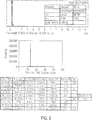
- the lower layer (i.e., the graphite layer 402) of the anode was scraped for XRD and tested for particle size, with the results shown in Fig. 6 .
- Data in Table 3 further shows that the use of the graphite layers (i.e., Graphite 1 and 3) having an OI value of greater than 15 between the silicon mixture and the substrate may obviously decrease the X/Y elongation of the anode, that is, the X/Y elongation is less than 0.5%.
- the traditional substrates i.e., Substrates 1 and 2
- the high-strength substrate i.e., Substrate 6
- Fig. 7 shows anodes after the circulation of the lithium ion batteries of Comparative Embodiment D5, Embodiment S24, Embodiment S21 and Embodiment S36. Results show that as shown by D5 and S24 in Fig. 7 , when no graphite or the graphite having an OI value of less than 15 is used between the silicon mixture and the substrate, the anode is wrinkled and deforms. As shown by S21 in Fig. 7 , when the graphite having an OI value of greater than 15 is used between the silicon mixture and the substrate, the wrinkling and deformation phenomena are obviously reduced. As shown by S36 in Fig. 7 , after the substrate in S21 is replaced by the high-strength substrate, the wrinkling and deformation phenomena are further reduced.
Landscapes
- Chemical & Material Sciences (AREA)
- Chemical Kinetics & Catalysis (AREA)
- Electrochemistry (AREA)
- General Chemical & Material Sciences (AREA)
- Engineering & Computer Science (AREA)
- Materials Engineering (AREA)
- Manufacturing & Machinery (AREA)
- Composite Materials (AREA)
- Inorganic Chemistry (AREA)
- Battery Electrode And Active Subsutance (AREA)
- Secondary Cells (AREA)
Abstract
Description
- The present application claims the benefit of priority from the China Patent Application No.
201811534070.X, filed on 14 December 2018 - The present application relates to the field of energy storage, specifically relates to an anode and an electrochemical apparatus and an electronic apparatus using the anode, in particular, in a lithium ion battery.
- With the widespread use of electronic devices such as cameras, digital video cameras, mobile phones and notebook computers, people have an increasing performance requirement for electrochemical apparatus (e.g., lithium ion batteries). Lithium ion batteries have been widely used in various fields due to their high energy density, long cycle life, no memory effect and the like. A traditional lithium ion battery usually uses a silicon material as an anode current collector and uses a graphite material as an anode active material. However, in the use of the lithium ion battery, the use of traditional silicon materials and graphite materials may encounter multiple problems, such as the easy occurrence of wrinkling in an anode and the easy deformation of a battery cell.
- In view of this, it is definitely necessary to provide an improved anode and an electrochemical apparatus and an electronic apparatus using the anode.
- Embodiments of the present application solve at least one problem in the related art at least to a certain extent by providing an anode and an electrochemical apparatus and an electronic apparatus using the anode.
- In one embodiment, the present application provides an anode, comprising a substrate, an active material layer and a carbon coating layer between the substrate and the active material layer, wherein an X-ray diffraction pattern of the carbon coating layer includes a 004 diffraction pattern and a 110 diffraction pattern, a ratio C004/C110 of a c-axial length C004 of a unit crystal cell length obtained from the 004 diffraction pattern to an a-axial length C110 of a unit crystal cell length obtained from the 110 diffraction pattern is an OI value of the carbon coating layer, and the OI value is greater than about 15.
- According to some embodiments of the present application, the substrate has a tensile strength of greater than about 400 MPa and an elongation of less than about 2%.
- According to some embodiments of the present application, the carbon coating layer is selected from natural graphite, artificial graphite, hard carbon, soft carbon or a combination thereof.
- According to some embodiments of the present application, the substrate is selected from copper, nickel, a copper alloy, a nickel alloy or a combination thereof.
- According to some embodiments of the present application, the active material layer is a silicon active material layer.
- According to some embodiments of the present application, the silicon active material layer includes not less than about 0.1 w% of silicon.
- In another embodiment, the present application provides an electrochemical apparatus, comprising a cathode and the anode according to the embodiments of the present application.
- In another embodiment, the present application provides an electronic apparatus, including the electrochemical apparatus according to the embodiments of the present application.
- Additional aspects and advantages of the embodiments of the present application will be partially described, reflected or explained through the implementation of the embodiments of the present application in the subsequent descriptions.
- The following will briefly introduce the drawings required for describing the embodiments of the present application or the prior art so as to facilitate the description of the embodiments of the present application. Obviously, the drawings in the following descriptions are only part of the embodiments in the present application. Those skilled in the art still can obtain drawings of other embodiments according to structures illustrated in these drawings without creative efforts.
-
Fig. 1 shows a schematic diagram of an anode according to the prior art. -
Fig. 2 shows a schematic diagram of an anode according to an embodiment of the present application. -
Fig. 3 shows X/Y and Z elongations of graphite having different OI values at the end of circulation of a lithium ion battery under a compaction density of 1.8 g/cc of the anode. -
Fig. 4 shows a cross-sectional view of an anode according to an embodiment of the present application under a scanning electron microscope (SEM). -
Fig. 5 shows an X-ray diffraction (XRD) pattern and particle size distribution of an upper layer of an anode according to an embodiment of the present application. -
Fig. 6 shows an XRD pattern and particle size distribution of a lower layer of an anode according to an embodiment of the present application. -
Fig. 7 shows anodes having different X/Y elongations after the circulation of the lithium ion battery. - Embodiments of the present application will be described in detail below. The embodiments of the present application shall not be explained as limitations to the present application.
- As used herein, the term "about" in the present application is used for describing and explaining a small change. When being used in combination with an event or a situation, the term may refer to an example where the event or situation occurs accurately and an example where the event or situation occurs extremely similarly. For example, when being used in combination with a value, the term may refer to a varying range less than or equal to ±10% of the value, such as less than or equal to ±5%, less than or equal to ±4%, less than or equal to ±3%, less than or equal to ±2%, less than or equal to ±1%, less than or equal to ±0.5%, less than or equal to ±0.1% and less than or equal to ±0.05%. In addition, the amount, the ratio and other values are sometimes shown in the range format in the present application. It should be understood that such range format is used for convenience and brevity and is to be understood in a flexible manner as not only including values that are explicitly specified as the limits of the range, but also including all individual values or sub-ranges that are covered in the range, as clearly stating each value and each sub-range.
- At the present, silicon material has been widely used as an active material of an anode to increase the energy of a lithium ion battery. Usually, the silicon material is mixed with graphite to prepare a silicon mixture which is then stirred to form an anode slurry, followed by coating the anode slurry onto a substrate (i.e., an anode current collector) (as shown by 101 in
Fig. 1 ) to form a silicon mixture active material layer (as shown by 102 inFig. 1 ). However, dramatic volume expansion, particularly expansion in an X/Y direction (i.e., the horizontal direction), can easily occur in the silicon material during the circulation of the lithium ion battery. The X/Y-directional expansion of the anode active material layer can easily be transmitted to the substrate, leading to wrinkling and bending of the anode and thus resulting in deformation of the battery cell structure. - To solve the above problem, as shown in
Fig. 2 , the present application provides an anode, comprising asubstrate 201, anactive material layer 202 and acarbon coating layer 203 between the substrate and the active material layer, wherein an X-ray diffraction pattern of the carbon coating layer includes a 004 diffraction pattern and a 110 diffraction pattern, a ratio C004/C110 of a c-axial length C004 of a unit crystal cell length obtained from the 004 diffraction pattern to an a-axial length C110 of a unit crystal cell length obtained from the 110 diffraction pattern is an OI value of the carbon coating layer, and the OI value is greater than about 15. - The inventors of the present application found that the OI value may reflect the orientation of the carbon coating layer. The larger the OI value is, the higher the anisotropism of the carbon coating layer is. During the circulation of the lithium ion battery, the carbon coating layer having a high OI value tends to generate expansion between layers, i.e., expansion in the Z direction (the vertical direction), and does not easily generate expansion in the X/Y direction. Applying the carbon coating layer having a high OI value to the substrate and the active material layer (for example, the silicon active material layer) so that the carbon coating layer and the active material layer are embedded together can not only ensure the bonding force between two layers, but also allow the carbon coating layer to have certain sliding capacity. Such a structure may result in the X/Y expansion of the silicon active material layer not being transmitted to the substrate. As an X/Y expansion force subjected by the substrate during the circulation of the lithium ion battery is reduced, the X/Y elongation of the substrate is decreased, thereby improving on the problems of wrinkling and bending of the anode and improving on the problem of deformation of the battery cell.
- The substrate used in a traditional anode usually has a relatively low tensile strength or relatively high elongation. Therefore, the traditional substrate usually has a relatively high elongation in the X/Y direction, which is usually greater than about 0.5%. The relatively high X/Y-directional elongation easily causes wrinkling of the anode and deformation of the battery cell.
- To solve this problem, in some embodiments of the present application, the traditional substrate is further replaced by a high-strength substrate to allow the substrate to elongate to an extremely small degree during the circulation of the lithium ion battery, so as to improve on the problems of the wrinkling of the anode, the deformation of the battery cell and the like.
- According to some embodiments of the present application, the substrate has a tensile strength of greater than about 400 MPa. According to some other embodiments of the present application, the substrate has an elongation of less than about 2%.
- According to some embodiments of the present application, the carbon coating layer is selected from natural graphite, artificial graphite, hard carbon, soft carbon or a combination thereof.
- According to some embodiments of the present application, the OI value of the carbon coating layer is greater than about 13.
- According to some embodiments of the present application, the substrate is selected from copper, nickel, a copper alloy, a nickel alloy or a combination thereof.
- According to some embodiments of the present application, the active material layer is a silicon active material layer.
- According to some embodiments of the present application, the silicon active material layer includes not less than about 0.1 w% of silicon.
- According to some embodiments of the present application, a silicon active material includes, but not limited to, pure silicon, a silicon-carbon compound, a silicon-oxygen compound, a silicon alloy, a silicon coating or a combination thereof.
- A material capable of being applied to a cathode in the embodiment of the present application, a constitution and a manufacturing method thereof include any technologies disclosed in the prior art. In some embodiments, the cathode is a cathode disclosed in the U.S. patent
US9812739B - In some embodiments, the cathode includes a current collector and a cathode active material layer located on the current collector. The cathode active material includes at least one lithiation intercalation compound for reversibly embedding and de-embedding lithium ions. In some embodiments, the cathode active material includes a composite oxide. In some embodiments, the composite oxide contains lithium and at least one element selected from cobalt, manganese and nickel.
- In some embodiments, the cathode active material includes, but is not limited to:
- LiaA1-bXbD2 (0.90≤a≤1.8, 0≤b≤0.5);
- LiaE1-bXbO2-cDc (0.90≤a≤1.8, 0≤b≤0.5, 0≤c≤0.05);
- LiaE2-bXbD4 (0.90≤a≤1.8, 0≤b≤0.5);
- LiaE2-bXbO4-cDc (0.90≤a≤1.8, 0≤b≤0.5, 0≤c≤0.05);
- LiaNi1-b-cCobXcDα (0.90≤a≤1.8, 0≤b≤0.5, 0≤c≤0.05; 0<α≤2);
- LiaNi1-b-cCobXcO2-αTα (0.90≤a≤1.8, 0≤b≤0.5, 0≤c≤0.05; 0<α≤2);
- LiaNi1-b-cCobXcO2-αT2 (0.90≤a≤1.8, 0≤b≤0.5, 0≤c≤0.05; 0<α≤2);
- LiaNi1-bcMnbXcDα (0.90≤a≤1.8, 0≤b≤0.5, 0≤c≤0.05; 0<α≤2);
- LiaNi1-b-cMnbXcO2-αTα (0.90≤a≤1.8, 0≤b≤0.5, 0≤c≤0.05; 0<α≤2);
- LiaNi1-b-cMnbXcO2-αT2 (0.90≤a≤1.8, 0≤b≤0.5, 0≤c≤0.05; 0<α≤2);
- LiaNibEcGdO2 (0.90≤a≤1.8, 0≤b≤0.9, 0≤c≤0.5, 0.001≤d≤0.1);
- LiaNibCocMndGeO2 (0.90≤a≤1.8, 0≤b≤0.9, 0≤c≤0.5, 0≤d≤0.5, 0.001≤e≤0.1);
- LiaNiGbO2 (0.90≤a≤1.8, 0.001≤b<0.1);
- LiaCoGbO2 (0.90≤a≤1.8, 0.001≤b<0.1);
- LiaMnGbO2 (0.90≤a≤1.8, 0.001≤b<0.1);
- LiaMn2GbO4 (0.90≤a≤1.8, 0.001≤b<0.1);
- QO2, QS2, LiQS2, V2O5, LiV2O5, LiIO2, LiNiVO4, Li(3-f)J2(PO4)3 (0≤f≤2), Li(3-f)Fe2(PO4)3 (0≤f≤2) or LiFePO4;
- In some embodiments, the cathode active material is selected from lithium cobalt oxide (LiCoO2), a lithium Ni-Co-Mn (NCM) ternary material, lithium iron phosphate (LiFePO4), lithium manganate (LiMn2O4) or any combination thereof.
- In some embodiments, the cathode active material may have a coating layer on the surface, or may be mixed with another compound having a coating layer. The coating layer may include at least one coating element compound selected from oxide of a coating element, hydroxide of the coating element, oxyhydroxide of the coating element, a carbonate oxygen salt of the coating element and hydroxycarbonate of the coating element. The compound for coating may be amorphous or crystalline.
- In some embodiments, the coating element contained in the coating layer may include Mg, Al, Co, K, Na, Ca, Si, Ti, V, Sn, Ge, Ga, B, As, Zr and any combination thereof. The coating layer may be applied by any methods as long as the method does not have adverse effects on the performance of the cathode active material. For example, the method may include any coating methods known in the art, such as spraying and impregnation.
- The cathode active material layer further includes an adhesive, and optionally includes a conductive material. The adhesive enhances the combination between particles of the cathode active material and also enhances the combination between the cathode active material and the current collector.
- In some embodiments, the adhesive includes, but is not limited to: polyvinyl alcohol, hydroxy propyl cellulose, diacetyl cellulose, polyvinyl chloride, carboxylated polyvinyl chloride, polyvinyl fluoride, an ethylidene oxygen-containing polymer, polyvinylpyrrolidone, polyurethane, polytetrafluoroethylene, 1,1-polyvinylidene fluoride, polyethylene, polypropylene, butadiene styrene rubber, acrylic butadiene styrene rubber, epoxy resin, nylon and the like.
- In some embodiments, the conductive material includes, but is not limited to: a carbon-based material, a metal-based material, a conductive polymer and mixtures thereof. In some embodiments, the carbon-based material is selected from natural graphite, artificial graphite, carbon black, acetylene black, Ketjen black, carbon fibre or any combination thereof. In some embodiments, the metal-based material is selected from metal powder, metal fibre, copper, nickel, aluminum and silver. In some embodiments, the conductive polymer is a polyphenylene derivative.
- In some embodiments, the current collector may be, but is not limited to, aluminum.
- The cathode may be prepared by a preparation method known in the art. For example, the cathode may be obtained by the following method: the active material, the conductive material and the adhesive are mixed in a solvent to prepare an active material composition, and the current collector is coated with the active material composition. In some embodiments, the solvent may include, but is not limited to, N-methyl pyrrolidone.
- An electrolyte solution capable of being used in the embodiment of the present application may be an electrolyte solution known in the prior art. An electrolyte capable of being used in the electrolyte solution of the embodiments of the present application includes, but is not limited to: inorganic lithium salt, such as LiClO4, LiAsF6, LiPF6, LiBF4, LiSbF6, LiSO3F and LiN(FSO2)2; fluorine-containing organic lithium salt, such as LiCF3SO3, LiN(FSO2)(CF3SO2), LiN(CF3SO2)2, LiN(C2F5SO2)2,
ringlike 1,3-lithium hexafluoropropane disulfonimide, ringlike 1,2-lithium tetrafluoroethane disulfonimide, LiN(CF3SO2)(C4F9SO2), LiC(CF3SO2)3, LiPF4(CF3)2, LiPF4(C2F5)2, LiPF4(CF3SO2)2, LiPF4(C2F5SO2)2, LiBF2(CF3)2, LiBF2(C2F5)2, LiBF2(CF3SO2)2 and LiBF2(C2F5SO2)2; and dicarboxylic acid complex-containing lithium salt, such as bi(oxalate synthesized) lithium borate, difluoroxalate syntehsized lithium borate, tri(oxalate synthesized) lithium phosphate, difluoro-bi(oxalate synthesized) lithium phosphate, tetrafluoro(oxalate synthesized) lithium phosphate and the like. In addition, one of the above-mentioned electrolytes may be independently used, or two or more of the above-mentioned electrolytes may be used simultaneously. For example, in some embodiments, the electrolyte includes a combination of LiPF6 and LiBF4. In some embodiments, the electrolyte includes a combination of the inorganic lithium salt such as the LiPF6 or the LiBF4 and the fluorine-containing organic lithium salt such as LiCF3SO3, LiN(CF3SO2)2 and LiN(C2F5SO2)2. In some embodiments, the concentration of the electrolyte is within a range of about 0.8 mol/L to about 3 mol/L, such as a range of about 0.8 mol/L to about 2.5 mol/L, a range of about 0.8 mol/L to about 2 mol/L and a range of about 1 mol/L to about 2 mol/L. For another example, the concentration is about 1 mol/L, about 1.15 mol/L, about 1.2 mol/L, about 1.5 mol/L, about 2 mol/L or about 2.5 mol/L. - In some embodiments, a separator is arranged between the cathode and the anode to prevent a short circuit. There are no special limitations to the material and the shape of the separator used in the embodiments of the present application, and the separator may be any technologies disclosed in the prior art. In some embodiments, the separator includes a polymer or an inorganic substance and the like formed by a material stable in the electrolyte solution of the present application.
- For example, the separator may include a substrate layer and a surface treatment layer. The substrate layer is nonwoven cloth, a membrane or a composite membrane having a porous structure, and is made of at least one of polyethylene, polypropylene, polyethylene glycol terephthalate and polyimide. Specifically, a polypropylene porous membrane, a polyethylene porous membrane, polypropylene nonwoven cloth, polyethylene nonwoven cloth or a polypropylene-polyethylene-polypropylene porous composite membrane can be adopted.
- The surface treatment layer is arranged on at least one surface of the substrate layer, and may be a polymer layer or an inorganic substance layer, or may be a layer formed by mixing the polymer and the inorganic substance.
- The inorganic substance layer includes inorganic particles and an adhesive. The inorganic particle is selected from one or a combination of several of aluminum oxide, silicon oxide, magnesium oxide, titanium oxide, hafnium oxide, tin oxide, ceric oxide, nickel oxide, zinc oxide, calcium oxide, zirconium oxide, yttrium oxide, silicon carbide, boehmite, aluminum hydroxide, magnesium hydroxide, calcium hydroxide and barium sulphate. The adhesive is one or a combination of several of polyvinylidene fluoride, a vinylidene fluoride-hexafluoropropylene copolymer, polyamide, polyacrylonitrile, polyacrylate, polyacrylic acid, polyacrylate, polyvinylpyrrolidone, polyvinylether, polymethyl methacrylate, polytetrafluoroethylene and polyhexafluoropropylene.
- The polymer layer includes a polymer, and the material of the polymer is selected from at least one of polyamide, polyacrylonitrile, an acrylate polymer, polyacrylic acid, polyacrylate, polyvinylpyrrolidone, polyvinylether, polyvinylidene fluoride and poly(vinylidene fluoride-hexafluoropropylene) .
- The electrochemical apparatus of the present application includes any apparatuses capable of generating electrochemical reactions. Specific examples of the electrochemical apparatus include all types of primary barriers, secondary barriers, fuel batteries, solar batteries or capacitors. Particularly, the electrochemical apparatus is a lithium secondary battery, including a lithium metal secondary battery, a lithium ion secondary battery, a lithium polymer secondary battery or a lithium ion polymer secondary battery. In some embodiments, the electrochemical apparatus of the present application includes a cathode having a cathode active material capable of absorbing and releasing metal ions; an anode according to the embodiments of the present application; an electrolyte solution; and a separator arranged between the cathode and the anode.
- There are no special limitations to the use of the electrochemical apparatus of the present application, and the electrochemical apparatus may be applied to any electronic apparatuses known in the prior art. In one embodiment, the electrochemical apparatus of the present application may be applied to, but is not limited to, a notebook computer, a pen input type computer, a mobile computer, an e-book player, a portable phone, a portable fax machine, a portable copying machine, a portable printing machine, a head-mounted stereo headphone, a video tape recorder, a liquid crystal television set, a hand-held cleaner, a portable CD machine, a mini optical disk, a transceiver, an electronic notebook, a calculator, a memory card, a portable sound recorder, a radio receiver, a backup power supply, a motor, an automobile, a motorcycle, a power-assisted bicycle, a bicycle, a lighting device, a toy, a game machine, a clock, an electric tool, a flashlight, a camera, a household large-sized storage battery, a lithium ion capacitor and the like.
- A lithium ion battery is taken as an example below, and the preparation of the lithium ion battery is described in combination with specific embodiments. Those skilled in the art will understand that preparation methods described in the present application are only examples, and any other proper preparation methods shall all fall within the scope of the present application.
- Embodiments and comparative embodiments of the lithium ion battery according to the present application are described below for performance estimation.
- Graphite, a conductive agent (conductive carbon black, Super P) and an adhesive (sodium carboxymethyl cellulose, CMC) were mixed in a mass ratio of 97%:1%:2% to prepare a graphite slurry; an anode current collector was coated with the prepared graphite slurry to prepare a graphite coating layer; the graphite coating layer was coated with a silicon mixture to prepare an anode membrane; and the prepared anode membrane was subjected to cold pressing so that it had a compaction density of 1.8 g/cc, so as to obtain the anode.
- Lithium cobalt oxide, conductive carbon black and polyvinylidene fluoride were mixed in a mass ratio of 97%:1%:1% to prepare a cathode slurry; an aluminum foil of a cathode current collector was coated with the prepared cathode slurry to prepare a cathode membrane; and the prepared cathode membrane was subjected to cold pressing so that it had a compaction density of 4.15 g/cc, so as to obtain the cathode.
- Under a dry argon environment, LiPF6 was added into a solvent prepared by mixing EC, PC and DEC (in a weight ratio of 1:1:1) and uniformly mixed so that LiPF6 had a concentration of 1.15 mol/L, so as to obtain the electrolyte solution.
- A PE porous thin membrane polymer was used as the separator.
- The anode and the cathode were respectively cut into required widths and lengths, welded with tabs and wound to form a naked battery cell. The naked battery cell was packaged and baked, injected with the electrolyte solution, and then was stood at room temperature for 24 hours and was then stood at 60°C for 12 hours. The lithium ion battery was prepared by the procedures such as formation and capacity.
- A 004 diffraction pattern and a 110 diffraction pattern in an X-ray diffraction pattern of a carbon coating layer in the anode were tested in accordance with Method for Determination of Lattice Parameters of Artificial Graphite of the Machinery Industry Standard JB/T 4220-2011 of the People's Republic of China. Test conditions were as follows: X ray adopted CuKα radiation which was filtered out through a filter or a monochromator; the working voltage of an X-ray tube was (30-35) kV, and the working current was (15-20) mA; the scanning speed of a counter was 1/4 (°)/min; during recording of the 004 diffraction pattern, the scanning range of a diffraction angle 2θ was 53-57 degrees; during recording of the 110 diffraction pattern, the scanning range of the diffraction angle 2θ was 75-79 degrees; the c-axial length of a unit crystal cell length obtained from the 004 diffraction pattern was recorded as C004; and the a-axial length of a unit crystal cell length obtained from the 110 diffraction pattern was recorded as C110. The OI value was calculated through the following formula:

- The widths of a substrate of the anode before and after the circulation of the lithium ion battery were measured respectively. The elongation of the substrate at the end of the circulation was calculated through the following formula:


- The widths of the graphite layer before and after the circulation of the lithium ion battery were measured respectively. The elongation of the graphite layer at the end of the circulation was calculated through the following formula:


- The tensile strength of the substrate of the anode was tested in accordance with methods from the Electrolytic Copper Foil of the National Standard GB/T 5230-1995 of the People's Republic of China. Test conditions were as follows: a test sample having a certain length was taken, and a cross sectional area S0 of the test sample was measured; a test machine stretched the test sample at a speed of 50 mm/min till the test sample was broken; and a maximum load Fb was read from a force measurement plate or a tensile curve. The tensile strength σb was calculated according to the following formula:

- The elongation of the substrate of the anode was tested in accordance with methods from the Electrolytic Copper Foil of the National Standard GB/T 5230-1995 of the People's Republic of China. Test conditions were as follows: a test sample having a certain length was taken, and two marks were made on the test sample; a distance between the two mark lines was recorded as L0; the test machine stretched the test sample at a speed of 50 mm/min until the test sample was broken; and the distance between the two marked lines after the test sample was broken was measured and recorded as L1. The elongation δ was calculated according to the following formula:

- Table 1 and
Fig. 3 show the OI values of different graphite materials before and after circulation and the X/Y and Z elongations of graphite layers made of the materials.Table 1 OI value before circulation OI value after circulation X/Y elongation Z elongation Graphite 1 19.3 13.2 0.20% 35.80 % Graphite 2 18.55 11.1 0.22% 35.50 % Graphite 3 16.55 10.9 0.22% 35.30 % Graphite 4 15.2 10.4 0.23% 35.10 % Graphite 5 13.53 9.8 0.25% 35.10 % Graphite 6 12.1 8.6 0.28% 35.00 % Graphite 7 10.6 7.2 0.30% 34.80 % Graphite 8 8.0 5.6 0.34% 34.70 % Graphite 9 7.0 4.7 0.45% 34.60 % Graphite 10 5.9 3.9 0.70% 34.20% - The results show that the X/Y elongation of the graphite layer is decreased with the increase of the OI value of the graphite material before and after the circulation, and the Z elongation of the graphite layer is increased with the increase of the OI value of the graphite material before and after the circulation.
- Table 2 shows the tensile strengths and the elongations of various substrates. When the traditional substrate (i.e., an electrolytic copper foil) has a tensile strength greater than 400 MPa, the elongation of the traditional substrate is usually relatively large (>2%). The high-strength substrate (i.e., a rolled copper foil) used in the present application has a high tensile strength (greater than 400 MPa) and low elongation (<2%).
Table 2 Substrate Tensile strength (MPa) Elongation Traditional substrate 1 (electrolytic copper foil) 1100 2.5% Traditional substrate 2 (electrolytic copper foil) 480 3.2% Traditional substrate 3 (electrolytic copper foil) 490 3.3% Traditional substrate 4 (electrolytic copper foil) 1110 3.0% Traditional substrate 5 (electrolytic copper foil) 420 4.9% High-strength substrate 6 (rolled copper foil) 530 0.8% High-strength substrate 7 (rolled copper foil) 530 1.7% High-strength substrate 8 (rolled copper foil) 510 0.8% High-strength substrate 9 (rolled copper foil) 540 1.6% High-strength substrate 10 (rolled copper foil) 670 1.4% - The anode was prepared according to the settings of all the embodiments and comparative embodiments in Table 3 below. The
silicon mixtures silicon mixtures silicon mixture 1 was: DvlO 3.5 µm, Dv50 8.1 µm, Dv90 25.4 µm and Dv99 51.0 µm. The particle size distribution of thesilicon mixture 2 was: Dv10 4.7 µm, Dv50 12.1 µm, Dv90 28.9 µm and Dv99 46.4 µm. The particle size distribution of thesilicon mixture 3 was: Dv10 3.7 µm, Dv50 7.9 µm, Dv90 16.2 µm and Dv99 23.8 µm. The lithium ion battery was prepared by adopting the above-mentioned anode, and the X/Y and Z elongations of the anode at the end of the circulation of the lithium ion battery were tested. The results are as shown in Table 3.Table 3 Embodiment S/Comparative Embodiments D Anode Elongation Silicon mixture Graphite Substrate X/Y Z D1 1 - 1 0.55% 57.5% S1 1 1 1 0.43% 59.4% S2 1 3 1 0.47% 59.0% S3 1 7 1 0.58% 57.0% S4 1 8 1 0.73% 55.1% S5 1 10 1 0.93% 53.3% D2 2 - 1 0.51% 57.3% S6 2 1 1 0.41% 59.2% S7 2 3 1 0.44% 58.8% S8 2 7 1 0.55% 56.9% S9 2 8 1 0.71% 55.0% S10 2 10 1 0.91% 53.2% D3 3 - 1 0.55% 57.1% S11 3 1 1 0.42% 59.1% S12 3 3 1 0.46% 58.6% S13 3 7 1 0.54% 56.9% S14 3 8 1 0.74% 55.0% S15 3 10 1 0.95% 53.0% D4 1 - 2 0.63% 56.9% S16 1 1 2 0.46% 59.1% S17 1 3 2 0.48% 58.5% S18 1 7 2 0.56% 57.2% S19 1 8 2 0.66% 56.0% S20 1 10 2 0.98% 52.5% D5 2 - 2 0.59% 56.7% S21 2 1 2 0.44% 59.1% S22 2 3 2 0.45% 58.3% S23 2 7 2 0.59% 57.0% S24 2 8 2 0.64% 55.7% S25 2 10 2 0.96% 52.4% D6 3 - 2 0.60% 56.7% S26 3 1 2 0.47% 59.1% S27 3 3 2 0.45% 58.1% S28 3 7 2 0.58% 56.7% S29 3 8 2 0.64% 55.5% S30 3 10 2 0.93% 52.2% D7 1 - 6 0.42% 58.1% S31 1 1 6 0.35% 60.5% S32 1 3 6 0.36% 60.3% S33 1 7 6 0.49% 57.5% S34 1 8 6 0.52% 56.2% S35 1 10 6 0.85% 53.0% D8 2 - 6 0.39% 57.9% S36 2 1 6 0.34% 60.2% S37 2 3 6 0.34% 60.0% S38 2 7 6 0.47% 57.5% S39 2 8 6 0.55% 55.9% S40 2 10 6 0.87% 52.9% D9 3 - 6 0.38% 57.8% S41 3 1 6 0.33% 60.0% S42 3 3 6 0.39% 59.9% S43 3 7 6 0.43% 57.4% S44 3 8 6 0.55% 55.8% S45 3 10 6 0.88% 52.7% S46 3 2 1 0.44% 58.8% - The results show that the graphite layer may be successfully applied between various silicon mixture layers and various substrates. Taking Embodiment S46 as an example,
Fig. 4 shows the obtained anode, including asubstrate 401, agraphite layer 402 and asilicon mixture layer 403. The upper layer (i.e., the silicon mixture layer 403) of the anode was scraped for XRD and tested for particle size, with the results shown inFig. 5 . The lower layer (i.e., the graphite layer 402) of the anode was scraped for XRD and tested for particle size, with the results shown inFig. 6 . - Data in Table 3 further shows that the use of the graphite layers (i.e.,
Graphite 1 and 3) having an OI value of greater than 15 between the silicon mixture and the substrate may obviously decrease the X/Y elongation of the anode, that is, the X/Y elongation is less than 0.5%. On the basis that the graphite layer having an OI value of greater than 15 is used, the traditional substrates (i.e.,Substrates 1 and 2) are replaced by the high-strength substrate (i.e., Substrate 6) to further decrease the X/Y elongation of the anode, that is, the X/Y elongation is less than 0.4%. -
Fig. 7 shows anodes after the circulation of the lithium ion batteries of Comparative Embodiment D5, Embodiment S24, Embodiment S21 and Embodiment S36. Results show that as shown by D5 and S24 inFig. 7 , when no graphite or the graphite having an OI value of less than 15 is used between the silicon mixture and the substrate, the anode is wrinkled and deforms. As shown by S21 inFig. 7 , when the graphite having an OI value of greater than 15 is used between the silicon mixture and the substrate, the wrinkling and deformation phenomena are obviously reduced. As shown by S36 inFig. 7 , after the substrate in S21 is replaced by the high-strength substrate, the wrinkling and deformation phenomena are further reduced. - By referring to "embodiments", "part of the embodiments", "an embodiment", "for another example", "for example", "for specific example" or "part of the examples" throughout the entire description, a meaning represented thereby is that at least one embodiment or example in the present application includes specific features, structures, materials or characteristics described in the embodiment or example. Therefore, descriptions appearing in all parts of the whole description, such as: "in some embodiments", "in the embodiments", "in one embodiment", "in another example", "in one example", "in the specific example" or "for example", do not necessarily refer to the same embodiments or examples in the present application. In addition, the specific features, structures, materials and characteristics herein may be combined in one or more embodiments or examples by any proper methods.
- Although illustrative embodiments have been demonstrated and described, those skilled in the art should understand that the above-mentioned embodiments may not be explained as limitations to the present application, and can make changes, replacements and modifications to the embodiments without departing from the spirit, principle and scope of the present application.
Claims (15)
- An anode, comprising a substrate (201), an active material layer (202) and a carbon coating layer (203) between the substrate (201) and the active material layer (202), wherein an X-ray diffraction pattern of the carbon coating layer (203) comprises a 004 diffraction pattern and a 110 diffraction pattern; and a ratio C004/C110 of a c-axial length C004 of a unit crystal cell length obtained from the 004 diffraction pattern to an a-axial length C110 of a unit crystal cell length obtained from the 110 diffraction pattern is an OI value of the carbon coating layer (203), and the OI value is greater than 15.
- The anode according to claim 1, wherein the substrate (201) comprises a tensile strength of greater than 400 MPa and an elongation of less than 2%.
- The anode according to claim 1 or 2, wherein the carbon coating layer (203) is selected from natural graphite, artificial graphite, hard carbon, soft carbon or a combination thereof.
- The anode according to claim 2 or 3, wherein the substrate (201) is selected from copper, nickel, a copper alloy, a nickel alloy or a combination thereof.
- The anode according to any one of claims 1-4, wherein the active material layer (202) is a silicon active material layer.
- The anode according to claim 5, wherein the silicon active material layer comprises not less than 0.1 w% of silicon.
- The anode according to claim 5 or 6, wherein the silicon active material is selected from pure silicon, a silicon-carbon compound, a silicon-oxygen compound, a silicon alloy, a silicon coating or a combination thereof.
- An electrochemical apparatus, comprising:a cathode; andan anode comprising a substrate (201), an active material layer (202) and a carbon coating layer (203) between the substrate (201) and the active material layer (202), wherein an X-ray diffraction pattern of the carbon coating layer (203) comprises a 004 diffraction pattern and a 110 diffraction pattern; and a ratio C004/C110 of a c-axial length C004 of a unit crystal cell length obtained from the 004 diffraction pattern to an a-axial length C110 of a unit crystal cell length obtained from the 110 diffraction pattern is an OI value of the carbon coating layer (203), and the OI value is greater than 15.
- The electrochemical apparatus according to claim 8, wherein the substrate (201) comprises a tensile strength of greater than 400 MPa and an elongation of less than 2%.
- The electrochemical apparatus according to claim 8 or 9, wherein the carbon coating layer (203) is selected from natural graphite, artificial graphite, hard carbon, soft carbon or a combination thereof.
- The electrochemical apparatus according to claim 9 or 10, wherein the substrate (201) is selected from copper, nickel, a copper alloy, a nickel alloy or a combination thereof.
- The electrochemical apparatus according to any one of claims 8-11, wherein the active material layer (202) is a silicon active material layer.
- The electrochemical apparatus according to claim 12, wherein the silicon active material layer comprises not less than 0.1 w% of silicon.
- The electrochemical apparatus according to any one of claims 8-13, wherein the electrochemical apparatus is a lithium ion battery.
- An electronic apparatus, comprising an electrochemical apparatus according to any one of claims 8-14.
Applications Claiming Priority (1)
| Application Number | Priority Date | Filing Date | Title |
|---|---|---|---|
| CN201811534070.XA CN109616614B (en) | 2018-12-14 | 2018-12-14 | Negative pole piece and electrochemical device and electronic device using the same |
Publications (1)
| Publication Number | Publication Date |
|---|---|
| EP3667784A1 true EP3667784A1 (en) | 2020-06-17 |
Family
ID=66009168
Family Applications (1)
| Application Number | Title | Priority Date | Filing Date |
|---|---|---|---|
| EP19178251.5A Pending EP3667784A1 (en) | 2018-12-14 | 2019-06-04 | Anode and electrochemical apparatus and electronic apparatus using the anode |
Country Status (3)
| Country | Link |
|---|---|
| US (1) | US11063262B2 (en) |
| EP (1) | EP3667784A1 (en) |
| CN (1) | CN109616614B (en) |
Cited By (1)
| Publication number | Priority date | Publication date | Assignee | Title |
|---|---|---|---|---|
| EP3968407A4 (en) * | 2020-04-30 | 2022-11-23 | Contemporary Amperex Technology Co., Limited | SECONDARY BATTERY AND METHOD OF MANUFACTURING IT, AND APPARATUS CONTAINING A SECONDARY BATTERY |
Families Citing this family (12)
| Publication number | Priority date | Publication date | Assignee | Title |
|---|---|---|---|---|
| JP7653356B2 (en) | 2019-11-14 | 2025-03-28 | 寧徳新能源科技有限公司 | Anode materials and electrochemical and electronic devices containing same |
| CN110890531B (en) * | 2019-11-14 | 2021-03-05 | 宁德新能源科技有限公司 | Negative electrode material, and electrochemical device and electronic device comprising same |
| CN110797520B (en) * | 2019-11-14 | 2021-06-25 | 宁德新能源科技有限公司 | Anode material and electrochemical device and electronic device including the same |
| CN111029543B (en) * | 2019-11-28 | 2022-02-15 | 宁德新能源科技有限公司 | Negative electrode material, and electrochemical device and electronic device comprising same |
| WO2021102847A1 (en) * | 2019-11-28 | 2021-06-03 | 宁德新能源科技有限公司 | Negative electrode material, electrochemical device comprising same, and electronic device |
| CN111354944B (en) * | 2020-03-20 | 2021-03-26 | 宁德新能源科技有限公司 | Negative electrode active material, and electrochemical device and electronic device using same |
| PL3968416T3 (en) * | 2020-06-04 | 2024-09-23 | Ningde Amperex Technology Ltd. | NEGATIVE ELECTRODE ACTIVE MATERIAL AND ELECTROCHEMICAL DEVICE AND ELECTRONIC DEVICE USING NEGATIVE ELECTRODE ACTIVE MATERIAL |
| CN111725485B (en) * | 2020-06-23 | 2021-10-15 | 珠海冠宇电池股份有限公司 | A negative electrode sheet and battery |
| KR102851353B1 (en) * | 2020-06-26 | 2025-08-28 | 에스케이온 주식회사 | Anode for lithium secondary battery and lithium secondary battery including the same |
| CN111628141B (en) * | 2020-07-16 | 2021-05-25 | 珠海冠宇电池股份有限公司 | A silicon-doped negative pole piece and a lithium ion battery comprising the negative pole piece |
| CN115832211B (en) * | 2021-09-30 | 2025-03-07 | 宁德时代新能源科技股份有限公司 | A secondary battery, a battery module containing the same, a battery pack and an electric device |
| CN116598420B (en) * | 2023-07-18 | 2024-05-14 | 宁德时代新能源科技股份有限公司 | Negative electrode sheet, preparation method, and corresponding secondary battery and power-using device |
Citations (5)
| Publication number | Priority date | Publication date | Assignee | Title |
|---|---|---|---|---|
| CN102769121A (en) * | 2012-06-29 | 2012-11-07 | 深圳市海太阳实业有限公司 | Silicon-carbon negative pole piece, manufacturing method thereof, lithium ion battery and manufacturing method thereof |
| US9812739B2 (en) | 2015-03-31 | 2017-11-07 | Ningde Amperex Technology Limited | Electrolyte additive and use thereof in lithium-ion battery |
| JP2018078021A (en) * | 2016-11-09 | 2018-05-17 | 日産自動車株式会社 | Method for manufacturing secondary battery electrode |
| CN108847489A (en) * | 2018-05-04 | 2018-11-20 | 宁德时代新能源科技股份有限公司 | Negative pole piece and battery |
| CN108963187A (en) * | 2018-07-19 | 2018-12-07 | 桑德集团有限公司 | Silicon-carbon cathode, preparation method, lithium ion battery and electric vehicle |
Family Cites Families (14)
| Publication number | Priority date | Publication date | Assignee | Title |
|---|---|---|---|---|
| EP0903799B1 (en) * | 1997-09-19 | 2003-03-12 | Matsushita Electric Industrial Co., Ltd. | Nonaqueous electrolyte secondary battery and its anode |
| JP3520921B2 (en) * | 2001-03-27 | 2004-04-19 | 日本電気株式会社 | Negative electrode for secondary battery and secondary battery using the same |
| KR101552763B1 (en) * | 2012-05-31 | 2015-09-11 | 주식회사 엘지화학 | Anode comprising silicon based material and carbon material, and lithium secondary battery comprising the same |
| CN103515573A (en) * | 2012-06-29 | 2014-01-15 | 宁德新能源科技有限公司 | Negative pole piece |
| CN102842701B (en) | 2012-08-17 | 2016-08-03 | 东莞新能源科技有限公司 | Lithium ion battery anode pole piece and comprise the lithium ion battery of this anode pole piece |
| KR101582718B1 (en) * | 2013-02-04 | 2016-01-06 | 주식회사 엘지화학 | Anode comprising spherical natural graphite and lithium secondary battery comprising the same |
| WO2015026559A1 (en) | 2013-08-20 | 2015-02-26 | Graftech International Holdings Inc. | Battery anode |
| CN103633293B (en) | 2013-11-08 | 2017-02-15 | 鲍添增 | Lithium ion battery negative electrode piece using hard carbon and soft carbon as active materials and lithium ion battery |
| US11031587B2 (en) * | 2015-07-02 | 2021-06-08 | Showa Denko K. K. | Negative electrode material for lithium-ion batteries including non-flaky artificial graphite including silicon-containing particles, artificial graphite particles and carbonaceous material |
| KR101995373B1 (en) * | 2016-07-04 | 2019-09-24 | 주식회사 엘지화학 | Negative electrode for secondary battery |
| CN107528044A (en) | 2017-07-25 | 2017-12-29 | 深圳市沃特玛电池有限公司 | A kind of lithium ion battery negative electrode and preparation method thereof |
| JP6648088B2 (en) * | 2017-10-19 | 2020-02-14 | Jx金属株式会社 | Rolled copper foil for negative electrode current collector of secondary battery, secondary battery negative electrode and secondary battery using the same, and method of producing rolled copper foil for negative electrode current collector of secondary battery |
| CN108807848B (en) * | 2018-05-11 | 2019-10-08 | 宁德时代新能源科技股份有限公司 | Negative electrode plate and secondary battery containing same |
| CN108807849B (en) * | 2018-05-16 | 2019-11-15 | 宁德时代新能源科技股份有限公司 | Negative pole piece and secondary battery containing the same |
-
2018
- 2018-12-14 CN CN201811534070.XA patent/CN109616614B/en active Active
-
2019
- 2019-03-06 US US16/294,057 patent/US11063262B2/en active Active
- 2019-06-04 EP EP19178251.5A patent/EP3667784A1/en active Pending
Patent Citations (6)
| Publication number | Priority date | Publication date | Assignee | Title |
|---|---|---|---|---|
| CN102769121A (en) * | 2012-06-29 | 2012-11-07 | 深圳市海太阳实业有限公司 | Silicon-carbon negative pole piece, manufacturing method thereof, lithium ion battery and manufacturing method thereof |
| US9812739B2 (en) | 2015-03-31 | 2017-11-07 | Ningde Amperex Technology Limited | Electrolyte additive and use thereof in lithium-ion battery |
| JP2018078021A (en) * | 2016-11-09 | 2018-05-17 | 日産自動車株式会社 | Method for manufacturing secondary battery electrode |
| CN108847489A (en) * | 2018-05-04 | 2018-11-20 | 宁德时代新能源科技股份有限公司 | Negative pole piece and battery |
| EP3565034A1 (en) * | 2018-05-04 | 2019-11-06 | Contemporary Amperex Technology Co., Limited | Negative electrode plate and battery |
| CN108963187A (en) * | 2018-07-19 | 2018-12-07 | 桑德集团有限公司 | Silicon-carbon cathode, preparation method, lithium ion battery and electric vehicle |
Cited By (2)
| Publication number | Priority date | Publication date | Assignee | Title |
|---|---|---|---|---|
| EP3968407A4 (en) * | 2020-04-30 | 2022-11-23 | Contemporary Amperex Technology Co., Limited | SECONDARY BATTERY AND METHOD OF MANUFACTURING IT, AND APPARATUS CONTAINING A SECONDARY BATTERY |
| US12355069B2 (en) | 2020-04-30 | 2025-07-08 | Contemporary Amperex Technology (Hong Kong) Limited | Secondary battery, process for preparing same, and apparatus comprising secondary battery |
Also Published As
| Publication number | Publication date |
|---|---|
| CN109616614A (en) | 2019-04-12 |
| US11063262B2 (en) | 2021-07-13 |
| US20200194796A1 (en) | 2020-06-18 |
| CN109616614B (en) | 2020-12-11 |
Similar Documents
| Publication | Publication Date | Title |
|---|---|---|
| US11063262B2 (en) | Anode and electochemical apparatus and electronic apparatus using the anode | |
| CN112909238B (en) | Positive active material, positive pole piece and electrochemical energy storage device | |
| US12355071B2 (en) | Positive electrode active material, electrochemical apparatus, and electronic device | |
| EP4394915A1 (en) | Electrochemical device and electronic device | |
| EP4220766A1 (en) | Positive electrode active material, electrochemical apparatus and electronic device | |
| EP3723169A1 (en) | Negative electrode for lithium metal battery and lithium metal battery comprising same | |
| CN114430018B (en) | Electrochemical device and electronic device including the same | |
| KR20030081160A (en) | Battery | |
| WO2022198660A1 (en) | Positive electrode lithium supplementing material, and positive electrode plate and electrochemical device including same | |
| JP7437516B2 (en) | Electrochemical devices and electronic devices including them | |
| CN111416116A (en) | Positive electrode active material and electrochemical device comprising same | |
| CN119153797A (en) | Electrochemical device and electronic device | |
| EP2372818A1 (en) | Non-aqueous electrolyte secondary battery and fabrication method for non-aqueous electrolyte secondary battery | |
| WO2025209064A1 (en) | Positive electrode material, electrochemical device, and electronic device | |
| EP4629322A1 (en) | Negative electrode for all-solid-state battery and all-solid-state battery comprising same | |
| EP1172877B1 (en) | Non-aqueous electrolyte secondary cell | |
| EP4456179A1 (en) | Electrochemical device and electronic device | |
| JP2023538140A (en) | Cathode material, and electrochemical and electronic devices containing the same | |
| EP4451373A1 (en) | Electrochemical device and electronic device | |
| CN114094188B (en) | Electrochemical device and electronic device comprising same | |
| KR101044577B1 (en) | High voltage lithium secondary battery | |
| CN100576611C (en) | Battery | |
| JP4561040B2 (en) | Nonaqueous electrolyte secondary battery | |
| KR102957523B1 (en) | Electrochemical device and electronic device including the electrochemical device | |
| EP4579769A1 (en) | Negative electrode material, secondary battery and electronic device |
Legal Events
| Date | Code | Title | Description |
|---|---|---|---|
| PUAI | Public reference made under article 153(3) epc to a published international application that has entered the european phase |
Free format text: ORIGINAL CODE: 0009012 |
|
| STAA | Information on the status of an ep patent application or granted ep patent |
Free format text: STATUS: THE APPLICATION HAS BEEN PUBLISHED |
|
| AK | Designated contracting states |
Kind code of ref document: A1 Designated state(s): AL AT BE BG CH CY CZ DE DK EE ES FI FR GB GR HR HU IE IS IT LI LT LU LV MC MK MT NL NO PL PT RO RS SE SI SK SM TR |
|
| AX | Request for extension of the european patent |
Extension state: BA ME |
|
| STAA | Information on the status of an ep patent application or granted ep patent |
Free format text: STATUS: REQUEST FOR EXAMINATION WAS MADE |
|
| 17P | Request for examination filed |
Effective date: 20201020 |
|
| RBV | Designated contracting states (corrected) |
Designated state(s): AL AT BE BG CH CY CZ DE DK EE ES FI FR GB GR HR HU IE IS IT LI LT LU LV MC MK MT NL NO PL PT RO RS SE SI SK SM TR |
|
| STAA | Information on the status of an ep patent application or granted ep patent |
Free format text: STATUS: EXAMINATION IS IN PROGRESS |
|
| 17Q | First examination report despatched |
Effective date: 20230705 |