EP3667555A1 - A weeding system and method for use in agriculture - Google Patents
A weeding system and method for use in agriculture Download PDFInfo
- Publication number
- EP3667555A1 EP3667555A1 EP18020640.1A EP18020640A EP3667555A1 EP 3667555 A1 EP3667555 A1 EP 3667555A1 EP 18020640 A EP18020640 A EP 18020640A EP 3667555 A1 EP3667555 A1 EP 3667555A1
- Authority
- EP
- European Patent Office
- Prior art keywords
- image
- images
- nighttime
- daytime
- training
- Prior art date
- Legal status (The legal status is an assumption and is not a legal conclusion. Google has not performed a legal analysis and makes no representation as to the accuracy of the status listed.)
- Granted
Links
Images

Classifications
-
- A—HUMAN NECESSITIES
- A01—AGRICULTURE; FORESTRY; ANIMAL HUSBANDRY; HUNTING; TRAPPING; FISHING
- A01M—CATCHING, TRAPPING OR SCARING OF ANIMALS; APPARATUS FOR THE DESTRUCTION OF NOXIOUS ANIMALS OR NOXIOUS PLANTS
- A01M21/00—Apparatus for the destruction of unwanted vegetation, e.g. weeds
- A01M21/04—Apparatus for destruction by steam, chemicals, burning, or electricity
- A01M21/043—Apparatus for destruction by steam, chemicals, burning, or electricity by chemicals
-
- G—PHYSICS
- G06—COMPUTING OR CALCULATING; COUNTING
- G06F—ELECTRIC DIGITAL DATA PROCESSING
- G06F18/00—Pattern recognition
- G06F18/20—Analysing
- G06F18/21—Design or setup of recognition systems or techniques; Extraction of features in feature space; Blind source separation
- G06F18/214—Generating training patterns; Bootstrap methods, e.g. bagging or boosting
-
- G—PHYSICS
- G06—COMPUTING OR CALCULATING; COUNTING
- G06T—IMAGE DATA PROCESSING OR GENERATION, IN GENERAL
- G06T7/00—Image analysis
- G06T7/0002—Inspection of images, e.g. flaw detection
- G06T7/0012—Biomedical image inspection
- G06T7/0014—Biomedical image inspection using an image reference approach
- G06T7/0016—Biomedical image inspection using an image reference approach involving temporal comparison
-
- G—PHYSICS
- G06—COMPUTING OR CALCULATING; COUNTING
- G06T—IMAGE DATA PROCESSING OR GENERATION, IN GENERAL
- G06T7/00—Image analysis
- G06T7/70—Determining position or orientation of objects or cameras
-
- G—PHYSICS
- G06—COMPUTING OR CALCULATING; COUNTING
- G06V—IMAGE OR VIDEO RECOGNITION OR UNDERSTANDING
- G06V20/00—Scenes; Scene-specific elements
- G06V20/10—Terrestrial scenes
- G06V20/188—Vegetation
-
- G—PHYSICS
- G06—COMPUTING OR CALCULATING; COUNTING
- G06V—IMAGE OR VIDEO RECOGNITION OR UNDERSTANDING
- G06V20/00—Scenes; Scene-specific elements
- G06V20/35—Categorising the entire scene, e.g. birthday party or wedding scene
- G06V20/38—Outdoor scenes
-
- G—PHYSICS
- G06—COMPUTING OR CALCULATING; COUNTING
- G06V—IMAGE OR VIDEO RECOGNITION OR UNDERSTANDING
- G06V20/00—Scenes; Scene-specific elements
- G06V20/50—Context or environment of the image
- G06V20/56—Context or environment of the image exterior to a vehicle by using sensors mounted on the vehicle
-
- G—PHYSICS
- G06—COMPUTING OR CALCULATING; COUNTING
- G06T—IMAGE DATA PROCESSING OR GENERATION, IN GENERAL
- G06T2207/00—Indexing scheme for image analysis or image enhancement
- G06T2207/20—Special algorithmic details
- G06T2207/20081—Training; Learning
-
- G—PHYSICS
- G06—COMPUTING OR CALCULATING; COUNTING
- G06T—IMAGE DATA PROCESSING OR GENERATION, IN GENERAL
- G06T2207/00—Indexing scheme for image analysis or image enhancement
- G06T2207/30—Subject of image; Context of image processing
- G06T2207/30181—Earth observation
- G06T2207/30188—Vegetation; Agriculture
-
- G—PHYSICS
- G06—COMPUTING OR CALCULATING; COUNTING
- G06T—IMAGE DATA PROCESSING OR GENERATION, IN GENERAL
- G06T2207/00—Indexing scheme for image analysis or image enhancement
- G06T2207/30—Subject of image; Context of image processing
- G06T2207/30248—Vehicle exterior or interior
- G06T2207/30252—Vehicle exterior; Vicinity of vehicle
Definitions
- This invention generally relates to the field of automated weed treatment for agriculture.
- WO2018142371A1 in the name of the present applicant discloses a weeding system for an agricultural weeding vehicle, comprising one or several cameras adapted to be mounted on a vehicle to acquire digital images of a portion of a crop field during vehicle travel, a spraying unit adapted to be mounted on said vehicle and comprising at least two supply modules with a chemical agent tank, a driven delivery valve and at least one nozzle to spray the chemical agent from a supply module, and a controller module able to receive a weed species detection signal and to selectively command the spraying of chemical agent based on said signal.
- the system further comprises a weed species identification unit with a plurality of parallel processing cores each adapted to perform convolution operations a sub-matrix constructed from nearby pixels of the image and a predefined kernel to obtain a feature representation sub-matrix of the pixel values of the image, the unit being adapted to compute probability of presence of weed species from a feature representation matrix of the image constructed from the feature representation sub-matrices generated by the processing cores, and to generate a weed species detection signal based on said probability of presence.
- a weed species identification unit with a plurality of parallel processing cores each adapted to perform convolution operations a sub-matrix constructed from nearby pixels of the image and a predefined kernel to obtain a feature representation sub-matrix of the pixel values of the image, the unit being adapted to compute probability of presence of weed species from a feature representation matrix of the image constructed from the feature representation sub-matrices generated by the processing cores, and to generate a weed species detection signal based on said probability of presence.
- Such system relies on high quality images of the field area, that are processed in real-time by a machine-learning based process in order to locate specific weed species.
- Such known system generally involves that the images are taken with sufficient light conditions, which basically restricts its use to day time.
- a problem with the weed recognition process as mentioned above is that a night use would require extremely strong artificial lighting, while the electrical energy available on board, provided by batteries or other energy source, is inherently limited.
- the present invention thus aims at providing a system with training-based plant recognition that can be used effectively and reliably in low light conditions.
- a weeding system for an agricultural weeding vehicle comprising:
- the present invention provides a method for training a training-based weed recognition algorithm for use in an agricultural weeding vehicle, the agricultural vehicle comprising:
- the method may include the same preferred but optional additional features as above.
- the present invention provides a weed treatment method for use in an agricultural weeding vehicle, the vehicle comprising:
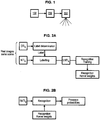
- a system for weed recognition comprises a data acquisition unit 100, a central processing unit 200 and a spraying unit 300.
- the central processing unit receives digital images taken on a regular basis by data acquisition unit 100, executes an algorithmic processing based on prior learning to identify in the images weed to be destroyed, as well as the location of the weed in the images, and controls one or several sprayers corresponding to the weed location so as to spray an herbicide or other chemical agent on the weed.
- a practical implementation of the system is described e.g. in WO2018142371A1 in the name of the same applicant, the contents of which is incorporated by reference and to which the skilled person will refer as necessary.
- the learning process comprises a labelling or tagging step.
- this step reference images similar to the ones that will be taken by the acquisition unit in the running mode of the system are taken and labelled.
- a learning algorithm essentially learns how to distinguish between an undesirable weed species and a different item in an image.
- the result of this training step can be in one particular implementation a collection of kernel weights, corresponding to various convolutions used in the algorithm. Details of this training process and the learning algorithm are provided in particular in WO2018142371A1 .
- a set of weights is determined from the convolutions using the kernel weights and is representative of the positions of the weed plants in the image, as well as the probability that they indeed are weed plants.
- WO2018142371A1 provides details of the processing.
- the labeling step is essential to the reliability of the detection: one must be able to say with great accuracy what is weed and what is not weed in the training images. This accuracy can be greatly compromised when the system will operate in low light conditions such as by night, implying that the reference images should also be low light condition images and thus difficult to label.
- the present invention provides different approaches to tackle this problem.
- each reference image provided as an input to the learning process is duplicated, two images of exactly the same scene being taken under different light conditions.
- daytime image DTlx a first image during daytime
- corresponding nighttime image NTlx a second image of the same scene during night time
- corresponding nighttime image NTlx a second image of the same scene during night time
- label determination typically presence or absence of weed
- corresponding nighttime image NTIx is labelled accordingly (labeled nighttime image LNTlx).
- the running mode nighttime images RNTly taken during displacement of the system are applied to the recognition process which is fed with the recognition kernel weights as generated above.
- the nighttime reference images NTIi used for the training should be acquired in conditions similar to those acquired in the running mode.
- the running mode provide some artificial lighting
- the night time reference images should preferably be taken with a similar artificial lighting.
- the reference image duplication may be achieved by taking a daytime image DTlx of the scene in normal camera settings conditions, then changing the camera settings to reduce the exposure (aperture and/or shutter speed), and taking a second daytime image of the same scene with the reduced exposure setting so as to simulate a nighttime condition, such image being designated as SNTIx.
- the shutter speed and/or aperture for simulating a night time image will be selected so that the quantity of light received by the image sensor will be of the same order or magnitude as the quantity of light received by the sensor in the running mode in nighttime condition, as determined by the running mode shutter speed.
- the running mode images are taken with an exposure time Texp which is selected so that the images generated during the train displacement by night are sharp enough for performing the recognition process.
- This exposure time typically is from 0.5 to 5 milliseconds depending on the image sensor characteristic features and the actual conditions (presence of artificial light, moonlight).
- the darker reference images are taken with an exposure time such that a quantity of light similar to the one received in the running mode is obtained (typically around 0.1 to 0.2 millisecond again depending on the image sensor characteristic features and the actual conditions (presence of artificial light, moonlight).
- the daytime image DTIx is used for label determination
- the labeled simulated nighttime image LNTIx is used for the recognition training.
- each daytime reference image is used for contouring the representation of the species, such contouring being applied to the corresponding night time image for facilitating the recognition training step.
- the capture of the reference images in the first implementation is automated in order to collect day time and night time images of the same scene without staff having to wait for hours until the light conditions change.
- the same artificial light esp. in terms of color temperature and light intensity, is used for the reference night time images.
- the camera settings changes may comprise reduced aperture, in combination with a reduced exposure time or in replacement of a reduced exposure time.
- a filtering (optical or digital) can be used in order to improve the simulation of the nighttime conditions, in particular when artificial light is used.
- a second approach of the present invention comprises building a training-based conversion algorithm in order to specifically convert nighttime images that are taken in nighttime conditions into day time images.
- Such algorithm can be based for instance on the disclosure available at https://arxiv.org/abs/1805.01934, presented at CVPR2018 conference.
- the night-to-day conversion algorithm is trained using a pair of reference images comprising a day time image and a night time image of the same scene.
- this conversion training uses as an input matching pairs of real night/day images DTIx, NTIx such as obtained according to the first approach above (first or second implementation) and allows generating conversion kernel weights which, when used in convolution operations applied to the nighttime image NTIx of a pair, will lead to a converted daytime image CDTIx which is as close as possible to the corresponding real daytime image DTIx.
- the conversion algorithm once trained allows converting a nighttime image NTIy into a corresponding converted daytime image CDTIy.
- the latter is then used for the label determination step as described above (again being much easier to perform than on the nighttime image), the label being applied to the corresponding nighttime image.
- the labeled nighttime images are used for the recognition training, and the thus obtained recognition kernel weights are used for the recognition in the running mode (cf. Figures 2A and 2B ).
- the day time and night time reference images are exploited in their Bayer (raw) format, as it has proven by experimentation that the training is at least as efficient with such image format, upstream of any calibration intended to suit the image to the human eye.
Landscapes
- Engineering & Computer Science (AREA)
- Theoretical Computer Science (AREA)
- General Physics & Mathematics (AREA)
- Physics & Mathematics (AREA)
- Multimedia (AREA)
- General Health & Medical Sciences (AREA)
- Health & Medical Sciences (AREA)
- Life Sciences & Earth Sciences (AREA)
- Computer Vision & Pattern Recognition (AREA)
- Data Mining & Analysis (AREA)
- Environmental Sciences (AREA)
- Insects & Arthropods (AREA)
- Zoology (AREA)
- Wood Science & Technology (AREA)
- Pest Control & Pesticides (AREA)
- Nuclear Medicine, Radiotherapy & Molecular Imaging (AREA)
- Quality & Reliability (AREA)
- Toxicology (AREA)
- Radiology & Medical Imaging (AREA)
- Medical Informatics (AREA)
- Evolutionary Computation (AREA)
- Artificial Intelligence (AREA)
- Evolutionary Biology (AREA)
- General Engineering & Computer Science (AREA)
- Bioinformatics & Computational Biology (AREA)
- Bioinformatics & Cheminformatics (AREA)
- Image Analysis (AREA)
- Mechanical Engineering (AREA)
- Soil Sciences (AREA)
Abstract
Description
- This invention generally relates to the field of automated weed treatment for agriculture.
- Document
WO2018142371A1 in the name of the present applicant discloses a weeding system for an agricultural weeding vehicle, comprising one or several cameras adapted to be mounted on a vehicle to acquire digital images of a portion of a crop field during vehicle travel, a spraying unit adapted to be mounted on said vehicle and comprising at least two supply modules with a chemical agent tank, a driven delivery valve and at least one nozzle to spray the chemical agent from a supply module, and a controller module able to receive a weed species detection signal and to selectively command the spraying of chemical agent based on said signal. - The system further comprises a weed species identification unit with a plurality of parallel processing cores each adapted to perform convolution operations a sub-matrix constructed from nearby pixels of the image and a predefined kernel to obtain a feature representation sub-matrix of the pixel values of the image, the unit being adapted to compute probability of presence of weed species from a feature representation matrix of the image constructed from the feature representation sub-matrices generated by the processing cores, and to generate a weed species detection signal based on said probability of presence.
- Such system relies on high quality images of the field area, that are processed in real-time by a machine-learning based process in order to locate specific weed species.
- Such known system generally involves that the images are taken with sufficient light conditions, which basically restricts its use to day time.
- At the same time, it is very often desirable to perform such treatments during the night or at dusk, for a variety of reasons including technical and environmental reasons well known to the skilled person.
- A problem with the weed recognition process as mentioned above is that a night use would require extremely strong artificial lighting, while the electrical energy available on board, provided by batteries or other energy source, is inherently limited.
- It would thus be desirable to have a system that can be used in low light conditions, such as at night with artificial light, without requiring high lighting power, or even with no artificial light at all e.g. under bright moon conditions.
- The present invention thus aims at providing a system with training-based plant recognition that can be used effectively and reliably in low light conditions.
- To this end, the present invention provides according to a first aspect a weeding system for an agricultural weeding vehicle, comprising:
- * at least one camera adapted to be mounted on an agricultural vehicle to acquire an image of a portion of a field while said agricultural vehicle is travelling in said field, said image comprising a matrix of pixel values,
- * a spraying unit adapted to be mounted on said agricultural vehicle,
- * a control unit adapted to receive images from said camera, generate a weed species detection signal and selectively cause the spraying of a chemical agent by the spraying unit on the basis of said weed species detection signal,
- Preferred but optional aspects of this system comprise the following features, taken individually or in any technically-compatible combinations:
- * a species contouring is performed on the daytime images and applied to the corresponding nighttime image for training the weed recognition algorithm.
- * each pair of a reference daytime image and nighttime image comprises two images of a same scene taken by the same camera under different lighting conditions.
- * each pair of a reference daytime image and nighttime image comprises two images of a same scene taken by the same camera under different settings.
- * said settings comprise at least one among shutter speed setting and aperture setting.
- * the nighttime image of the pair further results from a filtering of the corresponding daytime image so as to simulate nighttime artificial lighting conditions.
- * each pair of a reference daytime image and nighttime image comprises a real nighttime image and a simulated daytime image generated from said nighttime image by means of a training-based conversion algorithm.
- * said conversion algorithm is executed on raw Bayer images from a digital camera.
- * said conversion algorithm is trained by pairs of real day time and night time images of the same scene in raw Bayer mode.
- According to a second aspect, the present invention provides a method for training a training-based weed recognition algorithm for use in an agricultural weeding vehicle, the agricultural vehicle comprising:
- * at least one camera adapted to acquire an image of a portion of a field while said agricultural vehicle is travelling on said field, said image comprising a matrix of pixel values,
- * a spraying unit,
- * a control unit adapted to receive running-mode nighttime images from said camera, generate a weed species detection signal and selectively cause the spraying of a chemical agent by the spraying unit on the basis of said weed species detection signal,
- determining a label from each daytime image of a pair,
- assigning said label of the corresponding nighttime image of the same pair,
- using the labeled nighttime images for training the weed recognition algorithm.
- The method may include the same preferred but optional additional features as above.
- Finally, the present invention provides a weed treatment method for use in an agricultural weeding vehicle, the vehicle comprising:
- * at least one camera adapted to acquire an image of a portion of a field while said agricultural vehicle is travelling on said field, said image comprising a matrix of pixel values,
- * a spraying unit,
- * a control unit adapted to receive running-mode nighttime images from said camera, generate a weed species detection signal and selectively cause the spraying of a chemical agent by the spraying unit on the basis of said weed species detection signal,
- Other aims, features and advantages of the present invention will appear more clearly from the following detailed description of preferred embodiments thereof, made with reference to the appended drawings in which:
-
Figure 1 diagrammatically illustrates a weed treatment system for implementation of the present invention, -
Figures 2A and3B illustrate a process according to a first implementation of a first approach of the present invention -
Figure 3 illustrates a part of a process according to a second implementation of a first approach of the present invention, and -
Figures 4A and 4B illustrate parts of a process according to a second approach of the present invention. - Referring to
Figure 1 , a system for weed recognition according to the present invention comprises adata acquisition unit 100, acentral processing unit 200 and aspraying unit 300. In a manner known per se, the central processing unit receives digital images taken on a regular basis bydata acquisition unit 100, executes an algorithmic processing based on prior learning to identify in the images weed to be destroyed, as well as the location of the weed in the images, and controls one or several sprayers corresponding to the weed location so as to spray an herbicide or other chemical agent on the weed. A practical implementation of the system is described e.g. inWO2018142371A1 in the name of the same applicant, the contents of which is incorporated by reference and to which the skilled person will refer as necessary. - In a manner known per se, the learning process comprises a labelling or tagging step. In this step, reference images similar to the ones that will be taken by the acquisition unit in the running mode of the system are taken and labelled.
- These labeled reference images are then used in a training step, in which a learning algorithm essentially learns how to distinguish between an undesirable weed species and a different item in an image. The result of this training step can be in one particular implementation a collection of kernel weights, corresponding to various convolutions used in the algorithm. Details of this training process and the learning algorithm are provided in particular in
WO2018142371A1 . - In the running mode, for each image taken, a set of weights is determined from the convolutions using the kernel weights and is representative of the positions of the weed plants in the image, as well as the probability that they indeed are weed plants. Again,
WO2018142371A1 provides details of the processing. - It is easily understood that the labeling step is essential to the reliability of the detection: one must be able to say with great accuracy what is weed and what is not weed in the training images. This accuracy can be greatly compromised when the system will operate in low light conditions such as by night, implying that the reference images should also be low light condition images and thus difficult to label.
- The present invention provides different approaches to tackle this problem.
- In a first implementation of the first approach of the present invention and referring to
Fig. 2A , each reference image provided as an input to the learning process is duplicated, two images of exactly the same scene being taken under different light conditions. - In this case, this is achieved by taking a first image during daytime (daytime image DTlx), leaving the camera in place and taking a second image of the same scene during night time (corresponding nighttime image NTlx). Each daytime image DTlx is used for label determination (typically presence or absence of weed), and corresponding nighttime image NTIx is labelled accordingly (labeled nighttime image LNTlx). These images are used as input for the recognition training, as illustrated, this training allowing to determine recognition kernel weights.
- Referring to
Figure 2B , the running mode nighttime images RNTly taken during displacement of the system are applied to the recognition process which is fed with the recognition kernel weights as generated above. - It should be noted here that the nighttime reference images NTIi used for the training should be acquired in conditions similar to those acquired in the running mode. In particular, should the running mode provide some artificial lighting, then the night time reference images should preferably be taken with a similar artificial lighting.
- In a second implementation, and referring to
Fig. 3 , the reference image duplication may be achieved by taking a daytime image DTlx of the scene in normal camera settings conditions, then changing the camera settings to reduce the exposure (aperture and/or shutter speed), and taking a second daytime image of the same scene with the reduced exposure setting so as to simulate a nighttime condition, such image being designated as SNTIx. - For that purpose, the shutter speed and/or aperture for simulating a night time image will be selected so that the quantity of light received by the image sensor will be of the same order or magnitude as the quantity of light received by the sensor in the running mode in nighttime condition, as determined by the running mode shutter speed.
- For instance, the running mode images are taken with an exposure time Texp which is selected so that the images generated during the train displacement by night are sharp enough for performing the recognition process. This exposure time typically is from 0.5 to 5 milliseconds depending on the image sensor characteristic features and the actual conditions (presence of artificial light, moonlight).
- In such case, the darker reference images are taken with an exposure time such that a quantity of light similar to the one received in the running mode is obtained (typically around 0.1 to 0.2 millisecond again depending on the image sensor characteristic features and the actual conditions (presence of artificial light, moonlight).
- The subsequent steps of the process are similar to the ones of the first implementation: the daytime image DTIx is used for label determination, and the labeled simulated nighttime image LNTIx is used for the recognition training.
- The recognition itself can be performed according to
Figure 2B . - In this approach, each daytime reference image is used for contouring the representation of the species, such contouring being applied to the corresponding night time image for facilitating the recognition training step.
- Preferably, the capture of the reference images in the first implementation is automated in order to collect day time and night time images of the same scene without staff having to wait for hours until the light conditions change.
- In addition, if in the running mode of the system artificial light is used, then the same artificial light, esp. in terms of color temperature and light intensity, is used for the reference night time images.
- In the second implementation, the camera settings changes may comprise reduced aperture, in combination with a reduced exposure time or in replacement of a reduced exposure time.
- In addition, a filtering (optical or digital) can be used in order to improve the simulation of the nighttime conditions, in particular when artificial light is used.
- Referring now to
Figs. 4A and 4B , a second approach of the present invention comprises building a training-based conversion algorithm in order to specifically convert nighttime images that are taken in nighttime conditions into day time images. Such algorithm can be based for instance on the disclosure available at https://arxiv.org/abs/1805.01934, presented at CVPR2018 conference. - In this approach the night-to-day conversion algorithm is trained using a pair of reference images comprising a day time image and a night time image of the same scene.
- As illustrated in
Figure 4A , this conversion training uses as an input matching pairs of real night/day images DTIx, NTIx such as obtained according to the first approach above (first or second implementation) and allows generating conversion kernel weights which, when used in convolution operations applied to the nighttime image NTIx of a pair, will lead to a converted daytime image CDTIx which is as close as possible to the corresponding real daytime image DTIx. - Referring to
Figure 4B , the conversion algorithm once trained allows converting a nighttime image NTIy into a corresponding converted daytime image CDTIy. The latter is then used for the label determination step as described above (again being much easier to perform than on the nighttime image), the label being applied to the corresponding nighttime image. - Then the labeled nighttime images are used for the recognition training, and the thus obtained recognition kernel weights are used for the recognition in the running mode (cf.
Figures 2A and 2B ). - Preferably, the day time and night time reference images are exploited in their Bayer (raw) format, as it has proven by experimentation that the training is at least as efficient with such image format, upstream of any calibration intended to suit the image to the human eye.
- This allows substantially decreasing the processing power needed for treating the images, allowing to achieve real time operation more easily, and/or allowing an increase of the image capture rate in the system.
- Of course the present invention is not limited to the described embodiments, but the skilled person will be able to derive, using his general knowledge, numerous variations.
- In particular, other algorithms than those based on convolutions with matrices of kernel weights can be used for the recognition and conversion processes.
Claims (15)
- A weeding system for an agricultural weeding vehicle, comprising:* at least one camera adapted to be mounted on an agricultural vehicle to acquire an image of a portion of a field while said agricultural vehicle is travelling in said field, said image comprising a matrix of pixel values,* a spraying unit adapted to be mounted on said agricultural vehicle,* a control unit adapted to receive images from said camera, generate a weed species detection signal and selectively cause the spraying of a chemical agent by the spraying unit on the basis of said weed species detection signal,the control unit being adapted to execute in a running mode a training-based algorithm, the training being applied on a set of reference images labeled according to the effective presence of not of weed species in said images, characterized in that each of said reference images comprises a pair of a so-called nighttime image and a so-called daytime image of the same scene, in that said labeling is performed on the daytime images and applied to the corresponding nighttime images, and in that in the running mode, the algorithm receives nighttime real images.
- A system according to claim 1, wherein a species contouring is performed on the daytime images and applied to the corresponding nighttime image for training the weed recognition algorithm.
- A system according to claim 1 or 2, wherein each pair of a reference daytime image and nighttime image comprises two images of a same scene taken by the same camera under different lighting conditions.
- A system according to claim 1 or 2, wherein each pair of a reference daytime image and nighttime image comprises two images of a same scene taken by the same camera under different settings such as shutter speed setting and aperture setting.
- A system according to claim 4, wherein the nighttime image of the pair further results from a filtering of the corresponding daytime image so as to simulate nighttime artificial lighting conditions.
- A system according to claim 1 or 2, wherein each pair of a reference daytime image and nighttime image comprises a real nighttime image and a simulated daytime image generated from said nighttime image by means of a training-based conversion algorithm.
- A system according to claim 6, wherein said conversion algorithm is executed on raw Bayer images from a digital camera and trained by pairs of real day time and night time images of the same scene in raw Bayer mode.
- A method for training a training-based weed recognition algorithm for use in an agricultural weeding vehicle, the agricultural vehicle comprising:* at least one camera adapted to acquire an image of a portion of a field while said agricultural vehicle is travelling on said field, said image comprising a matrix of pixel values,* a spraying unit,* a control unit adapted to receive running-mode nighttime images from said camera, generate a weed species detection signal and selectively cause the spraying of a chemical agent by the spraying unit on the basis of said weed species detection signal,the training of the weed recognition algorithm being based on pairs a so-called daytime image and a so-called nighttime image of the same scene and comprising the following steps:- determining a label from each daytime image of a pair,- assigning said label of the corresponding nighttime image of the same pair,- using the labeled nighttime images for training the weed recognition algorithm.The method may include the same preferred but optional additional features as above.
- A method according to claim 8, further comprising a step of determining a weed species contour from each daytime image of a pair, said contour being applied to the corresponding nighttime image for training the weed recognition algorithm.
- A method according to claim 8 or 9, wherein each pair of a reference daytime image and nighttime image comprises two images of a same scene taken by the same camera under different lighting conditions.
- A method according to claim 8 or 9, wherein each pair of a reference daytime image and nighttime image comprises two images of a same scene taken by the same camera under different settings such as shutter speed setting and aperture setting.
- A method according to claim 11, wherein the nighttime image of the pair further results from a filtering of the corresponding daytime image so as to simulate nighttime artificial lighting conditions.
- A method according to claim 8 or 9, wherein each pair of a reference daytime image and nighttime image comprises a real nighttime image and a simulated daytime image generated from said nighttime image by means of a training-based conversion algorithm.
- A method according to claim 13, wherein said conversion algorithm is executed on raw Bayer images from a digital camera and is trained by pairs of real day time and night time images of the same scene in raw Bayer mode.
- A weed treatment method for use in an agricultural weeding vehicle, the vehicle comprising:* at least one camera adapted to acquire an image of a portion of a field while said agricultural vehicle is travelling on said field, said image comprising a matrix of pixel values,* a spraying unit,* a control unit adapted to receive running-mode nighttime images from said camera, generate a weed species detection signal and selectively cause the spraying of a chemical agent by the spraying unit on the basis of said weed species detection signal,the method comprising applying to the acquired images a weed recognition algorithm trained by the method according to any one of claims 8 to 14.
Priority Applications (3)
| Application Number | Priority Date | Filing Date | Title |
|---|---|---|---|
| EP18020640.1A EP3667555B1 (en) | 2018-12-14 | 2018-12-14 | A weeding system and method for use in agriculture |
| US17/413,241 US12035702B2 (en) | 2018-12-14 | 2019-12-16 | Weeding system and method for use in agriculture |
| PCT/EP2019/085442 WO2020120804A1 (en) | 2018-12-14 | 2019-12-16 | A weeding system and method for use in agriculture |
Applications Claiming Priority (1)
| Application Number | Priority Date | Filing Date | Title |
|---|---|---|---|
| EP18020640.1A EP3667555B1 (en) | 2018-12-14 | 2018-12-14 | A weeding system and method for use in agriculture |
Publications (2)
| Publication Number | Publication Date |
|---|---|
| EP3667555A1 true EP3667555A1 (en) | 2020-06-17 |
| EP3667555B1 EP3667555B1 (en) | 2025-05-07 |
Family
ID=64745836
Family Applications (1)
| Application Number | Title | Priority Date | Filing Date |
|---|---|---|---|
| EP18020640.1A Active EP3667555B1 (en) | 2018-12-14 | 2018-12-14 | A weeding system and method for use in agriculture |
Country Status (3)
| Country | Link |
|---|---|
| US (1) | US12035702B2 (en) |
| EP (1) | EP3667555B1 (en) |
| WO (1) | WO2020120804A1 (en) |
Cited By (3)
| Publication number | Priority date | Publication date | Assignee | Title |
|---|---|---|---|---|
| US12120973B2 (en) | 2023-02-07 | 2024-10-22 | FarmWise Labs, Inc. | Crop detection system and/or method |
| US12201044B2 (en) | 2018-02-05 | 2025-01-21 | FarmWise Labs, Inc. | Method for autonomously weeding crops in an agricultural field |
| US12317881B2 (en) | 2018-02-05 | 2025-06-03 | FarmWise Labs, Inc. | Method for autonomously weeding crops in an agricultural field |
Families Citing this family (6)
| Publication number | Priority date | Publication date | Assignee | Title |
|---|---|---|---|---|
| EP3666622A1 (en) * | 2018-12-14 | 2020-06-17 | Bilberry SAS | System and method for railway weeding |
| EP4590121B1 (en) | 2022-09-22 | 2026-04-22 | Bayer Aktiengesellschaft | Precise application of liquids in a field for cultivated plants |
| US12478057B2 (en) | 2022-12-09 | 2025-11-25 | Cnh Industrial America Llc | Harvest weed mapping |
| US12628729B2 (en) * | 2022-12-20 | 2026-05-19 | Deere & Company | Controlling image capture based on event timing during planting operation |
| AU2025206860A1 (en) | 2024-01-12 | 2026-07-09 | Bayer Aktiengesellschaft | Accurate application of liquids to a target object in an agricultural field |
| EP4585043A1 (en) | 2024-01-12 | 2025-07-16 | Bayer Aktiengesellschaft | Precise application of liquids to a target object in an agricultural field |
Citations (1)
| Publication number | Priority date | Publication date | Assignee | Title |
|---|---|---|---|---|
| WO2018142371A1 (en) | 2017-02-06 | 2018-08-09 | Bilberry Sas | Weed control systems and methods, and agricultural sprayer incorporating same |
Family Cites Families (4)
| Publication number | Priority date | Publication date | Assignee | Title |
|---|---|---|---|---|
| US20200167972A1 (en) * | 2017-05-24 | 2020-05-28 | HELLA GmbH & Co. KGaA | Method and system for automatically colorizing night-vision images |
| US11468670B2 (en) * | 2017-11-07 | 2022-10-11 | University Of Florida Research Foundation, Incorporated | Detection and management of target vegetation using machine vision |
| US20210084885A1 (en) * | 2018-03-02 | 2021-03-25 | Basf Agro Trademarks Gmbh | Apparatus for spray management |
| EP3824282A4 (en) * | 2018-07-17 | 2022-03-23 | Photonic Detection Systems Pty Ltd | DETECTION SYSTEM FOR DETECTING A MATERIAL AND DISTINGUISHING A SPECIFIC MATERIAL FROM ANOTHER MATERIAL |
-
2018
- 2018-12-14 EP EP18020640.1A patent/EP3667555B1/en active Active
-
2019
- 2019-12-16 WO PCT/EP2019/085442 patent/WO2020120804A1/en not_active Ceased
- 2019-12-16 US US17/413,241 patent/US12035702B2/en active Active
Patent Citations (1)
| Publication number | Priority date | Publication date | Assignee | Title |
|---|---|---|---|---|
| WO2018142371A1 (en) | 2017-02-06 | 2018-08-09 | Bilberry Sas | Weed control systems and methods, and agricultural sprayer incorporating same |
Non-Patent Citations (5)
| Title |
|---|
| ALEX OLSEN ET AL: "DeepWeeds: A Multiclass Weed Species Image Dataset for Deep Learning", SCIENTIFIC REPORTS, vol. 9, no. 1, 28 November 2018 (2018-11-28), XP055595858, DOI: 10.1038/s41598-018-38343-3 * |
| DAI DENGXIN ET AL: "Dark Model Adaptation: Semantic Image Segmentation from Daytime to Nighttime", 2018 21ST INTERNATIONAL CONFERENCE ON INTELLIGENT TRANSPORTATION SYSTEMS (ITSC), IEEE, 4 November 2018 (2018-11-04), pages 3819 - 3824, XP033470035, ISBN: 978-1-7281-0321-1, [retrieved on 20181207], DOI: 10.1109/ITSC.2018.8569387 * |
| LUIS PEREZ ET AL: "The Effectiveness of Data Augmentation in Image Classification using Deep Learning", ARXIV.ORG, CORNELL UNIVERSITY LIBRARY, 201 OLIN LIBRARY CORNELL UNIVERSITY ITHACA, NY 14853, 13 December 2017 (2017-12-13), XP080843267 * |
| PHILLIP ISOLA ET AL: "Image-to-Image Translation with Conditional Adversarial Networks", ARXIV.ORG, CORNELL UNIVERSITY LIBRARY, 201 OLIN LIBRARY CORNELL UNIVERSITY ITHACA, NY 14853, 21 November 2016 (2016-11-21), XP080733474, DOI: 10.1109/CVPR.2017.632 * |
| YI ZILI ET AL: "DualGAN: Unsupervised Dual Learning for Image-to-Image Translation", 2017 IEEE INTERNATIONAL CONFERENCE ON COMPUTER VISION (ICCV), IEEE, 22 October 2017 (2017-10-22), pages 2868 - 2876, XP033283153, DOI: 10.1109/ICCV.2017.310 * |
Cited By (3)
| Publication number | Priority date | Publication date | Assignee | Title |
|---|---|---|---|---|
| US12201044B2 (en) | 2018-02-05 | 2025-01-21 | FarmWise Labs, Inc. | Method for autonomously weeding crops in an agricultural field |
| US12317881B2 (en) | 2018-02-05 | 2025-06-03 | FarmWise Labs, Inc. | Method for autonomously weeding crops in an agricultural field |
| US12120973B2 (en) | 2023-02-07 | 2024-10-22 | FarmWise Labs, Inc. | Crop detection system and/or method |
Also Published As
| Publication number | Publication date |
|---|---|
| US12035702B2 (en) | 2024-07-16 |
| EP3667555B1 (en) | 2025-05-07 |
| WO2020120804A1 (en) | 2020-06-18 |
| US20220071192A1 (en) | 2022-03-10 |
Similar Documents
| Publication | Publication Date | Title |
|---|---|---|
| EP3667555B1 (en) | A weeding system and method for use in agriculture | |
| US12258055B2 (en) | System and method for railway weeding | |
| AU2022256171B2 (en) | Weeding robot and method, apparatus for planning weeding path for the same and medium | |
| US10977494B2 (en) | Recognition of weed in a natural environment | |
| DE102018215057B4 (en) | Machine learning device, robot system and machine learning method | |
| RU2764872C2 (en) | Weed detection in natural environment | |
| CN113568428B (en) | A campus security method and system based on multi-UAV collaboration | |
| Aravind et al. | Design and development of automatic weed detection and smart herbicide sprayer robot | |
| CN111163628A (en) | Automatic Plant Detection Using Image Data | |
| CN110108704A (en) | A kind of automatic monitoring and pre-alarming method of cyanobacteria and its automatic monitoring and alarming system | |
| CN109927033A (en) | A kind of target object dynamic adaptation method applied to conveyer belt sorting | |
| CN112016373B (en) | An intelligent auxiliary search and rescue system for people in distress on the water based on visual perception and calculation | |
| KR102002632B1 (en) | Fruit monitoring system and method at the same | |
| Gothai et al. | Weed identification using convolutional neural network and convolutional neural network architectures | |
| CN117292248B (en) | Deep learning-based farmland pesticide spraying system and weed detection method | |
| CN118262239A (en) | Jasmine flower picking method based on deep learning | |
| CN117726853A (en) | Bird protection methods, devices, equipment and storage media based on artificial intelligence | |
| WO2019238232A1 (en) | Method and machine readable storage medium of classifying a near sun sky image | |
| CN107292353A (en) | A kind of fruit tree classification method and system | |
| CN121327753A (en) | A method, device, storage medium, and program product for monitoring dairy cow behavior. | |
| Lysenko et al. | Determination of the not uniformity of illumination in process monitoring of wheat crops by UAVs | |
| JP2022114418A (en) | Artificial intelligence (AI) learning device, thinning target object estimation device, estimation system, and program | |
| CN114462485A (en) | Red date jujube witches broom initial-stage control method | |
| Meena et al. | Harnessing AI and robotics for smart weed management in cotton | |
| Menaka et al. | Patch-To-Prediction: Vision Transformers for Weed Detection in Real-World Farming Conditions |
Legal Events
| Date | Code | Title | Description |
|---|---|---|---|
| PUAI | Public reference made under article 153(3) epc to a published international application that has entered the european phase |
Free format text: ORIGINAL CODE: 0009012 |
|
| STAA | Information on the status of an ep patent application or granted ep patent |
Free format text: STATUS: THE APPLICATION HAS BEEN PUBLISHED |
|
| AK | Designated contracting states |
Kind code of ref document: A1 Designated state(s): AL AT BE BG CH CY CZ DE DK EE ES FI FR GB GR HR HU IE IS IT LI LT LU LV MC MK MT NL NO PL PT RO RS SE SI SK SM TR |
|
| AX | Request for extension of the european patent |
Extension state: BA ME |
|
| STAA | Information on the status of an ep patent application or granted ep patent |
Free format text: STATUS: REQUEST FOR EXAMINATION WAS MADE |
|
| 17P | Request for examination filed |
Effective date: 20201216 |
|
| RBV | Designated contracting states (corrected) |
Designated state(s): AL AT BE BG CH CY CZ DE DK EE ES FI FR GB GR HR HU IE IS IT LI LT LU LV MC MK MT NL NO PL PT RO RS SE SI SK SM TR |
|
| STAA | Information on the status of an ep patent application or granted ep patent |
Free format text: STATUS: EXAMINATION IS IN PROGRESS |
|
| 17Q | First examination report despatched |
Effective date: 20220330 |
|
| REG | Reference to a national code |
Ref country code: DE Ref legal event code: R079 Free format text: PREVIOUS MAIN CLASS: G06K0009000000 Ipc: G06V0020100000 Ref document number: 602018081657 Country of ref document: DE |
|
| GRAP | Despatch of communication of intention to grant a patent |
Free format text: ORIGINAL CODE: EPIDOSNIGR1 |
|
| STAA | Information on the status of an ep patent application or granted ep patent |
Free format text: STATUS: GRANT OF PATENT IS INTENDED |
|
| INTG | Intention to grant announced |
Effective date: 20250225 |
|
| RIC1 | Information provided on ipc code assigned before grant |
Ipc: G06V 20/56 20220101ALI20250214BHEP Ipc: G06V 20/00 20220101ALI20250214BHEP Ipc: G06V 20/10 20220101AFI20250214BHEP |
|
| GRAS | Grant fee paid |
Free format text: ORIGINAL CODE: EPIDOSNIGR3 |
|
| GRAA | (expected) grant |
Free format text: ORIGINAL CODE: 0009210 |
|
| STAA | Information on the status of an ep patent application or granted ep patent |
Free format text: STATUS: THE PATENT HAS BEEN GRANTED |
|
| AK | Designated contracting states |
Kind code of ref document: B1 Designated state(s): AL AT BE BG CH CY CZ DE DK EE ES FI FR GB GR HR HU IE IS IT LI LT LU LV MC MK MT NL NO PL PT RO RS SE SI SK SM TR |
|
| REG | Reference to a national code |
Ref country code: GB Ref legal event code: FG4D |
|
| REG | Reference to a national code |
Ref country code: CH Ref legal event code: EP |
|
| REG | Reference to a national code |
Ref country code: DE Ref legal event code: R096 Ref document number: 602018081657 Country of ref document: DE |
|
| REG | Reference to a national code |
Ref country code: IE Ref legal event code: FG4D |
|
| REG | Reference to a national code |
Ref country code: NL Ref legal event code: FP |
|
| PG25 | Lapsed in a contracting state [announced via postgrant information from national office to epo] |
Ref country code: PT Free format text: LAPSE BECAUSE OF FAILURE TO SUBMIT A TRANSLATION OF THE DESCRIPTION OR TO PAY THE FEE WITHIN THE PRESCRIBED TIME-LIMIT Effective date: 20250908 Ref country code: FI Free format text: LAPSE BECAUSE OF FAILURE TO SUBMIT A TRANSLATION OF THE DESCRIPTION OR TO PAY THE FEE WITHIN THE PRESCRIBED TIME-LIMIT Effective date: 20250507 Ref country code: ES Free format text: LAPSE BECAUSE OF FAILURE TO SUBMIT A TRANSLATION OF THE DESCRIPTION OR TO PAY THE FEE WITHIN THE PRESCRIBED TIME-LIMIT Effective date: 20250507 |
|
| REG | Reference to a national code |
Ref country code: LT Ref legal event code: MG9D |
|
| PG25 | Lapsed in a contracting state [announced via postgrant information from national office to epo] |
Ref country code: NO Free format text: LAPSE BECAUSE OF FAILURE TO SUBMIT A TRANSLATION OF THE DESCRIPTION OR TO PAY THE FEE WITHIN THE PRESCRIBED TIME-LIMIT Effective date: 20250807 Ref country code: GR Free format text: LAPSE BECAUSE OF FAILURE TO SUBMIT A TRANSLATION OF THE DESCRIPTION OR TO PAY THE FEE WITHIN THE PRESCRIBED TIME-LIMIT Effective date: 20250808 |
|
| PG25 | Lapsed in a contracting state [announced via postgrant information from national office to epo] |
Ref country code: PL Free format text: LAPSE BECAUSE OF FAILURE TO SUBMIT A TRANSLATION OF THE DESCRIPTION OR TO PAY THE FEE WITHIN THE PRESCRIBED TIME-LIMIT Effective date: 20250507 |
|
| REG | Reference to a national code |
Ref country code: AT Ref legal event code: MK05 Ref document number: 1793353 Country of ref document: AT Kind code of ref document: T Effective date: 20250507 |
|
| PG25 | Lapsed in a contracting state [announced via postgrant information from national office to epo] |
Ref country code: BG Free format text: LAPSE BECAUSE OF FAILURE TO SUBMIT A TRANSLATION OF THE DESCRIPTION OR TO PAY THE FEE WITHIN THE PRESCRIBED TIME-LIMIT Effective date: 20250507 |
|
| PG25 | Lapsed in a contracting state [announced via postgrant information from national office to epo] |
Ref country code: HR Free format text: LAPSE BECAUSE OF FAILURE TO SUBMIT A TRANSLATION OF THE DESCRIPTION OR TO PAY THE FEE WITHIN THE PRESCRIBED TIME-LIMIT Effective date: 20250507 |
|
| PG25 | Lapsed in a contracting state [announced via postgrant information from national office to epo] |
Ref country code: AT Free format text: LAPSE BECAUSE OF FAILURE TO SUBMIT A TRANSLATION OF THE DESCRIPTION OR TO PAY THE FEE WITHIN THE PRESCRIBED TIME-LIMIT Effective date: 20250507 |
|
| PG25 | Lapsed in a contracting state [announced via postgrant information from national office to epo] |
Ref country code: RS Free format text: LAPSE BECAUSE OF FAILURE TO SUBMIT A TRANSLATION OF THE DESCRIPTION OR TO PAY THE FEE WITHIN THE PRESCRIBED TIME-LIMIT Effective date: 20250807 |
|
| PG25 | Lapsed in a contracting state [announced via postgrant information from national office to epo] |
Ref country code: IS Free format text: LAPSE BECAUSE OF FAILURE TO SUBMIT A TRANSLATION OF THE DESCRIPTION OR TO PAY THE FEE WITHIN THE PRESCRIBED TIME-LIMIT Effective date: 20250907 |
|
| PG25 | Lapsed in a contracting state [announced via postgrant information from national office to epo] |
Ref country code: LV Free format text: LAPSE BECAUSE OF FAILURE TO SUBMIT A TRANSLATION OF THE DESCRIPTION OR TO PAY THE FEE WITHIN THE PRESCRIBED TIME-LIMIT Effective date: 20250507 |
|
| PGFP | Annual fee paid to national office [announced via postgrant information from national office to epo] |
Ref country code: DE Payment date: 20251211 Year of fee payment: 8 |
|
| PGFP | Annual fee paid to national office [announced via postgrant information from national office to epo] |
Ref country code: GB Payment date: 20251219 Year of fee payment: 8 |
|
| PG25 | Lapsed in a contracting state [announced via postgrant information from national office to epo] |
Ref country code: SM Free format text: LAPSE BECAUSE OF FAILURE TO SUBMIT A TRANSLATION OF THE DESCRIPTION OR TO PAY THE FEE WITHIN THE PRESCRIBED TIME-LIMIT Effective date: 20250507 Ref country code: DK Free format text: LAPSE BECAUSE OF FAILURE TO SUBMIT A TRANSLATION OF THE DESCRIPTION OR TO PAY THE FEE WITHIN THE PRESCRIBED TIME-LIMIT Effective date: 20250507 |
|
| PGFP | Annual fee paid to national office [announced via postgrant information from national office to epo] |
Ref country code: NL Payment date: 20251219 Year of fee payment: 8 Ref country code: FR Payment date: 20251229 Year of fee payment: 8 |
|
| PG25 | Lapsed in a contracting state [announced via postgrant information from national office to epo] |
Ref country code: CZ Free format text: LAPSE BECAUSE OF FAILURE TO SUBMIT A TRANSLATION OF THE DESCRIPTION OR TO PAY THE FEE WITHIN THE PRESCRIBED TIME-LIMIT Effective date: 20250507 |
|
| PG25 | Lapsed in a contracting state [announced via postgrant information from national office to epo] |
Ref country code: EE Free format text: LAPSE BECAUSE OF FAILURE TO SUBMIT A TRANSLATION OF THE DESCRIPTION OR TO PAY THE FEE WITHIN THE PRESCRIBED TIME-LIMIT Effective date: 20250507 |
|
| PG25 | Lapsed in a contracting state [announced via postgrant information from national office to epo] |
Ref country code: RO Free format text: LAPSE BECAUSE OF FAILURE TO SUBMIT A TRANSLATION OF THE DESCRIPTION OR TO PAY THE FEE WITHIN THE PRESCRIBED TIME-LIMIT Effective date: 20250507 Ref country code: SK Free format text: LAPSE BECAUSE OF FAILURE TO SUBMIT A TRANSLATION OF THE DESCRIPTION OR TO PAY THE FEE WITHIN THE PRESCRIBED TIME-LIMIT Effective date: 20250507 |
|
| PG25 | Lapsed in a contracting state [announced via postgrant information from national office to epo] |
Ref country code: IT Free format text: LAPSE BECAUSE OF FAILURE TO SUBMIT A TRANSLATION OF THE DESCRIPTION OR TO PAY THE FEE WITHIN THE PRESCRIBED TIME-LIMIT Effective date: 20250507 |
|
| REG | Reference to a national code |
Ref country code: DE Ref legal event code: R097 Ref document number: 602018081657 Country of ref document: DE |
|
| PLBE | No opposition filed within time limit |
Free format text: ORIGINAL CODE: 0009261 |
|
| STAA | Information on the status of an ep patent application or granted ep patent |
Free format text: STATUS: NO OPPOSITION FILED WITHIN TIME LIMIT |
|
| REG | Reference to a national code |
Ref country code: CH Ref legal event code: L10 Free format text: ST27 STATUS EVENT CODE: U-0-0-L10-L00 (AS PROVIDED BY THE NATIONAL OFFICE) Effective date: 20260318 |
|
| 26N | No opposition filed |
Effective date: 20260210 |
|
| PG25 | Lapsed in a contracting state [announced via postgrant information from national office to epo] |
Ref country code: LT Free format text: LAPSE BECAUSE OF FAILURE TO SUBMIT A TRANSLATION OF THE DESCRIPTION OR TO PAY THE FEE WITHIN THE PRESCRIBED TIME-LIMIT Effective date: 20250507 |
|
| PG25 | Lapsed in a contracting state [announced via postgrant information from national office to epo] |
Ref country code: MC Free format text: LAPSE BECAUSE OF FAILURE TO SUBMIT A TRANSLATION OF THE DESCRIPTION OR TO PAY THE FEE WITHIN THE PRESCRIBED TIME-LIMIT Effective date: 20250507 |
|
| REG | Reference to a national code |
Ref country code: CH Ref legal event code: H13 Free format text: ST27 STATUS EVENT CODE: U-0-0-H10-H13 (AS PROVIDED BY THE NATIONAL OFFICE) Effective date: 20260723 |
|
| PG25 | Lapsed in a contracting state [announced via postgrant information from national office to epo] |
Ref country code: SE Free format text: LAPSE BECAUSE OF FAILURE TO SUBMIT A TRANSLATION OF THE DESCRIPTION OR TO PAY THE FEE WITHIN THE PRESCRIBED TIME-LIMIT Effective date: 20250507 |