EP3667419A1 - Radiation sensitive composition and resist pattern forming method - Google Patents
Radiation sensitive composition and resist pattern forming method Download PDFInfo
- Publication number
- EP3667419A1 EP3667419A1 EP18845007.6A EP18845007A EP3667419A1 EP 3667419 A1 EP3667419 A1 EP 3667419A1 EP 18845007 A EP18845007 A EP 18845007A EP 3667419 A1 EP3667419 A1 EP 3667419A1
- Authority
- EP
- European Patent Office
- Prior art keywords
- group
- radiation
- atom
- sensitive composition
- mass
- Prior art date
- Legal status (The legal status is an assumption and is not a legal conclusion. Google has not performed a legal analysis and makes no representation as to the accuracy of the status listed.)
- Withdrawn
Links
- 239000000203 mixture Substances 0.000 title claims abstract description 72
- 230000005855 radiation Effects 0.000 title claims abstract description 63
- 238000000034 method Methods 0.000 title claims abstract description 18
- 239000002253 acid Substances 0.000 claims abstract description 66
- 125000004432 carbon atom Chemical group C* 0.000 claims abstract description 57
- 239000002904 solvent Substances 0.000 claims abstract description 46
- 125000000962 organic group Chemical group 0.000 claims abstract description 23
- 125000004435 hydrogen atom Chemical group [H]* 0.000 claims abstract description 16
- 125000003118 aryl group Chemical group 0.000 claims abstract description 15
- 125000005843 halogen group Chemical group 0.000 claims abstract description 14
- 125000002887 hydroxy group Chemical group [H]O* 0.000 claims abstract description 12
- 125000006413 ring segment Chemical group 0.000 claims abstract description 12
- ATJFFYVFTNAWJD-UHFFFAOYSA-N Tin Chemical group [Sn] ATJFFYVFTNAWJD-UHFFFAOYSA-N 0.000 claims abstract description 9
- 229910052718 tin Inorganic materials 0.000 claims abstract description 9
- 229910052732 germanium Inorganic materials 0.000 claims abstract description 8
- GNPVGFCGXDBREM-UHFFFAOYSA-N germanium atom Chemical group [Ge] GNPVGFCGXDBREM-UHFFFAOYSA-N 0.000 claims abstract description 8
- 125000001072 heteroaryl group Chemical group 0.000 claims abstract description 8
- 229910052745 lead Inorganic materials 0.000 claims abstract description 7
- WABPQHHGFIMREM-UHFFFAOYSA-N lead(0) Chemical group [Pb] WABPQHHGFIMREM-UHFFFAOYSA-N 0.000 claims abstract description 7
- 239000007788 liquid Substances 0.000 claims description 40
- 239000003960 organic solvent Substances 0.000 claims description 13
- 125000001424 substituent group Chemical group 0.000 claims description 9
- 239000000758 substrate Substances 0.000 claims description 7
- 238000010894 electron beam technology Methods 0.000 claims description 6
- 125000003107 substituted aryl group Chemical group 0.000 claims description 2
- 230000035945 sensitivity Effects 0.000 abstract description 24
- 150000002430 hydrocarbons Chemical group 0.000 description 47
- 239000003795 chemical substances by application Substances 0.000 description 25
- 230000000052 comparative effect Effects 0.000 description 18
- -1 phenylethynyl group Chemical group 0.000 description 17
- WYURNTSHIVDZCO-UHFFFAOYSA-N Tetrahydrofuran Chemical compound C1CCOC1 WYURNTSHIVDZCO-UHFFFAOYSA-N 0.000 description 16
- 125000002723 alicyclic group Chemical group 0.000 description 15
- 150000001875 compounds Chemical class 0.000 description 15
- 239000007787 solid Substances 0.000 description 15
- 150000001768 cations Chemical class 0.000 description 14
- 230000015572 biosynthetic process Effects 0.000 description 12
- 125000005842 heteroatom Chemical group 0.000 description 12
- XLYOFNOQVPJJNP-UHFFFAOYSA-N water Substances O XLYOFNOQVPJJNP-UHFFFAOYSA-N 0.000 description 12
- 229910052731 fluorine Inorganic materials 0.000 description 10
- 125000001153 fluoro group Chemical group F* 0.000 description 10
- 229910052751 metal Inorganic materials 0.000 description 10
- 239000002184 metal Substances 0.000 description 10
- WVYWICLMDOOCFB-UHFFFAOYSA-N 4-methyl-2-pentanol Chemical compound CC(C)CC(C)O WVYWICLMDOOCFB-UHFFFAOYSA-N 0.000 description 9
- 125000000217 alkyl group Chemical group 0.000 description 9
- 125000002029 aromatic hydrocarbon group Chemical group 0.000 description 9
- 239000011148 porous material Substances 0.000 description 9
- RTZKZFJDLAIYFH-UHFFFAOYSA-N Diethyl ether Chemical compound CCOCC RTZKZFJDLAIYFH-UHFFFAOYSA-N 0.000 description 8
- 239000012528 membrane Substances 0.000 description 8
- 238000003786 synthesis reaction Methods 0.000 description 8
- YLQBMQCUIZJEEH-UHFFFAOYSA-N tetrahydrofuran Natural products C=1C=COC=1 YLQBMQCUIZJEEH-UHFFFAOYSA-N 0.000 description 8
- OKTJSMMVPCPJKN-UHFFFAOYSA-N Carbon Chemical group [C] OKTJSMMVPCPJKN-UHFFFAOYSA-N 0.000 description 6
- QTBSBXVTEAMEQO-UHFFFAOYSA-N acetic acid Substances CC(O)=O QTBSBXVTEAMEQO-UHFFFAOYSA-N 0.000 description 6
- 230000002349 favourable effect Effects 0.000 description 6
- CATSNJVOTSVZJV-UHFFFAOYSA-N heptan-2-one Chemical compound CCCCCC(C)=O CATSNJVOTSVZJV-UHFFFAOYSA-N 0.000 description 6
- 239000004810 polytetrafluoroethylene Substances 0.000 description 6
- 229920001343 polytetrafluoroethylene Polymers 0.000 description 6
- 230000002829 reductive effect Effects 0.000 description 6
- 239000004215 Carbon black (E152) Substances 0.000 description 5
- LFQSCWFLJHTTHZ-UHFFFAOYSA-N Ethanol Chemical compound CCO LFQSCWFLJHTTHZ-UHFFFAOYSA-N 0.000 description 5
- 125000003545 alkoxy group Chemical group 0.000 description 5
- 125000003277 amino group Chemical group 0.000 description 5
- 125000003710 aryl alkyl group Chemical group 0.000 description 5
- 239000003759 ester based solvent Substances 0.000 description 5
- 229930195733 hydrocarbon Natural products 0.000 description 5
- 125000000449 nitro group Chemical group [O-][N+](*)=O 0.000 description 5
- 125000001997 phenyl group Chemical group [H]C1=C([H])C([H])=C(*)C([H])=C1[H] 0.000 description 5
- 230000002285 radioactive effect Effects 0.000 description 5
- 239000004094 surface-active agent Substances 0.000 description 5
- ZCYVEMRRCGMTRW-UHFFFAOYSA-N 7553-56-2 Chemical group [I] ZCYVEMRRCGMTRW-UHFFFAOYSA-N 0.000 description 4
- WKBOTKDWSSQWDR-UHFFFAOYSA-N Bromine atom Chemical group [Br] WKBOTKDWSSQWDR-UHFFFAOYSA-N 0.000 description 4
- 125000006615 aromatic heterocyclic group Chemical group 0.000 description 4
- 125000004429 atom Chemical group 0.000 description 4
- 239000002585 base Substances 0.000 description 4
- 229910052801 chlorine Inorganic materials 0.000 description 4
- 125000001309 chloro group Chemical group Cl* 0.000 description 4
- 230000000694 effects Effects 0.000 description 4
- 229910052740 iodine Inorganic materials 0.000 description 4
- 239000011342 resin composition Substances 0.000 description 4
- 150000005846 sugar alcohols Polymers 0.000 description 4
- ZWEHNKRNPOVVGH-UHFFFAOYSA-N 2-Butanone Chemical compound CCC(C)=O ZWEHNKRNPOVVGH-UHFFFAOYSA-N 0.000 description 3
- CSCPPACGZOOCGX-UHFFFAOYSA-N Acetone Chemical compound CC(C)=O CSCPPACGZOOCGX-UHFFFAOYSA-N 0.000 description 3
- ZMXDDKWLCZADIW-UHFFFAOYSA-N N,N-Dimethylformamide Chemical compound CN(C)C=O ZMXDDKWLCZADIW-UHFFFAOYSA-N 0.000 description 3
- DNIAPMSPPWPWGF-UHFFFAOYSA-N Propylene glycol Chemical compound CC(O)CO DNIAPMSPPWPWGF-UHFFFAOYSA-N 0.000 description 3
- XUIMIQQOPSSXEZ-UHFFFAOYSA-N Silicon Chemical group [Si] XUIMIQQOPSSXEZ-UHFFFAOYSA-N 0.000 description 3
- YXFVVABEGXRONW-UHFFFAOYSA-N Toluene Chemical compound CC1=CC=CC=C1 YXFVVABEGXRONW-UHFFFAOYSA-N 0.000 description 3
- 239000005456 alcohol based solvent Substances 0.000 description 3
- 150000001408 amides Chemical class 0.000 description 3
- QVGXLLKOCUKJST-UHFFFAOYSA-N atomic oxygen Chemical compound [O] QVGXLLKOCUKJST-UHFFFAOYSA-N 0.000 description 3
- DKPFZGUDAPQIHT-UHFFFAOYSA-N butyl acetate Chemical compound CCCCOC(C)=O DKPFZGUDAPQIHT-UHFFFAOYSA-N 0.000 description 3
- 125000003178 carboxy group Chemical group [H]OC(*)=O 0.000 description 3
- 239000011248 coating agent Substances 0.000 description 3
- 238000000576 coating method Methods 0.000 description 3
- 125000004093 cyano group Chemical group *C#N 0.000 description 3
- 238000001035 drying Methods 0.000 description 3
- 239000004210 ether based solvent Substances 0.000 description 3
- 238000005227 gel permeation chromatography Methods 0.000 description 3
- 238000007654 immersion Methods 0.000 description 3
- 239000005453 ketone based solvent Substances 0.000 description 3
- 239000012046 mixed solvent Substances 0.000 description 3
- 125000001624 naphthyl group Chemical group 0.000 description 3
- 229910052760 oxygen Inorganic materials 0.000 description 3
- 239000001301 oxygen Substances 0.000 description 3
- 229930195734 saturated hydrocarbon Natural products 0.000 description 3
- 229910052710 silicon Inorganic materials 0.000 description 3
- 229930195735 unsaturated hydrocarbon Natural products 0.000 description 3
- OJVAMHKKJGICOG-UHFFFAOYSA-N 2,5-hexanedione Chemical compound CC(=O)CCC(C)=O OJVAMHKKJGICOG-UHFFFAOYSA-N 0.000 description 2
- KKLIEUWPBXKNFS-UHFFFAOYSA-M 2-carboxyphenolate;triphenylsulfanium Chemical compound OC1=CC=CC=C1C([O-])=O.C1=CC=CC=C1[S+](C=1C=CC=CC=1)C1=CC=CC=C1 KKLIEUWPBXKNFS-UHFFFAOYSA-M 0.000 description 2
- YEJRWHAVMIAJKC-UHFFFAOYSA-N 4-Butyrolactone Chemical compound O=C1CCCO1 YEJRWHAVMIAJKC-UHFFFAOYSA-N 0.000 description 2
- OZJPLYNZGCXSJM-UHFFFAOYSA-N 5-valerolactone Chemical compound O=C1CCCCO1 OZJPLYNZGCXSJM-UHFFFAOYSA-N 0.000 description 2
- DLFVBJFMPXGRIB-UHFFFAOYSA-N Acetamide Chemical compound CC(N)=O DLFVBJFMPXGRIB-UHFFFAOYSA-N 0.000 description 2
- KWOLFJPFCHCOCG-UHFFFAOYSA-N Acetophenone Chemical compound CC(=O)C1=CC=CC=C1 KWOLFJPFCHCOCG-UHFFFAOYSA-N 0.000 description 2
- LSNNMFCWUKXFEE-UHFFFAOYSA-M Bisulfite Chemical compound OS([O-])=O LSNNMFCWUKXFEE-UHFFFAOYSA-M 0.000 description 2
- HEDRZPFGACZZDS-UHFFFAOYSA-N Chloroform Chemical compound ClC(Cl)Cl HEDRZPFGACZZDS-UHFFFAOYSA-N 0.000 description 2
- RWSOTUBLDIXVET-UHFFFAOYSA-N Dihydrogen sulfide Chemical class S RWSOTUBLDIXVET-UHFFFAOYSA-N 0.000 description 2
- FXHOOIRPVKKKFG-UHFFFAOYSA-N N,N-Dimethylacetamide Chemical compound CN(C)C(C)=O FXHOOIRPVKKKFG-UHFFFAOYSA-N 0.000 description 2
- ATHHXGZTWNVVOU-UHFFFAOYSA-N N-methylformamide Chemical compound CNC=O ATHHXGZTWNVVOU-UHFFFAOYSA-N 0.000 description 2
- OFBQJSOFQDEBGM-UHFFFAOYSA-N Pentane Chemical compound CCCCC OFBQJSOFQDEBGM-UHFFFAOYSA-N 0.000 description 2
- KYQCOXFCLRTKLS-UHFFFAOYSA-N Pyrazine Chemical compound C1=CN=CC=N1 KYQCOXFCLRTKLS-UHFFFAOYSA-N 0.000 description 2
- YRKCREAYFQTBPV-UHFFFAOYSA-N acetylacetone Chemical compound CC(=O)CC(C)=O YRKCREAYFQTBPV-UHFFFAOYSA-N 0.000 description 2
- 125000001931 aliphatic group Chemical group 0.000 description 2
- 150000001450 anions Chemical class 0.000 description 2
- RDOXTESZEPMUJZ-UHFFFAOYSA-N anisole Chemical compound COC1=CC=CC=C1 RDOXTESZEPMUJZ-UHFFFAOYSA-N 0.000 description 2
- 125000005428 anthryl group Chemical group [H]C1=C([H])C([H])=C2C([H])=C3C(*)=C([H])C([H])=C([H])C3=C([H])C2=C1[H] 0.000 description 2
- 238000006243 chemical reaction Methods 0.000 description 2
- JHIVVAPYMSGYDF-UHFFFAOYSA-N cyclohexanone Chemical compound O=C1CCCCC1 JHIVVAPYMSGYDF-UHFFFAOYSA-N 0.000 description 2
- BGTOWKSIORTVQH-UHFFFAOYSA-N cyclopentanone Chemical compound O=C1CCCC1 BGTOWKSIORTVQH-UHFFFAOYSA-N 0.000 description 2
- 230000018109 developmental process Effects 0.000 description 2
- USIUVYZYUHIAEV-UHFFFAOYSA-N diphenyl ether Chemical compound C=1C=CC=CC=1OC1=CC=CC=C1 USIUVYZYUHIAEV-UHFFFAOYSA-N 0.000 description 2
- 238000004090 dissolution Methods 0.000 description 2
- LZCLXQDLBQLTDK-UHFFFAOYSA-N ethyl 2-hydroxypropanoate Chemical compound CCOC(=O)C(C)O LZCLXQDLBQLTDK-UHFFFAOYSA-N 0.000 description 2
- JBTWLSYIZRCDFO-UHFFFAOYSA-N ethyl methyl carbonate Chemical compound CCOC(=O)OC JBTWLSYIZRCDFO-UHFFFAOYSA-N 0.000 description 2
- FKRCODPIKNYEAC-UHFFFAOYSA-N ethyl propionate Chemical compound CCOC(=O)CC FKRCODPIKNYEAC-UHFFFAOYSA-N 0.000 description 2
- 238000011156 evaluation Methods 0.000 description 2
- 125000002541 furyl group Chemical group 0.000 description 2
- ZSIAUFGUXNUGDI-UHFFFAOYSA-N hexan-1-ol Chemical compound CCCCCCO ZSIAUFGUXNUGDI-UHFFFAOYSA-N 0.000 description 2
- 238000000671 immersion lithography Methods 0.000 description 2
- 150000002576 ketones Chemical class 0.000 description 2
- AMXOYNBUYSYVKV-UHFFFAOYSA-M lithium bromide Chemical compound [Li+].[Br-] AMXOYNBUYSYVKV-UHFFFAOYSA-M 0.000 description 2
- 238000004519 manufacturing process Methods 0.000 description 2
- 238000002156 mixing Methods 0.000 description 2
- VLKZOEOYAKHREP-UHFFFAOYSA-N n-Hexane Chemical compound CCCCCC VLKZOEOYAKHREP-UHFFFAOYSA-N 0.000 description 2
- 239000002245 particle Substances 0.000 description 2
- 238000000059 patterning Methods 0.000 description 2
- 229920000642 polymer Polymers 0.000 description 2
- 238000002360 preparation method Methods 0.000 description 2
- 230000001681 protective effect Effects 0.000 description 2
- 230000007261 regionalization Effects 0.000 description 2
- 239000004065 semiconductor Substances 0.000 description 2
- 239000010703 silicon Substances 0.000 description 2
- 150000003384 small molecules Chemical class 0.000 description 2
- 229910052717 sulfur Inorganic materials 0.000 description 2
- SYOMOUVVLOMDPU-UHFFFAOYSA-N (4-methoxyphenyl)-tris(2-phenylethynyl)stannane Chemical compound COC1=CC=C(C=C1)[Sn](C#CC1=CC=CC=C1)(C#CC1=CC=CC=C1)C#CC1=CC=CC=C1 SYOMOUVVLOMDPU-UHFFFAOYSA-N 0.000 description 1
- 0 *S(N1CC(CCCC2)C2CC1)(O)O Chemical compound *S(N1CC(CCCC2)C2CC1)(O)O 0.000 description 1
- CYSGHNMQYZDMIA-UHFFFAOYSA-N 1,3-Dimethyl-2-imidazolidinon Chemical compound CN1CCN(C)C1=O CYSGHNMQYZDMIA-UHFFFAOYSA-N 0.000 description 1
- ARXJGSRGQADJSQ-UHFFFAOYSA-N 1-methoxypropan-2-ol Chemical compound COCC(C)O ARXJGSRGQADJSQ-UHFFFAOYSA-N 0.000 description 1
- RNIPJYFZGXJSDD-UHFFFAOYSA-N 2,4,5-triphenyl-1h-imidazole Chemical compound C1=CC=CC=C1C1=NC(C=2C=CC=CC=2)=C(C=2C=CC=CC=2)N1 RNIPJYFZGXJSDD-UHFFFAOYSA-N 0.000 description 1
- VWYMQCMKEVZSFW-UHFFFAOYSA-N 2-methylbutan-2-yl 4-hydroxypiperidine-1-carboxylate Chemical compound CCC(C)(C)OC(=O)N1CCC(O)CC1 VWYMQCMKEVZSFW-UHFFFAOYSA-N 0.000 description 1
- 125000000094 2-phenylethyl group Chemical group [H]C1=C([H])C([H])=C(C([H])=C1[H])C([H])([H])C([H])([H])* 0.000 description 1
- VGVHNLRUAMRIEW-UHFFFAOYSA-N 4-methylcyclohexan-1-one Chemical compound CC1CCC(=O)CC1 VGVHNLRUAMRIEW-UHFFFAOYSA-N 0.000 description 1
- HLBJBHMDLIENQP-UHFFFAOYSA-M C1(CCCCC1)OC(=O)C(CC(=O)OC1CCCCC1)S(=O)(=O)[O-].C1(=CC=CC=C1)[S+](C1=CC=CC=C1)C1=CC=CC=C1 Chemical compound C1(CCCCC1)OC(=O)C(CC(=O)OC1CCCCC1)S(=O)(=O)[O-].C1(=CC=CC=C1)[S+](C1=CC=CC=C1)C1=CC=CC=C1 HLBJBHMDLIENQP-UHFFFAOYSA-M 0.000 description 1
- BGOLRQYCHMRFFI-UHFFFAOYSA-N C[S](C(C(O)OCC(CC1C2)(CC(C3)C4)C14C23O)(F)F)(O)(=O)=O Chemical compound C[S](C(C(O)OCC(CC1C2)(CC(C3)C4)C14C23O)(F)F)(O)(=O)=O BGOLRQYCHMRFFI-UHFFFAOYSA-N 0.000 description 1
- BVKZGUZCCUSVTD-UHFFFAOYSA-L Carbonate Chemical compound [O-]C([O-])=O BVKZGUZCCUSVTD-UHFFFAOYSA-L 0.000 description 1
- OIFBSDVPJOWBCH-UHFFFAOYSA-N Diethyl carbonate Chemical compound CCOC(=O)OCC OIFBSDVPJOWBCH-UHFFFAOYSA-N 0.000 description 1
- KMTRUDSVKNLOMY-UHFFFAOYSA-N Ethylene carbonate Chemical compound O=C1OCCO1 KMTRUDSVKNLOMY-UHFFFAOYSA-N 0.000 description 1
- NTIZESTWPVYFNL-UHFFFAOYSA-N Methyl isobutyl ketone Chemical compound CC(C)CC(C)=O NTIZESTWPVYFNL-UHFFFAOYSA-N 0.000 description 1
- UIHCLUNTQKBZGK-UHFFFAOYSA-N Methyl isobutyl ketone Natural products CCC(C)C(C)=O UIHCLUNTQKBZGK-UHFFFAOYSA-N 0.000 description 1
- SUAKHGWARZSWIH-UHFFFAOYSA-N N,N‐diethylformamide Chemical compound CCN(CC)C=O SUAKHGWARZSWIH-UHFFFAOYSA-N 0.000 description 1
- SECXISVLQFMRJM-UHFFFAOYSA-N N-Methylpyrrolidone Chemical compound CN1CCCC1=O SECXISVLQFMRJM-UHFFFAOYSA-N 0.000 description 1
- OHLUUHNLEMFGTQ-UHFFFAOYSA-N N-methylacetamide Chemical compound CNC(C)=O OHLUUHNLEMFGTQ-UHFFFAOYSA-N 0.000 description 1
- CTQNGGLPUBDAKN-UHFFFAOYSA-N O-Xylene Chemical compound CC1=CC=CC=C1C CTQNGGLPUBDAKN-UHFFFAOYSA-N 0.000 description 1
- PCNDJXKNXGMECE-UHFFFAOYSA-N Phenazine Natural products C1=CC=CC2=NC3=CC=CC=C3N=C21 PCNDJXKNXGMECE-UHFFFAOYSA-N 0.000 description 1
- 206010034972 Photosensitivity reaction Diseases 0.000 description 1
- 239000004793 Polystyrene Substances 0.000 description 1
- WTKZEGDFNFYCGP-UHFFFAOYSA-N Pyrazole Chemical compound C=1C=NNC=1 WTKZEGDFNFYCGP-UHFFFAOYSA-N 0.000 description 1
- NINIDFKCEFEMDL-UHFFFAOYSA-N Sulfur Chemical compound [S] NINIDFKCEFEMDL-UHFFFAOYSA-N 0.000 description 1
- DHXVGJBLRPWPCS-UHFFFAOYSA-N Tetrahydropyran Chemical compound C1CCOCC1 DHXVGJBLRPWPCS-UHFFFAOYSA-N 0.000 description 1
- IUHFWCGCSVTMPG-UHFFFAOYSA-N [C].[C] Chemical compound [C].[C] IUHFWCGCSVTMPG-UHFFFAOYSA-N 0.000 description 1
- JABXMSSGPHGCII-UHFFFAOYSA-N acetic acid;propane-1,2-diol Chemical compound CC(O)=O.CC(O)CO JABXMSSGPHGCII-UHFFFAOYSA-N 0.000 description 1
- 150000007513 acids Chemical class 0.000 description 1
- 125000002252 acyl group Chemical group 0.000 description 1
- 125000004423 acyloxy group Chemical group 0.000 description 1
- 125000005073 adamantyl group Chemical group C12(CC3CC(CC(C1)C3)C2)* 0.000 description 1
- 150000001338 aliphatic hydrocarbons Chemical class 0.000 description 1
- 239000003513 alkali Substances 0.000 description 1
- 125000003342 alkenyl group Chemical group 0.000 description 1
- 125000004453 alkoxycarbonyl group Chemical group 0.000 description 1
- 125000005194 alkoxycarbonyloxy group Chemical group 0.000 description 1
- 125000000304 alkynyl group Chemical group 0.000 description 1
- 230000005260 alpha ray Effects 0.000 description 1
- 229910052782 aluminium Inorganic materials 0.000 description 1
- XAGFODPZIPBFFR-UHFFFAOYSA-N aluminium Chemical compound [Al] XAGFODPZIPBFFR-UHFFFAOYSA-N 0.000 description 1
- 125000003368 amide group Chemical group 0.000 description 1
- 229940072049 amyl acetate Drugs 0.000 description 1
- PGMYKACGEOXYJE-UHFFFAOYSA-N anhydrous amyl acetate Natural products CCCCCOC(C)=O PGMYKACGEOXYJE-UHFFFAOYSA-N 0.000 description 1
- 230000003667 anti-reflective effect Effects 0.000 description 1
- 150000004982 aromatic amines Chemical class 0.000 description 1
- 150000004945 aromatic hydrocarbons Chemical class 0.000 description 1
- 239000012298 atmosphere Substances 0.000 description 1
- 125000000499 benzofuranyl group Chemical group O1C(=CC2=C1C=CC=C2)* 0.000 description 1
- 125000004196 benzothienyl group Chemical group S1C(=CC2=C1C=CC=C2)* 0.000 description 1
- 125000001797 benzyl group Chemical group [H]C1=C([H])C([H])=C(C([H])=C1[H])C([H])([H])* 0.000 description 1
- FOFBSKVKYLFXSD-UHFFFAOYSA-N benzyl(trichloro)germane Chemical compound Cl[Ge](Cl)(Cl)CC1=CC=CC=C1 FOFBSKVKYLFXSD-UHFFFAOYSA-N 0.000 description 1
- 125000004369 butenyl group Chemical group C(=CCC)* 0.000 description 1
- VFGRALUHHHDIQI-UHFFFAOYSA-N butyl 2-hydroxyacetate Chemical compound CCCCOC(=O)CO VFGRALUHHHDIQI-UHFFFAOYSA-N 0.000 description 1
- 125000000480 butynyl group Chemical group [*]C#CC([H])([H])C([H])([H])[H] 0.000 description 1
- 239000004202 carbamide Substances 0.000 description 1
- 150000001721 carbon Chemical group 0.000 description 1
- 229910052799 carbon Inorganic materials 0.000 description 1
- BVKZGUZCCUSVTD-UHFFFAOYSA-N carbonic acid Chemical compound OC(O)=O BVKZGUZCCUSVTD-UHFFFAOYSA-N 0.000 description 1
- 150000007942 carboxylates Chemical class 0.000 description 1
- 150000001732 carboxylic acid derivatives Chemical class 0.000 description 1
- 238000005266 casting Methods 0.000 description 1
- 239000003054 catalyst Substances 0.000 description 1
- 238000003776 cleavage reaction Methods 0.000 description 1
- 238000009833 condensation Methods 0.000 description 1
- 230000005494 condensation Effects 0.000 description 1
- 150000003950 cyclic amides Chemical class 0.000 description 1
- 150000004292 cyclic ethers Chemical class 0.000 description 1
- 150000003997 cyclic ketones Chemical class 0.000 description 1
- 125000000000 cycloalkoxy group Chemical group 0.000 description 1
- 125000000753 cycloalkyl group Chemical group 0.000 description 1
- CGZZMOTZOONQIA-UHFFFAOYSA-N cycloheptanone Chemical compound O=C1CCCCCC1 CGZZMOTZOONQIA-UHFFFAOYSA-N 0.000 description 1
- HPXRVTGHNJAIIH-UHFFFAOYSA-N cyclohexanol Chemical compound OC1CCCCC1 HPXRVTGHNJAIIH-UHFFFAOYSA-N 0.000 description 1
- 125000000596 cyclohexenyl group Chemical group C1(=CCCCC1)* 0.000 description 1
- 125000000113 cyclohexyl group Chemical group [H]C1([H])C([H])([H])C([H])([H])C([H])(*)C([H])([H])C1([H])[H] 0.000 description 1
- IIRFCWANHMSDCG-UHFFFAOYSA-N cyclooctanone Chemical compound O=C1CCCCCCC1 IIRFCWANHMSDCG-UHFFFAOYSA-N 0.000 description 1
- 125000002433 cyclopentenyl group Chemical group C1(=CCCC1)* 0.000 description 1
- 125000001511 cyclopentyl group Chemical group [H]C1([H])C([H])([H])C([H])([H])C([H])(*)C1([H])[H] 0.000 description 1
- 230000006735 deficit Effects 0.000 description 1
- 125000005265 dialkylamine group Chemical group 0.000 description 1
- 150000001983 dialkylethers Chemical class 0.000 description 1
- WYACBZDAHNBPPB-UHFFFAOYSA-N diethyl oxalate Chemical compound CCOC(=O)C(=O)OCC WYACBZDAHNBPPB-UHFFFAOYSA-N 0.000 description 1
- 238000009792 diffusion process Methods 0.000 description 1
- IEJIGPNLZYLLBP-UHFFFAOYSA-N dimethyl carbonate Chemical compound COC(=O)OC IEJIGPNLZYLLBP-UHFFFAOYSA-N 0.000 description 1
- ORPDKMPYOLFUBA-UHFFFAOYSA-M diphenyliodanium;1,1,2,2,3,3,4,4,4-nonafluorobutane-1-sulfonate Chemical compound C=1C=CC=CC=1[I+]C1=CC=CC=C1.[O-]S(=O)(=O)C(F)(F)C(F)(F)C(F)(F)C(F)(F)F ORPDKMPYOLFUBA-UHFFFAOYSA-M 0.000 description 1
- VCYWRKSVJFJVTB-UHFFFAOYSA-L diphenyllead(2+);dichloride Chemical compound C=1C=CC=CC=1[Pb](Cl)(Cl)C1=CC=CC=C1 VCYWRKSVJFJVTB-UHFFFAOYSA-L 0.000 description 1
- 239000012156 elution solvent Substances 0.000 description 1
- 230000007613 environmental effect Effects 0.000 description 1
- 150000002168 ethanoic acid esters Chemical class 0.000 description 1
- 125000001495 ethyl group Chemical group [H]C([H])([H])C([H])([H])* 0.000 description 1
- 229940116333 ethyl lactate Drugs 0.000 description 1
- 125000002534 ethynyl group Chemical group [H]C#C* 0.000 description 1
- 238000001704 evaporation Methods 0.000 description 1
- 230000008020 evaporation Effects 0.000 description 1
- 238000001914 filtration Methods 0.000 description 1
- 125000003983 fluorenyl group Chemical group C1(=CC=CC=2C3=CC=CC=C3CC12)* 0.000 description 1
- 230000005251 gamma ray Effects 0.000 description 1
- MNWFXJYAOYHMED-UHFFFAOYSA-M heptanoate Chemical compound CCCCCCC([O-])=O MNWFXJYAOYHMED-UHFFFAOYSA-M 0.000 description 1
- FUZZWVXGSFPDMH-UHFFFAOYSA-N hexanoic acid Chemical compound CCCCCC(O)=O FUZZWVXGSFPDMH-UHFFFAOYSA-N 0.000 description 1
- XMBWDFGMSWQBCA-UHFFFAOYSA-N hydrogen iodide Chemical class I XMBWDFGMSWQBCA-UHFFFAOYSA-N 0.000 description 1
- 230000003301 hydrolyzing effect Effects 0.000 description 1
- 238000005286 illumination Methods 0.000 description 1
- 150000002460 imidazoles Chemical class 0.000 description 1
- 239000012535 impurity Substances 0.000 description 1
- 230000002401 inhibitory effect Effects 0.000 description 1
- 125000001449 isopropyl group Chemical group [H]C([H])([H])C([H])(*)C([H])([H])[H] 0.000 description 1
- 150000002596 lactones Chemical class 0.000 description 1
- 238000001459 lithography Methods 0.000 description 1
- 150000002736 metal compounds Chemical class 0.000 description 1
- 229910001507 metal halide Inorganic materials 0.000 description 1
- 150000005309 metal halides Chemical class 0.000 description 1
- 150000002738 metalloids Chemical group 0.000 description 1
- 125000000956 methoxy group Chemical group [H]C([H])([H])O* 0.000 description 1
- UZKWTJUDCOPSNM-UHFFFAOYSA-N methoxybenzene Substances CCCCOC=C UZKWTJUDCOPSNM-UHFFFAOYSA-N 0.000 description 1
- 125000002496 methyl group Chemical group [H]C([H])([H])* 0.000 description 1
- 229940043265 methyl isobutyl ketone Drugs 0.000 description 1
- 150000002762 monocarboxylic acid derivatives Chemical class 0.000 description 1
- 125000002950 monocyclic group Chemical group 0.000 description 1
- 150000002780 morpholines Chemical class 0.000 description 1
- QJQAMHYHNCADNR-UHFFFAOYSA-N n-methylpropanamide Chemical compound CCC(=O)NC QJQAMHYHNCADNR-UHFFFAOYSA-N 0.000 description 1
- 125000004123 n-propyl group Chemical group [H]C([H])([H])C([H])([H])C([H])([H])* 0.000 description 1
- 125000004923 naphthylmethyl group Chemical group C1(=CC=CC2=CC=CC=C12)C* 0.000 description 1
- 229910052757 nitrogen Inorganic materials 0.000 description 1
- 125000004433 nitrogen atom Chemical group N* 0.000 description 1
- QJGQUHMNIGDVPM-UHFFFAOYSA-N nitrogen group Chemical group [N] QJGQUHMNIGDVPM-UHFFFAOYSA-N 0.000 description 1
- 125000003518 norbornenyl group Chemical group C12(C=CC(CC1)C2)* 0.000 description 1
- 125000002868 norbornyl group Chemical group C12(CCC(CC1)C2)* 0.000 description 1
- 125000004430 oxygen atom Chemical group O* 0.000 description 1
- 230000036961 partial effect Effects 0.000 description 1
- 125000005010 perfluoroalkyl group Chemical group 0.000 description 1
- 125000005561 phenanthryl group Chemical group 0.000 description 1
- UBOGEXSQACVGEC-UHFFFAOYSA-K phenyltin(3+);trichloride Chemical compound Cl[Sn](Cl)(Cl)C1=CC=CC=C1 UBOGEXSQACVGEC-UHFFFAOYSA-K 0.000 description 1
- 125000004437 phosphorous atom Chemical group 0.000 description 1
- 229910052698 phosphorus Inorganic materials 0.000 description 1
- 230000000704 physical effect Effects 0.000 description 1
- 125000003367 polycyclic group Chemical group 0.000 description 1
- 229920001296 polysiloxane Polymers 0.000 description 1
- 229920002223 polystyrene Polymers 0.000 description 1
- 150000003151 propanoic acid esters Chemical class 0.000 description 1
- 125000004368 propenyl group Chemical group C(=CC)* 0.000 description 1
- RUOJZAUFBMNUDX-UHFFFAOYSA-N propylene carbonate Chemical compound CC1COC(=O)O1 RUOJZAUFBMNUDX-UHFFFAOYSA-N 0.000 description 1
- LLHKCFNBLRBOGN-UHFFFAOYSA-N propylene glycol methyl ether acetate Chemical compound COCC(C)OC(C)=O LLHKCFNBLRBOGN-UHFFFAOYSA-N 0.000 description 1
- 125000002568 propynyl group Chemical group [*]C#CC([H])([H])[H] 0.000 description 1
- 125000004309 pyranyl group Chemical group O1C(C=CC=C1)* 0.000 description 1
- 125000001725 pyrenyl group Chemical group 0.000 description 1
- 150000003222 pyridines Chemical class 0.000 description 1
- 125000004076 pyridyl group Chemical group 0.000 description 1
- 125000000168 pyrrolyl group Chemical group 0.000 description 1
- 125000005493 quinolyl group Chemical group 0.000 description 1
- 150000003839 salts Chemical class 0.000 description 1
- 230000007017 scission Effects 0.000 description 1
- 230000001235 sensitizing effect Effects 0.000 description 1
- 229920002545 silicone oil Polymers 0.000 description 1
- 238000004528 spin coating Methods 0.000 description 1
- 238000003860 storage Methods 0.000 description 1
- 239000000126 substance Substances 0.000 description 1
- BDHFUVZGWQCTTF-UHFFFAOYSA-M sulfonate Chemical compound [O-]S(=O)=O BDHFUVZGWQCTTF-UHFFFAOYSA-M 0.000 description 1
- 125000001273 sulfonato group Chemical group [O-]S(*)(=O)=O 0.000 description 1
- RWSOTUBLDIXVET-UHFFFAOYSA-O sulfonium group Chemical group [SH3+] RWSOTUBLDIXVET-UHFFFAOYSA-O 0.000 description 1
- 239000011593 sulfur Substances 0.000 description 1
- 125000004434 sulfur atom Chemical group 0.000 description 1
- NZNVBGIQMWGYRR-UHFFFAOYSA-N tert-butyl 2-phenylbenzimidazole-1-carboxylate Chemical compound N=1C2=CC=CC=C2N(C(=O)OC(C)(C)C)C=1C1=CC=CC=C1 NZNVBGIQMWGYRR-UHFFFAOYSA-N 0.000 description 1
- PWQLFIKTGRINFF-UHFFFAOYSA-N tert-butyl 4-hydroxypiperidine-1-carboxylate Chemical compound CC(C)(C)OC(=O)N1CCC(O)CC1 PWQLFIKTGRINFF-UHFFFAOYSA-N 0.000 description 1
- CROWJIMGVQLMPG-UHFFFAOYSA-N tert-butyl benzimidazole-1-carboxylate Chemical compound C1=CC=C2N(C(=O)OC(C)(C)C)C=NC2=C1 CROWJIMGVQLMPG-UHFFFAOYSA-N 0.000 description 1
- MTBKGWHHOBJMHJ-UHFFFAOYSA-N tert-butyl imidazole-1-carboxylate Chemical compound CC(C)(C)OC(=O)N1C=CN=C1 MTBKGWHHOBJMHJ-UHFFFAOYSA-N 0.000 description 1
- KMUNFRBJXIEULW-UHFFFAOYSA-N tert-butyl n,n-bis(2-hydroxyethyl)carbamate Chemical compound CC(C)(C)OC(=O)N(CCO)CCO KMUNFRBJXIEULW-UHFFFAOYSA-N 0.000 description 1
- WIURVMHVEPTKHB-UHFFFAOYSA-N tert-butyl n,n-dicyclohexylcarbamate Chemical compound C1CCCCC1N(C(=O)OC(C)(C)C)C1CCCCC1 WIURVMHVEPTKHB-UHFFFAOYSA-N 0.000 description 1
- UQEXYHWLLMPVRB-UHFFFAOYSA-N tert-butyl n,n-dioctylcarbamate Chemical compound CCCCCCCCN(C(=O)OC(C)(C)C)CCCCCCCC UQEXYHWLLMPVRB-UHFFFAOYSA-N 0.000 description 1
- QJONCGVUGJUWJQ-UHFFFAOYSA-N tert-butyl n,n-diphenylcarbamate Chemical compound C=1C=CC=CC=1N(C(=O)OC(C)(C)C)C1=CC=CC=C1 QJONCGVUGJUWJQ-UHFFFAOYSA-N 0.000 description 1
- RQCNHUCCQJMSRG-UHFFFAOYSA-N tert-butyl piperidine-1-carboxylate Chemical compound CC(C)(C)OC(=O)N1CCCCC1 RQCNHUCCQJMSRG-UHFFFAOYSA-N 0.000 description 1
- 125000001935 tetracenyl group Chemical group C1(=CC=CC2=CC3=CC4=CC=CC=C4C=C3C=C12)* 0.000 description 1
- 125000001544 thienyl group Chemical group 0.000 description 1
- 125000003396 thiol group Chemical group [H]S* 0.000 description 1
- 125000003944 tolyl group Chemical group 0.000 description 1
- 150000003624 transition metals Chemical group 0.000 description 1
- 125000005270 trialkylamine group Chemical group 0.000 description 1
- 125000005409 triarylsulfonium group Chemical group 0.000 description 1
- CIWQSBMDFPABPQ-UHFFFAOYSA-N trichloro(phenyl)germane Chemical compound Cl[Ge](Cl)(Cl)C1=CC=CC=C1 CIWQSBMDFPABPQ-UHFFFAOYSA-N 0.000 description 1
- IMNIKXMHMHIKDX-UHFFFAOYSA-K trichloro(propan-2-yl)stannane Chemical compound CC(C)[Sn](Cl)(Cl)Cl IMNIKXMHMHIKDX-UHFFFAOYSA-K 0.000 description 1
- 239000012953 triphenylsulfonium Substances 0.000 description 1
- 125000000391 vinyl group Chemical group [H]C([*])=C([H])[H] 0.000 description 1
- 239000008096 xylene Substances 0.000 description 1
- 125000005023 xylyl group Chemical group 0.000 description 1
Classifications
-
- G—PHYSICS
- G03—PHOTOGRAPHY; CINEMATOGRAPHY; ANALOGOUS TECHNIQUES USING WAVES OTHER THAN OPTICAL WAVES; ELECTROGRAPHY; HOLOGRAPHY
- G03F—PHOTOMECHANICAL PRODUCTION OF TEXTURED OR PATTERNED SURFACES, e.g. FOR PRINTING, FOR PROCESSING OF SEMICONDUCTOR DEVICES; MATERIALS THEREFOR; ORIGINALS THEREFOR; APPARATUS SPECIALLY ADAPTED THEREFOR
- G03F7/00—Photomechanical, e.g. photolithographic, production of textured or patterned surfaces, e.g. printing surfaces; Materials therefor, e.g. comprising photoresists; Apparatus specially adapted therefor
- G03F7/004—Photosensitive materials
- G03F7/038—Macromolecular compounds which are rendered insoluble or differentially wettable
-
- G—PHYSICS
- G03—PHOTOGRAPHY; CINEMATOGRAPHY; ANALOGOUS TECHNIQUES USING WAVES OTHER THAN OPTICAL WAVES; ELECTROGRAPHY; HOLOGRAPHY
- G03F—PHOTOMECHANICAL PRODUCTION OF TEXTURED OR PATTERNED SURFACES, e.g. FOR PRINTING, FOR PROCESSING OF SEMICONDUCTOR DEVICES; MATERIALS THEREFOR; ORIGINALS THEREFOR; APPARATUS SPECIALLY ADAPTED THEREFOR
- G03F7/00—Photomechanical, e.g. photolithographic, production of textured or patterned surfaces, e.g. printing surfaces; Materials therefor, e.g. comprising photoresists; Apparatus specially adapted therefor
- G03F7/004—Photosensitive materials
- G03F7/075—Silicon-containing compounds
- G03F7/0757—Macromolecular compounds containing Si-O, Si-C or Si-N bonds
-
- G—PHYSICS
- G03—PHOTOGRAPHY; CINEMATOGRAPHY; ANALOGOUS TECHNIQUES USING WAVES OTHER THAN OPTICAL WAVES; ELECTROGRAPHY; HOLOGRAPHY
- G03F—PHOTOMECHANICAL PRODUCTION OF TEXTURED OR PATTERNED SURFACES, e.g. FOR PRINTING, FOR PROCESSING OF SEMICONDUCTOR DEVICES; MATERIALS THEREFOR; ORIGINALS THEREFOR; APPARATUS SPECIALLY ADAPTED THEREFOR
- G03F7/00—Photomechanical, e.g. photolithographic, production of textured or patterned surfaces, e.g. printing surfaces; Materials therefor, e.g. comprising photoresists; Apparatus specially adapted therefor
- G03F7/004—Photosensitive materials
- G03F7/0042—Photosensitive materials with inorganic or organometallic light-sensitive compounds not otherwise provided for, e.g. inorganic resists
-
- C—CHEMISTRY; METALLURGY
- C08—ORGANIC MACROMOLECULAR COMPOUNDS; THEIR PREPARATION OR CHEMICAL WORKING-UP; COMPOSITIONS BASED THEREON
- C08G—MACROMOLECULAR COMPOUNDS OBTAINED OTHERWISE THAN BY REACTIONS ONLY INVOLVING UNSATURATED CARBON-TO-CARBON BONDS
- C08G79/00—Macromolecular compounds obtained by reactions forming a linkage containing atoms other than silicon, sulfur, nitrogen, oxygen, and carbon with or without the latter elements in the main chain of the macromolecule
-
- C—CHEMISTRY; METALLURGY
- C08—ORGANIC MACROMOLECULAR COMPOUNDS; THEIR PREPARATION OR CHEMICAL WORKING-UP; COMPOSITIONS BASED THEREON
- C08G—MACROMOLECULAR COMPOUNDS OBTAINED OTHERWISE THAN BY REACTIONS ONLY INVOLVING UNSATURATED CARBON-TO-CARBON BONDS
- C08G79/00—Macromolecular compounds obtained by reactions forming a linkage containing atoms other than silicon, sulfur, nitrogen, oxygen, and carbon with or without the latter elements in the main chain of the macromolecule
- C08G79/12—Macromolecular compounds obtained by reactions forming a linkage containing atoms other than silicon, sulfur, nitrogen, oxygen, and carbon with or without the latter elements in the main chain of the macromolecule a linkage containing tin
-
- G—PHYSICS
- G03—PHOTOGRAPHY; CINEMATOGRAPHY; ANALOGOUS TECHNIQUES USING WAVES OTHER THAN OPTICAL WAVES; ELECTROGRAPHY; HOLOGRAPHY
- G03F—PHOTOMECHANICAL PRODUCTION OF TEXTURED OR PATTERNED SURFACES, e.g. FOR PRINTING, FOR PROCESSING OF SEMICONDUCTOR DEVICES; MATERIALS THEREFOR; ORIGINALS THEREFOR; APPARATUS SPECIALLY ADAPTED THEREFOR
- G03F7/00—Photomechanical, e.g. photolithographic, production of textured or patterned surfaces, e.g. printing surfaces; Materials therefor, e.g. comprising photoresists; Apparatus specially adapted therefor
- G03F7/004—Photosensitive materials
- G03F7/0042—Photosensitive materials with inorganic or organometallic light-sensitive compounds not otherwise provided for, e.g. inorganic resists
- G03F7/0043—Chalcogenides; Silicon, germanium, arsenic or derivatives thereof; Metals, oxides or alloys thereof
-
- G—PHYSICS
- G03—PHOTOGRAPHY; CINEMATOGRAPHY; ANALOGOUS TECHNIQUES USING WAVES OTHER THAN OPTICAL WAVES; ELECTROGRAPHY; HOLOGRAPHY
- G03F—PHOTOMECHANICAL PRODUCTION OF TEXTURED OR PATTERNED SURFACES, e.g. FOR PRINTING, FOR PROCESSING OF SEMICONDUCTOR DEVICES; MATERIALS THEREFOR; ORIGINALS THEREFOR; APPARATUS SPECIALLY ADAPTED THEREFOR
- G03F7/00—Photomechanical, e.g. photolithographic, production of textured or patterned surfaces, e.g. printing surfaces; Materials therefor, e.g. comprising photoresists; Apparatus specially adapted therefor
- G03F7/004—Photosensitive materials
- G03F7/0045—Photosensitive materials with organic non-macromolecular light-sensitive compounds not otherwise provided for, e.g. dissolution inhibitors
-
- G—PHYSICS
- G03—PHOTOGRAPHY; CINEMATOGRAPHY; ANALOGOUS TECHNIQUES USING WAVES OTHER THAN OPTICAL WAVES; ELECTROGRAPHY; HOLOGRAPHY
- G03F—PHOTOMECHANICAL PRODUCTION OF TEXTURED OR PATTERNED SURFACES, e.g. FOR PRINTING, FOR PROCESSING OF SEMICONDUCTOR DEVICES; MATERIALS THEREFOR; ORIGINALS THEREFOR; APPARATUS SPECIALLY ADAPTED THEREFOR
- G03F7/00—Photomechanical, e.g. photolithographic, production of textured or patterned surfaces, e.g. printing surfaces; Materials therefor, e.g. comprising photoresists; Apparatus specially adapted therefor
- G03F7/004—Photosensitive materials
- G03F7/038—Macromolecular compounds which are rendered insoluble or differentially wettable
- G03F7/0382—Macromolecular compounds which are rendered insoluble or differentially wettable the macromolecular compound being present in a chemically amplified negative photoresist composition
-
- G—PHYSICS
- G03—PHOTOGRAPHY; CINEMATOGRAPHY; ANALOGOUS TECHNIQUES USING WAVES OTHER THAN OPTICAL WAVES; ELECTROGRAPHY; HOLOGRAPHY
- G03F—PHOTOMECHANICAL PRODUCTION OF TEXTURED OR PATTERNED SURFACES, e.g. FOR PRINTING, FOR PROCESSING OF SEMICONDUCTOR DEVICES; MATERIALS THEREFOR; ORIGINALS THEREFOR; APPARATUS SPECIALLY ADAPTED THEREFOR
- G03F7/00—Photomechanical, e.g. photolithographic, production of textured or patterned surfaces, e.g. printing surfaces; Materials therefor, e.g. comprising photoresists; Apparatus specially adapted therefor
- G03F7/16—Coating processes; Apparatus therefor
- G03F7/162—Coating on a rotating support, e.g. using a whirler or a spinner
-
- G—PHYSICS
- G03—PHOTOGRAPHY; CINEMATOGRAPHY; ANALOGOUS TECHNIQUES USING WAVES OTHER THAN OPTICAL WAVES; ELECTROGRAPHY; HOLOGRAPHY
- G03F—PHOTOMECHANICAL PRODUCTION OF TEXTURED OR PATTERNED SURFACES, e.g. FOR PRINTING, FOR PROCESSING OF SEMICONDUCTOR DEVICES; MATERIALS THEREFOR; ORIGINALS THEREFOR; APPARATUS SPECIALLY ADAPTED THEREFOR
- G03F7/00—Photomechanical, e.g. photolithographic, production of textured or patterned surfaces, e.g. printing surfaces; Materials therefor, e.g. comprising photoresists; Apparatus specially adapted therefor
- G03F7/16—Coating processes; Apparatus therefor
- G03F7/168—Finishing the coated layer, e.g. drying, baking, soaking
-
- G—PHYSICS
- G03—PHOTOGRAPHY; CINEMATOGRAPHY; ANALOGOUS TECHNIQUES USING WAVES OTHER THAN OPTICAL WAVES; ELECTROGRAPHY; HOLOGRAPHY
- G03F—PHOTOMECHANICAL PRODUCTION OF TEXTURED OR PATTERNED SURFACES, e.g. FOR PRINTING, FOR PROCESSING OF SEMICONDUCTOR DEVICES; MATERIALS THEREFOR; ORIGINALS THEREFOR; APPARATUS SPECIALLY ADAPTED THEREFOR
- G03F7/00—Photomechanical, e.g. photolithographic, production of textured or patterned surfaces, e.g. printing surfaces; Materials therefor, e.g. comprising photoresists; Apparatus specially adapted therefor
- G03F7/20—Exposure; Apparatus therefor
- G03F7/2002—Exposure; Apparatus therefor with visible light or UV light, through an original having an opaque pattern on a transparent support, e.g. film printing, projection printing; by reflection of visible or UV light from an original such as a printed image
-
- G—PHYSICS
- G03—PHOTOGRAPHY; CINEMATOGRAPHY; ANALOGOUS TECHNIQUES USING WAVES OTHER THAN OPTICAL WAVES; ELECTROGRAPHY; HOLOGRAPHY
- G03F—PHOTOMECHANICAL PRODUCTION OF TEXTURED OR PATTERNED SURFACES, e.g. FOR PRINTING, FOR PROCESSING OF SEMICONDUCTOR DEVICES; MATERIALS THEREFOR; ORIGINALS THEREFOR; APPARATUS SPECIALLY ADAPTED THEREFOR
- G03F7/00—Photomechanical, e.g. photolithographic, production of textured or patterned surfaces, e.g. printing surfaces; Materials therefor, e.g. comprising photoresists; Apparatus specially adapted therefor
- G03F7/20—Exposure; Apparatus therefor
- G03F7/2002—Exposure; Apparatus therefor with visible light or UV light, through an original having an opaque pattern on a transparent support, e.g. film printing, projection printing; by reflection of visible or UV light from an original such as a printed image
- G03F7/2012—Exposure; Apparatus therefor with visible light or UV light, through an original having an opaque pattern on a transparent support, e.g. film printing, projection printing; by reflection of visible or UV light from an original such as a printed image using liquid photohardening compositions, e.g. for the production of reliefs such as flexographic plates or stamps
-
- G—PHYSICS
- G03—PHOTOGRAPHY; CINEMATOGRAPHY; ANALOGOUS TECHNIQUES USING WAVES OTHER THAN OPTICAL WAVES; ELECTROGRAPHY; HOLOGRAPHY
- G03F—PHOTOMECHANICAL PRODUCTION OF TEXTURED OR PATTERNED SURFACES, e.g. FOR PRINTING, FOR PROCESSING OF SEMICONDUCTOR DEVICES; MATERIALS THEREFOR; ORIGINALS THEREFOR; APPARATUS SPECIALLY ADAPTED THEREFOR
- G03F7/00—Photomechanical, e.g. photolithographic, production of textured or patterned surfaces, e.g. printing surfaces; Materials therefor, e.g. comprising photoresists; Apparatus specially adapted therefor
- G03F7/26—Processing photosensitive materials; Apparatus therefor
-
- G—PHYSICS
- G03—PHOTOGRAPHY; CINEMATOGRAPHY; ANALOGOUS TECHNIQUES USING WAVES OTHER THAN OPTICAL WAVES; ELECTROGRAPHY; HOLOGRAPHY
- G03F—PHOTOMECHANICAL PRODUCTION OF TEXTURED OR PATTERNED SURFACES, e.g. FOR PRINTING, FOR PROCESSING OF SEMICONDUCTOR DEVICES; MATERIALS THEREFOR; ORIGINALS THEREFOR; APPARATUS SPECIALLY ADAPTED THEREFOR
- G03F7/00—Photomechanical, e.g. photolithographic, production of textured or patterned surfaces, e.g. printing surfaces; Materials therefor, e.g. comprising photoresists; Apparatus specially adapted therefor
- G03F7/26—Processing photosensitive materials; Apparatus therefor
- G03F7/30—Imagewise removal using liquid means
-
- G—PHYSICS
- G03—PHOTOGRAPHY; CINEMATOGRAPHY; ANALOGOUS TECHNIQUES USING WAVES OTHER THAN OPTICAL WAVES; ELECTROGRAPHY; HOLOGRAPHY
- G03F—PHOTOMECHANICAL PRODUCTION OF TEXTURED OR PATTERNED SURFACES, e.g. FOR PRINTING, FOR PROCESSING OF SEMICONDUCTOR DEVICES; MATERIALS THEREFOR; ORIGINALS THEREFOR; APPARATUS SPECIALLY ADAPTED THEREFOR
- G03F7/00—Photomechanical, e.g. photolithographic, production of textured or patterned surfaces, e.g. printing surfaces; Materials therefor, e.g. comprising photoresists; Apparatus specially adapted therefor
- G03F7/26—Processing photosensitive materials; Apparatus therefor
- G03F7/38—Treatment before imagewise removal, e.g. prebaking
Definitions
- the present invention relates to a radiation-sensitive composition and a resist pattern-forming method.
- Radiation-sensitive compositions for use in microfabrication by lithography generate acids at light-exposed regions by exposure to electromagnetic waves such as a far ultraviolet ray (an ArF excimer laser beam, a KrF excimer laser beam, etc.) or an extreme ultraviolet ray (EUV ray), charged particle rays such as an electron beam, or the like.
- electromagnetic waves such as a far ultraviolet ray (an ArF excimer laser beam, a KrF excimer laser beam, etc.) or an extreme ultraviolet ray (EUV ray), charged particle rays such as an electron beam, or the like.
- a chemical reaction in which the acid serves as a catalyst causes a difference in rates of dissolution between light-exposed regions and light-unexposed regions, in a developer solution, thereby enabling a resist pattern to be formed on a substrate.
- miniaturization of patterns has proceeded to a level of no greater than 40 nm in terms of the line width, and therefore there has been a demand for further improvements of various types of resist performance for radiation-sensitive compositions.
- an ability to further enhance a resolution of the resist pattern to be formed has also been desired.
- the aforementioned conventional radiation-sensitive compositions have not been able to meet these demands.
- the present invention was made in view of the foregoing circumstances, and an object of the present invention is to provide a radiation-sensitive composition and a resist pattern-forming method, both being superior in sensitivity and resolution.
- a radiation-sensitive composition comprises: a polymetalloxane (hereinafter, may be also referred to as "(A) polymetalloxane” or “polymetalloxane (A)”) having a structural unit represented by the following formula (1) (hereinafter, may be also referred to as “structural unit (I)”); a radiation-sensitive acid generator (hereinafter, may be also referred to as “(B) acid generator” or “acid generator (B)”); and a solvent (hereinafter, may be also referred to as “(C) solvent” or “solvent (C)”), wherein, in the formula (1), M represents a germanium atom, a tin atom or a lead atom; Ar 1 represents a substituted or unsubstituted aryl group having 6 to 20 ring atoms or a substituted or unsubstituted heteroaryl group having 5 to 20 ring atoms; R 1 represents
- a resist pattern-forming method comprises: applying the radiation-sensitive composition of the one aspect of the present invention directly or indirectly on at least an upper face side of a substrate to form a resist film; exposing the resist film to an extreme ultraviolet ray or an electron beam; and developing with an organic solvent-containing liquid the resist film exposed.
- the radiation-sensitive resin composition of the one aspect of the present invention is capable of forming a resist pattern with superior sensitivity and superior resolution. Therefore, the radiation-sensitive resin composition and the resist pattern-forming method of the aspects of the present invention can be suitably used for manufacture of semiconductor devices, in which microfabrication is expected to progress further hereafter.
- a radiation-sensitive composition of one embodiment of the present invention contains the polymetalloxane (A), the acid generator (B), and the solvent (C).
- the radiation-sensitive composition may also contain, as a favorable component, an acid trapper (hereinafter, may be also referred to as “(D) acid trapper” or “acid trapper (D)”), and may further contain, within a range not leading to impairment of the effects of the present invention, other optional component(s).
- the radiation-sensitive composition is superior in sensitivity and resolution due to containing the polymetalloxane (A) and the acid generator (B).
- the reason for achieving the effects described above due to the radiation-sensitive composition having the constitution described above may be supposed as in the following, for example.
- the polymetalloxane (A) has a metal atom of germanium, tin or lead respectively, and a (hetero)aromatic ring bonds to this metal atom.
- bonds between the metal and the (hetero)aromatic rings are cleaved by an action of an acid generated from the acid generator (B) upon the exposure to generate bonds of [metal]-(OH), which are condensed to increase a molecular weight, whereby the resist pattern is considered to be formed.
- Such resist pattern formation from the polymetalloxane (A) by the acid generator (B) can be performed with superior sensitivity, and therefore formation of the resist pattern is believed to be enabled with superior resolution.
- each component will be described.
- the polymetalloxane (A) has the structural unit (I).
- the "polymetalloxane” as referred to herein means a compound having at least one bond of [metal]-[oxygen]-[metal].
- the polymetalloxane (A) may also have, in addition to the structural unit (I), a structural unit (II) represented by a formula (2) and a structural unit (III) represented by a formula (3), which are described later, and the like.
- each structural unit will be described.
- the structural unit (I) is represented by the following formula (I).
- M represents a germanium atom, a tin atom or a lead atom
- Ar 1 represents a substituted or unsubstituted aryl group having 6 to 20 ring atoms or a substituted or unsubstituted heteroaryl group having 5 to 20 ring atoms
- R 1 represents a monovalent organic group having 1 to 20 carbon atoms, a hydrogen atom, a halogen atom or a hydroxy group
- n is 2 or 3.
- M represents preferably a tin atom in light of the sensitivity and resolution each being superior.
- Examples of the aryl group having 6 to 20 ring atoms which may be represented by Ar 1 include a phenyl group, a naphthyl group, an anthryl group, a phenanthryl group, a fluorenyl group, a tetracenyl group, a pyrenyl group, and the like. Of these, a phenyl group or a naphthyl group are preferred, and a phenyl group is more preferred.
- heteroaryl group having 5 to 20 ring atoms which may be represented by Ar 1 include:
- Examples of the substituent of the substituted aryl group or the substituted heteroaryl group which may be represented by Ar 1 include:
- the substituent is preferably the electron donating group, more preferably the alkoxy group, and still more preferably a methoxy group.
- the monovalent organic group having 1 to 20 carbon atoms which may be represented by R 1 is exemplified by: a monovalent hydrocarbon group having 1 to 20 carbon atoms; a group ( ⁇ ) that includes a divalent hetero atom-containing group between carbon atoms of ([carbon]-[carbon]) of the monovalent hydrocarbon group having 1 to 20 carbon atoms; a group obtained by substituting, with a monovalent hetero atom-containing group, a part or all of hydrogen atoms included in the monovalent hydrocarbon group having 1 to 20 carbon atoms or in the group ( ⁇ ); and the like.
- the monovalent organic group having 1 to 20 carbon atoms which may be represented by R 1 may be, similarly to Ar 1 , a substituted or unsubstituted aryl group having 6 to 20 ring atoms or a substituted or unsubstituted heteroaryl group having 5 to 20 ring atoms.
- the "hydrocarbon group” may involve a chain hydrocarbon group, an alicyclic hydrocarbon group and an aromatic hydrocarbon group.
- the “hydrocarbon group” may be either a saturated hydrocarbon group or an unsaturated hydrocarbon group.
- the "chain hydrocarbon group” as referred to herein means a hydrocarbon group not including a ring structure but comprising only a chain structure, and both a straight chain hydrocarbon group and a branched hydrocarbon group are involved.
- the "alicyclic hydrocarbon group” as referred to herein means a hydrocarbon group not including an aromatic ring structure but comprising only an alicyclic structure as the ring structure, and both a monocyclic alicyclic hydrocarbon group and a polycyclic alicyclic hydrocarbon group are involved.
- the alicyclic hydrocarbon group does not need to be constituted by only the alicyclic structure, and a part thereof may include a chain structure.
- the "aromatic hydrocarbon group” as referred to herein means a hydrocarbon group including an aromatic ring structure as the ring structure.
- the aromatic hydrocarbon group does not need to be constituted by only the aromatic ring structure, and a part thereof may include a chain structure and/or an alicyclic structure.
- the monovalent hydrocarbon group having 1 to 20 carbon atoms is exemplified by a monovalent chain hydrocarbon group having 1 to 20 carbon atoms, a monovalent alicyclic hydrocarbon group having 3 to 20 carbon atoms, a monovalent aromatic hydrocarbon group having 6 to 20 carbon atoms, and the like.
- Examples of the monovalent chain hydrocarbon group having 1 to 20 carbon atoms include:
- Examples of the monovalent alicyclic hydrocarbon group having 3 to 20 carbon atoms include:
- Examples of the monovalent aromatic hydrocarbon group having 6 to 20 carbon atoms include:
- the hetero atom that may constitute the monovalent or divalent hetero atom-containing group is exemplified by an oxygen atom, a nitrogen atom, a sulfur atom, a phosphorus atom, a silicon atom, a halogen atom, and the like.
- the halogen atom include a fluorine atom, a chlorine atom, a bromine atom, an iodine atom, and the like.
- divalent hetero atom-containing group examples include -O-, -CO-, - S-, -CS-, -NR'-, groups obtained by combining at least two of the same, and the like, wherein R' represents a hydrogen atom or a monovalent hydrocarbon group. Of these, -O- is preferred.
- Examples of the monovalent hetero atom-containing group include halogen atoms such as a fluorine atom, a chlorine atom, a bromine atom and an iodine atom, a hydroxy group, a carboxy group, a cyano group, an amino group, a sulfanyl group (-SH), a sulfonate group (-SO 3 - X + , wherein X + represents a monovalent cation), a sulfonium salt group (-Y + T - , wherein -Y + represents a monovalent sulfonium cation group, and T - represents a monovalent anion), and the like.
- a fluorine atom is preferred.
- R 1 represents preferably a hydroxy group.
- n is preferably 3.
- the lower limit of the proportion of the structural unit (I) contained with respect to the total structural units constituting the polymetalloxane (A) is preferably 5 mol%, more preferably 20 mol%, still more preferably 50 mol%, and particularly preferably 75 mol%.
- the upper limit of the proportion of the structural unit (I) is preferably 100 mol%, more preferably 99 mol%, still more preferably 95 mol%, and particularly preferably 90 mol%.
- the structural unit (II) is represented by the following formula (2).
- M represents a germanium atom, a tin atom or a lead atom
- R 2 represents a substituted or unsubstituted chain hydrocarbon group having 1 to 20 carbon atoms, a substituted or unsubstituted alicyclic hydrocarbon group having 3 to 20 carbon atoms, or a substituted or unsubstituted aralkyl group having 7 to 20 carbon atoms
- m is an integer of 1 or 2, wherein in a case in which m is 2, two R 2 s are identical or different.
- Examples of the chain hydrocarbon group, the alicyclic hydrocarbon group or the aralkyl group which may be represented by R 2 include groups similar to those exemplified as the chain hydrocarbon group, the alicyclic hydrocarbon group or the aralkyl group for the organic group which may be represented by R 1 described above, and the like.
- Examples of the substituent which may be included in the chain hydrocarbon group, the alicyclic hydrocarbon group or the aralkyl group which may be represented by R 2 include groups similar to the monovalent hetero atom-containing groups exemplified as the substituent in the organic group which may be represented by R 1 described above, and the like.
- m is preferably 1.
- the lower limit of the content of the structural unit (II) is preferably 1 mol%, more preferably 5 mol%, still more preferably 10 mol%, and particularly preferably 15 mol%.
- the upper limit of the content of the structural unit (II) is preferably 50 mol%, more preferably 30 mol%, still more preferably 25 mol%, and particularly preferably 20 mol%.
- the structural unit (III) is represented by the following formula (3). (MO 2 ) (3)
- M represents a germanium atom, a tin atom or a lead atom.
- the lower limit of the proportion of the structural unit (III) contained with respect to the total structural units constituting the polymetalloxane (A) is preferably 1 mol%, more preferably 3 mol%, still more preferably 5 mol%, and particularly preferably 10 mol%.
- the upper limit of the proportion of the structural unit (III) is preferably 50 mol%, more preferably 30 mol%, still more preferably 20 mol%, and particularly preferably 15 mol%.
- the polymetalloxane (A) may have a structural unit (other structural unit(s)) other than the structural units (I) to (III).
- the other structural unit is exemplified by a structural unit that includes a metal atom or a metalloid atom such as a transition metal atom or an atom belonging to group 13 or group 15, and the like.
- the lower limit of the content of the other structural unit with respect to the total structural units constituting the polymetalloxane (A) is preferably 1 mol%, and more preferably 3 mol%.
- the upper limit of the content of the other structural unit is preferably 50 mol%, and more preferably 20 mol%.
- the lower limit of the content of the polymetalloxane (A) with respect to the total solid content in the radiation-sensitive composition is preferably 50% by mass, more preferably 70 mol%, still more preferably 80 mol%, and particularly preferably 85% by mass.
- the upper limit of the content is, for example, 95% by mass.
- the "total solid content” as referred to herein means a value calculated from a mass (W1) of the radiation-sensitive composition, and a mass (W2) determined after drying of this composition, according to a formula of: W2 x 100/W1 (% by mass).
- the radiation-sensitive composition may contain two or more types of the polymetalloxane (A).
- the lower limit of a weight average molecular weight (Mw) of the polymetalloxane (A) is preferably 700, more preferably 1,000, still more preferably 1,200, and particularly preferably 1,400.
- the upper limit of the Mw is preferably 20,000, more preferably 10,000, still more preferably 8,000, and particularly preferably 7,000.
- the Mw of the polymetalloxane (A) as referred to herein is a value determined using gel permeation chromatography (GPC) under the following conditions.
- the polymetalloxane (A) can be synthesized by, for example, performing a hydrolytic condensation of a metal halide that gives the structural unit (I), with a metal compound or the like having a phenylethynyl group in a solvent such as tetrahydrofuran, in the presence of water.
- the acid generator (B) is a component that generates an acid (hereinafter, may be also referred to as "acid (I)") by irradiation with a radioactive ray.
- the acid generator (B) may be contained in the radiation-sensitive composition in the form of a low-molecular-weight compound (hereinafter, may be also referred to as "(B) acid generating agent” or “acid generating agent (B)” as appropriate), in the form of an acid generator incorporated as a part of the polymetalloxane (A), or in a combination of both these forms.
- the radiation-sensitive composition contains: a polymetalloxane having the structural unit represented by the above formula (1) and having a site that that is capable of generating an acid by irradiation with a radioactive ray; and the solvent (C).
- the upper limit of a pKa of the acid (I) is preferably 3, more preferably 1, still more preferably 0, and particularly preferably -1.
- the lower limit of the pKa is preferably -5, more preferably -4, still more preferably -3, and particularly preferably -2.
- Examples of the acid (I) include sulfonic acid, disulfonylimidic acid, and the like.
- Examples of the acid generating agent (B) that generates sulfonic acid include a sulfonate onium salt represented by the following formula (4), and the like.
- R 11 , R 12 and R 13 each independently represent a hydrogen atom, a fluorine atom or a monovalent organic group having 1 to 20 carbon atoms; and Z + represents a monovalent radiation-sensitive onium cation.
- Examples of the monovalent organic group having 1 to 20 carbon atoms which may be represented by R 11 , R 12 or R 13 include groups similar to those exemplified as the organic group which may be represented by R 1 described above, and the like.
- R 11 to R 13 for example: a combination of R 11 and R 12 representing a fluorine atom with R 13 representing a perfluoroalkyl group; R 11 and R 12 representing a monovalent organic group not including a fluorine atom with R 13 representing a hydrogen atom; and the like may be exemplified.
- Examples of the monovalent radiation-sensitive onium cation represented by Z + include a cation represented by the following formula (r-a) (hereinafter, may be also referred to as “cation (r-a)”), a cation represented by the following formula (r-b) (hereinafter, may be also referred to as “cation (r-b)”), a cation represented by the following formula (r-c) (hereinafter, may be also referred to as “cation (r-c)”), and the like.
- R B3 and R B4 each independently represent a monovalent organic group having 1 to 20 carbon atoms
- R B5 represents a monovalent organic group having 1 to 20 carbon atoms, a hydroxy group, a nitro group or a halogen atom, or two or more of R B5 s taken together represent a part of a ring structure together with the carbon chain to which the two or more of R B5 s bond
- b3 is an integer of 0 to 5, wherein in a case in which a plurality of R B5 s are present, the plurality of R B5 s are identical or different
- n bb is an integer of 0 to 3.
- Examples of the monovalent organic group having 1 to 20 carbon atoms which may be represented by R B3 , R B4 or R B5 include groups similar to the organic groups exemplified as R 1 in the above formula (1), and the like.
- R B3 and R B4 each represent preferably a monovalent unsubstituted hydrocarbon group having 1 to 20 carbon atoms or a hydrocarbon group in which a hydrogen atom is substituted with a substituent, more preferably a monovalent unsubstituted aromatic hydrocarbon group having 6 to 18 carbon atoms or an aromatic hydrocarbon group in which a hydrogen atom is substituted with a substituent, and still more preferably a phenyl group.
- the substituent which may substitute for a hydrogen atom included in the monovalent hydrocarbon group having 1 to 20 carbon atoms represented by R B3 or R B4 is preferably a substituted or unsubstituted monovalent hydrocarbon group having 1 to 20 carbon atoms, -OSO 2 -R k , -SO 2 -R k , -OR k , -COOR k , -O-CO-R k , -O-R kk -COOR k , -R kk -CO-R k or -S-R k , wherein R k represents a monovalent hydrocarbon group having 1 to 10 carbon atoms, and R kk represents a single bond or a divalent hydrocarbon group having 1 to 10 carbon atoms.
- R B5 represents preferably a substituted or unsubstituted monovalent hydrocarbon group having 1 to 20 carbon atoms, -OSO 2 -R k , -SO 2 -R k , -OR k ,-COOR k , -O-CO-R k , -O-R kk -COOR k , -R kk -CO-R k or -S-R k , wherein R k represents a monovalent hydrocarbon group having 1 to 10 carbon atoms, and R kk represents a single bond or a divalent hydrocarbon group having 1 to 10 carbon atoms.
- R B6 and R B7 each independently represent a monovalent organic group having 1 to 20 carbon atoms, a hydroxy group, a nitro group or a halogen atom, or two or more of R B6 s taken together represent a part of a ring structure together with the carbon chain to which the two or more of R B6 s bond, or two or more of R B7 s taken together represent a part of a ring structure together with the carbon atom or carbon chain to which the two or more of R B7 s bond; b4 is an integer of 0 to 7, wherein in a case in which a plurality of R B6 s are present, the plurality of R B6 s are identical or different; b5 is an integer of 0 to 6, wherein in a case in which a plurality of R B7 s are present, the plurality of R B7 s are identical or different; n b2 is an integer of 0 to 3; R B8 represents a single bond or
- R B6 and R B7 each represent preferably a substituted or unsubstituted monovalent hydrocarbon group having 1 to 20 carbon atoms, -OR k , -COOR k , -O-CO-R k , -O-R kk -COOR k or -R kk -CO-R k , wherein R k represents a monovalent hydrocarbon group having 1 to 10 carbon atoms, and R kk represents a single bond or a divalent hydrocarbon group having 1 to 10 carbon atoms.
- R B9 and R B10 each independently represent a monovalent organic group having 1 to 20 carbon atoms, a hydroxy group, a nitro group or a halogen atom, or two or more of R B9 s taken together represent a part of a ring structure together with the carbon chain to which the two or more of R B9 s bond, or two or more of R B10 s taken together represent a part of a ring structure together with the carbon chain to which the two or more of R B10 s bond; and b6 and b7 are each independently an integer of 0 to 5, wherein in a case in which a plurality of R B9 s are present, the plurality of R B9 s are identical or different, and in a case in which a plurality of R B10 s are present, the plurality of R B10 s are identical or different.
- R B9 and R B10 each represent a substituted or unsubstituted monovalent hydrocarbon group having 1 to 20 carbon atoms, -OSO 2 -R k , -SO 2 -R k , -OR k , -COOR k , -O-CO-R k , -O-R kk -COOR k , -R kk -CO-R k or -S-R k , or that two or more of R B9 and R B10 taken together represent a part of a ring structure together with the carbon chain to which the two or more of R B9 and R B10 bond, wherein R k represents a monovalent hydrocarbon group having 1 to 10 carbon atoms; and R kk represents a single bond or a divalent hydrocarbon group having 1 to 10 carbon atoms.
- Examples of the monovalent hydrocarbon group having 1 to 20 carbon atoms which may be represented by R B5 , R B6 , R B7 , R B9 or R B10 include groups similar to the groups exemplified as the hydrocarbon group for the organic group which may be represented by R 1 in the above formula (1), and the like.
- Examples of the divalent organic group which may be represented by R B8 include groups obtained by removing one hydrogen atom from the monovalent organic group having 1 to 20 carbon atoms exemplified as R 1 in the above formula (1), and the like.
- Examples of the substituent which may substitute for a hydrogen atom included in the hydrocarbon group which may be represented by R B5 , R B6 , R B7 , R B9 or R B10 described above include: halogen atoms such as a fluorine atom, a chlorine atom, a bromine atom and an iodine atom; a hydroxy group; a carboxy group; a cyano group; a nitro group; an alkoxy group; an alkoxycarbonyl group; an alkoxycarbonyloxy group; an acyl group; an acyloxy group; and the like. Of these, a halogen atom is preferred and a fluorine atom is more preferred.
- R B5 , R B6 , R B7 , R B9 and R B10 each represent preferably an unsubstituted linear or branched monovalent alkyl group, a monovalent fluorinated alkyl group, an unsubstituted monovalent aromatic hydrocarbon group, -OSO 2 -R k or -SO 2 -R k , more preferably a fluorinated alkyl group or an unsubstituted monovalent aromatic hydrocarbon group, and still more preferably a fluorinated alkyl group.
- b3 is preferably an integer of 0 to 2, more preferably 0 or 1, and still more preferably 0; and n bb is preferably 0 or 1 and more preferably 0.
- b6 and b7 are each preferably an integer of 0 to 2, more preferably 0 or 1, and still more preferably 0.
- Z + represents preferably the cation (r-a) or the cation (r-c), and more preferably a triphenylsulfonium cation or a diphenyliodonium cation.
- the acid generator (B) is in the form incorporated as a part of the polymetalloxane (A)
- a structure obtained by substituting at least one hydrogen atom included in the organic group which may be represented by R 11 , R 12 or R 13 in the above formula (4) with M (a germanium atom, a tin atom or a lead atom) in the polymetalloxane (A) i.e., being equivalent to the structure, wherein R 1 in the above formula (1) or R 2 in the above formula (2) is R 11 R 12 R 13 C-in the above formula (4)
- a structure obtained by substituting at least one hydrogen atom included in the monovalent radiation-sensitive onium cation represented by Z + in the above formula (4) with M in the polymetalloxane (A), and the like are involved.
- Examples of the acid generating agent (B) include compounds represented by the following formulae (i-1) to (i-11) (hereinafter, may be also referred to as “compounds (i-1) to (i-11)”), and the like.
- Z + is as defined in the above formula (4).
- the acid generating agent (B) is preferably the compound (i-1) or the compound (i-11).
- the lower limit of the content of the acid generating agent (B) with respect to 100 parts by mass of the polymetalloxane (A) is preferably 1 part by mass, more preferably 3 parts by mass, still more preferably 5 parts by mass, particularly preferably 8 parts by mass, further particularly preferably 12 parts by mass, and most particularly preferably 15 parts by mass.
- the upper limit of the content of the acid generating agent (B) is preferably 50 parts by mass, more preferably 30 parts by mass, still more preferably 25 parts by mass, and particularly preferably 20 parts by mass.
- the solvent (C) is not particularly limited as long as it is a solvent capable of dissolving or dispersing at least the polymetalloxane (A) and the acid generator (B), as well as optional component(s) such as the acid trapper (D) which may be contained as needed.
- the solvent (C) is exemplified by an alcohol solvent, an ether solvent, a ketone solvent, an amide solvent, an ester solvent, a hydrocarbon solvent, and the like.
- Examples of the alcohol solvent include:
- ether solvent examples include:
- ketone solvent examples include:
- amide solvent examples include:
- ester solvent examples include:
- hydrocarbon solvent examples include:
- the solvent (C) is preferably the alcohol solvent, more preferably the aliphatic monohydric alcohol solvent, and still more preferably 4-methyl-2-pentanol.
- the radiation-sensitive resin composition may contain two or more types of the solvent (C).
- the solvent (C) may be a mixed solvent containing the organic solvent as a principal component, and a small amount of water.
- the solvent (C) being such a mixed solvent enables the polymetalloxane (A) to be hydrated, and as a result, the storage stability of the radiation-sensitive composition can be further improved.
- an increase in the molecular weight of the polymetalloxane (A) can be further promoted in resist pattern formation.
- the lower limit of the content of water in the mixed solvent is preferably 0.01% by mass, more preferably 0.1% by mass, and still more preferably 1% by mass.
- the upper limit of the content is preferably 20% by mass, and more preferably 10% by mass.
- the acid trapper (D) traps an acid generated from the acid generator (B) by an exposure and controls a diffusion phenomenon of the acid in the resist film, thereby allowing an effect of inhibiting an undesired chemical reaction in unexposed regions to be achieved.
- the acid trapper (D) may be contained in the radiation-sensitive composition in the form of a low-molecular weight compound (hereinafter, may be also referred to as "(D) acid trapping agent” or “acid trapping agent (D)” as appropriate), in the form incorporated as a part of the polymetalloxane (A), or in both of these forms.
- the acid trapping agent (D) is exemplified by a nitrogen-containing compound, a photodegradable base that is photosensitized by an exposure to generate a weak acid, and the like.
- the photodegradable base is degraded through the exposure, leading to a decrease in an acid-trapping property.
- the nitrogen-containing compound is exemplified by an amine compound, an amide group-containing compound, a urea compound, a nitrogen-containing heterocyclic compound, and the like.
- Examples of the amine compound include: compounds each having one amino group such as monoalkylamine, dialkylamine, trialkylamine and aromatic amine; compounds each having two amino groups; compounds each having three or more amino groups; and the like.
- nitrogen-containing heterocyclic compound examples include imidazoles, pyridines, morpholines, pyrazine, pyrazole, and the like.
- a compound having an acid-labile group may be also used.
- a nitrogen-containing compound having an acid-labile group include N-t-butoxycarbonylpiperidine, N-t-butoxycarbonylimidazole, N-t-butoxycarbonylbenzimidazole, N-t-butoxycarbonyl-2-phenylbenzimidazole, N-(t-butoxycarbonyl)di-n-octylamine, N-(t-butoxycarbonyl)diethanolamine, N-(t-butoxycarbonyl)dicyclohexylamine, N-(t-butoxycarbonyl)diphenylamine, N-t-butoxycarbonyl-4-hydroxypiperidine, N-t-amyloxycarbonyl-4-hydroxypiperidine, and the like.
- the photodegradable base is exemplified by a radiation-sensitive onium cation salt of a carboxylic acid, and the like.
- a radiation-sensitive onium cation salt of a carboxylic acid examples include a sulfonium salt represented by the following formula (5-1), an iodonium salt represented by the following formula (5-2), and the like.
- R 23 to R 27 each independently represent a hydrogen atom, an alkyl group, an alkoxy group, a hydroxy group or a halogen atom; and E - and Q - each independently represent R ⁇ -COO - or an anion represented by the following formula (5-3), wherein R ⁇ represents a monovalent hydrocarbon group having 1 to 20 carbon atoms.
- R 28 represents a linear or branched alkyl group having 1 to 12 carbon atoms, a linear or branched fluorinated alkyl group having 1 to 12 carbon atoms or a linear or branched alkoxy group having 1 to 12 carbon atoms; and u is an integer of 0 to 2, wherein in a case in which u is 2, two R 28 s are identical or different.
- the photodegradable base is preferably the sulfonium salt, more preferably a triarylsulfonium salt, and still more preferably triphenylsulfonium salicylate.
- the lower limit of the content of the acid trapping agent (D) with respect to 100 parts by mass of the polymetalloxane (A) is preferably 0.1 parts by mass, more preferably 0.5 parts by mass, still more preferably 1 part by mass, and particularly preferably 3 parts by mass.
- the upper limit of the content of the acid trapping agent (D) is preferably 20 parts by mass, more preferably 15 parts by mass, still more preferably 10 parts by mass, and particularly preferably 7 parts by mass.
- the sensitivity and resolution of the radiation-sensitive composition can be further improved.
- One, or two or more types of the acid trapper (D) may be used.
- the radiation-sensitive composition may also contain other optional component(s) in addition to the components (A) to (D).
- the other optional component is exemplified by a surfactant, a sensitizing agent, a fluorine atom-containing polymer, and the like.
- the lower limit of the content of the other optional component with respect to 100 parts by mass of the polymetalloxane (A) is preferably 0.1 parts by mass, and more preferably 0.5 parts by mass.
- the upper limit of the content of the other optional component is preferably 10 parts by mass, and more preferably 5 parts by mass.
- One, or two or more types of the other optional component may be used.
- the radiation-sensitive composition may be prepared by, for example, mixing at a predetermined ratio the polymetalloxane (A), the acid generator (B), the solvent (C), and as needed the optional component such as the acid trapper (D), and preferably filtering a thus resulting mixture through a filter having a pore size of about 0.2 ⁇ m.
- the lower limit of the solid content concentration of the radiation-sensitive composition is preferably 0.1% by mass, more preferably 0.5% by mass, still more preferably 1% by mass, and particularly preferably 2% by mass.
- the upper limit of the solid content concentration is preferably 50% by mass, more preferably 30% by mass, still more preferably 10% by mass, and particularly preferably 5% by mass.
- the resist pattern-forming method of the other embodiment of the present invention includes the steps of: applying the radiation-sensitive composition of the one embodiment of the present invention directly or indirectly on at least an upper face side of a substrate to form a resist film (hereinafter, may be also referred to as “applying step”); exposing the resist film (hereinafter, may be also referred to as “exposing step”); and developing the resist film exposed (hereinafter, may be also referred to as "developing step”).
- the resist pattern-forming method enables a resist pattern with superior sensitivity and superior resolution to be formed since the radiation-sensitive composition described above is used. Hereinafter, each step will be described.
- the radiation-sensitive composition of the one embodiment of the present invention is applied directly or indirectly on at least an upper face side of a substrate.
- the radiation-sensitive composition is applied such that a coating film thus obtained has a desired thickness, and thereafter evaporation of a solvent and the like in the radiation-sensitive composition is allowed by prebaking (PB) as needed, thereby forming a resist film.
- PB prebaking
- the applying procedure may be, for example, spin-coating, flow casting coating, roll coating, or the like.
- the substrate may be, for example, a silicon wafer, a wafer covered with aluminum, and the like. It is to be noted that in order to maximize potential abilities of the radiation-sensitive composition, an organic or inorganic antireflective film may be formed on the substrate.
- the lower limit of the average thickness of the resist film to be formed is preferably 1 nm, more preferably 5 nm, still more preferably 10 nm, and particularly preferably 20 nm.
- the upper limit of the average thickness is preferably 1,000 nm, more preferably 200 nm, still more preferably 100 nm, and particularly preferably 70 nm.
- the lower limit of a temperature for the PB is preferably 60 °C, and more preferably 80 °C.
- the upper limit of the temperature for the PB is preferably 140 °C, and more preferably 120 °C.
- the lower limit of a time period for the PB is preferably 5 sec, and more preferably 10 sec.
- the upper limit of the time period for the PB is preferably 600 sec, and more preferably 300 sec.
- a protective film may be provided on the resist film formed.
- a protective film for liquid immersion may be provided on the resist film formed in order to avoid direct contact between the film and a liquid immersion medium.
- the resist film formed by the applying step is exposed.
- the film is irradiated with a radioactive ray through a mask having a predetermined pattern, for example.
- irradiation with a radioactive ray via a liquid immersion medium such as water, i.e., liquid immersion lithography may be adopted.
- the radioactive ray for use in the exposure is exemplified by: an electromagnetic wave such as a visible light ray, an ultraviolet ray, a far ultraviolet ray, an EUV ray (wavelength: 13.5 nm), an X-ray or a ⁇ -ray; a charged particle ray such as an electron beam or an ⁇ -ray; or the like.
- the EUV ray and the electron beam are preferred.
- post exposure baking is conducted after the exposure.
- the lower limit of the temperature for the PEB is preferably 50 °C, and more preferably 80 °C.
- the upper limit of the temperature for the PEB is preferably 200 °C, and more preferably 180 °C.
- the lower limit of the time period for the PEB is preferably 5 sec, and more preferably 10 sec.
- the upper limit of the time period for the PEB is preferably 600 sec, and more preferably 300 sec.
- the resist film exposed is developed by a conventionally well-known procedure. Accordingly, a predetermined resist pattern is formed.
- the developer solution is exemplified by an aqueous alkali solution, an organic solvent-containing liquid, and the like.
- the developer solution is preferably the organic solvent-containing liquid in light of developability and the like.
- organic solvent in the organic solvent-containing liquid examples include organic solvents similar to those exemplified as the solvent (C) for the radiation-sensitive composition, and the like. Of these, the ketone solvents and the ester solvents are preferred, and 2-heptanone and butyl acetate are more preferred.
- the lower limit of the content of the organic solvent in the organic solvent-containing liquid is preferably 80% by mass, more preferably 90% by mass, still more preferably 95% by mass, and particularly preferably 99% by mass.
- a contrast of rates of dissolution in the developer solution between a light-exposed region and a light-unexposed region can be further improved.
- a component of the organic solvent-containing liquid other than the organic solvent may be, for example, water, silicone oil, or the like.
- a surfactant may be added in an appropriate amount, if necessary.
- the surfactant for example, an ionic or nonionic fluorochemical surfactant, a silicone-based surfactant or the like may be used.
- the resist pattern obtained after the development is preferably rinsed with a rinse agent such as water or an alcohol, and then dried.
- a rinse agent such as water or an alcohol
- the solid content concentration of a liquid containing the polymetalloxane (A) was calculated from a mass (M1) of the liquid containing the polymetalloxane (A) and a mass (M2) determined after drying of the liquid, according to a formula of: M2 x 100/M1 (% by mass).
- Phenylgermanium trichloride in an amount of 2.0 g was dissolved in 50 g of tetrahydrofuran, and 1.0 g of water was added thereto. The mixture was stirred at room temperature for 48 hrs. After 40 g of 4-methyl-2-pentanol was added thereto, the mixture was concentrated under reduced pressure by a rotary evaporator, and then the concentrated liquid was filtered through a PTFE membrane filter having a pore size of 0.20 ⁇ m to give a liquid containing a polymetalloxane (A-1). This liquid had a solid content concentration of 4.0% by mass.
- Benzylgermanium trichloride in an amount of 2.0 g was dissolved in 50 g of tetrahydrofuran, and 1.0 g of water was added thereto. The mixture was stirred at room temperature for 48 hrs. After 40 g of 4-methyl-2-pentanol was added thereto, the mixture was concentrated under reduced pressure by a rotary evaporator, and then the concentrated liquid was filtered through a PTFE membrane filter having a pore size of 0.20 ⁇ m to give a liquid containing a polymetalloxane (A-2). This liquid had a solid content concentration of 4.3% by mass.
- Phenyltin trichloride in an amount of 2.0 g was dissolved in 50 g of tetrahydrofuran, and 1.0 g of water was added thereto. The mixture was stirred at room temperature for 48 hrs. After 40 g of 4-methyl-2-pentanol was added thereto, the mixture was concentrated under reduced pressure by a rotary evaporator, and then the concentrated liquid was filtered through a PTFE membrane filter having a pore size of 0.20 ⁇ m to give a liquid containing a polymetalloxane (A-3). This liquid had a solid content concentration of 3.5% by mass.
- Isopropyltin trichloride in an amount of 2.0 g was dissolved in 50 g of tetrahydrofuran, and 1.0 g of water was added thereto. The mixture was stirred at room temperature for 48 hrs. After 40 g of 4-methyl-2-pentanol was added thereto, the mixture was concentrated under reduced pressure by a rotary evaporator, and then the concentrated liquid was filtered through a PTFE membrane filter having a pore size of 0.20 ⁇ m to give a liquid containing a polymetalloxane (A-5). This liquid had a solid content concentration of 4.0% by mass.
- Diphenyldichlorolead in an amount of 2.0 g was dissolved in 50 g of tetrahydrofuran, and 5.0 g of water was added thereto. The mixture was stirred at 40 °C for 12 hrs. After 40 g of 4-methyl-2-pentanol was added thereto, the mixture was concentrated under reduced pressure by a rotary evaporator, and then the concentrated liquid was filtered through a PTFE membrane filter having a pore size of 0.20 ⁇ m to give a liquid containing a polymetalloxane (A-6). This liquid had a solid content concentration of 5.0% by mass.
- the acid generating agent (B), the solvent (C) and the acid trapping agent (D) used for preparing the radiation-sensitive compositions are presented below.
- PB was conducted under a condition of 100 °C and 60 sec to form a resist film having an average thickness of 50 nm.
- this resist film was exposed through a mask by using a vacuum ultraviolet light exposure system (NA: 0.3, diepole illumination, wavelength: 13.5 nm).
- NA vacuum ultraviolet light exposure system
- PEB was conducted under a condition of 170 °C and 120 sec.
- development was carried out with a puddle method using 2-heptanone at 23 °C for 1 min to execute patterning. Thereafter, drying was carried out and a negative-tone resist pattern was formed.
- an optimum exposure dose was determined as an exposure dose at which a line-and-space pattern (1L 1S) that included line portions having line widths of 30 nm and space portions of 30 nm that were intervals formed by adjacent line portions was formed to give 1:1 line widths, and this optimum exposure dose was defined as sensitivity (mJ/cm 2 ).
- the sensitivity was evaluated to be: "AAA (extremely favorable)” in a case of the sensitivity being no greater than 20 mJ/cm 2 ; “AA (very favorable)” in a case of the sensitivity being greater than 20 mJ/cm 2 and no greater than 25 mJ/cm 2 ; “A (favorable)” in a case of the sensitivity being greater than 25 mJ/cm 2 and no greater than 30 mJ/cm 2 ; and "B (unfavorable)” in a case of the sensitivity being greater than 30 mJ/cm 2 .
- the resolution was evaluated to be: "AA (very favorable)” in a case of being able to form a line-and-space pattern (1L 1S) that included line portions having line widths of 22 nm and space portions of 22 nm that were intervals formed by adjacent line portions to give 1:1 line widths; "A (favorable)” in a case of difficulty in resolving for 22 nm, but being able to form a 25 nm line-and-space pattern (1L 1S) to give a 1:1 line width; and “B (unfavorable)” in a case of difficulty in forming the 25 nm line-and-space pattern (1L 1S) to give 1:1 line widths.
- the radiation-sensitive compositions of the Examples were superior in the sensitivity and the resolution.
- the radiation-sensitive compositions of the Comparative Examples were inferior in the sensitivity, the resolution or both characteristics.
- the radiation-sensitive resin composition and the resist pattern-forming method of the embodiments of the present invention formation of a resist pattern is enabled with superior sensitivity and superior resolution. Therefore, these can be suitably used for the manufacture of semiconductor devices, for which further progress of microfabrication is expected in the future.
Landscapes
- Physics & Mathematics (AREA)
- General Physics & Mathematics (AREA)
- Spectroscopy & Molecular Physics (AREA)
- Chemical & Material Sciences (AREA)
- Organic Chemistry (AREA)
- Medicinal Chemistry (AREA)
- Chemical Kinetics & Catalysis (AREA)
- Polymers & Plastics (AREA)
- Health & Medical Sciences (AREA)
- Engineering & Computer Science (AREA)
- Metallurgy (AREA)
- Materials For Photolithography (AREA)
- Exposure And Positioning Against Photoresist Photosensitive Materials (AREA)
Abstract
Description
- The present invention relates to a radiation-sensitive composition and a resist pattern-forming method.
- Radiation-sensitive compositions for use in microfabrication by lithography generate acids at light-exposed regions by exposure to electromagnetic waves such as a far ultraviolet ray (an ArF excimer laser beam, a KrF excimer laser beam, etc.) or an extreme ultraviolet ray (EUV ray), charged particle rays such as an electron beam, or the like. A chemical reaction in which the acid serves as a catalyst causes a difference in rates of dissolution between light-exposed regions and light-unexposed regions, in a developer solution, thereby enabling a resist pattern to be formed on a substrate.
- There is a demand for such radiation-sensitive compositions to allow for improved resist performance along with microfabrication in processing techniques. To meet this demand, types, molecular structures and the like of polymers, acid generating agents and other components which may be used in the compositions have been investigated, and combinations thereof have been further investigated in detail (see, Japanese Unexamined Patent Application, Publication Nos.
H11-125907 H8-146610 2000-298347 -
- Patent Document 1: Japanese Unexamined Patent Application, Publication No.
H11-125907 - Patent Document 2: Japanese Unexamined Patent Application, Publication No.
H8-146610 - Patent Document 3: Japanese Unexamined Patent Application, Publication No.
2000-298347 - At present, miniaturization of patterns has proceeded to a level of no greater than 40 nm in terms of the line width, and therefore there has been a demand for further improvements of various types of resist performance for radiation-sensitive compositions. In addition to enabling superior sensitivity to be achieved even in cases of being exposed to, in particular, electron beams, EUV, etc., an ability to further enhance a resolution of the resist pattern to be formed has also been desired. However, the aforementioned conventional radiation-sensitive compositions have not been able to meet these demands.
- The present invention was made in view of the foregoing circumstances, and an object of the present invention is to provide a radiation-sensitive composition and a resist pattern-forming method, both being superior in sensitivity and resolution.
- According to one aspect of the invention made for solving the aforementioned problems, a radiation-sensitive composition comprises: a polymetalloxane (hereinafter, may be also referred to as "(A) polymetalloxane" or "polymetalloxane (A)") having a structural unit represented by the following formula (1) (hereinafter, may be also referred to as "structural unit (I)"); a radiation-sensitive acid generator (hereinafter, may be also referred to as "(B) acid generator" or "acid generator (B)"); and a solvent (hereinafter, may be also referred to as "(C) solvent" or "solvent (C)"),

- According to another aspect of the present invention made for solving the aforementioned problems, a resist pattern-forming method comprises: applying the radiation-sensitive composition of the one aspect of the present invention directly or indirectly on at least an upper face side of a substrate to form a resist film; exposing the resist film to an extreme ultraviolet ray or an electron beam; and developing with an organic solvent-containing liquid the resist film exposed.
- The radiation-sensitive resin composition of the one aspect of the present invention is capable of forming a resist pattern with superior sensitivity and superior resolution. Therefore, the radiation-sensitive resin composition and the resist pattern-forming method of the aspects of the present invention can be suitably used for manufacture of semiconductor devices, in which microfabrication is expected to progress further hereafter.
- A radiation-sensitive composition of one embodiment of the present invention contains the polymetalloxane (A), the acid generator (B), and the solvent (C). The radiation-sensitive composition may also contain, as a favorable component, an acid trapper (hereinafter, may be also referred to as "(D) acid trapper" or "acid trapper (D)"), and may further contain, within a range not leading to impairment of the effects of the present invention, other optional component(s).
- The radiation-sensitive composition is superior in sensitivity and resolution due to containing the polymetalloxane (A) and the acid generator (B). Although not necessarily clarified and without wishing to be bound by any theory, the reason for achieving the effects described above due to the radiation-sensitive composition having the constitution described above may be supposed as in the following, for example. The polymetalloxane (A) has a metal atom of germanium, tin or lead respectively, and a (hetero)aromatic ring bonds to this metal atom. In this polymetalloxane (A), bonds between the metal and the (hetero)aromatic rings ([metal]-[(hetero)aromatic ring]) are cleaved by an action of an acid generated from the acid generator (B) upon the exposure to generate bonds of [metal]-(OH), which are condensed to increase a molecular weight, whereby the resist pattern is considered to be formed. Such resist pattern formation from the polymetalloxane (A) by the acid generator (B) can be performed with superior sensitivity, and therefore formation of the resist pattern is believed to be enabled with superior resolution. Hereinafter, each component will be described.
- The polymetalloxane (A) has the structural unit (I). The "polymetalloxane" as referred to herein means a compound having at least one bond of [metal]-[oxygen]-[metal]. The polymetalloxane (A) may also have, in addition to the structural unit (I), a structural unit (II) represented by a formula (2) and a structural unit (III) represented by a formula (3), which are described later, and the like. Hereinafter, each structural unit will be described.
- The structural unit (I) is represented by the following formula (I).

- In the above formula (1), M represents a germanium atom, a tin atom or a lead atom; Ar1 represents a substituted or unsubstituted aryl group having 6 to 20 ring atoms or a substituted or unsubstituted heteroaryl group having 5 to 20 ring atoms; R1 represents a monovalent organic group having 1 to 20 carbon atoms, a hydrogen atom, a halogen atom or a hydroxy group; and n is 2 or 3.
- M represents preferably a tin atom in light of the sensitivity and resolution each being superior.
- Examples of the aryl group having 6 to 20 ring atoms which may be represented by Ar1 include a phenyl group, a naphthyl group, an anthryl group, a phenanthryl group, a fluorenyl group, a tetracenyl group, a pyrenyl group, and the like. Of these, a phenyl group or a naphthyl group are preferred, and a phenyl group is more preferred.
- Examples of the heteroaryl group having 5 to 20 ring atoms which may be represented by Ar1 include:
- oxygen-containing aromatic heterocyclic groups such as a furyl group, a pyranyl group and a benzofuranyl group;
- nitrogen-containing aromatic heterocyclic groups such as a pyrrolyl group, a pyridyl group and a quinolyl group;
- sulfur-containing aromatic heterocyclic groups such as a thienyl group and a benzothiophenyl group; and the like. Of these, the oxygen-containing aromatic heterocyclic group is preferred, and a furyl group is more preferred.
- Examples of the substituent of the substituted aryl group or the substituted heteroaryl group which may be represented by Ar1 include:
- electron donating groups such as a hydroxy group, an alkoxy group, an amino group, a cycloalkyloxy group, an alkyl group, and a cycloalkyl group;
- halogen atoms such as a fluorine atom, a chlorine atom, a bromine atom, and an iodine atom;
- electron attractive groups such as a cyano group, a nitro group, and a carboxy group; and the like.
- In light of cleavage of the bond between the metal and the (hetero)aromatic rings of ([metal]-[(hetero)aromatic ring]) in the structural unit (I) being more likely to occur, the substituent is preferably the electron donating group, more preferably the alkoxy group, and still more preferably a methoxy group.
- The monovalent organic group having 1 to 20 carbon atoms which may be represented by R1 is exemplified by: a monovalent hydrocarbon group having 1 to 20 carbon atoms; a group (α) that includes a divalent hetero atom-containing group between carbon atoms of ([carbon]-[carbon]) of the monovalent hydrocarbon group having 1 to 20 carbon atoms; a group obtained by substituting, with a monovalent hetero atom-containing group, a part or all of hydrogen atoms included in the monovalent hydrocarbon group having 1 to 20 carbon atoms or in the group (α); and the like. Alternatively, the monovalent organic group having 1 to 20 carbon atoms which may be represented by R1 may be, similarly to Ar1, a substituted or unsubstituted aryl group having 6 to 20 ring atoms or a substituted or unsubstituted heteroaryl group having 5 to 20 ring atoms.
- As referred to herein, the "hydrocarbon group" may involve a chain hydrocarbon group, an alicyclic hydrocarbon group and an aromatic hydrocarbon group. The "hydrocarbon group" may be either a saturated hydrocarbon group or an unsaturated hydrocarbon group. The "chain hydrocarbon group" as referred to herein means a hydrocarbon group not including a ring structure but comprising only a chain structure, and both a straight chain hydrocarbon group and a branched hydrocarbon group are involved. The "alicyclic hydrocarbon group" as referred to herein means a hydrocarbon group not including an aromatic ring structure but comprising only an alicyclic structure as the ring structure, and both a monocyclic alicyclic hydrocarbon group and a polycyclic alicyclic hydrocarbon group are involved. However, the alicyclic hydrocarbon group does not need to be constituted by only the alicyclic structure, and a part thereof may include a chain structure. The "aromatic hydrocarbon group" as referred to herein means a hydrocarbon group including an aromatic ring structure as the ring structure. However, the aromatic hydrocarbon group does not need to be constituted by only the aromatic ring structure, and a part thereof may include a chain structure and/or an alicyclic structure.
- The monovalent hydrocarbon group having 1 to 20 carbon atoms is exemplified by a monovalent chain hydrocarbon group having 1 to 20 carbon atoms, a monovalent alicyclic hydrocarbon group having 3 to 20 carbon atoms, a monovalent aromatic hydrocarbon group having 6 to 20 carbon atoms, and the like.
- Examples of the monovalent chain hydrocarbon group having 1 to 20 carbon atoms include:
- alkyl groups such as a methyl group, an ethyl group, a n-propyl group and an i-propyl group;
- alkenyl groups such as an ethenyl group, a propenyl group and a butenyl group;
- alkynyl groups such as an ethynyl group, a propynyl group and a butynyl group; and the like.
- Examples of the monovalent alicyclic hydrocarbon group having 3 to 20 carbon atoms include:
- monocyclic alicyclic saturated hydrocarbon groups such as a cyclopentyl group and a cyclohexyl group;
- monocyclic alicyclic unsaturated hydrocarbon groups such as a cyclopentenyl group and a cyclohexenyl group;
- polycyclic alicyclic saturated hydrocarbon groups such as a norbornyl group, an adamantyl group and a tricyclodecyl group;
- polycyclic alicyclic unsaturated hydrocarbon groups such as a norbornenyl group and a tricyclodecenyl group; and the like.
- Examples of the monovalent aromatic hydrocarbon group having 6 to 20 carbon atoms include:
- aryl groups such as a phenyl group, a tolyl group, a xylyl group, a naphthyl group and an anthryl group;
- aralkyl groups such as a benzyl group, a phenethyl group, a naphthylmethyl group and an anthrylmethyl group; and the like.
- The hetero atom that may constitute the monovalent or divalent hetero atom-containing group is exemplified by an oxygen atom, a nitrogen atom, a sulfur atom, a phosphorus atom, a silicon atom, a halogen atom, and the like. Examples of the halogen atom include a fluorine atom, a chlorine atom, a bromine atom, an iodine atom, and the like.
- Examples of the divalent hetero atom-containing group include -O-, -CO-, - S-, -CS-, -NR'-, groups obtained by combining at least two of the same, and the like, wherein R' represents a hydrogen atom or a monovalent hydrocarbon group. Of these, -O- is preferred.
- Examples of the monovalent hetero atom-containing group include halogen atoms such as a fluorine atom, a chlorine atom, a bromine atom and an iodine atom, a hydroxy group, a carboxy group, a cyano group, an amino group, a sulfanyl group (-SH), a sulfonate group (-SO3 -X+, wherein X+ represents a monovalent cation), a sulfonium salt group (-Y+T-, wherein -Y+ represents a monovalent sulfonium cation group, and T- represents a monovalent anion), and the like. Of these, a fluorine atom is preferred.
- R1 represents preferably a hydroxy group.
- In the above formula (1), n is preferably 3.
- The lower limit of the proportion of the structural unit (I) contained with respect to the total structural units constituting the polymetalloxane (A) is preferably 5 mol%, more preferably 20 mol%, still more preferably 50 mol%, and particularly preferably 75 mol%. The upper limit of the proportion of the structural unit (I) is preferably 100 mol%, more preferably 99 mol%, still more preferably 95 mol%, and particularly preferably 90 mol%. When the proportion of the structural unit (I) falls within the above range, the sensitivity and resolution of the radiation-sensitive composition can be further improved.
- The structural unit (II) is represented by the following formula (2).

- In the above formula (2), M represents a germanium atom, a tin atom or a lead atom; R2 represents a substituted or unsubstituted chain hydrocarbon group having 1 to 20 carbon atoms, a substituted or unsubstituted alicyclic hydrocarbon group having 3 to 20 carbon atoms, or a substituted or unsubstituted aralkyl group having 7 to 20 carbon atoms; and m is an integer of 1 or 2, wherein in a case in which m is 2, two R2s are identical or different.
- Examples of the chain hydrocarbon group, the alicyclic hydrocarbon group or the aralkyl group which may be represented by R2 include groups similar to those exemplified as the chain hydrocarbon group, the alicyclic hydrocarbon group or the aralkyl group for the organic group which may be represented by R1 described above, and the like. Examples of the substituent which may be included in the chain hydrocarbon group, the alicyclic hydrocarbon group or the aralkyl group which may be represented by R2 include groups similar to the monovalent hetero atom-containing groups exemplified as the substituent in the organic group which may be represented by R1 described above, and the like.
- In the above formula (2), m is preferably 1.
- In a case in which the polymetalloxane (A) contains the structural unit (II), the lower limit of the content of the structural unit (II) is preferably 1 mol%, more preferably 5 mol%, still more preferably 10 mol%, and particularly preferably 15 mol%. The upper limit of the content of the structural unit (II) is preferably 50 mol%, more preferably 30 mol%, still more preferably 25 mol%, and particularly preferably 20 mol%.
- The structural unit (III) is represented by the following formula (3).
(MO2) (3)
- In the above formula (3), M represents a germanium atom, a tin atom or a lead atom.
- In a case in which the polymetalloxane (A) has the structural unit (III), the lower limit of the proportion of the structural unit (III) contained with respect to the total structural units constituting the polymetalloxane (A) is preferably 1 mol%, more preferably 3 mol%, still more preferably 5 mol%, and particularly preferably 10 mol%. The upper limit of the proportion of the structural unit (III) is preferably 50 mol%, more preferably 30 mol%, still more preferably 20 mol%, and particularly preferably 15 mol%.
- The polymetalloxane (A) may have a structural unit (other structural unit(s)) other than the structural units (I) to (III). The other structural unit is exemplified by a structural unit that includes a metal atom or a metalloid atom such as a transition metal atom or an atom belonging to group 13 or group 15, and the like. In a case in which the polymetalloxane (A) has the other structural unit, the lower limit of the content of the other structural unit with respect to the total structural units constituting the polymetalloxane (A) is preferably 1 mol%, and more preferably 3 mol%. The upper limit of the content of the other structural unit is preferably 50 mol%, and more preferably 20 mol%.
- The lower limit of the content of the polymetalloxane (A) with respect to the total solid content in the radiation-sensitive composition is preferably 50% by mass, more preferably 70 mol%, still more preferably 80 mol%, and particularly preferably 85% by mass. The upper limit of the content is, for example, 95% by mass. The "total solid content" as referred to herein means a value calculated from a mass (W1) of the radiation-sensitive composition, and a mass (W2) determined after drying of this composition, according to a formula of: W2 x 100/W1 (% by mass). The radiation-sensitive composition may contain two or more types of the polymetalloxane (A).
- The lower limit of a weight average molecular weight (Mw) of the polymetalloxane (A) is preferably 700, more preferably 1,000, still more preferably 1,200, and particularly preferably 1,400. The upper limit of the Mw is preferably 20,000, more preferably 10,000, still more preferably 8,000, and particularly preferably 7,000. When the Mw of the polymetalloxane (A) falls within the above range, the sensitivity and the resolution can be further improved.
- The Mw of the polymetalloxane (A) as referred to herein is a value determined using gel permeation chromatography (GPC) under the following conditions.
- GPC columns: "Super AWM-H" x 2 and "Super AW2500" x 2, both available from Tosoh Corporation
- column temperature: 40 °C
- elution solvent: 30 mM LiBr solution in N,N-dimethylacetamide
- flow rate: 0.3 mL/min
- sample concentration: 1.0% by mass
- amount of injected sample: 100 µL
- detector: differential refractometer
- standard substance: mono-dispersed polystyrene
- The polymetalloxane (A) can be synthesized by, for example, performing a hydrolytic condensation of a metal halide that gives the structural unit (I), with a metal compound or the like having a phenylethynyl group in a solvent such as tetrahydrofuran, in the presence of water.
- The acid generator (B) is a component that generates an acid (hereinafter, may be also referred to as "acid (I)") by irradiation with a radioactive ray. The acid generator (B) may be contained in the radiation-sensitive composition in the form of a low-molecular-weight compound (hereinafter, may be also referred to as "(B) acid generating agent" or "acid generating agent (B)" as appropriate), in the form of an acid generator incorporated as a part of the polymetalloxane (A), or in a combination of both these forms. In the case in which the acid generator (B) is in the form incorporated as a part of the polymetalloxane (A), the radiation-sensitive composition contains: a polymetalloxane having the structural unit represented by the above formula (1) and having a site that that is capable of generating an acid by irradiation with a radioactive ray; and the solvent (C).
- The upper limit of a pKa of the acid (I) is preferably 3, more preferably 1, still more preferably 0, and particularly preferably -1. The lower limit of the pKa is preferably -5, more preferably -4, still more preferably -3, and particularly preferably -2. When the pKa of the acid (I) falls within the above range, a rate of an increase in the molecular weight of the polymetalloxane (A) by way of an action of the acid (I) can be made more appropriate and as a result, the sensitivity and resolution of the radiation-sensitive composition can be further improved.
- Examples of the acid (I) include sulfonic acid, disulfonylimidic acid, and the like.
- Examples of the acid generating agent (B) that generates sulfonic acid include a sulfonate onium salt represented by the following formula (4), and the like.

- In the above formula (4), R11, R12 and R13 each independently represent a hydrogen atom, a fluorine atom or a monovalent organic group having 1 to 20 carbon atoms; and Z+ represents a monovalent radiation-sensitive onium cation.
- Examples of the monovalent organic group having 1 to 20 carbon atoms which may be represented by R11, R12 or R13 include groups similar to those exemplified as the organic group which may be represented by R1 described above, and the like.
- With respect to a combination of R11 to R13, for example: a combination of R11 and R12 representing a fluorine atom with R13 representing a perfluoroalkyl group; R11 and R12 representing a monovalent organic group not including a fluorine atom with R13 representing a hydrogen atom; and the like may be exemplified.
- Examples of the monovalent radiation-sensitive onium cation represented by Z+ include a cation represented by the following formula (r-a) (hereinafter, may be also referred to as "cation (r-a)"), a cation represented by the following formula (r-b) (hereinafter, may be also referred to as "cation (r-b)"), a cation represented by the following formula (r-c) (hereinafter, may be also referred to as "cation (r-c)"), and the like.


- In the above formula (r-a), RB3 and RB4 each independently represent a monovalent organic group having 1 to 20 carbon atoms; RB5 represents a monovalent organic group having 1 to 20 carbon atoms, a hydroxy group, a nitro group or a halogen atom, or two or more of RB5s taken together represent a part of a ring structure together with the carbon chain to which the two or more of RB5s bond; b3 is an integer of 0 to 5, wherein in a case in which a plurality of RB5s are present, the plurality of RB5s are identical or different; and nbb is an integer of 0 to 3.
- Examples of the monovalent organic group having 1 to 20 carbon atoms which may be represented by RB3, RB4 or RB5 include groups similar to the organic groups exemplified as R1 in the above formula (1), and the like.
- RB3 and RB4 each represent preferably a monovalent unsubstituted hydrocarbon group having 1 to 20 carbon atoms or a hydrocarbon group in which a hydrogen atom is substituted with a substituent, more preferably a monovalent unsubstituted aromatic hydrocarbon group having 6 to 18 carbon atoms or an aromatic hydrocarbon group in which a hydrogen atom is substituted with a substituent, and still more preferably a phenyl group.
- The substituent which may substitute for a hydrogen atom included in the monovalent hydrocarbon group having 1 to 20 carbon atoms represented by RB3 or RB4 is preferably a substituted or unsubstituted monovalent hydrocarbon group having 1 to 20 carbon atoms, -OSO2-Rk, -SO2-Rk, -ORk, -COORk, -O-CO-Rk, -O-Rkk-COORk, -Rkk-CO-Rk or -S-Rk, wherein Rk represents a monovalent hydrocarbon group having 1 to 10 carbon atoms, and Rkk represents a single bond or a divalent hydrocarbon group having 1 to 10 carbon atoms.
- RB5 represents preferably a substituted or unsubstituted monovalent hydrocarbon group having 1 to 20 carbon atoms, -OSO2-Rk, -SO2-Rk, -ORk,-COORk, -O-CO-Rk, -O-Rkk-COORk, -Rkk-CO-Rk or -S-Rk, wherein Rk represents a monovalent hydrocarbon group having 1 to 10 carbon atoms, and Rkk represents a single bond or a divalent hydrocarbon group having 1 to 10 carbon atoms.
- In the above formula (r-b), RB6 and RB7 each independently represent a monovalent organic group having 1 to 20 carbon atoms, a hydroxy group, a nitro group or a halogen atom, or two or more of RB6s taken together represent a part of a ring structure together with the carbon chain to which the two or more of RB6s bond, or two or more of RB7s taken together represent a part of a ring structure together with the carbon atom or carbon chain to which the two or more of RB7s bond; b4 is an integer of 0 to 7, wherein in a case in which a plurality of RB6s are present, the plurality of RB6s are identical or different; b5 is an integer of 0 to 6, wherein in a case in which a plurality of RB7s are present, the plurality of RB7s are identical or different; nb2 is an integer of 0 to 3; RB8 represents a single bond or a divalent organic group having 1 to 20 carbon atoms; and nb1 is an integer of 0 to 2.
- RB6 and RB7 each represent preferably a substituted or unsubstituted monovalent hydrocarbon group having 1 to 20 carbon atoms, -ORk, -COORk, -O-CO-Rk, -O-Rkk-COORk or -Rkk-CO-Rk, wherein Rk represents a monovalent hydrocarbon group having 1 to 10 carbon atoms, and Rkk represents a single bond or a divalent hydrocarbon group having 1 to 10 carbon atoms.
- In the above formula (r-c), RB9 and RB10 each independently represent a monovalent organic group having 1 to 20 carbon atoms, a hydroxy group, a nitro group or a halogen atom, or two or more of RB9s taken together represent a part of a ring structure together with the carbon chain to which the two or more of RB9s bond, or two or more of RB10s taken together represent a part of a ring structure together with the carbon chain to which the two or more of RB10s bond; and b6 and b7 are each independently an integer of 0 to 5, wherein in a case in which a plurality of RB9s are present, the plurality of RB9s are identical or different, and in a case in which a plurality of RB10s are present, the plurality of RB10s are identical or different.
- It is preferred that RB9 and RB10 each represent a substituted or unsubstituted monovalent hydrocarbon group having 1 to 20 carbon atoms, -OSO2-Rk, -SO2-Rk, -ORk, -COORk, -O-CO-Rk, -O-Rkk-COORk, -Rkk-CO-Rk or -S-Rk, or that two or more of RB9 and RB10 taken together represent a part of a ring structure together with the carbon chain to which the two or more of RB9 and RB10 bond, wherein Rk represents a monovalent hydrocarbon group having 1 to 10 carbon atoms; and Rkk represents a single bond or a divalent hydrocarbon group having 1 to 10 carbon atoms.
- Examples of the monovalent hydrocarbon group having 1 to 20 carbon atoms which may be represented by RB5, RB6, RB7, RB9 or RB10 include groups similar to the groups exemplified as the hydrocarbon group for the organic group which may be represented by R1 in the above formula (1), and the like.
- Examples of the divalent organic group which may be represented by RB8 include groups obtained by removing one hydrogen atom from the monovalent organic group having 1 to 20 carbon atoms exemplified as R1 in the above formula (1), and the like.
- Examples of the substituent which may substitute for a hydrogen atom included in the hydrocarbon group which may be represented by RB5, RB6, RB7, RB9 or RB10 described above include: halogen atoms such as a fluorine atom, a chlorine atom, a bromine atom and an iodine atom; a hydroxy group; a carboxy group; a cyano group; a nitro group; an alkoxy group; an alkoxycarbonyl group; an alkoxycarbonyloxy group; an acyl group; an acyloxy group; and the like. Of these, a halogen atom is preferred and a fluorine atom is more preferred.
- RB5, RB6, RB7, RB9 and RB10 each represent preferably an unsubstituted linear or branched monovalent alkyl group, a monovalent fluorinated alkyl group, an unsubstituted monovalent aromatic hydrocarbon group, -OSO2-Rk or -SO2-Rk, more preferably a fluorinated alkyl group or an unsubstituted monovalent aromatic hydrocarbon group, and still more preferably a fluorinated alkyl group.
- In the formula (r-a): b3 is preferably an integer of 0 to 2, more preferably 0 or 1, and still more preferably 0; and nbb is preferably 0 or 1 and more preferably 0. In the formula (r-b): b4 is preferably an integer of 0 to 2, more preferably 0 or 1, and still more preferably 0; b5 is preferably an integer of 0 to 2, more preferably 0 or 1, and still more preferably 0; nb2 is preferably 2 or 3, and more preferably 2; and nb1 is preferably 0 or 1, and more preferably 0. In the formula (r-c), b6 and b7 are each preferably an integer of 0 to 2, more preferably 0 or 1, and still more preferably 0.
- Z+ represents preferably the cation (r-a) or the cation (r-c), and more preferably a triphenylsulfonium cation or a diphenyliodonium cation.
- In the case in which the acid generator (B) is in the form incorporated as a part of the polymetalloxane (A), for example, a structure obtained by substituting at least one hydrogen atom included in the organic group which may be represented by R11, R12 or R13 in the above formula (4) with M (a germanium atom, a tin atom or a lead atom) in the polymetalloxane (A) (i.e., being equivalent to the structure, wherein R1 in the above formula (1) or R2 in the above formula (2) is R11R12R13C-in the above formula (4)), a structure obtained by substituting at least one hydrogen atom included in the monovalent radiation-sensitive onium cation represented by Z+ in the above formula (4) with M in the polymetalloxane (A), and the like are involved.
- Examples of the acid generating agent (B) include compounds represented by the following formulae (i-1) to (i-11) (hereinafter, may be also referred to as "compounds (i-1) to (i-11)"), and the like.


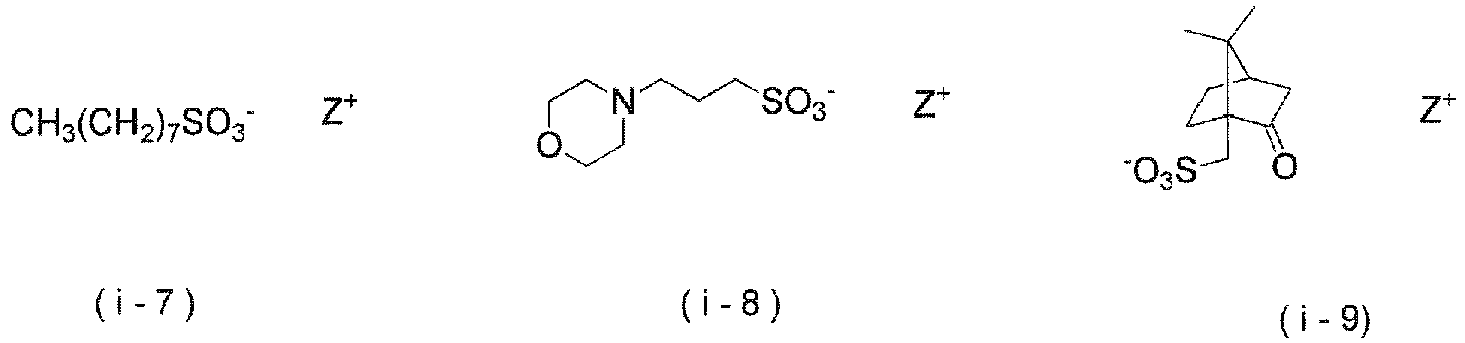
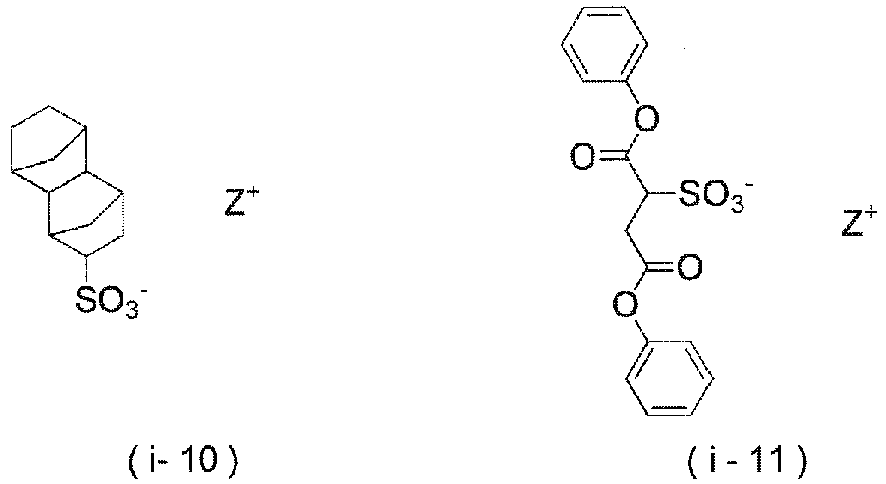
- In the above formulae (i-1) to (i-11), Z+ is as defined in the above formula (4).
- The acid generating agent (B) is preferably the compound (i-1) or the compound (i-11).
- The lower limit of the content of the acid generating agent (B) with respect to 100 parts by mass of the polymetalloxane (A) is preferably 1 part by mass, more preferably 3 parts by mass, still more preferably 5 parts by mass, particularly preferably 8 parts by mass, further particularly preferably 12 parts by mass, and most particularly preferably 15 parts by mass. The upper limit of the content of the acid generating agent (B) is preferably 50 parts by mass, more preferably 30 parts by mass, still more preferably 25 parts by mass, and particularly preferably 20 parts by mass. When the content of the acid generating agent (B) falls within the above range, the sensitivity and resolution of the radiation-sensitive composition can be further improved. The radiation-sensitive composition may contain two or more types of the acid generator (B).
- The solvent (C) is not particularly limited as long as it is a solvent capable of dissolving or dispersing at least the polymetalloxane (A) and the acid generator (B), as well as optional component(s) such as the acid trapper (D) which may be contained as needed.
- The solvent (C) is exemplified by an alcohol solvent, an ether solvent, a ketone solvent, an amide solvent, an ester solvent, a hydrocarbon solvent, and the like.
- Examples of the alcohol solvent include:
- aliphatic monohydric alcohol solvents having 1 to 18 carbon atoms such as 4-methyl-2-pentanol and n-hexanol;
- alicyclic monohydric alcohol solvents having 3 to 18 carbon atoms such as cyclohexanol;
- polyhydric alcohol solvents having 2 to 18 carbon atoms such as propylene glycol;
- polyhydric alcohol partially etherated solvents having 3 to 19 carbon atoms such as propylene glycol monomethyl ether; and the like.
- Examples of the ether solvent include:
- dialkyl ether solvents having 4 to 14 carbon atoms such as diethyl ether;
- cyclic ether solvents such as tetrahydrofuran and tetrahydropyran;
- aromatic ring-containing ether solvents such as diphenyl ether and anisole; and the like.
- Examples of the ketone solvent include:
- chain ketone solvents having 3 to 12 carbon atoms such as acetone, methyl ethyl ketone, methyl-iso-butyl ketone, and 2-heptanone;
- cyclic ketone solvents such as cyclopentanone, cyclohexanone, cycloheptanone, cyclooctanone and methylcyclohexanone;
- 2,4-pentanedione, acetonyl acetone, acetophenone; and the like.
- Examples of the amide solvent include:
- cyclic amide solvents such as N,N'-dimethylimidazolidinone and N-methylpyrrolidone;
- chain amide solvents such as N-methylformamide, N,N-dimethylformamide, N,N-diethylformamide, acetamide, N-methylacetamide, N,N-dimethylacetamide and N-methylpropionamide; and the like.
- Examples of the ester solvent include:
- monocarboxylic acid ester solvents, e.g., acetic acid ester solvents such as n-butyl acetate and amyl acetate, propionic acid ester solvents such as ethyl propionate, and the like;
- hydroxycarboxylic acid ester solvents such as ethyl lactate and n-butyl glycolate;
- polyhydric alcohol carboxylate solvents such as propylene glycol acetate;
- polyhydric alcohol partial ether carboxylate solvents such as propylene glycol monomethyl ether acetate;
- polyhydric carboxylic acid diester solvents such as diethyl oxalate;
- lactone solvents such as γ-butyrolactone and δ-valerolactone;
- carbonate solvents such as dimethyl carbonate, diethyl carbonate, ethylene carbonate and propylene carbonate; and the like.
- Examples of the hydrocarbon solvent include:
- aliphatic hydrocarbon solvents having 5 to 12 carbon atoms such as n-pentane and n-hexane;
- aromatic hydrocarbon solvents having 6 to 16 carbon atoms such as toluene and xylene; and the like.
- The solvent (C) is preferably the alcohol solvent, more preferably the aliphatic monohydric alcohol solvent, and still more preferably 4-methyl-2-pentanol. The radiation-sensitive resin composition may contain two or more types of the solvent (C).
- Alternatively, the solvent (C) may be a mixed solvent containing the organic solvent as a principal component, and a small amount of water. The solvent (C) being such a mixed solvent enables the polymetalloxane (A) to be hydrated, and as a result, the storage stability of the radiation-sensitive composition can be further improved. In addition, an increase in the molecular weight of the polymetalloxane (A) can be further promoted in resist pattern formation.
- The lower limit of the content of water in the mixed solvent is preferably 0.01% by mass, more preferably 0.1% by mass, and still more preferably 1% by mass. The upper limit of the content is preferably 20% by mass, and more preferably 10% by mass.
- The acid trapper (D) traps an acid generated from the acid generator (B) by an exposure and controls a diffusion phenomenon of the acid in the resist film, thereby allowing an effect of inhibiting an undesired chemical reaction in unexposed regions to be achieved. The acid trapper (D) may be contained in the radiation-sensitive composition in the form of a low-molecular weight compound (hereinafter, may be also referred to as "(D) acid trapping agent" or "acid trapping agent (D)" as appropriate), in the form incorporated as a part of the polymetalloxane (A), or in both of these forms.
- The acid trapping agent (D) is exemplified by a nitrogen-containing compound, a photodegradable base that is photosensitized by an exposure to generate a weak acid, and the like. The photodegradable base is degraded through the exposure, leading to a decrease in an acid-trapping property.
- The nitrogen-containing compound is exemplified by an amine compound, an amide group-containing compound, a urea compound, a nitrogen-containing heterocyclic compound, and the like.
- Examples of the amine compound include: compounds each having one amino group such as monoalkylamine, dialkylamine, trialkylamine and aromatic amine; compounds each having two amino groups; compounds each having three or more amino groups; and the like.
- Examples of the nitrogen-containing heterocyclic compound include imidazoles, pyridines, morpholines, pyrazine, pyrazole, and the like.
- As the nitrogen-containing compound, a compound having an acid-labile group may be also used. Examples of such a nitrogen-containing compound having an acid-labile group include N-t-butoxycarbonylpiperidine, N-t-butoxycarbonylimidazole, N-t-butoxycarbonylbenzimidazole, N-t-butoxycarbonyl-2-phenylbenzimidazole, N-(t-butoxycarbonyl)di-n-octylamine, N-(t-butoxycarbonyl)diethanolamine, N-(t-butoxycarbonyl)dicyclohexylamine, N-(t-butoxycarbonyl)diphenylamine, N-t-butoxycarbonyl-4-hydroxypiperidine, N-t-amyloxycarbonyl-4-hydroxypiperidine, and the like.
- The photodegradable base is exemplified by a radiation-sensitive onium cation salt of a carboxylic acid, and the like. Examples of such a compound include a sulfonium salt represented by the following formula (5-1), an iodonium salt represented by the following formula (5-2), and the like.

- In the above formulae (5-1) and (5-2), R23 to R27 each independently represent a hydrogen atom, an alkyl group, an alkoxy group, a hydroxy group or a halogen atom; and E- and Q- each independently represent Rβ-COO- or an anion represented by the following formula (5-3), wherein Rβ represents a monovalent hydrocarbon group having 1 to 20 carbon atoms.

- In the above formula (5-3), R28 represents a linear or branched alkyl group having 1 to 12 carbon atoms, a linear or branched fluorinated alkyl group having 1 to 12 carbon atoms or a linear or branched alkoxy group having 1 to 12 carbon atoms; and u is an integer of 0 to 2, wherein in a case in which u is 2, two R28s are identical or different.
- The photodegradable base is preferably the sulfonium salt, more preferably a triarylsulfonium salt, and still more preferably triphenylsulfonium salicylate.
- In a case in which the radiation-sensitive composition contains the acid trapping agent (D), the lower limit of the content of the acid trapping agent (D) with respect to 100 parts by mass of the polymetalloxane (A) is preferably 0.1 parts by mass, more preferably 0.5 parts by mass, still more preferably 1 part by mass, and particularly preferably 3 parts by mass. The upper limit of the content of the acid trapping agent (D) is preferably 20 parts by mass, more preferably 15 parts by mass, still more preferably 10 parts by mass, and particularly preferably 7 parts by mass. When the content of the acid trapping agent (D) falls within the above range, the sensitivity and resolution of the radiation-sensitive composition can be further improved. One, or two or more types of the acid trapper (D) may be used.
- The radiation-sensitive composition may also contain other optional component(s) in addition to the components (A) to (D). The other optional component is exemplified by a surfactant, a sensitizing agent, a fluorine atom-containing polymer, and the like. In a case in which the radiation-sensitive composition contains the other optional component, the lower limit of the content of the other optional component with respect to 100 parts by mass of the polymetalloxane (A) is preferably 0.1 parts by mass, and more preferably 0.5 parts by mass. The upper limit of the content of the other optional component is preferably 10 parts by mass, and more preferably 5 parts by mass. One, or two or more types of the other optional component may be used.
- The radiation-sensitive composition may be prepared by, for example, mixing at a predetermined ratio the polymetalloxane (A), the acid generator (B), the solvent (C), and as needed the optional component such as the acid trapper (D), and preferably filtering a thus resulting mixture through a filter having a pore size of about 0.2 µm. The lower limit of the solid content concentration of the radiation-sensitive composition is preferably 0.1% by mass, more preferably 0.5% by mass, still more preferably 1% by mass, and particularly preferably 2% by mass. The upper limit of the solid content concentration is preferably 50% by mass, more preferably 30% by mass, still more preferably 10% by mass, and particularly preferably 5% by mass.
- The resist pattern-forming method of the other embodiment of the present invention includes the steps of: applying the radiation-sensitive composition of the one embodiment of the present invention directly or indirectly on at least an upper face side of a substrate to form a resist film (hereinafter, may be also referred to as "applying step"); exposing the resist film (hereinafter, may be also referred to as "exposing step"); and developing the resist film exposed (hereinafter, may be also referred to as "developing step").
- The resist pattern-forming method enables a resist pattern with superior sensitivity and superior resolution to be formed since the radiation-sensitive composition described above is used. Hereinafter, each step will be described.
- In this step, the radiation-sensitive composition of the one embodiment of the present invention is applied directly or indirectly on at least an upper face side of a substrate. Specifically, the radiation-sensitive composition is applied such that a coating film thus obtained has a desired thickness, and thereafter evaporation of a solvent and the like in the radiation-sensitive composition is allowed by prebaking (PB) as needed, thereby forming a resist film. The applying procedure may be, for example, spin-coating, flow casting coating, roll coating, or the like. The substrate may be, for example, a silicon wafer, a wafer covered with aluminum, and the like. It is to be noted that in order to maximize potential abilities of the radiation-sensitive composition, an organic or inorganic antireflective film may be formed on the substrate.
- The lower limit of the average thickness of the resist film to be formed is preferably 1 nm, more preferably 5 nm, still more preferably 10 nm, and particularly preferably 20 nm. On the other hand, the upper limit of the average thickness is preferably 1,000 nm, more preferably 200 nm, still more preferably 100 nm, and particularly preferably 70 nm.
- The lower limit of a temperature for the PB is preferably 60 °C, and more preferably 80 °C. The upper limit of the temperature for the PB is preferably 140 °C, and more preferably 120 °C. The lower limit of a time period for the PB is preferably 5 sec, and more preferably 10 sec. The upper limit of the time period for the PB is preferably 600 sec, and more preferably 300 sec.
- In this step, in order to preclude influences from basic impurities and the like included in the environmental atmosphere, for example, a protective film may be provided on the resist film formed. Also, in a case in which liquid immersion lithography is carried out in the exposing step as described later, a protective film for liquid immersion may be provided on the resist film formed in order to avoid direct contact between the film and a liquid immersion medium.
- In this step, the resist film formed by the applying step is exposed. Specifically, the film is irradiated with a radioactive ray through a mask having a predetermined pattern, for example. In this step, as needed, irradiation with a radioactive ray via a liquid immersion medium such as water, i.e., liquid immersion lithography, may be adopted. The radioactive ray for use in the exposure is exemplified by: an electromagnetic wave such as a visible light ray, an ultraviolet ray, a far ultraviolet ray, an EUV ray (wavelength: 13.5 nm), an X-ray or a γ-ray; a charged particle ray such as an electron beam or an α-ray; or the like. Of these, the EUV ray and the electron beam are preferred.
- It is preferred that post exposure baking (PEB) is conducted after the exposure. The lower limit of the temperature for the PEB is preferably 50 °C, and more preferably 80 °C. The upper limit of the temperature for the PEB is preferably 200 °C, and more preferably 180 °C. The lower limit of the time period for the PEB is preferably 5 sec, and more preferably 10 sec. The upper limit of the time period for the PEB is preferably 600 sec, and more preferably 300 sec.
- In this step, the resist film exposed is developed by a conventionally well-known procedure. Accordingly, a predetermined resist pattern is formed. The developer solution is exemplified by an aqueous alkali solution, an organic solvent-containing liquid, and the like. The developer solution is preferably the organic solvent-containing liquid in light of developability and the like.
- Examples of the organic solvent in the organic solvent-containing liquid include organic solvents similar to those exemplified as the solvent (C) for the radiation-sensitive composition, and the like. Of these, the ketone solvents and the ester solvents are preferred, and 2-heptanone and butyl acetate are more preferred.
- The lower limit of the content of the organic solvent in the organic solvent-containing liquid is preferably 80% by mass, more preferably 90% by mass, still more preferably 95% by mass, and particularly preferably 99% by mass. When the content of the organic solvent falls within the above range, a contrast of rates of dissolution in the developer solution between a light-exposed region and a light-unexposed region can be further improved. It is to be noted that a component of the organic solvent-containing liquid other than the organic solvent may be, for example, water, silicone oil, or the like.
- Into the developer solution, a surfactant may be added in an appropriate amount, if necessary. As the surfactant, for example, an ionic or nonionic fluorochemical surfactant, a silicone-based surfactant or the like may be used.
- The resist pattern obtained after the development is preferably rinsed with a rinse agent such as water or an alcohol, and then dried.
- Hereinafter, the present invention is explained in detail by way of Examples, but the present invention is not in any way limited to these Examples. Each physical property value was measured according to the following method.
- The solid content concentration of a liquid containing the polymetalloxane (A) was calculated from a mass (M1) of the liquid containing the polymetalloxane (A) and a mass (M2) determined after drying of the liquid, according to a formula of: M2 x 100/M1 (% by mass).
- Phenylgermanium trichloride in an amount of 2.0 g was dissolved in 50 g of tetrahydrofuran, and 1.0 g of water was added thereto. The mixture was stirred at room temperature for 48 hrs. After 40 g of 4-methyl-2-pentanol was added thereto, the mixture was concentrated under reduced pressure by a rotary evaporator, and then the concentrated liquid was filtered through a PTFE membrane filter having a pore size of 0.20 µm to give a liquid containing a polymetalloxane (A-1). This liquid had a solid content concentration of 4.0% by mass.
- Benzylgermanium trichloride in an amount of 2.0 g was dissolved in 50 g of tetrahydrofuran, and 1.0 g of water was added thereto. The mixture was stirred at room temperature for 48 hrs. After 40 g of 4-methyl-2-pentanol was added thereto, the mixture was concentrated under reduced pressure by a rotary evaporator, and then the concentrated liquid was filtered through a PTFE membrane filter having a pore size of 0.20 µm to give a liquid containing a polymetalloxane (A-2). This liquid had a solid content concentration of 4.3% by mass.
- Phenyltin trichloride in an amount of 2.0 g was dissolved in 50 g of tetrahydrofuran, and 1.0 g of water was added thereto. The mixture was stirred at room temperature for 48 hrs. After 40 g of 4-methyl-2-pentanol was added thereto, the mixture was concentrated under reduced pressure by a rotary evaporator, and then the concentrated liquid was filtered through a PTFE membrane filter having a pore size of 0.20 µm to give a liquid containing a polymetalloxane (A-3). This liquid had a solid content concentration of 3.5% by mass.
- 4-Methoxyphenyltri(phenylethynyl)tin in an amount of 1.0 g was dissolved in 25 g of tetrahydrofuran and 25 g of chloroform, and 3.0 g of water was added thereto. The mixture was stirred at room temperature for 96 hrs. After 40 g of 4-methyl-2-pentanol was added thereto, the mixture was concentrated under reduced pressure by a rotary evaporator, and then the concentrated liquid was filtered through a PTFE membrane filter having a pore size of 0.20 µm to give a liquid containing a polymetalloxane (A-4). This liquid had a solid content concentration of 2.5% by mass.
- Isopropyltin trichloride in an amount of 2.0 g was dissolved in 50 g of tetrahydrofuran, and 1.0 g of water was added thereto. The mixture was stirred at room temperature for 48 hrs. After 40 g of 4-methyl-2-pentanol was added thereto, the mixture was concentrated under reduced pressure by a rotary evaporator, and then the concentrated liquid was filtered through a PTFE membrane filter having a pore size of 0.20 µm to give a liquid containing a polymetalloxane (A-5). This liquid had a solid content concentration of 4.0% by mass.
- Diphenyldichlorolead in an amount of 2.0 g was dissolved in 50 g of tetrahydrofuran, and 5.0 g of water was added thereto. The mixture was stirred at 40 °C for 12 hrs. After 40 g of 4-methyl-2-pentanol was added thereto, the mixture was concentrated under reduced pressure by a rotary evaporator, and then the concentrated liquid was filtered through a PTFE membrane filter having a pore size of 0.20 µm to give a liquid containing a polymetalloxane (A-6). This liquid had a solid content concentration of 5.0% by mass.
- The acid generating agent (B), the solvent (C) and the acid trapping agent (D) used for preparing the radiation-sensitive compositions are presented below.
-
- B-1: diphenyliodonium nonafluorobutanesulfonate (a compound represented by the following formula (B-1))
- B-2: triphenylsulfonium 1,2-di(cyclohexyloxycarbonyl)ethane-1-sulfonate (a compound represented by the following formula (B-2))
- C-1: 4-methyl-2-pentanol
-
- D-1: triphenylsulfonium salicylate (a compound represented by the following formula (D-1))
- D-2: 2,4,5-triphenylimidazole (a compound represented by the following formula (D-2))
- After mixing 2,500 parts by mass of a liquid (containing 100 parts by mass of (A-1) in terms of the solid content) containing (A-1) as the polymetalloxane (A) with 10 parts by mass of (B-1) as the acid generating agent (B), the mixture was diluted with 1,890 parts by mass of (C-1) as the solvent (C) to prepare a liquid having a solid content concentration of 2.5% by mass. The liquid was filtered through a membrane filter having a pore size of 0.20 µm to give a radiation-sensitive composition (R-1).
- Each component of the type and the content shown in Table 2 below (the content of the polymetalloxane (A) being indicated as "parts by mass" of the liquid containing the polymetalloxane) was mixed, and the mixture was diluted with (C-1) as the solvent (C) to prepare a liquid having a solid content concentration of 2.5% by mass. The liquid thus obtained was filtered through a membrane filter having a pore size of 0.20 µm to give radiation-sensitive compositions (R-2) to (R-14). In Table 1 below, "-" denotes that a corresponding component was not used.
Table 1 Radiation-sensitive composition (A) Polymetalloxane (B) Acid generating agent (C) Solvent (D) Acid trapping agent type content (parts by mass) type content (parts by mass) type content (parts by mass) type content (parts by mass) Example 1 R-1 A-1 2500 B-1 10 C-1 1890 - - Comparative Example 1 R-2 A-1 2500 - - C-1 1500 - - Comparative Example 2 R-3 A-2 2500 B-1 10 C-1 2190 - - Comparative Example 3 R-4 A-2 2500 - - C-1 1800 - - Example 2 R-5 A-3 2500 B-2 20 C-1 1780 - - Example 3 R-6 A-3 2500 B-2 20 C-1 1975 D-1 5 Example 4 R-7 A-3 2500 B-2 20 C-1 1975 D-2 5 Comparative Example 4 R-8 A-3 2500 - - C-1 1000 - - Example 5 R-9 A-4 2500 B-1 15 C-1 585 - - Comparative Example 5 R-10 A-4 2500 - - C-1 0 - - Comparative Example 6 R-11 A-5 2500 B-1 15 C-1 2085 - - Comparative Example 7 R-12 A-5 2500 - - C-1 1500 - - Example 6 R-13 A-6 2500 B-2 10 C-1 2890 - - Comparative Example 8 R-14 A-6 2500 - - C-1 2500 - - - After each radiation-sensitive composition prepared as described above was spin-coated on a silicon wafer, PB was conducted under a condition of 100 °C and 60 sec to form a resist film having an average thickness of 50 nm. Next, this resist film was exposed through a mask by using a vacuum ultraviolet light exposure system (NA: 0.3, diepole illumination, wavelength: 13.5 nm). Thereafter, PEB was conducted under a condition of 170 °C and 120 sec. Subsequently, development was carried out with a puddle method using 2-heptanone at 23 °C for 1 min to execute patterning. Thereafter, drying was carried out and a negative-tone resist pattern was formed.
- The radiation-sensitive compositions prepared as described above, and the resist patterns formed as described above were evaluated on the following items according to methods described below. The results of the evaluations are shown in Table 2 below.
- By way of patterning with a vacuum ultraviolet ray (wavelength: 13.5 nm), an optimum exposure dose was determined as an exposure dose at which a line-and-space pattern (1L 1S) that included line portions having line widths of 30 nm and space portions of 30 nm that were intervals formed by adjacent line portions was formed to give 1:1 line widths, and this optimum exposure dose was defined as sensitivity (mJ/cm2). The sensitivity was evaluated to be: "AAA (extremely favorable)" in a case of the sensitivity being no greater than 20 mJ/cm2; "AA (very favorable)" in a case of the sensitivity being greater than 20 mJ/cm2 and no greater than 25 mJ/cm2; "A (favorable)" in a case of the sensitivity being greater than 25 mJ/cm2 and no greater than 30 mJ/cm2; and "B (unfavorable)" in a case of the sensitivity being greater than 30 mJ/cm2.
- In the formation of the resist pattern described above, the resolution was evaluated to be: "AA (very favorable)" in a case of being able to form a line-and-space pattern (1L 1S) that included line portions having line widths of 22 nm and space portions of 22 nm that were intervals formed by adjacent line portions to give 1:1 line widths; "A (favorable)" in a case of difficulty in resolving for 22 nm, but being able to form a 25 nm line-and-space pattern (1L 1S) to give a 1:1 line width; and "B (unfavorable)" in a case of difficulty in forming the 25 nm line-and-space pattern (1L 1S) to give 1:1 line widths.
Table 2 Radiation-sensitive composition Sensitivity Resolution Example 1 R-1 A A Comparative Example 1 R-2 B A Comparative Example 2 R-3 B A Comparative Example 3 R-4 B A Example 2 R-5 AA A Example 3 R-6 AA AA Example 4 R-7 A AA Comparative Example 4 R-8 B A Example 5 R-9 AAA A Comparative Example 5 R-10 B A Comparative Example 6 R-11 B B Comparative Example 7 R-12 B A Example 6 R-13 A A Comparative Example 8 R-14 B A - As is clear from the results shown in Table 2, the radiation-sensitive compositions of the Examples were superior in the sensitivity and the resolution. The radiation-sensitive compositions of the Comparative Examples were inferior in the sensitivity, the resolution or both characteristics.
- According to the radiation-sensitive resin composition and the resist pattern-forming method of the embodiments of the present invention, formation of a resist pattern is enabled with superior sensitivity and superior resolution. Therefore, these can be suitably used for the manufacture of semiconductor devices, for which further progress of microfabrication is expected in the future.


Claims (4)
- A radiation-sensitive composition comprising:a polymetalloxane comprising a structural unit represented by the following formula (1);a radiation-sensitive acid generator; anda solvent,
 wherein, in the formula (1), M represents a germanium atom, a tin atom or a lead atom; Ar1 represents a substituted or unsubstituted aryl group having 6 to 20 ring atoms, or a substituted or unsubstituted heteroaryl group having 5 to 20 ring atoms; R1 represents a monovalent organic group having 1 to 20 carbon atoms, a hydrogen atom, a halogen atom or a hydroxy group; and n is 2 or 3.
 - The radiation-sensitive composition according to claim 1, wherein a substituent of the substituted aryl group or the substituted heteroaryl group which may be represented by Ar1 is an electron donating group.
- The radiation-sensitive composition according to claim 1 or 2, further comprising an acid trapper.
- A resist pattern-forming method comprising:applying the radiation-sensitive composition according to any one of claims 1 to 3 directly or indirectly on at least one face side of a substrate;exposing to an extreme ultraviolet ray or electron beam a resist film formed by the applying; anddeveloping with an organic solvent-containing liquid the resist film exposed.
Applications Claiming Priority (2)
| Application Number | Priority Date | Filing Date | Title |
|---|---|---|---|
| JP2017156126 | 2017-08-10 | ||
| PCT/JP2018/027972 WO2019031250A1 (en) | 2017-08-10 | 2018-07-25 | Radiation sensitive composition and resist pattern forming method |
Publications (2)
| Publication Number | Publication Date |
|---|---|
| EP3667419A1 true EP3667419A1 (en) | 2020-06-17 |
| EP3667419A4 EP3667419A4 (en) | 2021-05-12 |
Family
ID=65271227
Family Applications (1)
| Application Number | Title | Priority Date | Filing Date |
|---|---|---|---|
| EP18845007.6A Withdrawn EP3667419A4 (en) | 2017-08-10 | 2018-07-25 | Radiation sensitive composition and resist pattern forming method |
Country Status (6)
| Country | Link |
|---|---|
| US (1) | US11506976B2 (en) |
| EP (1) | EP3667419A4 (en) |
| JP (1) | JPWO2019031250A1 (en) |
| KR (1) | KR20200039665A (en) |
| TW (1) | TW201910391A (en) |
| WO (1) | WO2019031250A1 (en) |
Cited By (2)
| Publication number | Priority date | Publication date | Assignee | Title |
|---|---|---|---|---|
| EP4393925A1 (en) * | 2022-12-27 | 2024-07-03 | Samsung Electronics Co., Ltd. | Organometallic compound, resist composition including the same and pattern forming method using the same |
| EP4573413A4 (en) * | 2022-08-17 | 2026-08-05 | Inpria Corp | ADDITIVES FOR METAL OXIDE PHOTORACKS, POSITIVE TONER DEVELOPMENT WITH ADDITIVES AND DOUBLE-FIRING DOUBLE DEVELOPMENT PROCESS |
Families Citing this family (3)
| Publication number | Priority date | Publication date | Assignee | Title |
|---|---|---|---|---|
| US20230142791A1 (en) * | 2020-03-31 | 2023-05-11 | Toray Industries, Inc. | Inorganic solid object pattern manufacturing method and inorganic solid object pattern |
| WO2022054552A1 (en) * | 2020-09-11 | 2022-03-17 | 東レ株式会社 | Polymetalloxane-containing composition, cured body, member, electronic component, and fiber |
| JP2024169053A (en) | 2023-05-25 | 2024-12-05 | 東京応化工業株式会社 | Resist composition and pattern forming method |
Family Cites Families (10)
| Publication number | Priority date | Publication date | Assignee | Title |
|---|---|---|---|---|
| US4761464A (en) * | 1986-09-23 | 1988-08-02 | Zeigler John M | Interrupted polysilanes useful as photoresists |
| JPS63253939A (en) * | 1987-04-10 | 1988-10-20 | Nippon Telegr & Teleph Corp <Ntt> | Process for forming resist pattern |
| JPH08146610A (en) | 1994-11-17 | 1996-06-07 | Nippon Zeon Co Ltd | Resist composition and pattern forming method using the same |
| JP3991462B2 (en) | 1997-08-18 | 2007-10-17 | Jsr株式会社 | Radiation sensitive resin composition |
| US6136501A (en) | 1998-08-28 | 2000-10-24 | Shipley Company, L.L.C. | Polymers and photoresist compositions comprising same |
| JP3979095B2 (en) * | 2002-01-18 | 2007-09-19 | Jsr株式会社 | Radiation curable composition, optical waveguide using the same, and method for producing optical waveguide |
| WO2016140057A1 (en) * | 2015-03-05 | 2016-09-09 | Jsr株式会社 | Radiation-sensitive composition and pattern formation method |
| EP3564751A4 (en) * | 2016-12-28 | 2020-10-14 | JSR Corporation | RADIATION-SENSITIVE COMPOSITION, STRUCTURAL FORMING PROCESS AND METALLIC RESIN AND PROCESS FOR MANUFACTURING THEREOF |
| WO2018123537A1 (en) * | 2016-12-28 | 2018-07-05 | Jsr株式会社 | Radiation sensitive composition, pattern forming method and metal oxide |
| JPWO2018139109A1 (en) * | 2017-01-26 | 2019-11-14 | Jsr株式会社 | Radiation-sensitive composition and pattern forming method |
-
2018
- 2018-07-25 JP JP2019535092A patent/JPWO2019031250A1/en active Pending
- 2018-07-25 EP EP18845007.6A patent/EP3667419A4/en not_active Withdrawn
- 2018-07-25 KR KR1020207002443A patent/KR20200039665A/en not_active Withdrawn
- 2018-07-25 WO PCT/JP2018/027972 patent/WO2019031250A1/en not_active Ceased
- 2018-08-07 TW TW107127459A patent/TW201910391A/en unknown
-
2020
- 2020-01-31 US US16/778,166 patent/US11506976B2/en active Active
Cited By (2)
| Publication number | Priority date | Publication date | Assignee | Title |
|---|---|---|---|---|
| EP4573413A4 (en) * | 2022-08-17 | 2026-08-05 | Inpria Corp | ADDITIVES FOR METAL OXIDE PHOTORACKS, POSITIVE TONER DEVELOPMENT WITH ADDITIVES AND DOUBLE-FIRING DOUBLE DEVELOPMENT PROCESS |
| EP4393925A1 (en) * | 2022-12-27 | 2024-07-03 | Samsung Electronics Co., Ltd. | Organometallic compound, resist composition including the same and pattern forming method using the same |
Also Published As
| Publication number | Publication date |
|---|---|
| KR20200039665A (en) | 2020-04-16 |
| US11506976B2 (en) | 2022-11-22 |
| JPWO2019031250A1 (en) | 2020-07-02 |
| EP3667419A4 (en) | 2021-05-12 |
| TW201910391A (en) | 2019-03-16 |
| WO2019031250A1 (en) | 2019-02-14 |
| US20200166840A1 (en) | 2020-05-28 |
Similar Documents
| Publication | Publication Date | Title |
|---|---|---|
| US11506976B2 (en) | Radiation-sensitive composition and resist pattern-forming method | |
| KR102389746B1 (en) | Resist composition and patterning process | |
| KR102148074B1 (en) | Resist composition and patterning process | |
| KR102300551B1 (en) | Chemically amplified resist composition and patterning process | |
| KR101960605B1 (en) | Resist composition and patterning process | |
| KR102382931B1 (en) | Resist composition and patterning process | |
| KR20180136383A (en) | Resist composition and patterning process | |
| KR102826222B1 (en) | Pattern forming method, actinic light-sensitive or radiation-sensitive composition, method for manufacturing electronic device | |
| TW201944174A (en) | Resist composition and patterning process | |
| KR20180107738A (en) | Resist composition and patterning process | |
| EP3564751A1 (en) | Radiation-sensitive composition, pattern formation method, and metal-containing resin and method for manufacturing same | |
| KR20180002022A (en) | Resist composition and patterning process | |
| TWI637971B (en) | Photoresist material and pattern forming method | |
| KR20210031842A (en) | Resist composition and patterning process | |
| KR102382929B1 (en) | Resist composition and patterning process | |
| TWI756463B (en) | Photosensitive resin composition, resist film, pattern forming method, and manufacturing method of electronic device | |
| KR20210020812A (en) | Resist composition and patterning process | |
| JP7400818B2 (en) | Radiation-sensitive resin composition, resist pattern forming method, and compound | |
| JP6571912B2 (en) | Dendritic compounds, photoresist compositions, and methods of making electronic devices | |
| WO2014175201A1 (en) | Pattern formation method, active light-sensitive or radiation-sensitive resin composition used therein, resist film, and electronic device using resist film and method for producing electronic device | |
| TW201927746A (en) | Active-light-sensitive or radiation-sensitive resin composition, resist film, pattern formation method, method for manufacturing electronic device, and compound | |
| JPWO2018084050A1 (en) | Metal-containing onium salt compound, photodegradable base, resist composition, and device manufacturing method using the resist composition | |
| JPWO2018180070A1 (en) | Actinic ray-sensitive or radiation-sensitive resin composition, resist film, pattern formation method, and electronic device manufacturing method | |
| TW201928518A (en) | Active ray- or radiation-sensitive resin composition, resist film, pattern forming method, method for manufacturing electronic device, and compound | |
| WO2019093145A1 (en) | Composition for forming resist film and resist pattern forming method |
Legal Events
| Date | Code | Title | Description |
|---|---|---|---|
| STAA | Information on the status of an ep patent application or granted ep patent |
Free format text: STATUS: THE INTERNATIONAL PUBLICATION HAS BEEN MADE |
|
| PUAI | Public reference made under article 153(3) epc to a published international application that has entered the european phase |
Free format text: ORIGINAL CODE: 0009012 |
|
| STAA | Information on the status of an ep patent application or granted ep patent |
Free format text: STATUS: REQUEST FOR EXAMINATION WAS MADE |
|
| 17P | Request for examination filed |
Effective date: 20200203 |
|
| AK | Designated contracting states |
Kind code of ref document: A1 Designated state(s): AL AT BE BG CH CY CZ DE DK EE ES FI FR GB GR HR HU IE IS IT LI LT LU LV MC MK MT NL NO PL PT RO RS SE SI SK SM TR |
|
| AX | Request for extension of the european patent |
Extension state: BA ME |
|
| DAV | Request for validation of the european patent (deleted) | ||
| DAX | Request for extension of the european patent (deleted) | ||
| A4 | Supplementary search report drawn up and despatched |
Effective date: 20210412 |
|
| RIC1 | Information provided on ipc code assigned before grant |
Ipc: G03F 7/038 20060101AFI20210406BHEP Ipc: G03F 7/004 20060101ALI20210406BHEP Ipc: G03F 7/20 20060101ALI20210406BHEP |
|
| STAA | Information on the status of an ep patent application or granted ep patent |
Free format text: STATUS: THE APPLICATION IS DEEMED TO BE WITHDRAWN |
|
| 18D | Application deemed to be withdrawn |
Effective date: 20211111 |