EP3666776A1 - Hydrate of a gonadotropin-releasing hormone receptor antagonist - Google Patents
Hydrate of a gonadotropin-releasing hormone receptor antagonist Download PDFInfo
- Publication number
- EP3666776A1 EP3666776A1 EP18211713.5A EP18211713A EP3666776A1 EP 3666776 A1 EP3666776 A1 EP 3666776A1 EP 18211713 A EP18211713 A EP 18211713A EP 3666776 A1 EP3666776 A1 EP 3666776A1
- Authority
- EP
- European Patent Office
- Prior art keywords
- relugolix
- pharmaceutical composition
- hemi hydrate
- hydrate
- range
- Prior art date
- Legal status (The legal status is an assumption and is not a legal conclusion. Google has not performed a legal analysis and makes no representation as to the accuracy of the status listed.)
- Withdrawn
Links
- 102000008238 LHRH Receptors Human genes 0.000 title 1
- 108010021290 LHRH Receptors Proteins 0.000 title 1
- 229940044551 receptor antagonist Drugs 0.000 title 1
- 239000002464 receptor antagonist Substances 0.000 title 1
- 239000008194 pharmaceutical composition Substances 0.000 claims abstract description 33
- 238000002360 preparation method Methods 0.000 claims abstract description 9
- 239000000546 pharmaceutical excipient Substances 0.000 claims abstract description 8
- 201000009273 Endometriosis Diseases 0.000 claims abstract description 6
- 206010060862 Prostate cancer Diseases 0.000 claims abstract description 6
- 208000000236 Prostatic Neoplasms Diseases 0.000 claims abstract description 6
- 238000011282 treatment Methods 0.000 claims abstract description 6
- 206010046798 Uterine leiomyoma Diseases 0.000 claims abstract description 5
- 201000010260 leiomyoma Diseases 0.000 claims abstract description 5
- 239000003814 drug Substances 0.000 claims abstract description 4
- AOMXMOCNKJTRQP-UHFFFAOYSA-N 1-[4-[1-[(2,6-difluorophenyl)methyl]-5-[(dimethylamino)methyl]-3-(6-methoxypyridazin-3-yl)-2,4-dioxothieno[2,3-d]pyrimidin-6-yl]phenyl]-3-methoxyurea Chemical compound C1=CC(NC(=O)NOC)=CC=C1C1=C(CN(C)C)C(C(=O)N(C=2N=NC(OC)=CC=2)C(=O)N2CC=3C(=CC=CC=3F)F)=C2S1 AOMXMOCNKJTRQP-UHFFFAOYSA-N 0.000 claims description 75
- 229950004238 relugolix Drugs 0.000 claims description 74
- 239000000843 powder Substances 0.000 claims description 9
- 230000005855 radiation Effects 0.000 claims description 8
- 238000001938 differential scanning calorimetry curve Methods 0.000 claims description 6
- 239000007941 film coated tablet Substances 0.000 claims description 5
- 239000008184 oral solid dosage form Substances 0.000 claims description 5
- 238000010438 heat treatment Methods 0.000 claims description 4
- 239000000126 substance Substances 0.000 claims description 4
- 238000001757 thermogravimetry curve Methods 0.000 claims description 4
- 238000000034 method Methods 0.000 abstract description 7
- 238000011321 prophylaxis Methods 0.000 abstract description 4
- 238000000634 powder X-ray diffraction Methods 0.000 description 13
- ZMANZCXQSJIPKH-UHFFFAOYSA-N Triethylamine Chemical compound CCN(CC)CC ZMANZCXQSJIPKH-UHFFFAOYSA-N 0.000 description 12
- XLYOFNOQVPJJNP-UHFFFAOYSA-N water Substances O XLYOFNOQVPJJNP-UHFFFAOYSA-N 0.000 description 12
- 239000013078 crystal Substances 0.000 description 11
- 239000012453 solvate Substances 0.000 description 10
- 239000000463 material Substances 0.000 description 7
- WEVYAHXRMPXWCK-UHFFFAOYSA-N Acetonitrile Chemical compound CC#N WEVYAHXRMPXWCK-UHFFFAOYSA-N 0.000 description 6
- FBPFZTCFMRRESA-KVTDHHQDSA-N D-Mannitol Chemical compound OC[C@@H](O)[C@@H](O)[C@H](O)[C@H](O)CO FBPFZTCFMRRESA-KVTDHHQDSA-N 0.000 description 6
- HQKMJHAJHXVSDF-UHFFFAOYSA-L magnesium stearate Chemical compound [Mg+2].CCCCCCCCCCCCCCCCCC([O-])=O.CCCCCCCCCCCCCCCCCC([O-])=O HQKMJHAJHXVSDF-UHFFFAOYSA-L 0.000 description 6
- 239000003826 tablet Substances 0.000 description 6
- IAZDPXIOMUYVGZ-UHFFFAOYSA-N Dimethylsulphoxide Chemical compound CS(C)=O IAZDPXIOMUYVGZ-UHFFFAOYSA-N 0.000 description 5
- 150000001875 compounds Chemical class 0.000 description 5
- 238000005259 measurement Methods 0.000 description 5
- 239000000203 mixture Substances 0.000 description 5
- 239000011541 reaction mixture Substances 0.000 description 5
- 239000007787 solid Substances 0.000 description 5
- IJGRMHOSHXDMSA-UHFFFAOYSA-N Atomic nitrogen Chemical compound N#N IJGRMHOSHXDMSA-UHFFFAOYSA-N 0.000 description 4
- 238000005481 NMR spectroscopy Methods 0.000 description 4
- XAGFODPZIPBFFR-UHFFFAOYSA-N aluminium Chemical compound [Al] XAGFODPZIPBFFR-UHFFFAOYSA-N 0.000 description 4
- 229910052782 aluminium Inorganic materials 0.000 description 4
- 239000002552 dosage form Substances 0.000 description 4
- 239000003960 organic solvent Substances 0.000 description 4
- 238000010926 purge Methods 0.000 description 4
- 239000002904 solvent Substances 0.000 description 4
- YMWUJEATGCHHMB-UHFFFAOYSA-N Dichloromethane Chemical compound ClCCl YMWUJEATGCHHMB-UHFFFAOYSA-N 0.000 description 3
- RTZKZFJDLAIYFH-UHFFFAOYSA-N Diethyl ether Chemical compound CCOCC RTZKZFJDLAIYFH-UHFFFAOYSA-N 0.000 description 3
- 229920002153 Hydroxypropyl cellulose Polymers 0.000 description 3
- OKKJLVBELUTLKV-UHFFFAOYSA-N Methanol Chemical compound OC OKKJLVBELUTLKV-UHFFFAOYSA-N 0.000 description 3
- GWEVSGVZZGPLCZ-UHFFFAOYSA-N Titan oxide Chemical compound O=[Ti]=O GWEVSGVZZGPLCZ-UHFFFAOYSA-N 0.000 description 3
- 239000008186 active pharmaceutical agent Substances 0.000 description 3
- 238000004458 analytical method Methods 0.000 description 3
- 239000001913 cellulose Substances 0.000 description 3
- 229920002678 cellulose Polymers 0.000 description 3
- 238000012512 characterization method Methods 0.000 description 3
- 239000011248 coating agent Substances 0.000 description 3
- 238000000576 coating method Methods 0.000 description 3
- 238000004090 dissolution Methods 0.000 description 3
- 239000001863 hydroxypropyl cellulose Substances 0.000 description 3
- 235000010977 hydroxypropyl cellulose Nutrition 0.000 description 3
- 235000019359 magnesium stearate Nutrition 0.000 description 3
- 235000010355 mannitol Nutrition 0.000 description 3
- 239000011343 solid material Substances 0.000 description 3
- 238000000982 solution X-ray diffraction Methods 0.000 description 3
- 229920002785 Croscarmellose sodium Polymers 0.000 description 2
- LFQSCWFLJHTTHZ-UHFFFAOYSA-N Ethanol Chemical compound CCO LFQSCWFLJHTTHZ-UHFFFAOYSA-N 0.000 description 2
- 239000000579 Gonadotropin-Releasing Hormone Substances 0.000 description 2
- 101000857870 Squalus acanthias Gonadoliberin Proteins 0.000 description 2
- DPXJVFZANSGRMM-UHFFFAOYSA-N acetic acid;2,3,4,5,6-pentahydroxyhexanal;sodium Chemical compound [Na].CC(O)=O.OCC(O)C(O)C(O)C(O)C=O DPXJVFZANSGRMM-UHFFFAOYSA-N 0.000 description 2
- 239000004411 aluminium Substances 0.000 description 2
- 229960001681 croscarmellose sodium Drugs 0.000 description 2
- 235000010947 crosslinked sodium carboxy methyl cellulose Nutrition 0.000 description 2
- 230000018044 dehydration Effects 0.000 description 2
- 238000006297 dehydration reaction Methods 0.000 description 2
- 238000000113 differential scanning calorimetry Methods 0.000 description 2
- 238000009472 formulation Methods 0.000 description 2
- 239000007789 gas Substances 0.000 description 2
- XLXSAKCOAKORKW-AQJXLSMYSA-N gonadorelin Chemical compound C([C@@H](C(=O)NCC(=O)N[C@@H](CC(C)C)C(=O)N[C@@H](CCCNC(N)=N)C(=O)N1[C@@H](CCC1)C(=O)NCC(N)=O)NC(=O)[C@H](CO)NC(=O)[C@H](CC=1C2=CC=CC=C2NC=1)NC(=O)[C@H](CC=1N=CNC=1)NC(=O)[C@H]1NC(=O)CC1)C1=CC=C(O)C=C1 XLXSAKCOAKORKW-AQJXLSMYSA-N 0.000 description 2
- 229940035638 gonadotropin-releasing hormone Drugs 0.000 description 2
- 239000001866 hydroxypropyl methyl cellulose Substances 0.000 description 2
- 235000010979 hydroxypropyl methyl cellulose Nutrition 0.000 description 2
- 229920003088 hydroxypropyl methyl cellulose Polymers 0.000 description 2
- UFVKGYZPFZQRLF-UHFFFAOYSA-N hydroxypropyl methyl cellulose Chemical compound OC1C(O)C(OC)OC(CO)C1OC1C(O)C(O)C(OC2C(C(O)C(OC3C(C(O)C(O)C(CO)O3)O)C(CO)O2)O)C(CO)O1 UFVKGYZPFZQRLF-UHFFFAOYSA-N 0.000 description 2
- UQSXHKLRYXJYBZ-UHFFFAOYSA-N iron oxide Inorganic materials [Fe]=O UQSXHKLRYXJYBZ-UHFFFAOYSA-N 0.000 description 2
- 239000011812 mixed powder Substances 0.000 description 2
- 229910052757 nitrogen Inorganic materials 0.000 description 2
- NDLPOXTZKUMGOV-UHFFFAOYSA-N oxo(oxoferriooxy)iron hydrate Chemical compound O.O=[Fe]O[Fe]=O NDLPOXTZKUMGOV-UHFFFAOYSA-N 0.000 description 2
- 230000000704 physical effect Effects 0.000 description 2
- 238000003756 stirring Methods 0.000 description 2
- 238000002076 thermal analysis method Methods 0.000 description 2
- 238000001107 thermogravimetry coupled to mass spectrometry Methods 0.000 description 2
- PFKFTWBEEFSNDU-UHFFFAOYSA-N 1,1'-Carbonyldiimidazole Substances C1=CN=CN1C(=O)N1C=CN=C1 PFKFTWBEEFSNDU-UHFFFAOYSA-N 0.000 description 1
- JDUWYIGQOJMHAI-UHFFFAOYSA-N 6-(4-aminophenyl)-1-[(2,6-difluorophenyl)methyl]-5-[(dimethylamino)methyl]-3-(6-methoxypyridazin-3-yl)thieno[2,3-d]pyrimidine-2,4-dione Chemical compound N1=NC(OC)=CC=C1N1C(=O)C(C(CN(C)C)=C(S2)C=3C=CC(N)=CC=3)=C2N(CC=2C(=CC=CC=2F)F)C1=O JDUWYIGQOJMHAI-UHFFFAOYSA-N 0.000 description 1
- 101100223811 Caenorhabditis elegans dsc-1 gene Proteins 0.000 description 1
- DGAQECJNVWCQMB-PUAWFVPOSA-M Ilexoside XXIX Chemical compound C[C@@H]1CC[C@@]2(CC[C@@]3(C(=CC[C@H]4[C@]3(CC[C@@H]5[C@@]4(CC[C@@H](C5(C)C)OS(=O)(=O)[O-])C)C)[C@@H]2[C@]1(C)O)C)C(=O)O[C@H]6[C@@H]([C@H]([C@@H]([C@H](O6)CO)O)O)O.[Na+] DGAQECJNVWCQMB-PUAWFVPOSA-M 0.000 description 1
- GMPKIPWJBDOURN-UHFFFAOYSA-N Methoxyamine Chemical compound CON GMPKIPWJBDOURN-UHFFFAOYSA-N 0.000 description 1
- FXHOOIRPVKKKFG-UHFFFAOYSA-N N,N-Dimethylacetamide Chemical compound CN(C)C(C)=O FXHOOIRPVKKKFG-UHFFFAOYSA-N 0.000 description 1
- 125000005233 alkylalcohol group Chemical group 0.000 description 1
- 239000005557 antagonist Substances 0.000 description 1
- 239000007864 aqueous solution Substances 0.000 description 1
- 239000011230 binding agent Substances 0.000 description 1
- 230000005540 biological transmission Effects 0.000 description 1
- 230000015572 biosynthetic process Effects 0.000 description 1
- 239000002775 capsule Substances 0.000 description 1
- 238000012790 confirmation Methods 0.000 description 1
- 238000003869 coulometry Methods 0.000 description 1
- 239000002178 crystalline material Substances 0.000 description 1
- 238000002425 crystallisation Methods 0.000 description 1
- 230000008025 crystallization Effects 0.000 description 1
- 238000011161 development Methods 0.000 description 1
- 238000007416 differential thermogravimetric analysis Methods 0.000 description 1
- 239000003085 diluting agent Substances 0.000 description 1
- 239000007884 disintegrant Substances 0.000 description 1
- 229940088679 drug related substance Drugs 0.000 description 1
- 230000002349 favourable effect Effects 0.000 description 1
- 239000000945 filler Substances 0.000 description 1
- 239000007888 film coating Substances 0.000 description 1
- 238000009501 film coating Methods 0.000 description 1
- 239000012530 fluid Substances 0.000 description 1
- 238000004817 gas chromatography Methods 0.000 description 1
- XNXVOSBNFZWHBV-UHFFFAOYSA-N hydron;o-methylhydroxylamine;chloride Chemical compound Cl.CON XNXVOSBNFZWHBV-UHFFFAOYSA-N 0.000 description 1
- 239000004615 ingredient Substances 0.000 description 1
- 239000000314 lubricant Substances 0.000 description 1
- 238000004519 manufacturing process Methods 0.000 description 1
- 238000004949 mass spectrometry Methods 0.000 description 1
- 238000002844 melting Methods 0.000 description 1
- 230000008018 melting Effects 0.000 description 1
- 150000004682 monohydrates Chemical class 0.000 description 1
- 125000001997 phenyl group Chemical group [H]C1=C([H])C([H])=C(*)C([H])=C1[H] 0.000 description 1
- 229920000642 polymer Polymers 0.000 description 1
- 230000000069 prophylactic effect Effects 0.000 description 1
- 238000001953 recrystallisation Methods 0.000 description 1
- 230000003252 repetitive effect Effects 0.000 description 1
- 238000004467 single crystal X-ray diffraction Methods 0.000 description 1
- 239000011734 sodium Substances 0.000 description 1
- 229910052708 sodium Inorganic materials 0.000 description 1
- 239000011877 solvent mixture Substances 0.000 description 1
- 239000003381 stabilizer Substances 0.000 description 1
- 238000010561 standard procedure Methods 0.000 description 1
- 238000003860 storage Methods 0.000 description 1
- 230000001225 therapeutic effect Effects 0.000 description 1
- 238000002411 thermogravimetry Methods 0.000 description 1
- 239000004408 titanium dioxide Substances 0.000 description 1
- OGIDPMRJRNCKJF-UHFFFAOYSA-N titanium oxide Inorganic materials [Ti]=O OGIDPMRJRNCKJF-UHFFFAOYSA-N 0.000 description 1
- 238000005406 washing Methods 0.000 description 1
- 230000004580 weight loss Effects 0.000 description 1
- 238000010626 work up procedure Methods 0.000 description 1
Images

Classifications
-
- C—CHEMISTRY; METALLURGY
- C07—ORGANIC CHEMISTRY
- C07D—HETEROCYCLIC COMPOUNDS
- C07D495/00—Heterocyclic compounds containing in the condensed system at least one hetero ring having sulfur atoms as the only ring hetero atoms
- C07D495/02—Heterocyclic compounds containing in the condensed system at least one hetero ring having sulfur atoms as the only ring hetero atoms in which the condensed system contains two hetero rings
- C07D495/04—Ortho-condensed systems
Definitions
- the present invention relates to relugolix hemi hydrate and a process for its preparation.
- the invention also relates to a pharmaceutical composition comprising relugolix hemi hydrate, preferably in a predetermined and/or effective amount and at least one pharmaceutically acceptable excipient.
- the pharmaceutical composition of the present invention can be used as a medicament, in particular for the treatment and/or prophylaxis of a condition selected from the group consisting of endometriosis, uterine fibroids and prostate cancer.
- Relugolix is an oral selective antagonist of the gonadotropin-releasing hormone (GnRH) receptor and currently under development for the treatment of endometriosis, uterine fibrioids and prostate cancer. It can be chemically designated as 1-[4-[1-(2,6-difluorobenzyl)-5-(dimethylaminomethyl)-3-(6-methoxypyridazin-3-yl)-2,4-dioxo-1,2,3,4-tetrahydrothieno[2,3- d ]pyrimidin-6-yl]phenyl]-3-methoxyurea and is represented by the following chemical structure according to Formula (I)
- relugolix is disclosed in WO 2004/067535 A1 .
- relugolix was prepared in analogy to the method disclosed in example 4, which involves final recrystallization from dichloromethane/methanol/diethyl ether.
- Example 83 teaches that relugolix was obtained as colorless crystals.
- WO 2014/051164 A2 discloses a THF solvate and a further crystalline form of relugolix, respectively. While the THF solvate is obtained via crystallization from THF, the latter is produced by recrystallizing the THF solvate from a solvent mixture comprising an alkyl alcohol (e.g. ethanol) and a solvent selected from the group consisting of dimethylsulfoxide, dimethylfromamide and dimethylacetamide (e.g. DMSO).
- a solvent mixture comprising an alkyl alcohol (e.g. ethanol) and a solvent selected from the group consisting of dimethylsulfoxide, dimethylfromamide and dimethylacetamide (e.g. DMSO).
- a compound intended to be used for the preparation of an oral solid dosage form requires particular physical properties, which ensure safe production and storage of the finished dosage form. These physical properties are mainly determined by the crystal structure of the active pharmaceutical ingredient and include, but are not limited to physical stability, hygroscopicity, solubility, dissolution rate, flowability and compactability.
- solvate or hydrate formation may be used as a means for customizing the physicochemical properties of an active pharmaceutical ingredient with a process or clinical need, they often suffer from certain drawbacks, which to a certain degree compromizes their utility for formulation into a pharmaceutical dosage form. For example, like the THF solvate of WO 2014/051164 A2 they can contain unacceptable amounts of residual organic solvents.
- the present invention relates to a hemi hydrate of relugolix.
- the relugolix hemi hydrate of the present invention possesses one or more favorable physicochemical properties for a drug substance intended for use in an oral solid dosage form selected from the group consisting of chemical stability, physical stability, hygroscopicity, solubility, dissolution, morphology, crystallinity, flowability, compactibility and wettability.
- the relugolix hemi hydrate of the present invention is physically and chemically stable and can thus be reliably formulated into a pharmaceutical dosage form and safely stored.
- room temperature refers to a temperature in the range of from 20 to 30 °C.
- the term "measured at a temperature in the range of from 20 to 30 °C" refers to a measurement under standard conditions.
- standard conditions mean a temperature in the range of from 20 to 30 °C, i.e. at room temperature.
- Standard conditions can mean a temperature of about 22 °C.
- standard conditions can additionally mean a measurement under 20-80% relative humidity, preferably 30-70% relative humidity, more preferably 40-60% relative humidity and most preferably 50% relative humidity.
- reflection with regards to powder X-ray diffraction as used herein, means peaks in an X-ray diffractogram, which are caused at certain diffraction angles (Bragg angles) by constructive interference from X-rays scattered by parallel planes of atoms in solid material, which are distributed in an ordered and repetitive pattern in a long-range positional order.
- a solid material is classified as crystalline material, whereas amorphous material is defined as solid material which lacks long-range order and only displays short-range order, thus resulting in broad scattering.
- long-range order e.g.
- the term "essentially the same" with reference to powder X-ray diffraction means that variabilities in reflection positions and relative intensities of the reflections are to be taken into account.
- a typical precision of the 2-Theta values is in the range of ⁇ 0.2° 2-Theta, preferably in the range of ⁇ 0.1° 2-Theta.
- a reflection that usually appears at 9.4° 2-Theta for example can appear between 9.2° and 9.6° 2-Theta, preferably between 9.3 and 9.5° 2-Theta on most X-ray diffractometers under standard conditions.
- relative reflection intensities will show inter-apparatus variability as well as variability due to degree of crystallinity, preferred orientation, sample preparation and other factors known to those skilled in the art and should be taken as qualitative measure only.
- the crystalline relugolix hemi hydrate of the present invention may be referred to herein as being characterized by a powder X-ray diffractogram "as shown in" a figure.
- a powder X-ray diffractogram as shown in a figure.
- factors such as variations in instrument type, response and variations in sample directionality, sample concentration, sample purity, sample history and sample preparation may lead to variations, for example relating to the exact reflection and peak positions and their intensities.
- a comparison of the graphical data in the figures herein with the graphical data generated for an unknown physical form and the confirmation that two sets of graphical data relate to the same crystal form is well within the knowledge of a person skilled in the art.
- solid-state form refers to any crystalline and/or amorphous phase of a compound.
- solvate refers to a crystalline solid were either one or more organic solvent(s) is/are cooperated in or accommodated by the crystal structure e.g. is/are part of the crystal structure or entrapped into the crystal (solvent inclusions). Thereby, the one or more organic solvent(s) can be present in a stoichiometric or non-stoichiometric amount.
- the solvate may be referred to by adding greek numeral prefixes.
- a solvate may be referred to as a hemi solvate or as a mono solvate depending on the solvent(s)/compound stoichiometry.
- the solvent content can be measured/determined, for example, by GC, NMR, SXRD and/or TGA/MS.
- hydrate refers to a crystalline solid where either water is cooperated in or accommodated by the crystal structure e.g. is part of the crystal structure or entrapped into the crystal (water inclusions). Thereby, water can be present in a stoichiometric or non-stoichiometric amount.
- the hydrate may be referred to by adding greek numeral prefixes.
- a hydrate may be referred to as a hemi hydrate or as a mono hydrate depending on the water/compound stoichiometry.
- the water content can be measured, for example, by Karl-Fischer-Coulometry, GC, NMR, SXRD and/or TGA/MS.
- dehydrating or “dehydration” as used herein, describe the at least partial removal of water from the crystal structure of the host molecule.
- a "predetermined amount" as used herein with regards to the relugolix hemi hydrate of the present invention refers to the initial amount of the relugolix hemi hydrate used for the preparation of a pharmaceutical composition having a desired dosage strength of relugolix.
- relugolix hemi hydrate of the present invention encompasses an amount of relugolix hemi hydrate, which causes the desired therapeutic and/or prophylactic effect.
- the term "about” means within a statistically meaningful range of a value. Such a range can be within an order of magnitude, typically within 10%, more typically within 5%, even more typically within 1% and most typically within 0.1% of the indicated value or range. Sometimes, such a range can lie within the experimental error, typical of standard methods used for the measurement and/or determination of a given value or range.
- the present invention relates to a hydrate of relugolix.
- the present invention relates to a hemi hydrate of relugolix herein also designated as "relugolix hemi hydrate".
- the present invention relates to relugolix hemi hydrate, characterized by the chemical structure according to Formula (II) wherein n is in the range of from 0.3 to 0.7, preferably in the range of from 0.4 to 0.6 more preferably in the range of from 0.45 to 0.55 and most preferably n is about 0.5.
- n can be selected from the group consisting of about 0.3, 0.4, 0.45, 0.5, 0.55, 0.6 and 0.7.
- the relugolix hemi hydrate of the present invention has a molar ratio of relugolix and water in the range of from 1.0: 0.3 to 0.7, preferably of from 1.0: 0.4 to 0.6, more preferably of from 1.0: 0.45 to 0.55 and most preferably the molar ratio is about 1.0 to 0.5.
- the relugolix hemi hydrate of the present invention as defined in any one of the above described embodiments may be characterized by analytical methods well known in the field of the pharmaceutical industry for characterizing solids. Such methods comprise but are not limited to powder X-ray diffraction, differential scanning calorimetry and thermogravimetric analysis. It may be characterized by one of the aforementioned analytical methods or by combining two or more of them. In particular, the relugolix hemi hydrate of the present invention may be characterized by any one of the following embodiments or by combining two or more of the following embodiments.
- the present invention relates to relugolix hemi hydrate, characterized by having a PXRD comprising reflections at 2-Theta angles of:
- the present invention relates to relugolix hemi hydrate, characterized by having a PXRD comprising reflections at 2-Theta angles of:
- the present invention relates to relugolix hemi hydrate, characterized by having a PXRD comprising reflections at 2-Theta angles of (6.9 ⁇ 0.2)°, (7.3 ⁇ 0.2)°, (7.5 ⁇ 0.2)°, (9.4 ⁇ 0.2)°, (9.7 ⁇ 0.2)°, (12.1 ⁇ 0.2)°, (16.5 ⁇ 0.2)° (18.1 ⁇ 0.2)°, (19.1 ⁇ 0.2)° and (23.2 ⁇ 0.2)°, when measured at a temperature in the range of from 20 to 30 °C with Cu-Kalpha 1,2 radiation having a wavelength of 0.15419 nm.
- the present invention relates to relugolix hemi hydrate, characterized by having a PXRD comprising reflections at 2-Theta angles of (6.9 ⁇ 0.1)°, (7.3 ⁇ 0.1)°, (7.5 ⁇ 0.1)°, (9.4 ⁇ 0.1)°, (9.7 ⁇ 0.2)°, (12.1 ⁇ 0.1)°, (16.5 ⁇ 0.1)° (18.1 ⁇ 0.1)°, (19.1 ⁇ 0.1)° and (23.2 ⁇ 0.1)°, when measured at a temperature in the range of from 20 to 30 °C with Cu-Kalpha 1,2 radiation having a wavelength of 0.15419 nm.
- the present invention also relates to relugolix hemi hydrate, characterized by having a PXRD essentially the same as shown in Figure 1 of the present invention, when measured at a temperature in the range of from 20 to 30 °C with Cu-Kalpha 1,2 radiation having a wavelength of 0.15419 nm.
- the present invention also relates to relugolix hemi hydrate, characterized by having a DSC curve comprising an endothermic peak, preferably a first endothermic peak, having an onset at a temperature of (67 ⁇ 5)°C, preferably of (67 ⁇ 3)°C, even more preferably of (67 ⁇ 2)°C and most preferably of (67 ⁇ 1)°C, when measured a heating rate of 10 K/min.
- the present invention also relates to relugolix hemi hydrate, characterized by having a DSC curve comprising an endothermic peak, preferably a first endothermic peak, having a peak maximum at a temperature of (96 ⁇ 5)°C, preferably of (96 ⁇ 3)°C, even more preferably of (96 ⁇ 2)°C and most preferably of (96 ⁇ 1)°C, when measured a heating rate of 10 K/min.
- the invention relates to relugolix hemi hydrate, characterized by having a DSC curve comprising an endothermic peak, preferably a first endothermic peak, with an enthalpy of (36 ⁇ 5) J/g, preferably of (36 ⁇ 3) J/g, even more preferably of (36 ⁇ 2) J/g and most preferably of (36 ⁇ 1) J/g, when measured at a heating rate of 10 K/min.
- the present invention relates to relugolix hemi hydrate, characterized by having a TGA curve showing a mass loss in the range of from 0.9 - 2.1 w-%, preferably of from 1.2 - 1.8 w-%, more preferably of from 1.35 - 1.65 w-% and most preferably the mass loss is about 1.5 w-%, based on the weight of the relugolix hemi hydrate, when heated from 25 to 120 °C at a rate of 10 K/min.
- the present invention relates to the use of the relugolix hemi hydrate of the present invention as defined in any one of the embodiments described above for the preparation of a pharmaceutical composition.
- the present invention relates to a pharmaceutical composition
- a pharmaceutical composition comprising the relugolix hemi hydrate of the present invention as defined in any one of the embodiments described above, preferably in an effective and/or predetermined amount, and at least one pharmaceutically acceptable excipient.
- the pharmaceutical composition of the present invention is an oral solid dosage form, such as a tablet or a capsule. More preferably, the pharmaceutical composition of the present invention is a tablet e.g. a film-coated tablet.
- the at least one pharmaceutically acceptable excipient, which is comprised in the pharmaceutical composition of the present invention is preferably selected from the group consisting of fillers/diluents, binders, disintegrants, lubricants, stabilizers, coating materials and combinations thereof. Preferably, all of these pharmaceutically acceptable excipients are comprised by the pharmaceutical composition of the present invention.
- the at least one pharmaceutically acceptable excipient which is comprised in the pharmaceutical composition of the present invention is selected from the group consisting of D -mannitol, crystalline cellulose, hydroxypropyl cellulose, crosscarmellose sodium, magnesium stearate and one or more coating materials. More preferably, all of these pharmaceutically acceptable excipients are comprised by the pharmaceutical composition of the present invention.
- the coating materials comprise hydroxypropylmethyl cellulose, titanium dioxide and ferric oxide.
- the present invention relates to a pharmaceutical composition as defined in any one of the embodiments described above, wherein the pharmaceutical composition comprises not less than 25 w-%, preferably not less than 35 w-%, more preferably not less than 40 w-% of relugolix hemi hydrate calculated as water-free relugolix, based on the weight of the pharmaceutical composition.
- the pharmaceutical composition comprises not more than 80 w-%, more preferably not more than 75 w-% of relugolix hemi hydrate calculated as water-free relugolix, based on the weight of the pharmaceutical composition.
- the present invention relates to a pharmaceutical composition as describe above, wherein the predetermined and/or effective amount of relugolix hemi hydrate is selected from the group consisting of 20 mg, 30 mg, 40 mg, 50 mg, 60 mg, 70 mg, 80 mg, 90 mg, 100 mg, 110 mg, 120 mg, 130 mg, 140 mg, 150 mg and 160 mg calculated as water-free relugolix.
- the invention relates to a pharmaceutical composition as describe above, wherein the predetermined and/or effective amount of relugolix hemi hydrate is selected from the group consisting of 40 mg, 50 mg, 60 mg, 70 mg, 80 mg, 90 mg, 100 mg, 110 mg and 120 mg, calculated as water-free relugolix.
- the predetermined and/or effective amount of relugolix hemi hydrate is 40 mg, 80 mg or 120 mg, calculated as water-free relugolix.
- the present invention also relates to a pharmaceutical composition as defined in any one of the above described embodiments, wherein the pharmaceutical composition is to be administered once-daily.
- the present invention relates to the pharmaceutical composition as defined in any one of the above described embodiments for use as a medicament.
- the present invention relates to the pharmaceutical composition as defined in any one of the above described embodiments for use in the treatment or prophylaxis of a condition selected from the group consisting of endometriosis, uterine fibroids and prostate cancer.
- the present invention is directed to a method of treating or prophylactically preventing a condition selected from the group consisting of endometriosis, uterine fibroids and prostate cancer by administering the pharmaceutical composition as defined in any one of the above described embodiments to a patient in need of such a treatment and/or prophylaxis.
- Powder X-ray diffraction was performed with a PANalytical X' Pert PRO diffractometer equipped with a theta/theta coupled goniometer in transmission geometry, Cu-Kalpha 1,2 radiation (wavelength 0.15419 nm) with a focusing mirror and a solid state PIXcel detector.
- Diffractograms were recorded at a tube voltage of 45 kV and a tube current of 40 mA, applying a stepsize of 0.013° 2-Theta with 40s per step (255 channels) in the angular range of 2° to 40° 2-Theta at ambient conditions.
- a typical precision of the 2-Theta values is in the range of ⁇ 0.2° 2-Theta, preferably of ⁇ 0.1° 2-Theta.
- TGA was performed on a Mettler TGA/DSC 1 instrument. Relugolix hemi hydrate (11.4 mg) was heated in a 100 microliter aluminum pan closed with an aluminum lid. The lid was automatically pierced at the beginning of the measurement. The sample was initially kept at 25 °C for 2.5 minutes and then heated from 25 to 150 °C at a rate of 10 K/min. Nitrogen (purge rate 30 mL/min) was used as purge gas.
- DSC was performed on a Mettler Polymer DSC R instrument. Relugolix hemi hydrate (3.3 mg) was heated in a 40 microliter aluminium pan with a pierced aluminium lid from 25 to 250 °C at a rate of 10 K/min. Nitrogen (purge rate 50 mL/min) was used as purge gas.
- Example 1 Preparation of 1-[4-[1-(2,6-difluorobenzyl)-5-(dimethylaminomethyl)-3-(6-methoxypyridazin-3-yl)-2,4-dioxo-1,2,3,4-tetrahydrothieno[2,3-u0pyrimidin-6-yl]phenyl]-3-methoxyurea hemi hydrate (relugolix hemi hydrate)
- 6-(4-Aminophenyl)-1-(2,6-difluorobenzyl)-5-(dimethylaminomethyl)-3-(6-methoxypyridazin-3-yl)thieno[2,3- d ]pyrimidin-2,4(1 H , 3 H )-dione (32.49 g, 0.0590 mol, e.g. prepared according to Examples 6 or 14 of WO 2014/051164 A2 ) was then added to the reaction mixture.
- the residual material in the flask was then taken up in acetonitrile (20 mL) and the washings transferred to the reaction mixture. This reaction mixture was warmed to 50 °C (internal temperature) and stirred for 16 hours.
- Triethylamine (Et3N) (10.69 mL, 0.0767 mol, 1.3 equiv.) was added at 50 °C followed by water (150 mL) portionwise and the mixture was stirred for 3 hours at 50 °C. Thereafter, further amount of water (300 mL) was added at the same temperature and then it was allowed to stir at RT overnight. The solid was filtered under vacuum, washed with water (2 x 150 mL) and dried in vacuum. Solid-state characterization of the obtained material is described in Example 2 hereinafter.
- FIG. 1 A representative diffractogram of relugolix hemi hydrate is displayed in Figure 1 herein.
- the corresponding reflection list is provided in Table 1 below.
- Table 1 PXRD reflections of relugolix hemi hydrate in the range of from 2 to 30° 2-Theta;
- a typical precision of the 2-Theta values is in the range of ⁇ 0.2° 2-Theta, preferably of ⁇ 0.1° 2-Theta.
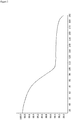
- the TGA curve of relugolix hemi hydrate is displayed in Figure 2 of the present invention and shows a mass loss of about 1.5 w-% from the start of the measurement until about 120 °C, which corresponds to about 0.5 mol equivalent of water.
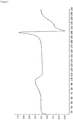
- the weight loss corresponds well to the broad endothermic peak observed in the DSC curve displayed in Figure 3 herein (onset: 67.1 °C, peak:96.2 °C, DH: 36.2 J/g), which can be assigned to the dehydration process.
- Thermoanalysis indicates that relugolix hemi hydrate of the present invention is physically stable upon moderate temperature stress.
- Example 3 Film-coated tablets comprising relugolix hemi hydrate
Landscapes
- Chemical & Material Sciences (AREA)
- Organic Chemistry (AREA)
- Pharmaceuticals Containing Other Organic And Inorganic Compounds (AREA)
Abstract
The present invention relates to relugolixhemihydrate and a process for its preparation. The invention also relates to a pharmaceutical composition comprising relugolixhemihydrate, preferably in a predetermined and/or effective amount and at least one pharmaceutically acceptable excipient. The pharmaceutical composition of the present invention can be used as a medicament, in particular for the treatment and/or prophylaxis of a condition selected from the group consisting of endometriosis, uterine fibroids and prostate cancer.
Description
- The present invention relates to relugolix hemihydrate and a process for its preparation. The invention also relates to a pharmaceutical composition comprising relugolix hemihydrate, preferably in a predetermined and/or effective amount and at least one pharmaceutically acceptable excipient. The pharmaceutical composition of the present invention can be used as a medicament, in particular for the treatment and/or prophylaxis of a condition selected from the group consisting of endometriosis, uterine fibroids and prostate cancer.
- Relugolix is an oral selective antagonist of the gonadotropin-releasing hormone (GnRH) receptor and currently under development for the treatment of endometriosis, uterine fibrioids and prostate cancer. It can be chemically designated as 1-[4-[1-(2,6-difluorobenzyl)-5-(dimethylaminomethyl)-3-(6-methoxypyridazin-3-yl)-2,4-dioxo-1,2,3,4-tetrahydrothieno[2,3-d]pyrimidin-6-yl]phenyl]-3-methoxyurea and is represented by the following chemical structure according to Formula (I)

- The compound relugolix is disclosed in
WO 2004/067535 A1 . According to example 83 relugolix was prepared in analogy to the method disclosed in example 4, which involves final recrystallization from dichloromethane/methanol/diethyl ether. Example 83 teaches that relugolix was obtained as colorless crystals. - Miwa et. al, J. Med. Chem. 2011, 54, 4998-5012 describes colorless crystals having a melting point of 228 °C.
-
WO 2014/051164 A2 discloses a THF solvate and a further crystalline form of relugolix, respectively. While the THF solvate is obtained via crystallization from THF, the latter is produced by recrystallizing the THF solvate from a solvent mixture comprising an alkyl alcohol (e.g. ethanol) and a solvent selected from the group consisting of dimethylsulfoxide, dimethylfromamide and dimethylacetamide (e.g. DMSO). - A compound intended to be used for the preparation of an oral solid dosage form requires particular physical properties, which ensure safe production and storage of the finished dosage form. These physical properties are mainly determined by the crystal structure of the active pharmaceutical ingredient and include, but are not limited to physical stability, hygroscopicity, solubility, dissolution rate, flowability and compactability.
- Although solvate or hydrate formation may be used as a means for customizing the physicochemical properties of an active pharmaceutical ingredient with a process or clinical need, they often suffer from certain drawbacks, which to a certain degree compromizes their utility for formulation into a pharmaceutical dosage form. For example, like the THF solvate of
WO 2014/051164 A2 they can contain unacceptable amounts of residual organic solvents. - Hence, there remains a need for improved solid-state forms of relugolix possessing physicochemical properties which allow for the stable formulation of relugolix into a pharmaceutical dosage form such that reliable quality and efficacy are achieved throughout shelf-life.
- The present invention relates to a hemihydrate of relugolix. The relugolix hemihydrate of the present invention possesses one or more favorable physicochemical properties for a drug substance intended for use in an oral solid dosage form selected from the group consisting of chemical stability, physical stability, hygroscopicity, solubility, dissolution, morphology, crystallinity, flowability, compactibility and wettability.
- In particular, the relugolix hemihydrate of the present invention is physically and chemically stable and can thus be reliably formulated into a pharmaceutical dosage form and safely stored.
-
- PXRD
- powder X-ray diffractogram
- DSC
- differential scanning calorimetry
- TGA
- thermogravimetric analysis
- GC
- gas chromatography
- MS
- mass spectrometry
- SXRD
- single crystal X-ray diffraction
- NMR
- nuclear magnetic resonance
- RT
- room temperature
- w-%
- weight percent
- In the context of the present invention the following definitions have the indicated meaning, unless explicitly stated otherwise:
As used herein the term "room temperature" refers to a temperature in the range of from 20 to 30 °C. - As used herein, the term "measured at a temperature in the range of from 20 to 30 °C" refers to a measurement under standard conditions. Typically, standard conditions mean a temperature in the range of from 20 to 30 °C, i.e. at room temperature. Standard conditions can mean a temperature of about 22 °C. Typically, standard conditions can additionally mean a measurement under 20-80% relative humidity, preferably 30-70% relative humidity, more preferably 40-60% relative humidity and most preferably 50% relative humidity.
- The term "reflection" with regards to powder X-ray diffraction as used herein, means peaks in an X-ray diffractogram, which are caused at certain diffraction angles (Bragg angles) by constructive interference from X-rays scattered by parallel planes of atoms in solid material, which are distributed in an ordered and repetitive pattern in a long-range positional order. Such a solid material is classified as crystalline material, whereas amorphous material is defined as solid material which lacks long-range order and only displays short-range order, thus resulting in broad scattering. According to literature, long-range order e.g. extends over approximately 100 to 1000 atoms, whereas short-range order is over a few atoms only (see " Fundamentals of Powder Diffraction and Structural Characterization of Materials" by Vitalij K. Pecharsky and Peter Y. Zavalij, Kluwer Academic Publishers, 2003, page 3).
- The term "essentially the same" with reference to powder X-ray diffraction means that variabilities in reflection positions and relative intensities of the reflections are to be taken into account. For example, a typical precision of the 2-Theta values is in the range of ± 0.2° 2-Theta, preferably in the range of ± 0.1° 2-Theta. Thus, a reflection that usually appears at 9.4° 2-Theta for example can appear between 9.2° and 9.6° 2-Theta, preferably between 9.3 and 9.5° 2-Theta on most X-ray diffractometers under standard conditions. Furthermore, one skilled in the art will appreciate that relative reflection intensities will show inter-apparatus variability as well as variability due to degree of crystallinity, preferred orientation, sample preparation and other factors known to those skilled in the art and should be taken as qualitative measure only.
- The crystalline relugolix hemihydrate of the present invention may be referred to herein as being characterized by a powder X-ray diffractogram "as shown in" a figure. The person skilled in the art understands that factors such as variations in instrument type, response and variations in sample directionality, sample concentration, sample purity, sample history and sample preparation may lead to variations, for example relating to the exact reflection and peak positions and their intensities. However, a comparison of the graphical data in the figures herein with the graphical data generated for an unknown physical form and the confirmation that two sets of graphical data relate to the same crystal form is well within the knowledge of a person skilled in the art.
- The term "solid-state form" as used herein refers to any crystalline and/or amorphous phase of a compound.
- The term "solvate" as used herein, refers to a crystalline solid were either one or more organic solvent(s) is/are cooperated in or accommodated by the crystal structure e.g. is/are part of the crystal structure or entrapped into the crystal (solvent inclusions). Thereby, the one or more organic solvent(s) can be present in a stoichiometric or non-stoichiometric amount. When the one or more organic solvent(s) is/are present in stoichiometric amount(s), the solvate may be referred to by adding greek numeral prefixes. For example, a solvate may be referred to as a hemisolvate or as a monosolvate depending on the solvent(s)/compound stoichiometry. The solvent content can be measured/determined, for example, by GC, NMR, SXRD and/or TGA/MS.
- The term "hydrate" as used herein, refers to a crystalline solid where either water is cooperated in or accommodated by the crystal structure e.g. is part of the crystal structure or entrapped into the crystal (water inclusions). Thereby, water can be present in a stoichiometric or non-stoichiometric amount. When water is present in stoichiometric amount, the hydrate may be referred to by adding greek numeral prefixes. For example, a hydrate may be referred to as a hemihydrate or as a monohydrate depending on the water/compound stoichiometry. The water content can be measured, for example, by Karl-Fischer-Coulometry, GC, NMR, SXRD and/or TGA/MS.
- The terms "dehydrating" or "dehydration" as used herein, describe the at least partial removal of water from the crystal structure of the host molecule.
- A "predetermined amount" as used herein with regards to the relugolix hemihydrate of the present invention refers to the initial amount of the relugolix hemihydrate used for the preparation of a pharmaceutical composition having a desired dosage strength of relugolix.
- The term "effective amount" as used herein with regards to the relugolix hemihydrate of the present invention encompasses an amount of relugolix hemihydrate, which causes the desired therapeutic and/or prophylactic effect.
- As used herein, the term "about" means within a statistically meaningful range of a value. Such a range can be within an order of magnitude, typically within 10%, more typically within 5%, even more typically within 1% and most typically within 0.1% of the indicated value or range. Sometimes, such a range can lie within the experimental error, typical of standard methods used for the measurement and/or determination of a given value or range.
-
-
Figure 1 : illustrates a representative PXRD of the relugolix hemihydrate of the present invention. The x-axis shows the scattering angle in °2-Theta, the y-axis shows the intensity of the scattered X-ray beam in counts of detected photons. -
Figure 2 : illustrates a representative TGA curve of the relugolix hemihydrate of the present invention. The x-axis shows the temperature in degree Celsius (°C), the y-axis shows the mass (loss) of the sample in weight percent (w-%). -
Figure 3 : illustrates a representative DSC curve of the relugolix hemihydrate of the present invention. The x-axis shows the temperature in degree Celsius (°C), the y-axis shows the heat flow rate in Milliwatt per gram (W/g) with endothermic peaks going up. - The present invention relates to a hydrate of relugolix. In particular, the present invention relates to a hemihydrate of relugolix herein also designated as "relugolix hemihydrate". More precisely, the present invention relates to relugolix hemihydrate, characterized by the chemical structure according to Formula (II)

- The relugolix hemihydrate of the present invention as defined in any one of the above described embodiments may be characterized by analytical methods well known in the field of the pharmaceutical industry for characterizing solids. Such methods comprise but are not limited to powder X-ray diffraction, differential scanning calorimetry and thermogravimetric analysis. It may be characterized by one of the aforementioned analytical methods or by combining two or more of them. In particular, the relugolix hemihydrate of the present invention may be characterized by any one of the following embodiments or by combining two or more of the following embodiments.
- The present invention relates to relugolix hemihydrate, characterized by having a PXRD comprising reflections at 2-Theta angles of:
- (5.9 ± 0.2)°, (7.5 ± 0.2)° and (9.4 ± 0.2)°; or
- (5.9 ± 0.2)°, (6.9 ± 0.2)°, (7.5 ± 0.2)° and (9.4 ± 0.2)°; or
- (5.9 ± 0.2)°, (6.9 ± 0.2)°, (7.5 ± 0.2)°, (9.4 ± 0.2)° and (12.1 ± 0.2)°; or
- (5.9 ± 0.2)°, (6.9 ± 0.2)°, (7.5 ± 0.2)°, (9.4 ± 0.2)°, (12.1 ± 0.2)° and (16.5 ± 0.2)°; or
- (5.9 ± 0.2)°, (6.9 ± 0.2)°, (7.5 ± 0.2)°, (9.4 ± 0.2)°, (12.1 ± 0.2)°, (16.5 ± 0.2)° and (18.1 ± 0.2)°; or
- (5.9 ± 0.2)°, (6.9 ± 0.2)°, (7.5 ± 0.2)°, (9.4 ± 0.2)°, (12.1 ± 0.2)°, (16.5 ± 0.2)°, (18.1 ± 0.2)° and (19.1 ± 0.2)°; or
- (5.9 ± 0.2)°, (6.9 ± 0.2)°, (7.5 ± 0.2)°, (9.4 ± 0.2)°, (10.2 ± 0.2)°, (12.1 ± 0.2)°, (16.5 ± 0.2)°, (18.1 ± 0.2)° and (19.1 ± 0.2)°; or
- (5.9 ± 0.2)°, (6.4 ± 0.2)°, (6.9 ± 0.2)°, (7.5 ± 0.2)°, (9.4 ± 0.2)°, (10.2 ± 0.2)°, (12.1 ± 0.2)°, (16.5 ± 0.2)°, (18.1 ± 0.2)° and (19.1 ± 0.2)°;
- Alternatively, the present invention relates to relugolix hemihydrate, characterized by having a PXRD comprising reflections at 2-Theta angles of:
- (5.9 ± 0.1)°, (7.5 ± 0.1)° and (9.4 ± 0.1)°; or
- (5.9 ± 0.1)°, (6.9 ± 0.1)°, (7.5 ± 0.1)° and (9.4 ± 0.1)°; or
- (5.9 ± 0.1)°, (6.9 ± 0.1)°, (7.5 ± 0.1)°, (9.4 ± 0.1)° and (12.1 ± 0.1)°; or
- (5.9 ± 0.1)°, (6.9 ± 0.1)°, (7.5 ± 0.1)°, (9.4 ± 0.1)°, (12.1 ± 0.1)° and (16.5 ± 0.1)°; or
- (5.9 ± 0.1)°, (6.9 ± 0.1)°, (7.5 ± 0.1)°, (9.4 ± 0.1)°, (12.1 ± 0.1)°, (16.5 ± 0.1)° and (18.1 ± 0.1)°; or
- (5.9 ± 0.1)°, (6.9 ± 0.1)°, (7.5 ± 0.1)°, (9.4 ± 0.1)°, (12.1 ± 0.1)°, (16.5 ± 0.1)°, (18.1 ± 0.1)° and (19.1 ± 0.1)°; or
- (5.9 ± 0.1)°, (6.9 ± 0.1)°, (7.5 ± 0.1)°, (9.4 ± 0.1)°, (10.2 ± 0.1)°, (12.1 ± 0.1)°, (16.5 ± 0.1)°, (18.1 ± 0.1)° and (19.1 ± 0.1)°; or
- (5.9 ± 0.1)°, (6.4 ± 0.1)°, (6.9 ± 0.1)°, (7.5 ± 0.1)°, (9.4 ± 0.1)°, (10.2 ± 0.1)°, (12.1 ± 0.1)°, (16.5 ± 0.1)°, (18.1 ± 0.1)° and (19.1 ± 0.1)°;
- In addition, the present invention relates to relugolix hemihydrate, characterized by having a PXRD comprising reflections at 2-Theta angles of (6.9 ± 0.2)°, (7.3 ± 0.2)°, (7.5 ± 0.2)°, (9.4 ± 0.2)°, (9.7 ± 0.2)°, (12.1 ± 0.2)°, (16.5 ± 0.2)° (18.1 ± 0.2)°, (19.1 ± 0.2)° and (23.2 ± 0.2)°, when measured at a temperature in the range of from 20 to 30 °C with Cu-Kalpha1,2 radiation having a wavelength of 0.15419 nm.
- Alternatively, the present invention relates to relugolix hemihydrate, characterized by having a PXRD comprising reflections at 2-Theta angles of (6.9 ± 0.1)°, (7.3 ± 0.1)°, (7.5 ± 0.1)°, (9.4 ± 0.1)°, (9.7 ± 0.2)°, (12.1 ± 0.1)°, (16.5 ± 0.1)° (18.1 ± 0.1)°, (19.1 ± 0.1)° and (23.2 ± 0.1)°, when measured at a temperature in the range of from 20 to 30 °C with Cu-Kalpha1,2 radiation having a wavelength of 0.15419 nm.
- The present invention also relates to relugolix hemihydrate, characterized by having a PXRD essentially the same as shown in
Figure 1 of the present invention, when measured at a temperature in the range of from 20 to 30 °C with Cu-Kalpha1,2 radiation having a wavelength of 0.15419 nm. - Furthermore, the present invention also relates to relugolix hemihydrate, characterized by having a DSC curve comprising an endothermic peak, preferably a first endothermic peak, having an onset at a temperature of (67 ± 5)°C, preferably of (67 ± 3)°C, even more preferably of (67 ± 2)°C and most preferably of (67 ± 1)°C, when measured a heating rate of 10 K/min.
- The present invention also relates to relugolix hemihydrate, characterized by having a DSC curve comprising an endothermic peak, preferably a first endothermic peak, having a peak maximum at a temperature of (96 ± 5)°C, preferably of (96 ± 3)°C, even more preferably of (96 ± 2)°C and most preferably of (96 ± 1)°C, when measured a heating rate of 10 K/min.
- Moreover, the invention relates to relugolix hemihydrate, characterized by having a DSC curve comprising an endothermic peak, preferably a first endothermic peak, with an enthalpy of (36 ± 5) J/g, preferably of (36 ± 3) J/g, even more preferably of (36 ± 2) J/g and most preferably of (36 ± 1) J/g, when measured at a heating rate of 10 K/min.
- In another embodiment, the present invention relates to relugolix hemihydrate, characterized by having a TGA curve showing a mass loss in the range of from 0.9 - 2.1 w-%, preferably of from 1.2 - 1.8 w-%, more preferably of from 1.35 - 1.65 w-% and most preferably the mass loss is about 1.5 w-%, based on the weight of the relugolix hemihydrate, when heated from 25 to 120 °C at a rate of 10 K/min.
- In a further aspect the present invention relates to the use of the relugolix hemihydrate of the present invention as defined in any one of the embodiments described above for the preparation of a pharmaceutical composition.
- In another aspect, the present invention relates to a pharmaceutical composition comprising the relugolix hemihydrate of the present invention as defined in any one of the embodiments described above, preferably in an effective and/or predetermined amount, and at least one pharmaceutically acceptable excipient. Preferably, the pharmaceutical composition of the present invention is an oral solid dosage form, such as a tablet or a capsule. More preferably, the pharmaceutical composition of the present invention is a tablet e.g. a film-coated tablet.
- The at least one pharmaceutically acceptable excipient, which is comprised in the pharmaceutical composition of the present invention is preferably selected from the group consisting of fillers/diluents, binders, disintegrants, lubricants, stabilizers, coating materials and combinations thereof. Preferably, all of these pharmaceutically acceptable excipients are comprised by the pharmaceutical composition of the present invention.
- In a preferred embodiment, the at least one pharmaceutically acceptable excipient, which is comprised in the pharmaceutical composition of the present invention is selected from the group consisting of D-mannitol, crystalline cellulose, hydroxypropyl cellulose, crosscarmellose sodium, magnesium stearate and one or more coating materials. More preferably, all of these pharmaceutically acceptable excipients are comprised by the pharmaceutical composition of the present invention. Preferably, the coating materials comprise hydroxypropylmethyl cellulose, titanium dioxide and ferric oxide.
- In one embodiment, the present invention relates to a pharmaceutical composition as defined in any one of the embodiments described above, wherein the pharmaceutical composition comprises not less than 25 w-%, preferably not less than 35 w-%, more preferably not less than 40 w-% of relugolix hemihydrate calculated as water-free relugolix, based on the weight of the pharmaceutical composition. Preferably, the pharmaceutical composition comprises not more than 80 w-%, more preferably not more than 75 w-% of relugolix hemihydrate calculated as water-free relugolix, based on the weight of the pharmaceutical composition.
- Furthermore, the present invention relates to a pharmaceutical composition as describe above, wherein the predetermined and/or effective amount of relugolix hemihydrate is selected from the group consisting of 20 mg, 30 mg, 40 mg, 50 mg, 60 mg, 70 mg, 80 mg, 90 mg, 100 mg, 110 mg, 120 mg, 130 mg, 140 mg, 150 mg and 160 mg calculated as water-free relugolix. Preferably, the invention relates to a pharmaceutical composition as describe above, wherein the predetermined and/or effective amount of relugolix hemihydrate is selected from the group consisting of 40 mg, 50 mg, 60 mg, 70 mg, 80 mg, 90 mg, 100 mg, 110 mg and 120 mg, calculated as water-free relugolix. Most preferably, the predetermined and/or effective amount of relugolix hemihydrate is 40 mg, 80 mg or 120 mg, calculated as water-free relugolix.
- The present invention also relates to a pharmaceutical composition as defined in any one of the above described embodiments, wherein the pharmaceutical composition is to be administered once-daily.
- In a further aspect, the present invention relates to the pharmaceutical composition as defined in any one of the above described embodiments for use as a medicament.
- In yet another aspect, the present invention relates to the pharmaceutical composition as defined in any one of the above described embodiments for use in the treatment or prophylaxis of a condition selected from the group consisting of endometriosis, uterine fibroids and prostate cancer.
- In another embodiment, the present invention is directed to a method of treating or prophylactically preventing a condition selected from the group consisting of endometriosis, uterine fibroids and prostate cancer by administering the pharmaceutical composition as defined in any one of the above described embodiments to a patient in need of such a treatment and/or prophylaxis.
- The following non-limiting examples are illustrative for the disclosure and are not to be construed as to be in any way limiting for the scope of the invention.
- Powder X-ray diffraction was performed with a PANalytical X' Pert PRO diffractometer equipped with a theta/theta coupled goniometer in transmission geometry, Cu-Kalpha1,2 radiation (wavelength 0.15419 nm) with a focusing mirror and a solid state PIXcel detector. Diffractograms were recorded at a tube voltage of 45 kV and a tube current of 40 mA, applying a stepsize of 0.013° 2-Theta with 40s per step (255 channels) in the angular range of 2° to 40° 2-Theta at ambient conditions. A typical precision of the 2-Theta values is in the range of ± 0.2° 2-Theta, preferably of ± 0.1° 2-Theta.
- TGA was performed on a Mettler TGA/DSC 1 instrument. Relugolix hemihydrate (11.4 mg) was heated in a 100 microliter aluminum pan closed with an aluminum lid. The lid was automatically pierced at the beginning of the measurement. The sample was initially kept at 25 °C for 2.5 minutes and then heated from 25 to 150 °C at a rate of 10 K/min. Nitrogen (purge
rate 30 mL/min) was used as purge gas. - DSC was performed on a Mettler Polymer DSC R instrument. Relugolix hemihydrate (3.3 mg) was heated in a 40 microliter aluminium pan with a pierced aluminium lid from 25 to 250 °C at a rate of 10 K/min. Nitrogen (purge
rate 50 mL/min) was used as purge gas. -

- 1,1'-Carbonyldiimidazole (CDI) (16.27 g, 0.1003 mol) was dissolved in acetonitrile (130 mL) and stirred well. Triethylamine (Et3N) (7.4 mL, 0.0531 mol, 0.9 equiv) was added with stirring and then the reaction mixture was cooled to 10 °C. Methoxyamine hydrochloride (MeONH2*HCl) (9.414 g, 0.1127 mol) was added portion-wise by not exceeding 30 °C inner temperature. The reaction mixture was stirred well until complete dissolution. 6-(4-Aminophenyl)-1-(2,6-difluorobenzyl)-5-(dimethylaminomethyl)-3-(6-methoxypyridazin-3-yl)thieno[2,3-d]pyrimidin-2,4(1H, 3H)-dione (32.49 g, 0.0590 mol, e.g. prepared according to Examples 6 or 14 of
WO 2014/051164 A2 ) was then added to the reaction mixture. The residual material in the flask was then taken up in acetonitrile (20 mL) and the washings transferred to the reaction mixture. This reaction mixture was warmed to 50 °C (internal temperature) and stirred for 16 hours. - Work-up: Triethylamine (Et3N) (10.69 mL, 0.0767 mol, 1.3 equiv.) was added at 50 °C followed by water (150 mL) portionwise and the mixture was stirred for 3 hours at 50 °C. Thereafter, further amount of water (300 mL) was added at the same temperature and then it was allowed to stir at RT overnight. The solid was filtered under vacuum, washed with water (2 x 150 mL) and dried in vacuum. Solid-state characterization of the obtained material is described in Example 2 hereinafter.
- A representative diffractogram of relugolix hemihydrate is displayed in
Figure 1 herein. The corresponding reflection list is provided in Table 1 below.Table 1: PXRD reflections of relugolix hemihydrate in the range of from 2 to 30° 2-Theta; A typical precision of the 2-Theta values is in the range of ± 0.2° 2-Theta, preferably of ± 0.1° 2-Theta. Reflection position [°2-Theta] Reflection position [°2-Theta] Reflection position [°2-Theta] Reflection position [°2-Theta] 5.9 12.9 18.1 23.2 6.4 13.9 18.8 23.6 6.9 14.2 19.1 24.1 7.3 14.7 19.5 24.4 7.5 15.3 19.9 24.9 9.4 15.5 20.3 25.2 9.7 15.7 20.6 25.4 10.2 16.0 21.1 26.5 11.3 16.5 21.9 27.4 12.1 16.7 22.2 28.5 12.3 17.9 22.7 28.7 - The TGA curve of relugolix hemihydrate is displayed in
Figure 2 of the present invention and shows a mass loss of about 1.5 w-% from the start of the measurement until about 120 °C, which corresponds to about 0.5 mol equivalent of water. The weight loss corresponds well to the broad endothermic peak observed in the DSC curve displayed inFigure 3 herein (onset: 67.1 °C, peak:96.2 °C, DH: 36.2 J/g), which can be assigned to the dehydration process. Thermoanalysis indicates that relugolix hemihydrate of the present invention is physically stable upon moderate temperature stress. - In a fluid bed granulator relugolix hemihydrate, D-mannitol and crystalline cellulose were mixed. An aqueous solution of hydroxypropyl cellulose was sprayed onto the blend and the mixture was dried to give a granulated powder. The granulated powder was milled to give a milled powder. Croscarmellose sodium and magnesium stearate were added to the obtained milled powder and they were mixed to give a mixed powder. The mixed powder was tableted by a rotary tableting machine to give core tablets. The core tablets were film-coated to yield film-coated tablets.
Ingredient mg/tablet Relugolix hemihydrate 81.2* D-mannitol 125 crystalline cellulose 51 hydroxypropyl cellulose 7.6 croscarmellose sodium 12.7 magnesium stearate 2.5 Tablet core 280 hydroxypropylmethyl cellulose 9.06 titanium oxide 1.02 red ferric oxide 0.10 Film-coating 10.2 Film Coated Tablet 290.2 *Equivalent to 80 mg relugolix
Claims (13)
- Relugolix hemihydrate.
- The relugolix hemihydrate of claim 1, characterized by the chemical structure according to Formula (II)

- The relugolix hemihydrate of claim 1 or 2, characterized by having a powder X-ray diffractogram comprising reflections at 2-Theta angles of (5.9 ± 0.2)°, (7.5 ± 0.2)° and (9.4 ± 0.2)°, when measured at a temperature in the range of from 20 to 30 °C with Cu-Kalpha1,2 radiation having a wavelength of 0.15419 nm.
- The relugolix hemihydrate of claim 3 characterized by having a powder X-ray diffractogram comprising additional reflections at 2-Theta angles of (6.9 ± 0.2)° and (12.1 ± 0.2)°, when measured at a temperature in the range of from 20 to 30 °C with Cu-Kalpha1,2 radiation having a wavelength of 0.15419 nm.
- The relugolix hemihydrate as defined in any one of the preceding claims, characterized by having a differential scanning calorimetry curve comprising a first endothermic peak having an onset at a temperature of (67 ± 5)°C, when measured at a heating rate of 10 K/min.
- The relugolix hemihydrate as defined in any one of the preceding claims, characterized by having a thermogravimetric analysis curve showing a mass loss in the range of from 0.9 - 2.1 w-%, based on the weight of the relugolix hemihydrate, when heated from 25 to 120 °C at a rate of 10 K/min.
- Use of the relugolix hemihydrate as defined in any one of the preceding claims for the preparation of a pharmaceutical composition.
- A pharmaceutical composition comprising the relugolix hemihydrate as defined in any one of claims 1 to 6 and at least one pharmaceutically acceptable excipient.
- The pharmaceutical composition as defined in claim 8, wherein the pharmaceutical composition is an oral solid dosage form.
- The pharmaceutical composition of claim 9, wherein the oral solid dosage form is a film-coated tablet.
- The pharmaceutical composition as defined in any one of claims 8 to 10, comprising 40 mg, 80 mg or 120 mg of the relugolix hemihydrate as defined in any one of claims 1 to 6, calculated as water-free relugolix.
- The pharmaceutical composition as defined in any one of claims 8 to 11 for use as a medicament.
- The pharmaceutical composition as defined in any one of claims 8 to 11 for use in the treatment of a condition selected from the group consisting of endometriosis, uterine fibroids and prostate cancer.
Priority Applications (1)
| Application Number | Priority Date | Filing Date | Title |
|---|---|---|---|
| EP18211713.5A EP3666776A1 (en) | 2018-12-11 | 2018-12-11 | Hydrate of a gonadotropin-releasing hormone receptor antagonist |
Applications Claiming Priority (1)
| Application Number | Priority Date | Filing Date | Title |
|---|---|---|---|
| EP18211713.5A EP3666776A1 (en) | 2018-12-11 | 2018-12-11 | Hydrate of a gonadotropin-releasing hormone receptor antagonist |
Publications (1)
| Publication Number | Publication Date |
|---|---|
| EP3666776A1 true EP3666776A1 (en) | 2020-06-17 |
Family
ID=64664909
Family Applications (1)
| Application Number | Title | Priority Date | Filing Date |
|---|---|---|---|
| EP18211713.5A Withdrawn EP3666776A1 (en) | 2018-12-11 | 2018-12-11 | Hydrate of a gonadotropin-releasing hormone receptor antagonist |
Country Status (1)
| Country | Link |
|---|---|
| EP (1) | EP3666776A1 (en) |
Cited By (8)
| Publication number | Priority date | Publication date | Assignee | Title |
|---|---|---|---|---|
| EP3765464A1 (en) * | 2018-03-14 | 2021-01-20 | Teva Pharmaceuticals USA, Inc. | Solid state forms of relugolix |
| WO2021026011A1 (en) * | 2019-08-02 | 2021-02-11 | Johnson Matthey Public Limited Company | Solid-state forms of relugolix |
| WO2021069700A1 (en) * | 2019-10-10 | 2021-04-15 | Myovant Sciences Gmbh | Crystalline solvated forms of n-(4-(1-(2,6-difluorobenzyl)-5- ((dimethylamino)methyl)-3-(6-methoxy-3-pyridazinyl)-2,4-dioxo-1,2,3,4- tetrahydrothieno[2,3-d]pyrimidin-6-yl)phenyl)-n'-methoxyurea |
| WO2021069711A1 (en) * | 2019-10-10 | 2021-04-15 | Myovant Sciences Gmbh | Crystalline forms of n-(4-(1-(2,6-difluorobenzyl)-5- ((dimethylamino)methyl)-3-(6-methoxy-3-pyridazinyl)-2,4-dioxo- 1,2,3,4-tetrahydrothieno[2,3-d]pyrimidin-6-yl)phenyl)-n'- methoxyurea |
| CN113501830A (en) * | 2021-07-14 | 2021-10-15 | 山东百诺医药股份有限公司 | Preparation method of Ruogeli |
| CN113620972A (en) * | 2021-02-02 | 2021-11-09 | 奥锐特药业(天津)有限公司 | Rugosril new crystal form and preparation method thereof |
| CN115671069A (en) * | 2022-11-24 | 2023-02-03 | 北京鑫开元医药科技有限公司 | Ruuggolide tablet and preparation method thereof |
| US12441738B2 (en) | 2018-03-14 | 2025-10-14 | Assia Chemical Industries Ltd. | Solid state forms of Relugolix |
Citations (2)
| Publication number | Priority date | Publication date | Assignee | Title |
|---|---|---|---|---|
| WO2004067535A1 (en) | 2003-01-29 | 2004-08-12 | Takeda Pharmaceutical Company Limited | Thienopyrimidine compounds and use thereof |
| WO2014051164A2 (en) | 2012-09-28 | 2014-04-03 | Takeda Pharmaceutical Company Limited | Production method of thienopyrimidine derivative |
-
2018
- 2018-12-11 EP EP18211713.5A patent/EP3666776A1/en not_active Withdrawn
Patent Citations (3)
| Publication number | Priority date | Publication date | Assignee | Title |
|---|---|---|---|---|
| WO2004067535A1 (en) | 2003-01-29 | 2004-08-12 | Takeda Pharmaceutical Company Limited | Thienopyrimidine compounds and use thereof |
| EP1591446A1 (en) * | 2003-01-29 | 2005-11-02 | Takeda Chemical Industries, Ltd. | Thienopyrimidine compounds and use thereof |
| WO2014051164A2 (en) | 2012-09-28 | 2014-04-03 | Takeda Pharmaceutical Company Limited | Production method of thienopyrimidine derivative |
Non-Patent Citations (3)
| Title |
|---|
| KAZUHIRO MIWA ET AL: "Discovery of 1-{4-[1-(2,6-Difluorobenzyl)-5-[(dimethylamino)methyl]-3-(6-methoxypyridazin-3-yl)-2,4-dioxo-1,2,3,4-tetrahydrothieno[2,3- d ]pyrimidin-6-yl]phenyl}-3-methoxyurea (TAK-385) as a Potent, Orally Active, Non-Peptide Antagonist of the Human Gonadotropin-Releasing Hormone Receptor", JOURNAL OF MEDICINAL CHEMISTRY, vol. 54, no. 14, 28 July 2011 (2011-07-28), pages 4998 - 5012, XP055012890, ISSN: 0022-2623, DOI: 10.1021/jm200216q * |
| MIWA, J. MED. CHEM., vol. 54, 2011, pages 4998 - 5012 |
| VITALIJ K. PECHARSKY; PETER Y. ZAVALIJ: "Fundamentals of Powder Diffraction and Structural Characterization of Materials", 2003, KLUWER ACADEMIC PUBLISHERS, pages: 3 |
Cited By (10)
| Publication number | Priority date | Publication date | Assignee | Title |
|---|---|---|---|---|
| EP3765464A1 (en) * | 2018-03-14 | 2021-01-20 | Teva Pharmaceuticals USA, Inc. | Solid state forms of relugolix |
| US12441738B2 (en) | 2018-03-14 | 2025-10-14 | Assia Chemical Industries Ltd. | Solid state forms of Relugolix |
| WO2021026011A1 (en) * | 2019-08-02 | 2021-02-11 | Johnson Matthey Public Limited Company | Solid-state forms of relugolix |
| JP2022542159A (en) * | 2019-08-02 | 2022-09-29 | ジョンソン、マッセイ、パブリック、リミテッド、カンパニー | Solid Form Relugolix |
| WO2021069700A1 (en) * | 2019-10-10 | 2021-04-15 | Myovant Sciences Gmbh | Crystalline solvated forms of n-(4-(1-(2,6-difluorobenzyl)-5- ((dimethylamino)methyl)-3-(6-methoxy-3-pyridazinyl)-2,4-dioxo-1,2,3,4- tetrahydrothieno[2,3-d]pyrimidin-6-yl)phenyl)-n'-methoxyurea |
| WO2021069711A1 (en) * | 2019-10-10 | 2021-04-15 | Myovant Sciences Gmbh | Crystalline forms of n-(4-(1-(2,6-difluorobenzyl)-5- ((dimethylamino)methyl)-3-(6-methoxy-3-pyridazinyl)-2,4-dioxo- 1,2,3,4-tetrahydrothieno[2,3-d]pyrimidin-6-yl)phenyl)-n'- methoxyurea |
| US12338249B2 (en) | 2019-10-10 | 2025-06-24 | Sumitomo Pharma Switzerland Gmbh | Crystalline forms of N-(4-(1-(2,6-difluorobenzyl)-5-((dimethylamino)methyl)-3-(6-methoxy-3-pyridazinyl)-2,4-dioxo-1,2,3,4-tetrahydrothieno[2,3-d]pyrimidin-6-yl)phenyl)-N′-methoxyurea |
| CN113620972A (en) * | 2021-02-02 | 2021-11-09 | 奥锐特药业(天津)有限公司 | Rugosril new crystal form and preparation method thereof |
| CN113501830A (en) * | 2021-07-14 | 2021-10-15 | 山东百诺医药股份有限公司 | Preparation method of Ruogeli |
| CN115671069A (en) * | 2022-11-24 | 2023-02-03 | 北京鑫开元医药科技有限公司 | Ruuggolide tablet and preparation method thereof |
Similar Documents
| Publication | Publication Date | Title |
|---|---|---|
| US12410189B2 (en) | Polymorphs and solid forms of (S)-2-2((2-((S)-4-(difluoromethyl)-2-oxooxazolidin-3-yl)-5,6-dihydrobenzo[f]imidazo[1,2-d][1,4]oxazepin-9- yl)amino)propanamide, and methods of production | |
| EP3808742A1 (en) | Polymorph of selinexor | |
| US20220194936A1 (en) | Crystalline forms of n-(5-(5-((1r,2s)-2-fluorocyclopropyl)-1,2,4-oxadiazol-3-yl)-2-methylphenyl)imidazo[1,2-a]pyridine-3-carboxamide | |
| US20240287066A1 (en) | Crystalline Form of Sotorasib | |
| JP2020500925A (en) | Novel crystal form of {[5- (3-chlorophenyl) -3-hydroxypyridine-2-carbonyl] amino} acetic acid and method for producing the same | |
| WO2020182978A1 (en) | Crystalline salt of a 5-ht2a receptor antagonist | |
| US12590095B2 (en) | Crystalline forms of an orally available, selective kit and PDGFR kinase inhibitor | |
| EP3887356B1 (en) | Multi-component crystals of an orally available hif prolyl hydroxylase inhibitor | |
| US20250059170A1 (en) | Solid state forms of an fgfr inhibitor | |
| US20240343712A1 (en) | Solid-state forms of 2-(3-(4-(1h-indazol-5-ylamino)quinazolin-2-yl)phenoxy)-n-isopropylacetamide methane sulfonic acid salt | |
| KR20230137313A (en) | Method for producing diphenylpyrazine derivatives | |
| WO2025144118A1 (en) | Novel polymorph of ribociclib dihydrochloride dihydrate and method of preparation | |
| EP3888750A1 (en) | Crystalline form of voxelotor | |
| EP4126237B1 (en) | Dimaleate form of 1-((2r,4r)-2-(1h-benzo[d]imidazol-2-yl)-1-methylpiperidin-4-yl)-3-(4-cyanophenyl)urea | |
| EP4227305A1 (en) | Crystalline form of sotorasib | |
| EP3517529B1 (en) | Salt of quinazoline derivative, preparation method therefor and application thereof | |
| TW202309018A (en) | Solid state forms of (s)-n-(3-(2-(((r)-1-hydroxypropan-2-yl)amino)-6-morpholinopyridin-4-yl)-4-methylphenyl)-3-(2,2,2-trifluoroethyl)pyrrolidine-1-carboxamide and salts thereof | |
| WO2021156140A1 (en) | Polymorph of rucaparib mesylate | |
| WO2020187674A1 (en) | Crystalline (s)-[3,4-difluoro-2-(2-fluoro-4-iodophenylamino)phenyl][3-hydroxy-3-(piperidin-2-yl)azetidin-1-yl]methanone hemisuccinate | |
| HK1175780A1 (en) | Crystalline cdc7 inhibitor salts | |
| HK1175780B (en) | Crystalline cdc7 inhibitor salts |
Legal Events
| Date | Code | Title | Description |
|---|---|---|---|
| PUAI | Public reference made under article 153(3) epc to a published international application that has entered the european phase |
Free format text: ORIGINAL CODE: 0009012 |
|
| STAA | Information on the status of an ep patent application or granted ep patent |
Free format text: STATUS: THE APPLICATION HAS BEEN PUBLISHED |
|
| AK | Designated contracting states |
Kind code of ref document: A1 Designated state(s): AL AT BE BG CH CY CZ DE DK EE ES FI FR GB GR HR HU IE IS IT LI LT LU LV MC MK MT NL NO PL PT RO RS SE SI SK SM TR |
|
| AX | Request for extension of the european patent |
Extension state: BA ME |
|
| STAA | Information on the status of an ep patent application or granted ep patent |
Free format text: STATUS: THE APPLICATION IS DEEMED TO BE WITHDRAWN |
|
| 18D | Application deemed to be withdrawn |
Effective date: 20201218 |