EP3666767A1 - Pyridazinone compound, method for preparation thereof, pharmaceutical composition thereof, and use thereof - Google Patents
Pyridazinone compound, method for preparation thereof, pharmaceutical composition thereof, and use thereof Download PDFInfo
- Publication number
- EP3666767A1 EP3666767A1 EP18845225.4A EP18845225A EP3666767A1 EP 3666767 A1 EP3666767 A1 EP 3666767A1 EP 18845225 A EP18845225 A EP 18845225A EP 3666767 A1 EP3666767 A1 EP 3666767A1
- Authority
- EP
- European Patent Office
- Prior art keywords
- optionally
- optionally substituted
- compound
- group
- acid
- Prior art date
- Legal status (The legal status is an assumption and is not a legal conclusion. Google has not performed a legal analysis and makes no representation as to the accuracy of the status listed.)
- Granted
Links
- 0 CN(C)C(*)(*)c1ccc(C(c2ccccc22)=NN(Cc(cc3)ccc3Cl)C2=O)c(F)n1 Chemical compound CN(C)C(*)(*)c1ccc(C(c2ccccc22)=NN(Cc(cc3)ccc3Cl)C2=O)c(F)n1 0.000 description 12
- ZWGLKFFZPPEUPE-UHFFFAOYSA-N CN(C)CCNc(cc1)nc(F)c1C(c1ccccc11)=NN(Cc(cc2)ccc2C#N)C1=O Chemical compound CN(C)CCNc(cc1)nc(F)c1C(c1ccccc11)=NN(Cc(cc2)ccc2C#N)C1=O ZWGLKFFZPPEUPE-UHFFFAOYSA-N 0.000 description 2
- KIWHUQYEZKUQKN-UHFFFAOYSA-N N#Cc1ccc(CN(C(c2ccccc22)=O)N=C2c2cccnc2F)cc1 Chemical compound N#Cc1ccc(CN(C(c2ccccc22)=O)N=C2c2cccnc2F)cc1 KIWHUQYEZKUQKN-UHFFFAOYSA-N 0.000 description 2
- YZDUILJBCMHXPK-UHFFFAOYSA-N O=C(c1ccccc11)N(Cc(cc2)ccc2Cl)N=C1c1ccc(NC2CC2)nc1F Chemical compound O=C(c1ccccc11)N(Cc(cc2)ccc2Cl)N=C1c1ccc(NC2CC2)nc1F YZDUILJBCMHXPK-UHFFFAOYSA-N 0.000 description 2
- PRHYCIFJDMKMCC-UHFFFAOYSA-N CC(OCc1ccc(C(c2c3cccc2)=NN(Cc(cc2)cc([O]4CCN(Cc5ccc(C(c6c7cccc6)=NN(Cc6ccc(CC[O]8CCC(CNc9ccc(C(c%10ccccc%10%10)=NN(Cc%11ccc(C)cc%11)C%10=O)c(F)n9)CC8)cc6)C7=O)c(F)n5)CC4)c2Cl)C3=O)c(F)n1)=O Chemical compound CC(OCc1ccc(C(c2c3cccc2)=NN(Cc(cc2)cc([O]4CCN(Cc5ccc(C(c6c7cccc6)=NN(Cc6ccc(CC[O]8CCC(CNc9ccc(C(c%10ccccc%10%10)=NN(Cc%11ccc(C)cc%11)C%10=O)c(F)n9)CC8)cc6)C7=O)c(F)n5)CC4)c2Cl)C3=O)c(F)n1)=O PRHYCIFJDMKMCC-UHFFFAOYSA-N 0.000 description 1
- IVNINZAGPBFWSE-UHFFFAOYSA-N CCNCCNC(NC(C(C(c1c2cccc1)=NN(Cc(cc1)ccc1C#N)C2=O)=C1)F)=C1Cl Chemical compound CCNCCNC(NC(C(C(c1c2cccc1)=NN(Cc(cc1)ccc1C#N)C2=O)=C1)F)=C1Cl IVNINZAGPBFWSE-UHFFFAOYSA-N 0.000 description 1
- DXHKFYOCTNEYTC-UHFFFAOYSA-N CCOC(CCCNc(c(Cl)c1)nc(F)c1C(c1c2cccc1)=NN(Cc(cc1)ccc1C#N)C2=O)=O Chemical compound CCOC(CCCNc(c(Cl)c1)nc(F)c1C(c1c2cccc1)=NN(Cc(cc1)ccc1C#N)C2=O)=O DXHKFYOCTNEYTC-UHFFFAOYSA-N 0.000 description 1
- UACPVQWXIFGTBE-UHFFFAOYSA-N CN(C)CCNc(c(Cl)c1)nc(F)c1C(c1c2cccc1)=NN(Cc(cc1)ccc1C#N)C2=O Chemical compound CN(C)CCNc(c(Cl)c1)nc(F)c1C(c1c2cccc1)=NN(Cc(cc1)ccc1C#N)C2=O UACPVQWXIFGTBE-UHFFFAOYSA-N 0.000 description 1
- NTFVDXJYWVOQJA-UHFFFAOYSA-N Cc(nc1)cnc1C(c1ccccc11)=NN(Cc(cc2)ccc2Cl)C1=O Chemical compound Cc(nc1)cnc1C(c1ccccc11)=NN(Cc(cc2)ccc2Cl)C1=O NTFVDXJYWVOQJA-UHFFFAOYSA-N 0.000 description 1
- UCOWANXDSHJWAE-UHFFFAOYSA-N Cc1ccc(C(c(c2c3)cc(OC)c3OC)=NN(Cc(cc3)ccc3Cl)C2=O)c(F)n1 Chemical compound Cc1ccc(C(c(c2c3)cc(OC)c3OC)=NN(Cc(cc3)ccc3Cl)C2=O)c(F)n1 UCOWANXDSHJWAE-UHFFFAOYSA-N 0.000 description 1
- OIDFIWNMKVKIAW-UHFFFAOYSA-N Cc1ncccc1C(c1ccccc11)=NN(Cc(cc2)ccc2C#N)C1=O Chemical compound Cc1ncccc1C(c1ccccc11)=NN(Cc(cc2)ccc2C#N)C1=O OIDFIWNMKVKIAW-UHFFFAOYSA-N 0.000 description 1
- DTHPGUXJHMSEQF-UHFFFAOYSA-N N#Cc1ccc(CN(C(c2ccccc22)=O)N=C2c(ccc(NC2CC2)n2)c2F)cc1 Chemical compound N#Cc1ccc(CN(C(c2ccccc22)=O)N=C2c(ccc(NC2CC2)n2)c2F)cc1 DTHPGUXJHMSEQF-UHFFFAOYSA-N 0.000 description 1
- WUPXNOXEGKPJBO-UHFFFAOYSA-N N#Cc1ccc(CN(C(c2ccccc22)=O)N=C2c(ccc(NCC2CCOCC2)n2)c2F)cc1 Chemical compound N#Cc1ccc(CN(C(c2ccccc22)=O)N=C2c(ccc(NCC2CCOCC2)n2)c2F)cc1 WUPXNOXEGKPJBO-UHFFFAOYSA-N 0.000 description 1
- HXGVIZXINKCDJH-UHFFFAOYSA-N N#Cc1ccc(CN(C(c2ccccc22)=O)N=C2c2ccc(C(F)(F)F)nc2F)cc1 Chemical compound N#Cc1ccc(CN(C(c2ccccc22)=O)N=C2c2ccc(C(F)(F)F)nc2F)cc1 HXGVIZXINKCDJH-UHFFFAOYSA-N 0.000 description 1
- ZSISSULPJFKGFL-UHFFFAOYSA-N N#Cc1ccc(CN(C(c2ccccc22)=O)N=C2c2ccc(CO)nc2F)cc1 Chemical compound N#Cc1ccc(CN(C(c2ccccc22)=O)N=C2c2ccc(CO)nc2F)cc1 ZSISSULPJFKGFL-UHFFFAOYSA-N 0.000 description 1
- GORYHBLYNFCPCV-UHFFFAOYSA-N N#Cc1ccc(CN(C(c2ccccc22)=O)N=C2c2ccc(NC3COC3)nc2F)cc1 Chemical compound N#Cc1ccc(CN(C(c2ccccc22)=O)N=C2c2ccc(NC3COC3)nc2F)cc1 GORYHBLYNFCPCV-UHFFFAOYSA-N 0.000 description 1
- XZBHYSBZTLGQNV-UHFFFAOYSA-N N#Cc1ccc(CN2N=C(c3cnccc3)c3ccccc3C2=O)cc1 Chemical compound N#Cc1ccc(CN2N=C(c3cnccc3)c3ccccc3C2=O)cc1 XZBHYSBZTLGQNV-UHFFFAOYSA-N 0.000 description 1
- LLUOMMVTMWMJNY-UHFFFAOYSA-N O=C(c1ccccc11)N(Cc(cc2)ccc2Cl)N=C1c1ccc(N2CCC2)nc1F Chemical compound O=C(c1ccccc11)N(Cc(cc2)ccc2Cl)N=C1c1ccc(N2CCC2)nc1F LLUOMMVTMWMJNY-UHFFFAOYSA-N 0.000 description 1
- QZVDGHLMNJVYJT-UHFFFAOYSA-N O=C(c1ccccc11)N(Cc(cc2)ccc2Cl)N=C1c1ccc(NC2COC2)nc1F Chemical compound O=C(c1ccccc11)N(Cc(cc2)ccc2Cl)N=C1c1ccc(NC2COC2)nc1F QZVDGHLMNJVYJT-UHFFFAOYSA-N 0.000 description 1
- LJXHMCTVBYOYNI-UHFFFAOYSA-N O=C(c1ccccc11)N(Cc(cc2)ccc2Cl)N=C1c1cccnc1Cl Chemical compound O=C(c1ccccc11)N(Cc(cc2)ccc2Cl)N=C1c1cccnc1Cl LJXHMCTVBYOYNI-UHFFFAOYSA-N 0.000 description 1
Images
Classifications
-
- C—CHEMISTRY; METALLURGY
- C07—ORGANIC CHEMISTRY
- C07D—HETEROCYCLIC COMPOUNDS
- C07D401/00—Heterocyclic compounds containing two or more hetero rings, having nitrogen atoms as the only ring hetero atoms, at least one ring being a six-membered ring with only one nitrogen atom
- C07D401/02—Heterocyclic compounds containing two or more hetero rings, having nitrogen atoms as the only ring hetero atoms, at least one ring being a six-membered ring with only one nitrogen atom containing two hetero rings
- C07D401/04—Heterocyclic compounds containing two or more hetero rings, having nitrogen atoms as the only ring hetero atoms, at least one ring being a six-membered ring with only one nitrogen atom containing two hetero rings directly linked by a ring-member-to-ring-member bond
-
- A—HUMAN NECESSITIES
- A61—MEDICAL OR VETERINARY SCIENCE; HYGIENE
- A61P—SPECIFIC THERAPEUTIC ACTIVITY OF CHEMICAL COMPOUNDS OR MEDICINAL PREPARATIONS
- A61P31/00—Antiinfectives, i.e. antibiotics, antiseptics, chemotherapeutics
- A61P31/12—Antivirals
- A61P31/14—Antivirals for RNA viruses
-
- A—HUMAN NECESSITIES
- A61—MEDICAL OR VETERINARY SCIENCE; HYGIENE
- A61K—PREPARATIONS FOR MEDICAL, DENTAL OR TOILETRY PURPOSES
- A61K31/00—Medicinal preparations containing organic active ingredients
- A61K31/33—Heterocyclic compounds
- A61K31/395—Heterocyclic compounds having nitrogen as a ring hetero atom, e.g. guanethidine or rifamycins
- A61K31/495—Heterocyclic compounds having nitrogen as a ring hetero atom, e.g. guanethidine or rifamycins having six-membered rings with two or more nitrogen atoms as the only ring heteroatoms, e.g. piperazine or tetrazines
- A61K31/50—Pyridazines; Hydrogenated pyridazines
- A61K31/502—Pyridazines; Hydrogenated pyridazines ortho- or peri-condensed with carbocyclic ring systems, e.g. cinnoline, phthalazine
-
- A—HUMAN NECESSITIES
- A61—MEDICAL OR VETERINARY SCIENCE; HYGIENE
- A61P—SPECIFIC THERAPEUTIC ACTIVITY OF CHEMICAL COMPOUNDS OR MEDICINAL PREPARATIONS
- A61P31/00—Antiinfectives, i.e. antibiotics, antiseptics, chemotherapeutics
-
- A—HUMAN NECESSITIES
- A61—MEDICAL OR VETERINARY SCIENCE; HYGIENE
- A61P—SPECIFIC THERAPEUTIC ACTIVITY OF CHEMICAL COMPOUNDS OR MEDICINAL PREPARATIONS
- A61P31/00—Antiinfectives, i.e. antibiotics, antiseptics, chemotherapeutics
- A61P31/12—Antivirals
- A61P31/14—Antivirals for RNA viruses
- A61P31/16—Antivirals for RNA viruses for influenza or rhinoviruses
-
- A—HUMAN NECESSITIES
- A61—MEDICAL OR VETERINARY SCIENCE; HYGIENE
- A61P—SPECIFIC THERAPEUTIC ACTIVITY OF CHEMICAL COMPOUNDS OR MEDICINAL PREPARATIONS
- A61P31/00—Antiinfectives, i.e. antibiotics, antiseptics, chemotherapeutics
- A61P31/12—Antivirals
- A61P31/14—Antivirals for RNA viruses
- A61P31/18—Antivirals for RNA viruses for HIV
-
- A—HUMAN NECESSITIES
- A61—MEDICAL OR VETERINARY SCIENCE; HYGIENE
- A61P—SPECIFIC THERAPEUTIC ACTIVITY OF CHEMICAL COMPOUNDS OR MEDICINAL PREPARATIONS
- A61P31/00—Antiinfectives, i.e. antibiotics, antiseptics, chemotherapeutics
- A61P31/12—Antivirals
- A61P31/20—Antivirals for DNA viruses
-
- A—HUMAN NECESSITIES
- A61—MEDICAL OR VETERINARY SCIENCE; HYGIENE
- A61P—SPECIFIC THERAPEUTIC ACTIVITY OF CHEMICAL COMPOUNDS OR MEDICINAL PREPARATIONS
- A61P31/00—Antiinfectives, i.e. antibiotics, antiseptics, chemotherapeutics
- A61P31/12—Antivirals
- A61P31/20—Antivirals for DNA viruses
- A61P31/22—Antivirals for DNA viruses for herpes viruses
-
- C—CHEMISTRY; METALLURGY
- C07—ORGANIC CHEMISTRY
- C07D—HETEROCYCLIC COMPOUNDS
- C07D401/00—Heterocyclic compounds containing two or more hetero rings, having nitrogen atoms as the only ring hetero atoms, at least one ring being a six-membered ring with only one nitrogen atom
- C07D401/14—Heterocyclic compounds containing two or more hetero rings, having nitrogen atoms as the only ring hetero atoms, at least one ring being a six-membered ring with only one nitrogen atom containing three or more hetero rings
-
- C—CHEMISTRY; METALLURGY
- C07—ORGANIC CHEMISTRY
- C07D—HETEROCYCLIC COMPOUNDS
- C07D403/00—Heterocyclic compounds containing two or more hetero rings, having nitrogen atoms as the only ring hetero atoms, not provided for by group C07D401/00
- C07D403/02—Heterocyclic compounds containing two or more hetero rings, having nitrogen atoms as the only ring hetero atoms, not provided for by group C07D401/00 containing two hetero rings
- C07D403/04—Heterocyclic compounds containing two or more hetero rings, having nitrogen atoms as the only ring hetero atoms, not provided for by group C07D401/00 containing two hetero rings directly linked by a ring-member-to-ring-member bond
-
- C—CHEMISTRY; METALLURGY
- C07—ORGANIC CHEMISTRY
- C07D—HETEROCYCLIC COMPOUNDS
- C07D405/00—Heterocyclic compounds containing both one or more hetero rings having oxygen atoms as the only ring hetero atoms, and one or more rings having nitrogen as the only ring hetero atom
- C07D405/14—Heterocyclic compounds containing both one or more hetero rings having oxygen atoms as the only ring hetero atoms, and one or more rings having nitrogen as the only ring hetero atom containing three or more hetero rings
-
- C—CHEMISTRY; METALLURGY
- C07—ORGANIC CHEMISTRY
- C07D—HETEROCYCLIC COMPOUNDS
- C07D413/00—Heterocyclic compounds containing two or more hetero rings, at least one ring having nitrogen and oxygen atoms as the only ring hetero atoms
- C07D413/14—Heterocyclic compounds containing two or more hetero rings, at least one ring having nitrogen and oxygen atoms as the only ring hetero atoms containing three or more hetero rings
Definitions
- the invention relates to a phthalazinone compound, and a preparation method, pharmaceutical composition and use thereof.
- HBV infection hepatitis B virus
- interferon and nucleoside anti-HBV drugs are the two main means for treating HBV infection.
- interferon has disadvantages including poor tolerance, adverse reactions, and high cost; and each of the 6 nucleoside drugs (lamivudine, adefovir, entecavir, telbivudine, tenofovir and clevudine) that have been marketed act on the HBV reverse transcriptase, and may produce drug resistance and side effects in different degrees during long-term treatment, which greatly limits the application of such drugs.
- the invention provides a compound of formula I with a phthalazinone core structure, or a pharmaceutically acceptable salt, solvate or prodrug thereof.
- any one or more hydrogens in the compound of formula I or a pharmaceutically acceptable salt, solvate or prodrug thereof may be replaced by deuterium; optionally, the hydrogens represented by R 1 and R 2 may be each independently replaced by deuterium; optionally, any one or more hydrogens in one or more substituents represented by R 3 may be replaced by deuterium; optionally, any one or more hydrogens in one or more of H, alkyl, optionally substituted alkoxy, optionally substituted heterochain hydrocarbyl, -(CH 2 ) n+1 R 5 represented by R 3 may be replaced by deuterium.
- the compound of formula I is selected from the group consisting of the compounds having a structure represented by one of the following formulae I-I to I-V:
- the compound of formula I or a pharmaceutically acceptable salt, solvate or prodrug thereof as described above, is characterized in that:
- the prodrug refers to a compound obtained by modifying the chemical structure of a drug, which is inactive or less active in vitro, and takes effect in vivo by releasing an active drug through enzymatic or non-enzymatic conversion.
- the form of the prodrug in the present invention is not particularly limited, as long as it may release an active drug through enzymatic or chemical action in vivo, so as to exert the expected pharmacological effect, and it may be a carrier prodrug or a biological prodrug.
- the compound of formula I or a pharmaceutically acceptable salt, solvate or prodrug thereof is characterized in that the compound of formula I is one of the following compounds:
- the present invention also provides a method for preparing the above-mentioned compound of formula I or a pharmaceutically acceptable salt, solvate or prodrug thereof, characterized in that the method for preparing the compound of formula I includes steps of one of the following routes:
- the above preparation method includes steps of one of the following routes:
- the hydrolysis is performed in a solvent under an acidic or basic condition;
- the acid is one or more selected from the group consisting of acetic acid, hydrochloric acid, sulfuric acid, and trifluoroacetic acid;
- the base is one or more selected from the group consisting of potassium hydroxide, sodium hydroxide, potassium acetate, sodium acetate, potassium t -butoxide, and sodium t -butoxide;
- the solvent is one or more selected from the group consisting of ethanol, methanol, water, and acetic acid.
- the nucleophilic substitution is performed in a solvent in the presence of a base;
- the base is preferably one or more selected from the group consisting of potassium carbonate, cesium carbonate, sodium hydride, potassium hydride, potassium t -butoxide, sodium t -butoxide and sodium hydroxide;
- the solvent is preferably one or more selected from the group consisting of acetonitrile, N,N-dimethylformamide and tetrahydrofuran.
- the Suzuki coupling reaction is performed in a solvent in the presence of a metal catalyst, a base and a ligand under a heating condition;
- the solvent is preferably N,N-dimethylformamide, toluene or 1,4-dioxane, the heating condition is heating under reflux or heating with microwave;
- the base is preferably one or more selected from the group consisting of cesium carbonate, potassium carbonate, potassium t -butoxide and sodium t -butoxide;
- the metal catalyst is preferably one or more selected from the group consisting of palladium acetate, Pd(PPh 3 ) 4 and Pd(dppf) 2 Cl 2 ;
- the ligand is preferably one or more selected from the group consisting of triphenyl phosphine, 1,1'-bis(diphenylphosphine)ferrocene, binaphthalene diphenylphosphine, 2-dicyclohexylphosphino-2',6'-dime
- the Grignard reagent prepared above may be a magnesium, iron, copper, zinc or lithium salt.
- the pharmaceutically acceptable salt of the compound of formula I can be prepared by dissolving the compound of formula I in an alcohol solution saturated with a corresponding acid, for example, by dissolving a phthalazinone compound of formula I in HCl saturated methanol solution, stirring at room temperature for 30 minutes, and evaporating the solvent to dryness to obtain the corresponding hydrochloride of the compound of formula I.
- the present invention further provides a pharmaceutical composition which comprises a therapeutically effective amount of one or more of the above compound of formula I or a pharmaceutically acceptable salt, solvate or prodrug thereof, and optionally, a pharmaceutically acceptable carrier.
- the above pharmaceutically acceptable carrier refers to a conventional pharmaceutical carrier in the field of pharmacy, for example, a diluent such as water, etc.; a filler such as starch, sucrose etc.; a binders such as a cellulose derivative, an alginate, gelatin, polyvinylpyrrolidone; a wetting agent such as glycerol; a disintegrating agent such as agar, calcium carbonate and sodium bicarbonate; a absorption enhancer such as a quaternary ammonium compound; a surfactant such as cetyl alcohol; an adsorption carrier such as kaolin and soap clay; a lubricant such as talc, calcium stearate and magnesium stearate, and polyethylene glycol.
- a diluent such as water, etc.
- a filler such as starch, sucrose etc.
- a binders such as a cellulose derivative, an alginate, gelatin, polyvinylpyrrolidone
- the above compound of formula I or a pharmaceutically acceptable salt, solvate or prodrug thereof, or the pharmaceutical composition can be administered to a patient in need of such treatment by oral, rectal or parenteral administration.
- oral administration it can be made into a conventional solid preparation, such as tablets, powders, granules, capsules, etc., or into a liquid preparation, such as water or oil suspensions, or other liquid preparations, such as syrup; when used for parenteral administration, it can be made into a solution, a water or oily suspension for injection, and the like.
- the present invention also provides use of the compound of formula I or a pharmaceutically acceptable salt, solvate or prodrug thereof, or the pharmaceutical composition described above in preparation of a medicament for prevention and/or treatment of hepatitis B disease.
- the present invention also provides use of the compound of formula I or a pharmaceutically acceptable salt, solvate or prodrug thereof, or the pharmaceutical composition described above in preparation of a HBV inhibitor.
- the present invention also provides use of the compound of formula I or a pharmaceutically acceptable salt, solvate or prodrug thereof, or the pharmaceutical composition described above in preparation of a medicament for inhibiting virus replication, said virus includes hepatitis A virus, HBV, hepatitis C virus, influenza virus, adenovirus, HIV, herpes virus, human papilloma virus.
- the present invention also provides a method for preventing and/or treating hepatitis B disease, comprising administering an effective amount of the compound of formula I or a pharmaceutically acceptable salt, solvate or prodrug thereof, or the pharmaceutical composition described above.
- the present invention also provides a method for inhibiting HBV, comprising administering an effective amount of the compound of formula I or a pharmaceutically acceptable salt, solvate or prodrug thereof, or the pharmaceutical composition described above.
- the present invention also provides a method for inhibiting virus replication, comprising administering an effective amount of the compound of formula I or a pharmaceutically acceptable salt, solvate or prodrug thereof, or the pharmaceutical composition described above.
- the viruse includes hepatitis A virus, HBV, hepatitis C virus, influenza virus, adenovirus, HIV, herpes virus, human papilloma virus.
- the compound exerts antiviral activity by interfering with the nucleocapsidization of the viral RNA, has a highly effective activity of inhibiting HBV DNA replication at the cellular level, and has less growth toxicity to HepG2.2.15 cells.
- the compound has good liver targeting, can stably exist and enrich in the liver, and is an effective HBV inhibitor.
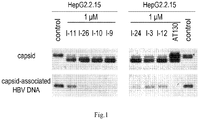
- Fig. 1 shows images of the non-denaturing agarose gel electrophoresis of test example 2.
- the nuclear magnetic resonance proton spectrum was recorded on a Bruker AMX-400, Gemini-300, or AMX-600 nuclear magnetic resonance spectrometer, and the unit of chemical shift ⁇ is ppm.
- the specific optical rotation was measured on a Perkin-Elmer 241 automatic polarimeter, and the microwave treatment was carried out on a CEM-discovery microwave reactor.
- Silica gel (200-300 mesh) for column chromatography was produced by Qingdao Ocean Chemical Branch Plant. Thin layer chromatography was carried out on a GF254 high-performance plate produced by Yantai Chemical Research Institute.
- Preparative thin-layer chromatography plates were produced by the Shanghai Institute of Materia Medica, Chinese Academy of Sciences, and the stationary phase was prepared by using GF254 (HG/T2354-92) silica gel and sodium carboxymethyl cellulose (800-1200), which were produced by Qingdao Ocean Chemical Co., Ltd. and China National Medicine Group Shanghai Chemical Reagent Company, respectively. Unless otherwise specified, all solvents were analytically pure. All reagents were purchased from Sinopharm Chemical Reagent Co., Ltd. Color developing was performed by using iodine, ultraviolet fluorescence and the like. The organic solvent was distilled off in a rotary evaporator under reduced pressure.
- 3,6-dichlorophthalazine (10g, 50.3mmol) was dissolved in acetic acid (150ml) and refluxed at 120 °C for 6 hours. After the reaction was completed as monitored by TLC, the reaction was terminated and the reaction solution was cooled to room temperature. A white solid 2 (8.5g, 94%) was obtained after removing acetic acid by rotary evaporation under reduced pressure.
- Step b
- Phthalazinone 2 (1.0g, 5.5mmol) was dissolved in DMF (70ml), and p-chlorobenzyl chloride (1.1g, 6.6mmol) and Cs 2 CO 3 (2.1g, 6.6mmol) were added in this order. After the reaction system was stirred at 50 °C for 5 hours, the reaction was completed as monitored by TLC. Ethyl acetate (100ml) and water (100ml) were added to the reaction solution, and the organic layer was washed with water (100ml x 4) and saturated brine (100ml) in this order, dried over anhydrous sodium sulfate for half an hour and concentrated to obtain a crude product.
- I-8 Compound I-8 was prepared in the same method as that in Example 1, except that 2-cyano-pyridine-3-boronic acid was used in place of pyridine-4-boronic acid.
- I-21 Compound I-21 was prepared in the same method as that in Example 1, except that 2-fluoro-6-(N,N-dimethylaminoethylamino)-pyridine-3-boronic acid was used in place of pyridine-4-boronic acid.
- I-28 Compound I-28 was prepared in the same method as that in Example 1, except that 2-fluoro-6-acetoxymethylpyridine-3-boronic acid was used in place of pyridine-4-boronic acid.
- III-1 Compound III-1 was prepared in the same method as that in Example 1, except that 2-methylpyrazine-5-boronic acid was used in place of pyridine-4-boronic acid.
- IV-19 Compound IV-19 was prepared in the same method as that in Example 1, except that p-cyanobenzyl chloride was used in place of p-chlorobenzyl chloride and 2-fluoro-6-cyclopropyl-pyridine-3-boronic acid was used in place of pyridine-4-boronic acid.
- p-chlorobenzaldehyde (1g, 7.1mmol) was dissolved in anhydrous methanol (50ml), added with NaBD 4 (360mg, 8.5mmol), stirred at room temperature for 1 hour, and then rotary evaporated to remove the solvent. The residue was dissolved in ethyl acetate (100ml) and water (100ml), and the organic layer was washed with water (100ml x 4) and saturated brine (100ml) in this order, dried over anhydrous sodium sulfate for half an hour and then concentrated to obtain a crude product. The crude product was separated and purified by column chromatography to obtain a white solid 5 (0.9g, 90%).
- Step b
- the organic layer was washed with water (100ml x 4) and saturated brine (100ml) in this order, dried over anhydrous sodium sulfate for half an hour, and then concentrated to obtain a crude product.
- the crude product was separated and purified by column chromatography to obtain a white solid 7 (0.6g, 80%).
- Step b
- V-4 Compound V-4 was prepared in the same method as in Example 3, except that 4,5-dimethylphthalic anhydride was used in place of 4-fluorophthalic anhydride.
- V-5 Compound V-5 was prepared in the same method as that in Example 3, except that 4-methoxyphthalic anhydride was used in place of 4-fluorophthalic anhydride.
- V-6 Compound V-6 was prepared in the same method as in Example 3, except that 4,5-dimethoxyphthalic anhydride was used in place of 4-fluorophthalic anhydride.
- V-7 Compound V-7 was prepared in the same method as in Example 3, except that 4-cyanophthalic anhydride was used in place of 4-fluorophthalic anhydride.
- V-8 Compound V-8 was prepared in the same method as in Example 3, except that 4-trifluoromethylphthalic anhydride was used in place of 4-fluorophthalic anhydride.
- V-9 Compound V-9 was prepared in the same method as that in Example 3, except that 4,5-di-trifluoromethylphthalic anhydride was used in place of 4-fluorophthalic anhydride.
- V-10 Compound V-10 was prepared in the same method as in Example 3, except that 4,5-difluorophthalic anhydride was used in place of 4-fluorophthalic anhydride and p-cyanobenzyl chloride was used in place of p-chlorobenzyl chloride.
- V-11 Compound V-11 was prepared in the same method as in Example 3, except that 4,5-dimethylphthalic anhydride was used in place of 4-fluorophthalic anhydride and p-cyanobenzyl chloride was used in place of p-chlorobenzyl chloride.
- V-12 Compound V-12 was prepared in the same method as that in Example 3, except that 4,5-dimethoxyphthalic anhydride was used in place of 4-fluorophthalic anhydride, and p-cyanobenzyl chloride was used in place of p-chlorobenzyl chloride.
- Step b
- Human hepatoblastoma cell line HepG2.2.15 stably transfected with full-length HBV (provided by Shanghai Institute of Materia Medica, Chinese Academy of Sciences)
- Incubator (ThermoForma3111); Microplate reader (Molecular Devices Spectra Max 190); Electronic balance; Microscope; Biosafety cabinet (Heal Force safe15); Centrifuge (Eppendorf Centrifuge 5810R); Real-Time PCR (FASTA GEN-DNA fast2000)
- Lamivudine (3TC) synthesized by department of medicinal chemistry, the Shanghai Institute of Materia Medica, Chinese Academy of Sciences, was formulated into a 40mM stock solution with DMEM/High Glucose culture solution (Dulbecco 's modified Eagle 's medium, Hyclone).
- HepG2.2.15 cells were cultured and passaged according to conventional methods. DMEM containing 10% (v/v) bovine serum and the selective antibiotic G418 was used as a medium, the cells were cultured in an incubator at 37 °C under 5% CO 2 for 8 days (the medium was exchanged on the 4th day).
- test compounds were formulated with DMSO into a 40mM stock solution, which was then prepared into a solution at the defined highest concentration using a DMEM medium containing 10% HycloneTM Fetal Bovine Serum, followed by diluting the same; the positive drug was lamivudine, which was also prepared into a solution at the defined concentration with the DMEM medium containing 10% HycloneTM Fetal Bovine Serum.
- HepG2.2.15 cells were seeded at 5 ⁇ 10 3 cells/well in a 96-well plate, and cultured for eight days in the presence of the compounds according to the above method, and then 200 ⁇ l of the supernatant was taken out, followed by addition of the MTT solution. After 4 hours of culture, a lysate was added. After 12 hours of culture, the OD 570 was measured on a microplate reader. By comparing with the absorbance of the control well, the percentage of viable cells was calculated, and CC 50 , the concentration required for the reduction of cell viability by 50%, was calculated.
- HepG2.2.15 cells were treated with compounds at different concentrations for 8 days (the medium was exchanged on the 4th day), and the supernatant was aspirated, and the HBV DNA contained in the mature virus particles in the supernatant was quantitated by using a real-time PCR method.
- the experimental data were processed by using the Origin software and IC 50 was calculated.
- Table 1 Toxicity against HepG2.2.15 cells and the activity of inhibiting HBV DNA of the compounds of formula I in the examples
- Compounds CC 50 ( ⁇ M) IC 50 ( ⁇ M) Compounds CC 50 ( ⁇ M) IC 50 ( ⁇ M) I-1 >100 7.3 IV-24 >100 0.35 I-2 98.7 3.1 IV-25 54.1 1.2 I-3 >100 0.5 IV-26 >100 0.43 I-4 >100 3.1 IV-27 >100 0.0142 I-5 51.8 1.5 IV-28 21.32 0.191 I-6 >100 1.7 IV-29 26.57 0.0439 I-7 48.9 3.8 IV-30 10.16 ⁇ 0.0977 I-8 >100 5.2 IV-31 108.7 0.452 I-9 40.7 0.3 IV-32 43.73 0.191 I-10 81.8 0.1 IV-33 180.87 ⁇ 0.0977 I-11 22.6 0.9 IV-34 >100 15.7 I-12 15.7 0.6 IV-35 >100 1.233 I-13 32.7 1.2 IV-36
- Test Example 3 Tissue Distribution of the Compounds Prepared in the Examples in Mice
- 10 ⁇ l of a plasma and tissue sample was placed in a 1.5ml centrifuge tube, added with 100 ⁇ l of an internal standard solution (5.00ng/ml verapamil and 50.0ng/ml Glibenclamide solution in acetonitrile), vortexed for 60 seconds, and then centrifuged for 3 min (at 12000 rpm); 75 ⁇ l of the supernatant was transferred to a 96-well plate loaded with an equal volume of water, and shaken for mixing well and then analyzed. The injection volume was 10 ⁇ l.
- an internal standard solution 5.00ng/ml verapamil and 50.0ng/ml Glibenclamide solution in acetonitrile
- 75 ⁇ l of the supernatant was transferred to a 96-well plate loaded with an equal volume of water, and shaken for mixing well and then analyzed.
- the injection volume was 10 ⁇ l.
- DMSO dimethyl sulfoxide
- Stock solution an appropriate amount of the compound was weighted and formulated into a 2.00mg/ml stock solution with DMSO.
- Working solution The stock solution was stepwisely diluted to obtain the solutions at each gradient concentration. 5.00 ⁇ l of reference standard working solution was added to 45.0 ⁇ l of a mice blank plasma and blank tissue. Then it was treated according to the method described in the section of "Sample pretreatment method" .
- Administration solution a certain amount of a compound was precisely weighed and formulated into a 2.00mg/ml milky white suspension in a ratio of 2.5% DMSO + 97.5% (0.5% MC).
- Table 2 Mean drug concentrations of the example compounds and the comparative compounds in different tissues of mice (po 10mg/kg) Compounds time (h) Plasma (ng/ml) Liver (ng/g) comparative compound I-70 1 161 BLQ a 3 71.7 BLQ 8 17.3 BLQ comparative compound I-88 1 169 34.2 3 180 9.64 8 0.993 BLQ I-10 1 61.0 476 3 12.5 318 8 BLQ 2.91 I-11 1 33.3 1224 3 32.5 1413 8 23.0 815 IV-5 1 154 1029 3 63.2 1047 8 80.1 1188 IV-15 1 549 7270 3 437 4461 8 257 2800 Note: a BLQ means that the content is below the minimum detection limit of the instrument.
- the example compounds show metabolic properties (i.e., metabolic stability in the liver) much superior to those of the comparative compounds.
- Compounds I-10, I-11, IV-5 and IV-15 have good liver targeting in mice, and can be stably present and enriched in liver, with a low content in plasma.
- the example compounds exert their antiviral activity by interfering with the nucleocapsidization of viral RNA. They showed high activity of inhibiting HBV DNA replication at the cellular level, with little toxicity to the growth of HepG2.2.15 cells, and have good liver targeting, and can be stably present and enriched in the liver, and thus they are effective HBV inhibitors.
Landscapes
- Chemical & Material Sciences (AREA)
- Organic Chemistry (AREA)
- Health & Medical Sciences (AREA)
- Life Sciences & Earth Sciences (AREA)
- Virology (AREA)
- Medicinal Chemistry (AREA)
- Veterinary Medicine (AREA)
- General Health & Medical Sciences (AREA)
- Public Health (AREA)
- Animal Behavior & Ethology (AREA)
- Pharmacology & Pharmacy (AREA)
- Oncology (AREA)
- Nuclear Medicine, Radiotherapy & Molecular Imaging (AREA)
- General Chemical & Material Sciences (AREA)
- Chemical Kinetics & Catalysis (AREA)
- Communicable Diseases (AREA)
- Molecular Biology (AREA)
- Engineering & Computer Science (AREA)
- Biotechnology (AREA)
- Pulmonology (AREA)
- Epidemiology (AREA)
- AIDS & HIV (AREA)
- Tropical Medicine & Parasitology (AREA)
- Pharmaceuticals Containing Other Organic And Inorganic Compounds (AREA)
- Plural Heterocyclic Compounds (AREA)
Abstract
Description
- The invention relates to a phthalazinone compound, and a preparation method, pharmaceutical composition and use thereof.
- According to the statistics of World Health Organization, 2 billion people worldwide have been infected with the hepatitis B virus (HBV), and about 350-400 million people have chronic infection. About one million people die each year of cirrhosis, hepatic insufficiency, liver cancer, and other complications due to HBV infection. Therefore, HBV infection remains a world disease seriously harming public health.
- So far, interferon and nucleoside anti-HBV drugs are the two main means for treating HBV infection. However, interferon has disadvantages including poor tolerance, adverse reactions, and high cost; and each of the 6 nucleoside drugs (lamivudine, adefovir, entecavir, telbivudine, tenofovir and clevudine) that have been marketed act on the HBV reverse transcriptase, and may produce drug resistance and side effects in different degrees during long-term treatment, which greatly limits the application of such drugs.
- Therefore, it is increasingly urgent to research and develop more non-nucleoside small molecule anti-HBV drugs that act on new targets, have new mechanisms and new core structures, which is a hot topic in the field of medicinal chemistry, and has very important significance in theory, economy and society.
- The invention provides a compound of formula I with a phthalazinone core structure, or a pharmaceutically acceptable salt, solvate or prodrug thereof.
- The present invention provides the following technical solutions:
A compound of formula I or a pharmaceutically acceptable salt, solvate or prodrug thereof:
- R is Cl or CN;
- R1 and R2 are each independently H;
- A is heteroaryl;
- R3 represents one or more substituents, each being independently selected from the group consisting of H, halogen, cyano, hydroxyl, alkyl, haloalkyl, optionally substituted cycloalkyl, optionally substituted heterocyclyl, optionally substituted heterochain hydrocarbyl, optionally substituted alkoxy, alkanoyloxy, -(CH2)n+1R5, -N(R6)-(CH2)n(R5);
- R4 represents one or more substituents, each being independently selected from the group consisting of H, halogen, cyano, hydroxyl, optionally substituted alkyl, optionally substituted alkoxy, alkanoyloxy;
- R5 and R6 are each independently selected from the group consisting of H, hydroxyl, optionally substituted alkyl, optionally substituted cycloalkyl, optionally substituted alkoxy, alkanoyloxy, alkylsulfonyl, alkanoyl, alkoxyacyl, optionally substituted heterocyclyl, -N(Q1)(Q2);
- optionally, R5 and R6 are each independently selected from the group consisting of H, hydroxyl, optionally substituted alkyl, optionally substituted cycloalkyl, optionally substituted alkoxy, alkanoyloxy, optionally substituted heterocyclyl, -N(Q1)(Q2);
- in the "optionally substituted" groups, the substituent is selected from the group consisting of halogen, hydroxyl, alkyl, hydroxyalkyl, cycloalkyl, alkoxy, alkanoyl, alkoxyalkoxy, alkoxyacyl, carboxyl, heterocyclyl, -N(Q1)(Q2);
- optionally, in the "optionally substituted" groups, the substituent is selected from the group consisting of halogen, hydroxyl, alkyl, cycloalkyl, alkoxy, alkanoyl, heterocyclyl, -N(Q1)(Q2);
wherein, - n is an integer selected from the group consisting of 0 to 10;
- Q1 and Q2 are each independently H, alkyl or alkoxyacyl;
- optionally, Q1 and Q2 are each independently H and alkyl;
- preferably,
- R3 represents 1, 2 or 3 substituents;
- R4 represents 1 or 2 substituents;
- the "heteroaryl" is a 5- to 10-membered heteroaryl containing 1 to 3 heteroatoms selected from the group consisting of N, O and S, optionally a 6- to 10-membered heteroaryl containing 1 to 2 heteroatoms selected from the group consisting of N, O and S, optionally, the heteroaryl includes pyridyl, pyrimidinyl, pyrazinyl, pyridazinyl, furyl, indolyl, azaindolyl, naphthyridinyl or quinolyl;
- the "halogen" includes fluorine, chlorine, bromine and iodine;
- the alkyl comprised in the "alkyl", "haloalkyl", "alkylsulfonyl", "alkoxyacyl", and "alkoxyalkoxy" is a C1-C18 linear or branched alkyl, optionally, the alkyl is a C1-C7 linear or branched alkyl, optionally, the alkyl is a C1-C5 linear or branched alkyl, optionally the alkyl includes methyl, ethyl, n-propyl, isopropyl, n-butyl, isobutyl, t-butyl, sec-butyl, n-pentyl, 1-methylbutyl, 2-methylbutyl, 3-methylbutyl, isopentyl, 1-ethylpropyl, neopentyl, n-hexyl, 1-methylpentyl, 2-methylpentyl, 3-methylpentyl, isohexyl, 1,1-dimethylbutyl, 2,2-dimethylbutyl, 3,3-dimethylbutyl, 1,2-dimethylbutyl, 1,3-dimethylbutyl, 2,3-dimethylbutyl, 2-ethylbutyl, n-heptyl, 2-methylhexyl, 3-methylhexyl, 2,2-dimethylpentyl, 3,3-dimethylpentyl, 2,3-dimethylpentyl, 2,4-dimethylpentyl, 3-ethylpentyl, 2,2,3-trimethylbutyl; optionally, the "haloalkyl" includes trifluoromethyl;
- the "alkoxy" is a C1-C6 linear or branched alkoxy, optionally, the alkoxy is a C1-C5 linear or branched alkoxy, optionally, the alkoxy is a C1-C3 linear or branched alkoxy, optionally, the alkoxy includes methoxy, ethoxy, n-propoxy, isopropoxy, n-butoxy, isobutoxy, t-butoxy, sec-butoxy, n-pentyloxy, isopentyloxy, neopentyloxy, n-hexyloxy, isohexyloxy, 3-methylpentyloxy;
- the "alkanoyloxy" is a linear or branched C1-C6 alkanoyloxy, and optionally includes acetoxy;
- the "cycloalkyl" is a C3-C6 cycloalkyl, optionally, the cycloalkyl includes cyclopropyl, cyclobutyl, cyclopentyl, cyclohexyl;
- the heterocyclic structure in the "heterocyclyl" is a saturated or unsaturated 3- to 10-membered monocyclic or polycyclic non-aromatic ring structure containing 1, 2 or 3 heteroatoms selected from the group consisting of N, O, and S in the ring, optionally, the heterocyclyl is a 3- to 6-membered saturated ring containing N in the ring, optionally, the heterocyclyl is a 4- to 6-membered non-aromatic ring structure containing 1-2 heteroatoms selected from the group consisting of N and O in the ring, optionally, the heterocyclyl includes a tetrahydropyrrole ring, a tetrahydrothiophene ring or a tetrahydrofuran ring;
- the heterochain hydrocarbon structure in the "heterochain hydrocarbyl" is a C1-C7 saturated or unsaturated, linear or branched heterochain structure containing 1-3 heteroatoms selected from the group consisting of N and O in the chain. Optionally, the heterochain hydrocarbyl is a C1-C5 saturated or unsaturated, linear or branched heterochain hydrocarbon structure containing 1-3 heteroatoms selected from the group consisting of N and O in the chain, optionally, the heterochain hydrocarbyl is a C1-C5 saturated or unsaturated, linear or branched heterochain hydrocarbon structure containing 1-3 oxygen atoms in the chain;
- the "alkanoyl" is a C1-C6 linear or branched alkanoyl, optionally, the alkanoyl includes formyl, acetyl;
- n is an integer selected from the group consisting of 0 to 5, optionally n is 0, 1, 2, 3, or 4.
- Optionally, any one or more hydrogens in the compound of formula I or a pharmaceutically acceptable salt, solvate or prodrug thereof may be replaced by deuterium; optionally, the hydrogens represented by R1 and R2 may be each independently replaced by deuterium; optionally, any one or more hydrogens in one or more substituents represented by R3 may be replaced by deuterium; optionally, any one or more hydrogens in one or more of H, alkyl, optionally substituted alkoxy, optionally substituted heterochain hydrocarbyl, -(CH2)n+1R5 represented by R3 may be replaced by deuterium.
- Optionally, in the compound of formula I, or a pharmaceutically acceptable salt, solvate or prodrug thereof as described above:
- R is Cl or CN;
- R1 and R2 are each independently H or D;
- A is pyridyl, pyrimidinyl or pyrazinyl;
- R3 represents one or more substituents, each being independently selected from the group consisting of H, D, halogen, cyano, hydroxyl, trifluoromethyl, methyl optionally substituted by one or more D, methylol, methoxymethyl optionally substituted by one or more D, acetoxymethyl, methoxy optionally substituted by one or more D, methoxyethoxy, amino, methylamino, dimethylamino, t-butylamino, cyclopropylamino, epoxypropylamino, acetylamino, oxetanylamino, methoxymethylamino, methoxyethylamino, methoxypropylamino, ethoxyethylamino, ethoxypropylamino, methoxycarbonylethylamino, methoxycarbonylpropylamino, ethoxycarbonylmethylamino, ethoxycarbonylethylamino, ethoxycarbonylpropylamino, hydroxyethylamino, hydroxypropylamino, hydroxybutylamino, cyclobutylamino, azetidinyl, N,N-dimethylaminomethylamino, N,N-dimethylaminoethylamino, N,N-dimethylaminopropylamino, N,N-dimethylaminobutylamino, t-butoxyacylaminobutylamino, 5-morpholinylmethyl, ethylaminoethylamino, ethylaminopropylamino, ethylaminobutylamino, methoxyethoxyethoxyethylamino, ethoxyethoxyethylamino, t-butoxycarbonylethylamino, t-butoxycarbonylpropylamino, t-butoxycarbonylmethoxyethylamino, carboxylethylamino, carboxylpropylamino, carboxymethoxyethylamino, 6-morpholinylmethyl, 6-(tetrahydrofuranyl)methylamino, methylsulfonylethylamino, (2,2-dimethyl-[1,3]-dioxolan-4-yl)-methylamino, 2,3-dihydroxypropylamino, 2-hydroxypropylamino, trifluoromethylethylamino;
- optionally, R3 represents one or more substituents, each being independently selected from the group consisting of H, D, halogen, cyano, trifluoromethyl, methyl optionally substituted by one or more D, methylol, methoxymethyl optionally substituted by one or more D, acetoxymethyl, methoxy optionally substituted by one or more D, amino, methylamino, dimethylamino, t-butylamino, cyclopropylamino, epoxypropylamino, acetylamino, oxetanylamino, methoxymethylamino, cyclobutylamino, azetidinyl, N,N-dimethylaminomethylamino, N,N-dimethylaminoethylamino, 6-morpholinylmethyl, 6-(tetrahydrofuranyl)methylamino;
- R4 represents one or more substituents, each being independently selected from the group consisting of H, halogen, methyl, methoxy, cyano and trifluoromethyl.
- Optionally, in the compound of formula I, or a pharmaceutically acceptable salt, solvate or prodrug thereof as described above, the compound of formula I is selected from the group consisting of the compounds having a structure represented by one of the following formulae I-I to I-V:


- wherein, R, R1, R2, R3 and R4 are each independently defined as above;
- preferably, in the formula I-I, R1 and R2 are each independently H or D; R3 represents one or more substituents, preferably 1, 2 or 3 substituents, each being independently selected from the group consisting of H, D, halogen, cyano, C1-C5 linear or branched alkyl optionally substituted by one or more D, trifluoromethyl, C3-C6 cycloalkyl, C1-C5 linear or branched alkyl optionally substituted by one or more D in which any carbon atom may be replaced by an oxygen atom, C1-C5 linear or branched alkoxy optionally substituted by one or more D, 3- to 6-membered saturated heterocyclyl containing 1-2 nitrogen atoms, -(CH2)n+1R5 optionally substituted by one or more D, -N(R6)-(CH2)n(R5); wherein, n is 0, 1, 2, 3 or 4; R5 and R6 are each independently H, hydroxyl, methyl, ethyl, propyl, isopropyl, butyl, isobutyl, C3-C6 cycloalkyl, methoxy, ethoxy, acetoxy, 4- to 6-membered non-aromatic heterocyclyl having 1-2 heteroatoms selected from the group consisting of N and O, or amino substituted by 1-2 substituents selected from the group consisting of methyl and ethyl;
- preferably, in the formula I-II, R1 and R2 are each independently H or D; R3 represents 1 or 2 substituents, each being independently selected from the group consisting of H, halogen, cyano, trifluoromethyl, C1-C7 linear or branched alkyl optionally substituted by one or more D, C1-C6 linear or branched alkoxy optionally substituted by one or more D, -N(R6)-(CH2)n(R5); wherein, n is 0, 1, 2, 3 or 4; R5 and R6 are each independently H, halogen, methyl, ethyl, propyl, isopropyl, butyl or isobutyl;
- preferably, in the formula I-III, R1 and R2 are each independently H or D; R3 represents 1 or 2 substituents, each being independently selected from the group consisting of H, D, halogen, cyano, trifluoromethyl, C1-C7 linear or branched alkyl optionally substituted by one or more D, C1-C6 linear or branched alkoxy optionally substituted by one or more D or -N(R6)-(CH2)n(R5); wherein, n is 0, 1, 2, 3 or 4; R5 and R6 are each independently H, methyl, ethyl, propyl, isopropyl, butyl;
- preferably, in formula I-IV, R1 and R2 are each independently H or D; R3 represents one or more substituents, preferably 1, 2 or 3 substituents, each being independently selected from the group consisting of H, D, halogen, cyano, hydroxyl, trifluoromethyl, C3-C6 cycloalkyl, C1-C5 linear or branched alkyl optionally substituted by one or more D, C1-C5 linear or branched alkyl optionally substituted by one or more D in which any carbon atom may be replaced by an oxygen atom, C1-C5 linear or branched alkoxy optionally substituted by one or more D, 3- to 6-membered saturated heterocyclyl containing N (preferable 3- to 6-membered saturated heterocyclyl containing one nitrogen atom), -(CH2)n+1R5 optionally substituted by one or more D, -N(R6)-(CH2)n(R5); wherein, n is 0, 1, 2, 3 or 4; R5 and R6 are each independently H, hydroxyl, methyl, ethyl, propyl, isopropyl, butyl, isobutyl, t-butyl, C3-C6 cycloalkyl, methoxy, ethoxy, methoxyethoxyethoxy, ethoxyethoxy, acetyl, acetyloxy, methoxycarbonyl, ethoxycarbonyl, t-butoxycarbonyl, t-butoxycarbonylmethoxy, carboxyl, carboxymethoxy, 4- to 6-membered non-aromatic heterocyclyl with 1-2 heteroatoms selected from the group consisting of N and O, or amino substituted by 1-2 substituents selected from the group consisting of methyl, ethyl and t-butoxycarbonyl, methylsulfonyl, 2,2-dimethyl-[1,3]-dioxolan-4-yl, 2,3-dihydroxypropyl, 2-hydroxypropyl, trifluoromethylethyl;
- optionally, in formula I-IV, R1 and R2 are each independently H or D; R3 represents one or more substituents, preferably 1, 2 or 3 substituents, each being independently selected from the group consisting of H, D, halogen, cyano, trifluoromethyl, C3-C6 cycloalkyl, C1-C5 linear or branched alkyl optionally substituted by one or more D, C1-C5 linear or branched alkyl optionally substituted by one or more D in which any carbon atom may be replaced by an oxygen atom, C1-C5 linear or branched alkoxy optionally substituted by one or more D, 3- to 6-membered saturated heterocyclyl containing N (preferable 3- to 6-membered saturated heterocyclyl containing one nitrogen atom), -(CH2)n+1R5 optionally substituted by one or more D, -N(R6)-(CH2)n(R5); wherein, n is 0, 1, 2, 3 or 4; R5 and R6 are each independently H, hydroxyl, methyl, ethyl, propyl, isopropyl, butyl, isobutyl, C3-C6 cycloalkyl, methoxy, ethoxy, acetoxy, 4- to 6-membered non-aromatic heterocyclyl with 1-2 heteroatoms selected from the group consisting of N and O, or amino substituted by 1-2 substituents selected from the group consisting of methyl and ethyl;
- preferably, in formula I-V, R represents Cl or CN; R1 and R2 are each independently H or D; R3 represents one or more substituents, preferably 1, 2 or 3 substituents, each being independently selected from the group consisting of H, D, halogen, cyano, hydroxyl, trifluoromethyl, C3-C6 cycloalkyl, C1-C5 linear or branched alkyl optionally substituted by one or more D, C1-C5 linear or branched alkyl optionally substituted by one or more D in which any carbon atom may be replaced by an oxygen atom, C1-C5 linear or branched alkoxy optionally substituted by one or more D, 3- to 6-membered saturated heterocyclyl containing N, -(CH2)n+1R5 optionally substituted by one or more D, -N(R6)-(CH2)n(R5); wherein n is 0, 1, 2, 3 or 4; R4 represents one or more substituents, preferably 1 or 2 substituents, each being independently selected from the group consisting of H, halogen, cyano, trifluoromethyl, methyl, ethyl, methoxy; R5 and R6 are each independently H, hydroxyl, methyl, ethyl, propyl, isopropyl, butyl, isobutyl, t-butyl, C3-C6 cycloalkyl, methoxy, ethoxy, methoxyethoxyethoxy, ethoxyethoxy, acetyl, acetoxyl, methoxycarbonyl, ethoxycarbonyl, t-butoxycarbonyl, t-butoxycarbonylmethoxy, carboxyl, carboxymethoxy, 4- to 6-membered non-aromatic heterocyclyl with 1-2 heteroatoms selected from the group consisting of N and O, or amino substituted by 1-2 substituents selected from the group consisting of methyl and ethyl, methylsulfonyl, 2,2-dimethyl-[1,3]-dioxolan-4-yl, 2,3-dihydroxypropyl, 2-hydroxypropyl, trifluoromethylethyl.
- optionally, in formula I-V, R represents Cl or CN; R1 and R2 are each independently H or D; R3 represents one or more substituents, preferably 1, 2 or 3 substituents, each being independently selected from the group consisting of H, D, halogen, cyano, trifluoromethyl, C3-C6 cycloalkyl, C1-C5 linear or branched alkyl optionally substituted by one or more D, C1-C5 linear or branched alkyl optionally substituted by one or more D in which any carbon atom may be replaced by an oxygen atom, C1-C5 linear or branched alkoxy optionally substituted by one or more D, 3- to 6-membered saturated heterocyclyl containing N, -(CH2)n+1R5 optionally substituted by one or more D, -N(R6)-(CH2)n(R5); wherein n is 0, 1, 2, 3 or 4; R4 represents one or more substituents, preferably 1 or 2 substituents, each being independently selected from the group consisting of H, halogen, cyano, trifluoromethyl, methyl, ethyl, methoxy; R5 and R6 are each independently H, hydroxyl, methyl, ethyl, propyl, isopropyl, butyl, isobutyl, C3-C6 cycloalkyl, methoxy, ethoxy, acetoxy, 4- to 6-membered non-aromatic heterocyclyl with 1-2 heteroatoms selected from the group consisting of N and O, or amino substituted by 1-2 substituents selected from methyl and ethyl.
- Optionally, the compound of formula I, or a pharmaceutically acceptable salt, solvate or prodrug thereof as described above, is characterized in that:
- the compound of formula I includes one or more optical isomers, enantiomers, diastereoisomers or racemate mixtures of the compound of formula I;
- optionally, the pharmaceutically acceptable salt includes an anionic salt and a cationic salt of the compound of formula I; optionally, the pharmaceutically acceptable salt includes an alkali metal salt, an alkaline earth metal salt, an ammonium salt of the compound of formula I; optionally, the alkali metal includes sodium, potassium, lithium, cesium, and the alkaline earth metal includes magnesium, calcium, strontium; optionally, the pharmaceutically acceptable salt includes a salt formed by the compound of formula I and an organic base; optionally, the organic base includes trialkylamine, pyridine, quinoline, piperidine, imidazole, picoline, dimethylaminopyridine, dimethylaniline, N-alkylmorpholine, 1,5-diazabicyclo[4.3.0]non-5-ene, 1,8-diazabicyclo[5.4.0]undec-7-ene, 1,4-diazabicyclo[2.2.2]octane; optionally, the trialkylamine includes trimethylamine, triethylamine, N-ethyldiisopropylamine; optionally, the N-alkylmorpholine includes N-methylmorpholine; optionally, the pharmaceutically acceptable salt includes a salt formed by the compound of formula I and an acid; optionally, the acid includes an inorganic acid and an organic acid; optionally, the inorganic acid includes hydrochloric acid, hydrobromic acid, hydroiodic acid, sulfuric acid, nitric acid, phosphoric acid, carbonic acid; optionally, the organic acid includes formic acid, acetic acid, propionic acid, oxalic acid, malonic acid, succinic acid, fumaric acid, maleic acid, lactic acid, malic acid, citric acid, citric acid, tartaric acid, carbonic acid, picric acid, methanesulfonic acid, ethanesulfonic acid, p-toluenesulfonic acid, glutamic acid, pamoic acid;
- optionally, the solvate is a complex formed by the compound of formula I and a pharmaceutically acceptable solvent; optionally, the pharmaceutically acceptable solvent includes water, ethanol, acetic acid, N,N-dimethyl formamide, dimethyl sulfoxide; preferably, the pharmaceutically acceptable solvent is water.
- The prodrug refers to a compound obtained by modifying the chemical structure of a drug, which is inactive or less active in vitro, and takes effect in vivo by releasing an active drug through enzymatic or non-enzymatic conversion. The form of the prodrug in the present invention is not particularly limited, as long as it may release an active drug through enzymatic or chemical action in vivo, so as to exert the expected pharmacological effect, and it may be a carrier prodrug or a biological prodrug.
- Optionally, the compound of formula I or a pharmaceutically acceptable salt, solvate or prodrug thereof, is characterized in that the compound of formula I is one of the following compounds:


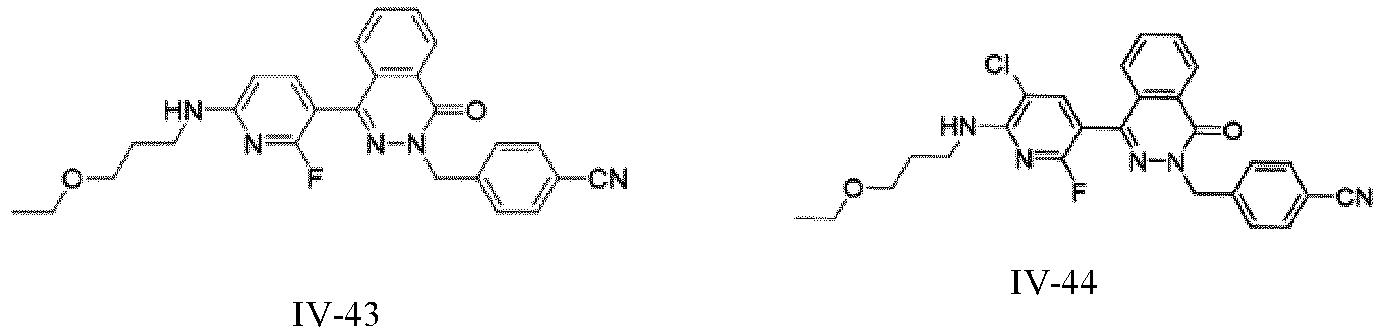


- The present invention also provides a method for preparing the above-mentioned compound of formula I or a pharmaceutically acceptable salt, solvate or prodrug thereof, characterized in that the method for preparing the compound of formula I includes steps of one of the following routes:
- Route 1:

- the compound I is obtained from the compound a-1 by a Suzuki reaction,
- wherein, R, R1, R2, R3, R4 and A are each defined as above;
- Route 2:

- the compound I is obtained from the compound b-1 and the compound b-2 by a nucleophilic substitution,
- wherein, R, R1, R2, R3, R4 and A are each defined as above.
- Optionally, the above preparation method includes steps of one of the following routes:
- Route 1:

- the compound represented by formula H1 is hydrolyzed to obtain the compound represented by formula H2, the compound represented by formula H2 is subjected to a nucleophilic substitution with parachlorobenzyl chloride H3 to obtain the compound represented by formula H4, which is finally subjected to a Suzuki coupling reaction under the action of a metal catalyst or a base, to obtain a phthalazinone compound represented by formula H5;
- wherein, R4 is H, and R, R1, R2, R3, and A are each defined the same as the above;
- Route 2:

- the compound represented by formula H6 is prepared into the Grignard reagent represented by formula H7, which is then subjected to an addition reaction with phthalic anhydride to give the compound represented by formula H8, the compound represented by formula H8 is subjected to a ring-closing reaction with hydrazine hydrate to give the compound represented by formula H9, which is subjected to a nucleophilic substitution with parachlorobenzyl chloride to give the compound represented by formula H10;
- wherein R, R1, R2, R3 and R4 are each defined as above, but R4 is not H.
- Preferably, in the above method, the hydrolysis is performed in a solvent under an acidic or basic condition; the acid is one or more selected from the group consisting of acetic acid, hydrochloric acid, sulfuric acid, and trifluoroacetic acid; the base is one or more selected from the group consisting of potassium hydroxide, sodium hydroxide, potassium acetate, sodium acetate, potassium t-butoxide, and sodium t-butoxide; the solvent is one or more selected from the group consisting of ethanol, methanol, water, and acetic acid.
- Preferably, in the above method, the nucleophilic substitution is performed in a solvent in the presence of a base; the base is preferably one or more selected from the group consisting of potassium carbonate, cesium carbonate, sodium hydride, potassium hydride, potassium t-butoxide, sodium t-butoxide and sodium hydroxide; the solvent is preferably one or more selected from the group consisting of acetonitrile, N,N-dimethylformamide and tetrahydrofuran.
- Preferably, in the above method, the Suzuki coupling reaction is performed in a solvent in the presence of a metal catalyst, a base and a ligand under a heating condition; the solvent is preferably N,N-dimethylformamide, toluene or 1,4-dioxane, the heating condition is heating under reflux or heating with microwave; the base is preferably one or more selected from the group consisting of cesium carbonate, potassium carbonate, potassium t-butoxide and sodium t-butoxide; the metal catalyst is preferably one or more selected from the group consisting of palladium acetate, Pd(PPh3)4 and Pd(dppf)2Cl2; the ligand is preferably one or more selected from the group consisting of triphenyl phosphine, 1,1'-bis(diphenylphosphine)ferrocene, binaphthalene diphenylphosphine, 2-dicyclohexylphosphino-2',6'-dimethoxy-biphenyl and 2-dicyclohexylphosphino-2'-(N,N-dimethylamino)-biphenyl.
- Preferably, in the above method, the Grignard reagent prepared above may be a magnesium, iron, copper, zinc or lithium salt.
- The pharmaceutically acceptable salt of the compound of formula I can be prepared by dissolving the compound of formula I in an alcohol solution saturated with a corresponding acid, for example, by dissolving a phthalazinone compound of formula I in HCl saturated methanol solution, stirring at room temperature for 30 minutes, and evaporating the solvent to dryness to obtain the corresponding hydrochloride of the compound of formula I.
- The present invention further provides a pharmaceutical composition which comprises a therapeutically effective amount of one or more of the above compound of formula I or a pharmaceutically acceptable salt, solvate or prodrug thereof, and optionally, a pharmaceutically acceptable carrier.
- The above pharmaceutically acceptable carrier refers to a conventional pharmaceutical carrier in the field of pharmacy, for example, a diluent such as water, etc.; a filler such as starch, sucrose etc.; a binders such as a cellulose derivative, an alginate, gelatin, polyvinylpyrrolidone; a wetting agent such as glycerol; a disintegrating agent such as agar, calcium carbonate and sodium bicarbonate; a absorption enhancer such as a quaternary ammonium compound; a surfactant such as cetyl alcohol; an adsorption carrier such as kaolin and soap clay; a lubricant such as talc, calcium stearate and magnesium stearate, and polyethylene glycol. In addition, other adjuvants, such as a flavoring agent and a sweetening agent, can also be added to the above pharmaceutical composition.
- The above compound of formula I or a pharmaceutically acceptable salt, solvate or prodrug thereof, or the pharmaceutical composition can be administered to a patient in need of such treatment by oral, rectal or parenteral administration. When used for oral administration, it can be made into a conventional solid preparation, such as tablets, powders, granules, capsules, etc., or into a liquid preparation, such as water or oil suspensions, or other liquid preparations, such as syrup; when used for parenteral administration, it can be made into a solution, a water or oily suspension for injection, and the like.
- The present invention also provides use of the compound of formula I or a pharmaceutically acceptable salt, solvate or prodrug thereof, or the pharmaceutical composition described above in preparation of a medicament for prevention and/or treatment of hepatitis B disease.
- The present invention also provides use of the compound of formula I or a pharmaceutically acceptable salt, solvate or prodrug thereof, or the pharmaceutical composition described above in preparation of a HBV inhibitor.
- The present invention also provides use of the compound of formula I or a pharmaceutically acceptable salt, solvate or prodrug thereof, or the pharmaceutical composition described above in preparation of a medicament for inhibiting virus replication, said virus includes hepatitis A virus, HBV, hepatitis C virus, influenza virus, adenovirus, HIV, herpes virus, human papilloma virus.
- The present invention also provides a method for preventing and/or treating hepatitis B disease, comprising administering an effective amount of the compound of formula I or a pharmaceutically acceptable salt, solvate or prodrug thereof, or the pharmaceutical composition described above.
- The present invention also provides a method for inhibiting HBV, comprising administering an effective amount of the compound of formula I or a pharmaceutically acceptable salt, solvate or prodrug thereof, or the pharmaceutical composition described above.
- The present invention also provides a method for inhibiting virus replication, comprising administering an effective amount of the compound of formula I or a pharmaceutically acceptable salt, solvate or prodrug thereof, or the pharmaceutical composition described above. The viruse includes hepatitis A virus, HBV, hepatitis C virus, influenza virus, adenovirus, HIV, herpes virus, human papilloma virus.
- According to a specific embodiment in one aspect, the compound exerts antiviral activity by interfering with the nucleocapsidization of the viral RNA, has a highly effective activity of inhibiting HBV DNA replication at the cellular level, and has less growth toxicity to HepG2.2.15 cells.
- According to a specific embodiment in one aspect, the compound has good liver targeting, can stably exist and enrich in the liver, and is an effective HBV inhibitor.
-
Fig. 1 shows images of the non-denaturing agarose gel electrophoresis of test example 2. - Hereinafter, examples of the present invention will be described in detail. It should be understood that the examples described herein are only used to illustrate the present invention, and they are not intended to limit the present invention.
- In the following examples, the nuclear magnetic resonance proton spectrum was recorded on a Bruker AMX-400, Gemini-300, or AMX-600 nuclear magnetic resonance spectrometer, and the unit of chemical shift δ is ppm. The specific optical rotation was measured on a Perkin-Elmer 241 automatic polarimeter, and the microwave treatment was carried out on a CEM-discovery microwave reactor. Silica gel (200-300 mesh) for column chromatography was produced by Qingdao Ocean Chemical Branch Plant. Thin layer chromatography was carried out on a GF254 high-performance plate produced by Yantai Chemical Research Institute. Preparative thin-layer chromatography plates were produced by the Shanghai Institute of Materia Medica, Chinese Academy of Sciences, and the stationary phase was prepared by using GF254 (HG/T2354-92) silica gel and sodium carboxymethyl cellulose (800-1200), which were produced by Qingdao Ocean Chemical Co., Ltd. and China National Medicine Group Shanghai Chemical Reagent Company, respectively. Unless otherwise specified, all solvents were analytically pure. All reagents were purchased from Sinopharm Chemical Reagent Co., Ltd. Color developing was performed by using iodine, ultraviolet fluorescence and the like. The organic solvent was distilled off in a rotary evaporator under reduced pressure.
- The scheme for synthesizing compound I-1 is shown as below:

- 3,6-dichlorophthalazine (10g, 50.3mmol) was dissolved in acetic acid (150ml) and refluxed at 120 °C for 6 hours. After the reaction was completed as monitored by TLC, the reaction was terminated and the reaction solution was cooled to room temperature. A white solid 2 (8.5g, 94%) was obtained after removing acetic acid by rotary evaporation under reduced pressure.
- Phthalazinone 2 (1.0g, 5.5mmol) was dissolved in DMF (70ml), and p-chlorobenzyl chloride (1.1g, 6.6mmol) and Cs2CO3 (2.1g, 6.6mmol) were added in this order. After the reaction system was stirred at 50 °C for 5 hours, the reaction was completed as monitored by TLC. Ethyl acetate (100ml) and water (100ml) were added to the reaction solution, and the organic layer was washed with water (100ml x 4) and saturated brine (100ml) in this order, dried over anhydrous sodium sulfate for half an hour and concentrated to obtain a crude product. The crude product was separated and purified by column chromatography (PE: EA=100:0 ∼ 10:1) to obtain a white solid 3 (1.5g, 88%). 1H NMR (400 MHz, CDCl3) δ 8.49-8.44 (m, 1H), 8.02-7.99 (m, 1H), 7.88 (dtd, J=16.4, 7.3, 1.4 Hz, 2H), 7.50-7.43 (m, 2H), 7.34-7.30 (m, 2H), 5.34 (s, 2H). MS (ESI): 305.1 [M+H]+.
- Compound 3 (100mg, 0.33mmol) was dissolved in a mixed solvent of 1,4-dioxane (20ml) and water (5ml), and then pyridine-4-boronic acid (52.9mg, 0.43mmol), Pd(PPh3)4 (76.0mg, 0.033mmol) and K3PO4 (139mg, 0.66mmol) were added in this order. After purged with N2 for three times, the reaction was performed at 100 °C overnight. After the reaction was completed as monitored by TLC at the next day, the reaction system was cooled to room temperature. After removing the solvent by rotary evaporation under reduced pressure, the residue was extracted and dissolved with ethyl acetate (30ml). The organic layer was washed with water (30ml x 3) and saturated brine (30ml) in this order, dried over anhydrous sodium sulfate, and concentrated to give a crude product. The crude product was separated and purified by column chromatography to obtain product I-1 (92mg, 81%). 1H NMR (400 MHz, CDCl3) δ 8.69 (dd, J=4.5, 1.7 Hz, 2H), 7.66 (dd, J=4.5, 1.7 Hz, 2H), 7.58 (dt, J=8.1, 2.0 Hz, 1H), 7.44-7.40 (m, 2H), 7.34 (d, J=1.3 Hz, 1H), 7.46-7.40 (m, 2H), 7.33-7.27 (m, 2H), 5.36 (s, 2H).
- The following compounds were prepared in the same method as that in Example 1:
Compounds Preparation methods and structures of the products I-2 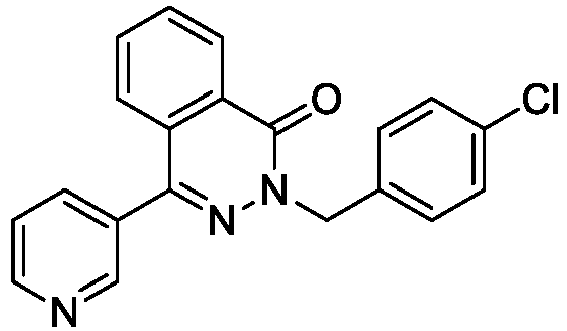
Compound I-2 was prepared in the same method as that in Example 1, except that pyridine-3-boric acid was used in place of pyridine-4-boronic acid. (White crystal, yield 77%) 1H NMR (400 MHz, CDCl3) δ 8.88 (d, J=2.2 Hz, 1H), 8.79 (dd, J=4.9, 1.6 Hz, 1H), 8.60-8.55 (m, 1H), 7.94 (dt, J=8.1, 2.0 Hz, 1H), 7.87-7.79 (m, 2H), 7.73-7.69 (m, 1H), 7.53-7.47 (m, 3H), 7.35-7.31 (m, 2H), 5.46 (s, 2H), 1.62 (s, 3H). I-3 
Compound I-3 was prepared in the same method as that in Example 1, except that 2-fluoro-pyridine-3-boronic acid was used in place of pyridine-4-boronic acid. (White crystal, yield 62%) 1H NMR (400 MHz, CDCl3) δ 8.56-8.51 (m, 1H), 8.45-8.41 (m, 1H), 7.96 (ddd, J=9.3, 7.4, 2.0 Hz, 1H), 7.81 (pd, J=7.2, 1.4 Hz, 2H), 7.49-7.40 (m, 4H), 7.35-7.30 (m, 2H), 5.43 (s, 2H). I-4 
Compound I-4 was prepared in the same method as that in Example 1, except that 2-fluoro-6-methoxy-pyridine-3-boronic acid was used in place of pyridine-4-boronic acid. (White crystal, yield 70%) 1H NMR (300 MHz, CDCl3) δ 8.53 (s, 1H), 7.99 (d, J=9.0 Hz, 1H), 7.74 (dt, J=8.1, 2.0 Hz, 1H), 7.55-7.52 (m, 2H), 7.44 (d, J=8.8 Hz, 2H), 7.29 (d, J=8.3 Hz, 2H), 6.82 (d, J=8.6 Hz, 1H), 5.33 (s, 2H), 3.98 (s, 3H). I-5 
Compound I-5 was prepared in the same method as that in Example 1, except that 6-amino-pyridine-3-boronic acid was used in place of pyridine-4-boronic acid. (White crystal, yield 74%) 1H NMR (300 MHz,CDCl3) δ 8.45 (s, 1H), 7.89 (s, 1H), 7.82 (ddd, J=9.3, 7.4, 2.0 Hz, 1H), 7.77-7.73 (d, J=7.2, 1.4 Hz, 2H), 7.66 (d, J=1.3 Hz, 1H), 7.43 (d, J=6.4 Hz, 2H), 7.32 (d, J=7.4 Hz, 2H), 6.56 (d, J=8.4 Hz, 1H), 5.35 (d, J=14.5 Hz, 2H), 4.66 (s, 2H). I-6 
Compound I-6 was prepared in the same method as that in Example 1, except that 2-chloro-pyridine-3-boronic acid was used in place of pyridine-4-boronic acid. (White crystal, yield 31%) 1H NMR (400 MHz, CDCl3) δ 7.82 (dd, J=7.6, 1.9 Hz, 1H), 7.76 (d, J=1.2 Hz, 1H), 7.72 (ddd, J=9.3, 7.4, 2.0 Hz, 1H), 7.63 (d, J=7.2, 1.4 Hz, 2H), 7.41-7.37 (m, 3H), 7.36 (dd, J=7.6, 4.8 Hz, 1H), 7.32-7.28 (m, 2H), 5.34 (s, 2H). I-7 
Compound I-7 was prepared in the same method as that in Example 1, except that 2-methyl-pyridine-3-boronic acid was used in place of pyridine-4-boronic acid. (White crystal, yield 77%) 1H NMR (500 MHz, CDCl3) δ 8.84 (s, 1H), 8.26 (s, 1H), 7.84 (s, 1H), 7.65 (d, J=5.0 Hz, 2H), 7.58 (s, 1H), 7.47-7.29 (m, 5H), 4.87 (s, 2H), 2.56 (s, 3H). I-8 
Compound I-8 was prepared in the same method as that in Example 1, except that 2-cyano-pyridine-3-boronic acid was used in place of pyridine-4-boronic acid. (White crystal, yield 76%) 1H NMR (500 MHz, CDCl3) δ 8.69-8.62 (m, 2H), 8.13 (t, J=7.5 Hz, 1H), 7.86-7.82 (m, 1H), 7.69-7.62 (m, 2H), 7.63-7.55 (m, 1H), 7.39 (d, J=7.5 Hz, 2H), 7.32 (d, J=7.5 Hz, 2H), 4.87 (s, 2H). I-9 
Compound I-9 was prepared in the same method as that in Example 1, except that 2,6-difluoro-pyridine-3-boronic acid was used in place of pyridine-4-boronic acid. (White crystal, yield 83%) 1H NMR (400 MHz, CDCl3) δ 8.54-8.45 (m, 1H), 8.06-7.97 (m, 1H), 7.83-7.74 (m, 2H), 7.47-7.38 (m, 3H), 7.31-7.26 (m, 2H), 7.03 (dd, J=8.0, 2.6 Hz, 1H), 5.40 (s, 2H). I-10 
Compound I-10 was prepared in the same method as that in Example 1, except that 2-fluoro-6-methyl-pyridine-3-boronic acid was used in place of pyridine-4-boronic acid. (White crystal, yield 85%) 1H NMR (400 MHz, CDCl3) δ 8.55-8.49 (m, 1H), 7.85-7.76 (m, 3H), 7.49-7.43 (m, 3H), 7.33-7.30 (m, 2H), 7.25 (dd, J=7.6, 1.7 Hz, 1H), 5.43 (s, 2H), 2.65 (s, 3H). I-11 
Compound I-11 was prepared in the same method as that in Example 1, except that 2-fluoro-6-amino-pyridine-3-boronic acid pinacol ester was used in place of pyridine-4-boronic acid. (White crystal, yield 64%) 1H NMR (400 MHz, CD3OD) δ 8.46-8.40 (m, 1H), 7.89-7.84 (m, 2H), 7.62 (dd, J=9.7, 8.2 Hz, 2H), 7.43 (d, J=8.5 Hz, 2H), 7.31 (d, J=8.4 Hz, 2H), 6.55 (dd, J=8.2, 1.8 Hz, 1H), 5.42 (s, 2H). I-12 
Compound I-12 was prepared in the same method as that in Example 1, except that 2-fluoro-6-methylamino-pyridine-3-boronic acid pinacol ester was used in place of pyridine-4-boronic acid. (White crystal, 71% yield) 1H NMR (400 MHz, CDCl3) δ 8.54-8.43 (m, 1H), 7.78 (dt, J=10.5, 3.5 Hz, 2H), 7.64 (dd, J=9.5, 8.2 Hz, 1H), 7.61-7.55 (m, 1H), 7.47 (d, J=8.6 Hz, 2H), 7.34-7.29 (m, 2H), 6.40 (dd, J=8.2, 2.0 Hz, 1H), 5.42 (s, 2H), 4.90 (s, 1H), 3.03 (d, J=5.2 Hz, 3H). I-13 
Compound I-13 was prepared in the same method as that in Example 1, except that 2-fluoro-6-dimethylamino-pyridine-3-boronic acid pinacol ester was used in place of pyridine-4-boronic acid. (White crystal, yield 75%) 1H NMR (400 MHz, CDCl3) δ 8.53-8.46 (m, 1H), 7.77 (dd, J=6.5, 2.9 Hz, 2H), 7.65 (dd, J=9.7, 8.4 Hz, 1H), 7.61-7.57 (m, 1H), 7.49-7.44 (m, 2H), 7.32-7.28 (m, 2H), 6.48 (dd, J=8.4, 2.2 Hz, 1H), 5.42 (s, 2H), 3.18 (s, 6H). I-14 
Compound I-14 was prepared in the same method as that in Example 1, except that 2-fluoro-6-t-butylamino-pyridine-3-boronic acid pinacol ester was used in place of pyridine-4-boronic acid. (White crystal, yield 65%) 1H NMR (400 MHz, CDCl3) δ 8.50 (dt, J=5.6, 3.3 Hz, 1H), 7.80-7.76 (m, 2H), 7.64-7.60 (m, 1H), 7.55 (dd, J=9.7, 8.2 Hz, 1H), 7.48-7.44 (m, 2H), 7.32-7.29 (m, 2H), 6.40 (dd, J=8.2, 2.0 Hz, 1H), 5.42 (s, 2H), 4.84 (s, 1H), 1.51 (s, 9H). I-15 
Compound I-15 was prepared in the same method as that in Example 1, except that 2-fluoro-6-methoxymethylamino-pyridine-3-boronic acid pinacol ester was used in place of pyridine-4-boronic acid. (White crystal, yield 43%) 1H NMR (300 MHz, CD3OD) δ 8.43 (s, 1H), 8.18 (s, 1H), 7.95 (d, J=8.7 Hz, 1H), 7.84 (s, 2H), 7.66 (s, 1H), 7.51 (s, 1H), 7.40 (d, J=7.7 Hz, 2H), 7.28 (d, J=7.9 Hz, 2H), 5.40 (s, 2H), 4.80 (s, 2H), 3.40 (s, 3H). I-16 
Compound I-16 was prepared in the same method as that in Example 1, except that 2-fluoro-6-cyclopropylamino-pyridine-3-boronic acid pinacol ester was used in place of pyridine-4-boronic acid. (White crystal, yield 51%) 1H NMR (500 MHz, CDCl3) δ 8.36 (s, 1H), 7.84 (s, 1H), 7.65 (d, J=5.0 Hz, 2H), 7.59 (d, J=5.0 Hz, 2H), 7.39 (s, 2H), 7.32 (s, 2H), 4.87 (s, 2H), 3.16 (s, 1H), 2.37 (s, 1H), 0.82 (s, 2H), 0.57 (s, 2H). I-17 
Compound I-17 was prepared in the same method as that in Example 1, except that 2-fluoro-6-oxetanylamino-pyridine-3-boronic acid pinacol ester was used in place of pyridine-4-boronic acid. (White crystal, yield 44%) 1H NMR (400 MHz, CDCl3) δ 7.96 (dd, J=9.8, 8.4 Hz, 1H), 7.65 (d, J=5.0 Hz, 2H), 7.59 (d, J=5.0 Hz, 2H), 7.54 (s, 1H), 7.43 (d, J=8.4 Hz, 2H), 7.32 (d, J=8.4 Hz, 2H), 6.34 (dd, J=8.3, 1.8 Hz, 1H), 5.34 (s, 2H), 5.28-5.26 (m, 1H), 5.06-5.03 (m, 2H), 4.59 (d, J=5.7 Hz, 2H). I-18 
Compound I-18 was prepared in the same method as that in Example 1, except that 2-fluoro-6-azetidinyl-pyridine-3-boronic acid was used in place of pyridine-4-boronic acid. (White crystal, yield 47%) 1H NMR (400 MHz, CDCl3) δ 8.54-8.48 (m, 1H), 7.81-7.74 (m, 2H), 7.62 (dd, J=9.3, 8.2 Hz, 1H), 7.59-7.54 (m, 1H), 7.46 (d, J=8.4 Hz, 2H), 7.32-7.29 (m, 2H), 6.22 (dd, J=8.2, 1.9 Hz, 1H), 5.42 (s, 2H), 4.17 (t, J=7.5 Hz, 4H), 2.53-2.45 (m, 2H). I-19 
Compound I-19 was prepared in the same method as that in Example 1, except that 2-fluoro-6-trifluoromethyl-pyridine-3-boronic acid was used in place of pyridine-4-boronic acid. (White crystal, yield 53%) 1H NMR (500 MHz, CDCl3) δ 8.67 (dd, J=15.0, 10.1 Hz, 1H), 7.87-7.81 (m, 1H), 7.69-7.63 (m, 2H), 7.64-7.53 (m, 1H), 7.48 (d, J=15.0 Hz, 1H), 7.43-7.29 (m, 4H), 4.87 (s, 2H). I-20 
Compound I-20 was prepared in the same method as that in Example 1, except that 2-fluoro-6-methoxy-pyridine-3-boronic acid was used in place of pyridine-4-boronic acid. (White crystal, yield 63%) 1H NMR (500 MHz, CDCl3) δ 8.67 (s, 1H), 7.84 (s, 1H), 7.65 (d, J=5.0 Hz, 2H), 7.58 (s, 1H), 7.36 (d, J=35.0 Hz, 4H), 6.90 (s, 1H), 4.87 (s, 2H), 3.80 (s, 3H). I-21 
Compound I-21 was prepared in the same method as that in Example 1, except that 2-fluoro-6-(N,N-dimethylaminoethylamino)-pyridine-3-boronic acid was used in place of pyridine-4-boronic acid. (White crystal, yield 30%) 1H NMR (500 MHz, CDCl3) δ 8.35 (dd, J=15.0, 9.9 Hz, 1H), 7.86-7.81 (m, 1H), 7.67-7.62 (m, 2H), 7.58 (ddd, J=15.4, 8.4, 3.1 Hz, 2H), 7.40-7.28 (m, 4H), 4.87 (s, 2H), 3.60 (t, J=10.3 Hz, 2H), 2.61 (t, J=10.4 Hz, 2H), 2.26 (s, 6H). I-22 
Compound I-22 was prepared in the same method as that in Example 1, except that 2-fluoro-6-hydroxymethyl-pyridine-3-boronic acid was used in place of pyridine-4-boronic acid. (White crystal, yield 37%) 1H NMR (500 MHz, CDCl3) δ 8.56-8.51 (m, 1H), 7.96 (dd, J=8.9, 7.6 Hz, 1H), 7.86-7.77 (m, 2H), 7.46 (d, J=8.1 Hz, 4H), 7.32 (d, J=8.4 Hz, 2H), 5.43 (s, 2H), 4.88 (d, J=5.5 Hz, 2H), 2.96 (t, J=5.6 Hz, 1H). I-23 
Compound I-23 was prepared in the same method as in Example 1, except that 2,4,6-trifluoropyridine-3-boronic acid was used in place of pyridine-4-boronic acid. (White crystal, yield 12%) 1H NMR (500 MHz, CDCl3) δ 7.84 (s, 1H), 7.65 (d, J=5.0 Hz, 2H), 7.58 (s, 1H), 7.36 (d, J=35.0 Hz, 4H), 7.28 (s, 1H), 4.87 (s, 2H). I-28 
Compound I-28 was prepared in the same method as that in Example 1, except that 2-fluoro-6-acetoxymethylpyridine-3-boronic acid was used in place of pyridine-4-boronic acid. (White crystal, yield 32%) 1H NMR (500 MHz, CDCl3) δ 8.97 (s, 1H), 7.85 (d, J=5.0 Hz, 2H), 7.69-7.51 (m, 3H), 7.36 (d, J=35.0 Hz, 4H), 5.79 (s, 2H), 4.87 (s, 2H), 2.09 (s, 3H). I-29 
Compound I-29 was prepared in the same method as that in Example 1, except that 2-fluoro-6-morpholinemethyl-pyridine-3-boronic acid pinacol ester was used in place of pyridine-4-boronic acid. (White crystal, yield 15%) 1H NMR (400 MHz, DMSO) δ 8.74 (s, 1H), 7.84 (s, 1H), 7.73-7.63 (m, 3H), 7.58 (s, 1H), 7.35 (d, J=35.0 Hz, 4H), 4.87 (s, 2H), 3.94 (s, 2H), 3.57 (s, 4H), 2.42 (s, 4H). I-30 
Compound I-30 was prepared in the same method as that in Example 1, except that 2-fluoro-6-(tetrahydrofuran-4-ylmethylamino)-pyridine-3-boronic acid pinacol ester was used in place of pyridine-4-boronic acid. (White crystal, yield 53%) 1H NMR (500 MHz, CDCl3) δ 8.36 (s, 1H), 7.84 (s, 1H), 7.65 (d, J=5.0 Hz, 2H), 7.59 (d, J=5.0 Hz, 2H), 7.36 (d, J=35.0 Hz, 4H), 4.87 (s, 2H), 3.65 (d, J=50.0 Hz, 4H), 3.36 (s, 2H), 2.29 (s, 1H), 1.70 (s, 1H), 1.55 (s, 2H), 1.30 (s, 2H). I-31 
Compound I-31 was prepared in the same method as that in Example 1, except that 2-fluoro-6-cyclopropyl-pyridine-3-boronic acid was used in place of pyridine-4-boronic acid. (White crystal, yield 56%) 1H NMR (500 MHz, CDCl3) δ 8.59 (s, 1H), 7.84 (s, 1H), 7.66 (d, J=5.0 Hz, 2H), 7.58 (s, 1H), 7.36 (d, J=35.0 Hz, 5H), 4.87 (s, 2H), 2.22 (s, 1H), 1.24 (s, 2H), 0.99 (s, 2H). I-32 
Compound I-32 was prepared in the same method as that in Example 1, except that 2-fluoro-6-methoxymethyl-pyridine-3-boronic acid was used in place of pyridine-4-boronic acid. (White crystal, yield 47%) 1H NMR (500 MHz, CDCl3) δ 8.97 (s, 1H), 7.84 (d, J=5.0 Hz, 2H), 7.65 (d, J=5.0 Hz, 2H), 7.58 (s, 1H), 7.35 (d, J=35.0 Hz, 4H), 4.87 (s, 2H), 4.44 (s, 2H), 3.27 (s, 3H). I-33 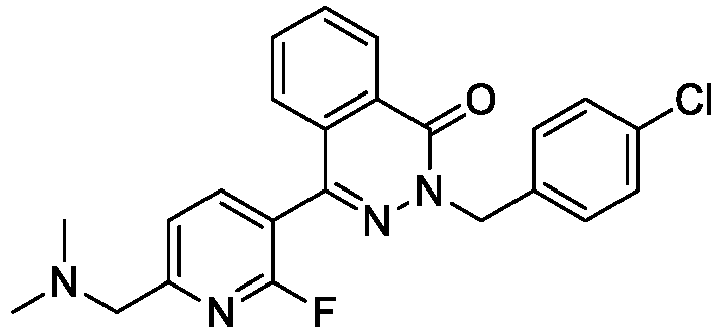
Compound I-33 was prepared in the same method as that in Example 1, except that 2-fluoro-6-(dimethylaminomethyl)-pyridine-3-boronic acid was used in place of pyridine-4-boronic acid. (White crystal, yield 63%) 1H NMR (500 MHz, CDCl3) δ 8.74 (s, 1H), 7.84 (s, 1H), 7.70-7.54 (m, 4H), 7.36 (d, J=35.0 Hz, 4H), 4.87 (s, 2H), 3.94 (s, 2H), 2.16 (s, 6H). I-34 
Compound I-34 was prepared in the same method as that in Example 1, except that 2-fluoro-6-(deuterated methyl)-pyridine-3-boronic acid was used in place of pyridine-4-boronic acid. (White crystal, yield 53%) 1H NMR (400 MHz, CDCl3) δ 8.55-8.49 (m, 1H), 7.85-7.76 (m, 3H), 7.49-7.43 (m, 3H), 7.33-7.30 (m, 2H), 7.25 (dd, J=7.6, 1.7 Hz, 1H), 5.43 (s, 2H). I-35 
Compound I-35 was prepared in the same method as that in Example 1, except that 2-fluoro-6-(methoxydeuterated methyl)-pyridine-3-boronic acid was used in place of pyridine-4-boronic acid. (White crystal, yield 63%) 1H NMR (400 MHz, CDCl3) δ 8.55-8.49 (m, 1H), 7.85-7.76 (m, 3H), 7.49-7.43 (m, 3H), 7.33-7.30 (m, 2H), 7.25 (dd, J=7.6, 1.7 Hz, 1H), 5.43 (s, 2H).3.86(s, 3H). I-36 
Compound I-36 was prepared in the same method as that in Example 1, except that 2-fluoro-6-(deuterated methoxydeuterated methyl)-pyridine-3-boronic acid was used in place of pyridine-4-boronic acid. (White crystal, yield 41%) 1H NMR (400 MHz, CDCl3) δ 8.55-8.49 (m, 1H), 7.85-7.76 (m, 3H), 7.49-7.43 (m, 3H), 7.33-7.30 (m, 2H), 7.25 (dd, J=7.6, 1.7 Hz, 1H), 5.43 (s, 2H). I-37 
Compound I-37 was prepared in the same method as that in Example 1, except that 2-fluoro-6-(N, N-dimethyldimethylaminodeuterated methyl)-pyridine-3-boronic acid was used in place of pyridine-4-boronic acid. (White crystal, yield 33%) 1H NMR (400 MHz, CDCl3) δ 8.55-8.49 (m, 1H), 7.85-7.76 (m, 3H), 7.49-7.43 (m, 3H), 7.33-7.30 (m, 2H), 7.25 (dd, J=7.6, 1.7 Hz, 1H), 5.43 (s, 2H), 2.16 (s, 6H). I-38 
Compound I-38 was prepared in the same method as that in Example 1, except that 2-fluoro-6-(N-methylaminodeuterated methyl)-pyridine-3-boronic acid was used in place of pyridine-4-boronic acid. (White crystal, yield 36%) 1H NMR (400 MHz, CDCl3) δ 8.55-8.49 (m, 1H), 7.85-7.76 (m, 3H), 7.49-7.43 (m, 3H), 7.33-7.30 (m, 2H), 7.25 (dd, J=7.6, 1.7 Hz, 1H), 5.43 (s, 2H), 2.14 (s, 3H). I-39 
The above compound was prepared in the same method as that in Example 1, except that 2-fluoro-5-chloro-pyridine-3-boronic acid was used in place of pyridine-4-boronic acid. (White crystal, yield 68%) 1H NMR (400 MHz, Chloroform-d) δ 8.54 (dd, J=7.5, 1.9 Hz, 1H), 8.37 (dd, J=2.8, 1.4 Hz, 1H), 7.94 (dd, J=7.7, 2.7 Hz, 1H), 7.83 (tt, J=7.4, 5.6 Hz, 2H), 7.50-7.41 (m, 3H), 7.35-7.30 (m, 2H), 5.43 (s, 2H). I-40 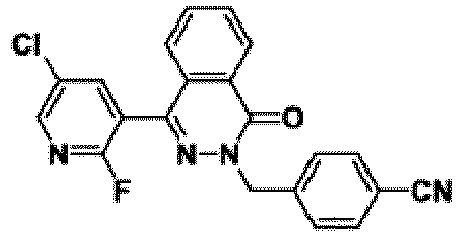
The above compound was prepared in the same method as that in Example 1, except that 4-cyanobenzyl chloride was used in place of p-chlorobenzyl chloride and 2-fluoro-5-chloro-pyridine-3-boronic acid was used in place of pyridine-4-boronic acid. (White crystal, yield 73%) 1H NMR (400 MHz, Chloroform-d) δ 8.57-8.50 (m, 1H), 8.38 (dd, J=2.6, 1.4 Hz, 1H), 7.94 (dd, J=7.7, 2.6 Hz, 1H), 7.90-7.82 (m, 2H), 7.66 (d, 2H), 7.60 (d, 2H), 7.49-7.44 (m, 1H), 5.50 (s, 2H). I-41 
The above compound was prepared in the same method as that in Example 1, except that 2-chloro-4-cyanobenzyl chloride was used in place of p-chlorobenzyl chloride and 2-fluoro-5-chloro-pyridine-3-boronic acid was used in place of pyridine-4-boronic acid. (White crystal, yield 65%) 1H NMR (400 MHz, Chloroform-d) δ 8.61-8.53 (m, 1H), 8.37 (dd, J=2.7, 1.4 Hz, 1H), 7.93 (dd, J=7.7, 2.6 Hz, 1H), 7.91-7.86 (m, 2H), 7.73 (d, J=1.6 Hz, 1H), 7.54-7.51 (m, 2H), 7.49 (td, J=3.0, 2.2 Hz, 1H), 5.64 (s, 2H). I-42 
The above compound was prepared in the same method as that in Example 1, except that 2-fluoro-4-cyanobenzyl chloride was used in place of p-chlorobenzyl chloride and 2-fluoro-5-chloro-pyridine-3-boronic acid was used in place of pyridine-4-boronic acid. (White crystal, 71% yield) 1H NMR (400 MHz, Chloroform-d) δ 8.58-8.50 (m, 1H), 8.37 (dd, J=2.6, 1.4 Hz, 1H), 7.93 (dd, J=7.7, 2.7 Hz, 1H), 7.90-7.84 (m, 2H), 7.54-7.39 (m, 4H), 5.58 (s, 2H). I-43 
The above compound was prepared in the same method as that in Example 1, except that 4-cyanobenzyl chloride was used in place of p-chlorobenzyl chloride, and 2-fluoro-5-hydroxy-pyridine-3-boronic acid was used in place of pyridine-4-boronic acid. (White crystal, yield 55%) 1H NMR (400 MHz, Chloroform-d) δ 8.66-8.57 (m, 1H), 8.10 (s, 1H), 7.99-7.83 (m, 3H), 7.69 (d, J=8.1 Hz, 2H), 7.59 (d, J=8.1 Hz, 2H), 7.09 (d, J=2.7 Hz, 1H). I-44 
The above compound was prepared in the same method as that in Example 1, except that 4-cyanobenzyl chloride was used in place of p-chlorobenzyl chloride, and 2-fluoro-5-methyl-pyridine-3-boronic acid was used in place of pyridine-4-boronic acid. (White crystal, yield 76%) 1H NMR (400 MHz, Chloroform-d) δ 8.53 (dd, J=7.1, 2.1 Hz, 1H), 8.23 (s, 1H), 7.83 (tt, J=7.3, 6.0 Hz, 2H), 7.74 (dd, J=8.8, 2.5 Hz, 1H), 7.66 (d, J=8.2 Hz, 2H), 7.60 (d, J=8.3 Hz, 2H), 7.47 (dd, J=5.8, 3.5 Hz, 1H), 5.51 (s, 2H), 2.46 (s, 3H). I-45 
The above compound was prepared in the same method as that in Example 1, except that 4-cyanobenzyl chloride was used in place of p-chlorobenzyl chloride, and 2-fluoro-5-morpholinylmethyl-pyridine-3-boronic acid was used in place of pyridine-4-boronic acid. (White crystal, yield 61%) 1H NMR (400 MHz, Chloroform-d) δ 8.54-8.49 (m, 1H), 8.33 (dd, J=2.3, 1.1 Hz, 1H), 7.94 (dd, J=8.9, 2.4 Hz, 1H), 7.82 (ddd, J=7.9, 5.5, 1.7 Hz, 2H), 7.64 (d, J=8.4 Hz, 2H), 7.58 (d, J=8.3 Hz, 2H), 7.48-7.43 (m, 1H), 5.50 (s, 2H), 3.71 (dt, J=7.0, 4.5 Hz, 4H), 3.61 (s, 2H), 2.51 (t, J=4.6 Hz, 4H). II-1 
Compound II-1 was prepared in the same method as that in Example 1, except that 2-aminopyrimidine-5-boronic acid pinacol ester was used in place of pyridine-4-boronic acid. (White crystal, yield 56%) 1H NMR (500 MHz, CDCl3) δ 8.67 (s, 2H), 7.87-7.81 (m, 1H), 7.69-7.63 (m, 2H), 7.63-7.54 (m, 1H), 7.42-7.29 (m, 4H), 4.87 (s, 2H), 1.86 (s, 2H). II-2 
Compound II-2 was prepared in the same method as that in Example 1, except that 2-cyanopyrimidine-5-boronic acid pinacol ester was used in place of pyridine-4-boronic acid. (White crystal, yield 67%) 1H NMR (500 MHz, CDCl3) δ 9.33 (s, 2H), 7.87-7.80 (m, 1H), 7.70-7.63 (m, 2H), 7.62-7.54 (m, 1H), 7.44-7.28 (m, 4H), 4.87 (s, 2H). II-3 
Compound II-3 was prepared in the same method as that in Example 1, except that 2-methoxypyrimidine-5-boronic acid was used in place of pyridine-4-boronic acid. (White crystal, yield 70%) 1H NMR (400 MHz, CDCl3) δ 9.01 (s, 2H), 7.87-7.81 (m, 1H), 7.67-7.63 (m, 2H), 7.63-7.54 (m, 1H), 7.44-7.24 (m, 4H), 4.87 (s, 2H), 3.85 (s, 3H). II-4 
Compound II-4 was prepared in the same method as that in Example 1, except that 2-methylpyrimidine-5-boronic acid was used in place of pyridine-4-boronic acid. (White crystal, yield 84%) 1H NMR (300 MHz, CDCl3) δ 8.92 (s, 2H), 7.87-7.81 (m, 1H), 7.68-7.63 (m, 2H), 7.62-7.54 (m, 1H), 7.42-7.28 (m, 4H), 4.87 (s, 2H), 2.18 (s, 3H). III-1 
Compound III-1 was prepared in the same method as that in Example 1, except that 2-methylpyrazine-5-boronic acid was used in place of pyridine-4-boronic acid. (White crystal, yield 33%) 1H NMR (500 MHz, CDCl3) δ 9.16 (s, 1H), 8.81 (s, 1H), 7.88-7.81 (m, 1H), 7.69-7.63 (m, 2H), 7.62-7.52 (m, 1H), 7.42-7.28 (m, 4H), 4.87 (s, 2H), 2.59 (s, 3H). IV-1 
Compound IV-1 was prepared in the same method as that in Example 1, except that p-cyanobenzyl chloride was used in place of p-chlorobenzyl chloride. (White crystal, yield 85%) 1H NMR (400 MHz, CDCl3) δ 8.90 (t, J=1.8 Hz, 1H), 8.75 (ddd, J=4.6, 2.7, 1.8 Hz, 1H), 8.40 (dd, J=7.8, 1.7 Hz, 1H), 7.99 (ddd, J=7.9, 2.6, 1.8 Hz, 1H), 7.89 (dd, J=7.7, 1.7 Hz, 1H), 7.77 (td, J=7.7, 1.8 Hz, 1H), 7.71 (dd, J=7.6, 1.7 Hz, 1H), 7.68 (dt, J=7.3, 1.3 Hz, 2H), 7.64 (dt, J=8.4, 1.0 Hz, 2H), 7.56 (dd, J=7.9, 4.8 Hz, 1H), 5.41 (t, J=1.0 Hz, 2H). IV-2 
Compound IV-2 was prepared in the same method as that in Example 1, except that p-cyanobenzyl chloride was used in place of p-chlorobenzyl chloride and 2-fluoro-pyridine-3-boronic acid was used in place of pyridine-4-boronic acid. (White crystal, yield 82%) 1H NMR (400 MHz, CDCl3) δ 8.56-8.52 (m, 1H), 8.45 (d, J=4.9 Hz, 1H), 7.96 (ddd, J=9.3, 7.4, 2.0 Hz, 1H), 7.89-7.79 (m, 2H), 7.68-7.58 (m, 4H), 7.51-7.40 (m, 2H), 5.51 (s, 2H). IV-3 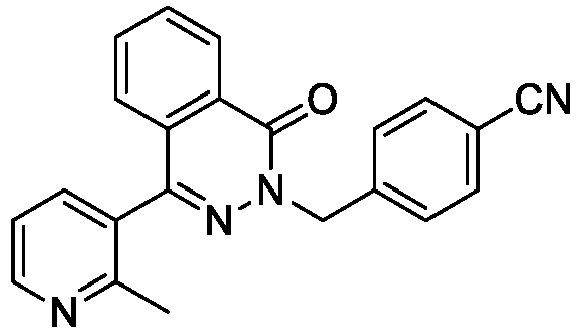
Compound IV-3 was prepared in the same method as that in Example 1, except that p-cyanobenzyl chloride was used in place of p-chlorobenzyl chloride and 2-methyl-pyridine-3-boronic acid was used in place of pyridine-4-boronic acid. (White crystal, yield 77%) 1H NMR (400 MHz, CDCl3) δ 8.67 (dd, J=3.5, 2.2 Hz, 1H), 8.37 (dd, J=7.7, 1.7 Hz, 1H), 7.83-7.80 (m, 2H), 7.77 (td, J=7.5, 1.6 Hz, 1H), 7.70-7.62 (m, 6H), 5.41 (t, J=1.0 Hz, 2H). IV-4 
Compound IV-4 was prepared in the same method as in Example 1, except that p-cyanobenzyl chloride was used in place of p-chlorobenzyl chloride and 2-cyano-pyridine-3-boronic acid was used in place of pyridine-4-boronic acid. (White crystal, yield 85%) 1H NMR (400 MHz, CDCl3) δ 8.62 (dd, J=3.5, 2.2 Hz, 1H), 8.35 (dd, J=7.8, 1.7 Hz, 1H), 8.01 (dd, J=7.9, 2.2 Hz, 1H), 7.90 (dd, J=7.9, 3.5 Hz, 1H), 7.85 (dd, J=7.7, 1.7 Hz, 1H), 7.78 (td, J=7.5, 1.6 Hz, 1H), 7.71 (td, J=7.6, 1.7 Hz, 1H), 7.69-7.60 (m, 4H), 5.39 (t, J=1.0 Hz, 2H). IV-5 
Compound IV-5 was prepared in the same method as that in Example 1, except that p-cyanobenzyl chloride was used in place of p-chlorobenzyl chloride and 2,6-difluoro-pyridine-3-boronic acid was used in place of pyridine-4-boronic acid. (White crystal, yield 75%) 1H NMR (400 MHz, CDCl3) δ 8.55 (dd, J=6.9, 2.5 Hz, 1H), 8.05 (dd, J=16.6, 7.8 Hz, 1H), 7.91-7.82 (m, 2H), 7.68-7.57 (m, 4H), 7.48-7.43 (m, 1H), 7.07 (dd, J=8.1, 2.9 Hz, 1H), 5.50 (s, 2H). IV-6 
Compound IV-6 was prepared in the same method as that in Example 1, except that p-cyanobenzyl chloride was used in place of p-chlorobenzyl chloride and 2-fluoro-6-methyl-pyridine-3-boronic acid was used in place of pyridine-4-boronic acid. (White crystal, 71% yield) 1H NMR (400 MHz, CDCl3) δ 8.50 (d, J=6.8 Hz, 1H), 7.86-7.74 (m, 3H), 7.60 (q, J=8.5 Hz, 4H), 7.47 (d, J=6.9 Hz, 1H), 7.22 (s, 1H), 5.48 (s, 2H), 2.63 (s, 3H). IV-7 
Compound IV-7 was prepared in the same method as that in Example 1, except that p-cyanobenzyl chloride was used in place of p-chlorobenzyl chloride and 2-fluoro-6-amino-pyridine-3-boronic acid pinacol ester was used in place of pyridine-4-boronic acid. (White crystal, yield 56%) 1H NMR (400 MHz, CDCl3) δ 8.55-8.46 (m, 1H), 7.85-7.79 (m, 2H), 7.63 (dt, J=15.4, 5.5 Hz, 6H), 6.52 (dd, J=8.0, 1.8 Hz, 1H), 5.50 (s, 2H), 4.81 (s, 2H). IV-8 
Compound IV-8 was prepared in the same method as that in Example 1, except that p-cyanobenzyl chloride was used in place of p-chlorobenzyl chloride, and 2-fluoro-6-methylamino-pyridine-3-boronic acid pinacol ester was used in place of pyridine-4-boronic acid. (White crystal, yield 60%) 1H NMR (400 MHz, CDCl3) δ 8.36 (s, 1H), 7.85 (d, J=5.0 Hz, 3H), 7.65 (d, J=5.0 Hz, 2H), 7.59 (d, J=5.0 Hz, 2H), 7.52 (s, 2H), 4.87 (s, 2H), 2.89 (s, 3H), 2.32 (s, 1H). IV-9 
Compound IV-9 was prepared in the same method as that in Example 1, except that p-cyanobenzyl chloride was used in place of p-chlorobenzyl chloride, and 2-fluoro-6-dimethylamino-pyridine-3-boronic acid pinacol ester was used in place of pyridine-4-boronic acid. (White crystal, yield 77%) 1H NMR (400 MHz, CDCl3) δ 8.36 (dd, J=15.0, 10.1 Hz, 1H), 7.87-7.82 (m, 3H), 7.67-7.63 (m, 2H), 7.63-7.56 (m, 2H), 7.55-7.49 (m, 2H), 4.87 (s, 2H), 3.15 (s, 6H). IV-10 
Compound IV-10 was prepared in the same method as that in Example 1, except that p-cyanobenzyl chloride was used in place of p-chlorobenzyl chloride, and 2-fluoro-6-acetamido-pyridine-3-boronic acid pinacol ester was used in place of pyridine-4-boronic acid. (White crystal, yield 43%) 1H NMR (400 MHz, CDCl3) δ 9.21 (d, J=7.5 Hz, 1H), 8.83 (dd, J=7.5, 5.0 Hz, 1H), 8.29 (s, 1H), 7.89-7.82 (m, 3H), 7.67-7.63 (m, 2H), 7.58 (ddd, J=7.3, 6.2, 2.9 Hz, 1H), 7.52 (d, J=7.5 Hz, 2H), 4.87 (s, 2H), 2.09 (s, 3H). IV-11 
Compound IV-11 was prepared in the same method as that in Example 1, except that p-cyanobenzyl chloride was used in place of p-chlorobenzyl chloride and 2-fluoro-6-azetidinyl-pyridine-3-boronic acid was used in place of pyridine-4-boronic acid. (White crystal, yield 51%) 1H NMR (400 MHz, CDCl3) δ 8.51-8.46 (m, 1H), 7.83-7.75 (m, 2H), 7.60 (dt, J=8.2, 5.8 Hz, 6H), 6.21 (d, J=8.2 Hz, 1H), 5.49 (s, 2H), 4.16 (t, J=7.5 Hz, 4H), 2.53-2.42 (m, 2H). IV-12 
Compound IV-12 was prepared in the same method as that in Example 1, except that p-cyanobenzyl chloride was used in place of p-chlorobenzyl chloride and 2-fluoro-6-t-butylamino-pyridine-3-boronic acid pinacol ester was used in place of pyridine-4-boronic acid. (White crystal, yield 57%) 1H NMR (400 MHz, CDCl3) δ 8.36 (s, 1H), 7.85 (d, J=5.0 Hz, 3H), 7.65 (d, J=5.0 Hz, 2H), 7.59 (d, J=5.0 Hz, 2H), 7.52 (s, 2H), 4.87 (s, 2H), 2.25 (s, 1H), 1.36 (s, 9H). IV-13 
Compound IV-13 was prepared in the same method as that in Example 1, except that p-cyanobenzyl chloride was used in place of p-chlorobenzyl chloride, and 2-fluoro-6-cyclopropylamino-pyridine-3-boronic acid pinacol ester was used in place of pyridine-4-boronic acid. (White crystal, yield 49%) 1H NMR (400 MHz, CDCl3) δ 8.36 (s, 1H), 7.84 (d, J=5.0 Hz, 3H), 7.65 (d, J=5.0 Hz, 2H), 7.58 (d, J=5.0 Hz, 2H), 7.52 (s, 2H), 4.87 (s, 2H), 3.19 (s, 1H), 2.36 (s, 1H), 0.82 (s, 2H), 0.57 (s, 2H). IV-14 
Compound IV-14 was prepared in the same method as that in Example 1, except that p-cyanobenzyl chloride was used in place of p-chlorobenzyl chloride and 2-fluoro-6-(N,N-dimethylaminoethylamino)-pyridine-3-boronic acid was used in place of pyridine-4-boronic acid. (White crystal, yield 35%) 1H NMR (400 MHz, CDCl3) δ 8.36 (s, 1H), 7.85 (d, J=5.0 Hz, 3H), 7.65 (d, J=5.0 Hz, 2H), 7.59 (d, J=5.0 Hz, 2H), 7.52 (s, 2H), 4.87 (s, 2H), 3.60 (s, 2H), 2.61 (s, 2H), 2.26 (s, 6H), 2.22 (s, 1H). IV-15 
Compound IV-15 was prepared in the same method as that in Example 1, except that p-cyanobenzyl chloride was used in place of p-chlorobenzyl chloride and 2-fluoro-6-trifluoromethyl-pyridine-3-boronic acid was used in place of pyridine-4-boronic acid. (White crystal, yield 65%) 1H NMR (400 MHz, CDCl3) δ 8.58-8.54 (m, 1H), 8.16 (t, J=8.1 Hz, 1H), 7.91-7.80 (m, 3H), 7.63 (dd, J=23.4, 8.3 Hz, 4H), 7.45 (d, J=7.4 Hz, 1H), 5.51 (s, 2H). IV-16 
Compound IV-16 was prepared in the same method as that in Example 1, except that p-cyanobenzyl chloride was used in place of p-chlorobenzyl chloride, and 2-fluoro-6-oxetanylamino-pyridine-3-boronic acid pinacol ester was used in place of pyridine-4-boronic acid. (White crystal, yield 33%) 1H NMR (400 MHz, CDCl3) δ 8.36 (s, 1H), 7.85 (d, J=5.0 Hz, 3H), 7.65 (d, J=5.0 Hz, 2H), 7.59 (d, J=5.0 Hz, 2H), 7.52 (s, 2H), 4.87 (s, 2H). 5.24-5.21 (m, 1H), 4.98-4.96 (m, 2H), 4.53 (d, J=5.7 Hz, 2H). IV-19 
Compound IV-19 was prepared in the same method as that in Example 1, except that p-cyanobenzyl chloride was used in place of p-chlorobenzyl chloride and 2-fluoro-6-cyclopropyl-pyridine-3-boronic acid was used in place of pyridine-4-boronic acid. (White crystal, yield 37%) 1H NMR (400 MHz, CDCl3) δ 8.59 (s, 1H), 7.85 (d, J=5.0 Hz, 3H), 7.66 (d, J=5.0 Hz, 2H), 7.58 (s, 1H), 7.52 (s, 2H), 7.39 (s, 1H), 4.87 (s, 2H), 2.22 (s, 1H), 1.24 (s, 2H), 0.99 (s, 2H). IV-20 
Compound IV-20 was prepared in the same method as that in Example 1, except that p-cyanobenzyl chloride was used in place of p-chlorobenzyl chloride and 2-fluoro-6-hydroxymethyl-pyridine-3-boronic acid was used in place of pyridine-4-boronic acid. (White crystal, yield 25%) 1H NMR (400 MHz, CDCl3) δ 8.97 (s, 1H), 7.85 (d, J=5.0 Hz, 4H), 7.65 (d, J=5.0 Hz, 2H), 7.58 (s, 1H), 7.52 (s, 2H), 5.08 (s, 2H), 4.87 (s, 2H), 4.13 (s, 1H). IV-21 
Compound IV-21 was prepared in the same method as that in Example 1, except that p-cyanobenzyl chloride was used in place of p-chlorobenzyl chloride, and 2-fluoro-6-(dimethylaminomethyl)-pyridine-3-boronic acid was used in place of pyridine-4-boronic acid. (White crystal, yield 41%) 1H NMR (400 MHz, CDCl3) δ 8.74 (s, 1H), 7.84 (d, J=5.0 Hz, 3H), 7.70-7.63 (m, 3H), 7.58 (s, 1H), 7.52 (s, 2H), 4.87 (s, 2H), 3.94 (s, 2H), 2.16 (s, 6H). IV-22 
Compound IV-22 was prepared in the same method as that in Example 1, except that p-cyanobenzyl chloride was used in place of p-chlorobenzyl chloride and 2-fluoro-6-methoxymethyl-pyridine-3-boronic acid was used in place of pyridine-4-boronic acid. (White crystal, yield 45%) 1H NMR (400 MHz, CDCl3) δ 8.97 (s, 1H), 7.85 (d, J=5.0 Hz, 4H), 7.65 (d, J=5.0 Hz, 2H), 7.58 (s, 1H), 7.52 (s, 2H), 4.87 (s, 2H), 4.44 (s, 2H), 3.27 (s, 3H). IV-23 
Compound IV-23 was prepared in the same method as that in Example 1, except that p-cyanobenzyl chloride was used in place of p-chlorobenzyl chloride and 2-fluoro-6-acetoxymethylpyridine-3-boronic acid was used in place of pyridine-4-boronic acid. (White crystal, yield 30%) 1H NMR (400 MHz, CDCl3) δ 8.97 (s, 1H), 7.84 (d, J=5.0 Hz, 4H), 7.65 (d, J=5.0 Hz, 2H), 7.58 (s, 1H), 7.52 (s, 2H), 5.79 (s, 2H), 4.87 (s, 2H), 2.09 (s, 3H). IV-24 
Compound IV-24 was prepared in the same method as that in Example 1, except that p-cyanobenzyl chloride was used in place of p-chlorobenzyl chloride and 2-fluoro-6-morpholinemethyl-pyridine-3-boronic acid pinacol ester was used in place of pyridine-4-boronic acid. (White crystal, yield 38%) 1H NMR (400 MHz, CDCl3) δ 8.74 (s, 1H), 7.84 (d, J=5.0 Hz, 3H), 7.70-7.63 (m, 3H), 7.58 (s, 1H), 7.52 (s, 2H), 4.87 (s, 2H), 3.94 (s, 2H), 3.57 (s, 4H), 2.42 (s, 4H). IV-25 
Compound IV-25 was prepared in the same method as that in Example 1, except that p-cyanobenzyl chloride was used in place of p-chlorobenzyl chloride, 2-fluoro-6-(tetrahydrofuran-4-ylmethylamino)-pyridine-3-boronic acid pinacol ester was used in place of pyridine-4-boronic acid. (White crystal, yield 17%) 1H NMR (400 MHz, CDCl3) δ 8.36 (s, 1H), 7.84 (d, J=5.0 Hz, 3H), 7.65 (d, J=5.0 Hz, 2H), 7.58 (d, J=5.0 Hz, 2H), 7.52 (s, 2H), 4.87 (s, 2H), 3.65 (d, J=50.0 Hz, 4H), 3.36 (s, 2H), 2.29 (s, 1H), 1.68 (s, 1H), 1.55 (s, 2H), 1.30 (s, 2H). - The scheme for synthesizing compound 1-24 is shown as below:

- p-chlorobenzaldehyde (1g, 7.1mmol) was dissolved in anhydrous methanol (50ml), added with NaBD4 (360mg, 8.5mmol), stirred at room temperature for 1 hour, and then rotary evaporated to remove the solvent. The residue was dissolved in ethyl acetate (100ml) and water (100ml), and the organic layer was washed with water (100ml x 4) and saturated brine (100ml) in this order, dried over anhydrous sodium sulfate for half an hour and then concentrated to obtain a crude product. The crude product was separated and purified by column chromatography to obtain a white solid 5 (0.9g, 90%).
- Compound 5 (500mg, 3.5mmol) was dissolved in toluene (20ml), added with triethylamine (2ml, 14mmol) and methanesulfonyl chloride (0.32ml, 4.2mmol) in this order, stirred at room temperature for 2 hours, and then rotary evaporated to remove the solvent. The residue was dissolved in ethyl acetate (100ml) and water (100ml), and the organic layer was washed with water (100ml x 4) and saturated brine (100ml) in this order, dried over anhydrous sodium sulfate for half an hour and then concentrated to obtain a crude product.
- The above crude product (500mg, 2.3mmol) was dissolved in DMF (40ml), and 6-chlorophthalazinone (compound 2) (407mg, 2.3mmol) and Cs2CO3 (750mg, 2.3mmol) were added in this order. After the reaction system was stirred at 50 °C for 5 hours, the reaction was completed as monitored by TLC. Ethyl acetate (100ml) and water (100ml) were added to the reaction solution, and the organic layer was washed with water (100ml x 4) and saturated brine (100ml) in this order, dried over anhydrous sodium sulfate for half an hour, and concentrated to obtain a crude product. The crude product was separated and purified by column chromatography to obtain a white solid 6 (490mg, 70%).
- Compound 6 (100mg, 0.33mmol) was dissolved in a mixed solvent of 1,4-dioxane (20ml) and water (5ml), and then 2-fluoro-6-methylpyridine-3-boronic acid (52.9mg, 0.43mmol), Pd(PPh3)4 (76.0mg, 0.033mmol), and K3PO4 (139mg, 0.66mmol) were added in this order. After the reaction system was purged with N2 for 3 times, the reaction was performed at 100 °C overnight. Next day, after the reaction was completed as monitored by TLC, the reaction system was cooled to room temperature. After removing the solvent by rotary evaporation under reduced pressure, the residue was extracted and dissolved with ethyl acetate (30ml). The organic layer was washed with water (30ml x 3) and saturated brine (30ml) in this order, dried over anhydrous sodium sulfate, and concentrated to give a crude product. The crude product was separated and purified by column chromatography to obtain product 1-24 (84mg, 75%). 1H NMR (400 MHz, CDCl3) δ 8.56-8.47 (m, 1H), 7.80 (tdd, J=8.9, 8.3, 4.5 Hz, 3H), 7.47 (dd, J=9.0, 2.6 Hz, 3H), 7.31 (d, J=8.4 Hz, 2H), 7.26 (dd, J=7.5, 1.5 Hz, 1H), 5.41 (s, 1H), 2.65 (s, 3H).
- The following compounds were prepared in the same method as that in Example 2:
Compounds Preparation methods and structures of the products I-25 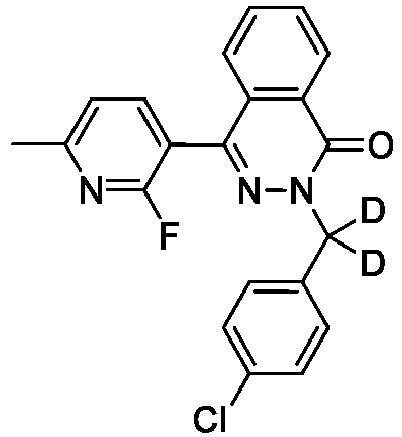
Compound I-25 was prepared in the same method as that in Example 2, except that methyl p-chlorobenzoate was used in place of p-chlorobenzaldehyde, and LiAlD4 was used in place of NaBD4. (White crystal, yield 54%) 1H NMR (400 MHz, CDCl3) δ 8.50 (d, J=7.3 Hz, 1H), 7.85-7.71 (m, 3H), 7.45 (d, J=8.4 Hz, 3H), 7.32-7.27 (m, 2H), 7.22 (s, 1H), 2.63 (s, 3H). I-26 
Compound I-26 was prepared in the same method as that in Example 2, except that 2,6-difluoropyridine-3-boronic acid was used in place of 2-fluoro-6-methylpyridine-3-boronic acid. (White crystal, yield 58%) 1H NMR (400 MHz, CDCl3) δ 8.59-8.51 (m, 1H), 8.05 (dt, J=8.8, 8.0 Hz, 1H), 7.88-7.74 (m, 2H), 7.49-7.42 (m, 3H), 7.35-7.31 (m, 2H), 7.06 (dd, J=8.0, 2.8 Hz, 1H), 5.41 (s, 1H). I-27 
Compound I-27 was prepared in the same method as that in Example 2, except that 2,6-difluoropyridine-3-boronic acid was used in place of 2-fluoro-6-methylpyridine-3-boronic acid, methyl p-chlorobenzoate was used in place of p-chlorobenzaldehyde, and LiAlD4 was used in place of NaBD4. (White crystal, yield 61%) 1H NMR (400 MHz, CDCl3) δ 8.56-8.50 (m, 1H), 8.05 (dd, J=16.6, 7.8 Hz, 1H), 7.87-7.78 (m, 2H), 7.48-7.42 (m, 3H), 7.36-7.31 (m, 2H), 7.06 (dd, J=7.9, 2.6 Hz, 1H). IV-17 
Compound IV-17 was prepared in the same method as that in Example 2, except that p-cyanobenzaldehyde was used in place of p-chlorobenzaldehyde, and 2,6-difluoropyridine-3-boronic acid was used in place of 2-fluoro-6-methylpyridine-3-boronic acid. (White crystal, yield 66%) 1H NMR (300 MHz, CDCl3) δ 9.07 (s, 1H), 7.85 (d, J=5.0 Hz, 3H), 7.65 (d, J=5.0 Hz, 2H), 7.58 (s, 1H), 7.51 (d, J=8.7 Hz, 3H), 5.68 (s, 1H). IV-18 
Compound IV-18 was prepared in the same method as that in Example 2, except that methyl p-cyanobenzoate was used in place of p-chlorobenzaldehyde, LiAlD4 was used in place of NaBD4, and 2,6-difluoropyridine-3-boronic acid was used in place of 2-fluoro-6-methylpyridine-3-boronic acid. (White crystal, yield 59%) 1H NMR (300 MHz, CDCl3) δ 9.07 (s, 1H), 7.85 (d, J=5.0 Hz, 3H), 7.65 (d, J=5.0 Hz, 2H), 7.58 (s, 1H), 7.51 (d, J=10.7 Hz, 3H). - The scheme for synthesizing compound V-1 is shown as below:

- 2-fluoro-3-bromo-6-methylpyridine (500mg, 2.6mmol) was dissolved in anhydrous THF (50ml), magnesium strips (126mg, 5.2mmol) was added thereto. The reaction system was purged with N2 for 3 times, and stirred at room temperature for 1 hour, and then a solution of 4-fluorophthalic anhydride (474 mg, 2.8mmol) in THF was added and reacted at room temperature overnight. The solvent was rotary evaporated in the next day. The residue was dissolved in ethyl acetate (100ml) and water (100ml). The organic layer was washed with water (100ml x 4) and saturated brine (100ml) in this order, dried over anhydrous sodium sulfate for half an hour, and then concentrated to obtain a crude product. The crude product was separated and purified by column chromatography to obtain a white solid 7 (0.6g, 80%).
- Compound 7 (0.6g, 2.1mmol) was dissolved in absolute ethanol (30ml), added with 85% hydrazine hydrate (79µl), and refluxed for 5 hours. The solvent was rotary evaporated to obtain a crude product 8 (384mg, 67%).
- The above crude product (300mg, 1.1mmol) was dissolved in DMF (40ml), and the halide (1.3mmol) and Cs2CO3 (429mg, 1.3mmol) were added in this order. After the reaction system was stirred at 50 °C for 5 hours, the reaction was completed as monitored by TLC. Ethyl acetate (100ml) and water (100ml) were added to the reaction solution, and the organic layer was washed with water (100ml x 4) and saturated brine (100ml) in this order, dried over anhydrous sodium sulfate for half an hour, and concentrated to obtain a crude product. The crude product was separated and purified by column chromatography to obtain a white crystal V-1 (327mg, 75%). 1H NMR (500 MHz, CDCl3) δ 8.66 (s, 1H), 7.98 (s, 1H), 7.82 (s, 1H), 7.54 (s, 1H), 7.47 (s, 1H), 7.35 (d, J=35.0 Hz, 4H), 4.87 (s, 2H), 2.68 (s, 3H).
- The following compounds were prepared in the same method as that in Example 3:
Compounds Preparation methods and structures of the products V-2 
Compound V-2 was prepared in the same method as in Example 3, except that 4,5-difluorophthalic anhydride was used in place of 4-fluorophthalic anhydride. (White crystal, yield 74%) 1H NMR (400 MHz, CDCl3) δ 8.66 (s, 1H), 8.14 (s, 1H), 7.96 (s, 1H), 7.47 (s, 1H), 7.36 (d, J=35.0 Hz, 4H), 4.87 (s, 2H), 2.68 (s, 3H). V-3 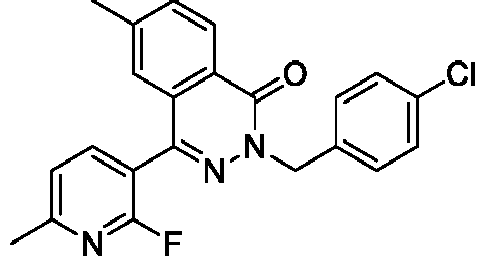
Compound V-3 was prepared in the same method as in Example 3, except that 4-methylphthalic anhydride was used in place of 4-fluorophthalic anhydride. (White crystal, 71% yield) 1H NMR (400 MHz, CDCl3) δ 8.66 (s, 1H), 7.92 (s, 1H), 7.79 (s, 1H), 7.46 (d, J=10.0 Hz, 2H), 7.36 (d, J=35.0 Hz, 4H), 4.87 (s, 2H), 2.68 (s, 3H), 2.42 (s, 3H). V-4 
Compound V-4 was prepared in the same method as in Example 3, except that 4,5-dimethylphthalic anhydride was used in place of 4-fluorophthalic anhydride. (White crystal, yield 64%) 1H NMR (400 MHz, CDCl3) δ 8.66 (s, 1H), 8.05 (s, 1H), 7.87 (s, 1H), 7.47 (s, 1H), 7.36 (d, J=35.0 Hz, 4H), 4.87 (s, 2H), 2.68 (s, 3H), 2.31 (s, 6H). V-5 
Compound V-5 was prepared in the same method as that in Example 3, except that 4-methoxyphthalic anhydride was used in place of 4-fluorophthalic anhydride. (White crystal, yield 69%) 1H NMR (300 MHz, CDCl3) δ 8.66 (s, 1H), 7.84 (s, 1H), 7.58 (s, 1H), 7.47 (s, 1H), 7.36 (d, J=35.0 Hz, 4H), 7.23 (s, 1H), 4.87 (s, 2H), 3.77 (s, 3H), 2.68 (s, 3H). V-6 
Compound V-6 was prepared in the same method as in Example 3, except that 4,5-dimethoxyphthalic anhydride was used in place of 4-fluorophthalic anhydride. (White crystal, yield 80%) 1H NMR (400 MHz, CDCl3) δ 8.66 (s, 1H), 7.76 (s, 1H), 7.58 (s, 1H), 7.47 (s, 1H), 7.36 (d, J=35.0 Hz, 4H), 4.87 (s, 2H), 3.85 (s, 6H), 2.68 (s, 3H). V-7 
Compound V-7 was prepared in the same method as in Example 3, except that 4-cyanophthalic anhydride was used in place of 4-fluorophthalic anhydride. (White crystal, yield 51%) 1H NMR (400 MHz, CDCl3) δ 8.66 (s, 1H), 8.02 (s, 1H), 7.85 (s, 1H), 7.59 (s, 1H), 7.47 (s, 1H), 7.36 (d, J=35.0 Hz, 4H), 4.87 (s, 2H), 2.68 (s, 3H). V-8 
Compound V-8 was prepared in the same method as in Example 3, except that 4-trifluoromethylphthalic anhydride was used in place of 4-fluorophthalic anhydride. (White crystal, yield 45%) 1H NMR (400 MHz, CDCl3) δ 8.66 (s, 1H), 8.23 (s, 1H), 7.77 (s, 1H), 7.63 (s, 1H), 7.47 (s, 1H), 7.36 (d, J=35.0 Hz, 4H), 4.87 (s, 2H), 2.68 (s, 3H). V-9 
Compound V-9 was prepared in the same method as that in Example 3, except that 4,5-di-trifluoromethylphthalic anhydride was used in place of 4-fluorophthalic anhydride. (White crystal, yield 37%) 1H NMR (400 MHz, CDCl3) δ 8.87 (s, 1H), 8.66 (s, 1H), 7.84 (s, 1H), 7.47 (s, 1H), 7.35 (d, J=35.0 Hz, 4H), 4.87 (s, 2H), 2.68 (s, 3H). V-10 
Compound V-10 was prepared in the same method as in Example 3, except that 4,5-difluorophthalic anhydride was used in place of 4-fluorophthalic anhydride and p-cyanobenzyl chloride was used in place of p-chlorobenzyl chloride. (White crystal, yield 75%) 1H NMR (400 MHz, CDCl3) δ 8.66 (s, 1H), 8.14 (s, 1H), 7.96 (s, 1H), 7.85 (s, 2H), 7.52 (s, 2H), 7.47 (s, 1H), 4.87 (s, 2H), 2.68 (s, 3H). V-11 
Compound V-11 was prepared in the same method as in Example 3, except that 4,5-dimethylphthalic anhydride was used in place of 4-fluorophthalic anhydride and p-cyanobenzyl chloride was used in place of p-chlorobenzyl chloride. (White crystal, yield 60%) 1H NMR (400 MHz, CDCl3) δ 8.66 (s, 1H), 8.05 (s, 1H), 7.86 (d, J=10.0 Hz, 3H), 7.52 (s, 2H), 7.47 (s, 1H), 4.87 (s, 2H), 2.68 (s, 3H), 2.31 (s, 6H). V-12 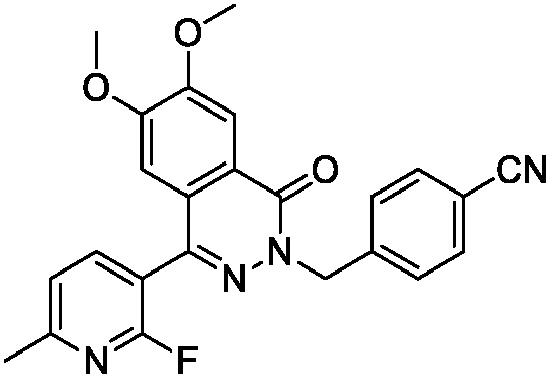
Compound V-12 was prepared in the same method as that in Example 3, except that 4,5-dimethoxyphthalic anhydride was used in place of 4-fluorophthalic anhydride, and p-cyanobenzyl chloride was used in place of p-chlorobenzyl chloride. (White crystal, yield 69%) 1H NMR (400 MHz, CDCl3) δ 8.66 (s, 1H), 7.85 (s, 2H), 7.76 (s, 1H), 7.58 (s, 1H), 7.49 (d, J=25.0 Hz, 3H), 4.87 (s, 2H), 3.85 (s, 6H), 2.68 (s, 3H). -
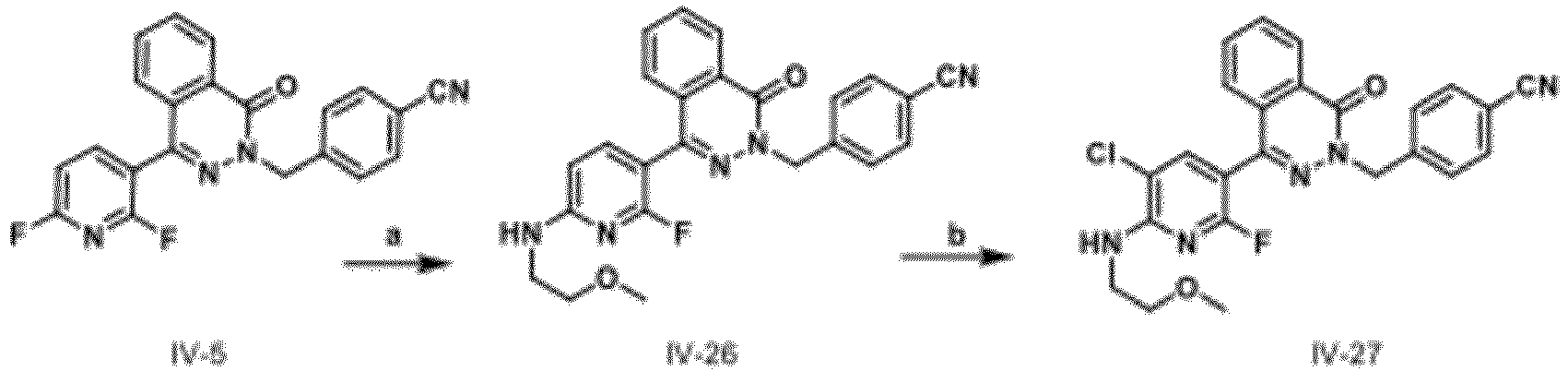
- Compound IV-5 (150mg, 0.4mmol) was dissolved in absolute ethanol (10ml), added with 2-methoxyethylamine (0.35ml, 4mmol), and refluxed overnight. The solvent was rotary evaporated in the next day, and the residue was dissolved in ethyl acetate (50ml) and water (50ml). The organic layer was washed with saturated brine (50ml), dried over anhydrous sodium sulfate for half an hour and concentrated to obtain a crude product. The crude product was separated and purified by column chromatography to obtain a white solid IV-26 (0.9g, 52%), 1H NMR (400 MHz, Chloroform-d) δ 8.52-8.47 (m, 1H), 7.83-7.76 (m, 2H), 7.67-7.52 (m, 7H), 6.43 (dd, J=8.2, 1.8 Hz, 1H), 5.49 (s, 2H), 5.26 (d, J=6.1 Hz, 1H), 3.72-3.53 (m, 4H), 3.43 (s, 3H).
- Compound IV-26 (80mg, 0.19mmol) was dissolved in anhydrous acetonitrile (10ml), added with N-chlorosuccinimide (25mg, 0.19mmol), and refluxed for 5 hours. The solvent was rotary evaporated to obtain a crude product. The crude product was separated and purified by column chromatography to obtain a white solid IV-27 (73mg, 85%). 1H NMR (400 MHz, Chloroform-d) δ 8.52-8.45 (m, 1H), 7.85-7.77 (m, 2H), 7.66-7.61 (m, 3H), 7.59-7.56 (m, 3H), 5.71 (t, J=5.4 Hz, 1H), 5.47 (s, 2H), 3.76-3.69 (m, 2H 3.63 (dd, J=5.3, 4.2 Hz, 2H 3.44 (s, 3H).
Compounds Preparation methods and structures of the products IV-28 
The above compound was prepared in the same method as that in Example 4, except that 4-chlorobenzyl chloride was used in place of 4-cyanobenzyl chloride. (White crystal, yield 70%) 1H NMR (400 MHz, Chloroform-d) δ 8.54-8.47 (m, 1H), 7.83-7.74 (m, 2H), 7.64-7.55 (m, 2H), 7.50-7.42 (m, 2H), 7.31 (d, J=8.4 Hz, 2H), 6.42 (dd, J=8.2, 1.8 Hz, 1H), 5.42 (s, 2H), 5.21 (s, 1H), 3.62 (pd, J=6.2, 1.9 Hz, 4H), 3.44 (s, 3H). IV-29 
The above compound was prepared in the same method as that in Example 4, except that 4-chlorobenzyl chloride was used in place of 4-cyanobenzyl chloride. (White crystal, yield 85%) 1H NMR (400 MHz, Chloroform-d) δ 8.53-8.48 (m, 1H), 7.83-7.76 (m, 2H), 7.67 (d, J=7.9 Hz, 1H), 7.57 (dq, J=7.2, 3.3 Hz, 1H), 7.49-7.44 (m, 2H), 7.35-7.29 (m, 2H), 5.71 (t, J=5.1 Hz, 1H), 5.41 (s, 2H), 3.74 (q, J=5.1 Hz, 2H), 3.65 (t, J=5.0 Hz, 2H), 3.45 (s, 3H). IV-30 
The above compound was prepared in the same method as that in Example 4, except that ammonia gas was used in place of 2-methoxyethylamine. (White crystal, yield 81%) 1H NMR (400 MHz, Chloroform-d) δ 8.52-8.46 (m, 1H), 7.85-7.78 (m, 2H), 7.70 (d, J=7.9 Hz, 1H), 7.65-7.61 (m, 2H), 7.59-7.50 (m, 3H), 5.47 (s, 2H), 5.22 (s, 2H). IV-31 
The above compound was prepared in the same method as that in Example 4, except that 2-methoxyethanol was used in place of 2-methoxyethylamine. (White crystal, yield 56%) 1H NMR (400 MHz, Chloroform-d) δ 8.55-8.49 (m, 1H), 7.91-7.76 (m, 3H), 7.65 (d, J=8.5 Hz, 2H), 7.59 (d, J=8.3 Hz, 2H), 7.54-7.49 (m, 1H), 6.89 (dd, J=8.2, 1.1 Hz, 1H), 5.50 (s, 2H), 4.61-4.51 (m, 2H), 3.85-3.78 (m, 2H), 3.49 (s, 3H). IV-32 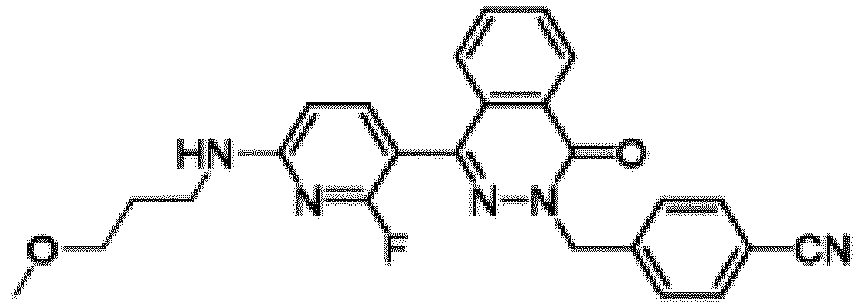
The above compound was prepared in the same method as that in Example 4, except that 3-methoxypropylamine was used in place of 2-methoxyethylamine. (White crystal, yield 61%) 1H NMR (400 MHz, Chloroform-d) δ 8.66-8.39 (m, 1H), 7.86-7.73 (m, 2H), 7.72-7.47 (m, 6H), 6.39 (d, J=8.5 Hz, 1H), 5.50 (s, 2H), 5.35 (s, 1H), 3.57 (t, J=5.7 Hz, 2H), 3.50 (q, J=6.2 Hz, 2H), 3.40 (d, J=1.6 Hz, 3H), 1.95 (p, J=6.2 Hz, 2H). IV-33 
The above compound was prepared in the same method as that in Example 4, except that 3-methoxypropylamine was used in place of 2-methoxyethylamine. (White crystal, yield 86%) 1H NMR (400 MHz, Chloroform-d) δ 8.54-8.47 (m, 1H), 7.85-7.78 (m, 2H), 7.67-7.62 (m, 3H), 7.59 (d, J=8.4 Hz, 2H), 6.14 (t, J=5.2 Hz, 1H), 5.49 (s, 2H), 3.72-3.53 (m, 4H), 3.43 (s, 3H), 2.05-1.86 (m, 2H). IV-34 
The above compound was prepared in the same method as that in Example 4, except that glycine ethyl ester was used in place of 2-methoxyethylamine. (White crystal, yield 67%) 1H NMR (400 MHz, Chloroform-d) δ 8.53-8.49 (m, 1H), 7.85-7.77 (m, 2H), 7.68-7.56 (m, 6H), 6.50 (dd, J=8.2, 1.7 Hz, 1H), 5.49 (s, 2H), 5.35 (t, J=5.3 Hz, 1H), 4.30 (q, J=7.1 Hz, 2H), 4.22 (d, J=5.2 Hz, 2H), 1.35 (t, J=7.1 Hz, 3H). IV-35 
The above compound was prepared in the same method as that in Example 4, except that ethyl 4-aminobutyrate was used in place of 2-methoxyethylamine. (White crystal, yield 79%) 1H NMR (400 MHz, Chloroform-d) δ 8.53-8.48 (m, 1H), 7.85-7.77 (m, 2H), 7.67-7.57 (m, 6H), 6.41 (dd, J=8.2, 1.9 Hz, 1H), 5.50 (s, 2H), 5.07 (t, J=5.9 Hz, 1H), 4.19 (q, J=7.1 Hz, 2H), 3.46 (q, J=6.7 Hz, 2H), 2.47 (t, J=7.1 Hz, 2H), 2.02 (p, J=7.0 Hz, 2H), 1.30 (t, J=7.1 Hz, 3H). IV-36 
The above compound was prepared in the same method as that in Example 4, except that ethyl 4-aminobutyrate was used in place of 2-methoxyethylamine. (White crystal, yield 81%) 1H NMR (400 MHz, Chloroform-d) δ 8.50-8.48 (m, 1H), 7.86-7.79 (m, 2H), 7.69-7.56 (m, 6H), 5.58 (s, 1H), 5.49 (s, 2H), 4.23-4.15 (m, 2H), 3.67-3.54 (m, 2H), 2.48 (t, J=7.1 Hz, 2H), 2.06 (d, J=5.3 Hz, 2H), 1.30 (t, J=7.1 Hz, 3H). IV-37 
The above compound was prepared in the same method as that in Example 4, except that N,N-dimethylethylenediamine was used in place of 2-methoxyethylamine. (White crystal, yield 59%) 1H NMR (400 MHz, Chloroform-d) δ 8.54-8.46 (m, 1H), 7.86-7.75 (m, 2H), 7.67-7.53 (m, 6H), 6.50 (dd, J=8.3, 1.9 Hz, 1H), 6.01 (s, 1H), 5.49 (s, 2H), 3.58 (q, J=5.4 Hz, 2H), 2.81 (t, J=5.7 Hz, 2H), 2.48 (s, 6H). IV-38 
The above compound was prepared in the same method as that in Example 4, except that N,N-dimethylethylenediamine was used in place of 2-methoxyethylamine. (White crystal, 71% yield) 1H NMR (400 MHz, Chloroform-d) δ 8.50 (t, J=4.7 Hz, 1H), 7.82 (dd, J=6.3, 3.0 Hz, 2H), 7.72-7.53 (m, 6H), 6.04 (s, 1H), 5.49 (s, 2H), 3.57 (q, J=5.7 Hz, 2H), 2.62 (t, J=6.0 Hz, 2H), 2.34 (s, 6H). IV-39 
he above compound was prepared in the same method as that in Example 4, except that N,N-dimethylpropanediamine was used in place of 2-methoxyethylamine. (White crystal, yield 57%) 1H NMR (400 MHz, Chloroform-d) δ 8.52-8.43 (m, 1H), 7.82-7.73 (m, 2H), 7.60 (q, J=8.5 Hz, 6H), 6.37 (dd, J=8.2, 1.9 Hz, 1H), 6.19 (d, J=5.5 Hz, 1H), 5.48 (s, 2H), 3.45 (q, J=6.0 Hz, 2H), 2.48 (t, J=6.5 Hz, 2H), 2.29 (s, 6H), 1.84 (q, J=6.4 Hz, 2H). IV-40 
The above compound was prepared in the same method as that in Example 4, except that N,N-dimethylbutanediamine was used in place of 2-methoxyethylamine. (White crystal, yield 67%) 1H NMR (400 MHz, Chloroform-d) δ 8.51-8.45 (m, 1H), 7.81-7.76 (m, 2H), 7.68-7.51 (m, 6H), 6.33 (dd, J=8.2, 1.9 Hz, 1H), 5.83 (s, 1H), 5.48 (s, 2H), 3.36 (d, J=5.7 Hz, 2H), 2.34 (t, J=6.9 Hz, 2H), 2.26 (s, 6H), 1.78-1.58 (m, 4H). IV-41 
The above compound was prepared in the same method as that in Example 4, except that 2-ethoxyethylamine was used in place of 2-methoxyethylamine. (White crystal, yield 69%) 1H NMR (400 MHz, Chloroform-d) δ 8.51-8.46 (m, 1H), 7.81-7.76 (m, 2H), 7.64-7.55 (m, 6H), 6.41 (dd, J=8.2, 1.9 Hz, 1H), 5.48 (s, 2H), 5.23 (t, J=5.5 Hz, 1H), 3.66 (dd, J=5.5, 4.4 Hz, 2H), 3.61-3.53 (m, 4H), 1.25 (t, J=7.0 Hz, 3H). IV-42 
The above compound was prepared in the same method as that in Example 4, except that 2-ethoxyethylamine was used in place of 2-methoxyethylamine. (White crystal, yield 86%) 1H NMR (400 MHz, Chloroform-d) δ 8.51-8.46 (m, 1H), 7.84-7.76 (m, 2H), 7.68-7.52 (m, 6H), 5.75 (t, J=5.3 Hz, 1H), 5.47 (s, 2H), 3.77-3.64 (m, 4H), 3.58 (q, J=7.0 Hz, 2H), 1.26 (t, J=7.0 Hz, 3H). IV-43 
The above compound was prepared in the same method as that in Example 4, except that 3-ethoxypropylamine was used in place of 2-methoxyethylamine. (White crystal, yield 68%) 1H NMR (400 MHz, Chloroform-d) δ 8.50-8.46 (m, 1H), 7.81-7.75 (m, 2H), 7.65-7.51 (m, 6H), 6.36 (dd, J=8.3, 1.9 Hz, 1H), 5.48 (s, 2H), 5.37 (s, 1H), 3.59 (t, J=5.7 Hz, IV-442H), 3.54-3.44 (m, 4H), 1.93 (p, J=6.0 Hz, 2H), 1.21 (t, J=7.1 Hz, 3H). IV-44 
The above compound was prepared in the same method as that in Example 4, except that 3-ethoxypropylamine was used in place of 2-methoxyethylamine. (White crystal, yield 88%) 1H NMR (400 MHz, Chloroform-d) δ 8.51-8.45 (m, 1H), 7.82-7.77 (m, 2H), 7.65-7.55 (m, 6H), 6.30 (t, J=5.1 Hz, 1H), 5.47 (s, 2H), 3.64 (dt, J=9.1, 5.5 Hz, 4H), 3.55 (q, J=7.0 Hz, 2H), 2.01-1.92 (m, 2H), 1.27 (t, J=7.0 Hz, 3H). IV-45 
The above compound was prepared in the same method as that in Example 4, except that 4-t-butoxycarbonylbutanediamine was used in place of 2-methoxyethylamine. (White crystal, yield 75%) 1H NMR (400 MHz, Chloroform-d) δ 8.51-8.45 (m, 1H), 7.83-7.74 (m, 2H), 7.65-7.54 (m, 6H), 6.38 (dd, J=8.2, 1.8 Hz, 1H), 5.48 (s, 2H), 3.40 (q, J=6.5 Hz, 2H), 3.20 (q, J=6.6 Hz, 2H), 1.74-1.65 (m, 2H), 1.60 (d, J=7.5 Hz, 2H), 1.45 (s, 9H). IV-46 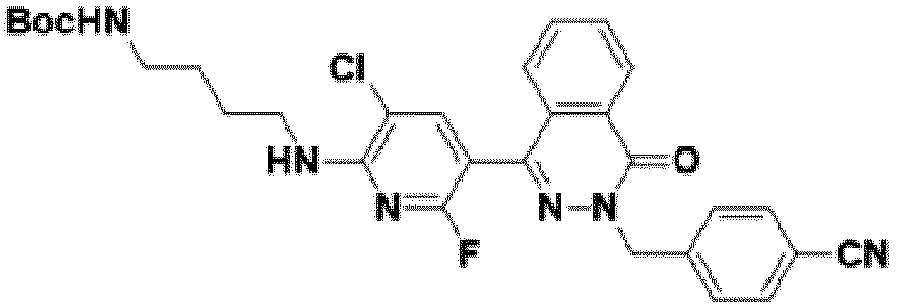
The above compound was prepared in the same method as that in Example 4, except that 4-t-butoxycarbonylbutanediamine was used in place of 2-methoxyethylamine. (White crystal, yield 81%) 1H NMR (400 MHz, Chloroform-d) δ 8.52-8.45 (m, 1H), 7.84-7.75 (m, 2H), 7.67-7.53 (m, 6H), 5.47 (s, 2H), 5.40 (s, 1H), 4.64 (s, 1H), 3.55 (td, J=7.0, 5.8 Hz, 2H), 3.21 (q, J=6.7 Hz, 2H), 1.73 (ddd, J=8.7, 7.5, 5.3 Hz, 2H), 1.64-1.57 (m, 2H), 1.45 (s, 9H). IV-47 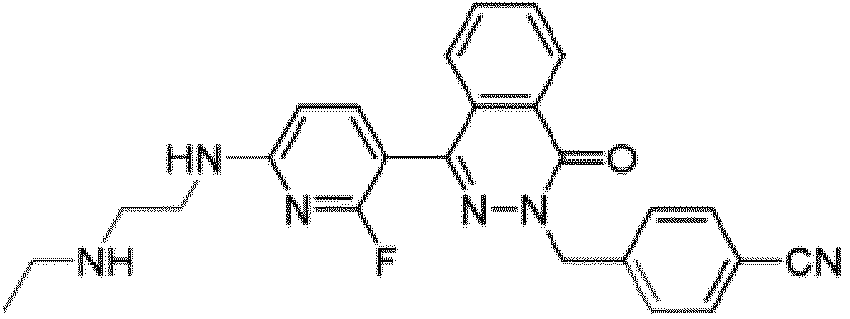
The above compound was prepared in the same method as that in Example 4, except that 2-ethylethylenediamine was used in place of 2-methoxyethylamine. (White crystal, yield 61%) 1H NMR (400 MHz, Chloroform-d) δ 8.54-8.46 (m, 1H), 7.84-7.75 (m, 2H), 7.66-7.54 (m, 6H), 6.45 (dd, J=8.2, 1.9 Hz, 1H), 5.69 (t, J=5.4 Hz, 1H), 5.49 (s, 2H), 3.53 (q, J=5.6 Hz, 2H), 2.98 (dd, J=6.3, 5.2 Hz, 2H), 2.77 (q, J=7.1 Hz, 2H), 1.19 (t, J=7.2 Hz, 3H). IV-48 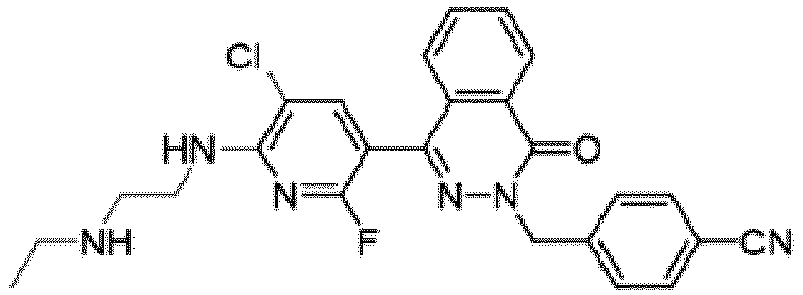
The above compound was prepared in the same method as that in Example 4, except that 2-ethylethylenediamine was used in place of 2-methoxyethylamine. (White crystal, yield 74%) 1H NMR (400 MHz, Chloroform-d) δ 8.53-8.49 (m, 1H), 7.85-7.79 (m, 2H), 7.71-7.62 (m, 3H), 7.58 (d, J=8.3 Hz, 3H), 6.93 (s, 1H), 5.48 (s, 2H), 4.04 (d, J=5.2 Hz, 2H), 3.36-3.28 (m, 2H), 3.14 (q, J=7.2 Hz, 2H), 1.51 (t, J=7.2 Hz, 3H). IV-49 
The above compound was prepared in the same method as that in Example 4, except that 2-(2-(2-methoxyethoxy)ethoxy)ethyl-1-amine was used in place of 2-methoxyethylamine. (White crystal, yield 76%) 1H NMR (400 MHz, Chloroform-d) δ 8.50-8.46 (m, 1H), 7.80-7.77 (m, 2H), 7.63-7.56 (m, 6H), 6.43 (dd, J=8.2, 1.8 Hz, 1H), 5.57 (t, J=5.6 Hz, 1H), 5.48 (s, 2H), 3.75-3.66 (m, 8H), 3.62-3.57 (m, 4H), 3.41 (s, 3H). IV-50 
The above compound was prepared in the same method as that in Example 4, except that 2-(2-(2-methoxyethoxy)ethoxy)ethyl-1-amine was used in place of 2-methoxyethylamine. (White crystal, yield 84%) 1H NMR (400 MHz, Chloroform-d) δ 8.51-8.46 (m, 1H), 7.83-7.77 (m, 2H), 7.66-7.55 (m, 6H), 5.84 (s, 1H), 5.47 (s, 2H), 3.75-3.66 (m, 10H), 3.60-3.56 (m, 2H), 3.40 (s, 3H). IV-51 
The above compound was prepared in the same method as that in Example 4, except that t-butyl 4-aminobutyrate was used in place of 2-methoxyethylamine. (White crystal, yield 83%) 1H NMR (400 MHz, Chloroform-d) δ 8.52-8.45 (m, 1H), 7.84-7.76 (m, 2H), 7.68-7.55 (m, 6H), 5.63 (t, J=5.7 Hz, 1H), 5.47 (s, 2H), 3.57 (td, J=6.8, 5.6 Hz, 2H), 2.38 (t, J=7.1 Hz, 2H), 1.99 (p, J=7.0 Hz, 2H), 1.48 (d, J=1.2 Hz, 9H). IV-52 
The above compound was prepared in the same method as that in Example 4, except that 4-aminobutyric acid was used in place of 2-methoxyethylamine. (White crystal, 71% yield) 1H NMR (400 MHz, Chloroform-d) δ 8.53-8.46 (m, 1H), 7.80 (dd, J=6.2, 3.2 Hz, 2H), 7.66-7.55 (m, 6H), 5.56 (d, J=5.8 Hz, 1H), 5.47 (s, 2H), 3.61 (q, J=6.5 Hz, 2H), 2.53 (t, J=7.1 Hz, 2H), 2.08-2.03 (m, 2H). IV-53 
The above compound was prepared in the same method as that in Example 4, except that N-ethylpropanediamine was used in place of 2-methoxyethylamine. (White crystal, yield 58%) 1H NMR (400 MHz, Chloroform-d) δ 8.53-8.44 (m, 1H), 7.84-7.73 (m, 2H), 7.64-7.53 (m, 6H), 6.39 (dd, J=8.2, 1.9 Hz, 1H), 6.07 (s, 1H), 5.48 (s, 2H), 3.55-3.46 (m, 2H), 2.87 (t, J=6.4 Hz, 2H), 2.77 (q, J=7.2 Hz, 2H), 1.92 (p, J=6.4 Hz, 2H), 1.22 (t, J=7.2 Hz, 3H). IV-54 
The above compound was prepared in the same method as that in Example 4, except that N-ethylpropanediamine was used in place of 2-methoxyethylamine. (White crystal, yield 82%) 1H NMR (400 MHz, Chloroform-d) δ 8.55-8.46 (m, 1H), 7.86-7.78 (m, 2H), 7.70-7.55 (m, 6H), 6.26 (t, J=6.1 Hz, 1H), 5.48 (s, 2H), 3.80-3.72 (m, 2H), 3.11 (q, J=7.0 Hz, 4H), 2.26 (t, J=6.5 Hz, 2H), 1.48 (t, J=7.2 Hz, 3H). IV-55 
The above compound was prepared in the same method as that in Example 4, except that N-ethylbutanediamine was used in place of 2-methoxyethylamine. (White crystal, 71% yield) 1H NMR (400 MHz, Chloroform-d) δ 8.51-8.44 (m, 1H), 7.82-7.76 (m, 2H), 7.65-7.53 (m, 6H), 5.57 (t, J=5.9 Hz, 1H), 5.46 (s, 2H), 3.54 (q, J=6.4 Hz, 2H), 3.05 (q, J=7.1 Hz, 4H), 1.84 (ddq, J=35.4, 14.5, 7.1 Hz, 4H), 1.35 (t, J=7.3 Hz, 3H). IV-56 
The above compound was prepared in the same method as that in Example 4, except that 2-(2-ethoxyethoxy)ethyl-1-amine was used in place of 2-methoxyethylamine. (White crystal, yield 64%) 1H NMR (400 MHz, Chloroform-d) δ 8.53-8.47 (m, 1H), 7.84-7.77 (m, 2H), 7.66-7.54 (m, 6H), 6.42 (dd, J=8.2, 1.8 Hz, 1H), 5.49 (s, 2H), 5.43 (t, J=5.5 Hz, 1H), 3.75 (dd, J=5.6, 4.5 Hz, 2H), 3.72-3.68 (m, 2H), 3.66-3.61 (m, 4H), 3.61-3.55 (m, 2H), 1.27 (t, J=7.0 Hz, 3H). IV-57 
The above compound was prepared in the same method as that in Example 4, except that 2-(2-ethoxyethoxy)ethyl-1-amine was used in place of 2-methoxyethylamine. (White crystal, yield 84%) 1H NMR (400 MHz, Chloroform-d) δ 7.84-7.76 (m, 2H), 7.67-7.52 (m, 6H), 5.81 (s, 1H), 5.47 (s, 2H), 3.74 (d, J=2.7 Hz, 4H), 3.71-3.67 (m, 2H), 3.64 (dt, J=6.1, 2.1 Hz, 2H), 3.57 (q, J=7.0 Hz, 2H), 1.24 (t, J=7.0 Hz, 3H). IV-58 
The above compound was prepared in the same method as that in Example 4, except that t-butyl 2-(2-aminoethoxy)acetate was used in place of 2-methoxyethylamine. (White crystal, yield 67%) 1H NMR (400 MHz, Chloroform-d) δ 8.53-8.48 (m, 1H), 7.83-7.78 (m, 2H), 7.66-7.54 (m, 6H), 6.47 (dd, J=8.3, 1.9 Hz, 1H), 5.81 (d, J=5.2 Hz, 1H), 5.50 (s, 2H), 4.06 (s, 2H), 3.80 (dd, J=5.5, 4.5 Hz, 2H), 3.64 (q, J=5.1 Hz, 2H), 1.53 (s, 9H). IV-59 
The above compound was prepared in the same method as that in Example 4, except that t-butyl 2-(2-aminoethoxy)acetate was used in place of 2-methoxyethylamine. (White crystal, yield 86%) 1H NMR (400 MHz, Chloroform-d) δ 7.84-7.80 (m, 2H), 7.68-7.63 (m, 3H), 7.60 (d, J=8.4 Hz, 3H), 6.24 (s, 1H), 5.49 (s, 2H), 4.07 (s, 2H), 3.83 (dd, J=5.5, 4.3 Hz, 2H), 3.76 (t, J=5.1 Hz, 2H), 1.53 (s, 9H). IV-60 
The above compound was prepared in the same method as that in Example 4, except that 2-(2-aminoethoxy)acetic acid was used in place of 2-methoxyethylamine. (White crystal, yield 73%) 1H NMR (400 MHz, DMSO-d6) δ 8.33 (dd, J=7.3, 2.2 Hz, 1H), 7.93 (dq, J=6.0, 3.6, 2.7 Hz, 3H), 7.84-7.76 (m, 2H), 7.62 (d, J=6.9 Hz, 1H), 7.51 (d, J=7.9 Hz, 2H), 7.28 (s, 1H), 5.45 (s, 2H), 3.66 (t, J=5.7 Hz, 2H), 3.53 (d, J=5.6 Hz, 2H). IV-61 
The above compound was prepared in the same method as that in Example 4, except that t-butyl 3-aminopropionate was used in place of 2-methoxyethylamine. (White crystal, yield 60%) 1H NMR (400 MHz, Chloroform-d) δ 8.53-8.47 (m, 1H), 7.83-7.79 (m, 2H), 7.68-7.55 (m, 7H), 6.41 (dd, J=8.2, 1.8 Hz, 1H), 5.50 (d, J=2.9 Hz, 2H), 5.36 (t, J=6.2 Hz, 1H), 3.69 (q, J=6.1 Hz, 2H), 2.61 (t, J=6.0 Hz, 2H), 1.50 (s, 9H). IV-62 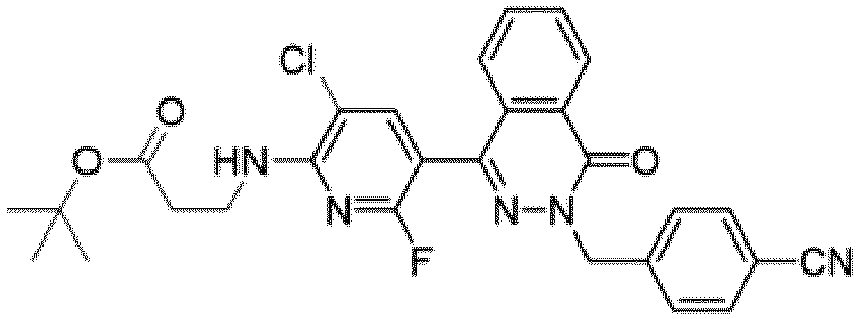
The above compound was prepared in the same method as that in Example 4, except that t-butyl 3-aminopropionate was used in place of 2-methoxyethylamine. (White crystal, yield 75%) 1H NMR (400 MHz, Chloroform-d) δ 8.50 (s, 1H), 7.82 (s, 2H), 7.70-7.55 (m, 6H), 5.95 (s, 1H), 5.49 (s, 2H), 3.81 (d, J=6.0 Hz, 2H), 2.63 (t, J=6.0 Hz, 2H), 1.52 (s, 9H). IV-63 
The above compound was prepared in the same method as that in Example 4, except that 3-aminopropionic acid was used in place of 2-methoxyethylamine. (White crystal, yield 76%) 1H NMR (400 MHz, Chloroform-d) δ 8.53-8.46 (m, 1H), 7.80 (s, 2H), 7.68-7.60 (m, 3H), 7.57 (d, J=7.9 Hz, 3H), 5.86 (s, 1H), 5.47 (s, 2H), 3.85 (q, J=6.0 Hz, 2H), 2.80 (t, J=6.0 Hz, 2H). IV-64 
The above compound was prepared in the same method as that in Example 4, except that methyl 4-aminobutyrate was used in place of 2-methoxyethylamine. (White crystal, yield 59%) 1H NMR (400 MHz, Chloroform-d) δ 8.51-8.45 (m, 1H), 7.83-7.74 (m, 2H), 7.64-7.54 (m, 6H), 6.40 (dd, J=8.2, 1.9 Hz, 1H), 5.48 (s, 2H), 5.09 (t, J=5.9 Hz, 1H), 3.71 (s, 3H), 3.44 (q, J=6.6 Hz, 2H), 2.47 (t, J=7.1 Hz, 2H), 2.00 (p, J=7.0 Hz, 2H). IV-65 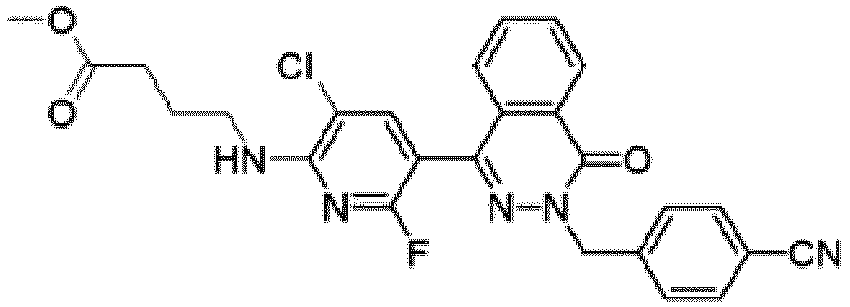
The above compound was prepared in the same method as that in Example 4, except that methyl 4-aminobutyrate was used in place of 2-methoxyethylamine. (White crystal, yield 77%) 1H NMR (400 MHz, Chloroform-d) δ 8.52-8.47 (m, 1H), 7.84-7.79 (m, 2H), 7.67-7.57 (m, 6H), 5.57 (t, J=5.8 Hz, 1H), 5.49 (s, 2H), 3.73 (s, 3H), 3.60 (td, J=6.8, 5.7 Hz, 2H), 2.49 (t, J=7.1 Hz, 2H), 2.06 (p, J=7.0 Hz, 2H). IV-66 
The above compound was prepared in the same method as that in Example 4, except that 3-aminopropanol was used in place of 2-methoxyethylamine. -(White crystal, yield 61%) 1H NMR (400 MHz, Chloroform-d) δ 8.58-8.44 (m, 1H), 7.86-7.76 (m, 2H), 7.64 (d, J=8.4 Hz, 2H), 7.62-7.56 (m, 5H), 6.42 (dd, J=8.3, 1.8 Hz, 1H), 5.50 (s, 2H), 5.20 (t, J=6.1 Hz, 1H), 3.81 (t, J=5.6 Hz, 2H), 3.60 (q, J=6.2 Hz, 2H), 2.59 (s, 1H), 1.94-1.86 (m, 2H). IV-67 
The above compound was prepared in the same method as that in Example 4, except that 3-aminopropanol was used in place of 2-methoxyethylamine. (White crystal, yield 81%) 1H NMR (400 MHz, Chloroform-d) δ 8.53-8.46 (m, 1H), 7.85-7.78 (m, 2H), 7.68-7.51 (m, 6H), 5.87 (t, J=5.9 Hz, 1H), 5.48 (s, 2H), 3.80 (t, J=5.6 Hz, 2H), 3.69 (q, J=6.1 Hz, 2H), 1.96-1.85 (m, 2H). IV-68 
The above compound was prepared in the same method as that in Example 4, except that 4-aminobutanol was used in place of 2-methoxyethylamine. (White crystal, yield 70%) 1H NMR (400 MHz, Chloroform-d) δ 8.52-8.43 (m, 1H), 7.83-7.74 (m, 2H), 7.69-7.49 (m, 6H), 6.36 (dd, J=8.2, 1.9 Hz, 1H), 5.47 (s, 2H), 5.08 (t, J=5.7 Hz, 1H), 3.73 (t, J=6.1 Hz, 2H), 3.40 (q, J=6.7 Hz, 2H), 1.80-1.66 (m, 4H). IV-69 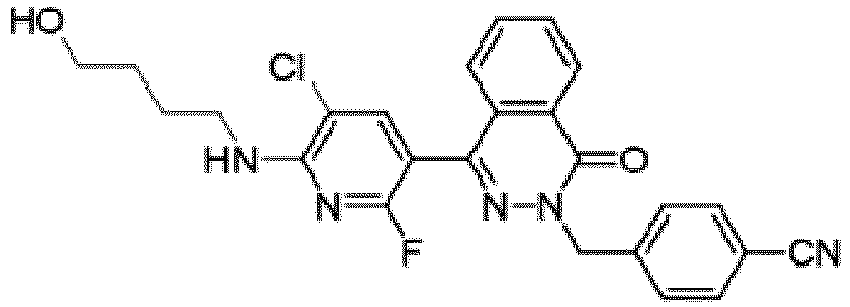
The above compound was prepared in the same method as that in Example 4, except that 4-aminobutanol was used in place of 2-methoxyethylamine. (White crystal, yield 85%) 1H NMR (400 MHz, Chloroform-d) δ 8.51-8.44 (m, 1H), 7.84-7.76 (m, 2H), 7.67-7.53 (m, 6H), 5.57 (t, J=5.7 Hz, 1H), 5.47 (s, 2H), 3.75 (t, J=6.1 Hz, 2H), 3.57 (td, J=6.8, 5.6 Hz, 2H), 1.84-1.77 (m, 2H), 1.75-1.67 (m, 2H). IV-70 
The above compound was prepared in the same method as that in Example 4, except that ethyl 3-aminopropionate was used in place of 2-methoxyethylamine. (White crystal, yield 66%) 1H NMR (400 MHz, Chloroform-d) δ 8.54-8.47 (m, 1H), 7.85-7.76 (m, 2H), 7.67-7.54 (m, 6H), 6.41 (dd, J=8.2, 1.8 Hz, 1H), 5.49 (s, 2H), 5.36 (t, J=6.3 Hz, 1H), 4.21 (q, J=7.2 Hz, 2H), 3.74 (q, J=6.1 Hz, 2H), 2.70 (t, J=6.0 Hz, 2H), 1.31 (t, J=7.1 Hz, 3H). IV-71 
The above compound was prepared in the same method as that in Example 4, except that ethyl 3-aminopropionate was used in place of 2-methoxyethylamine. (White crystal, yield 79%) 1H NMR (400 MHz, Chloroform-d) δ 8.53-8.47 (m, 1H), 7.85-7.78 (m, 2H), 7.68-7.62 (m, 3H), 7.62-7.55 (m, 3H), 5.96 (t, J=6.1 Hz, 1H), 5.48 (s, 2H), 4.22 (q, J=7.1 Hz, 2H), 3.85 (q, J=6.1 Hz, 2H), 2.72 (t, J=6.0 Hz, 2H), 1.32 (t, J=7.1 Hz, 3H). IV-72 
The above compound was prepared in the same method as that in Example 4, except that methyl 3-aminopropionate was used in place of 2-methoxyethylamine. (White crystal, yield 70%) 1H NMR (400 MHz, Chloroform-d) δ 8.52-8.44 (m, 1H), 7.82-7.74 (m, 2H), 7.64-7.53 (m, 6H), 6.39 (dd, J=8.2, 1.8 Hz, 1H), 5.47 (s, 2H), 5.30 (t, J=6.1 Hz, 1H), 3.70-3.75 (m, 5H), 2.70 (t, J=6.0 Hz, 2H). IV-73 
The above compound was prepared in the same method as that in Example 4, except that methyl 3-aminopropionate was used in place of 2-methoxyethylamine. (White crystal, 78% yield) 1H NMR (400 MHz, Chloroform-d) δ 8.52-8.45 (m, 1H), 7.83-7.77 (m, 2H), 7.66-7.55 (m, 6H), 5.91 (t, J=6.2 Hz, 1H), 5.47 (s, 2H), 3.83 (q, J=6.1 Hz, 2H), 3.75 (s, 3H), 2.73 (t, J=6.0 Hz, 2H). IV-74 
The above compound was prepared in the same method as that in Example 4, except that 2-aminoethyl sulfone was used in place of 2-methoxyethylamine. (White crystal, yield 67%) 1H NMR (400 MHz, Chloroform-d) δ 8.55-8.48 (m, 1H), 7.84-7.78 (m, 2H), 7.67-7.56 (m, 6H), 6.50 (dd, J=8.2, 1.6 Hz, 1H), 5.52 (d, J=6.3 Hz, 1H), 5.50 (s, 2H), 4.04 (q, J=6.0 Hz, 2H), 3.48-3.40 (m, 2H), 3.04 (s, 3H). IV-75 
The above compound was prepared in the same method as that in Example 4, except that 2-aminoethyl sulfone was used in place of 2-methoxyethylamine. (White crystal, yield 83%) 1H NMR (400 MHz, Chloroform-d) δ 8.54-8.50 (m, 1H), 7.85-7.82 (m, 2H), 7.72 (d, J=7.9 Hz, 1H), 7.67-7.63 (m, 2H), 7.62-7.55 (m, 3H), 6.03 (d, J=6.1 Hz, 1H), 5.49 (s, 2H), 4.12 (q, J=6.0 Hz, 2H), 3.47-3.42 (m, 2H), 3.05 (s, 3H). IV-76 
The above compound was prepared in the same method as that in Example 4, except that 2-aminoethanol was used in place of 2-methoxyethylamine. (White crystal, yield 66%) 1H NMR (400 MHz, Methanol-d4) δ 8.47-8.42 (m, 1H), 7.95-7.89 (m, 2H), 7.75-7.71 (m, 2H), 7.69-7.58 (m, 4H), 6.55 (dd, J=8.3, 1.9 Hz, 1H), 5.53 (s, 2H), 3.76 (t, J=5.8 Hz, 2H), 3.52 (t, J=5.8 Hz, 2H). IV-77 
The above compound was prepared in the same method as that in Example 4, except that 2-aminoethanol was used in place of 2-methoxyethylamine. (White crystal, 78% yield) 1H NMR (400 MHz, Chloroform-d) δ 8.53-8.49 (m, 1H), 7.87-7.80 (m, 2H), 7.74-7.49 (m, 6H), 5.76 (s, 1H), 5.49 (s, 3H), 3.94 (q, J=5.1 Hz, 2H), 3.75 (q, J=5.3 Hz, 2H). IV-78 
The above compound was prepared in the same method as that in Example 4, except that (2,2-dimethyl-[1,3]-dioxolane-4-yl)-methylamine was used in place of 2-methoxyethylamine. (White crystal, yield 69%) 1H NMR (400 MHz, Chloroform-d) δ 8.54-8.48 (m, 1H), 7.84-7.77 (m, 2H), 7.67-7.55 (m, 6H), 6.45 (dd, J=8.4, 1.7 Hz, 1H), 5.50 (s, 2H), 5.15 (t, J=5.8 Hz, 1H), 4.15 (dd, J=8.3, 6.5 Hz, 1H), 3.82-3.70 (m, 2H), 3.49 (dt, J=13.9, 5.9 Hz, 1H), 1.41 (s, 3H). IV-79 
The above compound was prepared in the same method as that in Example 4, except that (2,2-dimethyl-[1,3]-dioxolane-4-yl)-methylamine was used in place of 2-methoxyethylamine. (White crystal, yield 78%) 1H NMR (400 MHz, Chloroform-d) δ 8.53-8.48 (m, 1H), 7.85-7.79 (m, 2H), 7.70-7.63 (m, 3H), 7.62-7.55 (m, 3H), 5.72 (t, J=5.7 Hz, 1H), 5.49 (s, 2H), 4.45 (qd, J=6.0, 3.5 Hz, 1H), 4.15 (dd, J=8.6, 6.7 Hz, 1H), 3.82-3.75 (m, 2H), 3.69 (dt, J=14.2, 5.9 Hz, 1H), 1.54 (s, 3H), 1.42 (s, 3H). IV-80 
The above compound was prepared in the same method as that in Example 4, except that 3-amino-1,2-propanediol was used in place of 2-methoxyethylamine. (White crystal, yield 76%) 1H NMR (400 MHz, Chloroform-d) δ 8.55-8.48 (m, 1H), 7.86-7.80 (m, 2H), 7.70 (d, J=7.9 Hz, 1H), 7.67-7.63 (m, 2H), 7.61-7.54 (m, 3H), 5.79 (t, J=6.0 Hz, 1H), 5.49 (s, 2H), 4.00 (p, J=5.0 Hz, 1H), 3.82-3.75 (m, 2H), 3.71-3.60 (m, 2H). IV-81 
The above compound was prepared in the same method as that in Example 4, except that 1-amino-2-propanol was used in place of 2-methoxyethylamine. (White crystal, yield 61%) 1H NMR (400 MHz, Chloroform-d) δ 8.53-8.48 (m, 1H), 7.84-7.77 (m, 2H), 7.68-7.56 (m, 6H), 6.45 (dd, J=8.2, 1.6 Hz, 1H), 5.50 (s, 2H), 5.24 (s, 1H), 4.12 (s, 1H), 3.62 (ddd, J=13.8, 6.6, 3.2 Hz, 1H), 3.31 (ddd, J=13.4, 7.8, 5.2 Hz, 1H), 2.24 (d, J=4.4 Hz, 1H), 1.32 (d, J=6.3 Hz, 3H). IV-82 
The above compound was prepared in the same method as that in Example 4, except that 1-amino-2-propanol was used in place of 2-methoxyethylamine. (White crystal, yield 79%) 1H NMR (400 MHz, Chloroform-d) δ 8.54-8.49 (m, 1H), 7.85-7.79 (m, 2H), 7.70-7.63 (m, 3H), 7.59 (d, J=8.1 Hz, 3H), 5.78 (s, 1H), 5.49 (s, 2H), 4.14 (d, J=6.4 Hz, 1H), 3.77 (ddd, J=13.9, 6.5, 3.3 Hz, 1H), 3.41 (ddd, J=13.4, 7.8, 5.1 Hz, 1H), 2.17 (d, J=4.5 Hz, 1H), 1.33 (d, J=6.3 Hz, 3H). IV-83 
The above compound was prepared in the same method as that in Example 4, except that 1-amino-3,3,3-trifluoropropane was used in place of 2-methoxyethylamine. (White crystal, yield 76%) 1H NMR (400 MHz, Chloroform-d) δ 8.54-8.48 (m, 1H), 7.85-7.78 (m, 2H), 7.68-7.56 (m, 6H), 6.44 (dd, J=8.2, 1.7 Hz, 1H), 5.50 (s, 2H), 5.04 (t, J=6.3 Hz, 1H), 3.75 (q, J=6.4 Hz, 2H), 2.53 (qt, J=10.9, 6.5 Hz, 2H). IV-84 
The above compound was prepared in the same method as that in Example 4, except that 1-amino-3,3,3-trifluoropropane was used in place of 2-methoxyethylamine. (White crystal, yield 86%) 1H NMR (400 MHz, Chloroform-d) δ 8.51 (dd, J=6.3, 3.1 Hz, 1H), 7.87-7.80 (m, 2H), 7.70 (d, J=7.8 Hz, 1H), 7.65 (d, J=8.1 Hz, 2H), 7.62-7.55 (m, 3H), 5.58 (t, J=6.2 Hz, 1H), 5.49 (s, 2H), 3.85 (q, J=6.4 Hz, 2H), 2.56 (qt, J=10.8, 6.5 Hz, 2H). - Human hepatoblastoma cell line HepG2.2.15 stably transfected with full-length HBV (provided by Shanghai Institute of Materia Medica, Chinese Academy of Sciences)
- Incubator (ThermoForma3111); Microplate reader (Molecular Devices Spectra Max 190); Electronic balance; Microscope; Biosafety cabinet (Heal Force safe15); Centrifuge (Eppendorf Centrifuge 5810R); Real-Time PCR (FASTA GEN-DNA fast2000)
- Positive drug and formulation: Lamivudine (3TC), synthesized by department of medicinal chemistry, the Shanghai Institute of Materia Medica, Chinese Academy of Sciences, was formulated into a 40mM stock solution with DMEM/High Glucose culture solution (Dulbecco 's modified Eagle 's medium, Hyclone).
- Other solutions and formulations:
- DMEM/High Glucose medium: Dulbecco's modified Eagle's medium 1 × (Hyclone) phosphate buffer (PBS, pH7.3, 1L): NaCl, 8.0g; Na2HPO4, 1.16g; KH2PO4, 0.2g; KCl: 0.2g;
- MTT solution: MTT (Sigma), formulated to 5mg/ml with PBS;
- DNA extraction kit: DNeasy® Blood & Tissue (Qiagen)
- HepG2.2.15 cells were cultured and passaged according to conventional methods. DMEM containing 10% (v/v) bovine serum and the selective antibiotic G418 was used as a medium, the cells were cultured in an incubator at 37 °C under 5% CO2 for 8 days (the medium was exchanged on the 4th day).
- The test compounds were formulated with DMSO into a 40mM stock solution, which was then prepared into a solution at the defined highest concentration using a DMEM medium containing 10% Hyclone™ Fetal Bovine Serum, followed by diluting the same; the positive drug was lamivudine, which was also prepared into a solution at the defined concentration with the DMEM medium containing 10% Hyclone™ Fetal Bovine Serum.
- HepG2.2.15 cells were seeded at 5 × 10³ cells/well in a 96-well plate, and cultured for eight days in the presence of the compounds according to the above method, and then 200µl of the supernatant was taken out, followed by addition of the MTT solution. After 4 hours of culture, a lysate was added. After 12 hours of culture, the OD570 was measured on a microplate reader. By comparing with the absorbance of the control well, the percentage of viable cells was calculated, and CC50, the concentration required for the reduction of cell viability by 50%, was calculated.
- HepG2.2.15 cells were treated with compounds at different concentrations for 8 days (the medium was exchanged on the 4th day), and the supernatant was aspirated, and the HBV DNA contained in the mature virus particles in the supernatant was quantitated by using a real-time PCR method.
- DNA in the supernatant of HepG2.2.15 cell cuturewas extracted by a column (Qiagen, DNeasy® Blood & Tissue Handbook)
- 1) The supernatant DNA from a 96-well plate, 200µl/well, was collected, wherein the contents in the duplicate wells were collected into a same EP tube, and centrifuged at 4000rcf for 5min, and the supernatant was collected;
- 2) 200µl of the supernatant was added into a 1.5ml EP tube, added with 20µl of proteinase K and 200µl of Buffer AL (Qiagen, DNeasy® Blood & Tissue Kit), vortexed to be mixed thoroughly, and incubated at 56 °C for 10min;
- 3) 200µl of ethanol was added and vortexed to be mixed thoroughly;
- 4) all the liquid obtained from step 3) was added into a DNeasy Mini spin column (Qiagen, DNeasy® Blood & Tissue Kit) placed in a 2ml waste liquid collection tube, and centrifuged at 6000rcf for 1min, and the supernatant was discarded;
- 5) the DNeasy Mini spin column was placed in a new 2ml waste liquid collection tube, added with 500µl of Buffer AW1 (Qiagen, DNeasy® Blood & Tissue Kit), and centrifuged at 6000rcf for 1min, and the supernatant was discarded;
- 6) the DNeasy Mini spin column was placed in a new 2ml waste liquid collection tube, added with 500µl of Buffer AW2, (Qiagen, DNeasy® Blood & Tissue Kit), and centrifuged at 20000rcf for 3min, and the supernatant was discarded;
- 7) the DNeasy Mini spin column was placed in a new 1.5ml EP tube, 50µl of Buffer AE (Qiagen, DNeasy® Blood & Tissue Kit) was pipetted and directly applied onto the membrane of the DNeasy Mini spin column, which was then left at room temperature for 5min, and centrifuged at 6000rcf for 1min to elute the DNA from the membrane, the DNeasy Mini spin column was discarded, and the DNA sample was collected and stored at -20 °C.
- Real-time PCR detection of HBV DNA in supernatant (HBV nucleic acid quantitative detection kit, DAAN Gene)
- 1) Standard curve: 1e7-1e4 IU/ml, the sample amount was 1µl, a blank well was set so as to check whether the reaction system is polluted or not;
- 2) 1µl of a DNA sample was added in sequence;
- 3) Addition of enzyme and reaction buffer: two tubes of the reaction solution were first added into the enzyme, mixed well and centrifuged slightly, placed on ice, added with the sample, followed by addition of 19µl of the enzyme reaction solution, wherein, during the addition, the DNA sample should be sure of not being touched to cause contamination;
- 4) the sample was sealed with a sealing film and centrifuged;
- 5) PCR reaction:
- Stage 1: 93 °C, 2min
- Stage 2: 10 cycles
- Step 1: 93 °C, 45s
- Step 2: 55 °C, 1min
- Stage 3: 45 cycles
- Step 1: 93 °C, 30s
- Step 2: 55 °C, 45s
- Sample: 20µl
- Detection: data were collected after completing the step 2 (55 °C, 45s) of the stage 3.
- The experimental data were processed by using the Origin software and IC50 was calculated.
- The experimental results are shown in Table 1.
Table 1: Toxicity against HepG2.2.15 cells and the activity of inhibiting HBV DNA of the compounds of formula I in the examples Compounds CC50(µM) IC50(µM) Compounds CC50(µM) IC50(µM) I-1 >100 7.3 IV-24 >100 0.35 I-2 98.7 3.1 IV-25 54.1 1.2 I-3 >100 0.5 IV-26 >100 0.43 I-4 >100 3.1 IV-27 >100 0.0142 I-5 51.8 1.5 IV-28 21.32 0.191 I-6 >100 1.7 IV-29 26.57 0.0439 I-7 48.9 3.8 IV-30 10.16 <0.0977 I-8 >100 5.2 IV-31 108.7 0.452 I-9 40.7 0.3 IV-32 43.73 0.191 I-10 81.8 0.1 IV-33 180.87 <0.0977 I-11 22.6 0.9 IV-34 >100 15.7 I-12 15.7 0.6 IV-35 >100 1.233 I-13 32.7 1.2 IV-36 >100 0.482 I-14 10.3 2.1 IV-37 86.5 2.18 I-15 >100 6.2 IV-38 9.759 0.343 I-16 20.1 0.5 IV-39 18.43 0.684 I-17 >100 1.6 IV-40 18.63 0.66 I-18 42.9 1.2 IV-41 >100 0.3253 I-19 77.5 0.2 IV-42 29.76 0.2923 I-20 33.3 1.3 IV-43 89.82 0.2877 I-21 >100 1.6 IV-44 54.83 <0.09766 I-22 >100 0.4 IV-45 >100 0.3681 I-23 >100 0.6 IV-46 >100 0.014 I-24 >100 0.4 IV-47 12.97 1.72 I-25 >100 1.3 IV-48 7.383 0.5163 I-26 >100 0.9 IV-49 93.57 0.1655 I-27 >100 0.3 IV-50 >100 0.00965 I-28 73.1 1.0 IV-51 89.88 0.092 I-29 >100 4.6 IV-52 >100 0.0845 I-30 >100 0.4 IV-53 18.1 1.0686 I-31 >100 0.6 IV-54 8.554 0.4698 I-32 >100 1.0 IV-55 2.561 0.09 I-33 >100 1.3 IV-56 >100 0.2145 I-34 >100 0.2 IV-57 100 0.0878 I-35 >100 0.3 IV-58 >100 5.3023 I-36 89 1.5 IV-59 >100 0.7803 I-37 95 2.7 IV-60 >100 0.7663 I-38 81 0.8 IV-61 195.26 0.4651 I-39 >25 0.21 IV-62 >100 0.4445 I-40 >100 0.051 IV-63 >100 0.2624 I-41 46.6 0.108 IV-64 >100 1.2202 I-42 33.5 0.378 IV-65 >100 0.1165 I-43 >100 1.5733 IV-66 94.05 0.1802 I-44 31.54 0.294 IV-67 >100 0.0042 I-45 >100 2.017 IV-68 >100 0.332 II-1 41.5 3.8 IV-69 25.02 0.0081 II-2 32.4 4.5 IV-70 >100 3.3199 II-3 >100 8.8 IV-71 >100 2.7798 II-4 97.6 7.1 IV-72 >100 1.721 III-1 87.8 6.2 IV-73 >100 0.215 IV-1 >100 5.4 IV-74 >100 0.13 IV-2 >100 1.18 IV-75 >100 0.0366 IV-3 >100 5.5 IV-76 >100 0.2022 IV-4 >100 3.3 IV-77 32.14 0.0277 IV-5 >100 0.12 IV-78 >100 0.3408 IV-6 >100 0.8 IV-79 >100 0.3468 IV-7 >100 0.8 IV-80 >100 <0.098 IV-8 >100 0.9 IV-81 65.21 0.334 IV-9 >100 1.3 IV-82 71.88 0.209 IV-10 47.9 1.7 IV-83 >100 0.413 IV-11 98.5 0.4 IV-84 63.54 <0.098 IV-12 46.3 3.7 V-1 >100 0.7 IV-13 78.5 3.8 V-2 >100 0.3 IV-14 >100 1.5 V-3 >100 1.5 IV-15 >100 0.27 V-4 >100 1.3 IV-16 88.3 1.0 V-5 >100 3.7 IV-17 >100 0.13 V-6 >100 2.6 IV-18 >100 0.21 V-7 >100 0.9 IV-19 >100 0.27 V-8 >100 1.1 IV-20 >100 0.30 V-9 >100 1.3 IV-21 >100 1.30 V-10 47.9 0.7 IV-22 >100 3.5 V-11 >100 1.2 IV-23 >100 4.5 V-12 >100 4.5 Note: CC50 reflects the effect of the compounds in the examples on the growth of HepG2.2.15 cells, and is half (50%) lethal concentration.
IC50 is the concentration at which the compounds in the examples inhibit DNA replication of HBV by half (50%). - It can be seen from the test results that the compounds in the examples all have an IC50 less than 10 µM, demonstrating that each of them has high activity of inhibiting HBV DNA replication at the cellular level, and is less toxic to the growth of HepG2.2.15 cells.
- 1 × 10⁶ dispersed cells were added with 100µl of cell lysate (50mM Tris-HCl pH 7.5, 1mM EDTA, 0.5% Nonidet P-40), and lysed on ice for 15 min, with vortexing every 5 min to make sure that the cells were sufficiently lysed. The lysed cells were centrifuged at 10,000 × g for 10 min at 4 °C to remove nuclei and cell debris. 20µl of the cell lysate was added into the well of 1.2% or 1.8% agarose gel. Electrophoresis was run at 70V for 2.5 h at 4 °C. Every sample had a duplicate. After electrophoresis, the membrane-transferring was performed by siphon overnight. One sample was transferred to a nitrocellulose membrane (Amersham ™ Hybond-ECL, GE), and the capsid was detected with anti-HBcAg antibody (Abcam) using Western blot method; another sample was in situ denatured with a denaturing solution (1.5 M NaCl, 0.5 M NaOH) for 45 min, neutralized with a neutralizing solution (1.5 M NaCl, 1 M Tris-HCl pH 7.4) for 45 min, and transferred to a nylon membrane (Amersham ™ Hybond-N +, GE), and then the level of nucleic acid in the capsid was detected with HBV-specific probes by using Southern blot method. The results were shown in
Fig. 1 . - As shown in
Fig. 1 , all of the compounds I-11, I-26, I-10, I-9, I-24, I-3, and I-12 can induce the generation of an abnormal capsid with faster electrophoretic migration speed, and the content of HBV DNA in the capsid was significantly reduced, demonstrating that the compounds exert their anti-HBV activity by interfering with the assembly of the virus capsid. - 10µl of a plasma and tissue sample was placed in a 1.5ml centrifuge tube, added with 100µl of an internal standard solution (5.00ng/ml verapamil and 50.0ng/ml Glibenclamide solution in acetonitrile), vortexed for 60 seconds, and then centrifuged for 3 min (at 12000 rpm); 75µl of the supernatant was transferred to a 96-well plate loaded with an equal volume of water, and shaken for mixing well and then analyzed. The injection volume was 10µl.
- Internal standard: an appropriate amount of verapamil and glibenclamide standards were dissolved and diluted in dimethyl sulfoxide (DMSO), shaken for mixing well, and prepared into a stock solution with a mass concentration of 2000µg/ml, which was further diluted into internal standard working solutions of 5.00ng/ml and 50.0ng/ml.
- Stock solution: an appropriate amount of the compound was weighted and formulated into a 2.00mg/ml stock solution with DMSO.
- Working solution: The stock solution was stepwisely diluted to obtain the solutions at each gradient concentration. 5.00µl of reference standard working solution was added to 45.0µl of a mice blank plasma and blank tissue. Then it was treated according to the method described in the section of "Sample pretreatment method".
- Administration solution: a certain amount of a compound was precisely weighed and formulated into a 2.00mg/ml milky white suspension in a ratio of 2.5% DMSO + 97.5% (0.5% MC).
- Approximately 0.1ml of orbital blood and liver was collected in EDTAK2 for anticoagulation from each animal that had been anesthetized with isoflurane. For the PO group, the blood was collected at 1h, 3h, and 8h after administration of the test compound. After collection, the blood sample was analyzed by using comparative compounds I-70 and I-88. The results are shown in Table 2 below.

Table 2: Mean drug concentrations of the example compounds and the comparative compounds in different tissues of mice (po 10mg/kg) Compounds time (h) Plasma (ng/ml) Liver (ng/g) comparative compound I-70 1 161 BLQa 3 71.7 BLQ 8 17.3 BLQ comparative compound I-88 1 169 34.2 3 180 9.64 8 0.993 BLQ I-10 1 61.0 476 3 12.5 318 8 BLQ 2.91 I-11 1 33.3 1224 3 32.5 1413 8 23.0 815 IV-5 1 154 1029 3 63.2 1047 8 80.1 1188 IV-15 1 549 7270 3 437 4461 8 257 2800 Note: aBLQ means that the content is below the minimum detection limit of the instrument. - As shown in Table 2, the example compounds show metabolic properties (i.e., metabolic stability in the liver) much superior to those of the comparative compounds. Compounds I-10, I-11, IV-5 and IV-15 have good liver targeting in mice, and can be stably present and enriched in liver, with a low content in plasma.
- The example compounds exert their antiviral activity by interfering with the nucleocapsidization of viral RNA. They showed high activity of inhibiting HBV DNA replication at the cellular level, with little toxicity to the growth of HepG2.2.15 cells, and have good liver targeting, and can be stably present and enriched in the liver, and thus they are effective HBV inhibitors.
- The preferred embodiments of the present invention have been described in details as above. However, the present invention is not limited to the specific details of the above embodiments. A variety of simple modifications can be made to the technical solution of the present invention within the scope of the technical concept of the present invention, and all of these simple modifications are within the protection scope of the present invention.
Claims (10)
- A compound of formula I or a pharmaceutically acceptable salt, solvate or prodrug thereof:
 R is Cl or CN;R1 and R2 are each independently H;A is heteroaryl;R3 represents one or more substituents, each being independently selected from the group consisting of H, halogen, cyano, hydroxyl, alkyl, haloalkyl, optionally substituted cycloalkyl, optionally substituted heterocyclyl, optionally substituted heterochain hydrocarbyl, optionally substituted alkoxy, alkanoyloxy, -(CH2)n+1R5, -N(R6)-(CH2)n(R5);R4 represents one or more substituents, each being independently selected from the group consisting of H, halogen, cyano, hydroxyl, optionally substituted alkyl, optionally substituted alkoxy, alkanoyloxy;R5 and R6 are each independently selected from the group consisting of H, hydroxyl, optionally substituted alkyl, optionally substituted cycloalkyl, optionally substituted alkoxy, alkanoyloxy, alkylsulfonyl, alkanoyl, alkoxyacyl, optionally substituted heterocyclyl, -N(Q1)(Q2);optionally, R5 and R6 are each independently selected from the group consisting of H, hydroxyl, optionally substituted alkyl, optionally substituted cycloalkyl, optionally substituted alkoxy, alkanoyloxy, optionally substituted heterocyclyl, -N(Q1)(Q2);in the "optionally substituted" groups, the substituent is selected from the group consisting of halogen, hydroxyl, alkyl, hydroxyalkyl, cycloalkyl, alkoxy, alkanoyl, alkoxyalkoxy, alkoxyacyl, carboxyl, heterocyclyl, -N(Q1)(Q2);optionally, in the "optionally substituted" groups, the substituent is selected from the group consisting of halogen, hydroxyl, alkyl, cycloalkyl, alkoxy, alkanoyl, heterocyclyl, -N(Q1)(Q2);
wherein,n is an integer selected from the group consisting of 0 to 10;Q1 and Q2 are each independently H, alkyl or alkoxyacyl;optionally, Q1 and Q2 are each independently H or alkyl;preferably,R3 represents 1, 2 or 3 substituents;R4 represents 1 or 2 substituents;the "heteroaryl" is a 5- to 10-membered heteroaryl containing 1 to 3 heteroatoms selected from the group consisting of N, O and S, optionally a 6- to 10-membered heteroaryl containing 1 to 2 heteroatoms selected from the group consisting of N, O and S, optionally, the heteroaryl includes pyridyl, pyrimidinyl, pyrazinyl, pyridazinyl, furyl, indolyl, aza-indolyl, naphthyridinyl or quinolyl;the "halogen" includes fluorine, chlorine, bromine and iodine;the alkyl comprised in the "alkyl", "haloalkyl", "alkylsulfonyl", "alkoxyacyl", and "alkoxyalkoxy" is a C1-C18 linear or branched alkyl, optionally, the alkyl is a C1-C7 linear or branched alkyl, optionally, the alkyl is a C1-C5 linear or branched alkyl, optionally the alkyl includes methyl, ethyl, n-propyl, isopropyl, n-butyl, isobutyl, t-butyl, sec-butyl, n-pentyl, 1-methylbutyl, 2-methylbutyl, 3 -methylbutyl, isopentyl, 1-ethylpropyl, neopentyl, n-hexyl, 1-methylpentyl, 2-methylpentyl, 3-methylpentyl, isohexyl, 1,1-dimethylbutyl, 2,2-dimethylbutyl, 3,3-dimethylbutyl, 1,2-dimethylbutyl, 1,3-dimethylbutyl, 2,3-dimethylbutyl, 2-ethylbutyl, n-heptyl, 2-methylhexyl, 3-methylhexyl, 2,2-dimethylpentyl, 3,3-dimethylpentyl, 2,3-dimethylpentyl, 2,4-dimethylpentyl, 3-ethylpentyl, 2,2,3-trimethylbutyl; optionally, the "haloalkyl" includes trifluoromethyl;the "alkoxy" is a C1-C6 linear or branched alkoxy, optionally, the alkoxy is a C1-C5 linear or branched alkoxy, optionally, the alkoxy is a C1-C3 linear or branched alkoxy, optionally, the alkoxy includes methoxy, ethoxy, n-propoxy, isopropoxy, n-butoxy, isobutoxy, t-butoxy, sec-butoxy, n-pentyloxy, isopentyloxy, neopentyloxy, n-hexyloxy, isohexyloxy, 3-methylpentyloxy;the "alkanoyloxy" is a linear or branched C1-C6 alkanoyloxy, and optionally includes acetoxy;the "cycloalkyl" is a C3-C6 cycloalkyl, optionally, the cycloalkyl includes cyclopropyl, cyclobutyl, cyclopentyl, cyclohexyl;the heterocyclic structure in "heterocyclyl" is saturated or unsaturated 3- to 10-membered monocyclic or polycyclic non-aromatic ring structure containing 1, 2 or 3 heteroatoms selected from the group consisting of N, O, and S in the ring, optionally, the heterocyclyl is a 3- to 6-membered saturated ring containing N in the ring, optionally, the heterocyclyl is a 4- to 6-membered non-aromatic ring structure containing 1-2 heteroatoms selected from the group consisting of N and O in the ring, optionally, the heterocyclyl includes a tetrahydropyrrole ring, a tetrahydrothiophene ring or a tetrahydrofuran ring;the heterochain hydrocarbon structure in the "heterochain hydrocarbyl" is a C1-C7 saturated or unsaturated, linear or branched heterochain structure containing 1-3 heteroatoms selected from the group consisting of N and O in the chain, optionally, the heterochain hydrocarbyl is a C1-C5 saturated or unsaturated, linear or branched heterochain hydrocarbon structure containing 1-3 heteroatoms selected from the group consisting of N and O in the chain, optionally, the heterochain hydrocarbyl is a C1-C5 saturated or unsaturated, linear or branched heterochain hydrocarbon structure containing 1-3 oxygen atoms in the chain;the "alkanoyl" is a C1-C6 linear or branched alkanoyl, optionally, the alkanoyl includes formyl, acetyl;n is an integer selected from the group consisting of 0 to 5, optionally n is 0, 1, 2, 3, or 4;optionally, any one or more hydrogens in the compound of formula I or a pharmaceutically acceptable salt, solvate or prodrug thereof may be replaced by deuterium; optionally, the hydrogens represented by R1 and R2 are each independently replaced by deuterium; optionally, any one or more hydrogens in one or more substituents represented by R3 may be replaced by deuterium; optionally, any one or more hydrogens in one or more of H, alkyl, optionally substituted alkoxy, optionally substituted heterochain hydrocarbyl, -(CH2)n+1,R5 represented by R3 may be replaced by deuterium. - The compound of formula I, or a pharmaceutically acceptable salt, solvate or prodrug thereof according to claim 1, wherein:R is Cl or CN;R1 and R2 are each independently H or D;A is pyridyl, pyrimidinyl or pyrazinyl;R3 represents one or more substituents, each being independently selected from the group consisting of H, D, halogen, cyano, hydroxyl, trifluoromethyl, methyl optionally substituted by one or more D, methylol, methoxymethyl optionally substituted by one or more D, acetoxymethyl, methoxy optionally substituted by one or more D, methoxyethoxy, amino, methylamino, dimethylamino, t-butylamino, cyclopropylamino, epoxypropylamino, acetylamino, oxetanylamino, methoxymethylamino, methoxyethylamino, methoxypropylamino, ethoxyethylamino, ethoxypropylamino, methoxycarbonylethylamino, methoxycarbonylpropylamino, ethoxycarbonylmethylamino, ethoxycarbonylethylamino, ethoxycarbonylpropylamino, hydroxyethylamino, hydroxypropylamino, hydroxybutylamino, cyclobutylamino, azetidinyl, N,N-dimethylaminomethylamino, N,N-dimethylaminoethylamino, N,N-dimethylaminopropylamino, N,N-dimethylaminobutylamino, t-butoxyacylaminobutylamino, 5-morpholinylmethyl, ethylaminoethylamino, ethylaminopropylamino, ethylaminobutylamino, methoxyethoxyethoxyethylamino, ethoxyethoxyethylamino, t-butoxycarbonylethylamino, t-butoxycarbonylpropylamino, t-butoxycarbonylmethoxyethylamino, carboxylethylamino, carboxylpropylamino, carboxymethoxyethylamino, 6-morpholinylmethyl, 6-(tetrahydrofuranyl)methylamino, methylsulfonylethylamino, (2,2-dimethyl-[1,3]-dioxolan-4-yl)-methylamino, 2,3-dihydroxypropylamino, 2-hydroxypropylamino, trifluoromethylethylamino;optionally, R3 represents one or more substituents, each being independently selected from the group consisting of H, D, halogen, cyano, trifluoromethyl, methyl optionally substituted by one or more D, methylol, methoxymethyl optionally substituted by one or more D, acetoxymethyl, methoxy optionally substituted by one or more D, amino, methylamino, dimethylamino, t-butylamino, cyclopropylamino, epoxypropylamino, acetylamino, oxetanylamino, methoxymethylamino, cyclobutylamino, azetidinyl, N,N-dimethylaminomethylamino, N,N-dimethylaminoethylamino, 6-morpholinylmethyl, 6-(tetrahydrofuranyl)methylamino;R4 represents one or more substituents, each being independently selected from the group consisting of H, halogen, methyl, methoxy, cyano and trifluoromethyl.
- The compound of formula I, or a pharmaceutically acceptable salt, solvate or prodrug thereof according to claim 1 or 2, wherein the compound of formula I is selected from the group consisting of the compounds having a structure represented by one of the following formulae I-I to I-V:

 wherein, R, R1, R2, R3 and R4 are each independently defined as those in claim 1 or 2;preferably, in the formula I-I, R1 and R2 are each independently H or D; R3 represents one or more substituents, preferably 1, 2 or 3 substituents, each being independently selected from the group consisting of H, D, halogen, cyano, C1-C5 linear or branched alkyl optionally substituted by one or more D, trifluoromethyl, C3-C6 cycloalkyl, C1-C5 linear or branched alkyl optionally substituted by one or more D in which any carbon atom may be replaced by an oxygen atom, C1-C5 linear or branched alkoxy optionally substituted by one or more D, 3- to 6-membered saturated heterocyclyl containing 1-2 nitrogen atoms, -(CH2)n+1,R5 optionally substituted by one or more D, -N(R6)-(CH2)n(R5); wherein, n is 0, 1, 2, 3 or 4; R5 and R6 are each independently H, hydroxyl, methyl, ethyl, propyl, isopropyl, butyl, isobutyl, C3-C6 cycloalkyl, methoxy, ethoxy, acetoxy, 4- to 6-membered non-aromatic heterocyclyl having 1-2 heteroatoms selected from the group consisting of N and O, or amino substituted by 1-2 substituents selected from the group consisting of methyl, ethyl;preferably, in the formula I-II, R1 and R2 are each independently H or D; R3 represents 1 or 2 substituents, each being independently selected from the group consisting of H, D, halogen, cyano, trifluoromethyl, C1-C7 linear or branched alkyl optionally substituted by one or more D, C1-C6 linear or branched alkoxy optionally substituted by one or more D, -N(R6)-(CH2)n(R5); wherein, n is 0, 1, 2, 3 or 4; R5 and R6 are each independently H, halogen, methyl, ethyl, propyl, isopropyl, butyl or isobutyl;preferably, in the formula I-III, R1 and R2 are each independently H or D; R3 represents 1 or 2 substituents, each being independently selected from the group consisting of H, D, halogen, cyano, trifluoromethyl, C1-C7 linear or branched alkyl optionally substituted by one or more D, C1-C6 linear or branched alkoxy optionally substituted by one or more D, or -N(R6)-(CH2)n(R5); wherein, n is 0, 1, 2, 3 or 4; R5 and R6 are each independently H, methyl, ethyl, propyl, isopropyl, butyl;preferably, in formula I-IV, R1 and R2 are each independently H or D; R3 represents one or more substituents, preferably 1, 2 or 3 substituents, each being independently selected from the group consisting of H, D, halogen, cyano, hydroxyl, trifluoromethyl, C3-C6 cycloalkyl, C1-C5 linear or branched alkyl optionally substituted by one or more D, C1-C5 linear or branched alkyl optionally substituted by one or more D in which any carbon atom may be replaced by an oxygen atom, C1-C5 linear or branched alkoxy optionally substituted by one or more D, 3- to 6-membered saturated heterocyclyl containing N, -(CH2)n+1,R5 optionally substituted by one or more D, -N(R6)-(CH2)n(R5); wherein, n is 0, 1, 2, 3 or 4; R5 and R6 are each independently H, hydroxyl, methyl, ethyl, propyl, isopropyl, butyl, isobutyl, t-butyl, C3-C6 cycloalkyl, methoxy, ethoxy, methoxyethoxyethoxy, ethoxyethoxy, acetyl, acetyloxy, methoxycarbonyl, ethoxycarbonyl, t-butoxycarbonyl, t-butoxycarbonylmethoxy, carboxyl, carboxymethoxy, 4- to 6-membered non-aromatic heterocyclyl with 1-2 heteroatoms selected from the group consisting of N and O, or amino substituted by 1-2 substituents selected from the group consisting of methyl, ethyl and t-butoxycarbonyl, methylsulfonyl, 2,2-dimethyl-[1,3]-dioxolan-4-yl, 2,3-dihydroxypropyl, 2-hydroxypropyl, trifluoromethylethyl;optionally, in formula I-IV, R1 and R2 are each independently H or D; R3 represents one or more substituents, preferably 1, 2 or 3 substituents, each being independently selected from the group consisting of H, D, halogen, cyano, trifluoromethyl, C3-C6 cycloalkyl, C1-C5 linear or branched alkyl optionally substituted by one or more D, C1-C5 linear or branched alkyl optionally substituted by one or more D in which any carbon atom may be replaced by an oxygen atom, C1-C5 linear or branched alkoxy optionally substituted by one or more D, 3- to 6-membered saturated heterocyclyl containing N, -(CH2)n+1,R5 optionally substituted by one or more D, -N(R6)-(CH2)n(R5); wherein, n is 0, 1, 2, 3 or 4; R5 and R6 are each independently H, hydroxyl, methyl, ethyl, propyl, isopropyl, butyl, isobutyl, C3-C6 cycloalkyl, methoxy, ethoxy, acetoxy, 4- to 6-membered non-aromatic heterocyclyl with 1-2 heteroatoms selected from the group consisting of N and O, or amino substituted by 1-2 substituents selected from the group consisting of methyl and ethyl;preferably, in formula I-V, R represents Cl or CN; R1 and R2 are each independently H or D; R3 represents one or more substituents, preferably 1, 2 or 3 substituents, each being independently selected from the group consisting of H, D, halogen, cyano, hydroxyl, trifluoromethyl, C3-C6 cycloalkyl, C1-C5 linear or branched alkyl optionally substituted by one or more D, C1-C5 linear or branched alkyl optionally substituted by one or more D in which any carbon atom may be replaced by an oxygen atom, C1-C5 linear or branched alkoxy optionally substituted by one or more D, 3- to 6-membered saturated heterocyclyl containing N, -(CH2)n+1,R5 optionally substituted by one or more D, -N(R6)-(CH2)n(R5); wherein n is 0, 1, 2, 3 or 4; R4 represents one or more substituents, preferably 1 or 2 substituents, each being independently selected from the group consisting of H, halogen, cyano, trifluoromethyl, methyl, ethyl, methoxy; R5 and R6 are each independently H, hydroxyl, methyl, ethyl, propyl, isopropyl, butyl, isobutyl, t-butyl, C3-C6 cycloalkyl, methoxy, ethoxy, methoxyethoxyethoxy, ethoxyethoxy, acetyl, acetoxyl, methoxycarbonyl, ethoxycarbonyl, t-butoxycarbonyl, t -butoxycarbonylmethoxy, carboxyl, carboxymethoxy, 4- to 6-membered non-aromatic heterocyclyl with 1-2 heteroatoms selected from the group consisting of N and O, or amino substituted by 1-2 substituents selected from the group consisting of methyl and ethyl, methylsulfonyl, 2,2-dimethyl-[1,3]-dioxolan-4-yl, 2,3-dihydroxypropyl, 2-hydroxypropyl, trifluoromethylethyl.optionally, in formula I-V, R represents Cl or CN; R1 and R2 are each independently H or D; R3 represents one or more substituents, preferably 1, 2 or 3 substituents, each being independently selected from the group consisting of H, D, halogen, cyano, trifluoromethyl, C3-C6 cycloalkyl, C1-C5 linear or branched alkyl optionally substituted by one or more D, C1-C5 linear or branched alkyl optionally substituted by one or more D in which any carbon atom may be replaced by an oxygen atom, C1-C5 linear or branched alkoxy optionally substituted by one or more D, 3- to 6-membered saturated heterocyclyl containing N, -(CH2)n+1,R5 optionally substituted by one or more D, -N(R6)-(CH2)n(R5); wherein n is 0, 1, 2, 3 or 4; R4 represents one or more substituents, preferably 1 or 2 substituents, each being independently selected from the group consisting of H, halogen, cyano, trifluoromethyl, methyl, ethyl, methoxy; R5 and R6 are each independently H, hydroxyl, methyl, ethyl, propyl, isopropyl, butyl, isobutyl, C3-C6 cycloalkyl, methoxy, ethoxy, acetoxy, 4- to 6-membered non-aromatic heterocyclyl with 1-2 heteroatoms selected from the group consisting of N and O, or amino substituted by 1-2 substituents selected from the group consisting of methyl and ethyl.
 - The compound of formula I, or a pharmaceutically acceptable salt, solvate or prodrug thereof according to any one of claims 1 to 3, characterized in that:the compound of formula I includes one or more optical isomers enantiomers, diastereoisomers or racemate mixtures of the compound of formula I;optionally, the pharmaceutically acceptable salt includes an anionic salt and a cationic salt of the compound of formula I; optionally, the pharmaceutically acceptable salt includes an alkali metal salt, an alkaline earth metal salt, an ammonium salt of the compound of formula I; optionally, the alkali metal includes sodium, potassium, lithium, cesium, and the alkaline earth metal includes magnesium, calcium, strontium; optionally, the pharmaceutically acceptable salt includes a salt formed by the compound of formula I and an organic base; optionally, the organic base includes trialkylamine, pyridine, quinoline, piperidine, imidazole, picoline, dimethylaminopyridine, dimethylaniline, N-alkylmorpholine, 1,5-diazabicyclo[4.3.0]non-5-ene, 1,8-diazabicyclo[5.4.0]undec-7-ene,1,4-diazabicyclo[2.2.2]octane; optionally, the trialkylamine includes trimethylamine, triethylamine, N-ethyldiisopropylamine; optionally, the N-alkylmorpholine includes N-methylmorpholine; optionally, the pharmaceutically acceptable salt includes a salt formed by the compound of formula I and an acid; optionally, the acid includes an inorganic acid and an organic acid; optionally, the inorganic acid includes hydrochloric acid, hydrobromic acid, hydroiodic acid, sulfuric acid, nitric acid, phosphoric acid, carbonic acid; optionally, the organic acid includes formic acid, acetic acid, propionic acid, oxalic acid, malonic acid, succinic acid, fumaric acid, maleic acid, lactic acid, malic acid, citric acid, citric acid, tartaric acid, carbonic acid, picric acid, methanesulfonic acid, ethanesulfonic acid, p-toluenesulfonic acid, glutamic acid, pamoic acid;optionally, the solvate is a complex formed by the compound of formula I and a pharmaceutically acceptable solvent; optionally, the pharmaceutically acceptable solvent includes water, ethanol, acetic acid, N,N-dimethyl formamide and dimethyl sulfoxide; preferably, the pharmaceutically acceptable solvent is water.
- The compound of formula I, or a pharmaceutically acceptable salt, solvate or prodrug thereof according to any one of claims 1 to 4, wherein the compound of formula I is one of the following compounds:


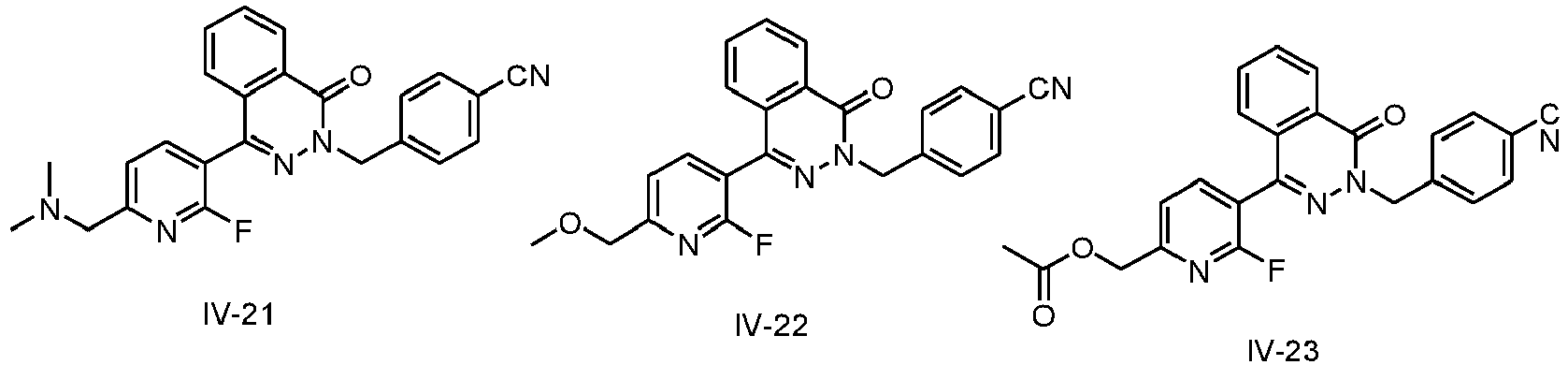


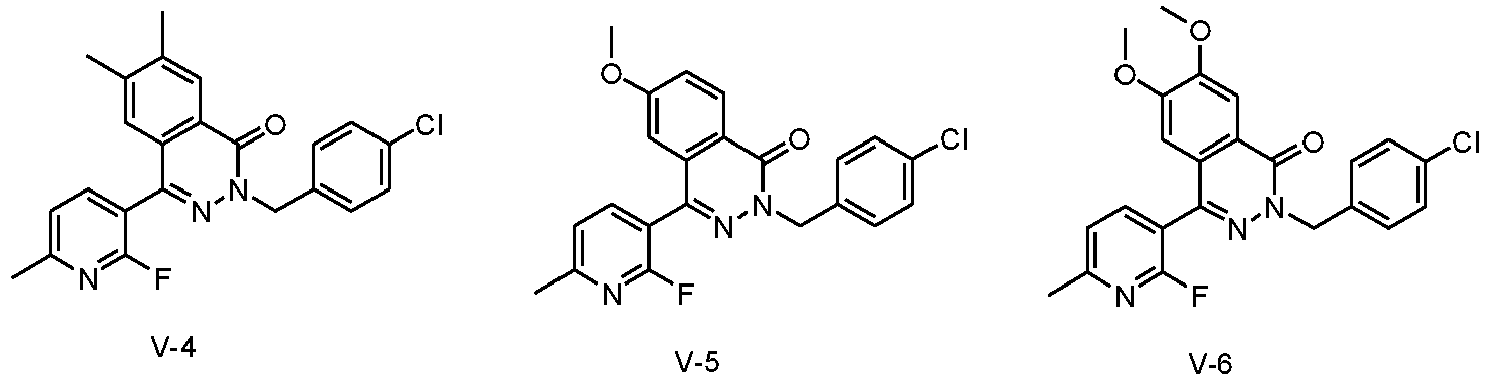
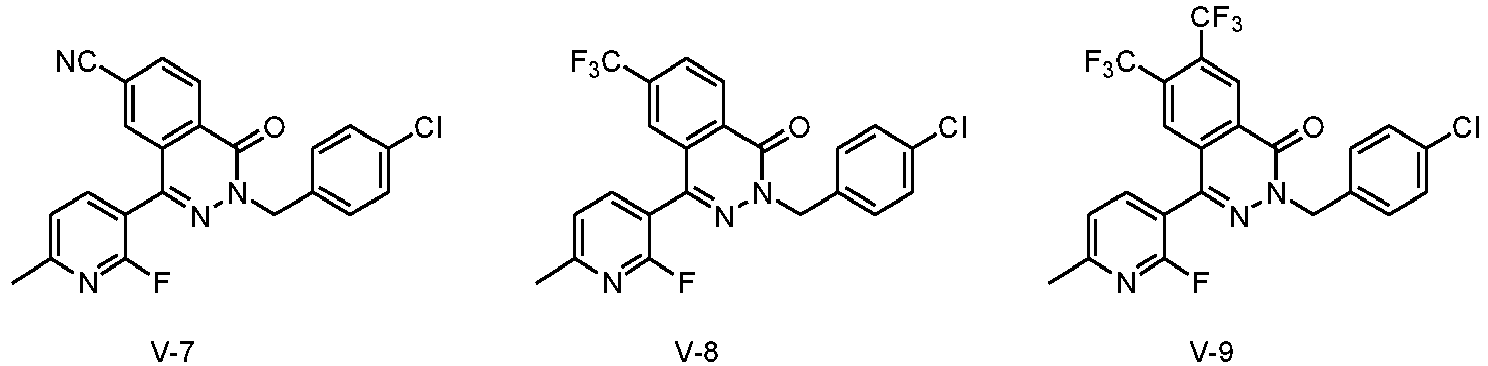

- A method of preparing the compound of formula I, or a pharmaceutically acceptable salt, solvate or prodrug thereof according to any one of claims 1 to 5, wherein the method of preparing the compound of formula I includes steps of one of the following routes :Route 1:
 the compound I is obtained from the compound a-1 by a Suzuki reaction,wherein, R, R1, R2, R3, R4 and A are each defined as those defined in any one of claims 1 to 5;Route 2:
 the compound I is obtained from the compound b-1 and the compound b-2 by a nucleophilic substitution,wherein, R, R1, R2, R3, R4 and A are each defined as those defined in any one of claims 1 to 5.
 - A pharmaceutical composition comprising a therapeutically effective amount of one or more selected from the group consisting of the compound of formula I, or a pharmaceutically acceptable salt, solvate or prodrug thereof according to any one of claims 1 to 5, and an optional pharmaceutically acceptable carrier.
- Use of the compound of formula I or a pharmaceutically acceptable salt, solvate or prodrug thereof according to any one of claims 1 to 5, or the pharmaceutical composition according to claim 7 in preparation of a medicament for the prevention and/or treatment of hepatitis B disease.
- Use of the compound of formula I or a pharmaceutically acceptable salt, solvate or prodrug thereof according to any one of claims 1 to 5, or the pharmaceutical composition according to claim 7 in preparation of a hepatitis B virus inhibitor.
- Use of the compound of formula I or a pharmaceutically acceptable salt, solvate or prodrug thereof according to any one of claims 1 to 5, or the pharmaceutical composition according to claim 7 in preparation of a medicament for inhibiting virus replication, said virus includes hepatitis A virus, hepatitis B virus, hepatitis C virus, influenza virus, adenovirus, HIV, herpes virus, human papilloma virus.
Applications Claiming Priority (2)
| Application Number | Priority Date | Filing Date | Title |
|---|---|---|---|
| CN201710681892 | 2017-08-10 | ||
| PCT/CN2018/099806 WO2019029656A1 (en) | 2017-08-10 | 2018-08-10 | Pyridazinone compound, method for preparation thereof, pharmaceutical composition thereof, and use thereof |
Publications (3)
| Publication Number | Publication Date |
|---|---|
| EP3666767A4 EP3666767A4 (en) | 2020-06-17 |
| EP3666767A1 true EP3666767A1 (en) | 2020-06-17 |
| EP3666767B1 EP3666767B1 (en) | 2021-12-01 |
Family
ID=64792495
Family Applications (1)
| Application Number | Title | Priority Date | Filing Date |
|---|---|---|---|
| EP18845225.4A Not-in-force EP3666767B1 (en) | 2017-08-10 | 2018-08-10 | Phthalazinone derivatives, method for their preparation thereof, pharmaceutical composition comprising them, and their use |
Country Status (8)
| Country | Link |
|---|---|
| US (1) | US11040952B2 (en) |
| EP (1) | EP3666767B1 (en) |
| JP (1) | JP7012822B2 (en) |
| KR (1) | KR102458221B1 (en) |
| CN (1) | CN109134429B (en) |
| ES (1) | ES2905926T3 (en) |
| PH (1) | PH12020500305A1 (en) |
| WO (1) | WO2019029656A1 (en) |
Families Citing this family (2)
| Publication number | Priority date | Publication date | Assignee | Title |
|---|---|---|---|---|
| WO2020259539A1 (en) * | 2019-06-25 | 2020-12-30 | 中国科学院上海药物研究所 | 4-pyridine substituted phthalazinone compound and preparation method, pharmaceutical composition, and use thereof |
| CN119241513B (en) * | 2024-10-08 | 2025-11-21 | 青岛农业大学 | Preparation method and antibacterial application of diaryl seven-membered oxygen heterocyclic skeleton containing indole |
Family Cites Families (9)
| Publication number | Priority date | Publication date | Assignee | Title |
|---|---|---|---|---|
| JP3120857B2 (en) * | 1990-02-19 | 2000-12-25 | 中外製薬株式会社 | Novel condensed heterocyclic compound and anti-asthmatic agent using the same |
| ES2611604T3 (en) * | 2004-10-22 | 2017-05-09 | Janssen Pharmaceutica Nv | C fms kinase inhibitors |
| JP3120857U (en) * | 2006-02-03 | 2006-04-20 | 誠二 金谷 | Foot training equipment |
| KR20110102468A (en) * | 2008-12-16 | 2011-09-16 | 서트리스 파마슈티컬즈, 인코포레이티드 | Phthalaginone and related analogs as sirtuin modulators |
| WO2011055270A1 (en) * | 2009-11-04 | 2011-05-12 | Wyeth Llc | Indole based receptor crth2 antagonists |
| WO2013188848A2 (en) * | 2012-06-15 | 2013-12-19 | The Regents Of The University Of California | Antiviral compounds and methods of use |
| CN104003940B (en) * | 2014-06-16 | 2017-02-15 | 华东理工大学 | 2,4-difluoro-5-( phthalazone-1-methyl)-benzoyl piperazine compound and application thereof |
| CN112675174B (en) * | 2015-05-08 | 2022-06-17 | 四川大学华西第二医院 | New use of poly ADP ribose polymerase inhibitor for treating hepatitis B virus related diseases |
| CN106467495A (en) * | 2015-08-19 | 2017-03-01 | 中国科学院上海药物研究所 | Pyridazinone compound, its preparation method, pharmaceutical composition and purposes |
-
2018
- 2018-08-10 ES ES18845225T patent/ES2905926T3/en active Active
- 2018-08-10 WO PCT/CN2018/099806 patent/WO2019029656A1/en not_active Ceased
- 2018-08-10 CN CN201810905518.8A patent/CN109134429B/en not_active Expired - Fee Related
- 2018-08-10 EP EP18845225.4A patent/EP3666767B1/en not_active Not-in-force
- 2018-08-10 KR KR1020207006483A patent/KR102458221B1/en active Active
- 2018-08-10 JP JP2020506941A patent/JP7012822B2/en not_active Expired - Fee Related
-
2020
- 2020-02-10 US US16/786,710 patent/US11040952B2/en not_active Expired - Fee Related
- 2020-02-10 PH PH12020500305A patent/PH12020500305A1/en unknown
Also Published As
| Publication number | Publication date |
|---|---|
| JP2020529458A (en) | 2020-10-08 |
| KR102458221B1 (en) | 2022-10-24 |
| EP3666767B1 (en) | 2021-12-01 |
| EP3666767A4 (en) | 2020-06-17 |
| WO2019029656A1 (en) | 2019-02-14 |
| US20200181109A1 (en) | 2020-06-11 |
| KR20200037356A (en) | 2020-04-08 |
| CN109134429A (en) | 2019-01-04 |
| JP7012822B2 (en) | 2022-02-14 |
| CN109134429B (en) | 2021-06-01 |
| US11040952B2 (en) | 2021-06-22 |
| PH12020500305A1 (en) | 2021-01-25 |
| ES2905926T3 (en) | 2022-04-12 |
Similar Documents
| Publication | Publication Date | Title |
|---|---|---|
| CN113784968B (en) | Crystal forms of Wee1 inhibitor compounds and their applications | |
| CN119654319B (en) | A CDK inhibitor and its phosphate polymorph | |
| CN113286794A (en) | KRAS mutein inhibitors | |
| WO2021190467A1 (en) | Spiro ring-containing quinazoline compound | |
| CN114929701B (en) | Crystallization of a PDE3/PDE4 dual inhibitor and its application | |
| FR2921657A1 (en) | New nicotinamide derivatives useful for the preparation of a medicament for the treatment or prevention of cancer | |
| CN114286818A (en) | Heterocyclic compounds as BET inhibitors | |
| BRPI0917791A2 (en) | pyrrolopyrimidine compounds as cdk inhibitors | |
| CN111961034A (en) | Compounds useful as RET kinase inhibitors and uses thereof | |
| AU2020355384B2 (en) | Crystalline form of capsid protein assembly inhibitor containing N hetero five-membered ring, and application thereof | |
| TWI912374B (en) | Pyrmidyl derivatives, preparation methods and uses thereof | |
| CN104844566A (en) | Kinase inhibitor with novel structure | |
| CN106467495A (en) | Pyridazinone compound, its preparation method, pharmaceutical composition and purposes | |
| CN108290899A (en) | A kind of substituted pyrrolopyrimidine compound and its application | |
| WO2020253458A1 (en) | Cdk kinase inhibitor | |
| CN114621256B (en) | Pyrazolo [1,5-a ] pyridine compound, and preparation method and application thereof | |
| EP3666767B1 (en) | Phthalazinone derivatives, method for their preparation thereof, pharmaceutical composition comprising them, and their use | |
| WO2022208382A1 (en) | Novel dialkoxynaphtho[2,3-c]furan-1(3h)-one derivatives and pharmaceutical composition for preventing or treating respiratory disease or sars-cov-2 infection disease, comprising same | |
| CN113166148B (en) | Heterocyclic compounds as CDK-HDAC dual pathway inhibitors | |
| CN113549018B (en) | Protein kinase inhibitors and derivatives thereof, preparation methods, pharmaceutical compositions and applications | |
| CN114736203A (en) | Heterocyclic compounds as BCL-2 inhibitors | |
| CN116768881B (en) | 4- (3-Indolyl) -1, 3-thiazole compound and preparation method and application thereof | |
| CN119264111B (en) | Benzotriazole derivatives as CDKs inhibitors, and pharmaceutical composition and application thereof | |
| RU2842334C2 (en) | Crystalline form of inhibiting wee1 compound and use thereof | |
| CN112004809A (en) | 5-chloro-2, 4-pyrimidine derivatives as antitumor agents |
Legal Events
| Date | Code | Title | Description |
|---|---|---|---|
| STAA | Information on the status of an ep patent application or granted ep patent |
Free format text: STATUS: THE INTERNATIONAL PUBLICATION HAS BEEN MADE |
|
| PUAI | Public reference made under article 153(3) epc to a published international application that has entered the european phase |
Free format text: ORIGINAL CODE: 0009012 |
|
| STAA | Information on the status of an ep patent application or granted ep patent |
Free format text: STATUS: REQUEST FOR EXAMINATION WAS MADE |
|
| 17P | Request for examination filed |
Effective date: 20200210 |
|
| A4 | Supplementary search report drawn up and despatched |
Effective date: 20200402 |
|
| AK | Designated contracting states |
Kind code of ref document: A1 Designated state(s): AL AT BE BG CH CY CZ DE DK EE ES FI FR GB GR HR HU IE IS IT LI LT LU LV MC MK MT NL NO PL PT RO RS SE SI SK SM TR |
|
| AX | Request for extension of the european patent |
Extension state: BA ME |
|
| DAV | Request for validation of the european patent (deleted) | ||
| DAX | Request for extension of the european patent (deleted) | ||
| STAA | Information on the status of an ep patent application or granted ep patent |
Free format text: STATUS: EXAMINATION IS IN PROGRESS |
|
| 17Q | First examination report despatched |
Effective date: 20210325 |
|
| GRAP | Despatch of communication of intention to grant a patent |
Free format text: ORIGINAL CODE: EPIDOSNIGR1 |
|
| STAA | Information on the status of an ep patent application or granted ep patent |
Free format text: STATUS: GRANT OF PATENT IS INTENDED |
|
| INTG | Intention to grant announced |
Effective date: 20210812 |
|
| GRAS | Grant fee paid |
Free format text: ORIGINAL CODE: EPIDOSNIGR3 |
|
| GRAA | (expected) grant |
Free format text: ORIGINAL CODE: 0009210 |
|
| STAA | Information on the status of an ep patent application or granted ep patent |
Free format text: STATUS: THE PATENT HAS BEEN GRANTED |
|
| AK | Designated contracting states |
Kind code of ref document: B1 Designated state(s): AL AT BE BG CH CY CZ DE DK EE ES FI FR GB GR HR HU IE IS IT LI LT LU LV MC MK MT NL NO PL PT RO RS SE SI SK SM TR |
|
| REG | Reference to a national code |
Ref country code: GB Ref legal event code: FG4D |
|
| REG | Reference to a national code |
Ref country code: AT Ref legal event code: REF Ref document number: 1451652 Country of ref document: AT Kind code of ref document: T Effective date: 20211215 Ref country code: CH Ref legal event code: EP |
|
| REG | Reference to a national code |
Ref country code: IE Ref legal event code: FG4D |
|
| REG | Reference to a national code |
Ref country code: DE Ref legal event code: R096 Ref document number: 602018027706 Country of ref document: DE |
|
| REG | Reference to a national code |
Ref country code: LT Ref legal event code: MG9D |
|
| REG | Reference to a national code |
Ref country code: NL Ref legal event code: MP Effective date: 20211201 |
|
| REG | Reference to a national code |
Ref country code: ES Ref legal event code: FG2A Ref document number: 2905926 Country of ref document: ES Kind code of ref document: T3 Effective date: 20220412 |
|
| REG | Reference to a national code |
Ref country code: AT Ref legal event code: MK05 Ref document number: 1451652 Country of ref document: AT Kind code of ref document: T Effective date: 20211201 |
|
| PG25 | Lapsed in a contracting state [announced via postgrant information from national office to epo] |
Ref country code: RS Free format text: LAPSE BECAUSE OF FAILURE TO SUBMIT A TRANSLATION OF THE DESCRIPTION OR TO PAY THE FEE WITHIN THE PRESCRIBED TIME-LIMIT Effective date: 20211201 Ref country code: LT Free format text: LAPSE BECAUSE OF FAILURE TO SUBMIT A TRANSLATION OF THE DESCRIPTION OR TO PAY THE FEE WITHIN THE PRESCRIBED TIME-LIMIT Effective date: 20211201 Ref country code: FI Free format text: LAPSE BECAUSE OF FAILURE TO SUBMIT A TRANSLATION OF THE DESCRIPTION OR TO PAY THE FEE WITHIN THE PRESCRIBED TIME-LIMIT Effective date: 20211201 Ref country code: BG Free format text: LAPSE BECAUSE OF FAILURE TO SUBMIT A TRANSLATION OF THE DESCRIPTION OR TO PAY THE FEE WITHIN THE PRESCRIBED TIME-LIMIT Effective date: 20220301 Ref country code: AT Free format text: LAPSE BECAUSE OF FAILURE TO SUBMIT A TRANSLATION OF THE DESCRIPTION OR TO PAY THE FEE WITHIN THE PRESCRIBED TIME-LIMIT Effective date: 20211201 |
|
| PG25 | Lapsed in a contracting state [announced via postgrant information from national office to epo] |
Ref country code: SE Free format text: LAPSE BECAUSE OF FAILURE TO SUBMIT A TRANSLATION OF THE DESCRIPTION OR TO PAY THE FEE WITHIN THE PRESCRIBED TIME-LIMIT Effective date: 20211201 Ref country code: PL Free format text: LAPSE BECAUSE OF FAILURE TO SUBMIT A TRANSLATION OF THE DESCRIPTION OR TO PAY THE FEE WITHIN THE PRESCRIBED TIME-LIMIT Effective date: 20211201 Ref country code: NO Free format text: LAPSE BECAUSE OF FAILURE TO SUBMIT A TRANSLATION OF THE DESCRIPTION OR TO PAY THE FEE WITHIN THE PRESCRIBED TIME-LIMIT Effective date: 20220301 Ref country code: LV Free format text: LAPSE BECAUSE OF FAILURE TO SUBMIT A TRANSLATION OF THE DESCRIPTION OR TO PAY THE FEE WITHIN THE PRESCRIBED TIME-LIMIT Effective date: 20211201 Ref country code: HR Free format text: LAPSE BECAUSE OF FAILURE TO SUBMIT A TRANSLATION OF THE DESCRIPTION OR TO PAY THE FEE WITHIN THE PRESCRIBED TIME-LIMIT Effective date: 20211201 Ref country code: GR Free format text: LAPSE BECAUSE OF FAILURE TO SUBMIT A TRANSLATION OF THE DESCRIPTION OR TO PAY THE FEE WITHIN THE PRESCRIBED TIME-LIMIT Effective date: 20220302 |
|
| PG25 | Lapsed in a contracting state [announced via postgrant information from national office to epo] |
Ref country code: NL Free format text: LAPSE BECAUSE OF FAILURE TO SUBMIT A TRANSLATION OF THE DESCRIPTION OR TO PAY THE FEE WITHIN THE PRESCRIBED TIME-LIMIT Effective date: 20211201 |
|
| PG25 | Lapsed in a contracting state [announced via postgrant information from national office to epo] |
Ref country code: SM Free format text: LAPSE BECAUSE OF FAILURE TO SUBMIT A TRANSLATION OF THE DESCRIPTION OR TO PAY THE FEE WITHIN THE PRESCRIBED TIME-LIMIT Effective date: 20211201 Ref country code: SK Free format text: LAPSE BECAUSE OF FAILURE TO SUBMIT A TRANSLATION OF THE DESCRIPTION OR TO PAY THE FEE WITHIN THE PRESCRIBED TIME-LIMIT Effective date: 20211201 Ref country code: RO Free format text: LAPSE BECAUSE OF FAILURE TO SUBMIT A TRANSLATION OF THE DESCRIPTION OR TO PAY THE FEE WITHIN THE PRESCRIBED TIME-LIMIT Effective date: 20211201 Ref country code: PT Free format text: LAPSE BECAUSE OF FAILURE TO SUBMIT A TRANSLATION OF THE DESCRIPTION OR TO PAY THE FEE WITHIN THE PRESCRIBED TIME-LIMIT Effective date: 20220401 Ref country code: EE Free format text: LAPSE BECAUSE OF FAILURE TO SUBMIT A TRANSLATION OF THE DESCRIPTION OR TO PAY THE FEE WITHIN THE PRESCRIBED TIME-LIMIT Effective date: 20211201 Ref country code: CZ Free format text: LAPSE BECAUSE OF FAILURE TO SUBMIT A TRANSLATION OF THE DESCRIPTION OR TO PAY THE FEE WITHIN THE PRESCRIBED TIME-LIMIT Effective date: 20211201 |
|
| REG | Reference to a national code |
Ref country code: DE Ref legal event code: R097 Ref document number: 602018027706 Country of ref document: DE |
|
| PG25 | Lapsed in a contracting state [announced via postgrant information from national office to epo] |
Ref country code: IS Free format text: LAPSE BECAUSE OF FAILURE TO SUBMIT A TRANSLATION OF THE DESCRIPTION OR TO PAY THE FEE WITHIN THE PRESCRIBED TIME-LIMIT Effective date: 20220401 |
|
| PLBE | No opposition filed within time limit |
Free format text: ORIGINAL CODE: 0009261 |
|
| STAA | Information on the status of an ep patent application or granted ep patent |
Free format text: STATUS: NO OPPOSITION FILED WITHIN TIME LIMIT |
|
| PG25 | Lapsed in a contracting state [announced via postgrant information from national office to epo] |
Ref country code: DK Free format text: LAPSE BECAUSE OF FAILURE TO SUBMIT A TRANSLATION OF THE DESCRIPTION OR TO PAY THE FEE WITHIN THE PRESCRIBED TIME-LIMIT Effective date: 20211201 Ref country code: AL Free format text: LAPSE BECAUSE OF FAILURE TO SUBMIT A TRANSLATION OF THE DESCRIPTION OR TO PAY THE FEE WITHIN THE PRESCRIBED TIME-LIMIT Effective date: 20211201 |
|
| 26N | No opposition filed |
Effective date: 20220902 |
|
| PG25 | Lapsed in a contracting state [announced via postgrant information from national office to epo] |
Ref country code: SI Free format text: LAPSE BECAUSE OF FAILURE TO SUBMIT A TRANSLATION OF THE DESCRIPTION OR TO PAY THE FEE WITHIN THE PRESCRIBED TIME-LIMIT Effective date: 20211201 |
|
| PG25 | Lapsed in a contracting state [announced via postgrant information from national office to epo] |
Ref country code: MC Free format text: LAPSE BECAUSE OF FAILURE TO SUBMIT A TRANSLATION OF THE DESCRIPTION OR TO PAY THE FEE WITHIN THE PRESCRIBED TIME-LIMIT Effective date: 20211201 |
|
| REG | Reference to a national code |
Ref country code: CH Ref legal event code: PL |
|
| GBPC | Gb: european patent ceased through non-payment of renewal fee |
Effective date: 20220810 |
|
| PG25 | Lapsed in a contracting state [announced via postgrant information from national office to epo] |
Ref country code: LU Free format text: LAPSE BECAUSE OF NON-PAYMENT OF DUE FEES Effective date: 20220810 Ref country code: LI Free format text: LAPSE BECAUSE OF NON-PAYMENT OF DUE FEES Effective date: 20220831 Ref country code: CH Free format text: LAPSE BECAUSE OF NON-PAYMENT OF DUE FEES Effective date: 20220831 |
|
| REG | Reference to a national code |
Ref country code: BE Ref legal event code: MM Effective date: 20220831 |
|
| P01 | Opt-out of the competence of the unified patent court (upc) registered |
Effective date: 20230428 |
|
| PG25 | Lapsed in a contracting state [announced via postgrant information from national office to epo] |
Ref country code: IE Free format text: LAPSE BECAUSE OF NON-PAYMENT OF DUE FEES Effective date: 20220810 |
|
| PGFP | Annual fee paid to national office [announced via postgrant information from national office to epo] |
Ref country code: IT Payment date: 20230517 Year of fee payment: 6 |
|
| PG25 | Lapsed in a contracting state [announced via postgrant information from national office to epo] |
Ref country code: BE Free format text: LAPSE BECAUSE OF NON-PAYMENT OF DUE FEES Effective date: 20220831 |
|
| PG25 | Lapsed in a contracting state [announced via postgrant information from national office to epo] |
Ref country code: GB Free format text: LAPSE BECAUSE OF NON-PAYMENT OF DUE FEES Effective date: 20220810 |
|
| PGFP | Annual fee paid to national office [announced via postgrant information from national office to epo] |
Ref country code: ES Payment date: 20230906 Year of fee payment: 6 |
|
| PGFP | Annual fee paid to national office [announced via postgrant information from national office to epo] |
Ref country code: FR Payment date: 20230811 Year of fee payment: 6 Ref country code: DE Payment date: 20230809 Year of fee payment: 6 |
|
| PG25 | Lapsed in a contracting state [announced via postgrant information from national office to epo] |
Ref country code: CY Free format text: LAPSE BECAUSE OF FAILURE TO SUBMIT A TRANSLATION OF THE DESCRIPTION OR TO PAY THE FEE WITHIN THE PRESCRIBED TIME-LIMIT Effective date: 20211201 |
|
| PG25 | Lapsed in a contracting state [announced via postgrant information from national office to epo] |
Ref country code: MK Free format text: LAPSE BECAUSE OF FAILURE TO SUBMIT A TRANSLATION OF THE DESCRIPTION OR TO PAY THE FEE WITHIN THE PRESCRIBED TIME-LIMIT Effective date: 20211201 Ref country code: HU Free format text: LAPSE BECAUSE OF FAILURE TO SUBMIT A TRANSLATION OF THE DESCRIPTION OR TO PAY THE FEE WITHIN THE PRESCRIBED TIME-LIMIT; INVALID AB INITIO Effective date: 20180810 |
|
| PG25 | Lapsed in a contracting state [announced via postgrant information from national office to epo] |
Ref country code: TR Free format text: LAPSE BECAUSE OF FAILURE TO SUBMIT A TRANSLATION OF THE DESCRIPTION OR TO PAY THE FEE WITHIN THE PRESCRIBED TIME-LIMIT Effective date: 20211201 |
|
| PG25 | Lapsed in a contracting state [announced via postgrant information from national office to epo] |
Ref country code: MT Free format text: LAPSE BECAUSE OF FAILURE TO SUBMIT A TRANSLATION OF THE DESCRIPTION OR TO PAY THE FEE WITHIN THE PRESCRIBED TIME-LIMIT Effective date: 20211201 |
|
| REG | Reference to a national code |
Ref country code: DE Ref legal event code: R119 Ref document number: 602018027706 Country of ref document: DE |
|
| PG25 | Lapsed in a contracting state [announced via postgrant information from national office to epo] |
Ref country code: DE Free format text: LAPSE BECAUSE OF NON-PAYMENT OF DUE FEES Effective date: 20250301 |
|
| PG25 | Lapsed in a contracting state [announced via postgrant information from national office to epo] |
Ref country code: IT Free format text: LAPSE BECAUSE OF NON-PAYMENT OF DUE FEES Effective date: 20240810 |
|
| PG25 | Lapsed in a contracting state [announced via postgrant information from national office to epo] |
Ref country code: FR Free format text: LAPSE BECAUSE OF NON-PAYMENT OF DUE FEES Effective date: 20240831 |
|
| REG | Reference to a national code |
Ref country code: ES Ref legal event code: FD2A Effective date: 20250926 |
|
| PG25 | Lapsed in a contracting state [announced via postgrant information from national office to epo] |
Ref country code: ES Free format text: LAPSE BECAUSE OF NON-PAYMENT OF DUE FEES Effective date: 20240811 |