EP3666733A1 - Method for producing lithium manganese oxide-based positive electrode active material - Google Patents
Method for producing lithium manganese oxide-based positive electrode active material Download PDFInfo
- Publication number
- EP3666733A1 EP3666733A1 EP18862376.3A EP18862376A EP3666733A1 EP 3666733 A1 EP3666733 A1 EP 3666733A1 EP 18862376 A EP18862376 A EP 18862376A EP 3666733 A1 EP3666733 A1 EP 3666733A1
- Authority
- EP
- European Patent Office
- Prior art keywords
- manganese oxide
- active material
- cathode active
- lithium
- nanoparticles
- Prior art date
- Legal status (The legal status is an assumption and is not a legal conclusion. Google has not performed a legal analysis and makes no representation as to the accuracy of the status listed.)
- Granted
Links
Images



Classifications
-
- C—CHEMISTRY; METALLURGY
- C01—INORGANIC CHEMISTRY
- C01G—COMPOUNDS CONTAINING METALS NOT COVERED BY SUBCLASSES C01D OR C01F
- C01G45/00—Compounds of manganese
- C01G45/12—Complex oxides containing manganese and at least one other metal element
- C01G45/1221—Manganates or manganites with trivalent manganese, tetravalent manganese or mixtures thereof
- C01G45/1242—Manganates or manganites with trivalent manganese, tetravalent manganese or mixtures thereof of the type (Mn2O4)-, e.g. LiMn2O4 or Li(MxMn2-x)O4
-
- C—CHEMISTRY; METALLURGY
- C01—INORGANIC CHEMISTRY
- C01G—COMPOUNDS CONTAINING METALS NOT COVERED BY SUBCLASSES C01D OR C01F
- C01G45/00—Compounds of manganese
- C01G45/02—Oxides
-
- H—ELECTRICITY
- H01—ELECTRIC ELEMENTS
- H01G—CAPACITORS; CAPACITORS, RECTIFIERS, DETECTORS, SWITCHING DEVICES, LIGHT-SENSITIVE OR TEMPERATURE-SENSITIVE DEVICES OF THE ELECTROLYTIC TYPE
- H01G11/00—Hybrid capacitors, i.e. capacitors having different positive and negative electrodes; Electric double-layer [EDL] capacitors; Processes for the manufacture thereof or of parts thereof
- H01G11/04—Hybrid capacitors
- H01G11/06—Hybrid capacitors with one of the electrodes allowing ions to be reversibly doped thereinto, e.g. lithium ion capacitors [LIC]
-
- H—ELECTRICITY
- H01—ELECTRIC ELEMENTS
- H01G—CAPACITORS; CAPACITORS, RECTIFIERS, DETECTORS, SWITCHING DEVICES, LIGHT-SENSITIVE OR TEMPERATURE-SENSITIVE DEVICES OF THE ELECTROLYTIC TYPE
- H01G11/00—Hybrid capacitors, i.e. capacitors having different positive and negative electrodes; Electric double-layer [EDL] capacitors; Processes for the manufacture thereof or of parts thereof
- H01G11/22—Electrodes
- H01G11/30—Electrodes characterised by their material
- H01G11/46—Metal oxides
-
- H—ELECTRICITY
- H01—ELECTRIC ELEMENTS
- H01M—PROCESSES OR MEANS, e.g. BATTERIES, FOR THE DIRECT CONVERSION OF CHEMICAL ENERGY INTO ELECTRICAL ENERGY
- H01M10/00—Secondary cells; Manufacture thereof
- H01M10/05—Accumulators with non-aqueous electrolyte
- H01M10/052—Li-accumulators
- H01M10/0525—Rocking-chair batteries, i.e. batteries with lithium insertion or intercalation in both electrodes; Lithium-ion batteries
-
- H—ELECTRICITY
- H01—ELECTRIC ELEMENTS
- H01M—PROCESSES OR MEANS, e.g. BATTERIES, FOR THE DIRECT CONVERSION OF CHEMICAL ENERGY INTO ELECTRICAL ENERGY
- H01M4/00—Electrodes
- H01M4/02—Electrodes composed of, or comprising, active material
- H01M4/36—Selection of substances as active materials, active masses, active liquids
- H01M4/48—Selection of substances as active materials, active masses, active liquids of inorganic oxides or hydroxides
- H01M4/50—Selection of substances as active materials, active masses, active liquids of inorganic oxides or hydroxides of manganese
- H01M4/505—Selection of substances as active materials, active masses, active liquids of inorganic oxides or hydroxides of manganese of mixed oxides or hydroxides containing manganese for inserting or intercalating light metals, e.g. LiMn2O4 or LiMn2OxFy
-
- C—CHEMISTRY; METALLURGY
- C01—INORGANIC CHEMISTRY
- C01P—INDEXING SCHEME RELATING TO STRUCTURAL AND PHYSICAL ASPECTS OF SOLID INORGANIC COMPOUNDS
- C01P2004/00—Particle morphology
- C01P2004/01—Particle morphology depicted by an image
- C01P2004/03—Particle morphology depicted by an image obtained by SEM
-
- C—CHEMISTRY; METALLURGY
- C01—INORGANIC CHEMISTRY
- C01P—INDEXING SCHEME RELATING TO STRUCTURAL AND PHYSICAL ASPECTS OF SOLID INORGANIC COMPOUNDS
- C01P2004/00—Particle morphology
- C01P2004/10—Particle morphology extending in one dimension, e.g. needle-like
- C01P2004/16—Nanowires or nanorods, i.e. solid nanofibres with two nearly equal dimensions between 1-100 nanometer
-
- C—CHEMISTRY; METALLURGY
- C01—INORGANIC CHEMISTRY
- C01P—INDEXING SCHEME RELATING TO STRUCTURAL AND PHYSICAL ASPECTS OF SOLID INORGANIC COMPOUNDS
- C01P2004/00—Particle morphology
- C01P2004/51—Particles with a specific particle size distribution
-
- C—CHEMISTRY; METALLURGY
- C01—INORGANIC CHEMISTRY
- C01P—INDEXING SCHEME RELATING TO STRUCTURAL AND PHYSICAL ASPECTS OF SOLID INORGANIC COMPOUNDS
- C01P2004/00—Particle morphology
- C01P2004/54—Particles characterised by their aspect ratio, i.e. the ratio of sizes in the longest to the shortest dimension
-
- C—CHEMISTRY; METALLURGY
- C01—INORGANIC CHEMISTRY
- C01P—INDEXING SCHEME RELATING TO STRUCTURAL AND PHYSICAL ASPECTS OF SOLID INORGANIC COMPOUNDS
- C01P2004/00—Particle morphology
- C01P2004/60—Particles characterised by their size
- C01P2004/61—Micrometer sized, i.e. from 1-100 micrometer
-
- C—CHEMISTRY; METALLURGY
- C01—INORGANIC CHEMISTRY
- C01P—INDEXING SCHEME RELATING TO STRUCTURAL AND PHYSICAL ASPECTS OF SOLID INORGANIC COMPOUNDS
- C01P2004/00—Particle morphology
- C01P2004/60—Particles characterised by their size
- C01P2004/62—Submicrometer sized, i.e. from 0.1-1 micrometer
-
- C—CHEMISTRY; METALLURGY
- C01—INORGANIC CHEMISTRY
- C01P—INDEXING SCHEME RELATING TO STRUCTURAL AND PHYSICAL ASPECTS OF SOLID INORGANIC COMPOUNDS
- C01P2004/00—Particle morphology
- C01P2004/60—Particles characterised by their size
- C01P2004/64—Nanometer sized, i.e. from 1-100 nanometer
-
- C—CHEMISTRY; METALLURGY
- C01—INORGANIC CHEMISTRY
- C01P—INDEXING SCHEME RELATING TO STRUCTURAL AND PHYSICAL ASPECTS OF SOLID INORGANIC COMPOUNDS
- C01P2006/00—Physical properties of inorganic compounds
- C01P2006/12—Surface area
-
- C—CHEMISTRY; METALLURGY
- C01—INORGANIC CHEMISTRY
- C01P—INDEXING SCHEME RELATING TO STRUCTURAL AND PHYSICAL ASPECTS OF SOLID INORGANIC COMPOUNDS
- C01P2006/00—Physical properties of inorganic compounds
- C01P2006/40—Electric properties
-
- H—ELECTRICITY
- H01—ELECTRIC ELEMENTS
- H01M—PROCESSES OR MEANS, e.g. BATTERIES, FOR THE DIRECT CONVERSION OF CHEMICAL ENERGY INTO ELECTRICAL ENERGY
- H01M4/00—Electrodes
- H01M4/02—Electrodes composed of, or comprising, active material
- H01M2004/026—Electrodes composed of, or comprising, active material characterised by the polarity
- H01M2004/028—Positive electrodes
-
- Y—GENERAL TAGGING OF NEW TECHNOLOGICAL DEVELOPMENTS; GENERAL TAGGING OF CROSS-SECTIONAL TECHNOLOGIES SPANNING OVER SEVERAL SECTIONS OF THE IPC; TECHNICAL SUBJECTS COVERED BY FORMER USPC CROSS-REFERENCE ART COLLECTIONS [XRACs] AND DIGESTS
- Y02—TECHNOLOGIES OR APPLICATIONS FOR MITIGATION OR ADAPTATION AGAINST CLIMATE CHANGE
- Y02E—REDUCTION OF GREENHOUSE GAS [GHG] EMISSIONS, RELATED TO ENERGY GENERATION, TRANSMISSION OR DISTRIBUTION
- Y02E60/00—Enabling technologies; Technologies with a potential or indirect contribution to GHG emissions mitigation
- Y02E60/10—Energy storage using batteries
-
- Y—GENERAL TAGGING OF NEW TECHNOLOGICAL DEVELOPMENTS; GENERAL TAGGING OF CROSS-SECTIONAL TECHNOLOGIES SPANNING OVER SEVERAL SECTIONS OF THE IPC; TECHNICAL SUBJECTS COVERED BY FORMER USPC CROSS-REFERENCE ART COLLECTIONS [XRACs] AND DIGESTS
- Y02—TECHNOLOGIES OR APPLICATIONS FOR MITIGATION OR ADAPTATION AGAINST CLIMATE CHANGE
- Y02E—REDUCTION OF GREENHOUSE GAS [GHG] EMISSIONS, RELATED TO ENERGY GENERATION, TRANSMISSION OR DISTRIBUTION
- Y02E60/00—Enabling technologies; Technologies with a potential or indirect contribution to GHG emissions mitigation
- Y02E60/13—Energy storage using capacitors
Definitions
- the present invention relates to a method for preparing a lithium manganese oxide-based cathode active material for storage devices, and particularly, to a method for preparing a lithium manganese oxide-based cathode active material with excellent specific capacitance, having a high surface area with a small size, without the need for a heat treatment process for a long time under high temperature conditions.
- Supercapcitors are being studied as energy storage devices having higher density than existing capacitors and having higher output than common lithium ion batteries.
- Supercapacitors may be simply classified into electrical double layer capacitors (EDLC) and pseudocapacitors according to their energy storage mechanism.
- EDLC electrical double layer capacitors
- pseudocapacitor that stores energy through the oxidation/reduction reaction of metal ions using a metal oxide as an electrode material is known to have much better specific capacitance than a carbon-based supercapacitor.
- organic electrolyte-based lithium ion batteries have a risk of explosion by impact and heat, studies on aqueous lithium ion batteries using an aqueous electrolyte are being actively pursued.
- the size of metal oxide used as electrode material is advantageous for the size of metal oxide used as electrode material to be reduced to increase the surface area to the largest extent possible.
- the surface area should be large so that the interface between electrolyte and electrode may widen and the oxidation/reduction reaction may smoothly occur.
- a metal oxide is difficult to directly apply for pseudocapacitors and batteries, because the particle size increases and the surface area decreases after a high temperature heat treatment processes, due to agglomeration of particles.
- a method for preparing a lithium manganese oxide-based cathode active material including the steps of: producing manganese oxide nanoparticles using manganese salts; and mixing the manganese oxide nanoparticles with lithium salts, and heat treating the mixture at 350 °C to 430 °C for 1 hour to 3.5 hours, and then heat treating at 650 °C to 750 °C for 2.5 hours to 8 hours.
- a lithium manganese oxide-based cathode active material prepared by the above described method is provided.
- the energy and time used to synthesize a lithium manganese oxide may be reduced.
- the size and surface area of a lithium manganese oxide synthesized after heat treatment may be maintained small, and high specific capacitance may be realized.
- a method for preparing a lithium manganese oxide-based cathode (positive electrode) active material including the steps of: producing manganese oxide nanoparticles using manganese salts; mixing the manganese oxide nanoparticles with lithium salts; heat treating the mixture at 350 °C to 430 °C for 1 hour to 3.5 hours; and then heat treating at 650 °C to 750 °C for 2.5 hours to 8 hours.
- the present invention is characterized in that a lithium manganese oxide-based cathode active material that can be used in the cathodes of lithium ion batteries and pseudocapacitors, which are energy storage devices having high energy density and output, is easily synthesized by a simple process without conducting a high temperature heat treatment process for a long time, by synthesizing a manganese oxide having a nanostructure first, and then mixing it with lithium salts and conducting stepwise heat treatment under optimized conditions.
- a lithium manganese oxide was mainly synthesized by directly mixing manganese salts and lithium salts by a dry or wet method, followed by high temperature heat treatment, but the heat treatment time for increasing the crystallinity of the lithium manganese oxide is too long, and the size of the lithium manganese oxide prepared thereby is as large, such as a few micrometers ( ⁇ m) to tens of micrometers ( ⁇ m), and the surface area is small, and thus it is not suitable for a pseudocapacitor that should yield high output instantaneously.
- a manganese oxide having a nanostructure by preparing a manganese oxide having a nanostructure first, and then mixing it with lithium salts, and proceeding with a stepwise heat treatment, energy and time used to synthesize the lithium manganese oxide can be saved. Moreover, the size and surface area of a lithium manganese oxide synthesized after heat treatment may be maintained small.
- a manganese salt as starting material for producing manganese oxide nanoparticles may be one or more selected from the group consisting of: manganese sulfate, manganese acetate, manganese chloride, manganese nitrate, manganese carbonate, and hydrates or mixture thereof.
- the step of producing manganese oxide nanoparticles may include reacting the manganese salt in the presence of an oxidizing agent, at about 50 °C or more, or about 50 °C to about 150 °C, or about 50 °C to about 100 °C.
- the reaction for producing the manganese oxide may be conducted in an aqueous solution state.
- a reaction time may vary according to reaction temperature and pressure conditions, and the reaction may be conducted for about 2 hours or more, or about 2 hours to about 72 hours.
- the step of producing manganese oxide nanoparticles does not require application of a high temperature and high pressure hydrothermal synthesis method using an autoclave and the like, the reaction may be conducted under a pressure condition of about 10 kg/cm 2 or less, about 1 kg/cm 2 to about 10 kg/cm 2 , about 1 kg/cm 2 to about 3 kg/cm 2 , or under an atmospheric pressure condition.
- manganese oxide nanoparticles may be produced through a flask reaction of the manganese salt with an oxidizing agent at a temperature of about 50 °C to 100 °C or about 60 °C to 90 °C in an aqueous solution state, rather than a high temperature hydrothermal synthesis reaction.
- the flask reaction may be conducted under an atmospheric pressure (about 1 atm) condition.
- the manganese salt may be reacted with an oxidizing agent in an aqueous solution state, at about 50 °C to 100 °C, or about 60 °C to 90 °C, overnight for about 12 hours to 18 hours, about 12 hours to 36 hours, or about 12 hours to about 24 hours.
- one or more oxidizing agent is selected from the group consisting of potassium permanganate (KMnO 4 ), ammonium persulfate, hydrogen peroxide, ferric chloride, and hydrates or mixtures thereof may be used.
- potassium permanganate may be used, in that the formation of the crystal phase of the lithium manganese oxide may be effectively achieved, when mixing manganese oxide nanoparticles and lithium salts to produce the lithium manganese oxide.
- the resulting manganese oxide nanoparticles may have an ⁇ or ⁇ -MnO 2 crystal structures and nanorod shapes.
- the number average length of the manganese oxide nanoparticles measured with a SEM (scanning electron microscope), may be 200 nm to 2000 nm, or 200 nm to 1000 nm, or 200 nm to 500 nm.
- the number average width of the manganese oxide nanoparticles may be 20 nm to 100 nm, 20 nm to 50 nm, or 20 nm to 30 nm.
- manganese oxide nanoparticles grow in the shape of nanorods, nanowires, or nanoplanes in an aqueous solution state, and thus manganese oxide nanoparticles serve as a backbone when preparing lithium manganese oxide cathode active material, thereby preventing lithium manganese oxide from growing large to a size of a few micrometers.
- manganese salts are mixed with lithium salts and heat treated, instead of manganese oxide nanoparticles, the lithium manganese oxide may not have a specific size and shape, and it may be formed with a size of a few micrometers.
- the lithium manganese oxide exhibits charge and discharge properties by de-intercalation and intercalation, but the de-intercalation and intercalation of lithium ions are achieved only on the surface of the lithium manganese oxide.
- specific capacitance may be maximized.
- the manganese oxide nanoparticles thus produced and lithium salts are mixed and subjected to stepwise heat treatment under predetermined conditions, thus preparing a lithium manganese oxide-based cathode active material.
- the lithium salts may be one or more selected from the group consisting of lithium hydroxide, lithium carbonate, lithium acetate, lithium chloride, lithium nitrate, and hydrates or mixtures thereof.
- the manganese oxide nanoparticles and lithium salts may be mixed at a mole ratio of 2.3:0.7 to 1.7:1.3 (Mn:Li) and reacted, and for example, the mole ratio may be 2.1:0.9 to 1.9:1.1, more specifically 2.05:0.95 to 1.95:1.05.
- the lithium manganese oxide in order for LiMn 2 O 4 to form a structurally stable composition, manganese oxide nanoparticles and lithium salts may be mixed at the above-explained mole ratio range and reacted. If the mole ratio of manganese oxide nanoparticles and lithium salts does not fall within the above range, in addition to the structure of LiMn 2 O 4 , non-reacted manganese oxide and a structure of Mn 2 O 3 may be produced.
- primary heat treatment may be conducted at 350 °C to 430 °C for 1 hour to 3.5 hours, the temperature of a sintering furnace may be continuously increased to 650 °C to 750 °C, and then secondary heat treatment may be conducted at 650 °C to 750 °C for 2.5 hours to 8 hours, thus synthesizing a lithium manganese oxide having a small particle size and a large surface area, and excellent specific capacitance.
- the primary heat treatment is conducted at a temperature of 350 °C or more, and then the manganese oxide-lithium salt mixture begins to be converted into a structure of LiMn 2 O 4 at a temperature of 350 °C or more. More specifically, at a temperature of less than 350 °C, such conversion into the LiMn 2 O 4 structure may not occur. Thereafter, if a temperature is increased to 650 °C or more, LiMn 2 O 4 crystal seeds formed in the above-mentioned mixture may grow large, and the whole mixture may be converted into LiMn 2 O 4 .
- LiMn 2 O 4 crystal seeds grow faster, a structure of Mn 3 O 4 begins to grow, in addition to the LiMn 2 O 4 .
- primary heat treatment is conducted at a high temperature of greater than 430 °C, more LiMn 2 O 4 crystal seeds may be generated than in the temperature range of 350 °C or more and 430 °C or less.
- the LiMn 2 O 4 crystal size may become smaller than in the mixture primarily heat-treated in the temperature range of 350 °C or more and 430 °C or less, and thus electrochemical performance may decrease compared to LiMn 2 O 4 with a large crystal size.
- the larger the size of a LiMn 2 O 4 single crystal the higher the crystallinity, and the higher the crystallinity, the better the electrochemical performance.
- electrochemical performance is not good compared to a single crystal.
- the primary heat treatment process corresponds to a process for producing LiMn 2 O 4 crystal seeds, and it may be conducted at 350 °C to 430 °C or 370 °C to 420 °C for 1 hour to 3.5 hours, or at 380 °C to 415 °C for 1.5 hours to 2.5 hours.
- the temperature for the primary heat treatment process should be conducted at 350 °C or more so as to previously produce LiMn 2 O 4 crystal seeds, and should be conducted at 430 °C or less so as to maintain the number of small LiMn 2 O 4 crystal seeds.
- the temperature and time of the primary heat treatment process maintains a complementary relationship, and it is preferable that in the case where a low heat treatment temperature is applied, a long heat treatment time is applied, and in case where a high heat treatment temperature is applied, a short heat treatment time is applied.
- a heat treatment time for example, in case the primary heat treatment process temperature is 350 °C to 390 °C, a heat treatment time of 2 hours to 3.5 hours may be applied.
- a heat treatment time of 1 hour to 2 hours may be applied.
- the primary heat treatment process should be conducted for more than 1 hour so that the production of LiMn 2 O 4 crystal seeds may begin, and should be conducted for 3.5 hours or less so as to maintain the number of small LiMn 2 O 4 crystal seeds.
- the temperature of a sintering furnace may be raised to a high temperature to conduct a secondary heat treatment process.
- the secondary heat treatment process corresponds to a process for growing the LiMn 2 O 4 crystal seeds produced in the primary heat treatment process, and it should be conducted at: 650 °C to 750 °C, or 660 °C to 740 °C, for 2.5 hours to 8 hours; 675 °C to 725 °C for 3 hours to 6 hours; or 680 °C to 715 °C for 3.5 hours to 5 hours.
- the secondary heat treatment process should be conducted at 650 °C or more so as to rapidly grow the LiMn 2 O 4 crystal seeds, and should be conducted at 750 °C or less so that Mn 3 O 4 crystals may not be produced in addition to LiMn 2 O 4 .
- the temperature and time of the secondary heat treatment process maintain a complementary relationship, and it is preferable that in case where a low heat treatment temperature is applied, a long heat treatment time is applied, and in case where a high heat treatment temperature is applied, a short heat treatment time is applied.
- the heat treatment time may be 4 hours to 8 hours.
- the heat treatment time may be 2.5 hours to 4 hours.
- the secondary heat treatment should be conducted for 2.5 hours or more so that all the LiMn 2 O 4 crystals may sufficiently grow, and should be conducted for 8 hours or less so that a LiMn 2 O 4 nanorod shape may be maintained after all the LiMn 2 O 4 crystals are grown.
- the secondary heat treatment process is conducted for too long, the LiMn 2 O 4 nanoparticles may begin to agglomerate, and decrease the surface area.
- the heat treatment step may be conducted under an atmosphere containing oxygen or air. Particularly, it is preferable that the heat treatment process is conducted under an oxygen-containing condition, so that a mixture of manganese oxide nanoparticles and lithium salts react properly to effectively produce the lithium manganese oxide during the heat treatment, and the manganese oxide nanoparticles may not be reduced to MnO with disappearance of the nanostructures.
- lithium manganese oxide-based cathode active material examples described below may be referred to.
- a method of preparing lithium manganese oxide-based cathode active material is not limited to the description of the specification, the preparation method may further adopt steps commonly used in the art, and the step(s) of the preparation method may be modified by commonly modifiable step (s) .
- a lithium manganese oxide-based cathode active material prepared by the above-explained method is provided.
- the lithium manganese oxide-based cathode active material may be represented by the following Chemical Formula 1, and for example, it may be LiMn 2 O 4 , Li 1.05 Mn 1.95 O 4 , Li 1.12 Mn 1.88 O 4 , Li 1.24 Mn 1.76 O 4 , and the like.
- Chemical Formula 1 Li x Mn y O z
- x is a real number in a range of 0.7 to 1.3, or 0.85 to 1.15
- y is a real number in a range of 1.7 to 2.3, or 1.85 to 2.15
- z may be determined according to the oxidation numbers of x and y, and for example, it is an integer of 1 to 4, preferably 4.
- the lithium manganese oxide-based cathode active material according to the present invention has nanoparticle and rod structures having a relatively large specific surface area, instead of an amorphous structure of a few micrometers having a small specific surface area, previously obtained by mixing manganese salts and lithium salts and then conducting a heat treatment process. More specifically, such structural characteristics may maximize the intercalation and de-intercalation of lithium ions due to a small size of nanometers and a large surface area.
- the lithium manganese oxide-based cathode active material may have a surface area measured by BET, of 5 m 2 /g to 30 m 2 /g, preferably 15 m 2 /g or more or 15 m 2 /g to 30 m 2 /g.
- the lithium manganese oxide-based cathode active material may have nanoparticle and rod shapes, and the number average length measured by a SEM (scanning electron microscope) may be 100 nm to 500 nm, preferably 100 nm to 300 nm, and more preferably 100 to 200 nm.
- the number average width may be 20 nm to 200 nm, preferably 20 nm to 100 nm, and more preferably 20 nm to 50 nm.
- the number average width may be more easily diffused inside of the lithium manganese oxide, and specific capacitance may be higher.
- a solution in which a cathode active material, acetylene black as a conductive material for transferring a current, and polyvinylidene fluoride as a binder for fixing particles are mixed at weight ratio of 7:2:1 in NMP (N-methyl-2-pyrrolidone) may be coated on a carbon electrode and dried, and then specific capacitance may be measured by cyclic voltammetry.
- the specific capacitance of a test ink using a lithium manganese oxide-based cathode active material measured by cyclic voltammetry, may be 243 F/g or more, or 243 F/g to 300 F/g, preferably 245 F/g or more, or 245 F/g to 300 F/g in a 1 M lithium sulfate (Li 2 SO 4 ) electrolyte.
- Li 2 SO 4 lithium sulfate
- MnO 2 particles in the shape of nanorods were prepared through a flask reaction as follows.
- the MnO 2 nanoparticles synthesized in step 1-1 and LiOH ⁇ H 2 O were mixed with ethanol at a mole ratio of 2:1, and then ethanol was evaporated to obtain a homogeneous MnO 2 -LiOH ⁇ H 2 O mixed powder.
- the obtained MnO 2 -LiOH ⁇ H 2 O mixed powder was heat-treated under an air atmosphere at about 400 °C for about 2 hours, and then the temperature was raised to about 700 °C, and additional heat treatment was conducted for about 4 hours to obtain LiMn 2 O 4 nanoparticles maintaining nanorod shapes with a number average width of about 50 nm and a number average length of about 300 nm.
- the produced LiMn 2 O 4 nanoparticles were mixed with acetylene black as a conductive material for transferring a current and polyvinylidene fluoride as a binder for fixing particles at a weight ratio of 7:2:1 in NMP (N-methyl-2-pyrrolidone), and the solution was coated on a carbon electrode and dried to prepare a cathode electrode for a pseudocapacitor.
- a CV graph was determined by cyclic voltammetry (CV) and is shown in FIG. 2 .
- the specific capacitance measured by cyclic voltammetry was as high as 257.51 F/g.
- LiMn 2 O 4 nanoparticles in the shape of somewhat blunt nanorods having a number average width of about 50 nm and a number average length of about 400 nm were prepared by the same method as Example 1, except that MnSO 4 ⁇ H 2 O was modified to manganese acetate to prepare MnO 2 nanoparticles in step 1-1 of Example 1.
- LiMn 2 O 4 nanoparticles in the shape of nanorods having a number average width of about 30 nm and a number average length of about 500 nm were prepared by the same method as Example 1, except that KMnO 4 was modified to ammonium persulfate to prepare MnO 2 nanoparticles in step 1-1 of Example 1.
- LiMn 2 O 4 nanoparticles maintaining a nanorod shape with a number average width of about 30 nm and a number average length of about 500 nm were prepared by the same method as Example 1, except that the synthesis temperature was modified to 100 °C to prepare MnO 2 nanoparticles in step 1-1 of Example 1.
- LiMn 2 O 4 nanoparticles maintaining a nanorod shape with a number average width of about 30 nm and a number average length of about 500 nm were prepared by the same method as Example 1, except that the synthesis time was modified to 36 hours to prepare MnO 2 nanoparticles in step 1-1 of Example 1.
- LiMn 2 O 4 nanoparticles maintaining a nanorod shape with a number average width of about 50 nm and a number average length of about 300 nm were prepared by the same method as Example 1, except that MnO 2 nanoparticles and LiOH ⁇ H 2 O were mixed at a mole ratio of 2.1:1.9, and then a heat treatment process was conducted in step 1-2 of Example 1.
- LiMn 2 O 4 nanoparticles maintaining a nanorod shape with a number average width of about 60 nm and a number average length of about 300 nm were prepared by the same method as Example 1, except that MnO 2 -LiOH ⁇ H 2 O mixed powder was heat treated under an air atmosphere at about 430 °C for 2 hours, and then the temperature was raised to about 750 °C and additional heat treatment was conducted for about 4 hours in step 1-2 of Example 1.
- LiMn 2 O 4 nanoparticles maintaining a nanorod shape with a number average width of about 40 nm and a number average length of about 400 nm were prepared by the same method as Example 1, except that a MnO 2 -LiOH ⁇ H 2 O mixed powder was heat treated under an air atmosphere at about 400 °C for 1 hour, and then the temperature was raised to about 700 °C and additional heat treatment was conducted for about 2.5 hours in step 1-2 of Example 1.
- LiMn 2 O 4 nanoparticles maintaining a nanorod shape with a number average width of about 50 nm and a number average length of about 300 nm were prepared by the same method as Example 1, except that a MnO 2 -LiOH ⁇ H 2 O mixed powder was heat treated under an air atmosphere at about 350 °C for about 3.5 hours, and then the temperature was raised to about 700 °C and additional heat treatment was conducted for about 4 hours in step 1-2 of Example 1.
- LiMn 2 O 4 nanoparticles maintaining a nanorod shape with a number average width of about 40 nm and a number average length of about 500 nm were prepared by the same method as Example 1, except that a MnO 2 -LiOH ⁇ H 2 O mixed powder was heat treated under an air atmosphere at about 400 °C for about 2 hours, and then the temperature was raised to about 650 °C and additional heat treatment was conducted for about 8 hours in step 1-2 of Example 1.
- LiMn 2 O 4 nanoparticles in the shape of nanorods with a number average width of about 30 nm and a number average length of about 500 nm were prepared by the same method as Example 1, except that a MnO 2 -LiOH ⁇ H 2 O mixed powder was heat treated under an air atmosphere at about 400 °C for about 2 hours, and then the temperature was raised to about 700 °C and additional heat treatment was conducted for a reduced time of about 2 hours in step 1-2 of Example 1.
- a CV graph was determined by cyclic voltammetry (CV) and is shown in FIG. 3 .
- the specific capacitance measured by cyclic voltammetry was confirmed to be 242.61 F/g.
- Comparative Example 1 since the crystallinity of LiMn 2 O 4 nanoparticles is not good, specific capacitance is remarkably lowered, compared to Example 1 using the same reactants MnSO 4 ⁇ H 2 O and KMnO 4 .
- LiMn 2 O 4 nanoparticles in the shape of nanorods with a number average width of about 30 nm and a number average length of about 500 nm were prepared by the same method as Example 1, except that a MnO 2 -LiOH ⁇ H 2 O mixed powder was heat treated under an air atmosphere at about 400 °C for a prolonged time of about 4 hours, and then the temperature was raised to about 700 °C and additional heat treatment was conducted for about 4 hours in step 1-2 of Example 1.
- a CV graph was determined by cyclic voltammetry (CV) and is shown in FIG. 4 .
- the specific capacitance measured by cyclic voltammetry was confirmed to be 234.51 F/g.
- the heat treatment time at 400 °C was prolonged to 4 hours, on the contrary, specific capacitance was remarkably lowered, compared to Example 1 using the same reactants MnSO 4 ⁇ H 2 O and KMnO 4 .
- LiMn 2 O 4 nanoparticles in the shape of nanorods with a number average width of about 30 nm and a number average length of about 500 nm were prepared by the same method as Example 1, except that a MnO 2 -LiOH ⁇ H 2 O mixed powder was directly heat treated at about 700 °C for about 4 hours without heat treatment under an air atmosphere at about 400 °C in step 1-2 of Example 1.
- MnO 2 particles in the shape of nanorods were prepared by the following hydrothermal synthesis method.
- the MnO 2 nanoparticles synthesized by hydrothermal synthesis in step 4-1 and LiOH ⁇ H 2 O were mixed with ethanol at a mole ratio of 2:1, and then ethanol was evaporated to obtain a homogeneous MnO 2 -LiOH ⁇ H 2 O mixed powder.
- the obtained MnO 2 -LiOH ⁇ H 2 O mixed powder was directly heat-treated at about 700 °C for about 4 hours without heat treatment under an air atmosphere at about 400 °C, thus preparing LiMn 2 O 4 nanoparticles maintaining nanorod shapes with a number average width of about 70 nm and a number average length of about 400 nm.
- LiMn 2 O 4 nanoparticles in the shape of nanorods with a number average width of about 30 nm and a number average length of about 500 nm were prepared by the same method as Example 1, except that a MnO 2 -LiOH ⁇ H 2 O mixed powder was heat treated under an air atmosphere at about 400 °C for about 2 hours, and then the temperature was raised to about 500 °C and additional heat treatment was conducted for about 4 hours in step 1-2 of Example 1.
- a CV graph was determined by cyclic voltammetry (CV) and is shown in FIG. 9 .
- the specific capacitance measured by cyclic voltammetry was confirmed to be 191.92 F/g.
- LiMn 2 O 4 nanoparticles in the shape of nanorods with a number average width of about 30 nm and a number average length of about 500 nm were prepared by the same method as Example 1, except that a MnO 2 -LiOH ⁇ H 2 O mixed powder was heat treated under an air atmosphere at about 400 °C for about 2 hours, and then the temperature was raised to about 800 °C and additional heat treatment was conducted for a reduced time of about 4 hours in step 1-2 of Example 1.
- a CV graph was determined by cyclic voltammetry (CV) and is shown in FIG. 10 .
- the specific capacitance measured by cyclic voltammetry was confirmed to be 211.79 F/g.
- LiMn 2 O 4 nanoparticles maintaining a nanorod shape with a number average width of about 70 nm and a number average length of about 200 nm were prepared by the same method as Example 1, except that a MnO 2 -LiOH ⁇ H 2 O mixed powder was heat treated under an air atmosphere at about 300 °C for about 4 hours, and then the temperature was raised to about 750 °C and additional heat treatment was conducted for a reduced time of about 24 hours in step 1-2 of Example 1.
- the specific capacitance measured by cyclic voltammetry was confirmed to be 201.45 F/g.
- Manganese salt MnSO 4 ⁇ H 2 O and lithium salt Li 2 CO 3 were mixed at a mole ratio of 2:1 without conducting step 1-1 of Example 1, and then heat treated under an air atmosphere at about 750 °C for about 10 hours, thus preparing LiMn 2 O 4 particles having a size of about 1 micrometers to 5 micrometers.
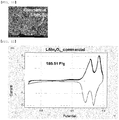
- FIG. 11 A photograph was taken by a SEM (scanning electron microscope) of a commercially available lithium manganese oxide (LiMn 2 O 4 , electrochemical grade, 482277 Aldrich, less than 5 micrometers), and is shown in FIG. 11 .
- a CV graph was determined by cyclic voltammetry (CV) and is shown in FIG. 12 .
- the specific capacitance measured by cyclic voltammetry was 185.51 F/g.
- LiMn 2 O 4 commercially available as electrochemical grade has a very large particle size of a few micrometers, and thus the specific surface area is small, thus exhibiting low specific capacitance of just 185.51 F/g.
Landscapes
- Chemical & Material Sciences (AREA)
- Engineering & Computer Science (AREA)
- Organic Chemistry (AREA)
- Inorganic Chemistry (AREA)
- Power Engineering (AREA)
- Chemical Kinetics & Catalysis (AREA)
- General Chemical & Material Sciences (AREA)
- Electrochemistry (AREA)
- Materials Engineering (AREA)
- Microelectronics & Electronic Packaging (AREA)
- Manufacturing & Machinery (AREA)
- Battery Electrode And Active Subsutance (AREA)
- Electric Double-Layer Capacitors Or The Like (AREA)
- Inorganic Compounds Of Heavy Metals (AREA)
Abstract
Description
- This application claims priority to and the benefit of Korean Patent Application No.
10-2017-0124428 filed on September 26, 2017 10-2018-0113045 filed on September 20, 2018 - The present invention relates to a method for preparing a lithium manganese oxide-based cathode active material for storage devices, and particularly, to a method for preparing a lithium manganese oxide-based cathode active material with excellent specific capacitance, having a high surface area with a small size, without the need for a heat treatment process for a long time under high temperature conditions.
- With a worldwide large increase in energy demand, of the demand for energy storage devices having large energy storage capacity and high output is on the rise.
- Particularly, recently, there has been an increasing need for energy storage devices having optimal energy density and output. Supercapcitors are being studied as energy storage devices having higher density than existing capacitors and having higher output than common lithium ion batteries. Supercapacitors may be simply classified into electrical double layer capacitors (EDLC) and pseudocapacitors according to their energy storage mechanism. Among them, a pseudocapacitor that stores energy through the oxidation/reduction reaction of metal ions using a metal oxide as an electrode material is known to have much better specific capacitance than a carbon-based supercapacitor. Further, since organic electrolyte-based lithium ion batteries have a risk of explosion by impact and heat, studies on aqueous lithium ion batteries using an aqueous electrolyte are being actively pursued.
- In order to prepare a high output high capacity electrode material, it is advantageous for the size of metal oxide used as electrode material to be reduced to increase the surface area to the largest extent possible. The surface area should be large so that the interface between electrolyte and electrode may widen and the oxidation/reduction reaction may smoothly occur. However, a metal oxide is difficult to directly apply for pseudocapacitors and batteries, because the particle size increases and the surface area decreases after a high temperature heat treatment processes, due to agglomeration of particles.
- Thus, studies on a method for synthesizing an electrode material having a small size and a wide surface area even after high temperature heat treatment, with minimized energy and time, and without a complicated synthesis process, are needed.
- It is an object of the present invention to provide a method for preparing a lithium manganese oxide-based cathode active material that has a small size and a large specific surface area, and excellent specific capacitance, by minimizing energy and time, without a heat treatment process performed for a long time under high temperature conditions.
- It is another object of the present invention to provide a lithium manganese oxide-based cathode active material prepared by the above-described method.
- According to one embodiment of the invention, a method for preparing a lithium manganese oxide-based cathode active material is provided, said method including the steps of: producing manganese oxide nanoparticles using manganese salts; and mixing the manganese oxide nanoparticles with lithium salts, and heat treating the mixture at 350 °C to 430 °C for 1 hour to 3.5 hours, and then heat treating at 650 °C to 750 °C for 2.5 hours to 8 hours.
- Meanwhile, according to another embodiment of the invention, a lithium manganese oxide-based cathode active material prepared by the above described method is provided.
- According to the present invention, by preparing a manganese oxide having a nanostructure first, and then mixing it with lithium salts and proceeding stepwise with a heat treatment under optimum conditions, the energy and time used to synthesize a lithium manganese oxide may be reduced. Moreover, the size and surface area of a lithium manganese oxide synthesized after heat treatment may be maintained small, and high specific capacitance may be realized.
-
-
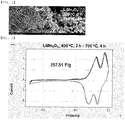
FIG. 1 shows SEM photographs taken at a magnification of 50000 times of the MnO2 and LiMn2O4 nanoparticles prepared according to Example 1 (left: MnO2, right: LiMn2O4). -
FIG. 2 is a CV graph determined by cyclic voltammetry, for the cathode electrode for a pseudocapacitor prepared using the cathode active material including the LiMn2O4 nanoparticles prepared according to Example 1 (x axis: potential, y axis: current, specific capacitance: 257.51 F/g) . -
FIG. 3 is a CV graph determined by cyclic voltammetry, for the cathode electrode for a pseudocapacitor prepared using the cathode active material including the LiMn2O4 nanoparticles prepared according to Comparative Example 1 (x axis: potential, y axis: current, specific capacitance: 242.61 F/g). -
FIG. 4 is a CV graph determined by cyclic voltammetry, for the cathode electrode for a pseudocapacitor prepared using the cathode active material including the LiMn2O4 nanoparticles prepared according to Comparative Example 2 (x axis: potential, y axis: current, specific capacitance: 234.51 F/g). -
FIG. 5 shows SEM photographs taken at magnification of times 50000 of the MnO2 and LiMn2O4 nanoparticles prepared according to Comparative Example 3 (left: MnO2, right: LiMn2O4). -
FIG. 6 is a CV graph determined by cyclic voltammetry, for the cathode electrode for a pseudocapacitor prepared using the cathode active material including the LiMn2O4 nanoparticles prepared according to Comparative Example 3 (x axis: potential, y axis: current, specific capacitance: 194.10 F/g). -
FIG. 7 shows SEM photographs taken at magnification of 50000 times of the MnO2 and LiMn2O4 nanoparticles prepared according to Comparative Example 4 (left: MnO2, right: LiMn2O4). -
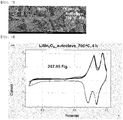
FIG. 8 is a CV graph determined by cyclic voltammetry, for the cathode electrode for a pseudocapacitor prepared using the cathode active material including the LiMn2O4 nanoparticles prepared according to Comparative Example 4 (x axis: potential, y axis: current, specific capacitance: 207.05 F/g). -
FIG. 9 is a CV graph determined by cyclic voltammetry, for the cathode electrode for pseudocapacitor prepared using the cathode active material including the LiMn2O4 nanoparticles prepared according to Comparative Example 5 (x axis: potential, y axis: current, specific capacitance: 191.92 F/g). -
FIG. 10 is a CV graph determined by cyclic voltammetry, for the cathode electrode for a pseudocapacitor prepared using the cathode active material including the LiMn2O4 nanoparticles prepared according to Comparative Example 6 (x axis: potential, y axis: current, specific capacitance: 211.79 F/g). -
FIG. 11 is the SEM photograph taken at magnification of 20000 times of commercially available LiMn2O4 particles according to Comparative Example 9. -
FIG. 12 is a CV graph determined by cyclic voltammetry, for the cathode electrode for a pseudocapacitor prepared using the cathode active material including commercially available LiMn2O4 particles according to Comparative Example 9 (x axis: potential, y axis: current, specific capacitance: 185.51 F/g). - As used herein, terms "first", "second", and the like are used to explain various constructional elements, and they are used only to distinguish one constructional element from other constructional elements.
- Further, the terms used herein are only to explain specific embodiments, and are not intended to limit the present invention. A singular expression includes a plural expression thereof, unless it is expressly stated or obvious from the context that such is not intended. As used herein, the terms "comprise", "equipped", "have", etc. are intended to designate the existence of practiced characteristic, number, step, constructional element, or combinations thereof, and they are not intended to preclude the possibility of existence or addition of one or more other characteristics, numbers, steps, constructional elements, or combinations thereof.
- Although various modifications can be made to the present invention and the present invention may have various forms, specific examples will be illustrated and explained in detail below. However, it should be understood that these are not intended to limit the present invention to a specific disclosure, and that the present invention includes all modifications, equivalents, or replacements thereof without departing from the spirit and technical scope of the invention.
- Hereinafter, the present invention will be explained in detail.
- According to one embodiment of the invention, a method for preparing a lithium manganese oxide-based cathode (positive electrode) active material is provided, said method including the steps of: producing manganese oxide nanoparticles using manganese salts; mixing the manganese oxide nanoparticles with lithium salts; heat treating the mixture at 350 °C to 430 °C for 1 hour to 3.5 hours; and then heat treating at 650 °C to 750 °C for 2.5 hours to 8 hours.
- The present invention is characterized in that a lithium manganese oxide-based cathode active material that can be used in the cathodes of lithium ion batteries and pseudocapacitors, which are energy storage devices having high energy density and output, is easily synthesized by a simple process without conducting a high temperature heat treatment process for a long time, by synthesizing a manganese oxide having a nanostructure first, and then mixing it with lithium salts and conducting stepwise heat treatment under optimized conditions.
- Previously, a lithium manganese oxide was mainly synthesized by directly mixing manganese salts and lithium salts by a dry or wet method, followed by high temperature heat treatment, but the heat treatment time for increasing the crystallinity of the lithium manganese oxide is too long, and the size of the lithium manganese oxide prepared thereby is as large, such as a few micrometers (µm) to tens of micrometers (µm), and the surface area is small, and thus it is not suitable for a pseudocapacitor that should yield high output instantaneously. Thus, in the present invention, by preparing a manganese oxide having a nanostructure first, and then mixing it with lithium salts, and proceeding with a stepwise heat treatment, energy and time used to synthesize the lithium manganese oxide can be saved. Moreover, the size and surface area of a lithium manganese oxide synthesized after heat treatment may be maintained small.
- First, in the present invention, a manganese salt as starting material for producing manganese oxide nanoparticles, may be one or more selected from the group consisting of: manganese sulfate, manganese acetate, manganese chloride, manganese nitrate, manganese carbonate, and hydrates or mixture thereof.
- According to a preferable embodiment of the invention, the step of producing manganese oxide nanoparticles may include reacting the manganese salt in the presence of an oxidizing agent, at about 50 °C or more, or about 50 °C to about 150 °C, or about 50 °C to about 100 °C. The reaction for producing the manganese oxide may be conducted in an aqueous solution state. Herein, a reaction time may vary according to reaction temperature and pressure conditions, and the reaction may be conducted for about 2 hours or more, or about 2 hours to about 72 hours. Further, since the step of producing manganese oxide nanoparticles does not require application of a high temperature and high pressure hydrothermal synthesis method using an autoclave and the like, the reaction may be conducted under a pressure condition of about 10 kg/cm2 or less, about 1 kg/cm2 to about 10 kg/cm2, about 1 kg/cm2 to about 3 kg/cm2, or under an atmospheric pressure condition. Particularly, manganese oxide nanoparticles may be produced through a flask reaction of the manganese salt with an oxidizing agent at a temperature of about 50 °C to 100 °C or about 60 °C to 90 °C in an aqueous solution state, rather than a high temperature hydrothermal synthesis reaction. Herein, the flask reaction may be conducted under an atmospheric pressure (about 1 atm) condition. For example, the manganese salt may be reacted with an oxidizing agent in an aqueous solution state, at about 50 °C to 100 °C, or about 60 °C to 90 °C, overnight for about 12 hours to 18 hours, about 12 hours to 36 hours, or about 12 hours to about 24 hours.
- Herein, one or more oxidizing agent is selected from the group consisting of potassium permanganate (KMnO4), ammonium persulfate, hydrogen peroxide, ferric chloride, and hydrates or mixtures thereof may be used. Among them, potassium permanganate may be used, in that the formation of the crystal phase of the lithium manganese oxide may be effectively achieved, when mixing manganese oxide nanoparticles and lithium salts to produce the lithium manganese oxide.
- The resulting manganese oxide nanoparticles may have an α or γ-MnO2 crystal structures and nanorod shapes. The number average length of the manganese oxide nanoparticles, measured with a SEM (scanning electron microscope), may be 200 nm to 2000 nm, or 200 nm to 1000 nm, or 200 nm to 500 nm. Further, the number average width of the manganese oxide nanoparticles may be 20 nm to 100 nm, 20 nm to 50 nm, or 20 nm to 30 nm.
- Commonly, manganese oxide nanoparticles grow in the shape of nanorods, nanowires, or nanoplanes in an aqueous solution state, and thus manganese oxide nanoparticles serve as a backbone when preparing lithium manganese oxide cathode active material, thereby preventing lithium manganese oxide from growing large to a size of a few micrometers. If manganese salts are mixed with lithium salts and heat treated, instead of manganese oxide nanoparticles, the lithium manganese oxide may not have a specific size and shape, and it may be formed with a size of a few micrometers. Particularly, the lithium manganese oxide exhibits charge and discharge properties by de-intercalation and intercalation, but the de-intercalation and intercalation of lithium ions are achieved only on the surface of the lithium manganese oxide. Thus, by making the lithium manganese oxide as small as possible to increase the specific surface area, specific capacitance may be maximized.
- In the present invention, the manganese oxide nanoparticles thus produced and lithium salts are mixed and subjected to stepwise heat treatment under predetermined conditions, thus preparing a lithium manganese oxide-based cathode active material.
- The lithium salts may be one or more selected from the group consisting of lithium hydroxide, lithium carbonate, lithium acetate, lithium chloride, lithium nitrate, and hydrates or mixtures thereof.
- The manganese oxide nanoparticles and lithium salts may be mixed at a mole ratio of 2.3:0.7 to 1.7:1.3 (Mn:Li) and reacted, and for example, the mole ratio may be 2.1:0.9 to 1.9:1.1, more specifically 2.05:0.95 to 1.95:1.05. Among the lithium manganese oxide, in order for LiMn2O4 to form a structurally stable composition, manganese oxide nanoparticles and lithium salts may be mixed at the above-explained mole ratio range and reacted. If the mole ratio of manganese oxide nanoparticles and lithium salts does not fall within the above range, in addition to the structure of LiMn2O4, non-reacted manganese oxide and a structure of Mn2O3 may be produced.
- After mixing manganese oxide nanoparticles and lithium salts as explained above, primary heat treatment may be conducted at 350 °C to 430 °C for 1 hour to 3.5 hours, the temperature of a sintering furnace may be continuously increased to 650 °C to 750 °C, and then secondary heat treatment may be conducted at 650 °C to 750 °C for 2.5 hours to 8 hours, thus synthesizing a lithium manganese oxide having a small particle size and a large surface area, and excellent specific capacitance.
- The primary heat treatment is conducted at a temperature of 350 °C or more, and then the manganese oxide-lithium salt mixture begins to be converted into a structure of LiMn2O4 at a temperature of 350 °C or more. More specifically, at a temperature of less than 350 °C, such conversion into the LiMn2O4 structure may not occur. Thereafter, if a temperature is increased to 650 °C or more, LiMn2O4 crystal seeds formed in the above-mentioned mixture may grow large, and the whole mixture may be converted into LiMn2O4. However, at a temperature of 750 °C or more, although the LiMn2O4 crystal seeds grow faster, a structure of Mn3O4 begins to grow, in addition to the LiMn2O4. Further, if primary heat treatment is conducted at a high temperature of greater than 430 °C, more LiMn2O4 crystal seeds may be generated than in the temperature range of 350 °C or more and 430 °C or less. However, if a temperature of 650 °C or more is applied later through the second heat treatment, finally, the LiMn2O4 crystal size may become smaller than in the mixture primarily heat-treated in the temperature range of 350 °C or more and 430 °C or less, and thus electrochemical performance may decrease compared to LiMn2O4 with a large crystal size. For example, the larger the size of a LiMn2O4 single crystal, the higher the crystallinity, and the higher the crystallinity, the better the electrochemical performance. To the contrary, in the case of a LiMn2O4 polycrystal including small gathered single crystals, since charge transfer resistance between the grain boundaries between the crystals is high, electrochemical performance is not good compared to a single crystal.
- Herein, the primary heat treatment process corresponds to a process for producing LiMn2O4 crystal seeds, and it may be conducted at 350 °C to 430 °C or 370 °C to 420 °C for 1 hour to 3.5 hours, or at 380 °C to 415 °C for 1.5 hours to 2.5 hours. Particularly, the temperature for the primary heat treatment process should be conducted at 350 °C or more so as to previously produce LiMn2O4 crystal seeds, and should be conducted at 430 °C or less so as to maintain the number of small LiMn2O4 crystal seeds. The temperature and time of the primary heat treatment process maintains a complementary relationship, and it is preferable that in the case where a low heat treatment temperature is applied, a long heat treatment time is applied, and in case where a high heat treatment temperature is applied, a short heat treatment time is applied. For example, in case the primary heat treatment process temperature is 350 °C to 390 °C, a heat treatment time of 2 hours to 3.5 hours may be applied. In addition, in case the primary heat treatment process temperature is 390 °C to 430 °C, a heat treatment time of 1 hour to 2 hours may be applied. However, the primary heat treatment process should be conducted for more than 1 hour so that the production of LiMn2O4 crystal seeds may begin, and should be conducted for 3.5 hours or less so as to maintain the number of small LiMn2O4 crystal seeds.
- After conducting the primary heat treatment process, the temperature of a sintering furnace may be raised to a high temperature to conduct a secondary heat treatment process. The secondary heat treatment process corresponds to a process for growing the LiMn2O4 crystal seeds produced in the primary heat treatment process, and it should be conducted at: 650 °C to 750 °C, or 660 °C to 740 °C, for 2.5 hours to 8 hours; 675 °C to 725 °C for 3 hours to 6 hours; or 680 °C to 715 °C for 3.5 hours to 5 hours. Particularly, the secondary heat treatment process should be conducted at 650 °C or more so as to rapidly grow the LiMn2O4 crystal seeds, and should be conducted at 750 °C or less so that Mn3O4 crystals may not be produced in addition to LiMn2O4. The temperature and time of the secondary heat treatment process maintain a complementary relationship, and it is preferable that in case where a low heat treatment temperature is applied, a long heat treatment time is applied, and in case where a high heat treatment temperature is applied, a short heat treatment time is applied. For example, in case the secondary heat treatment process temperature is 650 °C to 700 °C, the heat treatment time may be 4 hours to 8 hours. Further, in case the secondary heat treatment process temperature is 700 °C to 750 °C, the heat treatment time may be 2.5 hours to 4 hours. However, the secondary heat treatment should be conducted for 2.5 hours or more so that all the LiMn2O4 crystals may sufficiently grow, and should be conducted for 8 hours or less so that a LiMn2O4 nanorod shape may be maintained after all the LiMn2O4 crystals are grown. Particularly, if the secondary heat treatment process is conducted for too long, the LiMn2O4 nanoparticles may begin to agglomerate, and decrease the surface area.
- The heat treatment step may be conducted under an atmosphere containing oxygen or air. Particularly, it is preferable that the heat treatment process is conducted under an oxygen-containing condition, so that a mixture of manganese oxide nanoparticles and lithium salts react properly to effectively produce the lithium manganese oxide during the heat treatment, and the manganese oxide nanoparticles may not be reduced to MnO with disappearance of the nanostructures.
- For a specific preparation method of the lithium manganese oxide-based cathode active material, examples described below may be referred to. However, a method of preparing lithium manganese oxide-based cathode active material is not limited to the description of the specification, the preparation method may further adopt steps commonly used in the art, and the step(s) of the preparation method may be modified by commonly modifiable step (s) .
- Meanwhile, according to another embodiment of the invention, a lithium manganese oxide-based cathode active material prepared by the above-explained method is provided.
- The lithium manganese oxide-based cathode active material may be represented by the following
Chemical Formula 1, and for example, it may be LiMn2O4, Li1.05Mn1.95O4, Li1.12Mn1.88O4, Li1.24Mn1.76O4, and the like.
[Chemical Formula 1] LixMnyOz
- In
Chemical Formula 1,
x is a real number in a range of 0.7 to 1.3, or 0.85 to 1.15,
y is a real number in a range of 1.7 to 2.3, or 1.85 to 2.15, and
z may be determined according to the oxidation numbers of x and y, and for example, it is an integer of 1 to 4, preferably 4. - Particularly, as explained above, by synthesizing manganese oxide nanoparticles and then mixing them with lithium salts and conducting stepwise heat treatment processes under optimized conditions, the lithium manganese oxide-based cathode active material according to the present invention has nanoparticle and rod structures having a relatively large specific surface area, instead of an amorphous structure of a few micrometers having a small specific surface area, previously obtained by mixing manganese salts and lithium salts and then conducting a heat treatment process. More specifically, such structural characteristics may maximize the intercalation and de-intercalation of lithium ions due to a small size of nanometers and a large surface area.
- For example, the lithium manganese oxide-based cathode active material may have a surface area measured by BET, of 5 m2/g to 30 m2/g, preferably 15 m2/g or more or 15 m2/g to 30 m2/g.
- The lithium manganese oxide-based cathode active material may have nanoparticle and rod shapes, and the number average length measured by a SEM (scanning electron microscope) may be 100 nm to 500 nm, preferably 100 nm to 300 nm, and more preferably 100 to 200 nm. The number average width may be 20 nm to 200 nm, preferably 20 nm to 100 nm, and more preferably 20 nm to 50 nm. Particularly, since the intercalation and de-intercalation of lithium occur on the surface, and then the lithium ions are diffused inside, as the number average width rather than the number average length is smaller, lithium ions may be more easily diffused inside of the lithium manganese oxide, and specific capacitance may be higher.
- In order to measure the electrical properties of the lithium manganese oxide-based cathode active material according to one embodiment of the present invention, a solution in which a cathode active material, acetylene black as a conductive material for transferring a current, and polyvinylidene fluoride as a binder for fixing particles are mixed at weight ratio of 7:2:1 in NMP (N-methyl-2-pyrrolidone) may be coated on a carbon electrode and dried, and then specific capacitance may be measured by cyclic voltammetry. Herein, the specific capacitance of a test ink using a lithium manganese oxide-based cathode active material, measured by cyclic voltammetry, may be 243 F/g or more, or 243 F/g to 300 F/g, preferably 245 F/g or more, or 245 F/g to 300 F/g in a 1 M lithium sulfate (Li2SO4) electrolyte. Particularly, when calculating only based on active material, it may be 286 F/g or more, or 286 F/g to 429 F/g.
- In the present invention, since particulars other than those described above may be adjusted as necessary, they are not specifically limited.
- Hereinafter, preferable examples are presented for better understanding of the present invention. However, these examples are presented only as illustrations of the present invention, and the scope of the present invention is not limited thereby.
- MnO2 particles in the shape of nanorods were prepared through a flask reaction as follows.
- First, 10 mmol of MnSO4 · H2O and 10 mmol of KMnO4 were mixed with 100 mL of water to prepare an aqueous solution, and then the solution was stirred at room temperature and atmospheric pressure for about 30 minutes. Thereafter, while stirring the mixed aqueous solution under atmospheric pressure and a temperature of about 80 °C overnight (for about 12 hours to 18 hours), a thermal reaction was conducted to produce MnO2 nanoparticles in the shape of nanorods having a number average width of about 30 nm and a number average length of about 500 nm.
- The MnO2 nanoparticles synthesized in step 1-1 and LiOH·H2O were mixed with ethanol at a mole ratio of 2:1, and then ethanol was evaporated to obtain a homogeneous MnO2-LiOH·H2O mixed powder. The obtained MnO2-LiOH·H2O mixed powder was heat-treated under an air atmosphere at about 400 °C for about 2 hours, and then the temperature was raised to about 700 °C, and additional heat treatment was conducted for about 4 hours to obtain LiMn2O4 nanoparticles maintaining nanorod shapes with a number average width of about 50 nm and a number average length of about 300 nm.
- For the MnO2 nanoparticles produced in step 1-1 and the LiMn2O4 nanoparticles produced in step 1-2, photographs were taken with a SEM (scanning electron microscope) and are shown in
FIG. 1 (left: MnO2 nanoparticles, right: LiMn2O4 nanoparticles). Particularly, it can be confirmed that as MnO2 is converted into LiMn2O4, although the nanorods become shorter and thicker, the nanostructure is maintained. - Further, the produced LiMn2O4 nanoparticles were mixed with acetylene black as a conductive material for transferring a current and polyvinylidene fluoride as a binder for fixing particles at a weight ratio of 7:2:1 in NMP (N-methyl-2-pyrrolidone), and the solution was coated on a carbon electrode and dried to prepare a cathode electrode for a pseudocapacitor. For the cathode electrode for a pseudocapacitor prepared using LiMn2O4 nanoparticles, a CV graph was determined by cyclic voltammetry (CV) and is shown in
FIG. 2 . Herein, the specific capacitance measured by cyclic voltammetry was as high as 257.51 F/g. - LiMn2O4 nanoparticles in the shape of somewhat blunt nanorods having a number average width of about 50 nm and a number average length of about 400 nm were prepared by the same method as Example 1, except that MnSO4·H2O was modified to manganese acetate to prepare MnO2 nanoparticles in step 1-1 of Example 1.
- For a cathode electrode for a pseudocapacitor prepared using a lithium manganese oxide-based cathode active material including the produced LiMn2O4 nanoparticles, specific capacitance measured by cyclic voltammetry was confirmed to be 253.45 F/g.
- LiMn2O4 nanoparticles in the shape of nanorods having a number average width of about 30 nm and a number average length of about 500 nm were prepared by the same method as Example 1, except that KMnO4 was modified to ammonium persulfate to prepare MnO2 nanoparticles in step 1-1 of Example 1.
- For a cathode electrode for a pseudocapacitor prepared using a lithium manganese oxide-based cathode active material including the produced LiMn2O4 nanoparticles, specific capacitance measured by cyclic voltammetry was confirmed to be 245.76 F/g.
- LiMn2O4 nanoparticles maintaining a nanorod shape with a number average width of about 30 nm and a number average length of about 500 nm were prepared by the same method as Example 1, except that the synthesis temperature was modified to 100 °C to prepare MnO2 nanoparticles in step 1-1 of Example 1.
- For a cathode electrode for a pseudocapacitor prepared using a lithium manganese oxide-based cathode active material including the produced LiMn2O4 nanoparticles, specific capacitance measured by cyclic voltammetry was confirmed to be 247.92 F/g.
- LiMn2O4 nanoparticles maintaining a nanorod shape with a number average width of about 30 nm and a number average length of about 500 nm were prepared by the same method as Example 1, except that the synthesis time was modified to 36 hours to prepare MnO2 nanoparticles in step 1-1 of Example 1.
- For a cathode electrode for a pseudocapacitor prepared using a lithium manganese oxide-based cathode active material including the produced LiMn2O4 nanoparticles, specific capacitance measured by cyclic voltammetry was confirmed to be 248.24 F/g.
- LiMn2O4 nanoparticles maintaining a nanorod shape with a number average width of about 50 nm and a number average length of about 300 nm were prepared by the same method as Example 1, except that MnO2 nanoparticles and LiOH·H2O were mixed at a mole ratio of 2.1:1.9, and then a heat treatment process was conducted in step 1-2 of Example 1.
- For a cathode electrode for a pseudocapacitor prepared using a lithium manganese oxide-based cathode active material including the produced LiMn2O4 nanoparticles, specific capacitance measured by cyclic voltammetry was confirmed to be 256.72 F/g.
- LiMn2O4 nanoparticles maintaining a nanorod shape with a number average width of about 60 nm and a number average length of about 300 nm were prepared by the same method as Example 1, except that MnO2-LiOH·H2O mixed powder was heat treated under an air atmosphere at about 430 °C for 2 hours, and then the temperature was raised to about 750 °C and additional heat treatment was conducted for about 4 hours in step 1-2 of Example 1.
- For a cathode electrode for a pseudocapacitor prepared using a lithium manganese oxide-based cathode active material including the produced LiMn2O4 nanoparticles, specific capacitance measured by cyclic voltammetry was confirmed to be 256.12 F/g.
- LiMn2O4 nanoparticles maintaining a nanorod shape with a number average width of about 40 nm and a number average length of about 400 nm were prepared by the same method as Example 1, except that a MnO2-LiOH·H2O mixed powder was heat treated under an air atmosphere at about 400 °C for 1 hour, and then the temperature was raised to about 700 °C and additional heat treatment was conducted for about 2.5 hours in step 1-2 of Example 1.
- For a cathode electrode for a pseudocapacitor prepared using a lithium manganese oxide-based cathode active material including the produced LiMn2O4 nanoparticles, specific capacitance measured by cyclic voltammetry was confirmed to be 251.35 F/g.
- LiMn2O4 nanoparticles maintaining a nanorod shape with a number average width of about 50 nm and a number average length of about 300 nm were prepared by the same method as Example 1, except that a MnO2-LiOH·H2O mixed powder was heat treated under an air atmosphere at about 350 °C for about 3.5 hours, and then the temperature was raised to about 700 °C and additional heat treatment was conducted for about 4 hours in step 1-2 of Example 1.
- For a cathode electrode for a pseudocapacitor prepared using a lithium manganese oxide-based cathode active material including the produced LiMn2O4 nanoparticles, specific capacitance measured by cyclic voltammetry was confirmed to be 253.35 F/g.
- LiMn2O4 nanoparticles maintaining a nanorod shape with a number average width of about 40 nm and a number average length of about 500 nm were prepared by the same method as Example 1, except that a MnO2-LiOH·H2O mixed powder was heat treated under an air atmosphere at about 400 °C for about 2 hours, and then the temperature was raised to about 650 °C and additional heat treatment was conducted for about 8 hours in step 1-2 of Example 1.
- For a cathode electrode for a pseudocapacitor prepared using a lithium manganese oxide-based cathode active material including the produced LiMn2O4 nanoparticles, specific capacitance measured by cyclic voltammetry was confirmed to be 251.07 F/g.
- LiMn2O4 nanoparticles in the shape of nanorods with a number average width of about 30 nm and a number average length of about 500 nm were prepared by the same method as Example 1, except that a MnO2-LiOH·H2O mixed powder was heat treated under an air atmosphere at about 400 °C for about 2 hours, and then the temperature was raised to about 700 °C and additional heat treatment was conducted for a reduced time of about 2 hours in step 1-2 of Example 1.
- For a cathode electrode for a pseudocapacitor prepared using a lithium manganese oxide-based cathode active material including the produced LiMn2O4 nanoparticles, a CV graph was determined by cyclic voltammetry (CV) and is shown in
FIG. 3 . Herein, the specific capacitance measured by cyclic voltammetry was confirmed to be 242.61 F/g. Particularly, it can be seen that in the case of Comparative Example 1, since the crystallinity of LiMn2O4 nanoparticles is not good, specific capacitance is remarkably lowered, compared to Example 1 using the same reactants MnSO4·H2O and KMnO4 . - LiMn2O4 nanoparticles in the shape of nanorods with a number average width of about 30 nm and a number average length of about 500 nm were prepared by the same method as Example 1, except that a MnO2-LiOH·H2O mixed powder was heat treated under an air atmosphere at about 400 °C for a prolonged time of about 4 hours, and then the temperature was raised to about 700 °C and additional heat treatment was conducted for about 4 hours in step 1-2 of Example 1.
- For a cathode electrode for a pseudocapacitor prepared using a lithium manganese oxide-based cathode active material including the produced LiMn2O4 nanoparticles, a CV graph was determined by cyclic voltammetry (CV) and is shown in
FIG. 4 . Herein, the specific capacitance measured by cyclic voltammetry was confirmed to be 234.51 F/g. Particularly, it can be seen that in the case of Comparative Example 2, although the heat treatment time at 400 °C was prolonged to 4 hours, on the contrary, specific capacitance was remarkably lowered, compared to Example 1 using the same reactants MnSO4·H2O and KMnO4. - LiMn2O4 nanoparticles in the shape of nanorods with a number average width of about 30 nm and a number average length of about 500 nm were prepared by the same method as Example 1, except that a MnO2-LiOH·H2O mixed powder was directly heat treated at about 700 °C for about 4 hours without heat treatment under an air atmosphere at about 400 °C in step 1-2 of Example 1.
- For the produced MnO2 nanoparticles and LiMn2O4 nanoparticles, photographs were taken with a SEM (scanning electron microscope) and are shown in
FIG. 5 (left: MnO2 nanoparticles, right: LiMn2O4 nanoparticles). For a cathode electrode for a pseudocapacitor prepared using a lithium manganese oxide-based cathode active material including the produced LiMn2O4 nanoparticles, a CV graph was determined by cyclic voltammetry (CV) and is shown inFIG. 6 . Herein, the specific capacitance measured by cyclic voltammetry was confirmed to be 194.10 F/g. Particularly, it was confirmed that the particle shapes of MnO2 and LiMn2O4 prepared according to Comparative Example 3 are not significantly different from the MnO2 and LiMn2O4 prepared according to Example 1, but the specific capacitance is remarkably lowered. - MnO2 particles in the shape of nanorods were prepared by the following hydrothermal synthesis method.
- First, 10 mmol MnSO4·H2O, and 10 mmol KMnO4 were mixed with 100 mL of water to prepare an aqueous solution, and then the solution was stirred at room temperature and atmospheric pressure for about 30 minutes. Thereafter, the mixed aqueous solution was put into an autoclave operated under an internal pressure of about 3.8 bar, and a hydrothermal synthesis process of high temperature and high pressure was conducted under an internal temperature of about 160 °C for about 6 hours to produce MnO2 nanoparticles in the shape of nanorods having a number average width of about 40 nm and a number average length of about 700 nm.
- The MnO2 nanoparticles synthesized by hydrothermal synthesis in step 4-1 and LiOH·H2O were mixed with ethanol at a mole ratio of 2:1, and then ethanol was evaporated to obtain a homogeneous MnO2-LiOH·H2O mixed powder. The obtained MnO2-LiOH·H2O mixed powder was directly heat-treated at about 700 °C for about 4 hours without heat treatment under an air atmosphere at about 400 °C, thus preparing LiMn2O4 nanoparticles maintaining nanorod shapes with a number average width of about 70 nm and a number average length of about 400 nm.
- For the MnO2 nanoparticles produced by the hydrothermal synthesis method in step 4-1 and the LiMn2O4 nanoparticles produced in step 4-2, photographs were taken by a SEM (scanning electron microscope) and are shown in
FIG. 7 (left: MnO2 nanoparticles, right: LiMn2O4 nanoparticles). For a cathode electrode for a pseudocapacitor prepared using a lithium manganese oxide-based cathode active material including the produced LiMn2O4 nanoparticles, a CV graph was determined by cyclic voltammetry (CV) and is shown inFIG. 8 . Herein, the specific capacitance measured by cyclic voltammetry was confirmed to be 207.05 F/g. - Particularly, in the case of Comparative Example 4, the process cost is increased due to the synthesis of MnO2 by a hydrothermal synthesis method, and since the produced MnO2 nanoparticles are larger than those produced by the flask reaction, the size of LiMn2O4 nanoparticles produced by mixing them with lithium salts and heat treating also increases. Therefore, based on the same mass, the surface area of lithium manganese oxide nanoparticles produced according to Comparative Example 4 become smaller than that of the nanoparticles produced according to Example 1 wherein a hydrothermal synthesis method is not applied. Thus, in case lithium manganese oxide nanoparticles produced according to Comparative Example 4 are used, the specific capacitance is remarkably lowered compared to that used the nanoparticles of Example 1.
- LiMn2O4 nanoparticles in the shape of nanorods with a number average width of about 30 nm and a number average length of about 500 nm were prepared by the same method as Example 1, except that a MnO2-LiOH·H2O mixed powder was heat treated under an air atmosphere at about 400 °C for about 2 hours, and then the temperature was raised to about 500 °C and additional heat treatment was conducted for about 4 hours in step 1-2 of Example 1.
- For a cathode electrode for a pseudocapacitor prepared using a lithium manganese oxide-based cathode active material including the produced LiMn2O4 nanoparticles, a CV graph was determined by cyclic voltammetry (CV) and is shown in
FIG. 9 . Herein, the specific capacitance measured by cyclic voltammetry was confirmed to be 191.92 F/g. - LiMn2O4 nanoparticles in the shape of nanorods with a number average width of about 30 nm and a number average length of about 500 nm were prepared by the same method as Example 1, except that a MnO2-LiOH·H2O mixed powder was heat treated under an air atmosphere at about 400 °C for about 2 hours, and then the temperature was raised to about 800 °C and additional heat treatment was conducted for a reduced time of about 4 hours in step 1-2 of Example 1.
- For a cathode electrode for a pseudocapacitor prepared using a lithium manganese oxide-based cathode active material including the produced LiMn2O4 nanoparticles, a CV graph was determined by cyclic voltammetry (CV) and is shown in
FIG. 10 . Herein, the specific capacitance measured by cyclic voltammetry was confirmed to be 211.79 F/g. - LiMn2O4 nanoparticles maintaining a nanorod shape with a number average width of about 70 nm and a number average length of about 200 nm were prepared by the same method as Example 1, except that a MnO2-LiOH·H2O mixed powder was heat treated under an air atmosphere at about 300 °C for about 4 hours, and then the temperature was raised to about 750 °C and additional heat treatment was conducted for a reduced time of about 24 hours in step 1-2 of Example 1.
- For a cathode electrode for a pseudocapacitor prepared using lithium manganese oxide-based cathode active material including the produced LiMn2O4 nanoparticles, the specific capacitance measured by cyclic voltammetry was confirmed to be 201.45 F/g.
- Manganese salt MnSO4·H2O and lithium salt Li2CO3 were mixed at a mole ratio of 2:1 without conducting step 1-1 of Example 1, and then heat treated under an air atmosphere at about 750 °C for about 10 hours, thus preparing LiMn2O4 particles having a size of about 1 micrometers to 5 micrometers.
- For a cathode electrode for a pseudocapacitor prepared using lithium manganese oxide-based cathode active material including the produced LiMn2O4 nanoparticles, the specific capacitance measured by cyclic voltammetry was remarkably lowered to about 193.42 F/g.
- A photograph was taken by a SEM (scanning electron microscope) of a commercially available lithium manganese oxide (LiMn2O4, electrochemical grade, 482277 Aldrich, less than 5 micrometers), and is shown in
FIG. 11 . For a cathode electrode for a pseudocapacitor prepared using the lithium manganese oxide, a CV graph was determined by cyclic voltammetry (CV) and is shown inFIG. 12 . Herein, the specific capacitance measured by cyclic voltammetry was 185.51 F/g. Particularly, it can be seen that even LiMn2O4 commercially available as electrochemical grade has a very large particle size of a few micrometers, and thus the specific surface area is small, thus exhibiting low specific capacitance of just 185.51 F/g.
Claims (13)
- A method for preparing a lithium manganese oxide-based cathode active material, comprising the steps of:producing manganese oxide nanoparticles using manganese salts; andmixing the manganese oxide nanoparticles with lithium salts and heat treating the mixture at 350 °C to 430 °C for 1 hour to 3.5 hours, and then heat treating the mixture at 650 °C to 750 °C for 2.5 hours to 8 hours.
- The method for preparing lithium manganese oxide-based cathode active material according to Claim 1,
wherein the manganese salt is one or more selected from the group consisting of manganese sulfate, manganese acetate, manganese chloride, manganese nitrate, manganese carbonate, and hydrates or mixtures thereof. - The method for preparing a lithium manganese oxide-based cathode active material according to Claim 1,
wherein in the step of producing manganese oxide nanoparticles, the manganese salts are reacted in the presence of an oxidizing agent, under conditions of 50 °C or more and 10 kg/cm2 or less. - The method for preparing a lithium manganese oxide-based cathode active material according to Claim 3,
wherein the oxidizing agent is one or more selected from the group consisting of potassium permanganate, aluminum persulfate, hydrogen peroxide, ferric chloride, and a hydrate or a mixture thereof. - The method for preparing a lithium manganese oxide-based cathode active material according to Claim 1,
wherein the manganese oxide nanoparticles have nanorod shapes. - The method for preparing a lithium manganese oxide-based cathode active material according to Claim 1,
wherein the manganese oxide nanoparticles have a number average length of 200 nm to 2000 nm, and a number average width of 20 nm to 100 nm. - The method for preparing a lithium manganese oxide-based cathode active material according to Claim 1,
wherein the manganese oxide nanoparticles and lithium salts are mixed at a mole ratio of 2.3:0.7 to 1.7:1.3 and reacted. - The method for preparing a lithium manganese oxide-based cathode active material according to Claim 1,
wherein the step of heat treating is conducted under an atmosphere containing oxygen or air. - The method for preparing a lithium manganese oxide-based cathode active material according to Claim 1,
wherein the step of heat treating is conducted by mixing the manganese oxide nanoparticles and lithium salts and heat treating the mixture at 380 °C to 415 °C for 1.5 hours to 2.5 hours, and then heat treating at 675 °C to 725 °C for 3 hours to 6 hours. - A lithium manganese oxide-based cathode active material prepared by the method according to any one of claims 1 to 9.
- The lithium manganese oxide-based cathode active material according to Claim 10,
wherein the cathode active material has a shape of a nanorod. - The lithium manganese oxide-based cathode active material according to Claim 10,
wherein a number average length is 200 nm to 2000 nm, and a number average width is 20 nm to 100 nm. - The lithium manganese oxide-based cathode active material according to Claim 10,
wherein specific capacitance measured by cyclic voltammetry in a 1 M Li2SO4 electrolyte is 243 F/g or more.
Applications Claiming Priority (3)
| Application Number | Priority Date | Filing Date | Title |
|---|---|---|---|
| KR20170124428 | 2017-09-26 | ||
| KR1020180113045A KR20190035547A (en) | 2017-09-26 | 2018-09-20 | Process for preparing lithium manganese oxide based cathode active material |
| PCT/KR2018/011262 WO2019066415A1 (en) | 2017-09-26 | 2018-09-21 | Method for producing lithium manganese oxide-based positive electrode active material |
Publications (3)
| Publication Number | Publication Date |
|---|---|
| EP3666733A1 true EP3666733A1 (en) | 2020-06-17 |
| EP3666733A4 EP3666733A4 (en) | 2020-12-02 |
| EP3666733B1 EP3666733B1 (en) | 2024-02-28 |
Family
ID=66165772
Family Applications (1)
| Application Number | Title | Priority Date | Filing Date |
|---|---|---|---|
| EP18862376.3A Active EP3666733B1 (en) | 2017-09-26 | 2018-09-21 | Method for producing lithium manganese oxide-based positive electrode active material |
Country Status (7)
| Country | Link |
|---|---|
| US (1) | US11522182B2 (en) |
| EP (1) | EP3666733B1 (en) |
| JP (1) | JP7062159B2 (en) |
| KR (1) | KR20190035547A (en) |
| CN (1) | CN111094187A (en) |
| ES (1) | ES2976191T3 (en) |
| HU (1) | HUE066334T2 (en) |
Family Cites Families (17)
| Publication number | Priority date | Publication date | Assignee | Title |
|---|---|---|---|---|
| JP3929548B2 (en) | 1997-04-21 | 2007-06-13 | ソニー株式会社 | Method for producing non-aqueous electrolyte secondary battery |
| EP1113993B1 (en) * | 1998-08-13 | 2004-03-10 | E.I. Du Pont De Nemours And Company | Method for producing lithium manganese oxide intercalation compounds and compounds produced thereby |
| JP2000072443A (en) | 1998-08-26 | 2000-03-07 | Ube Ind Ltd | Method for producing lithium manganese composite oxide and use thereof |
| KR20010056566A (en) | 1999-12-15 | 2001-07-04 | 성재갑 | Method for preparing lithium manganese oxide for lithium cell and battery |
| CN100371256C (en) | 2006-01-26 | 2008-02-27 | 合肥工业大学 | A kind of synthetic method of series nano lithium manganese oxides for lithium ion battery |
| KR100999109B1 (en) * | 2008-06-05 | 2010-12-07 | 한양대학교 산학협력단 | Cathode active material for lithium secondary battery, manufacturing method thereof, and lithium secondary battery comprising same |
| KR101092400B1 (en) | 2009-03-26 | 2011-12-09 | 한국과학기술원 | Method For Preparing Lithium manganese oxide And Lithium manganese metal oxide With Spinel And Nanostructure |
| KR101170095B1 (en) * | 2010-02-18 | 2012-07-31 | 한국과학기술원 | Method for synthesizing nanostructured gamma manganese oxide at atmospheric pressure and low temperature and spinel lithium manganese oxide thereof |
| KR101262857B1 (en) | 2011-01-04 | 2013-05-09 | 국립대학법인 울산과학기술대학교 산학협력단 | Single-step production method for nano-structured manganese oxide |
| KR101395361B1 (en) | 2011-05-02 | 2014-05-14 | 삼성코닝정밀소재 주식회사 | Method of producing Manganese Oxide nano-wire |
| US10319537B2 (en) * | 2011-08-15 | 2019-06-11 | Purdue Research Foundation | Modified graphitic electrodes for electrochemical energy storage enhancement |
| JP2015084303A (en) | 2013-10-25 | 2015-04-30 | 三星エスディアイ株式会社Samsung SDI Co.,Ltd. | Rechargeable lithium ion battery |
| CN103594703B (en) * | 2013-11-28 | 2015-11-18 | 福建师范大学 | Mix the preparation method of the spinel lithium-rich lithium manganate cathode material of bivalent cation |
| EP3207581B1 (en) * | 2014-10-13 | 2020-07-01 | Research Foundation Of The City University Of New York | Mixed material cathode for secondary alkaline batteries |
| CN105692703B (en) * | 2014-11-24 | 2017-09-08 | 苏州世名科技股份有限公司 | Lithium-rich manganese-based anode material and preparation method thereof and lithium ion battery |
| EP3162764B1 (en) | 2015-11-02 | 2018-04-04 | IMEC vzw | Methods for forming lithium manganese oxide layers |
| CN106252594B (en) | 2016-09-05 | 2018-12-07 | 哈尔滨工业大学 | A kind of ball-shaped lithium-ion battery anode material and its synthetic method with nanoscale two-phase coexistent structure |
-
2018
- 2018-09-20 KR KR1020180113045A patent/KR20190035547A/en not_active Ceased
- 2018-09-21 EP EP18862376.3A patent/EP3666733B1/en active Active
- 2018-09-21 CN CN201880057431.8A patent/CN111094187A/en active Pending
- 2018-09-21 ES ES18862376T patent/ES2976191T3/en active Active
- 2018-09-21 JP JP2020514696A patent/JP7062159B2/en active Active
- 2018-09-21 HU HUE18862376A patent/HUE066334T2/en unknown
- 2018-09-21 US US16/646,880 patent/US11522182B2/en active Active
Also Published As
| Publication number | Publication date |
|---|---|
| HUE066334T2 (en) | 2024-07-28 |
| KR20190035547A (en) | 2019-04-03 |
| EP3666733B1 (en) | 2024-02-28 |
| ES2976191T3 (en) | 2024-07-26 |
| EP3666733A4 (en) | 2020-12-02 |
| US11522182B2 (en) | 2022-12-06 |
| CN111094187A (en) | 2020-05-01 |
| US20200280066A1 (en) | 2020-09-03 |
| JP2020533799A (en) | 2020-11-19 |
| JP7062159B2 (en) | 2022-05-06 |
Similar Documents
| Publication | Publication Date | Title |
|---|---|---|
| JP4211865B2 (en) | Li-Ni composite oxide particle powder for non-aqueous electrolyte secondary battery, method for producing the same, and non-aqueous electrolyte secondary battery | |
| JP4574877B2 (en) | Positive electrode active material for lithium secondary battery and method for producing the same | |
| JP5081731B2 (en) | The manufacturing method of the raw material for positive electrode active materials for lithium secondary batteries. | |
| CN108336331B (en) | Electrode active material, lithium secondary battery comprising the same, and method for preparing the same | |
| US9620783B2 (en) | Mesoporous metal oxide microsphere electrode compositions and their methods of making | |
| KR102829144B1 (en) | Lithium manganese oxide-based positive electrode active material and method for preparing the same | |
| KR101981654B1 (en) | Negative electrode active material for rechargable battery, method for manufacturing the same, and rechargable battery including the same | |
| JPH11317230A (en) | Positive active material for lithium secondary battery and method for producing the same | |
| KR101751787B1 (en) | Anodes active material containing Si composite for lithium secondary batteries and its preparation method and lithium secondary batteries comprising the same | |
| WO2005112152A1 (en) | Method for producing lithium-containing complex oxide for positive electrode of lithium secondary battery | |
| JP2004292264A (en) | Trimanganese tetroxide particle, its production method, nonaqueous electrolyte secondary battery, positive electrode active substance therefor and its preparation method | |
| KR20120123897A (en) | Manganese Oxide nano-wire, Rechargeable Battery including the same and Method of producing Manganese Oxide | |
| JP2012030989A (en) | Titanium dioxide, method of manufacturing the same, electrode for lithium ion battery using the same, and lithium ion battery | |
| KR101604003B1 (en) | Anodes active material containing Si composite for lithium secondary batteries and its preparation method and lithium secondary batteries comprising the same | |
| US20150243975A1 (en) | Manufacturing method for electrode material, electrode material, and electric storage device provided with the electrode material | |
| KR100490613B1 (en) | A positive active material for a lithium secondary battery and a method of preparing the same | |
| JP4927369B2 (en) | Method for producing lithium-containing composite oxide for positive electrode of lithium secondary battery | |
| KR101661896B1 (en) | Positive active material for lithium secondary battery, method of preparing same and a lithium secondary battery comprising the same | |
| Ponnusamy et al. | Transition Metal Oxide‐Based Nanomaterials for Lithium‐Ion Battery Applications: Synthesis, Properties, and Prospects | |
| KR101170095B1 (en) | Method for synthesizing nanostructured gamma manganese oxide at atmospheric pressure and low temperature and spinel lithium manganese oxide thereof | |
| EP3666733B1 (en) | Method for producing lithium manganese oxide-based positive electrode active material | |
| JP4553095B2 (en) | Cobalt oxide particle powder and production method thereof, positive electrode active material for non-aqueous electrolyte secondary battery, production method thereof, and non-aqueous electrolyte secondary battery | |
| CN104603995B (en) | Method for producing composite material of metal oxide and conductive carbon | |
| KR20210021730A (en) | Method for preparing lithium manganese oxide based positive electrode active material | |
| WO2019066415A1 (en) | Method for producing lithium manganese oxide-based positive electrode active material |
Legal Events
| Date | Code | Title | Description |
|---|---|---|---|
| STAA | Information on the status of an ep patent application or granted ep patent |
Free format text: STATUS: THE INTERNATIONAL PUBLICATION HAS BEEN MADE |
|
| PUAI | Public reference made under article 153(3) epc to a published international application that has entered the european phase |
Free format text: ORIGINAL CODE: 0009012 |
|
| STAA | Information on the status of an ep patent application or granted ep patent |
Free format text: STATUS: REQUEST FOR EXAMINATION WAS MADE |
|
| 17P | Request for examination filed |
Effective date: 20200309 |
|
| AK | Designated contracting states |
Kind code of ref document: A1 Designated state(s): AL AT BE BG CH CY CZ DE DK EE ES FI FR GB GR HR HU IE IS IT LI LT LU LV MC MK MT NL NO PL PT RO RS SE SI SK SM TR |
|
| AX | Request for extension of the european patent |
Extension state: BA ME |
|
| A4 | Supplementary search report drawn up and despatched |
Effective date: 20201030 |
|
| RIC1 | Information provided on ipc code assigned before grant |
Ipc: C01G 45/02 20060101ALI20201026BHEP Ipc: H01M 4/505 20100101ALI20201026BHEP Ipc: C01G 45/12 20060101AFI20201026BHEP |
|
| DAV | Request for validation of the european patent (deleted) | ||
| DAX | Request for extension of the european patent (deleted) | ||
| RAP1 | Party data changed (applicant data changed or rights of an application transferred) |
Owner name: LG ENERGY SOLUTION LTD. |
|
| RAP3 | Party data changed (applicant data changed or rights of an application transferred) |
Owner name: LG ENERGY SOLUTION, LTD. |
|
| GRAP | Despatch of communication of intention to grant a patent |
Free format text: ORIGINAL CODE: EPIDOSNIGR1 |
|
| STAA | Information on the status of an ep patent application or granted ep patent |
Free format text: STATUS: GRANT OF PATENT IS INTENDED |
|
| RIC1 | Information provided on ipc code assigned before grant |
Ipc: H01M 4/505 20100101ALI20231011BHEP Ipc: C01G 45/02 20060101ALI20231011BHEP Ipc: C01G 45/12 20060101AFI20231011BHEP |
|
| INTG | Intention to grant announced |
Effective date: 20231027 |
|
| GRAS | Grant fee paid |
Free format text: ORIGINAL CODE: EPIDOSNIGR3 |
|
| GRAA | (expected) grant |
Free format text: ORIGINAL CODE: 0009210 |
|
| STAA | Information on the status of an ep patent application or granted ep patent |
Free format text: STATUS: THE PATENT HAS BEEN GRANTED |
|
| AK | Designated contracting states |
Kind code of ref document: B1 Designated state(s): AL AT BE BG CH CY CZ DE DK EE ES FI FR GB GR HR HU IE IS IT LI LT LU LV MC MK MT NL NO PL PT RO RS SE SI SK SM TR |
|
| P01 | Opt-out of the competence of the unified patent court (upc) registered |
Effective date: 20240119 |
|
| REG | Reference to a national code |
Ref country code: GB Ref legal event code: FG4D |
|
| REG | Reference to a national code |
Ref country code: CH Ref legal event code: EP |
|
| REG | Reference to a national code |
Ref country code: DE Ref legal event code: R096 Ref document number: 602018065992 Country of ref document: DE |
|
| REG | Reference to a national code |
Ref country code: IE Ref legal event code: FG4D |
|
| REG | Reference to a national code |
Ref country code: LT Ref legal event code: MG9D |
|
| PG25 | Lapsed in a contracting state [announced via postgrant information from national office to epo] |
Ref country code: IS Free format text: LAPSE BECAUSE OF FAILURE TO SUBMIT A TRANSLATION OF THE DESCRIPTION OR TO PAY THE FEE WITHIN THE PRESCRIBED TIME-LIMIT Effective date: 20240628 |
|
| REG | Reference to a national code |
Ref country code: NL Ref legal event code: MP Effective date: 20240228 |
|
| PG25 | Lapsed in a contracting state [announced via postgrant information from national office to epo] |
Ref country code: LT Free format text: LAPSE BECAUSE OF FAILURE TO SUBMIT A TRANSLATION OF THE DESCRIPTION OR TO PAY THE FEE WITHIN THE PRESCRIBED TIME-LIMIT Effective date: 20240228 |
|
| PG25 | Lapsed in a contracting state [announced via postgrant information from national office to epo] |
Ref country code: GR Free format text: LAPSE BECAUSE OF FAILURE TO SUBMIT A TRANSLATION OF THE DESCRIPTION OR TO PAY THE FEE WITHIN THE PRESCRIBED TIME-LIMIT Effective date: 20240529 |
|
| PG25 | Lapsed in a contracting state [announced via postgrant information from national office to epo] |
Ref country code: NL Free format text: LAPSE BECAUSE OF FAILURE TO SUBMIT A TRANSLATION OF THE DESCRIPTION OR TO PAY THE FEE WITHIN THE PRESCRIBED TIME-LIMIT Effective date: 20240228 Ref country code: RS Free format text: LAPSE BECAUSE OF FAILURE TO SUBMIT A TRANSLATION OF THE DESCRIPTION OR TO PAY THE FEE WITHIN THE PRESCRIBED TIME-LIMIT Effective date: 20240528 Ref country code: HR Free format text: LAPSE BECAUSE OF FAILURE TO SUBMIT A TRANSLATION OF THE DESCRIPTION OR TO PAY THE FEE WITHIN THE PRESCRIBED TIME-LIMIT Effective date: 20240228 |
|
| REG | Reference to a national code |
Ref country code: ES Ref legal event code: FG2A Ref document number: 2976191 Country of ref document: ES Kind code of ref document: T3 Effective date: 20240726 |
|
| REG | Reference to a national code |
Ref country code: HU Ref legal event code: AG4A Ref document number: E066334 Country of ref document: HU |
|
| PG25 | Lapsed in a contracting state [announced via postgrant information from national office to epo] |
Ref country code: RS Free format text: LAPSE BECAUSE OF FAILURE TO SUBMIT A TRANSLATION OF THE DESCRIPTION OR TO PAY THE FEE WITHIN THE PRESCRIBED TIME-LIMIT Effective date: 20240528 Ref country code: NO Free format text: LAPSE BECAUSE OF FAILURE TO SUBMIT A TRANSLATION OF THE DESCRIPTION OR TO PAY THE FEE WITHIN THE PRESCRIBED TIME-LIMIT Effective date: 20240528 Ref country code: NL Free format text: LAPSE BECAUSE OF FAILURE TO SUBMIT A TRANSLATION OF THE DESCRIPTION OR TO PAY THE FEE WITHIN THE PRESCRIBED TIME-LIMIT Effective date: 20240228 Ref country code: LT Free format text: LAPSE BECAUSE OF FAILURE TO SUBMIT A TRANSLATION OF THE DESCRIPTION OR TO PAY THE FEE WITHIN THE PRESCRIBED TIME-LIMIT Effective date: 20240228 Ref country code: IS Free format text: LAPSE BECAUSE OF FAILURE TO SUBMIT A TRANSLATION OF THE DESCRIPTION OR TO PAY THE FEE WITHIN THE PRESCRIBED TIME-LIMIT Effective date: 20240628 Ref country code: HR Free format text: LAPSE BECAUSE OF FAILURE TO SUBMIT A TRANSLATION OF THE DESCRIPTION OR TO PAY THE FEE WITHIN THE PRESCRIBED TIME-LIMIT Effective date: 20240228 Ref country code: GR Free format text: LAPSE BECAUSE OF FAILURE TO SUBMIT A TRANSLATION OF THE DESCRIPTION OR TO PAY THE FEE WITHIN THE PRESCRIBED TIME-LIMIT Effective date: 20240529 Ref country code: FI Free format text: LAPSE BECAUSE OF FAILURE TO SUBMIT A TRANSLATION OF THE DESCRIPTION OR TO PAY THE FEE WITHIN THE PRESCRIBED TIME-LIMIT Effective date: 20240228 Ref country code: BG Free format text: LAPSE BECAUSE OF FAILURE TO SUBMIT A TRANSLATION OF THE DESCRIPTION OR TO PAY THE FEE WITHIN THE PRESCRIBED TIME-LIMIT Effective date: 20240228 |
|
| PG25 | Lapsed in a contracting state [announced via postgrant information from national office to epo] |
Ref country code: PT Free format text: LAPSE BECAUSE OF FAILURE TO SUBMIT A TRANSLATION OF THE DESCRIPTION OR TO PAY THE FEE WITHIN THE PRESCRIBED TIME-LIMIT Effective date: 20240628 Ref country code: PL Free format text: LAPSE BECAUSE OF FAILURE TO SUBMIT A TRANSLATION OF THE DESCRIPTION OR TO PAY THE FEE WITHIN THE PRESCRIBED TIME-LIMIT Effective date: 20240228 |
|
| REG | Reference to a national code |
Ref country code: AT Ref legal event code: MK05 Ref document number: 1661123 Country of ref document: AT Kind code of ref document: T Effective date: 20240228 |
|
| PG25 | Lapsed in a contracting state [announced via postgrant information from national office to epo] |
Ref country code: SE Free format text: LAPSE BECAUSE OF FAILURE TO SUBMIT A TRANSLATION OF THE DESCRIPTION OR TO PAY THE FEE WITHIN THE PRESCRIBED TIME-LIMIT Effective date: 20240228 Ref country code: PT Free format text: LAPSE BECAUSE OF FAILURE TO SUBMIT A TRANSLATION OF THE DESCRIPTION OR TO PAY THE FEE WITHIN THE PRESCRIBED TIME-LIMIT Effective date: 20240628 Ref country code: PL Free format text: LAPSE BECAUSE OF FAILURE TO SUBMIT A TRANSLATION OF THE DESCRIPTION OR TO PAY THE FEE WITHIN THE PRESCRIBED TIME-LIMIT Effective date: 20240228 Ref country code: LV Free format text: LAPSE BECAUSE OF FAILURE TO SUBMIT A TRANSLATION OF THE DESCRIPTION OR TO PAY THE FEE WITHIN THE PRESCRIBED TIME-LIMIT Effective date: 20240228 |
|
| PG25 | Lapsed in a contracting state [announced via postgrant information from national office to epo] |
Ref country code: DK Free format text: LAPSE BECAUSE OF FAILURE TO SUBMIT A TRANSLATION OF THE DESCRIPTION OR TO PAY THE FEE WITHIN THE PRESCRIBED TIME-LIMIT Effective date: 20240228 |
|
| PG25 | Lapsed in a contracting state [announced via postgrant information from national office to epo] |
Ref country code: SM Free format text: LAPSE BECAUSE OF FAILURE TO SUBMIT A TRANSLATION OF THE DESCRIPTION OR TO PAY THE FEE WITHIN THE PRESCRIBED TIME-LIMIT Effective date: 20240228 |
|
| PG25 | Lapsed in a contracting state [announced via postgrant information from national office to epo] |
Ref country code: EE Free format text: LAPSE BECAUSE OF FAILURE TO SUBMIT A TRANSLATION OF THE DESCRIPTION OR TO PAY THE FEE WITHIN THE PRESCRIBED TIME-LIMIT Effective date: 20240228 Ref country code: CZ Free format text: LAPSE BECAUSE OF FAILURE TO SUBMIT A TRANSLATION OF THE DESCRIPTION OR TO PAY THE FEE WITHIN THE PRESCRIBED TIME-LIMIT Effective date: 20240228 |
|
| PG25 | Lapsed in a contracting state [announced via postgrant information from national office to epo] |
Ref country code: AT Free format text: LAPSE BECAUSE OF FAILURE TO SUBMIT A TRANSLATION OF THE DESCRIPTION OR TO PAY THE FEE WITHIN THE PRESCRIBED TIME-LIMIT Effective date: 20240228 |
|
| PG25 | Lapsed in a contracting state [announced via postgrant information from national office to epo] |
Ref country code: SK Free format text: LAPSE BECAUSE OF FAILURE TO SUBMIT A TRANSLATION OF THE DESCRIPTION OR TO PAY THE FEE WITHIN THE PRESCRIBED TIME-LIMIT Effective date: 20240228 |
|
| PG25 | Lapsed in a contracting state [announced via postgrant information from national office to epo] |
Ref country code: SM Free format text: LAPSE BECAUSE OF FAILURE TO SUBMIT A TRANSLATION OF THE DESCRIPTION OR TO PAY THE FEE WITHIN THE PRESCRIBED TIME-LIMIT Effective date: 20240228 Ref country code: SK Free format text: LAPSE BECAUSE OF FAILURE TO SUBMIT A TRANSLATION OF THE DESCRIPTION OR TO PAY THE FEE WITHIN THE PRESCRIBED TIME-LIMIT Effective date: 20240228 Ref country code: RO Free format text: LAPSE BECAUSE OF FAILURE TO SUBMIT A TRANSLATION OF THE DESCRIPTION OR TO PAY THE FEE WITHIN THE PRESCRIBED TIME-LIMIT Effective date: 20240228 Ref country code: EE Free format text: LAPSE BECAUSE OF FAILURE TO SUBMIT A TRANSLATION OF THE DESCRIPTION OR TO PAY THE FEE WITHIN THE PRESCRIBED TIME-LIMIT Effective date: 20240228 Ref country code: DK Free format text: LAPSE BECAUSE OF FAILURE TO SUBMIT A TRANSLATION OF THE DESCRIPTION OR TO PAY THE FEE WITHIN THE PRESCRIBED TIME-LIMIT Effective date: 20240228 Ref country code: CZ Free format text: LAPSE BECAUSE OF FAILURE TO SUBMIT A TRANSLATION OF THE DESCRIPTION OR TO PAY THE FEE WITHIN THE PRESCRIBED TIME-LIMIT Effective date: 20240228 Ref country code: AT Free format text: LAPSE BECAUSE OF FAILURE TO SUBMIT A TRANSLATION OF THE DESCRIPTION OR TO PAY THE FEE WITHIN THE PRESCRIBED TIME-LIMIT Effective date: 20240228 |
|
| REG | Reference to a national code |
Ref country code: DE Ref legal event code: R097 Ref document number: 602018065992 Country of ref document: DE |
|
| PG25 | Lapsed in a contracting state [announced via postgrant information from national office to epo] |
Ref country code: IT Free format text: LAPSE BECAUSE OF FAILURE TO SUBMIT A TRANSLATION OF THE DESCRIPTION OR TO PAY THE FEE WITHIN THE PRESCRIBED TIME-LIMIT Effective date: 20240228 |
|
| PG25 | Lapsed in a contracting state [announced via postgrant information from national office to epo] |
Ref country code: IT Free format text: LAPSE BECAUSE OF FAILURE TO SUBMIT A TRANSLATION OF THE DESCRIPTION OR TO PAY THE FEE WITHIN THE PRESCRIBED TIME-LIMIT Effective date: 20240228 |
|
| PLBE | No opposition filed within time limit |
Free format text: ORIGINAL CODE: 0009261 |
|
| STAA | Information on the status of an ep patent application or granted ep patent |
Free format text: STATUS: NO OPPOSITION FILED WITHIN TIME LIMIT |
|
| 26N | No opposition filed |
Effective date: 20241129 |
|
| PG25 | Lapsed in a contracting state [announced via postgrant information from national office to epo] |
Ref country code: SI Free format text: LAPSE BECAUSE OF FAILURE TO SUBMIT A TRANSLATION OF THE DESCRIPTION OR TO PAY THE FEE WITHIN THE PRESCRIBED TIME-LIMIT Effective date: 20240228 Ref country code: MC Free format text: LAPSE BECAUSE OF FAILURE TO SUBMIT A TRANSLATION OF THE DESCRIPTION OR TO PAY THE FEE WITHIN THE PRESCRIBED TIME-LIMIT Effective date: 20240228 |
|
| REG | Reference to a national code |
Ref country code: CH Ref legal event code: PL |
|
| PG25 | Lapsed in a contracting state [announced via postgrant information from national office to epo] |
Ref country code: LU Free format text: LAPSE BECAUSE OF NON-PAYMENT OF DUE FEES Effective date: 20240921 |
|
| PG25 | Lapsed in a contracting state [announced via postgrant information from national office to epo] |
Ref country code: CH Free format text: LAPSE BECAUSE OF NON-PAYMENT OF DUE FEES Effective date: 20240930 |
|
| PG25 | Lapsed in a contracting state [announced via postgrant information from national office to epo] |
Ref country code: IE Free format text: LAPSE BECAUSE OF NON-PAYMENT OF DUE FEES Effective date: 20240921 |
|
| PGFP | Annual fee paid to national office [announced via postgrant information from national office to epo] |
Ref country code: DE Payment date: 20250820 Year of fee payment: 8 |
|
| PGFP | Annual fee paid to national office [announced via postgrant information from national office to epo] |
Ref country code: BE Payment date: 20250820 Year of fee payment: 8 Ref country code: HU Payment date: 20250929 Year of fee payment: 8 Ref country code: GB Payment date: 20250820 Year of fee payment: 8 |
|
| PGFP | Annual fee paid to national office [announced via postgrant information from national office to epo] |
Ref country code: FR Payment date: 20250821 Year of fee payment: 8 |
|
| PG25 | Lapsed in a contracting state [announced via postgrant information from national office to epo] |
Ref country code: CY Free format text: LAPSE BECAUSE OF FAILURE TO SUBMIT A TRANSLATION OF THE DESCRIPTION OR TO PAY THE FEE WITHIN THE PRESCRIBED TIME-LIMIT; INVALID AB INITIO Effective date: 20180921 |
|
| PGFP | Annual fee paid to national office [announced via postgrant information from national office to epo] |
Ref country code: ES Payment date: 20251007 Year of fee payment: 8 |