EP3666065A1 - Method for producing plant body - Google Patents
Method for producing plant body Download PDFInfo
- Publication number
- EP3666065A1 EP3666065A1 EP18844781.7A EP18844781A EP3666065A1 EP 3666065 A1 EP3666065 A1 EP 3666065A1 EP 18844781 A EP18844781 A EP 18844781A EP 3666065 A1 EP3666065 A1 EP 3666065A1
- Authority
- EP
- European Patent Office
- Prior art keywords
- plant
- dimensional body
- organization
- ink
- plant cells
- Prior art date
- Legal status (The legal status is an assumption and is not a legal conclusion. Google has not performed a legal analysis and makes no representation as to the accuracy of the status listed.)
- Pending
Links
- 238000004519 manufacturing process Methods 0.000 title description 8
- 238000000034 method Methods 0.000 claims abstract description 130
- 230000004069 differentiation Effects 0.000 claims abstract description 77
- 239000011324 bead Substances 0.000 claims description 75
- 238000012258 culturing Methods 0.000 claims description 17
- 206010020649 Hyperkeratosis Diseases 0.000 claims description 14
- 238000007598 dipping method Methods 0.000 claims description 10
- 230000008520 organization Effects 0.000 claims description 9
- 230000001737 promoting effect Effects 0.000 claims description 3
- 239000000976 ink Substances 0.000 description 250
- 241000196324 Embryophyta Species 0.000 description 247
- 239000003795 chemical substances by application Substances 0.000 description 66
- 239000007864 aqueous solution Substances 0.000 description 28
- 239000000758 substrate Substances 0.000 description 24
- 239000003375 plant hormone Substances 0.000 description 23
- 239000000203 mixture Substances 0.000 description 20
- SEOVTRFCIGRIMH-UHFFFAOYSA-N indole-3-acetic acid Chemical compound C1=CC=C2C(CC(=O)O)=CNC2=C1 SEOVTRFCIGRIMH-UHFFFAOYSA-N 0.000 description 16
- 239000005631 2,4-Dichlorophenoxyacetic acid Substances 0.000 description 14
- 239000007788 liquid Substances 0.000 description 13
- 229930192334 Auxin Natural products 0.000 description 12
- HFCYZXMHUIHAQI-UHFFFAOYSA-N Thidiazuron Chemical compound C=1C=CC=CC=1NC(=O)NC1=CN=NS1 HFCYZXMHUIHAQI-UHFFFAOYSA-N 0.000 description 12
- 239000002363 auxin Substances 0.000 description 12
- UQHKFADEQIVWID-UHFFFAOYSA-N cytokinin Natural products C1=NC=2C(NCC=C(CO)C)=NC=NC=2N1C1CC(O)C(CO)O1 UQHKFADEQIVWID-UHFFFAOYSA-N 0.000 description 12
- 239000004062 cytokinin Substances 0.000 description 12
- UXVMQQNJUSDDNG-UHFFFAOYSA-L Calcium chloride Chemical compound [Cl-].[Cl-].[Ca+2] UXVMQQNJUSDDNG-UHFFFAOYSA-L 0.000 description 11
- 239000001110 calcium chloride Substances 0.000 description 11
- 229910001628 calcium chloride Inorganic materials 0.000 description 11
- XLYOFNOQVPJJNP-UHFFFAOYSA-N water Substances O XLYOFNOQVPJJNP-UHFFFAOYSA-N 0.000 description 11
- 235000010443 alginic acid Nutrition 0.000 description 9
- 229920000615 alginic acid Polymers 0.000 description 9
- 238000007599 discharging Methods 0.000 description 9
- 210000000056 organ Anatomy 0.000 description 9
- IXPNQXFRVYWDDI-UHFFFAOYSA-N 1-methyl-2,4-dioxo-1,3-diazinane-5-carboximidamide Chemical compound CN1CC(C(N)=N)C(=O)NC1=O IXPNQXFRVYWDDI-UHFFFAOYSA-N 0.000 description 8
- 239000000661 sodium alginate Substances 0.000 description 8
- 235000010413 sodium alginate Nutrition 0.000 description 8
- 229940005550 sodium alginate Drugs 0.000 description 8
- 241000219109 Citrullus Species 0.000 description 7
- 235000012828 Citrullus lanatus var citroides Nutrition 0.000 description 7
- 235000016623 Fragaria vesca Nutrition 0.000 description 7
- 240000009088 Fragaria x ananassa Species 0.000 description 7
- 235000011363 Fragaria x ananassa Nutrition 0.000 description 7
- 239000012531 culture fluid Substances 0.000 description 7
- 235000013399 edible fruits Nutrition 0.000 description 7
- FHVDTGUDJYJELY-UHFFFAOYSA-N 6-{[2-carboxy-4,5-dihydroxy-6-(phosphanyloxy)oxan-3-yl]oxy}-4,5-dihydroxy-3-phosphanyloxane-2-carboxylic acid Chemical compound O1C(C(O)=O)C(P)C(O)C(O)C1OC1C(C(O)=O)OC(OP)C(O)C1O FHVDTGUDJYJELY-UHFFFAOYSA-N 0.000 description 6
- 235000009854 Cucurbita moschata Nutrition 0.000 description 6
- 240000001980 Cucurbita pepo Species 0.000 description 6
- 235000009852 Cucurbita pepo Nutrition 0.000 description 6
- 238000005273 aeration Methods 0.000 description 6
- 229940072056 alginate Drugs 0.000 description 6
- 239000000463 material Substances 0.000 description 6
- 230000007246 mechanism Effects 0.000 description 6
- 229920002120 photoresistant polymer Polymers 0.000 description 6
- 230000008635 plant growth Effects 0.000 description 6
- 235000020354 squash Nutrition 0.000 description 6
- 230000012010 growth Effects 0.000 description 5
- 238000002360 preparation method Methods 0.000 description 5
- NWBJYWHLCVSVIJ-UHFFFAOYSA-N N-benzyladenine Chemical compound N=1C=NC=2NC=NC=2C=1NCC1=CC=CC=C1 NWBJYWHLCVSVIJ-UHFFFAOYSA-N 0.000 description 4
- CZMRCDWAGMRECN-UGDNZRGBSA-N Sucrose Chemical compound O[C@H]1[C@H](O)[C@@H](CO)O[C@@]1(CO)O[C@@H]1[C@H](O)[C@@H](O)[C@H](O)[C@@H](CO)O1 CZMRCDWAGMRECN-UGDNZRGBSA-N 0.000 description 4
- 229930006000 Sucrose Natural products 0.000 description 4
- -1 alkaline-earth metal salt Chemical class 0.000 description 4
- 239000006185 dispersion Substances 0.000 description 4
- 230000000694 effects Effects 0.000 description 4
- 108010025899 gelatin film Proteins 0.000 description 4
- 239000011521 glass Substances 0.000 description 4
- 239000002609 medium Substances 0.000 description 4
- 238000002156 mixing Methods 0.000 description 4
- 239000006870 ms-medium Substances 0.000 description 4
- 230000029553 photosynthesis Effects 0.000 description 4
- 238000010672 photosynthesis Methods 0.000 description 4
- 241000894007 species Species 0.000 description 4
- 239000005720 sucrose Substances 0.000 description 4
- 230000008093 supporting effect Effects 0.000 description 4
- PRPINYUDVPFIRX-UHFFFAOYSA-N 1-naphthaleneacetic acid Chemical compound C1=CC=C2C(CC(=O)O)=CC=CC2=C1 PRPINYUDVPFIRX-UHFFFAOYSA-N 0.000 description 3
- HXKWSTRRCHTUEC-UHFFFAOYSA-N 2,4-Dichlorophenoxyaceticacid Chemical compound OC(=O)C(Cl)OC1=CC=C(Cl)C=C1 HXKWSTRRCHTUEC-UHFFFAOYSA-N 0.000 description 3
- 108090000790 Enzymes Proteins 0.000 description 3
- 102000004190 Enzymes Human genes 0.000 description 3
- FAIXYKHYOGVFKA-UHFFFAOYSA-N Kinetin Natural products N=1C=NC=2N=CNC=2C=1N(C)C1=CC=CO1 FAIXYKHYOGVFKA-UHFFFAOYSA-N 0.000 description 3
- 239000000783 alginic acid Substances 0.000 description 3
- 229960001126 alginic acid Drugs 0.000 description 3
- 150000004781 alginic acids Chemical class 0.000 description 3
- 229910052784 alkaline earth metal Inorganic materials 0.000 description 3
- QVGXLLKOCUKJST-UHFFFAOYSA-N atomic oxygen Chemical compound [O] QVGXLLKOCUKJST-UHFFFAOYSA-N 0.000 description 3
- 229940088598 enzyme Drugs 0.000 description 3
- 230000006870 function Effects 0.000 description 3
- 239000001963 growth medium Substances 0.000 description 3
- 238000003306 harvesting Methods 0.000 description 3
- QANMHLXAZMSUEX-UHFFFAOYSA-N kinetin Chemical compound N=1C=NC=2N=CNC=2C=1NCC1=CC=CO1 QANMHLXAZMSUEX-UHFFFAOYSA-N 0.000 description 3
- 229960001669 kinetin Drugs 0.000 description 3
- 229910052760 oxygen Inorganic materials 0.000 description 3
- 239000001301 oxygen Substances 0.000 description 3
- 230000011664 signaling Effects 0.000 description 3
- 241000234282 Allium Species 0.000 description 2
- 235000002732 Allium cepa var. cepa Nutrition 0.000 description 2
- 235000008553 Allium fistulosum Nutrition 0.000 description 2
- 244000257727 Allium fistulosum Species 0.000 description 2
- 240000002234 Allium sativum Species 0.000 description 2
- 235000005338 Allium tuberosum Nutrition 0.000 description 2
- 244000003377 Allium tuberosum Species 0.000 description 2
- 244000003416 Asparagus officinalis Species 0.000 description 2
- 235000005340 Asparagus officinalis Nutrition 0.000 description 2
- 240000002791 Brassica napus Species 0.000 description 2
- 235000011299 Brassica oleracea var botrytis Nutrition 0.000 description 2
- 240000003259 Brassica oleracea var. botrytis Species 0.000 description 2
- 235000008534 Capsicum annuum var annuum Nutrition 0.000 description 2
- 108010059892 Cellulase Proteins 0.000 description 2
- LFQSCWFLJHTTHZ-UHFFFAOYSA-N Ethanol Chemical compound CCO LFQSCWFLJHTTHZ-UHFFFAOYSA-N 0.000 description 2
- 241000209510 Liliopsida Species 0.000 description 2
- 241000218922 Magnoliophyta Species 0.000 description 2
- HYVABZIGRDEKCD-UHFFFAOYSA-N N(6)-dimethylallyladenine Chemical compound CC(C)=CCNC1=NC=NC2=C1N=CN2 HYVABZIGRDEKCD-UHFFFAOYSA-N 0.000 description 2
- 244000124853 Perilla frutescens Species 0.000 description 2
- 235000006140 Raphanus sativus var sativus Nutrition 0.000 description 2
- 241000592344 Spermatophyta Species 0.000 description 2
- 235000009337 Spinacia oleracea Nutrition 0.000 description 2
- 244000300264 Spinacia oleracea Species 0.000 description 2
- 241000607479 Yersinia pestis Species 0.000 description 2
- 235000006886 Zingiber officinale Nutrition 0.000 description 2
- 244000273928 Zingiber officinale Species 0.000 description 2
- 229910001420 alkaline earth metal ion Inorganic materials 0.000 description 2
- 238000013459 approach Methods 0.000 description 2
- 229910052788 barium Inorganic materials 0.000 description 2
- DSAJWYNOEDNPEQ-UHFFFAOYSA-N barium atom Chemical compound [Ba] DSAJWYNOEDNPEQ-UHFFFAOYSA-N 0.000 description 2
- 230000015572 biosynthetic process Effects 0.000 description 2
- 239000000648 calcium alginate Substances 0.000 description 2
- 235000010410 calcium alginate Nutrition 0.000 description 2
- 229960002681 calcium alginate Drugs 0.000 description 2
- OKHHGHGGPDJQHR-YMOPUZKJSA-L calcium;(2s,3s,4s,5s,6r)-6-[(2r,3s,4r,5s,6r)-2-carboxy-6-[(2r,3s,4r,5s,6r)-2-carboxylato-4,5,6-trihydroxyoxan-3-yl]oxy-4,5-dihydroxyoxan-3-yl]oxy-3,4,5-trihydroxyoxane-2-carboxylate Chemical compound [Ca+2].O[C@@H]1[C@H](O)[C@H](O)O[C@@H](C([O-])=O)[C@H]1O[C@H]1[C@@H](O)[C@@H](O)[C@H](O[C@H]2[C@H]([C@@H](O)[C@H](O)[C@H](O2)C([O-])=O)O)[C@H](C(O)=O)O1 OKHHGHGGPDJQHR-YMOPUZKJSA-L 0.000 description 2
- 230000032823 cell division Effects 0.000 description 2
- 229940106157 cellulase Drugs 0.000 description 2
- 238000012136 culture method Methods 0.000 description 2
- 230000003247 decreasing effect Effects 0.000 description 2
- 238000001514 detection method Methods 0.000 description 2
- 201000010099 disease Diseases 0.000 description 2
- 208000037265 diseases, disorders, signs and symptoms Diseases 0.000 description 2
- 241001233957 eudicotyledons Species 0.000 description 2
- 235000004611 garlic Nutrition 0.000 description 2
- 235000008397 ginger Nutrition 0.000 description 2
- 230000001976 improved effect Effects 0.000 description 2
- 239000003617 indole-3-acetic acid Substances 0.000 description 2
- JTEDVYBZBROSJT-UHFFFAOYSA-N indole-3-butyric acid Chemical compound C1=CC=C2C(CCCC(=O)O)=CNC2=C1 JTEDVYBZBROSJT-UHFFFAOYSA-N 0.000 description 2
- 230000006698 induction Effects 0.000 description 2
- 238000005304 joining Methods 0.000 description 2
- 239000011325 microbead Substances 0.000 description 2
- 235000015816 nutrient absorption Nutrition 0.000 description 2
- 235000015097 nutrients Nutrition 0.000 description 2
- SIOXPEMLGUPBBT-UHFFFAOYSA-N picolinic acid Chemical compound OC(=O)C1=CC=CC=N1 SIOXPEMLGUPBBT-UHFFFAOYSA-N 0.000 description 2
- 230000008569 process Effects 0.000 description 2
- 239000005871 repellent Substances 0.000 description 2
- 239000011369 resultant mixture Substances 0.000 description 2
- 239000000243 solution Substances 0.000 description 2
- WGTYBPLFGIVFAS-UHFFFAOYSA-M tetramethylammonium hydroxide Chemical compound [OH-].C[N+](C)(C)C WGTYBPLFGIVFAS-UHFFFAOYSA-M 0.000 description 2
- UZKQTCBAMSWPJD-UQCOIBPSSA-N trans-Zeatin Natural products OCC(/C)=C\CNC1=NC=NC2=C1N=CN2 UZKQTCBAMSWPJD-UQCOIBPSSA-N 0.000 description 2
- UZKQTCBAMSWPJD-FARCUNLSSA-N trans-zeatin Chemical compound OCC(/C)=C/CNC1=NC=NC2=C1N=CN2 UZKQTCBAMSWPJD-FARCUNLSSA-N 0.000 description 2
- 229940023877 zeatin Drugs 0.000 description 2
- SMYMJHWAQXWPDB-UHFFFAOYSA-N (2,4,5-trichlorophenoxy)acetic acid Chemical compound OC(=O)COC1=CC(Cl)=C(Cl)C=C1Cl SMYMJHWAQXWPDB-UHFFFAOYSA-N 0.000 description 1
- SODPIMGUZLOIPE-UHFFFAOYSA-N (4-chlorophenoxy)acetic acid Chemical compound OC(=O)COC1=CC=C(Cl)C=C1 SODPIMGUZLOIPE-UHFFFAOYSA-N 0.000 description 1
- 239000003559 2,4,5-trichlorophenoxyacetic acid Substances 0.000 description 1
- OVSKIKFHRZPJSS-DOMIDYPGSA-N 2-(2,4-dichlorophenoxy)acetic acid Chemical compound OC(=O)[14CH2]OC1=CC=C(Cl)C=C1Cl OVSKIKFHRZPJSS-DOMIDYPGSA-N 0.000 description 1
- ZBIULCVFFJJYTN-UHFFFAOYSA-N 2-(4-fluorophenoxy)acetic acid Chemical compound OC(=O)COC1=CC=C(F)C=C1 ZBIULCVFFJJYTN-UHFFFAOYSA-N 0.000 description 1
- HABAPWZXRLIZDL-UHFFFAOYSA-N 2-chloro-2-phenoxyacetic acid Chemical compound OC(=O)C(Cl)OC1=CC=CC=C1 HABAPWZXRLIZDL-UHFFFAOYSA-N 0.000 description 1
- RZCJYMOBWVJQGV-UHFFFAOYSA-N 2-naphthyloxyacetic acid Chemical compound C1=CC=CC2=CC(OCC(=O)O)=CC=C21 RZCJYMOBWVJQGV-UHFFFAOYSA-N 0.000 description 1
- WLJVXDMOQOGPHL-PPJXEINESA-N 2-phenylacetic acid Chemical compound O[14C](=O)CC1=CC=CC=C1 WLJVXDMOQOGPHL-PPJXEINESA-N 0.000 description 1
- GOLXRNDWAUTYKT-UHFFFAOYSA-N 3-(1H-indol-3-yl)propanoic acid Chemical compound C1=CC=C2C(CCC(=O)O)=CNC2=C1 GOLXRNDWAUTYKT-UHFFFAOYSA-N 0.000 description 1
- GOSWTRUMMSCNCW-HNNGNKQASA-N 9-ribosyl-trans-zeatin Chemical compound C1=NC=2C(NC\C=C(CO)/C)=NC=NC=2N1[C@@H]1O[C@H](CO)[C@@H](O)[C@H]1O GOSWTRUMMSCNCW-HNNGNKQASA-N 0.000 description 1
- 240000004507 Abelmoschus esculentus Species 0.000 description 1
- 241000209514 Alismataceae Species 0.000 description 1
- 241000219317 Amaranthaceae Species 0.000 description 1
- 241000234270 Amaryllidaceae Species 0.000 description 1
- 244000144730 Amygdalus persica Species 0.000 description 1
- 241000208173 Apiaceae Species 0.000 description 1
- 240000007087 Apium graveolens Species 0.000 description 1
- 235000015849 Apium graveolens Dulce Group Nutrition 0.000 description 1
- 235000010591 Appio Nutrition 0.000 description 1
- 241000209524 Araceae Species 0.000 description 1
- 235000017060 Arachis glabrata Nutrition 0.000 description 1
- 244000105624 Arachis hypogaea Species 0.000 description 1
- 235000010777 Arachis hypogaea Nutrition 0.000 description 1
- 235000018262 Arachis monticola Nutrition 0.000 description 1
- 241001632409 Aralia elata Species 0.000 description 1
- 235000015888 Aralia elata Nutrition 0.000 description 1
- 241000208340 Araliaceae Species 0.000 description 1
- 240000005528 Arctium lappa Species 0.000 description 1
- 235000003130 Arctium lappa Nutrition 0.000 description 1
- 235000008078 Arctium minus Nutrition 0.000 description 1
- 241000123643 Asparagaceae Species 0.000 description 1
- 241000208838 Asteraceae Species 0.000 description 1
- 241000894006 Bacteria Species 0.000 description 1
- 241000167854 Bourreria succulenta Species 0.000 description 1
- 235000006506 Brasenia schreberi Nutrition 0.000 description 1
- 244000267222 Brasenia schreberi Species 0.000 description 1
- 244000178993 Brassica juncea Species 0.000 description 1
- 235000005855 Brassica juncea var. subintegrifolia Nutrition 0.000 description 1
- 235000011293 Brassica napus Nutrition 0.000 description 1
- 235000006008 Brassica napus var napus Nutrition 0.000 description 1
- 240000007124 Brassica oleracea Species 0.000 description 1
- 235000003899 Brassica oleracea var acephala Nutrition 0.000 description 1
- 235000011301 Brassica oleracea var capitata Nutrition 0.000 description 1
- 235000017647 Brassica oleracea var italica Nutrition 0.000 description 1
- 235000001169 Brassica oleracea var oleracea Nutrition 0.000 description 1
- 235000010149 Brassica rapa subsp chinensis Nutrition 0.000 description 1
- 235000000536 Brassica rapa subsp pekinensis Nutrition 0.000 description 1
- 235000000540 Brassica rapa subsp rapa Nutrition 0.000 description 1
- 241000499436 Brassica rapa subsp. pekinensis Species 0.000 description 1
- 241000219193 Brassicaceae Species 0.000 description 1
- 241000195940 Bryophyta Species 0.000 description 1
- OYPRJOBELJOOCE-UHFFFAOYSA-N Calcium Chemical compound [Ca] OYPRJOBELJOOCE-UHFFFAOYSA-N 0.000 description 1
- 244000025254 Cannabis sativa Species 0.000 description 1
- 240000004160 Capsicum annuum Species 0.000 description 1
- 240000008384 Capsicum annuum var. annuum Species 0.000 description 1
- 235000007862 Capsicum baccatum Nutrition 0.000 description 1
- OKTJSMMVPCPJKN-UHFFFAOYSA-N Carbon Chemical compound [C] OKTJSMMVPCPJKN-UHFFFAOYSA-N 0.000 description 1
- 241000219321 Caryophyllaceae Species 0.000 description 1
- 241000871189 Chenopodiaceae Species 0.000 description 1
- 244000067456 Chrysanthemum coronarium Species 0.000 description 1
- 235000005979 Citrus limon Nutrition 0.000 description 1
- 244000131522 Citrus pyriformis Species 0.000 description 1
- 241001672694 Citrus reticulata Species 0.000 description 1
- 241000218158 Clematis Species 0.000 description 1
- 244000205754 Colocasia esculenta Species 0.000 description 1
- 235000006481 Colocasia esculenta Nutrition 0.000 description 1
- 241000218631 Coniferophyta Species 0.000 description 1
- 241000207782 Convolvulaceae Species 0.000 description 1
- 241000219112 Cucumis Species 0.000 description 1
- 235000015510 Cucumis melo subsp melo Nutrition 0.000 description 1
- 240000008067 Cucumis sativus Species 0.000 description 1
- 235000010799 Cucumis sativus var sativus Nutrition 0.000 description 1
- 241000219104 Cucurbitaceae Species 0.000 description 1
- 241000612152 Cyclamen hederifolium Species 0.000 description 1
- 241000234646 Cyperaceae Species 0.000 description 1
- 244000000626 Daucus carota Species 0.000 description 1
- 235000002767 Daucus carota Nutrition 0.000 description 1
- 235000009355 Dianthus caryophyllus Nutrition 0.000 description 1
- 240000006497 Dianthus caryophyllus Species 0.000 description 1
- XXFACTAYGKKOQB-SSDOTTSWSA-N Dihydrozeatin Natural products OC[C@H](C)CCNC1=NC=NC2=C1NC=N2 XXFACTAYGKKOQB-SSDOTTSWSA-N 0.000 description 1
- 240000008955 Dioscorea japonica Species 0.000 description 1
- 235000005251 Dioscorea japonica Nutrition 0.000 description 1
- 241000234272 Dioscoreaceae Species 0.000 description 1
- 240000002395 Euphorbia pulcherrima Species 0.000 description 1
- 241000221017 Euphorbiaceae Species 0.000 description 1
- 241000220485 Fabaceae Species 0.000 description 1
- 235000010469 Glycine max Nutrition 0.000 description 1
- 244000068988 Glycine max Species 0.000 description 1
- 241000219146 Gossypium Species 0.000 description 1
- 235000009438 Gossypium Nutrition 0.000 description 1
- 240000003824 Gypsophila paniculata Species 0.000 description 1
- 244000020551 Helianthus annuus Species 0.000 description 1
- 235000003222 Helianthus annuus Nutrition 0.000 description 1
- 240000005979 Hordeum vulgare Species 0.000 description 1
- 235000007340 Hordeum vulgare Nutrition 0.000 description 1
- 244000017020 Ipomoea batatas Species 0.000 description 1
- 235000002678 Ipomoea batatas Nutrition 0.000 description 1
- 235000003228 Lactuca sativa Nutrition 0.000 description 1
- 240000008415 Lactuca sativa Species 0.000 description 1
- 241000207923 Lamiaceae Species 0.000 description 1
- 241000234280 Liliaceae Species 0.000 description 1
- 244000280244 Luffa acutangula Species 0.000 description 1
- 235000009814 Luffa aegyptiaca Nutrition 0.000 description 1
- 235000007688 Lycopersicon esculentum Nutrition 0.000 description 1
- 239000005574 MCPA Substances 0.000 description 1
- 235000011430 Malus pumila Nutrition 0.000 description 1
- 244000070406 Malus silvestris Species 0.000 description 1
- 235000015103 Malus silvestris Nutrition 0.000 description 1
- 241000219071 Malvaceae Species 0.000 description 1
- 240000003183 Manihot esculenta Species 0.000 description 1
- 235000016735 Manihot esculenta subsp esculenta Nutrition 0.000 description 1
- 235000016278 Mentha canadensis Nutrition 0.000 description 1
- 244000245214 Mentha canadensis Species 0.000 description 1
- 235000009811 Momordica charantia Nutrition 0.000 description 1
- 244000302512 Momordica charantia Species 0.000 description 1
- 240000002853 Nelumbo nucifera Species 0.000 description 1
- 235000006508 Nelumbo nucifera Nutrition 0.000 description 1
- 235000006510 Nelumbo pentapetala Nutrition 0.000 description 1
- 241000209445 Nelumbonaceae Species 0.000 description 1
- 235000002637 Nicotiana tabacum Nutrition 0.000 description 1
- 244000061176 Nicotiana tabacum Species 0.000 description 1
- 241000209477 Nymphaeaceae Species 0.000 description 1
- 241000233855 Orchidaceae Species 0.000 description 1
- 240000007594 Oryza sativa Species 0.000 description 1
- 235000007164 Oryza sativa Nutrition 0.000 description 1
- 235000007199 Panicum miliaceum Nutrition 0.000 description 1
- 240000008114 Panicum miliaceum Species 0.000 description 1
- 241000207960 Pedaliaceae Species 0.000 description 1
- 235000004347 Perilla Nutrition 0.000 description 1
- 235000016374 Perilla frutescens var crispa Nutrition 0.000 description 1
- 240000001979 Perilla frutescens var. acuta Species 0.000 description 1
- 240000003296 Petasites japonicus Species 0.000 description 1
- 244000062780 Petroselinum sativum Species 0.000 description 1
- 244000127818 Phalaenopsis amabilis Species 0.000 description 1
- 235000006089 Phaseolus angularis Nutrition 0.000 description 1
- 239000005595 Picloram Substances 0.000 description 1
- 235000010582 Pisum sativum Nutrition 0.000 description 1
- 240000004713 Pisum sativum Species 0.000 description 1
- 241000209504 Poaceae Species 0.000 description 1
- 108010059820 Polygalacturonase Proteins 0.000 description 1
- 241000208476 Primulaceae Species 0.000 description 1
- 235000006040 Prunus persica var persica Nutrition 0.000 description 1
- 240000005049 Prunus salicina Species 0.000 description 1
- 235000014443 Pyrus communis Nutrition 0.000 description 1
- 240000001987 Pyrus communis Species 0.000 description 1
- 241000218201 Ranunculaceae Species 0.000 description 1
- 244000088415 Raphanus sativus Species 0.000 description 1
- 235000005733 Raphanus sativus var niger Nutrition 0.000 description 1
- 240000001970 Raphanus sativus var. sativus Species 0.000 description 1
- 235000004789 Rosa xanthina Nutrition 0.000 description 1
- 241000220222 Rosaceae Species 0.000 description 1
- 241001107098 Rubiaceae Species 0.000 description 1
- 241001093501 Rutaceae Species 0.000 description 1
- 240000000111 Saccharum officinarum Species 0.000 description 1
- 235000007201 Saccharum officinarum Nutrition 0.000 description 1
- 235000007238 Secale cereale Nutrition 0.000 description 1
- 244000082988 Secale cereale Species 0.000 description 1
- 235000003434 Sesamum indicum Nutrition 0.000 description 1
- 244000040738 Sesamum orientale Species 0.000 description 1
- 241000533293 Sesbania emerus Species 0.000 description 1
- 240000005498 Setaria italica Species 0.000 description 1
- 239000005708 Sodium hypochlorite Substances 0.000 description 1
- 241000208292 Solanaceae Species 0.000 description 1
- 240000003768 Solanum lycopersicum Species 0.000 description 1
- 235000002597 Solanum melongena Nutrition 0.000 description 1
- 244000061458 Solanum melongena Species 0.000 description 1
- 235000002595 Solanum tuberosum Nutrition 0.000 description 1
- 244000061456 Solanum tuberosum Species 0.000 description 1
- 244000178280 Spathoglottis plicata Species 0.000 description 1
- WHKUVVPPKQRRBV-UHFFFAOYSA-N Trasan Chemical compound CC1=CC(Cl)=CC=C1OCC(O)=O WHKUVVPPKQRRBV-UHFFFAOYSA-N 0.000 description 1
- 235000021307 Triticum Nutrition 0.000 description 1
- 244000098338 Triticum aestivum Species 0.000 description 1
- 241000722921 Tulipa gesneriana Species 0.000 description 1
- 235000009499 Vanilla fragrans Nutrition 0.000 description 1
- 244000263375 Vanilla tahitensis Species 0.000 description 1
- 235000012036 Vanilla tahitensis Nutrition 0.000 description 1
- 235000010749 Vicia faba Nutrition 0.000 description 1
- 240000006677 Vicia faba Species 0.000 description 1
- 235000002098 Vicia faba var. major Nutrition 0.000 description 1
- 235000010711 Vigna angularis Nutrition 0.000 description 1
- 240000007098 Vigna angularis Species 0.000 description 1
- 244000047670 Viola x wittrockiana Species 0.000 description 1
- 235000004031 Viola x wittrockiana Nutrition 0.000 description 1
- 241001106476 Violaceae Species 0.000 description 1
- 241000219094 Vitaceae Species 0.000 description 1
- 235000009754 Vitis X bourquina Nutrition 0.000 description 1
- 235000012333 Vitis X labruscana Nutrition 0.000 description 1
- 240000006365 Vitis vinifera Species 0.000 description 1
- 235000014787 Vitis vinifera Nutrition 0.000 description 1
- 244000195452 Wasabia japonica Species 0.000 description 1
- 235000000760 Wasabia japonica Nutrition 0.000 description 1
- 240000008042 Zea mays Species 0.000 description 1
- 235000005824 Zea mays ssp. parviglumis Nutrition 0.000 description 1
- 235000002017 Zea mays subsp mays Nutrition 0.000 description 1
- 241000963384 Zingiber mioga Species 0.000 description 1
- 241000234299 Zingiberaceae Species 0.000 description 1
- FJJCIZWZNKZHII-UHFFFAOYSA-N [4,6-bis(cyanoamino)-1,3,5-triazin-2-yl]cyanamide Chemical compound N#CNC1=NC(NC#N)=NC(NC#N)=N1 FJJCIZWZNKZHII-UHFFFAOYSA-N 0.000 description 1
- 238000010521 absorption reaction Methods 0.000 description 1
- 238000004380 ashing Methods 0.000 description 1
- WDIHJSXYQDMJHN-UHFFFAOYSA-L barium chloride Chemical compound [Cl-].[Cl-].[Ba+2] WDIHJSXYQDMJHN-UHFFFAOYSA-L 0.000 description 1
- 229910001626 barium chloride Inorganic materials 0.000 description 1
- 230000005587 bubbling Effects 0.000 description 1
- 229910052791 calcium Inorganic materials 0.000 description 1
- 239000011575 calcium Substances 0.000 description 1
- 239000001728 capsicum frutescens Substances 0.000 description 1
- 229910052799 carbon Inorganic materials 0.000 description 1
- 238000004113 cell culture Methods 0.000 description 1
- 230000003915 cell function Effects 0.000 description 1
- 239000002738 chelating agent Substances 0.000 description 1
- 235000019693 cherries Nutrition 0.000 description 1
- 238000011109 contamination Methods 0.000 description 1
- 238000007796 conventional method Methods 0.000 description 1
- 235000005822 corn Nutrition 0.000 description 1
- 229930186364 cyclamen Natural products 0.000 description 1
- 238000013461 design Methods 0.000 description 1
- 230000006866 deterioration Effects 0.000 description 1
- 238000011161 development Methods 0.000 description 1
- 230000018109 developmental process Effects 0.000 description 1
- IWEDIXLBFLAXBO-UHFFFAOYSA-N dicamba Chemical compound COC1=C(Cl)C=CC(Cl)=C1C(O)=O IWEDIXLBFLAXBO-UHFFFAOYSA-N 0.000 description 1
- XXFACTAYGKKOQB-ZETCQYMHSA-N dihydrozeatin Chemical compound OC[C@@H](C)CCNC1=NC=NC2=C1NC=N2 XXFACTAYGKKOQB-ZETCQYMHSA-N 0.000 description 1
- 238000010790 dilution Methods 0.000 description 1
- 239000012895 dilution Substances 0.000 description 1
- 238000009826 distribution Methods 0.000 description 1
- 238000001035 drying Methods 0.000 description 1
- 210000002257 embryonic structure Anatomy 0.000 description 1
- 230000006353 environmental stress Effects 0.000 description 1
- 238000005530 etching Methods 0.000 description 1
- 108010093305 exopolygalacturonase Proteins 0.000 description 1
- 239000012530 fluid Substances 0.000 description 1
- 235000013305 food Nutrition 0.000 description 1
- 235000015134 garland chrysanthemum Nutrition 0.000 description 1
- 239000007789 gas Substances 0.000 description 1
- 238000007429 general method Methods 0.000 description 1
- 230000005484 gravity Effects 0.000 description 1
- 239000003630 growth substance Substances 0.000 description 1
- 230000006872 improvement Effects 0.000 description 1
- 230000001939 inductive effect Effects 0.000 description 1
- 235000021374 legumes Nutrition 0.000 description 1
- 235000009018 li Nutrition 0.000 description 1
- 230000005499 meniscus Effects 0.000 description 1
- 229910052751 metal Inorganic materials 0.000 description 1
- 239000002184 metal Substances 0.000 description 1
- 238000012986 modification Methods 0.000 description 1
- 230000004048 modification Effects 0.000 description 1
- DTCQNPPJTCKZSC-UHFFFAOYSA-N n-(3-methylbutyl)-7h-purin-2-amine Chemical compound CC(C)CCNC1=NC=C2NC=NC2=N1 DTCQNPPJTCKZSC-UHFFFAOYSA-N 0.000 description 1
- 239000002086 nanomaterial Substances 0.000 description 1
- 235000016709 nutrition Nutrition 0.000 description 1
- 238000005457 optimization Methods 0.000 description 1
- 210000001672 ovary Anatomy 0.000 description 1
- 238000012856 packing Methods 0.000 description 1
- 235000002252 panizo Nutrition 0.000 description 1
- 235000020232 peanut Nutrition 0.000 description 1
- 235000011197 perejil Nutrition 0.000 description 1
- 238000000206 photolithography Methods 0.000 description 1
- NQQVFXUMIDALNH-UHFFFAOYSA-N picloram Chemical compound NC1=C(Cl)C(Cl)=NC(C(O)=O)=C1Cl NQQVFXUMIDALNH-UHFFFAOYSA-N 0.000 description 1
- 229940081066 picolinic acid Drugs 0.000 description 1
- 238000009832 plasma treatment Methods 0.000 description 1
- 235000021251 pulses Nutrition 0.000 description 1
- 235000019633 pungent taste Nutrition 0.000 description 1
- 235000009566 rice Nutrition 0.000 description 1
- 230000011218 segmentation Effects 0.000 description 1
- SUKJFIGYRHOWBL-UHFFFAOYSA-N sodium hypochlorite Chemical compound [Na+].Cl[O-] SUKJFIGYRHOWBL-UHFFFAOYSA-N 0.000 description 1
- 239000007787 solid Substances 0.000 description 1
- 239000002904 solvent Substances 0.000 description 1
- 230000001360 synchronised effect Effects 0.000 description 1
- GOSWTRUMMSCNCW-UHFFFAOYSA-N trans-zeatin riboside Natural products C1=NC=2C(NCC=C(CO)C)=NC=NC=2N1C1OC(CO)C(O)C1O GOSWTRUMMSCNCW-UHFFFAOYSA-N 0.000 description 1
Images






Classifications
-
- A—HUMAN NECESSITIES
- A01—AGRICULTURE; FORESTRY; ANIMAL HUSBANDRY; HUNTING; TRAPPING; FISHING
- A01H—NEW PLANTS OR NON-TRANSGENIC PROCESSES FOR OBTAINING THEM; PLANT REPRODUCTION BY TISSUE CULTURE TECHNIQUES
- A01H4/00—Plant reproduction by tissue culture techniques ; Tissue culture techniques therefor
- A01H4/005—Methods for micropropagation; Vegetative plant propagation using cell or tissue culture techniques
-
- A—HUMAN NECESSITIES
- A01—AGRICULTURE; FORESTRY; ANIMAL HUSBANDRY; HUNTING; TRAPPING; FISHING
- A01H—NEW PLANTS OR NON-TRANSGENIC PROCESSES FOR OBTAINING THEM; PLANT REPRODUCTION BY TISSUE CULTURE TECHNIQUES
- A01H4/00—Plant reproduction by tissue culture techniques ; Tissue culture techniques therefor
-
- A—HUMAN NECESSITIES
- A01—AGRICULTURE; FORESTRY; ANIMAL HUSBANDRY; HUNTING; TRAPPING; FISHING
- A01H—NEW PLANTS OR NON-TRANSGENIC PROCESSES FOR OBTAINING THEM; PLANT REPRODUCTION BY TISSUE CULTURE TECHNIQUES
- A01H5/00—Angiosperms, i.e. flowering plants, characterised by their plant parts; Angiosperms characterised otherwise than by their botanic taxonomy
- A01H5/02—Flowers
-
- C—CHEMISTRY; METALLURGY
- C12—BIOCHEMISTRY; BEER; SPIRITS; WINE; VINEGAR; MICROBIOLOGY; ENZYMOLOGY; MUTATION OR GENETIC ENGINEERING
- C12N—MICROORGANISMS OR ENZYMES; COMPOSITIONS THEREOF; PROPAGATING, PRESERVING, OR MAINTAINING MICROORGANISMS; MUTATION OR GENETIC ENGINEERING; CULTURE MEDIA
- C12N5/00—Undifferentiated human, animal or plant cells, e.g. cell lines; Tissues; Cultivation or maintenance thereof; Culture media therefor
- C12N5/04—Plant cells or tissues
Definitions
- the present invention relates to a method of producing a plant body.
- the following method is known as an effective method of growing virus-free seedlings or the like of, for example, strawberry varieties.
- shoot apex cells or the like collected from an excellent individual are cultured in an aseptic condition, so that a mass of undifferentiated cells is formed.
- the mass of undifferentiated cells is called a callus.
- a plant hormone, whose concentration has been adjusted to a predetermined concentration is added to the callus. This produces an adventitious bud or the like.
- the adventitious bud or the like is used to regenerate a plant body.
- Patent Literature 1 discloses a technique as described above.
- Patent Literature 2 discloses a method of producing a microbead gel. Patent Literature 2 also discloses that cells can be encapsulated in the microbead gel. Further, Patent Literature 3 discloses a method of culturing cells in three dimensions with use of a three-dimensional cell culture carrier containing a carbon nanomaterial.
- Patent Literature 1 is incapable of controlling the shape of a grown body of a plant and the shape of the grown body of the plant has been left to that plant itself.
- Patent Literatures 2 and 3 assume use of cells which have already differentiated.
- An aspect of the present invention is attained in view of the above problems.
- An object of the present invention is to provide a method of forming a plant body having a desired three-dimensional shape.
- the inventor of the present invention made diligent studies. As a result, the inventor has found that a plant body having a desired three-dimensional shape can be obtained by forming a three-dimensional body with use of plant cells having differentiation ability, and thereby has accomplished the present invention.
- the present invention includes the following aspects.
- An aspect of the present invention advantageously makes it possible to provide a method of forming a plant body having a desired three-dimensional shape.
- a method of producing a plant body in accordance with an embodiment of the present invention includes the step (forming step) of forming a three-dimensional body which contains plant cells having differentiation ability. According to the method of producing a plant body, a plant body having a desired three-dimensional shape can be obtained since the plant body is obtained from the three-dimensional body which has been formed in the forming step. The details of the above method will be discussed below.
- the forming step is the step of forming a three-dimensional body which contains plant cells having differentiation ability.
- the forming step allows a plant body to be formed in a desired shape, and also allows the plant cells to differentiate into a desired tissue. This makes it possible to design a plant body with a high degree of freedom.
- the plant cells having differentiation ability may be, for example, dedifferentiated cells.
- the dedifferentiated cells may be, for example, cells obtained from a callus which has been obtained from cells collected from a plant tissue. Examples of such a plant tissue encompass roots, stems, leaves, petals, seeds, embryos, ovules, ovaries, anthers, pollens, and growth points (shoot apical meristems and root apical meristems). In particular, cells of shoot apical meristems (shoot apex cells) are preferable since those cells are virus-free.
- the callus can be formed by extracting the plant tissue and culturing the plant tissue in a culture medium which contains nutrients.
- callus induction can be performed by adding, to cells collected from the plant tissue, auxin and cytokinin (which are plant hormones) at substantially the same concentrations.
- the culture medium can be a liquid medium or any medium which is generally used for plant culture. Examples of such a culture medium encompass an MS medium and an LS medium.
- cells be isolated from the callus or (ii) the callus be broken up so as to be in the state of a spheroid which is made of a mass of cells, by using an enzyme on the callus which has been formed.
- the enzyme may be cellulase, pectinase, or the like. It is preferable that an aqueous solution of any of these enzymes be brought into contact with the callus.
- the three-dimensional body can be formed by directly using cells obtained from a plant tissue other than using the cells which have been obtained through the callus and each of which has differentiation ability. Note, however, that in this case, at least some of the cells having been obtained from the plant tissues need to be dedifferentiated after the three-dimensional body has been formed by using those cells obtained from the plant tissue.
- the three-dimensional body can be also formed by using both of plant cells having differentiation ability and plant cells which have differentiated into a specific tissue.
- the plant cells which have differentiated into a specific tissue mean, for example, (a) plant cells obtained from a plant tissue or (b) plant cells which are obtained as a result of differentiation of plant cells having differentiation ability, by subjecting the plant cells having the differentiation ability to the step of promoting organization (organization-promoting step).
- the plant cells can be plant cells from any of seed plants, pteridophytes and bryophytes.
- the seed plants can be angiosperms or gymnosperms.
- the angiosperms can be monocotyledons or dicotyledons.
- the above plants can be grass plants or woody plants.
- Examples of the monocotyledons encompass Orchidaceae (e.g., boat orchid, moth orchid, and vanilla), Poaceae (e.g., rice, wheat, barley, rye, corn, proso millet, foxtail millet, and sugar cane), Cyperaceae (e.g., papyrus), Araceae (e.g., taro), Alismataceae (e.g., arrowhead), Liliaceae (e.g., tulip, onion, Welsh onion, garlic, garlic chive, and asparagus), Dioscoreaceae (e.g., Japanese yam), and Zingiberaceae (e.g., myoga ginger and ginger).
- onions, Welsh onions, garlics, and garlic chives may be classified as Amaryllidaceae
- asparaguses may be classified as Asparagaceae.
- dicotyledons examples include Asteraceae (e.g., sunflower, lettuce, burdock, garland chrysanthemum, and Japanese butterbur), Fabaceae (e.g., soybean, pea, adzuki bean, fava bean, and peanut), Rubiaceae (e.g., coffee bean), Lamiaceae (e.g., shiso (Perilla frutescens var.
- Asteraceae e.g., sunflower, lettuce, burdock, garland chrysanthemum, and Japanese butterbur
- Fabaceae e.g., soybean, pea, adzuki bean, fava bean, and peanut
- Rubiaceae e.g., coffee bean
- Lamiaceae e.g., shiso (Perilla frutescens var.
- Euphorbiaceae e.g., poinsettia and cassava
- Malvaceae e.g., Gossypium and okra
- Apiaceae e.g., carrot, parsley, and celery
- Brassicaceae e.g., Japanese radish, colza, Chinese cabbage, turnip, leaf mustard, cauliflower, cabbage, broccoli, wasabi, and radish
- Rosaceae e.g., strawberry, apple, pear, cherry, Japanese plum, and peach
- Solanaceae e.g., eggplant, tomato, red pepper, tobacco, green pepper, and potato
- Chenopodiaceae e.g., spinach
- Nymphaeaceae e.g., candock and water shield
- Nelumbonaceae e.g., lotus
- Rutaceae e.g., mandarin orange and lemon
- Araliaceae e.g., udo and Japanese angelica tree
- the plant cells having differentiation ability can be plant cells derived from two or more species of plants. This makes it possible to produce a plant body which has characteristics of the two or more species of plants. Such a plant body may lead to an advantageous effect such as an improved resistance to environmental stress, avoidance of damage by disease and pest, an improved quality, an increased yield, or an enhanced growth.
- the above also makes it possible to reduce workload for grafting. For example, the need for preparation of a scion and a stock is eliminated. Further, it becomes unnecessary to manage a plant body such that neither water nor bacteria enter the plant body through a joint between a scion and a stock. Note that it is also possible to use a plant body which has been grown by a normal method as one of a scion and a stock, and use the above-described three-dimensional body as the other one of the scion and the stock.
- a plant body can be designed with a higher degree of freedom since it is possible to form only a specific organ by using cells from a different species of plant. For example, in a case where cells from a plant having large leaves are used, it is possible to enhance growth because photosynthesis can be easily performed, or it is possible to perform photosynthesis by a smaller number of leaves. On the other hand, in a case where a plant having widely spread roots is used, nutrients can be easily absorbed. This results in an enhanced plant growth or an increased sugar content or increased nutritional value. Further, it is possible to form roots of a plant which is not originally suitable for hydroponic culture, by using cells from a plant suitable for hydroponic culture. In addition, it is also possible to use cells from a plant which is resistant to coldness or hotness or resistant to disease and pest.
- a stem part and a leaf part by using cells of a watermelon and to form roots and a portion of a stem by using cells from a squash. This makes it possible to obtain an advantageous effect which is equivalent to that obtained by grafting a scion from a watermelon on a stock from a squash.
- the "three-dimensional body” herein means a structure which is formed by stacking layers of two or more cells, which structure is formed so as to have a shape that is identical to a rough shape of a target plant body.
- the target plant body here can be a complete plant body which includes a root, a stem and a leaf, or alternatively, can be made of some of organs of a complete plant body.
- the "shape that is identical to a rough shape of a target plant body” herein means a shape in which respective positions, directions, and/or sizes of organs and/or the number of organs is/are the same as that/those of a plant body which is a target of production. Note that the "shape that is identical to a rough shape of a target plant body” herein can encompass the shape of a three-dimensional body which includes at least one of a hollow part and a groove as described later.
- the shape of the three-dimensional body can be identical to or different from a shape which a target plant species has in a case where the target plant species is produced by a normal production method or a case where the target plant species grows under natural conditions.
- shape which a target plant species has in a case where the target plant species is produced by a normal production method or a case where the target plant species grows under natural conditions will be simply referred to as "normal shape”.
- a plant body which efficiently performs photosynthesis by using a three-dimensional body which has larger leaves, a larger number of leaves or leaves which are arranged in a different manner as compared to the normal shape.
- a plant body which has a high water absorption ability or a high nutrient absorption ability by using a three-dimensional body which has thicker roots, longer roots, a larger number of roots or a thicker stem(s) as compare to the normal shape.
- Such a three-dimensional body can achieve an enhanced growth or increased additional value of a plant body.
- the three-dimensional body can be subjected to arrangement control of at least either leaves or stems.
- directions of leaves or stems can be limited to one direction or two directions.
- leaves or stems can be arranged linearly or in an L shape.
- the three-dimensional body can be provided with a region where a larger number of leaves are present and a region where a smaller number of leaves are present.
- Use of such a three-dimensional body allows for high-density planting by narrowing a space between plant bodies. Fig.
- FIG. 1 is a view schematically illustrating a shape of a plant body in accordance with an embodiment of the present invention.
- (a) of Fig. 1 shows normal plant bodies each having radially developed leaves.
- (b) of Fig. 1 shows plant bodies whose leaf directions are limited to two directions (plant bodies each having leaves which are linearly arranged).
- the plant bodies illustrated in (b) of Fig. 1 can be planted so as to have a narrower space between the plant bodies.
- location of light sources can be optimized by limiting directions or arrangement of leaves.
- the light sources need to be provided in a specific direction(s) or at a specific position(s), it is possible to reduce initial investment and heat, light and power expenses.
- the three-dimensional bodies can be arranged to have a short height.
- a position(s) where a flower(s) is/are developed it is possible to control a position(s) where a flower(s) is/are developed by controlling directions or arrangement of leaves, stems, or branches.
- leaves can be arranged such that no leaf is formed in the vicinity of a tip of a stem (a position where development of a flower bud is expected).
- leaves can be arranged such that no leaf is developed at a position which is not apart from a tip of a stem by not less than a length of a leaf of the normal shape, preferably by not less than twice the length of a leaf of the normal shape. This allows for control of a position where a fruit is developed.
- the detection operation is an operation to detect an object to be harvested, by using, for example, a stereo camera
- the ingathering operation is an operation to ingather the object to be harvested, by using, for example, a manipulator. It is a problem in all operations that in a case where a first object to be harvested is behind a leaf or a second object to be harvested, the first object may not be detected or ingathered.
- the first object to be harvested may not be recognized, by image recognition, as an object to be harvested. Further, even if the first object to be harvested is recognized, the ingathering operation may not be carried out for ingathering the first object. For example, in a case where a first object to be harvested is behind a leaf or a second object to be harvested, it may be difficult to approach the first object by the manipulator while no other part is damaged. In other words, leaving the shape of a body of a plant to growth of that plant itself may hinder promotion of automation of the harvesting operation.
- a method of producing a plant body in accordance with an embodiment of the present invention can provide a seedling capable of having a shape which improves workability at the time when the seedling is grown or harvested, as compared to a case where arrangement of leaves and fruits is left to natural plant growth.
- a seedling which has a shape suitable for automation. For example, it is possible to cause fruits to be developed at a given position(s) in a case where a three-dimensional body is formed so as to have leaves, stems, or branches whose directions or arrangement is/are controlled.
- a three-dimensional body which has a first region where a large number of leaves are present and a second region where a fruit(s) is/are developed and in which the first region and the second region are separated from each other in a planar direction or a height direction.
- (c) of Fig. 1 shows plant bodies having a region ⁇ where there are many leaves and a region ⁇ where fruits are developed. This achieves easier image recognition of the fruits and easier approach to the fruits by the manipulator.
- the method of producing a plant body in accordance with an embodiment of the present invention makes it possible to customize the shape of a seedling to a shape which is desired by a user. Further, the method of producing a plant body in accordance with an embodiment of the present invention is applicable to not only plants for food production but also plants for ornamental use or gifts.
- a method of forming the three-dimensional body is not limited to a particular method. It is only necessary to provide plant cells or the like having differentiation ability in a desired shape and to form a stack of layers of such cells or the like.
- the plant cells can be provided by, for example, a manipulator so as to form the stack of layers.
- the desired shape can be formed by immersing a substrate in a dispersion liquid in which plant cells are dispersed.
- the desired shape can be formed by applying or dropping the dispersion liquid onto, for example, a substrate.
- a dispersion liquid herein is also referred to as "ink”.
- an ink which is obtained by dispersing, in a liquid, isolated cells or spheroids or a mixture thereof.
- the liquid can be, for example, water.
- water is used for preparation of the ink, it is possible to use pure water or an aqueous solution in which various components are dissolved.
- the three-dimensional body is preferably formed by a dipping method, an ink jet method, or a dispenser method. This makes it possible to easily form the three-dimensional body with use of the above-described ink.
- the dipping method it is possible to use a substrate on which a pattern for providing the plant cells has been formed in advance.
- the dipping method can include, for example, the steps of: immersing the substrate in the ink which fills a bath or the like; and then taking out the substrate from the ink.
- the substrate can be a substrate on which a pattern has been formed in advance by, for example, photolithography.
- the pattern includes a region where the plant cells are to be provided and a region where no plant cells are to be provided.
- the substrate can have a surface which is modified by, for example, atmospheric-pressure plasma as needed. With such modification, the region where the plant cells are to be provided can be made hydrophilic and the region where no plant cells are to be provided can be made water-repellent.
- the plant cells can be provided only on a desired hydrophilic-region pattern.
- FIG. 2 is a view schematically illustrating the forming step in accordance with an embodiment of the present invention.
- the ink jet method is used as an example.
- An ink jet head 1 is connected to a tank 2 which is filled with an ink containing the plant cells.
- the ink jet head 1 can be moved by a mechanism 3 for moving an ink jet head.
- the ink jet head 1 discharges a droplet 4 (ink which contains plant cells) while being moved. This makes it possible to form a three-dimensional body 5 including a stack of layers of the plant cells which are contained in the ink.
- the plant cells are provided along a direction perpendicular to the gravitational direction (that is, along a horizontal direction).
- the three-dimensional body is formed such that a direction in which a stem(s) will grow in the future (plant growth direction) corresponds to the horizontal direction at the stage of the forming step.
- a first layer 6 is formed along the horizontal direction by dropping the droplet 4.
- the gravitational direction is a direction in which the droplet 4 is dropped.
- the three-dimensional body 5 can have thickness, a plurality of layers such as a second layer 7 and a third layer 8 are sequentially formed on the first layer 6.
- a plurality of layers such as a second layer 7 and a third layer 8 are sequentially formed on the first layer 6.
- the above arrangement also eliminates the need to use a pattern which includes a hydrophilic region and a water-repellent region as described above.
- the pattern can be formed by dropping the ink whose viscosity is adjusted to be high.
- a diameter of a nozzle for discharging the ink is determined as appropriate in accordance with a size of the plant cells which are contained in the ink.
- the diameter of the nozzle can be, for example, not less than 20 ⁇ m.
- the size of the plant cells is approximately 10 ⁇ m. Accordingly, if the diameter of the nozzle is not less than 20 ⁇ m, the risk of clogging the nozzle can be reduced.
- the plant cells to be discharged can be isolated cells or spheroids.
- the ink jet method allows the ink to be discharged by the unit of picoliter to nanoliter.
- the ink jet method is preferable. It is preferable to use, as the ink jet method, a piezoelectric method.
- a piezoelectric method a piezoelectric element is deformed by voltage application. This causes pressure, and the ink is then discharged by the pressure.
- the piezoelectric method less influences the plant cells, as compared to a thermal method in which the ink is heated.
- a droplet size of the ink to be discharged can be controlled to be uniform by an electric pulse signal. From this viewpoint, the piezoelectric method is preferable.
- a jet dispenser method as the dispenser method. Since the jet dispenser method, like the ink jet method, is a contactless method, the jet dispenser method is suitable for forming the three-dimensional body with use of delicate cells. Further, since the jet dispenser method, like the ink jet method, allows the ink to be stably discharged in droplets of a relatively minute amount, the jet dispenser method is preferable.
- the ink in a bath or tank can be stirred by a magnetic stirrer or bubbling. This makes it possible to keep the plant cells uniformly dispersed in the ink. Further, it is desirable to enclose a space in which the three-dimensional body formed by the ink is handled and to keep moisture inside the space at not less than 70% by, for example, a humidifier. This makes it possible to prevent the ink from drying.
- the plant cells which have differentiated into the specific tissue is provided at a site where that tissue is to be developed (that is, cells having differentiated into a leaf are provided at a site where a leaf is to be developed, and cells having differentiated into a root are provided at a site where a root is to be developed). Further, it is preferable to provide the plant cells having differentiation ability, around the plant cells which have differentiated into the specific tissue.
- This arrangement makes it easier in a culture step to join (a) the plant cells which have differentiated into the specific tissue and (b) the plant cells having differentiation ability and multiplying through cell division around the plant cells which have differentiated into the specific tissue. Further, it will be possible to perform signaling from the plant cells which have differentiated into the specific tissue to the plant cells having differentiation ability around the plant cells which have differentiated into the specific tissue, so as to induce differentiation of the plant cells having differentiation ability into the specific tissue.
- the plant cells are encapsulated in gel beads, respectively.
- the gel beads respectively containing the plant cells in a shape that is identical to a rough shape of a target plant body. This makes it possible to easily form the three-dimensional body by stacking layers of the gel beads.
- the gel beads preferably contain an alkaline-earth metal salt of alginic acid (e.g., calcium alginate and barium alginate).
- a method of forming the gel beads is not limited to a particular method.
- the gel beads can be formed by dropping an ink which contains an alginate and a plant cell having differentiation ability, into an aqueous solution of alkaline-earth metal salt.
- an ink is prepared, which ink contains sodium alginate and a plant cell having differentiation ability.
- the ink is dropped into a bath which is filled with an aqueous solution of calcium chloride which is separately prepared.
- the sodium alginate contained in the ink which has been dropped reacts with the calcium chloride in the bath to form a gel film of calcium alginate.
- a gel film of barium alginate is formed. This gelatinizes the surface of the ink which has been dropped, and forms a gel bead containing a plant cell and a solution.
- Fig. 3 is a view schematically illustrating a gel bead in accordance with an embodiment of the present invention.
- an ink component 10 (which may contain a plant cell) is covered by a gel film 11.
- the three-dimensional body can be formed by stacking layers of the gel bead 9.
- the ink can be dropped preferably by, for example, an ink jet method or a jet dispenser method which allows a small amount of droplet to be dropped. This makes it possible to minimize the size of the gel bead formed.
- the ink contains the alginate at a concentration of preferably 0.5% by weight to 1.5% by weight.
- the aqueous solution into which the ink is dropped contains alkaline-earth metal ions at a concentration of preferably 30 mM to 180 mM, more preferably 45 mM to 90 mM.
- the three-dimensional body is formed from (a) gel beads respectively containing the plant cells having differentiation ability and (b) gel beads containing no plant cell having differentiation ability.
- the gel beads containing no plant cell having differentiation ability can be formed in the same manner as the gel beads respectively containing the plant cells having differentiation ability.
- Fig. 4 is a view schematically illustrating an arrangement of gel beads in accordance with an embodiment of the present invention. As illustrated in Fig. 4 , gel beads 12 containing no plant cell can be used to support gel beads 13 each containing a plant cell, which gel beads 13 are arranged in the same shape as a plant body. In other words, the gel beads 12 containing no plant cell can be used as a support material.
- the gel beads containing no plant cell having differentiation ability can be gel beads respectively containing plant cells which have differentiated into a specific tissue.
- Fig. 5 is a view schematically illustrating an arrangement of gel beads in accordance with another embodiment which is different from that illustrated in Fig. 4 .
- gel beads 72 respectively containing plant cells having differentiation ability can be provided so as to surround a gel bead 71 containing a plant cell which has differentiated into a specific tissue.
- gel beads can be arranged as illustrated in (b) of Fig. 5 . This promotes joining of plant cells as described above, and also allows for signaling from plant cells which have differentiated.
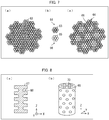
- a hollow part 62 is provided. The hollow part 62 will be described later.
- the gel beads have, for example, an intended function to retain a structure as the three-dimensional body. At a stage in which the function or the like becomes unnecessary, it is preferable to remove the gel beads.
- the gel beads can be removed by using a chelating agent which traps alkaline-earth metal ions.
- the three-dimensional body can include at least one of a hollow part and a groove which are open at a surface of the three-dimensional body.
- cells inside the three-dimensional body may die.
- the three-dimensional body is large (for example, a case where a diameter of a part corresponding to a stem or a root is large or a case where a part corresponding to a leaf has a large thickness)
- the cells inside the three-dimensional body may die.
- oxygen and culture fluid can be supplied inside the three-dimensional body via the hollow part or the groove.
- the part corresponding to a stem has a diameter of not less than several hundred micrometers
- the diameter of the hollow part is preferably not less than approximately 100 ⁇ m, in view of the size of molecules passing through the hollow part and a channel resistance in the hollow part.
- Fig. 6 is a view schematically illustrating a three-dimensional body including a hollow part in accordance with an embodiment of the present invention. The following assumes a case where a stem part 60 having a diameter of 1000 ⁇ m is formed by stacking layers of gel beads 61, each of which contains a plant cell and has a diameter of 30 ⁇ m.
- a) of Fig. 6 is a view illustrating an appearance of the stem part 60.
- (b) of Fig. 6 is a cross sectional view taken along line A-A' in (a) of Fig. 6 .
- the stem part 60 is provided with a hollow part 62 which communicates with outside.
- the hollow part 62 is formed so as to be surrounded by the gel beads 61. In a case where the three-dimensional body is formed both above and below the stem part 60, the hollow part 62 should not be blocked.
- Fig. 7 is a view illustrating a model for determining an arrangement of a hollow part in accordance with an embodiment of the present invention.
- Fig. 7 assumes the cross sectional view of (b) of Fig. 6 .
- the model is prepared such that a cross section of the three-dimensional body as illustrated in (a) of Fig. 7 is formed by close packing of circles 63.
- the circles 63 have a diameter which is equal to that of the gel beads 61 each containing a plant cell.
- a smallest repeat unit 64 hereinafter, referred to as "unit 64" having a diameter of approximately 100 ⁇ m is determined.
- unit 64 shows units.
- the unit 64 is made of seven circles 63 which are closely packed.
- the hollow part is also configured by using a unit 66 which is made of circles 65 having the same diameter as the circles 63.
- (c) of Fig. 7 is a view illustrating segmentation of (a) of Fig. 7 arranged such that units 64 surround each unit 66.
- the units 64 are each a region where the gel beads 61 are to be provided, and the unit 66 is a region where no gel bead 61 is to be provided.
- the stem part 60 including the hollow part 62 can be formed by stacking layers arranged as illustrated in (c) of Fig. 7 along a Z axis direction of (a) of Fig. 6 .
- oxygen and culture fluid can be sufficiently supplied to all the gel beads 61 since the gel beads 61 are located in an area that is apart from the surface of the stem part 60 by not more than 50 ⁇ m.
- the units 66 be provided with no gel bead from the beginning. In other words, it is not preferable to have an arrangement in which the gel beads are provided in the units 66 as a supporting material and subsequently removed afterward. Note however that the gel beads can be provided as a supporting material in parts except for the hollow part. Meanwhile, when layers of the gel beads are stacked, the ink jet method or the jet dispenser method is preferably used as described above.
- Fig. 8 is a view schematically illustrating a three-dimensional body including a hollow part in accordance with another embodiment which is different from that illustrated in Fig. 6 .
- (a) of Fig. 8 shows a stem part 67 which includes a hollow part 68 perpendicular to a length direction of a stem.
- (a) of Fig. 8 is a view of a cross section parallel to the Z axis direction.
- (b) of Fig. 8 shows a stem part 69 which includes hollow parts 70 extending in many directions and communicating with each other and which is in a sponge-like state (a porous body).
- Fig. 9 is a view schematically illustrating a three-dimensional body including grooves in accordance with an embodiment of the present invention.
- grooves 74 can be provided at the surface of a stem part 73.
- Fig. 9 illustrates an example of grooves, which extend in the Z axis direction (gravitational direction and length direction of the three-dimensional body).
- a direction in which the grooves extend is not limited to a particular direction. Note that in a case as illustrated in Fig. 9 , it is possible to easily form the grooves extending in parallel to the length direction of the three-dimensional body by stacking layers of plant cells along a direction parallel to the gravitational direction.
- the three-dimensional body which includes at least one of the hollow part and the grooves can be also formed by using the gel beads.
- the method of producing a plant body in accordance with an embodiment of the present invention preferably includes the step (organization-promoting step) of adding, to plant cells having differentiation ability, an organization-promoting agent containing a component that promotes organization of the plant cell, before, after or simultaneously with the forming step.
- This makes it possible to promote differentiation of the plant cell.
- the plant cells having differentiation ability for use in the forming step includes cells of a single kind, the cells can be differentiated into various organs. Further, it is possible to shorten time for obtaining a plant body from a three-dimensional body.
- the organization-promoting agent contains a component that promotes organization of a plant cell.
- the organization-promoting agent can be a solid, a liquid or a gas. In view of handleability, the organization-promoting agent is preferably a liquid.
- the component that promotes organization of a plant cell encompasses a growth regulator suitable for differentiation into a leaf or a root, and can be, for example, a plant hormone.
- a plant hormone encompass auxin and cytokinin.
- auxin and cytokinin encompass auxin and cytokinin. The following lists plant hormones. Which plant hormone is suitable for a plant cell depends on a type of the plant cell.
- auxin encompass 2,4-dichlorophenoxyacetic acid (2,4-D), naphthaleneacetic acid, indolebutyric acid, indoleacetic acid, indolepropionic acid, chlorophenoxyacetic acid, naphthoxyacetic acid, phenylacetic acid, 2,4,5-trichlorophenoxyacetic acid, parachlorophenoxyacetic acid, 2-methyl-4-chlorophenoxyacetic acid, 4-fluorophenoxyacetic acid, 2-methoxy-3,6-dichlorobenzoic acid, 2-phenyl acid, picloram, and picolinic acid.
- 2,4-D 2,4-dichlorophenoxyacetic acid
- naphthaleneacetic acid indolebutyric acid
- indoleacetic acid indolepropionic acid
- chlorophenoxyacetic acid naphthoxyacetic acid
- phenylacetic acid 2,4,5-trichlorophenoxyacetic acid
- 2,4-dichlorophenoxyacetic acid, naphthaleneacetic acid, indolebutyric acid, or indoleacetic acid is preferable; 2,4-dichlorophenoxyacetic acid or naphthaleneacetic acid is more preferable; and 2,4-dichlorophenoxyacetic acid is still more preferable.
- cytokinin encompass benzyladenine, kinetin, zeatin, benzylaminopurine, isopentylaminopurine, thidiazuron (TDZ), isopentenyladenine, zeatin riboside, and dihydrozeatin.
- benzyladenine, kinetin, thidiazuron, or zeatin is preferable; benzyladenine, kinetin, or thidiazuron is more preferable; and thidiazuron is still more preferable.
- a solvent can be, for example, water.
- Water is preferable, because water has less influence on plant cells and water is easily handled.
- a liquid containing the organization-promoting agent may also be referred to as an "ink", as with the dispersion liquid of the plant cells.
- a method of adding the organization-promoting agent is not limited to a particular method, and can be, for example, the following method.
- the organization-promoting step is carried out prior to the forming step, the organization-promoting agent is added in advance to plant cells before the three-dimensional body is formed.
- the organization-promoting step is carried out after the forming step, the organization-promoting agent is added by immersing the three-dimensional body in the organization-promoting agent, or applying or dropping the organization-promoting agent to the three-dimensional body.
- the organization-promoting step is carried out simultaneously with the forming step, the organization-promoting agent is added to plant cells while the plant cells are provided in a desired shape.
- the organization-promoting agent is added so as to produce a plant hormone environment which is suitable for a tissue to be organized.
- a weight ratio of cytokinin/auxin is in a range of 2 to 3 in the organization-promoting agent which is to be added to the site where differentiation into a leaf is desired, in a range of 1 to 2 in the organization-promoting agent which is to be added to the site where differentiation into a stem is desired, and in a range of 0.5 to 1 in the organization-promoting agent which is to be added to the site where differentiation into a root is desired.
- the plant hormone environment can be adjusted by changing the amount of the organization-promoting agent to be added, depending on which site of the three-dimensional body the organization-promoting agent is to be added to.
- the plant hormone environment can be adjusted by (i) preparing in advance a plurality of organization-promoting agents different in plant hormone composition, (ii) selecting, for each site of the three-dimensional body, an organization-promoting agent from the plurality of organization-promoting agents, and (iii) adding the organization-promoting agent thus selected.
- the organization-promoting agents different in plant hormone composition can be added to two or more parts of the three-dimensional body, respectively.
- each organization-promoting agent contains a single plant hormone and the single plant hormone is different in concentration in each organization-promoting agent.
- the expression “different in plant hormone composition” also means that each organization-promoting agent contains a plurality of kinds of plant hormones and the plurality of kinds of plant hormones are different in plant hormone concentration in each organization-promoting agent.
- the expression “different in plant hormone composition” also means that the plant hormone(s) contained in each organization-promoting agent is/are different in kind.
- the organization-promoting step it is preferable to add the organization-promoting agent to the three-dimensional body or the plant cells having differentiation ability, by a dipping method, an ink jet method, or a dispenser method. This makes it possible to easily add the organization-promoting agent to the three-dimensional body or the plant cells having differentiation ability. Note that this case assumes that the organization-promoting agent is used in the form of liquid.
- the dipping method can include, for example, the step of immersing the three-dimensional body or the plant cells having differentiation ability in the organization-promoting agent which fills a bath.
- the plant cells having differentiation ability is immersed in the organization-promoting agent which fills the bath, it is preferable to (i) prepare in advance a plurality of organization-promoting agents having different compositions each corresponding to a tissue into which the plant cells having differentiation ability is desired to differentiate, and (ii) to immerse the plant cells having differentiation ability into a corresponding organization-promoting agent.
- the ink jet method and the dispenser method can include, for example, the step of dropping the organization-promoting agent onto the three-dimensional body or the plant cells having differentiation ability.
- the ink jet method or the dispenser method is more preferable, from the viewpoint that an amount of the organization-promoting agent dropped is stable and easily adjustable to any amount. It is preferable to use, as the ink jet method, a piezoelectric method.
- the piezoelectric method allows for more stable discharge amount and easier fine control of concentration, as compared to a thermal method.
- As the dispenser method it is possible to use a jet dispenser method.
- Fig. 10 is a view schematically illustrating the organization-promoting step in accordance with an embodiment of the present invention.
- Fig. 10 shows an example in which the ink jet method is used.
- An ink jet head 14 is connected to a tank 15 which is filled with an ink containing the organization-promoting agent.
- the ink jet head 14 can be moved by a mechanism 16 for moving an ink jet head.
- the ink jet head 14 discharges a droplet 17 (ink which contains the organization-promoting agent) while the mechanism 16 is moving the ink jet head 14. This allows the organization-promoting agent to be added to the three-dimensional body 5.
- the ink jet method or the dispenser method it is preferable to place the three-dimensional body along the horizontal direction and add the organization-promoting agent so that a concentration gradient is produced along the horizontal direction.
- the concentration gradient is produced preferably such that the concentration of cytokinin is high at a site where differentiation into a stem or a leaf is desired and the concentration of auxin is high at a site where differentiation into a root is desired.
- the organization-promoting agent is added to the three-dimensional body by a method capable of carrying out gradation control.
- the ink jet method be used for gradation control.
- "gradation control" means producing color shading by continuously dropping, onto substantially identical drawing positions, a plurality of droplets of the same ink in a very short period of time.
- the gradation control can be carried out by continuously applying drive voltage at a high frequency.
- the gradation control by the ink jet method can be used to control an amount or concentration of the organization-promoting agent added.
- the amount or concentration of the organization-promoting agent added allows for control of a tissue organized by differentiation. Further, differentiation can be finely controlled since a continuous concentration distribution in the order of picoliter can be produced.
- the piezoelectric method is an excellent method for the gradation control, and in particular, a share mode type is the best in the gradation control.
- the share mode type causes the ink to be discharged by (i) applying drive voltage and (ii) thereby causing a surface of a wall made of a piezoelectric element between ink chambers to be deformed into a V shape. Accordingly, an amount of deformation of the surface of the wall for discharge of the ink is small. Therefore, the share mode type allows the drive voltage to be continuously applied at a high frequency. It is known that a share mode type ink jet head is capable of controlling approximately eight gradation levels by optimization of an input waveform.
- the ink containing the organization-promoting agent can be used as the ink for the gradation control.
- the gradation control can also be carried out by causing one or more droplet of ink discharged from a first nozzle to collide in the air with one or more droplet of ink discharged from a second nozzle which has a different nozzle from that of the first nozzle.
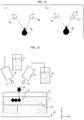
- Fig. 11 is a view schematically illustrating gradation control in accordance with an embodiment of the present invention.
- a droplet 18 corresponding to gradation level 1, which droplet is discharged from a first nozzle is mixed with a droplet 19 corresponding to gradation level 1, which droplet is discharged from a second nozzle which is different from the first nozzle, so that a droplet 20 is obtained.
- a droplet 18 corresponding to gradation level 1 which droplet is discharged from a first nozzle
- a droplet 18 corresponding to gradation level 1 which droplet is discharged from a first nozzle, is mixed with droplets 21 corresponding to gradation level 2, which droplets are discharged from a second nozzle which is different from the first nozzle, so that a droplet 22 is obtained.
- a meniscus at a nozzle hole of an ink jet head becomes unstable as the gradation level is increased. This may cause deterioration in accuracy of a discharge amount or a landing position of a droplet.
- the organization-promoting step is carried out simultaneously with the forming step, it is possible to use a method according to which one droplet is formed by (i) discharging a first droplet containing a plant cell and a second droplet containing the organization-promoting agent from different nozzles, respectively, and (ii) causing the first droplet and the second droplet to collide and mix with each other in the air.
- an ink which contains plant cells is referred to as "ink A”
- an ink which contains not plant cells but the organization-promoting agent is referred to as "ink B”.
- the ink A should contain at least plant cells.
- the ink A can further contain at least one of cytokinin and auxin in addition to the plant cells.
- the ink B is preferably arranged to be an aqueous solution containing auxin in a case where the ink A contains cytokinin, or to be an aqueous solution containing cytokinin in a case where the ink A contains auxin.
- the ink B preferably contains at least one or both of cytokinin and auxin.
- the optimum plant hormone environment can be created at each site after mixing the ink A and the ink B, by (i) fixing respective concentrations of the ink A and the ink B and (ii) changing a ratio of amounts of the ink A and the ink B mixed together, which ratio is changed depending on a site of the three-dimensional body to which site a resultant mixture is added.
- the optimum plant hormone environment can be created by (i) preparing in advance a plurality of concentrations of the ink A or the ink B and (ii) mixing the ink A or the ink B of a predetermined concentration depending on a site on which a resultant mixture is dropped.
- Fig. 12 is a view schematically illustrating a case where the organization-promoting step is carried out simultaneously with the forming step and where droplets are caused to collide and mix with each other in the air.
- An ink jet head 23 and an ink jet head 24 are prepared.
- the ink jet head 23 discharges the ink A
- the ink jet head 24 discharges the ink B.
- the ink jet head 23 is connected with a tank 25 which is filled with the ink A
- the ink jet head 24 is connected with a tank 26 which is filled with the ink B.
- the ink jet head 23 and the ink jet head 24 are arranged to face each other, and wave signals for discharging droplets from the ink jet head 23 and the ink jet head 24 are synchronized with each other under a condition where flying speeds of the droplets are matched with each other in advance. This allows the droplet 27 and the droplet 28 to collide and mix with each other in the air.
- the ink jet head 23 and the ink jet head 24 here can carry out gradation control. Accordingly, it is also possible to cause, for example, a collision between a droplet corresponding to gradation level 1 discharged from the ink jet head 23 and droplets corresponding to gradation level 2 discharged from the ink jet head 24. Note that it is desirable to prevent influence of an external disturbance such as wind on flying droplets, for example, by providing a screen around the ink jet head 23 and the ink jet head 24.
- the ink A or the ink B here can contain an alginate such as sodium alginate.
- the ink jet head 23 and the ink jet head 24 can be provided so that the droplet 29 can be dropped in an aqueous solution 32 of calcium chloride which fills a bath 31.
- an alginic acid component in the droplet 29 and a calcium component in the tank 31 react with each other.
- a gel is instantly formed at a boundary between the droplet 29 and the aqueous solution 32 of calcium chloride. This results in formation of a gel bead 30 containing a component of the ink A and a component of the ink B.
- a Z-axis stage 33 and an X-Y planar stage 34 are moved. This allows for formation of the three-dimensional body by joining gel beads 30 together and stacking layers of the gel beads 30.
- the Z-axis stage 33 is preferably provided in the vicinity of the surface of the aqueous solution 32 of calcium chloride at the time when the forming step is started (at the time when the droplet 29 is dropped). Then, it is desirable to move the Z-axis stage 33 downward (toward a lower side of a Z axis) by a distance corresponding to a diameter of the gel bead 30, at the time when a layer of gel beads 30 is to be provided.
- the method of adding the organization-promoting agent is not limited to such a method.
- the three-dimensional body can be formed from a plurality of inks while the plurality of inks are not mixed together.
- the three dimensional body can be formed by (i) preparing in advance the plurality of inks, each of which inks contains (a) plant cells and (b) an organization-promoting agent having a different composition and (ii) discharging these inks from different discharging means, respectively.
- FIG. 13 is a view schematically illustrating a case where the organization-promoting step is carried out simultaneously with the forming step and where organization-promoting agents having different compositions, respectively, are used.
- Fig. 13 assumes a case using inks C, D, and E, each of which inks contains (a) plant cells and (b) an organization-promoting agent having a different composition.
- Ink jet heads 35, 36 and 37 are prepared.
- the ink jet head 35 discharges the ink C
- the ink jet head 36 discharges the ink D
- the ink jet head 37 discharges the ink E.
- the ink jet head 35 is connected with a tank 38 which is filled with the ink C.
- the ink jet head 36 is connected with a tank 39 which is filled with the ink D.
- the ink jet head 37 is connected with a tank 40 which is filled with the ink E.
- the ink jet heads 35, 36 and 37 can be moved by a mechanism 41 for moving ink jet heads. After the ink jet head 35 is caused to discharge a droplet 42 of the ink C, respective positions of the ink jet heads 35, 36 and 37 are moved by the mechanism 41. Then, the ink jet head 36 is caused to discharge a droplet 43 of the ink D, so that the droplet 43 is stacked on the droplet 42 so as to form a layer.
- the ink jet head 37 is caused to discharge a droplet 44 of the ink E, so that the droplet 44 is stacked on the droplet 43 so as to form a layer.
- the inks need not be mixed in the air. This achieves a more stable process. Further, it is possible to obtain gel beads by (i) arranging the plurality of inks such that each of the inks contains an alginate and (ii) dropping the inks into an aqueous solution of calcium chloride.
- the culture step it is preferable to have the culture step after the forming step.
- the three-dimensional body is cultured and grown so as to be a target plant body.
- the culture step is carried out after the forming step and the organization-promoting step. This makes it possible to further promote differentiation of the three-dimensional body.
- the three-dimensional body formed in the forming step is, for example, put in a culture apparatus or culture fluid so as to grow into a plant body.
- the culture step can be carried out by aeration culture.
- the three-dimensional body can be cultured so as to be joined to another plant body.
- the three-dimensional body can be formed so that a plant body containing all of organs including, for example, leaves, a stem(s), and roots.
- a three-dimensional body is joined to a plant body which lacks roots, and then, the three-dimensional body can be caused to differentiate into roots.
- a three-dimensional body was formed, by using inks containing strawberry cells, for a strawberry seedling from which roots had been removed.
- the three-dimensional body and the another plant body can be the same or different in plant species.
- a root part of a watermelon can be formed by using squash cells, for the watermelon from which the root part has been removed. This makes it possible to form squash roots which are joined to a stem of the watermelon. Then, it becomes possible to form a plant body which is equivalent to that obtained by grafting a scion from a watermelon on a stock from a squash. It is also possible to form only a root part of a plant which is not suitable for hydroponic culture, by using cells from a plant body suitable for hydroponic culture. This allows for hydroponic culture of a plant which is typically unsuitable for hydroponic culture.
- a length direction of a part of the three-dimensional body which part corresponds to a stem be kept parallel to the gravitational direction.
- the "length direction of a part of the three-dimensional body which part corresponds to a stem” is intended to mean a direction in which the stem of a plant body will grow.
- the three-dimensional body be cultured while being kept such that a direction in which a stem(s) will grow is an upward direction along the gravitational direction and a direction in which roots will grow is a downward direction along the gravitational direction. In this way, the three-dimensional body is cultured in a gravitational environment which is same as that of a plant which grows in nature.
- Fig. 14 is a view schematically illustrating the culture step in accordance with an embodiment of the present invention.
- the three-dimensional body 5 is kept in a culture apparatus 45 such that a direction in which a stem(s) will grow in the future (plant growth direction) is parallel to the gravitational direction.
- the present invention is not limited to the embodiments, but can be altered by a skilled person in the art within the scope of the claims.
- the present invention also encompasses, in its technical scope, any embodiment derived by combining technical means disclosed in differing embodiments.
- cells for use in a forming step were prepared as below.
- a lamina of strawberry (variety: "Tochiotome") was collected. Then, the lamina was disinfected and sterilized by a general method using ethanol and sodium hypochlorite.
- 1/3 MS medium was prepared by 3-fold dilution of an inorganic composition of MS medium. With respect to the 1/3 MS medium, 30 g/L of sucrose, 1.0 mg/L of TDZ, and 0.1 mg/L of 2,4-D were added. A resultant medium was used to perform callus induction from the lamina. Each cell of a callus thus obtained was isolated by using an aqueous solution of cellulase.
- the each cell isolated was dispersed in an aqueous solution having a TDZ concentration which had been adjusted to 1.0 mg/L. As a result, an ink A-1 was obtained. Further, three kinds of aqueous solutions of 2,4-D were prepared. An aqueous solution having a 2,4-D concentration of 0.2 mg/L was referred to as "ink B-1”, an aqueous solution having a 2,4-D concentration of 0.4 mg/L was referred to as "ink B-2”, and an aqueous solution having a 2,4-D concentration of 0.6 mg/L was referred to as "ink B-3".
- a substrate, on which a pattern was formed was prepared as below. This substrate was used in the forming step.
- Fig. 15 is a view schematically illustrating a method of fabricating a substrate for use in Example 1.
- a positive photoresist 47 was applied to a glass substrate 46 by using a slit coater.
- the positive photoresist 47 was masked by a metal mask 48 having an aperture pattern which allows cells to be provided in a desired pattern. Then, the positive photoresist 47 was irradiated with light 49 for exposure.
- a photoresist layer 50 was formed as illustrated in (d) of Fig. 15 .
- an exposed part 51 was removed by using an etching liquid (aqueous solution of tetramethylammonium hydroxide).
- an etching liquid aqueous solution of tetramethylammonium hydroxide.
- the glass substrate 46 on which the pattern was formed was subjected to hydrophilization as illustrated in (f) of Fig. 15 .
- the glass substrate 46 was treated with plasma 52 by use of an ashing apparatus. This allowed for obtaining the glass substrate 46 having a hydrophilic region 53 as illustrated in (g) of Fig. 15 .
- Fig. 16 is a view schematically illustrating a substrate for use in Example 1.
- the above dipping allowed an ink 54 (ink A-1) to be provided only on a predetermined pattern as illustrated in Fig. 16 .
- the inks B-1, B-2, and B-3 were dropped by using a dispenser onto the ink A-1 provided on the substrate, so that the ink A-1 was covered with the inks B-1, B-2, and B-3.
- the inks B-1, B-2, and B-3 were dropped here such that (i) the ink B-1 was dropped on a part which was supposed to be a root of a plant body after culturing, (ii) the ink B-2 was dropped on a part which was supposed to be a stem of the plant body after culturing, and (iii) the ink B-3 was dropped on a part which was supposed to a leaf of the plant body after culturing.
- the inks B-1, B-2, and B-3 were dropped such that a total amount of the inks dropped was double that of the ink A-1. Note that in order to prevent the inks B-1, B-2, and B-3 from mixing together on the substrate, fluidities of the inks B-1, B-2, and B-3 were suppressed by adjusting viscosities of the inks B-1, B-2, and B-3.
- a culture step was carried out.
- a sample which had been prepared in the organization-promoting step was put in a culture fluid containing sucrose and the like, and aeration culture was carried out.
- the aeration culture was carried out for 45 days under controlled conditions where the light intensity was 40 ⁇ mol ⁇ m -2 ⁇ sec -1 , the day length was 16 hours, and the temperature was 25°C.
- Example 1 Cells were isolated as in Example 1. The cells isolated were dispersed in an aqueous solution, which had been adjusted such that a sodium alginate concentration was 1% by weight and a TDZ concentration was 2.4 mg/L. As a result, an ink A-2 was obtained. Further, an aqueous solution having a 2,4-D concentration of 1.0 mg/L was prepared as an ink B-4.
- Example 2 An apparatus for use in Example 2 was configured in a similar manner as that illustrated in Fig. 12 .
- An ink jet head for discharging the ink A-2 and an ink jet head for discharging the ink B-4 were separately prepared, and arranged so as to be inclined at approximately -30° to 30° with respect to a vertical direction. This allowed one droplet to be formed by causing a collision of a droplet of the ink A-2 and a droplet of the ink B-4.
- These two ink jet heads were each a piezoelectric share-mode-type ink jet head capable of carrying out gradation control.
- a bath which was filled with 2% by weight aqueous solution of calcium chloride was placed. Furthermore, a Z-axis stage was provided in the bath, and an X-Y planar stage was provided below the bath.
- Example 2 the forming step and the organization-promoting step were carried out simultaneously by using the above apparatus. Note that in Example 2, a discharge amount of ink from each of the ink jet head was set to approximately 7 pL per droplet, and that in the case of gradation level 2, the discharge amount was approximately 14 pL per droplet and in the case of gradation level 3, the discharge amount was approximately 20 pL per droplet. In Example 2, the ink jet head discharging the ink A-2 was always arranged to discharge a droplet corresponding to gradation level 1, and the ink jet head discharging the ink B-4 was arranged to discharge a droplet(s) corresponding to gradation level 1 to 3.
- the ink B-4 corresponding to gradation level 1 was dropped on a part which was supposed to be a leaf of a plant body after culturing. Meanwhile, the ink B-4 corresponding to gradation level 2 was dropped on a part which was supposed to be a stem of the plant body after culturing. Further, the ink B-4 corresponding to gradation level 3 was dropped on a part which was supposed to a root of the plant body after culturing.
- the three-dimensional body was ultimately formed to have a size of approximately 10 cm in length, 1 cm in width, and 0.5 cm in thickness.
- the length means a length in an X axis direction
- the width means a length in a Y axis direction
- the thickness means a length in a Z axis direction.
- the three-dimensional body thus formed was put in a culture fluid containing sucrose and the like, and aeration culture was carried out.
- the aeration culture was carried out for 45 days under controlled conditions where the light intensity was 40 ⁇ mol ⁇ m -2 ⁇ sec -1 , the day length was 16 hours, and the temperature was 25°C.
- a new three-dimensional body sample was prepared by the same method. Then, the culture step was similarly carried out while this sample was kept such that a part which was supposed to be a root of a plant body was on a lower side and a part which was supposed to be a leaf of the plant body was on an upper side.
- Fig. 17 is a view schematically illustrating the forming step in Example 3.
- a strawberry seedling 55 (total length: approximately 7 cm) from which roots had been removed was put and fixed in a tank 31 which was filled with an aqueous solution 32 of calcium chloride.
- gel beads 56 were formed so as to be continuous with the strawberry seedling 55 in a part from which the roots had been removed As a result, a three-dimensional body was prepared. Note that (a) of Fig.
- FIG. 17 is a view from a position in a Z axis direction and (b) of Fig. 17 is a view from a position in a Y axis direction.
- a discharge amount of ink from the ink jet head 23 was set to approximately 7 pL per droplet, and this discharge amount corresponded to gradation level 1.
- a discharge amount of ink from the ink jet head 24 per droplet was set to approximately 7 pL. Since the gradation level was 3, the discharge amount from the ink jet head 24 was set to approximately 20 pL.
- Fig. 18 is a view schematically illustrating the culture step in Example 3.
- a plant body including the three-dimensional body prepared as described above was arranged as illustrated in Fig. 18 by using a clamp 57 such that a part which was supposed to be a root of a plant body after culturing was on a lower side in the gravitational direction. Note that culturing was carried out while the plant body was kept such that only the three-dimensional body formed by the gel beads 56 was in a culture fluid 59 with which a container 58 was filled. This arrangement was intended to prevent contamination in culturing, and also takes into account influence of the gravity on differentiation. Thereafter, culturing was carried out for 15 days under the same conditions as those in the culture step in Example 2.
- Example 1 Isolated plant cells having differentiation ability were separated into four groups. With respect to each of three groups among the four groups, a corresponding one of respective blends of organization-promoting agents (see Table 2 below), sucrose, and the like were added. Inks C-1, C-2, and C-3 were thus prepared. The blends were suitable for differentiation into leaves, stems, and roots, respectively. Plant cells in remaining one of the four groups of the isolated plant cells having differentiation ability were dispersed in a 1% by weight aqueous solution of sodium alginate, so that an ink D-4 was prepared. [Table 2] Ink C-1 C-2 C-3 TDZ concentration (mg/L) 1.2 0.8 0.7 2,4-D concentration (mg/L) 0.5 0.7 0.84
- Respective droplets of the inks D-1 to D-5 were dropped into the 2% by weight aqueous solution of calcium chloride, by using five ink jet heads.
- the discharge amount of ink per droplet was set to approximately 7 pL.
- gel beads formed had a diameter of approximately 20 ⁇ m.
- the inks D-1 and D-4 were dropped on a part where a leaf was to be formed, the inks D-2 and D-4 were dropped on a part where a stem was to be formed, and the inks D-3 and D-4 were dropped on a part where a root was to be formed. Further, the ink D-5 was dropped on a part where the supporting material was necessary. The ink D-4 was dropped so as to form gel beads, around the gel beads which had been formed by dropping the inks D-1, D-2, or D-3.
- the plant cells having differentiation ability (ink D-4), which has not undergone the organization-promoting step, multiplies through cell division, and functions to join plant cells in adjacent gel beads.
- the plant cell (inks D-1, D-2, and D-3), which has undergone the organization-promoting step and differentiated, joins to the plant cells having differentiation ability around that plant cell having differentiated.
- the plant cell (inks D-1, D-2, and D-3) functions to perform signaling for inducing differentiation of the plant cells having differentiation ability into specific tissues.
- the three-dimensional body was thus obtained.
- the three-dimensional body ultimately formed had a size of approximately 5 cm in length, 1 cm in width, and 0.3 cm in thickness.
- the length means a length in an X axis direction
- the width means a length in a Y axis direction
- the thickness means a length in a Z axis direction.
- Example 2 Thereafter, the culture step was carried out as in Example 2. Note that although only the plant cells having differentiation ability was used as materials in Example 4, differentiated plant cells having been extracted from plant tissues can be also used. A similar effect can be obtained, in a case where the ink D-1 (leaf), the ink D-2 (stem) and the ink D-3 (root) are prepared by isolating and dispersing such differentiated plant cells having been extracted from plant tissues and the same process as described above is carried out.
- An aspect of the present invention is applicable to, for example, production of a plant body having a shape that is suitable for plant growing or plant cultivation.
Landscapes
- Life Sciences & Earth Sciences (AREA)
- Engineering & Computer Science (AREA)
- Health & Medical Sciences (AREA)
- Biotechnology (AREA)
- Botany (AREA)
- Developmental Biology & Embryology (AREA)
- Cell Biology (AREA)
- Wood Science & Technology (AREA)
- Organic Chemistry (AREA)
- Bioinformatics & Cheminformatics (AREA)
- Zoology (AREA)
- Chemical & Material Sciences (AREA)
- Biomedical Technology (AREA)
- Genetics & Genomics (AREA)
- Environmental Sciences (AREA)
- General Engineering & Computer Science (AREA)
- General Health & Medical Sciences (AREA)
- Biochemistry (AREA)
- Microbiology (AREA)
- Physiology (AREA)
- Breeding Of Plants And Reproduction By Means Of Culturing (AREA)
- Micro-Organisms Or Cultivation Processes Thereof (AREA)
Abstract
Description
- The present invention relates to a method of producing a plant body.
- In general, the following method is known as an effective method of growing virus-free seedlings or the like of, for example, strawberry varieties. First, shoot apex cells or the like collected from an excellent individual are cultured in an aseptic condition, so that a mass of undifferentiated cells is formed. The mass of undifferentiated cells is called a callus. Next, a plant hormone, whose concentration has been adjusted to a predetermined concentration, is added to the callus. This produces an adventitious bud or the like. Then, the adventitious bud or the like is used to regenerate a plant body. For example, Patent Literature 1 discloses a technique as described above.
- Meanwhile,
Patent Literature 2 discloses a method of producing a microbead gel.Patent Literature 2 also discloses that cells can be encapsulated in the microbead gel. Further,Patent Literature 3 discloses a method of culturing cells in three dimensions with use of a three-dimensional cell culture carrier containing a carbon nanomaterial. -
- [Patent Literature 1]
Japanese Patent Application Publication Tokukai No.2017-55670 (Publication date: March 23, 2017 - [Patent Literature 2]
Japanese Patent Application Publication Tokukai No.2009-207963 (Publication date: September 17, 2009 - [Patent Literature 3]
Japanese Patent Application Publication Tokukai No.2005-130759 (Publication date: May 26, 2005 - However, there has been a room for improvement in the above-described conventional techniques, from the viewpoint of forming a plant body having a desired three-dimensional shape. For example, the technique disclosed in Patent Literature 1 is incapable of controlling the shape of a grown body of a plant and the shape of the grown body of the plant has been left to that plant itself. Further, the techniques disclosed in
Patent Literatures - An aspect of the present invention is attained in view of the above problems. An object of the present invention is to provide a method of forming a plant body having a desired three-dimensional shape.
- In order to solve the above problems, the inventor of the present invention made diligent studies. As a result, the inventor has found that a plant body having a desired three-dimensional shape can be obtained by forming a three-dimensional body with use of plant cells having differentiation ability, and thereby has accomplished the present invention. The present invention includes the following aspects.
- <1> A method of producing a plant body, including the step (forming step) of: forming a three-dimensional body which contains plant cells having differentiation ability.
- <2> The method as described in <1>, wherein: the plant cells having differentiation ability are dedifferentiated cells obtained from a callus.
- <3> The method as described in <1> or <2>, wherein: in the forming step, gel beads containing the plant cells having differentiation ability are arranged in a shape that is identical to a rough shape of a target plant body.
- <4> The method as described in <3>, wherein: the three-dimensional body is formed from (a) the gel beads containing the plant cells having differentiation ability and (b) gel beads containing no plant cell having differentiation ability.
- <5> The method as described in any one of <1> to <4>, wherein: the plant cells having differentiation ability are plant cells derived from two or more species of plants.
- <6> The method as described in any one of <1> to <5>, further including the step (organization-promoting step) of: adding an organization-promoting agent to the plant cells having differentiation ability, the organization-promoting agent containing a component that promotes organization of the plant cells, the organization-promoting step being carried out before, after or simultaneously with the forming step.
- <7> The method as described in <6>, wherein: in the organization-promoting step, the organization-promoting agent includes different kinds of organization-promoting agents, and the different kinds of organization promoting agents are added respectively to two or more parts of the three-dimensional body.
- <8> The method as described in <6> or <7>, further including the step (culture step) of: culturing the three-dimensional body, after the forming step and the organization-promoting step.
- <9> The method as described in <8>, wherein: in the culture step, the three-dimensional body is cultured so as to be joined to another plant body.
- <10> The method as described in <8> or <9>, wherein: in the culture method, a length direction of a part of the three-dimensional body which part corresponds to a stem is kept parallel to a gravitational direction.
- <11> The method as described in any one of <1> to <10>, wherein: in the forming step, the three-dimensional body is formed by a dipping method, an ink jet method, or a dispenser method.
- <12> The method as described in any one of <6> to <10>, wherein: in the organization-promoting step, the organization-promoting agent is added to the three-dimensional body or the plant cells having differentiation ability, by a dipping method, an ink jet method, or a dispenser method.
- <13> The method as described in <12>, wherein the organization-promoting agent is added to the three-dimensional body, by a method capable of carrying out gradation control.
- <14> The method as described in any one of <1> to <13>, wherein: the three-dimensional body is subjected to arrangement control of at least leaves or stems.
- <15> The method as described in any one of <1> to <14>, wherein: the three-dimensional body includes at least one of a hollow part and a groove which are open at a surface of the three-dimensional body.
- An aspect of the present invention advantageously makes it possible to provide a method of forming a plant body having a desired three-dimensional shape.
-
-
Fig. 1 is a view schematically illustrating a shape of a plant body in accordance with an embodiment of the present invention. -
Fig. 2 is a view schematically illustrating a forming step in accordance with an embodiment of the present invention. -
Fig. 3 is a view schematically illustrating a gel bead in accordance with an embodiment of the present invention. -
Fig. 4 is a view schematically illustrating an arrangement of gel beads in accordance with an embodiment of the present invention. -
Fig. 5 is a view schematically illustrating an arrangement of gel beads in accordance with another embodiment which is different from that illustrated inFig. 4 . -
Fig. 6 is a view schematically illustrating a three-dimensional body including a hollow part in accordance with an embodiment of the present invention. -
Fig. 7 is a view illustrating a model for determining an arrangement of a hollow part in accordance with an embodiment of the present invention. -
Fig. 8 is a view schematically illustrating a three-dimensional body including a hollow part in accordance with another embodiment which is different from that illustrated inFig. 6 . -
Fig. 9 is a view schematically illustrating a three-dimensional body including grooves in accordance with an embodiment of the present invention. -
Fig. 10 is a view schematically illustrating an organization-promoting step in accordance with an embodiment of the present invention. -
Fig. 11 is a view schematically illustrating gradation control in accordance with an embodiment of the present invention. -
Fig. 12 is a view schematically illustrating a case where the organization-promoting step is carried out simultaneously with the forming step and where droplets are caused to collide and mix with each other in the air. -
Fig. 13 is a view schematically illustrating a case where the organization-promoting step is carried out simultaneously with the forming step and where organization-promoting agents having different compositions, respectively, are used. -
Fig. 14 is a view schematically illustrating a culture step in accordance with an embodiment of the present invention. -
Fig. 15 is a view schematically illustrating a method of fabricating a substrate for use in Example 1. -
Fig. 16 is a view schematically illustrating a substrate for use in Example 1. -
Fig. 17 is a view schematically illustrating the forming step in Example 3. -
Fig. 18 is a view schematically illustrating the culture step in Example 3. - An embodiment of the present invention will be discussed below. Note, however, that the present invention is not limited to such an embodiment. Note that a numerical range "A to B" herein means "not less than A and not more than B" unless otherwise specified in the present specification. For convenience of description, members having identical functions are assigned identical referential numerals, and their descriptions are omitted.
- A method of producing a plant body in accordance with an embodiment of the present invention includes the step (forming step) of forming a three-dimensional body which contains plant cells having differentiation ability. According to the method of producing a plant body, a plant body having a desired three-dimensional shape can be obtained since the plant body is obtained from the three-dimensional body which has been formed in the forming step. The details of the above method will be discussed below.
- The forming step is the step of forming a three-dimensional body which contains plant cells having differentiation ability. The forming step allows a plant body to be formed in a desired shape, and also allows the plant cells to differentiate into a desired tissue. This makes it possible to design a plant body with a high degree of freedom.
- In the forming step, at least plant cells having differentiation ability are used. The plant cells having differentiation ability may be, for example, dedifferentiated cells. The dedifferentiated cells may be, for example, cells obtained from a callus which has been obtained from cells collected from a plant tissue. Examples of such a plant tissue encompass roots, stems, leaves, petals, seeds, embryos, ovules, ovaries, anthers, pollens, and growth points (shoot apical meristems and root apical meristems). In particular, cells of shoot apical meristems (shoot apex cells) are preferable since those cells are virus-free.
- The callus can be formed by extracting the plant tissue and culturing the plant tissue in a culture medium which contains nutrients. For example, callus induction can be performed by adding, to cells collected from the plant tissue, auxin and cytokinin (which are plant hormones) at substantially the same concentrations. The culture medium can be a liquid medium or any medium which is generally used for plant culture. Examples of such a culture medium encompass an MS medium and an LS medium.
- It is preferable that subsequently, (i) cells be isolated from the callus or (ii) the callus be broken up so as to be in the state of a spheroid which is made of a mass of cells, by using an enzyme on the callus which has been formed. In this case, the three-dimensional body can be more easily formed. The enzyme may be cellulase, pectinase, or the like. It is preferable that an aqueous solution of any of these enzymes be brought into contact with the callus.
- Note that the three-dimensional body can be formed by directly using cells obtained from a plant tissue other than using the cells which have been obtained through the callus and each of which has differentiation ability. Note, however, that in this case, at least some of the cells having been obtained from the plant tissues need to be dedifferentiated after the three-dimensional body has been formed by using those cells obtained from the plant tissue.
- Further, the three-dimensional body can be also formed by using both of plant cells having differentiation ability and plant cells which have differentiated into a specific tissue. The plant cells which have differentiated into a specific tissue mean, for example, (a) plant cells obtained from a plant tissue or (b) plant cells which are obtained as a result of differentiation of plant cells having differentiation ability, by subjecting the plant cells having the differentiation ability to the step of promoting organization (organization-promoting step).
- The plant cells can be plant cells from any of seed plants, pteridophytes and bryophytes. The seed plants can be angiosperms or gymnosperms. The angiosperms can be monocotyledons or dicotyledons. The above plants can be grass plants or woody plants.
- Examples of the monocotyledons encompass Orchidaceae (e.g., boat orchid, moth orchid, and vanilla), Poaceae (e.g., rice, wheat, barley, rye, corn, proso millet, foxtail millet, and sugar cane), Cyperaceae (e.g., papyrus), Araceae (e.g., taro), Alismataceae (e.g., arrowhead), Liliaceae (e.g., tulip, onion, Welsh onion, garlic, garlic chive, and asparagus), Dioscoreaceae (e.g., Japanese yam), and Zingiberaceae (e.g., myoga ginger and ginger). Note that in some cases, onions, Welsh onions, garlics, and garlic chives may be classified as Amaryllidaceae, and asparaguses may be classified as Asparagaceae.
- Examples of the dicotyledons encompass Asteraceae (e.g., sunflower, lettuce, burdock, garland chrysanthemum, and Japanese butterbur), Fabaceae (e.g., soybean, pea, adzuki bean, fava bean, and peanut), Rubiaceae (e.g., coffee bean), Lamiaceae (e.g., shiso (Perilla frutescens var. crispa), perilla, and Japanese mint), Euphorbiaceae (e.g., poinsettia and cassava), Malvaceae (e.g., Gossypium and okra), Apiaceae (e.g., carrot, parsley, and celery), Brassicaceae (e.g., Japanese radish, colza, Chinese cabbage, turnip, leaf mustard, cauliflower, cabbage, broccoli, wasabi, and radish), Rosaceae (e.g., strawberry, apple, pear, cherry, Japanese plum, and peach), Solanaceae (e.g., eggplant, tomato, red pepper, tobacco, green pepper, and potato), Chenopodiaceae (e.g., spinach), Nymphaeaceae (e.g., candock and water shield), Nelumbonaceae (e.g., lotus), Rutaceae (e.g., mandarin orange and lemon), Araliaceae (e.g., udo and Japanese angelica tree), Convolvulaceae (e.g., sweet potato), Cucurbitaceae (e.g., watermelon, melon, cucumber, bitter melon, squash, and loofah), Vitaceae (e.g., grape), Pedaliaceae (e.g., sesame), Caryophyllaceae (e.g., baby's breath and carnation), Violaceae (e.g., pansy), Primulaceae (e.g., cyclamen), and Ranunculaceae (e.g., Clematis). Note that in some cases, spinaches may be classified as Amaranthaceae.
- The plant cells having differentiation ability can be plant cells derived from two or more species of plants. This makes it possible to produce a plant body which has characteristics of the two or more species of plants. Such a plant body may lead to an advantageous effect such as an improved resistance to environmental stress, avoidance of damage by disease and pest, an improved quality, an increased yield, or an enhanced growth.
- The above also makes it possible to reduce workload for grafting. For example, the need for preparation of a scion and a stock is eliminated. Further, it becomes unnecessary to manage a plant body such that neither water nor bacteria enter the plant body through a joint between a scion and a stock. Note that it is also possible to use a plant body which has been grown by a normal method as one of a scion and a stock, and use the above-described three-dimensional body as the other one of the scion and the stock.
- Furthermore, as compared to conventional grafting, a plant body can be designed with a higher degree of freedom since it is possible to form only a specific organ by using cells from a different species of plant. For example, in a case where cells from a plant having large leaves are used, it is possible to enhance growth because photosynthesis can be easily performed, or it is possible to perform photosynthesis by a smaller number of leaves. On the other hand, in a case where a plant having widely spread roots is used, nutrients can be easily absorbed. This results in an enhanced plant growth or an increased sugar content or increased nutritional value. Further, it is possible to form roots of a plant which is not originally suitable for hydroponic culture, by using cells from a plant suitable for hydroponic culture. In addition, it is also possible to use cells from a plant which is resistant to coldness or hotness or resistant to disease and pest.
- For example, in an embodiment of the present invention, it is possible to form a stem part and a leaf part by using cells of a watermelon and to form roots and a portion of a stem by using cells from a squash. This makes it possible to obtain an advantageous effect which is equivalent to that obtained by grafting a scion from a watermelon on a stock from a squash.
- The "three-dimensional body" herein means a structure which is formed by stacking layers of two or more cells, which structure is formed so as to have a shape that is identical to a rough shape of a target plant body. The target plant body here can be a complete plant body which includes a root, a stem and a leaf, or alternatively, can be made of some of organs of a complete plant body. For example, according to a method of producing a plant body in accordance with an embodiment of the present invention, it is possible to form a three-dimensional body in a region corresponding to roots in a plant body whose roots have been removed and to cause the three-dimensional body to differentiate into roots.
- The "shape that is identical to a rough shape of a target plant body" herein means a shape in which respective positions, directions, and/or sizes of organs and/or the number of organs is/are the same as that/those of a plant body which is a target of production. Note that the "shape that is identical to a rough shape of a target plant body" herein can encompass the shape of a three-dimensional body which includes at least one of a hollow part and a groove as described later.
- The shape of the three-dimensional body can be identical to or different from a shape which a target plant species has in a case where the target plant species is produced by a normal production method or a case where the target plant species grows under natural conditions. Hereinafter, the "shape which a target plant species has in a case where the target plant species is produced by a normal production method or a case where the target plant species grows under natural conditions" will be simply referred to as "normal shape".
- For example, it is possible to obtain a plant body which efficiently performs photosynthesis, by using a three-dimensional body which has larger leaves, a larger number of leaves or leaves which are arranged in a different manner as compared to the normal shape. Further, it is possible to obtain a plant body which has a high water absorption ability or a high nutrient absorption ability, by using a three-dimensional body which has thicker roots, longer roots, a larger number of roots or a thicker stem(s) as compare to the normal shape. Such a three-dimensional body can achieve an enhanced growth or increased additional value of a plant body.
- Further, the three-dimensional body can be subjected to arrangement control of at least either leaves or stems. For example, in such a three-dimensional body, directions of leaves or stems can be limited to one direction or two directions. For example, leaves or stems can be arranged linearly or in an L shape. Alternatively, the three-dimensional body can be provided with a region where a larger number of leaves are present and a region where a smaller number of leaves are present. Alternatively, it is possible to control directions, arrangement, and/or the number of roots, instead of that/those of leaves. Use of such a three-dimensional body allows for high-density planting by narrowing a space between plant bodies.
Fig. 1 is a view schematically illustrating a shape of a plant body in accordance with an embodiment of the present invention. (a) ofFig. 1 shows normal plant bodies each having radially developed leaves. (b) ofFig. 1 shows plant bodies whose leaf directions are limited to two directions (plant bodies each having leaves which are linearly arranged). As compared to the plant bodies illustrated in (a) ofFig. 1 , the plant bodies illustrated in (b) ofFig. 1 can be planted so as to have a narrower space between the plant bodies. - Moreover, for example, in plant factories, location of light sources can be optimized by limiting directions or arrangement of leaves. In other words, since the light sources need to be provided in a specific direction(s) or at a specific position(s), it is possible to reduce initial investment and heat, light and power expenses. Further, for a supposed case where three-dimensional bodies are cultivated on multiple shelves, the three-dimensional bodies can be arranged to have a short height.
- Note that in a case where the directions, arrangement, or the number of leaves, stems or roots is controlled, it is preferable to prevent photosynthesis performance or nutrient absorption ability from being decreased. For example, it is preferable to increase the surface area of each leaf instead of decreasing the number of leaves, or to increase the number of leaves instead of limiting the directions of leaves.
- Further, it is also possible to control a position(s) where a flower(s) is/are developed. For example, it is possible to control a position(s) where a flower(s) is/are developed by controlling directions or arrangement of leaves, stems, or branches. For example, leaves can be arranged such that no leaf is formed in the vicinity of a tip of a stem (a position where development of a flower bud is expected). For example, leaves can be arranged such that no leaf is developed at a position which is not apart from a tip of a stem by not less than a length of a leaf of the normal shape, preferably by not less than twice the length of a leaf of the normal shape. This allows for control of a position where a fruit is developed.
- In recent years, in order to reduce workload of farmers and increase efficiency of farm operations, automation of various farm operations has been promoted. One of farm operations which are the most difficult to automate here is a harvesting operation. In order to automate the harvesting operation, a detection operation and an ingathering operation are necessary. The detection operation is an operation to detect an object to be harvested, by using, for example, a stereo camera, and the ingathering operation is an operation to ingather the object to be harvested, by using, for example, a manipulator. It is a problem in all operations that in a case where a first object to be harvested is behind a leaf or a second object to be harvested, the first object may not be detected or ingathered. In other words, in a case where a first object to be harvested is behind a leaf or a second object to be harvested, the first object to be harvested may not be recognized, by image recognition, as an object to be harvested. Further, even if the first object to be harvested is recognized, the ingathering operation may not be carried out for ingathering the first object. For example, in a case where a first object to be harvested is behind a leaf or a second object to be harvested, it may be difficult to approach the first object by the manipulator while no other part is damaged. In other words, leaving the shape of a body of a plant to growth of that plant itself may hinder promotion of automation of the harvesting operation.
- A method of producing a plant body in accordance with an embodiment of the present invention can provide a seedling capable of having a shape which improves workability at the time when the seedling is grown or harvested, as compared to a case where arrangement of leaves and fruits is left to natural plant growth. In other words, it is possible to provide a seedling which has a shape suitable for automation. For example, it is possible to cause fruits to be developed at a given position(s) in a case where a three-dimensional body is formed so as to have leaves, stems, or branches whose directions or arrangement is/are controlled. For example, it is possible to form a three-dimensional body which has a first region where a large number of leaves are present and a second region where a fruit(s) is/are developed and in which the first region and the second region are separated from each other in a planar direction or a height direction. For example, (c) of
Fig. 1 shows plant bodies having a region α where there are many leaves and a region β where fruits are developed. This achieves easier image recognition of the fruits and easier approach to the fruits by the manipulator. - As described above, the method of producing a plant body in accordance with an embodiment of the present invention makes it possible to customize the shape of a seedling to a shape which is desired by a user. Further, the method of producing a plant body in accordance with an embodiment of the present invention is applicable to not only plants for food production but also plants for ornamental use or gifts.
- A method of forming the three-dimensional body is not limited to a particular method. It is only necessary to provide plant cells or the like having differentiation ability in a desired shape and to form a stack of layers of such cells or the like. The plant cells can be provided by, for example, a manipulator so as to form the stack of layers. Alternatively, the desired shape can be formed by immersing a substrate in a dispersion liquid in which plant cells are dispersed. Alternatively, the desired shape can be formed by applying or dropping the dispersion liquid onto, for example, a substrate. Such a dispersion liquid herein is also referred to as "ink". For example, it is preferable to use an ink which is obtained by dispersing, in a liquid, isolated cells or spheroids or a mixture thereof. The liquid can be, for example, water. In a case where water is used for preparation of the ink, it is possible to use pure water or an aqueous solution in which various components are dissolved.
- In the forming step, the three-dimensional body is preferably formed by a dipping method, an ink jet method, or a dispenser method. This makes it possible to easily form the three-dimensional body with use of the above-described ink.
- In the dipping method, it is possible to use a substrate on which a pattern for providing the plant cells has been formed in advance. The dipping method can include, for example, the steps of: immersing the substrate in the ink which fills a bath or the like; and then taking out the substrate from the ink. The substrate can be a substrate on which a pattern has been formed in advance by, for example, photolithography. The pattern includes a region where the plant cells are to be provided and a region where no plant cells are to be provided. The substrate can have a surface which is modified by, for example, atmospheric-pressure plasma as needed. With such modification, the region where the plant cells are to be provided can be made hydrophilic and the region where no plant cells are to be provided can be made water-repellent. When the substrate is dipped in the ink, the plant cells can be provided only on a desired hydrophilic-region pattern.
- On the other hand, use of the ink jet method or the dispenser method makes it possible to provide the ink in a desired shape by dropping the ink on the substrate.
Fig. 2 is a view schematically illustrating the forming step in accordance with an embodiment of the present invention. InFig. 2 , the ink jet method is used as an example. An ink jet head 1 is connected to atank 2 which is filled with an ink containing the plant cells. The ink jet head 1 can be moved by amechanism 3 for moving an ink jet head. The ink jet head 1 discharges a droplet 4 (ink which contains plant cells) while being moved. This makes it possible to form a three-dimensional body 5 including a stack of layers of the plant cells which are contained in the ink. - In a case where the ink jet method or the dispenser method is used, preferably, the plant cells are provided along a direction perpendicular to the gravitational direction (that is, along a horizontal direction). In other words, preferably, the three-dimensional body is formed such that a direction in which a stem(s) will grow in the future (plant growth direction) corresponds to the horizontal direction at the stage of the forming step. For example, as illustrated in
Fig. 2 , afirst layer 6 is formed along the horizontal direction by dropping thedroplet 4. Note that inFig. 2 , the gravitational direction is a direction in which thedroplet 4 is dropped. Then, in order that the three-dimensional body 5 can have thickness, a plurality of layers such as a second layer 7 and athird layer 8 are sequentially formed on thefirst layer 6. This makes it possible to more simply form the three-dimensional body, as compared to a method according which plant cells are stacked along a direction parallel to the gravitational direction from the beginning. Therefore, the three-dimensional body can be formed efficiently at a high yield rate. - The above arrangement also eliminates the need to use a pattern which includes a hydrophilic region and a water-repellent region as described above. For example, the pattern can be formed by dropping the ink whose viscosity is adjusted to be high.
- In the ink jet method or the dispenser method, a diameter of a nozzle for discharging the ink is determined as appropriate in accordance with a size of the plant cells which are contained in the ink. The diameter of the nozzle can be, for example, not less than 20 µm. The size of the plant cells is approximately 10 µm. Accordingly, if the diameter of the nozzle is not less than 20 µm, the risk of clogging the nozzle can be reduced. The plant cells to be discharged can be isolated cells or spheroids.
- Since the ink jet method allows the ink to be discharged by the unit of picoliter to nanoliter, the ink jet method is preferable. It is preferable to use, as the ink jet method, a piezoelectric method. In the piezoelectric method, a piezoelectric element is deformed by voltage application. This causes pressure, and the ink is then discharged by the pressure. The piezoelectric method less influences the plant cells, as compared to a thermal method in which the ink is heated. Further, in the piezoelectric method, a droplet size of the ink to be discharged can be controlled to be uniform by an electric pulse signal. From this viewpoint, the piezoelectric method is preferable.
- On the other hand, it is possible to use, for example, a jet dispenser method as the dispenser method. Since the jet dispenser method, like the ink jet method, is a contactless method, the jet dispenser method is suitable for forming the three-dimensional body with use of delicate cells. Further, since the jet dispenser method, like the ink jet method, allows the ink to be stably discharged in droplets of a relatively minute amount, the jet dispenser method is preferable.
- In a case where the ink is used, the ink in a bath or tank can be stirred by a magnetic stirrer or bubbling. This makes it possible to keep the plant cells uniformly dispersed in the ink. Further, it is desirable to enclose a space in which the three-dimensional body formed by the ink is handled and to keep moisture inside the space at not less than 70% by, for example, a humidifier. This makes it possible to prevent the ink from drying.
- In a case where the three-dimensional body is formed by using plant cells which have differentiated into a specific tissue in combination with the above-described plant cells having differentiation ability, the plant cells which have differentiated into the specific tissue is provided at a site where that tissue is to be developed (that is, cells having differentiated into a leaf are provided at a site where a leaf is to be developed, and cells having differentiated into a root are provided at a site where a root is to be developed). Further, it is preferable to provide the plant cells having differentiation ability, around the plant cells which have differentiated into the specific tissue. This arrangement makes it easier in a culture step to join (a) the plant cells which have differentiated into the specific tissue and (b) the plant cells having differentiation ability and multiplying through cell division around the plant cells which have differentiated into the specific tissue. Further, it will be possible to perform signaling from the plant cells which have differentiated into the specific tissue to the plant cells having differentiation ability around the plant cells which have differentiated into the specific tissue, so as to induce differentiation of the plant cells having differentiation ability into the specific tissue.
- In the forming step, it is preferable that the plant cells are encapsulated in gel beads, respectively. In other words, in the forming step, it is preferable to arrange the gel beads respectively containing the plant cells, in a shape that is identical to a rough shape of a target plant body. This makes it possible to easily form the three-dimensional body by stacking layers of the gel beads. The gel beads preferably contain an alkaline-earth metal salt of alginic acid (e.g., calcium alginate and barium alginate).
- A method of forming the gel beads is not limited to a particular method. For example, the gel beads can be formed by dropping an ink which contains an alginate and a plant cell having differentiation ability, into an aqueous solution of alkaline-earth metal salt. The following will describe a specific example. First, an ink is prepared, which ink contains sodium alginate and a plant cell having differentiation ability. The ink is dropped into a bath which is filled with an aqueous solution of calcium chloride which is separately prepared. The sodium alginate contained in the ink which has been dropped reacts with the calcium chloride in the bath to form a gel film of calcium alginate. In a case where an aqueous solution of barium chloride is used here in place of the aqueous solution of calcium chloride, a gel film of barium alginate is formed. This gelatinizes the surface of the ink which has been dropped, and forms a gel bead containing a plant cell and a solution.
Fig. 3 is a view schematically illustrating a gel bead in accordance with an embodiment of the present invention. In a gel bead 9, an ink component 10 (which may contain a plant cell) is covered by agel film 11. The three-dimensional body can be formed by stacking layers of the gel bead 9. - The ink can be dropped preferably by, for example, an ink jet method or a jet dispenser method which allows a small amount of droplet to be dropped. This makes it possible to minimize the size of the gel bead formed.
- The ink contains the alginate at a concentration of preferably 0.5% by weight to 1.5% by weight. The aqueous solution into which the ink is dropped contains alkaline-earth metal ions at a concentration of preferably 30 mM to 180 mM, more preferably 45 mM to 90 mM.
- Further, in the forming step, it is possible to additionally use gel beads containing no plant cell having differentiation ability. In other words, preferably, the three-dimensional body is formed from (a) gel beads respectively containing the plant cells having differentiation ability and (b) gel beads containing no plant cell having differentiation ability. The gel beads containing no plant cell having differentiation ability can be formed in the same manner as the gel beads respectively containing the plant cells having differentiation ability.
Fig. 4 is a view schematically illustrating an arrangement of gel beads in accordance with an embodiment of the present invention. As illustrated inFig. 4 ,gel beads 12 containing no plant cell can be used to supportgel beads 13 each containing a plant cell, whichgel beads 13 are arranged in the same shape as a plant body. In other words, thegel beads 12 containing no plant cell can be used as a support material. - Further, the gel beads containing no plant cell having differentiation ability can be gel beads respectively containing plant cells which have differentiated into a specific tissue.
Fig. 5 is a view schematically illustrating an arrangement of gel beads in accordance with another embodiment which is different from that illustrated inFig. 4 . For example, as illustrated in (a) ofFig. 5 ,gel beads 72 respectively containing plant cells having differentiation ability can be provided so as to surround agel bead 71 containing a plant cell which has differentiated into a specific tissue. By using the arrangement of the gel beads illustrated in (a) ofFig. 5 as the smallest unit, gel beads can be arranged as illustrated in (b) ofFig. 5 . This promotes joining of plant cells as described above, and also allows for signaling from plant cells which have differentiated. Note that in the arrangement illustrated in (b) ofFig. 5 , ahollow part 62 is provided. Thehollow part 62 will be described later. - The gel beads have, for example, an intended function to retain a structure as the three-dimensional body. At a stage in which the function or the like becomes unnecessary, it is preferable to remove the gel beads. In a case where the gel beads are formed from the alkaline-earth metal salt of alginic acid, the gel beads can be removed by using a chelating agent which traps alkaline-earth metal ions.
- The three-dimensional body can include at least one of a hollow part and a groove which are open at a surface of the three-dimensional body. In a case where oxygen and culture fluid are not sufficiently supplied to the inside of the three-dimensional body in the culture step (described later), cells inside the three-dimensional body may die. In particular, in a case where the three-dimensional body is large (for example, a case where a diameter of a part corresponding to a stem or a root is large or a case where a part corresponding to a leaf has a large thickness), the cells inside the three-dimensional body may die. In a case where the three-dimensional body includes a hollow part or a groove, oxygen and culture fluid can be supplied inside the three-dimensional body via the hollow part or the groove. For example, in a case where the part corresponding to a stem has a diameter of not less than several hundred micrometers, it is preferable to provide the hollow part or the groove. The diameter of the hollow part is preferably not less than approximately 100 µm, in view of the size of molecules passing through the hollow part and a channel resistance in the hollow part.
- The following will describe an example in which the hollow part is provided in the part corresponding to a stem (hereinafter, simply referred to as "stem part").
Fig. 6 is a view schematically illustrating a three-dimensional body including a hollow part in accordance with an embodiment of the present invention. The following assumes a case where astem part 60 having a diameter of 1000 µm is formed by stacking layers ofgel beads 61, each of which contains a plant cell and has a diameter of 30 µm. (a) ofFig. 6 is a view illustrating an appearance of thestem part 60. (b) ofFig. 6 is a cross sectional view taken along line A-A' in (a) ofFig. 6 . Thestem part 60 is provided with ahollow part 62 which communicates with outside. Thehollow part 62 is formed so as to be surrounded by thegel beads 61. In a case where the three-dimensional body is formed both above and below thestem part 60, thehollow part 62 should not be blocked. -
Fig. 7 is a view illustrating a model for determining an arrangement of a hollow part in accordance with an embodiment of the present invention.Fig. 7 assumes the cross sectional view of (b) ofFig. 6 . First, the model is prepared such that a cross section of the three-dimensional body as illustrated in (a) ofFig. 7 is formed by close packing ofcircles 63. Thecircles 63 have a diameter which is equal to that of thegel beads 61 each containing a plant cell. In consideration of a radius of thecircles 63, a smallest repeat unit 64 (hereinafter, referred to as "unit 64") having a diameter of approximately 100 µm is determined. (b) ofFig. 7 shows units. In a case where the diameter of thecircles 63 is 30 µm, theunit 64 is made of sevencircles 63 which are closely packed. The hollow part is also configured by using aunit 66 which is made ofcircles 65 having the same diameter as thecircles 63. (c) ofFig. 7 is a view illustrating segmentation of (a) ofFig. 7 arranged such thatunits 64 surround eachunit 66. Theunits 64 are each a region where thegel beads 61 are to be provided, and theunit 66 is a region where nogel bead 61 is to be provided. - The
stem part 60 including thehollow part 62 can be formed by stacking layers arranged as illustrated in (c) ofFig. 7 along a Z axis direction of (a) ofFig. 6 . In this case, oxygen and culture fluid can be sufficiently supplied to all thegel beads 61 since thegel beads 61 are located in an area that is apart from the surface of thestem part 60 by not more than 50 µm. Note that it is preferable that theunits 66 be provided with no gel bead from the beginning. In other words, it is not preferable to have an arrangement in which the gel beads are provided in theunits 66 as a supporting material and subsequently removed afterward. Note however that the gel beads can be provided as a supporting material in parts except for the hollow part. Meanwhile, when layers of the gel beads are stacked, the ink jet method or the jet dispenser method is preferably used as described above. - The hollow part is not particularly limited in arrangement to a fluid channel communicating with a top and a bottom of the stem part (extending in the Z axis direction) as described above. For example,
Fig. 8 is a view schematically illustrating a three-dimensional body including a hollow part in accordance with another embodiment which is different from that illustrated inFig. 6 . (a) ofFig. 8 shows astem part 67 which includes ahollow part 68 perpendicular to a length direction of a stem. Note that (a) ofFig. 8 is a view of a cross section parallel to the Z axis direction. On the other hand, (b) ofFig. 8 shows astem part 69 which includeshollow parts 70 extending in many directions and communicating with each other and which is in a sponge-like state (a porous body). -
Fig. 9 is a view schematically illustrating a three-dimensional body including grooves in accordance with an embodiment of the present invention. For example, as illustrated in (a) ofFig. 9 ,grooves 74 can be provided at the surface of astem part 73. Further, it is possible to have both thehollow part 62 and thegrooves 74 as shown in astem part 75 illustrated in (b) ofFig. 9. Fig. 9 illustrates an example of grooves, which extend in the Z axis direction (gravitational direction and length direction of the three-dimensional body). However, a direction in which the grooves extend is not limited to a particular direction. Note that in a case as illustrated inFig. 9 , it is possible to easily form the grooves extending in parallel to the length direction of the three-dimensional body by stacking layers of plant cells along a direction parallel to the gravitational direction. - The three-dimensional body which includes at least one of the hollow part and the grooves can be also formed by using the gel beads.
- The method of producing a plant body in accordance with an embodiment of the present invention preferably includes the step (organization-promoting step) of adding, to plant cells having differentiation ability, an organization-promoting agent containing a component that promotes organization of the plant cell, before, after or simultaneously with the forming step. This makes it possible to promote differentiation of the plant cell. For example, even in a case where the plant cells having differentiation ability for use in the forming step includes cells of a single kind, the cells can be differentiated into various organs. Further, it is possible to shorten time for obtaining a plant body from a three-dimensional body.
- The organization-promoting agent contains a component that promotes organization of a plant cell. The organization-promoting agent can be a solid, a liquid or a gas. In view of handleability, the organization-promoting agent is preferably a liquid.
- The component that promotes organization of a plant cell encompasses a growth regulator suitable for differentiation into a leaf or a root, and can be, for example, a plant hormone. Examples of the plant hormone encompass auxin and cytokinin. The following lists plant hormones. Which plant hormone is suitable for a plant cell depends on a type of the plant cell.
- Examples of auxin encompass 2,4-dichlorophenoxyacetic acid (2,4-D), naphthaleneacetic acid, indolebutyric acid, indoleacetic acid, indolepropionic acid, chlorophenoxyacetic acid, naphthoxyacetic acid, phenylacetic acid, 2,4,5-trichlorophenoxyacetic acid, parachlorophenoxyacetic acid, 2-methyl-4-chlorophenoxyacetic acid, 4-fluorophenoxyacetic acid, 2-methoxy-3,6-dichlorobenzoic acid, 2-phenyl acid, picloram, and picolinic acid. Particularly, 2,4-dichlorophenoxyacetic acid, naphthaleneacetic acid, indolebutyric acid, or indoleacetic acid is preferable; 2,4-dichlorophenoxyacetic acid or naphthaleneacetic acid is more preferable; and 2,4-dichlorophenoxyacetic acid is still more preferable.
- Examples of cytokinin encompass benzyladenine, kinetin, zeatin, benzylaminopurine, isopentylaminopurine, thidiazuron (TDZ), isopentenyladenine, zeatin riboside, and dihydrozeatin. Particularly, benzyladenine, kinetin, thidiazuron, or zeatin is preferable; benzyladenine, kinetin, or thidiazuron is more preferable; and thidiazuron is still more preferable.
- In a case where the organization-promoting agent is used in the form of liquid, a solvent can be, for example, water. Water is preferable, because water has less influence on plant cells and water is easily handled. Note that in the present specification, a liquid containing the organization-promoting agent may also be referred to as an "ink", as with the dispersion liquid of the plant cells.
- A method of adding the organization-promoting agent is not limited to a particular method, and can be, for example, the following method. In a case where the organization-promoting step is carried out prior to the forming step, the organization-promoting agent is added in advance to plant cells before the three-dimensional body is formed. In a case where the organization-promoting step is carried out after the forming step, the organization-promoting agent is added by immersing the three-dimensional body in the organization-promoting agent, or applying or dropping the organization-promoting agent to the three-dimensional body. In a case where the organization-promoting step is carried out simultaneously with the forming step, the organization-promoting agent is added to plant cells while the plant cells are provided in a desired shape.
- The organization-promoting agent is added so as to produce a plant hormone environment which is suitable for a tissue to be organized. In other words, in the organization-promoting step, it is preferable to add different organization-promoting agents to two or more parts of the three-dimensional body, respectively. For example, it is preferable to add the organization-promoting agents so that the concentration of cytokinin will be high at a site where differentiation into a stem or a leaf is desired and the concentration of auxin will be high at a site where differentiation into a root is desired. For example, preferably, a weight ratio of cytokinin/auxin is in a range of 2 to 3 in the organization-promoting agent which is to be added to the site where differentiation into a leaf is desired, in a range of 1 to 2 in the organization-promoting agent which is to be added to the site where differentiation into a stem is desired, and in a range of 0.5 to 1 in the organization-promoting agent which is to be added to the site where differentiation into a root is desired.
- The plant hormone environment can be adjusted by changing the amount of the organization-promoting agent to be added, depending on which site of the three-dimensional body the organization-promoting agent is to be added to. Alternatively, the plant hormone environment can be adjusted by (i) preparing in advance a plurality of organization-promoting agents different in plant hormone composition, (ii) selecting, for each site of the three-dimensional body, an organization-promoting agent from the plurality of organization-promoting agents, and (iii) adding the organization-promoting agent thus selected. In other words, in the organization-promoting step, the organization-promoting agents different in plant hormone composition can be added to two or more parts of the three-dimensional body, respectively. The expression "different in plant hormone composition" here means that each organization-promoting agent contains a single plant hormone and the single plant hormone is different in concentration in each organization-promoting agent. Further, the expression "different in plant hormone composition" also means that each organization-promoting agent contains a plurality of kinds of plant hormones and the plurality of kinds of plant hormones are different in plant hormone concentration in each organization-promoting agent. In addition, the expression "different in plant hormone composition" also means that the plant hormone(s) contained in each organization-promoting agent is/are different in kind.
- In the organization-promoting step, it is preferable to add the organization-promoting agent to the three-dimensional body or the plant cells having differentiation ability, by a dipping method, an ink jet method, or a dispenser method. This makes it possible to easily add the organization-promoting agent to the three-dimensional body or the plant cells having differentiation ability. Note that this case assumes that the organization-promoting agent is used in the form of liquid.
- The dipping method can include, for example, the step of immersing the three-dimensional body or the plant cells having differentiation ability in the organization-promoting agent which fills a bath. Note that in a case where the plant cells having differentiation ability is immersed in the organization-promoting agent which fills the bath, it is preferable to (i) prepare in advance a plurality of organization-promoting agents having different compositions each corresponding to a tissue into which the plant cells having differentiation ability is desired to differentiate, and (ii) to immerse the plant cells having differentiation ability into a corresponding organization-promoting agent. The ink jet method and the dispenser method can include, for example, the step of dropping the organization-promoting agent onto the three-dimensional body or the plant cells having differentiation ability. The ink jet method or the dispenser method is more preferable, from the viewpoint that an amount of the organization-promoting agent dropped is stable and easily adjustable to any amount. It is preferable to use, as the ink jet method, a piezoelectric method. The piezoelectric method allows for more stable discharge amount and easier fine control of concentration, as compared to a thermal method. As the dispenser method, it is possible to use a jet dispenser method.
-
Fig. 10 is a view schematically illustrating the organization-promoting step in accordance with an embodiment of the present invention.Fig. 10 shows an example in which the ink jet method is used. Anink jet head 14 is connected to atank 15 which is filled with an ink containing the organization-promoting agent. Theink jet head 14 can be moved by amechanism 16 for moving an ink jet head. Theink jet head 14 discharges a droplet 17 (ink which contains the organization-promoting agent) while themechanism 16 is moving theink jet head 14. This allows the organization-promoting agent to be added to the three-dimensional body 5. - In a case where the ink jet method or the dispenser method is used, it is preferable to place the three-dimensional body along the horizontal direction and add the organization-promoting agent so that a concentration gradient is produced along the horizontal direction. In other words, it is preferable that as illustrated in
Fig. 10 , (i) the three-dimensional body 5 is placed such that a direction in which a stem(s) will grow in the future (plant growth direction) is along the horizontal direction at the stage of the organization-promoting step and (ii) the concentration gradient of the organization-promoting agent is produced along the plant growth direction. This makes it possible to efficiently promote differentiation of the plant cell at a high yield rate. For example, the concentration gradient is produced preferably such that the concentration of cytokinin is high at a site where differentiation into a stem or a leaf is desired and the concentration of auxin is high at a site where differentiation into a root is desired. - In the organization-promoting step, preferably, the organization-promoting agent is added to the three-dimensional body by a method capable of carrying out gradation control. For example, in the organization-promoting step, it is preferable that the ink jet method be used for gradation control. In the field of ink jet printers and the like, "gradation control" means producing color shading by continuously dropping, onto substantially identical drawing positions, a plurality of droplets of the same ink in a very short period of time. The gradation control can be carried out by continuously applying drive voltage at a high frequency. In an embodiment of the present invention, the gradation control by the ink jet method can be used to control an amount or concentration of the organization-promoting agent added. The amount or concentration of the organization-promoting agent added allows for control of a tissue organized by differentiation. Further, differentiation can be finely controlled since a continuous concentration distribution in the order of picoliter can be produced.
- The piezoelectric method is an excellent method for the gradation control, and in particular, a share mode type is the best in the gradation control. The share mode type causes the ink to be discharged by (i) applying drive voltage and (ii) thereby causing a surface of a wall made of a piezoelectric element between ink chambers to be deformed into a V shape. Accordingly, an amount of deformation of the surface of the wall for discharge of the ink is small. Therefore, the share mode type allows the drive voltage to be continuously applied at a high frequency. It is known that a share mode type ink jet head is capable of controlling approximately eight gradation levels by optimization of an input waveform. The ink containing the organization-promoting agent can be used as the ink for the gradation control.
- The gradation control can also be carried out by causing one or more droplet of ink discharged from a first nozzle to collide in the air with one or more droplet of ink discharged from a second nozzle which has a different nozzle from that of the first nozzle.
Fig. 11 is a view schematically illustrating gradation control in accordance with an embodiment of the present invention. In (a) ofFig. 11 , adroplet 18 corresponding to gradation level 1, which droplet is discharged from a first nozzle, is mixed with adroplet 19 corresponding to gradation level 1, which droplet is discharged from a second nozzle which is different from the first nozzle, so that adroplet 20 is obtained. In (b) ofFig. 11 , adroplet 18 corresponding to gradation level 1, which droplet is discharged from a first nozzle, is mixed withdroplets 21 corresponding togradation level 2, which droplets are discharged from a second nozzle which is different from the first nozzle, so that adroplet 22 is obtained. This makes it possible to obtain thedroplet 20 and thedroplet 22 which have different concentrations of the organization-promoting agent, respectively. - Note that even in the case of the share mode type, a meniscus at a nozzle hole of an ink jet head becomes unstable as the gradation level is increased. This may cause deterioration in accuracy of a discharge amount or a landing position of a droplet. On this account, it is preferable to control the gradation level so that the gradation level will be approximately 3 at the highest in an application where a plurality of flying droplets are caused to collide and mix with each other in the air.
- In a case where the organization-promoting step is carried out simultaneously with the forming step, it is possible to use a method according to which one droplet is formed by (i) discharging a first droplet containing a plant cell and a second droplet containing the organization-promoting agent from different nozzles, respectively, and (ii) causing the first droplet and the second droplet to collide and mix with each other in the air. Hereinafter, an ink which contains plant cells is referred to as "ink A" and an ink which contains not plant cells but the organization-promoting agent is referred to as "ink B".
- The ink A should contain at least plant cells. The ink A can further contain at least one of cytokinin and auxin in addition to the plant cells. The ink B is preferably arranged to be an aqueous solution containing auxin in a case where the ink A contains cytokinin, or to be an aqueous solution containing cytokinin in a case where the ink A contains auxin. In a case where the ink A contains both of cytokinin and auxin, the ink B preferably contains at least one or both of cytokinin and auxin.
- It is possible to create the optimum plant hormone environment for organization of the plant cells by mixing the ink B with the ink A. In other words, it is possible to create an environment in which the concentration of cytokinin is high at a site where differentiation into a stem or a leaf is desired, while it is possible to create an environment in which the concentration of auxin is high at a site where differentiation into a root is desired.
- The optimum plant hormone environment can be created at each site after mixing the ink A and the ink B, by (i) fixing respective concentrations of the ink A and the ink B and (ii) changing a ratio of amounts of the ink A and the ink B mixed together, which ratio is changed depending on a site of the three-dimensional body to which site a resultant mixture is added. Alternatively, the optimum plant hormone environment can be created by (i) preparing in advance a plurality of concentrations of the ink A or the ink B and (ii) mixing the ink A or the ink B of a predetermined concentration depending on a site on which a resultant mixture is dropped.
- The following will discuss one example of a method of carrying out the organization-promoting step simultaneously with the forming step, with reference to
Fig. 12. Fig. 12 is a view schematically illustrating a case where the organization-promoting step is carried out simultaneously with the forming step and where droplets are caused to collide and mix with each other in the air. Anink jet head 23 and anink jet head 24 are prepared. Theink jet head 23 discharges the ink A, and theink jet head 24 discharges the ink B. Theink jet head 23 is connected with atank 25 which is filled with the ink A, and theink jet head 24 is connected with atank 26 which is filled with the ink B. When to discharge the ink A from theink jet head 23 and when to discharge the ink B from theink jet head 24 are controlled, so that onedroplet 29 can be formed by causing adroplet 27 of the ink A and adroplet 28 of the ink B to collide with each other in the air. For example, theink jet head 23 and theink jet head 24 are arranged to face each other, and wave signals for discharging droplets from theink jet head 23 and theink jet head 24 are synchronized with each other under a condition where flying speeds of the droplets are matched with each other in advance. This allows thedroplet 27 and thedroplet 28 to collide and mix with each other in the air. Theink jet head 23 and theink jet head 24 here can carry out gradation control. Accordingly, it is also possible to cause, for example, a collision between a droplet corresponding to gradation level 1 discharged from theink jet head 23 and droplets corresponding togradation level 2 discharged from theink jet head 24. Note that it is desirable to prevent influence of an external disturbance such as wind on flying droplets, for example, by providing a screen around theink jet head 23 and theink jet head 24. - The ink A or the ink B here can contain an alginate such as sodium alginate. Meanwhile, the
ink jet head 23 and theink jet head 24 can be provided so that thedroplet 29 can be dropped in anaqueous solution 32 of calcium chloride which fills abath 31. In this case, when thedroplet 29 is dropped into theaqueous solution 32 of calcium chloride, an alginic acid component in thedroplet 29 and a calcium component in thetank 31 react with each other. As a result, a gel is instantly formed at a boundary between thedroplet 29 and theaqueous solution 32 of calcium chloride. This results in formation of agel bead 30 containing a component of the ink A and a component of the ink B. - While the above-described discharge is repeated, a Z-
axis stage 33 and an X-Yplanar stage 34 are moved. This allows for formation of the three-dimensional body by joininggel beads 30 together and stacking layers of thegel beads 30. - Note that in order to stack the layers at a high accuracy, the Z-
axis stage 33 is preferably provided in the vicinity of the surface of theaqueous solution 32 of calcium chloride at the time when the forming step is started (at the time when thedroplet 29 is dropped). Then, it is desirable to move the Z-axis stage 33 downward (toward a lower side of a Z axis) by a distance corresponding to a diameter of thegel bead 30, at the time when a layer ofgel beads 30 is to be provided. - It is preferable to use a method in which the ink A and the ink B are caused to collide and mix with each other in the air, from the viewpoint of having a simpler device configuration. However, the method of adding the organization-promoting agent is not limited to such a method. For example, the three-dimensional body can be formed from a plurality of inks while the plurality of inks are not mixed together. In this case, the three dimensional body can be formed by (i) preparing in advance the plurality of inks, each of which inks contains (a) plant cells and (b) an organization-promoting agent having a different composition and (ii) discharging these inks from different discharging means, respectively.
Fig. 13 is a view schematically illustrating a case where the organization-promoting step is carried out simultaneously with the forming step and where organization-promoting agents having different compositions, respectively, are used.Fig. 13 assumes a case using inks C, D, and E, each of which inks contains (a) plant cells and (b) an organization-promoting agent having a different composition. Ink jet heads 35, 36 and 37 are prepared. Theink jet head 35 discharges the ink C, theink jet head 36 discharges the ink D, and theink jet head 37 discharges the ink E. Theink jet head 35 is connected with atank 38 which is filled with the ink C. Theink jet head 36 is connected with atank 39 which is filled with the ink D. Theink jet head 37 is connected with atank 40 which is filled with the ink E. The ink jet heads 35, 36 and 37 can be moved by amechanism 41 for moving ink jet heads. After theink jet head 35 is caused to discharge adroplet 42 of the ink C, respective positions of the ink jet heads 35, 36 and 37 are moved by themechanism 41. Then, theink jet head 36 is caused to discharge a droplet 43 of the ink D, so that the droplet 43 is stacked on thedroplet 42 so as to form a layer. After the respective positions of the ink jet heads 35, 36 and 37 are similarly moved, theink jet head 37 is caused to discharge adroplet 44 of the ink E, so that thedroplet 44 is stacked on the droplet 43 so as to form a layer. In this case, the inks need not be mixed in the air. This achieves a more stable process. Further, it is possible to obtain gel beads by (i) arranging the plurality of inks such that each of the inks contains an alginate and (ii) dropping the inks into an aqueous solution of calcium chloride. - It is preferable to have the culture step after the forming step. In the culture step, the three-dimensional body is cultured and grown so as to be a target plant body. Note that preferably, the culture step is carried out after the forming step and the organization-promoting step. This makes it possible to further promote differentiation of the three-dimensional body.
- The three-dimensional body formed in the forming step is, for example, put in a culture apparatus or culture fluid so as to grow into a plant body. The culture step can be carried out by aeration culture.
- In the culture step, the three-dimensional body can be cultured so as to be joined to another plant body. In the above-described forming step, the three-dimensional body can be formed so that a plant body containing all of organs including, for example, leaves, a stem(s), and roots. However, it is not necessary to form all the organs in the forming step. It is possible to culture a three-dimensional body capable of becoming one or some of organs of a plant body so that the three-dimensional body will be joined to a plant body which is arranged in advance to lack the one or some of organs. For example, a three-dimensional body is joined to a plant body which lacks roots, and then, the three-dimensional body can be caused to differentiate into roots. For example, in Examples described later, a three-dimensional body was formed, by using inks containing strawberry cells, for a strawberry seedling from which roots had been removed.
- Note that in a case where the three-dimensional body is cultured so as to join to another plant body, the three-dimensional body and the another plant body can be the same or different in plant species. For example, a root part of a watermelon can be formed by using squash cells, for the watermelon from which the root part has been removed. This makes it possible to form squash roots which are joined to a stem of the watermelon. Then, it becomes possible to form a plant body which is equivalent to that obtained by grafting a scion from a watermelon on a stock from a squash. It is also possible to form only a root part of a plant which is not suitable for hydroponic culture, by using cells from a plant body suitable for hydroponic culture. This allows for hydroponic culture of a plant which is typically unsuitable for hydroponic culture.
- In the culture method, it is preferable that a length direction of a part of the three-dimensional body which part corresponds to a stem be kept parallel to the gravitational direction. Note that the "length direction of a part of the three-dimensional body which part corresponds to a stem" is intended to mean a direction in which the stem of a plant body will grow. In other words, it is preferable that the three-dimensional body be cultured while being kept such that a direction in which a stem(s) will grow is an upward direction along the gravitational direction and a direction in which roots will grow is a downward direction along the gravitational direction. In this way, the three-dimensional body is cultured in a gravitational environment which is same as that of a plant which grows in nature. This makes it possible to prevent the plant body from growing in an unintended direction. In a case where the three-dimensional body which is, for example, a leaf or a root is to be joined to another plant body which has a stem, preferably, a direction in which the stem of the another plant will grow is kept to be parallel to the gravitational direction.
-
Fig. 14 is a view schematically illustrating the culture step in accordance with an embodiment of the present invention. InFig. 14 , the three-dimensional body 5 is kept in aculture apparatus 45 such that a direction in which a stem(s) will grow in the future (plant growth direction) is parallel to the gravitational direction. - The present invention is not limited to the embodiments, but can be altered by a skilled person in the art within the scope of the claims. The present invention also encompasses, in its technical scope, any embodiment derived by combining technical means disclosed in differing embodiments.
- The following will discuss an embodiment of the present invention in more detail with reference to Examples. Note, however, that the present invention is not limited to such Examples.
- First, cells for use in a forming step were prepared as below. A lamina of strawberry (variety: "Tochiotome") was collected. Then, the lamina was disinfected and sterilized by a general method using ethanol and sodium hypochlorite. Further, 1/3 MS medium was prepared by 3-fold dilution of an inorganic composition of MS medium. With respect to the 1/3 MS medium, 30 g/L of sucrose, 1.0 mg/L of TDZ, and 0.1 mg/L of 2,4-D were added. A resultant medium was used to perform callus induction from the lamina. Each cell of a callus thus obtained was isolated by using an aqueous solution of cellulase.
- The each cell isolated was dispersed in an aqueous solution having a TDZ concentration which had been adjusted to 1.0 mg/L. As a result, an ink A-1 was obtained. Further, three kinds of aqueous solutions of 2,4-D were prepared. An aqueous solution having a 2,4-D concentration of 0.2 mg/L was referred to as "ink B-1", an aqueous solution having a 2,4-D concentration of 0.4 mg/L was referred to as "ink B-2", and an aqueous solution having a 2,4-D concentration of 0.6 mg/L was referred to as "ink B-3".
- Next, a substrate, on which a pattern was formed, was prepared as below. This substrate was used in the forming step.
Fig. 15 is a view schematically illustrating a method of fabricating a substrate for use in Example 1. First, as illustrated in (a) and (b) ofFig. 15 , apositive photoresist 47 was applied to aglass substrate 46 by using a slit coater. As illustrated in (c) ofFig. 15 , thepositive photoresist 47 was masked by ametal mask 48 having an aperture pattern which allows cells to be provided in a desired pattern. Then, thepositive photoresist 47 was irradiated withlight 49 for exposure. As a result, aphotoresist layer 50 was formed as illustrated in (d) ofFig. 15 . Subsequently, as illustrated in (d) and (e) ofFig. 15 , an exposedpart 51 was removed by using an etching liquid (aqueous solution of tetramethylammonium hydroxide). Thereafter, theglass substrate 46 on which the pattern was formed was subjected to hydrophilization as illustrated in (f) ofFig. 15 . In the hydrophilization, theglass substrate 46 was treated withplasma 52 by use of an ashing apparatus. This allowed for obtaining theglass substrate 46 having ahydrophilic region 53 as illustrated in (g) ofFig. 15 . Note that conditions of a plasma treatment were adjusted so that a contact angle with respect to water would be not more than 10° in a region where cells were to be provided (a part from which thephotoresist layer 50 was removed) and a contact angle with respect to water would be not less than 60° in a region where the cells were not to be provided (a part where thephotoresist layer 50 remained). - The substrate on which the pattern was formed as described above was dipped in the ink A-1 which filled a bath, and then taken out from the bath.
Fig. 16 is a view schematically illustrating a substrate for use in Example 1. The above dipping allowed an ink 54 (ink A-1) to be provided only on a predetermined pattern as illustrated inFig. 16 . - Next, in an organization-promoting step, the inks B-1, B-2, and B-3 were dropped by using a dispenser onto the ink A-1 provided on the substrate, so that the ink A-1 was covered with the inks B-1, B-2, and B-3. The inks B-1, B-2, and B-3 were dropped here such that (i) the ink B-1 was dropped on a part which was supposed to be a root of a plant body after culturing, (ii) the ink B-2 was dropped on a part which was supposed to be a stem of the plant body after culturing, and (iii) the ink B-3 was dropped on a part which was supposed to a leaf of the plant body after culturing. In order to cover the ink A-1 present on the pattern, the inks B-1, B-2, and B-3 were dropped such that a total amount of the inks dropped was double that of the ink A-1. Note that in order to prevent the inks B-1, B-2, and B-3 from mixing together on the substrate, fluidities of the inks B-1, B-2, and B-3 were suppressed by adjusting viscosities of the inks B-1, B-2, and B-3.
- Following the organization-promoting step, a culture step was carried out. In the culture step, a sample which had been prepared in the organization-promoting step was put in a culture fluid containing sucrose and the like, and aeration culture was carried out. The aeration culture was carried out for 45 days under controlled conditions where the light intensity was 40 µmol·m-2·sec-1, the day length was 16 hours, and the temperature was 25°C.
- Cells were isolated as in Example 1. The cells isolated were dispersed in an aqueous solution, which had been adjusted such that a sodium alginate concentration was 1% by weight and a TDZ concentration was 2.4 mg/L. As a result, an ink A-2 was obtained. Further, an aqueous solution having a 2,4-D concentration of 1.0 mg/L was prepared as an ink B-4.
- An apparatus for use in Example 2 was configured in a similar manner as that illustrated in
Fig. 12 . An ink jet head for discharging the ink A-2 and an ink jet head for discharging the ink B-4 were separately prepared, and arranged so as to be inclined at approximately -30° to 30° with respect to a vertical direction. This allowed one droplet to be formed by causing a collision of a droplet of the ink A-2 and a droplet of the ink B-4. These two ink jet heads were each a piezoelectric share-mode-type ink jet head capable of carrying out gradation control. - Further, below these two ink jet heads, a bath which was filled with 2% by weight aqueous solution of calcium chloride was placed. Furthermore, a Z-axis stage was provided in the bath, and an X-Y planar stage was provided below the bath.
- In Example 2, the forming step and the organization-promoting step were carried out simultaneously by using the above apparatus. Note that in Example 2, a discharge amount of ink from each of the ink jet head was set to approximately 7 pL per droplet, and that in the case of
gradation level 2, the discharge amount was approximately 14 pL per droplet and in the case ofgradation level 3, the discharge amount was approximately 20 pL per droplet. In Example 2, the ink jet head discharging the ink A-2 was always arranged to discharge a droplet corresponding to gradation level 1, and the ink jet head discharging the ink B-4 was arranged to discharge a droplet(s) corresponding to gradation level 1 to 3. Therefore, when the droplets discharged from these two ink jet heads were mixed together to form a droplet, the amount of the droplet thus formed became 14 pL to 27 pL. A gel bead formed from this droplet had a diameter of 30 µm to 40 µm. The ink B-4 corresponding to gradation level 1 was dropped on a part which was supposed to be a leaf of a plant body after culturing. Meanwhile, the ink B-4 corresponding togradation level 2 was dropped on a part which was supposed to be a stem of the plant body after culturing. Further, the ink B-4 corresponding togradation level 3 was dropped on a part which was supposed to a root of the plant body after culturing. A resultant weight ratio of TDZ and 2,4-D, which were contained in the gel bead prepared as described above, was shown in Table 1 below.[Table 1] Part organized by culturing Leaf Stem Root Gradation level of ink B-4 1 2 3 Amount of mixed inks (pL) 14 21 27 TDZ concentration (mg/L) 1.2 0.8 0.7 2,4-D concentration (mg/L) 0.5 0.7 0.84 Weight ratio (TDZ/2,4-D) 2.4 1.2 0.8 - While gel beads were being formed, the X-Y planar stage and the Z-axis stage were moved. As a result, 15 to 16 layers of the gel beads were stacked. The three-dimensional body was ultimately formed to have a size of approximately 10 cm in length, 1 cm in width, and 0.5 cm in thickness. Here, the length means a length in an X axis direction, the width means a length in a Y axis direction, and the thickness means a length in a Z axis direction.
- Subsequently, in a culture step, the three-dimensional body thus formed was put in a culture fluid containing sucrose and the like, and aeration culture was carried out. The aeration culture was carried out for 45 days under controlled conditions where the light intensity was 40 µmol·m-2·sec-1, the day length was 16 hours, and the temperature was 25°C.
- Additionally, a new three-dimensional body sample was prepared by the same method. Then, the culture step was similarly carried out while this sample was kept such that a part which was supposed to be a root of a plant body was on a lower side and a part which was supposed to be a leaf of the plant body was on an upper side.
- First, collected cells were cultured and an ink A-3 and an ink B-5 were prepared, as in Example 2. Further, an apparatus which was configured in the same manner as that illustrated in
Fig. 12 was used in Example 3.Fig. 17 is a view schematically illustrating the forming step in Example 3. In Example 3, as illustrated inFig. 17 , a strawberry seedling 55 (total length: approximately 7 cm) from which roots had been removed was put and fixed in atank 31 which was filled with anaqueous solution 32 of calcium chloride. Then,gel beads 56 were formed so as to be continuous with thestrawberry seedling 55 in a part from which the roots had been removed As a result, a three-dimensional body was prepared. Note that (a) ofFig. 17 is a view from a position in a Z axis direction and (b) ofFig. 17 is a view from a position in a Y axis direction. In this case, a discharge amount of ink from theink jet head 23 was set to approximately 7 pL per droplet, and this discharge amount corresponded to gradation level 1. Meanwhile, a discharge amount of ink from theink jet head 24 per droplet was set to approximately 7 pL. Since the gradation level was 3, the discharge amount from theink jet head 24 was set to approximately 20 pL. -
Fig. 18 is a view schematically illustrating the culture step in Example 3. A plant body including the three-dimensional body prepared as described above was arranged as illustrated inFig. 18 by using aclamp 57 such that a part which was supposed to be a root of a plant body after culturing was on a lower side in the gravitational direction. Note that culturing was carried out while the plant body was kept such that only the three-dimensional body formed by thegel beads 56 was in aculture fluid 59 with which acontainer 58 was filled. This arrangement was intended to prevent contamination in culturing, and also takes into account influence of the gravity on differentiation. Thereafter, culturing was carried out for 15 days under the same conditions as those in the culture step in Example 2. - Cells were isolated as in Example 1. Isolated plant cells having differentiation ability were separated into four groups. With respect to each of three groups among the four groups, a corresponding one of respective blends of organization-promoting agents (see Table 2 below), sucrose, and the like were added. Inks C-1, C-2, and C-3 were thus prepared. The blends were suitable for differentiation into leaves, stems, and roots, respectively. Plant cells in remaining one of the four groups of the isolated plant cells having differentiation ability were dispersed in a 1% by weight aqueous solution of sodium alginate, so that an ink D-4 was prepared.
[Table 2] Ink C-1 C-2 C-3 TDZ concentration (mg/L) 1.2 0.8 0.7 2,4-D concentration (mg/L) 0.5 0.7 0.84 - Next, after the inks C-1, C-2, and C-3 were subjected to aeration culture for 3 days, sodium alginate was added to each of the inks C1, C-2, and C-3 such that 1% by weight of the sodium alginate was contained. Inks D-1, D-2, and D-3 were thus prepared. Further, a 1% by weight aqueous solution of sodium alginate was prepared as an ink D-5 for a supporting material which contained no plant cell.
- Respective droplets of the inks D-1 to D-5 were dropped into the 2% by weight aqueous solution of calcium chloride, by using five ink jet heads. The discharge amount of ink per droplet was set to approximately 7 pL. In this case, gel beads formed had a diameter of approximately 20 µm.
- The inks D-1 and D-4 were dropped on a part where a leaf was to be formed, the inks D-2 and D-4 were dropped on a part where a stem was to be formed, and the inks D-3 and D-4 were dropped on a part where a root was to be formed. Further, the ink D-5 was dropped on a part where the supporting material was necessary. The ink D-4 was dropped so as to form gel beads, around the gel beads which had been formed by dropping the inks D-1, D-2, or D-3. In the above arrangement, in the culture step, the plant cells having differentiation ability (ink D-4), which has not undergone the organization-promoting step, multiplies through cell division, and functions to join plant cells in adjacent gel beads. On the other hand, the plant cell (inks D-1, D-2, and D-3), which has undergone the organization-promoting step and differentiated, joins to the plant cells having differentiation ability around that plant cell having differentiated. At this time, the plant cell (inks D-1, D-2, and D-3) functions to perform signaling for inducing differentiation of the plant cells having differentiation ability into specific tissues.
- While gel beads were being formed, the X-Y planar stage and the Z-axis stage were moved. As a result, 15 to 16 layers of the gel beads were formed. The three-dimensional body was thus obtained. The three-dimensional body ultimately formed had a size of approximately 5 cm in length, 1 cm in width, and 0.3 cm in thickness. Here, the length means a length in an X axis direction, the width means a length in a Y axis direction, and the thickness means a length in a Z axis direction.
- Thereafter, the culture step was carried out as in Example 2. Note that although only the plant cells having differentiation ability was used as materials in Example 4, differentiated plant cells having been extracted from plant tissues can be also used. A similar effect can be obtained, in a case where the ink D-1 (leaf), the ink D-2 (stem) and the ink D-3 (root) are prepared by isolating and dispersing such differentiated plant cells having been extracted from plant tissues and the same process as described above is carried out.
- An aspect of the present invention is applicable to, for example, production of a plant body having a shape that is suitable for plant growing or plant cultivation.
-
- 1, 14
- ink jet head
- 2, 15
- tank
- 3, 16
- mechanism for moving an ink jet head(s)
- 4, 17
- droplet
- 5
- three-dimensional body
- 9
- gel bead
- 10
- ink component
- 11
- gel film
- 12
- gel bead containing no plant cell
- 13
- gel bead containing a plant cell
Claims (15)
- A method of producing a plant body, comprising the step of:
forming a three-dimensional body which contains plant cells having differentiation ability. - The method as set forth in claim 1, wherein:
the plant cells having differentiation ability are dedifferentiated cells obtained from a callus. - The method as set forth in claim 1 or 2, wherein:
in the step of forming the three-dimensional body, gel beads containing the plant cells having differentiation ability are arranged in a shape that is identical to a rough shape of a target plant body. - The method as set forth in claim 3, wherein:
the three-dimensional body is formed from (a) the gel beads containing the plant cells having differentiation ability and (b) gel beads containing no plant cell having differentiation ability. - The method as set forth in any one of claims 1 to 4, wherein:
the plant cells having differentiation ability are plant cells derived from two or more species of plants. - The method as set forth in any one of claims 1 to 5, further comprising the step of:
adding an organization-promoting agent to the plant cells having differentiation ability, the organization-promoting agent containing a component that promotes organization of the plant cells, the step of adding the organization-promoting agent being carried out before, after or simultaneously with the step of forming the three-dimensional body. - The method as set forth in claim 6, wherein:
in the step of adding the organization-promoting agent, the organization-promoting agent includes different kinds of organization-promoting agents, and the different kinds of organization promoting agents are added respectively to two or more parts of the three-dimensional body. - The method as set forth in claim 6 or 7, further comprising the step of:
culturing the three-dimensional body, after the step of forming the three-dimensional body and the step of adding the organization-promoting agent. - The method as set forth in claim 8, wherein:
in the step of culturing the three-dimensional body, the three-dimensional body is cultured so as to be joined to another plant body. - The method as set forth in claim 8 or 9, wherein:
in the step of culturing the three-dimensional body, a length direction of a part of the three-dimensional body which part corresponds to a stem is kept parallel to a gravitational direction. - The method as set forth in any one of claims 1 to 10, wherein:
in the step of forming the three-dimensional body, the three-dimensional body is formed by a dipping method, an ink jet method, or a dispenser method. - The method as set forth in any one of claims 6 to 10, wherein:
in the step of adding the organization-promoting agent, the organization-promoting agent is added to the three-dimensional body or the plant cells having differentiation ability, by a dipping method, an ink jet method, or a dispenser method. - The method as set forth in claim 12, wherein:
the organization-promoting agent is added to the three-dimensional body, by a method capable of carrying out gradation control. - The method as set forth in any one of claims 1 to 13, wherein:
the three-dimensional body is subjected to arrangement control of at least leaves or stems. - The method as set forth in any one of claims 1 to 14, wherein:
the three-dimensional body includes at least one of a hollow part and a groove which are open at a surface of the three-dimensional body.
Applications Claiming Priority (2)
| Application Number | Priority Date | Filing Date | Title |
|---|---|---|---|
| JP2017152348A JP7057076B2 (en) | 2017-08-07 | 2017-08-07 | Plant production method |
| PCT/JP2018/028999 WO2019031376A1 (en) | 2017-08-07 | 2018-08-02 | Method for producing plant body |
Publications (2)
| Publication Number | Publication Date |
|---|---|
| EP3666065A1 true EP3666065A1 (en) | 2020-06-17 |
| EP3666065A4 EP3666065A4 (en) | 2020-07-29 |
Family
ID=65271414
Family Applications (1)
| Application Number | Title | Priority Date | Filing Date |
|---|---|---|---|
| EP18844781.7A Pending EP3666065A4 (en) | 2017-08-07 | 2018-08-02 | METHOD FOR PRODUCING A PLANT BODY |
Country Status (4)
| Country | Link |
|---|---|
| US (1) | US11185029B2 (en) |
| EP (1) | EP3666065A4 (en) |
| JP (1) | JP7057076B2 (en) |
| WO (1) | WO2019031376A1 (en) |
Families Citing this family (1)
| Publication number | Priority date | Publication date | Assignee | Title |
|---|---|---|---|---|
| JP7641737B2 (en) | 2020-12-25 | 2025-03-07 | 株式会社クボタ | Method for manufacturing three-dimensionally shaped body and method for producing plant body |
Family Cites Families (6)
| Publication number | Priority date | Publication date | Assignee | Title |
|---|---|---|---|---|
| JP2005130759A (en) | 2003-10-30 | 2005-05-26 | Bios Ikagaku Kenkyusho:Kk | Three-dimensional cell culture carrier, method for three-dimensional cell culture and three-dimensional animal or plant cell |
| WO2009137135A2 (en) | 2008-02-15 | 2009-11-12 | Zgi, Inc. | On-orbit procedures for adapting plants and animals to hostile environments |
| JP5472844B2 (en) | 2008-03-03 | 2014-04-16 | 国立大学法人富山大学 | Method for producing gel |
| ES2809457T3 (en) * | 2014-12-11 | 2021-03-04 | Eth Zuerich | Graft support matrix for cartilage repair and procedure for obtaining it |
| JP6519168B2 (en) * | 2014-12-17 | 2019-05-29 | 株式会社リコー | Three-dimensional cell assembly, method for producing the same, and solution for forming the same |
| JP2017055670A (en) | 2015-09-14 | 2017-03-23 | 住友ゴム工業株式会社 | Callus induction method, callus culture method, somatic embryo induction method, plant regeneration method, and plant growth method |
-
2017
- 2017-08-07 JP JP2017152348A patent/JP7057076B2/en active Active
-
2018
- 2018-08-02 US US16/637,109 patent/US11185029B2/en active Active
- 2018-08-02 WO PCT/JP2018/028999 patent/WO2019031376A1/en not_active Ceased
- 2018-08-02 EP EP18844781.7A patent/EP3666065A4/en active Pending
Also Published As
| Publication number | Publication date |
|---|---|
| WO2019031376A1 (en) | 2019-02-14 |
| EP3666065A4 (en) | 2020-07-29 |
| JP7057076B2 (en) | 2022-04-19 |
| US11185029B2 (en) | 2021-11-30 |
| JP2019030236A (en) | 2019-02-28 |
| US20200245578A1 (en) | 2020-08-06 |
Similar Documents
| Publication | Publication Date | Title |
|---|---|---|
| Paek et al. | Application of bioreactor systems for large scale production of horticultural and medicinal plants | |
| Zobayed et al. | In vitro-grown roots: a superior explant for prolific shoot regeneration of St. John's wort (Hypericum perforatum L. cv ‘New Stem’) in a temporary immersion bioreactor | |
| Nguyen et al. | Photoautotrophic micropropagation | |
| Paek et al. | High frequency of bulblet regeneration from bulb scale sections of Fritillaria thunbergii | |
| Altman et al. | Micropropagation: clonal plant propagation in vitro | |
| EP1096849B1 (en) | A PROCESS FOR PRODUCTION AND SUBSEQUENT $i(EX VITRO) SOWING AND PROPAGATION OF PRE-GERMINATED PLANT SOMATIC EMBRYOS | |
| Nhut et al. | The importance of explant source on regeneration and micropropagation of Gladiolus by liquid shake culture | |
| US11185029B2 (en) | Method for producing plant body | |
| Towler et al. | Design, development, and applications of mist bioreactors for micropropagation and hairy root culture | |
| WO1998036636A2 (en) | Method for generating embryogenic cell cultures for the production of bananas (musa spp.) | |
| Krueger et al. | Culture of Amelanchier x grandiflora in a programmable micropropagation apparatus | |
| US6946295B2 (en) | Process for ex vitro sowing and germination of plant somatic embryos | |
| Nieves et al. | Callus induction in cotyledons of Moringa oleifera Lam. | |
| Erst et al. | Rooting and acclimatization of in vitro propagated microshoots of the Ericaceae | |
| Behera et al. | Adventitious plantlet regeneration from different explants of Aegle marmelos (L.) Corr | |
| Cruz et al. | In vitro regeneration of annatto (Bixa orellana L.) plantlets from nodal and internodal adult stem segments | |
| EP1143786B1 (en) | A process for ex vitro sowing and germination of plant somatic embryos | |
| Kıymaz et al. | In vitro propagation of ornamental snapdragon (Antirrhinum majus L.) revisited: an analysis on the effects of plant growth regulators | |
| Musgrave | Growing plants in space. | |
| Kuklin et al. | Alfalfa embryo production in airlift vessels via direct somatic embryogenesis | |
| An et al. | Effects of in vitro culture types on regeneration and acclimatization of yellow poplar (Liriodendron tulipifera L.) from somatic embryos | |
| JP7641737B2 (en) | Method for manufacturing three-dimensionally shaped body and method for producing plant body | |
| Balogun et al. | Novelty, rapidity and quality in seed yam production: the case of Temporary Immersion Bioreactors | |
| Datta et al. | Prospects of artificial seeds from microspore-derived embryos of cereals | |
| Zhao et al. | Studies of cotyledon protoplast cultures from Brassica napus, B. campestris and B. oleracea. I: Cell wall regeneration and cell division |
Legal Events
| Date | Code | Title | Description |
|---|---|---|---|
| STAA | Information on the status of an ep patent application or granted ep patent |
Free format text: STATUS: THE INTERNATIONAL PUBLICATION HAS BEEN MADE |
|
| PUAI | Public reference made under article 153(3) epc to a published international application that has entered the european phase |
Free format text: ORIGINAL CODE: 0009012 |
|
| STAA | Information on the status of an ep patent application or granted ep patent |
Free format text: STATUS: REQUEST FOR EXAMINATION WAS MADE |
|
| 17P | Request for examination filed |
Effective date: 20200224 |
|
| AK | Designated contracting states |
Kind code of ref document: A1 Designated state(s): AL AT BE BG CH CY CZ DE DK EE ES FI FR GB GR HR HU IE IS IT LI LT LU LV MC MK MT NL NO PL PT RO RS SE SI SK SM TR |
|
| AX | Request for extension of the european patent |
Extension state: BA ME |
|
| A4 | Supplementary search report drawn up and despatched |
Effective date: 20200630 |
|
| RIC1 | Information provided on ipc code assigned before grant |
Ipc: C12N 5/04 20060101ALI20200624BHEP Ipc: A01H 4/00 20060101AFI20200624BHEP |
|
| DAV | Request for validation of the european patent (deleted) | ||
| DAX | Request for extension of the european patent (deleted) | ||
| STAA | Information on the status of an ep patent application or granted ep patent |
Free format text: STATUS: EXAMINATION IS IN PROGRESS |
|
| 17Q | First examination report despatched |
Effective date: 20221005 |