EP3663219A1 - Packaging - Google Patents
Packaging Download PDFInfo
- Publication number
- EP3663219A1 EP3663219A1 EP19850204.9A EP19850204A EP3663219A1 EP 3663219 A1 EP3663219 A1 EP 3663219A1 EP 19850204 A EP19850204 A EP 19850204A EP 3663219 A1 EP3663219 A1 EP 3663219A1
- Authority
- EP
- European Patent Office
- Prior art keywords
- face
- protective layer
- shape
- packaging
- seam
- Prior art date
- Legal status (The legal status is an assumption and is not a legal conclusion. Google has not performed a legal analysis and makes no representation as to the accuracy of the status listed.)
- Pending
Links
Images
Classifications
-
- B—PERFORMING OPERATIONS; TRANSPORTING
- B65—CONVEYING; PACKING; STORING; HANDLING THIN OR FILAMENTARY MATERIAL
- B65D—CONTAINERS FOR STORAGE OR TRANSPORT OF ARTICLES OR MATERIALS, e.g. BAGS, BARRELS, BOTTLES, BOXES, CANS, CARTONS, CRATES, DRUMS, JARS, TANKS, HOPPERS, FORWARDING CONTAINERS; ACCESSORIES, CLOSURES, OR FITTINGS THEREFOR; PACKAGING ELEMENTS; PACKAGES
- B65D5/00—Rigid or semi-rigid containers of polygonal cross-section, e.g. boxes, cartons or trays, formed by folding or erecting one or more blanks made of paper
- B65D5/42—Details of containers or of foldable or erectable container blanks
- B65D5/4279—Joints, seams, leakproof joints or corners, special connections between panels
-
- B—PERFORMING OPERATIONS; TRANSPORTING
- B65—CONVEYING; PACKING; STORING; HANDLING THIN OR FILAMENTARY MATERIAL
- B65D—CONTAINERS FOR STORAGE OR TRANSPORT OF ARTICLES OR MATERIALS, e.g. BAGS, BARRELS, BOTTLES, BOXES, CANS, CARTONS, CRATES, DRUMS, JARS, TANKS, HOPPERS, FORWARDING CONTAINERS; ACCESSORIES, CLOSURES, OR FITTINGS THEREFOR; PACKAGING ELEMENTS; PACKAGES
- B65D75/00—Packages comprising articles or materials partially or wholly enclosed in strips, sheets, blanks, tubes or webs of flexible sheet material, e.g. in folded wrappers
- B65D75/28—Articles or materials wholly enclosed in composite wrappers, i.e. wrappers formed by associating or interconnecting two or more sheets or blanks
-
- B—PERFORMING OPERATIONS; TRANSPORTING
- B65—CONVEYING; PACKING; STORING; HANDLING THIN OR FILAMENTARY MATERIAL
- B65D—CONTAINERS FOR STORAGE OR TRANSPORT OF ARTICLES OR MATERIALS, e.g. BAGS, BARRELS, BOTTLES, BOXES, CANS, CARTONS, CRATES, DRUMS, JARS, TANKS, HOPPERS, FORWARDING CONTAINERS; ACCESSORIES, CLOSURES, OR FITTINGS THEREFOR; PACKAGING ELEMENTS; PACKAGES
- B65D25/00—Details of other kinds or types of rigid or semi-rigid containers
- B65D25/14—Linings or internal coatings
-
- B—PERFORMING OPERATIONS; TRANSPORTING
- B65—CONVEYING; PACKING; STORING; HANDLING THIN OR FILAMENTARY MATERIAL
- B65D—CONTAINERS FOR STORAGE OR TRANSPORT OF ARTICLES OR MATERIALS, e.g. BAGS, BARRELS, BOTTLES, BOXES, CANS, CARTONS, CRATES, DRUMS, JARS, TANKS, HOPPERS, FORWARDING CONTAINERS; ACCESSORIES, CLOSURES, OR FITTINGS THEREFOR; PACKAGING ELEMENTS; PACKAGES
- B65D5/00—Rigid or semi-rigid containers of polygonal cross-section, e.g. boxes, cartons or trays, formed by folding or erecting one or more blanks made of paper
- B65D5/40—Rigid or semi-rigid containers of polygonal cross-section, e.g. boxes, cartons or trays, formed by folding or erecting one or more blanks made of paper specially constructed to contain liquids
-
- B—PERFORMING OPERATIONS; TRANSPORTING
- B65—CONVEYING; PACKING; STORING; HANDLING THIN OR FILAMENTARY MATERIAL
- B65D—CONTAINERS FOR STORAGE OR TRANSPORT OF ARTICLES OR MATERIALS, e.g. BAGS, BARRELS, BOTTLES, BOXES, CANS, CARTONS, CRATES, DRUMS, JARS, TANKS, HOPPERS, FORWARDING CONTAINERS; ACCESSORIES, CLOSURES, OR FITTINGS THEREFOR; PACKAGING ELEMENTS; PACKAGES
- B65D5/00—Rigid or semi-rigid containers of polygonal cross-section, e.g. boxes, cartons or trays, formed by folding or erecting one or more blanks made of paper
- B65D5/42—Details of containers or of foldable or erectable container blanks
- B65D5/56—Linings or internal coatings, e.g. pre-formed trays provided with a blow- or thermoformed layer
-
- B—PERFORMING OPERATIONS; TRANSPORTING
- B65—CONVEYING; PACKING; STORING; HANDLING THIN OR FILAMENTARY MATERIAL
- B65D—CONTAINERS FOR STORAGE OR TRANSPORT OF ARTICLES OR MATERIALS, e.g. BAGS, BARRELS, BOTTLES, BOXES, CANS, CARTONS, CRATES, DRUMS, JARS, TANKS, HOPPERS, FORWARDING CONTAINERS; ACCESSORIES, CLOSURES, OR FITTINGS THEREFOR; PACKAGING ELEMENTS; PACKAGES
- B65D65/00—Wrappers or flexible covers; Packaging materials of special type or form
- B65D65/38—Packaging materials of special type or form
- B65D65/40—Applications of laminates for particular packaging purposes
-
- B—PERFORMING OPERATIONS; TRANSPORTING
- B65—CONVEYING; PACKING; STORING; HANDLING THIN OR FILAMENTARY MATERIAL
- B65D—CONTAINERS FOR STORAGE OR TRANSPORT OF ARTICLES OR MATERIALS, e.g. BAGS, BARRELS, BOTTLES, BOXES, CANS, CARTONS, CRATES, DRUMS, JARS, TANKS, HOPPERS, FORWARDING CONTAINERS; ACCESSORIES, CLOSURES, OR FITTINGS THEREFOR; PACKAGING ELEMENTS; PACKAGES
- B65D65/00—Wrappers or flexible covers; Packaging materials of special type or form
- B65D65/38—Packaging materials of special type or form
- B65D65/46—Applications of disintegrable, dissolvable or edible materials
- B65D65/466—Bio- or photodegradable packaging materials
-
- Y—GENERAL TAGGING OF NEW TECHNOLOGICAL DEVELOPMENTS; GENERAL TAGGING OF CROSS-SECTIONAL TECHNOLOGIES SPANNING OVER SEVERAL SECTIONS OF THE IPC; TECHNICAL SUBJECTS COVERED BY FORMER USPC CROSS-REFERENCE ART COLLECTIONS [XRACs] AND DIGESTS
- Y02—TECHNOLOGIES OR APPLICATIONS FOR MITIGATION OR ADAPTATION AGAINST CLIMATE CHANGE
- Y02W—CLIMATE CHANGE MITIGATION TECHNOLOGIES RELATED TO WASTEWATER TREATMENT OR WASTE MANAGEMENT
- Y02W90/00—Enabling technologies or technologies with a potential or indirect contribution to greenhouse gas [GHG] emissions mitigation
- Y02W90/10—Bio-packaging, e.g. packing containers made from renewable resources or bio-plastics
Definitions
- the invention refers to the production of packaging for mainly liquid, fatty and frozen foodstuffs or products containing or releasing fats and moisture.
- the most known types of packaging where the claimed invention may be used are paper cups, various containers with round or other bases, packages of various shapes for dairy products, juices and other products where the main shape-forming/frame material is mainly pulp and paper material or any other material requiring protection of the end-face from contact with the contents of the container.
- the method of bending or turning under is mainly used in the production of packaging for dairy products and juices. Requires special folding equipment. Due to the increase in the number of layers up to three at the welding/adhesive point at the container walls, the seam has an excessive compaction, which imposes some restrictions on the formation of cups and containers with a round base and a rolled edge.
- This method does not imply any protection of the end-face by additional methods at all, but is based solely on the properties of the material itself in terms of resistance to end-face absorption.
- the main disadvantages of this method are the higher cost of pulp and paper base material, which has the mentioned properties, as well as the impossibility of long-term storage of the product due to direct contact of the food product with the microbiological environment of the end-face of the pulp and paper material.
- the problem to be solved by the present invention is to simplify the assembly and formation of the a finished package, for achieving a result of protection of the end-face of the package without thickening of the shape-forming material in the place of overlap (seam).
- the above stated result is achieved in the claimed package with a sealed end-face of the seam overlapping made of a shape-forming material consisting of a frame material and a protective layer, which is applied only from the inner side of the frame material, the protective layer is extended relative to the transverse length of the frame material by means of an elongated protective layer, and, at the point where the shape-forming material is joined by overlaps to form the package seam, the elongated protective layer is connected to a mating layer of the shape-forming material without touching the end-face of the seam.
- the protective layer is made of biodegradable polymer, e.g. polymlactic acid (PLA).
- PLA polymlactic acid
- the main idea of this invention is to extend the protective layer beyond the frame material and its subsequent soldering to the protective layer of the mating surface during the formation of the finished package so that the protected end-face of the frame material remains isolated from contact with the food contents of the package.
- Extending the protective layer beyond the frame material does not cause thickening of the material at the place of heat sealing with the mating surfaces, as in the conventional case with the imposition of additional polymeric tapes or in some cases of material patching, or changes in technical and mechanical properties, as in the case of bending or patching of the material.
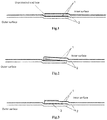
- Fig. 1 shows the general characteristics of the problem.
- the bonding of the material creates an unprotected end-face edge (unprotected end-face), which then comes into contact with the contents of the package.
- Fig. 2 shows a bending or reversal pattern with compensation for excess layer thickness by trimming the bending edge of the workpiece.
- the seam Due to the increase in the number of layers up to three at the welding/gluing point of the packing walls, the seam has an excessive compaction, which imposes some restrictions on the formation of glasses and containers with a round base and a rolled edge.
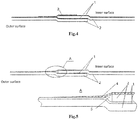
- Figures 3 and 4 show a polymer tape application scheme to protect the end-face of the frame material. It is a method of end-face protection used in the production of packaging for liquid products. The method is based on the application of an additional, specially multi-layer material in the form of a polymeric tape with reduced elasticity for the possibility of its application. This method has a significant limitation: it is used to process the role web fed material / workpiece before it is divided into single products.
- This method of protecting the end-face of the frame material creates an excessive thickness of the seam, which may impose restrictions on the types and methods of formation of packaging.
- Fig. 5 schematically shows a preferred embodiment of the claimed invention, wherein no excess thickness is created in the place of fastening mating surfaces of a frame material and a protective layer, no additional materials are introduced an (as in the case of a fold), and the direction of the frame material fibers is not changed, which, in the conventionally known methods, changes the local physical and mechanical characteristics of the frame material in the place of the seam and may impose restrictions when rolling an the edge of the package, or during further formation of the package.
- the shape-forming material of the container consists of a frame material 2 and a protective layer 1, applied from the inner side of the frame material 2, thereby forming an end-face 5 of the frame material.
- the protective layer 1 is extended by means of an elongated protective layer 4 in relation to the frame material 2 and, at the point where the shape-forming material overlaps to form the a seam, the elongated protective layer 4 is connected to the a mating layer of the shape-forming material. In this way, the end-face 5 of the frame material 2 is sealed by covering the end-face 5 with the elongated protective layer 4, without thickening the shape-forming material.
- the elongated protective layer 4 is welded to the mating surface to protect the welded area from contact with the external environment (e.g. the contents of the container) and to protect the end-face 5 of the frame material from contact with the contents of the container or the external environment.
Landscapes
- Engineering & Computer Science (AREA)
- Mechanical Engineering (AREA)
- Life Sciences & Earth Sciences (AREA)
- Biodiversity & Conservation Biology (AREA)
- Chemical & Material Sciences (AREA)
- Composite Materials (AREA)
- Wrappers (AREA)
- Packages (AREA)
Abstract
Description
- The invention refers to the production of packaging for mainly liquid, fatty and frozen foodstuffs or products containing or releasing fats and moisture.
- The most known types of packaging where the claimed invention may be used are paper cups, various containers with round or other bases, packages of various shapes for dairy products, juices and other products where the main shape-forming/frame material is mainly pulp and paper material or any other material requiring protection of the end-face from contact with the contents of the container.
- When forming a container, where laminated pulp and paper material are mainly used as the frame material, as well as any other material, that requires protection of the end-face from contact with the contents of the container, there is a problem when, when the material overlap at the joint. The end face at the inner surface without the use of additional methods of protection is unprotected from contact with the contents of the container.
- There are several ways to solve this problem:
- 1. Bending and turning the end face under itself.
- 2. Application on the end face or in the area of its location of the polymer tape.
- 3. Use of material with high end-face absorption resistance.
- In revealing each of the methods used to date to address the problem of end-face absorption, it is necessary to pay attention to the obvious shortcomings of each of them.
- The method of bending or turning under is mainly used in the production of packaging for dairy products and juices. Requires special folding equipment. Due to the increase in the number of layers up to three at the welding/adhesive point at the container walls, the seam has an excessive compaction, which imposes some restrictions on the formation of cups and containers with a round base and a rolled edge.
- There is a widely used way to compensate for the excess thickness of the three layers by trimming the bendable edge of the workpiece to reduce the thickness of the tilted edge. However, as a rule, due to the heterogeneity of the material structure in terms of thickness, physical and technical properties of the folded material in the place of bending, it is not possible to keep the same properties comparing to the material bound in one layer without a fold.
- Application to the end of the polymer tape. It is a method of end-face protection used by Tetrapack ® in the production of packaging for liquid products. It is a method based on the application of an additional special multi-layer material in the form of a polymeric strip with a reduced elasticity for its application. This method has a significant limitation - it is used to process the web fed material before it is divided into single workpieces. Thus, this method has a limitation in the formation of pre-cut products by pieces.
- In addition, as with the previous method, it creates an excessive seam thickness and completely different physical and technical properties compared to the same properties of the material bonded in one layer without additional layers of other materials.
- Use of material with high end-face absorption resistance. This method is most widely used in the production of paper cups and containers for food products with a round base, as well as in the production of milk bags and juices with a short shelf life. It is based on the use of pulp and paper raw materials with hydrophobic additives that slow down or prevent long time penetration of liquid, greasy and other products into the end-face part of the material in contact with the contents of the package.
- This method does not imply any protection of the end-face by additional methods at all, but is based solely on the properties of the material itself in terms of resistance to end-face absorption.
- The main disadvantages of this method are the higher cost of pulp and paper base material, which has the mentioned properties, as well as the impossibility of long-term storage of the product due to direct contact of the food product with the microbiological environment of the end-face of the pulp and paper material.
- The main drawbacks in the applied end-face protection methods described and not inherent by this invention are:
- 1 Excessive thickening of the material at the overlap and end-face protection of the frame material (observed both when bending or turning under the material and when applying polymeric tape). It also complicates further assembly and formation of the finished package.
- 2. Excessive rigidity of the overlap and end-face protection of the shape-forming/frame material (especially when bending or turning under the material). Complicates further assembly and formation of the finished package. Especially it prevents high-quality rolling of the upper edge of paper cups and round containers.
- 3. In the case of polymer tape application, the method is known to be used in the course of processing the web fed material before it is divided into single workpieces. Thus, the method of application of polymeric tape has a significant limitation when working with pre-cut products by single pieces.
- 4 Use of expensive frame material with hydrophobic properties in case of absence of additional methods of face-end protection.
- There is a known multi-layer packaging material for a flexible, preferably pillow-shaped packaging container containing an inner paper layer, external liquid-tight layers of polyolefin on both sides of the paper layer, and aluminum foil, which serves as a gas-tight layer and is located between the paper layer and one of the two outer liquid-tight layers. Between the aluminium foil and one of the two external liquid-tight layers, it contains a load-absorbing polyolefin film in contact with the aluminium foil. Foldings of packaging material are formed by means of heat sealing (patent
RU Nº2529522 - There is a known packaging container, taken as a prototype containing a multilayer forming material consisting of frame and protective layers. The protective layer is contained on the outer and inner surface of the frame material (patent
RU Nº 2487065 - However, the difficulty in assembling the known technical solutions due to the multi-layer structure of the material and the way of forming folds, entails a thickening of the material in the places of seams and, as a consequence, the provision of excessive rigidity of packaging, i.e. complication of further assembly and formation of the finished package.
- The problem to be solved by the present invention is to simplify the assembly and formation of the a finished package, for achieving a result of protection of the end-face of the package without thickening of the shape-forming material in the place of overlap (seam).
- The above stated result is achieved in the claimed package with a sealed end-face of the seam overlapping made of a shape-forming material consisting of a frame material and a protective layer, which is applied only from the inner side of the frame material, the protective layer is extended relative to the transverse length of the frame material by means of an elongated protective layer, and, at the point where the shape-forming material is joined by overlaps to form the package seam, the elongated protective layer is connected to a mating layer of the shape-forming material without touching the end-face of the seam.
- An additional feature is that the protective layer is made of biodegradable polymer, e.g. polymlactic acid (PLA).
- The main idea of this invention is to extend the protective layer beyond the frame material and its subsequent soldering to the protective layer of the mating surface during the formation of the finished package so that the protected end-face of the frame material remains isolated from contact with the food contents of the package.
- Extending the protective layer beyond the frame material does not cause thickening of the material at the place of heat sealing with the mating surfaces, as in the conventional case with the imposition of additional polymeric tapes or in some cases of material patching, or changes in technical and mechanical properties, as in the case of bending or patching of the material.
-
-
Fig. 1 schematically depicts conventionally known elements of packaging with a protective layer having an unprotected end-face edge; -
Fig. 2 schematically depicts a conventionally known method contemplating a bending pattern with compensation for excess layer thickness by trimming the bending edge of the frame material; -
Fig. 3 schematically depicts a conventionally known method contemplating application of a polymer tape around the end-face (seam) of the frame material, to protect the end face; -
Fig. 4 schematically depicts a conventionally known method contemplating application of a polymer tape partially around the end-face of the frame material and partially along an inner surface of the protective layer, to protect the end face; -
Fig. 5 schematically depicts a preferred embodiment of the invention contemplating application of an elongated protective layer of a polymer tape to a mating surface of the frame material, to protect the end face. - The proposed protection of the end-face of the shape-forming material by extending the protective (lamination) layer and further heat sealing with the adjacent layer during the formation of the a packaging container is explained in the attached drawings wherein:
- 1 - protective layer;
- 2 - frame material;
- 3 - polymer tape;
- 4 - elongated protective layer;
- 5 - insulated protected end-face of the frame material.
-
Fig. 1 shows the general characteristics of the problem. When forming a frame package coated/laminated with a protective layer on the inner surface of the package, the bonding of the material creates an unprotected end-face edge (unprotected end-face), which then comes into contact with the contents of the package. - It is also the most commonly used side wall mounting scheme for forming paper cups and food containers with a round base. At their manufacturing the frame material with high indicators of obstruction of end-face absorption is most often used.
-
Fig. 2 shows a bending or reversal pattern with compensation for excess layer thickness by trimming the bending edge of the workpiece. - Due to the increase in the number of layers up to three at the welding/gluing point of the packing walls, the seam has an excessive compaction, which imposes some restrictions on the formation of glasses and containers with a round base and a rolled edge.
-
Figures 3 and4 show a polymer tape application scheme to protect the end-face of the frame material. It is a method of end-face protection used in the production of packaging for liquid products. The method is based on the application of an additional, specially multi-layer material in the form of a polymeric tape with reduced elasticity for the possibility of its application. This method has a significant limitation: it is used to process the role web fed material / workpiece before it is divided into single products. - This method of protecting the end-face of the frame material creates an excessive thickness of the seam, which may impose restrictions on the types and methods of formation of packaging.
-
Fig. 5 schematically shows a preferred embodiment of the claimed invention, wherein no excess thickness is created in the place of fastening mating surfaces of a frame material and a protective layer, no additional materials are introduced an (as in the case of a fold), and the direction of the frame material fibers is not changed, which, in the conventionally known methods, changes the local physical and mechanical characteristics of the frame material in the place of the seam and may impose restrictions when rolling an the edge of the package, or during further formation of the package. - The shape-forming material of the container consists of a
frame material 2 and aprotective layer 1, applied from the inner side of theframe material 2, thereby forming an end-face 5 of the frame material. Theprotective layer 1 is extended by means of an elongated protective layer 4 in relation to theframe material 2 and, at the point where the shape-forming material overlaps to form the a seam, the elongated protective layer 4 is connected to the a mating layer of the shape-forming material. In this way, the end-face 5 of theframe material 2 is sealed by covering the end-face 5 with the elongated protective layer 4, without thickening the shape-forming material. - Further production of containers (packaging) is carried out in a conventional way with the selection of appropriate tools and welding modes of the
frame material 2. Together with the welding of theframe material 2, the elongated protective layer 4 is welded to the mating surface to protect the welded area from contact with the external environment (e.g. the contents of the container) and to protect the end-face 5 of the frame material from contact with the contents of the container or the external environment.
Claims (2)
- A packaging with a sealed overlapped end-face of the seam made of a shape-forming material consisting of a frame material and a protective layer, characterized in that the protective layer is applied only from the inner side of the frame material, is made elongated relative to the transverse length of the frame material and at the point where the shape-forming material overlaps to form the package seam, the elongated protective layer is connected to a mating layer of the shape-forming material, without touching the end-face of the seam.
- The packaging according to Claim 1, wherein the protective layer is made of biodegradable polymer.
Applications Claiming Priority (2)
| Application Number | Priority Date | Filing Date | Title |
|---|---|---|---|
| RU2018129756 | 2018-08-15 | ||
| PCT/RU2019/000631 WO2020036515A1 (en) | 2018-08-15 | 2019-09-12 | Packaging |
Publications (2)
| Publication Number | Publication Date |
|---|---|
| EP3663219A1 true EP3663219A1 (en) | 2020-06-10 |
| EP3663219A4 EP3663219A4 (en) | 2021-05-05 |
Family
ID=69525767
Family Applications (1)
| Application Number | Title | Priority Date | Filing Date |
|---|---|---|---|
| EP19850204.9A Pending EP3663219A4 (en) | 2018-08-15 | 2019-09-12 | PACKAGING |
Country Status (3)
| Country | Link |
|---|---|
| US (1) | US20200299024A1 (en) |
| EP (1) | EP3663219A4 (en) |
| WO (1) | WO2020036515A1 (en) |
Cited By (1)
| Publication number | Priority date | Publication date | Assignee | Title |
|---|---|---|---|---|
| WO2022219176A1 (en) * | 2021-04-16 | 2022-10-20 | Envican Gmbh | Can |
Family Cites Families (14)
| Publication number | Priority date | Publication date | Assignee | Title |
|---|---|---|---|---|
| GB1013656A (en) * | 1963-05-21 | 1965-12-15 | Tetra Pak Ab | A tube or tubular package formed from a packing laminate |
| SE384168B (en) * | 1967-12-22 | 1976-04-26 | Tetra Pak Int | METHOD OF PREPARATION FOR CONVERSION TO PACKAGING INTENDED LAMINATE PANELS |
| JPS5938266U (en) * | 1982-09-01 | 1984-03-10 | 日本特許管理株式会社 | Shrink nylon casing backing structure |
| DE4411924A1 (en) * | 1994-04-07 | 1995-10-12 | Ruediger Haaga Gmbh | container |
| JPH11236030A (en) | 1997-12-18 | 1999-08-31 | Dainippon Printing Co Ltd | Blank with covering material, method for producing the same, and apparatus for producing the same |
| ES2637670T3 (en) | 1999-01-27 | 2017-10-16 | Tetra Laval Holdings & Finance S.A. | Laminated packaging material for paper container |
| FR2791636A1 (en) * | 1999-04-01 | 2000-10-06 | Jean Bodet | Sealed cylindrical container for liquids and powders has plastics and cardboard laminate blank which is rolled and the plastic edges sealed together |
| WO2003106277A1 (en) * | 2002-06-12 | 2003-12-24 | Sonoco Development, Inc. | Metalized seam seal for single wrap container |
| JP2005014975A (en) * | 2003-06-26 | 2005-01-20 | Toppan Printing Co Ltd | Paper container |
| CN1852838B (en) | 2003-09-17 | 2012-01-04 | 日本纸张包装株式会社 | Sealing tape in paper container, and longitudinal sealing tape in paper container and paper container with longitudinal sealing tape |
| FI124502B (en) * | 2006-05-18 | 2014-09-30 | Stora Enso Oyj | Procedure for protecting the raw edge of paper or cardboard |
| SE532388C2 (en) | 2008-03-14 | 2010-01-12 | Tetra Laval Holdings & Finance | Packaging laminates and containers with two separate gas barrier layers and method for their preparation |
| TWM350309U (en) * | 2008-09-23 | 2009-02-11 | xi-qing Zhang | Spreading structure of multi-layered type container |
| WO2011088854A1 (en) * | 2010-01-20 | 2011-07-28 | Tetra Laval Holdings & Finance S.A. | Packaging laminate |
-
2019
- 2019-09-12 US US16/645,731 patent/US20200299024A1/en not_active Abandoned
- 2019-09-12 EP EP19850204.9A patent/EP3663219A4/en active Pending
- 2019-09-12 WO PCT/RU2019/000631 patent/WO2020036515A1/en not_active Ceased
Cited By (2)
| Publication number | Priority date | Publication date | Assignee | Title |
|---|---|---|---|---|
| WO2022219176A1 (en) * | 2021-04-16 | 2022-10-20 | Envican Gmbh | Can |
| US12534263B2 (en) | 2021-04-16 | 2026-01-27 | Envican Gmbh | Can |
Also Published As
| Publication number | Publication date |
|---|---|
| WO2020036515A1 (en) | 2020-02-20 |
| EP3663219A4 (en) | 2021-05-05 |
| US20200299024A1 (en) | 2020-09-24 |
Similar Documents
| Publication | Publication Date | Title |
|---|---|---|
| JP2656095B2 (en) | Packaging laminate and method for producing the same | |
| RU2527040C2 (en) | Splicing tape | |
| JP2012527386A (en) | Sealed paperboard container with enhanced barrier properties | |
| EP0091674B1 (en) | A single piece packaging container | |
| KR20230104995A (en) | Sheet packaging material for producing sealed packages for pourable food products | |
| US3242829A (en) | Container | |
| RU2107624C1 (en) | Sheet type packing material and method of its manufacture | |
| CN1331646A (en) | Method for impact-resistant packaging of products and flat cardboard blank for carrying out the method | |
| US20200299024A1 (en) | Packaging | |
| US3709398A (en) | Container | |
| EP0000374A1 (en) | A method of manufacturing a packing laminate and a packing laminate manufactured according to this method | |
| EP4532350B1 (en) | Cup and blank for forming | |
| JP6051899B2 (en) | Cup type paper container manufacturing method and cup type paper container | |
| WO2007032719A1 (en) | A sealing strip as well as a packaging container including such a strip | |
| EP3083436B1 (en) | Wrapper for soap bar | |
| CN1285781A (en) | Method of manufacturing edge-sealed packaging container blanks | |
| EP3663217A1 (en) | Method for producing an elongated protective layer for the shape-forming material of a blank | |
| CN100542794C (en) | Method for producing packaging laminate blanks and blanks and packaging containers produced thereby | |
| RU189037U1 (en) | PACKAGING | |
| CN101058240B (en) | Novel technology for longitudinal sealing of beverage package box packaging material | |
| JPH0333579B2 (en) | ||
| JP2006513940A (en) | Packaging container and packaging material blank | |
| US20160332797A1 (en) | Easy open pouches | |
| AU2017347365B2 (en) | A sealed pouch for dispensing material | |
| US20050035008A1 (en) | Soap bar wrapper |
Legal Events
| Date | Code | Title | Description |
|---|---|---|---|
| STAA | Information on the status of an ep patent application or granted ep patent |
Free format text: STATUS: THE INTERNATIONAL PUBLICATION HAS BEEN MADE |
|
| PUAI | Public reference made under article 153(3) epc to a published international application that has entered the european phase |
Free format text: ORIGINAL CODE: 0009012 |
|
| STAA | Information on the status of an ep patent application or granted ep patent |
Free format text: STATUS: REQUEST FOR EXAMINATION WAS MADE |
|
| 17P | Request for examination filed |
Effective date: 20200306 |
|
| AK | Designated contracting states |
Kind code of ref document: A1 Designated state(s): AL AT BE BG CH CY CZ DE DK EE ES FI FR GB GR HR HU IE IS IT LI LT LU LV MC MK MT NL NO PL PT RO RS SE SI SK SM TR |
|
| AX | Request for extension of the european patent |
Extension state: BA ME |
|
| XX | Miscellaneous (additional remarks) |
Free format text: THE FILING DATE OF THE INTERNATIONAL APPLICATION IS WITHIN TWO MONTHS FROM THE DATE OF EXPIRATION OF THE PRIORITY PERIOD (R. 26BIS.3 PCT). |
|
| A4 | Supplementary search report drawn up and despatched |
Effective date: 20210407 |
|
| RIC1 | Information provided on ipc code assigned before grant |
Ipc: B65D 5/40 20060101AFI20210330BHEP Ipc: B65D 65/40 20060101ALI20210330BHEP Ipc: B65D 30/08 20060101ALI20210330BHEP Ipc: B65D 75/28 20060101ALI20210330BHEP Ipc: B65D 65/46 20060101ALI20210330BHEP |
|
| TPAC | Observations filed by third parties |
Free format text: ORIGINAL CODE: EPIDOSNTIPA |
|
| DAV | Request for validation of the european patent (deleted) | ||
| DAX | Request for extension of the european patent (deleted) | ||
| STAA | Information on the status of an ep patent application or granted ep patent |
Free format text: STATUS: EXAMINATION IS IN PROGRESS |
|
| 17Q | First examination report despatched |
Effective date: 20230411 |
|
| GRAP | Despatch of communication of intention to grant a patent |
Free format text: ORIGINAL CODE: EPIDOSNIGR1 |
|
| STAA | Information on the status of an ep patent application or granted ep patent |
Free format text: STATUS: GRANT OF PATENT IS INTENDED |
|
| INTG | Intention to grant announced |
Effective date: 20250206 |
|
| GRAJ | Information related to disapproval of communication of intention to grant by the applicant or resumption of examination proceedings by the epo deleted |
Free format text: ORIGINAL CODE: EPIDOSDIGR1 |
|
| STAA | Information on the status of an ep patent application or granted ep patent |
Free format text: STATUS: EXAMINATION IS IN PROGRESS |
|
| INTC | Intention to grant announced (deleted) | ||
| GRAJ | Information related to disapproval of communication of intention to grant by the applicant or resumption of examination proceedings by the epo deleted |
Free format text: ORIGINAL CODE: EPIDOSDIGR1 |
|
| GRAP | Despatch of communication of intention to grant a patent |
Free format text: ORIGINAL CODE: EPIDOSNIGR1 |
|
| RAP1 | Party data changed (applicant data changed or rights of an application transferred) |
Owner name: DOECO USA LLC |
|
| RIN1 | Information on inventor provided before grant (corrected) |
Inventor name: DOECO USA LLC |
|
| GRAP | Despatch of communication of intention to grant a patent |
Free format text: ORIGINAL CODE: EPIDOSNIGR1 |
|
| STAA | Information on the status of an ep patent application or granted ep patent |
Free format text: STATUS: GRANT OF PATENT IS INTENDED |
|
| INTG | Intention to grant announced |
Effective date: 20260410 |
|
| RIN1 | Information on inventor provided before grant (corrected) |
Inventor name: SAVELEV, DMITRII VIKTOROVICH |
|
| GRAS | Grant fee paid |
Free format text: ORIGINAL CODE: EPIDOSNIGR3 |
|
| GRAA | (expected) grant |
Free format text: ORIGINAL CODE: 0009210 |
|
| STAA | Information on the status of an ep patent application or granted ep patent |
Free format text: STATUS: THE PATENT HAS BEEN GRANTED |