EP3660008A1 - Coumarin oxime ester compound and preparation and use thereof - Google Patents
Coumarin oxime ester compound and preparation and use thereof Download PDFInfo
- Publication number
- EP3660008A1 EP3660008A1 EP18839489.4A EP18839489A EP3660008A1 EP 3660008 A1 EP3660008 A1 EP 3660008A1 EP 18839489 A EP18839489 A EP 18839489A EP 3660008 A1 EP3660008 A1 EP 3660008A1
- Authority
- EP
- European Patent Office
- Prior art keywords
- alkyl
- compound
- amino
- group
- cycloalkyl
- Prior art date
- Legal status (The legal status is an assumption and is not a legal conclusion. Google has not performed a legal analysis and makes no representation as to the accuracy of the status listed.)
- Granted
Links
Images

Classifications
-
- C—CHEMISTRY; METALLURGY
- C07—ORGANIC CHEMISTRY
- C07D—HETEROCYCLIC COMPOUNDS
- C07D311/00—Heterocyclic compounds containing six-membered rings having one oxygen atom as the only hetero atom, condensed with other rings
- C07D311/02—Heterocyclic compounds containing six-membered rings having one oxygen atom as the only hetero atom, condensed with other rings ortho- or peri-condensed with carbocyclic rings or ring systems
- C07D311/04—Benzo[b]pyrans, not hydrogenated in the carbocyclic ring
- C07D311/58—Benzo[b]pyrans, not hydrogenated in the carbocyclic ring other than with oxygen or sulphur atoms in position 2 or 4
-
- C—CHEMISTRY; METALLURGY
- C07—ORGANIC CHEMISTRY
- C07D—HETEROCYCLIC COMPOUNDS
- C07D311/00—Heterocyclic compounds containing six-membered rings having one oxygen atom as the only hetero atom, condensed with other rings
- C07D311/02—Heterocyclic compounds containing six-membered rings having one oxygen atom as the only hetero atom, condensed with other rings ortho- or peri-condensed with carbocyclic rings or ring systems
- C07D311/04—Benzo[b]pyrans, not hydrogenated in the carbocyclic ring
- C07D311/06—Benzo[b]pyrans, not hydrogenated in the carbocyclic ring with oxygen or sulfur atoms directly attached in position 2
- C07D311/08—Benzo[b]pyrans, not hydrogenated in the carbocyclic ring with oxygen or sulfur atoms directly attached in position 2 not hydrogenated in the hetero ring
-
- C—CHEMISTRY; METALLURGY
- C07—ORGANIC CHEMISTRY
- C07D—HETEROCYCLIC COMPOUNDS
- C07D311/00—Heterocyclic compounds containing six-membered rings having one oxygen atom as the only hetero atom, condensed with other rings
- C07D311/02—Heterocyclic compounds containing six-membered rings having one oxygen atom as the only hetero atom, condensed with other rings ortho- or peri-condensed with carbocyclic rings or ring systems
- C07D311/04—Benzo[b]pyrans, not hydrogenated in the carbocyclic ring
- C07D311/06—Benzo[b]pyrans, not hydrogenated in the carbocyclic ring with oxygen or sulfur atoms directly attached in position 2
- C07D311/08—Benzo[b]pyrans, not hydrogenated in the carbocyclic ring with oxygen or sulfur atoms directly attached in position 2 not hydrogenated in the hetero ring
- C07D311/16—Benzo[b]pyrans, not hydrogenated in the carbocyclic ring with oxygen or sulfur atoms directly attached in position 2 not hydrogenated in the hetero ring substituted in position 7
-
- C—CHEMISTRY; METALLURGY
- C07—ORGANIC CHEMISTRY
- C07D—HETEROCYCLIC COMPOUNDS
- C07D311/00—Heterocyclic compounds containing six-membered rings having one oxygen atom as the only hetero atom, condensed with other rings
- C07D311/02—Heterocyclic compounds containing six-membered rings having one oxygen atom as the only hetero atom, condensed with other rings ortho- or peri-condensed with carbocyclic rings or ring systems
- C07D311/04—Benzo[b]pyrans, not hydrogenated in the carbocyclic ring
- C07D311/06—Benzo[b]pyrans, not hydrogenated in the carbocyclic ring with oxygen or sulfur atoms directly attached in position 2
- C07D311/08—Benzo[b]pyrans, not hydrogenated in the carbocyclic ring with oxygen or sulfur atoms directly attached in position 2 not hydrogenated in the hetero ring
- C07D311/12—Benzo[b]pyrans, not hydrogenated in the carbocyclic ring with oxygen or sulfur atoms directly attached in position 2 not hydrogenated in the hetero ring substituted in position 3 and unsubstituted in position 7
-
- C—CHEMISTRY; METALLURGY
- C07—ORGANIC CHEMISTRY
- C07D—HETEROCYCLIC COMPOUNDS
- C07D311/00—Heterocyclic compounds containing six-membered rings having one oxygen atom as the only hetero atom, condensed with other rings
- C07D311/02—Heterocyclic compounds containing six-membered rings having one oxygen atom as the only hetero atom, condensed with other rings ortho- or peri-condensed with carbocyclic rings or ring systems
- C07D311/04—Benzo[b]pyrans, not hydrogenated in the carbocyclic ring
- C07D311/58—Benzo[b]pyrans, not hydrogenated in the carbocyclic ring other than with oxygen or sulphur atoms in position 2 or 4
- C07D311/68—Benzo[b]pyrans, not hydrogenated in the carbocyclic ring other than with oxygen or sulphur atoms in position 2 or 4 with nitrogen atoms directly attached in position 4
-
- C—CHEMISTRY; METALLURGY
- C07—ORGANIC CHEMISTRY
- C07D—HETEROCYCLIC COMPOUNDS
- C07D311/00—Heterocyclic compounds containing six-membered rings having one oxygen atom as the only hetero atom, condensed with other rings
- C07D311/02—Heterocyclic compounds containing six-membered rings having one oxygen atom as the only hetero atom, condensed with other rings ortho- or peri-condensed with carbocyclic rings or ring systems
- C07D311/78—Ring systems having three or more relevant rings
-
- C—CHEMISTRY; METALLURGY
- C07—ORGANIC CHEMISTRY
- C07D—HETEROCYCLIC COMPOUNDS
- C07D493/00—Heterocyclic compounds containing oxygen atoms as the only ring hetero atoms in the condensed system
- C07D493/02—Heterocyclic compounds containing oxygen atoms as the only ring hetero atoms in the condensed system in which the condensed system contains two hetero rings
- C07D493/04—Ortho-condensed systems
-
- C—CHEMISTRY; METALLURGY
- C08—ORGANIC MACROMOLECULAR COMPOUNDS; THEIR PREPARATION OR CHEMICAL WORKING-UP; COMPOSITIONS BASED THEREON
- C08F—MACROMOLECULAR COMPOUNDS OBTAINED BY REACTIONS ONLY INVOLVING CARBON-TO-CARBON UNSATURATED BONDS
- C08F2/00—Processes of polymerisation
- C08F2/46—Polymerisation initiated by wave energy or particle radiation
- C08F2/48—Polymerisation initiated by wave energy or particle radiation by ultraviolet or visible light
-
- C—CHEMISTRY; METALLURGY
- C08—ORGANIC MACROMOLECULAR COMPOUNDS; THEIR PREPARATION OR CHEMICAL WORKING-UP; COMPOSITIONS BASED THEREON
- C08F—MACROMOLECULAR COMPOUNDS OBTAINED BY REACTIONS ONLY INVOLVING CARBON-TO-CARBON UNSATURATED BONDS
- C08F2/00—Processes of polymerisation
- C08F2/46—Polymerisation initiated by wave energy or particle radiation
- C08F2/48—Polymerisation initiated by wave energy or particle radiation by ultraviolet or visible light
- C08F2/50—Polymerisation initiated by wave energy or particle radiation by ultraviolet or visible light with sensitising agents
Definitions
- the present invention relates to coumarin 3-ketooxime ester compounds, which can be used as a photoinitiator.
- the present invention also relates to the preparation and use of coumarin 3-ketooxime ester compounds.
- Photoinitiators also known as photo sensitizers or photo-curing agents, are a class of compounds that can absorb energy of a certain wavelength in the ultraviolet region (250-400 nm) or visible region (400-600 nm) to generate free radicals, cations, etc., thereby initiating monomer polymerization, crosslinking and curing.
- the photoinitiator In the photo-curing system, the photoinitiator generally accounts for 3-5%. Although the content is low, it is the key component among them, which plays a decisive role in the photo-curing speed. It is related to whether the oligomer and diluent can be rapidly cross-linked and solidified when the formula system is irradiated with light, thereby changing from liquid to solid.
- the photoinitiator must meet the requirements of different photo-curing conditions and applications.
- the main goals are: to improve light sensitivity, improve surface curing efficiency (anti-oxidation inhibition), improve deep curing performance, improve solubility of photoinitiators in monomers and resins, reduce toxicity and odor, reduce migration of uncured initiator after curing, and reduce yellowing.
- Oxime ester photoinitiators have become a class of photoinitiators that have received increasing attention in recent years because of their excellent photosensitivity, wherein BASF's products OXE-01 and OXE-02 are two typical oxime esters currently on the market. These two products have high photosensitivity, but their UV absorption wavelengths are relatively short and are not suitable for the needs of UV- LED light sources (emission wavelength of 365 nm, 385 nm, 395 nm, 405 nm, and 420 nm). There are also some Chinese patents on oxime ester photoinitiators.
- CN102775527A discloses a diphenyl sulfide ketone oxime ester photoinitiator and a preparation method thereof.
- CN102492059A discloses substituted diphenyl sulfide ketoxime type photoinitiators and the like.
- the ultraviolet absorption wavelength of most initiators is 250-350 nm, which cannot match with the increasingly developed LED light sources, and greatly limits the application of oxime ester photoinitiators.
- CN104817653A discloses an oxime ester photoinitiator suitable for UV-LED light source curing.
- the initiator compound is a coumarin aldoxime ester compound.
- studies have shown that the thermal stability of such compounds is less than that of OXE-01.
- CN1889960A discloses that coumarinone oxime ester compounds can be used in pharmaceutical or cosmetic compositions to prevent and treat diseases, including immunological diseases, chronic inflammation, neurological and skin diseases, tumor diseases, specific viruses (particularly SARS) and so on. In this sense, such compounds are safe and non-toxic, but no literature has reported the use of coumarin ketoxime esters as photoinitiators.
- the inventors of the present invention have conducted extensive and in-depth research on photoinitiators suitable for radiation curing by UV-LED light sources (emission wavelength of 300 to 450 nm, especially 365 to 420 nm) in order to find a photoinitiator that can replace OXE-01 and OXE-02, which can be more suitable for UV-LED light source curing and has good thermal stability.
- the inventors of the present invention have found that the coumarin (keto) oxime ester compounds obtained by connecting an unsubstituted or substituted coumarin directly or via a carbonyl group to an oxime ester moiety have strong ultraviolet absorption in the range of 300 to 450nm, especially 350 to 420nm, and have good thermal stability, so they are suitable as photoinitiators for radiation curing by UV-LED light source.
- the objects of the present invention are achieved based on the foregoing findings.
- an object of the present invention is to provide a coumarin (keto) oxime ester compound, whose absorption wavelength is not only suitable for Radiation curing by UV-LED light source, but also has good thermal stability.
- Another object of the present invention is to provide a method for preparing the coumarin (keto) oxime ester compound of the present invention.
- Another object of the present invention is to provide use of the coumarin (keto) oxime ester compound of the present invention as a photoinitiator or a photo sensitizer.
- Figure 1 is a schematic diagram of a Ugra offset plate test strip, in which
- a coumarin (keto) oxime ester compound of the following formula (I) is provided: wherein:
- the compound of formula (I) contains both a coumarin-based structural moiety and a (keto) oxime ester-based structural moiety.
- the compound has strong ultraviolet absorption in the range of 300 to 450 nm. After absorbing light energy, it can quickly transfer energy and continuously initiate polymerization. It has obvious advantages in terms of photosensitivity and pattern integrity, and is very suitable for UV-LED light source, and it is safe and non-toxic and can be used in food packaging and other fields.
- the compound of formula (I) also has good thermal stability.
- C n -C m means in each case that the number of carbon atoms contained in the group is n to m.
- Halogen means fluorine, chlorine, bromine, and iodine. In the present invention, preferably, the halogen includes F, CI, or a combination thereof.
- C n -C m alkyl refers to a branched or unbranched saturated hydrocarbon group having n to m carbon atoms, such as 1 to 20, preferably 1 to 12, more preferably 1 to 8, particularly preferably 1 to 6, and particularly preferably 1 to 4 carbon atoms, for example, methyl, ethyl, propyl, 1-methylethyl, butyl, 1-methylpropyl, 2-methylpropyl, 1,1-dimethylethyl, pentyl, 1-methylbutyl, 2-methylbutyl, 3-methylbutyl, 2,2-dimethylpropyl, 1-ethylpropyl, hexyl, 1,1-dimethylpropyl, 1,2-dimethylpropyl, 1-methylpentyl, 2-methylpentyl, 3-methylpentyl, 4-methylpentyl, 1,1-dimethylbutyl, 1,2-dimethylbutyl, 1,3-dimethylbutyl, 2,
- C 1 -C 8 alkyl can be methyl, ethyl, propyl, isopropyl, n-butyl, 2-butyl, tert-butyl, pentyl, isopentyl, hexyl, heptyl, octyl, and isomers thereof.
- C 1 -C 6 alkyl can be methyl, ethyl, propyl, isopropyl, n-butyl, 2-butyl, tert-butyl, pentyl, isopentyl, hexyl, and isomers thereof.
- C 1 -C 4 alkyl can be methyl, ethyl, propyl, 1-methylethyl, butyl, 1-methylpropyl, 2-methylpropyl, 1,1-dimethylethyl, and isomers thereof.
- C 2 -C m alkenyl refers to a branched or unbranched unsaturated open-chain hydrocarbon group having 2 to m, such as 2 to 20, preferably 2 to 6, more preferably 2 to 4 carbon atoms and having one or more double bonds at any position, for example ethenyl, 1-propenyl, 2-propenyl, 1-methylethenyl, 1-butenyl, 2-butenyl, 3-butenyl, 1-methyl-1-propenyl, 2-methyl-1-propenyl, 1-methyl-2-propenyl, 2-methyl-2-propenyl, 1-pentenyl, 2-pentenyl, 3-pentenyl, 4-pentenyl, 1-methyl-1-butenyl, 2-methyl-1-butenyl, 3-methyl-1-butenyl, 1-methyl-2-butenyl, 2-methyl-2-butenyl, 3-methyl-2-butenyl, 1-methyl-3-butenyl, 2-methyl-3-butenyl, 2-methyl-3-buten
- C 2 -C 6 alkenyl can be ethenyl, propenyl, 1-butenyl, 2-butenyl, isobutenyl, 1-pentenyl, 2-pentenyl, neopentenyl, 1-hexenyl, 2-hexenyl, 3-hexenyl, isohexenyl, neohexenyl, and isomers thereof.
- C 2 -C 4 alkenyl can be ethenyl, 1-propenyl, 2-propenyl, 1-methylethenyl, 1-butenyl, 2-butenyl, 3-butenyl, 1-methyl-1-propenyl, 2-methyl-l-propenyl, 1-methyl-2-propenyl, 2-methyl-2-propenyl, and isomers thereof.
- C 2 -C m alkynyl refers to a branched or unbranched unsaturated open-chain hydrocarbon group having 2 to m, such as 2 to 20, preferably 2 to 6, more preferably 2 to 4 carbon atoms and having one or more triple bonds at any position, for example, ethynyl, propynyl, 1-butynyl, 2-butynyl, and isomers thereof.
- C 2 -C 6 alkynyl can be ethynyl, propynyl, 1-butynyl, 2-butynyl, 1-pentynyl, 2-pentynyl, 3-pentynyl, 4-pentynyl, 1-hexynyl, 2-hexynyl, 3-hexynyl, 4-hexynyl, 5-hexynyl, and isomers thereof.
- C 2 -C 4 alkynyl can be ethynyl, propynyl, 1-butynyl, 2-butynyl, and isomers thereof.
- C 3 -C m cycloalkyl refers to a saturated alicyclic monocyclic group having 3 to m, such as 3 to 20, preferably 3 to 8, more preferably 5 to 6 ring carbon atoms, for example, cyclopropyl, cyclobutyl, cyclopentyl, cyclohexyl, cycloheptyl, cyclooctyl and cyclodecyl.
- C 4 -C m cycloalkylalkyl means an alkyl group substituted with a cycloalkyl group and contains a total of 4 to m carbon atoms, such as 4 to 20 carbon atoms, preferably 4 to 10 carbon atoms, more preferably 4 to 6 carbon atoms, wherein the alkyl and cycloalkyl are as defined herein, for example, cyclopropylmethyl, cyclopropylethyl, cyclopropylpropyl, cyclopropylbutyl, cyclobutylmethyl, cyclobutylethyl, cyclobutylpropyl, cyclobutylbutyl, cyclopentylmethyl, cyclopentylethyl, cyclopentylpropyl, cyclopentylbutyl, cyclohexylmethyl, cyclohexylethyl, cyclohexylpropyl, cyclohexyl
- C 4 -C 10 alkylcycloalkyl means a cycloalkyl substituted with an alkyl group and contains a total of 4 to m carbon atoms, such as 4 to 10 carbon atoms, preferably 4 to 8 carbon atoms, more preferably 4 to 6 carbon atoms, wherein the alkyl and cycloalkyl are as defined herein, for example, methylcyclopropyl, ethylcyclopropyl, propylcyclopropyl, butylcyclopropyl, methylcyclobutyl, ethylcyclobutyl, propylcyclobutyl, butylcyclobutyl, methylcyclopentyl, ethylcyclopentyl, propylcyclopentyl, butylcyclopentyl, methylcyclohexyl, ethylcyclohexyl, propylcyclohexyl, butylcyclohexyl,
- C 6 -C m aryl refers to a monocyclic, bicyclic or tricyclic aromatic hydrocarbon group containing 6 to m carbon atoms, such as 6 to 18, preferably 6 to 10 carbon atoms.
- C 6 -C m aryl groups mention may be made of phenyl, tolyl, ethylphenyl, propylphenyl, butylphenyl, xylyl, methylethylphenyl, diethylphenyl, methylpropylphenyl, naphthyl, and the like; phenyl or naphthyl is preferred, especially phenyl (also represented as C 6 H 5 as a substituent).
- C 7 -C 20 aralkyl means an alkyl group substituted with an aryl group and contains a total of 7 to 20 carbon atoms, such as 7 to 12, preferably 7 to 10 carbon atoms, more preferably 7 to 8 carbon atoms, wherein the alkyl and aryl groups are as defined herein, for example, benzyl, phenylethyl, naphthylmethyl, and naphthylethyl.
- C 7 -C 20 alkylaryl means an aryl group substituted with an alkyl group and contains a total of 7 to 20 carbon atoms, such as 7 to 12, preferably 7 to 10 carbon atoms, more preferably 7 to 8 carbon atoms, wherein the alkyl and aryl groups are as defined herein, for example, methylphenyl, dimethylphenyl, trimethylphenyl, ethylphenyl, diethylphenyl, triethylphenyl, methylnaphthyl, ethylnaphthyl and the like.
- C n -C m alkoxy and “C n -C m alkylthio” refer to a C n -C m alkyl group having an oxygen atom or a sulfur atom as a linking group bonded to any carbon atom of the open-chain C n -C m alkane corresponding to the C n -C m alkyl group, for example, a C 1 -C 20 alkoxy (or alkylthio) group, preferably a C 1 -C 12 alkoxy (or alkylthio) group, more preferably a C 1 -C8 alkoxy (or alkylthio) group, and specifically preferably a C 1 -C 6 alkoxy (or alkylthio) group, particularly preferably a C 1 -C 4 alkoxy (or alkylthio group.
- C 1 -C 8 alkoxy can be methoxy, ethoxy, propoxy, isopropoxy, n-butoxy, 2-butoxy, tert-butoxy, pentyloxy, isopentyloxy, hexyloxy, heptyloxy, octyloxy, isooctyloxy, and isomers thereof.
- C 1 -C 4 alkoxy may be methoxy, ethoxy, propoxy, isopropoxy, n-butoxy, sec-butoxy, isobutoxy, tert-butoxy, and isomers thereof.
- C 1 -C 8 alkylthio can be methylthio, ethylthio, propylthio, isopropylthio, n-butylthio, 2-butylthio, tert-butylthio, pentylthio, isopentylthio, hexylthio, heptylthio, octylthio, isooctylthio, and isomers thereof.
- C 1 -C 4 alkylthio can be methylthio, ethylthio, propylthio, isopropylthio, n-butylthio, and isomers thereof.
- C 2 -C m alkenyloxy and “C 2 -C m alkenylthio” refer to a C 2 -C m alkenyl group having an oxygen atom or a sulfur atom as a linking group bonded to any saturated carbon atom of the C 2 -C m alkene corresponding to the C 2 -C m alkenyl group, for example, a C 2 -C 2o alkenyloxy (or alkenylthio) group, preferably a C 2 -C 12 alkenyloxy (or alkenylthio) group, more preferably a C 2 -C 8 alkenyloxy (or alkenylthio) group, and specifically preferably a C 2 -C 6 alkenyloxy (or alkenylthio) group, particularly preferably a C 2 -C 4 alkenyloxy (or alkenylthio) group, for example, ethenyloxy, propenyloxy, is
- C 2 -C m alkynyloxy and “C 2 -C m alkynylthio” refer to a C 2 -C m alkynyl group having an oxygen atom or a sulfur atom as a linking group bonded to any saturated carbon atom of the C 2 -C m alkyne corresponding to the C 2 -C m alkynyl group, for example, a C 2 -C 2o alkynyloxy (or alkynylthio) group, preferably a C 2 -C 12 alkynyloxy (or alkynylthio) group, more preferably a C 2 -C 8 alkynyloxy (or alkynylthio) group, and particularly preferably a C 2 -C 6 alkynyloxy (or alkynylthio) group, especially preferably a C 2 -C 4 alkynyloxy (or alkynylthio) group, for example,
- C 3 -C m cycloalkoxy and “C 3 -C m cycloalkylthio” refer to a C 3 -C m cycloalkyl group having an oxygen atom or a sulfur atom as a linking group bonded to any ring carbon atom of the C 3 -C m cycloalkane corresponding to the C 3 -C m cycloalkyl group, for example, C 3 -C 20 cycloalkoxy (or cycloalkylthio) group, preferably C 3 -C 8 cycloalkoxy (or cycloalkylthio) group, more preferably C 5 -C 6 cycloalkoxy (or cycloalkylthio) group, for example, cyclopropyloxy, cyclobutyloxy, cyclopentyloxy, cyclohexyloxy, cycloheptyloxy, cyclooctyloxy, cyclodec
- C 4 -C m cycloalkylalkoxy and "C 4 -C m cycloalkylalkylthio” refer to an alkoxy (alkylthio) group substituted with a cycloalkyl group and contain a total of 4 to m carbon atoms, such as 4 to 20 carbon atoms, preferably 4 to 8 carbon atoms, wherein the cycloalkyl and alkoxy (alkylthio) groups are as defined herein, for example, cyclopropylmethoxy, cyclopropylethoxy, cyclopropylpropoxy, cyclopropylbutoxy, cyclobutylmethoxy, cyclobutylethoxy, cyclobutylpropoxy, cyclobutylbutyloxy, cyclopentylmethoxy, cyclopentylethoxy, cyclopentylpropoxy, cyclopentylbutoxy, cyclohexylmethoxy
- C 6 -C m aryloxy and “C 6 -C m arylthio” refer to a C 6 -C m aryl group having an oxygen atom or a sulfur atom as a linking group bonded to any aromatic carbon atom of the C 6 -C m aromatic hydrocarbon corresponding to the C 6 -C m aryl group, for example, phenylthio, phenoxy, tolyloxy, tolylthio, naphthylthio, naphthyloxy, and the like.
- n is 0 or 1.
- the compound of formula (I) is referred to as a coumarin oxime ester compound; when n is 1, the compound of formula (I) is referred to as a coumarin ketooxime ester compound.
- coumarin (keto) oxime ester compounds are collectively referred to as coumarin (keto) oxime ester compounds.
- R 1 , R 2 , R 3 , R 4 , and R 5 are independently selected from hydrogen, halogen, nitro, hydroxy, mercapto, carboxyl, C 1 -C 8 carboxylate ester group, sulfonic acid group, amino, cyano, C 1 -C 20 alkyl, C 2 -C 20 alkenyl, C 2 -C 20 alkynyl, C 3 -C 20 cycloalkyl, C 4 -C 20 cycloalkylalkyl, C 1 -C 20 alkoxy, C 2 -C 20 alkenyloxy, C 2 -C 20 alkynyloxy, C 3 -C 20 cycloalkoxy, C 4 -C 20 cycloalkylalkoxy, C 1 -C 20 alkylthio, C 2 -C 20 alkenylthio, C 2 -C 20 alkynylthio, C 3 -C 20 cycloalkylthio
- R 1 together with R 2 , R 2 together with R 3 , R 3 together with R 4 , or R 1 together with R 2 and R 3 together with R 4 form a saturated or unsaturated divalent group having 3 to 4 atoms selected from C, N, O, and S and wherein at least one of the atoms is carbon atom; and
- R 1 , R 2 , R 3 , R 4 , and R 5 are independently selected from hydrogen, halogen, nitro, hydroxy, mercapto, carboxyl, C 1 -C 6 carboxylate ester group, sulfonic acid group, amino, cyano, C 1 -C 6 alkyl, C 2 -C 6 alkenyl, C 2 -C 6 alkynyl, C 3 -C 8 cycloalkyl, C 4 -C 8 cycloalkylalkyl, C 1 -C 6 alkoxy, C 2 -C 6 alkenyloxy, C 2 -C 6 alkynyloxy, C 3 -C 8 cycloalkoxy, C 4 -C 8 cycloalkylalkoxy, C 1 -C 6 alkylthio, C 2 -C 6 alkenylthio, C 2 -C 6 alkynylthio, C 3 -C 8 cycloalkylthio,
- R 1 together with R 2 , R 2 together with R 3 , or R 3 together with R 4 form a saturated or unsaturated divalent group having 3 to 4 atoms selected from C, N, O, and S and wherein at least one of the atoms is carbon atom.
- R 1 , R 2 , R 3 , R 4 , and R 5 are independently selected from hydrogen, halogen, nitro, C 1 -C 4 carboxylate ester group, C 1 -C 4 alkyl, C 2 -C 4 alkenyl, C 1 -C 4 alkoxy, C 1 -C 4 alkylthio, mono(C 1 -C 4 alkyl)amino, di(C 1 -C 4 alkyl)amino, phenoxy and phenylthio.
- R 6 and R 7 independently represent linear or branched C 1 -C 20 alkyl, C 3 -C 10 cycloalkyl, C 4 -C 10 cycloalkylalkyl, C 4 -C 10 alkylcycloalkyl, C 6 -C 20 aryl, C 7 -C 20 aralkyl and C 7 -C 20 alkylaryl, wherein the aforementioned C 1 -C 20 alkyl, C 3 -C 10 cycloalkyl, C 4 -C 10 cycloalkylalkyl, C 4 -C 10 alkylcycloalkyl, C 6 -C 20 aryl, C 7 -C 20 aralkyl and C 7 -C 20 alkylaryl are optionally substituted with one or more groups independently selected from the group consisting of: C 1 -C 6 alkylthio, C 1 -C 6 alkoxy, C 1 -C 6 alkyl, halogen, nitro, amino
- R 6 and R 7 independently represent linear or branched C 1 -C 8 alkyl, C 3 -C 8 cycloalkyl, C 4 -C 8 cycloalkylalkyl, C 4 -C 8 alkylcycloalkyl, C 6 -C 10 aryl, C 7 -C 11 aralkyl and C 7 -C 11 alkylaryl, wherein the aforementioned C 1 -C 8 alkyl, C 3 -C 8 cycloalkyl, C 4 -C 8 cycloalkylalkyl, C 4 -C 8 alkylcycloalkyl, C 6 -C 10 aryl, C 7 -C 11 aralkyl and C 7 -C 11 alkylaryl may be optionally substituted with one or more groups independently selected from the group consisting of: C 1 -C 4 alkyl, C 1 -C 4 alkylthio, C 1 -C 4 alkoxy, halogen, nitro, amino
- R 6 and R 7 are independently selected from linear or branched C 1 -C 8 alkyl, C 5 -C 6 cycloalkyl, C 1 -C 4 alkyl substituted with C 5 -C 6 cycloalkyl, C 1 -C 4 alkyl substituted with phenyl, and phenyl, wherein the aforementioned phenyl each may be optionally substituted with one or more groups independently selected from the group consisting of: C 1 -C 4 alkyl, C 1 -C 4 alkylthio, C 1 -C 4 alkoxy, halogen, nitro, amino, mono(C 1 -C 4 alkyl)amino, di(C 1 -C 4 alkyl)amino and mercapto.
- R 6 is linear or branched C 1 -C 6 alkyl, C 5 -C 6 cycloalkyl, C 1 -C 2 alkyl substituted with C 5 -C 6 cycloalkyl, or phenyl, and the aforementioned phenyl is optionally substituted with one or more groups independently selected from the group consisting of: C 1 -C 4 alkyl, halogen, nitro, amino and mercapto, and R 7 is linear or branched C 1 -C 7 alkyl or phenyl, wherein the phenyl is optionally substituted with one or more groups independently selected from the group consisting of: C 1 -C 4 alkyl, C 1 -C 4 alkylthio, C 1 -C 4 alkoxy, halogen, nitro, amino, mono(C i -C 4 alkyl)amino, di(C 1 -C 4 alkyl)amino and mercapto.
- R 5 is H.
- the compound of formula (I) is selected from compounds 1 to 50.
- the compounds 1 to 50 were prepared in Examples 1 to 50, respectively.
- a method for preparing a compound of formula (I) of the present invention comprising the following steps:
- the oximation reaction usually starts with a carbonyl compound. For this reason, when n is 0, a compound of formula (II) is subjected to oximation reaction with hydroxylamine and/or hydroxylamine hydrochloride to obtain a compound of formula (IIIa) R 1 -R 5 and R 6 in formulae (II) and (IIIa) are as defined for formula (I).
- hydroxylamine hydrochloride NH 2 OH.HCl
- hydroxylamine NH 2 OH
- NH 2 OH hydroxylamine
- the oximation reaction is usually carried out in an organic solvent, preferably in an organic polar solvent.
- the solvent that can be used are, for example, ethanol or aqueous ethanol.
- bases such as sodium acetate, pyridine, piperidine, triethylamine are generally added. Among them, pyridine, piperidine, and triethylamine can also be used as bases and/or solvents or co-solvents.
- the temperature of oximation reaction is generally the reflux temperature of the solvent, and the temperature range is usually 60 to 120°C.
- the time of oximation reaction is not particularly limited either, but it is usually carried out for 0.1 to 20 hours, preferably 0.5 to 10 hours.
- the relative amount of the compound of formula (II) and the compound selected from hydroxylamine and/or hydroxylamine hydrochloride is not particularly limited. Generally, they are used in approximately equimolar amounts, for example, the molar ratio of the two is 1:1.5 to 1.5:1, preferably 1:1.2 to 1.2:1.
- the alkyl nitrite may be a C 1 -C 6 alkyl nitrite such as methyl nitrite, ethyl nitrite, isopropyl nitrite, butyl nitrite, isoamyl nitrite.
- the oximation reaction is usually carried out in an organic solvent, preferably in an organic polar solvent. Solvents that can be used are, for example, ethanol or aqueous ethanol. In order to promote the oximation reaction to completion, it is generally necessary to add concentrated hydrochloric acid. Concentrated hydrochloric acid may also be used as the acid and/or solvent or co-solvent.
- the temperature of oximation reaction is low, and the temperature range is usually -30 to 20°C, preferably 5 to 20°C.
- the time of oximation reaction is not particularly limited either, it is usually carried out for 0.1 to 20 hours, preferably 0.5 to 10 hours.
- the relative amount of the compound of formula (II) and the compound selected from the group consisting of nitrous acid, nitrite and/or alkyl nitrite is not particularly limited. Generally, they are used in approximately equimolar amounts, for example, the molar ratio of the two is 1:1.5 to 1.5:1, preferably 1:1.2 to 1.2:1.
- each oxime ester group There may be two configurations for each oxime ester group, either (Z) or (E). Isomers can be separated by conventional methods, but it is also possible to use a mixture of isomers as the photo-initiated substance. The present invention therefore also relates to a mixture of configurational isomers of a compound of formula (I).
- Esterification of the compounds of the formulae (IIIa) and (IIIb) is conventional, and by this reaction, the hydroxyl group in the oxime group is converted to an ester group, thereby obtaining the compound of the formula (I).
- the esterifying agent it is not particularly limited as long as the hydroxyl group in the oxime group of the compounds of the formulae (IIIa) and (IIIb) can be converted into an ester group.
- a corresponding acid halide such as an acid chloride, a corresponding carboxylic acid, or a corresponding anhydride can be used.
- These compounds can be represented by formulae (IVa), (IVb) and (IVc), respectively: wherein X is halogen, especially chlorine, and R 7 is as defined for formula (I).
- the above-mentioned esterification reaction is usually performed in the presence of a catalyst suitable for the esterification reaction.
- a catalyst suitable for the esterification reaction.
- the catalyst either an acidic catalyst or a basic catalyst can be used.
- the catalyst one or more selected from the group consisting of sulfuric acid, perchloric acid, zinc chloride, ferric chloride, pyridine, p-toluenesulfonic acid, sodium hydroxide, potassium hydroxide, sodium carbonate, sodium bicarbonate, sodium tert-butoxide, sodium ethoxide, sodium hydride, potassium hydride, calcium hydride and tertiary amines, for example, trialkylamines, such as trimethylamine and triethylamine can be used.
- the amount of catalyst used is conventional and can be determined by common knowledge in the art, or by several routine preliminary experiments.
- the above-mentioned esterification reaction is usually performed in a solvent, preferably in an organic solvent.
- the choice of the type of the solvent is not particularly limited, as long as it can dissolve the compound of formula (IIIa) or formula (IIIb) and the esterifying agent and is chemically inert to the esterification reaction, that is, it does not participate in the esterification reaction.
- the solvent mention may be made of tetrahydrofuran, benzene, toluene, N,N-dimethylformamide, dichloromethane and acetone.
- a single solvent may be used, or a mixture of two or more solvents may be used.
- the relative amount of the compound of formula (IIIa) or formula (IIIb) and the esterifying agent selected from the compounds of (IVa), (IVb) and (IVc) is not particularly limited. Generally, they are used in approximately equimolar amounts, for example, the molar ratio of the two is 1:1.5 to 1.5:1, preferably 1:1.2 to 1.2:1.
- the esterification reaction can be carried out over a very wide temperature range. According to the present invention, it is advantageous that the esterification reaction is carried out at a temperature of -10°C to 150°C, preferably 0°C to 100°C, preferably at room temperature.
- the time of esterification reaction is not particularly limited either, but the esterification reaction is usually carried out for 1 to 24 hours, preferably 1 to 12 hours.
- a reaction mixture comprising a compound of formula (I) is obtained. Therefore, the reaction mixture needs to be worked up to obtain a purified compound of formula (I).
- the reaction mixture obtained by the esterification reaction is first filtered, and the filtrate portion is taken out. Then, the filtrate is washed to remove the catalyst and unreacted raw materials.
- the washing liquid is not particularly limited as long as it can remove the catalyst and unreacted raw materials.
- dilute hydrochloric acid aqueous solution
- saturated aqueous sodium bicarbonate solution and water can be mentioned.
- the concentration of dilute hydrochloric acid is not particularly limited. Generally, dilute hydrochloric acid having a concentration of 5 to 12% is used.
- washing with a washing liquid can be performed once or multiple times; in the case of multiple times, a single washing liquid can be used, or different washing liquids can be used sequentially.
- the filtrate obtained by filtering the reaction mixture obtained from the esterification reaction is washed sequentially with dilute hydrochloric acid, saturated aqueous sodium bicarbonate solution and water.
- the aqueous phase needs to be discarded before the organic phase is washed with the next washing liquid.
- drying is required to remove residual water.
- anhydrous sodium sulfate can usually be used for drying. After drying, the residual organic solvent is removed.
- the means for removing the organic solvent is not particularly limited, and the organic solvent can usually be removed by distillation under reduced pressure. After removal of the residual organic solvent, a crude product of the compound of formula (I) is obtained. If it is desired to further improve the purity of the compound of formula (I), the compound can be further purified, for example, by means of recrystallization.
- the choice of the recrystallization solvent is conventional and is not particularly limited. According to the present invention, it is advantageous to recrystallize the crude product of the compound of formula (I) with methanol.
- the compound of formula (I) of the present invention has a large conjugated system and a long absorption wavelength, and has a strong absorption in the wavelength range of 300 to 450 nm, particually 350 to 420 nm, especially 365 to 405 nm, so it can be applied to UV-LED light curing system.
- the raw materials for preparing the compound of the formula (I) of the present invention are all coumarin ketone compounds with little toxicity, and the harm degree to human body and environment is reduced compared with the traditional photoinitiator.
- the compound of formula (I) according to the present invention can effectively initiate a curing reaction as a photoinitiator in a UV-LED light curing system.
- the compound of formula (I) can be used as a photoinitiator or photosensitizer in the fields of coatings, inks, microelectronics, printing and the like.
- the compound of formula (I) is used as a photoinitiator or photosensitizer, its amount is conventional or can be determined through routine preliminary tests.
- 4-methoxysalicylic aldehyde (0.0293 mol, 4.45 g) was added to a 50 mL three-necked round bottom flask containing 15 mL of ethanol. After stirring well, the mixture was heated to 35°C to dissolve all the reactants in ethanol. Then hexahydropyridine (0.01 mol, 1 mL) and ethyl acetoacetate (0.036 mol, 4.68 g) were added, and the reaction mixture was heated to reflux, and the reaction was carried out for 1 hour under stirring.
- 4-methoxysalicylic aldehyde (0.0293 mol, 4.45 g) was added to a 50 mL three-necked round bottom flask containing 15 mL of ethanol. After stirring well, the mixture was heated to 35°C to dissolve all the reactants in ethanol. Then, hexahydropyridine (0.01 mol, 1 mL) and ethyl octanoyl acetate (0.029 mol, 6.21 g) were added, and the reaction mixture was heated to reflux, and the reaction was carried out for 1 hour under stirring.
- the intermediate 21a (6.04 g, 0.02 mol) was added to a 100 ml three-necked flask containing 30 ml of tetrahydrofuran, 15 g concentrated hydrochloric acid (35%) was added, and after stirring for 0.5 hours, isoamyl nitrite (2.36 g, 0.02 mol) was added dropwise at a temperature controlled at 5°C. After completion of the dropwise addition, the reaction was continued at 10°C for 3 hours. After the reaction was completed, the reaction solution was poured into water and extracted with ethyl acetate. The organic phase was collected and washed with water to neutrality.
- Example 21 was repeated, and the reaction raw materials were appropriately changed to obtain the compounds 22 to 30 and their NMR data in the following table.
- the method of Example 1 was repeated, and the reaction raw materials were appropriately changed to obtain the following Compounds 31 to 50 and their NMR data.
- Patent application publication CN104817653A discloses the following compound A.
- the initial decomposition temperatures of this compound and compounds 1, 3, 21, 28, 31 and 32 of the present invention are shown in the following table: Compounds Initial decomposition temperature (°C) Compounds Initial decomposition temperature (°C) Compound 1 187 Compound 31 170 Compound 3 190 Compound 32 200 Compound 21 165 Compound A 150 Compound 28 175
- the initial decomposition temperatures of compounds 1, 3, 21, 28, 31 and 32 according to the present invention are significantly higher than that of compound A, and therefore they have better thermal stability.
- a Ugra offset plate test strip was used as a mask to test the photosensitivity of the photoinitiator.
- the sections of the Ugra offset plate test strip is shown in Figure 1 .
- the Ugra offset plate test strip is divided into 5 control sections, from left to right: continuous density scale section (1); dark-bright micron isoline concentric circle section (2); full-tone dot section (3); ghosting control section (4); highlight, shadow control section (5).
- the second section dark-bright micron isoline concentric circle section: concentric circle diagram composed of 12 dark-bright micron isoline, which are respectively 4, 6, 8, 10, 12, 15, 20, 25, 30, 40, 55, 70, and used to detect the exposure and development when exposing the PS plate.
- the third section full-tone dot section: it consists of 10% - 100%, evaluation screens with a range of 10%, which is divided into two rows upper and low, and used to measure the transfer of dots in exposing, proofing and printing, and it can measure the change curve of film dots and offset plate, proofing and printing dots.
- the fourth section ghosting control section: it consists of thin lines with a line width of 60 lines/cm and an area ratio of 60%, is divided into 4 small blocks, lines at three angles: 0°, 45°, 90°, and in a quarter of D small block, arranged by short lines at 90° on both sides, 45° in the middle small cube, and 90° above and below.
- the fifth section highlight, shadow control section, fine dot section is arranged by the small highlight dots and the corresponding shadow dark dots, which are used to finely control the accuracy of exposure and development.
- the photosensitive composition containing a photoinitiator was coated on an aluminum substrate, and then exposed and developed. Sensitivity was evaluated from the continuously scale of the obtained image, and accuracy was evaluated from the micro-line test block area, thereby evaluating the pros and cons of the photosensitive composition formula.
- a photosensitive composition containing a photoinitiator was prepared according to the following composition: acrylate resin 200 parts by mass dipentaerythritol hexaacrylate 100 parts by mass photoinitiator 5 parts by mass crystal violet dye 5 parts by mass butanone (solvent) 900 parts by mass
- the photoinitiator in the above composition was selected from a coumarin ketooxime ester compound represented by the formula (I) of the present invention or a photoinitiator known in the art (for comparison).
- Acrylate resin is a resin purchased under the trade name of FS2600K from Shanghai Feelshun International Trade Co., Ltd., having a functionality of 2 and a number average molecular weight of 1400.
- Dipentaerythritol hexaacrylate was a product purchased under the trade name of GM66G0C from Shanghai Feelshun International Trade Co., Ltd.
- Crystal violet dye was a product purchased under the trade name hexamethylrosaniline hydrochloride from Shanghai Sinopharm.
- the rotation speed of the centrifugal coater was controlled so that the coating amount (calculated as solid content) on the aluminum plate substrate was 1.0-2.5 g/m 2 . After preliminary drying on the centrifugal coater, it was transferred to a blast dryer at 100 °C and dried for 3 minutes to obtain a purple laser CTP original plate. Then, a Ugra test strip was used as a mask to test the photosensitivity of the plate, and after exposure for a period of time, it was developed with a 1% aqueous NaOH solution.
- the photopolymerizable compound Underwent a polymerization reaction in the presence of an initiator, and was insoluble in the developing solution, while the non-exposed area was soluble, thus a negative image was obtained.
- the sensitivity of photoinitiator was evaluated from the continuous scale of the obtained image.
- the initiator system sensitivity is characterized by the highest number of gray levels retained (i.e., polymerized) after development. The higher the number of gray levels was, the higher the sensitivity of the test system was. The results are shown in Table 3.
- OXE-01 represents 1-[4-(phenylthio)phenyl]-1,2-octanedione 2-(O-benzoyloxime)
- OXE-02 represents 1-(6-O-methylbenzoyl-9-ethylcarbazol-3-yl)-(3-ethyl ketone)-1-oxime acetate
- the structural formulas are as follows:
- the gray scale numbers of the photoinitiators 1 to 50 of the present invention at 365 nm, 385 nm, 395 nm and 405 nm are higher than those of commercially available photoinitiators OXE-01 and OXE-02.
- the coumarin (keto) oxime ester photoinitiators of the present invention have superior photosensitivity at wavelengths of 365 nm, 385 nm, 395 nm and 405 nm, and are suitable for UV-LED light sources of 365 nm, 385 nm, 395 nm, 405 nm.
- the coumarin (keto) oxime ester photoinitiators represented by formula (I) of the present invention have good photosensitivity at wavelengths of 365 nm, 385 nm, 395 nm, and 405 nm, which is better than currently commercially available ketoxime ester photoinitiators such as OXE-01 and OXE-02.
- the production process of the compounds disclosed in the present invention is simple and has high yield, and is very suitable for industrial production.
- UV-LED light sources of 365 nm, 385 nm, 395 nm, and 405 nm
- photoinitiators in fields involving UV-LED light curing such as coatings, inks, microelectronics, printing and the like.
- Such substances have good market prospects.
- the photoinitiator of the present invention can contribute to promote the widespread application of green and environmentally friendly UV-LED light sources in the UV light curing industry.
Landscapes
- Chemical & Material Sciences (AREA)
- Organic Chemistry (AREA)
- Health & Medical Sciences (AREA)
- Chemical Kinetics & Catalysis (AREA)
- Medicinal Chemistry (AREA)
- Polymers & Plastics (AREA)
- Plural Heterocyclic Compounds (AREA)
- Organic Low-Molecular-Weight Compounds And Preparation Thereof (AREA)
- Pyrane Compounds (AREA)
- Heterocyclic Carbon Compounds Containing A Hetero Ring Having Oxygen Or Sulfur (AREA)
- Pharmaceuticals Containing Other Organic And Inorganic Compounds (AREA)
Abstract
Description
- The present invention relates to coumarin 3-ketooxime ester compounds, which can be used as a photoinitiator. The present invention also relates to the preparation and use of coumarin 3-ketooxime ester compounds.
- Photoinitiators, also known as photo sensitizers or photo-curing agents, are a class of compounds that can absorb energy of a certain wavelength in the ultraviolet region (250-400 nm) or visible region (400-600 nm) to generate free radicals, cations, etc., thereby initiating monomer polymerization, crosslinking and curing. In the photo-curing system, the photoinitiator generally accounts for 3-5%. Although the content is low, it is the key component among them, which plays a decisive role in the photo-curing speed. It is related to whether the oligomer and diluent can be rapidly cross-linked and solidified when the formula system is irradiated with light, thereby changing from liquid to solid. At present, light curing technology has been widely used in traditional fields such as coatings, inks, microelectronics, printing, etc. In addition, it is also used in new fields such as the preparation of laser video and three-dimensional components. As an important component of the photo-curing system, the photoinitiator must meet the requirements of different photo-curing conditions and applications. In the field of free radical photoinitiators, the main goals are: to improve light sensitivity, improve surface curing efficiency (anti-oxidation inhibition), improve deep curing performance, improve solubility of photoinitiators in monomers and resins, reduce toxicity and odor, reduce migration of uncured initiator after curing, and reduce yellowing.
- Oxime ester photoinitiators have become a class of photoinitiators that have received increasing attention in recent years because of their excellent photosensitivity, wherein BASF's products OXE-01 and OXE-02 are two typical oxime esters currently on the market. These two products have high photosensitivity, but their UV absorption wavelengths are relatively short and are not suitable for the needs of UV- LED light sources (emission wavelength of 365 nm, 385 nm, 395 nm, 405 nm, and 420 nm). There are also some Chinese patents on oxime ester photoinitiators. For example,
CN102775527A discloses a diphenyl sulfide ketone oxime ester photoinitiator and a preparation method thereof.CN102492059A discloses substituted diphenyl sulfide ketoxime type photoinitiators and the like. However, the ultraviolet absorption wavelength of most initiators is 250-350 nm, which cannot match with the increasingly developed LED light sources, and greatly limits the application of oxime ester photoinitiators. -
CN104817653A discloses an oxime ester photoinitiator suitable for UV-LED light source curing. The initiator compound is a coumarin aldoxime ester compound. However, studies have shown that the thermal stability of such compounds is less than that of OXE-01. [Zhu Guigang, Synthesis of coumarin oxime ester derivatives and their application in LED light curing, Master thesis, 2016; Dietliker K, Birbaum J L, Hüsler R, et al. Photolatent catalysts[J]. CHIMIA International Journal for Chemistry, 2002, 56(5): 197-202.] -
CN1889960A discloses that coumarinone oxime ester compounds can be used in pharmaceutical or cosmetic compositions to prevent and treat diseases, including immunological diseases, chronic inflammation, neurological and skin diseases, tumor diseases, specific viruses (particularly SARS) and so on. In this sense, such compounds are safe and non-toxic, but no literature has reported the use of coumarin ketoxime esters as photoinitiators. - Therefore, there is still a need for a photoinitiator with an absorption wavelength suitable for UV-LED light sources (emission wavelength of 300 to 450 nm, especially 365 to 420 nm) and good thermal stability.
- In view of the problems existing in the prior art, the inventors of the present invention have conducted extensive and in-depth research on photoinitiators suitable for radiation curing by UV-LED light sources (emission wavelength of 300 to 450 nm, especially 365 to 420 nm) in order to find a photoinitiator that can replace OXE-01 and OXE-02, which can be more suitable for UV-LED light source curing and has good thermal stability. The inventors of the present invention have found that the coumarin (keto) oxime ester compounds obtained by connecting an unsubstituted or substituted coumarin directly or via a carbonyl group to an oxime ester moiety have strong ultraviolet absorption in the range of 300 to 450nm, especially 350 to 420nm, and have good thermal stability, so they are suitable as photoinitiators for radiation curing by UV-LED light source. The objects of the present invention are achieved based on the foregoing findings.
- Therefore, an object of the present invention is to provide a coumarin (keto) oxime ester compound, whose absorption wavelength is not only suitable for Radiation curing by UV-LED light source, but also has good thermal stability.
- Another object of the present invention is to provide a method for preparing the coumarin (keto) oxime ester compound of the present invention.
- Another object of the present invention is to provide use of the coumarin (keto) oxime ester compound of the present invention as a photoinitiator or a photo sensitizer.
- The technical solutions to achieve the above-mentioned objects of the present invention can be summarized as follows:
- 1. A coumarin (keto) oxime ester compound of formula (I):

- n is 0 or 1;
- R1, R2, R3, R4, and R5 independently represent hydrogen, halogen, nitro, hydroxy, mercapto, carboxyl, C1-C8 carboxylate ester group, sulfonic acid group, amino, cyano, C1-C20 alkyl, C2-C20 alkenyl, C2-C20 alkynyl, C3-C20 cycloalkyl, C4-C20 cycloalkylalkyl, C1-C20 alkoxy, C2-C20 alkenyloxy, C2-C2o alkynyloxy, C3-C20 cycloalkoxy, C4-C20 cycloalkylalkoxy, C1-C20 alkylthio, C2-C20 alkenylthio, C2-C20 alkynylthio, C3-C20 cycloalkylthio, C4-C20 cycloalkylalkylthio, C6-C18 aryl, C6-C18 aryloxy and C6-C18 arylthio, wherein the aforementioned amino, C1-C20 alkyl, C2-C20 alkenyl, C2-C20 alkynyl, C3-C20 cycloalkyl, C4-C20 cycloalkylalkyl, C1-C20 alkoxy, C2-C20 alkenyloxy, C2-C20 alkynyloxy, C3-C20 cycloalkoxy, C4-C20 cycloalkylalkoxy, C1-C20 alkylthio, C2-C20 alkenylthio, C2-C20 alkynylthio, C3-C20 cycloalkylthio, C4-C20 cycloalkylalkylthio, C6-C18 aryl, C6-C18 aryloxy and C6-C18 arylthio may be optionally substituted with one or more groups independently selected from the group consisting of: halogen, nitro, hydroxy, mercapto, carboxyl, sulfonic acid group, amino, cyano, C1-C6 alkyl, C1-C6 alkoxy, C1-C6 alkylthio, C2-C6 alkenyl and C2-C6 alkynyl, or
- R1 together with R2, R2 together with R3, R3 together with R4, or R1 together with R2 and R3 together with R4 form a saturated or unsaturated divalent group having 3 to 4 atoms selected from C, N, O, and S and wherein at least one of the atoms is carbon atom; and
- R6 and R7 independently represent linear or branched C1-C20 alkyl, C3-C10 cycloalkyl, C4-C10 cycloalkylalkyl, C4-C10 alkylcycloalkyl, C6-C20 aryl, C7-C20 aralkyl and C7-C20 alkylaryl, wherein the aforementioned C1-C20 alkyl, C3-C10 cycloalkyl, C4-C10 cycloalkylalkyl, C4-C10 alkylcycloalkyl, C6-C20 aryl, C7-C20 aralkyl and C7-C20 alkylaryl may be optionally substituted with one or more groups independently selected from the group consisting of: C1-C6 alkyl, C1-C6 alkylthio, C1-C6 alkoxy, halogen, nitro, amino, mono(C1-C6 alkyl)amino, di(C1-C6 alkyl)amino and mercapto,
- 2. The compound according to
item 1, wherein R1, R2, R3, R4, and R5 are independently selected from hydrogen, halogen, nitro, hydroxy, mercapto, carboxyl, C1-C6 carboxylate ester group, sulfonic acid group, amino, cyano, C1-C6 alkyl, C2-C6 alkenyl, C2-C6 alkynyl, C3-C8 cycloalkyl, C4-C8 cycloalkylalkyl, C1-C6 alkoxy, C2-C6 alkenyloxy, C2-C6 alkynyloxy, C3-C8 cycloalkoxy, C4-C8 cycloalkylalkoxy, C1-C6 alkylthio, C2-C6 alkenylthio, C2-C6 alkynylthio, C3-C8 cycloalkylthio, C4-C8 cycloalkylalkylthio, C6-C10 aryl, C6-C10 aryloxy and C6-C10 arylthio, wherein the aforementioned amino, C1-C6 alkyl, C2-C6 alkenyl, C2-C6 alkynyl, C3-C8 cycloalkyl, C4-C8 cycloalkylalkyl, C1-C6 alkoxy, C2-C6 alkenyloxy, C2-C6 alkynyloxy, C3-C8 cycloalkoxy, C4-C8 cycloalkylalkoxy, C1-C6 alkylthio, C2-C6 alkenylthio, C2-C6 alkynylthio, C3-C8 cycloalkylthio, C4-C8 cycloalkylalkylthio, C6-C10 aryl, C6-C10 aryloxy and C6-C10 arylthio may be optionally substituted with one or more groups independently selected from the group consisting of: halogen, nitro, hydroxy, mercapto, carboxyl, sulfonic acid group, amino, cyano, C1-C4 alkyl, C1-C4 alkoxy, C1-C4 alkylthio, C2-C4 alkenyl and C2-C4 alkynyl; or, R1 together with R2, R2 together with R3, or R3 together with R4 form a saturated or unsaturated divalent group having 3 to 4 atoms selected from C, N, O, and S and wherein at least one of the atoms is carbon atom,
preferably, R1, R2, R3, R4, and R5 are independently selected from hydrogen, halogen, nitro, C1-C4 carboxylate ester group, C1-C4 alkyl, C2-C4 alkenyl, C1-C4 alkoxy, C1-C4 alkylthio, mono(Ci-C4 alkyl)amino, di(C1-C4 alkyl)amino, phenoxy and phenylthio; or, R1 together with R2, R2 together with R3, or R3 together with R4 form a saturated or unsaturated divalent group having 3 to 4 atoms selected from C, N, O, and S and wherein at least one of the atoms is carbon atom, for example, -O-CH2-O-, -S-CH2-S-, -N-CH2-N-, -O-CH2CH2-O-, -S-CH2CH2-S-, -N-CH2CH2-N- or -CH=CH -CN=CH-. - 3. The compound according to
item
preferably, R6, and R7 are independently selected from linear or branched C1-C8 alkyl, C5-C6 cycloalkyl, C1-C4 alkyl substituted with C5-C6 cycloalkyl, C1-C4 alkyl substituted with phenyl, and phenyl, wherein the aforementioned phenyl each may be optionally substituted with one or more groups independently selected from the group consisting of: C1-C4 alkyl, C1-C4 alkylthio, C1-C4 alkoxy, halogen, nitro, amino, mono(Ci-C4 alkyl)amino, di(C1-C4 alkyl)amino and mercapto;
more preferably, R6 is linear or branched C1-C6 alkyl, C5-C6 cycloalkyl, C1-C2 alkyl substituted with C5-C6 cycloalkyl, or phenyl, and the aforementioned phenyl may be optionally substituted with one or more groups independently selected from the group consisting of: C1-C4 alkyl, C1-C4 alkylthio, C1-C4 alkoxy, halogen, nitro, amino and mercapto, and
R7 is linear or branched C1-C7 alkyl or phenyl, wherein the phenyl may be optionally substituted with one or more groups independently selected from the group consisting of: C1-C4 alkyl, halogen, nitro, amino, mono(Ci-C4 alkyl)amino, di(C1-C4 alkyl)amino and mercapto. - 4. The compound according to any one of
items 1 to 3, wherein R5 is H. - 5. The compound according to
item
n is 0,
R1, R2, R3, and R4 are independently selected from hydrogen, halogen, nitro, C1-C4 carboxylate ester group, C1-C6 alkyl, C2-C4 alkenyl, C1-C4 alkoxy, C1-C4 alkylthio, mono(Ci-C4 alkyl)amino, di(C1-C4 alkyl)amino, phenoxy and phenylthio; or, R1 together with R2, R2 together with R3, or R3 together with R4 form a saturated or unsaturated divalent group having 3 to 4 atoms selected from C, N, O, and S and wherein at least one of the atoms is carbon atom, for example, -CH=CH-CN=CH-;
R6 is linear or branched C1-C6 alkyl, halo C1-C6 alkyl, C5-C6 cycloalkyl, C1-C2 alkyl substituted with C5-C6 cycloalkyl, or phenyl, and the aforementioned phenyl may be optionally substituted with one or more groups independently selected from the group consisting of: fluorine, chlorine, bromine, C1-C4 alkyl, C1-C4 alkoxy, C1-C4 alkylthio and halo C1-C4 alkyl, and
R7 is linear or branched C1-C7 alkyl or phenyl, wherein the phenyl may be optionally substituted with one or more groups independently selected from the group consisting of: C1-C4 alkyl, halogen, nitro, amino, mono(Ci-C4 alkyl)amino and di(C1-C4 alkyl)amino, or
n is 1,
R1, R2, R3, and R4 are independently selected from hydrogen, C1-C4 alkyl, C1-C4 alkoxy, C1-C4 alkylthio, mono(C1-C4 alkyl)amino, di(C1-C4 alkyl)amino, phenoxy and phenylthio; or, R1 together with R2, R2 together with R3, or R3 together with R4 form a saturated or unsaturated divalent group having 3 to 4 atoms selected from C, N, O, and S and wherein at least one of the atoms is carbon atom, for example, -O-CH2-O-, -S-CH2-S-, -N-CH2-N-, -O-CH2CH2-O-, -S-CH2CH2-S- or -N-CH2CH2-N;
R6 is linear or branched C1-C6 alkyl, halo C1-C6 alkyl, C5-C6 cycloalkyl or C1-C2 alkyl substituted with C5-C6 cycloalkyl, and
R7 is linear or branched C1-C6 alkyl or phenyl optionally substituted with nitro. - 6. The compound according to
item 1, wherein the compound of formula (I) is selected fromcompounds 1 to 50. - 7. A method for preparing the compound according to any one of
items 1 to 6, comprising the steps of:- (1) oximation reaction: when n is 0, a compound of formula (II) is subjected to oximation reaction with hydroxylamine and/or hydroxylamine hydrochloride to obtain a compound of formula (IIIa)


items 1 to 6; and - (2) the compound of formula (IIIa) or (IIIb) is esterified to obtain the compound of formula (I).
- (1) oximation reaction: when n is 0, a compound of formula (II) is subjected to oximation reaction with hydroxylamine and/or hydroxylamine hydrochloride to obtain a compound of formula (IIIa)
- 8. The method according to item 7, wherein
when n is 0: the oximation reaction is performed in the presence of sodium acetate, pyridine, piperidine, triethylamine or a mixture thereof; and/or, the oximation reaction is performed in the presence of ethanol or aqueous ethanol as solvent; and/or, the temperature of oximation reaction is 60 to 120°C; and/or, the time of oximation reaction is 0.1 to 20 hours, preferably 0.5 to 10 hours; and a molar ratio of the compound of formula (II) to the compound selected from hydroxylamine and/or hydroxylamine hydrochloride is 1:1.5 to 1.5:1, preferably 1:1.2 to 1.2:1;
when n is 1, the oximation reaction is performed in the presence of concentrated hydrochloric acid; and/or, the oximation reaction is performed in the presence of ethanol or aqueous ethanol as solvent; and/or, the temperature of oximation reaction is -30 to 20°C, preferably 5 to 20°C; and/or, the time of oximation reaction is 0.1 to 20 hours, preferably 0.5 to 10 hours; and a molar ratio of the compound of formula (II) to the compound selected from nitrous acid, nitrite and/or alkyl nitrite is 1:1.5 to 1.5:1, preferably 1:1.2 to 1.2:1; - 9. The method according to item 7 or 8, wherein the alkyl nitrite is C1-C6 alkyl nitrite, for example, methyl nitrite, ethyl nitrite, isopropyl nitrite, butyl nitrite, isoamyl nitrate; and/or, the esterification of step (2) is performed using an esterifying agent selected from compounds of the following formulae (IVa), (IVb) and (IVc):

items 1 to 6. - 10. The method according to any one of items 7 to 9, wherein the esterification reaction is performed in the presence of one or more catalysts selected from the group consisting of: sulfuric acid, perchloric acid, zinc chloride, ferric chloride, pyridine, p-toluenesulfonic acid, sodium hydroxide, potassium hydroxide, sodium carbonate, sodium bicarbonate, sodium tert-butoxide, sodium ethoxide, sodium hydride, potassium hydride, calcium hydride and tertiary amines, for example, trialkylamine, such as trimethylamine and triethylamine.
- 11. The method according to any one of items 7 to 10, wherein the esterification reaction is performed in a solvent selected from the group consisting of tetrahydrofuran, benzene, toluene, N,N-dimethylformamide, dichloromethane and acetone; and/or, a molar ratio of the compound of formula (IIIa) or formula (IIIb) to the esterifying agent selected from the compounds of (IVa), (IVb) and (IVc) is 1:1.5 to 1.5:1, preferably 1:1.2 to 1.2:1.
- 12. Use of the compound of formula (I) according to any one of
items 1 to 6 as a photoinitiator, especially as a photoinitiator in a UV-LED light curing system, particularly use as a photoinitiator or photosensitizer in a photo-curing system with a radiation wavelength of 300 to 450 nm, preferably 350 to 420 nm, especially 365 to 405 nm. -
Figure 1 is a schematic diagram of a Ugra offset plate test strip, in which - 1 - Continuous density scale section,
- 2 - Dark-bright micron isoline concentric circle section,
- 3 - Full-tone dot section,
- 4 - Ghosting control section, and
- 5 - Highlight, shadow control section.
- According to a first aspect of the present invention, a coumarin (keto) oxime ester compound of the following formula (I) is provided:

- n is 0 or 1;
- R1, R2, R3, R4, and R5 independently represent hydrogen, halogen, nitro, hydroxy, mercapto, carboxyl, C1-C8 carboxylate ester group, sulfonic acid group, amino, cyano, C1-C20 alkyl, C2-C20 alkenyl, C2-C20 alkynyl, C3-C20 cycloalkyl, C4-C20 cycloalkylalkyl, C1-C20 alkoxy, C2-C20 alkenyloxy, C2-C20 alkynyloxy, C3-C20 cycloalkoxy, C4-C20 cycloalkylalkoxy, C1-C20 alkylthio, C2-C20 alkenylthio, C2-C20 alkynylthio, C3-C20 cycloalkylthio, C4-C20 cycloalkylalkylthio, C6-C18 aryl, C6-C18 aryloxy and C6-C18 arylthio, wherein the aforementioned amino, C1-C20 alkyl, C2-C20 alkenyl, C2-C20 alkynyl, C3-C20 cycloalkyl, C4-C20 cycloalkylalkyl, C1-C20 alkoxy, C2-C20 alkenyloxy, C2-C2o alkynyloxy, C3-C20 cycloalkoxy, C4-C20 cycloalkylalkoxy, C1-C20 alkylthio, C2-C20 alkenylthio, C2-C20 alkynylthio, C3-C20 cycloalkylthio, C4-C20 cycloalkylalkylthio, C6-C18 aryl, C6-C18 aryloxy and C6-C18 arylthio may be optionally substituted with one or more groups independently selected from the group consisting of: halogen, nitro, hydroxy, mercapto, carboxyl, sulfonic acid group, amino, cyano, C1-C6 alkyl, C1-C6 alkoxy, C1-C6 alkylthio, C2-C6 alkenyl and C2-C6 alkynyl, or
- R1 together with R2, R2 together with R3, R3 together with R4, or R1 together with R2 and R3 together with R4 form a saturated or unsaturated divalent group having 3 to 4 atoms selected from C, N, O, and S and wherein at least one of the atoms is carbon atom; and
- R6 and R7 independently represent linear or branched C1-C20 alkyl, C3-C10 cycloalkyl, C4-C10 cycloalkylalkyl, C4-C10 alkylcycloalkyl, C6-C20 aryl, C7-C20 aralkyl and C7-C20 alkylaryl, wherein the aforementioned C1-C20 alkyl, C3-C10 cycloalkyl, C4-C10 cycloalkylalkyl, C4-C10 alkylcycloalkyl, C6-C20 aryl, C7-C20 aralkyl and C7-C20 alkylaryl are optionally substituted with one or more groups independently selected from the group consisting of: C1-C6 alkyl, C1-C6 alkylthio, C1-C6 alkoxy, halogen, nitro, amino, mono(C1-C6 alkyl)amino, di(C1-C6 alkyl)amino and mercapto,
- The compound of formula (I) contains both a coumarin-based structural moiety and a (keto) oxime ester-based structural moiety. The compound has strong ultraviolet absorption in the range of 300 to 450 nm. After absorbing light energy, it can quickly transfer energy and continuously initiate polymerization. It has obvious advantages in terms of photosensitivity and pattern integrity, and is very suitable for UV-LED light source, and it is safe and non-toxic and can be used in food packaging and other fields. In addition, the compound of formula (I) also has good thermal stability.
- In the present invention, the prefix "Cn-Cm" means in each case that the number of carbon atoms contained in the group is n to m.
- "Halogen" means fluorine, chlorine, bromine, and iodine. In the present invention, preferably, the halogen includes F, CI, or a combination thereof.
- As used herein, the term "Cn-Cm alkyl" refers to a branched or unbranched saturated hydrocarbon group having n to m carbon atoms, such as 1 to 20, preferably 1 to 12, more preferably 1 to 8, particularly preferably 1 to 6, and particularly preferably 1 to 4 carbon atoms, for example, methyl, ethyl, propyl, 1-methylethyl, butyl, 1-methylpropyl, 2-methylpropyl, 1,1-dimethylethyl, pentyl, 1-methylbutyl, 2-methylbutyl, 3-methylbutyl, 2,2-dimethylpropyl, 1-ethylpropyl, hexyl, 1,1-dimethylpropyl, 1,2-dimethylpropyl, 1-methylpentyl, 2-methylpentyl, 3-methylpentyl, 4-methylpentyl, 1,1-dimethylbutyl, 1,2-dimethylbutyl, 1,3-dimethylbutyl, 2,2-dimethylbutyl, 2,3-dimethylbutyl, 3,3-dimethylbutyl, 1-ethylbutyl, 2-ethylbutyl, 1,1,2-trimethylpropyl, 1,2,2-trimethylpropyl, 1-ethyl-1-methylpropyl, 1-ethyl-2-methylpropyl, heptyl, octyl, 2-ethylhexyl, nonyl, decyl, undecyl, dodecyl, and isomers thereof. C1-C8 alkyl can be methyl, ethyl, propyl, isopropyl, n-butyl, 2-butyl, tert-butyl, pentyl, isopentyl, hexyl, heptyl, octyl, and isomers thereof. C1-C6 alkyl can be methyl, ethyl, propyl, isopropyl, n-butyl, 2-butyl, tert-butyl, pentyl, isopentyl, hexyl, and isomers thereof. C1-C4 alkyl can be methyl, ethyl, propyl, 1-methylethyl, butyl, 1-methylpropyl, 2-methylpropyl, 1,1-dimethylethyl, and isomers thereof.
- As used herein, the term "C2-Cm alkenyl" refers to a branched or unbranched unsaturated open-chain hydrocarbon group having 2 to m, such as 2 to 20, preferably 2 to 6, more preferably 2 to 4 carbon atoms and having one or more double bonds at any position, for example ethenyl, 1-propenyl, 2-propenyl, 1-methylethenyl, 1-butenyl, 2-butenyl, 3-butenyl, 1-methyl-1-propenyl, 2-methyl-1-propenyl, 1-methyl-2-propenyl, 2-methyl-2-propenyl, 1-pentenyl, 2-pentenyl, 3-pentenyl, 4-pentenyl, 1-methyl-1-butenyl, 2-methyl-1-butenyl, 3-methyl-1-butenyl, 1-methyl-2-butenyl, 2-methyl-2-butenyl, 3-methyl-2-butenyl, 1-methyl-3-butenyl, 2-methyl-3-butenyl, 3-methyl-3-butenyl, 1,1-dimethyl-2-propenyl, 1,2-dim ethyl-1 -propenyl, 1,2-dimethyl-2-propenyl, 1 -ethyl-1 -propenyl, 1-ethyl-2-propenyl, 1-hexenyl, 2-hexenyl, 3-hexenyl, 4-hexenyl, 5-hexenyl, 1-methyl-1-pentenyl, 2-methyl-1-pentenyl, 3-methyl-1-pentenyl, 4-methyl-1-pentenyl, 1-methyl-2-pentenyl, 2-methyl-2-pentenyl, 3-methyl-2-pentenyl, 4-methyl-2-pentenyl, 1-methyl-3-pentenyl, 2-methyl-3-pentenyl, 3-methyl-3-pentenyl, 4-methyl-3-pentenyl, 1-methyl-4-pentenyl, 2-methyl-4-pentenyl, 3-methyl-4-pentenyl, 4-methyl-4-pentenyl, 1,1-dimethyl-2-butenyl, 1,1-dimethyl-3-butenyl, 1,2-dimethyl-l-butenyl, 1,2-dimethyl-2-butenyl, 1,2-dimethyl-3-butenyl, 1,3-dimethyl-1-butenyl, 1,3-dimethyl-2-butenyl, 1,3-dimethyl-3-butenyl, 2,2-dimethyl-3-butenyl, 2,3-dimethyl-1-butenyl, 2,3-dimethyl-2-butenyl, 2,3-dimethyl-3-butenyl, 3,3-dimethyl-1-butenyl, 3,3-dimethyl-2-butenyl, 1-ethyl-1-butenyl, 1-ethyl-2-butenyl, 1-ethyl-3-butenyl, 2-ethyl-1-butenyl, 2-ethyl-2-butenyl, 2-ethyl-3-butenyl, 1,1,2-trimethyl-2-propenyl, 1 -ethyl-1 -methyl-2-propenyl, 1 -ethyl-2-methyl-1 -propenyl, 1-ethyl-2-methyl-2-propenyl, and isomers thereof. C2-C6 alkenyl can be ethenyl, propenyl, 1-butenyl, 2-butenyl, isobutenyl, 1-pentenyl, 2-pentenyl, neopentenyl, 1-hexenyl, 2-hexenyl, 3-hexenyl, isohexenyl, neohexenyl, and isomers thereof. C2-C4 alkenyl can be ethenyl, 1-propenyl, 2-propenyl, 1-methylethenyl, 1-butenyl, 2-butenyl, 3-butenyl, 1-methyl-1-propenyl, 2-methyl-l-propenyl, 1-methyl-2-propenyl, 2-methyl-2-propenyl, and isomers thereof.
- As used herein, the term "C2-Cm alkynyl" refers to a branched or unbranched unsaturated open-chain hydrocarbon group having 2 to m, such as 2 to 20, preferably 2 to 6, more preferably 2 to 4 carbon atoms and having one or more triple bonds at any position, for example, ethynyl, propynyl, 1-butynyl, 2-butynyl, and isomers thereof. C2-C6 alkynyl can be ethynyl, propynyl, 1-butynyl, 2-butynyl, 1-pentynyl, 2-pentynyl, 3-pentynyl, 4-pentynyl, 1-hexynyl, 2-hexynyl, 3-hexynyl, 4-hexynyl, 5-hexynyl, and isomers thereof. C2-C4 alkynyl can be ethynyl, propynyl, 1-butynyl, 2-butynyl, and isomers thereof.
- As used herein, the term "C3-Cm cycloalkyl" refers to a saturated alicyclic monocyclic group having 3 to m, such as 3 to 20, preferably 3 to 8, more preferably 5 to 6 ring carbon atoms, for example, cyclopropyl, cyclobutyl, cyclopentyl, cyclohexyl, cycloheptyl, cyclooctyl and cyclodecyl.
- The term "C4-Cm cycloalkylalkyl" means an alkyl group substituted with a cycloalkyl group and contains a total of 4 to m carbon atoms, such as 4 to 20 carbon atoms, preferably 4 to 10 carbon atoms, more preferably 4 to 6 carbon atoms, wherein the alkyl and cycloalkyl are as defined herein, for example, cyclopropylmethyl, cyclopropylethyl, cyclopropylpropyl, cyclopropylbutyl, cyclobutylmethyl, cyclobutylethyl, cyclobutylpropyl, cyclobutylbutyl, cyclopentylmethyl, cyclopentylethyl, cyclopentylpropyl, cyclopentylbutyl, cyclohexylmethyl, cyclohexylethyl, cyclohexylpropyl, cyclohexylbutyl and the like.
- The term "C4-C10 alkylcycloalkyl" means a cycloalkyl substituted with an alkyl group and contains a total of 4 to m carbon atoms, such as 4 to 10 carbon atoms, preferably 4 to 8 carbon atoms, more preferably 4 to 6 carbon atoms, wherein the alkyl and cycloalkyl are as defined herein, for example, methylcyclopropyl, ethylcyclopropyl, propylcyclopropyl, butylcyclopropyl, methylcyclobutyl, ethylcyclobutyl, propylcyclobutyl, butylcyclobutyl, methylcyclopentyl, ethylcyclopentyl, propylcyclopentyl, butylcyclopentyl, methylcyclohexyl, ethylcyclohexyl, propylcyclohexyl, butylcyclohexyl, and the like.
- As used herein, the term "C6-Cm aryl" refers to a monocyclic, bicyclic or tricyclic aromatic hydrocarbon group containing 6 to m carbon atoms, such as 6 to 18, preferably 6 to 10 carbon atoms. As examples of C6-Cm aryl groups, mention may be made of phenyl, tolyl, ethylphenyl, propylphenyl, butylphenyl, xylyl, methylethylphenyl, diethylphenyl, methylpropylphenyl, naphthyl, and the like; phenyl or naphthyl is preferred, especially phenyl (also represented as C6H5 as a substituent).
- The term "C7-C20 aralkyl" means an alkyl group substituted with an aryl group and contains a total of 7 to 20 carbon atoms, such as 7 to 12, preferably 7 to 10 carbon atoms, more preferably 7 to 8 carbon atoms, wherein the alkyl and aryl groups are as defined herein, for example, benzyl, phenylethyl, naphthylmethyl, and naphthylethyl.
- The term "C7-C20 alkylaryl" means an aryl group substituted with an alkyl group and contains a total of 7 to 20 carbon atoms, such as 7 to 12, preferably 7 to 10 carbon atoms, more preferably 7 to 8 carbon atoms, wherein the alkyl and aryl groups are as defined herein, for example, methylphenyl, dimethylphenyl, trimethylphenyl, ethylphenyl, diethylphenyl, triethylphenyl, methylnaphthyl, ethylnaphthyl and the like.
- The terms "Cn-Cm alkoxy" and "Cn-Cm alkylthio" refer to a Cn-Cm alkyl group having an oxygen atom or a sulfur atom as a linking group bonded to any carbon atom of the open-chain Cn-Cm alkane corresponding to the Cn-Cm alkyl group, for example, a C1-C20 alkoxy (or alkylthio) group, preferably a C1-C12 alkoxy (or alkylthio) group, more preferably a C1-C8 alkoxy (or alkylthio) group, and specifically preferably a C1-C6 alkoxy (or alkylthio) group, particularly preferably a C1-C4 alkoxy (or alkylthio group. C1-C8 alkoxy can be methoxy, ethoxy, propoxy, isopropoxy, n-butoxy, 2-butoxy, tert-butoxy, pentyloxy, isopentyloxy, hexyloxy, heptyloxy, octyloxy, isooctyloxy, and isomers thereof. C1-C4 alkoxy may be methoxy, ethoxy, propoxy, isopropoxy, n-butoxy, sec-butoxy, isobutoxy, tert-butoxy, and isomers thereof. C1-C8 alkylthio can be methylthio, ethylthio, propylthio, isopropylthio, n-butylthio, 2-butylthio, tert-butylthio, pentylthio, isopentylthio, hexylthio, heptylthio, octylthio, isooctylthio, and isomers thereof. C1-C4 alkylthio can be methylthio, ethylthio, propylthio, isopropylthio, n-butylthio, and isomers thereof.
- The terms "C2-Cm alkenyloxy" and "C2-Cm alkenylthio" refer to a C2-Cm alkenyl group having an oxygen atom or a sulfur atom as a linking group bonded to any saturated carbon atom of the C2-Cm alkene corresponding to the C2-Cm alkenyl group, for example, a C2-C2o alkenyloxy (or alkenylthio) group, preferably a C2-C12 alkenyloxy (or alkenylthio) group, more preferably a C2-C8 alkenyloxy (or alkenylthio) group, and specifically preferably a C2-C6 alkenyloxy (or alkenylthio) group, particularly preferably a C2-C4 alkenyloxy (or alkenylthio) group, for example, ethenyloxy, propenyloxy, isopropenyloxy, n-butenyloxy, sec-butenyloxy, isobutenyloxy, tert-butenyloxy, and isomers thereof, ethenylthio, propenylthio, isopropenylthio, n-butenylthio, and isomers thereof.
- The terms "C2-Cm alkynyloxy" and "C2-Cm alkynylthio" refer to a C2-Cm alkynyl group having an oxygen atom or a sulfur atom as a linking group bonded to any saturated carbon atom of the C2-Cm alkyne corresponding to the C2-Cm alkynyl group, for example, a C2-C2o alkynyloxy (or alkynylthio) group, preferably a C2-C12 alkynyloxy (or alkynylthio) group, more preferably a C2-C8 alkynyloxy (or alkynylthio) group, and particularly preferably a C2-C6 alkynyloxy (or alkynylthio) group, especially preferably a C2-C4 alkynyloxy (or alkynylthio) group, for example, ethynyloxy, propynyloxy, n-butynyloxy, sec-butynyloxy, and isomers thereof, ethynylthio, propynylthio, propynylthio, n-butynylthio, sec-butynylthio, and isomers thereof.
- The terms "C3-Cm cycloalkoxy" and "C3-Cm cycloalkylthio" refer to a C3-Cm cycloalkyl group having an oxygen atom or a sulfur atom as a linking group bonded to any ring carbon atom of the C3-Cm cycloalkane corresponding to the C3-Cm cycloalkyl group, for example, C3-C20 cycloalkoxy (or cycloalkylthio) group, preferably C3-C8 cycloalkoxy (or cycloalkylthio) group, more preferably C5-C6 cycloalkoxy (or cycloalkylthio) group, for example, cyclopropyloxy, cyclobutyloxy, cyclopentyloxy, cyclohexyloxy, cycloheptyloxy, cyclooctyloxy, cyclodecyloxy, and isomers thereof, cyclopropylthio, cyclobutylthio, cyclopentylthio, cyclohexylthio, cycloheptylthio, cyclooctylthio, cyclodecylthio, and isomers thereof.
- The terms "C4-Cm cycloalkylalkoxy" and "C4-Cm cycloalkylalkylthio" refer to an alkoxy (alkylthio) group substituted with a cycloalkyl group and contain a total of 4 to m carbon atoms, such as 4 to 20 carbon atoms, preferably 4 to 8 carbon atoms, wherein the cycloalkyl and alkoxy (alkylthio) groups are as defined herein, for example, cyclopropylmethoxy, cyclopropylethoxy, cyclopropylpropoxy, cyclopropylbutoxy, cyclobutylmethoxy, cyclobutylethoxy, cyclobutylpropoxy, cyclobutylbutyloxy, cyclopentylmethoxy, cyclopentylethoxy, cyclopentylpropoxy, cyclopentylbutoxy, cyclohexylmethoxy, cyclohexylethoxy, cyclohexylpropoxy, cyclohexylbutoxy, cyclopropylmethylthio, cyclopropylethylthio, cyclopropylpropylthio, cyclopropylbutylthio, cyclobutylmethylthio, cyclobutylethylthio, cyclobutylpropylthio, cyclobutylbutylthio, cyclopentylmethylthio, cyclopentylethylthio, cyclopentylpropylthio, cyclopentylbutylthio, cyclohexylmethylthio, cyclohexylethylthio, cyclohexylpropylthio, cyclohexylbutylthio, and the like.
- The terms "C6-Cm aryloxy" and "C6-Cm arylthio" refer to a C6-Cm aryl group having an oxygen atom or a sulfur atom as a linking group bonded to any aromatic carbon atom of the C6-Cm aromatic hydrocarbon corresponding to the C6-Cm aryl group, for example, phenylthio, phenoxy, tolyloxy, tolylthio, naphthylthio, naphthyloxy, and the like.
- In the present invention, n is 0 or 1. When n is 0, the compound of formula (I) is referred to as a coumarin oxime ester compound; when n is 1, the compound of formula (I) is referred to as a coumarin ketooxime ester compound. These two compounds are collectively referred to as coumarin (keto) oxime ester compounds.
- In the present invention, R1, R2, R3, R4, and R5 are independently selected from hydrogen, halogen, nitro, hydroxy, mercapto, carboxyl, C1-C8 carboxylate ester group, sulfonic acid group, amino, cyano, C1-C20 alkyl, C2-C20 alkenyl, C2-C20 alkynyl, C3-C20 cycloalkyl, C4-C20 cycloalkylalkyl, C1-C20 alkoxy, C2-C20 alkenyloxy, C2-C20 alkynyloxy, C3-C20 cycloalkoxy, C4-C20 cycloalkylalkoxy, C1-C20 alkylthio, C2-C20 alkenylthio, C2-C20 alkynylthio, C3-C20 cycloalkylthio, C4-C20 cycloalkylalkylthio, C6-C18 aryl, C6-C18 aryloxy and C6-C18 arylthio, wherein the aforementioned amino, C1-C20 alkyl, C2-C20 alkenyl, C2-C20 alkynyl, C3-C20 cycloalkyl, C4-C20 cycloalkylalkyl, C1-C20 alkoxy, C2-C20 alkenyloxy, C2-C20 alkynyloxy, C3-C20 cycloalkoxy, C4-C20 cycloalkylalkoxy, C1-C20 alkylthio, C2-C20 alkenylthio, C2-C20 alkynylthio, C3-C20 cycloalkylthio, C4-C20 cycloalkylalkylthio, C6-C18 aryl, C6-C18 aryloxy and C6-C18 arylthio may be optionally substituted with one or more groups independently selected from the group consisting of: halogen, nitro, hydroxy, mercapto, carboxyl, sulfonic acid group, amino, cyano, C1-C6 alkyl, C1-C6 alkoxy, C1-C6 alkylthio, C2-C6 alkenyl and C2-C6 alkynyl. Alternatively, R1 together with R2, R2 together with R3, R3 together with R4, or R1 together with R2 and R3 together with R4 form a saturated or unsaturated divalent group having 3 to 4 atoms selected from C, N, O, and S and wherein at least one of the atoms is carbon atom; and
- Preferably, R1, R2, R3, R4, and R5 are independently selected from hydrogen, halogen, nitro, hydroxy, mercapto, carboxyl, C1-C6 carboxylate ester group, sulfonic acid group, amino, cyano, C1-C6 alkyl, C2-C6 alkenyl, C2-C6 alkynyl, C3-C8 cycloalkyl, C4-C8 cycloalkylalkyl, C1-C6 alkoxy, C2-C6 alkenyloxy, C2-C6 alkynyloxy, C3-C8 cycloalkoxy, C4-C8 cycloalkylalkoxy, C1-C6 alkylthio, C2-C6 alkenylthio, C2-C6 alkynylthio, C3-C8 cycloalkylthio, C4-C8 cycloalkylalkylthio, C6-C10 aryl, C6-C10 aryloxy and C6-C10 arylthio, wherein the aforementioned amino, C1-C6 alkyl, C2-C6 alkenyl, C2-C6 alkynyl, C3-C8 cycloalkyl, C4-C8 cycloalkylalkyl, C1-C6 alkoxy, C2-C6 alkenyloxy, C2-C6 alkynyloxy, C3-C8 cycloalkoxy, C4-C8 cycloalkylalkoxy, C1-C6 alkylthio, C2-C6 alkenylthio, C2-C6 alkynylthio, C3-C8 cycloalkylthio, C4-C8 cycloalkylalkylthio, C6-C10 aryl, C6-C10 aryloxy and C6-C10 arylthio may be optionally substituted with one or more groups independently selected from the group consisting of: halogen, nitro, hydroxy, mercapto, carboxyl, sulfonic acid group, amino, cyano, C1-C4 alkyl, C1-C4 alkoxy, C1-C4 alkylthio, C2-C4 alkenyl and C2-C4 alkynyl. Alternatively, R1 together with R2, R2 together with R3, or R3 together with R4 form a saturated or unsaturated divalent group having 3 to 4 atoms selected from C, N, O, and S and wherein at least one of the atoms is carbon atom.
- Particually preferably, R1, R2, R3, R4, and R5 are independently selected from hydrogen, halogen, nitro, C1-C4 carboxylate ester group, C1-C4 alkyl, C2-C4 alkenyl, C1-C4 alkoxy, C1-C4 alkylthio, mono(C1-C4 alkyl)amino, di(C1-C4 alkyl)amino, phenoxy and phenylthio. Alternatively, R1 together with R2, R2 together with R3, or R3 together with R4 form a saturated or unsaturated divalent group having 3 to 4 atoms selected from C, N, O, and S and wherein at least one of the atoms is carbon atom, for example, -O-CH2-O-, -S-CH2-S-, -N-CH2-N-, -O-CH2CH2-O-, -S-CH2CH2-S-, -N-CH2CH2-N- or -CH=CH-CN=CH-.
- In the present invention, R6 and R7 independently represent linear or branched C1-C20 alkyl, C3-C10 cycloalkyl, C4-C10 cycloalkylalkyl, C4-C10 alkylcycloalkyl, C6-C20 aryl, C7-C20 aralkyl and C7-C20 alkylaryl, wherein the aforementioned C1-C20 alkyl, C3-C10 cycloalkyl, C4-C10 cycloalkylalkyl, C4-C10 alkylcycloalkyl, C6-C20 aryl, C7-C20 aralkyl and C7-C20 alkylaryl are optionally substituted with one or more groups independently selected from the group consisting of: C1-C6 alkylthio, C1-C6 alkoxy, C1-C6 alkyl, halogen, nitro, amino, mono(C1-C6 alkyl)amino, di(C1-C6 alkyl)amino and mercapto.
- Preferably, R6 and R7 independently represent linear or branched C1-C8 alkyl, C3-C8 cycloalkyl, C4-C8 cycloalkylalkyl, C4-C8 alkylcycloalkyl, C6-C10 aryl, C7-C11 aralkyl and C7-C11 alkylaryl, wherein the aforementioned C1-C8 alkyl, C3-C8 cycloalkyl, C4-C8 cycloalkylalkyl, C4-C8 alkylcycloalkyl, C6-C10 aryl, C7-C11 aralkyl and C7-C11 alkylaryl may be optionally substituted with one or more groups independently selected from the group consisting of: C1-C4 alkyl, C1-C4 alkylthio, C1-C4 alkoxy, halogen, nitro, amino, mono(Ci-C4 alkyl)amino, di(C1-C4 alkyl)amino and mercapto.
- Particually preferably, R6 and R7 are independently selected from linear or branched C1-C8 alkyl, C5-C6 cycloalkyl, C1-C4 alkyl substituted with C5-C6 cycloalkyl, C1-C4 alkyl substituted with phenyl, and phenyl, wherein the aforementioned phenyl each may be optionally substituted with one or more groups independently selected from the group consisting of: C1-C4 alkyl, C1-C4 alkylthio, C1-C4 alkoxy, halogen, nitro, amino, mono(C1-C4 alkyl)amino, di(C1-C4 alkyl)amino and mercapto. Especially, R6 is linear or branched C1-C6 alkyl, C5-C6 cycloalkyl, C1-C2 alkyl substituted with C5-C6 cycloalkyl, or phenyl, and the aforementioned phenyl is optionally substituted with one or more groups independently selected from the group consisting of: C1-C4 alkyl, halogen, nitro, amino and mercapto, and R7 is linear or branched C1-C7 alkyl or phenyl, wherein the phenyl is optionally substituted with one or more groups independently selected from the group consisting of: C1-C4 alkyl, C1-C4 alkylthio, C1-C4 alkoxy, halogen, nitro, amino, mono(Ci-C4 alkyl)amino, di(C1-C4 alkyl)amino and mercapto.
- Also preferably, R5 is H.
- Especially preferably, when n is 0,
R1, R2, R3, and R4 are independently selected from hydrogen, halogen, nitro, C1-C4 carboxylate ester group, C1-C6 alkyl, C2-C4 alkenyl, C1-C4 alkoxy, C1-C4 alkylthio, mono(Ci-C4 alkyl)amino, di(C1-C4 alkyl)amino, phenoxy and phenylthio; or, R1 together with R2, R2 together with R3, or R3 together with R4 form a saturated or unsaturated divalent group having 3 to 4 atoms selected from C, N, O, and S and wherein at least one of the atoms is carbon atom, for example, -CH=CH-CN=CH-;
R6 is linear or branched C1-C6 alkyl, halo C1-C6 alkyl, C5-C6 cycloalkyl, C1-C2 alkyl substituted with C5-C6 cycloalkyl, or phenyl, and the aforementioned phenyl is optionally substituted with one or more groups independently selected from the group consisting of: fluorine, chlorine, bromine, C1-C4 alkyl, C1-C4 alkoxy, C1-C4 alkylthio and halo C1-C4 alkyl, and
R7 is linear or branched C1-C7 alkyl or phenyl, wherein the phenyl is optionally substituted with one or more groups independently selected from the group consisting of: C1-C4 alkyl, halogen, nitro, amino, mono(Ci-C4 alkyl)amino and di(C1-C4 alkyl)amino, or
when n is 1,
R1, R2, R3, and R4 are independently selected from hydrogen, C1-C4 alkyl, C1-C4 alkoxy, C1-C4 alkylthio, mono(Ci-C4 alkyl)amino, di(C1-C4 alkyl)amino, phenoxy and phenylthio; or, R1 together with R2, R2 together with R3, or R3 together with R4 form a saturated or unsaturated divalent group having 3 to 4 atoms selected from C, N, O, and S and wherein at least one of the atoms is carbon atom, for example, -O-CH2-O-, -S-CH2-S-, -N-CH2-N-, -O-CH2CH2-O-, -S-CH2CH2-S- or -N-CH2CH2-N;
R6 is linear or branched C1-C6 alkyl, halo C1-C6 alkyl, C5-C6 cycloalkyl or C1-C2 alkyl substituted with C5-C6 cycloalkyl, and
R7 is linear or branched C1-C6 alkyl or phenyl optionally substituted with nitro. - In a particularly preferred embodiment of the present invention, the compound of formula (I) is selected from
compounds 1 to 50. Thecompounds 1 to 50 were prepared in Examples 1 to 50, respectively. - According to a second aspect of the present invention, a method for preparing a compound of formula (I) of the present invention is provided, comprising the following steps:
- (1) oximation reaction: when n is 0, a compound of formula (II) is subjected to oximation reaction with hydroxylamine and/or hydroxylamine hydrochloride to obtain a compound of formula (IIIa)


- (2) the compound of formula (IIIa) or (IIIb) is esterified to obtain the compound of formula (I).
- In order to prepare the compound of formula (I) of the present invention, it is necessary to first perform an oximation reaction to introduce an oxime group, and then the hydroxyl group in the oxime group is converted into the corresponding ester group through an esterification reaction, thereby obtaining the coumarin (keto) oxime ester compound of the present invention.
- The oximation reaction usually starts with a carbonyl compound. For this reason, when n is 0, a compound of formula (II) is subjected to oximation reaction with hydroxylamine and/or hydroxylamine hydrochloride to obtain a compound of formula (IIIa)

- When n is 1, the compound of formula (II) is subjected to oximation reaction with nitrous acid, nitrite and/or alkyl nitrite to obtain a compound of formula (IIIb):

- There may be two configurations for each oxime ester group, either (Z) or (E). Isomers can be separated by conventional methods, but it is also possible to use a mixture of isomers as the photo-initiated substance. The present invention therefore also relates to a mixture of configurational isomers of a compound of formula (I).
- Esterification of the compounds of the formulae (IIIa) and (IIIb) is conventional, and by this reaction, the hydroxyl group in the oxime group is converted to an ester group, thereby obtaining the compound of the formula (I). As the esterifying agent, it is not particularly limited as long as the hydroxyl group in the oxime group of the compounds of the formulae (IIIa) and (IIIb) can be converted into an ester group. As the esterifying agent, a corresponding acid halide, such as an acid chloride, a corresponding carboxylic acid, or a corresponding anhydride can be used. These compounds can be represented by formulae (IVa), (IVb) and (IVc), respectively:

- In order to accelerate the esterification reaction, the above-mentioned esterification reaction is usually performed in the presence of a catalyst suitable for the esterification reaction. As the catalyst, either an acidic catalyst or a basic catalyst can be used. As the catalyst, one or more selected from the group consisting of sulfuric acid, perchloric acid, zinc chloride, ferric chloride, pyridine, p-toluenesulfonic acid, sodium hydroxide, potassium hydroxide, sodium carbonate, sodium bicarbonate, sodium tert-butoxide, sodium ethoxide, sodium hydride, potassium hydride, calcium hydride and tertiary amines, for example, trialkylamines, such as trimethylamine and triethylamine can be used. The amount of catalyst used is conventional and can be determined by common knowledge in the art, or by several routine preliminary experiments.
- In order to increase the yield of the compound of formula (I), it is advantageous to remove the water produced by the esterification reaction during the esterification reaction. This can be done, for example, by distillation condensation.
- The above-mentioned esterification reaction is usually performed in a solvent, preferably in an organic solvent. The choice of the type of the solvent is not particularly limited, as long as it can dissolve the compound of formula (IIIa) or formula (IIIb) and the esterifying agent and is chemically inert to the esterification reaction, that is, it does not participate in the esterification reaction. As examples of the solvent, mention may be made of tetrahydrofuran, benzene, toluene, N,N-dimethylformamide, dichloromethane and acetone. A single solvent may be used, or a mixture of two or more solvents may be used.
- The relative amount of the compound of formula (IIIa) or formula (IIIb) and the esterifying agent selected from the compounds of (IVa), (IVb) and (IVc) is not particularly limited. Generally, they are used in approximately equimolar amounts, for example, the molar ratio of the two is 1:1.5 to 1.5:1, preferably 1:1.2 to 1.2:1.
- The esterification reaction can be carried out over a very wide temperature range. According to the present invention, it is advantageous that the esterification reaction is carried out at a temperature of -10°C to 150°C, preferably 0°C to 100°C, preferably at room temperature. The time of esterification reaction is not particularly limited either, but the esterification reaction is usually carried out for 1 to 24 hours, preferably 1 to 12 hours.
- After the completion of the esterification reaction, a reaction mixture comprising a compound of formula (I) is obtained. Therefore, the reaction mixture needs to be worked up to obtain a purified compound of formula (I). Generally, the reaction mixture obtained by the esterification reaction is first filtered, and the filtrate portion is taken out. Then, the filtrate is washed to remove the catalyst and unreacted raw materials. The washing liquid is not particularly limited as long as it can remove the catalyst and unreacted raw materials. As examples of the washing liquid, dilute hydrochloric acid (aqueous solution), saturated aqueous sodium bicarbonate solution and water can be mentioned. The concentration of dilute hydrochloric acid is not particularly limited. Generally, dilute hydrochloric acid having a concentration of 5 to 12% is used. Washing with a washing liquid can be performed once or multiple times; in the case of multiple times, a single washing liquid can be used, or different washing liquids can be used sequentially. According to the present invention, it is advantageous that the filtrate obtained by filtering the reaction mixture obtained from the esterification reaction is washed sequentially with dilute hydrochloric acid, saturated aqueous sodium bicarbonate solution and water. Certainly, after each washing with the washing liquid, the aqueous phase needs to be discarded before the organic phase is washed with the next washing liquid. After washing, drying is required to remove residual water. For this purpose, anhydrous sodium sulfate can usually be used for drying. After drying, the residual organic solvent is removed. The means for removing the organic solvent is not particularly limited, and the organic solvent can usually be removed by distillation under reduced pressure. After removal of the residual organic solvent, a crude product of the compound of formula (I) is obtained. If it is desired to further improve the purity of the compound of formula (I), the compound can be further purified, for example, by means of recrystallization. The choice of the recrystallization solvent is conventional and is not particularly limited. According to the present invention, it is advantageous to recrystallize the crude product of the compound of formula (I) with methanol.
- The compound of formula (I) of the present invention has a large conjugated system and a long absorption wavelength, and has a strong absorption in the wavelength range of 300 to 450 nm, particually 350 to 420 nm, especially 365 to 405 nm, so it can be applied to UV-LED light curing system. The raw materials for preparing the compound of the formula (I) of the present invention are all coumarin ketone compounds with little toxicity, and the harm degree to human body and environment is reduced compared with the traditional photoinitiator.
- Therefore, according to a third aspect of the present invention, use of the compound of formula (I) according to the present invention as a photoinitiator is provided. The compound of formula (I) of the present invention can effectively initiate a curing reaction as a photoinitiator in a UV-LED light curing system.
- The compound of formula (I) can be used as a photoinitiator or photosensitizer in the fields of coatings, inks, microelectronics, printing and the like. When the compound of formula (I) is used as a photoinitiator or photosensitizer, its amount is conventional or can be determined through routine preliminary tests.
- The present invention will be further described below with reference to specific examples, but it should not be construed as limiting the scope of the present invention.
-

- The synthetic route of
compound 1 is as follows:
- 4-methoxysalicylic aldehyde (0.0293 mol, 4.45 g) was added to a 50 mL three-necked round bottom flask containing 15 mL of ethanol. After stirring well, the mixture was heated to 35°C to dissolve all the reactants in ethanol. Then hexahydropyridine (0.01 mol, 1 mL) and ethyl acetoacetate (0.036 mol, 4.68 g) were added, and the reaction mixture was heated to reflux, and the reaction was carried out for 1 hour under stirring. After the reaction was completed, the mixture was cooled to room temperature, filtered to obtain a yellow solid, which was then recrystallized with ethanol to obtain 6.2 g of the product with a yield of 97%, which was identified as compound 1a. 1H-NMR (400MHz, CDCl3) δ 2.70 (s, 3H), 3.91 (s, 3H), 6.82 (d, 1H), 6.88 (d, 1H), 7.55 (d, 1H), 8.48 (s, 1H).
- The intermediate product 1a (4.66 g, 0.021 mol) and 50 mL of a mixed solution of ethanol and water (Vethanol:Vwater = 2:1) were poured into a 100 mL three-necked round bottom flask, and then hydroxylamine hydrochloride (1.45 g, 0.021 mol) and sodium acetate (1.72 g, 0.021 mol) were added. After reacting under stirring at 70°C for 0.5 hours, the reaction solution was filtered, and then the filtrate was subjected to vacuum rotary evaporation to obtain a pale yellow solid, which was recrystallized with ethanol to obtain 4.47 g a product with a yield of 90%, which was identified as compound 1b. 1H-NMR (400MHz, DMSO-D6) δ 2.05 (s, 3H), 3.86 (s, 3H), 6.95 (d, 1H), 7.01 (d, 1H), 7.70 (d, 1H), 8.03 (s, 1H), 11.30 (s, 1H).
- The above intermediate 1b (2.08 g, 0.009 mol) and 30 ml of tetrahydrofuran were added to a 100 mL three-neck round bottom flask, then cetyl chloride (0.78 g, 0.01 mol) and triethylamine (1.35 g, 0.013 mol) were added, and the reaction was carried out at room temperature and under stirring for 1 hour. The reaction was terminated. After the reaction solution was filtered, the filtrate was poured into water and extracted with ethyl acetate. The organic phase was collected, washed sequentially with dilute hydrochloric acid solution, saturated sodium carbonate solution, and distilled water, and then the organic phase was collected and dried with MgSO4 overnight. After filtration, the organic phase was distilled off under reduced pressure to obtain 2.37 g a white solid with a yield of 97.0%, which was identified as
Compound 1. 1H-NMR (400MHz, CDCl3) δ 2.25 (s, 3H), 2.40 (s, 3H), 3.89 (s, 3H), 6.82 (d, 1H), 6.87 (d, 1H), 7.44 (d, 1H), 8.04 (s, 1H). - The method of Example 1 was repeated, the reaction raw materials were appropriately changed, and the
compounds 2 to 20 and their NMR data in the following table were obtained.Example Compounds H-NMR δ(ppm) 2 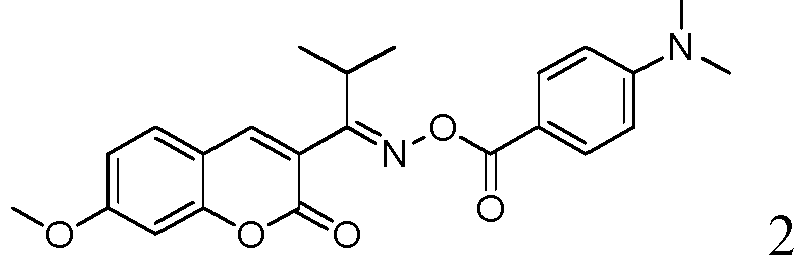
δ 1.04 (d, 6H), 1.76 (m, 1H), 3.06 (s, 6H), 3.83 (s, 3H), 6.471-6.477 (d, 1H), 6.58-6.61 (d, 1H), 7.30-7.32 (d, 1H), 7.98 (s, 1H), 7.66 (m, 2H), 8.21 (m, 2H) 3 
δ 1.20-1.24 (t, 6H), 2.23 (s, 3H), 2.39 (s, 3H), 3.40-3.45 (q, 4H), 6.471-6.477 (d, 1H), 6.58-6.61 (d, 1H), 7.30-7.32 (d, 1H), 7.98 (s, 1H) 4 
δ 1.20-1.24 (t, 6H), 2.39 (s, 3H), 3.40-3.45 (q, 4H), 6.471-6.477 (d, 1H), 6.58-6.61 (d, 1H), 7.30-7.32 (d, 1H), 7.98 (s, 1H), 7.79 (m, 1H)7.66 (m, 2H), 8.21 (m, 2H) 5 
δ 1.20-1.24 (t, 6H), 2.23 (s, 3H), 2.52 (s, 3H), 3.40-3.45 (q, 4H), 6.471-6.477 (d, 1H), 6.58-6.61 (d, 1H), 7.30-7.32 (d, 1H), 7.98 (s, 1H), 7.66 (m, 2H), 8.21 (m, 2H) 6 
δ 0.88 (t, 3H), 1.31 (m, 2H), 1.29 (m, 6H), 1.52 (m, 2H), 2.30 (t, 2H), 1.20-1.24 (t, 6H), 2.39 (s, 3H), 3.40-3.45 (q, 4H), 6.471-6.477 (d, 1H), 6.58-6.61 (d, 1H), 7.30-7.32 (d, 1H), 7.98 (s, 1H) 7 
δ 2.25 (s, 3H), 3.89 (s, 3H), 6.82 (d, 1H), 7.44 (d, 1H), 8.04 (s, 1H), 7.79 (m, 1H)7.66 (m, 2H), 8.21 (m, 2H) 8 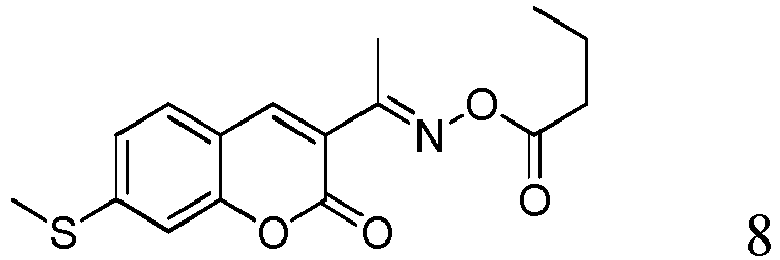
δ 0.88 (t, 3H), 1.52 (m, 2H), 2.30 (t, 2H), 2.53 (s, 3H), 3.11 (s, 3H), 7.74 (d, 1H), 7.34 (d, 1H), 7.32 (s, 1H)7.54 (s, 1H) 9 
δ 1.20-1.24 (t, 6H), 2.39 (s, 3H), ,6.471-6.477 (d, 1H), 6.58-6.61 (d, 1H), 7.30-7.32 (d, 1H), 7.98 (s, 1H), 7.79 (m, 1H)7.66 (m, 2H), 8.21 (m, 2H) 10 
δ 2.23 (s, 3H), 2.39 (s, 3H), 6.471-6.477 (d, 1H), 6.58-6.61 (d, 1H), 7.30-7.32 (d, 1H), 7.98 (s, 1H) 11 
δ 2.39 (s, 3H), 6.471 (s, 1H), 6.58 (s, 1H), 7.30 (s, 1H), 7.98 (s, 1H), 7.66 (m, 2H), 8.21 (m, 2H) 12 
δ 1.43-1.75 (m, 10), 2.42 (m, 1H), 6.471 (s, 1H), 6.58 (s, 1H), 7.30 (s, 1H), 7.98 (s, 1H), 7.66 (m, 2H), 8.21 (m, 2H) 13 
δ 0.90 (t, 3H), 1.31 (m, 2H), 1.29 (m, 4H), 1.47 (m, 2H)1.53 (t, 2H), 7.42 (d, 2H), 7.65 (m, 1H), 7.84 (s, 1H), 7.54 (s, 1H), 7.66 (m, 2H), ,8.21 (m, 2H) 14 
δ 1.20 (s, 3H), 2.39 (s, 3H), ,6.471-6.477 (d, 1H), 6.58-6.61 (d, 1H), 7.30-7.32 (d, 1H), 7.98 (s, 1H), 7.79 (m, 1H)7.66 (m, 2H), 8.21 (m, 2H) 15 
δ 1.09 (t, 6H), 2.67 (m, 2H), 2.39 (s, 3H), 3.11 (s, 3H), 7.74 (d, 1H), 7.34 (d, 1H), 7.32 (s, 1H) 16 
δ 1.20-1.24 (t, 6H), 2.39 (s, 3H), 3.40-3.45 (q, 4H), 6.471-6.477 (d, 1H), 6.58-6.61 (d, 1H), 7.30-7.32 (d, 1H), 7.98 (s, 1H), 7.66 (d, 2H), 8.21 (d, 2H) 17 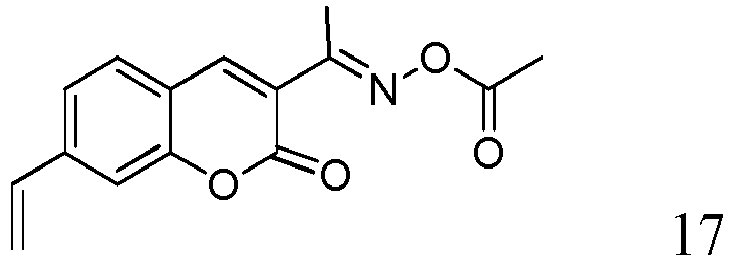
δ 2.23 (s, 3H), 2.39 (s, 3H), 5.61 (d, 2H), 6.53 (t, 1H).6.471 (d, 1H), 6.58 (d, 1H), 7.30 (s, 1H), 7.98 (s, 1H) 18 
δ 0.88 (t, 3H), 1.52 (m, 2H), 2.30 (t, 2H), 2.53 (s, 3H), 7.74 (d, 2H), 7.34 (d, 2H), 7.32 (s, 1H)7.54 (s, 1H), 7.63 (s, 1H) 19 
δ 1.04 (t, 3H), 1.57 (p, 2H), 2.53 (s, 3H)6.471-6.477 (d, 1H), 6.58-6.61 (d, 1H), 7.25-7.28 (m, 2H), 7.30-7.32 (d, 1H), 7.41-7.43 (d, 2H), 7.19 (m, 1H), 7.98 (s, 1H) 20 
δ 2.39 (s, 3H), 6.471-6.477 (d, 1H), 6.58-6.61 (d, 1H), 7.25-7.28 (m, 2H), 7.30-7.32 (d, 1H), 7.41-7.43 (d, 2H), 7.19 (m, 1H), 7.98 (s, 1H), 7.79 (m, 1H)7.66 (m, 2H), 8.21 (m, 2H) -

- The synthetic route of compound 21 is as follows:

- 4-methoxysalicylic aldehyde (0.0293 mol, 4.45 g) was added to a 50 mL three-necked round bottom flask containing 15 mL of ethanol. After stirring well, the mixture was heated to 35°C to dissolve all the reactants in ethanol. Then, hexahydropyridine (0.01 mol, 1 mL) and ethyl octanoyl acetate (0.029 mol, 6.21 g) were added, and the reaction mixture was heated to reflux, and the reaction was carried out for 1 hour under stirring. After the reaction was completed, the mixture was cooled to room temperature, filtered to obtain a yellow solid, which was then recrystallized with ethanol to obtain 6.3 g product with a yield of 90%, which was identified as compound 21a. 1H-NMR (400MHz, CDCl3) δ 0.88 (t, 3H), 1.30 (m, 10H), 2.94 (t, 2H), 3.91 (s, 3H), 6.88 (d, 2H), 7.55 (d, 1H), 8.48 (s, 1H).
- The intermediate 21a (6.04 g, 0.02 mol) was added to a 100 ml three-necked flask containing 30 ml of tetrahydrofuran, 15 g concentrated hydrochloric acid (35%) was added, and after stirring for 0.5 hours, isoamyl nitrite (2.36 g, 0.02 mol) was added dropwise at a temperature controlled at 5°C. After completion of the dropwise addition, the reaction was continued at 10°C for 3 hours. After the reaction was completed, the reaction solution was poured into water and extracted with ethyl acetate. The organic phase was collected and washed with water to neutrality. The organic phase was dried, the organic solvent was removed by rotary evaporation, recrystallized with 10 g petroleum ether, and suction filtered at low temperature to obtain 3.31 g white solid with a yield of 50%, which was identified as compound 21b. 1H-NMR (400MHz, CDCl3) δ 0.88 (t, 3H), 1.30 (m, 8H), 2.94 (t, 2H), 3.91 (s, 3H), 6.88 (d, 2H), 7.55 (d, 1H), 8.48 (s, 1H), 11.31(s, 1H).
- The above intermediate product 21b (3.31 g, 0.01 mol) and 30 ml of tetrahydrofuran were added to a 100 mL three-neck round bottom flask, then acetyl chloride (0.78 g, 0.01 mol) and triethylamine (1.35 g, 0.013 mol) were added, and the reaction was carried out at room temperature for 1 hour under stirring. The reaction was terminated. After the reaction solution was filtered, the filtrate was poured into water and extracted with ethyl acetate. The organic phase was collected, washed sequentially with dilute hydrochloric acid solution, saturated sodium carbonate solution, and distilled water, and then the organic phase was collected and dried with MgSO4 overnight. After filtration, the organic phase was distilled off under reduced pressure to obtain 3.58 g white solid with a yield of 96.0%, which was identified as compound 21. 1H-NMR (400MHz, CDCl3) δ 0.88 (t, 3H), 1.30 (m, 8H), 2.94 (t, 2H), 2.23 (s, 3H), 2.39 (s, 3H), 6.88 (d, 2H), 7.55 (d, 1H), 8.48 (s, 1H).
- The method of Example 21 was repeated, and the reaction raw materials were appropriately changed to obtain the compounds 22 to 30 and their NMR data in the following table. The method of Example 1 was repeated, and the reaction raw materials were appropriately changed to obtain the following Compounds 31 to 50 and their NMR data.
Example Chemical formula NMR data 22 
δ 0.88 (t, 3H), 1.30-1.35 (m, 8H), 1.53-1.56 (t, 2H), 2.28 (s, 3H), 6.88 (d, 2H), 7.55 (d, 1H), 7.19 (d, 1H), 7.25-7.27 (m, 2H), 7.41-7.42 (m, 2H), 8.45 (s, 1H) 23 
δ 0.88 (t, 3H), 1.30-1.35 (m, 8H), 1.53-1.56 (t, 2H), 3.83 (s, 3H), 6.88 (d, 1H), 7.55 (d, 1H), 8.48 (s, 1H), 7.25-7.27 (d, 2H), 7.41-7.42 (d, 2H), 8.45 (s, 1H) 24 
δ 0.88 (t, 3H), 1.30-1.35 (m, 8H), 1.53-1.56 (t, 2H), 2.28 (s, 3H), 2.53 (s, 3H), 6.88 (d, 2H), 7.55 (d, 1H), 7.19 (d, 1H) 25 
δ, 1.4-1.6 (m, 11H), 6.88 (d, 2H), 7.55 (d, 1H), 7.19 (s, 1H), 8.45 (s, 1H), 7.19 (d, 1H), 7.22 (d, 1H), 7.25-7.27 (m, 4H), 7.41-7.42 (m, 4H) 26 
δ, 1.15 (t, 6H), 1.4-1.6 (m, 11H), 2.28 (s, 3H), 3.41 (p, 4H), 7.19 (s, 1H), 8.45 (s, 1H), 7.19 (d, 1H), 7.22 (d, 1H) 27 
δ, 1.15 (t, 6H), 0.88 (t, 3H), 1.30-1.35 (m, 8H), 1.53-1.56 (t, 2H), 2.28 (s, 3H), 3.41 (p, 4H), 7.19 (s, 1H), 8.45 (s, 1H), 7.19 (d, 1H), 7.22 (d, 1H) 28 
δ, 1.43-1.80 (m, 11H),3.42 (m, 1H),2.28 (s, 3H), 7.19 (s, 1H), 8.45 (s, 1H), 7.19 (d, 1H), 7.22 (d, 1H), 7.22 (d, 1H), 7.25-7.27 (m, 2H), 7.41-7.42 (m, 2H) 29 
δ, 0.88 (t, 3H), 1.30-1.35 (m, 8H), 1.53-1.56 (t, 2H), 2.28 (s, 3H), 7.19 (s, 1H), 8.45 (s, 1H), 7.19 (s, 1H) 30 
δ, 1.4-1.6 (m, 11H), 2.28 (s, 3H), 7.19 (s, 1H), 8.45 (s, 1H), 7.19 (s, 1H) 31 
δ, 2.28 (s, 3H), 2.34 (s, 3H), 2.53 (s, 3H), 3.11 (s, 3H), 7.19 (s, 1H), 7.54 (s, 1H), 7.63 (s, 1H) 32 
δ, 1.33 (s, 9H), 1.50 (s, 9H), 2.28 (s, 3H), 2.41 (s, 3H),7.19 (s, 1H), 7.60 (s, 1H), 8.06 (s, 1H) 33 
δ, 1.33 (s, 9H), 2.28 (s, 3H),2.41 (s, 3H), 7.19 (s, 1H), 7.50 (s, 1H), 8.10 (d, 1H), 8.45 (d, 1H) 34 
δ, 1.33 (s, 9H), 2.28 (s, 3H),2.41 (s, 3H), 7.19-7.25 (m, 4H), 7.41 (d, 2H), 8.10 (d, 1H) 35 
δ, 1.33 (s, 9H), 2.28 (s, 3H),2.41 (s, 3H), 2.53 (s, 3H), 7.19 (s, 1H), 7.50 (s, 1H), 8.10 (d, 1H) 36 
δ, 1.15 (s, 6H),1.33 (s, 9H), 2.28 (s, 3H),2.41 (s, 3H) 7.19 (s, 1H), 7.50 (s, 1H), 8.10 (d, 1H) 37 
δ, 2.28 (s, 3H), 2.34 (s, 3H), 2.53 (s, 3H), 7.19 (s, 1H), 7.54 (s, 1H), 7.63 (s, 1H) 38 
δ, 2.28 (s, 3H), 2.34 (s, 3H), 2.53 (s, 3H), 7.19 (m, 4H), 7.41 (d, 2H),7.54 (s, 1H), 7.63 (s, 1H) 39 
δ, 1.33 (s, 9H), 1.50 (s, 9H), 2.28 (s, 3H),7.19 (m, 4H), 7.41 (d, 2H),7.60 (s, 1H), 8.06 (s, 1H) 40 
δ, 1.33 (s, 9H), 2.28 (s, 3H), 2.53 (s, 3H), 7.19 (m, 4H), 7.41 (d, 2H), 7.50 (s, 1H), 8.10 (d, 1H) 41 
δ, 1.33 (s, 9H), 2.41 (s, 3H), 2.53 (s, 3H), 7.19 (m, 4H), 7.41 (d, 2H), 7.50 (s, 1H), 8.10 (d, 1H) 42 
δ, 1.09 (s, 3H),1.33 (s, 9H), 1.50 (s, 9H), 2.07 (m, 2H), 2.41 (s, 3H),7.19 (s, 1H), 7.60 (s, 1H), 8.06 (s, 1H) 43 
δ 1.33 (s, 9H), 1.50 (s, 9H), 2.41 (s, 3H),7.19 (m, 4H), 7.25 (d, 2H), 7.60 (s, 1H), 8.06 (s, 1H) 44 
δ, 1.33 (s, 9H),1.50 (s, 9H), 1.4-1.6 (m, 9H), 2.07 (d, 2H), 2.41 (s, 3H), 7.19 (s, 1H), 7.22 (d, 1H), 8.45 (s, 1H) 45 
δ, 1.33 (s, 9H), 1.50 (s, 9H), 2.28 (s, 3H), 7.19 (s, 1H), 7.60 (s, 1H), 8.06 (s, 1H) 46 
δ, 1.33 (s, 9H), 1.50 (s, 9H), 2.28 (s, 3H),7.19 (s, 1H), 7.41 (d, 4H),7.60 (s, 1H), 8.06 (s, 1H) 47 
δ, 1.33 (s, 9H), 1.50 (s, 9H), 2.28 (s, 3H),7.19 (s, 1H), 7.60 (s, 1H), 8.06 (s, 1H) 48 
δ, 1.33 (s, 9H), 2.28 (s, 3H), 2.53 (s, 3H), 7.19 (s, 1H), 7.50 (s, 1H), 8.10 (d, 1H) 49 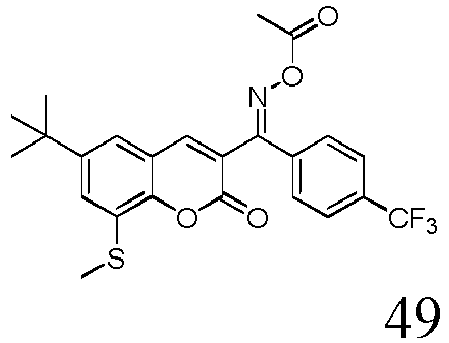
δ, 1.33 (s, 9H), 2.28 (s, 3H), 2.53 (s, 3H), 7.19 (s, 1H), 7.25 (d, 4H), 7.50 (s, 1H), 8.10 (d, 1H) 50 
δ, 1.33 (s, 9H), 2.28 (s, 3H),2.41 (s, 3H), 2.53 (s, 3H), 7.19 (s, 1H), 7.50 (s, 1H), 8.10 (d, 1H) - Patent application publication
CN104817653A discloses the following compound A. The initial decomposition temperatures of this compound and compounds 1, 3, 21, 28, 31 and 32 of the present invention are shown in the following table:
Compounds Initial decomposition temperature (°C) Compounds Initial decomposition temperature (°C) Compound 1187 Compound 31 170 Compound 3190 Compound 32 200 Compound 21 165 Compound A 150 Compound 28 175 - As can be seen from the above table, the initial decomposition temperatures of
compounds - A Ugra offset plate test strip was used as a mask to test the photosensitivity of the photoinitiator. The sections of the Ugra offset plate test strip is shown in
Figure 1 . The Ugra offset plate test strip is divided into 5 control sections, from left to right: continuous density scale section (1); dark-bright micron isoline concentric circle section (2); full-tone dot section (3); ghosting control section (4); highlight, shadow control section (5). The first section: the continuous density scale section is divided into 13 gradients for controlling exposure and development. The second section: dark-bright micron isoline concentric circle section: concentric circle diagram composed of 12 dark-bright micron isoline, which are respectively 4, 6, 8, 10, 12, 15, 20, 25, 30, 40, 55, 70, and used to detect the exposure and development when exposing the PS plate. The third section: full-tone dot section: it consists of 10% - 100%, evaluation screens with a range of 10%, which is divided into two rows upper and low, and used to measure the transfer of dots in exposing, proofing and printing, and it can measure the change curve of film dots and offset plate, proofing and printing dots. The fourth section: ghosting control section: it consists of thin lines with a line width of 60 lines/cm and an area ratio of 60%, is divided into 4 small blocks, lines at three angles: 0°, 45°, 90°, and in a quarter of D small block, arranged by short lines at 90° on both sides, 45° in the middle small cube, and 90° above and below. The fifth section: highlight, shadow control section, fine dot section is arranged by the small highlight dots and the corresponding shadow dark dots, which are used to finely control the accuracy of exposure and development. The photosensitive composition containing a photoinitiator was coated on an aluminum substrate, and then exposed and developed. Sensitivity was evaluated from the continuously scale of the obtained image, and accuracy was evaluated from the micro-line test block area, thereby evaluating the pros and cons of the photosensitive composition formula. - Specifically, the photosensitivity of the compound of formula (I) was tested according to the following steps.
- (1) A photosensitive composition containing a photoinitiator was prepared according to the following composition:
acrylate resin 200 parts by mass dipentaerythritol hexaacrylate 100 parts by mass photoinitiator 5 parts by mass crystal violet dye 5 parts by mass butanone (solvent) 900 parts by mass - The photoinitiator in the above composition was selected from a coumarin ketooxime ester compound represented by the formula (I) of the present invention or a photoinitiator known in the art (for comparison). Acrylate resin is a resin purchased under the trade name of FS2600K from Shanghai Feelshun International Trade Co., Ltd., having a functionality of 2 and a number average molecular weight of 1400. Dipentaerythritol hexaacrylate was a product purchased under the trade name of GM66G0C from Shanghai Feelshun International Trade Co., Ltd. Crystal violet dye was a product purchased under the trade name hexamethylrosaniline hydrochloride from Shanghai Sinopharm.
- (2) each of the above compositions was stirred and mixed under yellow light, and spin-coated using a centrifuge on a PS aluminum plate substrate treated in advance and meeting the following conditions:
Aluminum plate substrate size: 1030 mm × 800 mm Aluminum plate substrate thickness: 0.28-0.3 mm Grit specification: Ra = 0.5-0.6 µm Rh = 0.3-0.35 µm Weight of anode oxide film: 3-3.5 g/m2 - The rotation speed of the centrifugal coater was controlled so that the coating amount (calculated as solid content) on the aluminum plate substrate was 1.0-2.5 g/m2. After preliminary drying on the centrifugal coater, it was transferred to a blast dryer at 100 °C and dried for 3 minutes to obtain a purple laser CTP original plate. Then, a Ugra test strip was used as a mask to test the photosensitivity of the plate, and after exposure for a period of time, it was developed with a 1% aqueous NaOH solution.
- In the exposed area, the photopolymerizable compound underwent a polymerization reaction in the presence of an initiator, and was insoluble in the developing solution, while the non-exposed area was soluble, thus a negative image was obtained. By exposure and development, the sensitivity of photoinitiator was evaluated from the continuous scale of the obtained image. The initiator system sensitivity is characterized by the highest number of gray levels retained (i.e., polymerized) after development. The higher the number of gray levels was, the higher the sensitivity of the test system was. The results are shown in Table 3.
Table 3 Examples / Comparative Examples Photoinitiator photosensitivity (number of gradients) 365nm 385nm 395nm 405nm 51 Compound of Example 1 9 8 7 5 52 Compound of Example 2 10 9 9 8 53 Compound of Example 3 11 10 9 8 54 Compound of Example 4 9 8 8 7 55 Compound of Example 5 10 9 11 10 56 Compound of Example 6 11 10 9 10 57 Compound of Example 7 8 10 9 11 58 Compound of Example 8 9 9 8 10 59 Compound of Example 9 10 9 8 7 60 Compound of Example 10 9 10 9 11 61 Compound of Example 11 8 8 9 10 62 Compound of Example 12 9 8 9 10 63 Compound of Example 13 9 8 8 9 64 Compound of Example 14 10 9 8 7 65 Compound of Example 15 8 9 7 9 66 Compound of Example 16 8 10 9 8 67 Compound of Example 17 8 10 11 10 68 Compound of Example 18 9 8 8 9 69 Compound of Example 19 8 9 9 10 70 Compound of Example 20 8 7 9 8 71 Compound of Example 21 9 11 10 9 72 Compound of Example 22 8 10 9 9 73 Compound of Example 23 8 8 9 7 74 Compound of Example 24 8 9 10 11 75 Compound of Example 25 9 9 8 10 76 Compound of Example 26 8 9 10 11 77 Compound of Example 27 10 8 9 10 78 Compound of Example 28 9 8 10 9 79 Compound of Example 29 10 8 9 10 80 Compound of Example 30 11 8 8 7 81 Compound of Example 31 8 8 9 10 82 Compound of Example 32 9 8 9 10 83 Compound of Example 33 9 8 8 9 84 Compound of Example 34 10 9 8 7 85 Compound of Example 35 8 9 7 9 86 Compound of Example 36 8 10 9 8 87 Compound of Example 37 8 10 11 10 88 Compound of Example 38 9 8 8 9 89 Compound of Example 39 8 9 9 10 90 Compound of Example 40 8 8 9 10 91 Compound of Example 41 9 8 9 10 92 Compound of Example 42 8 10 9 9 93 Compound of Example 43 8 8 9 7 94 Compound of Example 44 8 9 10 11 95 Compound of Example 45 9 9 8 10 96 Compound of Example 46 8 9 10 11 97 Compound of Example 47 10 8 9 10 98 Compound of Example 48 9 8 10 9 99 Compound of Example 49 8 10 9 9 100 Compound of Example 50 8 10 9 9 Comparative example 1 OXE-01 8 7 5 3 Comparative example 2 OXE-02 9 7 6 3 - In Table 3, OXE-01 represents 1-[4-(phenylthio)phenyl]-1,2-octanedione 2-(O-benzoyloxime), and OXE-02 represents 1-(6-O-methylbenzoyl-9-ethylcarbazol-3-yl)-(3-ethyl ketone)-1-oxime acetate, the structural formulas are as follows:

- It can be clearly seen from the experimental results in Table 3 that the gray scale numbers of the
photoinitiators 1 to 50 of the present invention at 365 nm, 385 nm, 395 nm and 405 nm are higher than those of commercially available photoinitiators OXE-01 and OXE-02. In other words, the coumarin (keto) oxime ester photoinitiators of the present invention have superior photosensitivity at wavelengths of 365 nm, 385 nm, 395 nm and 405 nm, and are suitable for UV-LED light sources of 365 nm, 385 nm, 395 nm, 405 nm. - In summary, the coumarin (keto) oxime ester photoinitiators represented by formula (I) of the present invention have good photosensitivity at wavelengths of 365 nm, 385 nm, 395 nm, and 405 nm, which is better than currently commercially available ketoxime ester photoinitiators such as OXE-01 and OXE-02. In addition, the production process of the compounds disclosed in the present invention is simple and has high yield, and is very suitable for industrial production. These compounds have good compatibility with UV-LED light sources of 365 nm, 385 nm, 395 nm, and 405 nm, and can be widely used as photoinitiators in fields involving UV-LED light curing such as coatings, inks, microelectronics, printing and the like. Such substances have good market prospects. In view of the limited variety of photoinitiators currently applicable to UV-LEDs, the promotion and application of UV-LED light sources in the field of ultraviolet curing is limited to a certain extent. Therefore, the photoinitiator of the present invention can contribute to promote the widespread application of green and environmentally friendly UV-LED light sources in the UV light curing industry.
Claims (12)
- A coumarin (keto) oxime ester compound of formula (I):
 n is 0 or 1;R1, R2, R3, R4, and R5 independently represent hydrogen, halogen, nitro, hydroxyl, mercapto, carboxyl, C1-C8 carboxylate ester group, sulfonic acid group, amino, cyano, C1-C20 alkyl, C2-C20 alkenyl, C2-C20 alkynyl, C3-C20 cycloalkyl, C4-C20 cycloalkylalkyl, C1-C20 alkoxy, C2-C20 alkenyloxy, C2-C20 alkynyloxy, C3-C20 cycloalkoxy, C4-C20 cycloalkylalkoxy, C1-C20 alkylthio, C2-C20 alkenylthio, C2-C20 alkynylthio, C3-C20 cycloalkylthio, C4-C20 cycloalkylalkylthio, C6-C18 aryl, C6-C18 aryloxy and C6-C18 arylthio, wherein the aforementioned amino, C1-C20 alkyl, C2-C20 alkenyl, C2-C20 alkynyl, C3-C20 cycloalkyl, C4-C20 cycloalkylalkyl, C1-C20 alkoxy, C2-C20 alkenyloxy, C2-C20 alkynyloxy, C3-C20 cycloalkoxy, C4-C20 cycloalkylalkoxy, C1-C20 alkylthio, C2-C20 alkenylthio, C2-C20 alkynylthio, C3-C20 cycloalkylthio, C4-C20 cycloalkylalkylthio, C6-C18 aryl, C6-C18 aryloxy and C6-C18 arylthio may be optionally substituted with one or more groups independently selected from the group consisting of: halogen, nitro, hydroxy, mercapto, carboxyl, sulfonic acid group, amino, cyano, C1-C6 alkyl, C1-C6 alkoxy, C1-C6 alkylthio, C2-C6 alkenyl and C2-C6 alkynyl, orR1 together with R2, R2 together with R3, R3 together with R4, or R1 together with R2 and R3 together with R4 form a saturated or unsaturated divalent group having 3 to 4 atoms selected from C, N, O, and S and wherein at least one of the atoms is carbon atom; andR6, and R7 independently represent linear or branched C1-C20 alkyl, C3-C10 cycloalkyl, C4-C10 cycloalkylalkyl, C4-C10 alkylcycloalkyl, C6-C20 aryl, C7-C20 aralkyl and C7-C20 alkylaryl, wherein the aforementioned C1-C20 alkyl, C3-C10 cycloalkyl, C4-C10 cycloalkylalkyl, C4-C10 alkylcycloalkyl, C6-C20 aryl, C7-C20 aralkyl and C7-C20 alkylaryl are optionally substituted with one or more groups independently selected from the group consisting of: C1-C6 alkyl, C1-C6 alkylthio, C1-C6 alkoxy, halogen, nitro, amino, mono(C1-C6 alkyl)amino, di(C1-C6 alkyl)amino and mercapto,except for the compound that meets the following definitions: n is 0, R1, R2, R3, R4 and R5 are all H, R6 is methyl, and R7 is n-propyl.
 - The compound according to claim 1, wherein R1, R2, R3, R4 and R5 are independently selected from hydrogen, halogen, nitro, hydroxy, mercapto, carboxyl, C1-C6 carboxylate ester group, sulfonic acid group, amino, cyano, C1-C6 alkyl, C2-C6 alkenyl, C2-C6 alkynyl, C3-C8 cycloalkyl, C4-C8 cycloalkylalkyl, C1-C6 alkoxy, C2-C6 alkenyloxy, C2-C6 alkynyloxy, C3-C8 cycloalkoxy, C4-C8 cycloalkylalkoxy, C1-C6 alkylthio, C2-C6 alkenylthio, C2-C6 alkynylthio, C3-C8 cycloalkylthio, C4-C8 cycloalkylalkylthio, C6-C10 aryl, C6-C10 aryloxy and C6-C10 arylthio, wherein the aforementioned amino, C1-C6 alkyl, C2-C6 alkenyl, C2-C6 alkynyl, C3-C8 cycloalkyl, C4-C8 cycloalkylalkyl, C1-C6 alkoxy, C2-C6 alkenyloxy, C2-C6 alkynyloxy, C3-C8 cycloalkoxy, C4-C8 cycloalkylalkoxy, C1-C6 alkylthio, C2-C6 alkenylthio, C2-C6 alkynylthio, C3-C8 cycloalkylthio, C4-C8 cycloalkylalkylthio, C6-C10 aryl, C6-C10 aryloxy and C6-C10 arylthio may be optionally substituted with one or more groups independently selected from the group consisting of: halogen, nitro, hydroxy, mercapto, carboxyl, sulfonic acid group, amino, cyano, C1-C4 alkyl, C1-C4 alkoxy, C1-C4 alkylthio, C2-C4 alkenyl and C2-C4 alkynyl; or, R1 together with R2, R2 together with R3, or R3 together with R4 form a saturated or unsaturated divalent group having 3 to 4 atoms selected from C, N, O, and S and wherein at least one of the atoms is carbon atom,
Preferably, R1, R2, R3, R4 and R5 are independently selected from hydrogen, halogen, nitro, C1-C4 carboxylate ester group, C1-C4 alkyl, C2-C4 alkenyl, C1-C4 alkoxy, C1-C4 alkylthio, mono(C1-C4 alkyl)amino, di(C1-C4 alkyl)amino, phenoxy and phenylthio; or, R1 together with R2, R2 together with R3, or R3 together with R4 form a saturated or unsaturated divalent group having 3 to 4 atoms selected from C, N, O, and S and wherein at least one of the atoms is carbon atom, for example, -O-CH2-O-, -S-CH2-S-, -N-CH2-N-, -O-CH2CH2-O-, -S-CH2CH2-S-, -N-CH2CH2-N- or -CH=CH-CN=CH-. - The compound according to claim 1 or 2, wherein R6 and R7 independently represent linear or branched C1-C8 alkyl, C3-C8 cycloalkyl, C4-C8 cycloalkylalkyl, C4-C8 alkylcycloalkyl, C6-C10 aryl, C7-C11 aralkyl and C7-C11 alkylaryl, wherein the aforementioned C1-C8 alkyl, C3-C8 cycloalkyl, C4-C8 cycloalkylalkyl, C4-C8 alkylcycloalkyl, C6-C10 aryl, C7-C11 aralkyl and C7-C11 alkylaryl are optionally substituted with one or more groups independently selected from the group consisting of: C1-C4 alkyl, C1-C4 alkylthio, C1-C4 alkoxy, halogen, nitro, amino, mono(C1-C4 alkyl)amino, di(C1-C4 alkyl)amino and mercapto,
preferably, R6 and R7 are independently selected from linear or branched C1-C8 alkyl, C5-C6 cycloalkyl, C1-C4 alkyl substituted with C5-C6 cycloalkyl, C1-C4 alkyl substituted with phenyl, and phenyl, wherein the aforementioned phenyl each is optionally substituted with one or more groups independently selected from the group consisting of: C1-C4 alkyl, C1-C4 alkylthio, C1-C4 alkoxy, halogen, nitro, amino, mono(C1-C4 alkyl)amino, di(C1-C4 alkyl)amino and mercapto;
more preferably, R6 is linear or branched C1-C6 alkyl, C5-C6 cycloalkyl, C1-C2 alkyl substituted with C5-C6 cycloalkyl or phenyl, and the aforementioned phenyl is optionally substituted with one or more groups independently selected from the group consisting of: C1-C4 alkyl, C1-C4 alkylthio, C1-C4 alkoxy, halogen, nitro, amino and mercapto, and R7 is linear or branched C1-C7 alkyl or phenyl, wherein the phenyl is optionally substituted with one or more groups independently selected from the group consisting of: C1-C4 alkyl, halogen, nitro, amino, mono(C1-C4 alkyl)amino, di(C1-C4 alkyl)amino and mercapto. - The compound according to any one of claims 1 to 3, wherein R5 is H.
- The compound according to claim 1 or 4, wherein
n is 0,
R1, R2, R3, and R4 are independently selected from hydrogen, halogen, nitro, C1-C4 carboxylate ester group, C1-C6 alkyl, C2-C4 alkenyl, C1-C4 alkoxy, C1-C4 alkylthio, mono(C1-C4 alkyl)amino, di(C1-C4 alkyl)amino, phenoxy and phenylthio; or, R1 together with R2, R2 together with R3, or R3 together with R4 form a saturated or unsaturated divalent group having 3 to 4 atoms selected from C, N, O, and S and wherein at least one of the atoms is carbon atom, for example, -CH=CH-CN=CH-;
R6 is linear or branched C1-C6 alkyl, halo C1-C6 alkyl, C5-C6 cycloalkyl, C1-C2 alkyl substituted with C5-C6 cycloalkyl or phenyl, and the aforementioned phenyl is optionally substituted with one or more groups independently selected from the group consisting of: fluorine, chlorine, bromine, C1-C4 alkyl, C1-C4 alkoxy, C1-C4 alkylthio and halo C1-C4 alkyl, and
R7 is linear or branched C1-C7 alkyl or phenyl, wherein the phenyl is optionally substituted with one or more groups independently selected from the group consisting of: C1-C4 alkyl, halogen, nitro, amino, mono(C1-C4 alkyl)amino and di(C1-C4 alkyl)amino, or
n is 1,
R1, R2, R3, and R4 are independently selected from hydrogen, C1-C4 alkyl, C1-C4 alkoxy, C1-C4 alkylthio, mono(C1-C4 alkyl)amino, di(C1-C4 alkyl)amino, phenoxy and phenylthio; or, R1 together with R2, R2 together with R3, or R3 together with R4 form a saturated or unsaturated divalent group having 3 to 4 atoms selected from C, N, O, and S and wherein at least one of the atoms is carbon atom, for example, -O-CH2-O-, -S-CH2-S-, -N-CH2-N-, -O-CH2CH2-O-, -S-CH2CH2-S- or -N-CH2CH2-N;
R6 is linear or branched C1-C6 alkyl, halo C1-C6 alkyl, C5-C6 cycloalkyl or C1-C2 alkyl substituted with C5-C6 cycloalkyl, and
R7 is linear or branched C1-C6 alkyl or phenyl optionally substituted with nitro. - The compound according to claim 1, wherein the compound of formula (I) is selected from the group consisiting of:


- A method for preparing the compound according to any one of claims 1 to 6, comprising the steps of:(1) oximation reaction: when n is 0, a compound of formula (II) is subjected to oximation reaction with hydroxylamine and/or hydroxylamine hydrochloride to obtain a compound of formula (IIIa)

 (2) the compound of formula (IIIa) or (IIIb) is esterified to obtain the compound of formula (I).
 - The method according to claim 7, wherein
when n is 0: the oximation reaction is performed in the presence of sodium acetate, pyridine, piperidine, triethylamine or a mixture thereof; and/or, the oximation reaction is performed in the presence of ethanol or aqueous ethanol as solvent; and/or, the temperature of oximation reaction is 60 to 120°C; and/or, the time of oximation reaction is 0.1 to 20 hours, preferably 0.5 to 10 hours; and a molar ratio of the compound of formula (II) to the compound selected from hydroxylamine and/or hydroxylamine hydrochloride is 1:1.5 to 1.5:1, preferably 1:1.2 to 1.2:1;
when n is 1, the oximation reaction is performed in the presence of concentrated hydrochloric acid; and/or, the oximation reaction is performed in the presence of ethanol or aqueous ethanol as solvent; and/or, the temperature of oximation reaction is -30 to 20°C, preferably 5 to 20°C; and/or, the time of oximation reaction is 0.1 to 20 hours, preferably 0.5 to 10 hours; and a molar ratio of the compound of formula (II) to the compound selected from nitrous acid, nitrite and/or alkyl nitrite is 1:1.5 to 1.5:1, preferably 1:1.2 to 1.2:1. - The method according to claim 7 or 8, wherein the alkyl nitrite is C1-C6 alkyl nitrite, for example, methyl nitrite, ethyl nitrite, isopropyl nitrite, butyl nitrite, isoamyl nitrate; and/or, the esterification of step (2) is performed using an esterifying agent selected from compounds of the following formulae (IVa), (IVb) and (IVc):

- The method according to any one of claims 7 to 9, wherein the esterification reaction is performed in the presence of one or more catalysts selected from the group consisting of: sulfuric acid, perchloric acid, zinc chloride, ferric chloride, pyridine, p-toluenesulfonic acid, sodium hydroxide, potassium hydroxide, sodium carbonate, sodium bicarbonate, sodium tert-butoxide, sodium ethoxide, sodium hydride, potassium hydride, calcium hydride and tertiary amines, for example, trialkylamine, such as trimethylamine and triethylamine.
- The method according to any one of claims 7 to 10, wherein the esterification reaction is performed in a solvent selected from the group consisting of tetrahydrofuran, benzene, toluene, N,N-dimethylformamide, dichloromethane and acetone; and/or, the molar ratio of the compound of formula (IIIa) or formula (IIIb) to the esterifying agent selected from the compounds of (IVa), (IVb) and (IVc) is 1:1.5 to 1.5:1, preferably 1:1.2 to 1.2:1.
- Use of the compound of formula (I) according to any one of claims 1 to 6 as a photoinitiator, especially as a photoinitiator in a UV-LED light curing system, preferably use as a photoinitiator or photosensitizer in a photo-curing system with a radiation wavelength of 300 to 450 nm, particularly 350 to 420 nm, especially 365 to 405 nm.
Applications Claiming Priority (2)
| Application Number | Priority Date | Filing Date | Title |
|---|---|---|---|
| CN201710620077.2A CN109305951A (en) | 2017-07-26 | 2017-07-26 | Coumarin oxime ester compound and its preparation and application |
| PCT/CN2018/088830 WO2019019792A1 (en) | 2017-07-26 | 2018-05-29 | Coumarin oxime ester compound and preparation and use thereof |
Publications (3)
| Publication Number | Publication Date |
|---|---|
| EP3660008A1 true EP3660008A1 (en) | 2020-06-03 |
| EP3660008A4 EP3660008A4 (en) | 2021-04-21 |
| EP3660008B1 EP3660008B1 (en) | 2025-08-27 |
Family
ID=65040975
Family Applications (1)
| Application Number | Title | Priority Date | Filing Date |
|---|---|---|---|
| EP18839489.4A Active EP3660008B1 (en) | 2017-07-26 | 2018-05-29 | Coumarin oxime ester compound and preparation and use thereof |
Country Status (6)
| Country | Link |
|---|---|
| US (1) | US11142511B2 (en) |
| EP (1) | EP3660008B1 (en) |
| JP (1) | JP6910533B2 (en) |
| KR (1) | KR102365830B1 (en) |
| CN (2) | CN109305951A (en) |
| WO (1) | WO2019019792A1 (en) |
Families Citing this family (18)
| Publication number | Priority date | Publication date | Assignee | Title |
|---|---|---|---|---|
| WO2020209205A1 (en) * | 2019-04-08 | 2020-10-15 | 株式会社Adeka | Carbamoyloxime compound, and polymerization initiator and polymerizable composition containing said compound |
| CN110078694A (en) * | 2019-04-30 | 2019-08-02 | 同济大学 | Cumarin based ketoxime esters compound and its preparation method and application |
| CN110054604A (en) * | 2019-04-30 | 2019-07-26 | 同济大学 | Oxime ester compound and its preparation method and application containing cumarin |
| JPWO2020241529A1 (en) * | 2019-05-24 | 2020-12-03 | ||
| CN110330501B (en) * | 2019-06-25 | 2021-05-07 | 湖北固润科技股份有限公司 | Long-wavelength coumarin oxime ester compounds and their preparation and application |
| WO2020258014A1 (en) * | 2019-06-25 | 2020-12-30 | 湖北固润科技股份有限公司 | Long-wavelength coumarin oxime ester compound, preparation therefor, and application thereof |
| CN111454598A (en) * | 2020-04-17 | 2020-07-28 | 湖北固润科技股份有限公司 | Light-cured composition suitable for irradiation curing of near-infrared L ED light source and application thereof |
| CN112279864B (en) * | 2020-09-30 | 2024-07-16 | 湖北固润科技股份有限公司 | Bifunctional coumarin oxime ester compounds and their preparation and application |
| CN113336702B (en) * | 2021-06-01 | 2022-06-14 | 西南大学 | Process for producing 2-amino-fused pyridine compound |
| CN114920722B (en) * | 2021-06-02 | 2024-03-08 | 何黎琴 | A kind of 7-hydroxy-3-acetyl coumarin oxime compound, its preparation method and medicinal use |
| CN114790185B (en) * | 2022-04-29 | 2023-09-19 | 五邑大学 | A coumarin oxime ester compound or its pharmaceutically acceptable salt and its preparation method and application |
| CN115554185B (en) * | 2022-09-14 | 2024-12-24 | 广州大鱼创福科技有限公司 | Application of a coumarin derivative in inhibiting tyrosinase activity |
| CN115583931B (en) * | 2022-09-28 | 2024-03-15 | 湖北固润科技股份有限公司 | Ether functionalized coumarin oxime ester compounds and their preparation and application |
| CN116655573B (en) * | 2023-04-28 | 2025-05-30 | 安庆师范大学 | Oxime ester compound and preparation method and application thereof |
| CN117865922A (en) * | 2024-01-08 | 2024-04-12 | 湖北固润科技股份有限公司 | Formyl formate coumarin compound, preparation method and use thereof, and photoinitiator composition containing the same |
| CN117865923B (en) * | 2024-01-08 | 2026-06-26 | 湖北固润科技股份有限公司 | Coumarin formylformate compounds, their preparation methods and uses, as well as photoinitiator compositions and photocurable compositions containing them. |
| CN119504490A (en) * | 2024-11-20 | 2025-02-25 | 湖北固润科技股份有限公司 | Aroylformic acid oxime ester photoinitiator and preparation method thereof |
| CN120647613B (en) * | 2025-05-28 | 2026-02-27 | 澳门科技大学 | Antitumor small molecule compounds, their preparation methods and applications |
Family Cites Families (8)
| Publication number | Priority date | Publication date | Assignee | Title |
|---|---|---|---|---|
| WO2002100903A1 (en) * | 2001-06-11 | 2002-12-19 | Ciba Specialty Chemicals Holding Inc. | Oxime ester photoinitiators having a combined structure |
| DE10348022A1 (en) * | 2003-10-15 | 2005-05-25 | Imtm Gmbh | New dipeptidyl peptidase IV inhibitors for the functional influence of different cells and for the treatment of immunological, inflammatory, neuronal and other diseases |
| CN101370772B (en) * | 2006-01-13 | 2012-10-17 | 东洋油墨制造株式会社 | Diketooxime ester compound and use thereof |
| CN101891845B (en) * | 2010-07-15 | 2013-08-07 | 常州强力电子新材料有限公司 | Application of carbazole oxime ester compound serving as photoinitiator in photopolymerisable acrylate composition |
| CN102492059B (en) | 2011-11-28 | 2013-04-17 | 常州强力先端电子材料有限公司 | Diphenyl sulfide ketone oxime ester photoinitiator as well as preparation method and application thereof |
| CN102775527B (en) * | 2012-07-05 | 2014-03-05 | 常州强力先端电子材料有限公司 | Ketoxime ester photoinitiator and preparation method thereof |
| CN103819583B (en) * | 2014-03-18 | 2016-05-18 | 常州强力电子新材料股份有限公司 | A kind of containing two oxime ester lightlike initiating agents of nitro and its preparation method and application |
| CN104817653B (en) * | 2015-04-22 | 2016-08-24 | 江南大学 | A kind of coumarin oxime ester lightlike initiating agent and preparation method thereof |
-
2017
- 2017-07-26 CN CN201710620077.2A patent/CN109305951A/en not_active Withdrawn
-
2018
- 2018-05-29 CN CN201880049443.6A patent/CN110959006A/en active Pending
- 2018-05-29 EP EP18839489.4A patent/EP3660008B1/en active Active
- 2018-05-29 WO PCT/CN2018/088830 patent/WO2019019792A1/en not_active Ceased
- 2018-05-29 JP JP2020504170A patent/JP6910533B2/en active Active
- 2018-05-29 KR KR1020207005324A patent/KR102365830B1/en active Active
- 2018-05-29 US US16/633,294 patent/US11142511B2/en active Active
Also Published As
| Publication number | Publication date |
|---|---|
| CN110959006A (en) | 2020-04-03 |
| US20200148660A1 (en) | 2020-05-14 |
| EP3660008A4 (en) | 2021-04-21 |
| JP2020528914A (en) | 2020-10-01 |
| EP3660008B1 (en) | 2025-08-27 |
| JP6910533B2 (en) | 2021-07-28 |
| KR20200041327A (en) | 2020-04-21 |
| BR112020001598A2 (en) | 2020-07-21 |
| KR102365830B1 (en) | 2022-02-23 |
| CA3071010A1 (en) | 2019-01-31 |
| US11142511B2 (en) | 2021-10-12 |
| CN109305951A (en) | 2019-02-05 |
| WO2019019792A1 (en) | 2019-01-31 |
Similar Documents
| Publication | Publication Date | Title |
|---|---|---|
| EP3660008B1 (en) | Coumarin oxime ester compound and preparation and use thereof | |
| CN112279864B (en) | Bifunctional coumarin oxime ester compounds and their preparation and application | |
| JP5647738B2 (en) | High-sensitivity carbazole oxime ester photoinitiator, process for its production and use | |
| CN108117488B (en) | Benzoyl methyl cinnamate compound and preparation method and application thereof | |
| Chen et al. | Synthesis and anti-inflammatory activity of resveratrol analogs | |
| CN110330501B (en) | Long-wavelength coumarin oxime ester compounds and their preparation and application | |
| JP4354511B2 (en) | Method for preparing a photoresist composition | |
| CN107522633A (en) | A kind of oxime ester lightlike initiating agent containing fluorenes | |
| CN107793502A (en) | Oxime ester lightlike initiating agent, its preparation method, Photocurable composition and its application | |
| CN110563589B (en) | Single or double cinnamic acid methyl ester photoinitiator and its preparation method and application | |
| CN115583931B (en) | Ether functionalized coumarin oxime ester compounds and their preparation and application | |
| CN110563588B (en) | Single or double cinnamate photoinitiator and its preparation method and application | |
| CA3071010C (en) | Coumarin oxime ester compounds, preparation and use thereof | |
| CN110551098B (en) | Oxime ester photoinitiator containing five-membered aromatic heterocyclic structure and preparation and application thereof | |
| JP2026043023A (en) | Polymer manufacturing method | |
| CN113336876A (en) | Use of gamma, delta-unsaturated oxime ester compounds as photoinitiators | |
| HK40017458A (en) | Mono-cinnamate or dicinnamate photoinitiators as well as preparation method and application thereof | |
| BR112020001598B1 (en) | COUMARIN OXIME ESTER COMPOUNDS, PREPARATION AND USE THEREOF | |
| HK40018331A (en) | Mono/bis-methyl cinnamate photoinitiators as well as preparation method and use thereof | |
| CN104030973A (en) | Preparation method of 1, 4-dihydropyridine compound | |
| CN108794333A (en) | The method for preparing cinnamic acid benzoyl first ester type compound | |
| WO2020000359A1 (en) | Method for preparing methyl benzoylcinnamate compound | |
| CN112409295B (en) | Fluorene initiator, photocuring composition containing same and application thereof | |
| WO2020252628A1 (en) | Oxime ester photoinitiators containing five-membered heteroaromatic ring structure, and preparation and use thereof | |
| WO2020258014A1 (en) | Long-wavelength coumarin oxime ester compound, preparation therefor, and application thereof |
Legal Events
| Date | Code | Title | Description |
|---|---|---|---|
| STAA | Information on the status of an ep patent application or granted ep patent |
Free format text: STATUS: THE INTERNATIONAL PUBLICATION HAS BEEN MADE |
|
| PUAI | Public reference made under article 153(3) epc to a published international application that has entered the european phase |
Free format text: ORIGINAL CODE: 0009012 |
|
| STAA | Information on the status of an ep patent application or granted ep patent |
Free format text: STATUS: REQUEST FOR EXAMINATION WAS MADE |
|
| 17P | Request for examination filed |
Effective date: 20200221 |
|
| AK | Designated contracting states |
Kind code of ref document: A1 Designated state(s): AL AT BE BG CH CY CZ DE DK EE ES FI FR GB GR HR HU IE IS IT LI LT LU LV MC MK MT NL NO PL PT RO RS SE SI SK SM TR |
|
| AX | Request for extension of the european patent |
Extension state: BA ME |
|
| DAX | Request for extension of the european patent (deleted) | ||
| RAV | Requested validation state of the european patent: fee paid |
Extension state: KH Effective date: 20200304 |
|
| REG | Reference to a national code |
Ref country code: DE Ref legal event code: R079 Free format text: PREVIOUS MAIN CLASS: C07D0311080000 Ipc: C07D0311120000 Ref country code: DE Ref legal event code: R079 Ref document number: 602018085034 Country of ref document: DE Free format text: PREVIOUS MAIN CLASS: C07D0311080000 Ipc: C07D0311120000 |
|
| A4 | Supplementary search report drawn up and despatched |
Effective date: 20210322 |
|
| RIC1 | Information provided on ipc code assigned before grant |
Ipc: C07D 311/12 20060101AFI20210316BHEP Ipc: C07D 311/16 20060101ALI20210316BHEP Ipc: C07D 493/04 20060101ALI20210316BHEP Ipc: C07D 311/58 20060101ALI20210316BHEP Ipc: C07D 311/68 20060101ALI20210316BHEP Ipc: C08F 2/48 20060101ALI20210316BHEP |
|
| STAA | Information on the status of an ep patent application or granted ep patent |
Free format text: STATUS: EXAMINATION IS IN PROGRESS |
|
| 17Q | First examination report despatched |
Effective date: 20240112 |
|
| GRAP | Despatch of communication of intention to grant a patent |
Free format text: ORIGINAL CODE: EPIDOSNIGR1 |
|
| STAA | Information on the status of an ep patent application or granted ep patent |
Free format text: STATUS: GRANT OF PATENT IS INTENDED |
|
| INTG | Intention to grant announced |
Effective date: 20250319 |
|
| GRAS | Grant fee paid |
Free format text: ORIGINAL CODE: EPIDOSNIGR3 |
|
| GRAA | (expected) grant |
Free format text: ORIGINAL CODE: 0009210 |
|
| STAA | Information on the status of an ep patent application or granted ep patent |
Free format text: STATUS: THE PATENT HAS BEEN GRANTED |
|
| AK | Designated contracting states |
Kind code of ref document: B1 Designated state(s): AL AT BE BG CH CY CZ DE DK EE ES FI FR GB GR HR HU IE IS IT LI LT LU LV MC MK MT NL NO PL PT RO RS SE SI SK SM TR |
|
| REG | Reference to a national code |
Ref country code: GB Ref legal event code: FG4D |
|
| REG | Reference to a national code |
Ref country code: CH Ref legal event code: EP |
|
| REG | Reference to a national code |
Ref country code: DE Ref legal event code: R096 Ref document number: 602018085034 Country of ref document: DE |
|
| REG | Reference to a national code |
Ref country code: IE Ref legal event code: FG4D |
|
| REG | Reference to a national code |
Ref country code: NL Ref legal event code: MP Effective date: 20250827 |
|
| PG25 | Lapsed in a contracting state [announced via postgrant information from national office to epo] |
Ref country code: IS Free format text: LAPSE BECAUSE OF FAILURE TO SUBMIT A TRANSLATION OF THE DESCRIPTION OR TO PAY THE FEE WITHIN THE PRESCRIBED TIME-LIMIT Effective date: 20251227 |
|
| PG25 | Lapsed in a contracting state [announced via postgrant information from national office to epo] |
Ref country code: NO Free format text: LAPSE BECAUSE OF FAILURE TO SUBMIT A TRANSLATION OF THE DESCRIPTION OR TO PAY THE FEE WITHIN THE PRESCRIBED TIME-LIMIT Effective date: 20251127 |
|
| REG | Reference to a national code |
Ref country code: LT Ref legal event code: MG9D |
|
| PG25 | Lapsed in a contracting state [announced via postgrant information from national office to epo] |
Ref country code: PT Free format text: LAPSE BECAUSE OF FAILURE TO SUBMIT A TRANSLATION OF THE DESCRIPTION OR TO PAY THE FEE WITHIN THE PRESCRIBED TIME-LIMIT Effective date: 20251229 |
|
| PG25 | Lapsed in a contracting state [announced via postgrant information from national office to epo] |
Ref country code: FI Free format text: LAPSE BECAUSE OF FAILURE TO SUBMIT A TRANSLATION OF THE DESCRIPTION OR TO PAY THE FEE WITHIN THE PRESCRIBED TIME-LIMIT Effective date: 20250827 |
|
| PG25 | Lapsed in a contracting state [announced via postgrant information from national office to epo] |
Ref country code: NL Free format text: LAPSE BECAUSE OF FAILURE TO SUBMIT A TRANSLATION OF THE DESCRIPTION OR TO PAY THE FEE WITHIN THE PRESCRIBED TIME-LIMIT Effective date: 20250827 Ref country code: HR Free format text: LAPSE BECAUSE OF FAILURE TO SUBMIT A TRANSLATION OF THE DESCRIPTION OR TO PAY THE FEE WITHIN THE PRESCRIBED TIME-LIMIT Effective date: 20250827 |
|
| PG25 | Lapsed in a contracting state [announced via postgrant information from national office to epo] |
Ref country code: GR Free format text: LAPSE BECAUSE OF FAILURE TO SUBMIT A TRANSLATION OF THE DESCRIPTION OR TO PAY THE FEE WITHIN THE PRESCRIBED TIME-LIMIT Effective date: 20251128 |
|
| PG25 | Lapsed in a contracting state [announced via postgrant information from national office to epo] |
Ref country code: SE Free format text: LAPSE BECAUSE OF FAILURE TO SUBMIT A TRANSLATION OF THE DESCRIPTION OR TO PAY THE FEE WITHIN THE PRESCRIBED TIME-LIMIT Effective date: 20250827 |
|
| PG25 | Lapsed in a contracting state [announced via postgrant information from national office to epo] |
Ref country code: LV Free format text: LAPSE BECAUSE OF FAILURE TO SUBMIT A TRANSLATION OF THE DESCRIPTION OR TO PAY THE FEE WITHIN THE PRESCRIBED TIME-LIMIT Effective date: 20250827 |
|
| PG25 | Lapsed in a contracting state [announced via postgrant information from national office to epo] |
Ref country code: BG Free format text: LAPSE BECAUSE OF FAILURE TO SUBMIT A TRANSLATION OF THE DESCRIPTION OR TO PAY THE FEE WITHIN THE PRESCRIBED TIME-LIMIT Effective date: 20250827 Ref country code: PL Free format text: LAPSE BECAUSE OF FAILURE TO SUBMIT A TRANSLATION OF THE DESCRIPTION OR TO PAY THE FEE WITHIN THE PRESCRIBED TIME-LIMIT Effective date: 20250827 |
|
| PG25 | Lapsed in a contracting state [announced via postgrant information from national office to epo] |
Ref country code: RS Free format text: LAPSE BECAUSE OF FAILURE TO SUBMIT A TRANSLATION OF THE DESCRIPTION OR TO PAY THE FEE WITHIN THE PRESCRIBED TIME-LIMIT Effective date: 20251127 |
|
| PG25 | Lapsed in a contracting state [announced via postgrant information from national office to epo] |
Ref country code: ES Free format text: LAPSE BECAUSE OF FAILURE TO SUBMIT A TRANSLATION OF THE DESCRIPTION OR TO PAY THE FEE WITHIN THE PRESCRIBED TIME-LIMIT Effective date: 20250827 |
|
| REG | Reference to a national code |
Ref country code: AT Ref legal event code: MK05 Ref document number: 1829878 Country of ref document: AT Kind code of ref document: T Effective date: 20250827 |
|
| PG25 | Lapsed in a contracting state [announced via postgrant information from national office to epo] |
Ref country code: SM Free format text: LAPSE BECAUSE OF FAILURE TO SUBMIT A TRANSLATION OF THE DESCRIPTION OR TO PAY THE FEE WITHIN THE PRESCRIBED TIME-LIMIT Effective date: 20250827 |
|
| PG25 | Lapsed in a contracting state [announced via postgrant information from national office to epo] |
Ref country code: DK Free format text: LAPSE BECAUSE OF FAILURE TO SUBMIT A TRANSLATION OF THE DESCRIPTION OR TO PAY THE FEE WITHIN THE PRESCRIBED TIME-LIMIT Effective date: 20250827 |
|
| PG25 | Lapsed in a contracting state [announced via postgrant information from national office to epo] |
Ref country code: AT Free format text: LAPSE BECAUSE OF FAILURE TO SUBMIT A TRANSLATION OF THE DESCRIPTION OR TO PAY THE FEE WITHIN THE PRESCRIBED TIME-LIMIT Effective date: 20250827 |
|
| PG25 | Lapsed in a contracting state [announced via postgrant information from national office to epo] |
Ref country code: IT Free format text: LAPSE BECAUSE OF FAILURE TO SUBMIT A TRANSLATION OF THE DESCRIPTION OR TO PAY THE FEE WITHIN THE PRESCRIBED TIME-LIMIT Effective date: 20250827 |
|
| PGFP | Annual fee paid to national office [announced via postgrant information from national office to epo] |
Ref country code: FR Payment date: 20260121 Year of fee payment: 9 |
|
| PG25 | Lapsed in a contracting state [announced via postgrant information from national office to epo] |
Ref country code: CZ Free format text: LAPSE BECAUSE OF FAILURE TO SUBMIT A TRANSLATION OF THE DESCRIPTION OR TO PAY THE FEE WITHIN THE PRESCRIBED TIME-LIMIT Effective date: 20250827 |
|
| PG25 | Lapsed in a contracting state [announced via postgrant information from national office to epo] |
Ref country code: EE Free format text: LAPSE BECAUSE OF FAILURE TO SUBMIT A TRANSLATION OF THE DESCRIPTION OR TO PAY THE FEE WITHIN THE PRESCRIBED TIME-LIMIT Effective date: 20250827 Ref country code: SK Free format text: LAPSE BECAUSE OF FAILURE TO SUBMIT A TRANSLATION OF THE DESCRIPTION OR TO PAY THE FEE WITHIN THE PRESCRIBED TIME-LIMIT Effective date: 20250827 |
|
| REG | Reference to a national code |
Ref country code: DE Ref legal event code: R097 Ref document number: 602018085034 Country of ref document: DE |
|
| PG25 | Lapsed in a contracting state [announced via postgrant information from national office to epo] |
Ref country code: LT Free format text: LAPSE BECAUSE OF FAILURE TO SUBMIT A TRANSLATION OF THE DESCRIPTION OR TO PAY THE FEE WITHIN THE PRESCRIBED TIME-LIMIT Effective date: 20250827 |
|
| PLBE | No opposition filed within time limit |
Free format text: ORIGINAL CODE: 0009261 |
|
| STAA | Information on the status of an ep patent application or granted ep patent |
Free format text: STATUS: NO OPPOSITION FILED WITHIN TIME LIMIT |
|
| REG | Reference to a national code |
Ref country code: CH Ref legal event code: L10 Free format text: ST27 STATUS EVENT CODE: U-0-0-L10-L00 (AS PROVIDED BY THE NATIONAL OFFICE) Effective date: 20260708 |
|
| 26N | No opposition filed |
Effective date: 20260528 |