EP3659973A2 - Method for preparation of plate-type manganese dioxide nanoparticle - Google Patents
Method for preparation of plate-type manganese dioxide nanoparticle Download PDFInfo
- Publication number
- EP3659973A2 EP3659973A2 EP18876546.5A EP18876546A EP3659973A2 EP 3659973 A2 EP3659973 A2 EP 3659973A2 EP 18876546 A EP18876546 A EP 18876546A EP 3659973 A2 EP3659973 A2 EP 3659973A2
- Authority
- EP
- European Patent Office
- Prior art keywords
- manganese dioxide
- plate
- amine
- coupling agent
- type manganese
- Prior art date
- Legal status (The legal status is an assumption and is not a legal conclusion. Google has not performed a legal analysis and makes no representation as to the accuracy of the status listed.)
- Pending
Links
Images


Classifications
-
- C—CHEMISTRY; METALLURGY
- C01—INORGANIC CHEMISTRY
- C01G—COMPOUNDS CONTAINING METALS NOT COVERED BY SUBCLASSES C01D OR C01F
- C01G45/00—Compounds of manganese
- C01G45/02—Oxides
- C01G45/024—Manganese dioxide
-
- H—ELECTRICITY
- H01—ELECTRIC ELEMENTS
- H01G—CAPACITORS; CAPACITORS, RECTIFIERS, DETECTORS, SWITCHING DEVICES, LIGHT-SENSITIVE OR TEMPERATURE-SENSITIVE DEVICES OF THE ELECTROLYTIC TYPE
- H01G11/00—Hybrid capacitors, i.e. capacitors having different positive and negative electrodes; Electric double-layer [EDL] capacitors; Processes for the manufacture thereof or of parts thereof
- H01G11/22—Electrodes
- H01G11/30—Electrodes characterised by their material
- H01G11/32—Carbon-based
- H01G11/42—Powders or particles, e.g. composition thereof
-
- H—ELECTRICITY
- H01—ELECTRIC ELEMENTS
- H01G—CAPACITORS; CAPACITORS, RECTIFIERS, DETECTORS, SWITCHING DEVICES, LIGHT-SENSITIVE OR TEMPERATURE-SENSITIVE DEVICES OF THE ELECTROLYTIC TYPE
- H01G11/00—Hybrid capacitors, i.e. capacitors having different positive and negative electrodes; Electric double-layer [EDL] capacitors; Processes for the manufacture thereof or of parts thereof
- H01G11/22—Electrodes
- H01G11/30—Electrodes characterised by their material
- H01G11/46—Metal oxides
-
- C—CHEMISTRY; METALLURGY
- C01—INORGANIC CHEMISTRY
- C01P—INDEXING SCHEME RELATING TO STRUCTURAL AND PHYSICAL ASPECTS OF SOLID INORGANIC COMPOUNDS
- C01P2004/00—Particle morphology
- C01P2004/01—Particle morphology depicted by an image
- C01P2004/03—Particle morphology depicted by an image obtained by SEM
-
- C—CHEMISTRY; METALLURGY
- C01—INORGANIC CHEMISTRY
- C01P—INDEXING SCHEME RELATING TO STRUCTURAL AND PHYSICAL ASPECTS OF SOLID INORGANIC COMPOUNDS
- C01P2004/00—Particle morphology
- C01P2004/20—Particle morphology extending in two dimensions, e.g. plate-like
-
- C—CHEMISTRY; METALLURGY
- C01—INORGANIC CHEMISTRY
- C01P—INDEXING SCHEME RELATING TO STRUCTURAL AND PHYSICAL ASPECTS OF SOLID INORGANIC COMPOUNDS
- C01P2004/00—Particle morphology
- C01P2004/20—Particle morphology extending in two dimensions, e.g. plate-like
- C01P2004/24—Nanoplates, i.e. plate-like particles with a thickness from 1-100 nanometer
-
- C—CHEMISTRY; METALLURGY
- C01—INORGANIC CHEMISTRY
- C01P—INDEXING SCHEME RELATING TO STRUCTURAL AND PHYSICAL ASPECTS OF SOLID INORGANIC COMPOUNDS
- C01P2004/00—Particle morphology
- C01P2004/60—Particles characterised by their size
- C01P2004/64—Nanometer sized, i.e. from 1-100 nanometer
-
- Y—GENERAL TAGGING OF NEW TECHNOLOGICAL DEVELOPMENTS; GENERAL TAGGING OF CROSS-SECTIONAL TECHNOLOGIES SPANNING OVER SEVERAL SECTIONS OF THE IPC; TECHNICAL SUBJECTS COVERED BY FORMER USPC CROSS-REFERENCE ART COLLECTIONS [XRACs] AND DIGESTS
- Y02—TECHNOLOGIES OR APPLICATIONS FOR MITIGATION OR ADAPTATION AGAINST CLIMATE CHANGE
- Y02E—REDUCTION OF GREENHOUSE GAS [GHG] EMISSIONS, RELATED TO ENERGY GENERATION, TRANSMISSION OR DISTRIBUTION
- Y02E60/00—Enabling technologies; Technologies with a potential or indirect contribution to GHG emissions mitigation
- Y02E60/13—Energy storage using capacitors
Definitions
- the present invention relates to a method for the preparation of plate-type manganese dioxide nanoparticles.
- Supercapacitors are one of the energy storage devices and the application areas thereof are expanded variously from small to large.
- the supercapacitors are characterized by a high charge/discharge rate and a long charge/discharge cycle life.
- apseudo-capacitor uses a metal oxide as a positive electrode material. Recently, many studies have been conducted due to the wide operating voltage range possessed by manganese dioxide.
- the present invention is directed to prepare plate-type manganese dioxide nanoparticles by using an amine-based coupling agent as described hereinafter and relates to plate-type manganese dioxide nanoparticles that can be suitably mixed with a carbon-based conductive material and are thus useful as a positive electrode material for pseudo-capacitors.
- one embodiment of the present invention provides a method for the preparation of plate-type manganese dioxide nanoparticles including the steps of adding an amine-based coupling agent to an aqueous solution containing a manganese salt to react them (step 1); and adding an oxidizing agent to the product of step 1 to react them (step 2).
- step 1 Adding an amine-based coupling agent to an aqueous solution containing a manganese salt to react them (step 1)
- Step 1 is a step of reacting a manganese salt with an amine-based coupling agent, thus causing the manganese dioxide to be prepared finally to have plate-like shapes.
- the amine-based coupling agent used in step 1 causes the manganese dioxide nanoparticles to have plate-like shapes through bonding with manganese ions.
- the amine-based coupling agent may contain one amine group and may contain about one carboxyl group or thiol group.
- the amine group is for binding with manganese ions, and in the case of two or more amine groups, there is a problem that the binding with manganese ions is strong and the production yield of manganese dioxide is deteriorated.
- the amine-based coupling agent is a compound represented by the following Chemical Formula 1: in Chemical Formula 1,
- the "natural amino acid residue” means a structure excluding the structure of NH 2 -CH-COOH from the chemical structure of a natural amino acid.
- the natural amino acid residue mean hydrogen.
- the natural amino acid residue means -CH 2 COOH.
- the natural amino acid residue means -CH 2 SH.
- the amine-based coupling agent is glycine, aspartic acid, cysteamine, cysteine, glutamic acid, selenocysteine, alanine, valine, isoleucine, leucine, methionine, or phenylalanine.
- the molar ratio of the manganese salt and the amine-based coupling agent is preferably 1: 0.5 to 2.When the molar ratio is less than 0.5, the effect due to the addition of the amine-based coupling agent is insignificant. When the molar ratio is greater than 2, the amount of the amine-based coupling agent added is too large, so that the effect due to excess coupling agent does not appear, and rather the yield is lowered.
- the manganese salt used in step 1 is Mn(CH 3 COO) 2 , or MnSO 4 .
- the reaction by adjusting the pH to 7 or more in the reaction of step 1 as necessary.
- a basic material such as NaOH or KOH may be added during the reaction instep 1.
- the pH can be adjusted to 8 or more, 9 or more, or 10 or more.
- the reaction time of step 1 is not particularly limited, but it is preferably 5 minutes to 1 hour. When the reaction time is less than 5 minutes, the reaction of step 1 is not sufficiently progressed. When the reaction time exceeds 1 hour, the reaction is substantially not further progressed.
- reaction temperature of step 1 is not particularly limited, but is preferably 10 °C to 50 °C, and more preferably the reaction can be carried out at room temperature.
- step 2 Adding an oxidizing agent to the product of step 1 to react them (step 2)
- Step 2 is a step of finally preparing plate-type manganese dioxide nanoparticles by adding an oxidizing agent to the product of step 1 to react them.
- K 2 S 2 O 8 Na 2 S 2 O 8 , or (NH 4 ) 2 S 2 O 8 may be used.
- the amount of the oxidizing agent used is not particularly limited, but the molar ratio of the manganese salt used in step 1 and the oxidizing agent is preferably 2 to 10. When the molar ratio is less than 2, there is a fear that the effect due to the use of the oxidizing agent is insufficient. When the molar ratio is greater than 10, the reaction effect is not substantially further increased.
- the reaction time of step 2 is preferably 2 hours to 12 hours. When the reaction time is less than 2 hours, the reaction of step 2 is not sufficiently progressed. When the reaction time exceeds 12 hours, the reaction is substantially not further progressed.
- reaction temperature of step 2 is not particularly limited, but it is preferably 10 °C to 50 °C, and more preferably the reaction can be carried out at room temperature.
- Another embodiment of the present invention provides plate-type manganese dioxide nanoparticles prepared by the preparation method described above. Since the plate-type manganese dioxide nanoparticles have a large surface area, they can be mixed well with carbon-based conductive materials, such as carbon black, or carbon nanotubes. When there is a 1D material such as carbon nanotube in the preparation process, some manganese dioxide can be attached to the surface of carbon, and naturally mixed with carbon nanotubes.
- Yet another embodiment of the present invention provides a positive electrode for pseudo-capacitors including the plate-type manganese dioxide nanoparticles.
- the positive electrode for pseudo-capacitors may further include a carbon-based conductive material, for example, carbon black and carbon nanotubes, in addition to the plate-type manganese dioxide nanoparticles.
- the plate-type manganese dioxide nanoparticles prepared according to the present invention are used for the preparation of a positive electrode for pseudo-capacitors, it is effective in increasing the specific capacitance.
- the preparation method according to the present invention is to prepare plate-type manganese dioxide nanoparticles using an amine-based coupling agent, and the plate-type manganese dioxide nanoparticles prepared thereby can be suitably mixed with a carbon-based conductive material, and thus can be effectively used as a positive electrode material of a pseudo-capacitor.
- step 1 To the product of step 1, 1.6 g of K 2 S 2 O 8 and 50 mL of water were further added and the mixture was further reacted at room temperature for 12 hours to prepare a plate-type manganese dioxide.
- step 1 To the product of step 1, 1.6 g of K 2 S 2 O 8 and 50 mL of water were further added and the mixture was further reacted at room temperature for 12 hours to prepare a plate-type manganese dioxide.
- a plate-type manganese dioxide was prepared in the same manner as in Example 2, except that cysteamine was used instead of glycine.
- a solution in which 3 mmol of KMnO 4 , 0.5 mmol of MnSO 4 , 40 mL of water, and 500 mg of NaOH were mixed was put into a high-pressure reactor and reacted at 160°C for 12 hours to prepare manganese dioxide.
- a plate-type manganese dioxide was prepared in the same manner as in Example 2, except that sodium diethyldithiocarbamate was used instead of glycine.
Landscapes
- Chemical & Material Sciences (AREA)
- Engineering & Computer Science (AREA)
- Organic Chemistry (AREA)
- Power Engineering (AREA)
- Inorganic Chemistry (AREA)
- Materials Engineering (AREA)
- Microelectronics & Electronic Packaging (AREA)
- Inorganic Compounds Of Heavy Metals (AREA)
Abstract
Description
- This application claims the benefits of the filing date of Korean Patent Application No.
10-2017-0149678 - The present invention relates to a method for the preparation of plate-type manganese dioxide nanoparticles.
- Supercapacitors are one of the energy storage devices and the application areas thereof are expanded variously from small to large. The supercapacitors are characterized by a high charge/discharge rate and a long charge/discharge cycle life. Among the supercapacitors, apseudo-capacitor uses a metal oxide as a positive electrode material. Recently, many studies have been conducted due to the wide operating voltage range possessed by manganese dioxide.
- In an attempt to increase the energy storage capacity per mass of the capacitor, studies have been frequently conducted to increase the surface area of the metal oxide.By the way, when forming nanoparticles with an OD structure while reducing the particle size of the metal oxide in order to increase the surface area, a large amount of conductive material is required, and the interfacial resistance between particles is increased. In addition, since manganese dioxide particles with a 1D structure basically have a tunnel-type crystal phase, if the crystallinity is increased, the entry and exit of ions can be carried out only in one direction, and thus the output characteristics may be deteriorated. To compensate this, the method of attaching a small amount of manganese dioxide particles to a conductive material has a limit on the total energy density considering the weight of the conductive material.
- On the other hand, studies have also been conducted to produce metal oxide particles in spherical amorphous particles or unique shapes, but in most cases, the particles are grown by attaching to a conductive material, or the preparation method is complicated.
- Accordingly, the present invention is directed to prepare plate-type manganese dioxide nanoparticles by using an amine-based coupling agent as described hereinafter and relates to plate-type manganese dioxide nanoparticles that can be suitably mixed with a carbon-based conductive material and are thus useful as a positive electrode material for pseudo-capacitors.
- It is an object of the present inventionto provide a method for the preparation of plate-type manganese dioxide nanoparticles.
- It is another object of the present invention to provide plate-type manganese dioxide nanoparticles prepared by the preparation method.
- It is yet another object of the present invention to provide a positive electrodeforredox capacitors including the plate-type manganese dioxide nanoparticles.
- In order to achieve the above objects, one embodiment of the present invention provides a method for the preparation of plate-type manganese dioxide nanoparticles including the steps of adding an amine-based coupling agent to an aqueous solution containing a manganese salt to react them (step 1); and adding an oxidizing agent to the product of
step 1 to react them (step 2). - Hereinafter, embodiments of the present invention will be described in detail for each step.
-
Step 1 is a step of reacting a manganese salt with an amine-based coupling agent, thus causing the manganese dioxide to be prepared finally to have plate-like shapes. - The amine-based coupling agent used in
step 1 causes the manganese dioxide nanoparticles to have plate-like shapes through bonding with manganese ions. Preferably, the amine-based coupling agent may contain one amine group and may contain about one carboxyl group or thiol group. The amine group is for binding with manganese ions, and in the case of two or more amine groups, there is a problem that the binding with manganese ions is strong and the production yield of manganese dioxide is deteriorated. - Preferably, the amine-based coupling agent is a compound represented by the following Chemical Formula 1:

- R1 is a natural amino acid residue, and
- R2 is COOH, or CH2SH.
- In
Chemical Formula 1, the "natural amino acid residue" means a structure excluding the structure of NH2-CH-COOH from the chemical structure of a natural amino acid. For example, when the natural amino acid is glycine, the natural amino acid residue mean hydrogen. When the natural amino acid is aspartic acid, the natural amino acid residue means -CH2COOH. When the natural amino acid is cysteine, the natural amino acid residue means -CH2SH. - Preferably, the amine-based coupling agent is glycine, aspartic acid, cysteamine, cysteine, glutamic acid, selenocysteine, alanine, valine, isoleucine, leucine, methionine, or phenylalanine.
- The molar ratio of the manganese salt and the amine-based coupling agent is preferably 1: 0.5 to 2.When the molar ratio is less than 0.5, the effect due to the addition of the amine-based coupling agent is insignificant. When the molar ratio is greater than 2, the amount of the amine-based coupling agent added is too large, so that the effect due to excess coupling agent does not appear, and rather the yield is lowered.
- Preferably, the manganese salt used in
step 1 is Mn(CH3COO)2, or MnSO4. - Meanwhile,it is preferable to perform the reaction by adjusting the pH to 7 or more in the reaction of
step 1 as necessary. To this end, a basic material such as NaOH or KOH may be added during the reaction instep 1. Preferably, the pH can be adjusted to 8 or more, 9 or more, or 10 or more. - The reaction time of
step 1 is not particularly limited, but it is preferably 5 minutes to 1 hour. When the reaction time is less than 5 minutes, the reaction ofstep 1 is not sufficiently progressed. When the reaction time exceeds 1 hour, the reaction is substantially not further progressed. - In addition, the reaction temperature of
step 1 is not particularly limited, but is preferably 10 °C to 50 °C, and more preferably the reaction can be carried out at room temperature. - Step 2 is a step of finally preparing plate-type manganese dioxide nanoparticles by adding an oxidizing agent to the product of
step 1 to react them. - As the oxidizing agent, K2S2O8, Na2S2O8, or (NH4)2S2O8 may be used.
- The amount of the oxidizing agent used is not particularly limited, but the molar ratio of the manganese salt used in
step 1 and the oxidizing agent is preferably 2 to 10. When the molar ratio is less than 2, there is a fear that the effect due to the use of the oxidizing agent is insufficient. When the molar ratio is greater than 10, the reaction effect is not substantially further increased. - The reaction time of step 2 is preferably 2 hours to 12 hours. When the reaction time is less than 2 hours, the reaction of step 2 is not sufficiently progressed. When the reaction time exceeds 12 hours, the reaction is substantially not further progressed.
- In addition, the reaction temperature of step 2 is not particularly limited, but it is preferably 10 °C to 50 °C, and more preferably the reaction can be carried out at room temperature.
- Another embodiment of the present invention provides plate-type manganese dioxide nanoparticles prepared by the preparation method described above. Since the plate-type manganese dioxide nanoparticles have a large surface area, they can be mixed well with carbon-based conductive materials, such as carbon black, or carbon nanotubes. When there is a 1D material such as carbon nanotube in the preparation process, some manganese dioxide can be attached to the surface of carbon, and naturally mixed with carbon nanotubes.
- Yet another embodiment of the present invention provides a positive electrode for pseudo-capacitors including the plate-type manganese dioxide nanoparticles.The positive electrode for pseudo-capacitors may further include a carbon-based conductive material, for example, carbon black and carbon nanotubes, in addition to the plate-type manganese dioxide nanoparticles.
- As in the following examples, when the plate-type manganese dioxide nanoparticles prepared according to the present invention are used for the preparation of a positive electrode for pseudo-capacitors, it is effective in increasing the specific capacitance.
- As described above, the preparation method according to the present invention is to prepare plate-type manganese dioxide nanoparticles using an amine-based coupling agent, and the plate-type manganese dioxide nanoparticles prepared thereby can be suitably mixed with a carbon-based conductive material, and thus can be effectively used as a positive electrode material of a pseudo-capacitor.
-
-
FIG. 1 shows an SEM image of the plate-type manganese dioxide nanoparticles prepared according to Example 1 of the present invention. -
FIG. 2 shows an SEM image of the plate-type manganese dioxide nanoparticles prepared according to Example 2 of the present invention. -
FIG. 3 shows an SEM image of the plate-type manganese dioxide nanoparticles prepared according to Example 3 of the present invention. -
FIG. 4 shows an SEM image of the plate-type manganese dioxide nanoparticles prepared according to Comparative Example 1 of the present invention. -
FIG. 5 shows an SEM image of the plate-type manganese dioxide nanoparticles prepared according to Comparative Example 2 of the present invention. -
FIG. 6 shows an SEM image of the plate-type manganese dioxide nanoparticles prepared according to Comparative Example 3 of the present invention. - Hereinafter, preferred examples will be presented to facilitate understanding of the present invention. However, these examples are provided for a better understanding of the present invention only, and are not intended to limit the scope of the invention.
- 2 mmol of Mn acetate and 20 mL of water were put intoa reaction vessel, and 4 mmol of glycine was added thereto. Then, 5 g of NaOH and 50 mL of water were added and reacted with stirring at room temperature for 30 minutes.
- To the product of
step 1, 1.6 g of K2S2O8 and 50 mL of water were further added and the mixture was further reacted at room temperature for 12 hours to prepare a plate-type manganese dioxide. - 40 mg of CNT, 2 mmol of Mn acetate and 20 mL of water were put into a reaction vessel, and 4 mmol of glycine was added thereto. Then, 5 g of NaOH and 50 mL of water were added and reacted with stirring at room temperature for 30 minutes.
- To the product of
step 1, 1.6 g of K2S2O8 and 50 mL of water were further added and the mixture was further reacted at room temperature for 12 hours to prepare a plate-type manganese dioxide. - A plate-type manganese dioxide was prepared in the same manner as in Example 2, except that cysteamine was used instead of glycine.
- A solution in which 0.5 mmol of KMnO4, 0.2 mL of formaldehyde, and 35 mL of water were mixed was put into a high-pressure reactor and reacted at 120°C for 10 hours. Then, manganese dioxide was produced by heating to 280°C in air.
- A solution in which 3 mmol of KMnO4, 0.5 mmol of MnSO4, 40 mL of water, and 500 mg of NaOH were mixed was put into a high-pressure reactor and reacted at 160°C for 12 hours to prepare manganese dioxide.
- A plate-type manganese dioxide was prepared in the same manner as in Example 2, except that sodium diethyldithiocarbamate was used instead of glycine.
- Manganese dioxides prepared in Examples and Comparative Examples were observed by SEM images, and the results are shown in
FIGS. 1 to 6 . - In Examples of the present invention, a plate-like shape was observed, whereas in Comparative Example 1, a needle-like shape was observed, and in Comparative Example 2, a honeycomb-like shape was observed. Further, in Comparative Example 3, particles having an unclear shape were synthesized.
- 85 wt% of manganese dioxide prepared in Examples or Comparative Examples, 10 wt% of carbon black and 5 wt% of polyvinylidene fluoride (PVDF) binder were mixed. To 0.1 g of the mixed powder, 3.9 g of NMP was added to make a solution, which was added with 1 mm diameter ZrO2 beadsto a small glass vial and mixed using a 3D mixer. The ink was placed on a glassy carbon electrode and dried in vacuo, and then the specific capacitance was measured by cyclic voltammetry (CV) in a range of 0 to 1.0 V or 0 to 1.2 V in 1M Li2SO4 solution.The results are shown in Table 1 below.
[Table 1] Example 1 Example 2 Example 3 Comparative Example 1 Comparative Example 2 Specific capacitance 250 F/g 250 F/g 200 F/g 50 F/g or less 150 F/g - As shown in Table 1, in the case of Examples according to the present invention, it was confirmed that the specific capacitance is displayed larger than that of Comparative Examples.
Claims (12)
- Amethod for the preparation of plate-type manganese dioxide nanoparticles comprising the steps of:adding an amine-based coupling agent to an aqueous solution containing a manganese salt to react them (step 1); andadding an oxidizing agent to the product of step 1 to react them (step 2).
- The method of claim 1, wherein
the manganese salt is Mn(CH3COO)2, or MnSO4. - The method of claim 1, wherein
the amine-based coupling agent contains one amine group and contains one or two carboxyl groups or thiol groups. - The method of claim 1, wherein
the amine-based coupling agent is a compound represented by the following Chemical Formula 1: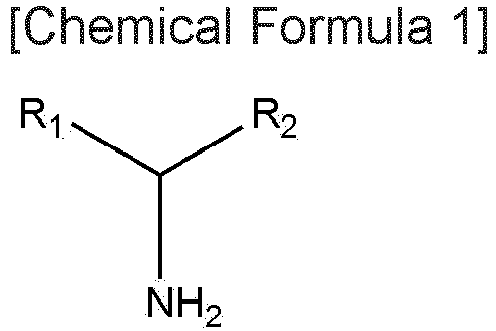 R1 is a natural amino acid residue, andR2 is COOH, or CH2SH.
 - The method of claim 1, wherein
the amine-based coupling agent is glycine, aspartic acid, cysteamine, cysteine, glutamic acid, selenocysteine, alanine, valine, isoleucine, leucine, methionine, or phenylalanine. - The method of claim 1, wherein
the molar ratio of the manganese salt and the amine-based coupling agent is 1: 0.5 to 2. - The method of claim 1, wherein
the reaction time of step 1 is 5 minutes to 1 hour. - The method of claim 1, wherein
the oxidizing agent is K2S2O8, Na2S2O8, or (NH4)2S2O8. - The method of claim 1, wherein
the molar ratio of the manganese salt used in step 1 and the oxidizing agent is 2 to 10. - The method of claim 1, wherein
the reaction time of step 2 is 2 hours to 12 hours. - Plate-type manganese dioxide nanoparticles prepared by the preparation method of any one of claims 1 to 10.
- A positive electrode for pseudo-capacitors comprising the plate-type manganese dioxide nanoparticles of claim 11.
Applications Claiming Priority (2)
| Application Number | Priority Date | Filing Date | Title |
|---|---|---|---|
| KR1020170149678A KR102457687B1 (en) | 2017-11-10 | 2017-11-10 | Method for preparation of plate-type manganese dioxide nanoparticles |
| PCT/KR2018/010863 WO2019093648A2 (en) | 2017-11-10 | 2018-09-14 | Method for preparation of plate-type manganese dioxide nanoparticle |
Publications (2)
| Publication Number | Publication Date |
|---|---|
| EP3659973A2 true EP3659973A2 (en) | 2020-06-03 |
| EP3659973A4 EP3659973A4 (en) | 2020-08-19 |
Family
ID=66438847
Family Applications (1)
| Application Number | Title | Priority Date | Filing Date |
|---|---|---|---|
| EP18876546.5A Pending EP3659973A4 (en) | 2017-11-10 | 2018-09-14 | PROCESS FOR THE PREPARATION OF PLATE-TYPE MANGANESE DIOXIDE NANOPARTICLES |
Country Status (6)
| Country | Link |
|---|---|
| US (1) | US12060282B2 (en) |
| EP (1) | EP3659973A4 (en) |
| JP (1) | JP7106188B2 (en) |
| KR (1) | KR102457687B1 (en) |
| CN (1) | CN111094186A (en) |
| WO (1) | WO2019093648A2 (en) |
Families Citing this family (1)
| Publication number | Priority date | Publication date | Assignee | Title |
|---|---|---|---|---|
| CN112266023A (en) * | 2020-11-17 | 2021-01-26 | 河南大学 | A manganese dioxide nanostructure with controllable morphology, its preparation method and application |
Family Cites Families (11)
| Publication number | Priority date | Publication date | Assignee | Title |
|---|---|---|---|---|
| US3647835A (en) * | 1969-11-12 | 1972-03-07 | Mobil Oil Corp | Method of direct generation of manganese (iii) solution from manganese (ii) solution |
| JP2815611B2 (en) * | 1989-05-10 | 1998-10-27 | 正同化学工業株式会社 | Method for producing manganese oxide |
| KR100255929B1 (en) | 1997-08-08 | 2000-05-01 | 강호익 | A method for preparing high pure trimanganese tetraoxide as a magnetic material |
| WO2007006585A2 (en) * | 2005-07-14 | 2007-01-18 | Elsper Ruediger | Synthesis of a porous and/or stratified structure manganese oxide |
| KR100842295B1 (en) | 2007-04-03 | 2008-06-30 | 한국전자통신연구원 | Method of manufacturing manganese dioxide nanoparticles |
| KR101170095B1 (en) * | 2010-02-18 | 2012-07-31 | 한국과학기술원 | Method for synthesizing nanostructured gamma manganese oxide at atmospheric pressure and low temperature and spinel lithium manganese oxide thereof |
| KR101262857B1 (en) * | 2011-01-04 | 2013-05-09 | 국립대학법인 울산과학기술대학교 산학협력단 | Single-step production method for nano-structured manganese oxide |
| CN102368555B (en) | 2011-10-19 | 2013-04-10 | 桑德集团有限公司 | Method for manufacturing anode material of rare-earth-yttrium-doped lithium manganese oxide battery |
| KR101371288B1 (en) | 2011-12-22 | 2014-03-07 | 이화여자대학교 산학협력단 | Manganese oxide/graphene composite and producing method of the same |
| CN104275493B (en) | 2013-07-02 | 2016-07-06 | 济南大学 | A kind of method preparing gold nano dish for reducing agent with aminoacid |
| KR101946145B1 (en) | 2016-02-24 | 2019-02-11 | 경희대학교 산학협력단 | A Method for preparing metal oxide nanoparticle and metal hydroxide nanoparticle in aqueous solution |
-
2017
- 2017-11-10 KR KR1020170149678A patent/KR102457687B1/en active Active
-
2018
- 2018-09-14 US US16/646,098 patent/US12060282B2/en active Active
- 2018-09-14 WO PCT/KR2018/010863 patent/WO2019093648A2/en not_active Ceased
- 2018-09-14 CN CN201880057139.6A patent/CN111094186A/en active Pending
- 2018-09-14 EP EP18876546.5A patent/EP3659973A4/en active Pending
- 2018-09-14 JP JP2019571684A patent/JP7106188B2/en active Active
Also Published As
| Publication number | Publication date |
|---|---|
| CN111094186A (en) | 2020-05-01 |
| EP3659973A4 (en) | 2020-08-19 |
| KR102457687B1 (en) | 2022-10-20 |
| WO2019093648A2 (en) | 2019-05-16 |
| US20200207637A1 (en) | 2020-07-02 |
| JP7106188B2 (en) | 2022-07-26 |
| WO2019093648A3 (en) | 2019-06-27 |
| US12060282B2 (en) | 2024-08-13 |
| JP2020525387A (en) | 2020-08-27 |
| KR20190053609A (en) | 2019-05-20 |
Similar Documents
| Publication | Publication Date | Title |
|---|---|---|
| KR101382386B1 (en) | Preparation method of lithium-metal composite oxides | |
| CN101595581B (en) | Li-ni composite oxide particle powder for rechargeable battery with nonaqueous electrolyte, process for producing the li-ni composite oxide particle powder, and rechargeable battery with nonaqueous el | |
| CN101675547B (en) | Process for production of positive electrode active material for lithium ion secondary battery | |
| CN102239586B (en) | Surface-modified lithium-containing composite oxide for positive electrode active material of lithium-ion secondary battery and manufacturing method thereof | |
| CN100494074C (en) | Preparation method of amorphous molybdenum sulfide nanopowder | |
| CN101785134A (en) | Surface-modified lithium-containing composite oxide for positive electrode active material of lithium ion secondary battery, and method for producing same | |
| CN104724734A (en) | Method for producing flower-like sphere type nanometer magnesium hydroxide with characteristics of light weight and high specific surface area | |
| JP4760805B2 (en) | Lithium nickel cobalt composite oxide, production method thereof, and positive electrode active material for secondary battery | |
| CN106684348B (en) | A kind of nano iron fluoride-based cathode material and preparation method thereof | |
| JP2018530871A (en) | Lithium ion battery | |
| JP6243932B2 (en) | Method for producing titanium niobium oxide, and method for producing titanium niobium oxide negative electrode active material using titanium niobium oxide obtained therefrom | |
| EP3644335B1 (en) | Method for preparing anode active material for pseudo capacitor | |
| KR101608733B1 (en) | Method for manufacturing cathode active material for lithium secondary battery | |
| McNulty et al. | NiVO3 fused oxide nanoparticles–an electrochemically stable intercalation anode material for lithium ion batteries | |
| CN106542560A (en) | A kind of preparation method of rare earth oxysulfate | |
| JP7054658B2 (en) | Method for manufacturing LATP crystal particles for solid electrolyte of secondary battery | |
| KR101346405B1 (en) | Method of controlling the aspect ratio of a nano-structure, and Method of producing a nano-structure using the same | |
| US12060282B2 (en) | Method for preparation of plate-type manganese dioxide nanoparticles | |
| JP4729700B2 (en) | Dy-doped nano ceria-based sintered body | |
| KR102829143B1 (en) | Method for preparing lithium manganese oxide based positive electrode active material | |
| JPH11292549A (en) | Cobalt hydroxide and method for producing the same | |
| US10454110B2 (en) | Method for producing lithium ion cell active material particles | |
| JP7089983B2 (en) | Method for manufacturing NASICON type negative electrode active material particles for sodium ion secondary battery | |
| CN112875765A (en) | NiMnO3Preparation method of bimetal oxide and energy storage device | |
| JP2004175644A (en) | Magnesia particles and method for producing the same |
Legal Events
| Date | Code | Title | Description |
|---|---|---|---|
| STAA | Information on the status of an ep patent application or granted ep patent |
Free format text: STATUS: THE INTERNATIONAL PUBLICATION HAS BEEN MADE |
|
| PUAI | Public reference made under article 153(3) epc to a published international application that has entered the european phase |
Free format text: ORIGINAL CODE: 0009012 |
|
| STAA | Information on the status of an ep patent application or granted ep patent |
Free format text: STATUS: REQUEST FOR EXAMINATION WAS MADE |
|
| 17P | Request for examination filed |
Effective date: 20200227 |
|
| AK | Designated contracting states |
Kind code of ref document: A2 Designated state(s): AL AT BE BG CH CY CZ DE DK EE ES FI FR GB GR HR HU IE IS IT LI LT LU LV MC MK MT NL NO PL PT RO RS SE SI SK SM TR |
|
| AX | Request for extension of the european patent |
Extension state: BA ME |
|
| A4 | Supplementary search report drawn up and despatched |
Effective date: 20200716 |
|
| RIC1 | Information provided on ipc code assigned before grant |
Ipc: H01G 11/42 20130101ALI20200710BHEP Ipc: C01G 45/02 20060101AFI20200710BHEP |
|
| DAV | Request for validation of the european patent (deleted) | ||
| DAX | Request for extension of the european patent (deleted) | ||
| RAP1 | Party data changed (applicant data changed or rights of an application transferred) |
Owner name: LG ENERGY SOLUTION LTD. |
|
| RAP3 | Party data changed (applicant data changed or rights of an application transferred) |
Owner name: LG ENERGY SOLUTION, LTD. |
|
| STAA | Information on the status of an ep patent application or granted ep patent |
Free format text: STATUS: EXAMINATION IS IN PROGRESS |
|
| 17Q | First examination report despatched |
Effective date: 20230207 |