EP3659792A1 - Tyre cold retreading method and system - Google Patents
Tyre cold retreading method and system Download PDFInfo
- Publication number
- EP3659792A1 EP3659792A1 EP19211663.0A EP19211663A EP3659792A1 EP 3659792 A1 EP3659792 A1 EP 3659792A1 EP 19211663 A EP19211663 A EP 19211663A EP 3659792 A1 EP3659792 A1 EP 3659792A1
- Authority
- EP
- European Patent Office
- Prior art keywords
- filler
- tread strip
- cold
- tyre
- curing
- Prior art date
- Legal status (The legal status is an assumption and is not a legal conclusion. Google has not performed a legal analysis and makes no representation as to the accuracy of the status listed.)
- Granted
Links
Images



Classifications
-
- B—PERFORMING OPERATIONS; TRANSPORTING
- B29—WORKING OF PLASTICS; WORKING OF SUBSTANCES IN A PLASTIC STATE IN GENERAL
- B29D—PRODUCING PARTICULAR ARTICLES FROM PLASTICS OR FROM SUBSTANCES IN A PLASTIC STATE
- B29D30/00—Producing pneumatic or solid tyres or parts thereof
- B29D30/06—Pneumatic tyres or parts thereof (e.g. produced by casting, moulding, compression moulding, injection moulding, centrifugal casting)
- B29D30/52—Unvulcanised treads, e.g. on used tyres; Retreading
- B29D30/54—Retreading
-
- B—PERFORMING OPERATIONS; TRANSPORTING
- B29—WORKING OF PLASTICS; WORKING OF SUBSTANCES IN A PLASTIC STATE IN GENERAL
- B29D—PRODUCING PARTICULAR ARTICLES FROM PLASTICS OR FROM SUBSTANCES IN A PLASTIC STATE
- B29D30/00—Producing pneumatic or solid tyres or parts thereof
- B29D30/06—Pneumatic tyres or parts thereof (e.g. produced by casting, moulding, compression moulding, injection moulding, centrifugal casting)
- B29D30/52—Unvulcanised treads, e.g. on used tyres; Retreading
- B29D30/54—Retreading
- B29D30/56—Retreading with prevulcanised tread
-
- B—PERFORMING OPERATIONS; TRANSPORTING
- B29—WORKING OF PLASTICS; WORKING OF SUBSTANCES IN A PLASTIC STATE IN GENERAL
- B29D—PRODUCING PARTICULAR ARTICLES FROM PLASTICS OR FROM SUBSTANCES IN A PLASTIC STATE
- B29D30/00—Producing pneumatic or solid tyres or parts thereof
- B29D30/06—Pneumatic tyres or parts thereof (e.g. produced by casting, moulding, compression moulding, injection moulding, centrifugal casting)
- B29D30/52—Unvulcanised treads, e.g. on used tyres; Retreading
- B29D30/54—Retreading
- B29D2030/541—Abrading the tyre, e.g. buffing, to remove tread and/or sidewalls rubber, to prepare it for retreading
-
- B—PERFORMING OPERATIONS; TRANSPORTING
- B29—WORKING OF PLASTICS; WORKING OF SUBSTANCES IN A PLASTIC STATE IN GENERAL
- B29D—PRODUCING PARTICULAR ARTICLES FROM PLASTICS OR FROM SUBSTANCES IN A PLASTIC STATE
- B29D30/00—Producing pneumatic or solid tyres or parts thereof
- B29D30/06—Pneumatic tyres or parts thereof (e.g. produced by casting, moulding, compression moulding, injection moulding, centrifugal casting)
- B29D30/52—Unvulcanised treads, e.g. on used tyres; Retreading
- B29D30/54—Retreading
- B29D2030/544—Applying an intermediate adhesive layer, e.g. cement or cushioning element between carcass and tread
Definitions
- the present invention relates to a tyre cold retreading method and system.
- the present invention may be used to advantage for retreading truck tyres, to which the following description refers purely by way of example.
- the curing takes place at high temperatures (around 150°C to 160°C) and high pressures (in the order of about 1.4-1.6 MPa) which are needed to make the rubber fluid enough to flow into the mold in order to form the pattern during curing; the thermal and mechanical stresses to which the casing is subjected due to such high temperatures and pressures can however cause damage to the same casing .
- the tread strip (called “PCT Pre Cured Tread - strip ”) is pre-cured and already provided with the pattern, and between the casing and the pre-cured tread strip an intermediate strip or "cushion", having a bonding function, is interposed.
- the curing is only meant to cure the intermediate strip in order to determine the optimal adhesion of the tread strip to the casing by means of the bonding action of the cushion (i.e., a pattern is not printed during curing); as a result, in the cold retreading process, curing takes place at lower temperatures (in the order of 100°C - 125°C), at lower pressures (in the order of 0.4-0.6 MPa), the casing is therefore subjected to lower thermal and mechanical stresses.
- the hot retreading process provides for an average curing period for each "truck" tyre of about 1 hour at around 150°C - 160°C, while the cold retreading process provides for an average curing period for each "truck” tyre of about 4 hours at around 100°C - 125°C.
- the vacuum makes it possible to apply a uniform pressure to the entire tread strip both at the peaks of the blocks of the pattern and at the valleys of the pattern; the uniformity of the pneumatic pressure (which would never be mechanically feasible insofar as the valleys of the pattern cannot be reached due to the size, shape and number thereof) makes it possible to ensure optimal tread adhesion to the casing.
- the use of the autoclave and the envelope has several drawbacks: firstly, in use, the autoclave exhibits an internal pressure that is considerably greater than atmospheric pressure and that therefore poses various problems as regards the safety of the operators of the plant; furthermore, applying the envelope to the tyre is quite long and laborious, the envelope has a rather short working life (i.e., it must be replaced quite often), and the possible failure of the envelope during curing (a frequent situation) forces the recommencement of the retreading process or, in some cases, even the scrapping of the tyre.
- Number 1 in Figure 1 indicates as a whole a cold retreading plant for retreading a "truck" tyre 2.
- the retreading plant 1 comprises a removal station 3, wherein the old worn tread (shown on the left) is mechanically removed from the 2, exposing an equatorial surface 4 (shown on the right) of a casing 5 of the tyre 2.
- the retreading plant 1 comprises a skiving station 6, wherein the equatorial surface 4 of the casing 5 is subjected to skiving in order to remove any local damage; the skiving operation can result in the formation on the equatorial surface 4 of the casing 5 of craters of random and variable dimensions and positions which are subsequently filled with green rubber.
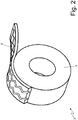
- the retreading plant 1 comprises a winding station 7 whereto the casing 5 is transferred at the end of the skiving; within the winding station 7, an intermediate strip or cushion 8 of green rubber and a pre-cured tread strip 9 are wound about the casing 5 (one after the other). It is important to observe that the pre-cured tread strip 9 has already been cured in a special mold before being wound about the casing 5 and presents the tread pattern.
- the retreading plant 1 comprises a curing station 10, wherein the retreaded tyre 2 (i.e. the casing 5 provided with the cushion 8 and the pre-cured tread strip 9) is subjected to a curing process for curing the cushion 8 which is interposed between the casing 5 and the pre-cured tread strip 9 thus resulting in optimal adhesion of the pre-cured tread strip 9 to the casing 5 by means of the bonding action of the cushion 8.
- the retreaded tyre 2 i.e. the casing 5 provided with the cushion 8 and the pre-cured tread strip 9
- the filler 11 constitutes a "negative" of the pre-cured tread strip 9 covering the pre-cured tread strip 9 by penetrating into the grooves of the tread pattern.
- the filler 11 is applied on the pre-cured tread strip 9 so as to completely cover the pre-cured tread strip 9 and then present externally a flat equatorial surface (i.e. smooth, free of depressions and grooves); in other words, the filler 11 is used to form a coating that "smoothes" the pre-cured tread strip 9 by providing outwardly a flat, equatorial surface (i.e. smooth, without depressions and grooves).
- the filler 11 is applied onto the pre-cured tread strip 9 by an applicator device 12 after the pre-cured tread strip 9 has been wrapped around the casing 5 (i.e. when the strip 9 of the pre-cured tread has an annular shape).
- the filler 11 is applied to the pre-cured tread strip 9 by an applicator device 12 before the pre-cured tread strip 9 is wrapped around the casing 5 (i.e. when the tread strip 9 pre-cured has a flat shape).
- the pre-cured tread strip 9 provided with the filler 11 i.e. coated by the filler 11 is wound around the casing 5.
- the applicator device 12 comprises an outlet mouth which has the same width as the pre-cured tread strip 9 and is provided with an outlet opening which dispenses the filler 11 in a fluid state uniformly throughout the transversal extension of the pre-cured tread strip 9.
- the filler 11 is (at least initially, i.e. at the moment of application on the pre-cured tread strip 9) in a fluid state, i.e. it is sliding since it has limited consistency; in other words, the filler 11 is (at least initially) in a fluid state, i.e. it is deformed indefinitely if subjected to a cutting stress independently of the extent of the cutting stress.
- the filler 11 contains metal powder (very thin) which has the advantage of having an excellent thermal transmissibility which is indispensable during curing (as better explained below).
- the filler 11 could also contain elastomeric powder obtained at least partially grinding the old worn tread (in other words "recycling" the old tread worn to form the filler 11).
- the filler 11 can be made by clay or other similar natural material which has the advantage of being easy retrievable, inexpensive and recyclable either for further retreading operation or in general. Furthermore, the natural shrinkage of the clay due to curing allows also easy removal of the filler 11 from the tread pattern; in other words, after curing the filler 11 made by clay (or other similar natural material) can be removed easily from the pre-cured tread strip 9 thanks to the natural shrinkage of the clay due to curing.
- the filler 11 can be made (partially or completely) by a material (such as clay) which shrinks during the curing (i.e. has a natural shrinkage due to curing).
- the filler 11 comprises binders (for example polyvinyl glues) which dry after application of the filler 11; in this way, the filler 11 forms a compact strip which, after curing, can be unwound from the tyre 2 (as illustrated for example in Figure 5 ).
- the filler 11 in a fluid state is a rather dense sludge which, when dried, forms a more or less compact body.
- the fluid filler 11 is free of binders which dry after application of the fluid filler 11 and therefore the filler 11 is rendered at least partially stable after application of the filler 11 by mechanical compacting; in this way, the filler 11 does not form a compact strip and after curing is generally removed being previously destroyed (for example by high frequency vibrations and/or by high pressure water jets).
- the filler 11 in a fluid state is in essence a very thin powder which when pressed tends to compact.
- the curing station 10 comprises a curing mold 14 which is composed of a plurality of pressure bodies 15 which each are shaped as a circular sector and together constitute a ring adapted to contain the tyre 2.
- Each pressure body 15 is moved radially (and thus pushed radially against the tyre 2) by an actuator 16 (for example a pneumatic or hydraulic cylinder).
- the actuators 16 are adapted to apply a radial pressure towards the center (i.e. a radial pressure which compresses the tyre 2) of calibrated force and determined in such a way that during the curing process the tyre 2 (i.e.
- the pre-cured tread strip 9 which is part of the tyre 2) is compressed radially at a desired pressure;
- the actuators 16 could use to radially press the pressure bodies 15 a calibrated pressure pneumatic or hydraulic system, or they could use a fully mechanical system provided with calibrated springs.
- Each pressure body 15 is heated to transmit heat to the pre-cured tread strip 9 and then to the substrate 8; the pressure bodies 15 are not in direct contact with the pre-cured tread strip 9 since the pre-cured tread strip 9 is coated by the filler 11 and, consequently, the heat held by the pressure bodies 15 to reach the pre-cured tread strip 9 must first pass through the filler 11 (as a result and as previously stated the filler 11 must be a good heat transmitter).
- the tyre 2 is maintained at ambient pressure and a radial pressure is applied mechanically to the tread strip 9 by the pressor bodies 15 of the curing mold 14 and by the interposition of the filler 11.
- the pressures bodies 15 of the curing mold 14 press on the filler 11 which has a smooth surface externally (hence the pressure exerted by the pressure bodies 15 is distributed uniformly over the whole filler 11); the filler 11 transmits the pressure exerted by the pressure bodies 15 uniformly over the whole pre-cured tread strip 9 since the filler 11 is homogeneously distributed over the whole pre-cured tread strip 9 (i.e. also in all the grooves of the tread pattern). Accordingly, the filler 11 acts as a "distributor" of the pressure exerted by the pressure bodies 15 over the entire pre-cured tread strip 9 by being a coating that negatively reproduces the shape of the pre-cured tread strip 9.
- the filler 11 which covers the pre-cured tread strip 9 constitutes a "counter-mold" (a mechanical interface) which cooperates with the curing mold 14 to distribute uniformly over the whole pre-cured tread strip 9 the pressure (thrust) applied by the pressor bodies 15 of the curing mold 14.
- the tyre 2 is kept at ambient pressure and a radial pressure is applied mechanically to the pre-cured tread strip 9 (which is part of the tyre 2 and constitutes the outermost part of the tyre 2 same).
- a radial pressure is applied mechanically to the pre-cured tread strip 9 by a series of pressure bodies 15, which are arranged around the tyre 2 and are pushed with a radial force determined against the pre-cured tread strip 9.
- the retreading method described above avoids the use, during the curing process, of an autoclave (avoiding the safety problems that the use of the autoclave entails) and of envelopes for the vacuum (avoiding the complicated dressing / removing the tyre 2 and the risks of breaking the vacuum envelopes); this result is obtained thanks to the fact that the pre-cured tread strip 9 is covered by the filler 11 which has a perfectly smooth outer surface and therefore it is possible to mechanically apply a uniform pressure on the pre-cured tread strip 9 during the curing process pushing on the filler 11 which covers the pre-cured tread strip 9.
Landscapes
- Engineering & Computer Science (AREA)
- Mechanical Engineering (AREA)
- Tyre Moulding (AREA)
- Tires In General (AREA)
- Organic Low-Molecular-Weight Compounds And Preparation Thereof (AREA)
Abstract
Description
- The present invention relates to a tyre cold retreading method and system.
- The present invention may be used to advantage for retreading truck tyres, to which the following description refers purely by way of example.
- Traditionally, after first use "truck" pneumatic tyres are retreaded, i.e., they are provided with a new tread in place of the old worn tread which is removed beforehand. The retreading of a "truck" pneumatic tyre provides to eliminate the old worn tread mechanically from the used pneumatic tyre in order to expose the "casing", and subsequently applying a new tread to the casing. The application of a new tread to the casing provides winding about the same casing a "tread strip"; the casing is then subjected to a curing process in order to determine the optimum adhesion of the tread to the casing. In the hot retreading process, the tread strip is green and without a pattern which is implemented during the curing step in a curing press provided with a mold having the required pattern.
- In the hot retreading process, the curing takes place at high temperatures (around 150°C to 160°C) and high pressures (in the order of about 1.4-1.6 MPa) which are needed to make the rubber fluid enough to flow into the mold in order to form the pattern during curing; the thermal and mechanical stresses to which the casing is subjected due to such high temperatures and pressures can however cause damage to the same casing .
- In the cold retreading process, the tread strip (called "PCT Pre Cured Tread - strip") is pre-cured and already provided with the pattern, and between the casing and the pre-cured tread strip an intermediate strip or "cushion", having a bonding function, is interposed. In the cold retreading process, the curing is only meant to cure the intermediate strip in order to determine the optimal adhesion of the tread strip to the casing by means of the bonding action of the cushion (i.e., a pattern is not printed during curing); as a result, in the cold retreading process, curing takes place at lower temperatures (in the order of 100°C - 125°C), at lower pressures (in the order of 0.4-0.6 MPa), the casing is therefore subjected to lower thermal and mechanical stresses.
- Generally, the hot retreading process provides for an average curing period for each "truck" tyre of about 1 hour at around 150°C - 160°C, while the cold retreading process provides for an average curing period for each "truck" tyre of about 4 hours at around 100°C - 125°C.
- In the cold retreading process and to ensure adequate adhesion of the tread strip to the casing (with the interposition of the intermediate green rubber strip), it is necessary during curing to apply a radial pressure that compresses the tread strip against the casing. In known retreading plants, such a radial pressure is obtained by inserting the tyre in an autoclave within which an overpressure (in the order of 0.6 MPa), in relation to atmospheric pressure, is implemented and by inserting the tyre into a flexible "envelope" within which a vacuum is initially created and which is subsequently inflated with air to a pressure of about 0.45 Mpa); the difference in pressure (normally called "DPC"), which is maintained during the curing cycle, results in the generation of a pneumatic pressure that compresses the tread strip against the casing.
- The use of the autoclave and the envelope, wherein the "DPC" pressure differential is applied, the vacuum makes it possible to apply a uniform pressure to the entire tread strip both at the peaks of the blocks of the pattern and at the valleys of the pattern; the uniformity of the pneumatic pressure (which would never be mechanically feasible insofar as the valleys of the pattern cannot be reached due to the size, shape and number thereof) makes it possible to ensure optimal tread adhesion to the casing.
- However, the use of the autoclave and the envelope has several drawbacks: firstly, in use, the autoclave exhibits an internal pressure that is considerably greater than atmospheric pressure and that therefore poses various problems as regards the safety of the operators of the plant; furthermore, applying the envelope to the tyre is quite long and laborious, the envelope has a rather short working life (i.e., it must be replaced quite often), and the possible failure of the envelope during curing (a frequent situation) forces the recommencement of the retreading process or, in some cases, even the scrapping of the tyre.
- It is an object of the present invention to provide a tyre cold retreading method and system designed to eliminate the above drawbacks, and which are cheap and easy to implement.
- According to the present invention, there are provided a cold tyre retreading method and system, as claimed in the accompanying Claims.
- The claims describe preferred embodiments of the present invention forming an integral part of the present disclosure.
- A non-limiting embodiment of the present invention will be described by way of example with reference to the accompanying drawings, in which:
-
Figure 1 is a schematic view of a tyre cold retreading plant implemented according to the present invention; -
Figure 2 is a schematic view of a winding of a pre-cured tread strip around a casing of a tyre to be retread; -
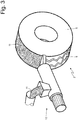
Figure 3 is a schematic view of an application of a filler over a pre-cured tread strip previously wound around a casing of a tyre to be retread; -
Figure 4 is a schematic view of a curing of a retread tyre; -
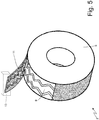
Figure 5 is a schematic view of a removal of a filler from the pre-cured tread strip after the curing; -
Figure 6 is a schematic view of an application of a filler over a flat pre-cured tread strip; and -
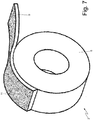
Figure 7 is a schematic view of a winding around a casing of a tyre to be rebuilt of a pre-cured tread strip previously provided with a filler. - Number 1 in
Figure 1 indicates as a whole a cold retreading plant for retreading a "truck"tyre 2. - The retreading plant 1 comprises a
removal station 3, wherein the old worn tread (shown on the left) is mechanically removed from the 2, exposing an equatorial surface 4 (shown on the right) of acasing 5 of thetyre 2. - Furthermore the retreading plant 1 comprises a
skiving station 6, wherein theequatorial surface 4 of thecasing 5 is subjected to skiving in order to remove any local damage; the skiving operation can result in the formation on theequatorial surface 4 of thecasing 5 of craters of random and variable dimensions and positions which are subsequently filled with green rubber. - The retreading plant 1 comprises a
winding station 7 whereto thecasing 5 is transferred at the end of the skiving; within thewinding station 7, an intermediate strip or cushion 8 of green rubber and apre-cured tread strip 9 are wound about the casing 5 (one after the other). It is important to observe that thepre-cured tread strip 9 has already been cured in a special mold before being wound about thecasing 5 and presents the tread pattern. - The retreading plant 1 comprises a
curing station 10, wherein the retreaded tyre 2 (i.e. thecasing 5 provided with the cushion 8 and the pre-cured tread strip 9) is subjected to a curing process for curing the cushion 8 which is interposed between thecasing 5 and thepre-cured tread strip 9 thus resulting in optimal adhesion of thepre-cured tread strip 9 to thecasing 5 by means of the bonding action of the cushion 8. - According to what shown in
Figure 3 , after winding thepre-cured tread strip 9 around thecasing 5 and before subjecting thecasing 5 to curing, onto thepre-cured tread strip 9 is applied afiller 11 in the fluid which completely fills the tread pattern (that is, it penetrates the grooves of the tread pattern) and forms a coating that covers thepre-cured tread strip 9. In other words, thefiller 11 constitutes a "negative" of thepre-cured tread strip 9 covering thepre-cured tread strip 9 by penetrating into the grooves of the tread pattern. - The
filler 11 is applied on thepre-cured tread strip 9 so as to completely cover thepre-cured tread strip 9 and then present externally a flat equatorial surface (i.e. smooth, free of depressions and grooves); in other words, thefiller 11 is used to form a coating that "smoothes" thepre-cured tread strip 9 by providing outwardly a flat, equatorial surface (i.e. smooth, without depressions and grooves). - In the embodiment illustrated in
Figure 3 , thefiller 11 is applied onto thepre-cured tread strip 9 by anapplicator device 12 after thepre-cured tread strip 9 has been wrapped around the casing 5 (i.e. when thestrip 9 of the pre-cured tread has an annular shape). - In the variant shown in
Figure 6 , thefiller 11 is applied to thepre-cured tread strip 9 by anapplicator device 12 before thepre-cured tread strip 9 is wrapped around the casing 5 (i.e. when thetread strip 9 pre-cured has a flat shape). In this embodiment and as illustrated inFigure 7 , thepre-cured tread strip 9 provided with the filler 11 (i.e. coated by the filler 11) is wound around thecasing 5. - By way of example, the
applicator device 12 comprises an outlet mouth which has the same width as thepre-cured tread strip 9 and is provided with an outlet opening which dispenses thefiller 11 in a fluid state uniformly throughout the transversal extension of thepre-cured tread strip 9. - As illustrated in
Figure 5 , after curing thefiller 11 is removed from thepre-cured tread strip 9 by aremoval device 13 and this operation terminates thetyre retreading process 2. - As previously stated, the
filler 11 is (at least initially, i.e. at the moment of application on the pre-cured tread strip 9) in a fluid state, i.e. it is sliding since it has limited consistency; in other words, thefiller 11 is (at least initially) in a fluid state, i.e. it is deformed indefinitely if subjected to a cutting stress independently of the extent of the cutting stress. - According to a possible embodiment, the
filler 11 contains metal powder (very thin) which has the advantage of having an excellent thermal transmissibility which is indispensable during curing (as better explained below). - According to a possible embodiment, the
filler 11 could also contain elastomeric powder obtained at least partially grinding the old worn tread (in other words "recycling" the old tread worn to form the filler 11). - According to a preferred embodiment, the
filler 11 can be made by clay or other similar natural material which has the advantage of being easy retrievable, inexpensive and recyclable either for further retreading operation or in general. Furthermore, the natural shrinkage of the clay due to curing allows also easy removal of thefiller 11 from the tread pattern; in other words, after curing thefiller 11 made by clay (or other similar natural material) can be removed easily from thepre-cured tread strip 9 thanks to the natural shrinkage of the clay due to curing. In general, thefiller 11 can be made (partially or completely) by a material (such as clay) which shrinks during the curing (i.e. has a natural shrinkage due to curing). - According to a possible embodiment, the
filler 11 comprises binders (for example polyvinyl glues) which dry after application of thefiller 11; in this way, thefiller 11 forms a compact strip which, after curing, can be unwound from the tyre 2 (as illustrated for example inFigure 5 ). In this embodiment, thefiller 11 in a fluid state is a rather dense sludge which, when dried, forms a more or less compact body. - According to an alternative embodiment, the
fluid filler 11 is free of binders which dry after application of thefluid filler 11 and therefore thefiller 11 is rendered at least partially stable after application of thefiller 11 by mechanical compacting; in this way, thefiller 11 does not form a compact strip and after curing is generally removed being previously destroyed (for example by high frequency vibrations and/or by high pressure water jets). In this embodiment, thefiller 11 in a fluid state is in essence a very thin powder which when pressed tends to compact. - According to what shown in
Figure 4 , thecuring station 10 comprises acuring mold 14 which is composed of a plurality ofpressure bodies 15 which each are shaped as a circular sector and together constitute a ring adapted to contain thetyre 2. Eachpressure body 15 is moved radially (and thus pushed radially against the tyre 2) by an actuator 16 (for example a pneumatic or hydraulic cylinder). According to a preferred embodiment, theactuators 16 are adapted to apply a radial pressure towards the center (i.e. a radial pressure which compresses the tyre 2) of calibrated force and determined in such a way that during the curing process the tyre 2 (i.e. thepre-cured tread strip 9 which is part of the tyre 2) is compressed radially at a desired pressure; by way of example, theactuators 16 could use to radially press the pressure bodies 15 a calibrated pressure pneumatic or hydraulic system, or they could use a fully mechanical system provided with calibrated springs. - Each
pressure body 15 is heated to transmit heat to thepre-cured tread strip 9 and then to the substrate 8; thepressure bodies 15 are not in direct contact with thepre-cured tread strip 9 since thepre-cured tread strip 9 is coated by thefiller 11 and, consequently, the heat held by thepressure bodies 15 to reach thepre-cured tread strip 9 must first pass through the filler 11 (as a result and as previously stated thefiller 11 must be a good heat transmitter). - During curing, the
tyre 2 is maintained at ambient pressure and a radial pressure is applied mechanically to thetread strip 9 by thepressor bodies 15 of thecuring mold 14 and by the interposition of thefiller 11. In other words, thepressures bodies 15 of thecuring mold 14 press on thefiller 11 which has a smooth surface externally (hence the pressure exerted by thepressure bodies 15 is distributed uniformly over the whole filler 11); thefiller 11 transmits the pressure exerted by thepressure bodies 15 uniformly over the whole pre-curedtread strip 9 since thefiller 11 is homogeneously distributed over the whole pre-cured tread strip 9 (i.e. also in all the grooves of the tread pattern). Accordingly, thefiller 11 acts as a "distributor" of the pressure exerted by thepressure bodies 15 over the entirepre-cured tread strip 9 by being a coating that negatively reproduces the shape of thepre-cured tread strip 9. - In essence, the
filler 11 which covers thepre-cured tread strip 9 constitutes a "counter-mold" (a mechanical interface) which cooperates with thecuring mold 14 to distribute uniformly over the wholepre-cured tread strip 9 the pressure (thrust) applied by thepressor bodies 15 of thecuring mold 14. - As previously stated, during the curing process the
tyre 2 is kept at ambient pressure and a radial pressure is applied mechanically to the pre-cured tread strip 9 (which is part of thetyre 2 and constitutes the outermost part of thetyre 2 same). In particular, during curing, a radial pressure is applied mechanically to thepre-cured tread strip 9 by a series ofpressure bodies 15, which are arranged around thetyre 2 and are pushed with a radial force determined against thepre-cured tread strip 9. - The embodiments described herein can be combined without departing from the scope of protection of the present invention.
- The retreading method described above has numerous advantages.
- In particular, the retreading method described above avoids the use, during the curing process, of an autoclave (avoiding the safety problems that the use of the autoclave entails) and of envelopes for the vacuum (avoiding the complicated dressing / removing the
tyre 2 and the risks of breaking the vacuum envelopes); this result is obtained thanks to the fact that thepre-cured tread strip 9 is covered by thefiller 11 which has a perfectly smooth outer surface and therefore it is possible to mechanically apply a uniform pressure on thepre-cured tread strip 9 during the curing process pushing on thefiller 11 which covers thepre-cured tread strip 9. -
- 1
- retreading plant
- 2
- tyre
- 3
- removal station
- 4
- equatorial surface
- 5
- casing
- 6
- skiving station
- 7
- winding station
- 8
- cushion
- 9
- pre-cured tread strip
- 10
- curing station
- 11
- filler
- 12
- applicator device
- 13
- removal device
- 14
- curing mold
- 15
- pressure bodies
Claims (15)
- A cold retreading method of a tyre (2); the cold retreading method comprises the steps of:removing the old worn tread from the tyre (2) in order to expose an equatorial surface (4) of a casing (5) of the tyre (2);winding about the equatorial surface (4) of the casing (5) a green rubber cushion (8) and a pre-cured tread strip (9) provided with a tread pattern; andcuring the green rubber cushion (8) inserted within the tyre (2) between the casing (5) and the pre-cured tread strip (9);applying to the pre-cured tread strip (9) and before curing a filler (11) in a fluid state which enters the grooves of the tread pattern and forms a coating covering the pre-cured tread strip (9); andremoving the filler (11) covering the pre-cured tread strip (9) after curing;the cold retreading method is characterized in that the filler (11) contains a material which shrinks during the curing.
- The cold reconstruction method according to claim 1, wherein the filler (11) contains clay or other similar natural material.
- The cold reconstruction method according to claim 1, wherein the filler (11) contains metal powder.
- The cold reconstruction method according to any one of claims 1 to 3, wherein the filler (11) contains elastomer powder.
- The cold reconstruction method according to claim 4, wherein the elastomer powder is at least partially obtained by crushing the old worn out tread.
- The cold reconstruction method according to any one of claims 1 to 5, wherein the filler (11) comprises binders which dry after application of the fluid filler (11) .
- The cold reconstruction method according to claim 6, in which the binders are constituted by polyvinyl glues.
- The cold reconstruction method according to any one of claims 1 to 5, wherein the filler (11) is free of binders which dry after application of the fluid filler (11).
- The cold reconstruction method according to claim 8, wherein the filler (11) is rendered at least partly stable after application of the filler (11) in a fluid state by mechanical compaction.
- The cold reconstruction method according to any one of claims 1 to 9, wherein, during curing, the tyre (2) is maintained at ambient pressure and a radial pressure is mechanically applied to the tread strip (9) by pressing from external on the filler (11) covering the pre-cured tread strip (9).
- The cold reconstruction method according to claim 10, wherein, during curing, a radial pressure is applied mechanically to the pre-cured tread strip (9) by a series of pressure bodies (15), which are arranged around the tyre (2) to form a ring and are pushed with a determined radial force against the filler (11) which covers the pre-cured tread strip (9).
- The cold reconstruction method according to claim 11, wherein the pressure bodies (15) are heated to transmit heat to the pre-cured tread strip (9) and then to the substrate (8).
- The cold reconstruction method according to any one of claims 1 to 12, wherein the filler (11) in a fluid state is applied to the pre-cured tread strip (9) before winding the pre-cured tread strip (9) around the casing (5).
- The cold reconstruction method according to any one of Claims 1 to 12, in which the filler (11) in a fluid state is applied to the pre-cured tread strip (9) after winding the pre-cured tread strip (9) around the casing (5).
- A cold retreading plant (1); the cold retreading plant (1) comprises:a removing station (3) for removing the old worn tread strip from the tyre (2) in order to expose an equatorial surface (4) of a casing (5) of the tyre (2);a winding station (7) for winding about the equatorial surface (4) of the casing (5) a green rubber cushion (8) and a pre-cured tread strip (9) provided with a tread pattern;a curing station (10) for curing the green rubber cushion (8) inserted within the tyre (2) between the casing (5) and the pre-cured tread strip (9);the cold retreading plant (1) is characterized in comprising:an applicator device (12) for applying to the pre-cured tread strip (9) and before curing a filler (11) in a fluid state which enters the grooves of the tread pattern and forms a coating covering the pre-cured tread strip (9) wherein the filler (11) contains a material which shrinks during the curing; anda removal device (13) for removing the filler (11) covering the pre-cured tread strip (9) after curing.
Applications Claiming Priority (1)
| Application Number | Priority Date | Filing Date | Title |
|---|---|---|---|
| IT102018000010702A IT201800010702A1 (en) | 2018-11-29 | 2018-11-29 | COLD REBUILDING METHOD AND PLANT OF A TIRE |
Publications (2)
| Publication Number | Publication Date |
|---|---|
| EP3659792A1 true EP3659792A1 (en) | 2020-06-03 |
| EP3659792B1 EP3659792B1 (en) | 2021-09-01 |
Family
ID=65409418
Family Applications (1)
| Application Number | Title | Priority Date | Filing Date |
|---|---|---|---|
| EP19211663.0A Active EP3659792B1 (en) | 2018-11-29 | 2019-11-26 | Tyre cold retreading method and system |
Country Status (2)
| Country | Link |
|---|---|
| EP (1) | EP3659792B1 (en) |
| IT (1) | IT201800010702A1 (en) |
Citations (2)
| Publication number | Priority date | Publication date | Assignee | Title |
|---|---|---|---|---|
| GB506142A (en) * | 1937-10-22 | 1939-05-23 | Us Rubber Prod Inc | Improvements in pneumatic tyre |
| WO2014163610A1 (en) * | 2013-03-31 | 2014-10-09 | Compagnie Generale Des Etablissements Michelin | Improved methods of tire retreading using preassembled treads |
-
2018
- 2018-11-29 IT IT102018000010702A patent/IT201800010702A1/en unknown
-
2019
- 2019-11-26 EP EP19211663.0A patent/EP3659792B1/en active Active
Patent Citations (2)
| Publication number | Priority date | Publication date | Assignee | Title |
|---|---|---|---|---|
| GB506142A (en) * | 1937-10-22 | 1939-05-23 | Us Rubber Prod Inc | Improvements in pneumatic tyre |
| WO2014163610A1 (en) * | 2013-03-31 | 2014-10-09 | Compagnie Generale Des Etablissements Michelin | Improved methods of tire retreading using preassembled treads |
Also Published As
| Publication number | Publication date |
|---|---|
| IT201800010702A1 (en) | 2020-05-29 |
| EP3659792B1 (en) | 2021-09-01 |
Similar Documents
| Publication | Publication Date | Title |
|---|---|---|
| US3236709A (en) | Tire recapping process | |
| US3983193A (en) | Method of retreading pneumatic tires | |
| US2966936A (en) | Working method for recapping and repairing tires | |
| US4185056A (en) | Method of making a flexible elastomeric matrix and method of retreading tires therewith | |
| EP2337674B1 (en) | Method of controlling tread shrinkage during curing | |
| EP3941730B1 (en) | Tyre cold retreading method | |
| AU4650993A (en) | Method and apparatus for retreading a tire | |
| EP3659792B1 (en) | Tyre cold retreading method and system | |
| CN113518706B (en) | Cold tire retreading method | |
| US3964949A (en) | Method of treading tires | |
| EP3663078B1 (en) | Mobile tyre retreading plant | |
| EP2981409A1 (en) | Improved methods of tire retreading using preassembled treads | |
| EP3565715B1 (en) | Pneumatic tyre cold retreading method and plant | |
| WO1992008603A1 (en) | Method for rebelting tires | |
| CN114761217B (en) | Vulcanizing device and method for vulcanizing and molding tires and method for treating film for tire vulcanizing device | |
| EP4344864A1 (en) | Tire manufacturing method and plant | |
| US20250256475A1 (en) | Tire manufacturing method and plant | |
| JP2019081299A (en) | Vulcanization method in production process of retreaded tire | |
| CA2653285A1 (en) | Overall recapping method of tires | |
| JPH05154940A (en) | Method of renewing pneumatic tire | |
| US20160318271A1 (en) | Elevated Pressure and Temperature Tire Curing Utilizing Liquids | |
| JPH0195009A (en) | Regenerating method for tire | |
| WO1980001262A1 (en) | Removable tread belt and method of recapping same | |
| EP0830247A1 (en) | Expandable tread mold and method for retreading tires | |
| WO2012015338A1 (en) | Method for vulcanizing pneumatic tyre casings |
Legal Events
| Date | Code | Title | Description |
|---|---|---|---|
| PUAI | Public reference made under article 153(3) epc to a published international application that has entered the european phase |
Free format text: ORIGINAL CODE: 0009012 |
|
| STAA | Information on the status of an ep patent application or granted ep patent |
Free format text: STATUS: THE APPLICATION HAS BEEN PUBLISHED |
|
| AK | Designated contracting states |
Kind code of ref document: A1 Designated state(s): AL AT BE BG CH CY CZ DE DK EE ES FI FR GB GR HR HU IE IS IT LI LT LU LV MC MK MT NL NO PL PT RO RS SE SI SK SM TR |
|
| AX | Request for extension of the european patent |
Extension state: BA ME |
|
| STAA | Information on the status of an ep patent application or granted ep patent |
Free format text: STATUS: REQUEST FOR EXAMINATION WAS MADE |
|
| 17P | Request for examination filed |
Effective date: 20201130 |
|
| RBV | Designated contracting states (corrected) |
Designated state(s): AL AT BE BG CH CY CZ DE DK EE ES FI FR GB GR HR HU IE IS IT LI LT LU LV MC MK MT NL NO PL PT RO RS SE SI SK SM TR |
|
| GRAP | Despatch of communication of intention to grant a patent |
Free format text: ORIGINAL CODE: EPIDOSNIGR1 |
|
| STAA | Information on the status of an ep patent application or granted ep patent |
Free format text: STATUS: GRANT OF PATENT IS INTENDED |
|
| INTG | Intention to grant announced |
Effective date: 20210401 |
|
| RIC1 | Information provided on ipc code assigned before grant |
Ipc: B29D 30/56 20060101ALI20210322BHEP Ipc: B29D 30/54 20060101AFI20210322BHEP |
|
| GRAS | Grant fee paid |
Free format text: ORIGINAL CODE: EPIDOSNIGR3 |
|
| GRAA | (expected) grant |
Free format text: ORIGINAL CODE: 0009210 |
|
| STAA | Information on the status of an ep patent application or granted ep patent |
Free format text: STATUS: THE PATENT HAS BEEN GRANTED |
|
| AK | Designated contracting states |
Kind code of ref document: B1 Designated state(s): AL AT BE BG CH CY CZ DE DK EE ES FI FR GB GR HR HU IE IS IT LI LT LU LV MC MK MT NL NO PL PT RO RS SE SI SK SM TR |
|
| REG | Reference to a national code |
Ref country code: GB Ref legal event code: FG4D |
|
| REG | Reference to a national code |
Ref country code: CH Ref legal event code: EP Ref country code: AT Ref legal event code: REF Ref document number: 1425797 Country of ref document: AT Kind code of ref document: T Effective date: 20210915 |
|
| REG | Reference to a national code |
Ref country code: DE Ref legal event code: R096 Ref document number: 602019007354 Country of ref document: DE |
|
| REG | Reference to a national code |
Ref country code: IE Ref legal event code: FG4D |
|
| REG | Reference to a national code |
Ref country code: LT Ref legal event code: MG9D |
|
| REG | Reference to a national code |
Ref country code: NL Ref legal event code: MP Effective date: 20210901 |
|
| PG25 | Lapsed in a contracting state [announced via postgrant information from national office to epo] |
Ref country code: RS Free format text: LAPSE BECAUSE OF FAILURE TO SUBMIT A TRANSLATION OF THE DESCRIPTION OR TO PAY THE FEE WITHIN THE PRESCRIBED TIME-LIMIT Effective date: 20210901 Ref country code: SE Free format text: LAPSE BECAUSE OF FAILURE TO SUBMIT A TRANSLATION OF THE DESCRIPTION OR TO PAY THE FEE WITHIN THE PRESCRIBED TIME-LIMIT Effective date: 20210901 Ref country code: ES Free format text: LAPSE BECAUSE OF FAILURE TO SUBMIT A TRANSLATION OF THE DESCRIPTION OR TO PAY THE FEE WITHIN THE PRESCRIBED TIME-LIMIT Effective date: 20210901 Ref country code: FI Free format text: LAPSE BECAUSE OF FAILURE TO SUBMIT A TRANSLATION OF THE DESCRIPTION OR TO PAY THE FEE WITHIN THE PRESCRIBED TIME-LIMIT Effective date: 20210901 Ref country code: HR Free format text: LAPSE BECAUSE OF FAILURE TO SUBMIT A TRANSLATION OF THE DESCRIPTION OR TO PAY THE FEE WITHIN THE PRESCRIBED TIME-LIMIT Effective date: 20210901 Ref country code: NO Free format text: LAPSE BECAUSE OF FAILURE TO SUBMIT A TRANSLATION OF THE DESCRIPTION OR TO PAY THE FEE WITHIN THE PRESCRIBED TIME-LIMIT Effective date: 20211201 Ref country code: BG Free format text: LAPSE BECAUSE OF FAILURE TO SUBMIT A TRANSLATION OF THE DESCRIPTION OR TO PAY THE FEE WITHIN THE PRESCRIBED TIME-LIMIT Effective date: 20211201 Ref country code: LT Free format text: LAPSE BECAUSE OF FAILURE TO SUBMIT A TRANSLATION OF THE DESCRIPTION OR TO PAY THE FEE WITHIN THE PRESCRIBED TIME-LIMIT Effective date: 20210901 |
|
| REG | Reference to a national code |
Ref country code: AT Ref legal event code: MK05 Ref document number: 1425797 Country of ref document: AT Kind code of ref document: T Effective date: 20210901 |
|
| PG25 | Lapsed in a contracting state [announced via postgrant information from national office to epo] |
Ref country code: PL Free format text: LAPSE BECAUSE OF FAILURE TO SUBMIT A TRANSLATION OF THE DESCRIPTION OR TO PAY THE FEE WITHIN THE PRESCRIBED TIME-LIMIT Effective date: 20210901 Ref country code: LV Free format text: LAPSE BECAUSE OF FAILURE TO SUBMIT A TRANSLATION OF THE DESCRIPTION OR TO PAY THE FEE WITHIN THE PRESCRIBED TIME-LIMIT Effective date: 20210901 Ref country code: GR Free format text: LAPSE BECAUSE OF FAILURE TO SUBMIT A TRANSLATION OF THE DESCRIPTION OR TO PAY THE FEE WITHIN THE PRESCRIBED TIME-LIMIT Effective date: 20211202 |
|
| PG25 | Lapsed in a contracting state [announced via postgrant information from national office to epo] |
Ref country code: AT Free format text: LAPSE BECAUSE OF FAILURE TO SUBMIT A TRANSLATION OF THE DESCRIPTION OR TO PAY THE FEE WITHIN THE PRESCRIBED TIME-LIMIT Effective date: 20210901 |
|
| PG25 | Lapsed in a contracting state [announced via postgrant information from national office to epo] |
Ref country code: IS Free format text: LAPSE BECAUSE OF FAILURE TO SUBMIT A TRANSLATION OF THE DESCRIPTION OR TO PAY THE FEE WITHIN THE PRESCRIBED TIME-LIMIT Effective date: 20220101 Ref country code: SM Free format text: LAPSE BECAUSE OF FAILURE TO SUBMIT A TRANSLATION OF THE DESCRIPTION OR TO PAY THE FEE WITHIN THE PRESCRIBED TIME-LIMIT Effective date: 20210901 Ref country code: SK Free format text: LAPSE BECAUSE OF FAILURE TO SUBMIT A TRANSLATION OF THE DESCRIPTION OR TO PAY THE FEE WITHIN THE PRESCRIBED TIME-LIMIT Effective date: 20210901 Ref country code: RO Free format text: LAPSE BECAUSE OF FAILURE TO SUBMIT A TRANSLATION OF THE DESCRIPTION OR TO PAY THE FEE WITHIN THE PRESCRIBED TIME-LIMIT Effective date: 20210901 Ref country code: PT Free format text: LAPSE BECAUSE OF FAILURE TO SUBMIT A TRANSLATION OF THE DESCRIPTION OR TO PAY THE FEE WITHIN THE PRESCRIBED TIME-LIMIT Effective date: 20220103 Ref country code: NL Free format text: LAPSE BECAUSE OF FAILURE TO SUBMIT A TRANSLATION OF THE DESCRIPTION OR TO PAY THE FEE WITHIN THE PRESCRIBED TIME-LIMIT Effective date: 20210901 Ref country code: EE Free format text: LAPSE BECAUSE OF FAILURE TO SUBMIT A TRANSLATION OF THE DESCRIPTION OR TO PAY THE FEE WITHIN THE PRESCRIBED TIME-LIMIT Effective date: 20210901 Ref country code: CZ Free format text: LAPSE BECAUSE OF FAILURE TO SUBMIT A TRANSLATION OF THE DESCRIPTION OR TO PAY THE FEE WITHIN THE PRESCRIBED TIME-LIMIT Effective date: 20210901 Ref country code: AL Free format text: LAPSE BECAUSE OF FAILURE TO SUBMIT A TRANSLATION OF THE DESCRIPTION OR TO PAY THE FEE WITHIN THE PRESCRIBED TIME-LIMIT Effective date: 20210901 |
|
| REG | Reference to a national code |
Ref country code: DE Ref legal event code: R097 Ref document number: 602019007354 Country of ref document: DE |
|
| PG25 | Lapsed in a contracting state [announced via postgrant information from national office to epo] |
Ref country code: MC Free format text: LAPSE BECAUSE OF FAILURE TO SUBMIT A TRANSLATION OF THE DESCRIPTION OR TO PAY THE FEE WITHIN THE PRESCRIBED TIME-LIMIT Effective date: 20210901 |
|
| PLBE | No opposition filed within time limit |
Free format text: ORIGINAL CODE: 0009261 |
|
| STAA | Information on the status of an ep patent application or granted ep patent |
Free format text: STATUS: NO OPPOSITION FILED WITHIN TIME LIMIT |
|
| PG25 | Lapsed in a contracting state [announced via postgrant information from national office to epo] |
Ref country code: LU Free format text: LAPSE BECAUSE OF NON-PAYMENT OF DUE FEES Effective date: 20211126 Ref country code: IT Free format text: LAPSE BECAUSE OF FAILURE TO SUBMIT A TRANSLATION OF THE DESCRIPTION OR TO PAY THE FEE WITHIN THE PRESCRIBED TIME-LIMIT Effective date: 20210901 Ref country code: DK Free format text: LAPSE BECAUSE OF FAILURE TO SUBMIT A TRANSLATION OF THE DESCRIPTION OR TO PAY THE FEE WITHIN THE PRESCRIBED TIME-LIMIT Effective date: 20210901 Ref country code: BE Free format text: LAPSE BECAUSE OF NON-PAYMENT OF DUE FEES Effective date: 20211130 |
|
| REG | Reference to a national code |
Ref country code: BE Ref legal event code: MM Effective date: 20211130 |
|
| 26N | No opposition filed |
Effective date: 20220602 |
|
| PG25 | Lapsed in a contracting state [announced via postgrant information from national office to epo] |
Ref country code: SI Free format text: LAPSE BECAUSE OF FAILURE TO SUBMIT A TRANSLATION OF THE DESCRIPTION OR TO PAY THE FEE WITHIN THE PRESCRIBED TIME-LIMIT Effective date: 20210901 |
|
| PG25 | Lapsed in a contracting state [announced via postgrant information from national office to epo] |
Ref country code: IE Free format text: LAPSE BECAUSE OF NON-PAYMENT OF DUE FEES Effective date: 20211126 |
|
| PG25 | Lapsed in a contracting state [announced via postgrant information from national office to epo] |
Ref country code: CY Free format text: LAPSE BECAUSE OF FAILURE TO SUBMIT A TRANSLATION OF THE DESCRIPTION OR TO PAY THE FEE WITHIN THE PRESCRIBED TIME-LIMIT Effective date: 20210901 |
|
| REG | Reference to a national code |
Ref country code: CH Ref legal event code: PL |
|
| PG25 | Lapsed in a contracting state [announced via postgrant information from national office to epo] |
Ref country code: LI Free format text: LAPSE BECAUSE OF NON-PAYMENT OF DUE FEES Effective date: 20221130 Ref country code: HU Free format text: LAPSE BECAUSE OF FAILURE TO SUBMIT A TRANSLATION OF THE DESCRIPTION OR TO PAY THE FEE WITHIN THE PRESCRIBED TIME-LIMIT; INVALID AB INITIO Effective date: 20191126 Ref country code: CH Free format text: LAPSE BECAUSE OF NON-PAYMENT OF DUE FEES Effective date: 20221130 |
|
| PG25 | Lapsed in a contracting state [announced via postgrant information from national office to epo] |
Ref country code: MK Free format text: LAPSE BECAUSE OF FAILURE TO SUBMIT A TRANSLATION OF THE DESCRIPTION OR TO PAY THE FEE WITHIN THE PRESCRIBED TIME-LIMIT Effective date: 20210901 |
|
| PG25 | Lapsed in a contracting state [announced via postgrant information from national office to epo] |
Ref country code: TR Free format text: LAPSE BECAUSE OF FAILURE TO SUBMIT A TRANSLATION OF THE DESCRIPTION OR TO PAY THE FEE WITHIN THE PRESCRIBED TIME-LIMIT Effective date: 20210901 |
|
| GBPC | Gb: european patent ceased through non-payment of renewal fee |
Effective date: 20231126 |
|
| PG25 | Lapsed in a contracting state [announced via postgrant information from national office to epo] |
Ref country code: MT Free format text: LAPSE BECAUSE OF FAILURE TO SUBMIT A TRANSLATION OF THE DESCRIPTION OR TO PAY THE FEE WITHIN THE PRESCRIBED TIME-LIMIT Effective date: 20210901 |
|
| PG25 | Lapsed in a contracting state [announced via postgrant information from national office to epo] |
Ref country code: GB Free format text: LAPSE BECAUSE OF NON-PAYMENT OF DUE FEES Effective date: 20231126 |
|
| PG25 | Lapsed in a contracting state [announced via postgrant information from national office to epo] |
Ref country code: GB Free format text: LAPSE BECAUSE OF NON-PAYMENT OF DUE FEES Effective date: 20231126 |
|
| PGFP | Annual fee paid to national office [announced via postgrant information from national office to epo] |
Ref country code: DE Payment date: 20251022 Year of fee payment: 7 |
|
| PGFP | Annual fee paid to national office [announced via postgrant information from national office to epo] |
Ref country code: FR Payment date: 20251022 Year of fee payment: 7 |