EP3659577A1 - Keratin fiber straightening composition, process, and kit-of-parts - Google Patents
Keratin fiber straightening composition, process, and kit-of-parts Download PDFInfo
- Publication number
- EP3659577A1 EP3659577A1 EP18209099.3A EP18209099A EP3659577A1 EP 3659577 A1 EP3659577 A1 EP 3659577A1 EP 18209099 A EP18209099 A EP 18209099A EP 3659577 A1 EP3659577 A1 EP 3659577A1
- Authority
- EP
- European Patent Office
- Prior art keywords
- keratin fibers
- range
- composition
- weight
- polyquaternium
- Prior art date
- Legal status (The legal status is an assumption and is not a legal conclusion. Google has not performed a legal analysis and makes no representation as to the accuracy of the status listed.)
- Withdrawn
Links
Classifications
-
- A—HUMAN NECESSITIES
- A61—MEDICAL OR VETERINARY SCIENCE; HYGIENE
- A61K—PREPARATIONS FOR MEDICAL, DENTAL OR TOILETRY PURPOSES
- A61K8/00—Cosmetics or similar toiletry preparations
- A61K8/18—Cosmetics or similar toiletry preparations characterised by the composition
- A61K8/30—Cosmetics or similar toiletry preparations characterised by the composition containing organic compounds
- A61K8/33—Cosmetics or similar toiletry preparations characterised by the composition containing organic compounds containing oxygen
- A61K8/36—Carboxylic acids; Salts or anhydrides thereof
- A61K8/365—Hydroxycarboxylic acids; Ketocarboxylic acids
-
- A—HUMAN NECESSITIES
- A61—MEDICAL OR VETERINARY SCIENCE; HYGIENE
- A61K—PREPARATIONS FOR MEDICAL, DENTAL OR TOILETRY PURPOSES
- A61K8/00—Cosmetics or similar toiletry preparations
- A61K8/18—Cosmetics or similar toiletry preparations characterised by the composition
- A61K8/72—Cosmetics or similar toiletry preparations characterised by the composition containing organic macromolecular compounds
- A61K8/84—Cosmetics or similar toiletry preparations characterised by the composition containing organic macromolecular compounds obtained by reactions otherwise than those involving only carbon-carbon unsaturated bonds
- A61K8/89—Polysiloxanes
- A61K8/896—Polysiloxanes containing atoms other than silicon, carbon, oxygen and hydrogen, e.g. dimethicone copolyol phosphate
- A61K8/898—Polysiloxanes containing atoms other than silicon, carbon, oxygen and hydrogen, e.g. dimethicone copolyol phosphate containing nitrogen, e.g. amodimethicone, trimethyl silyl amodimethicone or dimethicone propyl PG-betaine
-
- A—HUMAN NECESSITIES
- A61—MEDICAL OR VETERINARY SCIENCE; HYGIENE
- A61Q—SPECIFIC USE OF COSMETICS OR SIMILAR TOILETRY PREPARATIONS
- A61Q5/00—Preparations for care of the hair
- A61Q5/06—Preparations for styling the hair, e.g. by temporary shaping or colouring
-
- A—HUMAN NECESSITIES
- A61—MEDICAL OR VETERINARY SCIENCE; HYGIENE
- A61K—PREPARATIONS FOR MEDICAL, DENTAL OR TOILETRY PURPOSES
- A61K2800/00—Properties of cosmetic compositions or active ingredients thereof or formulation aids used therein and process related aspects
- A61K2800/80—Process related aspects concerning the preparation of the cosmetic composition or the storage or application thereof
- A61K2800/88—Two- or multipart kits
-
- A—HUMAN NECESSITIES
- A61—MEDICAL OR VETERINARY SCIENCE; HYGIENE
- A61K—PREPARATIONS FOR MEDICAL, DENTAL OR TOILETRY PURPOSES
- A61K2800/00—Properties of cosmetic compositions or active ingredients thereof or formulation aids used therein and process related aspects
- A61K2800/80—Process related aspects concerning the preparation of the cosmetic composition or the storage or application thereof
- A61K2800/88—Two- or multipart kits
- A61K2800/882—Mixing prior to application
-
- A—HUMAN NECESSITIES
- A61—MEDICAL OR VETERINARY SCIENCE; HYGIENE
- A61K—PREPARATIONS FOR MEDICAL, DENTAL OR TOILETRY PURPOSES
- A61K2800/00—Properties of cosmetic compositions or active ingredients thereof or formulation aids used therein and process related aspects
- A61K2800/80—Process related aspects concerning the preparation of the cosmetic composition or the storage or application thereof
- A61K2800/88—Two- or multipart kits
- A61K2800/884—Sequential application
Definitions
- the present invention relates to the field of straightening of keratin fibers, preferably human keratin fibers, more preferably human hair. Furthermore, a process for straightening the keratin fibers as well as a kit-of-parts is disclosed.
- WO2011104282 and WO2012010351 disclose hair-straightening processes employing glyoxylic acid treatments and combining them with a heating step. This procedure leads to good straightening results, but comes with a few disadvantages. Due to the high concentration of glyoxylic acid that is needed for straightening very curly hair, there always is a risk of irritating scalp or skin. Furthermore, the treatment has an undesired effect on the client's natural hair color, often leading to a color shift and/or undesired lightening. Therefore, it is not uncommon to combine the straightening routine with an oxidative coloring routine as disclosed in WO2014067702 .
- FR2997845 and FR3044903 hair treatment compositions and processes employing acids and monomeric silanes in combination with a heating step.
- FR2997847 a combination of glyoxylic acid with aminosilicones and a heating step is disclosed.
- the aforementioned prior art is silent on Polysilicone-29.
- Inventors of the present invention have unexpectedly found that a combination of glyoxylic acid and/or its various forms with Polysilicone-29 provided a superior hair straightening effect in comparison to each of the components used alone while maintaining a healthy state of the hair resulting in very good cosmetic feel of the treated keratin fibers. In addition it has been found that there is no visually perceivable color shift of the keratin fibers after carrying out the treatment.
- the first object of the present invention is a composition for straightening of keratin fibers, preferably human keratin fibers, more preferably human hair, having a pH of 4 or less and comprising
- the second object of the present invention is a two-part composition
- the parts A and B which are provided for separate storage and for mixing directly prior to the application onto the keratin fibers, wherein part A comprises glyoxylic acid and/or its hydrate(s) and/or its salt(s) having a pH of less than 4, and part B comprises Polysilicone-29 having a pH in the range of 2 to 10.
- the third object of the present invention is a process for semi-permanent straightening of keratin fibers, preferably human keratin fibers, more preferably human hair characterized in that it comprises the steps of:
- the time range for leaving the composition on the keratin fibers in step c) from 1 to 10 min is particularly preferred for home application of the composition, whereas the longer process times are preferred for salon application.
- steps a) to g) are repeated with a time period of 8 h and 72 h between each full process run from above.
- a further object of the present invention is a process for semi-permanent straightening of keratin fibers, preferably human keratin fibers, more preferably human hair characterized in that it comprises the steps of:
- the time range for leaving the composition on the keratin fibers in step c) from 1 to 10 min is particularly preferred for home application of the composition, whereas the longer process times are preferred for salon application.
- steps a) to g) are repeated with a time period of 8 h and 72 h between each full process run from above.
- kits-of-parts comprising the composition and/or two-part composition as defined above and a straightening tool for keratin fibers, preferably a hair straightening iron.
- the composition comprises glyoxylic acid and/or its hydrate(s) and/or its salt(s) at a total concentration is in the range of 0.1 % to 20% by weight, preferably in the range of 0.2% to 10% by weight, more preferably in the range of 0.25% to 5% by weight, further more preferably in the range of 0.35% to 5% by weight, calculated to the total of the composition.
- concentration ranges between 5% and 20% by weight of glyoxylic acid and/or its hydrate(s) and/or its salt(s) is particularly suitable for hair salon application performed by a professional, whereas the 0.1% to 5% by weight concentration of the compounds are suitable for consumer products for home use.
- Suitable concentration ranges are illustrated in examples 3-7.
- Polysilicone-29 is the INCI name of a polymeric silane offered for sale by Momentive Performance Materials Inc.
- the pH is less than 7, preferably 4 or less, more preferably it is in the range of pH 1 to 3.5. Suitable pH ranges are illustrated in example 3.
- Polysilicone-29 is kept separate from the composition comprising glyoxylic acid and/or its hydrate(s) and/or its salt(s) and the compositions comprising the compounds are mixed directly prior to their use. Having a mixing step prior to application onto keratin fibers for this embodiment allows for greater flexibility with mixing ratios of the two compositions.
- compositions comprising Polysilicone-29 and glyoxylic acid is formed on the keratin fibers.
- the concentration of thickening agents in the composition of the present invention is in the range from 0.1% to 5% by weight, preferably 0.2% to 3% by weight, calculated to the total of the composition.
- Suitable cationic polymers are those of best known with their INCI category name Polyquaternium.
- the hair streaks were then blow dried and treated with a straightening iron having a surface temperature of 200°C (3 strokes per streak).
- the hair streaks were then shampooed again with the commercially available shampoo from above and allowed to air-dry for 15 h.
- the volume of the hair streaks was measured as described above (V 1 ). Each experiment with the compositions from above was run in triplicates.
- compositions were prepared by conventional mixing techniques: Ingredient Inventive comp [% by weight] Comparative comp A [% by weight] Comparative comp B [% by weight] Steps 1 2 1 2 1 2 Glyoxylic acid 3.7 - 4.0 - - - Polysilicone-29 - 0.3 - - 4.0 - PEG-40/PPG-8 Methylaminopropyl/ Hydroxypropyl Dimethicone Copolymer - - - - - - NaOH / HCl Ad pH 2.0 Water Ad 100.0
- the inventive composition delivered a higher straightening effect in comparison to the comparative compositions. Moreover, the straightening performance of the inventive composition was similar to the one-step treatment of example 1.
- the concentration of Polysilicone 29 can be adjusted in this example to 3%, 5%, 10%, by weight and all values within this range.
- the concentration of glyoxylic acid can be adjusted in this example to 3%, 5%, 10%, 15%, 20% by weight and all values within this range.
- the concentration of Polysilicone 29 can be adjusted in this example to 0.1% 3%, 5%, 10%, by weight and all values within this range.
- composition A Composition A
- the concentration of Polysilicone 29 can be adjusted in this example to 0.1% 3%, 5%, 10%, by weight and all values within this range.
- composition B may be adjusted to 2.0, 5.0, or 10.0.
- compositions A and B are mixed prior to application in a weight ratio of 1:1 and are then applied onto keratin fibers.
Landscapes
- Health & Medical Sciences (AREA)
- Life Sciences & Earth Sciences (AREA)
- Animal Behavior & Ethology (AREA)
- General Health & Medical Sciences (AREA)
- Public Health (AREA)
- Veterinary Medicine (AREA)
- Birds (AREA)
- Epidemiology (AREA)
- Emergency Medicine (AREA)
- Cosmetics (AREA)
Abstract
Description
- The present invention relates to the field of straightening of keratin fibers, preferably human keratin fibers, more preferably human hair. Furthermore, a process for straightening the keratin fibers as well as a kit-of-parts is disclosed.
- Changing ones hair shape has always been en vogue. Already in the ancient Egyptian era, long, straight hair was popular. Women, who were not blessed with this kind of natural hair used fire heated iron plates to transform their hair into the desired shape. This procedure often led to severe burns of the face and hands. It was not before the early 19th century that straightening irons became more professional with the invention of a hair tong made by Marcel Grateau. Nowadays, hot tools such as curling or straightening irons are more popular than ever before. They got into the focus of consumers in both salon and mass market. These tools lead to satisfying results as they work at very high temperatures up to 230°C. When dry hair is getting in contact with the hot iron and a proper pressure is applied at the same time, the hair shape can be fixed for a certain amount of time until humidity returns it to the original state. Unfortunately, application of such hot temperature leads to hair damage and thus a bad hair feel after use.
- The prior art has primarily tackled the durability problem while making non-reductive processes for straightening of hair available.
WO2011104282 andWO2012010351 disclose hair-straightening processes employing glyoxylic acid treatments and combining them with a heating step. This procedure leads to good straightening results, but comes with a few disadvantages. Due to the high concentration of glyoxylic acid that is needed for straightening very curly hair, there always is a risk of irritating scalp or skin. Furthermore, the treatment has an undesired effect on the client's natural hair color, often leading to a color shift and/or undesired lightening. Therefore, it is not uncommon to combine the straightening routine with an oxidative coloring routine as disclosed inWO2014067702 . - In
FR2997845 FR3044903 FR2997847 a - Despite the attempts of the prior art, there is a huge need for products which allow for a more effective straightening of keratin fibers while reducing hair damage, leaving a pleasant hair feel after application and enhancing hair shine, and do not have a detrimental effect on the natural hair color of the customer.
- So far the prior art has not fully achieved the aforementioned objectives.
- Inventors of the present invention have unexpectedly found that a combination of glyoxylic acid and/or its various forms with Polysilicone-29 provided a superior hair straightening effect in comparison to each of the components used alone while maintaining a healthy state of the hair resulting in very good cosmetic feel of the treated keratin fibers. In addition it has been found that there is no visually perceivable color shift of the keratin fibers after carrying out the treatment.
- Therefore, the first object of the present invention is a composition for straightening of keratin fibers, preferably human keratin fibers, more preferably human hair, having a pH of 4 or less and comprising
- glyoxylic acid and/or its hydrate(s) and/or its salt(s), and
- Polysilicone-29.
- The second object of the present invention is a two-part composition comprising the parts A and B, which are provided for separate storage and for mixing directly prior to the application onto the keratin fibers,
wherein part A comprises glyoxylic acid and/or its hydrate(s) and/or its salt(s) having a pH of less than 4, and part B comprises Polysilicone-29 having a pH in the range of 2 to 10. - The third object of the present invention is a process for semi-permanent straightening of keratin fibers, preferably human keratin fibers, more preferably human hair characterized in that it comprises the steps of:
- a) optionally washing the keratin fibers and/or drying the keratin fibers,
- b) applying the composition and/or two-part composition as defined above onto keratin fibers,
- c) leaving the composition onto the keratin fibers for 1 min to 120 min, preferably for a time period in the range of 2 min to 60 min, more preferably in the range of 2 min to 30 min, further more preferably in the range of 2 min to 10 min,
- d) optionally rinsing-off the keratin fibers,
- e) drying the keratin fibers,
- f) treating the keratin fibers with a straightening iron having a surface temperature of 180°C ± 50°C, preferably in the range of 170°C to 200°C,
- g) optionally rinsing-off and/or washing the keratin fibers and/or drying the keratin fibers.
- The time range for leaving the composition on the keratin fibers in step c) from 1 to 10 min is particularly preferred for home application of the composition, whereas the longer process times are preferred for salon application.
- It is preferred that the weight ratio of keratin fibers to composition in step b) is in the range of 0.5:2 to 2:0.5.
- It is also preferred that the steps a) to g) are repeated with a time period of 8 h and 72 h between each full process run from above.
- A further object of the present invention is a process for semi-permanent straightening of keratin fibers, preferably human keratin fibers, more preferably human hair characterized in that it comprises the steps of:
- a) optionally washing the keratin fibers and/or drying the keratin fibers,
- b) applying a composition having a pH of 4 or less and comprising glyoxylic acid and/or its hydrate(s) and/or its salt(s),
- c) leaving the composition onto the keratin fibers for 1 min to 120 min, preferably for a time period in the range of 2 min to 60 min, more preferably in the range of 2 min to 30 min, further more preferably in the range of 2 min to 10 min,
- d) rinsing-off the keratin fibers,
- e) applying a composition having a pH in the range of 2 to 10 and comprising Polysilicone-29,
- f) optionally rinsing-off the keratin fibers,
- g) drying the keratin fibers,
- h) treating the keratin fibers with a straightening iron having a surface temperature of 180°C ± 50°C, preferably in the range of 170°C to 200°C,
- i) optionally rinsing-off and/or washing the keratin fibers and/or drying the keratin fibers.
- The time range for leaving the composition on the keratin fibers in step c) from 1 to 10 min is particularly preferred for home application of the composition, whereas the longer process times are preferred for salon application.
- It is suitable that the steps a) to g) are repeated with a time period of 8 h and 72 h between each full process run from above.
- It is preferred that the weight ratio of keratin fibers to compositions in steps b) and e) is in the range of 0.5:2 to 2:0.5.
- Still a further object of the present invention is a kit-of-parts comprising the composition and/or two-part composition as defined above and a straightening tool for keratin fibers, preferably a hair straightening iron.
- The composition comprises glyoxylic acid and/or its hydrate(s) and/or its salt(s) at a total concentration is in the range of 0.1 % to 20% by weight, preferably in the range of 0.2% to 10% by weight, more preferably in the range of 0.25% to 5% by weight, further more preferably in the range of 0.35% to 5% by weight, calculated to the total of the composition. The concentration ranges between 5% and 20% by weight of glyoxylic acid and/or its hydrate(s) and/or its salt(s) is particularly suitable for hair salon application performed by a professional, whereas the 0.1% to 5% by weight concentration of the compounds are suitable for consumer products for home use.
- Suitable concentration ranges are illustrated in examples 3-7.
- Polysilicone-29 is the INCI name of a polymeric silane offered for sale by Momentive Performance Materials Inc.
- For aspects of the present invention where the polymeric silane and glyoxylic acid and/or its hydrates and/or its salt(s) are within the same one-part composition, the pH is less than 7, preferably 4 or less, more preferably it is in the range of pH 1 to 3.5. Suitable pH ranges are illustrated in example 3.
- In another aspect of the present invention, Polysilicone-29 is kept separate from the composition comprising glyoxylic acid and/or its hydrate(s) and/or its salt(s) and the compositions comprising the compounds are mixed directly prior to their use. Having a mixing step prior to application onto keratin fibers for this embodiment allows for greater flexibility with mixing ratios of the two compositions.
- The latter aspect is then available as a two-part composition in line with the second object of the present invention. This aspect is illustrated in example 8.
- For this aspect, the pH of the composition comprising glyoxylic acid and/or its salt(s) and/or its hydrate(s) is less than 7, preferably 4 or less, more preferably it is in the range of pH 1 to 3.5. For the composition part comprising Polysilicone-29, the pH may be in the range of 2 to 10. However, after mixing both compositions, the resulting pH must be in the range of less than 7, preferably 4 or less, more preferably it is in the range of pH 1 to 3.5 to make full use of the glyoxylic acid straightening potential.
- In another aspect of the present invention, Polysilicone-29 is kept separate from the composition comprising glyoxylic acid and/or its hydrate(s) and/or its salt(s) and is also applied subsequently onto keratin fibers. According to this embodiment, the composition comprising glyoxylic acid and/or its hydrate(s) and/or its salt(s) is applied first, and then the composition comprising Polysilicone-29 is applied onto keratin fibers without a rinsing step between applying the compositions. This embodiment is illustrated in examples 2, 6, and 7. The pH ranges are similar as disclosed for the two-part composition.
- The skilled reader notices that with the absence of the rinsing step the compositions comprising Polysilicone-29 and glyoxylic acid is formed on the keratin fibers.
- In yet another aspect of the present invention, the Polysilicone-29 is kept separate from the composition comprising glyoxylic acid and/or its hydrate(s) and/or its salt(s) and also applied subsequently on the keratin fibers. According to this embodiment, the composition comprising glyoxylic acid and/or its hydrate(s) and/or its salt(s) is applied first, and then the composition comprising Polysilicone-29 is applied onto keratin fibers with a rinsing step between applying the compositions. The pH ranges are similar as disclosed for the two-part composition.
- Irrespective of the aspects listed above, the composition comprising Polysilicone-29 comprises this compound at a total concentration in the range of 0.01 % to 10% by weight, preferably in the range of 0.02% to 8% by weight, more preferably in the range of 0.05% to 6% by weight, further more preferably in the range of 0.1% to 2% by weight, calculated to the total of the composition.
- Also irrespective of the aspects listed above, the weight ratio of glyoxylic acid and/or its hydrate(s) and/or its salt(s) to Polysilicone-29 applied onto keratin fibers is in the range of 10 to 0.1. This weight ratio applies to the embodiments where glyoxylic acid and/or its hydrate(s) and/or its salt(s) and Polysilicone-29 are present in one composition, but also to the embodiments where both compounds are kept separate prior to their application onto keratin fibers.
- Suitable cosmetic forms of the compositions of the present inventions are solutions, dispersions, thickened gels and/or emulsions, as well as foams.
- For preparation of a thickened gel, the composition comprises a thickening agent, preferably a thickening polymer, more preferably an associative and/or non-associative thickening polymer.
- It is to be noted that the thickening polymer must have the property of thickening the composition under the low pH conditions, namely at pH of 4 or less. Thus, suitable thickeners provide for a solution/gel having a viscosity of at least 500 mPas at 25°C, measured with a Brookfield viscometer and spindle #5, at pH of 4 or less. More preferably suitable thickening polymers are also resistant to partial neutralization of glyoxylic acid and/or its hydrate(s) and/or its salt(s).
- Suitable thickening polymers are carbohydrate-based non-associative thickening polymers, still further more preferably they are selected from xanthan gum and/or dehydroxanthan gum, and hydroxyethylcellulose.
- The concentration of thickening agents in the composition of the present invention is in the range from 0.1% to 5% by weight, preferably 0.2% to 3% by weight, calculated to the total of the composition.
- The gel form of the compositions of the present invention is illustrated in examples 4, 5, 7, and 8.
- It is to be noted that such thickened gels may comprise one or more hydrophobic compound(s) at a concentration below 2% by weight, calculated to the total of the composition. Such a viewpoint is illustrated in example 4.
- In case the composition of the present invention presents itself as an emulsion or a gel, the composition comprises one or more hydrophobic compound(s), preferably selected from C12 to C22 fatty alcohols, fatty acid esters having a C12 to C22 fatty acid esterified with a linear or branched, saturated or unsaturated C3 to C18 fatty alcohol, natural and/or vegetable oils, hydrocarbon-based compounds, and/or their mixtures.
- Suitable C12 to C22 fatty alcohols are lauryl alcohol, tridecyl alcohol, myristyl alcohol, pentadecyl alcohol, cetyl alcohol, palmitoleyl alcohol, heptadecyl alcohol, stearyl alcohol, nonadecyl alcohol, arachidyl alcohol, behenyl alcohol, and/or their mixtures, in particular cetearyl alcohol.
- Suitable fatty acid esters consisting of linear or branched, saturated or unsaturated fatty acids with C12 to C22 being esterified with linear or branched primary alcohols with C3 to C18 are octyl palmitate, isocetyl palmitate, isopropyl palmitate, octyl stearate, oleyl oleate, and myristyl myristate, as well as their mixtures.
- Suitable petrolatum-based compounds are liquid paraffins, especially paraffinum perliquidum and paraffinum subliquidum, and mineral oil, in particular white mineral oil.
- Suitable natural and/or vegetable oils are olive oil, almond oil, avocado oil, wheatgerm oil, and castor oil.
- The total concentration of these hydrophobic compounds for forming emulsions is in the range of 0.1% to 20% by weight, preferably from 1% to 15% by weight, and more preferably from 2% to 10% by weight, calculated to the total of the composition.
- Emulsions are illustrated in examples 5, 6, and 7.
- The composition may further comprise surfactant(s), preferably a non-ionic and/or anionic and/or cationic and/or amphoteric/zwitterionic surfactant, in viewpoint of examples 4-8.
- Suitable anionic surfactants are alkyl sulfate or preferably ethoxylated alkyl ether sulfate surfactant, and/or mixtures thereof with an alkyl chain length of C10 to C22.
- Suitable surfactants are laureth sulfates, coceth sulfate, pareth sulfate, capryleth sulphate, myreth sulfate, oleth sulfate, deceth sulfate, trideceth sulfate, coco sulphate, C10-C16 alkyl sulphate, C11-C15 alkyl sulphate, C12-C18 alkyl sulphate, C12-C15 alkyl sulphate, C12-C16 alkyl sulphate, C12-C13 alkyl sulfate, lauryl sulphate, myrystyl sulphate, palm kernel sulphate, cetearyl sulfate, cetyl sulphate, decyl sulphate, oleyl sulphate, behenyl sulphate and/or their salts. All of the aforementioned anionic surfactants may or may not be ethoxylated at various degrees.
- Further suitable anionic surfactants useful within the scope of the invention are α-olefin sulfonates and/or their salts, and in particular alkali salts of sulfosuccinic acid semiesters, for example, the disodium salt of monooctyl sulfosuccinate and alkali salts of long-chain monoalkyl ethoxysulfosuccinates.
- Suitable non-ionic surfactants are N-alkylpolyhydroxyalkylamide type surfactants according to the following general formula:

-
- The preferred N-alkylpolyhydroxyalkylamide type surfactants have the following structure:
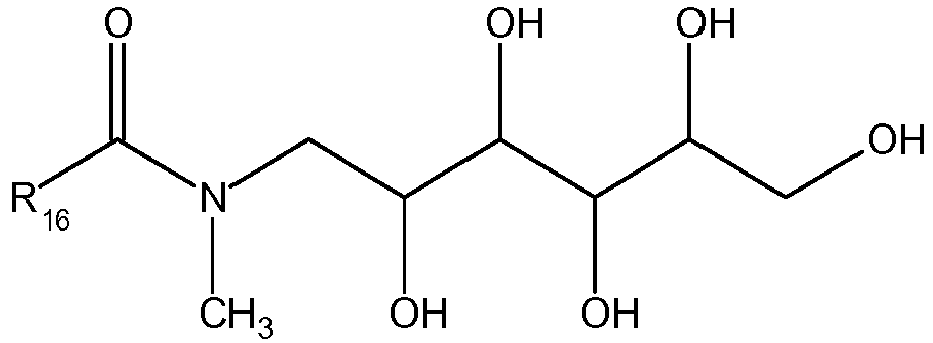
- The most preferred N-alkylpolyhydroxyalkylamide type surfactants are selected from lauroyl/myristoyl methyl glucamide and coco methyl glucamide.
- Further suitable nonionic surfactants are alkyl polyglycosides according to the general structure:
R23O(R24O)tZx
- Wherein Z denotes a carbohydrate with C5 to C6, R23 is an alkyl group with C8 to C18, R24 is methyl, ethyl or propyl, t ranges from 0 to 10, and x ranges from 1 to 5. Suitable compounds according to this structure are C9-C11 alkylpolyglycoside, the structures disclosed in
EP-A 70 074 JP 2015-123019A - The preferred compounds according to the structure of above are decyl glucoside, lauryl glucoside, and coco glucoside, and the most preferred one is decyl glucoside.
- Suitable examples for non-ionic surfactants are fatty alcohol ethoxylates of the following general structure
R25(OCH2CH2)n4OH
wherein R25 is straight or branched, saturated or unsaturated alkyl chain which may be synthetic or natural with a C chain length in the range of 8 to 40, preferably 9 to 30 and more preferably 9 to 24 and n4 is a number in the range of 5 to 40, preferably 9 to 30. - Non-limiting suitable examples of the fatty alcohol ethoxylates are C9-11 Pareth-6, C9-11 Pareth-8, C9-15 Pareth-8, C11-13 Pareth-9, C11-13 Pareth-10, C11-15 Pareth-5, C11-15 Pareth-7, C11-15 Pareth-9, C11-15 Pareth-12, C11-15 Pareth-15, C11-15 Pareth-20, C11-15 Pareth-30, C11-15 Pareth-40, C11-21 Pareth-10, C12-13 Pareth-5, C12-13 Pareth-6, C12-13 Pareth-7, C12-13 Pareth-9, C12-13 Pareth-10, C12-13 Pareth-15, C12-13 Pareth-23, C12-14 Pareth-5, C12-14 Pareth-7, C12-14 Pareth-9, C12-14 Pareth-11, C12-14 Pareth-12, C12-15 Pareth-5, C12-15 Pareth-7, C12-15 Pareth-9, C12-15 Pareth-10, C12-15 Pareth-11, C12-15 Pareth-12, C12-16 Pareth-5, C12-16 Pareth-7, C12-16 Pareth-9, C13-15 Pareth-21, C14-15 Pareth-7, C14-15 Pareth-8, C14-15 Pareth-11, C14-15 Pareth-12, C14-15 Pareth-13, C20-22 Pareth-30, C20-40 Pareth-10, C20-40 Pareth-24, C20-40 Pareth-40, C20-40 Pareth-95, C22-24 Pareth-33, Beheneth-5, Beheneth-10, Beheneth-15, Beheneth-20, Beheneth-25, Beheneth-30, Ceteareth-5, Ceteareth-6, Ceteareth-7, Ceteareth-10, Ceteareth-11, Ceteareth-12, Ceteareth-15, Ceteareth-20, Ceteareth-25, Ceteareth-30, Ceteareth-35, Ceteareth-40, Laureth-5, Laureth-10, Laureth-15, Laureth-20, Laureth-25, Laureth-30, Laureth-40, Myreth-5, Myreth-10, Ceteth-5, Ceteth-10, Ceteth-15, Ceteth-20, Ceteth-25, Ceteth-30, Ceteth-40, Oleth-5, Oleth-10, Oleth-15, Oleth-20, Oleth-25, Oleth-30, Oleth-40, Steareth-5, Steareth-10, Steareth-15, Steareth-20, Steareth-25, Steareth-30, Steareth-35, and Steareth-40. They may also be present in the compositions as a mixture of more than one surfactant.
- Further suitable nonionic surfactants are polypropylene glycol ethers of fatty alcohol according to general structure
R25(OCH2-CH2-CH2)n5OH
wherein R25 is straight or branched, saturated or unsaturated fatty alcohol which may be synthetic or natural with a C chain length in the range of 8 to 40, preferably 9 to 30 and more preferably 9 to 24 and n5 is a number in the range of 1 to 40, preferably 3 to 30. - Suitable non-limiting examples are PPG-3 Caprylyl ether, PPG-5 Caprylyl ether, PPG-10 Caprylyl ether, PPG-10 Cetyl ether, PPG-20 Cetyl ether, PPG-28 Cetyl ether, PPG-30 Cetyl ether, PPG-7 Lauryl ether, PPG-10 Lauryl ether, PPG-10 Oleyl ether, PPG-20 Oleyl ether, PPG-23 Oleyl ether, PPG-30 Oleyl ether, PPG-11 Stearyl ether and PPG-15 Stearyl ether.
- Further suitable nonionic surfactants are polyethylene glycol fatty acid esters of the following general structure
R26C(O)(OCH2CH2)n6OH
wherein R26 is straight or branched, saturated or unsaturated alkyl group which may be synthetic or natural with a C chain length in the range of 7 to 39, preferably 9 to 29 and more preferably 9 to 23 and n6 is a number in the range of 5 to 40, preferably 9 to 30. - Suitable non-limiting examples are PEG-8 Behenate, PEG-8 Caprate, PEG-8 Caprylate, PEG-5 Cocoate, PEG-8 Cocoate, PEG-9 Cocoate, PEG-10 Cocoate, PEG-15 Cocoate, PEG-6 Isopalmitate, PEG-6 Isostearate, PEG-8 Isostearate, PEG-9 Isostearate, PEG-10 Isostearate, PEG-12 Isostearate, PEG-20 Isostearate, PEG-30 Isostearate, PEG-40 Isostearate, PEG-6 Laurate, PEG-8 Laurate, PEG-9 Laurate, PEG-10 Laurate, PEG-12 Laurate, PEG-14 Laurate, PEG-20 Laurate, PEG-30 Laurate, PEG-8 Myristate, PEG-20 Myristate, PEG-5 Oleate, PEG-6 Oleate, PEG-7 Oleate, PEG-8 Oleate, PEG-9 Oleate, PEG-10 Oleate, PEG-11 Oleate, PEG-12 Oleate, PEG-15 Oleate, PEG-20 Oleate, PEG-30 Oleate, PEG-32 Oleate, PEG-6 Palmitate, PEG-18 Palmitate, PEG-20 Palmitate, PEG-5 Stearate, PEG-6 Stearate, PEG-7 Stearate, PEG-8 Stearate, PEG-9 Stearate, PEG-10 Stearate, PEG-12 Stearate, PEG-14 Stearate, PEG-15 Stearate, PEG-20 Stearate, PEG-25 Stearate, PEG-30 Stearate, PEG-35 Stearate and PEG-40 Stearate.
- Further suitable nonionic surfactants are polypropylene glycol fatty acid esters of the following general structure
R27C(O)(OCH2-CH2-CH2)n8OH
wherein R27 is straight or branched, saturated or unsaturated alkyl group which may be synthetic or natural with a C chain length in the range of 7 to 39, preferably 9 to 29 and more preferably 9 to 23 and n8 is a number in the range of 1 to 40, preferably 9 to 30. - Suitable non-limiting examples are PPG-15 Isostearate, PPG-9 Laurate, PPG-26 Oleate and PPG-36 Oleate.
- Further suitable nonionic surfactants are polyethylene glycol and polypropylene glycol ether of fatty alcohols of the following general structure
R28(OCH2-CH2-CH2)n9(OCH2CH2)n10 OH
wherein R28 is straight or branched, saturated or unsaturated alkyl group which may be synthetic or natural with a C chain length in the range of 7 to 39, preferably 9 to 29 and more preferably 9 to 23 and n9 and n10 may be the same or different and are a number in the range of 1 to 40. - Further suitable nonionic surfactants are ethoxylated vegetable oils. Well-known and commonly used examples are ethoxylated castor oil such as PEG-40 hydrogenated castor oil or and PEG-60 hydrogenated castor oil.
- Suitable cationic surfactants have one or more positively charged group(s) at a pH 4 or less and are selected from cationic and/or cationizable and/or zwitterionic/amphoteric surfactants.
- Suitable cationic surfactants are of quaternary ammonium structure according to the following general structure

- where R1 is a saturated or unsaturated, branched or linear alkyl chain with C8-C22 or
R5CONH(CH2)n
- where R5 is saturated or unsaturated, branched or linear alkyl chain with C7-C21 atoms and n has typical value of 1-4 or
R6COO(CH2)n
- where R6 is saturated or unsaturated, branched or linear alkyl chain with C7-C21 atoms and n has typical value of 1-4, and
- R2 is unsaturated or saturated, branched or linear alkyl chain with C1-C22 atoms or
R5CONH(CH2)n
or
R6COO(CH2)n
- where R5, R6 and n are same as above.
- R3 and R4 have an alkyl chain with C1 to C4, and X- is typically chloride, bromide, or methosulfate.
- Typical examples of those ingredients are cetyl trimethyl ammonium chloride, stearyl trimonium chloride, dipalmitoyl dimonium chloride, distearyl dimethyl ammonium chloride, stearamidopropyl trimethyl ammonium chloride, dioleoylethyl dimethyl ammonium methosulfate, dioleoylethyl hydroxyethylmonium methosulfate, behenyl trimethyl ammonium chloride, and/or their mixtures.
- Suitable cationizable surfactants are surfactants which carry one or more chemical group(s) that is/are at least at some point non-ionic at pH above 4, but which is/are positively charged at a pH of 4 or less. Such groups are, for example, primary, secondary, and tertiary amino groups.
- Further suitable cationizable surfactants are known as alkyl amido alkyl amine surfactants and are according to the following general structure

- Suitable compounds according to this definition are, for example, cocamidopropyl dimethylamine, stearamidopropyl dimethylamine, behenamidopropyl dimethylamine.
- Further suitable surfactants having one or more positively charged group(s) at a pH below 7 are amphoteric/zwitterionic surfactants. Amphoteric/zwitterionic surfactants may be selected from compounds according to the general structure(s)

- Suitable compounds are known as hydroxysultaine surfactants, such as cocoamidopropyl hydroxysultaine, laurylamidopropyl hydroxysultaine, erucamidopropyl hydroxysultaine, lauryl hydroxysultaine, and cocoyl hydroxysultaine.
- Further suitable amphoteric/zwitterionic surfactants are of betaine type. Suitable compounds may be selected from alkyl betaines and/or alkylamido betaines. A preferred compound selected from alkyl betaines is lauryl betaine. A preferred compound selected from alkylamido betaines is cocamidopropyl betaine.
- It is to be noted that the skilled person can combine the surfactants from the classes of above to create suitable surfactant mixtures.
- The preferred surfactant(s) having one or more positively charged group(s) at a pH of 4 or less of the composition according to the present invention is/are selected from quaternary ammonium surfactant(s), alkyl amido alkyl amine surfactant(s), amphoteric/zwitterionic surfactants, and/or their mixtures.
- The total concentration of surfactants in the composition of the present invention is in the range of 0.05% to 25% by weight, preferably 0.1% to 15% by weight, more preferably in the range of 0.2% to 8% by weight, calculated to the total of the composition.
- The composition of the present invention may comprise one or more cationic conditioning polymer(s) different from Polysilicone-29.
- Suitable cationic polymers are those of best known with their INCI category name Polyquaternium.
- Typical examples of those are Polyquaternium 1, Polyquaternium 2, Polyquaternium 4, Polyquaternium 5, Polyquaternium 6, Polyquaternium 7, Polyquaternium 8, Polyquaternium 9, Polyquaternium 10, Polyquaternium 11, Polyquaternium 12, Polyquaternium 13, Polyquaternium 14, Polyquaternium 15, Polyquaternium 16, Polyquaternium 17, Polyquaternium 18, Polyquaternium 19, Polyquaternium 20, Polyquaternium 22, Polyquaternium 24, Polyquaternium 27, Polyquaternium 28, Polyquaternium 29, Polyquaternium 30, Polyquaternium 31, Polyquaternium 32, Polyquaternium 33, Polyquaternium 34, Polyquaternium 35 and Polyquaternium 36, Polyquaternium-37, Polyquaternium 39, Polyquaternium 42, Polyquaternium 43, Polyquaternium 44, Polyquaternium 45, Polyquaternium 46, Polyquaternium 47, Polyquaternium 48, Polyquaternium 49, Polyquaternium 50, Polyquaternium 51, Polyquaternium 52, Polyquaternium 53, Polyquaternium 54, Polyquaternium 55, Polyquaternium 56, Polyquaternium 57, Polyquaternium 58, Polyquaternium 59, Polyquaternium 60, Polyquaternium 61, Polyquaternium 62, Polyquaternium 63, Polyquaternium 64, Polyquaternium 65, Polyquaternium 66, Polyquaternium 67, Polyquaternium 68, Polyquaternium 69, Polyquaternium-70, Polyquaternium 71, Polyquaternium 72, Polyquaternium 73, Polyquaternium 74, Polyquaternium 75, Polyquaternium 76, Polyquaternium 77, Polyquaternium 78, Polyquaternium-79, Polyquaternium 80, Polyquaternium 81, Polyquaternium 82, Polyquaternium 83, Polyquaternium 84, Polyquaternium 85, Polyquaternium 86, and Polyquaternium 87.
- It has further been found that especially those of cationic cellulose type polymers known as Polymer JR type from Amerchol such as Polyquaternium 10 or cationic galactomannans such as cationic guar gum known with trade name Jaguar from Rhône-Poulenc which are chemically for example guar hydroxypropyl trimonium chloride and cationic tara gum and its derivatives known with INCI name Caesalpinia spinosa hydroxypropyltrimonium chloride, are preferred ones. Furthermore, chitosan and chitin can also be included in the compositions as cationic natural polymers. In this context reference is also made to the cationic polymers disclosed in
DE 25 21 960 ,DE 28 11 010, 30 44 738 DE 32 17 059 , as well as to the products described inEP-A 337 354 - The most preferred cationic polymers are those of cationic cellulose derivatives, cationic guar gum derivatives, cationic Caesalpinia spinosa gum derivatives, polyquaternium 6, polyquaternium 7, polyquaternium 10, polyquaternium 37, polyquaternium 67 and polyquaternium 70.
- The cationic polymers also include the quaternized products of graft polymers from organopolysiloxanes and polyethyl oxazolines described in
EP-A 524 612 EP-A 640 643 - Compositions may comprise cationic polymer at a total concentration of 0.01 to 5%, preferably 0.02 to 4%, more preferably 0.05 to 3% and most preferably 0.1 to 2.5% by weight, calculated to the total of the composition.
- This viewpoint is illustrated in example 5.
- The following examples are to illustrate the invention, but not to limit it.
- The following compositions were prepared by conventional mixing techniques:
Ingredient Inventive comp [% by weight] Comparative comp A [% by weight] Comparative comp B [% by weight] Comparative comp C [% by weight] Glyoxylic acid 3.7 4.0 - 3.7 Polysilicone-29 0.3 - 4.0 - PEG-40/PPG-8 Methylaminopropyl/ Hydroxypropyl Dimethicone Copolymer - - - 0.3 NaOH / HCl Ad pH 2.0 Water Ad 100.0 - Indian frizzy hair streaks (25 cm long, 2 g per bundle) were purchased from International Hair Importers & Products Inc., Glendale, NY, USA. One hair streak was left untreated and kept for reference purposes. The hair streaks were washed with a commercially available shampoo under the tradname Goldwell Kerasilk Control Purifying Shampoo and then air-dried for 15 h. The volume of the hair streaks was measured with a machine rotating the hair streak, taking a photograph, and analyzing the area of the resulting hair cone (V0). 2 g of the compositions from above were applied onto a hair streak and left on the streaks for 20 min at room temperature. The hair streaks were then blow dried and treated with a straightening iron having a surface temperature of 200°C (3 strokes per streak). The hair streaks were then shampooed again with the commercially available shampoo from above and allowed to air-dry for 15 h. The volume of the hair streaks was measured as described above (V1). Each experiment with the compositions from above was run in triplicates.
- The volume reduction was calculated according to the following formula:

- The following results were obtained:
Treatment Vred [%] SD Inventive comp 36.7 2.3 Comparative comp A 41.2 1.2 Comparative comp B 45.1 2.9 Comparative comp C 43.2 1.6 - As the results from above clearly show, the inventive composition delivered a higher straightening effect in comparison to the comparative compositions.
- The keratin fibers treated with the inventive composition had the best cosmetic feel in comparison to the comparative compositions.
- Moreover, 4 trained experts in the field of hair care confirmed independently of each other that the was no discernible color difference between the reference hair streak and the hair streak treated with the inventive composition whereas the hair streaks treated with the comparative compositions appeared lighter brownish than the reference hair streak.
- The following compositions were prepared by conventional mixing techniques:
Ingredient Inventive comp [% by weight] Comparative comp A [% by weight] Comparative comp B [% by weight] Steps 1 2 1 2 1 2 Glyoxylic acid 3.7 - 4.0 - - - Polysilicone-29 - 0.3 - - 4.0 - PEG-40/PPG-8 Methylaminopropyl/ Hydroxypropyl Dimethicone Copolymer - - - - - - NaOH / HCl Ad pH 2.0 Water Ad 100.0 - Indian frizzy hair streaks (25 cm long, 2 g per bundle) were purchased from International Hair Importers & Products Inc., Glendale, NY, USA. One hair streak was left untreated and kept for reference purposes. The hair streaks were washed with a commercially available shampoo under the tradename Goldwell Kerasilk Control Purifying Shampoo and then air-dried for 15 h. The volume of the hair streaks was measured as disclosed in example 1 (V0). 2 g of the compositions of step 1 from above were applied onto a hair streak and left on the streaks for 20 min at room temperature. The hair streaks were then rinsed thoroughly with lukewarm water, towel dried, and 2 g of the composition of step 2 was applied. The hair streaks were blow dried and treated with a straightening iron having a surface temperature of 200°C (3 strokes per streak). The hair streaks were then shampooed again with the commercially available shampoo from above and allowed to air-dry for 15 h. The volume of the hair streaks was measured as described above (V1). Each experiment with the compositions from above was run in triplicates.
- The volume reduction was calculated according to the following formula:

- The following results were obtained:
Treatment Vred [%] SD Inventive comp 46.8 1.8 Comparative comp A 59.6 1.8 Comparative comp B 60.2 7.8 - As the results from above clearly show, the inventive composition delivered a higher straightening effect in comparison to the comparative compositions. Moreover, the straightening performance of the inventive composition was similar to the one-step treatment of example 1.
- The keratin fibers treated with the inventive composition had the best cosmetic feel in comparison to the comparative compositions.
- Moreover, 4 trained experts in the field of hair care confirmed independently of each other that the was no discernible color difference between the reference hair streak and the hair streak treated with the inventive composition whereas the hair streaks treated with the comparative compositions appeared lighter brownish than the reference hair streak.
- The following examples are within the scope of the present invention.
-
% by weight Glyoxylic acid 1.0 Polysilicone 29 0.1 Ceteareth 3 0.1 Cetrimonium chloride 1.0 Dehydroxanthan gum 0.5 NaOH/HCl ad pH 2.5 Water ad 100.0 - The concentration of glyoxylic acid can be adjusted in this example to 3%, 5%, 10%, 15%, 20% by weight and all values within this range.
- The pH may equally be adjusted in the range of 1.0 to 4.0.
-
% by weight Glyoxylic acid 0.1 Polysilicone 29 1.0 Ceteareth 3 0.1 Cetrimonium chloride 1.0 Dehydroxanthan gum 0.5 NaOH/HCl ad pH 2.5 Water ad 100.0 - The concentration of Polysilicone 29 can be adjusted in this example to 3%, 5%, 10%, by weight and all values within this range.
-
% by weight Glyoxylic acid 3.0 Polysilicone 29 0.1 Cetearyl alcohol 5.0 Isopropyl palmitate 1.0 PEG-40 hydrogenated castor oil 1.0 Cetrimonium chloride 1.0 Behenamidopropyl dimethylamine 0.5 Polyquaternium 10 0.2 Fragrance 0.2 Preservatives 0.1 NaOH/HCI ad pH 3.0 Water ad 100.0 - The concentration of glyoxylic acid can be adjusted in this example to 3%, 5%, 10%, 15%, 20% by weight and all values within this range.
-
% by weight Glyoxylic acid 3.0 Cetearyl alcohol 5.0 Isopropyl palmitate 1.0 PEG-40 hydrogenated castor oil 1.0 Cetrimonium chloride 1.0 Behenamidopropyl dimethylamine 0.5 Fragrance 0.2 Preservatives 0.1 NaOH/HCI ad pH 3.0 Water ad 100.0 - The concentration of glyoxylic acid can be adjusted in this example to 3%, 5%, 10%, 15%, 20% by weight and all values within this range.
-
% by weight Polysilicone 29 0.5 Cetearyl alcohol 5.0 Cetrimonium chloride 2.0 Behenamidopropyl dimethylamine 0.5 Fragrance 0.2 Preservatives 0.1 NaOH/HCI ad pH 3.0 Water ad 100.0 - The concentration of Polysilicone 29 can be adjusted in this example to 0.1% 3%, 5%, 10%, by weight and all values within this range.
- The application of the compositions follows the procedure of example 2.
-
% by weight Glyoxylic acid 3.0 PEG-40 hydrogenated castor oil 0.2 Xanthan gum 0.5 NaOH/HCl ad pH 3.0 Water ad 100.0 - The concentration of glyoxylic acid can be adjusted in this example to 3%, 5%, 10%, 15%, 20% by weight and all values within this range.
-
% by weight Polysilicone 29 0.5 Cetearyl alcohol 5.0 Cetrimonium chloride 2.0 Behenamidopropyl dimethylamine 0.5 Fragrance 0.2 Preservatives 0.1 NaOH/HCl ad pH 3.0 Water ad 100.0 - The concentration of Polysilicone 29 can be adjusted in this example to 0.1% 3%, 5%, 10%, by weight and all values within this range.
- The application of the compositions follows the procedure of example 2.
- The composition of step 1 of example 7.
-
% by weight Polysilicone 29 0.5 Dehydroxanthan gum 0.25 NaOH/HCl ad pH 8.0 Water ad 100.0 - The concentration of Polysilicone 29 can be adjusted in this example to 0.1% 3%, 5%, 10%, by weight and all values within this range.
- The pH of composition B may be adjusted to 2.0, 5.0, or 10.0.
- The compositions A and B are mixed prior to application in a weight ratio of 1:1 and are then applied onto keratin fibers.
Claims (15)
- A composition for straightening of keratin fibers, preferably human keratin fibers, more preferably human hair, having a pH of 4 or less and comprising- glyoxylic acid and/or its hydrate(s) and/or its salt(s),- Polysilicone-29.
- The composition according to claim 1 characterized in that the total concentration of glyoxylic acid and/or its hydrate(s) and/or its salt(s) is in the range of 0.1% to 20% by weight, preferably in the range of 0.2% to 10% by weight, more preferably in the range of 0.25% to 5% by weight, further more preferably in the range of 0.35% to 5% by weight, calculated to the total of the composition.
- The composition according to claims 1 and/or 2 characterized in that the total concentration of Polysilicone-29 is in the range of 0.01% to 10% by weight, preferably in the range of 0.02% to 8% by weight, more preferably in the range of 0.05% to 6% by weight, further more preferably in the range of 0.1% to 2% by weight, calculated to the total of the composition.
- The composition according to any of the preceding claims characterized in that the weight ratio of glyoxylic acid and/or its hydrate(s) and/or its salt(s) to Polysilicone-29 is in the range of 10 to 0.1.
- The composition according to any of the preceding claims characterized in that the composition is a thickened gel and comprises a thickening agent, preferably a thickening polymer, more preferably an associative and/or non-associative thickening polymer, further more preferably a carbohydrate-based non-associative thickening polymer, still further more preferably it is selected from xanthan gum and/or dehydroxanthan gum.
- The composition according to any of the preceding claims characterized in that the composition is an emulsion and comprises one or more hydrophobic compound(s), preferably selected from C12 to C22 fatty alcohols, fatty acid esters having a C12 to C22 fatty acid esterified with a linear or branched, saturated or unsaturated C3 to C18 fatty alcohol, natural and/or vegetable oils, hydrocarbon-based compounds, and/or their mixtures.
- The composition according to any of the preceding claims characterized in that it further comprises a surfactant, preferably an anionic and/or non-ionic and/or cationic and/or amphoteric/zwitterionic surfactant.
- The composition according to any of the preceding claims characterized in that the total concentration of surfactants is in the range of 0.05% to 25% by weight, preferably 0.1% to 15% by weight, more preferably in the range of 0.2% to 8% by weight, calculated to the total of the composition.
- The composition according to any of the preceding claims characterized in that it comprises one or more cationic conditioning polymer(s) different from Polysilicone-29.
- The composition according to any of the preceding claims characterized in that the total concentration of cationic polymers is in the range of 0.01 to 5%, preferably 0.02 to 4%, more preferably 0.05 to 3% and most preferably 0.1 to 2.5% by weight, calculated to the total of the composition.
- A two-part composition comprising the parts A and B, which are provided for separate storage and for mixing directly prior to the application onto the keratin fibers, wherein part A comprises glyoxylic acid and/or its hydrate(s) and/or its salt(s) having a pH of less than 4, and part B comprises Polysilicone-29 having a pH in the range of 2 to 10.
- A process for semi-permanent straightening of keratin fibers, preferably human keratin fibers, more preferably human hair, characterized in that it comprises the steps of:a) optionally washing the keratin fibers and/or drying the keratin fibers,b) applying the composition as defined in claims 1 to 10 and/or the composition as defined in claim 11 onto keratin fibers,c) leaving the composition onto the keratin fibers for 1 min to 120 min, preferably for a time period in the range of 2 min to 60 min, more preferably in the range of 2 min to 30 min, further more preferably in the range of 2 min to 10 min,d) optionally rinsing-off the keratin fibers,e) drying the keratin fibers,f) treating the keratin fibers with a straightening iron having a surface temperature of 180°C ± 50°C, preferably in the range of 170°C to 200°C,g) optionally rinsing-off and/or washing the keratin fibers and/or drying the keratin fibers.
- The process according to claim 12 characterized in that the steps a) to g) are repeated with a time period of 8 h and 72 h between each full process run.
- A process for semi-permanent straightening of keratin fibers, preferably human keratin fibers, more preferably human hair characterized in that it comprises the steps of:a) optionally washing the keratin fibers and/or drying the keratin fibers,b) applying a composition having a pH of 4 or less and comprising glyoxylic acid and/or its hydrate(s) and/or its salt(s) as defined in claim 11,c) leaving the composition onto the keratin fibers for 1 min to 120 min, preferably for a time period in the range of 2 min to 60 min, more preferably in the range of 2 min to 30 min, further more preferably in the range of 2 min to 10 min,d) rinsing-off the keratin fibers,e) applying a composition having a pH of 2 to 10 and comprising Polysilicone-29,f) optionally rinsing-off the keratin fibers,g) drying the keratin fibers,h) treating the keratin fibers with a straightening iron having a surface temperature of 180°C ± 50°C, preferably in the range of 170°C to 200°C,i) optionally rinsing-off and/or washing the keratin fibers and/or drying the keratin fibers.
- A kit-of-parts comprising the composition as defined in the claims 1 to 10 and/or as defined in claim 11 and a straightening tool for keratin fibers, preferably a hair straightening iron.
Priority Applications (1)
| Application Number | Priority Date | Filing Date | Title |
|---|---|---|---|
| EP18209099.3A EP3659577A1 (en) | 2018-11-29 | 2018-11-29 | Keratin fiber straightening composition, process, and kit-of-parts |
Applications Claiming Priority (1)
| Application Number | Priority Date | Filing Date | Title |
|---|---|---|---|
| EP18209099.3A EP3659577A1 (en) | 2018-11-29 | 2018-11-29 | Keratin fiber straightening composition, process, and kit-of-parts |
Publications (1)
| Publication Number | Publication Date |
|---|---|
| EP3659577A1 true EP3659577A1 (en) | 2020-06-03 |
Family
ID=64559509
Family Applications (1)
| Application Number | Title | Priority Date | Filing Date |
|---|---|---|---|
| EP18209099.3A Withdrawn EP3659577A1 (en) | 2018-11-29 | 2018-11-29 | Keratin fiber straightening composition, process, and kit-of-parts |
Country Status (1)
| Country | Link |
|---|---|
| EP (1) | EP3659577A1 (en) |
Cited By (8)
| Publication number | Priority date | Publication date | Assignee | Title |
|---|---|---|---|---|
| EP3928761A1 (en) * | 2020-06-24 | 2021-12-29 | Revlon Consumer Products Corporation | Compositions for treating keratin fibers |
| EP3973944A1 (en) * | 2020-09-25 | 2022-03-30 | Kao Germany GmbH | Composition, process and kit for semi-permanent straightening keratin fibers |
| WO2022112961A1 (en) * | 2020-11-30 | 2022-06-02 | Jean Paul Myne' Srl | Cosmetic composition for the treatment of keratinic fibers and method comprising the application of said composition to the keratinic fibers |
| EP3875153A4 (en) * | 2018-11-02 | 2022-09-07 | Shiseido Company, Ltd. | COSMETIC PRODUCT FOR THE HAIR, AND HAIR TREATMENT METHOD USING THE SAME |
| EP3875155A4 (en) * | 2018-11-02 | 2022-12-21 | Shiseido Company, Ltd. | HAIR TREATMENT PROCEDURES |
| JP2023085464A (en) * | 2018-12-13 | 2023-06-20 | 株式会社 資生堂 | hair treatment method |
| WO2025018431A1 (en) * | 2023-07-20 | 2025-01-23 | L'oreal | Composition suitable for keratin fibers |
| JP2025522040A (en) * | 2022-07-13 | 2025-07-10 | ウェラ ジャーマニー ゲーエムベーハー | Cosmetic composition for semi-permanent transformation of keratin fibres - Patents.com |
Citations (21)
| Publication number | Priority date | Publication date | Assignee | Title |
|---|---|---|---|---|
| US1985424A (en) | 1933-03-23 | 1934-12-25 | Ici Ltd | Alkylene-oxide derivatives of polyhydroxyalkyl-alkylamides |
| US2016962A (en) | 1932-09-27 | 1935-10-08 | Du Pont | Process for producing glucamines and related products |
| US2703798A (en) | 1950-05-25 | 1955-03-08 | Commercial Solvents Corp | Detergents from nu-monoalkyl-glucamines |
| DE2521960A1 (en) | 1974-05-16 | 1976-04-08 | Oreal | NEW COSMETIC AGENTS BASED ON QUATERNIZED POLYMERS |
| DE2811010A1 (en) | 1977-03-15 | 1978-09-28 | Oreal | MEANS AND METHODS FOR TREATMENT OF KERATIN MATERIALS WITH CATIONIC AND ANIONIC POLYMERS |
| DE3044738A1 (en) | 1979-11-28 | 1981-06-19 | L'Oreal, 75008 Paris | Hair treatment compsn. - contg. amphoteric polymer contg. basic nitrogen and acid gps., and cationic polymer contg. poly:amine or quat. ammonium gps. |
| DE3217059A1 (en) | 1981-05-08 | 1982-11-25 | Oreal | PRESSURIZED AGENT BASED ON CATIONIC AND ANIONIC POLYMERS, METHODS FOR FOAMING AND METHODS FOR TREATING THE HAIR |
| EP0070074A2 (en) | 1981-07-13 | 1983-01-19 | THE PROCTER & GAMBLE COMPANY | Foaming surfactant compositions |
| EP0337354A1 (en) | 1988-04-12 | 1989-10-18 | Kao Corporation | Low-irritation detergent composition |
| WO1992006984A1 (en) | 1990-10-12 | 1992-04-30 | The Procter & Gamble Company | Process for preparing n-alkyl polyhydroxy amines and fatty acid amides therefrom in hydroxy solvents |
| EP0524612A2 (en) | 1991-07-22 | 1993-01-27 | Kao Corporation | Modified silicone containing hair cosmetic |
| EP0640643A2 (en) | 1993-08-10 | 1995-03-01 | Kao Corporation | Organopolysiloxanes and a method of setting hair using the same |
| WO1996027366A1 (en) | 1995-03-03 | 1996-09-12 | Henkel Kommanditgesellschaft Auf Aktien | Cosmetic and/or pharmaceutical preparations |
| WO2011104282A2 (en) | 2010-02-24 | 2011-09-01 | Alderan S.A.S. Di D'ottavi Adele & C. | Process for semi-permanent straightening of curly, frizzy or wavy hair |
| WO2012010351A2 (en) | 2010-07-20 | 2012-01-26 | Alderan S.A.S. Di D'ottavi Adele & C. | Process for semipermanent straightening of curly, frizzy or wavy hair. |
| WO2014067702A1 (en) | 2012-11-05 | 2014-05-08 | Kao Corporation | Process for straightening and dyeing hair |
| FR2997847A1 (en) | 2012-11-09 | 2014-05-16 | Oreal | COMPOSITION COMPRISING GLYOXYLIC ACID AND AMINO SILICONE, METHOD FOR SMOOTHING THE HAIR THEREFROM |
| FR2997845A1 (en) | 2012-11-09 | 2014-05-16 | Oreal | METHOD FOR SMOOTHING A HAIR FROM A COMPOSITION CONTAINING GLYOXYLIC ACID AND / OR ONE OF ITS DERIVATIVES |
| WO2014131469A1 (en) * | 2013-02-28 | 2014-09-04 | Kao Corporation | Composition and process for semi-permanent straightening of the hair |
| JP2015123019A (en) | 2013-12-26 | 2015-07-06 | 花王株式会社 | Method for producing alkyl poly glycoside |
| FR3044903A1 (en) | 2015-12-14 | 2017-06-16 | Oreal | PROCESS FOR THE COSMETIC TREATMENT OF KERATIN FIBERS USING TWO PARTICULAR ALCOXYSILANES AND A HEATING STEP. |
-
2018
- 2018-11-29 EP EP18209099.3A patent/EP3659577A1/en not_active Withdrawn
Patent Citations (22)
| Publication number | Priority date | Publication date | Assignee | Title |
|---|---|---|---|---|
| US2016962A (en) | 1932-09-27 | 1935-10-08 | Du Pont | Process for producing glucamines and related products |
| US1985424A (en) | 1933-03-23 | 1934-12-25 | Ici Ltd | Alkylene-oxide derivatives of polyhydroxyalkyl-alkylamides |
| US2703798A (en) | 1950-05-25 | 1955-03-08 | Commercial Solvents Corp | Detergents from nu-monoalkyl-glucamines |
| DE2521960A1 (en) | 1974-05-16 | 1976-04-08 | Oreal | NEW COSMETIC AGENTS BASED ON QUATERNIZED POLYMERS |
| DE2811010A1 (en) | 1977-03-15 | 1978-09-28 | Oreal | MEANS AND METHODS FOR TREATMENT OF KERATIN MATERIALS WITH CATIONIC AND ANIONIC POLYMERS |
| DE3044738A1 (en) | 1979-11-28 | 1981-06-19 | L'Oreal, 75008 Paris | Hair treatment compsn. - contg. amphoteric polymer contg. basic nitrogen and acid gps., and cationic polymer contg. poly:amine or quat. ammonium gps. |
| DE3217059A1 (en) | 1981-05-08 | 1982-11-25 | Oreal | PRESSURIZED AGENT BASED ON CATIONIC AND ANIONIC POLYMERS, METHODS FOR FOAMING AND METHODS FOR TREATING THE HAIR |
| EP0070074A2 (en) | 1981-07-13 | 1983-01-19 | THE PROCTER & GAMBLE COMPANY | Foaming surfactant compositions |
| EP0337354A1 (en) | 1988-04-12 | 1989-10-18 | Kao Corporation | Low-irritation detergent composition |
| WO1992006984A1 (en) | 1990-10-12 | 1992-04-30 | The Procter & Gamble Company | Process for preparing n-alkyl polyhydroxy amines and fatty acid amides therefrom in hydroxy solvents |
| EP0524612A2 (en) | 1991-07-22 | 1993-01-27 | Kao Corporation | Modified silicone containing hair cosmetic |
| EP0640643A2 (en) | 1993-08-10 | 1995-03-01 | Kao Corporation | Organopolysiloxanes and a method of setting hair using the same |
| WO1996027366A1 (en) | 1995-03-03 | 1996-09-12 | Henkel Kommanditgesellschaft Auf Aktien | Cosmetic and/or pharmaceutical preparations |
| WO2011104282A2 (en) | 2010-02-24 | 2011-09-01 | Alderan S.A.S. Di D'ottavi Adele & C. | Process for semi-permanent straightening of curly, frizzy or wavy hair |
| WO2012010351A2 (en) | 2010-07-20 | 2012-01-26 | Alderan S.A.S. Di D'ottavi Adele & C. | Process for semipermanent straightening of curly, frizzy or wavy hair. |
| WO2014067702A1 (en) | 2012-11-05 | 2014-05-08 | Kao Corporation | Process for straightening and dyeing hair |
| FR2997847A1 (en) | 2012-11-09 | 2014-05-16 | Oreal | COMPOSITION COMPRISING GLYOXYLIC ACID AND AMINO SILICONE, METHOD FOR SMOOTHING THE HAIR THEREFROM |
| FR2997845A1 (en) | 2012-11-09 | 2014-05-16 | Oreal | METHOD FOR SMOOTHING A HAIR FROM A COMPOSITION CONTAINING GLYOXYLIC ACID AND / OR ONE OF ITS DERIVATIVES |
| US20150258007A1 (en) * | 2012-11-09 | 2015-09-17 | L'oreal | Composition comprising a dicarbonyl compound and an amino silicone, and process for straightening the hair using this composition |
| WO2014131469A1 (en) * | 2013-02-28 | 2014-09-04 | Kao Corporation | Composition and process for semi-permanent straightening of the hair |
| JP2015123019A (en) | 2013-12-26 | 2015-07-06 | 花王株式会社 | Method for producing alkyl poly glycoside |
| FR3044903A1 (en) | 2015-12-14 | 2017-06-16 | Oreal | PROCESS FOR THE COSMETIC TREATMENT OF KERATIN FIBERS USING TWO PARTICULAR ALCOXYSILANES AND A HEATING STEP. |
Non-Patent Citations (1)
| Title |
|---|
| ANONYMOUS: "Silsoft CLX-E conditioning agent Marketing Bulletin", 2015, pages 1 - 12, XP002788416, Retrieved from the Internet <URL:www.momentive.com> [retrieved on 20190129] * |
Cited By (11)
| Publication number | Priority date | Publication date | Assignee | Title |
|---|---|---|---|---|
| EP3875153A4 (en) * | 2018-11-02 | 2022-09-07 | Shiseido Company, Ltd. | COSMETIC PRODUCT FOR THE HAIR, AND HAIR TREATMENT METHOD USING THE SAME |
| EP3875155A4 (en) * | 2018-11-02 | 2022-12-21 | Shiseido Company, Ltd. | HAIR TREATMENT PROCEDURES |
| JP2023085464A (en) * | 2018-12-13 | 2023-06-20 | 株式会社 資生堂 | hair treatment method |
| EP3928761A1 (en) * | 2020-06-24 | 2021-12-29 | Revlon Consumer Products Corporation | Compositions for treating keratin fibers |
| WO2021260486A1 (en) * | 2020-06-24 | 2021-12-30 | Revlon Consumer Products Corporation | Compositions for treating keratin fibers |
| EP3973944A1 (en) * | 2020-09-25 | 2022-03-30 | Kao Germany GmbH | Composition, process and kit for semi-permanent straightening keratin fibers |
| EP3973947A3 (en) * | 2020-09-25 | 2022-04-27 | Kao Germany GmbH | Composition, process and kit for semi-permanent straightening keratin fibers |
| WO2022112961A1 (en) * | 2020-11-30 | 2022-06-02 | Jean Paul Myne' Srl | Cosmetic composition for the treatment of keratinic fibers and method comprising the application of said composition to the keratinic fibers |
| JP2025522040A (en) * | 2022-07-13 | 2025-07-10 | ウェラ ジャーマニー ゲーエムベーハー | Cosmetic composition for semi-permanent transformation of keratin fibres - Patents.com |
| JP7828508B2 (en) | 2022-07-13 | 2026-03-11 | ウェラ ジャーマニー ゲーエムベーハー | Cosmetic composition for semi-permanent deformation of keratin fibres - Patent Application 20070122997 |
| WO2025018431A1 (en) * | 2023-07-20 | 2025-01-23 | L'oreal | Composition suitable for keratin fibers |
Similar Documents
| Publication | Publication Date | Title |
|---|---|---|
| EP3347102B1 (en) | Process for permanent shaping hair | |
| US12109286B2 (en) | Process for semipermanent straightening and permanent shaping hair | |
| KR102215425B1 (en) | Cosmetic composition for hair containing thiol-based compound and hair cleansing and treatment method | |
| KR102219825B1 (en) | Cosmetic composition for hair containing thiol-based compound and hair cleansing and treatment method | |
| EP3453380B1 (en) | Bleaching and decolorization process for keratin fibers | |
| JP2019529384A (en) | Hair treatment composition | |
| AU2009288042B2 (en) | Hair styling method | |
| EP3710115B1 (en) | Process for permanent waving keratin fibers | |
| EP4013375A1 (en) | Kit-of-parts and composition for dyeing of keratin fibers, method, and use thereof | |
| EP3225229A1 (en) | Process for treating hair | |
| EP3890692B1 (en) | Process for reshaping keratin fibers | |
| EP3463276B1 (en) | Process for treating hair | |
| EP3890696B1 (en) | Process for reshaping keratin fibers | |
| JP2006045183A (en) | Hair cosmetics | |
| US20230263716A1 (en) | Compositions and methods for treating keratin materials | |
| EP4122440B1 (en) | Process for permanent waving keratin fibers | |
| EP4069376B1 (en) | Reshaping composition for keratin fibers | |
| EP4081180B1 (en) | Reshaping composition for keratin fibers | |
| EP3533435B1 (en) | Cleansing and conditioning composition for keratin fibers, method, use, and kit-of-parts thereof | |
| DE202018006763U1 (en) | Composition for straightening keratin fibers | |
| EP4186489A1 (en) | Personal cleansing composition comprising alpha-sulfo fatty acid surfactants | |
| JP3234675B2 (en) | Hair cosmetics | |
| EP3890686A1 (en) | Process for reshaping keratin fibers |
Legal Events
| Date | Code | Title | Description |
|---|---|---|---|
| PUAI | Public reference made under article 153(3) epc to a published international application that has entered the european phase |
Free format text: ORIGINAL CODE: 0009012 |
|
| STAA | Information on the status of an ep patent application or granted ep patent |
Free format text: STATUS: THE APPLICATION HAS BEEN PUBLISHED |
|
| AK | Designated contracting states |
Kind code of ref document: A1 Designated state(s): AL AT BE BG CH CY CZ DE DK EE ES FI FR GB GR HR HU IE IS IT LI LT LU LV MC MK MT NL NO PL PT RO RS SE SI SK SM TR |
|
| AX | Request for extension of the european patent |
Extension state: BA ME |
|
| STAA | Information on the status of an ep patent application or granted ep patent |
Free format text: STATUS: REQUEST FOR EXAMINATION WAS MADE |
|
| 17P | Request for examination filed |
Effective date: 20201103 |
|
| RBV | Designated contracting states (corrected) |
Designated state(s): AL AT BE BG CH CY CZ DE DK EE ES FI FR GB GR HR HU IE IS IT LI LT LU LV MC MK MT NL NO PL PT RO RS SE SI SK SM TR |
|
| STAA | Information on the status of an ep patent application or granted ep patent |
Free format text: STATUS: EXAMINATION IS IN PROGRESS |
|
| 17Q | First examination report despatched |
Effective date: 20220211 |
|
| STAA | Information on the status of an ep patent application or granted ep patent |
Free format text: STATUS: THE APPLICATION IS DEEMED TO BE WITHDRAWN |
|
| 18D | Application deemed to be withdrawn |
Effective date: 20220622 |