EP3658147B1 - Combination comprising palbociclib and 6-(2,4-dichlorophenyl)-5-[4-[(3s)-1-(3-fluoropropyl)pyrrolidin-3-yl]oxyphenyl]-8,9-dihydro-7h-benzo[7]annulene-2-carboxylic acid and its use for the treatment of cancer - Google Patents
Combination comprising palbociclib and 6-(2,4-dichlorophenyl)-5-[4-[(3s)-1-(3-fluoropropyl)pyrrolidin-3-yl]oxyphenyl]-8,9-dihydro-7h-benzo[7]annulene-2-carboxylic acid and its use for the treatment of cancer Download PDFInfo
- Publication number
- EP3658147B1 EP3658147B1 EP18740615.2A EP18740615A EP3658147B1 EP 3658147 B1 EP3658147 B1 EP 3658147B1 EP 18740615 A EP18740615 A EP 18740615A EP 3658147 B1 EP3658147 B1 EP 3658147B1
- Authority
- EP
- European Patent Office
- Prior art keywords
- palbociclib
- benzo
- dihydro
- cancer
- fluoropropyl
- Prior art date
- Legal status (The legal status is an assumption and is not a legal conclusion. Google has not performed a legal analysis and makes no representation as to the accuracy of the status listed.)
- Active
Links
- HEZXIYUDMUQDHU-QFIPXVFZSA-N COC(c(cc1CCC2)ccc1C(c(cc1)ccc1O[C@@H]1CN(CCCF)CC1)=C2Br)=O Chemical compound COC(c(cc1CCC2)ccc1C(c(cc1)ccc1O[C@@H]1CN(CCCF)CC1)=C2Br)=O HEZXIYUDMUQDHU-QFIPXVFZSA-N 0.000 description 1
- VDDLELYAGVIJDH-UHFFFAOYSA-N COC(c1ccc2C(c(cc3)ccc3OC3CN(CCCF)CC3)=CCCCc2c1)=O Chemical compound COC(c1ccc2C(c(cc3)ccc3OC3CN(CCCF)CC3)=CCCCc2c1)=O VDDLELYAGVIJDH-UHFFFAOYSA-N 0.000 description 1
Images
Classifications
-
- A—HUMAN NECESSITIES
- A61—MEDICAL OR VETERINARY SCIENCE; HYGIENE
- A61K—PREPARATIONS FOR MEDICAL, DENTAL OR TOILETRY PURPOSES
- A61K31/00—Medicinal preparations containing organic active ingredients
- A61K31/33—Heterocyclic compounds
- A61K31/395—Heterocyclic compounds having nitrogen as a ring hetero atom, e.g. guanethidine or rifamycins
- A61K31/40—Heterocyclic compounds having nitrogen as a ring hetero atom, e.g. guanethidine or rifamycins having five-membered rings with one nitrogen as the only ring hetero atom, e.g. sulpiride, succinimide, tolmetin, buflomedil
- A61K31/4015—Heterocyclic compounds having nitrogen as a ring hetero atom, e.g. guanethidine or rifamycins having five-membered rings with one nitrogen as the only ring hetero atom, e.g. sulpiride, succinimide, tolmetin, buflomedil having oxo groups directly attached to the heterocyclic ring, e.g. piracetam, ethosuximide
-
- A—HUMAN NECESSITIES
- A61—MEDICAL OR VETERINARY SCIENCE; HYGIENE
- A61K—PREPARATIONS FOR MEDICAL, DENTAL OR TOILETRY PURPOSES
- A61K31/00—Medicinal preparations containing organic active ingredients
- A61K31/33—Heterocyclic compounds
- A61K31/395—Heterocyclic compounds having nitrogen as a ring hetero atom, e.g. guanethidine or rifamycins
- A61K31/40—Heterocyclic compounds having nitrogen as a ring hetero atom, e.g. guanethidine or rifamycins having five-membered rings with one nitrogen as the only ring hetero atom, e.g. sulpiride, succinimide, tolmetin, buflomedil
-
- A—HUMAN NECESSITIES
- A61—MEDICAL OR VETERINARY SCIENCE; HYGIENE
- A61K—PREPARATIONS FOR MEDICAL, DENTAL OR TOILETRY PURPOSES
- A61K31/00—Medicinal preparations containing organic active ingredients
- A61K31/33—Heterocyclic compounds
- A61K31/395—Heterocyclic compounds having nitrogen as a ring hetero atom, e.g. guanethidine or rifamycins
- A61K31/495—Heterocyclic compounds having nitrogen as a ring hetero atom, e.g. guanethidine or rifamycins having six-membered rings with two or more nitrogen atoms as the only ring heteroatoms, e.g. piperazine or tetrazines
- A61K31/505—Pyrimidines; Hydrogenated pyrimidines, e.g. trimethoprim
- A61K31/519—Pyrimidines; Hydrogenated pyrimidines, e.g. trimethoprim ortho- or peri-condensed with heterocyclic rings
-
- A—HUMAN NECESSITIES
- A61—MEDICAL OR VETERINARY SCIENCE; HYGIENE
- A61P—SPECIFIC THERAPEUTIC ACTIVITY OF CHEMICAL COMPOUNDS OR MEDICINAL PREPARATIONS
- A61P35/00—Antineoplastic agents
-
- A—HUMAN NECESSITIES
- A61—MEDICAL OR VETERINARY SCIENCE; HYGIENE
- A61K—PREPARATIONS FOR MEDICAL, DENTAL OR TOILETRY PURPOSES
- A61K2300/00—Mixtures or combinations of active ingredients, wherein at least one active ingredient is fully defined in groups A61K31/00 - A61K41/00
Definitions
- the estrogen receptor ⁇ (ESR1) is expressed in the majority of breast tumors, enabling them to respond to the mitogenic actions of estrogens.
- compound (1) 6-(2,4-dichlorophenyl)-5-[4-[(3S)-1-(3-fluoropropyl)pyrrolidin-3-yl]oxyphenyl]-8,9-dihydro-7H-benzo[7]annulene-2-carboxylic acid, hereafter designated as "compound (1)”, is a selective estrogen receptor degrader (SERD) which has complete estrogen receptor antagonist properties and accelerates the proteasomal degradation of the estrogen receptor.
- SESD selective estrogen receptor degrader
- Palbociclib also known as 6-acetyl-8-cyclopentyl-5-methyl-2-[5-(1-piperazinyl)pyridine-2-ylamino]pyrido[2,3-d]pyrimidin-7(8H)-one, is an inhibitor of cyclin-dependent kinase (CDK) 4 and 6.
- Palbociclib is marketed under the tradename Ibrance ® and is indicated for the treatment of hormone receptor (HR)-positive, human epidermal growth factor receptor 2 (HER2)-negative locally advanced or metastatic breast cancer, in combination with an aromatase inhibitor, or in combination with fulvestrant in women who have received prior endocrine therapy. In pre- or perimenopausal women, the endocrine therapy should be combined with a luteinizing hormone-releasing hormone (LHRH) agonist.
- LHRH luteinizing hormone-releasing hormone
- CN 106 924 210 A discloses the use of palbociclib for treating breast cancer.
- WO 2016/176666 A1 discloses the combination of palbociclib with the SERD fulvestrant for treating ER+, HER2- advanced or metastatic breast cancer patients that have progressed on prior endocrine therapy.
- compound (1) may exist not only in the form of a zwitterion (i.e. a globally neutral molecule having an acid group and a basic group), but also in the form of addition salts with acids or bases. Such addition salts may be used in the above combination.
- a combination comprising compound (1), or a pharmaceutically acceptable salt thereof, and palbociclib.
- the combination of compound (1), or a pharmaceutically acceptable salt thereof, with palbociclib shows therapeutic synergy.
- a combination demonstrates therapeutic synergy if its therapeutic effect is superior compared to the cumulative effect of either active agent of the combination alone.
- compound (1), or a pharmaceutically acceptable salt thereof, and palbociclib are administered by the oral route.
- the present text also describes a combination of compound (1), or a pharmaceutically acceptable salt thereof, and palbociclib for its use as a medicament.
- composition comprising compound (1), or a pharmaceutically acceptable salt thereof, and palbociclib, as well as at least one pharmaceutically acceptable excipient.
- excipients are selected from the customary excipients which are known to a person skilled in the art. More particularly, the excipients are selected from those useful for oral administration in whatever form (liquid solution, dispersion or suspension, tablets, capsules or the like).
- compound (1), or a pharmaceutically acceptable salt thereof, and palbociclib may be administered simultaneously, separately, or spaced out over a period of time (sequential administration). Therefore, the combination provided herein is not exclusively limited to the one which is obtained by physical association of the constituents in a single pharmaceutical composition, but also to those which allow a separate administration, which can be simultaneous or spaced out (or “spread out”) over time.
- a pharmaceutical kit which comprises:
- the compound (1) or pharmaceutically acceptable salt thereof and palbociclib are advantageously present at effective doses, adapted considering the treated pathology and the condition of the patient to which it is administered.
- the recommended starting dose for cancer treatment for adult patients is 125 mg once daily for 21 days followed by 7 days off treatment, along with dosing interruption and/or dose reductions based on individual safety and tolerability.
- compound (1) or a pharmaceutically acceptable salt thereof for use in the treatment of cancer by co-administration with palbociclib.
- palbociclib for use in the treatment of cancer by co-administration with compound (1) or a pharmaceutically acceptable salt thereof.
- the cancer is a hormone dependent cancer.
- the cancer is an estrogen receptor dependent cancer, particularly the cancer is an estrogen receptor ⁇ dependent cancer.
- the cancer is resistant to anti-hormonal treatment.
- the cancer is a cancer with wild type estrogen receptors.
- the cancer is a cancer with deregulated function of estrogen receptors related to, but not limited to, at least one epigenetic and genetic alteration of estrogen receptors such us mutation, amplification, splice variant.
- the cancer is a cancer with mutated estrogen receptors.
- the mutations of estrogen receptors can include, but not limited to, new or known mutations such as Leu536Arg, Tyr537Ser, Tyr537Asn, or Asp538Gly.
- the cancer is an estrogen-sensitive cancer.
- the cancer is breast cancer, more particularly an estrogen receptor positive breast cancer (ER ⁇ positive breast cancer), or a metastasis thereof, such as a cerebral metastasis.
- ER ⁇ positive breast cancer estrogen receptor positive breast cancer
- metastasis thereof such as a cerebral metastasis.
- the present text also describes a method of treating the pathological conditions indicated above, particularly breast cancer, comprising administering to a subject in need thereof a therapeutically effective amount of compound (1), or a pharmaceutically acceptable salt thereof, and a therapeutically effective amount of palbociclib.
- the present text also describes a method of treating the pathological conditions indicated above, particularly breast cancer, comprising administering to a subject in need thereof a pharmaceutical composition as described above.
- the present text also describes a method of treating the pathological conditions indicated above, particularly breast cancer, comprising administering to a subject in need thereof a combination as described above.
- the present text also describes a method of treating the pathological conditions indicated above, particularly breast cancer, comprising co-administering to a subject in need thereof compound (1) or a pharmaceutically acceptable salt thereof and palbociclib.
- the present text also describes a method of treating the pathological conditions indicated above, particularly breast cancer, comprising co-administering to a subject in need thereof palbociclib and compound (1) or a pharmaceutically acceptable salt thereof.
- the subject may be a human.
- the present text also describes a combination comprising compound (1), or a pharmaceutically acceptable salt thereof, and palbociclib for the manufacture of a medicament useful in treating the pathological conditions indicated above, particularly breast cancer.
- the present text also describes the use of compound (1), or a pharmaceutically acceptable salt thereof, in the manufacture of a medicament useful in treating the pathological conditions indicated above, particularly breast cancer, by co-administration with palbociclib.
- the present text also describes the use of palbociclib in the manufacture of a medicament useful in treating the pathological conditions indicated above, particularly breast cancer, by co-administration with compound (1) or a pharmaceutically acceptable salt thereof.
- the present text also describes an article of manufacture, a packaging, or an administration unit, comprising:
- liquid chromatography/mass spectra were obtained on a UPLC Acquity Waters instrument, light scattering detector Sedere and SQD Waters mass spectrometer using UV detection DAD 210 ⁇ I ⁇ 400 nm and column Acquity UPLC CSH C18 1.7 ⁇ m, dimension 2.1 ⁇ 30 mm, mobile phase H 2 O + 0,1% HCO 2 H / CH 3 CN + 0,1% HCO 2 H.
- the treated groups included compound (1) at 5 mg/kg alone, palbociclib at 100 mg/kg alone, and the combination of compound (1) and palbociclib at the same dose and regime.
- Compound (1) was orally dosed twice a day (BID) and palbociclib was orally dosed once a day (QD) for 30 days.
- Anti-tumor efficacy was evaluated by tumor volume measurement.
- mice Female athymic nude mice were obtained from Harlan (Indianapolis, IN, USA). Animals were allowed to acclimate for at least four days before the study enrollment. Mice were 12 to 13 weeks old and weighed between 20.2 and 27.3 grams at the beginning of the treatments. These animals were housed under conditions outlined in the NIH Guide for Care and Use of Laboratory Animals in compliance with the USDA Laboratory Animal Welfare Act.
- MCF7-Y537S (ESR1) cell line was MCF7 cells expressing the ER.Y537S variant that was generated by Sanofi Biology Discovery Group.
- Y537S mutation was introduced in ESR1 construct (GenBank NM_000125.3) by site directed mutagenesis ( Toy W. et al., Cancer Discovery, 2017, 7, 277-287 ). The construct was transfected in MCF7 cells which were selected for their growth in absence of estradiol.
- MCF-Y537S is an ESR1 mutation that confers estrogen-independent activity to ER ⁇ (Estrogen Receptor alpha) and contributes to endocrine resistant disease ( Robinson D.R.
- the cells were grown in Eagle's Minimum Essential Medium (EMEM) supplemented with 10% fetal bovine serum (FBS), human Insulin, in 5% CO 2 at 37°C.
- EMEM Eagle's Minimum Essential Medium
- FBS fetal bovine serum
- FBS human Insulin
- the cells were harvested in 0.25% Trypsin EDTA and washed by Dulbecco's Phosphate Buffered Saline (DPBS) and re-suspended in DPBS with 50% matrigel (Becton Dickinson catalog No. 356234, lot No. 32277).
- the cells (20 ⁇ 10 6 cells/per mouse) were subcutaneously (SC) implanted into the right flank of female nude mice.
- the tumors were reserved as tumor stocks for fragment implantation.
- the tumors were serially propagated through fragment tissue transplantation subcutaneously.
- the fragment tumor tissues were subcutaneously implanted into the right flank of female nude mice. 50 mice were assigned in this experiment.
- Compound (1) was prepared in Vehicle A, then Solutol HS15 (purchased from Sigma) was added to the final concentration 5%, and the solution was left under stirring for an hour for complete dissolution. After that, vehicle B was added. The final pH was 5.5.
- Palbociclib was prepared in Vehicle A, then Solutol HS15 was added to the final concentration 5%, and the solution was left under stirring for an hour for complete dissolution. After that, vehicle B was added. The final pH was 5.5.
- mice were pooled and randomly distributed to the treatment and control groups (10 mice per group), where median tumor volumes for each group ranged from 202.5 to 211.5 mm 3 .
- Treatments of compound (1) and palbociclib were initiated on day 22.
- Compound (1) was orally administered at 5 mg/kg BID (at least 5 hours apart) and palbociclib was orally administered at 100 mg/kg QD, for 30 days. Animal body weight was assessed daily.
- Examples include animal handling issues such as misgavage, tumor model related issues such as tumor induced cachexia leading to body weight loss that can be observed in control or vehicle treated groups and excessive tumor ulceration. Mice that have non-drug related death or significant bodyweight loss will not be considered toxic and will be excluded from statistical analysis. Animal body weight included the tumor weight.
- the median percent regression for a group on a given day is then calculated by taking the median of individual % regression values calculated for each animal in the group.
- the day of calculation is determined by the day when ⁇ T/ ⁇ C is calculated, excepted if median percent regression is not representative of the activity of the group. In this case, the day is determined by the first day when the median percent regression is maximal.
- a two-way Anova-Type analysis with factors treatment and day (repeated) is performed on tumor volume changes from baseline. It is followed by contrast analyses with Bonferroni-Holm correction for multiplicity to compare all treated groups to the control group and to compare the combination versus each single agent at the dose involved in the combination at each day from day 27 to 51.
- Tumor volume changes from baseline are calculated for each animal and each day by subtracting the tumor volume on the day of first treatment (day 21) from the tumor volume on the specified observation day.
- Agent Route/ Dosage (in mL/kg per injection) Dosage in mg/kg per injection (total dose) Schedule in days (total of 30 days) *Unscheduled death (Day of death) Average body weight change in % per group at nadir (day of nadir) ⁇ T/ ⁇ C in % at day 51 Median % of regressions on day 51 Regressions p-value on day 47 # Biological Interpretation Partial Complete Vehicle PO, BID (10) - - 0/10 -2.2 (22) 100 - 0/10 0/10 - - Compound (1) PO, BID (10) 5 (295) N.B.
- mice were excluded from statistical analysis because those mice corresponded to non-drug related death or terminations during the study.
- Table 2 Efficacy of compound (1) combined with palbociclib against subcutaneous human breast cancer cell line MCF7-Y537S xenograft model in nude mice. Comparison of each group to the control group at each day.
- nMAD Median Absolute Deviation
- nMAD normalized MAD
- nMAD 1.4826*MAD.
- n number of animals. 3 mice were excluded from statistical analysis because those mice corresponded to non-drug related death or terminations during the study. Table 3 : Efficacy of compound (1) combined with palbociclib against subcutaneous human breast cancer cell line MCF7-Y537S xenograft model in nude mice.
- nMAD Median Absolute Deviation
- nMAD normalized MAD
- nMAD 1.4826*MAD
- the effect of the combination of compound (1) at 5 mg/kg + palbociclib at 100 mg/kg is significantly greater than the effect of palbociclib at 100 mg/kg alone on day 34 to day 51.
- the effect of the combination of compound (1) at 5 mg/kg + palbociclib at 100 mg/kg is significantly greater than the effect of compound (1) at 5 mg/kg alone on day 27 to day 51.
- n number of animals. 3 mice were excluded from statistical analysis because those mice corresponded to non-drug related death or terminations during the study.
Landscapes
- Health & Medical Sciences (AREA)
- Life Sciences & Earth Sciences (AREA)
- Chemical & Material Sciences (AREA)
- Veterinary Medicine (AREA)
- Medicinal Chemistry (AREA)
- Animal Behavior & Ethology (AREA)
- General Health & Medical Sciences (AREA)
- Pharmacology & Pharmacy (AREA)
- Public Health (AREA)
- Epidemiology (AREA)
- Chemical Kinetics & Catalysis (AREA)
- Organic Chemistry (AREA)
- Nuclear Medicine, Radiotherapy & Molecular Imaging (AREA)
- General Chemical & Material Sciences (AREA)
- Pharmaceuticals Containing Other Organic And Inorganic Compounds (AREA)
- Acyclic And Carbocyclic Compounds In Medicinal Compositions (AREA)
Description
- Herein are provided a combination of palbociclib and of 6-(2,4-dichlorophenyl)-5-[4-[(3S)-1-(3-fluoropropyl)pyrrolidin-3-yl]oxyphenyl]-8,9-dihydro-7H-benzo[7]annulene-2-carboxylic acid, a pharmaceutical composition containing such a combination, and the therapeutic uses of such combination and pharmaceutical composition, in particular for the treatment of cancer.
- The estrogen receptor α (ESR1) is expressed in the majority of breast tumors, enabling them to respond to the mitogenic actions of estrogens.
- 6-(2,4-dichlorophenyl)-5-[4-[(3S)-1-(3-fluoropropyl)pyrrolidin-3-yl]oxyphenyl]-8,9-dihydro-7H-benzo[7]annulene-2-carboxylic acid, hereafter designated as "compound (1)", is a selective estrogen receptor degrader (SERD) which has complete estrogen receptor antagonist properties and accelerates the proteasomal degradation of the estrogen receptor. This compound is disclosed in the patent application
PCT/EP2017/053282 WO 2017/140669 . - Palbociclib, also known as 6-acetyl-8-cyclopentyl-5-methyl-2-[5-(1-piperazinyl)pyridine-2-ylamino]pyrido[2,3-d]pyrimidin-7(8H)-one, is an inhibitor of cyclin-dependent kinase (CDK) 4 and 6. Palbociclib is marketed under the tradename Ibrance® and is indicated for the treatment of hormone receptor (HR)-positive, human epidermal growth factor receptor 2 (HER2)-negative locally advanced or metastatic breast cancer, in combination with an aromatase inhibitor, or in combination with fulvestrant in women who have received prior endocrine therapy. In pre- or perimenopausal women, the endocrine therapy should be combined with a luteinizing hormone-releasing hormone (LHRH) agonist.
-
CN 106 924 210 A discloses the use of palbociclib for treating breast cancer. -
WO 2016/176666 A1 discloses the combination of palbociclib with the SERD fulvestrant for treating ER+, HER2- advanced or metastatic breast cancer patients that have progressed on prior endocrine therapy. - There is always a need to find new antitumoral treatments. Now, it has been shown that a combination of compound (1) with palbociclib is well tolerated, demonstrates strong anti-tumor efficacy and induces tumor regression, with a synergistic effect compared to each of the active ingredient alone.
- Herein is provided a combination comprising compound (1) and palbociclib.
- In the combination provided herein, compound (1) may exist not only in the form of a zwitterion (i.e. a globally neutral molecule having an acid group and a basic group), but also in the form of addition salts with acids or bases. Such addition salts may be used in the above combination. Hence, herein is provided a combination comprising compound (1), or a pharmaceutically acceptable salt thereof, and palbociclib.
- In an embodiment, the combination of compound (1), or a pharmaceutically acceptable salt thereof, with palbociclib shows therapeutic synergy. A combination demonstrates therapeutic synergy if its therapeutic effect is superior compared to the cumulative effect of either active agent of the combination alone.
- In another embodiment, compound (1), or a pharmaceutically acceptable salt thereof, and palbociclib are administered by the oral route.
- The present text also describes a combination of compound (1), or a pharmaceutically acceptable salt thereof, and palbociclib for its use as a medicament.
- Provided herein is also a pharmaceutical composition comprising compound (1), or a pharmaceutically acceptable salt thereof, and palbociclib, as well as at least one pharmaceutically acceptable excipient.
- The excipients are selected from the customary excipients which are known to a person skilled in the art. More particularly, the excipients are selected from those useful for oral administration in whatever form (liquid solution, dispersion or suspension, tablets, capsules or the like).
- In another embodiment, compound (1), or a pharmaceutically acceptable salt thereof, and palbociclib may be administered simultaneously, separately, or spaced out over a period of time (sequential administration). Therefore, the combination provided herein is not exclusively limited to the one which is obtained by physical association of the constituents in a single pharmaceutical composition, but also to those which allow a separate administration, which can be simultaneous or spaced out (or "spread out") over time.
- Herein is also provided a pharmaceutical kit which comprises:
- (i) a first pharmaceutical composition comprising compound (1), or a pharmaceutically acceptable salt thereof, and at least one pharmaceutically acceptable excipient;
- (ii) a second pharmaceutical composition comprising palbociclib, and at least one pharmaceutically acceptable excipient;
- In the combinations, pharmaceutical compositions and pharmaceutical kit described above, the compound (1) or pharmaceutically acceptable salt thereof and palbociclib are advantageously present at effective doses, adapted considering the treated pathology and the condition of the patient to which it is administered. In particular for palbociclib, the recommended starting dose for cancer treatment for adult patients is 125 mg once daily for 21 days followed by 7 days off treatment, along with dosing interruption and/or dose reductions based on individual safety and tolerability.
- Herein is also provided a combination comprising compound (1), or a pharmaceutically acceptable salt thereof, and palbociclib, as well as a pharmaceutical composition and kit as described above, for use in the treatment of cancer.
- Herein is also provided compound (1) or a pharmaceutically acceptable salt thereof for use in the treatment of cancer by co-administration with palbociclib.
- Herein is also provided palbociclib for use in the treatment of cancer by co-administration with compound (1) or a pharmaceutically acceptable salt thereof.
- In another embodiment, the cancer is a hormone dependent cancer.
- In another embodiment, the cancer is an estrogen receptor dependent cancer, particularly the cancer is an estrogen receptor α dependent cancer.
- In another embodiment, the cancer is resistant to anti-hormonal treatment.
- In another embodiment, the cancer is a cancer with wild type estrogen receptors.
- In another embodiment, the cancer is a cancer with deregulated function of estrogen receptors related to, but not limited to, at least one epigenetic and genetic alteration of estrogen receptors such us mutation, amplification, splice variant.
- In another embodiment, the cancer is a cancer with mutated estrogen receptors.
- In another embodiment, the mutations of estrogen receptors can include, but not limited to, new or known mutations such as Leu536Arg, Tyr537Ser, Tyr537Asn, or Asp538Gly.
- In another embodiment, the cancer is an estrogen-sensitive cancer.
- In another embodiment, the cancer is breast cancer, more particularly an estrogen receptor positive breast cancer (ERα positive breast cancer), or a metastasis thereof, such as a cerebral metastasis.
- The present text also describes a method of treating the pathological conditions indicated above, particularly breast cancer, comprising administering to a subject in need thereof a therapeutically effective amount of compound (1), or a pharmaceutically acceptable salt thereof, and a therapeutically effective amount of palbociclib.
- The present text also describes a method of treating the pathological conditions indicated above, particularly breast cancer, comprising administering to a subject in need thereof a pharmaceutical composition as described above.
- The present text also describes a method of treating the pathological conditions indicated above, particularly breast cancer, comprising administering to a subject in need thereof a combination as described above.
- The present text also describes a method of treating the pathological conditions indicated above, particularly breast cancer, comprising co-administering to a subject in need thereof compound (1) or a pharmaceutically acceptable salt thereof and palbociclib.
- The present text also describes a method of treating the pathological conditions indicated above, particularly breast cancer, comprising co-administering to a subject in need thereof palbociclib and compound (1) or a pharmaceutically acceptable salt thereof.
- In the methods described above, the subject may be a human.
- The present text also describes a combination comprising compound (1), or a pharmaceutically acceptable salt thereof, and palbociclib for the manufacture of a medicament useful in treating the pathological conditions indicated above, particularly breast cancer.
- The present text also describes the use of compound (1), or a pharmaceutically acceptable salt thereof, in the manufacture of a medicament useful in treating the pathological conditions indicated above, particularly breast cancer, by co-administration with palbociclib.
- The present text also describes the use of palbociclib in the manufacture of a medicament useful in treating the pathological conditions indicated above, particularly breast cancer, by co-administration with compound (1) or a pharmaceutically acceptable salt thereof.
- The present text also describes an article of manufacture, a packaging, or an administration unit, comprising:
- a packaging material;
- the above defined combination, pharmaceutical composition or pharmaceutical kit; and
- a label or package insert contained within said packaging material, indicating that said combination, pharmaceutical composition or pharmaceutical kit is administered to a patient for the treatment of cancer.
- The examples below show how to synthesize compound (1), and the pharmacological results obtained with compound (1), palbociclib and their combination against a breast cancer cell line xenograft in mice.
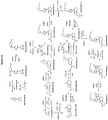
- The experimental protocol for synthesizing 6-(2,4-dichlorophenyl)-5-[4-[(3S)-1-(3-fluoropropyl)pyrrolidin-3-yl]oxyphenyl]-8,9-dihydro-7H-benzo[7]annulene-2-carboxylic acid (compound (1)), described in the patent application
WO 2017/140669 , is reproduced below, along with its analytical data. The synthetic scheme for the synthesis of compound (1) is found inFigure 1 . - The 1H NMR spectra were performed on a Bruker Avance DRX-400 spectrometer, with the chemical shifts (δ in ppm) in the solvent dimethyl sulfoxide-d6 (d6-DMSO) referenced at 2.5 ppm at a temperature of 303 K. Coupling constants (J) are given in Hertz.
- The liquid chromatography/mass spectra (LC/MS) were obtained on a UPLC Acquity Waters instrument, light scattering detector Sedere and SQD Waters mass spectrometer using UV detection DAD 210<I<400 nm and column Acquity UPLC CSH C18 1.7 µm, dimension 2.1×30 mm, mobile phase H2O + 0,1% HCO2H / CH3CN + 0,1% HCO2H.
- The following abbreviations and empirical formulae are used:
- AcOEt
- ethyl acetate
- AlCl3
- aluminium trichloride
- Cs2CO3
- cesium carbonate
- DCM
- dichloromethane
- DMF
- N,N-dimethylformamide
- DMSO
- dimethyl sulfoxide
- HCI
- hydrogen chloride
- K2CO3
- potassium carbonate
- LC/MS
- liquid chromatography/mass spectrometry
- MeOH
- methanol
- MgSO4
- magnesium sulfate
- NaHCO3
- sodium bicarbonate
- NaOH
- sodium hydroxyde
- Pd(dppf)Cl2
- 1,1'bis(diphenylphosphino)ferrocene] dichloropalladium(II)
- Ph3P or P(Ph)3
- triphenylphosphine
- Ph3P=O
- triphenylphosphine oxide
- °C
- degrees Celsius
- ml
- millilitre(s)
- mmol
- millimole(s)
- µmol
- micromole(s)
- µM
- micromolar
- nM
- nanomolar
- ppm
- parts per million
-

- To a solution of commercially available 4-(4,4,5,5-tetramethyl-1,3,2-dioxaborolan-2-yl)phenol (a) (82.7 g, 364.51 mmol) in THF (2 L) was added under argon (R)-1-N-Boc-3-hydroxypyrrolidine (b) (84.43 g, 437.41 mmol) followed by N,N,N',N'-tetramethylazodicarboxamide (99.1 g, 546.77 mmol). The clear reaction mixture turned orange and triphenylphosphine (143.41 g, 546.77 mmol) was added. The reaction mixture was stirred at room temperature for 24 hours, meanwhile a precipitate of triphenylphosphine oxide formed (Ph3P=O). The reaction mixture was poured in water (1.5 L) and extracted with ethyl acetate (AcOEt) (3x1.5 L). Gathered organic phases were dried over magnesium sulfate (MgSO4), filtered and concentrated under reduced pressure. The residue was taken up into diisopropylether (1.5 L) and the solid formed (Ph3P=O) was filtered. The solvent was concentrated under reduced pressure and the residue purified by column chromatography eluting with a mixture of heptane with AcOEt (90/10; v/v) to give 145 g (100%) of tert-butyl (3S)-3-[4-(4,4,5,5-tetramethyl-1,3,2-dioxaborolan-2-yl)phenoxy]pyrrolidine-1-carboxylate (c) as a colorless oil.
1H NMR (400 MHz, DMSO-d6, δ ppm): 1.27 (s : 12H); 1.39 (s : 9H); 2.05 (m : 1H); 2.14 (m : 1H); 3.37 (3H); 3.55 (m : 1H); 5.05 (s : 1H); 6.94 (d, J = 8.4 Hz : 2H); 7.61 (d, J = 8.4 Hz : 2H) -

- To a solution of (S)-tert-butyl 3-(4-(4,4,5,5-tetramethyl-1,3,2-dioxaborolan-2-yl)phenoxy)pyrrolidine-1-carboxylate (c) (80 g, 195.23 mmol) in MeOH (450 ml) was added slowly HCI 4N in dioxane (250 ml).
- After 1.5 hours, the reaction mixture was concentrated under reduced pressure and the residue was taken up into Et2O with stirring to give a solid which then was filtered and dried under vacuum to give 61.8 g (95%) of (3S)-3-[4-(4,4,5,5-tetramethyl-1,3,2-dioxaborolan-2yl)phenoxy]pyrrolidine, hydrochloride (d) as a white powder.
- 1H NMR (400 MHz, DMSO-d6, δ ppm): 1.28 (s : 12H); 2.10 (m : 1H); 2.21 (m : 1H); 3.31 (3H); 3.48 (m : 1H); 5.19 (m : 1H); 6.97 (d, J = 8.4 Hz : 2H); 7.63 (d, J = 8.4 Hz : 2H); 9.48 (s : 1H); 9.71 (s : 1H).
- LC/MS (m/z, MH+): 290
-

- To a suspension of (S)-3-(4-(4,4,5,5-tetramethyl-1,3,2-dioxaborolan-2-yl)phenoxy)pyrrolidine hydrochloride (d) (20 g, 61.42 mmol) in acetonitrile (100 ml), was added K2CO3 (21.22 g, 153.54 mmol) and 1-iodo-3-fluoropropane (12.15 g, 61.42 mmol), under argon. The reaction mixture was stirred at 40°C for 24 hours. After cooling to room temperature, the reaction mixture was filtered and washed with acetonitrile. The filtrate was concentrated under reduced pressure and the residue was taken up in DCM and the solid formed was filtered and washed with DCM. The filtrate was concentrated to give 21.5 g (100%) of (3S)-1-(3-fluoropropyl)-3-[4-(4,4,5,5-tetramethyl-1,3,2-dioxaborolan-2-yl)phenoxy]pyrrolidine (e) as a yellow foam.
- 1H NMR (400 MHz, DMSO-d6, δ ppm): 1.27 (s : 12H); 1.77 (m : 2H); 1.84 (m : 1H); 2.27 (m : 1H); 2.41 (m : 1H); 2.49 (2H); 2.62 (dd, J = 2.6 and 10.4Hz : 1H); 2.69 (m : 1H); 2.83 (dd, J = 6.2 and 10.4Hz : 1H); 4.47 (td, J = 6.2 and 47Hz : 2H) ; 4.99 (m : 1H); 6.77 (d , J = 8.4 Hz : 2H); 7.58 (d, J = 8.4 Hz : 2H).
- LC/MS (m/z, MH+): 350
-

- To a solution of 2-hydroxy-6,7,8,9-tetrahydro-5H-benzo[7]annulen-5-one (A) (1.52 g, 8.63 mmol), in acetone (60 ml), was added K2CO3 (1.19 g, 8.63 mmol) and pivaloyl chloride (1.06 ml, 8.63 mmol). The reaction mixture was stirred at room temperature for 16 hours, filtered and concentrated under reduced pressure. The residue was purified by flash chromatography eluting with a gradient of heptane in AcOEt (100/0 to 85/15, v/v) to give 1.55 g (69%) of 5-oxo-6,7,8,9-tetrahydro-5H-benzo[7]annulen-2-
yl 2,2-dimethylpropanoate (B) as a colorless oil. - 1H NMR (400 MHz, DMSO-d6, δ ppm): 7.65 (d, 1H); 7.10-7.04 (m, 2H); 2.95 (t, 2H); 2.68 (t, 2H); 1.85-1.65 (m, 4H).
- LC/MS (m/z, MH+): 261
-

- To a solution of 5-oxo-6,7,8,9-tetrahydro-5H-benzo[7]annulen-2-
yl 2,2-dimethylpropanoate (B) (15 g, 57.62 mmol) in DCM (500 ml) was added dropwise under argon pyridine (7.28 ml, 86.43 mmol) and trifluoromethanesulfonic anhydride (19.58 ml, 115.24 mmol). The reaction mixture was stirred at room temperature for 2 hours and ice (200 g) was added. The phases were separated, the aqueous phase was washed with DCM and the gathered organic phases were dried over MgSO4, filtered and evaporated under reduced pressure to give 22 g (97%) of 9-(trifluoromethanesulfonyloxy)-6,7-dihydro-5H-benzo[7]annulen-3-yl 2,2-dimethylpropanoate (C) as a white solid.
LC/MS (m/z, MH-): 391 -

- To a solution of 9-(trifluoromethanesulfonyloxy)-6,7-dihydro-5H-benzo[7]annulen-3-yl-2,2-dimethylpropanoate (C) (22 g, 56.07 mmol) and (3S)-1-(3-fluoropropyl)-3-[4-(tetramethyl-1,3,2-dioxaborolan-2-yl)phenoxy]pyrrolidine (e) (20.56 g, 58.87 mmol) in dioxane (420 ml) and water (120 ml) was added under argon Pd(dppf)Cl2 (2.75 g, 3.36 mmol) and Cs2CO3 (36.57 g, 112.13 mmol). The reaction mixture was stirred for 1 hour at room temperature and was partitioned between water and DCM. The aqueous phase was washed with DCM and the gathered organic phases dried over MgSO4, filtered and concentrated under reduced pressure. The residue was purified by column chromatography eluting with a gradient of MeOH in DCM (0 to 5%; V/V) to give 31 g (100 %) of 9-(4-{[(3S)-1-(3-fluoropropyl)pyrrolidin-3-yl]oxy}phenyl)-6,7-dihydro-5H-benzo[7]annulen-3-yl-2,2-dimethylpropanoate (D).
LC/MS (m/z, MH+): 466 -

- To a solution under argon of 9-(4-{[(3S)-1-(3-fluoropropyl)pyrrolidin-3-yl]oxy}phenyl)-6,7-dihydro-5H-benzo[7]annulen-3-yl-2,2-dimethylpropanoate (D) (24.8 g, 53.26 mmol) in MeOH (300 ml), was added NaOH 5M (23 ml, 115.00 mmol). The reaction mixture was stirred for 2 hours at room temperature. pH was then adjusted to 7 by addition of 6N aqueous HCI solution. The MeOH was concentrated under reduced pressure, then DCM was added. The organic phase was dried over MgSO4, and concentrated under reduced pressure. The residue was purified by flash chromatography eluting with a gradient of DCM/ MeOH from 100/0 to 95/05 to give 18.8 g (93%) of 9-(4-{[(3S)-1-(3-fluoropropyl)pyrrolidin-3-yl]oxy}phenyl)-6,7-dihydro-5H-benzo[7]annulen-3-ol (E) as a beige solid.
LC/MS (m/z, MH+): 382 -

- To a solution of 9-(4-{[(3S)-1-(3-fluoropropyl)pyrrolidin-3-yl]oxy}phenyl)-6,7-dihydro-5H-benzo[7]annulen-3-ol (E) (20.6 g, 54.00 mmol) in DCM (200 ml) and pyridine (6.55 ml, 81.00 mmol), cooled to 5°C (ice bath), was added dropwise trifluoromethanesulfonic anhydride (18.93 ml, 108.00 mmol) under argon, and the reaction temperature was maintained <15°C. The ice bath was removed, and the brown suspension was stirred at room temperature for 2 hours. Ice (200 g) and DCM (200 ml) were added and the phases separated. The organic phase was dried over MgSO4, and concentrated under reduced pressure. The residue was purified by flash chromatography eluting with a gradient of DCM/MeOH from 100/0 to 95/05 to give 24.7 g (89.1%) of 9-(4-{[(3S)-1-(3-fluoropropyl)pyrrolidin-3-yl]oxy}phenyl)-6,7-dihydro-5H-benzo[7]annulen-3-yl trifluoromethanesulfonate (F) as a brown oil.
LC/MS (m/z, MH+): 514 -

- To a solution of 9-(4-{[(3S)-1-(3-fluoropropyl)pyrrolidin-3-yl]oxy}phenyl)-6,7-dihydro-5H-benzo[7]annulen-3-yl trifluoromethanesulfonate (F) (10.1 g, 19.67 mmol) in DMF (66 ml) and MeOH (33 ml), were added Pd(dppf)Cl2 (909 mg, 1.18 mmol) and diisopropylethylamine (7.21 ml). The black suspension was carbonylated in an autoclave at 70°C under 5 bars of CO for 5 hours. The reaction mixture was filtered, then the filtrate was partially concentrated under reduced pressure. The residue was partitioned between AcOEt and water. The organic phase was washed with water (2x 100 ml), dried over MgSO4, and concentrated under reduced pressure. The residue was purified by flash chromatography eluting with a gradient of DCM/ MeOH from 100/0 to 95/05 to give 7.13 g (86%) of methyl 9-(4-{[(3S)-1-(3-fluoropropyl)pyrrolidin-3-yl]oxy}phenyl)-6,7-dihydro-5H-benzo[7]annulene-3-carboxylate (G) as a brown gum.
LC/MS (m/z, MH+): 424 -

- To a solution of commercially available 2-hydroxy-6,7,8,9-tetrahydro-5H-benzo[7]annulen-5-one (A) (18.5 g, 105 mmol) in DCM (185 ml) and lutidine (13.35 ml, 113.505 mmol), cooled at 5°C under argon, was added dropwise trifluoromethanesulfonic anhydride (20.22 ml, 123.29 mmol) while keeping temperature between 10 and 20°C. The reaction mixture was stirred for 1 hour at 5°C then at room temperature for 1 hour.
- Then, ice (200 g) was added and the slurry partitioned between water and DCM. The organic phase was washed with aqueous NaHCO3 solution, dried over MgSO4, filtered off and concentrated under reduced pressure. The residue was purified by flash chromatography eluting with a gradient of heptane/AcOEt from 100 to 90/10 to give 28.2 g (87%) of 5-oxo-6,7,8,9-tetrahydro-5H-benzo[7]annulen-2-yl trifluoromethanesulfonate (A1) as an orange oil.
LC/MS (m/z, MH+): 309 -

- To a solution of 5-oxo-6,7,8,9-tetrahydro-5H-benzo[7]annulen-2-yl trifluoromethanesulfonate (A1) (5.03 g, 16.32 mmol) in DMF (24 ml) and MeOH (12 ml), were added Pd(dppf)Cl2 (754 mg, 0.98 mmol) and diisopropylethylamine (6 ml). The black suspension was carbonylated in an autoclave at 70°C under 5 bars of CO for 2.5 hours. The reaction mixture was filtered, then the filtrate was partially concentrated under reduced pressure, and the residue, was partitioned between AcOEt and water. The organic phase was washed with water (2x 75 ml) and aqueous HCI 0.5 N, dried over MgSO4 and concentrated under reduced pressure. The residue was purified by flash chromatography eluting with a gradient of heptane/AcOEt from 100/0 to 90/10 to give 3.4 g (95%) of methyl 5-oxo-6,7,8,9-tetrahydro-5H-benzo[7]annulene-2-carboxylate (B1) as a colorless oil.
LC/MS (m/z, MH+): 219 -

- To a solution of methyl 5-oxo-6,7,8,9-tetrahydro-5H-benzo[7]annulene-2-carboxylate (B1) (18,19 g, 83,34 mmol) in DCM (500 ml) and anhydrous pyridine (11 ml, 130,56 mmol), cooled at 5°C under argon, was added dropwise trifluoromethanesulfonic anhydride (30 ml, 176,54 mmol). The reaction mixture, a thick suspension, was stirred at room temperature for 24 hours, then ice was added and partitioned between water and DCM. The organic phase was dried over MgSO4, filtered off and concentrated under reduced pressure to give 29 g (100%) of methyl 9-(trifluoromethanesulfonyloxy)-6,7-dihydro-5H-benzo[7]annulene-3-carboxylate (C1) as a yellow gum.
LC/MS (m/z, MH+): 351 -

- To a solution of methyl 9-(trifluoromethanesulfonyloxy)-6,7-dihydro-5H-benzo[7]annulene-3-carboxylate (C1) (29 g, 82.9 mmol), (3S)-1-(3-fluoropropyl)-3-[4-(tetramethyl-1,3,2-dioxaborolan-2-yl)phenoxy]pyrrolidine (e) (28.9 g, 82.9 mmol), in dioxane (225 ml) were added Pd(dppf)Cl2 under argon, complex with DCM (3.73 g, 4.57 mmol) and Cs2CO3 1.5 M aqueous solution (111.12 ml, 166.68 mmol). The reaction mixture was stirred at 60°C for 1 hour.
- After cooling to room temperature, the reaction mixture was poured into a mixture of water (500 ml) and AcOEt (400ml). The organic phase was washed with brine, dried over MgSO4, filtered on celite and concentrated under reduced pressure. The residue was purified by flash chromatography eluting with a gradient of DCM/MeOH from 100/0 to 95/05 to give 23 g (65%) of methyl 9-(4-{[(3S)-1-(3-fluoropropyl)pyrrolidin-3-yl]oxy}phenyl)-6,7-dihydro-5H-benzo[7]annulene-3-carboxylate (G) as a brown gum.
LC/MS (m/z, MH+): 424 -

- To a solution of methyl 9-(4-{[(3S)-1-(3-fluoropropyl)pyrrolidin-3-yl]oxy}phenyl)-6,7-dihydro-5H-benzo[7]annulene-3-carboxylate (G) (13.93 g, 32.89 mmol), in DCM (150 ml) was added under argon pyridinium tribromide (15.78 g, 44.41 mmol). The reaction mixture was stirred for 1 hour at room temperature. Water (200 ml) was added, organic phase was then dried over MgSO4, and concentrated under reduced pressure. The residue was purified by flash chromatography eluting with a gradient of DCM/MeOH from 100/0 to 95/05 to give 16.4 g (85%) of methyl 8-bromo-9-(4-{[(3S)-1-(3-fluoropropyl)pyrrolidin-3-yl]oxy}phenyl)-6,7-dihydro-5H-benzo[7]annulene-3-carboxylate hydrobromide (H) as a yellow meringue.
LC/MS (m/z, MH+): 502 -

- To a solution of methyl 8-bromo-9-(4-{[(3S)-1-(3-fluoropropyl)pyrrolidin-3-yl]oxy}phenyl)-6,7-dihydro-5H-benzo[7]annulene-3-carboxylate hydrobromide (H) (150 mg, 298.56 µmol), in dioxane (12 ml) and water (2 ml), was added 2,4-dichlorophenyl-boronic acid (62.67 mg, 328.41 µmol), Cs2CO3 (204.48 mg, 626.97 µmol), and Pd(dppf)Cl2 (14.63 mg, 17.91 µmol). The reaction mixture was heated at 90°C for 3 hours, and partitioned between AcOEt and water. The phases were separated and the organic phase washed with brine, dried over MgSO4 and concentrated under reduced pressure. The residue was purified by column chromatography eluting with a mixture of DCM, acetonitrile and MeOH (96/2/2; V/V/V) to give 80 mg (47%) of 6-(2,4-dichloro-phenyl)-5-{4-[1-(3-fluoro-propyl)-pyrrolidin-3-yloxy]-phenyl}-8,9-dihydro-7H-benzocycloheptene-2-carboxylic acid methyl ester (I).
LC/MS (m/z, MH+): 568 -

- To a solution of 6-(2,4-dichloro-phenyl)-5-{4-[1-(3-fluoro-propyl)-pyrrolidin-3-yloxy]-phenyl}-8,9-dihydro-7H-benzocycloheptene-2-carboxylic acid methyl ester (I) (80 mg, 140.72 µmol) in MeOH (5 ml) was added a solution of NaOH (562.88 µl, 5 M) and the reaction mixture was heated at 60°C for 5 hours and the solvent removed under reduced pressure. The residue was taken up in water (10 ml) and aqueous HCI (5 M) added to
pH 7. The slurry was extracted with DCM, dried over MgSO4 and concentrated under reduced pressure. The solid was purified by column chromatography eluting with a mixture of DCM, acetonitrile and MeOH (90/5/5; V/V/V) to give 60 mg (77%) of 6-(2,4-dichlorophenyl)-5-[4-[(3S)-1-(3-fluoropropyl)pyrrolidin-3-yl]oxyphenyl]-8,9-dihydro-7H-benzo[7]annulene-2-carboxylic acid. - 1H NMR (400 MHz, DMSO-d6, δ ppm): 1.68 (m, 1 H); 1,79 (dm, J=25.3 Hz, 2 H); 2.07 to 2.23 (m, 5 H); 2.38 (m, 1 H); 2.46 (t, J=7.2 Hz, 2 H); 2.52 (m, 1 H); 2.62 (m, 1 H); 2.55 to 2.89 (m, 3 H); 4.47 (td, J=6.2 and 47.6 Hz, 2 H); 4.72 (m, 1 H); 6.63 (d, J=8.9 Hz, 2 H); 6.71 (m, 3 H); 7.18 (d, J=8.4 Hz, 1 H); 8.26 (dd, J=2.0 and 8.4 Hz, 1 H); 7.58 (d, J=2,0 Hz, 1 H); 7.63 (d, J=8.4 Hz, 1 H); 7.79 (s, 1 H); 12.3 (m, 1 H)
- LC/MS (m/z, MH+): 554
- In the present study, the anti-tumor efficacy of 6-(2,4-dichlorophenyl)-5-[4-[(3S)-1-(3-fluoropropyl)pyrrolidin-3-yl]oxyphenyl]-8,9-dihydro-7H-benzo[7]annulene-2-carboxylic acid ("compound (1)"), combined with the cyclin-dependent kinase 4 (CDK4) inhibitor palbociclib, was investigated after 30 days treatment against a subcutaneous MCF7-Y537S human breast cancer cell line xenograft in female nude mice.
- The treated groups included compound (1) at 5 mg/kg alone, palbociclib at 100 mg/kg alone, and the combination of compound (1) and palbociclib at the same dose and regime.
- Compound (1) was orally dosed twice a day (BID) and palbociclib was orally dosed once a day (QD) for 30 days. Anti-tumor efficacy was evaluated by tumor volume measurement.
- Female athymic nude mice were obtained from Harlan (Indianapolis, IN, USA). Animals were allowed to acclimate for at least four days before the study enrollment. Mice were 12 to 13 weeks old and weighed between 20.2 and 27.3 grams at the beginning of the treatments. These animals were housed under conditions outlined in the NIH Guide for Care and Use of Laboratory Animals in compliance with the USDA Laboratory Animal Welfare Act.
- Parental MCF7 cells were obtained from the American Type Culture Collection (ATCC® HTB-22™). MCF7-Y537S (ESR1) cell line was MCF7 cells expressing the ER.Y537S variant that was generated by Sanofi Biology Discovery Group. Y537S mutation was introduced in ESR1 construct (GenBank NM_000125.3) by site directed mutagenesis (Toy W. et al., Cancer Discovery, 2017, 7, 277-287). The construct was transfected in MCF7 cells which were selected for their growth in absence of estradiol. MCF-Y537S is an ESR1 mutation that confers estrogen-independent activity to ERα (Estrogen Receptor alpha) and contributes to endocrine resistant disease (Robinson D.R. et al., Nat Genet., 2013, 45 (12), 1446-1451). The cells were grown in Eagle's Minimum Essential Medium (EMEM) supplemented with 10% fetal bovine serum (FBS), human Insulin, in 5% CO2 at 37°C. The cells were harvested in 0.25% Trypsin EDTA and washed by Dulbecco's Phosphate Buffered Saline (DPBS) and re-suspended in DPBS with 50% matrigel (Becton Dickinson catalog No. 356234, lot No. 32277). The cells (20 × 106 cells/per mouse) were subcutaneously (SC) implanted into the right flank of female nude mice.
- When the MCF7-Y537S tumors were established, the tumors were reserved as tumor stocks for fragment implantation. The tumors were serially propagated through fragment tissue transplantation subcutaneously. The fragment tumor tissues were subcutaneously implanted into the right flank of female nude mice. 50 mice were assigned in this experiment.
- Compound (1) and palbociclib (commercially available, marketed under the tradename Ibrance®) were formulated as follows:
- Vehicle A: 20% Labrasol® (supplied from Gattefosse SAS, France);
- Vehicle B: 5% Dextrose.
- Compound (1) was prepared in Vehicle A, then Solutol HS15 (purchased from Sigma) was added to the
final concentration 5%, and the solution was left under stirring for an hour for complete dissolution. After that, vehicle B was added. The final pH was 5.5. - Dose volume for compound (1) administration: 10 ml/kg by oral gavage.
- Doses: 5 mg/kg (dosage of compound (1) in the above volume).
- Palbociclib was prepared in Vehicle A, then Solutol HS15 was added to the
final concentration 5%, and the solution was left under stirring for an hour for complete dissolution. After that, vehicle B was added. The final pH was 5.5. - Dose volume: 10 ml/kg by oral gavage.
- Doses: 100 mg/kg (dosage of palbociclib in the above volume).
- The animals required for experiment (plus extra) were pooled and implanted with MCF7-Y537S tumor fragment tissues on
day 0. Onday 21 post implantation, the mice were pooled and randomly distributed to the treatment and control groups (10 mice per group), where median tumor volumes for each group ranged from 202.5 to 211.5 mm3. Treatments of compound (1) and palbociclib were initiated on day 22. Compound (1) was orally administered at 5 mg/kg BID (at least 5 hours apart) and palbociclib was orally administered at 100 mg/kg QD, for 30 days. Animal body weight was assessed daily. - The dosages are expressed in mg/kg and based on daily body weight per animal. Vehicle treated animals were used as controls. Mice were checked daily and adverse clinical reactions noted. Individual mice were weighed daily until the end of the experiment. Mice would be euthanized when morbid or weight loss ≥20% was observed. Tumors were measured with a caliper twice weekly until final sacrifice. When a tumor size reached approximately 2000 mm3 or when there are animal health issues (40% area of a tumor ulcerated), animals would be euthanized and date of death recorded. Solid tumor volumes were estimated from two dimensional tumor measurements and calculated according to the following equation:

- A dosage producing either 15% body weight loss during 3 consecutive days for an individual mouse, 20% body weight loss during 1 day, or 10% or more drug related deaths, was considered an excessively toxic dosage, unless under certain circumstances bodyweight loss or animal death can be considered non-drug related. Examples include animal handling issues such as misgavage, tumor model related issues such as tumor induced cachexia leading to body weight loss that can be observed in control or vehicle treated groups and excessive tumor ulceration. Mice that have non-drug related death or significant bodyweight loss will not be considered toxic and will be excluded from statistical analysis. Animal body weight included the tumor weight.
- The primary efficacy end points include tumor volume changes from baseline summarized by the ratio of medians of tumor volume changes from baseline between the treated and control groups (ΔT/ΔC). Changes in tumor volume for each treated (T) and control (C) group are calculated for each animal on each day by subtracting the tumor volume on the day of first treatment (staging day) from the tumor volume on the specified observation day. The median ΔT is calculated for the treated group and the median ΔC is calculated for the control group. The ratio ΔT/ΔC is calculated and expressed as percentage:

- ΔT/ΔC ≤ 40% is considered as therapeutically active, ΔT/ΔC = 0% is considered as tumor stasis, and ΔT/ΔC < 0% is considered as tumor regression (very active). ΔT/ΔC > 40% is considered as therapeutically inactive.
- Percent tumor regression is defined as % (percentage) of tumor volume decrease in the treated group on a specified observation day compared to its volume when the study was initiated. At a specific time point (t) and for each animal, the regression percentage is calculated using the following formula:

- The median percent regression for a group on a given day is then calculated by taking the median of individual % regression values calculated for each animal in the group. The day of calculation is determined by the day when ΔT/ΔC is calculated, excepted if median percent regression is not representative of the activity of the group. In this case, the day is determined by the first day when the median percent regression is maximal.
- A two-way Anova-Type analysis with factors treatment and day (repeated) is performed on tumor volume changes from baseline. It is followed by contrast analyses with Bonferroni-Holm correction for multiplicity to compare all treated groups to the control group and to compare the combination versus each single agent at the dose involved in the combination at each day from
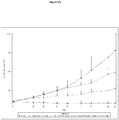
day 27 to 51. - In the figures, the medians and Median Absolute Deviation (MAD) of each group are represented for each day of measurement.
- In the tables, the medians and Normalized MAD (nMAD = 1.4826*MAD) of each group are reported for each day of measurement.
- Tumor volume changes from baseline are calculated for each animal and each day by subtracting the tumor volume on the day of first treatment (day 21) from the tumor volume on the specified observation day.
- All statistical analyses were performed using SAS version 9.2 software. A probability of less than 5% (p<0.05) was considered as significant.
- Compound (1) at 5 mg/kg BID, palbociclib 100 mg/kg QD and the combination of compound (1) and palbociclib at the doses and regime for 30 days were well tolerated in this study showing average body weight change in % per group at nadir (the lowest of body weight drop in the group) of -1.7% (day 22), -2.0% (day 22) and -6.4% (day 26), respectively (Table 1).
- Compound (1) at a dose of 5 mg/kg BID for 30 days had minimal effect on tumor growth with ΔT/ΔC value of 59% (p = 0.4113) on
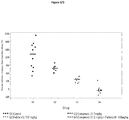
day 51. Palbociclib at a dose of 100 mg/kg QD for 30 days achieved anti-tumor efficacy with ΔT/ΔC value of 27% (p<0.0001) onday 51. When compound (1) at 5 mg/kg combined with palbociclib 100 mg/kg with the same dose regime as BID for compound (1) and QD for palbociclib, the combination treatment demonstrated strong anti-tumor efficacy with ΔT/ΔC value less than 0 (p < 0.0001) and induced tumor regression (median tumor regression 32%) onday 51. The statistical analysis indicated the combination effect was significantly different when compared to either compound (1) alone or palbociclib alone on day 51 (p <0.0001). Detailed results are shown in Tables 1, 2 and 3 below, as well as inFigures 2 and3 : -
Figure 2 : Antitumor activity of compound (1) combined with palbociclib against subcutaneous human breast cancer cell line MCF7-Y537S xenograft in nude mice: tumor volume evolution. The curves represent medians + or - MAD (Median Absolute Deviation) at each day for each group; -
Figure 3 : Antitumor activity of compound (1) combined with palbociclib against subcutaneous human breast cancer cell line MCF7-Y537S xenograft in nude mice: tumor volume changes from baseline onday 51. Points represent individual tumor volume changes from baseline onday 51, bars correspond to medians. - From this experiment, we conclude that the compound (1) at 5 mg/kg twice a day combined with the CDK4 inhibitor palbociclib at 100 mg/kg once a day induced significant anti-tumor efficacy and tumor regression in MCF7-Y537S human breast cancer cell line xenograft model in nude mice that was superior to single agents alone.
Table 1: Efficacy of compound (1) combined with palbociclib against subcutaneous MCF7-Y537S human breast cancer xenograft in nude mice. Agent Route/ Dosage (in mL/kg per injection) Dosage in mg/kg per injection (total dose) Schedule in days (total of 30 days) *Unscheduled death (Day of death) Average body weight change in % per group at nadir (day of nadir) ΔT/ΔC in % at day 51Median % of regressions on day 51Regressions p-value on day 47# Biological Interpretation Partial Complete Vehicle PO, BID (10) - - 0/10 -2.2 (22) 100 - 0/10 0/10 - - Compound (1) PO, BID (10) 5 (295) N.B. 22 to 51 2/10 -1.7(22) 59 NR 0/8 0/8 p = 0.4113 Inactive Palbociclib PO, QD (10) 100 (3000) 22 to 51 0/10 -2.0 (22) 27 NR 0/10 0/10 p < 0.0001 Active Compound (1) + Palbociclib PO, BID (10) PO, QD (10) 5 (295) N.B. + 100 (3000) 22 to 51 1/10 -2.3 (26) <0 32 2/9 0/9 p < 0.0001 Very active PO: per os N.B.: animals accepted one dose in the starting date. NR: no regression (0% regression). # Statistical analysis: Comparison of each single agent and combination versus the control group. The p-values were obtained using a contrast analysis to compare each treated group versus control at each day using Bonferroni-Holm adjustment for multiplicity after a two-way Anova-Type with repeated measures on tumor volume changes from baseline. A probability less than 5% (p<0.05) was considered as significant. *3 mice were excluded from statistical analysis because those mice corresponded to non-drug related death or terminations during the study. Table 2: Efficacy of compound (1) combined with palbociclib against subcutaneous human breast cancer cell line MCF7-Y537S xenograft model in nude mice. Comparison of each group to the control group at each day. Tumor volume changes from baseline mm3 : Median (nMAD)*, n and p-value# Treatment Group Global Day 27 Day 30 Day 34 Day 37 Day 41 Day 44 Day 49 Day 51 Control - 111.5 181.0 296.0 392.0 663.0 867.0 1140.0 1322.0 (44.48) (78.58) (133.43) (235.73) (363.24) (456.64) (615.28) (633.07) n=10 n=10 n=10 n=10 n=10 n=10 n=10 n=10 Compound (1) 5 mg/kg - 114.0 171.5 270.5 336.0 440.0 498.5 727.5 782.0 (19.27) (31.13) (112.68) (112.68) (39.29) (91.18) (160.86) (112.68) n=8 n=8 n=8 n=8 n=8 n=8 n=8 n=8 0.3975 0.6333 0.3909 0.7343 0.5990 0.2495 0.1950 0.3770 0.4113 Palbociclib 100 mg/kg - 68.5 98.0 121.5 132.0 193.5 249.5 298.5 363.5 (31.88) (25.20) (34.10) (31.88) (52.63) (43.74) (97.11) (108.23) n=10 n=10 n=10 n=10 n=10 n=10 n=10 n=10 <0.0001 0.1164 0.0009 <0.0001 <0.0001 <0.0001 <0.0001 <0.0001 <0.0001 Compound (1) 5 mg/kg + Palbociclib 100 mg/kg - -8.0 -17.0 -35.0 -30.0 -43.0 -63.0 -53.0 -52.0 (63.75) (97.85) (74.13) (57.82) (60.79) (45.96) (72.65) (72.65) n=9 n=9 n=9 n=9 n=9 n=9 n=9 n=9 <0.0001 0.0077 <0.0001 <0.0001 <0.0001 <0.0001 <0.0001 <0.0001 <0.0001 # p-values obtained with a contrast analysis versus control at each day with Bonferroni-Holm adjustment for multiplicity after a two-way Anova-Type on tumor volume changes from baseline. * MAD= Median Absolute Deviation; nMAD= normalized MAD; nMAD= 1.4826*MAD. For palbociclib at 100 mg/kg, the effect on tumor volume changes from baseline is significant compared to the control group from day 30 today 51.For the combination compound (1) at 5 mg/kg + palbociclib at 100 mg/kg, the effect on tumor volume changes from baseline is significant compared to the control group from day 27 today 51.n = number of animals. 3 mice were excluded from statistical analysis because those mice corresponded to non-drug related death or terminations during the study. Table 3: Efficacy of compound (1) combined with palbociclib against subcutaneous human breast cancer cell line MCF7-Y537S xenograft model in nude mice. Comparison of compound (1) 5 mg/kg and palbociclib 100 mg/kg as single agents versus the combination at each day. Tumor volume changes from baseline mm3 : Median (nMAD)*, n and p-value# Treatment Group Global Day 27 Day 30 Day 34 Day 37 Day 41 Day 44 Day 49 Day 51 Compound (1) 5 mg/kg + Palbociclib 100 mg/kg - -8.0 -17.0 -35.0 -30.0 -43.0 -63.0 -53.0 -52.0 (63.75) (97.85) (74.13) (57.82) (60.79) (45.96) (72.65) (72.65) n=9 n=9 n=9 n=9 n=9 n=9 n=9 n=9 Palbociclib 100 mg/kg - 68.5 98.0 121.5 132.0 193.5 249.5 298.5 363.5 (31.88) (25.20) (34.10) (31.88) (52.63) (43.74) (97.11) (108.23) n=10 n=10 n=10 n=10 n=10 n=10 n=10 n=10 <0.0001 0.2417 0.0736 0.0026 0.0002 <0.0001 <0.0001 <0.0001 <0.0001 Compound (1) 5 mg/kg - 114.0 171.5 270.5 336.0 440.0 498.5 727.5 782.0 (19.27) (31.13) (112.68) (112.68) (39.29) (91.18) (160.86) (112.68) n=8 n=8 n=8 n=8 n=8 n=8 n=8 n=8 <0.0001 0.0342 <0.0001 <0.0001 <0.0001 <0.0001 <0.0001 <0.0001 <0.0001 # p-values obtained with a contrast analysis to compare the combinations of compound (1) and palbociclib versus each single agent at the dose involved in the combination at each day with Bonferroni-Holm adjustment for multiplicity after a two-way Anova-Type on tumor volume changes from baseline. * MAD= Median Absolute Deviation; nMAD= normalized MAD; nMAD= 1.4826*MAD The effect of the combination of compound (1) at 5 mg/kg + palbociclib at 100 mg/kg is significantly greater than the effect of palbociclib at 100 mg/kg alone on day 34 today 51.The effect of the combination of compound (1) at 5 mg/kg + palbociclib at 100 mg/kg is significantly greater than the effect of compound (1) at 5 mg/kg alone on day 27 today 51.n = number of animals. 3 mice were excluded from statistical analysis because those mice corresponded to non-drug related death or terminations during the study.
Claims (14)
- A combination comprising 6-(2,4-dichlorophenyl)-5-[4-[(3S)-1-(3-fluoropropyl)pyrrolidin-3-yl]oxyphenyl]-8,9-dihydro-7H-benzo[7]annulene-2-carboxylic acid, or a pharmaceutically acceptable salt thereof, and palbociclib.
- The combination according to claim 1, showing therapeutic synergy.
- The combination according to claim 1 or claim 2, for use in the treatment of cancer.
- The combination according to claim 3, wherein the cancer is breast cancer.
- The combination according to any of claims 1 to 4, wherein both compounds are administered separately, simultaneously or spaced out over time.
- A pharmaceutical composition comprising 6-(2,4-dichlorophenyl)-5-[4-[(3S)-1-(3-fluoropropyl)pyrrolidin-3-yl]oxyphenyl]-8,9-dihydro-7H-benzo[7]annulene-2-carboxylic acid, or a pharmaceutically acceptable salt thereof, and palbociclib, and at least one pharmaceutically acceptable excipient.
- The pharmaceutical composition according to claim 6, wherein 6-(2,4-dichlorophenyl)-5-[4-[(3S)-1-(3-fluoropropyl)pyrrolidin-3-yl]oxyphenyl]-8,9-dihydro-7H-benzo[7]annulene-2-carboxylic acid, or a pharmaceutically acceptable salt thereof, and palbociclib are administered simultaneously, separately, or spaced out over a period of time.
- The pharmaceutical composition according to claim 6 or claim 7, for use in the treatment of cancer.
- The pharmaceutical composition according to claim 8, wherein the cancer is breast cancer.
- Compound 6-(2,4-dichlorophenyl)-5-[4-[(3S)-1-(3-fluoropropyl)pyrrolidin-3-yl]oxyphenyl]-8,9-dihydro-7H-benzo[7]annulene-2-carboxylic acid or a pharmaceutically acceptable salt thereof for use in the treatment of cancer by co-administration with palbociclib.
- The compound for use in the treatment of cancer according to claim 10, which is administered simultaneously, separately, or spaced out over time with palbociclib.
- Palbociclib for use in the treatment of cancer by co-administration with compound 6-(2,4-dichlorophenyl)-5-[4-[(3S)-1-(3-fluoropropyl)pyrrolidin-3-yl]oxyphenyl]-8,9-dihydro-7H-benzo[7]annulene-2-carboxylic acid or a pharmaceutically acceptable salt thereof.
- Palbociclib for use in the treatment of cancer according to claim 12, which is administered simultaneously, separately, or spaced out over time with compound 6-(2,4-dichlorophenyl)-5-[4-[(3S)-1-(3-fluoropropyl)pyrrolidin-3-yl]oxyphenyl]-8,9-dihydro-7H-benzo[7]annulene-2-carboxylic acid or a pharmaceutically acceptable salt thereof.
- A pharmaceutical kit comprising:(i) a first pharmaceutical composition comprising 6-(2,4-dichlorophenyl)-5-[4-[(3S)-1-(3-fluoropropyl)pyrrolidin-3-yl]oxyphenyl]-8,9-dihydro-7H-benzo[7]annulene-2-carboxylic acid, or a pharmaceutically acceptable salt thereof, and at least one pharmaceutically acceptable excipient;(ii) a second pharmaceutical composition comprising palbociclib, and at least one pharmaceutically acceptable excipient;both pharmaceutical compositions (i) and (ii) being in separate compartments and being intended to be independently administered, each administration with regards to the other one being simultaneous, separated or spread out over time.
Priority Applications (4)
| Application Number | Priority Date | Filing Date | Title |
|---|---|---|---|
| PL18740615T PL3658147T3 (en) | 2017-07-24 | 2018-07-23 | Combination comprising palbociclib and 6-(2,4-dichlorophenyl)-5-[4-[(3s)-1-(3-fluoropropyl)pyrrolidin-3-yl]oxyphenyl]-8,9-dihydro-7h-benzo[7]annulene-2-carboxylic acid and its use for the treatment of cancer |
| SI201830528T SI3658147T1 (en) | 2017-07-24 | 2018-07-23 | Combination comprising palbociclib and 6-(2,4-dichlorophenyl)-5-(4-((3s)-1-(3-fluoropropyl)pyrrolidin-3-yl)oxyphenyl)-8,9-dihydro-7h-benzo(7)annulene-2-carboxylic acid and its use for the treatment of cancer |
| HRP20212030TT HRP20212030T1 (en) | 2017-07-24 | 2018-07-23 | Combination comprising palbociclib and 6-(2,4-dichlorophenyl)-5-[4-[(3s)-1-(3-fluoropropyl)pyrrolidin-3-yl]oxyphenyl]-8,9-dihydro-7h-benzo[7]annulene-2-carboxylic acid and its use for the treatment of cancer |
| RS20220068A RS62837B1 (en) | 2017-07-24 | 2018-07-23 | Combination comprising palbociclib and 6-(2,4-dichlorophenyl)-5-[4-[(3s)-1-(3-fluoropropyl)pyrrolidin-3-yl]oxyphenyl]-8,9-dihydro-7h-benzo[7]annulene-2-carboxylic acid and its use for the treatment of cancer |
Applications Claiming Priority (3)
| Application Number | Priority Date | Filing Date | Title |
|---|---|---|---|
| US201762536121P | 2017-07-24 | 2017-07-24 | |
| EP17305998.1A EP3434272A1 (en) | 2017-07-25 | 2017-07-25 | Combination comprising palbociclib and 6-(2,4-dichlorophenyl)-5-[4-[(3s)-1-(3-fluoropropyl)pyrrolidin-3-yl]oxyphenyl]-8,9-dihydro-7h-benzo[7]annulene-2-carboxylic acid |
| PCT/EP2018/069901 WO2019020559A1 (en) | 2017-07-24 | 2018-07-23 | Combination comprising palbociclib and 6-(2,4-dichlorophenyl)-5-[4-[(3s)-1-(3-fluoropropyl)pyrrolidin-3-yl]oxyphenyl]-8,9-dihydro-7h-benzo[7] annulene-2-carboxylic acid and its use for the treatment of cancer |
Publications (2)
| Publication Number | Publication Date |
|---|---|
| EP3658147A1 EP3658147A1 (en) | 2020-06-03 |
| EP3658147B1 true EP3658147B1 (en) | 2021-11-10 |
Family
ID=59569252
Family Applications (2)
| Application Number | Title | Priority Date | Filing Date |
|---|---|---|---|
| EP17305998.1A Ceased EP3434272A1 (en) | 2017-07-24 | 2017-07-25 | Combination comprising palbociclib and 6-(2,4-dichlorophenyl)-5-[4-[(3s)-1-(3-fluoropropyl)pyrrolidin-3-yl]oxyphenyl]-8,9-dihydro-7h-benzo[7]annulene-2-carboxylic acid |
| EP18740615.2A Active EP3658147B1 (en) | 2017-07-24 | 2018-07-23 | Combination comprising palbociclib and 6-(2,4-dichlorophenyl)-5-[4-[(3s)-1-(3-fluoropropyl)pyrrolidin-3-yl]oxyphenyl]-8,9-dihydro-7h-benzo[7]annulene-2-carboxylic acid and its use for the treatment of cancer |
Family Applications Before (1)
| Application Number | Title | Priority Date | Filing Date |
|---|---|---|---|
| EP17305998.1A Ceased EP3434272A1 (en) | 2017-07-24 | 2017-07-25 | Combination comprising palbociclib and 6-(2,4-dichlorophenyl)-5-[4-[(3s)-1-(3-fluoropropyl)pyrrolidin-3-yl]oxyphenyl]-8,9-dihydro-7h-benzo[7]annulene-2-carboxylic acid |
Country Status (30)
| Country | Link |
|---|---|
| US (2) | US11260057B2 (en) |
| EP (2) | EP3434272A1 (en) |
| JP (1) | JP6741897B1 (en) |
| KR (1) | KR20200031622A (en) |
| CN (1) | CN111107851B (en) |
| AR (1) | AR112284A1 (en) |
| AU (1) | AU2018308871A1 (en) |
| BR (1) | BR112020001398A2 (en) |
| CA (1) | CA3070754A1 (en) |
| CO (1) | CO2020000240A2 (en) |
| DK (1) | DK3658147T3 (en) |
| ES (1) | ES2906279T3 (en) |
| HR (1) | HRP20212030T1 (en) |
| HU (1) | HUE057271T2 (en) |
| IL (1) | IL272166B2 (en) |
| LT (1) | LT3658147T (en) |
| MA (1) | MA49673B1 (en) |
| MX (1) | MX393852B (en) |
| MY (1) | MY195271A (en) |
| PH (1) | PH12020500091A1 (en) |
| PL (1) | PL3658147T3 (en) |
| PT (1) | PT3658147T (en) |
| RS (1) | RS62837B1 (en) |
| RU (1) | RU2764116C2 (en) |
| SG (1) | SG11202000367RA (en) |
| SI (1) | SI3658147T1 (en) |
| TW (1) | TWI768087B (en) |
| UY (1) | UY37818A (en) |
| WO (1) | WO2019020559A1 (en) |
| ZA (1) | ZA202000145B (en) |
Families Citing this family (13)
| Publication number | Priority date | Publication date | Assignee | Title |
|---|---|---|---|---|
| EP3434272A1 (en) * | 2017-07-25 | 2019-01-30 | Sanofi | Combination comprising palbociclib and 6-(2,4-dichlorophenyl)-5-[4-[(3s)-1-(3-fluoropropyl)pyrrolidin-3-yl]oxyphenyl]-8,9-dihydro-7h-benzo[7]annulene-2-carboxylic acid |
| ES2923412T3 (en) * | 2018-09-07 | 2022-09-27 | Sanofi Sa | 6-(2,4-dichlorophenyl)-5-[4-[(3S)-1-(3-fluoropropyl)pyrrolidin-3-yl]oxyphenyl]-8,9-dihydro-7H-benzo[7] salts Methyl annulene-2-carboxylate and preparation process thereof |
| AU2020268762A1 (en) * | 2019-05-09 | 2021-12-02 | Sanofi | 6-(2,4-dichlorophenyl)-5-[4-[(3S)-1-(3-fluoropropyl)pyrrolidin-3-yl]oxyphenyl]-8,9-dihydro-7H-benzo[7]annulene-2-carboxylic acid for use in metastatic or advanced breast cancer patients |
| JP7680438B2 (en) | 2019-10-01 | 2025-05-20 | サノフイ | Novel substituted 6,7-dihydro-5H-benzo[7]annulene compounds, their preparation methods and their therapeutic uses |
| BR112022009705A2 (en) * | 2019-12-09 | 2022-08-09 | Sanofi Sa | CRYSTALLINE DRIVER FORM OF A 7H-BENZO[7]ANULENE-2-CARBOXYLIC ACID DERIVATIVE, ITS USES AND PREPARATION PROCESSES, SOLID FORM, DRUG AND PHARMACEUTICAL COMPOSITION |
| TW202146007A (en) * | 2020-02-27 | 2021-12-16 | 法商賽諾菲公司 | Combination comprising alpelisib and 6-(2,4-dichlorophenyl)-5-[4-[(3s)-1-(3-fluoropropyl)pyrrolidin-3-yl]oxyphenyl]-8,9-dihydro-7h-benzo[7]annulene-2-carboxylic acid |
| AU2021366223A1 (en) | 2020-10-19 | 2023-06-22 | Sanofi | Substituted 6,7-dihydro-5h-benzo[7]annulene compounds and their derivatives, processes for their preparation and therapeutic uses thereof |
| US12595230B2 (en) | 2020-10-19 | 2026-04-07 | Sanofi | Substituted 6,7-dihydro-5H-benzo[7]annulene compounds and their derivatives, processes for their preparation and therapeutic uses thereof |
| IL303041A (en) * | 2020-11-23 | 2023-07-01 | Sanofi Sa | Combinations containing abamciclib, and 6-(2,4-DICHLOROPHENYL)-5-[4-[(3S)-1-(3-FLUOROPROPYL)PYRROLIDIN-3-YL]OXYPHENYL]-8,9-DIHYDRO-7H-BENZO [7]ANNULENE-2-CARBOXYLIC ACID |
| TW202302084A (en) * | 2021-03-02 | 2023-01-16 | 法商賽諾菲公司 | Treatment of breast cancer with amcenestrant and palbociclib |
| TW202304425A (en) * | 2021-04-12 | 2023-02-01 | 法商賽諾菲公司 | Combination comprising ribociclib and amcenestrant |
| KR102815360B1 (en) | 2022-03-03 | 2025-06-02 | 인하대학교 산학협력단 | Composition for preventing or treating cancer |
| US12558428B2 (en) | 2024-03-08 | 2026-02-24 | Halda Therapeutics Opco, Inc. | Heterobifunctional compounds and their use in treating disease |
Family Cites Families (29)
| Publication number | Priority date | Publication date | Assignee | Title |
|---|---|---|---|---|
| CA2105655A1 (en) | 1991-03-08 | 1992-09-09 | Kent Neuenschwander | Multicyclic tertiary amine polyaromatic squalene synthetase inhibitors |
| DE19833786A1 (en) | 1998-07-18 | 2000-01-20 | Schering Ag | New diphenyl-benzocycloheptene derivatives, are tissue-selective estrogens and antiestrogens useful e.g. for treating osteoporosis or hormone-dependent tumors or in hormone replacement therapy |
| ES2236056T3 (en) | 2001-01-24 | 2005-07-16 | Chiesi Farmaceutici S.P.A. | DERIVATIVES OF 2H-1-BENZOPIRANE, PROCEDURES FOR THEIR PREPARATION AND PHARMACEUTICAL COMPOSITIONS OF THE SAME. |
| CZ2004220A3 (en) | 2001-08-11 | 2004-06-16 | Bristol-Myers Squibb Pharma Company | The title is not available |
| SI1501819T1 (en) | 2002-04-24 | 2011-01-31 | Merck Sharp & Dohme | Estrogen receptor modulators |
| CA2512000C (en) | 2002-12-26 | 2011-08-09 | Eisai Co., Ltd. | Selective estrogen receptor modulator |
| AU2005267385B2 (en) | 2004-06-25 | 2011-11-10 | Janssen Pharmaceutica N.V. | Quaternary salt CCR2 antagonists |
| ES2551086T3 (en) | 2005-06-14 | 2015-11-16 | Baylor University | Combretastatin analogues with tubulin binding activity |
| US8127618B1 (en) | 2007-05-18 | 2012-03-06 | Pacesetter, Inc. | Implantable micro-electromechanical system sensor |
| EP2048126A1 (en) | 2007-10-11 | 2009-04-15 | Bayer Schering Pharma AG | Benzocycloheptane derivatives as selectively active oestrogens |
| DE102010030538A1 (en) | 2010-06-25 | 2011-12-29 | Bayer Schering Pharma Aktiengesellschaft | 6,7-Dihydro-5H-benzo [7] annulene derivatives, process for their preparation, pharmaceutical preparations containing them and their use for the preparation of medicaments |
| GB2483736B (en) | 2010-09-16 | 2012-08-29 | Aragon Pharmaceuticals Inc | Estrogen receptor modulators and uses thereof |
| US9540361B2 (en) | 2010-12-24 | 2017-01-10 | Merck Sharp & Dohme B.V. | N-substituted azetidine derivatives |
| DE102011087987A1 (en) | 2011-12-08 | 2013-06-13 | Bayer Intellectual Property Gmbh | 6,7-Dihydro-5H-benzo [7] annulene derivatives, process for their preparation, pharmaceutical preparations containing them and their use for the preparation of medicaments |
| KR20150039705A (en) | 2011-12-30 | 2015-04-13 | 켄타우루스 바이오파마 컴퍼니 리미티드 | Novel arylalkene derivatives and use thereof as selective estrogen receptor modulators |
| CN102584687A (en) | 2011-12-30 | 2012-07-18 | 北京赛林泰医药技术有限公司 | Ethylene derivatives used as selective estrogen receptor modulators |
| SI3033086T1 (en) * | 2013-08-14 | 2022-01-31 | Novartis Ag | Combination therapy for cancer treatment |
| WO2015028409A1 (en) | 2013-08-27 | 2015-03-05 | Bayer Pharma Aktiengesellschaft | 6,7-dihydro-5h-benzo[7]annulene derivatives, method for the preparation thereof, pharmaceutical preparations comprising them, and the use thereof for producing medicaments |
| CN117865872A (en) | 2014-12-18 | 2024-04-12 | 豪夫迈·罗氏有限公司 | Tetrahydro-pyrido[3,4-b]indole estrogen receptor modulators and uses thereof |
| CN107406424B (en) | 2014-12-18 | 2020-08-25 | 豪夫迈·罗氏有限公司 | Estrogen receptor modulators and uses thereof |
| WO2016146591A1 (en) * | 2015-03-16 | 2016-09-22 | Astrazeneca Ab | Combination treatment |
| AR104068A1 (en) * | 2015-03-26 | 2017-06-21 | Hoffmann La Roche | COMBINATIONS OF A 3-KINASE PHOSFOINOSYTIDE INHIBITOR COMPOSITE AND A CDK4 / 6 INHIBITOR COMPOUND FOR CANCER TREATMENT |
| KR102676629B1 (en) * | 2015-04-29 | 2024-06-18 | 래디어스 파마슈티컬스, 인코포레이티드 | How to Treat Cancer |
| CN106924210A (en) * | 2015-12-29 | 2017-07-07 | 北京新领先医药科技发展有限公司 | A kind of capsule containing Pabuk former times profit cloth and preparation method thereof |
| AU2017221083B2 (en) * | 2016-02-15 | 2021-06-24 | Sanofi | 6,7-dihydro-5H-benzo[7]annulene derivatives as estrogen receptor modulators |
| SG11201903908PA (en) | 2016-11-17 | 2019-05-30 | Sanofi Sa | Novel substituted n-(3-fluoropropyl)-pyrrolidine compounds, processes for their preparation and therapeutic uses thereof |
| EP3434272A1 (en) * | 2017-07-25 | 2019-01-30 | Sanofi | Combination comprising palbociclib and 6-(2,4-dichlorophenyl)-5-[4-[(3s)-1-(3-fluoropropyl)pyrrolidin-3-yl]oxyphenyl]-8,9-dihydro-7h-benzo[7]annulene-2-carboxylic acid |
| ES2923412T3 (en) | 2018-09-07 | 2022-09-27 | Sanofi Sa | 6-(2,4-dichlorophenyl)-5-[4-[(3S)-1-(3-fluoropropyl)pyrrolidin-3-yl]oxyphenyl]-8,9-dihydro-7H-benzo[7] salts Methyl annulene-2-carboxylate and preparation process thereof |
| US20200155521A1 (en) * | 2018-11-16 | 2020-05-21 | Arqule, Inc. | Pharmaceutical combination for treatment of cancer |
-
2017
- 2017-07-25 EP EP17305998.1A patent/EP3434272A1/en not_active Ceased
-
2018
- 2018-07-23 RS RS20220068A patent/RS62837B1/en unknown
- 2018-07-23 LT LTEPPCT/EP2018/069901T patent/LT3658147T/en unknown
- 2018-07-23 CN CN201880048755.5A patent/CN111107851B/en active Active
- 2018-07-23 WO PCT/EP2018/069901 patent/WO2019020559A1/en not_active Ceased
- 2018-07-23 HR HRP20212030TT patent/HRP20212030T1/en unknown
- 2018-07-23 KR KR1020207002003A patent/KR20200031622A/en not_active Ceased
- 2018-07-23 SI SI201830528T patent/SI3658147T1/en unknown
- 2018-07-23 BR BR112020001398-6A patent/BR112020001398A2/en not_active Application Discontinuation
- 2018-07-23 HU HUE18740615A patent/HUE057271T2/en unknown
- 2018-07-23 CA CA3070754A patent/CA3070754A1/en active Pending
- 2018-07-23 MA MA49673A patent/MA49673B1/en unknown
- 2018-07-23 DK DK18740615.2T patent/DK3658147T3/en active
- 2018-07-23 JP JP2020503737A patent/JP6741897B1/en active Active
- 2018-07-23 PL PL18740615T patent/PL3658147T3/en unknown
- 2018-07-23 SG SG11202000367RA patent/SG11202000367RA/en unknown
- 2018-07-23 US US16/634,089 patent/US11260057B2/en active Active
- 2018-07-23 MX MX2020000917A patent/MX393852B/en unknown
- 2018-07-23 ES ES18740615T patent/ES2906279T3/en active Active
- 2018-07-23 IL IL272166A patent/IL272166B2/en unknown
- 2018-07-23 EP EP18740615.2A patent/EP3658147B1/en active Active
- 2018-07-23 PT PT187406152T patent/PT3658147T/en unknown
- 2018-07-23 AU AU2018308871A patent/AU2018308871A1/en not_active Abandoned
- 2018-07-23 MY MYPI2020000179A patent/MY195271A/en unknown
- 2018-07-23 RU RU2020107416A patent/RU2764116C2/en active
- 2018-07-24 AR ARP180102058 patent/AR112284A1/en not_active Application Discontinuation
- 2018-07-24 TW TW107125442A patent/TWI768087B/en not_active IP Right Cessation
- 2018-07-24 UY UY0001037818A patent/UY37818A/en not_active Application Discontinuation
-
2020
- 2020-01-09 ZA ZA2020/00145A patent/ZA202000145B/en unknown
- 2020-01-10 PH PH12020500091A patent/PH12020500091A1/en unknown
- 2020-01-13 CO CONC2020/0000240A patent/CO2020000240A2/en unknown
-
2022
- 2022-01-19 US US17/579,187 patent/US20220362248A1/en not_active Abandoned
Also Published As
Similar Documents
| Publication | Publication Date | Title |
|---|---|---|
| US20220362248A1 (en) | Combination comprising palbociclib and 6-(2,4-dichlorophenyl)-5-[4-[(3s)-1-(3-fluoropropyl)pyrrolidin-3-yl]oxyphenyl]-8,9-dihydro-7h-benzo[7] annulene-2-carboxylic acid and its use for the treatment of cancer | |
| EP2694485B1 (en) | Combination of akt inhibitor compound and vemurafenib for use in therapeutic treatments | |
| EP4110326B1 (en) | Combination comprising alpelisib and 6-(2,4-dichlorophenyl)-5-[4-[(3s)-1-(3-fluoropropyl)pyrrolidin-3-yl]oxyphenyl]-8,9-dihydro-7h-benzo[7]annulene-2-carboxylic acid | |
| US20230404971A1 (en) | Combination Comprising Abemaciclib and 6-(2,4-Dichlorophenyl)-5-[4-[(3S)-1-(3-Fluoropropyl)Pyrrolidin-3-yl]Oxyphenyl]-8,9-Dihydro-7H-Benzo[7]Annulene-2-Carboxylic Acid | |
| JP6147246B2 (en) | Combinations of AKT and MEK inhibitor compounds and methods of use | |
| EP4322941A1 (en) | Combination comprising ribociclib and amcenestrant | |
| JP2021534115A (en) | Treatment of B-cell malignancies | |
| WO2021030671A1 (en) | Tetracyclic compounds and their salts, compositions, and methods for their use | |
| HK40019959B (en) | Combination comprising palbociclib and 6-(2,4-dichlorophenyl)-5-[4-[(3s)-1-(3-fluoropropyl)pyrrolidin-3-yl]oxyphenyl]-8,9-dihydro-7h-benzo[7] annulene-2-carboxylic acid and its use for the treatment of cancer | |
| WO2023168036A1 (en) | Method of treatment including kras g12c inhibitors and shp2 inhibitors | |
| HK40016954A (en) | Combinations of akt and mek inhibitor compounds, and methods of use | |
| HK1193754A (en) | Combinations of akt and mek inhibitor compounds, and methods of use |
Legal Events
| Date | Code | Title | Description |
|---|---|---|---|
| REG | Reference to a national code |
Ref country code: HR Ref legal event code: TUEP Ref document number: P20212030 Country of ref document: HR |
|
| STAA | Information on the status of an ep patent application or granted ep patent |
Free format text: STATUS: UNKNOWN |
|
| STAA | Information on the status of an ep patent application or granted ep patent |
Free format text: STATUS: THE INTERNATIONAL PUBLICATION HAS BEEN MADE |
|
| PUAI | Public reference made under article 153(3) epc to a published international application that has entered the european phase |
Free format text: ORIGINAL CODE: 0009012 |
|
| STAA | Information on the status of an ep patent application or granted ep patent |
Free format text: STATUS: REQUEST FOR EXAMINATION WAS MADE |
|
| 17P | Request for examination filed |
Effective date: 20200123 |
|
| AK | Designated contracting states |
Kind code of ref document: A1 Designated state(s): AL AT BE BG CH CY CZ DE DK EE ES FI FR GB GR HR HU IE IS IT LI LT LU LV MC MK MT NL NO PL PT RO RS SE SI SK SM TR |
|
| AX | Request for extension of the european patent |
Extension state: BA ME |
|
| REG | Reference to a national code |
Ref country code: HK Ref legal event code: DE Ref document number: 40019959 Country of ref document: HK |
|
| DAX | Request for extension of the european patent (deleted) | ||
| RAV | Requested validation state of the european patent: fee paid |
Extension state: TN Effective date: 20200123 Extension state: MA Effective date: 20200123 |
|
| STAA | Information on the status of an ep patent application or granted ep patent |
Free format text: STATUS: EXAMINATION IS IN PROGRESS |
|
| 17Q | First examination report despatched |
Effective date: 20210223 |
|
| GRAP | Despatch of communication of intention to grant a patent |
Free format text: ORIGINAL CODE: EPIDOSNIGR1 |
|
| STAA | Information on the status of an ep patent application or granted ep patent |
Free format text: STATUS: GRANT OF PATENT IS INTENDED |
|
| INTG | Intention to grant announced |
Effective date: 20210806 |
|
| GRAS | Grant fee paid |
Free format text: ORIGINAL CODE: EPIDOSNIGR3 |
|
| GRAA | (expected) grant |
Free format text: ORIGINAL CODE: 0009210 |
|
| STAA | Information on the status of an ep patent application or granted ep patent |
Free format text: STATUS: THE PATENT HAS BEEN GRANTED |
|
| AK | Designated contracting states |
Kind code of ref document: B1 Designated state(s): AL AT BE BG CH CY CZ DE DK EE ES FI FR GB GR HR HU IE IS IT LI LT LU LV MC MK MT NL NO PL PT RO RS SE SI SK SM TR |
|
| REG | Reference to a national code |
Ref country code: GB Ref legal event code: FG4D Ref country code: TN Ref legal event code: VAGR Ref document number: TN/P/2022/000032 Country of ref document: TN |
|
| REG | Reference to a national code |
Ref country code: AT Ref legal event code: REF Ref document number: 1445430 Country of ref document: AT Kind code of ref document: T Effective date: 20211115 Ref country code: CH Ref legal event code: EP |
|
| REG | Reference to a national code |
Ref country code: DE Ref legal event code: R096 Ref document number: 602018026476 Country of ref document: DE |
|
| REG | Reference to a national code |
Ref country code: IE Ref legal event code: FG4D |
|
| REG | Reference to a national code |
Ref country code: DK Ref legal event code: T3 Effective date: 20220125 |
|
| REG | Reference to a national code |
Ref country code: PT Ref legal event code: SC4A Ref document number: 3658147 Country of ref document: PT Date of ref document: 20220202 Kind code of ref document: T Free format text: AVAILABILITY OF NATIONAL TRANSLATION Effective date: 20220126 Ref country code: FI Ref legal event code: FGE |
|
| REG | Reference to a national code |
Ref country code: NO Ref legal event code: T2 Effective date: 20211110 |
|
| REG | Reference to a national code |
Ref country code: RO Ref legal event code: EPE Ref country code: NL Ref legal event code: FP |
|
| REG | Reference to a national code |
Ref country code: SE Ref legal event code: TRGR |
|
| REG | Reference to a national code |
Ref country code: MA Ref legal event code: VAGR Ref document number: 49673 Country of ref document: MA Kind code of ref document: B1 |
|
| REG | Reference to a national code |
Ref country code: EE Ref legal event code: FG4A Ref document number: E021860 Country of ref document: EE Effective date: 20220126 |
|
| REG | Reference to a national code |
Ref country code: GR Ref legal event code: EP Ref document number: 20220400306 Country of ref document: GR Effective date: 20220309 |
|
| REG | Reference to a national code |
Ref country code: HR Ref legal event code: T1PR Ref document number: P20212030 Country of ref document: HR |
|
| REG | Reference to a national code |
Ref country code: ES Ref legal event code: FG2A Ref document number: 2906279 Country of ref document: ES Kind code of ref document: T3 Effective date: 20220418 |
|
| REG | Reference to a national code |
Ref country code: HU Ref legal event code: AG4A Ref document number: E057271 Country of ref document: HU |
|
| REG | Reference to a national code |
Ref country code: SK Ref legal event code: T3 Ref document number: E 39212 Country of ref document: SK |
|
| PG25 | Lapsed in a contracting state [announced via postgrant information from national office to epo] |
Ref country code: IS Free format text: LAPSE BECAUSE OF FAILURE TO SUBMIT A TRANSLATION OF THE DESCRIPTION OR TO PAY THE FEE WITHIN THE PRESCRIBED TIME-LIMIT Effective date: 20220310 Ref country code: LV Free format text: LAPSE BECAUSE OF FAILURE TO SUBMIT A TRANSLATION OF THE DESCRIPTION OR TO PAY THE FEE WITHIN THE PRESCRIBED TIME-LIMIT Effective date: 20211110 |
|
| PG25 | Lapsed in a contracting state [announced via postgrant information from national office to epo] |
Ref country code: SM Free format text: LAPSE BECAUSE OF FAILURE TO SUBMIT A TRANSLATION OF THE DESCRIPTION OR TO PAY THE FEE WITHIN THE PRESCRIBED TIME-LIMIT Effective date: 20211110 |
|
| REG | Reference to a national code |
Ref country code: DE Ref legal event code: R097 Ref document number: 602018026476 Country of ref document: DE |
|
| REG | Reference to a national code |
Ref country code: HR Ref legal event code: ODRP Ref document number: P20212030 Country of ref document: HR Payment date: 20220720 Year of fee payment: 5 |
|
| PLBE | No opposition filed within time limit |
Free format text: ORIGINAL CODE: 0009261 |
|
| STAA | Information on the status of an ep patent application or granted ep patent |
Free format text: STATUS: NO OPPOSITION FILED WITHIN TIME LIMIT |
|
| 26N | No opposition filed |
Effective date: 20220811 |
|
| PG25 | Lapsed in a contracting state [announced via postgrant information from national office to epo] |
Ref country code: AL Free format text: LAPSE BECAUSE OF FAILURE TO SUBMIT A TRANSLATION OF THE DESCRIPTION OR TO PAY THE FEE WITHIN THE PRESCRIBED TIME-LIMIT Effective date: 20211110 |
|
| PG25 | Lapsed in a contracting state [announced via postgrant information from national office to epo] |
Ref country code: MC Free format text: LAPSE BECAUSE OF FAILURE TO SUBMIT A TRANSLATION OF THE DESCRIPTION OR TO PAY THE FEE WITHIN THE PRESCRIBED TIME-LIMIT Effective date: 20211110 |
|
| REG | Reference to a national code |
Ref country code: AT Ref legal event code: UEP Ref document number: 1445430 Country of ref document: AT Kind code of ref document: T Effective date: 20211110 |
|
| P01 | Opt-out of the competence of the unified patent court (upc) registered |
Effective date: 20230424 |
|
| PGFP | Annual fee paid to national office [announced via postgrant information from national office to epo] |
Ref country code: RS Payment date: 20230614 Year of fee payment: 6 Ref country code: RO Payment date: 20230623 Year of fee payment: 6 Ref country code: IE Payment date: 20230606 Year of fee payment: 6 Ref country code: CZ Payment date: 20230629 Year of fee payment: 6 |
|
| REG | Reference to a national code |
Ref country code: HR Ref legal event code: ODRP Ref document number: P20212030 Country of ref document: HR Payment date: 20230719 Year of fee payment: 6 |
|
| PGFP | Annual fee paid to national office [announced via postgrant information from national office to epo] |
Ref country code: SK Payment date: 20230612 Year of fee payment: 6 Ref country code: PL Payment date: 20230614 Year of fee payment: 6 Ref country code: GR Payment date: 20230613 Year of fee payment: 6 |
|
| PGFP | Annual fee paid to national office [announced via postgrant information from national office to epo] |
Ref country code: TR Payment date: 20230720 Year of fee payment: 6 Ref country code: NO Payment date: 20230712 Year of fee payment: 6 |
|
| VSFP | Annual fee paid to validation state [announced via postgrant information from national office to epo] |
Ref country code: TN Payment date: 20220731 Year of fee payment: 5 |
|
| PGFP | Annual fee paid to national office [announced via postgrant information from national office to epo] |
Ref country code: HU Payment date: 20230725 Year of fee payment: 6 Ref country code: HR Payment date: 20230719 Year of fee payment: 6 |
|
| PG25 | Lapsed in a contracting state [announced via postgrant information from national office to epo] |
Ref country code: MK Free format text: LAPSE BECAUSE OF FAILURE TO SUBMIT A TRANSLATION OF THE DESCRIPTION OR TO PAY THE FEE WITHIN THE PRESCRIBED TIME-LIMIT Effective date: 20211110 Ref country code: CY Free format text: LAPSE BECAUSE OF FAILURE TO SUBMIT A TRANSLATION OF THE DESCRIPTION OR TO PAY THE FEE WITHIN THE PRESCRIBED TIME-LIMIT Effective date: 20211110 |
|
| REG | Reference to a national code |
Ref country code: LU Ref legal event code: HC Owner name: SANOFI; FR Free format text: FORMER OWNER: SANOFI Effective date: 20240625 |
|
| REG | Reference to a national code |
Ref country code: EE Ref legal event code: HB1A Ref document number: E021860 Country of ref document: EE |
|
| PGFP | Annual fee paid to national office [announced via postgrant information from national office to epo] |
Ref country code: NL Payment date: 20240613 Year of fee payment: 7 |
|
| PGFP | Annual fee paid to national office [announced via postgrant information from national office to epo] |
Ref country code: EE Payment date: 20240604 Year of fee payment: 7 Ref country code: BG Payment date: 20240613 Year of fee payment: 7 |
|
| PGFP | Annual fee paid to national office [announced via postgrant information from national office to epo] |
Ref country code: PT Payment date: 20240627 Year of fee payment: 7 |
|
| PGFP | Annual fee paid to national office [announced via postgrant information from national office to epo] |
Ref country code: LU Payment date: 20240711 Year of fee payment: 7 |
|
| PGFP | Annual fee paid to national office [announced via postgrant information from national office to epo] |
Ref country code: SE Payment date: 20240611 Year of fee payment: 7 Ref country code: BE Payment date: 20240617 Year of fee payment: 7 |
|
| PG25 | Lapsed in a contracting state [announced via postgrant information from national office to epo] |
Ref country code: MT Free format text: LAPSE BECAUSE OF FAILURE TO SUBMIT A TRANSLATION OF THE DESCRIPTION OR TO PAY THE FEE WITHIN THE PRESCRIBED TIME-LIMIT Effective date: 20211110 |
|
| PGFP | Annual fee paid to national office [announced via postgrant information from national office to epo] |
Ref country code: LT Payment date: 20240709 Year of fee payment: 7 Ref country code: FI Payment date: 20240712 Year of fee payment: 7 |
|
| PGFP | Annual fee paid to national office [announced via postgrant information from national office to epo] |
Ref country code: DK Payment date: 20240712 Year of fee payment: 7 |
|
| PGFP | Annual fee paid to national office [announced via postgrant information from national office to epo] |
Ref country code: AT Payment date: 20240625 Year of fee payment: 7 |
|
| PGFP | Annual fee paid to national office [announced via postgrant information from national office to epo] |
Ref country code: SI Payment date: 20240613 Year of fee payment: 7 |
|
| REG | Reference to a national code |
Ref country code: HR Ref legal event code: PBON Ref document number: P20212030 Country of ref document: HR Effective date: 20240723 |
|
| REG | Reference to a national code |
Ref country code: SK Ref legal event code: MM4A Ref document number: E 39212 Country of ref document: SK Effective date: 20240723 |
|
| PG25 | Lapsed in a contracting state [announced via postgrant information from national office to epo] |
Ref country code: HU Free format text: LAPSE BECAUSE OF NON-PAYMENT OF DUE FEES Effective date: 20240724 |
|
| PG25 | Lapsed in a contracting state [announced via postgrant information from national office to epo] |
Ref country code: HU Free format text: LAPSE BECAUSE OF NON-PAYMENT OF DUE FEES Effective date: 20240724 |
|
| PG25 | Lapsed in a contracting state [announced via postgrant information from national office to epo] |
Ref country code: HR Free format text: LAPSE BECAUSE OF NON-PAYMENT OF DUE FEES Effective date: 20240723 |
|
| PG25 | Lapsed in a contracting state [announced via postgrant information from national office to epo] |
Ref country code: RO Free format text: LAPSE BECAUSE OF NON-PAYMENT OF DUE FEES Effective date: 20240723 |
|
| PG25 | Lapsed in a contracting state [announced via postgrant information from national office to epo] |
Ref country code: NO Free format text: LAPSE BECAUSE OF NON-PAYMENT OF DUE FEES Effective date: 20240731 |
|
| PG25 | Lapsed in a contracting state [announced via postgrant information from national office to epo] |
Ref country code: GR Free format text: LAPSE BECAUSE OF NON-PAYMENT OF DUE FEES Effective date: 20250205 |
|
| PG25 | Lapsed in a contracting state [announced via postgrant information from national office to epo] |
Ref country code: CZ Free format text: LAPSE BECAUSE OF NON-PAYMENT OF DUE FEES Effective date: 20240723 |
|
| PG25 | Lapsed in a contracting state [announced via postgrant information from national office to epo] |
Ref country code: SK Free format text: LAPSE BECAUSE OF NON-PAYMENT OF DUE FEES Effective date: 20240723 |
|
| PG25 | Lapsed in a contracting state [announced via postgrant information from national office to epo] |
Ref country code: RS Free format text: LAPSE BECAUSE OF NON-PAYMENT OF DUE FEES Effective date: 20240723 |
|
| PGFP | Annual fee paid to national office [announced via postgrant information from national office to epo] |
Ref country code: GB Payment date: 20250529 Year of fee payment: 8 |
|
| REG | Reference to a national code |
Ref country code: BE Ref legal event code: PD Owner name: SANOFI; FR Free format text: DETAILS ASSIGNMENT: CHANGE OF OWNER(S), OTHER; FORMER OWNER NAME: SANOFI Effective date: 20250411 |
|
| PGFP | Annual fee paid to national office [announced via postgrant information from national office to epo] |
Ref country code: FR Payment date: 20250610 Year of fee payment: 8 |
|
| PG25 | Lapsed in a contracting state [announced via postgrant information from national office to epo] |
Ref country code: IE Free format text: LAPSE BECAUSE OF NON-PAYMENT OF DUE FEES Effective date: 20240723 |
|
| PGFP | Annual fee paid to national office [announced via postgrant information from national office to epo] |
Ref country code: ES Payment date: 20250807 Year of fee payment: 8 |
|
| PGFP | Annual fee paid to national office [announced via postgrant information from national office to epo] |
Ref country code: DE Payment date: 20250604 Year of fee payment: 8 |
|
| PGFP | Annual fee paid to national office [announced via postgrant information from national office to epo] |
Ref country code: IT Payment date: 20250623 Year of fee payment: 8 |
|
| PGFP | Annual fee paid to national office [announced via postgrant information from national office to epo] |
Ref country code: CH Payment date: 20250801 Year of fee payment: 8 |
|
| VS25 | Lapsed in a validation state [announced via postgrant information from nat. office to epo] |
Ref country code: MA Free format text: LAPSE BECAUSE OF NON-PAYMENT OF DUE FEES Effective date: 20240724 |
|
| VSFP | Annual fee paid to validation state [announced via postgrant information from national office to epo] |
Ref country code: MA Payment date: 20230628 Year of fee payment: 6 |
|
| VSFP | Annual fee paid to validation state [announced via postgrant information from national office to epo] |
Ref country code: MA Payment date: 20220623 Year of fee payment: 5 |
|
| PG25 | Lapsed in a contracting state [announced via postgrant information from national office to epo] |
Ref country code: PL Free format text: LAPSE BECAUSE OF NON-PAYMENT OF DUE FEES Effective date: 20240723 |
|
| REG | Reference to a national code |
Ref country code: LT Ref legal event code: MM4D Effective date: 20250723 |
|
| REG | Reference to a national code |
Ref country code: DK Ref legal event code: EBP Effective date: 20250731 |
|
| REG | Reference to a national code |
Ref country code: NL Ref legal event code: MM Effective date: 20250801 |
|
| REG | Reference to a national code |
Ref country code: AT Ref legal event code: MM01 Ref document number: 1445430 Country of ref document: AT Kind code of ref document: T Effective date: 20250723 |
|
| PG25 | Lapsed in a contracting state [announced via postgrant information from national office to epo] |
Ref country code: LU Free format text: LAPSE BECAUSE OF NON-PAYMENT OF DUE FEES Effective date: 20250723 |
|
| REG | Reference to a national code |
Ref country code: BE Ref legal event code: MM Effective date: 20250731 |
|
| PG25 | Lapsed in a contracting state [announced via postgrant information from national office to epo] |
Ref country code: LT Free format text: LAPSE BECAUSE OF NON-PAYMENT OF DUE FEES Effective date: 20250723 |
|
| PG25 | Lapsed in a contracting state [announced via postgrant information from national office to epo] |
Ref country code: FI Free format text: LAPSE BECAUSE OF NON-PAYMENT OF DUE FEES Effective date: 20250723 Ref country code: AT Free format text: LAPSE BECAUSE OF NON-PAYMENT OF DUE FEES Effective date: 20250723 |
|
| PG25 | Lapsed in a contracting state [announced via postgrant information from national office to epo] |
Ref country code: BE Free format text: LAPSE BECAUSE OF NON-PAYMENT OF DUE FEES Effective date: 20250731 |
|
| PG25 | Lapsed in a contracting state [announced via postgrant information from national office to epo] |
Ref country code: NL Free format text: LAPSE BECAUSE OF NON-PAYMENT OF DUE FEES Effective date: 20250801 |
|
| PG25 | Lapsed in a contracting state [announced via postgrant information from national office to epo] |
Ref country code: PT Free format text: LAPSE BECAUSE OF NON-PAYMENT OF DUE FEES Effective date: 20260123 |
|
| PG25 | Lapsed in a contracting state [announced via postgrant information from national office to epo] |
Ref country code: EE Free format text: LAPSE BECAUSE OF NON-PAYMENT OF DUE FEES Effective date: 20250731 |
|
| PG25 | Lapsed in a contracting state [announced via postgrant information from national office to epo] |
Ref country code: BG Free format text: LAPSE BECAUSE OF NON-PAYMENT OF DUE FEES Effective date: 20250723 |