EP3657856A1 - Mobile communication terminal and method for performing radio cell measurements - Google Patents
Mobile communication terminal and method for performing radio cell measurements Download PDFInfo
- Publication number
- EP3657856A1 EP3657856A1 EP18207265.2A EP18207265A EP3657856A1 EP 3657856 A1 EP3657856 A1 EP 3657856A1 EP 18207265 A EP18207265 A EP 18207265A EP 3657856 A1 EP3657856 A1 EP 3657856A1
- Authority
- EP
- European Patent Office
- Prior art keywords
- radio access
- access technology
- communication terminal
- radio
- mobile communication
- Prior art date
- Legal status (The legal status is an assumption and is not a legal conclusion. Google has not performed a legal analysis and makes no representation as to the accuracy of the status listed.)
- Granted
Links
Images

Classifications
-
- H—ELECTRICITY
- H04—ELECTRIC COMMUNICATION TECHNIQUE
- H04W—WIRELESS COMMUNICATION NETWORKS
- H04W36/00—Hand-off or reselection arrangements
- H04W36/0005—Control or signalling for completing the hand-off
- H04W36/0083—Determination of parameters used for hand-off, e.g. generation or modification of neighbour cell lists
- H04W36/0085—Hand-off measurements
- H04W36/0088—Scheduling hand-off measurements
-
- H—ELECTRICITY
- H04—ELECTRIC COMMUNICATION TECHNIQUE
- H04W—WIRELESS COMMUNICATION NETWORKS
- H04W48/00—Access restriction; Network selection; Access point selection
- H04W48/16—Discovering, processing access restriction or access information
-
- H—ELECTRICITY
- H04—ELECTRIC COMMUNICATION TECHNIQUE
- H04W—WIRELESS COMMUNICATION NETWORKS
- H04W36/00—Hand-off or reselection arrangements
- H04W36/14—Reselecting a network or an air interface
- H04W36/144—Reselecting a network or an air interface over a different radio air interface technology
Definitions
- Exemplary implementations described herein generally relate to mobile communication terminals and methods for performing radio cell measurements.
- a typical feature of a mobile communication terminal is its capability to move while keeping a connection to a communication network. This is achieved by performing a handover of the mobile communications terminal between radio cells. Since the coverage areas of different radio access technologies typically differ, for example currently LTE (Long Term Evolution) coverage is limited in comparison to GSM (Global System for Mobile Communications) coverage, a mobile communication terminal may search radio cells operated according to different RATs to find suitable candidates for a handover. For the cell search, the mobile communication terminal performs radio cell measurements. However, performing radio cell measurements according to multiple RATs and multiple radio cells may have negative impact on the current communication performance as well as on the power consumption of the mobile communication terminal. Accordingly, efficient approaches for performing radio cell measurements are desirable.
- LTE Long Term Evolution
- GSM Global System for Mobile Communications
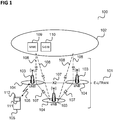
- Figure 1 shows a communication system 100, in this example an LTE (Long Term Evolution) communication system.
- LTE Long Term Evolution
- the communication system 100 includes a network side having a radio access network (e.g. an E-UTRAN, Evolved UMTS (Universal Mobile Communications System) Terrestrial Radio Access Network according to LTE) 101 and a core network (e.g. an EPC, Evolved Packet Core, according LTE) 102.
- the radio access network 101 may include base (transceiver) stations (e.g. eNodeBs, eNBs, according to LTE) 103. Each base station 103 provides radio coverage for one or more mobile radio cells 104 of the radio access network 101.
- a mobile terminal (also referred to as UE, user equipment, or MS, mobile station) 105 located in a mobile radio cell 104 may communicate with the core network 102 and with other mobile terminals 105 via the base station providing coverage in (in other words operating) the mobile radio cell.
- UE user equipment
- MS mobile station
- Control and user data are transmitted between a base station 103 and a mobile terminal 105 located in the mobile radio cell 104 operated by the base station 103 over the air interface 106 on the basis of a multiple access method.
- the base stations 103 are interconnected with each other by means of a first interface 107, e.g. an X2 interface.
- the base stations 103 are also connected by means of a second interface 108, e.g. an S1 interface, to the core network, e.g. to an MME (Mobility Management Entity) 109, and a Serving Gateway (S-GW) 110.
- MME Mobility Management Entity
- S-GW Serving Gateway
- the MME 109 is responsible for controlling the mobility of mobile terminals located in the coverage area of E-UTRAN
- the S-GW 110 is responsible for handling the transmission of user data between mobile terminals 105 and core network 102.
- the mobile terminal 105 For radio communication via the air interface 106, the mobile terminal 105 includes a transceiver 111 (which may operate as a transmitter and a receiver) and one or more antennas 112.
- a transceiver 111 which may operate as a transmitter and a receiver
- the communication system 100 is a communication system according to LTE as an example which includes a network side (i.e. a communication network) having a radio access network 101 operating according to a radio access technology (RAT) according to LTE, i.e. an E-UTRAN, and an LTE core network, i.e. an Evolved Packet Core (EPC).
- RAT radio access technology
- EPC Evolved Packet Core
- communication networks according to various communication technologies e.g. various mobile communication standards, may be used.
- each base station 103 may provide a radio communication connection via the air interface between itself and the mobile terminal 105 and operate radio cells 104 according to LTE, 5G (Fifth Generation), UMTS, GSM (Global System for Mobile Communications), EDGE (Enhanced Data Rates for GSM Evolution) radio access.
- the radio access network 101 may operate as an E-UTRAN, a 5G NR (New Radio) radio access network, a UTRAN, a GSM radio access network, or a GERAN (GSM EDGE Radio Access Network).
- the core network 102 may include the functionality of an EPC, a 5GC (5G core, i.e. 5G core network), a UMTS core network or a GSM core network.
- the base stations 103 are typically referred as BTS (Base Transceiver Station) and are connected to and managed by a BSC (Base Station Controller) which is part of the radio access network 101.
- the core network 102 includes, in case of a communication network operating according to GSM, one or more SGSNs (Serving GPRS (General Packet Radio Service) Support Nodes) and one or more GGSN (Gateway GPRS Support Nodes).
- SGSNs Serving GPRS (General Packet Radio Service) Support Nodes
- GGSN Gateway GPRS Support Nodes
- the mobile terminal 105 may be within the coverage area of more than one mobile communication networks which may operate according to the same RAT or according to different RATs. This is illustrated in figure 2 .
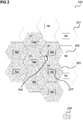
- FIG. 2 shows a radio cell arrangement 200 including radio cells of two communication networks.
- the radio cell arrangement 200 includes a first plurality of radio cells 201 (shown without hatching) operated by a plurality of first base stations 202 of a first communication network (e.g. LTE base stations eNB), and a second plurality of radio cells 203 indicated by a hatching 204 operated by a plurality of second base stations 205 of a second communication network (e.g. of a different RAT, e.g. GSM base stations BTS).
- a first communication network e.g. LTE base stations eNB
- second plurality of radio cells 203 indicated by a hatching 204 operated by a plurality of second base stations 205 of a second communication network
- a different RAT e.g. GSM base stations BTS
- the second plurality of radio cells 203 overlaps the first plurality of radio cells 201 such that a mobile terminal 206, e.g. corresponding to mobile terminal 105, located in the overlapping area may connect to both the first communication network and the second communication network, e.g. may both register with a base station 202 of the first communication network and a base station 205 of the second communication network.
- the mobile terminal 206 may perform a handover or a reselection from one cell of one of the communication networks to another cell of the communication network (i.e. within the same RAT) or to a radio cell of the other communication network (i.e. perform an inter-RAT handover or reselection).
- Mobility mechanisms in both RAT and inter-RAT handovers require finding and measuring the radio cells on different RATs quickly. Smooth execution of such mechanisms typically directly leads to good user experience. Sustained battery life for mobile devices is typically a very important parameter. Running many background tasks (cell searches, power measurements etc.) exhaustively drains the battery power quickly destroying the user experience.
- Measuring a radio cell means that the quality of a radio cell (typically a neighboring cell) is determined by a mobile terminal. For this, the mobile terminal synchronizes with the radio cell and measures its signal quality, i.e. the signal quality of signals emitted by the base station operating the radio cell for operation of the radio cell.
- the signal quality may for example be represented by the signal-to-interference-plus-noise ratio (SINR).
- SINR signal-to-interference-plus-noise ratio
- the mobile terminal may for example perform a measurement of a reference signal of a radio cell (i.e. emitted by a base station operating the radio cell) and determine one or more of the Reference Signal Received Power (RSRP), the Received Signal Strength Indicator (RSSI) and the Reference Signal Received Quality (RSRQ) of the reference signal.
- RSRP Reference Signal Received Power
- RSSI Received Signal Strength Indicator
- RSSQ Reference Signal Received Quality
- a modern wireless device may, as mentioned above for the mobile terminal 206, be able to communicate with multiple RATs.
- the device may receive a NW request to find cells on another RAT. Upon reception of this request, the device has to find the cells on the new RAT, make measurements of some key indicators and report to the NW.
- NW network
- cell search and "cell search procedure” is used to refer to the combined procedure of the measurement, evaluation and detection process of one or more radio cells. This can be seen to be very tightly related to the cell selection or reselection process because the mobile terminal typically goes through the cell search procedure first before it goes through the cell selection.
- the first plurality of radio cells 201 are radio cells of a first communication network operating according to a radio access technology offering relatively high data rates such as 5G, LTE or UMTS
- the second plurality of radio cells 203 are radio cells of a communication network operating according to a radio access technology offering relatively low data rates such as GSM.
- both communication networks may provide radio access for the UE 206 which is sufficient to have a voice call between the UE 206 and, for example, another UE.
- the mobile terminal 206 may require high data rates and possibly the expected functionality or user experience cannot be provided when the devices operates in (i.e. is provided radio access by) a low data rate Radio Access Technology (RAT) such as GSM.
- RAT Radio Access Technology
- radio access i.e. a connection to a communication network
- GSM Global System for Mobile communications
- GSM inter-RAT measurements performed during a data connection typically reduces the available data rate for the data connection, because for performing measurements of GSM radio cells, the transceiver 111 needs to be tuned to the desired GSM frequencies (of the GSM radio cells to be measured) and back again.
- the measurement typically also introduce mobility delays and latency within the currently used high data rate RAT or for a handover from one high data rate RAT to another high data rate RAT.
- a mobile terminal may be constructed to perform GSM inter-RAT measurements in parallel to a high data rate RAT connection (i.e. in gapless fashion), such a mobile terminal typically has higher costs (i.e. a higher bill of materials BOM) than a mobile terminal that requires radio gaps for GSM inter-RAT measurements.
- a mobile terminal 105, 206 ignores, reduces or delays performing GSM (or generally low data rate network) inter-RAT measurements configured by the network side (i.e. of the current network, i.e. the communication network currently serving the mobile terminal, i.e. currently providing radio access for the mobile terminal) when the mobile terminal is configured for data centric behavior only or while no voice centric application is running on the mobile terminal (e.g. while the mobile terminal has no voice call).
- GSM Global System for Mobile communications
- the mobile terminal may resume performing GSM inter-RAT measurements (e.g. when configured by the network side) as soon as a voice centric application is executed on the mobile terminal (e.g. a VoLTE (Voice over LTE) or VoNR (Voice over NR) call gets established or the mobile terminal has lost or is very close to losing its connection to the current network.
- a voice centric application e.g. a VoLTE (Voice over LTE) or VoNR (Voice over NR) call gets established or the mobile terminal has lost or is very close to losing its connection to the current network.
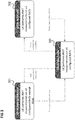
- Figure 3 shows an example of an operation of a mobile terminal.
- FIG 3 which can be seen to depict a state machine with respect to 2G (Second Generation, e.g. GSM) inter-RAT measurements
- three states are differentiated: a first state 301 in which the mobile terminal (e.g. a UE) has a data connection, a second state 302 in which the mobile terminal has voice call and a third state 303 in which the mobile terminal is in idle mode.
- the second state 302 may include the case that the mobile terminal has a voice call as well as a data connection.
- the first state 301 may mean that the mobile terminal does not have a voice call.
- a voice call may be understood as a communication connection for transmission of speech data in real-time, i.e. for a conversation between two users that is taking place via the voice call.
- a data connection may be understood as connection for transmission of useful data other than speech data for a conversation currently taking place, e.g. a file download such as a video download or also a streaming of e.g. a video.
- a data connection may usually be understood as a connection which has higher data rate (i.e. data throughput) requirements than a voice call.
- the mobile terminal transitions from the third state 303 to the first state 301 when it establishes a data connection and back when it releases the (or all) data connection(s).
- the mobile terminal transitions from the third state 303 to the second state 302 when it establishes a voice connection and back when it releases the (or all) voice connection(s).
- the second state 302 may include the case that the mobile terminal has a voice call as well as a data connection
- the mobile terminal transitions from the first state 301 to the second state 302 in case it establishes a voice connection and back to the first state 301 when it releases the (or all) voice connection(s) but keeps a data connection or to the third state 303 when it releases all connections (i.e. becomes idle).
- the mobile terminal performs inter-RAT measurements for all RATs for which it is configured except GSM (or generally 2G RATs).
- GSM or generally 2G RATs
- the mobile terminal performs inter-RAT measurements for all RATs for which it is configured (including GSM).
- the third state 303 the mobile terminal performs inter-RAT measurements for all RATs for which it is configured.
- deactivation of 2G measurements is not limited to connected mode but may also be extended to idle mode, possibly with additional conditions.
- GSM measurements may also be deactivated in the third state 303, e.g. in case the mobile terminal is configured as data-centric device.
- the mobile terminal ignores instructions from the network side to perform 2G inter-RAT measurements.
- the mobile terminal may indicate to the network side that it does not support 2G (e.g. GSM) inter-RAT measurements such that the network will not instruct it to perform measurements.
- 2G e.g. GSM
- 2G inter-RAT measurements can be seen to be performed based on a priority of a the 2G RAT with respect to a high data rate RAT (3G, 4G or 5G RAT such as UMTS, LTE or 5G RAT). If the mobile terminal has a voice call or is configured as voice-centric, the 2G RAT can be seen to be prioritized over the high data rate RAT, meaning that the mobile terminal performs 2G RAT measurements (taking into account the negative impact on the high data rate RAT).
- 3G, 4G or 5G RAT such as UMTS, LTE or 5G RAT
- the high data rate RAT can be seen to be prioritized over the 2G RAT, meaning that the mobile terminal does not perform 2G RAT measurements (and thus avoiding negative impact on the high data rate RATs by the 2G RAT measurements).
- Prioritizing the high data RAT can be seen as prioritizing a connection using a high data rate RAT over the risk of a short loss of radio access.
- the mobile terminal may decide about the prioritization, i.e. whether to prioritize the 2G RAT or the high data rate RAT for example based on at least one of which applications are running on the mobile terminal and a device configuration or device type, possibly without any additional network signaling or specific modem capabilities.
- Deactivating 2G inter-RAT measurements allow a mobile terminal to maintain high data rates in data connections since it can be avoided that a data connection is interrupted by 2G measurements. This allows enhancing mobile terminal performance and end user experience. Further, the mobile terminal may save power since less measurements gaps need to be used for executing IRAT measurements. Measurement gaps saved in this manner can be used for increasing sleep durations of the mobile terminal. Furthermore, using less measurements gaps to execute the 2G measurements allows performing measurements for high data rate RATs (e.g. 3G, 4G or 5G) more frequently, thus allowing the mobile terminal to detect suitable high data rate RAT cells faster which leads to better mobility for the high data rate RATs. Additionally, since measurement gaps do not need to be distributed to 2G, the measurement gap distribution between the RATs to be measured is easier.
- high data rate RATs e.g. 3G, 4G or 5G
- a mobile terminal may be statically configured to perform or avoid performing 2G inter-RAT measurements.
- a mobile terminal may be configured to have a certain device type, e.g. as a device of a type that only supports data centric applications (such as live streaming action camera) and thus avoid performing 2G inter-RAT measurements.
- a user interface of the mobile terminal may allow a user to configure the measurement circuit to perform or avoid performing 2G inter-RAT measurements by a corresponding user setting or user preference.
- Whether a mobile terminal performs or avoids performing 2G inter-RAT measurements may also be controlled (and change) dynamically, e.g. based on the active (foreground) applications running on the mobile terminal or based on judging that the mobile terminal behaves data centric (and thus 2G inter-RAT measurements should be avoided) until a voice connection gets established (e.g. a mobile terminated or mobile originated call).
- the mobile terminal may include a controller which controls the transceiver 111 of the mobile terminal to perform or avoid performing 2G inter-RAT measurements.
- the controller may for example detect whether a voice centric application is running on the mobile terminal, e.g. by the use of a modem audio system of the moble terminal or based on a specific registration function that allows voice centric applications to enforce the mobile terminal to perform GSM inter-RAT measurements when configured by the network.
- the controller uses mobile terminal usage settings, e.g. UE usage settings as defined by 3GPP to decide whether to control the transceiver 111 to perform 2G inter-RAT measurements.
- LTE is used as example for a high data rate RAT but it may also be any other applicable high data rate RAT such as 5G RAT.
- GSM and 2G are only examples and any low data rate RAT may be used.
- a low data rate RAT may in this context be understood as a RAT supporting at most data connections at a low data rate e.g. at a data rate supporting real-time speech data transmission for a voice call.
- the controller considers the UE usage setting stored in a memory of the mobile terminal, i.e. considers UE usage setting information, to decide whether to perform 2G inter-RAT measurements, allowing enhancing the performance and reducing power consumption of data centric devices.
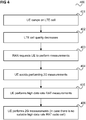
- Figure 4 shows a flow diagram 400 illustrating an example for controlling whether or not to perform 2G inter-RAT measurements.
- a UE is camping on an LTE radio cell, connected to an LTE communication network and performing a data transfer via a data connection.
- the radio cell (reception) quality decreases at the mobile terminal.
- the eNB operating the radio cell requests the UE to provide a measurement report for all neighbor radio cells of the radio cell for all RATs (for which the UE is configured).
- the controller determines that the UE is configured for data centric behavior or only data centric applications are running on the UE and that the UE keeps the connection to the current serving radio cell and that neighbor radio cells have been detected operating according to one or more non-GSM RATs. Therefore, the controller controls the UE's transceiver to not perform any of the requested GSM inter-RAT measurements.
- the UE performs IRAT measurements to measure radio cells operating according to non-GSM RATs (e.g. NR, LTE or 3G).
- non-GSM RATs e.g. NR, LTE or 3G.
- the UE when the UE is about to lose connection to the current serving cell (detected depending on power and/or quality thresholds) and has not found a suitable non-GSM radio cell to provide radio access, the UE prioritizes the configured GSM inter-RAT measurements with respect to the non-GSM measurements to avoid a long interruption of the connection to the network.
- the UE may also at first start performing measurements on all configured RATs (including GSM) and stop performing the GSM measurements based on a decision by the controller, e.g. if the UE has detected non-GSM radio cells (which might be suitable for a handover such that a GSM cell is not necessary).
- the mobile terminal may in 406 resume the GSM inter-RAT measurements if the UE is about to lose radio access (e.g. if no suitable non-GSM radio cell has been found after all).
- a mobile communication terminal as illustrated in figure 5 is provided.
- Figure 5 shows a mobile communication terminal 500.
- the mobile communication terminal 500 includes a transceiver 501 configured to be operable (e.g. configured to support communication) according to a first radio access technology and at least a second radio access technology (e.g. one or more second radio access technologies).
- a transceiver 501 configured to be operable (e.g. configured to support communication) according to a first radio access technology and at least a second radio access technology (e.g. one or more second radio access technologies).
- the mobile communication terminal 500 further includes a measurement circuit 502 configured to perform radio cell measurements for the first radio access technology depending on a priority of the first radio access technology with respect to the second radio access technology.
- a mobile (communication) terminal performs measurements for a first radio access technology depending whether it is prioritized over one or more second radio access technologies or whether the one or more second radio access technologies are prioritized over the first radio access technology. This means that the mobile terminal may avoid measurements for a certain RAT under certain conditions, e.g. based on whether the mobile terminal has an established voice call for which the RAT may be needed.
- the mobile terminal only performs measurements for the first radio access technology if it is prioritized over the one or more second radio access technologies while it deactivates performing measurements for the first radio access technology if the one or more second radio access technologies are prioritized over the first radio access technology.
- the mobile terminal may for example ignore instructions to perform the measurements which it has received from a communication network (e.g. its current serving network).
- a communication network e.g. its current serving network
- the mobile (communication) terminal is configured for data centric use or only data centric applications are running on the mobile terminal, keeping a connection to a high data rate RAT is prioritized over ensuring radio access (e.g. a connection to the network side at all).
- Inter-RAT measurements on a lower data rate RAT e.g. GSM
- GSM lower data rate RAT
- the mobile terminal may perform measurements on GSM (or other low data rate RATs) as configured by the network.
- the first radio access technology e.g. a 2G RAT
- the UE may thus for example only perform 2G measurements if it has not detected any NR, LTE or 3G radio cells.
- the measurement circuit may be part of the transceiver.
- the communication terminal may include a controller configured to control the operation of the measurement circuit.
- the transceiver may for example be (or be part of) a communication subsystem including a baseband processor and an RF (Radio Frequency) transceiver. It may for example correspond to the RF transceiver of the communication subsystem.
- the mobile communication terminal may have a determiner configured to determine whether the second radio access technology should be prioritized over the first radio access technology.
- the measurement circuit may be configured to perform radio cell measurements for the first radio access technology depending on whether the second radio access technology should be prioritized over the first radio access technology. For example, the measurement circuit is configured to avoid radio cell measurements for the first radio access technology if the second radio access technology should be prioritized over the first radio access technology.
- the mobile communication terminal 500 for example carries out a method as illustrated in figure 6 .
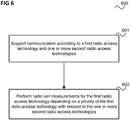
- Figure 6 shows a method for performing radio cell measurements, for example performed by a mobile communication terminal.
- the mobile communication terminal is operable (e.g. supports communication) according to a first radio access technology and at least a second radio access technology.
- This may for example include configuring the communication terminal, e.g. a transceiver of the communication terminal, to be operable according to a first radio access technology and at least a second radio access technology (e.g. one or more second radio access technologies).
- the mobile communication terminal performs radio cell measurements for the first radio access technology depending on a priority of the first radio access technology with respect to the at least a second radio access technology.
- the components of the mobile communication terminal may for example be implemented by one or more processors.
- a "processor” may be understood as any kind of a logic implementing entity, which may be special purpose circuitry or a processor executing software stored in a memory, firmware, or any combination thereof.
- a "processor” may be a hard-wired logic processor or a programmable logic processor such as a programmable processor, e.g. a microprocessor.
- a “processor” may also be a processor executing software, e.g. any kind of computer program. Any other kind of implementation of the respective functions which will be described in more detail below may also be understood as a "processor".
- the mobile communication terminal may for example be at least partially implemented by a transceiver which may for example be at least partially implemented by one or more modems (e.g. GSM, UMTS, LTE or 5G modems), a baseband processor or other transceiver components or also by an application processor.
- the mobile communication terminal may include typical communication terminal devices such as a transceiver (including e.g. a baseband processor, one or more filters, transmit chains, receive chains, amplifiers etc.), an antenna, a subscriber identity module, an application processor, a memory etc.
- Example 1 is a mobile communication terminal as illustrated in figure 5 .
- Example 2 the subject-matter of example 1 may optionally include a controller configured to decide whether to set the priority of the first radio access technology with respect to the at least a second radio access technology.
- Example 3 the subject-matter of any one of examples 1-2 may optionally include a or the controller being configured to either prioritize the first radio access technology over the at least a second radio access technology or the at least a second radio access technology over the first radio access technology by setting the priority of the first radio access technology with respect to the at least a second radio access technology or not.
- Example 4 the subject-matter of any one of examples 1-3 may optionally include the measurement circuit being configured to perform radio cell measurements for the first radio access technology if the first radio access technology is prioritized over the at least a second radio access technology.
- Example 5 the subject-matter of any one of examples 1-4 may optionally include the first radio access technology supporting voice calls and a or the controller being configured to prioritize the first radio access technology with respect to the at least a second radio access technology if the mobile communication terminal has a voice call over the first radio access technology.
- Example 6 the subject-matter of any one of examples 1-5 may optionally include the first radio access technology supporting voice calls and the measurement circuit being configured to perform radio cell measurements for the first radio access technology if the mobile communication terminal has a voice call over the first radio access technology.
- Example 7 the subject-matter of any one of examples 1-6 may optionally include the first radio access technology supporting voice calls and a or the controller being configured to prioritize the at least a second radio access technology with respect to the first radio access technology if the mobile communication terminal has no voice call over the first radio access technology.
- Example 8 the subject-matter of any one of examples 1-7 may optionally include the first radio access technology supporting voice calls and the measurement circuit being configured to avoid performing radio cell measurements for the first radio access technology if the mobile communication terminal has no voice call over the first radio access technology.
- Example 9 the subject-matter of any one of examples 1-8 may optionally include the first radio access technology supporting voice calls and a or the controller being configured to prioritize the at least a second radio access technology with respect to the first radio access technology if the mobile communication terminal has no voice call over the first radio access technology and has a data connection over one of the at least a second radio access technology.
- Example 10 the subject-matter of any one of examples 1-9 may optionally include the first radio access technology supporting voice calls and the measurement circuit being configured to avoid performing radio cell measurements for the first radio access technology if the mobile communication terminal has no voice call over the first radio access technology and has a data connection over one of the at least a second radio access technology.
- Example 11 the subject-matter of any one of examples 1-10 may optionally include the at least a second radio access technology supporting data connections and a or the controller being configured to prioritize the at least a second radio access technology with respect to the first radio access technology if the mobile communication terminal has a data connection over one of the at least a second radio access technology.
- Example 12 the subject-matter of any one of examples 1-11 may optionally include the at least a second radio access technology supporting a data connection and the measurement circuit being configured to avoid radio cell measurements for the first radio access technology if the mobile communication terminal has a data connection over one of the at least a second radio access technology.
- Example 13 the subject-matter of any one of examples 1-12 may optionally include a or the controller being configured to prioritize the first radio access technology over the at least a second radio access technology based on a user setting of the mobile communication terminal.
- Example 14 the subject-matter of any one of examples 1-13 may optionally include a or the controller being configured to prioritize the first radio access technology over the at least a second radio access technology based on a device type of the mobile communication terminal.
- Example 15 the subject-matter of any one of examples 1-14 may optionally include a or the controller being configured to prioritize the first radio access technology with respect to the at least a second radio access technology if the mobile communication terminal has no coverage by means of the at least a second radio access technology.
- Example 16 the subject-matter of any one of examples 1-15 may optionally include the at least a second radio access technology supporting a higher data rate than the first radio access technology.
- Example 17 the subject-matter of any one of examples 1-16 may optionally include the first radio access technology being of a second generation mobile communication technology and the at least a second radio access technology being of a third or higher generation mobile communication technology.
- Example 18 the subject-matter of any one of examples 1-17 may optionally include the first radio access technology being a Global System for Mobile Communications radio access technology and the at least a second radio technology being one or more of a Long Term Evolution radio access technology, a 5G New Radio radio access technology and a Universal Mobile Communications System radio access technology.
- the first radio access technology being a Global System for Mobile Communications radio access technology
- the at least a second radio technology being one or more of a Long Term Evolution radio access technology, a 5G New Radio radio access technology and a Universal Mobile Communications System radio access technology.
- Example 19 the subject-matter of any one of examples 1-18 may optionally include the measurement circuit being configured to avoid performing radio cell measurements for the first radio access technology by ignoring instructions from a communication network to perform measurements for the first radio access technology.
- Example 20 the subject-matter of any one of examples 1-19 may optionally include the measurement circuit being configured to avoid performing radio cell measurements for the first radio access technology by indicating to a communication network that the mobile communication terminal does not support the first radio access technology.
- Example 21 the subject-matter of any one of examples 1-20 may optionally include the measurement circuit being configured to delay radio cell measurements for the first radio access technology depending on a priority of the first radio access technology with respect to the at least a second radio access technology.
- Example 22 is a method for performing radio cell measurements as illustrated in figure 6 .
- Example 23 the subject-matter of example 22 may optionally include deciding whether to set the priority of the first radio access technology with respect to the at least a second radio access technology.
- Example 24 the subject-matter of example 22 or 23 may optionally include either prioritizing the first radio access technology over the at least a second radio access technology or the at least a second radio access technology over the first radio access technology by setting the priority of the first radio access technology with respect to the at least a second radio access technology or not.
- Example 25 the subject-matter of any one of examples 22-24 may optionally include performing radio cell measurements for the first radio access technology if the first radio access technology is prioritized over the at least a second radio access technology.
- Example 26 the subject-matter of any one of examples 22-25 may optionally include the first radio access technology supporting voice calls and the method including prioritizing the first radio access technology with respect to the at least a second radio access technology if a voice call over the first radio access technology is established.
- Example 27 the subject-matter of any one of examples 22-26 may optionally include the first radio access technology supporting voice calls and the method including performing radio cell measurements for the first radio access technology if a voice call over the first radio access technology has been established.
- Example 28 the subject-matter of any one of examples 22-27 may optionally include the first radio access technology supporting voice calls and the method including prioritizing the at least a second radio access technology with respect to the first radio access technology if no voice call over the first radio access technology has been established.
- Example 29 the subject-matter of any one of examples 22-28 may optionally include the first radio access technology supporting voice calls and the method including avoiding performing radio cell measurements for the first radio access technology if no voice call over the first radio access technology has been established.
- Example 30 the subject-matter of any one of examples 22-29 may optionally include the first radio access technology supporting voice calls and the method including prioritizing the at least a second radio access technology with respect to the first radio access technology if no voice call over the first radio access technology has been established and a data connection over one of the at least a second radio access technology has been established.
- Example 31 the subject-matter of any one of examples 22-30 may optionally include the first radio access technology supporting voice calls and the method including avoiding performing radio cell measurements for the first radio access technology if no voice call over the first radio access technology has been established and a data connection over one of the at least a second radio access technology has been established.
- Example 32 the subject-matter of any one of examples 22-31 may optionally include the at least a second radio access technology supporting data connections and the method including prioritizing the at least a second radio access technology with respect to the first radio access technology if a data connection over one of the at least a second radio access technology has been established.
- Example 33 the subject-matter of any one of examples 22-32 may optionally include the at least a second radio access technology supporting a data connection and the method including avoiding radio cell measurements for the first radio access technology if a data connection over one of the at least a second radio access technology has been established.
- Example 34 the subject-matter of any one of examples 22-33 may optionally include prioritizing the first radio access technology over the at least a second radio access technology based on a user setting.
- Example 35 the subject-matter of any one of examples 22-34 may optionally include prioritizing the first radio access technology over the at least a second radio access technology based on a device type of a mobile communication terminal performing the radio cell measurements.
- Example 36 the subject-matter of any one of examples 22-35 may optionally include prioritizing the first radio access technology with respect to the at least a second radio access technology if there is no coverage by means of the at least a second radio access technology.
- Example 37 the subject-matter of any one of examples 22-36 may optionally include the at least a second radio access technology supporting a higher data rate than the first radio access technology.
- Example 38 the subject-matter of any one of examples 22-37 may optionally include the first radio access technology being of a second generation mobile communication technology and the at least a second radio access technology being of a third or higher generation mobile communication technology.
- Example 39 the subject-matter of any one of examples 22-38 may optionally include the first radio access technology being a Global System for Mobile Communications radio access technology and the at least a second radio technology being one or more of a Long Term Evolution radio access technology, a 5G New Radio radio access technology and a Universal Mobile Communications System radio access technology.
- the first radio access technology being a Global System for Mobile Communications radio access technology
- the at least a second radio technology being one or more of a Long Term Evolution radio access technology, a 5G New Radio radio access technology and a Universal Mobile Communications System radio access technology.
- Example 40 the subject-matter of any one of examples 22-39 may optionally include avoiding performing radio cell measurements for the first radio access technology by ignoring instructions from a communication network to perform measurements for the first radio access technology.
- Example 41 the subject-matter of any one of examples 22-40 may optionally include avoiding performing radio cell measurements for the first radio access technology by indicating to a communication network that the first radio access technology is not supported.
- Example 42 the subject-matter of any one of examples 22-41 may optionally include delaying radio cell measurements for the first radio access technology depending on a priority of the first radio access technology with respect to the at least a second radio access technology.
- a mobile communication terminal including a determiner configured to determine whether the mobile communication terminal has a data connection, via a first radio access technology, which has a throughput requirement which cannot be fulfilled with a second radio access technology and a measuring circuit configured to avoid performing radio cell measurements of radio cells operated according to the second radio access technology if the mobile communication terminal has a data connection via the first radio access technology which has a throughput requirement which cannot be fulfilled with a second radio access technology.
- a measuring circuit performs signal measurements of a radio access technology depending on whether the communication terminal has a connection having requirements which cannot be fulfilled by means of the radio access technology.
- a mobile communication terminal including a transceiver configured to be operable according to a plurality of radio access technologies and a determiner configured to determine whether to perform radio cell measurements for one of the radio access technologies depending on whether the communication terminal is configured to be used for voice connections or data connections.
Landscapes
- Engineering & Computer Science (AREA)
- Computer Networks & Wireless Communication (AREA)
- Signal Processing (AREA)
- Computer Security & Cryptography (AREA)
- Mobile Radio Communication Systems (AREA)
Abstract
Description
- Exemplary implementations described herein generally relate to mobile communication terminals and methods for performing radio cell measurements.
- A typical feature of a mobile communication terminal is its capability to move while keeping a connection to a communication network. This is achieved by performing a handover of the mobile communications terminal between radio cells. Since the coverage areas of different radio access technologies typically differ, for example currently LTE (Long Term Evolution) coverage is limited in comparison to GSM (Global System for Mobile Communications) coverage, a mobile communication terminal may search radio cells operated according to different RATs to find suitable candidates for a handover. For the cell search, the mobile communication terminal performs radio cell measurements. However, performing radio cell measurements according to multiple RATs and multiple radio cells may have negative impact on the current communication performance as well as on the power consumption of the mobile communication terminal. Accordingly, efficient approaches for performing radio cell measurements are desirable.
- In the drawings, like reference characters generally refer to the same parts throughout the different views. The drawings are not necessarily to scale, emphasis instead generally being placed upon illustrating the principles of the invention. In the following description, various aspects are described with reference to the following drawings, in which:
-
Figure 1 shows an exemplary cellular mobile radio communication system. -
Figure 2 shows an exemplary radio cell arrangement including radio cells of two communication networks. -
Figure 3 shows an example of an operation of a mobile terminal with respect to radio cell measurement. -
Figure 4 shows a flow diagram illustrating an example for controlling whether or not to perform 2G (Second Generation) inter-RAT measurements. -
Figure 5 shows an exemplary mobile communication terminal. -
Figure 6 shows an exemplary method for performing radio cell measurements, for example performed by a mobile communication terminal. - The following detailed description refers to the accompanying drawings that show, by way of illustration, specific details and aspects of this disclosure in which the invention may be practiced. Other aspects may be utilized and structural, logical, and electrical changes may be made without departing from the scope of the invention. The various aspects of this disclosure are not necessarily mutually exclusive, as some aspects of this disclosure can be combined with one or more other aspects of this disclosure to form new aspects.
-
Figure 1 shows acommunication system 100, in this example an LTE (Long Term Evolution) communication system. - The
communication system 100 includes a network side having a radio access network (e.g. an E-UTRAN, Evolved UMTS (Universal Mobile Communications System) Terrestrial Radio Access Network according to LTE) 101 and a core network (e.g. an EPC, Evolved Packet Core, according LTE) 102. Theradio access network 101 may include base (transceiver) stations (e.g. eNodeBs, eNBs, according to LTE) 103. Eachbase station 103 provides radio coverage for one or moremobile radio cells 104 of theradio access network 101. - A mobile terminal (also referred to as UE, user equipment, or MS, mobile station) 105 located in a
mobile radio cell 104 may communicate with thecore network 102 and with othermobile terminals 105 via the base station providing coverage in (in other words operating) the mobile radio cell. - Control and user data are transmitted between a
base station 103 and amobile terminal 105 located in themobile radio cell 104 operated by thebase station 103 over theair interface 106 on the basis of a multiple access method. - The
base stations 103 are interconnected with each other by means of afirst interface 107, e.g. an X2 interface. Thebase stations 103 are also connected by means of asecond interface 108, e.g. an S1 interface, to the core network, e.g. to an MME (Mobility Management Entity) 109, and a Serving Gateway (S-GW) 110. For example, the MME 109 is responsible for controlling the mobility of mobile terminals located in the coverage area of E-UTRAN, while the S-GW 110 is responsible for handling the transmission of user data betweenmobile terminals 105 andcore network 102. - For radio communication via the
air interface 106, themobile terminal 105 includes a transceiver 111 (which may operate as a transmitter and a receiver) and one ormore antennas 112. - In the example of
figure 1 , thecommunication system 100 is a communication system according to LTE as an example which includes a network side (i.e. a communication network) having aradio access network 101 operating according to a radio access technology (RAT) according to LTE, i.e. an E-UTRAN, and an LTE core network, i.e. an Evolved Packet Core (EPC). However, according to various embodiments, communication networks according to various communication technologies, e.g. various mobile communication standards, may be used. For example, eachbase station 103 may provide a radio communication connection via the air interface between itself and themobile terminal 105 and operateradio cells 104 according to LTE, 5G (Fifth Generation), UMTS, GSM (Global System for Mobile Communications), EDGE (Enhanced Data Rates for GSM Evolution) radio access. Accordingly, theradio access network 101 may operate as an E-UTRAN, a 5G NR (New Radio) radio access network, a UTRAN, a GSM radio access network, or a GERAN (GSM EDGE Radio Access Network). Analogously, thecore network 102 may include the functionality of an EPC, a 5GC (5G core, i.e. 5G core network), a UMTS core network or a GSM core network. - In case of a communication network operating according to GSM, the
base stations 103 are typically referred as BTS (Base Transceiver Station) and are connected to and managed by a BSC (Base Station Controller) which is part of theradio access network 101. Thecore network 102 includes, in case of a communication network operating according to GSM, one or more SGSNs (Serving GPRS (General Packet Radio Service) Support Nodes) and one or more GGSN (Gateway GPRS Support Nodes). - The
mobile terminal 105 may be within the coverage area of more than one mobile communication networks which may operate according to the same RAT or according to different RATs. This is illustrated infigure 2 . -
Figure 2 shows aradio cell arrangement 200 including radio cells of two communication networks. - The
radio cell arrangement 200 includes a first plurality of radio cells 201 (shown without hatching) operated by a plurality offirst base stations 202 of a first communication network (e.g. LTE base stations eNB), and a second plurality ofradio cells 203 indicated by ahatching 204 operated by a plurality ofsecond base stations 205 of a second communication network (e.g. of a different RAT, e.g. GSM base stations BTS). - As illustrated, the second plurality of
radio cells 203 overlaps the first plurality ofradio cells 201 such that amobile terminal 206, e.g. corresponding tomobile terminal 105, located in the overlapping area may connect to both the first communication network and the second communication network, e.g. may both register with abase station 202 of the first communication network and abase station 205 of the second communication network. In particular, themobile terminal 206 may perform a handover or a reselection from one cell of one of the communication networks to another cell of the communication network (i.e. within the same RAT) or to a radio cell of the other communication network (i.e. perform an inter-RAT handover or reselection). - Mobility mechanisms in both RAT and inter-RAT handovers require finding and measuring the radio cells on different RATs quickly. Smooth execution of such mechanisms typically directly leads to good user experience. Sustained battery life for mobile devices is typically a very important parameter. Running many background tasks (cell searches, power measurements etc.) exhaustively drains the battery power quickly destroying the user experience.
- Measuring a radio cell means that the quality of a radio cell (typically a neighboring cell) is determined by a mobile terminal. For this, the mobile terminal synchronizes with the radio cell and measures its signal quality, i.e. the signal quality of signals emitted by the base station operating the radio cell for operation of the radio cell. The signal quality may for example be represented by the signal-to-interference-plus-noise ratio (SINR). The mobile terminal may for example perform a measurement of a reference signal of a radio cell (i.e. emitted by a base station operating the radio cell) and determine one or more of the Reference Signal Received Power (RSRP), the Received Signal Strength Indicator (RSSI) and the Reference Signal Received Quality (RSRQ) of the reference signal.
- A modern wireless device may, as mentioned above for the
mobile terminal 206, be able to communicate with multiple RATs. In many scenarios, when a device is moving to the border of the coverage region of a specific RAT or due to some network (NW) decisions (i.e. radio access network 101) as a result of load balancing and access control, the device may receive a NW request to find cells on another RAT. Upon reception of this request, the device has to find the cells on the new RAT, make measurements of some key indicators and report to the NW. - The term "cell search" and "cell search procedure" is used to refer to the combined procedure of the measurement, evaluation and detection process of one or more radio cells. This can be seen to be very tightly related to the cell selection or reselection process because the mobile terminal typically goes through the cell search procedure first before it goes through the cell selection.
- In the following, it is assumed that the first plurality of
radio cells 201 are radio cells of a first communication network operating according to a radio access technology offering relatively high data rates such as 5G, LTE or UMTS, while the second plurality ofradio cells 203 are radio cells of a communication network operating according to a radio access technology offering relatively low data rates such as GSM. - When the
mobile terminal 206 has a voice call and leaves the coverage area of aradio cell 201, a handover may be performed to both aradio cell 201 of the first communication network as well as to aradio cell 203 of the second communication network because both communication networks can support voice calls. This means that both communication networks may provide radio access for the UE 206 which is sufficient to have a voice call between the UE 206 and, for example, another UE. - However, in case the
mobile terminal 206 is a data centric device or a device running a data centric application, it may require high data rates and possibly the expected functionality or user experience cannot be provided when the devices operates in (i.e. is provided radio access by) a low data rate Radio Access Technology (RAT) such as GSM. - Hence for a data centric device or application, it is typically more important to keep providing the
mobile terminal 206 with radio access (i.e. a connection to a communication network) at a high data rate RAT than to avoid a short loss of radio access because a handover to GSM may impact the mobile terminal's functionality (e.g. a data-centric application run by the mobile terminal) as much as a loss of connection (i.e. a loss of radio access). - In addition, GSM inter-RAT measurements performed during a data connection (e.g. for a data transfer) which uses a high data rate RAT (e.g. 5G, LTE or UMTS) typically reduces the available data rate for the data connection, because for performing measurements of GSM radio cells, the transceiver 111 needs to be tuned to the desired GSM frequencies (of the GSM radio cells to be measured) and back again. The measurement typically also introduce mobility delays and latency within the currently used high data rate RAT or for a handover from one high data rate RAT to another high data rate RAT. While a mobile terminal may be constructed to perform GSM inter-RAT measurements in parallel to a high data rate RAT connection (i.e. in gapless fashion), such a mobile terminal typically has higher costs (i.e. a higher bill of materials BOM) than a mobile terminal that requires radio gaps for GSM inter-RAT measurements.
- On the other hand, many communication networks operating according to high data rate RATs do not provide sufficient coverage to ensure sufficient mobility for voice centric device or applications. For example, mobility may be restricted when a user moves with his mobile terminal into or within buildings or from hotspots into rural areas if using only high data rate RATs. Accordingly, mobility from high data rate RATs to 2G networks such as GSM is important to provide expected user experience for voice centric devices or applications.
- In view of the above, according to various examples, a
mobile terminal - The mobile terminal may resume performing GSM inter-RAT measurements (e.g. when configured by the network side) as soon as a voice centric application is executed on the mobile terminal (e.g. a VoLTE (Voice over LTE) or VoNR (Voice over NR) call gets established or the mobile terminal has lost or is very close to losing its connection to the current network.
-
Figure 3 shows an example of an operation of a mobile terminal. - In
figure 3 , which can be seen to depict a state machine with respect to 2G (Second Generation, e.g. GSM) inter-RAT measurements, three states are differentiated: afirst state 301 in which the mobile terminal (e.g. a UE) has a data connection, asecond state 302 in which the mobile terminal has voice call and athird state 303 in which the mobile terminal is in idle mode. It should be noted that thesecond state 302 may include the case that the mobile terminal has a voice call as well as a data connection. Accordingly, thefirst state 301 may mean that the mobile terminal does not have a voice call. - A voice call may be understood as a communication connection for transmission of speech data in real-time, i.e. for a conversation between two users that is taking place via the voice call. A data connection may be understood as connection for transmission of useful data other than speech data for a conversation currently taking place, e.g. a file download such as a video download or also a streaming of e.g. a video. In the following examples, a data connection may usually be understood as a connection which has higher data rate (i.e. data throughput) requirements than a voice call.
- The mobile terminal transitions from the
third state 303 to thefirst state 301 when it establishes a data connection and back when it releases the (or all) data connection(s). The mobile terminal transitions from thethird state 303 to thesecond state 302 when it establishes a voice connection and back when it releases the (or all) voice connection(s). In case that thesecond state 302 may include the case that the mobile terminal has a voice call as well as a data connection, the mobile terminal transitions from thefirst state 301 to thesecond state 302 in case it establishes a voice connection and back to thefirst state 301 when it releases the (or all) voice connection(s) but keeps a data connection or to thethird state 303 when it releases all connections (i.e. becomes idle). - In the example of
figure 3 , in thefirst state 301, the mobile terminal performs inter-RAT measurements for all RATs for which it is configured except GSM (or generally 2G RATs). In thesecond state 302, the mobile terminal performs inter-RAT measurements for all RATs for which it is configured (including GSM). In thethird state 303 the mobile terminal performs inter-RAT measurements for all RATs for which it is configured. - It should be noted that the deactivation of 2G measurements (as in the first state 302) is not limited to connected mode but may also be extended to idle mode, possibly with additional conditions. For example, GSM measurements may also be deactivated in the
third state 303, e.g. in case the mobile terminal is configured as data-centric device. - According to various examples, to deactivate (and thus avoid) the 2G inter-RAT measurements (e.g. in the
first state 301 and possibly also in the third state 303), the mobile terminal ignores instructions from the network side to perform 2G inter-RAT measurements. Alternatively, to deactivate 2G inter-RAT measurements, e.g. in case that it is configured for data centric applications or while it only uses data centric applications, the mobile terminal may indicate to the network side that it does not support 2G (e.g. GSM) inter-RAT measurements such that the network will not instruct it to perform measurements. - 2G inter-RAT measurements can be seen to be performed based on a priority of a the 2G RAT with respect to a high data rate RAT (3G, 4G or 5G RAT such as UMTS, LTE or 5G RAT). If the mobile terminal has a voice call or is configured as voice-centric, the 2G RAT can be seen to be prioritized over the high data rate RAT, meaning that the mobile terminal performs 2G RAT measurements (taking into account the negative impact on the high data rate RAT). If the mobile terminal has no voice call and a data connection or is configured as data-centric, the high data rate RAT can be seen to be prioritized over the 2G RAT, meaning that the mobile terminal does not perform 2G RAT measurements (and thus avoiding negative impact on the high data rate RATs by the 2G RAT measurements). Prioritizing the high data RAT can be seen as prioritizing a connection using a high data rate RAT over the risk of a short loss of radio access.
- The mobile terminal may decide about the prioritization, i.e. whether to prioritize the 2G RAT or the high data rate RAT for example based on at least one of which applications are running on the mobile terminal and a device configuration or device type, possibly without any additional network signaling or specific modem capabilities.
- Deactivating 2G inter-RAT measurements, e.g. as described above, allow a mobile terminal to maintain high data rates in data connections since it can be avoided that a data connection is interrupted by 2G measurements. This allows enhancing mobile terminal performance and end user experience. Further, the mobile terminal may save power since less measurements gaps need to be used for executing IRAT measurements. Measurement gaps saved in this manner can be used for increasing sleep durations of the mobile terminal. Furthermore, using less measurements gaps to execute the 2G measurements allows performing measurements for high data rate RATs (e.g. 3G, 4G or 5G) more frequently, thus allowing the mobile terminal to detect suitable high data rate RAT cells faster which leads to better mobility for the high data rate RATs. Additionally, since measurement gaps do not need to be distributed to 2G, the measurement gap distribution between the RATs to be measured is easier.
- A mobile terminal may be statically configured to perform or avoid performing 2G inter-RAT measurements. For example, at its production, a mobile terminal may be configured to have a certain device type, e.g. as a device of a type that only supports data centric applications (such as live streaming action camera) and thus avoid performing 2G inter-RAT measurements. Also, a user interface of the mobile terminal may allow a user to configure the measurement circuit to perform or avoid performing 2G inter-RAT measurements by a corresponding user setting or user preference.
- Whether a mobile terminal performs or avoids performing 2G inter-RAT measurements may also be controlled (and change) dynamically, e.g. based on the active (foreground) applications running on the mobile terminal or based on judging that the mobile terminal behaves data centric (and thus 2G inter-RAT measurements should be avoided) until a voice connection gets established (e.g. a mobile terminated or mobile originated call).
- The mobile terminal may include a controller which controls the transceiver 111 of the mobile terminal to perform or avoid performing 2G inter-RAT measurements. The controller may for example detect whether a voice centric application is running on the mobile terminal, e.g. by the use of a modem audio system of the moble terminal or based on a specific registration function that allows voice centric applications to enforce the mobile terminal to perform GSM inter-RAT measurements when configured by the network.
- According to various examples, the controller uses mobile terminal usage settings, e.g. UE usage settings as defined by 3GPP to decide whether to control the transceiver 111 to perform 2G inter-RAT measurements. In the following example, LTE is used as example for a high data rate RAT but it may also be any other applicable high data rate RAT such as 5G RAT. Similarly, GSM and 2G are only examples and any low data rate RAT may be used. A low data rate RAT may in this context be understood as a RAT supporting at most data connections at a low data rate e.g. at a data rate supporting real-time speech data transmission for a voice call.
- The controller considers the UE usage setting stored in a memory of the mobile terminal, i.e. considers UE usage setting information, to decide whether to perform 2G inter-RAT measurements, allowing enhancing the performance and reducing power consumption of data centric devices.
-
Figure 4 shows a flow diagram 400 illustrating an example for controlling whether or not to perform 2G inter-RAT measurements. - In 401, a UE is camping on an LTE radio cell, connected to an LTE communication network and performing a data transfer via a data connection.
- In 402, the radio cell (reception) quality decreases at the mobile terminal.
- In 403, the eNB operating the radio cell requests the UE to provide a measurement report for all neighbor radio cells of the radio cell for all RATs (for which the UE is configured).
- In 404, the controller determines that the UE is configured for data centric behavior or only data centric applications are running on the UE and that the UE keeps the connection to the current serving radio cell and that neighbor radio cells have been detected operating according to one or more non-GSM RATs. Therefore, the controller controls the UE's transceiver to not perform any of the requested GSM inter-RAT measurements.
- In 405, the UE performs IRAT measurements to measure radio cells operating according to non-GSM RATs (e.g. NR, LTE or 3G).
- In 406, when the UE is about to lose connection to the current serving cell (detected depending on power and/or quality thresholds) and has not found a suitable non-GSM radio cell to provide radio access, the UE prioritizes the configured GSM inter-RAT measurements with respect to the non-GSM measurements to avoid a long interruption of the connection to the network.
- It should be noted that following 403, the UE may also at first start performing measurements on all configured RATs (including GSM) and stop performing the GSM measurements based on a decision by the controller, e.g. if the UE has detected non-GSM radio cells (which might be suitable for a handover such that a GSM cell is not necessary). The mobile terminal may in 406 resume the GSM inter-RAT measurements if the UE is about to lose radio access (e.g. if no suitable non-GSM radio cell has been found after all).
- In summary, according to various examples, a mobile communication terminal as illustrated in
figure 5 is provided. -
Figure 5 shows amobile communication terminal 500. - The
mobile communication terminal 500 includes atransceiver 501 configured to be operable (e.g. configured to support communication) according to a first radio access technology and at least a second radio access technology (e.g. one or more second radio access technologies). - The
mobile communication terminal 500 further includes ameasurement circuit 502 configured to perform radio cell measurements for the first radio access technology depending on a priority of the first radio access technology with respect to the second radio access technology. - According to various examples, in other words, a mobile (communication) terminal performs measurements for a first radio access technology depending whether it is prioritized over one or more second radio access technologies or whether the one or more second radio access technologies are prioritized over the first radio access technology. This means that the mobile terminal may avoid measurements for a certain RAT under certain conditions, e.g. based on whether the mobile terminal has an established voice call for which the RAT may be needed.
- For example, the mobile terminal only performs measurements for the first radio access technology if it is prioritized over the one or more second radio access technologies while it deactivates performing measurements for the first radio access technology if the one or more second radio access technologies are prioritized over the first radio access technology.
- For deactivating performing measurements, the mobile terminal may for example ignore instructions to perform the measurements which it has received from a communication network (e.g. its current serving network).
- For example, while the mobile (communication) terminal is configured for data centric use or only data centric applications are running on the mobile terminal, keeping a connection to a high data rate RAT is prioritized over ensuring radio access (e.g. a connection to the network side at all). Inter-RAT measurements on a lower data rate RAT (e.g. GSM) are for example not performed as long as a connection to a high data rate RAT can be achieved. When a voice centric application is running on the mobile terminal, the mobile terminal may perform measurements on GSM (or other low data rate RATs) as configured by the network.
- The first radio access technology, e.g. a 2G RAT, may for example be prioritized over the second radio access technologies (e.g. NR, LTE and 3G RATs) if (and for example only if) the mobile communication terminal has not found any suitable radio cells operating according to the second RATs for providing continued radio access and risks to lose radio access. The UE may thus for example only perform 2G measurements if it has not detected any NR, LTE or 3G radio cells.
- It should be noted that the measurement circuit may be part of the transceiver. Further, the communication terminal may include a controller configured to control the operation of the measurement circuit. The transceiver may for example be (or be part of) a communication subsystem including a baseband processor and an RF (Radio Frequency) transceiver. It may for example correspond to the RF transceiver of the communication subsystem.
- The mobile communication terminal may have a determiner configured to determine whether the second radio access technology should be prioritized over the first radio access technology. The measurement circuit may be configured to perform radio cell measurements for the first radio access technology depending on whether the second radio access technology should be prioritized over the first radio access technology. For example, the measurement circuit is configured to avoid radio cell measurements for the first radio access technology if the second radio access technology should be prioritized over the first radio access technology.
- The
mobile communication terminal 500 for example carries out a method as illustrated infigure 6 . -
Figure 6 shows a method for performing radio cell measurements, for example performed by a mobile communication terminal. - In 601, the mobile communication terminal is operable (e.g. supports communication) according to a first radio access technology and at least a second radio access technology. This may for example include configuring the communication terminal, e.g. a transceiver of the communication terminal, to be operable according to a first radio access technology and at least a second radio access technology (e.g. one or more second radio access technologies).
- In 602, the mobile communication terminal performs radio cell measurements for the first radio access technology depending on a priority of the first radio access technology with respect to the at least a second radio access technology.
- The components of the mobile communication terminal (e.g. the transceiver and the measurement circuit or also a possible controller or determiner) may for example be implemented by one or more processors. A "processor" may be understood as any kind of a logic implementing entity, which may be special purpose circuitry or a processor executing software stored in a memory, firmware, or any combination thereof. Thus a "processor" may be a hard-wired logic processor or a programmable logic processor such as a programmable processor, e.g. a microprocessor. A "processor" may also be a processor executing software, e.g. any kind of computer program. Any other kind of implementation of the respective functions which will be described in more detail below may also be understood as a "processor". The mobile communication terminal may for example be at least partially implemented by a transceiver which may for example be at least partially implemented by one or more modems (e.g. GSM, UMTS, LTE or 5G modems), a baseband processor or other transceiver components or also by an application processor. The mobile communication terminal may include typical communication terminal devices such as a transceiver (including e.g. a baseband processor, one or more filters, transmit chains, receive chains, amplifiers etc.), an antenna, a subscriber identity module, an application processor, a memory etc.
- The following examples pertain to further exemplary implementations.
- Example 1 is a mobile communication terminal as illustrated in
figure 5 . - In Example 2, the subject-matter of example 1 may optionally include a controller configured to decide whether to set the priority of the first radio access technology with respect to the at least a second radio access technology.
- In Example 3, the subject-matter of any one of examples 1-2 may optionally include a or the controller being configured to either prioritize the first radio access technology over the at least a second radio access technology or the at least a second radio access technology over the first radio access technology by setting the priority of the first radio access technology with respect to the at least a second radio access technology or not.
- In Example 4, the subject-matter of any one of examples 1-3 may optionally include the measurement circuit being configured to perform radio cell measurements for the first radio access technology if the first radio access technology is prioritized over the at least a second radio access technology.
- In Example 5, the subject-matter of any one of examples 1-4 may optionally include the first radio access technology supporting voice calls and a or the controller being configured to prioritize the first radio access technology with respect to the at least a second radio access technology if the mobile communication terminal has a voice call over the first radio access technology.
- In Example 6, the subject-matter of any one of examples 1-5 may optionally include the first radio access technology supporting voice calls and the measurement circuit being configured to perform radio cell measurements for the first radio access technology if the mobile communication terminal has a voice call over the first radio access technology.
- In Example 7, the subject-matter of any one of examples 1-6 may optionally include the first radio access technology supporting voice calls and a or the controller being configured to prioritize the at least a second radio access technology with respect to the first radio access technology if the mobile communication terminal has no voice call over the first radio access technology.
- In Example 8, the subject-matter of any one of examples 1-7 may optionally include the first radio access technology supporting voice calls and the measurement circuit being configured to avoid performing radio cell measurements for the first radio access technology if the mobile communication terminal has no voice call over the first radio access technology.
- In Example 9, the subject-matter of any one of examples 1-8 may optionally include the first radio access technology supporting voice calls and a or the controller being configured to prioritize the at least a second radio access technology with respect to the first radio access technology if the mobile communication terminal has no voice call over the first radio access technology and has a data connection over one of the at least a second radio access technology.
- In Example 10, the subject-matter of any one of examples 1-9 may optionally include the first radio access technology supporting voice calls and the measurement circuit being configured to avoid performing radio cell measurements for the first radio access technology if the mobile communication terminal has no voice call over the first radio access technology and has a data connection over one of the at least a second radio access technology.
- In Example 11, the subject-matter of any one of examples 1-10 may optionally include the at least a second radio access technology supporting data connections and a or the controller being configured to prioritize the at least a second radio access technology with respect to the first radio access technology if the mobile communication terminal has a data connection over one of the at least a second radio access technology.
- In Example 12, the subject-matter of any one of examples 1-11 may optionally include the at least a second radio access technology supporting a data connection and the measurement circuit being configured to avoid radio cell measurements for the first radio access technology if the mobile communication terminal has a data connection over one of the at least a second radio access technology.
- In Example 13, the subject-matter of any one of examples 1-12 may optionally include a or the controller being configured to prioritize the first radio access technology over the at least a second radio access technology based on a user setting of the mobile communication terminal.
- In Example 14, the subject-matter of any one of examples 1-13 may optionally include a or the controller being configured to prioritize the first radio access technology over the at least a second radio access technology based on a device type of the mobile communication terminal.
- In Example 15, the subject-matter of any one of examples 1-14 may optionally include a or the controller being configured to prioritize the first radio access technology with respect to the at least a second radio access technology if the mobile communication terminal has no coverage by means of the at least a second radio access technology.
- In Example 16, the subject-matter of any one of examples 1-15 may optionally include the at least a second radio access technology supporting a higher data rate than the first radio access technology.
- In Example 17, the subject-matter of any one of examples 1-16 may optionally include the first radio access technology being of a second generation mobile communication technology and the at least a second radio access technology being of a third or higher generation mobile communication technology.
- In Example 18, the subject-matter of any one of examples 1-17 may optionally include the first radio access technology being a Global System for Mobile Communications radio access technology and the at least a second radio technology being one or more of a Long Term Evolution radio access technology, a 5G New Radio radio access technology and a Universal Mobile Communications System radio access technology.
- In Example 19, the subject-matter of any one of examples 1-18 may optionally include the measurement circuit being configured to avoid performing radio cell measurements for the first radio access technology by ignoring instructions from a communication network to perform measurements for the first radio access technology.
- In Example 20, the subject-matter of any one of examples 1-19 may optionally include the measurement circuit being configured to avoid performing radio cell measurements for the first radio access technology by indicating to a communication network that the mobile communication terminal does not support the first radio access technology.
- In Example 21, the subject-matter of any one of examples 1-20 may optionally include the measurement circuit being configured to delay radio cell measurements for the first radio access technology depending on a priority of the first radio access technology with respect to the at least a second radio access technology.
- In Example 22 is a method for performing radio cell measurements as illustrated in
figure 6 . - In Example 23, the subject-matter of example 22 may optionally include deciding whether to set the priority of the first radio access technology with respect to the at least a second radio access technology.
- In Example 24, the subject-matter of example 22 or 23 may optionally include either prioritizing the first radio access technology over the at least a second radio access technology or the at least a second radio access technology over the first radio access technology by setting the priority of the first radio access technology with respect to the at least a second radio access technology or not.
- In Example 25, the subject-matter of any one of examples 22-24 may optionally include performing radio cell measurements for the first radio access technology if the first radio access technology is prioritized over the at least a second radio access technology.
- In Example 26, the subject-matter of any one of examples 22-25 may optionally include the first radio access technology supporting voice calls and the method including prioritizing the first radio access technology with respect to the at least a second radio access technology if a voice call over the first radio access technology is established.
- In Example 27, the subject-matter of any one of examples 22-26 may optionally include the first radio access technology supporting voice calls and the method including performing radio cell measurements for the first radio access technology if a voice call over the first radio access technology has been established.
- In Example 28, the subject-matter of any one of examples 22-27 may optionally include the first radio access technology supporting voice calls and the method including prioritizing the at least a second radio access technology with respect to the first radio access technology if no voice call over the first radio access technology has been established.
- In Example 29, the subject-matter of any one of examples 22-28 may optionally include the first radio access technology supporting voice calls and the method including avoiding performing radio cell measurements for the first radio access technology if no voice call over the first radio access technology has been established.
- In Example 30, the subject-matter of any one of examples 22-29 may optionally include the first radio access technology supporting voice calls and the method including prioritizing the at least a second radio access technology with respect to the first radio access technology if no voice call over the first radio access technology has been established and a data connection over one of the at least a second radio access technology has been established.
- In Example 31, the subject-matter of any one of examples 22-30 may optionally include the first radio access technology supporting voice calls and the method including avoiding performing radio cell measurements for the first radio access technology if no voice call over the first radio access technology has been established and a data connection over one of the at least a second radio access technology has been established.
- In Example 32, the subject-matter of any one of examples 22-31 may optionally include the at least a second radio access technology supporting data connections and the method including prioritizing the at least a second radio access technology with respect to the first radio access technology if a data connection over one of the at least a second radio access technology has been established.
- In Example 33, the subject-matter of any one of examples 22-32 may optionally include the at least a second radio access technology supporting a data connection and the method including avoiding radio cell measurements for the first radio access technology if a data connection over one of the at least a second radio access technology has been established.
- In Example 34, the subject-matter of any one of examples 22-33 may optionally include prioritizing the first radio access technology over the at least a second radio access technology based on a user setting.
- In Example 35, the subject-matter of any one of examples 22-34 may optionally include prioritizing the first radio access technology over the at least a second radio access technology based on a device type of a mobile communication terminal performing the radio cell measurements.
- In Example 36, the subject-matter of any one of examples 22-35 may optionally include prioritizing the first radio access technology with respect to the at least a second radio access technology if there is no coverage by means of the at least a second radio access technology.
- In Example 37, the subject-matter of any one of examples 22-36 may optionally include the at least a second radio access technology supporting a higher data rate than the first radio access technology.
- In Example 38, the subject-matter of any one of examples 22-37 may optionally include the first radio access technology being of a second generation mobile communication technology and the at least a second radio access technology being of a third or higher generation mobile communication technology.
- In Example 39, the subject-matter of any one of examples 22-38 may optionally include the first radio access technology being a Global System for Mobile Communications radio access technology and the at least a second radio technology being one or more of a Long Term Evolution radio access technology, a 5G New Radio radio access technology and a Universal Mobile Communications System radio access technology.
- In Example 40, the subject-matter of any one of examples 22-39 may optionally include avoiding performing radio cell measurements for the first radio access technology by ignoring instructions from a communication network to perform measurements for the first radio access technology.
- In Example 41, the subject-matter of any one of examples 22-40 may optionally include avoiding performing radio cell measurements for the first radio access technology by indicating to a communication network that the first radio access technology is not supported.
- In Example 42, the subject-matter of any one of examples 22-41 may optionally include delaying radio cell measurements for the first radio access technology depending on a priority of the first radio access technology with respect to the at least a second radio access technology.
- According to a further example, a mobile communication terminal is provided including a determiner configured to determine whether the mobile communication terminal has a data connection, via a first radio access technology, which has a throughput requirement which cannot be fulfilled with a second radio access technology and a measuring circuit configured to avoid performing radio cell measurements of radio cells operated according to the second radio access technology if the mobile communication terminal has a data connection via the first radio access technology which has a throughput requirement which cannot be fulfilled with a second radio access technology.
- According to an example, in other words, a measuring circuit performs signal measurements of a radio access technology depending on whether the communication terminal has a connection having requirements which cannot be fulfilled by means of the radio access technology.
- According to a further example, a mobile communication terminal is provided including a transceiver configured to be operable according to a plurality of radio access technologies and a determiner configured to determine whether to perform radio cell measurements for one of the radio access technologies depending on whether the communication terminal is configured to be used for voice connections or data connections.
- It should be noted that one or more of the features of any of the examples above may be combined with any one of the other examples.
- While specific aspects have been described, it should be understood by those skilled in the art that various changes in form and detail may be made therein without departing from the spirit and scope of the aspects of this disclosure as defined by the appended claims. The scope is thus indicated by the appended claims and all changes which come within the meaning and range of equivalency of the claims are therefore intended to be embraced.
Claims (15)
- A mobile communication terminal comprising:a transceiver configured to be operable according to a first radio access technology andat least a second radio access technology;a measurement circuit configured to perform radio cell measurements for the first radio access technology depending on a priority of the first radio access technology with respect to the at least a second radio access technology.
- The mobile communication terminal of claim 1, comprising a controller configured to decide whether to set the priority of the first radio access technology with respect to the at least a second radio access technology.
- The mobile communication terminal of claim 2, wherein the controller is configured to either prioritize the first radio access technology over the at least a second radio access technology or the at least a second radio access technology over the first radio access technology by setting the priority of the first radio access technology with respect to the at least a second radio access technology or not.
- The mobile communication terminal of any one of claims 1 to 3, wherein the measurement circuit is configured to perform radio cell measurements for the first radio access technology if the first radio access technology is prioritized over the at least a second radio access technology.
- The mobile communication terminal of claim 2 or 3, wherein the first radio access technology supports voice calls and wherein the controller is configured to prioritize the first radio access technology with respect to the at least a second radio access technology if the mobile communication terminal has a voice call over the first radio access technology.
- The mobile communication terminal of any one of claims 1 to 5, wherein the first radio access technology supports voice calls and the measurement circuit is configured to perform radio cell measurements for the first radio access technology if the mobile communication terminal has a voice call over the first radio access technology.
- The mobile communication terminal of claim 2, 3 or 5 wherein the first radio access technology supports voice calls and wherein the controller is configured to prioritize the at least a second radio access technology with respect to the first radio access technology if the mobile communication terminal has no voice call over the first radio access technology.
- The mobile communication terminal of any one of claims 1 to 7, wherein the first radio access technology supports voice calls and the measurement circuit is configured to avoid performing radio cell measurements for the first radio access technology if the mobile communication terminal has no voice call over the first radio access technology.
- The mobile communication terminal of claim 2, 3 or 5 wherein the first radio access technology supports voice calls and wherein the controller is configured to prioritize the at least a second radio access technology with respect to the first radio access technology if the mobile communication terminal has no voice call over the first radio access technology and has a data connection over one of the at least a second radio access technology.
- The mobile communication terminal of any one of claims 1 to 9, wherein the first radio access technology supports voice calls and the measurement circuit is configured to avoid performing radio cell measurements for the first radio access technology if the mobile communication terminal has no voice call over the first radio access technology and has a data connection over one of the at least a second radio access technology.
- The mobile communication terminal of claim 2, wherein the at least a second radio access technology support data connections and wherein the controller is configured to prioritize the at least a second radio access technology with respect to the first radio access technology if the mobile communication terminal has a data connection over one of the at least a second radio access technology.
- The mobile communication terminal of any one of claims 1 to 11, wherein the at least a second radio access technology support a data connection and the measurement circuit is configured to avoid radio cell measurements for the first radio access technology if the mobile communication terminal has a data connection over one of the at least a second radio access technology.
- The mobile communication terminal of claim 2, wherein the controller is configured to prioritize the first radio access technology over the at least a second radio access technology based on a user setting of the mobile communication terminal.
- The mobile communication terminal of claim 2, wherein the controller is configured to prioritize the first radio access technology over the at least a second radio access technology based on a device type of the mobile communication terminal.
- A method for performing radio cell measurements comprising:supporting communication according to a first radio access technology and at least a second radio access technology; andperforming radio cell measurements for the first radio access technology depending on a priority of the first radio access technology with respect to the at least a second radio access technology.
Priority Applications (2)
| Application Number | Priority Date | Filing Date | Title |
|---|---|---|---|
| EP18207265.2A EP3657856B1 (en) | 2018-11-20 | 2018-11-20 | Mobile communication terminal and method for performing radio cell measurements |
| PCT/US2019/056412 WO2020106382A1 (en) | 2018-11-20 | 2019-10-16 | Mobile communication terminal and method for performing radio cell measurements |
Applications Claiming Priority (1)
| Application Number | Priority Date | Filing Date | Title |
|---|---|---|---|
| EP18207265.2A EP3657856B1 (en) | 2018-11-20 | 2018-11-20 | Mobile communication terminal and method for performing radio cell measurements |
Publications (2)
| Publication Number | Publication Date |
|---|---|
| EP3657856A1 true EP3657856A1 (en) | 2020-05-27 |
| EP3657856B1 EP3657856B1 (en) | 2022-06-29 |
Family
ID=64402092
Family Applications (1)
| Application Number | Title | Priority Date | Filing Date |
|---|---|---|---|
| EP18207265.2A Not-in-force EP3657856B1 (en) | 2018-11-20 | 2018-11-20 | Mobile communication terminal and method for performing radio cell measurements |
Country Status (2)
| Country | Link |
|---|---|
| EP (1) | EP3657856B1 (en) |
| WO (1) | WO2020106382A1 (en) |
Cited By (1)
| Publication number | Priority date | Publication date | Assignee | Title |
|---|---|---|---|---|
| US12543111B2 (en) | 2023-04-01 | 2026-02-03 | Apple Inc. | Dynamic radio access technology selection for 5G wireless devices |
Citations (4)
| Publication number | Priority date | Publication date | Assignee | Title |
|---|---|---|---|---|
| US20080176564A1 (en) * | 2007-01-22 | 2008-07-24 | Nokia Corporation | Apparatus, method and computer program product providing inter-rat measurement control based on connection data rate |
| WO2009021009A1 (en) * | 2007-08-06 | 2009-02-12 | Interdigital Patent Holdings, Inc. | Lte measurement definitions for inter radio access technology measurement with n0n-3gpp radio access |
| WO2009054702A1 (en) * | 2007-10-25 | 2009-04-30 | Lg Electronics Inc. | Method of measuring cell in wireless communication system |
| WO2015175225A1 (en) * | 2014-05-15 | 2015-11-19 | Qualcomm Incorporated | Multi-radio access technology (rat) measurement scheduling |
-
2018
- 2018-11-20 EP EP18207265.2A patent/EP3657856B1/en not_active Not-in-force
-
2019
- 2019-10-16 WO PCT/US2019/056412 patent/WO2020106382A1/en not_active Ceased
Patent Citations (4)
| Publication number | Priority date | Publication date | Assignee | Title |
|---|---|---|---|---|
| US20080176564A1 (en) * | 2007-01-22 | 2008-07-24 | Nokia Corporation | Apparatus, method and computer program product providing inter-rat measurement control based on connection data rate |
| WO2009021009A1 (en) * | 2007-08-06 | 2009-02-12 | Interdigital Patent Holdings, Inc. | Lte measurement definitions for inter radio access technology measurement with n0n-3gpp radio access |
| WO2009054702A1 (en) * | 2007-10-25 | 2009-04-30 | Lg Electronics Inc. | Method of measuring cell in wireless communication system |
| WO2015175225A1 (en) * | 2014-05-15 | 2015-11-19 | Qualcomm Incorporated | Multi-radio access technology (rat) measurement scheduling |
Cited By (1)
| Publication number | Priority date | Publication date | Assignee | Title |
|---|---|---|---|---|
| US12543111B2 (en) | 2023-04-01 | 2026-02-03 | Apple Inc. | Dynamic radio access technology selection for 5G wireless devices |
Also Published As
| Publication number | Publication date |
|---|---|
| EP3657856B1 (en) | 2022-06-29 |
| WO2020106382A1 (en) | 2020-05-28 |
Similar Documents
| Publication | Publication Date | Title |
|---|---|---|
| US10979960B2 (en) | Communication method, network device, and terminal device supporting multimode communication links | |
| JP6471828B1 (en) | Wireless communication system and method, wireless base station and control station | |
| CN109644079B (en) | Dynamic overlay mode switching and communication bandwidth adjustment | |
| CN102474784B (en) | Gravity treatment between RAT/handoff parameter optimization | |
| US8862114B2 (en) | Radio communication system, radio base station, and communication control method | |
| CN104604316B (en) | Dynamic movability management in cellular telecommunication network in cell breathing base station | |
| EP2883390A1 (en) | User mobility control for heterogeneous wireless networks | |
| EP2954725A1 (en) | An enhanced solution for handover | |
| US10149215B2 (en) | Network node and methods for selecting access node for communications in wireless communication networks | |
| US20160127994A1 (en) | Method and apparatus for configuring event-triggered drx in wireless communication system | |
| WO2015096720A1 (en) | Method, system and device for performing handover decision | |
| EP3657856B1 (en) | Mobile communication terminal and method for performing radio cell measurements | |
| CN109982395A (en) | A kind of method and device configuring handoff parameter | |
| HK1177575B (en) | Wireless communication system, method, wireless base station and control station |
Legal Events
| Date | Code | Title | Description |
|---|---|---|---|
| PUAI | Public reference made under article 153(3) epc to a published international application that has entered the european phase |
Free format text: ORIGINAL CODE: 0009012 |
|
| STAA | Information on the status of an ep patent application or granted ep patent |
Free format text: STATUS: THE APPLICATION HAS BEEN PUBLISHED |
|
| AK | Designated contracting states |
Kind code of ref document: A1 Designated state(s): AL AT BE BG CH CY CZ DE DK EE ES FI FR GB GR HR HU IE IS IT LI LT LU LV MC MK MT NL NO PL PT RO RS SE SI SK SM TR |
|
| AX | Request for extension of the european patent |
Extension state: BA ME |
|
| STAA | Information on the status of an ep patent application or granted ep patent |
Free format text: STATUS: REQUEST FOR EXAMINATION WAS MADE |
|
| 17P | Request for examination filed |
Effective date: 20201125 |
|
| RBV | Designated contracting states (corrected) |
Designated state(s): AL AT BE BG CH CY CZ DE DK EE ES FI FR GB GR HR HU IE IS IT LI LT LU LV MC MK MT NL NO PL PT RO RS SE SI SK SM TR |
|
| RAP1 | Party data changed (applicant data changed or rights of an application transferred) |
Owner name: APPLE INC. |
|
| GRAP | Despatch of communication of intention to grant a patent |
Free format text: ORIGINAL CODE: EPIDOSNIGR1 |
|
| STAA | Information on the status of an ep patent application or granted ep patent |
Free format text: STATUS: GRANT OF PATENT IS INTENDED |
|
| INTG | Intention to grant announced |
Effective date: 20220214 |
|
| GRAS | Grant fee paid |
Free format text: ORIGINAL CODE: EPIDOSNIGR3 |
|
| GRAA | (expected) grant |
Free format text: ORIGINAL CODE: 0009210 |
|
| STAA | Information on the status of an ep patent application or granted ep patent |
Free format text: STATUS: THE PATENT HAS BEEN GRANTED |
|
| AK | Designated contracting states |
Kind code of ref document: B1 Designated state(s): AL AT BE BG CH CY CZ DE DK EE ES FI FR GB GR HR HU IE IS IT LI LT LU LV MC MK MT NL NO PL PT RO RS SE SI SK SM TR |
|
| REG | Reference to a national code |
Ref country code: CH Ref legal event code: EP |
|
| REG | Reference to a national code |
Ref country code: DE Ref legal event code: R096 Ref document number: 602018037247 Country of ref document: DE |
|
| REG | Reference to a national code |
Ref country code: AT Ref legal event code: REF Ref document number: 1502105 Country of ref document: AT Kind code of ref document: T Effective date: 20220715 |
|
| REG | Reference to a national code |
Ref country code: IE Ref legal event code: FG4D |
|
| REG | Reference to a national code |
Ref country code: LT Ref legal event code: MG9D |
|
| PG25 | Lapsed in a contracting state [announced via postgrant information from national office to epo] |
Ref country code: SE Free format text: LAPSE BECAUSE OF FAILURE TO SUBMIT A TRANSLATION OF THE DESCRIPTION OR TO PAY THE FEE WITHIN THE PRESCRIBED TIME-LIMIT Effective date: 20220629 Ref country code: NO Free format text: LAPSE BECAUSE OF FAILURE TO SUBMIT A TRANSLATION OF THE DESCRIPTION OR TO PAY THE FEE WITHIN THE PRESCRIBED TIME-LIMIT Effective date: 20220929 Ref country code: LT Free format text: LAPSE BECAUSE OF FAILURE TO SUBMIT A TRANSLATION OF THE DESCRIPTION OR TO PAY THE FEE WITHIN THE PRESCRIBED TIME-LIMIT Effective date: 20220629 Ref country code: HR Free format text: LAPSE BECAUSE OF FAILURE TO SUBMIT A TRANSLATION OF THE DESCRIPTION OR TO PAY THE FEE WITHIN THE PRESCRIBED TIME-LIMIT Effective date: 20220629 Ref country code: GR Free format text: LAPSE BECAUSE OF FAILURE TO SUBMIT A TRANSLATION OF THE DESCRIPTION OR TO PAY THE FEE WITHIN THE PRESCRIBED TIME-LIMIT Effective date: 20220930 Ref country code: FI Free format text: LAPSE BECAUSE OF FAILURE TO SUBMIT A TRANSLATION OF THE DESCRIPTION OR TO PAY THE FEE WITHIN THE PRESCRIBED TIME-LIMIT Effective date: 20220629 Ref country code: BG Free format text: LAPSE BECAUSE OF FAILURE TO SUBMIT A TRANSLATION OF THE DESCRIPTION OR TO PAY THE FEE WITHIN THE PRESCRIBED TIME-LIMIT Effective date: 20220929 |
|
| REG | Reference to a national code |
Ref country code: NL Ref legal event code: MP Effective date: 20220629 |
|
| REG | Reference to a national code |
Ref country code: AT Ref legal event code: MK05 Ref document number: 1502105 Country of ref document: AT Kind code of ref document: T Effective date: 20220629 |
|
| PG25 | Lapsed in a contracting state [announced via postgrant information from national office to epo] |
Ref country code: RS Free format text: LAPSE BECAUSE OF FAILURE TO SUBMIT A TRANSLATION OF THE DESCRIPTION OR TO PAY THE FEE WITHIN THE PRESCRIBED TIME-LIMIT Effective date: 20220629 Ref country code: LV Free format text: LAPSE BECAUSE OF FAILURE TO SUBMIT A TRANSLATION OF THE DESCRIPTION OR TO PAY THE FEE WITHIN THE PRESCRIBED TIME-LIMIT Effective date: 20220629 |
|
| PG25 | Lapsed in a contracting state [announced via postgrant information from national office to epo] |
Ref country code: NL Free format text: LAPSE BECAUSE OF FAILURE TO SUBMIT A TRANSLATION OF THE DESCRIPTION OR TO PAY THE FEE WITHIN THE PRESCRIBED TIME-LIMIT Effective date: 20220629 |
|
| PG25 | Lapsed in a contracting state [announced via postgrant information from national office to epo] |
Ref country code: SM Free format text: LAPSE BECAUSE OF FAILURE TO SUBMIT A TRANSLATION OF THE DESCRIPTION OR TO PAY THE FEE WITHIN THE PRESCRIBED TIME-LIMIT Effective date: 20220629 Ref country code: SK Free format text: LAPSE BECAUSE OF FAILURE TO SUBMIT A TRANSLATION OF THE DESCRIPTION OR TO PAY THE FEE WITHIN THE PRESCRIBED TIME-LIMIT Effective date: 20220629 Ref country code: RO Free format text: LAPSE BECAUSE OF FAILURE TO SUBMIT A TRANSLATION OF THE DESCRIPTION OR TO PAY THE FEE WITHIN THE PRESCRIBED TIME-LIMIT Effective date: 20220629 Ref country code: PT Free format text: LAPSE BECAUSE OF FAILURE TO SUBMIT A TRANSLATION OF THE DESCRIPTION OR TO PAY THE FEE WITHIN THE PRESCRIBED TIME-LIMIT Effective date: 20221031 Ref country code: ES Free format text: LAPSE BECAUSE OF FAILURE TO SUBMIT A TRANSLATION OF THE DESCRIPTION OR TO PAY THE FEE WITHIN THE PRESCRIBED TIME-LIMIT Effective date: 20220629 Ref country code: EE Free format text: LAPSE BECAUSE OF FAILURE TO SUBMIT A TRANSLATION OF THE DESCRIPTION OR TO PAY THE FEE WITHIN THE PRESCRIBED TIME-LIMIT Effective date: 20220629 Ref country code: AT Free format text: LAPSE BECAUSE OF FAILURE TO SUBMIT A TRANSLATION OF THE DESCRIPTION OR TO PAY THE FEE WITHIN THE PRESCRIBED TIME-LIMIT Effective date: 20220629 |
|
| PG25 | Lapsed in a contracting state [announced via postgrant information from national office to epo] |
Ref country code: PL Free format text: LAPSE BECAUSE OF FAILURE TO SUBMIT A TRANSLATION OF THE DESCRIPTION OR TO PAY THE FEE WITHIN THE PRESCRIBED TIME-LIMIT Effective date: 20220629 Ref country code: IS Free format text: LAPSE BECAUSE OF FAILURE TO SUBMIT A TRANSLATION OF THE DESCRIPTION OR TO PAY THE FEE WITHIN THE PRESCRIBED TIME-LIMIT Effective date: 20221029 |
|
| REG | Reference to a national code |
Ref country code: DE Ref legal event code: R097 Ref document number: 602018037247 Country of ref document: DE |
|
| PG25 | Lapsed in a contracting state [announced via postgrant information from national office to epo] |
Ref country code: AL Free format text: LAPSE BECAUSE OF FAILURE TO SUBMIT A TRANSLATION OF THE DESCRIPTION OR TO PAY THE FEE WITHIN THE PRESCRIBED TIME-LIMIT Effective date: 20220629 |
|
| PG25 | Lapsed in a contracting state [announced via postgrant information from national office to epo] |
Ref country code: DK Free format text: LAPSE BECAUSE OF FAILURE TO SUBMIT A TRANSLATION OF THE DESCRIPTION OR TO PAY THE FEE WITHIN THE PRESCRIBED TIME-LIMIT Effective date: 20220629 Ref country code: CZ Free format text: LAPSE BECAUSE OF FAILURE TO SUBMIT A TRANSLATION OF THE DESCRIPTION OR TO PAY THE FEE WITHIN THE PRESCRIBED TIME-LIMIT Effective date: 20220629 |
|
| PLBE | No opposition filed within time limit |
Free format text: ORIGINAL CODE: 0009261 |
|
| STAA | Information on the status of an ep patent application or granted ep patent |
Free format text: STATUS: NO OPPOSITION FILED WITHIN TIME LIMIT |
|
| REG | Reference to a national code |
Ref country code: DE Ref legal event code: R119 Ref document number: 602018037247 Country of ref document: DE |
|
| 26N | No opposition filed |
Effective date: 20230330 |
|
| PG25 | Lapsed in a contracting state [announced via postgrant information from national office to epo] |
Ref country code: MC Free format text: LAPSE BECAUSE OF FAILURE TO SUBMIT A TRANSLATION OF THE DESCRIPTION OR TO PAY THE FEE WITHIN THE PRESCRIBED TIME-LIMIT Effective date: 20220629 |
|
| REG | Reference to a national code |
Ref country code: CH Ref legal event code: PL |
|
| GBPC | Gb: european patent ceased through non-payment of renewal fee |
Effective date: 20221120 |
|
| REG | Reference to a national code |
Ref country code: BE Ref legal event code: MM Effective date: 20221130 |
|
| PG25 | Lapsed in a contracting state [announced via postgrant information from national office to epo] |
Ref country code: LI Free format text: LAPSE BECAUSE OF NON-PAYMENT OF DUE FEES Effective date: 20221130 Ref country code: CH Free format text: LAPSE BECAUSE OF NON-PAYMENT OF DUE FEES Effective date: 20221130 |
|
| PG25 | Lapsed in a contracting state [announced via postgrant information from national office to epo] |
Ref country code: SI Free format text: LAPSE BECAUSE OF FAILURE TO SUBMIT A TRANSLATION OF THE DESCRIPTION OR TO PAY THE FEE WITHIN THE PRESCRIBED TIME-LIMIT Effective date: 20220629 Ref country code: LU Free format text: LAPSE BECAUSE OF NON-PAYMENT OF DUE FEES Effective date: 20221120 |
|
| PG25 | Lapsed in a contracting state [announced via postgrant information from national office to epo] |
Ref country code: IE Free format text: LAPSE BECAUSE OF NON-PAYMENT OF DUE FEES Effective date: 20221120 Ref country code: GB Free format text: LAPSE BECAUSE OF NON-PAYMENT OF DUE FEES Effective date: 20221120 Ref country code: DE Free format text: LAPSE BECAUSE OF NON-PAYMENT OF DUE FEES Effective date: 20230601 |
|
| PG25 | Lapsed in a contracting state [announced via postgrant information from national office to epo] |
Ref country code: FR Free format text: LAPSE BECAUSE OF NON-PAYMENT OF DUE FEES Effective date: 20221130 Ref country code: BE Free format text: LAPSE BECAUSE OF NON-PAYMENT OF DUE FEES Effective date: 20221130 |
|
| PG25 | Lapsed in a contracting state [announced via postgrant information from national office to epo] |
Ref country code: IT Free format text: LAPSE BECAUSE OF FAILURE TO SUBMIT A TRANSLATION OF THE DESCRIPTION OR TO PAY THE FEE WITHIN THE PRESCRIBED TIME-LIMIT Effective date: 20220629 |
|
| PG25 | Lapsed in a contracting state [announced via postgrant information from national office to epo] |
Ref country code: HU Free format text: LAPSE BECAUSE OF FAILURE TO SUBMIT A TRANSLATION OF THE DESCRIPTION OR TO PAY THE FEE WITHIN THE PRESCRIBED TIME-LIMIT; INVALID AB INITIO Effective date: 20181120 |
|
| PG25 | Lapsed in a contracting state [announced via postgrant information from national office to epo] |
Ref country code: CY Free format text: LAPSE BECAUSE OF FAILURE TO SUBMIT A TRANSLATION OF THE DESCRIPTION OR TO PAY THE FEE WITHIN THE PRESCRIBED TIME-LIMIT Effective date: 20220629 |
|
| PG25 | Lapsed in a contracting state [announced via postgrant information from national office to epo] |
Ref country code: MK Free format text: LAPSE BECAUSE OF FAILURE TO SUBMIT A TRANSLATION OF THE DESCRIPTION OR TO PAY THE FEE WITHIN THE PRESCRIBED TIME-LIMIT Effective date: 20220629 |
|
| PG25 | Lapsed in a contracting state [announced via postgrant information from national office to epo] |
Ref country code: MT Free format text: LAPSE BECAUSE OF FAILURE TO SUBMIT A TRANSLATION OF THE DESCRIPTION OR TO PAY THE FEE WITHIN THE PRESCRIBED TIME-LIMIT Effective date: 20220629 |
|
| PG25 | Lapsed in a contracting state [announced via postgrant information from national office to epo] |
Ref country code: BG Free format text: LAPSE BECAUSE OF FAILURE TO SUBMIT A TRANSLATION OF THE DESCRIPTION OR TO PAY THE FEE WITHIN THE PRESCRIBED TIME-LIMIT Effective date: 20220629 |
|
| PG25 | Lapsed in a contracting state [announced via postgrant information from national office to epo] |
Ref country code: BG Free format text: LAPSE BECAUSE OF FAILURE TO SUBMIT A TRANSLATION OF THE DESCRIPTION OR TO PAY THE FEE WITHIN THE PRESCRIBED TIME-LIMIT Effective date: 20220629 |
|
| PG25 | Lapsed in a contracting state [announced via postgrant information from national office to epo] |
Ref country code: TR Free format text: LAPSE BECAUSE OF FAILURE TO SUBMIT A TRANSLATION OF THE DESCRIPTION OR TO PAY THE FEE WITHIN THE PRESCRIBED TIME-LIMIT Effective date: 20220629 |