EP3657428A1 - Data learning server, and method for generating and using learning model thereof - Google Patents
Data learning server, and method for generating and using learning model thereof Download PDFInfo
- Publication number
- EP3657428A1 EP3657428A1 EP18868442.7A EP18868442A EP3657428A1 EP 3657428 A1 EP3657428 A1 EP 3657428A1 EP 18868442 A EP18868442 A EP 18868442A EP 3657428 A1 EP3657428 A1 EP 3657428A1
- Authority
- EP
- European Patent Office
- Prior art keywords
- trouble
- air
- conditioner
- learning
- home appliance
- Prior art date
- Legal status (The legal status is an assumption and is not a legal conclusion. Google has not performed a legal analysis and makes no representation as to the accuracy of the status listed.)
- Granted
Links
Images





Classifications
-
- G—PHYSICS
- G06—COMPUTING OR CALCULATING; COUNTING
- G06Q—INFORMATION AND COMMUNICATION TECHNOLOGY [ICT] SPECIALLY ADAPTED FOR ADMINISTRATIVE, COMMERCIAL, FINANCIAL, MANAGERIAL OR SUPERVISORY PURPOSES; SYSTEMS OR METHODS SPECIALLY ADAPTED FOR ADMINISTRATIVE, COMMERCIAL, FINANCIAL, MANAGERIAL OR SUPERVISORY PURPOSES, NOT OTHERWISE PROVIDED FOR
- G06Q10/00—Administration; Management
-
- G—PHYSICS
- G05—CONTROLLING; REGULATING
- G05B—CONTROL OR REGULATING SYSTEMS IN GENERAL; FUNCTIONAL ELEMENTS OF SUCH SYSTEMS; MONITORING OR TESTING ARRANGEMENTS FOR SUCH SYSTEMS OR ELEMENTS
- G05B23/00—Testing or monitoring of control systems or parts thereof
- G05B23/02—Electric testing or monitoring
- G05B23/0205—Electric testing or monitoring by means of a monitoring system capable of detecting and responding to faults
- G05B23/0218—Electric testing or monitoring by means of a monitoring system capable of detecting and responding to faults characterised by the fault detection method dealing with either existing or incipient faults
- G05B23/0243—Electric testing or monitoring by means of a monitoring system capable of detecting and responding to faults characterised by the fault detection method dealing with either existing or incipient faults model based detection method, e.g. first-principles knowledge model
-
- G—PHYSICS
- G06—COMPUTING OR CALCULATING; COUNTING
- G06F—ELECTRIC DIGITAL DATA PROCESSING
- G06F18/00—Pattern recognition
- G06F18/20—Analysing
- G06F18/21—Design or setup of recognition systems or techniques; Extraction of features in feature space; Blind source separation
- G06F18/214—Generating training patterns; Bootstrap methods, e.g. bagging or boosting
-
- G—PHYSICS
- G06—COMPUTING OR CALCULATING; COUNTING
- G06N—COMPUTING ARRANGEMENTS BASED ON SPECIFIC COMPUTATIONAL MODELS
- G06N20/00—Machine learning
-
- G—PHYSICS
- G06—COMPUTING OR CALCULATING; COUNTING
- G06N—COMPUTING ARRANGEMENTS BASED ON SPECIFIC COMPUTATIONAL MODELS
- G06N3/00—Computing arrangements based on biological models
- G06N3/02—Neural networks
-
- G—PHYSICS
- G06—COMPUTING OR CALCULATING; COUNTING
- G06N—COMPUTING ARRANGEMENTS BASED ON SPECIFIC COMPUTATIONAL MODELS
- G06N99/00—Subject matter not provided for in other groups of this subclass
-
- G—PHYSICS
- G06—COMPUTING OR CALCULATING; COUNTING
- G06Q—INFORMATION AND COMMUNICATION TECHNOLOGY [ICT] SPECIALLY ADAPTED FOR ADMINISTRATIVE, COMMERCIAL, FINANCIAL, MANAGERIAL OR SUPERVISORY PURPOSES; SYSTEMS OR METHODS SPECIALLY ADAPTED FOR ADMINISTRATIVE, COMMERCIAL, FINANCIAL, MANAGERIAL OR SUPERVISORY PURPOSES, NOT OTHERWISE PROVIDED FOR
- G06Q50/00—Information and communication technology [ICT] specially adapted for implementation of business processes of specific business sectors, e.g. utilities or tourism
-
- G—PHYSICS
- G06—COMPUTING OR CALCULATING; COUNTING
- G06Q—INFORMATION AND COMMUNICATION TECHNOLOGY [ICT] SPECIALLY ADAPTED FOR ADMINISTRATIVE, COMMERCIAL, FINANCIAL, MANAGERIAL OR SUPERVISORY PURPOSES; SYSTEMS OR METHODS SPECIALLY ADAPTED FOR ADMINISTRATIVE, COMMERCIAL, FINANCIAL, MANAGERIAL OR SUPERVISORY PURPOSES, NOT OTHERWISE PROVIDED FOR
- G06Q50/00—Information and communication technology [ICT] specially adapted for implementation of business processes of specific business sectors, e.g. utilities or tourism
- G06Q50/10—Services
-
- H—ELECTRICITY
- H04—ELECTRIC COMMUNICATION TECHNIQUE
- H04L—TRANSMISSION OF DIGITAL INFORMATION, e.g. TELEGRAPHIC COMMUNICATION
- H04L12/00—Data switching networks
- H04L12/28—Data switching networks characterised by path configuration, e.g. LAN [Local Area Networks] or WAN [Wide Area Networks]
- H04L12/2803—Home automation networks
- H04L12/2823—Reporting information sensed by appliance or service execution status of appliance services in a home automation network
- H04L12/2825—Reporting to a device located outside the home and the home network
-
- H—ELECTRICITY
- H04—ELECTRIC COMMUNICATION TECHNIQUE
- H04W—WIRELESS COMMUNICATION NETWORKS
- H04W4/00—Services specially adapted for wireless communication networks; Facilities therefor
- H04W4/02—Services making use of location information
- H04W4/029—Location-based management or tracking services
-
- H—ELECTRICITY
- H04—ELECTRIC COMMUNICATION TECHNIQUE
- H04W—WIRELESS COMMUNICATION NETWORKS
- H04W4/00—Services specially adapted for wireless communication networks; Facilities therefor
- H04W4/30—Services specially adapted for particular environments, situations or purposes
- H04W4/33—Services specially adapted for particular environments, situations or purposes for indoor environments, e.g. buildings
-
- H—ELECTRICITY
- H04—ELECTRIC COMMUNICATION TECHNIQUE
- H04W—WIRELESS COMMUNICATION NETWORKS
- H04W88/00—Devices specially adapted for wireless communication networks, e.g. terminals, base stations or access point devices
- H04W88/08—Access point devices
-
- H—ELECTRICITY
- H04—ELECTRIC COMMUNICATION TECHNIQUE
- H04L—TRANSMISSION OF DIGITAL INFORMATION, e.g. TELEGRAPHIC COMMUNICATION
- H04L12/00—Data switching networks
- H04L12/28—Data switching networks characterised by path configuration, e.g. LAN [Local Area Networks] or WAN [Wide Area Networks]
- H04L12/2803—Home automation networks
- H04L2012/2847—Home automation networks characterised by the type of home appliance used
- H04L2012/285—Generic home appliances, e.g. refrigerators
Definitions
- the disclosure relates to a method for generating a learning model and a data learning server using a generated learning model.
- AI Artificial intelligence
- AI Artificial intelligence
- a human-level intelligence in which a machine learns, judges, and iteratively improves analysis and decision making, unlike an existing rule-based smart system.
- an accuracy, a recognition rate and understanding or anticipation of a user's taste may be correspondingly increased.
- existing rule-based smart systems are gradually being replaced by AI systems.
- AI technology is composed of machine learning and elementary technologies that utilize machine learning.
- Machine learning is an algorithmic technology that is capable of classifying or learning characteristics of input data.
- Element technology is a technology that simulates functions, such as recognition and judgment of a human brain, using machine learning algorithms, such as deep learning.
- Machine learning is composed of technical fields such as linguistic understanding, visual understanding, reasoning, prediction, knowledge representation, motion control, or the like.
- Linguistic understanding is a technology for recognizing, applying, and/or processing human language or characters and includes natural language processing, machine translation, dialogue system, question and answer, speech recognition or synthesis, and the like.
- Visual understanding is a technique for recognizing and processing objects as human vision, including object recognition, object tracking, image search, human recognition, scene understanding, spatial understanding, image enhancement, and the like.
- Inference prediction is a technique for judging and logically inferring and predicting information, including knowledge-based and probability-based inference, optimization prediction, preference-based planning, recommendation, or the like.
- Knowledge representation is a technology for automating human experience information into knowledge data, including knowledge building (data generation or classification), knowledge management (data utilization), or the like.
- Motion control is a technique for controlling the autonomous running of the vehicle and the motion of the robot, including motion control (navigation, collision, driving), operation control (behavior control), or the like.
- an objective of the disclosure is to diagnose a trouble of a home appliance (for example, an air-conditioner, a refrigerator, a washing machine, a robot cleaner, or the like) using an AI function.
- a home appliance for example, an air-conditioner, a refrigerator, a washing machine, a robot cleaner, or the like.
- the disclosure provides a method for generating or updating a learning model to diagnose a trouble of a home appliance and using the same.
- a data learning server includes a communicator configured to be communicable with an external device, a learning data acquisition unit configured to acquire production information of a home appliance and operation information related to a trouble of the home appliance using the communicator, a model learning unit configured to generate or update a learning model using the product information and the operation information, and a storage configured to store a learning model trained to estimate a trouble item of the home appliance and a new trouble detection pattern related to the trouble item using the generated or updated learning model.
- a data learning server may include a storage configured to store a learning model trained to estimate a trouble item of a home appliance and a new trouble detection pattern related to the trouble item, a recognition data acquisition unit configured to acquire operation information of the home appliance, a model application unit configured to acquire a trouble item of the home appliance by applying the operation information to the learning model, and a communicator configured to transmit the acquired trouble item to an external device.
- An air-conditioner includes a display, a sensor configured to sense at least one of temperature inside an air-conditioner, temperature, pressure, or humidity outside the air-conditioner, a blower fan configured to discharge cold air to outside, a communicator configured to be communicable with an external device, and a processor configured to comprise a sensing value sensed through the sensor, based on operation information related to a trouble of the air-conditioner being transmitted to the external device, control the communicator to cause a trouble item that is a result of applying the operation information to a learning model to be received from the external device, and control the display to display the received trouble item, and the learning model may be trained using operation information of the air-conditioner.
- a user terminal may include a display, a communicator, an inputter configured to receive a user input, a processor configured to, based on receiving a user input signal requesting to execute a diagnosis function through the inputter, control the communicator to transmit a signal for requesting an operation corresponding to the trouble diagnosis function execution to an air-conditioner, and based on acquiring a trouble item estimated by applying the operation information of the air-conditioner to a learning model according to the signal for requesting an operation from an external device through the communicator, control the display to display the acquired trouble item.
- possibility of trouble occurrence of a home appliance can be diagnosed by using AI technology and thus, inconvenience of a user can be greatly reduced.
- the learning model of the disclosure can be continuously updated using various information of a home appliance. Thus, the more the learning model of the disclosure is used, a trouble diagnosis service with a higher accuracy may be provided to a user.
- the learning model of the disclosure may provide a user with a situation in which a home appliance is continuously managed by providing a trouble detection pattern which is continuously updated.
- first and second may be used to describe various elements, these elements are not limited by these terms, and the terms are only used to distinguish one element from another. For example, a first element can be termed a second element, and similarly, a second element can be termed a first element without departing from the scope of the disclosure.
- the term “and/or” includes any of a plurality of associated listed items or a plurality of associated listed items.
- an element e.g., a first element
- another element e.g., a second element
- any such element may be directly connected to the other element or may be connected via another element (e.g., a third element).
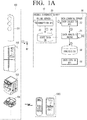
- FIGS. 1A and 1B are views illustrating a network system for generating and using a learning model according to an embodiment.
- a network system may include a home appliance 100, a user terminal 1000, and a trouble diagnosis server 10.
- the home appliance 100 may include, for example, an air-conditioner 101, a refrigerator 102, a washing machine 103, a robot cleaner 104, or the like.
- the user terminal 1000 may be a device that remotely controls the home appliance 100.
- the user terminal 1000 may include, for example, a smart phone, a cellular phone, or a tablet personal computer (PC) equipped with a home appliance control application.
- the user terminal 1000 may include a smart television (TV), a digital camera, a personal digital assistant (PDA), a portable multimedia player (PMP), a notebook computer, a desktop computer, or the like.
- TV smart television
- PDA personal digital assistant
- PMP portable multimedia player
- notebook computer a desktop computer, or the like.
- the user terminal 1000 may control a home appliance remotely.
- the user terminal 1000 may transmit a control command to the home appliance 100 by using radio frequency (RF) communication technology such as ultra-high frequency (UHF), very high frequency (VHF), infrared data association (IrDA), wide area network (WAN), local area network (LAN), mobile communication, Bluetooth, Wi-Fi, ZigBee, or the like.
- RF radio frequency
- the trouble diagnosis server 10 may be connected with the home appliance 100 via a third device (for example, an access point (AP), a repeater, a router, a gateway, or hub) or directly connected.
- a third device for example, an access point (AP), a repeater, a router, a gateway, or hub.
- the trouble diagnosis server 10 may be composed of one server or a plurality of servers according to functions.
- the trouble diagnosis server 10 may include at least one of a bridge server 20 or a data learning server 30.
- the bridge server 20 may be, for example, a server for collecting various information (for example, product information, operation information, or the like) from a home appliance.
- the bridge server 20 may include a connection application programming interface (API) 22 and state data database (DB) 24.
- API application programming interface
- DB state data database
- connection API 22 may include, for example, an application programming interface (API) that serves as an interface between different devices operating according to a heterogeneous protocol.
- API application programming interface
- the API may be defined as a set of sub-routines or functions that can be called for any processing of other protocols in any one protocol. That is, the API may provide an environment in which the operation of other protocols may be performed in any one protocol.
- the bridge server 20 may collect product information and operation information of the home appliance 100 using the connection API 22.
- the bridge server 20 may store the product information and operation information of the collected home appliance 100 in the DB 24.
- the data learning server 30 may generate a learning model and obtain a learning model application result by using the learned generation model.
- the data learning server 30 may include, for example, a data collection API 32, a data analysis engine 34, an analysis DB 36, and a data service API 38.
- the home appliance 100 may transmit operation information of the home appliance 100 to the trouble diagnosis server 10 via a third device (e.g., an access point (AP), a repeater, a router, a gateway, or a hub).
- a third device e.g., an access point (AP), a repeater, a router, a gateway, or a hub.
- the home appliance 100 may transmit product information of the home appliance 100 to the trouble diagnosis server 10.
- the bridge server 20 of the trouble diagnosis server 10 may collect product information and operation information of the home appliance 100 transmitted from home appliance 100 using the connection API 22 and store the collected product information and operation information of the home appliance 100 in the status data DB 24.
- the product information of the home appliance 100 may be at least one of a type of the home appliance (e.g., air-conditioner, cleaner, refrigerator, robot cleaner, or the like) or a product identifier (e.g., manufacturing number, product name, manufacturing date, or the like).
- a type of the home appliance e.g., air-conditioner, cleaner, refrigerator, robot cleaner, or the like
- a product identifier e.g., manufacturing number, product name, manufacturing date, or the like.
- the product information of the home appliance 100 may include position information of the home appliance 100.
- the operation information of the home appliance 100 may be, for example, at least one of an operational history (e.g., a set operating mode, a periodically measured driving mode frequency), performance information (e.g., periodically measured operating efficiency), a current measurement, a frequency measurement, a temperature measurement (e.g., temperature within the home appliance, temperature outside the home appliance, etc.), a pressure measurement, a vibration measurement, or a trouble history (e.g., error code generation, operation hold, or the like).
- an operational history e.g., a set operating mode, a periodically measured driving mode frequency
- performance information e.g., periodically measured operating efficiency
- a current measurement e.g., a frequency measurement
- a temperature measurement e.g., temperature within the home appliance, temperature outside the home appliance, etc.
- a pressure measurement e.g., a vibration measurement
- a trouble history e.g., error code generation, operation hold, or the like.
- the operation information of the home appliance 100 may include at least one of time for setting various driving modes or a period for maintaining driving mode.
- the data learning server 30 may obtain the product information and operation information of the home appliance 100 stored in the state data DB 24 of the bridge server 20 using the data collection API 32.
- a data analysis engine 34 of the data learning server 30 may obtain the product information and operation information of the home appliance 100 obtained through the data collection API 32.
- the data analysis engine 34 of the data learning server 30 may generate or update a learning model for estimating a trouble item and a new trouble detection pattern associated with the trouble item of the home appliance 100 using the acquired operation information of the home appliance 100 as learning data. According to various embodiments, the data analysis engine 34 may use the obtained product information of the home appliance 100 as learning data.
- a trouble item may mean a trouble of a component forming a home appliance, such as, for example, a compressor trouble, a fan trouble, or the like.
- the trouble detection pattern may mean, for example, a change in the current value measured in a compressor, a fan, etc., a change in a pressure value, a change in frequency, or the like.
- a trouble item and a trouble detection pattern are not limited thereto.
- an interval in which the data learning server 30 generates or updates the learning model using the learning data may proceed on a time basis, daily basis, or monthly basis, or in the event of a particular event occurrence.
- the generation and update intervals of the learning model are not limited thereto.
- the data learning server 30 may store the generated learning model in the analysis DB 36.
- the learning model may be configured to estimate a new trouble detection pattern related to a trouble item of the home appliance 100, not a general learning model.
- the trouble item may include an existing trouble item stored in the analysis DB 36 and a new trouble item not stored in the analysis DB 36. That is, the data learning server 30 may transmit a new trouble item corresponding to the estimated new trouble detection pattern to the data service API 38.
- the home appliance 100 may transmit operation information of the home appliance 100 to the trouble diagnosis server 10 via a third device (e.g., an access point (AP)).
- the data learning server 30 of the trouble diagnosis server 10 can obtain the operation information of the home appliance using the data service API 38.
- the data learning server 30 may enter the obtained operation information of the home appliance 100 into a learned learning model to estimate a trouble item of the home appliance 100 stored in the analysis DB 36 and a new trouble detection pattern associated with the trouble item.
- the data learning server 30 may estimate a trouble item related to the operation information of the home appliance 100 as a result of the application of the learning model. Estimating the trouble item may be, for example, estimating a probability of trouble (or a probability of trouble occurrence) using the operation information.
- the analysis DB 36 of the data learning server 30 may transmit the estimated trouble item to the data service API 38.
- the analysis DB 36 of the data learning server 30 may transmit, to the data service API 38, information related to the newly estimated trouble detection pattern (e.g., the number of new trouble detection patterns, a trouble item associated with a new trouble detection pattern, an importance of a new trouble detection pattern, etc.) regardless of the operation information obtained from the home appliance 100.
- the analysis DB 36 may transmit information associated with the newly added trouble detection pattern to the data service API 38 in accordance with a period in which the data learning server 30 updates the learning model using product information and operation information.
- the data learning server 30 may transmit the estimated trouble item to the home appliance 100 via a third device (e.g., an access point (AP)). Further, the data learning server 30 can transmit information related to the newly estimated trouble detection pattern to the home appliance 100 through the third device. According to various embodiments, in operation 9, the data learning server 30 can transmit the determined trouble item to the user terminal 1000 via the third device. The data learning server 30 can transmit information related to the newly estimated trouble detection pattern to the user terminal 1000 through the third device.
- a third device e.g., an access point (AP)
- AP access point
- the home appliance 100 receiving the trouble item related to the new trouble detection pattern can display the received trouble item on a display or the like. Further, the home appliance 100 receiving the information related to the newly estimated trouble detection pattern can display information related to the received trouble detection pattern (e.g., the number of newly registered trouble detection patterns, etc.) on a display or the like.
- the user terminal 1000 receiving the trouble item related to the new trouble detection pattern can display the received trouble item on a display or the like.
- the user terminal 1000 receiving the information related to the newly estimated trouble detection pattern can display information related to the received trouble detection pattern (e.g., the number of newly registered trouble detection patterns, etc.) on a display or the like.
- FIGS. 2A and 2B illustrate a configuration of the data learning server 30 according to an embodiment.
- FIG. 2A is a functional block diagram in which the data learning server 30 generates or updates a learning model.
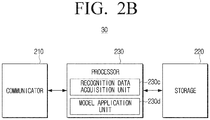
- FIG. 2B is a functional block diagram of using a learning model generated or updated by the data learning server 30.
- the learning model included in the data learning server 30 may be constructed in consideration of an application field of a learning server, a purpose of learning, computer performance of the device, or the like.
- the learning model may be a model based on, for example, a neural network.
- learning models such as deep neural network (DNN), recurrent neural network (RNN), and bidirectional recurrent deep neural network (BRDNN) may be used but are not limited thereto.
- the data learning server 30 may include a communicator 210, a storage 220, and a processor 230.
- the communicator 210 may communicate with an external device.
- the external device may include at least one of an external server (for example, the bridge server 20, or the like) or the home appliance 100.
- an external server for example, the bridge server 20, or the like
- the home appliance 100 for example, the bridge server 20, or the like
- Wireless communication may include, for example, cellular communication, near-field wireless communication, or global navigation satellite system (GNSS) communication.
- Cellular communication may include, for example, long-term evolution (LTE), LTE Advance (LTE-A), code division multiple access (CDMA), wideband CDMA (WCDMA), universal mobile telecommunications system (UMTS), wireless broadband (WiBro), or global system for mobile communications (GSM).
- Near-field wireless communication may include, for example, wireless fidelity (WiFi) WiFi Direct, light fidelity (LiFi), Bluetooth, Bluetooth low energy (BLE), Zigbee, near field communication (NFC), magnetic secure transmission, radio frequency (RF), or body area network (BAN).
- the data learning server 30 may include the storage 220.
- the storage 220 may store a learning model generated by the data learning server 30.
- the storage 220 may include a volatile memory or a non-volatile memory.
- the volatile memory may include, for example, random access memory (RAM) (for example, DRAM, SRAM, or SDRAM).
- RAM random access memory
- the non-volatile memory may include, for example, one time programmable read-only memory (ROM) (OTPROM), programmable read-only memory (PROM), erasable programmable read-only memory (EPROM), electrically erasable programmable read-only memory (EEPROM), mask ROM, flash ROM, flash memory, hard drive, or sold state drive (SSD).
- ROM read-only memory
- PROM programmable read-only memory
- EPROM erasable programmable read-only memory
- EEPROM electrically erasable programmable read-only memory
- mask ROM mask ROM
- flash ROM flash memory
- flash memory hard drive
- SSD sold state drive
- the processor 230 may include one or more of a central processing device, an application processor, a graphic processing unit (GPU), a camera image signal processor, or a communication processor (CP).
- a central processing device an application processor, a graphic processing unit (GPU), a camera image signal processor, or a communication processor (CP).
- GPU graphic processing unit
- CP communication processor
- the processor 230 may be implemented as a system on chip (SoC) or a system in package (SiP).
- SoC system on chip
- SiP system in package
- the processor 230 may, for example, drive an operating system or application program to control at least one other component (e.g., hardware or software components) of data learning server 30 coupled to processor 230, and may perform various data processing and calculations.
- the processor 230 may load a command or data received from other components (for example: the communicator 210) to a volatile memory and process the same, and store result data in the non-volatile memory.
- the processor 230 in FIG. 2A is a functional block diagram for generating a learning model
- the processor 230 may include a learning data acquisition unit 230a and a model learning unit 230b.
- the learning data acquisition unit 230a may acquire at least one of product information and operation information of the home appliance 100 through the communicator 210.
- the learning data acquisition unit 230a may obtain the product information and the operation information of the home appliance 100 from the bridge server 20 connected to the home appliance 100.
- the learning data acquisition unit 230a may obtain product information and operation information from the home appliance 100 or a third device in communication with the home appliance 100.
- the model learning unit 230b may generate or update the learning model using the acquired operation information of the home appliance 100. In addition, the model learning unit 230b can generate or update the learning model using the obtained product information of the home appliance 100.
- the storage 220 may store the learned learning model to estimate the new trouble detection pattern of the home appliance 100 as a result of the creation or updating of the learning model.
- FIG. 2B is a functional block diagram in which the processor 230 uses a learning model.
- the processor 230 may include a recognition data acquisition unit 230c and a model application unit 230d.
- the storage 220 may estimate a new trouble detection pattern of the home appliance 100 and store a learning model that is learned to provide a trouble item related to the estimated new trouble detection pattern.
- the recognition data acquisition unit 230c may acquire operation information of the home appliance 100.
- the model application unit 230d may apply the acquired operation information to the learning model of the storage 220 and acquire the trouble item of the home appliance 100.
- the communicator 210 may transmit the acquired trouble item of the home appliance 100 to an external device.
- the external device may be, for example, the home appliance 100 or the third device in communication with the home appliance 100, or the like.
- the processor 230 may control the communicator 210 to transmit the information related to the trouble detection pattern newly estimated by the learning model of the storage 220 to an external device.
- FIG. 3 is a view to describe estimating a new trouble detection pattern in a trouble diagnosis server according to an embodiment.
- the storage 220 may store a basic trouble detection pattern 310.
- the basic trouble detection pattern may be, for example, a result generated by a manufacturer through repeated experiment and data collection.
- the model learning unit 230b can generate or update the learning model using the operation information of the home appliance 100 obtained through the communicator (e.g., the communicator 210 of FIG. 2A ).
- the model learning unit 230b may generate or update the learning model using the obtained product information of the home appliance 100.
- the model learning unit 230b may estimate a new trouble detection pattern using the operation information of the home appliance 100.
- the model learning unit 230b may estimate a new trouble detection pattern by further using the acquired product information of the home appliance 100.
- the model learning unit 230b may detect a trouble history (for example, a history of generating an error related to a trouble, a history in which driving has been stopped due to a trouble, a history in which an driving performance is degraded to less than or equal to a preset level (for example: 60% or less compared to an average driving performance, etc.)) among the acquired operation information, and may identify the operation information for a predetermined period at the time when the trouble history is detected.
- a trouble history for example, a history of generating an error related to a trouble, a history in which driving has been stopped due to a trouble, a history in which an driving performance is degraded to less than or equal to a preset level (for example: 60% or less compared to an average driving performance, etc.)
- the model learning unit 230b may detect a record that current is maintained at 10A or more for 10 minutes or more at the compressor by calculating back for ten hours on the basis of the time when the trouble history is detected.
- the model learning unit 230b may store the detected record as a new first trouble 321.
- the model learning unit 230b may accumulate a record with a new second trouble 322 and a new third trouble 323 if a current change and a trouble history similar to that of the current change are found. If the accumulated record exceeds a predetermined number of times (e.g., detection at 500 or more home appliances 100), the model learning unit 230b may estimate the change in current as a new trouble pattern and generate a first group 320 of trouble patterns.
- the model learning unit 230b may update a prestored basic trouble detection pattern.
- the basic trouble detection pattern 310 may be changed such that, for example, current of the compressor is changed to 10A or more for three times or more within one hour.
- the model learning unit 230b may detect a record, for example, a current value which is 10A or more for three times or more is measured within one and half hours in the compressor by calculating back for five hours from the time when the trouble history is detected.
- the model learning unit 230b may estimate that the detected record is similar to the format of the pre-stored basic trouble detection pattern 310 and accumulate and store the detected pattern in the basic trouble detection pattern 310. If the record accumulated in a pattern similar to the basic trouble detection pattern exceeds a predetermined number of times (e.g., detection at 100 or more home appliances 100), the model learning unit 230b may update the basic trouble detection pattern 310 by reflecting the detected pattern to the basic trouble detection pattern 310.
- a predetermined number of times e.g., detection at 100 or more home appliances 100
- the model learning unit 230b may estimate and generate a new trouble detection pattern using a plurality of items included in the operation information.
- the model learning unit 230b can detect, for example, a record that current is maintained at 10A or more for three times or more within one hour in the compressor, by calculating back for ten hours from the time when the trouble history is detected, at 500 or more home appliances 100.
- the model learning unit (e.g., 230b) may detect a record that the current is maintained at 10A or more for three times or more within one hour in the processor without a trouble at 500 or more home appliances.
- the model learning unit 230b may further detect a record of other items among the operation information of the home appliance 100. For example, if the current is maintained at 10A or more for three times or more within one hour in the compressor, the model learning unit 230b may detect a record that the temperature of the compressor rises for ten or more degrees from an average driving temperature at the same period, along with the trouble history.
- the model learning unit 230b may estimate and generate a case where the temperature of the compressor rises for ten degrees or more than the average driving temperature and the current changes to 10A or more for three times or more within one hour, at the same time, as a new trouble pattern.
- the model learning unit 230b may repeat the above operation and generate or update a second group 330 of a new trouble pattern, a third group 340 of a new trouble pattern, or the like.
- the storage 220 may acquire and store the data that the model learning unit 230b estimates as the new trouble detection pattern and generates.
- the data learning server 30 can predict the trouble of the home appliance 100 by using the updated or generated learning model as described above. Accordingly, the manufacturer who operates the trouble diagnosis server 10 including the data learning server 30 may reduce the inconvenience of a user on the use of the product by taking an action, such as preparing the component in advance in preparation for any trouble.
- FIGS. 4A and 4B are views to compare an existing trouble detection pattern stored in the data learning server and a new trouble detection pattern according to an embodiment.
- a horizontal axis of the graph of FIGS. 4A and 4B may represent time, and a vertical axis of the graph may represent a current.
- a first curve 410 and a second curve 420 displayed on the graph may represent a measurement of current over time.
- the first curve 410 shown in FIG. 4A may be a trouble detection pattern in which the data learning server 30 is already stored.
- the pre-stored trouble pattern may be the case when the current measured at the compressor rises to a predetermined slope (e.g., a slope having a value of two) to exceed 10A within ten days.
- the data learning server 30 may assume that the compressor is likely to be degraded.
- the predetermined slope may have a variation about 5%.
- the data learning server 30 may estimate that it is highly likely that the trouble (example: degradation of the compressor) may occur in the home appliance 100 based on a record that the current rises to a slope having a value of 2 in the first section 431, reaching 10A, and the current rises with a slope having a value of 2.1 in the second section 432, reaching 10A.
- the second curve 420 illustrated in FIG. 4B may be a trouble detection pattern generated by estimating as a new trouble detection pattern by the data learning server 30.
- the data learning server 30 can estimate and generate the second curve 420 as the new trouble detection pattern after acquiring, from 100 or more home appliances 100, a current change over time of a pattern similar to the second curve 420 and a trouble history that a trouble has occurred within five hours within five hours from the current change.
- the current measured by the compressor may rise to a slope value of 3 for two times or more within five days, exceeding 10A.
- the predetermined slope may have a range of 5%.
- the data learning server 30 may estimate that the home appliance 100 may highly likely to have a trouble based on a record that current rises with a slope having a value of 3 in the third section 433 and exceeds 10A, and the current rises with a slope having a value of 3.15 in the fourth section 434 and exceeds 10A.
- the first curve 410 illustrated in FIG. 4A is a pre-stored trouble detection pattern, and may be a case in which the current measured by the compressor rises sharply by 10% or more compared to the average value by two times or more within ten days.
- the data learning server 30 may estimate that the compressor is likely to be degraded.
- the data learning server 30 may estimate that a trouble highly likely occurs (for example: degradation of compressor) in the home appliance 100 based on a record that the current rises 10% or more as compared to the average value in the first section 431 and the current rises 10% or more as compared to the average value in the second section 432 as well.
- a trouble highly likely occurs for example: degradation of compressor
- the second curve 420 shown in FIG. 4B may be a trouble detection pattern estimated by the data learning server 30 as a new trouble detection pattern.
- the data learning server 30 may estimate and generate the second curve 420 as the new trouble detection pattern after acquiring a current change over time of a pattern similar to the second curve 420 and a trouble history within three hours from the current change from 1000 or more home appliances 100.
- the second curve 420 shown in FIG. 4B may be a trouble detection pattern generated by the data learning server 30 as the new trouble detection pattern.
- the new trouble detection pattern may be a case where the current measured by the compressor rises sharply by 12% or more compared to the average value for two times or more within five days.
- the data learning server 30 may estimate that a trouble (example: degradation of compressor) highly likely occurs in the home appliance 100 based on a record that the current rises for 12% or more as compared to the average value in the third section 433 and the current rises for 12% or more in the fourth section 434 by 12% or more as compared to the average value.
- a trouble example: degradation of compressor
- the data learning server 30 may estimate possibility of trouble before trouble occurs in a key component and transmit a signal requesting to proceed a pre-order of the component to a manufacturer of the home appliance 100.
- the manufacturer may save time for replacement of the component for repair and reduce serial trouble occurrence in a high price component due to a trouble in a low price component.
- the manufacturer may notify a repairing engineer of the trouble of information on the component with trouble occurrence in advance, and the repairing engineer may reduce time for trouble repairing.
- FIG. 5A is a block diagram illustrating a configuration of an air-conditioner which is one of a home appliance according to an embodiment.
- the air-conditioner 101 may include a sensor 510, a blower fan 520, a communicator 530, a storage 540, a display 560, and a processor 550. As various embodiments, the air-conditioner 101 may omit at least one of the aforementioned elements or additionally include other elements.
- the sensor 510 may include, for example, a temperature sensor, a pressure sensor, a vibration sensor, a humidity sensor, an illumination sensor, or the like. According to an embodiment, the sensor 510 may sense temperature inside the air-conditioner 101 and indoor temperature around the air-conditioner 101.
- the blower fan 520 may discharge cold air to the outside through an opening / closing part (not shown). Alternatively, in a still-air mode, the blower fan 520 may discharge cold air to the outside by a predetermined speed or less through a plurality of micro holes (not shown).
- the predetermined speed may be 0.25m/s or less, and preferentially 0.15m/s or less.
- the communicator 530 may communicate with an external device.
- the external device may include at least one of a trouble diagnosis server 10, the data learning server 30, and a user terminal 1000.
- Communication of the communicator 530 with the external device may include communicating with an external device via a third device or the like.
- the communicator 530 may receive a remote control signal for controlling the air-conditioner 101 from the user terminal 1000.
- the communicator 530 may communicate with an external device through wired communication or wireless communication.
- the communicator 530 may perform communication according to standards such as cellular communication, near-field communication, and communication with the control terminal device through the Internet, universal serial bus (USB) communication, Wi-Fi, Bluetooth, Zigbee, infrared (IR), radio frequency (RF) such as ultra-high frequency (UHF), and very high frequency (VHF), ultra-wideband (UWB), or the like.
- USB universal serial bus
- IR infrared
- RF radio frequency
- UHF ultra-high frequency
- VHF very high frequency
- UWB ultra-wideband
- the storage 540 stores various software and programs for performing the functions of the air-conditioner 101.
- the storage 540 may store a temperature control algorithm according to a plurality of driving modes.
- the temperature control algorithm may include a change in a set temperature according to a predetermined period of each operation mode, an intensity of a wind velocity, a direction of a wind speed, or the like.
- the storage 540 may store the trained learning model based on the operation information of the air-conditioner 101.
- the processor 550 may read out a program stored in the storage 540.
- the processor 550 may read out programs including a series of readable instructions and perform air conditioning according to set temperature, to perform a function of the air-conditioner 101.
- the processor 550 may sense the pressure and/or temperature of the refrigerant in the indoor heat exchanger to detect whether normal air conditioning is being performed. For example, the processor 550 may sense whether there is a damage or frost in the indoor heat exchanger tubing and whether water in which vapor in the air is condensed is properly removed.
- the processor 550 may control the speed of the blower fan 520. Specifically, the processor 550 may control the speed at which the blower fan 520 rotates according to the ambient temperature and the set temperature measured by the sensor 510. Specifically, the processor 550 may control the speed at which the blower fan 520 rotates according to the difference between the ambient temperature and the set temperature. For example, if the difference between the ambient temperature and the set temperature is large, the rotational speed of the blower fan 520 may be increased to reach the set temperature, and if the difference between the indoor temperature and the set temperature is small or the indoor temperature reaches the set temperature, the rotational speed of the blower fan 520 can be slowed down so that the compressor of the outdoor unit is not turned off as the indoor temperature falls too much. For example, the processor 550 may control the speed of rotation of the blower fan 520 between 500 revolutions per minute (RPM) and 900 RPM.
- RPM revolutions per minute
- the processor 550 may control the communicator 530 to transmit product information (for example, manufacturing number, name, and manufacturing date, or the like, of the air-conditioner 101) and operation information (for example, operation history, performance information, current measurement, frequency measurement, temperature measurement, pressure measurement, vibration measurement, trouble history, or the like) of the air-conditioner 101 to an external device.
- product information for example, manufacturing number, name, and manufacturing date, or the like
- operation information for example, operation history, performance information, current measurement, frequency measurement, temperature measurement, pressure measurement, vibration measurement, trouble history, or the like
- the processor 550 may control the communicator 530 to receive new trouble detection pattern information and the trouble item received from an external device and control to display the obtained new trouble detection pattern and the trouble item on the display 560, or the like, through the communicator 530.
- the display 560 may display various information related to the air-conditioner. For example, the display 560 may display the current ambient temperature, temperature set by the user, current wind velocity, operation mode, or the like.
- the display 560 may display information related to the new trouble detection pattern received from an external device and a trouble item.
- a network system including a data learning server (example: the data learning server 30 of FIG. 1A ) for generating a learning model using the air-conditioner 101 and the learning data obtained from the air-conditioner 101.
- a data learning server example: the data learning server 30 of FIG. 1A
- the data learning server 30 of FIG. 1A for generating a learning model using the air-conditioner 101 and the learning data obtained from the air-conditioner 101.
- the air-conditioner 101 of the network system may include the sensor 510 for sensing the temperature inside or around the air-conditioner 101, the blower fan 520 for discharging cold air to the outside, and the communicator 530 communicable with an external device.
- the air-conditioner 101 may include the processor 550 for controlling the communicator 530 to transmit the temperature set in the air-conditioner 101 and the ambient temperature sensed through the sensor 510 to the external device.
- the external device may include the trouble diagnosis server 10, the data learning server (example: the data learning server 30 of FIG. 1A ), or a third device communicated to at least one of the trouble diagnosis server 10 or the data learning server (example: the data learning server 30 of FIG. 1A ).
- the data learning server (e.g., data learning server 30 of FIG. 1A ) of the network system may include the learning data acquisition unit (e.g., a learning data acquisition unit 203a of FIG. 2A ) for acquiring the product information and operation information transmitted from the air-conditioner 101, the model learning unit (e.g., the model learning unit 203b of FIG. 2A ) for generating a learning model using the operation information, and a storage (e.g., the storage 202 of FIG. 2A ) that stores the trouble item and the trained learning model to estimate a new trouble detection pattern associated with the trouble item as a result of the generation of the learning model.
- the learning data acquisition unit e.g., a learning data acquisition unit 203a of FIG. 2A
- the model learning unit e.g., the model learning unit 203b of FIG. 2A
- a storage e.g., the storage 202 of FIG. 2A
- a network system including the air-conditioner 101 and the data learning server (e.g., data learning server 30 of FIG. 1A ) for providing a trouble item using recognition data acquired from the air-conditioner 101.
- the data learning server e.g., data learning server 30 of FIG. 1A
- the air-conditioner 101 of the network system may include the sensor 510 for sensing ambient temperature, the blower fan 520 for discharging cold air to the outside, the communicator 530 communicable with an external device, and the processor 550 for controlling the communicator 530 to transmit the operation information of the air-conditioner 101 to an external device.
- the external device may include the trouble diagnosis server 10, the data learning server (example: the data learning server 30 of FIG. 1A ), or a third device communicated to at least one of the trouble diagnosis server 10 or the data learning server (example: the data learning server 30 of FIG. 1A ).
- the data learning server may estimates a new trouble pattern of the air-conditioner 101 and include the storage (e.g., storage 202 of FIG. 2B ) for storing a trained learning model to provide a trouble item related to the estimated trouble pattern, the recognition data acquisition unit (e.g., the recognition data acquisition unit 203c of FIG. 2B ), which obtains the operation information of the air-conditioner 101, the model application unit (e.g., the model application unit 203d of FIG. 2B ) that obtains the trouble item of the air-conditioner 101 by inputting the operation information into the learning model, and the communicator 201 (e.g., the communicator 201 of FIG.
- the storage e.g., storage 202 of FIG. 2B
- the recognition data acquisition unit e.g., the recognition data acquisition unit 203c of FIG. 2B
- the model application unit e.g., the model application unit 203d of FIG. 2B
- the communicator 201 e.g., the communic
- the external device may include the air-conditioner 101 or a third device in communication with the air-conditioner 101.
- the external device may include the user terminal 1000 or a third device in communication with the user terminal 1000 for transmitting recommended temperature.
- FIG. 5B is a block diagram illustrating a configuration of a user terminal 1000 according to an embodiment.
- the user terminal 1000 may include a display 570, a communicator 575, an inputter 580, a storage 585, and a processor 590.
- the display 570 may provide information of the user terminal 1000 to a user visually.
- the display 570 may display user interface related to an AI operation by the control of the processor 590.
- the communicator 575 may support establishment of a wired or wireless communication channel between the user terminal 1000 and an external device, and communication performance through the established communication channel.
- the external device may include, for example, at least one of a trouble diagnosis server (e.g., the trouble diagnosis server 10 of FIG. 1A ), the data learning server (e.g., the data learning server 30 of FIG. 1A ), and a third device in communication with the trouble diagnosis server (e.g., the trouble diagnosis server 10 of FIG. 1A ) and the data learning server (e.g., the data learning server 30 of FIG. 1A ).
- the communicator 575 may communicate with an external device via near-field communication network (e.g., Bluetooth, WiFI direct, infrared data association (IrDA), or the like) or remote distance communication network (e.g., cellular network, Internet, or computer network (e.g., LAN or WAN)) using a wireless communication module (e.g., a cellular communication module, a near-field wireless communication module, or a global navigation satellite system (GNSS) communication module), wired communication module (e.g., a local area network (LAN) communication module, or powerline communications module)
- near-field communication network e.g., Bluetooth, WiFI direct, infrared data association (IrDA), or the like
- remote distance communication network e.g., cellular network, Internet, or computer network (e.g., LAN or WAN)
- a wireless communication module e.g., a cellular communication module, a near-field wireless communication module, or a global navigation satellite system (GNSS) communication
- the inputter 580 may receive an instruction or data to be used for a component (for example: processor 590) of the user terminal 1000 from the outside (e.g., user).
- the inputter 580 may include, for example, a button, a microphone, a touch panel, or the like.
- the inputter 580 may transmit a user input signal generated in accordance with a user input to control the user terminal 1000 to the processor 590.
- the storage 585 may store various data used by at least one element (e.g., processor 590), for example, software (e.g., program), input data or output data regarding a command related thereto.
- the storage 585 may include a volatile memory or a non-volatile memory.
- the program is software (for example, operating system) stored in the storage 585 and may include middle ware or application.
- the processor 590 may drive, for example, software (e.g., program) stored in the storage 585 to control at least one other element (e.g., hardware or software element) of the user terminal 1000 connected to the processor 590 and perform various data processing and calculations.
- the processor 590 may load and process the instructions or data received from other elements (e.g., communicator 575) to the volatile memory and store resultant data in the non-volatile memory.
- the processor 590 may include a main processor (e.g., a central processing unit or application processor), and an auxiliary processor (e.g., a graphics processing unit, an image signal processor, a sensor hub processor, or a communication processor) that is operated independently, additionally or alternatively, using less power than the main processor, or specialized for a specified function.
- auxiliary processor may be operated separately or embedded in the main processor.
- the processor 590 may control the communicator 575 to transmit an AI operation request signal corresponding to a user interface related to the AI operation to an air-conditioner (e.g., the air-conditioner 101 of FIG. 1A ).
- an air-conditioner e.g., the air-conditioner 101 of FIG. 1A
- the processor 590 may control the display 570 to display the obtained trouble item.
- the trouble item may be obtained as a result of applying the operation information of the air-conditioner (for example, the air-conditioner 101 of FIG. 1A ) to the learning model by the air-conditioner (for example, the air-conditioner 101 of FIG. 1A ).
- the air-conditioner e.g., the air-conditioner 101 of FIG. 1A
- the user terminal 1000 for controlling the air-conditioner (e.g., the air-conditioner 101 of FIG. 1A ).
- the processor 590 may control the communicator 575 to transmit the AI operation request signal corresponding to the user interface related to the AI operation to the air-conditioner (e.g., the air-conditioner 101 of FIG. 1A ).
- the air-conditioner e.g., the air-conditioner 101 of FIG. 1A
- the processor 550 of the air-conditioner may control the communicator 530 to transmit the operation information of the air-conditioner (e.g., the air-conditioner 101 of FIG. 1A ) to an external device. 530 may be controlled.
- the processor 550 of the air-conditioner e.g., the air-conditioner 101 of FIG.
- the communicator 530 may control the communicator 530 to receive, from the external device, the estimated trouble item by reflecting the transmitted operation information to the learning model.
- the processor 550 may display a trouble item received through the communicator 530.
- the trouble item is a result of applying the operation information to the learned learning model to estimate a new trouble detection pattern associated with the trouble item based on the operation information of the air-conditioner (for example, the air-conditioner 101 of FIG. 1A ).
- FIG. 6 is a flowchart describing determination on degradation of a compressor according to rise in current using operation information of a compressor included in an air-conditioner by a trouble diagnosis server according to an embodiment.
- the trouble diagnosis server 10 may determine degradation of the compressor using at least one of, for example, frequency, current, suction pressure and temperature, discharge pressure and temperature included in the acquired operation information of the air-conditioner.
- the trouble diagnosis server 10 may acquire the current value that is measured for three times using the obtained operation information. For example, the trouble diagnosis server 10 may acquire the current value that is measured in the 100 to 200 sec intervals.
- the trouble diagnosis server 10 may identify whether the discharge pressure measured in the same period as the period during which the current is measured is increased or decreased by 10% or more. If the change in the discharge pressure exceeds 10%, the trouble diagnosis server 10 may terminate the determination of whether the compressor is degraded or not.
- the trouble diagnosis server 10 may identify whether the suction pressure change is within 10%. When the suction pressure change exceeds 10%, the trouble diagnosis server 10 may terminate the determination process for compression degradation without a further process.
- the trouble diagnosis server 10 may identify whether there is a change in operating frequency. If there is a change in the operating frequency, the trouble diagnosis server 10 may terminate the determination process for compression degradation without a further process.
- the trouble diagnosis server 10 may identify whether the last measurement, among the current measurement, is greater than or equal to the 1.4 times of the average value of the previous measurement of two times.
- the trouble diagnosis server 10 may terminate the determination process for compressor degradation without a further process.
- the trouble diagnosis server 10 may identify whether there is a trouble in an element of the air-conditioner using a change in various items included in the operation information of the air-conditioner.
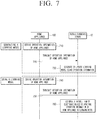
- FIG. 7 is a flowchart to describe that a trouble diagnosis server generates a learning model and estimates a trouble of a home appliance using a learning model according to an embodiment.
- the home appliance 100 may derive operation information of the home appliance 100.
- the home appliance 100 may derive the product information of the home appliance 100.
- the product information of the home appliance 100 may be at least one of a type of the home appliance (for example, the air-conditioner, washing machine, refrigerator, robot cleaner, or the like), product identifier (for example, manufacturing number, manufacturing name, manufacturing date, or the like), or trouble history (for example, error code generation, motion hold, or the like).
- a type of the home appliance for example, the air-conditioner, washing machine, refrigerator, robot cleaner, or the like
- product identifier for example, manufacturing number, manufacturing name, manufacturing date, or the like
- trouble history for example, error code generation, motion hold, or the like.
- the operation information of the home appliance 100 may be at least one of, for example, operation history (e.g., set driving mode, periodically-measured driving mode frequency), performance information (for example, periodically-measured operation efficiency), current measurement, frequency measurement, temperature measurement (for example, temperature inside the home appliance, temperature outside the home appliance, or the like), pressure measurement, vibration measurement, or the like.
- operation history e.g., set driving mode, periodically-measured driving mode frequency
- performance information for example, periodically-measured operation efficiency
- current measurement e.g., frequency measurement
- temperature measurement for example, temperature inside the home appliance, temperature outside the home appliance, or the like
- pressure measurement e.g., vibration measurement, or the like.
- the home appliance 100 may transmit the derived operation information of the home appliance 100 to the trouble diagnosis server 10.
- the home appliance 100 may transmit the derived product information of the home appliance 100 to the trouble diagnosis server 10.
- the home appliance 100 may transmit the derived operation information to the data learning server 30, trouble diagnosis server 10, or a third device (for example, AP) in communication with the data learning server 30.
- a third device for example, AP
- the trouble diagnosis server 10 may generate or update the learning model trained to estimate a new trouble detection pattern related to a trouble item of the home appliance using the received operation information. According to various embodiments, the trouble diagnosis server 10 may generate or update the learning model by using the product information of the home appliance 100.
- the home appliance 100 may derive the operation information of the home appliance 100.
- the home appliance 100 may transmit the derived operation information to the trouble diagnosis server 10.
- the trouble diagnosis server 10 may apply the received operation information to the learning model to estimate the trouble item of the home appliance.
- FIGS. 8A and 8B are views to describe that a user terminal displays information on a newly-generated trouble detection pattern and a trouble item according to an embodiment.
- the user terminal 1000 may execute an application for controlling the air-conditioner 101 in response to a user's input.
- the application for controlling the air-conditioner 101 may display a user interface 810 capable of manipulations such as on/off of the air-conditioner 101, selection of the operation mode of the air-conditioner 101, AI operation selection, wind intensity setting, reservation setting, AI trouble diagnosis identification, or the like.
- the user may display the user interface out of the viewport range to be within the viewport range by using a dragging gesture.
- the user terminal 1000 may receive information related to the new trouble detection pattern associated with the trouble of the air-conditioner 101 from the trouble diagnosis server and display the same on the display 1100.
- the user terminal 1000 may display the number 815 of newly added trouble detection patterns on the display 1100 in response to a user input executing an AI trouble diagnosis function. That is, the user terminal 1000 may transmit a user input for selecting the AI trouble diagnosis function to the diagnosis server 10.
- the trouble diagnosis server 10 may transmit information related to the newly added trouble detection pattern to the user terminal 1000.
- the user terminal 1000 may display information associated with the received newly added trouble detection pattern (e.g., the number 815 of newly added trouble detection patterns).
- the trouble diagnosis server 10 may transmit the number 825 of the trouble detection patterns newly added by the trouble diagnosis server 10 to the user terminal, in accordance with a predetermined cycle (for example, 30 days).
- the user terminal 1000 may display the received number 815 of the trouble detection patterns on the display 1100.
- an application for controlling the air-conditioner 101 may display existing number 820 of the trouble detection patterns, and the number 815 of the newly-added trouble detection patterns on the display 1100 at the same time.
- the application for controlling the air-conditioner 101 may display the newly-added trouble detection pattern and the associated trouble item (not shown) together.
- the application for controlling the air-conditioner 101 may display the history of use of a general air-conditioner such as power usage 830 and use state, or the like.
- the user terminal 1000 may receive the trouble of the air-conditioner 101 from the trouble diagnosis server and display the same on the display 1100.
- the user terminal 1000 may display the trouble diagnosis result in the display 1100 in response to a user input executing an AI trouble diagnosis function. That is, the user terminal 1000 may transmit a user input selecting an AI trouble diagnosis function to the processor (e.g., the processor 550 of FIG. 5 ) of the air-conditioner 101 or the trouble diagnosis server 10. The processor (e.g., processor 550 of FIG. 5 ) of the air-conditioner 101 or the trouble diagnosis server 10 may transmit the diagnosis result to the user terminal 1000 to perform a trouble diagnosis. The user terminal 1000 may display the received trouble diagnosis result 840.
- the processor e.g., the processor 550 of FIG. 5
- the processor e.g., processor 550 of FIG. 5
- the user terminal 1000 may display the received trouble diagnosis result 840.
- the trouble diagnosis server 10 or the processor (e.g., the processor 550 of FIG. 5 ) of the air-conditioner 101 may automatically perform trouble diagnosis for the air-conditioner 101 in accordance with a predetermined cycle (for example, ten days), and transmit the result to the user terminal 1000.
- the user terminal 1000 may display the received trouble diagnosis result 840.
- the user interface 810 for controlling the air-conditioner 101 may display the trouble diagnosis result 840.
- the trouble diagnosis result may display, for example, a name 841 of the home appliance subject to trouble diagnosis, a group name 842 to which the home appliance subject to trouble diagnosis belongs to on the network, a network address 843 of the home appliance subject to trouble diagnosis, diagnosis time 844, or result 845.
- the user interface 810 for controlling the air-conditioner 101 may display the trouble item with high possibility (for example: compressor degradation) and display the result (for example, after service (A/S) request, or the like) taken by the trouble diagnosis server 10.
- high possibility for example: compressor degradation
- A/S after service
- the trouble diagnosis server 10 may improve the probability of predicting trouble occurrence using the newly-estimated trouble detection pattern. As a result, inconvenience of a user who uses a home appliance may be minimized.
- the embodiments may be implemented as S/W program including an instruction stored in a computer-readable storage media.
- a computer is a device which calls instructions stored in a storage medium and is capable of operating according to an embodiment according to the called instructions, and may include the trouble diagnosis server according to the embodiments.
- a machine-readable storage medium may be provided in the form of a non-transitory storage medium.
- non-transitory only denotes that a storage medium does not include a signal but is tangible, and does not distinguish the case in which a data is semi-permanently stored in a storage medium from the case in which a data is temporarily stored in a storage medium.
- the controlling method according to the embodiments may be provided in a computer program product.
- the computer program product may be traded between a seller and a purchaser as a commodity.
- a computer program product may include a software program (S/W) and a computer readable storage medium having stored therein a software program.
- a computer program product may include a product (e.g., a downloadable app) in the form of a S/W program electronically distributed through an electronic market (e.g. Google Play Store, App Store) or a manufacturer of the trouble diagnosis server.
- an electronic market e.g. Google Play Store, App Store
- the storage medium may be a server of a manufacturer, a server of an electronic market, or a storage medium of a relay server for temporarily storing an SW program.
- the computer program product may include a storage medium of a server or a storage medium of a home appliance in a system configured by a server and a home appliance.
- a third device e.g., a smart phone
- the computer program product may include a storage medium of the third device.
- the computer program product may include the S/W program itself transmitted from the server to the home appliance or the third device, or from the third device to the home appliance.
- one of the server, the home appliance, and the third device may execute the computer program product to perform the method according to the embodiments.
- two or more of the server, the home appliance, and the third device may execute the computer program product to distribute the method according to the disclosed embodiments.
- a server e.g.: a cloud server or an AI server, etc.
- a server may run a computer program product stored on a server to control the home appliance connected to the server to perform a method according to the disclosed embodiments.
- the third device may execute a computer program product to control the home appliance connected to and communicating with the third device to perform the method according to the disclosed embodiment.
- the third device can download the computer program product from the server and execute the downloaded computer program product.
- the third device may execute a computer program product provided in a preloaded manner to perform the method according to the disclosed embodiments.
Landscapes
- Engineering & Computer Science (AREA)
- Theoretical Computer Science (AREA)
- Physics & Mathematics (AREA)
- General Physics & Mathematics (AREA)
- Business, Economics & Management (AREA)
- Software Systems (AREA)
- Tourism & Hospitality (AREA)
- Data Mining & Analysis (AREA)
- General Engineering & Computer Science (AREA)
- Artificial Intelligence (AREA)
- Evolutionary Computation (AREA)
- Computing Systems (AREA)
- Mathematical Physics (AREA)
- Health & Medical Sciences (AREA)
- General Health & Medical Sciences (AREA)
- Marketing (AREA)
- Economics (AREA)
- General Business, Economics & Management (AREA)
- Strategic Management (AREA)
- Human Resources & Organizations (AREA)
- Computer Networks & Wireless Communication (AREA)
- Signal Processing (AREA)
- Computer Vision & Pattern Recognition (AREA)
- Automation & Control Theory (AREA)
- Life Sciences & Earth Sciences (AREA)
- Primary Health Care (AREA)
- Medical Informatics (AREA)
- Molecular Biology (AREA)
- Computational Linguistics (AREA)
- Biomedical Technology (AREA)
- Biophysics (AREA)
- Entrepreneurship & Innovation (AREA)
- Operations Research (AREA)
- Quality & Reliability (AREA)
- Bioinformatics & Computational Biology (AREA)
- Bioinformatics & Cheminformatics (AREA)
- Evolutionary Biology (AREA)
- Testing And Monitoring For Control Systems (AREA)
- Telephonic Communication Services (AREA)
- Air Conditioning Control Device (AREA)
Abstract
Description
- The disclosure relates to a method for generating a learning model and a data learning server using a generated learning model.
- Recently, intelligent services have been used in a variety of application fields to recognize data such as voice, image, video, or text automatically to provide information associated with the data or to provide services associated with the data.
- Artificial intelligence (AI) technology used for an intelligent service is the technology that implements a human-level intelligence in which a machine learns, judges, and iteratively improves analysis and decision making, unlike an existing rule-based smart system. As the use of AI systems increases, an accuracy, a recognition rate and understanding or anticipation of a user's taste may be correspondingly increased. As such, existing rule-based smart systems are gradually being replaced by AI systems.
- AI technology is composed of machine learning and elementary technologies that utilize machine learning.
- Machine learning is an algorithmic technology that is capable of classifying or learning characteristics of input data. Element technology is a technology that simulates functions, such as recognition and judgment of a human brain, using machine learning algorithms, such as deep learning. Machine learning is composed of technical fields such as linguistic understanding, visual understanding, reasoning, prediction, knowledge representation, motion control, or the like.
- Various fields implementing AI technology may include the following. Linguistic understanding is a technology for recognizing, applying, and/or processing human language or characters and includes natural language processing, machine translation, dialogue system, question and answer, speech recognition or synthesis, and the like. Visual understanding is a technique for recognizing and processing objects as human vision, including object recognition, object tracking, image search, human recognition, scene understanding, spatial understanding, image enhancement, and the like. Inference prediction is a technique for judging and logically inferring and predicting information, including knowledge-based and probability-based inference, optimization prediction, preference-based planning, recommendation, or the like. Knowledge representation is a technology for automating human experience information into knowledge data, including knowledge building (data generation or classification), knowledge management (data utilization), or the like. Motion control is a technique for controlling the autonomous running of the vehicle and the motion of the robot, including motion control (navigation, collision, driving), operation control (behavior control), or the like.
- According to an embodiment of the disclosure, an objective of the disclosure is to diagnose a trouble of a home appliance (for example, an air-conditioner, a refrigerator, a washing machine, a robot cleaner, or the like) using an AI function.
- The disclosure provides a method for generating or updating a learning model to diagnose a trouble of a home appliance and using the same.
- The tasks to be solved in the disclosure are not limited to the technical challenges set forth above, and other tasks not mentioned can be clearly understood by one of ordinary skill in the art from the following description.
- According to an embodiment, a data learning server includes a communicator configured to be communicable with an external device, a learning data acquisition unit configured to acquire production information of a home appliance and operation information related to a trouble of the home appliance using the communicator, a model learning unit configured to generate or update a learning model using the product information and the operation information, and a storage configured to store a learning model trained to estimate a trouble item of the home appliance and a new trouble detection pattern related to the trouble item using the generated or updated learning model.
- A data learning server according to an embodiment may include a storage configured to store a learning model trained to estimate a trouble item of a home appliance and a new trouble detection pattern related to the trouble item, a recognition data acquisition unit configured to acquire operation information of the home appliance, a model application unit configured to acquire a trouble item of the home appliance by applying the operation information to the learning model, and a communicator configured to transmit the acquired trouble item to an external device.
- An air-conditioner according to an embodiment includes a display, a sensor configured to sense at least one of temperature inside an air-conditioner, temperature, pressure, or humidity outside the air-conditioner, a blower fan configured to discharge cold air to outside, a communicator configured to be communicable with an external device, and a processor configured to comprise a sensing value sensed through the sensor, based on operation information related to a trouble of the air-conditioner being transmitted to the external device, control the communicator to cause a trouble item that is a result of applying the operation information to a learning model to be received from the external device, and control the display to display the received trouble item, and the learning model may be trained using operation information of the air-conditioner.
- A user terminal according to an embodiment may include a display, a communicator, an inputter configured to receive a user input, a processor configured to, based on receiving a user input signal requesting to execute a diagnosis function through the inputter, control the communicator to transmit a signal for requesting an operation corresponding to the trouble diagnosis function execution to an air-conditioner, and based on acquiring a trouble item estimated by applying the operation information of the air-conditioner to a learning model according to the signal for requesting an operation from an external device through the communicator, control the display to display the acquired trouble item.
- According to an embodiment of the disclosure, possibility of trouble occurrence of a home appliance can be diagnosed by using AI technology and thus, inconvenience of a user can be greatly reduced.
- The learning model of the disclosure can be continuously updated using various information of a home appliance. Thus, the more the learning model of the disclosure is used, a trouble diagnosis service with a higher accuracy may be provided to a user.
- The learning model of the disclosure may provide a user with a situation in which a home appliance is continuously managed by providing a trouble detection pattern which is continuously updated.
-
-
FIGS. 1A and1B are views illustrating a network system for generating and using a learning model according to an embodiment; -
FIGS. 2A and2B are views illustrating a configuration of adata learning server 30 according to an embodiment; -
FIG. 3 is a view to describe estimating a new trouble detection pattern in a trouble diagnosis server according to an embodiment; -
FIG. 4 is a view to compare an existing trouble detection pattern and a new trouble detection pattern stored in a data learning server according to an embodiment; -
FIG. 5A is a block diagram illustrating a configuration of an air-conditioner which is one of a home appliance according to an embodiment; -
FIG. 5B is a block diagram illustrating a configuration of auser terminal 1000 according to an embodiment; -
FIG. 6 is a flowchart describing determination on degradation of a compressor according to rise in current using operation information of a compressor included in an air-conditioner by a trouble diagnosis server according to an embodiment; -
FIG. 7 is a flowchart to describe that a trouble diagnosis server generates a learning model and estimates a trouble of a home appliance using a learning model according to an embodiment; and -
FIGS. 8A and 8B are views to describe that a user terminal displays information on a newly-generated trouble detection pattern and a trouble item according to an embodiment. - The configurations shown in the embodiments and drawings described herein are merely exemplary, and various modifications may be made to the embodiments and drawings of the disclosure at the time of filing of the present application.
- The same reference numbers or numerals presented in each of the figures herein represent parts or components that perform substantially the same function.
- The terms used in the disclosure are used to describe embodiments and are not to be construed as being limited by the terms. Singular expressions are intended to include plural forms unless the context clearly indicates otherwise. It will be further understood that terms "include" or "formed of' used in the specification specify the presence of features, numerals, steps, operations, components, parts, or combinations thereof mentioned in the specification, but do not preclude the presence or addition of one or more other features, numerals, steps, operations, components, parts, or combinations thereof.
- Furthermore, although the terms "first" "second," and the like as used herein may be used to describe various elements, these elements are not limited by these terms, and the terms are only used to distinguish one element from another. For example, a first element can be termed a second element, and similarly, a second element can be termed a first element without departing from the scope of the disclosure. The term "and/or" includes any of a plurality of associated listed items or a plurality of associated listed items.
- It is to be understood that an element (e.g., a first element) is "operatively or communicatively coupled with / to" another element (e.g., a second element) is that any such element may be directly connected to the other element or may be connected via another element (e.g., a third element).
- Hereinbelow, the embodiment will be further described with reference to the attached drawings.
-
FIGS. 1A and1B are views illustrating a network system for generating and using a learning model according to an embodiment. - A network system may include a
home appliance 100, auser terminal 1000, and atrouble diagnosis server 10. - The
home appliance 100 may include, for example, an air-conditioner 101, arefrigerator 102, awashing machine 103, arobot cleaner 104, or the like. - The
user terminal 1000 may be a device that remotely controls thehome appliance 100. Theuser terminal 1000 may include, for example, a smart phone, a cellular phone, or a tablet personal computer (PC) equipped with a home appliance control application. According to various embodiments, theuser terminal 1000 may include a smart television (TV), a digital camera, a personal digital assistant (PDA), a portable multimedia player (PMP), a notebook computer, a desktop computer, or the like. - The
user terminal 1000 may control a home appliance remotely. For example, theuser terminal 1000 may transmit a control command to thehome appliance 100 by using radio frequency (RF) communication technology such as ultra-high frequency (UHF), very high frequency (VHF), infrared data association (IrDA), wide area network (WAN), local area network (LAN), mobile communication, Bluetooth, Wi-Fi, ZigBee, or the like. - The
trouble diagnosis server 10 may be connected with thehome appliance 100 via a third device (for example, an access point (AP), a repeater, a router, a gateway, or hub) or directly connected. - According to an embodiment, the
trouble diagnosis server 10 may be composed of one server or a plurality of servers according to functions. For example, thetrouble diagnosis server 10 may include at least one of abridge server 20 or adata learning server 30. - According to an embodiment, the
bridge server 20 may be, for example, a server for collecting various information (for example, product information, operation information, or the like) from a home appliance. Thebridge server 20 may include a connection application programming interface (API) 22 and state data database (DB) 24. - The
connection API 22 may include, for example, an application programming interface (API) that serves as an interface between different devices operating according to a heterogeneous protocol. The API may be defined as a set of sub-routines or functions that can be called for any processing of other protocols in any one protocol. That is, the API may provide an environment in which the operation of other protocols may be performed in any one protocol. - The
bridge server 20 according to an embodiment may collect product information and operation information of thehome appliance 100 using theconnection API 22. Thebridge server 20 may store the product information and operation information of the collectedhome appliance 100 in theDB 24. - According to an embodiment, the
data learning server 30 may generate a learning model and obtain a learning model application result by using the learned generation model. Thedata learning server 30 may include, for example, adata collection API 32, adata analysis engine 34, ananalysis DB 36, and adata service API 38. - Generating a learning model by the
data learning server 30 will be described referring toFIG. 1A . - In
operation ①, thehome appliance 100 may transmit operation information of thehome appliance 100 to thetrouble diagnosis server 10 via a third device (e.g., an access point (AP), a repeater, a router, a gateway, or a hub). According to various embodiments, thehome appliance 100 may transmit product information of thehome appliance 100 to thetrouble diagnosis server 10. Thebridge server 20 of thetrouble diagnosis server 10 may collect product information and operation information of thehome appliance 100 transmitted fromhome appliance 100 using theconnection API 22 and store the collected product information and operation information of thehome appliance 100 in thestatus data DB 24. - According to an embodiment, the product information of the
home appliance 100 may be at least one of a type of the home appliance (e.g., air-conditioner, cleaner, refrigerator, robot cleaner, or the like) or a product identifier (e.g., manufacturing number, product name, manufacturing date, or the like). - According to various embodiments, the product information of the
home appliance 100 may include position information of thehome appliance 100. - The operation information of the
home appliance 100 may be, for example, at least one of an operational history (e.g., a set operating mode, a periodically measured driving mode frequency), performance information (e.g., periodically measured operating efficiency), a current measurement, a frequency measurement, a temperature measurement (e.g., temperature within the home appliance, temperature outside the home appliance, etc.), a pressure measurement, a vibration measurement, or a trouble history (e.g., error code generation, operation hold, or the like). - According to various embodiments, the operation information of the
home appliance 100 may include at least one of time for setting various driving modes or a period for maintaining driving mode. - In
operation ②, thedata learning server 30 may obtain the product information and operation information of thehome appliance 100 stored in thestate data DB 24 of thebridge server 20 using thedata collection API 32. - In
operation ③, adata analysis engine 34 of thedata learning server 30 may obtain the product information and operation information of thehome appliance 100 obtained through thedata collection API 32. - In
operation ④, thedata analysis engine 34 of thedata learning server 30 may generate or update a learning model for estimating a trouble item and a new trouble detection pattern associated with the trouble item of thehome appliance 100 using the acquired operation information of thehome appliance 100 as learning data. According to various embodiments, thedata analysis engine 34 may use the obtained product information of thehome appliance 100 as learning data. - A trouble item may mean a trouble of a component forming a home appliance, such as, for example, a compressor trouble, a fan trouble, or the like. The trouble detection pattern may mean, for example, a change in the current value measured in a compressor, a fan, etc., a change in a pressure value, a change in frequency, or the like. However, a trouble item and a trouble detection pattern are not limited thereto.
- According to various embodiments, an interval in which the
data learning server 30 generates or updates the learning model using the learning data may proceed on a time basis, daily basis, or monthly basis, or in the event of a particular event occurrence. However, the generation and update intervals of the learning model are not limited thereto. - In
operation ⑤, thedata learning server 30 may store the generated learning model in theanalysis DB 36. In this case, the learning model may be configured to estimate a new trouble detection pattern related to a trouble item of thehome appliance 100, not a general learning model. - According to various embodiments, the trouble item may include an existing trouble item stored in the
analysis DB 36 and a new trouble item not stored in theanalysis DB 36. That is, thedata learning server 30 may transmit a new trouble item corresponding to the estimated new trouble detection pattern to thedata service API 38. - Referring to
FIG. 1B , using a learning model by thedata learning server 30 will be described. - In
operation ⑥, thehome appliance 100 may transmit operation information of thehome appliance 100 to thetrouble diagnosis server 10 via a third device (e.g., an access point (AP)). Thedata learning server 30 of thetrouble diagnosis server 10 can obtain the operation information of the home appliance using thedata service API 38. - In
operation ⑦, thedata learning server 30 may enter the obtained operation information of thehome appliance 100 into a learned learning model to estimate a trouble item of thehome appliance 100 stored in theanalysis DB 36 and a new trouble detection pattern associated with the trouble item. - In
operation ⑧, thedata learning server 30 may estimate a trouble item related to the operation information of thehome appliance 100 as a result of the application of the learning model. Estimating the trouble item may be, for example, estimating a probability of trouble (or a probability of trouble occurrence) using the operation information. Theanalysis DB 36 of thedata learning server 30 may transmit the estimated trouble item to thedata service API 38. - According to various embodiments, the
analysis DB 36 of thedata learning server 30 may transmit, to thedata service API 38, information related to the newly estimated trouble detection pattern (e.g., the number of new trouble detection patterns, a trouble item associated with a new trouble detection pattern, an importance of a new trouble detection pattern, etc.) regardless of the operation information obtained from thehome appliance 100. For example, theanalysis DB 36 may transmit information associated with the newly added trouble detection pattern to thedata service API 38 in accordance with a period in which thedata learning server 30 updates the learning model using product information and operation information. - In
operation ⑨, thedata learning server 30 may transmit the estimated trouble item to thehome appliance 100 via a third device (e.g., an access point (AP)). Further, thedata learning server 30 can transmit information related to the newly estimated trouble detection pattern to thehome appliance 100 through the third device. According to various embodiments, inoperation ⑨, thedata learning server 30 can transmit the determined trouble item to theuser terminal 1000 via the third device. Thedata learning server 30 can transmit information related to the newly estimated trouble detection pattern to theuser terminal 1000 through the third device. - In
operation ⑩, thehome appliance 100 receiving the trouble item related to the new trouble detection pattern can display the received trouble item on a display or the like. Further, thehome appliance 100 receiving the information related to the newly estimated trouble detection pattern can display information related to the received trouble detection pattern (e.g., the number of newly registered trouble detection patterns, etc.) on a display or the like. - According to various embodiments, in
operation ⑩, theuser terminal 1000 receiving the trouble item related to the new trouble detection pattern can display the received trouble item on a display or the like. Theuser terminal 1000 receiving the information related to the newly estimated trouble detection pattern can display information related to the received trouble detection pattern (e.g., the number of newly registered trouble detection patterns, etc.) on a display or the like. -
FIGS. 2A and2B illustrate a configuration of thedata learning server 30 according to an embodiment. -
FIG. 2A is a functional block diagram in which thedata learning server 30 generates or updates a learning model.FIG. 2B is a functional block diagram of using a learning model generated or updated by thedata learning server 30. - According to various embodiments, the learning model included in the
data learning server 30 may be constructed in consideration of an application field of a learning server, a purpose of learning, computer performance of the device, or the like. The learning model may be a model based on, for example, a neural network. For example, learning models such as deep neural network (DNN), recurrent neural network (RNN), and bidirectional recurrent deep neural network (BRDNN) may be used but are not limited thereto. - Referring to
FIGS. 2A and2B , thedata learning server 30 may include acommunicator 210, astorage 220, and aprocessor 230. - The
communicator 210 may communicate with an external device. - The external device may include at least one of an external server (for example, the
bridge server 20, or the like) or thehome appliance 100. - The
communicator 210 may communicate with an external device by wire or wirelessly. Wireless communication may include, for example, cellular communication, near-field wireless communication, or global navigation satellite system (GNSS) communication. Cellular communication may include, for example, long-term evolution (LTE), LTE Advance (LTE-A), code division multiple access (CDMA), wideband CDMA (WCDMA), universal mobile telecommunications system (UMTS), wireless broadband (WiBro), or global system for mobile communications (GSM). Near-field wireless communication may include, for example, wireless fidelity (WiFi) WiFi Direct, light fidelity (LiFi), Bluetooth, Bluetooth low energy (BLE), Zigbee, near field communication (NFC), magnetic secure transmission, radio frequency (RF), or body area network (BAN). - The
data learning server 30 may include thestorage 220. Thestorage 220 may store a learning model generated by thedata learning server 30. - The
storage 220 may include a volatile memory or a non-volatile memory. The volatile memory may include, for example, random access memory (RAM) (for example, DRAM, SRAM, or SDRAM). The non-volatile memory may include, for example, one time programmable read-only memory (ROM) (OTPROM), programmable read-only memory (PROM), erasable programmable read-only memory (EPROM), electrically erasable programmable read-only memory (EEPROM), mask ROM, flash ROM, flash memory, hard drive, or sold state drive (SSD). - The
processor 230 may include one or more of a central processing device, an application processor, a graphic processing unit (GPU), a camera image signal processor, or a communication processor (CP). - According to an embodiment, the
processor 230 may be implemented as a system on chip (SoC) or a system in package (SiP). Theprocessor 230 may, for example, drive an operating system or application program to control at least one other component (e.g., hardware or software components) ofdata learning server 30 coupled toprocessor 230, and may perform various data processing and calculations. - The
processor 230 may load a command or data received from other components (for example: the communicator 210) to a volatile memory and process the same, and store result data in the non-volatile memory. - The
processor 230 inFIG. 2A is a functional block diagram for generating a learning model - Referring to
FIG. 2A , theprocessor 230 may include a learningdata acquisition unit 230a and amodel learning unit 230b. - The learning
data acquisition unit 230a may acquire at least one of product information and operation information of thehome appliance 100 through thecommunicator 210. For example, the learningdata acquisition unit 230a may obtain the product information and the operation information of thehome appliance 100 from thebridge server 20 connected to thehome appliance 100. Alternatively, the learningdata acquisition unit 230a may obtain product information and operation information from thehome appliance 100 or a third device in communication with thehome appliance 100. - The
model learning unit 230b may generate or update the learning model using the acquired operation information of thehome appliance 100. In addition, themodel learning unit 230b can generate or update the learning model using the obtained product information of thehome appliance 100. Thestorage 220 may store the learned learning model to estimate the new trouble detection pattern of thehome appliance 100 as a result of the creation or updating of the learning model. -
FIG. 2B is a functional block diagram in which theprocessor 230 uses a learning model. - Referring to
FIG. 2B , theprocessor 230 may include a recognitiondata acquisition unit 230c and amodel application unit 230d. In this example, thestorage 220 may estimate a new trouble detection pattern of thehome appliance 100 and store a learning model that is learned to provide a trouble item related to the estimated new trouble detection pattern. - Referring to
FIG. 2B , the recognitiondata acquisition unit 230c may acquire operation information of thehome appliance 100. - The
model application unit 230d may apply the acquired operation information to the learning model of thestorage 220 and acquire the trouble item of thehome appliance 100. - The
communicator 210 may transmit the acquired trouble item of thehome appliance 100 to an external device. The external device may be, for example, thehome appliance 100 or the third device in communication with thehome appliance 100, or the like. - According to various embodiments, the
processor 230 may control thecommunicator 210 to transmit the information related to the trouble detection pattern newly estimated by the learning model of thestorage 220 to an external device. -
FIG. 3 is a view to describe estimating a new trouble detection pattern in a trouble diagnosis server according to an embodiment. - Referring to
FIG. 3A , thestorage 220 may store a basictrouble detection pattern 310. The basic trouble detection pattern may be, for example, a result generated by a manufacturer through repeated experiment and data collection. - Referring to
FIG. 3B , themodel learning unit 230b can generate or update the learning model using the operation information of thehome appliance 100 obtained through the communicator (e.g., thecommunicator 210 ofFIG. 2A ). Themodel learning unit 230b may generate or update the learning model using the obtained product information of thehome appliance 100. - For example, the
model learning unit 230b may estimate a new trouble detection pattern using the operation information of thehome appliance 100. Themodel learning unit 230b may estimate a new trouble detection pattern by further using the acquired product information of thehome appliance 100. - According to an embodiment, the
model learning unit 230b may detect a trouble history (for example, a history of generating an error related to a trouble, a history in which driving has been stopped due to a trouble, a history in which an driving performance is degraded to less than or equal to a preset level (for example: 60% or less compared to an average driving performance, etc.)) among the acquired operation information, and may identify the operation information for a predetermined period at the time when the trouble history is detected. - For example, the
model learning unit 230b may detect a record that current is maintained at 10A or more for 10 minutes or more at the compressor by calculating back for ten hours on the basis of the time when the trouble history is detected. Themodel learning unit 230b may store the detected record as a newfirst trouble 321. - The
model learning unit 230b may accumulate a record with a newsecond trouble 322 and a newthird trouble 323 if a current change and a trouble history similar to that of the current change are found. If the accumulated record exceeds a predetermined number of times (e.g., detection at 500 or more home appliances 100), themodel learning unit 230b may estimate the change in current as a new trouble pattern and generate afirst group 320 of trouble patterns. - According to various embodiments, the
model learning unit 230b may update a prestored basic trouble detection pattern. The basictrouble detection pattern 310 may be changed such that, for example, current of the compressor is changed to 10A or more for three times or more within one hour. - The
model learning unit 230b according to various embodiments may detect a record, for example, a current value which is 10A or more for three times or more is measured within one and half hours in the compressor by calculating back for five hours from the time when the trouble history is detected. - The
model learning unit 230b may estimate that the detected record is similar to the format of the pre-stored basictrouble detection pattern 310 and accumulate and store the detected pattern in the basictrouble detection pattern 310. If the record accumulated in a pattern similar to the basic trouble detection pattern exceeds a predetermined number of times (e.g., detection at 100 or more home appliances 100), themodel learning unit 230b may update the basictrouble detection pattern 310 by reflecting the detected pattern to the basictrouble detection pattern 310. - According to various embodiments, the
model learning unit 230b may estimate and generate a new trouble detection pattern using a plurality of items included in the operation information. - According to various embodiments, the
model learning unit 230b can detect, for example, a record that current is maintained at 10A or more for three times or more within one hour in the compressor, by calculating back for ten hours from the time when the trouble history is detected, at 500 ormore home appliances 100. The model learning unit (e.g., 230b) may detect a record that the current is maintained at 10A or more for three times or more within one hour in the processor without a trouble at 500 or more home appliances. - The
model learning unit 230b may further detect a record of other items among the operation information of thehome appliance 100. For example, if the current is maintained at 10A or more for three times or more within one hour in the compressor, themodel learning unit 230b may detect a record that the temperature of the compressor rises for ten or more degrees from an average driving temperature at the same period, along with the trouble history. - The
model learning unit 230b may estimate and generate a case where the temperature of the compressor rises for ten degrees or more than the average driving temperature and the current changes to 10A or more for three times or more within one hour, at the same time, as a new trouble pattern. - The
model learning unit 230b according to an embodiment may repeat the above operation and generate or update asecond group 330 of a new trouble pattern, athird group 340 of a new trouble pattern, or the like. - Referring to
FIG. 3C , thestorage 220 may acquire and store the data that themodel learning unit 230b estimates as the new trouble detection pattern and generates. - According to an embodiment, the
data learning server 30 can predict the trouble of thehome appliance 100 by using the updated or generated learning model as described above. Accordingly, the manufacturer who operates thetrouble diagnosis server 10 including thedata learning server 30 may reduce the inconvenience of a user on the use of the product by taking an action, such as preparing the component in advance in preparation for any trouble. -
FIGS. 4A and 4B are views to compare an existing trouble detection pattern stored in the data learning server and a new trouble detection pattern according to an embodiment. - A horizontal axis of the graph of
FIGS. 4A and 4B may represent time, and a vertical axis of the graph may represent a current. Afirst curve 410 and asecond curve 420 displayed on the graph may represent a measurement of current over time. - The
first curve 410 shown inFIG. 4A may be a trouble detection pattern in which thedata learning server 30 is already stored. For example, the pre-stored trouble pattern may be the case when the current measured at the compressor rises to a predetermined slope (e.g., a slope having a value of two) to exceed 10A within ten days. In this case, thedata learning server 30 may assume that the compressor is likely to be degraded. - According to various embodiments, the predetermined slope may have a variation about 5%. The
data learning server 30 may estimate that it is highly likely that the trouble (example: degradation of the compressor) may occur in thehome appliance 100 based on a record that the current rises to a slope having a value of 2 in thefirst section 431, reaching 10A, and the current rises with a slope having a value of 2.1 in thesecond section 432, reaching 10A. - The
second curve 420 illustrated inFIG. 4B may be a trouble detection pattern generated by estimating as a new trouble detection pattern by thedata learning server 30. For example, thedata learning server 30 can estimate and generate thesecond curve 420 as the new trouble detection pattern after acquiring, from 100 ormore home appliances 100, a current change over time of a pattern similar to thesecond curve 420 and a trouble history that a trouble has occurred within five hours within five hours from the current change. - According to an embodiment, in the new detection pattern, the current measured by the compressor may rise to a slope value of 3 for two times or more within five days, exceeding 10A.
- According to various embodiments, the predetermined slope may have a range of 5%. The
data learning server 30 may estimate that thehome appliance 100 may highly likely to have a trouble based on a record that current rises with a slope having a value of 3 in thethird section 433 and exceeds 10A, and the current rises with a slope having a value of 3.15 in thefourth section 434 and exceeds 10A. - According to various embodiments, the
first curve 410 illustrated inFIG. 4A is a pre-stored trouble detection pattern, and may be a case in which the current measured by the compressor rises sharply by 10% or more compared to the average value by two times or more within ten days. In this example, thedata learning server 30 may estimate that the compressor is likely to be degraded. - For example, the
data learning server 30 may estimate that a trouble highly likely occurs (for example: degradation of compressor) in thehome appliance 100 based on a record that the current rises 10% or more as compared to the average value in thefirst section 431 and the current rises 10% or more as compared to the average value in thesecond section 432 as well. - According to various embodiments, the
second curve 420 shown inFIG. 4B may be a trouble detection pattern estimated by thedata learning server 30 as a new trouble detection pattern. For example, thedata learning server 30 may estimate and generate thesecond curve 420 as the new trouble detection pattern after acquiring a current change over time of a pattern similar to thesecond curve 420 and a trouble history within three hours from the current change from 1000 ormore home appliances 100. - According to various embodiments, the
second curve 420 shown inFIG. 4B may be a trouble detection pattern generated by thedata learning server 30 as the new trouble detection pattern. The new trouble detection pattern may be a case where the current measured by the compressor rises sharply by 12% or more compared to the average value for two times or more within five days. - For example, the
data learning server 30 may estimate that a trouble (example: degradation of compressor) highly likely occurs in thehome appliance 100 based on a record that the current rises for 12% or more as compared to the average value in thethird section 433 and the current rises for 12% or more in thefourth section 434 by 12% or more as compared to the average value. - The
data learning server 30 according to an embodiment may estimate possibility of trouble before trouble occurs in a key component and transmit a signal requesting to proceed a pre-order of the component to a manufacturer of thehome appliance 100. - Thus, the manufacturer may save time for replacement of the component for repair and reduce serial trouble occurrence in a high price component due to a trouble in a low price component. The manufacturer may notify a repairing engineer of the trouble of information on the component with trouble occurrence in advance, and the repairing engineer may reduce time for trouble repairing.
-
FIG. 5A is a block diagram illustrating a configuration of an air-conditioner which is one of a home appliance according to an embodiment. - Referring to
FIG. 5A , the air-conditioner 101 may include asensor 510, ablower fan 520, acommunicator 530, astorage 540, a display 560, and aprocessor 550. As various embodiments, the air-conditioner 101 may omit at least one of the aforementioned elements or additionally include other elements. - The
sensor 510 may include, for example, a temperature sensor, a pressure sensor, a vibration sensor, a humidity sensor, an illumination sensor, or the like. According to an embodiment, thesensor 510 may sense temperature inside the air-conditioner 101 and indoor temperature around the air-conditioner 101. - The
blower fan 520 may discharge cold air to the outside through an opening / closing part (not shown). Alternatively, in a still-air mode, theblower fan 520 may discharge cold air to the outside by a predetermined speed or less through a plurality of micro holes (not shown). The predetermined speed may be 0.25m/s or less, and preferentially 0.15m/s or less. - The
communicator 530 may communicate with an external device. At this time, the external device may include at least one of atrouble diagnosis server 10, thedata learning server 30, and auser terminal 1000. Communication of thecommunicator 530 with the external device may include communicating with an external device via a third device or the like. For example, thecommunicator 530 may receive a remote control signal for controlling the air-conditioner 101 from theuser terminal 1000. - The
communicator 530 may communicate with an external device through wired communication or wireless communication. For example, thecommunicator 530 may perform communication according to standards such as cellular communication, near-field communication, and communication with the control terminal device through the Internet, universal serial bus (USB) communication, Wi-Fi, Bluetooth, Zigbee, infrared (IR), radio frequency (RF) such as ultra-high frequency (UHF), and very high frequency (VHF), ultra-wideband (UWB), or the like. - The
storage 540 stores various software and programs for performing the functions of the air-conditioner 101. Specifically, thestorage 540 may store a temperature control algorithm according to a plurality of driving modes. Here, the temperature control algorithm may include a change in a set temperature according to a predetermined period of each operation mode, an intensity of a wind velocity, a direction of a wind speed, or the like. Further, according to the disclosure, thestorage 540 may store the trained learning model based on the operation information of the air-conditioner 101. - The
processor 550 may read out a program stored in thestorage 540. Theprocessor 550 may read out programs including a series of readable instructions and perform air conditioning according to set temperature, to perform a function of the air-conditioner 101. - The
processor 550 may sense the pressure and/or temperature of the refrigerant in the indoor heat exchanger to detect whether normal air conditioning is being performed. For example, theprocessor 550 may sense whether there is a damage or frost in the indoor heat exchanger tubing and whether water in which vapor in the air is condensed is properly removed. - The
processor 550 may control the speed of theblower fan 520. Specifically, theprocessor 550 may control the speed at which theblower fan 520 rotates according to the ambient temperature and the set temperature measured by thesensor 510. Specifically, theprocessor 550 may control the speed at which theblower fan 520 rotates according to the difference between the ambient temperature and the set temperature. For example, if the difference between the ambient temperature and the set temperature is large, the rotational speed of theblower fan 520 may be increased to reach the set temperature, and if the difference between the indoor temperature and the set temperature is small or the indoor temperature reaches the set temperature, the rotational speed of theblower fan 520 can be slowed down so that the compressor of the outdoor unit is not turned off as the indoor temperature falls too much. For example, theprocessor 550 may control the speed of rotation of theblower fan 520 between 500 revolutions per minute (RPM) and 900 RPM. - The
processor 550 may control thecommunicator 530 to transmit product information (for example, manufacturing number, name, and manufacturing date, or the like, of the air-conditioner 101) and operation information (for example, operation history, performance information, current measurement, frequency measurement, temperature measurement, pressure measurement, vibration measurement, trouble history, or the like) of the air-conditioner 101 to an external device. - The
processor 550 may control thecommunicator 530 to receive new trouble detection pattern information and the trouble item received from an external device and control to display the obtained new trouble detection pattern and the trouble item on the display 560, or the like, through thecommunicator 530. - The display 560 may display various information related to the air-conditioner. For example, the display 560 may display the current ambient temperature, temperature set by the user, current wind velocity, operation mode, or the like.
- The display 560 according to an embodiment may display information related to the new trouble detection pattern received from an external device and a trouble item.
- According to various embodiments, there may be a network system including a data learning server (example: the
data learning server 30 ofFIG. 1A ) for generating a learning model using the air-conditioner 101 and the learning data obtained from the air-conditioner 101. - The air-
conditioner 101 of the network system may include thesensor 510 for sensing the temperature inside or around the air-conditioner 101, theblower fan 520 for discharging cold air to the outside, and thecommunicator 530 communicable with an external device. The air-conditioner 101 may include theprocessor 550 for controlling thecommunicator 530 to transmit the temperature set in the air-conditioner 101 and the ambient temperature sensed through thesensor 510 to the external device. - The external device may include the
trouble diagnosis server 10, the data learning server (example: thedata learning server 30 ofFIG. 1A ), or a third device communicated to at least one of thetrouble diagnosis server 10 or the data learning server (example: thedata learning server 30 ofFIG. 1A ). - The data learning server (e.g.,
data learning server 30 ofFIG. 1A ) of the network system may include the learning data acquisition unit (e.g., a learning data acquisition unit 203a ofFIG. 2A ) for acquiring the product information and operation information transmitted from the air-conditioner 101, the model learning unit (e.g., the model learning unit 203b ofFIG. 2A ) for generating a learning model using the operation information, and a storage (e.g., the storage 202 ofFIG. 2A ) that stores the trouble item and the trained learning model to estimate a new trouble detection pattern associated with the trouble item as a result of the generation of the learning model. - According to various embodiments, there may be a network system including the air-
conditioner 101 and the data learning server (e.g.,data learning server 30 ofFIG. 1A ) for providing a trouble item using recognition data acquired from the air-conditioner 101. - The air-
conditioner 101 of the network system may include thesensor 510 for sensing ambient temperature, theblower fan 520 for discharging cold air to the outside, thecommunicator 530 communicable with an external device, and theprocessor 550 for controlling thecommunicator 530 to transmit the operation information of the air-conditioner 101 to an external device. - The external device may include the
trouble diagnosis server 10, the data learning server (example: thedata learning server 30 ofFIG. 1A ), or a third device communicated to at least one of thetrouble diagnosis server 10 or the data learning server (example: thedata learning server 30 ofFIG. 1A ). - The data learning server (e.g.,
data learning server 30 ofFIG. 1A ) may estimates a new trouble pattern of the air-conditioner 101 and include the storage (e.g., storage 202 ofFIG. 2B ) for storing a trained learning model to provide a trouble item related to the estimated trouble pattern, the recognition data acquisition unit (e.g., the recognition data acquisition unit 203c ofFIG. 2B ), which obtains the operation information of the air-conditioner 101, the model application unit (e.g., the model application unit 203d ofFIG. 2B ) that obtains the trouble item of the air-conditioner 101 by inputting the operation information into the learning model, and the communicator 201 (e.g., the communicator 201 ofFIG. 2B ) for transmitting the obtained trouble item to the external device. The external device may include the air-conditioner 101 or a third device in communication with the air-conditioner 101. The external device may include theuser terminal 1000 or a third device in communication with theuser terminal 1000 for transmitting recommended temperature. -
FIG. 5B is a block diagram illustrating a configuration of auser terminal 1000 according to an embodiment. - Referring to
FIG. 5B , theuser terminal 1000 may include adisplay 570, acommunicator 575, aninputter 580, astorage 585, and aprocessor 590. - The
display 570 may provide information of theuser terminal 1000 to a user visually. For example, thedisplay 570 may display user interface related to an AI operation by the control of theprocessor 590. - The
communicator 575 may support establishment of a wired or wireless communication channel between theuser terminal 1000 and an external device, and communication performance through the established communication channel. The external device may include, for example, at least one of a trouble diagnosis server (e.g., thetrouble diagnosis server 10 ofFIG. 1A ), the data learning server (e.g., thedata learning server 30 ofFIG. 1A ), and a third device in communication with the trouble diagnosis server (e.g., thetrouble diagnosis server 10 ofFIG. 1A ) and the data learning server (e.g., thedata learning server 30 ofFIG. 1A ). - The
communicator 575 may communicate with an external device via near-field communication network (e.g., Bluetooth, WiFI direct, infrared data association (IrDA), or the like) or remote distance communication network (e.g., cellular network, Internet, or computer network (e.g., LAN or WAN)) using a wireless communication module (e.g., a cellular communication module, a near-field wireless communication module, or a global navigation satellite system (GNSS) communication module), wired communication module (e.g., a local area network (LAN) communication module, or powerline communications module) The various types of communication modules described above may be implemented as a single chip or a separate chip. - The
inputter 580 may receive an instruction or data to be used for a component (for example: processor 590) of theuser terminal 1000 from the outside (e.g., user). Theinputter 580 may include, for example, a button, a microphone, a touch panel, or the like. Theinputter 580 may transmit a user input signal generated in accordance with a user input to control theuser terminal 1000 to theprocessor 590. - The
storage 585 may store various data used by at least one element (e.g., processor 590), for example, software (e.g., program), input data or output data regarding a command related thereto. Thestorage 585 may include a volatile memory or a non-volatile memory. - The program is software (for example, operating system) stored in the
storage 585 and may include middle ware or application. - The
processor 590 may drive, for example, software (e.g., program) stored in thestorage 585 to control at least one other element (e.g., hardware or software element) of theuser terminal 1000 connected to theprocessor 590 and perform various data processing and calculations. Theprocessor 590 may load and process the instructions or data received from other elements (e.g., communicator 575) to the volatile memory and store resultant data in the non-volatile memory. - According to one embodiment, the
processor 590 may include a main processor (e.g., a central processing unit or application processor), and an auxiliary processor (e.g., a graphics processing unit, an image signal processor, a sensor hub processor, or a communication processor) that is operated independently, additionally or alternatively, using less power than the main processor, or specialized for a specified function. Here, the auxiliary processor may be operated separately or embedded in the main processor. - According to various embodiments, when a user input signal according to a user input for selecting a user interface related to an artificial intelligence operation included in a screen provided by the
display 570 is received through theinputter 580, theprocessor 590 may control thecommunicator 575 to transmit an AI operation request signal corresponding to a user interface related to the AI operation to an air-conditioner (e.g., the air-conditioner 101 ofFIG. 1A ). When a trouble item of the air-conditioner (e.g., the air-conditioner 101 ofFIG. 1A ) is acquired through thecommunicator 575 according to the AI operation request signal, theprocessor 590 may control thedisplay 570 to display the obtained trouble item. At this time, the trouble item may be obtained as a result of applying the operation information of the air-conditioner (for example, the air-conditioner 101 ofFIG. 1A ) to the learning model by the air-conditioner (for example, the air-conditioner 101 ofFIG. 1A ). - According to various embodiments, there may be a network system including the air-conditioner (e.g., the air-
conditioner 101 ofFIG. 1A ) and theuser terminal 1000 for controlling the air-conditioner (e.g., the air-conditioner 101 ofFIG. 1A ). - When the user input signal according to the user input selecting the user interface related to the AI operation included in the screen provided by the
display 570 of theuser terminal 1000 is received through theinputter 580, theprocessor 590 may control thecommunicator 575 to transmit the AI operation request signal corresponding to the user interface related to the AI operation to the air-conditioner (e.g., the air-conditioner 101 ofFIG. 1A ). - When the air-conditioner (e.g., the air-
conditioner 101 ofFIG. 1A ) receives an AI operation request through thecommunicator 530 of the air-conditioner (e.g., the air-conditioner 101 ofFIG. 1A ), theprocessor 550 of the air-conditioner (e.g., the air-conditioner 101 ofFIG. 1A ) may control thecommunicator 530 to transmit the operation information of the air-conditioner (e.g., the air-conditioner 101 ofFIG. 1A ) to an external device. 530 may be controlled. Theprocessor 550 of the air-conditioner (e.g., the air-conditioner 101 ofFIG. 1A ) may control thecommunicator 530 to receive, from the external device, the estimated trouble item by reflecting the transmitted operation information to the learning model. Theprocessor 550 may display a trouble item received through thecommunicator 530. The trouble item is a result of applying the operation information to the learned learning model to estimate a new trouble detection pattern associated with the trouble item based on the operation information of the air-conditioner (for example, the air-conditioner 101 ofFIG. 1A ). -
FIG. 6 is a flowchart describing determination on degradation of a compressor according to rise in current using operation information of a compressor included in an air-conditioner by a trouble diagnosis server according to an embodiment. - The
trouble diagnosis server 10 may determine degradation of the compressor using at least one of, for example, frequency, current, suction pressure and temperature, discharge pressure and temperature included in the acquired operation information of the air-conditioner. - Referring to
operation 610, thetrouble diagnosis server 10 may acquire the current value that is measured for three times using the obtained operation information. For example, thetrouble diagnosis server 10 may acquire the current value that is measured in the 100 to 200 sec intervals. - Referring to
operation 620, thetrouble diagnosis server 10 may identify whether the discharge pressure measured in the same period as the period during which the current is measured is increased or decreased by 10% or more. If the change in the discharge pressure exceeds 10%, thetrouble diagnosis server 10 may terminate the determination of whether the compressor is degraded or not. - Referring to
operation 630, when the discharge pressure change is within 10%, thetrouble diagnosis server 10 may identify whether the suction pressure change is within 10%. When the suction pressure change exceeds 10%, thetrouble diagnosis server 10 may terminate the determination process for compression degradation without a further process. - Referring to
operation 640, when the suction pressure change is within 10%, thetrouble diagnosis server 10 may identify whether there is a change in operating frequency. If there is a change in the operating frequency, thetrouble diagnosis server 10 may terminate the determination process for compression degradation without a further process. - Referring to
operation 650, when there is no change in the operating frequency, thetrouble diagnosis server 10 may identify whether the last measurement, among the current measurement, is greater than or equal to the 1.4 times of the average value of the previous measurement of two times. - When the last current measurement is greater than or equal to the value which is 1.4 times higher than the average value of the previous measurement of two times, it may be determined that there is high possibility of compressor degradation. If the last current measurement is less than the value which is 1.4 times higher than the average value of the previous measurement of two times, the
trouble diagnosis server 10 may terminate the determination process for compressor degradation without a further process. - The
trouble diagnosis server 10 may identify whether there is a trouble in an element of the air-conditioner using a change in various items included in the operation information of the air-conditioner. -
FIG. 7 is a flowchart to describe that a trouble diagnosis server generates a learning model and estimates a trouble of a home appliance using a learning model according to an embodiment. - Referring to
operation 710, thehome appliance 100 may derive operation information of thehome appliance 100. Thehome appliance 100 may derive the product information of thehome appliance 100. - According to an embodiment, the product information of the
home appliance 100 may be at least one of a type of the home appliance (for example, the air-conditioner, washing machine, refrigerator, robot cleaner, or the like), product identifier (for example, manufacturing number, manufacturing name, manufacturing date, or the like), or trouble history (for example, error code generation, motion hold, or the like). - The operation information of the
home appliance 100 may be at least one of, for example, operation history (e.g., set driving mode, periodically-measured driving mode frequency), performance information (for example, periodically-measured operation efficiency), current measurement, frequency measurement, temperature measurement (for example, temperature inside the home appliance, temperature outside the home appliance, or the like), pressure measurement, vibration measurement, or the like. - Referring to
operation 720, thehome appliance 100 may transmit the derived operation information of thehome appliance 100 to thetrouble diagnosis server 10. Thehome appliance 100 may transmit the derived product information of thehome appliance 100 to thetrouble diagnosis server 10. - According to an embodiment, the
home appliance 100 may transmit the derived operation information to thedata learning server 30,trouble diagnosis server 10, or a third device (for example, AP) in communication with thedata learning server 30. - Referring to
operation 730, thetrouble diagnosis server 10 may generate or update the learning model trained to estimate a new trouble detection pattern related to a trouble item of the home appliance using the received operation information. According to various embodiments, thetrouble diagnosis server 10 may generate or update the learning model by using the product information of thehome appliance 100. - Referring
operation 740, thehome appliance 100 may derive the operation information of thehome appliance 100. - Referring to
operation 750, thehome appliance 100 may transmit the derived operation information to thetrouble diagnosis server 10. - Referring to
operation 760, thetrouble diagnosis server 10 may apply the received operation information to the learning model to estimate the trouble item of the home appliance. -
FIGS. 8A and 8B are views to describe that a user terminal displays information on a newly-generated trouble detection pattern and a trouble item according to an embodiment. - Referring to
FIGS. 8A and 8B , theuser terminal 1000 may execute an application for controlling the air-conditioner 101 in response to a user's input. - The application for controlling the air-
conditioner 101 may display auser interface 810 capable of manipulations such as on/off of the air-conditioner 101, selection of the operation mode of the air-conditioner 101, AI operation selection, wind intensity setting, reservation setting, AI trouble diagnosis identification, or the like. - When the
user interface 810 is out of a viewport range of thedisplay 1100 included in theuser terminal 1000, the user may display the user interface out of the viewport range to be within the viewport range by using a dragging gesture. - Referring to
FIG. 8A , theuser terminal 1000 may receive information related to the new trouble detection pattern associated with the trouble of the air-conditioner 101 from the trouble diagnosis server and display the same on thedisplay 1100. - For example, the
user terminal 1000 may display thenumber 815 of newly added trouble detection patterns on thedisplay 1100 in response to a user input executing an AI trouble diagnosis function. That is, theuser terminal 1000 may transmit a user input for selecting the AI trouble diagnosis function to thediagnosis server 10. Thetrouble diagnosis server 10 may transmit information related to the newly added trouble detection pattern to theuser terminal 1000. Theuser terminal 1000 may display information associated with the received newly added trouble detection pattern (e.g., thenumber 815 of newly added trouble detection patterns). - According to various embodiments, the
trouble diagnosis server 10 may transmit the number 825 of the trouble detection patterns newly added by thetrouble diagnosis server 10 to the user terminal, in accordance with a predetermined cycle (for example, 30 days). Theuser terminal 1000 may display the receivednumber 815 of the trouble detection patterns on thedisplay 1100. - According to an embodiment, an application for controlling the air-
conditioner 101 may display existingnumber 820 of the trouble detection patterns, and thenumber 815 of the newly-added trouble detection patterns on thedisplay 1100 at the same time. - According to various embodiments, the application for controlling the air-
conditioner 101 may display the newly-added trouble detection pattern and the associated trouble item (not shown) together. - According to an embodiment, the application for controlling the air-
conditioner 101 may display the history of use of a general air-conditioner such aspower usage 830 and use state, or the like. - Referring to
FIG. 8B , theuser terminal 1000 may receive the trouble of the air-conditioner 101 from the trouble diagnosis server and display the same on thedisplay 1100. - For example, the
user terminal 1000 may display the trouble diagnosis result in thedisplay 1100 in response to a user input executing an AI trouble diagnosis function. That is, theuser terminal 1000 may transmit a user input selecting an AI trouble diagnosis function to the processor (e.g., theprocessor 550 ofFIG. 5 ) of the air-conditioner 101 or thetrouble diagnosis server 10. The processor (e.g.,processor 550 ofFIG. 5 ) of the air-conditioner 101 or thetrouble diagnosis server 10 may transmit the diagnosis result to theuser terminal 1000 to perform a trouble diagnosis. Theuser terminal 1000 may display the receivedtrouble diagnosis result 840. - According to various embodiments, the
trouble diagnosis server 10 or the processor (e.g., theprocessor 550 ofFIG. 5 ) of the air-conditioner 101 may automatically perform trouble diagnosis for the air-conditioner 101 in accordance with a predetermined cycle (for example, ten days), and transmit the result to theuser terminal 1000. Theuser terminal 1000 may display the receivedtrouble diagnosis result 840. - According to an embodiment, the
user interface 810 for controlling the air-conditioner 101 may display thetrouble diagnosis result 840. The trouble diagnosis result may display, for example, aname 841 of the home appliance subject to trouble diagnosis, agroup name 842 to which the home appliance subject to trouble diagnosis belongs to on the network, anetwork address 843 of the home appliance subject to trouble diagnosis,diagnosis time 844, or result 845. - For example, as a result of the trouble diagnosis, when it is determined that the trouble likelihood is high, the
user interface 810 for controlling the air-conditioner 101 may display the trouble item with high possibility (for example: compressor degradation) and display the result (for example, after service (A/S) request, or the like) taken by thetrouble diagnosis server 10. - The
trouble diagnosis server 10 according to an embodiment may improve the probability of predicting trouble occurrence using the newly-estimated trouble detection pattern. As a result, inconvenience of a user who uses a home appliance may be minimized. - The embodiments may be implemented as S/W program including an instruction stored in a computer-readable storage media.
- A computer is a device which calls instructions stored in a storage medium and is capable of operating according to an embodiment according to the called instructions, and may include the trouble diagnosis server according to the embodiments.
- A machine-readable storage medium may be provided in the form of a non-transitory storage medium. Herein, the term "non-transitory" only denotes that a storage medium does not include a signal but is tangible, and does not distinguish the case in which a data is semi-permanently stored in a storage medium from the case in which a data is temporarily stored in a storage medium.
- The controlling method according to the embodiments may be provided in a computer program product. The computer program product may be traded between a seller and a purchaser as a commodity.
- A computer program product may include a software program (S/W) and a computer readable storage medium having stored therein a software program. For example, a computer program product may include a product (e.g., a downloadable app) in the form of a S/W program electronically distributed through an electronic market (e.g. Google Play Store, App Store) or a manufacturer of the trouble diagnosis server. For electronic distribution, at least a portion of the S/W program may be stored on a storage medium or may be created temporarily. In this case, the storage medium may be a server of a manufacturer, a server of an electronic market, or a storage medium of a relay server for temporarily storing an SW program.
- The computer program product may include a storage medium of a server or a storage medium of a home appliance in a system configured by a server and a home appliance. Alternatively, when there is a third device (e.g., a smart phone) communicatively coupled to a server or a home appliance, the computer program product may include a storage medium of the third device. Alternatively, the computer program product may include the S/W program itself transmitted from the server to the home appliance or the third device, or from the third device to the home appliance.
- In this case, one of the server, the home appliance, and the third device may execute the computer program product to perform the method according to the embodiments. Alternatively, two or more of the server, the home appliance, and the third device may execute the computer program product to distribute the method according to the disclosed embodiments.
- For example, a server (e.g.: a cloud server or an AI server, etc.) may run a computer program product stored on a server to control the home appliance connected to the server to perform a method according to the disclosed embodiments.
- As another example, the third device may execute a computer program product to control the home appliance connected to and communicating with the third device to perform the method according to the disclosed embodiment. When the third device executes the computer program product, the third device can download the computer program product from the server and execute the downloaded computer program product. Alternatively, the third device may execute a computer program product provided in a preloaded manner to perform the method according to the disclosed embodiments.
Claims (15)
- A data learning server comprising:a communicator configured to be communicable with an external device;a learning data acquisition unit configured to acquire production information of a home appliance and operation information related to a trouble of the home appliance using the communicator;a model learning unit configured to generate or update a learning model using the product information and the operation information; anda storage configured to store a learning model trained to estimate a trouble item of the home appliance and a new trouble detection pattern related to the trouble item using the generated or updated learning model.
- The data learning server of claim 1, wherein the product information of the home appliance comprises at least one of a type, a manufacturing number, a product name, or a manufacturing date of the home appliance,
wherein the operation information of the home appliance comprises at least one of a driving mode set to the home appliance, frequency of the driving mode, performance information of the home appliance, a current measurement, a frequency measurement, a temperature measurement, a pressure measurement, a vibration measurement, or a trouble history. - The data learning server of claim 1, wherein the learning data acquisition unit further obtains position information of the home appliance,
wherein the model learning unit generates or updates a learning model using the product information, the operation information, and the position information. - A data learning server comprising:a storage configured to store a learning model trained to estimate a trouble item of a home appliance and a new trouble detection pattern related to the trouble item;a recognition data acquisition unit configured to acquire operation information of the home appliance;a model application unit configured to acquire a trouble item of the home appliance by applying the operation information to the learning model; anda communicator configured to transmit the acquired trouble item to an external device.
- The data learning server of claim 4, wherein the data learning server controls the communicator to transmit, to the external device, information that is stored in the storage and is related to the new trouble detection pattern obtained by using the learning model.
- The data learning server of claim 4, wherein the information related to the trouble detection pattern comprises at least one of a number of new trouble detection patterns, a trouble item related to the new trouble detection pattern, and importance of the new trouble detection pattern.
- The data learning server of claim 4, wherein the data learning server, based on receiving a signal requesting information related to the new trouble detection pattern according to a preset interval or from the external device, controls the communicator to transmit the information related to the new trouble detection pattern to the external device.
- An air-conditioner comprising:a display;a sensor configured to sense at least one of temperature inside an air-conditioner, temperature, pressure, or humidity outside the air-conditioner;a blower fan configured to discharge cold air to outside;a communicator configured to be communicable with an external device; anda processor configured to comprise a sensing value sensed through the sensor, based on operation information related to a trouble of the air-conditioner being transmitted to the external device, control the communicator to receive, from the external device, a trouble item that is a result of applying the operation information to a learning model, and control the display to display the received trouble item,wherein the learning model is trained using operation information of the air-conditioner.
- A user terminal comprising:a display;a communicator;an inputter configured to receive a user input; anda processor configured to:based on receiving a user input signal requesting to execute a diagnosis function through the inputter,control the communicator to transmit a signal for requesting an operation corresponding to the trouble diagnosis function execution to an air-conditioner, andbased on acquiring a trouble item estimated by applying the operation information of the air-conditioner to a learning model according to the signal for requesting an operation from an external device through the communicator, control the display to display the acquired trouble item.
- A network system comprising:a learning server for generating or updating a learning model using an air-conditioner and learning data acquired from the air-conditioner,wherein the air-conditioner comprises:a display;a blower fan configured to discharge cold air to outside;a sensor configured to sense at least one of temperature inside the air-conditioner and at least one of temperature, pressure, or humidity outside the air-conditioner;a communicator configured to be communicable with an external device; anda processor configured to comprise product information of the air-conditioner and a sensing value sensed through the sensor, and control the communicator to transmit operation information related to the trouble of the air-conditioner to an external device,wherein the data learning server comprises:a learning data acquisition unit configured to acquire the product information and the operation information;a model learning unit configured to generate or update a learning model using the acquired product information and the operation information; anda storage configured to store a learning model that is trained to estimate a trouble item of the air-conditioner and a new trouble detection pattern related to the trouble item using the generated or updated learning model.
- A network system comprising:an air-conditioner and a data learning server providing a trouble item using recognition data acquired from the air-conditioner,wherein the air-conditioner comprises:a display;a blower fan for discharging cold air to an outside;a sensor configured to sense at least one of temperature inside the air-conditioner and at least one of temperature, pressure, and humidity of the air-conditioner;a communicator capable of communicating with an external device; anda processor configured to comprise a sensing value sensed through the sensor and control the communicator to transmit operation information related to a trouble of the air-conditioner to the external device,wherein the data learning server comprises:a storage configured to store a trouble item of the air-conditioner and a learning model trained to estimate a new trouble detection pattern related to the trouble item;a recognition data acquisition unit configured to acquire the operation information;a model application unit configured to acquire a trouble item of the air-conditioner by applying the operation information to the learning model; anda communicator configured to transmit the trouble item to the external device.
- A method for generating a learning model, the method comprising:acquiring production information of a home appliance and operation information related to a trouble of the home appliance;generating or updating a learning model using the product information and the operation information; andstoring a learning model trained to estimate a trouble item and a new trouble detection pattern related to the trouble item using the generated or updated learning model.
- A method for using a learning model, the method comprising:storing a learning model learned to estimate a trouble item of a home appliance and a new trouble detection pattern related to the trouble item;acquiring operation information of the home appliance;acquiring a trouble item of the home appliance by applying the operation information to the learning model; andtransmitting the acquired trouble item to an external device.
- A controlling method of an air-conditioner, the method comprising:sensing at least one of temperature inside an air-conditioner, temperature, pressure, or humidity outside the air-conditioner;including the sensing result and transmitting operation information related to the trouble of the air-conditioner to an external device;receiving a trouble item estimated by applying the operation information to a learning model from the external device; anddisplaying the received trouble item on a display,wherein the learning model is trained using operation information of the air-conditioner.
- A method for controlling an air-conditioner using a user terminal, the method comprising:receiving a user input signal requesting to execute a trouble diagnosis function;transmitting a signal for requesting an operation corresponding to the trouble diagnosis function execution to an air-conditioner;receiving a trouble item estimated by applying the operation information of the air-conditioner to a learning model according to the signal for requesting an operation; anddisplaying the received trouble item on a display.
Applications Claiming Priority (2)
| Application Number | Priority Date | Filing Date | Title |
|---|---|---|---|
| KR1020170135070A KR102511522B1 (en) | 2017-10-18 | 2017-10-18 | Data learning server, method for generating and using thereof |
| PCT/KR2018/011700 WO2019078515A1 (en) | 2017-10-18 | 2018-10-02 | Data learning server, and method for generating and using learning model thereof |
Publications (4)
| Publication Number | Publication Date |
|---|---|
| EP3657428A1 true EP3657428A1 (en) | 2020-05-27 |
| EP3657428A4 EP3657428A4 (en) | 2020-06-03 |
| EP3657428B1 EP3657428B1 (en) | 2026-01-07 |
| EP3657428C0 EP3657428C0 (en) | 2026-01-07 |
Family
ID=66173265
Family Applications (1)
| Application Number | Title | Priority Date | Filing Date |
|---|---|---|---|
| EP18868442.7A Active EP3657428B1 (en) | 2017-10-18 | 2018-10-02 | Data learning server, and method for generating and using learning model thereof |
Country Status (5)
| Country | Link |
|---|---|
| US (1) | US11405231B2 (en) |
| EP (1) | EP3657428B1 (en) |
| KR (1) | KR102511522B1 (en) |
| CN (1) | CN111247552A (en) |
| WO (1) | WO2019078515A1 (en) |
Families Citing this family (23)
| Publication number | Priority date | Publication date | Assignee | Title |
|---|---|---|---|---|
| KR102587127B1 (en) * | 2017-12-26 | 2023-10-11 | 삼성전자주식회사 | Method and apparatus for managing operational data of appliance device for failure prediction |
| KR102669026B1 (en) * | 2018-10-26 | 2024-05-27 | 삼성전자주식회사 | Electronic device and Method for controlling the electronic device thereof |
| CN109656145B (en) * | 2018-12-27 | 2022-08-02 | 美智纵横科技有限责任公司 | Electric appliance, control method and control system thereof, server and electric appliance control device |
| WO2021006369A1 (en) * | 2019-07-05 | 2021-01-14 | 엘지전자 주식회사 | Artificial intelligence-based appliance management device and appliance management method |
| US12205265B2 (en) | 2019-07-11 | 2025-01-21 | Lg Electronics Inc. | Artificial intelligence server |
| CN110395286B (en) * | 2019-08-02 | 2020-08-07 | 中南大学 | A method and system for air quality monitoring and ventilation regulation in a train |
| KR102332236B1 (en) * | 2019-08-13 | 2021-11-30 | 주식회사 유비벨록스모바일 | SYSTEM FOR NOTIFYING CONSUMER OF STATUS ANALYSIS INFORMATION ABOUT IoT HOME APPLIANCES IN REAL TIME BASED ON BIG DATA |
| KR102826189B1 (en) * | 2019-09-09 | 2025-06-27 | 엘지전자 주식회사 | Server |
| KR102293431B1 (en) * | 2019-10-29 | 2021-08-25 | 주식회사 디비엔텍 | Method and system for updating cctv-control system |
| KR20210155179A (en) * | 2020-06-15 | 2021-12-22 | 삼성전자주식회사 | Electronic apparatus and method for controlling thereof |
| JP7276298B2 (en) * | 2020-10-09 | 2023-05-18 | トヨタ自動車株式会社 | MODEL LEARNING SYSTEM, VEHICLE CONTROL DEVICE, AND MODEL LEARNING METHOD |
| CN112328420A (en) * | 2020-10-26 | 2021-02-05 | 南京燚麒智能科技有限公司 | Method, device and system for detecting equipment fault |
| KR102396496B1 (en) * | 2021-05-21 | 2022-05-10 | 주식회사 이엠포커스 | Method for Providing Information Generated by Failure Mode and Effect Analysis |
| DE102021208443A1 (en) * | 2021-08-04 | 2023-02-09 | BSH Hausgeräte GmbH | Detection of an anomaly on a household appliance |
| CN113674249A (en) * | 2021-08-24 | 2021-11-19 | 重庆忽米网络科技有限公司 | PCB printing quality detection method based on industrial internet |
| CN116208494B (en) * | 2021-11-30 | 2026-01-30 | 维沃软件技术有限公司 | AI model switching processing methods, devices, and communication equipment |
| KR20230124333A (en) | 2022-02-18 | 2023-08-25 | 엘지전자 주식회사 | Method of making a diagnosis device which has ice-making function and server implementing thereof |
| KR20230125369A (en) | 2022-02-21 | 2023-08-29 | 엘지전자 주식회사 | Management server, method for controlling thereof, and home appliances managed by the management server |
| CN114877468B (en) * | 2022-05-28 | 2024-05-24 | 河南省人民医院 | An operating room air purification management system based on deep learning |
| KR102583019B1 (en) * | 2023-04-13 | 2023-09-27 | 주식회사 쿨맥스 | Artificial Intelligence Refrigerator with failure prediction function |
| CN116527720B (en) * | 2023-06-29 | 2023-09-29 | 深圳艾为电气技术有限公司 | Intelligent obstacle removing strategy acquisition method and device for electric compressor |
| US12554610B2 (en) | 2023-08-21 | 2026-02-17 | State Farm Mutual Automobile Insurance Company | Systems and methods for an artificial intelligence-based appliance end-of-life calculator |
| KR102764797B1 (en) * | 2024-01-19 | 2025-02-11 | 김예진 | Method for managing history of device and diagnosing device problem based on artificial intelligence and solution for predicting problem in advance using thereof |
Family Cites Families (17)
| Publication number | Priority date | Publication date | Assignee | Title |
|---|---|---|---|---|
| JP4149178B2 (en) * | 2001-03-09 | 2008-09-10 | 松下電器産業株式会社 | Remote maintenance system |
| JP2004214785A (en) | 2002-12-27 | 2004-07-29 | Matsushita Electric Ind Co Ltd | Device management system, device management method, management device, managed device, device management program for management device, and device management program for managed device |
| KR20090000592A (en) * | 2007-03-02 | 2009-01-08 | 세메스 주식회사 | Equipment failure diagnosis system and method |
| JP5413240B2 (en) * | 2010-02-25 | 2014-02-12 | 日本電気株式会社 | Event prediction system, event prediction method, and computer program |
| US8836536B2 (en) * | 2011-07-29 | 2014-09-16 | Hewlett-Packard Development Company, L. P. | Device characterization system and methods |
| KR101249902B1 (en) * | 2011-08-10 | 2013-04-05 | 엘지전자 주식회사 | Diagnostic system and method for home appliance |
| CN104471511B (en) * | 2012-03-13 | 2018-04-20 | 视力移动技术有限公司 | Device, user interface and method for recognizing pointing gestures |
| EP2918045A1 (en) * | 2012-11-06 | 2015-09-16 | Tollgrade Communications, Inc. | Agent-based communication service quality monitoring and diagnostics |
| CN104697765B (en) * | 2014-08-26 | 2017-12-26 | 安徽工程大学 | Air conditioning for automobiles fault detection system and method |
| WO2016079634A1 (en) * | 2014-11-20 | 2016-05-26 | Lg Electronics Inc. | Remote diagnostic system and method for diagnosing electric appliances |
| US10386800B2 (en) * | 2015-02-24 | 2019-08-20 | Siemens Industry, Inc. | Variable air volume modeling for an HVAC system |
| KR20160109913A (en) * | 2015-03-13 | 2016-09-21 | 이화여자대학교 산학협력단 | Learning content provision system for performing customized learning feedback method |
| JP2016173782A (en) * | 2015-03-18 | 2016-09-29 | エヌ・ティ・ティ・コミュニケーションズ株式会社 | Failure prediction system, failure prediction method, failure prediction device, learning device, failure prediction program, and learning program |
| KR20170031985A (en) * | 2015-09-14 | 2017-03-22 | 현대건설주식회사 | Fault detection and diagnostics method of air-conditioning system |
| KR102535912B1 (en) * | 2015-12-28 | 2023-05-24 | 코웨이 주식회사 | Air conditioner system |
| US20170315855A1 (en) * | 2016-05-02 | 2017-11-02 | Agt International Gmbh | Method of detecting anomalies on appliances and system thereof |
| CN107168205B (en) * | 2017-06-07 | 2019-07-09 | 南京航空航天大学 | A kind of online health monitoring data collection and analysis method of civil aircraft air-conditioning system |
-
2017
- 2017-10-18 KR KR1020170135070A patent/KR102511522B1/en active Active
-
2018
- 2018-10-02 WO PCT/KR2018/011700 patent/WO2019078515A1/en not_active Ceased
- 2018-10-02 CN CN201880068023.2A patent/CN111247552A/en active Pending
- 2018-10-02 US US16/756,590 patent/US11405231B2/en active Active
- 2018-10-02 EP EP18868442.7A patent/EP3657428B1/en active Active
Also Published As
| Publication number | Publication date |
|---|---|
| EP3657428B1 (en) | 2026-01-07 |
| WO2019078515A1 (en) | 2019-04-25 |
| US20200244476A1 (en) | 2020-07-30 |
| EP3657428C0 (en) | 2026-01-07 |
| EP3657428A4 (en) | 2020-06-03 |
| KR102511522B1 (en) | 2023-03-17 |
| CN111247552A (en) | 2020-06-05 |
| KR20190043258A (en) | 2019-04-26 |
| US11405231B2 (en) | 2022-08-02 |
Similar Documents
| Publication | Publication Date | Title |
|---|---|---|
| EP3657428B1 (en) | Data learning server, and method for generating and using learning model thereof | |
| KR102553299B1 (en) | Data learning server and method for generating and using thereof | |
| US11353218B2 (en) | Integrated management method and system for kitchen environment using artificial intelligence | |
| US11847896B2 (en) | Predictive alarm analytics | |
| KR102893327B1 (en) | A method for integrated controlling home appliance and system for the same | |
| US20210164677A1 (en) | Air conditioner and method for controlling air conditioner | |
| US20210165377A1 (en) | Method for controlling commercial washing machine by using artificial intelligence and system for the same | |
| KR20190077771A (en) | Method and apparatus for managing operational data of appliance device for failure prediction | |
| CN109990430A (en) | Air conditioning control method and air conditioning control device | |
| US20240242496A1 (en) | Adversarial masks for scene-customized false detection removal | |
| JP7228074B1 (en) | REMOTE CONTROL METHOD, REMOTE CONTROL DEVICE, AND REMOTE CONTROL PROGRAM | |
| KR20240076607A (en) | System and method to support AI-based interactive services for home appliances | |
| RU2772237C2 (en) | Data-based learning server and method for forming and using its learning model | |
| US11823041B1 (en) | Extending learning of artificial intelligent systems | |
| CN116659069B (en) | An air conditioning control method, device, storage medium, and air conditioner | |
| CN110598916A (en) | Method and system for constructing user behavior model | |
| US20250391261A1 (en) | Network device event processing | |
| KR20250006686A (en) | Home appliance device operating based on user detection result and method for controlling the same | |
| KR20250135615A (en) | Home appliance cotrol method based on image recognition and home appliance cotrol system performing the method | |
| BR112019020372B1 (en) | METHOD FOR GENERATING A LEARNING MODEL OF A DATA LEARNING SERVER, DATA LEARNING SERVER, AND NETWORK SYSTEM |
Legal Events
| Date | Code | Title | Description |
|---|---|---|---|
| STAA | Information on the status of an ep patent application or granted ep patent |
Free format text: STATUS: THE INTERNATIONAL PUBLICATION HAS BEEN MADE |
|
| PUAI | Public reference made under article 153(3) epc to a published international application that has entered the european phase |
Free format text: ORIGINAL CODE: 0009012 |
|
| STAA | Information on the status of an ep patent application or granted ep patent |
Free format text: STATUS: REQUEST FOR EXAMINATION WAS MADE |
|
| 17P | Request for examination filed |
Effective date: 20200220 |
|
| AK | Designated contracting states |
Kind code of ref document: A1 Designated state(s): AL AT BE BG CH CY CZ DE DK EE ES FI FR GB GR HR HU IE IS IT LI LT LU LV MC MK MT NL NO PL PT RO RS SE SI SK SM TR |
|
| AX | Request for extension of the european patent |
Extension state: BA ME |
|
| A4 | Supplementary search report drawn up and despatched |
Effective date: 20200504 |
|
| RIC1 | Information provided on ipc code assigned before grant |
Ipc: G06N 3/02 20060101ALI20200424BHEP Ipc: H04W 88/08 20090101ALI20200424BHEP Ipc: G06Q 50/00 20120101ALI20200424BHEP Ipc: G06Q 50/10 20120101AFI20200424BHEP Ipc: G06Q 10/00 20120101ALI20200424BHEP Ipc: G06N 99/00 20190101ALI20200424BHEP |
|
| DAV | Request for validation of the european patent (deleted) | ||
| DAX | Request for extension of the european patent (deleted) | ||
| STAA | Information on the status of an ep patent application or granted ep patent |
Free format text: STATUS: EXAMINATION IS IN PROGRESS |
|
| 17Q | First examination report despatched |
Effective date: 20210924 |
|
| GRAP | Despatch of communication of intention to grant a patent |
Free format text: ORIGINAL CODE: EPIDOSNIGR1 |
|
| STAA | Information on the status of an ep patent application or granted ep patent |
Free format text: STATUS: GRANT OF PATENT IS INTENDED |
|
| INTG | Intention to grant announced |
Effective date: 20250822 |
|
| GRAS | Grant fee paid |
Free format text: ORIGINAL CODE: EPIDOSNIGR3 |
|
| GRAA | (expected) grant |
Free format text: ORIGINAL CODE: 0009210 |
|
| STAA | Information on the status of an ep patent application or granted ep patent |
Free format text: STATUS: THE PATENT HAS BEEN GRANTED |
|
| AK | Designated contracting states |
Kind code of ref document: B1 Designated state(s): AL AT BE BG CH CY CZ DE DK EE ES FI FR GB GR HR HU IE IS IT LI LT LU LV MC MK MT NL NO PL PT RO RS SE SI SK SM TR |
|
| REG | Reference to a national code |
Ref country code: CH Ref legal event code: F10 Free format text: ST27 STATUS EVENT CODE: U-0-0-F10-F00 (AS PROVIDED BY THE NATIONAL OFFICE) Effective date: 20260107 Ref country code: GB Ref legal event code: FG4D |
|
| REG | Reference to a national code |
Ref country code: DE Ref legal event code: R096 Ref document number: 602018088495 Country of ref document: DE |
|
| REG | Reference to a national code |
Ref country code: IE Ref legal event code: FG4D |
|
| U01 | Request for unitary effect filed |
Effective date: 20260109 |
|
| U07 | Unitary effect registered |
Designated state(s): AT BE BG DE DK EE FI FR IT LT LU LV MT NL PT RO SE SI Effective date: 20260114 |