EP3656218A1 - Method for testing the result of a filling process of vials - Google Patents
Method for testing the result of a filling process of vials Download PDFInfo
- Publication number
- EP3656218A1 EP3656218A1 EP18208057.2A EP18208057A EP3656218A1 EP 3656218 A1 EP3656218 A1 EP 3656218A1 EP 18208057 A EP18208057 A EP 18208057A EP 3656218 A1 EP3656218 A1 EP 3656218A1
- Authority
- EP
- European Patent Office
- Prior art keywords
- vial
- dye
- methselect
- vials
- drug product
- Prior art date
- Legal status (The legal status is an assumption and is not a legal conclusion. Google has not performed a legal analysis and makes no representation as to the accuracy of the status listed.)
- Withdrawn
Links
- 238000000034 method Methods 0.000 title claims abstract description 34
- 238000005429 filling process Methods 0.000 title claims abstract description 24
- 238000012360 testing method Methods 0.000 title claims abstract description 11
- 239000012669 liquid formulation Substances 0.000 claims abstract description 30
- 230000005499 meniscus Effects 0.000 claims description 33
- 230000007547 defect Effects 0.000 claims description 28
- 239000004094 surface-active agent Substances 0.000 claims description 24
- 239000007788 liquid Substances 0.000 claims description 22
- 239000000825 pharmaceutical preparation Substances 0.000 claims description 19
- 229940126534 drug product Drugs 0.000 claims description 18
- 239000000975 dye Substances 0.000 claims description 17
- 239000011521 glass Substances 0.000 claims description 15
- 238000011049 filling Methods 0.000 claims description 14
- GNBHRKFJIUUOQI-UHFFFAOYSA-N fluorescein Chemical compound O1C(=O)C2=CC=CC=C2C21C1=CC=C(O)C=C1OC1=CC(O)=CC=C21 GNBHRKFJIUUOQI-UHFFFAOYSA-N 0.000 claims description 9
- XLYOFNOQVPJJNP-UHFFFAOYSA-N water Substances O XLYOFNOQVPJJNP-UHFFFAOYSA-N 0.000 claims description 5
- RVGRUAULSDPKGF-UHFFFAOYSA-N Poloxamer Chemical compound C1CO1.CC1CO1 RVGRUAULSDPKGF-UHFFFAOYSA-N 0.000 claims description 4
- ANRHNWWPFJCPAZ-UHFFFAOYSA-M thionine Chemical compound [Cl-].C1=CC(N)=CC2=[S+]C3=CC(N)=CC=C3N=C21 ANRHNWWPFJCPAZ-UHFFFAOYSA-M 0.000 claims description 4
- 239000002699 waste material Substances 0.000 claims description 4
- 239000007850 fluorescent dye Substances 0.000 claims description 3
- 229960000502 poloxamer Drugs 0.000 claims description 3
- 229920001983 poloxamer Polymers 0.000 claims description 3
- RBTBFTRPCNLSDE-UHFFFAOYSA-N 3,7-bis(dimethylamino)phenothiazin-5-ium Chemical compound C1=CC(N(C)C)=CC2=[S+]C3=CC(N(C)C)=CC=C3N=C21 RBTBFTRPCNLSDE-UHFFFAOYSA-N 0.000 claims description 2
- QFVHZQCOUORWEI-UHFFFAOYSA-N 4-[(4-anilino-5-sulfonaphthalen-1-yl)diazenyl]-5-hydroxynaphthalene-2,7-disulfonic acid Chemical compound C=12C(O)=CC(S(O)(=O)=O)=CC2=CC(S(O)(=O)=O)=CC=1N=NC(C1=CC=CC(=C11)S(O)(=O)=O)=CC=C1NC1=CC=CC=C1 QFVHZQCOUORWEI-UHFFFAOYSA-N 0.000 claims description 2
- MPVDXIMFBOLMNW-ISLYRVAYSA-N 7-hydroxy-8-[(E)-phenyldiazenyl]naphthalene-1,3-disulfonic acid Chemical compound OC1=CC=C2C=C(S(O)(=O)=O)C=C(S(O)(=O)=O)C2=C1\N=N\C1=CC=CC=C1 MPVDXIMFBOLMNW-ISLYRVAYSA-N 0.000 claims description 2
- 239000012099 Alexa Fluor family Substances 0.000 claims description 2
- DPKHZNPWBDQZCN-UHFFFAOYSA-N acridine orange free base Chemical compound C1=CC(N(C)C)=CC2=NC3=CC(N(C)C)=CC=C3C=C21 DPKHZNPWBDQZCN-UHFFFAOYSA-N 0.000 claims description 2
- DZBUGLKDJFMEHC-UHFFFAOYSA-N benzoquinolinylidene Natural products C1=CC=CC2=CC3=CC=CC=C3N=C21 DZBUGLKDJFMEHC-UHFFFAOYSA-N 0.000 claims description 2
- IQFVPQOLBLOTPF-HKXUKFGYSA-L congo red Chemical compound [Na+].[Na+].C1=CC=CC2=C(N)C(/N=N/C3=CC=C(C=C3)C3=CC=C(C=C3)/N=N/C3=C(C4=CC=CC=C4C(=C3)S([O-])(=O)=O)N)=CC(S([O-])(=O)=O)=C21 IQFVPQOLBLOTPF-HKXUKFGYSA-L 0.000 claims description 2
- 239000013078 crystal Substances 0.000 claims description 2
- ZMMJGEGLRURXTF-UHFFFAOYSA-N ethidium bromide Chemical compound [Br-].C12=CC(N)=CC=C2C2=CC=C(N)C=C2[N+](CC)=C1C1=CC=CC=C1 ZMMJGEGLRURXTF-UHFFFAOYSA-N 0.000 claims description 2
- 229960005542 ethidium bromide Drugs 0.000 claims description 2
- 229960004657 indocyanine green Drugs 0.000 claims description 2
- MOFVSTNWEDAEEK-UHFFFAOYSA-M indocyanine green Chemical compound [Na+].[O-]S(=O)(=O)CCCCN1C2=CC=C3C=CC=CC3=C2C(C)(C)C1=CC=CC=CC=CC1=[N+](CCCCS([O-])(=O)=O)C2=CC=C(C=CC=C3)C3=C2C1(C)C MOFVSTNWEDAEEK-UHFFFAOYSA-M 0.000 claims description 2
- STZCRXQWRGQSJD-GEEYTBSJSA-M methyl orange Chemical compound [Na+].C1=CC(N(C)C)=CC=C1\N=N\C1=CC=C(S([O-])(=O)=O)C=C1 STZCRXQWRGQSJD-GEEYTBSJSA-M 0.000 claims description 2
- 229940012189 methyl orange Drugs 0.000 claims description 2
- CEQFOVLGLXCDCX-WUKNDPDISA-N methyl red Chemical compound C1=CC(N(C)C)=CC=C1\N=N\C1=CC=CC=C1C(O)=O CEQFOVLGLXCDCX-WUKNDPDISA-N 0.000 claims description 2
- 229960000907 methylthioninium chloride Drugs 0.000 claims description 2
- 229920000136 polysorbate Polymers 0.000 claims description 2
- 229950008882 polysorbate Drugs 0.000 claims description 2
- PYWVYCXTNDRMGF-UHFFFAOYSA-N rhodamine B Chemical compound [Cl-].C=12C=CC(=[N+](CC)CC)C=C2OC2=CC(N(CC)CC)=CC=C2C=1C1=CC=CC=C1C(O)=O PYWVYCXTNDRMGF-UHFFFAOYSA-N 0.000 claims description 2
- MPLHNVLQVRSVEE-UHFFFAOYSA-N texas red Chemical compound [O-]S(=O)(=O)C1=CC(S(Cl)(=O)=O)=CC=C1C(C1=CC=2CCCN3CCCC(C=23)=C1O1)=C2C1=C(CCC1)C3=[N+]1CCCC3=C2 MPLHNVLQVRSVEE-UHFFFAOYSA-N 0.000 claims description 2
- JEVGKYBUANQAKG-UHFFFAOYSA-N victoria blue R Chemical compound [Cl-].C12=CC=CC=C2C(=[NH+]CC)C=CC1=C(C=1C=CC(=CC=1)N(C)C)C1=CC=C(N(C)C)C=C1 JEVGKYBUANQAKG-UHFFFAOYSA-N 0.000 claims description 2
- 239000000203 mixture Substances 0.000 description 30
- 238000009472 formulation Methods 0.000 description 26
- 239000007864 aqueous solution Substances 0.000 description 20
- 239000000463 material Substances 0.000 description 13
- 239000008194 pharmaceutical composition Substances 0.000 description 10
- 239000000243 solution Substances 0.000 description 10
- 239000000872 buffer Substances 0.000 description 9
- PEDCQBHIVMGVHV-UHFFFAOYSA-N Glycerine Chemical compound OCC(O)CO PEDCQBHIVMGVHV-UHFFFAOYSA-N 0.000 description 8
- HNDVDQJCIGZPNO-YFKPBYRVSA-N L-histidine Chemical compound OC(=O)[C@@H](N)CC1=CN=CN1 HNDVDQJCIGZPNO-YFKPBYRVSA-N 0.000 description 8
- 229920001213 Polysorbate 20 Polymers 0.000 description 8
- 239000000256 polyoxyethylene sorbitan monolaurate Substances 0.000 description 8
- 235000010486 polyoxyethylene sorbitan monolaurate Nutrition 0.000 description 8
- 229940068977 polysorbate 20 Drugs 0.000 description 8
- 230000002209 hydrophobic effect Effects 0.000 description 7
- 238000000576 coating method Methods 0.000 description 6
- 229960002885 histidine Drugs 0.000 description 6
- 238000003756 stirring Methods 0.000 description 6
- LFQSCWFLJHTTHZ-UHFFFAOYSA-N Ethanol Chemical compound CCO LFQSCWFLJHTTHZ-UHFFFAOYSA-N 0.000 description 5
- CZMRCDWAGMRECN-UGDNZRGBSA-N Sucrose Chemical compound O[C@H]1[C@H](O)[C@@H](CO)O[C@@]1(CO)O[C@@H]1[C@H](O)[C@@H](O)[C@H](O)[C@@H](CO)O1 CZMRCDWAGMRECN-UGDNZRGBSA-N 0.000 description 5
- 229930006000 Sucrose Natural products 0.000 description 5
- 239000013583 drug formulation Substances 0.000 description 5
- 239000005292 fiolax Substances 0.000 description 5
- 238000004519 manufacturing process Methods 0.000 description 5
- 229920002981 polyvinylidene fluoride Polymers 0.000 description 5
- 108090000623 proteins and genes Proteins 0.000 description 5
- 102000004169 proteins and genes Human genes 0.000 description 5
- 239000005720 sucrose Substances 0.000 description 5
- 239000002033 PVDF binder Substances 0.000 description 4
- -1 antibodies Substances 0.000 description 4
- 238000011109 contamination Methods 0.000 description 4
- 238000004108 freeze drying Methods 0.000 description 4
- HNDVDQJCIGZPNO-UHFFFAOYSA-N histidine Natural products OC(=O)C(N)CC1=CN=CN1 HNDVDQJCIGZPNO-UHFFFAOYSA-N 0.000 description 4
- 239000000546 pharmaceutical excipient Substances 0.000 description 4
- 239000000244 polyoxyethylene sorbitan monooleate Substances 0.000 description 4
- 235000010482 polyoxyethylene sorbitan monooleate Nutrition 0.000 description 4
- 229920000053 polysorbate 80 Polymers 0.000 description 4
- 229940068968 polysorbate 80 Drugs 0.000 description 4
- 235000000346 sugar Nutrition 0.000 description 4
- QTBSBXVTEAMEQO-UHFFFAOYSA-N Acetic acid Chemical compound CC(O)=O QTBSBXVTEAMEQO-UHFFFAOYSA-N 0.000 description 3
- WQZGKKKJIJFFOK-GASJEMHNSA-N Glucose Natural products OC[C@H]1OC(O)[C@H](O)[C@@H](O)[C@@H]1O WQZGKKKJIJFFOK-GASJEMHNSA-N 0.000 description 3
- KFZMGEQAYNKOFK-UHFFFAOYSA-N Isopropanol Chemical compound CC(C)O KFZMGEQAYNKOFK-UHFFFAOYSA-N 0.000 description 3
- KWYUFKZDYYNOTN-UHFFFAOYSA-M Potassium hydroxide Chemical compound [OH-].[K+] KWYUFKZDYYNOTN-UHFFFAOYSA-M 0.000 description 3
- DNIAPMSPPWPWGF-UHFFFAOYSA-N Propylene glycol Chemical compound CC(O)CO DNIAPMSPPWPWGF-UHFFFAOYSA-N 0.000 description 3
- HEMHJVSKTPXQMS-UHFFFAOYSA-M Sodium hydroxide Chemical compound [OH-].[Na+] HEMHJVSKTPXQMS-UHFFFAOYSA-M 0.000 description 3
- 229940024606 amino acid Drugs 0.000 description 3
- 150000001413 amino acids Chemical class 0.000 description 3
- 239000013011 aqueous formulation Substances 0.000 description 3
- WQZGKKKJIJFFOK-VFUOTHLCSA-N beta-D-glucose Chemical compound OC[C@H]1O[C@@H](O)[C@H](O)[C@@H](O)[C@@H]1O WQZGKKKJIJFFOK-VFUOTHLCSA-N 0.000 description 3
- 239000003795 chemical substances by application Substances 0.000 description 3
- KRKNYBCHXYNGOX-UHFFFAOYSA-N citric acid Chemical compound OC(=O)CC(O)(C(O)=O)CC(O)=O KRKNYBCHXYNGOX-UHFFFAOYSA-N 0.000 description 3
- 235000011187 glycerol Nutrition 0.000 description 3
- 238000002156 mixing Methods 0.000 description 3
- 239000003755 preservative agent Substances 0.000 description 3
- 239000003381 stabilizer Substances 0.000 description 3
- 238000003860 storage Methods 0.000 description 3
- 150000005846 sugar alcohols Chemical class 0.000 description 3
- 150000008163 sugars Chemical class 0.000 description 3
- HDTRYLNUVZCQOY-UHFFFAOYSA-N α-D-glucopyranosyl-α-D-glucopyranoside Natural products OC1C(O)C(O)C(CO)OC1OC1C(O)C(O)C(O)C(CO)O1 HDTRYLNUVZCQOY-UHFFFAOYSA-N 0.000 description 2
- VBICKXHEKHSIBG-UHFFFAOYSA-N 1-monostearoylglycerol Chemical compound CCCCCCCCCCCCCCCCCC(=O)OCC(O)CO VBICKXHEKHSIBG-UHFFFAOYSA-N 0.000 description 2
- GUBGYTABKSRVRQ-XLOQQCSPSA-N Alpha-Lactose Chemical compound O[C@@H]1[C@@H](O)[C@@H](O)[C@@H](CO)O[C@H]1O[C@@H]1[C@@H](CO)O[C@H](O)[C@H](O)[C@H]1O GUBGYTABKSRVRQ-XLOQQCSPSA-N 0.000 description 2
- CIWBSHSKHKDKBQ-JLAZNSOCSA-N Ascorbic acid Chemical compound OC[C@H](O)[C@H]1OC(=O)C(O)=C1O CIWBSHSKHKDKBQ-JLAZNSOCSA-N 0.000 description 2
- FBPFZTCFMRRESA-FSIIMWSLSA-N D-Glucitol Natural products OC[C@H](O)[C@H](O)[C@@H](O)[C@H](O)CO FBPFZTCFMRRESA-FSIIMWSLSA-N 0.000 description 2
- FBPFZTCFMRRESA-KVTDHHQDSA-N D-Mannitol Chemical compound OC[C@@H](O)[C@@H](O)[C@H](O)[C@H](O)CO FBPFZTCFMRRESA-KVTDHHQDSA-N 0.000 description 2
- FBPFZTCFMRRESA-JGWLITMVSA-N D-glucitol Chemical compound OC[C@H](O)[C@@H](O)[C@H](O)[C@H](O)CO FBPFZTCFMRRESA-JGWLITMVSA-N 0.000 description 2
- WQZGKKKJIJFFOK-QTVWNMPRSA-N D-mannopyranose Chemical compound OC[C@H]1OC(O)[C@@H](O)[C@@H](O)[C@@H]1O WQZGKKKJIJFFOK-QTVWNMPRSA-N 0.000 description 2
- LYCAIKOWRPUZTN-UHFFFAOYSA-N Ethylene glycol Chemical compound OCCO LYCAIKOWRPUZTN-UHFFFAOYSA-N 0.000 description 2
- DHMQDGOQFOQNFH-UHFFFAOYSA-N Glycine Chemical compound NCC(O)=O DHMQDGOQFOQNFH-UHFFFAOYSA-N 0.000 description 2
- VEXZGXHMUGYJMC-UHFFFAOYSA-N Hydrochloric acid Chemical compound Cl VEXZGXHMUGYJMC-UHFFFAOYSA-N 0.000 description 2
- GUBGYTABKSRVRQ-QKKXKWKRSA-N Lactose Natural products OC[C@H]1O[C@@H](O[C@H]2[C@H](O)[C@@H](O)C(O)O[C@@H]2CO)[C@H](O)[C@@H](O)[C@H]1O GUBGYTABKSRVRQ-QKKXKWKRSA-N 0.000 description 2
- 229930195725 Mannitol Natural products 0.000 description 2
- ISWSIDIOOBJBQZ-UHFFFAOYSA-N Phenol Natural products OC1=CC=CC=C1 ISWSIDIOOBJBQZ-UHFFFAOYSA-N 0.000 description 2
- NBIIXXVUZAFLBC-UHFFFAOYSA-N Phosphoric acid Chemical compound OP(O)(O)=O NBIIXXVUZAFLBC-UHFFFAOYSA-N 0.000 description 2
- 239000002202 Polyethylene glycol Substances 0.000 description 2
- FAPWRFPIFSIZLT-UHFFFAOYSA-M Sodium chloride Chemical compound [Na+].[Cl-] FAPWRFPIFSIZLT-UHFFFAOYSA-M 0.000 description 2
- QAOWNCQODCNURD-UHFFFAOYSA-N Sulfuric acid Chemical compound OS(O)(=O)=O QAOWNCQODCNURD-UHFFFAOYSA-N 0.000 description 2
- HDTRYLNUVZCQOY-WSWWMNSNSA-N Trehalose Natural products O[C@@H]1[C@@H](O)[C@@H](O)[C@@H](CO)O[C@@H]1O[C@@H]1[C@H](O)[C@@H](O)[C@@H](O)[C@@H](CO)O1 HDTRYLNUVZCQOY-WSWWMNSNSA-N 0.000 description 2
- 239000013543 active substance Substances 0.000 description 2
- HDTRYLNUVZCQOY-LIZSDCNHSA-N alpha,alpha-trehalose Chemical compound O[C@@H]1[C@@H](O)[C@H](O)[C@@H](CO)O[C@@H]1O[C@@H]1[C@H](O)[C@@H](O)[C@H](O)[C@@H](CO)O1 HDTRYLNUVZCQOY-LIZSDCNHSA-N 0.000 description 2
- 239000005388 borosilicate glass Substances 0.000 description 2
- 239000000969 carrier Substances 0.000 description 2
- YCIMNLLNPGFGHC-UHFFFAOYSA-N catechol Chemical compound OC1=CC=CC=C1O YCIMNLLNPGFGHC-UHFFFAOYSA-N 0.000 description 2
- 239000011248 coating agent Substances 0.000 description 2
- 239000002537 cosmetic Substances 0.000 description 2
- 235000014113 dietary fatty acids Nutrition 0.000 description 2
- 230000000694 effects Effects 0.000 description 2
- 235000019441 ethanol Nutrition 0.000 description 2
- 239000000194 fatty acid Substances 0.000 description 2
- 229930195729 fatty acid Natural products 0.000 description 2
- 238000001914 filtration Methods 0.000 description 2
- 239000008103 glucose Substances 0.000 description 2
- 239000008101 lactose Substances 0.000 description 2
- RLSSMJSEOOYNOY-UHFFFAOYSA-N m-cresol Chemical compound CC1=CC=CC(O)=C1 RLSSMJSEOOYNOY-UHFFFAOYSA-N 0.000 description 2
- 239000000594 mannitol Substances 0.000 description 2
- 235000010355 mannitol Nutrition 0.000 description 2
- HEBKCHPVOIAQTA-UHFFFAOYSA-N meso ribitol Natural products OCC(O)C(O)C(O)CO HEBKCHPVOIAQTA-UHFFFAOYSA-N 0.000 description 2
- 239000013642 negative control Substances 0.000 description 2
- GLDOVTGHNKAZLK-UHFFFAOYSA-N octadecan-1-ol Chemical compound CCCCCCCCCCCCCCCCCCO GLDOVTGHNKAZLK-UHFFFAOYSA-N 0.000 description 2
- AQIXEPGDORPWBJ-UHFFFAOYSA-N pentan-3-ol Chemical compound CCC(O)CC AQIXEPGDORPWBJ-UHFFFAOYSA-N 0.000 description 2
- 229920001223 polyethylene glycol Polymers 0.000 description 2
- 229920005862 polyol Polymers 0.000 description 2
- 150000003077 polyols Chemical class 0.000 description 2
- 239000011148 porous material Substances 0.000 description 2
- 239000013641 positive control Substances 0.000 description 2
- QELSKZZBTMNZEB-UHFFFAOYSA-N propylparaben Chemical compound CCCOC(=O)C1=CC=C(O)C=C1 QELSKZZBTMNZEB-UHFFFAOYSA-N 0.000 description 2
- GHMLBKRAJCXXBS-UHFFFAOYSA-N resorcinol Chemical compound OC1=CC=CC(O)=C1 GHMLBKRAJCXXBS-UHFFFAOYSA-N 0.000 description 2
- 239000000600 sorbitol Substances 0.000 description 2
- 235000010356 sorbitol Nutrition 0.000 description 2
- 238000006467 substitution reaction Methods 0.000 description 2
- LDDMACCNBZAMSG-BDVNFPICSA-N (2r,3r,4s,5r)-3,4,5,6-tetrahydroxy-2-(methylamino)hexanal Chemical compound CN[C@@H](C=O)[C@@H](O)[C@H](O)[C@H](O)CO LDDMACCNBZAMSG-BDVNFPICSA-N 0.000 description 1
- QZNNVYOVQUKYSC-JEDNCBNOSA-N (2s)-2-amino-3-(1h-imidazol-5-yl)propanoic acid;hydron;chloride Chemical compound Cl.OC(=O)[C@@H](N)CC1=CN=CN1 QZNNVYOVQUKYSC-JEDNCBNOSA-N 0.000 description 1
- 108091032973 (ribonucleotides)n+m Proteins 0.000 description 1
- ZORQXIQZAOLNGE-UHFFFAOYSA-N 1,1-difluorocyclohexane Chemical compound FC1(F)CCCCC1 ZORQXIQZAOLNGE-UHFFFAOYSA-N 0.000 description 1
- OWEGMIWEEQEYGQ-UHFFFAOYSA-N 100676-05-9 Natural products OC1C(O)C(O)C(CO)OC1OCC1C(O)C(O)C(O)C(OC2C(OC(O)C(O)C2O)CO)O1 OWEGMIWEEQEYGQ-UHFFFAOYSA-N 0.000 description 1
- MSWZFWKMSRAUBD-GASJEMHNSA-N 2-amino-2-deoxy-D-galactopyranose Chemical compound N[C@H]1C(O)O[C@H](CO)[C@H](O)[C@@H]1O MSWZFWKMSRAUBD-GASJEMHNSA-N 0.000 description 1
- XMTQQYYKAHVGBJ-UHFFFAOYSA-N 3-(3,4-DICHLOROPHENYL)-1,1-DIMETHYLUREA Chemical compound CN(C)C(=O)NC1=CC=C(Cl)C(Cl)=C1 XMTQQYYKAHVGBJ-UHFFFAOYSA-N 0.000 description 1
- CERZMXAJYMMUDR-QBTAGHCHSA-N 5-amino-3,5-dideoxy-D-glycero-D-galacto-non-2-ulopyranosonic acid Chemical compound N[C@@H]1[C@@H](O)CC(O)(C(O)=O)O[C@H]1[C@H](O)[C@H](O)CO CERZMXAJYMMUDR-QBTAGHCHSA-N 0.000 description 1
- RZVAJINKPMORJF-UHFFFAOYSA-N Acetaminophen Chemical compound CC(=O)NC1=CC=C(O)C=C1 RZVAJINKPMORJF-UHFFFAOYSA-N 0.000 description 1
- 206010067484 Adverse reaction Diseases 0.000 description 1
- 239000004475 Arginine Substances 0.000 description 1
- KRKNYBCHXYNGOX-UHFFFAOYSA-K Citrate Chemical compound [O-]C(=O)CC(O)(CC([O-])=O)C([O-])=O KRKNYBCHXYNGOX-UHFFFAOYSA-K 0.000 description 1
- XXXSILNSXNPGKG-ZHACJKMWSA-N Crotoxyphos Chemical compound COP(=O)(OC)O\C(C)=C\C(=O)OC(C)C1=CC=CC=C1 XXXSILNSXNPGKG-ZHACJKMWSA-N 0.000 description 1
- HEBKCHPVOIAQTA-QWWZWVQMSA-N D-arabinitol Chemical compound OC[C@@H](O)C(O)[C@H](O)CO HEBKCHPVOIAQTA-QWWZWVQMSA-N 0.000 description 1
- 108020004414 DNA Proteins 0.000 description 1
- 229920002307 Dextran Polymers 0.000 description 1
- 239000004375 Dextrin Substances 0.000 description 1
- 229920001353 Dextrin Polymers 0.000 description 1
- KCXVZYZYPLLWCC-UHFFFAOYSA-N EDTA Chemical compound OC(=O)CN(CC(O)=O)CCN(CC(O)=O)CC(O)=O KCXVZYZYPLLWCC-UHFFFAOYSA-N 0.000 description 1
- 239000004386 Erythritol Substances 0.000 description 1
- UNXHWFMMPAWVPI-UHFFFAOYSA-N Erythritol Natural products OCC(O)C(O)CO UNXHWFMMPAWVPI-UHFFFAOYSA-N 0.000 description 1
- 229930091371 Fructose Natural products 0.000 description 1
- RFSUNEUAIZKAJO-ARQDHWQXSA-N Fructose Chemical compound OC[C@H]1O[C@](O)(CO)[C@@H](O)[C@@H]1O RFSUNEUAIZKAJO-ARQDHWQXSA-N 0.000 description 1
- 239000005715 Fructose Substances 0.000 description 1
- 108010010803 Gelatin Proteins 0.000 description 1
- 239000004471 Glycine Substances 0.000 description 1
- DGAQECJNVWCQMB-PUAWFVPOSA-M Ilexoside XXIX Chemical class C[C@@H]1CC[C@@]2(CC[C@@]3(C(=CC[C@H]4[C@]3(CC[C@@H]5[C@@]4(CC[C@@H](C5(C)C)OS(=O)(=O)[O-])C)C)[C@@H]2[C@]1(C)O)C)C(=O)O[C@H]6[C@@H]([C@H]([C@@H]([C@H](O6)CO)O)O)O.[Na+] DGAQECJNVWCQMB-PUAWFVPOSA-M 0.000 description 1
- LKDRXBCSQODPBY-AMVSKUEXSA-N L-(-)-Sorbose Chemical compound OCC1(O)OC[C@H](O)[C@@H](O)[C@@H]1O LKDRXBCSQODPBY-AMVSKUEXSA-N 0.000 description 1
- ODKSFYDXXFIFQN-BYPYZUCNSA-P L-argininium(2+) Chemical compound NC(=[NH2+])NCCC[C@H]([NH3+])C(O)=O ODKSFYDXXFIFQN-BYPYZUCNSA-P 0.000 description 1
- GUBGYTABKSRVRQ-PICCSMPSSA-N Maltose Natural products O[C@@H]1[C@@H](O)[C@H](O)[C@@H](CO)O[C@@H]1O[C@@H]1[C@@H](CO)OC(O)[C@H](O)[C@H]1O GUBGYTABKSRVRQ-PICCSMPSSA-N 0.000 description 1
- MBBZMMPHUWSWHV-BDVNFPICSA-N N-methylglucamine Chemical compound CNC[C@H](O)[C@@H](O)[C@H](O)[C@H](O)CO MBBZMMPHUWSWHV-BDVNFPICSA-N 0.000 description 1
- 240000002853 Nelumbo nucifera Species 0.000 description 1
- 235000006508 Nelumbo nucifera Nutrition 0.000 description 1
- 235000006510 Nelumbo pentapetala Nutrition 0.000 description 1
- 108091034117 Oligonucleotide Proteins 0.000 description 1
- 235000019483 Peanut oil Nutrition 0.000 description 1
- MUPFEKGTMRGPLJ-RMMQSMQOSA-N Raffinose Natural products O(C[C@H]1[C@@H](O)[C@H](O)[C@@H](O)[C@@H](O[C@@]2(CO)[C@H](O)[C@@H](O)[C@@H](CO)O2)O1)[C@@H]1[C@H](O)[C@@H](O)[C@@H](O)[C@@H](CO)O1 MUPFEKGTMRGPLJ-RMMQSMQOSA-N 0.000 description 1
- VYPSYNLAJGMNEJ-UHFFFAOYSA-N Silicium dioxide Chemical compound O=[Si]=O VYPSYNLAJGMNEJ-UHFFFAOYSA-N 0.000 description 1
- 229920002472 Starch Polymers 0.000 description 1
- 235000021355 Stearic acid Nutrition 0.000 description 1
- MUPFEKGTMRGPLJ-UHFFFAOYSA-N UNPD196149 Natural products OC1C(O)C(CO)OC1(CO)OC1C(O)C(O)C(O)C(COC2C(C(O)C(O)C(CO)O2)O)O1 MUPFEKGTMRGPLJ-UHFFFAOYSA-N 0.000 description 1
- TVXBFESIOXBWNM-UHFFFAOYSA-N Xylitol Natural products OCCC(O)C(O)C(O)CCO TVXBFESIOXBWNM-UHFFFAOYSA-N 0.000 description 1
- JLCPHMBAVCMARE-UHFFFAOYSA-N [3-[[3-[[3-[[3-[[3-[[3-[[3-[[3-[[3-[[3-[[3-[[5-(2-amino-6-oxo-1H-purin-9-yl)-3-[[3-[[3-[[3-[[3-[[3-[[5-(2-amino-6-oxo-1H-purin-9-yl)-3-[[5-(2-amino-6-oxo-1H-purin-9-yl)-3-hydroxyoxolan-2-yl]methoxy-hydroxyphosphoryl]oxyoxolan-2-yl]methoxy-hydroxyphosphoryl]oxy-5-(5-methyl-2,4-dioxopyrimidin-1-yl)oxolan-2-yl]methoxy-hydroxyphosphoryl]oxy-5-(6-aminopurin-9-yl)oxolan-2-yl]methoxy-hydroxyphosphoryl]oxy-5-(6-aminopurin-9-yl)oxolan-2-yl]methoxy-hydroxyphosphoryl]oxy-5-(6-aminopurin-9-yl)oxolan-2-yl]methoxy-hydroxyphosphoryl]oxy-5-(6-aminopurin-9-yl)oxolan-2-yl]methoxy-hydroxyphosphoryl]oxyoxolan-2-yl]methoxy-hydroxyphosphoryl]oxy-5-(5-methyl-2,4-dioxopyrimidin-1-yl)oxolan-2-yl]methoxy-hydroxyphosphoryl]oxy-5-(4-amino-2-oxopyrimidin-1-yl)oxolan-2-yl]methoxy-hydroxyphosphoryl]oxy-5-(5-methyl-2,4-dioxopyrimidin-1-yl)oxolan-2-yl]methoxy-hydroxyphosphoryl]oxy-5-(5-methyl-2,4-dioxopyrimidin-1-yl)oxolan-2-yl]methoxy-hydroxyphosphoryl]oxy-5-(6-aminopurin-9-yl)oxolan-2-yl]methoxy-hydroxyphosphoryl]oxy-5-(6-aminopurin-9-yl)oxolan-2-yl]methoxy-hydroxyphosphoryl]oxy-5-(4-amino-2-oxopyrimidin-1-yl)oxolan-2-yl]methoxy-hydroxyphosphoryl]oxy-5-(4-amino-2-oxopyrimidin-1-yl)oxolan-2-yl]methoxy-hydroxyphosphoryl]oxy-5-(4-amino-2-oxopyrimidin-1-yl)oxolan-2-yl]methoxy-hydroxyphosphoryl]oxy-5-(6-aminopurin-9-yl)oxolan-2-yl]methoxy-hydroxyphosphoryl]oxy-5-(4-amino-2-oxopyrimidin-1-yl)oxolan-2-yl]methyl [5-(6-aminopurin-9-yl)-2-(hydroxymethyl)oxolan-3-yl] hydrogen phosphate Polymers Cc1cn(C2CC(OP(O)(=O)OCC3OC(CC3OP(O)(=O)OCC3OC(CC3O)n3cnc4c3nc(N)[nH]c4=O)n3cnc4c3nc(N)[nH]c4=O)C(COP(O)(=O)OC3CC(OC3COP(O)(=O)OC3CC(OC3COP(O)(=O)OC3CC(OC3COP(O)(=O)OC3CC(OC3COP(O)(=O)OC3CC(OC3COP(O)(=O)OC3CC(OC3COP(O)(=O)OC3CC(OC3COP(O)(=O)OC3CC(OC3COP(O)(=O)OC3CC(OC3COP(O)(=O)OC3CC(OC3COP(O)(=O)OC3CC(OC3COP(O)(=O)OC3CC(OC3COP(O)(=O)OC3CC(OC3COP(O)(=O)OC3CC(OC3COP(O)(=O)OC3CC(OC3COP(O)(=O)OC3CC(OC3COP(O)(=O)OC3CC(OC3CO)n3cnc4c(N)ncnc34)n3ccc(N)nc3=O)n3cnc4c(N)ncnc34)n3ccc(N)nc3=O)n3ccc(N)nc3=O)n3ccc(N)nc3=O)n3cnc4c(N)ncnc34)n3cnc4c(N)ncnc34)n3cc(C)c(=O)[nH]c3=O)n3cc(C)c(=O)[nH]c3=O)n3ccc(N)nc3=O)n3cc(C)c(=O)[nH]c3=O)n3cnc4c3nc(N)[nH]c4=O)n3cnc4c(N)ncnc34)n3cnc4c(N)ncnc34)n3cnc4c(N)ncnc34)n3cnc4c(N)ncnc34)O2)c(=O)[nH]c1=O JLCPHMBAVCMARE-UHFFFAOYSA-N 0.000 description 1
- 239000008351 acetate buffer Substances 0.000 description 1
- 239000002253 acid Substances 0.000 description 1
- 239000004480 active ingredient Substances 0.000 description 1
- 230000006838 adverse reaction Effects 0.000 description 1
- WQZGKKKJIJFFOK-PHYPRBDBSA-N alpha-D-galactose Chemical compound OC[C@H]1O[C@H](O)[C@H](O)[C@@H](O)[C@H]1O WQZGKKKJIJFFOK-PHYPRBDBSA-N 0.000 description 1
- 229910000147 aluminium phosphate Inorganic materials 0.000 description 1
- 239000000611 antibody drug conjugate Substances 0.000 description 1
- 229940049595 antibody-drug conjugate Drugs 0.000 description 1
- ODKSFYDXXFIFQN-UHFFFAOYSA-N arginine Natural products OC(=O)C(N)CCCNC(N)=N ODKSFYDXXFIFQN-UHFFFAOYSA-N 0.000 description 1
- 235000010323 ascorbic acid Nutrition 0.000 description 1
- 229960005070 ascorbic acid Drugs 0.000 description 1
- 239000011668 ascorbic acid Substances 0.000 description 1
- 229960000686 benzalkonium chloride Drugs 0.000 description 1
- UREZNYTWGJKWBI-UHFFFAOYSA-M benzethonium chloride Chemical compound [Cl-].C1=CC(C(C)(C)CC(C)(C)C)=CC=C1OCCOCC[N+](C)(C)CC1=CC=CC=C1 UREZNYTWGJKWBI-UHFFFAOYSA-M 0.000 description 1
- 229960001950 benzethonium chloride Drugs 0.000 description 1
- CADWTSSKOVRVJC-UHFFFAOYSA-N benzyl(dimethyl)azanium;chloride Chemical compound [Cl-].C[NH+](C)CC1=CC=CC=C1 CADWTSSKOVRVJC-UHFFFAOYSA-N 0.000 description 1
- MSWZFWKMSRAUBD-UHFFFAOYSA-N beta-D-galactosamine Natural products NC1C(O)OC(CO)C(O)C1O MSWZFWKMSRAUBD-UHFFFAOYSA-N 0.000 description 1
- GUBGYTABKSRVRQ-QUYVBRFLSA-N beta-maltose Chemical compound OC[C@H]1O[C@H](O[C@H]2[C@H](O)[C@@H](O)[C@H](O)O[C@@H]2CO)[C@H](O)[C@@H](O)[C@@H]1O GUBGYTABKSRVRQ-QUYVBRFLSA-N 0.000 description 1
- HUTDDBSSHVOYJR-UHFFFAOYSA-H bis[(2-oxo-1,3,2$l^{5},4$l^{2}-dioxaphosphaplumbetan-2-yl)oxy]lead Chemical compound [Pb+2].[Pb+2].[Pb+2].[O-]P([O-])([O-])=O.[O-]P([O-])([O-])=O HUTDDBSSHVOYJR-UHFFFAOYSA-H 0.000 description 1
- LRHPLDYGYMQRHN-UHFFFAOYSA-N butyl alcohol Substances CCCCO LRHPLDYGYMQRHN-UHFFFAOYSA-N 0.000 description 1
- 125000000484 butyl group Chemical group [H]C([*])([H])C([H])([H])C([H])([H])C([H])([H])[H] 0.000 description 1
- 150000001720 carbohydrates Chemical class 0.000 description 1
- 235000014633 carbohydrates Nutrition 0.000 description 1
- 230000015556 catabolic process Effects 0.000 description 1
- 239000002738 chelating agent Substances 0.000 description 1
- 239000007979 citrate buffer Substances 0.000 description 1
- HPXRVTGHNJAIIH-UHFFFAOYSA-N cyclohexanol Chemical compound OC1CCCCC1 HPXRVTGHNJAIIH-UHFFFAOYSA-N 0.000 description 1
- 238000006731 degradation reaction Methods 0.000 description 1
- 239000008367 deionised water Substances 0.000 description 1
- 229910021641 deionized water Inorganic materials 0.000 description 1
- 230000036425 denaturation Effects 0.000 description 1
- 238000004925 denaturation Methods 0.000 description 1
- 230000000368 destabilizing effect Effects 0.000 description 1
- 230000006866 deterioration Effects 0.000 description 1
- 235000019425 dextrin Nutrition 0.000 description 1
- 239000008121 dextrose Substances 0.000 description 1
- 150000002016 disaccharides Chemical class 0.000 description 1
- 239000005293 duran Substances 0.000 description 1
- UNXHWFMMPAWVPI-ZXZARUISSA-N erythritol Chemical compound OC[C@H](O)[C@H](O)CO UNXHWFMMPAWVPI-ZXZARUISSA-N 0.000 description 1
- 235000019414 erythritol Nutrition 0.000 description 1
- 229940009714 erythritol Drugs 0.000 description 1
- 150000002148 esters Chemical class 0.000 description 1
- 238000002474 experimental method Methods 0.000 description 1
- 229930182830 galactose Natural products 0.000 description 1
- 239000000499 gel Substances 0.000 description 1
- 239000008273 gelatin Substances 0.000 description 1
- 229920000159 gelatin Polymers 0.000 description 1
- 235000019322 gelatine Nutrition 0.000 description 1
- 235000011852 gelatine desserts Nutrition 0.000 description 1
- 150000004676 glycans Chemical class 0.000 description 1
- YQEMORVAKMFKLG-UHFFFAOYSA-N glycerine monostearate Natural products CCCCCCCCCCCCCCCCCC(=O)OC(CO)CO YQEMORVAKMFKLG-UHFFFAOYSA-N 0.000 description 1
- SVUQHVRAGMNPLW-UHFFFAOYSA-N glycerol monostearate Natural products CCCCCCCCCCCCCCCCC(=O)OCC(O)CO SVUQHVRAGMNPLW-UHFFFAOYSA-N 0.000 description 1
- 150000002337 glycosamines Chemical class 0.000 description 1
- 229920001477 hydrophilic polymer Polymers 0.000 description 1
- WGCNASOHLSPBMP-UHFFFAOYSA-N hydroxyacetaldehyde Natural products OCC=O WGCNASOHLSPBMP-UHFFFAOYSA-N 0.000 description 1
- 239000005299 ilmabor Substances 0.000 description 1
- 150000002605 large molecules Chemical class 0.000 description 1
- 229920002521 macromolecule Polymers 0.000 description 1
- 238000005259 measurement Methods 0.000 description 1
- 229960003194 meglumine Drugs 0.000 description 1
- 229910052751 metal Inorganic materials 0.000 description 1
- 239000002184 metal Chemical class 0.000 description 1
- 229920000609 methyl cellulose Polymers 0.000 description 1
- 125000002496 methyl group Chemical group [H]C([H])([H])* 0.000 description 1
- 239000004292 methyl p-hydroxybenzoate Substances 0.000 description 1
- 235000010270 methyl p-hydroxybenzoate Nutrition 0.000 description 1
- 230000011987 methylation Effects 0.000 description 1
- 238000007069 methylation reaction Methods 0.000 description 1
- 239000001923 methylcellulose Substances 0.000 description 1
- 229960002900 methylcellulose Drugs 0.000 description 1
- 229960002216 methylparaben Drugs 0.000 description 1
- 239000004530 micro-emulsion Substances 0.000 description 1
- 238000011169 microbiological contamination Methods 0.000 description 1
- 239000002480 mineral oil Substances 0.000 description 1
- 235000010446 mineral oil Nutrition 0.000 description 1
- 238000012986 modification Methods 0.000 description 1
- 230000004048 modification Effects 0.000 description 1
- VYQNWZOUAUKGHI-UHFFFAOYSA-N monobenzone Chemical compound C1=CC(O)=CC=C1OCC1=CC=CC=C1 VYQNWZOUAUKGHI-UHFFFAOYSA-N 0.000 description 1
- 150000002772 monosaccharides Chemical class 0.000 description 1
- GOQYKNQRPGWPLP-UHFFFAOYSA-N n-heptadecyl alcohol Natural products CCCCCCCCCCCCCCCCCO GOQYKNQRPGWPLP-UHFFFAOYSA-N 0.000 description 1
- 239000002105 nanoparticle Substances 0.000 description 1
- CERZMXAJYMMUDR-UHFFFAOYSA-N neuraminic acid Natural products NC1C(O)CC(O)(C(O)=O)OC1C(O)C(O)CO CERZMXAJYMMUDR-UHFFFAOYSA-N 0.000 description 1
- QIQXTHQIDYTFRH-UHFFFAOYSA-N octadecanoic acid Chemical compound CCCCCCCCCCCCCCCCCC(O)=O QIQXTHQIDYTFRH-UHFFFAOYSA-N 0.000 description 1
- OQCDKBAXFALNLD-UHFFFAOYSA-N octadecanoic acid Natural products CCCCCCCC(C)CCCCCCCCC(O)=O OQCDKBAXFALNLD-UHFFFAOYSA-N 0.000 description 1
- 239000003921 oil Substances 0.000 description 1
- 235000019198 oils Nutrition 0.000 description 1
- 229920001542 oligosaccharide Polymers 0.000 description 1
- 150000002482 oligosaccharides Chemical class 0.000 description 1
- 238000005457 optimization Methods 0.000 description 1
- LXCFILQKKLGQFO-UHFFFAOYSA-N p-hydroxybenzoic acid methyl ester Natural products COC(=O)C1=CC=C(O)C=C1 LXCFILQKKLGQFO-UHFFFAOYSA-N 0.000 description 1
- 239000002245 particle Substances 0.000 description 1
- 239000000312 peanut oil Substances 0.000 description 1
- 239000003208 petroleum Substances 0.000 description 1
- 238000011170 pharmaceutical development Methods 0.000 description 1
- 229960003742 phenol Drugs 0.000 description 1
- 239000008363 phosphate buffer Substances 0.000 description 1
- 229920001993 poloxamer 188 Polymers 0.000 description 1
- 229940044519 poloxamer 188 Drugs 0.000 description 1
- 108091033319 polynucleotide Proteins 0.000 description 1
- 102000040430 polynucleotide Human genes 0.000 description 1
- 239000002157 polynucleotide Substances 0.000 description 1
- 229920001282 polysaccharide Polymers 0.000 description 1
- 239000005017 polysaccharide Substances 0.000 description 1
- 239000001267 polyvinylpyrrolidone Substances 0.000 description 1
- 235000013855 polyvinylpyrrolidone Nutrition 0.000 description 1
- 229920000036 polyvinylpyrrolidone Polymers 0.000 description 1
- 230000002335 preservative effect Effects 0.000 description 1
- 102000004196 processed proteins & peptides Human genes 0.000 description 1
- 108090000765 processed proteins & peptides Proteins 0.000 description 1
- 238000012545 processing Methods 0.000 description 1
- 235000010232 propyl p-hydroxybenzoate Nutrition 0.000 description 1
- 239000004405 propyl p-hydroxybenzoate Substances 0.000 description 1
- QQONPFPTGQHPMA-UHFFFAOYSA-N propylene Natural products CC=C QQONPFPTGQHPMA-UHFFFAOYSA-N 0.000 description 1
- 235000013772 propylene glycol Nutrition 0.000 description 1
- 125000004805 propylene group Chemical group [H]C([H])([H])C([H])([*:1])C([H])([H])[*:2] 0.000 description 1
- 229960003415 propylparaben Drugs 0.000 description 1
- 239000005297 pyrex Substances 0.000 description 1
- MUPFEKGTMRGPLJ-ZQSKZDJDSA-N raffinose Chemical compound O[C@H]1[C@H](O)[C@@H](CO)O[C@@]1(CO)O[C@@H]1[C@H](O)[C@@H](O)[C@H](O)[C@@H](CO[C@@H]2[C@@H]([C@@H](O)[C@@H](O)[C@@H](CO)O2)O)O1 MUPFEKGTMRGPLJ-ZQSKZDJDSA-N 0.000 description 1
- 239000008159 sesame oil Substances 0.000 description 1
- 235000011803 sesame oil Nutrition 0.000 description 1
- 239000000741 silica gel Substances 0.000 description 1
- 229910002027 silica gel Inorganic materials 0.000 description 1
- 239000005364 simax Substances 0.000 description 1
- 229940126586 small molecule drug Drugs 0.000 description 1
- 239000011734 sodium Substances 0.000 description 1
- 229910052708 sodium Inorganic materials 0.000 description 1
- 239000011780 sodium chloride Substances 0.000 description 1
- RYYKJJJTJZKILX-UHFFFAOYSA-M sodium octadecanoate Chemical compound [Na+].CCCCCCCCCCCCCCCCCC([O-])=O RYYKJJJTJZKILX-UHFFFAOYSA-M 0.000 description 1
- 239000001593 sorbitan monooleate Substances 0.000 description 1
- 235000011069 sorbitan monooleate Nutrition 0.000 description 1
- 229940035049 sorbitan monooleate Drugs 0.000 description 1
- 239000003549 soybean oil Substances 0.000 description 1
- 235000012424 soybean oil Nutrition 0.000 description 1
- 239000012177 spermaceti Substances 0.000 description 1
- 229940084106 spermaceti Drugs 0.000 description 1
- 239000008107 starch Substances 0.000 description 1
- 235000019698 starch Nutrition 0.000 description 1
- SFVFIFLLYFPGHH-UHFFFAOYSA-M stearalkonium chloride Chemical compound [Cl-].CCCCCCCCCCCCCCCCCC[N+](C)(C)CC1=CC=CC=C1 SFVFIFLLYFPGHH-UHFFFAOYSA-M 0.000 description 1
- 239000008117 stearic acid Substances 0.000 description 1
- 229960004274 stearic acid Drugs 0.000 description 1
- 229940012831 stearyl alcohol Drugs 0.000 description 1
- 239000000126 substance Substances 0.000 description 1
- 239000012906 subvisible particle Substances 0.000 description 1
- 239000008362 succinate buffer Substances 0.000 description 1
- 239000000725 suspension Substances 0.000 description 1
- 239000000454 talc Substances 0.000 description 1
- 229910052623 talc Inorganic materials 0.000 description 1
- 238000010998 test method Methods 0.000 description 1
- 235000013311 vegetables Nutrition 0.000 description 1
- 238000012795 verification Methods 0.000 description 1
- 238000011179 visual inspection Methods 0.000 description 1
- 239000000811 xylitol Substances 0.000 description 1
- 235000010447 xylitol Nutrition 0.000 description 1
- HEBKCHPVOIAQTA-SCDXWVJYSA-N xylitol Chemical compound OC[C@H](O)[C@@H](O)[C@H](O)CO HEBKCHPVOIAQTA-SCDXWVJYSA-N 0.000 description 1
- 229960002675 xylitol Drugs 0.000 description 1
Images


Classifications
-
- A—HUMAN NECESSITIES
- A61—MEDICAL OR VETERINARY SCIENCE; HYGIENE
- A61J—CONTAINERS SPECIALLY ADAPTED FOR MEDICAL OR PHARMACEUTICAL PURPOSES; DEVICES OR METHODS SPECIALLY ADAPTED FOR BRINGING PHARMACEUTICAL PRODUCTS INTO PARTICULAR PHYSICAL OR ADMINISTERING FORMS; DEVICES FOR ADMINISTERING FOOD OR MEDICINES ORALLY; BABY COMFORTERS; DEVICES FOR RECEIVING SPITTLE
- A61J1/00—Containers specially adapted for medical or pharmaceutical purposes
- A61J1/14—Details; Accessories therefor
- A61J1/18—Arrangements for indicating condition of container contents, e.g. sterile condition
-
- B—PERFORMING OPERATIONS; TRANSPORTING
- B65—CONVEYING; PACKING; STORING; HANDLING THIN OR FILAMENTARY MATERIAL
- B65B—MACHINES, APPARATUS OR DEVICES FOR, OR METHODS OF, PACKAGING ARTICLES OR MATERIALS; UNPACKING
- B65B3/00—Packaging plastic material, semiliquids, liquids or mixed solids and liquids, in individual containers or receptacles, e.g. bags, sacks, boxes, cartons, cans, or jars
- B65B3/003—Filling medical containers such as ampoules, vials, syringes or the like
- B65B3/006—Related operations, e.g. scoring ampoules
Definitions
- the invention relates to a method which employs a dye for testing the result of a filling process of vials with a liquid formulation, and to the use of a dye for testing the result of a filling process of vials with said liquid formulation.
- Lyophilized formulations have become an important part of pharmaceutical development and production. In particular, lyophilized formulations offer significant advantages with respect to stability and storage over solutions or other liquid formulations.
- the freeze-drying process itself can result in a deterioration of the properties of the formulation, in particular if the active agent is a protein.
- Lyoprotectants such as certain sugars as well as surfactants are commonly added to the pharmaceutical formulation to avoid degradation of active agents and improve overall stability.
- surfactants are typically used to ensure adequate drug product stability, processing and compatibility with administration materials and devices.
- Surfactants within the meaning of the invention means any substance that shows surface activity, so the terms "surfactant” and "surface active agent” can be used synonymously within the meaning of the invention.
- a liquid pharmaceutical formulation can creep up the inner surface of the walls of a container (e.g., a vial) above the meniscus of the liquid pharmaceutical formulation after it has been filled in.
- This creeping results in an undesired appearance that is in essence a material causing the undesired appearance, for example, in the form of a contamination of the inner surface of the wall of a container above the meniscus and can take the form of a haze or cloud or fog or haziness of different patterns, or even of droplets, on the inner wall of the vial above the meniscus of the liquid pharmaceutical formulation.
- the term “undesired appearance” encompasses also contamination or defect of the inner surface of the wall of a container above the meniscus of the content of the container, such as a liquid pharmaceutical formulation.
- Another source of such a defect of the inner wall of the vial above the meniscus of the liquid pharmaceutical formulation can also be a "dirty" filling process or a shaking of the vial after filling, leaving splashes on the inner wall of the vial above the meniscus of the pharmaceutical formulation.
- the defect takes on a form of a residue on the inner wall surface of the container. This residue may be considered a cosmetic defect, yet it is undesirable because it can impact the visual inspection of the containers and its appearance may be questioned by patients and doctors alike.
- the creeping of the liquid on the container walls can for example occur, if the liquid formulation comprises a surfactant; however, it has also been observed for liquid formulations without surfactant.
- the creeping can also depend on the properties of the glass container.
- hydrophobic coatings e.g., siliconized coatings
- glass containers have also been suggested to prevent creeping in glass vials of lyophilisates.
- hydrophobic coatings e.g., siliconized coatings
- the inventors found that not every container with a hydrophobic coating is equally suitable and such containers may introduce further quality defects, such as an increased amount of sub-visible particles.
- the inventors found that, in particular, the difference between the actual surface tension of the liquid, compared to the actual surface energy of the glass container, is relevant for the avoidance of creeping.
- the present invention is based on the finding that the use of a dye in a liquid drug formulation provides an accurate and reliable test method for determining whether material making up the defect occurs during the filling process of vials with a liquid drug formulation.
- the method according to the invention allows one to determine both a vial and a filling process which avoids material making up the defect, thereby providing significant improvements in lyophilized drug formulation quality, in particular in mass production, and associated cost savings.
- Subject of the invention is a method METHTEST for testing the result of a filling process of vials with a liquid formulation DYE-FORM, comprising the steps (a), (b) and (c):
- testing of a filling process of a vial comprises, for example, testing whether fogging occurs once a vial has been filled with liquid formulation. This can also be used to predict fogging, for example using a test liquid formulation to simulate the filling of an actual drug formulation. Furthermore, testing a filling process of a vial comprises verification that the filling of the vial with the liquid formulation was done in a clean way essentially keeping the inner surface of the wall above the meniscus of the liquid formulation in the vial in a clean state, for example, the filling of the vial was done without any splashing to the inner surface of the wall having occurred.
- the result of the filling process of vials can be determined as being negative or unsatisfactory when any of the mentioned defects or undesired appearances occur, caused for example, when the filling process itself fails to meet expectations, such as when splashing occurs during the filling process, or caused for example when after the filling process for other reasons any of the mentioned defects or undesired appearances occur, such as due to fogging or creeping.
- the vial is a glass vial.
- one type of glass that is suitable is borosilicate glass.
- Borosilicate glass vials are commercially available inter alia under the trade designations Duran®, Pyrex®, Ilmabor®, Simax®, Fiolax®, TopLyo®, Ompi Alba® and BORO-8330TM.
- the surface of the glass can optionally be modified. Examples of modifications are hydrophobic coatings, siliconization or methylation of the surface.
- the dye may be selected from the group consisting of fluorescein, methylene blue, rhodamine, Congo red, acridine orange, crystal violet, cyanine, methyl orange, Coomassie blue, methyl red, ethidium bromide, Victoria blue, Orange G, BODIPY, Alexa Fluor, Texas red, indocyanine green, cyanine, phtahlocyanine, and derivatives thereof.
- the dye is a fluorescent dye.
- the dye is fluorescein.
- DYE-FORM comprises a surfactant.
- component (2) of DYE-FORM can comprise the surfactant.
- DYE-FORM comprises a surfactant
- the surfactant is a polysorbate or a poloxamer.
- the surfactant is selected from the group consisting of polysorbate 20, polysorbate 80 and poloxamer 188.
- DYE-FORM can be prepared by mixing the two components (1) and (2) in any order.
- component (1) is added to component (2).
- the dye is dissolved in component (2) thereby obtaining DYE-FORM with the dye in a dissolved state.
- the dissolving can be done by any conventional means known to the skilled person in the art, such as shaking, stirring, application of ultrasonic sound.
- Devices which can be used for the shaking, stirring or for application of ultrasonic sound are also known to the skilled person, stirring can for example be done with appliances such as stirring rods or magnetic stirrers.
- the dissolving is performed during a time of from 1 second to 12 hours, more preferably of from 2 minutes to 6 hours, even more preferably of from 10 minutes to 4 hours, especially of from 30 minutes to 3 hours, more especially of form 1.5 hours to 2.5 hours.
- the dissolving is done at a temperature of from 0°C to 100°C, more preferably of from 2°C to 80°C, even more preferably of from 5°C to 50°C, especially of from 10°C to 35°C, more especially of from 15°C to 25°C.
- DYE-FORM can be filtered before it is filled into the vial, this is for example done to remove any undissolved particles, such as undissolved dye.
- the filtering can be performed by any means known in the art.
- the filtering may be performed using a PVDF filter.
- the pore size can range preferably from 50 nm to 50 micrometer, more preferably from 100 nm to 10 micrometer, even more preferably from 100 nm to 5 micrometer. In one particular embodiment, the pore size is 0.2 micrometer.
- the liquid is water.
- the liquid formulation is an aqueous formulation.
- the liquid formulation comprises a drug product.
- the drug product can be any drug product known to the skilled person, such as small molecule drug products, large molecule drug products, such as proteins, antibodies, antibody-drug conjugates, peptides, RNA, DNA, oligonucleotides, or polynucleotides.
- the liquid formulation is an aqueous formulation
- it can comprise a buffer.
- the buffer can, for example, be used to stabilize the pH of the solution.
- liquid formulation is an aqueous formulation
- it can have a pH of 2 to 12, preferably of 2.5 to 10, more preferably of 3.5 to 8, and even more preferably of 4 to 7.
- Suitable buffers are well known in the art. Such buffers are for example histidine-buffers, citrate-buffers, succinate-buffers, acetate-buffers, phosphate-buffers, and mixtures thereof. Preferred buffers are citrate, L-histidine or mixtures of L-histidine and L-histidine hydrochloride.
- the pH can be adjusted with an acid or a base known in the art, e.g. hydrochloric acid, acetic acid, phosphoric acid, sulfuric acid, citric acid, sodium hydroxide or potassium hydroxide.
- the liquid formulation can comprise, besides a drug product, further components typically found in pharmaceutical formulations, such as carriers, excipients, stabilizers, preservatives, lyoprotectants or other components.
- Carriers can be any carrier known to the skilled person in the art such as for example aqueous liquids; dextrose solutions; glycerol solutions; microemulsions; nanoparticles; liposomal suspensions; oils, including those of petroleum, animal, vegetable or synthetic origin, such as peanut oil, soybean oil, mineral oil, and sesame oil; isopropyl alcohol, gaseous fluorocarbons, ethyl alcohol, polyvinyl pyrrolidone, propylene glycol, a gel-producing material, stearyl alcohol, stearic acid, spermaceti, sorbitan monooleate, and methylcellulose; as well as combinations thereof.
- oils including those of petroleum, animal, vegetable or synthetic origin, such as peanut oil, soybean oil, mineral oil, and sesame oil
- isopropyl alcohol gaseous fluorocarbons
- ethyl alcohol polyvinyl pyrrolidone
- propylene glycol a gel-producing material
- Excipients can be any excipient known to the skilled person in the art such as for example starch, glucose, lactose, sucrose, gelatin, silica gel, sodium stearate, glycerol, glycerol monostearate, talc, sodium chloride, propylene, glycol, and ethanol; as well as combinations thereof.
- Stabilizers can be any stabilizers known to the skilled person in the art such as for example amino acids; ascorbic acid; surfactants such as a polyosorbate or a poloxamer; polyhydric sugar alcohols, preferably trihydric or higher sugar alcohols, such as glycerin, erythritol, arabitol, xylitol, sorbitol, mannitol and sucrose; as well as combinations thereof.
- Preservatives can be any preservative known to the skilled person in the art, such as for example octadecyldimethylbenzyl ammonium chloride, hexamethonium chloride, benzalkonium chloride, benzethonium chloride, phenol, butyl or benzyl alcohol, alkyl parabens such as methyl or propyl paraben, catechol, resorcinol, cyclohexanol, 3-pentanol, and m-cresol.
- Lyoprotectants are pharmaceutically acceptable excipients which protect a labile active ingredient (e.g., a protein) against destabilizing conditions during the freeze-drying process, subsequent storage and reconstitution.
- Lyoprotectants comprise, but are not limited to, the group consisting of sugars, polyols (e.g. sugar alcohols) and amino acids.
- lyoprotectants are selected from the group consisting of sugars (such as sucrose, trehalose, lactose, glucose, mannose, maltose, galactose, fructose, sorbose, raffinose, and neuraminic acid), amino sugars (such as lucosamine, galactosamine, and N-methylglucosamine (“Meglumine”)), polyols (such as mannitol and sorbitol), and amino acids (such as arginine and glycine).
- sugars such as sucrose, trehalose, lactose, glucose, mannose, maltose, galactose, fructose, sorbose, raffinose, and neuraminic acid
- amino sugars such as lucosamine, galactosamine, and N-methylglucosamine (“Meglumine”)
- polyols such as mannitol and sorbitol
- hydrophilic polymers such as polyethylene glycol (PEG); monosaccharides; disaccharides; including mannose and trehalose; oligosaccharides, polysaccharides, and other carbohydrates including dextrins or dextrans; chelating agents such as EDTA; salt-forming counter-ions such as sodium; metal complexes (e.g. Zn-protein complexes); and fatty acid esters, fatty acid ethers or sugar esters.
- PEG polyethylene glycol
- DYE-FORM comprises a surfactant
- DYE-FORM preferably comprises the surfactant in an amount of from 0.000001 to 50%, more preferably from 0.000001 to 10%, even more preferably from 0.00001 to 1%, especially from 0.0001 to 0.5%, more especially from 0.00015 to 0.2%, even more especially from 0.001 to 0.1%, of surfactant; the percentages are weight of surfactant/volume of DYE-FORM.
- DYE-FORM comprises from 0.01 to 100 mg/ml, more preferably from 0.05 to 50 mg/ml, even more preferably from 0.1 to 20 mg/ml, especially from 0.5 to 12 mg/ml, more especially from 1 to 10 mg/ml, even more especially from 2 to 8 mg/ml, of dye in DYE-FORM.
- the vial is typically filled according to a pre-determined volume.
- DYE-FORM fills 1 to 99%, more preferably 5 to 95%, even more preferably 10 to 90%, especially 15 to 80%, more especially 20 to 70%, even more especially 25 to 60%, in particular 30 to 60%, more in particular 40 to 60%, of the volume of the vial.
- the filling of vials is preferably automated.
- the period of time that the filled vial is allowed to stand upright may depend on the type of liquid or liquid formulation, on the type of vial and, in case a surfactant is present, on the type of surfactant.
- the vial is allowed to stand upright for 1 second to 1 week, more preferably for 10 seconds to 1 day, even more preferably for 10 seconds to 12 hours, especially for 1 minute to 6 hours, more especially for 2 minutes to 3 hours, even more especially for 3 minutes to 1 hour, in particular for 5 minutes to 30 minutes.
- the filled vials are allowed to stand upright for said period of time to observe potential creeping of DYE-FORM up the inner wall surface of the vials at a temperature of 0°C to 100°C, more preferably 2°C to 80°C, even more preferably 5°C to 50°C, especially 10°C to 35°C, more especially 15°C to 25°C.
- step (c) of the method the meniscus line of the DYE-FORM is to be understood to correspond to the height which the DYE-FORM would be expected to reach in the vial based on the volume of DYE-FORM.
- the determination of whether DYE-FORM is present on the inner wall surface of the filled vial above the meniscus line of the DYE-FORM can be made by a machine. In preferred embodiments, the determination of whether DYE-FORM is present on the inner wall surface of the filled vial above the meniscus line of the DYE-FORM is made by automated photographic analysis of the vial wall.
- Another subject of the invention is a method METHSELECT for selecting a vial which shows no defects after the filling of the vial with a drug product, comprising the steps (a), (b), (c) and (d):
- kit KITDYE for analyzing the susceptibility to fogging of a vial containing a component (2), wherein the kit comprises a component (1); with component (1) and component (2) as defined herein, also with all their embodiments.
- the kit additionally comprises a member selected from the group consisting of:
- component (1) is present in the kit in the form of a solution, preferably in the form of an aqueous solution.
- the positive control vial can be a vial type which has been tested by METHTEST, and for which it has been determined that DYE-FORM is present on the inner wall surface of the filled vial above the meniscus line of the DYE-FORM;
- the negative control vial can be a vial type which has been tested by METHTEST, and for which it has been determined that DYE-FORM is not present on the inner wall surface of the filled vial above the meniscus line of the DYE-FORM; with METHTEST as defined herein, also with all its embodiments.
- Another subject of the invention is a method METHCOMP for increasing patient compliance, wherein a drug product is provided to the patient in a vial selected by METHSELECT, with METHSELECT as defined herein, also with all its embodiments.
- METHCOMP is for increasing patient compliance for a patient who is self-administering a drug product.
- Another subject of the invention is a method METHRED for reducing waste of drug product dosed from a vial and/or for reducing waste of vials, comprising selecting the vial by METHSELECT, with METHSELECT as defined herein, also with all its embodiments.
- Another subject of the invention is a method METHSTAND for standardizing the dosage and/or administration of drug product administered to a patient from a vial, comprising filling a vial with drug product, wherein said vial is selected by METHSELECT, with METHSELECT as defined herein, also with all its embodiments.
- Another subject of the invention is the use of a dye in METHTEST, KITDYE, METHSELECT, METHCOMP, METHRED, and/or METHSTAND, with METHTEST, KITDYE, METHSELECT, METHCOMP, METHRED, and METHSTAND as defined herein, also with all their embodiments.
- a simulated "dirty" fill-in procedure causing creeping of non-lyophilized formulations was performed to evaluate the extent of solution creeping up the inner vial surface, before actual freeze drying.
- the filling process and any material making up the defect was characterized through the use of a fluorescent dye.
- the obtained aqueous solution was subsequently filtered using a Millipore 0.22 micrometer PVDF (polyvinylidene difluoride) filter.
- SCHOTT TopLyo® vials (size 2R, ca. 2 mL of volume) were filled with 0.7 mL of this filtered aqueous solution.
- the vials were allowed to stand for 10 min at ambient temperature before being assessed for any changes on the inner wall of the vials above the meniscus of the aqueous solution.
- the assessment was conducted in an Apollo II liquid viewer (Adelphi manufacturing, Haywards heath, UK) with the least possible movement of the vials during assessment.
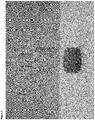
- the other 15 vials of the 50 vials showed dots or small droplets on the inner wall surface above the meniscus of the aqueous solution. This can be seen from Figure 2 , which is a representative photograph of the 15 vials with such small droplets on the inner wall surface above the meniscus of the aqueous solution. These small droplets remained on the inner wall surface and did not flow down back into the solution.
- the obtained aqueous solution was subsequently filtered using a Millipore 0.22 micrometer PVDF filter.
- 10 SCHOTT Fiolax® vials (size 2R, ca. 2 mL of volume) were filled with 0.7 mL of this filtered aqueous solution.
- the vials were allowed to stand for 10 min at ambient temperature before being assessed for any changes on the inner wall of the vials above the meniscus of the aqueous solution.
- the assessment was conducted in an Apollo II liquid viewer (Adelphi manufacturing, Haywards heath, UK) with the least possible movement of the vials during assessment.
- both formulations contained a model protein (BSA) at a concentration of 20 mg/ml.
- BSA model protein
- PS20 polysorbate 20
- PS80 polysorbate 80
- Formulation 1 20 mg/ml BSA, 0.03% w/v PS20, 248 mM Sucrose, 20 mM Histidine/Histidine HCI at pH 5.75.
- Formulation 2 20 mg/ml BSA, 0.03% w/v PS80, 248 mM Sucrose, 20 mM Histidine/Histidine HCI at pH 5.75.
- the vials used were the following: Two types of vials were used, each in a 2 ml configuration. For vial type 1 a Fiolax® vial (SCHOTT AG, Germany) was used, which had a hydrophilic inner wall glass surface. For vial type 2 a TopLyo® vial (SCHOTT AG, Germany) was used, which had a hydrophobic inner wall glass surface. Prior to filling, vials type 1 and 2 were washed with a Belimed PH810 vial washer (Belimed AG, Switzerland) at 80°C using deionized water.
- a Belimed PH810 vial washer Belimed PH810 vial washer
- Fluorescein was added to formulations 1 and 2 in a concentration of 5 mg/ml and the formulations were stirred for 2 h at room temperature and subsequently filtered using a Millipore 0.22 micrometer PVDF filter. The filtered aqueous solutions were used for simulated fogging.
Landscapes
- Health & Medical Sciences (AREA)
- Pharmacology & Pharmacy (AREA)
- Life Sciences & Earth Sciences (AREA)
- Animal Behavior & Ethology (AREA)
- General Health & Medical Sciences (AREA)
- Public Health (AREA)
- Veterinary Medicine (AREA)
- Medicinal Preparation (AREA)
Abstract
The invention relates to a method which employs a dye for testing the result of a filling process of vials with a liquid formulation, and to the use of a dye for testing the result of a filling process of vials with said liquid formulation.
Description
- The invention relates to a method which employs a dye for testing the result of a filling process of vials with a liquid formulation, and to the use of a dye for testing the result of a filling process of vials with said liquid formulation.
- Lyophilized formulations have become an important part of pharmaceutical development and production. In particular, lyophilized formulations offer significant advantages with respect to stability and storage over solutions or other liquid formulations.
- It is often undesirable to store pharmaceutical formulations in a liquid form due to potential stability problems. Some liquid formulations must be stored at low temperatures. Other formulations deteriorate during storage in a liquid form. One possibility to overcome these issues is to freeze-dry the pharmaceutical formulation. A freeze-dried formulation can be transported and stored in a dry form which can then be reconstituted prior to use.
- However, the freeze-drying process itself can result in a deterioration of the properties of the formulation, in particular if the active agent is a protein. Lyoprotectants such as certain sugars as well as surfactants are commonly added to the pharmaceutical formulation to avoid degradation of active agents and improve overall stability. In addition, surfactants are typically used to ensure adequate drug product stability, processing and compatibility with administration materials and devices. Surfactants within the meaning of the invention means any substance that shows surface activity, so the terms "surfactant" and "surface active agent" can be used synonymously within the meaning of the invention.
- It has been observed that in some cases a liquid pharmaceutical formulation can creep up the inner surface of the walls of a container (e.g., a vial) above the meniscus of the liquid pharmaceutical formulation after it has been filled in. This creeping results in an undesired appearance that is in essence a material causing the undesired appearance, for example, in the form of a contamination of the inner surface of the wall of a container above the meniscus and can take the form of a haze or cloud or fog or haziness of different patterns, or even of droplets, on the inner wall of the vial above the meniscus of the liquid pharmaceutical formulation.
- So for the purpose of this invention, the term "undesired appearance" encompasses also contamination or defect of the inner surface of the wall of a container above the meniscus of the content of the container, such as a liquid pharmaceutical formulation.
- Another source of such a defect of the inner wall of the vial above the meniscus of the liquid pharmaceutical formulation can also be a "dirty" filling process or a shaking of the vial after filling, leaving splashes on the inner wall of the vial above the meniscus of the pharmaceutical formulation. After lyophilization, the defect takes on a form of a residue on the inner wall surface of the container. This residue may be considered a cosmetic defect, yet it is undesirable because it can impact the visual inspection of the containers and its appearance may be questioned by patients and doctors alike.
- Aside from the cosmetic side, it is possible that such a defect provides risks for container closure integrity if the material causing the defect, such as dried material, is in between container and stopper. This increases the likelihood of microbiological contamination, which may present a risk for adverse reactions in patients. Further risks include the possibility that the material making up the defect is air-dried instead of lyophilized, which could result in different reconstitution kinetics or, depending on the formulation, might cause changes in the formulation, e.g. in the form of protein denaturation.
- The creeping of the liquid on the container walls can for example occur, if the liquid formulation comprises a surfactant; however, it has also been observed for liquid formulations without surfactant. The creeping can also depend on the properties of the glass container.
- The creeping of the liquid on the container walls has been explained with the Marangoni flow or Marangoni convection and can be influenced by the parameters of the glass containers used (Abdul-Fattah, A.M., et al.; European Journal of Pharmaceutics and Biopharmaceutics, 85 (2013) 314-326). To avoid creeping (also called "fogging"), it has been suggested to utilize glass containers with a defined contact angle (see for example
WO 2010/115728 A2 ). Contact angle measurement also allows for an estimation of the overall hydrophobicity of a glass surface (Rödel, E., et al.; Pharm. Ind. 75 (2013), 328-332). - The use of hydrophobic coatings (e.g., siliconized coatings) in glass containers has also been suggested to prevent creeping in glass vials of lyophilisates. However, the inventors found that not every container with a hydrophobic coating is equally suitable and such containers may introduce further quality defects, such as an increased amount of sub-visible particles. The inventors found that, in particular, the difference between the actual surface tension of the liquid, compared to the actual surface energy of the glass container, is relevant for the avoidance of creeping.
- Manufacturers of glass containers with hydrophobic coatings even promote their hydrophobic coated vials by suggesting a Lotus effect caused by the hydrophobic coating, which means that any material making up the defect of the inner wall of the vial above the meniscus of the liquid formulation in the vial after filling flows down and back into the liquid formulation, but also this was found by the inventors not to occur in all instances; instead the material making up the defect occasionally remained on the inner wall surface of the vial above the meniscus of the liquid formulation in the vial after filling.
- As such, there is a need for a new method to allow for an optimized selection of glass containers for lyophilized formulations, to allow for an optimized selection of a "clean" filling process of vials with a liquid drug formulation, and for control, improvement and optimization of a filling process of vials with liquid formulations in order to minimize or even to avoid any material making up the defect on the inner wall surface of the vial above the meniscus of the liquid formulation in the vial.
- The present invention is based on the finding that the use of a dye in a liquid drug formulation provides an accurate and reliable test method for determining whether material making up the defect occurs during the filling process of vials with a liquid drug formulation. Advantageously, the method according to the invention allows one to determine both a vial and a filling process which avoids material making up the defect, thereby providing significant improvements in lyophilized drug formulation quality, in particular in mass production, and associated cost savings.
- Subject of the invention is a method METHTEST for testing the result of a filling process of vials with a liquid formulation DYE-FORM, comprising the steps (a), (b) and (c):
- (a) filling a vial with DYE-FORM resulting in a filled vial;
- (b) allowing the filled vial to stand upright for a period of time; and
- (c) determining whether DYE-FORM is present or not on the inner wall surface of the filled vial above the meniscus line of DYE-FORM;
-
-
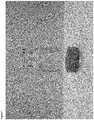
Figure 1 is a representative photograph of a TopLyo® vial with a "clean" vial wall, after having been filled with DYE-FORM by the filling process of Example 1; a "clean" vial means a vial without any of the defects mentioned herein, such as no DYE-FORM is observed on the inner wall surface above the meniscus line of the DYE-FORM. -
Figure 2 is a representative photograph of a TopLyo® vial with small droplets on the inner wall surface above the meniscus line of the DYE-FORM, after having been filled with DYE-FORM by the filling process of Example 1. -
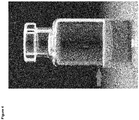
Figure 3 is a representative photograph of a Fiolax® vial showing a defect ("fogging") on the inner wall surface above the meniscus line of the DYE-FORM, after having been filled with DYE-FORM by the filling process of Example 2. -
Figure 4 is a representative photograph of a Fiolax® vial showing a defect ("fogging") on the inner wall surface above the meniscus line of the DYE-FORM, after having been filled with DYE-FORM according to formulation 1 by the filling process of Example 3. -
Figure 5 is a representative photograph of a TopLyo® vial with a "clean" vial wall, after having been filled with DYE-FORM according to formulation 1 by the filling process of Example 3; a "clean" vial means a vial without any of the defects mentioned herein, such as no DYE-FORM is observed on the inner wall surface above the meniscus line of the DYE-FORM. - The testing of a filling process of a vial comprises, for example, testing whether fogging occurs once a vial has been filled with liquid formulation. This can also be used to predict fogging, for example using a test liquid formulation to simulate the filling of an actual drug formulation. Furthermore, testing a filling process of a vial comprises verification that the filling of the vial with the liquid formulation was done in a clean way essentially keeping the inner surface of the wall above the meniscus of the liquid formulation in the vial in a clean state, for example, the filling of the vial was done without any splashing to the inner surface of the wall having occurred. The result of the filling process of vials can be determined as being negative or unsatisfactory when any of the mentioned defects or undesired appearances occur, caused for example, when the filling process itself fails to meet expectations, such as when splashing occurs during the filling process, or caused for example when after the filling process for other reasons any of the mentioned defects or undesired appearances occur, such as due to fogging or creeping.
- Preferably, the vial is a glass vial. For example, one type of glass that is suitable is borosilicate glass. Borosilicate glass vials are commercially available inter alia under the trade designations Duran®, Pyrex®, Ilmabor®, Simax®, Fiolax®, TopLyo®, Ompi Alba® and BORO-8330™. The surface of the glass can optionally be modified. Examples of modifications are hydrophobic coatings, siliconization or methylation of the surface.
- The dye may be selected from the group consisting of fluorescein, methylene blue, rhodamine, Congo red, acridine orange, crystal violet, cyanine, methyl orange, Coomassie blue, methyl red, ethidium bromide, Victoria blue, Orange G, BODIPY, Alexa Fluor, Texas red, indocyanine green, cyanine, phtahlocyanine, and derivatives thereof.
- Preferably, the dye is a fluorescent dye.
- In a particular embodiment, the dye is fluorescein.
- In some embodiments, DYE-FORM comprises a surfactant. In the case that DYE-FORM comprises a surfactant, component (2) of DYE-FORM can comprise the surfactant. In the case that DYE-FORM comprises a surfactant, preferably the surfactant is a polysorbate or a poloxamer. In specific embodiments, the surfactant is selected from the group consisting of polysorbate 20, polysorbate 80 and poloxamer 188.
- DYE-FORM can be prepared by mixing the two components (1) and (2) in any order. In one embodiment, component (1) is added to component (2).
- Preferably, the dye is dissolved in component (2) thereby obtaining DYE-FORM with the dye in a dissolved state.
- The dissolving can be done by any conventional means known to the skilled person in the art, such as shaking, stirring, application of ultrasonic sound. Devices which can be used for the shaking, stirring or for application of ultrasonic sound are also known to the skilled person, stirring can for example be done with appliances such as stirring rods or magnetic stirrers.
- Preferably, the dissolving is performed during a time of from 1 second to 12 hours, more preferably of from 2 minutes to 6 hours, even more preferably of from 10 minutes to 4 hours, especially of from 30 minutes to 3 hours, more especially of form 1.5 hours to 2.5 hours.
- Preferably, the dissolving is done at a temperature of from 0°C to 100°C, more preferably of from 2°C to 80°C, even more preferably of from 5°C to 50°C, especially of from 10°C to 35°C, more especially of from 15°C to 25°C.
- DYE-FORM can be filtered before it is filled into the vial, this is for example done to remove any undissolved particles, such as undissolved dye. The filtering can be performed by any means known in the art. For example, the filtering may be performed using a PVDF filter. The pore size can range preferably from 50 nm to 50 micrometer, more preferably from 100 nm to 10 micrometer, even more preferably from 100 nm to 5 micrometer. In one particular embodiment, the pore size is 0.2 micrometer.
- Preferably, the liquid is water.
- Preferably, the liquid formulation is an aqueous formulation.
- Preferably, the liquid formulation comprises a drug product.
- The drug product can be any drug product known to the skilled person, such as small molecule drug products, large molecule drug products, such as proteins, antibodies, antibody-drug conjugates, peptides, RNA, DNA, oligonucleotides, or polynucleotides.
- In case the liquid formulation is an aqueous formulation, it can comprise a buffer. The buffer can, for example, be used to stabilize the pH of the solution.
- In case the liquid formulation is an aqueous formulation, it can have a pH of 2 to 12, preferably of 2.5 to 10, more preferably of 3.5 to 8, and even more preferably of 4 to 7.
- Suitable buffers are well known in the art. Such buffers are for example histidine-buffers, citrate-buffers, succinate-buffers, acetate-buffers, phosphate-buffers, and mixtures thereof. Preferred buffers are citrate, L-histidine or mixtures of L-histidine and L-histidine hydrochloride. Independently from the buffer used, the pH can be adjusted with an acid or a base known in the art, e.g. hydrochloric acid, acetic acid, phosphoric acid, sulfuric acid, citric acid, sodium hydroxide or potassium hydroxide.
- The liquid formulation can comprise, besides a drug product, further components typically found in pharmaceutical formulations, such as carriers, excipients, stabilizers, preservatives, lyoprotectants or other components.
- Carriers can be any carrier known to the skilled person in the art such as for example aqueous liquids; dextrose solutions; glycerol solutions; microemulsions; nanoparticles; liposomal suspensions; oils, including those of petroleum, animal, vegetable or synthetic origin, such as peanut oil, soybean oil, mineral oil, and sesame oil; isopropyl alcohol, gaseous fluorocarbons, ethyl alcohol, polyvinyl pyrrolidone, propylene glycol, a gel-producing material, stearyl alcohol, stearic acid, spermaceti, sorbitan monooleate, and methylcellulose; as well as combinations thereof.
- Excipients can be any excipient known to the skilled person in the art such as for example starch, glucose, lactose, sucrose, gelatin, silica gel, sodium stearate, glycerol, glycerol monostearate, talc, sodium chloride, propylene, glycol, and ethanol; as well as combinations thereof.
- Stabilizers can be any stabilizers known to the skilled person in the art such as for example amino acids; ascorbic acid; surfactants such as a polyosorbate or a poloxamer; polyhydric sugar alcohols, preferably trihydric or higher sugar alcohols, such as glycerin, erythritol, arabitol, xylitol, sorbitol, mannitol and sucrose; as well as combinations thereof.
- Preservatives can be any preservative known to the skilled person in the art, such as for example octadecyldimethylbenzyl ammonium chloride, hexamethonium chloride, benzalkonium chloride, benzethonium chloride, phenol, butyl or benzyl alcohol, alkyl parabens such as methyl or propyl paraben, catechol, resorcinol, cyclohexanol, 3-pentanol, and m-cresol.
- Lyoprotectants are pharmaceutically acceptable excipients which protect a labile active ingredient (e.g., a protein) against destabilizing conditions during the freeze-drying process, subsequent storage and reconstitution. Lyoprotectants comprise, but are not limited to, the group consisting of sugars, polyols (e.g. sugar alcohols) and amino acids. Preferably, lyoprotectants are selected from the group consisting of sugars (such as sucrose, trehalose, lactose, glucose, mannose, maltose, galactose, fructose, sorbose, raffinose, and neuraminic acid), amino sugars (such as lucosamine, galactosamine, and N-methylglucosamine ("Meglumine")), polyols (such as mannitol and sorbitol), and amino acids (such as arginine and glycine). Preferably, lyoprotectants are present in the liquid formulation in an amount of 1 to 500 mM, more preferably 10 to about 300 mM and even more preferably in an amount of about 100 to about 200 mM.
- Yet other components in the liquid formulation can be hydrophilic polymers such as polyethylene glycol (PEG); monosaccharides; disaccharides; including mannose and trehalose; oligosaccharides, polysaccharides, and other carbohydrates including dextrins or dextrans; chelating agents such as EDTA; salt-forming counter-ions such as sodium; metal complexes (e.g. Zn-protein complexes); and fatty acid esters, fatty acid ethers or sugar esters.
- In the case that DYE-FORM comprises a surfactant, then DYE-FORM preferably comprises the surfactant in an amount of from 0.000001 to 50%, more preferably from 0.000001 to 10%, even more preferably from 0.00001 to 1%, especially from 0.0001 to 0.5%, more especially from 0.00015 to 0.2%, even more especially from 0.001 to 0.1%, of surfactant; the percentages are weight of surfactant/volume of DYE-FORM.
- Preferably, DYE-FORM comprises from 0.01 to 100 mg/ml, more preferably from 0.05 to 50 mg/ml, even more preferably from 0.1 to 20 mg/ml, especially from 0.5 to 12 mg/ml, more especially from 1 to 10 mg/ml, even more especially from 2 to 8 mg/ml, of dye in DYE-FORM.
- In step (a) of the method, the vial is typically filled according to a pre-determined volume. Preferably, DYE-FORM fills 1 to 99%, more preferably 5 to 95%, even more preferably 10 to 90%, especially 15 to 80%, more especially 20 to 70%, even more especially 25 to 60%, in particular 30 to 60%, more in particular 40 to 60%, of the volume of the vial. The filling of vials is preferably automated.
- In step (b) of the method, the period of time that the filled vial is allowed to stand upright may depend on the type of liquid or liquid formulation, on the type of vial and, in case a surfactant is present, on the type of surfactant. Preferably, the vial is allowed to stand upright for 1 second to 1 week, more preferably for 10 seconds to 1 day, even more preferably for 10 seconds to 12 hours, especially for 1 minute to 6 hours, more especially for 2 minutes to 3 hours, even more especially for 3 minutes to 1 hour, in particular for 5 minutes to 30 minutes.
- During the period of time that the filled vials are allowed to stand upright, potential creeping of DYE-FORM up the inner wall surface of the vials could occur.
- Preferably, the filled vials are allowed to stand upright for said period of time to observe potential creeping of DYE-FORM up the inner wall surface of the vials at a temperature of 0°C to 100°C, more preferably 2°C to 80°C, even more preferably 5°C to 50°C, especially 10°C to 35°C, more especially 15°C to 25°C.
- In step (c) of the method, the meniscus line of the DYE-FORM is to be understood to correspond to the height which the DYE-FORM would be expected to reach in the vial based on the volume of DYE-FORM.
- The determination of whether DYE-FORM is present on the inner wall surface of the filled vial above the meniscus line of the DYE-FORM can be made by a machine. In preferred embodiments, the determination of whether DYE-FORM is present on the inner wall surface of the filled vial above the meniscus line of the DYE-FORM is made by automated photographic analysis of the vial wall.
- Another subject of the invention is a method METHSELECT for selecting a vial which shows no defects after the filling of the vial with a drug product, comprising the steps (a), (b), (c) and (d):
- steps (a), (b) and (c) as defined herein, also with all their embodiments; and
- step (d) selecting a vial for which it has been determined that no DYE-FORM is present on the inner wall surface of the filled vial above the meniscus line of the DYE-FORM;
- Another subject of the invention is a kit KITDYE for analyzing the susceptibility to fogging of a vial containing a component (2), wherein the kit comprises a component (1);
with component (1) and component (2) as defined herein, also with all their embodiments. - Preferably, the kit additionally comprises a member selected from the group consisting of:
- (i) a surfactant;
- (ii) a buffer;
- (iii) a filter;
- (iv) a positive control vial;
- (v) a negative control vial;
- In some embodiments, component (1) is present in the kit in the form of a solution, preferably in the form of an aqueous solution.
- The positive control vial can be a vial type which has been tested by METHTEST, and for which it has been determined that DYE-FORM is present on the inner wall surface of the filled vial above the meniscus line of the DYE-FORM;
the negative control vial can be a vial type which has been tested by METHTEST, and for which it has been determined that DYE-FORM is not present on the inner wall surface of the filled vial above the meniscus line of the DYE-FORM;
with METHTEST as defined herein, also with all its embodiments. - Another subject of the invention is a method METHCOMP for increasing patient compliance, wherein a drug product is provided to the patient in a vial selected by METHSELECT, with METHSELECT as defined herein, also with all its embodiments.
- Preferably, METHCOMP is for increasing patient compliance for a patient who is self-administering a drug product.
- Another subject of the invention is a method METHRED for reducing waste of drug product dosed from a vial and/or for reducing waste of vials, comprising selecting the vial by METHSELECT, with METHSELECT as defined herein, also with all its embodiments.
- Another subject of the invention is a method METHSTAND for standardizing the dosage and/or administration of drug product administered to a patient from a vial, comprising filling a vial with drug product, wherein said vial is selected by METHSELECT, with METHSELECT as defined herein, also with all its embodiments.
- Another subject of the invention is the use of a dye in METHTEST, KITDYE, METHSELECT, METHCOMP, METHRED, and/or METHSTAND, with METHTEST, KITDYE, METHSELECT, METHCOMP, METHRED, and METHSTAND as defined herein, also with all their embodiments.
- The definitions of the words or drawing elements described herein are meant to include not only the combination of elements which are literally set forth, but all equivalent structure, material or acts for performing substantially the same function in substantially the same way to obtain substantially the same result. In this sense, it is therefore contemplated that an equivalent substitution of two or more elements may be made for any one of the elements described and its various embodiments or that a single element may be substituted for two or more elements in a claim.
- Changes from the claimed subject matter as viewed by a person with ordinary skill in the art, now known or later devised, are expressly contemplated as being equivalents within the scope intended and its various embodiments. Therefore, obvious substitutions now or later known to one with ordinary skill in the art are defined to be within the scope of the defined elements. This disclosure is thus meant to be understood to include what is specifically illustrated and described herein, what is conceptually equivalent, what can be obviously substituted, and also what incorporates the essential ideas.
- A simulated "dirty" fill-in procedure causing creeping of non-lyophilized formulations was performed to evaluate the extent of solution creeping up the inner vial surface, before actual freeze drying. The filling process and any material making up the defect was characterized through the use of a fluorescent dye.
- An aqueous solution of 5 mg/mL fluorescein (Fluka Analytical) and polysorbate 20 0.02 % weight/volume (= 0.2 g per 1 L water) was prepared by mixing fluorescein with a respective aqueous solution of polysorbate 20 and stirring the mixture for 2 h at room temperature. The obtained aqueous solution was subsequently filtered using a Millipore 0.22 micrometer PVDF (polyvinylidene difluoride) filter.
- 50 SCHOTT TopLyo® vials (size 2R, ca. 2 mL of volume) were filled with 0.7 mL of this filtered aqueous solution. The vials were allowed to stand for 10 min at ambient temperature before being assessed for any changes on the inner wall of the vials above the meniscus of the aqueous solution. The assessment was conducted in an Apollo II liquid viewer (Adelphi manufacturing, Haywards heath, UK) with the least possible movement of the vials during assessment.
- Of the 50 vials, 35 vials did not show any fogging or creeping; rather, the inner wall surfaces of the vials were "clean", that is without any defect on the inner wall surface above the meniscus of the aqueous solution of the vial. This can be seen from
Figure 1 , which is a representative photograph of the 35 vials with a "clean" vial wall. - The other 15 vials of the 50 vials showed dots or small droplets on the inner wall surface above the meniscus of the aqueous solution. This can be seen from
Figure 2 , which is a representative photograph of the 15 vials with such small droplets on the inner wall surface above the meniscus of the aqueous solution. These small droplets remained on the inner wall surface and did not flow down back into the solution. - To illustrate the use of the method for predicting fogging, an aqueous solution of 5 mg/mL fluorescein and polysorbate 20 0.02 % weight/volume (= 0.2 g per 1 L water) was prepared by mixing fluorescein with a respective aqueous solution of polysorbate 20 and stirring the mixture for 2 h at room temperature. The obtained aqueous solution was subsequently filtered using a Millipore 0.22 micrometer PVDF filter.
- 10 SCHOTT Fiolax® vials (size 2R, ca. 2 mL of volume) were filled with 0.7 mL of this filtered aqueous solution. The vials were allowed to stand for 10 min at ambient temperature before being assessed for any changes on the inner wall of the vials above the meniscus of the aqueous solution. The assessment was conducted in an Apollo II liquid viewer (Adelphi manufacturing, Haywards heath, UK) with the least possible movement of the vials during assessment.
- Of the 10 vials, all 10 vials showed a defect in the form of a contamination ("fogging") of the inner wall surface above the meniscus of the aqueous solution. This can be seen from
Figure 3 , which is a representative photograph of the 10 vials with such defect on the inner wall surface above the meniscus of the aqueous solution. This defect remained on the inner wall surface and did not flow down back into the solution. - In this experiment, the method for predicting fogging was tested using two different formulations in two vial types. Both formulations contained a model protein (BSA) at a concentration of 20 mg/ml. One formulation was prepared containing polysorbate 20 (PS20), and one formulation was prepared containing polysorbate 80 (PS80), as follows:
Formulation 1: 20 mg/ml BSA, 0.03% w/v PS20, 248 mM Sucrose, 20 mM Histidine/Histidine HCI at pH 5.75.
Formulation 2: 20 mg/ml BSA, 0.03% w/v PS80, 248 mM Sucrose, 20 mM Histidine/Histidine HCI at pH 5.75. - The vials used were the following:
Two types of vials were used, each in a 2 ml configuration. For vial type 1 a Fiolax® vial (SCHOTT AG, Germany) was used, which had a hydrophilic inner wall glass surface. For vial type 2 a TopLyo® vial (SCHOTT AG, Germany) was used, which had a hydrophobic inner wall glass surface. Prior to filling, vials type 1 and 2 were washed with a Belimed PH810 vial washer (Belimed AG, Zug, Switzerland) at 80°C using deionized water. - Fluorescein was added to formulations 1 and 2 in a concentration of 5 mg/ml and the formulations were stirred for 2 h at room temperature and subsequently filtered using a Millipore 0.22 micrometer PVDF filter. The filtered aqueous solutions were used for simulated fogging.
- 10 vials each from the two different vial types were slowly filled with 1 ml of the filtered aqueous solution according to formulation 1, and 10 vials each were slowly filled with 1 ml of the filtered aqueous solution according to formulation 2. The vials were assessed for any changes related to solution creeping up the inner surface of the vial wall, both after 10 seconds and after 60 minutes at ambient temperature. The assessment was conducted in an Apollo II liquid viewer (Adelphi manufacturing, Haywards heath, UK) with the least possible movement of the vials during assessment.
- The method showed that there were distinct differences in the extent of fluorescence solution creeping up the inner wall surface of the two different vial types. While both formulations 1 and 2 formed a concave meniscus in the type 1 vials (see
Figure 4 ), they formed a planar surface in type 2 vials (seeFigure 5 ). No significant differences between formulations 1 and 2 were visible. - When formulation 1 was filled into the type 1 vials, the method showed after 10 seconds a defect in the form of a contamination ("fogging") of the inner wall surface above the meniscus of the aqueous solution (see the area pointed to by the arrow in
Figure 4 ). The defect appeared equally in formulation 2. No fogging was observed within 10 seconds in type 2 vials (seeFigure 5 ), or even within 60 minutes, regardless of the formulation used.
with the surfactant, the buffer and the filter as defined herein, also with all their embodiments.
Claims (15)
- A method METHTEST for testing the result of a filling process of vials with a liquid formulation DYE-FORM, comprising the steps (a), (b) and (c):(a) filling a vial with DYE-FORM resulting in a filled vial;(b) allowing the filled vial to stand upright for a period of time; and(c) determining whether DYE-FORM is present or not on the inner wall surface of the filled vial above the meniscus line of DYE-FORM;with DYE-FORM comprising two components (1) and (2), component (1) being a dye, component (2) being a liquid or a liquid formulation.
- Method according to claim 1, wherein the vial is a glass vial.
- Method according to claim 1 or claim 2, wherein the dye may be selected from the group consisting of fluorescein, methylene blue, rhodamine, Congo red, acridine orange, crystal violet, cyanine, methyl orange, Coomassie blue, methyl red, ethidium bromide, Victoria blue, Orange G, BODIPY, Alexa Fluor, Texas red, indocyanine green, cyanine, phtahlocyanine, and derivatives thereof.
- Method according to one or more of claims 1 to 3, wherein the dye is a fluorescent dye.
- Method according to one or more of claims 1 to 4, wherein the dye is fluorescein.
- Method according to one or more of claims 1 to 5, wherein DYE-FORM comprises a surfactant.
- Method according to claim 5, wherein the surfactant is a polysorbate or a poloxamer.
- Method according to one or more of claims 1 to 7, wherein the liquid is water.
- Method according to one or more of claims 1 to 7, wherein the liquid formulation comprises a drug product.
- A method METHSELECT for selecting a vial which shows no defects after the filling of the vial with a drug product, comprising the steps (a), (b), (c) and (d):step (a), (b) and (c) as defined in claims 1 to 9; andstep (d) selecting a vial for which it has been determined that no DYE-FORM is present on the inner wall surface of the filled vial above the meniscus line of the DYE-FORM;with DYE-FORM as defined in claim 1.
- A kit KITDYE for analyzing the susceptibility to fogging of a vial containing a component (2), wherein the kit comprises a component (1);
with component (1) and component (2) as defined in claim 1. - A method METHCOMP for increasing patient compliance, wherein a drug product is provided to the patient in a vial selected by METHSELECT, with METHSELECT as defined in claim 10.
- A method METHRED for reducing waste of drug product dosed from a vial and/or for reducing waste of vials, comprising selecting the vial by METHSELECT, with METHSELECT as defined in claim 10.
- A method METHSTAND for standardizing the dosage and/or administration of drug product administered to a patient from a vial, comprising filling a vial with drug product, wherein said vial is selected by METHSELECT, with METHSELECT as defined in claim 10.
- A dye in METHTEST, KITDYE, METHSELECT, METHCOMP, METHRED, and/or METHSTAND, with METHTEST, KITDYE, METHSELECT, METHCOMP, METHRED, and METHSTAND as defined in any one of claims 1 to 14.
Priority Applications (1)
| Application Number | Priority Date | Filing Date | Title |
|---|---|---|---|
| EP18208057.2A EP3656218A1 (en) | 2018-11-23 | 2018-11-23 | Method for testing the result of a filling process of vials |
Applications Claiming Priority (1)
| Application Number | Priority Date | Filing Date | Title |
|---|---|---|---|
| EP18208057.2A EP3656218A1 (en) | 2018-11-23 | 2018-11-23 | Method for testing the result of a filling process of vials |
Publications (1)
| Publication Number | Publication Date |
|---|---|
| EP3656218A1 true EP3656218A1 (en) | 2020-05-27 |
Family
ID=64456846
Family Applications (1)
| Application Number | Title | Priority Date | Filing Date |
|---|---|---|---|
| EP18208057.2A Withdrawn EP3656218A1 (en) | 2018-11-23 | 2018-11-23 | Method for testing the result of a filling process of vials |
Country Status (1)
| Country | Link |
|---|---|
| EP (1) | EP3656218A1 (en) |
Cited By (2)
| Publication number | Priority date | Publication date | Assignee | Title |
|---|---|---|---|---|
| WO2023172587A1 (en) * | 2022-03-07 | 2023-09-14 | Opus Life Sciences Llc | Fluorescein formulations and kits |
| US20250073125A1 (en) * | 2023-09-06 | 2025-03-06 | Opus Life Sciences, Llc | High ph formulations and kits |
Citations (3)
| Publication number | Priority date | Publication date | Assignee | Title |
|---|---|---|---|---|
| JP2003169694A (en) * | 2001-12-10 | 2003-06-17 | Wako Pure Chem Ind Ltd | Reagent for Gram staining, reagent kit and Gram staining method using the same |
| WO2010115728A2 (en) | 2009-03-30 | 2010-10-14 | F. Hoffmann-La Roche Ag | A method for avoiding glass fogging |
| US20130203173A1 (en) * | 2012-02-03 | 2013-08-08 | Thermo Fisher Scientific Oy | Method for determining the concentration of beta-D-glucan |
-
2018
- 2018-11-23 EP EP18208057.2A patent/EP3656218A1/en not_active Withdrawn
Patent Citations (3)
| Publication number | Priority date | Publication date | Assignee | Title |
|---|---|---|---|---|
| JP2003169694A (en) * | 2001-12-10 | 2003-06-17 | Wako Pure Chem Ind Ltd | Reagent for Gram staining, reagent kit and Gram staining method using the same |
| WO2010115728A2 (en) | 2009-03-30 | 2010-10-14 | F. Hoffmann-La Roche Ag | A method for avoiding glass fogging |
| US20130203173A1 (en) * | 2012-02-03 | 2013-08-08 | Thermo Fisher Scientific Oy | Method for determining the concentration of beta-D-glucan |
Non-Patent Citations (4)
| Title |
|---|
| ABDUL-FATTAH, A.M. ET AL., EUROPEAN JOURNAL OF PHARMACEUTICS AND BIOPHARMACEUTICS, vol. 85, 2013, pages 314 - 326 |
| ABDUL-FATTAH, A.M. ET AL., EUROPEAN JOURNAL OF PHARMACEUTICS AND BIOPHARMACEUTICS, vol. 85, 2013, pages 314 - 326, XP002789312 * |
| DOUGLAS ROBY: "New Mexico Wastewater Laboratory Certification Study Guide. Version I", UTILITY OPERATORS CERTIFICATION PROGRAM, 1 July 2016 (2016-07-01), pages 296 pp., XP055562614, Retrieved from the Internet <URL:https://www.env.nm.gov/wp-content/uploads/2016/07/New-Mexico-Wastewater-Laboratory-Certification-Study-Guide.pdf> * |
| RODEL, E. ET AL., PHARM. IND., vol. 75, 2013, pages 328 - 332 |
Cited By (2)
| Publication number | Priority date | Publication date | Assignee | Title |
|---|---|---|---|---|
| WO2023172587A1 (en) * | 2022-03-07 | 2023-09-14 | Opus Life Sciences Llc | Fluorescein formulations and kits |
| US20250073125A1 (en) * | 2023-09-06 | 2025-03-06 | Opus Life Sciences, Llc | High ph formulations and kits |
Similar Documents
| Publication | Publication Date | Title |
|---|---|---|
| Que et al. | Insights into the dissolution behavior of ledipasvir–copovidone amorphous solid dispersions: role of drug loading and intermolecular interactions | |
| Salunke et al. | Ion activated in situ gel of gellan gum containing salbutamol sulphate for nasal administration | |
| JP7221485B2 (en) | Formulations of Brincidofovir | |
| JP5835717B2 (en) | Pharmaceutical composition and method for producing the same | |
| TR201901579T4 (en) | Pharmaceutical dosage form for rapid release of an indoline derivative. | |
| US11911500B2 (en) | Medroxyprogesterone acetate injectable compositions and methods of use | |
| Gao et al. | A sensitive in vitro performance assay reveals the in vivo drug release mechanisms of long-acting medroxyprogesterone acetate microparticles | |
| MXPA05004299A (en) | Depot formulations of arylheterocyclic active agents in the form of a suspension. | |
| US20190105390A1 (en) | Formulations of a pi3k/mtor-inhibitor for intravenous administration | |
| CN112218618B (en) | Aqueous formulation containing 1-(4-{[4-(dimethylamino)piperidin-1-yl]carbonyl}phenyl)-3-[4-(4,6-dimorpholin-4-yl-1,3,5-triazin-2-yl)phenyl]urea | |
| US20040115822A1 (en) | Methods of measuring the dissolution rate of an analyte in a non-aqueous liquid composition | |
| D'Souza | Injectables | |
| Fecioru et al. | In vitro performance testing of nanoparticulate drug products for parenteral administration | |
| JP3699223B2 (en) | A novel dosage form of hydroxocobalamin and its use in cyanide poisoning | |
| US20220387448A1 (en) | Medroxyprogesterone acetate injectable compositions and methods of use | |
| IL318343A (en) | Method for suppressing bitterness of quinoline derivatives | |
| US11752095B2 (en) | Medroxyprogesterone acetate injectable compositions and methods of use | |
| Lima et al. | Bioequivalence of final tablet formulation and research tablet formulation of eslicarbazepine acetate in healthy volunteers | |
| Fernandes | Relatório de Estágio em Investigação na Bluepharma Indústria Farmacêutica, SA | |
| CN120603583A (en) | Lyophilized sovastatin-based injectable formulation and preparation method | |
| WO2007026771A1 (en) | Injection for intravenous drip | |
| BR122024022133A2 (en) | OPHTHALMOLOGICAL PHARMACEUTICAL COMPOSITIONS AND THEIR USE | |
| HK1241736A1 (en) | Formulations of a pi3k/mtor-inhibitor for intravenous administration | |
| Rydén et al. | P19 Dextran microspheres as a nasal delivery system for insulin to rats | |
| Wijma | ORODISPERSIBLE FILMS CONTAINING PULLULAN AND TREHALOSE AS FILM FORMING AGENTS AND AS PROTEIN STABILIZING SUGARS |
Legal Events
| Date | Code | Title | Description |
|---|---|---|---|
| PUAI | Public reference made under article 153(3) epc to a published international application that has entered the european phase |
Free format text: ORIGINAL CODE: 0009012 |
|
| AK | Designated contracting states |
Kind code of ref document: A1 Designated state(s): AL AT BE BG CH CY CZ DE DK EE ES FI FR GB GR HR HU IE IS IT LI LT LU LV MC MK MT NL NO PL PT RO RS SE SI SK SM TR |
|
| AX | Request for extension of the european patent |
Extension state: BA ME |
|
| STAA | Information on the status of an ep patent application or granted ep patent |
Free format text: STATUS: THE APPLICATION HAS BEEN WITHDRAWN |
|
| 18W | Application withdrawn |
Effective date: 20200610 |