EP3656058B1 - Device and method for generating a multi-kernel polar code - Google Patents
Device and method for generating a multi-kernel polar code Download PDFInfo
- Publication number
- EP3656058B1 EP3656058B1 EP17761832.9A EP17761832A EP3656058B1 EP 3656058 B1 EP3656058 B1 EP 3656058B1 EP 17761832 A EP17761832 A EP 17761832A EP 3656058 B1 EP3656058 B1 EP 3656058B1
- Authority
- EP
- European Patent Office
- Prior art keywords
- kernel
- matrix
- polar code
- transformation matrix
- basis
- Prior art date
- Legal status (The legal status is an assumption and is not a legal conclusion. Google has not performed a legal analysis and makes no representation as to the accuracy of the status listed.)
- Active
Links
Images




Classifications
-
- H—ELECTRICITY
- H03—ELECTRONIC CIRCUITRY
- H03M—CODING; DECODING; CODE CONVERSION IN GENERAL
- H03M13/00—Coding, decoding or code conversion, for error detection or error correction; Coding theory basic assumptions; Coding bounds; Error probability evaluation methods; Channel models; Simulation or testing of codes
- H03M13/61—Aspects and characteristics of methods and arrangements for error correction or error detection, not provided for otherwise
- H03M13/615—Use of computational or mathematical techniques
- H03M13/616—Matrix operations, especially for generator matrices or check matrices, e.g. column or row permutations
-
- H—ELECTRICITY
- H03—ELECTRONIC CIRCUITRY
- H03M—CODING; DECODING; CODE CONVERSION IN GENERAL
- H03M13/00—Coding, decoding or code conversion, for error detection or error correction; Coding theory basic assumptions; Coding bounds; Error probability evaluation methods; Channel models; Simulation or testing of codes
- H03M13/03—Error detection or forward error correction by redundancy in data representation, i.e. code words containing more digits than the source words
- H03M13/05—Error detection or forward error correction by redundancy in data representation, i.e. code words containing more digits than the source words using block codes, i.e. a predetermined number of check bits joined to a predetermined number of information bits
- H03M13/13—Linear codes
-
- G—PHYSICS
- G06—COMPUTING OR CALCULATING; COUNTING
- G06F—ELECTRIC DIGITAL DATA PROCESSING
- G06F17/00—Digital computing or data processing equipment or methods, specially adapted for specific functions
- G06F17/10—Complex mathematical operations
- G06F17/16—Matrix or vector computation, e.g. matrix-matrix or matrix-vector multiplication, matrix factorization
-
- H—ELECTRICITY
- H03—ELECTRONIC CIRCUITRY
- H03M—CODING; DECODING; CODE CONVERSION IN GENERAL
- H03M13/00—Coding, decoding or code conversion, for error detection or error correction; Coding theory basic assumptions; Coding bounds; Error probability evaluation methods; Channel models; Simulation or testing of codes
- H03M13/03—Error detection or forward error correction by redundancy in data representation, i.e. code words containing more digits than the source words
- H03M13/033—Theoretical methods to calculate these checking codes
-
- H—ELECTRICITY
- H03—ELECTRONIC CIRCUITRY
- H03M—CODING; DECODING; CODE CONVERSION IN GENERAL
- H03M13/00—Coding, decoding or code conversion, for error detection or error correction; Coding theory basic assumptions; Coding bounds; Error probability evaluation methods; Channel models; Simulation or testing of codes
- H03M13/03—Error detection or forward error correction by redundancy in data representation, i.e. code words containing more digits than the source words
- H03M13/05—Error detection or forward error correction by redundancy in data representation, i.e. code words containing more digits than the source words using block codes, i.e. a predetermined number of check bits joined to a predetermined number of information bits
- H03M13/11—Error detection or forward error correction by redundancy in data representation, i.e. code words containing more digits than the source words using block codes, i.e. a predetermined number of check bits joined to a predetermined number of information bits using multiple parity bits
- H03M13/1102—Codes on graphs and decoding on graphs, e.g. low-density parity check [LDPC] codes
- H03M13/1148—Structural properties of the code parity-check or generator matrix
- H03M13/116—Quasi-cyclic LDPC [QC-LDPC] codes, i.e. the parity-check matrix being composed of permutation or circulant sub-matrices
- H03M13/1168—Quasi-cyclic LDPC [QC-LDPC] codes, i.e. the parity-check matrix being composed of permutation or circulant sub-matrices wherein the sub-matrices have column and row weights greater than one, e.g. multi-diagonal sub-matrices
-
- H—ELECTRICITY
- H03—ELECTRONIC CIRCUITRY
- H03M—CODING; DECODING; CODE CONVERSION IN GENERAL
- H03M13/00—Coding, decoding or code conversion, for error detection or error correction; Coding theory basic assumptions; Coding bounds; Error probability evaluation methods; Channel models; Simulation or testing of codes
- H03M13/03—Error detection or forward error correction by redundancy in data representation, i.e. code words containing more digits than the source words
- H03M13/05—Error detection or forward error correction by redundancy in data representation, i.e. code words containing more digits than the source words using block codes, i.e. a predetermined number of check bits joined to a predetermined number of information bits
- H03M13/13—Linear codes
- H03M13/15—Cyclic codes, i.e. cyclic shifts of codewords produce other codewords, e.g. codes defined by a generator polynomial, Bose-Chaudhuri-Hocquenghem [BCH] codes
- H03M13/1505—Golay Codes
Definitions
- the present invention relates to data encoding and decoding in communication systems. More specifically, the present invention relates to a device and method for encoding and decoding data using multi-kernel polar codes.
- Polar codes are a class of channel codes introduced by Arikan in the work “Channel polarization: a method for constructing capacity-achieving codes for symmetric binary-input memoryless channels," IEEE Trans. Inf. Theo, July 2009 . They are provably capacity-achieving over various classes of channels, and they provide excellent error rate performance for practical code lengths.
- This matrix is also called kernel of the polar code.
- N - K.
- K.
- the elements u i of a binary input vector u N of length N are set to zero for i ⁇ F , and to the information bits for i ⁇ I .
- the relationship between the input vector u N and the codeword x N can be represented by a Tanner graph, which has a number of stages or layers equal to n. Moreover, the Tanner graph is the basis for the decoding algorithms.
- the original polar codes are a sub-case of multi-kernel polar codes, wherein the block length is a power of 2.
- the kernels forming the transformation matrix of the multi-kernel polar code are of the form T 2 ⁇ ... ⁇ T 2 , the multi-kernel polar code is actually a polar code.
- the main idea of the polar codes is that, based on successive-cancellation (SC) decoding as will be elucidated below, some input bit positions are more reliable than others due to a polarization phenomenon.
- SC successive-cancellation
- the information bits are put in the most reliable positions of the input vector u N , while the unreliable positions of the input vector are set to the fixed bit value 0, called also frozen bits, which form the frozen set, as described above.
- the reliabilities of the input bit positions can be obtained by density evolution, genie-aided simulation, or other similar methods (see, e.g., " A comparative study of polar code constructions for the AWGN channel," arXiv:1501.02473, 2015, by H. Vangala et al.).
- a linear code in particular of a polar code, is the minimum distance and it largely determines the slope of the error-rate curve.
- Polar codes permit only to achieve a limited range of minimum distances.
- the minimum distance of a polar code is a power of two, and it is the smallest Hamming weight of rows of the transformation matrix indexed by the information set. This is a significant limit for the design of polar codes, particularly for short lengths where the minimum distance plays a crucial role.
- polar codes show a poor performance compared to other block codes.
- Multi-kernel polar codes can increase the range of minimum distances.
- the structure of the codes which is based on Kronecker products of kernel matrices, does not allow the code to reach the maximal minimum distance for a given code length and dimension.
- the invention relates to a device as specified in claim 1.
- an improved device since the generated multi-kernel polar code can be decoded according to the usual SC decoding (or SC list decoding) operations, the reliabilities of the input bits are not altered, and the decoding order of the input bits is maintained. Thus, the added permutation does not change the structure and the complexity of the SC (list) decoder. Moreover, the device can generate the multi-kernel polar code in a flexible way by means of a permutation improving the distance spectrum of the multi-kernel polar code.
- the device allows to generate a multi-kernel polar code leading to lower error rates compared to the prior art, i.e., having a better performance, and reducing the cyclic redundancy check (CRC) size in SC list decoding.
- CRC cyclic redundancy check
- the processor is configured to permute the order of at least two columns of a sub-matrix of the first transformation matrix G N such that the second transformation matrix G' N has the same polarization as the first transformation matrix G N .
- This provides the advantage of obtaining a multi-kernel polar code having improved minimum distance properties and, at the same time, having polarization properties which improve the reliability transmission of data over noisy communication channels.
- the processor is configured to generate the second transformation matrix G' N of size N ⁇ N by permuting the order of the least two columns of the sub-matrix of the first transformation matrix G N and by permuting the order of at least two columns of a further sub-matrix of the first transformation matrix G N .
- This provides the advantage of obtaining a multi-kernel polar code having improved minimum distance and polarization properties in an easy and efficient way by performing a permutation operation.
- the processor is further configured to determine the predetermined permutation ⁇ N a in such a way that the minimum distance of the multi-kernel polar code x N of length N and dimension K is larger than a predefined threshold.
- the generated multi-kernel polar code has an improved minimum distance, in particular a desired minimum distance being larger than a predefined threshold.
- the invention relates to a communication apparatus comprising a channel encoder comprising a device for generating a multi-kernel polar code according to the first aspect as such or any one of the implementation forms thereof.
- the invention relates to a communication apparatus comprising a channel decoder comprising a device for generating a multi-kernel polar code according to the first aspect as such or anyone of the implementation forms thereof.
- the communication apparatus comprises a processor configured to decode the multi-kernel polar code on the basis of a successive-cancellation (SC) algorithm or a successive-cancellation list (SCL) algorithm.
- SC successive-cancellation
- SCL successive-cancellation list
- the invention relates to a method as specified in claim 13.
- the invention relates to a computer program comprising a program code for performing the method of the fourth aspect when executed on a computer.
- the invention can be implemented in hardware and/or software.
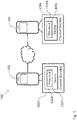
- Figure 1 shows a schematic diagram of a communication system 100 with a communication apparatus 102 comprising a device 102b for generating a multi-kernel polar code x N according to an embodiment.
- the communication apparatus 102 comprises a channel encoder 102a, wherein the channel encoder 102a comprises the device 102b for generating the multi-kernel polar code x N of length N and dimension K on the basis of a first transformation matrix G N of size N ⁇ N defining a first multi-kernel polar code.
- the communication apparatus 102 can be configured to send it to the communication apparatus 104 via a communication channel.
- the communication apparatus 104 comprises a channel decoder 104a, wherein the channel decoder 104a comprises a device 104b for generating a multi-kernel polar code as described above.
- the device 104b can comprise a processor 104c configured to decode the multi-kernel polar code on the basis of a successive-cancellation (SC) algorithm or a successive-cancellation list (SCL) algorithm.
- SC successive-cancellation
- SCL successive-cancellation list
- an improved device 102b since the generated multi-kernel polar code x N can be decoded, e.g., by the communication apparatus 104, according to the usual SC decoding (or SC list decoding) operations.
- the processor 102c can be configured to permute the order of at least two columns of a sub-matrix of the first transformation matrix G N , e.g., by means of the inner edge permutation or predetermined permutation, in a way such that the polarization phenomenon is not affected (i.e. destroyed), and thus reliabilities of the input bits are not changed.
- the bit decoding order is not altered, and the decoding complexity at the communication apparatus 104 is not increased.
- the device 102b allows to generate a multi-kernel polar code x N leading to lower error rates and reducing the cyclic redundancy check (CRC) size in SC list decoding.
- CRC cyclic redundancy check
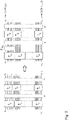
- Figure 2 shows a schematic diagram illustrating a Tanner graph of the multi-kernel polar code x N generated by the device 102b according to an embodiment.
- the processor 102c can be configured to permute the order of at least two columns of a sub-matrix of the first transformation matrix G N such that the second transformation matrix G' N has the same polarization as the first transformation matrix G N .
- the processor 102c can be configured to generate the second transformation matrix G'N of size N ⁇ N by permuting the order of the least two columns of the sub-matrix of the first transformation matrix G N and by permuting the order of at least two columns of a further sub-matrix of the first transformation matrix G N .
- the Tanner graph has a number of stages or layers equal to an integer S , wherein S is the number of factors of the Kronecker product, and represents the relationship between the input vector u N and the generated multi-kernel polar code x N .
- S 2 stages: the first stage composed by N b kernels T b and the second stage composed by N a kernels T a (the stages are counted from right to left).
- N b kernels T b the stages are connected by an edge permutation P
- the first stage is connected to the multi-kernel polar code x N by the edge permutation P -1 .
- a further predetermined permutation ⁇ N a is added between the canonical edge permutation P and one of the kernels T a .
- This embodiment has the advantage that the predetermined permutation ⁇ Na does not alter the bit reliabilities or the SC decoding, since the input log-likelihood-ratios (LLRs) of a kernel are equally distributed.
- LLRs log-likelihood-
- the predetermined permutation ⁇ N a can produce an effect on the second transformation matrix G'N of the multi-kernel polar code, since it shuffles the columns of a part of the first transformation matrix G N .
- the processor 102c can be further configured to determine the predetermined permutation ⁇ N a in such a way that the minimum distance of the multi-kernel polar code x N of length N and dimension K is larger than a predefined threshold.
- the predetermined permutation ⁇ Na and the corresponding permutation matrix ⁇ N a T can be defined as follows.
- the predetermined permutation ⁇ N a of length N a is a bijection ⁇ N a : [ N a ] ⁇ [ N a ].
- the predetermined permutation ⁇ N a alters the distance spectrum of the code and, thus, improves the error-rate performance.
- this alteration increases the minimum distance of the multi-kernel polar code x N .
- this alteration only decrease the multiplicity of the multi-kernel polar codewords at the minimum distance.
- the communication apparatus 102 can be configured to send it to the communication apparatus 104 via the communication channel.
- the processor 104c of the communication apparatus 104 can be configured to decode the received symbols y 0 , ..., y N -1 , namely the symbols x 0 , ..., x N- 1 affected by the propagation through the communication channel, by using a successive cancellation (SC) algorithm (see the aforementioned work by E. Arikan).
- SC successive cancellation
- the algorithm is initialized with the channel log-likelihood-ratios (LLRs) of the code bits at the right side of the Tanner graph. Then, the algorithm propagates the messages along the edges the Tanner graph of the multi-kernel polar code, namely the LLR values from right to left, and hard-decisions (bits) from left to right.
- LLRs and hard-decisions are computed according to update functions which can, for example, be found in the aforementioned work by Arikan and in the aforementioned document PCT/EP2016/069593 .
- the input bits (on the left side of the graph) are successively decoded from top to bottom.
- the processor 104c of the communication apparatus 104 can be configured to decode the received symbols y 0 , ..., y N- 1 by means of SC list decoding (see, I. Tal et al., "List decoding of polar codes," in IEEE ISIT, July 2011 ) or similar methods.
- Figure 3 shows a schematic diagram illustrating a distance spectrum of a multi-kernel polar code generated by the device 102b according to an embodiment.
- FIG 3 the distance spectrum of a (16,8) multi-kernel polar code x 16 generated in order to maximize the minimum distance is shown.
- the predetermined permutation ⁇ 8 (7,1,4,3,2,5,6,8) is applied to the upper half of the first transformation matrix G 16 , the distance spectrum changes as shown in figure 3 on the right.
- embodiments of the invention reduce the number of minimum weight multi-kernel polar codewords.
- This property can be used, e.g., in order to reduce the CRC size necessary to decode the multi-kernel polar code x 16 with list decoding (see, the aforementioned work by I. Tal et al.).
- the device 102b can even be configured to generate the multi-kernel polar code x 16 in such a way that the minimum distance of the multi-kernel polar code x 16 is reduced.
- Figure 4 shows a schematic diagram illustrating a Tanner graph of the multi-kernel polar code x 24 generated by the device 102b according to an embodiment.
- FIG 4 an example of a Tanner graph of a (24,12) multi-kernel polar code x 24 is shown.
- processor 102c can be configured in order to transform a (24,12,6) multi-kernel polar code into a (24,12,8) extended Golay code, which optimizes the minimum distance for a given code length and dimension.
- the generator matrix of the Golay code is given by the following matrix: 0 1 1 1 1 1 0 0 0 0 1 1 1 1 0 0 0 0 1 1 1 1 0 0 0 0 1 1 1 1 0 0 0 1 0 0 1 1 1 0 0 1 0 0 1 1 1 0 0 1 0 1 0 1 0 1 0 1 0 1 0 1 0 1 0 1 0 1 0 1 0 1 0 1 0 1 0 1 0 1 0 1 0 1 0 1 0 1 0 1 0 1 0 1 0 1 0 1 0 1 0 1 0 1 0 1 0 1 0 1 0 1 0 1 0 1 0 1 0 1 0 1 0 1
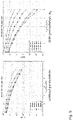
- the block error rate performances (BLER) of the two codes, i.e. with and without the inner edge permutation or predetermined permutation ⁇ 8 , under list decoding are shown in figure 5 as a function of the signal-to-noise ratio E b / N 0 in dB.
- the multi-kernel polar codes generated by the device 102b have a significantly improved performance (BLER) for list lengths of four and larger (compare left side and right side of the figure 5 ), and this happens without changing the decoding complexity. Therefore, the generation of multi-kernel polar codes x N according to embodiments of the invention (right side of figure 5 ) also allows for efficient decoding of the extended Golay code.
- the (23,12,7) Golay code as well can be obtained from the proposed multi-kernel polar code construction by puncturing one bit, e.g., the last one x 23 .
- Figure 6 shows a schematic diagram illustrating the performance of a multi-kernel polar code x 48 generated by the device 102b according to an embodiment.
- the predetermined permutation ⁇ 16 can be found offline for any code length.
- exemplary multi-kernel polar codes x 24 and x 48 are shown, which can be generated by the device 102b according to embodiments of the invention.
- Table 1 Multi-kernel polar codes x 24 and x 48 without and with edge permutations or predetermined permutations ⁇ N a , and the increase in minimum distance. Without permutation With permutation (new) (24,12,6) (24,12,8) +2 (48,15,12) (48,15,16) +4 (48,18,8) (48,18,10) +2 (96,18,24) (96,18,32) +8
- Figure 7 shows a schematic diagram illustrating a Tanner graph of a polar code x 32 generated by the device 102b according to an embodiment.
- the processor 102c can be configured to improve the performance of polar codes, and also to increase the minimum distance of punctured or shortened polar codes.
- the processor 102c can be configured to obtain the (24,12,8) extended Golay code by puncturing a polar code x 32 of length 32 with an inner edge permutation or predetermined permutation ⁇ 8 , as illustrated in the following.
- the resulting Tanner graph of the code is shown in figure 7 , wherein the thick lines represent the channel LLRs set to zero due to the puncturing of the corresponding code bits.
- the BLER of the generated Golay code as a function of the signal-to-noise ratio E b / N 0 in dB is depicted in figure 8 .
- the additional inner edge predetermined permutation ⁇ 8 leads to a significantly improved performance.
- Figure 9 shows a schematic diagram of a corresponding method 900 for generating a multi-kernel polar code x N of length N and dimension K on the basis of a first transformation matrix G N of size N ⁇ N defining a first multi-kernel polar code according to an embodiment.
- the method 900 comprises the steps of:
Landscapes
- Physics & Mathematics (AREA)
- Engineering & Computer Science (AREA)
- Theoretical Computer Science (AREA)
- Mathematical Physics (AREA)
- Probability & Statistics with Applications (AREA)
- General Physics & Mathematics (AREA)
- Pure & Applied Mathematics (AREA)
- Mathematical Optimization (AREA)
- Computational Mathematics (AREA)
- Mathematical Analysis (AREA)
- Algebra (AREA)
- Computing Systems (AREA)
- Data Mining & Analysis (AREA)
- Databases & Information Systems (AREA)
- Software Systems (AREA)
- General Engineering & Computer Science (AREA)
- Error Detection And Correction (AREA)
Description
- In general, the present invention relates to data encoding and decoding in communication systems. More specifically, the present invention relates to a device and method for encoding and decoding data using multi-kernel polar codes.
- Reliable transmission of data over noisy communication channels requires some kind of error correction coding to be used. Polar codes are a class of channel codes introduced by Arikan in the work "Channel polarization: a method for constructing capacity-achieving codes for symmetric binary-input memoryless channels," IEEE Trans. Inf. Theo, July 2009. They are provably capacity-achieving over various classes of channels, and they provide excellent error rate performance for practical code lengths.
- In their original construction according to the aforementioned work by Arikan, polar codes are based on the polarization effect of the Kronecker products of the matrix:

- This matrix is also called kernel of the polar code. A polar code of length N and dimension K is defined by a transformation matrix

- As it follows from the above description, any code dimension (i.e., number of information bits) K of polar codes is possible. Thus, polar codes admit any code rate R = K/N. However, a drawback of the original construction of polar codes is that their code lengths are restricted to powers of 2, i.e., N = 2 n . This is not sufficient in order to cover the diversity of block lengths demanded by modern communication systems.
- In the prior art, different approaches have been suggested in order to solve the problem related to the length of polar codes, as elucidated in the following.
- To tackle the code length problem of the original construction of polar codes, a multi-kernel construction of polar codes has been proposed in
PCT/EP2016/069593 - The main idea of the polar codes is that, based on successive-cancellation (SC) decoding as will be elucidated below, some input bit positions are more reliable than others due to a polarization phenomenon. This holds for multi-kernel polar codes as well, wherein the information bits are put in the most reliable positions of the input vector u N, while the unreliable positions of the input vector are set to the
fixed bit value 0, called also frozen bits, which form the frozen set, as described above. The reliabilities of the input bit positions can be obtained by density evolution, genie-aided simulation, or other similar methods (see, e.g., "A comparative study of polar code constructions for the AWGN channel," arXiv:1501.02473, 2015, by H. Vangala et al.). - Another important parameter of a linear code, in particular of a polar code, is the minimum distance and it largely determines the slope of the error-rate curve. Polar codes permit only to achieve a limited range of minimum distances. In particular, the minimum distance of a polar code is a power of two, and it is the smallest Hamming weight of rows of the transformation matrix indexed by the information set. This is a significant limit for the design of polar codes, particularly for short lengths where the minimum distance plays a crucial role. In particular, in this range, polar codes show a poor performance compared to other block codes. Multi-kernel polar codes can increase the range of minimum distances. However, the structure of the codes, which is based on Kronecker products of kernel matrices, does not allow the code to reach the maximal minimum distance for a given code length and dimension.
- In the prior art, different approaches have been suggested in order to improve polar codes by permuting decoding elements, as elucidated in the following.
- In the work by F. Gabry et al., "Multi-Kernel construction of polar codes", in IEEE, May 2017, it discloses a method for generating a multi-kernel polar code, based on the construction of a Tanner graph. Encoding might be performed by matrix multiplication or directly on the Tanner graph.
- In the work by H. Vangala et al., "Permuted successive cancellation decoder for polar codes", in IEEE ISITA, Oct. 2014, it is suggested to permute the stages of the SC decoder Tanner graph. This does not change the transformation matrix of the code, since the encoder is not affected by this change. Moreover, the resulting permuted SC decoder matches the results of the classic SC decoder.
- In the work by S. Buzaglo et al., "Permuted successive cancellation decoding for polar codes", in IEEE ISIT, June 2017, a permutation on the input vector has been proposed for the decoding of large kernels. The effect of this permutation is to shuffle the rows of the transformation matrix, thereby altering the bit reliabilities, and changing the bit decoding order. However, as a consequence, the SC decoder has to be modified, which increases the decoding complexity.
- Thus, there is a need for an improved device and method for encoding and decoding data using multi-kernel polar codes.
- It is an object of the invention to provide for an improved device and method for encoding and decoding data using multi-kernel polar codes.
- The foregoing and other objects are achieved by the subject matter of the independent claims. Further implementation forms are apparent from the dependent claims, the description and the figures.
- According to a first aspect, the invention relates to a device as specified in
claim 1. - Thus, an improved device is provided, since the generated multi-kernel polar code can be decoded according to the usual SC decoding (or SC list decoding) operations, the reliabilities of the input bits are not altered, and the decoding order of the input bits is maintained. Thus, the added permutation does not change the structure and the complexity of the SC (list) decoder. Moreover, the device can generate the multi-kernel polar code in a flexible way by means of a permutation improving the distance spectrum of the multi-kernel polar code. Moreover, the device allows to generate a multi-kernel polar code leading to lower error rates compared to the prior art, i.e., having a better performance, and reducing the cyclic redundancy check (CRC) size in SC list decoding.
- In a possible implementation form of the device according to the first aspect, the processor is configured to permute the order of at least two columns of a sub-matrix of the first transformation matrix GN such that the second transformation matrix G'N has the same polarization as the first transformation matrix GN.
- This provides the advantage of obtaining a multi-kernel polar code having improved minimum distance properties and, at the same time, having polarization properties which improve the reliability transmission of data over noisy communication channels.
- In another possible implementation form of the device according to the first aspect, the processor is configured to generate the second transformation matrix G'N of size N × N by permuting the order of the least two columns of the sub-matrix of the first transformation matrix GN and by permuting the order of at least two columns of a further sub-matrix of the first transformation matrix GN.
- This provides the advantage of obtaining a multi-kernel polar code having improved minimum distance and polarization properties in an easy and efficient way by performing a permutation operation.
- In another possible implementation form of the device according to the first aspect, the processor is further configured to determine the predetermined permutation πN
a in such a way that the minimum distance of the multi-kernel polar code x N of length N and dimension K is larger than a predefined threshold. - Thus, an improved device is obtained, since the generated multi-kernel polar code has an improved minimum distance, in particular a desired minimum distance being larger than a predefined threshold.
- In another possible implementation form of the device according to the first aspect, the polar code x N has a length N = 24, and the first transformation matrix is given by G 24 =


- In another possible implementation form of the device according to the first aspect, the predetermined permutation π 8 is given by:

- In another possible implementation form of the device according to the first aspect, the polar code x N has a length N = 48, and the first transformation matrix is given by the following equation:


- In another possible implementation form of the device according to the first aspect, the predetermined permutation π 16 is given by:

- In another possible implementation form of the device according to the first aspect, the processer is further configured to generate a Golay code on the basis of the polar code x N , wherein the polar code x N has a length N = 32 and the predetermined permutation π 8 is given by:



- According to a second aspect, the invention relates to a communication apparatus comprising a channel encoder comprising a device for generating a multi-kernel polar code according to the first aspect as such or any one of the implementation forms thereof.
- According to a third aspect, the invention relates to a communication apparatus comprising a channel decoder comprising a device for generating a multi-kernel polar code according to the first aspect as such or anyone of the implementation forms thereof. In a possible implementation form of the device according to the third aspect, the communication apparatus comprises a processor configured to decode the multi-kernel polar code on the basis of a successive-cancellation (SC) algorithm or a successive-cancellation list (SCL) algorithm.
- Making use of list decoding or similar decoding methods provides the advantage of improving the distance properties of the multi-kernel polar code x N.
- According to a fourth aspect, the invention relates to a method as specified in claim 13.
- According to a fifth aspect, the invention relates to a computer program comprising a program code for performing the method of the fourth aspect when executed on a computer.
- The invention can be implemented in hardware and/or software.
- Further embodiments of the invention will be described with respect to the following figures, wherein:
-
Fig. 1 shows a schematic diagram of a communication system with a communication apparatus comprising a device for generating a multi-kernel polar code according to an embodiment; -
Fig. 2 shows a schematic diagram illustrating a Tanner graph of a multi-kernel polar code generated by a device according to an embodiment; -
Fig. 3 shows a schematic diagram illustrating a distance spectrum of a multi-kernel polar code generated by a device according to an embodiment; -
Fig. 4 shows a schematic diagram illustrating a Tanner graph of a multi-kernel polar code generated by a device according to an embodiment; -
Fig. 5 shows a schematic diagram illustrating the performance of a multi-kernel polar code generated by a device according to an embodiment; -
Fig. 6 shows a schematic diagram illustrating the performance of a multi-kernel polar code generated by a device according to an embodiment; -
Fig. 7 shows a schematic diagram illustrating a Tanner graph of a polar code generated by a device according to an embodiment; -
Fig. 8 shows a schematic diagram illustrating the performance of a polar code generated by a device according to an embodiment; and -
Fig. 9 shows a schematic diagram of a method for generating a multi-kernel polar code according to an embodiment. - In the various figures, identical reference signs will be used for identical or at least functionally equivalent features.
- In the following description, reference is made to the accompanying drawings, which form part of the disclosure, and in which are shown, by way of illustration, specific aspects in which the present invention may be placed. It is understood that other aspects may be utilized and structural or logical changes may be made without departing from the scope of the present invention. The following detailed description, therefore, is not to be taken in a limiting sense, as the scope of the present invention is defined by the appended claims. For instance, it is understood that a disclosure in connection with a described method may also hold true for a corresponding device or system configured to perform the method and vice versa. For example, if a specific method step is described, a corresponding device may include a unit to perform the described method step, even if such unit is not explicitly described or illustrated in the figures. Further, it is understood that the features of the various exemplary aspects described herein may be combined with each other, unless specifically noted otherwise.
-
Figure 1 shows a schematic diagram of acommunication system 100 with acommunication apparatus 102 comprising adevice 102b for generating a multi-kernel polar code x N according to an embodiment. - The
communication apparatus 102 comprises achannel encoder 102a, wherein thechannel encoder 102a comprises thedevice 102b for generating the multi-kernel polar code x N of length N and dimension K on the basis of a first transformation matrix GN of size N × N defining a first multi-kernel polar code. - The
device 102b comprises aprocessor 102c configured to generate a second transformation matrix G'N of size N × N by permuting the order of at least two columns of a sub-matrix of the first transformation matrix GN, and generate the multi-kernel polar code x N on the basis of the following equation:
- Once, the multi-kernel polar code x N is generated, the
communication apparatus 102 can be configured to send it to thecommunication apparatus 104 via a communication channel. - In an embodiment, the
communication apparatus 104 comprises achannel decoder 104a, wherein thechannel decoder 104a comprises adevice 104b for generating a multi-kernel polar code as described above. Moreover, thedevice 104b can comprise aprocessor 104c configured to decode the multi-kernel polar code on the basis of a successive-cancellation (SC) algorithm or a successive-cancellation list (SCL) algorithm. - Thus, an
improved device 102b is provided, since the generated multi-kernel polar code x N can be decoded, e.g., by thecommunication apparatus 104, according to the usual SC decoding (or SC list decoding) operations. Moreover, theprocessor 102c can be configured to permute the order of at least two columns of a sub-matrix of the first transformation matrix GN, e.g., by means of the inner edge permutation or predetermined permutation, in a way such that the polarization phenomenon is not affected (i.e. destroyed), and thus reliabilities of the input bits are not changed. Correspondingly, the bit decoding order is not altered, and the decoding complexity at thecommunication apparatus 104 is not increased. Moreover, making use of list decoding or similar decoding methods improves the distance properties of the multi-kernel polar code. Furthermore, thedevice 102b allows to generate a multi-kernel polar code x N leading to lower error rates and reducing the cyclic redundancy check (CRC) size in SC list decoding. -
Figure 2 shows a schematic diagram illustrating a Tanner graph of the multi-kernel polar code x N generated by thedevice 102b according to an embodiment. - In an embodiment, the
processor 102c is configured to generate the first transformation matrix GN on the basis of the following equation:
b = T p1 ⊗ ... ⊗ T pλ is a first kernel matrix of dimension Nb × Nb, Nb = p 1 ·...· p λ, and TNa = T pλ+1 ⊗ ... ⊗ Tps is a second kernel matrix of dimension Na × Na , Na = p λ+1 ·...· ps, and wherein Tpj is a kernel matrix of dimension pj × pj , and wherein λ is an integer assuming a value in the interval [0, ..., s], s being the total number of kernel matrices Tpj forming the first kernel matrix TNb and the second kernel matrix TNa. - In particular, the
processor 102c can be configured to permute the order of at least two columns of a sub-matrix of the first transformation matrix GN such that the second transformation matrix G'N has the same polarization as the first transformation matrix GN. Moreover, theprocessor 102c can be configured to generate the second transformation matrix G'N of size N × N by permuting the order of the least two columns of the sub-matrix of the first transformation matrix GN and by permuting the order of at least two columns of a further sub-matrix of the first transformation matrix GN. - In order to better elucidate how the
processor 102c can permute the order of the columns of a sub-matrix of the first transformation matrix GN as explained above, reference can be made to the Tanner graph shown infigure 2 . In general, the Tanner graph has a number of stages or layers equal to an integer S, wherein S is the number of factors of the Kronecker product, and represents the relationship between the input vector u N and the generated multi-kernel polar code x N. - In the embodiment shown on the right of
figure 2 , the Tanner graph has S = 2 stages: the first stage composed by Nb kernels Tb and the second stage composed by Na kernels Ta (the stages are counted from right to left). On the left side offigure 2 , a representation of a conventional Tanner graph is shown for comparison as well, wherein the two stages are connected by an edge permutation P, and the first stage is connected to the multi-kernel polar code x N by the edge permutation P -1. On the right offigure 2 , in the Tanner graph corresponding to the embodiment of the invention, a further predetermined permutation πNa is added between the canonical edge permutation P and one of the kernels Ta . This embodiment has the advantage that the predetermined permutation πNa does not alter the bit reliabilities or the SC decoding, since the input log-likelihood-ratios (LLRs) of a kernel are equally distributed. - The predetermined permutation πN
a can produce an effect on the second transformation matrix G'N of the multi-kernel polar code, since it shuffles the columns of a part of the first transformation matrix GN. Theprocessor 102c can be configured to apply the predetermined permutation πNa to the first kernel Ta as in thefigure 2 , and can further be configured to generate the second transformation matrix G'N on the basis of the following equation:


a . - In an embodiment of the invention, besides the predetermined permutation πNa as, e.g. shown in
figure 2 , further such edge permutations may be added to the Tanner graph, in order to improve the performance of the multi-kernel polar code x N . Moreover, theprocessor 102c can be further configured to determine the predetermined permutation πNa in such a way that the minimum distance of the multi-kernel polar code x N of length N and dimension K is larger than a predefined threshold. - The predetermined permutation πNa and the corresponding permutation matrix

a of length Na is a bijection πNa : [Na ] → [Na ]. Then, for the predetermined permutation πNa , the permutation matrix
a can be defined by:
- The predetermined permutation πN
a alters the distance spectrum of the code and, thus, improves the error-rate performance. In particular, in an embodiment, this alteration increases the minimum distance of the multi-kernel polar code x N . In another embodiment, this alteration only decrease the multiplicity of the multi-kernel polar codewords at the minimum distance. - Once, the multi-kernel polar code x N is generated, the
communication apparatus 102 can be configured to send it to thecommunication apparatus 104 via the communication channel. - As already mentioned in the context of
figure 1 , theprocessor 104c of thecommunication apparatus 104 can be configured to decode the received symbols y 0, ..., y N-1, namely the symbols x 0, ..., x N-1 affected by the propagation through the communication channel, by using a successive cancellation (SC) algorithm (see the aforementioned work by E. Arikan). The algorithm is initialized with the channel log-likelihood-ratios (LLRs) of the code bits at the right side of the Tanner graph. Then, the algorithm propagates the messages along the edges the Tanner graph of the multi-kernel polar code, namely the LLR values from right to left, and hard-decisions (bits) from left to right. LLRs and hard-decisions are computed according to update functions which can, for example, be found in the aforementioned work by Arikan and in the aforementioned documentPCT/EP2016/069593 processor 104c of thecommunication apparatus 104 can be configured to decode the received symbols y0, ..., y N-1 by means of SC list decoding (see, I. Tal et al., "List decoding of polar codes," in IEEE ISIT, July 2011) or similar methods. -
Figure 3 shows a schematic diagram illustrating a distance spectrum of a multi-kernel polar code generated by thedevice 102b according to an embodiment. - In
figure 3 , the distance spectrum of a (16,8) multi-kernel polar code x 16 generated in order to maximize the minimum distance is shown. In particular, if the predetermined permutation π 8 = (7,1,4,3,2,5,6,8) is applied to the upper half of the first transformation matrix G 16, the distance spectrum changes as shown infigure 3 on the right. - As can be seen in
figure 3 , embodiments of the invention (on the right offigure 3 ) reduce the number of minimum weight multi-kernel polar codewords. This property can be used, e.g., in order to reduce the CRC size necessary to decode the multi-kernel polar code x 16 with list decoding (see, the aforementioned work by I. Tal et al.). Moreover, in embodiments of the invention, thedevice 102b can even be configured to generate the multi-kernel polar code x 16 in such a way that the minimum distance of the multi-kernel polar code x 16 is reduced. -
Figure 4 shows a schematic diagram illustrating a Tanner graph of the multi-kernel polar code x 24 generated by thedevice 102b according to an embodiment. - In particular, in
figure 4 , an example of a Tanner graph of a (24,12) multi-kernel polar code x 24 is shown. - In general, by using the following kernel matrices:

PCT/EP2016/082555 - In the following, it will be shown, how the
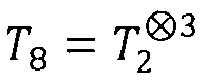
processor 102c according to an embodiment can be configured in order to transform a (24,12,6) multi-kernel polar code into a (24,12,8) extended Golay code, which optimizes the minimum distance for a given code length and dimension. - Given a multi-kernel polar code x 24 defined by the transformation matrix G 24 = T 3 ⊗

processor 102c can be configured to add the predetermined permutation π8 = (7,1,4,3,2,5,6,8) before the first T 8 kernel. It is worth noticing that this permutation is not unique in order to obtain the desired result, since in other embodiments, 10,752 permutations out of all the 40,320 possible permutations of 8 elements can be used. However, in the embodiment wherein the predetermined permutation is given by π 8 = (7,1,4,3,2,5,6,8), theprocessor 102c is configured to generate the second transformation matrix on the basis of the following equation:
figure 4 . - Given the second transformation matrix G'24, the
processor 102c can be configured to obtain the (24,12,8) extended Golay code by taking as information set I = {3,5,6,7,11,13,14,15,19,21,22,23}. As a result, the generator matrix of the Golay code is given by the following matrix:
- The block error rate performances (BLER) of the two codes, i.e. with and without the inner edge permutation or predetermined permutation π 8, under list decoding (see, I. Tal et al., "List decoding of polar codes," in IEEE ISIT, July 2011) are shown in
figure 5 as a function of the signal-to-noise ratio Eb /N 0 in dB. As it can be taken fromfigure 5 , the multi-kernel polar codes generated by thedevice 102b have a significantly improved performance (BLER) for list lengths of four and larger (compare left side and right side of thefigure 5 ), and this happens without changing the decoding complexity. Therefore, the generation of multi-kernel polar codes x N according to embodiments of the invention (right side offigure 5 ) also allows for efficient decoding of the extended Golay code. - It is worth noticing that, in an embodiment, the (23,12,7) Golay code as well can be obtained from the proposed multi-kernel polar code construction by puncturing one bit, e.g., the last one x 23.
-
Figure 6 shows a schematic diagram illustrating the performance of a multi-kernel polar code x 48 generated by thedevice 102b according to an embodiment. - In an embodiment, the
processor 102c can be configured to generate the multi-kernel polar code x 48 on the basis of a firsttransformation matrix 

- The predetermined permutation π 16 can be found offline for any code length. In table 1, exemplary multi-kernel polar codes x 24 and x 48 are shown, which can be generated by the
device 102b according to embodiments of the invention.Table 1: Multi-kernel polar codes x 24 and x 48 without and with edge permutations or predetermined permutations πN a , and the increase in minimum distance.Without permutation With permutation (new) (24,12,6) (24,12,8) +2
(48,15,12) (48,15,16) +4
(48,18,8) (48,18,10) +2
(96,18,24) (96,18,32) +8
- In particular, in
figure 6 , the BLER of the two codes (48,15,16) and (48,15,12), i.e. with and without inner edge permutations or predetermined permutations π 16, as a function of the signal-to-noise ratio Eb /N 0 in dB are shown for list decoding (see, the aforementioned work by I. Tal et al.). Similarly to the shorter code, a significant decrease in the error rate can be observed forlist length 8 or longer. -
Figure 7 shows a schematic diagram illustrating a Tanner graph of a polar code x 32 generated by thedevice 102b according to an embodiment. - The
processor 102c can be configured to improve the performance of polar codes, and also to increase the minimum distance of punctured or shortened polar codes. - In particular, in an embodiment, the
processor 102c can be configured to obtain the (24,12,8) extended Golay code by puncturing a polar code x 32 oflength 32 with an inner edge permutation or predetermined permutation π 8, as illustrated in the following. After generating the firsttransformation matrix 
processor 102c can be configured to insert the predetermined permutation π 8 = (7,1,4,3,2,5,6,8) before thelast kernel 

kernels 


- The resulting Tanner graph of the code is shown in
figure 7 , wherein the thick lines represent the channel LLRs set to zero due to the puncturing of the corresponding code bits. - Given the second transformation matrix G'32, the
processor 102c can be configured to generate the (24,12,8) Golay code by selecting the information set as I = {11,13,14,15,19,21,22,23,27,29,30,31}. As a result, the transformation matrix of the Golay code is given by:
- The BLER of the generated Golay code as a function of the signal-to-noise ratio Eb /N 0 in dB is depicted in
figure 8 . In this embodiment as well, for list size of 4 or larger, the additional inner edge predetermined permutation π 8 leads to a significantly improved performance. -
Figure 9 shows a schematic diagram of acorresponding method 900 for generating a multi-kernel polar code x N of length N and dimension K on the basis of a first transformation matrix GN of size N × N defining a first multi-kernel polar code according to an embodiment. - The
method 900 comprises the steps of: - generating 902 a second transformation matrix G'N of size N × N by permuting the order of at least two columns of a sub-matrix of the first transformation matrix GN, and
- generating 904 the multi-kernel polar code x N on the basis of the following equation:

- wherein u N = (u 0, ..., u N-1) is a vector of size N, with the elements ui, i = 0, ... N - 1, corresponding to an information bit if i ∈ I, I being a set of K information bit indices, and ui = 0, if i ∈ F, F being a set of N - K frozen bit indices.
- While a particular feature or aspect of the disclosure may have been disclosed with respect to only one of several implementations or embodiments, such feature or aspect may be combined with one or more other features or aspects of the other implementations or embodiments as may be desired and advantageous for any given or particular application. Furthermore, to the extent that the terms "include", "have", "with", or other variants thereof are used in either the detailed description or the claims, such terms are intended to be inclusive in a manner similar to the term "comprise". Also, the terms "exemplary", "for example" and "e.g." are merely meant as an example, rather than the best or optimal. The terms "coupled" and "connected", along with derivatives may have been used. It should be understood that these terms may have been used to indicate that two elements cooperate or interact with each other regardless whether they are in direct physical or electrical contact, or they are not in direct contact with each other.
- Although specific aspects have been illustrated and described herein, it will be appreciated by those of ordinary skill in the art that a variety of alternate and/or equivalent implementations may be substituted for the specific aspects shown and described without departing from the scope of the present disclosure. This application is intended to cover any adaptations or variations of the specific aspects discussed herein.
- Although the elements in the following claims are recited in a particular sequence with corresponding labeling, unless the claim recitations otherwise imply a particular sequence for implementing some or all of those elements, those elements are not necessarily intended to be limited to being implemented in that particular sequence.
- Many alternatives, modifications, and variations will be apparent to those skilled in the art in light of the above teachings. Of course, those skilled in the art readily recognize that there are numerous applications of the invention beyond those described herein. While the present invention has been described with reference to one or more particular embodiments, those skilled in the art recognize that many changes may be made thereto without departing from the scope of the present invention. It is therefore to be understood that within the scope of the appended claims, the invention may be practiced otherwise than as specifically described herein.
Claims (14)
- Device (102b, 104b) for generating a multi-kernel polar code x N of length N and dimension K on the basis of a first transformation matrix GN of size N × N defining a first multi-kernel polar code, the device (102b, 104b) comprising a processor (102c, 104c) configured to:generate the first transformation matrix GN on the basis of the following equation:
 wherein TN
b = T p1 ⊗ ... ⊗ T pλ is a first kernel matrix of dimension Nb × Nb, Nb = p 1 · ...· p λ, and TNa = T pλ+1 ⊗ ... ⊗ Tps is a second kernel matrix of dimension Na × Na , Na = p λ+1 · ... · p s , and wherein Tpj is a kernel matrix of dimension pj × pj , and wherein λ is an integer assuming a value in the interval [0, ..., s], s being the total number of kernel matrices Tpj forming the first kernel matrix TNb and the second kernel matrix TNa; andgenerate a second transformation matrix G'N of size N × N by permuting the order of at least two columns of a sub-matrix of the first transformation matrix GN, and the second transformation matrix G'N is on the basis of the following equation: for any 1 ≤ j ≤ Nb, wherein

a ; andgenerate the multi-kernel polar code x N on the basis of the following equation: wherein u N = (u 0, ..., u N-1) is a vector of size N, with the elements u i, i = 0, ... N - 1, corresponding to an information bit if i ∈ I, I being a set of K information bit indices, and ui = 0, if i ∈ F, F being a set of N - K frozen bit indices; andsend the multi-kernel polar code x N via a communication channel.
 - The device (102b, 104b) of claim 1, wherein the processor (102c, 104c) is configured to permute the order of at least two columns of a sub-matrix of the first transformation matrix GN such that the second transformation matrix G'N has the same polarization as the first transformation matrix GN.
- The device (102b, 104b) of claim 1 or 2, wherein the processor (102c, 104c) is configured to generate the second transformation matrix G'N of size N × N by permuting the order of the least two columns of the sub-matrix of the first transformation matrix GN and by permuting the order of at least two columns of a further sub-matrix of the first transformation matrix GN.
- The device (102b, 104b) of claim 3, wherein the processor (102c, 104c) is further configured to determine the predetermined permutation πN
a in such a way that the minimum distance of the multi-kernel polar code x N of length N and dimension K is larger than a predefined threshold. - The device (102b, 104b) of claim 1 or 4, wherein the polar code x N has a length N = 24,and wherein the first transformation matrix is given by

 and wherein the processor (102c, 104c) is configured to generate the second transformation matrix on the basis of the following equation:
- The device (102b, 104b) of claim 5, wherein a predetermined permutation π 8 is given by:

- The device (102b, 104b) of claim 1 or 4, wherein the polar code x N has a length N = 48,
and wherein the first transformation matrix is given by the following equation:

- The device (102b, 104b) of claim 7, wherein a predetermined permutation π 16 is given by:

- The device (102b, 104b) of claim 1 or 4, wherein the processer (102c, 104c) is further configured to generate a Golay code on the basis of the polar code x N , wherein the polar code x N has a length N = 32 and the predetermined permutation π 8 is given by:




- A communication apparatus (102) comprising a channel encoder (102a) comprising a device (102b) for generating a multi-kernel polar code according to any one of the preceding claims.
- A communication apparatus (104) comprising a channel decoder (104a) comprising a device (104b) for generating a multi-kernel polar code according to any one of the claims 1 to 9.
- The communication apparatus (104) of claim 11, wherein the communication apparatus (104) comprises a processor (104c) configured to decode a multi-kernel polar code on the basis of a successive-cancellation (SC) algorithm or a successive-cancellation list (SCL) algorithm.
- Method (900) for generating a multi-kernel polar code x N of length N and dimension K on the basis of a first transformation matrix GN of size N × N defining a first multi-kernel polar code, the method (900) comprising the steps of:generating (901) the first transformation matrix GN on the basis of the following equation:
 wherein TNb = T p1 ⊗ ... ⊗ T pλ is a first kernel matrix of dimension Nb × Nb, Nb = p 1 · ... · p λ, and TN
a = T pλ+1 ⊗ ... ⊗ Tps is a second kernel matrix of dimension Na × Na , Na = p λ+1 · ... · p s , and wherein Tpj is a kernel matrix of dimension pj × pjt and wherein λ is an integer assuming a value in the interval [0, ...,s], s being the total number of kernel matrices Tpj forming the first kernel matrix TNb and the second kernel matrix TNa ; andgenerating (902) a second transformation matrix G'N of size N × N by permuting the order of at least two columns of a sub-matrix of the first transformation matrix GN , and the second transformation matrix G'N is on the basis of the following equation: for any 1 ≤ j ≤ Nb, wherein

a ; andgenerating (904) the multi-kernel polar code x N on the basis of the following equation: wherein u N = (u 0, ..., u N-1) is a vector of size N, with the elements ui , i = 0, ... N - 1, corresponding to an information bit if i ∈ I, I being a set of K information bit indices, and ui = 0, if i ∈ F, F being a set of N - K frozen bit indices; andsending the multi-kernel polar code x N via a communication channel.
 - A computer program comprising a program code for performing the method (900) of claim 13 when executed on a computer.
Applications Claiming Priority (1)
| Application Number | Priority Date | Filing Date | Title |
|---|---|---|---|
| PCT/EP2017/071185 WO2019037841A1 (en) | 2017-08-23 | 2017-08-23 | Device and method for generating a multi-kernel polar code |
Publications (2)
| Publication Number | Publication Date |
|---|---|
| EP3656058A1 EP3656058A1 (en) | 2020-05-27 |
| EP3656058B1 true EP3656058B1 (en) | 2022-07-27 |
Family
ID=59791045
Family Applications (1)
| Application Number | Title | Priority Date | Filing Date |
|---|---|---|---|
| EP17761832.9A Active EP3656058B1 (en) | 2017-08-23 | 2017-08-23 | Device and method for generating a multi-kernel polar code |
Country Status (4)
| Country | Link |
|---|---|
| US (1) | US11245424B2 (en) |
| EP (1) | EP3656058B1 (en) |
| CN (1) | CN111034057B (en) |
| WO (1) | WO2019037841A1 (en) |
Families Citing this family (3)
| Publication number | Priority date | Publication date | Assignee | Title |
|---|---|---|---|---|
| CN111524238B (en) * | 2020-04-23 | 2022-02-01 | 南京航空航天大学 | Three-dimensional point cloud deformation method based on coding point driving |
| EP4199396A4 (en) * | 2020-09-17 | 2024-02-21 | Huawei Technologies Co., Ltd. | Method and apparatus for encoding polar code, and method and apparatus for decoding polar code |
| CN116979973B (en) * | 2023-09-22 | 2023-12-15 | 为准(北京)电子科技有限公司 | Information decoding method and device, electronic equipment and readable storage medium |
Family Cites Families (12)
| Publication number | Priority date | Publication date | Assignee | Title |
|---|---|---|---|---|
| CA2298919C (en) | 1999-02-19 | 2006-04-18 | Ntt Mobile Communications Network Inc. | Interleaving and turbo encoding using prime number permutations |
| US7512863B2 (en) * | 2005-10-12 | 2009-03-31 | Qualcomm Corporation | Turbo code interleaver for low frame error rate |
| CN103684477B (en) | 2012-09-24 | 2017-02-01 | 华为技术有限公司 | Method and device for generating mixed polar codes |
| US9083387B2 (en) * | 2012-12-18 | 2015-07-14 | Samsung Electronics Co., Ltd. | Communication system with compound coding mechanism and method of operation thereof |
| CN103414540A (en) * | 2013-08-14 | 2013-11-27 | 南京邮电大学 | Degraded eavesdropping channel rate compatible method based on Polar code |
| WO2015058416A1 (en) | 2013-10-26 | 2015-04-30 | 华为技术有限公司 | Polar code decoding method and device |
| KR102157667B1 (en) * | 2014-05-15 | 2020-09-18 | 삼성전자주식회사 | Puncturing apparatus and puncturing method thereof |
| US9742440B2 (en) * | 2015-03-25 | 2017-08-22 | Samsung Electronics Co., Ltd | HARQ rate-compatible polar codes for wireless channels |
| TWI629872B (en) * | 2016-02-03 | 2018-07-11 | 旺宏電子股份有限公司 | Method and device for adjusting the code length of extended polar codes |
| EP3443677B1 (en) | 2016-08-18 | 2022-04-20 | Huawei Technologies Co., Ltd. | Communication device and communication method using polar codes |
| EP3529901B1 (en) | 2016-12-23 | 2020-10-07 | Huawei Technologies Co., Ltd. | Apparatus and method for generating polar codes |
| CN106998208B (en) * | 2017-01-17 | 2020-04-28 | 北京航空航天大学 | Code word construction method of variable length Polar code |
-
2017
- 2017-08-23 CN CN201780093672.3A patent/CN111034057B/en active Active
- 2017-08-23 EP EP17761832.9A patent/EP3656058B1/en active Active
- 2017-08-23 WO PCT/EP2017/071185 patent/WO2019037841A1/en not_active Ceased
-
2020
- 2020-02-21 US US16/797,214 patent/US11245424B2/en active Active
Also Published As
| Publication number | Publication date |
|---|---|
| US20200195279A1 (en) | 2020-06-18 |
| CN111034057B (en) | 2022-04-22 |
| CN111034057A (en) | 2020-04-17 |
| EP3656058A1 (en) | 2020-05-27 |
| US11245424B2 (en) | 2022-02-08 |
| WO2019037841A1 (en) | 2019-02-28 |
Similar Documents
| Publication | Publication Date | Title |
|---|---|---|
| USRE47936E1 (en) | Decoding method and decoding device for polar code cascaded with cyclic redundancy check | |
| US10651973B2 (en) | Method and apparatus for error-correction encoding using a polar code | |
| US10541710B2 (en) | Devices and methods implementing polar codes | |
| CN103368583B (en) | The interpretation method of polar code and code translator | |
| US11095312B2 (en) | Polar code encoding/decoding method and encoding/decoding apparatus | |
| US11316538B2 (en) | Polar code encoding method and apparatus | |
| US10924137B2 (en) | Apparatus and method for generating polar codes | |
| JP2019518388A (en) | System and method for piecewise rate matching when using polar codes | |
| US11177834B2 (en) | Communication method and apparatus using polar codes | |
| US10812107B2 (en) | Apparatus and methods for polar code construction and bit position allocation | |
| EP3443677B1 (en) | Communication device and communication method using polar codes | |
| CN111066250A (en) | Method and device for encoding and decoding based on layered polarization code | |
| EP4084375B1 (en) | Polar code encoding method and apparatus | |
| US11245424B2 (en) | Device and method for generating a multi-kernel polar code | |
| WO2018021926A1 (en) | Decoding of polar codes and polar subcodes | |
| Oliveira et al. | Puncturing based on polarization for polar codes in 5G networks | |
| CN109644006A (en) | Apparatus and method for encoding and decoding data | |
| US11031954B1 (en) | Data decoding method using LDPC code as error correction code and data transmitting method thereof | |
| US11190214B2 (en) | Construction of a polar code based on a distance criterion and a reliability criterion, in particular of a multi-kernel polar code | |
| Zhang et al. | Rate Matching and Piecewise Sequence Adaptation for Polar Codes with Reed-Solomon Kernels | |
| Oliveira et al. | Polarization-driven puncturing for polar codes in 5g systems | |
| KR20250052570A (en) | Apparatus and method for encoding and decoding of data in communication or broadcasting system |
Legal Events
| Date | Code | Title | Description |
|---|---|---|---|
| STAA | Information on the status of an ep patent application or granted ep patent |
Free format text: STATUS: UNKNOWN |
|
| STAA | Information on the status of an ep patent application or granted ep patent |
Free format text: STATUS: THE INTERNATIONAL PUBLICATION HAS BEEN MADE |
|
| PUAI | Public reference made under article 153(3) epc to a published international application that has entered the european phase |
Free format text: ORIGINAL CODE: 0009012 |
|
| STAA | Information on the status of an ep patent application or granted ep patent |
Free format text: STATUS: REQUEST FOR EXAMINATION WAS MADE |
|
| 17P | Request for examination filed |
Effective date: 20200217 |
|
| AK | Designated contracting states |
Kind code of ref document: A1 Designated state(s): AL AT BE BG CH CY CZ DE DK EE ES FI FR GB GR HR HU IE IS IT LI LT LU LV MC MK MT NL NO PL PT RO RS SE SI SK SM TR |
|
| AX | Request for extension of the european patent |
Extension state: BA ME |
|
| DAV | Request for validation of the european patent (deleted) | ||
| DAX | Request for extension of the european patent (deleted) | ||
| GRAP | Despatch of communication of intention to grant a patent |
Free format text: ORIGINAL CODE: EPIDOSNIGR1 |
|
| STAA | Information on the status of an ep patent application or granted ep patent |
Free format text: STATUS: GRANT OF PATENT IS INTENDED |
|
| RIC1 | Information provided on ipc code assigned before grant |
Ipc: H03M 13/03 20060101ALI20220202BHEP Ipc: H03M 13/15 20060101ALI20220202BHEP Ipc: H03M 13/13 20060101AFI20220202BHEP |
|
| INTG | Intention to grant announced |
Effective date: 20220221 |
|
| GRAS | Grant fee paid |
Free format text: ORIGINAL CODE: EPIDOSNIGR3 |
|
| GRAA | (expected) grant |
Free format text: ORIGINAL CODE: 0009210 |
|
| STAA | Information on the status of an ep patent application or granted ep patent |
Free format text: STATUS: THE PATENT HAS BEEN GRANTED |
|
| AK | Designated contracting states |
Kind code of ref document: B1 Designated state(s): AL AT BE BG CH CY CZ DE DK EE ES FI FR GB GR HR HU IE IS IT LI LT LU LV MC MK MT NL NO PL PT RO RS SE SI SK SM TR |
|
| REG | Reference to a national code |
Ref country code: CH Ref legal event code: EP |
|
| REG | Reference to a national code |
Ref country code: DE Ref legal event code: R096 Ref document number: 602017059897 Country of ref document: DE |
|
| REG | Reference to a national code |
Ref country code: AT Ref legal event code: REF Ref document number: 1507765 Country of ref document: AT Kind code of ref document: T Effective date: 20220815 |
|
| REG | Reference to a national code |
Ref country code: IE Ref legal event code: FG4D |
|
| REG | Reference to a national code |
Ref country code: LT Ref legal event code: MG9D |
|
| REG | Reference to a national code |
Ref country code: NL Ref legal event code: MP Effective date: 20220727 |
|
| PG25 | Lapsed in a contracting state [announced via postgrant information from national office to epo] |
Ref country code: SE Free format text: LAPSE BECAUSE OF FAILURE TO SUBMIT A TRANSLATION OF THE DESCRIPTION OR TO PAY THE FEE WITHIN THE PRESCRIBED TIME-LIMIT Effective date: 20220727 Ref country code: RS Free format text: LAPSE BECAUSE OF FAILURE TO SUBMIT A TRANSLATION OF THE DESCRIPTION OR TO PAY THE FEE WITHIN THE PRESCRIBED TIME-LIMIT Effective date: 20220727 Ref country code: PT Free format text: LAPSE BECAUSE OF FAILURE TO SUBMIT A TRANSLATION OF THE DESCRIPTION OR TO PAY THE FEE WITHIN THE PRESCRIBED TIME-LIMIT Effective date: 20221128 Ref country code: NO Free format text: LAPSE BECAUSE OF FAILURE TO SUBMIT A TRANSLATION OF THE DESCRIPTION OR TO PAY THE FEE WITHIN THE PRESCRIBED TIME-LIMIT Effective date: 20221027 Ref country code: NL Free format text: LAPSE BECAUSE OF FAILURE TO SUBMIT A TRANSLATION OF THE DESCRIPTION OR TO PAY THE FEE WITHIN THE PRESCRIBED TIME-LIMIT Effective date: 20220727 Ref country code: LV Free format text: LAPSE BECAUSE OF FAILURE TO SUBMIT A TRANSLATION OF THE DESCRIPTION OR TO PAY THE FEE WITHIN THE PRESCRIBED TIME-LIMIT Effective date: 20220727 Ref country code: LT Free format text: LAPSE BECAUSE OF FAILURE TO SUBMIT A TRANSLATION OF THE DESCRIPTION OR TO PAY THE FEE WITHIN THE PRESCRIBED TIME-LIMIT Effective date: 20220727 Ref country code: FI Free format text: LAPSE BECAUSE OF FAILURE TO SUBMIT A TRANSLATION OF THE DESCRIPTION OR TO PAY THE FEE WITHIN THE PRESCRIBED TIME-LIMIT Effective date: 20220727 Ref country code: ES Free format text: LAPSE BECAUSE OF FAILURE TO SUBMIT A TRANSLATION OF THE DESCRIPTION OR TO PAY THE FEE WITHIN THE PRESCRIBED TIME-LIMIT Effective date: 20220727 |
|
| REG | Reference to a national code |
Ref country code: AT Ref legal event code: MK05 Ref document number: 1507765 Country of ref document: AT Kind code of ref document: T Effective date: 20220727 |
|
| PG25 | Lapsed in a contracting state [announced via postgrant information from national office to epo] |
Ref country code: PL Free format text: LAPSE BECAUSE OF FAILURE TO SUBMIT A TRANSLATION OF THE DESCRIPTION OR TO PAY THE FEE WITHIN THE PRESCRIBED TIME-LIMIT Effective date: 20220727 Ref country code: IS Free format text: LAPSE BECAUSE OF FAILURE TO SUBMIT A TRANSLATION OF THE DESCRIPTION OR TO PAY THE FEE WITHIN THE PRESCRIBED TIME-LIMIT Effective date: 20221127 Ref country code: HR Free format text: LAPSE BECAUSE OF FAILURE TO SUBMIT A TRANSLATION OF THE DESCRIPTION OR TO PAY THE FEE WITHIN THE PRESCRIBED TIME-LIMIT Effective date: 20220727 Ref country code: GR Free format text: LAPSE BECAUSE OF FAILURE TO SUBMIT A TRANSLATION OF THE DESCRIPTION OR TO PAY THE FEE WITHIN THE PRESCRIBED TIME-LIMIT Effective date: 20221028 |
|
| REG | Reference to a national code |
Ref country code: CH Ref legal event code: PL |
|
| PG25 | Lapsed in a contracting state [announced via postgrant information from national office to epo] |
Ref country code: SM Free format text: LAPSE BECAUSE OF FAILURE TO SUBMIT A TRANSLATION OF THE DESCRIPTION OR TO PAY THE FEE WITHIN THE PRESCRIBED TIME-LIMIT Effective date: 20220727 Ref country code: RO Free format text: LAPSE BECAUSE OF FAILURE TO SUBMIT A TRANSLATION OF THE DESCRIPTION OR TO PAY THE FEE WITHIN THE PRESCRIBED TIME-LIMIT Effective date: 20220727 Ref country code: MC Free format text: LAPSE BECAUSE OF FAILURE TO SUBMIT A TRANSLATION OF THE DESCRIPTION OR TO PAY THE FEE WITHIN THE PRESCRIBED TIME-LIMIT Effective date: 20220727 Ref country code: LU Free format text: LAPSE BECAUSE OF NON-PAYMENT OF DUE FEES Effective date: 20220823 Ref country code: LI Free format text: LAPSE BECAUSE OF NON-PAYMENT OF DUE FEES Effective date: 20220831 Ref country code: DK Free format text: LAPSE BECAUSE OF FAILURE TO SUBMIT A TRANSLATION OF THE DESCRIPTION OR TO PAY THE FEE WITHIN THE PRESCRIBED TIME-LIMIT Effective date: 20220727 Ref country code: CZ Free format text: LAPSE BECAUSE OF FAILURE TO SUBMIT A TRANSLATION OF THE DESCRIPTION OR TO PAY THE FEE WITHIN THE PRESCRIBED TIME-LIMIT Effective date: 20220727 Ref country code: CH Free format text: LAPSE BECAUSE OF NON-PAYMENT OF DUE FEES Effective date: 20220831 Ref country code: AT Free format text: LAPSE BECAUSE OF FAILURE TO SUBMIT A TRANSLATION OF THE DESCRIPTION OR TO PAY THE FEE WITHIN THE PRESCRIBED TIME-LIMIT Effective date: 20220727 |
|
| REG | Reference to a national code |
Ref country code: DE Ref legal event code: R097 Ref document number: 602017059897 Country of ref document: DE Ref country code: BE Ref legal event code: MM Effective date: 20220831 |
|
| PG25 | Lapsed in a contracting state [announced via postgrant information from national office to epo] |
Ref country code: SK Free format text: LAPSE BECAUSE OF FAILURE TO SUBMIT A TRANSLATION OF THE DESCRIPTION OR TO PAY THE FEE WITHIN THE PRESCRIBED TIME-LIMIT Effective date: 20220727 Ref country code: EE Free format text: LAPSE BECAUSE OF FAILURE TO SUBMIT A TRANSLATION OF THE DESCRIPTION OR TO PAY THE FEE WITHIN THE PRESCRIBED TIME-LIMIT Effective date: 20220727 |
|
| PLBE | No opposition filed within time limit |
Free format text: ORIGINAL CODE: 0009261 |
|
| STAA | Information on the status of an ep patent application or granted ep patent |
Free format text: STATUS: NO OPPOSITION FILED WITHIN TIME LIMIT |
|
| PG25 | Lapsed in a contracting state [announced via postgrant information from national office to epo] |
Ref country code: AL Free format text: LAPSE BECAUSE OF FAILURE TO SUBMIT A TRANSLATION OF THE DESCRIPTION OR TO PAY THE FEE WITHIN THE PRESCRIBED TIME-LIMIT Effective date: 20220727 |
|
| 26N | No opposition filed |
Effective date: 20230502 |
|
| PG25 | Lapsed in a contracting state [announced via postgrant information from national office to epo] |
Ref country code: IE Free format text: LAPSE BECAUSE OF NON-PAYMENT OF DUE FEES Effective date: 20220823 Ref country code: FR Free format text: LAPSE BECAUSE OF NON-PAYMENT OF DUE FEES Effective date: 20220927 |
|
| PG25 | Lapsed in a contracting state [announced via postgrant information from national office to epo] |
Ref country code: SI Free format text: LAPSE BECAUSE OF FAILURE TO SUBMIT A TRANSLATION OF THE DESCRIPTION OR TO PAY THE FEE WITHIN THE PRESCRIBED TIME-LIMIT Effective date: 20220727 |
|
| PG25 | Lapsed in a contracting state [announced via postgrant information from national office to epo] |
Ref country code: BE Free format text: LAPSE BECAUSE OF NON-PAYMENT OF DUE FEES Effective date: 20220831 |
|
| PG25 | Lapsed in a contracting state [announced via postgrant information from national office to epo] |
Ref country code: CY Free format text: LAPSE BECAUSE OF FAILURE TO SUBMIT A TRANSLATION OF THE DESCRIPTION OR TO PAY THE FEE WITHIN THE PRESCRIBED TIME-LIMIT Effective date: 20220727 |
|
| PG25 | Lapsed in a contracting state [announced via postgrant information from national office to epo] |
Ref country code: MK Free format text: LAPSE BECAUSE OF FAILURE TO SUBMIT A TRANSLATION OF THE DESCRIPTION OR TO PAY THE FEE WITHIN THE PRESCRIBED TIME-LIMIT Effective date: 20220727 Ref country code: IT Free format text: LAPSE BECAUSE OF FAILURE TO SUBMIT A TRANSLATION OF THE DESCRIPTION OR TO PAY THE FEE WITHIN THE PRESCRIBED TIME-LIMIT Effective date: 20220727 Ref country code: HU Free format text: LAPSE BECAUSE OF FAILURE TO SUBMIT A TRANSLATION OF THE DESCRIPTION OR TO PAY THE FEE WITHIN THE PRESCRIBED TIME-LIMIT; INVALID AB INITIO Effective date: 20170823 |
|
| PG25 | Lapsed in a contracting state [announced via postgrant information from national office to epo] |
Ref country code: BG Free format text: LAPSE BECAUSE OF FAILURE TO SUBMIT A TRANSLATION OF THE DESCRIPTION OR TO PAY THE FEE WITHIN THE PRESCRIBED TIME-LIMIT Effective date: 20220727 |
|
| PG25 | Lapsed in a contracting state [announced via postgrant information from national office to epo] |
Ref country code: MT Free format text: LAPSE BECAUSE OF FAILURE TO SUBMIT A TRANSLATION OF THE DESCRIPTION OR TO PAY THE FEE WITHIN THE PRESCRIBED TIME-LIMIT Effective date: 20220727 |
|
| PGFP | Annual fee paid to national office [announced via postgrant information from national office to epo] |
Ref country code: DE Payment date: 20250702 Year of fee payment: 9 |
|
| PGFP | Annual fee paid to national office [announced via postgrant information from national office to epo] |
Ref country code: GB Payment date: 20250703 Year of fee payment: 9 |
|
| PG25 | Lapsed in a contracting state [announced via postgrant information from national office to epo] |
Ref country code: TR Free format text: LAPSE BECAUSE OF FAILURE TO SUBMIT A TRANSLATION OF THE DESCRIPTION OR TO PAY THE FEE WITHIN THE PRESCRIBED TIME-LIMIT Effective date: 20220727 |