EP3654666A1 - Information processing device, information processing method, and program - Google Patents
Information processing device, information processing method, and program Download PDFInfo
- Publication number
- EP3654666A1 EP3654666A1 EP18832751.4A EP18832751A EP3654666A1 EP 3654666 A1 EP3654666 A1 EP 3654666A1 EP 18832751 A EP18832751 A EP 18832751A EP 3654666 A1 EP3654666 A1 EP 3654666A1
- Authority
- EP
- European Patent Office
- Prior art keywords
- sound
- user
- tactile
- section
- presentation
- Prior art date
- Legal status (The legal status is an assumption and is not a legal conclusion. Google has not performed a legal analysis and makes no representation as to the accuracy of the status listed.)
- Withdrawn
Links
Images





Classifications
-
- H—ELECTRICITY
- H04—ELECTRIC COMMUNICATION TECHNIQUE
- H04R—LOUDSPEAKERS, MICROPHONES, GRAMOPHONE PICK-UPS OR LIKE ACOUSTIC ELECTROMECHANICAL TRANSDUCERS; ELECTRIC HEARING AIDS; PUBLIC ADDRESS SYSTEMS
- H04R27/00—Public address systems
-
- H—ELECTRICITY
- H04—ELECTRIC COMMUNICATION TECHNIQUE
- H04R—LOUDSPEAKERS, MICROPHONES, GRAMOPHONE PICK-UPS OR LIKE ACOUSTIC ELECTROMECHANICAL TRANSDUCERS; ELECTRIC HEARING AIDS; PUBLIC ADDRESS SYSTEMS
- H04R3/00—Circuits for transducers
- H04R3/02—Circuits for transducers for preventing acoustic reaction, i.e. acoustic oscillatory feedback
-
- A—HUMAN NECESSITIES
- A63—SPORTS; GAMES; AMUSEMENTS
- A63G—MERRY-GO-ROUNDS; SWINGS; ROCKING-HORSES; CHUTES; SWITCHBACKS; SIMILAR DEVICES FOR PUBLIC AMUSEMENT
- A63G31/00—Amusement arrangements
- A63G31/16—Amusement arrangements creating illusions of travel
-
- A—HUMAN NECESSITIES
- A63—SPORTS; GAMES; AMUSEMENTS
- A63J—DEVICES FOR THEATRES, CIRCUSES, OR THE LIKE; CONJURING APPLIANCES OR THE LIKE
- A63J25/00—Equipment specially adapted for cinemas
-
- A—HUMAN NECESSITIES
- A63—SPORTS; GAMES; AMUSEMENTS
- A63J—DEVICES FOR THEATRES, CIRCUSES, OR THE LIKE; CONJURING APPLIANCES OR THE LIKE
- A63J5/00—Auxiliaries for producing special effects on stages, or in circuses or arenas
-
- H—ELECTRICITY
- H04—ELECTRIC COMMUNICATION TECHNIQUE
- H04R—LOUDSPEAKERS, MICROPHONES, GRAMOPHONE PICK-UPS OR LIKE ACOUSTIC ELECTROMECHANICAL TRANSDUCERS; ELECTRIC HEARING AIDS; PUBLIC ADDRESS SYSTEMS
- H04R1/00—Details of transducers, loudspeakers or microphones
- H04R1/02—Casings; Cabinets ; Supports therefor; Mountings therein
- H04R1/028—Casings; Cabinets ; Supports therefor; Mountings therein associated with devices performing functions other than acoustics, e.g. electric candles
-
- H—ELECTRICITY
- H04—ELECTRIC COMMUNICATION TECHNIQUE
- H04R—LOUDSPEAKERS, MICROPHONES, GRAMOPHONE PICK-UPS OR LIKE ACOUSTIC ELECTROMECHANICAL TRANSDUCERS; ELECTRIC HEARING AIDS; PUBLIC ADDRESS SYSTEMS
- H04R3/00—Circuits for transducers
- H04R3/002—Damping circuit arrangements for transducers, e.g. motional feedback circuits
-
- B—PERFORMING OPERATIONS; TRANSPORTING
- B06—GENERATING OR TRANSMITTING MECHANICAL VIBRATIONS IN GENERAL
- B06B—METHODS OR APPARATUS FOR GENERATING OR TRANSMITTING MECHANICAL VIBRATIONS OF INFRASONIC, SONIC, OR ULTRASONIC FREQUENCY, e.g. FOR PERFORMING MECHANICAL WORK IN GENERAL
- B06B1/00—Methods or apparatus for generating mechanical vibrations of infrasonic, sonic, or ultrasonic frequency
- B06B1/02—Methods or apparatus for generating mechanical vibrations of infrasonic, sonic, or ultrasonic frequency making use of electrical energy
- B06B1/04—Methods or apparatus for generating mechanical vibrations of infrasonic, sonic, or ultrasonic frequency making use of electrical energy operating with electromagnetism
- B06B1/045—Methods or apparatus for generating mechanical vibrations of infrasonic, sonic, or ultrasonic frequency making use of electrical energy operating with electromagnetism using vibrating magnet, armature or coil system
-
- G—PHYSICS
- G06—COMPUTING OR CALCULATING; COUNTING
- G06F—ELECTRIC DIGITAL DATA PROCESSING
- G06F3/00—Input arrangements for transferring data to be processed into a form capable of being handled by the computer; Output arrangements for transferring data from processing unit to output unit, e.g. interface arrangements
- G06F3/01—Input arrangements or combined input and output arrangements for interaction between user and computer
- G06F3/016—Input arrangements with force or tactile feedback as computer generated output to the user
-
- H—ELECTRICITY
- H04—ELECTRIC COMMUNICATION TECHNIQUE
- H04R—LOUDSPEAKERS, MICROPHONES, GRAMOPHONE PICK-UPS OR LIKE ACOUSTIC ELECTROMECHANICAL TRANSDUCERS; ELECTRIC HEARING AIDS; PUBLIC ADDRESS SYSTEMS
- H04R2201/00—Details of transducers, loudspeakers or microphones covered by H04R1/00 but not provided for in any of its subgroups
- H04R2201/02—Details casings, cabinets or mounting therein for transducers covered by H04R1/02 but not provided for in any of its subgroups
- H04R2201/023—Transducers incorporated in garment, rucksacks or the like
-
- H—ELECTRICITY
- H04—ELECTRIC COMMUNICATION TECHNIQUE
- H04R—LOUDSPEAKERS, MICROPHONES, GRAMOPHONE PICK-UPS OR LIKE ACOUSTIC ELECTROMECHANICAL TRANSDUCERS; ELECTRIC HEARING AIDS; PUBLIC ADDRESS SYSTEMS
- H04R2400/00—Loudspeakers
- H04R2400/03—Transducers capable of generating both sound as well as tactile vibration, e.g. as used in cellular phones
-
- H—ELECTRICITY
- H04—ELECTRIC COMMUNICATION TECHNIQUE
- H04R—LOUDSPEAKERS, MICROPHONES, GRAMOPHONE PICK-UPS OR LIKE ACOUSTIC ELECTROMECHANICAL TRANSDUCERS; ELECTRIC HEARING AIDS; PUBLIC ADDRESS SYSTEMS
- H04R2410/00—Microphones
- H04R2410/05—Noise reduction with a separate noise microphone
-
- H—ELECTRICITY
- H04—ELECTRIC COMMUNICATION TECHNIQUE
- H04R—LOUDSPEAKERS, MICROPHONES, GRAMOPHONE PICK-UPS OR LIKE ACOUSTIC ELECTROMECHANICAL TRANSDUCERS; ELECTRIC HEARING AIDS; PUBLIC ADDRESS SYSTEMS
- H04R2430/00—Signal processing covered by H04R, not provided for in its groups
- H04R2430/01—Aspects of volume control, not necessarily automatic, in sound systems
Definitions
- the present disclosure relates to an information processing device, an information processing method, and a program.
- the present disclosure proposes a novel and improved information processing device, information processing method, and program that can appropriately prevent sound emitted by a tactile stimulus (second sound) from being perceived by a user.
- an information processing device including a generation section that generates, on the basis of information regarding a first perception characteristic of a user with respect to a first sound emitted from an acoustic presentation section and information regarding a second perception characteristic of the user with respect to a second sound emitted by a tactile stimulus presented from a tactile data presentation section, tactile data to be used for presentation of the tactile stimulus of emitting the second sound that is not perceived by the user.
- an information processing method executed by a computer including generating, on the basis of information regarding a first perception characteristic of a user with respect to a first sound emitted from an acoustic presentation section and information regarding a second perception characteristic of the user with respect to a second sound emitted by a tactile stimulus presented from a tactile data presentation section, tactile data to be used for presentation of the tactile stimulus of emitting the second sound that is not perceived by the user.
- a program for causing a computer to implement generating, on the basis of information regarding a first perception characteristic of a user with respect to a first sound emitted from an acoustic presentation section and information regarding a second perception characteristic of the user with respect to a second sound emitted by a tactile stimulus presented from a tactile data presentation section, tactile data to be used for presentation of the tactile stimulus of emitting the second sound that is not perceived by the user.
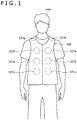
- the information processing system presents various sensations to a user. Describing more particularly, as depicted in FIG. 1 , the information processing system includes a sensation presentation device 100 that is worn by a user and presents various sensations to the user through the sensation presentation device 100.
- the sensation presentation device 100 includes a plurality of tactile data presentation sections 121 (in FIG. 1 , a tactile data presentation section 121a to a tactile data presentation section 121h) provided in the inside thereof.
- a plurality of tactile data presentation sections 121 for example, as depicted in FIG. 1 , six tactile data presentation sections 121 (tactile data presentation section 121a to tactile data presentation section 121f)
- a plurality of tactile data presentation sections 121 for example, as depicted in FIG. 1 , six tactile data presentation sections 121 (tactile data presentation section 121a to tactile data presentation section 121f)
- a plurality of tactile data presentation sections 121 for example, as depicted in FIG.
- one tactile data presentation section 121 on each shoulder can be deployed; and on a rear side, a plurality of tactile data presentation sections 121 (not depicted; for example, six tactile data presentation sections 121 similar to those on the front side) can be deployed.
- the individual tactile data presentation sections 121 can be deployed in such a positional relationship that the individual tactile data presentation sections 121 deployed on the front side and the individual tactile data presentation sections 121 deployed on the rear side are opposed to each other.
- the sensation presentation device 100 includes one or more tactile data presentation sections 121 and can present various tactile stimuli to a user by controlling the magnitude and the timing of outputting of them or a combination of the tactile data presentation sections 121 to be used for outputting.
- the sensation presentation device 100 can present a sensation that the user is cut, a sensation that the user hits some object, a sensation that the user is held down and so forth.
- FIG. 1 depicts an example in which the sensation presentation device 100 is a sleeveless garment (vest)
- the sensation presentation device 100 is not limited to such example and may be able to present a sensation to various regions of the body where it has sleeves, trousers or the like.
- the number of tactile data presentation sections 121 provided on the sensation presentation device 100 is not limited especially.
- the sensation presentation device 100 may include an acoustic data presentation section 131 that presents sound (in FIG. 2 , an acoustic data presentation section 131a and another acoustic data presentation section 131b).
- an acoustic data presentation section 131 that presents sound
- a plurality of (for example, one on each shoulder as depicted in FIG. 2 ) acoustic data presentation sections 131 can be deployed in the shoulder region of the user.
- the sensation presentation device 100 includes one or more acoustic data presentation sections 131 and can present various acoustic effects to the user by controlling the magnitude and the timing of an output of them.
- the sensation presentation device 100 can localize a sound image in the space and can present sound effect only to the user in a situation in which BGM is presented from another speaker (for example, sound effect when the user is cut, sound effect when the user hits some object or the like).
- the number of acoustic data presentation sections 131 provided in the sensation presentation device 100 is not limited specifically.
- the sensation presentation device 100 may include a mechanism that can present the visual, olfactory, or taste.
- the sensation presentation device 100 may be able to present the visual (video) like a transmission type head-mounted display or the like or may present the olfactory (smell) like a fragrance presentation device or the like or else may present the taste (flavor) like an electric taste presentation device.
- the information processing system is a system that can be utilized, for example, regardless of the indoor (for example, a playhouse, a movie theater, a concert hall, a live house, indoor play facilities in a theme park and so forth) or the outdoor (for example, a playhouse whose stage is provided outdoors, a concert venue or a live venue, a movie screening venue whose screen is provided outdoors, outdoor play facilities in a theme park and so forth). Further, as depicted in FIG.
- the information processing system includes a sensation presentation device 100, an information processing device 200, a controller 260, an audio IF 270, an amplifier 280, a front speaker 290, a projector 300, a screen 310, a light 320, a smoke generator 330, and a wind generator 340 (it is to be noted that the information processing system depicted in FIG. 3 assumes a case in which it is utilized indoors).
- the information processing device 200 is a device that generally controls the entire information processing system. More particularly, the information processing device 200 generally controls a sensation to be presented to a user through the sensation presentation device 100, a video to be projected to the screen 310, a sound to be emitted from the front speaker 290, a light to be irradiated from the light 320, a smoke to be generated from the smoke generator 330, a wind to be generated from the wind generator 340 and so forth. Functions of the information processing device 200 are hereinafter described in detail.
- the controller 260 is a device that is used when an operator performs inputting to the information processing device 200.
- the audio IF 270 is a device that functions as an interface of acoustic data that is used for presentation of sound through the sensation presentation device 100.
- the amplifier 280 is a device that performs amplification or adjustment of acoustic data inputted to the audio IF 270, switching of an input and so forth.
- the front speaker 290 is a device that functions as an acoustic presentation section and is a device that presents sound (first sound) to the overall venue.
- the projector 300 is a device that projects a video to the screen 310, and the screen 310 is a face (for example, a flat face or a curved face) to which a video is projected.
- the light 320, the smoke generator 330, and the wind generator 340 are devices that present light, smoke, and wind, respectively.
- a tactile stimulus is presented from the tactile data presentation section 121 of the sensation presentation device 100 to the user together with provision of various types of content including theatrics, a movie, a concert, a live and so forth as in the information processing system according to the present disclosure
- various types of content including theatrics, a movie, a concert, a live and so forth
- the user may feel uncomfortable by perceiving sound (second sound) emitted by the tactile stimulus. More particularly, where the sound (second sound) emitted by the tactile stimulus is perceived as noise by the user, it becomes harder for the user to hear sound (first sound) presented from the front speaker 290 or the presence is disturbed.
- the discloser of the present case has come to create the technology of the present disclosure taking the circumstances described above into consideration.
- the information processing device 200 generates tactile data to be used for presentation of a tactile stimulus in which second sound that is not perceived by a user is emitted on the basis of information regarding a first perception characteristic of the user with respect to a first sound emitted from the front speaker 290 (acoustic presentation section) (such information is hereinafter referred to as "first perception characteristic information”) and information regarding a second perception characteristic of the user with respect to a second sound emitted by a tactile stimulus presented from the tactile data presentation section 121 of the sensation presentation device 100 (such information is hereinafter referred to as "second perception characteristic information").
- the "first perception characteristic information” is information indicative of whether or not first sound is perceived by the user, a degree of the perception or the like and includes frequency characteristic information of the first sound when the first sound reaches an ear of the user.
- the "second perception characteristic information” is information indicative of whether or not second sound is perceived by the user, a degree of such perception or the like and includes frequency characteristic of the second sound when the second sound reaches an ear of the user.
- Particular examples of the first perception characteristic information and the second perception characteristic information are hereinafter described. Further, although it is described in the foregoing description that the first sound is sound emitted from the front speaker 290, the first sound is not limited to this.
- the first sound includes also sound emitted from the acoustic data presentation section 131 of the sensation presentation device 100 and further includes, in the case where an arbitrary speaker other than the front speaker 290 and the acoustic data presentation section 131 exists, also sound emitted from the speaker.
- the information processing device 200 provides tactile data generated in such a manner to the sensation presentation device 100 such that the tactile data presentation section 121 of the sensation presentation device 100 can use the tactile data to present a tactile stimulus of emitting second sound that is not perceived by users. Therefore, a user to whom the tactile stimulus is presented and another user who is located in the neighborhood of the user and to whom the tactile stimulus is not presented can be prevented from perceiving the second sound and feeling uncomfortable.
- the "user" in the present specification is a concept that includes not only a user to whom a tactile stimulus is presented but also a user to whom a tactile stimulus is not presented.
- the information processing device 200 Describing a generation method of tactile data, the information processing device 200 generates tactile data by adjusting the ratio of first sound and second sound that are to reach an ear of a user on the basis of first perception characteristic information and second perception characteristic information. For example, the information processing device 200 adjusts the ratio for each frequency band to generate tactile data.
- the "ratio between first sound and second sound” may be represented as SN ratio (Signal-Noise ratio) (it is to be noted that this does not limited to the S/N ratio).
- SN ratio Signal-Noise ratio
- the information processing device 200 adjusts the ratio between first sound and second sound (SN ratio) in advance or adjust the ratio on the real time basis on the basis of first perception characteristic information and second perception characteristic information.
- the information processing device 200 can generate tactile data such that the sound pressure level of the second sound is lower than the sound pressure level of the first sound in the audible range of a user (in other words, in outside of the audible range of a user, the information processing device 200 may not be made the sound pressure level of the second sound lower than the sound pressure level of the first sound).
- the information processing device 200 adjusts, for each frequency band in outside of the audible range of a user, the sound pressure level of the second sound so as to be lower than the sound pressure level of the first sound (a waveform 2 in B of FIG. 4 indicates the sound pressure level of the second sound). This makes it possible for the information processing device 200 to prevent the second sound from being perceived by the user.
- the information processing device 200 can adjust the frequency band corresponding to the second sound to a frequency band outside the audible range or adjust the frequency band corresponding to the second sound to a lower value than the audible level.
- the "case where first sound is not emitted from the front speaker 290" is a concept including not only a case in which a first sound is not at all emitted from the front speaker 290 but also a case in which the first sound is very weak.
- the "frequency band corresponding to the first sound” is a frequency band in which the first sound has a sound pressure level that is so high that it has an influence on the perception of a user (sound pressure level equal to or higher than a predetermined value) and that a frequency band in which the first sound has a sound pressure level that is so low that it has no influence on the perception of a user can be excepted.
- the "predetermined value" in the "case where the frequency band corresponding to the first sound is higher than a predetermined value” assumes that it is a frequency that is at least equal to or higher than the frequency band corresponding to the second sound and for which it is difficult to take such countermeasures as to make the sound pressure level of the second sound lower than the sound pressure level of the first sound until the second sound is not perceived by a user (note that this is no restrictive).
- frequency characteristic information, included in the first perception characteristic information, of first sound when the first sound reaches an ear of a user has such a waveform 1 as depicted in A of FIG. 5 .
- the information processing device 200 since the frequency band corresponding to the first sound is higher than a predetermined value (in A of FIG. 5 , 500 [Hz]), the information processing device 200 adjusts the frequency band corresponding to the second sound to the outside of the audible range (in A of FIG. 5 , to 200 [Hz] or less) as depicted in B of FIG. 5 .
- the information processing device 200 can prevent the second sound from being perceived by a user. It is to be noted that, if the modes of B of FIG. 4 and B of FIG. 5 are compared with each other, then the mode of B of FIG. 4 is considered preferable because it can present a more various tactile stimulus to a user.
- the information processing device 200 may decrease the ratio of the second sound such that the second sound is not perceived by a user (is less likely to be perceived). For example, in the case where sound in a high frequency band is emitted with a considerable sound volume from the front speaker 290, the information processing device 200 can make it possible to prevent the second sound from being perceived (to make second sound less likely to be perceived) by the user only by decreasing the ratio of the second sound.
- the "case where the frequency band corresponding to the first sound is sufficiently greater than the frequency band corresponding to the second sound” can be rephrased as a "case in which the frequency band corresponding to the first sound is higher than a predetermined value” or as a "case in which the difference between a frequency corresponding to a sound pressure level at a peak of the first sound and a frequency corresponding to a sound pressure level at a peak of the second sound is greater than a predetermined value" (it is to be noted that the "predetermined values” are different from that described hereinabove).
- the information processing device 200 includes a control section 210, a generation section 220, a communication section 230, a display section 240, and a storage section 250 and is connected to an external controller 260 through the communication section 230.
- the control section 210 is a functional configuration that generally controls the functional configurations of the information processing device 200.
- the control section 210 can control starting and stopping of the functional configurations on the basis of inputting using the controller 260 and designate contents of a sensation to be presented to a user by the sensation presentation device 100 (for example, contents, timing, strength and so forth of a tactile stimulus to be presented by the tactile data presentation section 121, contents, timing, and volume of sound to be presented by the acoustic data presentation section 131, and so forth).
- the control section 210 can control devices other than the information processing device 200 in the information processing system by generating various control signals. It is to be noted that contents of control of the control section 210 are not limited to them.
- the control section 210 may implement processes performed generally by a computer for universal use, a PC (Personal Computer), a tablet PC, a smartphone and so forth (for example, processes of an OS (Operating System) and so forth).
- the generation section 220 is a functional configuration for generating various data to be used by the information processing system. More particularly, the generation section 220 is a functional configuration that generates data to be used for presentation of a tactile stimulus, a sound, a light, a video, a smoke, and a wind. It is to be noted that generation of data to be used for presentation of a tactile stimulus, a sound and, a light is hereinafter described.
- the generation section 220 generates data to be used for presentation of a video, a smoke, and a wind at any time under the control of the control section 210 and provides the generated data to the individual devices through the network to which the projector 300, the smoke generator 330, and the wind generator 340 are connected. Further, as depicted in FIG. 6 , the generation section 220 includes a tactile data generation section 221, an acoustic data generation section 222, and a lighting data generation section 223.
- the tactile data generation section 221 is a functional configuration that generates tactile data to be used for presentation of a tactile stimulus by the tactile data presentation section 121 of the sensation presentation device 100. Describing more particularly, the tactile data generation section 221 acquires first perception characteristic information and second perception characteristic information regarding a content to be provided to a user. It is to be noted that the acquisition source of such information is not limited specifically.
- the first perception characteristic information and the second perception characteristic information may be information acquired from a user who enjoyed the content in the past or may be information acquired from a user who is enjoying the content at present (information of part of the content ended by now). Further, the first perception characteristic information and the second perception characteristic information may be information acquired in regard to another content similar to the content.
- the first perception characteristic information and the second perception characteristic information can be acquired, for example, by a sensor mounted on an ear of each user who has enjoyed (or is currently enjoying) the content in a state in which the user sits on a seat. Further, the first perception characteristic information and the second perception characteristic information may be estimated on the basis of the position (or seat) of the user.
- the tactile data generation section 221 adjusts, on the basis of the first perception characteristic information and the second perception characteristic information, the ratio (SN ratio) between the first sound and the second sound that reach an ear of a user to generate tactile data. For example, as described above, the tactile data generation section 221 can generate tactile data such that the sound pressure level of the second sound is lower than the sound pressure level of the first sound in the audible range of the user.
- the tactile data generation section 221 adjusts the waveform 2 of the second wave at timings in such a manner as depicted in (4)' to (6)' of FIG. 7 .
- the sound pressure level of the second sound that reaches an ear of the user becomes lower than the sound pressure level of the first sound as depicted in B of FIG. 8 (in B of FIG. 8 , a graph in the case where (3)' and (6)' of FIG. 7 are compared with each other is depicted). Accordingly, the user does not feel uncomfortable because the user does not perceive the second sound any more.
- the tactile data generation section 221 can adjust the frequency band corresponding to the second sound to the outside of the audible range or can adjust the sound pressure level of the second sound to a value lower than the audible level.
- the tactile data generation section 221 adjusts the sound pressure level of the second sound at different timings to values lower than the audible level as depicted in (4)' to (6)' of FIG. 9 . Consequently, the user does not feel uncomfortable because the user does not perceive the second sound any more.
- the tactile data generation section 221 may decrease the ratio of the second sound such that the second sound is not perceived (is less likely to be perceived) by the user as described hereinabove.
- the tactile data generation section 221 can perform the adjustment described above using an arbitrary waveform adjustment technology or sound pressure adjustment technology (software for exclusive use or the like). It is to be noted that the type of the waveform adjustment technology or the sound pressure adjustment technology to be used is not restricted specifically.
- the acoustic data generation section 222 is a functional configuration for generating acoustic data to be used for presentation of a first sound by the front speaker 290 and the acoustic data presentation section 131 of the sensation presentation device 100 under the control of the control section 210.
- the acoustic data generation section 222 provides the acoustic data to the front speaker 290 and the sensation presentation device 100 through a predetermined network.
- the lighting data generation section 223 is a functional configuration for generating lighting data to be used for presentation of light (lighting) by the light 320 under the control of the control section 210.
- the lighting data generation section 223 provides the lighting data to the light 320 through a predetermined network.
- the communication section 230 is a functional configuration for performing communication with an external apparatus. For example, in the case where an operator of the information processing device 200 performs inputting using the controller 260, the communication section 230 receives the input data from the controller 260 and provides the input data to the control section 210 to implement reflection of the input by the operator. Further, the communication section 230 transmits data generated by the generation section 220 (including, for example, tactile data, acoustic data and so forth) to a predetermined external apparatus to implement presentation of a tactile stimulus, a sound, a video, a lighting, a smoke, a wind and so forth. It is to be noted that the data communicated by the communication section 230 are not limited to them.
- the communication section 230 may receive the first perception characteristic information and the second perception characteristic information from the sensation presentation device 100 or the like. Further, the types of the communication method and the communication line to be used for communication between the communication section 230 and respective external apparatuses are not restricted specifically. For example, the communication section 230 may perform communication by wired communication or by wireless communication with the respective external apparatuses.
- the display section 240 is a functional configuration for displaying a setting screen image to be used for inputting by an operator and so forth.
- the display section 240 may be a display device such as, for example, a liquid crystal display (LCD: Liquid Crystal Display) or an organic EL (Electro Luminescence) display. It is to be noted that the type and display contents of the display section 240 are not limited to them.
- the storage section 250 is a functional configuration for storing various data.
- the storage section 250 stores programs and parameters to be used by the functional configurations of the information processing device 200, data generated by the functional configurations (for example, tactile data, acoustic data, lighting data and so forth) and so forth. It is to be noted that contents of the data to be stored into the storage section 250 are not limited to them.
- the controller 260 is a device for receiving an input by an operator and providing input data to the information processing device 200.
- the controller 260 includes various inputting mechanisms such as a keyboard, a mouse, buttons, switches, levers, touch sensors, pressure sensors, or proximity sensors. It is to be noted that the types of inputting mechanisms provided in the controller 260 are not limited to them. Further, the controller 260 may not be provided as an external apparatus of the information processing device 200 but may be provided in the information processing device 200.
- the functional configuration described above with reference to FIG. 6 is an example to the last, and the functional configuration of the information processing device 200 is not limited to such example.
- the information processing device 200 may not necessarily include all of the functional configurations depicted in FIG. 6 . All or part of the functional configurations of the information processing device 200 may be provided in an external apparatus such as the sensation presentation device 100. Further, the functional configuration of the information processing device 200 can be modified flexibly in accordance with the specification or practical use.
- the sensation presentation device 100 includes a control section 110, a tactile presentation section 120, a sound presentation section 130, a communication section 140, a sensor section 150, and a storage section 160.
- the control section 110 is a functional configuration that generally controls the functional configurations of the sensation presentation device 100.
- the control section 110 controls starting and stopping of the functional configurations on the basis of various data (including, for example, tactile data, acoustic data, other control signals and so forth) provided from the information processing device 200.
- contents of control of the control section 110 are not limited to them.
- the control section 110 may implement processes that are generally performed in a computer for universal use, a PC, a tablet PC, a smartphone and so forth (for example, processes of an OS or the like).
- the control section 110 includes a tactile data processing section 111 and an acoustic data processing section 112.
- the tactile data processing section 111 performs a process relating to presentation of a tactile stimulus by the tactile data presentation section 121 using tactile data provided from the information processing device 200.
- the tactile data processing section 111 may implement presentation of a tactile stimulus by editing, on the basis of settings of the individual sensation presentation device 100 (for example, settings of the sensation presentation device 100 performed uniquely by a user (for example, setting of a volume, setting of ON/OFF of the function and so forth)), tactile data provided from and information processing device 200 and providing the tactile data after the editing to the tactile data presentation section 121.
- the acoustic data processing section 112 performs processes relating to presentation of a first sound by the acoustic data presentation section 131 using acoustic data supplied from the information processing device 200.
- the acoustic data processing section 112 may implement presentation of the first sound by editing, on the basis of settings of the individual sensation presentation device 100 (for example, settings of the sensation presentation device 100 performed uniquely by a user (for example, setting of a volume, setting of ON/OFF of the function and so forth)), acoustic data provided from the information processing device 200 and providing the first sound after the editing to the acoustic data presentation section 131.
- the tactile presentation section 120 is a functional configuration that includes one or more tactile data presentation sections 121 and presents a tactile stimulus to the user using the tactile data presentation section 121.
- the tactile data presentation section 121 is a functional configuration for presenting a tactile stimulus to a user using tactile data provided from the tactile data processing section 111.
- the tactile data presentation section 121 may be an actuator that presents vibration (for example, an ERM (eccentric motor), an LRA (linear resonance actuator), a VCM (voice coil motor) or the like), or may be an electric element that presents a sensation of force or else may be a temperature change element that presents a temperature sensation (for example, a Peltier element or the like).
- the "tactile stimulus” can include a vibration, a sensation of force, a temperature sensation and so forth.
- the tactile stimulus to be presented by the tactile data presentation section 121 is not limited to them.
- a channel may be allocated to each of the tactile data presentation sections 121 (in FIG. 10 , at least the tactile data presentation section 121a to the tactile data presentation section 121c) such that presentation of a tactile stimulus that is different for each channel is performed.
- the sound presentation section 130 includes one or more acoustic data presentation sections 131 and has a functional configuration that it presents a first sound to the user using the acoustic data presentation sections 131.
- the acoustic data presentation section 131 is a functional configuration that presents a first sound to the user using acoustic data provided from the acoustic data processing section 112.
- the acoustic data presentation section 131 can include a speaker for reproducing acoustic data, an amplification circuit for the speaker and so forth.
- a plurality of acoustic data presentation sections 131 (in FIG. 10 , at least the acoustic data presentation section 131a to the acoustic data presentation section 131c) may be provided such that localization of a sound image may be implemented by adjusting outputs of the acoustic data presentation sections 131.
- the sound image may be localized by cooperation of the acoustic data presentation sections 131 and speakers provided around them (for example, speakers at the seats). It is to be noted that different channels may be allocated to the individual acoustic data presentation sections 131 such that presentation of sound that is different among the different channels is performed.
- the communication section 140 is a functional configuration that performs communication with an external apparatus.
- the communication section 140 receives various data generated by the information processing device 200 (including, for example, tactile data, acoustic data, other control signals and so forth).
- the data communicated by the communication section 140 are not limited to them.
- the types of the communication method and the communication lines to be used for communication between the communication section 140 and the external apparatus are not restricted specifically.
- the communication section 140 may perform wired communication with an external apparatus or may perform wireless communication.
- the sensor section 150 includes various sensors and has a functional configuration for acquiring sensor data generated by the sensors.
- the sensor section 150 may include a position sensor (a sensor that can be used for specification of the position of a user including, for example, a GNSS (Global Navigation Satellite System) receiver, a proximity sensor and so forth) such that it acquires sensor data to be used for specification of the position of the user.
- a position sensor a sensor that can be used for specification of the position of a user including, for example, a GNSS (Global Navigation Satellite System) receiver, a proximity sensor and so forth
- the first perception characteristic information and the second perception characteristic information can be estimated on the basis of the position of the user described above.
- the type of the sensor provided in the sensor section 150 is not restricted specifically.
- the sensor section 150 may include various sensors such as a posture sensor (a gyro sensor, an acceleration sensor or the like), a temperature sensor, or a pressure sensor.
- the storage section 160 has a functional configuration for storing various data.
- the storage section 160 stores programs and parameters to be used by the functional configurations of the sensation presentation device 100, or various data provided from the information processing device 200 (including, for example, tactile data, acoustic data, other control signals and so forth) and so forth. It is to be noted that contents of the data stored in the storage section 160 are not limited to them.
- the functional configuration of the sensation presentation device 100 has been described above. It is to be noted that the functional configuration described hereinabove with reference to FIG. 10 is an example to the last, and the functional configuration of the sensation presentation device 100 is not limited to such an example as described above. For example, the sensation presentation device 100 may not necessarily include all of the functional configurations depicted in FIG. 10 . Further, the functional configuration of the sensation presentation device 100 can be modified flexibly in accordance with specifications or a practical use.
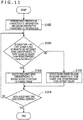
- FIG. 11 depicts a flow of processing in the case where tactile data to be used for presentation of a tactile stimulus of emitting a second sound that is not perceived by a user is generated (programmed) in advance on the basis of first perception characteristic information and second perception characteristic information before starting of a content.
- the tactile data generation section 221 of the information processing device 200 acquires first perception characteristic information and second perception characteristic information regarding a content to be presented to a user. As described hereinabove, the acquisition sources of such information are not restricted specifically.
- the tactile data generation section 221 confirms, for each timing of the content (for example, for each segment), whether or not first sound is emitted or whether or not a frequency band corresponding to the first sound is higher than a predetermined value (for example, 500 [HZ]).
- a predetermined value for example, 500 [HZ]
- the tactile data generation section 221 adjusts the frequency band corresponding to the second sound to the outside of the audible range (for example, 200 [Hz] or less) at step S1008 (it is to be noted that the tactile data generation section 221 may adjust the sound pressure level of the second sound to a value lower than the audible level).
- the tactile data generation section 221 In the case where the first sound is emitted and besides the frequency band corresponding to the first sound is equal to or lower than the predetermined value (step S1004/No), the tactile data generation section 221 generates tactile data at step S1012 such that the sound pressure level of the second sound is lower than the sound pressure level of the first sound in the audible range of the user. The processes at step S1004 to step S1012 are repeated until the adjustment described above ends over the overall content (step S1016/No).
- the steps in the flow chart of FIG. 11 need not necessarily be processed in a time series in accordance with the order described. In particular, the steps in the flow chart may be processed in an order different from the described order or may be processed in parallel.
- the tactile data generation section 221 may perform decision of whether or not the frequency band corresponding to the first sound is sufficiently greater than the frequency band corresponding to the second sound and generate tactile data such that, in the case where the frequency band corresponding to the first sound is sufficiently greater than the frequency band corresponding to the second sound, the ratio of the second sound is decreased as described hereinabove. Further, the tactile data generation section 221 may not generate (program) tactile data in advance before starting of a content but generate tactile data on the real time basis when a content is provided.
- the sensation presentation device 100 has a structure that two vests including an outer vest having no size adjustment function and an inner vest having a size adjustment function are placed one on the other (structure that the outer vest covers the inner vest from above). Further, taking easiness to put on and take off by a user into consideration, the outer vest and the inner vest may be partially physically connected to each other, for example, at the opposite shoulder portions.
- an example of the outer vest is depicted in FIG. 12 and an example of the inner vest is depicted in FIG. 13 .
- FIG. 12 depicts an example of the outer vest of the sensation presentation device 100 (that is depicted in FIG. 2 ) in which the acoustic data presentation sections 131 are disposed at the opposite shoulder regions.
- the outer vest and the inner vest depicted in A of FIG. 13 ) includes an opening and closing mechanism 10 (for example, a fastener, a hook-and-loop fastener, a button or the like.
- the opening and closing mechanism 10 is not limited to them) in the middle of the front body thereof. Consequently, the user can put on and take off the sensation presentation device 100 of the two-layer structure easily and efficiently without performing a movement of a high load such as to pass the head through the sensation presentation device 100.
- the outer vest includes a predetermined number of pockets 11 (in the example of FIG. 12 , the pocket 11a to the pocket 11d) at the front body thereof. Consequently, since the outer vest can accommodate parts to be worn on a wrist or a foot hereinafter described, in the case where such parts are not used, management of the parts is facilitated.
- the sensation presentation device 100 of the vest type is adopted because that the user can move the arms easily, that the sensation presentation device 100 is superior in breathability and so forth are taken into consideration
- the shape of the sensation presentation device 100 (especially, the shape of the outer vest) can be changed to various designs in accordance with an application of the same (contents of the content).
- a of FIG. 13 depicts an example of the front body of the inner vest and B of FIG. 13 depicts an example of the back body of the inner vest.
- an adjustment mechanism 12 in the example of FIG. 13 , a hook-and-loop fastener
- the sensation presentation device 100 it is desirable that the sensation presentation device 100 and the tactile data presentation section 121 are pressed against the body by appropriate pressure.
- the body of the user has a significant individual difference depending upon the age, sex and so forth.
- the inner vest includes the adjustment mechanism 12 such that the contact pressure between the tactile data presentation section 121 and the body can be adjusted and an optimum tactile stimulus can be presented for each user. Further, since the inner vest is covered with the outer vest when it is used, the adjustment mechanism 12 is not exposed to the surface. Consequently, the designability of the wear is improved, and it can be prevented that large sound is generated to discomfort the audience around the user by operating the hook-and-loop fastener for attachment and removal in order for the user itself to perform size adjustment of the inner vest using the hook-and-loop fastener. Note that it is assumed that wearing of the sensation presentation device 100 by the user is completed before the content is started and size adjustment or putting on and taking off is not performed except during break time or the like.
- a space for wearing (putting on and taking off) of the sensation presentation device 100 is provided at a position different from a seat on which the user is to be seated and a clerk in charge assists putting on or taking off of the sensation presentation device 100 by the user (naturally, this is not restrictive).
- the inner vest includes a fixation mechanism 13 that can fix the tactile data presentation section 121 (in the example of FIG. 13 , a hook-and-loop fastener).
- the sensation presentation device 100 presents a tactile stimulus to a user
- the tactile stimulus is presented to a similar position without being influenced by the individual difference (size of the body or the like) for each user.
- the arrangement of the tactile data presentation section 121 is adjusted in response to an individual difference for each user.
- the position (region) at which a tactile stimulus is to be presented changes in response to contents or staging of a content such as a drama or a movie.
- the positions at which a tactile stimulus is to be presented change depending upon the content such that, in the case of a drama A, they are four places of the front of the body; in the case of another dram B, they are six places of the front of the body; and in the case of a movie A, they are two places of the front in addition to the six places of the front of the body. Therefore, the inner vest has the fixation mechanisms 13 provided over a substantially overall face thereof to allow the tactile data presentation section 121 to be fixed at a desired position.
- the fixation mode of the tactile data presentation section 121 is described with reference to FIG. 14 . It is not assumed basically that, upon wearing by the user before a content is started, the fixation position of the tactile data presentation sections 121 is changed by the user itself (this is not restrictive). Therefore, as depicted in A of FIG. 14 , the inner vest has a two-sheet structure, and the fixation mechanism 13 is provided on the inner side of the two-sheet structure such that it cannot be touched by the user.
- the tactile data presentation section 121 can be fixed to the inner vest by being sandwiched by the fixation mechanism 13 (hook-and-loop fastener female or the like) and another fixation mechanism 14 (hook-and-loop fastener male or the like) which is a separate part. It is assumed that, as depicted in A of FIG. 14 , the fixation mechanism 13 is provided on an inner side face of an "outer side 15 of the inner vest" (outer vest side) in the two-sheet structure. In other words, it is assumed that the fixation mechanism 13 is not provided on an "inner side 16 of the inner vest" (user body side) in the two-sheet structure. Consequently, the tactile data presentation section 121 is pressed against the body of the user precisely by tensile force of the "outer side 15 of the inner vest” generated by fastening pressure of the adjustment mechanism 12 upon size adjustment.
- the sensation presentation device 100 desirably has a two-layer structure of the inner vest and the outer vest as described hereinabove, only the inner vest may be used by itself taking easiness of putting on and taking off into consideration. Also in this case, since the inner vest has such a structure as described above, the tactile data presentation sections 121 can be prevented from being exposed to the surface, the designability is assured.
- the body of the user has an individual difference that is great depending upon the age or the sex. Therefore, such operation is conceivable that, for example, two kinds of wears including a wear for men (outer vest and inner vest) and a wear for women (outer vest and inner vest) are prepared before provision of a content and, in regard to the inner vest for women, presupposing that the adjustment mechanism 12 is rather narrowed down in accordance with the body, the fixation position of the tactile data presentation sections 121 is set to the relatively inner side in comparison with that for men.
- two kinds of wears including a wear for men (outer vest and inner vest) and a wear for women (outer vest and inner vest) are prepared before provision of a content and, in regard to the inner vest for women, presupposing that the adjustment mechanism 12 is rather narrowed down in accordance with the body, the fixation position of the tactile data presentation sections 121 is set to the relatively inner side in comparison with that for men.
- the position and the number of tactile data presentation sections 121 are changed in response to contents of a content before starting of the content and design and generation of tactile data to be inputted to the tactile data presentation sections 121 are performed on the basis of the setting of the position and the number of the tactile data presentation sections 121.
- the sensation presentation device 100 may be able to present, at a location to which a tactile stimulus is not presented depending upon a vest portion, a tactile stimulus by using some other part.
- the sensation presentation device 100 includes connectors such that it can be electrically connected to additional tactile data presentation sections 121 (in A of FIG. 15 , a tactile data presentation section 121k to a tactile data presentation section 121p) by wirings 190 (in A of FIG. 15 , a wiring 190a to a wiring 190f) connected to the connectors.
- additional tactile data presentation sections 121 in A of FIG. 15 , a tactile data presentation section 121k to a tactile data presentation section 121p
- wirings 190 in A of FIG. 15 , a wiring 190a to a wiring 190f
- each of the added tactile data presentation sections 121 includes a connector such that it can be electrically connected to further added tactile data presentation sections 121 by wirings 190 connected to the connectors.
- a cable whose length can be adjusted for example, a curled cable or a take-up type cable
- movement of the user can be prevented from being disturbed by the unnecessarily long wirings 190.
- a channel that can be used for an added tactile data presentation section 121 may be used for presentation of a tactile stimulus to another portion (for example, a vest portion). This makes it possible to present a variety of tactile stimuli to the portion.
- the additional tactile data presentation sections 121 may be connected by wireless connection.
- the additional tactile data presentation sections 121 are fixed by a constant pressure to the portions of the body by a predetermined fixation mechanism (for example, a hook-and-loop fastener or the like).
- a predetermined fixation mechanism for example, a hook-and-loop fastener or the like.
- a label 17 indicative of a fixation position (in B of FIG. 15 , a label 17a to a label 17f: an illustration, a character or the like representative of a fixation position is indicated) is affixed. This can prevent the user from fixing each additional tactile data presentation section 121 to a wrong position.
- FIG. 16 depicts a manner in which a user sits on the seat in a state in which it wears a sensation presentation device 100 (and the additional tactile data presentation section 121k to tactile data presentation section 121p).
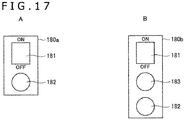
- an operation panel 180 that is used for a predetermined operation by a user is installed.
- the operation panel 180a depicted in A of FIG. 17 includes a switch 181, and the user can operate the switch 181 to switch presentation of various sensations including a tactile stimulus ON/OFF. Further, a connector 182 (female) is provided for the operation panel 180a, and the user can place the sensation presentation device 100 into an operable state by inserting a connector (male) provided for the sensation presentation device 100 into the connector 182. Meanwhile, the operation panel 180b depicted in B of FIG. 17 further includes a volume adjustment mechanism 183, and the user can adjust a tactile stimulus or the volume of sound to be presented by the sensation presentation device 100 to a desired magnitude.
- the sensation presentation device 100 a plurality of types (size of S/M/L, for adult/child, for male/female, color, notation number) is provided, and by connecting a sensation presentation device 100 to the connector 182, the type of the sensation presentation device 100 can be identified by the information processing system (especially by the information processing device 200) depending upon the resistance value for type detection incorporated in the sensation presentation device 100 or a contrivance for ON/OFF detection such as a DIP switch.
- the information processing system (especially the information processing device 200) may change a signal (volume or the like) to be supplied to the wear in response to the identified type.
- the information processing device 200 includes a CPU (Central Processing Unit) 901, a ROM (Read Only Memory) 902, a RAM (Random Access Memory) 903, a host bus 904, a bridge 905, an external bus 906, an interface 907, an inputting device 908, an outputting device 909, a storage device (HDD) 910, a drive 911, and a communication device 912.
- a CPU Central Processing Unit
- ROM Read Only Memory
- RAM Random Access Memory
- bridge 905 an external bus 906, an interface 907, an inputting device 908, an outputting device 909, a storage device (HDD) 910, a drive 911, and a communication device 912.
- HDD storage device
- the CPU 901 functions as an arithmetic operation processing device and a control device and controls general operation in the information processing device 200 in accordance with various programs. Further, the CPU 901 may be a microprocessor.
- the ROM 902 stores programs, arithmetic operation parameters and so forth to be used by the CPU 901.
- the RAM 903 temporarily stores a program to be used in execution of the CPU 901, parameters that change suitably in such execution and so forth. They are connected to each other by the host bus 904 configured from a CPU bus or the like. By cooperation of the CPU 901, the ROM 902, and the RAM 903, functions of the control section 210 and the generation section 220 are implemented.
- the host bus 904 is connected to the external bus 906 such as a PCI (Peripheral Component Interconnect/Interface) bus through the bridge 905. It is to be noted that the host bus 904, the bridge 905, and the external bus 906 need not necessarily be configured separately from each other and the functions of them may be incorporated in one bus.
- PCI Peripheral Component Interconnect/Interface
- the inputting device 908 is configured from inputting means for allowing a user to input information such as a mouse, a keyboard, a touch panel, buttons, a microphone, switches, and levers, and an input controlling circuit that generates an input signal on the basis of an input by a user and outputs the input signal to the CPU 901.
- the user who uses the information processing device 200 can input various data and instruct a processing operation to various devices by operating the inputting device 908.
- the functions of the controller 260 are implemented by the inputting device 908.
- the outputting device 909 includes display devices such as, for example, a CRT (Cathode Ray Tube) display device, a liquid crystal display (LCD) device, an OLED (Organic Light Emitting Diode) device, and lamps.
- display devices such as, for example, a CRT (Cathode Ray Tube) display device, a liquid crystal display (LCD) device, an OLED (Organic Light Emitting Diode) device, and lamps.
- the functions of the display section 240 are implemented by the outputting device 909.
- the storage device 910 is a device for data storage.
- the storage device 910 may include a storage medium, a recording device for recording data into the storage medium, a reading out device for reading out data from the storage medium, a deletion device for deleting data recorded in the storage medium and so forth.
- the storage device 910 is configured, for example, from an HDD (Hard Disk Drive).
- the storage device 910 drives the hard disk to store programs to be executed by the CPU 901 and various data.
- the functions of the storage section 250 are implemented by the storage device 910.
- the drive 911 is a reader/writer for a storage medium and is built in or externally attached to the information processing device 200.
- the drive 911 reads out information recorded on a removable storage medium 913 such as a magnetic disk, an optical disk, a magneto-optical disk, or a semiconductor memory loaded therein and outputs the information to the RAM 903. Further, also it is possible for the drive 911 to write information into the removable storage medium 913.
- the communication device 912 is a communication interface configured from a communication device for connecting, for example, to a communication network 914 and so forth.
- the functions of the communication section 230 are implemented by the communication device 912.
- an operation confirmation work can be performed in a state in which the sensation presentation device 100 is connected to the connector 182 of the operation panel 180.
- audible sound is sequentially generated from the tactile data presentation sections 121 (actuators) of the sensation presentation device 100 such that a confirmer performs operation confirmation with its ears.
- the audible sound may be changed for each tactile data presentation section 121 (for example, identification information such as "1," "2,” "3" and so forth is allocated to the individual tactile data generation section 221 of each sensation presentation device 100 such that the respective identification information is outputted as audible sound to the tactile data presentation sections 121).
- the works at the first step and the second step are performed by rendering the sensation presentation devices 100 operative one by one such that sounds emitted from the sensation presentation device 100 may not mix with each other.
- the confirmer successively performs the works at the first step and the second step while operating the switch 181 of the operation panel 180 to sequentially switching the sensation presentation devices 100 ON/OFF.
- generation of audible sound from the sensation presentation devices 100 or the like may be performed while being displaced little by little for each sensation presentation device 100 such that the confirmer can perform the operation confirmation work without moving from a seat to another seat.
- identification information such as “1,” “2,” or “3” is allocated to each sensation presentation device 100 while such identification information as “1,” “2,” or “3” is allocated to each tactile data generation section 221 of each sensation presentation device 100 and a combination of identification information of a sensation presentation device 100 and a tactile data presentation section 121 like “1-1,” “1-2,” or “1-3” is outputted to the tactile data presentation section 121 as audible sound.
- the confirmer makes it possible for the confirmer to perform the operation confirmation work without moving from a position at which the operator can hear the audible sound emitted from all sensation presentation devices 100.
- the hearing work of the audible sound may be performed by a device for exclusive use.
- an acceleration sensor may be provided in each tactile data presentation section 121 such that operation confirmation is performed by analysis or the like of acceleration data when each tactile data presentation section 121 vibrates.
- An operator who operates the controller 260 described above would be positioned in a control booth behind (or in the middle of) the auditorium such that the operator can overlook the stage and the auditorium, and would operate interfaces provided on the controller 260 such as a touch panel and physical switches in accordance with a timing of movement of a performer on the stage in response to a progress determined in advance.
- devices relating to state effects such as acoustics, lighting, videos, or tactile stimuli can be collectively controlled on the real time basis.
- the operator can collectively control the strength of the stage effects outputted from the devices relating to the stage effects such as acoustics, lighting, videos, or tactile stimuli on the real time basis by an operation of a slide bar provided on the controller 260. For example, if the operator lowers the slide bar, then the sound volume decreases and the strength of tactile stimuli presented by the tactile data presentation sections 121 decreases or the lighting becomes dark.
- an event in the content switches, and the devices relating to the stage effects such as acoustics, lighting, videos, or tactile stimuli can be collectively controlled on the real time basis in accordance with a program associated with the event after the switching. It is to be noted that, at this time, events different from each other may be allocated to different buttons.
- a timekeeper who performs progress management may be deployed separately from the operator in the control booth such that the operator and the timekeeper perform a work cooperatively.
Landscapes
- Physics & Mathematics (AREA)
- Engineering & Computer Science (AREA)
- Acoustics & Sound (AREA)
- Signal Processing (AREA)
- Health & Medical Sciences (AREA)
- General Health & Medical Sciences (AREA)
- Otolaryngology (AREA)
- User Interface Of Digital Computer (AREA)
- Details Of Audible-Bandwidth Transducers (AREA)
- Circuit For Audible Band Transducer (AREA)
Abstract
Description
- The present disclosure relates to an information processing device, an information processing method, and a program.
- In the past, various technologies for presenting a tactile stimulus or the like to a user have been proposed, for example, as in
PTL 1 specified below. -
JP 2018-60313A - Here, for example, together with provision of various types of content including theatrics, a movie, a concert, a live and so forth, staging in which a tactile stimulus is presented from a tactile data presentation section including an actuator and so forth to a user to improve the presence or the like. At this time, there is the possibility that the user may perceive sound emitted by a tactile stimulus (second sound) and feel uncomfortable. Depending upon the technology disclosed in
PTL 1 specified above, it cannot be prevented appropriately that the user perceives sound emitted by a tactile stimulus (second sound). - Therefore, the present disclosure proposes a novel and improved information processing device, information processing method, and program that can appropriately prevent sound emitted by a tactile stimulus (second sound) from being perceived by a user.
- According to the present disclosure, there is provided an information processing device including a generation section that generates, on the basis of information regarding a first perception characteristic of a user with respect to a first sound emitted from an acoustic presentation section and information regarding a second perception characteristic of the user with respect to a second sound emitted by a tactile stimulus presented from a tactile data presentation section, tactile data to be used for presentation of the tactile stimulus of emitting the second sound that is not perceived by the user.
- Further, according to the present disclosure, there is provided an information processing method executed by a computer, the method including generating, on the basis of information regarding a first perception characteristic of a user with respect to a first sound emitted from an acoustic presentation section and information regarding a second perception characteristic of the user with respect to a second sound emitted by a tactile stimulus presented from a tactile data presentation section, tactile data to be used for presentation of the tactile stimulus of emitting the second sound that is not perceived by the user.
- Further, according to the present disclosure, there is provided a program for causing a computer to implement generating, on the basis of information regarding a first perception characteristic of a user with respect to a first sound emitted from an acoustic presentation section and information regarding a second perception characteristic of the user with respect to a second sound emitted by a tactile stimulus presented from a tactile data presentation section, tactile data to be used for presentation of the tactile stimulus of emitting the second sound that is not perceived by the user.
- As described above, with the present disclosure, it is possible to prevent appropriately that a user perceives sound emitted by a tactile stimulus (second sound).
- It is to be noted that the effect described above is not necessarily restrictive and some effect described in the present specification or other effects capable of being grasped from the present specification may be exhibited together with or in place of the effect described above.
-
- [
FIG. 1] FIG. 1 is a view depicting a particular example of asensation presentation device 100. - [
FIG. 2] FIG. 2 is a view depicting another particular example of thesensation presentation device 100. - [
FIG. 3] FIG. 3 is a view depicting an example of a configuration of an information processing system according to the present disclosure. - [
FIG. 4] FIG. 4 is a view illustrating a method for generating tactile data such that second sound is not perceived by a user. - [
FIG. 5] FIG. 5 is a view illustrating another method for generating tactile data such that second sound is not perceived by a user. - [
FIG. 6] FIG. 6 is a block diagram depicting an example of a functional configuration of aninformation processing device 200. - [
FIG. 7] FIG. 7 is a view illustrating a method for generating tactile data such that second sound is not perceived by a user. - [
FIG. 8] FIG. 8 is a view illustrating another method for generating tactile data such that second sound is not perceived by a user. - [
FIG. 9] FIG. 9 is a view illustrating a further method for generating tactile data such that second sound is not perceived by a user. - [
FIG. 10] FIG. 10 is a block diagram depicting an example of a functional configuration of thesensation presentation device 100. - [
FIG. 11] FIG. 11 is a flow chart illustrating an example of a flow of a generation process of tactile data. - [
FIG. 12] FIG. 12 is a view illustrating an outer vest. - [
FIG. 13] FIG. 13 is a view illustrating an inner vest. - [
FIG. 14] FIG. 14 is a view illustrating a fixation mode of a tactiledata presentation section 121. - [
FIG. 15] FIG. 15 is a view illustrating a wearing mode of additional tactiledata presentation sections 121. - [
FIG. 16] FIG. 16 is a view depicting a manner in which a user sits on a seat in a state in which it wears thesensation presentation device 100. - [
FIG. 17] FIG. 17 is a view illustrating anoperation panel 180. - [
FIG. 18] FIG. 18 is a block diagram depicting an example of a hardware configuration of theinformation processing device 200. - In the following, a preferred embodiment of the present disclosure is described with reference to the accompanying drawings. It is to be noted that, in the present specification and the drawings, configurations having substantially same functional configurations are denoted by like reference symbols and overlapping description of them is omitted.
- Further, the description is given in the following order.
- 1. Overview of Information Processing System
- 2. Example of Functional Configuration of Device
- 3. Example of Processing Flow of Device
- 4. Example of Hardware Configuration
- 5. Remarks
- First, an overview of an information processing system according to the present disclosure is described.
- The information processing system according to the present disclosure presents various sensations to a user. Describing more particularly, as depicted in
FIG. 1 , the information processing system includes asensation presentation device 100 that is worn by a user and presents various sensations to the user through thesensation presentation device 100. - As depicted in
FIG. 1 , thesensation presentation device 100 includes a plurality of tactile data presentation sections 121 (inFIG. 1 , a tactiledata presentation section 121a to a tactiledata presentation section 121h) provided in the inside thereof. For example, in the inside of thesensation presentation device 100, on a front side of the user, a plurality of tactile data presentation sections 121 (for example, as depicted inFIG. 1 , six tactile data presentation sections 121 (tactiledata presentation section 121a to tactiledata presentation section 121f)) can be deployed; in a shoulder region, a plurality of tactile data presentation sections 121 (for example, as depicted inFIG. 1 , one tactiledata presentation section 121 on each shoulder (tactiledata presentation section 121g and tactiledata presentation section 121h)) can be deployed; and on a rear side, a plurality of tactile data presentation sections 121 (not depicted; for example, six tactiledata presentation sections 121 similar to those on the front side) can be deployed. As an example, the individual tactiledata presentation sections 121 can be deployed in such a positional relationship that the individual tactiledata presentation sections 121 deployed on the front side and the individual tactiledata presentation sections 121 deployed on the rear side are opposed to each other. - The
sensation presentation device 100 includes one or more tactiledata presentation sections 121 and can present various tactile stimuli to a user by controlling the magnitude and the timing of outputting of them or a combination of the tactiledata presentation sections 121 to be used for outputting. For example, thesensation presentation device 100 can present a sensation that the user is cut, a sensation that the user hits some object, a sensation that the user is held down and so forth. It is to be noted that, whileFIG. 1 depicts an example in which thesensation presentation device 100 is a sleeveless garment (vest), thesensation presentation device 100 is not limited to such example and may be able to present a sensation to various regions of the body where it has sleeves, trousers or the like. Further, the number of tactiledata presentation sections 121 provided on thesensation presentation device 100 is not limited especially. - Further, as depicted in
FIG. 2 , thesensation presentation device 100 may include an acoustic data presentation section 131 that presents sound (inFIG. 2 , an acousticdata presentation section 131a and another acousticdata presentation section 131b). For example, in thesensation presentation device 100, a plurality of (for example, one on each shoulder as depicted inFIG. 2 ) acoustic data presentation sections 131 can be deployed in the shoulder region of the user. - The
sensation presentation device 100 includes one or more acoustic data presentation sections 131 and can present various acoustic effects to the user by controlling the magnitude and the timing of an output of them. For example, thesensation presentation device 100 can localize a sound image in the space and can present sound effect only to the user in a situation in which BGM is presented from another speaker (for example, sound effect when the user is cut, sound effect when the user hits some object or the like). It is to be noted that the number of acoustic data presentation sections 131 provided in thesensation presentation device 100 is not limited specifically. - Here, while the examples of
FIGS. 1 and2 depict an example in which sensations to be presented to the user by thesensation presentation device 100 include the tactile (a tactile stimulus presented by the tactile data presentation section 121) and the auditory (sound presented by the acoustic data presentation section 131), the sensations to be presented to the user are not limited to them. More particularly, thesensation presentation device 100 may include a mechanism that can present the visual, olfactory, or taste. For example, thesensation presentation device 100 may be able to present the visual (video) like a transmission type head-mounted display or the like or may present the olfactory (smell) like a fragrance presentation device or the like or else may present the taste (flavor) like an electric taste presentation device. - Now, an example of a configuration of an entire system including the
sensation presentation device 100 is described with reference toFIG. 3 . The information processing system according to the present disclosure is a system that can be utilized, for example, regardless of the indoor (for example, a playhouse, a movie theater, a concert hall, a live house, indoor play facilities in a theme park and so forth) or the outdoor (for example, a playhouse whose stage is provided outdoors, a concert venue or a live venue, a movie screening venue whose screen is provided outdoors, outdoor play facilities in a theme park and so forth). Further, as depicted inFIG. 3 , the information processing system according to the present disclosure includes asensation presentation device 100, aninformation processing device 200, acontroller 260, an audio IF 270, anamplifier 280, afront speaker 290, aprojector 300, ascreen 310, a light 320, a smoke generator 330, and a wind generator 340 (it is to be noted that the information processing system depicted inFIG. 3 assumes a case in which it is utilized indoors). - A user would wear the
sensation presentation device 100 and sit on a seat in a mode in which it can view thescreen 310 or a stage. Theinformation processing device 200 is a device that generally controls the entire information processing system. More particularly, theinformation processing device 200 generally controls a sensation to be presented to a user through thesensation presentation device 100, a video to be projected to thescreen 310, a sound to be emitted from thefront speaker 290, a light to be irradiated from the light 320, a smoke to be generated from the smoke generator 330, a wind to be generated from thewind generator 340 and so forth. Functions of theinformation processing device 200 are hereinafter described in detail. Thecontroller 260 is a device that is used when an operator performs inputting to theinformation processing device 200. - The audio IF 270 is a device that functions as an interface of acoustic data that is used for presentation of sound through the
sensation presentation device 100. Theamplifier 280 is a device that performs amplification or adjustment of acoustic data inputted to the audio IF 270, switching of an input and so forth. Thefront speaker 290 is a device that functions as an acoustic presentation section and is a device that presents sound (first sound) to the overall venue. - The
projector 300 is a device that projects a video to thescreen 310, and thescreen 310 is a face (for example, a flat face or a curved face) to which a video is projected. The light 320, the smoke generator 330, and thewind generator 340 are devices that present light, smoke, and wind, respectively. - An example of a configuration of the information processing system according to the present disclosure has been described. It is to be noted that the configuration described above with reference to
FIG. 3 is an example to the last, and the configuration of the information processing system according to the present disclosure is not limited to such an example as described above. The configuration of the information processing system according to the present disclosure can be modified flexibly in accordance with specifications or practical use. - Here, in the case where a tactile stimulus is presented from the tactile
data presentation section 121 of thesensation presentation device 100 to the user together with provision of various types of content including theatrics, a movie, a concert, a live and so forth as in the information processing system according to the present disclosure, there is the possibility that the user may feel uncomfortable by perceiving sound (second sound) emitted by the tactile stimulus. More particularly, where the sound (second sound) emitted by the tactile stimulus is perceived as noise by the user, it becomes harder for the user to hear sound (first sound) presented from thefront speaker 290 or the presence is disturbed. Further, there is the possibility that not only a user to whom a tactile stimulus is presented but also a user to whom the tactile stimulus is not presented (user who does not wear the sensation presentation device 100) may feel uncomfortable similarly as in the case described above by perceiving sound (second sound) emitted by a tactile stimulus presented to another person located in the neighborhood. - The discloser of the present case has come to create the technology of the present disclosure taking the circumstances described above into consideration. The
information processing device 200 according to the present disclosure generates tactile data to be used for presentation of a tactile stimulus in which second sound that is not perceived by a user is emitted on the basis of information regarding a first perception characteristic of the user with respect to a first sound emitted from the front speaker 290 (acoustic presentation section) (such information is hereinafter referred to as "first perception characteristic information") and information regarding a second perception characteristic of the user with respect to a second sound emitted by a tactile stimulus presented from the tactiledata presentation section 121 of the sensation presentation device 100 (such information is hereinafter referred to as "second perception characteristic information"). - Here, the "first perception characteristic information" is information indicative of whether or not first sound is perceived by the user, a degree of the perception or the like and includes frequency characteristic information of the first sound when the first sound reaches an ear of the user. Meanwhile, the "second perception characteristic information" is information indicative of whether or not second sound is perceived by the user, a degree of such perception or the like and includes frequency characteristic of the second sound when the second sound reaches an ear of the user. Particular examples of the first perception characteristic information and the second perception characteristic information are hereinafter described. Further, although it is described in the foregoing description that the first sound is sound emitted from the
front speaker 290, the first sound is not limited to this. For example, the first sound includes also sound emitted from the acoustic data presentation section 131 of thesensation presentation device 100 and further includes, in the case where an arbitrary speaker other than thefront speaker 290 and the acoustic data presentation section 131 exists, also sound emitted from the speaker. - Then, the
information processing device 200 provides tactile data generated in such a manner to thesensation presentation device 100 such that the tactiledata presentation section 121 of thesensation presentation device 100 can use the tactile data to present a tactile stimulus of emitting second sound that is not perceived by users. Therefore, a user to whom the tactile stimulus is presented and another user who is located in the neighborhood of the user and to whom the tactile stimulus is not presented can be prevented from perceiving the second sound and feeling uncomfortable. In particular, it is to be noted that the "user" in the present specification is a concept that includes not only a user to whom a tactile stimulus is presented but also a user to whom a tactile stimulus is not presented. - Describing a generation method of tactile data, the
information processing device 200 generates tactile data by adjusting the ratio of first sound and second sound that are to reach an ear of a user on the basis of first perception characteristic information and second perception characteristic information. For example, theinformation processing device 200 adjusts the ratio for each frequency band to generate tactile data. Here, the "ratio between first sound and second sound" may be represented as SN ratio (Signal-Noise ratio) (it is to be noted that this does not limited to the S/N ratio). In such a case, "S (Signal)" represents a signal of a first sound presented from thefront speaker 290, and "N (Noise)" represents a signal of a second sound emitted by a tactile stimulus. For example, theinformation processing device 200 adjusts the ratio between first sound and second sound (SN ratio) in advance or adjust the ratio on the real time basis on the basis of first perception characteristic information and second perception characteristic information. - Describing an adjustment method of the ratio between first sound and second sound (SN ratio) more particularly, for example, the
information processing device 200 can generate tactile data such that the sound pressure level of the second sound is lower than the sound pressure level of the first sound in the audible range of a user (in other words, in outside of the audible range of a user, theinformation processing device 200 may not be made the sound pressure level of the second sound lower than the sound pressure level of the first sound). - For example, a case is considered in which the frequency characteristic information, included in the first perception characteristic information, of the first sound when the first sound reaches an ear of a user has such a
waveform 1 as depicted in A ofFIG. 4 . Thus, theinformation processing device 200 adjusts, for each frequency band in outside of the audible range of a user, the sound pressure level of the second sound so as to be lower than the sound pressure level of the first sound (awaveform 2 in B ofFIG. 4 indicates the sound pressure level of the second sound). This makes it possible for theinformation processing device 200 to prevent the second sound from being perceived by the user. - Further, in the case where first sound is not emitted from the
front speaker 290 or in the case where the frequency band corresponding to the first sound is higher than a predetermined value, theinformation processing device 200 can adjust the frequency band corresponding to the second sound to a frequency band outside the audible range or adjust the frequency band corresponding to the second sound to a lower value than the audible level. Here, it is to be noted that the "case where first sound is not emitted from thefront speaker 290" is a concept including not only a case in which a first sound is not at all emitted from thefront speaker 290 but also a case in which the first sound is very weak. Further, it is to be noted that the "frequency band corresponding to the first sound" is a frequency band in which the first sound has a sound pressure level that is so high that it has an influence on the perception of a user (sound pressure level equal to or higher than a predetermined value) and that a frequency band in which the first sound has a sound pressure level that is so low that it has no influence on the perception of a user can be excepted. Furthermore, the "predetermined value" in the "case where the frequency band corresponding to the first sound is higher than a predetermined value" assumes that it is a frequency that is at least equal to or higher than the frequency band corresponding to the second sound and for which it is difficult to take such countermeasures as to make the sound pressure level of the second sound lower than the sound pressure level of the first sound until the second sound is not perceived by a user (note that this is no restrictive). - For example, a case is considered in which frequency characteristic information, included in the first perception characteristic information, of first sound when the first sound reaches an ear of a user has such a
waveform 1 as depicted in A ofFIG. 5 . In such a case, since the frequency band corresponding to the first sound is higher than a predetermined value (in A ofFIG. 5 , 500 [Hz]), theinformation processing device 200 adjusts the frequency band corresponding to the second sound to the outside of the audible range (in A ofFIG. 5 , to 200 [Hz] or less) as depicted in B ofFIG. 5 . By this, even if it is difficult to take such countermeasures as to make the sound pressure level of the second sound lower than the sound pressure level of the first sound until the second sound is not perceived by a user as described above, theinformation processing device 200 can prevent the second sound from being perceived by a user. It is to be noted that, if the modes of B ofFIG. 4 and B ofFIG. 5 are compared with each other, then the mode of B ofFIG. 4 is considered preferable because it can present a more various tactile stimulus to a user. - Furthermore, in the case where the frequency band corresponding to the first sound is sufficiently greater than the frequency band corresponding to the second sound, the
information processing device 200 may decrease the ratio of the second sound such that the second sound is not perceived by a user (is less likely to be perceived). For example, in the case where sound in a high frequency band is emitted with a considerable sound volume from thefront speaker 290, theinformation processing device 200 can make it possible to prevent the second sound from being perceived (to make second sound less likely to be perceived) by the user only by decreasing the ratio of the second sound. It is to be noted that the "case where the frequency band corresponding to the first sound is sufficiently greater than the frequency band corresponding to the second sound" can be rephrased as a "case in which the frequency band corresponding to the first sound is higher than a predetermined value" or as a "case in which the difference between a frequency corresponding to a sound pressure level at a peak of the first sound and a frequency corresponding to a sound pressure level at a peak of the second sound is greater than a predetermined value" (it is to be noted that the "predetermined values" are different from that described hereinabove). - The foregoing description is directed to an overview of the information processing system according to the present disclosure. Now, an example of a functional configuration of the
information processing device 200 and thesensation presentation device 100 in the information processing system according to the present disclosure is described. - First, an example of a functional configuration of the
information processing device 200 is described with reference toFIG. 6 . As depicted inFIG. 6 , theinformation processing device 200 includes acontrol section 210, ageneration section 220, acommunication section 230, adisplay section 240, and astorage section 250 and is connected to anexternal controller 260 through thecommunication section 230. - The
control section 210 is a functional configuration that generally controls the functional configurations of theinformation processing device 200. For example, thecontrol section 210 can control starting and stopping of the functional configurations on the basis of inputting using thecontroller 260 and designate contents of a sensation to be presented to a user by the sensation presentation device 100 (for example, contents, timing, strength and so forth of a tactile stimulus to be presented by the tactiledata presentation section 121, contents, timing, and volume of sound to be presented by the acoustic data presentation section 131, and so forth). Further, thecontrol section 210 can control devices other than theinformation processing device 200 in the information processing system by generating various control signals. It is to be noted that contents of control of thecontrol section 210 are not limited to them. For example, thecontrol section 210 may implement processes performed generally by a computer for universal use, a PC (Personal Computer), a tablet PC, a smartphone and so forth (for example, processes of an OS (Operating System) and so forth). - The
generation section 220 is a functional configuration for generating various data to be used by the information processing system. More particularly, thegeneration section 220 is a functional configuration that generates data to be used for presentation of a tactile stimulus, a sound, a light, a video, a smoke, and a wind. It is to be noted that generation of data to be used for presentation of a tactile stimulus, a sound and, a light is hereinafter described. Thegeneration section 220 generates data to be used for presentation of a video, a smoke, and a wind at any time under the control of thecontrol section 210 and provides the generated data to the individual devices through the network to which theprojector 300, the smoke generator 330, and thewind generator 340 are connected. Further, as depicted inFIG. 6 , thegeneration section 220 includes a tactiledata generation section 221, an acousticdata generation section 222, and a lightingdata generation section 223. - The tactile
data generation section 221 is a functional configuration that generates tactile data to be used for presentation of a tactile stimulus by the tactiledata presentation section 121 of thesensation presentation device 100. Describing more particularly, the tactiledata generation section 221 acquires first perception characteristic information and second perception characteristic information regarding a content to be provided to a user. It is to be noted that the acquisition source of such information is not limited specifically. For example, the first perception characteristic information and the second perception characteristic information may be information acquired from a user who enjoyed the content in the past or may be information acquired from a user who is enjoying the content at present (information of part of the content ended by now). Further, the first perception characteristic information and the second perception characteristic information may be information acquired in regard to another content similar to the content. The first perception characteristic information and the second perception characteristic information can be acquired, for example, by a sensor mounted on an ear of each user who has enjoyed (or is currently enjoying) the content in a state in which the user sits on a seat. Further, the first perception characteristic information and the second perception characteristic information may be estimated on the basis of the position (or seat) of the user. - Then, the tactile
data generation section 221 adjusts, on the basis of the first perception characteristic information and the second perception characteristic information, the ratio (SN ratio) between the first sound and the second sound that reach an ear of a user to generate tactile data. For example, as described above, the tactiledata generation section 221 can generate tactile data such that the sound pressure level of the second sound is lower than the sound pressure level of the first sound in the audible range of the user. - Description is given with reference to more particular examples depicted in
FIGS. 7 and8 . For example, a case is considered in which thewaveform 1 of the first sound included in the first perception characteristic information changes in the order of (1) to (3) ofFIG. 7 as time passes and thewaveform 2 of the second sound included in the second perception characteristic information changes in the order of (4) to (6) ofFIG. 7 as time passes. In such a case, in the case where the tactiledata generation section 221 uses the tactile data as they are without adjusting the same upon presentation of a tactile stimulus, a waveform band in which the sound pressure level of the second sound that reaches an ear of a user is higher than the sound pressure level of the first sound sometimes appears in the audible range of the user as depicted in A ofFIG. 8 (in A ofFIG. 8 , a graph in the case where (3) and (6) ofFIG. 7 are compared with each other is depicted). Accordingly, the user will perceive the second sound and feel uncomfortable. - Thus, the tactile
data generation section 221 adjusts thewaveform 2 of the second wave at timings in such a manner as depicted in (4)' to (6)' ofFIG. 7 . By this, in the audible range of the user, the sound pressure level of the second sound that reaches an ear of the user becomes lower than the sound pressure level of the first sound as depicted in B ofFIG. 8 (in B ofFIG. 8 , a graph in the case where (3)' and (6)' ofFIG. 7 are compared with each other is depicted). Accordingly, the user does not feel uncomfortable because the user does not perceive the second sound any more. - Further, in the case where the first sound is not emitted from the
front speaker 290, or in the case where the frequency band corresponding to the first sound is higher than the predetermined value, the tactiledata generation section 221 can adjust the frequency band corresponding to the second sound to the outside of the audible range or can adjust the sound pressure level of the second sound to a value lower than the audible level. - Here, description is given with reference to a more detailed particular example depicted in
FIG. 9 . A case is considered in which the first sound is not emitted from thefront speaker 290 and thewaveform 2 of the second sound included in the second perception characteristic information changes in the order of (4) to (6) ofFIG. 9 as time passes. In such a case, since the sound pressure level of the second sound is equal to or higher than the audible level (in the present example, 25 [dB]) in the audible range of the user, the user will perceive the second sound and feel uncomfortable. - Therefore, the tactile
data generation section 221 adjusts the sound pressure level of the second sound at different timings to values lower than the audible level as depicted in (4)' to (6)' ofFIG. 9 . Consequently, the user does not feel uncomfortable because the user does not perceive the second sound any more. - Further, in the case where the frequency band corresponding to the first sound is sufficiently greater than the frequency band corresponding to the second sound, the tactile
data generation section 221 may decrease the ratio of the second sound such that the second sound is not perceived (is less likely to be perceived) by the user as described hereinabove. - It is to be noted that the tactile
data generation section 221 can perform the adjustment described above using an arbitrary waveform adjustment technology or sound pressure adjustment technology (software for exclusive use or the like). It is to be noted that the type of the waveform adjustment technology or the sound pressure adjustment technology to be used is not restricted specifically. - The acoustic
data generation section 222 is a functional configuration for generating acoustic data to be used for presentation of a first sound by thefront speaker 290 and the acoustic data presentation section 131 of thesensation presentation device 100 under the control of thecontrol section 210. The acousticdata generation section 222 provides the acoustic data to thefront speaker 290 and thesensation presentation device 100 through a predetermined network. - The lighting
data generation section 223 is a functional configuration for generating lighting data to be used for presentation of light (lighting) by the light 320 under the control of thecontrol section 210. The lightingdata generation section 223 provides the lighting data to the light 320 through a predetermined network. - The
communication section 230 is a functional configuration for performing communication with an external apparatus. For example, in the case where an operator of theinformation processing device 200 performs inputting using thecontroller 260, thecommunication section 230 receives the input data from thecontroller 260 and provides the input data to thecontrol section 210 to implement reflection of the input by the operator. Further, thecommunication section 230 transmits data generated by the generation section 220 (including, for example, tactile data, acoustic data and so forth) to a predetermined external apparatus to implement presentation of a tactile stimulus, a sound, a video, a lighting, a smoke, a wind and so forth. It is to be noted that the data communicated by thecommunication section 230 are not limited to them. For example, thecommunication section 230 may receive the first perception characteristic information and the second perception characteristic information from thesensation presentation device 100 or the like. Further, the types of the communication method and the communication line to be used for communication between thecommunication section 230 and respective external apparatuses are not restricted specifically. For example, thecommunication section 230 may perform communication by wired communication or by wireless communication with the respective external apparatuses. - The
display section 240 is a functional configuration for displaying a setting screen image to be used for inputting by an operator and so forth. Thedisplay section 240 may be a display device such as, for example, a liquid crystal display (LCD: Liquid Crystal Display) or an organic EL (Electro Luminescence) display. It is to be noted that the type and display contents of thedisplay section 240 are not limited to them. - The
storage section 250 is a functional configuration for storing various data. For example, thestorage section 250 stores programs and parameters to be used by the functional configurations of theinformation processing device 200, data generated by the functional configurations (for example, tactile data, acoustic data, lighting data and so forth) and so forth. It is to be noted that contents of the data to be stored into thestorage section 250 are not limited to them. - The
controller 260 is a device for receiving an input by an operator and providing input data to theinformation processing device 200. Thecontroller 260 includes various inputting mechanisms such as a keyboard, a mouse, buttons, switches, levers, touch sensors, pressure sensors, or proximity sensors. It is to be noted that the types of inputting mechanisms provided in thecontroller 260 are not limited to them. Further, thecontroller 260 may not be provided as an external apparatus of theinformation processing device 200 but may be provided in theinformation processing device 200. - The example of a functional configuration of the
information processing device 200 and thecontroller 260 have been described. It is to be noted that the functional configuration described above with reference toFIG. 6 is an example to the last, and the functional configuration of theinformation processing device 200 is not limited to such example. For example, theinformation processing device 200 may not necessarily include all of the functional configurations depicted inFIG. 6 . All or part of the functional configurations of theinformation processing device 200 may be provided in an external apparatus such as thesensation presentation device 100. Further, the functional configuration of theinformation processing device 200 can be modified flexibly in accordance with the specification or practical use. - The foregoing description is directed to an example of a functional configuration of the
information processing device 200. Now, an example of a functional configuration of thesensation presentation device 100 is described with reference toFIG. 10 . As depicted inFIG. 10 , thesensation presentation device 100 includes acontrol section 110, atactile presentation section 120, asound presentation section 130, acommunication section 140, asensor section 150, and astorage section 160. - The
control section 110 is a functional configuration that generally controls the functional configurations of thesensation presentation device 100. For example, thecontrol section 110 controls starting and stopping of the functional configurations on the basis of various data (including, for example, tactile data, acoustic data, other control signals and so forth) provided from theinformation processing device 200. It is to be noted that contents of control of thecontrol section 110 are not limited to them. For example, thecontrol section 110 may implement processes that are generally performed in a computer for universal use, a PC, a tablet PC, a smartphone and so forth (for example, processes of an OS or the like). Further, as depicted inFIG. 10 , thecontrol section 110 includes a tactiledata processing section 111 and an acousticdata processing section 112. - The tactile
data processing section 111 performs a process relating to presentation of a tactile stimulus by the tactiledata presentation section 121 using tactile data provided from theinformation processing device 200. For example, the tactiledata processing section 111 may implement presentation of a tactile stimulus by editing, on the basis of settings of the individual sensation presentation device 100 (for example, settings of thesensation presentation device 100 performed uniquely by a user (for example, setting of a volume, setting of ON/OFF of the function and so forth)), tactile data provided from andinformation processing device 200 and providing the tactile data after the editing to the tactiledata presentation section 121. - The acoustic
data processing section 112 performs processes relating to presentation of a first sound by the acoustic data presentation section 131 using acoustic data supplied from theinformation processing device 200. For example, the acousticdata processing section 112 may implement presentation of the first sound by editing, on the basis of settings of the individual sensation presentation device 100 (for example, settings of thesensation presentation device 100 performed uniquely by a user (for example, setting of a volume, setting of ON/OFF of the function and so forth)), acoustic data provided from theinformation processing device 200 and providing the first sound after the editing to the acoustic data presentation section 131. - The
tactile presentation section 120 is a functional configuration that includes one or more tactiledata presentation sections 121 and presents a tactile stimulus to the user using the tactiledata presentation section 121. - The tactile
data presentation section 121 is a functional configuration for presenting a tactile stimulus to a user using tactile data provided from the tactiledata processing section 111. For example, the tactiledata presentation section 121 may be an actuator that presents vibration (for example, an ERM (eccentric motor), an LRA (linear resonance actuator), a VCM (voice coil motor) or the like), or may be an electric element that presents a sensation of force or else may be a temperature change element that presents a temperature sensation (for example, a Peltier element or the like). In other words, the "tactile stimulus" can include a vibration, a sensation of force, a temperature sensation and so forth. It is to be noted that the tactile stimulus to be presented by the tactiledata presentation section 121 is not limited to them. Further, a channel may be allocated to each of the tactile data presentation sections 121 (inFIG. 10 , at least the tactiledata presentation section 121a to the tactiledata presentation section 121c) such that presentation of a tactile stimulus that is different for each channel is performed. - The
sound presentation section 130 includes one or more acoustic data presentation sections 131 and has a functional configuration that it presents a first sound to the user using the acoustic data presentation sections 131. - The acoustic data presentation section 131 is a functional configuration that presents a first sound to the user using acoustic data provided from the acoustic
data processing section 112. For example, the acoustic data presentation section 131 can include a speaker for reproducing acoustic data, an amplification circuit for the speaker and so forth. Further, a plurality of acoustic data presentation sections 131 (inFIG. 10 , at least the acousticdata presentation section 131a to the acousticdata presentation section 131c) may be provided such that localization of a sound image may be implemented by adjusting outputs of the acoustic data presentation sections 131. At this time, the sound image may be localized by cooperation of the acoustic data presentation sections 131 and speakers provided around them (for example, speakers at the seats). It is to be noted that different channels may be allocated to the individual acoustic data presentation sections 131 such that presentation of sound that is different among the different channels is performed. - The
communication section 140 is a functional configuration that performs communication with an external apparatus. For example, thecommunication section 140 receives various data generated by the information processing device 200 (including, for example, tactile data, acoustic data, other control signals and so forth). It is to be noted that the data communicated by thecommunication section 140 are not limited to them. Further, the types of the communication method and the communication lines to be used for communication between thecommunication section 140 and the external apparatus are not restricted specifically. For example, thecommunication section 140 may perform wired communication with an external apparatus or may perform wireless communication. - The
sensor section 150 includes various sensors and has a functional configuration for acquiring sensor data generated by the sensors. For example, thesensor section 150 may include a position sensor (a sensor that can be used for specification of the position of a user including, for example, a GNSS (Global Navigation Satellite System) receiver, a proximity sensor and so forth) such that it acquires sensor data to be used for specification of the position of the user. Where the position of the user is specified by analysis using the sensor data, the first perception characteristic information and the second perception characteristic information can be estimated on the basis of the position of the user described above. It is to be noted that the type of the sensor provided in thesensor section 150 is not restricted specifically. For example, thesensor section 150 may include various sensors such as a posture sensor (a gyro sensor, an acceleration sensor or the like), a temperature sensor, or a pressure sensor. - The
storage section 160 has a functional configuration for storing various data. For example, thestorage section 160 stores programs and parameters to be used by the functional configurations of thesensation presentation device 100, or various data provided from the information processing device 200 (including, for example, tactile data, acoustic data, other control signals and so forth) and so forth. It is to be noted that contents of the data stored in thestorage section 160 are not limited to them. - An example of the functional configuration of the
sensation presentation device 100 has been described above. It is to be noted that the functional configuration described hereinabove with reference toFIG. 10 is an example to the last, and the functional configuration of thesensation presentation device 100 is not limited to such an example as described above. For example, thesensation presentation device 100 may not necessarily include all of the functional configurations depicted inFIG. 10 . Further, the functional configuration of thesensation presentation device 100 can be modified flexibly in accordance with specifications or a practical use. - The foregoing description is directed to an example of a functional configuration of the
information processing device 200 and thesensation presentation device 100 in the information processing system according to the present disclosure. Subsequently, an example of a flow of a generation process of tactile data to be used for presentation of a tactile stimulus is described with reference toFIG. 11. FIG. 11 depicts a flow of processing in the case where tactile data to be used for presentation of a tactile stimulus of emitting a second sound that is not perceived by a user is generated (programmed) in advance on the basis of first perception characteristic information and second perception characteristic information before starting of a content. - First, at step S1000, the tactile
data generation section 221 of theinformation processing device 200 acquires first perception characteristic information and second perception characteristic information regarding a content to be presented to a user. As described hereinabove, the acquisition sources of such information are not restricted specifically. At step S1004, the tactiledata generation section 221 confirms, for each timing of the content (for example, for each segment), whether or not first sound is emitted or whether or not a frequency band corresponding to the first sound is higher than a predetermined value (for example, 500 [HZ]). - In the case where the first sound is not emitted or the frequency band corresponding to the first sound is higher than the predetermined value (step S1004/Yes), the tactile
data generation section 221 adjusts the frequency band corresponding to the second sound to the outside of the audible range (for example, 200 [Hz] or less) at step S1008 (it is to be noted that the tactiledata generation section 221 may adjust the sound pressure level of the second sound to a value lower than the audible level). In the case where the first sound is emitted and besides the frequency band corresponding to the first sound is equal to or lower than the predetermined value (step S1004/No), the tactiledata generation section 221 generates tactile data at step S1012 such that the sound pressure level of the second sound is lower than the sound pressure level of the first sound in the audible range of the user. The processes at step S1004 to step S1012 are repeated until the adjustment described above ends over the overall content (step S1016/No). - It is to be noted that the steps in the flow chart of
FIG. 11 need not necessarily be processed in a time series in accordance with the order described. In particular, the steps in the flow chart may be processed in an order different from the described order or may be processed in parallel. Further, though not depicted in the flow chart ofFIG. 11 , the tactiledata generation section 221 may perform decision of whether or not the frequency band corresponding to the first sound is sufficiently greater than the frequency band corresponding to the second sound and generate tactile data such that, in the case where the frequency band corresponding to the first sound is sufficiently greater than the frequency band corresponding to the second sound, the ratio of the second sound is decreased as described hereinabove. Further, the tactiledata generation section 221 may not generate (program) tactile data in advance before starting of a content but generate tactile data on the real time basis when a content is provided. - The foregoing description is directed to a flow of a generation process of tactile data. Now, an example of a hardware configuration of the information processing system according to the present disclosure is described.
- First, a hardware configuration of the
sensation presentation device 100 is described. Thesensation presentation device 100 has a structure that two vests including an outer vest having no size adjustment function and an inner vest having a size adjustment function are placed one on the other (structure that the outer vest covers the inner vest from above). Further, taking easiness to put on and take off by a user into consideration, the outer vest and the inner vest may be partially physically connected to each other, for example, at the opposite shoulder portions. Here, an example of the outer vest is depicted inFIG. 12 and an example of the inner vest is depicted inFIG. 13 . -
FIG. 12 depicts an example of the outer vest of the sensation presentation device 100 (that is depicted inFIG. 2 ) in which the acoustic data presentation sections 131 are disposed at the opposite shoulder regions. Further, the outer vest (and the inner vest depicted in A ofFIG. 13 ) includes an opening and closing mechanism 10 (for example, a fastener, a hook-and-loop fastener, a button or the like. It is to be noted that the opening andclosing mechanism 10 is not limited to them) in the middle of the front body thereof. Consequently, the user can put on and take off thesensation presentation device 100 of the two-layer structure easily and efficiently without performing a movement of a high load such as to pass the head through thesensation presentation device 100. Further, in the case where the user feels uncomfortable or in a like case, the user can take off thesensation presentation device 100 easily and rapidly. Further, the outer vest includes a predetermined number of pockets 11 (in the example ofFIG. 12 , thepocket 11a to thepocket 11d) at the front body thereof. Consequently, since the outer vest can accommodate parts to be worn on a wrist or a foot hereinafter described, in the case where such parts are not used, management of the parts is facilitated. It is to be noted that, although mainly a case in which thesensation presentation device 100 of the vest type is adopted because that the user can move the arms easily, that thesensation presentation device 100 is superior in breathability and so forth are taken into consideration, the shape of the sensation presentation device 100 (especially, the shape of the outer vest) can be changed to various designs in accordance with an application of the same (contents of the content). - A of
FIG. 13 depicts an example of the front body of the inner vest and B ofFIG. 13 depicts an example of the back body of the inner vest. As depicted in A and B ofFIG. 13 , an adjustment mechanism 12 (in the example ofFIG. 13 , a hook-and-loop fastener) that can steplessly adjust the size of the inner vest is provided on side face portions of the inner vest. In order for thesensation presentation device 100 to transmit a tactile stimulus to the body of the user, it is desirable that thesensation presentation device 100 and the tactiledata presentation section 121 are pressed against the body by appropriate pressure. However, the body of the user has a significant individual difference depending upon the age, sex and so forth. Therefore, the inner vest includes theadjustment mechanism 12 such that the contact pressure between the tactiledata presentation section 121 and the body can be adjusted and an optimum tactile stimulus can be presented for each user. Further, since the inner vest is covered with the outer vest when it is used, theadjustment mechanism 12 is not exposed to the surface. Consequently, the designability of the wear is improved, and it can be prevented that large sound is generated to discomfort the audience around the user by operating the hook-and-loop fastener for attachment and removal in order for the user itself to perform size adjustment of the inner vest using the hook-and-loop fastener. Note that it is assumed that wearing of thesensation presentation device 100 by the user is completed before the content is started and size adjustment or putting on and taking off is not performed except during break time or the like. More particularly, it is assumed that a space for wearing (putting on and taking off) of thesensation presentation device 100 is provided at a position different from a seat on which the user is to be seated and a clerk in charge assists putting on or taking off of thesensation presentation device 100 by the user (naturally, this is not restrictive). - Further, the inner vest includes a
fixation mechanism 13 that can fix the tactile data presentation section 121 (in the example ofFIG. 13 , a hook-and-loop fastener). When thesensation presentation device 100 presents a tactile stimulus to a user, desirably the tactile stimulus is presented to a similar position without being influenced by the individual difference (size of the body or the like) for each user. In particular, it is desirable that the arrangement of the tactiledata presentation section 121 is adjusted in response to an individual difference for each user. Further, the position (region) at which a tactile stimulus is to be presented changes in response to contents or staging of a content such as a drama or a movie. For example, the positions at which a tactile stimulus is to be presented change depending upon the content such that, in the case of a drama A, they are four places of the front of the body; in the case of another dram B, they are six places of the front of the body; and in the case of a movie A, they are two places of the front in addition to the six places of the front of the body. Therefore, the inner vest has thefixation mechanisms 13 provided over a substantially overall face thereof to allow the tactiledata presentation section 121 to be fixed at a desired position. - Here, a particular example of the fixation mode of the tactile
data presentation section 121 is described with reference toFIG. 14 . It is not assumed basically that, upon wearing by the user before a content is started, the fixation position of the tactiledata presentation sections 121 is changed by the user itself (this is not restrictive). Therefore, as depicted in A ofFIG. 14 , the inner vest has a two-sheet structure, and thefixation mechanism 13 is provided on the inner side of the two-sheet structure such that it cannot be touched by the user. The tactiledata presentation section 121 can be fixed to the inner vest by being sandwiched by the fixation mechanism 13 (hook-and-loop fastener female or the like) and another fixation mechanism 14 (hook-and-loop fastener male or the like) which is a separate part. It is assumed that, as depicted in A ofFIG. 14 , thefixation mechanism 13 is provided on an inner side face of an "outer side 15 of the inner vest" (outer vest side) in the two-sheet structure. In other words, it is assumed that thefixation mechanism 13 is not provided on an "inner side 16 of the inner vest" (user body side) in the two-sheet structure. Consequently, the tactiledata presentation section 121 is pressed against the body of the user precisely by tensile force of the "outer side 15 of the inner vest" generated by fastening pressure of theadjustment mechanism 12 upon size adjustment. - Further, since the "
inner side 16 of the inner vest" exists as a face, when the user puts on or takes off thesensation presentation device 100, the projecting tactiledata presentation sections 121 are prevented from disturbing such putting on or taking off. Although thesensation presentation device 100 desirably has a two-layer structure of the inner vest and the outer vest as described hereinabove, only the inner vest may be used by itself taking easiness of putting on and taking off into consideration. Also in this case, since the inner vest has such a structure as described above, the tactiledata presentation sections 121 can be prevented from being exposed to the surface, the designability is assured. - Further, as described hereinabove, the body of the user has an individual difference that is great depending upon the age or the sex. Therefore, such operation is conceivable that, for example, two kinds of wears including a wear for men (outer vest and inner vest) and a wear for women (outer vest and inner vest) are prepared before provision of a content and, in regard to the inner vest for women, presupposing that the
adjustment mechanism 12 is rather narrowed down in accordance with the body, the fixation position of the tactiledata presentation sections 121 is set to the relatively inner side in comparison with that for men. Similarly, also such operation is conceivable that, taking a height difference between men and women, the relative distance in the upward and downward direction between the tactiledata presentation sections 121 is made comparatively short in comparison with that for men. Further, in regard to the wear for women, also such operation is conceivable that the tactiledata presentation section 121 is arranged away from the chest. Also such operation is conceivable that three sizes of S/M/L (by a same wear) are prepared in response to the size of the body independently of the difference between men and women and fixation positions of the tactiledata presentation sections 121 are made different among them as described hereinabove. Alternatively, also such operation is conceivable that the position and the number of tactiledata presentation sections 121 are changed in response to contents of a content before starting of the content and design and generation of tactile data to be inputted to the tactiledata presentation sections 121 are performed on the basis of the setting of the position and the number of the tactiledata presentation sections 121. - Furthermore, the
sensation presentation device 100 may be able to present, at a location to which a tactile stimulus is not presented depending upon a vest portion, a tactile stimulus by using some other part. For example, as depicted in A ofFIG. 15 , thesensation presentation device 100 includes connectors such that it can be electrically connected to additional tactile data presentation sections 121 (in A ofFIG. 15 , a tactiledata presentation section 121k to a tactiledata presentation section 121p) by wirings 190 (in A ofFIG. 15 , awiring 190a to awiring 190f) connected to the connectors. It is to be noted that, like the tactiledata presentation section 1211 and the tactiledata presentation section 121m in A ofFIG. 15 , each of the added tactiledata presentation sections 121 includes a connector such that it can be electrically connected to further added tactiledata presentation sections 121 by wirings 190 connected to the connectors. It is to be noted that, where a cable whose length can be adjusted (for example, a curled cable or a take-up type cable) is used as for the wirings 190, movement of the user can be prevented from being disturbed by the unnecessarily long wirings 190. Further, in the case where a tactiledata presentation section 121 is not added by a wiring 190, a channel that can be used for an added tactiledata presentation section 121 may be used for presentation of a tactile stimulus to another portion (for example, a vest portion). This makes it possible to present a variety of tactile stimuli to the portion. It is to be noted that the additional tactiledata presentation sections 121 may be connected by wireless connection. - Further, the additional tactile
data presentation sections 121 are fixed by a constant pressure to the portions of the body by a predetermined fixation mechanism (for example, a hook-and-loop fastener or the like). By this structure, for example, as depicted in A ofFIG. 15 , thesensation presentation device 100 can present a tactile stimulus to the wrists, knees, and insteps other than the vest portions. It is to be noted that the position at which an additional tactiledata presentation section 121 is to be fixed is not restricted specifically and can be changed flexibly in response to contents of a content. - Here, as depicted in B of
FIG. 15 , it is assumed that, to each of the additional tactiledata presentation sections 121, a label 17 indicative of a fixation position (in B ofFIG. 15 , alabel 17a to alabel 17f: an illustration, a character or the like representative of a fixation position is indicated) is affixed. This can prevent the user from fixing each additional tactiledata presentation section 121 to a wrong position. - Now, devices that are used together with the
sensation presentation device 100 are described. First, peripheral devices for a seat used in the case where a user is seated and receives provision of a content are described with reference toFIG. 16. FIG. 16 depicts a manner in which a user sits on the seat in a state in which it wears a sensation presentation device 100 (and the additional tactiledata presentation section 121k to tactiledata presentation section 121p). Thus, it is assumed that, for each seat, anoperation panel 180 that is used for a predetermined operation by a user is installed. - Here, particular examples of the
operation panel 180 are described with reference toFIG. 17 . Theoperation panel 180a depicted in A ofFIG. 17 includes aswitch 181, and the user can operate theswitch 181 to switch presentation of various sensations including a tactile stimulus ON/OFF. Further, a connector 182 (female) is provided for theoperation panel 180a, and the user can place thesensation presentation device 100 into an operable state by inserting a connector (male) provided for thesensation presentation device 100 into theconnector 182. Meanwhile, theoperation panel 180b depicted in B ofFIG. 17 further includes avolume adjustment mechanism 183, and the user can adjust a tactile stimulus or the volume of sound to be presented by thesensation presentation device 100 to a desired magnitude. - It is to be noted that, for the
sensation presentation device 100, a plurality of types (size of S/M/L, for adult/child, for male/female, color, notation number) is provided, and by connecting asensation presentation device 100 to theconnector 182, the type of thesensation presentation device 100 can be identified by the information processing system (especially by the information processing device 200) depending upon the resistance value for type detection incorporated in thesensation presentation device 100 or a contrivance for ON/OFF detection such as a DIP switch. The information processing system (especially the information processing device 200) may change a signal (volume or the like) to be supplied to the wear in response to the identified type. - Subsequently, a hardware configuration of the
information processing device 200 is described with reference toFIG. 18 . - As depicted in
FIG. 18 , theinformation processing device 200 includes a CPU (Central Processing Unit) 901, a ROM (Read Only Memory) 902, a RAM (Random Access Memory) 903, ahost bus 904, abridge 905, anexternal bus 906, aninterface 907, aninputting device 908, anoutputting device 909, a storage device (HDD) 910, adrive 911, and acommunication device 912. - The
CPU 901 functions as an arithmetic operation processing device and a control device and controls general operation in theinformation processing device 200 in accordance with various programs. Further, theCPU 901 may be a microprocessor. TheROM 902 stores programs, arithmetic operation parameters and so forth to be used by theCPU 901. TheRAM 903 temporarily stores a program to be used in execution of theCPU 901, parameters that change suitably in such execution and so forth. They are connected to each other by thehost bus 904 configured from a CPU bus or the like. By cooperation of theCPU 901, theROM 902, and theRAM 903, functions of thecontrol section 210 and thegeneration section 220 are implemented. - The
host bus 904 is connected to theexternal bus 906 such as a PCI (Peripheral Component Interconnect/Interface) bus through thebridge 905. It is to be noted that thehost bus 904, thebridge 905, and theexternal bus 906 need not necessarily be configured separately from each other and the functions of them may be incorporated in one bus. - The
inputting device 908 is configured from inputting means for allowing a user to input information such as a mouse, a keyboard, a touch panel, buttons, a microphone, switches, and levers, and an input controlling circuit that generates an input signal on the basis of an input by a user and outputs the input signal to theCPU 901. The user who uses theinformation processing device 200 can input various data and instruct a processing operation to various devices by operating theinputting device 908. The functions of thecontroller 260 are implemented by theinputting device 908. - The
outputting device 909 includes display devices such as, for example, a CRT (Cathode Ray Tube) display device, a liquid crystal display (LCD) device, an OLED (Organic Light Emitting Diode) device, and lamps. The functions of thedisplay section 240 are implemented by theoutputting device 909. - The
storage device 910 is a device for data storage. Thestorage device 910 may include a storage medium, a recording device for recording data into the storage medium, a reading out device for reading out data from the storage medium, a deletion device for deleting data recorded in the storage medium and so forth. Thestorage device 910 is configured, for example, from an HDD (Hard Disk Drive). Thestorage device 910 drives the hard disk to store programs to be executed by theCPU 901 and various data. The functions of thestorage section 250 are implemented by thestorage device 910. - The
drive 911 is a reader/writer for a storage medium and is built in or externally attached to theinformation processing device 200. Thedrive 911 reads out information recorded on aremovable storage medium 913 such as a magnetic disk, an optical disk, a magneto-optical disk, or a semiconductor memory loaded therein and outputs the information to theRAM 903. Further, also it is possible for thedrive 911 to write information into theremovable storage medium 913. - The
communication device 912 is a communication interface configured from a communication device for connecting, for example, to acommunication network 914 and so forth. The functions of thecommunication section 230 are implemented by thecommunication device 912. - The foregoing description is directed to an example of a hardware configuration in the information processing system according to the present disclosure. Now, as remarks, operational aspects in the information processing system according to the present disclosure are described.
- In the case where the information processing system according to the present disclosure is used, before starting of a content, an operation confirmation work can be performed in a state in which the
sensation presentation device 100 is connected to theconnector 182 of theoperation panel 180. - In the operation confirmation work, as a first step, for the object of confirmation of a conduction state and so forth, audible sound is sequentially generated from the tactile data presentation sections 121 (actuators) of the
sensation presentation device 100 such that a confirmer performs operation confirmation with its ears. At this time, the audible sound may be changed for each tactile data presentation section 121 (for example, identification information such as "1," "2," "3" and so forth is allocated to the individual tactiledata generation section 221 of eachsensation presentation device 100 such that the respective identification information is outputted as audible sound to the tactile data presentation sections 121). As a second step, for the object of confirmation of a failure state of the tactiledata presentation sections 121, simple waveforms of low audibility such as a Sin wave of 100 [Hz] are sequentially inputted to the tactiledata presentation sections 121. For example, in the case where some abnormal sound is heard by the confirmer at the second step, it is estimated that the tactiledata presentation section 121 suffers from damage or the like. - The works at the first step and the second step are performed by rendering the
sensation presentation devices 100 operative one by one such that sounds emitted from thesensation presentation device 100 may not mix with each other. For example, the confirmer successively performs the works at the first step and the second step while operating theswitch 181 of theoperation panel 180 to sequentially switching thesensation presentation devices 100 ON/OFF. - It is to be noted that generation of audible sound from the
sensation presentation devices 100 or the like may be performed while being displaced little by little for eachsensation presentation device 100 such that the confirmer can perform the operation confirmation work without moving from a seat to another seat. Further, such dealing is conceivable that identification information such as "1," "2," or "3" is allocated to eachsensation presentation device 100 while such identification information as "1," "2," or "3" is allocated to each tactiledata generation section 221 of eachsensation presentation device 100 and a combination of identification information of asensation presentation device 100 and a tactiledata presentation section 121 like "1-1," "1-2," or "1-3" is outputted to the tactiledata presentation section 121 as audible sound. This makes it possible for the confirmer to perform the operation confirmation work without moving from a position at which the operator can hear the audible sound emitted from allsensation presentation devices 100. Further, the hearing work of the audible sound may be performed by a device for exclusive use. Further, an acceleration sensor may be provided in each tactiledata presentation section 121 such that operation confirmation is performed by analysis or the like of acceleration data when each tactiledata presentation section 121 vibrates. - An operator who operates the
controller 260 described above would be positioned in a control booth behind (or in the middle of) the auditorium such that the operator can overlook the stage and the auditorium, and would operate interfaces provided on thecontroller 260 such as a touch panel and physical switches in accordance with a timing of movement of a performer on the stage in response to a progress determined in advance. - By a predetermined operation performed for the
controller 260, devices relating to state effects such as acoustics, lighting, videos, or tactile stimuli can be collectively controlled on the real time basis. For example, the operator can collectively control the strength of the stage effects outputted from the devices relating to the stage effects such as acoustics, lighting, videos, or tactile stimuli on the real time basis by an operation of a slide bar provided on thecontroller 260. For example, if the operator lowers the slide bar, then the sound volume decreases and the strength of tactile stimuli presented by the tactiledata presentation sections 121 decreases or the lighting becomes dark. Further, for example, every time the operator depresses a predetermined button, an event in the content switches, and the devices relating to the stage effects such as acoustics, lighting, videos, or tactile stimuli can be collectively controlled on the real time basis in accordance with a program associated with the event after the switching. It is to be noted that, at this time, events different from each other may be allocated to different buttons. - Further, not only a user but also an operator can receive feedback of stage effects being experienced by the user by wearing a headphone for acoustic presentation and a
sensation presentation device 100 for tactile presentation. It is to be noted that, a timekeeper who performs progress management may be deployed separately from the operator in the control booth such that the operator and the timekeeper perform a work cooperatively. - Although the preferred embodiment of the present disclosure has been described in detail with reference to the accompanying drawings, the technical scope of the present disclosure is not limited to such embodiment. It is apparent that a person who has common knowledge in the technical field to which the present disclosure pertains can conceive various alterations or modifications within the scope of the technical idea disclosed in the claims, and it is recognized that they naturally belong to the technical scope of the present disclosure.
- Further, the advantageous effects described in the present specification are explanatory or exemplary to the last and not restrictive. In particular, the technology according to the present disclosure can demonstrate other advantageous effects that are apparent to those skilled in the art from the description of the present specification together with or in place of the effects described above.
- It should be noted that the following configurations also fall within the technical scope of the present disclosure:
- (1) An information processing device, including:
a generation section that generates, on the basis of information regarding a first perception characteristic of a user with respect to a first sound emitted from an acoustic presentation section and information regarding a second perception characteristic of the user with respect to a second sound emitted by a tactile stimulus presented from a tactile data presentation section, tactile data to be used for presentation of the tactile stimulus of emitting the second sound that is not perceived by the user. - (2) The information processing device according to (1) above, in which
the generation section generates the tactile data by adjusting a ratio between the first sound and the second sound that reach an ear of the user on the basis of the information regarding the first perception characteristic and the information regarding the second perception characteristic. - (3) The information processing device according to (2) above, in which
the generation section generates the tactile data by adjusting the ratio for each frequency band on the basis of the information regarding the first perception characteristic and the information regarding the second perception characteristic. - (4) The information processing device according to (3) above, in which
the generation section decreases a sound pressure level of the second sound so as to be lower than that of the first sound in an audible range of the user. - (5) The information processing device according to (3) above, in which,
In a case where the first sound is not emitted or in a case where the frequency band corresponding to the first sound is higher than a predetermined value, the generation section adjusts the frequency band corresponding to the second sound to an outside of the audible range or adjusts a sound pressure level of the second sound to a value lower than that of an audible level. - (6) The information processing device according to (3) above, in which,
in a case where the frequency band corresponding to the first sound is higher than a predetermined value or in a case where a difference between a frequency corresponding to a sound pressure level that is a peak of the first sound and another frequency corresponding to a sound pressure level that is a peak of the second sound is greater than a predetermined value, the generation section decreases the ratio of the second sound. - (7) An information processing method to be executed by a computer, the method including:
generating, on the basis of information regarding a first perception characteristic of a user with respect to a first sound emitted from an acoustic presentation section and information regarding a second perception characteristic of the user with respect to a second sound emitted by a tactile stimulus presented from a tactile data presentation section, tactile data to be used for presentation of the tactile stimulus of emitting the second sound that is not perceived by the user. - (8) A program for causing a computer to implement:
generating, on the basis of information regarding a first perception characteristic of a user with respect to a first sound emitted from an acoustic presentation section and information regarding a second perception characteristic of the user with respect to a second sound emitted by a tactile stimulus presented from a tactile data presentation section, tactile data to be used for presentation of the tactile stimulus of emitting the second sound that is not perceived by the user. -
- 100
- Sensation presentation device
- 110
- Control section
- 111
- Tactile data processing section
- 112
- Acoustic data processing section
- 120
- Tactile presentation section
- 121
- Tactile data presentation section
- 130
- Sound presentation section
- 131
- Acoustic data presentation section
- 140
- Communication section
- 150
- Sensor section
- 160
- Storage section
- 200
- Information processing device
- 210
- Control section
- 220
- Generation section
- 221
- Tactile data generation section
- 222
- Acoustic data generation section
- 223
- Lighting data generation section
- 230
- Communication section
- 240
- Display section
- 250
- Storage section
- 260
- Controller
- 270
- Audio IF
- 280
- Amplifier
- 290
- Front speaker
- 300
- Projector
- 310
- Screen
- 320
- Light
- 330
- Smoke generator
- 340
- Wind generator
Claims (8)
- An information processing device, comprising:a generation section that generates, on a basis of information regarding a first perception characteristic of a user with respect to a first sound emitted from an acoustic presentation section and information regarding a second perception characteristic of the user with respect to a second sound emitted by a tactile stimulus presented from a tactile data presentation section, tactile data to be used for presentation of the tactile stimulus of emitting the second sound that is not perceived by the user.
- The information processing device according to claim 1, wherein
the generation section generates the tactile data by adjusting a ratio between the first sound and the second sound that reach an ear of the user on the basis of the information regarding the first perception characteristic and the information regarding the second perception characteristic. - The information processing device according to claim 2, wherein
the generation section generates the tactile data by adjusting the ratio for each frequency band on the basis of the information regarding the first perception characteristic and the information regarding the second perception characteristic. - The information processing device according to claim 3, wherein
the generation section decreases a sound pressure level of the second sound so as to be lower than that of the first sound in an audible range of the user. - The information processing device according to claim 3, wherein,
in a case where the first sound is not emitted or in a case where the frequency band corresponding to the first sound is higher than a predetermined value, the generation section adjusts the frequency band corresponding to the second sound to an outside of the audible range or adjusts a sound pressure level of the second sound to a value lower than that of an audible level. - The information processing device according to claim 3, wherein,
in a case where the frequency band corresponding to the first sound is higher than a predetermined value or in a case where a difference between a frequency corresponding to a sound pressure level that is a peak of the first sound and another frequency corresponding to a sound pressure level that is a peak of the second sound is greater than a predetermined value, the generation section decreases the ratio of the second sound. - An information processing method to be executed by a computer, the method comprising:generating, on a basis of information regarding a first perception characteristic of a user with respect to a first sound emitted from an acoustic presentation section and information regarding a second perception characteristic of the user with respect to a second sound emitted by a tactile stimulus presented from a tactile data presentation section, tactile data to be used for presentation of the tactile stimulus of emitting the second sound that is not perceived by the user.
- A program for causing a computer to implement:
generating, on a basis of information regarding a first perception characteristic of a user with respect to a first sound emitted from an acoustic presentation section and information regarding a second perception characteristic of the user with respect to a second sound emitted by a tactile stimulus presented from a tactile data presentation section, tactile data to be used for presentation of the tactile stimulus of emitting the second sound that is not perceived by the user.
Applications Claiming Priority (3)
| Application Number | Priority Date | Filing Date | Title |
|---|---|---|---|
| US201762530455P | 2017-07-10 | 2017-07-10 | |
| US201762534879P | 2017-07-20 | 2017-07-20 | |
| PCT/JP2018/025277 WO2019013056A1 (en) | 2017-07-10 | 2018-07-03 | Information processing device, information processing method, and program |
Publications (2)
| Publication Number | Publication Date |
|---|---|
| EP3654666A1 true EP3654666A1 (en) | 2020-05-20 |
| EP3654666A4 EP3654666A4 (en) | 2020-05-27 |
Family
ID=70153026
Family Applications (1)
| Application Number | Title | Priority Date | Filing Date |
|---|---|---|---|
| EP18832751.4A Withdrawn EP3654666A4 (en) | 2017-07-10 | 2018-07-03 | INFORMATION PROCESSING DEVICE, INFORMATION PROCESSING METHOD, AND PROGRAM |
Country Status (5)
| Country | Link |
|---|---|
| US (1) | US11190874B2 (en) |
| EP (1) | EP3654666A4 (en) |
| JP (1) | JP7040527B2 (en) |
| CN (1) | CN110915231A (en) |
| WO (1) | WO2019013056A1 (en) |
Cited By (1)
| Publication number | Priority date | Publication date | Assignee | Title |
|---|---|---|---|---|
| US11887631B2 (en) | 2019-11-12 | 2024-01-30 | Sony Group Corporation | Information processing device and information processing method |
Families Citing this family (5)
| Publication number | Priority date | Publication date | Assignee | Title |
|---|---|---|---|---|
| US10824390B1 (en) * | 2019-09-24 | 2020-11-03 | Facebook Technologies, Llc | Methods and system for adjusting level of tactile content when presenting audio content |
| JP7711704B2 (en) | 2020-06-26 | 2025-07-23 | ソニーグループ株式会社 | Information processing device, information processing method, program, and recording/playback system |
| WO2022262950A1 (en) * | 2021-06-15 | 2022-12-22 | Flexound Systems Oy | Controlling reproduction of sound and vibration |
| JP2023037924A (en) * | 2021-09-06 | 2023-03-16 | トヨタ紡織株式会社 | Simulated experience system |
| JP2023148851A (en) * | 2022-03-30 | 2023-10-13 | 株式会社栗本鐵工所 | Control device, control method, tactile presentation system and computer program |
Family Cites Families (24)
| Publication number | Priority date | Publication date | Assignee | Title |
|---|---|---|---|---|
| JPS6442599U (en) * | 1987-09-02 | 1989-03-14 | ||
| US5553148A (en) | 1994-06-20 | 1996-09-03 | Werle; Ben | Apparatus and method for producing vibratory sensations to accompany audible sounds in a properly phased relationship |
| JP3561787B2 (en) | 1994-06-30 | 2004-09-02 | 和通 藤原 | Method and apparatus for imparting acoustic vibration sensation |
| JP2004233463A (en) * | 2003-01-28 | 2004-08-19 | Nec Viewtechnology Ltd | Fan noise reduction apparatus and fan noise reduction method |
| JP2006222826A (en) * | 2005-02-14 | 2006-08-24 | Fujitsu Ltd | Mobile information terminal with call function |
| WO2008117002A1 (en) | 2007-03-26 | 2008-10-02 | Nds Limited | Active fan control |
| US9019087B2 (en) | 2007-10-16 | 2015-04-28 | Immersion Corporation | Synchronization of haptic effect data in a media stream |
| EP2277096A1 (en) | 2008-05-09 | 2011-01-26 | Koninklijke Philips Electronics N.V. | Method and system for conveying an emotion |
| US20110080273A1 (en) * | 2008-06-13 | 2011-04-07 | Waseda University | Sensation Presenting System and Sensation Presenting Device |
| US9402133B2 (en) | 2009-02-12 | 2016-07-26 | Brock Maxwell SEILER | Multi-channel audio vibratory entertainment system |
| US8716940B2 (en) | 2009-10-01 | 2014-05-06 | Production Resource Group, Llc | Sound adaptive cooling system for a stage light |
| JP5732937B2 (en) * | 2010-09-08 | 2015-06-10 | ヤマハ株式会社 | Sound masking equipment |
| WO2013136133A1 (en) * | 2012-03-15 | 2013-09-19 | Nokia Corporation | A tactile apparatus link |
| US9098984B2 (en) | 2013-03-14 | 2015-08-04 | Immersion Corporation | Haptic effects broadcasting during a group event |
| DE102013214201A1 (en) * | 2013-07-19 | 2015-01-22 | Volkswagen Aktiengesellschaft | Method for controlling a motor vehicle air conditioning system |
| JP2015185137A (en) * | 2014-03-26 | 2015-10-22 | ソニー株式会社 | Information processing apparatus, information processing method, and program |
| KR101641418B1 (en) * | 2014-07-25 | 2016-07-20 | 포항공과대학교 산학협력단 | Method for haptic signal generation based on auditory saliency and apparatus therefor |
| JP2017182496A (en) * | 2016-03-30 | 2017-10-05 | ソニー株式会社 | Controller, control method and program |
| US10649529B1 (en) * | 2016-06-28 | 2020-05-12 | Apple Inc. | Modification of user-perceived feedback of an input device using acoustic or haptic output |
| JP6922908B2 (en) * | 2016-07-07 | 2021-08-18 | ソニーグループ株式会社 | Information processing equipment, information processing methods, and programs |
| US10699538B2 (en) * | 2016-07-27 | 2020-06-30 | Neosensory, Inc. | Method and system for determining and providing sensory experiences |
| EP3522024A4 (en) * | 2016-09-30 | 2019-10-16 | Sony Corporation | CONTENT PROVIDING SYSTEM, CONTROL DEVICE, AND RECEIVING DEVICE |
| JP2018060313A (en) | 2016-10-04 | 2018-04-12 | ソニー株式会社 | Receiving device and method, transmitting device and method, and program |
| CN106774891A (en) | 2016-12-15 | 2017-05-31 | 北京小鸟看看科技有限公司 | The audio effect generating method of virtual reality scenario, equipment and virtual reality device |
-
2018
- 2018-07-03 CN CN201880045010.3A patent/CN110915231A/en active Pending
- 2018-07-03 JP JP2019529076A patent/JP7040527B2/en active Active
- 2018-07-03 WO PCT/JP2018/025277 patent/WO2019013056A1/en not_active Ceased
- 2018-07-03 EP EP18832751.4A patent/EP3654666A4/en not_active Withdrawn
- 2018-07-03 US US16/628,089 patent/US11190874B2/en active Active
Cited By (1)
| Publication number | Priority date | Publication date | Assignee | Title |
|---|---|---|---|---|
| US11887631B2 (en) | 2019-11-12 | 2024-01-30 | Sony Group Corporation | Information processing device and information processing method |
Also Published As
| Publication number | Publication date |
|---|---|
| US20210152931A1 (en) | 2021-05-20 |
| JPWO2019013056A1 (en) | 2020-05-07 |
| EP3654666A4 (en) | 2020-05-27 |
| WO2019013056A1 (en) | 2019-01-17 |
| CN110915231A (en) | 2020-03-24 |
| JP7040527B2 (en) | 2022-03-23 |
| US11190874B2 (en) | 2021-11-30 |
Similar Documents
| Publication | Publication Date | Title |
|---|---|---|
| EP3654666A1 (en) | Information processing device, information processing method, and program | |
| US11684112B2 (en) | Vibrating footwear device and entertainment system for use therewith | |
| EP3654665B1 (en) | Information processing device, information processing method and program | |
| US9078523B2 (en) | Electronic display for vibro-kinetic platform | |
| JP6835070B2 (en) | Systems, terminals, methods and recording media | |
| JP2017033536A (en) | Audience-based haptics | |
| JP7216394B2 (en) | Live production system and live production method | |
| US12101576B2 (en) | Information processing apparatus, information processing method, and program | |
| JPWO2019163260A1 (en) | Information processing equipment, information processing methods, and programs | |
| JP7808949B2 (en) | Information processing device, information processing method, and information processing program | |
| JP2016213667A (en) | Sensory presentation device | |
| Alma et al. | Preliminary study of upper-body haptic feedback perception on cinematic experience | |
| JP2021073749A (en) | Information processing unit, information processing method and program | |
| WO2020100583A1 (en) | Information processing device, information processing method, and recording medium | |
| WO2008117285A2 (en) | Virtual communicator for interactive voice guidance | |
| JP2021052965A (en) | Movie showing facility | |
| WO2022102307A1 (en) | Signal processing apparatus, signal processing method, and signal processing system | |
| HK1248097B (en) | Vibrating footwear device and entertainment system for use therewith | |
| HK1142799B (en) | Vibrating footwear device and entertainment system for use therewith | |
| HK1142799A (en) | Vibrating footwear device and entertainment system for use therewith |
Legal Events
| Date | Code | Title | Description |
|---|---|---|---|
| STAA | Information on the status of an ep patent application or granted ep patent |
Free format text: STATUS: THE INTERNATIONAL PUBLICATION HAS BEEN MADE |
|
| PUAI | Public reference made under article 153(3) epc to a published international application that has entered the european phase |
Free format text: ORIGINAL CODE: 0009012 |
|
| STAA | Information on the status of an ep patent application or granted ep patent |
Free format text: STATUS: REQUEST FOR EXAMINATION WAS MADE |
|
| 17P | Request for examination filed |
Effective date: 20200117 |
|
| AK | Designated contracting states |
Kind code of ref document: A1 Designated state(s): AL AT BE BG CH CY CZ DE DK EE ES FI FR GB GR HR HU IE IS IT LI LT LU LV MC MK MT NL NO PL PT RO RS SE SI SK SM TR |
|
| AX | Request for extension of the european patent |
Extension state: BA ME |
|
| A4 | Supplementary search report drawn up and despatched |
Effective date: 20200429 |
|
| RIC1 | Information provided on ipc code assigned before grant |
Ipc: H04R 1/02 20060101ALI20200422BHEP Ipc: A63J 25/00 20090101ALI20200422BHEP Ipc: A63G 31/16 20060101ALI20200422BHEP Ipc: H04R 3/00 20060101AFI20200422BHEP Ipc: H04R 27/00 20060101ALI20200422BHEP Ipc: A63J 5/00 20060101ALN20200422BHEP Ipc: B06B 1/04 20060101ALN20200422BHEP Ipc: H04R 1/00 20060101ALI20200422BHEP |
|
| DAV | Request for validation of the european patent (deleted) | ||
| DAX | Request for extension of the european patent (deleted) | ||
| RAP3 | Party data changed (applicant data changed or rights of an application transferred) |
Owner name: SONY GROUP CORPORATION |
|
| STAA | Information on the status of an ep patent application or granted ep patent |
Free format text: STATUS: EXAMINATION IS IN PROGRESS |
|
| 17Q | First examination report despatched |
Effective date: 20220103 |
|
| GRAP | Despatch of communication of intention to grant a patent |
Free format text: ORIGINAL CODE: EPIDOSNIGR1 |
|
| STAA | Information on the status of an ep patent application or granted ep patent |
Free format text: STATUS: GRANT OF PATENT IS INTENDED |
|
| RIC1 | Information provided on ipc code assigned before grant |
Ipc: H04R 3/00 20060101AFI20250617BHEP Ipc: H04R 1/00 20060101ALI20250617BHEP Ipc: H04R 27/00 20060101ALI20250617BHEP Ipc: H04R 1/02 20060101ALI20250617BHEP Ipc: A63G 31/16 20060101ALI20250617BHEP Ipc: A63J 25/00 20090101ALI20250617BHEP Ipc: B06B 1/04 20060101ALN20250617BHEP Ipc: A63J 5/00 20060101ALN20250617BHEP |
|
| INTG | Intention to grant announced |
Effective date: 20250627 |
|
| STAA | Information on the status of an ep patent application or granted ep patent |
Free format text: STATUS: THE APPLICATION IS DEEMED TO BE WITHDRAWN |
|
| 18D | Application deemed to be withdrawn |
Effective date: 20251028 |