EP3654516A1 - Power supply device - Google Patents
Power supply device Download PDFInfo
- Publication number
- EP3654516A1 EP3654516A1 EP19201950.3A EP19201950A EP3654516A1 EP 3654516 A1 EP3654516 A1 EP 3654516A1 EP 19201950 A EP19201950 A EP 19201950A EP 3654516 A1 EP3654516 A1 EP 3654516A1
- Authority
- EP
- European Patent Office
- Prior art keywords
- output
- output terminal
- power supply
- fet
- circuit
- Prior art date
- Legal status (The legal status is an assumption and is not a legal conclusion. Google has not performed a legal analysis and makes no representation as to the accuracy of the status listed.)
- Granted
Links
Images



Classifications
-
- H—ELECTRICITY
- H02—GENERATION; CONVERSION OR DISTRIBUTION OF ELECTRIC POWER
- H02M—APPARATUS FOR CONVERSION BETWEEN AC AND AC, BETWEEN AC AND DC, OR BETWEEN DC AND DC, AND FOR USE WITH MAINS OR SIMILAR POWER SUPPLY SYSTEMS; CONVERSION OF DC OR AC INPUT POWER INTO SURGE OUTPUT POWER; CONTROL OR REGULATION THEREOF
- H02M3/00—Conversion of DC power input into DC power output
- H02M3/22—Conversion of DC power input into DC power output with intermediate conversion into AC
- H02M3/24—Conversion of DC power input into DC power output with intermediate conversion into AC by static converters
- H02M3/28—Conversion of DC power input into DC power output with intermediate conversion into AC by static converters using discharge tubes with control electrode or semiconductor devices with control electrode to produce the intermediate AC
- H02M3/325—Conversion of DC power input into DC power output with intermediate conversion into AC by static converters using discharge tubes with control electrode or semiconductor devices with control electrode to produce the intermediate AC using devices of a triode or a transistor type requiring continuous application of a control signal
- H02M3/335—Conversion of DC power input into DC power output with intermediate conversion into AC by static converters using discharge tubes with control electrode or semiconductor devices with control electrode to produce the intermediate AC using devices of a triode or a transistor type requiring continuous application of a control signal using semiconductor devices only
- H02M3/33561—Conversion of DC power input into DC power output with intermediate conversion into AC by static converters using discharge tubes with control electrode or semiconductor devices with control electrode to produce the intermediate AC using devices of a triode or a transistor type requiring continuous application of a control signal using semiconductor devices only having more than one ouput with independent control
-
- H—ELECTRICITY
- H02—GENERATION; CONVERSION OR DISTRIBUTION OF ELECTRIC POWER
- H02M—APPARATUS FOR CONVERSION BETWEEN AC AND AC, BETWEEN AC AND DC, OR BETWEEN DC AND DC, AND FOR USE WITH MAINS OR SIMILAR POWER SUPPLY SYSTEMS; CONVERSION OF DC OR AC INPUT POWER INTO SURGE OUTPUT POWER; CONTROL OR REGULATION THEREOF
- H02M1/00—Details of apparatus for conversion
- H02M1/08—Circuits specially adapted for the generation of control voltages for semiconductor devices incorporated in static converters
-
- H—ELECTRICITY
- H02—GENERATION; CONVERSION OR DISTRIBUTION OF ELECTRIC POWER
- H02M—APPARATUS FOR CONVERSION BETWEEN AC AND AC, BETWEEN AC AND DC, OR BETWEEN DC AND DC, AND FOR USE WITH MAINS OR SIMILAR POWER SUPPLY SYSTEMS; CONVERSION OF DC OR AC INPUT POWER INTO SURGE OUTPUT POWER; CONTROL OR REGULATION THEREOF
- H02M1/00—Details of apparatus for conversion
- H02M1/32—Means for protecting converters other than automatic disconnection
- H02M1/34—Snubber circuits
-
- H—ELECTRICITY
- H02—GENERATION; CONVERSION OR DISTRIBUTION OF ELECTRIC POWER
- H02M—APPARATUS FOR CONVERSION BETWEEN AC AND AC, BETWEEN AC AND DC, OR BETWEEN DC AND DC, AND FOR USE WITH MAINS OR SIMILAR POWER SUPPLY SYSTEMS; CONVERSION OF DC OR AC INPUT POWER INTO SURGE OUTPUT POWER; CONTROL OR REGULATION THEREOF
- H02M3/00—Conversion of DC power input into DC power output
- H02M3/02—Conversion of DC power input into DC power output without intermediate conversion into AC
- H02M3/04—Conversion of DC power input into DC power output without intermediate conversion into AC by static converters
- H02M3/10—Conversion of DC power input into DC power output without intermediate conversion into AC by static converters using discharge tubes with control electrode or semiconductor devices with control electrode
- H02M3/145—Conversion of DC power input into DC power output without intermediate conversion into AC by static converters using discharge tubes with control electrode or semiconductor devices with control electrode using devices of a triode or transistor type requiring continuous application of a control signal
- H02M3/155—Conversion of DC power input into DC power output without intermediate conversion into AC by static converters using discharge tubes with control electrode or semiconductor devices with control electrode using devices of a triode or transistor type requiring continuous application of a control signal using semiconductor devices only
- H02M3/156—Conversion of DC power input into DC power output without intermediate conversion into AC by static converters using discharge tubes with control electrode or semiconductor devices with control electrode using devices of a triode or transistor type requiring continuous application of a control signal using semiconductor devices only with automatic control of output voltage or current, e.g. switching regulators
- H02M3/158—Conversion of DC power input into DC power output without intermediate conversion into AC by static converters using discharge tubes with control electrode or semiconductor devices with control electrode using devices of a triode or transistor type requiring continuous application of a control signal using semiconductor devices only with automatic control of output voltage or current, e.g. switching regulators including plural semiconductor devices as final control devices for a single load
- H02M3/1584—Conversion of DC power input into DC power output without intermediate conversion into AC by static converters using discharge tubes with control electrode or semiconductor devices with control electrode using devices of a triode or transistor type requiring continuous application of a control signal using semiconductor devices only with automatic control of output voltage or current, e.g. switching regulators including plural semiconductor devices as final control devices for a single load with a plurality of power processing stages connected in parallel
-
- H—ELECTRICITY
- H02—GENERATION; CONVERSION OR DISTRIBUTION OF ELECTRIC POWER
- H02M—APPARATUS FOR CONVERSION BETWEEN AC AND AC, BETWEEN AC AND DC, OR BETWEEN DC AND DC, AND FOR USE WITH MAINS OR SIMILAR POWER SUPPLY SYSTEMS; CONVERSION OF DC OR AC INPUT POWER INTO SURGE OUTPUT POWER; CONTROL OR REGULATION THEREOF
- H02M3/00—Conversion of DC power input into DC power output
- H02M3/22—Conversion of DC power input into DC power output with intermediate conversion into AC
- H02M3/24—Conversion of DC power input into DC power output with intermediate conversion into AC by static converters
- H02M3/28—Conversion of DC power input into DC power output with intermediate conversion into AC by static converters using discharge tubes with control electrode or semiconductor devices with control electrode to produce the intermediate AC
- H02M3/325—Conversion of DC power input into DC power output with intermediate conversion into AC by static converters using discharge tubes with control electrode or semiconductor devices with control electrode to produce the intermediate AC using devices of a triode or a transistor type requiring continuous application of a control signal
- H02M3/335—Conversion of DC power input into DC power output with intermediate conversion into AC by static converters using discharge tubes with control electrode or semiconductor devices with control electrode to produce the intermediate AC using devices of a triode or a transistor type requiring continuous application of a control signal using semiconductor devices only
- H02M3/33569—Conversion of DC power input into DC power output with intermediate conversion into AC by static converters using discharge tubes with control electrode or semiconductor devices with control electrode to produce the intermediate AC using devices of a triode or a transistor type requiring continuous application of a control signal using semiconductor devices only having several active switching elements
- H02M3/33573—Full-bridge at primary side of an isolation transformer
-
- H—ELECTRICITY
- H02—GENERATION; CONVERSION OR DISTRIBUTION OF ELECTRIC POWER
- H02M—APPARATUS FOR CONVERSION BETWEEN AC AND AC, BETWEEN AC AND DC, OR BETWEEN DC AND DC, AND FOR USE WITH MAINS OR SIMILAR POWER SUPPLY SYSTEMS; CONVERSION OF DC OR AC INPUT POWER INTO SURGE OUTPUT POWER; CONTROL OR REGULATION THEREOF
- H02M3/00—Conversion of DC power input into DC power output
- H02M3/22—Conversion of DC power input into DC power output with intermediate conversion into AC
- H02M3/24—Conversion of DC power input into DC power output with intermediate conversion into AC by static converters
- H02M3/28—Conversion of DC power input into DC power output with intermediate conversion into AC by static converters using discharge tubes with control electrode or semiconductor devices with control electrode to produce the intermediate AC
- H02M3/325—Conversion of DC power input into DC power output with intermediate conversion into AC by static converters using discharge tubes with control electrode or semiconductor devices with control electrode to produce the intermediate AC using devices of a triode or a transistor type requiring continuous application of a control signal
- H02M3/335—Conversion of DC power input into DC power output with intermediate conversion into AC by static converters using discharge tubes with control electrode or semiconductor devices with control electrode to produce the intermediate AC using devices of a triode or a transistor type requiring continuous application of a control signal using semiconductor devices only
- H02M3/33569—Conversion of DC power input into DC power output with intermediate conversion into AC by static converters using discharge tubes with control electrode or semiconductor devices with control electrode to produce the intermediate AC using devices of a triode or a transistor type requiring continuous application of a control signal using semiconductor devices only having several active switching elements
- H02M3/33576—Conversion of DC power input into DC power output with intermediate conversion into AC by static converters using discharge tubes with control electrode or semiconductor devices with control electrode to produce the intermediate AC using devices of a triode or a transistor type requiring continuous application of a control signal using semiconductor devices only having several active switching elements having at least one active switching element at the secondary side of an isolation transformer
-
- H—ELECTRICITY
- H02—GENERATION; CONVERSION OR DISTRIBUTION OF ELECTRIC POWER
- H02M—APPARATUS FOR CONVERSION BETWEEN AC AND AC, BETWEEN AC AND DC, OR BETWEEN DC AND DC, AND FOR USE WITH MAINS OR SIMILAR POWER SUPPLY SYSTEMS; CONVERSION OF DC OR AC INPUT POWER INTO SURGE OUTPUT POWER; CONTROL OR REGULATION THEREOF
- H02M3/00—Conversion of DC power input into DC power output
- H02M3/22—Conversion of DC power input into DC power output with intermediate conversion into AC
- H02M3/24—Conversion of DC power input into DC power output with intermediate conversion into AC by static converters
- H02M3/28—Conversion of DC power input into DC power output with intermediate conversion into AC by static converters using discharge tubes with control electrode or semiconductor devices with control electrode to produce the intermediate AC
- H02M3/325—Conversion of DC power input into DC power output with intermediate conversion into AC by static converters using discharge tubes with control electrode or semiconductor devices with control electrode to produce the intermediate AC using devices of a triode or a transistor type requiring continuous application of a control signal
- H02M3/335—Conversion of DC power input into DC power output with intermediate conversion into AC by static converters using discharge tubes with control electrode or semiconductor devices with control electrode to produce the intermediate AC using devices of a triode or a transistor type requiring continuous application of a control signal using semiconductor devices only
- H02M3/33569—Conversion of DC power input into DC power output with intermediate conversion into AC by static converters using discharge tubes with control electrode or semiconductor devices with control electrode to produce the intermediate AC using devices of a triode or a transistor type requiring continuous application of a control signal using semiconductor devices only having several active switching elements
- H02M3/33576—Conversion of DC power input into DC power output with intermediate conversion into AC by static converters using discharge tubes with control electrode or semiconductor devices with control electrode to produce the intermediate AC using devices of a triode or a transistor type requiring continuous application of a control signal using semiconductor devices only having several active switching elements having at least one active switching element at the secondary side of an isolation transformer
- H02M3/33584—Bidirectional converters
-
- H—ELECTRICITY
- H02—GENERATION; CONVERSION OR DISTRIBUTION OF ELECTRIC POWER
- H02M—APPARATUS FOR CONVERSION BETWEEN AC AND AC, BETWEEN AC AND DC, OR BETWEEN DC AND DC, AND FOR USE WITH MAINS OR SIMILAR POWER SUPPLY SYSTEMS; CONVERSION OF DC OR AC INPUT POWER INTO SURGE OUTPUT POWER; CONTROL OR REGULATION THEREOF
- H02M3/00—Conversion of DC power input into DC power output
- H02M3/22—Conversion of DC power input into DC power output with intermediate conversion into AC
- H02M3/24—Conversion of DC power input into DC power output with intermediate conversion into AC by static converters
- H02M3/28—Conversion of DC power input into DC power output with intermediate conversion into AC by static converters using discharge tubes with control electrode or semiconductor devices with control electrode to produce the intermediate AC
- H02M3/325—Conversion of DC power input into DC power output with intermediate conversion into AC by static converters using discharge tubes with control electrode or semiconductor devices with control electrode to produce the intermediate AC using devices of a triode or a transistor type requiring continuous application of a control signal
- H02M3/335—Conversion of DC power input into DC power output with intermediate conversion into AC by static converters using discharge tubes with control electrode or semiconductor devices with control electrode to produce the intermediate AC using devices of a triode or a transistor type requiring continuous application of a control signal using semiconductor devices only
- H02M3/33569—Conversion of DC power input into DC power output with intermediate conversion into AC by static converters using discharge tubes with control electrode or semiconductor devices with control electrode to produce the intermediate AC using devices of a triode or a transistor type requiring continuous application of a control signal using semiconductor devices only having several active switching elements
- H02M3/33576—Conversion of DC power input into DC power output with intermediate conversion into AC by static converters using discharge tubes with control electrode or semiconductor devices with control electrode to produce the intermediate AC using devices of a triode or a transistor type requiring continuous application of a control signal using semiconductor devices only having several active switching elements having at least one active switching element at the secondary side of an isolation transformer
- H02M3/33592—Conversion of DC power input into DC power output with intermediate conversion into AC by static converters using discharge tubes with control electrode or semiconductor devices with control electrode to produce the intermediate AC using devices of a triode or a transistor type requiring continuous application of a control signal using semiconductor devices only having several active switching elements having at least one active switching element at the secondary side of an isolation transformer having a synchronous rectifier circuit or a synchronous freewheeling circuit at the secondary side of an isolation transformer
-
- H—ELECTRICITY
- H02—GENERATION; CONVERSION OR DISTRIBUTION OF ELECTRIC POWER
- H02M—APPARATUS FOR CONVERSION BETWEEN AC AND AC, BETWEEN AC AND DC, OR BETWEEN DC AND DC, AND FOR USE WITH MAINS OR SIMILAR POWER SUPPLY SYSTEMS; CONVERSION OF DC OR AC INPUT POWER INTO SURGE OUTPUT POWER; CONTROL OR REGULATION THEREOF
- H02M1/00—Details of apparatus for conversion
- H02M1/0048—Circuits or arrangements for reducing losses
- H02M1/0051—Diode reverse recovery losses
-
- H—ELECTRICITY
- H02—GENERATION; CONVERSION OR DISTRIBUTION OF ELECTRIC POWER
- H02M—APPARATUS FOR CONVERSION BETWEEN AC AND AC, BETWEEN AC AND DC, OR BETWEEN DC AND DC, AND FOR USE WITH MAINS OR SIMILAR POWER SUPPLY SYSTEMS; CONVERSION OF DC OR AC INPUT POWER INTO SURGE OUTPUT POWER; CONTROL OR REGULATION THEREOF
- H02M1/00—Details of apparatus for conversion
- H02M1/0067—Converter structures employing plural converter units, other than for parallel operation of the units on a single load
- H02M1/007—Plural converter units in cascade
-
- H—ELECTRICITY
- H02—GENERATION; CONVERSION OR DISTRIBUTION OF ELECTRIC POWER
- H02M—APPARATUS FOR CONVERSION BETWEEN AC AND AC, BETWEEN AC AND DC, OR BETWEEN DC AND DC, AND FOR USE WITH MAINS OR SIMILAR POWER SUPPLY SYSTEMS; CONVERSION OF DC OR AC INPUT POWER INTO SURGE OUTPUT POWER; CONTROL OR REGULATION THEREOF
- H02M1/00—Details of apparatus for conversion
- H02M1/32—Means for protecting converters other than automatic disconnection
- H02M1/34—Snubber circuits
- H02M1/342—Active non-dissipative snubbers
-
- H—ELECTRICITY
- H02—GENERATION; CONVERSION OR DISTRIBUTION OF ELECTRIC POWER
- H02M—APPARATUS FOR CONVERSION BETWEEN AC AND AC, BETWEEN AC AND DC, OR BETWEEN DC AND DC, AND FOR USE WITH MAINS OR SIMILAR POWER SUPPLY SYSTEMS; CONVERSION OF DC OR AC INPUT POWER INTO SURGE OUTPUT POWER; CONTROL OR REGULATION THEREOF
- H02M1/00—Details of apparatus for conversion
- H02M1/32—Means for protecting converters other than automatic disconnection
- H02M1/34—Snubber circuits
- H02M1/344—Active dissipative snubbers
-
- H—ELECTRICITY
- H02—GENERATION; CONVERSION OR DISTRIBUTION OF ELECTRIC POWER
- H02M—APPARATUS FOR CONVERSION BETWEEN AC AND AC, BETWEEN AC AND DC, OR BETWEEN DC AND DC, AND FOR USE WITH MAINS OR SIMILAR POWER SUPPLY SYSTEMS; CONVERSION OF DC OR AC INPUT POWER INTO SURGE OUTPUT POWER; CONTROL OR REGULATION THEREOF
- H02M3/00—Conversion of DC power input into DC power output
- H02M3/02—Conversion of DC power input into DC power output without intermediate conversion into AC
- H02M3/04—Conversion of DC power input into DC power output without intermediate conversion into AC by static converters
- H02M3/10—Conversion of DC power input into DC power output without intermediate conversion into AC by static converters using discharge tubes with control electrode or semiconductor devices with control electrode
- H02M3/145—Conversion of DC power input into DC power output without intermediate conversion into AC by static converters using discharge tubes with control electrode or semiconductor devices with control electrode using devices of a triode or transistor type requiring continuous application of a control signal
- H02M3/155—Conversion of DC power input into DC power output without intermediate conversion into AC by static converters using discharge tubes with control electrode or semiconductor devices with control electrode using devices of a triode or transistor type requiring continuous application of a control signal using semiconductor devices only
-
- Y—GENERAL TAGGING OF NEW TECHNOLOGICAL DEVELOPMENTS; GENERAL TAGGING OF CROSS-SECTIONAL TECHNOLOGIES SPANNING OVER SEVERAL SECTIONS OF THE IPC; TECHNICAL SUBJECTS COVERED BY FORMER USPC CROSS-REFERENCE ART COLLECTIONS [XRACs] AND DIGESTS
- Y02—TECHNOLOGIES OR APPLICATIONS FOR MITIGATION OR ADAPTATION AGAINST CLIMATE CHANGE
- Y02B—CLIMATE CHANGE MITIGATION TECHNOLOGIES RELATED TO BUILDINGS, e.g. HOUSING, HOUSE APPLIANCES OR RELATED END-USER APPLICATIONS
- Y02B70/00—Technologies for an efficient end-user side electric power management and consumption
- Y02B70/10—Technologies improving the efficiency by using switched-mode power supplies [SMPS], i.e. efficient power electronics conversion e.g. power factor correction or reduction of losses in power supplies or efficient standby modes
Definitions
- the present invention relates to power supply devices.
- Conventional power supply devices include, for example, multi-output power supply devices.
- Such a multi-output power supply device includes an insulated DC/DC converter that transforms a direct-current voltage of a high-voltage power supply and a step-down chopper circuit that steps down the DC voltage transformed by the DC/DC converter.
- Japanese Patent Application Laid-open No. 2006-67703 discloses a switching power supply device that includes a main converter and a sub-converter. The main converter transforms a direct-current voltage, and the sub-converter transforms the direct-current voltage to a voltage that is less than that from the main converter.
- the multi-output power supply device described above still has room for improvement in that, for example, a plurality of different power supplies are configured from a high-voltage power supply.
- the object of the present invention is to provide a power supply device in which the power supplies can be properly configured from the high-voltage power supply.
- a power supply device includes an insulated transformer that transforms a voltage of alternating-current power; a rectifying circuit that rectifies the alternating-current power transformed by the transformer to direct-current power; a smoothing inductor that smooths the direct-current power rectified by the rectifying circuit; a first output terminal that outputs the direct-current power smoothed by the smoothing inductor; a second output terminal that is a terminal different from the first output terminal and outputs the direct-current power smoothed by the smoothing inductor; a first switching element that is provided between the smoothing inductor and the first output terminal and adjusts a current output from the smoothing inductor to the first output terminal; a second switching element that is provided between the smoothing inductor and the second output terminal and adjusts a current output from the smoothing inductor to the second output terminal; and a controller that controls the first switching element and the second switching element.
- the power supply device further includes a switching circuit that outputs, to the transformer, alternating-current power obtained by transforming direct-current power supplied from a power supply, wherein the controller controls the switching circuit based on a first feedback-control amount corresponding to a difference between an output value output from the first output terminal and a first target voltage to be targeted with a difference between an output value output from the second output terminal and a second target voltage to be targeted.
- the controller controls the first switching element by using a rectangular first pulse signal generated based on a second feedback-control amount corresponding to a difference between an output value output from any one of the first output terminal and the second output terminal and a target value to be targeted, and controls the second switching element by using a second pulse signal obtained by reversing the first pulse signal.
- a snubber circuit that includes a storage element storing surge power due to reverse recovery time of the rectifying circuit, a third switching element discharging the surge power stored in the storage element, and a snubber inductor provided between the third switching element and the second output terminal; and a fourth switching element that is provided between the first output terminal and the third switching element and energizes or de-energizes a current flowing between the first output terminal and the third switching element, wherein the snubber inductor, the third switching element, and the fourth switching element configures a step-down chopper circuit that steps down a voltage of power supplied from the first output terminal to output the stepped-down voltage to the second output terminal, and a step-up chopper circuit that steps up a voltage of power supplied from the second output terminal to output the stepped-up voltage to the first output terminal.
- FIG. 1 is a circuit diagram illustrating a configuration example of the multi-output power supply device 1 according to the first embodiment.
- FIG. 2 is a diagram illustrating a calculation example of a phase-shift amount Ph and a duty Du according to the first embodiment.
- FIG. 3 is a sequence diagram illustrating an operation example of the multi-output power supply device 1 according the first embodiment.
- the multi-output power supply device 1 configures a plurality of different power supplies from a high-voltage power supply 10. As shown in FIG. 1 , the multi-output power supply device 1 includes a power supply 10, a full-bridge circuit 20 as a switching circuit, a transformer 30 as a voltage converter, a rectifying circuit 40, a smoothing inductor 50, a switching unit 60, an output unit 70, and controller 80.
- the power supply 10 supplies direct-current power.
- the power supply 10 is configured with a plurality of battery cells connected in series.
- the power supply 10 supplies a relatively-high voltage to be insulated.
- the full-bridge circuit 20 converts direct-current power into alternating-current power.
- the full-bridge circuit 20 is a phase-shifted switching circuit and includes four switching elements.
- the full-bridge circuit 20 includes, for example, a field-effect transistor (FET) Q1, an FET Q2, an FET Q3, and an FET Q4.
- FET field-effect transistor
- the FETs Q1 to Q4 are N-channel metal-oxide-semiconductor (MOS) FETs.
- the full-bridge circuit 20 is formed as a first series circuit in which the source terminal of the FET Q1 is coupled to the drain terminal of the FET Q2.
- the first series circuit where the drain terminal of the FET Q1 is coupled to the positive electrode of the power supply 10 and the source terminal of the FET Q2 is coupled to the negative electrode of the power supply 10, is coupled between the positive electrode and the negative electrode of the power supply 10.
- the full-bridge circuit 20 is formed as a second series circuit in which the source terminal of the FET Q3 is coupled to the drain terminal of the FET Q4.
- the second series circuit where the drain terminal of the FET Q3 is coupled to the positive electrode of the power supply 10 and the source terminal of the FET Q4 is coupled to the negative electrode of the power supply 10, is coupled between the positive electrode and the negative electrode of the power supply 10.
- the second series circuit where the drain terminal of the FET Q3 is coupled to the drain terminal of the FET Q1 and the source terminal of the FET Q4 is coupled to the source terminal of the FET Q2, is coupled to the first series circuit in parallel.
- the full-bridge circuit 20 is coupled to the controller 80, and the FETs Q1 to Q4 are pulse width modulation (PWM) controlled by the controller 80.
- PWM pulse width modulation
- the full-bridge circuit 20 converts direct-current power supplied from the power supply 10 into alternating-current power by using the FETs Q1 to Q4 and outputs the alternating-current power to a primary winding of the transformer 30. Note that an input capacitor C1 for smoothing is provided between the full-bridge circuit 20 and the power supply 10.
- the transformer 30 transforms the voltage of the alternating-current power.
- the transformer 30 includes the primary winding and a secondary winding.
- the primary winding and the secondary winding are magnetically coupled with each other in a manner insulated from each other.
- the primary winding is coupled to the full-bridge circuit 20.
- one end of the primary winding is coupled to a connecting wire between the source terminal of the FET Q1 and the drain terminal of the FET Q2, and the other end thereof is coupled to a connecting line between the source terminal of the FET Q3 and the drain terminal of the FET Q4.
- the secondary winding is coupled to the rectifying circuit 40.
- one end of the secondary winding is coupled to a connecting wire between the anode terminal of a diode d3 and the cathode terminal of a diode d4 as described below, and the other end thereof is coupled to a connecting line between the anode terminal of a diode d1 and the cathode terminal of a diode d2.
- the transformation degree of the transformer 30 is determined depending on the turn ratio (transformation ratio) of the primary winding and the secondary winding. Transformer 30 steps down the alternating-current power supplied from the full-bridge circuit 20 to output it to the rectifying circuit 40.
- the rectifying circuit 40 rectifies alternating-current power to direct-current power.
- the rectifying circuit 40 includes four rectifying elements.
- the rectifying circuit 40 includes, for example, the diode d1, the diode d2, the diode d3, and the diode d4.
- the rectifying circuit 40 is configured as a bridge circuit with the diodes d1 to d4 and performs full-wave rectification.
- the anode terminal of the diode d1 is coupled to the cathode terminal of the diode d2
- the anode terminal of the diode d3 is coupled to the cathode terminal of the diode d4.
- the cathode terminal of the diode d1 is coupled to the cathode terminal of the diode d3, and the anode terminal of the diode d2 is coupled to the anode terminal of the diode d4.
- one end of the secondary winding is coupled to the connecting wire between the anode terminal of the diode d3 and the cathode terminal of the diode d4 in the rectifying circuit 40.
- the other end of the secondary winding is coupled to the connecting wire between the anode terminal of the diode d1 and the cathode terminal of the diode d2 in the rectifying circuit 40.
- the smoothing inductor 50 is coupled to a connecting wire between the cathode terminal of the diode d1 and the cathode terminal of the diode d3 in the rectifying circuit 40.
- a grand G is coupled to a connecting line between the anode terminal of the diode d2 and the anode terminal of the diode d4 in the rectifying circuit 40.
- the rectifying circuit 40 rectifies the alternating-current power stepped down by the transformer 30 to direct-current power and outputs the direct-current power to the output unit 70 via the smoothing inductor 50 and the switching unit 60.
- the smoothing inductor 50 smooths direct current (pulsating current).
- the smoothing inductor 50 is provided between the rectifying circuit 40 and the switching unit 60.
- One end of the smoothing inductor 50 is coupled to the connecting wire between the cathode terminal of the diode d1 and the cathode terminal of the diode d3, and the other end thereof is coupled to the switching unit 60.
- the smoothing inductor 50 smooths the direct-current power rectified by the rectifying circuit 40 and outputs the smoothed direct-current power to the switching unit 60.
- the switching unit 60 adjusts currents flowing to two output terminals.
- the switching unit 60 and the smoothing inductor 50 are configured as a single-inductor multiple-output (SIMO) type circuit.
- the switching unit 60 includes two switching elements.
- the switching unit 60 includes, for example, an FET Q5 as a first switching element, and an FET Q6 as a second switching element.
- the FETs Q5 and Q6 are N-channel type MOSFETs.
- the FET Q5 is provided between the smoothing inductor 50 and a first output terminal 71.
- the source terminal of the FET Q5 is coupled the other end of the smoothing inductor 50, and the drain terminal thereof is coupled to the first output terminal 71.
- the FET Q5, the gate terminal of which is coupled to the controller 80, is PWM-controlled by the controller 80.
- the FET Q5 adjusts a current output from the smoothing inductor 50 to the first output terminal 71.
- the FET Q6 is provided between the smoothing inductor 50 and a second output terminal 72.
- the drain terminal of the FET Q6 is coupled the other end of the smoothing inductor 50, and the source terminal thereof is coupled to the second output terminal 72.
- the FET Q6 is coupled to the controller 80 and PWM-controlled by the controller 80. The FET Q6 adjusts a current output from the smoothing inductor 50 to the second output terminal 72.
- the output unit 70 outputs direct-current power.
- the output unit 70 is coupled to the switching unit 60 and outputs the direct-current power output from the switching unit 60.
- the output unit 70 includes the first output terminal 71 and the second output terminal 72.
- the first output terminal 71 and the second output terminal 72 are different terminals.
- the first output terminal 71 is coupled to the drain terminal of the FET Q5 and outputs direct-current power output from the FET Q5.
- the second output terminal 72 is coupled to the source terminal of the FET Q6 and outputs direct-current power output from the FET Q6.
- the power output from the first output terminal 71 is greater than the power output from the second output terminal 72.
- an output capacitor C2 is provided between the FET Q5 and the first output terminal 71 in parallel
- an output capacitor C3 is provided between the FET Q6 and the second output terminal 72 in parallel.
- the controller 80 controls the full-bridge circuit 20 and the switching unit 60.
- the controller 80 includes an electronic circuit in which a well-known microcomputer is its core. Such a microcomputer includes a CPU, a ROM that configures a storage unit, a RAM, and an interface.
- the controller 80 PWM-controls the FETs Q1 to Q4 of the full-bridge circuit 20. As shown in FIG. 3 , the controller 80 controls the FETs Q1 to Q4 by using pulse signals S1 to S4, respectively.
- the controller 80 feedback-controls the FETs Q1 to Q4 through digital signal processing (DSP).
- DSP digital signal processing
- the controller 80 feedback-controls the full-bridge circuit 20 based on, for example, a first feedback-control amount corresponding to the difference between an output value output from the first output terminal 71 and a first target voltage to be targeted (first target value) Vref1 with the difference between an output value output from the second output terminal 72 and a second target voltage to be targeted (second target value) Vref2.
- the controller 80 determines the difference between a first output voltage Vo1, which is the voltage of the direct-current power output from the first output terminal 71, and the first target voltage Vref1. As shown in FIG. 2 , the controller 80 subtracts the first output voltage Vo1 from the first target voltage Vref1 to determine the difference of the first output voltage Vo1 to the first target voltage Vref1.
- the first target voltage Vref1 which is the voltage of power that a load unit coupled to the first output terminal 71 requires, is changed depending on the request of the load unit as necessary.
- the controller 80 determines the difference between a second output voltage Vo2, which is the voltage of the direct-current-power output from the second output terminal 72, and the second target voltage Vref2. As shown in FIG. 2 , the controller 80 subtracts the second output voltage Vo2 from the second target voltage Vref2 to determine the difference of the second output voltage Vo2 to the second target voltage Vref2.
- the second target voltage Vref2 which is the voltage of power that a load unit coupled to the second output terminal 72 requires, is changed depending on the request of the load unit as necessary.
- the controller 80 performs a PI operation on the total difference obtained by adding the difference of the first output voltage Vo1 and the difference of the second output voltage Vo2 to determine the first feedback-control amount. As shown in FIG. 3 , the controller 80 determines the phase-shift amount Ph and the duty (time-ratio duty) for the respective pulse signals S1 to S4 to PWM-control the FETs Q1 to Q4, based on the first feedback-control amount.
- the phase-shift amount Ph is the phase difference between the pulse signal S1 and the pulse signal S3, for example.
- the controller 80 PWM-controls the FET Q1 to Q4 based on the determined phase-shift amount Ph and duty.
- the controller 80 feedback-controls the FETs Q5 and Q6 of the switching unit 60. For example, the controller 80 generates a rectangular pulse signal S6 based on the second feedback-control amount corresponding to the difference between the output value output from the second output terminal 72 and the second target voltage Vref2. As shown in FIG. 2 , the controller 80 performs a PI operation on the difference of the second output voltage Vo2 described above to determine the second feedback-control amount, for example. The controller 80 determines the duty Du (see FIG. 3 ) of the pulse signal S6 to PWM-control the FET Q6, based on the second feedback-control amount. The controller 80 PWM-controls the FET Q6 based on the pulse signal S6 with the determined duty Du.
- the controller 80 determines the duty Du (see FIG. 3 ) of the pulse signal S6 to PWM-control the FET Q6, based on the second feedback-control amount.
- the controller 80 controls the FET Q5 by using a pulse signal S5, which is obtained by reversing the pulse signal S6.
- the pulse signal S6 and the pulse signal S5 are complementary pulse signals, so that when one pulse signal is on, the other pulse is off.
- the controller 80 PWM-controls the FETs Q1 to Q4 of the full-bridge circuit 20 based on the respective pulse signals S1 to S4.
- the full-bridge circuit 20 applies a voltage Vt to the primary winding of the transformer 30 from one side with the FETs Q2 and Q3 on, and applies the voltage Vt to the primary winding of the transformer 30 from the other side with the FETs Q1 and Q4 on.
- the transformer 30 steps down the alternating-current power output from the full-bridge circuit 20 and outputs the stepped-down, alternating-current power to the rectifying circuit 40.
- the rectifying circuit 40 rectifies the alternating-current power output from the transformer 30 to direct-current power and outputs the direct-current power to the smoothing inductor 50.
- the smoothing inductor 50 smooths the direct-current power output from the rectifying circuit 40 and outputs the smoothed direct-current power to the switching unit 60.
- the switching unit 60 adjusts the current of the direct-current power output from the smoothing inductor 50. For example, the switching unit 60 adjusts a current I1 (see FIG. 3 ) output from the first output terminal 71 by turning on/off the FET Q5 based on the pulse signal S5.
- the switching unit 60 adjusts a current I2 output from the second output terminal 72 by turning on/off the FET Q6 based on the pulse signal S6.
- a current IL shown in FIG. 3 is the current output from the smoothing inductor 50.
- the controller 80 feedback-controls the FETs Q1 to Q4 by using the phase-shift amount Ph and the duty determined based on the first feedback-control amount.
- the controller 80 feedback-controls the FETs Q5 and Q6 by using the duty Du determined based on the second feedback-control amount.
- the multi-output power supply device 1 includes the insulated transformer 30, the rectifying circuit 40, the smoothing inductor 50, the first output terminal 71, the second output terminal 72, the FET Q5, the FET Q6, and the controller 80.
- the insulated transformer 30 transforms the voltage of alternating-current power.
- the rectifying circuit 40 rectifies the alternating-current power transformed by the transformer 30 to the direct-current power.
- the smoothing inductor 50 smooths the direct-current power rectified by the rectifying circuit 40.
- the first output terminal 71 outputs the direct-current power smoothed by the smoothing inductor 50.
- the second output terminal 72 is a terminal different from the first output terminal 71 and outputs the direct-current power smoothed by the smoothing inductor 50.
- the FET Q5 is provided between the smoothing inductor 50 and the first output terminal 71 and adjusts the current output from the smoothing inductor 50 to the first output terminal 71.
- the FET Q6 is provided between the smoothing inductor 50 and the second output terminal 72 and adjusts the current output from the smoothing inductor 50 to the second output terminal 72.
- the controller 80 controls the FET Q5 and the FET Q6.
- the multi-output power supply device 1 enables the multi-output power supply device 1 to be configured as a multi-output power supply device with the insulated transformer 30 and the single-inductor multi-output (SIMO) type circuit.
- the multi-output power supply device 1 thus can output power with the different voltages from the first and second output terminals 71 and 72, so that a plurality of power supplies can be properly configured from the high-voltage power supply 10.
- the conventional multi-output power supply device may be configured as, for example, a multi-output power supply device with an insulated DC/DC converter and a step-down chopper circuit.
- the multi-output power supply device 1 according to the present invention is configured as the multi-output power supply device with the insulated full-bridge circuit 20 and the single-inductor multi-output (SIMO) type circuit.
- SIMO single-inductor multi-output
- This configuration of the multi-output power supply device 1 according to the present invention can decrease an inductor and a diode while increasing switching elements in comparison with the conventional multi-output power supply device.
- this enables an inductor that is relatively large in size to be decreased, so that upsizing of the device can be prevented.
- the production cost of the multi-output power supply device 1 can be reduced.
- the multi-output power supply device 1 described above includes the full-bridge circuit 20. This circuit outputs, to the transformer 30, the alternating-current power obtained by transforming the direct-current power supplied from the power supply 10.
- the controller 80 controls the full-bridge circuit 20 based on the first feedback-control amount corresponding to the difference between the output value output from the first output terminal 71 and the first target voltage Vref1 to be targeted with the difference between the output value output from the second output terminal 72 and the second target voltage Vref2 to be targeted.
- This configuration allows the multi-output power supply device 1 to determine the first feedback-control amount in consideration of the differences of the respective output values that are output from the first output terminal 71 and the second output terminal 72, so that the power output from the full-bridge circuit 20 can approach the target value in comparison with a case where the first feedback-control amount is determined based on the difference of the output value output from the one-side output terminal.
- the controller 80 controls the FET Q6 by using the rectangular pulse signal S6 generated based on the second feedback-control amount corresponding to the difference between the output value output from the second output terminal 72 and the second target voltage Vref2 to be targeted, and controls the FET Q5 by using the pulse signal S5 obtained by reversing the pulse signal S6.
- This configuration enables the multi-output power supply device 1 to control the FETs Q5 and Q6 by using the complementary pulse signals to feedback-control them based on the second feedback-control amount corresponding to the difference of the output value output from the one-side output terminal. This simplifies the feedback control of the FETs Q5 and Q6 in the multi-output power supply device 1.
- FIG. 4 is a circuit diagram illustrating a configuration example of a multi-output power supply device 1A according to the variation of the first embodiment.
- the multi-output power supply device 1A is different from the multi-output power supply device 1 of the first embodiment in that this device includes a center-tap-type transformer 30A and a rectifying circuit 40A as shown in FIG. 4 .
- the rectifying circuit 40A has diodes d5 and d6.
- the center tap of a secondary winding is coupled to the smoothing inductor 50, one end of the secondary winding is coupled to the cathode terminal of the diode d6 of the rectifying circuit 40A, and the other end of the secondary winding is coupled to the cathode terminal of the diode d5 of the rectifying circuit 40A.
- Each anode terminal of the diodes d5 and d6 is coupled to the grand G.
- the transformer 30A steps down the alternating-current power output from the full-bridge circuit 20 and outputs the stepped-down, alternating-current power to the rectifying circuit 40A.
- the rectifying circuit 40A rectifies the alternating-current power output from the transformer 30A to direct-current power and outputs the direct-current power to the smoothing inductor 50.
- the smoothing inductor 50 smooths the direct-current power output from the rectifying circuit 40A and outputs the smoothed direct-current power to the switching unit 60.
- the switching unit 60 adjusts the current of the direct-current power output from the smoothing inductor 50. In this way, the multi-output power supply device 1A may adopt the center-tap-type transformer 30A.
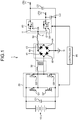
- FIG. 5 is a circuit diagram illustrating a configuration example of the multi-output power supply device 1B according to the second embodiment.
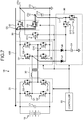
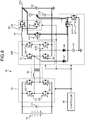
- FIG. 6 is a circuit diagram illustrating a first operation example of the multi-output power supply device 1B according to the second embodiment.
- FIG. 7 is a circuit diagram illustrating a second operation example of the multi-output power supply device 1B according to the second embodiment.
- FIG. 8 is a circuit diagram illustrating a third operation example of the multi-output power supply device 1B according to the second embodiment.
- FIG. 9 is a circuit diagram illustrating a fourth operation example of the multi-output power supply device 1B according to the second embodiment.
- the multi-output power supply device 1B according to the second embodiment is different from the multi-output power supply device 1 according to the first embodiment in that this device includes a snubber circuit 90 and an FET Q13 as a fourth switching element.
- the snubber circuit 90 is a circuit that suppresses a surge component (surge power) of power.
- the snubber circuit 90 includes diodes d7 and d8, a snubber capacitor C4 as a storage element, an FET Q11, an FET Q12 as a third switching element, and snubber inductor L for smoothing.
- the snubber circuit 90 storages, in the snubber capacitor C4, surge power output due to reverse recovery time of parasitic diodes in FETs Q7 to Q10 of the full-bridge circuit (rectifying circuit) 40B on the secondary side to suppress the surge component at the output.
- the FETs Q7 to Q10 are N-channel type MOSFETs.
- the snubber capacitor C4, which is a capacitor that storages power, is coupled to one end side of the secondary winding of the transformer 30 via the diode d7. Furthermore, the snubber capacitor C4 is coupled to the other end side of the secondary winding of the transformer 30 via the diode d8.
- the FET Q11 is provided between the negative-side terminal of the snubber capacitor C and the second output terminal 72.
- the FET Q11 is an N-channel type MOSFET. The source terminal thereof is coupled to the negative-side terminal of the snubber capacitor C, and the drain terminal thereof is coupled to the second output terminal 72 via the snubber inductor L.
- the FET Q11 is turned off by the controller 80 when outputting the surge power stored in the snubber capacitor C to the second output terminal 72.
- the FET Q11 is turned on by the controller 80 when storing the surge power in the snubber capacitor C.
- the FET Q12 discharges the surge power stored in the snubber capacitor C to the second output terminal 72.
- the FET Q12 is provided between the snubber capacitor C and the second output terminal 72.
- the FET Q12 is an N-channel type MOSFET. The drain terminal thereof is coupled to the positive-side terminal of the snubber capacitor C, and the source terminal thereof is coupled to the second output terminal 72 via the snubber inductor L.
- the FET Q12 is turned on by the controller 80 and outputs the surge power stored in the snubber capacitor C to the second output terminal 72 to regenerate the power.
- the FET Q12 is turned off by the controller 80 and stores the surge power in the snubber capacitor C.
- the snubber inductor L configures a snubber smoothing circuit, along with an output capacitor C3.
- the snubber inductor L is provided between the FET Q12 and the second output terminal 72.
- One end of the snubber inductor L is coupled to the source terminal of the FET Q12, and the other end thereof is coupled to the second output terminal 72.
- the snubber smoothing circuit smooths the power supplied from the snubber capacitor C to output it to the second output terminal 72.
- the FET Q13 energizes or de-energizes a current flowing between the first output terminal 71 and the second output terminal 72.
- the FET Q13 is provided between the first output terminal 71 and the FET Q12.
- the FET Q13 is an N-channel type MOSFET.
- the drain terminal thereof is coupled to the first output terminal 71, and the source terminal thereof is coupled to the drain terminal of the FET Q12.
- the FET Q13 is turned on by the controller 80 and energizes between the first output terminal 71 and the second output terminal 72.
- the FET Q13 is turned off by the controller 80 and de-energizes between the first output terminal 71 and the second output terminal 72.
- the snubber inductor L, the FET Q12, and the FET Q13 configure a step-down chopper circuit.
- the step-down chopper circuit turns on the FET Q13 and switching-controls the FET Q12 to step down the voltage of power supplied from a battery coupled to the first output terminal 71 to output it to a battery coupled to the second output terminal 72.
- the snubber inductor L, the FET Q12, and the FET Q13 configure a step-up chopper circuit.
- the step-up chopper circuit turns on the FET Q13 and switching-controls the FET Q12 to step up the voltage of power supplied from a battery coupled to the second output terminal 72 to output it to the battery coupled to the first output terminal 71.
- the multi-output power supply device 1B supplies power from the primary side to the secondary side and supplies power to the respective batteries that are coupled to the first output terminal 71 and the second output terminal 72.
- the snubber circuit 90 outputs the surge power output due to the reverse recovery time of the full-bridge circuit 40B on the secondary side to the second output terminal 72 as regeneration power.
- the multi-output power supply device 1B supplies power from the secondary side to the primary side and supplies power to the power supply 10 on the primary side.
- the snubber circuit 90 outputs the surge power output due to the reverse recovery time of the full-bridge circuit 40B on the secondary side to the second output terminal 72 as the regeneration power.
- the multi-output power supply device 1B steps down the voltage of the power supplied from the battery coupled to the first output terminal 71 to output it to the battery coupled to the second output terminal 72, by using the step-down chopper circuit described above. At this time, the multi-output power supply device 1B supplies no power from the primary side to the secondary side and thus generates no surge power, which is output due to the reverse recovery time of the full-bridge circuit 40B on the secondary side. This allows the snubber circuit 90 of the multi-output power supply device 1B to be disabled, so that parts of the snubber circuit 90 (the snubber inductor L and the FET Q12) can be also used as components of the step-down chopper circuit.
- the multi-output power supply device 1B steps up the voltage of the power supplied from the battery coupled to the second output terminal 72 to output it to the battery coupled to the first output terminal 71, by using the step-up chopper circuit described above. At this time, the multi-output power supply device 1B supplies no power from the primary side to the secondary side and thus generates no surge power, which is output due to the reverse recovery time of the full-bridge circuit 40B on the secondary side. This allows the snubber circuit 90 of the multi-output power supply device 1B to be disabled, so that parts of the snubber circuit 90 (the snubber inductor L and the FET Q12) can be also used as components of the step-up chopper circuit.
- the multi-output power supply device 1B includes the snubber circuit 90 and the FET Q13.
- the snubber circuit 90 includes the snubber capacitor C4, the FET Q12, and the snubber inductor L.
- the snubber capacitor C4 stores the surge power due to the reverse recovery time of the full-bridge circuit 40B.
- the FET Q12 discharges the surge power stored in the snubber capacitor C4.
- the snubber inductor L is provided between the FET Q12 and the second output terminal 72.
- the FET Q13 is provided between the first output terminal 71 and the FET Q12, and energizes or de-energizes the current flowing between the first output terminal 71 and the second output terminal 72.
- the snubber inductor L, the FET Q12, and the FET Q13 configure the step-down chopper circuit and the step-up chopper circuit.
- the step-down chopper circuit steps down the voltage of the power supplied from the first output terminal 71 to output it to the second output terminal 72.
- the step-up chopper circuit steps up the voltage of the power supplied from the second output terminal 72 to output it to the first output terminal 71.
- This configuration of the multi-output power supply device 1B enables parts of the snubber circuit 90 (the snubber inductor L and the FET Q12) to be also used as components of the step-down chopper circuit and the step-up chopper circuit. This can prevent upsizing of the multi-output power supply device 1B and reduce the production cost thereof.
- the multi-output power supply device 1B can also perform power conversion between the first output terminal 71 and the second output terminal 72. This can increase power-conversion patterns and provide power supply devices with high marketability.
- controller 80 performs the PI operation on the total difference obtained by adding the difference of the first output voltage Vo1 and the difference of the second output voltage Vo2, but without being limited to this, other operation methods such as a PID operation may be applied.
- controller 80 controls the FET Q6 by using the rectangular pulse signal S6 generated based on the second feedback-control amount corresponding to the difference between the output value output from the second output terminal 72 and the second target voltage Vref2 and controls the FET Q5 by using the pulse signal S5 obtained by reversing the pulse signal S6 has been discussed, but is not limited to this.
- the controller 80 may control the FET Q5 by using the rectangular pulse signal S5 generated based on the second feedback-control amount corresponding to the difference between the output value output from the first output terminal 71 and the first target voltage Vref1 and control the FET Q6 by using the pulse signal S6 obtained by reversing the pulse signal S5.
- controller 80 feedback-controls the FETs Q1 to Q4 by using the DSP.
- the FETs Q1 to Q13 are N-channel type MOSFETs has been discussed, but without being limited to this, they may be other switching elements such as insulated gate bipolar transistors (IGBTs).
- IGBTs insulated gate bipolar transistors
- the multi-output power supply device 1B according to the second embodiment may be configured with a center-tap-type transformer.
- the power supply device can be configured as a multi-output power supply device with the insulated transformer and the single-inductor multiple-output (SIMO) type circuit, so that the power supplies can be properly configured from the high-voltage power supply.
- SIMO single-inductor multiple-output
Landscapes
- Engineering & Computer Science (AREA)
- Power Engineering (AREA)
- Dc-Dc Converters (AREA)
Abstract
Description
- The present invention relates to power supply devices.
- Conventional power supply devices include, for example, multi-output power supply devices. Such a multi-output power supply device includes an insulated DC/DC converter that transforms a direct-current voltage of a high-voltage power supply and a step-down chopper circuit that steps down the DC voltage transformed by the DC/DC converter. Japanese Patent Application Laid-open No.
2006-67703 - The multi-output power supply device described above still has room for improvement in that, for example, a plurality of different power supplies are configured from a high-voltage power supply.
- In view of the above, the object of the present invention is to provide a power supply device in which the power supplies can be properly configured from the high-voltage power supply.
- In order to solve the above mentioned problem and achieve the object, a power supply device according to one aspect of the present invention includes an insulated transformer that transforms a voltage of alternating-current power; a rectifying circuit that rectifies the alternating-current power transformed by the transformer to direct-current power; a smoothing inductor that smooths the direct-current power rectified by the rectifying circuit; a first output terminal that outputs the direct-current power smoothed by the smoothing inductor; a second output terminal that is a terminal different from the first output terminal and outputs the direct-current power smoothed by the smoothing inductor; a first switching element that is provided between the smoothing inductor and the first output terminal and adjusts a current output from the smoothing inductor to the first output terminal; a second switching element that is provided between the smoothing inductor and the second output terminal and adjusts a current output from the smoothing inductor to the second output terminal; and a controller that controls the first switching element and the second switching element.
- According to another aspect of the present invention, in the power supply device, it is preferable that the power supply device further includes a switching circuit that outputs, to the transformer, alternating-current power obtained by transforming direct-current power supplied from a power supply, wherein the controller controls the switching circuit based on a first feedback-control amount corresponding to a difference between an output value output from the first output terminal and a first target voltage to be targeted with a difference between an output value output from the second output terminal and a second target voltage to be targeted.
- According to still another aspect of the present invention, in the power supply device, it is preferable that the controller controls the first switching element by using a rectangular first pulse signal generated based on a second feedback-control amount corresponding to a difference between an output value output from any one of the first output terminal and the second output terminal and a target value to be targeted, and controls the second switching element by using a second pulse signal obtained by reversing the first pulse signal.
- According to still another aspect of the present invention, in the power supply device, it is preferable that a snubber circuit that includes a storage element storing surge power due to reverse recovery time of the rectifying circuit, a third switching element discharging the surge power stored in the storage element, and a snubber inductor provided between the third switching element and the second output terminal; and a fourth switching element that is provided between the first output terminal and the third switching element and energizes or de-energizes a current flowing between the first output terminal and the third switching element, wherein the snubber inductor, the third switching element, and the fourth switching element configures a step-down chopper circuit that steps down a voltage of power supplied from the first output terminal to output the stepped-down voltage to the second output terminal, and a step-up chopper circuit that steps up a voltage of power supplied from the second output terminal to output the stepped-up voltage to the first output terminal.
- The above and other objects, features, advantages and technical and industrial significance of this invention will be better understood by reading the following detailed description of presently preferred embodiments of the invention, when considered in connection with the accompanying drawings.
-
-
FIG. 1 is a circuit diagram illustrating a configuration example of a multi-output power supply device according to a first embodiment; -
FIG. 2 is a diagram illustrating a calculation example of a phase-shift amount and a duty according to the first embodiment; -
FIG. 3 is a sequence diagram illustrating an operation example of the multi-output power-supply device according the first embodiment; -
FIG. 4 is a circuit diagram illustrating a configuration example of a multi-output power supply device according to a variation of the first embodiment; -
FIG. 5 is a circuit diagram illustrating a configuration example of a multi-output power supply device according to a second embodiment; -
FIG. 6 is a circuit diagram illustrating a first operation example of the multi-output power supply device according to the second embodiment; -
FIG. 7 is a circuit diagram illustrating a second operation example of the multi-output power supply device according to the second embodiment; -
FIG. 8 is a circuit diagram illustrating a third operation example of the multi-output power supply device according to the second embodiment; and -
FIG. 9 is a circuit diagram illustrating a fourth operation example of the multi-output power supply device according to the second embodiment. - Embodiments of the present invention (embodiments) will be described in detail with reference to the drawings. The present invention is not limited by the description of the following embodiments. The components described below include one that is readily conceived by those skilled in the art and one that is substantially the same as those. Furthermore, the configurations described below can be combined as necessary. Various omissions, substitutions, or changes of the configurations can be conducted without departing from the subject matter of the present invention.
- A multi-output
power supply device 1 according to a first embodiment will be described with reference to the drawings.FIG. 1 is a circuit diagram illustrating a configuration example of the multi-outputpower supply device 1 according to the first embodiment.FIG. 2 is a diagram illustrating a calculation example of a phase-shift amount Ph and a duty Du according to the first embodiment.FIG. 3 is a sequence diagram illustrating an operation example of the multi-outputpower supply device 1 according the first embodiment. - The multi-output
power supply device 1 configures a plurality of different power supplies from a high-voltage power supply 10. As shown inFIG. 1 , the multi-outputpower supply device 1 includes apower supply 10, a full-bridge circuit 20 as a switching circuit, atransformer 30 as a voltage converter, a rectifyingcircuit 40, asmoothing inductor 50, aswitching unit 60, anoutput unit 70, andcontroller 80. - The
power supply 10 supplies direct-current power. For example, thepower supply 10 is configured with a plurality of battery cells connected in series. Thepower supply 10 supplies a relatively-high voltage to be insulated. - The full-
bridge circuit 20 converts direct-current power into alternating-current power. The full-bridge circuit 20 is a phase-shifted switching circuit and includes four switching elements. The full-bridge circuit 20 includes, for example, a field-effect transistor (FET) Q1, an FET Q2, an FET Q3, and an FET Q4. For example, the FETs Q1 to Q4 are N-channel metal-oxide-semiconductor (MOS) FETs. - The full-
bridge circuit 20 is formed as a first series circuit in which the source terminal of the FET Q1 is coupled to the drain terminal of the FET Q2. The first series circuit, where the drain terminal of the FET Q1 is coupled to the positive electrode of thepower supply 10 and the source terminal of the FET Q2 is coupled to the negative electrode of thepower supply 10, is coupled between the positive electrode and the negative electrode of thepower supply 10. - The full-
bridge circuit 20 is formed as a second series circuit in which the source terminal of the FET Q3 is coupled to the drain terminal of the FET Q4. The second series circuit, where the drain terminal of the FET Q3 is coupled to the positive electrode of thepower supply 10 and the source terminal of the FET Q4 is coupled to the negative electrode of thepower supply 10, is coupled between the positive electrode and the negative electrode of thepower supply 10. The second series circuit, where the drain terminal of the FET Q3 is coupled to the drain terminal of the FET Q1 and the source terminal of the FET Q4 is coupled to the source terminal of the FET Q2, is coupled to the first series circuit in parallel. - The full-
bridge circuit 20 is coupled to thecontroller 80, and the FETs Q1 to Q4 are pulse width modulation (PWM) controlled by thecontroller 80. The full-bridge circuit 20 converts direct-current power supplied from thepower supply 10 into alternating-current power by using the FETs Q1 to Q4 and outputs the alternating-current power to a primary winding of thetransformer 30. Note that an input capacitor C1 for smoothing is provided between the full-bridge circuit 20 and thepower supply 10. - The
transformer 30 transforms the voltage of the alternating-current power. Thetransformer 30 includes the primary winding and a secondary winding. The primary winding and the secondary winding are magnetically coupled with each other in a manner insulated from each other. The primary winding is coupled to the full-bridge circuit 20. For example, one end of the primary winding is coupled to a connecting wire between the source terminal of the FET Q1 and the drain terminal of the FET Q2, and the other end thereof is coupled to a connecting line between the source terminal of the FET Q3 and the drain terminal of the FET Q4. - The secondary winding is coupled to the rectifying
circuit 40. For example, one end of the secondary winding is coupled to a connecting wire between the anode terminal of a diode d3 and the cathode terminal of a diode d4 as described below, and the other end thereof is coupled to a connecting line between the anode terminal of a diode d1 and the cathode terminal of a diode d2. The transformation degree of thetransformer 30 is determined depending on the turn ratio (transformation ratio) of the primary winding and the secondary winding. Transformer 30 steps down the alternating-current power supplied from the full-bridge circuit 20 to output it to the rectifyingcircuit 40. - The rectifying
circuit 40 rectifies alternating-current power to direct-current power. The rectifyingcircuit 40 includes four rectifying elements. The rectifyingcircuit 40 includes, for example, the diode d1, the diode d2, the diode d3, and the diode d4. The rectifyingcircuit 40 is configured as a bridge circuit with the diodes d1 to d4 and performs full-wave rectification. In the rectifyingcircuit 40, the anode terminal of the diode d1 is coupled to the cathode terminal of the diode d2, and the anode terminal of the diode d3 is coupled to the cathode terminal of the diode d4. In the rectifyingcircuit 40, the cathode terminal of the diode d1 is coupled to the cathode terminal of the diode d3, and the anode terminal of the diode d2 is coupled to the anode terminal of the diode d4. - As described above, one end of the secondary winding is coupled to the connecting wire between the anode terminal of the diode d3 and the cathode terminal of the diode d4 in the rectifying
circuit 40. The other end of the secondary winding is coupled to the connecting wire between the anode terminal of the diode d1 and the cathode terminal of the diode d2 in the rectifyingcircuit 40. The smoothinginductor 50 is coupled to a connecting wire between the cathode terminal of the diode d1 and the cathode terminal of the diode d3 in the rectifyingcircuit 40. A grand G is coupled to a connecting line between the anode terminal of the diode d2 and the anode terminal of the diode d4 in the rectifyingcircuit 40. The rectifyingcircuit 40 rectifies the alternating-current power stepped down by thetransformer 30 to direct-current power and outputs the direct-current power to theoutput unit 70 via the smoothinginductor 50 and the switchingunit 60. - The smoothing
inductor 50 smooths direct current (pulsating current). The smoothinginductor 50 is provided between the rectifyingcircuit 40 and the switchingunit 60. One end of the smoothinginductor 50 is coupled to the connecting wire between the cathode terminal of the diode d1 and the cathode terminal of the diode d3, and the other end thereof is coupled to theswitching unit 60. The smoothinginductor 50 smooths the direct-current power rectified by the rectifyingcircuit 40 and outputs the smoothed direct-current power to theswitching unit 60. - The switching
unit 60 adjusts currents flowing to two output terminals. The switchingunit 60 and the smoothinginductor 50 are configured as a single-inductor multiple-output (SIMO) type circuit. The switchingunit 60 includes two switching elements. The switchingunit 60 includes, for example, an FET Q5 as a first switching element, and an FET Q6 as a second switching element. For example, the FETs Q5 and Q6 are N-channel type MOSFETs. The FET Q5 is provided between the smoothinginductor 50 and afirst output terminal 71. The source terminal of the FET Q5 is coupled the other end of the smoothinginductor 50, and the drain terminal thereof is coupled to thefirst output terminal 71. The FET Q5, the gate terminal of which is coupled to thecontroller 80, is PWM-controlled by thecontroller 80. The FET Q5 adjusts a current output from the smoothinginductor 50 to thefirst output terminal 71. - The FET Q6 is provided between the smoothing
inductor 50 and asecond output terminal 72. The drain terminal of the FET Q6 is coupled the other end of the smoothinginductor 50, and the source terminal thereof is coupled to thesecond output terminal 72. The FET Q6 is coupled to thecontroller 80 and PWM-controlled by thecontroller 80. The FET Q6 adjusts a current output from the smoothinginductor 50 to thesecond output terminal 72. - The
output unit 70 outputs direct-current power. Theoutput unit 70 is coupled to theswitching unit 60 and outputs the direct-current power output from the switchingunit 60. Theoutput unit 70 includes thefirst output terminal 71 and thesecond output terminal 72. Thefirst output terminal 71 and thesecond output terminal 72 are different terminals. Thefirst output terminal 71 is coupled to the drain terminal of the FET Q5 and outputs direct-current power output from the FET Q5. Thesecond output terminal 72 is coupled to the source terminal of the FET Q6 and outputs direct-current power output from the FET Q6. In the present embodiment, the power output from thefirst output terminal 71 is greater than the power output from thesecond output terminal 72. Note that an output capacitor C2 is provided between the FET Q5 and thefirst output terminal 71 in parallel, and an output capacitor C3 is provided between the FET Q6 and thesecond output terminal 72 in parallel. - The
controller 80 controls the full-bridge circuit 20 and the switchingunit 60. Thecontroller 80 includes an electronic circuit in which a well-known microcomputer is its core. Such a microcomputer includes a CPU, a ROM that configures a storage unit, a RAM, and an interface. Thecontroller 80 PWM-controls the FETs Q1 to Q4 of the full-bridge circuit 20. As shown inFIG. 3 , thecontroller 80 controls the FETs Q1 to Q4 by using pulse signals S1 to S4, respectively. Thecontroller 80 feedback-controls the FETs Q1 to Q4 through digital signal processing (DSP). Thecontroller 80 feedback-controls the full-bridge circuit 20 based on, for example, a first feedback-control amount corresponding to the difference between an output value output from thefirst output terminal 71 and a first target voltage to be targeted (first target value) Vref1 with the difference between an output value output from thesecond output terminal 72 and a second target voltage to be targeted (second target value) Vref2. - For example, the
controller 80 determines the difference between a first output voltage Vo1, which is the voltage of the direct-current power output from thefirst output terminal 71, and the first target voltage Vref1. As shown inFIG. 2 , thecontroller 80 subtracts the first output voltage Vo1 from the first target voltage Vref1 to determine the difference of the first output voltage Vo1 to the first target voltage Vref1. Here, the first target voltage Vref1, which is the voltage of power that a load unit coupled to thefirst output terminal 71 requires, is changed depending on the request of the load unit as necessary. - The
controller 80 determines the difference between a second output voltage Vo2, which is the voltage of the direct-current-power output from thesecond output terminal 72, and the second target voltage Vref2. As shown inFIG. 2 , thecontroller 80 subtracts the second output voltage Vo2 from the second target voltage Vref2 to determine the difference of the second output voltage Vo2 to the second target voltage Vref2. Here, the second target voltage Vref2, which is the voltage of power that a load unit coupled to thesecond output terminal 72 requires, is changed depending on the request of the load unit as necessary. - The
controller 80 performs a PI operation on the total difference obtained by adding the difference of the first output voltage Vo1 and the difference of the second output voltage Vo2 to determine the first feedback-control amount. As shown inFIG. 3 , thecontroller 80 determines the phase-shift amount Ph and the duty (time-ratio duty) for the respective pulse signals S1 to S4 to PWM-control the FETs Q1 to Q4, based on the first feedback-control amount. Here, the phase-shift amount Ph is the phase difference between the pulse signal S1 and the pulse signal S3, for example. Thecontroller 80 PWM-controls the FET Q1 to Q4 based on the determined phase-shift amount Ph and duty. - The
controller 80 feedback-controls the FETs Q5 and Q6 of the switchingunit 60. For example, thecontroller 80 generates a rectangular pulse signal S6 based on the second feedback-control amount corresponding to the difference between the output value output from thesecond output terminal 72 and the second target voltage Vref2. As shown inFIG. 2 , thecontroller 80 performs a PI operation on the difference of the second output voltage Vo2 described above to determine the second feedback-control amount, for example. Thecontroller 80 determines the duty Du (seeFIG. 3 ) of the pulse signal S6 to PWM-control the FET Q6, based on the second feedback-control amount. Thecontroller 80 PWM-controls the FET Q6 based on the pulse signal S6 with the determined duty Du. Thecontroller 80 controls the FET Q5 by using a pulse signal S5, which is obtained by reversing the pulse signal S6. Here, the pulse signal S6 and the pulse signal S5 are complementary pulse signals, so that when one pulse signal is on, the other pulse is off. - An operation example of the multi-output
power supply device 1 will now be described. Thecontroller 80 PWM-controls the FETs Q1 to Q4 of the full-bridge circuit 20 based on the respective pulse signals S1 to S4. As shown inFIG. 3 , the full-bridge circuit 20 applies a voltage Vt to the primary winding of thetransformer 30 from one side with the FETs Q2 and Q3 on, and applies the voltage Vt to the primary winding of thetransformer 30 from the other side with the FETs Q1 and Q4 on. Thetransformer 30 steps down the alternating-current power output from the full-bridge circuit 20 and outputs the stepped-down, alternating-current power to the rectifyingcircuit 40. The rectifyingcircuit 40 rectifies the alternating-current power output from thetransformer 30 to direct-current power and outputs the direct-current power to the smoothinginductor 50. The smoothinginductor 50 smooths the direct-current power output from the rectifyingcircuit 40 and outputs the smoothed direct-current power to theswitching unit 60. The switchingunit 60 adjusts the current of the direct-current power output from the smoothinginductor 50. For example, the switchingunit 60 adjusts a current I1 (seeFIG. 3 ) output from thefirst output terminal 71 by turning on/off the FET Q5 based on the pulse signal S5. The switchingunit 60 adjusts a current I2 output from thesecond output terminal 72 by turning on/off the FET Q6 based on the pulse signal S6. Note that a current IL shown inFIG. 3 is the current output from the smoothinginductor 50. - The
controller 80 feedback-controls the FETs Q1 to Q4 by using the phase-shift amount Ph and the duty determined based on the first feedback-control amount. Thecontroller 80 feedback-controls the FETs Q5 and Q6 by using the duty Du determined based on the second feedback-control amount. - As above, the multi-output
power supply device 1 according to the first embodiment includes the insulatedtransformer 30, the rectifyingcircuit 40, the smoothinginductor 50, thefirst output terminal 71, thesecond output terminal 72, the FET Q5, the FET Q6, and thecontroller 80. Theinsulated transformer 30 transforms the voltage of alternating-current power. The rectifyingcircuit 40 rectifies the alternating-current power transformed by thetransformer 30 to the direct-current power. The smoothinginductor 50 smooths the direct-current power rectified by the rectifyingcircuit 40. Thefirst output terminal 71 outputs the direct-current power smoothed by the smoothinginductor 50. Thesecond output terminal 72 is a terminal different from thefirst output terminal 71 and outputs the direct-current power smoothed by the smoothinginductor 50. The FET Q5 is provided between the smoothinginductor 50 and thefirst output terminal 71 and adjusts the current output from the smoothinginductor 50 to thefirst output terminal 71. The FET Q6 is provided between the smoothinginductor 50 and thesecond output terminal 72 and adjusts the current output from the smoothinginductor 50 to thesecond output terminal 72. Thecontroller 80 controls the FET Q5 and the FET Q6. - This configuration enables the multi-output
power supply device 1 to be configured as a multi-output power supply device with theinsulated transformer 30 and the single-inductor multi-output (SIMO) type circuit. The multi-outputpower supply device 1 thus can output power with the different voltages from the first andsecond output terminals voltage power supply 10. - The conventional multi-output power supply device may be configured as, for example, a multi-output power supply device with an insulated DC/DC converter and a step-down chopper circuit. In contrast, the multi-output
power supply device 1 according to the present invention is configured as the multi-output power supply device with the insulated full-bridge circuit 20 and the single-inductor multi-output (SIMO) type circuit. This configuration of the multi-outputpower supply device 1 according to the present invention can decrease an inductor and a diode while increasing switching elements in comparison with the conventional multi-output power supply device. In the multi-outputpower supply device 1 according to the present invention, this enables an inductor that is relatively large in size to be decreased, so that upsizing of the device can be prevented. Furthermore, the production cost of the multi-outputpower supply device 1 can be reduced. - The multi-output
power supply device 1 described above includes the full-bridge circuit 20. This circuit outputs, to thetransformer 30, the alternating-current power obtained by transforming the direct-current power supplied from thepower supply 10. Thecontroller 80 controls the full-bridge circuit 20 based on the first feedback-control amount corresponding to the difference between the output value output from thefirst output terminal 71 and the first target voltage Vref1 to be targeted with the difference between the output value output from thesecond output terminal 72 and the second target voltage Vref2 to be targeted. This configuration allows the multi-outputpower supply device 1 to determine the first feedback-control amount in consideration of the differences of the respective output values that are output from thefirst output terminal 71 and thesecond output terminal 72, so that the power output from the full-bridge circuit 20 can approach the target value in comparison with a case where the first feedback-control amount is determined based on the difference of the output value output from the one-side output terminal. - In the multi-output
power supply device 1 described above, thecontroller 80 controls the FET Q6 by using the rectangular pulse signal S6 generated based on the second feedback-control amount corresponding to the difference between the output value output from thesecond output terminal 72 and the second target voltage Vref2 to be targeted, and controls the FET Q5 by using the pulse signal S5 obtained by reversing the pulse signal S6. This configuration enables the multi-outputpower supply device 1 to control the FETs Q5 and Q6 by using the complementary pulse signals to feedback-control them based on the second feedback-control amount corresponding to the difference of the output value output from the one-side output terminal. This simplifies the feedback control of the FETs Q5 and Q6 in the multi-outputpower supply device 1. - A variation of the first embodiment will now be described.
FIG. 4 is a circuit diagram illustrating a configuration example of a multi-outputpower supply device 1A according to the variation of the first embodiment. The multi-outputpower supply device 1A is different from the multi-outputpower supply device 1 of the first embodiment in that this device includes a center-tap-type transformer 30A and arectifying circuit 40A as shown inFIG. 4 . The rectifyingcircuit 40A has diodes d5 and d6. At thetransformer 30A, the center tap of a secondary winding is coupled to the smoothinginductor 50, one end of the secondary winding is coupled to the cathode terminal of the diode d6 of therectifying circuit 40A, and the other end of the secondary winding is coupled to the cathode terminal of the diode d5 of therectifying circuit 40A. Each anode terminal of the diodes d5 and d6 is coupled to the grand G. - The
transformer 30A steps down the alternating-current power output from the full-bridge circuit 20 and outputs the stepped-down, alternating-current power to therectifying circuit 40A. The rectifyingcircuit 40A rectifies the alternating-current power output from thetransformer 30A to direct-current power and outputs the direct-current power to the smoothinginductor 50. The smoothinginductor 50 smooths the direct-current power output from the rectifyingcircuit 40A and outputs the smoothed direct-current power to theswitching unit 60. The switchingunit 60 adjusts the current of the direct-current power output from the smoothinginductor 50. In this way, the multi-outputpower supply device 1A may adopt the center-tap-type transformer 30A. - A multi-output
power supply device 1B according to a second embodiment will now be described.FIG. 5 is a circuit diagram illustrating a configuration example of the multi-outputpower supply device 1B according to the second embodiment.FIG. 6 is a circuit diagram illustrating a first operation example of the multi-outputpower supply device 1B according to the second embodiment.FIG. 7 is a circuit diagram illustrating a second operation example of the multi-outputpower supply device 1B according to the second embodiment.FIG. 8 is a circuit diagram illustrating a third operation example of the multi-outputpower supply device 1B according to the second embodiment.FIG. 9 is a circuit diagram illustrating a fourth operation example of the multi-outputpower supply device 1B according to the second embodiment. - The multi-output
power supply device 1B according to the second embodiment is different from the multi-outputpower supply device 1 according to the first embodiment in that this device includes asnubber circuit 90 and an FET Q13 as a fourth switching element. Thesnubber circuit 90 is a circuit that suppresses a surge component (surge power) of power. Thesnubber circuit 90 includes diodes d7 and d8, a snubber capacitor C4 as a storage element, an FET Q11, an FET Q12 as a third switching element, and snubber inductor L for smoothing. Thesnubber circuit 90 storages, in the snubber capacitor C4, surge power output due to reverse recovery time of parasitic diodes in FETs Q7 to Q10 of the full-bridge circuit (rectifying circuit) 40B on the secondary side to suppress the surge component at the output. Note that, for example, the FETs Q7 to Q10 are N-channel type MOSFETs. The snubber capacitor C4, which is a capacitor that storages power, is coupled to one end side of the secondary winding of thetransformer 30 via the diode d7. Furthermore, the snubber capacitor C4 is coupled to the other end side of the secondary winding of thetransformer 30 via the diode d8. - The FET Q11 is provided between the negative-side terminal of the snubber capacitor C and the
second output terminal 72. The FET Q11 is an N-channel type MOSFET. The source terminal thereof is coupled to the negative-side terminal of the snubber capacitor C, and the drain terminal thereof is coupled to thesecond output terminal 72 via the snubber inductor L. The FET Q11 is turned off by thecontroller 80 when outputting the surge power stored in the snubber capacitor C to thesecond output terminal 72. The FET Q11 is turned on by thecontroller 80 when storing the surge power in the snubber capacitor C. - The FET Q12 discharges the surge power stored in the snubber capacitor C to the
second output terminal 72. The FET Q12 is provided between the snubber capacitor C and thesecond output terminal 72. The FET Q12 is an N-channel type MOSFET. The drain terminal thereof is coupled to the positive-side terminal of the snubber capacitor C, and the source terminal thereof is coupled to thesecond output terminal 72 via the snubber inductor L. The FET Q12 is turned on by thecontroller 80 and outputs the surge power stored in the snubber capacitor C to thesecond output terminal 72 to regenerate the power. The FET Q12 is turned off by thecontroller 80 and stores the surge power in the snubber capacitor C. - The snubber inductor L configures a snubber smoothing circuit, along with an output capacitor C3. The snubber inductor L is provided between the FET Q12 and the
second output terminal 72. One end of the snubber inductor L is coupled to the source terminal of the FET Q12, and the other end thereof is coupled to thesecond output terminal 72. The snubber smoothing circuit smooths the power supplied from the snubber capacitor C to output it to thesecond output terminal 72. - The FET Q13 energizes or de-energizes a current flowing between the
first output terminal 71 and thesecond output terminal 72. The FET Q13 is provided between thefirst output terminal 71 and the FET Q12. The FET Q13 is an N-channel type MOSFET. The drain terminal thereof is coupled to thefirst output terminal 71, and the source terminal thereof is coupled to the drain terminal of the FET Q12. The FET Q13 is turned on by thecontroller 80 and energizes between thefirst output terminal 71 and thesecond output terminal 72. The FET Q13 is turned off by thecontroller 80 and de-energizes between thefirst output terminal 71 and thesecond output terminal 72. - The snubber inductor L, the FET Q12, and the FET Q13 configure a step-down chopper circuit. The step-down chopper circuit turns on the FET Q13 and switching-controls the FET Q12 to step down the voltage of power supplied from a battery coupled to the
first output terminal 71 to output it to a battery coupled to thesecond output terminal 72. The snubber inductor L, the FET Q12, and the FET Q13 configure a step-up chopper circuit. For example, the step-up chopper circuit turns on the FET Q13 and switching-controls the FET Q12 to step up the voltage of power supplied from a battery coupled to thesecond output terminal 72 to output it to the battery coupled to thefirst output terminal 71. - An operation example of the multi-output
power supply device 1B will now be described. As shown inFIG. 6 , the multi-outputpower supply device 1B supplies power from the primary side to the secondary side and supplies power to the respective batteries that are coupled to thefirst output terminal 71 and thesecond output terminal 72. At this time, thesnubber circuit 90 outputs the surge power output due to the reverse recovery time of the full-bridge circuit 40B on the secondary side to thesecond output terminal 72 as regeneration power. - As shown in
FIG. 7 , the multi-outputpower supply device 1B supplies power from the secondary side to the primary side and supplies power to thepower supply 10 on the primary side. At this time, thesnubber circuit 90 outputs the surge power output due to the reverse recovery time of the full-bridge circuit 40B on the secondary side to thesecond output terminal 72 as the regeneration power. - As shown in
FIG. 8 , the multi-outputpower supply device 1B steps down the voltage of the power supplied from the battery coupled to thefirst output terminal 71 to output it to the battery coupled to thesecond output terminal 72, by using the step-down chopper circuit described above. At this time, the multi-outputpower supply device 1B supplies no power from the primary side to the secondary side and thus generates no surge power, which is output due to the reverse recovery time of the full-bridge circuit 40B on the secondary side. This allows thesnubber circuit 90 of the multi-outputpower supply device 1B to be disabled, so that parts of the snubber circuit 90 (the snubber inductor L and the FET Q12) can be also used as components of the step-down chopper circuit. - As shown in
FIG. 9 , the multi-outputpower supply device 1B steps up the voltage of the power supplied from the battery coupled to thesecond output terminal 72 to output it to the battery coupled to thefirst output terminal 71, by using the step-up chopper circuit described above. At this time, the multi-outputpower supply device 1B supplies no power from the primary side to the secondary side and thus generates no surge power, which is output due to the reverse recovery time of the full-bridge circuit 40B on the secondary side. This allows thesnubber circuit 90 of the multi-outputpower supply device 1B to be disabled, so that parts of the snubber circuit 90 (the snubber inductor L and the FET Q12) can be also used as components of the step-up chopper circuit. - As above, the multi-output
power supply device 1B according to the second embodiment includes thesnubber circuit 90 and the FET Q13. Thesnubber circuit 90 includes the snubber capacitor C4, the FET Q12, and the snubber inductor L. The snubber capacitor C4 stores the surge power due to the reverse recovery time of the full-bridge circuit 40B. The FET Q12 discharges the surge power stored in the snubber capacitor C4. The snubber inductor L is provided between the FET Q12 and thesecond output terminal 72. The FET Q13 is provided between thefirst output terminal 71 and the FET Q12, and energizes or de-energizes the current flowing between thefirst output terminal 71 and thesecond output terminal 72. The snubber inductor L, the FET Q12, and the FET Q13 configure the step-down chopper circuit and the step-up chopper circuit. The step-down chopper circuit steps down the voltage of the power supplied from thefirst output terminal 71 to output it to thesecond output terminal 72. The step-up chopper circuit steps up the voltage of the power supplied from thesecond output terminal 72 to output it to thefirst output terminal 71. - This configuration of the multi-output
power supply device 1B enables parts of the snubber circuit 90 (the snubber inductor L and the FET Q12) to be also used as components of the step-down chopper circuit and the step-up chopper circuit. This can prevent upsizing of the multi-outputpower supply device 1B and reduce the production cost thereof. The multi-outputpower supply device 1B can also perform power conversion between thefirst output terminal 71 and thesecond output terminal 72. This can increase power-conversion patterns and provide power supply devices with high marketability. - Note that the above description has discussed the example in which the
controller 80 performs the PI operation on the total difference obtained by adding the difference of the first output voltage Vo1 and the difference of the second output voltage Vo2, but without being limited to this, other operation methods such as a PID operation may be applied. - The example in which the
controller 80 controls the FET Q6 by using the rectangular pulse signal S6 generated based on the second feedback-control amount corresponding to the difference between the output value output from thesecond output terminal 72 and the second target voltage Vref2 and controls the FET Q5 by using the pulse signal S5 obtained by reversing the pulse signal S6 has been discussed, but is not limited to this. For example, thecontroller 80 may control the FET Q5 by using the rectangular pulse signal S5 generated based on the second feedback-control amount corresponding to the difference between the output value output from thefirst output terminal 71 and the first target voltage Vref1 and control the FET Q6 by using the pulse signal S6 obtained by reversing the pulse signal S5. - The example in which the
controller 80 feedback-controls the FETs Q1 to Q4 by using the DSP has been discussed, but without being limited to this, an analog circuit may feedback-control the FETs Q1 to Q4. - The example in which the FETs Q1 to Q13 are N-channel type MOSFETs has been discussed, but without being limited to this, they may be other switching elements such as insulated gate bipolar transistors (IGBTs).
- The multi-output
power supply device 1B according to the second embodiment may be configured with a center-tap-type transformer. - The power supply device according to the embodiment can be configured as a multi-output power supply device with the insulated transformer and the single-inductor multiple-output (SIMO) type circuit, so that the power supplies can be properly configured from the high-voltage power supply.
- Although the invention has been described with respect to specific embodiments for a complete and clear disclosure, the appended claims are not to be thus limited but are to be construed as embodying all modifications and alternative constructions that may occur to one skilled in the art that fairly fall within the basic teaching herein set forth.
Claims (4)
- A power supply device (1, 1A, 1B) comprising:an insulated transformer (30, 30A) that transforms a voltage of alternating-current power;a rectifying circuit (40, 40A, 40B) that rectifies the alternating-current power transformed by the transformer (30, 30A) to direct-current power;a smoothing inductor (50) that smooths the direct-current power rectified by the rectifying circuit (40, 40A, 40B);a first output terminal (71) that outputs the direct-current power smoothed by the smoothing inductor (50);a second output terminal (72) that is a terminal different from the first output terminal (71) and outputs the direct-current power smoothed by the smoothing inductor (50) ;a first switching element (Q5) that is provided between the smoothing inductor (50) and the first output terminal (71) and adjusts a current output from the smoothing inductor (50) to the first output terminal (71);a second switching element (Q6) that is provided between the smoothing inductor (50) and the second output terminal (72) and adjusts a current output from the smoothing inductor (50) to the second output terminal (72); anda controller (80) that controls the first switching element (Q5) and the second switching element (Q6).
- The power supply device (1, 1A, 1B) according to claim 1 further comprising:a switching circuit (20) that outputs, to the transformer (30, 30A), alternating-current power obtained by transforming direct-current power supplied from a power supply (10), whereinthe controller (80) controls the switching circuit (20) based on a first feedback-control amount corresponding to a difference between an output value output from the first output terminal (71) and a first target voltage (Vref1) to be targeted with a difference between an output value output from the second output terminal (72) and a second target voltage (Vref2) to be targeted.
- The power supply device (1, 1A, 1B) according to claim 1 or 2, wherein
the controller (80) controls the first switching element (Q5) by using a rectangular first pulse signal (S1) generated based on a second feedback-control amount corresponding to a difference between an output value output from any one of the first output terminal (71) and the second output terminal (72) and a target value (Vref1, Vref2) to be targeted, and controls the second switching element (Q6) by using a second pulse signal (S2) obtained by reversing the first pulse signal (S1). - The power supply device (1B) according to any one of claims 1 to 3, further comprising:a snubber circuit (90) that includes a storage element (C4) storing surge power due to reverse recovery time of the rectifying circuit (40B), a third switching element (Q12) discharging the surge power stored in the storage element (C4), and a snubber inductor (L) provided between the third switching element (Q12) and the second output terminal (72); anda fourth switching element (Q13) that is provided between the first output terminal (71) and the third switching element (Q12) and energizes or de-energizes a current flowing between the first output terminal (71) and the third switching element (Q12), whereinthe snubber inductor (L), the third switching element (Q12), and the fourth switching element (Q13) configures a step-down chopper circuit that steps down a voltage of power supplied from the first output terminal (71) to output the stepped-down voltage to the second output terminal (72), and a step-up chopper circuit that steps up a voltage of power supplied from the second output terminal (72) to output the stepped-up voltage to the first output terminal (71).
Applications Claiming Priority (1)
| Application Number | Priority Date | Filing Date | Title |
|---|---|---|---|
| JP2018213417A JP6823634B2 (en) | 2018-11-14 | 2018-11-14 | Power supply |
Publications (2)
| Publication Number | Publication Date |
|---|---|
| EP3654516A1 true EP3654516A1 (en) | 2020-05-20 |
| EP3654516B1 EP3654516B1 (en) | 2021-12-15 |
Family
ID=68242331
Family Applications (1)
| Application Number | Title | Priority Date | Filing Date |
|---|---|---|---|
| EP19201950.3A Active EP3654516B1 (en) | 2018-11-14 | 2019-10-08 | Power supply device |
Country Status (4)
| Country | Link |
|---|---|
| US (1) | US10897209B2 (en) |
| EP (1) | EP3654516B1 (en) |
| JP (1) | JP6823634B2 (en) |
| CN (1) | CN111193400B (en) |
Cited By (3)
| Publication number | Priority date | Publication date | Assignee | Title |
|---|---|---|---|---|
| EP3989420A1 (en) * | 2020-10-26 | 2022-04-27 | Yazaki Corporation | Power-supply control device |
| EP4009503A1 (en) * | 2020-12-03 | 2022-06-08 | Yazaki Corporation | Voltage conversion device |
| EP4009504A1 (en) * | 2020-12-02 | 2022-06-08 | Yazaki Corporation | Voltage conversion device |
Families Citing this family (7)
| Publication number | Priority date | Publication date | Assignee | Title |
|---|---|---|---|---|
| US12040618B2 (en) * | 2019-03-18 | 2024-07-16 | Panasonic Intellectual Property Management Co., Ltd. | Power conversion system including a second circuit being configured to control a current or power such that the current or the power is synchronized with power ripples caused by the AC power supply or the AC load |
| JPWO2020189295A1 (en) * | 2019-03-20 | 2020-09-24 | ||
| US11349401B1 (en) * | 2021-01-25 | 2022-05-31 | Semiconductor Components Industries, Llc | Method and system of a power converter with secondary side active clamp |
| CN114123794B (en) * | 2021-11-26 | 2024-06-14 | 成都芯源系统有限公司 | Switching power supply circuit and method |
| JP7497131B2 (en) * | 2022-05-11 | 2024-06-10 | 矢崎総業株式会社 | Active snubber circuit and step-down converter |
| KR102788553B1 (en) * | 2022-12-12 | 2025-04-01 | 주식회사 금경라이팅 | lighting circuit for LEDs |
| TWI888864B (en) * | 2023-07-12 | 2025-07-01 | 康舒科技股份有限公司 | Power supply with ring field effect transistor |
Citations (4)
| Publication number | Priority date | Publication date | Assignee | Title |
|---|---|---|---|---|
| US6498734B1 (en) * | 2000-01-21 | 2002-12-24 | Matsushita Electric Industrial Co., Ltd. | Power supply unit having reduced size and weight and an electronic apparatus using the same |
| JP2006067703A (en) | 2004-08-26 | 2006-03-09 | Sharp Corp | Switching power supply device |
| US20130301304A1 (en) * | 2011-02-04 | 2013-11-14 | Mitsubishi Electric Corporation | Dc-dc converter |
| US20140347891A1 (en) * | 2013-05-21 | 2014-11-27 | Toyota Jidosha Kabushiki Kaisha | Power conversion apparatus and power correction method |
Family Cites Families (9)
| Publication number | Priority date | Publication date | Assignee | Title |
|---|---|---|---|---|
| CN100590954C (en) * | 2004-12-08 | 2010-02-17 | 三垦电气株式会社 | Multi-output current resonant DC-DC converter |
| CN101521462B (en) * | 2008-02-29 | 2011-06-29 | 群康科技(深圳)有限公司 | Switch power supply circuit |
| DE102011076573A1 (en) * | 2011-05-27 | 2012-11-29 | Robert Bosch Gmbh | Snubber circuit for DC-DC converter |
| CN102832818B (en) * | 2011-06-16 | 2015-06-03 | 海洋王照明科技股份有限公司 | Constant-voltage power circuit based on single chip processor and constant-voltage power supply device |
| JP6139174B2 (en) * | 2013-02-25 | 2017-05-31 | ローム株式会社 | Power supply device, AC adapter, electronic device, and power supply system |
| US20140268892A1 (en) * | 2013-03-14 | 2014-09-18 | Voltronic Power Technology Corp. | Converter with adjustable output voltage |
| JP6576738B2 (en) * | 2015-08-21 | 2019-09-18 | 矢崎総業株式会社 | Power supply |
| US9973099B2 (en) * | 2015-08-26 | 2018-05-15 | Futurewei Technologies, Inc. | AC/DC converters with wider voltage regulation range |
| JP6004555B1 (en) * | 2015-09-11 | 2016-10-12 | Hoya Candeo Optronics株式会社 | Switching power supply device and light irradiation device including the same |
-
2018
- 2018-11-14 JP JP2018213417A patent/JP6823634B2/en active Active
-
2019
- 2019-10-08 EP EP19201950.3A patent/EP3654516B1/en active Active
- 2019-10-10 US US16/599,104 patent/US10897209B2/en active Active
- 2019-10-14 CN CN201910974623.1A patent/CN111193400B/en active Active
Patent Citations (4)
| Publication number | Priority date | Publication date | Assignee | Title |
|---|---|---|---|---|
| US6498734B1 (en) * | 2000-01-21 | 2002-12-24 | Matsushita Electric Industrial Co., Ltd. | Power supply unit having reduced size and weight and an electronic apparatus using the same |
| JP2006067703A (en) | 2004-08-26 | 2006-03-09 | Sharp Corp | Switching power supply device |
| US20130301304A1 (en) * | 2011-02-04 | 2013-11-14 | Mitsubishi Electric Corporation | Dc-dc converter |
| US20140347891A1 (en) * | 2013-05-21 | 2014-11-27 | Toyota Jidosha Kabushiki Kaisha | Power conversion apparatus and power correction method |
Cited By (5)
| Publication number | Priority date | Publication date | Assignee | Title |
|---|---|---|---|---|
| EP3989420A1 (en) * | 2020-10-26 | 2022-04-27 | Yazaki Corporation | Power-supply control device |
| CN114499194A (en) * | 2020-10-26 | 2022-05-13 | 矢崎总业株式会社 | Power supply control device |
| US11855542B2 (en) | 2020-10-26 | 2023-12-26 | Yazaki Corporation | Power-supply control device |
| EP4009504A1 (en) * | 2020-12-02 | 2022-06-08 | Yazaki Corporation | Voltage conversion device |
| EP4009503A1 (en) * | 2020-12-03 | 2022-06-08 | Yazaki Corporation | Voltage conversion device |
Also Published As
| Publication number | Publication date |
|---|---|
| CN111193400B (en) | 2023-08-22 |
| US20200153350A1 (en) | 2020-05-14 |
| CN111193400A (en) | 2020-05-22 |
| EP3654516B1 (en) | 2021-12-15 |
| JP6823634B2 (en) | 2021-02-03 |
| JP2020080625A (en) | 2020-05-28 |
| US10897209B2 (en) | 2021-01-19 |
Similar Documents
| Publication | Publication Date | Title |
|---|---|---|
| EP3654516B1 (en) | Power supply device | |
| US9438118B2 (en) | Efficient boost-buck converter and control method thereof | |
| US9136768B2 (en) | Switching power supply device | |
| US10686378B2 (en) | High-efficiency regulated buck-boost converter | |
| US9160238B2 (en) | Power converter with current feedback loop | |
| US10193464B2 (en) | DC-DC converter | |
| US9209698B2 (en) | Electric power conversion device | |
| US8300437B2 (en) | Multi-output DC-to-DC conversion apparatus with voltage-stabilizing function | |
| US11451161B2 (en) | Power switcher, power rectifier, and power converter including cascode-connected transistors | |
| US12603583B2 (en) | Integrated gate signal and power circuit including an isolated DC-DC converter that includes a non-isolated DC-DC converter | |
| EP3748834B1 (en) | Power supply device | |
| US20200127576A1 (en) | Power conversion equipment | |
| US10651751B2 (en) | Switching power supply device | |
| US8582318B2 (en) | Circuit and method for potential-isolated energy transfer with two output DC voltages | |
| US20160233769A1 (en) | Three-level sepic converter circuit | |
| JP6270753B2 (en) | Power converter | |
| US10404160B2 (en) | Auxiliary converter circuit and its method of operation | |
| JP6822824B2 (en) | Switching power supply | |
| US12519397B2 (en) | Switching power supply apparatus and electric power supply system | |
| US20220173666A1 (en) | Voltage conversion device | |
| US20050248963A1 (en) | Circuit for controlling the reverse recovery current in a blocking diode | |
| CN120150525A (en) | A two-stage converter and a control method for the two-stage converter | |
| CN116941173A (en) | Switching power supply device and power supply system | |
| JP2011217486A (en) | Step-up converter |
Legal Events
| Date | Code | Title | Description |
|---|---|---|---|
| PUAI | Public reference made under article 153(3) epc to a published international application that has entered the european phase |
Free format text: ORIGINAL CODE: 0009012 |
|
| STAA | Information on the status of an ep patent application or granted ep patent |
Free format text: STATUS: REQUEST FOR EXAMINATION WAS MADE |
|
| 17P | Request for examination filed |
Effective date: 20191008 |
|
| AK | Designated contracting states |
Kind code of ref document: A1 Designated state(s): AL AT BE BG CH CY CZ DE DK EE ES FI FR GB GR HR HU IE IS IT LI LT LU LV MC MK MT NL NO PL PT RO RS SE SI SK SM TR |
|
| AX | Request for extension of the european patent |
Extension state: BA ME |
|
| STAA | Information on the status of an ep patent application or granted ep patent |
Free format text: STATUS: EXAMINATION IS IN PROGRESS |
|
| 17Q | First examination report despatched |
Effective date: 20200907 |
|
| GRAP | Despatch of communication of intention to grant a patent |
Free format text: ORIGINAL CODE: EPIDOSNIGR1 |
|
| STAA | Information on the status of an ep patent application or granted ep patent |
Free format text: STATUS: GRANT OF PATENT IS INTENDED |
|
| INTG | Intention to grant announced |
Effective date: 20210929 |
|
| GRAS | Grant fee paid |
Free format text: ORIGINAL CODE: EPIDOSNIGR3 |
|
| GRAA | (expected) grant |
Free format text: ORIGINAL CODE: 0009210 |
|
| STAA | Information on the status of an ep patent application or granted ep patent |
Free format text: STATUS: THE PATENT HAS BEEN GRANTED |
|
| AK | Designated contracting states |
Kind code of ref document: B1 Designated state(s): AL AT BE BG CH CY CZ DE DK EE ES FI FR GB GR HR HU IE IS IT LI LT LU LV MC MK MT NL NO PL PT RO RS SE SI SK SM TR |
|
| REG | Reference to a national code |
Ref country code: GB Ref legal event code: FG4D Ref country code: CH Ref legal event code: EP |
|
| REG | Reference to a national code |
Ref country code: IE Ref legal event code: FG4D Ref country code: DE Ref legal event code: R096 Ref document number: 602019010061 Country of ref document: DE |
|
| REG | Reference to a national code |
Ref country code: AT Ref legal event code: REF Ref document number: 1456224 Country of ref document: AT Kind code of ref document: T Effective date: 20220115 |
|
| REG | Reference to a national code |
Ref country code: LT Ref legal event code: MG9D |
|
| REG | Reference to a national code |
Ref country code: NL Ref legal event code: MP Effective date: 20211215 |
|
| PG25 | Lapsed in a contracting state [announced via postgrant information from national office to epo] |
Ref country code: RS Free format text: LAPSE BECAUSE OF FAILURE TO SUBMIT A TRANSLATION OF THE DESCRIPTION OR TO PAY THE FEE WITHIN THE PRESCRIBED TIME-LIMIT Effective date: 20211215 Ref country code: LT Free format text: LAPSE BECAUSE OF FAILURE TO SUBMIT A TRANSLATION OF THE DESCRIPTION OR TO PAY THE FEE WITHIN THE PRESCRIBED TIME-LIMIT Effective date: 20211215 Ref country code: FI Free format text: LAPSE BECAUSE OF FAILURE TO SUBMIT A TRANSLATION OF THE DESCRIPTION OR TO PAY THE FEE WITHIN THE PRESCRIBED TIME-LIMIT Effective date: 20211215 Ref country code: BG Free format text: LAPSE BECAUSE OF FAILURE TO SUBMIT A TRANSLATION OF THE DESCRIPTION OR TO PAY THE FEE WITHIN THE PRESCRIBED TIME-LIMIT Effective date: 20220315 |
|
| REG | Reference to a national code |
Ref country code: AT Ref legal event code: MK05 Ref document number: 1456224 Country of ref document: AT Kind code of ref document: T Effective date: 20211215 |
|
| PG25 | Lapsed in a contracting state [announced via postgrant information from national office to epo] |
Ref country code: SE Free format text: LAPSE BECAUSE OF FAILURE TO SUBMIT A TRANSLATION OF THE DESCRIPTION OR TO PAY THE FEE WITHIN THE PRESCRIBED TIME-LIMIT Effective date: 20211215 Ref country code: NO Free format text: LAPSE BECAUSE OF FAILURE TO SUBMIT A TRANSLATION OF THE DESCRIPTION OR TO PAY THE FEE WITHIN THE PRESCRIBED TIME-LIMIT Effective date: 20220315 Ref country code: LV Free format text: LAPSE BECAUSE OF FAILURE TO SUBMIT A TRANSLATION OF THE DESCRIPTION OR TO PAY THE FEE WITHIN THE PRESCRIBED TIME-LIMIT Effective date: 20211215 Ref country code: HR Free format text: LAPSE BECAUSE OF FAILURE TO SUBMIT A TRANSLATION OF THE DESCRIPTION OR TO PAY THE FEE WITHIN THE PRESCRIBED TIME-LIMIT Effective date: 20211215 Ref country code: GR Free format text: LAPSE BECAUSE OF FAILURE TO SUBMIT A TRANSLATION OF THE DESCRIPTION OR TO PAY THE FEE WITHIN THE PRESCRIBED TIME-LIMIT Effective date: 20220316 |
|
| PG25 | Lapsed in a contracting state [announced via postgrant information from national office to epo] |
Ref country code: NL Free format text: LAPSE BECAUSE OF FAILURE TO SUBMIT A TRANSLATION OF THE DESCRIPTION OR TO PAY THE FEE WITHIN THE PRESCRIBED TIME-LIMIT Effective date: 20211215 |
|
| PG25 | Lapsed in a contracting state [announced via postgrant information from national office to epo] |
Ref country code: SM Free format text: LAPSE BECAUSE OF FAILURE TO SUBMIT A TRANSLATION OF THE DESCRIPTION OR TO PAY THE FEE WITHIN THE PRESCRIBED TIME-LIMIT Effective date: 20211215 Ref country code: SK Free format text: LAPSE BECAUSE OF FAILURE TO SUBMIT A TRANSLATION OF THE DESCRIPTION OR TO PAY THE FEE WITHIN THE PRESCRIBED TIME-LIMIT Effective date: 20211215 Ref country code: RO Free format text: LAPSE BECAUSE OF FAILURE TO SUBMIT A TRANSLATION OF THE DESCRIPTION OR TO PAY THE FEE WITHIN THE PRESCRIBED TIME-LIMIT Effective date: 20211215 Ref country code: PT Free format text: LAPSE BECAUSE OF FAILURE TO SUBMIT A TRANSLATION OF THE DESCRIPTION OR TO PAY THE FEE WITHIN THE PRESCRIBED TIME-LIMIT Effective date: 20220418 Ref country code: ES Free format text: LAPSE BECAUSE OF FAILURE TO SUBMIT A TRANSLATION OF THE DESCRIPTION OR TO PAY THE FEE WITHIN THE PRESCRIBED TIME-LIMIT Effective date: 20211215 Ref country code: EE Free format text: LAPSE BECAUSE OF FAILURE TO SUBMIT A TRANSLATION OF THE DESCRIPTION OR TO PAY THE FEE WITHIN THE PRESCRIBED TIME-LIMIT Effective date: 20211215 Ref country code: CZ Free format text: LAPSE BECAUSE OF FAILURE TO SUBMIT A TRANSLATION OF THE DESCRIPTION OR TO PAY THE FEE WITHIN THE PRESCRIBED TIME-LIMIT Effective date: 20211215 |
|
| PG25 | Lapsed in a contracting state [announced via postgrant information from national office to epo] |
Ref country code: PL Free format text: LAPSE BECAUSE OF FAILURE TO SUBMIT A TRANSLATION OF THE DESCRIPTION OR TO PAY THE FEE WITHIN THE PRESCRIBED TIME-LIMIT Effective date: 20211215 Ref country code: AT Free format text: LAPSE BECAUSE OF FAILURE TO SUBMIT A TRANSLATION OF THE DESCRIPTION OR TO PAY THE FEE WITHIN THE PRESCRIBED TIME-LIMIT Effective date: 20211215 |
|
| REG | Reference to a national code |
Ref country code: DE Ref legal event code: R097 Ref document number: 602019010061 Country of ref document: DE |
|
| PG25 | Lapsed in a contracting state [announced via postgrant information from national office to epo] |
Ref country code: IS Free format text: LAPSE BECAUSE OF FAILURE TO SUBMIT A TRANSLATION OF THE DESCRIPTION OR TO PAY THE FEE WITHIN THE PRESCRIBED TIME-LIMIT Effective date: 20220415 |
|
| PLBE | No opposition filed within time limit |
Free format text: ORIGINAL CODE: 0009261 |
|
| STAA | Information on the status of an ep patent application or granted ep patent |
Free format text: STATUS: NO OPPOSITION FILED WITHIN TIME LIMIT |
|
| PG25 | Lapsed in a contracting state [announced via postgrant information from national office to epo] |
Ref country code: DK Free format text: LAPSE BECAUSE OF FAILURE TO SUBMIT A TRANSLATION OF THE DESCRIPTION OR TO PAY THE FEE WITHIN THE PRESCRIBED TIME-LIMIT Effective date: 20211215 Ref country code: AL Free format text: LAPSE BECAUSE OF FAILURE TO SUBMIT A TRANSLATION OF THE DESCRIPTION OR TO PAY THE FEE WITHIN THE PRESCRIBED TIME-LIMIT Effective date: 20211215 |
|
| 26N | No opposition filed |
Effective date: 20220916 |
|
| PG25 | Lapsed in a contracting state [announced via postgrant information from national office to epo] |
Ref country code: SI Free format text: LAPSE BECAUSE OF FAILURE TO SUBMIT A TRANSLATION OF THE DESCRIPTION OR TO PAY THE FEE WITHIN THE PRESCRIBED TIME-LIMIT Effective date: 20211215 |
|
| PG25 | Lapsed in a contracting state [announced via postgrant information from national office to epo] |
Ref country code: MC Free format text: LAPSE BECAUSE OF FAILURE TO SUBMIT A TRANSLATION OF THE DESCRIPTION OR TO PAY THE FEE WITHIN THE PRESCRIBED TIME-LIMIT Effective date: 20211215 Ref country code: IT Free format text: LAPSE BECAUSE OF FAILURE TO SUBMIT A TRANSLATION OF THE DESCRIPTION OR TO PAY THE FEE WITHIN THE PRESCRIBED TIME-LIMIT Effective date: 20211215 |
|
| REG | Reference to a national code |
Ref country code: CH Ref legal event code: PL |
|
| REG | Reference to a national code |
Ref country code: BE Ref legal event code: MM Effective date: 20221031 |
|
| PG25 | Lapsed in a contracting state [announced via postgrant information from national office to epo] |
Ref country code: LU Free format text: LAPSE BECAUSE OF NON-PAYMENT OF DUE FEES Effective date: 20221008 |
|
| PG25 | Lapsed in a contracting state [announced via postgrant information from national office to epo] |
Ref country code: LI Free format text: LAPSE BECAUSE OF NON-PAYMENT OF DUE FEES Effective date: 20221031 Ref country code: FR Free format text: LAPSE BECAUSE OF NON-PAYMENT OF DUE FEES Effective date: 20221031 Ref country code: CH Free format text: LAPSE BECAUSE OF NON-PAYMENT OF DUE FEES Effective date: 20221031 |
|
| PG25 | Lapsed in a contracting state [announced via postgrant information from national office to epo] |
Ref country code: BE Free format text: LAPSE BECAUSE OF NON-PAYMENT OF DUE FEES Effective date: 20221031 |
|
| PG25 | Lapsed in a contracting state [announced via postgrant information from national office to epo] |
Ref country code: IE Free format text: LAPSE BECAUSE OF NON-PAYMENT OF DUE FEES Effective date: 20221008 |
|
| PG25 | Lapsed in a contracting state [announced via postgrant information from national office to epo] |
Ref country code: HU Free format text: LAPSE BECAUSE OF FAILURE TO SUBMIT A TRANSLATION OF THE DESCRIPTION OR TO PAY THE FEE WITHIN THE PRESCRIBED TIME-LIMIT; INVALID AB INITIO Effective date: 20191008 |
|
| PG25 | Lapsed in a contracting state [announced via postgrant information from national office to epo] |
Ref country code: CY Free format text: LAPSE BECAUSE OF FAILURE TO SUBMIT A TRANSLATION OF THE DESCRIPTION OR TO PAY THE FEE WITHIN THE PRESCRIBED TIME-LIMIT Effective date: 20211215 |
|
| PG25 | Lapsed in a contracting state [announced via postgrant information from national office to epo] |
Ref country code: MK Free format text: LAPSE BECAUSE OF FAILURE TO SUBMIT A TRANSLATION OF THE DESCRIPTION OR TO PAY THE FEE WITHIN THE PRESCRIBED TIME-LIMIT Effective date: 20211215 |
|
| GBPC | Gb: european patent ceased through non-payment of renewal fee |
Effective date: 20231008 |
|
| PG25 | Lapsed in a contracting state [announced via postgrant information from national office to epo] |
Ref country code: GB Free format text: LAPSE BECAUSE OF NON-PAYMENT OF DUE FEES Effective date: 20231008 |
|
| PG25 | Lapsed in a contracting state [announced via postgrant information from national office to epo] |
Ref country code: GB Free format text: LAPSE BECAUSE OF NON-PAYMENT OF DUE FEES Effective date: 20231008 |
|
| PG25 | Lapsed in a contracting state [announced via postgrant information from national office to epo] |
Ref country code: MT Free format text: LAPSE BECAUSE OF FAILURE TO SUBMIT A TRANSLATION OF THE DESCRIPTION OR TO PAY THE FEE WITHIN THE PRESCRIBED TIME-LIMIT Effective date: 20211215 |
|
| PG25 | Lapsed in a contracting state [announced via postgrant information from national office to epo] |
Ref country code: TR Free format text: LAPSE BECAUSE OF FAILURE TO SUBMIT A TRANSLATION OF THE DESCRIPTION OR TO PAY THE FEE WITHIN THE PRESCRIBED TIME-LIMIT Effective date: 20211215 |
|
| PGFP | Annual fee paid to national office [announced via postgrant information from national office to epo] |
Ref country code: DE Payment date: 20250902 Year of fee payment: 7 |