EP3654310A1 - Departure time duration for a vehicle - Google Patents
Departure time duration for a vehicle Download PDFInfo
- Publication number
- EP3654310A1 EP3654310A1 EP18207104.3A EP18207104A EP3654310A1 EP 3654310 A1 EP3654310 A1 EP 3654310A1 EP 18207104 A EP18207104 A EP 18207104A EP 3654310 A1 EP3654310 A1 EP 3654310A1
- Authority
- EP
- European Patent Office
- Prior art keywords
- time duration
- departure time
- vehicle
- geographical area
- vehicle user
- Prior art date
- Legal status (The legal status is an assumption and is not a legal conclusion. Google has not performed a legal analysis and makes no representation as to the accuracy of the status listed.)
- Granted
Links
Images



Classifications
-
- G—PHYSICS
- G08—SIGNALLING
- G08G—TRAFFIC CONTROL SYSTEMS
- G08G1/00—Traffic control systems for road vehicles
- G08G1/01—Detecting movement of traffic to be counted or controlled
- G08G1/0104—Measuring and analyzing of parameters relative to traffic conditions
- G08G1/0137—Measuring and analyzing of parameters relative to traffic conditions for specific applications
- G08G1/0141—Measuring and analyzing of parameters relative to traffic conditions for specific applications for traffic information dissemination
-
- G—PHYSICS
- G01—MEASURING; TESTING
- G01C—MEASURING DISTANCES, LEVELS OR BEARINGS; SURVEYING; NAVIGATION; GYROSCOPIC INSTRUMENTS; PHOTOGRAMMETRY OR VIDEOGRAMMETRY
- G01C21/00—Navigation; Navigational instruments not provided for in groups G01C1/00 - G01C19/00
- G01C21/26—Navigation; Navigational instruments not provided for in groups G01C1/00 - G01C19/00 specially adapted for navigation in a road network
- G01C21/34—Route searching; Route guidance
- G01C21/3453—Special cost functions, i.e. other than distance or default speed limit of road segments
- G01C21/3461—Preferred or disfavoured areas, e.g. dangerous zones, toll or emission zones, intersections, manoeuvre types or segments such as motorways, toll roads or ferries
-
- G—PHYSICS
- G01—MEASURING; TESTING
- G01W—METEOROLOGY
- G01W1/00—Meteorology
- G01W1/10—Devices for predicting weather conditions
-
- G—PHYSICS
- G08—SIGNALLING
- G08G—TRAFFIC CONTROL SYSTEMS
- G08G1/00—Traffic control systems for road vehicles
- G08G1/01—Detecting movement of traffic to be counted or controlled
- G08G1/0104—Measuring and analyzing of parameters relative to traffic conditions
- G08G1/0125—Traffic data processing
- G08G1/0133—Traffic data processing for classifying traffic situation
-
- G—PHYSICS
- G08—SIGNALLING
- G08G—TRAFFIC CONTROL SYSTEMS
- G08G1/00—Traffic control systems for road vehicles
- G08G1/09—Arrangements for giving variable traffic instructions
- G08G1/0962—Arrangements for giving variable traffic instructions having an indicator mounted inside the vehicle, e.g. giving voice messages
- G08G1/0967—Systems involving transmission of highway information, e.g. weather, speed limits
- G08G1/096766—Systems involving transmission of highway information, e.g. weather, speed limits where the system is characterised by the origin of the information transmission
- G08G1/096775—Systems involving transmission of highway information, e.g. weather, speed limits where the system is characterised by the origin of the information transmission where the origin of the information is a central station
-
- H—ELECTRICITY
- H04—ELECTRIC COMMUNICATION TECHNIQUE
- H04W—WIRELESS COMMUNICATION NETWORKS
- H04W4/00—Services specially adapted for wireless communication networks; Facilities therefor
- H04W4/30—Services specially adapted for particular environments, situations or purposes
- H04W4/40—Services specially adapted for particular environments, situations or purposes for vehicles, e.g. vehicle-to-pedestrians [V2P]
- H04W4/46—Services specially adapted for particular environments, situations or purposes for vehicles, e.g. vehicle-to-pedestrians [V2P] for vehicle-to-vehicle communication [V2V]
-
- G—PHYSICS
- G01—MEASURING; TESTING
- G01C—MEASURING DISTANCES, LEVELS OR BEARINGS; SURVEYING; NAVIGATION; GYROSCOPIC INSTRUMENTS; PHOTOGRAMMETRY OR VIDEOGRAMMETRY
- G01C21/00—Navigation; Navigational instruments not provided for in groups G01C1/00 - G01C19/00
- G01C21/26—Navigation; Navigational instruments not provided for in groups G01C1/00 - G01C19/00 specially adapted for navigation in a road network
- G01C21/34—Route searching; Route guidance
- G01C21/3453—Special cost functions, i.e. other than distance or default speed limit of road segments
- G01C21/3492—Special cost functions, i.e. other than distance or default speed limit of road segments employing speed data or traffic data, e.g. real-time or historical
Definitions
- the present disclosure relates generally to the field of departure time duration for a vehicle. More particularly, it relates to supporting a user of a vehicle with information regarding a departure time duration.
- a vehicle may typically be parked outside a house, on a street, in a parking lot or in a garage.
- different departure time durations are required. For example, if it has been snowing all night, a vehicle user may spend an extensive amount of time in the morning preparing the vehicle for departure e.g. by removing snow and ice from the vehicle or around the vehicle or on the road or on the drive-way or on the garage entrance/exit before the vehicle is able to depart.
- Heating the vehicle in order to remove snow is an option however this is not feasible in all situations, especially not in very cold weather with much snow which may result in a lengthy departure time duration which may have not been anticipated by the vehicle user which may lead the vehicle user to arrive late to work, school etc.
- the physical product may comprise one or more parts, such as controlling circuitry in the form of one or more controllers, one or more processors, or the like.
- An object of some embodiments is to provide alternative approaches to supporting a user of a vehicle with information regarding a departure time duration.
- this is achieved by a method for supporting a user of a vehicle with information regarding a departure time duration.
- the method comprises measuring a departure time duration for a first vehicle user associated to a geographical area and estimating a current departure time duration for at least a second vehicle user associated to the geographical area based on the measured departure time duration for the first vehicle user.
- the method further comprises determining any deviation of the estimated current departure time duration from a default departure time duration and when a deviation is determined, notifying the at least second vehicle user with information regarding the determined deviation of the default departure time duration for the geographical area.
- An advantage of some embodiments is that the vehicle user is supported with information regarding the departure time duration.
- the vehicle user may, based on the information regarding the departure time duration, plan for a lengthy departure time duration such that late arrival to a destination such as work or school is avoided.
- vehicle users may, based on the information regarding the departure time duration, choose another option than travelling with the vehicle e.g. staying at home, working from home, choosing public transportation etc.
- the method further comprises obtaining weather information for the geographical area, time of day and time of year for estimating the current departure time duration.
- An advantage of some embodiments is that a correlation between the obtained information and the departure time duration can be determined.
- the obtained weather information is adapted to comprise one or more of an ambient temperature, an amount of snowfall, and an air humidity.
- An advantage of some embodiments is that a correlation between the obtained information and the departure time duration can be more precisely determined.
- the method further comprises reporting the measured departure time duration for the first vehicle user and the associated geographical area.
- An advantage of some embodiments is that the at least second vehicle user may benefit from the measured departure time duration for the first vehicle user.
- the reporting further comprises reporting the obtained weather information for the geographical area, time of day and time of year for estimating the current departure time duration.
- An advantage of some embodiments is that the at least second vehicle user may benefit from the measured departure time duration for the first vehicle user and a correlation between the obtained information and the measured departure time duration may be determined.
- the estimating of the current departure time duration for the at least second vehicle user is based on a plurality reports.
- An advantage of some embodiments is that the at least second vehicle user may benefit from the measured departure time duration for the first vehicle user and a correlation between the obtained information and the measured departure time duration may be more precisely determined.
- the determined deviation of the default departure time duration comprises a delayed departure time.
- An advantage of some embodiments is that a vehicle user may plan for a lengthy departure time duration such that late arrival to a destination may be avoided.
- the measuring of the departure time duration for the first vehicle user starts from when the first vehicle user arrives at the vehicle and ends when the vehicle is in motion.
- An advantage of some embodiments is that the measuring starts when the vehicle user arrives at the vehicle and taking into account the time it takes to remove snow around the vehicle or leading up to the vehicle.
- the measuring of the departure time duration for the first vehicle user starts from an unlock event of the vehicle when the first vehicle user arrives at the vehicle.
- An advantage of some embodiments is that the measuring starts when the vehicle user actually unlocks the vehicle leading to a more precise measurement and reliable data.
- the measuring of the departure time duration for the first vehicle user ends when the vehicle has been in motion for a certain distance.
- An advantage of some embodiments is that the measuring ends when the vehicle actually has been in motion for a certain distance leading to a more precise measurement and reliable data.
- a second aspect is an apparatus for supporting a user of a vehicle with information regarding a departure time duration.
- the apparatus comprises a memory comprising executable instructions and one or more processors configured to communicate with the memory.
- the one or more processors are configured to cause the apparatus to measure a departure time duration for a vehicle user associated to a geographical area and report the measured departure time duration and the associated geographical area to a cloud service for estimating a current departure time duration and determining any deviation of the estimated current departure time duration.
- An advantage of some embodiments is that the vehicle user is supported with information regarding the departure time duration.
- the vehicle user may, based on the information regarding the departure time duration, plan for a lengthy departure time duration such that late arrival to a destination such as work or school is avoided.
- Yet an advantage of some embodiments is that the at least second vehicle user may benefit from the measured departure time duration.
- Yet another advantage of some embodiments is that vehicle users may, based on the information regarding the departure time duration, choose another option than travelling with the vehicle e.g. staying at home, working from home, choosing public transportation etc.
- the one or more processors are further configured to cause the apparatus to obtain weather information for the geographical area, time of day and time of year.
- An advantage of some embodiments is that a correlation between the obtained information and the measured departure time duration can be determined.
- a third aspect is a vehicle comprising the apparatus of the second aspect.
- An advantage of some embodiments is that the vehicle user is supported with information regarding the departure time duration.
- the vehicle user may, based on the information regarding the departure time duration, plan for a lengthy departure time duration such that late arrival to a destination such as work or school is avoided.
- At least second vehicle user may benefit from a measured departure time duration.
- Yet another advantage of some embodiments is that vehicle users may, based on the information regarding the departure time duration, choose another option than travelling with the vehicle e.g. staying at home, working from home, choosing public transportation etc.
- a fourth aspect is a cloud service for supporting a user of a vehicle with information regarding a departure time duration.
- the cloud service is configured to receive at least one report comprising information regarding a departure time duration for a first vehicle user associated to a geographical area.
- An advantage of some embodiments is that the vehicle user is supported with information regarding the departure time duration.
- the vehicle user may, based on the information regarding the departure time duration, plan for a lengthy departure time duration such that late arrival to a destination such as work or school is avoided.
- At least second vehicle user may benefit from a measured departure time duration.
- Yet another advantage of some embodiments is that vehicle users may, based on the information regarding the departure time duration, choose another option than travelling with the vehicle e.g. staying at home, working from home, choosing public transportation etc.
- the cloud service is further configured to receive at least one report comprising weather information for the geographical area, time of day and time of year from a cloud service.
- An advantage of some embodiments is that a correlation between the obtained information and the measured departure time duration can be determined.
- the cloud service is further configured to estimate a current departure time duration based on the received at least one report, determine any deviation of the estimated current departure time duration from a default departure time duration, and when a deviation is determined, notify the at least second vehicle user with information regarding the determined deviation of the departure time duration for the geographical area.
- An advantage of some embodiments is that the at least second vehicle user may benefit from the notification by planning for a lengthy departure time duration such that late arrival to a destination such as work or school is avoided.
- a fifth aspect is a system for supporting a user of a vehicle with information regarding a departure time duration.
- the system comprises a time measuring module configured to measure a departure time duration for a first vehicle user associated to a geographical area, a reporting module configured to report the measured departure time duration for the first vehicle user and the associated geographical area, an estimating module configured to estimate a current departure time duration for at least a second vehicle user associated to the geographical area based on the reported departure time duration, a determining module configured to determine deviations of the estimated departure time duration from a default departure time duration, and a notification module configured to notify the at least second vehicle user with information regarding the determined deviation of the departure time duration for the geographical area.
- An advantage of some embodiments is that the vehicle user is supported with information regarding the departure time duration.
- the vehicle user may, based on the information regarding the departure time duration, plan for a lengthy departure time duration such that late arrival to a destination such as work or school is avoided.
- At least second vehicle user may benefit from a measured departure time duration.
- Yet another advantage of some embodiments is that vehicle users may, based on the information regarding the departure time duration, choose another option than travelling with the vehicle e.g. staying at home, working from home, choosing public transportation etc.
- system further comprises a weather obtaining module configured to obtain weather information for the geographical area, time of day and time of year.
- An advantage of some embodiments is that a correlation between the obtained information and the departure time duration can be determined.
- a sixth aspect is a computer program product comprising a non-transitory computer readable medium, having thereon a computer program comprising program instructions.
- the computer program is loadable into a data processing unit and configured to cause execution of the method according to the first aspect when the computer program is run by the data processing unit.
- any of the above aspects may additionally have features identical with or corresponding to any of the various features as explained above for any of the other aspects.
- a departure time duration comprises the required time for a vehicle user to render the vehicle in a condition wherein the vehicle is able to depart from a geographical area.
- FIG 1 is a flowchart illustrating example method steps according to some embodiments.
- the departure time duration method 100 is for supporting a user of a vehicle with information regarding a departure time duration.
- the departure time duration method 100 may, for example, be performed by the departure time duration system 200 of Figure 2 .
- the departure time duration method 100 comprises following steps.
- step 110 a departure time duration for a first vehicle user 201 associated to a geographical area 206 is measured.
- step 140 a current departure time duration for at least a second vehicle user 207 associated to the geographical area 206 is estimated based on the measured departure time duration for the first vehicle user 201.
- step 150 any deviation of the estimated current departure time duration from a default departure time duration is determined.
- step 160 when a deviation is determined, the at least second vehicle user 207 is notified with information regarding the determined deviation of the default departure time duration for the geographical area 206.
- the departure time duration method 100 further comprises the following step.
- step 120 weather information for the geographical area 206, time of day and time of year for estimating the current departure time duration are obtained 220.
- the obtained weather information 220 is adapted to comprise one or more of an ambient temperature, an amount of snowfall, and an air humidity.
- the departure time duration method 100 further comprises the following step.
- step 130 the measured departure time duration for the first vehicle user and the associated geographical area are reported 230.
- the reporting 230 further comprises reporting the obtained weather information for the geographical area, time of day and time of year for estimating the current departure time duration.
- the estimating 140 of the current departure time duration for the at least second vehicle user is based on a plurality reports.
- the determined deviation 150 of the default departure time duration comprises a delayed departure time.
- the measuring 110 of the departure time duration for the first vehicle user 201 starts from when the first vehicle user 201 arrives at the vehicle 202 and ends when the vehicle is in motion.
- the measuring 110 of the departure time duration for the first vehicle user 201 starts from an unlock event of the vehicle 202 when the first vehicle user 201 arrives at the vehicle 202.
- the measuring 110 of the departure time duration for the first vehicle user 201 ends when the vehicle 202 has been in motion for a certain distance.
- FIG 2 is a schematic overview illustrating an example system according to some embodiments.
- the departure time duration system 200 is for supporting a user of a vehicle with information regarding a departure time duration.
- the departure time duration system 200 may, for example, be utilized for an environment 300a of Figure 3a or for an environment 300b of Fig 3b .
- a departure time duration for a first vehicle user 201 associated to a geographical area 206 is measured. More specifically, the departure time duration comprises the required time for the first vehicle user 201 to render the vehicle 202 in a condition wherein the vehicle 202 is able to depart from the geographical area 206 e.g. by removing snow and ice from the vehicle or around the vehicle or on the road or on the drive-way or on the garage entrance/exit before the vehicle is able to depart.
- the measuring is performed by an apparatus (not shown) configured for measuring time comprised in the vehicle 202.
- a current departure time duration for at least a second vehicle user 207 associated to the geographical area 206 is estimated in a cloud service 203 based on the measured departure time duration for the first vehicle user 201. More specifically, the current departure time duration is estimated based on at least a report 230 from the vehicle 202 comprising the measured departure time duration for the first vehicle user 201 and the associated geographical area 206 and received at the cloud service 203.
- the reporting 230 to the cloud service 203 further comprises reporting obtained weather information 220 for the geographical area 206 from a weather service 208, time of day and time of year to a cloud service 203 for estimating the current departure time duration.
- the reporting of the weather information 220 for the geographical area 206 may be reported to the cloud service 203 directly from the weather service 208.
- the weather service 208 may be comprised in a separate cloud service or in the same cloud service as cloud service 203.
- the weather service 208 is further configured to also provide information regarding time of day and time of year to the cloud service 203 in addition to the weather information for the geographical area 206.
- the obtained weather information is adapted to comprise one or more of an ambient temperature, an amount of snowfall, and an air humidity.
- the estimating of the current departure time duration for the at least second vehicle user 207 is based on a plurality of reports 230.
- the cloud service 203 is configured to, based on the at least one report 230, determine any deviation of the estimated current departure time duration from a default departure time duration. More specifically, the cloud service 203 is configured to by means of servers 204 and databases 205 associated to the cloud service 203 to calculate e.g. in a statistical method the estimated current departure time duration and determine any deviation of the estimated current departure time duration from a default departure time duration.
- the at least second vehicle user 207 associated to the same geographical area 206 is notified with information regarding the determined deviation of the default departure time duration for the geographical area 206. More specifically, a wireless communication device of the at least second vehicle user 207 receives a pushed notification from the cloud service 203 with information regarding the determined deviation of the default time duration for the geographical area 206.
- the determined deviation of the default departure time duration comprises a delayed departure time.
- the measuring, i.e. by the vehicle 202, of the departure time duration for the first vehicle user 201 starts from when the first vehicle user 201 arrives at the vehicle 202 and ends when the vehicle 202 is in motion.
- the measuring, i.e. by the vehicle 202, of the departure time duration for the first vehicle user 201 starts from an unlock event of the vehicle when the first vehicle user arrives 201 at the vehicle 202.
- the measuring, i.e. by the vehicle 202, of the departure time duration for the first vehicle user 201 ends when the vehicle has been in motion for a certain distance d e.g. 10 meters.
- the association to the geographical area 206 comprises a physical presence of the vehicle 202 of the first vehicle user 201 in the geographical area 206 and physical presence of vehicle(s) of the at least second vehicle user 207 in the geographical area 206 of which associations may be determined by means of fixed base stations that comprise wireless carrier network or wireless communication apparatus comprised in a vehicle wherein the wireless communication device participates in a position determination e.g. via GPS.
- Vehicles that are parked under a roof e.g. in a garage or in a carport, and within the same geographical area 206 may get excluded from reporting their measured departure time duration to the cloud service 203 such that their data is prevented from causing an erroneous estimation of departure time duration in the cloud service 203.
- notifications from the cloud service 203 are still pushed out to these vehicle users in the geographical area 206 as their drive-ways or garage entrance/exits may still be blocked with snow even though the vehicles themselves are not covered in snow and therefore it is still relevant information for these vehicle users.
- Figure 3a is a schematic drawing illustrating an example environment according to some embodiments.
- the departure time duration system 200 illustrated in Figure 2 may, for example, be utilized for an environment 300a of Figure 3a .
- Figure 3a illustrates an environment with a parking lot in a geographical area 306 comprising a plurality of parked vehicles 307 which are covered in snow and ice.
- the environment also illustrates a vehicle 302 which has been rendered (i.e. wherein snow and ice have been removed from or around the vehicle) in a condition wherein the vehicle 302 has been set in motion with the mission to depart from the geographical area 306 and wherein the vehicle 302 has been in motion for a certain distance d e.g. 10 meters.
- the vehicle users of the vehicles 307 are supported with information regarding a departure time duration based on the measured departure time duration for the vehicle 302 associated to the same geographical area 306.
- the support comprises notifications pushed out to wireless communication devices of the vehicle users for the vehicles 307 wherein the notifications comprise a determined deviation of an estimated current departure time duration from a default time duration which is based on a measured departure time duration for the vehicle 302.
- the vehicle users for the vehicles 307 are able to plan for the deviation in the departure time duration which may have not been anticipated by the vehicle users themselves.
- Figure 3b is a schematic drawing illustrating an example environment according to some embodiments.
- the departure time duration system 200 illustrated in Figure 2 may, for example, be utilized for an environment 300b of Figure 3b .
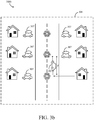
- Figure 3b illustrates an environment with a residential area in a geographical area 306 comprising a plurality of houses with parked vehicles 307 outside the houses which are covered in snow and ice.
- the environment also illustrates a vehicle 302 which has been rendered (i.e. wherein snow and ice have been removed from or around the vehicle) in a condition wherein the vehicle 302 has been set in motion with the mission to depart from the geographical area 306 and wherein the vehicle has been in motion for a certain distance d e.g. 10 meters.
- the vehicle users of the vehicles 307 are supported with information regarding a departure time duration based on the measured departure time duration for the vehicle 302 associated to the same geographical area 306.
- the support comprises notifications pushed out to wireless communication devices of the vehicle users for the vehicles 307 wherein the notifications comprise a determined deviation of an estimated current departure time duration from a default time duration which is based on a measured departure time duration for the vehicle 302.
- the vehicle users of the vehicles 307 are able to plan for the deviation in the departure time duration which may have not been anticipated by the vehicle users themselves.
- FIG. 4 is a schematic block diagram illustrating an example arrangement according to some embodiments.
- the example arrangement is a departure time duration arrangement 410 for supporting a user of a vehicle with information regarding a departure time duration, wherein the arrangement is configured to be associated with weather service arrangement WTHR 406, e.g. weather information providing circuitry or weather information obtaining circuitry, configured to obtain weather information for the geographical area, time of day and time of year.
- WTHR 406 e.g. weather information providing circuitry or weather information obtaining circuitry, configured to obtain weather information for the geographical area, time of day and time of year.
- the departure time duration arrangement 410 comprises controlling circuitry CNTR 400, which may in turn comprise a time measuring arrangement MEAS 401, e.g. time measuring circuitry, configured to measure a departure time duration for a first vehicle user associated to a geographical area, a reporting arrangement REP 402, e.g. reporting circuitry, configured to report the measured departure time duration for the first vehicle user and the associated geographical area, an estimating arrangement EST 403, e.g. estimating circuitry, configured to estimate a current departure time duration for at least a second vehicle user associated to the geographical area based on the reported departure time duration, a determining arrangement DET 404, e.g.
- determining circuitry configured to determine deviations of the estimated departure time duration from a default departure time duration
- a notification arrangement 405 e.g. notification circuitry, configured to notify the at least second vehicle user with information regarding the determined deviation of the departure time duration for the geographical area.
- the departure time duration arrangement 410 may be comprised in the departure time duration system 200 described in connection with Figure 2 and/or the departure time duration arrangement 410 may be configured to perform method steps of any of the methods described in connection with Figure 1 .
- Figure 5 is a schematic drawing illustrating an example computer readable medium according to some embodiments.
- the computer program product comprises a non-transitory computer readable medium 500 having thereon a computer program 510 comprising program instructions, wherein the computer program being loadable into a data processing unit and configured to cause execution of the method steps of any of the methods described in connection with Figure 1 .
- the physical product may comprise one or more parts, such as controlling circuitry in the form of one or more controllers, one or more processors, or the like.
- the described embodiments and their equivalents may be realized in software or hardware or a combination thereof.
- the embodiments may be performed by general purpose circuitry. Examples of general purpose circuitry include digital signal processors (DSP), central processing units (CPU), co-processor units, field programmable gate arrays (FPGA) and other programmable hardware.
- DSP digital signal processors
- CPU central processing units
- FPGA field programmable gate arrays
- the embodiments may be performed by specialized circuitry, such as application specific integrated circuits (ASIC).
- ASIC application specific integrated circuits
- the general purpose circuitry and/or the specialized circuitry may, for example, be associated with or comprised in an apparatus such as a vehicle.
- Embodiments may appear within an electronic apparatus (associated with or comprised in a vehicle) comprising arrangements, circuitry, and/or logic according to any of the embodiments described herein.
- an electronic apparatus associated with or comprised in a vehicle
- an electronic apparatus may be configured to perform methods according to any of the embodiments described herein.
- a computer program product comprises a computer readable medium such as, for example a universal serial bus (USB) memory, a plug-in card, an embedded drive or a read only memory (ROM).
- Figure 5 illustrates an example computer readable medium in the form of a compact disc (CD) ROM 500.
- the computer readable medium has stored thereon a computer program comprising program instructions.
- the computer program is loadable into a data processor (PROC) 520, which may, for example, be comprised in an apparatus or vehicle 510.
- PROC data processor
- the computer program may be stored in a memory (MEM) 530 associated with or comprised in the data-processing unit.
- the computer program may, when loaded into and run by the data processing unit, cause execution of method steps according to, for example, any of the methods illustrated in Figure 1 or otherwise described herein.
- the method embodiments described herein discloses example methods through steps being performed in a certain order. However, it is recognized that these sequences of events may take place in another order without departing from the scope of the claims. Furthermore, some method steps may be performed in parallel even though they have been described as being performed in sequence. Thus, the steps of any methods disclosed herein do not have to be performed in the exact order disclosed, unless a step is explicitly described as following or preceding another step and/or where it is implicit that a step must follow or precede another step.
Landscapes
- Engineering & Computer Science (AREA)
- Remote Sensing (AREA)
- Radar, Positioning & Navigation (AREA)
- Physics & Mathematics (AREA)
- General Physics & Mathematics (AREA)
- Automation & Control Theory (AREA)
- Environmental & Geological Engineering (AREA)
- Life Sciences & Earth Sciences (AREA)
- Atmospheric Sciences (AREA)
- Analytical Chemistry (AREA)
- Chemical & Material Sciences (AREA)
- Signal Processing (AREA)
- Environmental Sciences (AREA)
- Ecology (AREA)
- Biodiversity & Conservation Biology (AREA)
- Computer Networks & Wireless Communication (AREA)
- Traffic Control Systems (AREA)
Abstract
Description
- The present disclosure relates generally to the field of departure time duration for a vehicle. More particularly, it relates to supporting a user of a vehicle with information regarding a departure time duration.
- A vehicle may typically be parked outside a house, on a street, in a parking lot or in a garage. In different weather conditions, different departure time durations are required. For example, if it has been snowing all night, a vehicle user may spend an extensive amount of time in the morning preparing the vehicle for departure e.g. by removing snow and ice from the vehicle or around the vehicle or on the road or on the drive-way or on the garage entrance/exit before the vehicle is able to depart.
- Heating the vehicle in order to remove snow is an option however this is not feasible in all situations, especially not in very cold weather with much snow which may result in a lengthy departure time duration which may have not been anticipated by the vehicle user which may lead the vehicle user to arrive late to work, school etc.
- Therefore, there is a need for alternative approaches to supporting a user of a vehicle with information regarding a departure time duration.
- It should be emphasized that the term "comprises/comprising" when used in this specification is taken to specify the presence of stated features, integers, steps, or components, but does not preclude the presence or addition of one or more other features, integers, steps, components, or groups thereof. As used herein, the singular forms "a", "an" and "the" are intended to include the plural forms as well, unless the context clearly indicates otherwise.
- Generally, when an arrangement is referred to herein, it is to be understood as a physical product; e.g., an apparatus. The physical product may comprise one or more parts, such as controlling circuitry in the form of one or more controllers, one or more processors, or the like.
- An object of some embodiments is to provide alternative approaches to supporting a user of a vehicle with information regarding a departure time duration.
- According to a first aspect, this is achieved by a method for supporting a user of a vehicle with information regarding a departure time duration.
- The method comprises measuring a departure time duration for a first vehicle user associated to a geographical area and estimating a current departure time duration for at least a second vehicle user associated to the geographical area based on the measured departure time duration for the first vehicle user.
- The method further comprises determining any deviation of the estimated current departure time duration from a default departure time duration and when a deviation is determined, notifying the at least second vehicle user with information regarding the determined deviation of the default departure time duration for the geographical area.
- An advantage of some embodiments is that the vehicle user is supported with information regarding the departure time duration.
- Another advantage of some embodiments is that the vehicle user may, based on the information regarding the departure time duration, plan for a lengthy departure time duration such that late arrival to a destination such as work or school is avoided.
- Yet an advantage of some embodiments is that vehicle users may, based on the information regarding the departure time duration, choose another option than travelling with the vehicle e.g. staying at home, working from home, choosing public transportation etc.
- In some embodiments, the method further comprises obtaining weather information for the geographical area, time of day and time of year for estimating the current departure time duration.
- An advantage of some embodiments is that a correlation between the obtained information and the departure time duration can be determined.
- In some embodiments, the obtained weather information is adapted to comprise one or more of an ambient temperature, an amount of snowfall, and an air humidity.
- An advantage of some embodiments is that a correlation between the obtained information and the departure time duration can be more precisely determined.
- In some embodiments, the method further comprises reporting the measured departure time duration for the first vehicle user and the associated geographical area.
- An advantage of some embodiments is that the at least second vehicle user may benefit from the measured departure time duration for the first vehicle user.
- In some embodiments, the reporting further comprises reporting the obtained weather information for the geographical area, time of day and time of year for estimating the current departure time duration.
- An advantage of some embodiments is that the at least second vehicle user may benefit from the measured departure time duration for the first vehicle user and a correlation between the obtained information and the measured departure time duration may be determined.
- In some embodiments, the estimating of the current departure time duration for the at least second vehicle user is based on a plurality reports.
- An advantage of some embodiments is that the at least second vehicle user may benefit from the measured departure time duration for the first vehicle user and a correlation between the obtained information and the measured departure time duration may be more precisely determined.
- In some embodiments, the determined deviation of the default departure time duration comprises a delayed departure time.
- An advantage of some embodiments is that a vehicle user may plan for a lengthy departure time duration such that late arrival to a destination may be avoided.
- In some embodiments, the measuring of the departure time duration for the first vehicle user starts from when the first vehicle user arrives at the vehicle and ends when the vehicle is in motion.
- An advantage of some embodiments is that the measuring starts when the vehicle user arrives at the vehicle and taking into account the time it takes to remove snow around the vehicle or leading up to the vehicle.
- In some embodiments, the measuring of the departure time duration for the first vehicle user starts from an unlock event of the vehicle when the first vehicle user arrives at the vehicle.
- An advantage of some embodiments is that the measuring starts when the vehicle user actually unlocks the vehicle leading to a more precise measurement and reliable data.
- In some embodiments, the measuring of the departure time duration for the first vehicle user ends when the vehicle has been in motion for a certain distance.
- An advantage of some embodiments is that the measuring ends when the vehicle actually has been in motion for a certain distance leading to a more precise measurement and reliable data.
- A second aspect is an apparatus for supporting a user of a vehicle with information regarding a departure time duration.
- The apparatus comprises a memory comprising executable instructions and one or more processors configured to communicate with the memory.
- The one or more processors are configured to cause the apparatus to measure a departure time duration for a vehicle user associated to a geographical area and report the measured departure time duration and the associated geographical area to a cloud service for estimating a current departure time duration and determining any deviation of the estimated current departure time duration.
- An advantage of some embodiments is that the vehicle user is supported with information regarding the departure time duration.
- Another advantage of some embodiments is that the vehicle user may, based on the information regarding the departure time duration, plan for a lengthy departure time duration such that late arrival to a destination such as work or school is avoided.
- Yet an advantage of some embodiments is that the at least second vehicle user may benefit from the measured departure time duration.
- Yet another advantage of some embodiments is that vehicle users may, based on the information regarding the departure time duration, choose another option than travelling with the vehicle e.g. staying at home, working from home, choosing public transportation etc.
- In some embodiments, the one or more processors are further configured to cause the apparatus to obtain weather information for the geographical area, time of day and time of year.
- An advantage of some embodiments is that a correlation between the obtained information and the measured departure time duration can be determined.
- A third aspect is a vehicle comprising the apparatus of the second aspect.
- An advantage of some embodiments is that the vehicle user is supported with information regarding the departure time duration.
- Another advantage of some embodiments is that the vehicle user may, based on the information regarding the departure time duration, plan for a lengthy departure time duration such that late arrival to a destination such as work or school is avoided.
- Yet an advantage of some embodiments is that the at least second vehicle user may benefit from a measured departure time duration.
- Yet another advantage of some embodiments is that vehicle users may, based on the information regarding the departure time duration, choose another option than travelling with the vehicle e.g. staying at home, working from home, choosing public transportation etc.
- A fourth aspect is a cloud service for supporting a user of a vehicle with information regarding a departure time duration.
- The cloud service is configured to receive at least one report comprising information regarding a departure time duration for a first vehicle user associated to a geographical area.
- An advantage of some embodiments is that the vehicle user is supported with information regarding the departure time duration.
- Another advantage of some embodiments is that the vehicle user may, based on the information regarding the departure time duration, plan for a lengthy departure time duration such that late arrival to a destination such as work or school is avoided.
- Yet an advantage of some embodiments is that the at least second vehicle user may benefit from a measured departure time duration.
- Yet another advantage of some embodiments is that vehicle users may, based on the information regarding the departure time duration, choose another option than travelling with the vehicle e.g. staying at home, working from home, choosing public transportation etc.
- In some embodiments, the cloud service is further configured to receive at least one report comprising weather information for the geographical area, time of day and time of year from a cloud service.
- An advantage of some embodiments is that a correlation between the obtained information and the measured departure time duration can be determined.
- In some embodiments, the cloud service is further configured to estimate a current departure time duration based on the received at least one report, determine any deviation of the estimated current departure time duration from a default departure time duration, and when a deviation is determined, notify the at least second vehicle user with information regarding the determined deviation of the departure time duration for the geographical area.
- An advantage of some embodiments is that the at least second vehicle user may benefit from the notification by planning for a lengthy departure time duration such that late arrival to a destination such as work or school is avoided.
- A fifth aspect is a system for supporting a user of a vehicle with information regarding a departure time duration.
- The system comprises a time measuring module configured to measure a departure time duration for a first vehicle user associated to a geographical area, a reporting module configured to report the measured departure time duration for the first vehicle user and the associated geographical area, an estimating module configured to estimate a current departure time duration for at least a second vehicle user associated to the geographical area based on the reported departure time duration, a determining module configured to determine deviations of the estimated departure time duration from a default departure time duration, and a notification module configured to notify the at least second vehicle user with information regarding the determined deviation of the departure time duration for the geographical area.
- An advantage of some embodiments is that the vehicle user is supported with information regarding the departure time duration.
- Another advantage of some embodiments is that the vehicle user may, based on the information regarding the departure time duration, plan for a lengthy departure time duration such that late arrival to a destination such as work or school is avoided.
- Yet an advantage of some embodiments is that the at least second vehicle user may benefit from a measured departure time duration.
- Yet another advantage of some embodiments is that vehicle users may, based on the information regarding the departure time duration, choose another option than travelling with the vehicle e.g. staying at home, working from home, choosing public transportation etc.
- In some embodiments, the system further comprises a weather obtaining module configured to obtain weather information for the geographical area, time of day and time of year.
- An advantage of some embodiments is that a correlation between the obtained information and the departure time duration can be determined.
- A sixth aspect is a computer program product comprising a non-transitory computer readable medium, having thereon a computer program comprising program instructions. The computer program is loadable into a data processing unit and configured to cause execution of the method according to the first aspect when the computer program is run by the data processing unit.
- In some embodiments, any of the above aspects may additionally have features identical with or corresponding to any of the various features as explained above for any of the other aspects.
- Further objects, features and advantages will appear from the following detailed description of embodiments, with reference being made to the accompanying drawings. The drawings are not necessarily to scale, emphasis instead being placed upon illustrating the example embodiments.
-
Figure 1 is a flowchart illustrating example method steps according to some embodiments; -
Figure 2 is a schematic overview illustrating an example system according to some embodiments; -
Figure 3a is a schematic drawing illustrating an example environment according to some embodiments; -
Figure 3b is a schematic drawing illustrating an example environment according to some embodiments; -
Figure 4 is a schematic block diagram illustrating an example arrangement according to some embodiments; and -
Figure 5 is a schematic drawing illustrating an example computer readable medium according to some embodiments. - As already mentioned above, it should be emphasized that the term "comprises/comprising" when used in this specification is taken to specify the presence of stated features, integers, steps, or components, but does not preclude the presence or addition of one or more other features, integers, steps, components, or groups thereof. As used herein, the singular forms "a", "an" and "the" are intended to include the plural forms as well, unless the context clearly indicates otherwise.
- Embodiments of the present disclosure will be described and exemplified more fully hereinafter with reference to the accompanying drawings. The solutions disclosed herein can, however, be realized in many different forms and should not be construed as being limited to the embodiments set forth herein.
- In the following, embodiments will be described where alternative approaches to supporting a user of a vehicle with information regarding a departure time duration are provided.
- A departure time duration comprises the required time for a vehicle user to render the vehicle in a condition wherein the vehicle is able to depart from a geographical area.
-
Figure 1 is a flowchart illustrating example method steps according to some embodiments. The departuretime duration method 100 is for supporting a user of a vehicle with information regarding a departure time duration. Thus, the departuretime duration method 100 may, for example, be performed by the departuretime duration system 200 ofFigure 2 . - The departure
time duration method 100 comprises following steps. - In
step 110, a departure time duration for afirst vehicle user 201 associated to ageographical area 206 is measured. - In
step 140, a current departure time duration for at least asecond vehicle user 207 associated to thegeographical area 206 is estimated based on the measured departure time duration for thefirst vehicle user 201. - In
step 150, any deviation of the estimated current departure time duration from a default departure time duration is determined. - In
step 160, when a deviation is determined, the at leastsecond vehicle user 207 is notified with information regarding the determined deviation of the default departure time duration for thegeographical area 206. - In some embodiments, the departure
time duration method 100 further comprises the following step. - In
step 120, weather information for thegeographical area 206, time of day and time of year for estimating the current departure time duration are obtained 220. - In some embodiments, the obtained
weather information 220 is adapted to comprise one or more of an ambient temperature, an amount of snowfall, and an air humidity. - In some embodiments, the departure
time duration method 100 further comprises the following step. - In
step 130, the measured departure time duration for the first vehicle user and the associated geographical area are reported 230. - In some embodiments, the reporting 230 further comprises reporting the obtained weather information for the geographical area, time of day and time of year for estimating the current departure time duration.
- In some embodiments, the estimating 140 of the current departure time duration for the at least second vehicle user is based on a plurality reports.
- In some embodiments, the
determined deviation 150 of the default departure time duration comprises a delayed departure time. - In some embodiments, the measuring 110 of the departure time duration for the
first vehicle user 201 starts from when thefirst vehicle user 201 arrives at thevehicle 202 and ends when the vehicle is in motion. - In some embodiments, the measuring 110 of the departure time duration for the
first vehicle user 201 starts from an unlock event of thevehicle 202 when thefirst vehicle user 201 arrives at thevehicle 202. - In some embodiments, the measuring 110 of the departure time duration for the
first vehicle user 201 ends when thevehicle 202 has been in motion for a certain distance. -
Figure 2 is a schematic overview illustrating an example system according to some embodiments. The departuretime duration system 200 is for supporting a user of a vehicle with information regarding a departure time duration. Thus, the departuretime duration system 200 may, for example, be utilized for anenvironment 300a ofFigure 3a or for anenvironment 300b ofFig 3b . - A departure time duration for a
first vehicle user 201 associated to ageographical area 206 is measured. More specifically, the departure time duration comprises the required time for thefirst vehicle user 201 to render thevehicle 202 in a condition wherein thevehicle 202 is able to depart from thegeographical area 206 e.g. by removing snow and ice from the vehicle or around the vehicle or on the road or on the drive-way or on the garage entrance/exit before the vehicle is able to depart. The measuring is performed by an apparatus (not shown) configured for measuring time comprised in thevehicle 202. - A current departure time duration for at least a
second vehicle user 207 associated to thegeographical area 206 is estimated in acloud service 203 based on the measured departure time duration for thefirst vehicle user 201. More specifically, the current departure time duration is estimated based on at least areport 230 from thevehicle 202 comprising the measured departure time duration for thefirst vehicle user 201 and the associatedgeographical area 206 and received at thecloud service 203. - In some embodiments, the reporting 230 to the
cloud service 203 further comprises reporting obtainedweather information 220 for thegeographical area 206 from aweather service 208, time of day and time of year to acloud service 203 for estimating the current departure time duration. - In some embodiments, the reporting of the
weather information 220 for thegeographical area 206 may be reported to thecloud service 203 directly from theweather service 208. - The
weather service 208 may be comprised in a separate cloud service or in the same cloud service ascloud service 203. Theweather service 208 is further configured to also provide information regarding time of day and time of year to thecloud service 203 in addition to the weather information for thegeographical area 206. - In some embodiments, the obtained weather information is adapted to comprise one or more of an ambient temperature, an amount of snowfall, and an air humidity.
- In some embodiments, the estimating of the current departure time duration for the at least
second vehicle user 207 is based on a plurality ofreports 230. - The
cloud service 203 is configured to, based on the at least onereport 230, determine any deviation of the estimated current departure time duration from a default departure time duration. More specifically, thecloud service 203 is configured to by means ofservers 204 anddatabases 205 associated to thecloud service 203 to calculate e.g. in a statistical method the estimated current departure time duration and determine any deviation of the estimated current departure time duration from a default departure time duration. - When a deviation is determined, the at least
second vehicle user 207 associated to the samegeographical area 206, is notified with information regarding the determined deviation of the default departure time duration for thegeographical area 206. More specifically, a wireless communication device of the at leastsecond vehicle user 207 receives a pushed notification from thecloud service 203 with information regarding the determined deviation of the default time duration for thegeographical area 206. - In some embodiments, the determined deviation of the default departure time duration comprises a delayed departure time.
- In some embodiments, the measuring, i.e. by the
vehicle 202, of the departure time duration for thefirst vehicle user 201 starts from when thefirst vehicle user 201 arrives at thevehicle 202 and ends when thevehicle 202 is in motion. - In some embodiments, the measuring, i.e. by the
vehicle 202, of the departure time duration for thefirst vehicle user 201 starts from an unlock event of the vehicle when the first vehicle user arrives 201 at thevehicle 202. - In some embodiments, the measuring, i.e. by the
vehicle 202, of the departure time duration for thefirst vehicle user 201 ends when the vehicle has been in motion for a certain distance d e.g. 10 meters. - The association to the
geographical area 206 comprises a physical presence of thevehicle 202 of thefirst vehicle user 201 in thegeographical area 206 and physical presence of vehicle(s) of the at leastsecond vehicle user 207 in thegeographical area 206 of which associations may be determined by means of fixed base stations that comprise wireless carrier network or wireless communication apparatus comprised in a vehicle wherein the wireless communication device participates in a position determination e.g. via GPS. - Vehicles that are parked under a roof e.g. in a garage or in a carport, and within the same
geographical area 206 may get excluded from reporting their measured departure time duration to thecloud service 203 such that their data is prevented from causing an erroneous estimation of departure time duration in thecloud service 203. However, notifications from thecloud service 203 are still pushed out to these vehicle users in thegeographical area 206 as their drive-ways or garage entrance/exits may still be blocked with snow even though the vehicles themselves are not covered in snow and therefore it is still relevant information for these vehicle users. -
Figure 3a is a schematic drawing illustrating an example environment according to some embodiments. The departuretime duration system 200 illustrated inFigure 2 may, for example, be utilized for anenvironment 300a ofFigure 3a . -
Figure 3a illustrates an environment with a parking lot in ageographical area 306 comprising a plurality of parkedvehicles 307 which are covered in snow and ice. The environment also illustrates avehicle 302 which has been rendered (i.e. wherein snow and ice have been removed from or around the vehicle) in a condition wherein thevehicle 302 has been set in motion with the mission to depart from thegeographical area 306 and wherein thevehicle 302 has been in motion for a certain distance d e.g. 10 meters. - In this environment, the vehicle users of the
vehicles 307 are supported with information regarding a departure time duration based on the measured departure time duration for thevehicle 302 associated to the samegeographical area 306. The support comprises notifications pushed out to wireless communication devices of the vehicle users for thevehicles 307 wherein the notifications comprise a determined deviation of an estimated current departure time duration from a default time duration which is based on a measured departure time duration for thevehicle 302. In this way, the vehicle users for thevehicles 307 are able to plan for the deviation in the departure time duration which may have not been anticipated by the vehicle users themselves. -
Figure 3b is a schematic drawing illustrating an example environment according to some embodiments. The departuretime duration system 200 illustrated inFigure 2 may, for example, be utilized for anenvironment 300b ofFigure 3b . -
Figure 3b illustrates an environment with a residential area in ageographical area 306 comprising a plurality of houses with parkedvehicles 307 outside the houses which are covered in snow and ice. The environment also illustrates avehicle 302 which has been rendered (i.e. wherein snow and ice have been removed from or around the vehicle) in a condition wherein thevehicle 302 has been set in motion with the mission to depart from thegeographical area 306 and wherein the vehicle has been in motion for a certain distance d e.g. 10 meters. - In this environment, the vehicle users of the
vehicles 307 are supported with information regarding a departure time duration based on the measured departure time duration for thevehicle 302 associated to the samegeographical area 306. The support comprises notifications pushed out to wireless communication devices of the vehicle users for thevehicles 307 wherein the notifications comprise a determined deviation of an estimated current departure time duration from a default time duration which is based on a measured departure time duration for thevehicle 302. In this way, the vehicle users of thevehicles 307 are able to plan for the deviation in the departure time duration which may have not been anticipated by the vehicle users themselves. -
Figure 4 is a schematic block diagram illustrating an example arrangement according to some embodiments. The example arrangement is a departuretime duration arrangement 410 for supporting a user of a vehicle with information regarding a departure time duration, wherein the arrangement is configured to be associated with weatherservice arrangement WTHR 406, e.g. weather information providing circuitry or weather information obtaining circuitry, configured to obtain weather information for the geographical area, time of day and time of year. - The departure
time duration arrangement 410 comprises controllingcircuitry CNTR 400, which may in turn comprise a time measuringarrangement MEAS 401, e.g. time measuring circuitry, configured to measure a departure time duration for a first vehicle user associated to a geographical area, areporting arrangement REP 402, e.g. reporting circuitry, configured to report the measured departure time duration for the first vehicle user and the associated geographical area, an estimatingarrangement EST 403, e.g. estimating circuitry, configured to estimate a current departure time duration for at least a second vehicle user associated to the geographical area based on the reported departure time duration, a determiningarrangement DET 404, e.g. determining circuitry, configured to determine deviations of the estimated departure time duration from a default departure time duration, and anotification arrangement 405, e.g. notification circuitry, configured to notify the at least second vehicle user with information regarding the determined deviation of the departure time duration for the geographical area. - The departure
time duration arrangement 410 may be comprised in the departuretime duration system 200 described in connection withFigure 2 and/or the departuretime duration arrangement 410 may be configured to perform method steps of any of the methods described in connection withFigure 1 . -
Figure 5 is a schematic drawing illustrating an example computer readable medium according to some embodiments. The computer program product comprises a non-transitory computerreadable medium 500 having thereon acomputer program 510 comprising program instructions, wherein the computer program being loadable into a data processing unit and configured to cause execution of the method steps of any of the methods described in connection withFigure 1 . - Generally, when an arrangement is referred to herein, it is to be understood as a physical product; e.g., an apparatus. The physical product may comprise one or more parts, such as controlling circuitry in the form of one or more controllers, one or more processors, or the like.
- The described embodiments and their equivalents may be realized in software or hardware or a combination thereof. The embodiments may be performed by general purpose circuitry. Examples of general purpose circuitry include digital signal processors (DSP), central processing units (CPU), co-processor units, field programmable gate arrays (FPGA) and other programmable hardware. Alternatively or additionally, the embodiments may be performed by specialized circuitry, such as application specific integrated circuits (ASIC). The general purpose circuitry and/or the specialized circuitry may, for example, be associated with or comprised in an apparatus such as a vehicle.
- Embodiments may appear within an electronic apparatus (associated with or comprised in a vehicle) comprising arrangements, circuitry, and/or logic according to any of the embodiments described herein. Alternatively or additionally, an electronic apparatus (associated with or comprised in a vehicle) may be configured to perform methods according to any of the embodiments described herein.
- According to some embodiments, a computer program product comprises a computer readable medium such as, for example a universal serial bus (USB) memory, a plug-in card, an embedded drive or a read only memory (ROM).
Figure 5 illustrates an example computer readable medium in the form of a compact disc (CD)ROM 500. The computer readable medium has stored thereon a computer program comprising program instructions. The computer program is loadable into a data processor (PROC) 520, which may, for example, be comprised in an apparatus orvehicle 510. When loaded into the data processing unit, the computer program may be stored in a memory (MEM) 530 associated with or comprised in the data-processing unit. According to some embodiments, the computer program may, when loaded into and run by the data processing unit, cause execution of method steps according to, for example, any of the methods illustrated inFigure 1 or otherwise described herein. - Generally, all terms used herein are to be interpreted according to their ordinary meaning in the relevant technical field, unless a different meaning is clearly given and/or is implied from the context in which it is used.
- Reference has been made herein to various embodiments. However, a person skilled in the art would recognize numerous variations to the described embodiments that would still fall within the scope of the claims.
- For example, the method embodiments described herein discloses example methods through steps being performed in a certain order. However, it is recognized that these sequences of events may take place in another order without departing from the scope of the claims. Furthermore, some method steps may be performed in parallel even though they have been described as being performed in sequence. Thus, the steps of any methods disclosed herein do not have to be performed in the exact order disclosed, unless a step is explicitly described as following or preceding another step and/or where it is implicit that a step must follow or precede another step.
- In the same manner, it should be noted that in the description of embodiments, the partition of functional blocks into particular units is by no means intended as limiting. Contrarily, these partitions are merely examples. Functional blocks described herein as one unit may be split into two or more units. Furthermore, functional blocks described herein as being implemented as two or more units may be merged into fewer (e.g. a single) unit.
- Any feature of any of the embodiments disclosed herein may be applied to any other embodiment, wherever suitable. Likewise, any advantage of any of the embodiments may apply to any other embodiments, and vice versa.
- Hence, it should be understood that the details of the described embodiments are merely examples brought forward for illustrative purposes, and that all variations that fall within the scope of the claims are intended to be embraced therein.
Claims (18)
- A method for supporting a user of a vehicle with information regarding a departure time duration, comprising the steps of:measuring (110) a departure time duration for a first vehicle user associated to a geographical area,estimating (140) a current departure time duration for at least a second vehicle user associated to the geographical area based on the measured departure time duration for the first vehicle user,determining (150) any deviation of the estimated current departure time duration from a default departure time duration, andwhen a deviation is determined, notifying (160) the at least second vehicle user with information regarding the determined deviation of the default departure time duration for the geographical area.
- The method according to claim 1, further comprising the step of obtaining (120) weather information for the geographical area, time of day and time of year for estimating the current departure time duration.
- The method according to claim 2, wherein the obtained weather information is adapted to comprise one or more of: an ambient temperature, an amount of snowfall, and an air humidity.
- The method according to any of claims 1-3, further comprising the step of reporting (130) the measured departure time duration for the first vehicle user and the associated geographical area.
- The method according to any of claims 1-4, wherein the reporting (130) further comprises reporting (130) the obtained weather information for the geographical area, time of day and time of year for estimating the current departure time duration.
- The method according to any of claims 1-5, wherein the estimating (140) the current departure time duration for the at least second vehicle user is based on a plurality reports.
- The method according to any of claims 1-6, wherein the determined deviation (150) of the default departure time duration comprises a delayed departure time.
- The method according to any of claims 1-7, wherein the measuring (110) of the departure time duration for the first vehicle user starts from when the first vehicle user arrives at the vehicle and ends when the vehicle is in motion.
- The method according to claim 8, wherein the measuring (110) of the departure time duration for the first vehicle user starts from an unlock event of the vehicle when the first vehicle user arrives at the vehicle.
- The method according to claim 8, wherein the measuring (110) of the departure time duration for the first vehicle user ends when the vehicle has been in motion for a certain distance (d).
- An apparatus for supporting a user of a vehicle with information regarding a departure time duration, comprising:a memory comprising executable instructions,one or more processors configured to communicate with the memory wherein the one or more processors are configured to cause the apparatus to:measure a departure time duration for a vehicle user (201) associated to a geographical area (206), andreport (230) the measured departure time duration and the associated geographical area (206) to a cloud service (203) for estimating a current departure time duration and determining any deviation of the estimated current departure time duration.
- The apparatus according to claim 11, wherein the one or more processors are further configured to cause the apparatus to obtain (220) weather information for the geographical area (206), time of day and time of year.
- A vehicle (202) comprising the apparatus according to any of claims 11-12.
- A cloud service (203) for supporting a user of a vehicle with information regarding a departure time duration, wherein the cloud service (203) is configured to:
receive at least one report (230) comprising information regarding a departure time duration for a first vehicle user (201) associated to a geographical area (206). - The cloud service according to claim 14, wherein the cloud service (203) is further configured to:
receive at least one report (220) comprising weather information for the geographical area (206), time of day and time of year from a cloud service 208. - The cloud service according to any of claims 14-15, wherein the cloud service (203) is further configured to:estimate a current departure time duration based on the received at least one report (220,230),determine any deviation of the estimated current departure time duration from a default departure time duration, andwhen a deviation is determined, notify (260) the at least second vehicle user (207) with information regarding the determined deviation of the departure time duration for the geographical area (206).
- A system for supporting a user of a vehicle with information regarding a departure time duration, comprising:a time measuring module (401) configured to measure a departure time duration for a first vehicle user associated to a geographical area,a reporting module (402) configured to report the measured departure time duration for the first vehicle user and the associated geographical area,an estimating module (403) configured to estimate a current departure time duration for at least a second vehicle user associated to the geographical area based on the reported departure time duration,a determining module (404) configured to determine deviations of the estimated departure time duration from a default departure time duration, anda notification module (405) configured to notify the at least second vehicle user with information regarding the determined deviation of the departure time duration for the geographical area.
- The system according to claim 17, further comprising:
a weather obtaining module (406) configured to obtain weather information for the geographical area, time of day and time of year.
Priority Applications (4)
| Application Number | Priority Date | Filing Date | Title |
|---|---|---|---|
| EP18207104.3A EP3654310B1 (en) | 2018-11-19 | 2018-11-19 | Departure time duration for a vehicle |
| PCT/CN2019/114387 WO2020103659A1 (en) | 2018-11-19 | 2019-10-30 | Departure time duration for a vehicle |
| CN201980074251.5A CN112996704B (en) | 2018-11-19 | 2019-10-30 | Departure duration of vehicle |
| US17/317,706 US20210262814A1 (en) | 2018-11-19 | 2021-05-11 | Departure time duration for a vehicle |
Applications Claiming Priority (1)
| Application Number | Priority Date | Filing Date | Title |
|---|---|---|---|
| EP18207104.3A EP3654310B1 (en) | 2018-11-19 | 2018-11-19 | Departure time duration for a vehicle |
Publications (2)
| Publication Number | Publication Date |
|---|---|
| EP3654310A1 true EP3654310A1 (en) | 2020-05-20 |
| EP3654310B1 EP3654310B1 (en) | 2022-01-26 |
Family
ID=64362463
Family Applications (1)
| Application Number | Title | Priority Date | Filing Date |
|---|---|---|---|
| EP18207104.3A Active EP3654310B1 (en) | 2018-11-19 | 2018-11-19 | Departure time duration for a vehicle |
Country Status (4)
| Country | Link |
|---|---|
| US (1) | US20210262814A1 (en) |
| EP (1) | EP3654310B1 (en) |
| CN (1) | CN112996704B (en) |
| WO (1) | WO2020103659A1 (en) |
Cited By (1)
| Publication number | Priority date | Publication date | Assignee | Title |
|---|---|---|---|---|
| CN115512560A (en) * | 2022-10-17 | 2022-12-23 | 广汽埃安新能源汽车股份有限公司 | Vehicle control system |
Citations (3)
| Publication number | Priority date | Publication date | Assignee | Title |
|---|---|---|---|---|
| US20140278071A1 (en) * | 2013-03-12 | 2014-09-18 | Incredible Labs, Inc. | Estimating times to leave and to travel |
| US20160290816A1 (en) * | 2015-04-04 | 2016-10-06 | Nicholaus J. Bauer | Coordinating arrival and departure times |
| US20180313657A1 (en) * | 2012-11-06 | 2018-11-01 | Apple Inc. | Routing Based on Detected Stops |
Family Cites Families (11)
| Publication number | Priority date | Publication date | Assignee | Title |
|---|---|---|---|---|
| JP5832144B2 (en) * | 2011-05-20 | 2015-12-16 | 富士通テン株式会社 | Information notification device, information notification method, and information notification program |
| US8855901B2 (en) * | 2012-06-25 | 2014-10-07 | Google Inc. | Providing route recommendations |
| US9315108B2 (en) * | 2014-07-08 | 2016-04-19 | Toyota Jidosha Kabushiki Kaisha | Vehicle function determination |
| US10044817B2 (en) * | 2014-07-16 | 2018-08-07 | Toyota Jidosha Kabushiki Kaisha | Providing wireless services to a connected vehicle |
| US9914436B2 (en) * | 2015-05-28 | 2018-03-13 | Bader Abdullah ALMALKI | Automated vehicle snow and ice removal |
| JP6459847B2 (en) * | 2015-08-20 | 2019-01-30 | トヨタ自動車株式会社 | Charge control device |
| US9691275B2 (en) * | 2015-11-06 | 2017-06-27 | International Business Machines Corporation | Adjusting vehicle timing in a transportation network |
| US9857796B2 (en) * | 2016-05-11 | 2018-01-02 | International Business Machines Corporation | Vehicle positioning in a parking area |
| US10169794B2 (en) * | 2016-06-07 | 2019-01-01 | Microsoft Technology Licensing, Llc | Digital assistant for vehicle related activities |
| US9945679B2 (en) * | 2016-06-27 | 2018-04-17 | International Business Machines Corporation | Personalized travel routes to reduce stress |
| CN108257412A (en) * | 2018-01-10 | 2018-07-06 | 中景博道城市规划发展有限公司 | A kind of management of intelligent road-surface concrete position and control technique towards fine-grained management |
-
2018
- 2018-11-19 EP EP18207104.3A patent/EP3654310B1/en active Active
-
2019
- 2019-10-30 WO PCT/CN2019/114387 patent/WO2020103659A1/en not_active Ceased
- 2019-10-30 CN CN201980074251.5A patent/CN112996704B/en active Active
-
2021
- 2021-05-11 US US17/317,706 patent/US20210262814A1/en not_active Abandoned
Patent Citations (3)
| Publication number | Priority date | Publication date | Assignee | Title |
|---|---|---|---|---|
| US20180313657A1 (en) * | 2012-11-06 | 2018-11-01 | Apple Inc. | Routing Based on Detected Stops |
| US20140278071A1 (en) * | 2013-03-12 | 2014-09-18 | Incredible Labs, Inc. | Estimating times to leave and to travel |
| US20160290816A1 (en) * | 2015-04-04 | 2016-10-06 | Nicholaus J. Bauer | Coordinating arrival and departure times |
Cited By (2)
| Publication number | Priority date | Publication date | Assignee | Title |
|---|---|---|---|---|
| CN115512560A (en) * | 2022-10-17 | 2022-12-23 | 广汽埃安新能源汽车股份有限公司 | Vehicle control system |
| CN115512560B (en) * | 2022-10-17 | 2024-04-12 | 广汽埃安新能源汽车股份有限公司 | Vehicle control system |
Also Published As
| Publication number | Publication date |
|---|---|
| CN112996704A (en) | 2021-06-18 |
| CN112996704B (en) | 2023-10-20 |
| WO2020103659A1 (en) | 2020-05-28 |
| EP3654310B1 (en) | 2022-01-26 |
| US20210262814A1 (en) | 2021-08-26 |
Similar Documents
| Publication | Publication Date | Title |
|---|---|---|
| JP7186607B2 (en) | Method, apparatus and computer readable storage medium for updating electronic maps | |
| US10169993B1 (en) | Forecasting with matrix powers | |
| CN202816155U (en) | Server and bus stop board for providing bus driving information | |
| CN100498231C (en) | Path planning system and method | |
| JP6570791B2 (en) | Processing equipment | |
| WO2014074203A1 (en) | Predictive parking | |
| EP2232456A1 (en) | Monitoring a mobile device | |
| CN113888857A (en) | Public transportation management system, device and method based on Internet of vehicles | |
| US20210125196A1 (en) | Information analysis device and information analysis method | |
| CN113129588B (en) | Method and device for determining bus running line and electronic equipment | |
| WO2011155936A1 (en) | System and method for determining locations within points of interest | |
| US20210262814A1 (en) | Departure time duration for a vehicle | |
| US20200049524A1 (en) | Travel route estimation apparatus and travel route estimation method | |
| CN111145584A (en) | Garage management method, device and system based on PaaS platform and storage medium | |
| CN110264580B (en) | Management method and device for non-fixed parking spaces | |
| WO2018134146A1 (en) | Systems and methods for recognizing and measuring hard-to-reach destinations | |
| JP2018077810A (en) | Loading judgment program, loading judgment method and loading judgment device | |
| TW201824206A (en) | Method and system for estimating the number of parking spaces by using eTag detector providing the total parking spaces by integrating an area or a road section in conjunction with neighboring parking information and associated CCTV image information | |
| JP7830947B2 (en) | Information processing device, information processing method, program, and information processing system | |
| JP2021101227A (en) | Server apparatus | |
| Subadra et al. | Analysis of an automated bus tracking system for metropolitan using IoT | |
| US20260073740A1 (en) | Parking lot zone estimating device, and parking lot zone estimating method | |
| JP7526768B2 (en) | Information Providing Device | |
| CN115866563B (en) | OBU binding method, device, equipment and computer storage medium | |
| CN111860594B (en) | Detour order identification method, device, electronic device and readable storage medium |
Legal Events
| Date | Code | Title | Description |
|---|---|---|---|
| PUAI | Public reference made under article 153(3) epc to a published international application that has entered the european phase |
Free format text: ORIGINAL CODE: 0009012 |
|
| STAA | Information on the status of an ep patent application or granted ep patent |
Free format text: STATUS: REQUEST FOR EXAMINATION WAS MADE |
|
| 17P | Request for examination filed |
Effective date: 20181119 |
|
| AK | Designated contracting states |
Kind code of ref document: A1 Designated state(s): AL AT BE BG CH CY CZ DE DK EE ES FI FR GB GR HR HU IE IS IT LI LT LU LV MC MK MT NL NO PL PT RO RS SE SI SK SM TR |
|
| AX | Request for extension of the european patent |
Extension state: BA ME |
|
| RIN1 | Information on inventor provided before grant (corrected) |
Inventor name: LINDBERG NILSSON, ERIK Inventor name: NILSSON, MAGNUS |
|
| RIN1 | Information on inventor provided before grant (corrected) |
Inventor name: LINDBERG NILSSON, ERIK Inventor name: NILSSON, MAGNUS |
|
| GRAP | Despatch of communication of intention to grant a patent |
Free format text: ORIGINAL CODE: EPIDOSNIGR1 |
|
| STAA | Information on the status of an ep patent application or granted ep patent |
Free format text: STATUS: GRANT OF PATENT IS INTENDED |
|
| GRAS | Grant fee paid |
Free format text: ORIGINAL CODE: EPIDOSNIGR3 |
|
| GRAA | (expected) grant |
Free format text: ORIGINAL CODE: 0009210 |
|
| STAA | Information on the status of an ep patent application or granted ep patent |
Free format text: STATUS: THE PATENT HAS BEEN GRANTED |
|
| INTG | Intention to grant announced |
Effective date: 20211208 |
|
| AK | Designated contracting states |
Kind code of ref document: B1 Designated state(s): AL AT BE BG CH CY CZ DE DK EE ES FI FR GB GR HR HU IE IS IT LI LT LU LV MC MK MT NL NO PL PT RO RS SE SI SK SM TR |
|
| REG | Reference to a national code |
Ref country code: GB Ref legal event code: FG4D |
|
| REG | Reference to a national code |
Ref country code: CH Ref legal event code: EP |
|
| REG | Reference to a national code |
Ref country code: AT Ref legal event code: REF Ref document number: 1465881 Country of ref document: AT Kind code of ref document: T Effective date: 20220215 |
|
| REG | Reference to a national code |
Ref country code: IE Ref legal event code: FG4D |
|
| REG | Reference to a national code |
Ref country code: DE Ref legal event code: R096 Ref document number: 602018029999 Country of ref document: DE |
|
| REG | Reference to a national code |
Ref country code: LT Ref legal event code: MG9D |
|
| REG | Reference to a national code |
Ref country code: NL Ref legal event code: MP Effective date: 20220126 |
|
| REG | Reference to a national code |
Ref country code: AT Ref legal event code: MK05 Ref document number: 1465881 Country of ref document: AT Kind code of ref document: T Effective date: 20220126 |
|
| PG25 | Lapsed in a contracting state [announced via postgrant information from national office to epo] |
Ref country code: NL Free format text: LAPSE BECAUSE OF FAILURE TO SUBMIT A TRANSLATION OF THE DESCRIPTION OR TO PAY THE FEE WITHIN THE PRESCRIBED TIME-LIMIT Effective date: 20220126 |
|
| PG25 | Lapsed in a contracting state [announced via postgrant information from national office to epo] |
Ref country code: SE Free format text: LAPSE BECAUSE OF FAILURE TO SUBMIT A TRANSLATION OF THE DESCRIPTION OR TO PAY THE FEE WITHIN THE PRESCRIBED TIME-LIMIT Effective date: 20220126 Ref country code: RS Free format text: LAPSE BECAUSE OF FAILURE TO SUBMIT A TRANSLATION OF THE DESCRIPTION OR TO PAY THE FEE WITHIN THE PRESCRIBED TIME-LIMIT Effective date: 20220126 Ref country code: PT Free format text: LAPSE BECAUSE OF FAILURE TO SUBMIT A TRANSLATION OF THE DESCRIPTION OR TO PAY THE FEE WITHIN THE PRESCRIBED TIME-LIMIT Effective date: 20220526 Ref country code: NO Free format text: LAPSE BECAUSE OF FAILURE TO SUBMIT A TRANSLATION OF THE DESCRIPTION OR TO PAY THE FEE WITHIN THE PRESCRIBED TIME-LIMIT Effective date: 20220426 Ref country code: LT Free format text: LAPSE BECAUSE OF FAILURE TO SUBMIT A TRANSLATION OF THE DESCRIPTION OR TO PAY THE FEE WITHIN THE PRESCRIBED TIME-LIMIT Effective date: 20220126 Ref country code: HR Free format text: LAPSE BECAUSE OF FAILURE TO SUBMIT A TRANSLATION OF THE DESCRIPTION OR TO PAY THE FEE WITHIN THE PRESCRIBED TIME-LIMIT Effective date: 20220126 Ref country code: ES Free format text: LAPSE BECAUSE OF FAILURE TO SUBMIT A TRANSLATION OF THE DESCRIPTION OR TO PAY THE FEE WITHIN THE PRESCRIBED TIME-LIMIT Effective date: 20220126 Ref country code: BG Free format text: LAPSE BECAUSE OF FAILURE TO SUBMIT A TRANSLATION OF THE DESCRIPTION OR TO PAY THE FEE WITHIN THE PRESCRIBED TIME-LIMIT Effective date: 20220426 |
|
| PG25 | Lapsed in a contracting state [announced via postgrant information from national office to epo] |
Ref country code: PL Free format text: LAPSE BECAUSE OF FAILURE TO SUBMIT A TRANSLATION OF THE DESCRIPTION OR TO PAY THE FEE WITHIN THE PRESCRIBED TIME-LIMIT Effective date: 20220126 Ref country code: LV Free format text: LAPSE BECAUSE OF FAILURE TO SUBMIT A TRANSLATION OF THE DESCRIPTION OR TO PAY THE FEE WITHIN THE PRESCRIBED TIME-LIMIT Effective date: 20220126 Ref country code: FI Free format text: LAPSE BECAUSE OF FAILURE TO SUBMIT A TRANSLATION OF THE DESCRIPTION OR TO PAY THE FEE WITHIN THE PRESCRIBED TIME-LIMIT Effective date: 20220126 Ref country code: AT Free format text: LAPSE BECAUSE OF FAILURE TO SUBMIT A TRANSLATION OF THE DESCRIPTION OR TO PAY THE FEE WITHIN THE PRESCRIBED TIME-LIMIT Effective date: 20220126 |
|
| PG25 | Lapsed in a contracting state [announced via postgrant information from national office to epo] |
Ref country code: IS Free format text: LAPSE BECAUSE OF FAILURE TO SUBMIT A TRANSLATION OF THE DESCRIPTION OR TO PAY THE FEE WITHIN THE PRESCRIBED TIME-LIMIT Effective date: 20220526 |
|
| REG | Reference to a national code |
Ref country code: DE Ref legal event code: R097 Ref document number: 602018029999 Country of ref document: DE |
|
| PG25 | Lapsed in a contracting state [announced via postgrant information from national office to epo] |
Ref country code: SM Free format text: LAPSE BECAUSE OF FAILURE TO SUBMIT A TRANSLATION OF THE DESCRIPTION OR TO PAY THE FEE WITHIN THE PRESCRIBED TIME-LIMIT Effective date: 20220126 Ref country code: SK Free format text: LAPSE BECAUSE OF FAILURE TO SUBMIT A TRANSLATION OF THE DESCRIPTION OR TO PAY THE FEE WITHIN THE PRESCRIBED TIME-LIMIT Effective date: 20220126 Ref country code: RO Free format text: LAPSE BECAUSE OF FAILURE TO SUBMIT A TRANSLATION OF THE DESCRIPTION OR TO PAY THE FEE WITHIN THE PRESCRIBED TIME-LIMIT Effective date: 20220126 Ref country code: EE Free format text: LAPSE BECAUSE OF FAILURE TO SUBMIT A TRANSLATION OF THE DESCRIPTION OR TO PAY THE FEE WITHIN THE PRESCRIBED TIME-LIMIT Effective date: 20220126 Ref country code: DK Free format text: LAPSE BECAUSE OF FAILURE TO SUBMIT A TRANSLATION OF THE DESCRIPTION OR TO PAY THE FEE WITHIN THE PRESCRIBED TIME-LIMIT Effective date: 20220126 Ref country code: CZ Free format text: LAPSE BECAUSE OF FAILURE TO SUBMIT A TRANSLATION OF THE DESCRIPTION OR TO PAY THE FEE WITHIN THE PRESCRIBED TIME-LIMIT Effective date: 20220126 |
|
| PG25 | Lapsed in a contracting state [announced via postgrant information from national office to epo] |
Ref country code: AL Free format text: LAPSE BECAUSE OF FAILURE TO SUBMIT A TRANSLATION OF THE DESCRIPTION OR TO PAY THE FEE WITHIN THE PRESCRIBED TIME-LIMIT Effective date: 20220126 |
|
| PLBE | No opposition filed within time limit |
Free format text: ORIGINAL CODE: 0009261 |
|
| STAA | Information on the status of an ep patent application or granted ep patent |
Free format text: STATUS: NO OPPOSITION FILED WITHIN TIME LIMIT |
|
| 26N | No opposition filed |
Effective date: 20221027 |
|
| PG25 | Lapsed in a contracting state [announced via postgrant information from national office to epo] |
Ref country code: SI Free format text: LAPSE BECAUSE OF FAILURE TO SUBMIT A TRANSLATION OF THE DESCRIPTION OR TO PAY THE FEE WITHIN THE PRESCRIBED TIME-LIMIT Effective date: 20220126 |
|
| PG25 | Lapsed in a contracting state [announced via postgrant information from national office to epo] |
Ref country code: MC Free format text: LAPSE BECAUSE OF FAILURE TO SUBMIT A TRANSLATION OF THE DESCRIPTION OR TO PAY THE FEE WITHIN THE PRESCRIBED TIME-LIMIT Effective date: 20220126 |
|
| REG | Reference to a national code |
Ref country code: CH Ref legal event code: PL |
|
| REG | Reference to a national code |
Ref country code: BE Ref legal event code: MM Effective date: 20221130 |
|
| PG25 | Lapsed in a contracting state [announced via postgrant information from national office to epo] |
Ref country code: LI Free format text: LAPSE BECAUSE OF NON-PAYMENT OF DUE FEES Effective date: 20221130 Ref country code: IT Free format text: LAPSE BECAUSE OF FAILURE TO SUBMIT A TRANSLATION OF THE DESCRIPTION OR TO PAY THE FEE WITHIN THE PRESCRIBED TIME-LIMIT Effective date: 20220126 Ref country code: CH Free format text: LAPSE BECAUSE OF NON-PAYMENT OF DUE FEES Effective date: 20221130 |
|
| PG25 | Lapsed in a contracting state [announced via postgrant information from national office to epo] |
Ref country code: LU Free format text: LAPSE BECAUSE OF NON-PAYMENT OF DUE FEES Effective date: 20221119 |
|
| PG25 | Lapsed in a contracting state [announced via postgrant information from national office to epo] |
Ref country code: IE Free format text: LAPSE BECAUSE OF NON-PAYMENT OF DUE FEES Effective date: 20221119 |
|
| PG25 | Lapsed in a contracting state [announced via postgrant information from national office to epo] |
Ref country code: BE Free format text: LAPSE BECAUSE OF NON-PAYMENT OF DUE FEES Effective date: 20221130 |
|
| PG25 | Lapsed in a contracting state [announced via postgrant information from national office to epo] |
Ref country code: HU Free format text: LAPSE BECAUSE OF FAILURE TO SUBMIT A TRANSLATION OF THE DESCRIPTION OR TO PAY THE FEE WITHIN THE PRESCRIBED TIME-LIMIT; INVALID AB INITIO Effective date: 20181119 |
|
| PG25 | Lapsed in a contracting state [announced via postgrant information from national office to epo] |
Ref country code: CY Free format text: LAPSE BECAUSE OF FAILURE TO SUBMIT A TRANSLATION OF THE DESCRIPTION OR TO PAY THE FEE WITHIN THE PRESCRIBED TIME-LIMIT Effective date: 20220126 |
|
| PG25 | Lapsed in a contracting state [announced via postgrant information from national office to epo] |
Ref country code: MK Free format text: LAPSE BECAUSE OF FAILURE TO SUBMIT A TRANSLATION OF THE DESCRIPTION OR TO PAY THE FEE WITHIN THE PRESCRIBED TIME-LIMIT Effective date: 20220126 |
|
| PG25 | Lapsed in a contracting state [announced via postgrant information from national office to epo] |
Ref country code: MT Free format text: LAPSE BECAUSE OF FAILURE TO SUBMIT A TRANSLATION OF THE DESCRIPTION OR TO PAY THE FEE WITHIN THE PRESCRIBED TIME-LIMIT Effective date: 20220126 |
|
| PG25 | Lapsed in a contracting state [announced via postgrant information from national office to epo] |
Ref country code: GR Free format text: LAPSE BECAUSE OF NON-PAYMENT OF DUE FEES Effective date: 20220126 |
|
| PG25 | Lapsed in a contracting state [announced via postgrant information from national office to epo] |
Ref country code: GR Free format text: LAPSE BECAUSE OF NON-PAYMENT OF DUE FEES Effective date: 20220126 |
|
| PG25 | Lapsed in a contracting state [announced via postgrant information from national office to epo] |
Ref country code: TR Free format text: LAPSE BECAUSE OF FAILURE TO SUBMIT A TRANSLATION OF THE DESCRIPTION OR TO PAY THE FEE WITHIN THE PRESCRIBED TIME-LIMIT Effective date: 20220126 |
|
| PGFP | Annual fee paid to national office [announced via postgrant information from national office to epo] |
Ref country code: DE Payment date: 20251118 Year of fee payment: 8 |
|
| PGFP | Annual fee paid to national office [announced via postgrant information from national office to epo] |
Ref country code: GB Payment date: 20251020 Year of fee payment: 8 |
|
| PGFP | Annual fee paid to national office [announced via postgrant information from national office to epo] |
Ref country code: FR Payment date: 20251020 Year of fee payment: 8 |