EP3653614B1 - Tetrahydronaphtho[1,2-b]furan-2(3h)-one derivative and preparation and use thereof in pharmaceuticals - Google Patents
Tetrahydronaphtho[1,2-b]furan-2(3h)-one derivative and preparation and use thereof in pharmaceuticals Download PDFInfo
- Publication number
- EP3653614B1 EP3653614B1 EP18832512.0A EP18832512A EP3653614B1 EP 3653614 B1 EP3653614 B1 EP 3653614B1 EP 18832512 A EP18832512 A EP 18832512A EP 3653614 B1 EP3653614 B1 EP 3653614B1
- Authority
- EP
- European Patent Office
- Prior art keywords
- acid
- compound
- group
- nmr
- mhz
- Prior art date
- Legal status (The legal status is an assumption and is not a legal conclusion. Google has not performed a legal analysis and makes no representation as to the accuracy of the status listed.)
- Active
Links
Images

Classifications
-
- C—CHEMISTRY; METALLURGY
- C07—ORGANIC CHEMISTRY
- C07D—HETEROCYCLIC COMPOUNDS
- C07D307/00—Heterocyclic compounds containing five-membered rings having one oxygen atom as the only ring hetero atom
- C07D307/77—Heterocyclic compounds containing five-membered rings having one oxygen atom as the only ring hetero atom ortho- or peri-condensed with carbocyclic rings or ring systems
- C07D307/78—Benzo [b] furans; Hydrogenated benzo [b] furans
- C07D307/82—Benzo [b] furans; Hydrogenated benzo [b] furans with hetero atoms or with carbon atoms having three bonds to hetero atoms with at the most one bond to halogen, e.g. ester or nitrile radicals, directly attached to carbon atoms of the hetero ring
- C07D307/83—Oxygen atoms
-
- A—HUMAN NECESSITIES
- A61—MEDICAL OR VETERINARY SCIENCE; HYGIENE
- A61P—SPECIFIC THERAPEUTIC ACTIVITY OF CHEMICAL COMPOUNDS OR MEDICINAL PREPARATIONS
- A61P19/00—Drugs for skeletal disorders
- A61P19/02—Drugs for skeletal disorders for joint disorders, e.g. arthritis, arthrosis
-
- A—HUMAN NECESSITIES
- A61—MEDICAL OR VETERINARY SCIENCE; HYGIENE
- A61P—SPECIFIC THERAPEUTIC ACTIVITY OF CHEMICAL COMPOUNDS OR MEDICINAL PREPARATIONS
- A61P29/00—Non-central analgesic, antipyretic or antiinflammatory agents, e.g. antirheumatic agents; Non-steroidal antiinflammatory drugs [NSAID]
-
- C—CHEMISTRY; METALLURGY
- C07—ORGANIC CHEMISTRY
- C07D—HETEROCYCLIC COMPOUNDS
- C07D307/00—Heterocyclic compounds containing five-membered rings having one oxygen atom as the only ring hetero atom
- C07D307/77—Heterocyclic compounds containing five-membered rings having one oxygen atom as the only ring hetero atom ortho- or peri-condensed with carbocyclic rings or ring systems
- C07D307/92—Naphthofurans; Hydrogenated naphthofurans
-
- C—CHEMISTRY; METALLURGY
- C07—ORGANIC CHEMISTRY
- C07D—HETEROCYCLIC COMPOUNDS
- C07D405/00—Heterocyclic compounds containing both one or more hetero rings having oxygen atoms as the only ring hetero atoms, and one or more rings having nitrogen as the only ring hetero atom
- C07D405/02—Heterocyclic compounds containing both one or more hetero rings having oxygen atoms as the only ring hetero atoms, and one or more rings having nitrogen as the only ring hetero atom containing two hetero rings
- C07D405/06—Heterocyclic compounds containing both one or more hetero rings having oxygen atoms as the only ring hetero atoms, and one or more rings having nitrogen as the only ring hetero atom containing two hetero rings linked by a carbon chain containing only aliphatic carbon atoms
-
- C—CHEMISTRY; METALLURGY
- C07—ORGANIC CHEMISTRY
- C07D—HETEROCYCLIC COMPOUNDS
- C07D405/00—Heterocyclic compounds containing both one or more hetero rings having oxygen atoms as the only ring hetero atoms, and one or more rings having nitrogen as the only ring hetero atom
- C07D405/02—Heterocyclic compounds containing both one or more hetero rings having oxygen atoms as the only ring hetero atoms, and one or more rings having nitrogen as the only ring hetero atom containing two hetero rings
- C07D405/12—Heterocyclic compounds containing both one or more hetero rings having oxygen atoms as the only ring hetero atoms, and one or more rings having nitrogen as the only ring hetero atom containing two hetero rings linked by a chain containing hetero atoms as chain links
-
- C—CHEMISTRY; METALLURGY
- C07—ORGANIC CHEMISTRY
- C07D—HETEROCYCLIC COMPOUNDS
- C07D409/00—Heterocyclic compounds containing two or more hetero rings, at least one ring having sulfur atoms as the only ring hetero atoms
- C07D409/02—Heterocyclic compounds containing two or more hetero rings, at least one ring having sulfur atoms as the only ring hetero atoms containing two hetero rings
- C07D409/12—Heterocyclic compounds containing two or more hetero rings, at least one ring having sulfur atoms as the only ring hetero atoms containing two hetero rings linked by a chain containing hetero atoms as chain links
-
- C—CHEMISTRY; METALLURGY
- C07—ORGANIC CHEMISTRY
- C07D—HETEROCYCLIC COMPOUNDS
- C07D413/00—Heterocyclic compounds containing two or more hetero rings, at least one ring having nitrogen and oxygen atoms as the only ring hetero atoms
- C07D413/02—Heterocyclic compounds containing two or more hetero rings, at least one ring having nitrogen and oxygen atoms as the only ring hetero atoms containing two hetero rings
- C07D413/06—Heterocyclic compounds containing two or more hetero rings, at least one ring having nitrogen and oxygen atoms as the only ring hetero atoms containing two hetero rings linked by a carbon chain containing only aliphatic carbon atoms
-
- C—CHEMISTRY; METALLURGY
- C07—ORGANIC CHEMISTRY
- C07D—HETEROCYCLIC COMPOUNDS
- C07D413/00—Heterocyclic compounds containing two or more hetero rings, at least one ring having nitrogen and oxygen atoms as the only ring hetero atoms
- C07D413/02—Heterocyclic compounds containing two or more hetero rings, at least one ring having nitrogen and oxygen atoms as the only ring hetero atoms containing two hetero rings
- C07D413/12—Heterocyclic compounds containing two or more hetero rings, at least one ring having nitrogen and oxygen atoms as the only ring hetero atoms containing two hetero rings linked by a chain containing hetero atoms as chain links
-
- C—CHEMISTRY; METALLURGY
- C07—ORGANIC CHEMISTRY
- C07D—HETEROCYCLIC COMPOUNDS
- C07D417/00—Heterocyclic compounds containing two or more hetero rings, at least one ring having nitrogen and sulfur atoms as the only ring hetero atoms, not provided for by group C07D415/00
- C07D417/02—Heterocyclic compounds containing two or more hetero rings, at least one ring having nitrogen and sulfur atoms as the only ring hetero atoms, not provided for by group C07D415/00 containing two hetero rings
- C07D417/12—Heterocyclic compounds containing two or more hetero rings, at least one ring having nitrogen and sulfur atoms as the only ring hetero atoms, not provided for by group C07D415/00 containing two hetero rings linked by a chain containing hetero atoms as chain links
Definitions
- the present application relates to pharmaceuticals, particularly to drugs and preparation thereof, and more particularly to tetrahydronaphtho[1,2-b]furan-2(3H)-one derivatives, their preparation and uses in the preparation of a drug for preventing and/or treating rheumatoid arthritis.
- Rheumatoid arthritis pertaining to autoimmune inflammatory diseases, is a chronic systemic inflammatory disease whose etiology remains unknown and has clinical manifestations mainly of chronic, symmetrical, polysynovial arthritis and extra-articular lesion. This disease frequently occurs in small joints, such as hand, wrist and foot joints, and is prone to recurrent attacks. Moreover, the RA generally shows symmetrical distribution. At the early stage, this disease is often characterized by redness, swelling, pain and dysfunction at the joints, and when it comes to the advanced stage, the joints may suffer from different levels of stiffness and deformity accompanied by atrophy of bones and skeletal muscles, which may easily cause disability.
- the RA is a type of extensive inflammatory diseases which mainly involves synovial membranes (subsequently affecting articular cartilages, bone tissues, joint ligaments and tendons) and secondly involves some connective tissues such as serosa, heart, lung and eye.
- synovial membranes subsequently affecting articular cartilages, bone tissues, joint ligaments and tendons
- connective tissues such as serosa, heart, lung and eye.
- the systemic manifestations of rheumatoid arthritis further include fever, fatigue, pericarditis, subcutaneous nodules, pleurisy, arteritis and peripheral neuropathy.
- therapies for RA there is still lack of effective therapies for RA, and the current treatment is mainly directed against the inflammation and sequelae.
- the drugs for clinically treating RA primarily include non-steroidal anti-inflammatory drugs and adrenal cortical hormones.
- these drugs generally involve serious side effects, such as liver and kidney injury and pulmonary fibrosis, which render them unsuitable for the long-term treatment. Therefore, it is of great significance to develop a safe and effective drug for treating rheumatoid arthritis.
- An object of this application is to provide a safe and effective drug for treating rheumatoid arthritis to overcome the defects in the prior art.
- this disclosure provides a tetrahydronaphtho[1,2-b]furan-2(3H)-one derivative of formula (II) which is however not part of the invention: wherein:
- the tetrahydronaphtho[1,2-b]furan-2(3H)-one derivative of the disclosure is selected from the compounds shown in Table 1.
- Table 1 Preferred tetrahydronaphtho[1,2-b]furan-2(3H)-one derivatives ID Structural formula ID Structural formula ID Structural formula 1 2 3 4 5 6 7 8 9 10 11 12 13 14 15 16 17 18 19 20 21 22 23 24 25 26 27 28 29 30 31 32 33 34 35 36 37 38 39 40 41 42 43 44 45 46 47 48 49 50 51 52 53 54 55 56 57 58 59 60 61 62 63 64 65 66 67 68 69 70 71 72 73 74 75
- the invention provides compound 59 of table 1, its mono HCl salt and its mono fumaric acid salt.
- the invention further provides a method of preparing the tetrahydronaphtho[1,2-b]furan-2(3H)-one derivative as described above, comprising:
- the rearrangement reaction refers to the rearrangement of the starting material compound 2 to form compound 3 in the presence of the catalyst at a certain temperature in the solvent or under the solvent-free condition.
- the solvent is an aprotic solvent selected from toluene, xylene, tetrahydrofuran, 2-methyltetrahydrofuran, dioxane, dichloromethane and dichloroethane, preferably toluene or tetrahydrofuran;
- the catalyst is acetic anhydride or acetic acid/sulfuric acid;
- the rearrangement reaction is performed at -20°C-25°C, preferably -5°C-15°C, and more preferably 0°C-5°C; and a molar ratio of the catalyst to the compound 2 is 1:20-1:1, preferably 1:10-1:1, and more preferably 1:3-1:1.
- the hydrolysis in step (2) refers to the cleavage of the phenolic ester bond in compound 3 to form the compound 4 in the presence of the catalyst at a certain temperature in an appropriate solvent.
- the solvent is selected from the group consisting of methanol, ethanol, isopropanol, toluene, tetrahydrofuran, 2-methyltetrahydrofuran, dioxane, dichloromethane, dichloroethane, acetone and butanone, preferably methanol or tetrahydrofuran;
- the catalyst is selected from the group consisting of ammonia water, diethylamine, ethanolamine, formic acid and trifluoroacetic acid, preferably ammonia water; the hydrolysis is performed at -20°C-25°C, preferably -5°C-15°C, and more preferably 0°C-5°C; and a molar ratio of the catalyst to the compound 3 is 30:1-1:1, preferably 20:1-1:1, and more preferably 5:1-1:1.
- the nucleophilic substitution in step (3) refers to a reaction in which the compound 4 is reacted in an appropriate solvent at a certain temperature in the presence of the base and the catalyst to form the intermediate (I).
- the solvent is a protic or aprotic solvent, and is selected from methanol, ethanol, isopropanol, dimethyl sulfoxide, N,N-dimethylformamide, toluene, xylene, tetrahydrofuran, 2-methyltetrahydrofuran, ethyl acetate, dichloromethane, dichloroethane, chloroform, acetone and butanone, preferably acetone, ethanol or tetrahydrofuran;
- the base is an organic or inorganic base, wherein the organic base is selected from the group consisting of diethylamine, triethylamine, pyridine, piperidine, 4-dimethylaminopyridine, N,N-diisopropylethylamine, 1,8-diazabicycloundec-7-ene and 1,4-diazabicyclo[2.2.2]octane, preferably triethylamine
- the Michael-addition reaction in step (4) of the method refers to the addition of the methylene on the ⁇ -methylene lactone ring in the intermediate (I) to form the intermediate (II) in an appropriate solvent at a certain temperature in the presence of an organic base.
- the solvent is a protic or aprotic solvent, and is selected from methanol, ethanol, propanol, isopropanol, dimethyl sulfoxide, N,N-dimethylformamide, toluene, xylene, tetrahydrofuran, 2-methyltetrahydrofuran, ethyl acetate, dichloromethane, dichloroethane, chloroform, acetone and butanone, preferably methanol, ethanol or tetrahydrofuran;
- the base is an organic or inorganic base, wherein the organic base is selected from the group consisting of diethylamine, triethylamine, pyridine, piperidine, 4-dimethylaminopyridine, N,N-diisopropylethylamine, 1,8-diazabicycloundec-7-ene and 1,4-diazabicyclo[2.2.2]octane, preferably
- the salt-formation reaction in step (5) of the method refers to a reaction in which the intermediate (II) is reacted with a pharmaceutically-acceptable acid to form the target compound (III) in an appropriate solvent at a certain temperature.
- the solvent is a protic or aprotic solvent, and is selected from methanol, ethanol, isopropanol, dimethyl sulfoxide, N,N-dimethylformamide, toluene, xylene, tetrahydrofuran, 2-methyltetrahydrofuran, ethyl acetate, dichloromethane, dichloroethane, chloroform, acetone and butanone, preferably ethanol or dichloromethane;
- the salt-formation reaction is performed at 0°C-60°C, preferably 5°C-35°C, and more preferably 15°C-25°C;
- the acid L is an inorganic acid, an organic acid or a sulfonic acid; wherein the inorganic acid is selected from the group consisting of hydrochloric acid, hydrobromic acid, sulfuric acid, nitric acid and phosphoric acid;
- the organic acid is an aliphatic or aromatic organic acid, wherein the alipha
- the invention further provides a pharmaceutical composition comprising tetrahydronaphtho[1,2-b]furan-2(3H)-one derivative of the invention for use in treating rheumatoid arthritis.
- the tetrahydronaphtho[1,2-b]furan-2(3H)-one derivative of the invention can significantly inhibit the adjuvant-induced rheumatoid arthritis in Wistar male rats, so that it can alleviate the primary and secondary lesions, providing a preventive effect to some extent. Therefore, the tetrahydronaphtho[1,2-b]furan-2(3H)-one derivative of the invention is applicable to the preparation of a drug for preventing/treating rheumatoid arthritis. It has still not been reported about the application of the compound of formula (I) or a pharmaceutical composition thereof in the preparation of a drug for preventing/treating rheumatoid arthritis.
- the pharmaceutical composition comprises the tetrahydronaphtho[1,2-b]furan-2(3H)-one derivative of the invention as an active ingredient and a pharmaceutically-acceptable adjuvant, wherein a dosage form of the pharmaceutical composition is selected from the group consisting of tablet, dispersible tablet, buccal tablet, orally disintegrating tablet, sustained release tablet, capsule, soft capsule, dripping pill, granule, injection, powder injection and aerosol.
- Reagents and raw materials used herein are all commercially available or can be prepared according to the previously-published methods. Unless otherwise specified, the experiments mentioned below are performed under normal conditions or under conditions recommended by the manufacturer.
- the crude product was purified by silica gel column chromatography to give 315 mg of compound 4 with a yield of 73.7%, where a mixture of dichloromethane and methanol in a ratio of 20:1 was used as an eluent.
- Compound 4 was prepared with a yield of 65.0%.
- Compound 5 was prepared with a yield of 60.6%.
- Compound 6 was prepared with a yield of 99.7%.
- Compound 7 was prepared with a yield of 87.0%.
- Compound 8 was prepared with a yield of 39.3%.
- Compound 10 was prepared with a yield of 85.5%.
- Compound 12 was prepared with a yield of 96.8%.
- Compound 13 was prepared with a yield of 99.8%.
- Compound 14 was prepared with a yield of 84.5%.
- Compound 15 was prepared with a yield of 70.7%.
- Compound 17 was prepared with a yield of 85.0%.
- Compound 18 was prepared with a yield of 99.2%.
- Compound 20 was prepared with a yield of 96.7%.
- Compound 21 was prepared with a yield of 81.0%.
- Compound 22 was prepared with a yield of 93.5%.
- Compound 23 was prepared with a yield of 83.3%.
- Compound 24 was prepared with a yield of 85.2%.
- Compound 25 was prepared with a yield of 95.9%.
- Compound 26 was prepared with a yield of 92.9%.
- Compound 27 was prepared with a yield of 90.7%.
- Compound 28 was prepared with a yield of 94.1%.
- Compound 30 was prepared with a yield of 95.2%.
- Compound 31 was prepared with a yield of 93.9%.
- Compound 32 was prepared with a yield of 69.1%.
- Compound 33 was prepared with a yield of 82.9%.
- Compound 34 was prepared with a yield of 68.4%.
- Compound 35 was prepared with a yield of 91.5%.
- Compound 36 was prepared with a yield of 82.7%.
- Compound 37 was prepared with a yield of 74.1%.
- Compound 39 was prepared with a yield of 83.2%.
- Compound 40 was prepared with a yield of 81.6%.
- Compound 41 was prepared with a yield of 72.9%.
- Compound 42 was prepared with a yield of 74.4%.
- Compound 43 was prepared with a yield of 95.2%.
- Compound 44 was prepared with a yield of 90.0%.
- Compound 45 was prepared with a yield of 64.9%.
- Compound 45 was prepared with a yield of 64.9%.
- Compound 46 was prepared with a yield of 79.5%.
- Compound 47 was prepared with a yield of 86.1%.
- Compound 48 was prepared with a yield of 77.3%.
- Compound 49 was prepared with a yield of 74.1%.
- Compound 50 was prepared with a yield of 93.0%.
- Compound 51 was prepared with a yield of 93.2%.
- Compound 52 was prepared with a yield of 89.6%.
- Compound 53 was prepared with a yield of 81.5%.
- Compound 54 was prepared with a yield of 67.6%.
- Compound 55 was prepared with a yield of 82.1%.
- Compound 56 was prepared with a yield of 97.1%.
- Compound 60 was prepared with a yield of 92.8%.
- Compound 61 was prepared with a yield of 91.1%.
- Compound 63 was prepared with a yield of 89.5%.
- Compound 64 was prepared with a yield of 90.2%.
- Compound 65 was prepared with a yield of 96.3%.
- Compound 66 was prepared with a yield of 93.1%.
- Compound 67 was prepared with a yield of 91.0%.
- Compound 71 was prepared with a yield of 95.0%.
- Compound 72 was prepared with a yield of 95.0%.
- Compound 73 was prepared with a yield of 95.0%.
- Compound 74 was prepared with a yield of 95.0%.
- Compound 75 was prepared with a yield of 95.0%.
- Wistar male rats weighing 160-180 g, were raised in the SPF animal room of Shanghai University of Traditional Chinese Medicine, and employed for experiment following at least one week of culture, where the culture was performed at a temperature of 22 ⁇ 1°C and a humidity of 55 ⁇ 5% under a 12-h light-dark cycle.
- the feed and water were sterilized and then freely taken by rats. All experiments were carried out in strict accordance with the relevant regulations for experimental animals.
- BCG Bacille Calmette-Guerin
- US Difco Co., Ltd.
- YSL-7A Plethysmometer (paw volume) Meter was produced by the equipment station of Shandong Academy of Medical Sciences.
- the grouping and administration were performed as follows.
- the male wistar rats were randomly divided into four groups according to weight each for 10 rats.
- the rats in the blank control group were treated with 0.3% CMC solution daily by intragastric administration.
- the rats in the arthritis solvent control group were similarly treated with 0.3% CMC solution daily by intragastric administration.
- Rats from the two administration groups were respectively treated with 5 mg/kg and 20 mg/kg of compound 59 by oral administration once a day.
- the rats in the other three groups were sensitized individually by intramuscular injection of 0.1 mL of an adjuvant containing 10 mg/mL inactivated bacillus strain at the left hind foot pad. From the 10 th day after the occurrence of arthritis, the rats in the administration groups were orally administered for therapeutic pharmacodynamic observation.
- the therapeutic effect was monitored as follows.
- the rats were observed every day for the development of arthritis symptoms and weighed once every 2-3 days.
- a 5-level standard scoring system based on the clinical disease index was employed to evaluate the inflammation, where "0": no redness and swelling; “1”: redness and swelling at the small toe joints; “2”: swelling at the toe joints and toes; “3”: swelling at feet below the ankle joint; and "4": swelling at the entire feet including ankle joint.
- the two hind feet were measured for the volume to evaluate the swelling degree.
- the joints of the extremities began to swell about 10 days after the rats in the model group were injected intradermally with the complete adjuvant at the footpad, and the occurrence rate was up to 100%.
- the ankle joint at the sensitization side suffered from inflammatory swelling while the ankle joint at the opposite side underwent a secondary autoimmune swelling, which indicated the successful establishment of the adjuvant-induced arthritis rat model.
- the degree of the swelling at the two hind feet was measured and scored, and the weight was simultaneously measured.
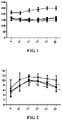
- Fig. 1 The weight of individual rats was monitored throughout the experiment, and the results were shown in Fig. 1 , which revealed the effect of the daily therapeutic administration of compound 59 on the weight of the rats with adjuvant-induced arthritis. It can be seen from Fig. 1 that the rats in the adjuvant-induced arthritis model group were significantly reduced in weight during the observation, and different doses of the compound 59 (5 mg/kg and 20 mg/kg) showed similar effect on the weight.
- Fig. 2 which revealed the effect of the daily therapeutic administration of compound 59 on the disease index of the adjuvant-induced arthritis in rats.
- the rats in the model group presented progressive arthritis, and compared to the model group, the disease index of arthritis in the rats from the compound 59 administration group was significantly lowered (P ⁇ 0.05).
- the rats in the model group suffered from an inflammatory swelling at the ankle joint on the sensitization side and a secondary autoimmune swelling on the opposite side.
- the effect of the daily therapeutic administration of compound 59 on secondary immune lesions was observed in this experiment, and the results were shown in Fig. 3 , which revealed the inhibitory effect of the daily therapeutic administration of compound 59 on secondary foot lesions of the rats with adjuvant-induced arthritis. It can be seen from the results that the rats in the adjuvant-induced arthritis model group underwent significant swelling at the feet during the observation, while compared to the model group, the secondary lesions of the rats in respective compound 59 administration groups were significantly inhibited (P ⁇ 0.05), alleviating the foot swelling.
- the rats in the model group suffered from an inflammatory swelling at the ankle joint on the sensitization side.
- the effect of TMX on the sensitized primary foot inflammatory lesions was observed herein, and the results were shown in Fig. 4 , which revealed the inhibitory effect of the daily therapeutic administration of compound 59 on primary foot lesions of the rats with adjuvant-induced arthritis.
- the rats in the adjuvant-induced arthritis model group underwent significant swelling at the feet during the observation, while compared to the model group, the primary lesions of the rats in respective compound 59 administration groups were significantly inhibited (P ⁇ 0.05), alleviating the foot swelling.
Landscapes
- Chemical & Material Sciences (AREA)
- Organic Chemistry (AREA)
- Health & Medical Sciences (AREA)
- Life Sciences & Earth Sciences (AREA)
- General Health & Medical Sciences (AREA)
- Chemical Kinetics & Catalysis (AREA)
- General Chemical & Material Sciences (AREA)
- Medicinal Chemistry (AREA)
- Nuclear Medicine, Radiotherapy & Molecular Imaging (AREA)
- Pharmacology & Pharmacy (AREA)
- Veterinary Medicine (AREA)
- Animal Behavior & Ethology (AREA)
- Rheumatology (AREA)
- Public Health (AREA)
- Immunology (AREA)
- Orthopedic Medicine & Surgery (AREA)
- Engineering & Computer Science (AREA)
- Bioinformatics & Cheminformatics (AREA)
- Physical Education & Sports Medicine (AREA)
- Pain & Pain Management (AREA)
- Pharmaceuticals Containing Other Organic And Inorganic Compounds (AREA)
- Furan Compounds (AREA)
Description
- The present application relates to pharmaceuticals, particularly to drugs and preparation thereof, and more particularly to tetrahydronaphtho[1,2-b]furan-2(3H)-one derivatives, their preparation and uses in the preparation of a drug for preventing and/or treating rheumatoid arthritis.
- Rheumatoid arthritis (RA), pertaining to autoimmune inflammatory diseases, is a chronic systemic inflammatory disease whose etiology remains unknown and has clinical manifestations mainly of chronic, symmetrical, polysynovial arthritis and extra-articular lesion. This disease frequently occurs in small joints, such as hand, wrist and foot joints, and is prone to recurrent attacks. Moreover, the RA generally shows symmetrical distribution. At the early stage, this disease is often characterized by redness, swelling, pain and dysfunction at the joints, and when it comes to the advanced stage, the joints may suffer from different levels of stiffness and deformity accompanied by atrophy of bones and skeletal muscles, which may easily cause disability. From the perspective of pathological change, the RA is a type of extensive inflammatory diseases which mainly involves synovial membranes (subsequently affecting articular cartilages, bone tissues, joint ligaments and tendons) and secondly involves some connective tissues such as serosa, heart, lung and eye. In addition to the joint lesions, the systemic manifestations of rheumatoid arthritis further include fever, fatigue, pericarditis, subcutaneous nodules, pleurisy, arteritis and peripheral neuropathy. However, there is still lack of effective therapies for RA, and the current treatment is mainly directed against the inflammation and sequelae. Chen, Hao et al., (Discovery of Potent Small-Molecule Inhibitors of Ubiquitin-Conjugating Enzyme UbcH5c from α-Santonin Derivatives, Journal of Medicinal Chemistry 2017 60 (16), 6828-6852) disclosed three series of analogues synthesized from α-santonin and analyzed their UbcH5c inhibitory activities by Western blotting and NF-κB luciferase assay, where compound 6d ((3aS,9bR)-8-((2-Bromobenzyl)oxy)-6,9-dimethyl-3-methylene-3a,4,5,9b-tetrahydronapht ho[1,2-b]furan-2(3H)-one) exhibited robust and specific inhibition of UbcH5c, and was thus suggested to be a promising lead compound for the development of new antirheumatoid arthritis (RA) agent. At present, the drugs for clinically treating RA primarily include non-steroidal anti-inflammatory drugs and adrenal cortical hormones. However, these drugs generally involve serious side effects, such as liver and kidney injury and pulmonary fibrosis, which render them unsuitable for the long-term treatment. Therefore, it is of great significance to develop a safe and effective drug for treating rheumatoid arthritis.
- The invention is defined by the appended claims.
- An object of this application is to provide a safe and effective drug for treating rheumatoid arthritis to overcome the defects in the prior art.
- In a first aspect, this disclosure provides a tetrahydronaphtho[1,2-b]furan-2(3H)-one derivative of formula (II) which is however not part of the invention:
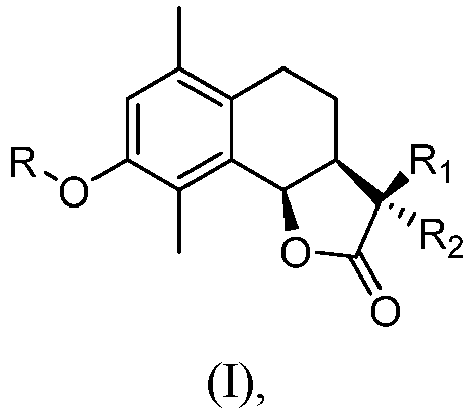
- R is selected from the group consisting of hydrogen, alkyl, cycloalkyl, hydroxy-substituted alkyl, alkenyl, alkynyl, aryl, alkylaryl, arylalkyl, arylalkenyl, arylalkynyl, heterocyclic group, trifluoromethyl, polyfluorosubstituted alkyl, cyano, cyanomethyl, acyl, carbamoyl, sulfonyl, sulfonamido and aryloxyalkyl;
- R1 and R2 together form a terminal double bond; or
- R1 is hydrogen or deuterium; and R2 is

- R3 and R4 are independently selected from the group consisting of hydrogen, alkyl, cycloalkyl, hydroxy-substituted alkyl, alkenyl, alkynyl, aryl, alkylaryl, arylalkyl, arylalkenyl, arylalkynyl, heterocyclic group, trifluoromethyl, polyfluorosubstituted alkyl, cyano, cyanomethyl, acyl, carbamoyl, sulfonyl, sulfonamido and aryloxyalkyl; or R3 and R4 form a cyclic structure with a nitrogen atom, wherein the cyclic structure is a 3- to 9-membered ring and may further comprise a heteroatom or one or more substituents selected from the group consisting of hydrogen, alkyl, cycloalkyl, alkenyl, alkynyl, aryl, alkylaryl, arylalkyl, arylalkenyl, arylalkynyl and heterocyclic group;
- R5 is selected from the group consisting of hydrocarbyl, cycloalkyl, hydroxy-substituted alkyl, alkenyl, alkynyl, aryl, heterocyclic group, aryl-substituted alkyl, arylalkenyl, arylalkynyl, cyano-substituted methyl, alkoxy-substituted alkyl and aryloxy-substituted alkyl;
- Z is selected from the group consisting of fluorine, chlorine, bromine, iodine, p-toluenesulfonate, methanesulfonate, benzenesulfonate and trifluoromethanesulfonate;
- the acid L is an inorganic acid, an organic acid or a sulfonic acid; wherein the inorganic acid is selected from the group consisting of hydrofluoric acid, hydrochloric acid, hydrobromic acid, hydroiodic acid, sulfuric acid, sulfurous acid, nitric acid, phosphoric acid, phosphorous acid, carbonic acid, boric acid, selenious acid and phosphomolybdic acid; the organic acid is an aliphatic or aromatic organic acid, wherein the aliphatic organic acid is selected from the group consisting of acetic acid, propionic acid, hexanoic acid, oxalic acid, trifluoroacetic acid, glycolic acid, lactic acid, pyruvic acid, malonic acid, succinic acid, maleic acid, fumaric acid, hydroxymaleic acid, malic acid, tartaric acid, citric acid, mandelic acid, cinnamic acid and amino acid; the amino acid is selected from glycine, glutamic acid, proline, arginine and lysine; the aromatic organic acid is selected from the group consisting of benzoic acid, salicylic acid, 4-aminosalicylic acid, hydrochloric acid and isonicotinic acid; and the sulfonic acid is selected from methanesulfonic acid, ethanesulfonic acid, 2-hydroxyethanesulfonic acid, 1,2-ethanedisulfonic acid, benzenesulfonic acid, p-toluenesulfonic acid, naphthalene-2-sulfonic acid and camphorsulfonic acid.
- In an embodiment, the tetrahydronaphtho[1,2-b]furan-2(3H)-one derivative of the disclosure is selected from the compounds shown in Table 1.
Table 1 Preferred tetrahydronaphtho[1,2-b]furan-2(3H)-one derivatives ID Structural formula ID Structural formula ID Structural formula 1 
2 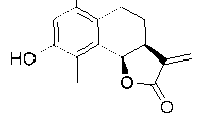
3 
4 
5 
6 
7 
8 
9 
10 
11 
12 
13 
14 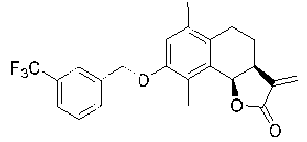
15 
16 
17 
18 
19 
20 
21 
22 
23 
24 
25 
26 
27 
28 
29 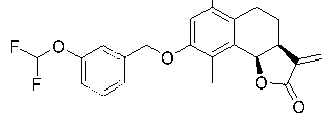
30 
31 
32 
33 
34 
35 
36 
37 
38 
39 
40 
41 
42 
43 
44 
45 
46 
47 
48 
49 
50 
51 
52 
53 
54 
55 
56 
57 
58 
59 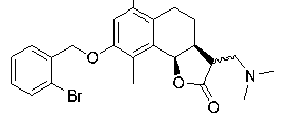
60 
61 
62 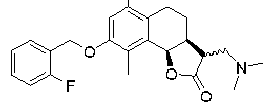
63 
64 
65 
66 
67 
68 
69 
70 
71 
72 
73 
74 
75 
- Notes: respective compounds in Tables 1-3 and Examples share the same ID.
- In a first aspect, the invention provides compound 59 of table 1, its mono HCl salt and its mono fumaric acid salt.
- In a second aspect, the invention further provides a method of preparing the tetrahydronaphtho[1,2-b]furan-2(3H)-one derivative as described above, comprising:
- (1) rearrangement reaction
subj ecting (3aS,5aS,9bS)-5a,9-dimethyl-3 -methylene-3a,5,5a, 9b-tetrahydronaphtho[1,2-b]furan-2,8(3H,4H)-dione (compound ②) to rearrangement reaction under an acidic condition in the presence of a catalyst in a solvent or under a solvent-free condition to form (3aS,9bR)-6,9-dimethyl-3-methylene-2-oxo-2,3,3a,4,5,9b-hexahydronaphtho[1,2-b]furan-8 -yl acetate (compound ③); - (2) hydrolysis
hydrolyzing a phenolic ester bond of thecompound ③ in a solvent under a basic condition in the presence of a catalyst to produce (3aS,9bR)-8-hydroxy-6,9-dimethyl-3-methylene-3a,4,5,9b-tetrahydronaphtho[1,2-b]furan-2(3H)-one (compound ④); - (3) nucleophilic substitution
subjecting a free phenolic hydroxyl group of thecompound ④ and a halogenated alkane to nucleophilic substitution in a solvent in the presence of a base and a catalyst to produce (3aS,9bR)-8-alkoxy-6,9-dimethyl-3-methylene-3a,4,5,9b-tetrahydronaphtho[1,2-b]furan-2( 3H)-one (intermediate I), wherein the halogenated alkane is a halobenzyl or haloalkyl; - (4) Michael addition
subjecting an α-methylene lactone ring of the intermediate I and a nucleophile to Michael addition in a solvent in the presence of a base to form (3R or 3 S,3aS,9bR)-8-substituted alkoxy-3-(substituted) aminomethyl/alkoxy/alkylthio-6,9-dimethyl-3a,4,5,9b-tetrahydronaphtho[1,2-b]furan-2(3H )-one (intermediate II), wherein the nucleophile is an oxygen-containing alcohol or phenol, a nitrogen-containing aliphatic or aromatic amine or a sulfur-containing thiophenol or thiol; and - (5) salt formation
subjecting the intermediate (II) and the acid L to salt-formation reaction in a solvent to produce a pharmaceutically-acceptable salt (compound III) of (3R or 3 S,3aS,9bR)-8-substituted alkoxy-3-disubstituted amino methyl-6,9-dimethyl-3a,4,5,9b-tetrahydronaphtho[1,2-b]furan-2(3H)-one as a target compound, as shown in the following scheme:
- R is selected from the group consisting of hydrogen, alkyl, cycloalkyl, hydroxy-substituted alkyl, alkenyl, alkynyl, aryl, alkylaryl, arylalkyl, arylalkenyl, arylalkynyl, heterocyclic group, trifluoromethyl, polyfluorosubstituted alkyl, cyano, cyanomethyl, acyl, carbamoyl, sulfonyl, sulfonamido and aryloxyalkyl;
- Q is N; R3 and R4 are the same or different;
- R3 and R4 are independently selected from the group consisting of hydrogen, alkyl, cycloalkyl, hydroxy-substituted alkyl, alkenyl, alkynyl, aryl, alkylaryl, arylalkyl, arylalkenyl, arylalkynyl, heterocyclic group, trifluoromethyl, polyfluorosubstituted alkyl, cyano, cyanomethyl, acyl, carbamoyl, sulfonyl, sulfonamido and aryloxyalkyl; or R3 and R4 form a cyclic structure with a nitrogen atom, wherein the cyclic structure is a 3- to 9-membered ring and may further comprise a heteroatom or one or more substituents selected from the group consisting of hydrogen, alkyl, cycloalkyl, alkenyl, alkynyl, aryl, alkylaryl, arylalkyl, arylalkenyl, arylalkynyl and heterocyclic group;
- R5 is selected from the group consisting of hydrocarbyl, cycloalkyl, hydroxy-substituted alkyl, alkenyl, alkynyl, aryl, heterocyclic group, aryl-substituted alkyl, arylalkenyl, arylalkynyl, cyano-substituted methyl, alkoxy-substituted alkyl and aryloxy-substituted alkyl;
- Z is selected from the group consisting of fluorine, chlorine, bromine, iodine, p-toluenesulfonate, methanesulfonate, benzenesulfonate and trifluoromethanesulfonate;
- the acid L is an inorganic acid, an organic acid or a sulfonic acid; wherein the inorganic acid is selected from the group consisting of hydrofluoric acid, hydrochloric acid, hydrobromic acid, hydroiodic acid, sulfuric acid, sulfurous acid, nitric acid, phosphoric acid, phosphorous acid, carbonic acid, boric acid, selenious acid and phosphomolybdic acid; the organic acid is an aliphatic or aromatic organic acid, wherein the aliphatic organic acid is selected from the group consisting of acetic acid, propionic acid, hexanoic acid, oxalic acid, trifluoroacetic acid, glycolic acid, lactic acid, pyruvic acid, malonic acid, succinic acid, maleic acid, fumaric acid, hydroxymaleic acid, malic acid, tartaric acid, citric acid, mandelic acid, cinnamic acid and amino acid; the amino acid is selected from glycine, glutamic acid, proline, arginine and lysine; the aromatic organic acid is selected from the group consisting of benzoic acid, salicylic acid, 4-aminosalicylic acid, hydrochloric acid and isonicotinic acid; and the sulfonic acid is selected from methanesulfonic acid, ethanesulfonic acid, 2-hydroxyethanesulfonic acid, 1,2-ethanedisulfonic acid, benzenesulfonic acid, p-toluenesulfonic acid, naphthalene-2-sulfonic acid and camphorsulfonic acid.
- The rearrangement reaction refers to the rearrangement of the starting
material compound ② to formcompound ③ in the presence of the catalyst at a certain temperature in the solvent or under the solvent-free condition. - In an embodiment, in step (1), the solvent is an aprotic solvent selected from toluene, xylene, tetrahydrofuran, 2-methyltetrahydrofuran, dioxane, dichloromethane and dichloroethane, preferably toluene or tetrahydrofuran; the catalyst is acetic anhydride or acetic acid/sulfuric acid; the rearrangement reaction is performed at -20°C-25°C, preferably -5°C-15°C, and more preferably 0°C-5°C; and a molar ratio of the catalyst to the
compound 2 is 1:20-1:1, preferably 1:10-1:1, and more preferably 1:3-1:1. - The hydrolysis in step (2) refers to the cleavage of the phenolic ester bond in
compound ③ to form thecompound ④ in the presence of the catalyst at a certain temperature in an appropriate solvent. - In an embodiment, in step (2), the solvent is selected from the group consisting of methanol, ethanol, isopropanol, toluene, tetrahydrofuran, 2-methyltetrahydrofuran, dioxane, dichloromethane, dichloroethane, acetone and butanone, preferably methanol or tetrahydrofuran; the catalyst is selected from the group consisting of ammonia water, diethylamine, ethanolamine, formic acid and trifluoroacetic acid, preferably ammonia water; the hydrolysis is performed at -20°C-25°C, preferably -5°C-15°C, and more preferably 0°C-5°C; and a molar ratio of the catalyst to the
compound 3 is 30:1-1:1, preferably 20:1-1:1, and more preferably 5:1-1:1. - The nucleophilic substitution in step (3) refers to a reaction in which the
compound ④ is reacted in an appropriate solvent at a certain temperature in the presence of the base and the catalyst to form the intermediate (I). - In an embodiment, in step (3), the solvent is a protic or aprotic solvent, and is selected from methanol, ethanol, isopropanol, dimethyl sulfoxide, N,N-dimethylformamide, toluene, xylene, tetrahydrofuran, 2-methyltetrahydrofuran, ethyl acetate, dichloromethane, dichloroethane, chloroform, acetone and butanone, preferably acetone, ethanol or tetrahydrofuran; the base is an organic or inorganic base, wherein the organic base is selected from the group consisting of diethylamine, triethylamine, pyridine, piperidine, 4-dimethylaminopyridine, N,N-diisopropylethylamine, 1,8-diazabicycloundec-7-ene and 1,4-diazabicyclo[2.2.2]octane, preferably triethylamine; the inorganic base is selected from the group consisting of sodium hydroxide, potassium hydroxide, potassium carbonate, sodium carbonate, cesium carbonate, potassium bicarbonate, sodium bicarbonate, sodium acetate, potassium acetate, sodium phosphate and potassium phosphate, preferably sodium acetate or potassium acetate; the catalyst is selected from the group consisting of tetrabutylammonium chloride, tetrabutylammonium bromide, tetrabutylammonium iodide, tetrabutylammonium hydrogen sulfate, benzyltriethylammonium chloride and dodecyltriethylammonium chloride, preferably tetrabutylammonium iodide; the nucleophilic substitution is performed at -30°C-60°C, preferably -10°C-35°C, and preferably 0°C-25°C; a molar ratio of the base to the
compound 4 is 6:1-1:1, preferably 3:1-1:1, and more preferably 2:1-1:1; and a molar ratio of the catalyst to thecompound ④ is 1:20-1:1, preferably 1:10-1:1, and more preferably 1:3-1:1. - The Michael-addition reaction in step (4) of the method refers to the addition of the methylene on the α-methylene lactone ring in the intermediate (I) to form the intermediate (II) in an appropriate solvent at a certain temperature in the presence of an organic base.
- In an embodiment, in step (4), the solvent is a protic or aprotic solvent, and is selected from methanol, ethanol, propanol, isopropanol, dimethyl sulfoxide, N,N-dimethylformamide, toluene, xylene, tetrahydrofuran, 2-methyltetrahydrofuran, ethyl acetate, dichloromethane, dichloroethane, chloroform, acetone and butanone, preferably methanol, ethanol or tetrahydrofuran; the base is an organic or inorganic base, wherein the organic base is selected from the group consisting of diethylamine, triethylamine, pyridine, piperidine, 4-dimethylaminopyridine, N,N-diisopropylethylamine, 1,8-diazabicycloundec-7-ene and 1,4-diazabicyclo[2.2.2]octane, preferably triethylamine; the inorganic base is selected from the group consisting of sodium hydroxide, potassium hydroxide, potassium carbonate, sodium carbonate, cesium carbonate, potassium bicarbonate, sodium bicarbonate, sodium acetate, potassium acetate, sodium phosphate and potassium phosphate, preferably sodium acetate or potassium acetate; the Michael addition is performed at -30°C-60°C, preferably, -10°C-35°C, and more preferably 0°C-25°C; and a molar ratio of the base to the intermediate (I) is 8:1-1:1, preferably 5:1-1:1, and more preferably 3:1-1:1.
- The salt-formation reaction in step (5) of the method refers to a reaction in which the intermediate (II) is reacted with a pharmaceutically-acceptable acid to form the target compound (III) in an appropriate solvent at a certain temperature.
- In an embodiment, in step (5), the solvent is a protic or aprotic solvent, and is selected from methanol, ethanol, isopropanol, dimethyl sulfoxide, N,N-dimethylformamide, toluene, xylene, tetrahydrofuran, 2-methyltetrahydrofuran, ethyl acetate, dichloromethane, dichloroethane, chloroform, acetone and butanone, preferably ethanol or dichloromethane; the salt-formation reaction is performed at 0°C-60°C, preferably 5°C-35°C, and more preferably 15°C-25°C; the acid L is an inorganic acid, an organic acid or a sulfonic acid; wherein the inorganic acid is selected from the group consisting of hydrochloric acid, hydrobromic acid, sulfuric acid, nitric acid and phosphoric acid; the organic acid is an aliphatic or aromatic organic acid, wherein the aliphatic organic acid is selected from the group consisting of acetic acid, propionic acid, hexanoic acid, oxalic acid, trifluoroacetic acid, glycolic acid, pyruvic acid, malonic acid, succinic acid, maleic acid, fumaric acid, hydroxymaleic acid, malic acid, tartaric acid, citric acid, mandelic acid, cinnamic acid and amino acid; the amino acid is selected from glycine, glutamic acid, arginine and lysine; the aromatic organic acid is selected from the group consisting of benzoic acid, salicylic acid, 4-aminosalicylic acid, hydrochloric acid and isonicotinic acid; and the sulfonic acid is selected from methanesulfonic acid, ethanesulfonic acid, 2-hydroxyethanesulfonic acid, 1,2-ethanedisulfonic acid, benzenesulfonic acid, p-toluenesulfonic acid, naphthalene-2-sulfonic acid and camphorsulfonic acid; and a molar ratio of the acid L to the intermediate II is 3:1-1:8, preferably 1:1-1:5, and more preferably 1:1-1:3.
- In a third aspect, the invention further provides a pharmaceutical composition comprising tetrahydronaphtho[1,2-b]furan-2(3H)-one derivative of the invention for use in treating rheumatoid arthritis.
- It has been demonstrated by animal experiments that the tetrahydronaphtho[1,2-b]furan-2(3H)-one derivative of the invention can significantly inhibit the adjuvant-induced rheumatoid arthritis in Wistar male rats, so that it can alleviate the primary and secondary lesions, providing a preventive effect to some extent. Therefore, the tetrahydronaphtho[1,2-b]furan-2(3H)-one derivative of the invention is applicable to the preparation of a drug for preventing/treating rheumatoid arthritis. It has still not been reported about the application of the compound of formula (I) or a pharmaceutical composition thereof in the preparation of a drug for preventing/treating rheumatoid arthritis.
- In an embodiment, the pharmaceutical composition comprises the tetrahydronaphtho[1,2-b]furan-2(3H)-one derivative of the invention as an active ingredient and a pharmaceutically-acceptable adjuvant, wherein a dosage form of the pharmaceutical composition is selected from the group consisting of tablet, dispersible tablet, buccal tablet, orally disintegrating tablet, sustained release tablet, capsule, soft capsule, dripping pill, granule, injection, powder injection and aerosol.
-
-
Fig. 1 shows the effect of daily therapeutic administration of compound 59 on weight of rats with adjuvant-induced arthritis, where the abscissa and ordinate respectively represent time (day) and weight (g). -
Fig. 2 shows the effect of daily therapeutic administration of compound 59 on the disease index of the adjuvant-induced arthritis in rats, where the abscissa and ordinate respectively represent time (day) and rheumatoid arthritis clinical disease index. -
Fig. 3 shows the inhibitory effect of daily therapeutic administration of compound 59 on secondary foot lesions in rats with adjuvant-induced arthritis, where the abscissa and ordinate respectively represent time (day) and foot diameter of rats. -
Fig. 4 shows the inhibitory effect of daily therapeutic administration of compound 59 on primary foot lesions in rats with adjuvant-induced arthritis, where the abscissa and ordinate respectively represent time (day) and foot diameter of rats. - The invention will be described in detail below with reference to the embodiments, but these embodiments are not intended to limit the invention.
- Reagents and raw materials used herein are all commercially available or can be prepared according to the previously-published methods. Unless otherwise specified, the experiments mentioned below are performed under normal conditions or under conditions recommended by the manufacturer.
- Those of the following examples which do not fall within the scope of the appended claims are reference examples.
- To a 250 mL round-bottomed flask were added 4.0 g of compound ② (16.4 mmol) and 30 mL of acetic anhydride. Under stirring at 0°C, the reaction mixture was dropwise added with 1 mL of concentrated sulfuric acid and reacted. After the reaction was completed, the reaction mixture was poured into 100 mL of ice water, and then the reaction mixture was extracted with dichloromethane three times each for 50 mL. The organic phases were collected, combined, washed respectively with saturated sodium bicarbonate (100 mL×3) and saturated brine (50 mL×3), dried with anhydrous Na2SO4 and concentrated using a rotary evaporator at 40°C and a vacuum degree of 0.1 MPa to give a crude product. The crude product was purified by silica gel column chromatography to give 3.7 g of
compound ③ with a yield of 78.9%, where a mixture of petroleum ether and ethyl acetate in a ratio of 3:1 was used as an eluent. - 1H NMR (500 MHz, Chloroform-d) δ 6.87 (s, 1H), 6.31 (d, J= 2.0 Hz, 1H), 5.72 (d, J = 1.8 Hz, 1H), 5.57 (d, J= 6.7 Hz, 1H), 3.31 (dddt, J= 8.7, 6.8, 4.8, 1.9 Hz, 1H), 2.75 (ddd, J= 16.7, 6.0, 4.6 Hz, 1H), 2.54 (ddd, J= 16.7, 9.6, 4.5 Hz, 1H), 2.33 (s, 3H), 2.23 (d, J = 3.9 Hz, 6H), 1.99 (ddd, J= 13.6, 10.9, 4.8 Hz, 1H), 1.83 (ddt, J= 13.7, 9.5, 4.8 Hz, 1H).
- 13C NMR (125 MHz, Chloroform-d) δ 170.2, 169.8, 147. 6, 139.8, 134.9, 134.6, 131.1, 129.2, 124.2, 121.8, 74.9, 39.4, 29.9, 26.0, 21.0, 19.7, 12.2.
- 500 mg of compound ③ (1.75 mmol) was added to a 25 mL flask and dissolved with 25 mL of methanol. The reaction mixture was dropwise added with 25 mL of NH3·H2O under stirring at 0°C and reacted. After the reaction was completed, the reaction mixture was evaporated under vacuum to remove the organic solvent and extracted with dichloromethane three times each for 30 mL. The organic phases were collected, combined, washed with 30 mL of saturated brine, dried with anhydrous Na2SO4 and concentrated using a rotary evaporator at 40°C and a vacuum degree of 0.1 MPa to give a crude product. The crude product was purified by silica gel column chromatography to give 315 mg of
compound ④ with a yield of 73.7%, where a mixture of dichloromethane and methanol in a ratio of 20:1 was used as an eluent. - 1H NMR (500 MHz, Chloroform-d) δ 6.68 (s, 1H), 6.30 (d, J= 2.0 Hz, 1H), 5.71 (d, J = 1.8 Hz, 1H), 5.59 (d, J= 6.7 Hz, 1H), 4.66 (s, 1H), 3.30 (dtt, J= 8.6, 4.7, 1.9 Hz, 1H), 2.70 (ddd, J= 16.4, 6.0, 4.5 Hz, 1H), 2.49 (ddd, J= 16.4, 9.6, 4.5 Hz, 1H), 2.31 (s, 3H), 2.19 (s, 3H), 1.96 (ddd, J= 13.5, 10.8, 4.7 Hz, 1H), 1.86- 1.75 (m, 1H).
- 13C NMR (125 MHz, Chloroform-d) δ 170.4, 152.0, 140.1, 134.6, 130.8, 128. 8, 122.5, 121. 6, 117.9, 75.3, 39.6, 26.2, 23.8, 19. 7, 11.4.
- 30 mg of compound ④ (0.12 mmol), 0.027 mL of 2-fluorobenzyl chloride (0.25 mmol), 34 mg of K2CO3 (0.25 mmol) and 90 mg of TBAI (0.25 mmol) were added to a 50 mL flask and dissolved with 5 mL of acetone. The reaction mixture was reacted under stirring at room temperature. After the reaction was completed, the reaction mixture was filtered under vacuum, and the filtrate was evaporated under vacuum to remove the organic solvent and dried with anhydrous Na2SO4 to give a crude product. Then the crude product was purified by silica gel column chromatography to give 41 mg of the target compound (3aS,9bR)-8-(2-fluorobenzyloxy)-6,9-dimethyl-3-methylene-3a,4,5,9b-tetrahydronaphtho[ 1,2-b]furan-2(3H)-one with a yield of 96.3%, where a mixture of petroleum ether and ethyl acetate in a ratio of 5:1 was used as an eluent.
- 1H NMR (500 MHz, Chloroform-d) δ 7.57 - 7.52 (m, 1H), 7.34 - 7.29 (m, 1H), 7.18 (t, J= 7.5 Hz, 1H), 7.12 - 7.06 (m, 1H), 6.84 (s, 1H), 6.30 (d, J= 2.0 Hz, 1H), 5.71 (d, J = 1.8 Hz, 1H), 5.63 (t, J = 6.6 Hz, 1H), 5.16 - 5.09 (m, 2H), 3.31 (ddd, J = 9.6, 6.8, 4.9 Hz, 1H), 2.72 (ddd, J= 16.4, 6.0, 4.5 Hz, 1H), 2.52 (ddd, J = 16.4, 9.6, 4.5 Hz, 1H), 2.36 (s, 3H), 2.24 (s, 3H), 1.97 (ddd, J= 13.5, 10.9, 4.7 Hz, 1H), 1.82 (dtd, J= 13.9, 9.6, 4.4 Hz, 1H).
- 13C NMR (125 MHz, Chloroform-d) δ 170.4, 154.9, 140.2, 134.2, 130.7, 129.5, 129.5, 129.0, 126.4, 124.4, 124.4, 121.5, 115.4, 115.2, 75.2, 64.5, 64.5, 39.6, 26.3, 23.8, 20.1, 11.7.
- Compounds 4-58 in Table 1 were synthesized according to the process in Example 3.
-
Compound 4 was prepared with a yield of 65.0%. - 1H NMR (500 MHz, Chloroform-d) δ 7.55 (dd, J= 8.1, 7.1 Hz, 1H), 7.22 (dd, J= 9.3, 1.8 Hz, 1H), 7.12-7.08 (m, 1H), 6.73 (s, 1H), 6.31 (d, J = 2.0 Hz, 1H), 5.71 (d, J = 1.8 Hz, 1H), 5.62 (d, J= 6.7 Hz, 1H), 5.01 (s, 2H), 3.32 (ddd, J= 9.5, 6.9, 4.9 Hz, 1H), 2.71 (ddd, J = 16.4, 6.2, 4.5 Hz, 1H), 2.52 (ddd, J= 16.3, 9.4, 4.4 Hz, 1H), 2.36 (s, 3H), 2.22 (s, 3H), 1.97 (ddd, J= 13.5, 11.0, 4.7 Hz, 1H), 1.82 (dtd, J= 13.8, 9.5, 4.4 Hz, 1H).
- 13C NMR (125 MHz, Chloroform-d) δ 170.3, 154.6, 140.1, 139.5, 139.5, 134.2, 133.7, 130.9, 129.2, 126.3, 123.7, 123.7, 121.6, 115.3, 115.0, 75.2, 69.3, 39.6, 26.3, 23.7, 20.1, 11.8.
- Compound 5 was prepared with a yield of 60.6%.
- 1H NMR (500 MHz, Chloroform-d) δ 7.66 (d, J= 8.1 Hz, 2H), 7.56 (d, J= 8.0 Hz, 2H), 6.77 (s, 1H), 6.31 (d, J= 2.0 Hz, 1H), 5.72 (d, J = 1.8 Hz, 1H), 5.63 (d, J= 6.7 Hz, 1H), 5.12 (s, 2H), 3.32 (dtd, J= 9.5, 4.9, 2.9 Hz, 1H), 2.72 (ddd, J= 16.4, 6.2, 4.5 Hz, 1H), 2.52 (ddd, J= 16.4, 9.4, 4.4 Hz, 1H), 2.38 (s, 3H), 2.23 (s, 3H), 2.01 - 1.94 (m, 1H), 1.83 (dtd, J= 13.8, 9.5, 4.4 Hz, 1H).
- 13C NMR (125 MHz, Chloroform-d) δ 170.3, 154.7, 141.7, 140.1, 134.2, 130.9, 129.1, 127.2(4C), 126.3, 125.7, 125.7, 121.6, 115.0, 75.2, 69.8, 39.6, 26.3, 23.8, 20.1, 11.8.
- Compound 6 was prepared with a yield of 99.7%.
- 1H NMR (500 MHz, Chloroform-d) δ 6.94 (d, J= 15.0 Hz, 2H), 6.83 (s, 1H), 6.31 (d, J= 2.0 Hz, 1H), 5.72 (d, J= 1.3 Hz, 1H), 5.61 (dd, J= 14.2, 6.7 Hz, 1H), 5.04 - 4.92 (m, 2H), 3.35 - 3.27 (m, 1H), 2.78 - 2.66 (m, 1H), 2.54 (ddq, J= 19.0, 9.5, 4.4 Hz, 1H), 2.39 - 2.24 (m, 15H), 1.97 (ddd, J = 9.0, 4.5, 1.6 Hz, 1H), 1.85 - 1.82 (m, 1H).
- 13C NMR (125 MHz, Chloroform-d) δ 170.5, 155.6, 152.1, 140.2, 138.2(2C), 134.1, 130.6, 130.4, 129.1(2C), 129.0, 128.5, 126.4, 121.5, 117.9, 114.8, 75.3, 65.3, 39.6, 29.8, 26.4, 23.8, 19.6, 11.6.
- Compound 7 was prepared with a yield of 87.0%.
- 1H NMR (500 MHz, Chloroform-d) δ 7.30 (t, J= 7.9 Hz, 1H), 7.02 (d, J= 7.2 Hz, 2H), 6.89 - 6.84 (m, 1H), 6.80 (s, 1H), 6.30 (d, J= 2.0 Hz, 1H), 5.71 (d, J= 1.7 Hz, 1H), 5.63 (d, J= 6.7 Hz, 1H), 5.04 (s, 2H), 3.83 (s, 3H), 3.31 (ddd, J= 9.5, 6.8, 4.9 Hz, 1H), 2.71 (dt, J= 16.4, 5.3 Hz, 1H), 2.56 - 2.47 (m, 1H), 2.37 (s, 3H), 2.23 (s, 3H), 1.96 (ddd, J = 13.5, 10.9, 4.7 Hz, 1H), 1.82 (dtd, J = 13.8, 9.6, 4.4 Hz, 1H).
- 13C NMR (125 MHz, Chloroform-d) δ 170.4, 159.9, 155.1, 140.2, 139.2, 134.1, 130.7, 129.7, 128.7, 126.3, 121.5, 119.4, 115.2, 113.4, 112.8, 75.3, 70.5, 55.4, 39.6, 26.3, 23.8, 20.1, 11.8.
- Compound 8 was prepared with a yield of 39.3%.
- 1H NMR (500 MHz, Chloroform-d) δ 8.08 - 8.04 (m, 1H), 7.92 - 7.88 (m, 1H), 7.86 (d, J= 8.3 Hz, 1H), 7.62 (d, J= 6.9 Hz, 1H), 7.56 - 7.51 (m, 2H), 7.51 - 7.46 (m, 1H), 6.96 (s, 1H), 6.31 (d, J = 1.6 Hz, 1H), 5.71 (s, 1H), 5.63 (d, J= 6.6 Hz, 1H), 5.48 (s, 2H), 3.31 (dd, J= 4.7, 2.6 Hz, 1H), 2.74 (dt, J= 16.4, 5.2 Hz, 1H), 2.54 (ddd, J = 16.1, 9.4, 4.4 Hz, 1H), 2.31 (s, 3H), 2.27 (s, 3H), 1.98 (dq, J= 15.5, 4.9 Hz, 1H), 1.84 (dtd, J= 13.8, 9.6, 4.4 Hz, 1H).
- 13C NMR (125 MHz, Chloroform-d) δ 170.4, 155.2, 140.2, 134.2, 133.9, 132.9, 131.6, 130.8, 129.0, 128.8, 126.5, 126.5, 126.3, 126.0, 125.5, 123.8, 121.5, 115.1, 75.3, 69.3, 39.6, 29.8, 26.4, 23.8, 20.2, 11.7.
- Compound 9 was prepared with a yield of 85.3%.
- 1H NMR (500 MHz, Chloroform-d) δ 7.40 (d, J= 8.0 Hz, 2H), 7.28 (dd, J= 7.5, 0.9 Hz, 1H), 7.00 (s, 1H), 6.33 (d, J= 2.0 Hz, 1H), 5.74 (d, J= 1.7 Hz, 1H), 5.63 (d, J= 6.7 Hz, 1H), 5.27 (s, 2H), 3.33 (ddd, J= 9.5, 6.8, 4.9 Hz, 1H), 2.79 - 2.73 (m, 1H), 2.56 (ddd, J= 16.3, 9.5, 4.5 Hz, 1H), 2.32 (s, 3H), 2.31 (s, 3H), 2.00 (ddd, J= 13.4, 10.8, 4.8 Hz, 1H), 1.85 (dtd, J = 13.9, 9.6, 4.4 Hz, 1H).
- 13C NMR (125 MHz, Chloroform-d) δ 170.4, 155.1, 140.2, 137.1, 134.2, 132.6, 130.7, 130.4, 129.3, 128.6(3C), 127.0, 121.4, 116.0, 75.3, 66.3, 39.6, 26.3, 23.8, 20.1, 11.6.
-
Compound 10 was prepared with a yield of 85.5%. - 1H NMR (500 MHz, Chloroform-d) δ 7.77 - 7.62 (m, 3H), 7.44 (t, J = 7.6 Hz, 1H), 6.84 (s, 1H), 6.31 (d, J= 2.0 Hz, 1H), 5.72 (d, J= 1.8 Hz, 1H), 5.63 (d, J= 6.7 Hz, 1H), 5.25 (d, J= 5.0 Hz, 2H), 3.32 (ddd, J = 9.6, 6.9, 4.9 Hz, 1H), 2.72 (dt, J= 16.3, 5.2 Hz, 1H), 2.57 - 2.47 (m, 1H), 2.38 (s, 3H), 2.25 (s, 3H), 1.97 (ddd, J= 13.5, 11.0, 4.7 Hz, 1H), 1.82 (dtd, J= 13.9, 9.6, 4.4 Hz, 1H).
- 13C NMR (125 MHz, Chloroform-d) δ 170.4, 154.4, 141.2, 140.1, 134.4, 133.3, 132.9, 130.9, 129.4, 128.4, 128.3, 126.3, 121.6, 117.2, 115.1, 111.0, 75.2, 68.1, 39.6, 26.3, 23.8, 20.1, 11.8.
- Compound 11 was prepared with a yield of 89.3%.
- 1H NMR (500 MHz, Chloroform-d) δ 7.35 (td, J = 7.9, 5.9 Hz, 1H), 7.21 (d, J= 7.6 Hz, 1H), 7.16 (d, J = 9.6 Hz, 1H), 7.01 (td, J= 8.4, 2.2 Hz, 1H), 6.77 (s, 1H), 6.31 (d, J = 2.0 Hz, 1H), 5.72 (d, J= 1.8 Hz, 1H), 5.63 (d, J = 6.7 Hz, 1H), 5.05 (s, 2H), 3.31 (dtd, J = 9.6, 4.9, 2.9 Hz, 1H), 2.71 (ddd, J= 16.4, 6.1, 4.5 Hz, 1H), 2.51 (ddd, J= 16.3, 9.6, 4.5 Hz, 1H), 2.37 (s, 3H), 2.23 (s, 3H), 2.01 - 1.93 (m, 1H), 1.82 (dtd, J = 13.9, 9.6, 4.4 Hz, 1H).
- 13C NMR (125 MHz, Chloroform-d) δ 170.4, 164.1, 154.8, 140.2, 140.1, 134.2, 130.8, 130.3, 130.2, 129.0, 126.3, 122.6, 121.6, 115.0, 114.1, 75.2, 69.8, 39.6, 26.3, 23.8, 20.2, 11.8.
-
Compound 12 was prepared with a yield of 96.8%. - 1H NMR (500 MHz, Chloroform-d) δ 7.45 - 7.42 (m, 1H), 7.34 - 7.28 (m, 3H), 6.76 (s, 1H), 6.31 (d, J= 2.0 Hz, 1H), 5.71 (d, J = 1.8 Hz, 1H), 5.63 (d, J = 6.7 Hz, 1H), 5.03 (s, 2H), 3.31 (dtd, J= 9.5, 4.9, 2.9 Hz, 1H), 2.71 (ddd, J= 16.4, 6.2, 4.5 Hz, 1H), 2.52 (ddd, J = 16.4, 9.5, 4.4 Hz, 1H), 2.37 (s, 3H), 2.23 (s, 3H), 1.96 (ddt, J= 9.5, 6.1, 4.8 Hz, 1H), 1.82 (dtd, J= 13.8, 9.5, 4.4 Hz, 1H).
- 13C NMR (125 MHz, Chloroform-d) δ 170.4, 154.8, 140.1, 139.7, 134.6, 134.2, 130.9, 130.0, 129.0, 128.1, 127.3, 126.3, 125.2, 121.5, 115.2, 75.2, 69.9, 39.6, 26.3, 23.8, 20.1, 11.8.
-
Compound 13 was prepared with a yield of 99.8%. - 1H NMR (500 MHz, Chloroform-d) δ 7.59 (s, 1H), 7.46 (d, J= 7.9 Hz, 1H), 7.37 (d, J = 7.7 Hz, 1H), 7.27 (d, J= 7.4 Hz, 1H), 6.76 (s, 1H), 6.31 (d, J= 2.0 Hz, 1H), 5.71 (d, J = 1.8 Hz, 1H), 5.63 (d, J= 6.7 Hz, 1H), 5.02 (s, 2H), 3.32 (ddd, J= 9.5, 6.9, 4.9 Hz, 1H), 2.72 (ddd, J = 16.4, 6.1, 4.5 Hz, 1H), 2.52 (ddd, J= 16.3, 9.4, 4.4 Hz, 1H), 2.37 (s, 3H), 2.23 (s, 3H), 1.97 (ddd, J= 13.5, 11.0, 4.7 Hz, 1H), 1.82 (dtd, J= 13.8, 9.5, 4.4 Hz, 1H).
- 13C NMR (125 MHz, Chloroform-d) δ 170.4, 154.8, 140.1, 139.9, 134.2, 131.0, 130.9, 130.3, 130.2, 129.1, 126.3, 125.7, 122.8, 121.5, 115.2, 75.2, 69.8, 39.6, 26.3, 23.8, 20.1, 11.8.
-
Compound 14 was prepared with a yield of 84.5%. - 1H NMR (500 MHz, Chloroform-d) δ 7.70 (s, 1H), 7.65 (d, J= 7.6 Hz, 1H), 7.59 (d, J = 7.8 Hz, 1H), 7.52 (t, J = 7.7 Hz, 1H), 6.79 (s, 1H), 6.31 (d, J= 2.1 Hz, 1H), 5.71 (d, J = 1.8 Hz, 1H), 5.63 (d, J= 6.7 Hz, 1H), 5.10 (s, 2H), 3.32 (ddd, J = 9.6, 6.9, 4.9 Hz, 1H), 2.72 (ddd, J = 16.4, 6.2, 4.5 Hz, 1H), 2.52 (ddd, J= 16.4, 9.5, 4.4 Hz, 1H), 2.37 (s, 3H), 2.23 (s, 3H), 2.02 - 1.93 (m, 1H), 1.83 (dtd, J= 13.8, 9.5, 4.5 Hz, 1H).
- 13C NMR (125 MHz, Chloroform-d) δ 170.4, 154.8, 140.1, 138.6, 134.3, 130.9, 130.5, 129.2(2C), 129.2, 126.4, 125.3, 124.8, 124.0, 121.5, 115.2, 75.2, 70.0, 39.6, 26.3, 23.8, 20.1, 11.7.
-
Compound 15 was prepared with a yield of 70.7%. - 1H NMR (500 MHz, Chloroform-d) δ 8.31 (s, 1H), 8.19 (d, J= 8.2 Hz, 1H), 7.80 (d, J = 7.3 Hz, 1H), 7.58 (t, J = 7.9 Hz, 1H), 6.77 (s, 1H), 6.31 (d, J= 2.0 Hz, 1H), 5.72 (d, J = 1.8 Hz, 1H), 5.64 (dd, J = 6.4, 2.7 Hz, 1H), 5.15 (s, 2H), 3.32 (d, J= 4.6 Hz, 1H), 2.71 (dd, J= 15.5, 5.4 Hz, 1H), 2.57 - 2.52 (m, 1H), 2.37 (d, J= 10.9 Hz, 3H), 2.23 (s, 3H), 1.98 (dd, J= 13.6, 6.1 Hz, 1H), 1.88 - 1.80 (m, 1H).
- Compound 16 was prepared with a yield of 92.8%.
- 1H NMR (500 MHz, Chloroform-d) δ 7.45 - 7.37 (m, 2H), 7.10 - 7.06 (m, 2H), 6.79 (s, 1H), 6.31 (d, J= 2.0 Hz, 1H), 5.71 (d, J= 1.8 Hz, 1H), 5.62 (d, J = 6.7 Hz, 1H), 5.01 (s, 2H), 3.31 (dtd, J= 9.5, 4.9, 2.9 Hz, 1H), 2.72 (ddd, J = 16.4, 6.2, 4.5 Hz, 1H), 2.55 - 2.48 (m, 1H), 2.35 (s, 3H), 2.23 (s, 3H), 1.96 (ddt, J= 9.6, 6.2, 4.8 Hz, 1H), 1.82 (dtd, J= 13.9, 9.6, 4.4 Hz, 1H).
- 13C NMR (125 MHz, Chloroform-d) δ 170.4, 163.5, 155.0, 140.1, 134.1, 133.3, 130.8, 129.1, 129.1, 128.9, 126.3, 121.5, 115.7, 115.5, 115.3, 75.2, 70.1, 39.6, 26.3, 23.8, 20.1, 11.7.
- Compound 17 was prepared with a yield of 85.0%.
- 1H NMR (500 MHz, Chloroform-d) δ 7.46 - 7.43 (m, 2H), 7.39 (t, J= 7.5 Hz, 2H), 7.33 (t, J= 7.3 Hz, 1H), 6.81 (s, 1H), 6.31 (d, J= 2.0 Hz, 1H), 5.71 (d, J= 1.8 Hz, 1H), 5.63 (d, J= 6.7 Hz, 1H), 5.06 (s, 2H), 3.31 (dtd, J = 9.6, 4.9, 2.9 Hz, 1H), 2.72 (ddd, J= 16.4, 6.1, 4.5 Hz, 1H), 2.52 (ddd, J = 16.3, 9.5, 4.4 Hz, 1H), 2.37 (s, 3H), 2.23 (s, 3H), 2.00 - 1.93 (m, 1H), 1.82 (dtd, J= 13.8, 9.6, 4.4 Hz, 1H).
- 13C NMR (125 MHz, Chloroform-d) δ 170.4, 155.1, 140.2, 137.6, 134.1, 130.7, 128.7, 128.7(2C), 127.9, 127.3(2C), 126.3, 121.5, 115.2, 75.3, 70.7, 39.6, 26.4, 23.8, 20.1, 11.7.
-
Compound 18 was prepared with a yield of 99.2%. - 1H NMR (500 MHz, Chloroform-d) δ 7.37 (d, J = 1.2 Hz, 4H), 6.76 (s, 1H), 6.31 (d, J = 2.0 Hz, 1H), 5.71 (d, J= 1.8 Hz, 1H), 5.62 (d, J= 6.7 Hz, 1H), 5.02 (s, 2H), 3.31 (ddd, J = 9.6, 6.9, 4.9 Hz, 1H), 2.71 (ddd, J= 16.4, 6.1, 4.5 Hz, 1H), 2.51 (ddd, J= 16.4, 9.5, 4.4 Hz, 1H), 2.35 (s, 3H), 2.22 (s, 3H), 2.00 - 1.93 (m, 1H), 1.82 (dtd, J = 13.9, 9.5, 4.4 Hz, 1H).
- 13C NMR (125 MHz, Chloroform-d) δ 170.4, 154.9, 140.1, 136.1, 134.2, 133.7, 130.8, 128.9, 128.9(2C), 128.6(2C), 126.3, 121.5, 115.2, 75.2, 69.9, 39.6, 26.3, 23.8, 20.1, 11.7.
- Compound 19 was prepared with a yield of 98.2%.
- 1H NMR (500 MHz, Chloroform-d) δ 7.33 (d, J = 8.0 Hz, 2H), 7.20 (d, J= 7.8 Hz, 2H), 6.81 (s, 1H), 6.30 (d, J= 2.0 Hz, 1H), 5.71 (d, J= 1.8 Hz, 1H), 5.62 (d, J= 6.7 Hz, 1H), 5.01 (s, 2H), 3.30 (dtd, J= 9.6, 4.9, 2.9 Hz, 1H), 2.71 (ddd, J = 16.3, 6.1, 4.5 Hz, 1H), 2.51 (ddd, J= 16.3, 9.5, 4.4 Hz, 1H), 2.37 (s, 3H), 2.35 (s, 3H), 2.23 (s, 3H), 1.96 (ddt, J= 9.5, 6.1, 4.8 Hz, 1H), 1.82 (dtd, J= 13.9, 9.6, 4.4 Hz, 1H).
- 13C NMR (125 MHz, Chloroform-d) δ 170.5, 155.2, 140.2, 137.7, 134.5, 134.1, 130.6, 129.3(2C), 128.6, 127.4(2C), 126.3, 121.4, 115.3, 75.3, 70.7, 39.6, 26.4, 23.8, 21.3, 20.1, 11.7.
- Compound 20 was prepared with a yield of 96.7%.
- 1H NMR (500 MHz, Chloroform-d) δ 7.67 (s, 1H), 7.63 - 7.59 (m, 2H), 7.58 - 7.54 (m, 1H), 7.49 - 7.42 (m, 4H), 7.39 - 7.34 (m, 1H), 6.84 (s, 1H), 6.31 (d, J= 2.0 Hz, 1H), 5.71 (d, J= 1.8 Hz, 1H), 5.63 (d, J = 6.7 Hz, 1H), 5.12 (s, 2H), 3.31 (ddd, J= 9.6, 6.8, 4.9 Hz, 1H), 2.72 (ddd, J= 16.3, 6.1, 4.5 Hz, 1H), 2.52 (ddd, J= 16.3, 9.5, 4.5 Hz, 1H), 2.39 (s, 3H), 2.24 (s, 3H), 1.97 (ddd, J= 13.5, 11.0, 4.7 Hz, 1H), 1.83 (dtd, J= 13.8, 9.6, 4.4 Hz, 1H).
- 13C NMR (125 MHz, Chloroform-d) δ 170.4, 155.1, 141.7, 141.1, 140.2, 138.1, 134.1, 130.8, 129.1, 129.0(2C), 128.8, 127.5, 127.3(2C), 126.8, 126.4, 126.2, 126.1, 121.5, 115.3, 75.3, 70.8, 39.6, 26.3, 23.8, 20.1, 11.8.
- Compound 21 was prepared with a yield of 81.0%.
- 1H NMR (500 MHz, Chloroform-d) δ 7.32 (tt, J= 8.4, 6.5 Hz, 1H), 6.93 (h, J = 4.0 Hz, 3H), 6.30 (d, J = 2.0 Hz, 1H), 5.70 (d, J= 1.8 Hz, 1H), 5.59 (d, J= 6.7 Hz, 1H), 5.09 (s, 2H), 3.29 (dddt, J= 8.6, 6.7, 4.8, 1.8 Hz, 1H), 2.72 (ddd, J= 16.4, 6.1, 4.5 Hz, 1H), 2.56 - 2.48 (m, 1H), 2.26 (d, J= 6.5 Hz, 6H), 2.01 - 1.90 (m, 1H), 1.81 (dtd, J= 13.9, 9.6, 4.4 Hz, 1H).
- 13C NMR (125 MHz, Chloroform-d) δ 170.4, 161.1, 161.1, 155.0, 140.2, 134.2, 130.7, 130.7, 130.6, 129.4, 127.0, 121.4, 116.1, 111.6, 111.4, 75.2, 59.2, 39.6, 26.3, 23.8, 20.1, 11.5.
- Compound 22 was prepared with a yield of 93.5%.
- 1H NMR (500 MHz, Chloroform-d) δ 7.28 (s, 1H), 7.07 - 6.96 (m, 2H), 6.80 (s, 1H), 6.31 (d, J= 1.9 Hz, 1H), 5.71 (d, J= 1.7 Hz, 1H), 5.63 (d, J = 6.7 Hz, 1H), 5.09 (s, 2H), 3.35 - 3.28 (m, 1H), 2.72 (dt, J= 16.4, 5.3 Hz, 1H), 2.56 - 2.48 (m, 1H), 2.37 (s, 3H), 2.24 (s, 3H), 2.01 - 1.93 (m, 1H), 1.82 (dtd, J= 13.8, 9.5, 4.3 Hz, 1H).
- 13C NMR (125 MHz, Chloroform-d) δ 170.4, 154.6, 140.1, 134.3, 130.9, 129.3, 126.3, 121.5, 116.4, 115.9, 115.8, 115.7, 115.7, 115.6, 115.1, 75.2, 63.9, 39.6, 26.3, 23.8, 20.1, 11.7.
- Compound 23 was prepared with a yield of 83.3%.
- 1H NMR (500 MHz, Chloroform-d) δ 7.53 - 7.46 (m, 1H), 6.95 - 6.88 (m, 1H), 6.85 (ddd, J = 10.2, 8.9, 2.5 Hz, 1H), 6.82 (s, 1H), 6.31 (d, J = 2.0 Hz, 1H), 5.71 (d, J = 1.8 Hz, 1H), 5.62 (d, J = 6.7 Hz, 1H), 5.10 - 5.02 (m, 2H), 3.31 (dtd, J = 9.5, 4.9, 2.9 Hz, 1H), 2.72 (ddd, J = 16.4, 6.1, 4.5 Hz, 1H), 2.52 (ddd, J= 16.3, 9.5, 4.4 Hz, 1H), 2.34 (s, 3H), 2.24 (s, 3H), 2.00 - 1.93 (m, 1H), 1.82 (dtd, J = 13.8, 9.6, 4.4 Hz, 1H).
- 13C NMR (125 MHz, Chloroform-d) δ 170.4, 154.7, 140.1, 134.2, 130.8, 130.5, 129.2, 126.4, 121.5, 115.3, 111.5, 104.1, 103.9, 103.7, 75.2, 64.1, 64.1, 39.6, 26.3, 23.8, 20.1, 11.7.
- Compound 24 was prepared with a yield of 85.2%.
- 1H NMR (500 MHz, Chloroform-d) δ 6.97 (dd, J = 7.9, 2.2 Hz, 2H), 6.78 - 6.71 (m, 2H), 6.31 (d, J= 2.1 Hz, 1H), 5.71 (d, J = 1.8 Hz, 1H), 5.63 (d, J = 6.7 Hz, 1H), 5.03 (s, 2H), 3.32 (ddd, J = 9.6, 6.9, 4.9 Hz, 1H), 2.72 (ddd, J= 16.3, 6.2, 4.5 Hz, 1H), 2.52 (ddd, J = 16.4, 9.4, 4.5 Hz, 1H), 2.38 (s, 3H), 2.23 (s, 3H), 1.97 (ddd, J = 13.5, 11.0, 4.7 Hz, 1H), 1.83 (dtd, J= 13.9, 9.6, 4.5 Hz, 1H).
- 13C NMR (125 MHz, Chloroform-d) δ 170.3, 164.4, 154.5, 140.1, 134.3, 131.0, 129.2, 126.3, 121.6, 115.0, 109.8, 109.6, 103.4, 103.2, 103.0, 75.1, 69.4, 39.6, 26.3, 23.8, 20.1, 11.8.
- Compound 25 was prepared with a yield of 95.9%.
- 1H NMR (500 MHz, Chloroform-d) δ 7.53 (d, J = 8.3 Hz, 1H), 7.29 (dd, J = 8.3, 2.1 Hz, 1H), 7.26 - 7.24 (m, 1H), 6.77 (s, 1H), 6.30 (d, J= 2.0 Hz, 1H), 5.72 (d, J= 1.8 Hz, 1H), 5.62 (d, J = 6.7 Hz, 1H), 5.09 (s, 2H), 3.31 (dddt, J = 8.7, 6.7, 4.7, 1.8 Hz, 1H), 2.71 (ddd, J = 16.4, 6.1, 4.5 Hz, 1H), 2.51 (ddd, J = 16.4, 9.5, 4.5 Hz, 1H), 2.37 (s, 3H), 2.23 (s, 3H), 1.96 (ddt, J = 9.6, 6.1, 4.8 Hz, 1H), 1.81 (dtd, J = 13.9, 9.6, 4.4 Hz, 1H).
- 13C NMR (125 MHz, Chloroform-d) δ 170.4, 154.5, 140.0, 137.0, 134.3, 133.9, 133.1, 130.8, 129.5, 129.2, 129.2, 127.4, 126.2, 121.6, 115.0, 75.2, 67.2, 39.5, 26.2, 23.7, 20.1, 11.7.
- Compound 26 was prepared with a yield of 92.9%.
- 1H NMR (500 MHz, Chloroform-d) δ 7.53 (d, J = 1.9 Hz, 1H), 7.46 (d, J = 8.2 Hz, 1H), 7.29 - 7.26 (m, 1H), 6.74 (s, 1H), 6.31 (d, J= 2.0 Hz, 1H), 5.71 (d, J = 1.8 Hz, 1H), 5.62 (d, J = 6.7 Hz, 1H), 5.00 (s, 2H), 3.32 (ddd, J = 9.5, 6.9, 4.9 Hz, 1H), 2.71 (ddd, J = 16.4, 6.1, 4.5 Hz, 1H), 2.52 (ddd, J = 16.4, 9.5, 4.5 Hz, 1H), 2.36 (s, 3H), 2.22 (s, 3H), 1.97 (ddd, J= 13.5, 11.0, 4.7 Hz, 1H), 1.82 (dtd, J = 13.8, 9.5, 4.4 Hz, 1H).
- 13C NMR (125 MHz, Chloroform-d) δ 170.4, 154.6, 140.0, 137.9, 134.3, 132.8, 131.9, 130.9, 130.7, 129.2, 129.1, 126.4, 126.3, 121.6, 115.1, 75.2, 69.3, 39.6, 26.3, 23.7, 20.1, 11.8.
- Compound 27 was prepared with a yield of 90.7%.
- 1H NMR (500 MHz, Chloroform-d) δ 7.92 (s, 2H), 7.85 (s, 1H), 6.78 (s, 1H), 6.32 (d, J = 2.1 Hz, 1H), 5.72 (d, J = 1.8 Hz, 1H), 5.63 (d, J = 6.7 Hz, 1H), 5.15 (s, 2H), 3.33 (ddd, J = 9.5, 7.0, 5.0 Hz, 1H), 2.73 (ddd, J = 16.4, 6.3, 4.5 Hz, 1H), 2.58 - 2.49 (m, 1H), 2.38 (s, 3H), 2.24 (s, 3H), 1.98 (ddd, J = 13.6, 11.1, 4.7 Hz, 1H), 1.84 (dtd, J= 13.8, 9.5, 4.4 Hz, 1H).
- 13C NMR (125 MHz, Chloroform-d) δ 170.3, 154.5, 140.3, 140.0, 134.4, 132.2, 131.9, 131.2, 129.7, 127.2, 127.2, 126.4, 124.5, 122.3, 122.0, 121.6, 115.2, 75.1, 69.4, 39.5, 26.2, 23.8, 20.1, 11.7.
- Compound 28 was prepared with a yield of 94.1%.
- 1H NMR (500 MHz, Chloroform-d) δ 7.36 (d, J = 8.7 Hz, 2H), 6.93 (d, J = 8.7 Hz, 2H), 6.82 (s, 1H), 6.30 (d, J = 2.0 Hz, 1H), 5.71 (d, J = 1.8 Hz, 1H), 5.62 (d, J = 6.7 Hz, 1H), 4.98 (s, 2H), 3.83 (s, 3H), 3.30 (dtd, J= 9.6, 4.9, 3.0 Hz, 1H), 2.71 (ddd, J= 16.4, 6.1, 4.5 Hz, 1H), 2.52 (ddd, J = 16.3, 9.5, 4.4 Hz, 1H), 2.34 (s, 3H), 2.23 (s, 3H), 2.00 - 1.93 (m, 1H), 1.82 (dtd, J = 13.9, 9.6, 4.4 Hz, 1H).
- 13C NMR (125 MHz, Chloroform-d) δ 170.4, 159.4, 155.2, 140.2, 134.0, 130.6, 129.6, 129.5, 129.0(2C), 128.6, 121.4, 115.4, 114.1(2C), 113.9, 75.3, 70.5, 39.6, 26.3, 23.7, 20.1, 11.7.
- Compound 29 was prepared with a yield of 94.8%.
- 1H NMR (500 MHz, Chloroform-d) δ 7.39 (t, J = 7.9 Hz, 1H), 7.31 - 7.27 (m, 1H), 7.22 (s, 1H), 7.08 (dd, J = 8.1, 1.9 Hz, 1H), 6.78 (s, 1H), 6.53 (t, J = 73.9 Hz, 1H), 6.31 (d, J = 2.0 Hz, 1H), 5.71 (d, J = 1.8 Hz, 1H), 5.63 (d, J = 6.7 Hz, 1H), 5.05 (s, 2H), 3.32 (dtd, J = 9.6, 4.9, 2.9 Hz, 1H), 2.72 (ddd, J = 16.4, 6.2, 4.5 Hz, 1H), 2.52 (ddd, J = 16.3, 9.5, 4.4 Hz, 1H), 2.37 (s, 3H), 2.23 (s, 3H), 1.97 (ddt, J = 13.5, 6.1, 4.7 Hz, 1H), 1.82 (dtd, J = 13.8, 9.5, 4.4 Hz, 1H).
- 13C NMR (125 MHz, Chloroform-d) δ 170.4, 154.8, 151.6, 140.1, 139.9, 134.2, 130.9, 130.1, 129.0, 126.3, 124.0, 121.5, 118.8, 118.3, 116.0, 115.2, 75.2, 70.0, 39.6, 26.3, 23.8, 20.1, 11.7.
- Compound 30 was prepared with a yield of 95.2%.
- 1H NMR (500 MHz, Chloroform-d) δ 7.29 (d, J = 7.3 Hz, 1H), 7.14 (dt, J = 14.9, 7.1 Hz, 2H), 6.86 (s, 1H), 6.30 (d, J = 2.0 Hz, 1H), 5.71 (d, J = 1.8 Hz, 1H), 5.62 (d, J = 6.7 Hz, 1H), 5.02 (s, 2H), 3.31 (ddd, J = 9.6, 6.8, 4.9 Hz, 1H), 2.73 (ddd, J = 16.4, 6.1, 4.5 Hz, 1H), 2.53 (ddd, J = 16.3, 9.5, 4.4 Hz, 1H), 2.38 - 2.12 (m, 12H), 1.97 (ddd, J= 13.5, 10.9, 4.7 Hz, 1H), 1.83 (ddt, J = 13.6, 9.5, 4.8 Hz, 1H).
- 13C NMR (125 MHz, Chloroform-d) δ 170.4, 155.2, 140.2, 137.2, 135.5, 135.2, 134.1, 130.7, 130.0, 128.6, 126.7, 126.3, 125.6, 121.4, 115.0, 75.3, 69.9, 39.6, 26.4, 23.8, 20.5, 20.2, 15.0, 11.7.
- Compound 31 was prepared with a yield of 93.9%.
- 1H NMR (500 MHz, Chloroform-d) δ 7.13 - 7.06 (m, 2H), 6.92 (dd, J = 7.2, 2.5 Hz, 1H), 6.87 (s, 1H), 6.30 (d, J = 2.0 Hz, 1H), 5.71 (d, J = 1.8 Hz, 1H), 5.62 (d, J = 6.7 Hz, 1H), 5.10 (s, 2H), 3.89 (d, J = 5.5 Hz, 6H), 3.30 (ddd, J = 9.6, 6.8, 4.9 Hz, 1H), 2.76 - 2.68 (m, 1H), 2.52 (ddd, J = 16.3, 9.6, 4.4 Hz, 1H), 2.35 (s, 3H), 2.24 (s, 3H), 1.97 (ddd, J = 13.5, 10.9, 4.7 Hz, 1H), 1.82 (dtd, J = 13.9, 9.6, 4.4 Hz, 1H).
- 13C NMR (125 MHz, Chloroform-d) δ 170.4, 155.2, 152.7, 146.9, 140.2, 134.1, 131.5, 130.6, 128.6, 126.2, 124.3, 121.4, 120.9, 115.1, 112.2, 75.3, 65.7, 61.2, 55.9, 39.7, 26.4, 23.8, 20.1, 11.8.
- Compound 32 was prepared with a yield of 69.1%.
- 1H NMR (500 MHz, Chloroform-d) δ 7.10 - 7.03 (m, 2H), 6.71 (s, 1H), 6.31 (d, J = 2.0 Hz, 1H), 5.72 (d, J = 1.8 Hz, 1H), 5.62 (d, J = 6.7 Hz, 1H), 4.98 (s, 2H), 3.32 (dtd, J = 9.5, 4.9, 2.8 Hz, 1H), 2.71 (ddd, J = 16.4, 6.2, 4.5 Hz, 1H), 2.52 (ddd, J = 16.4, 9.4, 4.5 Hz, 1H), 2.36 (s, 3H), 2.22 (s, 3H), 2.00 - 1.94 (m, 1H), 1.82 (dtd, J= 13.8, 9.5, 4.4 Hz, 1H).
- 13C NMR (125 MHz, Chloroform-d) δ 170.3, 154.4, 140.0, 134.3, 131.0, 129.4, 126.3, 121.6(2C), 115.0(2C), 111.1, 111.0, 110.9, 110.9, 75.1, 69.0, 39.5, 26.2, 23.7, 20.1, 11.7.
- Compound 33 was prepared with a yield of 82.9%.
- 1H NMR (500 MHz, Chloroform-d) δ 6.92 (s, 1H), 6.50 - 6.46 (m, 2H), 6.29 (d, J = 2.0 Hz, 1H), 5.70 (d, J = 1.7 Hz, 1H), 5.58 (d, J = 6.7 Hz, 1H), 5.01 (s, 2H), 3.80 (s, 3H), 3.29 (dtd, J = 9.6, 4.9, 3.0 Hz, 1H), 2.71 (ddd, J = 16.4, 6.0, 4.5 Hz, 1H), 2.51 (ddd, J = 16.4, 9.5, 4.4 Hz, 1H), 2.26 (d, J = 6.0 Hz, 6H), 1.96 (ddd, J = 13.5, 10.9, 4.7 Hz, 1H), 1.81 (dtd, J = 13.9, 9.6, 4.4 Hz, 1H).
- 13C NMR (125 MHz, Chloroform-d) δ 170.4, 163.8, 161.8, 161.7, 155.0, 140.2, 134.1, 130.6, 129.3, 127.0, 121.4, 116.2, 105.4, 98.2, 97.9, 75.3, 59.1, 55.9, 39.6, 26.3, 23.8, 20.0, 11.5.
- Compound 34 was prepared with a yield of 68.4%.
- 1H NMR (500 MHz, Chloroform-d) δ 7.93 (s, 1H), 7.56 - 7.51 (m, 2H), 6.82 (s, 1H), 6.31 (d, J = 2.0 Hz, 1H), 5.72 (d, J = 1.8 Hz, 1H), 5.64 (d, J = 6.7 Hz, 1H), 5.14 (s, 2H), 3.33 (ddd, J= 9.6, 6.9, 4.9 Hz, 1H), 2.73 (ddd, J = 16.4, 6.2, 4.5 Hz, 1H), 2.53 (ddd, J= 16.4, 9.4, 4.5 Hz, 1H), 2.39 (s, 3H), 2.25 (s, 3H), 1.98 (ddd, J = 13.5, 11.0, 4.7 Hz, 1H), 1.83 (dtd, J = 13.8, 9.5, 4.4 Hz, 1H).
- 13C NMR (125 MHz, Chloroform-d) δ 170.3, 154.6, 140.1, 136.5, 134.4, 131.0, 130.0(2C), 129.5, 126.4, 125.8, 125.8, 125.6, 125.6, 121.6, 115.3, 75.1, 67.6, 39.6, 26.3, 23.8, 20.1, 11.7.
- Compound 35 was prepared with a yield of 91.5%.
- 1H NMR (500 MHz, Chloroform-d) δ 7.45 - 7.40 (m, 1H), 7.14 (dd, J = 8.9, 2.3 Hz, 1H), 6.87 (d, J = 8.9 Hz, 1H), 6.82 (s, 1H), 6.31 (d, J = 2.0 Hz, 1H), 5.71 (d, J = 1.8 Hz, 1H), 5.64 (d, J = 6.7 Hz, 1H), 5.05 (s, 2H), 3.88 (s, 3H), 3.32 (dtd, J = 9.6, 4.9, 2.9 Hz, 1H), 2.72 (ddd, J = 16.4, 6.1, 4.5 Hz, 1H), 2.52 (ddd, J = 16.4, 9.5, 4.5 Hz, 1H), 2.38 (s, 3H), 2.24 (s, 3H), 2.01 - 1.93 (m, 1H), 1.83 (dtd, J = 13.8, 9.6, 4.4 Hz, 1H).
- 13C NMR (125 MHz, Chloroform-d) δ 170.4, 155.0, 155.0, 142.9, 140.2, 134.2, 130.7, 128.9(2C), 127.8, 126.4, 121.5, 121.2, 121.1, 115.3, 110.7, 75.2, 65.3, 55.9, 39.6, 26.3, 23.8,20.1, 11.7.
- Compound 36 was prepared with a yield of 82.7%.
- 1H NMR (500 MHz, Chloroform-d) δ 7.47 - 7.38 (m, 4H), 7.12 - 7.03 (m, 4H), 6.79 (s, 1H), 6.28 (s, 1H), 5.71 (d, J = 1.8 Hz, 1H), 5.62 (d, J = 6.7 Hz, 1H), 5.01 (s, 2H), 3.31 (dtd, J = 9.5, 4.9, 2.9 Hz, 1H), 2.72 (ddd, J = 16.4, 6.2, 4.5 Hz, 1H), 2.55 - 2.48 (m, 1H), 2.35 (s, 3H), 2.23 (s, 3H), 1.96 (ddt, J = 9.6, 6.2, 4.8 Hz, 1H), 1.82 (dtd, J = 13.9, 9.6, 4.4 Hz, 1H).
- 13C NMR (125 MHz, Chloroform-d) δ 170.6, 163.6, 155.2, 140.1, 134.1, 133.3, 130.8, 129.1, 129.1, 128.9, 126.3, 121.5, 115.7, 115.5, 115.3, 75.2, 70.1, 39.6, 26.3, 23.8, 20.1, 11.7.
- Compound 37 was prepared with a yield of 74.1%.
- NMR (500 MHz, Chloroform-d) δ 6.90 (s, 1H), 6.83 (dtd, J = 11.6, 5.8, 2.4 Hz, 1H), 6.30 (d, J = 2.0 Hz, 1H), 5.71 (d, J = 1.8 Hz, 1H), 5.59 (d, J = 6.7 Hz, 1H), 5.05 (s, 2H), 3.30 (dddt, J = 8.7, 6.7, 4.8, 1.8 Hz, 1H), 2.72 (ddd, J = 16.4, 6.2, 4.5 Hz, 1H), 2.52 (ddd, J = 16.4, 9.5, 4.5 Hz, 1H), 2.26 (s, 6H), 1.96 (ddt, J = 9.5, 6.1, 4.8 Hz, 1H), 1.82 (dtd, J = 13.8, 9.6, 4.4 Hz, 1H).
- Compound 38 was prepared with a yield of 92.3%.
- 1H NMR (500 MHz, Chloroform-d) δ 6.88 (s, 1H), 6.30 (d, J= 2.0 Hz, 1H), 5.71 (d, J = 1.8 Hz, 1H), 5.59 (d, J= 6.7 Hz, 1H), 5.12 - 5.07 (m, 2H), 3.31 (ddd, J= 9.5, 6.9, 4.9 Hz, 1H), 2.72 (ddd, J = 16.4, 6.1, 4.5 Hz, 1H), 2.52 (ddd, J = 16.5, 9.4, 4.4 Hz, 1H), 2.26 (s, 6H), 1.97 (ddd, J= 13.5, 11.0, 4.7 Hz, 1H), 1.82 (dtd, J= 13.8, 9.5, 4.4 Hz, 1H).
- Compound 39 was prepared with a yield of 83.2%.
- 1H NMR (500 MHz, Chloroform-d) δ 8.55 (s, 1H), 7.80 (dd, J = 8.2, 2.2 Hz, 1H), 7.39 (d, J = 8.2 Hz, 1H), 6.77 (s, 1H), 6.31 (d, J = 2.0 Hz, 1H), 5.71 (d, J = 1.7 Hz, 1H), 5.61 (d, J = 6.7 Hz, 1H), 5.06 (s, 2H), 3.32 (ddd, J = 9.4, 6.9, 4.9 Hz, 1H), 2.71 (dt, J = 16.4, 5.3 Hz, 1H), 2.57 - 2.47 (m, 1H), 2.33 (s, 3H), 2.23 (s, 3H), 1.97 (ddd, J = 13.4, 11.0, 4.7 Hz, 1H), 1.82 (dtd, J = 13.8, 9.5, 4.4 Hz, 1H).
- 13C NMR (125 MHz, Chloroform-d) δ 170.3, 154.4, 151.1, 148.7, 140.0, 138.4, 134.4, 132.4, 131.1, 129.5, 126.3, 124.7, 121.6, 115.1, 75.1, 67.4, 39.5, 26.2, 23.7, 20.1, 11.7.
- Compound 40 was prepared with a yield of 81.6%.
- 1H NMR (500 MHz, Chloroform-d) δ 6.85 (s, 1H), 6.31 (d, J = 2.1 Hz, 1H), 5.72 (d, J = 1.8 Hz, 1H), 5.60 (d, J = 6.7 Hz, 1H), 5.32 (d, J = 2.4 Hz, 2H), 3.32 (dddt, J = 8.8, 6.8, 4.7, 1.9 Hz, 1H), 2.72 (ddd, J = 16.5, 6.2, 4.5 Hz, 1H), 2.52 (ddd, J= 16.5, 9.4, 4.5 Hz, 1H), 2.32 (s, 3H), 2.24 (s, 3H), 1.97 (ddt, J = 13.6, 6.3, 4.7 Hz, 1H), 1.82 (dtd, J = 13.8, 9.5, 4.4 Hz, 1H).
- 13C NMR (125 MHz, Chloroform-d) δ 170.3, 164.9(2C), 153.7, 139.8, 134.7, 131.4, 131.0, 126.9, 121.8(2C), 115.7, 75.0, 60.8, 39.4, 26.1, 23.8, 20.1, 11.6.
- Compound 41 was prepared with a yield of 72.9%.
- 1H NMR (500 MHz, Chloroform-d) δ 8.07 - 7.98 (m, 3H), 7.68 (dd, J = 8.5, 2.2 Hz, 3H), 6.83 (s, 1H), 6.31 (d, J = 2.0 Hz, 1H), 5.72 (d, J = 1.8 Hz, 1H), 5.61 (d, J = 6.7 Hz, 1H), 5.18 (d, J = 1.2 Hz, 2H), 4.86 (s, 1H), 3.32 (ddd, J = 9.6, 6.9, 4.9 Hz, 1H), 2.72 (dt, J = 16.4, 5.3 Hz, 1H), 2.58 - 2.53 (m, 1H), 2.52 (s, 3H), 2.33 (s, 3H), 1.97 (ddd, J = 13.5, 11.0, 4.7 Hz, 1H), 1.82 (dtd, J = 13.9, 9.5, 4.5 Hz, 1H).
- 13C NMR (125 MHz, Chloroform-d) δ 170.4, 164.8, 154.4, 151.6, 140.0, 136.8, 134.3, 132.5, 131.8, 131.5, 131.0, 129.6, 128.9, 126.7(2C), 126.1(2C), 121.7, 115.5, 75.2, 63.2, 57.1, 39.5, 26.2, 20.2, 15.6, 11.7.
- Compound 42 was prepared with a yield of 74.4%.
- 1H NMR (500 MHz, Chloroform-d) δ 6.77 - 6.69 (m, 1H), 6.68 - 6.62 (m, 1H), 6.58 - 6.47 (m, 1H), 6.30 (d, J = 1.9 Hz, 1H), 5.72 (d, J = 1.4 Hz, 1H), 5.59 (dd, J = 15.0, 6.4 Hz, 1H), 4.17 - 4.13 (m, 1H), 4.11 - 4.01 (m, 1H), 3.29 (s, 1H), 2.75 (dt, J = 16.3, 5.0 Hz, 1H), 2.54 (ddd, J= 16.2, 9.6, 4.3 Hz, 1H), 2.37 - 2.26 (m, 3H), 2.25 - 2.15 (m, 3H), 2.00 - 1.93 (m, 1H), 1.79 (ddt, J = 18.1, 9.8, 4.2 Hz, 1H).
- 13C NMR (125 MHz, Chloroform-d) δ 170.4, 150.6, 142.0, 140.0, 133.3, 129.1, 127.5, 126.0, 125.7, 124.9, 124.3, 124.0, 121.6, 75.4, 39.5, 31.1, 29.8, 26.2, 24.7, 12.0.
- Compound 43 was prepared with a yield of 95.2%.
- 1H NMR (500 MHz, Chloroform-d) δ 7.64 (dd, J= 7.3, 1.9 Hz, 1H), 7.34 (qd, J= 7.5, 1.8 Hz, 2H), 7.31 - 7.27 (m, 1H), 6.79 (s, 1H), 6.31 (d, J = 2.0 Hz, 1H), 5.71 (d, J = 1.8 Hz, 1H), 5.63 (d, J = 6.7 Hz, 1H), 5.13 (d, J = 1.4 Hz, 2H), 3.31 (ddd, J = 9.6, 6.8, 4.9 Hz, 1H), 2.72 (ddd, J = 16.4, 6.0, 4.5 Hz, 1H), 2.52 (ddd, J = 16.3, 9.5, 4.4 Hz, 1H), 2.37 (s, 3H), 2.23 (s, 3H), 1.97 (ddd, J = 13.5, 10.9, 4.7 Hz, 1H), 1.82 (dtd, J = 13.8, 9.6, 4.4 Hz, 1H).
- 13C NMR (125 MHz, Chloroform-d) δ 170.4, 154.7, 146.7, 140.1, 134.3, 130.8, 130.4, 129.3, 129.1, 129.1, 127.2, 126.3, 121.5, 120.5, 120.5, 115.1, 75.2, 65.0, 39.6, 26.3, 23.8, 20.1, 11.7.
- Compound 44 was prepared with a yield of 90.0%.
- 1H NMR (500 MHz, Chloroform-d) δ 7.45 (d, J = 7.5 Hz, 1H), 7.27 - 7.24 (m, 2H), 7.23 (s, 1H), 6.85 (s, 1H), 6.31 (d, J = 2.0 Hz, 1H), 5.71 (d, J = 1.8 Hz, 1H), 5.63 (d, J = 6.7 Hz, 1H), 5.01 (s, 2H), 3.31 (ddd, J = 9.6, 6.8, 4.9 Hz, 1H), 2.77 - 2.69 (m, 1H), 2.53 (ddd, J = 16.3, 9.6, 4.4 Hz, 1H), 2.38 (s, 3H), 2.34 (s, 3H), 2.26 (s, 3H), 1.97 (ddd, J = 13.5, 10.9, 4.7 Hz, 1H), 1.82 (dtd, J = 13.9, 9.6, 4.4 Hz, 1H).
- 13C NMR (125 MHz, Chloroform-d) δ 170.5, 155.2, 140.2, 136.6, 135.4, 134.1, 130.7, 130.4, 128.6, 128.4, 128.2, 126.3, 126.1, 121.5, 114.9, 75.3, 69.2, 39.6, 26.3, 23.8, 20.2, 19.0, 11.7.
- Compound 45 was prepared with a yield of 64.9%.
- 1H NMR (500 MHz, Chloroform-d) δ 7.71 (d, J = 8.3 Hz, 2H), 7.18 (d, J = 8.4 Hz, 2H), 6.75 (s, 1H), 6.30 (d, J = 2.0 Hz, 1H), 5.71 (d, J = 1.8 Hz, 1H), 5.62 (d, J = 6.7 Hz, 1H), 5.00 (s, 2H), 3.31 (ddd, J = 9.5, 6.9, 4.9 Hz, 1H), 2.71 (ddd, J = 16.4, 6.1, 4.5 Hz, 1H), 2.51 (ddd, J = 16.3, 9.4, 4.4 Hz, 1H), 2.35 (s, 3H), 2.22 (s, 3H), 1.96 (ddd, J = 13.5, 11.0, 4.7 Hz, 1H), 1.82 (dtd, J = 13.8, 9.6, 4.4 Hz, 1H).
- 13C NMR (125 MHz, Chloroform-d) δ 170.4, 154.8, 140.1, 137.8(2C), 137.3, 134.2, 130.8, 129.1(2C), 128.9, 126.3, 121.5, 115.1, 93.4, 75.2, 70.0, 39.6, 26.3, 23.8, 20.1, 11.7.
- Compound 45 was prepared with a yield of 64.9%.
- 1H NMR (500 MHz, Chloroform-d) δ 7.71 (d, J = 8.3 Hz, 2H), 7.18 (d, J = 8.4 Hz, 2H), 6.75 (s, 1H), 6.30 (d, J = 2.0 Hz, 1H), 5.71 (d, J = 1.8 Hz, 1H), 5.62 (d, J = 6.7 Hz, 1H), 5.00 (s, 2H), 3.31 (ddd, J = 9.5, 6.9, 4.9 Hz, 1H), 2.71 (ddd, J = 16.4, 6.1, 4.5 Hz, 1H), 2.51 (ddd, J = 16.3, 9.4, 4.4 Hz, 1H), 2.35 (s, 3H), 2.22 (s, 3H), 1.96 (ddd, J = 13.5, 11.0, 4.7 Hz, 1H), 1.82 (dtd, J = 13.8, 9.6, 4.4 Hz, 1H).
- 13C NMR (125 MHz, Chloroform-d) δ 170.4, 154.8, 140.1, 137.8(2C), 137.3, 134.2, 130.8, 129.1(2C), 128.9, 126.3, 121.5, 115.1, 93.4, 75.2, 70.0, 39.6, 26.3, 23.8, 20.1, 11.7.
- Compound 46 was prepared with a yield of 79.5%.
- 1H NMR (500 MHz, Chloroform-d) δ 7.51 (d, J = 7.4 Hz, 1H), 7.33 - 7.27 (m, 1H), 7.00 (t, J = 7.5 Hz, 1H), 6.91 (d, J = 8.2 Hz, 1H), 6.85 (s, 1H), 6.30 (d, J = 2.0 Hz, 1H), 5.71 (d, J = 1.7 Hz, 1H), 5.63 (d, J = 6.7 Hz, 1H), 5.09 (s, 2H), 3.87 (s, 3H), 3.30 (ddd, J = 9.6, 6.8, 4.9 Hz, 1H), 2.75 - 2.68 (m, 1H), 2.56 - 2.48 (m, 1H), 2.38 (s, 3H), 2.23 (s, 3H), 1.96 (ddd, J = 13.5, 10.9, 4.8 Hz, 1H), 1.82 (dt, J = 13.6, 4.7 Hz, 1H).
- 13C NMR (125 MHz, Chloroform-d) δ 170.5, 156.8, 155.3, 140.3, 134.1, 130.5, 128.8, 128.5, 128.3, 126.3, 126.1, 121.4, 120.8, 115.3, 110.2, 75.3, 65.8, 55.5, 39.6, 29.8, 26.4, 20.1, 11.7.
- Compound 47 was prepared with a yield of 86.1%.
- 1H NMR (500 MHz, Chloroform-d) δ 7.79 (s, 1H), 7.66 (d, J = 7.9 Hz, 1H), 7.41 (d, J = 7.7 Hz, 1H), 7.12 (t, J = 7.8 Hz, 1H), 6.76 (s, 1H), 6.30 (d, J = 2.0 Hz, 1H), 5.71 (d, J = 1.8 Hz, 1H), 5.62 (d, J = 6.7 Hz, 1H), 4.99 (s, 2H), 3.31 (dtd, J = 9.5, 4.9, 2.9 Hz, 1H), 2.71 (ddd, J = 16.4, 6.1, 4.5 Hz, 1H), 2.52 (ddd, J = 16.2, 9.4, 4.4 Hz, 1H), 2.36 (s, 3H), 2.23 (s, 3H), 1.97 (ddd, J = 13.5, 11.0, 4.7 Hz, 1H), 1.82 (dtd, J = 13.8, 9.6, 4.4 Hz, 1H).
- 13C NMR (125 MHz, Chloroform-d) δ 170.4, 154.8, 140.1, 140.0, 137.0, 136.1, 134.2, 130.8, 130.4, 129.0, 126.4, 126.3, 121.5, 115.2, 94.5, 75.2, 69.7, 39.6, 26.3, 23.8, 20.1, 11.7.
- Compound 48 was prepared with a yield of 77.3%.
- 1H NMR (500 MHz, Chloroform-d) δ 8.75 (s, 1H), 7.81 (d, J= 7.0 Hz, 1H), 7.61 (d, J = 7.5 Hz, 1H), 7.27 (d, J = 8.2 Hz, 1H), 6.77 (s, 1H), 6.30 (s, 1H), 5.73 (d, J = 15.6 Hz, 1H), 5.60 (d, J = 6.5 Hz, 1H), 5.27 (d, J = 12.2 Hz, 2H), 3.33 (s, 1H), 2.71 (s, 1H), 2.52 (s, 1H), 2.32 (s, 3H), 2.23 (s, 3H), 1.97 (s, 1H), 1.82 (s, 1H).
- Compound 49 was prepared with a yield of 74.1%.
- 1H NMR (500 MHz, Chloroform-d) δ 7.68 (s, 1H), 7.60 (s, 1H), 7.46 - 7.43 (m, 2H), 7.39 (t, J = 7.5 Hz, 2H), 7.33 (t, J = 7.3 Hz, 1H), 6.81 (s, 1H), 6.31 (d, J = 2.0 Hz, 1H), 5.71 (d, J = 1.8 Hz, 1H), 5.63 (d, J = 6.7 Hz, 1H), 5.06 (s, 2H), 3.31 (dtd, J = 9.6, 4.9, 2.9 Hz, 1H), 2.72 (ddd, J = 16.4, 6.1, 4.5 Hz, 1H), 2.52 (ddd, J = 16.3, 9.5, 4.4 Hz, 1H), 2.37 (s, 3H), 2.23 (s, 3H), 2.00 - 1.93 (m, 1H), 1.82 (dtd, J = 13.8, 9.6, 4.4 Hz, 1H).
- 13C NMR (125 MHz, Chloroform-d) δ 170.4, 155.1, 140.2, 139.9,137.6, 134.1, 130.7, 128.7, 128.7(2C), 127.9, 127.3(2C), 126.3, 122.3, 121.5, 115.2, 75.3, 70.7, 39.6, 26.4, 23.8, 20.1, 11.7.
-
Compound 50 was prepared with a yield of 93.0%. - 1H NMR (300 MHz, Chloroform-d) δ 7.59 (2H, d, J = 7.9 Hz), 7.36 (1H, m), 7.19 (1H, m), 6.80 (1H, s), 6.31 (1H, s), 5.72 (1H, s), 5.63 (1H, d, J = 6.7 Hz), 5.10 (2H, s), 3.28-3.35 (1H, m), 2.66-2.81 (1H, m), 2.43-2.60 (1H, m), 2.39 (3H, s), 2.24 (3H, s), 1.91-2.09 (1H, m), 1.70-1.91 (1H, m).
- 13C NMR (125 MHz, Chloroform-d) δ 170.3, 154.6, 140.0, 136.7, 134.1, 132.5, 130.6, 129.1, 128.8, 128.7, 126.1, 122.1, 121.3, 114.9, 75.1, 69.8, 53.4, 39.4, 26.1, 23.6, 20.0, 11.6.
- ESIMS: m/z 381.2 [M+H]+.
- Compound 51 was prepared with a yield of 93.2%.
- 1H NMR (300 MHz, Chloroform-d) δ 7.87 (1H, d, J = 7.6 Hz), 7.55 (1H, d, J = 7.6 Hz), 7.39 (1H, m), 7.03 (1H, m), 6.79(1H, s), 6.31 (1H, d, J= 1.7 Hz), 5.72 (1H, d, J= 1.7 Hz), 5.63 (1H, d, J = 6.7 Hz), 5.01 (2H, s), 3.28-3.35 (1H, m), 2.68-2.77 (1H, m), 2.45-2.59 (1H, m), 2.39 (3H, s), 2.24 (3H, s), 1.92-2.02 (1H, m), 1.77-1.88 (1H, m).
- 13C NMR (125 MHz, Chloroform-d) δ 170.3, 154.5, 140.0, 139.5, 139.2, 134.1, 130.6, 129.4, 128.8, 128.5, 128.4, 126.1, 121.3, 114.9, 97.0, 75.1, 74.4, 39.4, 26.2, 23.6, 20.0, 11.7.
- ESIMS: m/z 461.0 [M+H]+.
- Compound 52 was prepared with a yield of 89.6%.
- 1H NMR (300 MHz, Chloroform-d) δ 7.79 (1H, d, J = 7.8 Hz), 7.70 (1H, d, J = 7.8 Hz), 7.59 (1H, m), 7.42 (1H,m), 6.75 (1H, s), 6.31 (1H, s), 5.72 (1H, s), 5.64 (1H, d, J = 6.7 Hz), 5.25 (2H, s), 3.28-3.35 (1H, m), 2.67-2.76 (1H, m), 2.44-2.58 (1H, m), 2.39 (3H, s), 2.22 (3H, s), 1.92-2.02 (1H, m), 1.77-1.88 (1H, m).
- 13C NMR (125 MHz, Chloroform-d) δ 170.2, 154.5, 140.0, 136.1, 134.1, 132.2, 130.7, 128.9, 128.4, 127.5, 127.2, 126.0, 125.7, 125.5, 121.4, 114.8, 75.1, 66.4, 39.4, 26.1, 23.6, 20.0, 11.6.
- ESIMS: m/z 403.0 [M+H]+.
- Compound 53 was prepared with a yield of 81.5%.
- 1H NMR (300 MHz, Chloroform-d) δ 7.73 (1H, s), 7.69 (1H, d, J= 7.6 Hz), 7.63 (1H, d, J = 7.6 Hz), 7.51 (1H, m), 6.75 (1H, s), 6.31 (1H, s), 5.72 (1H, s), 5.63 (1H, d, J = 6.8 Hz), 5.08 (2H, s), 3.29-3.36 (1H, m), 2.65-2.80 (1H, m), 2.42-2.59 (1H, m), 2.36 (3H, s), 2.23 (3H, s), 1.90-2.05 (1H, m), 1.79-1.88 (1H, m).
- 13C NMR (125 MHz, Chloroform-d) δ 170.2, 154.4, 139.8, 134.1, 131.5, 131.3, 130.9, 130.4, 129.4, 129.2, 126.1, 121.4, 118.7, 114.9, 112.7, 75.0, 69.3, 53.4, 39.4, 26.1, 23.6, 20.0, 11.6.
- ESIMS: m/z 382.1 [M+Na]+.
- Compound 54 was prepared with a yield of 67.6%.
- 1H NMR (300 MHz, Chloroform-d) δ 7.19-7.35 (3H, m), 7.14 (1H, d, J = 6.8 Hz), 6.81 (1H, s), 6.30 (1H, s), 5.71 (1H, s), 5.63 (1H, d, J= 6.7 Hz), 5.02 (2H, s), 3.27-3.34 (1H, m), 2.67-2.76 (1H, m), 2.43-2.61 (1H, m), 2.38 (3H, s), 2.37 (3H, s), 2.23 (3H, s), 1.89-2.08 (1H, m), 1.77-1.83 (1H, m).
- 13C NMR (125 MHz, Chloroform-d) δ 170.3, 155.1, 140.0, 138.2, 137.4, 133.9, 130.5, 128.5, 128.4, 127.9, 126.2, 124.2, 121.3, 115.1, 75.1, 70.6, 53.4, 39.4, 26.2, 23.6, 21.4, 19.9, 11.6.
- ESIMS: m/z 371.0 [M+Na]+.
- Compound 55 was prepared with a yield of 82.1%.
- 1H NMR (300MHz, Chloroform-d) δ 7.07-7.14 (2H, m), 6.91 (1H, dd, J = 6.2, 3.4 Hz), 6.87 (1H, s), 6.30 (1H, d, J = 1.8 Hz), 5.71 (1H, d, J = 1.8 Hz), 5.62 (1H, d, J = 6.7 Hz), 5.09 (2H, s), 3.89 (3H, s), 3.88 (3H, s), 3.22-3.37 (1H, m), 2.76-2.68 (1H, m), 2.43-2.62 (1H, m), 2.35 (3H, s), 2.24 (3H, s). 1.87-1.99 (1H, m), 1.78-1.87 (1H, m).
- 13C NMR (125 MHz, Chloroform-d) δ 170.3, 155.0, 152.5, 146.8, 140.1, 134.0, 130.4, 128.4, 126.0, 124.1, 121.2, 120.7, 114.9, 112.0, 75.1, 65.6, 61.0, 55.8, 39.5, 31.5, 26.2, 22.6, 19.9, 11.6.
- ESIMS: m/z 417.0 [M+Na]+.
- Compound 56 was prepared with a yield of 97.1%.
- 1H NMR (300 MHz, Chloroform-d) δ 7.51 (2H, d, J = 7.8 Hz), 7.31 (2H, d, J = 7.8 Hz), 6.76 (1H, s), 6.30 (1H, s), 5.71 (1H, s), 5.62 (1H, d, J = 6.7 Hz), 5.01 (2H, s), 3.28-3.34 (1H, m), 2.65-2.77 (1H, m), 2.44-2.57 (1H, m), 2.35 (3H, s), 2.22 (3H, s), 1.92-2.01 (1H, m), 1.73-1.89 (1H, m).
- 13C NMR (125 MHz, Chloroform-d) δ 170.2, 154.6, 139.9, 136.5, 134.0, 131.6 (2C), 130.7, 128.79, 128.75 (2C), 126.1, 121.6, 121.4, 115.0, 75.0, 69.8, 39.4, 26.1, 23.6, 20.0, 11.6.
- ESIMS: m/z 847.2 [2M+Na]+.
- Compound 57 was prepared with a yield of 79.8%.
- 1H NMR (300 MHz, Chloroform-d) δ 7.47 (2H, d, J = 8.5 Hz), 7.24 (2H, d, J = 8.5 Hz), 6.78 (1H, s), 6.30 (1H, s), 5.71 (1H, s), 5.62 (1H, d, J = 6.7 Hz), 5.05 (2H, s), 3.28-3.35 (1H, m), 2.67-2.74 (1H, m), 2.52-2.56 (1H, m), 2.36 (3H, s), 2.23 (3H, s), 1.94-2.00 (1H, m), 1.79-1.89 (1H, m).
- 13C NMR (125 MHz, Chloroform-d) δ 170.2, 154.7, 148.7, 139.9, 136.1, 134.0, 130.7, 128.8, 128.4(2C), 126.1, 121.3, 121.0(2C), 119.4, 114.9, 75.0, 69.6, 39.4, 26.1, 23.6, 19.9, 11.5.
- ESIMS: m/z 419.0 [M+H]+.
- Compound 58 was prepared with a yield of 85.4%.
- 1H NMR (500 MHz, Chloroform-d) δ 7.80 - 7.69 (m, 2H), 7.46 (t, J = 7.5 Hz, 2H), 7.38 (t, J= 7.3 Hz, 1H), 6.81 (s, 1H), 6.36 (d, J = 2.0 Hz, 1H), 5.81 (d, J = 1.8 Hz, 1H), 5.63 (d, J = 6.7 Hz, 1H), 5.06 (s, 2H), 3.31 (dtd, J = 9.6, 4.9, 2.9 Hz, 1H), 2.72 (ddd, J = 16.4, 6.1, 4.5 Hz, 1H), 2.52 (ddd, J= 16.3, 9.5, 4.4 Hz, 1H), 2.37 (s, 3H), 2.23 (s, 3H), 2.00 - 1.93 (m, 1H), 1.82 (dtd, J = 13.8, 9.6, 4.4 Hz, 1H).
- 13C NMR (125 MHz, Chloroform-d) δ 170.4, 156.1, 146.2, 137.6, 134.1, 130.7, 129.7, 128.7, 128.7(2C), 127.9, 127.3(2C), 126.3, 121.5, 115.2, 75.3, 70.7, 39.6, 26.4, 23.8, 20.1, 11.7.
- 1.0 g of (3aS,9bR)-8-(2-bromobenzyloxy)-6,9-dimethyl-3-methylene-3a,4,5,9b-tetrahydronaphtho[ 1,2-b]furan-2(3H)-one (2.43 mmol, 1.0 eq) and 0.3 g of dimethylamine hydrochloride (3.64 mmol, 1.5 eq) were dissolved in 20 mL of ethanol. The reaction mixture was dropwise added with 0.37 g of triethylamine (3.64 mmol, 0.51 mL) at 0°C, naturally heated to normal temperature and stirred. After the compound 51 was confirmed by TLC to be completely consumed, the reaction mixture was evaporated under vacuum at low temperature to remove ethanol and extracted with water and dichloromethane. The organic phase was washed with saturated brine, dried with anhydrous Na2SO4 and purified by column chromatography to give 1.1 g of a white solid (3R/S,3aS,9bR)-8-(2-bromobenzyloxy)-3-dimethylaminomethyl-6,9-dimethyl-3a,4,5,9b-tet rahydronaphtho[1,2-b]furan-2(3H)-one with a yield of 99%, where a mixture of PE and EA in a ratio of 20:1 was used as an eluent.
- 1H NMR (500 MHz, Chloroform-d) δ 7.58 (t, J = 7.1 Hz, 2H), 7.35 (t, J = 7.2 Hz, 1H), 7.18 (t, J = 7.2 Hz, 1H), 6.81 (s, 1H), 5.40 (d, J = 3.4 Hz, 1H), 5.09 (s, 2H), 3.24 - 3.10 (m, 1H), 2.84 (d, J = 16.2 Hz, 1H), 2.77 - 2.59 (m, 2H), 2.45 (dd, J = 8.1, 21.4 Hz, 1H), 2.37 (s, 3H), 2.34 (s, 6H), 2.24 (s, 3H), 2.05 (d, J = 11.7 Hz, 1H), 1.40 - 1.25 (m, 1H).
- 13C NMR (125 MHz, CDCl3) δ 177.0, 154.4, 136.7, 134.2, 132.5, 130.1, 129.2, 129.1, 128.7, 127.6, 125.8, 122.1, 115.0, 75.9, 69.8, 54.6, 45.6, 44.3, 38.3, 25.1, 20.0, 19.3, 11.4.
- Compounds 60-69 were synthesized according to the process in Example 4.
- Compound 60 was prepared with a yield of 92.8%.
- 1H NMR (500 MHz, CDCl3) δ 7.58 - 7.54 (m, 2H), 7.33 (t, J = 7.6 Hz, 1H), 7.21 - 7.18 (m, 1H), 6.79 (s, 1H), 5.38 (d, J = 4.4 Hz, 1H), 5.09(s, 2H), 3.15 (q, J= 7.2 Hz, 1H), 3.04 - 2.98 (m, 1H), 2.82 (d, J = 15.9 Hz, 2H), 2.72 - 2.63 (m, 2H), 2.50 (s, 3H), 2.35 (s, 3H), 2.23 (s, 3H), 2.16 (d, J = 7.8 Hz, 1H), 1.93 - 1.86 (m, 1H), 1.37 (dd, J = 4.7, 12.9 Hz, 1H).
- 13C NMR (125 MHz, CDCl3) δ 177.8, 154.3, 136.8, 134.2, 132.5, 129.9, 129.1, 128.9, 128.6, 127.6, 125.8, 122.1, 115.0, 75.9, 69.8, 47.5, 45.7, 38.4, 36.6, 25.1, 19.9, 19.6, 11.4.
- Compound 61 was prepared with a yield of 91.1%.
- 1H NMR (500 MHz, CDCl3) δ 7.59 - 7.55 (m, 2H), 7.34 (t, J = 7.6 Hz, 1H), 7.20 - 7.16 (m, 1H), 6.80 (s, 1H), 5.39 (d, J = 4.4 Hz, 1H), 5.08 (s, 2H), 3.14 (q, J = 7.2 Hz, 1H), 3.06 - 2.99 (m, 1H), 2.83 (d, J = 15.9 Hz, 2H), 2.71 - 2.62 (m, 2H), 2.50 (s, 3H), 2.35 (s, 3H), 2.23 (s, 3H), 2.16 (d, J = 7.8 Hz, 1H), 1.93 - 1.86 (m, 1H), 1.37 (dd, J = 4.7, 12.9 Hz, 1H).
- 13C NMR (125 MHz, CDCl3) δ 177.6, 154.4, 136.6, 134.2, 132.5, 129.9, 129.1, 128.9, 128.6, 127.6, 125.8, 122.1, 115.0, 75.9, 69.8, 47.5, 45.7, 38.4, 36.6, 25.1, 19.9, 19.6, 11.4.
- Compound 62 was prepared with a yield of 92.8%.
- 1H NMR (500 MHz, Chloroform-d) δ 7.59 (t, J = 7.1 Hz, 2H), 7.36 (t, J = 7.2 Hz, 1H), 7.19 (t, J = 7.2 Hz, 1H), 6.83 (s, 1H), 5.38 (d, J = 4.4 Hz, 1H), 5.08 (s, 2H), 3.14 (q, J = 7.2 Hz, 1H), 3.06 - 2.99 (m, 1H), 2.83 (d, J = 15.9 Hz, 2H), 2.71 - 2.62 (m, 2H), 2.51(s, 3H), 2.35 (s, 3H), 2.23 (s, 3H), 2.16 (d, J = 7.8 Hz, 1H), 1.93 - 1.86 (m, 1H), 1.37 (dd, J = 4.7, 12.9 Hz, 1H).
- 13C NMR (125 MHz, CDCl3) δ 177.6, 154.4, 138.6, 134.2, 132.5, 129.9, 129.1, 128.9, 128.6, 127.6, 125.8, 122.1, 115.0, 75.9, 69.8, 47.5, 45.7, 38.5, 36.6, 25.1, 19.9, 19.6, 11.4.
- Compound 63 was prepared with a yield of 89.5%.
- 1H NMR (500 MHz, CDCl3) δ 7.62 - 7.56 (m, 2H), 7.36 (td, J = 1.1, 7.6 Hz, 1H), 7.19 (td, J = 1.6, 7.9 Hz, 1H), 6.81 (s, 1H), 5.39 (d, J = 4.5 Hz, 1H), 5.11 (s, 2H), 3.17 (ddd, J = 4.2, 6.5, 10.9 Hz, 1H), 2.98 - 2.91 (m, 1H), 2.85 (ddd, J = 2.3, 4.5, 16.7 Hz, 1H), 2.79 (dd, J = 4.2, 12.7 Hz, 1H), 2.76 - 2.70 (m, 1H), 2.69 - 2.63 (m, 2H), 2.59 - 2.53 (m, 2H), 2.51 - 2.42 (m, 1H), 2.36 (s, 3H), 2.24 (s, 3H), 2.12 - 2.05 (m, 1H), 1.83 (t, J = 6.4 Hz, 4H), 1.34 (qd, J = 4.6, 13.1 Hz, 1H).
- 13C NMR (125 MHz, CDCl3) δ 177.0, 154.4, 136.7, 134.2, 132.5, 130.2, 129.2, 129.1, 128.7, 127.6, 125.9, 122.1, 115.0, 75.8, 69.9, 54.3, 51.1, 45.6, 38.4, 25.1, 23.6, 19.9, 19.4, 11.4.
- Compound 64 was prepared with a yield of 90.2%.
- 1H NMR (500 MHz, CDCl3) δ 7.59 (d, J= 8.0 Hz, 2H), 7.39 - 7.32 (m, 1H), 7.20 (td, J= 1.5, 7.9 Hz, 1H), 6.82 (s, 1H), 5.39 (d, J= 4.5 Hz, 1H), 5.11 (s, 2H), 3.81 - 3.69 (m, 4H), 3.21 (ddd, J = 4.5, 6.5, 10.9 Hz, 1H), 2.86 (ddd, J = 2.2, 4.3, 16.7 Hz, 1H), 2.81 (dd, J = 4.4, 13.1 Hz, 1H), 2.73 - 2.58 (m, 4H), 2.52 - 2.42 (m, 3H), 2.36 (s, 3H), 2.25 (s, 3H), 2.06 (dd, J = 3.5, 9.3 Hz, 1H), 1.34 (qd, J = 4.6, 13.1 Hz, 1H).
- 13C NMR (125 MHz, CDCl3) δ 177.0, 154.4, 136.7, 134.2, 132.5, 130.0, 129.1, 128.7, 127.6, 125.8, 122.1, 115.0, 75.8, 69.9, 66.9, 53.7, 53.7, 43.6, 38.6, 25.2, 19.9, 19.3, 11.4.
- Compound 65 was prepared with a yield of 96.3%.
- 1H NMR (500 MHz, CDCl3) δ 7.62 - 7.56 (m, 2H), 7.35 (td, J = 1.1, 7.6 Hz, 1H), 7.19 (td, J = 1.6, 7.9 Hz, 1H), 6.81 (s, 1H), 5.38 (d, J = 4.5 Hz, 1H), 5.10 (s, 2H), 3.72 (q, J = 7.0 Hz, 1H), 3.20 (ddd, J = 4.4, 6.5, 10.8 Hz, 1H), 3.00 (d, J = 10.3 Hz, 1H), 2.88 - 2.80 (m, 2H), 2.76 (dd, J= 4.3, 13.2 Hz, 1H), 2.71 - 2.64 (m, 2H), 2.45 (ddd, J= 4.7, 13.1, 17.1 Hz, 1H), 2.36 (s, 3H), 2.24 (s, 3H), 2.16 (td, J = 2.5, 11.6 Hz, 1H), 2.10 - 2.03 (m, 1H), 1.96 (td, J = 2.4, 11.6 Hz, 1H), 1.68 - 1.60 (m, 2H), 1.43 - 1.35 (m, 1H), 1.34 - 1.28 (m, 1H), 1.24 - 1.17 (m, 1H), 0.94 (d, J = 6.5 Hz, 3H).
- 13C NMR (125 MHz, CDCl3) δ 177.4, 154.4, 136.7, 134.2, 132.5, 130.2, 129.2, 129.0, 128.7, 127.6, 125.8, 122.1, 115.0, 75.8, 69.9, 55.4, 53.5, 52.8, 44.1, 38.7, 34.4, 34.2, 30.7, 25.2, 21.9, 19.9, 19.3, 11.4.
- Compound 66 was prepared with a yield of 93.1%.
- 1H NMR (500 MHz, CDCl3) δ 7.59 - 7.53 (m, 1H), 7.33 - 7.28 (m, 1H), 7.18 (t, J = 7.5 Hz, 1H), 7.12 - 7.06 (m, 1H), 6.82 (s, 1H), 5.38 (d, J = 4.5 Hz, 1H), 5.11 (s, 2H), 3.81 - 3.69 (m, 4H), 3.21 (ddd, J = 4.5, 6.5, 10.9 Hz, 1H), 2.86 (ddd, J = 2.2, 4.3, 16.7 Hz, 1H), 2.81 (dd, J = 4.4, 13.1 Hz, 1H), 2.73 - 2.58 (m, 4H), 2.52 - 2.42 (m, 3H), 2.36 (s, 3H), 2.25 (s, 3H), 2.06 (dd, J = 3.5, 9.3 Hz, 1H), 1.34 (qd, J = 4.6, 13.1 Hz, 1H).
- 13C NMR (125 MHz, CDCl3) δ 177.1, 154.4, 136.7, 134.2, 132.5, 130.0, 129.1, 128.7, 127.6, 125.8, 122.1, 115.0, 75.8, 69.9, 66.9, 53.7, 53.7, 43.6, 38.6, 25.2, 19.9, 19.5, 11.6.
- Compound 67 was prepared with a yield of 91.0%.
- 1H NMR (500 MHz, CDCl3) δ 7.61 - 7.58 (m, 2H), 7.36 (td, J = 1.1, 7.6 Hz, 1H), 7.18 (td, J= 1.6, 7.9 Hz, 1H), 6.80 (s, 1H), 5.39 (d, J= 4.5 Hz, 1H), 5.10 (s, 2H), 3.72 (q, J = 7.0 Hz, 1H), 3.20 (ddd, J = 4.4, 6.5, 10.8 Hz, 1H), 3.00 (d, J = 10.3 Hz, 1H), 2.88 - 2.80 (m, 2H), 2.74 (dd, J = 4.3, 13.2 Hz, 1H), 2.71 - 2.64 (m, 2H), 2.45 (ddd, J = 4.7, 13.1, 17.1 Hz, 1H), 2.36 (s, 3H), 2.24 (s, 3H), 2.16 (td, J = 2.5, 11.6 Hz, 1H), 2.10 - 2.03 (m, 1H), 1.96 (td, J = 2.4, 11.6 Hz, 1H), 1.68 - 1.60 (m, 2H), 1.43 - 1.35 (m, 1H), 1.34 - 1.28 (m, 1H), 1.24 - 1.17 (m, 1H).
- 13C NMR (125 MHz, CDCl3) δ 177.5, 154.5, 136.7, 134.3, 132.5, 130.2, 129.2, 129.0, 128.7, 127.6, 125.8, 122.1, 115.0, 75.8, 69.9, 56.4, 53.5, 52.8, 44.1, 38.7, 34.4, 34.2, 30.7, 25.2, 21.9, 19.3, 11.4.
- Compound 68 was prepared with a yield of 95.2%.
- 1H NMR (500 MHz, CDCl3) δ 7.59 - 7.55 (m, 2H), 7.37-7.29 (m, 5H),7.34 (t, J= 7.6 Hz, 1H), 7.20 - 7.16 (m, 1H), 6.80 (s, 1H), 5.39 (d, J= 4.4 Hz, 1H), 5.08 (s, 2H), 3.25 (s, 2H), 3.14 (q, J = 7.2 Hz, 1H), 3.06 - 2.99 (m, 1H), 2.83 (d, J = 15.9 Hz, 2H), 2.71 - 2.62 (m, 2H), 2.35 (s, 3H), 2.23 (s, 3H), 2.16 (d, J = 7.8 Hz, 1H), 1.93 - 1.86 (m, 1H), 1.37 (dd, J = 4.7, 12.9 Hz, 1H).
- 13C NMR (125 MHz, CDCl3) δ 177.6, 154.4, 136.6, 134.2, 132.5, 129.9, 129.1, 128.9, 128.6, 128.5(2C), 127.6, 127.3(2C), 126.8, 125.8, 122.1, 115.0, 75.9, 69.8, 52.6, 47.5, 38.4, 36.6, 25.1, 19.9, 19.6, 11.4.
- Compound 69 was prepared with a yield of 93.6%.
- 1H NMR (500 MHz, CDCl3) δ 7.58 - 7.52 (m, 1H), 7.35 - 7.29 (m, 1H), 7.19 (t, J = 7.5 Hz, 1H), 7.11 - 7.08 (m, 1H),6.81 (s, 1H), 5.39 (d, J = 4.5 Hz, 1H), 5.11 (s, 2H), 4.13(m,2H), 3.17 (ddd, J = 4.2, 6.5, 10.9 Hz, 1H), 2.98 - 2.91 (m, 1H), 2.85 (ddd, J = 2.3, 4.5, 16.7 Hz, 1H), 2.79 (dd, J = 4.2, 12.7 Hz, 1H), 2.78 - 2.73 (m, 1H), 2.76 - 2.70 (m, 1H), 2.59 - 2.53 (m, 2H), 2.51 - 2.42 (m, 1H), 2.36 (s, 3H), 2.24 (s, 3H), 2.12 - 2.05 (m, 1H), 1.83 (t, J = 6.4 Hz, 4H), 1.34 (qd, J = 4.6, 13.1 Hz, 1H), 1.21(t,3H).
- 13C NMR (125 MHz, CDCl3) δ 177.0, 173.5, 154.4, 136.7, 134.2, 132.5, 130.2, 129.2, 129.1, 128.7, 127.6, 125.9, 122.1, 115.0, 75.8, 71.9, 69.9, 61.3, 51.1, 45.6, 38.4, 25.1, 23.6, 19.9, 19.4, 14.1, 11.6.
- 1.0 g of compound 59 (2.18 mmol, 1.0 eq) was dissolved in 20 mL of dichloromethane, to which the same equivalent of hydrochloric acid was dropwise added at room temperature. The reaction mixture was reacted under stirring at room temperature, and the dropwise addition of the aqueous hydrochloric acid solution was stopped when the reaction mixture had pH of 4-5. The aqueous phase was collected and lyophilized to give 0.99 g of compound 70 with a yield of 92%.
- 1H NMR (500 MHz, Chloroform-d) δ 7.58 (t, J = 7.1 Hz, 2H), 7.35 (t, J = 7.2 Hz, 1H), 7.18 (t, J = 7.2 Hz, 1H), 6.81 (s, 1H), 5.40 (d, J = 3.4 Hz, 1H), 5.09 (s, 2H), 3.74 (d, J = 16.2 Hz, 1H), 3.46 (dd, J = 8.1, 21.4 Hz, 1H), 3.24 - 3.10 (m, 1H), 2.78 - 2.62 (m, 2H), 2.74 (s, 6H), 2.37 (s, 3H), 2.24 (s, 3H), 2.05 (d, J = 11.7 Hz, 1H), 1.40 - 1.25 (m, 1H).
- 13C NMR (125 MHz, CDCl3) δ 177.0, 154.4, 136.7, 134.2, 132.5, 130.1, 129.2, 129.1, 128.7, 127.6, 125.8, 122.1, 115.0, 75.9, 69.8, 52.8, 44.3, 43.6, 38.3, 25.1, 20.0, 19.3, 11.5.
- Compounds 71-72 in Table 1 were synthesized according to the process in Example 5.
- Compound 71 was prepared with a yield of 95.0%.
- 1H NMR (500 MHz, Chloroform-d) δ 16.32 (s, 1H), 7.58 (t, J = 7.1 Hz, 2H), 7.35 (t, J = 7.2 Hz, 1H), 7.31 (s, 1H), 7.18 (t, J = 7.2 Hz, 1H), 6.81 (s, 1H), 6.28 (s, 1H), 5.40 (d, J = 3.4 Hz, 1H), 5.09 (s, 2H), 3.74 (d, J= 16.2 Hz, 1H), 3.46 (dd, J= 8.1, 21.4 Hz, 1H), 3.24 - 3.10 (m, 1H), 2.78 - 2.62 (m, 2H), 2.74 (s, 6H), 2.37 (s, 3H), 2.24 (s, 3H), 2.05 (d, J = 11.7 Hz, 1H), 1.40 - 1.25 (m, 1H).
- 13C NMR (125 MHz, CDCl3) δ 177.0, 170.4, 167.4, 154.4, 138.9, 136.7, 134.5, 134.2, 132.5, 130.1, 129.2, 129.1, 128.7, 127.6, 125.8, 122.1, 115.0, 75.9, 69.8, 52.8, 44.3, 43.6, 38.3, 25.1, 20.0, 19.3, 11.5.
- Compound 72 was prepared with a yield of 95.0%.
- 1H NMR (500 MHz, Chloroform-d) δ 9.93(s,1H), 7.58 (t, J = 7.1 Hz, 2H), 7.35 (t, J = 7.2 Hz, 1H), 7.18 (t, J= 7.2 Hz, 1H), 6.81 (s, 1H), 5.40 (d, J= 3.4 Hz, 1H), 5.09 (s, 2H), 3.74 (d, J = 16.2 Hz, 1H), 3.46 (dd, J = 8.1, 21.4 Hz, 1H), 3.32(s,3H), 3.24 - 3.10 (m, 1H), 2.78 - 2.62 (m, 2H), 2.74 (s, 6H), 2.37 (s, 3H), 2.24 (s, 3H), 2.05 (d, J = 11.7 Hz, 1H), 1.40 - 1.25 (m, 1H).
- 13C NMR (125 MHz, CDCl3) δ 177.0, 154.4, 136.7, 134.2, 132.5, 130.1, 129.2, 129.1, 128.7, 127.6, 125.8, 122.1, 115.0, 75.9, 69.8, 52.8, 44.3, 43.6, 39.8, 38.3, 25.1, 20.0, 19.3, 11.5.
- Compounds 73-75 in Table 1 were synthesized according to the process in Example 4.
- Compound 73 was prepared with a yield of 95.0%.
- 1H NMR (500 MHz, CDCl3) δ 7.59 - 7.55 (m, 2H), 7.34 (t, J = 7.6 Hz, 1H), 7.20 - 7.16 (m, 1H), 6.80 (s, 1H), 5.39 (d, J= 4.4 Hz, 1H), 5.08 (s, 2H), 3.93 (s, 3H), 3.14 (q, J = 7.2 Hz, 1H), 3.06 - 2.99 (m, 1H), 2.83 (d, J = 15.9 Hz, 2H), 2.78 - 2.66 (m, 2H), 2.50 (s, 3H), 2.35 (s, 3H), 2.16 (d, J = 7.8 Hz, 1H), 1.93 - 1.86 (m, 1H), 1.37 (dd, J = 4.7, 12.9 Hz, 1H).
- 13C NMR (125 MHz, CDCl3) δ 177.6, 154.4, 136.6, 134.2, 132.5, 129.9, 129.1, 128.9, 128.6, 127.6, 125.8, 122.1, 115.0, 75.9, 69.8, 47.5, 45.7, 38.4, 36.6, 25.1, 19.9, 19.6, 11.4.
- Compound 74 was prepared with a yield of 95.0%.
- 1H NMR (500 MHz, CDCl3) δ 7.59 - 7.55 (m, 2H), 7.34 (t, J = 7.6 Hz, 1H), 7.29(m, 4H), 7.20 - 7.16 (m, 1H), 7.18(m, 1H), 6.80 (s, 1H), 5.39 (d, J = 4.4 Hz, 1H), 5.08 (s, 2H), 3.14 (q, J = 7.2 Hz, 1H), 3.06 - 2.99 (m, 1H), 2.83 (d, J = 15.9 Hz, 2H), 2.78 - 2.66 (m, 2H), 2.50 (s, 3H), 2.35 (s, 3H), 2.16 (d, J= 7.8 Hz, 1H), 1.93 - 1.86 (m, 1H), 1.37 (dd, J = 4.7, 12.9 Hz, 1H).
- 13C NMR (125 MHz, CDCl3) δ 177.6, 154.4, 136.6, 134.2, 132.5, 129.9, 129.6, 129.1, 128.9, 128.6, 128.3, 127.6, 125.8, 125.2, 122.1, 115.0, 75.9, 69.8, 47.5, 45.7, 38.4, 36.6, 25.1, 19.9, 11.4.
- Compound 75 was prepared with a yield of 95.0%.
- 1H NMR (500 MHz, CDCl3) δ 7.58 - 7.53 (m, 2H), 7.35-7.29 (m, 5H),7.33 (t, J = 7.6 Hz, 1H), 7.22 - 7.18(m, 1H), 6.80 (s, 1H), 5.33 (d, J= 4.4 Hz, 1H), 5.03 (s, 2H), 3.25 (s, 2H), 3.14 (q, J = 7.2 Hz, 1H), 3.06 - 2.99 (m, 1H), 2.83 (d, J = 15.9 Hz, 2H), 2.71 - 2.62 (m, 2H), 2.35 (s, 3H), 2.23 (s, 3H), 2.16 (d, J = 7.8 Hz, 1H), 1.93 - 1.86 (m, 1H), 1.37 (dd, J = 4.7, 12.9 Hz, 1H).
- 13C NMR (125 MHz, CDCl3) δ 177.6, 154.4, 136.6, 134.2, 132.5, 129.9, 129.1, 128.9, 128.8, 128.3(2C), 127.6, 127.3(2C), 126.8, 125.8, 122.1, 115.0, 75.9, 69.8, 52.6, 47.5, 38.4, 36.8, 26.1, 19.9, 19.6, 11.8.
- Wistar male rats, weighing 160-180 g, were raised in the SPF animal room of Shanghai University of Traditional Chinese Medicine, and employed for experiment following at least one week of culture, where the culture was performed at a temperature of 22±1°C and a humidity of 55±5% under a 12-h light-dark cycle. The feed and water were sterilized and then freely taken by rats. All experiments were carried out in strict accordance with the relevant regulations for experimental animals.
- Bacille Calmette-Guerin (BCG) H37Ra was purchased from Difco Co., Ltd. (US); and the YSL-7A Plethysmometer (paw volume) Meter was produced by the equipment station of Shandong Academy of Medical Sciences.
- The establishment of the adjuvant-induced arthritis rat model and the administration therefor were described performed as follows. Liquid paraffin was sterilized at high temperature and pressure, added with a 10mg/mL aqueous BCG solution and emulsified under repeated suction to produce a Freund's complete adjuvant (CFA) emulsion. In the experiment, individual rats were sensitized by intradermal injection of 0.1 mL of the CFA emulsion at the left hind paw to induce adjuvant arthritis in the limbs.
- The grouping and administration were performed as follows. The male wistar rats were randomly divided into four groups according to weight each for 10 rats.
- The rats in the blank control group were treated with 0.3% CMC solution daily by intragastric administration.
- The rats in the arthritis solvent control group were similarly treated with 0.3% CMC solution daily by intragastric administration.
- Rats from the two administration groups were respectively treated with 5 mg/kg and 20 mg/kg of compound 59 by oral administration once a day.
- In addition to the blank control group, the rats in the other three groups were sensitized individually by intramuscular injection of 0.1 mL of an adjuvant containing 10 mg/mL inactivated bacillus strain at the left hind foot pad. From the 10th day after the occurrence of arthritis, the rats in the administration groups were orally administered for therapeutic pharmacodynamic observation.
- The therapeutic effect was monitored as follows. The rats were observed every day for the development of arthritis symptoms and weighed once every 2-3 days. A 5-level standard scoring system based on the clinical disease index was employed to evaluate the inflammation, where "0": no redness and swelling; "1": redness and swelling at the small toe joints; "2": swelling at the toe joints and toes; "3": swelling at feet below the ankle joint; and "4": swelling at the entire feet including ankle joint. The two hind feet were measured for the volume to evaluate the swelling degree.
- The joints of the extremities began to swell about 10 days after the rats in the model group were injected intradermally with the complete adjuvant at the footpad, and the occurrence rate was up to 100%. The ankle joint at the sensitization side suffered from inflammatory swelling while the ankle joint at the opposite side underwent a secondary autoimmune swelling, which indicated the successful establishment of the adjuvant-induced arthritis rat model. At this time, the degree of the swelling at the two hind feet was measured and scored, and the weight was simultaneously measured.
- The weight of individual rats was monitored throughout the experiment, and the results were shown in
Fig. 1 , which revealed the effect of the daily therapeutic administration of compound 59 on the weight of the rats with adjuvant-induced arthritis. It can be seen fromFig. 1 that the rats in the adjuvant-induced arthritis model group were significantly reduced in weight during the observation, and different doses of the compound 59 (5 mg/kg and 20 mg/kg) showed similar effect on the weight. - During the experiment, the standard score (clinical disease index) for rats from respective groups was recorded to reflect the degree of the arthritis, and the results were shown in
Fig. 2 , which revealed the effect of the daily therapeutic administration of compound 59 on the disease index of the adjuvant-induced arthritis in rats. Specifically, the rats in the model group presented progressive arthritis, and compared to the model group, the disease index of arthritis in the rats from the compound 59 administration group was significantly lowered (P <0.05). - After injected intradermally with the complete adjuvant at the footpad, the rats in the model group suffered from an inflammatory swelling at the ankle joint on the sensitization side and a secondary autoimmune swelling on the opposite side. The effect of the daily therapeutic administration of compound 59 on secondary immune lesions was observed in this experiment, and the results were shown in
Fig. 3 , which revealed the inhibitory effect of the daily therapeutic administration of compound 59 on secondary foot lesions of the rats with adjuvant-induced arthritis. It can be seen from the results that the rats in the adjuvant-induced arthritis model group underwent significant swelling at the feet during the observation, while compared to the model group, the secondary lesions of the rats in respective compound 59 administration groups were significantly inhibited (P <0.05), alleviating the foot swelling. - After injected intradermally with the complete adjuvant at the footpad, the rats in the model group suffered from an inflammatory swelling at the ankle joint on the sensitization side. The effect of TMX on the sensitized primary foot inflammatory lesions was observed herein, and the results were shown in
Fig. 4 , which revealed the inhibitory effect of the daily therapeutic administration of compound 59 on primary foot lesions of the rats with adjuvant-induced arthritis. As the results demonstrated, the rats in the adjuvant-induced arthritis model group underwent significant swelling at the feet during the observation, while compared to the model group, the primary lesions of the rats in respective compound 59 administration groups were significantly inhibited (P <0.05), alleviating the foot swelling. - An adjuvant-induced Wistar male rat arthritis model was established herein, and then the preventive effect of compound 59 on the adjuvant-induced arthritis in rats was investigated. The experimental results confirmed that when it reached the peak of the onset of arthritis, different dosages of compound 59 (5 mg/kg and 20 mg/kg) were administered orally to the arthritic rats once a day, which showed no significant effect on the weight loss but significantly lowered the disease index, alleviating the primary and secondary lesions of arthritis in rats. Therefore, compound 59 of the invention had remarkable therapeutic effect.
- It was confirmed by such results that the daily oral administration of tetrahydronaphtho [1,2-b] furan-2(3H)-one derivatives represented by compound 59 showed different degrees of therapeutic effect on the adjuvant-induced arthritis in rats. Therefore, the class of tetrahydronaphtho [1,2-b] furan-2(3H)-one derivatives provided herein are applicable to the preparation of a drug for treating rheumatoid arthritis.
Claims (9)
- A tetrahydronaphtho[1,2-b]furan-2(3H)-one derivative, characterized in that the tetrahydronaphtho[1,2-b]furan-2(3H)-one derivative is

- A method of preparing a tetrahydronaphtho[1,2-b]furan-2(3H)-one derivative, comprising:(1) rearrangement reaction
subjecting (3aS,5aS,9bS)-5a,9-dimethyl-3-methylene-3a,5,5a, 9b-tetrahydronaphtho[1,2-b]furan-2,8(3H,4H)-dione (compound ②) to rearrangement reaction in a solvent under an acidic condition in the presence of a catalyst to form (3aS,9bR)-6,9-dimethyl-3-methylene-2-oxo-2,3,3a,4,5,9b-hexahydronaphtho[1,2-b] furan-8-yl acetate (compound ③);(2) hydrolysis
hydrolyzing a phenolic ester bond of the compound ③ in a solvent under a basic condition in the presence of a catalyst to produce (3aS,9bR)-8-hydroxy-6,9-dimethyl-3-methylene-3a,4,5,9b-tetrahydronaphtho[1,2-b] furan-2(3H)-one (compound ④);(3) nucleophilic substitution
subjecting a free phenolic hydroxyl group of the compound ④ and a halogenated alkane to nucleophilic substitution in a solvent in the presence of a base and a catalyst to produce (3aS,9bR)-8-alkoxy-6,9-dimethyl-3-methylene-3a,4,5,9b-tetrahydronaphtho[1,2-b] furan-2(3H)-one (intermediate I), wherein the halogenated alkane is a halobenzyl or haloalkyl;(4) Michael addition
subjecting an α-methylene lactone ring of the intermediate I and a nucleophile to Michael addition in a solvent in the presence of a base to form (3R or 3S,3aS,9bR)-8-substituted alkoxy-3-(sub stituted) aminomethyl/alkoxy/alkylthio-6,9-dimethyl-3a,4,5,9b-tetrahydronaphtho[1,2-b]furan-2(3H )-one (intermediate II), wherein the nucleophile is an oxygen-containing alcohol or phenol, a nitrogen-containing aliphatic or aromatic amine or a sulfur-containing thiophenol or thiol; and(5) salt formation
subjecting the intermediate (II) and an acid L to salt-formation reaction in a solvent to produce a pharmaceutically-acceptable salt (compound III) of (3R or 3S,3aS,9bR)-8-substituted alkoxy-3-disubstituted amino methyl-6,9-dimethyl-3a,4,5,9b-tetrahydronaphtho[1,2-b]furan-2(3H)-one as a target compound, as shown in the following scheme: R is selected from the group consisting of hydrogen, alkyl, cycloalkyl, hydroxy-substituted alkyl, alkenyl, alkynyl, aryl, alkylaryl, arylalkyl, arylalkenyl, arylalkynyl, heterocyclic group, trifluoromethyl, polyfluorosubstituted alkyl, cyano, cyanomethyl, acyl, carbamoyl, sulfonyl, sulfonamido and aryloxyalkyl;Q is N; R3 and R4 are the same or different;R3 and R4 are independently selected from the group consisting of hydrogen, alkyl, cycloalkyl, hydroxy-substituted alkyl, alkenyl, alkynyl, aryl, alkylaryl, arylalkyl, arylalkenyl, arylalkynyl, heterocyclic group, trifluoromethyl, polyfluorosubstituted alkyl, cyano, cyanomethyl, acyl, carbamoyl, sulfonyl, sulfonamido and aryloxyalkyl; or R3 and R4 form a cyclic structure with a nitrogen atom, wherein the cyclic structure is a 3- to 9-membered ring and further comprises a heteroatom or one or more substituents selected from the group consisting of hydrogen, alkyl, cycloalkyl, alkenyl, alkynyl, aryl, alkylaryl, arylalkyl, arylalkenyl, arylalkynyl and heterocyclic group;R5 is selected from the group consisting of hydrocarbyl, cycloalkyl, hydroxy-substituted alkyl, alkenyl, alkynyl, aryl, heterocyclic group, aryl-substituted alkyl, arylalkenyl, arylalkynyl, cyano-substituted methyl, alkoxy-substituted alkyl and aryloxy-substituted alkyl;Z is selected from the group consisting of fluorine, chlorine, bromine, iodine, p-toluenesulfonate, methanesulfonate, benzenesulfonate and trifluoromethanesulfonate;the acid L is an inorganic acid, an organic acid or a sulfonic acid; wherein the inorganic acid is selected from the group consisting of hydrofluoric acid, hydrochloric acid, hydrobromic acid, hydroiodic acid, sulfuric acid, sulfurous acid, nitric acid, phosphoric acid, phosphorous acid, carbonic acid, boric acid, selenious acid and phosphomolybdic acid; the organic acid is an aliphatic or aromatic organic acid, wherein the aliphatic organic acid is selected from the group consisting of acetic acid, propionic acid, hexanoic acid, oxalic acid, trifluoroacetic acid, glycolic acid, lactic acid, pyruvic acid, malonic acid, succinic acid, maleic acid, fumaric acid, hydroxymaleic acid, malic acid, tartaric acid, citric acid, mandelic acid, cinnamic acid and amino acid; the amino acid is selected from glycine, glutamic acid, proline, arginine and lysine; the aromatic organic acid is selected from the group consisting of benzoic acid, salicylic acid, 4-aminosalicylic acid, and isonicotinic acid; and the sulfonic acid is selected from methanesulfonic acid, ethanesulfonic acid, 2-hydroxyethanesulfonic acid, 1,2-ethanedisulfonic acid, benzenesulfonic acid, p-toluenesulfonic acid, naphthalene-2-sulfonic acid and camphorsulfonic acid.
 - The method according to claim 2, characterized in that in step (1), the solvent is selected from the group consisting of toluene, xylene, tetrahydrofuran, 2-methyltetrahydrofuran, dioxane, dichloromethane and dichloroethane; the catalyst is acetic anhydride or acetic acid/sulfuric acid; the rearrangement reaction is performed at- 20°C-25°C; and a molar ratio of the catalyst to the compound 2 is 1:20-1:1.
- The method according to claim 2, characterized in that in step (2), the solvent is selected from the group consisting of methanol, ethanol, isopropanol, toluene, tetrahydrofuran, 2-methyltetrahydrofuran, dioxane, dichloromethane, dichloroethane, acetone and butanone; the catalyst is selected from the group consisting of ammonia water, diethylamine, ethanolamine, formic acid and trifluoroacetic acid; the hydrolysis is performed at -20°C-25°C; and a molar ratio of the catalyst to the compound ③ is 30:1-1:1.
- The method according to claim 2, characterized in that in step (3), the solvent is a protic or aprotic solvent, and is selected from methanol, ethanol, isopropanol, dimethyl sulfoxide, N,N-dimethylformamide, toluene, xylene, tetrahydrofuran, 2-methyltetrahydrofuran, ethyl acetate, dichloromethane, dichloroethane, chloroform, acetone and butanone; the base is an organic or inorganic base, wherein the organic base is selected from the group consisting of diethylamine, triethylamine, pyridine, piperidine, 4-dimethylaminopyridine, N,N-diisopropylethylamine, 1,8-diazabicycloundec-7-ene and 1,4-diazabicyclo[2.2.2]octane; the inorganic base is selected from the group consisting of sodium hydroxide, potassium hydroxide, potassium carbonate, sodium carbonate, cesium carbonate, potassium bicarbonate, sodium bicarbonate, sodium acetate, potassium acetate, sodium phosphate and potassium phosphate; the catalyst is selected from the group consisting of tetrabutylammonium chloride, tetrabutylammonium bromide, tetrabutylammonium iodide, tetrabutylammonium hydrogen sulfate, benzyltriethylammonium chloride and dodecyltriethylammonium chloride; the nucleophilic substitution is performed at -30°C-60°C; a molar ratio of the base to the compound ④ is 6:1-1:1; and a molar ratio of the catalyst to the compound ④ is 1:20-1:1.
- The method according to claim 2, characterized in that in step (4), the solvent is a protic or aprotic solvent, and is selected from methanol, ethanol, propanol, isopropanol, dimethyl sulfoxide, N,N-dimethylformamide, toluene, xylene, tetrahydrofuran, 2-methyltetrahydrofuran, ethyl acetate, dichloromethane, dichloroethane, chloroform, acetone and butanone; the base is an organic or inorganic base, wherein the organic base is selected from the group consisting of diethylamine, triethylamine, pyridine, piperidine, 4-dimethylaminopyridine, N,N-diisopropylethylamine, 1,8-diazabicycloundec-7-ene and 1,4-diazabicyclo[2.2.2]octane; the inorganic base is selected from the group consisting of sodium hydroxide, potassium hydroxide, potassium carbonate, sodium carbonate, cesium carbonate, potassium bicarbonate, sodium bicarbonate, sodium acetate, potassium acetate, sodium phosphate and potassium phosphate; the Michael addition is performed at -30°C-60°C; and a molar ratio of the base to the intermediate (I) is 8:1-1:1.
- The method according to claim 2, characterized in that in step (5), the solvent is a protic or aprotic solvent, and is selected from methanol, ethanol, isopropanol, dimethyl sulfoxide, N,N-dimethylformamide, toluene, xylene, tetrahydrofuran, 2-methyltetrahydrofuran, ethyl acetate, dichloromethane, dichloroethane, chloroform, acetone and butanone; the salt-formation reaction is performed at 0°C-60°C; the acid L is an inorganic acid, an organic acid or a sulfonic acid; wherein the inorganic acid is selected from the group consisting of hydrochloric acid, hydrobromic acid, sulfuric acid, nitric acid and phosphoric acid; the organic acid is an aliphatic or aromatic organic acid, wherein the aliphatic organic acid is selected from the group consisting of acetic acid, propionic acid, hexanoic acid, oxalic acid, trifluoroacetic acid, glycolic acid, pyruvic acid, malonic acid, succinic acid, maleic acid, fumaric acid, hydroxymaleic acid, malic acid, tartaric acid, citric acid, mandelic acid, cinnamic acid and amino acid; the amino acid is selected from glycine, glutamic acid, arginine and lysine; the aromatic organic acid is selected from the group consisting of benzoic acid, salicylic acid, 4-aminosalicylic acid and isonicotinic acid; and the sulfonic acid is selected from methanesulfonic acid, ethanesulfonic acid, 2-hydroxyethanesulfonic acid, 1,2-ethanedisulfonic acid, benzenesulfonic acid, p-toluenesulfonic acid, naphthalene-2-sulfonic acid and camphorsulfonic acid; and a molar ratio of the acid L to the intermediate II is 3:1-1:8.
- A pharmaceutical composition comprising the tetrahydronaphtho[1,2-b]furan-2(3H)-one derivative of claim 1 for use in the treatment of rheumatoid arthritis.
- The pharmaceutical composition comprising the tetrahydronaphtho[1,2-b]furan-2(3H)-one derivative for use according to claim 8, characterized in that the pharmaceutical composition comprises the tetrahydronaphtho[1,2-b]furan-2(3H)-one derivative as an active ingredient and a pharmaceutically-acceptable adjuvant, wherein a dosage form of the pharmaceutical composition is tablet, dispersible tablet, buccal tablet, orally disintegrating tablet, sustained release tablet, capsule, soft capsule, dripping pill, granule, injection, powder injection or aerosol.
Applications Claiming Priority (2)
| Application Number | Priority Date | Filing Date | Title |
|---|---|---|---|
| CN201710576021.1A CN109251191A (en) | 2017-07-14 | 2017-07-14 | Tetrahydro naphtho- [1,2-b] furans -2 (3H) -one derivative and its preparation and the application in pharmacy |
| PCT/CN2018/095359 WO2019011285A1 (en) | 2017-07-14 | 2018-07-12 | Tetrahydronaphtho[1,2-b]furan-2(3h)-one derivative and preparation and use thereof in pharmaceuticals |
Publications (3)
| Publication Number | Publication Date |
|---|---|
| EP3653614A1 EP3653614A1 (en) | 2020-05-20 |
| EP3653614A4 EP3653614A4 (en) | 2020-12-30 |
| EP3653614B1 true EP3653614B1 (en) | 2022-04-20 |
Family
ID=65001092
Family Applications (1)
| Application Number | Title | Priority Date | Filing Date |
|---|---|---|---|
| EP18832512.0A Active EP3653614B1 (en) | 2017-07-14 | 2018-07-12 | Tetrahydronaphtho[1,2-b]furan-2(3h)-one derivative and preparation and use thereof in pharmaceuticals |
Country Status (5)
| Country | Link |
|---|---|
| US (1) | US11034663B2 (en) |
| EP (1) | EP3653614B1 (en) |
| JP (1) | JP7158060B2 (en) |
| CN (2) | CN109251191A (en) |
| WO (1) | WO2019011285A1 (en) |
Families Citing this family (5)
| Publication number | Priority date | Publication date | Assignee | Title |
|---|---|---|---|---|
| WO2021143853A1 (en) * | 2020-01-16 | 2021-07-22 | 上海青东生物科技有限公司 | Tetrahydronaphtho[1,2-b]furan-2(3h)-one compound and crystal research thereof |
| CN112794832B (en) * | 2021-01-30 | 2022-06-24 | 河南中医药大学 | A compound NBY-10 with anti-inflammatory activity extracted from burdock leaves and its preparation method and application |
| CN112851612B (en) * | 2021-01-30 | 2023-11-10 | 河南中医药大学 | A compound with cholesterol-lowering activity extracted from burdock leaves and its preparation method and application |
| CN112920148B (en) * | 2021-01-30 | 2023-11-14 | 河南中医药大学 | Novel compound NBY-16 extracted from burdock leaves and having anti-inflammatory activity, and preparation method and application thereof |
| CN121041271A (en) * | 2024-05-22 | 2025-12-02 | 江西普正制药股份有限公司 | Application of tetrahydronaphtho[1,2-b]furan-2(3H)-one in the preparation of drugs for treating inflammatory bowel disease |
Family Cites Families (2)
| Publication number | Priority date | Publication date | Assignee | Title |
|---|---|---|---|---|
| KR101348729B1 (en) * | 2010-08-30 | 2014-01-08 | 한국생명공학연구원 | Eudesman compounds, thereof and compositions for containing the same as an active ingredient |
| CN102499916A (en) * | 2011-11-29 | 2012-06-20 | 中国人民解放军第二军医大学 | Application of 1 beta-hydroxy alantolactone in preparation of medicine for preventing and curing rheumatoid arthritis |
-
2017
- 2017-07-14 CN CN201710576021.1A patent/CN109251191A/en active Pending
-
2018
- 2018-07-12 CN CN201880046977.3A patent/CN111247132B/en active Active
- 2018-07-12 EP EP18832512.0A patent/EP3653614B1/en active Active
- 2018-07-12 JP JP2020523479A patent/JP7158060B2/en active Active
- 2018-07-12 WO PCT/CN2018/095359 patent/WO2019011285A1/en not_active Ceased
-
2020
- 2020-03-13 US US16/741,844 patent/US11034663B2/en active Active
Also Published As
| Publication number | Publication date |
|---|---|
| CN109251191A (en) | 2019-01-22 |
| EP3653614A1 (en) | 2020-05-20 |
| US20200199089A1 (en) | 2020-06-25 |
| JP2020528079A (en) | 2020-09-17 |
| WO2019011285A1 (en) | 2019-01-17 |
| EP3653614A4 (en) | 2020-12-30 |
| CN111247132B (en) | 2021-11-23 |
| CN111247132A (en) | 2020-06-05 |
| US11034663B2 (en) | 2021-06-15 |
| JP7158060B2 (en) | 2022-10-21 |
Similar Documents
| Publication | Publication Date | Title |
|---|---|---|
| US11034663B2 (en) | Tetrahydronaphtho[1,2-b]furan-2(3H)-one derivatives and preparation and uses thereof | |
| CN1105116C (en) | Thienopyrimidines with PDE V-inhibition | |
| KR102120513B1 (en) | Imidazopyridine compounds and uses thereof | |
| Sheng et al. | Novel hybrids of 3-n-butylphthalide and edaravone: Design, synthesis and evaluations as potential anti-ischemic stroke agents | |
| US8383608B2 (en) | Imidazolidine compounds as androgen receptor modulators | |
| CN103096895B (en) | The method of nicotinic acid analogies and use thereof | |
| EP2968330B1 (en) | Compounds and methods for inducing chondrogenesis | |
| CA2877122A1 (en) | Preparation, uses and solid forms of obeticholic acid | |
| TW201718622A (en) | Methods and intermediates for the preparation bile acid derivatives | |
| EA017714B1 (en) | Tgr5 modulators and methods of use thereof | |
| WO1992003427A1 (en) | Ketone compound and remedy for osteoporosis | |
| CA2860192C (en) | Derivatives of aza adamantane and uses thereof | |
| JP5852269B2 (en) | Novel morpholinyl derivatives useful as MOGAT-2 inhibitors | |
| CA3097752A1 (en) | Imidazopyridines useful as mitochondrial uncouplers | |
| AU2017239338B2 (en) | Uridine phosphoramide prodrug, preparation method therefor, and medicinal uses thereof | |
| CN102532114B (en) | Nicotinic acid derivates, its preparation method and pharmaceutical composition thereof | |
| EA030709B1 (en) | Phenanthroline phosphonic acid derivative and preparation method therefor and application thereof | |
| CA2749496A1 (en) | Compositions and methods of use | |
| AU2020343737A1 (en) | MAGL inhibitor, preparation method therefor and use thereof | |
| CN115583890B (en) | Medicament for treating dyslipidemia and application thereof | |
| EP3634948B1 (en) | Inhibitors of rac1 and uses thereof for inducing bronchodilatation | |
| CN115772117A (en) | A kind of 2-hydroxysuccinic acid compound and its pharmaceutical composition and application | |
| CN120518506A (en) | Rivastigmine derivatives modified based on electron-donating effect, preparation method and application thereof | |
| Lu et al. | Design, synthesis and biological evaluation of novel bergapten derivatives as potent lipid lowering agents | |
| CN120136683A (en) | Catechol ether compounds and pharmaceutical compositions and applications thereof |
Legal Events
| Date | Code | Title | Description |
|---|---|---|---|
| STAA | Information on the status of an ep patent application or granted ep patent |
Free format text: STATUS: THE INTERNATIONAL PUBLICATION HAS BEEN MADE |
|
| PUAI | Public reference made under article 153(3) epc to a published international application that has entered the european phase |
Free format text: ORIGINAL CODE: 0009012 |
|
| STAA | Information on the status of an ep patent application or granted ep patent |
Free format text: STATUS: REQUEST FOR EXAMINATION WAS MADE |
|
| 17P | Request for examination filed |
Effective date: 20200213 |
|
| AK | Designated contracting states |
Kind code of ref document: A1 Designated state(s): AL AT BE BG CH CY CZ DE DK EE ES FI FR GB GR HR HU IE IS IT LI LT LU LV MC MK MT NL NO PL PT RO RS SE SI SK SM TR |
|
| AX | Request for extension of the european patent |
Extension state: BA ME |
|
| DAV | Request for validation of the european patent (deleted) | ||
| DAX | Request for extension of the european patent (deleted) | ||
| A4 | Supplementary search report drawn up and despatched |
Effective date: 20201201 |
|
| RIC1 | Information provided on ipc code assigned before grant |
Ipc: A61P 19/02 20060101ALI20201125BHEP Ipc: A61K 31/365 20060101ALI20201125BHEP Ipc: A61P 29/00 20060101ALI20201125BHEP Ipc: C07D 307/92 20060101AFI20201125BHEP Ipc: A61K 31/343 20060101ALI20201125BHEP |
|
| GRAP | Despatch of communication of intention to grant a patent |
Free format text: ORIGINAL CODE: EPIDOSNIGR1 |
|
| STAA | Information on the status of an ep patent application or granted ep patent |
Free format text: STATUS: GRANT OF PATENT IS INTENDED |
|
| INTG | Intention to grant announced |
Effective date: 20211118 |
|
| GRAS | Grant fee paid |
Free format text: ORIGINAL CODE: EPIDOSNIGR3 |
|
| GRAA | (expected) grant |
Free format text: ORIGINAL CODE: 0009210 |
|
| STAA | Information on the status of an ep patent application or granted ep patent |
Free format text: STATUS: THE PATENT HAS BEEN GRANTED |
|
| AK | Designated contracting states |
Kind code of ref document: B1 Designated state(s): AL AT BE BG CH CY CZ DE DK EE ES FI FR GB GR HR HU IE IS IT LI LT LU LV MC MK MT NL NO PL PT RO RS SE SI SK SM TR |
|
| REG | Reference to a national code |
Ref country code: GB Ref legal event code: FG4D |
|
| REG | Reference to a national code |
Ref country code: CH Ref legal event code: EP |
|
| REG | Reference to a national code |
Ref country code: DE Ref legal event code: R096 Ref document number: 602018034286 Country of ref document: DE |
|
| REG | Reference to a national code |
Ref country code: IE Ref legal event code: FG4D |
|
| REG | Reference to a national code |
Ref country code: AT Ref legal event code: REF Ref document number: 1485088 Country of ref document: AT Kind code of ref document: T Effective date: 20220515 |
|
| REG | Reference to a national code |
Ref country code: LT Ref legal event code: MG9D |
|
| REG | Reference to a national code |
Ref country code: NL Ref legal event code: MP Effective date: 20220420 |
|
| REG | Reference to a national code |
Ref country code: AT Ref legal event code: MK05 Ref document number: 1485088 Country of ref document: AT Kind code of ref document: T Effective date: 20220420 |
|
| PG25 | Lapsed in a contracting state [announced via postgrant information from national office to epo] |
Ref country code: NL Free format text: LAPSE BECAUSE OF FAILURE TO SUBMIT A TRANSLATION OF THE DESCRIPTION OR TO PAY THE FEE WITHIN THE PRESCRIBED TIME-LIMIT Effective date: 20220420 |
|
| PG25 | Lapsed in a contracting state [announced via postgrant information from national office to epo] |
Ref country code: SE Free format text: LAPSE BECAUSE OF FAILURE TO SUBMIT A TRANSLATION OF THE DESCRIPTION OR TO PAY THE FEE WITHIN THE PRESCRIBED TIME-LIMIT Effective date: 20220420 Ref country code: PT Free format text: LAPSE BECAUSE OF FAILURE TO SUBMIT A TRANSLATION OF THE DESCRIPTION OR TO PAY THE FEE WITHIN THE PRESCRIBED TIME-LIMIT Effective date: 20220822 Ref country code: NO Free format text: LAPSE BECAUSE OF FAILURE TO SUBMIT A TRANSLATION OF THE DESCRIPTION OR TO PAY THE FEE WITHIN THE PRESCRIBED TIME-LIMIT Effective date: 20220720 Ref country code: LT Free format text: LAPSE BECAUSE OF FAILURE TO SUBMIT A TRANSLATION OF THE DESCRIPTION OR TO PAY THE FEE WITHIN THE PRESCRIBED TIME-LIMIT Effective date: 20220420 Ref country code: HR Free format text: LAPSE BECAUSE OF FAILURE TO SUBMIT A TRANSLATION OF THE DESCRIPTION OR TO PAY THE FEE WITHIN THE PRESCRIBED TIME-LIMIT Effective date: 20220420 Ref country code: GR Free format text: LAPSE BECAUSE OF FAILURE TO SUBMIT A TRANSLATION OF THE DESCRIPTION OR TO PAY THE FEE WITHIN THE PRESCRIBED TIME-LIMIT Effective date: 20220721 Ref country code: FI Free format text: LAPSE BECAUSE OF FAILURE TO SUBMIT A TRANSLATION OF THE DESCRIPTION OR TO PAY THE FEE WITHIN THE PRESCRIBED TIME-LIMIT Effective date: 20220420 Ref country code: ES Free format text: LAPSE BECAUSE OF FAILURE TO SUBMIT A TRANSLATION OF THE DESCRIPTION OR TO PAY THE FEE WITHIN THE PRESCRIBED TIME-LIMIT Effective date: 20220420 Ref country code: BG Free format text: LAPSE BECAUSE OF FAILURE TO SUBMIT A TRANSLATION OF THE DESCRIPTION OR TO PAY THE FEE WITHIN THE PRESCRIBED TIME-LIMIT Effective date: 20220720 Ref country code: AT Free format text: LAPSE BECAUSE OF FAILURE TO SUBMIT A TRANSLATION OF THE DESCRIPTION OR TO PAY THE FEE WITHIN THE PRESCRIBED TIME-LIMIT Effective date: 20220420 |
|
| PG25 | Lapsed in a contracting state [announced via postgrant information from national office to epo] |
Ref country code: RS Free format text: LAPSE BECAUSE OF FAILURE TO SUBMIT A TRANSLATION OF THE DESCRIPTION OR TO PAY THE FEE WITHIN THE PRESCRIBED TIME-LIMIT Effective date: 20220420 Ref country code: PL Free format text: LAPSE BECAUSE OF FAILURE TO SUBMIT A TRANSLATION OF THE DESCRIPTION OR TO PAY THE FEE WITHIN THE PRESCRIBED TIME-LIMIT Effective date: 20220420 Ref country code: LV Free format text: LAPSE BECAUSE OF FAILURE TO SUBMIT A TRANSLATION OF THE DESCRIPTION OR TO PAY THE FEE WITHIN THE PRESCRIBED TIME-LIMIT Effective date: 20220420 Ref country code: IS Free format text: LAPSE BECAUSE OF FAILURE TO SUBMIT A TRANSLATION OF THE DESCRIPTION OR TO PAY THE FEE WITHIN THE PRESCRIBED TIME-LIMIT Effective date: 20220820 |
|
| REG | Reference to a national code |
Ref country code: DE Ref legal event code: R097 Ref document number: 602018034286 Country of ref document: DE |
|
| PG25 | Lapsed in a contracting state [announced via postgrant information from national office to epo] |
Ref country code: SM Free format text: LAPSE BECAUSE OF FAILURE TO SUBMIT A TRANSLATION OF THE DESCRIPTION OR TO PAY THE FEE WITHIN THE PRESCRIBED TIME-LIMIT Effective date: 20220420 Ref country code: SK Free format text: LAPSE BECAUSE OF FAILURE TO SUBMIT A TRANSLATION OF THE DESCRIPTION OR TO PAY THE FEE WITHIN THE PRESCRIBED TIME-LIMIT Effective date: 20220420 Ref country code: RO Free format text: LAPSE BECAUSE OF FAILURE TO SUBMIT A TRANSLATION OF THE DESCRIPTION OR TO PAY THE FEE WITHIN THE PRESCRIBED TIME-LIMIT Effective date: 20220420 Ref country code: EE Free format text: LAPSE BECAUSE OF FAILURE TO SUBMIT A TRANSLATION OF THE DESCRIPTION OR TO PAY THE FEE WITHIN THE PRESCRIBED TIME-LIMIT Effective date: 20220420 Ref country code: DK Free format text: LAPSE BECAUSE OF FAILURE TO SUBMIT A TRANSLATION OF THE DESCRIPTION OR TO PAY THE FEE WITHIN THE PRESCRIBED TIME-LIMIT Effective date: 20220420 Ref country code: CZ Free format text: LAPSE BECAUSE OF FAILURE TO SUBMIT A TRANSLATION OF THE DESCRIPTION OR TO PAY THE FEE WITHIN THE PRESCRIBED TIME-LIMIT Effective date: 20220420 |
|
| PLBE | No opposition filed within time limit |
Free format text: ORIGINAL CODE: 0009261 |
|
| STAA | Information on the status of an ep patent application or granted ep patent |
Free format text: STATUS: NO OPPOSITION FILED WITHIN TIME LIMIT |
|
| PG25 | Lapsed in a contracting state [announced via postgrant information from national office to epo] |
Ref country code: MC Free format text: LAPSE BECAUSE OF FAILURE TO SUBMIT A TRANSLATION OF THE DESCRIPTION OR TO PAY THE FEE WITHIN THE PRESCRIBED TIME-LIMIT Effective date: 20220420 |
|
| 26N | No opposition filed |
Effective date: 20230123 |
|
| REG | Reference to a national code |
Ref country code: BE Ref legal event code: MM Effective date: 20220731 |
|
| PG25 | Lapsed in a contracting state [announced via postgrant information from national office to epo] |
Ref country code: AL Free format text: LAPSE BECAUSE OF FAILURE TO SUBMIT A TRANSLATION OF THE DESCRIPTION OR TO PAY THE FEE WITHIN THE PRESCRIBED TIME-LIMIT Effective date: 20220420 |
|
| PG25 | Lapsed in a contracting state [announced via postgrant information from national office to epo] |
Ref country code: LU Free format text: LAPSE BECAUSE OF NON-PAYMENT OF DUE FEES Effective date: 20220712 |
|
| PG25 | Lapsed in a contracting state [announced via postgrant information from national office to epo] |
Ref country code: SI Free format text: LAPSE BECAUSE OF FAILURE TO SUBMIT A TRANSLATION OF THE DESCRIPTION OR TO PAY THE FEE WITHIN THE PRESCRIBED TIME-LIMIT Effective date: 20220420 Ref country code: BE Free format text: LAPSE BECAUSE OF NON-PAYMENT OF DUE FEES Effective date: 20220731 |
|
| PG25 | Lapsed in a contracting state [announced via postgrant information from national office to epo] |
Ref country code: IE Free format text: LAPSE BECAUSE OF NON-PAYMENT OF DUE FEES Effective date: 20220712 |
|
| PG25 | Lapsed in a contracting state [announced via postgrant information from national office to epo] |
Ref country code: IT Free format text: LAPSE BECAUSE OF FAILURE TO SUBMIT A TRANSLATION OF THE DESCRIPTION OR TO PAY THE FEE WITHIN THE PRESCRIBED TIME-LIMIT Effective date: 20220420 |
|
| PG25 | Lapsed in a contracting state [announced via postgrant information from national office to epo] |
Ref country code: MK Free format text: LAPSE BECAUSE OF FAILURE TO SUBMIT A TRANSLATION OF THE DESCRIPTION OR TO PAY THE FEE WITHIN THE PRESCRIBED TIME-LIMIT Effective date: 20220420 Ref country code: CY Free format text: LAPSE BECAUSE OF FAILURE TO SUBMIT A TRANSLATION OF THE DESCRIPTION OR TO PAY THE FEE WITHIN THE PRESCRIBED TIME-LIMIT Effective date: 20220420 |
|
| PG25 | Lapsed in a contracting state [announced via postgrant information from national office to epo] |
Ref country code: HU Free format text: LAPSE BECAUSE OF FAILURE TO SUBMIT A TRANSLATION OF THE DESCRIPTION OR TO PAY THE FEE WITHIN THE PRESCRIBED TIME-LIMIT; INVALID AB INITIO Effective date: 20180712 |
|
| PG25 | Lapsed in a contracting state [announced via postgrant information from national office to epo] |
Ref country code: MT Free format text: LAPSE BECAUSE OF FAILURE TO SUBMIT A TRANSLATION OF THE DESCRIPTION OR TO PAY THE FEE WITHIN THE PRESCRIBED TIME-LIMIT Effective date: 20220420 |
|
| PG25 | Lapsed in a contracting state [announced via postgrant information from national office to epo] |
Ref country code: BG Free format text: LAPSE BECAUSE OF FAILURE TO SUBMIT A TRANSLATION OF THE DESCRIPTION OR TO PAY THE FEE WITHIN THE PRESCRIBED TIME-LIMIT Effective date: 20220420 |
|
| PG25 | Lapsed in a contracting state [announced via postgrant information from national office to epo] |
Ref country code: BG Free format text: LAPSE BECAUSE OF FAILURE TO SUBMIT A TRANSLATION OF THE DESCRIPTION OR TO PAY THE FEE WITHIN THE PRESCRIBED TIME-LIMIT Effective date: 20220420 |
|
| PGFP | Annual fee paid to national office [announced via postgrant information from national office to epo] |
Ref country code: DE Payment date: 20250825 Year of fee payment: 8 |
|
| PGFP | Annual fee paid to national office [announced via postgrant information from national office to epo] |
Ref country code: GB Payment date: 20250708 Year of fee payment: 8 |
|
| PGFP | Annual fee paid to national office [announced via postgrant information from national office to epo] |
Ref country code: FR Payment date: 20250708 Year of fee payment: 8 |
|
| PGFP | Annual fee paid to national office [announced via postgrant information from national office to epo] |
Ref country code: CH Payment date: 20250826 Year of fee payment: 8 |
|
| PG25 | Lapsed in a contracting state [announced via postgrant information from national office to epo] |
Ref country code: TR Free format text: LAPSE BECAUSE OF FAILURE TO SUBMIT A TRANSLATION OF THE DESCRIPTION OR TO PAY THE FEE WITHIN THE PRESCRIBED TIME-LIMIT Effective date: 20220420 |