EP3650774A1 - Air conditioning control device, environmental setting terminal, air conditioning control method, and program - Google Patents
Air conditioning control device, environmental setting terminal, air conditioning control method, and program Download PDFInfo
- Publication number
- EP3650774A1 EP3650774A1 EP18829068.8A EP18829068A EP3650774A1 EP 3650774 A1 EP3650774 A1 EP 3650774A1 EP 18829068 A EP18829068 A EP 18829068A EP 3650774 A1 EP3650774 A1 EP 3650774A1
- Authority
- EP
- European Patent Office
- Prior art keywords
- air conditioning
- requested
- environment setting
- ultrasonic waves
- conditioning control
- Prior art date
- Legal status (The legal status is an assumption and is not a legal conclusion. Google has not performed a legal analysis and makes no representation as to the accuracy of the status listed.)
- Withdrawn
Links
Images



Classifications
-
- F—MECHANICAL ENGINEERING; LIGHTING; HEATING; WEAPONS; BLASTING
- F24—HEATING; RANGES; VENTILATING
- F24F—AIR-CONDITIONING; AIR-HUMIDIFICATION; VENTILATION; USE OF AIR CURRENTS FOR SCREENING
- F24F11/00—Control or safety arrangements
- F24F11/50—Control or safety arrangements characterised by user interfaces or communication
- F24F11/56—Remote control
-
- F—MECHANICAL ENGINEERING; LIGHTING; HEATING; WEAPONS; BLASTING
- F24—HEATING; RANGES; VENTILATING
- F24F—AIR-CONDITIONING; AIR-HUMIDIFICATION; VENTILATION; USE OF AIR CURRENTS FOR SCREENING
- F24F11/00—Control or safety arrangements
- F24F11/50—Control or safety arrangements characterised by user interfaces or communication
- F24F11/56—Remote control
- F24F11/59—Remote control for presetting
-
- F—MECHANICAL ENGINEERING; LIGHTING; HEATING; WEAPONS; BLASTING
- F24—HEATING; RANGES; VENTILATING
- F24F—AIR-CONDITIONING; AIR-HUMIDIFICATION; VENTILATION; USE OF AIR CURRENTS FOR SCREENING
- F24F11/00—Control or safety arrangements
- F24F11/62—Control or safety arrangements characterised by the type of control or by internal processing, e.g. using fuzzy logic, adaptive control or estimation of values
- F24F11/63—Electronic processing
-
- G—PHYSICS
- G01—MEASURING; TESTING
- G01S—RADIO DIRECTION-FINDING; RADIO NAVIGATION; DETERMINING DISTANCE OR VELOCITY BY USE OF RADIO WAVES; LOCATING OR PRESENCE-DETECTING BY USE OF THE REFLECTION OR RERADIATION OF RADIO WAVES; ANALOGOUS ARRANGEMENTS USING OTHER WAVES
- G01S5/00—Position-fixing by co-ordinating two or more direction or position line determinations; Position-fixing by co-ordinating two or more distance determinations
- G01S5/18—Position-fixing by co-ordinating two or more direction or position line determinations; Position-fixing by co-ordinating two or more distance determinations using ultrasonic, sonic or infrasonic waves
- G01S5/22—Position of source determined by co-ordinating a plurality of position lines defined by path-difference measurements
Definitions
- the present invention relates to an air conditioning control device, an environment setting terminal, an air conditioning control method, and a program.
- Patent Literature 1 Japanese Patent, Publication No. 4867836
- An object of the present invention devised in view of the aforementioned circumstances is to provide an air conditioning control device, an environment setting terminal, an air conditioning control method, and a program which can avoid interference between ultrasonic waves emitted from a plurality of environment setting terminals when communication between an air conditioning control device and the plurality of environment setting terminals is performed using ultrasonic waves.
- an air conditioning control device controls an air conditioning indoor unit according to requested environment settings requested by a plurality of users carrying environment setting terminals and terminal positions of the environment setting terminals and includes: an ultrasonic wave detection processor which individually detects ultrasonic waves emitted from the respective environment setting terminals through a plurality of ultrasonic sensors disposed at different positions; a position estimator which estimates terminal positions of the environment setting terminals on the basis of results of detection of the ultrasonic waves through the plurality of ultrasonic sensors; a requested environment acquisition unit which acquires the requested environment settings; and an indoor unit controller which controls the air conditioning indoor unit on the basis of the requested environment settings and the terminal positions.
- the ultrasonic wave detection processor performs answer back when the ultrasonic wave detection processor has read information superposed on ultrasonic waves emitted from the environment setting terminals.
- the requested environment acquisition unit acquires the requested environment settings through the information superposed on the ultrasonic waves emitted from the environment setting terminals.
- an environment setting terminal includes: a speaker capable of transmitting ultrasonic waves; a requested environment setting receiver which receives a requested environment setting indicating an environment requested by a user for an air conditioning control device; and an ultrasonic wave transmission processor which transmits ultrasonic waves on which the requested environment setting has been superposed through the speaker.
- the environment setting terminal further includes a microphone capable of detecting ultrasonic waves, and the ultrasonic wave transmission processor waits for a predetermined time and then re-transmits the ultrasonic waves on which the requested environment setting has been superposed when an answer back has not been received through the microphone after the ultrasonic waves on which the requested environment setting has been superposed are transmitted.
- the ultrasonic wave transmission processor changes a frequency of the ultrasonic waves and then re-transmits the ultrasonic waves on which the requested environment setting has been superposed when an answer back has not been received through the microphone after the ultrasonic waves on which the requested environment setting has been superposed are transmitted.
- an air conditioning control method controls an air conditioning indoor unit according to requested environment settings requested by a plurality of users carrying environment setting terminals and terminal positions of the environment setting terminals and includes: a step of individually detecting ultrasonic waves emitted from the respective environment setting terminals through a plurality of ultrasonic sensors disposed at different positions; a step of estimating terminal positions of the environment setting terminals on the basis of results of detection of the ultrasonic waves through the plurality of ultrasonic sensors; a step of acquiring the requested environment settings; and a step of controlling the air conditioning indoor unit on the basis of the requested environment settings and the terminal positions.
- a program causes a computer of an air conditioning control device which controls an air conditioning indoor unit according to requested environment settings requested by a plurality of users carrying environment setting terminals and terminal positions of the environment setting terminals to execute: a step of individually detecting ultrasonic waves emitted from the respective environment setting terminals through a plurality of ultrasonic sensors disposed at different positions; a step of estimating terminal positions of the environment setting terminals on the basis of results of detection of the ultrasonic waves through the plurality of ultrasonic sensors; a step of acquiring the requested environment settings; and a step of controlling the air conditioning indoor unit on the basis of the requested environment settings and the terminal positions.
- Fig. 1 is a diagram showing the overall configuration of the air conditioning system according to the first embodiment.
- the air conditioning system 1 is used in an environment in which a plurality of users are present in a relatively large space, such as a library, a large bookstore, a warehouse and a factory.
- a relatively large space such as a library, a large bookstore, a warehouse and a factory.
- the air conditioning system 1 is not limited to the aforementioned usage form in other embodiments.
- the air conditioning system 1 includes an air conditioning control device 2, an air conditioning indoor unit 3, and a smartphone 4 carried by each of a plurality of users present in the same space.
- the air conditioning control device 2 receives requests ("requested environment settings" which will be described later) for an environment (temperature, humidity, air flow, and the like) from a plurality of users and controls the air conditioning indoor unit 3 such that the requests are satisfied as far as possible.
- the air conditioning indoor unit 3 is provided on the ceiling or the like of a space in which users are present and performs various operations for adjusting the environment in the space according to control commands from the air conditioning control device 2.
- the air conditioning indoor unit 3 includes a fan 30 which can adjust an air flow, a louver 31 which can adjust a wind direction, four microphones 32 which are ultrasonic sensors capable of detecting ultrasonic waves and disposed at different positions, and a speaker 33 which can emit ultrasonic waves.
- the air conditioning system 1 according to the first embodiment includes only the single air conditioning indoor unit 3 (refer to Fig. 1 ), other embodiments are not limited to this form. That is, in the air conditioning system 1 according to other embodiments, a plurality of air conditioning indoor units 3 may be installed in the same space and the single air conditioning control device 2 may individually control operations of the plurality of air conditioning indoor units 3.
- the smartphone 4 is a portable terminal device carried by each of a plurality of users.
- the smartphone 4 according to the present embodiment serves as an environment setting terminal (a remote controller of an air conditioner) for transmitting a request (requested environment setting) of each user to the air conditioning control device 2 by operating according to a dedicated program (application).
- an environment setting terminal a remote controller of an air conditioner
- the “environment setting terminal” is not limited to a smartphone carried by each user in other embodiments.
- the “environment setting terminal” according to other embodiments may be a tablet type terminal device, a wrist watch type terminal device or the like carried by a user, or a dedicated remote controller.
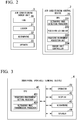
- Fig. 2 is a diagram showing functional configurations of the air conditioning control device and the air conditioning indoor unit according to the first embodiment.
- the air conditioning control device 2 includes a CPU 20.
- the CPU 20 is a processor (microcomputer) which controls the entire air conditioning control device 2 and operates according to a program provided in advance.
- the CPU 20 serves as an ultrasonic wave detection processor 201, a position estimator 202, a requested environment acquisition unit 203 and an indoor unit controller 204 by operating according to the program.
- the ultrasonic wave detection processor 201 individually detects ultrasonic waves emitted from the respective smartphones 4 through the plurality of microphones 32 provided in the air conditioning indoor unit 3. Specifically, the ultrasonic wave detection processor 201 performs answer back (response) through the speaker 33 provided in the air conditioning indoor unit 3 when it has correctly read information superposed on ultrasonic waves emitted from the smartphones 4.
- the position estimator 202 estimates the position of the smartphone 4 (terminal position) on the basis of results of detection of ultrasonic waves emitted from the smartphone 4 through the plurality of microphones 32 (specifically, a time difference of arrival at the microphones 32).
- the requested environment acquisition unit 203 acquires a requested environment setting.
- the "requested environment setting” is information indicating setting values of an environment (setting values such as a temperature, humidity and air flow that a user desire) requested by each user for the air conditioning control device 2 through the smartphone 4.
- the indoor unit controller 204 controls the air conditioning indoor unit 3 (the fane 30 and the louver 31) on the basis of requested environment settings received from respective users and positions (terminal positions) of the respective users.
- Fig. 3 is a diagram showing a functional diagram of the smartphone according to the first embodiment.
- the smartphone 4 includes a CPU 40, an operator 41, a display 42, a microphone 43 and a speaker 44.
- the operator 41 may be a touch panel and receive input operations of a user carrying the smartphone 4.
- the display 42 may be a liquid crystal display, an organic EL display, or the like and provide various types of information (a current set temperature, an input form of setting values, and the like) according to operation of the air conditioning control device 2 to the user through an image.
- the microphone 43 is an ultrasonic wave detection sensor which detects ultrasonic waves emitted from the outside.
- the speaker 44 transmits ultrasonic waves according to control of the CPU 40.
- the microphone 43 and the speaker 44 may be a standard microphone and speaker mounted in conventional smartphones and may be ones used for a general call function.
- the CPU 40 is a processor which controls the entire smartphone 4 and operates according to a program (an application for air conditioning control) provided in advance. Specifically, the CPU 40 serves as a requested environment setting receiver 401 and an ultrasonic wave transmission processor 402.
- the requested environment setting receiver 401 receives a requested environment setting (a set temperature, set humidity, a setting value of air flow, and the like) from a user through the operator 41.
- a requested environment setting a set temperature, set humidity, a setting value of air flow, and the like
- the ultrasonic wave transmission processor 402 transmits ultrasonic waves on which a requested environment setting received from a user has been superposed through the speaker 44.
- the ultrasonic wave transmission processor 402 waits for a predetermined time and then re-transmits ultrasonic waves on which the same requested environment setting as in the initial transmission has been superposed.
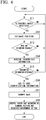
- Fig. 4 is a diagram showing a processing flow of the smartphone according to the first embodiment.
- Fig. 5 is a diagram showing a data structure of transmitted information transmitted by the smartphone according to the first embodiment.
- the processing flow of the smartphone 4 according to the first embodiment may be repeatedly executed from a time at which a dedicated application is started, for example.
- the requested environment setting receiver 401 of the smartphone 4 waits for input of a requested environment setting from a user (NO in step S01).
- the requested environment setting receiver 401 acquires the input requested environment setting.
- This requested environment setting includes a set temperature, a set humidity, a set air flow, and the like input by the user carrying the smart phone 4.
- the requested environment setting receiver 401 attaches a user ID to the requested environment setting acquired in step S01, superposes the requested environment setting having the user ID attached thereto (hereinafter described as "transmitted information") on ultrasonic waves and transmits the ultrasonic waves through the speaker 44 (step S02).
- the "transmitted information” may have the data structure as shown in Fig. 5 , for example.
- the transmitted information is configured in such a manner that a set temperature (" ⁇ °C"), a set humidity (" ⁇ %”), a set air flow ("low”), and the like input by a user are associated with a user ID ("UID0001").
- the user ID may be randomly determined when the aforementioned dedicated application is started or may be individual identification information allocated to the body of the smartphone 4 in advance.
- the transmitted information is encoded through amplitude modulation (AM modulation) or the like and superposed on ultrasonic waves emitted from the speaker 44.
- AM modulation amplitude modulation
- the ultrasonic wave transmission processor 402 determines whether an answer back has been received from the air conditioning control device 2 within a prescribed time (step S03). An answer back from the air conditioning control device 2 will be described later.
- step S03 When an answer back has been received from the air conditioning control device 2 within the prescribed time (YES in step S03), it is determined that the transmitted information has been correctly recognized by the air conditioning control device 2 and the smartphone 4 ends the processing.
- the ultrasonic wave transmission processor 402 waits for a predetermined time (step S04) and then superposes transmitted information including the requested environment setting received in step S01 on ultrasonic waves and re-transmits the ultrasonic waves (step S02). The ultrasonic wave transmission processor 402 repeatedly executes processing of steps S02 to S04 until an answer back is received from the air conditioning control device 2.
- the waiting time in step S04 may be, for example, on the order of several seconds to dozens of seconds and may be randomly determined on each occasion in the present embodiment.
- Fig. 6 is a diagram showing a processing flow of the air conditioning control device according to the first embodiment.
- Fig. 7 is a diagram showing a data structure of user information acquired by the indoor unit controller according to the first embodiment.
- Fig. 8 is a diagram for explaining functions of the indoor unit controller according to the first embodiment. The processing flow shown in Fig. 6 is regularly repeated from a time at which the air conditioning control device 2 and the air conditioning indoor unit 3 are started.
- the ultrasonic wave detection processor 201 of the air conditioning control device 2 waits for reception of ultrasonic waves transmitted from the smartphone 4 in step S02 of Fig. 4 (step S11: repeating of NO). Specifically, the ultrasonic wave detection processor 201 monitors the strengths of signals (strengths of signals output according to reception of ultrasonic waves) output from the microphones 32 ( Fig. 2 ) provided in the air conditioning indoor unit 3 and determines that ultrasonic waves have been received when the signal strengths exceed a predetermined determination threshold value.
- the position estimator 202 of the air conditioning control device 2 estimates the position of the smartphone 4 which has transmitted the ultrasonic waves on the basis of a difference (time difference) between timings at which ultrasonic waves have been received from the respective microphones 32 ( Fig. 2 ) (step S12). Specifically, the position estimator 202 acquires a time (detection time) at which a signal strength output from each microphone 32 exceeds the predetermined determination threshold value according to reception of ultrasonic waves. Then, the position estimator 202 estimates the position (terminal position) of the smartphone 4 on the basis of a different between four detection times (time difference of arrival).
- TDOA Time difference of Arrival
- the position estimator 202 determines whether correct position estimation has been performed in step S 12 (step S13).
- step S13 when ultrasonic waves have been transmitted from another smartphone 4 at the same time and thus interference has occurred, for example, the terminal position is not uniquely identified in step S12 and thus position estimation fails.
- correct position estimation has not been performed (NO in step S13)
- the processing returns to step S11 without performing the following processing and waits for ultrasonic waves.
- the position estimator 202 When correct position estimation has been performed (YES in step S13), the position estimator 202 records and holds the terminal position acquired on the basis of the position estimation.
- the requested environment acquisition unit 203 of the air conditioning control device 2 decodes transmitted information (user ID + requested environment setting (refer to Fig. 5 )) encoded into ultrasonic waves through the microphones 32 to acquire the transmitted information (step S14).
- the requested environment acquisition unit 203 determines whether the transmitted information has been correctly read according to decoding (step S15). Determination of whether correct reading has been performed may be performed through a generally well known cyclic redundancy check (CRC) and the like, for example.
- CRC cyclic redundancy check
- step S15 When the transmitted information has not been correctly read according to decoding (NO in step S15), the CPU 40 returns to step S11 without performing the following processing and waits for ultrasonic waves.
- the requested environment acquisition unit 203 records and holds the acquired transmitted information.
- the requested environment acquisition unit 203 integrates and associates terminal positions acquired by the position estimator 202 with the transmitted information (user ID + requested environment setting) acquired in step S15 and newly adds the associated information to user identification information as shown in Fig. 7 (step S16).
- the user identification information includes terminal positions ("X1, Y1"), set temperatures (" ⁇ °C”), set humidities (" ⁇ %”), set air flows ("low”) and the like which are associated with for each different user IDs ("UID0001," "UID0002” and “UID0003”), as shown in Fig. 7 .
- the ultrasonic wave detection processor 201 When various types of information (terminal positions, user IDs and requested environment settings) acquired through steps S11 to S15 are normally added to the user identification information, the ultrasonic wave detection processor 201 performs answer back using ultrasonic waves through the speaker 33 of the air conditioning indoor unit 3 (refer to Fig. 1 and Fig. 2 ) (step S17).
- the smartphone 4 can ascertain that the air conditioning control device 2 has correctly recognized the terminal position and requested environment setting by receiving the answer back (refer to step S03 of Fig. 4 ).
- step S18 the indoor unit controller 204 of the air conditioning control device 2 controls the air conditioning indoor unit 3 on the basis of the user identification information including the new user terminal position and requested environment setting and optimizes air conditioning. Processing of step S18 will be described in detail with reference to Fig. 8 .
- the indoor unit controller 204 specifies control parameters (al, a2, a3, a4, ...) for minimizing an objective function J (step S181).
- the control parameters are direct command values for causing the air conditioning indoor unit 3 to be in a desired state and, for example, may be the rotational speed of the fan 30, the inclination angle of the louver 31, and the like.
- the objective function J may be defined as represented by Expression (1).
- the vector x(i) includes M elements (x(i) 1 , x(i) 2 , ..., x(i) M ) and each element (x(i) 1 , x(i) 2 , ..., x(i) M ) indicates a value (scalar quantity) such as an actual temperature, humidity or air flow at the position where the user i is present.
- the vector x(i) is uniquely determined by a function F having the control parameters (al, a2, a3, a4, ...) of the air conditioning indoor unit 3 as input variables.
- a vector x*(i) is a vector quantity indicating a temperature, humidity, air flow or the like that the user i desires.
- the vector x*(i) includes M elements (x*(i) 1 , x*(i) 2 , ..., x*(i) M ) and each element (x*(i) 1 , x*(i) 2 , ..., x*(i) M ) indicates a temperature, humidity, air flow or the like that the user i desires. More specifically, the respective elements (x*(i) 1 , x*(i) 2 , ..., x*(i) M ) are a set temperature, set humidity, set air flow and the like indicated in the user identification information ( Fig. 7 ).
- M is the number of elements constituting the vector x(i) and the vector x*(i) and is the total number of physical quantities to be set as targets by a user, such as a temperature, humidity, air flow and the like.
- N is the number of users present in a space where the air conditioning indoor unit 3 is installed and, more specifically, the number of smartphones 4 (the number of types of user ID) detected through ultrasonic waves.
- Wd(i, k) is a weighting factor separately defined for each element and set to "1" (equal value) for all elements in general operation. However, each user may set “Wd(i, k) for respective elements (temperature, humidity, air flow, ..) to reflect preferences representing which physical quantity is regarded as important, for example. Through this weighting factor Wd(i, k), it is possible to respond to detailed requirements such as “I wish a requirement for "air flow” to be fulfilled when I return from the hot outdoors” and “I wish to preferentially set "humidity” to a desired value during the rainy season” of the same person.
- Weighting factor is a weighting factor separately defined for each user and set to "1" (equal value) for all users in general operation. However, in the cases in which an operation regarding demands of aged users or important users as important is performed, and the like, for example, the weighting factor for each user i may be changed.
- a method of specifying a minimum value of the objective function J may be based on a well known search algorithm.
- the function F may be based on physical simulations of a temperature distribution, a humidity distribution and an air flow distribution in a space based on air flow and radiation, for example.
- the indoor unit controller 204 transmits the specified control parameters to the air conditioning indoor unit 3 as command values to control the air conditioning indoor unit 3 (step S182).
- the ultrasonic wave detection processor 201 individually detects ultrasonic waves emitted from the respective smartphones 4 (environment setting terminals) by performing answer back (step S17 of Fig. 6 ).
- the smartphone 4 waits for a predetermined time, superposes a requested environment setting (the transmitted signal in Fig. 5 ) on ultrasonic waves and re-transmits the ultrasonic waves when an answer back has not been acquired from the air conditioning control device 2.
- the smartphone 4 attempts to transmit ultrasonic waves until an answer back is acquired when interference with ultrasonic waves emitted from other smartphones 4 occurs. Therefore, ultrasonic waves are individually received at all times and position estimation and reading of a requested environment setting are correctly performed.
- the requested environment acquisition unit 203 acquires information (transmitted information) superposed on ultrasonic waves emitted from the smartphone 4.
- ultrasonic waves transmitted for position estimation can also be used as an information transmission medium through encoding, and thus it is possible to avoid provision of new components and functions and promote reduction of product costs.
- a user ID and a requested environment setting may be transmitted to the air conditioning control device 2 through a transmission medium (radio waves, infrared rays, or the like) other than ultrasonic waves.
- a transmission medium radio waves, infrared rays, or the like
- ultrasonic waves transmitted by the smartphone 4 are simply sine waves and are used only for position estimation.
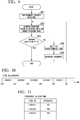
- Fig. 9 is a diagram showing a processing flow of a smartphone according to the second embodiment.
- the processing flow of the smartphone 4 according to the second embodiment may be repeatedly executed from a time at which a dedicated application is started, for example, as in the first embodiment.
- the smartphone 4 when reception of an answer back from the air conditioning control device 2 has not been acquired (NO in step S03), the smartphone 4 (ultrasonic wave transmission processor 402) performs processing of decreasing the frequency of ultrasonic waves to be transmitted next (step S041). For example, if an initial value of the frequency of ultrasonic waves (frequency of ultrasonic waves emitted first) is "40 kHz," the smartphone 4 may set the frequency of ultrasonic eaves to be transmitted for the second time to "35 kHz" or the like. The degree of decreased frequency here may be randomly determined on each occasion.
- the air conditioning control device 2 includes a plurality of types of frequency filter (band pass filter) which can pass only a specific frequency band. Accordingly, even if ultrasonic wave interference with other smartphones 4 occurs again, ultrasonic waves can be individually detected by separating them through the frequency filters of the air conditioning control device 2.
- band pass filter frequency filter
- the smartphone 4 set an initial value of the frequency of ultrasonic waves to be transmitted to a maximum value (e.g., 40 kHz) of a frequency that can be transmitted by the microphone 43, and when an answer back from the air conditioning control device 2 has not been acquired, gradually decrease the frequency by several kHz in step S041 on each occasion.
- a maximum value e.g. 40 kHz
- the smartphone 4 may perform processing of increasing the frequency of ultrasonic waves in step S041.
- the ultrasonic wave transmission processor 402 when the ultrasonic wave transmission processor 402 does not receive an answer back through the microphone 43 after transmitting ultrasonic waves having a requested environment setting superposed thereon, the ultrasonic wave transmission processor 402 changes (increases or decreases) the frequency of the ultrasonic waves and then re-transmits the ultrasonic waves having the requested environment setting superposed thereon.
- the smartphone 4 waits until a requested environment setting is received from the user in the processing flow of the smartphone 4 shown in Fig. 4 , the present invention is not limited to this aspect.
- the smartphone 4 may regularly transmit ultrasonic waves having a user ID superposed thereon even if a requested environment setting is not received from the user.
- an environment requested by a user can be provided more appropriately because a terminal position is updated to a newest user position at all times even when the position of the user has been changed.
- the smartphone 4 may detect change of the position of the user (movement of the user) through an acceleration sensor or the like included therein and transmit ultrasonic waves having various types of information superposed thereon using the detected change as a trigger.
- the air conditioning control device 2 identifies the terminal position of the smartphone 4 on the basis of the technique (TDOA) of estimating the position of a transmission origin on the basis of a time difference of arrival of ultrasonic waves at respective ultrasonic sensors (microphones 32), other embodiments are not limited to this aspect.
- TDOA technique of estimating the position of a transmission origin on the basis of a time difference of arrival of ultrasonic waves at respective ultrasonic sensors (microphones 32)
- the air conditioning control device 2 may identify the terminal position of the smartphone 4 on the basis of an ultrasonic wave reception strength.
- the microphones 32 may be disposed at any position in a space that is a cooling target of the air conditioning control device 2 (a ceiling, a wall, a floor and the like other than an installation place of an air conditioning indoor unit 3).
- the air conditioning indoor unit 3 includes four microphones 32, more microphones 32 may be included in other embodiments. Accordingly, redundancy of position estimation according to a time difference of arrival increases and thus a terminal position can be acquired with higher accuracy.
- the number of installed microphones 32 may be three if accuracy can be maintained and may be two in the case of a precondition that a user is present on the predetermined plane.
- Fig. 10 and Fig. 11 are a first diagram and a second diagram for explaining functions of air conditioning systems according to other modified examples.
- An air conditioning control device 2 (ultrasonic wave detection processor 201) according to a first modified example may superpose transmission time allocation information on an answer back when performing the answer back (step S17 of Fig. 6 ).
- the air conditioning control device 2 when ultrasonic waves from the smartphone 4 of "UID0001" are detected, the air conditioning control device 2 notifies the smartphone 4 of "UID0001” of allocation times of t00 to t01, t03 to t04, ... through the answer back thereof (refer to Fig. 10 ). Subsequently, when ultrasonic waves from the smartphone 4 of "UID0002" are newly detected, the air conditioning control device 2 notifies the smartphone 4 of "UID0002" of times t01 to t02, t04 to t05, ... other than the time periods allocated to "UID0001" through the answer back thereof.
- each smartphone 4 which has received notification of allocation times transmits ultrasonic waves at the notified allocation times.
- the air conditioning control device 2 (ultrasonic wave detection processor 201) according to the second embodiment may superpose transmission frequency allocation information on an answer back when performing the answer back (S17 of Fig. 6 ).
- the air conditioning control device 2 when ultrasonic waves from the smartphone 4 of "UID0001" are detected, the air conditioning control device 2 notifies the smartphone 4 of "UID0001” of allocation of a frequency f01 through the answer back thereof (refer to Fig. 11 ). Subsequently, when ultrasonic waves from the smartphone 4 of "UID0002" are newly detected, the air conditioning control device 2 notifies the smartphone 4 of "UID0002" of allocation time of a frequency f02 other than the frequency allocated to "UID0001" through the answer back thereof.
- each smartphone 4 which has received notification of an allocated frequency transmits ultrasonic waves at the notified allocated frequency.
- the air conditioning control device 2 uses "temperature,” “humidity,” “air flow” and the like as elements used for control, other embodiments are not limited to this aspect.
- the air conditioning control device 2 according to other embodiments may use any quantity with respect to human comfortability, such as “illumination,” “aroma,” “bathwater temperature” and “washing strength of toilet seat,” in addition to the aforementioned elements with respect to air conditioning.
- the air conditioning control device 2 according to other embodiments may have a lighting device, an aroma device, a hot water supply device, toilet seat device as well as the air conditioning indoor unit 3 as control targets.
- the above-described various processing procedures of the air conditioning control device 2 and the smartphone 4 in the above-described embodiments are stored in a computer-readable recording medium in the form of a program, and the aforementioned processing is performed by a computer reading and executing the program.
- the computer-readable recording medium refers to a magnetic disk, a magneto-optical disc, a CD-ROM, a DVD-ROM, a semiconductor memory or the like.
- the computer program may be transmitted to a computer through a communication link and the computer which has received this transmission may execute the program.
- the aforementioned program may be one for realizing some of the above-described functions. Further, the aforementioned program may be a program which can realize the above-described functions according to a combination with a program already recorded in a computer system, a so-called a difference file (difference program). Moreover, the air conditioning control device 2 and the smartphone 4 may be configured as a single computer or as a plurality of computers which can be connected such that they can communicate in other embodiments.
Landscapes
- Engineering & Computer Science (AREA)
- Chemical & Material Sciences (AREA)
- General Engineering & Computer Science (AREA)
- Mechanical Engineering (AREA)
- Combustion & Propulsion (AREA)
- Human Computer Interaction (AREA)
- Physics & Mathematics (AREA)
- Signal Processing (AREA)
- Radar, Positioning & Navigation (AREA)
- Mathematical Physics (AREA)
- Fuzzy Systems (AREA)
- Remote Sensing (AREA)
- General Physics & Mathematics (AREA)
- Air Conditioning Control Device (AREA)
- Measurement Of Velocity Or Position Using Acoustic Or Ultrasonic Waves (AREA)
Abstract
An air conditioning control device (2) executes a step of individually detecting ultrasonic waves emitted from respective smartphones (4) through a plurality of microphones (32) disposed at different positions, a step of estimating terminal positions of the smartphones (4) on the basis of results of detection of the ultrasonic waves through the plurality of microphones (32), a step of acquiring requested environment settings indicating environments requested by users, and a step of controlling an air conditioning indoor unit (3) on the basis of the requested environment settings and the terminal positions.
Description
- The present invention relates to an air conditioning control device, an environment setting terminal, an air conditioning control method, and a program.
- Priority is claimed on Japanese Patent Application No.
2017-130612, filed July 3, 2017 - In a space where a plurality of users are present, a function of identifying the positions of individuals on the basis of measurement of radio field intensities and time differences of arrival (TDOA) of terminal devices (remote controllers and the like) carried by the users and performing control such that the air conditioning requirements of the individuals are satisfied as far as possible may be provided (refer to Patent Literature 1, for example).
- [Patent Literature 1]
Japanese Patent, Publication No.4867836 - When communication between an air conditioning control device and a plurality of environment setting terminals (carried by respective users) is performed using ultrasonic waves, it is necessary to avoid interference between ultrasonic waves emitted from the environment setting terminals carried by the plurality of users.
- An object of the present invention devised in view of the aforementioned circumstances is to provide an air conditioning control device, an environment setting terminal, an air conditioning control method, and a program which can avoid interference between ultrasonic waves emitted from a plurality of environment setting terminals when communication between an air conditioning control device and the plurality of environment setting terminals is performed using ultrasonic waves.
- According to a first aspect of the present invention, an air conditioning control device controls an air conditioning indoor unit according to requested environment settings requested by a plurality of users carrying environment setting terminals and terminal positions of the environment setting terminals and includes: an ultrasonic wave detection processor which individually detects ultrasonic waves emitted from the respective environment setting terminals through a plurality of ultrasonic sensors disposed at different positions; a position estimator which estimates terminal positions of the environment setting terminals on the basis of results of detection of the ultrasonic waves through the plurality of ultrasonic sensors; a requested environment acquisition unit which acquires the requested environment settings; and an indoor unit controller which controls the air conditioning indoor unit on the basis of the requested environment settings and the terminal positions.
- According to a second aspect of the present invention, the ultrasonic wave detection processor performs answer back when the ultrasonic wave detection processor has read information superposed on ultrasonic waves emitted from the environment setting terminals.
- According to a third aspect of the present invention, the requested environment acquisition unit acquires the requested environment settings through the information superposed on the ultrasonic waves emitted from the environment setting terminals.
- According to a fourth aspect of the present invention, an environment setting terminal includes: a speaker capable of transmitting ultrasonic waves; a requested environment setting receiver which receives a requested environment setting indicating an environment requested by a user for an air conditioning control device; and an ultrasonic wave transmission processor which transmits ultrasonic waves on which the requested environment setting has been superposed through the speaker.
- According to a fifth aspect of the present invention, the environment setting terminal further includes a microphone capable of detecting ultrasonic waves, and the ultrasonic wave transmission processor waits for a predetermined time and then re-transmits the ultrasonic waves on which the requested environment setting has been superposed when an answer back has not been received through the microphone after the ultrasonic waves on which the requested environment setting has been superposed are transmitted.
- According to a sixth aspect of the present invention, the ultrasonic wave transmission processor changes a frequency of the ultrasonic waves and then re-transmits the ultrasonic waves on which the requested environment setting has been superposed when an answer back has not been received through the microphone after the ultrasonic waves on which the requested environment setting has been superposed are transmitted.
- According to a seventh aspect of the present invention, an air conditioning control method controls an air conditioning indoor unit according to requested environment settings requested by a plurality of users carrying environment setting terminals and terminal positions of the environment setting terminals and includes: a step of individually detecting ultrasonic waves emitted from the respective environment setting terminals through a plurality of ultrasonic sensors disposed at different positions; a step of estimating terminal positions of the environment setting terminals on the basis of results of detection of the ultrasonic waves through the plurality of ultrasonic sensors; a step of acquiring the requested environment settings; and a step of controlling the air conditioning indoor unit on the basis of the requested environment settings and the terminal positions.
- According to an eighth aspect of the present invention, a program causes a computer of an air conditioning control device which controls an air conditioning indoor unit according to requested environment settings requested by a plurality of users carrying environment setting terminals and terminal positions of the environment setting terminals to execute: a step of individually detecting ultrasonic waves emitted from the respective environment setting terminals through a plurality of ultrasonic sensors disposed at different positions; a step of estimating terminal positions of the environment setting terminals on the basis of results of detection of the ultrasonic waves through the plurality of ultrasonic sensors; a step of acquiring the requested environment settings; and a step of controlling the air conditioning indoor unit on the basis of the requested environment settings and the terminal positions.
- According to the aforementioned air conditioning control device, environment setting terminal, air conditioning control method and program, it is possible to avoid interference between ultrasonic waves emitted from a plurality of environment setting terminals.
-
-
Fig. 1 is a diagram showing the overall configuration of an air conditioning system according to a first embodiment. -
Fig. 2 is a diagram showing functional configurations of an air conditioning control device and an air conditioning indoor unit according to the first embodiment. -
Fig. 3 is a diagram showing a functional configuration of a smartphone according to the first embodiment. -
Fig. 4 is a diagram showing a processing flow of the smartphone according to the first embodiment. -
Fig. 5 is a diagram showing a data structure of transmitted information transmitted by the smartphone according to the first embodiment. -
Fig. 6 is a diagram showing a processing flow of the air conditioning control device according to the first embodiment. -
Fig. 7 is a diagram showing a data structure of information for each user acquired by an indoor unit controller according to the first embodiment. -
Fig. 8 is a diagram for explaining functions of the indoor unit controller according to the first embodiment. -
Fig. 9 is a diagram showing a processing flow of a smartphone according to a second embodiment. -
Fig. 10 is a first diagram for explaining functions of an air conditioning system according to other modified examples. -
Fig. 11 is a second diagram for explaining functions of an air conditioning system according to other modified examples. - Hereinafter, an air conditioning system according to a first embodiment will be described with reference to
Fig. 1 to Fig. 8 . -
Fig. 1 is a diagram showing the overall configuration of the air conditioning system according to the first embodiment. - It is assumed that the air conditioning system 1 according to the first embodiment is used in an environment in which a plurality of users are present in a relatively large space, such as a library, a large bookstore, a warehouse and a factory. However, the air conditioning system 1 is not limited to the aforementioned usage form in other embodiments.
- The air conditioning system 1 includes an air
conditioning control device 2, an air conditioning indoor unit 3, and asmartphone 4 carried by each of a plurality of users present in the same space. - The air
conditioning control device 2 receives requests ("requested environment settings" which will be described later) for an environment (temperature, humidity, air flow, and the like) from a plurality of users and controls the air conditioning indoor unit 3 such that the requests are satisfied as far as possible. - The air conditioning indoor unit 3 is provided on the ceiling or the like of a space in which users are present and performs various operations for adjusting the environment in the space according to control commands from the air
conditioning control device 2. - As shown in
Fig. 1 , the air conditioning indoor unit 3 includes afan 30 which can adjust an air flow, alouver 31 which can adjust a wind direction, fourmicrophones 32 which are ultrasonic sensors capable of detecting ultrasonic waves and disposed at different positions, and aspeaker 33 which can emit ultrasonic waves. - Although the air conditioning system 1 according to the first embodiment includes only the single air conditioning indoor unit 3 (refer to
Fig. 1 ), other embodiments are not limited to this form. That is, in the air conditioning system 1 according to other embodiments, a plurality of air conditioning indoor units 3 may be installed in the same space and the single airconditioning control device 2 may individually control operations of the plurality of air conditioning indoor units 3. - The
smartphone 4 is a portable terminal device carried by each of a plurality of users. Thesmartphone 4 according to the present embodiment serves as an environment setting terminal (a remote controller of an air conditioner) for transmitting a request (requested environment setting) of each user to the airconditioning control device 2 by operating according to a dedicated program (application). - The "environment setting terminal" is not limited to a smartphone carried by each user in other embodiments. The "environment setting terminal" according to other embodiments may be a tablet type terminal device, a wrist watch type terminal device or the like carried by a user, or a dedicated remote controller.
-
Fig. 2 is a diagram showing functional configurations of the air conditioning control device and the air conditioning indoor unit according to the first embodiment. - As shown in
Fig. 2 , the airconditioning control device 2 includes aCPU 20. TheCPU 20 is a processor (microcomputer) which controls the entire airconditioning control device 2 and operates according to a program provided in advance. - The
CPU 20 serves as an ultrasonicwave detection processor 201, aposition estimator 202, a requestedenvironment acquisition unit 203 and anindoor unit controller 204 by operating according to the program. - The ultrasonic
wave detection processor 201 individually detects ultrasonic waves emitted from therespective smartphones 4 through the plurality ofmicrophones 32 provided in the air conditioning indoor unit 3. Specifically, the ultrasonicwave detection processor 201 performs answer back (response) through thespeaker 33 provided in the air conditioning indoor unit 3 when it has correctly read information superposed on ultrasonic waves emitted from thesmartphones 4. - The
position estimator 202 estimates the position of the smartphone 4 (terminal position) on the basis of results of detection of ultrasonic waves emitted from thesmartphone 4 through the plurality of microphones 32 (specifically, a time difference of arrival at the microphones 32). - The requested
environment acquisition unit 203 acquires a requested environment setting. Here, the "requested environment setting" is information indicating setting values of an environment (setting values such as a temperature, humidity and air flow that a user desire) requested by each user for the airconditioning control device 2 through thesmartphone 4. - The
indoor unit controller 204 controls the air conditioning indoor unit 3 (thefane 30 and the louver 31) on the basis of requested environment settings received from respective users and positions (terminal positions) of the respective users. -
Fig. 3 is a diagram showing a functional diagram of the smartphone according to the first embodiment. - As shown in
Fig. 3 , thesmartphone 4 includes aCPU 40, anoperator 41, adisplay 42, amicrophone 43 and aspeaker 44. - For example, the
operator 41 may be a touch panel and receive input operations of a user carrying thesmartphone 4. - For example, the
display 42 may be a liquid crystal display, an organic EL display, or the like and provide various types of information (a current set temperature, an input form of setting values, and the like) according to operation of the airconditioning control device 2 to the user through an image. - The
microphone 43 is an ultrasonic wave detection sensor which detects ultrasonic waves emitted from the outside. - The
speaker 44 transmits ultrasonic waves according to control of theCPU 40. - The
microphone 43 and thespeaker 44 may be a standard microphone and speaker mounted in conventional smartphones and may be ones used for a general call function. - The
CPU 40 is a processor which controls theentire smartphone 4 and operates according to a program (an application for air conditioning control) provided in advance. Specifically, theCPU 40 serves as a requestedenvironment setting receiver 401 and an ultrasonicwave transmission processor 402. - The requested
environment setting receiver 401 receives a requested environment setting (a set temperature, set humidity, a setting value of air flow, and the like) from a user through theoperator 41. - The ultrasonic
wave transmission processor 402 transmits ultrasonic waves on which a requested environment setting received from a user has been superposed through thespeaker 44. - In addition, when an answer back from the air
conditioning control device 2 has not been received through themicrophone 43 after an initial transmission of ultrasonic waves on which requested environment setting has been superposed, the ultrasonicwave transmission processor 402 waits for a predetermined time and then re-transmits ultrasonic waves on which the same requested environment setting as in the initial transmission has been superposed. -
Fig. 4 is a diagram showing a processing flow of the smartphone according to the first embodiment. - In addition,
Fig. 5 is a diagram showing a data structure of transmitted information transmitted by the smartphone according to the first embodiment. - The processing flow of the
smartphone 4 according to the first embodiment may be repeatedly executed from a time at which a dedicated application is started, for example. - The requested
environment setting receiver 401 of the smartphone 4 (CPU 40) waits for input of a requested environment setting from a user (NO in step S01). When an input of a requested environment setting from a user is received through operation of the operator 41 (touch panel) (YES in step S01), the requestedenvironment setting receiver 401 acquires the input requested environment setting. This requested environment setting includes a set temperature, a set humidity, a set air flow, and the like input by the user carrying thesmart phone 4. - Next, the requested
environment setting receiver 401 attaches a user ID to the requested environment setting acquired in step S01, superposes the requested environment setting having the user ID attached thereto (hereinafter described as "transmitted information") on ultrasonic waves and transmits the ultrasonic waves through the speaker 44 (step S02). - Here, the "transmitted information" may have the data structure as shown in
Fig. 5 , for example. Specifically, the transmitted information is configured in such a manner that a set temperature ("○○ °C"), a set humidity ("○○%"), a set air flow ("low"), and the like input by a user are associated with a user ID ("UID0001"). For example, the user ID may be randomly determined when the aforementioned dedicated application is started or may be individual identification information allocated to the body of thesmartphone 4 in advance. - The transmitted information is encoded through amplitude modulation (AM modulation) or the like and superposed on ultrasonic waves emitted from the
speaker 44. - When transmission of the ultrasonic waves (on which the transmitted information has been superposed) in step S02 is completed, the ultrasonic
wave transmission processor 402 determines whether an answer back has been received from the airconditioning control device 2 within a prescribed time (step S03). An answer back from the airconditioning control device 2 will be described later. - When an answer back has been received from the air
conditioning control device 2 within the prescribed time (YES in step S03), it is determined that the transmitted information has been correctly recognized by the airconditioning control device 2 and thesmartphone 4 ends the processing. - On the other hand, when an answer back has not been received from the air
conditioning control device 2 within the prescribed time (NO in step S03), it is determined that the transmitted information transmitted in step S02 has not been correctly recognized by the airconditioning control device 2. Accordingly, the ultrasonicwave transmission processor 402 waits for a predetermined time (step S04) and then superposes transmitted information including the requested environment setting received in step S01 on ultrasonic waves and re-transmits the ultrasonic waves (step S02). The ultrasonicwave transmission processor 402 repeatedly executes processing of steps S02 to S04 until an answer back is received from the airconditioning control device 2. - The waiting time in step S04 may be, for example, on the order of several seconds to dozens of seconds and may be randomly determined on each occasion in the present embodiment.
-
Fig. 6 is a diagram showing a processing flow of the air conditioning control device according to the first embodiment. - In addition,
Fig. 7 is a diagram showing a data structure of user information acquired by the indoor unit controller according to the first embodiment. - Furthermore,
Fig. 8 is a diagram for explaining functions of the indoor unit controller according to the first embodiment. The processing flow shown inFig. 6 is regularly repeated from a time at which the airconditioning control device 2 and the air conditioning indoor unit 3 are started. - The ultrasonic
wave detection processor 201 of the air conditioning control device 2 (CPU 20) waits for reception of ultrasonic waves transmitted from thesmartphone 4 in step S02 ofFig. 4 (step S11: repeating of NO). Specifically, the ultrasonicwave detection processor 201 monitors the strengths of signals (strengths of signals output according to reception of ultrasonic waves) output from the microphones 32 (Fig. 2 ) provided in the air conditioning indoor unit 3 and determines that ultrasonic waves have been received when the signal strengths exceed a predetermined determination threshold value. - When ultrasonic waves have been received from the smartphone 4 (YES in step S11), the
position estimator 202 of the airconditioning control device 2 estimates the position of thesmartphone 4 which has transmitted the ultrasonic waves on the basis of a difference (time difference) between timings at which ultrasonic waves have been received from the respective microphones 32 (Fig. 2 ) (step S12). Specifically, theposition estimator 202 acquires a time (detection time) at which a signal strength output from eachmicrophone 32 exceeds the predetermined determination threshold value according to reception of ultrasonic waves. Then, theposition estimator 202 estimates the position (terminal position) of thesmartphone 4 on the basis of a different between four detection times (time difference of arrival). A technique (TDOA: Time difference of Arrival) of estimating the position of a transmission origin on the basis of a time difference of arrival of sound waves (radio waves) at respective sensors is known and thus detailed description thereof is omitted. - The
position estimator 202 determines whether correct position estimation has been performed in step S 12 (step S13). Here, when ultrasonic waves have been transmitted from anothersmartphone 4 at the same time and thus interference has occurred, for example, the terminal position is not uniquely identified in step S12 and thus position estimation fails. When correct position estimation has not been performed (NO in step S13), the processing returns to step S11 without performing the following processing and waits for ultrasonic waves. - When correct position estimation has been performed (YES in step S13), the
position estimator 202 records and holds the terminal position acquired on the basis of the position estimation. - Next, the requested
environment acquisition unit 203 of the airconditioning control device 2 decodes transmitted information (user ID + requested environment setting (refer toFig. 5 )) encoded into ultrasonic waves through themicrophones 32 to acquire the transmitted information (step S14). - The requested
environment acquisition unit 203 determines whether the transmitted information has been correctly read according to decoding (step S15). Determination of whether correct reading has been performed may be performed through a generally well known cyclic redundancy check (CRC) and the like, for example. Here, when ultrasonic waves have been transmitted fromother smartphones 4 and interference has occurred, for example, a plurality of encoded ultrasonic waves overlap and thus information superposed on the respective ultrasonic waves cannot be correctly read. - When the transmitted information has not been correctly read according to decoding (NO in step S15), the
CPU 40 returns to step S11 without performing the following processing and waits for ultrasonic waves. - When the transmitted information has been correctly read (YES in step S15), the requested
environment acquisition unit 203 records and holds the acquired transmitted information. - Here, the requested
environment acquisition unit 203 integrates and associates terminal positions acquired by theposition estimator 202 with the transmitted information (user ID + requested environment setting) acquired in step S15 and newly adds the associated information to user identification information as shown inFig. 7 (step S16). Here, the user identification information includes terminal positions ("X1, Y1"), set temperatures ("○○ °C"), set humidities ("○○%"), set air flows ("low") and the like which are associated with for each different user IDs ("UID0001," "UID0002" and "UID0003"), as shown inFig. 7 . - When various types of information (terminal positions, user IDs and requested environment settings) acquired through steps S11 to S15 are normally added to the user identification information, the ultrasonic
wave detection processor 201 performs answer back using ultrasonic waves through thespeaker 33 of the air conditioning indoor unit 3 (refer toFig. 1 andFig. 2 ) (step S17). Thesmartphone 4 can ascertain that the airconditioning control device 2 has correctly recognized the terminal position and requested environment setting by receiving the answer back (refer to step S03 ofFig. 4 ). - Next, the
indoor unit controller 204 of the airconditioning control device 2 controls the air conditioning indoor unit 3 on the basis of the user identification information including the new user terminal position and requested environment setting and optimizes air conditioning (step S18). Processing of step S18 will be described in detail with reference toFig. 8 . - As shown in
Fig. 8 , theindoor unit controller 204 specifies control parameters (al, a2, a3, a4, ...) for minimizing an objective function J (step S181). Here, the control parameters are direct command values for causing the air conditioning indoor unit 3 to be in a desired state and, for example, may be the rotational speed of thefan 30, the inclination angle of thelouver 31, and the like. - The objective function J may be defined as represented by Expression (1).
[Math. 1]

- A vector x(i) represented in expression (1) is a vector quantity indicating an actual temperature, humidity, air flow or the like at the position where a user i (i=1, 2, .., N) is present. The vector x(i) includes M elements (x(i)1, x(i)2, ..., x(i)M) and each element (x(i)1, x(i)2, ..., x(i)M) indicates a value (scalar quantity) such as an actual temperature, humidity or air flow at the position where the user i is present. In addition, as represented in expression (1), the vector x(i) is uniquely determined by a function F having the control parameters (al, a2, a3, a4, ...) of the air conditioning indoor unit 3 as input variables.
- Furthermore, a vector x*(i) is a vector quantity indicating a temperature, humidity, air flow or the like that the user i desires. The vector x*(i) includes M elements (x*(i)1, x*(i)2, ..., x*(i)M) and each element (x*(i)1, x*(i)2, ..., x*(i)M) indicates a temperature, humidity, air flow or the like that the user i desires. More specifically, the respective elements (x*(i)1, x*(i)2, ..., x*(i)M) are a set temperature, set humidity, set air flow and the like indicated in the user identification information (
Fig. 7 ). - As represented in expression (1), the objective function J is derived by obtaining an error rate ((x(i)k-x∗(i)k)/x∗(i)k) for each k-th element (k=1, .., M) of the vector x(i) first, summing error rates of all elements and then summing up the sums of the error rates obtained for respective user i for all users.
- "M" is the number of elements constituting the vector x(i) and the vector x*(i) and is the total number of physical quantities to be set as targets by a user, such as a temperature, humidity, air flow and the like.
- "N" is the number of users present in a space where the air conditioning indoor unit 3 is installed and, more specifically, the number of smartphones 4 (the number of types of user ID) detected through ultrasonic waves.
- "Wd(i, k)" is a weighting factor separately defined for each element and set to "1" (equal value) for all elements in general operation. However, each user may set "Wd(i, k) for respective elements (temperature, humidity, air flow, ..) to reflect preferences representing which physical quantity is regarded as important, for example. Through this weighting factor Wd(i, k), it is possible to respond to detailed requirements such as "I wish a requirement for "air flow" to be fulfilled when I return from the hot outdoors" and "I wish to preferentially set "humidity" to a desired value during the rainy season" of the same person.
- "Wp(i)" is a weighting factor separately defined for each user and set to "1" (equal value) for all users in general operation. However, in the cases in which an operation regarding demands of aged users or important users as important is performed, and the like, for example, the weighting factor for each user i may be changed.
- In addition, a method of specifying a minimum value of the objective function J may be based on a well known search algorithm. The function F may be based on physical simulations of a temperature distribution, a humidity distribution and an air flow distribution in a space based on air flow and radiation, for example.
- When the control parameters minimizing the objective function J are specified, the
indoor unit controller 204 transmits the specified control parameters to the air conditioning indoor unit 3 as command values to control the air conditioning indoor unit 3 (step S182). - According to the air
conditioning control device 2 according to the first embodiment, the ultrasonicwave detection processor 201 individually detects ultrasonic waves emitted from the respective smartphones 4 (environment setting terminals) by performing answer back (step S17 ofFig. 6 ). In addition, thesmartphone 4 waits for a predetermined time, superposes a requested environment setting (the transmitted signal inFig. 5 ) on ultrasonic waves and re-transmits the ultrasonic waves when an answer back has not been acquired from the airconditioning control device 2. - Accordingly, the
smartphone 4 attempts to transmit ultrasonic waves until an answer back is acquired when interference with ultrasonic waves emitted fromother smartphones 4 occurs. Therefore, ultrasonic waves are individually received at all times and position estimation and reading of a requested environment setting are correctly performed. - As described above, it is possible to avoid interference between ultrasonic waves emitted from a plurality of environment setting terminals through the air
conditioning control device 2 and thesmartphone 4 according to the first embodiment. - In addition, according to the air
conditioning control device 2 according to the first embodiment, the requestedenvironment acquisition unit 203 acquires information (transmitted information) superposed on ultrasonic waves emitted from thesmartphone 4. - Accordingly, ultrasonic waves transmitted for position estimation can also be used as an information transmission medium through encoding, and thus it is possible to avoid provision of new components and functions and promote reduction of product costs.
- However, other embodiments are not limited to this aspect. For example, in the air conditioning system 1 according to other embodiments, a user ID and a requested environment setting may be transmitted to the air
conditioning control device 2 through a transmission medium (radio waves, infrared rays, or the like) other than ultrasonic waves. In this case, it is assumed that ultrasonic waves transmitted by thesmartphone 4 are simply sine waves and are used only for position estimation. - Next, an air conditioning system according to a second embodiment will be described with reference to
Fig. 9 . -
Fig. 9 is a diagram showing a processing flow of a smartphone according to the second embodiment. - The processing flow of the
smartphone 4 according to the second embodiment may be repeatedly executed from a time at which a dedicated application is started, for example, as in the first embodiment. - Processing of steps S01, S02, S03 and S04 in
Fig. 9 is the same as that of the first embodiment and thus description thereof is omitted. - According to the processing flow according to the second embodiment, when reception of an answer back from the air
conditioning control device 2 has not been acquired (NO in step S03), the smartphone 4 (ultrasonic wave transmission processor 402) performs processing of decreasing the frequency of ultrasonic waves to be transmitted next (step S041). For example, if an initial value of the frequency of ultrasonic waves (frequency of ultrasonic waves emitted first) is "40 kHz," thesmartphone 4 may set the frequency of ultrasonic eaves to be transmitted for the second time to "35 kHz" or the like. The degree of decreased frequency here may be randomly determined on each occasion. - Further, the air
conditioning control device 2 according to the second embodiment includes a plurality of types of frequency filter (band pass filter) which can pass only a specific frequency band. Accordingly, even if ultrasonic wave interference withother smartphones 4 occurs again, ultrasonic waves can be individually detected by separating them through the frequency filters of the airconditioning control device 2. - In addition, it is desirable that the
smartphone 4 set an initial value of the frequency of ultrasonic waves to be transmitted to a maximum value (e.g., 40 kHz) of a frequency that can be transmitted by themicrophone 43, and when an answer back from the airconditioning control device 2 has not been acquired, gradually decrease the frequency by several kHz in step S041 on each occasion. - In this manner, it is possible to maintain an ultrasonic wave frequency varying range within a frequency band that does not affect the hearing of a user as far as possible.
- However, other embodiments are not limited thereto and the
smartphone 4 may perform processing of increasing the frequency of ultrasonic waves in step S041. - In other words, when the ultrasonic
wave transmission processor 402 does not receive an answer back through themicrophone 43 after transmitting ultrasonic waves having a requested environment setting superposed thereon, the ultrasonicwave transmission processor 402 changes (increases or decreases) the frequency of the ultrasonic waves and then re-transmits the ultrasonic waves having the requested environment setting superposed thereon. - Although the air conditioning system 1 according to the first and second embodiments have been described in detail, detailed aspects of the air conditioning system 1 are not limited to the aforementioned one and various design changes may be added thereto within a range without departing from the spirit or scope of the present invention.
- For example, although the
smartphone 4 waits until a requested environment setting is received from the user in the processing flow of thesmartphone 4 shown inFig. 4 , the present invention is not limited to this aspect. For example, thesmartphone 4 may regularly transmit ultrasonic waves having a user ID superposed thereon even if a requested environment setting is not received from the user. - In this manner, an environment requested by a user can be provided more appropriately because a terminal position is updated to a newest user position at all times even when the position of the user has been changed.
- Furthermore, in this case, the
smartphone 4 may detect change of the position of the user (movement of the user) through an acceleration sensor or the like included therein and transmit ultrasonic waves having various types of information superposed thereon using the detected change as a trigger. - In addition, although the air
conditioning control device 2 according to the first and second embodiments identifies the terminal position of thesmartphone 4 on the basis of the technique (TDOA) of estimating the position of a transmission origin on the basis of a time difference of arrival of ultrasonic waves at respective ultrasonic sensors (microphones 32), other embodiments are not limited to this aspect. - For example, the air
conditioning control device 2 according to other embodiments may identify the terminal position of thesmartphone 4 on the basis of an ultrasonic wave reception strength. - Moreover, although a plurality of (four)
microphones 32 which detect ultrasonic waves transmitted from thesmartphone 4 are disposed at different positions of the housing of the air conditioning indoor unit 3 in the air conditioning system 1 according to the first and second embodiments, other embodiments are not limited to this aspect. That is, themicrophones 32 may be disposed at any position in a space that is a cooling target of the air conditioning control device 2 (a ceiling, a wall, a floor and the like other than an installation place of an air conditioning indoor unit 3). - In addition, although the air conditioning indoor unit 3 according to the first and second embodiments includes four
microphones 32,more microphones 32 may be included in other embodiments. Accordingly, redundancy of position estimation according to a time difference of arrival increases and thus a terminal position can be acquired with higher accuracy. - On the other hand, the number of installed
microphones 32 may be three if accuracy can be maintained and may be two in the case of a precondition that a user is present on the predetermined plane. -
Fig. 10 and Fig. 11 are a first diagram and a second diagram for explaining functions of air conditioning systems according to other modified examples. - An air conditioning control device 2 (ultrasonic wave detection processor 201) according to a first modified example may superpose transmission time allocation information on an answer back when performing the answer back (step S17 of
Fig. 6 ). - For example, when ultrasonic waves from the
smartphone 4 of "UID0001" are detected, the airconditioning control device 2 notifies thesmartphone 4 of "UID0001" of allocation times of t00 to t01, t03 to t04, ... through the answer back thereof (refer toFig. 10 ). Subsequently, when ultrasonic waves from thesmartphone 4 of "UID0002" are newly detected, the airconditioning control device 2 notifies thesmartphone 4 of "UID0002" of times t01 to t02, t04 to t05, ... other than the time periods allocated to "UID0001" through the answer back thereof. - On the other hand, each
smartphone 4 which has received notification of allocation times transmits ultrasonic waves at the notified allocation times. - In this manner, interference can be prevented because a transmission timing does not overlap with those of
other smartphones 4 after first communication. - Furthermore, the air conditioning control device 2 (ultrasonic wave detection processor 201) according to the second embodiment may superpose transmission frequency allocation information on an answer back when performing the answer back (S17 of
Fig. 6 ). - For example, when ultrasonic waves from the
smartphone 4 of "UID0001" are detected, the airconditioning control device 2 notifies thesmartphone 4 of "UID0001" of allocation of a frequency f01 through the answer back thereof (refer toFig. 11 ). Subsequently, when ultrasonic waves from thesmartphone 4 of "UID0002" are newly detected, the airconditioning control device 2 notifies thesmartphone 4 of "UID0002" of allocation time of a frequency f02 other than the frequency allocated to "UID0001" through the answer back thereof. - On the other hand, each
smartphone 4 which has received notification of an allocated frequency transmits ultrasonic waves at the notified allocated frequency. - In this manner, interference can be prevented because a transmission frequency does not overlap with those of
other smartphones 4 after first communication. - In addition, although the air
conditioning control device 2 according to the first and second embodiments uses "temperature," "humidity," "air flow" and the like as elements used for control, other embodiments are not limited to this aspect. The airconditioning control device 2 according to other embodiments may use any quantity with respect to human comfortability, such as "illumination," "aroma," "bathwater temperature" and "washing strength of toilet seat," in addition to the aforementioned elements with respect to air conditioning. In the case of the above-described example, the airconditioning control device 2 according to other embodiments may have a lighting device, an aroma device, a hot water supply device, toilet seat device as well as the air conditioning indoor unit 3 as control targets. - Furthermore, the above-described various processing procedures of the air
conditioning control device 2 and thesmartphone 4 in the above-described embodiments, are stored in a computer-readable recording medium in the form of a program, and the aforementioned processing is performed by a computer reading and executing the program. In addition, the computer-readable recording medium refers to a magnetic disk, a magneto-optical disc, a CD-ROM, a DVD-ROM, a semiconductor memory or the like. Further, the computer program may be transmitted to a computer through a communication link and the computer which has received this transmission may execute the program. - The aforementioned program may be one for realizing some of the above-described functions. Further, the aforementioned program may be a program which can realize the above-described functions according to a combination with a program already recorded in a computer system, a so-called a difference file (difference program). Moreover, the air
conditioning control device 2 and thesmartphone 4 may be configured as a single computer or as a plurality of computers which can be connected such that they can communicate in other embodiments. - Although several embodiments of the present invention have been described, these embodiments have been suggested as examples and are not intended to limit the scope of the invention. These embodiments can be implemented in other various forms and various omissions, substitutions and modifications are possible without departing from essential characteristics of the invention. These embodiments and modifications thereof are included in the scope and essential characteristics of the invention and also included in the invention disclosed in claims and the equivalents thereof.
- According to the above-described air conditioning control device, environment setting terminal, air conditioning control method, and program, it is possible to avoid interference between ultrasonic waves emitted from a plurality of environment setting terminals.
-
- 1 Air conditioning system
- 2 Air conditioning control device
- 20 CPU
- 201 Ultrasonic wave detection processor
- 202 Position estimator
- 203 Requested environment acquisition unit
- 204 Indoor unit controller
- 3 Air conditioning indoor unit
- 30 Fan
- 31 Louver
- 32 Microphone (ultrasonic sensor)
- 33 Speaker
- 4 Smartphone (environment setting terminal)
- 40 CPU
- 41 Operator
- 42 Display
- 43 Microphone
- 44 Speaker
- 401 Requested environment setting receiver
- 402 Ultrasonic wave transmission processor
Claims (8)
- An air conditioning control device which controls an air conditioning indoor unit according to requested environment settings requested by a plurality of users carrying environment setting terminals and terminal positions of the environment setting terminals, the air conditioning control device comprising:an ultrasonic wave detection processor which individually detects ultrasonic waves emitted from the respective environment setting terminals through a plurality of ultrasonic sensors disposed at different positions;a position estimator which estimates terminal positions of the environment setting terminals on the basis of results of detection of the ultrasonic waves through the plurality of ultrasonic sensors;a requested environment acquisition unit which acquires the requested environment settings; andan indoor unit controller which controls the air conditioning indoor unit on the basis of the requested environment settings and the terminal positions.
- The air conditioning control device according to claim 1, wherein the ultrasonic wave detection processor performs answer back when the ultrasonic wave detection processor has read information superposed on ultrasonic waves emitted from the environment setting terminals.
- The air conditioning control device according to claim 1 or 2, wherein the requested environment acquisition unit acquires the requested environment settings through the information superposed on the ultrasonic waves emitted from the environment setting terminals.
- An environment setting terminal comprising:a speaker capable of transmitting ultrasonic waves;a requested environment setting receiver which receives a requested environment setting indicating an environment requested by a user for an air conditioning control device; andan ultrasonic wave transmission processor which transmits ultrasonic waves on which the requested environment setting has been superposed through the speaker.
- The environment setting terminal according to claim 4, further comprising a microphone capable of detecting ultrasonic waves,
wherein the ultrasonic wave transmission processor waits for a predetermined time and then re-transmits the ultrasonic waves on which the requested environment setting has been superposed when an answer back has not been received through the microphone after the ultrasonic waves on which the requested environment setting has been superposed are transmitted. - The environment setting terminal according to claim 5, wherein the ultrasonic wave transmission processor changes a frequency of the ultrasonic waves and then re-transmits the ultrasonic waves on which the requested environment setting has been superposed when an answer back has not been received through the microphone after the ultrasonic waves on which the requested environment setting has been superposed are transmitted.
- An air conditioning control method for controlling an air conditioning indoor unit according to requested environment settings requested by a plurality of users carrying environment setting terminals and terminal positions of the environment setting terminals, the air conditioning control method comprising:a step of individually detecting ultrasonic waves emitted from the respective environment setting terminals through a plurality of ultrasonic sensors disposed at different positions;a step of estimating terminal positions of the environment setting terminals on the basis of results of detection of the ultrasonic waves through the plurality of ultrasonic sensors;a step of acquiring the requested environment settings; anda step of controlling the air conditioning indoor unit on the basis of the requested environment settings and the terminal positions.
- A program causing a computer of an air conditioning control device which controls an air conditioning indoor unit according to requested environment settings requested by a plurality of users carrying environment setting terminals and terminal positions of the environment setting terminals to execute:a step of individually detecting ultrasonic waves emitted from the respective environment setting terminals through a plurality of ultrasonic sensors disposed at different positions;a step of estimating terminal positions of the environment setting terminals on the basis of results of detection of the ultrasonic waves through the plurality of ultrasonic sensors;a step of acquiring the requested environment settings; anda step of controlling the air conditioning indoor unit on the basis of the requested environment settings and the terminal positions.
Applications Claiming Priority (2)
| Application Number | Priority Date | Filing Date | Title |
|---|---|---|---|
| JP2017130612A JP2019015414A (en) | 2017-07-03 | 2017-07-03 | Air conditioning control device, environment setting terminal, air conditioning control method and program |
| PCT/JP2018/020976 WO2019008960A1 (en) | 2017-07-03 | 2018-05-31 | Air conditioning control device, environmental setting terminal, air conditioning control method, and program |
Publications (1)
| Publication Number | Publication Date |
|---|---|
| EP3650774A1 true EP3650774A1 (en) | 2020-05-13 |
Family
ID=64949941
Family Applications (1)
| Application Number | Title | Priority Date | Filing Date |
|---|---|---|---|
| EP18829068.8A Withdrawn EP3650774A1 (en) | 2017-07-03 | 2018-05-31 | Air conditioning control device, environmental setting terminal, air conditioning control method, and program |
Country Status (4)
| Country | Link |
|---|---|
| EP (1) | EP3650774A1 (en) |
| JP (1) | JP2019015414A (en) |
| CN (1) | CN111051784A (en) |
| WO (1) | WO2019008960A1 (en) |
Cited By (1)
| Publication number | Priority date | Publication date | Assignee | Title |
|---|---|---|---|---|
| EP3792564A4 (en) * | 2018-05-15 | 2021-07-07 | Mitsubishi Heavy Industries Thermal Systems, Ltd. | AIR CONDITIONING CONTROL DEVICE, AIR CONDITIONING CONTROL SYSTEM, AIR CONDITIONING CONTROL PROCESS AND PROGRAM |
Families Citing this family (6)
| Publication number | Priority date | Publication date | Assignee | Title |
|---|---|---|---|---|
| JP7049167B2 (en) * | 2018-04-20 | 2022-04-06 | 三菱重工サーマルシステムズ株式会社 | Air conditioner |
| JP7313161B2 (en) * | 2019-03-01 | 2023-07-24 | 三菱電機株式会社 | Air conditioner system, controller, construction support method and construction support program |
| EP4143416B1 (en) | 2020-04-30 | 2025-09-03 | Wellstrom AS | Method and apparatus for plugging |
| JP7389361B2 (en) * | 2021-03-25 | 2023-11-30 | ダイキン工業株式会社 | Information processing equipment, air conditioning systems and programs |
| JP7819835B2 (en) * | 2022-04-05 | 2026-02-25 | 美的集団股▲フン▼有限公司 | air conditioning system |
| CN119335479A (en) * | 2023-07-20 | 2025-01-21 | 美的集团武汉制冷设备有限公司 | Air conditioner and mobile device positioning method, air conditioner and mobile device |
Family Cites Families (14)
| Publication number | Priority date | Publication date | Assignee | Title |
|---|---|---|---|---|
| JP3590891B2 (en) * | 2001-04-20 | 2004-11-17 | 株式会社日立製作所 | Service system for monitoring center and air conditioner |
| JP2005241208A (en) * | 2004-02-27 | 2005-09-08 | Matsushita Electric Ind Co Ltd | Remote controller position detection method and air conditioner using the same |
| JP4453679B2 (en) * | 2005-05-24 | 2010-04-21 | ダイキン工業株式会社 | Equipment control system and equipment control apparatus |
| JP4867836B2 (en) | 2007-06-15 | 2012-02-01 | ダイキン工業株式会社 | Air conditioning system and system for identifying the location of electromagnetic wave oscillation etc. |
| JP2010032320A (en) * | 2008-07-28 | 2010-02-12 | Shimizu Corp | Position detection system |
| JP2010276232A (en) * | 2009-05-27 | 2010-12-09 | Panasonic Corp | Air conditioner |
| JP5208082B2 (en) * | 2009-09-29 | 2013-06-12 | 三菱電機株式会社 | ENVIRONMENT CONTROL SYSTEM, MOBILE TERMINAL, ENVIRONMENT CONTROL METHOD AND PROGRAM |
| CN102418980A (en) * | 2011-11-07 | 2012-04-18 | 太仓新凯裕电子科技有限公司 | Humidifying and dedusting method of air conditioning system |
| JP6252208B2 (en) * | 2014-01-31 | 2017-12-27 | 株式会社デンソーウェーブ | Air conditioning control system |
| CN105588257B (en) * | 2014-11-27 | 2018-09-25 | 海信(山东)空调有限公司 | A kind of intelligent air-conditioner control method and intelligent air condition |
| US10754004B2 (en) * | 2015-03-25 | 2020-08-25 | International Business Machines Corporation | Methods and apparatus for localizing a source of a set of radio signals |
| JP6610284B2 (en) | 2016-01-22 | 2019-11-27 | Tdk株式会社 | Coil device |
| CN106642547B (en) * | 2016-11-29 | 2020-05-22 | 美的集团武汉制冷设备有限公司 | Air conditioner control method and air conditioner |
| JP2019011916A (en) * | 2017-06-30 | 2019-01-24 | 三菱重工サーマルシステムズ株式会社 | Air conditioner, air conditioning system, control method, and program |
-
2017
- 2017-07-03 JP JP2017130612A patent/JP2019015414A/en active Pending
-
2018
- 2018-05-31 WO PCT/JP2018/020976 patent/WO2019008960A1/en not_active Ceased
- 2018-05-31 CN CN201880055921.4A patent/CN111051784A/en active Pending
- 2018-05-31 EP EP18829068.8A patent/EP3650774A1/en not_active Withdrawn
Cited By (1)
| Publication number | Priority date | Publication date | Assignee | Title |
|---|---|---|---|---|
| EP3792564A4 (en) * | 2018-05-15 | 2021-07-07 | Mitsubishi Heavy Industries Thermal Systems, Ltd. | AIR CONDITIONING CONTROL DEVICE, AIR CONDITIONING CONTROL SYSTEM, AIR CONDITIONING CONTROL PROCESS AND PROGRAM |
Also Published As
| Publication number | Publication date |
|---|---|
| CN111051784A (en) | 2020-04-21 |
| JP2019015414A (en) | 2019-01-31 |
| WO2019008960A1 (en) | 2019-01-10 |
Similar Documents
| Publication | Publication Date | Title |
|---|---|---|
| US20240112559A1 (en) | Privacy-preserving radar-based fall monitoring | |
| JP7495944B2 (en) | Off-line tuning system for detecting new motion zones in a motion detection system - Patents.com | |
| WO2019008960A1 (en) | Air conditioning control device, environmental setting terminal, air conditioning control method, and program | |
| US20190171171A1 (en) | Zone-based building control and monitoring system | |
| EP3650775A1 (en) | Air conditioning control device, environment setting terminal, air conditioning control method, and program | |
| US20210080940A1 (en) | Server, electronic device, and electronic device information providing method | |
| US11095472B2 (en) | Vision-based object recognition device and method for controlling the same | |
| KR102498362B1 (en) | Method for calculating location information and an electronic device thereof | |
| KR101898101B1 (en) | IOT interaction system | |
| EP3110179A1 (en) | A service providing method using a beacon and electronic apparatus thereof | |
| KR20170093470A (en) | Method for providing stress management servece and electronic device thereof | |
| CN114651292B (en) | Assigning different tasks to multiple presence sensor systems | |
| US11100789B2 (en) | Control system, installation equipment, remote controller, control method, and program | |
| CN103404180A (en) | Wireless communication monitoring device, system, method, program, and recording medium | |
| CN109747568B (en) | Method and device for controlling internet of things equipment linked with vehicle | |
| KR20170101710A (en) | Electronic device and method for managing specific absorption rate | |
| CN110529987A (en) | Biological characteristic air-conditioner control system | |
| KR20180058995A (en) | Electronic apparatus and controlling method thereof | |
| US12119957B2 (en) | Electronic device for controlling external device based on occupant monitoring system, and method thereof | |
| EP3859221A1 (en) | Air conditioning system and application program | |
| KR101958068B1 (en) | Method of servicing smart home automation and apparatuses performing the same | |
| EP3920518A1 (en) | Information apparatus, information processing method, information processing program, control device, control method and control program | |
| JP6949231B2 (en) | Air conditioning control device, air conditioning control system and air conditioning control method | |
| EP4035505B1 (en) | Systems and methods for fusing sensor data for deriving spatial analytics | |
| KR20160006042A (en) | Central control apparatus and facility control system |
Legal Events
| Date | Code | Title | Description |
|---|---|---|---|
| PUAI | Public reference made under article 153(3) epc to a published international application that has entered the european phase |
Free format text: ORIGINAL CODE: 0009012 |
|
| 17P | Request for examination filed |
Effective date: 20200130 |
|
| AK | Designated contracting states |
Kind code of ref document: A1 Designated state(s): AL AT BE BG CH CY CZ DE DK EE ES FI FR GB GR HR HU IE IS IT LI LT LU LV MC MK MT NL NO PL PT RO RS SE SI SK SM TR |
|
| AX | Request for extension of the european patent |
Extension state: BA ME |
|
| STAA | Information on the status of an ep patent application or granted ep patent |
Free format text: STATUS: THE APPLICATION HAS BEEN WITHDRAWN |
|
| 18W | Application withdrawn |
Effective date: 20200730 |