EP3650506A1 - Graphene based corrosion-resistant coating - Google Patents
Graphene based corrosion-resistant coating Download PDFInfo
- Publication number
- EP3650506A1 EP3650506A1 EP19208034.9A EP19208034A EP3650506A1 EP 3650506 A1 EP3650506 A1 EP 3650506A1 EP 19208034 A EP19208034 A EP 19208034A EP 3650506 A1 EP3650506 A1 EP 3650506A1
- Authority
- EP
- European Patent Office
- Prior art keywords
- coating
- article
- graphene nanoplatelets
- corrosion
- epoxy phenolic
- Prior art date
- Legal status (The legal status is an assumption and is not a legal conclusion. Google has not performed a legal analysis and makes no representation as to the accuracy of the status listed.)
- Withdrawn
Links
- 238000000576 coating method Methods 0.000 title claims abstract description 108
- 239000011248 coating agent Substances 0.000 title claims abstract description 102
- OKTJSMMVPCPJKN-UHFFFAOYSA-N Carbon Chemical compound [C] OKTJSMMVPCPJKN-UHFFFAOYSA-N 0.000 title claims abstract description 58
- 229910021389 graphene Inorganic materials 0.000 title claims abstract description 58
- 238000005260 corrosion Methods 0.000 title claims abstract description 41
- 230000007797 corrosion Effects 0.000 title claims abstract description 41
- 239000002064 nanoplatelet Substances 0.000 claims abstract description 57
- 239000005007 epoxy-phenolic resin Substances 0.000 claims abstract description 20
- 239000004593 Epoxy Substances 0.000 claims abstract description 18
- 238000000034 method Methods 0.000 claims abstract description 18
- ISWSIDIOOBJBQZ-UHFFFAOYSA-N phenol group Chemical group C1(=CC=CC=C1)O ISWSIDIOOBJBQZ-UHFFFAOYSA-N 0.000 claims abstract description 17
- QVGXLLKOCUKJST-UHFFFAOYSA-N atomic oxygen Chemical compound [O] QVGXLLKOCUKJST-UHFFFAOYSA-N 0.000 claims abstract description 11
- 229910052760 oxygen Inorganic materials 0.000 claims abstract description 11
- 239000001301 oxygen Substances 0.000 claims abstract description 11
- 239000000758 substrate Substances 0.000 claims description 21
- ZCDOYSPFYFSLEW-UHFFFAOYSA-N chromate(2-) Chemical compound [O-][Cr]([O-])(=O)=O ZCDOYSPFYFSLEW-UHFFFAOYSA-N 0.000 claims description 10
- 229910000838 Al alloy Inorganic materials 0.000 claims description 8
- 238000002156 mixing Methods 0.000 claims description 8
- 229910000861 Mg alloy Inorganic materials 0.000 claims description 7
- 125000000524 functional group Chemical group 0.000 claims description 7
- 239000002356 single layer Substances 0.000 claims description 7
- 238000006243 chemical reaction Methods 0.000 claims description 5
- 238000005086 pumping Methods 0.000 claims description 4
- 238000004519 manufacturing process Methods 0.000 description 10
- JOPOVCBBYLSVDA-UHFFFAOYSA-N chromium(6+) Chemical compound [Cr+6] JOPOVCBBYLSVDA-UHFFFAOYSA-N 0.000 description 6
- 239000010410 layer Substances 0.000 description 6
- 239000002904 solvent Substances 0.000 description 6
- 230000004888 barrier function Effects 0.000 description 5
- XAGFODPZIPBFFR-UHFFFAOYSA-N aluminium Chemical compound [Al] XAGFODPZIPBFFR-UHFFFAOYSA-N 0.000 description 4
- 239000000203 mixture Substances 0.000 description 4
- 239000007787 solid Substances 0.000 description 3
- CSCPPACGZOOCGX-UHFFFAOYSA-N Acetone Chemical compound CC(C)=O CSCPPACGZOOCGX-UHFFFAOYSA-N 0.000 description 2
- KFZMGEQAYNKOFK-UHFFFAOYSA-N Isopropanol Chemical compound CC(C)O KFZMGEQAYNKOFK-UHFFFAOYSA-N 0.000 description 2
- QAOWNCQODCNURD-UHFFFAOYSA-N Sulfuric acid Chemical compound OS(O)(=O)=O QAOWNCQODCNURD-UHFFFAOYSA-N 0.000 description 2
- 238000003915 air pollution Methods 0.000 description 2
- 229910052782 aluminium Inorganic materials 0.000 description 2
- 230000007613 environmental effect Effects 0.000 description 2
- 238000010438 heat treatment Methods 0.000 description 2
- 230000004048 modification Effects 0.000 description 2
- 238000012986 modification Methods 0.000 description 2
- 238000000527 sonication Methods 0.000 description 2
- XLYOFNOQVPJJNP-UHFFFAOYSA-N water Substances O XLYOFNOQVPJJNP-UHFFFAOYSA-N 0.000 description 2
- KXGFMDJXCMQABM-UHFFFAOYSA-N 2-methoxy-6-methylphenol Chemical compound [CH]OC1=CC=CC([CH])=C1O KXGFMDJXCMQABM-UHFFFAOYSA-N 0.000 description 1
- LFQSCWFLJHTTHZ-UHFFFAOYSA-N Ethanol Chemical compound CCO LFQSCWFLJHTTHZ-UHFFFAOYSA-N 0.000 description 1
- NINIDFKCEFEMDL-UHFFFAOYSA-N Sulfur Chemical compound [S] NINIDFKCEFEMDL-UHFFFAOYSA-N 0.000 description 1
- 230000002411 adverse Effects 0.000 description 1
- 150000001408 amides Chemical class 0.000 description 1
- 150000001412 amines Chemical class 0.000 description 1
- -1 but not limited to Chemical group 0.000 description 1
- 150000001732 carboxylic acid derivatives Chemical class 0.000 description 1
- 150000001735 carboxylic acids Chemical class 0.000 description 1
- 239000011247 coating layer Substances 0.000 description 1
- 238000007598 dipping method Methods 0.000 description 1
- 230000008030 elimination Effects 0.000 description 1
- 238000003379 elimination reaction Methods 0.000 description 1
- 239000003344 environmental pollutant Substances 0.000 description 1
- 150000002118 epoxides Chemical class 0.000 description 1
- 230000036541 health Effects 0.000 description 1
- 231100000206 health hazard Toxicity 0.000 description 1
- 230000007062 hydrolysis Effects 0.000 description 1
- 238000006460 hydrolysis reaction Methods 0.000 description 1
- 125000002887 hydroxy group Chemical group [H]O* 0.000 description 1
- 230000006872 improvement Effects 0.000 description 1
- 150000002576 ketones Chemical class 0.000 description 1
- 239000000463 material Substances 0.000 description 1
- 239000011159 matrix material Substances 0.000 description 1
- 239000005011 phenolic resin Substances 0.000 description 1
- 229920001568 phenolic resin Polymers 0.000 description 1
- 238000009428 plumbing Methods 0.000 description 1
- 231100000719 pollutant Toxicity 0.000 description 1
- 230000009467 reduction Effects 0.000 description 1
- 238000005507 spraying Methods 0.000 description 1
- 229910052717 sulfur Inorganic materials 0.000 description 1
- 239000011593 sulfur Substances 0.000 description 1
- 239000000725 suspension Substances 0.000 description 1
- 230000002195 synergetic effect Effects 0.000 description 1
- 231100000331 toxic Toxicity 0.000 description 1
- 230000002588 toxic effect Effects 0.000 description 1
- 230000001052 transient effect Effects 0.000 description 1
- BPSIOYPQMFLKFR-UHFFFAOYSA-N trimethoxy-[3-(oxiran-2-ylmethoxy)propyl]silane Chemical compound CO[Si](OC)(OC)CCCOCC1CO1 BPSIOYPQMFLKFR-UHFFFAOYSA-N 0.000 description 1
- 239000002699 waste material Substances 0.000 description 1
Images

Classifications
-
- C—CHEMISTRY; METALLURGY
- C09—DYES; PAINTS; POLISHES; NATURAL RESINS; ADHESIVES; COMPOSITIONS NOT OTHERWISE PROVIDED FOR; APPLICATIONS OF MATERIALS NOT OTHERWISE PROVIDED FOR
- C09D—COATING COMPOSITIONS, e.g. PAINTS, VARNISHES OR LACQUERS; FILLING PASTES; CHEMICAL PAINT OR INK REMOVERS; INKS; CORRECTING FLUIDS; WOODSTAINS; PASTES OR SOLIDS FOR COLOURING OR PRINTING; USE OF MATERIALS THEREFOR
- C09D161/00—Coating compositions based on condensation polymers of aldehydes or ketones; Coating compositions based on derivatives of such polymers
- C09D161/04—Condensation polymers of aldehydes or ketones with phenols only
- C09D161/06—Condensation polymers of aldehydes or ketones with phenols only of aldehydes with phenols
-
- C—CHEMISTRY; METALLURGY
- C09—DYES; PAINTS; POLISHES; NATURAL RESINS; ADHESIVES; COMPOSITIONS NOT OTHERWISE PROVIDED FOR; APPLICATIONS OF MATERIALS NOT OTHERWISE PROVIDED FOR
- C09D—COATING COMPOSITIONS, e.g. PAINTS, VARNISHES OR LACQUERS; FILLING PASTES; CHEMICAL PAINT OR INK REMOVERS; INKS; CORRECTING FLUIDS; WOODSTAINS; PASTES OR SOLIDS FOR COLOURING OR PRINTING; USE OF MATERIALS THEREFOR
- C09D5/00—Coating compositions, e.g. paints, varnishes or lacquers, characterised by their physical nature or the effects produced; Filling pastes
- C09D5/08—Anti-corrosive paints
- C09D5/082—Anti-corrosive paints characterised by the anti-corrosive pigment
- C09D5/084—Inorganic compounds
-
- B—PERFORMING OPERATIONS; TRANSPORTING
- B05—SPRAYING OR ATOMISING IN GENERAL; APPLYING FLUENT MATERIALS TO SURFACES, IN GENERAL
- B05D—PROCESSES FOR APPLYING FLUENT MATERIALS TO SURFACES, IN GENERAL
- B05D1/00—Processes for applying liquids or other fluent materials
- B05D1/18—Processes for applying liquids or other fluent materials performed by dipping
-
- B—PERFORMING OPERATIONS; TRANSPORTING
- B05—SPRAYING OR ATOMISING IN GENERAL; APPLYING FLUENT MATERIALS TO SURFACES, IN GENERAL
- B05D—PROCESSES FOR APPLYING FLUENT MATERIALS TO SURFACES, IN GENERAL
- B05D7/00—Processes, other than flocking, specially adapted for applying liquids or other fluent materials to particular surfaces or for applying particular liquids or other fluent materials
- B05D7/14—Processes, other than flocking, specially adapted for applying liquids or other fluent materials to particular surfaces or for applying particular liquids or other fluent materials to metal, e.g. car bodies
-
- B—PERFORMING OPERATIONS; TRANSPORTING
- B05—SPRAYING OR ATOMISING IN GENERAL; APPLYING FLUENT MATERIALS TO SURFACES, IN GENERAL
- B05D—PROCESSES FOR APPLYING FLUENT MATERIALS TO SURFACES, IN GENERAL
- B05D7/00—Processes, other than flocking, specially adapted for applying liquids or other fluent materials to particular surfaces or for applying particular liquids or other fluent materials
- B05D7/22—Processes, other than flocking, specially adapted for applying liquids or other fluent materials to particular surfaces or for applying particular liquids or other fluent materials to internal surfaces, e.g. of tubes
-
- C—CHEMISTRY; METALLURGY
- C09—DYES; PAINTS; POLISHES; NATURAL RESINS; ADHESIVES; COMPOSITIONS NOT OTHERWISE PROVIDED FOR; APPLICATIONS OF MATERIALS NOT OTHERWISE PROVIDED FOR
- C09D—COATING COMPOSITIONS, e.g. PAINTS, VARNISHES OR LACQUERS; FILLING PASTES; CHEMICAL PAINT OR INK REMOVERS; INKS; CORRECTING FLUIDS; WOODSTAINS; PASTES OR SOLIDS FOR COLOURING OR PRINTING; USE OF MATERIALS THEREFOR
- C09D163/00—Coating compositions based on epoxy resins; Coating compositions based on derivatives of epoxy resins
-
- C—CHEMISTRY; METALLURGY
- C09—DYES; PAINTS; POLISHES; NATURAL RESINS; ADHESIVES; COMPOSITIONS NOT OTHERWISE PROVIDED FOR; APPLICATIONS OF MATERIALS NOT OTHERWISE PROVIDED FOR
- C09D—COATING COMPOSITIONS, e.g. PAINTS, VARNISHES OR LACQUERS; FILLING PASTES; CHEMICAL PAINT OR INK REMOVERS; INKS; CORRECTING FLUIDS; WOODSTAINS; PASTES OR SOLIDS FOR COLOURING OR PRINTING; USE OF MATERIALS THEREFOR
- C09D163/00—Coating compositions based on epoxy resins; Coating compositions based on derivatives of epoxy resins
- C09D163/04—Epoxynovolacs
-
- C—CHEMISTRY; METALLURGY
- C09—DYES; PAINTS; POLISHES; NATURAL RESINS; ADHESIVES; COMPOSITIONS NOT OTHERWISE PROVIDED FOR; APPLICATIONS OF MATERIALS NOT OTHERWISE PROVIDED FOR
- C09D—COATING COMPOSITIONS, e.g. PAINTS, VARNISHES OR LACQUERS; FILLING PASTES; CHEMICAL PAINT OR INK REMOVERS; INKS; CORRECTING FLUIDS; WOODSTAINS; PASTES OR SOLIDS FOR COLOURING OR PRINTING; USE OF MATERIALS THEREFOR
- C09D5/00—Coating compositions, e.g. paints, varnishes or lacquers, characterised by their physical nature or the effects produced; Filling pastes
- C09D5/08—Anti-corrosive paints
-
- C—CHEMISTRY; METALLURGY
- C09—DYES; PAINTS; POLISHES; NATURAL RESINS; ADHESIVES; COMPOSITIONS NOT OTHERWISE PROVIDED FOR; APPLICATIONS OF MATERIALS NOT OTHERWISE PROVIDED FOR
- C09D—COATING COMPOSITIONS, e.g. PAINTS, VARNISHES OR LACQUERS; FILLING PASTES; CHEMICAL PAINT OR INK REMOVERS; INKS; CORRECTING FLUIDS; WOODSTAINS; PASTES OR SOLIDS FOR COLOURING OR PRINTING; USE OF MATERIALS THEREFOR
- C09D7/00—Features of coating compositions, not provided for in group C09D5/00; Processes for incorporating ingredients in coating compositions
- C09D7/40—Additives
- C09D7/60—Additives non-macromolecular
- C09D7/61—Additives non-macromolecular inorganic
-
- C—CHEMISTRY; METALLURGY
- C09—DYES; PAINTS; POLISHES; NATURAL RESINS; ADHESIVES; COMPOSITIONS NOT OTHERWISE PROVIDED FOR; APPLICATIONS OF MATERIALS NOT OTHERWISE PROVIDED FOR
- C09D—COATING COMPOSITIONS, e.g. PAINTS, VARNISHES OR LACQUERS; FILLING PASTES; CHEMICAL PAINT OR INK REMOVERS; INKS; CORRECTING FLUIDS; WOODSTAINS; PASTES OR SOLIDS FOR COLOURING OR PRINTING; USE OF MATERIALS THEREFOR
- C09D7/00—Features of coating compositions, not provided for in group C09D5/00; Processes for incorporating ingredients in coating compositions
- C09D7/40—Additives
- C09D7/70—Additives characterised by shape, e.g. fibres, flakes or microspheres
-
- B—PERFORMING OPERATIONS; TRANSPORTING
- B82—NANOTECHNOLOGY
- B82Y—SPECIFIC USES OR APPLICATIONS OF NANOSTRUCTURES; MEASUREMENT OR ANALYSIS OF NANOSTRUCTURES; MANUFACTURE OR TREATMENT OF NANOSTRUCTURES
- B82Y30/00—Nanotechnology for materials or surface science, e.g. nanocomposites
-
- C—CHEMISTRY; METALLURGY
- C08—ORGANIC MACROMOLECULAR COMPOUNDS; THEIR PREPARATION OR CHEMICAL WORKING-UP; COMPOSITIONS BASED THEREON
- C08K—Use of inorganic or non-macromolecular organic substances as compounding ingredients
- C08K2201/00—Specific properties of additives
- C08K2201/011—Nanostructured additives
-
- C—CHEMISTRY; METALLURGY
- C08—ORGANIC MACROMOLECULAR COMPOUNDS; THEIR PREPARATION OR CHEMICAL WORKING-UP; COMPOSITIONS BASED THEREON
- C08K—Use of inorganic or non-macromolecular organic substances as compounding ingredients
- C08K3/00—Use of inorganic substances as compounding ingredients
- C08K3/02—Elements
- C08K3/04—Carbon
- C08K3/042—Graphene or derivatives, e.g. graphene oxides
-
- C—CHEMISTRY; METALLURGY
- C08—ORGANIC MACROMOLECULAR COMPOUNDS; THEIR PREPARATION OR CHEMICAL WORKING-UP; COMPOSITIONS BASED THEREON
- C08K—Use of inorganic or non-macromolecular organic substances as compounding ingredients
- C08K3/00—Use of inorganic substances as compounding ingredients
- C08K3/02—Elements
- C08K3/04—Carbon
- C08K3/046—Carbon nanorods, nanowires, nanoplatelets or nanofibres
Definitions
- the present invention relates generally to coatings and more particularly to corrosion-resistant coatings.
- Aluminum aircraft heat exchangers placed in service in areas of the world with significant air pollution can exhibit considerable corrosion caused by sulfuric acid formed by the reaction of sulfur containing pollutants with atmospheric moisture.
- barrier coatings have been only partially effective in preventing or reducing this corrosion.
- Conventional hexavalent chromium-containing wash primers used to improve corrosion resistance have associated environmental and health risks and have shown insufficient results in highly corrosive environments.
- a coating for protecting a component exposed to a corrosive environment includes an epoxy phenolic resin and graphene nanoplatelets.
- an article for use in a corrosive environment includes a metallic substrate and a corrosion-resistant coating disposed on a surface of the metallic substrate.
- the corrosion-resistant coating includes an epoxy phenolic resin and graphene nanoplatelets.
- a method of protecting a an article exposed to a corrosive environment includes applying a corrosion-resistant epoxy phenolic coating to a surface of the article exposed to a corrosive environment and curing the corrosion-resistant epoxy phenolic coating.
- the coating comprises 0.1 to 2.0 weight percent graphene nanoplatelets containing 5 to 15 atomic percent oxygen.
- epoxy phenolic barrier coatings such as Rockhard coatings are used in combination with a hexavalent chromium-containing wash primer to protect metallic aircraft components from corrosion.
- a surface of the metallic component is deoxidized prior to applying a thin coating of hexavalent chromium-containing wash primer.
- the primer serves to improve coating adhesion and corrosion protection, but has been shown to provide generally poor corrosion protection in regions of the world with high air pollution.
- To improve corrosion resistance in highly corrosive environments multiple layers of the epoxy phenolic coating must be applied to provide barrier protection of the component.
- the application of multiple coats can significantly reduce manufacturing throughput and increase manufacturing costs, while the use of hexavalent chromium produces toxic environmental waste and can pose a significant health hazard in the manufacturing process.
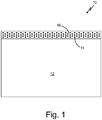
- FIG. 1 is a schematic view of corrosion-resistant coating 10 on substrate 12.
- Substrate 12 can be an aircraft component including, but not limited to, heat exchangers, ductwork, valves, or gearbox housings formed from aluminum or magnesium alloys.
- Coating 10 is an epoxy phenolic coating containing graphene nanoplatelets.
- graphene nanoplatelets 14 are dispersed in epoxy phenolic coating matrix 16 comprising an epoxy phenolic resin.
- a synergistic relationship exists between epoxy phenolic resin 16 and graphene nanoplatelets 14, providing improved corrosion resistance.
- the phenolic resin is less permeable to water than conventional epoxy bond primer systems and the graphene nanoplatelets 14 exhibit corrosion-resistant properties.
- Graphene nanoplatelets 14 can have a diameter within a range of 1 to 20 micrometers and arranged in stacks of less than eight single layer graphene sheets. Generally, nanoplatelets can be clusters of four to five single layer sheets and preferably, can be arranged in stacks of five or less single layer graphene sheets. Nanoplatelet diameters above 20 micrometers can cause the coating to have a rough or lumpy texture due to an orientation of the high aspect ratio graphene nanoplatelets 14 and gaps that form between nanoplatelets 14. Diameters less than one micrometer have an improved aspect ratio, but can increase a viscosity of coating 10 above a level suitable for coating application. Some increase in viscosity is acceptable and in some embodiments can be preferred as a means to increase coating thickness.
- Graphene nanoplatelets 14 can be suspended in a solvent (e.g., acetone, isopropanol, or other solvent suitable for mixing with the epoxy phenolic resin) and mixed with the epoxy phenolic resin.
- Coating 10 can have a total solid content of 30 to 35 percent by weight with a graphene nanoplatelet loading between 0.1 and 1.5 wt% of the total solid content.
- Graphene nanoplatelet content can be selected to provide acceptable corrosion resistance without adversely affecting coating 10 viscosity and mechanical properties of coating 10 after curing.
- Graphene nanoplatelets 14 can contain between 5 and 15 atomic percent oxygen in the form of surface functional groups including, but not limited to, hydroxyl units, carboxylic acids, and ketones.
- graphene nanoplatelets preferably contain about 15 atomic weight percent oxygen.
- Alkoxysilanes i.e., (3-glycidoxypropyl) trimethoxysilane
- Functional groups can be, for example, amine, amide, carboxylic acid, or epoxide.
- Graphene nanoplatelets 14 having less than 5 atomic percent oxygen may not mix adequately with the epoxy phenolic resin, while too much oxygen content can inhibit the corrosion-resistant properties of the graphene.
- Alkoxysilane can be mixed with alcohol and water to catalyze hydrolysis and then introduced to the suspension of graphene nanoplatelets 14.
- the functionalized graphene nanoplatelets 14 can then be added to the epoxy phenolic resin 16.
- Epoxy phenolic resin 16 can be, for example, Rockhard coating (i.e., Rockhard 961-450-002).
- Graphene nanoplatelets 14 can be sonicated into solution (e.g., 10-20 kHz sonication for 10-15 minutes) to produce coating 10.
- sonication can separate some clusters of the graphene nanoplatelets into stacks of less than five single layer sheets.
- FIG. 2 illustrates method 20 of protecting an article exposed to a corrosive environment.
- the article can be a metallic component exposed to a corrosive environment including, but not limited to, aircraft heat exchangers, ductwork, valves, and gearbox housings formed from aluminum or magnesium alloy.
- Method 20 includes preparing corrosion-resistant epoxy phenolic coating 10 (step 22); dipping the article in coating 10, spraying coating 10 on article surfaces, and/or pumping coating 10 through internal passages of the article (step 24); draining excess coating 10 from internal passages or a surface of the article (step 26); curing coating 10 (step 28); and repeating steps 24-28 until a desired coating thickness is achieved (step 30).
- coating 10 can be prepared by mixing graphene nanoplatelets 14 suspended in a solvent with an alkoxysilane mixture to form functional groups on the surface of graphene nanoplatelets 14, which improve mixing with epoxy phenolic resin 16.
- a mixture of epoxy phenolic resin 16 and the functionalized graphene nanoplatelets 14 can be sonicated to disperse graphene nanoplatelets 14 throughout the mixture.
- coating 10 can have graphene nanoplatelet loading of between 0.1 and 2.0 of the total solid wt.% to provide coating 10 with acceptable corrosion-resistant properties in an aggressive corrosion environment.
- Coating 10 can be applied directly to metallic substrate 12 without a hexavalent chromium-containing primer wash or other primer used to improve adhesion nor limit corrosion.
- coating 10 can be applied without deoxidizing the substrate surface.
- Substrate 12 can be dipped in coating 10 or coating 10 can be sprayed on substrate surfaces.
- To coat internal surfaces, such as internal heat exchanger surfaces coating 10 can be pumped through internal passages of the component.
- plumbing can be connected to inlets and outlets of the heat exchanger for pumping coating 10 through internal passageways. Such method can be used to coat all internal fins and other heat exchanging structures and surfaces. Excess coating 10 can be drained from internal passages or the surface of the article leaving a layer of coating 10 on the article.
- Coating 10 can be dried initially at room temperature to remove solvents and then further cured with the addition of heat.
- multiple layers of coating 10 can be applied to substrate 12 to achieve a desired coating thickness.
- Each layer can be partially cured before application of the subsequent layer.
- coating 10 can undergo a final cure and heat treatment.
- each layer of coating 10 can undergo an initial cure at room temperature for 60 minutes, followed by curing at 220 °F for 45-60 minutes, followed by curing at 350 °F for 60-70 minutes, which can be extended to 8-9 hours in the final cure and heat treatment.
- coating 10 can have a maximum thickness of about 25.4 micrometers.
- coating 10 can have a maximum thickness of 12.7 micrometers, and preferably a thickness of between 7.6 micrometers and 12.7 micrometers to provide adequate protection in corrosive environments.
- two layers of coating 10 can be applied to substrate 12 to achieve a coating thickness between 7.6 micrometers and 12.7 micrometers. This is a substantial improvement over barrier coating systems, which can require seven or more layers to achieve a tolerable level of corrosion protection.
- graphene nanoplatelets to an epoxy phenolic solvent-based coating system can provide improved corrosion resistance, while reducing the number of coats needed and eliminating the need for applying a chromate containing wash primer. Improved corrosion resistance increases component life. The reduction in coats applied results in improved manufacturing throughput and reduced manufacturing costs. And the elimination of the hexavalent chromium-containing wash primer makes the manufacturing process, as well as the manufactured article, more environmentally friendly.
- any relative terms or terms of degree used herein such as “substantially”, “essentially”, “generally”, “approximately” and the like, should be interpreted in accordance with and subject to any applicable definitions or limits expressly stated herein.
- any relative terms or terms of degree used herein should be interpreted to broadly encompass any relevant disclosed embodiments as well as such ranges or variations as would be understood by a person of ordinary skill in the art in view of the entirety of the present disclosure, such as to encompass ordinary manufacturing tolerance variations, incidental alignment variations, transient alignment or shape variations induced by thermal, rotational or vibrational operational conditions, and the like.
- any relative terms or terms of degree used herein should be interpreted to encompass a range that expressly includes the designated quality, characteristic, parameter or value, without variation, as if no qualifying relative term or term of degree were utilized in the given disclosure or recitation.
- a coating for protecting a component exposed to a corrosive environment includes an epoxy phenolic resin and graphene nanoplatelets.
- the coating of the preceding paragraph can optionally include, additionally and/or alternatively, any one or more of the following features, configurations, and/or additional components:
- graphene nanoplatelets can have a diameter within the range of 1 to 20 micrometers.
- nanoplatelets can comprise stacks of less than 8 single layer graphene sheets.
- graphene nanoplatelets can contain 5 to 15 atomic percent oxygen.
- graphene nanoplatelets can comprise functional groups selected to improve mixing with the epoxy phenolic resin.
- An article for use in a corrosive environment includes a metallic substrate and a corrosion-resistant coating disposed on a surface of the metallic substrate.
- the corrosion-resistant coating includes an epoxy phenolic resin and graphene nanoplatelets.
- the article of the preceding paragraph can optionally include, additionally and/or alternatively, any one or more of the following features, configurations, and/or additional components:
- a further embodiment of the article of any of the preceding paragraphs, wherein the coating can comprise 0.1 to 2.0 weight percent graphene nanoplatelets.
- graphene nanoplatelets can have a diameter within the range of 1 to 20 micrometers.
- nanoplatelets can comprise stacks of less than 8 single layer graphene sheets.
- graphene nanoplatelets can contain 5 to 15 atomic percent oxygen.
- graphene nanoplatelets can comprise functional groups selected to improve mixing with the epoxy phenolic resin.
- the substrate can be an aluminum alloy or magnesium alloy.
- the substrate can be a non-deoxidized aluminum alloy or magnesium alloy.
- a method of protecting a an article exposed to a corrosive environment includes applying a corrosion-resistant epoxy phenolic coating to a surface of the article exposed to a corrosive environment and curing the corrosion-resistant epoxy phenolic coating.
- the coating comprises 0.1 to 2.0 weight percent graphene nanoplatelets containing 5 to 15 atomic percent oxygen.
- the method of the preceding paragraph can optionally include, additionally and/or alternatively, any one or more of the following features, configurations, additional components, and/or steps:
- the surface of the article can be an aluminum alloy or magnesium alloy free of a chromate containing wash primer or chromate containing conversion coat.
- graphene nanoplatelets can have a diameter within the range of 1 to 20 micrometers.
- the article can be a heat exchanger and wherein applying the coating can comprise pumping the coating through internal passages of the heat exchanger to coat internal surfaces and draining excess coating to leave a coating thickness of less than 12.7 micrometers.
- a further embodiment of the method of any of the preceding paragraphs can further comprise repeating the steps of applying the corrosion-resistant epoxy phenolic coating and curing the coating to achieve a coating thickness between 7.6 micrometers and 12.7 micrometers.
Landscapes
- Chemical & Material Sciences (AREA)
- Life Sciences & Earth Sciences (AREA)
- Engineering & Computer Science (AREA)
- Wood Science & Technology (AREA)
- Materials Engineering (AREA)
- Organic Chemistry (AREA)
- Inorganic Chemistry (AREA)
- Laminated Bodies (AREA)
- Application Of Or Painting With Fluid Materials (AREA)
- Paints Or Removers (AREA)
Abstract
In one aspect, a coating (10) for protecting a component exposed to a corrosive environment includes an epoxy phenolic resin (16) and graphene nanoplatelets (14). In another aspect, a method of protecting a an article exposed to a corrosive environment includes applying a corrosion-resistant epoxy phenolic coating to a surface of the article exposed to a corrosive environment and curing the corrosion-resistant epoxy phenolic coating. The coating (10) comprises 0.1 to 2.0 weight percent graphene nanoplatelets containing 5 to 15 atomic percent oxygen.
Description
- The present invention relates generally to coatings and more particularly to corrosion-resistant coatings.
- Aluminum aircraft heat exchangers placed in service in areas of the world with significant air pollution can exhibit considerable corrosion caused by sulfuric acid formed by the reaction of sulfur containing pollutants with atmospheric moisture. Currently used barrier coatings have been only partially effective in preventing or reducing this corrosion. Conventional hexavalent chromium-containing wash primers used to improve corrosion resistance have associated environmental and health risks and have shown insufficient results in highly corrosive environments. The addition of multiple barrier coating layers, while capable of delaying corrosion, significantly increases manufacture time and cost. Improved and more environmentally friendly corrosion-resistant coatings are needed to increase component life while improving manufacturing throughput and reducing manufacturing costs.
- In one aspect, a coating for protecting a component exposed to a corrosive environment includes an epoxy phenolic resin and graphene nanoplatelets.
- In another aspect, an article for use in a corrosive environment includes a metallic substrate and a corrosion-resistant coating disposed on a surface of the metallic substrate. The corrosion-resistant coating includes an epoxy phenolic resin and graphene nanoplatelets.
- In yet another aspect, a method of protecting a an article exposed to a corrosive environment includes applying a corrosion-resistant epoxy phenolic coating to a surface of the article exposed to a corrosive environment and curing the corrosion-resistant epoxy phenolic coating. The coating comprises 0.1 to 2.0 weight percent graphene nanoplatelets containing 5 to 15 atomic percent oxygen.
- The present summary is provided only by way of example, and not limitation. Other aspects of the present disclosure will be appreciated in view of the entirety of the present disclosure, including the entire text, claims and accompanying figures.
-
-
FIG. 1 is a schematic view of a corrosion-resistant coating on an article. -
FIG. 2 is a method of applying a corrosion-resistant coating to an article. - While the above-identified figures set forth embodiments of the present invention, other embodiments are also contemplated, as noted in the discussion. In all cases, this disclosure presents the invention by way of representation and not limitation. It should be understood that numerous other modifications and embodiments can be devised by those skilled in the art, which fall within the scope and spirit of the principles of the invention. The figures may not be drawn to scale, and applications and embodiments of the present invention may include features, steps and/or components not specifically shown in the drawings.
- Currently, epoxy phenolic barrier coatings such as Rockhard coatings are used in combination with a hexavalent chromium-containing wash primer to protect metallic aircraft components from corrosion. A surface of the metallic component is deoxidized prior to applying a thin coating of hexavalent chromium-containing wash primer. The primer serves to improve coating adhesion and corrosion protection, but has been shown to provide generally poor corrosion protection in regions of the world with high air pollution. To improve corrosion resistance in highly corrosive environments, multiple layers of the epoxy phenolic coating must be applied to provide barrier protection of the component. The application of multiple coats can significantly reduce manufacturing throughput and increase manufacturing costs, while the use of hexavalent chromium produces toxic environmental waste and can pose a significant health hazard in the manufacturing process.
- Graphene nanoplatelets can be combined with an epoxy phenolic solvent-based coating system to provide improved corrosion resistance. The introduction of graphene nanoplatelets can reduce the number of coats needed (i.e., coating thickness) and can eliminate the need for applying a chromate-containing wash primer.
FIG. 1 is a schematic view of corrosion-resistant coating 10 onsubstrate 12.Substrate 12 can be an aircraft component including, but not limited to, heat exchangers, ductwork, valves, or gearbox housings formed from aluminum or magnesium alloys.Coating 10 is an epoxy phenolic coating containing graphene nanoplatelets. As schematically illustrated inFIG. 1 ,graphene nanoplatelets 14 are dispersed in epoxyphenolic coating matrix 16 comprising an epoxy phenolic resin. A synergistic relationship exists between epoxyphenolic resin 16 andgraphene nanoplatelets 14, providing improved corrosion resistance. The phenolic resin is less permeable to water than conventional epoxy bond primer systems and thegraphene nanoplatelets 14 exhibit corrosion-resistant properties. -
Graphene nanoplatelets 14 can have a diameter within a range of 1 to 20 micrometers and arranged in stacks of less than eight single layer graphene sheets. Generally, nanoplatelets can be clusters of four to five single layer sheets and preferably, can be arranged in stacks of five or less single layer graphene sheets. Nanoplatelet diameters above 20 micrometers can cause the coating to have a rough or lumpy texture due to an orientation of the high aspectratio graphene nanoplatelets 14 and gaps that form betweennanoplatelets 14. Diameters less than one micrometer have an improved aspect ratio, but can increase a viscosity of coating 10 above a level suitable for coating application. Some increase in viscosity is acceptable and in some embodiments can be preferred as a means to increase coating thickness. -
Graphene nanoplatelets 14 can be suspended in a solvent (e.g., acetone, isopropanol, or other solvent suitable for mixing with the epoxy phenolic resin) and mixed with the epoxy phenolic resin.Coating 10 can have a total solid content of 30 to 35 percent by weight with a graphene nanoplatelet loading between 0.1 and 1.5 wt% of the total solid content. Graphene nanoplatelet content can be selected to provide acceptable corrosion resistance without adversely affecting coating 10 viscosity and mechanical properties ofcoating 10 after curing.Graphene nanoplatelets 14 can contain between 5 and 15 atomic percent oxygen in the form of surface functional groups including, but not limited to, hydroxyl units, carboxylic acids, and ketones. In some embodiments, graphene nanoplatelets preferably contain about 15 atomic weight percent oxygen. Alkoxysilanes (i.e., (3-glycidoxypropyl) trimethoxysilane) can be used to functionalize the graphene nanoplatelet side chains, permitting improved mixing with the epoxy phenolic resin. Functional groups can be, for example, amine, amide, carboxylic acid, or epoxide.Graphene nanoplatelets 14 having less than 5 atomic percent oxygen may not mix adequately with the epoxy phenolic resin, while too much oxygen content can inhibit the corrosion-resistant properties of the graphene. Alkoxysilane can be mixed with alcohol and water to catalyze hydrolysis and then introduced to the suspension ofgraphene nanoplatelets 14. - The functionalized
graphene nanoplatelets 14 can then be added to theepoxy phenolic resin 16. Epoxyphenolic resin 16 can be, for example, Rockhard coating (i.e., Rockhard 961-450-002).Graphene nanoplatelets 14 can be sonicated into solution (e.g., 10-20 kHz sonication for 10-15 minutes) to producecoating 10. In addition to dispersinggraphene nanoplatelets 14, sonication can separate some clusters of the graphene nanoplatelets into stacks of less than five single layer sheets. -
FIG. 2 illustratesmethod 20 of protecting an article exposed to a corrosive environment. As previously disclosed, the article can be a metallic component exposed to a corrosive environment including, but not limited to, aircraft heat exchangers, ductwork, valves, and gearbox housings formed from aluminum or magnesium alloy.Method 20 includes preparing corrosion-resistant epoxy phenolic coating 10 (step 22); dipping the article incoating 10, sprayingcoating 10 on article surfaces, and/or pumpingcoating 10 through internal passages of the article (step 24); drainingexcess coating 10 from internal passages or a surface of the article (step 26); curing coating 10 (step 28); and repeating steps 24-28 until a desired coating thickness is achieved (step 30). As previously disclosed,coating 10 can be prepared by mixinggraphene nanoplatelets 14 suspended in a solvent with an alkoxysilane mixture to form functional groups on the surface ofgraphene nanoplatelets 14, which improve mixing withepoxy phenolic resin 16. A mixture of epoxyphenolic resin 16 and the functionalizedgraphene nanoplatelets 14 can be sonicated to dispersegraphene nanoplatelets 14 throughout the mixture. As previously disclosed,coating 10 can have graphene nanoplatelet loading of between 0.1 and 2.0 of the total solid wt.% to providecoating 10 with acceptable corrosion-resistant properties in an aggressive corrosion environment. -
Coating 10 can be applied directly tometallic substrate 12 without a hexavalent chromium-containing primer wash or other primer used to improve adhesion nor limit corrosion. In some embodiments,coating 10 can be applied without deoxidizing the substrate surface.Substrate 12 can be dipped in coating 10 orcoating 10 can be sprayed on substrate surfaces. To coat internal surfaces, such as internal heat exchanger surfaces,coating 10 can be pumped through internal passages of the component. In some embodiments, plumbing can be connected to inlets and outlets of the heat exchanger for pumpingcoating 10 through internal passageways. Such method can be used to coat all internal fins and other heat exchanging structures and surfaces.Excess coating 10 can be drained from internal passages or the surface of the article leaving a layer ofcoating 10 on the article.Coating 10 can be dried initially at room temperature to remove solvents and then further cured with the addition of heat. In some embodiments, multiple layers ofcoating 10 can be applied tosubstrate 12 to achieve a desired coating thickness. Each layer can be partially cured before application of the subsequent layer. After a desired coating thickness is achieved, coating 10 can undergo a final cure and heat treatment. For example, each layer ofcoating 10 can undergo an initial cure at room temperature for 60 minutes, followed by curing at 220 °F for 45-60 minutes, followed by curing at 350 °F for 60-70 minutes, which can be extended to 8-9 hours in the final cure and heat treatment. For the application ofcoating 10 to an aluminum alloy heat exchanger (e.g., 6000 series aluminum), coating 10 can have a maximum thickness of about 25.4 micrometers. In another embodiment, coating 10 can have a maximum thickness of 12.7 micrometers, and preferably a thickness of between 7.6 micrometers and 12.7 micrometers to provide adequate protection in corrosive environments. In some embodiments, two layers ofcoating 10 can be applied tosubstrate 12 to achieve a coating thickness between 7.6 micrometers and 12.7 micrometers. This is a substantial improvement over barrier coating systems, which can require seven or more layers to achieve a tolerable level of corrosion protection. - The addition of graphene nanoplatelets to an epoxy phenolic solvent-based coating system can provide improved corrosion resistance, while reducing the number of coats needed and eliminating the need for applying a chromate containing wash primer. Improved corrosion resistance increases component life. The reduction in coats applied results in improved manufacturing throughput and reduced manufacturing costs. And the elimination of the hexavalent chromium-containing wash primer makes the manufacturing process, as well as the manufactured article, more environmentally friendly.
- Any relative terms or terms of degree used herein, such as "substantially", "essentially", "generally", "approximately" and the like, should be interpreted in accordance with and subject to any applicable definitions or limits expressly stated herein. In all instances, any relative terms or terms of degree used herein should be interpreted to broadly encompass any relevant disclosed embodiments as well as such ranges or variations as would be understood by a person of ordinary skill in the art in view of the entirety of the present disclosure, such as to encompass ordinary manufacturing tolerance variations, incidental alignment variations, transient alignment or shape variations induced by thermal, rotational or vibrational operational conditions, and the like. Moreover, any relative terms or terms of degree used herein should be interpreted to encompass a range that expressly includes the designated quality, characteristic, parameter or value, without variation, as if no qualifying relative term or term of degree were utilized in the given disclosure or recitation.
- The following are non-exclusive descriptions of possible embodiments of the present invention.
- A coating for protecting a component exposed to a corrosive environment includes an epoxy phenolic resin and graphene nanoplatelets.
- The coating of the preceding paragraph can optionally include, additionally and/or alternatively, any one or more of the following features, configurations, and/or additional components:
- A further embodiment of the coating of any of the preceding paragraphs, wherein the coating can comprise 0.1 to 2.0 weight percent graphene nanoplatelets.
- A further embodiment of the coating of any of the preceding paragraphs, wherein the graphene nanoplatelets can have a diameter within the range of 1 to 20 micrometers.
- A further embodiment of the coating of any of the preceding paragraphs, wherein the nanoplatelets can comprise stacks of less than 8 single layer graphene sheets.
- A further embodiment of the coating of any of the preceding paragraphs, wherein the graphene nanoplatelets can contain 5 to 15 atomic percent oxygen.
- A further embodiment of the coating of any of the preceding paragraphs, wherein the graphene nanoplatelets can comprise functional groups selected to improve mixing with the epoxy phenolic resin.
- An article for use in a corrosive environment includes a metallic substrate and a corrosion-resistant coating disposed on a surface of the metallic substrate. The corrosion-resistant coating includes an epoxy phenolic resin and graphene nanoplatelets.
- The article of the preceding paragraph can optionally include, additionally and/or alternatively, any one or more of the following features, configurations, and/or additional components:
- A further embodiment of the article of any of the preceding paragraphs, wherein the coating can comprise 0.1 to 2.0 weight percent graphene nanoplatelets.
- A further embodiment of the article of any of the preceding paragraphs, wherein the graphene nanoplatelets can have a diameter within the range of 1 to 20 micrometers.
- A further embodiment of the article of any of the preceding paragraphs, wherein the nanoplatelets can comprise stacks of less than 8 single layer graphene sheets.
- A further embodiment of the article of any of the preceding paragraphs, wherein the graphene nanoplatelets can contain 5 to 15 atomic percent oxygen.
- A further embodiment of the article of any of the preceding paragraphs, wherein the graphene nanoplatelets can comprise functional groups selected to improve mixing with the epoxy phenolic resin.
- A further embodiment of the article of any of the preceding paragraphs, wherein the substrate can be an aluminum alloy or magnesium alloy.
- A further embodiment of the article of any of the preceding paragraphs, wherein the substrate can be a non-deoxidized aluminum alloy or magnesium alloy.
- A further embodiment of the article of any of the preceding paragraphs, wherein the article can be a heat exchanger and the surface of the substrate is an internal surface of the heat exchanger.
- A further embodiment of the article of any of the preceding paragraphs, wherein the substrate surface can be free of a chromate containing wash primer or chromate containing conversion coat.
- A method of protecting a an article exposed to a corrosive environment includes applying a corrosion-resistant epoxy phenolic coating to a surface of the article exposed to a corrosive environment and curing the corrosion-resistant epoxy phenolic coating. The coating comprises 0.1 to 2.0 weight percent graphene nanoplatelets containing 5 to 15 atomic percent oxygen.
- The method of the preceding paragraph can optionally include, additionally and/or alternatively, any one or more of the following features, configurations, additional components, and/or steps:
- A further embodiment of the method of any of the preceding paragraphs, wherein the surface of the article can be an aluminum alloy or magnesium alloy free of a chromate containing wash primer or chromate containing conversion coat.
- A further embodiment of the method of any of the preceding paragraphs, wherein the graphene nanoplatelets can have a diameter within the range of 1 to 20 micrometers.
- A further embodiment of the method of any of the preceding paragraphs, wherein the article can be a heat exchanger and wherein applying the coating can comprise pumping the coating through internal passages of the heat exchanger to coat internal surfaces and draining excess coating to leave a coating thickness of less than 12.7 micrometers.
- A further embodiment of the method of any of the preceding paragraphs can further comprise repeating the steps of applying the corrosion-resistant epoxy phenolic coating and curing the coating to achieve a coating thickness between 7.6 micrometers and 12.7 micrometers.
- While the invention has been described with reference to an exemplary embodiment(s), it will be understood by those skilled in the art that various changes may be made and equivalents may be substituted for elements thereof without departing from the scope of the invention. In addition, many modifications may be made to adapt a particular situation or material to the teachings of the invention without departing from the essential scope thereof. Therefore, it is intended that the invention not be limited to the particular embodiment(s) disclosed, but that the invention will include all embodiments falling within the scope of the appended claims.
Claims (15)
- A coating (10) for protecting a component exposed to a corrosive environment, the coating comprising:an epoxy phenolic resin (16); andgraphene nanoplatelets (14).
- The coating of claim 1, wherein the coating (10) comprises 0.1 to 2.0 weight percent graphene nanoplatelets.
- The coating of claim 2, wherein the graphene nanoplatelets (14) have a diameter within the range of 1 to 20 micrometers.
- The coating of claim 3, wherein the nanoplatelets (14) comprise stacks of less than 8 single layer graphene sheets.
- The coating of claim 4, wherein the graphene nanoplatelets (14) contain 5 to 15 atomic percent oxygen.
- The coating of claim 5, wherein the graphene nanoplatelets (14) comprise functional groups selected to improve mixing with the epoxy phenolic resin.
- An article for use in a corrosive environment, the article comprising:a metallic substrate (12); andthe corrosion-resistant coating (10) of any preceding claim, disposed on a surface of the metallic substrate (12).
- The article of claim 7, wherein the graphene nanoplatelets (14) comprise functional groups selected to improve mixing with the epoxy phenolic resin, and
wherein the substrate (12) is an aluminum alloy or magnesium alloy. - The article of claim 8, wherein the substrate surface is free of a chromate containing wash primer or chromate containing conversion coat.
- The article of claim 8, wherein the article is a heat exchanger and the surface of the substrate is an internal surface of the heat exchanger.
- A method of protecting an article exposed to a corrosive environment, the method comprising:applying a corrosion-resistant epoxy phenolic coating (10) to a surface of the article exposed to a corrosive environment, wherein the coating (10) comprises 0.1 to 2.0 weight percent graphene nanoplatelets containing 5 to 15 atomic percent oxygen; andcuring the corrosion-resistant epoxy phenolic coating.
- The method of claim 11, wherein the surface of the article is an aluminum alloy or magnesium alloy free of a chromate containing wash primer or chromate containing conversion coat.
- The method of claim 11 or 12, wherein the graphene nanoplatelets (14) have a diameter within the range of 1 to 20 micrometers.
- The method of claim 13, wherein the article is a heat exchanger and wherein applying the coating (10) comprises:pumping the coating through internal passages of the heat exchanger to coat internal surfaces; anddraining excess coating to leave a coating thickness of less than 12.7 micrometers.
- The method of claim 13, and further comprising repeating the steps of applying the corrosion-resistant epoxy phenolic coating and curing the coating to achieve a coating thickness between 7.6 micrometers and 12.7 micrometers.
Applications Claiming Priority (1)
| Application Number | Priority Date | Filing Date | Title |
|---|---|---|---|
| US16/185,417 US10781318B2 (en) | 2018-11-09 | 2018-11-09 | Graphene based corrosion-resistant coating |
Publications (1)
| Publication Number | Publication Date |
|---|---|
| EP3650506A1 true EP3650506A1 (en) | 2020-05-13 |
Family
ID=68501452
Family Applications (1)
| Application Number | Title | Priority Date | Filing Date |
|---|---|---|---|
| EP19208034.9A Withdrawn EP3650506A1 (en) | 2018-11-09 | 2019-11-08 | Graphene based corrosion-resistant coating |
Country Status (3)
| Country | Link |
|---|---|
| US (1) | US10781318B2 (en) |
| EP (1) | EP3650506A1 (en) |
| CN (1) | CN111171664A (en) |
Families Citing this family (7)
| Publication number | Priority date | Publication date | Assignee | Title |
|---|---|---|---|---|
| FR3094657B1 (en) * | 2019-04-03 | 2022-07-08 | Safran Nacelles | Process for manufacturing a structural surface exchanger for a nacelle |
| CN111426216B (en) * | 2020-04-03 | 2021-12-28 | 浙江大学 | High-efficiency heat exchanger of fuel cell temperature control system and processing device thereof |
| CN112029394B (en) * | 2020-08-04 | 2022-03-04 | 航天材料及工艺研究所 | Composition for forming magnesium-lithium alloy surface anticorrosive coating system and preparation method of anticorrosive coating system |
| CN112592631A (en) * | 2020-12-02 | 2021-04-02 | 湖南翰坤实业有限公司 | Ocean corrosion-resistant nano aviation coating and preparation method thereof |
| US11572521B1 (en) | 2021-11-12 | 2023-02-07 | Hamilton Sundstrand Corporation | Corrosion resistant dry film lubricants |
| CN117126586A (en) * | 2023-10-26 | 2023-11-28 | 成都石大力盾科技有限公司 | Thread seizure preventing coating and preparation method thereof |
| CN118442873B (en) * | 2024-07-08 | 2024-10-11 | 广东美的制冷设备有限公司 | Metal matrix composite material and preparation method thereof, fin, heat exchanger and application thereof |
Citations (6)
| Publication number | Priority date | Publication date | Assignee | Title |
|---|---|---|---|---|
| US20110274835A1 (en) * | 2007-03-29 | 2011-11-10 | Wei Liu | Method for membrane deposition |
| CN106147505A (en) * | 2014-10-25 | 2016-11-23 | 西安烨森电子科技有限责任公司 | Powder anti-corrosion coatings for submarine pipelines |
| US20170037257A1 (en) * | 2014-04-14 | 2017-02-09 | Board Of Regents, The University Of Texas System | Graphene-based coatings |
| CN107267033A (en) * | 2017-07-10 | 2017-10-20 | 厦门双瑞船舶涂料有限公司 | A kind of graphene doping heat exchanger tube coating and preparation method thereof |
| US20180186124A1 (en) * | 2016-12-29 | 2018-07-05 | Cytec Industries Inc. | Aqueous primer composition for adhesive bonding and bonding method using the same |
| EP3378903A1 (en) * | 2017-03-22 | 2018-09-26 | Hamilton Sundstrand Corporation | Corrosion protection via nanomaterials |
Family Cites Families (7)
| Publication number | Priority date | Publication date | Assignee | Title |
|---|---|---|---|---|
| JP5841125B2 (en) * | 2010-03-26 | 2016-01-13 | ユニバーシティ オブ ハワイ | Resin reinforced with nanomaterials and related materials |
| US20140037850A1 (en) * | 2012-08-06 | 2014-02-06 | General Electric Company | Corrosion and wear resistant organic coatings |
| US8962096B2 (en) * | 2012-11-28 | 2015-02-24 | Baker Hughes Incorporated | Method for preparing a high temperature polymer coating |
| DE102013201392A1 (en) * | 2013-01-29 | 2014-07-31 | Evonik Industries Ag | Adhesion promoter and primer compositions for hybrid metal-plastic components |
| EP3726594B1 (en) * | 2014-11-14 | 2022-05-04 | Gentherm Incorporated | Heating and cooling technologies |
| US10023963B2 (en) | 2016-06-06 | 2018-07-17 | United Technologies Corporation | Corrosion inhibiting additive |
| US20190352781A1 (en) * | 2018-05-17 | 2019-11-21 | Hamilton Sundstrand Corporation | Corrosion barrier |
-
2018
- 2018-11-09 US US16/185,417 patent/US10781318B2/en active Active
-
2019
- 2019-11-08 CN CN201911087789.8A patent/CN111171664A/en active Pending
- 2019-11-08 EP EP19208034.9A patent/EP3650506A1/en not_active Withdrawn
Patent Citations (6)
| Publication number | Priority date | Publication date | Assignee | Title |
|---|---|---|---|---|
| US20110274835A1 (en) * | 2007-03-29 | 2011-11-10 | Wei Liu | Method for membrane deposition |
| US20170037257A1 (en) * | 2014-04-14 | 2017-02-09 | Board Of Regents, The University Of Texas System | Graphene-based coatings |
| CN106147505A (en) * | 2014-10-25 | 2016-11-23 | 西安烨森电子科技有限责任公司 | Powder anti-corrosion coatings for submarine pipelines |
| US20180186124A1 (en) * | 2016-12-29 | 2018-07-05 | Cytec Industries Inc. | Aqueous primer composition for adhesive bonding and bonding method using the same |
| EP3378903A1 (en) * | 2017-03-22 | 2018-09-26 | Hamilton Sundstrand Corporation | Corrosion protection via nanomaterials |
| CN107267033A (en) * | 2017-07-10 | 2017-10-20 | 厦门双瑞船舶涂料有限公司 | A kind of graphene doping heat exchanger tube coating and preparation method thereof |
Also Published As
| Publication number | Publication date |
|---|---|
| US10781318B2 (en) | 2020-09-22 |
| US20200148894A1 (en) | 2020-05-14 |
| CN111171664A (en) | 2020-05-19 |
Similar Documents
| Publication | Publication Date | Title |
|---|---|---|
| US10781318B2 (en) | Graphene based corrosion-resistant coating | |
| Ramezanzadeh et al. | Studying various mixtures of 3-aminopropyltriethoxysilane (APS) and tetraethylorthosilicate (TEOS) silanes on the corrosion resistance of mild steel and adhesion properties of epoxy coating | |
| US10675843B2 (en) | Aqueous primer composition for adhesive bonding and bonding method using the same | |
| CN101720344B (en) | Resin composition for precoated steel sheet and steel sheet having excellent workability, heat resistance and corrosion resistance | |
| CN111073507B (en) | Water-based chromium-free zinc-aluminum anticorrosive paint and preparation method thereof | |
| EP4127264B1 (en) | Chromate-free ceramic compositions with reduced curing temperature | |
| CN107790360A (en) | The preparation method of composite coating that marine anticorrosion uses | |
| CN103897559B (en) | A kind of epoxidation zone rust coating process | |
| CN106133076B (en) | Anti-corrosion layer system, anti-corrosion bearing assembly and method of protecting bearing assembly from corrosion | |
| JP5186644B2 (en) | Anticorrosion film and anticorrosion paint | |
| CN103097473A (en) | Primer composition | |
| CN118146695A (en) | A kind of silicone modified epoxy heat-resistant anticorrosive primer and its preparation method and application | |
| CN115558422B (en) | A kind of sealing solution of self-repairing high corrosion resistance sealing material and its preparation method and application | |
| EP3800225A1 (en) | Corrosion resistant hydrophobic surfaces | |
| CN201272831Y (en) | Steel structure surface VCI squama zinc-aluminum coating system | |
| CN114479660A (en) | Chromium-free zinc-aluminum-nickel coating composite product and application thereof | |
| KR100701748B1 (en) | Plate material and its manufacturing method | |
| CN115637094B (en) | Cast magnesium alloy protective coating system and preparation and use methods thereof | |
| CN104893495A (en) | Corrosion resistant paint and preparation method thereof | |
| KR102945902B1 (en) | High corrosion resistant bolt and manufacturing method of the same | |
| EP3650505A1 (en) | Non-chromated corrosion-resistant coating | |
| CN105038580A (en) | Self-curing chemically bonded phosphate zinc-rich coating | |
| CN102151651B (en) | Preparation method of surface-coated bar with chloridion erosion resistance | |
| CN102314979A (en) | Rare-earth permanent magnet material with zinc-aluminum compound coating and coating agent and method for preparing rare-earth permanent magnet material | |
| CN110524428A (en) | A kind of method for anticorrosion treatment of rudder pin bearing |
Legal Events
| Date | Code | Title | Description |
|---|---|---|---|
| PUAI | Public reference made under article 153(3) epc to a published international application that has entered the european phase |
Free format text: ORIGINAL CODE: 0009012 |
|
| STAA | Information on the status of an ep patent application or granted ep patent |
Free format text: STATUS: THE APPLICATION HAS BEEN PUBLISHED |
|
| AK | Designated contracting states |
Kind code of ref document: A1 Designated state(s): AL AT BE BG CH CY CZ DE DK EE ES FI FR GB GR HR HU IE IS IT LI LT LU LV MC MK MT NL NO PL PT RO RS SE SI SK SM TR |
|
| AX | Request for extension of the european patent |
Extension state: BA ME |
|
| STAA | Information on the status of an ep patent application or granted ep patent |
Free format text: STATUS: THE APPLICATION IS DEEMED TO BE WITHDRAWN |
|
| 18D | Application deemed to be withdrawn |
Effective date: 20201114 |