EP3648395A1 - Encryption device, decryption device, encryption method, encryption program, decryption method and decryption program - Google Patents
Encryption device, decryption device, encryption method, encryption program, decryption method and decryption program Download PDFInfo
- Publication number
- EP3648395A1 EP3648395A1 EP17918542.6A EP17918542A EP3648395A1 EP 3648395 A1 EP3648395 A1 EP 3648395A1 EP 17918542 A EP17918542 A EP 17918542A EP 3648395 A1 EP3648395 A1 EP 3648395A1
- Authority
- EP
- European Patent Office
- Prior art keywords
- group
- cipher
- ciphertext
- decryption
- key
- Prior art date
- Legal status (The legal status is an assumption and is not a legal conclusion. Google has not performed a legal analysis and makes no representation as to the accuracy of the status listed.)
- Withdrawn
Links
Images












Classifications
-
- G—PHYSICS
- G09—EDUCATION; CRYPTOGRAPHY; DISPLAY; ADVERTISING; SEALS
- G09C—CIPHERING OR DECIPHERING APPARATUS FOR CRYPTOGRAPHIC OR OTHER PURPOSES INVOLVING THE NEED FOR SECRECY
- G09C1/00—Apparatus or methods whereby a given sequence of signs, e.g. an intelligible text, is transformed into an unintelligible sequence of signs by transposing the signs or groups of signs or by replacing them by others according to a predetermined system
-
- H—ELECTRICITY
- H04—ELECTRIC COMMUNICATION TECHNIQUE
- H04L—TRANSMISSION OF DIGITAL INFORMATION, e.g. TELEGRAPHIC COMMUNICATION
- H04L9/00—Cryptographic mechanisms or cryptographic arrangements for secret or secure communications; Network security protocols
- H04L9/30—Public key, i.e. encryption algorithm being computationally infeasible to invert or user's encryption keys not requiring secrecy
- H04L9/3066—Public key, i.e. encryption algorithm being computationally infeasible to invert or user's encryption keys not requiring secrecy involving algebraic varieties, e.g. elliptic or hyper-elliptic curves
- H04L9/3073—Public key, i.e. encryption algorithm being computationally infeasible to invert or user's encryption keys not requiring secrecy involving algebraic varieties, e.g. elliptic or hyper-elliptic curves involving pairings, e.g. identity based encryption [IBE], bilinear mappings or bilinear pairings, e.g. Weil or Tate pairing
-
- H—ELECTRICITY
- H04—ELECTRIC COMMUNICATION TECHNIQUE
- H04L—TRANSMISSION OF DIGITAL INFORMATION, e.g. TELEGRAPHIC COMMUNICATION
- H04L9/00—Cryptographic mechanisms or cryptographic arrangements for secret or secure communications; Network security protocols
- H04L9/08—Key distribution or management, e.g. generation, sharing or updating, of cryptographic keys or passwords
- H04L9/0816—Key establishment, i.e. cryptographic processes or cryptographic protocols whereby a shared secret becomes available to two or more parties, for subsequent use
- H04L9/0819—Key transport or distribution, i.e. key establishment techniques where one party creates or otherwise obtains a secret value, and securely transfers it to the other(s)
- H04L9/0825—Key transport or distribution, i.e. key establishment techniques where one party creates or otherwise obtains a secret value, and securely transfers it to the other(s) using asymmetric-key encryption or public key infrastructure [PKI], e.g. key signature or public key certificates
-
- H—ELECTRICITY
- H04—ELECTRIC COMMUNICATION TECHNIQUE
- H04L—TRANSMISSION OF DIGITAL INFORMATION, e.g. TELEGRAPHIC COMMUNICATION
- H04L9/00—Cryptographic mechanisms or cryptographic arrangements for secret or secure communications; Network security protocols
- H04L9/08—Key distribution or management, e.g. generation, sharing or updating, of cryptographic keys or passwords
- H04L9/0861—Generation of secret information including derivation or calculation of cryptographic keys or passwords
- H04L9/0869—Generation of secret information including derivation or calculation of cryptographic keys or passwords involving random numbers or seeds
-
- H—ELECTRICITY
- H04—ELECTRIC COMMUNICATION TECHNIQUE
- H04L—TRANSMISSION OF DIGITAL INFORMATION, e.g. TELEGRAPHIC COMMUNICATION
- H04L2209/00—Additional information or applications relating to cryptographic mechanisms or cryptographic arrangements for secret or secure communication H04L9/00
- H04L2209/12—Details relating to cryptographic hardware or logic circuitry
Definitions
- the present invention relates to at least either one of a high-security identity (ID)-based encryption (to be referred to as IBE hereinafter) scheme and a high-security attribute-based encryption (to be referred to as ABE hereinafter) scheme.
- ID high-security identity
- ABE high-security attribute-based encryption
- Non-Patent Literature 1 describes a partially quantum-resistant attribute-based encryption scheme that provides pre-challenge quantum security based on Isog-DBDH assumption.
- Non-Patent Literature 1 Koshiba, T., Takashima, K.: Pairing cryptography meets isogeny: A new framework of isogenous pairing groups. IACR Cryptology ePrint Archive 2016, 1138 (2016)
- Non-Patent Literature 1 can prove its security from a pairing-related problem hardness such as DBDH assumption that has been conventionally used widely.
- the isogeny problem is recognized as harder than the pairing-related problem because, for example, it indicates quantum resistance.
- the hardness has not yet been fully verified, it is concerned that unknown attacks might be found.
- An encryption device is an encryption device in a cryptographic system that uses a group G 0 , a group G t associated with the group G 0 , a group G ⁇ 0 , a group G ⁇ t associated with the group G ⁇ 0 , and a group G T associated with the group G 0 and the group G ⁇ 0 by pairing operation e 0 and associated with the group G t and the group G ⁇ t by pairing operation e t , the encryption device comprising; a ciphertext generation unit to generate a ciphertext ct using a generation element of an element X of the group G T and a generation element of an element Y ⁇ of the group G ⁇ t , the element X being generated through conversion of a generator of the group G T by a key generation random, or the element Y ⁇ being generated through conversion of a generator of the group G ⁇ t by the key generation random, wherein the ciphertext generation unit comprises:
- the present invention it is possible to provide security from a certain problem hardness by using a plurality of groups that are associated with each other. Also, in the present invention, it is possible to provide security from another problem hardness by generating a ciphertext ct ID' using a generation element generated by conversion using a key generation random.
- Embodiment 1 high-security, high-efficient IBE scheme will be described.
- formula 102 denotes that y is randomly selected from A according to the distribution of A. That is, in formula 102, y is a random. y ⁇ R A
- formula 103 denotes that y is uniformly selected from A. That is, in formula 103, y is a uniform random. y ⁇ U A
- Formula 104 namely F q , denotes a finite field of order q.
- Formula 106 denotes an inner product indicated by formula 108 of two vectors y ⁇ and v ⁇ indicated in formula 107.
- g y ⁇ denotes a group element denoted by formula 111.
- g ⁇ denotes a scalar exponentiation denoted by formula 112.
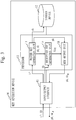
- An isogenous pairing group (to be referred to as IPG hereinafter) employed in an IBE scheme according to Embodiment 1 will be explained referring to Fig. 1 .
- IPG has a plurality of groups that are associated by isogeny and pairing operation.
- IPG is defined as follows.
- IPG generation algorithm Gen IPG (1 ⁇ , N), a master key pair of a public parameter pk IPG and a master secret key msk IPG indicated in formula 115 is generated randomly.
- (G t , G ⁇ t , e t , G T ) are asymmetric pairing groups of a prime order q with pairings e t : G t ⁇ G ⁇ t ⁇ G T and trapdoor homomorphisms ⁇ t .
- g t ⁇ t (g 0 ) ⁇ G t
- g ⁇ t ⁇ t (g ⁇ 0 ) ⁇ G ⁇ t .
- IPG has compatibility denoted by formula 116.
- g T e 0 (g 0 , g ⁇ 0 ) ⁇ 1 and G t ⁇ G ⁇ t .
- the IBE scheme comprises Setup algorithm, KeyGen algorithm, Enc algorithm, and Dec algorithm.
- Setup algorithm takes as input a security parameter 1 ⁇ and outputs public parameters pk and a master secret key msk.
- KeyGen algorithm takes as input the public parameters pk, the master secret key msk, and an identity ID, and outputs a decryption key sk ID corresponding to the identity ID.
- Enc algorithm takes as input the public parameters pk, a message m in a message space msg, and an identity ID', and outputs a ciphertext ct ID' .
- Dec algorithm takes as input the public parameters pk, the decryption key sk ID corresponding to the identity ID, and the ciphertext ct ID' encrypted under the identity ID', and outputs either a message m' ⁇ msg or a distinguished symbol ⁇ which indicates that decryption failed.
- a configuration of a cryptographic system 1 according to Embodiment 1 will be described referring to Fig. 2 .
- the cryptographic system 1 is provided with a key generation device 10, an encryption device 20, and a decryption device 30.
- the key generation device 10, the encryption device 20, and the decryption device 30 are connected to each other via a transmission line.
- a specific example of the transmission line is a local area network (LAN) or the Internet.
- the key generation device 10, the encryption device 20, and the decryption device 30 can communicate with each other via the transmission line.
- the key generation device 10 takes as input a security parameter 1 ⁇ and executes Setup algorithm to generate public parameters pk and a master secret key msk.
- the key generation device 10 also takes as input the public parameters pk, the master secret key msk, and an identity ID and executes KeyGen algorithm to generate a decryption key sk ID .
- the key generation device 10 publishes the public parameters pk and outputs the decryption key sk ID to the decryption device 30 corresponding to the identity ID.
- the key generation device 10 keeps the master secret key msk.
- Setup algorithm may be executed only once in setup or the like of the cryptographic system 10.
- the encryption device 20 takes as input the public parameters pk, a message m, and an identity ID' and executes Enc algorithm to generate a ciphertext ct ID' .
- the encryption device 20 outputs the ciphertext ct ID' to the decryption device 30.
- the decryption device 30 takes as input the public parameters pk, the decryption key sk ID , and the ciphertext ct ID' and executes Dec algorithm to generate a message m' or a distinguished symbol ⁇ which indicates that decryption failed.
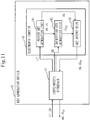
- a configuration of the key generation device 10 according to Embodiment 1 will be described referring to Fig. 3 .
- the key generation device 10 is provided with hardware devices which are a processor 11, a storage device 12, and an input/output interface 13.
- the processor 11 is connected to the other hardware devices via a signal line and controls these other hardware devices.
- the key generation device 10 is provided with a master key generation unit 14, a decryption key generation unit 15, and a key output unit 16, as function configuration elements. Functions of the master key generation unit 14, decryption key generation unit 15, and key output unit 16 are implemented by software.
- a program that implements the functions of the individual units of the key generation device 10 is stored in the storage device 12. This program is read by the processor 11 and executed by the processor 11. The functions of the individual units of the key generation device 10 are thus implemented.
- a configuration of the encryption device 20 according to Embodiment 1 will be described referring to Fig. 4 .
- the encryption device 20 is provided with hardware devices which are a processor 21, a storage device 22, and an input/output interface 23.
- the processor 21 is connected to the other hardware devices via a signal line and controls these other hardware devices.
- the encryption device 20 is provided with an acquisition unit 24, a ciphertext generation unit 25, and a ciphertext output unit 26, as function configuration elements.
- the ciphertext generation unit 25 is provided with a conversion information generation unit 251, a first cipher element generation unit 252, and a second cipher element generation unit 253. Functions of the acquisition unit 24, ciphertext generation unit 25, conversion information generation unit 251, first cipher element generation unit 252, second cipher element generation unit 253, and ciphertext output unit 26 are implemented by software.
- a program that implements the functions of the individual units of the encryption device 20 is stored in the storage device 22. This program is read by the processor 21 and executed by the processor 21. The functions of the individual units of the encryption device 20 are thus implemented.
- a configuration of the decryption device 30 according to Embodiment 1 will be described referring to Fig. 5 .
- the decryption device 30 is provided with hardware devices which are a processor 31, a storage device 32, and an input/output interface 33.
- the processor 31 is connected to the other hardware devices via a signal line and controls these other hardware devices.
- the decryption device 30 is provided with an acquisition unit 34, a decryption unit 35, and a message output unit 36, as function configuration elements.
- the acquisition unit 34 is provided with a decryption key acquisition unit 341 and a ciphertext acquisition unit 342.
- the decryption unit 35 is provided with a conversion information generation unit 351 and a message generation unit 352. Functions of the acquisition unit 34, decryption key acquisition unit 341, ciphertext acquisition unit 342, decryption unit 35, conversion information generation unit 351, message generation unit 352, and message output unit 36 are implemented by software.
- a program that implements the functions of the individual units of the decryption device 30 is stored in the storage device 32. This program is read by the processor 31 and executed by the processor 31. The functions of the individual units of the decryption device 30 are thus implemented.
- Each of the processors 11, 21, and 31 is an integrated circuit (IC) that performs processing.
- IC integrated circuit
- Specific examples of each of the processors 11, 21, and 31 are a central processing unit (CPU), a digital signal processor (DSP), and a graphics processing unit (GPU).
- each of the storage devices 12, 22, and 32 are a random access memory (RAM) and a hard disk drive (HDD).
- RAM random access memory
- HDD hard disk drive
- Each of the storage devices 12, 22, and 32 may be a portable storage medium such as a secure digital (SD) memory card, a compact flash (CF), a NAND flash, a flexible disk, an optical disk, a compact disk, a blu-ray (registered trademark) disk, and a DVD.
- SD secure digital
- CF compact flash
- NAND flash NAND flash
- flexible disk an optical disk
- a compact disk compact disk
- blu-ray (registered trademark) disk registered trademark
- Each of the input/output interfaces 13, 23, and 33 is an interface to receive as input, data from the outside and to output data to the outside.
- a specific example of each of the input/output interfaces 13, 23, and 33 is a connector such as a universal serial bus (USB), PS/2, and a high-definition multimedia interface (HDMI; registered trademark) that connects an input device such as a keyboard and an output device such as a display.
- a specific example of each of the input/output interfaces 13, 23, and 33 may also be a network interface card (NIC) that receives data from the outside and transmits data via the network.
- NIC network interface card
- Information, data, signal values, and variable values indicating processing results of the functions of the individual units implemented by the processor 11 are stored in the storage device 12, or a register or cache memory in the processor 11.
- information, data, signal values, and variable values indicating processing results of the functions of the individual units implemented by the processor 21 are stored in the storage device 22, or a register or cache memory in the processor 21.
- information, data, signal values, and variable values indicating processing results of the functions of the individual units implemented by the processor 31 are stored in the storage device 32, or a register or cache memory in the processor 31.
- the program that implements the individual functions implemented by the processor 11 is stored in the storage device 12, as described above.
- the program that implements the individual functions implemented by the processor 21 is stored in the storage device 22, as described above.
- the program that implements the individual functions implemented by the processor 31 is stored in the storage device 32.
- these programs may be stored in a portable storage medium such as a magnetic disk, a flexible disk, an optical disk, a compact disk, a blu-ray (registered trademark) disk, and a DVD.
- Fig. 3 illustrates only one processor 11.
- the key generation device 10 may be provided with a plurality of processors that replace the processor 11.
- the plurality of processors share execution of the program that implements the functions of the individual units of the key generation device 10.
- Each processor is an IC that performs processing, as the processor 11 does.
- the encryption device 20 may be provided with a plurality of processors that replace the processor 21.
- the decryption device 30 may be provided with a plurality of processors that replace the processor 31.
- the operation of the cryptographic system 1 according to Embodiment 1 is equivalent to a cryptographic method according to Embodiment 1.
- the operation of the cryptographic system 1 according to Embodiment 1 is also equivalent to processing of a cryptographic program according to Embodiment 1.
- An operation of the key generation device 10 according to Embodiment 1 is equivalent to a key generation method according to Embodiment 1.
- the operation of the key generation device 10 according to Embodiment 1 is also equivalent to processing of a key generation program according to Embodiment 1.
- An operation of the encryption device 20 according to Embodiment 1 is equivalent to an encryption method according to Embodiment 1.
- the operation of the encryption device 20 according to Embodiment 1 is also equivalent to processing of an encryption program according to Embodiment 1.
- An operation of the decryption device 30 according to Embodiment 1 is equivalent to a decryption method according to Embodiment 1.
- the operation of the decryption device 30 according to Embodiment 1 is also equivalent to processing of a decryption program according to Embodiment 1.
- the master key generation unit 14 receives as input the security parameter 1 ⁇ via the input/output interface 13.
- conversion from G 0 to G 1 roughly corresponds to “decryption key generation (KeyGen)”
- conversion from G 0 ⁇ G ⁇ 0 to G T roughly corresponds to “encryption (Enc)”
- conversion from G 1 ⁇ G ⁇ 1 to G T roughly corresponds to “decryption (Dec)”.
- the master key generation unit 14 generates a random hash function H which converts an element of a field F q , being a space of an identity, to an element of the group G 0 .
- the master key generation unit 14 generates a key generation random ⁇ which is a uniform random.
- the key output unit 16 outputs the public parameters pk to the encryption device 20 and the decryption device 30 by outputting the public parameters pk to an external public server or the like via the input/output interface 13.
- the master key generation unit 14 generates the master key pair by executing the Setup algorithm indicated in formula 118.
- KeyGen algorithm is executed by the key generation device 10.
- the decryption key generation unit 15 receives as input the identity ID of a user who uses the decryption key sk ID , via the input/output interface 13.
- the identity ID is inputted by, for example, a user of the key generation device 10, via the input device.
- the decryption key generation unit 15 takes as input the identity ID received in step S21 and calculates the hash function H included in the public parameters pk, to generate an element h 0 which is an element of the group G 0 .
- the decryption key generation unit 15 converts the element h 0 by isogeny ⁇ 1 and the key generation random ⁇ both included in the master secret key msk, to generate an element h 1 . More specifically, the decryption key generation unit 15 converts the element h 0 by isogeny ⁇ 1 and the key generation random ⁇ , to generate the element h 1 which is a key element k, as indicated in formula 119.
- h 1 : ⁇ 1 h 0 ⁇
- the key output unit 16 outputs the decryption key sk ID including the identity ID received in step S21 and the element h 1 generated in step S22 to the decryption device 30 via the input/output interface 13. At this time, the key output unit 16 prevents leakage of the decryption key sk ID to a third party by taking a method such as encryption according to some encryption scheme.
- the decryption key generation unit 15 generates the decryption key sk ID by executing the KeyGen algorithm indicated in formula 120.
- Enc algorithm is executed by the encryption device 20.
- the acquisition unit 24 acquires, via the input/output interface 23, the public parameters pk generated by the key generation device 10.
- the acquisition unit 24 also receives as input the message m being an encryption target and the identity ID' being a decryption condition.
- the message m and the identity ID' are inputted by, for example, a user of he encryption device 20 via the input device.
- the ciphertext generation unit 25 generates elements of the ciphertext ct ID' using the public parameters pk and the identity ID' which are acquired in step S31.
- the ciphertext generation unit 25 generates the elements of the ciphertext ct ID' using a generation element of an element X of the group G T and a generation element of an element Y ⁇ of the group G ⁇ t .
- the element X refers to e 0 (h 0 , g ⁇ 0 ') described later.
- the element Y ⁇ refers to g ⁇ 1 included in the public parameters pk.
- the ciphertext generation process includes processes of step S321 to step S323.
- the conversion information generation unit 251 takes as input the identity ID' received in step S31 and calculates the hash function H included in the public parameters pk to generate the element h 0 which is an element of the group G 0 .
- the conversion information generation unit 251 also generates an encryption random ⁇ which is a uniform random.
- the conversion information generation unit 251 uses the element h 0 and the encryption random ⁇ to generate conversion information z, as indicated in formula 121.
- z : e 0 h 0 g ⁇ 0 ′ ⁇
- the first cipher element generation unit 252 generates a cipher element c T which is an element of the ciphertext ct ID' by setting the message m to the conversion information z generated in step S321, as indicated in formula 122.
- c T : z ⁇ m
- the second cipher element generation unit 253 generates a cipher element c which is an element of the ciphertext ct ID' by setting the encryption random ⁇ to g ⁇ 1 which is the element Y ⁇ , as indicated in formula 123.
- c : g ⁇ 1 ⁇
- the ciphertext output unit 26 outputs the ciphertext ct ID' having, as cipher elements, the identity ID' received in step S31 and the cipher elements c T and c generated in step S32 to the decryption device 30 via the input/output interface 23.
- the encryption device 20 generates the ciphertext ct ID' by executing the Enc algorithm indicated in formula 124.
- Dec algorithm is executed by the decryption device 30.
- the acquisition unit 34 acquires, via the input/output interface 33, the public parameters pk and the decryption key sk ID which are generated by the key generation device 10 and the ciphertext ct ID' generated by the encryption device 20.
- the acquisition process includes processes of step S411 and step S412.
- Step S411 Decryption Key Acquisition Process
- the decryption key acquisition unit 341 acquires, via the input/output interface 33, the public parameters pk and the decryption key sk ID which are generated by the key generation device 10.
- the ciphertext acquisition unit 342 acquires the ciphertext ct ID' generated by the encryption device 20.
- the ciphertext ct ID' includes the cipher element c T and the cipher element c.
- the message m is set to the conversion information z in which the encryption random ⁇ is set to the element X which is generated through conversion of the generator (e 0 (h 0 , g ⁇ 0 ')) of the group G T by the key generation random ⁇ .
- the encryption random ⁇ is set to g ⁇ 1 which is the element Y ⁇ .
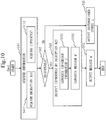
- the decryption unit 35 determines whether or not the identity ID included in the decryption key sk ID received in step S41 and the identity ID' included in the ciphertext ct ID' received in step S41 are equal. Hence, whether the ciphertext ct ID' can be decrypted by the decryption key sk ID is determined.
- the decryption unit 35 advances the processing to step S43. If not, the decryption unit 35 advances the processing to step S45.
- the decryption unit 35 generates the message m' by decrypting the ciphertext ct ID' by the decryption key sk ID received in step S41.
- the decryption process includes processes of step S431 and step S432.
- the conversion information generation unit 351 generates conversion information z' using the element h 1 included in the decryption key sk ID acquired in step S411 and the cipher element c included in the ciphertext ct ID' acquired in step S412, as indicated in formula 125.
- z ′ : e 1 h 1 c
- Step S432 Message Generation Process
- the message generation unit 352 generates the message m' using the conversion information z' generated in step S431 and the cipher element c T included in the ciphertext ct ID' acquired in step S412, as indicated in formula 127.
- m ′ : c T ⁇ z ′ ⁇ 1
- Step S44 Message Output Process
- the message output unit 36 outputs the message m' calculated in step S43, via the input/output interface 33.
- the message output unit 36 outputs the distinguished symbol ⁇ which indicates that decryption failed, via the input/output interface 33.
- the decryption device 30 executes the Dec algorithm indicated in formula 128 to decrypt the ciphertext ct ID' by the decryption key SK ID .
- the cryptographic system 1 implements the IBE scheme using IPG.
- the cryptographic system 1 generates the ciphertext ct ID' using the element X which is a generation element converted by the key generation random ⁇ . More specifically, the cryptographic system 1 generates the cipher element c T which is an element of the ciphertext ct ID' , using e 0 (h 0 , g ⁇ 0 ') which is the element X. Note that e 0 (h 0 , g ⁇ 0 ') which is the element X is generated by converting the generator (g ⁇ 0 ) of the group G T by the key generation random ⁇ . Therefore, it is possible to provide security from pairing problem hardness.
- Embodiment 1 the functions of the individual units of each of the key generation device 10, encryption device 20, and decryption device 30 are implemented by software.
- functions of individual units of each of a key generation device 10, encryption device 20, and decryption device 30 may be implemented by hardware. Modification 1 will now be described regarding its differences from Embodiment 1.
- the key generation device 10, encryption device 20, and decryption device 30 are respectively provided with electronic circuits 18, 28, and 38 in place of the respective processors 11, 21, and 31 and the respective storage devices 12, 22, and 32.
- the electronic circuits 18, 28, and 38 are dedicated circuits that implement functions of the individual units of the key generation device 10, encryption device 20, and decryption device 30, respectively, and functions of the storage devices 12, 22, and 32, respectively.
- each of the electronic circuits 18, 28, and 38 is a single circuit, a composite circuit, a programmed processor, a parallel-programmed processor, a logic IC, a gate array (GA), an application specific integrated circuit (ASIC), or a field-programmable gate array (FPGA).
- the key generation device 10, encryption device 20, and decryption device 30 may be each provided with a plurality of electronic circuits that replace the electronic circuits 18, 28, and 38, respectively. These plurality of electronic circuits implement together the functions of the individual units. Each electronic circuit is a dedicated circuit, as each of the electronic circuits 18, 28, and 38 is.
- Modification 2 some functions may be implemented by hardware, and the other functions may be implemented by software. That is, of the functions of each of the key generation device 10, encryption device 20, and decryption device 30, some may be implemented by hardware, and the other may be implemented by software.
- the processors 11, 21, 31, the storage devices 12, 22, 32, and the electronic circuits 18, 28, and 38 are called processing circuitry. That is, the functions of the individual units are implemented by the processing circuitry.
- Embodiment 2 description on matters that are identical with their counterparts of Embodiment 1 will be omitted, and differences from Embodiment 1 will be described.
- IBE which is conventionally implemented using pairing
- a secret key and a ciphertext are encoded on only one pair of paring groups G and G ⁇ .
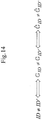
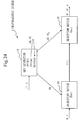
- different groups G ID and G ⁇ ID are made to correspond to different IDs. These groups G ID and G ⁇ ID will be called ID groups.
- a relation illustrated in Fig. 14 holds.
- an arrow signifies "if and only if". That is, G ID ⁇ G ID' holds if and only if ID ⁇ ID'. Also, G ⁇ ID ⁇ G ⁇ ID' holds if and only if G ID ⁇ G ID' .
- IDj when IDj is expressed as a subscript, this IDj signifies ID j .
- ID'j when ID'j is expressed as a subscript, this ID'j signifies ID' j .
- ID j is 0 or 1.
- ID' j is 0 or 1.
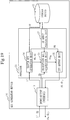
- a configuration of a key generation device 10 according to Embodiment 2 will be described referring to Fig. 19 .
- the key generation device 10 is different from the key generation device 10 illustrated in Fig. 3 in that it is provided with an ID group assigning unit 17 as a function configuration element.
- the ID group assigning unit 17 is implemented by software or hardware as the other function configuration elements are.
- a configuration of an encryption device 20 according to Embodiment 2 will be described referring to Fig. 20 .
- the encryption device 20 is different from the encryption device 20 illustrated in Fig. 4 in that it is provided with an ID group assigning unit 27 as a function configuration element.
- the ID group assigning unit 27 is implemented by software or hardware as the other function configuration elements are.
- Embodiment 2 An operation of a cryptographic system 1 according to Embodiment 2 will be described referring to Fig. 5 , Fig. 10 , and Figs. 19 to 23 . Operations of Embodiment 2 are equivalent to processes of methods and programs, as with Embodiment 1.
- a master key generation unit 14 receives as input a security parameter 1 ⁇ and a value n which is a bit number of the ID via an input/output interface 13.
- the master key generation unit 14 generates secret information s 0 which is a uniform random.
- the master key generation unit 14 generates an element h T by setting the secret information s 0 to an element g T of the group G T , as indicated in formula 130.
- h T : g T s 0
- h ⁇ j , ⁇ : g ⁇ j , ⁇ ⁇ j , ⁇
- h j , ⁇ : g j , ⁇ 1 / ⁇ j , ⁇
- a key output unit 16 outputs the public parameters pk to an encryption device 20 and a decryption device 30 by outputting the public parameters pk to an external public server or the like via the input/output interface 13.
- the master key generation unit 14 writes the generated master secret key msk to a storage device 12.
- the master key generation unit 14 generates the master key pair by executing the Setup algorithm indicated in formula 133.
- a decryption key generation unit 15 receives as input the identity ID of a user who uses a decryption key sk ID , via the input/output interface 13.
- the identity ID is inputted by, for example, a user of the key generation device 10, via an input device.
- ID j is 0 or 1.
- Step S62 ID Group Assigning Process
- the ID group assigning unit 17 Out of the elements h j, included in the master secret key msk, the ID group assigning unit 17 generates, as an element h ID , a set of those elements h j, that are included in the ID group G ID . More specifically, the ID group assigning unit 17 generates the element h ID , as indicated in formula 135.
- the decryption key generation unit 15 generates distributed information s ⁇ randomly, as indicated in formula 136.
- the distributed information s ⁇ is information in which the secret information s 0 is distributed.
- the decryption key generation unit 15 generates a key element k by setting the distributed information s ⁇ generated in step S63 to the element h ID generated in step S62, as indicated in Formula 137.
- k : h ID s ⁇
- the key output unit 16 outputs the decryption key sk ID including the identity ID received in step S61 and the key element k generated in step S64 to the decryption device 30 via the input/output interface 13.
- the decryption key generation unit 15 generates the decryption key sk ID by executing the KeyGen algorithm indicated in formula 138.
- An acquisition unit 24 acquires, via an input/output interface 23, the public parameters pk generated by the key generation device 10.
- the acquisition unit 24 also receives as input a message m being an encryption target and the identity ID' being a decryption condition.
- the message m and the identity ID' are inputted by, for example, a user of the encryption device 20 via the input device.
- Each ID' j is 0 or 1.
- the ID group assigning unit 17 Out of the elements h ⁇ j, included in the public parameters pk, the ID group assigning unit 17 generates, as an element h ⁇ ID , a set of those elements h ⁇ j, that are included in the ID group G ⁇ ID . More specifically, the ID group assigning unit 17 generates the element h ⁇ ID , as indicated in formula 140.
- a ciphertext generation unit 25 generates elements of a ciphertext ct ID' using the public parameters pk acquired in step S71 and the element h ⁇ ID generated in step S72.
- the ciphertext generation unit 25 generates the elements of the ciphertext ct ID' using a generation element of an element X of the group G T and a generation element of an element Y ⁇ of a group G ⁇ t .
- the element X refers to the element h T included in the public parameters pk.
- the element Y ⁇ refers to the element h ⁇ ID generated in step S72.
- the ciphertext generation process includes processes of step S731 to step S733.
- a conversion information generation unit 251 generates an encryption random ⁇ which is a uniform random.
- the conversion information generation 251 uses the element h T and the encryption random ⁇ to generate conversion information z, as indicated in formula 141.
- z : h T ⁇
- a first cipher element generation unit 252 generates a cipher element c T which is an element of the ciphertext ct ID' by setting the message m to the conversion information z generated in step S731, as indicated in formula 142.
- c T : z ⁇ m
- a second cipher element generation unit 253 generates a cipher element c which is an element of the ciphertext ct ID' by setting the encryption random ⁇ to the element h ⁇ ID which is the element Y ⁇ , as indicated in formula 143.
- c : h ⁇ ID ⁇
- a ciphertext output unit 26 outputs the ciphertext ct ID' having, as cipher elements, the identity ID' received in step S71 and the cipher elements c T and c generated in step S73, to the decryption device 30 via the input/output interface 23.
- the encryption device 20 generates the ciphertext ct ID' by executing the Enc algorithm indicated in formula 144.
- step S41 and step S42 and processes of step S44 and step S45 are the same as those in Embodiment 1.
- the decryption key sk ID includes the key element k in which the distributed information s ⁇ is set to the element h ID .
- the element h ID is generated using the element h j, .
- the ciphertext ct ID ' includes the cipher element c T and the cipher element c.
- the message m is set to the conversion information z in which the encryption random ⁇ is set to the element X which is the generator h T of the group G T .
- the encryption random ⁇ is set to the element h ⁇ ID which is the element Y ⁇ being converted from a generator g ⁇ j, of the group G ⁇ t by the key generation random ⁇ j, .
- a decryption unit 35 generates a message m' by decrypting the ciphertext ct ID' by the decryption key sk ID received in step S41.
- the decryption process includes processes of step S431 and step S432.
- a conversion information generation unit 351 generates conversion information z' using the element k included in the decryption key sk ID and the cipher element c included in the ciphertext ct ID' , as indicated in formula 145.
- z ′ : e 1 k c
- Step S432 Message Generation Process
- a message generation unit 352 generates the message m' using the conversion information z' generated in step S431 and the cipher element c T included in the ciphertext ct ID' , as indicated in formula 147.
- m ′ : c T ⁇ z ′ ⁇ 1
- the decryption device 30 executes the Dec algorithm indicated in formula 148 to decrypt the ciphertext ct ID' by the decryption key sk ID .
- the cryptographic system 1 according to Embodiment 2 implements the IBE scheme using IPG, as the cryptographic system 1 according to Embodiment 1 does. Therefore, it is possible to provide security from the isogeny problem hardness.
- the cryptographic system 1 according to Embodiment 2 generates the ciphertext ct ID' using the element Y ⁇ which is a generation element converted by the key generation random ⁇ j, . Therefore, it is possible to provide security from the pairing problem hardness.
- the cryptographic system 1 according to Embodiment 2 uses the ID groups G ID and G ⁇ ID . Accordingly, in cases where the identity ID and the identity ID' do not coincide, the group G ID and the group G ⁇ ID do not coincide. As a result, decryption can be disabled.
- Embodiment 3 an ABE scheme with a small set of attributes will be described.
- Embodiment 3 description on matters that are identical with their counterparts of Embodiment 2 will be omitted, and differences from Embodiment 2 will be described.
- KP-ABE key-policy-type ABE
- a policy being a decryption condition is set in a decryption key.
- the KP-ABE scheme can be converted by a method such as Naor conversion to a ciphertext-policy-type ABE (to be referred to CP-ABE hereinafter) scheme according to which a policy is set in a ciphertext.
- the KP-ABE scheme comprises Setup algorithm, KeyGen algorithm, Enc algorithm, and Dec algorithm.
- Setup algorithm takes as input a security parameter 1 ⁇ and outputs public parameters pk and a master secret key msk.
- Enc algorithm takes as input the public parameters pk, a message m in a message space msg, and a set of attributes, ⁇ , and outputs a ciphertext ct ⁇ .
- Dec algorithm takes as input the public parameters pk, the decryption key sk S for the access structure S, and the ciphertext ct ⁇ encrypted under the set of attributes, ⁇ , and outputs either a message m' ⁇ msg or a distinguished symbol ⁇ which indicates that decryption failed.
- a configuration of a cryptographic system 1 according to Embodiment 3 will be described referring to Fig. 24 .
- the cryptographic system 1 is provided with a key generation device 10, an encryption device 20, and a decryption device 30.
- the key generation device 10, the encryption device 20, and the decryption device 30 are connected to each other via a transmission line.
- a specific example of the transmission line is a local area network (LAN) or the Internet.
- the key generation device 10, the encryption device 20, and the decryption device 30 can communicate with each other via the transmission line.
- the key generation device 10 takes as input a security parameter 1 ⁇ and executes Setup algorithm to generate public parameters pk and a master secret key msk.
- the key generation device 10 publishes the public parameters pk and outputs the decryption key sk S to the decryption device 30 corresponding to the access structure S.
- the key generation device 10 keeps the master secret key msk.
- the encryption device 20 takes as input the public parameters pk, a message m, and a set of attributes, ⁇ , and executes Enc algorithm to generate a ciphertext ct ⁇ .
- the encryption device 20 outputs the ciphertext ct ⁇ to the decryption device 30.
- the decryption device 30 takes as input the public parameters pk, the decryption key sk S , and the ciphertext ct ⁇ and executes Dec algorithm to generate a message m' or a distinguished symbol ⁇ which indicates that decryption failed.
- a matrix M is an (L rows ⁇ r columns) matrix over the field F q .
- a labeling ⁇ is a labeling of the rows of the matrix M by an attribute from ⁇ (t, v), (t', v'), ... ⁇ . Note that every row is labeled by one attribute, that is, ⁇ : ⁇ 1, ..., L ⁇ ⁇ ⁇ (t, v), (t', v'), ... ⁇ .
- the span program accepts or rejects an input by the following criterion.
- the span program S accepts the set of attributes, ⁇ , if and only if a vector whose elements are all 1 is obtained by linear combination of a row (M i ) ⁇ (i) ⁇ of the matrix M.
- the span program S will be referred to as access structure.
- Embodiment 3 An operation of the cryptographic system 1 according to Embodiment 3 will be described referring to Fig. 5 , Fig. 10 , and Figs. 19 to 23 . Operations of Embodiment 3 are equivalent to processes of methods and programs, as with Embodiment 2.
- a master key generation unit 14 receives as input the security parameter 1 ⁇ and a value d which is the maximum number of the attributes, via an input/output interface 13.
- the master key generation unit 14 takes as input the received security parameter 1 ⁇ and d and executes IPG generation algorithm Gen IPG (1 ⁇ , d) to generate a master key pair of public parameters pk IPG and a master secret key msk IPG indicated in formula 149.
- the master key generation unit 14 generates secret information s 0 which is a uniform random.
- the master key generation unit 14 generates an element h T by setting the secret information s 0 to an element g T of a group G T , as indicated in formula 150.
- h T : g T s 0
- the master key generation unit 14 generates a key generation random ⁇ t which is a uniform random, for each integer t of t ⁇ [d].
- the master key generation unit 14 generates an element h ⁇ t for each integer t of t ⁇ [d] by setting the key generation random ⁇ t to an element g ⁇ t of a group G ⁇ t , as indicated in Formula 151.
- h ⁇ t : g ⁇ t ⁇ t
- the master key generation unit 14 also generates an element h t for each integer t of t ⁇ [d] by setting a reciprocal 1/ ⁇ t of the key generation random ⁇ t to an element g t of a group G t , as indicated in Formula 152.
- h t : g t 1 / ⁇ t
- a key output unit 16 outputs the public parameters pk to the encryption device 20 and the decryption device 30 by outputting the public parameters pk to an external public server or the like via the input/output interface 13.
- the master key generation unit 14 generates the master key pair by executing the Setup algorithm indicated in formula 153.
- the access structure S is information indicating a range where decryption by the decryption key sk S is possible.
- Step S62 ID Group Assigning Process
- the decryption key generation unit 15 generates distributed information s ⁇ , as indicated in formula 155.
- the decryption key generation unit 15 generates the decryption key sk S by executing the KeyGen algorithm indicated in formula 157.
- a process of step S73 is the same as that of Embodiment 2.
- An acquisition unit 24 acquires, via an input/output interface 23, the public parameters pk generated by the key generation device 10.
- the acquisition unit 24 also receives as input the message m being an encryption target and the set of attributes, ⁇ , being a decryption condition.
- An ID group assigning unit 27 takes a direct product of the group G ⁇ t for each integer t of t ⁇ ⁇ , as G ⁇ ID .
- the ID group assigning unit 17 Out of elements h ⁇ t included in the public parameters pk, the ID group assigning unit 17 generates, as an element h ⁇ ID , a set of those elements h ⁇ t that are included in the ID group G ⁇ ID . More specifically, the ID group assigning unit 17 generates the element h ⁇ ID , as indicated in formula 158.
- the encryption device 20 generates the ciphertext ct ⁇ by executing the Enc algorithm indicated in formula 159.
- step S44 and step S45 are the same as those in Embodiment 2.
- An acquisition unit 34 acquires, via an input/output interface 33, the public parameters pk and the decryption key sk S which are generated by the key generation device 10, and the ciphertext ct ⁇ generated by the encryption device 20.
- Step S411 Decryption Key Acquisition Process
- a decryption key acquisition unit 341 acquires, via the input/output interface 33, the public parameters pk and the decryption key sk S which are generated by the key generation device 10.
- a ciphertext acquisition unit 342 acquires the ciphertext ct ⁇ generated by the encryption device 20.
- the message m is set to conversion information z in which an encryption random ⁇ is set to an element X which is the generator h T of the group G T .
- the encryption random ⁇ is set to the element h ⁇ ID which is an element Y ⁇ being converted from the generator g ⁇ t of the group G ⁇ t by the key generation random ⁇ t .
- a decryption unit 35 determines whether or not the access structure S included in the decryption key sk S received in step S41 accepts the set of attributes, ⁇ , included in the ciphertext ct ⁇ . Hence, whether the ciphertext ct ⁇ can be decrypted by the decryption key sk S is determined.
- the decryption unit 35 advances the processing to step S43. If not, the decryption unit 35 advances the processing to step S45.
- the decryption unit 35 generates the message m' by decrypting the ciphertext ct ⁇ by the decryption key sk S received in step S41.
- the decryption process includes processes of step S431 and step S432.
- a conversion information generation unit 351 calculates a complementary coefficient ⁇ i indicated in formula 160.
- the conversion information generation unit 351 generates conversion information z' using the complementary coefficient ⁇ i , the element k included in the decryption key sk S , and the cipher element c included in the ciphertext ct ⁇ , as indicated in formula 161.
- Step S432 Message Generation Process
- a message generation unit 352 generates the message m' using the conversion information z' generated in step S431 and the cipher element c T included in the ciphertext ct ⁇ , as indicated in formula 163.
- m ′ : c T ⁇ z ′ ⁇ 1
- the decryption device 30 executes the Dec algorithm indicated in formula 164 to decrypt a ciphertext ct ID' by a decryption key sk ID .
- the cryptographic system 1 according to Embodiment 3 implements the ABE scheme using IPG. Therefore, it is possible to indicate security from the isogeny problem hardness.
- the cryptographic system 1 according to Embodiment 3 generates the ciphertext ct ⁇ using the element Y ⁇ which is a generation element converted by the key generation random ⁇ t . Therefore, it is possible to indicate security from the pairing problem hardness.
- Embodiment 4 an ABE scheme with a large set of attributes will be described.
- Embodiment 4 description on matters that are identical with their counterparts of Embodiment 3 will be omitted, and differences from Embodiment 3 will be described.
- the attribute t is included in the set of attributes, ⁇ .
- a category t of attribute and an attribute about the category t, x t : (x t,j ) ⁇ ⁇ 0, 1 ⁇ n , are included in a set of attributes, ⁇ .
- Embodiment 4 An operation of a cryptographic system 1 according to Embodiment 4 will be described referring to Fig. 5 , Fig. 10 , and Figs. 19 to 23 . Operations of Embodiment 4 are equivalent to processes of methods and programs, as with Embodiment 3.
- a master key generation unit 14 receives as input a security parameter 1 ⁇ , a value d which is the maximum number of attributes, and a value n representing the number of bits of each category t via an input/output interface 13.
- the master key generation unit 14 takes as input the received security parameter 1 ⁇ , d, and n and executes IPG generation algorithm Gen IPG (1 ⁇ , d, n) to generate a master key pair of public parameters pk IPG and a master secret key msk IPG indicated in formula 165.
- the master key generation unit 14 generates secret information s 0 which is a uniform random.
- the master key generation unit 14 generates an element h T by setting the secret information s 0 to an element g T of a group G T , as indicated in formula 166.
- h T : g T s 0
- the master key generation unit 14 generates a key generation random ⁇ t,j, which is a uniform random, for each integer t, each integer j, and each integer of t ⁇ [d], j ⁇ [n], and ⁇ ⁇ 0,1 , respectively.
- the master key generation unit 14 generates an element h ⁇ t,j, , for each integer t, each integer j, and each integer of t ⁇ [d], j ⁇ [n], and ⁇ ⁇ 0,1 , respectively, by setting the key generation random ⁇ t,j, , to an element g ⁇ t,j, , of a group G ⁇ t,j, , as indicated in Formula 167.
- h ⁇ t , j , ⁇ : g ⁇ t , j , ⁇ ⁇ t , j , ⁇
- the master key generation unit 14 also generates an element h t,j, for each integer t, each integer j, and each integer of t ⁇ [d], j ⁇ [n], and ⁇ ⁇ 0,1 , respectively, by setting a reciprocal 1/ ⁇ t,j, of the key generation random ⁇ t,j, to an element g t,j, of a group G t,j, , as indicated in Formula 168.
- h t , j , ⁇ : g t , j , ⁇ 1 / ⁇ t , j , ⁇
- a key output unit 16 outputs the public parameters pk to an encryption device 20 and a decryption device 30 by outputting the public parameters pk to an external public server or the like via the input/output interface 13.
- the master key generation unit 14 writes the generated master secret key msk to a storage device 12.
- the master key generation unit 14 generates the master key pair by executing the Setup algorithm indicated in formula 169.
- a process of step S61 is the same as that of Embodiment 3.
- Step S62 ID Group Assigning Process
- the ID group G t,vi is a t-th basis group. That is, the ID group assigning unit 17 generates the ID group G t,vi , as indicated in formula 170.
- a decryption key generation unit 15 generates distributed information s ⁇ i for each integer i of i ⁇ [L], as indicated in formula 172.
- the decryption key generation unit 15 generates a key element k i by setting the distributed information s ⁇ i generated in step S63 to the element h t,vi generated in step S62, as indicated in Formula 173.
- the decryption key generation unit 15 generates the decryption key sk s by executing the KeyGen algorithm indicated in formula 174.
- step S73 and step S74 are the same as those of Embodiment 2.
- An acquisition unit 24 acquires, via an input/output interface 23, the public parameters pk generated by a key generation device 10.
- the acquisition unit 24 also receives as input a message m being an encryption target and a set of attributes, ⁇ , being a decryption condition.
- the ID group assigning unit 17 Out of elements h ⁇ t,j , xt included in the public parameters pk, the ID group assigning unit 17 generates, as an element h ⁇ t,xt , a set of those elements h ⁇ t,j,tx that are included in the ID group G ⁇ t,xt . More specifically, the ID group assigning unit 17 generates the element h ⁇ t,xt , as indicated in formula 176.
- h ⁇ t , x t : h ⁇ t , j , x t , j j ⁇ n
- a ciphertext generation unit 25 generates elements of a ciphertext ct ⁇ using the public parameters pk acquired in step S71 and the element h ⁇ t,xt generated in step S72.
- the ciphertext generation unit 25 generates the elements of the ciphertext ct ⁇ using a generation element of an element X of the group G T and a generation element of an element Y ⁇ of the group G ⁇ t,xt .
- the element X refers to the element h T included in the public parameters pk.
- the element Y ⁇ refers to the element h ⁇ t,xt generated in step S72.
- the ciphertext generation process includes processes of step S731 to step S733.
- a conversion information generation unit 251 generates an encryption random ⁇ which is a uniform random.
- the conversion information generation 251 uses the element h T and the encryption random ⁇ to generate conversion information z, as indicated in formula 177.
- z : h T ⁇
- a first cipher element generation unit 252 generates a cipher element c T which is an element of the ciphertext ct ⁇ by setting the message m to the conversion information z generated in step S731, as indicated in formula 178.
- c T : z ⁇ m
- the encryption device 20 generates the ciphertext ct ⁇ by executing the Enc algorithm indicated in formula 180.
- step S41 and step S42 and processes of step S44 and step S45 are the same as those in Embodiment 3.
- the ciphertext ct ⁇ includes the cipher element c T and the cipher element c.
- the message m is set to the conversion information z in which the encryption random ⁇ is set to the element X which is the generator h T of the group G T .
- the encryption random ⁇ is set to the element h ⁇ t,xt which is the element Y ⁇ being converted from the generator g ⁇ t,j, of the group G ⁇ t,xt by the key generation random ⁇ t,j, .
- a decryption unit 35 generates a message m' by decrypting the ciphertext ct ⁇ by the decryption key sk s received in step S41.
- the decryption process includes processes of step S431 and step S432.
- a conversion information generation unit 351 calculates a complementary coefficient ⁇ i , indicated in formula 181.
- Step S432 Message Generation Process
- a message generation unit 352 generates the message m' using the conversion information z' generated in step S431 and the cipher element c T included in the ciphertext ct ⁇ , as indicated in formula 184.
- m ′ : c T ⁇ z ′ ⁇ 1
- the decryption device 30 executes the Dec algorithm indicated in formula 185 to decrypt a ciphertext ct ID' by a decryption key sk ID .
- the cryptographic system 1 according to Embodiment 4 implements the ABE scheme using IPG. Therefore, it is possible to indicate security from the isogeny problem hardness.
- the cryptographic system 1 according to Embodiment 4 generates the ciphertext ct ⁇ using the element Y ⁇ which is a generation element converted by the key generation random ⁇ t,j, . Therefore, it is possible to indicate security from the pairing problem hardness.
- Embodiment 5 hierarchical IBE (to be referred to as HIBE hereinafter) based on the IBE scheme described in Embodiment 2 will be described.
- Embodiment 5 description on matters that are identical with their counterparts of Embodiment 2 will be omitted, and differences from Embodiment 2 will be described.
- Embodiment 5 1-bit HIBE will be described first, and thereafter n (n ⁇ 1)-bit HIBE to which 1-bit HIBE is applied will be described.
- the HIBE scheme comprises Setup algorithm, KeyGen algorithm, Enc algorithm, Dec algorithm, and Delegate algorithm.
- Setup algorithm takes as input a security parameter 1 ⁇ and outputs public parameters pk and a master secret key msk.
- KeyGen algorithm takes as input the public parameters pk, the master secret key msk, and an identity ID, and outputs a decryption key sk ID corresponding to the identity ID.
- Enc algorithm takes as input the public parameters pk, a message m in a message space msg, and an identity ID', and outputs a ciphertext ct ID' .
- Dec algorithm takes as input the public parameters pk, the decryption key sk ID for the identity ID, and the ciphertext ct ID' encrypted under the identity ID', and outputs either a message m' ⁇ msg or a distinguished symbol ⁇ which indicates that decryption failed.
- a configuration of a cryptographic system 1 according to Embodiment 5 will be described referring to Fig. 25 .
- the cryptographic system 1 is provided with a key generation device 10, an encryption device 20, a decryption device 30, and a key delegation device 40.
- the key generation device 10, the encryption device 20, the decryption device 30, and the key delegation device 40 are connected to each other via a transmission line.
- a configuration of the key delegation device 40 according to Embodiment 5 will be described referring to Fig. 26 .
- the key delegation device 40 is provided with hardware devices which are a processor 41, a storage device 42, and an input/output interface 43.
- the processor 41 is connected to the other hardware devices via signal lines and controls these other hardware devices.
- the key delegation device 40 is provided with an acquisition unit 44, an ID group assigning unit 45, a low-level key generation unit 46, and a low-level key output unit 47, as function configuration elements. Functions of the acquisition unit 44, ID group assigning unit 45, low-level key generation unit 46, and low-level key output unit 47 are implemented by software.
- a program that implements the functions of the individual units of the key delegation device 40 is stored in the storage device 42. This program is read by the processor 41 and executed by the processor 41. Thus, the functions of the individual units of the key delegation device 40 are implemented.
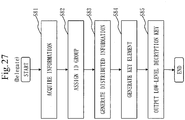
- Embodiment 5 An operation of the cryptographic system 1 according to Embodiment 5 will be described referring to Figs. 19 to 23 , Fig. 26 , and Fig. 27 .
- Operations of Embodiment 5 are equivalent to processes of methods and programs, as with Embodiment 2.
- An operation of the key delegation device 40 according to Embodiment 5 corresponds to a key delegation method according to Embodiment 5 and processes of a key delegation program according to Embodiment 5.
- Dec algorithm is the same as that of Embodiment 2 and accordingly its description will be omitted.
- IDt when IDt is expressed as a subscript, this IDt signifies ID t .
- ID't when ID't is expressed as a subscript, this ID't signifies ID' i .
- a master key generation unit 14 receives as input a security parameter 1 ⁇ and a value d ⁇ 2, which is a hierarchical number.
- the master key generation unit 14 takes as input the received security parameter 1 ⁇ and 2d and executes IPG generation algorithm Gen IPG (1 ⁇ , 2d) to generate a master key pair of public parameters pk IPG and a master secret key msk IPG indicated in formula 186.
- the master key generation unit 14 generates secret information s 0 which is a uniform random.
- the master key generation unit 14 generates an element h T by setting the secret information s 0 to an element g T of a group G T , as indicated in formula 187.
- h T : g T s 0
- the master key generation unit 14 generates a key generation random ⁇ t, which is a uniform random, for each integer t of t ⁇ [d] and each integer of ⁇ ⁇ 0,1 .
- the master key generation unit 14 generates an element h ⁇ t, for each integer t of t ⁇ [d] and each integer of ⁇ ⁇ 0,1 by setting a key generation random ⁇ t, to an element g ⁇ t, of a group G ⁇ t, , as indicated in Formula 188.
- h ⁇ t , ⁇ : g ⁇ t , ⁇ ⁇ t , ⁇
- the master key generation unit 14 also generates an element h t, , for each integer t of t ⁇ [d] and each integer of ⁇ ⁇ 0,1 by setting a key generation random ⁇ t, to an element g t, of a group G t, , as indicated in Formula 189.
- the key output unit 16 outputs the public parameters pk to the encryption device 20 and the decryption device 30 by outputting the public parameters pk to an external public server or the like via the input/output interface 13.
- the master key generation unit 14 writes the generated master secret key msk to a storage device 12.
- the master key generation unit 14 generates the master key pair by executing the Setup algorithm indicated in formula 190.
- a decryption key generation unit 15 receives as input the identity ID of a user who uses the decryption key sk ID , via the input/output interface 13.
- the identity ID is inputted by, for example, a user of the key generation device 10 via an input device.
- identity ID : (ID t ) t ⁇ [L] .
- L ⁇ d.
- each ID t is 0 or 1.
- Step S62 ID Group Assigning Process
- An ID group assigning unit 17 assigns ID t for each integer t of t ⁇ [L] to the group G t,IDt .
- the ID group assigning unit 17 takes a direct product of a group G t,IDt for each integer t of t ⁇ [L] as an ID group G ID . Namely, the ID group assigning unit 17 generates the ID group G ID , as indicated in formula 191.
- the ID group assigning unit 17 generates an element h ID , as indicated in formula 192.
- the decryption key generation unit 15 generates distributed information s ⁇ , as indicated in formula 193.
- the distributed information s ⁇ is information in which the secret information s 0 is distributed.
- the decryption key generation unit 15 generates a key element k by setting the distributed information s ⁇ generated in step S63 to the element h ID generated in step S62, as indicated in Formula 194.
- k : h ID s ⁇
- a key output unit 16 outputs the decryption key sk ID including the identity ID received in step S61 and the key element k generated in step S64 to the decryption device 30 via the input/output interface 13.
- the decryption key generation unit 15 generates the decryption key sk ID by executing the KeyGen algorithm indicated in formula 195.
- An acquisition unit 24 acquires, via an input/output interface 23, the public parameters pk generated by the key generation device 10.
- the acquisition unit 24 also receives as input a message m being an encryption target and the identity ID' being a decryption condition.
- the message m and the identity ID' are inputted by, for example, a user of the encryption device 20 via the input device.
- An ID group assigning unit 27 assigns ID' t for each integer t of t ⁇ [L] to a group G ⁇ t,IDt .
- the ID group assigning unit 27 takes a direct product of a group G ⁇ t,ID't for each integer t of t ⁇ [L] as an ID group G ⁇ ID . Namely, the ID group assigning unit 27 generates the ID group G ⁇ ID , as indicated in formula 196.
- the ID group assigning unit 27 generates an element h ⁇ ID , as indicated in formula 197.
- a ciphertext generation unit 25 generates elements of a ciphertext ct ID' using the public parameters pk acquired in step S71 and the element h ⁇ ID generated in step S72.
- the ciphertext generation unit 25 generates the elements of the ciphertext ct ID' using a generation element of an element X of the group G T and a generation element of an element Y ⁇ of a group G ⁇ t .
- the element X refers to the element h T included in the public parameters pk.
- the element Y ⁇ refers to the element h ⁇ ID generated in step S72.
- the ciphertext generation process includes processes of step S731 to step S733.
- a conversion information generation unit 251 generates an encryption random ⁇ which is a uniform random.
- the conversion information generation 251 uses the element h T and the encryption random ⁇ to generate conversion information z, as indicated in formula 198.
- z : h T ⁇
- a first cipher element generation unit 252 generates a cipher element c T which is an element of the ciphertext ct ID' by setting the message m to the conversion information z generated in step S731, as indicated in formula 199.
- c T : z ⁇ m
- a second cipher element generation unit 253 generates a cipher element c which is an element of the ciphertext ct ID' by setting the encryption random ⁇ to the element h ⁇ ID which is the element Y ⁇ , as indicated in formula 200.
- c : h ⁇ ID ⁇
- a ciphertext output unit 26 outputs the ciphertext ct ID' having, as cipher elements, the identity ID' received in step S71 and the cipher elements c T and c generated in step S73, to the decryption device 30 via the input/output interface 23.
- the encryption device 20 generates the ciphertext ct ID' by executing the Enc algorithm indicated in formula 201.
- Delegate algorithm is executed by the key delegation device 40.
- the acquisition unit 44 also receives as input an identity ID L+1 ⁇ ⁇ 0, 1 ⁇ of a user who uses a low-level decryption key sk ID* of the decryption key sk ID , via the input/output interface 43.
- the ID group assigning unit 45 generates an element k + and an element h ID* , as indicated in formula 203.
- the low-level key generation unit 46 generates distributed information ⁇ ⁇ ', as indicated in formula 204.
- the low-level key generation unit 46 generates a key element k ID* by setting the distributed information ⁇ ⁇ ' generated in step S83 to the element h ID* generated in step S82, as indicated in Formula 205.
- the low-level key output unit 47 outputs the low-level decryption key sk ID* including the identity ID* and the key element k ID* which is generated in step S64 to the decryption device 30 via the input/output interface 13.
- the decryption key generation unit 15 generates the low-level decryption key sk ID* by executing the Delegate algorithm indicated in formula 206.
- the n-bit HIBE scheme is configured using 1-bit HIBE Setup algorithm, 1-bit HIBE KeyGen algorithm, 1-bit HIBE Enc algorithm, 1-bit HIBE Dec algorithm, and 1-bit HIBE Delegate algorithm.
- 1-bit HIBE Setup algorithm 1-bit HIBE KeyGen algorithm
- 1-bit HIBE Enc algorithm 1-bit HIBE Dec algorithm
- 1-bit HIBE Delegate algorithm which are mentioned above will be referred to as obHIBE_Setup, obHIBE_KeyGen, obHIBE_Enc, obHIBE_Dec, and obHIBE_Delegate, respectively.
- n-bit HIBE Setup algorithm n-bit HIBE KeyGen algorithm
- n-bit HIBE Enc n-bit HIBE Dec
- n-bit HIBE Delegate algorithm n-bit HIBE_Setup, nbHIBE KeyGen, nbHIBE Enc, nbHIBE Dec, and nbHIBE_Delegate, respectively.
- the master key generation unit 14 receives as input the security parameter 1 ⁇ , the value d which is a hierarchical number, and the value n which is a bit number.
- the master key generation unit 14 takes as input the security parameter 1 ⁇ and a value d ⁇ n and executes obHIBE_Setup to generate public parameters pk ob and a master secret key msk ob .
- the master key generation unit 14 takes the public parameters pk ob as public parameters pk of the n-bit HIGE scheme and the master secret key msk ob as a master secret key msk of the n-bit HIBE scheme.
- master key generation unit 14 generates a master key pair by executing nbHIBE_Setup indicated in Formula 207.
- the decryption key generation unit 15 takes as input the public parameters pk and the master secret key msk which are generated by nbHIBE Setup, and the identity ID ⁇ , and executes obHIBE KeyGen to generate the decryption key sk ID .
- the decryption key generation unit 15 generates the decryption key sk ID by executing obHIBE_KeyGen indicated in formula 208.
- the acquisition unit 24 acquires the public parameters pk via an input/output interface 23.
- ID'* (ID' t,j ) t ⁇ [L], j ⁇ [n] is treated as a hierarchical 1-bit identity having a hierarchical number Ln.
- the ciphertext generation unit 25 and the ID group assigning unit 27 take as input the public parameters pk, the message m, and the identity ID'* and execute obHIBE_Enc to generate the ciphertext ct ID' .
- the encryption device 20 generates the ciphertext ct ID' by executing the nbHIBE_Enc indicated in formula 209.
- An acquisition unit 34 acquires the public parameters pk, the decryption key sk ID , and the ciphertext ct ID' via the input/output interface 33.
- a decryption unit 35 takes as input the public parameters pk, the decryption key sk ID* obtained by replacing ID in the decryption key sk ID by ID*, and the ciphertext ct ID'* obtained by replacing ID' of the ciphertext ct ID' by ID'*, and executes obHIBE Dec to generate the message m'.
- the decryption device 30 executes nbHIBE_Dec indicated in formula 210 to decrypt the ciphertext ct ID' by the decryption key sk ID .
- the acquisition unit 44 acquires the public parameters pk and the decryption key sk ID via the input/output interface 43.
- the acquisition unit 44 also receives as input the identity ID L+1 ⁇ ⁇ 0, 1 ⁇ n via the input/output interface 43.
- the ID group assigning unit 45 and the low-level key generation unit 46 take the identity ID L+1 as (ID L+1,j ) j ⁇ [n] and the decryption key sk ID as sk 0 . For each integer j of j ⁇ [n], the ID group assigning unit 45 and the low-level key generation unit 46 take as input the public parameters pk, a decryption key sk j-1 , and an identity ID L+1,j and execute obHIBE_Delegate to generate a decryption key sk j . The low-level key output unit 47 then outputs a decryption key sk n as a low-level decryption key sk ID' .
- the decryption key generation unit 15 generates the low-level decryption key sk ID' by executing the nbHIBE_Delegate indicated in formula 211.
- the cryptographic system 1 according to Embodiment 5 implements the HIBE scheme using IPG. Therefore, it is possible to indicate security from the isogeny problem hardness.
- the cryptographic system 1 according to Embodiment 5 generates a ciphertext ct ⁇ using the element Y ⁇ which is a generation element converted by a key generation random ⁇ t, . Therefore, it is possible to indicate security from the pairing problem hardness.
- Embodiment 6 high-security Boneh-Boyen type 1-bit HIBE will be described.
- Embodiment 6 description on matters that are identical with their counterparts of Embodiment 5 will be omitted, and differences from Embodiment 5 will be described.
- Embodiment 6 An operation of a cryptographic system 1 according to Embodiment 6 will be described referring to Fig. 5 , Fig. 10 , Figs. 19 to 23 , Fig. 26 , and Fig. 27 . Operations of Embodiment 6 are equivalent to processes of methods and programs, as with Embodiment 5.
- a master key generation unit 14 receives as input a security parameter 1 ⁇ and a value d ⁇ 2, which is a hierarchical number, via an input/output interface 13.
- the master key generation unit 14 takes as input the received security parameter 1 ⁇ and 4d and executes IPG generation algorithm Gen IPG (1 ⁇ , 4d) to generate a master key pair of public parameters pk IPG and a master secret key msk IPG indicated in formula 212.
- the master key generation unit 14 generates secret information ⁇ and secret information ⁇ which are uniform randoms.
- the master key generation unit 14 generates an element h T by setting the secret information ⁇ and the secret information ⁇ to an element g T of a group G T , as indicated in formula 213.
- h T : g T ⁇
- the master key generation unit 14 also generates an element f L t, , an element f R t, , and an element u L , for each integer t of t ⁇ [d] and each integer of ⁇ ⁇ 0,1 using the secret information ⁇ and the secret information ⁇ , as indicated in formula 214.
- the master key generation unit 14 generates a key generation random ⁇ t, , which is a uniform random, for each integer t of t ⁇ [d] and each integer i of i ⁇ [0, 1].
- the master key generation unit 14 generates an element h ⁇ R t, for each integer t of t ⁇ [d] and each integer i of i ⁇ [0, 1] by setting the key generation random ⁇ t, to an element g ⁇ R t, of a group G ⁇ R t, , as indicated in formula 215.
- h ⁇ t , l R : g ⁇ t , l R ⁇ t , l
- the master key generation unit 14 also generates an element h L t, for each integer t of t ⁇ [d] and each integer of ⁇ ⁇ 0,1 by setting the key generation random ⁇ t, to an element g L t, of a group G L t, as indicated in formula 216.
- h t , ⁇ L : g t , ⁇ L ⁇ t , ⁇
- the master key generation unit 14 also writes the generated master secret key msk to a storage device 12.
- the master key generation unit 14 generates master key pair by executing the Setup algorithm indicated in formula 217.
- the decryption key generation unit 15 receives as input an identity ID of a user who uses a decryption key sk ID , via the input/output interface 13.
- the identity ID is inputted by, for example, a user of the key generation device 10 via an input device.
- Step S62 ID Group Assigning Process
- An ID group assigning unit 17 assigns ID t for each integer t of t ⁇ [L] to a group G L t,IDt and a group G R t,IDt .
- the ID group assigning unit 17 takes a direct product of the group G L t,IDt for each integer t of t ⁇ [L] as an ID group G L ID , and a direct product of the group G R t,IDt for each integer t of t ⁇ [L] as an ID group G R ID . Namely, the ID group assigning unit 17 generates the ID group G L ID and the ID group G R ID , as indicated in formula 218.
- the ID group assigning unit 17 generates an element g L ID , an element f L ID , an element h L ID , and an element g R ID , as indicated in formula 219.
- a decryption key generation unit 15 generates distributed information ⁇ ⁇ , as indicated in formula 220.
- the key output unit 16 outputs the decryption key sk ID including the identity ID received in step S61 and the key element k generated in step S64 to the decryption device 30 via the input/output interface 13.
- the decryption key generation unit 15 generates the decryption key sk ID by executing the KeyGen algorithm indicated in formula 222.
- An acquisition unit 24 acquires, via an input/output interface 23, the public parameters pk generated by a key generation device 10.
- the acquisition unit 24 also receives as input a message m being an encryption target and an identity ID' being a decryption condition.
- the message m and the identity ID' are inputted by, for example, a user of the encryption device 20 via the input device.
- An ID group assigning unit 27 assigns ID' t for each integer t of t ⁇ [L] to a group G ⁇ L t,IDt and a group G ⁇ R t,IDt .
- the ID group assigning unit 27 takes a direct product of a group G ⁇ L t,ID't for each integer t of t ⁇ [L] as an ID group G ⁇ L ID and a direct product of a group G ⁇ R t,ID't for each integer t of t ⁇ [L] as an ID group G ⁇ R ID . Namely, the ID group assigning unit 27 generates the ID group G ⁇ L ID and the ID group G ⁇ R Id , as indicated in formula 223.
- the ID group assigning unit 27 generates an element g ⁇ L ID , an element f ⁇ R ID , and an element h ⁇ R ID , as indicated in formula 224.
- a ciphertext generation unit 25 generates elements of a ciphertext ct ID' using the public parameters pk acquired in step S71 and the element g ⁇ L ID , element f ⁇ R ID , and element h ⁇ R ID which are generated in step S72.
- the ciphertext generation unit 25 generates the elements of the ciphertext ct ID' using a generation element of an element X of the group G T and a generation element of an element Y ⁇ of a group G ⁇ t .
- the element X refers to the element h T included in the public parameters pk.
- the element Y ⁇ refers to the element g ⁇ L ID , element f ⁇ R ID , and element H ⁇ R ID which are generated in step S72.
- the ciphertext generation process includes processes of step S731 to step S733.
- a conversion information generation unit 251 generates an encryption random ⁇ which is a uniform random.
- the conversion information generation 251 uses the element h T and the encryption random ⁇ to generate conversion information z, as indicated in formula 225.
- z : h T ⁇
- a first cipher element generation unit 252 generates a cipher element c T which is an element of the ciphertext ct ID' by setting the message m to the conversion information z generated in step S731, as indicated in formula 226.
- c T : z ⁇ m
- a ciphertext output unit 26 outputs the ciphertext ct ID' having, as cipher elements, the identity ID' received in step S71 and the cipher elements c T and c generated in step S73, to the decryption device 30 via the input/output interface 23.
- the encryption device 20 generates the ciphertext ct ID' by executing the Enc algorithm indicated in formula 228.
- step S41 and step S42 and processes of step S44 and step S45 are the same as those in Embodiment 5.
- a decryption unit 35 generates a message m' by decrypting the ciphertext ct ID' by the decryption key sk ID received in step S41.
- the decryption process includes processes of step S431 and step S432.
- Step S432 Message Generation Process
- a message generation unit 352 generates the message m' using the conversion information z' generated in step S431 and the cipher element c T included in the ciphertext ct ID' , as indicated in formula 231.
- m ′ : c T ⁇ z ′ ⁇ 1
- the decryption device 30 executes the Dec algorithm indicated in formula 232 to decrypt the ciphertext ct ID' by the decryption key sk ID .
- Delegate algorithm is executed by a key delegation device 40.
- the acquisition unit 44 also receives as input an identity ID L+1 ⁇ ⁇ 0, 1 ⁇ of a user who uses a low-level decryption key sk ID' of the decryption key sk ID , via the input/output interface 43.
- the ID group assigning unit 45 generates an element k +L , an element g L ID' , an element k +R , and an element g R ID' , as indicated in formula 234.
- a low-level key generation unit 46 generates distributed information ⁇ ⁇ ', as indicated in formula 235.
- a low-level key output unit 47 outputs the low-level decryption key sk ID' including the identity ID' and the key element k which is generated in step S84 to the decryption device 30 via the input/output interface 13.
- the decryption key generation unit 15 generates the low-level decryption key S k ID' by executing the Delegate algorithm indicated in formula 237.
- the cryptographic system 1 according to Embodiment 6 implements the HIBE scheme using IPG. Therefore, it is possible to indicate security from the isogeny problem hardness.
- the cryptographic system 1 according to Embodiment 6 generates a ciphertext ct ⁇ using the element Y ⁇ which is a generation element converted by the key generation random ⁇ t, . Therefore, it is possible to indicate security from the pairing problem hardness.
Landscapes
- Engineering & Computer Science (AREA)
- Theoretical Computer Science (AREA)
- Signal Processing (AREA)
- Computer Networks & Wireless Communication (AREA)
- Computer Security & Cryptography (AREA)
- General Physics & Mathematics (AREA)
- Physics & Mathematics (AREA)
- Mathematical Physics (AREA)
- Pure & Applied Mathematics (AREA)
- Computing Systems (AREA)
- Mathematical Optimization (AREA)
- Mathematical Analysis (AREA)
- Algebra (AREA)
- Storage Device Security (AREA)
Abstract
Description
- The present invention relates to at least either one of a high-security identity (ID)-based encryption (to be referred to as IBE hereinafter) scheme and a high-security attribute-based encryption (to be referred to as ABE hereinafter) scheme.
- Quantum computers are being developed worldwide. Ciphers using isogenies have been proposed as encryption schemes that can maintain security even against the quantum computers. Non-Patent
Literature 1 describes a partially quantum-resistant attribute-based encryption scheme that provides pre-challenge quantum security based on Isog-DBDH assumption. - Non-Patent Literature 1: Koshiba, T., Takashima, K.: Pairing cryptography meets isogeny: A new framework of isogenous pairing groups. IACR Cryptology ePrint Archive 2016, 1138 (2016)
- However, it is unclear whether the scheme described in Non-Patent
Literature 1 can prove its security from a pairing-related problem hardness such as DBDH assumption that has been conventionally used widely. In general, the isogeny problem is recognized as harder than the pairing-related problem because, for example, it indicates quantum resistance. Meanwhile, since the hardness has not yet been fully verified, it is worried that unknown attacks might be found. - It is an objective of the present invention to make it possible to configure an encryption scheme capable of providing security from a plurality of problem hardnesses.
- An encryption device according to the present invention is an encryption device in a cryptographic system that uses a group G0, a group Gt associated with the group G0, a group G^0, a group G^t associated with the group G^0, and a group GT associated with the group G0 and the group G^0 by pairing operation e0 and associated with the group Gt and the group G^t by pairing operation et, the encryption device comprising;
a ciphertext generation unit to generate a ciphertext ct using a generation element of an element X of the group GT and a generation element of an element Y^ of the group G^t, the element X being generated through conversion of a generator of the group GT by a key generation random, or the element Y^ being generated through conversion of a generator of the group G^t by the key generation random,
wherein the ciphertext generation unit comprises: - a first cipher element generation unit to generate a cipher element cT which is an element of the ciphertext ct, by setting a message m to conversion information z in which an encryption random ζ is set to the element X; and
- a second cipher element generation unit to generate a cipher element c which is an element of the ciphertext ct, by setting the encryption random ζ to the element Y^.
- In the present invention, it is possible to provide security from a certain problem hardness by using a plurality of groups that are associated with each other. Also, in the present invention, it is possible to provide security from another problem hardness by generating a ciphertext ctID' using a generation element generated by conversion using a key generation random.
-
-
Fig. 1 is an explanatory diagram of an isogenous pairing group employed in the IBE scheme according toEmbodiment 1. -
Fig. 2 is a configuration diagram of acryptographic system 1 according toEmbodiment 1. -
Fig. 3 is a configuration diagram of akey generation device 10 according toEmbodiment 1. -
Fig. 4 is a configuration diagram of anencryption device 20 according toEmbodiment 1. -
Fig. 5 is a configuration diagram of adecryption device 30 according toEmbodiment 1. -
Fig. 6 is a flowchart of Setup algorithm according toEmbodiment 1. -
Fig. 7 is an explanatory diagram of IPG according toEmbodiment 1. -
Fig. 8 is a flowchart of KeyGen algorithm according toEmbodiment 1. -
Fig. 9 is a flowchart of Enc algorithm according toEmbodiment 1. -
Fig. 10 is a flowchart of Dec algorithm according toEmbodiment 1. -
Fig. 11 is a configuration diagram of akey generation device 10 according toModification 1. -
Fig. 12 is a configuration diagram of anencryption device 20 according toModification 1. -
Fig. 13 is a configuration diagram of adecryption device 30 according toModification 1. -
Fig. 14 is an explanatory diagram of properties of ID groups according to Embodiment 2. -
Fig. 15 is an explanatory diagram of ID groups in Setup algorithm according to Embodiment 2. -
Fig. 16 is an explanatory diagram of ID groups in KeyGen algorithm according to Embodiment 2. -
Fig. 17 is an explanatory diagram of ID groups in Enc algorithm according to Embodiment 2. -
Fig. 18 is an explanatory diagram of ID groups in Dec algorithm according to Embodiment 2. -
Fig. 19 is a configuration diagram of akey generation device 10 according to Embodiment 2. -
Fig. 20 is a configuration diagram of anencryption device 20 according to embodiment 2. -
Fig. 21 is a flowchart of Setup algorithm according to Embodiment 2. -
Fig. 22 is a flowchart of KeyGen algorithm according to Embodiment 2. -
Fig. 23 is a flowchart of Enc algorithm according to Embodiment 2. -
Fig. 24 is a configuration diagram of acryptographic system 1 according to Embodiment 3. -
Fig. 25 is a configuration diagram of acryptographic system 1 according to Embodiment 5. -
Fig. 26 is a configuration diagram of akey delegation device 40 according to Embodiment 5. -
Fig. 27 is a flowchart of Delegate algorithm according to Embodiment 5. - In
Embodiment 1, high-security, high-efficient IBE scheme will be described. - The notation in the following description will be explained.
- In the following explanation, when in a formula a symbol or the like is written above a variable, in the sentence this symbol or the like is placed on an upper right of the variable. Specifically, in a formula a symbol "^" or a symbol "→" is written above a variable, but in the sentence it is placed on an upper right of the variable. For example, formula 101 is written as B^ in the sentence.

- When a symbol "→" expressing a vector is annexed to a superscript, assume that this symbol "→" is a superscript to that superscript. This means that in gy→, y→ is expressed as a superscript to g.
- When A is a random variable or distribution, formula 102 denotes that y is randomly selected from A according to the distribution of A. That is, in formula 102, y is a random.

- When A is a set, formula 103 denotes that y is uniformly selected from A. That is, in formula 103, y is a uniform random.

- Formula 104, namely Fq, denotes a finite field of order q.

- Assume that formula 105 holds for an integer n larger than 0.

- Formula 106 denotes an inner product indicated by formula 108 of two vectors y→ and v→ indicated in formula 107.


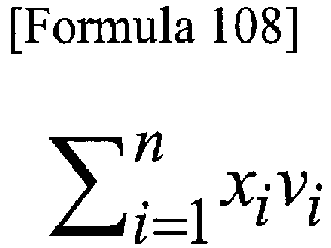
- For an element g in a product group K (resp. an element g^ in a product group K^) indicated in formula 109 and a vector y denoted by formula 110, gy→ denotes a group element denoted by formula 111.

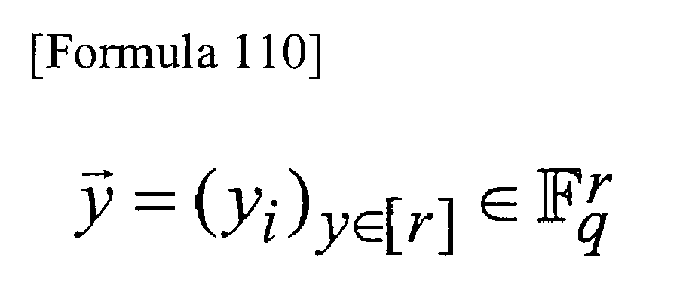

- For a scalar ζ∈Fq, gζ denotes a scalar exponentiation denoted by formula 112.

- For the element g := (gi) and the element g^ := (g^i) in the respective product groups K and K^ mentioned above, if a pairing ei is defined on a space denoted by formula 113, a pairing eK is defined as in Formula 114.


- An isogenous pairing group (to be referred to as IPG hereinafter) employed in an IBE scheme according to
Embodiment 1 will be explained referring toFig. 1 . - IPG has a plurality of groups that are associated by isogeny and pairing operation.
- More specifically, IPG has a group G0, groups Gt for t = 1, ..., d associated with the group G0 by isogeny φt, groups G^t for t = 1, ..., d associated with a group G^0 by isogeny φt, and a group GT associated with the groups Gt and the group G^t for t = 1, ..., d by pairing operation et. In IPG, assuming a case where elements from group G0 × group G^0 are converted by pairing operation e0 and a case where elements from group G0 × group G^0 are converted to groups Gt × groups G^t by isogeny φt for any one integer t of t = 1, ..., d and then converted by pairing operation et, results between the two cases are equal.
- For example, groups Gt and groups G^t for each integer t of t = 0, ..., d are groups on different elliptic curves.
- More precisely, IPG is defined as follows.
- According to IPG generation algorithm GenIPG(1λ, N), a master key pair of a public parameter pkIPG and a master secret key mskIPG indicated in formula 115 is generated randomly.

- Note that (Gt, G^t, et, GT) are asymmetric pairing groups of a prime order q with pairings et: Gt × G^t → GT and trapdoor homomorphisms φt. Trapdoor homomorphisms φt are mapping from G0 × G^0 to Gt × G^t such that Gt = φt(G0) and G^t = φt(G^0) under natural identifications G = G × 1G^ and G^ = 1G × G^ given by isogenies between different elliptic curves. Also, gt = φt(g0) ∈ Gt, g^t = φt(g^0) ∈ G^t.
- IPG has compatibility denoted by formula 116.

- Note that gT = e0(g0, g^0) ≠ 1 and Gt ≠ G^t.
- A configuration of the IBE scheme according to
Embodiment 1 will be described. - The IBE scheme comprises Setup algorithm, KeyGen algorithm, Enc algorithm, and Dec algorithm.
- Setup algorithm takes as input a
security parameter 1λ and outputs public parameters pk and a master secret key msk. - KeyGen algorithm takes as input the public parameters pk, the master secret key msk, and an identity ID, and outputs a decryption key skID corresponding to the identity ID.
- Enc algorithm takes as input the public parameters pk, a message m in a message space msg, and an identity ID', and outputs a ciphertext ctID'.
- Dec algorithm takes as input the public parameters pk, the decryption key skID corresponding to the identity ID, and the ciphertext ctID' encrypted under the identity ID', and outputs either a message m' ∈ msg or a distinguished symbol ┴ which indicates that decryption failed.
- A configuration of a
cryptographic system 1 according toEmbodiment 1 will be described referring toFig. 2 . - The
cryptographic system 1 is provided with akey generation device 10, anencryption device 20, and adecryption device 30. Thekey generation device 10, theencryption device 20, and thedecryption device 30 are connected to each other via a transmission line. A specific example of the transmission line is a local area network (LAN) or the Internet. Thekey generation device 10, theencryption device 20, and thedecryption device 30 can communicate with each other via the transmission line. - The
key generation device 10 takes as input asecurity parameter 1λ and executes Setup algorithm to generate public parameters pk and a master secret key msk. Thekey generation device 10 also takes as input the public parameters pk, the master secret key msk, and an identity ID and executes KeyGen algorithm to generate a decryption key skID. - The
key generation device 10 publishes the public parameters pk and outputs the decryption key skID to thedecryption device 30 corresponding to the identity ID. Thekey generation device 10 keeps the master secret key msk. - Setup algorithm may be executed only once in setup or the like of the
cryptographic system 10. - The
encryption device 20 takes as input the public parameters pk, a message m, and an identity ID' and executes Enc algorithm to generate a ciphertext ctID'. Theencryption device 20 outputs the ciphertext ctID' to thedecryption device 30. - The
decryption device 30 takes as input the public parameters pk, the decryption key skID, and the ciphertext ctID' and executes Dec algorithm to generate a message m' or a distinguished symbol ┴ which indicates that decryption failed. - A configuration of the
key generation device 10 according toEmbodiment 1 will be described referring toFig. 3 . - The
key generation device 10 is provided with hardware devices which are aprocessor 11, astorage device 12, and an input/output interface 13. Theprocessor 11 is connected to the other hardware devices via a signal line and controls these other hardware devices. - The
key generation device 10 is provided with a masterkey generation unit 14, a decryptionkey generation unit 15, and akey output unit 16, as function configuration elements. Functions of the masterkey generation unit 14, decryptionkey generation unit 15, andkey output unit 16 are implemented by software. - A program that implements the functions of the individual units of the
key generation device 10 is stored in thestorage device 12. This program is read by theprocessor 11 and executed by theprocessor 11. The functions of the individual units of thekey generation device 10 are thus implemented. - A configuration of the
encryption device 20 according toEmbodiment 1 will be described referring toFig. 4 . - The
encryption device 20 is provided with hardware devices which are aprocessor 21, astorage device 22, and an input/output interface 23. Theprocessor 21 is connected to the other hardware devices via a signal line and controls these other hardware devices. - The
encryption device 20 is provided with anacquisition unit 24, aciphertext generation unit 25, and aciphertext output unit 26, as function configuration elements. Theciphertext generation unit 25 is provided with a conversioninformation generation unit 251, a first cipherelement generation unit 252, and a second cipherelement generation unit 253. Functions of theacquisition unit 24,ciphertext generation unit 25, conversioninformation generation unit 251, first cipherelement generation unit 252, second cipherelement generation unit 253, andciphertext output unit 26 are implemented by software. - A program that implements the functions of the individual units of the
encryption device 20 is stored in thestorage device 22. This program is read by theprocessor 21 and executed by theprocessor 21. The functions of the individual units of theencryption device 20 are thus implemented. - A configuration of the
decryption device 30 according toEmbodiment 1 will be described referring toFig. 5 . - The
decryption device 30 is provided with hardware devices which are aprocessor 31, astorage device 32, and an input/output interface 33. Theprocessor 31 is connected to the other hardware devices via a signal line and controls these other hardware devices. - The
decryption device 30 is provided with anacquisition unit 34, adecryption unit 35, and amessage output unit 36, as function configuration elements. Theacquisition unit 34 is provided with a decryptionkey acquisition unit 341 and aciphertext acquisition unit 342. Thedecryption unit 35 is provided with a conversioninformation generation unit 351 and amessage generation unit 352. Functions of theacquisition unit 34, decryptionkey acquisition unit 341,ciphertext acquisition unit 342,decryption unit 35, conversioninformation generation unit 351,message generation unit 352, andmessage output unit 36 are implemented by software. - A program that implements the functions of the individual units of the
decryption device 30 is stored in thestorage device 32. This program is read by theprocessor 31 and executed by theprocessor 31. The functions of the individual units of thedecryption device 30 are thus implemented. - Each of the
processors processors - Specific examples of each of the
storage devices storage devices - Each of the input/
output interfaces output interfaces output interfaces - Information, data, signal values, and variable values indicating processing results of the functions of the individual units implemented by the
processor 11 are stored in thestorage device 12, or a register or cache memory in theprocessor 11. Likewise, information, data, signal values, and variable values indicating processing results of the functions of the individual units implemented by theprocessor 21 are stored in thestorage device 22, or a register or cache memory in theprocessor 21. Likewise, information, data, signal values, and variable values indicating processing results of the functions of the individual units implemented by theprocessor 31 are stored in thestorage device 32, or a register or cache memory in theprocessor 31. - The program that implements the individual functions implemented by the
processor 11 is stored in thestorage device 12, as described above. Likewise, the program that implements the individual functions implemented by theprocessor 21 is stored in thestorage device 22, as described above. Likewise, the program that implements the individual functions implemented by theprocessor 31 is stored in thestorage device 32. Alternatively, these programs may be stored in a portable storage medium such as a magnetic disk, a flexible disk, an optical disk, a compact disk, a blu-ray (registered trademark) disk, and a DVD. -
Fig. 3 illustrates only oneprocessor 11. However, thekey generation device 10 may be provided with a plurality of processors that replace theprocessor 11. The plurality of processors share execution of the program that implements the functions of the individual units of thekey generation device 10. Each processor is an IC that performs processing, as theprocessor 11 does. Likewise, theencryption device 20 may be provided with a plurality of processors that replace theprocessor 21. Thedecryption device 30 may be provided with a plurality of processors that replace theprocessor 31. - An operation of the
cryptographic system 1 according toEmbodiment 1 will be described referring toFigs. 3 to 10 . - The operation of the
cryptographic system 1 according toEmbodiment 1 is equivalent to a cryptographic method according toEmbodiment 1. The operation of thecryptographic system 1 according toEmbodiment 1 is also equivalent to processing of a cryptographic program according toEmbodiment 1. - An operation of the
key generation device 10 according toEmbodiment 1 is equivalent to a key generation method according toEmbodiment 1. The operation of thekey generation device 10 according toEmbodiment 1 is also equivalent to processing of a key generation program according toEmbodiment 1. - An operation of the
encryption device 20 according toEmbodiment 1 is equivalent to an encryption method according toEmbodiment 1. The operation of theencryption device 20 according toEmbodiment 1 is also equivalent to processing of an encryption program according toEmbodiment 1. - An operation of the
decryption device 30 according toEmbodiment 1 is equivalent to a decryption method according toEmbodiment 1. The operation of thedecryption device 30 according toEmbodiment 1 is also equivalent to processing of a decryption program according toEmbodiment 1. - Setup algorithm according to
Embodiment 1 will be described referring toFigs. 3 and6 . - Setup algorithm is executed by the
key generation device 10. - The master
key generation unit 14 receives as input thesecurity parameter 1λ via the input/output interface 13. The masterkey generation unit 14 takes as input the receivedsecurity parameter 1λ and d = 1 and executes IPG generation algorithm GenIPG (1λ, d) to generate a master key pair of the public parameters pkIPG and the master secret key mskIPG indicated in formula 117.
- That is, in
Embodiment 1, the group Gt and the group G^t for t = 0, 1, the pairing operation et, the group GT, and isogeny φ1 are generated, as illustrated inFig. 7 . - As illustrated in
Fig. 7 , conversion from G0 to G1 roughly corresponds to "decryption key generation (KeyGen)", conversion from G0 × G^0 to GT roughly corresponds to "encryption (Enc)", and conversion from G1 × G^1 to GT roughly corresponds to "decryption (Dec)". - The master
key generation unit 14 generates a random hash function H which converts an element of a field Fq, being a space of an identity, to an element of the group G0. - The master
key generation unit 14 generates a key generation random γ which is a uniform random. - Using the public parameters pkIPG generated in step S11 and the hash function H generated in step S12, the master
key generation unit 14 generates the public parameters pk := ((Gt, G^t, et)t=0,1, g^0' := g^0 γ, g^1, GT, H). Thekey output unit 16 outputs the public parameters pk to theencryption device 20 and thedecryption device 30 by outputting the public parameters pk to an external public server or the like via the input/output interface 13. - Using the master secret key mskIPG generated in step S11 and the key generation random γ generated in step S13, the master
key generation unit 14 generates the master secret key msk := (φ1, γ). The masterkey generation unit 14 writes the generated master secret key msk to thestorage device 12. - That is, the master
key generation unit 14 generates the master key pair by executing the Setup algorithm indicated in formula 118.
- KeyGen algorithm according to
Embodiment 1 will be described referring toFigs. 3 and8 . - KeyGen algorithm is executed by the
key generation device 10. - The decryption
key generation unit 15 receives as input the identity ID of a user who uses the decryption key skID, via the input/output interface 13. The identity ID is inputted by, for example, a user of thekey generation device 10, via the input device. - The decryption
key generation unit 15 takes as input the identity ID received in step S21 and calculates the hash function H included in the public parameters pk, to generate an element h0 which is an element of the group G0. - The decryption
key generation unit 15 converts the element h0 by isogeny φ1 and the key generation random γ both included in the master secret key msk, to generate an element h1. More specifically, the decryptionkey generation unit 15 converts the element h0 by isogeny φ1 and the key generation random γ, to generate the element h1 which is a key element k, as indicated in formula 119.
- That is, the element h1 is an element of the group Gt (= group G1) converted by the key generation random γ.
- The
key output unit 16 outputs the decryption key skID including the identity ID received in step S21 and the element h1 generated in step S22 to thedecryption device 30 via the input/output interface 13. At this time, thekey output unit 16 prevents leakage of the decryption key skID to a third party by taking a method such as encryption according to some encryption scheme. - That is, the decryption
key generation unit 15 generates the decryption key skID by executing the KeyGen algorithm indicated in formula 120.
- Enc algorithm according to
Embodiment 1 will be described referring toFigs. 4 and9 . - Enc algorithm is executed by the
encryption device 20. - The
acquisition unit 24 acquires, via the input/output interface 23, the public parameters pk generated by thekey generation device 10. Theacquisition unit 24 also receives as input the message m being an encryption target and the identity ID' being a decryption condition. The message m and the identity ID' are inputted by, for example, a user of heencryption device 20 via the input device. - The
ciphertext generation unit 25 generates elements of the ciphertext ctID' using the public parameters pk and the identity ID' which are acquired in step S31. Theciphertext generation unit 25 generates the elements of the ciphertext ctID' using a generation element of an element X of the group GT and a generation element of an element Y^ of the group G^t. The element X refers to e0(h0, g^0') described later. The element Y^ refers to g^1 included in the public parameters pk. - The ciphertext generation process includes processes of step S321 to step S323.
- The conversion
information generation unit 251 takes as input the identity ID' received in step S31 and calculates the hash function H included in the public parameters pk to generate the element h0 which is an element of the group G0. The conversioninformation generation unit 251 also generates an encryption random ζ which is a uniform random. - Using the element h0 and the encryption random ζ, the conversion
information generation unit 251 generates conversion information z, as indicated in formula 121.
- That is, the conversion
information generation unit 251 generates the conversion information z by converting e0(h0, g^0') which is the element X of the group GT, using the encryption random ζ. Since e0(h0, g^0') which is the element X includes g^0' := g^0 γ, e0(h0, g^0') is generated by converting a generator (g^0) of the group GT using the key generation random γ. - The first cipher
element generation unit 252 generates a cipher element cT which is an element of the ciphertext ctID' by setting the message m to the conversion information z generated in step S321, as indicated in formula 122.
- The second cipher
element generation unit 253 generates a cipher element c which is an element of the ciphertext ctID' by setting the encryption random ζ to g^1 which is the element Y^, as indicated in formula 123.
- The
ciphertext output unit 26 outputs the ciphertext ctID' having, as cipher elements, the identity ID' received in step S31 and the cipher elements cT and c generated in step S32 to thedecryption device 30 via the input/output interface 23. - That is, the
encryption device 20 generates the ciphertext ctID' by executing the Enc algorithm indicated in formula 124.
- Dec algorithm according to
Embodiment 1 will be described referring toFigs. 5 and10 . - Dec algorithm is executed by the
decryption device 30. - The
acquisition unit 34 acquires, via the input/output interface 33, the public parameters pk and the decryption key skID which are generated by thekey generation device 10 and the ciphertext ctID' generated by theencryption device 20. - The acquisition process includes processes of step S411 and step S412.
- The decryption
key acquisition unit 341 acquires, via the input/output interface 33, the public parameters pk and the decryption key skID which are generated by thekey generation device 10. The decryption key skID includes, as the key element k, the element h1 which is an element of the group Gt (= group G1) converted by the key generation random γ. - The
ciphertext acquisition unit 342 acquires the ciphertext ctID' generated by theencryption device 20. The ciphertext ctID' includes the cipher element cT and the cipher element c. In the cipher element cT, the message m is set to the conversion information z in which the encryption random ζ is set to the element X which is generated through conversion of the generator (e0(h0, g^0')) of the group GT by the key generation random γ. In the cipher element c, the encryption random ζ is set to g^1 which is the element Y^. - The
decryption unit 35 determines whether or not the identity ID included in the decryption key skID received in step S41 and the identity ID' included in the ciphertext ctID' received in step S41 are equal. Hence, whether the ciphertext ctID' can be decrypted by the decryption key skID is determined. - If it is determined that the identity ID and the identity DI' are equal, that is, if it is determined that decryption is possible, the
decryption unit 35 advances the processing to step S43. If not, thedecryption unit 35 advances the processing to step S45. - The
decryption unit 35 generates the message m' by decrypting the ciphertext ctID' by the decryption key skID received in step S41. - The decryption process includes processes of step S431 and step S432.
- The conversion
information generation unit 351 generates conversion information z' using the element h1 included in the decryption key skID acquired in step S411 and the cipher element c included in the ciphertext ctID' acquired in step S412, as indicated in formula 125.
- Since formula 126 holds, if the decryption key skID can decrypt the ciphertext ctID', then the conversion information z' and the conversion information z are identical.

- The
message generation unit 352 generates the message m' using the conversion information z' generated in step S431 and the cipher element cT included in the ciphertext ctID' acquired in step S412, as indicated in formula 127.
- The
message output unit 36 outputs the message m' calculated in step S43, via the input/output interface 33. - The
message output unit 36 outputs the distinguished symbol ┴ which indicates that decryption failed, via the input/output interface 33. - That is, the
decryption device 30 executes the Dec algorithm indicated in formula 128 to decrypt the ciphertext ctID' by the decryption key SKID.
- As described above, the
cryptographic system 1 according toEmbodiment 1 implements the IBE scheme using IPG. IPG is formed of a plurality of groups associated with each other. Therefore, it is possible to provide security from the problem hardness that is based on mapping used for associating the plurality of groups. More specifically, in IPG, the group G0 and each group GT for t = 1, ..., d are associated with each other by isogeny φt, and the group G^0 and each group G^t for t = 1, ..., d are associated with each other by isogeny φt. Therefore, it is possible to provide security from the isogeny problem hardness. - The
cryptographic system 1 according toEmbodiment 1 generates the ciphertext ctID' using the element X which is a generation element converted by the key generation random γ. More specifically, thecryptographic system 1 generates the cipher element cT which is an element of the ciphertext ctID', using e0(h0, g^0') which is the element X. Note that e0(h0, g^0') which is the element X is generated by converting the generator (g^0) of the group GT by the key generation random γ. Therefore, it is possible to provide security from pairing problem hardness. - In
Embodiment 1, the functions of the individual units of each of thekey generation device 10,encryption device 20, anddecryption device 30 are implemented by software. InModification 1, functions of individual units of each of akey generation device 10,encryption device 20, anddecryption device 30 may be implemented by hardware.Modification 1 will now be described regarding its differences fromEmbodiment 1. - Configurations of the
key generation device 10,encryption device 20, anddecryption device 30 according toModification 1 will be described referring toFigs. 11 to 13 . - In cases where the functions of the individual units are implemented by hardware, the
key generation device 10,encryption device 20, anddecryption device 30 are respectively provided withelectronic circuits respective processors respective storage devices electronic circuits key generation device 10,encryption device 20, anddecryption device 30, respectively, and functions of thestorage devices - It is assumed that each of the
electronic circuits - The
key generation device 10,encryption device 20, anddecryption device 30 may be each provided with a plurality of electronic circuits that replace theelectronic circuits electronic circuits - In Modification 2, some functions may be implemented by hardware, and the other functions may be implemented by software. That is, of the functions of each of the
key generation device 10,encryption device 20, anddecryption device 30, some may be implemented by hardware, and the other may be implemented by software. - The
processors storage devices electronic circuits - In Embodiment 2, high-security basic IBE scheme will be described.
- In Embodiment 2, description on matters that are identical with their counterparts of
Embodiment 1 will be omitted, and differences fromEmbodiment 1 will be described. - A key technique known in the IBE scheme according to Embodiment 2 will be described.
- In IBE which is conventionally implemented using pairing, a secret key and a ciphertext are encoded on only one pair of paring groups G and G^. In contrast to this, in IBE according to Embodiment 2, different groups GID and G^ID are made to correspond to different IDs. These groups GID and G^ID will be called ID groups.
- Hence, a relation illustrated in
Fig. 14 holds. InFig. 14 , an arrow signifies "if and only if". That is, GID ≠ GID' holds if and only if ID ≠ ID'. Also, G^ID ≠ G^ID' holds if and only if GID ≠ GID'. - This will be described more specifically referring to
Figs. 15 to 18 . In the following description, when IDj is expressed as a subscript, this IDj signifies IDj. When ID'j is expressed as a subscript, this ID'j signifies ID'j. - As illustrated in
Fig. 15 , with Setup algorithm, groups Gj,and groups G^j, for each integer j of j = 1..., n and for each integerof= 0, 1 are generated as groups Gt. Namely, 2n of groups Gj,and 2n of groups G^j,are generated.
 - As illustrated in
Fig. 16 , with KeyGen algorithm, ID which is a set of IDj for each integer j of j = 1, ..., n is inputted. Note that IDj is 0 or 1. A group Gj,IDj is assigned to IDj for each integer j of j = 1, ..., n. A direct product of the group Gj,IDj assigned to IDj for each integer j of j = 1, ..., n is the ID group GID. Namely, when ID = 01...10, ID group GID := G1,0 × G2,1 × ...x Gn-1,1 × Gn,0 holds. - As illustrated in
Fig. 17 , with Enc algorithm, ID' which is a set of ID'j for each integer j of j = 1, ..., n is inputted. Note that ID'j is 0 or 1. A group G^j,ID'j is assigned to ID'j for each integer j of j = 1, ..., n. A direct product of the group G^j,ID'j assigned to ID'j, for each integer j of j = 1, ..., n, is an ID group G^ID'. Namely, when ID' = 01...10, ID group G^ID' := G^1,0 × G^2,1 × ...× G^n-1,1 × G^n,0 holds. - As illustrated in
Fig. 18 , with Dec algorithm, a direct product by pairing operation of an element of the group Gj,IDj assigned to IDj and an element of the group G^j,ID'j assigned to ID'j, for each integer j of j = 1, ..., n, is calculated. At this time, if ID = ID', the group Gj,IDj and the group G^j,ID'j for each integer j of j = 1, ..., n correspond to each other. Hence, calculation results of pairing operation for each integer j of j = 1, ..., n constitute elements of a group GT. If ID ≠ ID', the group Gj,IDj and the group G^j,ID'j for at least one or more integers j of j = 1, ..., n do not correspond to each other. Accordingly, calculation results of pairing operation for at least one or more integers j of j = 1, ..., n do not constitute elements of the group GT. Correct decryption cannot be achieved unless calculation results of pairing operation constitute elements of the group GT for one or more integers j as well. - A configuration of a
key generation device 10 according to Embodiment 2 will be described referring toFig. 19 . - The
key generation device 10 is different from thekey generation device 10 illustrated inFig. 3 in that it is provided with an IDgroup assigning unit 17 as a function configuration element. The IDgroup assigning unit 17 is implemented by software or hardware as the other function configuration elements are. - A configuration of an
encryption device 20 according to Embodiment 2 will be described referring toFig. 20 . - The
encryption device 20 is different from theencryption device 20 illustrated inFig. 4 in that it is provided with an IDgroup assigning unit 27 as a function configuration element. The IDgroup assigning unit 27 is implemented by software or hardware as the other function configuration elements are. - An operation of a
cryptographic system 1 according to Embodiment 2 will be described referring toFig. 5 ,Fig. 10 , andFigs. 19 to 23 . Operations of Embodiment 2 are equivalent to processes of methods and programs, as withEmbodiment 1. - Setup algorithm according to Embodiment 2 will be described referring to
Figs. 19 and21 . - A master
key generation unit 14 receives as input asecurity parameter 1λ and a value n which is a bit number of the ID via an input/output interface 13. The masterkey generation unit 14 takes as input the receivedsecurity parameter 1λ and d = 2n and executes IPG generation algorithm GenIPG (1λ, d) to generate a master key pair of public parameters pkIPG and a master secret key mskIPG indicated in formula 129.
- The master
key generation unit 14 generates secret information s0 which is a uniform random. - The master
key generation unit 14 generates an element hT by setting the secret information s0 to an element gT of the group GT, as indicated in formula 130.
- The master
key generation unit 14 generates a key generation random τj,which is a uniform random, for each integer j of j = 1, ..., n and each integerof= 0, 1. - The master
key generation unit 14 generates an element h^j,for each integer j of j = 1, ..., n and each integerof= 0, 1 by setting the key generation random τj,to an element g^j,of the group G^j,, as indicated in Formula 131.
- The master
key generation unit 14 also generates an element hj,for each integer j of j = 1, ..., n and each integerof= 0, 1 by setting a reciprocal 1/τj,of the key generation random τj,to an element gj,of the group Gj,, as indicated in Formula 132.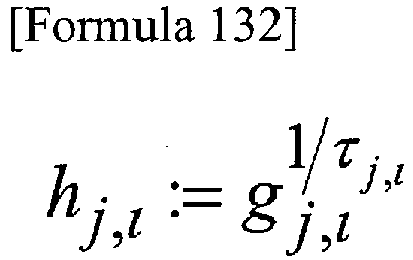
- Using the public parameters pkIPG generated in step S51, the element hT generated in step S52, and the element h^j,generated in step S53, the master
key generation unit 14 generates public parameters
key output unit 16 outputs the public parameters pk to anencryption device 20 and adecryption device 30 by outputting the public parameters pk to an external public server or the like via the input/output interface 13. - Using the secret information s0 generated in step S52 and the element hj,generated in step S53, the master
key generation unit 14 generates a master secret key
key generation unit 14 writes the generated master secret key msk to astorage device 12. - That is, the master
key generation unit 14 generates the master key pair by executing the Setup algorithm indicated in formula 133.
- KeyGen algorithm according to Embodiment 2 will be described referring to
Figs. 19 and22 . - A decryption
key generation unit 15 receives as input the identity ID of a user who uses a decryption key skID, via the input/output interface 13. The identity ID is inputted by, for example, a user of thekey generation device 10, via an input device. - As described above, identity ID := (IDj)j=1,...,n. Each IDj is 0 or 1.
- The ID
group assigning unit 17 assigns IDj for each integer j of j = 1, ..., n to different groups out of the groups Gj,which are the group Gt. More specifically, the IDgroup assigning unit 17 assigns IDj for each integer j of j = 1, ..., n to the groups Gj,IDj. Then, the IDgroup assigning unit 17 takes a direct product of the groups Gj,IDj for each integer j of j = 1, ..., n as an ID group GID. Namely, the IDgroup assigning unit 17 generates the ID group GID, as indicated in formula 134.
- Out of the elements hj,included in the master secret key msk, the ID
group assigning unit 17 generates, as an element hID, a set of those elements hj,that are included in the ID group GID. More specifically, the IDgroup assigning unit 17 generates the element hID, as indicated in formula 135.
- The decryption
key generation unit 15 generates distributed information s→ randomly, as indicated in formula 136. The distributed information s→ is information in which the secret information s0 is distributed.
- The decryption
key generation unit 15 generates a key element k by setting the distributed information s→ generated in step S63 to the element hID generated in step S62, as indicated in Formula 137.
- The
key output unit 16 outputs the decryption key skID including the identity ID received in step S61 and the key element k generated in step S64 to thedecryption device 30 via the input/output interface 13. - That is, the decryption
key generation unit 15 generates the decryption key skID by executing the KeyGen algorithm indicated in formula 138.
- Enc algorithm according to Embodiment 2 will be described referring to
Figs. 20 and23 . - An
acquisition unit 24 acquires, via an input/output interface 23, the public parameters pk generated by thekey generation device 10. Theacquisition unit 24 also receives as input a message m being an encryption target and the identity ID' being a decryption condition. The message m and the identity ID' are inputted by, for example, a user of theencryption device 20 via the input device. - As described above, identity ID' := (ID'j)j=1,...,n. Each ID'j is 0 or 1.
- The ID
group assigning unit 27 assigns ID'j for each integer j of j = 1, ..., n to different groups out of groups G^j,which are a group G^t. More specifically, the IDgroup assigning unit 17 assigns ID'j for each integer j of j = 1, ..., n to groups G^j,ID'j. Then, the IDgroup assigning unit 17 takes a direct product of the groups G^j,ID'j for each integer j of j = 1, ..., n as an ID group G^ID. Namely, the IDgroup assigning unit 17 generates the ID group G^ID, as indicated in formula 139.
- Out of the elements h^j,included in the public parameters pk, the ID
group assigning unit 17 generates, as an element h^ID, a set of those elements h^j,that are included in the ID group G^ID. More specifically, the IDgroup assigning unit 17 generates the element h^ID, as indicated in formula 140.
- A
ciphertext generation unit 25 generates elements of a ciphertext ctID' using the public parameters pk acquired in step S71 and the element h^ID generated in step S72. Theciphertext generation unit 25 generates the elements of the ciphertext ctID' using a generation element of an element X of the group GT and a generation element of an element Y^ of a group G^t. The element X refers to the element hT included in the public parameters pk. The element Y^ refers to the element h^ID generated in step S72. - The ciphertext generation process includes processes of step S731 to step S733.
- A conversion
information generation unit 251 generates an encryption random ζ which is a uniform random. - Using the element hT and the encryption random ζ, the
conversion information generation 251 generates conversion information z, as indicated in formula 141.
- A first cipher
element generation unit 252 generates a cipher element cT which is an element of the ciphertext ctID' by setting the message m to the conversion information z generated in step S731, as indicated in formula 142.
- A second cipher
element generation unit 253 generates a cipher element c which is an element of the ciphertext ctID' by setting the encryption random ζ to the element h^ID which is the element Y^, as indicated in formula 143.
- A
ciphertext output unit 26 outputs the ciphertext ctID' having, as cipher elements, the identity ID' received in step S71 and the cipher elements cT and c generated in step S73, to thedecryption device 30 via the input/output interface 23. - That is, the
encryption device 20 generates the ciphertext ctID' by executing the Enc algorithm indicated in formula 144.
- Dec algorithm according to Embodiment 2 will be described referring to
Figs. 5 and10 . - Processes of step S41 and step S42 and processes of step S44 and step S45 are the same as those in
Embodiment 1. - Note that the decryption key skID includes the key element k in which the distributed information s→ is set to the element hID. Note that the element hID is generated using the element hj,. In the element hj,, the reciprocal 1/τj,of the key generation random τj,is set to the element gj,of the group Gj,. Therefore, the decryption key skID includes the key element k which is an element of the group Gt (= group Gj,) converted by the key generation random τj,.
- The ciphertext ctID' includes the cipher element cT and the cipher element c. In the cipher element cT, the message m is set to the conversion information z in which the encryption random ζ is set to the element X which is the generator hT of the group GT. In the cipher element c, the encryption random ζ is set to the element h^ID which is the element Y^ being converted from a generator g^j,of the group G^t by the key generation random τj,.
- A
decryption unit 35 generates a message m' by decrypting the ciphertext ctID' by the decryption key skID received in step S41. - The decryption process includes processes of step S431 and step S432.
- A conversion
information generation unit 351 generates conversion information z' using the element k included in the decryption key skID and the cipher element c included in the ciphertext ctID', as indicated in formula 145.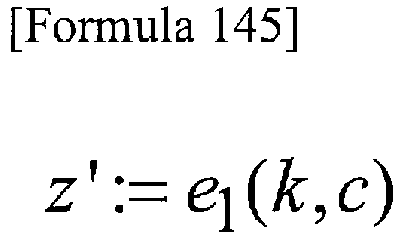
- Since formula 146 holds, if the decryption key skID can decrypt the ciphertext ctID', then the conversion information z' and the conversion information z are identical.

- A
message generation unit 352 generates the message m' using the conversion information z' generated in step S431 and the cipher element cT included in the ciphertext ctID', as indicated in formula 147.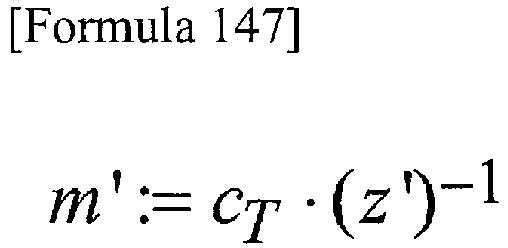
- That is, the
decryption device 30 executes the Dec algorithm indicated in formula 148 to decrypt the ciphertext ctID' by the decryption key skID.
- As described above, the
cryptographic system 1 according to Embodiment 2 implements the IBE scheme using IPG, as thecryptographic system 1 according toEmbodiment 1 does. Therefore, it is possible to provide security from the isogeny problem hardness. - The
cryptographic system 1 according to Embodiment 2 generates the ciphertext ctID' using the element Y^ which is a generation element converted by the key generation random τj,. Therefore, it is possible to provide security from the pairing problem hardness. - The
cryptographic system 1 according to Embodiment 2 uses the ID groups GID and G^ID. Accordingly, in cases where the identity ID and the identity ID' do not coincide, the group GID and the group G^ID do not coincide. As a result, decryption can be disabled. - In the
cryptographic system 1 according to Embodiment 2, KeyGen algorithm, Enc algorithm, and Dec algorithm do not use isogeny φt. Consequently, KeyGen algorithm, Enc algorithm, and Dec algorithm need not use a hash function H. - KeyGen algorithm, Enc algorithm, and Dec algorithm do not use isogeny φt. Accordingly, in step S51 of
Fig. 21 , GenIPG algorithm need not output isogeny φt. - In Embodiment 3, an ABE scheme with a small set of attributes will be described.
- In Embodiment 3, description on matters that are identical with their counterparts of Embodiment 2 will be omitted, and differences from Embodiment 2 will be described.
- In Embodiment 3, description will be made on a key-policy-type ABE (to be referred to as KP-ABE hereinafter) scheme according to which a policy being a decryption condition is set in a decryption key. The KP-ABE scheme can be converted by a method such as Naor conversion to a ciphertext-policy-type ABE (to be referred to CP-ABE hereinafter) scheme according to which a policy is set in a ciphertext.
- The KP-ABE scheme comprises Setup algorithm, KeyGen algorithm, Enc algorithm, and Dec algorithm.
- Setup algorithm takes as input a
security parameter 1λ and outputs public parameters pk and a master secret key msk. - KeyGen algorithm takes as input the public parameters pk, the master secret key msk, and an access structure S := (M, ρ), and outputs a decryption key skS corresponding to an input tag tag and the access structure S.
- Enc algorithm takes as input the public parameters pk, a message m in a message space msg, and a set of attributes, Γ, and outputs a ciphertext ctΓ.
- Dec algorithm takes as input the public parameters pk, the decryption key skS for the access structure S, and the ciphertext ctΓ encrypted under the set of attributes, Γ, and outputs either a message m' ∈ msg or a distinguished symbol ┴ which indicates that decryption failed.
- A configuration of a
cryptographic system 1 according to Embodiment 3 will be described referring toFig. 24 . - The
cryptographic system 1 is provided with akey generation device 10, anencryption device 20, and adecryption device 30. Thekey generation device 10, theencryption device 20, and thedecryption device 30 are connected to each other via a transmission line. A specific example of the transmission line is a local area network (LAN) or the Internet. Thekey generation device 10, theencryption device 20, and thedecryption device 30 can communicate with each other via the transmission line. - The
key generation device 10 takes as input asecurity parameter 1λ and executes Setup algorithm to generate public parameters pk and a master secret key msk. Thekey generation device 10 also takes as input the public parameters pk, the master secret key msk, and an access structure S := (M, p) and executes KeyGen algorithm to generate a decryption key skS. - The
key generation device 10 publishes the public parameters pk and outputs the decryption key skS to thedecryption device 30 corresponding to the access structure S. Thekey generation device 10 keeps the master secret key msk. - The
encryption device 20 takes as input the public parameters pk, a message m, and a set of attributes, Γ, and executes Enc algorithm to generate a ciphertext ctΓ. Theencryption device 20 outputs the ciphertext ctΓ to thedecryption device 30. - The
decryption device 30 takes as input the public parameters pk, the decryption key skS, and the ciphertext ctΓ and executes Dec algorithm to generate a message m' or a distinguished symbol ┴ which indicates that decryption failed. - An idea employed in the ABE scheme according to Embodiment 2 will be explained.
- A span program will be described. As the span program is an existing idea, it will be explained briefly concerning only on a range necessary in the following description.
- A span program over a field Fq is a labeled matrix S := (M, p). Note that a matrix M is an (L rows × r columns) matrix over the field Fq. A labeling ρ is a labeling of the rows of the matrix M by an attribute from {(t, v), (t', v'), ...}. Note that every row is labeled by one attribute, that is, ρ : {1, ..., L} → {(t, v), (t', v'), ...}.
- The span program accepts or rejects an input by the following criterion. Assume that Γ is a set of attributes, that is, Γ = {(tj, Xj)}1≤j≤d' (xj∈Utj). The span program S accepts the set of attributes, Γ, if and only if 1→ ∈ span<(Mi)ρ(i)∈Γ>. Acceptance of the set of attributes, Γ, by the span program S is expressed as R(S, Γ) = 1. That is, the span program S accepts the set of attributes, Γ, if and only if a vector whose elements are all 1 is obtained by linear combination of a row (Mi)ρ(i)∈Γ of the matrix M. The span program S will be referred to as access structure.
- An operation of the
cryptographic system 1 according to Embodiment 3 will be described referring toFig. 5 ,Fig. 10 , andFigs. 19 to 23 . Operations of Embodiment 3 are equivalent to processes of methods and programs, as with Embodiment 2. - Setup algorithm according to Embodiment 3 will be described referring to
Figs. 19 and21 . - A master
key generation unit 14 receives as input thesecurity parameter 1λ and a value d which is the maximum number of the attributes, via an input/output interface 13. The masterkey generation unit 14 takes as input the receivedsecurity parameter 1λ and d and executes IPG generation algorithm GenIPG (1λ, d) to generate a master key pair of public parameters pkIPG and a master secret key mskIPG indicated in formula 149.
- The master
key generation unit 14 generates secret information s0 which is a uniform random. - The master
key generation unit 14 generates an element hT by setting the secret information s0 to an element gT of a group GT, as indicated in formula 150.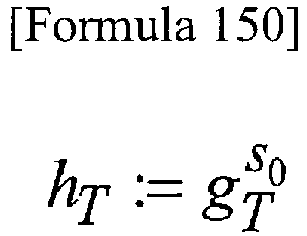
- The master
key generation unit 14 generates a key generation random τt which is a uniform random, for each integer t of t ∈ [d]. - The master
key generation unit 14 generates an element h^t for each integer t of t ∈ [d] by setting the key generation random τt to an element g^t of a group G^t, as indicated in Formula 151.
- The master
key generation unit 14 also generates an element ht for each integer t of t ∈ [d] by setting a reciprocal 1/τt of the key generation random τt to an element gt of a group Gt, as indicated in Formula 152.
- Using the public parameters pkIPG generated in step S51, the element hT generated in step S52, and the element h^t generated in step S53, the master
key generation unit 14 generates the public parameters pk := ((Gt, G^t, h^t, et)t∈[d], GT, hT). Akey output unit 16 outputs the public parameters pk to theencryption device 20 and thedecryption device 30 by outputting the public parameters pk to an external public server or the like via the input/output interface 13. - Using the secret information s0 generated in step S52 and the element ht generated in step S53, the master
key generation unit 14 generates the master secret key msk := (s0, (ht)t∈[d]). The masterkey generation unit 14 writes the generated master secret key msk to astorage device 12. - That is, the master
key generation unit 14 generates the master key pair by executing the Setup algorithm indicated in formula 153.
- KeyGen algorithm according to Embodiment 3 will be described referring to
Figs. 19 and22 . - A decryption
key generation unit 15 receives as input the access structure S := (M, p) of a user who uses a decryption key skS, via the input/output interface 13. The access structure S is information indicating a range where decryption by the decryption key skS is possible. - An ID
group assigning unit 17 takes a direct product of the group Gt where t = p(i) for each integer i of i ∈ [L], as an ID group GID. Out of the elements ht included in the master secret key msk, the IDgroup assigning unit 17 generates, as an element hID, a set of those elements ht that are included in the ID group GID. More specifically, the IDgroup assigning unit 17 generates the element hID, as indicated in formula 154.
- The decryption
key generation unit 15 generates distributed information s→, as indicated in formula 155.
- The decryption
key generation unit 15 generates a key element k := {ki} by setting the distributed information s→ generated in step S63 to the element hID generated in step S62, as indicated in Formula 156.
- The
key output unit 16 outputs the decryption key skS including the access structure S received in step S61 and the key element k := {ki} generated in step S64 to thedecryption device 30 via the input/output interface 13. - That is, the decryption
key generation unit 15 generates the decryption key skS by executing the KeyGen algorithm indicated in formula 157.
- Enc algorithm according to Embodiment 3 will be described referring to
Figs. 20 and23 . - A process of step S73 is the same as that of Embodiment 2.
- An
acquisition unit 24 acquires, via an input/output interface 23, the public parameters pk generated by thekey generation device 10. Theacquisition unit 24 also receives as input the message m being an encryption target and the set of attributes, Γ, being a decryption condition. - An ID
group assigning unit 27 takes a direct product of the group G^t for each integer t of t ∈ Γ, as G^ID. Out of elements h^t included in the public parameters pk, the IDgroup assigning unit 17 generates, as an element h^ID, a set of those elements h^t that are included in the ID group G^ID. More specifically, the IDgroup assigning unit 17 generates the element h^ID, as indicated in formula 158.
- A
ciphertext output unit 26 outputs the ciphertext ctΓ having, as cipher elements, the set of attributes, Γ, received in step S71 and cipher elements cT and c := {ct := h^t ζ} generated in step S73, to thedecryption device 30 via the input/output interface 23. - That is, the
encryption device 20 generates the ciphertext ctΓ by executing the Enc algorithm indicated in formula 159.
- Dec algorithm according to Embodiment 3 will be described referring to
Figs. 5 and10 . - Processes of step S44 and step S45 are the same as those in Embodiment 2.
- An
acquisition unit 34 acquires, via an input/output interface 33, the public parameters pk and the decryption key skS which are generated by thekey generation device 10, and the ciphertext ctΓ generated by theencryption device 20. - A decryption
key acquisition unit 341 acquires, via the input/output interface 33, the public parameters pk and the decryption key skS which are generated by thekey generation device 10. The decryption key skS includes the key element k := {ki} in which the distributed information s→ is set to the element hID. That is, the decryption key skS includes the key element k which is an element of the group Gt converted by the key generation random τt, as with Embodiment 2. - A
ciphertext acquisition unit 342 acquires the ciphertext ctΓ generated by theencryption device 20. The ciphertext ctΓ includes the cipher element cT and the cipher element c := {ct}. In the cipher element cT, the message m is set to conversion information z in which an encryption random ζ is set to an element X which is the generator hT of the group GT. In the cipher element c, the encryption random ζ is set to the element h^ID which is an element Y^ being converted from the generator g^t of the group G^t by the key generation random τt. - A
decryption unit 35 determines whether or not the access structure S included in the decryption key skS received in step S41 accepts the set of attributes, Γ, included in the ciphertext ctΓ. Hence, whether the ciphertext ctΓ can be decrypted by the decryption key skS is determined. - If it is determined to accept the set of attributes, Γ, that is, if it is determined that decryption is possible, the
decryption unit 35 advances the processing to step S43. If not, thedecryption unit 35 advances the processing to step S45. - The
decryption unit 35 generates the message m' by decrypting the ciphertext ctΓ by the decryption key skS received in step S41. - The decryption process includes processes of step S431 and step S432.
- A conversion
information generation unit 351 calculates a complementary coefficient σi indicated in formula 160.
- The conversion
information generation unit 351 generates conversion information z' using the complementary coefficient σi, the element k included in the decryption key skS, and the cipher element c included in the ciphertext ctΓ, as indicated in formula 161.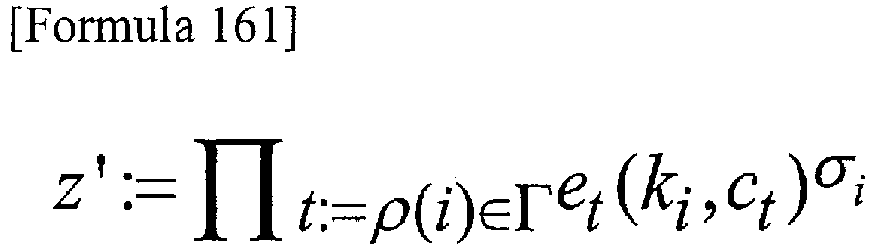
- Since formula 162 holds, if the decryption key skS can decrypt the ciphertext ctΓ, then the conversion information z' and the conversion information z are identical.

- A
message generation unit 352 generates the message m' using the conversion information z' generated in step S431 and the cipher element cT included in the ciphertext ctΓ, as indicated in formula 163.
- That is, the
decryption device 30 executes the Dec algorithm indicated in formula 164 to decrypt a ciphertext ctID' by a decryption key skID.
- As described above, the
cryptographic system 1 according to Embodiment 3 implements the ABE scheme using IPG. Therefore, it is possible to indicate security from the isogeny problem hardness. - The
cryptographic system 1 according to Embodiment 3 generates the ciphertext ctΓ using the element Y^ which is a generation element converted by the key generation random τt. Therefore, it is possible to indicate security from the pairing problem hardness. - In Embodiment 4, an ABE scheme with a large set of attributes will be described.
- In Embodiment 4, description on matters that are identical with their counterparts of Embodiment 3 will be omitted, and differences from Embodiment 3 will be described.
- In Embodiment 3, the attribute t is included in the set of attributes, Γ. In Embodiment 4, a category t of attribute and an attribute about the category t, xt := (xt,j) ∈ {0, 1}n, are included in a set of attributes, Γ.
- In the following description, when xt is expressed as a subscript, this xt signifies xt. When vi is expressed as a subscript, this vi signifies vi.
- An operation of a
cryptographic system 1 according to Embodiment 4 will be described referring toFig. 5 ,Fig. 10 , andFigs. 19 to 23 . Operations of Embodiment 4 are equivalent to processes of methods and programs, as with Embodiment 3. - Setup algorithm according to Embodiment 4 will be described referring to
Figs. 19 and21 . - A master
key generation unit 14 receives as input asecurity parameter 1λ, a value d which is the maximum number of attributes, and a value n representing the number of bits of each category t via an input/output interface 13. The masterkey generation unit 14 takes as input the receivedsecurity parameter 1λ, d, and n and executes IPG generation algorithm GenIPG (1λ, d, n) to generate a master key pair of public parameters pkIPG and a master secret key mskIPG indicated in formula 165.
- The master
key generation unit 14 generates secret information s0 which is a uniform random. - The master
key generation unit 14 generates an element hT by setting the secret information s0 to an element gT of a group GT, as indicated in formula 166.
- The master
key generation unit 14 generates a key generation random τt,j,which is a uniform random, for each integer t, each integer j, and each integerof t ∈ [d], j ∈ [n], and
- The master
key generation unit 14 generates an element h^t,j,, for each integer t, each integer j, and each integerof t ∈ [d], j ∈ [n], and , to an element g^t,j,, of a group G^t,j,, as indicated in Formula 167.
- The master
key generation unit 14 also generates an element ht,j,for each integer t, each integer j, and each integerof t ∈ [d], j ∈ [n], and of the key generation random τt,j,to an element gt,j,of a group Gt,j,, as indicated in Formula 168.
- Using the public parameters pkIPG generated in step S51, the element hT generated in step S52, and the element h^t,j,generated in step S53, the master
key generation unit 14 generates public parameters

key output unit 16 outputs the public parameters pk to anencryption device 20 and adecryption device 30 by outputting the public parameters pk to an external public server or the like via the input/output interface 13. - Using the secret information s0 generated in step S52 and the element ht,j,generated in step S53, the master
key generation unit 14 generates a master secret key
key generation unit 14 writes the generated master secret key msk to astorage device 12. - That is, the master
key generation unit 14 generates the master key pair by executing the Setup algorithm indicated in formula 169.
- KeyGen algorithm according to Embodiment 4 will be described referring to
Figs. 19 and22 . - A process of step S61 is the same as that of Embodiment 3.
- For each integer i of i ∈ [L], when p(i) = (t, vi := (vi,j) ∈ {0, 1}n), an ID
group assigning unit 17 takes, as an ID group Gt,vi, a direct product of a group Gt,j,vi for each integer j of j = 1, .., n. Note that the ID group Gt,vi is a t-th basis group. That is, the IDgroup assigning unit 17 generates the ID group Gt,vi, as indicated in formula 170.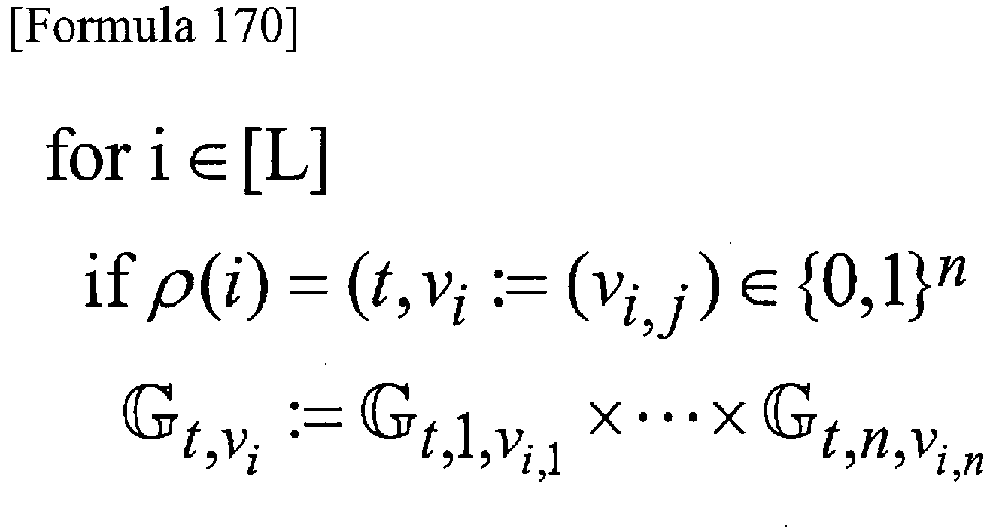
- Out of elements ht,j,included in the master secret key msk, the ID
group assigning unit 17 generates, as an element ht,vi, a set of those elements ht,j,that are included in the ID group Gt,vi. More specifically, the IDgroup assigning unit 17 generates the element ht,vi, as indicated in formula 171.
- A decryption
key generation unit 15 generates distributed information s→ i for each integer i of i ∈ [L], as indicated in formula 172.
- The decryption
key generation unit 15 generates a key element ki by setting the distributed information s→ i generated in step S63 to the element ht,vi generated in step S62, as indicated in Formula 173.
- The
key output unit 16 outputs a decryption key sks including an access structure S received in step S61 and a key element k := {ki} generated in step S64 to thedecryption device 30 via the input/output interface 13. - That is, the decryption
key generation unit 15 generates the decryption key sks by executing the KeyGen algorithm indicated in formula 174.
- Enc algorithm according to Embodiment 4 will be described referring to
Figs. 20 and23 . - Processes of step S73 and step S74 are the same as those of Embodiment 2.
- An
acquisition unit 24 acquires, via an input/output interface 23, the public parameters pk generated by akey generation device 10. Theacquisition unit 24 also receives as input a message m being an encryption target and a set of attributes, Γ, being a decryption condition. - An ID
group assigning unit 27 takes a direct product of a group G^t,j,xt of each integer j of j = 1, ..., n for each integer t of (t, xt := (xt,j) ∈ {0, 1}n) ∈ Γ, as an ID group G^t,xt. That is, the IDgroup assigning unit 27 generates the ID group G^t,xt, as indicated in formula 175.
- Out of elements h^t,j,xt included in the public parameters pk, the ID
group assigning unit 17 generates, as an element h^t,xt, a set of those elements h^t,j,tx that are included in the ID group G^t,xt. More specifically, the IDgroup assigning unit 17 generates the element h^t,xt, as indicated in formula 176.
- A
ciphertext generation unit 25 generates elements of a ciphertext ctΓ using the public parameters pk acquired in step S71 and the element h^t,xt generated in step S72. Theciphertext generation unit 25 generates the elements of the ciphertext ctΓ using a generation element of an element X of the group GT and a generation element of an element Y^ of the group G^t,xt. The element X refers to the element hT included in the public parameters pk. The element Y^ refers to the element h^t,xt generated in step S72. - The ciphertext generation process includes processes of step S731 to step S733.
- A conversion
information generation unit 251 generates an encryption random ζ which is a uniform random. - Using the element hT and the encryption random ζ, the
conversion information generation 251 generates conversion information z, as indicated in formula 177.
- A first cipher
element generation unit 252 generates a cipher element cT which is an element of the ciphertext ctΓ by setting the message m to the conversion information z generated in step S731, as indicated in formula 178.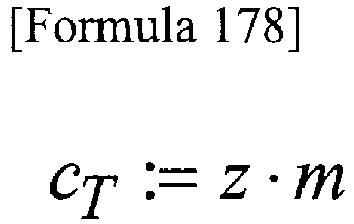
- A second cipher
element generation unit 253 generates, for each integer t of (t, xt := (xt,j) ∈ {0, 1}n) ∈ Γ, a cipher element ct which is an element of the ciphertext ctΓ by setting the encryption random ζ to the element h^t,xt which is the element Y^, as indicated in formula 179.
- A
ciphertext output unit 26 outputs the ciphertext ctΓ having, as cipher elements, the set of attributes, Γ, received in step S71 and cipher elements cT and c := {ct}t∈Γ generated in step S73, to thedecryption device 30 via the input/output interface 23. - That is, the
encryption device 20 generates the ciphertext ctΓ by executing the Enc algorithm indicated in formula 180.
- Dec algorithm according to Embodiment 4 will be described referring to
Figs. 5 and10 . - Processes of step S41 and step S42 and processes of step S44 and step S45 are the same as those in Embodiment 3.
- Note that the decryption key sks includes the key element k in which distributed information s→ is set to the element ht,vi. That is, the decryption key sks includes the key element k := {ki} which is an element of the group Gt,vi converted by the key generation random Tt,j,as in Embodiment 3.
- The ciphertext ctΓ includes the cipher element cT and the cipher element c. In the cipher element cT, the message m is set to the conversion information z in which the encryption random ζ is set to the element X which is the generator hT of the group GT. In the cipher element c, the encryption random ζ is set to the element h^t,xt which is the element Y^ being converted from the generator g^t,j,of the group G^t,xt by the key generation random τt,j,.
- A
decryption unit 35 generates a message m' by decrypting the ciphertext ctΓ by the decryption key sks received in step S41. - The decryption process includes processes of step S431 and step S432.
- A conversion
information generation unit 351 calculates a complementary coefficient σi, indicated in formula 181.
- The conversion
information generation unit 351 generates conversion information z' using the complementary coefficient σi, the element k := {ki} included in the decryption key sks, and the cipher element c := {ct} included in the ciphertext ctΓ, as indicated in formula 182.
- Since formula 183 holds, if the decryption key sks can decrypt the ciphertext ctΓ, then the conversion information z' and the conversion information z are identical.
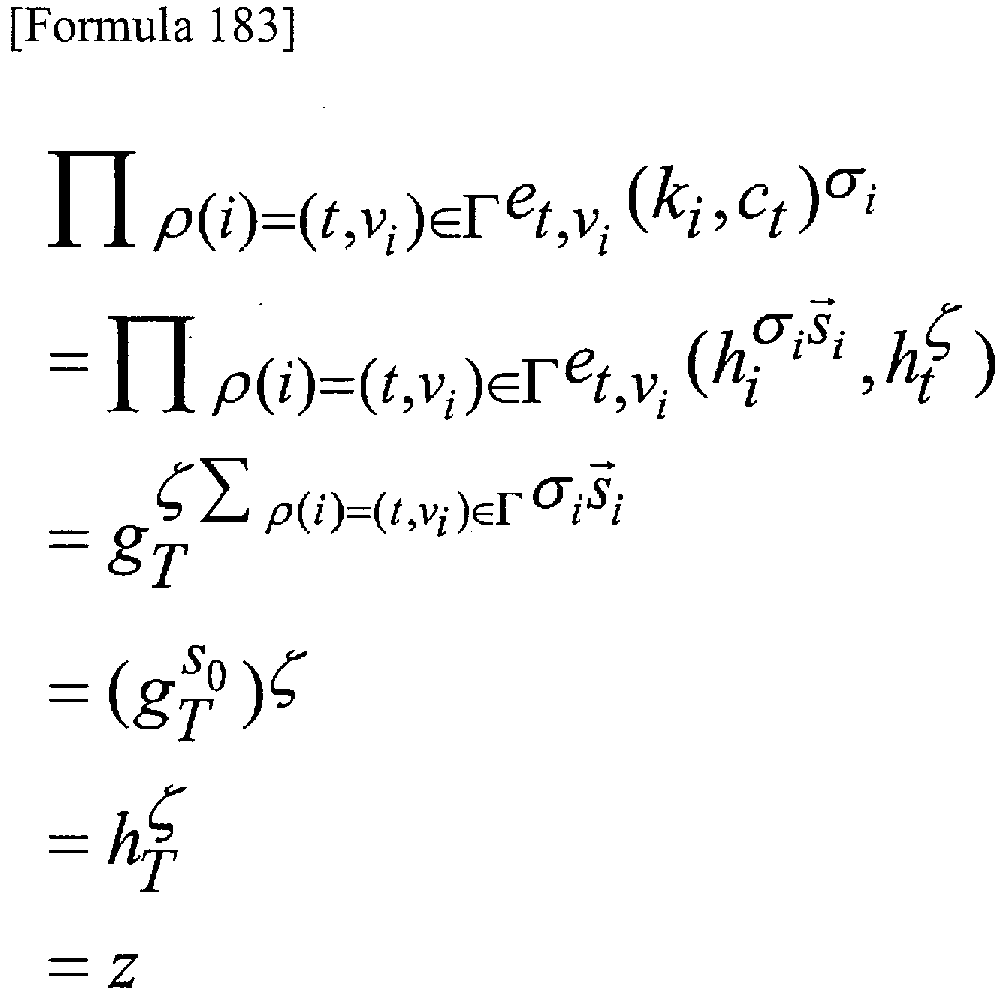
- A
message generation unit 352 generates the message m' using the conversion information z' generated in step S431 and the cipher element cT included in the ciphertext ctΓ, as indicated in formula 184.
- That is, the
decryption device 30 executes the Dec algorithm indicated in formula 185 to decrypt a ciphertext ctID' by a decryption key skID.
- As described above, the
cryptographic system 1 according to Embodiment 4 implements the ABE scheme using IPG. Therefore, it is possible to indicate security from the isogeny problem hardness. - The
cryptographic system 1 according to Embodiment 4 generates the ciphertext ctΓ using the element Y^ which is a generation element converted by the key generation random τt,j,. Therefore, it is possible to indicate security from the pairing problem hardness. - In Embodiment 5, hierarchical IBE (to be referred to as HIBE hereinafter) based on the IBE scheme described in Embodiment 2 will be described.
- In Embodiment 5, description on matters that are identical with their counterparts of Embodiment 2 will be omitted, and differences from Embodiment 2 will be described.
- In Embodiment 5, 1-bit HIBE will be described first, and thereafter n (n ≥ 1)-bit HIBE to which 1-bit HIBE is applied will be described.
- The HIBE scheme comprises Setup algorithm, KeyGen algorithm, Enc algorithm, Dec algorithm, and Delegate algorithm.
- Setup algorithm takes as input a
security parameter 1λ and outputs public parameters pk and a master secret key msk. - KeyGen algorithm takes as input the public parameters pk, the master secret key msk, and an identity ID, and outputs a decryption key skID corresponding to the identity ID.
- Enc algorithm takes as input the public parameters pk, a message m in a message space msg, and an identity ID', and outputs a ciphertext ctID'.
- Dec algorithm takes as input the public parameters pk, the decryption key skID for the identity ID, and the ciphertext ctID' encrypted under the identity ID', and outputs either a message m' ∈ msg or a distinguished symbol ⊥ which indicates that decryption failed.
- Delegate algorithm takes as input the public parameters pk, a secret key skID for a hierarchical identity ID of a length L, and (L+1)th IDL+1, and outputs either a secret key skID' for a hierarchical identity ID' := (ID, IDL+1) of a length (L+1) or a distinguished symbol ⊥ which indicates that key generation failed.
- A configuration of a
cryptographic system 1 according to Embodiment 5 will be described referring toFig. 25 . - The
cryptographic system 1 is provided with akey generation device 10, anencryption device 20, adecryption device 30, and akey delegation device 40. Thekey generation device 10, theencryption device 20, thedecryption device 30, and thekey delegation device 40 are connected to each other via a transmission line. - The
key delegation device 40 takes as input public parameters pk, a secret key skID for a hierarchical identity ID of a length L, and (L+1)th IDL+1, and executes Delegate algorithm to generate either a secret key skID' for a hierarchical identity ID' := (ID, IDL+1) of a length (L+1) or a distinguished symbol ⊥ which indicates that key generation failed. - A configuration of the
key delegation device 40 according to Embodiment 5 will be described referring toFig. 26 . - The
key delegation device 40 is provided with hardware devices which are aprocessor 41, astorage device 42, and an input/output interface 43. Theprocessor 41 is connected to the other hardware devices via signal lines and controls these other hardware devices. - The
key delegation device 40 is provided with anacquisition unit 44, an IDgroup assigning unit 45, a low-levelkey generation unit 46, and a low-levelkey output unit 47, as function configuration elements. Functions of theacquisition unit 44, IDgroup assigning unit 45, low-levelkey generation unit 46, and low-levelkey output unit 47 are implemented by software. - A program that implements the functions of the individual units of the
key delegation device 40 is stored in thestorage device 42. This program is read by theprocessor 41 and executed by theprocessor 41. Thus, the functions of the individual units of thekey delegation device 40 are implemented. - An operation of the
cryptographic system 1 according to Embodiment 5 will be described referring toFigs. 19 to 23 ,Fig. 26 , andFig. 27 . Operations of Embodiment 5 are equivalent to processes of methods and programs, as with Embodiment 2. An operation of thekey delegation device 40 according to Embodiment 5 corresponds to a key delegation method according to Embodiment 5 and processes of a key delegation program according to Embodiment 5. - Note that Dec algorithm is the same as that of Embodiment 2 and accordingly its description will be omitted.
- First, 1-bit HIBE will be described.
- In the following description, when IDt is expressed as a subscript, this IDt signifies IDt. When ID't is expressed as a subscript, this ID't signifies ID'i.
- Setup algorithm according to Embodiment 5 will be described referring to
Figs. 19 and21 . - A master
key generation unit 14 receives as input asecurity parameter 1λ and a value d ≥ 2, which is a hierarchical number. The masterkey generation unit 14 takes as input the receivedsecurity parameter 1λ and 2d and executes IPG generation algorithm GenIPG (1λ, 2d) to generate a master key pair of public parameters pkIPG and a master secret key mskIPG indicated in formula 186.
- The master
key generation unit 14 generates secret information s0 which is a uniform random. - The master
key generation unit 14 generates an element hT by setting the secret information s0 to an element gT of a group GT, as indicated in formula 187.
- The master
key generation unit 14 generates a key generation random τt,which is a uniform random, for each integer t of t ∈ [d] and each integerof
- The master
key generation unit 14 generates an element h^t,for each integer t of t ∈ [d] and each integerof to an element g^t,of a group G^t,, as indicated in Formula 188.
- The master
key generation unit 14 also generates an element ht,, for each integer t of t ∈ [d] and each integerof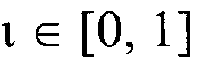 to an element gt,of a group Gt,, as indicated in Formula 189.
- Using the public parameters pkIPG generated in step S51, the element hT generated in step S52, and the element h^t,and the element ht,generated in step S53, the master
key generation unit 14 generates public parameters

key output unit 16 outputs the public parameters pk to theencryption device 20 and thedecryption device 30 by outputting the public parameters pk to an external public server or the like via the input/output interface 13. - Using the secret information s0 generated in step S52, the master
key generation unit 14 generates a master secret key msk := s0. The masterkey generation unit 14 writes the generated master secret key msk to astorage device 12. - That is, the master
key generation unit 14 generates the master key pair by executing the Setup algorithm indicated in formula 190.
- KeyGen algorithm according to Embodiment 5 will be described referring to
Figs. 19 and22 . - A decryption
key generation unit 15 receives as input the identity ID of a user who uses the decryption key skID, via the input/output interface 13. The identity ID is inputted by, for example, a user of thekey generation device 10 via an input device. - Assume that in this case identity ID := (IDt)t∈[L]. Note that L < d. Also, each IDt is 0 or 1.
- An ID
group assigning unit 17 assigns IDt for each integer t of t ∈ [L] to the group Gt,IDt. The IDgroup assigning unit 17 takes a direct product of a group Gt,IDt for each integer t of t ∈ [L] as an ID group GID. Namely, the IDgroup assigning unit 17 generates the ID group GID, as indicated in formula 191.
- The ID
group assigning unit 17 generates an element hID, as indicated in formula 192.
- The decryption
key generation unit 15 generates distributed information s→, as indicated in formula 193. The distributed information s→ is information in which the secret information s0 is distributed.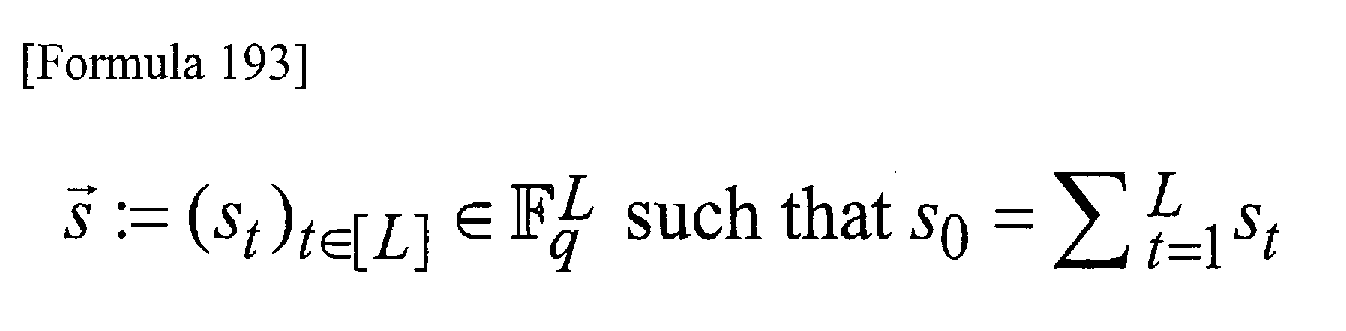
- The decryption
key generation unit 15 generates a key element k by setting the distributed information s→ generated in step S63 to the element hID generated in step S62, as indicated in Formula 194.
- A
key output unit 16 outputs the decryption key skID including the identity ID received in step S61 and the key element k generated in step S64 to thedecryption device 30 via the input/output interface 13. - That is, the decryption
key generation unit 15 generates the decryption key skID by executing the KeyGen algorithm indicated in formula 195.
- Enc algorithm according to Embodiment 5 will be described referring to
Figs. 20 and23 . - An
acquisition unit 24 acquires, via an input/output interface 23, the public parameters pk generated by thekey generation device 10. Theacquisition unit 24 also receives as input a message m being an encryption target and the identity ID' being a decryption condition. The message m and the identity ID' are inputted by, for example, a user of theencryption device 20 via the input device. - Assume that identity ID' := (ID't)t∈[L]. Note that L < d. Also, each IDt is 0 or 1.
- An ID
group assigning unit 27 assigns ID't for each integer t of t ∈ [L] to a group G^t,IDt. The IDgroup assigning unit 27 takes a direct product of a group G^t,ID't for each integer t of t ∈ [L] as an ID group G^ID. Namely, the IDgroup assigning unit 27 generates the ID group G^ID, as indicated in formula 196.
- The ID
group assigning unit 27 generates an element h^ID, as indicated in formula 197.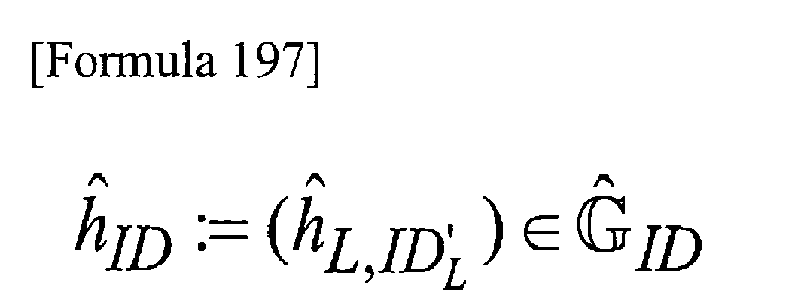
- A
ciphertext generation unit 25 generates elements of a ciphertext ctID' using the public parameters pk acquired in step S71 and the element h^ID generated in step S72. Theciphertext generation unit 25 generates the elements of the ciphertext ctID' using a generation element of an element X of the group GT and a generation element of an element Y^ of a group G^t. The element X refers to the element hT included in the public parameters pk. The element Y^ refers to the element h^ID generated in step S72. - The ciphertext generation process includes processes of step S731 to step S733.
- A conversion
information generation unit 251 generates an encryption random ζ which is a uniform random. - Using the element hT and the encryption random ζ, the
conversion information generation 251 generates conversion information z, as indicated in formula 198.
- A first cipher
element generation unit 252 generates a cipher element cT which is an element of the ciphertext ctID' by setting the message m to the conversion information z generated in step S731, as indicated in formula 199.
- A second cipher
element generation unit 253 generates a cipher element c which is an element of the ciphertext ctID' by setting the encryption random ζ to the element h^ID which is the element Y^, as indicated in formula 200.
- A
ciphertext output unit 26 outputs the ciphertext ctID' having, as cipher elements, the identity ID' received in step S71 and the cipher elements cT and c generated in step S73, to thedecryption device 30 via the input/output interface 23. - That is, the
encryption device 20 generates the ciphertext ctID' by executing the Enc algorithm indicated in formula 201.
- Delegate algorithm according to Embodiment 5 will be described referring to
Figs. 26 and27 . - Delegate algorithm is executed by the
key delegation device 40. - The
acquisition unit 44 acquires, via the input/output interface 43, the public parameters pk generated by thekey generation device 10 and the decryption key skID := k for which a low-level key is to be generated. Theacquisition unit 44 also receives as input an identity IDL+1 ∈ {0, 1} of a user who uses a low-level decryption key skID* of the decryption key skID, via the input/output interface 43. - The ID
group assigning unit 45 takes ID* := (ID, IDL+1). The IDgroup assigning unit 45 also generates an ID group GID*, as indicated in formula 202.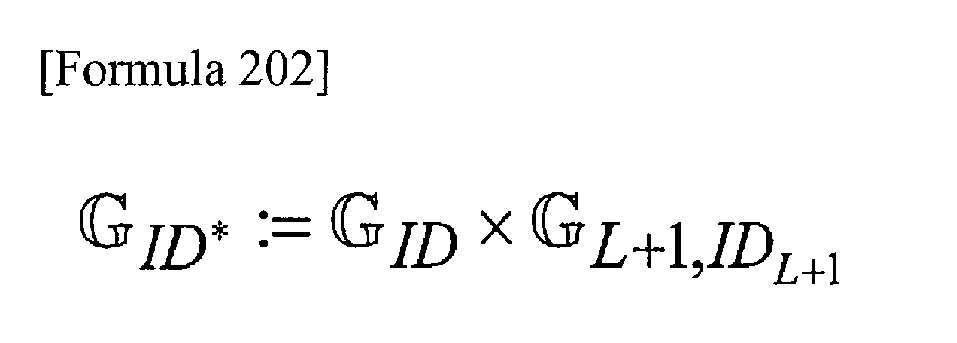
- The ID
group assigning unit 45 generates an element k+ and an element hID*, as indicated in formula 203.
- The low-level
key generation unit 46 generates distributed information τ→', as indicated in formula 204.
- The low-level
key generation unit 46 generates a key element kID* by setting the distributed information τ→' generated in step S83 to the element hID* generated in step S82, as indicated in Formula 205.
- The low-level
key output unit 47 outputs the low-level decryption key skID* including the identity ID* and the key element kID* which is generated in step S64 to thedecryption device 30 via the input/output interface 13. - That is, the decryption
key generation unit 15 generates the low-level decryption key skID* by executing the Delegate algorithm indicated in formula 206.
- Description will be made on n (n ≥ 1)-bit HIBE to which 1-bit HIBE described above is applied.
- The n-bit HIBE scheme is configured using 1-bit HIBE Setup algorithm, 1-bit HIBE KeyGen algorithm, 1-bit HIBE Enc algorithm, 1-bit HIBE Dec algorithm, and 1-bit HIBE Delegate algorithm.
- In describing the n-bit HIBE scheme, 1-bit HIBE Setup algorithm, 1-bit HIBE KeyGen algorithm, 1-bit HIBE Enc algorithm, 1-bit HIBE Dec algorithm, and 1-bit HIBE Delegate algorithm which are mentioned above will be referred to as obHIBE_Setup, obHIBE_KeyGen, obHIBE_Enc, obHIBE_Dec, and obHIBE_Delegate, respectively.
- In contrast, n-bit HIBE Setup algorithm, n-bit HIBE KeyGen algorithm, n-bit HIBE Enc algorithm, n-bit HIBE Dec algorithm, and n-bit HIBE Delegate algorithm will be referred to as nbHIBE_Setup, nbHIBE KeyGen, nbHIBE Enc, nbHIBE Dec, and nbHIBE_Delegate, respectively.
- Description will be made on nbHIBE_Setup.
- The master
key generation unit 14 receives as input thesecurity parameter 1λ, the value d which is a hierarchical number, and the value n which is a bit number. - The master
key generation unit 14 takes as input thesecurity parameter 1λ and a value d × n and executes obHIBE_Setup to generate public parameters pkob and a master secret key mskob. The masterkey generation unit 14 takes the public parameters pkob as public parameters pk of the n-bit HIGE scheme and the master secret key mskob as a master secret key msk of the n-bit HIBE scheme. - That is, master
key generation unit 14 generates a master key pair by executing nbHIBE_Setup indicated in Formula 207.
- Description will be made on nbHIBE KeyGen.
- The decryption
key generation unit 15 receives as input the identity ID of a user who uses the decryption key skID via the input/output interface 13. Assume that identity ID := (IDt := (IDt,j))t∈[L], j∈[n]. Note that L < d. Also, each IDt,j is 0 or 1. - ID^ := (IDt,j)t∈[L], j∈[n] is treated as a hierarchical 1-bit identity having a hierarchical number Ln. The decryption
key generation unit 15 takes as input the public parameters pk and the master secret key msk which are generated by nbHIBE Setup, and the identity ID^, and executes obHIBE KeyGen to generate the decryption key skID. - Namely, the decryption
key generation unit 15 generates the decryption key skID by executing obHIBE_KeyGen indicated in formula 208.
- Description will be made on nbHIBE_Enc.
- The
acquisition unit 24 acquires the public parameters pk via an input/output interface 23. Theacquisition unit 24 also receives as input the message m being an encryption target and the identity ID' being a decryption condition. Assume that the identity ID' := (ID't := (ID't,j))t∈[L], j∈[n]. - ID'* := (ID't,j)t∈[L], j∈[n] is treated as a hierarchical 1-bit identity having a hierarchical number Ln. The
ciphertext generation unit 25 and the IDgroup assigning unit 27 take as input the public parameters pk, the message m, and the identity ID'* and execute obHIBE_Enc to generate the ciphertext ctID'. - That is, the
encryption device 20 generates the ciphertext ctID' by executing the nbHIBE_Enc indicated in formula 209.
- Description will be made on nbHIBE_Dec.
- An
acquisition unit 34 acquires the public parameters pk, the decryption key skID, and the ciphertext ctID' via the input/output interface 33. - A
decryption unit 35 takes as input the public parameters pk, the decryption key skID* obtained by replacing ID in the decryption key skID by ID*, and the ciphertext ctID'* obtained by replacing ID' of the ciphertext ctID' by ID'*, and executes obHIBE Dec to generate the message m'. - That is, the
decryption device 30 executes nbHIBE_Dec indicated in formula 210 to decrypt the ciphertext ctID' by the decryption key skID.
- Description will be made on nbHIBE Delegate.
- The
acquisition unit 44 acquires the public parameters pk and the decryption key skID via the input/output interface 43. Theacquisition unit 44 also receives as input the identity IDL+1 ∈ {0, 1}n via the input/output interface 43. - The ID
group assigning unit 45 and the low-levelkey generation unit 46 take the identity IDL+1 as (IDL+1,j)j∈[n] and the decryption key skID as sk0. For each integer j of j ∈ [n], the IDgroup assigning unit 45 and the low-levelkey generation unit 46 take as input the public parameters pk, a decryption key skj-1, and an identity IDL+1,j and execute obHIBE_Delegate to generate a decryption key skj. The low-levelkey output unit 47 then outputs a decryption key skn as a low-level decryption key skID'. - That is, the decryption
key generation unit 15 generates the low-level decryption key skID' by executing the nbHIBE_Delegate indicated in formula 211.
- As described above, the
cryptographic system 1 according to Embodiment 5 implements the HIBE scheme using IPG. Therefore, it is possible to indicate security from the isogeny problem hardness. - The
cryptographic system 1 according to Embodiment 5 generates a ciphertext ctΓ using the element Y^ which is a generation element converted by a key generation random τt,. Therefore, it is possible to indicate security from the pairing problem hardness. - In Embodiment 6, high-security Boneh-Boyen type 1-bit HIBE will be described.
- In Embodiment 6, description on matters that are identical with their counterparts of Embodiment 5 will be omitted, and differences from Embodiment 5 will be described.
- An operation of a
cryptographic system 1 according to Embodiment 6 will be described referring toFig. 5 ,Fig. 10 ,Figs. 19 to 23 ,Fig. 26 , andFig. 27 . Operations of Embodiment 6 are equivalent to processes of methods and programs, as with Embodiment 5. - Setup algorithm according to Embodiment 6 will be described referring to
Figs. 19 and21 . - A master
key generation unit 14 receives as input asecurity parameter 1λ and a value d ≥ 2, which is a hierarchical number, via an input/output interface 13. The masterkey generation unit 14 takes as input the receivedsecurity parameter 1λ and 4d and executes IPG generation algorithm GenIPG (1λ, 4d) to generate a master key pair of public parameters pkIPG and a master secret key mskIPG indicated in formula 212.
- The master
key generation unit 14 generates secret information π and secret information τ which are uniform randoms. - The master
key generation unit 14 generates an element hT by setting the secret information π and the secret information τ to an element gT of a group GT, as indicated in formula 213.
- The master
key generation unit 14 also generates an element fL t,, an element fR t,, and an element uL, for each integer t of t ∈ [d] and each integerof

- The master
key generation unit 14 generates a key generation random σt,, which is a uniform random, for each integer t of t ∈ [d] and each integer i of i ∈ [0, 1]. - The master
key generation unit 14 generates an element h^R t,for each integer t of t ∈ [d] and each integer i of i ∈ [0, 1] by setting the key generation random σt,to an element g^R t,of a group G^R t,, as indicated in formula 215.
- The master
key generation unit 14 also generates an element hL t,for each integer t of t ∈ [d] and each integerof to an element gL t,of a group GL t,as indicated in formula 216.
- Using the public parameters pkIPG generated in step S51; the element hT, element fL t,, element f^R t,, and element uL, generated in step S52; and the element h^R t,and element hL t,generated in step S53, the master
key generation unit 14 generates public parameters

key output unit 16 outputs the public parameters pk to anencryption device 20 and adecryption device 30 by outputting the public parameters pk to an external public server or the like via the input/output interface 13. - Using the element uLgenerated in step S52, the master
key generation unit 14 generates a master secret key
key generation unit 14 also writes the generated master secret key msk to astorage device 12. - That is, the master
key generation unit 14 generates master key pair by executing the Setup algorithm indicated in formula 217.
- KeyGen algorithm according to Embodiment 6 will be described referring to
Figs. 19 and22 . - The decryption
key generation unit 15 receives as input an identity ID of a user who uses a decryption key skID, via the input/output interface 13. The identity ID is inputted by, for example, a user of thekey generation device 10 via an input device. - Assume that identity ID := (IDt)t∈[L]. Note that L < d. Also, each IDt is 0 or 1.
- An ID
group assigning unit 17 assigns IDt for each integer t of t ∈ [L] to a group GL t,IDt and a group GR t,IDt. The IDgroup assigning unit 17 takes a direct product of the group GL t,IDt for each integer t of t ∈ [L] as an ID group GL ID, and a direct product of the group GR t,IDt for each integer t of t ∈ [L] as an ID group GR ID. Namely, the IDgroup assigning unit 17 generates the ID group GL ID and the ID group GR ID, as indicated in formula 218.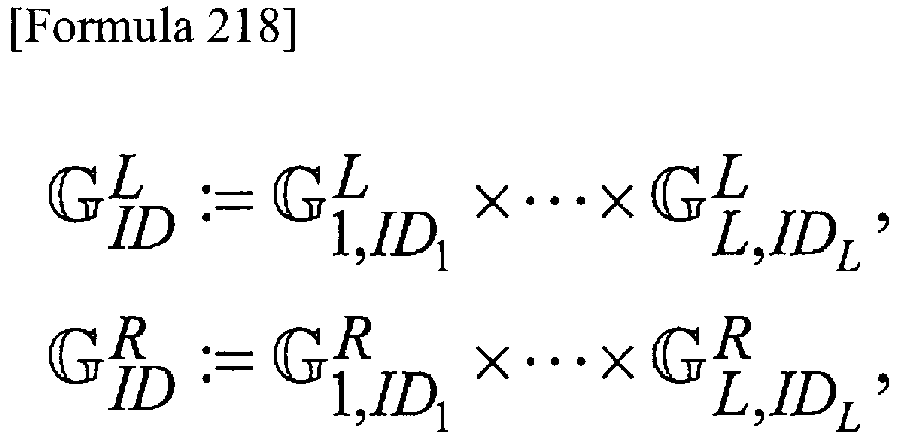
- The ID
group assigning unit 17 generates an element gL ID, an element fL ID, an element hL ID, and an element gR ID, as indicated in formula 219.
- A decryption
key generation unit 15 generates distributed information τ→, as indicated in formula 220.
- The decryption
key generation unit 15 generates a key element k := {vL ID·FL(ID)r→, (gR ID)} by employing the distributed information τ→ generated in step S63 and a uniform random r→ := (rt)t∈[L] for the element gL ID, element fL ID, element hL ID, and element gR ID generated in step S62, as indicated in formula 221.
- The
key output unit 16 outputs the decryption key skID including the identity ID received in step S61 and the key element k generated in step S64 to thedecryption device 30 via the input/output interface 13. - That is, the decryption
key generation unit 15 generates the decryption key skID by executing the KeyGen algorithm indicated in formula 222.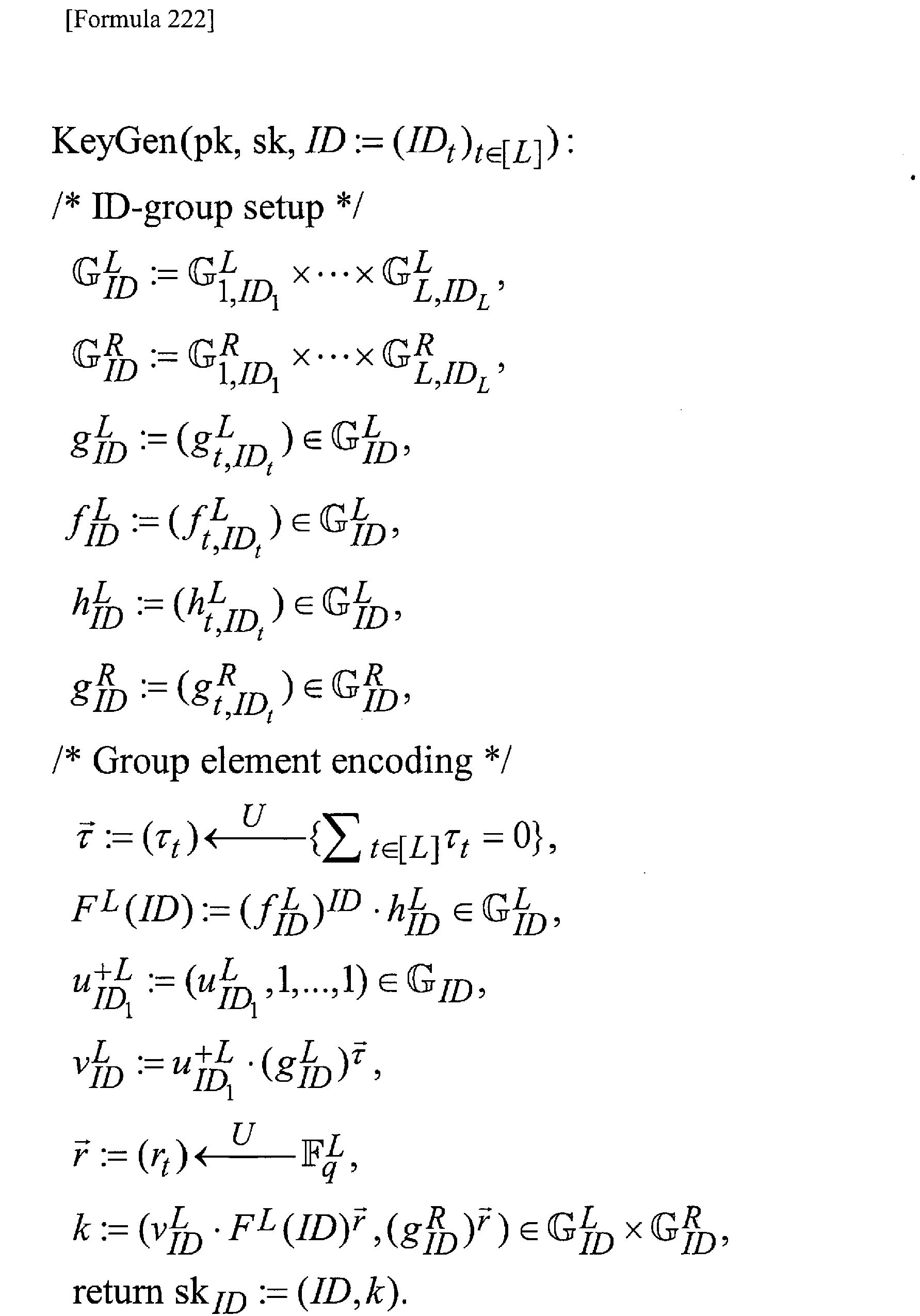
- Enc algorithm according to Embodiment 6 will be described referring to
Figs. 20 and23 . - An
acquisition unit 24 acquires, via an input/output interface 23, the public parameters pk generated by akey generation device 10. Theacquisition unit 24 also receives as input a message m being an encryption target and an identity ID' being a decryption condition. The message m and the identity ID' are inputted by, for example, a user of theencryption device 20 via the input device. - Assume that identity ID' := (ID't)t∈[L]. Note that L < d. Also, each ID't is 0 or 1.
- An ID
group assigning unit 27 assigns ID't for each integer t of t ∈ [L] to a group G^L t,IDt and a group G^R t,IDt. The IDgroup assigning unit 27 takes a direct product of a group G^L t,ID't for each integer t of t ∈ [L] as an ID group G^L ID and a direct product of a group G^R t,ID't for each integer t of t ∈ [L] as an ID group G^R ID. Namely, the IDgroup assigning unit 27 generates the ID group G^L ID and the ID group G^R Id, as indicated in formula 223.
- The ID
group assigning unit 27 generates an element g^L ID, an element f^R ID, and an element h^R ID, as indicated in formula 224.
- A
ciphertext generation unit 25 generates elements of a ciphertext ctID' using the public parameters pk acquired in step S71 and the element g^L ID, element f^R ID, and element h^R ID which are generated in step S72. Theciphertext generation unit 25 generates the elements of the ciphertext ctID' using a generation element of an element X of the group GT and a generation element of an element Y^ of a group G^t. The element X refers to the element hT included in the public parameters pk. The element Y^ refers to the element g^L ID, element f^R ID, and element H^R ID which are generated in step S72. - The ciphertext generation process includes processes of step S731 to step S733.
- A conversion
information generation unit 251 generates an encryption random ζ which is a uniform random. - Using the element hT and the encryption random ζ, the
conversion information generation 251 generates conversion information z, as indicated in formula 225.
- A first cipher
element generation unit 252 generates a cipher element cT which is an element of the ciphertext ctID' by setting the message m to the conversion information z generated in step S731, as indicated in formula 226.
- A second cipher
element generation unit 253 generates a cipher element c := {(g^L ID)ζ, F^R(ID)ζ} which is an element of the ciphertext ctID' by setting the encryption random ζ to the element g^L ID, element f^R ID, and element h^R ID which are each the element Y^, as indicated in formula 227.
- A
ciphertext output unit 26 outputs the ciphertext ctID' having, as cipher elements, the identity ID' received in step S71 and the cipher elements cT and c generated in step S73, to thedecryption device 30 via the input/output interface 23. - That is, the
encryption device 20 generates the ciphertext ctID' by executing the Enc algorithm indicated in formula 228.
- Dec algorithm according to Embodiment 6 will be described referring to
Figs. 5 and10 . - Processes of step S41 and step S42 and processes of step S44 and step S45 are the same as those in Embodiment 5.
- A
decryption unit 35 generates a message m' by decrypting the ciphertext ctID' by the decryption key skID received in step S41. - The decryption process includes processes of step S431 and step S432.
- A conversion
information generation unit 351 generates conversion information z' using the element k := {vL ID·FL(ID)r→, (gR ID)} included in the decryption key skID and the cipher element c := {(g^L ID)ζ, F^R(ID)ζ} included in the ciphertext ctID', as indicated in formula 229. Note that kL := L ID·FL(ID)R→ and that kR := (gR ID). Also note that cL := (g^L ID)ζ and that cR := F^R(ID)ζ.
- Since formula 230 holds, if the decryption key skID can decrypt the ciphertext ctID', then the conversion information z' and the conversion information z are identical.

- A
message generation unit 352 generates the message m' using the conversion information z' generated in step S431 and the cipher element cT included in the ciphertext ctID', as indicated in formula 231.
- That is, the
decryption device 30 executes the Dec algorithm indicated in formula 232 to decrypt the ciphertext ctID' by the decryption key skID.
- Delegate algorithm according to Embodiment 6 will be described referring to
Figs. 26 and27 . - Delegate algorithm is executed by a
key delegation device 40. - An
acquisition unit 44 acquires, via an input/output interface 43, the public parameters pk generated by thekey generation device 10 and the decryption key skID := (ID, kL, kR) for which a low-level key is to be generated. Note that kL := L ID·FL(ID)r→ and that kR := (gR ID). Theacquisition unit 44 also receives as input an identity IDL+1 ∈ {0, 1} of a user who uses a low-level decryption key skID' of the decryption key skID, via the input/output interface 43. - An ID
group assigning unit 45 takes ID' := (ID, IDL+1). The IDgroup assigning unit 45 also generates an ID group GL ID' and an ID group GR ID', as indicated in formula 233.
- The ID
group assigning unit 45 generates an element k+L, an element gL ID', an element k+R, and an element gR ID', as indicated in formula 234.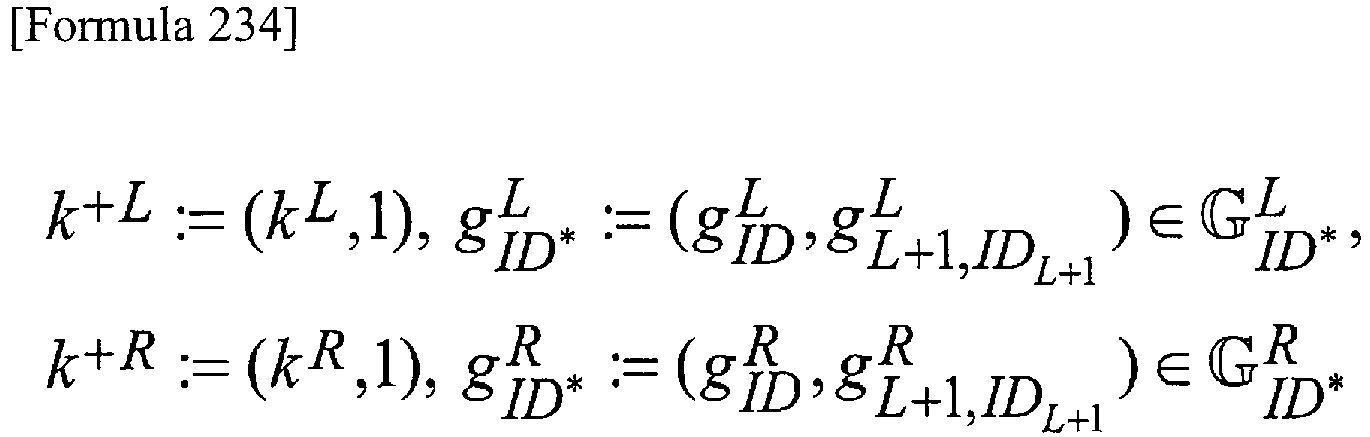
- A low-level
key generation unit 46 generates distributed information τ→', as indicated in formula 235.
- The low-level
key generation unit 46 generates the key element k := {kL, kR} by setting the distributed information τ→' generated in step S83 and a uniform random r→" to the element element k+L, element gL ID', element k+R, and element gR iD' which are generated in step S82, as indicated in Formula 236.
- A low-level
key output unit 47 outputs the low-level decryption key skID' including the identity ID' and the key element k which is generated in step S84 to thedecryption device 30 via the input/output interface 13. - That is, the decryption
key generation unit 15 generates the low-level decryption key SkID' by executing the Delegate algorithm indicated in formula 237.
- As described above, the
cryptographic system 1 according to Embodiment 6 implements the HIBE scheme using IPG. Therefore, it is possible to indicate security from the isogeny problem hardness. - The
cryptographic system 1 according to Embodiment 6 generates a ciphertext ctΓ using the element Y^ which is a generation element converted by the key generation random σt,. Therefore, it is possible to indicate security from the pairing problem hardness. - 1: cryptographic system; 10: key generation device; 11: processor; 12: storage device; 13: input/output interface; 14: master key generation unit; 15: decryption key generation unit; 16:
key output unit 16; 17: ID group assigning unit; 18: electronic circuit; 20: encryption device; 21: processor; 22: storage device; 23: input/output interface; 24: acquisition unit; 25: ciphertext generation unit; 26: ciphertext output unit; 27: ID group assigning unit; 28: electronic circuit; 30: decryption device; 31: processor; 32: storage device; 33: input/output interface; 34: acquisition unit; 35: decryption unit; 36: message output unit; 38: electronic circuit; 40: key delegation device; 41: processor; 42: storage device; 43: input/output interface; 44: acquisition unit; 45: ID group assigning unit; 46: low-level key generation unit; 47: low-level key output unit; 48: electronic circuit
Claims (18)
- An encryption device in a cryptographic system that uses a group G0, a group Gt associated with the group G0, a group G^0, a group G^t associated with the group G^0, and a group GT associated with the group G0 and the group G^0 by pairing operation e0 and associated with the group Gt and the group G^t by pairing operation et, the encryption device comprisinga ciphertext generation unit to generate a ciphertext ct using an element X of the group GT and an element Y^ of the group G^t, at least either one of the element X and the element Y^ being generated through conversion of a generator by a key generation random,wherein the ciphertext generation unit comprises:a first cipher element generation unit to generate a cipher element cT which is an element of the ciphertext ct, by setting a message m to conversion information z in which an encryption random ζ is set to the element X; anda second cipher element generation unit to generate a cipher element c which is an element of the ciphertext ct, by setting the encryption random ζ to the element Y^.
- The encryption device according to claim 1,wherein the first cipher element generation unit generates the cipher element cT indicated in formula 1, andwherein the second cipher element generation unit generates the cipher element c indicated in formula 2.
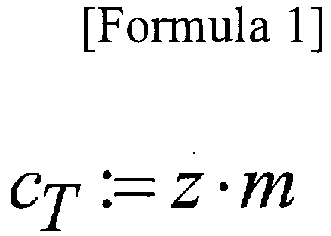


 γ is the key generation random,ĝ 0 is an element of the group G^0, andh 0 is an element of the group G0
 ĝ 1 is an element Y^ of the group G^1
 - The encryption device according to claim 1,
wherein the cryptographic system uses the group Gt and the group G^t for each integer t of t = 1, ..., w concerning an integer w of 2 or more,
wherein the encryption device further comprises an ID group assigning unit to assign an attribute xj for each integer j of j = 1, ..., n concerning an integer n of 2 or more to w or less, to a different group in the group G^t, and
wherein the second cipher element generation unit generates the cipher element c by setting the encryption random ζ to an element in a group assigned to the attribute xj for each integer j of j = 1, ..., n by the ID group assigning unit. - The encryption device according to claim 3,
wherein the cryptographic system uses, as the group Gt and the group G^t, a group Gt,and a group G^t, for each integer t of t = 1, ..., n and each integer t of t = 0, 1,
wherein the ID group assigning unit assigns an identity ID'j to the group G^t,of t = j and
wherein first cipher element generation unit generates the cipher element cT indicated in formula 3, and
wherein the second cipher element generation unit generates the cipher element c indicated in formula 4.
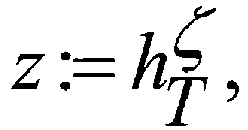
 g T is an element of the group GT, ands 0 is a random

 ĝj,is an element Y^ of the group G^t,, andτj,is the key generation random
 - The encryption device according to claim 3,
wherein the cryptographic system uses, as the group Gt and the group G^t, a group Gt and a group G^t for each integer t of t = 1, ..., d concerning an integer d of d = w,
wherein the ID group assigning unit assigns an attribute xt included in a set of attributes, Γ, to the group G^t,
wherein first cipher element generation unit generates the cipher element cT indicated in formula 5, and
wherein the second cipher element generation unit generates the cipher element c indicated in formula 6.

 gT is an element of the group GT, ands 0 is a random
 ĝt is an element Y^ of the group G^t, andτt is the key generation random
 - The encryption device according to claim 3,
wherein the cryptographic system uses, as the group Gt and the group G^t, a group Gt,j,and a group G^t,j,for each integer t of t = 1, ..., d concerning an integer d of d = w, each integer j of j = 1, ..., n, and each integerof
wherein the ID group assigning unit assigns an attribute xt included in a set of attributes, Γ, to the group G^t,
wherein the first cipher element generation unit generates the cipher element cT indicated in formula 7, and
wherein the second cipher element generation unit generates the cipher element c indicated in formula 8.

 gT is an element of the group GT, ands 0 is a random

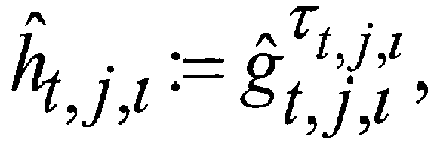 ĝt,j,is an element Y^ of the group G^j,t,, andτt,j,is the key generation random
 - The encryption device according to claim 3,
wherein the cryptographic system uses, as the group Gt and the group G^t, a group GL t,and a group GR t,, and a group G^L t,and a group GR^t,, for each integer t of t = 1, ..., d concerning an integer d of d = w and each integerof
wherein the ID group assigning unit assigns an identity ID' to a group G^L t,and a group G^R t,where t = j and
wherein the first cipher element generation unit generates the cipher element cT indicated in formula 9, and
wherein the second cipher element generation unit generates the cipher element c indicated in formula 10.

 gT is an element of the group GT, andπ, τ are respectively randoms


 are an element Y^ of the group G^L t,and an element Y^ of the group G^R t,, respectively, andσ t,is the key generation random
 - A decryption device in a cryptographic system that uses a group G0, a group Gt associated with the group G0, a group G^0, a group G^t associated with the group G^0, and a group GT associated with the group G0 and the group G^0 by pairing operation e0 and associated with the group Gt and the group G^t by pairing operation et, the decryption device comprising:
a ciphertext acquisition unit to acquire a ciphertext ct which is generated using an element X of the group GT and an element Y^ of the group G^t, at least either one of the element X and the element Y^ being generated through conversion of a generator by a key generation random, the ciphertext ct including a cipher element cT and a cipher element c, wherein in the cipher element cT, a message m is set to conversion information z in which an encryption random ζ is set to the element X, and in the cipher element c, the encryption random ζ is set to the element Y^; and
a decryption unit to generate conversion information z' from a decryption key sk and the cipher element c, and to generate a message m' from the conversion information z' and the cipher element cT, the decryption key sk including a key element k which is an element of the group Gt converted by the key generation random. - The decryption device according to claim 8,
wherein the ciphertext acquisition unit acquires the ciphertext ct including the cipher element cT and the cipher element c which are indicated in formula 11, and
wherein the decryption unit generates the conversion information z' and the message m' as indicated in formula 12.


 γ is the key generation random,ĝ 0 is an element of the group G^0,h 0 is an element of the group G0, andĝ 1 is an element Y^ of the group G^1

- The decryption device according to claim 8,
wherein the cryptographic system uses the group Gt and the group G^t for each integer t of t = 1, ..., w concerning an integer w of 2 or more,
wherein in the cipher element c, for each integer j of j = 1, ..., n concerning an integer n of 2 or more to w or less, an attribute xj is assigned to a different group in the group G^t, and the encryption random ζ is set to an element in a group to which the attribute xj for each integer j is assigned, and
wherein in the key element k, for each integer j' of j' = 1, ..., n concerning the integer n, an attribute xj' is assigned to a different group in the group Gt, and the encryption random ζ is set to an element in a group to which the attribute xj' for each integer j' is assigned. - The decryption device according to claim 10,
wherein the cryptographic system uses, as the group Gt and the group G^t, a group Gt,and a group G^t,for each integer t of t = 1, ..., n and each integerof
wherein the ciphertext acquisition unit acquires the ciphertext ct including the cipher element cT and the cipher element c which are indicated in formula 13, and
wherein the decryption unit generates the conversion information z' and the message m' as indicated in formula 14.


 gT is an element of the group GT,s 0 is a random,ĝ j,is an element Y^ of the group G^t,, andτ j,is the key generation random


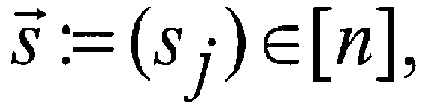
 gj,is an element of the group Gj,
 - The decryption device according to claim 10,
wherein the cryptographic system uses, as the group Gt and the group G^t, a group Gt and a group G^t for each integer t of t = 1, ..., d concerning an integer d of d = w,
wherein the ciphertext acquisition unit acquires the ciphertext ct including the cipher element cT and the cipher element c which are indicated in formula 15, and
wherein the decryption unit generates the conversion information z' and the message m', as indicated in formula 16.

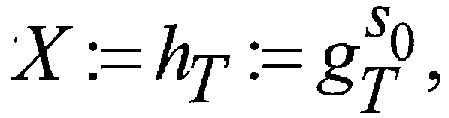
 gT is an element of the group GT,s 0 is a random,ĝt is an element Y^ of the group G^t, andτt is the key generation random

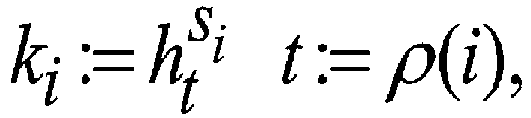


 gt is an element of the group Gt,Mi is an L-row vector, andL is an integer of 1 or more
 - The decryption device according to claim 10,
wherein the cryptographic system uses, as the group Gt and the group G^t, a group Gt,j,and a group G^t,j,for each integer t of t = 1, ..., d concerning an integer d of d = w, each integer j of j = 1, ..., n, and each integerof
wherein the ciphertext acquisition unit acquires the ciphertext ct including the cipher element cT and the cipher element c which are indicated in formula 17, and
wherein the decryption unit generates the conversion information z' and the message m', as indicated in formula 18.


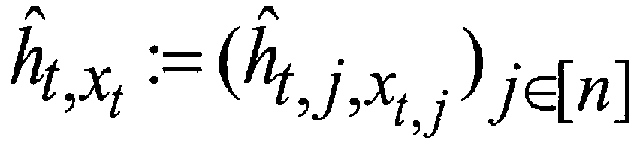
 gT is an element of the group TG,s 0 is a random,ĝ t,j,is an element Y^ of the group G^t,j,, andτ t,j,is the key generation random


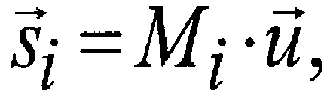


 g t,j, is an element of the group Gt,j,,Mi is an L-row vector, andL is an integer of 1 or more
 - The decryption device according to claim 10,
wherein the cryptographic system uses, as the group Gt and the group G^t, a group GL t,and a group GR t,t, and a group G^L t,and a group G^R t,, for each integer t of t = 1, ..., d concerning an integer d of d = w and each integerof
wherein the ciphertext acquisition unit acquires the ciphertext ct including the cipher element cT and the cipher element c which are indicated in formula 19, and
wherein the decryption unit generates the conversion information z' and the message m', as indicated in formula 20.


 gT is an element of the group GT,π,τ are respectively randoms,
 and an element Y^ of the group G^R t,, respectively, andσ t,is the key generation random





 and an element of the group GR t,, respectively, and
r := (rt ) t∈[L] is a random - An encryption method in a cryptographic system that uses a group G0, a group Gt associated with the group G0, a group G^0, a group G^t associated with the group G^0, and a group GT associated with the group G0 and the group G^0 by pairing operation e0 and associated with the group Gt and the group G^t by pairing operation et, the encryption method comprising
a ciphertext generation process of generating a ciphertext ct using an element X of the group GT and an element Y^ of the group G^t, at least either one of the element X and the element Y^ being generated through conversion of a generator by a key generation random,
wherein the ciphertext generation process comprises:a first cipher element generation process of generating a cipher element cT which is an element of the ciphertext ct, by setting a message m to conversion information z in which an encryption random ζ is set to the element X; anda second cipher element generation process of generating a cipher element c which is an element of the ciphertext ct, by setting the encryption random ζ to the element Y^. - An encryption program in a cryptographic system that uses a group G0, a group Gt associated with the group G0, a group G^0, a group G^t associated with the group G^0, and a group GT associated with the group G0 and the group G^0 by pairing operation e0 and associated with the group Gt and the group G^t by pairing operation et, the encryption program causing a computer to execute
a ciphertext generation process of generating a ciphertext ct using an element X of the group GT and an element Y^ of the group G^t, at least either one of the element X and the element Y^ being generated through conversion of a generator by a key generation random,
wherein the ciphertext generation process comprises:a first cipher element generation process of generating a cipher element cT which is an element of the ciphertext ct, by setting a message m to conversion information z in which an encryption random ζ is set to the element X; anda second cipher element generation process of generating a cipher element c which is an element of the ciphertext ct, by setting the encryption random ζ to the element Y^. - A decryption method in a cryptographic system that uses a group G0, a group Gt associated with the group G0, a group G^0, a group G^t associated with the group G^0, and a group GT associated with the group G0 and the group G^0 by pairing operation e0 and associated with the group Gt and the group G^ by pairing operation et, the decryption method comprising:a ciphertext acquisition process of acquiring a ciphertext ct which is generated using an element X of the group GT and an element Y^ of the group G^t, at least either one of the element X and the element Y^ being generated through conversion of a generator by a key generation random, the ciphertext ct including a cipher element cT and a cipher element c, wherein in the cipher element cT, a message m is set to conversion information z in which an encryption random ζ is set to the element X, and in the cipher element c, the encryption random ζ is set to the element Y^; anda decryption process of generating conversion information z' from a decryption key sk and the cipher element c, and generating a message m' from the conversion information z' and the cipher element cT, the decryption key sk including a key element k which is an element of the group Gt converted by the key generation random.
- A decryption program in a cryptographic system that uses a group G0, a group Gt associated with the group G0, a group G^0, a group G^t associated with the group G^0, and a group GT associated with the group G0 and the group G^0 by pairing operation e0 and associated with the group Gt and the group G^ by pairing operation et, the decryption program causing a computer to execute:a ciphertext acquisition process of acquiring a ciphertext ct which is generated using an element X of the group GT and an element Y^ of the group G^t, at least either one of the element X and the element Y^ being generated through conversion of a generator by a key generation random, the ciphertext ct including a cipher element cT and a cipher element c, wherein in the cipher element cT, a message m is set to conversion information z in which an encryption random ζ is set to the element X, and in the cipher element c, the encryption random ζ is set to the element Y^; anda decryption process of generating conversion information z' from a decryption key sk and the cipher element c, and generating a message m' from the conversion information z' and the cipher element cT, the decryption key sk including a key element k which is an element of the group Gt converted by the key generation random.
Applications Claiming Priority (1)
| Application Number | Priority Date | Filing Date | Title |
|---|---|---|---|
| PCT/JP2017/026283 WO2019016916A1 (en) | 2017-07-20 | 2017-07-20 | Encryption device, decryption device, encryption method, encryption program, decryption method and decryption program |
Publications (2)
| Publication Number | Publication Date |
|---|---|
| EP3648395A1 true EP3648395A1 (en) | 2020-05-06 |
| EP3648395A4 EP3648395A4 (en) | 2020-05-20 |
Family
ID=65015645
Family Applications (1)
| Application Number | Title | Priority Date | Filing Date |
|---|---|---|---|
| EP17918542.6A Withdrawn EP3648395A4 (en) | 2017-07-20 | 2017-07-20 | ENCRYPTION DEVICE, DECRYPTION DEVICE, ENCRYPTION PROCEDURE, ENCRYPTION PROGRAM, DECRYPTION PROCEDURE AND DECRYPTION PROGRAM |
Country Status (5)
| Country | Link |
|---|---|
| US (1) | US20200175893A1 (en) |
| EP (1) | EP3648395A4 (en) |
| JP (1) | JP6625283B2 (en) |
| CN (1) | CN110915162A (en) |
| WO (1) | WO2019016916A1 (en) |
Families Citing this family (2)
| Publication number | Priority date | Publication date | Assignee | Title |
|---|---|---|---|---|
| CN112383399B (en) * | 2020-11-06 | 2024-01-26 | 新大陆(福建)公共服务有限公司 | Key processing method, system, equipment and medium of self-adaptive matching identity platform |
| CN113890735A (en) * | 2021-11-10 | 2022-01-04 | 天宇鸿图应用技术研究院(重庆)有限公司 | Large prime number multiplication symmetrical encryption method based on quantum key distribution |
Family Cites Families (4)
| Publication number | Priority date | Publication date | Assignee | Title |
|---|---|---|---|---|
| JP5424974B2 (en) * | 2010-04-27 | 2014-02-26 | 三菱電機株式会社 | Cryptographic processing system, key generation device, encryption device, decryption device, signature processing system, signature device, and verification device |
| EP2846493A1 (en) * | 2013-09-05 | 2015-03-11 | Thomson Licensing | Method for ciphering and deciphering, corresponding electronic device and computer program product |
| CN105162589B (en) * | 2015-01-11 | 2018-08-14 | 陕西理工学院 | It is a kind of to can verify that encryption attribute method based on lattice |
| CN105162573B (en) * | 2015-07-13 | 2019-09-17 | 深圳天通信息科技有限公司 | The encryption attribute method of revocable fraction prestige key strategy based on multilinear pairing |
-
2017
- 2017-07-20 US US16/617,859 patent/US20200175893A1/en not_active Abandoned
- 2017-07-20 EP EP17918542.6A patent/EP3648395A4/en not_active Withdrawn
- 2017-07-20 JP JP2019530306A patent/JP6625283B2/en active Active
- 2017-07-20 CN CN201780093115.1A patent/CN110915162A/en active Pending
- 2017-07-20 WO PCT/JP2017/026283 patent/WO2019016916A1/en not_active Ceased
Also Published As
| Publication number | Publication date |
|---|---|
| JPWO2019016916A1 (en) | 2019-12-19 |
| CN110915162A (en) | 2020-03-24 |
| JP6625283B2 (en) | 2019-12-25 |
| WO2019016916A1 (en) | 2019-01-24 |
| US20200175893A1 (en) | 2020-06-04 |
| EP3648395A4 (en) | 2020-05-20 |
Similar Documents
| Publication | Publication Date | Title |
|---|---|---|
| US11522671B2 (en) | Homomorphic inference device, homomorphic inference method, computer readable medium, and privacy-preserving information processing system | |
| US11374742B2 (en) | Conversion key generation device, ciphertext conversion device, privacy-preserving information processing system, conversion key generation method, ciphertext conversion method, and computer | |
| EP3282437B1 (en) | Functional encryption system | |
| EP2881930B1 (en) | Encryption system, encryption method, encryption program and decryption device | |
| US11139952B2 (en) | Homomorphic computation device, encryption system, and computer readable medium | |
| EP2920908A2 (en) | Method for secure substring search | |
| EP3767874B1 (en) | Decrypting device, encrypting device, and encryption system | |
| EP3661115B1 (en) | Encryption device, decryption device, encryption method, decryption method, encryption program, and decryption program | |
| WO2020044748A1 (en) | Device for configuring id-based hash proof system, id-based encryption device, method for configuring id-based hash proof system, and program | |
| JP2023063430A (en) | CRYPTOGRAPHIC SYSTEM, KEY GENERATOR, ENCRYPTER, DECODER, METHOD AND PROGRAM | |
| EP3618345A1 (en) | Re-encrypted key generation device, re-encryption device, re-encrypted cipher text decryption device and cryptosystem | |
| US11909873B2 (en) | Decryption device, cryptographic system, and decryption method | |
| US20230269068A1 (en) | Confidential information processing system and confidential information processing method | |
| EP3113405B1 (en) | Cipher system and cipher program | |
| EP3648395A1 (en) | Encryption device, decryption device, encryption method, encryption program, decryption method and decryption program | |
| US11811741B2 (en) | Information processing system and information processing method | |
| US11451372B2 (en) | Privacy-preserving analysis device, privacy-preserving analysis system, privacy-preserving analysis method, and computer readable medium | |
| US11824638B2 (en) | Re-encryption device, method and computer readable medium to change the access range for ciphertext | |
| JP2017212699A (en) | Encryption device, decryption device, and encryption system | |
| US12250299B1 (en) | Systems and methods for classical-quantum encryption and decryption | |
| WO2026077179A1 (en) | Audio signal encryption method and apparatus, and electronic device and storage medium |
Legal Events
| Date | Code | Title | Description |
|---|---|---|---|
| PUAI | Public reference made under article 153(3) epc to a published international application that has entered the european phase |
Free format text: ORIGINAL CODE: 0009012 |
|
| STAA | Information on the status of an ep patent application or granted ep patent |
Free format text: STATUS: REQUEST FOR EXAMINATION WAS MADE |
|
| 17P | Request for examination filed |
Effective date: 20200114 |
|
| AK | Designated contracting states |
Kind code of ref document: A1 Designated state(s): AL AT BE BG CH CY CZ DE DK EE ES FI FR GB GR HR HU IE IS IT LI LT LU LV MC MK MT NL NO PL PT RO RS SE SI SK SM TR |
|
| AX | Request for extension of the european patent |
Extension state: BA ME |
|
| A4 | Supplementary search report drawn up and despatched |
Effective date: 20200422 |
|
| DAV | Request for validation of the european patent (deleted) | ||
| DAX | Request for extension of the european patent (deleted) | ||
| STAA | Information on the status of an ep patent application or granted ep patent |
Free format text: STATUS: THE APPLICATION IS DEEMED TO BE WITHDRAWN |
|
| 18D | Application deemed to be withdrawn |
Effective date: 20201114 |