EP3648248A1 - Radome for vehicles - Google Patents
Radome for vehicles Download PDFInfo
- Publication number
- EP3648248A1 EP3648248A1 EP18382784.9A EP18382784A EP3648248A1 EP 3648248 A1 EP3648248 A1 EP 3648248A1 EP 18382784 A EP18382784 A EP 18382784A EP 3648248 A1 EP3648248 A1 EP 3648248A1
- Authority
- EP
- European Patent Office
- Prior art keywords
- radome
- power source
- heating element
- temperature sensor
- vehicles
- Prior art date
- Legal status (The legal status is an assumption and is not a legal conclusion. Google has not performed a legal analysis and makes no representation as to the accuracy of the status listed.)
- Withdrawn
Links
Images
Classifications
-
- H—ELECTRICITY
- H01—ELECTRIC ELEMENTS
- H01Q—ANTENNAS, i.e. RADIO AERIALS
- H01Q1/00—Details of, or arrangements associated with, antennas
- H01Q1/02—Arrangements for de-icing; Arrangements for drying-out ; Arrangements for cooling; Arrangements for preventing corrosion
-
- G—PHYSICS
- G01—MEASURING; TESTING
- G01S—RADIO DIRECTION-FINDING; RADIO NAVIGATION; DETERMINING DISTANCE OR VELOCITY BY USE OF RADIO WAVES; LOCATING OR PRESENCE-DETECTING BY USE OF THE REFLECTION OR RERADIATION OF RADIO WAVES; ANALOGOUS ARRANGEMENTS USING OTHER WAVES
- G01S7/00—Details of systems according to groups G01S13/00, G01S15/00, G01S17/00
- G01S7/02—Details of systems according to groups G01S13/00, G01S15/00, G01S17/00 of systems according to group G01S13/00
- G01S7/40—Means for monitoring or calibrating
- G01S7/4004—Means for monitoring or calibrating of parts of a radar system
- G01S7/4039—Means for monitoring or calibrating of parts of a radar system of sensor or antenna obstruction, e.g. dirt- or ice-coating
-
- H—ELECTRICITY
- H01—ELECTRIC ELEMENTS
- H01Q—ANTENNAS, i.e. RADIO AERIALS
- H01Q1/00—Details of, or arrangements associated with, antennas
- H01Q1/27—Adaptation for use in or on movable bodies
- H01Q1/32—Adaptation for use in or on road or rail vehicles
- H01Q1/325—Adaptation for use in or on road or rail vehicles characterised by the location of the antenna on the vehicle
-
- H—ELECTRICITY
- H01—ELECTRIC ELEMENTS
- H01Q—ANTENNAS, i.e. RADIO AERIALS
- H01Q1/00—Details of, or arrangements associated with, antennas
- H01Q1/42—Housings not intimately mechanically associated with radiating elements, e.g. radome
-
- G—PHYSICS
- G01—MEASURING; TESTING
- G01S—RADIO DIRECTION-FINDING; RADIO NAVIGATION; DETERMINING DISTANCE OR VELOCITY BY USE OF RADIO WAVES; LOCATING OR PRESENCE-DETECTING BY USE OF THE REFLECTION OR RERADIATION OF RADIO WAVES; ANALOGOUS ARRANGEMENTS USING OTHER WAVES
- G01S7/00—Details of systems according to groups G01S13/00, G01S15/00, G01S17/00
- G01S7/02—Details of systems according to groups G01S13/00, G01S15/00, G01S17/00 of systems according to group G01S13/00
- G01S7/40—Means for monitoring or calibrating
- G01S7/4004—Means for monitoring or calibrating of parts of a radar system
- G01S7/4039—Means for monitoring or calibrating of parts of a radar system of sensor or antenna obstruction, e.g. dirt- or ice-coating
- G01S7/4043—Means for monitoring or calibrating of parts of a radar system of sensor or antenna obstruction, e.g. dirt- or ice-coating including means to prevent or remove the obstruction
-
- H—ELECTRICITY
- H01—ELECTRIC ELEMENTS
- H01Q—ANTENNAS, i.e. RADIO AERIALS
- H01Q1/00—Details of, or arrangements associated with, antennas
- H01Q1/27—Adaptation for use in or on movable bodies
- H01Q1/32—Adaptation for use in or on road or rail vehicles
- H01Q1/3208—Adaptation for use in or on road or rail vehicles characterised by the application wherein the antenna is used
- H01Q1/3233—Adaptation for use in or on road or rail vehicles characterised by the application wherein the antenna is used particular used as part of a sensor or in a security system, e.g. for automotive radar, navigation systems
Definitions
- the present invention refers to a radome for vehicles, which is able to give information back to a heating power source about the temperature in the radome surface.
- Vehicles with sensors able to sense their surroundings are the key enablers to decrease of road fatalities. Through sensors, driver assistance functions are implemented, minimizing risks and increasing the probability of avoiding collisions.
- Vehicles are designed to offer an aesthetically pleasant impression. Therefore, sensors must be integrated within the vehicle behind covers enabling their function, concealing them from the public view and harmonized with the aesthetic design of the vehicle.
- radomes In case of a radar sensor, such covers are known as radomes. As mentioned above, radomes must minimize the impact its presence offers to radar emitted and received waves. This is especially important in adverse weather conditions, when driving becomes more dangerous due to loss of visibility, road ground conditions and other. Obviously, water, ice and snow represent a clear danger for the functionality of the radar, as they block radar waves and can be deposited over the radome surface.
- radomes must be able to remove such layers, for instance, melting them. Integrating a heater in a decorative radome is a difficult task given the complexity of the design, the different materials employed, and the decoration technologies required to faithfully reproduce a brand logo.
- the most widespread method to integrate a heater in an automotive radome is by inserting metallic wires in the radome body. Electric current flows through the wires from a heating power source, heating the wire and the material surrounding them until the water, ice or snow are melted and removed from the radome surface.
- Automobile manufacturers typically specify a certain temperature that must be achieved across the radome surface in a specific time span. Also, available electric voltage and current to circulate through the heater is limited and specified by the automobile manufacturer
- the heater is sandwiched between radome layers with different material properties, so retrieving the temperature at the radome surface is not straightforward just from monitoring the amount of voltage and current supplied to the heater from the heating power source.
- one purpose of the present invention is to provide a radome which is able to optimize the thermal management.
- the radome for vehicles according to the present invention comprisies a frontal surface, a rear surface and a heating element, said heating element being powered by a power source, wherein the radome also comprises a temperature sensor in communication with said power source.
- said temperature sensor is integrated in the radome between the frontal surface and the rear surface.
- the temperature sensor preferably detects the temperature of the frontal surface of the radome.
- the heating element is also integrated in the radome between the frontal surface and the rear surface, and the temperature sensor is in communication with the power source for providing information about the detected temperature and regulating the power provided by the power source to the heating element.
- the information about the detected temperature is used by the heating power source, provided with a controller, to regulate the heating power supplied to the heating element in the radome.
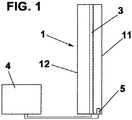
- Figure 1 is a diagrammatical sectional view of the radome for vehicles according to the present invention.
- the radome for vehicles according to the present invention is denoted as a whole by numeral reference 1, and the radome 1 comprises or defines a frontal surface 11 and a rear surface 12.
- frontal surface 11 is the surface oriented outwardly with respect to the vehicle, i.e. the surface exposed to the external environment, and the rear surface 12 is the opposed surface, as shown in Fig. 1 .
- the radome 1 can be of any suitable composition, such as e.g. formed from layers of the same composition of the radome disclosed in WO2012066417 A1 , in the name of the applicant of the present application, or the like.
- the radome 1 for vehicles according to the present invention also comprises a heating element 3 that heats the radome 1 for removing (by melting) water, ice or snow placed on the frontal surface 11 of the radome 1.
- the heating element 3 such as e.g. a resistor, is powered by a power source 4, such as a battery, of the same vehicle or another, and provides power to the heating element 3 for heating the radome 1 at a suitable temperature.
- a power source 4 such as a battery, of the same vehicle or another
- the heating element 3 is preferably integrated in the radome 1 between the frontal surface 11 and the rear surface 12, as shown in Fig. 1 .
- a temperature sensor 5 which can be any suitable temperature sensor, such as a thermometer, that is in communication with the power source 4, which includes a controller.
- the temperature sensor 5 is also preferably integrated in the radome 1, between the frontal surface 11 and the rear surface 12, as shown in Fig, 1 .
- the temperature sensor 5 is preferably placed near the frontal surface 11, because the detected temperature is preferably the temperature of the frontal surface 11, where water, ice or snow could be present.
- the power source 4 reduces or increases the power provided to the heating element 3 according to the detected temperature, or even switches on or switches off the heating element 3, i.e. the temperature sensor 5 works as a thermostat.
Landscapes
- Engineering & Computer Science (AREA)
- Remote Sensing (AREA)
- Radar, Positioning & Navigation (AREA)
- Computer Networks & Wireless Communication (AREA)
- Physics & Mathematics (AREA)
- General Physics & Mathematics (AREA)
- Computer Security & Cryptography (AREA)
- Details Of Aerials (AREA)
- Vehicle Waterproofing, Decoration, And Sanitation Devices (AREA)
- Radar Systems Or Details Thereof (AREA)
Abstract
Description
- The present invention refers to a radome for vehicles, which is able to give information back to a heating power source about the temperature in the radome surface.
- Vehicles with sensors able to sense their surroundings are the key enablers to decrease of road fatalities. Through sensors, driver assistance functions are implemented, minimizing risks and increasing the probability of avoiding collisions.
- Vehicles are designed to offer an aesthetically pleasant impression. Therefore, sensors must be integrated within the vehicle behind covers enabling their function, concealing them from the public view and harmonized with the aesthetic design of the vehicle.
- In case of a radar sensor, such covers are known as radomes. As mentioned above, radomes must minimize the impact its presence offers to radar emitted and received waves. This is especially important in adverse weather conditions, when driving becomes more dangerous due to loss of visibility, road ground conditions and other. Obviously, water, ice and snow represent a clear danger for the functionality of the radar, as they block radar waves and can be deposited over the radome surface.
- Hence, radomes must be able to remove such layers, for instance, melting them. Integrating a heater in a decorative radome is a difficult task given the complexity of the design, the different materials employed, and the decoration technologies required to faithfully reproduce a brand logo.
- The most widespread method to integrate a heater in an automotive radome is by inserting metallic wires in the radome body. Electric current flows through the wires from a heating power source, heating the wire and the material surrounding them until the water, ice or snow are melted and removed from the radome surface.
- Automobile manufacturers typically specify a certain temperature that must be achieved across the radome surface in a specific time span. Also, available electric voltage and current to circulate through the heater is limited and specified by the automobile manufacturer
- Given the high temperatures achieved by the wires when current is circulating, damages in the surrounding material are prone to happen due to expansion and contraction caused by temperatures shifts and the different properties of the materials in contact, such as metallic conductors, resins, inks and other coatings. Thus, the radome aesthetical appearance and radiofrequency performance may suffer degradation due to the presence of the heater.
- It is therefore of paramount importance managing efficiently the heating of the radome to expand its lifespan. The heater is sandwiched between radome layers with different material properties, so retrieving the temperature at the radome surface is not straightforward just from monitoring the amount of voltage and current supplied to the heater from the heating power source.
- Therefore, one purpose of the present invention is to provide a radome which is able to optimize the thermal management.
- With the radome for vehicles according to the present invention it is possible to solve said drawbacks, providing other advantages that are described below.
- The radome for vehicles according to the present invention comprisies a frontal surface, a rear surface and a heating element, said heating element being powered by a power source, wherein the radome also comprises a temperature sensor in communication with said power source.
- Advantageously, said temperature sensor is integrated in the radome between the frontal surface and the rear surface.
- Furthermore, the temperature sensor preferably detects the temperature of the frontal surface of the radome.
- The heating element is also integrated in the radome between the frontal surface and the rear surface, and the temperature sensor is in communication with the power source for providing information about the detected temperature and regulating the power provided by the power source to the heating element.
- The information about the detected temperature is used by the heating power source, provided with a controller, to regulate the heating power supplied to the heating element in the radome.
- This allows to optimally implement the heating function, avoiding waste of unnecessary power and decreasing the risk of damaging the radome, thus increasing its performance and durability.
- For a better understanding the above explanation and for the sole purpose of providing an example, some non-limiting drawings are included that schematically depict a practical embodiment.
-
Figure 1 is a diagrammatical sectional view of the radome for vehicles according to the present invention. - The radome for vehicles according to the present invention is denoted as a whole by
numeral reference 1, and theradome 1 comprises or defines afrontal surface 11 and arear surface 12. - It must be understood that the
frontal surface 11 is the surface oriented outwardly with respect to the vehicle, i.e. the surface exposed to the external environment, and therear surface 12 is the opposed surface, as shown inFig. 1 . - The
radome 1 can be of any suitable composition, such as e.g. formed from layers of the same composition of the radome disclosed inWO2012066417 A1 , in the name of the applicant of the present application, or the like. - The
radome 1 for vehicles according to the present invention also comprises aheating element 3 that heats theradome 1 for removing (by melting) water, ice or snow placed on thefrontal surface 11 of theradome 1. - The
heating element 3, such as e.g. a resistor, is powered by apower source 4, such as a battery, of the same vehicle or another, and provides power to theheating element 3 for heating theradome 1 at a suitable temperature. - The
heating element 3 is preferably integrated in theradome 1 between thefrontal surface 11 and therear surface 12, as shown inFig. 1 . - This suitable temperature is detected by a
temperature sensor 5, which can be any suitable temperature sensor, such as a thermometer, that is in communication with thepower source 4, which includes a controller. - The
temperature sensor 5 is also preferably integrated in theradome 1, between thefrontal surface 11 and therear surface 12, as shown inFig, 1 . - The
temperature sensor 5 is preferably placed near thefrontal surface 11, because the detected temperature is preferably the temperature of thefrontal surface 11, where water, ice or snow could be present. - Therefore, the
power source 4 reduces or increases the power provided to theheating element 3 according to the detected temperature, or even switches on or switches off theheating element 3, i.e. thetemperature sensor 5 works as a thermostat. - Even though reference has been made to a specific embodiment of the invention, it is obvious for a person skilled in the art that the radome for vehicles described herein is susceptible to numerous variations and modifications, and that all of the details mentioned can be substituted for other technically equivalent ones without departing from the scope of protection defined by the attached claims.
Claims (5)
- Radome (1) for vehicles, comprising a frontal surface (11), a rear surface (12) and a heating element (3), said heating element (3) being powered by a power source (4), characterized in that the radome also comprises a temperature sensor (5) in communication with said power source (4).
- Radome (1) for vehicles according to claim 1, wherein said temperature sensor (5) is integrated in the radome (1) between the frontal surface (11) and the rear surface (12).
- Radome (1) for vehicles according to claim 1 or 2, wherein the temperature sensor (5) detects the temperature of the frontal surface (11) of the radome (1).
- Radome (1) for vehicles according to claim 1, wherein the heating element (3) is integrated in the radome (1) between the frontal surface (11) and the rear surface (12).
- Radome (1) for vehicles according to claim 1, wherein the temperature sensor (5) is in communication with the power source (4) for providing information about the detected temperature and regulating the power provided by the power source (4) to the heating element (3).
Priority Applications (5)
| Application Number | Priority Date | Filing Date | Title |
|---|---|---|---|
| EP18382784.9A EP3648248A1 (en) | 2018-11-02 | 2018-11-02 | Radome for vehicles |
| JP2019200018A JP2020072479A (en) | 2018-11-02 | 2019-11-01 | Radome for vehicles |
| KR1020190138841A KR20200051496A (en) | 2018-11-02 | 2019-11-01 | Radome for vehicles |
| US16/671,822 US20200144693A1 (en) | 2018-11-02 | 2019-11-01 | Radome for vehicles |
| CN201911064286.9A CN111146586A (en) | 2018-11-02 | 2019-11-04 | Antenna cover for vehicle |
Applications Claiming Priority (1)
| Application Number | Priority Date | Filing Date | Title |
|---|---|---|---|
| EP18382784.9A EP3648248A1 (en) | 2018-11-02 | 2018-11-02 | Radome for vehicles |
Publications (1)
| Publication Number | Publication Date |
|---|---|
| EP3648248A1 true EP3648248A1 (en) | 2020-05-06 |
Family
ID=64426842
Family Applications (1)
| Application Number | Title | Priority Date | Filing Date |
|---|---|---|---|
| EP18382784.9A Withdrawn EP3648248A1 (en) | 2018-11-02 | 2018-11-02 | Radome for vehicles |
Country Status (5)
| Country | Link |
|---|---|
| US (1) | US20200144693A1 (en) |
| EP (1) | EP3648248A1 (en) |
| JP (1) | JP2020072479A (en) |
| KR (1) | KR20200051496A (en) |
| CN (1) | CN111146586A (en) |
Cited By (2)
| Publication number | Priority date | Publication date | Assignee | Title |
|---|---|---|---|---|
| EP4071925A1 (en) | 2021-04-08 | 2022-10-12 | Zanini Auto Grup, S.A. | Radome for vehicles |
| EP4306367A1 (en) | 2022-07-12 | 2024-01-17 | Zanini Auto Grup, S.A. | Sensor cover for vehicles and method for heating said sensor cover for vehicles |
Families Citing this family (4)
| Publication number | Priority date | Publication date | Assignee | Title |
|---|---|---|---|---|
| ES2954960T3 (en) * | 2018-08-30 | 2023-11-27 | Po Ind Llevant Marineta 2 5 | Radome for vehicles and manufacturing procedure for said radome |
| KR20220013114A (en) | 2020-07-24 | 2022-02-04 | 국방과학연구소 | Waveform radio wave transparency heater for a radome |
| JP7618410B2 (en) * | 2020-08-04 | 2025-01-21 | 三恵技研工業株式会社 | Radome structure for vehicle-mounted radar device and its manufacturing method |
| KR20220023500A (en) | 2020-08-21 | 2022-03-02 | 국방과학연구소 | Helical form radio wave transparency heater |
Citations (5)
| Publication number | Priority date | Publication date | Assignee | Title |
|---|---|---|---|---|
| US6414623B1 (en) * | 1999-05-17 | 2002-07-02 | Honda Giken Kogyo Kabushiki Kaisha | Radar system mounted on vehicle and capable of detecting degradation of sensitivity |
| WO2009094252A1 (en) * | 2008-01-24 | 2009-07-30 | Raytheon Company | Measuring surface temperature using embedded components |
| JP2010028458A (en) * | 2008-07-18 | 2010-02-04 | Mitsubishi Electric Corp | Multilayer radome |
| WO2012066417A1 (en) | 2010-11-15 | 2012-05-24 | Zanini Auto Grup, Sa | Decorative radome for automotive vehicular applications |
| WO2016073144A1 (en) * | 2014-11-03 | 2016-05-12 | Illinois Tool Works Inc. | Transmissive front-face heater for vehicle sensor system |
Family Cites Families (3)
| Publication number | Priority date | Publication date | Assignee | Title |
|---|---|---|---|---|
| DE102013222767A1 (en) * | 2013-11-08 | 2015-05-13 | Vega Grieshaber Kg | Heated antenna |
| CN106785303A (en) * | 2016-12-26 | 2017-05-31 | 广东盛路通信科技股份有限公司 | Antenna Anti-ice-and-snow device |
| CN108574132A (en) * | 2018-04-04 | 2018-09-25 | 中国电子科技集团公司第五十四研究所 | A kind of radome and its metal pattern layer design method |
-
2018
- 2018-11-02 EP EP18382784.9A patent/EP3648248A1/en not_active Withdrawn
-
2019
- 2019-11-01 KR KR1020190138841A patent/KR20200051496A/en not_active Withdrawn
- 2019-11-01 US US16/671,822 patent/US20200144693A1/en not_active Abandoned
- 2019-11-01 JP JP2019200018A patent/JP2020072479A/en active Pending
- 2019-11-04 CN CN201911064286.9A patent/CN111146586A/en active Pending
Patent Citations (5)
| Publication number | Priority date | Publication date | Assignee | Title |
|---|---|---|---|---|
| US6414623B1 (en) * | 1999-05-17 | 2002-07-02 | Honda Giken Kogyo Kabushiki Kaisha | Radar system mounted on vehicle and capable of detecting degradation of sensitivity |
| WO2009094252A1 (en) * | 2008-01-24 | 2009-07-30 | Raytheon Company | Measuring surface temperature using embedded components |
| JP2010028458A (en) * | 2008-07-18 | 2010-02-04 | Mitsubishi Electric Corp | Multilayer radome |
| WO2012066417A1 (en) | 2010-11-15 | 2012-05-24 | Zanini Auto Grup, Sa | Decorative radome for automotive vehicular applications |
| WO2016073144A1 (en) * | 2014-11-03 | 2016-05-12 | Illinois Tool Works Inc. | Transmissive front-face heater for vehicle sensor system |
Cited By (3)
| Publication number | Priority date | Publication date | Assignee | Title |
|---|---|---|---|---|
| EP4071925A1 (en) | 2021-04-08 | 2022-10-12 | Zanini Auto Grup, S.A. | Radome for vehicles |
| US12074366B2 (en) | 2021-04-08 | 2024-08-27 | Zanini Auto Grup, S.A. | Radome for vehicles |
| EP4306367A1 (en) | 2022-07-12 | 2024-01-17 | Zanini Auto Grup, S.A. | Sensor cover for vehicles and method for heating said sensor cover for vehicles |
Also Published As
| Publication number | Publication date |
|---|---|
| JP2020072479A (en) | 2020-05-07 |
| US20200144693A1 (en) | 2020-05-07 |
| KR20200051496A (en) | 2020-05-13 |
| CN111146586A (en) | 2020-05-12 |
Similar Documents
| Publication | Publication Date | Title |
|---|---|---|
| US20200144693A1 (en) | Radome for vehicles | |
| AU2019204176B2 (en) | Lens heating systems and methods for an led lighting system | |
| KR102455738B1 (en) | Double planar heaters for vehicle sensor systems | |
| US12096525B2 (en) | Lens heating systems and methods for an LED lighting system | |
| KR102418622B1 (en) | Radome structure having heating and lighting function | |
| CA2505739A1 (en) | Covered conductor and heater formed therewith | |
| US8047665B2 (en) | Rearview mirror assembly having a composite reflective surface | |
| CA2834520A1 (en) | Snow-melting led traffic signal | |
| CN115175798B (en) | Heatable plastic component and method for producing the same | |
| EP3618179B1 (en) | Radome for vehicles and method for manufacturing said radome | |
| CN106347247B (en) | Solar energy activation structure for revealing hidden marks in body panel of vehicle | |
| US20250069503A1 (en) | Heating system | |
| US20150282250A1 (en) | Vehicle Roof Defroster | |
| CN112086725A (en) | Backlight radar cover | |
| US20220221126A1 (en) | Apparatus for defrosting a vehicle light | |
| ES1289269U (en) | Radomo for vehicles (Machine-translation by Google Translate, not legally binding) | |
| JP2022502304A (en) | Assembly to protect sensors / emitters in driver assistance systems for automated vehicles with heating elements | |
| EP4071925B1 (en) | Radome for vehicles | |
| US9944255B2 (en) | Heated windshield wiper blade system | |
| US20190248196A1 (en) | Snow melting tire assembly | |
| JP2004306025A (en) | Resin window for vehicle | |
| DE202018006652U1 (en) | Radome for vehicles | |
| EP4216018A1 (en) | Apparatus for a motor vehicle with heatable windows and method for controlling the apparatus | |
| KR20250169111A (en) | Multi-function optical sensor cover | |
| KR20220111157A (en) | Snow detection sensor module |
Legal Events
| Date | Code | Title | Description |
|---|---|---|---|
| PUAI | Public reference made under article 153(3) epc to a published international application that has entered the european phase |
Free format text: ORIGINAL CODE: 0009012 |
|
| STAA | Information on the status of an ep patent application or granted ep patent |
Free format text: STATUS: THE APPLICATION HAS BEEN PUBLISHED |
|
| AK | Designated contracting states |
Kind code of ref document: A1 Designated state(s): AL AT BE BG CH CY CZ DE DK EE ES FI FR GB GR HR HU IE IS IT LI LT LU LV MC MK MT NL NO PL PT RO RS SE SI SK SM TR |
|
| AX | Request for extension of the european patent |
Extension state: BA ME |
|
| STAA | Information on the status of an ep patent application or granted ep patent |
Free format text: STATUS: REQUEST FOR EXAMINATION WAS MADE |
|
| 17P | Request for examination filed |
Effective date: 20201104 |
|
| RBV | Designated contracting states (corrected) |
Designated state(s): AL AT BE BG CH CY CZ DE DK EE ES FI FR GB GR HR HU IE IS IT LI LT LU LV MC MK MT NL NO PL PT RO RS SE SI SK SM TR |
|
| STAA | Information on the status of an ep patent application or granted ep patent |
Free format text: STATUS: EXAMINATION IS IN PROGRESS |
|
| 17Q | First examination report despatched |
Effective date: 20210330 |
|
| STAA | Information on the status of an ep patent application or granted ep patent |
Free format text: STATUS: THE APPLICATION IS DEEMED TO BE WITHDRAWN |
|
| 18D | Application deemed to be withdrawn |
Effective date: 20211012 |
|
| 110E | Request filed for conversion into a national patent application [according to art. 135 epc] |
Effective date: 20211103 |