EP3648117A1 - Electrical insulation, use of an electrical insulation, and method of producing an electrical insulation - Google Patents
Electrical insulation, use of an electrical insulation, and method of producing an electrical insulation Download PDFInfo
- Publication number
- EP3648117A1 EP3648117A1 EP18204086.5A EP18204086A EP3648117A1 EP 3648117 A1 EP3648117 A1 EP 3648117A1 EP 18204086 A EP18204086 A EP 18204086A EP 3648117 A1 EP3648117 A1 EP 3648117A1
- Authority
- EP
- European Patent Office
- Prior art keywords
- electrically insulating
- electrical insulation
- capsules
- electrical
- shell
- Prior art date
- Legal status (The legal status is an assumption and is not a legal conclusion. Google has not performed a legal analysis and makes no representation as to the accuracy of the status listed.)
- Granted
Links
Images


Classifications
-
- H—ELECTRICITY
- H01—ELECTRIC ELEMENTS
- H01B—CABLES; CONDUCTORS; INSULATORS; SELECTION OF MATERIALS FOR THEIR CONDUCTIVE, INSULATING OR DIELECTRIC PROPERTIES
- H01B3/00—Insulators or insulating bodies characterised by the insulating materials; Selection of materials for their insulating or dielectric properties
- H01B3/18—Insulators or insulating bodies characterised by the insulating materials; Selection of materials for their insulating or dielectric properties mainly consisting of organic substances
- H01B3/20—Insulators or insulating bodies characterised by the insulating materials; Selection of materials for their insulating or dielectric properties mainly consisting of organic substances liquids, e.g. oils
- H01B3/22—Insulators or insulating bodies characterised by the insulating materials; Selection of materials for their insulating or dielectric properties mainly consisting of organic substances liquids, e.g. oils hydrocarbons
-
- H—ELECTRICITY
- H01—ELECTRIC ELEMENTS
- H01B—CABLES; CONDUCTORS; INSULATORS; SELECTION OF MATERIALS FOR THEIR CONDUCTIVE, INSULATING OR DIELECTRIC PROPERTIES
- H01B3/00—Insulators or insulating bodies characterised by the insulating materials; Selection of materials for their insulating or dielectric properties
- H01B3/18—Insulators or insulating bodies characterised by the insulating materials; Selection of materials for their insulating or dielectric properties mainly consisting of organic substances
- H01B3/30—Insulators or insulating bodies characterised by the insulating materials; Selection of materials for their insulating or dielectric properties mainly consisting of organic substances plastics; resins; waxes
- H01B3/302—Polyurethanes or polythiourethanes; Polyurea or polythiourea
-
- H—ELECTRICITY
- H01—ELECTRIC ELEMENTS
- H01B—CABLES; CONDUCTORS; INSULATORS; SELECTION OF MATERIALS FOR THEIR CONDUCTIVE, INSULATING OR DIELECTRIC PROPERTIES
- H01B3/00—Insulators or insulating bodies characterised by the insulating materials; Selection of materials for their insulating or dielectric properties
- H01B3/18—Insulators or insulating bodies characterised by the insulating materials; Selection of materials for their insulating or dielectric properties mainly consisting of organic substances
- H01B3/30—Insulators or insulating bodies characterised by the insulating materials; Selection of materials for their insulating or dielectric properties mainly consisting of organic substances plastics; resins; waxes
- H01B3/40—Insulators or insulating bodies characterised by the insulating materials; Selection of materials for their insulating or dielectric properties mainly consisting of organic substances plastics; resins; waxes epoxy resins
-
- H—ELECTRICITY
- H01—ELECTRIC ELEMENTS
- H01B—CABLES; CONDUCTORS; INSULATORS; SELECTION OF MATERIALS FOR THEIR CONDUCTIVE, INSULATING OR DIELECTRIC PROPERTIES
- H01B3/00—Insulators or insulating bodies characterised by the insulating materials; Selection of materials for their insulating or dielectric properties
- H01B3/18—Insulators or insulating bodies characterised by the insulating materials; Selection of materials for their insulating or dielectric properties mainly consisting of organic substances
- H01B3/30—Insulators or insulating bodies characterised by the insulating materials; Selection of materials for their insulating or dielectric properties mainly consisting of organic substances plastics; resins; waxes
- H01B3/44—Insulators or insulating bodies characterised by the insulating materials; Selection of materials for their insulating or dielectric properties mainly consisting of organic substances plastics; resins; waxes vinyl resins; acrylic resins
- H01B3/441—Insulators or insulating bodies characterised by the insulating materials; Selection of materials for their insulating or dielectric properties mainly consisting of organic substances plastics; resins; waxes vinyl resins; acrylic resins from alkenes
-
- H—ELECTRICITY
- H01—ELECTRIC ELEMENTS
- H01B—CABLES; CONDUCTORS; INSULATORS; SELECTION OF MATERIALS FOR THEIR CONDUCTIVE, INSULATING OR DIELECTRIC PROPERTIES
- H01B3/00—Insulators or insulating bodies characterised by the insulating materials; Selection of materials for their insulating or dielectric properties
- H01B3/18—Insulators or insulating bodies characterised by the insulating materials; Selection of materials for their insulating or dielectric properties mainly consisting of organic substances
- H01B3/30—Insulators or insulating bodies characterised by the insulating materials; Selection of materials for their insulating or dielectric properties mainly consisting of organic substances plastics; resins; waxes
- H01B3/46—Insulators or insulating bodies characterised by the insulating materials; Selection of materials for their insulating or dielectric properties mainly consisting of organic substances plastics; resins; waxes silicones
-
- H—ELECTRICITY
- H01—ELECTRIC ELEMENTS
- H01B—CABLES; CONDUCTORS; INSULATORS; SELECTION OF MATERIALS FOR THEIR CONDUCTIVE, INSULATING OR DIELECTRIC PROPERTIES
- H01B7/00—Insulated conductors or cables characterised by their form
- H01B7/17—Protection against damage caused by external factors, e.g. sheaths or armouring
- H01B7/28—Protection against damage caused by moisture, corrosion, chemical attack or weather
- H01B7/2813—Protection against damage caused by electrical, chemical or water tree deterioration
Definitions
- the invention relates to an electrical insulation and methods of using and producing an electrical insulation.
- the invention relates in particular to an electrical insulation and methods of using and producing an electrical insulation that provide enhanced tolerance to defects.
- Electrical insulations are widely used to electrically insulate power system components, such as cables of a transmission line, busbars, transformer components, or other power system components.
- An electrical insulation may be based on an electrically insulating material, such as an epoxy resin.
- An epoxy based electrical insulation can be manufactured by mixing epoxy resin, hardener, accelerator and various fillers.
- Such an electrical insulation may be susceptible to electrical treeing. Electrical treeing may originate from metallic electrodes or impurities in the insulation, e.g., metallic particles and wires, small pieces of glass, wood or gas bubbles. Electrical treeing is a defect that commonly occurs in the electrical insulation of power system components. Partial discharges may cause a tree-shaped cavity to form in an electrical insulator.
- US 6 764 616 B1 discloses a hydrophobic epoxide resin system used as an electrical insulating material.
- the invention provides an electrical insulation in which capsules having a solid shell containing an electrically insulating liquid are provided in an insulating material, such as an epoxy resin, polyurethane resin, polyethylene or other polymeric materials.
- the insulating material may include optional other fillers.
- the capsules may be microcapsules.
- the microcapsules may have a diameter, measured along the maximum length of the microcapsules, which is not more than 1000 ⁇ m, preferably not more than 500 ⁇ m, further preferably not more than 100 ⁇ m.
- the microcapsules may have a diameter, measured along the maximum length of the microcapsules, which may be between 2 ⁇ m and 1000 ⁇ m.
- the microcapsules may have a diameter, measured along the maximum length of the microcapsules, which may be between 2 ⁇ m and 1000 ⁇ m, preferably between 2 ⁇ m and 500 ⁇ m.
- An electrical insulation according to an embodiment comprises an electrically insulating material and an electrical tree inhibiting material in the electrically insulating material.
- the electrical tree inhibiting material comprises a plurality of capsules having a shell and an electrically insulating liquid within the shell.
- the electrically insulating material may be a solid.
- the shell of the capsules may be a solid different from the electrically insulating material.
- the shell of the capsules may be configured to rupture in response to the mechanical stress and/or electrical field induced by electrical treeing.
- the electrically insulating liquid may be or may comprise oil or a blend of oils.
- the electrically insulating liquid may be or may comprise a silicone oil, a blend of silicone oils, a mineral transformer oil, a blend of mineral transformer oils and/or a vegetable oil, or a blend of vegetable oils.
- the electrically insulating liquid may comprise a blend of the mentioned oils.
- the electrically insulating liquid may have a resistivity from 10 3 ⁇ m to 10 20 ⁇ m.
- the electrically insulating liquid may have a resistivity from 10 3 ⁇ m to 10 20 ⁇ m at 25°C.
- the electrically insulating liquid may have dielectric permittivity from 1 to 50 at 25°C and at 50 Hz.
- the electrically insulating liquid may have a low viscosity.
- the electrically insulating liquid may have a dynamic viscosity of less than 100000 mm 2 /s at 25°C (measured according to DIN 53019).
- the electrically insulating liquid may have a dynamic viscosity of more than 0.01 mm 2 /s at 25°C (measured according to DIN 53019).
- the electrically insulating liquid may have a dynamic viscosity of 0.01 mm 2 /s to 100000 mm 2 /s, preferably of 1 mm 2 /s to 10000 mm 2 /s at 25°C (measured according to DIN 53019).
- the electrically insulating liquid may be a non-UV-curing electrically insulating liquid.
- the electrically insulating liquid may be a non-self-curing electrically insulating liquid.
- the electrically insulating liquid may contain fillers.
- the fillers within the insulating liquid contained in the capsules may be nanoparticles.
- the capsules may be microcapsules.
- a root-mean-square value of a maximum diameter of the capsules may be not more than 1000 ⁇ m, preferably not more than 500 ⁇ m, preferably not more than 100 ⁇ m.
- a root-mean-square value of a maximum diameter of the capsules may be between 2 ⁇ m and 1000 ⁇ m, optionally between 2 ⁇ m and 500 ⁇ m.
- the shell may comprise melamine formaldehyde or polyoxymethylene urea or other materials.
- the shell may contain fillers.
- the shell may have a wall thickness in the range from 0.1 ⁇ m to 100 ⁇ m.
- the shell may be free of fillers such as TiO 2 .
- the shell may be free of TiO 2 .
- the shell may be formed of a multi-layer system having several layers.
- the several layers may comprise a gelatine and/or resorcinol coating or other materials.
- the capsules may be dispersed in the electrically insulating material.
- the electrical insulation may comprise at least 1 wt-% of the capsules and/or at least 2 vol-% of the capsules.
- the electrical insulation may comprise between 1 wt-% and 30 wt-% of the capsules.
- the electrical insulation may comprise between 2 vol-% and 50 vol-% of the capsules.
- the electrically insulating material may be or may comprise an epoxy resin, polyurethane resin, polyethylene or other polymeric materials.
- the electrically insulating material may have fillers other than the capsules.
- the fillers may comprise an anti-settling agent (a sag resistance agent).
- the anti-settling agent or sag resistance agent may be operative to prevent or reduce settling of the capsules under influence of gravity in a mixture that includes the electrically insulating material in liquid phase, the capsules, and the anti-settling agent or sag resistance agent.
- An electrical insulation according to a further embodiment comprises a solid polymeric material and a plurality of capsules disposed within the solid polymeric material, wherein the capsules each have a shell and an electrically insulating liquid within the shell.
- the solid polymeric material may be or may comprise one or several of an epoxy resin, polyurethane resin, polyethylene or other polymeric materials.
- a power system component comprises an electrical component, in particular a conductor, and the electrical insulation according to an embodiment.
- the power system component may be a power transmission cable, in particular an underground cable.
- the power system component may be a busbar.
- the power system component may be a transformer.
- the power system component may be a circuit breaker.
- the power system component may be a switchgear.
- the power system component may be an insulating spacer.
- the power system component may be a switch.
- the power system component may be a motor.
- the power system component may be a generator.
- the power system component may be a bushing.
- a power system comprises a power system component having the electrical insulation according to an embodiment.
- the power system may be a medium or high voltage power transmission system.
- the shell of at least one capsule ruptures to release the electrically insulating liquid into a cavity formed by an electrical tree when the electrical tree impinges onto the shell of the at least one capsule.
- the electrically insulating liquid flows into the cavity of the electrical tree and impedes growth of the electrical tree.
- the electrical insulation may be the electrical insulation according to any embodiment disclosed herein.
- a method of producing an electrical insulation comprises forming a mixture comprising a polymeric material and a plurality of capsules in the polymeric material, wherein each of the capsules has a shell and an electrically insulating liquid within the shell.
- the method may further comprise processing the mixture into a solid electrical insulation.
- the polymeric material may comprise or may be a thermoset or thermoplast or elastomer or mixture or blend or co-polymer of these polymers.
- the polymeric material may be or may comprise an epoxy resin, polyurethane resin, polyethylene or other polymeric materials.
- Processing the mixture into a solid electrical insulation may comprise effecting a cross-linking reaction, curing, melting and/or otherwise processing the polymeric material.
- the mixture may optionally comprise fillers other than the plurality of capsules.
- the fillers may comprise an anti-settling agent (a sag resistance agent).
- the anti-settling agent or sag resistance agent may be operative to prevent or reduce settling of the capsules under influence of gravity in the mixture that includes the electrically insulating material in liquid phase, the capsules, and the anti-settling agent or sag resistance agent.
- the shell of the capsules in the mixture may be a solid.
- the shell of the capsules may be configured to rupture in response to the mechanical stress and/or electrical field induced by electrical treeing.
- the electrically insulating liquid contained within the capsules in the mixture may be or may comprise a silicone oil, a blend of silicone oils, a mineral transformer oil, a blend of mineral transformer oils and/or a vegetable oil or a blend of vegetable oils, or a blend of these oils.
- the electrically insulating liquid contained within the capsules in the mixture may have a resistivity from 10 3 ⁇ m to 10 20 ⁇ m.
- the electrically insulating liquid contained within the capsules in the mixture may have a resistivity from 10 3 ⁇ m to 10 20 ⁇ m at 25°C.
- the electrically insulating liquid contained within the capsules in the mixture may have dielectric permittivity from 1 to 50 at 25°C and at 50 Hz.
- the electrically insulating liquid contained within the capsules in the mixture may have a low viscosity.
- the electrically insulating liquid contained within the capsules in the mixture may have a dynamic viscosity of less than 100000 mm 2 /s at 25°C (measured according to DIN 53019).
- the electrically insulating liquid contained within the capsules in the mixture may have a dynamic viscosity of more than 0.01 mm 2 /s at 25°C (measured according to DIN 53019).
- the electrically insulating liquid may have a dynamic viscosity of 0.01 mm 2 /s to 100000 mm 2 /s, preferably of 1 mm 2 /s to 10000 mm 2 /s at 25°C (measured according to DIN 53019).
- the electrically insulating liquid contained within the capsules in the mixture may be a non-UV-curing electrically insulating liquid.
- the electrically insulating liquid contained within the capsules in the mixture may be a non-self-curing electrically insulating liquid.
- the electrically insulating liquid contained within the capsules in the mixture may contain fillers.
- the fillers within the insulating liquid contained in the capsules may be nanoparticles.
- the capsules in the mixture may be microcapsules.
- a root-mean-square value of a maximum diameter of the capsules may be not more than 1000 ⁇ m, preferably not more than 500 ⁇ m, preferably not more than 100 ⁇ m.
- a root-mean-square value of a maximum diameter of the capsules may be between 2 ⁇ m and 1000 ⁇ m, optionally between 2 ⁇ m and 500 ⁇ m.
- the shell of the capsules in the mixture may comprise melamine formaldehyde or polyoxymethylene urea or other materials.
- the shell of the capsules in the mixture may contain fillers.
- the shell of the capsules in the mixture may be free of fillers such as TiO 2 .
- the shell of the capsules in the mixture may be formed of a multi-layer system having several layers.
- the several layers may comprise a gelatin, or resorcinol coating or other materials.
- the shell of the capsules in the mixture may have a wall thickness in the range from 0.1 ⁇ m to 100 ⁇ m.
- the mixture may comprise at least 1 wt-% of the capsules and/or at least 2 vol-% of the capsules.
- the method may comprise causing a cross-linking reaction of the polymeric material.
- the mixture may comprise a hardener and/or an accelerator to facilitate the cross-linking reaction.
- the method may further comprise disposing the cured mixture, optionally after further post-processing, adjacent an electrical component, in particular adjacent a conductor, of a power system component.
- the cured mixture may comprise between 1 wt-% and 30 wt-% of the capsules.
- the cured mixture may comprise between 2 vol-% and 50 vol-% of the capsules.
- the power system component may be a power transmission cable, a busbar, a transformer, a circuit breaker, a switchgear, a switch, a spacer, a bushing, a motor, or a generator.
- mixture comprising a polymeric material and a plurality of capsules in the polymeric material, wherein each of the capsules has a shell and an electrically insulating liquid within the shell, for manufacturing an electrical insulation that inhibits electrical treeing.
- a low viscosity of the electrically insulating liquid in the capsules e.g., the low viscosity of a silicone oil, blend of silicone oils, mineral transformer oil(s) and/or vegetable oil(s) may assist the capability of the electrically insulating liquid to flow into the treeing channels.
- Use of a non-self-curing and non-UV-curing the electrically insulating liquid in the capsules ensures that the electrically insulating liquid in the capsules remains capable of flowing into the treeing channels.
- the electrical insulation according to embodiments provides enhanced tolerance to defects in the sense that, even when electrical treeing starts, the time to breakdown of the electrical insulation is extended compared to conventional electrical insulations that are based on similar electrically insulating materials, such as epoxy resins.
- the electrical insulator may be used for power system components of high or medium voltage power systems, without being limited thereto.
- the electrical insulator may be used for a power generation or power transmission system, without being limited thereto.
- Fig. 1 is a schematic representation of a power system component 10 comprising an electrical insulator according to an embodiment.
- the power system component 10 may be a component of a power generation or power transmission system.
- the power system component 10 may be a component of a high or medium voltage power system.
- the power system component 10 may be a power transmission cable, a busbar, a transformer, a circuit breaker, a switchgear, a switch, a motor, a generator.
- Exemplary power system components 10 include primary or secondary gas insulated switchgear, live tank breakers, dead tank breakers, generator circuit breakers, instrument transformers, other transformers, coils, bushings, sensors, railway power components, vacuum poles, or vacuum interrupters, without being limited thereto.
- the power system component 10 comprises an electrical component 11, which may in particular be a conductor, and an electrical insulation 20.
- the electrical insulation 20 may be disposed to cover at least part of the electrical component 11.
- the electrical insulation 20 is a composite system.
- the electrical insulation 20 may comprise
- the electrical insulation 20 comprises capsules 30 that are dispersed in a solid electrically insulating material 21.
- the capsules 30 are operative to inhibit growth of an electrical tree, thereby enhancing the defect tolerance of the electrical insulation 20.
- the capsules 30 may respectively be microcapsules.
- the capsules 30 may respectively have a mean diameter of less than 1000 ⁇ m, preferably less than 500 ⁇ m, preferably less than 100 ⁇ m.
- the capsules 30 may respectively have a mean diameter from 2 ⁇ m to 1000 ⁇ m, optionally from 2 ⁇ m to 500 ⁇ m.
- the capsules 30 may be evenly distributed throughout the electrically insulating material 21.
- the capsules 30 may be distributed throughout the electrically insulating material 21 such that any volume of 1 cm 3 of the electrical insulator includes from 2 vol-% to 50 vol-% of the capsules.
- the electrical insulation may comprise at least 1 wt-% of the capsules and/or at least 2 vol-% of the capsules.
- the electrical insulation may comprise 7 wt-% or more of the capsules.
- the electrical insulation may comprise 2 vol-% or more of the capsules. This ensures that a release of electrically insulating liquid from the capsule into a cavity formed by an electrical tree will mitigate further growth of the electrical tree at an early stage, thereby increasing robustness of the electrical insulation against electrical treeing.
- FIGS 2 to 5 illustrate exemplary capsules 30.
- the capsules 30 may respectively be configured as microcapsules.
- the capsules 30 may respectively have a solid shell 31 that defines an interior volume 32.
- the capsules 30 respectively have a silicone oil 36 or other electrically insulating, low-viscosity liquid in the interior volume 32 defined by the shell 31.
- a silicone oil, mineral transformer oil, vegetable oil or a blend of several such oils that is electrically insulating may be provided in the interior volume 32.
- an electrical insulation 20 that comprises capsules 30 having a shell 31 made of, for example, melamine formaldehyde or polyoxymethylene urea or other suitable shell material, and filled with an electrically insulating liquid or a blend of several insulating liquids 36 in the electrically insulating material 21, the growth of electrical trees in the electrical insulation 20 can be stopped or impeded.
- the electrically insulating liquid or a blend of several insulating liquids may include low viscosity silicone oil(s), mineral transformer oil(s), vegetable oil(s) or a blend of such oils.
- the electrically insulating liquid may have a resistivity from 10 3 ⁇ m to 10 20 ⁇ m at 25°C.
- the electrically insulating liquid may have dielectric permittivity from 1 to 50 at 25°C and at 50 Hz.
- partial discharges may cause electrical treeing to start.
- the electrical tree impinges on one or several of the capsules 30, it causes the shell of the capsule(s) 30 to rupture, releasing the electrically insulating liquid 36 into one or several channels of the electrical tree.
- the electrically insulating liquid 36 may be or may comprise a silicone oil, mineral transformer oil, vegetable oil or a blend of such oils.
- the electrically insulating liquid 36 may have a dynamic viscosity of equal to or less than 100000 mm 2 /s at 25°C (measured according to DIN 53019) and of equal to or more than 0.01 mm 2 /s at 25°C (measured according to DIN 53019).
- the electrically insulating liquid 36 may be or may comprise a blend of various silicone liquids, or other oils, mixed so as to attain a dynamic viscosity of equal to or less than 100000 mm 2 /s and equal to or more than 0.01 mm 2 /s (measured according to DIN 53019).
- the electrically insulating liquid 36 may preferably have a dynamic viscosity at 25°C (measured according to DIN 53019) which is from 1 mm 2 /s to 10000 mm 2 /s.
- the electrically insulating liquid 36 may be or may comprise dimethyl polysiloxanes, mineral transformer oils, vegetable oils, or blends of several such oils.
- the shell 31 may be made of a material which is responsive to mechanical stress in the electrically insulating material 21, causing the shell 31 to rupture in response to the electromechanical stress caused by the branches of an electrical tree.
- the shell 31 may be made of a material which is responsive to the electric field caused by partial discharges in electrical treeing, causing the shell 31 to rupture in response to the electrical field caused by electrical treeing.
- Multilayer shell constructions may be used, as explained with reference to Figures 3 and 4 .
- FIG. 3 illustrates an exemplary capsule 30.
- the capsule 30 may have a solid shell formed of an inner layer 33 and an outer coating 34.
- the inner layer 33 may be made of, for example, melamine formaldehyde or polyoxymethylene urea or other suitable shell material.
- the outer coating 34 may be made of or may comprise a gelatin coating and/or a resorcinol coating.
- FIG 4 illustrates an exemplary capsule 30.
- the capsule 30 may have a solid shell formed of an inner layer 33 and plural coating layers 34, 35.
- the inner layer 33 may be made of, for example, melamine formaldehyde or polyoxymethylene urea or other suitable shell material.
- the coating layer 34 may be made of or may comprise a gelatin coating or another material.
- the coating layer 35 may be made of or may comprise a resorcinol coating or another material.
- the shell 31 or each layer 33, 34, 35 of the shell may completely surround the interior volume 32, so as to retain the electrically insulating liquid therein.
- the capsules 30 may respectively have a mean maximum diameter of equal to or less than 1000 ⁇ m, preferably of equal to or less than 500 ⁇ m.
- the capsules 30 may respectively have a mean maximum diameter of equal to or more than 2 ⁇ m.
- the determination of the mean maximum diameter will be exemplarily explained with reference to Figure 5 .
- a line 38 is determined such that a distance 39 between the intersection of the line 38 and the outermost surface of the shell is maximum.
- the distance 39 is referred to as maximum diameter.
- the maximum diameters determined for at least ten capsules is averaged to determine the mean maximum diameter.
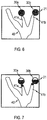
- Figures 6 and 7 are cross-sectional views of an electrical insulation 20 according to an embodiment, which illustrate the operation of the electrical insulation 20.
- Figure 6 depicts the electrical insulation in a state in which branches 41a, 41b of a cavity 40 formed by an electrical tree impinge on capsules 30a, 30b embedded within the electrically insulating material 21.
- the branches 41a, 41b formed by the electrical tree impinge on the capsules 30a, 30b the shell of the capsules is ruptured. This releases the electrically insulating liquid from the capsules 30a, 30b into the branches 41a, 41b of the cavity 40.
- the electrically insulating liquid impedes growth of the electrical tree.
- the electrically insulating liquid may mitigate the risk of further partial discharges occurring.
- a polymeric material in the liquid phase such as a liquid epoxy resin, polyethylene, polyurethane or other polymeric material
- a polymeric material in the liquid phase such as a liquid epoxy resin, polyethylene, polyurethane or other polymeric material
- capsules 30 having a shell and an electrically insulating liquid within the shell.
- Polymeric materials other than epoxy resin may be used.
- the polymeric material may comprise or may be a thermoset or thermoplast or elastomer or mixture or blend or co-polymer of these polymers.
- the mixture may comprise optional additional fillers, optional hardeners, and/or optional accelerators.
- the mixture may comprise at least 1 wt-% of the capsules and/or at least 2 vol-% of the capsules.
- the capsules may have the configuration explained with reference to Figures 1 to 7 above.
- the mixture may comprise a sag resistance or anti-settling agent that mitigates the risk of the capsules settling in the mixture.
- the mixture may comprise 0.05 to 10 wt-% of anti-settling agent.
- the epoxy resin may be processed into a solid to form the electrical insulation. For illustration, curing or other hardening techniques may be employed.
- the method may comprise optional post-processing after hardening the mixture.
- the method may comprise applying the electrical insulation to an electrical component, in particular a conductor, of a power system component.
- the electrical insulation according to embodiments provides enhanced defect tolerance compared to conventional electrical insulations, in particular as regards the time to breakdown by electrical treeing.
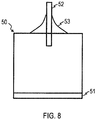
- Figure 8 shows a test specimen having a body of an electrical insulation 50.
- a planar electrode 51 is applied on one face of the body 50.
- a pin electrode 52 is inserted on the opposite face.
- Polydimethylsiloxan (PDMS) 53 may be applied to the face on which the pin electrode 52 enters the body 50.
- Comparative samples A and inventive samples B were produced to have the following composition of the body 50: Comparative sample A: up to 65% standard silica SiO 2 and epoxy resin.
- Inventive sample B up to 65 wt-% standard silica SiO 2 ; between 0.01 to 10 wt-% of anti-settling agent and 1-20 wt-% of microcapsules; and epoxy resin.
- the total weight of fillers in inventive samples of type B always matched the weight of fillers in comparative samples of type A.
- test specimens were respectively produced for sample A and twenty four for sample B.
- the time to breakdown was measured. The same voltage was applied to the test specimens of comparative sample A and the test specimens of inventive sample B.
- Table 1 Sample type time to breakdown [hours] A 90 A 388 A 455 A 482 A 502 A 559 A 617 A 764 A 867 A 980 A 1273 A 1287
- the electrical insulation according to embodiments which comprises capsules filled with an electrically insulating liquid as an electrical tree inhibiting material provides various effects and advantages. Robustness to defects such as electrical trees is enhanced.
- Capsules filled with low-viscosity insulating liquids e.g., silicone oils, mineral transformer oils, and/or vegetable oils or blends thereof have various desirable characteristics.
- the silicone oil has a lower carbon content than, e.g., the epoxy. A range of viscosities is available, facilitating the selection of a low-viscosity liquid that can easily and rapidly flow into the branches of an electrical tree. Silicone oil turns into silica sand during decomposition.
- the electrically insulating liquid contained within the capsules may contain fillers, such as nanoparticles.
- the electrically insulating liquid in the capsules is non-UV-curing
- various further desirable effects are attained.
- UV curing systems are prone to curing by themselves without action of UV light from partial discharges in the treeing channels within several weeks.
- the non-UV-curing electrically insulating liquids used in embodiments of the electrical insulation are suitable for use on power system components with an expected lifetime of 10 to 40 years.
- An electrical insulation and methods according to the invention may be used in association with a power system component, e.g., a power generation or power transmission system.
- the electrical insulation may in particular be used for isolating a power transmission cable, a busbar, a transformer, a circuit breaker, a switchgear, a switch, a bushing, a spacer, a motor, or a generator, without being limited thereto.
- Exemplary power system components that may comprise the electrical insulation according to an embodiment may include primary or secondary gas insulated switchgear, live tank breakers, dead tank breakers, generator circuit breakers, instrument transformers, other transformers, coils, bushings, sensors, railway power components, vacuum poles, or vacuum interrupters.
Landscapes
- Physics & Mathematics (AREA)
- Spectroscopy & Molecular Physics (AREA)
- Chemical & Material Sciences (AREA)
- Oil, Petroleum & Natural Gas (AREA)
- Organic Insulating Materials (AREA)
- Compositions Of Macromolecular Compounds (AREA)
Abstract
Description
- The invention relates to an electrical insulation and methods of using and producing an electrical insulation. The invention relates in particular to an electrical insulation and methods of using and producing an electrical insulation that provide enhanced tolerance to defects.
- Electrical insulations are widely used to electrically insulate power system components, such as cables of a transmission line, busbars, transformer components, or other power system components.
- An electrical insulation may be based on an electrically insulating material, such as an epoxy resin. An epoxy based electrical insulation can be manufactured by mixing epoxy resin, hardener, accelerator and various fillers. Such an electrical insulation may be susceptible to electrical treeing. Electrical treeing may originate from metallic electrodes or impurities in the insulation, e.g., metallic particles and wires, small pieces of glass, wood or gas bubbles. Electrical treeing is a defect that commonly occurs in the electrical insulation of power system components. Partial discharges may cause a tree-shaped cavity to form in an electrical insulator.
-
US 6 764 616 B1 discloses a hydrophobic epoxide resin system used as an electrical insulating material. - P. Vijayan and M. A. AlMaadeed, "'Containers' for self-healing epoxy composites and coating: Trends and advances", eXPRESS Polymer Letters Vol.10, No.6 (2016) 506-524 suggests the introduction of a self-healing functionality into an epoxy matrix by using polymer capsules in epoxy composites.
- X. J. Ye et al., "Improvement of fatigue resistance of epoxy composite with microencapsulated epoxy-SbF5 self-healing system", eXPRESS Polymer Letters Vol.11, No.11 (2017) 853-862 discloses a technique for rapid retardation and arresting of fatigue cracks that uses, inter alia, microcapsules induced toughening.
- There is a continued need in the art for an electrical insulation that provides enhanced tolerance to defects, i.e., that is less likely to fail once a defect starts to develop. There is in particular a continued need in the art for an electrical insulation that provides improved robustness to electrical treeing.
- Conventional epoxy composite materials are not adequate to provide sufficient resistance to electrical treeing. For illustration, the curing characteristics of the materials described in P. Vijayan and M. A. AlMaadeed, '''Containers' for self-healing epoxy composites and coating: Trends and advances", eXPRESS Polymer Letters Vol.10, No.6 (2016) 506-524 and in X. J. Ye et al., "Improvement of fatigue resistance of epoxy composite with microencapsulated epoxy-SbF5 self-healing system", eXPRESS Polymer Letters Vol. 11, No.11 (2017) 853-862 are such that the materials tend to self-cure too rapidly and cannot flow into channels formed by electrical treeing in an electrical insulation. This adversely affects the suitability of the epoxy composite of these documents for mitigating electrical treeing.
- It is an object of the invention to provide an improved electrical insulation and improved methods that provide enhanced tolerance to at least certain types of defects in the electrical insulation. It is in particular an object to provide an electrical insulation and methods of using and producing the electrical insulation, wherein the electrical insulation provides enhanced robustness against growth of electrical trees in the electrical insulation.
- An electrical insulation and methods as recited in the independent claims are provided. The dependent claims define embodiments.
- The invention provides an electrical insulation in which capsules having a solid shell containing an electrically insulating liquid are provided in an insulating material, such as an epoxy resin, polyurethane resin, polyethylene or other polymeric materials. The insulating material may include optional other fillers. When an electrical tree starts during operation of a power equipment, the electrical tree eventually hits one of the capsules, punctures it, and enables the insulating liquid from the capsule to flow into treeing channels. The electrically insulating liquid flowing into the treeing channels interferes with discharges in the treeing channels and thus significantly slows down the degradation of the electrical insulation.
- The capsules may be microcapsules. The microcapsules may have a diameter, measured along the maximum length of the microcapsules, which is not more than 1000 µm, preferably not more than 500 µm, further preferably not more than 100 µm. The microcapsules may have a diameter, measured along the maximum length of the microcapsules, which may be between 2 µm and 1000 µm. The microcapsules may have a diameter, measured along the maximum length of the microcapsules, which may be between 2 µm and 1000 µm, preferably between 2 µm and 500 µm.
- An electrical insulation according to an embodiment comprises an electrically insulating material and an electrical tree inhibiting material in the electrically insulating material. The electrical tree inhibiting material comprises a plurality of capsules having a shell and an electrically insulating liquid within the shell.
- The electrically insulating material may be a solid.
- The shell of the capsules may be a solid different from the electrically insulating material. The shell of the capsules may be configured to rupture in response to the mechanical stress and/or electrical field induced by electrical treeing.
- The electrically insulating liquid may be or may comprise oil or a blend of oils. The electrically insulating liquid may be or may comprise a silicone oil, a blend of silicone oils, a mineral transformer oil, a blend of mineral transformer oils and/or a vegetable oil, or a blend of vegetable oils. The electrically insulating liquid may comprise a blend of the mentioned oils.
- The electrically insulating liquid may have a resistivity from 103 Ω m to 1020 Ω m.
- The electrically insulating liquid may have a resistivity from 103 Ω m to 1020 Ω m at 25°C.
- The electrically insulating liquid may have dielectric permittivity from 1 to 50 at 25°C and at 50 Hz.
- The electrically insulating liquid may have a low viscosity.
- The electrically insulating liquid may have a dynamic viscosity of less than 100000 mm2/s at 25°C (measured according to DIN 53019).
- The electrically insulating liquid may have a dynamic viscosity of more than 0.01 mm2/s at 25°C (measured according to DIN 53019).
- The electrically insulating liquid may have a dynamic viscosity of 0.01 mm2/s to 100000 mm2/s, preferably of 1 mm2/s to 10000 mm2/s at 25°C (measured according to DIN 53019).
- The electrically insulating liquid may be a non-UV-curing electrically insulating liquid.
- The electrically insulating liquid may be a non-self-curing electrically insulating liquid.
- The electrically insulating liquid may contain fillers. The fillers within the insulating liquid contained in the capsules may be nanoparticles.
- The capsules may be microcapsules.
- A root-mean-square value of a maximum diameter of the capsules may be not more than 1000 µm, preferably not more than 500 µm, preferably not more than 100 µm.
- A root-mean-square value of a maximum diameter of the capsules may be between 2 µm and 1000 µm, optionally between 2 µm and 500 µm.
- The shell may comprise melamine formaldehyde or polyoxymethylene urea or other materials. The shell may contain fillers.
- The shell may have a wall thickness in the range from 0.1 µm to 100 µm.
- The shell may be free of fillers such as TiO2.
- The shell may be free of TiO2.
- The shell may be formed of a multi-layer system having several layers. The several layers may comprise a gelatine and/or resorcinol coating or other materials.
- The capsules may be dispersed in the electrically insulating material.
- The electrical insulation may comprise at least 1 wt-% of the capsules and/or at least 2 vol-% of the capsules.
- The electrical insulation may comprise between 1 wt-% and 30 wt-% of the capsules.
- The electrical insulation may comprise between 2 vol-% and 50 vol-% of the capsules.
- The electrically insulating material may be or may comprise an epoxy resin, polyurethane resin, polyethylene or other polymeric materials.
- The electrically insulating material may have fillers other than the capsules. The fillers may comprise an anti-settling agent (a sag resistance agent). The anti-settling agent or sag resistance agent may be operative to prevent or reduce settling of the capsules under influence of gravity in a mixture that includes the electrically insulating material in liquid phase, the capsules, and the anti-settling agent or sag resistance agent.
- An electrical insulation according to a further embodiment comprises a solid polymeric material and a plurality of capsules disposed within the solid polymeric material, wherein the capsules each have a shell and an electrically insulating liquid within the shell.
- The solid polymeric material may be or may comprise one or several of an epoxy resin, polyurethane resin, polyethylene or other polymeric materials.
- A power system component according to an embodiment comprises an electrical component, in particular a conductor, and the electrical insulation according to an embodiment.
- The power system component may be a power transmission cable, in particular an underground cable.
- The power system component may be a busbar.
- The power system component may be a transformer.
- The power system component may be a circuit breaker.
- The power system component may be a switchgear.
- The power system component may be an insulating spacer.
- The power system component may be a switch.
- The power system component may be a motor.
- The power system component may be a generator.
- The power system component may be a bushing.
- A power system according to an embodiment comprises a power system component having the electrical insulation according to an embodiment. The power system may be a medium or high voltage power transmission system.
- In a use of the electrical insulation according to an embodiment for impeding growth of an electrical tree, the shell of at least one capsule ruptures to release the electrically insulating liquid into a cavity formed by an electrical tree when the electrical tree impinges onto the shell of the at least one capsule. The electrically insulating liquid flows into the cavity of the electrical tree and impedes growth of the electrical tree.
- The electrical insulation may be the electrical insulation according to any embodiment disclosed herein.
- A method of producing an electrical insulation according to an embodiment comprises forming a mixture comprising a polymeric material and a plurality of capsules in the polymeric material, wherein each of the capsules has a shell and an electrically insulating liquid within the shell. The method may further comprise processing the mixture into a solid electrical insulation.
- The polymeric material may comprise or may be a thermoset or thermoplast or elastomer or mixture or blend or co-polymer of these polymers.
- The polymeric material may be or may comprise an epoxy resin, polyurethane resin, polyethylene or other polymeric materials.
- Processing the mixture into a solid electrical insulation may comprise effecting a cross-linking reaction, curing, melting and/or otherwise processing the polymeric material.
- The mixture may optionally comprise fillers other than the plurality of capsules.
- The fillers may comprise an anti-settling agent (a sag resistance agent). The anti-settling agent or sag resistance agent may be operative to prevent or reduce settling of the capsules under influence of gravity in the mixture that includes the electrically insulating material in liquid phase, the capsules, and the anti-settling agent or sag resistance agent.
- The shell of the capsules in the mixture may be a solid. The shell of the capsules may be configured to rupture in response to the mechanical stress and/or electrical field induced by electrical treeing.
- The electrically insulating liquid contained within the capsules in the mixture may be or may comprise a silicone oil, a blend of silicone oils, a mineral transformer oil, a blend of mineral transformer oils and/or a vegetable oil or a blend of vegetable oils, or a blend of these oils.
- The electrically insulating liquid contained within the capsules in the mixture may have a resistivity from 103 Ω m to 1020 Ω m.
- The electrically insulating liquid contained within the capsules in the mixture may have a resistivity from 103 Ω m to 1020 Ω m at 25°C.
- The electrically insulating liquid contained within the capsules in the mixture may have dielectric permittivity from 1 to 50 at 25°C and at 50 Hz.
- The electrically insulating liquid contained within the capsules in the mixture may have a low viscosity.
- The electrically insulating liquid contained within the capsules in the mixture may have a dynamic viscosity of less than 100000 mm2/s at 25°C (measured according to DIN 53019).
- The electrically insulating liquid contained within the capsules in the mixture may have a dynamic viscosity of more than 0.01 mm2/s at 25°C (measured according to DIN 53019).
- The electrically insulating liquid may have a dynamic viscosity of 0.01 mm2/s to 100000 mm2/s, preferably of 1 mm2/s to 10000 mm2/s at 25°C (measured according to DIN 53019).
- The electrically insulating liquid contained within the capsules in the mixture may be a non-UV-curing electrically insulating liquid.
- The electrically insulating liquid contained within the capsules in the mixture may be a non-self-curing electrically insulating liquid.
- The electrically insulating liquid contained within the capsules in the mixture may contain fillers. The fillers within the insulating liquid contained in the capsules may be nanoparticles.
- The capsules in the mixture may be microcapsules.
- A root-mean-square value of a maximum diameter of the capsules may be not more than 1000 µm, preferably not more than 500 µm, preferably not more than 100 µm.
- A root-mean-square value of a maximum diameter of the capsules may be between 2 µm and 1000 µm, optionally between 2 µm and 500 µm.
- The shell of the capsules in the mixture may comprise melamine formaldehyde or polyoxymethylene urea or other materials.
- The shell of the capsules in the mixture may contain fillers.
- The shell of the capsules in the mixture may be free of fillers such as TiO2.
- The shell of the capsules in the mixture may be formed of a multi-layer system having several layers. The several layers may comprise a gelatin, or resorcinol coating or other materials.
- The shell of the capsules in the mixture may have a wall thickness in the range from 0.1 µm to 100 µm.
- The mixture may comprise at least 1 wt-% of the capsules and/or at least 2 vol-% of the capsules. The method may comprise causing a cross-linking reaction of the polymeric material.
- The mixture may comprise a hardener and/or an accelerator to facilitate the cross-linking reaction.
- The method may further comprise disposing the cured mixture, optionally after further post-processing, adjacent an electrical component, in particular adjacent a conductor, of a power system component.
- The cured mixture may comprise between 1 wt-% and 30 wt-% of the capsules.
- The cured mixture may comprise between 2 vol-% and 50 vol-% of the capsules.
- The power system component may be a power transmission cable, a busbar, a transformer, a circuit breaker, a switchgear, a switch, a spacer, a bushing, a motor, or a generator.
- According to an another embodiment, there is disclosed the use of mixture comprising a polymeric material and a plurality of capsules in the polymeric material, wherein each of the capsules has a shell and an electrically insulating liquid within the shell, for manufacturing an electrical insulation that inhibits electrical treeing.
- Various effects are attained by the electrical insulation and methods according to embodiments. For illustration, when an electrical tree hits a capsule, rupture of the shell causes the electrically insulating liquid from the capsule to flow into one or several treeing channels and interfere with the discharges in the treeing channels. A low viscosity of the electrically insulating liquid in the capsules, e.g., the low viscosity of a silicone oil, blend of silicone oils, mineral transformer oil(s) and/or vegetable oil(s) may assist the capability of the electrically insulating liquid to flow into the treeing channels. Use of a non-self-curing and non-UV-curing the electrically insulating liquid in the capsules ensures that the electrically insulating liquid in the capsules remains capable of flowing into the treeing channels.
- The electrical insulation according to embodiments provides enhanced tolerance to defects in the sense that, even when electrical treeing starts, the time to breakdown of the electrical insulation is extended compared to conventional electrical insulations that are based on similar electrically insulating materials, such as epoxy resins.
- The electrical insulator may be used for power system components of high or medium voltage power systems, without being limited thereto.
- The electrical insulator may be used for a power generation or power transmission system, without being limited thereto.
- The subject-matter of the invention will be explained in more detail with reference to preferred exemplary embodiments which are illustrated in the attached drawings, in which:
-
Figure 1 is a schematic representation of a power system component comprising an electric insulation according to an embodiment. -
Figure 2 is a cross-sectional view of a capsule of an electrical insulator according to an embodiment. -
Figure 3 is a cross-sectional view of a capsule of an electrical insulator according to an embodiment. -
Figure 4 is a cross-sectional view of a capsule of an electrical insulator according to an embodiment. -
Figure 5 is a cross-sectional view of a capsule of an electrical insulator according to an embodiment. -
Figures 6 and 7 are cross-sectional views of an electrical insulator according to an embodiment. -
Figure 8 is a cross-sectional view of a test specimen. - Exemplary embodiments of the invention will be described with reference to the drawings in which identical or similar reference signs designate identical or similar elements. While some embodiments will be described in the context of specific exemplary electrically insulating materials that may be based on an epoxy resin, polyurethane, polyethylene or other polymeric materials, with reference to exemplary fillers, and with reference to specific exemplary capsules, the embodiments are not limited thereto.
- While some embodiments will be described in the context of specific exemplary power system components, such as cables of a transmission line, busbars, or conductors in transformers, the electrical insulator according to embodiments may be used in a wide variety of other applications. The features of embodiments may be combined with each other, unless specifically noted otherwise.
-
Fig. 1 is a schematic representation of apower system component 10 comprising an electrical insulator according to an embodiment. Thepower system component 10 may be a component of a power generation or power transmission system. Thepower system component 10 may be a component of a high or medium voltage power system. Thepower system component 10 may be a power transmission cable, a busbar, a transformer, a circuit breaker, a switchgear, a switch, a motor, a generator. Exemplarypower system components 10 include primary or secondary gas insulated switchgear, live tank breakers, dead tank breakers, generator circuit breakers, instrument transformers, other transformers, coils, bushings, sensors, railway power components, vacuum poles, or vacuum interrupters, without being limited thereto. - The
power system component 10 comprises anelectrical component 11, which may in particular be a conductor, and anelectrical insulation 20. Theelectrical insulation 20 may be disposed to cover at least part of theelectrical component 11. - The
electrical insulation 20 according to embodiments is a composite system. Theelectrical insulation 20 may comprise - an electrically insulating
material 21, which may comprise or which may be an epoxy resin, polyurethane, polyethylene and/or other polymer, -
capsules 30 that are dispersed in the electrically insulatingmaterial 21, and which will be described in more detail below, - optional fillers such as sag resistance or anti-settling agents that may be used in the production process to ensure a uniform distribution of the
capsules 30, and - optional hardeners and/or accelerators.
- As compared to conventional electrical insulations, the
electrical insulation 20 comprisescapsules 30 that are dispersed in a solid electrically insulatingmaterial 21. Thecapsules 30 are operative to inhibit growth of an electrical tree, thereby enhancing the defect tolerance of theelectrical insulation 20. - The
capsules 30 may respectively be microcapsules. Thecapsules 30 may respectively have a mean diameter of less than 1000 µm, preferably less than 500 µm, preferably less than 100 µm. Thecapsules 30 may respectively have a mean diameter from 2 µm to 1000 µm, optionally from 2 µm to 500 µm. - The
capsules 30 may be evenly distributed throughout the electrically insulatingmaterial 21. Thecapsules 30 may be distributed throughout the electrically insulatingmaterial 21 such that any volume of 1 cm3 of the electrical insulator includes from 2 vol-% to 50 vol-% of the capsules. - The electrical insulation may comprise at least 1 wt-% of the capsules and/or at least 2 vol-% of the capsules. The electrical insulation may comprise 7 wt-% or more of the capsules. Alternatively or additionally, the electrical insulation may comprise 2 vol-% or more of the capsules. This ensures that a release of electrically insulating liquid from the capsule into a cavity formed by an electrical tree will mitigate further growth of the electrical tree at an early stage, thereby increasing robustness of the electrical insulation against electrical treeing.
-
Figures 2 to 5 illustrateexemplary capsules 30. Thecapsules 30 may respectively be configured as microcapsules. Thecapsules 30 may respectively have asolid shell 31 that defines aninterior volume 32. Thecapsules 30 respectively have asilicone oil 36 or other electrically insulating, low-viscosity liquid in theinterior volume 32 defined by theshell 31. For illustration, a silicone oil, mineral transformer oil, vegetable oil or a blend of several such oils that is electrically insulating may be provided in theinterior volume 32. - By using an
electrical insulation 20 that comprisescapsules 30 having ashell 31 made of, for example, melamine formaldehyde or polyoxymethylene urea or other suitable shell material, and filled with an electrically insulating liquid or a blend of several insulatingliquids 36 in the electrically insulatingmaterial 21, the growth of electrical trees in theelectrical insulation 20 can be stopped or impeded. The electrically insulating liquid or a blend of several insulating liquids may include low viscosity silicone oil(s), mineral transformer oil(s), vegetable oil(s) or a blend of such oils. - The electrically insulating liquid may have a resistivity from 103 Ω m to 1020 Ω m at 25°C. The electrically insulating liquid may have dielectric permittivity from 1 to 50 at 25°C and at 50 Hz.
- During use of the
electrical insulation 20, partial discharges may cause electrical treeing to start. When the electrical tree impinges on one or several of thecapsules 30, it causes the shell of the capsule(s) 30 to rupture, releasing the electrically insulatingliquid 36 into one or several channels of the electrical tree. - The electrically insulating
liquid 36 may be or may comprise a silicone oil, mineral transformer oil, vegetable oil or a blend of such oils. The electrically insulatingliquid 36 may have a dynamic viscosity of equal to or less than 100000 mm2/s at 25°C (measured according to DIN 53019) and of equal to or more than 0.01 mm2/s at 25°C (measured according to DIN 53019). The electrically insulatingliquid 36 may be or may comprise a blend of various silicone liquids, or other oils, mixed so as to attain a dynamic viscosity of equal to or less than 100000 mm2/s and equal to or more than 0.01 mm2/s (measured according to DIN 53019). The electrically insulatingliquid 36 may preferably have a dynamic viscosity at 25°C (measured according to DIN 53019) which is from 1 mm2/s to 10000 mm2/s. - The electrically insulating
liquid 36 may be or may comprise dimethyl polysiloxanes, mineral transformer oils, vegetable oils, or blends of several such oils. - The
shell 31 may be made of a material which is responsive to mechanical stress in the electrically insulatingmaterial 21, causing theshell 31 to rupture in response to the electromechanical stress caused by the branches of an electrical tree. Alternatively or additionally, theshell 31 may be made of a material which is responsive to the electric field caused by partial discharges in electrical treeing, causing theshell 31 to rupture in response to the electrical field caused by electrical treeing. - Multilayer shell constructions may be used, as explained with reference to
Figures 3 and 4 . -
Figure 3 illustrates anexemplary capsule 30. Thecapsule 30 may have a solid shell formed of aninner layer 33 and anouter coating 34. Theinner layer 33 may be made of, for example, melamine formaldehyde or polyoxymethylene urea or other suitable shell material. Theouter coating 34 may be made of or may comprise a gelatin coating and/or a resorcinol coating. -
Figure 4 illustrates anexemplary capsule 30. Thecapsule 30 may have a solid shell formed of aninner layer 33 and plural coating layers 34, 35. Theinner layer 33 may be made of, for example, melamine formaldehyde or polyoxymethylene urea or other suitable shell material. Thecoating layer 34 may be made of or may comprise a gelatin coating or another material. Thecoating layer 35 may be made of or may comprise a resorcinol coating or another material. - In the
capsules 30 explained with reference toFigures 2 to 4 , theshell 31 or eachlayer interior volume 32, so as to retain the electrically insulating liquid therein. - The
capsules 30 may respectively have a mean maximum diameter of equal to or less than 1000 µm, preferably of equal to or less than 500 µm. Thecapsules 30 may respectively have a mean maximum diameter of equal to or more than 2 µm. The determination of the mean maximum diameter will be exemplarily explained with reference toFigure 5 . Aline 38 is determined such that adistance 39 between the intersection of theline 38 and the outermost surface of the shell is maximum. Thedistance 39 is referred to as maximum diameter. The maximum diameters determined for at least ten capsules is averaged to determine the mean maximum diameter. -
Figures 6 and 7 are cross-sectional views of anelectrical insulation 20 according to an embodiment, which illustrate the operation of theelectrical insulation 20.Figure 6 depicts the electrical insulation in a state in whichbranches cavity 40 formed by an electrical tree impinge oncapsules material 21. When thebranches capsules capsules branches cavity 40. The electrically insulating liquid impedes growth of the electrical tree. For illustration, the electrically insulating liquid may mitigate the risk of further partial discharges occurring. - In order to manufacture the electrical insulation according to an embodiment, a polymeric material in the liquid phase, such as a liquid epoxy resin, polyethylene, polyurethane or other polymeric material, may be mixed with
capsules 30 having a shell and an electrically insulating liquid within the shell. Polymeric materials other than epoxy resin may be used. For illustration, the polymeric material may comprise or may be a thermoset or thermoplast or elastomer or mixture or blend or co-polymer of these polymers. - The mixture may comprise optional additional fillers, optional hardeners, and/or optional accelerators.
- The mixture may comprise at least 1 wt-% of the capsules and/or at least 2 vol-% of the capsules. The capsules may have the configuration explained with reference to
Figures 1 to 7 above. - The mixture may comprise a sag resistance or anti-settling agent that mitigates the risk of the capsules settling in the mixture. The mixture may comprise 0.05 to 10 wt-% of anti-settling agent. The epoxy resin may be processed into a solid to form the electrical insulation. For illustration, curing or other hardening techniques may be employed.
- The method may comprise optional post-processing after hardening the mixture. The method may comprise applying the electrical insulation to an electrical component, in particular a conductor, of a power system component.
- The electrical insulation according to embodiments provides enhanced defect tolerance compared to conventional electrical insulations, in particular as regards the time to breakdown by electrical treeing.
- Tests were performed that evidence the improved characteristics of the electrical insulation according to embodiments.
-
Figure 8 shows a test specimen having a body of anelectrical insulation 50. Aplanar electrode 51 is applied on one face of thebody 50. Apin electrode 52 is inserted on the opposite face. Polydimethylsiloxan (PDMS) 53 may be applied to the face on which thepin electrode 52 enters thebody 50. - Comparative samples A and inventive samples B were produced to have the following composition of the body 50:
Comparative sample A: up to 65% standard silica SiO2 and epoxy resin. - Inventive sample B: up to 65 wt-% standard silica SiO2; between 0.01 to 10 wt-% of anti-settling agent and 1-20 wt-% of microcapsules; and epoxy resin. The total weight of fillers in inventive samples of type B always matched the weight of fillers in comparative samples of type A.
- Twelve test specimens were respectively produced for sample A and twenty four for sample B.
- The time to breakdown was measured. The same voltage was applied to the test specimens of comparative sample A and the test specimens of inventive sample B.
- The measured time to breakdown for the comparative samples A is summarized in the following Table 1:
Table 1 Sample type time to breakdown [hours] A 90 A 388 A 455 A 482 A 502 A 559 A 617 A 764 A 867 A 980 A 1273 A 1287 - None of twenty four inventive samples B failed while being under voltage for more than 1900 hours. Twelve inventive samples B were operating for more than 3400 hours without failure at the time of drafting of this application.
- The electrical insulation according to embodiments which comprises capsules filled with an electrically insulating liquid as an electrical tree inhibiting material provides various effects and advantages. Robustness to defects such as electrical trees is enhanced. Capsules filled with low-viscosity insulating liquids, e.g., silicone oils, mineral transformer oils, and/or vegetable oils or blends thereof have various desirable characteristics. The silicone oil has a lower carbon content than, e.g., the epoxy. A range of viscosities is available, facilitating the selection of a low-viscosity liquid that can easily and rapidly flow into the branches of an electrical tree. Silicone oil turns into silica sand during decomposition.
- The electrically insulating liquid contained within the capsules may contain fillers, such as nanoparticles.
- When the electrically insulating liquid in the capsules is non-UV-curing, various further desirable effects are attained. UV curing systems are prone to curing by themselves without action of UV light from partial discharges in the treeing channels within several weeks. The non-UV-curing electrically insulating liquids used in embodiments of the electrical insulation are suitable for use on power system components with an expected lifetime of 10 to 40 years.
- An electrical insulation and methods according to the invention may be used in association with a power system component, e.g., a power generation or power transmission system. The electrical insulation may in particular be used for isolating a power transmission cable, a busbar, a transformer, a circuit breaker, a switchgear, a switch, a bushing, a spacer, a motor, or a generator, without being limited thereto. Exemplary power system components that may comprise the electrical insulation according to an embodiment may include primary or secondary gas insulated switchgear, live tank breakers, dead tank breakers, generator circuit breakers, instrument transformers, other transformers, coils, bushings, sensors, railway power components, vacuum poles, or vacuum interrupters.
- While the invention has been described in detail in the drawings and foregoing description, such description is to be considered illustrative or exemplary and not restrictive. Variations to the disclosed embodiments can be understood and effected by those skilled in the art and practising the claimed invention, from a study of the drawings, the disclosure, and the appended claims. In the claims, the word "comprising" does not exclude other elements or steps, and the indefinite article "a" or "an" does not exclude a plurality. The mere fact that certain elements or steps are recited in distinct claims does not indicate that a combination of these elements or steps cannot be used to advantage, specifically, in addition to the actual claim dependency, any further meaningful claim combination shall be considered disclosed.
Claims (15)
- An electrical insulation (20), comprising:an electrically insulating material (21), andan electrical tree inhibiting material in the electrically insulating material (21), the electrical tree inhibiting material comprising a plurality of capsules (30) having a shell (31; 33, 34; 33-35) andan electrically insulating liquid (36) within the shell (31; 33, 34; 33-35).
- The electrical insulation (20) of claim 1, wherein the electrically insulating liquid (36) comprises a silicone oil, a mineral transformer oil or a vegetable oil, or their blends, optionally wherein the electrically insulating liquid contains one or several fillers, optionally wherein the one or several fillers comprises a sag resistance agent.
- The electrical insulation (20) of claim 1 or claim 2, wherein the electrically insulating liquid (36) has a viscosity of equal to or less than 100000 mm2/s, preferably of equal to or less than 10000 mm2/s.
- The electrical insulation (20) of any one of the preceding claims, wherein the electrically insulating liquid (36) has a viscosity of more than 0.01 mm2/s, preferably of more than 1 mm2/s.
- The electrical insulation (20) of any one of the preceding claims, wherein the electrically insulating liquid (36) is a non-UV-curing electrically insulating liquid (36).
- The electrical insulation (20) of any one of the preceding claims, wherein a root-mean-square value of a maximum diameter (39) of the capsules (30) is not more than 1000 µm, preferably not more than 500 µm, further preferably not more than 100 µm.
- The electrical insulation (20) of any one of the preceding claims, wherein the shell (31; 33, 34; 33-35) comprises melamine formaldehyde or polyoxymethylene urea or other materials.
- The electrical insulation (20) of any one of the preceding claims, wherein the shell (31; 33, 34; 33-35) is free of TiO2 and/or wherein the shell (33, 34; 33-35) is formed of a multi-layer system having several layers and/or wherein the shell (31) contains one or several fillers.
- The electrical insulation (20) of any one of the preceding claims, wherein the capsules (30) are dispersed in the electrically insulating material (21).
- The electrical insulation (20) of any one of the preceding claims, wherein the electrical insulation (20) comprises at least 1 wt-% of the capsules (30) and/or at least 2 vol-% of the capsules (30).
- The electrical insulation (20) of any one of the preceding claims, wherein the electrically insulating material (21) is an epoxy resin or comprises an epoxy resin, polyurethane or polyethylene or other polymer(s).
- A power system component (10), comprising:an electrical component (11), in particular a conductor, andthe electrical insulation (20) according to any one of the preceding claims.
- The power system component (10) according to claim 12, wherein the power system component (10) is a power transmission cable, a busbar, a transformer, a circuit breaker, a switchgear, a switch, a bushing, a spacer, a motor, or a generator.
- Use of the electrical insulation (20) of any one of claims 1 to 11 for impeding growth of an electrical tree, wherein the shell (31; 33, 34; 33-35) of at least one capsule (30) ruptures to release the electrically insulating liquid (36) into a cavity (40) formed by an electrical tree when the electrical tree impinges onto the shell (31; 33, 34; 33-35) of the at least one capsule, such that the electrically insulating liquid (36) flows into the cavity (40) formed by the electrical tree and thereby impedes growth of the electrical tree (40).
- A method of producing an electrical insulation (20), the method comprising:forming a mixture comprising a polymeric material and a plurality of capsules (30) in the polymeric material, wherein each of the capsules (30) has a shell (31; 33, 34; 33-35) and an electrically insulating liquid (36) within the shell (31; 33, 34; 33-35), andprocessing the mixture into a solid electrical insulation (20).
Priority Applications (2)
| Application Number | Priority Date | Filing Date | Title |
|---|---|---|---|
| EP18204086.5A EP3648117B1 (en) | 2018-11-02 | 2018-11-02 | Electrical insulation, use of an electrical insulation, and method of producing an electrical insulation |
| CN201921882437.7U CN212411704U (en) | 2018-11-02 | 2019-11-04 | Electrical insulation and power system assembly including the same |
Applications Claiming Priority (1)
| Application Number | Priority Date | Filing Date | Title |
|---|---|---|---|
| EP18204086.5A EP3648117B1 (en) | 2018-11-02 | 2018-11-02 | Electrical insulation, use of an electrical insulation, and method of producing an electrical insulation |
Publications (2)
| Publication Number | Publication Date |
|---|---|
| EP3648117A1 true EP3648117A1 (en) | 2020-05-06 |
| EP3648117B1 EP3648117B1 (en) | 2026-01-14 |
Family
ID=64172252
Family Applications (1)
| Application Number | Title | Priority Date | Filing Date |
|---|---|---|---|
| EP18204086.5A Active EP3648117B1 (en) | 2018-11-02 | 2018-11-02 | Electrical insulation, use of an electrical insulation, and method of producing an electrical insulation |
Country Status (2)
| Country | Link |
|---|---|
| EP (1) | EP3648117B1 (en) |
| CN (1) | CN212411704U (en) |
Families Citing this family (1)
| Publication number | Priority date | Publication date | Assignee | Title |
|---|---|---|---|---|
| CN120636928B (en) * | 2025-07-17 | 2026-02-10 | 北京天成瑞源电缆有限公司 | Weather-resistant type low-voltage cable and preparation method thereof |
Citations (4)
| Publication number | Priority date | Publication date | Assignee | Title |
|---|---|---|---|---|
| US3446741A (en) * | 1963-11-14 | 1969-05-27 | Minnesota Mining & Mfg | Insulating device,composition,and method |
| EP1168372A1 (en) * | 2000-06-20 | 2002-01-02 | Abb Research Ltd. | Resin for electrical insulation |
| US6764616B1 (en) | 1999-11-29 | 2004-07-20 | Huntsman Advanced Materials Americas Inc. | Hydrophobic epoxide resin system |
| WO2016170952A1 (en) * | 2015-04-21 | 2016-10-27 | 日東電工株式会社 | Self-repairing electrical insulation resin composition and electrical wire using same |
-
2018
- 2018-11-02 EP EP18204086.5A patent/EP3648117B1/en active Active
-
2019
- 2019-11-04 CN CN201921882437.7U patent/CN212411704U/en active Active
Patent Citations (4)
| Publication number | Priority date | Publication date | Assignee | Title |
|---|---|---|---|---|
| US3446741A (en) * | 1963-11-14 | 1969-05-27 | Minnesota Mining & Mfg | Insulating device,composition,and method |
| US6764616B1 (en) | 1999-11-29 | 2004-07-20 | Huntsman Advanced Materials Americas Inc. | Hydrophobic epoxide resin system |
| EP1168372A1 (en) * | 2000-06-20 | 2002-01-02 | Abb Research Ltd. | Resin for electrical insulation |
| WO2016170952A1 (en) * | 2015-04-21 | 2016-10-27 | 日東電工株式会社 | Self-repairing electrical insulation resin composition and electrical wire using same |
Non-Patent Citations (3)
| Title |
|---|
| P. VIJAYAN; M. A. ALMAADEED: "Containers' for self-healing epoxy composites and coating: Trends and advances", EXPRESS POLYMER LETTERS, vol. 10, no. 6, 2016, pages 506 - 524 |
| X. J. YE ET AL.: "Improvement of fatigue resistance of epoxy composite with microencapsulated epoxy-SbF5 self- healing system", EXPRESS POLYMER LETTERS, vol. 11, no. 11, 2017, pages 853 - 862 |
| X. J. YE ET AL.: "Improvement of fatigue resistance of epoxy composite with microencapsulated epoxy-SbF5 self-healing system", EXPRESS POLYMER LETTERS, vol. 11, no. l 1, 2017, pages 853 - 862 |
Also Published As
| Publication number | Publication date |
|---|---|
| EP3648117B1 (en) | 2026-01-14 |
| CN212411704U (en) | 2021-01-26 |
Similar Documents
| Publication | Publication Date | Title |
|---|---|---|
| Liang et al. | Decay-like fracture mechanism of silicone rubber composite insulator | |
| Hackam | Outdoor HV composite polymeric insulators | |
| Fofana et al. | Challenge of mixed insulating liquids for use in high-voltage transformers. II. Investigations of mixed liquid impregnated paper insulation | |
| RU2611050C2 (en) | Insulation system with improved resistance to partial discharge, method of its production | |
| Andersson et al. | Properties of interfaces between silicone rubber and epoxy | |
| US9728299B2 (en) | PTFE material having an anti-corona effect | |
| Wang et al. | Influence of addition of hydroxyl-terminated liquid nitrile rubber on dielectric properties and relaxation behavior of epoxy resin | |
| US20130131218A1 (en) | Insulation for rotating electrical machines | |
| US10685773B2 (en) | Transformer insulation | |
| US11045998B2 (en) | Producing power bushing condenser core by additive manufacturing | |
| Varivodov et al. | Technological aspects of the use of cast polymer insulation for high-voltage switchgear and busbars | |
| US6942900B2 (en) | Process for producing insulations for electrical conductors by means of powder coating | |
| EP2624258A1 (en) | Self-healing isolating layer for an electric machine | |
| EP3648117B1 (en) | Electrical insulation, use of an electrical insulation, and method of producing an electrical insulation | |
| Li et al. | Effects of inorganic fillers on withstanding short‐time breakdown and long‐time electrical aging of epoxy composites | |
| Ushakov et al. | Insulating materials and media used in high-voltage elements of electric power systems | |
| EP2402958A1 (en) | Electric isolation system for an electrical high voltage rotation machine | |
| Wang et al. | Water diffusivity transition in fumed silica-filled polydimethylsiloxane composite: Correlation with the interfacial free volumes characterized by positron annihilation lifetime spectroscopy: J Mater Sci | |
| Rajainmaki et al. | The electrical insulation of large superconducting magnets | |
| Jonsson et al. | Dry transformer bushings with composite insulators—The obvious combination for increased reliability | |
| Küchler | Insulating materials | |
| EP3544032B1 (en) | Transformer with gel composite insulation | |
| Varivodov et al. | Selection of methods and standards for the high-voltage testing of polymer insulators | |
| Park et al. | Electrical and mechanical properties of epoxy/micro-sized alumina composite and the effect of nano-sized alumina on those properties | |
| US5997940A (en) | Method for protecting porous components subjected to large potential differences and components thus produced |
Legal Events
| Date | Code | Title | Description |
|---|---|---|---|
| PUAI | Public reference made under article 153(3) epc to a published international application that has entered the european phase |
Free format text: ORIGINAL CODE: 0009012 |
|
| STAA | Information on the status of an ep patent application or granted ep patent |
Free format text: STATUS: THE APPLICATION HAS BEEN PUBLISHED |
|
| AK | Designated contracting states |
Kind code of ref document: A1 Designated state(s): AL AT BE BG CH CY CZ DE DK EE ES FI FR GB GR HR HU IE IS IT LI LT LU LV MC MK MT NL NO PL PT RO RS SE SI SK SM TR |
|
| AX | Request for extension of the european patent |
Extension state: BA ME |
|
| STAA | Information on the status of an ep patent application or granted ep patent |
Free format text: STATUS: REQUEST FOR EXAMINATION WAS MADE |
|
| 17P | Request for examination filed |
Effective date: 20201104 |
|
| RBV | Designated contracting states (corrected) |
Designated state(s): AL AT BE BG CH CY CZ DE DK EE ES FI FR GB GR HR HU IE IS IT LI LT LU LV MC MK MT NL NO PL PT RO RS SE SI SK SM TR |
|
| RAP1 | Party data changed (applicant data changed or rights of an application transferred) |
Owner name: ABB POWER GRIDS SWITZERLAND AG |
|
| RAP3 | Party data changed (applicant data changed or rights of an application transferred) |
Owner name: HITACHI ENERGY SWITZERLAND AG |
|
| STAA | Information on the status of an ep patent application or granted ep patent |
Free format text: STATUS: EXAMINATION IS IN PROGRESS |
|
| 17Q | First examination report despatched |
Effective date: 20230309 |
|
| P01 | Opt-out of the competence of the unified patent court (upc) registered |
Effective date: 20230527 |
|
| RAP1 | Party data changed (applicant data changed or rights of an application transferred) |
Owner name: HITACHI ENERGY LTD |
|
| GRAP | Despatch of communication of intention to grant a patent |
Free format text: ORIGINAL CODE: EPIDOSNIGR1 |
|
| STAA | Information on the status of an ep patent application or granted ep patent |
Free format text: STATUS: GRANT OF PATENT IS INTENDED |
|
| RIC1 | Information provided on ipc code assigned before grant |
Ipc: H01B 7/28 20060101AFI20250725BHEP Ipc: H01B 3/22 20060101ALN20250725BHEP Ipc: H01B 3/30 20060101ALN20250725BHEP Ipc: H01B 3/40 20060101ALN20250725BHEP Ipc: H01B 3/44 20060101ALN20250725BHEP Ipc: H01B 3/46 20060101ALN20250725BHEP |
|
| INTG | Intention to grant announced |
Effective date: 20250814 |
|
| GRAS | Grant fee paid |
Free format text: ORIGINAL CODE: EPIDOSNIGR3 |
|
| GRAA | (expected) grant |
Free format text: ORIGINAL CODE: 0009210 |
|
| STAA | Information on the status of an ep patent application or granted ep patent |
Free format text: STATUS: THE PATENT HAS BEEN GRANTED |
|
| AK | Designated contracting states |
Kind code of ref document: B1 Designated state(s): AL AT BE BG CH CY CZ DE DK EE ES FI FR GB GR HR HU IE IS IT LI LT LU LV MC MK MT NL NO PL PT RO RS SE SI SK SM TR |
|
| REG | Reference to a national code |
Ref country code: CH Ref legal event code: F10 Free format text: ST27 STATUS EVENT CODE: U-0-0-F10-F00 (AS PROVIDED BY THE NATIONAL OFFICE) Effective date: 20260114 Ref country code: GB Ref legal event code: FG4D |
|
| REG | Reference to a national code |
Ref country code: DE Ref legal event code: R096 Ref document number: 602018088556 Country of ref document: DE |
|
| REG | Reference to a national code |
Ref country code: IE Ref legal event code: FG4D |
|
| REG | Reference to a national code |
Ref country code: NL Ref legal event code: MP Effective date: 20260114 |
|
| PG25 | Lapsed in a contracting state [announced via postgrant information from national office to epo] |
Ref country code: NL Free format text: LAPSE BECAUSE OF FAILURE TO SUBMIT A TRANSLATION OF THE DESCRIPTION OR TO PAY THE FEE WITHIN THE PRESCRIBED TIME-LIMIT Effective date: 20260114 |
|
| REG | Reference to a national code |
Ref country code: AT Ref legal event code: MK05 Ref document number: 1877689 Country of ref document: AT Kind code of ref document: T Effective date: 20260114 |
|
| PG25 | Lapsed in a contracting state [announced via postgrant information from national office to epo] |
Ref country code: RS Free format text: LAPSE BECAUSE OF FAILURE TO SUBMIT A TRANSLATION OF THE DESCRIPTION OR TO PAY THE FEE WITHIN THE PRESCRIBED TIME-LIMIT Effective date: 20260414 |
|
| PG25 | Lapsed in a contracting state [announced via postgrant information from national office to epo] |
Ref country code: ES Free format text: LAPSE BECAUSE OF FAILURE TO SUBMIT A TRANSLATION OF THE DESCRIPTION OR TO PAY THE FEE WITHIN THE PRESCRIBED TIME-LIMIT Effective date: 20260114 |
|
| PG25 | Lapsed in a contracting state [announced via postgrant information from national office to epo] |
Ref country code: PL Free format text: LAPSE BECAUSE OF FAILURE TO SUBMIT A TRANSLATION OF THE DESCRIPTION OR TO PAY THE FEE WITHIN THE PRESCRIBED TIME-LIMIT Effective date: 20260114 |
|
| PG25 | Lapsed in a contracting state [announced via postgrant information from national office to epo] |
Ref country code: GR Free format text: LAPSE BECAUSE OF FAILURE TO SUBMIT A TRANSLATION OF THE DESCRIPTION OR TO PAY THE FEE WITHIN THE PRESCRIBED TIME-LIMIT Effective date: 20260415 |
|
| REG | Reference to a national code |
Ref country code: LT Ref legal event code: MG9D |
|
| PG25 | Lapsed in a contracting state [announced via postgrant information from national office to epo] |
Ref country code: LT Free format text: LAPSE BECAUSE OF FAILURE TO SUBMIT A TRANSLATION OF THE DESCRIPTION OR TO PAY THE FEE WITHIN THE PRESCRIBED TIME-LIMIT Effective date: 20260114 |
|
| PG25 | Lapsed in a contracting state [announced via postgrant information from national office to epo] |
Ref country code: NO Free format text: LAPSE BECAUSE OF FAILURE TO SUBMIT A TRANSLATION OF THE DESCRIPTION OR TO PAY THE FEE WITHIN THE PRESCRIBED TIME-LIMIT Effective date: 20260414 |
|
| PG25 | Lapsed in a contracting state [announced via postgrant information from national office to epo] |
Ref country code: SE Free format text: LAPSE BECAUSE OF FAILURE TO SUBMIT A TRANSLATION OF THE DESCRIPTION OR TO PAY THE FEE WITHIN THE PRESCRIBED TIME-LIMIT Effective date: 20260114 Ref country code: FI Free format text: LAPSE BECAUSE OF FAILURE TO SUBMIT A TRANSLATION OF THE DESCRIPTION OR TO PAY THE FEE WITHIN THE PRESCRIBED TIME-LIMIT Effective date: 20260114 Ref country code: AT Free format text: LAPSE BECAUSE OF FAILURE TO SUBMIT A TRANSLATION OF THE DESCRIPTION OR TO PAY THE FEE WITHIN THE PRESCRIBED TIME-LIMIT Effective date: 20260114 |
|
| PG25 | Lapsed in a contracting state [announced via postgrant information from national office to epo] |
Ref country code: HR Free format text: LAPSE BECAUSE OF FAILURE TO SUBMIT A TRANSLATION OF THE DESCRIPTION OR TO PAY THE FEE WITHIN THE PRESCRIBED TIME-LIMIT Effective date: 20260114 |
|
| PG25 | Lapsed in a contracting state [announced via postgrant information from national office to epo] |
Ref country code: IS Free format text: LAPSE BECAUSE OF FAILURE TO SUBMIT A TRANSLATION OF THE DESCRIPTION OR TO PAY THE FEE WITHIN THE PRESCRIBED TIME-LIMIT Effective date: 20260514 Ref country code: PT Free format text: LAPSE BECAUSE OF FAILURE TO SUBMIT A TRANSLATION OF THE DESCRIPTION OR TO PAY THE FEE WITHIN THE PRESCRIBED TIME-LIMIT Effective date: 20260514 |
|
| PG25 | Lapsed in a contracting state [announced via postgrant information from national office to epo] |
Ref country code: LV Free format text: LAPSE BECAUSE OF FAILURE TO SUBMIT A TRANSLATION OF THE DESCRIPTION OR TO PAY THE FEE WITHIN THE PRESCRIBED TIME-LIMIT Effective date: 20260114 |
|
| PG25 | Lapsed in a contracting state [announced via postgrant information from national office to epo] |
Ref country code: BG Free format text: LAPSE BECAUSE OF FAILURE TO SUBMIT A TRANSLATION OF THE DESCRIPTION OR TO PAY THE FEE WITHIN THE PRESCRIBED TIME-LIMIT Effective date: 20260114 |