EP3647432A1 - Method of extracting a pigment from microalgae - Google Patents
Method of extracting a pigment from microalgae Download PDFInfo
- Publication number
- EP3647432A1 EP3647432A1 EP18204120.2A EP18204120A EP3647432A1 EP 3647432 A1 EP3647432 A1 EP 3647432A1 EP 18204120 A EP18204120 A EP 18204120A EP 3647432 A1 EP3647432 A1 EP 3647432A1
- Authority
- EP
- European Patent Office
- Prior art keywords
- microalgae
- liquid
- pigment
- solvent
- astaxanthin
- Prior art date
- Legal status (The legal status is an assumption and is not a legal conclusion. Google has not performed a legal analysis and makes no representation as to the accuracy of the status listed.)
- Withdrawn
Links
- 239000000049 pigment Substances 0.000 title claims abstract description 101
- 238000000034 method Methods 0.000 title claims abstract description 58
- 239000001168 astaxanthin Substances 0.000 claims description 147
- JEBFVOLFMLUKLF-IFPLVEIFSA-N Astaxanthin Natural products CC(=C/C=C/C(=C/C=C/C1=C(C)C(=O)C(O)CC1(C)C)/C)C=CC=C(/C)C=CC=C(/C)C=CC2=C(C)C(=O)C(O)CC2(C)C JEBFVOLFMLUKLF-IFPLVEIFSA-N 0.000 claims description 135
- 235000013793 astaxanthin Nutrition 0.000 claims description 135
- MQZIGYBFDRPAKN-ZWAPEEGVSA-N astaxanthin Chemical compound C([C@H](O)C(=O)C=1C)C(C)(C)C=1/C=C/C(/C)=C/C=C/C(/C)=C/C=C/C=C(C)C=CC=C(C)C=CC1=C(C)C(=O)[C@@H](O)CC1(C)C MQZIGYBFDRPAKN-ZWAPEEGVSA-N 0.000 claims description 135
- 229940022405 astaxanthin Drugs 0.000 claims description 135
- 239000002904 solvent Substances 0.000 claims description 123
- XEKOWRVHYACXOJ-UHFFFAOYSA-N Ethyl acetate Chemical compound CCOC(C)=O XEKOWRVHYACXOJ-UHFFFAOYSA-N 0.000 claims description 78
- BZLVMXJERCGZMT-UHFFFAOYSA-N Methyl tert-butyl ether Chemical group COC(C)(C)C BZLVMXJERCGZMT-UHFFFAOYSA-N 0.000 claims description 58
- 238000004185 countercurrent chromatography Methods 0.000 claims description 47
- 208000031513 cyst Diseases 0.000 claims description 41
- 238000000622 liquid--liquid extraction Methods 0.000 claims description 41
- 238000000638 solvent extraction Methods 0.000 claims description 41
- 206010011732 Cyst Diseases 0.000 claims description 37
- 241000168517 Haematococcus lacustris Species 0.000 claims description 37
- 230000035784 germination Effects 0.000 claims description 37
- OKKJLVBELUTLKV-UHFFFAOYSA-N Methanol Chemical compound OC OKKJLVBELUTLKV-UHFFFAOYSA-N 0.000 claims description 36
- 239000012528 membrane Substances 0.000 claims description 31
- YMWUJEATGCHHMB-UHFFFAOYSA-N Dichloromethane Chemical compound ClCCl YMWUJEATGCHHMB-UHFFFAOYSA-N 0.000 claims description 30
- 230000001939 inductive effect Effects 0.000 claims description 30
- QTBSBXVTEAMEQO-UHFFFAOYSA-N Acetic acid Chemical compound CC(O)=O QTBSBXVTEAMEQO-UHFFFAOYSA-N 0.000 claims description 24
- XLYOFNOQVPJJNP-UHFFFAOYSA-N water Substances O XLYOFNOQVPJJNP-UHFFFAOYSA-N 0.000 claims description 24
- LFQSCWFLJHTTHZ-UHFFFAOYSA-N Ethanol Chemical compound CCO LFQSCWFLJHTTHZ-UHFFFAOYSA-N 0.000 claims description 21
- 239000001963 growth medium Substances 0.000 claims description 20
- 239000003921 oil Substances 0.000 claims description 20
- CSCPPACGZOOCGX-UHFFFAOYSA-N Acetone Chemical compound CC(C)=O CSCPPACGZOOCGX-UHFFFAOYSA-N 0.000 claims description 18
- LRHPLDYGYMQRHN-UHFFFAOYSA-N N-Butanol Chemical compound CCCCO LRHPLDYGYMQRHN-UHFFFAOYSA-N 0.000 claims description 18
- 239000000725 suspension Substances 0.000 claims description 18
- RTZKZFJDLAIYFH-UHFFFAOYSA-N Diethyl ether Chemical compound CCOCC RTZKZFJDLAIYFH-UHFFFAOYSA-N 0.000 claims description 17
- 238000004810 partition chromatography Methods 0.000 claims description 16
- ZWEHNKRNPOVVGH-UHFFFAOYSA-N 2-Butanone Chemical compound CCC(C)=O ZWEHNKRNPOVVGH-UHFFFAOYSA-N 0.000 claims description 15
- WEVYAHXRMPXWCK-UHFFFAOYSA-N Acetonitrile Chemical compound CC#N WEVYAHXRMPXWCK-UHFFFAOYSA-N 0.000 claims description 15
- UHOVQNZJYSORNB-UHFFFAOYSA-N Benzene Chemical compound C1=CC=CC=C1 UHOVQNZJYSORNB-UHFFFAOYSA-N 0.000 claims description 15
- LYCAIKOWRPUZTN-UHFFFAOYSA-N Ethylene glycol Chemical compound OCCO LYCAIKOWRPUZTN-UHFFFAOYSA-N 0.000 claims description 15
- YXFVVABEGXRONW-UHFFFAOYSA-N Toluene Chemical compound CC1=CC=CC=C1 YXFVVABEGXRONW-UHFFFAOYSA-N 0.000 claims description 15
- 235000015097 nutrients Nutrition 0.000 claims description 13
- SNRUBQQJIBEYMU-UHFFFAOYSA-N dodecane Chemical compound CCCCCCCCCCCC SNRUBQQJIBEYMU-UHFFFAOYSA-N 0.000 claims description 12
- 235000016709 nutrition Nutrition 0.000 claims description 12
- -1 n-alkanes Substances 0.000 claims description 11
- DIOQZVSQGTUSAI-UHFFFAOYSA-N n-butylhexane Natural products CCCCCCCCCC DIOQZVSQGTUSAI-UHFFFAOYSA-N 0.000 claims description 11
- HEDRZPFGACZZDS-UHFFFAOYSA-N Chloroform Chemical compound ClC(Cl)Cl HEDRZPFGACZZDS-UHFFFAOYSA-N 0.000 claims description 10
- IAZDPXIOMUYVGZ-UHFFFAOYSA-N Dimethylsulphoxide Chemical compound CS(C)=O IAZDPXIOMUYVGZ-UHFFFAOYSA-N 0.000 claims description 10
- DKGAVHZHDRPRBM-UHFFFAOYSA-N Tert-Butanol Chemical compound CC(C)(C)O DKGAVHZHDRPRBM-UHFFFAOYSA-N 0.000 claims description 10
- WYURNTSHIVDZCO-UHFFFAOYSA-N Tetrahydrofuran Chemical compound C1CCOC1 WYURNTSHIVDZCO-UHFFFAOYSA-N 0.000 claims description 10
- UAEPNZWRGJTJPN-UHFFFAOYSA-N methylcyclohexane Chemical compound CC1CCCCC1 UAEPNZWRGJTJPN-UHFFFAOYSA-N 0.000 claims description 10
- BDERNNFJNOPAEC-UHFFFAOYSA-N propan-1-ol Chemical compound CCCO BDERNNFJNOPAEC-UHFFFAOYSA-N 0.000 claims description 10
- 238000004460 liquid liquid chromatography Methods 0.000 claims description 7
- 239000003960 organic solvent Substances 0.000 claims description 7
- 241000195628 Chlorophyta Species 0.000 claims description 6
- AMQJEAYHLZJPGS-UHFFFAOYSA-N N-Pentanol Chemical compound CCCCCO AMQJEAYHLZJPGS-UHFFFAOYSA-N 0.000 claims description 6
- 230000005496 eutectics Effects 0.000 claims description 6
- 238000007710 freezing Methods 0.000 claims description 6
- 230000008014 freezing Effects 0.000 claims description 6
- JMMWKPVZQRWMSS-UHFFFAOYSA-N isopropanol acetate Natural products CC(C)OC(C)=O JMMWKPVZQRWMSS-UHFFFAOYSA-N 0.000 claims description 6
- 229940011051 isopropyl acetate Drugs 0.000 claims description 6
- GWYFCOCPABKNJV-UHFFFAOYSA-N isovaleric acid Chemical compound CC(C)CC(O)=O GWYFCOCPABKNJV-UHFFFAOYSA-N 0.000 claims description 6
- 238000009834 vaporization Methods 0.000 claims description 6
- 230000008016 vaporization Effects 0.000 claims description 6
- SCYULBFZEHDVBN-UHFFFAOYSA-N 1,1-Dichloroethane Chemical compound CC(Cl)Cl SCYULBFZEHDVBN-UHFFFAOYSA-N 0.000 claims description 5
- XDTMQSROBMDMFD-UHFFFAOYSA-N Cyclohexane Chemical compound C1CCCCC1 XDTMQSROBMDMFD-UHFFFAOYSA-N 0.000 claims description 5
- NHTMVDHEPJAVLT-UHFFFAOYSA-N Isooctane Chemical compound CC(C)CC(C)(C)C NHTMVDHEPJAVLT-UHFFFAOYSA-N 0.000 claims description 5
- KFZMGEQAYNKOFK-UHFFFAOYSA-N Isopropanol Chemical compound CC(C)O KFZMGEQAYNKOFK-UHFFFAOYSA-N 0.000 claims description 5
- XOBKSJJDNFUZPF-UHFFFAOYSA-N Methoxyethane Chemical compound CCOC XOBKSJJDNFUZPF-UHFFFAOYSA-N 0.000 claims description 5
- CTQNGGLPUBDAKN-UHFFFAOYSA-N O-Xylene Chemical compound CC1=CC=CC=C1C CTQNGGLPUBDAKN-UHFFFAOYSA-N 0.000 claims description 5
- 235000005472 carotenones Nutrition 0.000 claims description 5
- 150000002576 ketones Chemical class 0.000 claims description 5
- GYNNXHKOJHMOHS-UHFFFAOYSA-N methyl-cycloheptane Natural products CC1CCCCCC1 GYNNXHKOJHMOHS-UHFFFAOYSA-N 0.000 claims description 5
- YLQBMQCUIZJEEH-UHFFFAOYSA-N tetrahydrofuran Natural products C=1C=COC=1 YLQBMQCUIZJEEH-UHFFFAOYSA-N 0.000 claims description 5
- 239000008096 xylene Substances 0.000 claims description 5
- 241000218637 Chlamydomonas nivalis Species 0.000 claims description 4
- 241000196319 Chlorophyceae Species 0.000 claims description 4
- 241001442241 Chromochloris zofingiensis Species 0.000 claims description 4
- 241001452930 Ettlia carotinosa Species 0.000 claims description 4
- 239000011324 bead Substances 0.000 claims description 4
- 239000010773 plant oil Substances 0.000 claims description 4
- 230000001351 cycling effect Effects 0.000 claims description 3
- 238000004108 freeze drying Methods 0.000 claims description 3
- 238000012239 gene modification Methods 0.000 claims description 3
- 230000005017 genetic modification Effects 0.000 claims description 3
- 235000013617 genetically modified food Nutrition 0.000 claims description 3
- 230000002018 overexpression Effects 0.000 claims description 3
- 238000000527 sonication Methods 0.000 claims description 3
- 238000010257 thawing Methods 0.000 claims description 3
- 125000001226 carotenone group Chemical group 0.000 claims 1
- DIOQZVSQGTUSAI-NJFSPNSNSA-N decane Chemical compound CCCCCCCCC[14CH3] DIOQZVSQGTUSAI-NJFSPNSNSA-N 0.000 claims 1
- 210000004027 cell Anatomy 0.000 description 89
- 238000000605 extraction Methods 0.000 description 69
- 239000012071 phase Substances 0.000 description 59
- 241000195493 Cryptophyta Species 0.000 description 29
- 239000002028 Biomass Substances 0.000 description 28
- 238000010828 elution Methods 0.000 description 26
- 239000000284 extract Substances 0.000 description 26
- 230000005526 G1 to G0 transition Effects 0.000 description 22
- 238000002474 experimental method Methods 0.000 description 22
- 238000002347 injection Methods 0.000 description 21
- 239000007924 injection Substances 0.000 description 21
- 239000007788 liquid Substances 0.000 description 18
- 239000000126 substance Substances 0.000 description 18
- 235000019198 oils Nutrition 0.000 description 17
- CURLTUGMZLYLDI-UHFFFAOYSA-N Carbon dioxide Chemical compound O=C=O CURLTUGMZLYLDI-UHFFFAOYSA-N 0.000 description 16
- 238000000855 fermentation Methods 0.000 description 15
- 230000004151 fermentation Effects 0.000 description 15
- 239000000203 mixture Substances 0.000 description 15
- IMNFDUFMRHMDMM-UHFFFAOYSA-N N-Heptane Chemical compound CCCCCCC IMNFDUFMRHMDMM-UHFFFAOYSA-N 0.000 description 14
- 210000002421 cell wall Anatomy 0.000 description 14
- PEDCQBHIVMGVHV-UHFFFAOYSA-N Glycerine Chemical compound OCC(O)CO PEDCQBHIVMGVHV-UHFFFAOYSA-N 0.000 description 9
- 229910002092 carbon dioxide Inorganic materials 0.000 description 9
- 235000021466 carotenoid Nutrition 0.000 description 9
- 150000001747 carotenoids Chemical class 0.000 description 9
- 239000012530 fluid Substances 0.000 description 9
- 230000008569 process Effects 0.000 description 9
- 239000000243 solution Substances 0.000 description 9
- FAPWRFPIFSIZLT-UHFFFAOYSA-M Sodium chloride Chemical compound [Na+].[Cl-] FAPWRFPIFSIZLT-UHFFFAOYSA-M 0.000 description 8
- 229920006395 saturated elastomer Polymers 0.000 description 8
- 235000011054 acetic acid Nutrition 0.000 description 7
- 239000001569 carbon dioxide Substances 0.000 description 7
- 238000005119 centrifugation Methods 0.000 description 7
- 230000004907 flux Effects 0.000 description 7
- 238000004128 high performance liquid chromatography Methods 0.000 description 7
- 239000012510 hollow fiber Substances 0.000 description 7
- 239000011148 porous material Substances 0.000 description 7
- 239000011877 solvent mixture Substances 0.000 description 7
- 229910002651 NO3 Inorganic materials 0.000 description 6
- NHNBFGGVMKEFGY-UHFFFAOYSA-N Nitrate Chemical compound [O-][N+]([O-])=O NHNBFGGVMKEFGY-UHFFFAOYSA-N 0.000 description 6
- 230000001174 ascending effect Effects 0.000 description 6
- 238000001035 drying Methods 0.000 description 6
- 239000002609 medium Substances 0.000 description 6
- 238000000926 separation method Methods 0.000 description 6
- 150000001875 compounds Chemical class 0.000 description 5
- 239000013505 freshwater Substances 0.000 description 5
- 230000006698 induction Effects 0.000 description 5
- 239000007791 liquid phase Substances 0.000 description 5
- 150000003839 salts Chemical class 0.000 description 5
- KBPHJBAIARWVSC-XQIHNALSSA-N trans-lutein Natural products CC(=C/C=C/C=C(C)/C=C/C=C(C)/C=C/C1=C(C)CC(O)CC1(C)C)C=CC=C(/C)C=CC2C(=CC(O)CC2(C)C)C KBPHJBAIARWVSC-XQIHNALSSA-N 0.000 description 5
- 238000009736 wetting Methods 0.000 description 5
- YBJHBAHKTGYVGT-ZKWXMUAHSA-N (+)-Biotin Chemical compound N1C(=O)N[C@@H]2[C@H](CCCCC(=O)O)SC[C@@H]21 YBJHBAHKTGYVGT-ZKWXMUAHSA-N 0.000 description 4
- IJGRMHOSHXDMSA-UHFFFAOYSA-N Atomic nitrogen Chemical compound N#N IJGRMHOSHXDMSA-UHFFFAOYSA-N 0.000 description 4
- 241000195633 Dunaliella salina Species 0.000 description 4
- XEEYBQQBJWHFJM-UHFFFAOYSA-N Iron Chemical compound [Fe] XEEYBQQBJWHFJM-UHFFFAOYSA-N 0.000 description 4
- PXHVJJICTQNCMI-UHFFFAOYSA-N Nickel Chemical compound [Ni] PXHVJJICTQNCMI-UHFFFAOYSA-N 0.000 description 4
- 229910019142 PO4 Inorganic materials 0.000 description 4
- VMHLLURERBWHNL-UHFFFAOYSA-M Sodium acetate Chemical compound [Na+].CC([O-])=O VMHLLURERBWHNL-UHFFFAOYSA-M 0.000 description 4
- 238000005273 aeration Methods 0.000 description 4
- 230000015572 biosynthetic process Effects 0.000 description 4
- 150000001749 carotenones Chemical group 0.000 description 4
- 239000006285 cell suspension Substances 0.000 description 4
- 238000004587 chromatography analysis Methods 0.000 description 4
- 230000002209 hydrophobic effect Effects 0.000 description 4
- 238000004519 manufacturing process Methods 0.000 description 4
- 244000005700 microbiome Species 0.000 description 4
- 238000002156 mixing Methods 0.000 description 4
- NBIIXXVUZAFLBC-UHFFFAOYSA-K phosphate Chemical compound [O-]P([O-])([O-])=O NBIIXXVUZAFLBC-UHFFFAOYSA-K 0.000 description 4
- 239000001632 sodium acetate Substances 0.000 description 4
- 235000017281 sodium acetate Nutrition 0.000 description 4
- 239000011780 sodium chloride Substances 0.000 description 4
- VWDWKYIASSYTQR-UHFFFAOYSA-N sodium nitrate Chemical compound [Na+].[O-][N+]([O-])=O VWDWKYIASSYTQR-UHFFFAOYSA-N 0.000 description 4
- 238000012546 transfer Methods 0.000 description 4
- 235000008210 xanthophylls Nutrition 0.000 description 4
- QTBSBXVTEAMEQO-UHFFFAOYSA-M Acetate Chemical compound CC([O-])=O QTBSBXVTEAMEQO-UHFFFAOYSA-M 0.000 description 3
- OKTJSMMVPCPJKN-UHFFFAOYSA-N Carbon Chemical compound [C] OKTJSMMVPCPJKN-UHFFFAOYSA-N 0.000 description 3
- 229930091371 Fructose Natural products 0.000 description 3
- 239000005715 Fructose Substances 0.000 description 3
- RFSUNEUAIZKAJO-ARQDHWQXSA-N Fructose Chemical compound OC[C@H]1O[C@](O)(CO)[C@@H](O)[C@@H]1O RFSUNEUAIZKAJO-ARQDHWQXSA-N 0.000 description 3
- WQZGKKKJIJFFOK-GASJEMHNSA-N Glucose Natural products OC[C@H]1OC(O)[C@H](O)[C@@H](O)[C@@H]1O WQZGKKKJIJFFOK-GASJEMHNSA-N 0.000 description 3
- QNAYBMKLOCPYGJ-REOHCLBHSA-N L-alanine Chemical compound C[C@H](N)C(O)=O QNAYBMKLOCPYGJ-REOHCLBHSA-N 0.000 description 3
- CKLJMWTZIZZHCS-REOHCLBHSA-N L-aspartic acid Chemical compound OC(=O)[C@@H](N)CC(O)=O CKLJMWTZIZZHCS-REOHCLBHSA-N 0.000 description 3
- WHUUTDBJXJRKMK-VKHMYHEASA-N L-glutamic acid Chemical compound OC(=O)[C@@H](N)CCC(O)=O WHUUTDBJXJRKMK-VKHMYHEASA-N 0.000 description 3
- ZDXPYRJPNDTMRX-VKHMYHEASA-N L-glutamine Chemical compound OC(=O)[C@@H](N)CCC(N)=O ZDXPYRJPNDTMRX-VKHMYHEASA-N 0.000 description 3
- JVTAAEKCZFNVCJ-UHFFFAOYSA-M Lactate Chemical compound CC(O)C([O-])=O JVTAAEKCZFNVCJ-UHFFFAOYSA-M 0.000 description 3
- HEMHJVSKTPXQMS-UHFFFAOYSA-M Sodium hydroxide Chemical compound [OH-].[Na+] HEMHJVSKTPXQMS-UHFFFAOYSA-M 0.000 description 3
- 235000004279 alanine Nutrition 0.000 description 3
- 235000003704 aspartic acid Nutrition 0.000 description 3
- 230000008901 benefit Effects 0.000 description 3
- WQZGKKKJIJFFOK-VFUOTHLCSA-N beta-D-glucose Chemical compound OC[C@H]1O[C@@H](O)[C@H](O)[C@@H](O)[C@@H]1O WQZGKKKJIJFFOK-VFUOTHLCSA-N 0.000 description 3
- OQFSQFPPLPISGP-UHFFFAOYSA-N beta-carboxyaspartic acid Natural products OC(=O)C(N)C(C(O)=O)C(O)=O OQFSQFPPLPISGP-UHFFFAOYSA-N 0.000 description 3
- 238000004364 calculation method Methods 0.000 description 3
- 229910052799 carbon Inorganic materials 0.000 description 3
- 210000000170 cell membrane Anatomy 0.000 description 3
- 239000008367 deionised water Substances 0.000 description 3
- 235000014113 dietary fatty acids Nutrition 0.000 description 3
- 239000006185 dispersion Substances 0.000 description 3
- 229930195729 fatty acid Natural products 0.000 description 3
- 239000000194 fatty acid Substances 0.000 description 3
- 239000008103 glucose Substances 0.000 description 3
- 229930195712 glutamate Natural products 0.000 description 3
- ZDXPYRJPNDTMRX-UHFFFAOYSA-N glutamine Natural products OC(=O)C(N)CCC(N)=O ZDXPYRJPNDTMRX-UHFFFAOYSA-N 0.000 description 3
- 235000004554 glutamine Nutrition 0.000 description 3
- 239000002608 ionic liquid Substances 0.000 description 3
- KBPHJBAIARWVSC-RGZFRNHPSA-N lutein Chemical compound C([C@H](O)CC=1C)C(C)(C)C=1\C=C\C(\C)=C\C=C\C(\C)=C\C=C\C=C(/C)\C=C\C=C(/C)\C=C\[C@H]1C(C)=C[C@H](O)CC1(C)C KBPHJBAIARWVSC-RGZFRNHPSA-N 0.000 description 3
- 229960005375 lutein Drugs 0.000 description 3
- 239000012074 organic phase Substances 0.000 description 3
- 239000010452 phosphate Substances 0.000 description 3
- 229920001343 polytetrafluoroethylene Polymers 0.000 description 3
- 239000004810 polytetrafluoroethylene Substances 0.000 description 3
- 238000005086 pumping Methods 0.000 description 3
- 238000000746 purification Methods 0.000 description 3
- 230000009105 vegetative growth Effects 0.000 description 3
- FJHBOVDFOQMZRV-XQIHNALSSA-N xanthophyll Natural products CC(=C/C=C/C=C(C)/C=C/C=C(C)/C=C/C1=C(C)CC(O)CC1(C)C)C=CC=C(/C)C=CC2C=C(C)C(O)CC2(C)C FJHBOVDFOQMZRV-XQIHNALSSA-N 0.000 description 3
- JKQXZKUSFCKOGQ-JLGXGRJMSA-N (3R,3'R)-beta,beta-carotene-3,3'-diol Chemical compound C([C@H](O)CC=1C)C(C)(C)C=1/C=C/C(/C)=C/C=C/C(/C)=C/C=C/C=C(C)C=CC=C(C)C=CC1=C(C)C[C@@H](O)CC1(C)C JKQXZKUSFCKOGQ-JLGXGRJMSA-N 0.000 description 2
- QXNWZXMBUKUYMD-ITUXNECMSA-N 4-keto-beta-carotene Chemical compound CC=1C(=O)CCC(C)(C)C=1/C=C/C(/C)=C/C=C/C(/C)=C/C=C/C=C(C)C=CC=C(C)C=CC1=C(C)CCCC1(C)C QXNWZXMBUKUYMD-ITUXNECMSA-N 0.000 description 2
- 241000972773 Aulopiformes Species 0.000 description 2
- ZOXJGFHDIHLPTG-UHFFFAOYSA-N Boron Chemical compound [B] ZOXJGFHDIHLPTG-UHFFFAOYSA-N 0.000 description 2
- OYPRJOBELJOOCE-UHFFFAOYSA-N Calcium Chemical compound [Ca] OYPRJOBELJOOCE-UHFFFAOYSA-N 0.000 description 2
- ZAMOUSCENKQFHK-UHFFFAOYSA-N Chlorine atom Chemical compound [Cl] ZAMOUSCENKQFHK-UHFFFAOYSA-N 0.000 description 2
- RYGMFSIKBFXOCR-UHFFFAOYSA-N Copper Chemical compound [Cu] RYGMFSIKBFXOCR-UHFFFAOYSA-N 0.000 description 2
- 241000192700 Cyanobacteria Species 0.000 description 2
- PVNVIBOWBAPFOE-UHFFFAOYSA-N Dinoxanthin Natural products CC1(O)CC(OC(=O)C)CC(C)(C)C1=C=CC(C)=CC=CC(C)=CC=CC=C(C)C=CC=C(C)C=CC1(C(CC(O)C2)(C)C)C2(C)O1 PVNVIBOWBAPFOE-UHFFFAOYSA-N 0.000 description 2
- DGAQECJNVWCQMB-PUAWFVPOSA-M Ilexoside XXIX Chemical compound C[C@@H]1CC[C@@]2(CC[C@@]3(C(=CC[C@H]4[C@]3(CC[C@@H]5[C@@]4(CC[C@@H](C5(C)C)OS(=O)(=O)[O-])C)C)[C@@H]2[C@]1(C)O)C)C(=O)O[C@H]6[C@@H]([C@H]([C@@H]([C@H](O6)CO)O)O)O.[Na+] DGAQECJNVWCQMB-PUAWFVPOSA-M 0.000 description 2
- FYYHWMGAXLPEAU-UHFFFAOYSA-N Magnesium Chemical compound [Mg] FYYHWMGAXLPEAU-UHFFFAOYSA-N 0.000 description 2
- ZOKXTWBITQBERF-UHFFFAOYSA-N Molybdenum Chemical compound [Mo] ZOKXTWBITQBERF-UHFFFAOYSA-N 0.000 description 2
- 239000002033 PVDF binder Substances 0.000 description 2
- 241000081271 Phaffia rhodozyma Species 0.000 description 2
- OOUTWVMJGMVRQF-DOYZGLONSA-N Phoenicoxanthin Natural products CC(=C/C=C/C=C(C)/C=C/C=C(C)/C=C/C1=C(C)C(=O)C(O)CC1(C)C)C=CC=C(/C)C=CC2=C(C)C(=O)CCC2(C)C OOUTWVMJGMVRQF-DOYZGLONSA-N 0.000 description 2
- OAICVXFJPJFONN-UHFFFAOYSA-N Phosphorus Chemical compound [P] OAICVXFJPJFONN-UHFFFAOYSA-N 0.000 description 2
- 239000004743 Polypropylene Substances 0.000 description 2
- ZLMJMSJWJFRBEC-UHFFFAOYSA-N Potassium Chemical compound [K] ZLMJMSJWJFRBEC-UHFFFAOYSA-N 0.000 description 2
- 240000004808 Saccharomyces cerevisiae Species 0.000 description 2
- NINIDFKCEFEMDL-UHFFFAOYSA-N Sulfur Chemical compound [S] NINIDFKCEFEMDL-UHFFFAOYSA-N 0.000 description 2
- JZRWCGZRTZMZEH-UHFFFAOYSA-N Thiamine Natural products CC1=C(CCO)SC=[N+]1CC1=CN=C(C)N=C1N JZRWCGZRTZMZEH-UHFFFAOYSA-N 0.000 description 2
- XSQUKJJJFZCRTK-UHFFFAOYSA-N Urea Chemical compound NC(N)=O XSQUKJJJFZCRTK-UHFFFAOYSA-N 0.000 description 2
- 229930003779 Vitamin B12 Natural products 0.000 description 2
- JKQXZKUSFCKOGQ-LQFQNGICSA-N Z-zeaxanthin Natural products C([C@H](O)CC=1C)C(C)(C)C=1C=CC(C)=CC=CC(C)=CC=CC=C(C)C=CC=C(C)C=CC1=C(C)C[C@@H](O)CC1(C)C JKQXZKUSFCKOGQ-LQFQNGICSA-N 0.000 description 2
- QOPRSMDTRDMBNK-RNUUUQFGSA-N Zeaxanthin Natural products CC(=C/C=C/C=C(C)/C=C/C=C(C)/C=C/C1=C(C)CCC(O)C1(C)C)C=CC=C(/C)C=CC2=C(C)CC(O)CC2(C)C QOPRSMDTRDMBNK-RNUUUQFGSA-N 0.000 description 2
- HCHKCACWOHOZIP-UHFFFAOYSA-N Zinc Chemical compound [Zn] HCHKCACWOHOZIP-UHFFFAOYSA-N 0.000 description 2
- 238000002835 absorbance Methods 0.000 description 2
- 238000009825 accumulation Methods 0.000 description 2
- OENHQHLEOONYIE-UKMVMLAPSA-N all-trans beta-carotene Natural products CC=1CCCC(C)(C)C=1/C=C/C(/C)=C/C=C/C(/C)=C/C=C/C=C(C)C=CC=C(C)C=CC1=C(C)CCCC1(C)C OENHQHLEOONYIE-UKMVMLAPSA-N 0.000 description 2
- JKQXZKUSFCKOGQ-LOFNIBRQSA-N all-trans-Zeaxanthin Natural products CC(=C/C=C/C=C(C)/C=C/C=C(C)/C=C/C1=C(C)CC(O)CC1(C)C)C=CC=C(/C)C=CC2=C(C)CC(O)CC2(C)C JKQXZKUSFCKOGQ-LOFNIBRQSA-N 0.000 description 2
- PGYAYSRVSAJXTE-CLONMANBSA-N all-trans-neoxanthin Chemical compound C(\[C@]12[C@@](O1)(C)C[C@@H](O)CC2(C)C)=C/C(/C)=C/C=C/C(/C)=C/C=C/C=C(\C)/C=C/C=C(\C)C=C=C1C(C)(C)C[C@H](O)C[C@@]1(C)O PGYAYSRVSAJXTE-CLONMANBSA-N 0.000 description 2
- 239000003963 antioxidant agent Substances 0.000 description 2
- 230000003078 antioxidant effect Effects 0.000 description 2
- 235000006708 antioxidants Nutrition 0.000 description 2
- 239000008346 aqueous phase Substances 0.000 description 2
- 230000004888 barrier function Effects 0.000 description 2
- 235000013734 beta-carotene Nutrition 0.000 description 2
- 239000011648 beta-carotene Substances 0.000 description 2
- TUPZEYHYWIEDIH-WAIFQNFQSA-N beta-carotene Natural products CC(=C/C=C/C=C(C)/C=C/C=C(C)/C=C/C1=C(C)CCCC1(C)C)C=CC=C(/C)C=CC2=CCCCC2(C)C TUPZEYHYWIEDIH-WAIFQNFQSA-N 0.000 description 2
- 229960002747 betacarotene Drugs 0.000 description 2
- 238000013452 biotechnological production Methods 0.000 description 2
- 235000020958 biotin Nutrition 0.000 description 2
- 239000011616 biotin Substances 0.000 description 2
- 229960002685 biotin Drugs 0.000 description 2
- 229910052796 boron Inorganic materials 0.000 description 2
- 239000011575 calcium Substances 0.000 description 2
- 229910052791 calcium Inorganic materials 0.000 description 2
- ZCCIPPOKBCJFDN-UHFFFAOYSA-N calcium nitrate Chemical compound [Ca+2].[O-][N+]([O-])=O.[O-][N+]([O-])=O ZCCIPPOKBCJFDN-UHFFFAOYSA-N 0.000 description 2
- FDSDTBUPSURDBL-LOFNIBRQSA-N canthaxanthin Chemical compound CC=1C(=O)CCC(C)(C)C=1/C=C/C(/C)=C/C=C/C(/C)=C/C=C/C=C(C)C=CC=C(C)C=CC1=C(C)C(=O)CCC1(C)C FDSDTBUPSURDBL-LOFNIBRQSA-N 0.000 description 2
- 239000006143 cell culture medium Substances 0.000 description 2
- 150000001793 charged compounds Polymers 0.000 description 2
- 239000000460 chlorine Substances 0.000 description 2
- 229910052801 chlorine Inorganic materials 0.000 description 2
- UFMZWBIQTDUYBN-UHFFFAOYSA-N cobalt dinitrate Chemical compound [Co+2].[O-][N+]([O-])=O.[O-][N+]([O-])=O UFMZWBIQTDUYBN-UHFFFAOYSA-N 0.000 description 2
- AGVAZMGAQJOSFJ-WZHZPDAFSA-M cobalt(2+);[(2r,3s,4r,5s)-5-(5,6-dimethylbenzimidazol-1-yl)-4-hydroxy-2-(hydroxymethyl)oxolan-3-yl] [(2r)-1-[3-[(1r,2r,3r,4z,7s,9z,12s,13s,14z,17s,18s,19r)-2,13,18-tris(2-amino-2-oxoethyl)-7,12,17-tris(3-amino-3-oxopropyl)-3,5,8,8,13,15,18,19-octamethyl-2 Chemical compound [Co+2].N#[C-].[N-]([C@@H]1[C@H](CC(N)=O)[C@@]2(C)CCC(=O)NC[C@@H](C)OP(O)(=O)O[C@H]3[C@H]([C@H](O[C@@H]3CO)N3C4=CC(C)=C(C)C=C4N=C3)O)\C2=C(C)/C([C@H](C\2(C)C)CCC(N)=O)=N/C/2=C\C([C@H]([C@@]/2(CC(N)=O)C)CCC(N)=O)=N\C\2=C(C)/C2=N[C@]1(C)[C@@](C)(CC(N)=O)[C@@H]2CCC(N)=O AGVAZMGAQJOSFJ-WZHZPDAFSA-M 0.000 description 2
- 239000010949 copper Substances 0.000 description 2
- 229910052802 copper Inorganic materials 0.000 description 2
- 210000000805 cytoplasm Anatomy 0.000 description 2
- 229910021641 deionized water Inorganic materials 0.000 description 2
- 239000012153 distilled water Substances 0.000 description 2
- 238000009826 distribution Methods 0.000 description 2
- 230000002708 enhancing effect Effects 0.000 description 2
- 230000007613 environmental effect Effects 0.000 description 2
- 238000001704 evaporation Methods 0.000 description 2
- 230000008020 evaporation Effects 0.000 description 2
- 150000004665 fatty acids Chemical class 0.000 description 2
- 210000003495 flagella Anatomy 0.000 description 2
- 239000001257 hydrogen Substances 0.000 description 2
- 229910052739 hydrogen Inorganic materials 0.000 description 2
- 229910052742 iron Inorganic materials 0.000 description 2
- 239000011777 magnesium Substances 0.000 description 2
- 229910052749 magnesium Inorganic materials 0.000 description 2
- YIXJRHPUWRPCBB-UHFFFAOYSA-N magnesium nitrate Chemical compound [Mg+2].[O-][N+]([O-])=O.[O-][N+]([O-])=O YIXJRHPUWRPCBB-UHFFFAOYSA-N 0.000 description 2
- WPBNNNQJVZRUHP-UHFFFAOYSA-L manganese(2+);methyl n-[[2-(methoxycarbonylcarbamothioylamino)phenyl]carbamothioyl]carbamate;n-[2-(sulfidocarbothioylamino)ethyl]carbamodithioate Chemical compound [Mn+2].[S-]C(=S)NCCNC([S-])=S.COC(=O)NC(=S)NC1=CC=CC=C1NC(=S)NC(=O)OC WPBNNNQJVZRUHP-UHFFFAOYSA-L 0.000 description 2
- 238000012269 metabolic engineering Methods 0.000 description 2
- 239000012982 microporous membrane Substances 0.000 description 2
- 229910052750 molybdenum Inorganic materials 0.000 description 2
- 239000011733 molybdenum Substances 0.000 description 2
- JKQOBWVOAYFWKG-UHFFFAOYSA-N molybdenum trioxide Chemical compound O=[Mo](=O)=O JKQOBWVOAYFWKG-UHFFFAOYSA-N 0.000 description 2
- OWAAYLVMANNJOG-OAKWGMHJSA-N neoxanthin Natural products CC(=C/C=C(C)/C=C/C=C(C)/C=C=C1C(C)(C)CC(O)CC1(C)O)C=CC=C(/C)C=CC23OC2(C)CC(O)CC3(C)C OWAAYLVMANNJOG-OAKWGMHJSA-N 0.000 description 2
- 229910052759 nickel Inorganic materials 0.000 description 2
- 229910052757 nitrogen Inorganic materials 0.000 description 2
- 238000005192 partition Methods 0.000 description 2
- 229910052698 phosphorus Inorganic materials 0.000 description 2
- 239000011574 phosphorus Substances 0.000 description 2
- 230000000704 physical effect Effects 0.000 description 2
- 230000004962 physiological condition Effects 0.000 description 2
- 229920000642 polymer Polymers 0.000 description 2
- 229920001155 polypropylene Polymers 0.000 description 2
- 229920002981 polyvinylidene fluoride Polymers 0.000 description 2
- 239000011591 potassium Substances 0.000 description 2
- 229910052700 potassium Inorganic materials 0.000 description 2
- FGIUAXJPYTZDNR-UHFFFAOYSA-N potassium nitrate Chemical compound [K+].[O-][N+]([O-])=O FGIUAXJPYTZDNR-UHFFFAOYSA-N 0.000 description 2
- 239000000047 product Substances 0.000 description 2
- 235000018102 proteins Nutrition 0.000 description 2
- 108090000623 proteins and genes Proteins 0.000 description 2
- 102000004169 proteins and genes Human genes 0.000 description 2
- 238000011002 quantification Methods 0.000 description 2
- 230000000717 retained effect Effects 0.000 description 2
- 235000019515 salmon Nutrition 0.000 description 2
- 239000011734 sodium Substances 0.000 description 2
- 229910052708 sodium Inorganic materials 0.000 description 2
- 239000007787 solid Substances 0.000 description 2
- 241000894007 species Species 0.000 description 2
- 235000000346 sugar Nutrition 0.000 description 2
- 150000008163 sugars Chemical class 0.000 description 2
- 229910052717 sulfur Inorganic materials 0.000 description 2
- 239000011593 sulfur Substances 0.000 description 2
- 239000006228 supernatant Substances 0.000 description 2
- 238000003786 synthesis reaction Methods 0.000 description 2
- 235000019157 thiamine Nutrition 0.000 description 2
- KYMBYSLLVAOCFI-UHFFFAOYSA-N thiamine Chemical compound CC1=C(CCO)SCN1CC1=CN=C(C)N=C1N KYMBYSLLVAOCFI-UHFFFAOYSA-N 0.000 description 2
- 229960003495 thiamine Drugs 0.000 description 2
- 239000011721 thiamine Substances 0.000 description 2
- LWIHDJKSTIGBAC-UHFFFAOYSA-K tripotassium phosphate Chemical compound [K+].[K+].[K+].[O-]P([O-])([O-])=O LWIHDJKSTIGBAC-UHFFFAOYSA-K 0.000 description 2
- 229910052720 vanadium Inorganic materials 0.000 description 2
- GPPXJZIENCGNKB-UHFFFAOYSA-N vanadium Chemical compound [V]#[V] GPPXJZIENCGNKB-UHFFFAOYSA-N 0.000 description 2
- 235000019163 vitamin B12 Nutrition 0.000 description 2
- 239000011715 vitamin B12 Substances 0.000 description 2
- 150000003735 xanthophylls Chemical class 0.000 description 2
- 235000010930 zeaxanthin Nutrition 0.000 description 2
- 239000001775 zeaxanthin Substances 0.000 description 2
- 229940043269 zeaxanthin Drugs 0.000 description 2
- 239000011701 zinc Substances 0.000 description 2
- 229910052725 zinc Inorganic materials 0.000 description 2
- OENHQHLEOONYIE-JLTXGRSLSA-N β-Carotene Chemical compound CC=1CCCC(C)(C)C=1\C=C\C(\C)=C\C=C\C(\C)=C\C=C\C=C(/C)\C=C\C=C(/C)\C=C\C1=C(C)CCCC1(C)C OENHQHLEOONYIE-JLTXGRSLSA-N 0.000 description 2
- PAWQVTBBRAZDMG-UHFFFAOYSA-N 2-(3-bromo-2-fluorophenyl)acetic acid Chemical compound OC(=O)CC1=CC=CC(Br)=C1F PAWQVTBBRAZDMG-UHFFFAOYSA-N 0.000 description 1
- YECXHLPYMXGEBI-DOYZGLONSA-N Adonixanthin Natural products CC(=C/C=C/C=C(C)/C=C/C=C(C)/C=C/C1=C(C)C(=O)C(O)CC1(C)C)C=CC=C(/C)C=CC2=C(C)CC(O)CC2(C)C YECXHLPYMXGEBI-DOYZGLONSA-N 0.000 description 1
- 239000004254 Ammonium phosphate Substances 0.000 description 1
- DCXYFEDJOCDNAF-UHFFFAOYSA-N Asparagine Natural products OC(=O)C(N)CC(N)=O DCXYFEDJOCDNAF-UHFFFAOYSA-N 0.000 description 1
- 241000238017 Astacoidea Species 0.000 description 1
- 241000271566 Aves Species 0.000 description 1
- UXVMQQNJUSDDNG-UHFFFAOYSA-L Calcium chloride Chemical compound [Cl-].[Cl-].[Ca+2] UXVMQQNJUSDDNG-UHFFFAOYSA-L 0.000 description 1
- 241000238424 Crustacea Species 0.000 description 1
- 241000238557 Decapoda Species 0.000 description 1
- KCXVZYZYPLLWCC-UHFFFAOYSA-N EDTA Chemical compound OC(=O)CN(CC(O)=O)CCN(CC(O)=O)CC(O)=O KCXVZYZYPLLWCC-UHFFFAOYSA-N 0.000 description 1
- 241000196324 Embryophyta Species 0.000 description 1
- 108090000790 Enzymes Proteins 0.000 description 1
- 102000004190 Enzymes Human genes 0.000 description 1
- 241000588724 Escherichia coli Species 0.000 description 1
- 241000239366 Euphausiacea Species 0.000 description 1
- 239000007836 KH2PO4 Substances 0.000 description 1
- DCXYFEDJOCDNAF-REOHCLBHSA-N L-asparagine Chemical compound OC(=O)[C@@H](N)CC(N)=O DCXYFEDJOCDNAF-REOHCLBHSA-N 0.000 description 1
- 229910021380 Manganese Chloride Inorganic materials 0.000 description 1
- GLFNIEUTAYBVOC-UHFFFAOYSA-L Manganese chloride Chemical compound Cl[Mn]Cl GLFNIEUTAYBVOC-UHFFFAOYSA-L 0.000 description 1
- 241001465754 Metazoa Species 0.000 description 1
- 229910003424 Na2SeO3 Inorganic materials 0.000 description 1
- 229910021586 Nickel(II) chloride Inorganic materials 0.000 description 1
- 239000004677 Nylon Substances 0.000 description 1
- OOUTWVMJGMVRQF-NWYYEFBESA-N Phoenicoxanthin Chemical compound C([C@H](O)C(=O)C=1C)C(C)(C)C=1\C=C\C(\C)=C\C=C\C(\C)=C\C=C\C=C(/C)\C=C\C=C(/C)\C=C\C1=C(C)C(=O)CCC1(C)C OOUTWVMJGMVRQF-NWYYEFBESA-N 0.000 description 1
- 241000277331 Salmonidae Species 0.000 description 1
- 229930182558 Sterol Natural products 0.000 description 1
- 235000019486 Sunflower oil Nutrition 0.000 description 1
- 229910021627 Tin(IV) chloride Inorganic materials 0.000 description 1
- 239000004213 Violaxanthin Substances 0.000 description 1
- SZCBXWMUOPQSOX-LOFNIBRQSA-N Violaxanthin Natural products CC(=C/C=C/C=C(C)/C=C/C=C(C)/C=C/C12OC1(C)CC(O)CC2(C)C)C=CC=C(/C)C=CC34OC3(C)CC(O)CC4(C)C SZCBXWMUOPQSOX-LOFNIBRQSA-N 0.000 description 1
- 241001532060 Yucca elata Species 0.000 description 1
- 238000010521 absorption reaction Methods 0.000 description 1
- 239000002253 acid Substances 0.000 description 1
- YECXHLPYMXGEBI-ZNQVSPAOSA-N adonixanthin Chemical compound C([C@H](O)C(=O)C=1C)C(C)(C)C=1\C=C\C(\C)=C\C=C\C(\C)=C\C=C\C=C(/C)\C=C\C=C(/C)\C=C\C1=C(C)C[C@@H](O)CC1(C)C YECXHLPYMXGEBI-ZNQVSPAOSA-N 0.000 description 1
- 235000001014 amino acid Nutrition 0.000 description 1
- 229940024606 amino acid Drugs 0.000 description 1
- 150000001413 amino acids Chemical class 0.000 description 1
- 125000003277 amino group Chemical group 0.000 description 1
- 229910000148 ammonium phosphate Inorganic materials 0.000 description 1
- 235000019289 ammonium phosphates Nutrition 0.000 description 1
- 239000010775 animal oil Substances 0.000 description 1
- 238000013459 approach Methods 0.000 description 1
- 238000009360 aquaculture Methods 0.000 description 1
- 244000144974 aquaculture Species 0.000 description 1
- 239000012736 aqueous medium Substances 0.000 description 1
- 235000009582 asparagine Nutrition 0.000 description 1
- 229960001230 asparagine Drugs 0.000 description 1
- QVGXLLKOCUKJST-UHFFFAOYSA-N atomic oxygen Chemical compound [O] QVGXLLKOCUKJST-UHFFFAOYSA-N 0.000 description 1
- 230000002051 biphasic effect Effects 0.000 description 1
- 238000009835 boiling Methods 0.000 description 1
- KGBXLFKZBHKPEV-UHFFFAOYSA-N boric acid Chemical compound OB(O)O KGBXLFKZBHKPEV-UHFFFAOYSA-N 0.000 description 1
- 239000001110 calcium chloride Substances 0.000 description 1
- 229910001628 calcium chloride Inorganic materials 0.000 description 1
- 239000001506 calcium phosphate Substances 0.000 description 1
- 229910000389 calcium phosphate Inorganic materials 0.000 description 1
- 235000011010 calcium phosphates Nutrition 0.000 description 1
- 238000011088 calibration curve Methods 0.000 description 1
- 235000012682 canthaxanthin Nutrition 0.000 description 1
- 239000001659 canthaxanthin Substances 0.000 description 1
- 229940008033 canthaxanthin Drugs 0.000 description 1
- 239000002775 capsule Substances 0.000 description 1
- 239000004202 carbamide Substances 0.000 description 1
- 150000001746 carotenes Chemical class 0.000 description 1
- 235000005473 carotenes Nutrition 0.000 description 1
- 125000001895 carotenoid group Chemical group 0.000 description 1
- 230000022131 cell cycle Effects 0.000 description 1
- 229910052927 chalcanthite Inorganic materials 0.000 description 1
- 231100000481 chemical toxicant Toxicity 0.000 description 1
- 239000003086 colorant Substances 0.000 description 1
- 239000012141 concentrate Substances 0.000 description 1
- 235000005687 corn oil Nutrition 0.000 description 1
- 239000002537 cosmetic Substances 0.000 description 1
- 239000000287 crude extract Substances 0.000 description 1
- 238000010908 decantation Methods 0.000 description 1
- 230000003247 decreasing effect Effects 0.000 description 1
- 230000018044 dehydration Effects 0.000 description 1
- 238000006297 dehydration reaction Methods 0.000 description 1
- MNNHAPBLZZVQHP-UHFFFAOYSA-N diammonium hydrogen phosphate Chemical compound [NH4+].[NH4+].OP([O-])([O-])=O MNNHAPBLZZVQHP-UHFFFAOYSA-N 0.000 description 1
- 239000002027 dichloromethane extract Substances 0.000 description 1
- 150000005690 diesters Chemical class 0.000 description 1
- 235000015872 dietary supplement Nutrition 0.000 description 1
- 238000007865 diluting Methods 0.000 description 1
- ZPWVASYFFYYZEW-UHFFFAOYSA-L dipotassium hydrogen phosphate Chemical compound [K+].[K+].OP([O-])([O-])=O ZPWVASYFFYYZEW-UHFFFAOYSA-L 0.000 description 1
- 229910000396 dipotassium phosphate Inorganic materials 0.000 description 1
- 235000006932 echinenone Nutrition 0.000 description 1
- YXPMCBGFLULSGQ-YHEDCBSUSA-N echinenone Natural products CC(=C/C=C/C=C(C)/C=C/C=C(C)/C=C/C1=C(C)CCC(=O)C1(C)C)C=CC=C(/C)C=CC2=C(C)CCCC2(C)C YXPMCBGFLULSGQ-YHEDCBSUSA-N 0.000 description 1
- 239000008157 edible vegetable oil Substances 0.000 description 1
- 239000000839 emulsion Substances 0.000 description 1
- 229910052564 epsomite Inorganic materials 0.000 description 1
- 210000003746 feather Anatomy 0.000 description 1
- 238000011049 filling Methods 0.000 description 1
- 239000012467 final product Substances 0.000 description 1
- 235000013305 food Nutrition 0.000 description 1
- 235000003869 genetically modified organism Nutrition 0.000 description 1
- XLYOFNOQVPJJNP-ZSJDYOACSA-N heavy water Substances [2H]O[2H] XLYOFNOQVPJJNP-ZSJDYOACSA-N 0.000 description 1
- 239000008241 heterogeneous mixture Substances 0.000 description 1
- 238000000265 homogenisation Methods 0.000 description 1
- 239000002054 inoculum Substances 0.000 description 1
- 229910001959 inorganic nitrate Inorganic materials 0.000 description 1
- 229910052816 inorganic phosphate Inorganic materials 0.000 description 1
- 230000003993 interaction Effects 0.000 description 1
- 230000003834 intracellular effect Effects 0.000 description 1
- 238000002955 isolation Methods 0.000 description 1
- 125000000468 ketone group Chemical group 0.000 description 1
- 238000004811 liquid chromatography Methods 0.000 description 1
- 235000012680 lutein Nutrition 0.000 description 1
- 239000001656 lutein Substances 0.000 description 1
- ORAKUVXRZWMARG-WZLJTJAWSA-N lutein Natural products CC(=C/C=C/C=C(C)/C=C/C=C(C)/C=C/C1=C(C)CCCC1(C)C)C=CC=C(/C)C=CC2C(=CC(O)CC2(C)C)C ORAKUVXRZWMARG-WZLJTJAWSA-N 0.000 description 1
- 239000011565 manganese chloride Substances 0.000 description 1
- 239000000463 material Substances 0.000 description 1
- 229910052603 melanterite Inorganic materials 0.000 description 1
- 238000001000 micrograph Methods 0.000 description 1
- 229910000402 monopotassium phosphate Inorganic materials 0.000 description 1
- 230000004660 morphological change Effects 0.000 description 1
- 239000004570 mortar (masonry) Substances 0.000 description 1
- QMMRZOWCJAIUJA-UHFFFAOYSA-L nickel dichloride Chemical compound Cl[Ni]Cl QMMRZOWCJAIUJA-UHFFFAOYSA-L 0.000 description 1
- 150000002823 nitrates Chemical class 0.000 description 1
- 239000012454 non-polar solvent Substances 0.000 description 1
- 229920001778 nylon Polymers 0.000 description 1
- 239000004006 olive oil Substances 0.000 description 1
- 235000008390 olive oil Nutrition 0.000 description 1
- 230000003287 optical effect Effects 0.000 description 1
- 238000013386 optimize process Methods 0.000 description 1
- 239000012860 organic pigment Substances 0.000 description 1
- 238000012261 overproduction Methods 0.000 description 1
- 229910052760 oxygen Inorganic materials 0.000 description 1
- 239000001301 oxygen Substances 0.000 description 1
- 125000004430 oxygen atom Chemical group O* 0.000 description 1
- 239000002245 particle Substances 0.000 description 1
- 230000035699 permeability Effects 0.000 description 1
- 239000003208 petroleum Substances 0.000 description 1
- 229940085991 phosphate ion Drugs 0.000 description 1
- 150000003013 phosphoric acid derivatives Chemical class 0.000 description 1
- 239000002798 polar solvent Substances 0.000 description 1
- GNSKLFRGEWLPPA-UHFFFAOYSA-M potassium dihydrogen phosphate Chemical compound [K+].OP(O)([O-])=O GNSKLFRGEWLPPA-UHFFFAOYSA-M 0.000 description 1
- 239000004323 potassium nitrate Substances 0.000 description 1
- 235000010333 potassium nitrate Nutrition 0.000 description 1
- 229910000160 potassium phosphate Inorganic materials 0.000 description 1
- 235000011009 potassium phosphates Nutrition 0.000 description 1
- 102000004196 processed proteins & peptides Human genes 0.000 description 1
- 108090000765 processed proteins & peptides Proteins 0.000 description 1
- 150000003254 radicals Chemical class 0.000 description 1
- 239000000700 radioactive tracer Substances 0.000 description 1
- 238000011084 recovery Methods 0.000 description 1
- 230000001603 reducing effect Effects 0.000 description 1
- KBAHJOGZLVQNBH-UHFFFAOYSA-K rubidium(1+);phosphate Chemical compound [Rb+].[Rb+].[Rb+].[O-]P([O-])([O-])=O KBAHJOGZLVQNBH-UHFFFAOYSA-K 0.000 description 1
- 238000002274 shake-flask extraction Methods 0.000 description 1
- 239000004317 sodium nitrate Substances 0.000 description 1
- 235000010344 sodium nitrate Nutrition 0.000 description 1
- 239000001488 sodium phosphate Substances 0.000 description 1
- 229910000162 sodium phosphate Inorganic materials 0.000 description 1
- 235000011008 sodium phosphates Nutrition 0.000 description 1
- 239000011781 sodium selenite Substances 0.000 description 1
- 230000000087 stabilizing effect Effects 0.000 description 1
- 235000003702 sterols Nutrition 0.000 description 1
- 150000003432 sterols Chemical class 0.000 description 1
- 238000003860 storage Methods 0.000 description 1
- 239000002600 sunflower oil Substances 0.000 description 1
- 150000003505 terpenes Chemical class 0.000 description 1
- 235000007586 terpenes Nutrition 0.000 description 1
- 235000019529 tetraterpenoid Nutrition 0.000 description 1
- HPGGPRDJHPYFRM-UHFFFAOYSA-J tin(iv) chloride Chemical compound Cl[Sn](Cl)(Cl)Cl HPGGPRDJHPYFRM-UHFFFAOYSA-J 0.000 description 1
- 239000003440 toxic substance Substances 0.000 description 1
- 239000003053 toxin Substances 0.000 description 1
- 231100000765 toxin Toxicity 0.000 description 1
- 108700012359 toxins Proteins 0.000 description 1
- QORWJWZARLRLPR-UHFFFAOYSA-H tricalcium bis(phosphate) Chemical compound [Ca+2].[Ca+2].[Ca+2].[O-]P([O-])([O-])=O.[O-]P([O-])([O-])=O QORWJWZARLRLPR-UHFFFAOYSA-H 0.000 description 1
- RYFMWSXOAZQYPI-UHFFFAOYSA-K trisodium phosphate Chemical compound [Na+].[Na+].[Na+].[O-]P([O-])([O-])=O RYFMWSXOAZQYPI-UHFFFAOYSA-K 0.000 description 1
- 238000000870 ultraviolet spectroscopy Methods 0.000 description 1
- UUUGYDOQQLOJQA-UHFFFAOYSA-L vanadyl sulfate Chemical compound [V+2]=O.[O-]S([O-])(=O)=O UUUGYDOQQLOJQA-UHFFFAOYSA-L 0.000 description 1
- 229910000352 vanadyl sulfate Inorganic materials 0.000 description 1
- 235000013311 vegetables Nutrition 0.000 description 1
- 235000019245 violaxanthin Nutrition 0.000 description 1
- SZCBXWMUOPQSOX-PSXNNQPNSA-N violaxanthin Chemical compound C(\[C@@]12[C@](O1)(C)C[C@H](O)CC2(C)C)=C/C(/C)=C/C=C/C(/C)=C/C=C/C=C(\C)/C=C/C=C(\C)/C=C/[C@]1(C(C[C@@H](O)C2)(C)C)[C@]2(C)O1 SZCBXWMUOPQSOX-PSXNNQPNSA-N 0.000 description 1
- 238000005406 washing Methods 0.000 description 1
- 239000001052 yellow pigment Substances 0.000 description 1
- NWONKYPBYAMBJT-UHFFFAOYSA-L zinc sulfate Chemical compound [Zn+2].[O-]S([O-])(=O)=O NWONKYPBYAMBJT-UHFFFAOYSA-L 0.000 description 1
- 229910000368 zinc sulfate Inorganic materials 0.000 description 1
- 239000011686 zinc sulphate Substances 0.000 description 1
Images





Classifications
-
- C—CHEMISTRY; METALLURGY
- C12—BIOCHEMISTRY; BEER; SPIRITS; WINE; VINEGAR; MICROBIOLOGY; ENZYMOLOGY; MUTATION OR GENETIC ENGINEERING
- C12P—FERMENTATION OR ENZYME-USING PROCESSES TO SYNTHESISE A DESIRED CHEMICAL COMPOUND OR COMPOSITION OR TO SEPARATE OPTICAL ISOMERS FROM A RACEMIC MIXTURE
- C12P23/00—Preparation of compounds containing a cyclohexene ring having an unsaturated side chain containing at least ten carbon atoms bound by conjugated double bonds, e.g. carotenes
-
- B—PERFORMING OPERATIONS; TRANSPORTING
- B01—PHYSICAL OR CHEMICAL PROCESSES OR APPARATUS IN GENERAL
- B01D—SEPARATION
- B01D11/00—Solvent extraction
- B01D11/04—Solvent extraction of solutions which are liquid
- B01D11/0415—Solvent extraction of solutions which are liquid in combination with membranes
-
- B—PERFORMING OPERATIONS; TRANSPORTING
- B01—PHYSICAL OR CHEMICAL PROCESSES OR APPARATUS IN GENERAL
- B01D—SEPARATION
- B01D11/00—Solvent extraction
- B01D11/04—Solvent extraction of solutions which are liquid
- B01D11/0446—Juxtaposition of mixers-settlers
- B01D11/0461—Juxtaposition of mixers-settlers mixing by counter-current streams provoked by centrifugal force
-
- B—PERFORMING OPERATIONS; TRANSPORTING
- B01—PHYSICAL OR CHEMICAL PROCESSES OR APPARATUS IN GENERAL
- B01D—SEPARATION
- B01D11/00—Solvent extraction
- B01D11/04—Solvent extraction of solutions which are liquid
- B01D11/0476—Moving receptacles, e.g. rotating receptacles
- B01D11/048—Mixing by counter-current streams provoked by centrifugal force, in rotating coils or in other rotating spaces
-
- B—PERFORMING OPERATIONS; TRANSPORTING
- B01—PHYSICAL OR CHEMICAL PROCESSES OR APPARATUS IN GENERAL
- B01D—SEPARATION
- B01D11/00—Solvent extraction
- B01D11/04—Solvent extraction of solutions which are liquid
- B01D11/0492—Applications, solvents used
-
- B—PERFORMING OPERATIONS; TRANSPORTING
- B01—PHYSICAL OR CHEMICAL PROCESSES OR APPARATUS IN GENERAL
- B01D—SEPARATION
- B01D15/00—Separating processes involving the treatment of liquids with solid sorbents; Apparatus therefor
- B01D15/08—Selective adsorption, e.g. chromatography
- B01D15/10—Selective adsorption, e.g. chromatography characterised by constructional or operational features
- B01D15/18—Selective adsorption, e.g. chromatography characterised by constructional or operational features relating to flow patterns
- B01D15/1807—Selective adsorption, e.g. chromatography characterised by constructional or operational features relating to flow patterns using counter-currents, e.g. fluidised beds
-
- B—PERFORMING OPERATIONS; TRANSPORTING
- B01—PHYSICAL OR CHEMICAL PROCESSES OR APPARATUS IN GENERAL
- B01D—SEPARATION
- B01D15/00—Separating processes involving the treatment of liquids with solid sorbents; Apparatus therefor
- B01D15/08—Selective adsorption, e.g. chromatography
- B01D15/10—Selective adsorption, e.g. chromatography characterised by constructional or operational features
- B01D15/18—Selective adsorption, e.g. chromatography characterised by constructional or operational features relating to flow patterns
- B01D15/1892—Selective adsorption, e.g. chromatography characterised by constructional or operational features relating to flow patterns the sorbent material moving as a whole, e.g. continuous annular chromatography, true moving beds or centrifugal chromatography
-
- B—PERFORMING OPERATIONS; TRANSPORTING
- B01—PHYSICAL OR CHEMICAL PROCESSES OR APPARATUS IN GENERAL
- B01D—SEPARATION
- B01D11/00—Solvent extraction
- B01D11/02—Solvent extraction of solids
- B01D11/0261—Solvent extraction of solids comprising vibrating mechanisms, e.g. mechanical, acoustical
- B01D11/0265—Applying ultrasound
-
- B—PERFORMING OPERATIONS; TRANSPORTING
- B01—PHYSICAL OR CHEMICAL PROCESSES OR APPARATUS IN GENERAL
- B01D—SEPARATION
- B01D11/00—Solvent extraction
- B01D11/02—Solvent extraction of solids
- B01D11/0288—Applications, solvents
-
- B—PERFORMING OPERATIONS; TRANSPORTING
- B01—PHYSICAL OR CHEMICAL PROCESSES OR APPARATUS IN GENERAL
- B01D—SEPARATION
- B01D11/00—Solvent extraction
- B01D11/04—Solvent extraction of solutions which are liquid
- B01D11/0496—Solvent extraction of solutions which are liquid by extraction in microfluidic devices
Definitions
- Astaxanthin C 40 H 52 O 4
- C 40 H 52 O 4 also referred to as 3,3'-dihydroxy- ⁇ , ⁇ '-carotene-4,4'-dione
- Astaxanthin is a red carotenoid which is used as colorant in the food industry, for example in the aquaculture of salmon, as well as in the cosmetic industry. Astaxanthin is a strong antioxidant, stabilizing and reducing free radicals. Astaxanthin naturally occurs in the microalgae Haematococcus pluvialis (H. pluvialis). Astaxanthin can be extracted from H. pluvialis, however, the extraction is accompanied by high costs, such as for purification of the product.
- astaxanthin can be produced synthetically.
- synthetic astaxanthin has a 20-fold lower antioxidant effect than biotechnologically produced astaxanthin from H . pluvialis [1].
- Biotechnological production of astaxanthin using H. pluvialis is performed by enrichment of astaxanthin in said microalgae, e.g. by nitrate depletion or high light intensity, which results in accumulation of astaxanthin in the cytoplasm of a H. pluvialis cell to up to 5 wt.-% dry weight.
- astaxanthin synthesis is accompanied by formation of a thick, resistant cell wall, which renders direct extraction of astaxanthin from said cells having a thick cell wall to be an inefficient process.
- the cell suspension is commonly concentrated by centrifugation and subsequently dried.
- Centrifugal partition chromatography have been used for extracting carotenoids from algae and yeast.
- Marchal et al. used a CPC system to extract ⁇ -carotene from Dunaliella salina (D. salina) using a biocompatible solvent [4].
- D. salina does not contain a thick cell wall in any cell stage, which allows for a direct extraction of a pigment from D. salina using a solvent.
- CPC countercurrent chromatography
- the aim of the present invention is an efficient method of extracting a pigment from microalgae, particularly astaxanthin from H. pluvialis.
- a further aim is to optimize astaxanthin extraction from microalgae by replacing energy-intensive process steps such as concentration of the biomass, drying, and extracting astaxanthin with supercritical carbon dioxide, with an efficient process step allowing to increase efficiency and to reduce costs.
- a further aim is to make a pigment such as astaxanthin, which is enriched in a microalga, accessible to directly extracting said pigment using a solvent.
- a method of the present invention uses the properties of the natural cell cycle of a microalga for direct extraction of a pigment such as astaxanthin with a solvent.
- the method of the present invention differs from conventional astaxanthin production in that the pigment is not directly extracted from said cyst cells after stress-induced astaxanthin production, in contrast, flagellated cell stages, in which cells have only a thin cell membrane, are induced prior to extraction of said pigment.
- flagellated cell stages in which cells have only a thin cell membrane, are induced prior to extraction of said pigment.
- germination of said cyst cells is induced prior to or after concentrating said cells by centrifugation.
- said flagellated cells are optionally subjected to mechanical disruption before said pigment is extracted.
- another advantage of a method of the present invention is that, in one embodiment using long chained solvents such as decane or dodecane, it can be carried out non-invasively with regard to said microalgae cells, so that astaxanthin can be extracted from microalgae and subsequently said microalgae can be re-cultured to enrich astaxanthin which subsequently can be extracted after enrichment within the microalgae.
- a method of the present invention can be performed multiple times with the same stock of microalgae.
- the present invention relates to method of extracting a pigment from microalgae, comprising the following steps:
- said method comprises the following steps:
- said method comprises the following steps:
- said germination-inducing condition is selected from a phototrophic condition, a mixotrophic condition, and a heterotrophic condition.
- said microalgae are Chlorophyta, preferably Chlorophyceae, more preferably Haematococcus pluvialis.
- said liquid-liquid extraction system is a membrane-assisted liquid-liquid extraction system.
- said liquid-liquid extraction system is a liquid-liquid chromatography system selected from a centrifugal partition chromatography system and a countercurrent chromatography system.
- said solvent has a vapor pressure of at least 10 mbar, preferably of at least 64 mbar, at 25 °C and ambient pressure.
- said solvent is selected from methyl-tert-butyl ether, ethyl acetate, butan-1-ol, dichloromethane, chloroform, diethyl ether, ethyl methyl ether, toluene, benzene, ketone, 1,1-dichloroethane, cyclohexane, isopropyl acetate, 2-methyltetrahydofuran, methyl ethyl ketone, methylcyclohexane, 2,2,4-trimethylpentane, xylene, pentan-1-ol, dodecane, decane, acetone, ethanol, propan-2-ol, propan-1-ol, methanol, tetrahydrofuran, tert-butanol, acetonitrile, dimethyl sulfoxide, acetic acid, ethylene glycol, n-alkanes, and oil such as nutritional oil,
- said pigment is a keto-carotenoid, preferably astaxanthin.
- said method comprises the following steps:
- providing microalgae in an aqueous culture medium relates to providing microalgae for extraction of a pigment.
- said providing relates to providing microalgae in a cyst stage. Said microalgae in a cyst stage may be induced to enter a flagellated stage to allow for direct extraction of a pigment from said flagellated stage and thus non-disruptive extraction from said cells.
- said providing may relate to providing microalgae in a cyst stage, wherein said microalgae in a cyst stage are disrupted prior to extraction of said pigment and said pigment can be extracted from the resulting suspension of disrupted cells.
- said providing relates to providing microalgae in a flagellated stage.
- said flagellated cells can be used for direct extraction of a pigment and thus non-disruptive extraction, and/or said flagellated cells can be disrupted and said pigment can be extracted from the resulting suspension of disrupted cells.
- said providing relates to providing a mixed culture of microalgae containing both microalgae in a cyst stage and in a flagellated stage, wherein said microalgae in a cyst stage or in a flagellated stage each can be intact or disrupted.
- extracting relates to a separation process in which a substance, such as a pigment, is separated from a substance mixture, such as cell culture medium containing cells enriched with a pigment using a solvent.
- a substance mixture such as cell culture medium containing cells enriched with a pigment using a solvent.
- the solvent should be able to dissolve the pigment selectively and to dissolve a large amount of pigment. If a suitable solvent is used as extraction means, the substance to be extracted dissolves better in the solvent than in the substance mixture, and the solvent thus extracts the substance out of the substance mixture.
- a pigment refers to a substance selected from primary carotenoids such as violaxanthin, neoxanthin, lutein, zeaxanthin, and ⁇ -carotene, other carotenoids such as adonixanthin, adonirubin, canthaxanthin, and echinenone, astaxanthin in its free form, and astaxanthin in the form of mono- or diesters with fatty acids.
- a pigment refers to a xanthophyll or a keto-carotenoid.
- a pigment relates to astaxanthin.
- a pigment may be present in a free form, or in derivate form, such as a fatty acid ester of a pigment.
- a microalga selected from Haematococcus pluvialis, Chlorella zofingiensis, Neochloris wimmeri, and Chlamydomonas nivalis is enriched with a pigment, preferably with astaxanthin.
- cyanobacteria are enriched with a pigment.
- excessive light exposure relates to subjecting microalgae to higher intensity of light and/or other wavelengths of light than said microalgae are subjected to under normal, physiological conditions, wherein said subjecting results in the induction of a stressed state in said microalgae.
- high salinity relates to subjecting microalgae to higher concentrations of salt and/or other types of salts than said microalgae are subjected to under normal, physiological conditions, wherein said subjecting results in the induction of a stressed state in said microalgae.
- keto-carotenoid relates to a carotenoid which contains a ketone group, wherein a carotenoid is an organic pigment belonging to the tetraterpenoids.
- Astaxanthin relates to a keto-carotenoid that belongs to the class of terpenes. Astaxanthin is a lipid-soluble pigment and can be used as dietary supplement. It exhibits a red-orange color which derives from the extended chain of conjugated double bonds at the center of the compound. Astaxanthin naturally occurs in microalgae, yeast, salmon, trout, krill, shrimp, crayfish, crustaceans, and the feathers of some birds, and may further occur in genetically modified organisms, such as Escherichia coli bacteria.
- microalgae relates to microscopic algae which are unicellular species which exist individually, in chains, or in groups. Typically, microalgae are found in freshwater systems or marine systems. Microalgae may produce products such as carotenoids, antioxidants, fatty acids, enzymes, polymers, peptides, toxins, and sterols. In one embodiment, a microalga relates to Chlorella zofingiensis, Neochloris wimmeri, or Chlamydomonas nivalis. In one embodiment, the term "microalgae” may also include cyanobacteria.
- a microalga relates to Haematococcus pluvialis.
- the terms "microalga” and “cell” are used interchangeably.
- the term "culture medium”, as used herein, relates to a medium which is used to cultivate and nourish a microalga, for example H. pluvialis. Such a medium may contain nutrients such as nitrogen, phosphorus, potassium, sulfur, iron, magnesium, sodium, calcium, chlorine, zinc, copper, boron, molybdenum, manganese, nickel, vanadium, vitamin B12, biotin, and thiamine.
- a suitable culture medium is selected from Bold Modified Basal Freshwater Nutrient Solution (BBM), BG-11 medium, OHM medium, and KM1-medium.
- said culture medium may contain one or more of the mentioned nutrients in a certain combination.
- a carbon source such as glucose, fructose, acetate, glycerol, glutamate, lactate, alanine, aspartic acid, glutamine, or acetic acid can be added.
- cyst stage relates to a dormant stage of a microorganism, such as a microalga. Encystment of a microorganism allows for withstanding conditions in an unfavorable environment, such as lack of nutrients or oxygen, extreme temperatures, lack of moisture and presence of toxic chemicals.
- Microorganisms such as H. pluvialis may have a rigid cell wall structure in their cyst stage, consisting of several layers including the trilaminar sheath (TLS), secondary wall (SW), and tertiary wall (TW).
- TLS trilaminar sheath
- SW secondary wall
- TW tertiary wall
- a microalga in its flagellated stage is motile.
- a microalga in its flagellated stage does not have a thick cell wall.
- a microalga in a cyst stage can be induced to enter a flagellated stage by germination-inducing conditions, resulting in the loss of the thick cell wall present in the cyst stage.
- pigments enriched in a microalga cell in a cyst stage are retained in said cell, which is initially in a cyst stage and then enters a flagellated stage, until said pigment is extracted from said cell directly or from said cell in disrupted form.
- the flagellated stage of H. pluvialis does not comprise the rigid cell wall structure of cyst stage H. pluvialis.
- H. pluvialis in the flagellated stage are surrounded by a thin cell membrane.
- H. pluvialis cells which are induced to enter the flagellated stage retain the astaxanthin that enriched within said cells during being in a cyst stage.
- the lack of a thick cell wall in the flagellated stage of H. pluvialis enables using said cells without a thick cell wall for efficient astaxanthin extraction method.
- intracellular astaxanthin is directly extracted from a microalga in flagellated stage into a solvent without mechanical disruption of said microalga.
- the term "germination-inducing condition”, as used herein, relates to a condition that induces germination in a microorganism such as a microalga.
- the temperature range in a "germination-inducing condition” according to the present invention is between 10 °C and 35 °C, preferably between 20 °C and 30 °C.
- “germination-inducing condition” and “vegetative growth condition” are used synonymously.
- a condition which induces germination in a microalga, such as Haematococcus pluvialis may be selected from, for example, phototrophic, mixotrophic, and heterotrophic conditions.
- said condition comprises one or more components selected from nitrogen, phosphorus, potassium, sulfur, iron, magnesium, sodium, calcium, chlorine, zinc, copper, boron, molybdenum, manganese, nickel, vanadium, vitamin B12, biotin, and thiamine.
- said germination-inducing condition is a phototrophic germinating condition and comprises a CO 2 content of 0.01 to 10 % v/v, an aeration of 0.01 to 5 wm, and light.
- light in the wavelength range from 300 nm to 800 nm is used, preferably with larger quantities in the range from 400 nm to 500 nm and/or 550 nm to 700 nm.
- the light intensity is typically in a range of 10 to 10000 ⁇ mol m -2 s -1 .
- said germination-inducing condition is a mixotrophic germinating condition and comprises a CO 2 content of 0.01 to 10 % v/v, an aeration of 0.01 to 5 vvm, light, and a carbon source such as acetate, acetic acid, glycerol, glutamate, lactate, alanine, aspartic acid, glutamine, and/or sugars such as glucose and fructose.
- said germination-inducing condition is a heterotrophic condition and comprises a carbon source such as acetate, acetic acid, glycerol, glutamate, lactate, alanine, aspartic acid, glutamine, and/or sugars such as glucose and fructose, as well as aeration with 0.01 to 5 vvm air.
- a suspension relates to a heterogeneous mixture that contains solid particles and that may also contain solutes.
- a suspension contains a liquid and microalgae in their cyst stage and/or their flagellated stage.
- a suspension contains a liquid and disrupted microalgae, wherein said disrupted microalgae may derive from microalgae cells in a cyst stage or a flagellated stage.
- a suspension contains a liquid and microalgae in their cyst stage and/or their flagellated stage, and contains disrupted microalgae.
- the term "cell suspension” is used synonymously with the terms "fermentation broth” or "cell broth”.
- fermentation broth or "cell broth”, as used herein, relates to culture medium, or a different aqueous medium, which contains microalgae cells in their flagellated stage, and/or in their cyst stage, and/or disrupted cells, wherein said disrupted cells are disrupted flagellated cells, and/or disrupted cyst cells.
- fermentation broth, cell broth, and algae broth are used interchangeably.
- disrupting said microalgae relates to a process of disrupting the cell integrity of microalgae, wherein the resulting cells are referred to as "disrupted cells".
- the components of the cell interior of said microalga get released, such as pigments stored within said cell, for example astaxanthin.
- Disrupting microalgae can be performed, for example, by mechanically disrupting said cells, for example using a homogenizer, a grinder, a bead mill, beadbeating, a blender, sonication, pressure cycling, a microfluidizer, an expeller press, or freezing and thawing cycles.
- "Disrupted cells” are cells deriving from cells in a cyst stage or in a flagellated stage, which are disrupted.
- liquid-liquid chromatography system relates to a chromatography system which employs a liquid mobile phase and a liquid stationary phase.
- said liquid-liquid chromatography system relates to a chromatography system which employs a liquid mobile phase and a liquid stationary phase that is kept in the system with the help of a centrifugal field.
- the separation of substances of a mixture results from the distribution of the substances between the two immiscible liquid phases.
- a liquid-liquid chromatography system relates to a countercurrent chromatography system (CCC) or a centrifugal partition chromatography system (CPC).
- centrifugal partition chromatography or "CPC”, as used herein, relates to a chromatographic technique in which stationary and mobile phase are liquid, and the stationary phase is immobilized by the application of a centrifugal field.
- a centrifugal partition chromatography system comprises a connected network of extraction chambers. Annular disks and annular plates are the core of a CPC system. Chambers are milled into the annular disks, which are connected with each other by means of channels. Between each annular disk there is an annular plate which connects the last chamber of an annular disk with the next one through a hole. The annular disk and annular plate are alternately placed on top of each other and mounted on the axis of a centrifuge.
- a centrifugal force is generated by rotation, which is why one phase is retained in the chambers (stationary phase), while another phase (mobile phase) is pumped from chamber to chamber.
- the mobile phase is pumped from chamber to chamber and flows through the stationary phase towards the centrifugal field if it is the denser phase (this mode is called descending mode), or in centripetal direction if the mobile phase is the less dense phase (ascending mode).
- a commercially available CPC system can be used to carry out a method of extracting a pigment according to the present invention.
- the organic solvent is held stationary in the chambers of a CPC system by applying a centrifugal field.
- a CPC system allows for enhancing the efficiency of an extraction by means of centrifugation, since a dispersion of the aqueous phase, such as a cell suspension, into the organic phase is enhanced.
- a suitable solvent has to be identified that has a low solubility in water, that can be stationary hold in a CPC system, and that is able to extract astaxanthin from microalgae in a flagellated stage, or from disrupted microalgae in a cyst stage or a flagellated stage, or both. After extracting astaxanthin and saturation of said solvent, said astaxanthin-containing solvent is replaced within the CPC system by water that is pumped into said CPC system, and said astaxanthin-containing solvent is thus obtained.
- CCC countercurrent chromatography
- a CCC column is an open tube coiled on spools that rotate in a planetary motion.
- the planetary motion in the CCC spools changes the intensity and direction of the centrifugal field.
- phase decantation occurs while at a reversion of the centrifugal field the two phases mix and allow a mass transfer/extraction of the target compound.
- the mixing and settling zones are successively distributed along the whole tube length.
- a suitable solvent has to be identified that has a low solubility in water, that can be stationary hold in a CCC system, and that is able to extract astaxanthin from microalgae in a flagellated stage, or from disrupted microalgae in a cyst stage or a flagellated stage, or both.
- said astaxanthin-containing solvent is replaced within the CCC system by water that is pumped into said CCC system, and said astaxanthin-containing solvent is thus obtained.
- the obtained astaxanthin-containing solvent is treated by vaporization of said solvent, so that concentrated astaxanthin is obtained.
- liquid-liquid extraction system relates to a means to extract a pigment from microalgae, wherein said extraction is performed using two liquid phases.
- said liquid-liquid extraction system relates to a system selected from a liquid-liquid chromatography system, such as centrifugal partition chromatography and countercurrent chromatography, and a membrane-assisted liquid-liquid extraction system.
- said liquid-liquid extraction system is selected from centrifugal partition chromatography, countercurrent chromatography, and membrane-assisted liquid-liquid extraction.
- said two liquids are an organic solvent phase and an algae fermentation broth, and a pigment comprised in the fermentation broth will be distributed between the phases according to its partition coefficient.
- using a hollow fiber contactor for extraction has several advantages over conventional liquid-liquid extraction units such as mixer-settler systems, namely that no dispersion of one phase in the other phase is necessary and no separation of the two phases is needed after extraction, no danger of formation of a stable emulsion is present, the two liquid phases may have the same densities, the two phases may have different temperatures, and that there are large specific exchange surfaces.
- said membrane-assisted liquid-liquid extraction relates to pertraction and/or membrane-supported extraction.
- polymers typically used for an extraction system are polypropylene (PP), polyvinylidene fluoride (PVDF), and/or polytetrafluoroethylene (PTFE).
- phosphate as used herein, relates to phosphate ion, i.e. PO 4 3- , and salts or derivatives thereof.
- the term also relates to inorganic phosphate salts, such as sodium phosphate, calcium phosphate, potassium phosphate, rubidium phosphate, and ammonium phosphate.
- obtaining pigment relates to any process that allows to obtain a pigment of interest in a suitable form for storage, transportation, and/or commercial and/or scientific distribution. Such process may, for example, be lyophilizing said pigment, drying said pigment, freezing said pigment, dissolving said pigment in a solvent such as an organic solvent, a water-based solution, a plant oil, a deep eutectic solvent, or a mixture thereof, and dissolving said pigment in a pharmaceutically or nutritionally acceptable solvent such as nutritional oil.
- said obtaining relates to obtaining said pigment from a solvent, e.g. by evaporation of the solvent.
- said pigment is obtained by dissolving said pigment in nutritional oil, and is optionally subsequently processed in to capsules for pharmaceutical or nutritional administration.
- said pigment is obtained by dissolving said pigment in a solvent or solvent mixture comprising one or more of an organic solvent, a water-based solution, a plant oil, and/or a deep eutectic solvent.
- Chlorophyta relates to a division of green algae.
- Chlorophyceae relates to a class of green algae which typically have a characteristic arrangement of flagella.
- low availability of nutrients may relate to a concentration as low as 0 mM nitrate and/or 0 mM phosphate.
- high salinity refers to a concentration of up to 10 wt% NaCl.
- H. pluvialis may be present in one of three cell forms; firstly, a motile, biflagellate stage, secondly, a non-motile, naked palmella stage, and thirdly, a non-motile, thick-walled aplanospore stage (also referred to as cyst stage). Astaxanthin is typically accumulated in droplets in the perinuclear cytoplasm in the cyst stage.
- solvent relates to a substance which dissolves a solute, such as astaxanthin, resulting in a solution.
- solvents such as methyl-tert-butyl ether, ethyl acetate, butan-1-ol, dichloromethane, chloroform, diethyl ether, ethyl methyl ether, toluene, benzene, ketone, 1,1-dichloroethane, cyclohexane, isopropyl acetate, 2-methyltetrahydofuran, methyl ethyl ketone, methylcyclohexane, 2,2,4-trimethylpentane, xylene, pentan-i-ol, dodecane, decane, acetone, ethanol, propan-2-ol, propan-1-ol, methanol, tetrahydrofuran, ter
- a solvent used in a method of the present invention is a solvent mixture comprising two or more solvents.
- one solvent or a mixture of solvents may be used to extract said pigment.
- the term "solvent” may also relate to a hydrophobic deep eutectic solvent.
- a hydrophobic deep eutectic solvent is produced by mixing a hydrogen bond donor and a hydrogen bond acceptor. The term "solvent", as used herein, does not relate to an ionic liquid.
- said solvent is selected from methyl-tert-butyl ether, ethyl acetate, butan-1-ol, dichloromethane, chloroform, diethyl ether, ethyl methyl ether, toluene, benzene, ketone, 1,1-dichloroethane, cyclohexane, isopropyl acetate, 2-methyltetrahydofuran, methyl ethyl ketone, methylcyclohexane, 2,2,4-trimethylpentane, xylene, pentan-i-ol, dodecane, decane, acetone, ethanol, propan-2-ol, propan-1-ol, methanol, tetrahydrofuran, tert-butanol, acetonitrile
- said solvent is selected from methyl-tert-butyl ether, ethyl acetate, butan-1-ol, dichloromethane, chloroform, diethyl ether, ethyl methyl ether, toluene, benzene, ketone, 1,1-dichloroethane, cyclohexane, isopropyl acetate, 2-methyltetrahydofuran, methyl ethyl ketone, methylcyclohexane, 2,2,4-trimethylpentane, xylene, pentan-i-ol, dodecane, decane, acetone, ethanol, propan-2-ol, propan-1-ol, methanol, tetrahydrofuran, tert-butanol, acetonitrile, dimethyl sulfoxide, acetic acid, ethylene glycol
- stationary phase relates to an immobilized solid or liquid substance within the chromatographic system that allows for separation of a sample.
- said stationary phase is preferably an immobilized liquid substance within the chromatographic system.
- the term "mobile phase”, as used herein, relates to a liquid which dissolves and/or carries sample compounds within a chromatographic system allowing for interaction of said sample compounds with the stationary phase.
- the mobile phase contains a pigment which is to be extracted.
- the mobile phase contains pigment-enriched microalgae, wherein said microalgae may be present in said mobile phase being intact in a flagellated stage, and/or disrupted in a cyst stage and/or disrupted in a flagellated stage.
- said pigment contained in the mobile phase is present intracellularly in said microalgae or extracellularly in cell culture medium.
- vapor pressure relates to an indicator of the volatility of a substance and is defined by the pressure exerted by a vapor in a thermodynamic equilibrium with its condensed phases at a given temperature in a closed system.
- a substance having a high vapor pressure is commonly referred to as volatile.
- said vapor pressure relates to a given vapor pressure at room temperature and ambient pressure.
- high vapor pressure refers to a vapor pressure of at least 10 mbar.
- high vapor pressure relates to at least 64 mbar (such as of heptane), at least 124 mbar (such as of ethyl acetate), or at least 333 mbar (such as of methyl-tert-butyl ether) at 25 °C at ambient pressure.
- a solvent used in a method of the present invention has a high vapor pressure.
- oil relates to any nonpolar chemical substance that is a viscous liquid at ambient temperatures and is both hydrophobic and lipophilic.
- An oil may derive from an animal source, a vegetable source, a source from other organisms, or a petrochemical source.
- an oil when astaxanthin is extracted from disrupted cells, an oil is used as solvent.
- an edible vegetable or animal oil is used as a solvent, such as olive oil, maize oil, or sunflower oil.
- an oil such as a nutritional oil is used as a solvent for said pigment resulting in a final product being an oil comprising a pigment.
- Haematococcus pluvialis (SAG number 192.80) was procured from the Culture Collection of Algae at the University of Göttingen, Germany (SAG). As culture medium, Bold Modified Basal Freshwater Nutrient Solution (BBM) was used.
- BBM Basal Freshwater Nutrient Solution
- the induction of astaxanthin synthesis was performed in the open pond at an OD of 0.8 at 750 nm by increasing the light intensity (photon flux density) to 250 ⁇ mol m -2 s -1 for 7 days.
- the dry weight (DW) biomass concentrations were determined in quadruplicates. 1 ml culture aliquot was transferred into 2 ml micro-centrifuge tubes, centrifuged at 5500 rpm for 5 min and the supernatant was discarded. The biomass was washed with distilled water, which was discarded after centrifugation at 5500 rpm and the moist biomass was stored at - 80 °C and freeze dried subsequently. The freeze-dried samples were weighed and the biomass concentration was calculated. Therefore each Eppendorf tube was weighed empty before and with biomass after freeze drying. The dry weight biomass (DW) of each tube was divided through 1 mL.
- the astaxanthin content in the algae broth 5 mg was weighed in with a balance of Satorius (Göttingen, Germany).
- the biomass was processed with mortar and pestle. Extraction of the astaxanthin out of the broken cells was achieved by adding 10 ml of dichloromethane. The extraction was repeated three times, until the cell debris was left colorless.
- the astaxanthin-rich dichloromethane extract was evaporated with a rotary evaporator from Heidolph Instruments (Schwabach, Germany) and saponified for 3 h at room temperature in the dark using the method of Taucher et al. [7].
- the de-esterified astaxanthin samples were analyzed with a high-performance liquid chromatography unit (HPLC unit) (LC-20AB prominence Liquid chromatography, Shimadzu, Japan) consisting of an YMC Carotenoid column (C30, 3 ⁇ m, 150 ⁇ 4.6 mm, YMC Co., Japan) and a diode-array detector (SPD-M20A prominence diode array detector, Shimadzu, Japan).
- HPLC unit high-performance liquid chromatography unit
- YMC Carotenoid column C30, 3 ⁇ m, 150 ⁇ 4.6 mm, YMC Co., Japan
- SPD-M20A prominence diode array detector Shimadzu, Japan
- solvent A methanol, MTBE, water, 81:15:4, v/v
- solvent B methanol, MTBE, water, 8:89:3, v/v
- 2 % solvent B for 11 min a linear gradient from 2 % solvent B to 40 % solvent B for 7 min, 40 % solvent B for 6.5 min followed by a linear gradient to 100 % solvent B in 2.5 min, 100 % solvent B for 3 min, a linear gradient to 2 % solvent B in 3 min, held for 7 min.
- the flow rate was 1 ml min -1
- the injection volume was 10 ⁇ l
- the column temperature was kept at 22 °C.
- the signal of the diode-array detector was recorded at 478 nm.
- Example 6 Optimum extraction time for germinated H. pluvialis cells
- the optimal time for the extraction of astaxanthin from the germinated cells was determined to be between 24 h and 32 h after the germination was induced ( Figure 3 ).
- the extraction yield, calculated according equation 3, was nearly constant between 24 h and 32 h reaching yields of 56 to 60 % of the total astaxanthin available in the algal broth. After 40 h the yield decreased to 31 % and further to 17 %, 64 h after the germination was induced.
- the astaxanthin content in the algal broth remained constant within the investigated time range.
- the decrease of the yield after 32 h was caused by morphological changes of the germinated cells. An increasing number of germinated cells lost their flagella and built up a robust cell structure, with reduced permeability for methyl-tert-butyl ether ( Figure 4 ).
- Example 7 Extraction with countercurrent chromatography (CCC) and centrifugal partition chromatography (CPC) system
- Rotation was set at 1900 rpm and the culture medium, saturated with methyl-tert-butyl ether (the mobile phase) was pumped in the descending mode with a flow rate F of 1 ml min -1 .
- the germinated biomass was injected to the column via an injection loop.
- the stationary phase was pushed out of the column. That was done by switching from the descending mode to the ascending mode.
- the stationary phase was fractionated into 2 mL HPLC vials until no more stationary phase was coming out of the column. Defined parts of the collected fractions were pipetted into round bottom flasks, evaporated and further processed for the HPLC analysis as explained in Example 5.
- the CPC experiment was performed in the CPC 250 PRO SPECIAL BIO VERSION column with twin cells, with a total column volume of 250 ml, from Gilson Purifications SAS (formerly Armen Instruments, France):
- the CPC column has 12 disks, where each disk contains 20 engraved twin-cells; in total 240 cells.
- the column was connected to a pressure vessel (Apache Stainless Equipment Corporation, USA) with a total volume of 5 Liter for pumping the algae broth into the CPC.
- An overpressure of up to 7.3 bar was provided by the in-house compressed air line.
- the CPC experiment was carried out, using ethyl acetate as the extraction solvent. Ethyl acetate was stirred for 2 hours with deionized water at 24 ⁇ 1 °C.
- the separated phases were degassed with an ultrasonic bath.
- the CPC unit was filled with solvent-rich phase i.e. the stationary phase.
- the mobile phase water saturated with ethyl acetate
- the CPC unit was filled with solvent-rich phase i.e. the stationary phase.
- the mobile phase water saturated with ethyl acetate
- the CPC unit was filled with solvent-rich phase i.e. the stationary phase.
- the mobile phase water saturated with ethyl acetate
- 720 mL of the germinated algae broth with an OD of 4 at 750 nm was pumped into the CPC column with the same pressure.
- 24 min corresponds to 720 mL algae broth at this flow rate
- the flow of algae into the CPC was stopped.
- the pressure vessel was filled with deionized water (saturated with ethyl acetate) and the stationary phase was pushed out of the column in the ascending mode.
- the stationary phase was fractionated into 15 mL falcon tubes until no more stationary phase was coming out of the column. Defined parts of the collected fractions were pipetted into round bottom flasks, evaporated and further processed for the HPLC analysis as explained in Example 5.
- the stationary phase was pushed out the column in the ascending mode by pumping the culture medium (CCC), respectively water (CPC)-rich phase.
- CCC culture medium
- CPC water
- the phase was saturated with the solvent used for the extraction, methyl-tert-butyl ether for CCC and ethyl acetate for CPC.
- the fractions of the astaxanthin dissolved in the solvent coming out from the column were collected, evaporated and the astaxanthin content determined according to the procedure described in Example 5.
- the factor N is needed to adjust the value to the feed injected into the CCC/CPC. For example, if 5 mL algal broth was injected into the CCC/CPE and the shake flask experiment was carried out with 1 mL algae broth, this results in a value of 5 for N.
- operating condition B three different elution times were examined for the injection volumes of 0.5 mL and 2 mL.
- the elution times were chosen similar to operating conditions A, were the column was emptied 6.9, 18.9 and 36.9 min after the injection of 0.5 mL germinated algae cells.
- the elution times 8.4 min, 20.4 min and 38.4 min were examined. Only the first and most concentrated fraction was analyzed for its astaxanthin content and used for the calculation of the yield.
Landscapes
- Chemical & Material Sciences (AREA)
- Chemical Kinetics & Catalysis (AREA)
- Organic Chemistry (AREA)
- Engineering & Computer Science (AREA)
- Zoology (AREA)
- Wood Science & Technology (AREA)
- Life Sciences & Earth Sciences (AREA)
- Analytical Chemistry (AREA)
- Microbiology (AREA)
- General Chemical & Material Sciences (AREA)
- Biotechnology (AREA)
- Health & Medical Sciences (AREA)
- Biochemistry (AREA)
- Bioinformatics & Cheminformatics (AREA)
- General Engineering & Computer Science (AREA)
- General Health & Medical Sciences (AREA)
- Genetics & Genomics (AREA)
- Preparation Of Compounds By Using Micro-Organisms (AREA)
- Micro-Organisms Or Cultivation Processes Thereof (AREA)
Abstract
The present invention relates to a method of extracting a pigment from microalgae.
Description
- The present invention relates to a method of extracting a pigment from microalgae.
- Astaxanthin (C40H52O4), also referred to as 3,3'-dihydroxy-β,β'-carotene-4,4'-dione, is a red carotenoid which is used as colorant in the food industry, for example in the aquaculture of salmon, as well as in the cosmetic industry. Astaxanthin is a strong antioxidant, stabilizing and reducing free radicals. Astaxanthin naturally occurs in the microalgae Haematococcus pluvialis (H. pluvialis). Astaxanthin can be extracted from H. pluvialis, however, the extraction is accompanied by high costs, such as for purification of the product.
- Additionally, astaxanthin can be produced synthetically. However, synthetic astaxanthin has a 20-fold lower antioxidant effect than biotechnologically produced astaxanthin from H. pluvialis [1].
- Biotechnological production of astaxanthin using H. pluvialis is performed by enrichment of astaxanthin in said microalgae, e.g. by nitrate depletion or high light intensity, which results in accumulation of astaxanthin in the cytoplasm of a H. pluvialis cell to up to 5 wt.-% dry weight. However, astaxanthin synthesis is accompanied by formation of a thick, resistant cell wall, which renders direct extraction of astaxanthin from said cells having a thick cell wall to be an inefficient process. During biotechnological production of astaxanthin, the cell suspension is commonly concentrated by centrifugation and subsequently dried. After mechanical disruption of the cells using a bead mill, the extraction of astaxanthin from the biomass is performed using supercritical carbon dioxide which has to be compressed up to 1000 bar [2]. Extraction using carbon dioxide is a common astaxanthin-extraction process, however, the process is very energy-consuming due to the drying step and the high pressures needed for supercritical carbon dioxide. Additionally, each process step is accompanied by astaxanthin yield loss, which negatively influences the total efficiency of the process.
- Due to said thick cell wall in the cyst stage of H. pluvialis, a direct extraction of astaxanthin in a solvent is not possible. An approach for natural disruption of said thick cell wall is inducing germination by means of subjecting said cell in the cyst stage to vegetative growth conditions. Such germination-inducing conditions induce germination of H. pluvialis in the cyst stage to enter a flagellated stage [3]. In said flagellated stage, the cells do not have a thick cell wall and do only have a thin cell membrane for a short period of time. Praveenkumar et al. 2014 have described the extraction of astaxanthin from cells in said flagellated stage by centrifugation of cells in their flagellated stage and extraction of astaxanthin from said cells using an ionic liquid [3]. However, ionic liquids are very costly and thus not suitable for industrial scale extraction of astaxanthin.
- Centrifugal partition chromatography (CPC) have been used for extracting carotenoids from algae and yeast. For example, Marchal et al. used a CPC system to extract β-carotene from Dunaliella salina (D. salina) using a biocompatible solvent [4]. In contrast to H. pluvialis, which contains a thick cell wall in the cyst stage, D. salina does not contain a thick cell wall in any cell stage, which allows for a direct extraction of a pigment from D. salina using a solvent.
- An advantage of CPC systems, as well as of countercurrent chromatography (CCC) systems, is that mechanical stress and disruption of cells during the extraction process can be reduced by optimizing operational parameters. Therefore, cells that have undergone a method of extraction using such an optimized process can be re-cultured and used in multiple extractions [4].
- Du et al. [5] used a counter-current chromatography (CCC) system for isolation and purification of astaxanthin from a Phaffia rhodozyma extract. The astaxanthin-rich extract was obtained after disruption of the cells with DSMO, followed by several extraction steps using different solvents. The extract was injected in to a CCC unit and separated using a biphasic system composed of n-hexane-acetone-ethanol-water (1:1:1:1, v/v/v/v) resulting in a yield of 20.6 mg astaxanthin at 92.0% purity from 100 mg crude extract of Phaffia rhodozyma.
- However, there is a need of a method for extraction of a pigment which is efficient with regard to yield and solvent consumption, preferably allowing for reduced solvent consumption and reduced cost for solvent recovery.
- The aim of the present invention is an efficient method of extracting a pigment from microalgae, particularly astaxanthin from H. pluvialis. A further aim is to optimize astaxanthin extraction from microalgae by replacing energy-intensive process steps such as concentration of the biomass, drying, and extracting astaxanthin with supercritical carbon dioxide, with an efficient process step allowing to increase efficiency and to reduce costs. A further aim is to make a pigment such as astaxanthin, which is enriched in a microalga, accessible to directly extracting said pigment using a solvent.
- The technical problem is solved by providing a method of extracting a pigment from microalgae, comprising the following steps: providing microalgae in an aqueous culture medium, wherein said microalgae are enriched with a pigment, inducing said microalgae to enter a flagellated stage using a germination-inducing condition, and/or disrupting said microalgae resulting in a suspension comprising said disrupted microalgae and said pigment, and extracting said pigment from said flagellated microalgae and/or from said suspension using a liquid-liquid extraction system comprising a solvent.
- In one embodiment, a method of the present invention uses the properties of the natural cell cycle of a microalga for direct extraction of a pigment such as astaxanthin with a solvent. In one embodiment, the method of the present invention differs from conventional astaxanthin production in that the pigment is not directly extracted from said cyst cells after stress-induced astaxanthin production, in contrast, flagellated cell stages, in which cells have only a thin cell membrane, are induced prior to extraction of said pigment. In one embodiment, germination of said cyst cells is induced prior to or after concentrating said cells by centrifugation. In one embodiment, said flagellated cells are optionally subjected to mechanical disruption before said pigment is extracted.
- The present invention allows for direct extraction of astaxanthin from microalgae in their flagellated stage using a liquid-liquid extraction system. Thereby, costly processes such as drying, dehydration, and extraction using supercritical carbon dioxide, are avoided, and the efficiency of astaxanthin extraction is enhanced.
- Additionally, besides being cost- and time-efficient, another advantage of a method of the present invention is that, in one embodiment using long chained solvents such as decane or dodecane, it can be carried out non-invasively with regard to said microalgae cells, so that astaxanthin can be extracted from microalgae and subsequently said microalgae can be re-cultured to enrich astaxanthin which subsequently can be extracted after enrichment within the microalgae. Thus, in one embodiment, a method of the present invention can be performed multiple times with the same stock of microalgae.
- In the following, the elements of the invention will be described. These elements are listed with specific embodiments, however, it should be understood that they may be combined in any manner and in any number to create additional embodiments. The variously described examples and preferred embodiments should not be construed to limit the present invention to only the explicitly described embodiments. This description should be understood to support and encompass embodiments which combine two or more of the explicitly described embodiments or which combine the one or more of the explicitly described embodiments with any number of the disclosed and/or preferred elements. Furthermore, any permutations and combinations of all described elements in this application should be considered disclosed by the description of the present application unless the context indicates otherwise.
- The present invention relates to method of extracting a pigment from microalgae, comprising the following steps:
- a) Providing microalgae in an aqueous culture medium, wherein said microalgae are enriched with a pigment,
- b) Inducing said microalgae to enter a flagellated stage using a germination-inducing condition, and/or disrupting said microalgae resulting in a suspension comprising said disrupted microalgae and said pigment,
- c) Extracting said pigment from said flagellated microalgae and/or from said suspension using a liquid-liquid extraction system comprising a solvent, wherein the liquid-liquid extraction system is selected from a countercurrent chromatography system, a centrifugal partition chromatography system, and a membrane-assisted liquid-liquid extraction system.
- In one embodiment, said method comprises the following steps:
- a) Providing microalgae in an aqueous culture medium, wherein said microalgae are enriched with a pigment,
- b) Inducing said microalgae to enter a flagellated stage using a germination-inducing condition,
- c) Extracting said pigment from said flagellated microalgae using a liquid-liquid extraction system comprising a solvent, wherein the liquid-liquid extraction system is selected from a countercurrent chromatography system, a centrifugal partition chromatography system, and a membrane-assisted liquid-liquid extraction system.
- In one embodiment, said method comprises the following steps:
- a) Providing microalgae in an aqueous culture medium, wherein said microalgae are enriched with a pigment,
- b) Disrupting said microalgae resulting in a suspension of said disrupted microalgae and said pigment,
- c) Extracting said pigment from said suspension using a liquid-liquid extraction system comprising a solvent, wherein the liquid-liquid extraction system is selected from a countercurrent chromatography system, a centrifugal partition chromatography system, and a membrane-assisted liquid-liquid extraction system.
- In one embodiment, said microalgae are initially in a cyst stage and are induced to enter a flagellated stage by means of a germination-inducing condition.
- In one embodiment, said germination-inducing condition is selected from a phototrophic condition, a mixotrophic condition, and a heterotrophic condition.
- In one embodiment, wherein said microalgae are disrupted mechanically, for example by using a homogenizer, a grinder, a bead mill, beadbeating, a blender, sonication, pressure cycling, a microfluidizer, an expeller press, or freezing and thawing cycles. In one embodiment, said step c) is followed by
step d) obtaining said pigment by lyophilization, freezing, vaporization of said solvent, or by dissolving said pigment in a nutritional oil, or another solvent, such as an organic solvent, a water based solution, a plant oil, or a deep eutectic solvent, or a combination thereof. - In one embodiment, said microalgae have become enriched with said pigment by nutrient depletion, excessive light exposure, high salinity, and/or overexpression resulting from genetic modification of said microalgae.
- In one embodiment, said microalgae are Chlorophyta, preferably Chlorophyceae, more preferably Haematococcus pluvialis.
- In one embodiment, said microalgae are selected from Haematococcus pluvialis, Chlorella zofingiensis, Neochloris wimmeri, and Chlamydomonas nivalis.
- In one embodiment, said liquid-liquid extraction system is a membrane-assisted liquid-liquid extraction system.
- In one embodiment, said liquid-liquid extraction system is a liquid-liquid chromatography system selected from a centrifugal partition chromatography system and a countercurrent chromatography system.
- In one embodiment, said solvent has a vapor pressure of at least 10 mbar, preferably of at least 64 mbar, at 25 °C and ambient pressure.
- In one embodiment, said solvent is selected from methyl-tert-butyl ether, ethyl acetate, butan-1-ol, dichloromethane, chloroform, diethyl ether, ethyl methyl ether, toluene, benzene, ketone, 1,1-dichloroethane, cyclohexane, isopropyl acetate, 2-methyltetrahydofuran, methyl ethyl ketone, methylcyclohexane, 2,2,4-trimethylpentane, xylene, pentan-1-ol, dodecane, decane, acetone, ethanol, propan-2-ol, propan-1-ol, methanol, tetrahydrofuran, tert-butanol, acetonitrile, dimethyl sulfoxide, acetic acid, ethylene glycol, n-alkanes, and oil such as nutritional oil, or a combination thereof, preferably selected from ethyl acetate and methyl-tert-butyl ether, or a combination thereof.
- In one embodiment, said pigment is a keto-carotenoid, preferably astaxanthin.
- In one embodiment, said method comprises the following steps:
- a) Providing microalgae in an aqueous culture medium, wherein said microalgae are enriched with a pigment,
- b) Inducing said microalgae to enter a flagellated stage using a germination-inducing condition, and optionally disrupting said microalgae resulting in a suspension comprising said disrupted microalgae and said pigment,
- c) Extracting said pigment from said flagellated microalgae and/or from said suspension using a liquid-liquid extraction system comprising a solvent, wherein the liquid-liquid extraction system is selected from a countercurrent chromatography system, a centrifugal partition chromatography system, and a membrane-assisted liquid-liquid extraction system.
- The term "providing microalgae in an aqueous culture medium", as used herein, relates to providing microalgae for extraction of a pigment. In one embodiment, said providing relates to providing microalgae in a cyst stage. Said microalgae in a cyst stage may be induced to enter a flagellated stage to allow for direct extraction of a pigment from said flagellated stage and thus non-disruptive extraction from said cells. Alternatively, in one embodiment, said providing may relate to providing microalgae in a cyst stage, wherein said microalgae in a cyst stage are disrupted prior to extraction of said pigment and said pigment can be extracted from the resulting suspension of disrupted cells. In one embodiment, said providing relates to providing microalgae in a flagellated stage. In one embodiment, said flagellated cells can be used for direct extraction of a pigment and thus non-disruptive extraction, and/or said flagellated cells can be disrupted and said pigment can be extracted from the resulting suspension of disrupted cells. In one embodiment, said providing relates to providing a mixed culture of microalgae containing both microalgae in a cyst stage and in a flagellated stage, wherein said microalgae in a cyst stage or in a flagellated stage each can be intact or disrupted.
- The term "extracting", as used herein, relates to a separation process in which a substance, such as a pigment, is separated from a substance mixture, such as cell culture medium containing cells enriched with a pigment using a solvent. In order to allow for an efficient extraction of a pigment, the solvent should be able to dissolve the pigment selectively and to dissolve a large amount of pigment. If a suitable solvent is used as extraction means, the substance to be extracted dissolves better in the solvent than in the substance mixture, and the solvent thus extracts the substance out of the substance mixture.
- The term "pigment", as used herein, relates to a material that changes the color of reflected or transmitted light as the result of wavelength-selective absorption. In one embodiment, a pigment refers to a substance selected from primary carotenoids such as violaxanthin, neoxanthin, lutein, zeaxanthin, and β-carotene, other carotenoids such as adonixanthin, adonirubin, canthaxanthin, and echinenone, astaxanthin in its free form, and astaxanthin in the form of mono- or diesters with fatty acids. In one embodiment, a pigment refers to a xanthophyll or a keto-carotenoid. In one preferred embodiment, a pigment relates to astaxanthin. In one embodiment, a pigment may be present in a free form, or in derivate form, such as a fatty acid ester of a pigment.
- The term "enriched with a pigment", as used herein, relates to accumulation of pigments within microalgae cells. Said microalgae can become enriched with a pigment such as astaxanthin by, for example, nutrient depletion, particularly nitrate and/or phosphate depletion, excessive light exposure, high salinity, and/or metabolic engineering. In one embodiment, microalgae are genetically engineered to overexpress proteins that are involved in pigment production. In one embodiment, overexpression of proteins involved in pigment production resulting from genetic modification, i.e. metabolic engineering, of said microalgae leads to overproduction of pigments within said engineered microalgae. In one embodiment, a microalga selected from Haematococcus pluvialis, Chlorella zofingiensis, Neochloris wimmeri, and Chlamydomonas nivalis is enriched with a pigment, preferably with astaxanthin. In one embodiment, cyanobacteria are enriched with a pigment.
- The term "excessive light exposure", as used herein, relates to subjecting microalgae to higher intensity of light and/or other wavelengths of light than said microalgae are subjected to under normal, physiological conditions, wherein said subjecting results in the induction of a stressed state in said microalgae.
- The term "high salinity", as used herein, relates to subjecting microalgae to higher concentrations of salt and/or other types of salts than said microalgae are subjected to under normal, physiological conditions, wherein said subjecting results in the induction of a stressed state in said microalgae.
- The term "stressed state", as used herein, relates to a dormant phase of a microalga in which said microalga forms aplanospores (cysts). In a stressed state, a microalga becomes self-protective by forming a thick cell wall and may accumulate high levels of secondary carotenoids such as astaxanthin. In one embodiment, a stressed state is induced by non-vegetative growth conditions such as under excessive light exposure, high salinity, and/or nutrient depletion.
- The term "keto-carotenoid", as used herein, relates to a carotenoid which contains a ketone group, wherein a carotenoid is an organic pigment belonging to the tetraterpenoids.
- The term "xanthophyll", as used herein, relates to yellow pigments that form one of two major divisions of the carotenoid group. Xanthophylls are structurally similar to carotenes except containing oxygen atoms. Xanthophylls comprise substances such as astaxanthin, zeaxanthin, and neoxanthin.
- The term "astaxanthin", as used herein, relates to a keto-carotenoid that belongs to the class of terpenes. Astaxanthin is a lipid-soluble pigment and can be used as dietary supplement. It exhibits a red-orange color which derives from the extended chain of conjugated double bonds at the center of the compound. Astaxanthin naturally occurs in microalgae, yeast, salmon, trout, krill, shrimp, crayfish, crustaceans, and the feathers of some birds, and may further occur in genetically modified organisms, such as Escherichia coli bacteria.
- The term "microalgae", as used herein, relates to microscopic algae which are unicellular species which exist individually, in chains, or in groups. Typically, microalgae are found in freshwater systems or marine systems. Microalgae may produce products such as carotenoids, antioxidants, fatty acids, enzymes, polymers, peptides, toxins, and sterols. In one embodiment, a microalga relates to Chlorella zofingiensis, Neochloris wimmeri, or Chlamydomonas nivalis. In one embodiment, the term "microalgae" may also include cyanobacteria. In one preferred embodiment, a microalga relates to Haematococcus pluvialis. In one embodiment, the terms "microalga" and "cell" are used interchangeably. The term "culture medium", as used herein, relates to a medium which is used to cultivate and nourish a microalga, for example H. pluvialis. Such a medium may contain nutrients such as nitrogen, phosphorus, potassium, sulfur, iron, magnesium, sodium, calcium, chlorine, zinc, copper, boron, molybdenum, manganese, nickel, vanadium, vitamin B12, biotin, and thiamine. In one embodiment, a suitable culture medium is selected from Bold Modified Basal Freshwater Nutrient Solution (BBM), BG-11 medium, OHM medium, and KM1-medium. In one embodiment, said culture medium may contain one or more of the mentioned nutrients in a certain combination. Additionally a carbon source, such as glucose, fructose, acetate, glycerol, glutamate, lactate, alanine, aspartic acid, glutamine, or acetic acid can be added.
- The term "cyst stage", as used herein, relates to a dormant stage of a microorganism, such as a microalga. Encystment of a microorganism allows for withstanding conditions in an unfavorable environment, such as lack of nutrients or oxygen, extreme temperatures, lack of moisture and presence of toxic chemicals. Microorganisms such as H. pluvialis may have a rigid cell wall structure in their cyst stage, consisting of several layers including the trilaminar sheath (TLS), secondary wall (SW), and tertiary wall (TW).
- The term "flagellated stage", as used herein, relates to a stage of a microalga, in which said microalga is characterized by having one or more flagellae. In one embodiment, a microalga in its flagellated stage is motile. In one embodiment, a microalga in its flagellated stage does not have a thick cell wall. In one embodiment, a microalga in a cyst stage can be induced to enter a flagellated stage by germination-inducing conditions, resulting in the loss of the thick cell wall present in the cyst stage. In one embodiment, pigments enriched in a microalga cell in a cyst stage are retained in said cell, which is initially in a cyst stage and then enters a flagellated stage, until said pigment is extracted from said cell directly or from said cell in disrupted form. The flagellated stage of H. pluvialis does not comprise the rigid cell wall structure of cyst stage H. pluvialis. H. pluvialis in the flagellated stage are surrounded by a thin cell membrane. In one embodiment, H. pluvialis cells which are induced to enter the flagellated stage retain the astaxanthin that enriched within said cells during being in a cyst stage. In one embodiment of the present invention, the lack of a thick cell wall in the flagellated stage of H. pluvialis enables using said cells without a thick cell wall for efficient astaxanthin extraction method. In one embodiment, intracellular astaxanthin is directly extracted from a microalga in flagellated stage into a solvent without mechanical disruption of said microalga.
- The term "germination-inducing condition", as used herein, relates to a condition that induces germination in a microorganism such as a microalga. In one embodiment, the temperature range in a "germination-inducing condition" according to the present invention is between 10 °C and 35 °C, preferably between 20 °C and 30 °C. In one embodiment, "germination-inducing condition" and "vegetative growth condition" are used synonymously. A condition which induces germination in a microalga, such as Haematococcus pluvialis, may be selected from, for example, phototrophic, mixotrophic, and heterotrophic conditions. In one embodiment, said condition comprises one or more components selected from nitrogen, phosphorus, potassium, sulfur, iron, magnesium, sodium, calcium, chlorine, zinc, copper, boron, molybdenum, manganese, nickel, vanadium, vitamin B12, biotin, and thiamine. In one embodiment, said germination-inducing condition is a phototrophic germinating condition and comprises a CO2 content of 0.01 to 10 % v/v, an aeration of 0.01 to 5 wm, and light. In one embodiment, light in the wavelength range from 300 nm to 800 nm is used, preferably with larger quantities in the range from 400 nm to 500 nm and/or 550 nm to 700 nm. The light intensity (photon flux density) is typically in a range of 10 to 10000 µmol m-2s-1.
In one embodiment, said germination-inducing condition is a mixotrophic germinating condition and comprises a CO2 content of 0.01 to 10 % v/v, an aeration of 0.01 to 5 vvm, light, and a carbon source such as acetate, acetic acid, glycerol, glutamate, lactate, alanine, aspartic acid, glutamine, and/or sugars such as glucose and fructose. In one embodiment, light in the wavelength range from 300 nm to 800 nm is used, preferably with larger quantities in the range from 400 nm to 500 nm and/or 550 nm to 700 nm. The light intensity (photon flux density) is typically in a range of 10 to 10000 µmol m-2s-1.
In one embodiment, said germination-inducing condition is a heterotrophic condition and comprises a carbon source such as acetate, acetic acid, glycerol, glutamate, lactate, alanine, aspartic acid, glutamine, and/or sugars such as glucose and fructose, as well as aeration with 0.01 to 5 vvm air. - The term "suspension", as used herein, relates to a heterogeneous mixture that contains solid particles and that may also contain solutes. In one embodiment, a suspension contains a liquid and microalgae in their cyst stage and/or their flagellated stage. In one embodiment, a suspension contains a liquid and disrupted microalgae, wherein said disrupted microalgae may derive from microalgae cells in a cyst stage or a flagellated stage. In one embodiment, a suspension contains a liquid and microalgae in their cyst stage and/or their flagellated stage, and contains disrupted microalgae. In one embodiment, the term "cell suspension" is used synonymously with the terms "fermentation broth" or "cell broth".
- The terms "fermentation broth" or "cell broth", as used herein, relates to culture medium, or a different aqueous medium, which contains microalgae cells in their flagellated stage, and/or in their cyst stage, and/or disrupted cells, wherein said disrupted cells are disrupted flagellated cells, and/or disrupted cyst cells. In one embodiment, fermentation broth, cell broth, and algae broth are used interchangeably.
- The term "disrupting said microalgae", as used herein, relates to a process of disrupting the cell integrity of microalgae, wherein the resulting cells are referred to as "disrupted cells". By disrupting a microalga, the components of the cell interior of said microalga get released, such as pigments stored within said cell, for example astaxanthin. Disrupting microalgae can be performed, for example, by mechanically disrupting said cells, for example using a homogenizer, a grinder, a bead mill, beadbeating, a blender, sonication, pressure cycling, a microfluidizer, an expeller press, or freezing and thawing cycles. "Disrupted cells" are cells deriving from cells in a cyst stage or in a flagellated stage, which are disrupted.
- The term "liquid-liquid chromatography system", as used herein, relates to a chromatography system which employs a liquid mobile phase and a liquid stationary phase. In one embodiment, said liquid-liquid chromatography system relates to a chromatography system which employs a liquid mobile phase and a liquid stationary phase that is kept in the system with the help of a centrifugal field. In liquid-liquid chromatography, the separation of substances of a mixture results from the distribution of the substances between the two immiscible liquid phases. In one embodiment, a liquid-liquid chromatography system relates to a countercurrent chromatography system (CCC) or a centrifugal partition chromatography system (CPC).
- The term, "centrifugal partition chromatography" or "CPC", as used herein, relates to a chromatographic technique in which stationary and mobile phase are liquid, and the stationary phase is immobilized by the application of a centrifugal field. A centrifugal partition chromatography system comprises a connected network of extraction chambers. Annular disks and annular plates are the core of a CPC system. Chambers are milled into the annular disks, which are connected with each other by means of channels. Between each annular disk there is an annular plate which connects the last chamber of an annular disk with the next one through a hole. The annular disk and annular plate are alternately placed on top of each other and mounted on the axis of a centrifuge. A centrifugal force is generated by rotation, which is why one phase is retained in the chambers (stationary phase), while another phase (mobile phase) is pumped from chamber to chamber. The mobile phase is pumped from chamber to chamber and flows through the stationary phase towards the centrifugal field if it is the denser phase (this mode is called descending mode), or in centripetal direction if the mobile phase is the less dense phase (ascending mode). A commercially available CPC system can be used to carry out a method of extracting a pigment according to the present invention.
The organic solvent is held stationary in the chambers of a CPC system by applying a centrifugal field. A CPC system allows for enhancing the efficiency of an extraction by means of centrifugation, since a dispersion of the aqueous phase, such as a cell suspension, into the organic phase is enhanced. A suitable solvent has to be identified that has a low solubility in water, that can be stationary hold in a CPC system, and that is able to extract astaxanthin from microalgae in a flagellated stage, or from disrupted microalgae in a cyst stage or a flagellated stage, or both. After extracting astaxanthin and saturation of said solvent, said astaxanthin-containing solvent is replaced within the CPC system by water that is pumped into said CPC system, and said astaxanthin-containing solvent is thus obtained. In one embodiment, the obtained astaxanthin-containing solvent is treated by vaporization of said solvent, so that concentrated astaxanthin is obtained. Thereby, the method of the present invention is a very efficient process which allows to modify and/or replace energy- and time-consuming process steps in the astaxanthin-extraction, such as drying of biomass, mechanical cell disruption, and carbon dioxide extraction. - The term "countercurrent chromatography " or "CCC", as used herein, relates to a liquid-liquid chromatographic technique in which mobile and stationary phases are liquid, and the stationary phase is immobilized with the application of centrifugal field. A CCC column is an open tube coiled on spools that rotate in a planetary motion. The planetary motion in the CCC spools changes the intensity and direction of the centrifugal field. At high centrifugal fields, phase decantation (settling) occurs while at a reversion of the centrifugal field the two phases mix and allow a mass transfer/extraction of the target compound. The mixing and settling zones are successively distributed along the whole tube length. Similar to CPC, the CCC unit can operate in ascending mode (mobile phase is the less dense phase) or descending mode (mobile phase is the denser phase). A commercially available CCC system can be used to carry out a method of extracting a pigment according to the present invention.
The organic solvent is held stationary in the coiled tube of a CCC system with the application centrifugal field. A CCC system allows for enhancing the efficiency of an extraction by means of centrifugation, since a dispersion of the aqueous phase, such as a cell suspension, into the organic phase is enhanced. A suitable solvent has to be identified that has a low solubility in water, that can be stationary hold in a CCC system, and that is able to extract astaxanthin from microalgae in a flagellated stage, or from disrupted microalgae in a cyst stage or a flagellated stage, or both. After extracting astaxanthin and saturation of said solvent, said astaxanthin-containing solvent is replaced within the CCC system by water that is pumped into said CCC system, and said astaxanthin-containing solvent is thus obtained. In one embodiment, the obtained astaxanthin-containing solvent is treated by vaporization of said solvent, so that concentrated astaxanthin is obtained. Thereby, the method of the present invention is a very efficient process which allows to modify and/or replace energy- and time-consuming process steps in the astaxanthin-extraction, such as drying of biomass, mechanical cell disruption, and carbon dioxide extraction. - The term "liquid-liquid extraction system", as used herein, relates to a means to extract a pigment from microalgae, wherein said extraction is performed using two liquid phases. In one embodiment, said liquid-liquid extraction system relates to a system selected from a liquid-liquid chromatography system, such as centrifugal partition chromatography and countercurrent chromatography, and a membrane-assisted liquid-liquid extraction system. In one embodiment, said liquid-liquid extraction system is selected from centrifugal partition chromatography, countercurrent chromatography, and membrane-assisted liquid-liquid extraction.
- The term, "membrane-assisted liquid-liquid extraction", as used herein, relates to a method of extracting a compound such as a pigment which involves two liquid phases separated by a membrane. A liquid-liquid interface is formed at each pore mouth of said membrane and the membrane serves as a physical separation barrier between the feed (fermentation broth) and extracting phase (solvent or mixture of solvents). The liquid-liquid interface is stabilized by a slight overpressure on one side of the membrane. In one embodiment, membrane-assisted liquid-liquid extraction comprises using a hollow fiber contactor to allow a non-dispersive contact of two liquid phases via a microporous membrane. In one embodiment, said two liquids are an organic solvent phase and an algae fermentation broth, and a pigment comprised in the fermentation broth will be distributed between the phases according to its partition coefficient. In one embodiment, using a hollow fiber contactor for extraction has several advantages over conventional liquid-liquid extraction units such as mixer-settler systems, namely that no dispersion of one phase in the other phase is necessary and no separation of the two phases is needed after extraction, no danger of formation of a stable emulsion is present, the two liquid phases may have the same densities, the two phases may have different temperatures, and that there are large specific exchange surfaces. In one embodiment, said membrane-assisted liquid-liquid extraction relates to pertraction and/or membrane-supported extraction. In one embodiment, polymers typically used for an extraction system are polypropylene (PP), polyvinylidene fluoride (PVDF), and/or polytetrafluoroethylene (PTFE).
- The term "nitrate", as used herein, relates to a polyatomic ion with the molecular formula NO3, NH4 +, urea, and salts or derivatives thereof. The term also comprises salts of said polyatomic ion, such as inorganic nitrate salts including potassium nitrate, ammonium nitrate, sodium nitrate, calcium nitrate, magnesium nitrate. The term also relates to other forms of nitrate, such as in form of amino groups from amino acids, e.g. asparagine.
- The term "phosphate", as used herein, relates to phosphate ion, i.e. PO4 3-, and salts or derivatives thereof. The term also relates to inorganic phosphate salts, such as sodium phosphate, calcium phosphate, potassium phosphate, rubidium phosphate, and ammonium phosphate.
- The term "obtaining pigment", as used herein, relates to any process that allows to obtain a pigment of interest in a suitable form for storage, transportation, and/or commercial and/or scientific distribution. Such process may, for example, be lyophilizing said pigment, drying said pigment, freezing said pigment, dissolving said pigment in a solvent such as an organic solvent, a water-based solution, a plant oil, a deep eutectic solvent, or a mixture thereof, and dissolving said pigment in a pharmaceutically or nutritionally acceptable solvent such as nutritional oil. In one embodiment, said obtaining relates to obtaining said pigment from a solvent, e.g. by evaporation of the solvent. In one embodiment, said pigment is obtained by dissolving said pigment in nutritional oil, and is optionally subsequently processed in to capsules for pharmaceutical or nutritional administration. In one embodiment, said pigment is obtained by dissolving said pigment in a solvent or solvent mixture comprising one or more of an organic solvent, a water-based solution, a plant oil, and/or a deep eutectic solvent.
- The term "Chlorophyta", as used herein, relates to a division of green algae.
- The term "Chlorophyceae", as used herein, relates to a class of green algae which typically have a characteristic arrangement of flagella.
- The term "Haematococcus pluvialis", or "H. pluvialis", as used herein, relates to a freshwater species of Chlorophyta which belong to the class of Chlorophyceae. H. pluvialis typically produce astaxanthin, and astaxanthin is accumulated in their cyst stage under unfavorable environmental conditions, such as high light intensity, low availability of nutrients, or high salinity. In one embodiment, said unfavorable environmental conditions depend on the biomass concentration, nutrient supply, mixing, aeration, and distance of the light source to the reactor. In one embodiment, said high light intensity refers to a photon flux density of from 50 to 10.000 µmol m-2s-1. In one embodiment, low availability of nutrients may relate to a concentration as low as 0 mM nitrate and/or 0 mM phosphate. In one embodiment, high salinity refers to a concentration of up to 10 wt% NaCl. H. pluvialis may be present in one of three cell forms; firstly, a motile, biflagellate stage, secondly, a non-motile, naked palmella stage, and thirdly, a non-motile, thick-walled aplanospore stage (also referred to as cyst stage). Astaxanthin is typically accumulated in droplets in the perinuclear cytoplasm in the cyst stage.
- The term "solvent", as used herein, relates to a substance which dissolves a solute, such as astaxanthin, resulting in a solution. There are polar and non-polar solvents. Solvents such as methyl-tert-butyl ether, ethyl acetate, butan-1-ol, dichloromethane, chloroform, diethyl ether, ethyl methyl ether, toluene, benzene, ketone, 1,1-dichloroethane, cyclohexane, isopropyl acetate, 2-methyltetrahydofuran, methyl ethyl ketone, methylcyclohexane, 2,2,4-trimethylpentane, xylene, pentan-i-ol, dodecane, decane, acetone, ethanol, propan-2-ol, propan-1-ol, methanol, tetrahydrofuran, tert-butanol, acetonitrile, dimethyl sulfoxide, acetic acid, ethylene glycol, n-alkanes such as n-heptane, and an oil such as nutritional oil, or combinations thereof, can be used in a method of the present invention. In one embodiment, a solvent used in a method of the present invention is a solvent mixture comprising two or more solvents. In one embodiment, in a method of extracting a pigment from microalgae according to the present invention, one solvent or a mixture of solvents may be used to extract said pigment. In one embodiment, the term "solvent" may also relate to a hydrophobic deep eutectic solvent. In one embodiment, a hydrophobic deep eutectic solvent is produced by mixing a hydrogen bond donor and a hydrogen bond acceptor. The term "solvent", as used herein, does not relate to an ionic liquid. In one embodiment, when said pigment is extracted from said flagellated microalgae, wherein said flagellated microalgae are not disrupted, said solvent is selected from methyl-tert-butyl ether, ethyl acetate, butan-1-ol, dichloromethane, chloroform, diethyl ether, ethyl methyl ether, toluene, benzene, ketone, 1,1-dichloroethane, cyclohexane, isopropyl acetate, 2-methyltetrahydofuran, methyl ethyl ketone, methylcyclohexane, 2,2,4-trimethylpentane, xylene, pentan-i-ol, dodecane, decane, acetone, ethanol, propan-2-ol, propan-1-ol, methanol, tetrahydrofuran, tert-butanol, acetonitrile, dimethyl sulfoxide, acetic acid, and ethylene glycol, or a combination thereof, preferably selected from ethyl acetate and methyl-tert-butyl ether. In one embodiment, when said pigment is extracted from disrupted microalgae, said solvent is selected from methyl-tert-butyl ether, ethyl acetate, butan-1-ol, dichloromethane, chloroform, diethyl ether, ethyl methyl ether, toluene, benzene, ketone, 1,1-dichloroethane, cyclohexane, isopropyl acetate, 2-methyltetrahydofuran, methyl ethyl ketone, methylcyclohexane, 2,2,4-trimethylpentane, xylene, pentan-i-ol, dodecane, decane, acetone, ethanol, propan-2-ol, propan-1-ol, methanol, tetrahydrofuran, tert-butanol, acetonitrile, dimethyl sulfoxide, acetic acid, ethylene glycol, n-alkanes, and oil such as nutritional oil. In one embodiment, said solvent is a mixture of solvents, preferably a mixture of ethyl acetate, butan-1-ol, and isopropyl acetate, or a mixture of a nutritional oil with any of ethyl acetate, ethanol, and methanol, wherein said nutritional oil is preferably saturated with any of ethyl acetate, ethanol, and methanol.
- The term "stationary phase", as used herein, relates to an immobilized solid or liquid substance within the chromatographic system that allows for separation of a sample. In one embodiment, said stationary phase is preferably an immobilized liquid substance within the chromatographic system.
- The term "mobile phase", as used herein, relates to a liquid which dissolves and/or carries sample compounds within a chromatographic system allowing for interaction of said sample compounds with the stationary phase. In one embodiment, the mobile phase contains a pigment which is to be extracted. In one embodiment, the mobile phase contains pigment-enriched microalgae, wherein said microalgae may be present in said mobile phase being intact in a flagellated stage, and/or disrupted in a cyst stage and/or disrupted in a flagellated stage. In one embodiment, said pigment contained in the mobile phase is present intracellularly in said microalgae or extracellularly in cell culture medium.
- The term "vapor pressure", as used herein, relates to an indicator of the volatility of a substance and is defined by the pressure exerted by a vapor in a thermodynamic equilibrium with its condensed phases at a given temperature in a closed system. A substance having a high vapor pressure is commonly referred to as volatile. In one embodiment, said vapor pressure relates to a given vapor pressure at room temperature and ambient pressure. The term "high vapor pressure", as used in this context, refers to a vapor pressure of at least 10 mbar. In one embodiment, high vapor pressure relates to at least 64 mbar (such as of heptane), at least 124 mbar (such as of ethyl acetate), or at least 333 mbar (such as of methyl-tert-butyl ether) at 25 °C at ambient pressure. In one preferred embodiment, a solvent used in a method of the present invention has a high vapor pressure.
- The term "oil", as used herein, relates to any nonpolar chemical substance that is a viscous liquid at ambient temperatures and is both hydrophobic and lipophilic. An oil may derive from an animal source, a vegetable source, a source from other organisms, or a petrochemical source. In one embodiment, when astaxanthin is extracted from disrupted cells, an oil is used as solvent. In one embodiment, when astaxanthin is extracted from disrupted cells, an edible vegetable or animal oil is used as a solvent, such as olive oil, maize oil, or sunflower oil. In one embodiment, an oil such as a nutritional oil is used as a solvent for said pigment resulting in a final product being an oil comprising a pigment.
- The present invention is now further described by reference to the following figures.
-
Figure 1 is a schematic representation of extracting a substance according to the present invention using a CPC system.
In the beginning of the astaxanthin-extraction, the CPC system is filled with a solvent or solvent mixture and the rotation is started. Subsequently, water is pumped into the CPC system to act as mobile phase, and a fraction of the solvent i.e. the stationary phase is replaced by said mobile phase within the CPC system, wherein said replacement depends on the flow rate of the pump and the rotation speed (Figure 1A ).
Fermentation broth is subsequently pumped into the CPC system. Mass transfer occurs within the CPC system, so that astaxanthin is extracted from microalgae in flagellated stage into the solvent (Figure 1B ).
Alternatively, in one embodiment, said fermentation broth can contain disrupted cells, so that astaxanthin is extracted from said fermentation broth which contains astaxanthin released by disrupted cells. Alternatively, in one embodiment, said fermentation broth can contain both intact cells in flagellated stage and disrupted cells, so that astaxanthin is extracted both from intact flagellated cells and the fermentation broth containing astaxanthin released by disrupted cells.
The fermentation broth is pumped into the CPC system, until the solvent is saturated with astaxanthin (Figure 1C-E ). The extracted cells exit the CPC system from the last chamber at the outlet (Figure 1D,E ).
Once the solvent is saturated with astaxanthin, water is pumped out of the last chamber to collect the saturated solvent from the first chambers (Figure 1F ). Astaxanthin-containing solvent is completely pushed out of the CPC system, and thus collected. The solvent can be evaporated to obtain astaxanthin (Figure 1G ).
The extraction process can be repeated any number of times. -
Figure 2 is a schematic representation of an exemplary membrane-assisted extraction system. The transfer of astaxanthin from the cell broth through the pores of the membrane to the solvent is presented. At time tstart an exemplary solvent or solvent mixture is in contact with an astaxanthin containing fermentation broth. As the time progresses, astaxanthin penetrates through the pores and dissolves in the solvent respectively solvent mixture. After an infinite long time t∞, the astaxanthin distributes between the phases according to its partition coefficient.
In a typical operation, one fluid phase (wetting phase) fills the membrane pores due to capillary forces and the other fluid phase is non-wetting. In one embodiment, a hydrophobic membrane is used. An exemplary solvent (or solvent mixture) is the wetting phase, while the aqueous algae broth is the non-wetting phase. The solvent (or solvent mixture) fills the pores of the membrane. In one embodiment, to stabilize the liquid-liquid interface at the pore mouth, the non-wetting fluid is held at a slightly higher pressure, resulting in a transmembrane pressure of approximately 0.1 bar. -
Figure 3 shows astaxanthin extraction yield from germinating H. pluvialis cells using methyl-tert-butyl ether as solvent at 0h, 8h, 16h, 24 h, 32 h, 40h, 48h, 56h and 64 h after inducing the germination. The yield was calculated according toequation 2. -
Figure 4 shows microscope images of partially extracted H. pluvialis cells 48 h after the germination was induced. For theextraction 1 ml germinated algae broth was mixed with 5 ml methyl-tert-butyl ether. -
Figure 5 shows astaxanthin concentrations in the extract, 0 h (immediately after inducing the germination) and 24 h after inducing the germination obtained with different solvents (n-heptane, butan-1-ol, ethyl acetate, methyl-tert-butyl ether (MTBE) and dichloromethane). -
Figure 6 depicts shake flask experiments with the solvents butan-1-ol, heptane, methyl-tert-butyl ether, ethyl acetate and dichloromethane (from left to right) at t = 0 h and 24 h after inducing the germination. -
Figure 7 shows the extracted amount of astaxanthin in the 1st collected fraction obtained using operating conditions A, the extracted amount of astaxanthin in the shake flask experiment and the yield Yextract for an injection volume of 0.5 ml and three different elution times 6.9 min, 18.9 min and 36.9 min. -
Figure 8 shows resulting yields Yextract of the threedifferent injection volumes 2 mL (telution = 8.40 min), 5 mL (telution = 11.4 min), and 10 mL (telution = 16.4 min) of operating conditions C. The astaxanthin contents of all the collected fractions and of the injected sample (amount of astaxanthin in the injected fermentation broth) were quantified to calculate the yield (Yextract). -
Figure 9 shows the astaxanthin concentration of the injected algae broth offraction 1,fraction 2, and the remaining fractions of the threedifferent injection volumes 2 mL, 5 mL, and 10 mL of the operating conditions C. With increasing injection volume, an increase of the astaxanthin concentration in the collectedfractions fraction -
Figure 10 shows the principle of membrane-assisted liquid-liquid extraction.- A) Schematic representation of the cross-section of a parallel tube hollow fiber contactor allowing for a non-dispersive contact of two fluids via a microporous membrane. At each pore mouth of the membrane a fluid-fluid interface is formed. The fluid-fluid interface is stabilized by a slight overpressure on one side of the membrane. The membrane serves as a physical separation barrier between the feed and extracting phase (solvent or mixture of solvents). The concentration gradient of the solute in the two phases is the driving force for the mass transfer across fluid-fluid interface and extraction of a solute from one fluid phase (feed) in the other fluid phase (extracting phase).
- B) Flow sheet of a pilot plant of a hollow fiber contactor used for the extraction of astaxanthin from algae broth. The algae broth in the right reservoir was pumped in the tubes of the hollow fibers, the solvent in the left reservoir was pumped at the shell side. Both streams flow co-currently and are recirculated.
- Haematococcus pluvialis (SAG number 192.80) was procured from the Culture Collection of Algae at the University of Göttingen, Germany (SAG). As culture medium, Bold Modified Basal Freshwater Nutrient Solution (BBM) was used. It was prepared by diluting 20 ml Bold Modified Basal Freshwater Nutrient Solution (50×concentrate) from Sigma-Aldrich (Taufkirchen, Germany), with 980 ml de-ionized water, obtaining the following composition (per liter): 11.42 mg H3BO3, 25.0 mg CaCl2·2H2O, 0.49 mg Co(NO3)2·6H2O, 1.57 mg CuSO4·5H2O, 50.0 mg EDTA (free acid), 4.98 mg FeSO4·7H2O, 75 mg MgSO4·7H2O, 1.44 mg MnCl2·4H2O, 0.71 mg MoO3, 0.003 mg NiCl2·6H2O, 31.0 mg KOH,0.003 mg KI, 175.0 mg KH2PO4, 75 mg K2HPO4, 25 mg NaCl, 250.0 mg NaNO3, 0.002 mg Na2SeO3, 0.001 mg SnCl4, 0.0022 mg VOSO4·3H2O, and 8.82 mg ZnSO4·7H2O. Additionally, 1.64 g of sodium acetate (Molecular biology grade, > 99.0 %) was added to the culture medium. The pH was adjusted to 6.8.
- Parts of the H. pluvialis colonies were transferred from the agar-plate into a 250 ml Erlenmeyer flask and cultivated in 150 ml BBM + 20 mM sodium acetate. The culture was cultivated at a shaking plate for 16 days at 24 °C until an optical density (OD) of 0.6 at 750 nm was reached. The light was continuously supplied by one cool-fluorescence lamp with a light intensity (photon flux density) of 50 µmol m-2s-1. Subsequently, the broth was transferred in into a 2000 ml Erlenmeyer flask, filled up with fresh culture medium (working volume of 1600 ml) and incubated at the previous conditions for 14 days. This broth was used as an inoculum for the cultivation in a self-designed open pond with a total volume of 22 liter. The initial OD at 750 nm was adjusted to 0.1 and using a working volume of 8 liter. Water loss by evaporation was compensated once every 24 h by adding distilled water. The open-pond was illuminated continuously with two cool-fluorescence lamps with a light intensity (photon flux density) of 100 µmol m-2s-1 at a constant room temperature of 24±1 °C for 14 days.
- The induction of astaxanthin synthesis (enrichment of astaxanthin in the cells) was performed in the open pond at an OD of 0.8 at 750 nm by increasing the light intensity (photon flux density) to 250 µmol m-2s-1 for 7 days.
- To induce germination of H. pluvialis cyst cells, 400 ml of the cyst culture broth was transferred into a 500 ml Erlenmeyer flask and placed 24 hours on the shaking plate (175 rpm) at a light intensity (photon flux density) of 50 µmol m-2s-1 and a temperature of 24±1 °C. Afterwards the broth was centrifuged at 5500 rpm for 2 min and the supernatant was discarded. The cyst biomass was suspended into fresh BBM + 20 mM sodium acetate and 30 ml were transferred into a 50 ml Erlenmeyer flask with an OD of 4 at 750 nm. Culture conditions at the shaking plate were the same as described in example 1.
- Relevant physical properties of several solvents are reported (Table 1). Solvents were chosen regarding their ability to extract astaxanthin from the germinated algae cells, the maximal solubility in water, their hydrophobicity and enthalpy of vaporization.
Table 1: Physical properties of the tested solvents [6]. n-heptane butan-1-ol methyl-tert-butyl ether ethyl acetate dichloromethane solubility in water / wt% 0.00024 (25 °C) 7.4 (25 °C) 4.2 (20°C) 8.08 (25 °C) 1.73 (25 °C) solubility in water / gl-1 0.0024 (25 °C) 80 (25 °C) 44 (20 °C) 87.9 (25 °C) 17.6 (25 °C) log Poctanol/water / - 4.5 0.84 0.94 0.73 1.25 boiling point at 1 bar / °C 98.4 117.73 55.0 77.11 40 enthalpy of vaporization Δvap H, (101.325 kPa, T = 25 °C) / kJ mol-1 36.57 52.35 29.82 35.60 28.82 - The dry weight (DW) biomass concentrations were determined in quadruplicates. 1 ml culture aliquot was transferred into 2 ml micro-centrifuge tubes, centrifuged at 5500 rpm for 5 min and the supernatant was discarded. The biomass was washed with distilled water, which was discarded after centrifugation at 5500 rpm and the moist biomass was stored at - 80 °C and freeze dried subsequently. The freeze-dried samples were weighed and the biomass concentration was calculated. Therefore each Eppendorf tube was weighed empty before and with biomass after freeze drying. The dry weight biomass (DW) of each tube was divided through 1 mL.
- For the determination of the astaxanthin content in the algae broth, 5 mg of the DW was weighed in with a balance of Satorius (Göttingen, Germany). For cell homogenization the biomass was processed with mortar and pestle. Extraction of the astaxanthin out of the broken cells was achieved by adding 10 ml of dichloromethane. The extraction was repeated three times, until the cell debris was left colorless. The astaxanthin-rich dichloromethane extract was evaporated with a rotary evaporator from Heidolph Instruments (Schwabach, Germany) and saponified for 3 h at room temperature in the dark using the method of Taucher et al. [7]. Therefor 2.25 ml of acetone, 0.25 ml of MeOH and 0.5 ml of 0.05 M NaOH in MeOH were added to the extracted astaxanthin. Afterwards 3 ml petroleum ether were added. The mixture was washed with 3 ml of a 10 wt% aqueous NaCl solution and centrifuged for 2 min at 5500 rpm and the lower phase was discarded. The washing step with the NaCl solution was repeated two more times. The organic phase was evaporated and the extracted astaxanthin was dissolved in 3 ml of solvent B (methanol, MTBE, water, 8:89:3, v/v), which was used in the HPLC method, and filtrated through a 0.22 µm disposable nylon syringe-filter from Berrytec (Grünwald, Germany).
- The de-esterified astaxanthin samples were analyzed with a high-performance liquid chromatography unit (HPLC unit) (LC-20AB prominence Liquid chromatography, Shimadzu, Japan) consisting of an YMC Carotenoid column (C30, 3 µm, 150 × 4.6 mm, YMC Co., Japan) and a diode-array detector (SPD-M20A prominence diode array detector, Shimadzu, Japan). As mobile phase, solvent A (methanol, MTBE, water, 81:15:4, v/v) and solvent B (methanol, MTBE, water, 8:89:3, v/v) with the following gradient were used: 2 % solvent B for 11 min, a linear gradient from 2 % solvent B to 40 % solvent B for 7 min, 40 % solvent B for 6.5 min followed by a linear gradient to 100 % solvent B in 2.5 min, 100 % solvent B for 3 min, a linear gradient to 2 % solvent B in 3 min, held for 7 min. The flow rate was 1 ml min-1, the injection volume was 10 µl and the column temperature was kept at 22 °C. For the astaxanthin quantification a calibration curve was created with the chemical standard from Dr. Ehrenstorfer GmbH (Augsburg, Germany). The signal of the diode-array detector was recorded at 478 nm.
- For the determination of the ideal time for the extraction of astaxanthin from the germinated cells , with a time gap of 8 hours two cultures for the germination,
culture 1 andculture 2, were prepared as described in the Example 2. For the determination of the astaxanthin yield, one shake flask extraction experiment was performed 0 h, 16 h, 24 h, 40 h, 48 h and 64 h (culture 1) and 8 h, 32 h and 56 h (culture 2) after the germination was initiated. At every of the mentionedtime points 1 ml of the algae broth was transferred into a 15 ml falcon tube. 5 ml of methyl-tert-butyl ether were added and the binary mixture was shaken intensively for 30 min with the Multi Bio RS-24 from bioSan (Riga, Latvia) at a room temperature of 24±1 °C. After that, to separate the phases, the sample was centrifuged for 2 min at 5500 rpm. 4 ml of the astaxanthin-rich methyl-tert-butyl ether phase were withdrawn and evaporated with a rotary vacuum evaporator from Heidolph Instruments (Schwabach, Germany). The astaxanthin content in the extracts was quantified using the HPLC method described in Example 5. The biomass concentration and astaxanthin content of the algae broth for all studied time intervals was quantified as described in Example 4 and Example 5, respectively. The mass of astaxanthin in the extract, in the algae broth and the yield are presented inFigure 3 . - The optimal time for the extraction of astaxanthin from the germinated cells was determined to be between 24 h and 32 h after the germination was induced (
Figure 3 ). The extraction yield, calculated according equation 3, was nearly constant between 24 h and 32 h reaching yields of 56 to 60 % of the total astaxanthin available in the algal broth. After 40 h the yield decreased to 31 % and further to 17 %, 64 h after the germination was induced. The astaxanthin content in the algal broth remained constant within the investigated time range. The decrease of the yield after 32 h was caused by morphological changes of the germinated cells. An increasing number of germinated cells lost their flagella and built up a robust cell structure, with reduced permeability for methyl-tert-butyl ether (Figure 4 ). - The time points t = 0 h (extraction was performed immediately after adding new medium) and t = 24 h after the induction of the germination were taken to determine the extraction efficiency of the solvents shown in Table 1.
Figure 5 shows the astaxanthin concentration in heptane, butan-1-ol, ethyl acetate, methyl-tert-butyl ether (MTBE), and dichloromethane of the extract phase, after mixing 5 ml of each solvent with 1 ml feed at the mentioned times. The extraction efficiency of each solvent is increasing between t = 0 h and t = 24 h, due to the increasing number of germinated algae cells. 24 h after inducing the germination, the extraction efficiencies of the tested solvents was in the order [methyl-tert-butyl ether] > [dichloromethane] > [ethyl acetate] > [butan-i-ol] > [heptane] (Figure 5 andFigure 6 ). - CCC experiments were carried out on a countercurrent chromatography column, model HPCCC-Mini Centrifuge (0.8 mm i.d.) with a β-value between 0.5 to 0.78 from Dynamic Extractions (Wales) and a column volume of 18.2 ml. Two isocratic Gilson 306 pumps (Gilson, USA), equipped with an 806 Manometric Module (Gilson, USA), were used for delivering the mobile and stationary phases.
- CCC extraction experiments were conducted using methyl-tert-butyl ether as an extraction solvent. Therefore, methyl-tert-butyl ether was stirred for two hours with BBM + 20 mM sodium acetate culture medium at a room temperature of 24±1 °C. The equilibrated system was split into the upper solvent-rich phase and the lower culture medium-rich phase using a separatory funnel. The phases were degassed in an ultrasonic bath. The CCC unit was prepared by filling the column with the solvent-rich phase i.e. the stationary phase. Rotation was set at 1900 rpm and the culture medium, saturated with methyl-tert-butyl ether (the mobile phase) was pumped in the descending mode with a flow rate F of 1 ml min-1. After equilibrium conditions in the column were reached, the germinated biomass was injected to the column via an injection loop. After the corresponding elution time (shown in Table 2 for each operating condition), the stationary phase was pushed out of the column. That was done by switching from the descending mode to the ascending mode. The stationary phase was fractionated into 2 mL HPLC vials until no more stationary phase was coming out of the column. Defined parts of the collected fractions were pipetted into round bottom flasks, evaporated and further processed for the HPLC analysis as explained in Example 5.
- The CPC experiment was performed in the CPC 250 PRO SPECIAL BIO VERSION column with twin cells, with a total column volume of 250 ml, from Gilson Purifications SAS (formerly Armen Instruments, France):
The CPC column has 12 disks, where each disk contains 20 engraved twin-cells; in total 240 cells. The column was connected to a pressure vessel (Apache Stainless Equipment Corporation, USA) with a total volume of 5 Liter for pumping the algae broth into the CPC. An overpressure of up to 7.3 bar was provided by the in-house compressed air line.
The CPC experiment was carried out, using ethyl acetate as the extraction solvent. Ethyl acetate was stirred for 2 hours with deionized water at 24±1 °C. The separated phases were degassed with an ultrasonic bath. The CPC unit was filled with solvent-rich phase i.e. the stationary phase. After the rotational speed of the system had been set to 1350 rpm, the mobile phase (water saturated with ethyl acetate) was fed to the CPC unit at a pressure of 7.3 bar in the descending mode, what results in a flow rate of 30 ml min-1 at the set pressure. After that, 720 mL of the germinated algae broth with an OD of 4 at 750 nm was pumped into the CPC column with the same pressure. After 24 min (corresponds to 720 mL algae broth at this flow rate), the flow of algae into the CPC was stopped. The pressure vessel was filled with deionized water (saturated with ethyl acetate) and the stationary phase was pushed out of the column in the ascending mode. The stationary phase was fractionated into 15 mL falcon tubes until no more stationary phase was coming out of the column. Defined parts of the collected fractions were pipetted into round bottom flasks, evaporated and further processed for the HPLC analysis as explained in Example 5. - The elution time telution is the time span between the start of the injection (i.e. pumping) of the biomass into the CCC (CPC) column and switching from descending to ascending mode to push out the stationary phase from the column. Looking at the injected biomass as a tracer,
equation 1 gives the minimum time required for the extracted biomass (cells) to leave the column.equation 1: 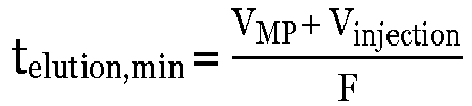
VMP is the volume of the mobile phase and Vinjection is the injected volume. - After the elution time, telution, the stationary phase was pushed out the column in the ascending mode by pumping the culture medium (CCC), respectively water (CPC)-rich phase. In both cases the phase was saturated with the solvent used for the extraction, methyl-tert-butyl ether for CCC and ethyl acetate for CPC. The fractions of the astaxanthin dissolved in the solvent coming out from the column were collected, evaporated and the astaxanthin content determined according to the procedure described in Example 5.
- The yield Yfeed was calculated as quotient of the mass of astaxanthin in the collected fractions mastaxanthin,fraction to the astaxanthin mass in injected feed biomass mastaxanthin,feed, as shown in
equation 2.equation 2: 
- Additionally, at every CCC (CPC) experiment, three shake flask experiments were performed, in order to determine the extractable amount of astaxanthin from the cells in the corresponding cell stage. Therefore 1 ml of the algae broth was mixed with 5 ml methyl-tert-butyl ether (CCC experiments) respectively ethyl acetate (CPC experiment) for 30 min. After centrifugation at 5500 rpm for 5 min, 4 ml of the solvent was taken and the astaxanthin content was determined according to the procedure described in Example 5. A yield Yextract, which takes the extractable amount of astaxanthin from the cells in the corresponding cell stage into account, was defined according to equation 3,
equation 3: 
- According to the results shown in the previous example such as example 6, methyl-tert-butyl ether was used as the extraction solvent in all CCC experiments and ethyl acetate in the CPC experiment. The germination was induced according to the conditions described in the previous examples. The following four operating conditions were examined in the CCC and one in the CPC column (Table 2). The obtained results are summarized in Table 2.
Table 2: Operating conditions for the experiments A - D in the CCC column and E in the CPC column. A B C D E Cbiomass injected / mg mL-1 4.95 2.95 2.95 4.97 16.8 6.72 8.65 Vinj / mL 0.5 0.5 2 2 5 10 2 5 720 mbiomass injected / mg 2.5 1.48 5.9 10.0 24.9 49.8 33.6 6055 mastaxathin injected / mg 0.026 0.027 0.108 0.1 0.33 0.66 0.57 63.95 telution / min 6.9 18.9 36.9 6.9 18.9 36.9 8.4 20.4 38.4 8.4 11.4 16.4 8.4 11.4 24 C1st fraction / mgastaxanthin L-1 2.5 2.5 2.5 4.9 5.6 5.0 29.5 29.8 25.5 46.9 124.8 507.6 195.7 179.6 338.8 Yextract / % 61.3 76.1 58.9 47.7 47.7 48.6 48.4 72.0 53.7 113.8 129.1 113.1 44.2 44.9 21.9 Yfeed / % 11.1 13.8 10.7 27.5 27.5 28.0 27.9 41.5 31.0 65.9 74.7 65.5 39.1 39.1 6.4 - In the operating conditions A, three different elution times were examined, namely 6.9 min, 18.9 min and 36.9 min. The injection volume (germinated algae broth) was 0.5 ml resulting in an injected amount of astaxanthin of 0.026 mg. Here, the influence of increasing elution times on the yield was investigated. Only the first and most concentrated fraction was analyzed for its astaxanthin content and used for the calculation of the yield. As presented in
Figure 7 , an increase of telution from 6.9 min to 36.9 min did not affect the yield Yextract of extracted astaxanthin. The calculated yields Yextract were in the range of 60 to 76 %. - To verify the results from operating condition A, in operating condition B three different elution times were examined for the injection volumes of 0.5 mL and 2 mL. For 0.5 mL the elution times were chosen similar to operating conditions A, were the column was emptied 6.9, 18.9 and 36.9 min after the injection of 0.5 mL germinated algae cells. For the injection volume of 2 mL of biomass, the elution times 8.4 min, 20.4 min and 38.4 min were examined. Only the first and most concentrated fraction was analyzed for its astaxanthin content and used for the calculation of the yield.
- Similar to the results of operating conditions A, the increase of the elution time did not affect the yields Yextract and Yfeed. For the injection of 0.5 mL, the values obtained for Yextract were around 48 %, values for Yfeed were around 28 %. The injections of 2 mL germinated algae broth show a similar trend. For an elution time of 8.4 min and 38.4 min, Yextract is 48 % and 54 %. For an elution time of 20.4 min, Yextract was calculated to be 72 %. For Yfeed, similar trends can be seen, yields of 27 %, 42 % and 31 % were obtained for the elution times of 8.4 min, 20.4 min and 36.4 min, respectively.
- In the operating conditions C, the influence of three different injection volumes, 2 mL, 5 mL and 10 mL on the yield and concentration of astaxanthin was examined. The astaxanthin content in the first two collected fractions was determined and the content of the low concentrated remaining fractions was determined after pouring these fractions together. For the calculation of the yields with equation (2) and (3), the mass of astaxanthin (mastaxanthin,fraction) in
fraction 1,fraction 2 and in the remaining fractions were summed up. As shown in the previous operating conditions A and B, an elution time longer than calculated with equation (1) doesn't affect the extracted amount of astaxanthin respectively the achieved yields. Consequently, telution were determined to be 8.4 min, 11.4 min and 16.4 min according to equation (1) for the injected volumes of 2 mL, 5 mL and 10 mL. The calculated yields Yextract were 113 % for the elution times of 8.4 min and 16.4 min and 130 % for 11.4 min and are presented inFigure 8 . The achieved yields Yfeed were 65 % for the elution times of 8.4 min and 16.4 min and 75 % for an elution time of 11.4 min. - In
Figure 9 the concentrations of the injected algae broth and the collectedfraction 1,fraction 2 and remaining fractions of the three injection volumes are shown. As it can be seen, the starting concentration of 65 mgastaxanthin L-1 in the injected algal broth is concentrated to 500 mgastaxanthin L-1 and 300 mgastaxanthin L-1 infraction 1 andfraction 2 when 10 mL were injected. - In operating conditions D, two different injection volumes of the germinated algae broth, 2 mL and 5 mL, were injected with two different biomass concentrations. For an injection volume of 2 mL, 16.8 mg mL-1 biomass and for an injection volume of 5 mL, 6.72 mg mL-1 biomass were injected. Thus, the injected amount of biomass respectively astaxanthin was the same in these experiments. The achieved Yextract was 44 %, Yfeed was 39 % for the injected volumes. In the run, where 2 mL algae broth were injected, the concentrations reached in the first and second fraction were 195 mgastaxanthin L-1 and 48 mgastaxanthin L-1. Similar values were reached, when 5 mL were injected resulting in concentrations of 180 mgastaxanthin L-1 and 50 mgastaxanthin L-1 for
fraction - In the CPC run, 720 ml germinated cell broth was injected into the CPC, corresponding to a biomass of 6055 mg and 63.95 mg astaxanthin, respectively. In the first collected fraction an astaxanthin content of 338 mg L-1 was measured. The yield Yextract was 21.9%.
- A pilot plant with PTFE hollow fibers with a total surface area of 0.1619 m2 was used for membrane-assisted liquid-liquid extraction. The solvent ethyl acetate and the homogenized H. pluvialis cysts were placed in two separate reservoirs. The solvent ethyl acetate was pumped in to the shell side and homogenized H. pluvialis cysts were pumped in the lumen side (in the tubes) of the hollow fiber membrane module. The two streams, ethyl acetate and the homogenized H. pluvialis cysts broth were pumped concurrently and circulated at the respective site of the membrane (
Fig 10 ). The run was stopped after 3 h. Astaxanthin was extracted from the fermentation broth into the solvent. Before the run, a shake flask experiment was performed similar to the CCC/CPC experiments. The absorbance of the extracted pigments was measured with UV/Vis spectroscopy at 478 nm to be 23.5. Three hours after starting the run, an absorbance of 0.333 at 478 nm was measured for the solvent circulated in the shell side of the plant. Assuming an infinite long extraction time, the same yield as in a shake flask experiment i.e. around 90%, this means a one stage extraction, can be expected. -
- [1] Koller M, Muhr A, and Braunegg G. Microalgae as versatile cellular factories for valued products. Algal Research, 2014; 6, 52-63.
- [2] Shah MMR, Liang Y, Cheng JJ, Daroch M. Astaxanthin-Producing Green Microalga Haematococcus pluvialis: From Single Cell to High Value Commerical Products. Frontiers in Plant Science. 2016; 7.
- [3] R. Praveenkumar, K. Lee, J. Lee and Y.-K. Oh, Breaking dormancy: an energy-efficient means of recovering astaxanthin from microalgae, Green Chemistry, 2014; 17, 1226-1234.
- [4] Marchal L, Mojaat-Guemir M, Foucault A and Pruvost J. Centrifugal partition extraction of β-carotene from Dunaliella salina for efficient and biocompatible recovery of metabolites, Bioresource Technology, 2013; 134, 396-400.
- [5] Xiping Du, Congcong Dong, Kai Wang, Zedong Jiang, Yanhong Chen,Yuanfan Yang, Feng Chen, Hui Ni. Separation and purification of astaxanthin from Phaffia rhodozyma by preparative high-speed counter-current chromatography. Journal of Chromatography B. 2016; 1029-1030,191-197.
- [6] David R. Lide e. CRC Handbook of Chemistry and Physics, Internet Version 2005. 2005.
- [7] Taucher J, Baer S, Schwerna P, Hofmann D, Hümmer M, Buchholz R, et al. Cell Disruption and Pressurized Liquid Extraction of Carotenoids from Microalgae. Journal of Thermodynamics & Catalysis. 2016; 7(1):7.
- The features of the present invention disclosed in the specification, the claims, and/or in the accompanying figures may, both separately and in any combination thereof, be material for realizing the invention in various forms thereof.
Claims (15)
- A method of extracting a pigment from microalgae, comprising the following steps:a) Providing microalgae in an aqueous culture medium, wherein said microalgae are enriched with a pigment,b) Inducing said microalgae to enter a flagellated stage using a germination-inducing condition, and/or disrupting said microalgae resulting in a suspension comprising said disrupted microalgae and said pigment,c) Extracting said pigment from said flagellated microalgae and/or from said suspension using a liquid-liquid extraction system comprising a solvent, wherein the liquid-liquid extraction system is selected from a countercurrent chromatography system, a centrifugal partition chromatography system, and a membrane-assisted liquid-liquid extraction system.
- The method according claim 1, wherein said method comprises the following steps:a) Providing microalgae in an aqueous culture medium, wherein said microalgae are enriched with a pigment,b) Inducing said microalgae to enter a flagellated stage using a germination-inducing condition,c) Extracting said pigment from said flagellated microalgae using a liquid-liquid extraction system comprising a solvent, wherein the liquid-liquid extraction system is selected from a countercurrent chromatography system, a centrifugal partition chromatography system, and a membrane-assisted liquid-liquid extraction system.
- The method according to claim 1, wherein said method comprises the following steps:a) Providing microalgae in an aqueous culture medium, wherein said microalgae are enriched with a pigment,b) Disrupting said microalgae resulting in a suspension of said disrupted microalgae and said pigment,c) Extracting said pigment from said suspension using a liquid-liquid extraction system comprising a solvent, wherein the liquid-liquid extraction system is selected from a countercurrent chromatography system, a centrifugal partition chromatography system, and a membrane-assisted liquid-liquid extraction system.
- The method according to claim 1 or 2, wherein said microalgae are initially in a cyst stage and are induced to enter a flagellated stage by means of a germination-inducing condition.
- The method according to claim 1, 2, or 4, wherein said germination-inducing condition is selected from a phototrophic condition, a mixotrophic condition, and a heterotrophic condition.
- The method according to claim 1 or 3, wherein said microalgae are disrupted mechanically, for example by using a homogenizer, a grinder, a bead mill, beadbeating, a blender, sonication, pressure cycling, a microfluidizer, an expeller press, or freezing and thawing cycles.
- The method according to any of the foregoing claims, wherein said step c) is followed by
step d) obtaining said pigment by lyophilization, freezing, vaporization of said solvent, or by dissolving said pigment in a nutritional oil, or another solvent, such as an organic solvent, a water based solution, a plant oil, or a deep eutectic solvent, or a combination thereof. - The method according to any of the foregoing claims, wherein said microalgae have become enriched with said pigment by nutrient depletion, excessive light exposure, high salinity, and/or overexpression resulting from genetic modification of said microalgae.
- The method according to any of the foregoing claims, wherein said microalgae are Chlorophyta, preferably Chlorophyceae, more preferably Haematococcus pluvialis.
- The method according to any of claims 1-8, wherein said microalgae are selected from Haematococcus pluvialis, Chlorella zofingiensis, Neochloris wimmeri, and Chlamydomonas nivalis.
- The method according to any of the foregoing claims, wherein said liquid-liquid extraction system is a membrane-assisted liquid-liquid extraction system.
- The method according to any of claims 1-10, wherein said liquid-liquid extraction system is a liquid-liquid chromatography system selected from a centrifugal partition chromatography system and a countercurrent chromatography system.
- The method according to any of the foregoing claims, wherein said solvent has a vapor pressure of at least 10 mbar, preferably of at least 64 mbar, at 25 °C and ambient pressure.
- The method according to any of the foregoing claims, wherein said solvent is selected from methyl-tert-butyl ether, ethyl acetate, butan-1-ol, dichloromethane, chloroform, diethyl ether, ethyl methyl ether, toluene, benzene, ketone, 1,1-dichloroethane, cyclohexane, isopropyl acetate, 2-methyltetrahydofuran, methyl ethyl ketone, methylcyclohexane, 2,2,4-trimethylpentane, xylene, pentan-i-ol, dodecane, decane, acetone, ethanol, propan-2-ol, propan-1-ol, methanol, tetrahydrofuran, tert-butanol, acetonitrile, dimethyl sulfoxide, acetic acid, ethylene glycol, n-alkanes, and oil such as nutritional oil, or a combination thereof, preferably selected from ethyl acetate and methyl-tert-butyl ether, or a combination thereof.
- The method according to any of the foregoing claims, wherein said pigment is a keto-carotenoid, preferably astaxanthin.
Priority Applications (5)
| Application Number | Priority Date | Filing Date | Title |
|---|---|---|---|
| EP18204120.2A EP3647432A1 (en) | 2018-11-02 | 2018-11-02 | Method of extracting a pigment from microalgae |
| EP19805542.8A EP3853374A1 (en) | 2018-11-02 | 2019-10-28 | Method of extracting a pigment from microalgae |
| CN201980085563.6A CN113260709A (en) | 2018-11-02 | 2019-10-28 | Method for extracting pigments from microalgae |
| US17/288,037 US20210381021A1 (en) | 2018-11-02 | 2019-10-28 | Method of extracting a pigment from microalgae |
| PCT/EP2019/079408 WO2020089173A1 (en) | 2018-11-02 | 2019-10-28 | Method of extracting a pigment from microalgae |
Applications Claiming Priority (1)
| Application Number | Priority Date | Filing Date | Title |
|---|---|---|---|
| EP18204120.2A EP3647432A1 (en) | 2018-11-02 | 2018-11-02 | Method of extracting a pigment from microalgae |
Publications (1)
| Publication Number | Publication Date |
|---|---|
| EP3647432A1 true EP3647432A1 (en) | 2020-05-06 |
Family
ID=64172274
Family Applications (2)
| Application Number | Title | Priority Date | Filing Date |
|---|---|---|---|
| EP18204120.2A Withdrawn EP3647432A1 (en) | 2018-11-02 | 2018-11-02 | Method of extracting a pigment from microalgae |
| EP19805542.8A Withdrawn EP3853374A1 (en) | 2018-11-02 | 2019-10-28 | Method of extracting a pigment from microalgae |
Family Applications After (1)
| Application Number | Title | Priority Date | Filing Date |
|---|---|---|---|
| EP19805542.8A Withdrawn EP3853374A1 (en) | 2018-11-02 | 2019-10-28 | Method of extracting a pigment from microalgae |
Country Status (4)
| Country | Link |
|---|---|
| US (1) | US20210381021A1 (en) |
| EP (2) | EP3647432A1 (en) |
| CN (1) | CN113260709A (en) |
| WO (1) | WO2020089173A1 (en) |
Cited By (2)
| Publication number | Priority date | Publication date | Assignee | Title |
|---|---|---|---|---|
| CN113030333A (en) * | 2021-03-23 | 2021-06-25 | 贵州中烟工业有限责任公司 | Method for measuring plastid pigment content in tobacco shreds |
| FR3159605A1 (en) | 2024-02-26 | 2025-08-29 | Delled | Use of bio-sourced lipid in a biphasic Centrifugal Partition Chromatography system |
Families Citing this family (3)
| Publication number | Priority date | Publication date | Assignee | Title |
|---|---|---|---|---|
| CN108504619B (en) * | 2018-06-06 | 2021-06-01 | 中国科学院海洋研究所 | A method for alleviating photoinhibition of Haematococcus pluvialis |
| CN119432117A (en) * | 2024-11-18 | 2025-02-14 | 南京工业大学 | Extractant and method for extracting microalgae pigment |
| CN119701403B (en) * | 2024-12-19 | 2025-12-19 | 广东药科大学 | Separation method for synchronously separating haematococcus pluvialis active substances |
Citations (1)
| Publication number | Priority date | Publication date | Assignee | Title |
|---|---|---|---|---|
| WO2014134411A1 (en) * | 2013-02-28 | 2014-09-04 | Valicor, Inc. | Algae extraction process |
-
2018
- 2018-11-02 EP EP18204120.2A patent/EP3647432A1/en not_active Withdrawn
-
2019
- 2019-10-28 CN CN201980085563.6A patent/CN113260709A/en active Pending
- 2019-10-28 WO PCT/EP2019/079408 patent/WO2020089173A1/en not_active Ceased
- 2019-10-28 EP EP19805542.8A patent/EP3853374A1/en not_active Withdrawn
- 2019-10-28 US US17/288,037 patent/US20210381021A1/en not_active Abandoned
Patent Citations (1)
| Publication number | Priority date | Publication date | Assignee | Title |
|---|---|---|---|---|
| WO2014134411A1 (en) * | 2013-02-28 | 2014-09-04 | Valicor, Inc. | Algae extraction process |
Non-Patent Citations (12)
| Title |
|---|
| DAVID R. LIDE E, CRC HANDBOOK OF CHEMISTRY AND PHYSICS, 2005 |
| JIAN-PING YUAN ET AL: "Hydrolysis Kinetics of Astaxanthin Esters and Stability of Astaxanthin of Haematococcus pluvialis during Saponification", JOURNAL OF AGRICULTURAL AND FOOD CHEMISTRY, vol. 47, no. 1, 1 January 1999 (1999-01-01), US, pages 31 - 35, XP055540265, ISSN: 0021-8561, DOI: 10.1021/jf980465x * |
| KAY GRÜNEWALD ET AL: "Secondary carotenoid accumulation in flagellates of the green alga Haematococcus lacustris", EUROPEAN JOURNAL OF PHYCOLOGY, vol. 32, no. 4, 26 November 1997 (1997-11-26), DE, pages 387 - 392, XP055540359, ISSN: 0967-0262, DOI: 10.1080/09670269710001737329 * |
| KOLLER M; MUHR A; BRAUNEGG G: "Microalgae as versatile cellular factories for valued products", ALGAL RESEARCH, vol. 6, 2014, pages 2 - 63 |
| LI H-B ET AL: "Preparative isolation and purification of astaxanthin from the microalga Chlorococcum sp. by high-speed counter-current chromatography", JOURNAL OF CHROMATOGRAPHY, ELSEVIER, AMSTERDAM, NL, vol. 925, no. 1-2, 3 August 2001 (2001-08-03), pages 133 - 137, XP004296306, ISSN: 0021-9673, DOI: 10.1016/S0021-9673(01)01022-6 * |
| LUC MARCHAL ET AL: "Centrifugal partition extraction of [beta]-carotene from Dunaliella salina for efficient and biocompatible recovery of metabolites", BIORESOURCE TECHNOLOGY, vol. 134, 13 February 2013 (2013-02-13), AMSTERDAM, NL, pages 396 - 400, XP055541111, ISSN: 0960-8524, DOI: 10.1016/j.biortech.2013.02.019 * |
| MARCHAL L; MOJAAT-GUEMIR M; FOUCAULT A; PRUVOST J: "Centrifugal partition extraction of β-carotene from Dunaliella salina for efficient and biocompatible recovery of metabolites", BIORESOURCE TECHNOLOGY, vol. 134, 2013, pages 396 - 400 |
| R. PRAVEENKUMAR; K. LEE; J. LEE; Y.-K. OH: "Breaking dormancy: an energy-efficient means of recovering astaxanthin from microalgae", GREEN CHEMISTRY, vol. 17, 2014, pages 1226 - 1234 |
| SHAH MMR; LIANG Y; CHENG JJ; DAROCH M: "Astaxanthin-Producing Green Microalga Haematococcus pluvialis: From Single Cell to High Value Commerical Products", FRONTIERS IN PLANT SCIENCE, vol. 7, 2016 |
| SHENGZHAO DONG ET AL: "Four Different Methods Comparison for Extraction of Astaxanthin from Green Alga Haematococcus pluvialis", THE SCIENTIFIC WORLD JOURNAL, vol. 2014, 1 January 2014 (2014-01-01), pages 1 - 7, XP055539500, ISSN: 2356-6140, DOI: 10.1155/2014/694305 * |
| TAUCHER J; BAER S; SCHWERNA P; HOFMANN D; HUMMER M; BUCHHOLZ R ET AL.: "Cell Disruption and Pressurized Liquid Extraction of Carotenoids from Microalgae", JOURNAL OF THERMODYNAMICS & CATALYSIS, vol. 7, no. 1, 2016, pages 7 |
| XIPING DU; CONGCONG DONG; KAI WANG; ZEDONG JIANG; YANHONG CHEN; YUANFAN YANG; FENG CHEN; HUI NI: "Separation and purification of astaxanthin from Phaffia rhodozyma bypreparative high-speed counter-current chromatography", JOURNAL OF CHROMATOGRAPHY B, vol. 1029, no. 1030, 2016, pages 191 - 197 |
Cited By (2)
| Publication number | Priority date | Publication date | Assignee | Title |
|---|---|---|---|---|
| CN113030333A (en) * | 2021-03-23 | 2021-06-25 | 贵州中烟工业有限责任公司 | Method for measuring plastid pigment content in tobacco shreds |
| FR3159605A1 (en) | 2024-02-26 | 2025-08-29 | Delled | Use of bio-sourced lipid in a biphasic Centrifugal Partition Chromatography system |
Also Published As
| Publication number | Publication date |
|---|---|
| US20210381021A1 (en) | 2021-12-09 |
| EP3853374A1 (en) | 2021-07-28 |
| CN113260709A (en) | 2021-08-13 |
| WO2020089173A1 (en) | 2020-05-07 |
Similar Documents
| Publication | Publication Date | Title |
|---|---|---|
| US20210381021A1 (en) | Method of extracting a pigment from microalgae | |
| Rammuni et al. | Comparative assessment on the extraction of carotenoids from microalgal sources: Astaxanthin from H. pluvialis and β-carotene from D. salina | |
| Aneesh et al. | Bioactivities of astaxanthin from natural sources, augmenting its biomedical potential: A review | |
| Bauer et al. | Direct extraction of astaxanthin from the microalgae Haematococcus pluvialis using liquid–liquid chromatography | |
| Mussagy et al. | Production and extraction of carotenoids produced by microorganisms | |
| Rajendran et al. | Microbial pigments: eco-friendly extraction techniques and some industrial applications | |
| Praveenkumar et al. | Breaking dormancy: an energy-efficient means of recovering astaxanthin from microalgae | |
| Singh et al. | Characterization of a new zeaxanthin producing strain of Chlorella saccharophila isolated from New Zealand marine waters | |
| Marchal et al. | Centrifugal partition extraction of β-carotene from Dunaliella salina for efficient and biocompatible recovery of metabolites | |
| Li et al. | A novel potential source of β-carotene: Eustigmatos cf. polyphem (Eustigmatophyceae) and pilot β-carotene production in bubble column and flat panel photobioreactors | |
| Sundararajan et al. | Current perspectives on industrial application of microbial carotenoid as an alternative to synthetic pigments | |
| US9315434B2 (en) | Method for preparing a composition rich in lutein produced by microalgae | |
| Pangestuti et al. | Seaweed-derived carotenoids | |
| CN101173214A (en) | High Astaxanthin Production Mutant Strain of Haematococcus Pluvialls | |
| Pajot et al. | Improving the extraction and the purification of fucoxanthin from Tisochrysis lutea using centrifugal partition chromatography | |
| Emtyazjoo et al. | Anticancer effect of Dunaliella salina under stress and normal conditions against skin carcinoma cell line A431 in vitro | |
| Ambati et al. | Enhancement of carotenoids in green alga-Botryococcus braunii in various autotrophic media under stress conditions | |
| EP1681060B1 (en) | Improved process for obtaining carotene and carotenoids from algae or cyanobacteria | |
| Garg et al. | Microalgal nutraceuticals: unravelling solution to food-health nexus | |
| CA2684914C (en) | Method for the intensive extraction of cellular compounds from micro-organisms by continuous culture and extraction, and corresponding device | |
| Aburai et al. | Carotenoid accumulation in aerial microalga Coelastrella rubescens KGU-H009 in light-and nitrogen-stress conditions | |
| KR20110116722A (en) | Method for preparing astaxanthin-containing extract from green algae | |
| WO2010063256A2 (en) | Method for producing carotenoids | |
| Šovljanski et al. | Microorganisms as Biotechnological Source of Carotenoids | |
| WO2018234603A1 (en) | PROCESS FOR THE EXTRACTION OF CAROTENOIDS USING NANOSTRUCTURED LIQUID PHASES |
Legal Events
| Date | Code | Title | Description |
|---|---|---|---|
| PUAI | Public reference made under article 153(3) epc to a published international application that has entered the european phase |
Free format text: ORIGINAL CODE: 0009012 |
|
| STAA | Information on the status of an ep patent application or granted ep patent |
Free format text: STATUS: THE APPLICATION HAS BEEN PUBLISHED |
|
| AK | Designated contracting states |
Kind code of ref document: A1 Designated state(s): AL AT BE BG CH CY CZ DE DK EE ES FI FR GB GR HR HU IE IS IT LI LT LU LV MC MK MT NL NO PL PT RO RS SE SI SK SM TR |
|
| AX | Request for extension of the european patent |
Extension state: BA ME |
|
| STAA | Information on the status of an ep patent application or granted ep patent |
Free format text: STATUS: THE APPLICATION IS DEEMED TO BE WITHDRAWN |
|
| 18D | Application deemed to be withdrawn |
Effective date: 20201107 |