EP3644680A1 - Wireless communication method and device - Google Patents
Wireless communication method and device Download PDFInfo
- Publication number
- EP3644680A1 EP3644680A1 EP18820875.5A EP18820875A EP3644680A1 EP 3644680 A1 EP3644680 A1 EP 3644680A1 EP 18820875 A EP18820875 A EP 18820875A EP 3644680 A1 EP3644680 A1 EP 3644680A1
- Authority
- EP
- European Patent Office
- Prior art keywords
- scheduling request
- timer
- transmitting
- resource
- scheduling
- Prior art date
- Legal status (The legal status is an assumption and is not a legal conclusion. Google has not performed a legal analysis and makes no representation as to the accuracy of the status listed.)
- Granted
Links
Images

Classifications
-
- H—ELECTRICITY
- H04—ELECTRIC COMMUNICATION TECHNIQUE
- H04W—WIRELESS COMMUNICATION NETWORKS
- H04W72/00—Local resource management
- H04W72/20—Control channels or signalling for resource management
-
- H—ELECTRICITY
- H04—ELECTRIC COMMUNICATION TECHNIQUE
- H04W—WIRELESS COMMUNICATION NETWORKS
- H04W72/00—Local resource management
- H04W72/20—Control channels or signalling for resource management
- H04W72/21—Control channels or signalling for resource management in the uplink direction of a wireless link, i.e. towards the network
-
- H—ELECTRICITY
- H04—ELECTRIC COMMUNICATION TECHNIQUE
- H04L—TRANSMISSION OF DIGITAL INFORMATION, e.g. TELEGRAPHIC COMMUNICATION
- H04L5/00—Arrangements affording multiple use of the transmission path
- H04L5/003—Arrangements for allocating sub-channels of the transmission path
- H04L5/0053—Allocation of signalling, i.e. of overhead other than pilot signals
- H04L5/0055—Physical resource allocation for ACK/NACK
-
- H—ELECTRICITY
- H04—ELECTRIC COMMUNICATION TECHNIQUE
- H04W—WIRELESS COMMUNICATION NETWORKS
- H04W72/00—Local resource management
- H04W72/12—Wireless traffic scheduling
- H04W72/1263—Mapping of traffic onto schedule, e.g. scheduled allocation or multiplexing of flows
-
- H—ELECTRICITY
- H04—ELECTRIC COMMUNICATION TECHNIQUE
- H04W—WIRELESS COMMUNICATION NETWORKS
- H04W76/00—Connection management
- H04W76/20—Manipulation of established connections
- H04W76/27—Transitions between radio resource control [RRC] states
-
- H—ELECTRICITY
- H04—ELECTRIC COMMUNICATION TECHNIQUE
- H04W—WIRELESS COMMUNICATION NETWORKS
- H04W80/00—Wireless network protocols or protocol adaptations to wireless operation
- H04W80/02—Data link layer protocols
Definitions
- the present disclosure relates to the wireless communications technologies field, and specifically to a method and device for transmitting a scheduling request.
- NB-IoT NarrowBand IOT
- 3GPP 3rd Generation Partnership Project
- LTE Long Term Evolution
- NB-IoT is configured to operate in narrowband systems of uplink/downlink 180 KHz.
- first-stage NB-IoT systems the basic functional design has been completed, including system information broadcast notification, point-to-point unicast uplink data transmission, downlink data reception, and so on.
- system information broadcast notification point-to-point unicast uplink data transmission
- downlink data reception and so on.
- BSR Buffer Status Report
- a solution is proposed in the prior art to transmit a scheduling request to a network side using an ACK/NACK feedback resource of downlink data.
- This solution greatly benefits a user with good signal coverage.
- a problem that needs to be solved is how to avoid activation of the function for a user with weak signal coverage.
- the successful transmission of the scheduling request depends on the existence of an available ACK/NACK feedback resource, that is, arrival of downlink data is required first. If a UE has not received downlink data for a long time, correspondingly, the UE will not have any available ACK/NACK feedback resource to carry the generated scheduling request.
- a problem that needs to be solved is how to avoid unnecessary waiting of a UE and transmit a scheduling request or a BSR to the network side in time.
- the present disclosure provides a method and device for transmitting a scheduling request.
- a method performed by user equipment comprising: initiating a first timer based on a state related to a scheduling request; and when the first timer expires, then transmitting information related to the scheduling request.
- the state related to the scheduling request may comprise: the scheduling request is triggered; the scheduling request is triggered and no other unprocessed scheduling requests exist; the scheduling request is transmitted; or a second timer prohibiting transmitting the scheduling request expires.
- the first timer may be initiated or reinitiated when the following case exists: a media access control (MAC) layer obtains a resource capable of being used to transmit the scheduling request; or the MAC layer instructs a physical layer to transmit the scheduling request on an uplink resource.
- MAC media access control
- the MAC layer when the scheduling request is triggered or a pending scheduling request needs to be transmitted, the MAC layer indicates to the physical layer that the scheduling request needs to be transmitted. When an available resource exists, the physical layer indicates to the MAC layer that the available resource exists to transmit the scheduling request.
- the available resource comprises a physical uplink control channel or a physical uplink shared channel for transmitting an ACK/NACK.
- a timer duration set when the first timer is initiated is different from a timer duration set when the first timer is reinitiated.
- the method may further comprise: when all unprocessed scheduling requests are canceled, stopping the first timer.
- the method may further comprise: when the second timer prohibiting transmitting the scheduling request is initiated, if the first timer is running, then stopping the first timer; and when the second timer prohibiting transmitting the scheduling request expires, reinitiating the first timer.
- the transmitting information related to the scheduling request may comprise transmitting the scheduling request through a dedicated resource or by adopting a random access manner.
- user equipment comprising a processor and a memory.
- the memory stores instructions that, when run by the processor, perform the method described above.
- an LTE mobile communications system and its later evolved versions are used as exemplary application environments; a base station and a terminal device that support NB-IoT are used as examples to set forth a plurality of embodiments of the present disclosure in detail.
- the present disclosure is not limited to the following embodiments, but is applicable to more other wireless communications systems such as a future 5G cellular communications system, and is applicable to other base stations and terminal devices such as base stations and terminal devices supporting eMTC, MMTC, and so on.
- the present disclosure proposes to configure a timer on the UE side.
- the timer may be configured on a physical layer, or may be configured on a MAC layer or at other locations.
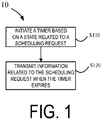
- FIG. 1 is a flowchart of a method 10 performed by user equipment (UE) according to an embodiment of the present disclosure.
- a first timer is initiated based on a state related to a scheduling request.
- the state related to the scheduling request may include: the scheduling request is triggered; the scheduling request is triggered and no other unprocessed or pending scheduling requests exist; the scheduling request is transmitted; or a second timer prohibiting transmitting the scheduling request expires, or the like.
- the first timer may be initiated or reinitiated when the following case exists: a media access control (MAC) layer or a MAC entity obtains a resource capable of being used to transmit the scheduling request; or the MAC layer or the MAC entity instructs a lower layer, for example, a physical layer, to transmit the scheduling request on an uplink resource; or the scheduling request is transmitted.
- the uplink resource may be a PUCCH resource or a PUSCH resource for transmitting an ACK/NACK, or a physical uplink control channel or a physical uplink shared channel for transmitting an ACK/NACK in an NB-Iot system.
- the uplink resource may further be other resources capable of being used to transmit the scheduling request, for example, a dedicated resource.
- the MAC layer or the MAC entity when the scheduling request is triggered or a pending scheduling request needs to be transmitted, the MAC layer or the MAC entity indicates to the lower layer, for example, the physical layer, that the scheduling request needs to be transmitted. Optionally, it may further be indicated that the scheduling request needs to be transmitted through a resource related to an ACK/NACK.
- the first timer may be initiated when or after the physical layer receives the indication.
- the physical layer may indicate to an upper layer, for example, the MAC layer or the MAC entity, that the available or valid resource exists.
- the scheduling request can be transmitted. At the same time, when the available or valid resource exists, the first timer may be stopped.
- the first timer may be stopped.
- the available or valid resource may be a physical uplink control channel or a physical uplink shared channel for transmitting an ACK/NACK.
- the available resource may further be a physical uplink control channel or a physical uplink shared channel for transmitting an ACK/NACK in an NB-Iot system.
- the available resource may further be other resources capable of being used to transmit the scheduling request, for example, a dedicated resource.
- the MAC layer or the MAC entity When the MAC layer or the MAC entity receives the indication that the available resource exists, the valid resource exists, or the scheduling request can be transmitted, it can be determined that the MAC layer or the MAC entity obtains an uplink resource capable of being used to transmit the scheduling request. Based on the determination, the MAC layer or the MAC entity can instruct the lower layer (for example, the physical layer) to transmit the scheduling request on the uplink resource.
- the lower layer for example, the physical layer
- the duration of the first timer may be broadcast in system information; the UE obtains the duration by receiving the system information and configures the first timer. Alternatively, the UE may obtain the duration of the first timer through dedicated signaling and configure the first timer.
- a timer duration set when the first timer is initiated is different from a timer duration set when the first timer is reinitiated.
- the duration of the first timer may be set to X1 (the unit of which may be seconds or TTI lengths).
- the duration of the timer may be set to X2 (the unit of which may be seconds or TTI lengths).
- X1 may be equal to X2, or X2 may be greater than X1.
- the UE may be judged whether the UE initiates the timer or reinitiates the timer. Specifically, when the first timer is not yet running and the timer needs to be initiated, the UE initiates the first timer. When the first timer is running and the timer needs to be initiated, the UE reinitiates the first timer.
- the first timer may be initiated.
- the second timer prohibiting transmitting the scheduling request refers to a timer initiated after the UE transmits the scheduling request. During running of the second timer, The UE is not allowed to transmit the scheduling request again.
- the second timer prohibiting transmitting the scheduling request when the second timer prohibiting transmitting the scheduling request is initiated, if the first timer is running, then the first timer is stopped. When the second timer prohibiting transmitting the scheduling request expires, the first timer is reinitiated.
- the UE may stop the first timer.
- the UE may stop the first timer.
- the second timer prohibiting transmitting the scheduling request is initiated or the scheduling request is transmitted, if the first timer is running, then the UE may stop the first timer.
- the second timer prohibiting transmitting the scheduling request expires, the first timer may be reinitiated.
- step S120 when the first timer expires, then information related to the scheduling request is transmitted.
- the transmitting information related to the scheduling request may include transmitting the scheduling request through a dedicated resource or by adopting a random access manner.
- the UE may trigger a random access procedure.
- the UE may transmit information related to scheduling, including, but not limited to, a scheduling request or a BSR to a network side in the following manner.
- the specific manner includes: triggering a random access procedure through which the UE may transmit the BSR or the scheduling request to the network side; transmitting the BSR or the scheduling request to the network side through a dedicated resource; or transmitting the BSR or the scheduling request to the network side by contention-free access.
- the aforementioned operation may be directly triggered after the first timer expires. If the first timer is configured on the physical layer, then after the first timer expires, the physical layer transmits indication information to the MAC layer, where the information may be waiting for an ACK/NACK resource to fail, or no available valid resource exists, or the scheduling request cannot be transmitted, or the like. The aforementioned operation is triggered after the MAC layer receives the aforementioned information.
- the present disclosure further proposes that the UE may receive information from the network side, where the information instructs the UE to activate a function of carrying a scheduling request using an ACK/NACK resource. After the UE receives the indication information of the network side, the function of carrying the scheduling request using the ACK/NACK resource is activated.
- the information may be carried in a MAC CE (for example, a MAC header).
- the value of an LCID may be used to indicate activation/deactivation of the function. For example, when the value of the LCID is 10111, it is indicated that the function can be activated. When the value of the LCID is 11000, it is indicated that the function is deactivated.
- the indication information may further be carried in an RRC message, for example, a message transmitted from the network side to the UE.
- the information may be indicated using 1 bit in a message carrying a configuration related to a scheduling request, and when the value of the bit is '0', it is indicated that the function is deactivated. When the value of the bit is '1', it is indicated that the function can be activated and vice versa.
- the indication information may further be carried in DCI.
- the information may be explicitly or implicitly indicated in the DCI.
- to activate or not to activate the function may be indicated through different MCSs indicating an ACK/NACK in the DCI.
- MCS BPSK
- MCS QPSK
- the DCI may include a field value, for example, represented by 1 bit.
- the indication information in the DCI may only indicate whether the function can be activated on an ACK/NACK resource scheduled by the DCI.
- the network side may further judge, according to information such as uplink or downlink signal strength or a coverage level of the UE, whether the UE can continue to use the function. For example, when the network side judges that the UE cannot use the function, the network side transmits indication information to the UE to deactivate the function.
- information such as uplink or downlink signal strength or a coverage level of the UE
- the UE may, according to the information such as the signal strength or coverage level, judge whether the function needs to be activated or judge whether the function needs to be requested from the network side.
- the judgment procedure may be as follows: if the current signal strength of the UE is greater than a threshold, then the UE judges that the function can be activated.
- the UE may transmit information to the network side to request the function to be activated.
- the judgment procedure may further be as follows: the UE is currently at a coverage level X; then, the UE at the level always activates the function or may request the network side to activate the function.
- the UE When the current coverage of the UE cannot meet requirements of the level X, for example, changes to a coverage level Y (as compared with X, the coverage level Y here represents weak coverage strength), then the UE does not activate the function or does not request the function to be activated.
- the threshold or coverage level for judgment is notified by the network side to the UE through broadcasting or dedicated signaling or adopting a predefined manner.
- the UE may transmit, through RRC signaling, information requesting the function to be activated, or cause the information to be carried in a MAC control element.
- the UE may initiate the aforementioned first timer only when receiving indication information (indicating activation of the function of carrying the scheduling request using the ACK/NACK resource).
- the UE can initiate the first timer only when the function of carrying the scheduling request using the ACK/NACK resource is activated.
- FIG. 2 is a block diagram of user equipment 20 according to an embodiment of the present disclosure.
- the user equipment 20 includes a processor 210 and a memory 220.
- the processor 210 may, for example, include a microprocessor, a microcontroller, an embedded processor, or the like.
- the memory 220 may, for example, include a volatile memory (for example, a random access memory (RAM)), a hard disk drive (HDD), a non-volatile memory (for example, a flash memory), or other memories.
- the memory 220 stores program instructions. The instructions, when run by the processor 210, can perform the aforementioned method performed by user equipment (for example, the method shown in FIG. 1 ) described in detail in the present disclosure.
- the program running on the device may be a program that enables a computer to implement the functions of the embodiments of the present disclosure by controlling a central processing unit (CPU).
- the program or information processed by the program may be temporarily stored in a volatile memory (for example, a random access memory (RAM)), a hard disk drive (HDD), a non-volatile memory (for example, a flash memory), or other memory systems.
- a volatile memory for example, a random access memory (RAM)
- HDD hard disk drive
- non-volatile memory for example, a flash memory
- the program for implementing the functions of the embodiments of the present disclosure may be recorded on a computer-readable recording medium.
- the corresponding functions can be achieved by the computer system through reading programs recorded on the recording medium and executing them.
- the so-called "computer system” herein may be a computer system embedded in the device, which may include operating systems or hardware (for example, peripherals).
- the "computer-readable recording medium” may be a semiconductor recording medium, an optical recording medium, a magnetic recording medium, a recording medium for programs that are dynamically stored for a short time, or any other computer-readable recording medium.
- circuits for example, monolithic or multi-chip integrated circuits.
- Circuits designed to execute the functions described in this description may include general-purpose processors, digital signal processors (DSPs), application specific integrated circuits (ASICs), field programmable gate arrays (FPGAs) or other programmable logic devices, discrete gates or transistor logic, or discrete hardware components, or any combination of the above.
- the general-purpose processor may be a microprocessor, or may be an existing processor, a controller, a microcontroller, or a state machine.
- the circuit may be a digital circuit or an analog circuit.
- the present disclosure is not limited to the embodiments described above. Although various examples of the described embodiments have been described, the present disclosure is not limited thereto.
- Fixed or non-mobile electronic devices installed indoors or outdoors such as AV equipment, kitchen equipment, cleaning equipment, air conditioners, office equipment, vending machines, and other household appliances, may be used as terminal devices or communications devices.
Landscapes
- Engineering & Computer Science (AREA)
- Signal Processing (AREA)
- Computer Networks & Wireless Communication (AREA)
- Mobile Radio Communication Systems (AREA)
Abstract
Description
- The present disclosure relates to the wireless communications technologies field, and specifically to a method and device for transmitting a scheduling request.
- With the rapid growth of mobile communication and great progress of technology, the world will move toward a fully interconnected network society where anyone or anything can acquire information and share data anytime and anywhere. It is estimated that there will be 50 billion interconnected devices by 2020, of which only about 10 billion may be mobile phones and tablet computers. The rest are not machines communicating with human beings but machines communicating with one another. Therefore, how to design a system to better support the Internet of Everything is a subject needing further and intensive study.
- In order to better implement the Internet of Everything, a new work item (see non-patent literature: RP-151621 New Work Item: NarrowBand IOT (NB-IoT)), which may be referred to as narrowband Internet of Things (NB-IoT), was proposed in the 3rd Generation Partnership Project (3GPP) Long Term Evolution (LTE) standard at the 3GPP RAN#69 plenary meeting held in September 2015. In the description of the project, in order to meet the requirements for low power consumption, long standby time, lowered costs, and wide coverage of Internet of Things terminals, NB-IoT is configured to operate in narrowband systems of uplink/downlink 180 KHz. Regarding first-stage NB-IoT systems, the basic functional design has been completed, including system information broadcast notification, point-to-point unicast uplink data transmission, downlink data reception, and so on. In the first-stage NB-Iot systems, once a terminal side has uplink data to be transmitted, a random access procedure needs to be initiated to transmit a BSR (Buffer Status Report) to a network side.
- In order to further enhance the function, a new work item (see non-patent literature: RP-170852 New WID on Further NB-IoT enhancements) was established at the 3GPP RAN#75 plenary meeting held in March 2017. This project aims to further enhance NB-Iot systems and proposes a function of transmitting a scheduling request by a physical layer.
- A solution is proposed in the prior art to transmit a scheduling request to a network side using an ACK/NACK feedback resource of downlink data. This solution greatly benefits a user with good signal coverage. However, a problem that needs to be solved is how to avoid activation of the function for a user with weak signal coverage. Furthermore, in this solution, the successful transmission of the scheduling request depends on the existence of an available ACK/NACK feedback resource, that is, arrival of downlink data is required first. If a UE has not received downlink data for a long time, correspondingly, the UE will not have any available ACK/NACK feedback resource to carry the generated scheduling request. In this case, a problem that needs to be solved is how to avoid unnecessary waiting of a UE and transmit a scheduling request or a BSR to the network side in time.
- In order to solve at least some of the aforementioned problems, the present disclosure provides a method and device for transmitting a scheduling request. Specifically, according to one aspect of the present disclosure, a method performed by user equipment is provided, comprising: initiating a first timer based on a state related to a scheduling request; and when the first timer expires, then transmitting information related to the scheduling request.
- In one embodiment, the state related to the scheduling request may comprise: the scheduling request is triggered; the scheduling request is triggered and no other unprocessed scheduling requests exist; the scheduling request is transmitted; or a second timer prohibiting transmitting the scheduling request expires.
- In one embodiment, the first timer may be initiated or reinitiated when the following case exists: a media access control (MAC) layer obtains a resource capable of being used to transmit the scheduling request; or the MAC layer instructs a physical layer to transmit the scheduling request on an uplink resource.
- In one embodiment, when the scheduling request is triggered or a pending scheduling request needs to be transmitted, the MAC layer indicates to the physical layer that the scheduling request needs to be transmitted. When an available resource exists, the physical layer indicates to the MAC layer that the available resource exists to transmit the scheduling request.
- In one embodiment, the available resource comprises a physical uplink control channel or a physical uplink shared channel for transmitting an ACK/NACK.
- In one embodiment, a timer duration set when the first timer is initiated is different from a timer duration set when the first timer is reinitiated.
- In one embodiment, the method may further comprise: when all unprocessed scheduling requests are canceled, stopping the first timer.
- In one embodiment, the method may further comprise: when the second timer prohibiting transmitting the scheduling request is initiated, if the first timer is running, then stopping the first timer; and when the second timer prohibiting transmitting the scheduling request expires, reinitiating the first timer.
- In one embodiment, the transmitting information related to the scheduling request may comprise transmitting the scheduling request through a dedicated resource or by adopting a random access manner.
- According to another aspect of the present disclosure, user equipment is provided, comprising a processor and a memory. The memory stores instructions that, when run by the processor, perform the method described above.
- The above and other features of the present disclosure will become more apparent with the following detailed description in conjunction with the accompanying drawings.
-
FIG. 1 is a flowchart of a method performed by user equipment according to an embodiment of the present disclosure; and -
FIG. 2 is a block diagram of user equipment according to an embodiment of the present disclosure. - The present disclosure is described in detail below with reference to the accompanying drawings and specific embodiments. Note that the present disclosure should not be limited to the specific embodiments described below. In addition, for simplicity, detailed description of the known art not directly related to the present disclosure is omitted to avoid obscuring the understanding of the present disclosure.
- In the following description, an LTE mobile communications system and its later evolved versions are used as exemplary application environments; a base station and a terminal device that support NB-IoT are used as examples to set forth a plurality of embodiments of the present disclosure in detail. However, note that the present disclosure is not limited to the following embodiments, but is applicable to more other wireless communications systems such as a future 5G cellular communications system, and is applicable to other base stations and terminal devices such as base stations and terminal devices supporting eMTC, MMTC, and so on.
- Prior to the detailed description, several terms mentioned in the present disclosure are illustrated as follows. The abbreviations involved in the present disclosure shall have the meanings set forth below, unless otherwise indicated.
- UE
- User Equipment
- MAC
- Media Access Control
- RRC
- Radio Resource Control
- PUCCH
- Physical Uplink Control Channel
- PUSCH
- Physical Uplink Shared Channel
- DCI
- Downlink Control Information
- ACK/NACK
- Acknowledgment/Negative-Acknowledgment
- CE
- Control Element
- MCS
- Modulation And Coding Scheme
- QPSK
- Quadrature Phase Shift Keying
- BPSK
- Binary Phase Shift Keying
- BSR
- Buffer Status Report
- SR
- Scheduling Request
- Several embodiments of the present disclosure are described in detail below.
- In order to avoid long-time waiting of UE for an ACK/NACK resource from delaying transmission of a scheduling request, the present disclosure proposes to configure a timer on the UE side. The timer may be configured on a physical layer, or may be configured on a MAC layer or at other locations.
-
FIG. 1 is a flowchart of amethod 10 performed by user equipment (UE) according to an embodiment of the present disclosure. - As shown in
FIG. 1 , in step S110, a first timer is initiated based on a state related to a scheduling request. For example, the state related to the scheduling request may include: the scheduling request is triggered; the scheduling request is triggered and no other unprocessed or pending scheduling requests exist; the scheduling request is transmitted; or a second timer prohibiting transmitting the scheduling request expires, or the like. - In one embodiment, the first timer may be initiated or reinitiated when the following case exists: a media access control (MAC) layer or a MAC entity obtains a resource capable of being used to transmit the scheduling request; or the MAC layer or the MAC entity instructs a lower layer, for example, a physical layer, to transmit the scheduling request on an uplink resource; or the scheduling request is transmitted. Preferably, the uplink resource may be a PUCCH resource or a PUSCH resource for transmitting an ACK/NACK, or a physical uplink control channel or a physical uplink shared channel for transmitting an ACK/NACK in an NB-Iot system. Furthermore, the uplink resource may further be other resources capable of being used to transmit the scheduling request, for example, a dedicated resource.
- In one embodiment, when the scheduling request is triggered or a pending scheduling request needs to be transmitted, the MAC layer or the MAC entity indicates to the lower layer, for example, the physical layer, that the scheduling request needs to be transmitted. Optionally, it may further be indicated that the scheduling request needs to be transmitted through a resource related to an ACK/NACK. The first timer may be initiated when or after the physical layer receives the indication. When an available or valid resource exists, the physical layer may indicate to an upper layer, for example, the MAC layer or the MAC entity, that the available or valid resource exists. Optionally, it may further be indicated that the scheduling request can be transmitted. At the same time, when the available or valid resource exists, the first timer may be stopped. Optionally, when the physical layer indicates to the upper layer, for example, the MAC layer or the MAC entity, that the available or valid resource exists or that the scheduling request can be transmitted, the first timer may be stopped. The available or valid resource may be a physical uplink control channel or a physical uplink shared channel for transmitting an ACK/NACK. The available resource may further be a physical uplink control channel or a physical uplink shared channel for transmitting an ACK/NACK in an NB-Iot system. Furthermore, the available resource may further be other resources capable of being used to transmit the scheduling request, for example, a dedicated resource.
- When the MAC layer or the MAC entity receives the indication that the available resource exists, the valid resource exists, or the scheduling request can be transmitted, it can be determined that the MAC layer or the MAC entity obtains an uplink resource capable of being used to transmit the scheduling request. Based on the determination, the MAC layer or the MAC entity can instruct the lower layer (for example, the physical layer) to transmit the scheduling request on the uplink resource.
- In one embodiment, the duration of the first timer may be broadcast in system information; the UE obtains the duration by receiving the system information and configures the first timer. Alternatively, the UE may obtain the duration of the first timer through dedicated signaling and configure the first timer.
- In one embodiment, a timer duration set when the first timer is initiated is different from a timer duration set when the first timer is reinitiated. For example, when the UE initiates the first timer, the duration of the first timer may be set to X1 (the unit of which may be seconds or TTI lengths). Further, when the UE reinitiates the timer, the duration of the timer may be set to X2 (the unit of which may be seconds or TTI lengths).
- Here, X1 may be equal to X2, or X2 may be greater than X1. When X2 is greater than X1, it may be set that X2 = X1 + T, where T may be a time window length or a timer duration prohibiting the UE from transmitting the scheduling request (that is, after the UE transmits the scheduling request, transmitting the scheduling request again is not allowed in the period of time T).
- Furthermore, according to whether the first timer is running, it may be judged whether the UE initiates the timer or reinitiates the timer. Specifically, when the first timer is not yet running and the timer needs to be initiated, the UE initiates the first timer. When the first timer is running and the timer needs to be initiated, the UE reinitiates the first timer.
- Furthermore, when the second timer prohibiting transmitting the scheduling request expires, the first timer may be initiated. The second timer prohibiting transmitting the scheduling request refers to a timer initiated after the UE transmits the scheduling request. During running of the second timer, The UE is not allowed to transmit the scheduling request again.
- In one embodiment, when the second timer prohibiting transmitting the scheduling request is initiated, if the first timer is running, then the first timer is stopped. When the second timer prohibiting transmitting the scheduling request expires, the first timer is reinitiated.
- In one embodiment, when all unprocessed scheduling requests are canceled, if the first timer is running, then the UE may stop the first timer. Or, when a MAC PDU including a BSR is assembled, if the first timer is running, then the UE may stop the first timer. Furthermore, when the second timer prohibiting transmitting the scheduling request is initiated or the scheduling request is transmitted, if the first timer is running, then the UE may stop the first timer. Furthermore, when the second timer prohibiting transmitting the scheduling request expires, the first timer may be reinitiated.
- Referring back to
FIG. 1 , in step S120, when the first timer expires, then information related to the scheduling request is transmitted. Here, the transmitting information related to the scheduling request may include transmitting the scheduling request through a dedicated resource or by adopting a random access manner. Alternatively, after the first timer expires, the UE may trigger a random access procedure. - In one embodiment, after the timer expires, the UE may transmit information related to scheduling, including, but not limited to, a scheduling request or a BSR to a network side in the following manner. The specific manner includes: triggering a random access procedure through which the UE may transmit the BSR or the scheduling request to the network side; transmitting the BSR or the scheduling request to the network side through a dedicated resource; or transmitting the BSR or the scheduling request to the network side by contention-free access.
- If the first timer is configured on the MAC layer or above the MAC layer, then the aforementioned operation may be directly triggered after the first timer expires. If the first timer is configured on the physical layer, then after the first timer expires, the physical layer transmits indication information to the MAC layer, where the information may be waiting for an ACK/NACK resource to fail, or no available valid resource exists, or the scheduling request cannot be transmitted, or the like. The aforementioned operation is triggered after the MAC layer receives the aforementioned information.
- The present disclosure further proposes that the UE may receive information from the network side, where the information instructs the UE to activate a function of carrying a scheduling request using an ACK/NACK resource. After the UE receives the indication information of the network side, the function of carrying the scheduling request using the ACK/NACK resource is activated.
- For example, the information may be carried in a MAC CE (for example, a MAC header). The value of an LCID may be used to indicate activation/deactivation of the function. For example, when the value of the LCID is 10111, it is indicated that the function can be activated. When the value of the LCID is 11000, it is indicated that the function is deactivated.
- Alternatively, the indication information may further be carried in an RRC message, for example, a message transmitted from the network side to the UE. For example, the information may be indicated using 1 bit in a message carrying a configuration related to a scheduling request, and when the value of the bit is '0', it is indicated that the function is deactivated. When the value of the bit is '1', it is indicated that the function can be activated and vice versa.
- Alternatively, the indication information may further be carried in DCI. The information may be explicitly or implicitly indicated in the DCI. For example, to activate or not to activate the function may be indicated through different MCSs indicating an ACK/NACK in the DCI. When the MCS is BPSK, it is indicated the function is deactivated; when the MCS is QPSK, it is indicated the function is activated. Alternatively, the DCI may include a field value, for example, represented by 1 bit. When the value of the bit is '0', it is indicated the function is deactivated. When the value of the bit is '1', it is indicated the function is activated and vice versa. Specifically, the indication information in the DCI may only indicate whether the function can be activated on an ACK/NACK resource scheduled by the DCI.
- Alternatively, the network side may further judge, according to information such as uplink or downlink signal strength or a coverage level of the UE, whether the UE can continue to use the function. For example, when the network side judges that the UE cannot use the function, the network side transmits indication information to the UE to deactivate the function. The approach used is similar to that described above.
- Alternatively, the UE may, according to the information such as the signal strength or coverage level, judge whether the function needs to be activated or judge whether the function needs to be requested from the network side. The judgment procedure may be as follows: if the current signal strength of the UE is greater than a threshold, then the UE judges that the function can be activated. Alternatively, the UE may transmit information to the network side to request the function to be activated. The judgment procedure may further be as follows: the UE is currently at a coverage level X; then, the UE at the level always activates the function or may request the network side to activate the function. When the current coverage of the UE cannot meet requirements of the level X, for example, changes to a coverage level Y (as compared with X, the coverage level Y here represents weak coverage strength), then the UE does not activate the function or does not request the function to be activated. The threshold or coverage level for judgment is notified by the network side to the UE through broadcasting or dedicated signaling or adopting a predefined manner.
- In addition, the UE may transmit, through RRC signaling, information requesting the function to be activated, or cause the information to be carried in a MAC control element.
- Furthermore, the UE may initiate the aforementioned first timer only when receiving indication information (indicating activation of the function of carrying the scheduling request using the ACK/NACK resource). Alternatively, the UE can initiate the first timer only when the function of carrying the scheduling request using the ACK/NACK resource is activated.
-
FIG. 2 is a block diagram ofuser equipment 20 according to an embodiment of the present disclosure. As shown inFIG. 2 , theuser equipment 20 includes aprocessor 210 and amemory 220. Theprocessor 210 may, for example, include a microprocessor, a microcontroller, an embedded processor, or the like. Thememory 220 may, for example, include a volatile memory (for example, a random access memory (RAM)), a hard disk drive (HDD), a non-volatile memory (for example, a flash memory), or other memories. Thememory 220 stores program instructions. The instructions, when run by theprocessor 210, can perform the aforementioned method performed by user equipment (for example, the method shown inFIG. 1 ) described in detail in the present disclosure. - The program running on the device according to the present disclosure may be a program that enables a computer to implement the functions of the embodiments of the present disclosure by controlling a central processing unit (CPU). The program or information processed by the program may be temporarily stored in a volatile memory (for example, a random access memory (RAM)), a hard disk drive (HDD), a non-volatile memory (for example, a flash memory), or other memory systems.
- The program for implementing the functions of the embodiments of the present disclosure may be recorded on a computer-readable recording medium. The corresponding functions can be achieved by the computer system through reading programs recorded on the recording medium and executing them. The so-called "computer system" herein may be a computer system embedded in the device, which may include operating systems or hardware (for example, peripherals). The "computer-readable recording medium" may be a semiconductor recording medium, an optical recording medium, a magnetic recording medium, a recording medium for programs that are dynamically stored for a short time, or any other computer-readable recording medium.
- Various features or functional modules of the device used in the above embodiments may be implemented or executed through circuits (for example, monolithic or multi-chip integrated circuits). Circuits designed to execute the functions described in this description may include general-purpose processors, digital signal processors (DSPs), application specific integrated circuits (ASICs), field programmable gate arrays (FPGAs) or other programmable logic devices, discrete gates or transistor logic, or discrete hardware components, or any combination of the above. The general-purpose processor may be a microprocessor, or may be an existing processor, a controller, a microcontroller, or a state machine. The circuit may be a digital circuit or an analog circuit. When new integrated circuit technologies that replace existing integrated circuits emerge because of the advances in semiconductor technology, one or a plurality of embodiments of the present disclosure may also be implemented using these new integrated circuit technologies.
- Furthermore, the present disclosure is not limited to the embodiments described above. Although various examples of the described embodiments have been described, the present disclosure is not limited thereto. Fixed or non-mobile electronic devices installed indoors or outdoors, such as AV equipment, kitchen equipment, cleaning equipment, air conditioners, office equipment, vending machines, and other household appliances, may be used as terminal devices or communications devices.
- The embodiments of the present disclosure have been described in detail above with reference to the accompanying drawings. However, the specific structures are not limited to the above embodiments. The present disclosure also includes any design modifications that do not depart from the substance of the present disclosure. In addition, various modifications can be made to the present disclosure within the scope of the claims. Embodiments resulting from the appropriate combinations of the technical means disclosed in different embodiments are also included within the technical scope of the present disclosure. In addition, components with the same effect described in the embodiments above may be replaced with one another.
Claims (10)
- A method performed by user equipment, comprising:initiating a first timer based on a state related to a scheduling request; andwhen the first timer expires, then transmitting information related to the scheduling request.
- The method according to claim 1, wherein the state related to the scheduling request comprises:the scheduling request is triggered;the scheduling request is triggered, and no other unprocessed scheduling requests exist;the scheduling request is transmitted; ora second timer prohibiting transmitting the scheduling request expires.
- The method according to claim 1, wherein the first timer is initiated or reinitiated when the following case exists:a media access control (MAC) layer obtains a resource capable of being used to transmit the scheduling request; orthe MAC layer instructs a physical layer to transmit the scheduling request on an uplink resource.
- The method according to claim 3, wherein when the scheduling request is triggered or a pending scheduling request needs to be transmitted, the MAC layer indicates to the physical layer that the scheduling request needs to be transmitted; and when an available resource exists, the physical layer indicates to the MAC layer that the available resource exists to transmit the scheduling request.
- The method according to claim 3, wherein the available resource comprises: a physical uplink control channel or a physical uplink shared channel for transmitting an ACK/NACK.
- The method according to claim 3, wherein a timer duration set when the first timer is initiated is different from a timer duration set when the first timer is reinitiated.
- The method according to claim 2, further comprising:
when all unprocessed scheduling requests are canceled, stopping the first timer. - The method according to claim 2, further comprising:when the second timer prohibiting transmitting the scheduling request is initiated, if the first timer is running, then stopping the first timer ; andwhen the second timer prohibiting transmitting the scheduling request expires, reinitiating the first timer.
- The method according to claim 1, wherein the transmitting information related to the scheduling request comprises: transmitting the scheduling request through a dedicated resource or by adopting a random access manner.
- User equipment, comprising:a processor; anda memory, the memory storing instructions, whereinthe instructions, when run by the processor, perform the method according to any one of claims 1 to 9.
Applications Claiming Priority (2)
| Application Number | Priority Date | Filing Date | Title |
|---|---|---|---|
| CN201710491434.XA CN109121220B (en) | 2017-06-23 | 2017-06-23 | Wireless communication method and apparatus |
| PCT/CN2018/092413 WO2018233682A1 (en) | 2017-06-23 | 2018-06-22 | Wireless communication method and device |
Publications (3)
| Publication Number | Publication Date |
|---|---|
| EP3644680A1 true EP3644680A1 (en) | 2020-04-29 |
| EP3644680A4 EP3644680A4 (en) | 2020-08-19 |
| EP3644680B1 EP3644680B1 (en) | 2022-07-20 |
Family
ID=64733835
Family Applications (1)
| Application Number | Title | Priority Date | Filing Date |
|---|---|---|---|
| EP18820875.5A Active EP3644680B1 (en) | 2017-06-23 | 2018-06-22 | Wireless communication method and device |
Country Status (6)
| Country | Link |
|---|---|
| US (1) | US11212826B2 (en) |
| EP (1) | EP3644680B1 (en) |
| CN (1) | CN109121220B (en) |
| ES (1) | ES2925199T3 (en) |
| MX (1) | MX2019014882A (en) |
| WO (1) | WO2018233682A1 (en) |
Families Citing this family (2)
| Publication number | Priority date | Publication date | Assignee | Title |
|---|---|---|---|---|
| US12010683B2 (en) * | 2018-10-28 | 2024-06-11 | Lg Electronics Inc. | Transmission of a second ACK after failure of first ACK |
| US12317278B2 (en) * | 2021-03-31 | 2025-05-27 | Ofinno, Llc | Scheduling requests in non-terrestrial networks |
Family Cites Families (13)
| Publication number | Priority date | Publication date | Assignee | Title |
|---|---|---|---|---|
| CN101772174B (en) * | 2009-01-04 | 2013-04-10 | 电信科学技术研究院 | Method for improving scheduling performance of uplink and user equipment |
| CN101771521B (en) * | 2009-01-06 | 2013-11-06 | 中兴通讯股份有限公司 | Management method of status report retransmission timer in buffer zone |
| CN101795497B (en) * | 2009-02-01 | 2012-02-15 | 电信科学技术研究院 | Sending method of scheduling request and EU (User Equipment) thereof |
| US8295253B2 (en) | 2009-02-05 | 2012-10-23 | Qualcomm Incorporated | Efficient ACK transmission for uplink semi-persistent scheduling release in LTE |
| ES2398441T3 (en) * | 2009-06-29 | 2013-03-19 | Telefonaktiebolaget Lm Ericsson (Publ) | Method and arrangement in a wireless communication system |
| CN107104780B (en) * | 2009-10-01 | 2020-10-16 | 交互数字专利控股公司 | Uplink control data transmission |
| CN103026650B (en) * | 2010-07-26 | 2016-06-08 | Lg电子株式会社 | In wireless communication system, send the method and apparatus of extended uplink control information |
| US9065545B2 (en) * | 2012-03-12 | 2015-06-23 | Blackberry Limited | Handling scheduling request collisions with an ACK/NACK repetition signal |
| US9693341B2 (en) * | 2012-05-15 | 2017-06-27 | Nokia Solutions And Networks Oy | Physical uplink control channel optimization |
| KR102057868B1 (en) * | 2012-08-01 | 2019-12-20 | 엘지전자 주식회사 | Method for signaling control information, and apparatus therefor |
| WO2016010227A1 (en) * | 2014-07-17 | 2016-01-21 | Lg Electronics Inc. | Method and apparatus for requesting scheduling in wireless communication system |
| GB2542172A (en) * | 2015-09-10 | 2017-03-15 | Nec Corp | Communication system |
| WO2018084382A1 (en) * | 2016-11-01 | 2018-05-11 | 엘지전자 주식회사 | Method for transmitting sr in wireless communication system and terminal therefor |
-
2017
- 2017-06-23 CN CN201710491434.XA patent/CN109121220B/en active Active
-
2018
- 2018-06-22 EP EP18820875.5A patent/EP3644680B1/en active Active
- 2018-06-22 MX MX2019014882A patent/MX2019014882A/en unknown
- 2018-06-22 WO PCT/CN2018/092413 patent/WO2018233682A1/en not_active Ceased
- 2018-06-22 ES ES18820875T patent/ES2925199T3/en active Active
- 2018-06-22 US US16/621,061 patent/US11212826B2/en active Active
Also Published As
| Publication number | Publication date |
|---|---|
| ES2925199T3 (en) | 2022-10-14 |
| US11212826B2 (en) | 2021-12-28 |
| EP3644680A4 (en) | 2020-08-19 |
| CN109121220A (en) | 2019-01-01 |
| CN109121220B (en) | 2022-07-26 |
| EP3644680B1 (en) | 2022-07-20 |
| MX2019014882A (en) | 2020-02-13 |
| US20200221483A1 (en) | 2020-07-09 |
| WO2018233682A1 (en) | 2018-12-27 |
Similar Documents
| Publication | Publication Date | Title |
|---|---|---|
| CN104601276B (en) | Method of handling coverage enhancement in a wireless communication system | |
| CN106664659B (en) | Media Access Control in LTE-U | |
| US10904873B2 (en) | Terminal apparatus, communication method, and integrated circuit | |
| KR101712302B1 (en) | Reducing power consumption in connected mode discontinuous reception | |
| RU2735132C1 (en) | Communication method, terminal device and network device | |
| CN111937443A (en) | Method, wireless device and computer program for receiving a wake-up signal | |
| JP2021100258A (en) | Active time processing in two-step grant | |
| KR20090077699A (en) | How to improve discontinuous reception and related communication equipment | |
| CN109863780B (en) | Method, device, device and system for using power saving signal pattern | |
| JP6362706B2 (en) | Apparatus and method for triggering a maximum power reporting event in a wireless communication network | |
| WO2021114743A1 (en) | Method implemented by user equipment, and user equipment | |
| WO2021092861A1 (en) | Wireless communication method, terminal device and network device | |
| WO2021088017A1 (en) | Method for determining downlink control information type, and apparatus | |
| BR112015006983B1 (en) | METHOD, NON-TRANSITORY COMPUTER READABLE STORAGE MEDIA, AND DEVICE | |
| US20210195647A1 (en) | Communication control method and user equipment | |
| US12200511B2 (en) | Method and apparatus of beam failure recovery executed by user equipment | |
| CN111587600B (en) | Method, apparatus, and computer-readable storage medium for communicating over multiple bandwidth segments | |
| US11019462B2 (en) | User equipment, base station, and related methods | |
| US20210111783A1 (en) | Data transmission method and device | |
| US11212826B2 (en) | Wireless communications method and device for transmitting scheduling request | |
| KR102457499B1 (en) | Method and apparatus for network management of support information signaling | |
| CN110582966A (en) | Method and device for sending feedback information | |
| KR20230161456A (en) | Device-to-device communication control methods, devices, and computer program products | |
| JP2024521615A (en) | Wireless communication method and device | |
| US12068860B2 (en) | Method for data retransmission and related devices |
Legal Events
| Date | Code | Title | Description |
|---|---|---|---|
| STAA | Information on the status of an ep patent application or granted ep patent |
Free format text: STATUS: THE INTERNATIONAL PUBLICATION HAS BEEN MADE |
|
| PUAI | Public reference made under article 153(3) epc to a published international application that has entered the european phase |
Free format text: ORIGINAL CODE: 0009012 |
|
| STAA | Information on the status of an ep patent application or granted ep patent |
Free format text: STATUS: REQUEST FOR EXAMINATION WAS MADE |
|
| 17P | Request for examination filed |
Effective date: 20191209 |
|
| AK | Designated contracting states |
Kind code of ref document: A1 Designated state(s): AL AT BE BG CH CY CZ DE DK EE ES FI FR GB GR HR HU IE IS IT LI LT LU LV MC MK MT NL NO PL PT RO RS SE SI SK SM TR |
|
| AX | Request for extension of the european patent |
Extension state: BA ME |
|
| A4 | Supplementary search report drawn up and despatched |
Effective date: 20200717 |
|
| RIC1 | Information provided on ipc code assigned before grant |
Ipc: H04W 74/04 20090101ALI20200713BHEP Ipc: H04W 72/12 20090101AFI20200713BHEP |
|
| RAP1 | Party data changed (applicant data changed or rights of an application transferred) |
Owner name: FG INNOVATION COMPANY LIMITED Owner name: SHARP KABUSHIKI KAISHA |
|
| DAV | Request for validation of the european patent (deleted) | ||
| DAX | Request for extension of the european patent (deleted) | ||
| GRAP | Despatch of communication of intention to grant a patent |
Free format text: ORIGINAL CODE: EPIDOSNIGR1 |
|
| STAA | Information on the status of an ep patent application or granted ep patent |
Free format text: STATUS: GRANT OF PATENT IS INTENDED |
|
| INTG | Intention to grant announced |
Effective date: 20220304 |
|
| GRAS | Grant fee paid |
Free format text: ORIGINAL CODE: EPIDOSNIGR3 |
|
| GRAA | (expected) grant |
Free format text: ORIGINAL CODE: 0009210 |
|
| STAA | Information on the status of an ep patent application or granted ep patent |
Free format text: STATUS: THE PATENT HAS BEEN GRANTED |
|
| AK | Designated contracting states |
Kind code of ref document: B1 Designated state(s): AL AT BE BG CH CY CZ DE DK EE ES FI FR GB GR HR HU IE IS IT LI LT LU LV MC MK MT NL NO PL PT RO RS SE SI SK SM TR |
|
| REG | Reference to a national code |
Ref country code: CH Ref legal event code: EP |
|
| REG | Reference to a national code |
Ref country code: DE Ref legal event code: R096 Ref document number: 602018038244 Country of ref document: DE |
|
| REG | Reference to a national code |
Ref country code: AT Ref legal event code: REF Ref document number: 1506389 Country of ref document: AT Kind code of ref document: T Effective date: 20220815 |
|
| REG | Reference to a national code |
Ref country code: NL Ref legal event code: FP |
|
| REG | Reference to a national code |
Ref country code: IE Ref legal event code: FG4D |
|
| REG | Reference to a national code |
Ref country code: ES Ref legal event code: FG2A Ref document number: 2925199 Country of ref document: ES Kind code of ref document: T3 Effective date: 20221014 |
|
| REG | Reference to a national code |
Ref country code: LT Ref legal event code: MG9D |
|
| PG25 | Lapsed in a contracting state [announced via postgrant information from national office to epo] |
Ref country code: SE Free format text: LAPSE BECAUSE OF FAILURE TO SUBMIT A TRANSLATION OF THE DESCRIPTION OR TO PAY THE FEE WITHIN THE PRESCRIBED TIME-LIMIT Effective date: 20220720 Ref country code: RS Free format text: LAPSE BECAUSE OF FAILURE TO SUBMIT A TRANSLATION OF THE DESCRIPTION OR TO PAY THE FEE WITHIN THE PRESCRIBED TIME-LIMIT Effective date: 20220720 Ref country code: PT Free format text: LAPSE BECAUSE OF FAILURE TO SUBMIT A TRANSLATION OF THE DESCRIPTION OR TO PAY THE FEE WITHIN THE PRESCRIBED TIME-LIMIT Effective date: 20221121 Ref country code: NO Free format text: LAPSE BECAUSE OF FAILURE TO SUBMIT A TRANSLATION OF THE DESCRIPTION OR TO PAY THE FEE WITHIN THE PRESCRIBED TIME-LIMIT Effective date: 20221020 Ref country code: LV Free format text: LAPSE BECAUSE OF FAILURE TO SUBMIT A TRANSLATION OF THE DESCRIPTION OR TO PAY THE FEE WITHIN THE PRESCRIBED TIME-LIMIT Effective date: 20220720 Ref country code: LT Free format text: LAPSE BECAUSE OF FAILURE TO SUBMIT A TRANSLATION OF THE DESCRIPTION OR TO PAY THE FEE WITHIN THE PRESCRIBED TIME-LIMIT Effective date: 20220720 Ref country code: FI Free format text: LAPSE BECAUSE OF FAILURE TO SUBMIT A TRANSLATION OF THE DESCRIPTION OR TO PAY THE FEE WITHIN THE PRESCRIBED TIME-LIMIT Effective date: 20220720 |
|
| REG | Reference to a national code |
Ref country code: AT Ref legal event code: MK05 Ref document number: 1506389 Country of ref document: AT Kind code of ref document: T Effective date: 20220720 |
|
| PG25 | Lapsed in a contracting state [announced via postgrant information from national office to epo] |
Ref country code: PL Free format text: LAPSE BECAUSE OF FAILURE TO SUBMIT A TRANSLATION OF THE DESCRIPTION OR TO PAY THE FEE WITHIN THE PRESCRIBED TIME-LIMIT Effective date: 20220720 Ref country code: IS Free format text: LAPSE BECAUSE OF FAILURE TO SUBMIT A TRANSLATION OF THE DESCRIPTION OR TO PAY THE FEE WITHIN THE PRESCRIBED TIME-LIMIT Effective date: 20221120 Ref country code: HR Free format text: LAPSE BECAUSE OF FAILURE TO SUBMIT A TRANSLATION OF THE DESCRIPTION OR TO PAY THE FEE WITHIN THE PRESCRIBED TIME-LIMIT Effective date: 20220720 Ref country code: GR Free format text: LAPSE BECAUSE OF FAILURE TO SUBMIT A TRANSLATION OF THE DESCRIPTION OR TO PAY THE FEE WITHIN THE PRESCRIBED TIME-LIMIT Effective date: 20221021 |
|
| REG | Reference to a national code |
Ref country code: DE Ref legal event code: R081 Ref document number: 602018038244 Country of ref document: DE Owner name: FG INNOVATION CO. LTD., TUEN MUN, HK Free format text: FORMER OWNERS: FG INNOVATION COMPANY LIMITED, HONG KONG, HK; SHARP KABUSHIKI KAISHA, SAKAI-CITY, OSAKA, JP Ref country code: DE Ref legal event code: R081 Ref document number: 602018038244 Country of ref document: DE Owner name: SHARP KABUSHIKI KAISHA, SAKAI CITY, JP Free format text: FORMER OWNERS: FG INNOVATION COMPANY LIMITED, HONG KONG, HK; SHARP KABUSHIKI KAISHA, SAKAI-CITY, OSAKA, JP |
|
| REG | Reference to a national code |
Ref country code: DE Ref legal event code: R097 Ref document number: 602018038244 Country of ref document: DE |
|
| PG25 | Lapsed in a contracting state [announced via postgrant information from national office to epo] |
Ref country code: SM Free format text: LAPSE BECAUSE OF FAILURE TO SUBMIT A TRANSLATION OF THE DESCRIPTION OR TO PAY THE FEE WITHIN THE PRESCRIBED TIME-LIMIT Effective date: 20220720 Ref country code: RO Free format text: LAPSE BECAUSE OF FAILURE TO SUBMIT A TRANSLATION OF THE DESCRIPTION OR TO PAY THE FEE WITHIN THE PRESCRIBED TIME-LIMIT Effective date: 20220720 Ref country code: DK Free format text: LAPSE BECAUSE OF FAILURE TO SUBMIT A TRANSLATION OF THE DESCRIPTION OR TO PAY THE FEE WITHIN THE PRESCRIBED TIME-LIMIT Effective date: 20220720 Ref country code: CZ Free format text: LAPSE BECAUSE OF FAILURE TO SUBMIT A TRANSLATION OF THE DESCRIPTION OR TO PAY THE FEE WITHIN THE PRESCRIBED TIME-LIMIT Effective date: 20220720 Ref country code: AT Free format text: LAPSE BECAUSE OF FAILURE TO SUBMIT A TRANSLATION OF THE DESCRIPTION OR TO PAY THE FEE WITHIN THE PRESCRIBED TIME-LIMIT Effective date: 20220720 |
|
| PLBE | No opposition filed within time limit |
Free format text: ORIGINAL CODE: 0009261 |
|
| STAA | Information on the status of an ep patent application or granted ep patent |
Free format text: STATUS: NO OPPOSITION FILED WITHIN TIME LIMIT |
|
| PG25 | Lapsed in a contracting state [announced via postgrant information from national office to epo] |
Ref country code: SK Free format text: LAPSE BECAUSE OF FAILURE TO SUBMIT A TRANSLATION OF THE DESCRIPTION OR TO PAY THE FEE WITHIN THE PRESCRIBED TIME-LIMIT Effective date: 20220720 Ref country code: EE Free format text: LAPSE BECAUSE OF FAILURE TO SUBMIT A TRANSLATION OF THE DESCRIPTION OR TO PAY THE FEE WITHIN THE PRESCRIBED TIME-LIMIT Effective date: 20220720 |
|
| 26N | No opposition filed |
Effective date: 20230421 |
|
| PG25 | Lapsed in a contracting state [announced via postgrant information from national office to epo] |
Ref country code: AL Free format text: LAPSE BECAUSE OF FAILURE TO SUBMIT A TRANSLATION OF THE DESCRIPTION OR TO PAY THE FEE WITHIN THE PRESCRIBED TIME-LIMIT Effective date: 20220720 |
|
| PG25 | Lapsed in a contracting state [announced via postgrant information from national office to epo] |
Ref country code: SI Free format text: LAPSE BECAUSE OF FAILURE TO SUBMIT A TRANSLATION OF THE DESCRIPTION OR TO PAY THE FEE WITHIN THE PRESCRIBED TIME-LIMIT Effective date: 20220720 |
|
| PG25 | Lapsed in a contracting state [announced via postgrant information from national office to epo] |
Ref country code: MC Free format text: LAPSE BECAUSE OF FAILURE TO SUBMIT A TRANSLATION OF THE DESCRIPTION OR TO PAY THE FEE WITHIN THE PRESCRIBED TIME-LIMIT Effective date: 20220720 |
|
| PG25 | Lapsed in a contracting state [announced via postgrant information from national office to epo] |
Ref country code: MC Free format text: LAPSE BECAUSE OF FAILURE TO SUBMIT A TRANSLATION OF THE DESCRIPTION OR TO PAY THE FEE WITHIN THE PRESCRIBED TIME-LIMIT Effective date: 20220720 |
|
| REG | Reference to a national code |
Ref country code: CH Ref legal event code: PL |
|
| REG | Reference to a national code |
Ref country code: BE Ref legal event code: MM Effective date: 20230630 |
|
| PG25 | Lapsed in a contracting state [announced via postgrant information from national office to epo] |
Ref country code: LU Free format text: LAPSE BECAUSE OF NON-PAYMENT OF DUE FEES Effective date: 20230622 |
|
| REG | Reference to a national code |
Ref country code: IE Ref legal event code: MM4A |
|
| PG25 | Lapsed in a contracting state [announced via postgrant information from national office to epo] |
Ref country code: LU Free format text: LAPSE BECAUSE OF NON-PAYMENT OF DUE FEES Effective date: 20230622 |
|
| PG25 | Lapsed in a contracting state [announced via postgrant information from national office to epo] |
Ref country code: IE Free format text: LAPSE BECAUSE OF NON-PAYMENT OF DUE FEES Effective date: 20230622 |
|
| PG25 | Lapsed in a contracting state [announced via postgrant information from national office to epo] |
Ref country code: IE Free format text: LAPSE BECAUSE OF NON-PAYMENT OF DUE FEES Effective date: 20230622 Ref country code: CH Free format text: LAPSE BECAUSE OF NON-PAYMENT OF DUE FEES Effective date: 20230630 |
|
| PG25 | Lapsed in a contracting state [announced via postgrant information from national office to epo] |
Ref country code: IT Free format text: LAPSE BECAUSE OF FAILURE TO SUBMIT A TRANSLATION OF THE DESCRIPTION OR TO PAY THE FEE WITHIN THE PRESCRIBED TIME-LIMIT Effective date: 20220720 Ref country code: BE Free format text: LAPSE BECAUSE OF NON-PAYMENT OF DUE FEES Effective date: 20230630 |
|
| PG25 | Lapsed in a contracting state [announced via postgrant information from national office to epo] |
Ref country code: BG Free format text: LAPSE BECAUSE OF FAILURE TO SUBMIT A TRANSLATION OF THE DESCRIPTION OR TO PAY THE FEE WITHIN THE PRESCRIBED TIME-LIMIT Effective date: 20220720 |
|
| PG25 | Lapsed in a contracting state [announced via postgrant information from national office to epo] |
Ref country code: BG Free format text: LAPSE BECAUSE OF FAILURE TO SUBMIT A TRANSLATION OF THE DESCRIPTION OR TO PAY THE FEE WITHIN THE PRESCRIBED TIME-LIMIT Effective date: 20220720 |
|
| REG | Reference to a national code |
Ref country code: NL Ref legal event code: PD Owner name: SHARP KABUSHIKI KAISHA; JP Free format text: DETAILS ASSIGNMENT: CHANGE OF OWNER(S), ASSIGNMENT; FORMER OWNER NAME: SHARP KABUSHIKI KAISHA Effective date: 20250225 |
|
| REG | Reference to a national code |
Ref country code: DE Ref legal event code: R081 Ref document number: 602018038244 Country of ref document: DE Owner name: SHARP KABUSHIKI KAISHA, SAKAI CITY, JP Free format text: FORMER OWNER: FG INNOVATION CO. LTD., TUEN MUN, NEW TERRITORIES, HK |
|
| REG | Reference to a national code |
Ref country code: GB Ref legal event code: 732E Free format text: REGISTERED BETWEEN 20250501 AND 20250507 |
|
| PGFP | Annual fee paid to national office [announced via postgrant information from national office to epo] |
Ref country code: DE Payment date: 20250618 Year of fee payment: 8 |
|
| PGFP | Annual fee paid to national office [announced via postgrant information from national office to epo] |
Ref country code: GB Payment date: 20250618 Year of fee payment: 8 |
|
| PGFP | Annual fee paid to national office [announced via postgrant information from national office to epo] |
Ref country code: NL Payment date: 20250618 Year of fee payment: 8 |
|
| PGFP | Annual fee paid to national office [announced via postgrant information from national office to epo] |
Ref country code: FR Payment date: 20250626 Year of fee payment: 8 |
|
| PG25 | Lapsed in a contracting state [announced via postgrant information from national office to epo] |
Ref country code: CY Free format text: LAPSE BECAUSE OF FAILURE TO SUBMIT A TRANSLATION OF THE DESCRIPTION OR TO PAY THE FEE WITHIN THE PRESCRIBED TIME-LIMIT; INVALID AB INITIO Effective date: 20180622 |
|
| PG25 | Lapsed in a contracting state [announced via postgrant information from national office to epo] |
Ref country code: HU Free format text: LAPSE BECAUSE OF FAILURE TO SUBMIT A TRANSLATION OF THE DESCRIPTION OR TO PAY THE FEE WITHIN THE PRESCRIBED TIME-LIMIT; INVALID AB INITIO Effective date: 20180622 |
|
| PGFP | Annual fee paid to national office [announced via postgrant information from national office to epo] |
Ref country code: ES Payment date: 20250728 Year of fee payment: 8 |
|
| PG25 | Lapsed in a contracting state [announced via postgrant information from national office to epo] |
Ref country code: TR Free format text: LAPSE BECAUSE OF FAILURE TO SUBMIT A TRANSLATION OF THE DESCRIPTION OR TO PAY THE FEE WITHIN THE PRESCRIBED TIME-LIMIT Effective date: 20220720 |
|
| REG | Reference to a national code |
Ref country code: ES Ref legal event code: PC2A Owner name: FG INNOVATION COMPANY LIMITED Effective date: 20260126 |