EP3644535A1 - Tone interleaving methods for multi-bands and wide bandwidth transmissions in wlan - Google Patents
Tone interleaving methods for multi-bands and wide bandwidth transmissions in wlan Download PDFInfo
- Publication number
- EP3644535A1 EP3644535A1 EP19203654.9A EP19203654A EP3644535A1 EP 3644535 A1 EP3644535 A1 EP 3644535A1 EP 19203654 A EP19203654 A EP 19203654A EP 3644535 A1 EP3644535 A1 EP 3644535A1
- Authority
- EP
- European Patent Office
- Prior art keywords
- mhz
- subcarriers
- mapping
- tones
- tone
- Prior art date
- Legal status (The legal status is an assumption and is not a legal conclusion. Google has not performed a legal analysis and makes no representation as to the accuracy of the status listed.)
- Pending
Links
Images






Classifications
-
- H—ELECTRICITY
- H04—ELECTRIC COMMUNICATION TECHNIQUE
- H04L—TRANSMISSION OF DIGITAL INFORMATION, e.g. TELEGRAPHIC COMMUNICATION
- H04L1/00—Arrangements for detecting or preventing errors in the information received
- H04L1/004—Arrangements for detecting or preventing errors in the information received by using forward error control
- H04L1/0056—Systems characterized by the type of code used
- H04L1/0061—Error detection codes
- H04L1/0063—Single parity check
-
- H—ELECTRICITY
- H03—ELECTRONIC CIRCUITRY
- H03M—CODING; DECODING; CODE CONVERSION IN GENERAL
- H03M13/00—Coding, decoding or code conversion, for error detection or error correction; Coding theory basic assumptions; Coding bounds; Error probability evaluation methods; Channel models; Simulation or testing of codes
- H03M13/25—Error detection or forward error correction by signal space coding, i.e. adding redundancy in the signal constellation, e.g. Trellis Coded Modulation [TCM]
- H03M13/255—Error detection or forward error correction by signal space coding, i.e. adding redundancy in the signal constellation, e.g. Trellis Coded Modulation [TCM] with Low Density Parity Check [LDPC] codes
-
- H—ELECTRICITY
- H03—ELECTRONIC CIRCUITRY
- H03M—CODING; DECODING; CODE CONVERSION IN GENERAL
- H03M13/00—Coding, decoding or code conversion, for error detection or error correction; Coding theory basic assumptions; Coding bounds; Error probability evaluation methods; Channel models; Simulation or testing of codes
- H03M13/27—Coding, decoding or code conversion, for error detection or error correction; Coding theory basic assumptions; Coding bounds; Error probability evaluation methods; Channel models; Simulation or testing of codes using interleaving techniques
- H03M13/276—Interleaving address generation
-
- H—ELECTRICITY
- H04—ELECTRIC COMMUNICATION TECHNIQUE
- H04L—TRANSMISSION OF DIGITAL INFORMATION, e.g. TELEGRAPHIC COMMUNICATION
- H04L1/00—Arrangements for detecting or preventing errors in the information received
- H04L1/004—Arrangements for detecting or preventing errors in the information received by using forward error control
- H04L1/0056—Systems characterized by the type of code used
- H04L1/0071—Use of interleaving
-
- H—ELECTRICITY
- H04—ELECTRIC COMMUNICATION TECHNIQUE
- H04L—TRANSMISSION OF DIGITAL INFORMATION, e.g. TELEGRAPHIC COMMUNICATION
- H04L5/00—Arrangements affording multiple use of the transmission path
- H04L5/003—Arrangements for allocating sub-channels of the transmission path
- H04L5/0048—Allocation of pilot signals, i.e. of signals known to the receiver
-
- H—ELECTRICITY
- H04—ELECTRIC COMMUNICATION TECHNIQUE
- H04W—WIRELESS COMMUNICATION NETWORKS
- H04W72/00—Local resource management
- H04W72/04—Wireless resource allocation
- H04W72/044—Wireless resource allocation based on the type of the allocated resource
- H04W72/0453—Resources in frequency domain, e.g. a carrier in FDMA
-
- H—ELECTRICITY
- H04—ELECTRIC COMMUNICATION TECHNIQUE
- H04W—WIRELESS COMMUNICATION NETWORKS
- H04W72/00—Local resource management
- H04W72/04—Wireless resource allocation
- H04W72/044—Wireless resource allocation based on the type of the allocated resource
- H04W72/0457—Variable allocation of band or rate
-
- H—ELECTRICITY
- H04—ELECTRIC COMMUNICATION TECHNIQUE
- H04W—WIRELESS COMMUNICATION NETWORKS
- H04W84/00—Network topologies
- H04W84/02—Hierarchically pre-organised networks, e.g. paging networks, cellular networks, WLAN [Wireless Local Area Network] or WLL [Wireless Local Loop]
- H04W84/10—Small scale networks; Flat hierarchical networks
- H04W84/12—WLAN [Wireless Local Area Networks]
Definitions
- Embodiments of the present invention generally relate to the field of wireless communications. More specifically, embodiments of the present invention relate to tone mapping plans for wide bandwidth, e.g., 240 MHz or 320 MHz, channels.
- Existing approaches to WLAN wireless communication involve interleaved tone plans used to map complex constellation points of codewords to nonadjacent addresses or index values. Interleaving the codeword mapping is important to reduce the error rate of wireless transmissions, for example, caused by burst errors. This type of mapping in effect spreads the data out over frequencies to make channel errors more correctable via error correction algorithms.
- Existing tone plans typically define resource units including a number of data tones (N SD ) that can be assigned to specific users/clients. The size of the channel's resource units depends on the channel's bandwidth and tone spacing.
- the bands currently available for 5GHz transmissions are 20 MHz, 40 MHz, 80 MHz, and 160 MHz. Typically narrower channel bandwidths can support a greater number of users/clients, where wider channel bandwidths can provide greater throughput.
- the present invention provides a method and apparatus for tone interleaving wide channel bandwidths or transmissions using multiple-bands.
- Embodiments of the present invention are designed to accommodate new generations of WLAN.
- existing communication standards of the current generations of WLAN are used to simplify the implementation of the tone mapping schemes described herein.
- the present invention preferably uses an 80 MHz channel bandwidth with resource units having 996 tones as a building block to efficiently implement new tone mapping and interleaving schemes for wider bandwidth channels.
- the tone interleaving methods described herein provide enhanced throughput for wider bandwidth channels (e.g., 240 MHz or 320 MHz) while mitigating the effects of burst errors.
- a method of tone mapping for WLAN transmissions includes dividing a wireless channel into a plurality of subcarriers, the wireless channel includes a wireless bandwidth of 320 MHz, the wireless channel is operable to carry WLAN transmissions including codewords, and the codewords include a plurality of complex constellation points, mapping each complex constellation point of the codewords of the WLAN transmissions to tones of subcarriers of the plurality of subcarriers, consecutive complex constellation points of codewords are mapped to nonadjacent tones of a respective subcarrier by a) mapping a first complex constellation point of the codewords to a first value of a first subcarrier of the plurality of subcarriers, b) mapping a second complex constellation point of the codewords to a second value of a second subcarrier of the plurality of subcarriers, c) mapping a third complex constellation point of the codewords to a third value of a third subcarrier of the plurality of subcarriers,
- the mapping includes mapping each complex constellation point using a tone mapping distance parameter of 20.
- the subcarriers include a channel bandwidth of 80 MHz.
- the subcarriers include 980 data tones.
- the mapping reduces an error rate of the transmission caused by burst errors.
- a method of tone mapping for WLAN transmissions includes dividing a wireless channel into a plurality of subcarriers, the wireless channel includes a wireless bandwidth of 240 MHz, the wireless channel is operable to carry WLAN transmissions including codewords, and the codewords include a plurality of complex constellation points, mapping each complex constellation point of the codewords of the WLAN transmissions to tones of subcarriers of the plurality of subcarriers, consecutive complex constellation points of codewords are mapped to nonadjacent tones of a respective subcarrier by a) mapping a first complex constellation point of the codewords to a first value of a first subcarrier of the plurality of subcarriers, b) mapping a second complex constellation point of the codewords to a second value of a second subcarrier of the plurality of subcarriers, c) mapping a third complex constellation point of the codewords to a third value of a third subcarrier of the plurality of subcarriers, and
- the mapping includes mapping each complex constellation point using a tone mapping distance parameter of 20.
- the subcarriers include a channel bandwidth of 80 MHz.
- the subcarriers include 980 data tones.
- the method is performed by a wireless access point.
- the method is performed by a wireless station.
- the method includes transmitting the WLAN transmissions using the tones mapped to the complex constellation points.
- a method of tone mapping for WLAN transmissions includes determining a wireless channel bandwidth of a wireless channel, the wireless channel is operable to carry WLAN transmissions including codewords, the codewords include a plurality of complex constellation points, dividing the wireless channel into a plurality of subcarriers, and mapping each complex constellation point of the codewords of the WLAN transmissions to tones of subcarriers of the plurality of subcarriers, consecutive complex constellation points of codewords are mapped to nonadjacent tones of a respective subcarrier until all tones of the respective subcarrier have been mapped.
- the mapping includes mapping each complex constellation point using a tone mapping distance parameter of 20.
- the subcarriers include a channel bandwidth of 80 MHz.
- the wireless channel bandwidth equals 240 MHz and the plurality of subcarriers includes three subcarriers.
- the wireless channel bandwidth equals 320 MHz and the plurality of subcarriers includes four subcarriers.
- the subcarriers include 980 data tones.
- the mapping reduces an error rate of the transmission caused by burst errors.
- the method includes transmitting the WLAN transmissions using the tones mapped to the complex constellation points.
- Embodiments of the present invention provide a method and apparatus for tone interleaving wide channel bandwidths or transmissions using multiple-bands.
- Embodiments of the present invention are designed to accommodate new generations of WLAN.
- existing communication standards of the current generations of WLAN e.g., IEEE 802.11ax
- the present invention preferably uses an 80 MHz channel bandwidth with resource units having 996 tones as a building block to efficiently implement new tone mapping and interleaving schemes for wider bandwidth channels.
- existing tone plans typically define resource units including a number of data tones (N SD ) that can be assigned to specific users/clients.
- the size of the channel's resource units depends on the channel's bandwidth and tone spacing.
- the bands currently available for 5GHz transmissions are 20 MHz, 40 MHz, 80 MHz, and 160 MHz.
- a 20 MHz channel has resource units with 242 total tones, including 234 data tones operable to be mapped to complex constellation points or complex constellation numbers of codewords to be transmitted.
- Other channel bandwidths such as 40 MHz and 80 MHz channels, provide resource units having 482 and 996 tones, respectively.
- the IEEE 802.11ax also supports channel bandwidths of 160 MHz (or 80+80 MHz) which include resource units having 1992 tones including 1960 data tones.
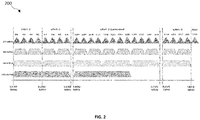
- Chart 200 depicted in Figure 2 illustrates bands used for wireless transmission according to the IEEE 802.11ax standard for 5GHz transmissions.
- the bands available for 5GHz transmissions are 20 MHz, 40 MHz, 80 MHz, and 160 MHz.
- narrower channel bandwidths can support a greater number of users/clients, where wider channel bandwidths can provide greater throughput.
- table 300 illustrates exemplary resource unit specifications for wider channel bandwidths of 240 MHz (240 MHz, 80+160 MHz, and 80+80+80 MHz) or 320 MHz (160+160 MHz, 80+240 MHz, 80+80+160 MHz, or 80+80+80+80 MHz) according to embodiments of the present invention.
- Existing 80 MHz channel bandwidth specifications of IEEE 802.11ax with are used as a building block to efficiently implement the tone plan described in table 300.
- the specification defines resource units having 996 tones including 980 data tones.
- the 240 MHz channel bandwidth provides 2988 (3x996) tones including 2940 data tones (3x980).
- the 320 MHz channel bandwidth provides 3984 (4x996) tones including 3920 data tones (4x980).
- the transmission can be interleaved over 160MHz/80+80 MHz tone interleavers, and for each 160MHz tone interleaver, a distance parameter 20 is applied.
- tables 400 and 450 including tone mapping distance parameters (D TM ) based on resource unit size for IEEE 802.11ax, and based on bandwidth for IEEE 802.11ac implementations are depicted.
- Table 400 illustrates LDPC tone mapping distance parameters for different resource unit sizes according to IEEE 802.11ax.
- D TM tone mapping distance parameter
- Resource units of 2x996 tones e.g., a 160 MHz channel bandwidth
- Resource units of 2x996 tones also have a tone mapping distance parameter of 20.
- Smaller resource unit sizes use smaller mapping distance parameters.
- resource units of 482, e.g., a 40 MHz bandwidth use a mapping distance parameter of 12
- resource units of 242, e.g., a 20 MHz bandwidth use a mapping distance parameter of 9.
- LDPC tone mapping for IEEE 802.11ac is determined according to channel bandwidth. As depicted in table 450, a 20 MHz channel uses a tone mapping distance parameter of 4, a 40 MHz channel uses a tone mapping distance parameter of 6, an 80 MHz channel uses a tone mapping parameter of 9, and a 160 MHz or 80+80 MHz channel also uses a tone mapping distance parameter of 9.
- Table 500 of Figure 5 illustrates an exemplary tone interleaving scheme that builds on the existing tone interleaving schemes depicted in tables 400 and 450 of Figure 4 to implement tone interleaving for wider channel bandwidths available in new generations of WLAN wireless communication standards according to embodiments of the present invention.
- a 240 MHz channel (240 MHz, 80+160 MHz, or 80+80+80 MHz) uses a tone interleaving scheme with a tone mapping distance parameter of 20, e.g., according to a data tone index.
- a tone mapping distance parameter of 20 e.g., according to a data tone index.
- transmissions over non-contiguous frequency segments use a tone mapping distance parameter of 20 for each 80 MHz segment.
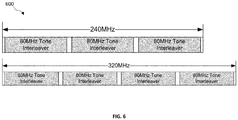
- an exemplary tone interleaving scheme defines a 240 MHz bandwidth channel with three non-contiguous 80 MHz frequency segments including segment boundaries between each 80 MHz frequency segment.
- a 320 MHz bandwidth channel with four non-contiguous 80 MHz frequency segments is defined and includes segment boundaries between each 80 MHz frequency segment.
- the segment boundaries represent roughly 6-8% of the available data tones in accordance with existing tone mapping schemes of IEEE 802.11ax. No interleaving is performed over the segment boundaries. In other words, each frequency segment is tone mapped individually and there is no cross-over between the mappings of the frequency segments.
- each channel into 80 MHz channel segments with resource unit spacing of 20 as defined in existing WLAN specifications, the implementation of the enhanced tone planes described herein is simplified and less expensive to implement.
- FIG. 7A illustrates an exemplary tone interleaving scheme 700 using a two-level tone interleaver according to embodiments of the present invention. Similar to the tone mapping scheme depicted in Figure 6 , 240 MHz and 320 MHz bandwidth channels are segmented into 80 MHz bandwidth channel segments such that existing WLAN specifications can be reused, thereby simplifying the implementation of the tone interleaving scheme. Each 80 MHz channel segment includes 996 total tones with 980 data units representing codewords as defined in IEEE 802.11ax. In the tone interleaving scheme depicted in Figure 7A , the tones are mapped across subcarriers (frequency segments) using a two level interleaver.
- the interleaving scheme 700 can use the same tone mapping distance parameter as IEEE 802.11ax, e.g., 20.
- a 240 MHz bandwidth channel 710 divided into three frequency segments.
- Tones of each frequency segment are interleaved within a frequency segment in a first level of the interleaver, and the tones are further interleaved over each of the three frequency segments in a second level of the interleaver.
- For each complex constellation point an address within the respective subcarrier is selected, and the tones are mapped in a non-linear manner for each subcarrier.
- a second set of complex constellation point from Word 1, Word 2, Word 3, and Word 4 are mapped to tones in subcarrier 765.
- Sets of other complex constellation points from the words to be transmitted 755 are mapped to tones in subcarrier 770 and 775 in the same manner.
- Figure 8 illustrates an exemplary tone interleaving scheme 800 using a direct interleaver according to embodiments of the present invention.
- the interleaving can be performed within the 240 MHz and 320 MHz bandwidths directly.
- the 240 MHz and 320 MHz can use different tone mapping distance parameters D TM to perform direct interleaving.
- D TM tone mapping distance parameters
- possible tone mapping distance parameters 20 49, 60, and 140 can be used to perform direct tone interleaving within the 240 MHz bandwidth channel.
- possible tone mapping distance parameters 20 40, 49, 80, and 140 can be used to perform direct tone interleaving within the 320 MHz bandwidth channel.
- Complex constellation points are mapped to noncontiguous tones of the channels using the selected mapping distance parameter.
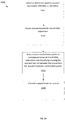
- a flowchart 900 depicting an exemplary sequence of computer implemented steps for performing tone interleaving for WLAN transmissions is depicted according to embodiments of the present invention.
- the steps can be performed, for example, by a wireless device (e.g., a wireless access point or wireless station) in communication with multiple wireless clients over multiple bands.
- the bands can have wide bandwidths of 240 MHz or 320 MHz, and the bands can be segmented into 80MHz subcarriers.
- a wireless channel bandwidth is selected or determined for communicating with one or more wireless devices.
- the channel bandwidth can be 240 MHz or 320 MHz.
- a 240 MHz bandwidth channel can include frequency segments of 80 MHz and 160 MHz (80+160 MHz) or three frequency segments of 80 MHz (80+80+80 MHz).
- a 320 MHz bandwidth channel can include frequency segments of 160 MHz (160+160 MHz), 80 MHz and 240 MHz (80+240 MHz), 80 MHz and 160 MHz (80+160 MHz), and four frequency segments of 80 MHz (80+80+80+80 MHz).
- the wide band of 240 MHz or 320 MHz is divided into 80 MHz subcarriers.
- 240 MHz bandwidth channels are divided into three 80 MHz subcarriers, and 320 MHz bandwidth channels are divided into four 80 MHz subcarriers.
- step 915 complex constellation points of codewords to be transmitted are mapped to nonadjacent addresses or index values of the 80 MHz subcarriers without interleaving over the segment barrier between the subcarriers.
- Each consecutive complex constellation point is mapped using a tone mapping distance parameter D TM of 20.
- step 915 can include performing a non-linear mapping of complex constellation points to all data tones of a one subcarrier before performing a non-linear mapping of complex constellation points to all data tones of the next subcarrier until all subcarriers have been mapped.
- a wireless transmission (e.g., WLAN transmission) including the tones mapped to the complex constellation points of the codewords is transmitted to a wireless receiver.
- a flowchart 1000 depicting an exemplary sequence of computer implemented steps for performing two-level tone interleaving for WLAN transmissions is depicted according to embodiments of the present invention.
- the steps can be performed, for example, by a wireless device (e.g., a wireless access point or wireless station) in communication with multiple wireless clients over multiple bands.
- the bands can be wide bands of 240 MHz or 320 MHz, and the wide bands can be segmented into 80MHz subcarriers.
- a wireless channel bandwidth is selected or determined.
- the channel bandwidth can be 240MHz or 320Mhz.
- a 240 MHz bandwidth channel can include frequency segments of 80 MHz and 160 MHz (80+160 MHz) or three frequency segments of 80 MHz (80+80+80 MHz).
- a 320 MHz bandwidth channel can include frequency segments of 160 MHz (160+160 MHz), 80 MHz and 240 MHz (80+240 MHz), 80 MHz and 160 MHz (80+160 MHz), and four frequency segments of 80 MHz (80+80+80+80 MHz).
- the wide band of 240 MHz or 320 MHz is divided into 80 MHz subcarriers.
- 240 MHz bandwidth channels are divided into three 80 MHz subcarriers, and 320 MHz bandwidth channels are divided into four 80 MHz subcarriers.
- step 1015 complex constellation points of codewords to be transmitted are mapped to nonadjacent addresses or index values of the 80 MHz subcarriers non-linearly by crossing the segment barrier between the subcarriers for adjacent complex constellation points.
- an address/index value of a tone within the respective subcarrier is selected, and the tones are mapped in a non-linear manner for each subcarrier.
- an address/index value within the respective subcarrier is selected, and the tones are mapped in a non-linear manner for each subcarrier until all data tones of the subcarriers have been mapped to complex constellation points.
- a wireless transmission (e.g., WLAN transmission) including the tones mapped to the complex constellation points of the codewords is transmitted to a wireless receiver.
- Embodiments of the present invention provide a method and apparatus for tone interleaving wide channel bandwidths or transmissions using multiple-bands and designed to accommodate new generations of WLAN.
- the present invention preferably uses an 80 MHz channel bandwidth with resource units having 996 tones as a building block to efficiently implement new tone mapping and interleaving schemes for wide bandwidth channels, e.g., 240 MHz or 320 MHz.
- the following discussion describes one such exemplary electronic system or computer system that can be used as a platform for implementing embodiments of the present invention as a wireless access point or wireless station.
- the exemplary computer system 1112 (e.g., a wireless access point or a wireless station) includes a central processing unit (CPU) 1101 for running software applications and optionally an operating system.
- Random access memory 1102 and read-only memory 1103 store applications and data for use by the CPU 1001.
- Data storage device 1104 provides non-volatile storage for applications and data and may include fixed disk drives, removable disk drives, flash memory devices, and CD-ROM, DVD-ROM or other optical storage devices.
- the optional user inputs 1106 and 1107 comprise devices that communicate inputs from one or more users to the computer system 1112 (e.g., mice, joysticks, cameras, touch screens, and/or microphones).
- a communication or network interface 1108 includes a plurality of transceivers and allows the computer system 1112 to communicate with other computer systems, networks, or devices via an electronic communications network, including wired and/or wireless communication and including an Intranet or the Internet (e.g., 802.11 wireless standard).
- the communication or network interface 1108 and can include a transmitter and a separate receiver for sending and receiving wireless data.
- the optional display device 1110 may be any device capable of displaying visual information in response to a signal from the computer system 1112 and may include a flat panel touch sensitive display, for example.
- the components of the computer system 1112, including the CPU 1101, memory 1102/1103, data storage 1104, user input devices 1106, and graphics subsystem 1105 may be coupled via one or more data buses 1100.
- program modules include routines, programs, objects, components, data structures, etc. that perform particular tasks or implement particular abstract data types.
- functionality of the program modules may be combined or distributed as desired in various embodiments.
Landscapes
- Engineering & Computer Science (AREA)
- Signal Processing (AREA)
- Computer Networks & Wireless Communication (AREA)
- Physics & Mathematics (AREA)
- Probability & Statistics with Applications (AREA)
- Theoretical Computer Science (AREA)
- Mobile Radio Communication Systems (AREA)
- Detection And Prevention Of Errors In Transmission (AREA)
- Error Detection And Correction (AREA)
Abstract
Description
- This application claims the benefit of and priority to provisional patent application Serial Number
62/750,286 - Embodiments of the present invention generally relate to the field of wireless communications. More specifically, embodiments of the present invention relate to tone mapping plans for wide bandwidth, e.g., 240 MHz or 320 MHz, channels.
- Existing approaches to WLAN wireless communication involve interleaved tone plans used to map complex constellation points of codewords to nonadjacent addresses or index values. Interleaving the codeword mapping is important to reduce the error rate of wireless transmissions, for example, caused by burst errors. This type of mapping in effect spreads the data out over frequencies to make channel errors more correctable via error correction algorithms. Existing tone plans typically define resource units including a number of data tones (NSD) that can be assigned to specific users/clients. The size of the channel's resource units depends on the channel's bandwidth and tone spacing. The bands currently available for 5GHz transmissions are 20 MHz, 40 MHz, 80 MHz, and 160 MHz. Typically narrower channel bandwidths can support a greater number of users/clients, where wider channel bandwidths can provide greater throughput.
- Recently, a new generation of wireless standards has been proposed that utilizes wider channel bandwidths or transmissions using multiple bands. Moreover, 6GHz bands will be made available in the near future and will be used to implemented WLAN wireless communication. However, existing approaches to tone interleaving cannot take advantage of the wider channel bandwidths and therefore throughput is reduced.
- Therefore, what is needed is an efficient approach to interleaving tones for WLAN wireless communication that utilizes multiple bands and wider channel bandwidths to provide enhanced throughput while mitigating the effects of burst errors.
- A method of tone mapping according to the invention is defined in
independent claim 1. The dependent claims define preferred embodiments thereof. Accordingly, the present invention provides a method and apparatus for tone interleaving wide channel bandwidths or transmissions using multiple-bands. Embodiments of the present invention are designed to accommodate new generations of WLAN. Preferably, existing communication standards of the current generations of WLAN are used to simplify the implementation of the tone mapping schemes described herein. For example, the present invention preferably uses an 80 MHz channel bandwidth with resource units having 996 tones as a building block to efficiently implement new tone mapping and interleaving schemes for wider bandwidth channels. The tone interleaving methods described herein provide enhanced throughput for wider bandwidth channels (e.g., 240 MHz or 320 MHz) while mitigating the effects of burst errors. - According to one embodiment, a method of tone mapping for WLAN transmissions is disclosed. The method includes dividing a wireless channel into a plurality of subcarriers, the wireless channel includes a wireless bandwidth of 320 MHz, the wireless channel is operable to carry WLAN transmissions including codewords, and the codewords include a plurality of complex constellation points, mapping each complex constellation point of the codewords of the WLAN transmissions to tones of subcarriers of the plurality of subcarriers, consecutive complex constellation points of codewords are mapped to nonadjacent tones of a respective subcarrier by a) mapping a first complex constellation point of the codewords to a first value of a first subcarrier of the plurality of subcarriers, b) mapping a second complex constellation point of the codewords to a second value of a second subcarrier of the plurality of subcarriers, c) mapping a third complex constellation point of the codewords to a third value of a third subcarrier of the plurality of subcarriers, d) mapping a fourth complex constellation point of the codewords to a fourth value of a fourth subcarrier of the plurality of subcarriers, and e) repeating steps a) -d) until all tones of the subcarriers have been mapped.
- Preferably, the mapping includes mapping each complex constellation point using a tone mapping distance parameter of 20.
- Preferably, the subcarriers include a channel bandwidth of 80 MHz.
- Preferably, the subcarriers include 980 data tones.
- Preferably, the mapping reduces an error rate of the transmission caused by burst errors.
- According to another embodiment, a method of tone mapping for WLAN transmissions is disclosed. The method include dividing a wireless channel into a plurality of subcarriers, the wireless channel includes a wireless bandwidth of 240 MHz, the wireless channel is operable to carry WLAN transmissions including codewords, and the codewords include a plurality of complex constellation points, mapping each complex constellation point of the codewords of the WLAN transmissions to tones of subcarriers of the plurality of subcarriers, consecutive complex constellation points of codewords are mapped to nonadjacent tones of a respective subcarrier by a) mapping a first complex constellation point of the codewords to a first value of a first subcarrier of the plurality of subcarriers, b) mapping a second complex constellation point of the codewords to a second value of a second subcarrier of the plurality of subcarriers, c) mapping a third complex constellation point of the codewords to a third value of a third subcarrier of the plurality of subcarriers, and d) repeating steps a) -c) until all tones of the subcarriers have been mapped.
- Preferably, the mapping includes mapping each complex constellation point using a tone mapping distance parameter of 20.
- Preferably, the subcarriers include a channel bandwidth of 80 MHz.
- Preferably, the subcarriers include 980 data tones.
- Preferably, the method is performed by a wireless access point.
- Preferably, the method is performed by a wireless station.
- Preferably, the method includes transmitting the WLAN transmissions using the tones mapped to the complex constellation points.
- According to a different embodiment, a method of tone mapping for WLAN transmissions is disclosed. The method includes determining a wireless channel bandwidth of a wireless channel, the wireless channel is operable to carry WLAN transmissions including codewords, the codewords include a plurality of complex constellation points, dividing the wireless channel into a plurality of subcarriers, and mapping each complex constellation point of the codewords of the WLAN transmissions to tones of subcarriers of the plurality of subcarriers, consecutive complex constellation points of codewords are mapped to nonadjacent tones of a respective subcarrier until all tones of the respective subcarrier have been mapped.
- Preferably, the mapping includes mapping each complex constellation point using a tone mapping distance parameter of 20.
- Preferably, the subcarriers include a channel bandwidth of 80 MHz.
- Preferably, the wireless channel bandwidth equals 240 MHz and the plurality of subcarriers includes three subcarriers.
- Preferably, the wireless channel bandwidth equals 320 MHz and the plurality of subcarriers includes four subcarriers.
- Preferably, the subcarriers include 980 data tones.
- Preferably, the mapping reduces an error rate of the transmission caused by burst errors.
- Preferably, the method includes transmitting the WLAN transmissions using the tones mapped to the complex constellation points.
- The accompanying drawings, which are incorporated in and form a part of this specification, illustrate embodiments of the invention and, together with the description, serve to explain the principles of the invention:
-
Figure 1 is a table depicting resource unit sizes and data tones available for different channel bandwidths used by the IEEE 802.11ax standard. -
Figure 2 is a chart illustrating bands used for wireless transmission in IEEE 802.11ax for 5GHz transmissions. -
Figure 3 is table illustrating exemplary resource unit specifications for wider channel bandwidths of 240 MHz (240 MHz, 80+160 MHz, and 80+80+80 MHz) or 320 MHz (160+160 MHz, 80+240 MHz, 80+80+160 MHz, or 80+80+80+80 MHz) according to embodiments of the present invention. -
Figure 4 depicts tables of tone mapping distance parameters (DTM) based on resource unit size for the IEEE 802.11ax standard and based on bandwidth for the IEEE 802.11ac standard. -
Figure 5 illustrates an exemplary tone interleaving scheme that builds on existing tone interleaving schemes depicted in tables 400 and 450 ofFigure 4 to implement tone interleaving for wider channel bandwidths available in new generations of WLAN wireless communication standards according to embodiments of the present invention. -
Figure 6 depicts an exemplary tone interleaving scheme that defines a 240 MHz bandwidth channel with three non-contiguous 80 MHz frequency and a 320 MHz bandwidth channel with four non-contiguous 80 MHz frequency segments according to embodiments of the present invention. -
Figure 7A illustrates an exemplary tone interleaving scheme using a two-level tone interleaver according to embodiments of the present invention. -
Figure 7B illustrates the tone mapping steps of an exemplary tone interleaving scheme according to embodiments of the present invention. -
Figure 8 illustrates an exemplary tone interleaving scheme using a direct interleaver according to embodiments of the present invention. -
Figure 9 is a flowchart depicting an exemplary sequence of computer implemented steps for performing tone interleaving for WLAN transmissions according to embodiments of the present invention. -
Figure 10 is a flowchart depicting an exemplary sequence of computer implemented steps for performing two-level tone interleaving for WLAN transmissions according to embodiments of the present invention. -
Figure 11 depicts an exemplary computer system platform upon which embodiments of the present invention may be implemented. - Reference will now be made in detail to several embodiments. While the subject matter will be described in conjunction with the alternative embodiments, it will be understood that they are not intended to limit the claimed subject matter to these embodiments. On the contrary, the claimed subject matter is intended to cover alternative, modifications, and equivalents, which may be included within the spirit and scope of the claimed subject matter as defined by the appended claims.
- Furthermore, in the following detailed description, numerous specific details are set forth in order to provide a thorough understanding of the claimed subject matter. However, it will be recognized by one skilled in the art that embodiments may be practiced without these specific details or with equivalents thereof. In other instances, well-known methods, procedures, components, and circuits have not been described in detail as not to unnecessarily obscure aspects and features of the subject matter.
- Portions of the detailed description that follow are presented and discussed in terms of a method. Although steps and sequencing thereof are disclosed in a figure herein (e.g.,
Figures 9 and10 ) describing the operations of this method, such steps and sequencing are exemplary. Embodiments are well suited to performing various other steps or variations of the steps recited in the flowchart of the figure herein, and in a sequence other than that depicted and described herein. - Some portions of the detailed description are presented in terms of procedures, steps, logic blocks, processing, and other symbolic representations of operations on data bits that can be performed on computer memory. These descriptions and representations are the means used by those skilled in the data processing arts to most effectively convey the substance of their work to others skilled in the art. A procedure, computer-executed step, logic block, process, etc., is here, and generally, conceived to be a self-consistent sequence of steps or instructions leading to a desired result. The steps are those requiring physical manipulations of physical quantities. Usually, though not necessarily, these quantities take the form of electrical or magnetic signals capable of being stored, transferred, combined, compared, and otherwise manipulated in a computer system. It has proven convenient at times, principally for reasons of common usage, to refer to these signals as bits, values, elements, symbols, characters, terms, numbers, or the like.
- It should be borne in mind, however, that all of these and similar terms are to be associated with the appropriate physical quantities and are merely convenient labels applied to these quantities. Unless specifically stated otherwise as apparent from the following discussions, it is appreciated that throughout, discussions utilizing terms such as "accessing," "writing," "including," "storing," "transmitting," "associating," "identifying," "encoding," or the like, refer to the action and processes of a computer system, or similar electronic computing device, that manipulates and transforms data represented as physical (electronic) quantities within the computer system's registers and memories into other data similarly represented as physical quantities within the computer system memories or registers or other such information storage, transmission or display devices.
- Embodiments of the present invention provide a method and apparatus for tone interleaving wide channel bandwidths or transmissions using multiple-bands. Embodiments of the present invention are designed to accommodate new generations of WLAN. Preferably, existing communication standards of the current generations of WLAN (e.g., IEEE 802.11ax) are used to simplify the implementation of the tone mapping schemes described herein. For example, the present invention preferably uses an 80 MHz channel bandwidth with resource units having 996 tones as a building block to efficiently implement new tone mapping and interleaving schemes for wider bandwidth channels.
- As depicted in
Figure 1 , existing tone plans typically define resource units including a number of data tones (NSD) that can be assigned to specific users/clients. The size of the channel's resource units depends on the channel's bandwidth and tone spacing. The bands currently available for 5GHz transmissions are 20 MHz, 40 MHz, 80 MHz, and 160 MHz. For example, as depicted in table 100 ofFigure 1 , a 20 MHz channel has resource units with 242 total tones, including 234 data tones operable to be mapped to complex constellation points or complex constellation numbers of codewords to be transmitted. Other channel bandwidths, such as 40 MHz and 80 MHz channels, provide resource units having 482 and 996 tones, respectively. The IEEE 802.11ax also supports channel bandwidths of 160 MHz (or 80+80 MHz) which include resource units having 1992 tones including 1960 data tones. - Chart 200 depicted in
Figure 2 illustrates bands used for wireless transmission according to the IEEE 802.11ax standard for 5GHz transmissions. The bands available for 5GHz transmissions are 20 MHz, 40 MHz, 80 MHz, and 160 MHz. As depicted inchart 200, narrower channel bandwidths can support a greater number of users/clients, where wider channel bandwidths can provide greater throughput. - With regard to
Figure 3 , table 300 illustrates exemplary resource unit specifications for wider channel bandwidths of 240 MHz (240 MHz, 80+160 MHz, and 80+80+80 MHz) or 320 MHz (160+160 MHz, 80+240 MHz, 80+80+160 MHz, or 80+80+80+80 MHz) according to embodiments of the present invention. Existing 80 MHz channel bandwidth specifications of IEEE 802.11ax with are used as a building block to efficiently implement the tone plan described in table 300. The specification defines resource units having 996 tones including 980 data tones. For example, the 240 MHz channel bandwidth provides 2988 (3x996) tones including 2940 data tones (3x980). The 320 MHz channel bandwidth provides 3984 (4x996) tones including 3920 data tones (4x980). The transmission can be interleaved over 160MHz/80+80 MHz tone interleavers, and for each 160MHz tone interleaver, adistance parameter 20 is applied. By reusing the 80 MHz channel bandwidth tone plan defined in existing WLAN specifications, the implementation of the enhanced tone planes described herein is simplified and less expensive to implement. - With regard to
Figure 4 , tables 400 and 450 including tone mapping distance parameters (DTM) based on resource unit size for IEEE 802.11ax, and based on bandwidth for IEEE 802.11ac implementations are depicted. Table 400 illustrates LDPC tone mapping distance parameters for different resource unit sizes according to IEEE 802.11ax. By spacing consecutive complex constellation points apart using a tone mapping distance parameter DTM in a tone interleaving scheme, the error rate of the wireless transmission is reduced. For example, as depicted inFigure 4 , resource units of 996 tones, e.g., a 80 MHz channel bandwidth, have a tone mapping distance parameter of 20, e.g., 20 tones according to a data tone index. Resource units of 2x996 tones, e.g., a 160 MHz channel bandwidth, also have a tone mapping distance parameter of 20. Smaller resource unit sizes use smaller mapping distance parameters. For example, resource units of 482, e.g., a 40 MHz bandwidth, use a mapping distance parameter of 12, and resource units of 242, e.g., a 20 MHz bandwidth, use a mapping distance parameter of 9. - LDPC tone mapping for IEEE 802.11ac is determined according to channel bandwidth. As depicted in table 450, a 20 MHz channel uses a tone mapping distance parameter of 4, a 40 MHz channel uses a tone mapping distance parameter of 6, an 80 MHz channel uses a tone mapping parameter of 9, and a 160 MHz or 80+80 MHz channel also uses a tone mapping distance parameter of 9.
- Table 500 of
Figure 5 illustrates an exemplary tone interleaving scheme that builds on the existing tone interleaving schemes depicted in tables 400 and 450 ofFigure 4 to implement tone interleaving for wider channel bandwidths available in new generations of WLAN wireless communication standards according to embodiments of the present invention. As depicted in table 500, a 240 MHz channel (240 MHz, 80+160 MHz, or 80+80+80 MHz) uses a tone interleaving scheme with a tone mapping distance parameter of 20, e.g., according to a data tone index. Specifically, transmissions over non-contiguous frequency segments use a tone mapping distance parameter of 20 for each 80 MHz segment. - As depicted in table 600 of
Figure 6 , according to embodiments of the present invention, an exemplary tone interleaving scheme defines a 240 MHz bandwidth channel with three non-contiguous 80 MHz frequency segments including segment boundaries between each 80 MHz frequency segment. A 320 MHz bandwidth channel with four non-contiguous 80 MHz frequency segments is defined and includes segment boundaries between each 80 MHz frequency segment. The segment boundaries represent roughly 6-8% of the available data tones in accordance with existing tone mapping schemes of IEEE 802.11ax. No interleaving is performed over the segment boundaries. In other words, each frequency segment is tone mapped individually and there is no cross-over between the mappings of the frequency segments. Using segment boundaries between the frequency segments has the advantage of increasing tolerance to errors, e.g., burst errors, but may reduce overall throughput. By dividing each channel into 80 MHz channel segments with resource unit spacing of 20 as defined in existing WLAN specifications, the implementation of the enhanced tone planes described herein is simplified and less expensive to implement. -
Figure 7A illustrates an exemplarytone interleaving scheme 700 using a two-level tone interleaver according to embodiments of the present invention. Similar to the tone mapping scheme depicted inFigure 6 , 240 MHz and 320 MHz bandwidth channels are segmented into 80 MHz bandwidth channel segments such that existing WLAN specifications can be reused, thereby simplifying the implementation of the tone interleaving scheme. Each 80 MHz channel segment includes 996 total tones with 980 data units representing codewords as defined in IEEE 802.11ax. In the tone interleaving scheme depicted inFigure 7A , the tones are mapped across subcarriers (frequency segments) using a two level interleaver. - For example, a 320
MHz bandwidth channel 705 is divided into four frequency segments. Tones of each frequency segment are interleaved within a frequency segment in a first level of the interleaver, and the tones are further interleaved over each of the four frequency segments in a second level of the interleaver. Preferably, the tones are interleaved over the four 80 MHz subcarriers as 4n for the first subcarrier, 4n+1 for the second sub carrier, 4n+2 for the third subcarrier, and 4n+3 for the fourth subcarrier, where n=0,1,2, ..., 979, so that complex constellation points are mapped to 980 individual tones of each subcarrier. For each complex constellation point, an address/index value within the respective subcarrier is selected, and the tones are mapped in a non-linear manner for each subcarrier. Theinterleaving scheme 700 can use the same tone mapping distance parameter as IEEE 802.11ax, e.g., 20. - According to the
tone interleaving scheme 700 depicted inFigure 7A , a 240MHz bandwidth channel 710 divided into three frequency segments. Tones of each frequency segment are interleaved within a frequency segment in a first level of the interleaver, and the tones are further interleaved over each of the three frequency segments in a second level of the interleaver. Preferably, the tones are interleaved over the three 80 MHz subcarriers as 3n for the first subcarrier, 3n+1 for the second sub carrier, and 3n+2 for the third subcarrier, where n=0,1,2, ..., 979, so that complex constellation points are mapped to 980 individual addresses/ index values of each subcarrier. For each complex constellation point, an address within the respective subcarrier is selected, and the tones are mapped in a non-linear manner for each subcarrier. -
Figure 7B illustrates thetone mapping 750 of exemplarytone interleaving scheme 700 according to embodiments of the present invention. As depicted inFigure 7B , a first step of thetone interleaving scheme 700 maps complex constellation points of words to be transmitted 755 includingWord 1,Word 2,Word 3, andWord 4. These can be stored in memory. Each word includes a number of complex constellation points to be mapped to tones within the 320 MHz bandwidth channel for transmission. In a first step represented by the solid arrows inFigure 7B , a first set of complex constellation point fromWord 1,Word 2,Word 3, andWord 4 are mapped to tones insubcarrier 760. In a second step represented by the dashed arrows inFigure 7B , a second set of complex constellation point fromWord 1,Word 2,Word 3, andWord 4 are mapped to tones insubcarrier 765. Sets of other complex constellation points from the words to be transmitted 755 are mapped to tones insubcarrier -
Figure 8 illustrates an exemplarytone interleaving scheme 800 using a direct interleaver according to embodiments of the present invention. Rather than segmenting each channel into 80MHz subcarriers to reuse existing IEEE 802.11ax interleaving standards, the interleaving can be performed within the 240 MHz and 320 MHz bandwidths directly. The 240 MHz and 320 MHz can use different tone mapping distance parameters DTM to perform direct interleaving. As depicted inFigure 8 , for a 240 MHz bandwidth channel having 2940 (3x980) data tones, possible tone mapping distance parameters of 20, 49, 60, and 140 can be used to perform direct tone interleaving within the 240 MHz bandwidth channel. For a 320 MHz bandwidth channel having 3920 (4x980) data tones, possible tone mapping distance parameters of 20, 40, 49, 80, and 140 can be used to perform direct tone interleaving within the 320 MHz bandwidth channel. Complex constellation points are mapped to noncontiguous tones of the channels using the selected mapping distance parameter. - With regard to
Figure 9 , aflowchart 900 depicting an exemplary sequence of computer implemented steps for performing tone interleaving for WLAN transmissions is depicted according to embodiments of the present invention. The steps can be performed, for example, by a wireless device (e.g., a wireless access point or wireless station) in communication with multiple wireless clients over multiple bands. The bands can have wide bandwidths of 240 MHz or 320 MHz, and the bands can be segmented into 80MHz subcarriers. - At
step 905, a wireless channel bandwidth is selected or determined for communicating with one or more wireless devices. The channel bandwidth can be 240 MHz or 320 MHz. A 240 MHz bandwidth channel can include frequency segments of 80 MHz and 160 MHz (80+160 MHz) or three frequency segments of 80 MHz (80+80+80 MHz). A 320 MHz bandwidth channel can include frequency segments of 160 MHz (160+160 MHz), 80 MHz and 240 MHz (80+240 MHz), 80 MHz and 160 MHz (80+160 MHz), and four frequency segments of 80 MHz (80+80+80+80 MHz). - At
step 910, the wide band of 240 MHz or 320 MHz is divided into 80 MHz subcarriers. 240 MHz bandwidth channels are divided into three 80 MHz subcarriers, and 320 MHz bandwidth channels are divided into four 80 MHz subcarriers. - At
step 915, complex constellation points of codewords to be transmitted are mapped to nonadjacent addresses or index values of the 80 MHz subcarriers without interleaving over the segment barrier between the subcarriers. Each consecutive complex constellation point is mapped using a tone mapping distance parameter DTM of 20. For example, step 915 can include performing a non-linear mapping of complex constellation points to all data tones of a one subcarrier before performing a non-linear mapping of complex constellation points to all data tones of the next subcarrier until all subcarriers have been mapped. - At
step 920, a wireless transmission (e.g., WLAN transmission) including the tones mapped to the complex constellation points of the codewords is transmitted to a wireless receiver. - With regard to
Figure 10 , aflowchart 1000 depicting an exemplary sequence of computer implemented steps for performing two-level tone interleaving for WLAN transmissions is depicted according to embodiments of the present invention. The steps can be performed, for example, by a wireless device (e.g., a wireless access point or wireless station) in communication with multiple wireless clients over multiple bands. The bands can be wide bands of 240 MHz or 320 MHz, and the wide bands can be segmented into 80MHz subcarriers. - At
step 1005, a wireless channel bandwidth is selected or determined. The channel bandwidth can be 240MHz or 320Mhz. A 240 MHz bandwidth channel can include frequency segments of 80 MHz and 160 MHz (80+160 MHz) or three frequency segments of 80 MHz (80+80+80 MHz). A 320 MHz bandwidth channel can include frequency segments of 160 MHz (160+160 MHz), 80 MHz and 240 MHz (80+240 MHz), 80 MHz and 160 MHz (80+160 MHz), and four frequency segments of 80 MHz (80+80+80+80 MHz). - At
step 1010, the wide band of 240 MHz or 320 MHz is divided into 80 MHz subcarriers. 240 MHz bandwidth channels are divided into three 80 MHz subcarriers, and 320 MHz bandwidth channels are divided into four 80 MHz subcarriers. - At
step 1015, complex constellation points of codewords to be transmitted are mapped to nonadjacent addresses or index values of the 80 MHz subcarriers non-linearly by crossing the segment barrier between the subcarriers for adjacent complex constellation points. - At
step 1015, for a 320 MHz bandwidth channel, the tones are interleaved over four 80 MHz subcarriers according to a data tone index as 4n for the first subcarrier, 4n+1 for the second sub carrier, 4n+2 for the third subcarrier, and 4n+3 for the fourth subcarrier, where n=0,1,2, ..., 979, so that the complex constellation points are mapped to 980 individual tones for each subcarrier. For each complex constellation point, an address/index value of a tone within the respective subcarrier is selected, and the tones are mapped in a non-linear manner for each subcarrier. - At
step 1015, for a 240 MHz bandwidth channel, the tones are interleaved over three 80 MHz subcarriers as 3n for the first subcarrier, 3n+1 for the second sub carrier, 3n+2 for the third subcarrier, and 3n+3 for the fourth subcarrier, where n=0,1,2, ..., 979, so that the complex constellation points are mapped to 980 individual tones for each subcarrier. For each complex constellation point, an address/index value within the respective subcarrier is selected, and the tones are mapped in a non-linear manner for each subcarrier until all data tones of the subcarriers have been mapped to complex constellation points. - At
step 1020, a wireless transmission (e.g., WLAN transmission) including the tones mapped to the complex constellation points of the codewords is transmitted to a wireless receiver. - Embodiments of the present invention provide a method and apparatus for tone interleaving wide channel bandwidths or transmissions using multiple-bands and designed to accommodate new generations of WLAN. For example, the present invention preferably uses an 80 MHz channel bandwidth with resource units having 996 tones as a building block to efficiently implement new tone mapping and interleaving schemes for wide bandwidth channels, e.g., 240 MHz or 320 MHz. The following discussion describes one such exemplary electronic system or computer system that can be used as a platform for implementing embodiments of the present invention as a wireless access point or wireless station.
- In the example of
Figure 11 , the exemplary computer system 1112 (e.g., a wireless access point or a wireless station) includes a central processing unit (CPU) 1101 for running software applications and optionally an operating system.Random access memory 1102 and read-only memory 1103 store applications and data for use by the CPU 1001.Data storage device 1104 provides non-volatile storage for applications and data and may include fixed disk drives, removable disk drives, flash memory devices, and CD-ROM, DVD-ROM or other optical storage devices. Theoptional user inputs - A communication or
network interface 1108 includes a plurality of transceivers and allows thecomputer system 1112 to communicate with other computer systems, networks, or devices via an electronic communications network, including wired and/or wireless communication and including an Intranet or the Internet (e.g., 802.11 wireless standard). The communication ornetwork interface 1108 and can include a transmitter and a separate receiver for sending and receiving wireless data. - The
optional display device 1110 may be any device capable of displaying visual information in response to a signal from thecomputer system 1112 and may include a flat panel touch sensitive display, for example. The components of thecomputer system 1112, including theCPU 1101,memory 1102/1103,data storage 1104,user input devices 1106, and graphics subsystem 1105 may be coupled via one ormore data buses 1100. - Some embodiments may be described in the general context of computer-executable instructions, such as program modules, executed by one or more computers or other devices. Generally, program modules include routines, programs, objects, components, data structures, etc. that perform particular tasks or implement particular abstract data types. Typically the functionality of the program modules may be combined or distributed as desired in various embodiments.
- Embodiments of the present invention are thus described. While the present invention has been described in particular embodiments, it should be appreciated that the present invention should not be construed as limited by such embodiments, but rather construed according to the following claims.
Claims (15)
- A method of tone mapping for WLAN transmissions, the method comprising:dividing a wireless channel into a plurality of subcarriers, wherein the wireless channel is operable to carry WLAN transmissions comprising codewords, wherein the codewords comprise a plurality of complex constellation points; andmapping each complex constellation point of the codewords of the WLAN transmissions to tones of subcarriers of the plurality of subcarriers, wherein consecutive complex constellation points of codewords are mapped to nonadjacent tones of a respective subcarrier until all tones of the respective subcarrier have been mapped.
- The method as described in Claim 1, wherein the wireless channel comprises a wireless bandwidth of 320 MHz; and
the mapping each complex constellation point of the codewords of the WLAN transmissions to tones of subcarriers of the plurality of subcarriers is performed by:a) mapping a first complex constellation point of the codewords to a first tone of a first subcarrier of the plurality of subcarriers;b) mapping a second complex constellation point of the codewords to a second value of the first subcarrier;c) mapping a third complex constellation point of the codewords to a third value of the first subcarrier;d) mapping a fourth complex constellation point of the codewords to a fourth value of the first subcarrier;e) repeating steps a) -d) for each subcarrier of the plurality of subcarriers; andf) repeating step e) until all tones of the plurality of subcarriers have been mapped. - The method as described in Claim 1, wherein the wireless channel comprises a wireless bandwidth of 240 MHz; and
the mapping each complex constellation point of the codewords of the WLAN transmissions to tones of subcarriers of the plurality of subcarriers is performed by:a) mapping a first complex constellation point of the codewords to a first tone of a first subcarrier of the plurality of subcarriers;b) mapping a second complex constellation point of the codewords to a second value of the first subcarrier;c) mapping a third complex constellation point of the codewords to a third value of the first subcarrier;e) repeating steps a) -c) for each subcarrier of the plurality of subcarriers; andf) repeating step e) until all tones of the plurality of subcarriers have been mapped. - The method as described in Claim 1, further comprising:
determining a wireless channel bandwidth of the wireless channel. - The method as described in any one of the preceding Claims, wherein said mapping further comprises mapping each complex constellation point using a tone mapping distance parameter of 20.
- The method as described in any one of the preceding Claims, wherein said subcarriers comprise a channel bandwidth of 80 MHz.
- The method as described in Claim 6, wherein said mapping is performed according to an IEEE 802.11ax tone plan.
- The method as described in any one of the preceding Claims, wherein said mapping is performed using 160MHz or 80+80 MHz tone interleavers, and wherein a distance parameter of 20 is used for said 160MHz tone interleaver.
- The method as described in any one of Claims 5 to 8 in combination with claim 1, 3 or 4, wherein said wireless channel bandwidth equals 240 MHz and said plurality of subcarriers comprises three subcarriers.
- The method as described in any one of Claims 5 to 8 in combination with claim 1, 2 or 4, wherein said wireless channel bandwidth equals 320 MHz and said plurality of subcarriers comprises four subcarriers.
- The method as described in any one of the preceding Claims, wherein said subcarriers comprise 980 data tones.
- The method as described in any one of the preceding Claims, wherein said mapping reduces an error rate of the transmission caused by burst errors.
- The method as described in any one of the preceding Claims, wherein said dividing and said mapping are performed by a wireless access point.
- The method as described in any one of the preceding Claims, wherein said dividing and said mapping are performed by a wireless station.
- The method as described in any one of the preceding Claims, further comprising transmitting the WLAN transmissions using the tones mapped to the complex constellation points.
Applications Claiming Priority (2)
| Application Number | Priority Date | Filing Date | Title |
|---|---|---|---|
| US201862750286P | 2018-10-25 | 2018-10-25 | |
| US16/586,192 US11677499B2 (en) | 2018-10-25 | 2019-09-27 | Tone interleaving methods for multi-bands and wide bandwidth transmissions in WLAN |
Publications (1)
| Publication Number | Publication Date |
|---|---|
| EP3644535A1 true EP3644535A1 (en) | 2020-04-29 |
Family
ID=68281219
Family Applications (1)
| Application Number | Title | Priority Date | Filing Date |
|---|---|---|---|
| EP19203654.9A Pending EP3644535A1 (en) | 2018-10-25 | 2019-10-16 | Tone interleaving methods for multi-bands and wide bandwidth transmissions in wlan |
Country Status (4)
| Country | Link |
|---|---|
| US (1) | US11677499B2 (en) |
| EP (1) | EP3644535A1 (en) |
| CN (2) | CN116546636A (en) |
| TW (1) | TWI729542B (en) |
Cited By (1)
| Publication number | Priority date | Publication date | Assignee | Title |
|---|---|---|---|---|
| US20230246738A1 (en) * | 2019-08-12 | 2023-08-03 | Lg Electronics Inc. | Method by which multi-ru receives ldpc-tone-mapped ppdu in wireless lan system, and apparatus |
Families Citing this family (4)
| Publication number | Priority date | Publication date | Assignee | Title |
|---|---|---|---|---|
| US12167410B2 (en) | 2019-07-05 | 2024-12-10 | Lg Electronics Inc. | Method and device for receiving PPDU having been subjected to LDPC tone mapping in broadband tone plan in wireless LAN system |
| WO2021029559A1 (en) * | 2019-08-12 | 2021-02-18 | 엘지전자 주식회사 | Method and apparatus for receiving ppdu in broadband in wireless lan system |
| CN118317360A (en) * | 2020-08-27 | 2024-07-09 | 华为技术有限公司 | Data fragmentation analysis method and related device |
| US12041008B2 (en) * | 2020-09-09 | 2024-07-16 | Intel Corporation | Preamble for extremely high throughput trigger based physical layer protocol data unit |
Citations (1)
| Publication number | Priority date | Publication date | Assignee | Title |
|---|---|---|---|---|
| US20170134050A1 (en) * | 2015-11-06 | 2017-05-11 | Samsung Electronics Co., Ltd | Channel coding framework for 802.11ay and larger block-length ldpc codes for 11ay with 2-step lifting matrices and in-place property |
Family Cites Families (14)
| Publication number | Priority date | Publication date | Assignee | Title |
|---|---|---|---|---|
| US7269209B2 (en) | 2002-02-08 | 2007-09-11 | Broadcom Corporation | Discrete multitone transmission and reception |
| WO2011136582A2 (en) * | 2010-04-29 | 2011-11-03 | Lg Electronics Inc. | Method and apparatus for transmitting data in very high throughput wireless local area network system |
| US9160503B2 (en) * | 2011-03-04 | 2015-10-13 | Qualcomm Incorporated | Method and apparatus supporting improved wide bandwidth transmissions |
| US9203672B2 (en) | 2012-05-13 | 2015-12-01 | Broadcom Corporation | Multi-channel support within single user, multiple user, multiple access, and/or MIMO wireless communications |
| CN103780337B (en) | 2012-10-26 | 2017-06-06 | 华为技术有限公司 | Interleaving treatment method and apparatus in wlan system |
| US20170034317A1 (en) * | 2013-12-28 | 2017-02-02 | Intel IP Corporation | Methods and arrangements to extend operational bandwidth |
| US20150365195A1 (en) | 2014-06-16 | 2015-12-17 | Qualcomm Incorporated | Interleaving in ofdma data tone plans |
| US20160007354A1 (en) * | 2014-07-07 | 2016-01-07 | Qualcomm Incorporated | Systems and methods for improved communication efficiency in high efficiency wireless networks |
| US9762422B2 (en) * | 2014-10-09 | 2017-09-12 | Qualcomm Incorporated | Tone-phase-shift keying: a new modulation scheme for SC-FDMA |
| CN106713213B (en) | 2015-07-25 | 2018-09-28 | 华为技术有限公司 | A kind of Ditital modulation method, demodulation method, relevant apparatus and system |
| EP3635995B1 (en) | 2017-06-07 | 2023-11-15 | Apple Inc. | Emtc-u measurement |
| US10856311B2 (en) * | 2018-03-06 | 2020-12-01 | Qualcomm Incorporated | Systems and methods of communicating via sub-bands in wireless communication networks |
| WO2020050528A1 (en) * | 2018-09-07 | 2020-03-12 | 엘지전자 주식회사 | Method and device for applying optimized phase rotation in wlan environment including wireless devices having mutually different maximum transmittable rf bandwidths |
| US11546938B2 (en) * | 2019-08-09 | 2023-01-03 | Qualcomm Incorporated | Physical layer preamble and signaling for wireless communication |
-
2019
- 2019-09-27 US US16/586,192 patent/US11677499B2/en active Active
- 2019-10-16 EP EP19203654.9A patent/EP3644535A1/en active Pending
- 2019-10-25 CN CN202310581169.XA patent/CN116546636A/en active Pending
- 2019-10-25 CN CN201911022574.8A patent/CN111107584B/en active Active
- 2019-10-25 TW TW108138561A patent/TWI729542B/en active
Patent Citations (1)
| Publication number | Priority date | Publication date | Assignee | Title |
|---|---|---|---|---|
| US20170134050A1 (en) * | 2015-11-06 | 2017-05-11 | Samsung Electronics Co., Ltd | Channel coding framework for 802.11ay and larger block-length ldpc codes for 11ay with 2-step lifting matrices and in-place property |
Cited By (2)
| Publication number | Priority date | Publication date | Assignee | Title |
|---|---|---|---|---|
| US20230246738A1 (en) * | 2019-08-12 | 2023-08-03 | Lg Electronics Inc. | Method by which multi-ru receives ldpc-tone-mapped ppdu in wireless lan system, and apparatus |
| US11902020B2 (en) * | 2019-08-12 | 2024-02-13 | Lg Electronics Inc. | Method by which Multi-RU receives LDPC-tone-mapped PPDU in wireless LAN system, and apparatus |
Also Published As
| Publication number | Publication date |
|---|---|
| CN116546636A (en) | 2023-08-04 |
| CN111107584B (en) | 2023-06-09 |
| US11677499B2 (en) | 2023-06-13 |
| TWI729542B (en) | 2021-06-01 |
| US20200136756A1 (en) | 2020-04-30 |
| TW202020863A (en) | 2020-06-01 |
| CN111107584A (en) | 2020-05-05 |
Similar Documents
| Publication | Publication Date | Title |
|---|---|---|
| US11677499B2 (en) | Tone interleaving methods for multi-bands and wide bandwidth transmissions in WLAN | |
| KR102243422B1 (en) | Method and apparatus for transmitting wireless local area network information | |
| JP7559201B2 (en) | PPDU transmission method and related device | |
| CN113612591A (en) | Method and device for transmitting HE-LTF sequence | |
| TW201415840A (en) | Method and apparatus for mapping virtual resources to physical resources in a wireless communication system | |
| KR102879467B1 (en) | Method and device for multi-resource unit multi-RU merging instruction | |
| CN110650543A (en) | Method and apparatus for uplink data transmission | |
| US11432199B2 (en) | Resource units for wide band transmission in a wireless network | |
| US12323345B2 (en) | Aggregated resource unit transmission scheme for single station allocation in WLAN | |
| CN118590204A (en) | A control information transmission method, related device and computer storage medium | |
| KR20250004081A (en) | Resource mapping method, device, storage medium and electronic device | |
| CN105338641A (en) | Information sending and receiving method, and related apparatus | |
| EP3012991A1 (en) | Method and device for using high-dimensional constellation graph to transmit data | |
| JP7768999B2 (en) | Resource allocation method and communication device | |
| KR102071929B1 (en) | Method, device and system for transmitting information | |
| EP3209057B1 (en) | Data transmission method, device and system | |
| WO2019051695A1 (en) | Resource indication method and device, and computer storage medium | |
| JP2020113990A (en) | Uplink data transmission method and apparatus | |
| BR122025011084A2 (en) | A method for transmitting a physical layer protocol data unit, a method at a receiving station for receiving a physical layer protocol data unit, a station enabled for use in a wireless local area network, a processing system, and a non-transient computer-readable medium. | |
| WO2016119592A1 (en) | Resource allocation instruction method and device | |
| HK1154134B (en) | Method and apparatus for mapping virtual resources to physical resources in a wireless communication system |
Legal Events
| Date | Code | Title | Description |
|---|---|---|---|
| PUAI | Public reference made under article 153(3) epc to a published international application that has entered the european phase |
Free format text: ORIGINAL CODE: 0009012 |
|
| STAA | Information on the status of an ep patent application or granted ep patent |
Free format text: STATUS: THE APPLICATION HAS BEEN PUBLISHED |
|
| AK | Designated contracting states |
Kind code of ref document: A1 Designated state(s): AL AT BE BG CH CY CZ DE DK EE ES FI FR GB GR HR HU IE IS IT LI LT LU LV MC MK MT NL NO PL PT RO RS SE SI SK SM TR |
|
| AX | Request for extension of the european patent |
Extension state: BA ME |
|
| STAA | Information on the status of an ep patent application or granted ep patent |
Free format text: STATUS: REQUEST FOR EXAMINATION WAS MADE |
|
| 17P | Request for examination filed |
Effective date: 20201027 |
|
| RBV | Designated contracting states (corrected) |
Designated state(s): AL AT BE BG CH CY CZ DE DK EE ES FI FR GB GR HR HU IE IS IT LI LT LU LV MC MK MT NL NO PL PT RO RS SE SI SK SM TR |
|
| STAA | Information on the status of an ep patent application or granted ep patent |
Free format text: STATUS: EXAMINATION IS IN PROGRESS |
|
| 17Q | First examination report despatched |
Effective date: 20211123 |
|
| P01 | Opt-out of the competence of the unified patent court (upc) registered |
Effective date: 20230627 |