EP3644238A1 - Optimization apparatus, method implemented by optimization apparatus, and optimization program - Google Patents
Optimization apparatus, method implemented by optimization apparatus, and optimization program Download PDFInfo
- Publication number
- EP3644238A1 EP3644238A1 EP19196985.6A EP19196985A EP3644238A1 EP 3644238 A1 EP3644238 A1 EP 3644238A1 EP 19196985 A EP19196985 A EP 19196985A EP 3644238 A1 EP3644238 A1 EP 3644238A1
- Authority
- EP
- European Patent Office
- Prior art keywords
- values
- cost function
- function
- binary expansion
- ising
- Prior art date
- Legal status (The legal status is an assumption and is not a legal conclusion. Google has not performed a legal analysis and makes no representation as to the accuracy of the status listed.)
- Granted
Links
- 0 *CCC=*IN Chemical compound *CCC=*IN 0.000 description 1
Images


Classifications
-
- G—PHYSICS
- G06—COMPUTING OR CALCULATING; COUNTING
- G06F—ELECTRIC DIGITAL DATA PROCESSING
- G06F17/00—Digital computing or data processing equipment or methods, specially adapted for specific functions
- G06F17/10—Complex mathematical operations
-
- G—PHYSICS
- G06—COMPUTING OR CALCULATING; COUNTING
- G06N—COMPUTING ARRANGEMENTS BASED ON SPECIFIC COMPUTATIONAL MODELS
- G06N3/00—Computing arrangements based on biological models
- G06N3/02—Neural networks
- G06N3/04—Architecture, e.g. interconnection topology
- G06N3/047—Probabilistic or stochastic networks
-
- G—PHYSICS
- G06—COMPUTING OR CALCULATING; COUNTING
- G06F—ELECTRIC DIGITAL DATA PROCESSING
- G06F17/00—Digital computing or data processing equipment or methods, specially adapted for specific functions
- G06F17/10—Complex mathematical operations
- G06F17/14—Fourier, Walsh or analogous domain transformations, e.g. Laplace, Hilbert, Karhunen-Loeve, transforms
-
- G—PHYSICS
- G06—COMPUTING OR CALCULATING; COUNTING
- G06F—ELECTRIC DIGITAL DATA PROCESSING
- G06F17/00—Digital computing or data processing equipment or methods, specially adapted for specific functions
- G06F17/10—Complex mathematical operations
- G06F17/11—Complex mathematical operations for solving equations, e.g. nonlinear equations, general mathematical optimization problems
-
- G—PHYSICS
- G06—COMPUTING OR CALCULATING; COUNTING
- G06F—ELECTRIC DIGITAL DATA PROCESSING
- G06F17/00—Digital computing or data processing equipment or methods, specially adapted for specific functions
- G06F17/10—Complex mathematical operations
- G06F17/16—Matrix or vector computation, e.g. matrix-matrix or matrix-vector multiplication, matrix factorization
-
- G—PHYSICS
- G06—COMPUTING OR CALCULATING; COUNTING
- G06N—COMPUTING ARRANGEMENTS BASED ON SPECIFIC COMPUTATIONAL MODELS
- G06N3/00—Computing arrangements based on biological models
- G06N3/02—Neural networks
- G06N3/04—Architecture, e.g. interconnection topology
- G06N3/044—Recurrent networks, e.g. Hopfield networks
-
- A—HUMAN NECESSITIES
- A61—MEDICAL OR VETERINARY SCIENCE; HYGIENE
- A61N—ELECTROTHERAPY; MAGNETOTHERAPY; RADIATION THERAPY; ULTRASOUND THERAPY
- A61N5/00—Radiation therapy
- A61N5/10—X-ray therapy; Gamma-ray therapy; Particle-irradiation therapy
- A61N5/103—Treatment planning systems
-
- A—HUMAN NECESSITIES
- A61—MEDICAL OR VETERINARY SCIENCE; HYGIENE
- A61N—ELECTROTHERAPY; MAGNETOTHERAPY; RADIATION THERAPY; ULTRASOUND THERAPY
- A61N5/00—Radiation therapy
- A61N5/10—X-ray therapy; Gamma-ray therapy; Particle-irradiation therapy
- A61N5/1042—X-ray therapy; Gamma-ray therapy; Particle-irradiation therapy with spatial modulation of the radiation beam within the treatment head
- A61N5/1045—X-ray therapy; Gamma-ray therapy; Particle-irradiation therapy with spatial modulation of the radiation beam within the treatment head using a multi-leaf collimator, e.g. for intensity modulated radiation therapy or IMRT
-
- G—PHYSICS
- G06—COMPUTING OR CALCULATING; COUNTING
- G06N—COMPUTING ARRANGEMENTS BASED ON SPECIFIC COMPUTATIONAL MODELS
- G06N3/00—Computing arrangements based on biological models
- G06N3/02—Neural networks
- G06N3/06—Physical realisation, i.e. hardware implementation of neural networks, neurons or parts of neurons
- G06N3/063—Physical realisation, i.e. hardware implementation of neural networks, neurons or parts of neurons using electronic means
-
- G—PHYSICS
- G06—COMPUTING OR CALCULATING; COUNTING
- G06N—COMPUTING ARRANGEMENTS BASED ON SPECIFIC COMPUTATIONAL MODELS
- G06N5/00—Computing arrangements using knowledge-based models
- G06N5/01—Dynamic search techniques; Heuristics; Dynamic trees; Branch-and-bound
Definitions
- Examples of the related art include Japanese Laid-open Patent Publication, No. 10-149445 , Japanese National Publication of International Patent Application No. 2002-522128 , and V.S. Denchev, N. Ding, S.V.N. Vishwanathan, and H. Neven, "Robust classification with adiabatic quantum optimization," in Proc. ICML'12, pp. 1003-1010 (2012 ).
- the discontinuous function is replaced by another function obtained through the approximation by the q-loss function. Therefore, there is a problem that a difference arises between the solution found by the Ising machine and the value desired to be found originally and a solution with high accuracy is not obtained in some cases.
- FIG. 11 is an explanatory diagram explaining a formulation example of a radiation irradiation plan.
- IMRT intensity modulated radiation therapy
- the shape of a multileaf collimator 303 is changed and each of regions such as a tumor 301 and normal tissue 302 is irradiated with radiation whose intensity is changed with a fine solution in conformity to the shape of a part that is not blocked by the multileaf collimator 303.
- the radiation irradiation plan in this case may be regarded as an optimization problem of carrying out irradiation of the tumor 301 while reducing irradiation of the normal tissue 302.
- a cost function (F(W)) relating to this radiation irradiation plan is as follows.
- the irradiation target (tumor 301 or normal tissue 302) in FIG. 11 is explained as a two-dimensional irradiation target and is expanded into a one-dimensional irradiation target in the following.
- the following description is similar even when the irradiation target is a three- or more-dimensional irradiation target.
- the vector W of the intensity of the beams that minimizes the cost function F(W) represented in the expression (3) is the solution found as the optimization problem.
- pi, Mi, ⁇ i, and Ci are constants set by a user.
- the first term in the cost function F(W) represented in expression (3) is a term (C(W)) that is a continuous function.
- the second term is a constraint term (F1(W)) and ⁇ i represents the intensity of the constraint term about each pixel. When di(W) becomes larger beyond Ci, F(W) also becomes larger.
- the second term is a discontinuous step function and therefore it is difficult to express F(W) in the Ising form without change.
- the optimization apparatus 200 squares the discontinuous function (F1(W)) included in the cost function F(W) (S202).
- the q-loss function may be first written as represented in the following expression (4) with use of a parameter (q ⁇ [- ⁇ , 0]).
- L q m min 1 ⁇ q 2 max 0 , 1 ⁇ m 2
- Wn is represented by the following expression (10).
- W n,k is what is obtained by turning Wn to binary values and is numerical values of 0 or 1 and corresponding to the Ising spins.
- (1 + ⁇ )A 2 is the quadratic term and corresponds to the following coupling coefficient (Jr). Furthermore, - 2(P + ⁇ C)A is the linear term and corresponds to the following coupling coefficient hr. Moreover, p 2 + ⁇ C 2 is a constant term and has no relation to W and therefore will be ignored in the following.
- Sr is a real number and therefore binary expansion is carried out. What results from the binary expansion is what is obtained by lining up elements resulting from binary expansion of each element of Sr in the row direction.
- S [W 1,1 , W 1,2 , ⁇ , W N,d ].
- h ⁇ ⁇ 2 P + ⁇ C M 1 ⁇ 1 , ⁇ , ⁇ 2 P + ⁇ C M 1 ⁇ d , ⁇ , ⁇ 2 P + ⁇ C M N ⁇ d
- the optimization apparatus 200 executes processing based on simulated annealing (SA) by the Ising machine based on the coupling coefficients (Q) (203).
- SA simulated annealing
- Q coupling coefficients
- W' which are the result obtained from F'(W)
- F1(W) discontinuous max function
- the reverse binary expansion unit 14 carries out reverse binary expansion for the values that have been sought by the Ising machine processing unit 13 and represent the ground state, i.e. numerical values of W' obtained by the simulated annealing of the Ising machine.
- the reverse binary expansion unit 14 executes the processing similar to that of the existing reverse binary expansion (204) and obtains continuous values (W) corresponding to the numerical values of W'. Thereby, the reverse binary expansion unit 14 obtains the values that minimize the input cost function F(W).
- the transforming unit 11 carries out transformation to the Ising format by using the Legendre transformation, the Lagrange function, and the Wolfe's duality theorem regarding the term (F1(W)) that is the discontinuous term of the cost function F(W) (S2).
- the transforming unit 11 finds a dual problem based on the Wolfe's duality theorem regarding the function (f1) after the Legendre transformation (S13). For example, property that the original problem may also be solved if the dual problem may be solved is used.
- z 1 and z 2 are Lagrange multipliers.
- the transforming unit 11 outputs the whole of the function (F'(W)) in which the penalty term expressed in the two-body Ising format is incorporated instead of the discontinuous function (F1(W)) and the ranges of values.
- the Ising machine processing unit 13 executes processing by an Ising machine by using the Ising format (S4).
- the Ising machine processing unit 13 executes processing based on simulated annealing (SA) by the Ising machine based on the coupling coefficients (Q) and finds the values of the respective spins that represent the ground state.
- SA simulated annealing
- Q coupling coefficients
Landscapes
- Engineering & Computer Science (AREA)
- Physics & Mathematics (AREA)
- General Physics & Mathematics (AREA)
- Mathematical Physics (AREA)
- Theoretical Computer Science (AREA)
- Data Mining & Analysis (AREA)
- Mathematical Analysis (AREA)
- Pure & Applied Mathematics (AREA)
- Computational Mathematics (AREA)
- Mathematical Optimization (AREA)
- General Engineering & Computer Science (AREA)
- Software Systems (AREA)
- Algebra (AREA)
- Databases & Information Systems (AREA)
- Computing Systems (AREA)
- Biophysics (AREA)
- Health & Medical Sciences (AREA)
- Life Sciences & Earth Sciences (AREA)
- Artificial Intelligence (AREA)
- Biomedical Technology (AREA)
- Computational Linguistics (AREA)
- Evolutionary Computation (AREA)
- General Health & Medical Sciences (AREA)
- Molecular Biology (AREA)
- Operations Research (AREA)
- Probability & Statistics with Applications (AREA)
- Management, Administration, Business Operations System, And Electronic Commerce (AREA)
- Complex Calculations (AREA)
Abstract
Description
- The embodiments discussed herein are related to an optimization apparatus, a method implemented by an optimization apparatus, and an optimization program.
- As a method for solving a multivariable optimization problem, at which the von Neumann computer is not good, the Ising machine (referred to as Boltzmann machine in some cases) using the Ising energy function (referred to also as cost function or objective function) exists. In the Ising machine, a problem of a calculation target is replaced by an Ising model that is a model representing the behavior of spins of a magnetic body and calculation is carried out. For example, the Ising machine finds, as a solution, the combination of the states of the respective bits with which the minimum value of the above-described energy function is obtained (ground state) by simulated annealing (referred to also as SA).
- Regarding the replacement of the problem of the calculation target into the Ising model, a related art is known in which the problem is replaced by the Ising model through an approximation by the q-loss function because transformation to the Ising model is difficult if a term of a discontinuous function exists in a cost function deemed as the problem.
- Examples of the related art include Japanese Laid-open Patent Publication, No.
10-149445 2002-522128 - However, in the above-described related art, the discontinuous function is replaced by another function obtained through the approximation by the q-loss function. Therefore, there is a problem that a difference arises between the solution found by the Ising machine and the value desired to be found originally and a solution with high accuracy is not obtained in some cases.
-
FIG. 10 is a block diagram illustrating a functional configuration example of existing optimization apparatus. As illustrated inFIG. 10 , in anoptimization apparatus 200, input of a cost function F(W) relating to an optimization problem is accepted and transformation to an expression of an Ising model (F'(W)) is carried out by using a q-loss function (201). As the cost function F(W) relating to the optimization problem, a cost function relating to formulation of a radiation irradiation plan in the medical field exists as one example. -
FIG. 11 is an explanatory diagram explaining a formulation example of a radiation irradiation plan. As illustrated inFIG. 11 , in intensity modulated radiation therapy (IMRT), the shape of amultileaf collimator 303 is changed and each of regions such as atumor 301 andnormal tissue 302 is irradiated with radiation whose intensity is changed with a fine solution in conformity to the shape of a part that is not blocked by themultileaf collimator 303. The radiation irradiation plan in this case may be regarded as an optimization problem of carrying out irradiation of thetumor 301 while reducing irradiation of thenormal tissue 302. - A cost function (F(W)) relating to this radiation irradiation plan is as follows. Here, the irradiation target (
tumor 301 or normal tissue 302) inFIG. 11 is explained as a two-dimensional irradiation target and is expanded into a one-dimensional irradiation target in the following. Thus, suppose that the following description is similar even when the irradiation target is a three- or more-dimensional irradiation target. - First, the irradiation target is discretized (segmentation by squares in the illustrated example) and is turned to pixels lined up on one row. Here, the number of pixels is defined as I. Furthermore, suppose that N beams of the radiation exist, and the intensity thereof is represented by a vector W = (w1, w2, ···, wN).
- When the irradiation amount of the radiation at the i-th pixel is defined as di(W, Mi), di(W, Mi) is represented by the following expression (1).

- In expression (1), Min is the influence given to the i-th pixel by the n-th beam and may be calculated in advance. Furthermore, Mi = (Mi1, Mi2, ···, MiN) is defined.
- If a target irradiation amount (pi) is given for each pixel, the cost function F(W) relating thereto is represented by the following expression (2), with the target irradiation amount defined as M = (M1, M2, ···, Mi). The purpose of squaring in expression (2) is to transform the function to an Ising model and ignore the sign of the difference in finding the minimum W when pi and di(W, Mi) become the closest values.

- However, there is a limit to the irradiation amount depending on the organ. When the limit is put as Ci, the cost function F(W) is represented by the following expression (3).

- The vector W of the intensity of the beams that minimizes the cost function F(W) represented in the expression (3) is the solution found as the optimization problem. Here, pi, Mi, βi, and Ci are constants set by a user. Furthermore, the first term in the cost function F(W) represented in expression (3) is a term (C(W)) that is a continuous function. The second term is a constraint term (F1(W)) and βi represents the intensity of the constraint term about each pixel. When di(W) becomes larger beyond Ci, F(W) also becomes larger. Furthermore, the second term is a discontinuous step function and therefore it is difficult to express F(W) in the Ising form without change.
- Thus, in the processing (201) of transforming the cost function F(W) to the expression of the Ising model (F'(W)), F1(W) included in F(W) is squared to be replaced by a q-loss function and F'(W) expressed in the two-body Ising format is output.
-
FIG. 12 is a flowchart illustrating an existing example of transformation to the expression of an Ising model. As illustrated inFIG. 12 , when the processing is started, theoptimization apparatus 200 accepts input of the cost function F(W) represented in expression (3) (S201). - In the cost function F(W), F1(W) that is a discontinuous function is included. Furthermore, the number of pixels (I), the number of beams (N), the target irradiation amount (pi), the degree of influence given by the beam (Mi), the strength of the constraint (βi), and the limit amount of irradiation (Ci) are included in the cost function F(W) as constants. These constants are specified by a user.
- Subsequently, for processing with the q-loss function, the
optimization apparatus 200 squares the discontinuous function (F1(W)) included in the cost function F(W) (S202). - Next, the
optimization apparatus 200 transforms the cost function F(W) in which the discontinuous function (F1(W)) is squared to the Ising format by using the q-loss function (S203). Subsequently, theoptimization apparatus 200 outputs the transformed F'(W) (S204). - The q-loss function may be first written as represented in the following expression (4) with use of a parameter (q ∈ [- ∞, 0]).

- Here, when a variable (t ∈ R) is added and the q-loss function is rewritten into the Ising format, the q-loss function is represented by the following expression (5).

- Here, assuming q << 0, expression (4) becomes Lq(m) = (max[0, 1 - m])2. Therefore, F1 included in F is represented by the following expression (6) by using Lq.

- Furthermore, in the Ising format, when q << 0 and a condition of ti ≥ 1 that is the minimal condition are added, the following expression (7) is obtained.

- In the expression (7), t is set to a constant 1 (canceled out with the constant term 1) and F'(W) of the following expression (8) is obtained. In the F'(W), the constraint term is represented in the square form. The
optimization apparatus 200 outputs the obtained F'(W).
- Referring back to
FIG. 10 , because the transformed F'(W) remains continuous values, theoptimization apparatus 200 subjects W to binary expansion into 0 and 1 for processing by the Ising machine (202). For example, theoptimization apparatus 200 accepts input of the precision of the binary expansion (dw) and the range of values (α, β) and carries out the binary expansion of W. Subsequently, theoptimization apparatus 200 outputs coupling coefficients (q) relating to W' resulting from the binary expansion and coefficients (Z) for returning W' to the original real numbers. -
FIG. 13 is a flowchart illustrating one example of binary expansion processing. As illustrated inFIG. 13 , when the processing is started, theoptimization apparatus 200 accepts input of the transformed expression in the Ising format (F'(W)), the precision dw of W (bit depth), and the range αw to βw of the values of W (S301). Here, dw and αw to βw are numerical values given by the user. - Subsequently, the
optimization apparatus 200 calculates the weight (δ) of each bit obtained as the result of the binary expansion and sets δw(k) = 2k-1/(2k-1 - 1) (S302). In this expression, k = 1 to dw is satisfied. - For example, when binary expansion is carried out with bit precision (dd) for what is obtained by turning the numerical values W to binary numbers, a string wd in which the MSB is set on the left side and numerical values are turned to binary numbers to the dd bits is defined as wnd = [wd1, wd2, ···, wddd]. The weight δw corresponding thereto is represented by the following expression (9) through multiplication of the expanded bits and the weights.

- Subsequently, when the
optimization apparatus 200 sets the section of Wn to αw to βw and simultaneously limits the range in the binary expansion, Wn is represented by the following expression (10).
- For example, the
optimization apparatus 200 sets n = 1 to N and sets Wn = αw∑k=1 dwWn,kδw(k) + βw (S303). Wn,k is what is obtained by turning Wn to binary values and is numerical values of 0 or 1 and corresponding to the Ising spins. - Subsequently, the
optimization apparatus 200 outputs, as the coupling coefficients, the coefficients of the quadratic term and the linear term of Wn of the expression (Z) obtained by substituting the above-described expression into F(w, t) (S304). At this time, theoptimization apparatus 200 also outputs Z = [αw, βw, δw]. - For example, all terms of F' are subjected to summation regarding i and therefore are added to each other finally. First, a consideration will be made about the terms inside the total sum. Here, when A = ∑k=1 NWnMn is defined, the inside of F' is represented by the following expression (11).

- Here, Sr = [W1, W2, ···, WN] and M = [M1, M2, ···, MN] are defined.
- In expression (11), (1 + β)A2 is the quadratic term and corresponds to the following coupling coefficient (Jr). Furthermore, - 2(P + βC)A is the linear term and corresponds to the following coupling coefficient hr. Moreover, p2 + βC2 is a constant term and has no relation to W and therefore will be ignored in the following.
- The expression of the Ising model before the binary expansion (S is the Ising spin and is a real number) and the coupling coefficients Jr and hr are represented by the following expression (12).

- Thus, the coupling coefficients Jr and hr are represented by the following expressions (13) and (14).


- Sr is a real number and therefore binary expansion is carried out. What results from the binary expansion is what is obtained by lining up elements resulting from binary expansion of each element of Sr in the row direction. Here, what results from the binary expansion of Sr is defined as S = [W1,1, W1,2, ···, WN,d]. When each element of Jr is multiplied by the weight δw and the matrix of Jr is expanded by a factor of N in the row direction and the column direction, what results from the binary expansion of Jr is represented by the following expression (15).

- Similarly, also regarding hr, each element of hr is multiplied by the weight δw and the vector is expanded by a factor of N in the row direction. When the resulting vector is defined as h', h' is represented by the following expression (16).

- Regarding the pixel (i), W as the basis of S is invariable. Regarding J' and h', what are finally obtained are what result from addition of i elements to each other with respect to each element and are represented by the following expressions (17) and (18). The number of bits of S is N∗d in total.
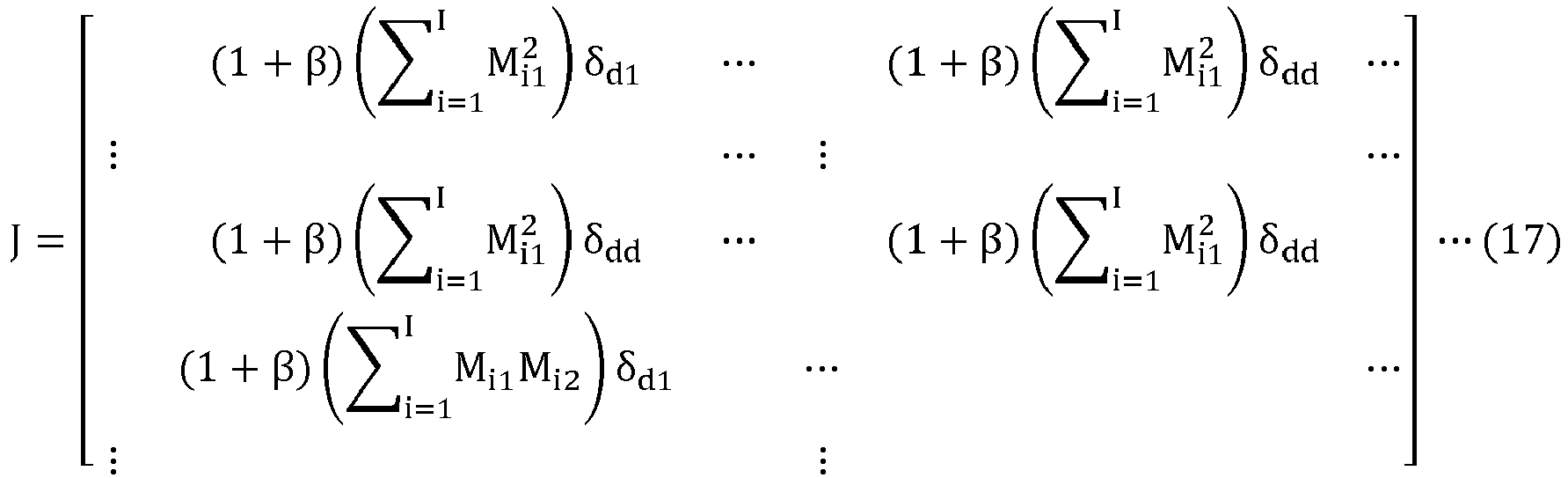

- In S304, the
optimization apparatus 200 employs J and h of the expressions (17) and (18) as the coupling coefficients (Q) and outputs them with Z = [αw, βw, δw]. Actually, numerical values are substituted into all places of symbols. - Referring back to
FIG. 10 , theoptimization apparatus 200 executes processing based on simulated annealing (SA) by the Ising machine based on the coupling coefficients (Q) (203). In the simulated annealing, a search is made for numerical values of W' that represent the combination of the states of the respective bits with which the minimum value of the cost function F'(W) transformed to the Ising format is obtained (ground state). - Subsequently, the
optimization apparatus 200 carries out reverse binary expansion for the numerical values of W' obtained by the simulated annealing of the Ising machine (204). Thereby, theoptimization apparatus 200 finds W that correspond to the numerical values of W' and are continuous values. For example, theoptimization apparatus 200 obtains Wn (continuous values) from the Ising spins (numerical values of W) based on the following expression (19) by using the coefficients Z = [αw, βw, δw] of the binary expansion.
- Here, the values of W', which are the result obtained from F'(W), are correct. However, because the term that is a discontinuous max function (F1(W)) is squared to be replaced by the q-loss function, W' are approximate values from the viewpoint of F(W) and are not correct values.
-
FIG. 14 is an explanatory diagram explaining an example of transformation by q-loss function. For example, as illustrated inFIG. 14 , a graph G201 is one example of F1(m) = max(0, m) as a term that is a discontinuous max function. In the replacement by use of the q-loss function, the term F1(W), which is the discontinuous max function, is squared. Due to this, the shape of the function (shape of the graph) changes as in a graph G202 that is one example of F1(m) = max(0, m)2. - For example, in formulation of a radiation irradiation plan, it is important to impose correct constraint corresponding to the linearity represented in the graph G201 on the beams with which irradiation is carried out. However, if the linearity is hot retained after the transformation as in the graph G202, it becomes difficult to impose the correct constraint and the constraint on the beams becomes less or becomes excessive in some cases.
-
FIG. 15 is an explanatory diagram exemplifying discontinuous functions. As illustrated inFIG. 15 , as discontinuous functions that change in the shape of the function when being replaced by an Ising model, there are also - min(0, m) of a graph G203, max(m, - m) of a graph G204, and so forth. For example, in the case of - min(0, m) of the graph G203, the function becomes max(0, m) when m is subjected to variable transformation to - m. Thus, - min(0, m) may be treated similarly to max(0, m). - In one aspect, the embodiments discussed herein intend to provide an optimization apparatus, an optimization method, and an optimization program that enable finding of the optimum solution with higher accuracy.
- In an example, an optimization apparatus includes: a transformation unit configured to transform an input first cost function to a second cost function by using at least any one of "Legendre transformation," "Lagrange function," and "Wolfe's duality theorem;" a binary expansion unit configured to acquire values in an Ising format by carrying out binary expansion for values relating to coefficients of the second cost function; an Ising machine unit configured to seek values that represent a ground state regarding the values in the Ising format relating to the coefficients of the second cost function; and a reverse binary expansion unit configured to acquire values that minimize the first cost function by carrying out reverse binary expansion for the sought values that represent the ground state.
- According to an aspect of the embodiment, it is possible to enable finding of the optimum solution with higher accuracy.
- The invention is described, by way of example only, with reference to the following drawings, in which:
-
FIG. 1 is a block diagram illustrating a functional configuration example of an optimization apparatus according to an embodiment; -
FIG. 2 is a flowchart illustrating an operation example of an optimization apparatus according to an embodiment; -
FIG. 3 is a flowchart exemplifying transformation processing; -
FIG. 4 is an explanatory diagram explaining one example of Legendre transformation; -
FIG. 5 is an explanatory diagram explaining one example of transformation by use of Wolfe's duality theorem; -
FIG. 6 is an explanatory diagram illustrating a comparative example between the present embodiment and an existing method regarding a discontinuous function; -
FIG. 7 is an explanatory diagram explaining one example of an experimental result; -
FIG. 8 is a block diagram illustrating a hardware configuration example of an optimization apparatus according to an embodiment; -
FIG. 9 is an explanatory diagram explaining one example of an Ising machine; -
FIG. 10 is a block diagram illustrating a functional configuration example of existing optimization apparatus; -
FIG. 11 is an explanatory diagram explaining a formulation example of a radiation irradiation plan; -
FIG. 12 is a flowchart illustrating an existing example of transformation to an expression of an Ising model; -
FIG. 13 is a flowchart illustrating one example of binary expansion processing; -
FIG. 14 is an explanatory diagram explaining an example of transformation by q-loss function; and -
FIG. 15 is an explanatory diagram exemplifying discontinuous functions. - The optimization apparatus, the optimization method, and the optimization program according to the embodiments will be described below with reference to the drawings. Configurations having the same function in the embodiments are given the same numeral and overlapping description is omitted. The optimization apparatus, the optimization method, and the optimization program described in the following embodiments merely represent one example and do not limit the embodiments. Furthermore, the following respective embodiments may be combined as appropriate in a range in which contradiction is not caused.
-
FIG. 1 is a block diagram illustrating a functional configuration example of an optimization apparatus according to an embodiment. As illustrated inFIG. 1 , anoptimization apparatus 1 includes a transforming unit 11, abinary expansion unit 12, an Isingmachine processing unit 13, and a reversebinary expansion unit 14. - The transforming unit 11 is a processing unit that accepts input of a cost function F(W) relating to an optimization problem and carries out transformation to an expression of an Ising model (F'(W)) by using the Legendre transformation, the Lagrange function, and the Wolfe's duality theorem. Suppose that, in the present embodiment, the cost function F(W) input to the transforming unit 11 relates to the radiation irradiation plan exemplified in
FIG. 11 as one example. For example, the input cost function F(W) is represented by the above-described expression (3). - The
binary expansion unit 12 is a processing unit that subjects W to binary expansion into 0 and 1 for processing by an Ising machine because the transformed F'(W) remains continuous values. For example, similarly to the existing binary expansion (202), thebinary expansion unit 12 turns values relating to coefficients of the cost function (F'(W)) transformed by the transforming unit 11 to the Ising format with binary spins through carrying out binary expansion. - The Ising
machine processing unit 13 is a processing unit that executes processing based on simulated annealing (SA) by the Ising machine based on coupling coefficients (Q) and seeks values that represent the ground state. - The reverse
binary expansion unit 14 carries out reverse binary expansion for the values that have been sought by the Isingmachine processing unit 13 and represent the ground state, i.e. numerical values of W' obtained by the simulated annealing of the Ising machine. For example, the reversebinary expansion unit 14 executes the processing similar to that of the existing reverse binary expansion (204) and obtains continuous values (W) corresponding to the numerical values of W'. Thereby, the reversebinary expansion unit 14 obtains the values that minimize the input cost function F(W). - Here, the processing of the respective units of the
optimization apparatus 1 will be described in detail.FIG. 2 is a flowchart illustrating an operation example of an optimization apparatus according to the embodiment. The optimization apparatus illustrated by reference toFIG. 2 may be theoptimization apparatus 1 illustrated inFIG. 1 . - As illustrated in
FIG. 2 , when the processing is started, the transforming unit 11 accepts input of the cost function F(W) having a discontinuous term (F1(W)) (see expression (3)) (S1). - Here, the discontinuous term (F1(W)) is a second term (Σiβimax(0, di(w) - Ci)) in the cost function F(W) represented in expression (3). This discontinuous term may be specified by a user at the time of input of the cost function F(W) or may be detected from the cost function F(W) by a publicly-known expression processing system.
- Subsequently, the transforming unit 11 carries out transformation to the Ising format by using the Legendre transformation, the Lagrange function, and the Wolfe's duality theorem regarding the term (F1(W)) that is the discontinuous term of the cost function F(W) (S2).
- Here, the transformation processing of S2 will be described in detail.
FIG. 3 is a flowchart exemplifying transformation processing. - As illustrated in
FIG. 3 , when the processing is started, the transforming unit 11 accepts input of the cost function F(W) (see expression (3)) (S11). Subsequently, the transforming unit 11 carries out the Legendre transformation twice regarding the discontinuous function F1(W) = Σiβimax(0, di(w) - Ci), which is the discontinuous term in the cost function F(W). Thereby, the transforming unit 11 changes the variable of the function F1 that is convex downward and finds an expression f1(w) in the quadratic format (S12). - When the Legendre transformation is carried out regarding the discontinuous function, the nature does not change although the transformation is carried out because the resulting function is equivalently expressed by a set of tangents specified by the values of the slope and the intercept. For example, f*(p) resulting from the Legendre transformation of a function f is represented by the following expression (20).

- The transforming unit 11 carries out the Legendre transformation twice for βimax(0, di(w) - Ci) of the discontinuous function F1(W). This is equivalent to operation of returning the function to the original because forward transformation and inverse transformation of the Legendre transformation are the same.
- For example, f1(w) = max(0, di(w) - Ci) = - min(0, Ci - di(w)) is defined. When the Legendre transformation is carried out twice for the f1, setting m = di(w) - Ci and putting f1(m) = - min(0, m) yield the following expression (21).

-
FIG. 4 is an explanatory diagram explaining one example of Legendre transformation. InFIG. 4 , a graph G1 is a graph of the discontinuous function F1 before the Legendre transformation. A graph G2 is a graph after the Legendre transformation is carried out twice for the discontinuous function F1. t is a variable added as the result of carrying out the Legendre transformation twice. The condition of t that minimizes (min)-(di(w) - Ci) of f1(w) of the graph G2 is t = 0 for di(w) < Ci and t = - 1 for di(w) > Ci. As illustrated inFIG. 4 , regarding the discontinuous function, the nature of the graph does not change even when the Legendre transformation is carried out twice. - When the function (f1) after the Legendre transformation remains as it is, - (minus) sign exists in front of min of the function f1 and it is difficult to treat the function f1 as a minimization problem of m and t.
- Therefore, the transforming unit 11 finds a dual problem based on the Wolfe's duality theorem regarding the function (f1) after the Legendre transformation (S13). For example, property that the original problem may also be solved if the dual problem may be solved is used.
- For example, the following expression (22) is obtained when the dual problem is found regarding the function (f1). Here, z1 and z2 are Lagrange multipliers. m is m = di(w) - Ci.

- Furthermore, when the signs are reversed regarding expression (22), expression (23) is obtained.

-
FIG. 5 is an explanatory diagram explaining one example of transformation by use of Wolfe's duality theorem. InFIG. 5 , the graph G2 is the graph after the Legendre transformation is carried out twice for the discontinuous function F1 as withFIG. 4 . A graph G3 is a graph of the expression transformed through finding the dual problem based on the Wolfe's duality theorem. - As illustrated in
FIG. 5 , in the expression of the graph G3, z1 and z2 are added to t added when the Legendre transformation is carried out twice. In the graph G3, the condition of z1 and z2 that minimizes (min) f1(w) is z1 = 0 for di(w) < Ci in order to cause f1(w) to follow the shape of the graph. Furthermore, for di(w) > Ci, z1 and z2 are indefinite, for example, they have no relation to the shape of the graph. - Referring back to
FIG. 3 , subsequently to S13, the transforming unit 11 employs Wolfe's dual constraints (expression transformed through finding the dual problem) as a penalty term M(- (di(w) - Ci) - z1 + z2)2 and expresses the penalty term in the two-body Ising format (S14). For example, the resulting function is represented by the following expression (24). M is set to a sufficiently large numerical value (for example, 100 or the like).
- Subsequently, regarding the cost function (F(W)), the transforming unit 11 outputs the whole of the function (F'(W)) in which the penalty term expressed in the two-body Ising format is incorporated instead of the discontinuous function (F1(W)) and the ranges of values.
- For example, the output F'(W) is represented by the following expression (25). Furthermore, the output ranges of the values of z1, z2, and t are z1 ≥ 0, z2 ≥ 0, and - 1 ≤ t ≤ 0.

- Referring back to
FIG. 2 , the Ising spins transformed to the Ising format in S2 are real number values. Therefore, subsequently to S2, thebinary expansion unit 12 carries out binary expansion for the spins of the real number values in the Ising format and finds the Ising format with binary spins (S3). For example, thebinary expansion unit 12 accepts input of the precision of the binary expansion (dw) and the range of values (α, β) and carries out the binary expansion of W similarly to the existing binary expansion (202). Subsequently, thebinary expansion unit 12 outputs coupling coefficients (q) relating to W' resulting from the binary expansion and coefficients (Z) for returning W' to the original real numbers. - Subsequently, the Ising
machine processing unit 13 executes processing by an Ising machine by using the Ising format (S4). For example, the Isingmachine processing unit 13 executes processing based on simulated annealing (SA) by the Ising machine based on the coupling coefficients (Q) and finds the values of the respective spins that represent the ground state. - Subsequently, the reverse
binary expansion unit 14 finds the values of coefficients before the binary expansion by using the values of the spins of the processing result by the Ising machine (values of the respective spins that represent the ground state) (S5). For example, the reversebinary expansion unit 14 executes the processing similar to that of the existing reverse binary expansion (204) to carry out reverse binary expansion for the numerical values of W' obtained by the Ising machine. Thereby, theoptimization apparatus 1 obtains the values (real number values) that minimize the input cost function F(W). - As described above, the
optimization apparatus 1 includes the transforming unit 11, thebinary expansion unit 12, the Isingmachine processing unit 13, and the reversebinary expansion unit 14. The transforming unit 11 transforms an input first cost function (F(W)) to a second cost function (F'(W)) by using the Lagrange function and the Wolfe's duality theorem. Thebinary expansion unit 12 finds the coupling coefficients (Q) to turn values relating to the coefficients of the second cost function to the Ising format with binary spins through carrying out binary expansion. The Isingmachine processing unit 13 seeks the values that represent the ground state regarding the coupling coefficients relating to the second cost function (F'(W)). The reversebinary expansion unit 14 carries out reverse binary expansion regarding the sought values that represent the ground state and finds the values that minimize the first cost function (F(W)). - Due to this, when describing the absolute value constraint included in the first cost function (F(W)) by an Ising model, the
optimization apparatus 1 may treat the absolute value constraint as it is without changing the shape of the function (graph shape). Therefore, theoptimization apparatus 1 may find the optimum solution with higher accuracy. -
FIG. 6 is an explanatory diagram illustrating a comparative example between the present embodiment and an existing method regarding a discontinuous function. InFIG. 6 , a graph G4 is a graph when a discontinuous function F1(m) is described by an Ising model by the transforming unit 11. A graph G5 is a graph when the discontinuous function F1(m) is described by an Ising model by the existing method using the q-loss function. - As illustrated in
FIG. 6 , in the graph G4, the function may be treated with the graph shape corresponding to the max function remaining as is (with the absolute value constraint remaining as it is). In contrast, in the existing method, the linearity is not retained in the graph shape after the transformation, and a region G51 in which the constraint becomes less and a region G52 in which the constraint becomes excessive are generated. As a result, for example, in formulation of a radiation irradiation plan, the constraint on beams becomes less or becomes excessive in some cases. -
FIG. 7 is an explanatory diagram explaining one example of an experimental result. The experimental result illustrated inFIG. 7 is obtained by finding a radiation irradiation plan when tumors (disease P(2) to P(4)) and normal tissue (normal P(1)) are disposed as a pixel arrangement P1. Beams exist at 20 places in a clockwise manner and the irradiation amount (M) is as represented inFIG. 7 , with the number of rows being I and the number of columns being N. Furthermore, suppose that the values of P(1 to 5) and the values of Ci are as represented inFIG. 7 . Moreover, suppose that square constraint using the q-loss function may be used if the result of multiplication of the obtained intensity W and M does not surpasses Ci (here Ci = P + 0.01). - In
FIG. 7 , MWabs is the result of multiplication of the obtained W and M (with absolute value constraint) by theoptimization apparatus 1 of the present embodiment under the conditions represented inFIG. 7 . Furthermore, MWsquare is the result of multiplication of the obtained W and M (with square constraint) by the existingoptimization apparatus 200. As illustrated inFIG. 7 , in MWsquare, the first and third values are larger than Ci and excessive. In contrast, in MWabs, a value that exceeds Ci does not exist. Therefore, it turns out that the constraint on the beams effectively works in the radiation irradiation plan by theoptimization apparatus 1 of the present embodiment. - Furthermore, the transforming unit 11 carries out the Legendre transformation regarding the discontinuous function (F1(W)) included in the first cost function (F(W)). Then, the transforming unit 11 carries out transformation to the second cost function (F'(W)) by incorporating a function obtained through finding a dual problem based on the Wolfe's duality theorem based on the expression after the Legendre transformation to the first cost function instead of the discontinuous function. This allows the
optimization apparatus 1 to carry out the transformation from the first cost function (F(W)) to the second cost function (F'(W)) without changing the shape of the discontinuous function (graph shape) included in the first cost function (F(W)). - The respective constituent elements of the respective apparatuses that are diagrammatically represented do not necessarily be configured as diagrammatically represented physically. For example, specific forms of distribution and integration of the respective apparatuses are not limited to the diagrammatically-represented forms, and all or part of the respective apparatuses may be configured to be distributed or integrated functionally or physically in an arbitrary unit according to various loads, the status of use, and so forth.
- All or an arbitrary part of various processing functions executed in the
optimization apparatus 1 may be executed on a central processing unit (CPU) (or microcomputer such as micro-processing unit (MPU) or micro controller unit (MCU)). Furthermore, it goes without saying that all or an arbitrary part of various processing functions may be executed on a program analyzed and executed by the CPU (or microcomputer such as MPU or MCU) or hardware based on wired logic. Moreover, the various processing functions executed in theoptimization apparatus 1 may be executed through cooperation of plural computers based on cloud computing. - Incidentally, various kinds of processing explained in the above-described embodiment may be implemented by executing a program prepared in advance by a computer. Thus, one example of a computer (hardware) that executes a program having the functions similar to that of the above-described embodiment will be described below.
FIG. 8 is a block diagram illustrating a hardware configuration example of an optimization apparatus according to the embodiment. The optimization apparatus illustrated inFIG. 8 may be theoptimization apparatus 1 illustrated inFIG. 1 . - As illustrated in
FIG. 8 , theoptimization apparatus 1 includes an input-output apparatus 100, astoring apparatus 101, a random access memory (RAM) 102, a read only memory (ROM) 103, aCPU 104, and anIsing machine 105. The respective units (100 to 105) in theoptimization apparatus 1 are coupled to a bus 106. - The input-
output apparatus 100 is an input apparatus such as keyboard and mouse that accept input operation from a user and an output apparatus such as a display that outputs various processing results. The storingapparatus 101 is a hard disk apparatus or the like, for example, and aprogram 101a for executing various kinds of processing explained in the above-described embodiment is stored therein. Furthermore, various kinds of data to which theprogram 101a refers are stored in thestoring apparatus 101. TheRAM 102 is used when theCPU 104 reads out theprogram 101a and executes various kinds of processing, and temporarily stores various kinds of information. TheROM 103 is a non-volatile memory that stores a boot program executed at the time of activation of theoptimization apparatus 1, and so forth, for example. - The
CPU 104 executes various kinds of processing relating to the transforming unit 11, thebinary expansion unit 12, the Isingmachine processing unit 13, and the reversebinary expansion unit 14 by reading out theprogram 101a stored in thestoring apparatus 101 and loading theprogram 101a into theRAM 102 to execute it. Theprogram 101a does not have to be stored in thestoring apparatus 101. For example, theoptimization apparatus 1 may read out and execute theprogram 101a stored in a storage medium that may be read by theoptimization apparatus 1. The storage medium that may be read by theoptimization apparatus 1 is compact disc (CD)-ROM, digital versatile disc (DVD) disc, portable recording medium such as universal serial bus (USB) memory, semiconductor memory such as flash memory, hard disk drive, and so forth, for example. Furthermore, theprogram 101a may be stored in an apparatus coupled to a public line, the Internet, a local area network (LAN), or the like and theoptimization apparatus 1 may read out theprogram 101a from any of them and execute it. - The
Ising machine 105 is an apparatus that executes processing based on simulated annealing (SA) and seeks the combination of the states of the respective bits with which the minimum value of a cost function transformed to the Ising format is obtained (ground state) under control by the Isingmachine processing unit 13. -
FIG. 9 is an explanatory diagram explaining one example of an Ising machine. The Ising machine illustrated inFIG. 9 may be theIsing machine 105 illustrated inFIG. 8 . As illustrated inFIG. 9 , theIsing machine 105 includes a controller 110, a hardware optimization engine 111, andplural neurons 112. - The controller 110 passes weights Wij relating to coupling coefficients to the hardware optimization engine 111 and causes the hardware optimization engine 111 to execute simulated annealing (SA) processing to obtain the state of each bit. The hardware optimization engine 111 sets the weights Wij from the controller 110 in each of the
neurons 112 and obtains output after the SA processing from each of theneurons 112. Subsequently, the hardware optimization engine 111 outputs, to the controller 110, the output obtained from each of theneurons 112. - The
plural neurons 112 are what are obtained by modeling an Ising model by using a neural network. For example, each of theplural neurons 112 functions as a neuron that outputs 0 or 1 according to the states of the other bits and the weights Wij (coupling coefficients) that represent the strength of coupling between another bit and the self-bit. - For example, each of the
neurons 112 includesmultipliers 113,adders 114, and acomparator 116. Each of themultipliers 113 multiplies the states (x1, x2, ···, xn) ofn neurons 112 output from the hardware optimization engine 111 and the weights Wi1, ···, and Wi,n. Theadders 114 integrate the values output from themultipliers 113 and addsnoise 115. Thecomparator 116 outputs a comparison result between the value resulting from the integration by theadders 114 and the addition of thenoise 115 and a threshold. Theneuron 112 seeks the ground state by sequentially updating the parameters of theneuron 112 based on the output value obtained from thecomparator 116 and repeating the processing. - In any of the above aspects, the various features may be implemented in hardware, or as software modules running on one or more processors. Features of one aspect may be applied to any of the other aspects.
- The invention also provides a computer program or a computer program product for carrying out any of the methods described herein, and a computer readable medium having stored thereon a program for carrying out any of the methods described herein. A computer program embodying the invention may be stored on a computer-readable medium, or it could, for example, be in the form of a signal such as a downloadable data signal provided from an Internet website, or it could be in any other form.
-
- 1: OPTIMIZATION APPARATUS
- 11: TRANSFORMING UNIT
- 12: BINARY EXPANSION UNIT
- 13: ISING MACHINE PROCESSING UNIT
- 14: REVERSE BINARY EXPANSION UNIT
- 100: INPUT-OUTPUT APPARATUS
- 101: STORING APPARATUS
- 101a: PROGRAM
- 102: RAM
- 103: ROM
- 104: CPU
- 105: ISING MACHINE
- 110: CONTROLLER
- 111: HARDWARE OPTIMIZATION ENGINE
- 112: NEURONS
- 113: MULTIPLIERS
- 114: ADDERS
- 115: NOISE
- 200: OPTIMIZATION APPARATUS
- 301: TUMOR
- 302 NORMAL TISSUE
- M: DEGREE OF INFLUENCE
- P1: PIXEL ARRANGEMENT
-
- Japanese Laid-open Patent Publication, No.
10-149445 - Japanese National Publication of International Patent Application No.
2002-522128 - V.S. Denchev, N. Ding, S.V.N. Vishwanathan, and H. Neven, "Robust classification with adiabatic quantum optimization," in Proc. ICML'12, pp. 1003-1010 (2012)
Claims (4)
- An optimization apparatus comprising:a transformation unit configured to transform an input first cost function to a second cost function by using at least any one of "Legendre transformation," "Lagrange function," and "Wolfe's duality theorem;"a binary expansion unit configured to acquire values in an Ising format by carrying out binary expansion for values relating to coefficients of the second cost function;an Ising machine unit configured to seek values that represent a ground state regarding the values in the Ising format relating to the coefficients of the second cost function; anda reverse binary expansion unit that includes acquiring values that minimize the first cost function by carrying out reverse binary expansion for the sought values that represent the ground state.
- The optimization apparatus according to claim 1,
wherein the transformation unit is further configured to
carry out Legendre transformation regarding a discontinuous function included in the first cost function, and
carry out transformation to the second cost function by incorporating a first function into the first cost function instead of the discontinuous function; the first function being a function obtained through finding a dual problem based on "Wolfe's duality theorem" on basis of an expression after the Legendre transformation. - A method implemented by an optimization apparatus, the method comprising:executing transformation processing that includes transforming an input first cost function to a second cost function by using at least any one of "Legendre transformation," "Lagrange function," and "Wolfe's duality theorem;"executing binary expansion processing that includes acquiring values in an Ising format by carrying out binary expansion for values relating to coefficients of the second cost function;executing Ising machine processing that includes seeking values that represent a ground state regarding the values in the Ising format relating to the coefficients of the second cost function; andexecuting reverse binary expansion processing that includes acquiring values that minimize the first cost function by carrying out reverse binary expansion for the sought values that represent the ground state.
- An optimization program being configured to cause a computer to perform processing, the processing comprising:executing transformation processing that includes transforming an input first cost function to a second cost function by using at least any one of "Legendre transformation," "Lagrange function," and "Wolfe's duality theorem;"executing binary expansion processing that includes acquiring values in an Ising format by carrying out binary expansion for values relating to coefficients of the second cost function;executing Ising machine processing that includes seeking values that represent a ground state regarding the values in the Ising format relating to the coefficients of the second cost function; andexecuting reverse binary expansion processing that includes acquiring values that minimize the first cost function by carrying out reverse binary expansion for the sought values that represent the ground state.
Applications Claiming Priority (1)
| Application Number | Priority Date | Filing Date | Title |
|---|---|---|---|
| JP2018199994A JP7187972B2 (en) | 2018-10-24 | 2018-10-24 | Apparatus, method and program |
Publications (2)
| Publication Number | Publication Date |
|---|---|
| EP3644238A1 true EP3644238A1 (en) | 2020-04-29 |
| EP3644238B1 EP3644238B1 (en) | 2021-08-11 |
Family
ID=67953653
Family Applications (1)
| Application Number | Title | Priority Date | Filing Date |
|---|---|---|---|
| EP19196985.6A Active EP3644238B1 (en) | 2018-10-24 | 2019-09-12 | Optimization apparatus, method implemented by optimization apparatus, and optimization program |
Country Status (4)
| Country | Link |
|---|---|
| US (1) | US11443012B2 (en) |
| EP (1) | EP3644238B1 (en) |
| JP (1) | JP7187972B2 (en) |
| CN (1) | CN111090826B (en) |
Families Citing this family (5)
| Publication number | Priority date | Publication date | Assignee | Title |
|---|---|---|---|---|
| JP7518379B2 (en) * | 2020-10-09 | 2024-07-18 | 富士通株式会社 | Optimization device, optimization program, and optimization method |
| JP7556260B2 (en) * | 2020-10-22 | 2024-09-26 | 富士通株式会社 | Optimization device, optimization method, and optimization program |
| JP2022125725A (en) * | 2021-02-17 | 2022-08-29 | 富士通株式会社 | Information processing system, information processing method, and program |
| CN118235141B (en) * | 2021-11-26 | 2025-09-09 | 富士胶片株式会社 | Information processing device, information processing method, and information processing program |
| JP2024077644A (en) | 2022-11-29 | 2024-06-10 | 富士通株式会社 | Data processing device, program and data processing method |
Citations (3)
| Publication number | Priority date | Publication date | Assignee | Title |
|---|---|---|---|---|
| JPH10149445A (en) | 1996-11-19 | 1998-06-02 | Image Joho Kagaku Kenkyusho | Body motion analysis visualization device |
| JP2002522128A (en) | 1998-08-06 | 2002-07-23 | ウイスコンシン アラムナイ リサーチ フオンデーシヨン | How to create a radiation treatment plan |
| WO2017145086A1 (en) * | 2016-02-23 | 2017-08-31 | 1Qb Information Technologies Inc. | Method and system for solving the lagrangian dual of a binary polynomially constrained polynomial programming problem using a binary optimizer |
Family Cites Families (7)
| Publication number | Priority date | Publication date | Assignee | Title |
|---|---|---|---|---|
| US10275422B2 (en) * | 2013-11-19 | 2019-04-30 | D-Wave Systems, Inc. | Systems and methods for finding quantum binary optimization problems |
| JP6445246B2 (en) * | 2014-03-27 | 2018-12-26 | 株式会社日立製作所 | Information processing apparatus and information processing method |
| US20170242824A1 (en) * | 2016-02-23 | 2017-08-24 | 1Qb Information Technologies Inc. | Method and system for solving the lagrangian dual of a binary polynomially constrained polynomial programming problem using a quantum annealer |
| WO2017017807A1 (en) | 2015-07-29 | 2017-02-02 | 株式会社日立製作所 | Information processing device and method |
| JP6629864B2 (en) | 2015-08-31 | 2020-01-15 | 株式会社日立製作所 | Information processing apparatus and method |
| CN105664376B (en) * | 2015-12-31 | 2019-11-19 | 上海联影医疗科技有限公司 | A kind of device and equipment of dosage distribution determination and radiotherapy treatment planning optimization |
| CA2921711C (en) * | 2016-02-23 | 2018-12-11 | 1Qb Information Technologies Inc. | Method and system for solving the lagrangian dual of a binary polynomially constrained polynomial programming problem using a quantum annealer |
-
2018
- 2018-10-24 JP JP2018199994A patent/JP7187972B2/en active Active
-
2019
- 2019-09-12 US US16/569,077 patent/US11443012B2/en active Active
- 2019-09-12 EP EP19196985.6A patent/EP3644238B1/en active Active
- 2019-09-27 CN CN201910924730.3A patent/CN111090826B/en active Active
Patent Citations (3)
| Publication number | Priority date | Publication date | Assignee | Title |
|---|---|---|---|---|
| JPH10149445A (en) | 1996-11-19 | 1998-06-02 | Image Joho Kagaku Kenkyusho | Body motion analysis visualization device |
| JP2002522128A (en) | 1998-08-06 | 2002-07-23 | ウイスコンシン アラムナイ リサーチ フオンデーシヨン | How to create a radiation treatment plan |
| WO2017145086A1 (en) * | 2016-02-23 | 2017-08-31 | 1Qb Information Technologies Inc. | Method and system for solving the lagrangian dual of a binary polynomially constrained polynomial programming problem using a binary optimizer |
Non-Patent Citations (3)
| Title |
|---|
| DARYL P NAZARETH ET AL: "First application of quantum annealing to IMRT beamlet intensity optimization", PHYSICS IN MEDICINE AND BIOLOGY, INSTITUTE OF PHYSICS PUBLISHING, BRISTOL GB, vol. 60, no. 10, 1 May 2015 (2015-05-01), pages 4137 - 4148, XP020284950, ISSN: 0031-9155, [retrieved on 20150501], DOI: 10.1088/0031-9155/60/10/4137 * |
| V.S. DENCHEVN. DINGS.V.N. VISHWANATHANH. NEVEN: "Robust classification with adiabatic quantum optimization", PROC. ICML, vol. 12, 2012, pages 1003 - 1010 |
| VASIL S DENCHEV ET AL: "Robust Classification with Adiabatic Quantum Optimization", CORR (ARXIV), vol. 1205.1148, no. v2, 30 May 2012 (2012-05-30), pages 1 - 17, XP055579010 * |
Also Published As
| Publication number | Publication date |
|---|---|
| CN111090826B (en) | 2023-09-29 |
| US11443012B2 (en) | 2022-09-13 |
| JP7187972B2 (en) | 2022-12-13 |
| JP2020067811A (en) | 2020-04-30 |
| EP3644238B1 (en) | 2021-08-11 |
| CN111090826A (en) | 2020-05-01 |
| US20200133988A1 (en) | 2020-04-30 |
Similar Documents
| Publication | Publication Date | Title |
|---|---|---|
| EP3644238B1 (en) | Optimization apparatus, method implemented by optimization apparatus, and optimization program | |
| Ajlouni et al. | Medical image diagnosis based on adaptive hybrid quantum CNN | |
| Pierson et al. | ZIFA: Dimensionality reduction for zero-inflated single-cell gene expression analysis | |
| US20220237465A1 (en) | Performing inference and signal-to-noise ratio based pruning to train sparse neural network architectures | |
| US8250013B2 (en) | System and method for privacy preserving predictive models for lung cancer survival analysis | |
| Medina-Ortiz et al. | Development of supervised learning predictive models for highly non-linear biological, biomedical, and general datasets | |
| Mahajan et al. | Image segmentation approach based on adaptive flower pollination algorithm and type II fuzzy entropy | |
| Gao et al. | Lincde: conditional density estimation via lindsey's method | |
| Coates et al. | Radiomic and radiogenomic modeling for radiotherapy: strategies, pitfalls, and challenges | |
| Calisto et al. | Self-adaptive 2D-3D ensemble of fully convolutional networks for medical image segmentation | |
| Bley et al. | Explaining predictive uncertainty by exposing second-order effects | |
| Hoang et al. | Data-driven inference of hidden nodes in networks | |
| Lazebnik et al. | An algorithm to optimize explainability using feature ensembles: T. Lazebnik et al. | |
| Chatzimichali et al. | Novel application of heuristic optimisation enables the creation and thorough evaluation of robust support vector machine ensembles for machine learning applications | |
| Stumpf et al. | Handbook of statistical systems biology | |
| CN118212158A (en) | Method and apparatus for semiconductor pattern correction | |
| Bouhamed et al. | Structure space of Bayesian networks is dramatically reduced by subdividing it in sub-networks | |
| Nugroho et al. | Enhancing dermoscopic pigmented skin lesion classification: A refined approach using the pre-trained Inception-V3 architecture | |
| Qi et al. | Superiority of quadratic over conventional neural networks for classification of gaussian mixture data | |
| Algarni et al. | Towards Improving Predictive Statistical Learning Model Accuracy by Enhancing Learning Technique. | |
| EP4050565B1 (en) | Process for iteratively reconstructing images using deep learning | |
| Hassan et al. | Bayesian-Optimized Random Forest with SMOTE for Predicting Kinase Inhibitor Resistance | |
| Royhan et al. | Feature Selection Using Ensemble Lasso Regression, Random Forest and Recursive Feature Elimination Methods in Breast Cancer Classification | |
| Symonov et al. | Optimisation of training samples with KLE and mutual information | |
| Dukov et al. | Evaluation of PNN pattern-layer activation function approximations in different training setups |
Legal Events
| Date | Code | Title | Description |
|---|---|---|---|
| PUAI | Public reference made under article 153(3) epc to a published international application that has entered the european phase |
Free format text: ORIGINAL CODE: 0009012 |
|
| STAA | Information on the status of an ep patent application or granted ep patent |
Free format text: STATUS: THE APPLICATION HAS BEEN PUBLISHED |
|
| AK | Designated contracting states |
Kind code of ref document: A1 Designated state(s): AL AT BE BG CH CY CZ DE DK EE ES FI FR GB GR HR HU IE IS IT LI LT LU LV MC MK MT NL NO PL PT RO RS SE SI SK SM TR |
|
| AX | Request for extension of the european patent |
Extension state: BA ME |
|
| STAA | Information on the status of an ep patent application or granted ep patent |
Free format text: STATUS: REQUEST FOR EXAMINATION WAS MADE |
|
| 17P | Request for examination filed |
Effective date: 20201028 |
|
| RBV | Designated contracting states (corrected) |
Designated state(s): AL AT BE BG CH CY CZ DE DK EE ES FI FR GB GR HR HU IE IS IT LI LT LU LV MC MK MT NL NO PL PT RO RS SE SI SK SM TR |
|
| STAA | Information on the status of an ep patent application or granted ep patent |
Free format text: STATUS: EXAMINATION IS IN PROGRESS |
|
| 17Q | First examination report despatched |
Effective date: 20210121 |
|
| GRAP | Despatch of communication of intention to grant a patent |
Free format text: ORIGINAL CODE: EPIDOSNIGR1 |
|
| STAA | Information on the status of an ep patent application or granted ep patent |
Free format text: STATUS: GRANT OF PATENT IS INTENDED |
|
| RIC1 | Information provided on ipc code assigned before grant |
Ipc: G06N 5/00 20060101ALN20210409BHEP Ipc: A61N 5/10 20060101ALN20210409BHEP Ipc: G06N 3/063 20060101ALI20210409BHEP Ipc: G06N 3/04 20060101AFI20210409BHEP |
|
| RIC1 | Information provided on ipc code assigned before grant |
Ipc: G06N 5/00 20060101ALN20210429BHEP Ipc: A61N 5/10 20060101ALN20210429BHEP Ipc: G06N 3/063 20060101ALI20210429BHEP Ipc: G06N 3/04 20060101AFI20210429BHEP |
|
| INTG | Intention to grant announced |
Effective date: 20210512 |
|
| GRAS | Grant fee paid |
Free format text: ORIGINAL CODE: EPIDOSNIGR3 |
|
| GRAA | (expected) grant |
Free format text: ORIGINAL CODE: 0009210 |
|
| STAA | Information on the status of an ep patent application or granted ep patent |
Free format text: STATUS: THE PATENT HAS BEEN GRANTED |
|
| AK | Designated contracting states |
Kind code of ref document: B1 Designated state(s): AL AT BE BG CH CY CZ DE DK EE ES FI FR GB GR HR HU IE IS IT LI LT LU LV MC MK MT NL NO PL PT RO RS SE SI SK SM TR |
|
| REG | Reference to a national code |
Ref country code: CH Ref legal event code: EP |
|
| REG | Reference to a national code |
Ref country code: DE Ref legal event code: R096 Ref document number: 602019006758 Country of ref document: DE |
|
| REG | Reference to a national code |
Ref country code: IE Ref legal event code: FG4D Ref country code: AT Ref legal event code: REF Ref document number: 1420149 Country of ref document: AT Kind code of ref document: T Effective date: 20210915 |
|
| REG | Reference to a national code |
Ref country code: LT Ref legal event code: MG9D |
|
| REG | Reference to a national code |
Ref country code: NL Ref legal event code: MP Effective date: 20210811 |
|
| REG | Reference to a national code |
Ref country code: AT Ref legal event code: MK05 Ref document number: 1420149 Country of ref document: AT Kind code of ref document: T Effective date: 20210811 |
|
| PG25 | Lapsed in a contracting state [announced via postgrant information from national office to epo] |
Ref country code: RS Free format text: LAPSE BECAUSE OF FAILURE TO SUBMIT A TRANSLATION OF THE DESCRIPTION OR TO PAY THE FEE WITHIN THE PRESCRIBED TIME-LIMIT Effective date: 20210811 Ref country code: SE Free format text: LAPSE BECAUSE OF FAILURE TO SUBMIT A TRANSLATION OF THE DESCRIPTION OR TO PAY THE FEE WITHIN THE PRESCRIBED TIME-LIMIT Effective date: 20210811 Ref country code: FI Free format text: LAPSE BECAUSE OF FAILURE TO SUBMIT A TRANSLATION OF THE DESCRIPTION OR TO PAY THE FEE WITHIN THE PRESCRIBED TIME-LIMIT Effective date: 20210811 Ref country code: ES Free format text: LAPSE BECAUSE OF FAILURE TO SUBMIT A TRANSLATION OF THE DESCRIPTION OR TO PAY THE FEE WITHIN THE PRESCRIBED TIME-LIMIT Effective date: 20210811 Ref country code: HR Free format text: LAPSE BECAUSE OF FAILURE TO SUBMIT A TRANSLATION OF THE DESCRIPTION OR TO PAY THE FEE WITHIN THE PRESCRIBED TIME-LIMIT Effective date: 20210811 Ref country code: NO Free format text: LAPSE BECAUSE OF FAILURE TO SUBMIT A TRANSLATION OF THE DESCRIPTION OR TO PAY THE FEE WITHIN THE PRESCRIBED TIME-LIMIT Effective date: 20211111 Ref country code: PT Free format text: LAPSE BECAUSE OF FAILURE TO SUBMIT A TRANSLATION OF THE DESCRIPTION OR TO PAY THE FEE WITHIN THE PRESCRIBED TIME-LIMIT Effective date: 20211213 Ref country code: LT Free format text: LAPSE BECAUSE OF FAILURE TO SUBMIT A TRANSLATION OF THE DESCRIPTION OR TO PAY THE FEE WITHIN THE PRESCRIBED TIME-LIMIT Effective date: 20210811 Ref country code: BG Free format text: LAPSE BECAUSE OF FAILURE TO SUBMIT A TRANSLATION OF THE DESCRIPTION OR TO PAY THE FEE WITHIN THE PRESCRIBED TIME-LIMIT Effective date: 20211111 Ref country code: AT Free format text: LAPSE BECAUSE OF FAILURE TO SUBMIT A TRANSLATION OF THE DESCRIPTION OR TO PAY THE FEE WITHIN THE PRESCRIBED TIME-LIMIT Effective date: 20210811 |
|
| PG25 | Lapsed in a contracting state [announced via postgrant information from national office to epo] |
Ref country code: PL Free format text: LAPSE BECAUSE OF FAILURE TO SUBMIT A TRANSLATION OF THE DESCRIPTION OR TO PAY THE FEE WITHIN THE PRESCRIBED TIME-LIMIT Effective date: 20210811 Ref country code: LV Free format text: LAPSE BECAUSE OF FAILURE TO SUBMIT A TRANSLATION OF THE DESCRIPTION OR TO PAY THE FEE WITHIN THE PRESCRIBED TIME-LIMIT Effective date: 20210811 Ref country code: GR Free format text: LAPSE BECAUSE OF FAILURE TO SUBMIT A TRANSLATION OF THE DESCRIPTION OR TO PAY THE FEE WITHIN THE PRESCRIBED TIME-LIMIT Effective date: 20211112 |
|
| PG25 | Lapsed in a contracting state [announced via postgrant information from national office to epo] |
Ref country code: NL Free format text: LAPSE BECAUSE OF FAILURE TO SUBMIT A TRANSLATION OF THE DESCRIPTION OR TO PAY THE FEE WITHIN THE PRESCRIBED TIME-LIMIT Effective date: 20210811 |
|
| PG25 | Lapsed in a contracting state [announced via postgrant information from national office to epo] |
Ref country code: DK Free format text: LAPSE BECAUSE OF FAILURE TO SUBMIT A TRANSLATION OF THE DESCRIPTION OR TO PAY THE FEE WITHIN THE PRESCRIBED TIME-LIMIT Effective date: 20210811 |
|
| REG | Reference to a national code |
Ref country code: DE Ref legal event code: R097 Ref document number: 602019006758 Country of ref document: DE |
|
| REG | Reference to a national code |
Ref country code: BE Ref legal event code: MM Effective date: 20210930 |
|
| PG25 | Lapsed in a contracting state [announced via postgrant information from national office to epo] |
Ref country code: SM Free format text: LAPSE BECAUSE OF FAILURE TO SUBMIT A TRANSLATION OF THE DESCRIPTION OR TO PAY THE FEE WITHIN THE PRESCRIBED TIME-LIMIT Effective date: 20210811 Ref country code: SK Free format text: LAPSE BECAUSE OF FAILURE TO SUBMIT A TRANSLATION OF THE DESCRIPTION OR TO PAY THE FEE WITHIN THE PRESCRIBED TIME-LIMIT Effective date: 20210811 Ref country code: RO Free format text: LAPSE BECAUSE OF FAILURE TO SUBMIT A TRANSLATION OF THE DESCRIPTION OR TO PAY THE FEE WITHIN THE PRESCRIBED TIME-LIMIT Effective date: 20210811 Ref country code: MC Free format text: LAPSE BECAUSE OF FAILURE TO SUBMIT A TRANSLATION OF THE DESCRIPTION OR TO PAY THE FEE WITHIN THE PRESCRIBED TIME-LIMIT Effective date: 20210811 Ref country code: EE Free format text: LAPSE BECAUSE OF FAILURE TO SUBMIT A TRANSLATION OF THE DESCRIPTION OR TO PAY THE FEE WITHIN THE PRESCRIBED TIME-LIMIT Effective date: 20210811 Ref country code: CZ Free format text: LAPSE BECAUSE OF FAILURE TO SUBMIT A TRANSLATION OF THE DESCRIPTION OR TO PAY THE FEE WITHIN THE PRESCRIBED TIME-LIMIT Effective date: 20210811 Ref country code: AL Free format text: LAPSE BECAUSE OF FAILURE TO SUBMIT A TRANSLATION OF THE DESCRIPTION OR TO PAY THE FEE WITHIN THE PRESCRIBED TIME-LIMIT Effective date: 20210811 |
|
| PLBE | No opposition filed within time limit |
Free format text: ORIGINAL CODE: 0009261 |
|
| STAA | Information on the status of an ep patent application or granted ep patent |
Free format text: STATUS: NO OPPOSITION FILED WITHIN TIME LIMIT |
|
| 26N | No opposition filed |
Effective date: 20220512 |
|
| PG25 | Lapsed in a contracting state [announced via postgrant information from national office to epo] |
Ref country code: LU Free format text: LAPSE BECAUSE OF NON-PAYMENT OF DUE FEES Effective date: 20210912 Ref country code: IT Free format text: LAPSE BECAUSE OF FAILURE TO SUBMIT A TRANSLATION OF THE DESCRIPTION OR TO PAY THE FEE WITHIN THE PRESCRIBED TIME-LIMIT Effective date: 20210811 Ref country code: IE Free format text: LAPSE BECAUSE OF NON-PAYMENT OF DUE FEES Effective date: 20210912 Ref country code: BE Free format text: LAPSE BECAUSE OF NON-PAYMENT OF DUE FEES Effective date: 20210930 |
|
| PG25 | Lapsed in a contracting state [announced via postgrant information from national office to epo] |
Ref country code: SI Free format text: LAPSE BECAUSE OF FAILURE TO SUBMIT A TRANSLATION OF THE DESCRIPTION OR TO PAY THE FEE WITHIN THE PRESCRIBED TIME-LIMIT Effective date: 20210811 |
|
| REG | Reference to a national code |
Ref country code: CH Ref legal event code: PL |
|
| PG25 | Lapsed in a contracting state [announced via postgrant information from national office to epo] |
Ref country code: CY Free format text: LAPSE BECAUSE OF FAILURE TO SUBMIT A TRANSLATION OF THE DESCRIPTION OR TO PAY THE FEE WITHIN THE PRESCRIBED TIME-LIMIT Effective date: 20210811 |
|
| PG25 | Lapsed in a contracting state [announced via postgrant information from national office to epo] |
Ref country code: LI Free format text: LAPSE BECAUSE OF NON-PAYMENT OF DUE FEES Effective date: 20220930 Ref country code: HU Free format text: LAPSE BECAUSE OF FAILURE TO SUBMIT A TRANSLATION OF THE DESCRIPTION OR TO PAY THE FEE WITHIN THE PRESCRIBED TIME-LIMIT; INVALID AB INITIO Effective date: 20190912 Ref country code: CH Free format text: LAPSE BECAUSE OF NON-PAYMENT OF DUE FEES Effective date: 20220930 |
|
| PG25 | Lapsed in a contracting state [announced via postgrant information from national office to epo] |
Ref country code: MK Free format text: LAPSE BECAUSE OF FAILURE TO SUBMIT A TRANSLATION OF THE DESCRIPTION OR TO PAY THE FEE WITHIN THE PRESCRIBED TIME-LIMIT Effective date: 20210811 |
|
| PG25 | Lapsed in a contracting state [announced via postgrant information from national office to epo] |
Ref country code: MT Free format text: LAPSE BECAUSE OF FAILURE TO SUBMIT A TRANSLATION OF THE DESCRIPTION OR TO PAY THE FEE WITHIN THE PRESCRIBED TIME-LIMIT Effective date: 20210811 |
|
| PGFP | Annual fee paid to national office [announced via postgrant information from national office to epo] |
Ref country code: DE Payment date: 20250820 Year of fee payment: 7 |
|
| PGFP | Annual fee paid to national office [announced via postgrant information from national office to epo] |
Ref country code: GB Payment date: 20250820 Year of fee payment: 7 |
|
| PGFP | Annual fee paid to national office [announced via postgrant information from national office to epo] |
Ref country code: FR Payment date: 20250821 Year of fee payment: 7 |
|
| PG25 | Lapsed in a contracting state [announced via postgrant information from national office to epo] |
Ref country code: TR Free format text: LAPSE BECAUSE OF FAILURE TO SUBMIT A TRANSLATION OF THE DESCRIPTION OR TO PAY THE FEE WITHIN THE PRESCRIBED TIME-LIMIT Effective date: 20210811 |