EP3643834A1 - Novel method for repairing ancient book by deacidification - Google Patents
Novel method for repairing ancient book by deacidification Download PDFInfo
- Publication number
- EP3643834A1 EP3643834A1 EP18883588.8A EP18883588A EP3643834A1 EP 3643834 A1 EP3643834 A1 EP 3643834A1 EP 18883588 A EP18883588 A EP 18883588A EP 3643834 A1 EP3643834 A1 EP 3643834A1
- Authority
- EP
- European Patent Office
- Prior art keywords
- deacidifying
- ancient books
- solution
- repairing
- alkaline
- Prior art date
- Legal status (The legal status is an assumption and is not a legal conclusion. Google has not performed a legal analysis and makes no representation as to the accuracy of the status listed.)
- Withdrawn
Links
Images

Classifications
-
- D—TEXTILES; PAPER
- D21—PAPER-MAKING; PRODUCTION OF CELLULOSE
- D21H—PULP COMPOSITIONS; PREPARATION THEREOF NOT COVERED BY SUBCLASSES D21C OR D21D; IMPREGNATING OR COATING OF PAPER; TREATMENT OF FINISHED PAPER NOT COVERED BY CLASS B31 OR SUBCLASS D21G; PAPER NOT OTHERWISE PROVIDED FOR
- D21H25/00—After-treatment of paper not provided for in groups D21H17/00 - D21H23/00
- D21H25/18—After-treatment of paper not provided for in groups D21H17/00 - D21H23/00 of old paper as in books, documents, e.g. restoring
-
- D—TEXTILES; PAPER
- D06—TREATMENT OF TEXTILES OR THE LIKE; LAUNDERING; FLEXIBLE MATERIALS NOT OTHERWISE PROVIDED FOR
- D06M—TREATMENT, NOT PROVIDED FOR ELSEWHERE IN CLASS D06, OF FIBRES, THREADS, YARNS, FABRICS, FEATHERS OR FIBROUS GOODS MADE FROM SUCH MATERIALS
- D06M11/00—Treating fibres, threads, yarns, fabrics or fibrous goods made from such materials, with inorganic substances or complexes thereof; Such treatment combined with mechanical treatment, e.g. mercerising
- D06M11/32—Treating fibres, threads, yarns, fabrics or fibrous goods made from such materials, with inorganic substances or complexes thereof; Such treatment combined with mechanical treatment, e.g. mercerising with oxygen, ozone, ozonides, oxides, hydroxides or percompounds; Salts derived from anions with an amphoteric element-oxygen bond
- D06M11/36—Treating fibres, threads, yarns, fabrics or fibrous goods made from such materials, with inorganic substances or complexes thereof; Such treatment combined with mechanical treatment, e.g. mercerising with oxygen, ozone, ozonides, oxides, hydroxides or percompounds; Salts derived from anions with an amphoteric element-oxygen bond with oxides, hydroxides or mixed oxides; with salts derived from anions with an amphoteric element-oxygen bond
- D06M11/38—Oxides or hydroxides of elements of Groups 1 or 11 of the Periodic Table
-
- D—TEXTILES; PAPER
- D06—TREATMENT OF TEXTILES OR THE LIKE; LAUNDERING; FLEXIBLE MATERIALS NOT OTHERWISE PROVIDED FOR
- D06M—TREATMENT, NOT PROVIDED FOR ELSEWHERE IN CLASS D06, OF FIBRES, THREADS, YARNS, FABRICS, FEATHERS OR FIBROUS GOODS MADE FROM SUCH MATERIALS
- D06M11/00—Treating fibres, threads, yarns, fabrics or fibrous goods made from such materials, with inorganic substances or complexes thereof; Such treatment combined with mechanical treatment, e.g. mercerising
- D06M11/32—Treating fibres, threads, yarns, fabrics or fibrous goods made from such materials, with inorganic substances or complexes thereof; Such treatment combined with mechanical treatment, e.g. mercerising with oxygen, ozone, ozonides, oxides, hydroxides or percompounds; Salts derived from anions with an amphoteric element-oxygen bond
- D06M11/36—Treating fibres, threads, yarns, fabrics or fibrous goods made from such materials, with inorganic substances or complexes thereof; Such treatment combined with mechanical treatment, e.g. mercerising with oxygen, ozone, ozonides, oxides, hydroxides or percompounds; Salts derived from anions with an amphoteric element-oxygen bond with oxides, hydroxides or mixed oxides; with salts derived from anions with an amphoteric element-oxygen bond
- D06M11/44—Oxides or hydroxides of elements of Groups 2 or 12 of the Periodic Table; Zincates; Cadmates
-
- D—TEXTILES; PAPER
- D06—TREATMENT OF TEXTILES OR THE LIKE; LAUNDERING; FLEXIBLE MATERIALS NOT OTHERWISE PROVIDED FOR
- D06M—TREATMENT, NOT PROVIDED FOR ELSEWHERE IN CLASS D06, OF FIBRES, THREADS, YARNS, FABRICS, FEATHERS OR FIBROUS GOODS MADE FROM SUCH MATERIALS
- D06M11/00—Treating fibres, threads, yarns, fabrics or fibrous goods made from such materials, with inorganic substances or complexes thereof; Such treatment combined with mechanical treatment, e.g. mercerising
- D06M11/32—Treating fibres, threads, yarns, fabrics or fibrous goods made from such materials, with inorganic substances or complexes thereof; Such treatment combined with mechanical treatment, e.g. mercerising with oxygen, ozone, ozonides, oxides, hydroxides or percompounds; Salts derived from anions with an amphoteric element-oxygen bond
- D06M11/36—Treating fibres, threads, yarns, fabrics or fibrous goods made from such materials, with inorganic substances or complexes thereof; Such treatment combined with mechanical treatment, e.g. mercerising with oxygen, ozone, ozonides, oxides, hydroxides or percompounds; Salts derived from anions with an amphoteric element-oxygen bond with oxides, hydroxides or mixed oxides; with salts derived from anions with an amphoteric element-oxygen bond
- D06M11/49—Oxides or hydroxides of elements of Groups 8, 9,10 or 18 of the Periodic Table; Ferrates; Cobaltates; Nickelates; Ruthenates; Osmates; Rhodates; Iridates; Palladates; Platinates
-
- D—TEXTILES; PAPER
- D06—TREATMENT OF TEXTILES OR THE LIKE; LAUNDERING; FLEXIBLE MATERIALS NOT OTHERWISE PROVIDED FOR
- D06M—TREATMENT, NOT PROVIDED FOR ELSEWHERE IN CLASS D06, OF FIBRES, THREADS, YARNS, FABRICS, FEATHERS OR FIBROUS GOODS MADE FROM SUCH MATERIALS
- D06M11/00—Treating fibres, threads, yarns, fabrics or fibrous goods made from such materials, with inorganic substances or complexes thereof; Such treatment combined with mechanical treatment, e.g. mercerising
- D06M11/73—Treating fibres, threads, yarns, fabrics or fibrous goods made from such materials, with inorganic substances or complexes thereof; Such treatment combined with mechanical treatment, e.g. mercerising with carbon or compounds thereof
- D06M11/76—Treating fibres, threads, yarns, fabrics or fibrous goods made from such materials, with inorganic substances or complexes thereof; Such treatment combined with mechanical treatment, e.g. mercerising with carbon or compounds thereof with carbon oxides or carbonates
-
- D—TEXTILES; PAPER
- D06—TREATMENT OF TEXTILES OR THE LIKE; LAUNDERING; FLEXIBLE MATERIALS NOT OTHERWISE PROVIDED FOR
- D06M—TREATMENT, NOT PROVIDED FOR ELSEWHERE IN CLASS D06, OF FIBRES, THREADS, YARNS, FABRICS, FEATHERS OR FIBROUS GOODS MADE FROM SUCH MATERIALS
- D06M13/00—Treating fibres, threads, yarns, fabrics or fibrous goods made from such materials, with non-macromolecular organic compounds; Such treatment combined with mechanical treatment
- D06M13/322—Treating fibres, threads, yarns, fabrics or fibrous goods made from such materials, with non-macromolecular organic compounds; Such treatment combined with mechanical treatment with compounds containing nitrogen
- D06M13/325—Amines
- D06M13/332—Di- or polyamines
-
- D—TEXTILES; PAPER
- D06—TREATMENT OF TEXTILES OR THE LIKE; LAUNDERING; FLEXIBLE MATERIALS NOT OTHERWISE PROVIDED FOR
- D06M—TREATMENT, NOT PROVIDED FOR ELSEWHERE IN CLASS D06, OF FIBRES, THREADS, YARNS, FABRICS, FEATHERS OR FIBROUS GOODS MADE FROM SUCH MATERIALS
- D06M2101/00—Chemical constitution of the fibres, threads, yarns, fabrics or fibrous goods made from such materials, to be treated
- D06M2101/02—Natural fibres, other than mineral fibres
- D06M2101/04—Vegetal fibres
- D06M2101/06—Vegetal fibres cellulosic
Definitions
- the present invention relates to the field of the deacidification and repair of ancient books, and specifically involves to a novel method for deacidifying and repairing ancient books.
- Current deacidifying and repairing technology mainly includes liquid phase deacidification and gaseous phase deacidification of which the principle is to neutralize the acid in ancient books by using an alkaline deacidifying agent so as to achieve deacidification and repair.
- the liquid phase deacidifying and repairing method mainly includes organic solution deacidification and aqueous solution deacidification.
- the deacidifying and repairing method by organic solvent mainly includes Weito method, FMC method, and barium hydroxide-methanol solution deacidification and repair.
- the deacidifying and repairing method by organic solution has advantages of high deacidifying and repairing efficiency, simple operation and low cost.
- Japan and western countries such as Germany, Italy, USA, and etc. mainly use organic solvent method, but the organic solvents are combustible wherein some have strong toxicity, and most of them are inappropriate for oil-soluble ink-printed print, causing dissolution of printing ink, thereby staining the ancient books. Additionally, a high level of safety requirement for operation is demanded when the toxicity is too strong.
- the deacidification and repair by aqueous solution has advantages of environmental safety, easy operation, economy and good deacidifying and repairing effect, but deformation and crimping still exist in the treated paper documents, bringing influence on the handwriting and thereby against a large scale of deacidification and repair.
- There's no deacidifying and repairing technology to solve the problem of deacidifying an entire book by the aqueous solution so far. Paper would stick to each other if deacidification and repair are directly carried out on the entire book which results in severe secondary damage.
- the ancient book must be separated into single pages before the processing and then rebound after the processing. The ancient book has a rather low strength over a long time and it would be easily damaged when being separated.
- the gaseous phase deacidifying and repairing method mainly includes diethylzinc method and morpholine deacidification method.
- diethylzinc deacidification method when meeting with the acidic hydrogen ion in paper, diethylzinc not only reacts with the acidic hydrogen ions in paper but also rapidly neutralizes the hydrogen in water to generate solid zinc oxide.
- solid zinc oxide remains on the surface of the paper and provides a certain deacidifying and repairing effect.
- diethylzinc is spontaneously combustible when meeting with air, and great danger exists, that is, a great threat of fire to the paper documents.
- residues of zinc oxide accelerate the photooxidation on paper fibers, yellowing and aging the paper to some extent. Therefore, such method is not a good one.
- the morpholine deacidification method under normal circumstance, morpholine is in liquid state, and turns into gas when mixing with water in vacuum, so as to react with the hydrogen ions in paper to achieve deacidification and repair. This method changes the color of paper easily, yellows the newspaper and magazines, and does not exerts reinforcement during the process. A large scale of promotion of such method is limited due to the high cost for equipment and instruments. From the aspect of deacidification technology abroad, in 1970s and 1980s, gaseous deacidification and repair attracted people for its large scale of processing. However, its extensive application is limited by the high level requirement for technological conditions, potential safety hazard, great investment and uneven processing effect.
- the present invention provides a novel method for deacidifying and repairing ancient books.
- a gas phase deacidifying and repairing technology and a liquid phase deacidifying and repairing technology are combined together, and by using a gas phase/liquid phase and a gas phase/solid phase deacidifying and repairing technologies, not only secondary damage of paper adhesion caused by the liquid phase deacidification and repair is avoided, but also the present technology aims at that original temperature and humidity of the ancient books are kept without drying the ancient books, so that fibers would not age or break, and the ancient books would not be yellowed or damaged.
- a novel method for deacidifying and repairing ancient books comprises: first placing the ancient books to be treated in a closed deacidifying and repairing device; after sealing, performing dehumidification operation and vacuumizing operation on the system in sequence to maintain the system dry; and after the system is stable under negative pressure, turning on a fan set, directly delivering a deacidifying agent to the deacidifying and repairing device via a gas pipe, or atomizing an alkaline deacidifying solution through a ultrasonic atomizer and then delivering the atomized alkaline deacidifying solution to the deacidifying and repairing device via the gas pipe, so that the ancient books to be treated absorb the alkaline deacidifying agent sufficiently and evenly; and meanwhile monitoring a pH value of the ancient books, thereby implementing deacidification and repair of the ancient books; wherein the ancient books comprises acidic ancient book, archived file, document, literature, journal, paper, calligraphy and painting, cotton and flax.
- the closed device has good airtightness, and the system is kept at room temperature, so that a relatively high dryness and a relatively high vacuum degree therein can be reached.
- the closed device has a suitable volume.
- a relationship of a device volume and a total volume of the ancient books to be treated satisfies that a ratio of the device volume to the total volume of the ancient books to be treated is 1.1:1 - 50:1.
- the dehumidification operation is as follows: dehumidifying the system to have air humidity of 10% - 90% through a dehumidifier and maintaining for 2 - 24 hours, when target duration is reached, turning off the dehumidifier.
- the duration of the dehumidification operation depends on an original humidity of the ancient books and the closed device volume; when the original humidity of the ancient books is 8% - 9% and the device volume is 1.5 - 2 times the total volume of the ancient books to be treated, the dehumidification operation lasts for 2 - 24 hours; when the original humidity is reduced by 10%, the duration of the dehumidification operation is reduced by 2 - 6 hours; when the device volume is doubled, the duration of the dehumidification operation is increased by 3 - 8 hours.
- the vacuumizing operation is performed as follows after the dehumidification operation is completed, vacuumizing the system to have an inner pressure of 0 to -0.08 MPa through a vacuum pump, when target pressure is reached, turning off the vacuum pump, and maintaining the closed system under stable negative pressure until the deacidification and repair is completed.
- the ultrasonic atomizer is an ultrasonic transducer
- the ultrasonic transducer is placed in a container containing with the deacidifying agent and is powered on.
- the structure of the deacidifying agent is dispersed and atomized into small-molecular atomized gas by means of high-frequency resonance of a piezoelectric ceramic.
- the deacidifying agent is a nanoscale alkaline deacidifying powder, an alkaline organic solution, or an alkaline inorganic solution; the pH value can be maintained stable for a relatively long term, being 7 to 13 and without toxicity; the deacidifying agent includes but is not limited to all alkaline materials such as NaOH solution, Ca(OH) 2 solution, Cu(OH) 2 solution, Fe(OH) 3 solution, KOH solution, Na 2 CO 3 solution, NaHCO 3 solution, NH 3 ⁇ H 2 O solution, ethylenediamine solution, phosphate solution, borate solution and the like.
- the solution is dispersed into liquid drops in micronscale to nanoscale having an average particle size of 1 nm - 2 ⁇ m, and is communicated with the closed deacidifying device via the gas pipe.
- the deacidifying agent includes but is not limited to all alkaline powder materials such as nano NaOH powder, Ca(OH) 2 powder, Cu(OH) 2 powder, Fe(OH) 3 powder, KOH powder, Na 2 CO 3 powder or NaHCO 3 powder, ethylenediamine powder and the like.
- an air-blast system slowly introduces the nanoscale alkaline deacidifying powder or the deacidifying agent atomized by the ultrasonic transducer into the closed deacidifying and repairing device, and circulates the deacidifying agent inside the system for even distribution.
- air humidity inside the system is maintained at 10% - 90%.
- the deacidifying and repairing device has a pH value monitor for ancient book therein, after the pH value of ancient book monitored reaches approximately 7 - 8.5 and is maintained for 1- 48 hours, the system is turned off; the duration depends on a deacidifying degree of the ancient books and a closed device volume, when the original pH value of ancient book is 6 - 6.5 and the device volume is 1.5 - 2 times a total volume of the ancient books to be treated, the deacidification lasts for 2 - 5 hours; when the original pH value is increased by 0.2, the duration of deacidification is reduced by 1 - 6 hours; when the device volume is doubled, the duration of deacidification is increased by 3 - 8 hours.
- the advantages of the present invention lie in that: A large-scale of acidified ancient books can be treated, without a great deal of equipment input, or affecting the original temperature and humidity of the ancient books, damage to paper structure, or secondary damage to the ancient books, so that acidic substances in the ancient book can be well neutralized with significant deacidifying effect. Meanwhile, a certain amount of the alkaline substances would left in the ancient books so as to further prolong lifetime of the ancient books better.
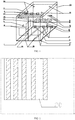
- a deacidifying and repairing device of the present invention has a structure as follows, shown as FIG. 1 to FIG. 4 .
- the deacidifying and repairing device includes a double-open front door 1, a fan set 4, a dehumidifier 6, a vacuum pump 7, a light 10, a middle partition 11, a gas pipe hole 12, a rear panel 13, an ultrasonic atomizer 14, a gas pipe 15 and a pulley track 18;
- the double-open front door 1 is provided on one side face of the device;
- the middle partition 11 divides the device into an upper part and a lower part, bottom faces of the upper and lower parts are each provided with the fan set 4;
- the dehumidifier 6, the vacuum pump 7 and the ultrasonic atomizer 14 are arranged at an external surface of the rear panel 13 opposite the double-open front door 1; lights 10 are provided all around a lower part of the middle partition;
- the gas pipe 15 locates at and runs through an upper part of the middle partition 11, and that section of the gas pipe is provided
- the device further includes visible windows 2. Both sides of the double-open front door 1 and left and right sides of the device are provided with the visible windows 2.
- the device further includes a hygrometer 5, a piezometer 8 and a pH meter 9; the hygrometer 5, the piezometer 8 and the pH meter 9 are all provided in the interior of the device.
- a PLC-control system 16 is fixed on the double-open front door 1; the fan set 4, the dehumidifier 6, the vacuum pump 7, the ultrasonic atomizer 14, the lights 10 and a bookrack 19 are integrally controlled by the PLC-control system, by monitoring the hygrometer 5, the piezometer 8 and the pH meter 9, real-time control of on-off of the lights, on-off of the fan, wind speed, on-off of the dehumidifier, air volume of the dehumidifier, on-off of the vacuum pump, wind speed of vacuum pumping, on-off of the ultrasonic atomizer, atomization volume, on-off of spinning of the bookrack and duration of spinning of the bookrack is performed.
- the device is made of an external material and an internal material, the external material is carbon steel, and the internal material is stainless steel; the device has a total width of 1 m - 2.5 m, a height of 1 m - 2.5 m, and a length of 3 m - 12 m.
- the device further includes a water groove 3 and a drain valve 17; the water groove is provided at the bottom face of the lower part of the device, locating at two sides of the device and the bottom face close to the rear panel; the water groove 3 has a depth of 1 - 10 cm below the bottom face and a width of 1 - 10 cm; the water groove 3 is connected to the drain valve 17; two pulley tracks 13 are provided, and a width between the two pulley tracks 13 is consistent with the width of the bookrack 19.
- the middle partition 11 is provided with an air outlet 20 thereon, since the closer to the fan, the higher the air velocity, an area of the air outlet increases with a distance from the fan set in a direction from the near to the distant.
- the bookrack 19 is made of stainless steel, with wheels at the bottom; the bookrack is provided with a link chain of stainless steel, a book basket is fixed on the link chain which is driven by a motor; after the motor is on, the book basket runs upward and downward so that more even absorption of atomized gas for the books is obtained; the book basket is designed as slightly wider at the top and slightly narrower at the bottom, the ancient books are opened laterally and placed with a lateral side facing upward, wind coming from the fan set 4 from top to bottom opens the ancient books slightly, allowing more even permeation of a deacidifying agent.
- the ultrasonic atomizer was turned on, and a solution obtained by evenly mixing NaOH solid and water according to a mass ratio of 20:80 was selected as a deacidifying agent and added to a container.
- the prepared NaOH solution was atomized by the ultrasonic transducer and introduced into a sealed container via the gas pipe for deacidification and repair.
- air humidity inside the system was controlled to be approximately 50%.
- Neutralization of acidic substances in the paper was performed simultaneously with monitoring the pH value of the ancient books. When the monitored pH value of the ancient books reached 7.2, the system was maintained stable for 2 hours, and then the system was turned off.
- the ultrasonic atomizer was turned on, and a solution obtained by evenly mixing NaOH solid and water according to a mass ratio of 20:80 was selected as a deacidifying agent and added to a container.
- the prepared NaOH solution was atomized by the ultrasonic transducer and introduced into a sealed container via the gas pipe for deacidification and repair.
- air humidity inside the system was controlled to be approximately 50%.
- Neutralization of acidic substances in the paper was performed simultaneously with monitoring the pH value of the ancient books. When the monitored pH value of the ancient books reached 7.2, the system was maintained stable for 2 hours, and then the system was turned off.
- the ultrasonic atomizer was turned on, and a solution obtained by evenly mixing NaOH solid and water according to a mass ratio of 30:70 was selected as a deacidifying agent and added to a container.
- the prepared NaOH solution was atomized by the ultrasonic transducer and introduced into a sealed container via the gas pipe for deacidification and repair.
- air humidity inside the system was controlled to be approximately 50%.
- Neutralization of acidic substances in the paper was performed simultaneously with monitoring the pH value of the ancient books. When the monitored pH value of the ancient books reached 7.2, the system was maintained stable for 2 hours, and then the system was turned off.
Landscapes
- Engineering & Computer Science (AREA)
- Textile Engineering (AREA)
- Agricultural Chemicals And Associated Chemicals (AREA)
- Paper (AREA)
Abstract
Description
- The present invention relates to the field of the deacidification and repair of ancient books, and specifically involves to a novel method for deacidifying and repairing ancient books.
- Thousands of precious books, calligraphy and paintings, modern newspaper, files and other cultural relics are preserved in various libraries, museums and archives in China. Being the essence of the Chinese nation's excellent traditional culture and a significant constituent of the Chinese cultural heritage with important historic value, cultural value and information value, they possess an irreproducible historic significance. As a carrier of the literal essence, paper would suffer a critical situation by the increasing severe worm damage, acidification, mildew and breakage with the time flies. Paper is made from fibrous materials, and the stability of cellulose is one of the most important factors that maintain the physical performances of paper. Cellulose is relatively stable under neutral and alkalescent conditions and generally would not be hydrolyzed or oxidized. However, in an acidic condition, hydrolysis on the cellulose is enhanced due to the catalysis of acid. After the hydrolysis of cellulose, strength of ancient books will be reduced by the decreased degree of polymerization, resulting in pulverization of ancient books over time. Therefore, various factors such as acidic chemical residues during production, organic acid generated by aging and degradation, acidification resulted by the use and storage environment, may intensify the aging of paper. Thus, there's an urgent need of thorough deacidification and repair research on paper documents. Although various researches on deacidifying and repairing paper documents have been carried out by the domestic and foreign research institutes, practically applicable and mature deacidifying and repairing technology has not been achieved till now.
- Current deacidifying and repairing technology mainly includes liquid phase deacidification and gaseous phase deacidification of which the principle is to neutralize the acid in ancient books by using an alkaline deacidifying agent so as to achieve deacidification and repair.
- The liquid phase deacidifying and repairing method mainly includes organic solution deacidification and aqueous solution deacidification.
- The deacidifying and repairing method by organic solvent mainly includes Weito method, FMC method, and barium hydroxide-methanol solution deacidification and repair. The deacidifying and repairing method by organic solution has advantages of high deacidifying and repairing efficiency, simple operation and low cost. Japan and western countries such as Germany, Italy, USA, and etc. mainly use organic solvent method, but the organic solvents are combustible wherein some have strong toxicity, and most of them are inappropriate for oil-soluble ink-printed print, causing dissolution of printing ink, thereby staining the ancient books. Additionally, a high level of safety requirement for operation is demanded when the toxicity is too strong.
- The deacidification and repair by aqueous solution has advantages of environmental safety, easy operation, economy and good deacidifying and repairing effect, but deformation and crimping still exist in the treated paper documents, bringing influence on the handwriting and thereby against a large scale of deacidification and repair. There's no deacidifying and repairing technology to solve the problem of deacidifying an entire book by the aqueous solution so far. Paper would stick to each other if deacidification and repair are directly carried out on the entire book which results in severe secondary damage. The ancient book must be separated into single pages before the processing and then rebound after the processing. The ancient book has a rather low strength over a long time and it would be easily damaged when being separated. After the book is immersed into the solution, the strength of paper becomes lower which brings severe secondary damage to the ancient books though the deacidification and repair are carried out. Moreover, drying is required after the books are immersed into the solution. Aging and breakage of fiber are easily caused during the drying, thereby yellowing or even damaging the paper. Such method is complicated in process with long term, which is inappropriate for the ancient books.
- The gaseous phase deacidifying and repairing method mainly includes diethylzinc method and morpholine deacidification method.
- The diethylzinc deacidification method: when meeting with the acidic hydrogen ion in paper, diethylzinc not only reacts with the acidic hydrogen ions in paper but also rapidly neutralizes the hydrogen in water to generate solid zinc oxide. Such solid zinc oxide remains on the surface of the paper and provides a certain deacidifying and repairing effect. However, diethylzinc is spontaneously combustible when meeting with air, and great danger exists, that is, a great threat of fire to the paper documents. In addition, residues of zinc oxide accelerate the photooxidation on paper fibers, yellowing and aging the paper to some extent. Therefore, such method is not a good one.
- The morpholine deacidification method: under normal circumstance, morpholine is in liquid state, and turns into gas when mixing with water in vacuum, so as to react with the hydrogen ions in paper to achieve deacidification and repair. This method changes the color of paper easily, yellows the newspaper and magazines, and does not exerts reinforcement during the process. A large scale of promotion of such method is limited due to the high cost for equipment and instruments. From the aspect of deacidification technology abroad, in 1970s and 1980s, gaseous deacidification and repair attracted people for its large scale of processing. However, its extensive application is limited by the high level requirement for technological conditions, potential safety hazard, great investment and uneven processing effect.
- There are various similar gaseous phase and liquid phase deacidifying and repairing technologies at home and abroad currently, but each of these still has defects such as high cost, high difficulty of operation, strong toxicity of deacidifying agent, failure to develop in large-scale, potential safety hazard, environmental pollution, etc. A practically applicable method for deacidifying and repairing ancient books has not been found till now.
- Aiming at the above and in order to overcome the above-mentioned problems or at least partially overcome the above-mentioned problems, the present invention provides a novel method for deacidifying and repairing ancient books.
In the present invention, a gas phase deacidifying and repairing technology and a liquid phase deacidifying and repairing technology are combined together, and by using a gas phase/liquid phase and a gas phase/solid phase deacidifying and repairing technologies, not only secondary damage of paper adhesion caused by the liquid phase deacidification and repair is avoided, but also the present technology aims at that original temperature and humidity of the ancient books are kept without drying the ancient books, so that fibers would not age or break, and the ancient books would not be yellowed or damaged. Meanwhile, it also avoids the trouble that an alkaline gaseous deacidifying agent suitable for the gas phase deacidification and repair cannot be found. Most of the organic/inorganic alkaline liquid and the nanoscale alkaline deacidifying powder can be used for deacidifying and repairing the ancient books by using the present technology. - A novel method for deacidifying and repairing ancient books, comprises: first placing the ancient books to be treated in a closed deacidifying and repairing device; after sealing, performing dehumidification operation and vacuumizing operation on the system in sequence to maintain the system dry; and after the system is stable under negative pressure, turning on a fan set, directly delivering a deacidifying agent to the deacidifying and repairing device via a gas pipe, or atomizing an alkaline deacidifying solution through a ultrasonic atomizer and then delivering the atomized alkaline deacidifying solution to the deacidifying and repairing device via the gas pipe, so that the ancient books to be treated absorb the alkaline deacidifying agent sufficiently and evenly; and meanwhile monitoring a pH value of the ancient books, thereby implementing deacidification and repair of the ancient books;
wherein the ancient books comprises acidic ancient book, archived file, document, literature, journal, paper, calligraphy and painting, cotton and flax. - In the above-mentioned method, the closed device has good airtightness, and the system is kept at room temperature, so that a relatively high dryness and a relatively high vacuum degree therein can be reached. The closed device has a suitable volume. A relationship of a device volume and a total volume of the ancient books to be treated satisfies that a ratio of the device volume to the total volume of the ancient books to be treated is 1.1:1 - 50:1.
- In the above-mentioned method, the dehumidification operation is as follows: dehumidifying the system to have air humidity of 10% - 90% through a dehumidifier and maintaining for 2 - 24 hours, when target duration is reached, turning off the dehumidifier. The duration of the dehumidification operation depends on an original humidity of the ancient books and the closed device volume; when the original humidity of the ancient books is 8% - 9% and the device volume is 1.5 - 2 times the total volume of the ancient books to be treated, the dehumidification operation lasts for 2 - 24 hours; when the original humidity is reduced by 10%, the duration of the dehumidification operation is reduced by 2 - 6 hours; when the device volume is doubled, the duration of the dehumidification operation is increased by 3 - 8 hours.
- In the above-mentioned method, the vacuumizing operation is performed as follows after the dehumidification operation is completed, vacuumizing the system to have an inner pressure of 0 to -0.08 MPa through a vacuum pump, when target pressure is reached, turning off the vacuum pump, and maintaining the closed system under stable negative pressure until the deacidification and repair is completed.
- In the above-mentioned method, the ultrasonic atomizer is an ultrasonic transducer, the ultrasonic transducer is placed in a container containing with the deacidifying agent and is powered on. The structure of the deacidifying agent is dispersed and atomized into small-molecular atomized gas by means of high-frequency resonance of a piezoelectric ceramic.
- In the above-mentioned method, the deacidifying agent is a nanoscale alkaline deacidifying powder, an alkaline organic solution, or an alkaline inorganic solution; the pH value can be maintained stable for a relatively long term, being 7 to 13 and without toxicity; the deacidifying agent includes but is not limited to all alkaline materials such as NaOH solution, Ca(OH)2 solution, Cu(OH)2 solution, Fe(OH)3 solution, KOH solution, Na2CO3 solution, NaHCO3 solution, NH3·H2O solution, ethylenediamine solution, phosphate solution, borate solution and the like. By means of a pressurizing or ultrasonic atomizer, the solution is dispersed into liquid drops in micronscale to nanoscale having an average particle size of 1 nm - 2 µm, and is communicated with the closed deacidifying device via the gas pipe.
- In the above-mentioned method, the deacidifying agent includes but is not limited to all alkaline powder materials such as nano NaOH powder, Ca(OH)2 powder, Cu(OH)2 powder, Fe(OH)3 powder, KOH powder, Na2CO3 powder or NaHCO3 powder, ethylenediamine powder and the like.
- In the above-mentioned method, through the gas pipe, an air-blast system slowly introduces the nanoscale alkaline deacidifying powder or the deacidifying agent atomized by the ultrasonic transducer into the closed deacidifying and repairing device, and circulates the deacidifying agent inside the system for even distribution.
- In the above-mentioned method, air humidity inside the system is maintained at 10% - 90%.
- In the above-mentioned method, the deacidifying and repairing device has a pH value monitor for ancient book therein, after the pH value of ancient book monitored reaches approximately 7 - 8.5 and is maintained for 1- 48 hours, the system is turned off; the duration depends on a deacidifying degree of the ancient books and a closed device volume, when the original pH value of ancient book is 6 - 6.5 and the device volume is 1.5 - 2 times a total volume of the ancient books to be treated, the deacidification lasts for 2 - 5 hours; when the original pH value is increased by 0.2, the duration of deacidification is reduced by 1 - 6 hours; when the device volume is doubled, the duration of deacidification is increased by 3 - 8 hours.
- Compared with the prior art, the advantages of the present invention lie in that:
A large-scale of acidified ancient books can be treated, without a great deal of equipment input, or affecting the original temperature and humidity of the ancient books, damage to paper structure, or secondary damage to the ancient books, so that acidic substances in the ancient book can be well neutralized with significant deacidifying effect. Meanwhile, a certain amount of the alkaline substances would left in the ancient books so as to further prolong lifetime of the ancient books better. -
-
FIG. 1 is a structural diagram of a deacidifying and repairing device of the present invention; -
FIG. 2 is a structural diagram of a middle partition; -
FIG. 3 is a structural diagram of a bookrack; -
FIG. 4 is an air flow diagram of the present invention. - Each component in the figures is as follows:
double-open front door 1,visible window 2,water groove 3, fan set 4,hygrometer 5, dehumidifier 6, vacuum pump 7, piezometer 8, pH meter 9, light 10, middle partition 11,gas pipe hole 12,rear panel 13,ultrasonic atomizer 14,gas pipe 15, PLC-control system 16,drain valve 17,pulley track 18,bookrack 19, andair outlet 20. - The present invention is further described in detail by combining the following specific embodiment, but the implementation of the present invention is not limited thereto. Those technological parameters which are not described particularly can be carried out by referring to conventional technologies.
- A deacidifying and repairing device of the present invention has a structure as follows, shown as
FIG. 1 to FIG. 4 . The deacidifying and repairing device, includes a double-open front door 1, afan set 4, a dehumidifier 6, a vacuum pump 7, a light 10, a middle partition 11, agas pipe hole 12, arear panel 13, anultrasonic atomizer 14, agas pipe 15 and apulley track 18; the double-open front door 1 is provided on one side face of the device; the middle partition 11 divides the device into an upper part and a lower part, bottom faces of the upper and lower parts are each provided with the fan set 4; the dehumidifier 6, the vacuum pump 7 and theultrasonic atomizer 14 are arranged at an external surface of therear panel 13 opposite the double-open front door 1;lights 10 are provided all around a lower part of the middle partition; thegas pipe 15 locates at and runs through an upper part of the middle partition 11, and that section of the gas pipe is provided with thegas pipe hole 12, thegas pipe 15 is connected with theultrasonic atomizer 14; and thepulley track 18 is provided on the bottom face of the device. The device further includesvisible windows 2. Both sides of the double-open front door 1 and left and right sides of the device are provided with thevisible windows 2. The device further includes ahygrometer 5, a piezometer 8 and a pH meter 9; thehygrometer 5, the piezometer 8 and the pH meter 9 are all provided in the interior of the device. A PLC-control system 16 is fixed on the double-open front door 1; the fan set 4, the dehumidifier 6, the vacuum pump 7, theultrasonic atomizer 14, thelights 10 and abookrack 19 are integrally controlled by the PLC-control system, by monitoring thehygrometer 5, the piezometer 8 and the pH meter 9, real-time control of on-off of the lights, on-off of the fan, wind speed, on-off of the dehumidifier, air volume of the dehumidifier, on-off of the vacuum pump, wind speed of vacuum pumping, on-off of the ultrasonic atomizer, atomization volume, on-off of spinning of the bookrack and duration of spinning of the bookrack is performed. The device is made of an external material and an internal material, the external material is carbon steel, and the internal material is stainless steel; the device has a total width of 1 m - 2.5 m, a height of 1 m - 2.5 m, and a length of 3 m - 12 m. The device further includes awater groove 3 and adrain valve 17; the water groove is provided at the bottom face of the lower part of the device, locating at two sides of the device and the bottom face close to the rear panel; thewater groove 3 has a depth of 1 - 10 cm below the bottom face and a width of 1 - 10 cm; thewater groove 3 is connected to thedrain valve 17; two pulley tracks 13 are provided, and a width between the two pulley tracks 13 is consistent with the width of thebookrack 19. The middle partition 11 is provided with anair outlet 20 thereon, since the closer to the fan, the higher the air velocity, an area of the air outlet increases with a distance from the fan set in a direction from the near to the distant. Thebookrack 19 is made of stainless steel, with wheels at the bottom; the bookrack is provided with a link chain of stainless steel, a book basket is fixed on the link chain which is driven by a motor; after the motor is on, the book basket runs upward and downward so that more even absorption of atomized gas for the books is obtained; the book basket is designed as slightly wider at the top and slightly narrower at the bottom, the ancient books are opened laterally and placed with a lateral side facing upward, wind coming from the fan set 4 from top to bottom opens the ancient books slightly, allowing more even permeation of a deacidifying agent. - Five Ancient Medical Book (edition 1937, published by People's Medical Publishing House) having a volume of 0.004 m3 were taken and tested to have a paper original humidity of 8.6%, and the books were placed in a 0.25 m × 0.25 m × 0.1 m deacidifying and repairing device having a volume of 0.00625 m3. First, dehumidification was carried out to the system for 4 hours, and the dehumidifier was turned off when time's up. Then the vacuum pump was turned on to vacuumize the system until the pressure reached -0.05 MPa, and the vacuum pump was turned off. The ultrasonic atomizer was turned on, and a solution obtained by evenly mixing NaOH solid and water according to a mass ratio of 20:80 was selected as a deacidifying agent and added to a container. The prepared NaOH solution was atomized by the ultrasonic transducer and introduced into a sealed container via the gas pipe for deacidification and repair. By controlling a valve for the gas pipe, air humidity inside the system was controlled to be approximately 50%. Neutralization of acidic substances in the paper was performed simultaneously with monitoring the pH value of the ancient books. When the monitored pH value of the ancient books reached 7.2, the system was maintained stable for 2 hours, and then the system was turned off. Samples were taken to compare the paper performance average values before and after the deacidification and repair, shown as the following table:
Table 1 pH Water content% Tensile strength (kN/m) Burst Tear (mN) Folding strength (Times) Before the deacidification and repair 5.98 8.6 1.460 1.568 28 3 After the deacidification and repair 7.21 9.1 1.540 1.590 32 4 - Five Ancient Medical Book (edition 1937, published by People's Medical Publishing House) having a volume of 0.004 m3 were taken and tested to have a paper original humidity of 9.2%, and the books were placed in a 0.25 m × 0.25 m × 0.1 m deacidifying and repairing device having a volume of 0.00625 m3. First, dehumidification was carried out to the system for 3 hours, and the dehumidifier was turned off when time's up. Then the vacuum pump was turned on to vacuumize the system until the pressure reached -0.07 MPa, and the vacuum pump was turned off. The ultrasonic atomizer was turned on, and a solution obtained by evenly mixing NaOH solid and water according to a mass ratio of 20:80 was selected as a deacidifying agent and added to a container. The prepared NaOH solution was atomized by the ultrasonic transducer and introduced into a sealed container via the gas pipe for deacidification and repair. By controlling a valve for the gas pipe, air humidity inside the system was controlled to be approximately 50%. Neutralization of acidic substances in the paper was performed simultaneously with monitoring the pH value of the ancient books. When the monitored pH value of the ancient books reached 7.2, the system was maintained stable for 2 hours, and then the system was turned off. Samples were taken to compare the paper performance average values before and after the deacidification and repair, shown as the following table:
Table 2 pH Water content% Tensile strength (kN/m) Burst Tear (mN) Folding strength (Times) Before the deacidification and repair 5.86 9.2 1.488 1.572 28 3 After the deacidification and repair 7.10 8.7 1.556 1.598 33 4 - Five Ancient Medical Book (edition 1937, published by People's Medical Publishing House) having a volume of 0.004 m3 were taken and tested to have a paper original humidity of 7.3%, and the books were placed in a 0.25 m × 0.25 m × 0.1 m deacidifying and repairing device having a volume of 0.00625 m3. First, dehumidification was carried out to the system for 4 hours, and the dehumidifier was turned off when time's up. Then the vacuum pump was turned on to vacuumize the system until the pressure reached -0.05 MPa, and the vacuum pump was turned off. The ultrasonic atomizer was turned on, and a solution obtained by evenly mixing NaOH solid and water according to a mass ratio of 30:70 was selected as a deacidifying agent and added to a container. The prepared NaOH solution was atomized by the ultrasonic transducer and introduced into a sealed container via the gas pipe for deacidification and repair. By controlling a valve for the gas pipe, air humidity inside the system was controlled to be approximately 50%. Neutralization of acidic substances in the paper was performed simultaneously with monitoring the pH value of the ancient books. When the monitored pH value of the ancient books reached 7.2, the system was maintained stable for 2 hours, and then the system was turned off. Samples were taken to compare the paper performance average values before and after the deacidification and repair, shown as the following table:
Table 3 pH Water content% Tensile strength (kN/m) Burst Tear (mN) Folding strength (Times) Before the deacidification and repair 5.89 7.3 1.451 1.578 27 3 After the deacidification and repair 7.38 8.9 1.535 1.598 31 4 - The above embodiments of the present invention are merely illustrative examples for the present invention, but implementations of the present invention are not limited thereto. For those skilled in the art, various variation or alteration can be made based on the above description. However, there is no need and cannot be exhaustive for all implementations. Any modification, equivalent substitution and improvement made within the spirit and principle of the present invention shall be included in the scope of protection of the present invention.
Claims (10)
- A novel method for deacidifying and repairing ancient books, characterized in that, the method comprises:first placing the ancient books to be treated in a closed deacidifying and repairing device;after sealing, performing dehumidification operation and vacuumizing operation on the system in sequence to maintain the system dry;after the system is stable under negative pressure, turning on a fan set, directly delivering a deacidifying agent to the deacidifying and repairing device via a gas pipe, or atomizing an alkaline deacidifying solution through a ultrasonic atomizer and then delivering the atomized alkaline deacidifying solution to the deacidifying and repairing device via the gas pipe, so that the ancient books to be treated absorb the alkaline deacidifying agent sufficiently and evenly; andmeanwhile monitoring pH value of the ancient books, thereby implementing deacidification and repair of the ancient books;wherein the ancient books comprises acidic ancient book, archived file, document, literature, journal, paper, calligraphy and painting, cotton and flax.
- The novel method for deacidifying and repairing ancient books according to claim 1, wherein a relationship of a device volume and a total volume of the ancient books to be treated satisfies that a ratio of the device volume to the total volume of the ancient books to be treated is 1.1:1 - 50:1.
- The novel method for deacidifying and repairing ancient books according to claim 1, wherein the dehumidification operation is as follows: dehumidifying the system to have air humidity of 10% - 90% through a dehumidifier and maintaining for 2 - 24 hours; duration of the dehumidification operation depends on an original humidity of the ancient books and the closed device volume; when the original humidity of the ancient books is 8% - 9% and the device volume is 1.5 - 2 times the total volume of the ancient books to be treated, the duration of the dehumidification operation is 2 - 24 hours; when the original humidity is reduced by 10%, the duration of the dehumidification operation is reduced by 2 - 6 hours; when the device volume is doubled, the duration of the dehumidification operation is increased by 3 - 8 hours.
- The novel method for deacidifying and repairing ancient books according to claim 1, wherein the vacuumizing operation is performed as follows after the dehumidification operation is completed, vacuumizing the system to have an inner pressure of 0 to -0.08 MPa through a vacuum pump, and maintaining the closed system under stable negative pressure until the deacidification and repair is completed.
- The novel method for deacidifying and repairing ancient books according to claim 1, wherein the ultrasonic atomizer is an ultrasonic transducer, the ultrasonic transducer is placed in a container containing with the deacidifying agent and is powered on, wherein the structure of the deacidifying agent is dispersed and atomized into small-molecular atomized gas by means of high-frequency resonance of a piezoelectric ceramic.
- The nanoscale deacidifying agent according to claim 1, wherein the deacidifying agent is a nanoscale alkaline deacidifying powder, an alkaline organic solution, or an alkaline inorganic solution; the pH value is 7 to 13; the alkaline deacidifying solution comprises NaOH solution, Ca(OH)2 solution, Cu(OH)2 solution, Fe(OH)3 solution, KOH solution, Na2CO3 solution, NaHCO3 solution, NH3·H2O solution, ethylenediamine solution, phosphate solution or borate solution; by means of a pressurizing or ultrasonic atomizer, the alkaline deacidifying solution is dispersed into liquid drops in micronscale to nanoscale having an average particle size of 1 nm - 2 µm.
- The nanoscale deacidifying agent according to claim 1, wherein the deacidifying agent comprises nano NaOH powder, Ca(OH)2 powder, Cu(OH)2 powder, Fe(OH)3 powder, KOH powder, Na2CO3 powder or NaHCO3 powder, or ethylenediamine powder.
- The novel method for deacidifying and repairing ancient books according to claim 1, through the gas pipe, the fan set slowly introduces the nanoscale alkaline deacidifying powder or the deacidifying agent atomized by the ultrasonic transducer into the closed deacidifying and repairing device, and circulates the deacidifying agent inside the system for even distribution.
- The novel method for deacidifying and repairing ancient books according to claim 1, wherein air humidity inside the system is maintained at 10% - 90%.
- The novel method for deacidifying and repairing ancient books according to claim 1, wherein the deacidifying and repairing device has a pH value monitor for ancient book therein, after the pH value of ancient book monitored reaches approximately 7 - 8.5 and is maintained for 1- 48 hours, the system is turned off; the duration depends on a deacidifying degree of the ancient books and a closed device volume, when the original pH value of ancient book is 6 - 6.5 and the device volume is 1.5 - 2 times a total volume of the ancient books to be treated, the deacidification lasts for 2 - 5 hours; when the original pH value is increased by 0.2, the duration of deacidification is reduced by 1 - 6 hours; when the device volume is doubled, the duration of deacidification is increased by 3 - 8 hours.
Applications Claiming Priority (2)
| Application Number | Priority Date | Filing Date | Title |
|---|---|---|---|
| CN201711219633.1A CN108004847B (en) | 2017-11-28 | 2017-11-28 | Ancient book deacidification and restoration method |
| PCT/CN2018/113229 WO2019105168A1 (en) | 2017-11-28 | 2018-10-31 | Novel method for repairing ancient book by deacidification |
Publications (2)
| Publication Number | Publication Date |
|---|---|
| EP3643834A1 true EP3643834A1 (en) | 2020-04-29 |
| EP3643834A4 EP3643834A4 (en) | 2021-03-10 |
Family
ID=62054529
Family Applications (1)
| Application Number | Title | Priority Date | Filing Date |
|---|---|---|---|
| EP18883588.8A Withdrawn EP3643834A4 (en) | 2017-11-28 | 2018-10-31 | NEW PROCESS FOR RESTORING AN OLD BOOK BY DEACIDIFICATION |
Country Status (3)
| Country | Link |
|---|---|
| EP (1) | EP3643834A4 (en) |
| CN (1) | CN108004847B (en) |
| WO (1) | WO2019105168A1 (en) |
Cited By (1)
| Publication number | Priority date | Publication date | Assignee | Title |
|---|---|---|---|---|
| US20200157742A1 (en) * | 2017-11-28 | 2020-05-21 | South China University Of Technology | Novel device for deacidifying, reinforcing and strengthening ancient books |
Families Citing this family (18)
| Publication number | Priority date | Publication date | Assignee | Title |
|---|---|---|---|---|
| CN108004847B (en) * | 2017-11-28 | 2021-08-10 | 华南理工大学 | Ancient book deacidification and restoration method |
| CN108914701B (en) * | 2018-08-30 | 2023-06-20 | 华南理工大学 | Can be used to whole volume ancient book deacidification reinforcing and fixing device in batches |
| CN109342382B (en) * | 2018-11-23 | 2022-11-15 | 复旦大学 | A kind of preparation method of deacidification functional paper with pH responsive fluorescent probe |
| CN110284366B (en) * | 2019-06-27 | 2020-10-09 | 中山大学 | Gas-phase deacidification and reinforcement method for paper cultural relics |
| CN110552238A (en) * | 2019-08-26 | 2019-12-10 | 华南理工大学 | A paper strengthening and strengthening treatment liquid and a method for strengthening and strengthening the paper |
| CN111794014A (en) * | 2020-06-03 | 2020-10-20 | 西安工业大学 | A kind of repair method for broken and broken disease of ancient calligraphy and painting |
| CN111851143B (en) * | 2020-08-25 | 2024-01-16 | 南京博物院 | Process and equipment for deacidifying whole paper literature |
| CN112056794A (en) * | 2020-09-14 | 2020-12-11 | 高新亮 | An ancient book document management and placement device |
| CN112921705A (en) * | 2021-01-25 | 2021-06-08 | 杭州众材科技有限公司 | Particle embedded paper deacidification protection method |
| CN113186754B (en) * | 2021-04-09 | 2022-05-06 | 杭州众材科技股份有限公司 | Protection method suitable for paper homogenization deacidification |
| CN115069663B (en) * | 2022-01-07 | 2023-07-11 | 中国科学院上海硅酸盐研究所 | Trinity desalting device and desalting method for salt-containing cultural relics |
| CN115216997A (en) * | 2022-07-27 | 2022-10-21 | 南京博物院 | Method for deacidifying paper |
| CN115928495B (en) * | 2022-11-25 | 2024-07-23 | 复旦大学 | Mineralized bacterial cellulose multifunctional protection lining paper for preventive protection of paper cultural relics and preparation method and application thereof |
| CN116752378B (en) * | 2023-05-09 | 2024-10-18 | 华南理工大学 | A method for in-situ formation of calcium carbonate in paper documents and a deacidification process |
| CN116590960A (en) * | 2023-06-02 | 2023-08-15 | 南通鑫炜信息技术有限公司 | A silk screen-based repair process and repair device for paper archives and ancient books |
| CN119888234B (en) * | 2025-03-12 | 2025-08-05 | 石家庄铁道大学 | A method and device for intelligent identification and restoration of ancient books based on machine learning |
| CN119956630A (en) * | 2025-04-09 | 2025-05-09 | 宁波八益集团有限公司 | A paper deacidification method using pressurized atomized borate composite bacterial cellulose |
| CN120350568B (en) * | 2025-06-24 | 2025-09-26 | 杭州众材科技股份有限公司 | A dry paper product deacidification method and deacidification equipment |
Family Cites Families (17)
| Publication number | Priority date | Publication date | Assignee | Title |
|---|---|---|---|---|
| US4860685A (en) * | 1985-07-10 | 1989-08-29 | Smith Richard D | Treatment of cellulosic materials |
| US5219524A (en) * | 1991-05-07 | 1993-06-15 | Everseal Preservation Labs., Inc. | System and method for preserving acid-containing articles |
| JP2502449B2 (en) * | 1993-04-30 | 1996-05-29 | 礼三郎 大江 | How to store porous materials |
| CA2327786A1 (en) * | 1998-04-07 | 1999-10-14 | Sm Schweizerische Munitionsunternehmung Ag | Active substance and device for the deacidification of printed matter |
| ES2154592B1 (en) * | 1999-05-27 | 2001-10-16 | Univ Politecnica De Cataluna | EQUIPMENT AND PROCEDURE FOR MASS DEACDIFICATION, ELIMINATION OF FREE ACIDITY AND DISINFESTATION OF CELLULOSICAL MATERIALS. |
| US6214165B1 (en) * | 1999-07-13 | 2001-04-10 | Joseph Zicherman | Method for deacidification of papers and books by fluidizing a bed of dry alkaline particles |
| CN202099693U (en) * | 2011-04-28 | 2012-01-04 | 广东工业大学 | Pressurizing atomizing deacidification device |
| CN102242529B (en) * | 2011-04-28 | 2014-03-12 | 广东工业大学 | Pressurizing, atomizing and deacidifying device and method for pressurizing, atomizing and deacidifying by using same |
| CN102268842B (en) * | 2011-07-28 | 2013-03-13 | 广东工业大学 | Method for deacidifying paper by using soluble tetraborate as paper deacidifying agent |
| CN102677544B (en) * | 2012-05-17 | 2014-04-30 | 常州大学 | Vacuum repairing method for ancient book and paper document |
| CN103147353A (en) * | 2013-03-29 | 2013-06-12 | 广东工业大学 | Ultrasound-assisted method for deacidification of paper |
| CN103898801A (en) * | 2014-04-22 | 2014-07-02 | 四川省档案局档案科学技术研究所 | Simple and high-efficiency paper deacidification method |
| CN105064132B (en) * | 2015-07-02 | 2017-08-01 | 浙江大学 | A kind of acid stripping method and deacidifying device |
| CN105239460B (en) * | 2015-10-14 | 2017-03-08 | 陕西师范大学 | A method for deacidifying full-volume archives and books directly using ethylene oxide |
| CN105544299B (en) * | 2016-01-05 | 2017-06-16 | 南京博物院 | Deacidification device and deacidification method for paper documents |
| CN206233038U (en) * | 2016-12-05 | 2017-06-09 | 郑州博物馆 | An atomization deacidification and drying device for paper cultural relics |
| CN108004847B (en) * | 2017-11-28 | 2021-08-10 | 华南理工大学 | Ancient book deacidification and restoration method |
-
2017
- 2017-11-28 CN CN201711219633.1A patent/CN108004847B/en active Active
-
2018
- 2018-10-31 EP EP18883588.8A patent/EP3643834A4/en not_active Withdrawn
- 2018-10-31 WO PCT/CN2018/113229 patent/WO2019105168A1/en not_active Ceased
Cited By (2)
| Publication number | Priority date | Publication date | Assignee | Title |
|---|---|---|---|---|
| US20200157742A1 (en) * | 2017-11-28 | 2020-05-21 | South China University Of Technology | Novel device for deacidifying, reinforcing and strengthening ancient books |
| US11549218B2 (en) * | 2017-11-28 | 2023-01-10 | South China University Of Technology | Device for deacidifying, reinforcing and strengthening ancient books |
Also Published As
| Publication number | Publication date |
|---|---|
| CN108004847B (en) | 2021-08-10 |
| WO2019105168A1 (en) | 2019-06-06 |
| CN108004847A (en) | 2018-05-08 |
| EP3643834A4 (en) | 2021-03-10 |
Similar Documents
| Publication | Publication Date | Title |
|---|---|---|
| CN108004847B (en) | Ancient book deacidification and restoration method | |
| US11486096B2 (en) | Method for strengthening and reinforcing ancient books | |
| US20200157742A1 (en) | Novel device for deacidifying, reinforcing and strengthening ancient books | |
| CN108914701B (en) | Can be used to whole volume ancient book deacidification reinforcing and fixing device in batches | |
| JP2016509477A (en) | Method for isolating cellulose from cellulosic biomass, isolated type I cellulose, and composite material using same | |
| CN105064132B (en) | A kind of acid stripping method and deacidifying device | |
| CN107460774A (en) | A kind of paper guard method and equipment | |
| CN105544299A (en) | Paper document deacidification device and method | |
| CN109695182A (en) | A kind of method depickling enhancing treatment fluid and aging paper is handled | |
| CN103898801A (en) | Simple and high-efficiency paper deacidification method | |
| Misenan et al. | Cellulose nanofiber as potential absorbent material for chloride ion | |
| WO2009149958A1 (en) | Apparatus for impregnating fibrous material with a liquid | |
| CN108797209A (en) | A kind of low boron filter paper and preparation method thereof | |
| CN110180503A (en) | A kind of preparation method of high removal rate air filting material | |
| CN107485564A (en) | A kind of prepared slices of Chinese crude drugs demulcen device | |
| EP1001084A2 (en) | Deacidifying agent | |
| CN203620870U (en) | Environment-friendly high-precision lithium ion battery diaphragm coater | |
| DE19921616A1 (en) | Deacidifying agent for organic material, useful in conservation of e.g. historical archive or book, contains dispersion of nanoparticles of alkaline metal compound, e.g. alkaline earth compound, in organic solvent | |
| CN202093011U (en) | Current-carrying air source generating device | |
| CN110284366B (en) | Gas-phase deacidification and reinforcement method for paper cultural relics | |
| CN106881025A (en) | Natural propolis trap the preparation method of film for the air free radical of matrix | |
| CN217330483U (en) | Wood drying device | |
| Parnklang et al. | Potential Applications of Colloidal Bacterial Cellulose Nanocrystal Suspensions for Mitigating Hazardous PM2. 5 Pollution | |
| CN110552238A (en) | A paper strengthening and strengthening treatment liquid and a method for strengthening and strengthening the paper | |
| CN119956630A (en) | A paper deacidification method using pressurized atomized borate composite bacterial cellulose |
Legal Events
| Date | Code | Title | Description |
|---|---|---|---|
| STAA | Information on the status of an ep patent application or granted ep patent |
Free format text: STATUS: THE INTERNATIONAL PUBLICATION HAS BEEN MADE |
|
| PUAI | Public reference made under article 153(3) epc to a published international application that has entered the european phase |
Free format text: ORIGINAL CODE: 0009012 |
|
| STAA | Information on the status of an ep patent application or granted ep patent |
Free format text: STATUS: REQUEST FOR EXAMINATION WAS MADE |
|
| 17P | Request for examination filed |
Effective date: 20200121 |
|
| AK | Designated contracting states |
Kind code of ref document: A1 Designated state(s): AL AT BE BG CH CY CZ DE DK EE ES FI FR GB GR HR HU IE IS IT LI LT LU LV MC MK MT NL NO PL PT RO RS SE SI SK SM TR |
|
| AX | Request for extension of the european patent |
Extension state: BA ME |
|
| DAV | Request for validation of the european patent (deleted) | ||
| DAX | Request for extension of the european patent (deleted) | ||
| A4 | Supplementary search report drawn up and despatched |
Effective date: 20210209 |
|
| RIC1 | Information provided on ipc code assigned before grant |
Ipc: D21H 25/18 20060101AFI20210203BHEP Ipc: D06M 11/49 20060101ALI20210203BHEP Ipc: D06M 101/06 20060101ALI20210203BHEP Ipc: D06M 11/76 20060101ALI20210203BHEP Ipc: D06M 11/38 20060101ALI20210203BHEP Ipc: D06M 11/44 20060101ALI20210203BHEP Ipc: D06M 13/332 20060101ALI20210203BHEP |
|
| STAA | Information on the status of an ep patent application or granted ep patent |
Free format text: STATUS: EXAMINATION IS IN PROGRESS |
|
| 17Q | First examination report despatched |
Effective date: 20241105 |
|
| STAA | Information on the status of an ep patent application or granted ep patent |
Free format text: STATUS: THE APPLICATION IS DEEMED TO BE WITHDRAWN |
|
| 18D | Application deemed to be withdrawn |
Effective date: 20250306 |