EP3643832A1 - Cord for rubber reinforcement and rubber product obtained using same - Google Patents
Cord for rubber reinforcement and rubber product obtained using same Download PDFInfo
- Publication number
- EP3643832A1 EP3643832A1 EP18820030.7A EP18820030A EP3643832A1 EP 3643832 A1 EP3643832 A1 EP 3643832A1 EP 18820030 A EP18820030 A EP 18820030A EP 3643832 A1 EP3643832 A1 EP 3643832A1
- Authority
- EP
- European Patent Office
- Prior art keywords
- rubber
- coating
- mass
- reinforcing cord
- parts
- Prior art date
- Legal status (The legal status is an assumption and is not a legal conclusion. Google has not performed a legal analysis and makes no representation as to the accuracy of the status listed.)
- Granted
Links
Images

Classifications
-
- D—TEXTILES; PAPER
- D07—ROPES; CABLES OTHER THAN ELECTRIC
- D07B—ROPES OR CABLES IN GENERAL
- D07B1/00—Constructional features of ropes or cables
- D07B1/16—Ropes or cables with an enveloping sheathing or inlays of rubber or plastics
- D07B1/162—Ropes or cables with an enveloping sheathing or inlays of rubber or plastics characterised by a plastic or rubber enveloping sheathing
-
- B—PERFORMING OPERATIONS; TRANSPORTING
- B29—WORKING OF PLASTICS; WORKING OF SUBSTANCES IN A PLASTIC STATE IN GENERAL
- B29D—PRODUCING PARTICULAR ARTICLES FROM PLASTICS OR FROM SUBSTANCES IN A PLASTIC STATE
- B29D29/00—Producing belts or bands
- B29D29/08—Toothed driving belts
-
- C—CHEMISTRY; METALLURGY
- C03—GLASS; MINERAL OR SLAG WOOL
- C03C—CHEMICAL COMPOSITION OF GLASSES, GLAZES OR VITREOUS ENAMELS; SURFACE TREATMENT OF GLASS; SURFACE TREATMENT OF FIBRES OR FILAMENTS MADE FROM GLASS, MINERALS OR SLAGS; JOINING GLASS TO GLASS OR OTHER MATERIALS
- C03C25/00—Surface treatment of fibres or filaments made from glass, minerals or slags
- C03C25/10—Coating
-
- C—CHEMISTRY; METALLURGY
- C03—GLASS; MINERAL OR SLAG WOOL
- C03C—CHEMICAL COMPOSITION OF GLASSES, GLAZES OR VITREOUS ENAMELS; SURFACE TREATMENT OF GLASS; SURFACE TREATMENT OF FIBRES OR FILAMENTS MADE FROM GLASS, MINERALS OR SLAGS; JOINING GLASS TO GLASS OR OTHER MATERIALS
- C03C25/00—Surface treatment of fibres or filaments made from glass, minerals or slags
- C03C25/10—Coating
- C03C25/24—Coatings containing organic materials
- C03C25/25—Non-macromolecular compounds
-
- C—CHEMISTRY; METALLURGY
- C03—GLASS; MINERAL OR SLAG WOOL
- C03C—CHEMICAL COMPOSITION OF GLASSES, GLAZES OR VITREOUS ENAMELS; SURFACE TREATMENT OF GLASS; SURFACE TREATMENT OF FIBRES OR FILAMENTS MADE FROM GLASS, MINERALS OR SLAGS; JOINING GLASS TO GLASS OR OTHER MATERIALS
- C03C25/00—Surface treatment of fibres or filaments made from glass, minerals or slags
- C03C25/10—Coating
- C03C25/24—Coatings containing organic materials
- C03C25/26—Macromolecular compounds or prepolymers
-
- C—CHEMISTRY; METALLURGY
- C03—GLASS; MINERAL OR SLAG WOOL
- C03C—CHEMICAL COMPOSITION OF GLASSES, GLAZES OR VITREOUS ENAMELS; SURFACE TREATMENT OF GLASS; SURFACE TREATMENT OF FIBRES OR FILAMENTS MADE FROM GLASS, MINERALS OR SLAGS; JOINING GLASS TO GLASS OR OTHER MATERIALS
- C03C25/00—Surface treatment of fibres or filaments made from glass, minerals or slags
- C03C25/10—Coating
- C03C25/24—Coatings containing organic materials
- C03C25/26—Macromolecular compounds or prepolymers
- C03C25/27—Rubber latex
-
- C—CHEMISTRY; METALLURGY
- C03—GLASS; MINERAL OR SLAG WOOL
- C03C—CHEMICAL COMPOSITION OF GLASSES, GLAZES OR VITREOUS ENAMELS; SURFACE TREATMENT OF GLASS; SURFACE TREATMENT OF FIBRES OR FILAMENTS MADE FROM GLASS, MINERALS OR SLAGS; JOINING GLASS TO GLASS OR OTHER MATERIALS
- C03C25/00—Surface treatment of fibres or filaments made from glass, minerals or slags
- C03C25/10—Coating
- C03C25/24—Coatings containing organic materials
- C03C25/26—Macromolecular compounds or prepolymers
- C03C25/32—Macromolecular compounds or prepolymers obtained otherwise than by reactions involving only carbon-to-carbon unsaturated bonds
- C03C25/36—Epoxy resins
-
- C—CHEMISTRY; METALLURGY
- C08—ORGANIC MACROMOLECULAR COMPOUNDS; THEIR PREPARATION OR CHEMICAL WORKING-UP; COMPOSITIONS BASED THEREON
- C08L—COMPOSITIONS OF MACROMOLECULAR COMPOUNDS
- C08L9/00—Compositions of homopolymers or copolymers of conjugated diene hydrocarbons
- C08L9/02—Copolymers with acrylonitrile
-
- C—CHEMISTRY; METALLURGY
- C09—DYES; PAINTS; POLISHES; NATURAL RESINS; ADHESIVES; COMPOSITIONS NOT OTHERWISE PROVIDED FOR; APPLICATIONS OF MATERIALS NOT OTHERWISE PROVIDED FOR
- C09D—COATING COMPOSITIONS, e.g. PAINTS, VARNISHES OR LACQUERS; FILLING PASTES; CHEMICAL PAINT OR INK REMOVERS; INKS; CORRECTING FLUIDS; WOODSTAINS; PASTES OR SOLIDS FOR COLOURING OR PRINTING; USE OF MATERIALS THEREFOR
- C09D109/00—Coating compositions based on homopolymers or copolymers of conjugated diene hydrocarbons
- C09D109/02—Copolymers with acrylonitrile
-
- D—TEXTILES; PAPER
- D06—TREATMENT OF TEXTILES OR THE LIKE; LAUNDERING; FLEXIBLE MATERIALS NOT OTHERWISE PROVIDED FOR
- D06M—TREATMENT, NOT PROVIDED FOR ELSEWHERE IN CLASS D06, OF FIBRES, THREADS, YARNS, FABRICS, FEATHERS OR FIBROUS GOODS MADE FROM SUCH MATERIALS
- D06M11/00—Treating fibres, threads, yarns, fabrics or fibrous goods made from such materials, with inorganic substances or complexes thereof; Such treatment combined with mechanical treatment, e.g. mercerising
- D06M11/73—Treating fibres, threads, yarns, fabrics or fibrous goods made from such materials, with inorganic substances or complexes thereof; Such treatment combined with mechanical treatment, e.g. mercerising with carbon or compounds thereof
- D06M11/74—Treating fibres, threads, yarns, fabrics or fibrous goods made from such materials, with inorganic substances or complexes thereof; Such treatment combined with mechanical treatment, e.g. mercerising with carbon or compounds thereof with carbon or graphite; with carbides; with graphitic acids or their salts
-
- D—TEXTILES; PAPER
- D06—TREATMENT OF TEXTILES OR THE LIKE; LAUNDERING; FLEXIBLE MATERIALS NOT OTHERWISE PROVIDED FOR
- D06M—TREATMENT, NOT PROVIDED FOR ELSEWHERE IN CLASS D06, OF FIBRES, THREADS, YARNS, FABRICS, FEATHERS OR FIBROUS GOODS MADE FROM SUCH MATERIALS
- D06M13/00—Treating fibres, threads, yarns, fabrics or fibrous goods made from such materials, with non-macromolecular organic compounds; Such treatment combined with mechanical treatment
- D06M13/322—Treating fibres, threads, yarns, fabrics or fibrous goods made from such materials, with non-macromolecular organic compounds; Such treatment combined with mechanical treatment with compounds containing nitrogen
- D06M13/395—Isocyanates
-
- D—TEXTILES; PAPER
- D06—TREATMENT OF TEXTILES OR THE LIKE; LAUNDERING; FLEXIBLE MATERIALS NOT OTHERWISE PROVIDED FOR
- D06M—TREATMENT, NOT PROVIDED FOR ELSEWHERE IN CLASS D06, OF FIBRES, THREADS, YARNS, FABRICS, FEATHERS OR FIBROUS GOODS MADE FROM SUCH MATERIALS
- D06M13/00—Treating fibres, threads, yarns, fabrics or fibrous goods made from such materials, with non-macromolecular organic compounds; Such treatment combined with mechanical treatment
- D06M13/322—Treating fibres, threads, yarns, fabrics or fibrous goods made from such materials, with non-macromolecular organic compounds; Such treatment combined with mechanical treatment with compounds containing nitrogen
- D06M13/402—Amides imides, sulfamic acids
- D06M13/418—Cyclic amides, e.g. lactams; Amides of oxalic acid
-
- D—TEXTILES; PAPER
- D06—TREATMENT OF TEXTILES OR THE LIKE; LAUNDERING; FLEXIBLE MATERIALS NOT OTHERWISE PROVIDED FOR
- D06M—TREATMENT, NOT PROVIDED FOR ELSEWHERE IN CLASS D06, OF FIBRES, THREADS, YARNS, FABRICS, FEATHERS OR FIBROUS GOODS MADE FROM SUCH MATERIALS
- D06M15/00—Treating fibres, threads, yarns, fabrics, or fibrous goods made from such materials, with macromolecular compounds; Such treatment combined with mechanical treatment
- D06M15/19—Treating fibres, threads, yarns, fabrics, or fibrous goods made from such materials, with macromolecular compounds; Such treatment combined with mechanical treatment with synthetic macromolecular compounds
- D06M15/37—Macromolecular compounds obtained otherwise than by reactions only involving carbon-to-carbon unsaturated bonds
- D06M15/55—Epoxy resins
-
- F—MECHANICAL ENGINEERING; LIGHTING; HEATING; WEAPONS; BLASTING
- F16—ENGINEERING ELEMENTS AND UNITS; GENERAL MEASURES FOR PRODUCING AND MAINTAINING EFFECTIVE FUNCTIONING OF MACHINES OR INSTALLATIONS; THERMAL INSULATION IN GENERAL
- F16G—BELTS, CABLES, OR ROPES, PREDOMINANTLY USED FOR DRIVING PURPOSES; CHAINS; FITTINGS PREDOMINANTLY USED THEREFOR
- F16G1/00—Driving-belts
- F16G1/06—Driving-belts made of rubber
- F16G1/08—Driving-belts made of rubber with reinforcement bonded by the rubber
-
- F—MECHANICAL ENGINEERING; LIGHTING; HEATING; WEAPONS; BLASTING
- F16—ENGINEERING ELEMENTS AND UNITS; GENERAL MEASURES FOR PRODUCING AND MAINTAINING EFFECTIVE FUNCTIONING OF MACHINES OR INSTALLATIONS; THERMAL INSULATION IN GENERAL
- F16G—BELTS, CABLES, OR ROPES, PREDOMINANTLY USED FOR DRIVING PURPOSES; CHAINS; FITTINGS PREDOMINANTLY USED THEREFOR
- F16G1/00—Driving-belts
- F16G1/06—Driving-belts made of rubber
- F16G1/08—Driving-belts made of rubber with reinforcement bonded by the rubber
- F16G1/10—Driving-belts made of rubber with reinforcement bonded by the rubber with textile reinforcement
-
- B—PERFORMING OPERATIONS; TRANSPORTING
- B29—WORKING OF PLASTICS; WORKING OF SUBSTANCES IN A PLASTIC STATE IN GENERAL
- B29B—PREPARATION OR PRETREATMENT OF THE MATERIAL TO BE SHAPED; MAKING GRANULES OR PREFORMS; RECOVERY OF PLASTICS OR OTHER CONSTITUENTS OF WASTE MATERIAL CONTAINING PLASTICS
- B29B15/00—Pretreatment of the material to be shaped, not covered by groups B29B7/00 - B29B13/00
- B29B15/08—Pretreatment of the material to be shaped, not covered by groups B29B7/00 - B29B13/00 of reinforcements or fillers
- B29B15/10—Coating or impregnating independently of the moulding or shaping step
- B29B15/12—Coating or impregnating independently of the moulding or shaping step of reinforcements of indefinite length
- B29B15/122—Coating or impregnating independently of the moulding or shaping step of reinforcements of indefinite length with a matrix in liquid form, e.g. as melt, solution or latex
- B29B15/125—Coating or impregnating independently of the moulding or shaping step of reinforcements of indefinite length with a matrix in liquid form, e.g. as melt, solution or latex by dipping
-
- D—TEXTILES; PAPER
- D06—TREATMENT OF TEXTILES OR THE LIKE; LAUNDERING; FLEXIBLE MATERIALS NOT OTHERWISE PROVIDED FOR
- D06M—TREATMENT, NOT PROVIDED FOR ELSEWHERE IN CLASS D06, OF FIBRES, THREADS, YARNS, FABRICS, FEATHERS OR FIBROUS GOODS MADE FROM SUCH MATERIALS
- D06M15/00—Treating fibres, threads, yarns, fabrics, or fibrous goods made from such materials, with macromolecular compounds; Such treatment combined with mechanical treatment
- D06M15/693—Treating fibres, threads, yarns, fabrics, or fibrous goods made from such materials, with macromolecular compounds; Such treatment combined with mechanical treatment with natural or synthetic rubber, or derivatives thereof
-
- D—TEXTILES; PAPER
- D07—ROPES; CABLES OTHER THAN ELECTRIC
- D07B—ROPES OR CABLES IN GENERAL
- D07B2201/00—Ropes or cables
- D07B2201/20—Rope or cable components
- D07B2201/2083—Jackets or coverings
- D07B2201/2087—Jackets or coverings being of the coated type
-
- D—TEXTILES; PAPER
- D07—ROPES; CABLES OTHER THAN ELECTRIC
- D07B—ROPES OR CABLES IN GENERAL
- D07B2201/00—Ropes or cables
- D07B2201/20—Rope or cable components
- D07B2201/2083—Jackets or coverings
- D07B2201/2092—Jackets or coverings characterised by the materials used
-
- D—TEXTILES; PAPER
- D07—ROPES; CABLES OTHER THAN ELECTRIC
- D07B—ROPES OR CABLES IN GENERAL
- D07B2205/00—Rope or cable materials
- D07B2205/20—Organic high polymers
- D07B2205/2075—Rubbers, i.e. elastomers
- D07B2205/2082—Rubbers, i.e. elastomers being of synthetic nature, e.g. chloroprene
-
- D—TEXTILES; PAPER
- D07—ROPES; CABLES OTHER THAN ELECTRIC
- D07B—ROPES OR CABLES IN GENERAL
- D07B2205/00—Rope or cable materials
- D07B2205/30—Inorganic materials
- D07B2205/3003—Glass
-
- D—TEXTILES; PAPER
- D07—ROPES; CABLES OTHER THAN ELECTRIC
- D07B—ROPES OR CABLES IN GENERAL
- D07B2501/00—Application field
- D07B2501/20—Application field related to ropes or cables
- D07B2501/2076—Power transmissions
-
- F—MECHANICAL ENGINEERING; LIGHTING; HEATING; WEAPONS; BLASTING
- F16—ENGINEERING ELEMENTS AND UNITS; GENERAL MEASURES FOR PRODUCING AND MAINTAINING EFFECTIVE FUNCTIONING OF MACHINES OR INSTALLATIONS; THERMAL INSULATION IN GENERAL
- F16G—BELTS, CABLES, OR ROPES, PREDOMINANTLY USED FOR DRIVING PURPOSES; CHAINS; FITTINGS PREDOMINANTLY USED THEREFOR
- F16G1/00—Driving-belts
- F16G1/28—Driving-belts with a contact surface of special shape, e.g. toothed
Definitions
- the present invention relates to a rubber-reinforcing cord and a rubber product including the rubber-reinforcing cord.
- a rubber belt or metal chain is used for driving a cam shaft of an internal combustion engine for an automobile, driving an accessory such as an injection pump, and transmitting power in an industrial machine.
- rubber belts which have high power transmission efficiency, for example, in view of improvement of fuel efficiency and the like.
- rubber belts Having higher strength and higher elastic modulus than metal chains, rubber belts also have an advantage of capable of being used even under a high load condition.
- the strength of rubber belts may be decreased by repeated application of stress, and thus rubber belts are limited in use.
- a rubber product such as a rubber belt commonly includes matrix rubber and a rubber-reinforcing cord embedded in the matrix rubber.
- the strength of the rubber belt depends on the strength of the rubber-reinforcing cord.
- the rubber-reinforcing cord is, therefore, an important member that determines the durable life of the rubber belt.
- the rubber-reinforcing cord is commonly formed of reinforcing fibers (a filament bundle including a plurality of filaments) and a coating protecting the surface of the reinforcing fibers. Such a coating can improve the adhesion between the rubber-reinforcing cord and matrix rubber when the rubber-reinforcing cord is embedded in the matrix rubber of a rubber product.
- Patent Literature 1 when matrix rubber is hydrogenated nitrile rubber, a rubber-reinforcing cord including a first coating layer which is a primary coating layer and a second coating layer which is an overcoat layer having contact with the matrix rubber is used in a rubber product including such matrix rubber and a coating including chlorosulfonated polyethylene is used as the second coating layer.
- Patent Literature 1 WO 2007/129624 A1
- hydrogenated nitrile rubber is predominantly used as matrix rubber.
- a conventional first coating for example, formed from a liquid mixture (RFL) of a resorcinol-formaldehyde condensate and rubber latex cannot achieve sufficient adhesion to the hydrogenated nitrile rubber by itself. Therefore, a second coating including chlorosulfonated polyethylene as a main material is indispensable for rubber-reinforcing cords. That is, a two- or more-layer coating needs to be provided.
- the first coating when a large amount of a crosslinking agent is added to impart high adhesion to a conventional first coating, the first coating sometimes can achieve the adhesion to hydrogenated nitrile rubber as matrix rubber by itself.
- the large amount of the crosslinking component causes a new problem in that the coating is so hard that the bending fatigue resistance is decreased.
- an object of the present invention is to provide a rubber-reinforcing cord having strong adhesion to matrix rubber, particularly matrix rubber including hydrogenated nitrile rubber, of rubber products and being capable of achieving higher bending performance, without being provided with a plurality of coatings.
- Another object of the present invention is to provide a rubber product reinforced by such a rubber-reinforcing cord and thus having high bending performance.
- the present invention is a rubber-reinforcing cord for reinforcing a rubber product, the rubber-reinforcing cord including: at least one strand, wherein the strand includes at least one filament bundle and a coating provided to cover at least a portion of a surface of the filament bundle, the coating includes a rubber component including at least one selected from the group consisting of carboxyl-modified nitrile rubber and carboxyl-modified hydrogenated nitrile rubber, an isocyanate compound, a bismaleimide compound, carbon black, and a rubber-modified epoxy resin, and in the coating, the content of the isocyanate compound is 10 to 50 parts by mass, the content of the bismaleimide compound is 5 to 25 parts by mass, the content of the carbon black is 2 to 18 parts by mass, and the content of the rubber-modified epoxy resin is 5 to 30 parts by mass, with respect to 100 parts by mass of the rubber component.
- the present invention also provides a rubber product reinforced by the above rubber-reinforcing cord according to the present invention.
- the rubber-reinforcing cord of the present invention has strong adhesion to matrix rubber, particularly matrix rubber including hydrogenated nitrile rubber, of rubber products and can achieve higher bending performance, without being provided with a plurality of coatings. Moreover, the rubber product of the present invention is reinforced by such a rubber-reinforcing cord and thus has high bending performance.
- a rubber-reinforcing cord is a cord for reinforcing rubber products.
- the rubber-reinforcing cord includes at least one strand.
- the strand includes at least one filament bundle (reinforcing fibers) and a coating provided to cover at least a portion of a surface of the filament bundle.
- the coating includes a rubber component at least one selected from the group consisting of carboxyl-modified nitrile rubber and carboxyl-modified hydrogenated nitrile rubber, an isocyanate compound, a bismaleimide compound, carbon black, and a rubber-modified epoxy resin.
- the filament bundle composing the strand includes a plurality of filaments.
- the material of the filaments is not particularly limited.
- the filaments of the rubber-reinforcing cord of the present embodiment for example, glass fiber filaments, polyvinyl alcohol fiber filaments typified by vinylon fibers, polyester fiber filaments, polyamide fiber filaments such as nylon and aramid (aromatic polyamide) fibers, carbon fiber filaments, and poly(p-phenylene benzobisoxazole) (PBO) fiber filaments can be used.
- filaments of fibers having excellent dimensional stability, tensile strength, modulus, and bending fatigue resistance are preferably used.
- fiber filaments selected from, for example, glass fiber filaments, aramid fiber filaments, poly(p-phenylene benzobisoxazole) fiber filaments, and carbon fiber filaments.
- glass fiber filaments are preferred.
- the filament bundle may be composed of one type of the filaments, or may be composed of two or more types of the filaments.
- the number of filaments included in the filament bundle is not particularly limited.
- the filament bundle can include, for example, 200 to 24,000 filaments.
- the surface of the filaments included in the filament bundle may be subjected to a pretreatment for increasing the adhesion strength.
- a preferred example of a pretreatment agent is a compound containing at least one functional group selected from the group consisting of an epoxy group and amino group.
- the pretreatment agent include aminosilanes, epoxysilanes, novolac epoxy resins, bisphenol A epoxy resins, bisphenol F epoxy resins, brominated epoxy resins, bisphenol AD epoxy resins, and glycidyl amine epoxy resins.
- Specific examples include Denacol series available from Nagase ChemteX Corporation, EPICLON series available from DIC Corporation, and Epikote series available from Mitsubishi Chemical Corporation.
- Polyurethane resins and isocyanate compounds can also be used as the pretreatment agent.
- a treatment agent including at least one selected from the group consisting of epoxy resins, urethane resins, and isocyanate compounds may be used as the pretreatment agent.
- a resin layer including at least one selected from the group consisting of epoxy resins, urethane resins, and isocyanate compounds is further provided between the filament bundle and coating.
- the pretreatment of the surface can enhance the adhesion between matrix rubber and the rubber-reinforcing cord also when less-adhesive fiber filaments, such as polyparaphenylene terephthalamide fiber filaments, are used.
- the coating (pretreatment agent film) formed on the surface of the filaments by the pretreatment of the filaments and made of the pretreatment agent is different from the coating of the present embodiment covering at least a portion of the surface of the filament bundle, and is not included in the coating of the present embodiment.
- the number of filament bundles included in the rubber-reinforcing cord is not particularly limited, and may be one or may be two or more.
- the filament bundle may include a plurality of filament bundles assembled together. In this case, each of the plurality of filament bundles may be twisted or untwisted. The plurality of filament bundles in one bundle may be twisted together or may be untwisted.
- the coating is provided to cover at least a portion of the surface of the filament bundle.
- the coating may be provided directly on the surface of the filament bundle, or may cover the surface of the filament bundle with another layer interposed therebetween.
- the rubber-reinforcing cord of the present embodiment may not be provided with other coating than this coating.
- the term "other coating” as used herein does not include the above pretreatment agent film. Therefore, the rubber-reinforcing cord in which this coating is provided on the surface of the filament bundle including the filaments provided with the pretreatment agent film can be a "rubber-reinforcing cord not provided with other coating than this coating.”
- the coating is formed by providing the later-described water-based treatment agent for coating formation on at least a portion of the surface of the filament bundle and drying the provided water-based treatment agent for coating formation by heat treatment.
- the water-based treatment agent can be provided on the surface of the filament bundle, for example, by impregnating the filament bundle with the water-based treatment agent for coating formation, or by applying the water-based treatment agent for coating formation to at least a portion of the surface of the filament bundle. This heat treatment almost completely removes water included in the filaments themselves and a solvent (e.g., water) of the water-based treatment agent.
- the coating includes a rubber component.
- the rubber component includes at least one selected from the group consisting of carboxyl-modified nitrile rubber (X-NBR) and carboxyl-modified hydrogenated nitrile rubber (X-HNBR).
- the total amount of the carboxyl-modified nitrile rubber and carboxyl-modified hydrogenated nitrile rubber included in the rubber component is preferably 70 mass% or more and more preferably 90 mass% or more.
- the rubber component may consist of the carboxyl-modified nitrile rubber and/or carboxyl-modified hydrogenated nitrile rubber. That is, the total amount of the carboxyl-modified nitrile rubber and carboxyl-modified hydrogenated nitrile rubber in the rubber component may be 100 mass%.
- the coating may further include rubber other than the carboxyl-modified nitrile rubber and carboxyl-modified hydrogenated nitrile rubber.
- rubber other than the carboxyl-modified nitrile rubber and carboxyl-modified hydrogenated nitrile rubber include a butadiene-styrene copolymer, dicarboxylated butadiene-styrene polymer, vinylpyridine-butadiene-styrene terpolymer, chloroprene, butadiene rubber, chlorosulfonated polyethylene, an acrylonitrile-butadiene copolymer, nitrile rubber (NBR), and hydrogenated nitrile rubber (HNBR).
- the coating further includes an isocyanate compound.
- the content of the isocyanate compound in the coating is 10 to 50 parts by mass, desirably 20 to 40 parts by mass, and more desirably 25 to 35 parts by mass with respect to 100 parts by mass of the rubber component.
- the isocyanate compound include aromatic or aliphatic organic diisocyanates, polyisocyanates, blocked isocyanates, and blocked polyisocyanates.
- the coating further includes a bismaleimide compound.
- the content of the bismaleimide compound in the coating is 5 to 25 parts by mass, desirably 10 to 20 parts by mass, and more desirably 12 to 18 parts by mass with respect to 100 parts by mass of the rubber component.
- Examples of the bismaleimide compound include bismaleimide, phenylmaleimide, and N,N'-m-phenylenedimaleimide.
- the coating further includes carbon black.
- the content of the carbon black in the coating is 2 to 18 parts by mass, desirably 5 to 15 parts by mass, and more desirably 7 to 13 parts by mass with respect to 100 parts by mass of the rubber component.
- the coating further includes a rubber-modified epoxy resin.
- the content of the rubber-modified epoxy resin in the coating is 5 to 30 parts by mass, desirably 10 to 25 parts by mass, and more desirably 12 to 20 parts by mass with respect to 100 parts by mass of the rubber component.
- the rubber-modified epoxy resin include nitrile rubber (NBR)-modified epoxy resins and butadiene rubber-modified epoxy resins. Among these, NBR-modified epoxy resins are preferred.
- the coating includes the rubber component including at least one selected from the group consisting of carboxyl-modified nitrile rubber and carboxyl-modified hydrogenated nitrile rubber, isocyanate compound, bismaleimide compound, carbon black, and rubber-modified epoxy resin whose contents are in the above ranges, the coating can achieve fiber protection performance, high adhesion performance, and high bending fatigue resistance by itself.
- the reinforcing cord of the present embodiment is included in a rubber product whose matrix rubber includes hydrogenated nitrile rubber, strong adhesion between the coating and matrix rubber can be achieved.
- the strong adhesion between the coating and matrix rubber can be achieved because the rubber-modified epoxy resin included in the coating of the present embodiment, nitrile rubber which is the rubber component included in the coating, and nitrile rubber included in the matrix rubber of the rubber product side are compatible. Moreover, a network structure is formed by a reaction of the epoxy resin with a carboxyl group in the rubber component included in the coating and, in the case where the hydrogenated nitrile rubber included in the matrix rubber of the rubber product side is, for example, carboxyl-modified hydrogenated nitrile rubber, a carboxyl group included in the carboxyl-modified hydrogenated nitrile rubber. This is thought to be another reason of the improvement in the adhesion between the coating and matrix rubber.
- the coating with improved flexibility can be obtained and the bending fatigue resistance of the reinforcing cord can further be improved.
- the rubber-modified epoxy resin reacts with the isocyanate compound and contributes to a stronger bond between the coatings.
- the rubber-modified epoxy resin can promote a polymerization reaction of the bismaleimide compound to make the above network structure formed in the coating denser.
- the coating strength and adhesion can be improved by using the rubber-modified epoxy resin in combination with the isocyanate compound and bismaleimide compound.
- the total content of the isocyanate compound, the bismaleimide compound, the carbon black, and the rubber-modified epoxy resin is desirably 100 parts by mass or less with respect to 100 parts by mass of the rubber component. If the total content of the isocyanate compound, bismaleimide compound, carbon black, and rubber-modified epoxy resin exceeds 100 parts by mass, formation of the coating can be difficult in some cases and protection of the cord and improvement in bending fatigue resistance can be prevented.
- the coating is preferably free of a resorcinol-formaldehyde condensate.
- the formation of the coating has no need to use a substance such as formaldehyde or ammonia which may impose a heavy load on the environment, and thus requires no environmental measures to be taken for workers.
- the coating may further include another component in addition to the above components.
- the total content of the rubber component, isocyanate compound, bismaleimide compound, carbon black, and rubber-modified epoxy resin (which may hereinafter be simply referred to as "five components") in the coating is not limited to a particular value.
- the total content of the above five components in the coating is desirably 70 mass% or more and more desirably 90 mass% or more.
- the coating may consist essentially of the above five components. "Consisting essentially of the above five components” means that the total content of the above five components in the coating is 97 mass% or more.
- the coating may consist of the above five components.
- the mass of the coating provided at least on the surface of the filament bundle is not particularly limited and may be adjusted as appropriate.
- the coating is provided so that the content thereof is desirably in the range of 5 to 30 mass%, more desirably in the range of 10 to 25 mass%, and particularly desirably in the range of 13 to 19 mass% with respect to the whole reinforcing cord.
- Too large a mass% of the coating may result in defects such as a reduction in the dimensional stability of the rubber-reinforcing cord in a rubber product and a reduction in the elastic modulus of the rubber-reinforcing cord.
- Too small a mass of the coating on the other hand, may make fraying of the strand more likely or cause a decline in the ability of the coating to protect the fibers, thus resulting in shortening of the durable life of a rubber product.
- the number of twists in the rubber-reinforcing cord of the present embodiment is not particularly limited.
- the number of twists given to one strand may be, for example, 1 to 6 twists/25 mm.
- the number of twists given to the plurality of strands may be, for example, 1 to 8 twists/25 mm.
- Lang lay may be employed in which the direction of the primary twists and the direction of the final twists are the same, or regular lay may be employed in which the direction of the primary twists and the direction of the final twists are opposite.
- the directions of the twists are not limited and may be the S direction or the Z direction.
- the features described for the rubber-reinforcing cord of the present embodiment can be applied to the following production method and may not be described repeatedly.
- the features described for the following production method can be applied to the rubber-reinforcing cord of the present embodiment.
- the example of the production method includes the following steps.
- a plurality of filaments are assembled into a filament bundle, and a water-based treatment agent for coating formation to be used to form a coating is prepared.
- the water-based treatment agent for coating formation is provided on at least a portion of the surface of the filament bundle.
- a heat treatment is performed to remove the solvent in the water-based treatment agent for coating formation.
- a coating is formed on at least a portion of the surface of the filament bundle.
- the method for providing the water-based treatment agent for coating formation on at least a portion of the surface of the filament bundle is not limited.
- the water-based treatment agent for coating formation may be applied onto the surface of the filament bundle, or the filament bundle may be immersed in the water-based treatment agent for coating formation.
- the conditions of the heat treatment for removing the solvent of the water-based treatment agent for coating formation are not particularly limited; however, it is necessary to avoid carrying out the drying under conditions where a reaction caused by a crosslinking agent in the coating can proceed to completion. It is therefore preferable to shorten the drying time (to 5 minutes or less, for example) when the drying is performed at a relatively high temperature (at 80°C or above, for example). When, for example, the temperature of the atmosphere is 150°C or below, the drying time may be 5 minutes or less. In an example, the drying may be performed in an atmosphere at 80°C to 280°C for 0.1 to 2 minutes.
- the filament bundle on which the coating has been formed may be twisted in one direction.
- the direction of twisting may be the S direction or the Z direction.
- the number of filaments included in the filament bundle and the number of twists given to the filament bundle are as specified above and thus will not be repeatedly described.
- the rubber-reinforcing cord of the present embodiment can be produced in this manner.
- the plurality of filament bundles each having a coating may be formed, assembled together, and given final twists.
- the direction of the final twists may be the same as or different from the direction of the twists of each filament bundle (the direction of the primary twists).
- the plurality of filament bundles each having a coating may be formed without twisting each filament bundle, assembled together, and given twists.
- the coating may be formed after the filament bundle is twisted.
- the type of the filaments, the number of filaments, and the number of twists of the filaments are as described above.
- the rubber-reinforcing cord is formed by twisting a bundle of the filament bundles in one direction after application of the water-based treatment agent for coating formation to the filament bundles or impregnation of the filament bundles with the water-based treatment agent for coating formation.
- the water-based treatment agent for coating formation preferably includes latex of rubber composing the rubber component of the coating. Since the rubber component of the coating includes at least one rubber selected from the group consisting of carboxyl-modified nitrile rubber (X-NBR) and carboxyl-modified hydrogenated nitrile rubber (X-HNBR), the water-based treatment agent for coating formation includes latex of at least one rubber selected from the group consisting of carboxyl-modified nitrile rubber (X-NBR) and carboxyl-modified hydrogenated nitrile rubber (X-HNBR). The water-based treatment agent for coating formation may also include another rubber latex, depending on the rubber component of the coating.
- X-NBR carboxyl-modified nitrile rubber
- X-HNBR carboxyl-modified hydrogenated nitrile rubber
- the water-based treatment agent for coating formation may also include another rubber latex, depending on the rubber component of the coating.
- the water-based treatment agent for coating formation further includes an isocyanate compound, bismaleimide compound, carbon black, and a rubber-modified epoxy resin. These components included in the water-based treatment agent for coating formation is the same as those described above, and thus will not be repeatedly described. These components included in the water-based treatment agent for coating formation are preferably used in the form of aqueous dispersions in order to allow the components to be uniformly present in the water-based treatment agent.
- the water-based treatment agent for coating formation is preferably free of a resorcinol-formaldehyde condensate.
- the water-based treatment agent for coating formation may further include a component other than the above components.
- the water-based treatment agent for coating formation may further include a resin, plasticizer, anti-aging agent, stabilizer, or filler as the other component.
- a rubber product of the present embodiment is a rubber product reinforced by the rubber-reinforcing cord of the present embodiment.
- the type of the rubber product is not particularly limited.
- Examples of the rubber product of the present embodiment include tires of automobiles and bicycles and transmission belts.
- Examples of the transmission belts include synchronous transmission belts and friction transmission belts.
- Examples of the synchronous transmission belts include toothed belts typified by timing belts for automobiles.
- Examples of the friction transmission belts include flat belts, round belts, V belts, and V-ribbed belts. That is, the rubber product of the present embodiment may be a toothed belt, flat belt, round belt, V belt, or V-ribbed belt.
- the rubber product of the present embodiment is formed by embedding the rubber-reinforcing cord of the present embodiment in a rubber composition (matrix rubber).
- the technique for embedding the rubber-reinforcing cord in the matrix rubber is not particularly limited, and a commonly-known technique may be employed.
- the rubber-reinforcing cord of the present embodiment is embedded in the rubber product (e.g., a rubber belt) of the present embodiment.
- the rubber product of the present embodiment thus formed has high bending fatigue resistance. Therefore, the rubber product of the present embodiment is particularly suitable for use in, for example, a timing belt of a vehicle engine and a belt for driving an accessory of a vehicle.
- the type of the rubber included in the rubber composition in which the rubber-reinforcing cord of the present embodiment is embedded is not particularly limited.
- the rubber is desirably hydrogenated nitrile rubber.
- the reason of this is that, as described above, the coating of the rubber-reinforcing cord of the present embodiment can maintain the flexibility to achieve the bending fatigue resistance and can be improved in adhesion when used in combination with matrix rubber including hydrogenated nitrile rubber.
- the hydrogenated nitrile rubber may be one in which a zinc acrylate derivative (such as zinc methacrylate) is dispersed.
- At least one rubber selected from hydrogenated nitrile rubber as such and hydrogenated nitrile rubber in which a zinc acrylate derivative is dispersed is preferable in view of water resistance and oil resistance.
- the matrix rubber may further include carboxyl-modified hydrogenated nitrile rubber.
- FIG. 1 shows a toothed belt as one example of the rubber product.
- the toothed belt 1 shown in FIG. 1 includes a belt body 11 and a plurality of rubber-reinforcing cords 12.
- the belt body 11 includes a belt portion 13 and a plurality of tooth portions 14 arranged at regular intervals and protruding from the belt portion 13.
- the rubber-reinforcing cords 12 are embedded within the belt portion 13 so as to extend parallel to the length direction of the belt portion 13.
- Each rubber-reinforcing cord 12 is the rubber-reinforcing cord of the present embodiment.
- a glass fiber (filament bundle) constituted by a bundle of 200 glass filaments (composed of E-glass and having an average diameter of 9 ⁇ m) was prepared. Three such glass fibers were aligned, and a water-based adhesive whose solids composition has a mass ratio (solid mass ratio) as shown in Table 1 below was applied to the three glass fibers and dried in a drying oven set at 150°C for 1 minute. A strand was formed in this manner. The strand formed has a cross-section as shown in FIG. 2 . That is, a strand 20 was formed by providing a coating 22 to cover the surfaces of three glass fibers 21 each composed of a large number of glass filaments. The three glass fibers 21 were adhered to each other by the coating 22.
- the strand obtained as above was primarily twisted at two turns/25 mm. Next, 11 such twisted strands were aligned and finally twisted at two turns/25 mm.
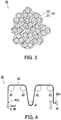
- a rubber-reinforcing cord 30 having a cross-section as shown in FIG. 3 was obtained in this manner. The proportion of the coating in the resultant cord was 20 mass%. Reinforcing cords of Examples 1 to 6 were obtained in this manner.
- Reinforcing cords of Comparative Examples 1 to 23 were obtained in the same manner as in Examples 1 to 6, except that water-based treatment agents whose solids compositions have mass ratios (solid mass ratios) as shown in Tables 2-1 to 2-4 below were used to form coatings.
- spot refers to a state where 20% or more and less than 90% of the surface of the rubber-reinforcing cord is covered by the matrix rubber at the peeling interface.
- interfacial peeling refers to a type of failure in which peeling occurs between the matrix rubber and rubber-reinforcing cord without rubber failure and in which the percentage of broken rubber present at the surface of the peeled rubber-reinforcing cord is less than 20%. The percentage of rubber present at the peeling interface was determined using a printed image of a photograph of the peeling interface.
- a photograph of the specimen is taken so as to include the whole peeling interface, a portion corresponding to the whole specimen is cut out from a printed image of the photograph, and the weight W of the cut-out printed image of the whole specimen is measured.
- a portion corresponding to the rubber is cut out from the printed image of the whole specimen, and the weight w of the whole cut-out portion corresponding to the rubber is measured.
- the percentage of the remaining rubber is determined ((w/W) ⁇ 100%). The results are shown in Tables 4 and 5-1 to 5-3.
- a test for evaluation of the bending fatigue resistance was carried out only for the rubber-reinforcing cords of Examples and Comparative Examples whose adhesion evaluation test results are "rubber failure" or “spot.” This test was not carried out for the rubber-reinforcing cords whose adhesion evaluation test results are "interfacial peeling" because the adhesion of such rubber-reinforcing cords is insufficient.
- the rubber-reinforcing cords were each embedded in a matrix rubber having the composition shown in Table 3 to form a flat belt having a width of 10 mm, a height of 300 mm, and a thickness of 3 mm. The obtained flat belts were subjected to a bending test in which the flat belts were bent 50,000 times and 100,000 times.
- the bending test was carried out using a bending tester 40 shown in FIG. 4 . Each specimen was measured for the tensile strength before and after the bending test.
- the term "tensile strength” as used herein refers to the breaking strength obtained by carrying out a tensile test using a commonly used tensile tester and commonly used cordgrip. The unit is N/cord.
- To measure the tensile strength "Autograph AGS-5kNX” manufactured by Shimadzu Corporation was used as a measuring apparatus, and "Trapezium” was used as software. The measurement speed was set to 250 mm/min, the distance between grips was set to 250 mm, and the initial load was set to 10 N.
- the bending tester 40 of FIG. 4 has one flat pulley 41 (diameter: 10 mm), four guide pulleys 42, and a motor 43.
- a produced specimen 44 flat belt
- a weight was attached to one end 43a of the specimen 44 to add a 9.8 N load to the specimen 44.
- the other end 43b of the specimen 44 was reciprocated by the motor 43 to repeatedly bend the specimen 44 around the flat pulley 41.
- the bending test was carried out at room temperature. After the bending test was carried out for the specimen 44 in this manner, the tensile strength of the specimen having undergone the bending test was measured.
- the tensile strength rate of the specimen yet to undergo the bending test is defined as 100%
- the tensile strength rate of the specimen having undergone the bending test namely the strength retention rate (%)
- the results are shown in Tables 4 and 5-1 to 5-3, in which the strength retention rate obtained after the 50,000-cycle bending test is "strength retention rate 1" and the strength retention rate obtained after the 100,000-cycle bending test is “strength retention rate 2.”
- the rubber-reinforcing cords having a strength retention rate 1 of 95% or more and a strength retention rate 2 of 85% or more are rated as rubber-reinforcing cords having desirable bending fatigue resistance.
- the rubber-reinforcing cords of Examples 1 to 6 exhibited stronger adhesion to matrix rubber than the rubber-reinforcing cords of Comparative Examples 1 to 23 and high bending fatigue resistance.
- the rubber-reinforcing cords of Comparative Examples 1 to 23 exhibited lower peeling strength than the rubber-reinforcing cords of Examples.
- the peeling interface was interfacial peeling or spot, which demonstrates inferior adhesion.
- the coatings of the rubber-reinforcing cords of Comparative Examples 2 and 3 included an NBR-modified epoxy resin, and the rubber-reinforcing cords of Comparative Examples 2 and 3 achieved relatively high adhesion compared to the rubber-reinforcing cords of other Comparative Examples.
- the peeling interface was spot and the peeling strength was greatly inferior to that of Examples.
Landscapes
- Engineering & Computer Science (AREA)
- Chemical & Material Sciences (AREA)
- Life Sciences & Earth Sciences (AREA)
- Organic Chemistry (AREA)
- Chemical Kinetics & Catalysis (AREA)
- General Engineering & Computer Science (AREA)
- Materials Engineering (AREA)
- Textile Engineering (AREA)
- General Chemical & Material Sciences (AREA)
- Geochemistry & Mineralogy (AREA)
- General Life Sciences & Earth Sciences (AREA)
- Mechanical Engineering (AREA)
- Wood Science & Technology (AREA)
- Health & Medical Sciences (AREA)
- Medicinal Chemistry (AREA)
- Polymers & Plastics (AREA)
- Treatments For Attaching Organic Compounds To Fibrous Goods (AREA)
- Ropes Or Cables (AREA)
- Chemical Or Physical Treatment Of Fibers (AREA)
Abstract
Description
- The present invention relates to a rubber-reinforcing cord and a rubber product including the rubber-reinforcing cord.
- A rubber belt or metal chain is used for driving a cam shaft of an internal combustion engine for an automobile, driving an accessory such as an injection pump, and transmitting power in an industrial machine. There has been an increasing interest in energy saving recently, and attention is focused on the use of rubber belts which have high power transmission efficiency, for example, in view of improvement of fuel efficiency and the like. Having higher strength and higher elastic modulus than metal chains, rubber belts also have an advantage of capable of being used even under a high load condition. However, the strength of rubber belts may be decreased by repeated application of stress, and thus rubber belts are limited in use.
- A rubber product such as a rubber belt commonly includes matrix rubber and a rubber-reinforcing cord embedded in the matrix rubber. The strength of the rubber belt depends on the strength of the rubber-reinforcing cord. The rubber-reinforcing cord is, therefore, an important member that determines the durable life of the rubber belt.
- The rubber-reinforcing cord is commonly formed of reinforcing fibers (a filament bundle including a plurality of filaments) and a coating protecting the surface of the reinforcing fibers. Such a coating can improve the adhesion between the rubber-reinforcing cord and matrix rubber when the rubber-reinforcing cord is embedded in the matrix rubber of a rubber product.
- It is conventionally known (see Patent Literature 1, for example) that when matrix rubber is hydrogenated nitrile rubber, a rubber-reinforcing cord including a first coating layer which is a primary coating layer and a second coating layer which is an overcoat layer having contact with the matrix rubber is used in a rubber product including such matrix rubber and a coating including chlorosulfonated polyethylene is used as the second coating layer.
- Patent Literature 1:
WO 2007/129624 A1 - However, the above conventional rubber-reinforcing cord and rubber product have the following problems.
- In rubber products, particularly toothed belts for automobiles, hydrogenated nitrile rubber is predominantly used as matrix rubber. In the case of rubber-reinforcing cords used in rubber products including such matrix rubber, a conventional first coating, for example, formed from a liquid mixture (RFL) of a resorcinol-formaldehyde condensate and rubber latex cannot achieve sufficient adhesion to the hydrogenated nitrile rubber by itself. Therefore, a second coating including chlorosulfonated polyethylene as a main material is indispensable for rubber-reinforcing cords. That is, a two- or more-layer coating needs to be provided. Incidentally, when a large amount of a crosslinking agent is added to impart high adhesion to a conventional first coating, the first coating sometimes can achieve the adhesion to hydrogenated nitrile rubber as matrix rubber by itself. However, the large amount of the crosslinking component causes a new problem in that the coating is so hard that the bending fatigue resistance is decreased.
- When the material used in a conventional second coating is used in a first coating, a rubber product reinforced by the resultant rubber-reinforcing cord unfortunately has poor bending properties. The reason of this is that, although solving the adhesion problem, the coating including chlorosulfonated polyethylene as its main material is weak against repeated bending because of a high degree of hardness and being rigid.
- Therefore, an object of the present invention is to provide a rubber-reinforcing cord having strong adhesion to matrix rubber, particularly matrix rubber including hydrogenated nitrile rubber, of rubber products and being capable of achieving higher bending performance, without being provided with a plurality of coatings. Another object of the present invention is to provide a rubber product reinforced by such a rubber-reinforcing cord and thus having high bending performance.
- The present invention is a rubber-reinforcing cord for reinforcing a rubber product, the rubber-reinforcing cord including: at least one strand, wherein
the strand includes at least one filament bundle and a coating provided to cover at least a portion of a surface of the filament bundle,
the coating includes a rubber component including at least one selected from the group consisting of carboxyl-modified nitrile rubber and carboxyl-modified hydrogenated nitrile rubber, an isocyanate compound, a bismaleimide compound, carbon black, and a rubber-modified epoxy resin, and
in the coating, the content of the isocyanate compound is 10 to 50 parts by mass, the content of the bismaleimide compound is 5 to 25 parts by mass, the content of the carbon black is 2 to 18 parts by mass, and the content of the rubber-modified epoxy resin is 5 to 30 parts by mass, with respect to 100 parts by mass of the rubber component. - The present invention also provides a rubber product reinforced by the above rubber-reinforcing cord according to the present invention.
- The rubber-reinforcing cord of the present invention has strong adhesion to matrix rubber, particularly matrix rubber including hydrogenated nitrile rubber, of rubber products and can achieve higher bending performance, without being provided with a plurality of coatings. Moreover, the rubber product of the present invention is reinforced by such a rubber-reinforcing cord and thus has high bending performance.
-
-
FIG. 1 is a partial exploded perspective view schematically showing an example of a rubber product according to the present invention. -
FIG. 2 is a cross-sectional view showing a strand in EXAMPLES. -
FIG. 3 is a cross-sectional view showing a rubber-reinforcing cord in EXAMPLES. -
FIG. 4 is a diagram schematically showing the method of a bending test carried out for rubber-reinforcing cords of Examples and Comparative Examples. - Hereinafter, embodiments of the present invention will be described.
- A rubber-reinforcing cord according to the present embodiment is a cord for reinforcing rubber products. The rubber-reinforcing cord includes at least one strand. The strand includes at least one filament bundle (reinforcing fibers) and a coating provided to cover at least a portion of a surface of the filament bundle. The coating includes a rubber component at least one selected from the group consisting of carboxyl-modified nitrile rubber and carboxyl-modified hydrogenated nitrile rubber, an isocyanate compound, a bismaleimide compound, carbon black, and a rubber-modified epoxy resin.
- Hereinafter, a method for producing the reinforcing cord of the present embodiment will be described in detail.
- In the rubber-reinforcing cord of the present embodiment, the filament bundle composing the strand includes a plurality of filaments. The material of the filaments is not particularly limited. As the filaments of the rubber-reinforcing cord of the present embodiment, for example, glass fiber filaments, polyvinyl alcohol fiber filaments typified by vinylon fibers, polyester fiber filaments, polyamide fiber filaments such as nylon and aramid (aromatic polyamide) fibers, carbon fiber filaments, and poly(p-phenylene benzobisoxazole) (PBO) fiber filaments can be used. Among these, filaments of fibers having excellent dimensional stability, tensile strength, modulus, and bending fatigue resistance are preferably used. It is preferable to use at least one type of fiber filaments selected from, for example, glass fiber filaments, aramid fiber filaments, poly(p-phenylene benzobisoxazole) fiber filaments, and carbon fiber filaments. In particular, glass fiber filaments are preferred. The filament bundle may be composed of one type of the filaments, or may be composed of two or more types of the filaments.
- The number of filaments included in the filament bundle is not particularly limited. The filament bundle can include, for example, 200 to 24,000 filaments.
- The surface of the filaments included in the filament bundle may be subjected to a pretreatment for increasing the adhesion strength. A preferred example of a pretreatment agent is a compound containing at least one functional group selected from the group consisting of an epoxy group and amino group. Examples of the pretreatment agent include aminosilanes, epoxysilanes, novolac epoxy resins, bisphenol A epoxy resins, bisphenol F epoxy resins, brominated epoxy resins, bisphenol AD epoxy resins, and glycidyl amine epoxy resins. Specific examples include Denacol series available from Nagase ChemteX Corporation, EPICLON series available from DIC Corporation, and Epikote series available from Mitsubishi Chemical Corporation. Polyurethane resins and isocyanate compounds can also be used as the pretreatment agent. For example, a treatment agent including at least one selected from the group consisting of epoxy resins, urethane resins, and isocyanate compounds may be used as the pretreatment agent. By the pretreatment performed using such a treatment agent, a resin layer including at least one selected from the group consisting of epoxy resins, urethane resins, and isocyanate compounds is further provided between the filament bundle and coating. The pretreatment of the surface can enhance the adhesion between matrix rubber and the rubber-reinforcing cord also when less-adhesive fiber filaments, such as polyparaphenylene terephthalamide fiber filaments, are used. It should be noted that the coating (pretreatment agent film) formed on the surface of the filaments by the pretreatment of the filaments and made of the pretreatment agent is different from the coating of the present embodiment covering at least a portion of the surface of the filament bundle, and is not included in the coating of the present embodiment.
- The number of filament bundles included in the rubber-reinforcing cord is not particularly limited, and may be one or may be two or more. The filament bundle may include a plurality of filament bundles assembled together. In this case, each of the plurality of filament bundles may be twisted or untwisted. The plurality of filament bundles in one bundle may be twisted together or may be untwisted.
- The coating is provided to cover at least a portion of the surface of the filament bundle. The coating may be provided directly on the surface of the filament bundle, or may cover the surface of the filament bundle with another layer interposed therebetween. The rubber-reinforcing cord of the present embodiment may not be provided with other coating than this coating. As described above, the term "other coating" as used herein does not include the above pretreatment agent film. Therefore, the rubber-reinforcing cord in which this coating is provided on the surface of the filament bundle including the filaments provided with the pretreatment agent film can be a "rubber-reinforcing cord not provided with other coating than this coating."
- The coating is formed by providing the later-described water-based treatment agent for coating formation on at least a portion of the surface of the filament bundle and drying the provided water-based treatment agent for coating formation by heat treatment. The water-based treatment agent can be provided on the surface of the filament bundle, for example, by impregnating the filament bundle with the water-based treatment agent for coating formation, or by applying the water-based treatment agent for coating formation to at least a portion of the surface of the filament bundle. This heat treatment almost completely removes water included in the filaments themselves and a solvent (e.g., water) of the water-based treatment agent.
- The coating includes a rubber component. The rubber component includes at least one selected from the group consisting of carboxyl-modified nitrile rubber (X-NBR) and carboxyl-modified hydrogenated nitrile rubber (X-HNBR). The total amount of the carboxyl-modified nitrile rubber and carboxyl-modified hydrogenated nitrile rubber included in the rubber component is preferably 70 mass% or more and more preferably 90 mass% or more. The rubber component may consist of the carboxyl-modified nitrile rubber and/or carboxyl-modified hydrogenated nitrile rubber. That is, the total amount of the carboxyl-modified nitrile rubber and carboxyl-modified hydrogenated nitrile rubber in the rubber component may be 100 mass%. The coating may further include rubber other than the carboxyl-modified nitrile rubber and carboxyl-modified hydrogenated nitrile rubber. Examples of the rubber other than the carboxyl-modified nitrile rubber and carboxyl-modified hydrogenated nitrile rubber include a butadiene-styrene copolymer, dicarboxylated butadiene-styrene polymer, vinylpyridine-butadiene-styrene terpolymer, chloroprene, butadiene rubber, chlorosulfonated polyethylene, an acrylonitrile-butadiene copolymer, nitrile rubber (NBR), and hydrogenated nitrile rubber (HNBR).
- The coating further includes an isocyanate compound. The content of the isocyanate compound in the coating is 10 to 50 parts by mass, desirably 20 to 40 parts by mass, and more desirably 25 to 35 parts by mass with respect to 100 parts by mass of the rubber component. Examples of the isocyanate compound include aromatic or aliphatic organic diisocyanates, polyisocyanates, blocked isocyanates, and blocked polyisocyanates.
- The coating further includes a bismaleimide compound. The content of the bismaleimide compound in the coating is 5 to 25 parts by mass, desirably 10 to 20 parts by mass, and more desirably 12 to 18 parts by mass with respect to 100 parts by mass of the rubber component. Examples of the bismaleimide compound include bismaleimide, phenylmaleimide, and N,N'-m-phenylenedimaleimide.
- The coating further includes carbon black. The content of the carbon black in the coating is 2 to 18 parts by mass, desirably 5 to 15 parts by mass, and more desirably 7 to 13 parts by mass with respect to 100 parts by mass of the rubber component.
- The coating further includes a rubber-modified epoxy resin. The content of the rubber-modified epoxy resin in the coating is 5 to 30 parts by mass, desirably 10 to 25 parts by mass, and more desirably 12 to 20 parts by mass with respect to 100 parts by mass of the rubber component. Examples of the rubber-modified epoxy resin include nitrile rubber (NBR)-modified epoxy resins and butadiene rubber-modified epoxy resins. Among these, NBR-modified epoxy resins are preferred.
- When the coating includes the rubber component including at least one selected from the group consisting of carboxyl-modified nitrile rubber and carboxyl-modified hydrogenated nitrile rubber, isocyanate compound, bismaleimide compound, carbon black, and rubber-modified epoxy resin whose contents are in the above ranges, the coating can achieve fiber protection performance, high adhesion performance, and high bending fatigue resistance by itself. In particular, when the reinforcing cord of the present embodiment is included in a rubber product whose matrix rubber includes hydrogenated nitrile rubber, strong adhesion between the coating and matrix rubber can be achieved. It is thought that the strong adhesion between the coating and matrix rubber can be achieved because the rubber-modified epoxy resin included in the coating of the present embodiment, nitrile rubber which is the rubber component included in the coating, and nitrile rubber included in the matrix rubber of the rubber product side are compatible. Moreover, a network structure is formed by a reaction of the epoxy resin with a carboxyl group in the rubber component included in the coating and, in the case where the hydrogenated nitrile rubber included in the matrix rubber of the rubber product side is, for example, carboxyl-modified hydrogenated nitrile rubber, a carboxyl group included in the carboxyl-modified hydrogenated nitrile rubber. This is thought to be another reason of the improvement in the adhesion between the coating and matrix rubber. Additionally, with the use of an NBR-modified epoxy resin as the rubber-modified epoxy resin, the coating with improved flexibility can be obtained and the bending fatigue resistance of the reinforcing cord can further be improved. The rubber-modified epoxy resin reacts with the isocyanate compound and contributes to a stronger bond between the coatings. Moreover, the rubber-modified epoxy resin can promote a polymerization reaction of the bismaleimide compound to make the above network structure formed in the coating denser. As described above, the coating strength and adhesion can be improved by using the rubber-modified epoxy resin in combination with the isocyanate compound and bismaleimide compound.
- The total content of the isocyanate compound, the bismaleimide compound, the carbon black, and the rubber-modified epoxy resin is desirably 100 parts by mass or less with respect to 100 parts by mass of the rubber component. If the total content of the isocyanate compound, bismaleimide compound, carbon black, and rubber-modified epoxy resin exceeds 100 parts by mass, formation of the coating can be difficult in some cases and protection of the cord and improvement in bending fatigue resistance can be prevented.
- The coating is preferably free of a resorcinol-formaldehyde condensate. When the coating is free of a resorcinol-formaldehyde condensate, the formation of the coating has no need to use a substance such as formaldehyde or ammonia which may impose a heavy load on the environment, and thus requires no environmental measures to be taken for workers.
- The coating may further include another component in addition to the above components.
- The total content of the rubber component, isocyanate compound, bismaleimide compound, carbon black, and rubber-modified epoxy resin (which may hereinafter be simply referred to as "five components") in the coating is not limited to a particular value. The total content of the above five components in the coating is desirably 70 mass% or more and more desirably 90 mass% or more. The coating may consist essentially of the above five components. "Consisting essentially of the above five components" means that the total content of the above five components in the coating is 97 mass% or more. The coating may consist of the above five components.
- The mass of the coating provided at least on the surface of the filament bundle is not particularly limited and may be adjusted as appropriate. For example, the coating is provided so that the content thereof is desirably in the range of 5 to 30 mass%, more desirably in the range of 10 to 25 mass%, and particularly desirably in the range of 13 to 19 mass% with respect to the whole reinforcing cord. Too large a mass% of the coating may result in defects such as a reduction in the dimensional stability of the rubber-reinforcing cord in a rubber product and a reduction in the elastic modulus of the rubber-reinforcing cord. Too small a mass of the coating, on the other hand, may make fraying of the strand more likely or cause a decline in the ability of the coating to protect the fibers, thus resulting in shortening of the durable life of a rubber product.
- The number of twists in the rubber-reinforcing cord of the present embodiment is not particularly limited. The number of twists given to one strand (the twists may hereinafter be referred to as "primary twists") may be, for example, 1 to 6 twists/25 mm. The number of twists given to the plurality of strands (the twists may hereinafter be referred to as "final twists") may be, for example, 1 to 8 twists/25 mm. Lang lay may be employed in which the direction of the primary twists and the direction of the final twists are the same, or regular lay may be employed in which the direction of the primary twists and the direction of the final twists are opposite. The directions of the twists are not limited and may be the S direction or the Z direction.
- Hereinafter, an example of the method for producing the rubber-reinforcing cord of the present embodiment will be described. The features described for the rubber-reinforcing cord of the present embodiment can be applied to the following production method and may not be described repeatedly. The features described for the following production method can be applied to the rubber-reinforcing cord of the present embodiment. The example of the production method includes the following steps.
- First, a plurality of filaments are assembled into a filament bundle, and a water-based treatment agent for coating formation to be used to form a coating is prepared. Next, the water-based treatment agent for coating formation is provided on at least a portion of the surface of the filament bundle. After that, a heat treatment is performed to remove the solvent in the water-based treatment agent for coating formation.
- By the above steps, a coating is formed on at least a portion of the surface of the filament bundle. The method for providing the water-based treatment agent for coating formation on at least a portion of the surface of the filament bundle is not limited. For example, the water-based treatment agent for coating formation may be applied onto the surface of the filament bundle, or the filament bundle may be immersed in the water-based treatment agent for coating formation.
- The conditions of the heat treatment for removing the solvent of the water-based treatment agent for coating formation are not particularly limited; however, it is necessary to avoid carrying out the drying under conditions where a reaction caused by a crosslinking agent in the coating can proceed to completion. It is therefore preferable to shorten the drying time (to 5 minutes or less, for example) when the drying is performed at a relatively high temperature (at 80°C or above, for example). When, for example, the temperature of the atmosphere is 150°C or below, the drying time may be 5 minutes or less. In an example, the drying may be performed in an atmosphere at 80°C to 280°C for 0.1 to 2 minutes.
- The filament bundle on which the coating has been formed may be twisted in one direction. The direction of twisting may be the S direction or the Z direction. The number of filaments included in the filament bundle and the number of twists given to the filament bundle are as specified above and thus will not be repeatedly described. The rubber-reinforcing cord of the present embodiment can be produced in this manner. The plurality of filament bundles each having a coating may be formed, assembled together, and given final twists. The direction of the final twists may be the same as or different from the direction of the twists of each filament bundle (the direction of the primary twists). Alternatively, the plurality of filament bundles each having a coating may be formed without twisting each filament bundle, assembled together, and given twists.
- The coating may be formed after the filament bundle is twisted. The type of the filaments, the number of filaments, and the number of twists of the filaments are as described above.
- In a preferred example of the production method of the present embodiment, the rubber-reinforcing cord is formed by twisting a bundle of the filament bundles in one direction after application of the water-based treatment agent for coating formation to the filament bundles or impregnation of the filament bundles with the water-based treatment agent for coating formation.
- Next, the water-based treatment agent for coating formation will be described.
- The water-based treatment agent for coating formation preferably includes latex of rubber composing the rubber component of the coating. Since the rubber component of the coating includes at least one rubber selected from the group consisting of carboxyl-modified nitrile rubber (X-NBR) and carboxyl-modified hydrogenated nitrile rubber (X-HNBR), the water-based treatment agent for coating formation includes latex of at least one rubber selected from the group consisting of carboxyl-modified nitrile rubber (X-NBR) and carboxyl-modified hydrogenated nitrile rubber (X-HNBR). The water-based treatment agent for coating formation may also include another rubber latex, depending on the rubber component of the coating.
- The water-based treatment agent for coating formation further includes an isocyanate compound, bismaleimide compound, carbon black, and a rubber-modified epoxy resin. These components included in the water-based treatment agent for coating formation is the same as those described above, and thus will not be repeatedly described. These components included in the water-based treatment agent for coating formation are preferably used in the form of aqueous dispersions in order to allow the components to be uniformly present in the water-based treatment agent.
- The water-based treatment agent for coating formation is preferably free of a resorcinol-formaldehyde condensate.
- The water-based treatment agent for coating formation may further include a component other than the above components. For example, the water-based treatment agent for coating formation may further include a resin, plasticizer, anti-aging agent, stabilizer, or filler as the other component.
- A rubber product of the present embodiment is a rubber product reinforced by the rubber-reinforcing cord of the present embodiment. The type of the rubber product is not particularly limited. Examples of the rubber product of the present embodiment include tires of automobiles and bicycles and transmission belts. Examples of the transmission belts include synchronous transmission belts and friction transmission belts. Examples of the synchronous transmission belts include toothed belts typified by timing belts for automobiles. Examples of the friction transmission belts include flat belts, round belts, V belts, and V-ribbed belts. That is, the rubber product of the present embodiment may be a toothed belt, flat belt, round belt, V belt, or V-ribbed belt.
- The rubber product of the present embodiment is formed by embedding the rubber-reinforcing cord of the present embodiment in a rubber composition (matrix rubber). The technique for embedding the rubber-reinforcing cord in the matrix rubber is not particularly limited, and a commonly-known technique may be employed. The rubber-reinforcing cord of the present embodiment is embedded in the rubber product (e.g., a rubber belt) of the present embodiment. The rubber product of the present embodiment thus formed has high bending fatigue resistance. Therefore, the rubber product of the present embodiment is particularly suitable for use in, for example, a timing belt of a vehicle engine and a belt for driving an accessory of a vehicle.
- The type of the rubber included in the rubber composition in which the rubber-reinforcing cord of the present embodiment is embedded is not particularly limited. The rubber is desirably hydrogenated nitrile rubber. The reason of this is that, as described above, the coating of the rubber-reinforcing cord of the present embodiment can maintain the flexibility to achieve the bending fatigue resistance and can be improved in adhesion when used in combination with matrix rubber including hydrogenated nitrile rubber. Additionally, the hydrogenated nitrile rubber may be one in which a zinc acrylate derivative (such as zinc methacrylate) is dispersed. At least one rubber selected from hydrogenated nitrile rubber as such and hydrogenated nitrile rubber in which a zinc acrylate derivative is dispersed is preferable in view of water resistance and oil resistance. The matrix rubber may further include carboxyl-modified hydrogenated nitrile rubber.
-
FIG. 1 shows a toothed belt as one example of the rubber product. The toothed belt 1 shown inFIG. 1 includes abelt body 11 and a plurality of rubber-reinforcingcords 12. Thebelt body 11 includes abelt portion 13 and a plurality oftooth portions 14 arranged at regular intervals and protruding from thebelt portion 13. The rubber-reinforcingcords 12 are embedded within thebelt portion 13 so as to extend parallel to the length direction of thebelt portion 13. Each rubber-reinforcingcord 12 is the rubber-reinforcing cord of the present embodiment. - Hereinafter, the embodiment of the present invention will be described in more detail with Examples and Comparative Examples.
- A glass fiber (filament bundle) constituted by a bundle of 200 glass filaments (composed of E-glass and having an average diameter of 9 µm) was prepared. Three such glass fibers were aligned, and a water-based adhesive whose solids composition has a mass ratio (solid mass ratio) as shown in Table 1 below was applied to the three glass fibers and dried in a drying oven set at 150°C for 1 minute. A strand was formed in this manner. The strand formed has a cross-section as shown in
FIG. 2 . That is, astrand 20 was formed by providing acoating 22 to cover the surfaces of threeglass fibers 21 each composed of a large number of glass filaments. The threeglass fibers 21 were adhered to each other by thecoating 22. The strand obtained as above was primarily twisted at two turns/25 mm. Next, 11 such twisted strands were aligned and finally twisted at two turns/25 mm. A rubber-reinforcingcord 30 having a cross-section as shown inFIG. 3 was obtained in this manner. The proportion of the coating in the resultant cord was 20 mass%. Reinforcing cords of Examples 1 to 6 were obtained in this manner. - Reinforcing cords of Comparative Examples 1 to 23 were obtained in the same manner as in Examples 1 to 6, except that water-based treatment agents whose solids compositions have mass ratios (solid mass ratios) as shown in Tables 2-1 to 2-4 below were used to form coatings.
[Table 1] Components Solid mass ratio (parts by mass) Example 1 Example 2 Example 3 Example 4 Example 5 Example 6 X-NBR latex (solids content: 40 mass%) (*1) 100 - 100 100 100 100 X-HNBR latex (solids content: 40 mass%) (*2) - 100 - - - - Aqueous bismaleimide dispersion (solids content: 50 mass%) 15 15 15 15 15 15 Blocked isocyanate (solids content: 40 mass%) 30 30 30 30 30 30 Carbon black (solids content: 30 mass%) 10 10 10 10 10 10 NBR-modified epoxy resin (solids content: 50 mass%) (*3) 15 15 5 10 20 30 (*1) Synthomer 6617 Latex (manufactured by Synthomer plc)
(*2) Zetpol Latex (manufactured by Zeon Corporation)
(*3) EPR-1415-1 (manufactured by ADEKA Corporation)[Table 2-1] Components Solid mass ratio (parts by mass) Comparative Example 1 Comparative Example 2 Comparative Example 3 Comparative Example 4 Comparative Example 5 Comparative Example 6 Comparative Example 7 X-NBR latex (solids content: 40 mass%) (*1) 100 100 100 100 100 100 NBR latex (solids content: 40 mass%) (*4) - - - 100 - - - Aqueous bismaleimide dispersion (solids content: 50 mass%) 15 15 15 15 - 15 15 Blocked isocyanate (solids content: 40 mass%) 30 30 30 30 30 - 30 Carbon black (solids content: 30 mass%) 10 10 10 10 10 10 - NBR-modified epoxy resin (solids content: 50 mass%) (*3) - 3 32 15 15 15 15 (*1) Synthomer 6617 Latex (manufactured by Synthomer plc)
(*3) EPR-1415-1 (manufactured by ADEKA Corporation)
(*4) Nipol 1562 Latex (manufactured by Zeon Corporation)[Table 2-2] Components Solid mass ratio (parts by mass) Comparative Example 8 Comparative Example 9 Comparative Example 10 Comparative Example 11 X-NBR latex (solids content: 40 mass%) (*1) 100 100 100 100 Aqueous bismaleimide dispersion (solids content: 50 mass%) 15 15 3 30 Blocked isocyanate (solids content: 40 mass%) 30 30 5 60 Carbon black (solids content: 30 mass%) 10 10 1 20 NBR-modified epoxy resin (solids content: 50 mass%) (*3) - - 15 30 Bisphenol A epoxy resin (solids content: 60 mass%) 15 - - - Glycerol polyglycidyl ether (solids content: 99 mass%) - 15 - - (*1) Synthomer 6617 Latex (manufactured by Synthomer plc)
(*3) EPR-1415-1 (manufactured by ADEKA Corporation)[Table 2-3] Components Solid mass ratio (parts by mass) Comparative Example 12 Comparative Example 13 Comparative Example 14 Comparative Example 15 Comparative Example 16 Comparative Example 17 Resorcinol-formaldehyde condensate (*5) 10 10 10 10 10 10 VP latex (solids content: 40 mass%) (*6) 70 70 70 50 30 - CSM latex (solids content: 40 mass%) (*7) 30 - - - - - SBR latex (solids content: 50 mass%) (*8) - 30 - - - - X-NBR latex (solids content: 40 mass%) (*1) - - 30 50 70 100 NBR-modified epoxy resin (solids content: 50 mass%) (*3) - - - - - - (*1) Synthomer 6617 Latex (manufactured by Synthomer plc)
(*3) EPR-1415-1 (manufactured by ADEKA Corporation)
(*5) SUMIKANOL (manufactured by Sumitomo Chemical Co., Ltd.)
(*6) PYRATEX (manufactured by NIPPON A&L INC.)
(*7) SEPOLEX CSM Latex (manufactured by Sumitomo Seika Chemicals Co., Ltd.)
(*8) SB Latex (manufactured by Asahi Kasei Chemicals Corporation)[Table 2-4] Components Solid mass ratio (parts by mass) Comparative Example 18 Comparative Example 19 Comparative Example 20 Comparative Example 21 Comparative Example 22 Comparative Example 23 Resorcinol-formaldehyde condensate (*5) 10 10 10 10 10 10 VP latex (solids content: 40 mass%) (*6) 70 70 70 50 30 - CSM latex (solids content: 40 mass%) (*7) 30 - - - - - SBR latex (solids content: 50 mass%) (*8) - 30 - - - - X-NBR latex (solids content: 40 mass%) (*1) - - 30 50 70 100 NBR-modified epoxy resin (solids content: 50 mass%) (*3) 15 15 15 15 15 15 (*1) Synthomer 6617 Latex (manufactured by Synthomer plc)
(*3) EPR-1415-1 (manufactured by ADEKA Corporation)
(*5) SUMIKANOL (manufactured by Sumitomo Chemical Co., Ltd.)
(*6) PYRATEX (manufactured by NIPPON A&L INC.)
(*7) SEPOLEX CSM Latex (manufactured by Sumitomo Seika Chemicals Co., Ltd.)
(*8) SB Latex (manufactured by Asahi Kasei Chemicals Corporation) - First, two pieces of rubber composed as shown in Table 3 (each piece having a width of 25 mm, a length of 50 mm, and a thickness of 5 mm) were prepared. Next, the rubber-reinforcing cord of each of Examples and Comparative Examples was sandwiched by the two rubber pieces in such a manner as to extend parallel to the length of the rubber pieces, and the cord and rubber pieces were adhered together by heating them at 150°C for 20 minutes. The specimen thus prepared was pulled lengthwise by a tensile tester to measure the peel strength between the matrix rubber and rubber-reinforcing cord of each of Examples and Comparative Examples. It was also examined whether the failure of the specimen was "rubber failure" which occurred while the rubber-reinforcing cord and matrix rubber remained adhered, "interfacial peeling" which occurred at the interface between the matrix rubber and rubber-reinforcing cord, or "spot" which is intermediate between "rubber failure" and "interfacial peeling." Specifically, the term "rubber failure" refers to a type of failure in which a crack appears within the matrix rubber without peeling at the interface between the matrix rubber and rubber-reinforcing cord and in which 90% or more of the surface of the rubber-reinforcing cord is covered by the matrix rubber at the peeling interface. The term "spot" refers to a state where 20% or more and less than 90% of the surface of the rubber-reinforcing cord is covered by the matrix rubber at the peeling interface. The term "interfacial peeling" refers to a type of failure in which peeling occurs between the matrix rubber and rubber-reinforcing cord without rubber failure and in which the percentage of broken rubber present at the surface of the peeled rubber-reinforcing cord is less than 20%. The percentage of rubber present at the peeling interface was determined using a printed image of a photograph of the peeling interface. Specifically, first, a photograph of the specimen is taken so as to include the whole peeling interface, a portion corresponding to the whole specimen is cut out from a printed image of the photograph, and the weight W of the cut-out printed image of the whole specimen is measured. Next, a portion corresponding to the rubber is cut out from the printed image of the whole specimen, and the weight w of the whole cut-out portion corresponding to the rubber is measured. Using the measured values of the weights W and w, the percentage of the remaining rubber is determined ((w/W) × 100%). The results are shown in Tables 4 and 5-1 to 5-3.
- A test for evaluation of the bending fatigue resistance was carried out only for the rubber-reinforcing cords of Examples and Comparative Examples whose adhesion evaluation test results are "rubber failure" or "spot." This test was not carried out for the rubber-reinforcing cords whose adhesion evaluation test results are "interfacial peeling" because the adhesion of such rubber-reinforcing cords is insufficient. The rubber-reinforcing cords were each embedded in a matrix rubber having the composition shown in Table 3 to form a flat belt having a width of 10 mm, a height of 300 mm, and a thickness of 3 mm. The obtained flat belts were subjected to a bending test in which the flat belts were bent 50,000 times and 100,000 times. The bending test was carried out using a bending
tester 40 shown inFIG. 4 . Each specimen was measured for the tensile strength before and after the bending test. The term "tensile strength" as used herein refers to the breaking strength obtained by carrying out a tensile test using a commonly used tensile tester and commonly used cordgrip. The unit is N/cord. To measure the tensile strength, "Autograph AGS-5kNX" manufactured by Shimadzu Corporation was used as a measuring apparatus, and "Trapezium" was used as software. The measurement speed was set to 250 mm/min, the distance between grips was set to 250 mm, and the initial load was set to 10 N. - The bending
tester 40 ofFIG. 4 has one flat pulley 41 (diameter: 10 mm), four guide pulleys 42, and amotor 43. First, a produced specimen 44 (flat belt) was hung on the five pulleys. Then, a weight was attached to oneend 43a of thespecimen 44 to add a 9.8 N load to thespecimen 44. In this state, theother end 43b of thespecimen 44 was reciprocated by themotor 43 to repeatedly bend thespecimen 44 around theflat pulley 41. The bending test was carried out at room temperature. After the bending test was carried out for thespecimen 44 in this manner, the tensile strength of the specimen having undergone the bending test was measured. - Subsequently, on the basis that the tensile strength rate of the specimen yet to undergo the bending test is defined as 100%, the tensile strength rate of the specimen having undergone the bending test, namely the strength retention rate (%), was determined. The greater the tensile strength retention rate is, the better the bending fatigue resistance is. The results are shown in Tables 4 and 5-1 to 5-3, in which the strength retention rate obtained after the 50,000-cycle bending test is "strength retention rate 1" and the strength retention rate obtained after the 100,000-cycle bending test is "strength retention rate 2." The rubber-reinforcing cords having a strength retention rate 1 of 95% or more and a strength retention rate 2 of 85% or more are rated as rubber-reinforcing cords having desirable bending fatigue resistance.
[Table 3] Components Mass ratio Hydrogenated nitrile rubber (*1) 70 Zinc dimethacrylate-containing hydrogenated nitrile rubber (*2) 30 Zinc oxide 10 Stearic acid 1 Carbon black 30 Trioctyl trimellitate 5 Sulfur 0.1 1,3-bis(t-butylperoxy-isopropyl)benzene 6 Magnesium oxide 1 4,4'-(α,α-dimethylbenzyl)diphenylamine 0.5 2-mercaptobenzimidazole zinc salt 0.5 Triallyl isocyanurate 1 (*1) Zetpol 2020 (manufactured by Zeon Corporation)
(*2) Zetpol 2000 L (manufactured by Zeon Corporation)[Table 4] Example 1 2 3 4 5 6 Peeling strength (N/25 mm) 313.9 279.8 276.5 285.9 292.2 293.7 Peeling interface Rubber failure Rubber failure Rubber failure Rubber failure Rubber failure Rubber failure Strength retention rate 1 (%) 98 97 98 98 96 95 Strength retention rate 2 (%) 90 90 92 90 88 85 [Table 5-1] Comparative Example 1 2 3 4 5 6 7 8 9 10 Peeling strength (N/25 mm) 150.3 203.1 254 104.0 115.5 110.7 116.1 113.7 126.7 101.8 Peeling interface Interfacial peeling Spot Spot Interfacial peeling Interfacial peeling Interfacial peeling Interfacial peeling Interfacial peeling Interfacial peeling Interfacial peeling Strength retention rate 1 (%) - 95 91 - - - - - - - Strength retention rate 2 (%) - 85 79 - - - - - - - [Table 5-2] Comparative Example 11 12 13 14 15 16 17 18 19 20 Peeling strength (N/25 mm) 195.5 95.4 99.7 94.6 102.5 101.3 97.6 91.4 93.8 91.2 Peeling interface Spot Interfacial peeling Interfacial peeling Interfacial peeling Interfacial peeling Interfacial peeling Interfacial peeling Interfacial peeling Interfacial peeling Interfacial peeling Strength retention rate 1 (%) 88 - - - - - - - - - Strength retention rate 2 (%) 73 - - - - - - - - - [Table 5-3] Comparative Example 21 22 23 Peeling strength (N/25 mm) 92.3 101.9 94.7 Peeling interface Interfacial peeling Interfacial peeling Interfacial peeling Strength retention rate 1 (%) - - - Strength retention rate 2 (%) - - - - The rubber-reinforcing cords of Examples 1 to 6 exhibited stronger adhesion to matrix rubber than the rubber-reinforcing cords of Comparative Examples 1 to 23 and high bending fatigue resistance. On the other hand, the rubber-reinforcing cords of Comparative Examples 1 to 23 exhibited lower peeling strength than the rubber-reinforcing cords of Examples. Additionally, the peeling interface was interfacial peeling or spot, which demonstrates inferior adhesion. The coatings of the rubber-reinforcing cords of Comparative Examples 2 and 3 included an NBR-modified epoxy resin, and the rubber-reinforcing cords of Comparative Examples 2 and 3 achieved relatively high adhesion compared to the rubber-reinforcing cords of other Comparative Examples. However, since the contents of the NBR-modified epoxy resin were beyond the range specified for the rubber-reinforcing cord of the present invention, the peeling interface was spot and the peeling strength was greatly inferior to that of Examples.
Claims (8)
- A rubber-reinforcing cord for reinforcing a rubber product, the rubber-reinforcing cord comprising: at least one strand, wherein
the strand comprises at least one filament bundle and a coating provided to cover at least a portion of a surface of the filament bundle,
the coating comprises a rubber component comprising at least one selected from the group consisting of carboxyl-modified nitrile rubber and carboxyl-modified hydrogenated nitrile rubber, an isocyanate compound, a bismaleimide compound, carbon black, and a rubber-modified epoxy resin, and
in the coating, the content of the isocyanate compound is 10 to 50 parts by mass, the content of the bismaleimide compound is 5 to 25 parts by mass, the content of the carbon black is 2 to 18 parts by mass, and the content of the rubber-modified epoxy resin is 5 to 30 parts by mass, with respect to 100 parts by mass of the rubber component. - The rubber-reinforcing cord according to claim 1, wherein the rubber-modified epoxy resin is a nitrile rubber-modified epoxy resin.
- The rubber-reinforcing cord according to claim 1 or 2, comprising no other coating than the coating.
- The rubber-reinforcing cord according to any one of claims 1 to 3, wherein the total content of the isocyanate compound, the bismaleimide compound, the carbon black, and the rubber-modified epoxy resin is 100 parts by mass or less with respect to 100 parts by mass of the rubber component.
- The rubber-reinforcing cord according to any one of claims 1 to 4, wherein the coating is free of a resorcinol-formaldehyde condensate.
- A rubber product reinforced by the rubber-reinforcing cord according to any one of claims 1 to 5.
- The rubber product according to claim 6, being a rubber belt comprising matrix rubber and the rubber-reinforcing cord embedded in the matrix rubber.
- The rubber product according to claim 7, wherein the matrix rubber comprises hydrogenated nitrile rubber.
Applications Claiming Priority (2)
| Application Number | Priority Date | Filing Date | Title |
|---|---|---|---|
| JP2017119707 | 2017-06-19 | ||
| PCT/JP2018/022051 WO2018235636A1 (en) | 2017-06-19 | 2018-06-08 | Rubber reinforcing cord and rubber product using the same |
Publications (3)
| Publication Number | Publication Date |
|---|---|
| EP3643832A1 true EP3643832A1 (en) | 2020-04-29 |
| EP3643832A4 EP3643832A4 (en) | 2021-04-28 |
| EP3643832B1 EP3643832B1 (en) | 2023-04-05 |
Family
ID=64737575
Family Applications (1)
| Application Number | Title | Priority Date | Filing Date |
|---|---|---|---|
| EP18820030.7A Active EP3643832B1 (en) | 2017-06-19 | 2018-06-08 | Cord for rubber reinforcement and rubber product obtained using same |
Country Status (5)
| Country | Link |
|---|---|
| US (1) | US11560671B2 (en) |
| EP (1) | EP3643832B1 (en) |
| JP (1) | JP6445748B1 (en) |
| CN (1) | CN110770388B (en) |
| WO (1) | WO2018235636A1 (en) |
Cited By (1)
| Publication number | Priority date | Publication date | Assignee | Title |
|---|---|---|---|---|
| EP4502267A4 (en) * | 2022-03-31 | 2026-04-29 | Nippon Sheet Glass Co Ltd | RUBBER REINFORCEMENT CODE |
Families Citing this family (6)
| Publication number | Priority date | Publication date | Assignee | Title |
|---|---|---|---|---|
| JP7163805B2 (en) * | 2019-02-05 | 2022-11-01 | 三菱ケミカル株式会社 | Method for producing sizing agent, carbon fiber bundle and reinforcing fiber bundle |
| EP3702521A1 (en) * | 2019-03-01 | 2020-09-02 | Continental Reifen Deutschland GmbH | Aqueous dipping composition |
| EP3702523A1 (en) * | 2019-03-01 | 2020-09-02 | Continental Reifen Deutschland GmbH | Aqueous dipping composition |
| EP3702524A1 (en) * | 2019-03-01 | 2020-09-02 | Continental Reifen Deutschland GmbH | Aqueous dipping composition |
| CN112175259B (en) * | 2020-10-19 | 2024-06-11 | 广东安格尔橡塑科技有限公司 | Rubber belt wrench and manufacturing method of rubber belt thereof |
| EP4348075A1 (en) * | 2021-05-24 | 2024-04-10 | Dayco Europe S.R.L. | Power transmission belt |
Family Cites Families (15)
| Publication number | Priority date | Publication date | Assignee | Title |
|---|---|---|---|---|
| JPS62149985A (en) * | 1985-12-24 | 1987-07-03 | 東邦レーヨン株式会社 | Highly adhesive carbonaceous fiber cord for reinforcing rubbler |
| US6664325B1 (en) * | 1999-01-14 | 2003-12-16 | Nippon Sheet Glass Co., Ltd. | Fiber processing agent, reinforcing fiber processed by the fiber processing agent and rubber product reinforced by the reinforcing fiber |
| JP3528652B2 (en) * | 1999-01-14 | 2004-05-17 | 日本板硝子株式会社 | Fiber treatment agent, reinforcing fiber treated therewith, and rubber product reinforced with the fiber |
| JP3759857B2 (en) * | 2000-05-16 | 2006-03-29 | 三ツ星ベルト株式会社 | Adhesion treatment method for the core wire |
| BRPI0711130B1 (en) | 2006-05-01 | 2017-03-21 | Nippon Sheet Glass Co Ltd | method for producing a reinforcement cord as well as reinforcement cord and product containing a reinforcement cord |
| JP5367582B2 (en) * | 2007-11-15 | 2013-12-11 | 日本板硝子株式会社 | Reinforcing cord and rubber product using the same |
| CN102414362B (en) * | 2009-04-28 | 2015-01-07 | 株式会社普利司通 | Adhesive composition for organic fiber cords, rubber-reinforcing material using same, tire and bonding method |
| EP2448378A1 (en) * | 2010-10-26 | 2012-05-02 | ATOTECH Deutschland GmbH | Composite build-up materials for embedding of active components |
| EP2719824B1 (en) * | 2011-06-10 | 2017-02-22 | Nippon Sheet Glass Company, Limited | Reinforcement cord for reinforcing rubber product, and rubber product using same |
| JP5997206B2 (en) * | 2013-06-27 | 2016-09-28 | 三ツ星ベルト株式会社 | Aramid core, manufacturing method thereof, treatment agent, and transmission belt |
| EP3088601B1 (en) * | 2013-12-25 | 2018-09-19 | Nippon Sheet Glass Company, Limited | Water-based treatment agent for forming rubber-reinforcing cord, rubber-reinforcing cord formed using same and production method therefor, and rubber product employing rubber-reinforcing cord |
| JP6605974B2 (en) * | 2015-01-30 | 2019-11-13 | 三ツ星ベルト株式会社 | Aramid core wire manufacturing method and treatment agent, and transmission belt manufacturing method |
| JP6713993B2 (en) * | 2015-07-15 | 2020-06-24 | 日本板硝子株式会社 | Rubber reinforcing cord and rubber product using the same |
| CN104987673A (en) * | 2015-08-05 | 2015-10-21 | 张家港康得新光电材料有限公司 | Epoxy resin composition for prepreg, carbon fiber prepreg and carbon fiber compound material |
| WO2017110076A1 (en) * | 2015-12-21 | 2017-06-29 | 日本板硝子株式会社 | Rubber-reinforcing cord and rubber product using same |
-
2018
- 2018-06-08 EP EP18820030.7A patent/EP3643832B1/en active Active
- 2018-06-08 JP JP2018550849A patent/JP6445748B1/en active Active
- 2018-06-08 US US16/619,755 patent/US11560671B2/en active Active
- 2018-06-08 CN CN201880039636.3A patent/CN110770388B/en active Active
- 2018-06-08 WO PCT/JP2018/022051 patent/WO2018235636A1/en not_active Ceased
Cited By (1)
| Publication number | Priority date | Publication date | Assignee | Title |
|---|---|---|---|---|
| EP4502267A4 (en) * | 2022-03-31 | 2026-04-29 | Nippon Sheet Glass Co Ltd | RUBBER REINFORCEMENT CODE |
Also Published As
| Publication number | Publication date |
|---|---|
| JP6445748B1 (en) | 2018-12-26 |
| US11560671B2 (en) | 2023-01-24 |
| CN110770388B (en) | 2021-10-22 |
| EP3643832A4 (en) | 2021-04-28 |
| CN110770388A (en) | 2020-02-07 |
| EP3643832B1 (en) | 2023-04-05 |
| JPWO2018235636A1 (en) | 2019-06-27 |
| US20200208344A1 (en) | 2020-07-02 |
| BR112019026015A2 (en) | 2020-06-23 |
| WO2018235636A1 (en) | 2018-12-27 |
Similar Documents
| Publication | Publication Date | Title |
|---|---|---|
| EP3643832B1 (en) | Cord for rubber reinforcement and rubber product obtained using same | |
| EP2719824B1 (en) | Reinforcement cord for reinforcing rubber product, and rubber product using same | |
| JP6542131B2 (en) | Aqueous treatment agent for forming a rubber reinforcing cord, rubber reinforcing cord formed using the same, method for producing the same, and rubber product using the rubber reinforcing cord | |
| EP1762654B1 (en) | Cord for reinforcing rubber, method of manufacturing the cord, and rubber product using the cord | |
| US11945948B2 (en) | Rubber-reinforcing cord and rubber product including same | |
| US20140350140A1 (en) | Fiber for reinforcing rubber products | |
| US20020142147A1 (en) | Transmission belt and method of treatment for bonding with poly-p-phenylene benzobisoxazole fiber | |
| JP5795197B2 (en) | Reinforcing cord for reinforcing rubber product and rubber product using the same | |
| EP3617397B1 (en) | Rubber-reinforcing cord and rubber product using same | |
| EP1371618B1 (en) | Fiber for reinforcing rubber products and process for its production | |
| EP2952625B1 (en) | Carbon fiber cord for reinforcing rubber product and rubber product using same | |
| JP7333491B1 (en) | Aqueous treatment agent, method for producing rubber reinforcing member, rubber reinforcing member, and rubber product | |
| EP4502267A1 (en) | Code for rubber reinforcement use | |
| JP2024141011A (en) | Aqueous treatment agent, method for producing rubber reinforcing member, rubber reinforcing member, and rubber product | |
| BR112019026015B1 (en) | RUBBER REINFORCEMENT CORD AND RUBBER PRODUCT INCLUDING THE SAME |
Legal Events
| Date | Code | Title | Description |
|---|---|---|---|
| STAA | Information on the status of an ep patent application or granted ep patent |
Free format text: STATUS: THE INTERNATIONAL PUBLICATION HAS BEEN MADE |
|
| PUAI | Public reference made under article 153(3) epc to a published international application that has entered the european phase |
Free format text: ORIGINAL CODE: 0009012 |
|
| STAA | Information on the status of an ep patent application or granted ep patent |
Free format text: STATUS: REQUEST FOR EXAMINATION WAS MADE |
|
| 17P | Request for examination filed |
Effective date: 20200109 |
|
| AK | Designated contracting states |
Kind code of ref document: A1 Designated state(s): AL AT BE BG CH CY CZ DE DK EE ES FI FR GB GR HR HU IE IS IT LI LT LU LV MC MK MT NL NO PL PT RO RS SE SI SK SM TR |
|
| AX | Request for extension of the european patent |
Extension state: BA ME |
|
| DAV | Request for validation of the european patent (deleted) | ||
| DAX | Request for extension of the european patent (deleted) | ||
| A4 | Supplementary search report drawn up and despatched |
Effective date: 20210330 |
|
| RIC1 | Information provided on ipc code assigned before grant |
Ipc: D06M 15/693 20060101AFI20210323BHEP Ipc: D06M 11/74 20060101ALI20210323BHEP Ipc: D06M 13/395 20060101ALI20210323BHEP Ipc: D06M 13/418 20060101ALI20210323BHEP Ipc: D06M 15/55 20060101ALI20210323BHEP Ipc: F16G 1/16 20060101ALI20210323BHEP Ipc: C03C 25/25 20180101ALI20210323BHEP Ipc: C03C 25/26 20180101ALI20210323BHEP Ipc: C03C 25/27 20180101ALI20210323BHEP Ipc: C03C 25/36 20060101ALI20210323BHEP |
|
| RIC1 | Information provided on ipc code assigned before grant |
Ipc: C03C 25/36 20060101ALI20220919BHEP Ipc: C03C 25/27 20180101ALI20220919BHEP Ipc: C03C 25/26 20180101ALI20220919BHEP Ipc: C03C 25/25 20180101ALI20220919BHEP Ipc: F16G 1/16 20060101ALI20220919BHEP Ipc: D06M 15/55 20060101ALI20220919BHEP Ipc: D06M 13/418 20060101ALI20220919BHEP Ipc: D06M 13/395 20060101ALI20220919BHEP Ipc: D06M 11/74 20060101ALI20220919BHEP Ipc: D06M 15/693 20060101AFI20220919BHEP |
|
| GRAP | Despatch of communication of intention to grant a patent |
Free format text: ORIGINAL CODE: EPIDOSNIGR1 |
|
| STAA | Information on the status of an ep patent application or granted ep patent |
Free format text: STATUS: GRANT OF PATENT IS INTENDED |
|
| INTG | Intention to grant announced |
Effective date: 20230110 |
|
| GRAS | Grant fee paid |
Free format text: ORIGINAL CODE: EPIDOSNIGR3 |
|
| GRAA | (expected) grant |
Free format text: ORIGINAL CODE: 0009210 |
|
| STAA | Information on the status of an ep patent application or granted ep patent |
Free format text: STATUS: THE PATENT HAS BEEN GRANTED |
|
| AK | Designated contracting states |
Kind code of ref document: B1 Designated state(s): AL AT BE BG CH CY CZ DE DK EE ES FI FR GB GR HR HU IE IS IT LI LT LU LV MC MK MT NL NO PL PT RO RS SE SI SK SM TR |
|
| REG | Reference to a national code |
Ref country code: GB Ref legal event code: FG4D |
|
| REG | Reference to a national code |
Ref country code: CH Ref legal event code: EP |
|
| REG | Reference to a national code |
Ref country code: AT Ref legal event code: REF Ref document number: 1558333 Country of ref document: AT Kind code of ref document: T Effective date: 20230415 |
|
| REG | Reference to a national code |
Ref country code: DE Ref legal event code: R096 Ref document number: 602018048138 Country of ref document: DE |
|
| REG | Reference to a national code |
Ref country code: IE Ref legal event code: FG4D |
|
| P01 | Opt-out of the competence of the unified patent court (upc) registered |
Effective date: 20230510 |
|
| REG | Reference to a national code |
Ref country code: LT Ref legal event code: MG9D |
|
| REG | Reference to a national code |
Ref country code: NL Ref legal event code: MP Effective date: 20230405 |
|
| REG | Reference to a national code |
Ref country code: AT Ref legal event code: MK05 Ref document number: 1558333 Country of ref document: AT Kind code of ref document: T Effective date: 20230405 |
|
| PG25 | Lapsed in a contracting state [announced via postgrant information from national office to epo] |
Ref country code: NL Free format text: LAPSE BECAUSE OF FAILURE TO SUBMIT A TRANSLATION OF THE DESCRIPTION OR TO PAY THE FEE WITHIN THE PRESCRIBED TIME-LIMIT Effective date: 20230405 |
|
| PG25 | Lapsed in a contracting state [announced via postgrant information from national office to epo] |
Ref country code: SE Free format text: LAPSE BECAUSE OF FAILURE TO SUBMIT A TRANSLATION OF THE DESCRIPTION OR TO PAY THE FEE WITHIN THE PRESCRIBED TIME-LIMIT Effective date: 20230405 Ref country code: PT Free format text: LAPSE BECAUSE OF FAILURE TO SUBMIT A TRANSLATION OF THE DESCRIPTION OR TO PAY THE FEE WITHIN THE PRESCRIBED TIME-LIMIT Effective date: 20230807 Ref country code: NO Free format text: LAPSE BECAUSE OF FAILURE TO SUBMIT A TRANSLATION OF THE DESCRIPTION OR TO PAY THE FEE WITHIN THE PRESCRIBED TIME-LIMIT Effective date: 20230705 Ref country code: ES Free format text: LAPSE BECAUSE OF FAILURE TO SUBMIT A TRANSLATION OF THE DESCRIPTION OR TO PAY THE FEE WITHIN THE PRESCRIBED TIME-LIMIT Effective date: 20230405 Ref country code: AT Free format text: LAPSE BECAUSE OF FAILURE TO SUBMIT A TRANSLATION OF THE DESCRIPTION OR TO PAY THE FEE WITHIN THE PRESCRIBED TIME-LIMIT Effective date: 20230405 |
|
| PG25 | Lapsed in a contracting state [announced via postgrant information from national office to epo] |
Ref country code: RS Free format text: LAPSE BECAUSE OF FAILURE TO SUBMIT A TRANSLATION OF THE DESCRIPTION OR TO PAY THE FEE WITHIN THE PRESCRIBED TIME-LIMIT Effective date: 20230405 Ref country code: PL Free format text: LAPSE BECAUSE OF FAILURE TO SUBMIT A TRANSLATION OF THE DESCRIPTION OR TO PAY THE FEE WITHIN THE PRESCRIBED TIME-LIMIT Effective date: 20230405 Ref country code: LV Free format text: LAPSE BECAUSE OF FAILURE TO SUBMIT A TRANSLATION OF THE DESCRIPTION OR TO PAY THE FEE WITHIN THE PRESCRIBED TIME-LIMIT Effective date: 20230405 Ref country code: LT Free format text: LAPSE BECAUSE OF FAILURE TO SUBMIT A TRANSLATION OF THE DESCRIPTION OR TO PAY THE FEE WITHIN THE PRESCRIBED TIME-LIMIT Effective date: 20230405 Ref country code: IS Free format text: LAPSE BECAUSE OF FAILURE TO SUBMIT A TRANSLATION OF THE DESCRIPTION OR TO PAY THE FEE WITHIN THE PRESCRIBED TIME-LIMIT Effective date: 20230805 Ref country code: HR Free format text: LAPSE BECAUSE OF FAILURE TO SUBMIT A TRANSLATION OF THE DESCRIPTION OR TO PAY THE FEE WITHIN THE PRESCRIBED TIME-LIMIT Effective date: 20230405 Ref country code: GR Free format text: LAPSE BECAUSE OF FAILURE TO SUBMIT A TRANSLATION OF THE DESCRIPTION OR TO PAY THE FEE WITHIN THE PRESCRIBED TIME-LIMIT Effective date: 20230706 Ref country code: AL Free format text: LAPSE BECAUSE OF FAILURE TO SUBMIT A TRANSLATION OF THE DESCRIPTION OR TO PAY THE FEE WITHIN THE PRESCRIBED TIME-LIMIT Effective date: 20230405 |
|
| PG25 | Lapsed in a contracting state [announced via postgrant information from national office to epo] |
Ref country code: FI Free format text: LAPSE BECAUSE OF FAILURE TO SUBMIT A TRANSLATION OF THE DESCRIPTION OR TO PAY THE FEE WITHIN THE PRESCRIBED TIME-LIMIT Effective date: 20230405 |
|
| REG | Reference to a national code |
Ref country code: DE Ref legal event code: R097 Ref document number: 602018048138 Country of ref document: DE |
|
| PG25 | Lapsed in a contracting state [announced via postgrant information from national office to epo] |
Ref country code: SK Free format text: LAPSE BECAUSE OF FAILURE TO SUBMIT A TRANSLATION OF THE DESCRIPTION OR TO PAY THE FEE WITHIN THE PRESCRIBED TIME-LIMIT Effective date: 20230405 |
|
| PG25 | Lapsed in a contracting state [announced via postgrant information from national office to epo] |
Ref country code: MC Free format text: LAPSE BECAUSE OF FAILURE TO SUBMIT A TRANSLATION OF THE DESCRIPTION OR TO PAY THE FEE WITHIN THE PRESCRIBED TIME-LIMIT Effective date: 20230405 |
|
| PG25 | Lapsed in a contracting state [announced via postgrant information from national office to epo] |
Ref country code: SM Free format text: LAPSE BECAUSE OF FAILURE TO SUBMIT A TRANSLATION OF THE DESCRIPTION OR TO PAY THE FEE WITHIN THE PRESCRIBED TIME-LIMIT Effective date: 20230405 Ref country code: SK Free format text: LAPSE BECAUSE OF FAILURE TO SUBMIT A TRANSLATION OF THE DESCRIPTION OR TO PAY THE FEE WITHIN THE PRESCRIBED TIME-LIMIT Effective date: 20230405 Ref country code: RO Free format text: LAPSE BECAUSE OF FAILURE TO SUBMIT A TRANSLATION OF THE DESCRIPTION OR TO PAY THE FEE WITHIN THE PRESCRIBED TIME-LIMIT Effective date: 20230405 Ref country code: MC Free format text: LAPSE BECAUSE OF FAILURE TO SUBMIT A TRANSLATION OF THE DESCRIPTION OR TO PAY THE FEE WITHIN THE PRESCRIBED TIME-LIMIT Effective date: 20230405 Ref country code: EE Free format text: LAPSE BECAUSE OF FAILURE TO SUBMIT A TRANSLATION OF THE DESCRIPTION OR TO PAY THE FEE WITHIN THE PRESCRIBED TIME-LIMIT Effective date: 20230405 Ref country code: DK Free format text: LAPSE BECAUSE OF FAILURE TO SUBMIT A TRANSLATION OF THE DESCRIPTION OR TO PAY THE FEE WITHIN THE PRESCRIBED TIME-LIMIT Effective date: 20230405 Ref country code: CZ Free format text: LAPSE BECAUSE OF FAILURE TO SUBMIT A TRANSLATION OF THE DESCRIPTION OR TO PAY THE FEE WITHIN THE PRESCRIBED TIME-LIMIT Effective date: 20230405 |
|
| REG | Reference to a national code |
Ref country code: CH Ref legal event code: PL |
|
| PLBE | No opposition filed within time limit |
Free format text: ORIGINAL CODE: 0009261 |
|
| STAA | Information on the status of an ep patent application or granted ep patent |
Free format text: STATUS: NO OPPOSITION FILED WITHIN TIME LIMIT |
|
| REG | Reference to a national code |
Ref country code: BE Ref legal event code: MM Effective date: 20230630 |
|
| PG25 | Lapsed in a contracting state [announced via postgrant information from national office to epo] |
Ref country code: LU Free format text: LAPSE BECAUSE OF NON-PAYMENT OF DUE FEES Effective date: 20230608 |
|
| 26N | No opposition filed |
Effective date: 20240108 |
|
| GBPC | Gb: european patent ceased through non-payment of renewal fee |
Effective date: 20230705 |
|
| REG | Reference to a national code |
Ref country code: IE Ref legal event code: MM4A |
|
| PG25 | Lapsed in a contracting state [announced via postgrant information from national office to epo] |
Ref country code: LU Free format text: LAPSE BECAUSE OF NON-PAYMENT OF DUE FEES Effective date: 20230608 |
|
| PG25 | Lapsed in a contracting state [announced via postgrant information from national office to epo] |
Ref country code: IE Free format text: LAPSE BECAUSE OF NON-PAYMENT OF DUE FEES Effective date: 20230608 |
|
| PG25 | Lapsed in a contracting state [announced via postgrant information from national office to epo] |
Ref country code: IE Free format text: LAPSE BECAUSE OF NON-PAYMENT OF DUE FEES Effective date: 20230608 Ref country code: CH Free format text: LAPSE BECAUSE OF NON-PAYMENT OF DUE FEES Effective date: 20230630 Ref country code: GB Free format text: LAPSE BECAUSE OF NON-PAYMENT OF DUE FEES Effective date: 20230705 |
|
| PG25 | Lapsed in a contracting state [announced via postgrant information from national office to epo] |
Ref country code: SI Free format text: LAPSE BECAUSE OF FAILURE TO SUBMIT A TRANSLATION OF THE DESCRIPTION OR TO PAY THE FEE WITHIN THE PRESCRIBED TIME-LIMIT Effective date: 20230405 |
|
| PG25 | Lapsed in a contracting state [announced via postgrant information from national office to epo] |
Ref country code: SI Free format text: LAPSE BECAUSE OF FAILURE TO SUBMIT A TRANSLATION OF THE DESCRIPTION OR TO PAY THE FEE WITHIN THE PRESCRIBED TIME-LIMIT Effective date: 20230405 Ref country code: IT Free format text: LAPSE BECAUSE OF FAILURE TO SUBMIT A TRANSLATION OF THE DESCRIPTION OR TO PAY THE FEE WITHIN THE PRESCRIBED TIME-LIMIT Effective date: 20230405 Ref country code: BE Free format text: LAPSE BECAUSE OF NON-PAYMENT OF DUE FEES Effective date: 20230630 |
|
| PG25 | Lapsed in a contracting state [announced via postgrant information from national office to epo] |
Ref country code: BG Free format text: LAPSE BECAUSE OF FAILURE TO SUBMIT A TRANSLATION OF THE DESCRIPTION OR TO PAY THE FEE WITHIN THE PRESCRIBED TIME-LIMIT Effective date: 20230405 |
|
| PG25 | Lapsed in a contracting state [announced via postgrant information from national office to epo] |
Ref country code: BG Free format text: LAPSE BECAUSE OF FAILURE TO SUBMIT A TRANSLATION OF THE DESCRIPTION OR TO PAY THE FEE WITHIN THE PRESCRIBED TIME-LIMIT Effective date: 20230405 |
|
| PG25 | Lapsed in a contracting state [announced via postgrant information from national office to epo] |
Ref country code: CY Free format text: LAPSE BECAUSE OF FAILURE TO SUBMIT A TRANSLATION OF THE DESCRIPTION OR TO PAY THE FEE WITHIN THE PRESCRIBED TIME-LIMIT; INVALID AB INITIO Effective date: 20180608 |
|
| PG25 | Lapsed in a contracting state [announced via postgrant information from national office to epo] |
Ref country code: HU Free format text: LAPSE BECAUSE OF FAILURE TO SUBMIT A TRANSLATION OF THE DESCRIPTION OR TO PAY THE FEE WITHIN THE PRESCRIBED TIME-LIMIT; INVALID AB INITIO Effective date: 20180608 |
|
| PG25 | Lapsed in a contracting state [announced via postgrant information from national office to epo] |
Ref country code: TR Free format text: LAPSE BECAUSE OF FAILURE TO SUBMIT A TRANSLATION OF THE DESCRIPTION OR TO PAY THE FEE WITHIN THE PRESCRIBED TIME-LIMIT Effective date: 20230405 |
|
| PGFP | Annual fee paid to national office [announced via postgrant information from national office to epo] |
Ref country code: DE Payment date: 20260430 Year of fee payment: 9 |
|
| PGFP | Annual fee paid to national office [announced via postgrant information from national office to epo] |
Ref country code: FR Payment date: 20260511 Year of fee payment: 9 |