EP3640869A1 - Method for predicting an energy demand, data processing system and renewable power plant with a storage - Google Patents
Method for predicting an energy demand, data processing system and renewable power plant with a storage Download PDFInfo
- Publication number
- EP3640869A1 EP3640869A1 EP18200992.8A EP18200992A EP3640869A1 EP 3640869 A1 EP3640869 A1 EP 3640869A1 EP 18200992 A EP18200992 A EP 18200992A EP 3640869 A1 EP3640869 A1 EP 3640869A1
- Authority
- EP
- European Patent Office
- Prior art keywords
- variables
- machine learning
- uncertainty
- deviation
- energy demand
- Prior art date
- Legal status (The legal status is an assumption and is not a legal conclusion. Google has not performed a legal analysis and makes no representation as to the accuracy of the status listed.)
- Granted
Links
Images





Classifications
-
- G—PHYSICS
- G06—COMPUTING OR CALCULATING; COUNTING
- G06Q—INFORMATION AND COMMUNICATION TECHNOLOGY [ICT] SPECIALLY ADAPTED FOR ADMINISTRATIVE, COMMERCIAL, FINANCIAL, MANAGERIAL OR SUPERVISORY PURPOSES; SYSTEMS OR METHODS SPECIALLY ADAPTED FOR ADMINISTRATIVE, COMMERCIAL, FINANCIAL, MANAGERIAL OR SUPERVISORY PURPOSES, NOT OTHERWISE PROVIDED FOR
- G06Q10/00—Administration; Management
- G06Q10/06—Resources, workflows, human or project management; Enterprise or organisation planning; Enterprise or organisation modelling
-
- G—PHYSICS
- G06—COMPUTING OR CALCULATING; COUNTING
- G06Q—INFORMATION AND COMMUNICATION TECHNOLOGY [ICT] SPECIALLY ADAPTED FOR ADMINISTRATIVE, COMMERCIAL, FINANCIAL, MANAGERIAL OR SUPERVISORY PURPOSES; SYSTEMS OR METHODS SPECIALLY ADAPTED FOR ADMINISTRATIVE, COMMERCIAL, FINANCIAL, MANAGERIAL OR SUPERVISORY PURPOSES, NOT OTHERWISE PROVIDED FOR
- G06Q50/00—Information and communication technology [ICT] specially adapted for implementation of business processes of specific business sectors, e.g. utilities or tourism
- G06Q50/06—Energy or water supply
-
- Y—GENERAL TAGGING OF NEW TECHNOLOGICAL DEVELOPMENTS; GENERAL TAGGING OF CROSS-SECTIONAL TECHNOLOGIES SPANNING OVER SEVERAL SECTIONS OF THE IPC; TECHNICAL SUBJECTS COVERED BY FORMER USPC CROSS-REFERENCE ART COLLECTIONS [XRACs] AND DIGESTS
- Y04—INFORMATION OR COMMUNICATION TECHNOLOGIES HAVING AN IMPACT ON OTHER TECHNOLOGY AREAS
- Y04S—SYSTEMS INTEGRATING TECHNOLOGIES RELATED TO POWER NETWORK OPERATION, COMMUNICATION OR INFORMATION TECHNOLOGIES FOR IMPROVING THE ELECTRICAL POWER GENERATION, TRANSMISSION, DISTRIBUTION, MANAGEMENT OR USAGE, i.e. SMART GRIDS
- Y04S10/00—Systems supporting electrical power generation, transmission or distribution
- Y04S10/50—Systems or methods supporting the power network operation or management, involving a certain degree of interaction with the load-side end user applications
Definitions
- the invention relates to a method for predicting an energy demand for operating a renewable power plant with a storage.
- the invention further relates to a data processing system adapted for carrying out the method of the invention.
- the invention further relates to a renewable power plant with a storage operated according to a prediction of an energy demand according to a method of the invention and/or comprising a data processing system of the invention.
- renewable power plants with a storage operated according to known prediction methods only service a renewable energy market, as normally accuracy of the prediction is too low in order to participate in a wholesale electricity market in which penalties for non-fulfillment of an actual energy demand are imposed and/or not being able to fulfill a contract is penalized.
- This object is achieved by providing a method for predicting an energy demand for operating a renewable power plant with a storage, wherein the method comprises:
- the method preferably provides a prediction of an energy demand of a specific renewable power plant, preferably based on a given energy demand of the whole electricity system.
- the predicted energy demand is preferably a predicted demand of production of one particular renewable power plant.
- the method of the invention can provide an automatic system for generating energy schedules.
- the method provides for an unsupervised learning system.
- a renewable power plant with a storage is preferably operated with a high accuracy, in particular so that it can service the wholesale energy market together with conventional power plants.
- the method is suitable for predicting an energy demand of a non-renewable power system, e.g., a power-heat-power system.
- the energy demand according to a perfect forecast preferably is an energy demand calculated based on a perfect input, i.e., without uncertainties.
- the actual energy demand is influenced by various factors; inter alia, uncertainties, in particular resource-dependent uncertainties and/or market-dependent uncertainties.
- uncertainties in particular resource-dependent uncertainties and/or market-dependent uncertainties.
- An example for a resource-dependent uncertainty is a weather forecast.
- An example for a market-dependent uncertainty is an electricity price uncertainty.
- a time-dependent dispatch schedule is obtained.
- the time-dependent dispatch schedule preferably shows an amount of energy, e.g., in Megawatt MW, that is to be sent from the renewable power plant to the grid dependent on the time of the day.
- the storage preferably forms a balancing device for balancing energy harvested from the source and the generated energy according to the energy demand.
- the machine learning techniques are preferably mathematical methods and/or algorithms performed by the machine learning device.
- predictive modelling techniques are used by the machine learning device.
- a decision tree is developed in order to display an algorithm for an assessment of how much the set of forecasted variables deviates from an energy demand according to a perfect forecast, especially for the specific day for which the prediction is made.
- other methods such as neural networks, are used as predictive modelling techniques.
- Predictive modelling techniques are preferably techniques that use statistics or other mathematical calculations for predicting an output.
- a model within predictive modelling is chosen in order to guess a possible output depending on a given input.
- classification and/or regression trees as special decision trees or neural networks are used.
- a decision tree preferably a tree-like model is used, including decision nodes.
- the strategy most likely to result in a goal is identified.
- decision rules are defined and/or identified.
- An accuracy of the method preferably improves over time as the machine learning device is trained by using deterministic and/or probabilistic methods.
- the machine learning device preferably produces a data-driven output.
- Machine learning techniques preferably comprise building an artificial learning device and/or generating a computer-based decision tool.
- the uncertainty post-processing is preferably an uncertainty post-processing phase, in particular chronologically, following a phase in which the set of forecasted variables is generated and/or calculated.
- the uncertainty post-processing in particular comprises building up an artificial learner based on known data (training data sets) as well as an application of the machine learning device on unknown data (testing data sets).
- the conformance of the prediction with an actual energy demand is crucial as in the wholesale electricity market penalties are imposed if the predicted energy demand is not met.
- the prediction of the energy demand is preferably provided in the form of a set of variables, comprising the amount of energy per hour that has to be sent to the grid.
- the method for predicting an energy demand is preferably automatic and/or human decisions for risk assessment are dispensable.
- the machine learning device preferably uses an artificial intelligence and/or creates an artificial learner.
- a variable is preferably a data point, e.g., a data point of a curve.
- a set of variables may comprise one or more variables, e.g., a time sequence of variables.
- the method preferably provides for predictions of the energy demand with increasing accuracy over time with regard to a length of at least one training data set.
- the method preferably provides for a high flexibility with regard to types of optimization methods used within the optimization algorithm and/or with regard to system models chosen according to the specific renewable power plant system with a storage.
- optimization methods comprise mathematical methods, e.g., linear optimization methods and/or dynamic optimization methods and/or heuristic optimization methods.
- linear optimization methods e.g., linear optimization methods and/or dynamic optimization methods and/or heuristic optimization methods.
- the optimization algorithm is performed by an optimization algorithm device and a set of weather forecast variables and/or a set of electricity price forecast variables are used as input for the optimization algorithm device.
- Sets of uncertainty-based variables are preferably sets of variables that take an uncertainty resulting from unforeseeable events and/or factors into account.
- the set of weather forecast variables is a set of uncertainty-based variables.
- the set of electricity price based variables is a set of uncertainty-based variables.
- the set of forecasted variables preferably is a forecasted energy schedule.
- the set of forecasted variables is an output of the optimization algorithm, in particular performed by the optimization algorithm device.
- preferred delivery hours and/or average deviation from an end user consumption to an energy production are taken into account by the machine learning device and/or the optimization algorithm device.
- the uncertainty post-processing in particular comprises a development phase in which the machine learning device is trained and/or an implementation phase in which the machine learning device is implemented for predicting a deviation of the set of forecasted variables from a future energy demand according to a perfect schedule.
- the development phase and the implementation phase preferably relate to a process in which the machine learning device is built, wherein the development phase is a learning phase and the implementation phase is an application phase.
- development phase and the implementation phase preferably relate to a sequential and/or parallel performance of two phases within the uncertainty post-processing, in particular within the application of the (trained) machine learning device.
- the energy demand according to a perfect forecast is in particular an energy demand without uncertainty-based input of a particular hour or a particular day for which a prediction according to an embodiment of the method is made.
- decision patterns are generated and embedded in the machine learning device.
- a learning system algorithm is performed by the machine learning device.
- the development phase is preferably performed before the first implementation phase.
- the machine learning device is trained by using one or more training data sets as input.
- the machine learning device is trained in that deviations of at least one predicted set of variables and at least one energy demand according to a perfect forecast from the past are compared.
- the predicted set of variables in particular is a set of deviation-to-perfect-based variables.
- a decision tree is generated by and/or within the machine learning device.
- the machine learning device comprises a decision tree building algorithm device for building the decision tree by performing a decision tree building algorithm, in particular using fuzzy logic.
- Fuzzy logic is a form of many-valued logic in which the truth values of variables may be any real number between 0 (false) and 1 (true), wherein the value may range between completely true and completely false.
- non-numeric values may be used, especially in order to facilitate the expression of rules and facts within a fuzzy logic model.
- the decision tree especially contains conditional control statements.
- the decision tree is an artificial learner.
- classes for the sets of variables used within the development phase and/or implementation phase are defined by a class definition algorithm device which performs a class definition algorithm.
- a fuzzy c-mean clustering algorithm is performed by a fuzzy c-mean clustering algorithm device.
- the classes defined are preferably combined with a fuzzy decision tree.
- the classes preferably correspond to the training data sets.
- the training data sets for the development phase within the uncertainty post-processing comprise one or more of the following sets of variables: a set of deviation-to-mean-based variables, a set of deviation-to-persistence-based variables, a set of day-of-the-year-based variables, a set of time-step-priority-based variables and a set of deviation-to-perfect-based variables.
- Training data sets are preferably historical data, especially of a particular year in the past. This has the advantage that seasonal variations can be taken into account, e.g., seasonal variations in sunshine hours for solar power plants or seasonal variations in wind strength for wind power plants.
- the set of deviation-to-mean-based variables especially takes a relation of a specific set of forecasted variables and an ensemble of sets of forecasted variables in the past into account.
- the set of deviation-to-mean-based variables preferably influences the decisions of the machine learning device if probabilistic methods are used in the development phase. If a deterministic set of forecasted variables is used in the development phase, the set of deviation-to-mean-based variables is preferably zero.
- the set of deviation-to-persistence-based variables is in particular used in order to generate a set of forecasted variables assuming a persistence.
- a deviation of the generated (persistence) set of variables and the set of forecasted variables results in the set of deviation-to-persistence-based variables.
- the persistence set of variables preferably considers, in particular weather, observations of a previous day as an expected forecast for the following day.
- the persistence set of variables is usually used when no other forecast is available, in particular it is used as a benchmark for forecasting.
- the set of day-of-the-year-based variables in particular takes seasonal influences in the energy demand and/or energy production into account.
- the set of time-step-priority-based variables in particular weighs time steps in the prediction according to a price level of the energy on the energy market at this particular time step. The higher the price is at a time step, e.g., at an hour, the higher the assigned priority.
- the set of deviation-to-perfect-based variables in particular compares a certain set of forecasted variables (in the past) with the respective energy demand according to a perfect forecast on this day (in the past) and/or determines the deviation of the set of forecasted variables (in the past) with the corresponding energy demand according to a perfect forecast (in the past).
- the set of deviation-to-perfect-based variables is an input during the development phase and/or an output during the implementation phase, when the machine learning device is applied to unknown data.
- the set of deviation-to-perfect-based variables as an output within the implementation phase is subsequently referred to as "predicted deviation”.
- a decision tree is built, in particular a classification or a regression tree, by a decision tree building algorithm device which performs a decision tree building algorithm.
- a decision tree pruning algorithm is performed by a decision tree pruning algorithm device.
- the decision tree pruning algorithm results in a less complex decision tree than the one built by the decision tree building algorithm, in particular an output of the decision tree pruning algorithm is a decision tree with the lowest possible costs for the operation of the renewable power plant with a storage.
- decision rules are extracted, in particular from a pruned decision tree.
- Decision rules are preferably extracted by the application of a decision rules extraction algorithm performed by a decision rules extraction algorithm device.
- the machine learning device is able to interpret unknown data sets (testing data sets) by using fuzzy logic.
- the one or more of the following devices used during the development phase are comprised by the machine learning device: class definition algorithm device, decision tree building algorithm device, decision tree pruning algorithm device and decision rules extraction algorithm device.
- one or more testing data sets form an input of a machine learning device, in particular influencing decision making in the uncertainty post-processing.
- the testing data sets are preferably data sets that have not been used during the development phase, in particular such that a performance of the machine learning device can be tested.
- testing data sets for the implementation phase within the uncertainty post-processing comprise one or more of the following sets of variables: a set of deviation-to-mean-based variables, a set of deviation-to-persistence-based variables, a set of day-of-the-year-based variables and a set of time-step-priority-based variables.
- a predicted deviation of the set of forecasted variables is calculated, in particular as an output.
- the predicted deviation and the set of forecasted variables are preferably used as an input for an adjustment algorithm performed by an adjustment algorithm device, in particular within the implementation phase.
- each of the one or more testing data sets is classified by a classification algorithm performed by a classification algorithm device.
- the classes preferably correspond to classes already defined within the development phase, in particular fuzzy clusters. It is particularly preferred that each variable within a set of variables of the testing data sets is rated in accordance with its membership degree to a specific class.
- a decision tree interference algorithm in particular a fuzzy decision tree interference algorithm, performed by a decision tree interference algorithm device takes the rules derived from the decision tree built during the development phase and the membership degree into account.
- the predicted deviation is obtained and/or used as an input for the adjustment algorithm performed by the adjustment algorithm device.
- the classification algorithm device and/or the decision tree interference algorithm device are preferably comprised by the machine learning device.
- the predicted energy demand is preferably an output of the adjustment algorithm performed by the adjustment algorithm device.
- the predicted deviation and/or the prediction of the energy demand are preferably in the form of a set of variables, respectively.
- the accuracy of the prediction of the energy demand is about 20% or more, preferably about 25% or more, higher than the accuracy of the set of forecasted variables with regard to an energy demand according to a perfect forecast.
- each time step is treated as a single decision problem.
- the renewable power plant with a storage is a concentrated solar power plant, in particular with a ten-hour storage, e.g. in the form of a thermal storage system.
- a 100 MW solar thermal power plant is preferably equipped with a storage system that allows 10 h (hours) of operation from the storage.
- the renewable power plant with a storage is a solar photovoltaic plant, e.g., with a battery system as storage, or a wind power plant, e.g., with a battery storage system as storage.
- the method has one or more of the following advantages:
- the method preferably provides an intelligent dispatch planning strategy for a renewable power plant with a storage.
- the invention further relates to a data processing system adapted for carrying out a method according to the invention.
- the data processing system preferably comprises a data processing apparatus and/or a data processing device.
- the data processing system is a data processing apparatus or a data processing device.
- the invention further relates to a renewable power plant operated according to a prediction of an energy demand according to a method according to the invention and/or comprising a data processing system according to the invention.
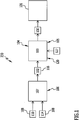
- An embodiment of the method for predicting an energy demand 100 for operating a renewable power plant with a storage 101 illustrated in Figures 1 to 3 comprises a first phase in which a set of forecasted variables 102 is calculated and a second phase in which the set of forecasted variables 102 is used as an input and adjusted according to machine learning techniques 104 within an uncertainty post-processing phase 105.
- an optimization algorithm 107 is performed by an optimization algorithm device 106, wherein one or more sets of uncertainty-based variables 108 are used as an input.
- one or more sets of uncertainty-based variables 108 are used as an input.
- two sets of uncertainty-based variables 108 are used, more preferably, a set of weather forecast variables 110, especially a weather forecast giving weather data per hour, and a set of electricity price forecast variables 114, especially an electricity price forecast giving an electricity price forecast per hour, are used as input for the optimization algorithm device 106.
- the set of forecasted variables 102 is generated as an output.
- the set of forecasted variables 102 is preferably a forecasted schedule 116 giving a forecasted energy demand per hour.
- optimization algorithm device 106 uses deterministic and/or probabilistic and/or heuristic methods for generating the set of forecasted variables 102.
- the form of the set of forecasted variables 102 preferably depends on the method and/or model used by the optimization algorithm device 106. For example, if the optimization algorithm device 106 uses a probabilistic method, the set of forecasted variables 102 comprises various possible forecasted schedules 116.
- the set of forecasted variables 102 is used as an input and/or a machine learning device 120 calculates the prediction of an energy demand 100 as an output using machine learning techniques 104.
- the uncertainty post-processing phase 105 comprises a development phase 122 (illustrated in Figures 2 and 4 ) and an implementation phase 124 (illustrated in Figures 3 and 5 ).
- the development phase 122 and the implementation phase 124 are preferably both performed completely or partially by the machine learning device 120.
- the method is used repeatedly for predictions of energy demands 100 for days, especially consecutive days.
- the development phase 122 is performed prior to the implementation phase 124, wherein especially during the development phase 122 an artificial learner and/or artificial intelligence device 125 is generated by the machine learning device 120 and/or as a part of the machine learning device 120.
- the artificial learner and/or an artificial intelligence device 125 in particular comprises a decision pattern 127 based on historical data 123, i.e., at least one training data set 118.
- the development phase 122 and the implementation phase 124 are preferably performed at least partially simultaneously by the machine learning device 120.
- decision patterns 127 are developed, preferably based on at least one training data set 118, in particular more than one training data set 118.
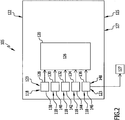
- the training data sets 118 - which are used as an input - comprise a set of deviation-to-mean-based variables 128, a set of deviation-to-persistence-based variables 130, a set of day-of-the-year-based variables 132, a set of time-step-priority-based variables 134 and a set of deviation-to-perfect-based variables 136.
- the deviation-to-persistence-based variables 130 preferably a set of deviation-to-persistence variables 140, is in particular obtained by predicting a set of variables assuming persistence and by determining a deviation of the persistence set of variables from the forecasted set of variables in particular from the forecasted schedule 116.
- the set of day-of-the-year-based variables 132 preferably a set of day-of-the-year variables 142, takes seasonal variations in the energy demand into account.
- the set of time-step-priority-based variables 134 preferably a set of time-step-priority variables 144, in particular takes an optimal market situation into account.
- the particular time step is prioritized in comparison to other time steps of the forecasted schedule 116.
- a higher priority is assigned to time steps in which higher prices on the energy market are expected. Time steps with higher prices have a higher priority and preferably the time steps are classified according to the prices that can be expected from the highest price to the lowest price.
- the set of deviation-to-perfect-based variables 136 preferably a set of deviation-to-perfect variables 146, in particular compares a calculated forecasted schedule 116 with an energy demand according to a perfect forecast 148 of the past that has been archived and that is now used as an input.
- a learning system algorithm 126 is performed by the machine learning device 120.
- the set of deviation-to-mean-based variables 128, the set of deviation-to-persistence-based variables 130, the set of day-of-the-year-based variables 132 and the set of time-step-priority-based variables 134 are used as inputs for the machine learning device 120 during the development phase 122 while the set of deviation-to-perfect-based variables 136 improves during repetition of the development phase 122 and especially influences the decision pattern 127 within the implementation phase 124.
- the decision pattern 127 is preferably also influenced by the other training data sets 118.
- the decision pattern 127 is preferably applied and/or used as an input for the machine learning device 120 in order to improve the forecasted schedule 116.
- a set of deviation-to-mean-based variables 128, a set of deviation-to-persistence-based variables 130, a set of day-of-the-year-based variables 132 and a set of time-step-priority-based variables 134 preferably are used as an input for the machine learning device 120, in particular as testing data sets 135.
- the testing data sets 135 and the training data sets 118 are in particular from different time periods.
- the machine learning device 120 performs a learning system evaluation algorithm 150 from which a predicted deviation 152 from an expected energy demand according to a perfect forecast 148 is calculated as an output.
- the predicted deviation 152 is used as an input for the application of an adjustment algorithm 154 which is performed by an adjustment algorithm device 155.
- the predicted deviation 152 and the set of forecasted variables 102 preferably form an input of the adjustment device 155.
- the adjustment device 155 the prediction of the energy demand 100, especially in the form of a final electricity delivery schedule 156, is calculated as an output.
- a preferred development phase 122 in which a decision tree 168 is used is illustrated.
- a set of deviation-to-mean-based variables 128, a set of deviation-to-persistence-based variables 130, a set of day-of-the-year-based variables 132, a set of time-step-priority-based variables 134 and a set of deviation-to-perfect-based variables 136 are used as input.
- a set of deviation-to-mean-based variables 128 is 0 (zero).
- a class definition algorithm 160 is performed by a class definition algorithm device 162 in order to define classes in which the parameters and/or variables of the input are grouped.
- a fuzzy c-mean clustering algorithm 164 is performed by a fuzzy c-mean clustering algorithm device 165 using fuzzy logic.
- the classes correspond to the training data sets 118.
- the classes 158 defined by the class definition algorithm 160 are preferably clusters 159.
- a decision tree building algorithm 166 is performed by a decision tree building algorithm device 167.
- fuzzy logic is used within the decision tree building algorithm 166.
- the input data is preferably divided into small packages from which the most relevant variables are isolated, more preferably by using a recursive partitioning approach. These most important variables in particular are set as decision points (decision nodes) in a resulting decision tree 168.
- the decision tree 168 is preferably adapted according to a decision tree pruning algorithm 170 performed by a decision tree pruning device 172.
- a complexity of the decision tree 168 is reduced and/or an accuracy is improved by reducing an overfitting of too many decision points (decision nodes).
- decision rules are extracted by a decision rules extraction algorithm 171 performed by a decision rules extraction algorithm device 173.
- the decision points (decision nodes) of the decision tree 168 are interpreted, especially by classical methods and/or deterministic methods and/or fuzzy logic interference.
- a defuzzification is performed resulting in a set of numeric values to be applied to the set of forecasted variables 102.
- Rules extracted by the decision rules extraction device 173 for example comprise:
- the uncertainty post-processing algorithm 103 is applied to testing data sets 135 which are unknown to the machine learning device 120.
- a classification algorithm 174 is performed on the input by a classification algorithm device 176.
- the testing data sets 135 are classified according to the classes 158 defined during the development phase 122, in particular according to classes 158 defined by class definition algorithm device 162, e.g., clusters 159 defined by the fuzzy c-mean clustering algorithm device.
- the classes 158 are preferably applied to the decision tree 168 by performing a decision tree interference algorithm 177 by a decision tree interference algorithm device 178.
- a decision tree interference algorithm device 178 For these applications, in particular fuzzy logic is used.
- the classification algorithm 174 and/or the decision tree interference algorithm 177 preferably correspond to the learning system evaluation algorithm described in conjunction with Figure 3 .
- the adjustment algorithm 154 in order to adjust the set of forecasted variables 102 with respect to the predicted deviation 152, is applied by the adjustment algorithm device 155.
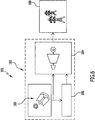
- a renewable power plant with a storage 101 preferably a concentrated solar power plant 180 ( Figure 6 ), a solar photovoltaic plant 200 ( Figure 7 ) or a wind power plant 220 ( Figure 8 ) is suitable.
- thermal energy of the sun is collected on at least one solar field 182 using solar collectors.
- mirrors and/or lenses are used to concentrate thermal energy onto a small area.
- the thermal energy is preferably partially sent to a power block device 184 and/or partially sent to a thermal storage system 186. Within the thermal storage system 186, the thermal energy is stored until - when the need arises - it is sent to the power block device 184.
- Electrical energy is in particular generated within the power block device 184 when the concentrated thermal energy is converted to heat, which preferably drives a heat engine connected to an electrical power generator and/or powers a thermochemical reaction.
- Electrical energy from the power block device 184 is preferably sent to the electricity grid 188 when demanded.
- the solar photovoltaic plant 200 ( Figure 7 )
- thermal energy from the sun is collected within a solar field 202 comprising at least one photovoltaic module 204 (schematically shown).
- the thermal energy is converted to electrical energy and preferably sent partially or completely to a battery storage system 206.
- the rest of the electrical energy is sent to a transformer device 208. From the transformer device 208, energy is preferably sent to an electricity grid 188.
- the electrical energy In cases in which the electrical energy is completely sent to the battery storage system 206, it can be sent from the battery storage system 206 to the transformer device 208, if necessary.
- the electrical energy is directly needed on the energy market, it is possible that the electrical energy is completely sent from the solar field 202 to the transformer device 208.
- the transformer device 208 preferably converts the electrical energy output from DC to AC, and/or connects the solar photovoltaic plant 200 to the electricity grid 188 through a high voltage connection.
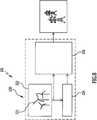
- the wind power plant 220 ( Figure 8 ) preferably comprises a wind farm 222 comprising wind turbines 221 (schematically shown) in which motion energy from wind is converted to electrical energy, a battery storage system 224 in which energy is stored and a transformer device 226 from which the energy is sent to the electricity grid 188.
- the transformer device 226 of the wind power plant preferably works as the transformer device of a solar photovoltaic plant 200.
- the prediction of the energy demand 100 is in most cases, i.e., for most time steps, closer to the energy demand according to a perfect forecast 148 than the set of forecasted variables 102.
- Figure 10 illustrates that the accuracy for the prediction of the energy demand 100 is higher than the accuracy of the set of forecasted variables 102 obtained from the optimization algorithm 107, in particular at least 1.4 times higher.
- the method for predicting an energy demand 100 is preferably performed by a data processing system 230 as indicated in Figure 1 .
- the data processing system 230 preferably comprises an apparatus and/or a device or is built thereof.
Landscapes
- Business, Economics & Management (AREA)
- Engineering & Computer Science (AREA)
- Economics (AREA)
- Human Resources & Organizations (AREA)
- Strategic Management (AREA)
- Entrepreneurship & Innovation (AREA)
- Health & Medical Sciences (AREA)
- Theoretical Computer Science (AREA)
- Marketing (AREA)
- General Physics & Mathematics (AREA)
- General Business, Economics & Management (AREA)
- Tourism & Hospitality (AREA)
- Physics & Mathematics (AREA)
- Public Health (AREA)
- Primary Health Care (AREA)
- Water Supply & Treatment (AREA)
- Development Economics (AREA)
- Educational Administration (AREA)
- General Health & Medical Sciences (AREA)
- Game Theory and Decision Science (AREA)
- Operations Research (AREA)
- Quality & Reliability (AREA)
- Management, Administration, Business Operations System, And Electronic Commerce (AREA)
- Supply And Distribution Of Alternating Current (AREA)
Abstract
Description
- The invention relates to a method for predicting an energy demand for operating a renewable power plant with a storage.
- The invention further relates to a data processing system adapted for carrying out the method of the invention.
- The invention further relates to a renewable power plant with a storage operated according to a prediction of an energy demand according to a method of the invention and/or comprising a data processing system of the invention.
- A derivation of the optimization problem and its adaptation to dynamic programming is known from the scientific publication "Methodology for optimized operation strategies of solar thermal power plants with integrated heat storage" by M. Wittmann et al.
- The scientific publication "Optimized dispatch in a first-principles concentrating solar power production model" by M. J. Wagner et al., Applied Energy 203 (2017) 959-971, discloses the integration of a dispatch optimization model into a detailed techno-economic analysis tool, wherein the mixed-integer linear program produces an optimized operation strategy, historically determined via a heuristic.
- However, renewable power plants with a storage operated according to known prediction methods only service a renewable energy market, as normally accuracy of the prediction is too low in order to participate in a wholesale electricity market in which penalties for non-fulfillment of an actual energy demand are imposed and/or not being able to fulfill a contract is penalized.
- It is an object of the present invention to provide a reliable method for the predicting an energy demand with improved accuracy for operating a renewable power plant with a storage.
- This object is achieved by providing a method for predicting an energy demand for operating a renewable power plant with a storage, wherein the method comprises:
- generating a set of forecasted variables based on at least one set of uncertainty-based variables by using an optimization algorithm; and
- uncertainty post-processing of the set of forecasted variables using machine learning techniques wherein the machine learning techniques are performed by a machine learning device that makes use of historical data relating to at least one energy demand according to a perfect forecast in the past.
- The method preferably provides a prediction of an energy demand of a specific renewable power plant, preferably based on a given energy demand of the whole electricity system.
- The predicted energy demand is preferably a predicted demand of production of one particular renewable power plant.
- Due to the uncertainty post-processing using machine learning techniques, the method of the invention can provide an automatic system for generating energy schedules. Preferably, the method provides for an unsupervised learning system.
- In accordance with the method, a renewable power plant with a storage is preferably operated with a high accuracy, in particular so that it can service the wholesale energy market together with conventional power plants. Alternatively, the method is suitable for predicting an energy demand of a non-renewable power system, e.g., a power-heat-power system.
- The energy demand according to a perfect forecast preferably is an energy demand calculated based on a perfect input, i.e., without uncertainties.
- The actual energy demand is influenced by various factors; inter alia, uncertainties, in particular resource-dependent uncertainties and/or market-dependent uncertainties. An example for a resource-dependent uncertainty is a weather forecast. An example for a market-dependent uncertainty is an electricity price uncertainty.
- In accordance with the prediction of the energy demand, preferably a time-dependent dispatch schedule is obtained. The time-dependent dispatch schedule preferably shows an amount of energy, e.g., in Megawatt MW, that is to be sent from the renewable power plant to the grid dependent on the time of the day.
- If less energy than given in the predicted demand is produced by a renewable energy source of the power plant at a certain time, energy from the storage of the renewable power plant is used to generate electricity which is sent to the grid. If more energy than the predicted demand is produced by the renewable energy source at a certain time, the excess amount of energy is sent to the storage to be used to generate electricity when not enough energy is produced by the renewable energy source.
- Due to the storage of the renewable power plant, the operation is not dependent only on the energy production of the source. The storage preferably forms a balancing device for balancing energy harvested from the source and the generated energy according to the energy demand.
- The machine learning techniques are preferably mathematical methods and/or algorithms performed by the machine learning device.
- Preferably, predictive modelling techniques are used by the machine learning device.
- In accordance with one example, a decision tree is developed in order to display an algorithm for an assessment of how much the set of forecasted variables deviates from an energy demand according to a perfect forecast, especially for the specific day for which the prediction is made. Alternatively, other methods, such as neural networks, are used as predictive modelling techniques.
- Predictive modelling techniques are preferably techniques that use statistics or other mathematical calculations for predicting an output. In particular, a model within predictive modelling is chosen in order to guess a possible output depending on a given input. Preferably classification and/or regression trees as special decision trees or neural networks are used.
- In a decision tree, preferably a tree-like model is used, including decision nodes. In accordance with a decision tree, the strategy most likely to result in a goal is identified. Within a building phase of the decision tree, decision rules are defined and/or identified.
- An accuracy of the method preferably improves over time as the machine learning device is trained by using deterministic and/or probabilistic methods.
- The machine learning device preferably produces a data-driven output.
- Machine learning techniques preferably comprise building an artificial learning device and/or generating a computer-based decision tool.
- The uncertainty post-processing is preferably an uncertainty post-processing phase, in particular chronologically, following a phase in which the set of forecasted variables is generated and/or calculated.
- The uncertainty post-processing in particular comprises building up an artificial learner based on known data (training data sets) as well as an application of the machine learning device on unknown data (testing data sets).
- With regard to predicting an energy demand, the conformance of the prediction with an actual energy demand is crucial as in the wholesale electricity market penalties are imposed if the predicted energy demand is not met.
- The prediction of the energy demand is preferably provided in the form of a set of variables, comprising the amount of energy per hour that has to be sent to the grid.
- The method for predicting an energy demand is preferably automatic and/or human decisions for risk assessment are dispensable. The machine learning device preferably uses an artificial intelligence and/or creates an artificial learner.
- According to the invention, a variable is preferably a data point, e.g., a data point of a curve. A set of variables may comprise one or more variables, e.g., a time sequence of variables.
- Due to the use of historical data by the machine learning device, the method preferably provides for predictions of the energy demand with increasing accuracy over time with regard to a length of at least one training data set.
- In addition, the method preferably provides for a high flexibility with regard to types of optimization methods used within the optimization algorithm and/or with regard to system models chosen according to the specific renewable power plant system with a storage.
- In particular, optimization methods comprise mathematical methods, e.g., linear optimization methods and/or dynamic optimization methods and/or heuristic optimization methods.
By the method of the invention, preferably an energy demand for energy of a concentrated solar power plant, a solar photovoltaic plant, or a wind power plant is predicted. - Preferably, the optimization algorithm is performed by an optimization algorithm device and a set of weather forecast variables and/or a set of electricity price forecast variables are used as input for the optimization algorithm device.
- Sets of uncertainty-based variables are preferably sets of variables that take an uncertainty resulting from unforeseeable events and/or factors into account.
- The set of weather forecast variables is a set of uncertainty-based variables.
- The set of electricity price based variables is a set of uncertainty-based variables.
- The set of forecasted variables preferably is a forecasted energy schedule.
- Preferably, the set of forecasted variables is an output of the optimization algorithm, in particular performed by the optimization algorithm device.
- In addition or alternatively, preferred delivery hours and/or average deviation from an end user consumption to an energy production are taken into account by the machine learning device and/or the optimization algorithm device.
- It can be advantageous if methods for demand analysis are used by the optimization algorithm device, in particular deterministic methods and/or probabilistic methods and/or heuristic methods and/or combinations thereof. The uncertainty post-processing in particular comprises a development phase in which the machine learning device is trained and/or an implementation phase in which the machine learning device is implemented for predicting a deviation of the set of forecasted variables from a future energy demand according to a perfect schedule.
- The development phase and the implementation phase preferably relate to a process in which the machine learning device is built, wherein the development phase is a learning phase and the implementation phase is an application phase.
- In addition, the development phase and the implementation phase preferably relate to a sequential and/or parallel performance of two phases within the uncertainty post-processing, in particular within the application of the (trained) machine learning device.
- The energy demand according to a perfect forecast is in particular an energy demand without uncertainty-based input of a particular hour or a particular day for which a prediction according to an embodiment of the method is made.
- Preferably, during the development phase, decision patterns are generated and embedded in the machine learning device. In particular, a learning system algorithm is performed by the machine learning device.
- Within the development phase of the uncertainty post-processing, in particular rules for decision making and/or a patterned recognition are developed within and/or by the machine learning device.
- The development phase is preferably performed before the first implementation phase.
- Preferably, in the development phase of the uncertainty post-processing, the machine learning device is trained by using one or more training data sets as input. In particular, the machine learning device is trained in that deviations of at least one predicted set of variables and at least one energy demand according to a perfect forecast from the past are compared. The predicted set of variables in particular is a set of deviation-to-perfect-based variables.
- During the development phase, preferably a decision tree is generated by and/or within the machine learning device. Preferably, the machine learning device comprises a decision tree building algorithm device for building the decision tree by performing a decision tree building algorithm, in particular using fuzzy logic.
- Fuzzy logic is a form of many-valued logic in which the truth values of variables may be any real number between 0 (false) and 1 (true), wherein the value may range between completely true and completely false. In contrast to classical mathematical models, non-numeric values may be used, especially in order to facilitate the expression of rules and facts within a fuzzy logic model.
- The decision tree especially contains conditional control statements. In particular, the decision tree is an artificial learner.
- According to a preferred embodiment, classes for the sets of variables used within the development phase and/or implementation phase are defined by a class definition algorithm device which performs a class definition algorithm.
- Preferably a fuzzy c-mean clustering algorithm is performed by a fuzzy c-mean clustering algorithm device. The classes defined are preferably combined with a fuzzy decision tree. The classes preferably correspond to the training data sets.
- Preferably, the training data sets for the development phase within the uncertainty post-processing comprise one or more of the following sets of variables: a set of deviation-to-mean-based variables, a set of deviation-to-persistence-based variables, a set of day-of-the-year-based variables, a set of time-step-priority-based variables and a set of deviation-to-perfect-based variables.
Training data sets are preferably historical data, especially of a particular year in the past. This has the advantage that seasonal variations can be taken into account, e.g., seasonal variations in sunshine hours for solar power plants or seasonal variations in wind strength for wind power plants. - The set of deviation-to-mean-based variables especially takes a relation of a specific set of forecasted variables and an ensemble of sets of forecasted variables in the past into account. The set of deviation-to-mean-based variables preferably influences the decisions of the machine learning device if probabilistic methods are used in the development phase. If a deterministic set of forecasted variables is used in the development phase, the set of deviation-to-mean-based variables is preferably zero.
- The set of deviation-to-persistence-based variables is in particular used in order to generate a set of forecasted variables assuming a persistence. A deviation of the generated (persistence) set of variables and the set of forecasted variables results in the set of deviation-to-persistence-based variables.
- The persistence set of variables preferably considers, in particular weather, observations of a previous day as an expected forecast for the following day. The persistence set of variables is usually used when no other forecast is available, in particular it is used as a benchmark for forecasting.
- The set of day-of-the-year-based variables in particular takes seasonal influences in the energy demand and/or energy production into account.
- The set of time-step-priority-based variables in particular weighs time steps in the prediction according to a price level of the energy on the energy market at this particular time step. The higher the price is at a time step, e.g., at an hour, the higher the assigned priority.
- The set of deviation-to-perfect-based variables in particular compares a certain set of forecasted variables (in the past) with the respective energy demand according to a perfect forecast on this day (in the past) and/or determines the deviation of the set of forecasted variables (in the past) with the corresponding energy demand according to a perfect forecast (in the past).
- Preferably, the set of deviation-to-perfect-based variables is an input during the development phase and/or an output during the implementation phase, when the machine learning device is applied to unknown data. For the sake of readability, the set of deviation-to-perfect-based variables as an output within the implementation phase is subsequently referred to as "predicted deviation".
- In the above-mentioned preferred embodiment using fuzzy logic, after the classes have been defined during the development phase, preferably - as already mentioned - a decision tree is built, in particular a classification or a regression tree, by a decision tree building algorithm device which performs a decision tree building algorithm.
- Afterwards, preferably a decision tree pruning algorithm is performed by a decision tree pruning algorithm device. The decision tree pruning algorithm results in a less complex decision tree than the one built by the decision tree building algorithm, in particular an output of the decision tree pruning algorithm is a decision tree with the lowest possible costs for the operation of the renewable power plant with a storage.
- Within the development phase according to the preferred embodiment using fuzzy logic, preferably decision rules are extracted, in particular from a pruned decision tree. Decision rules are preferably extracted by the application of a decision rules extraction algorithm performed by a decision rules extraction algorithm device.
- In particular, due to the development phase, the machine learning device is able to interpret unknown data sets (testing data sets) by using fuzzy logic.
- Preferably, the one or more of the following devices used during the development phase are comprised by the machine learning device: class definition algorithm device, decision tree building algorithm device, decision tree pruning algorithm device and decision rules extraction algorithm device.
- Preferably, in an implementation phase of the uncertainty post-processing, one or more testing data sets form an input of a machine learning device, in particular influencing decision making in the uncertainty post-processing.
- The testing data sets are preferably data sets that have not been used during the development phase, in particular such that a performance of the machine learning device can be tested.
- In particular, testing data sets for the implementation phase within the uncertainty post-processing comprise one or more of the following sets of variables: a set of deviation-to-mean-based variables, a set of deviation-to-persistence-based variables, a set of day-of-the-year-based variables and a set of time-step-priority-based variables.
- Preferably, within the implementation phase of the uncertainty post-processing, a predicted deviation of the set of forecasted variables is calculated, in particular as an output. The predicted deviation and the set of forecasted variables are preferably used as an input for an adjustment algorithm performed by an adjustment algorithm device, in particular within the implementation phase.
- According to a preferred embodiment, each of the one or more testing data sets is classified by a classification algorithm performed by a classification algorithm device. The classes preferably correspond to classes already defined within the development phase, in particular fuzzy clusters. It is particularly preferred that each variable within a set of variables of the testing data sets is rated in accordance with its membership degree to a specific class.
- Preferably a decision tree interference algorithm, in particular a fuzzy decision tree interference algorithm, performed by a decision tree interference algorithm device takes the rules derived from the decision tree built during the development phase and the membership degree into account. As an output, preferably the predicted deviation is obtained and/or used as an input for the adjustment algorithm performed by the adjustment algorithm device.
- The classification algorithm device and/or the decision tree interference algorithm device are preferably comprised by the machine learning device.
- The predicted energy demand is preferably an output of the adjustment algorithm performed by the adjustment algorithm device.
- The predicted deviation and/or the prediction of the energy demand are preferably in the form of a set of variables, respectively.
- In accordance with a preferred embodiment, the accuracy of the prediction of the energy demand is about 20% or more, preferably about 25% or more, higher than the accuracy of the set of forecasted variables with regard to an energy demand according to a perfect forecast.
- Preferably, each time step, more preferably each hour of a day, is treated as a single decision problem.
- In accordance with a preferred embodiment of the invention, the renewable power plant with a storage is a concentrated solar power plant, in particular with a ten-hour storage, e.g. in the form of a thermal storage system.
- For example, a 100 MW solar thermal power plant is preferably equipped with a storage system that allows 10 h (hours) of operation from the storage.
- Alternatively, the renewable power plant with a storage is a solar photovoltaic plant, e.g., with a battery system as storage, or a wind power plant, e.g., with a battery storage system as storage.
- Preferably, the method has one or more of the following advantages:
- the method of the invention enables an effective consideration of weather uncertainties in dispatch planning; and/or
- a flexible dispatch can be predicted.
- The method preferably provides an intelligent dispatch planning strategy for a renewable power plant with a storage.
- The invention further relates to a data processing system adapted for carrying out a method according to the invention.
- The data processing system preferably comprises a data processing apparatus and/or a data processing device. In particular, the data processing system is a data processing apparatus or a data processing device.
- The invention further relates to a renewable power plant operated according to a prediction of an energy demand according to a method according to the invention and/or comprising a data processing system according to the invention.
- The features and/or advantages explained in conjunction with the method of the invention are valid for the data processing system of the invention and/or the renewable power plant with a storage of the invention, too.
- These and further preferred embodiments of the invention are explained in more detail hereinafter taken in conjunction with the drawings.
- In detail:
- Figure 1
- shows a schematic flow chart illustrating the different phases of an embodiment of a method for predicting an energy demand for operating a renewable power plant with a storage;
- Figure 2
- shows a schematic flow chart of a development phase in an uncertainty post-processing within the embodiment illustrated in
Figure 1 ; - Figure 3
- shows a schematic flow chart of an implementation phase of the uncertainty post-processing within the embodiment illustrated in
Figure 1 andFigure 2 ; - Figure 4
- shows a schematic flow chart of a development phase, wherein a decision tree is used;
- Figure 5
- shows a schematic flow chart of an implementation phase, wherein a decision tree is used;
- Figure 6
- shows a schematic representation of a structure of a concentrated solar power plant to be operated according to the prediction of an energy demand obtained by a method of the invention;
- Figure 7
- shows a schematic representation of a structure of a solar photovoltaic plant to be operated according to a prediction of an energy demand obtained by a method of the invention;
- Figure 8
- shows a schematic representation of the structure of a wind power plant to be operated according to the prediction of an energy demand obtained by a method of the invention;
- Figure 9
- shows a diagram in which a set of forecasted variables, a prediction according to a method of the invention and an energy demand according to a perfect forecast are plotted; and
- Figure 10
- shows a block diagram in which an accuracy of a set of forecasted variables and a prediction according to a method of the invention of two successive years are compared in relation to an energy demand according to a perfect forecast.
- Identical or functionally equivalent elements are labeled with the same reference numeral in all Figures.
- An embodiment of the method for predicting an
energy demand 100 for operating a renewable power plant with astorage 101 illustrated inFigures 1 to 3 comprises a first phase in which a set of forecastedvariables 102 is calculated and a second phase in which the set of forecastedvariables 102 is used as an input and adjusted according tomachine learning techniques 104 within anuncertainty post-processing phase 105. - In the first phase, an
optimization algorithm 107 is performed by anoptimization algorithm device 106, wherein one or more sets of uncertainty-basedvariables 108 are used as an input. Preferably, two sets of uncertainty-basedvariables 108 are used, more preferably, a set ofweather forecast variables 110, especially a weather forecast giving weather data per hour, and a set of electricity price forecastvariables 114, especially an electricity price forecast giving an electricity price forecast per hour, are used as input for theoptimization algorithm device 106. - By the
optimization algorithm device 106, according to mathematical methods, preferably a heuristic, rules-based approach, the set of forecastedvariables 102 is generated as an output. The set of forecastedvariables 102 is preferably a forecastedschedule 116 giving a forecasted energy demand per hour. - It can be advantageous if the
optimization algorithm device 106 uses deterministic and/or probabilistic and/or heuristic methods for generating the set of forecastedvariables 102. - The form of the set of forecasted
variables 102 preferably depends on the method and/or model used by theoptimization algorithm device 106. For example, if theoptimization algorithm device 106 uses a probabilistic method, the set of forecastedvariables 102 comprises various possible forecastedschedules 116. - Within the
uncertainty post-processing phase 105, preferably the set of forecastedvariables 102 is used as an input and/or amachine learning device 120 calculates the prediction of anenergy demand 100 as an output usingmachine learning techniques 104. - According to a preferred embodiment, the
uncertainty post-processing phase 105 comprises a development phase 122 (illustrated inFigures 2 and4 ) and an implementation phase 124 (illustrated inFigures 3 and5 ). - The
development phase 122 and theimplementation phase 124 are preferably both performed completely or partially by themachine learning device 120. - Preferably, the method is used repeatedly for predictions of
energy demands 100 for days, especially consecutive days. For the first prediction of anenergy demand 100, in particular thedevelopment phase 122 is performed prior to theimplementation phase 124, wherein especially during thedevelopment phase 122 an artificial learner and/orartificial intelligence device 125 is generated by themachine learning device 120 and/or as a part of themachine learning device 120. The artificial learner and/or anartificial intelligence device 125 in particular comprises adecision pattern 127 based onhistorical data 123, i.e., at least onetraining data set 118. - After the
artificial intelligence device 125 has been applied to a set of forecastedvariables 102 once, thedevelopment phase 122 and theimplementation phase 124 are preferably performed at least partially simultaneously by themachine learning device 120. - During the
implementation phase 122, in particular by anartificial intelligence device 125 and/or themachine learning device 120,decision patterns 127 are developed, preferably based on at least onetraining data set 118, in particular more than onetraining data set 118. - According to a preferred embodiment, the training data sets 118 - which are used as an input - comprise a set of deviation-to-mean-based
variables 128, a set of deviation-to-persistence-basedvariables 130, a set of day-of-the-year-basedvariables 132, a set of time-step-priority-basedvariables 134 and a set of deviation-to-perfect-basedvariables 136. - The set of deviation-to-mean-based
variables 128, preferably a set of deviation-to-mean variables 138, in particular reflects the position of the selected forecastedschedule 116 in comparison to an ensemble of forecasted schedules in embodiments in which probabilistic methods are used. - The deviation-to-persistence-based
variables 130, preferably a set of deviation-to-persistence variables 140, is in particular obtained by predicting a set of variables assuming persistence and by determining a deviation of the persistence set of variables from the forecasted set of variables in particular from the forecastedschedule 116. - The set of day-of-the-year-based
variables 132, preferably a set of day-of-the-year variables 142, takes seasonal variations in the energy demand into account. - The set of time-step-priority-based
variables 134, preferably a set of time-step-priority variables 144, in particular takes an optimal market situation into account. According to the set of time-step-priority-basedvariables 134, the particular time step is prioritized in comparison to other time steps of the forecastedschedule 116. Preferably, a higher priority is assigned to time steps in which higher prices on the energy market are expected. Time steps with higher prices have a higher priority and preferably the time steps are classified according to the prices that can be expected from the highest price to the lowest price. - The set of deviation-to-perfect-based
variables 136, preferably a set of deviation-to-perfect variables 146, in particular compares a calculated forecastedschedule 116 with an energy demand according to aperfect forecast 148 of the past that has been archived and that is now used as an input. - During the
development phase 122, preferably alearning system algorithm 126 is performed by themachine learning device 120. - The set of deviation-to-mean-based
variables 128, the set of deviation-to-persistence-basedvariables 130, the set of day-of-the-year-basedvariables 132 and the set of time-step-priority-basedvariables 134 are used as inputs for themachine learning device 120 during thedevelopment phase 122 while the set of deviation-to-perfect-basedvariables 136 improves during repetition of thedevelopment phase 122 and especially influences thedecision pattern 127 within theimplementation phase 124. - In addition or alternatively, the
decision pattern 127 is preferably also influenced by the other training data sets 118. - During the implementation phase 124 (
Figure 3 ), thedecision pattern 127 is preferably applied and/or used as an input for themachine learning device 120 in order to improve the forecastedschedule 116. - During the
implementation phase 124, a set of deviation-to-mean-basedvariables 128, a set of deviation-to-persistence-basedvariables 130, a set of day-of-the-year-basedvariables 132 and a set of time-step-priority-basedvariables 134 preferably are used as an input for themachine learning device 120, in particular as testing data sets 135. Thetesting data sets 135 and thetraining data sets 118 are in particular from different time periods. - Preferably, the
machine learning device 120 performs a learningsystem evaluation algorithm 150 from which a predicteddeviation 152 from an expected energy demand according to aperfect forecast 148 is calculated as an output. The predicteddeviation 152 is used as an input for the application of anadjustment algorithm 154 which is performed by anadjustment algorithm device 155. - The predicted
deviation 152 and the set of forecastedvariables 102 preferably form an input of theadjustment device 155. By theadjustment device 155, the prediction of theenergy demand 100, especially in the form of a finalelectricity delivery schedule 156, is calculated as an output. - In
Figure 4 , apreferred development phase 122 in which adecision tree 168 is used is illustrated. As inFigure 2 , preferably as training data sets 118 a set of deviation-to-mean-basedvariables 128, a set of deviation-to-persistence-basedvariables 130, a set of day-of-the-year-basedvariables 132, a set of time-step-priority-basedvariables 134 and a set of deviation-to-perfect-basedvariables 136 are used as input. In cases in which deterministic methods are used, a set of deviation-to-mean-basedvariables 128 is 0 (zero). - During the
development phase 122 illustrated inFigure 4 , preferably aclass definition algorithm 160 is performed by a classdefinition algorithm device 162 in order to define classes in which the parameters and/or variables of the input are grouped. In particular, a fuzzy c-mean clustering algorithm 164 is performed by a fuzzy c-meanclustering algorithm device 165 using fuzzy logic. Preferably the classes correspond to the training data sets 118. In embodiments, in which a fuzzy c-mean clustering algorithm 164 is used, theclasses 158 defined by theclass definition algorithm 160 are preferablyclusters 159. - After the
classes 158, inparticular clusters 159, have been defined by the classdefinition algorithm device 162, preferably a decisiontree building algorithm 166 is performed by a decision treebuilding algorithm device 167. Preferably, within the application of thedecision tree 168, fuzzy logic is used. Within the decisiontree building algorithm 166, the input data is preferably divided into small packages from which the most relevant variables are isolated, more preferably by using a recursive partitioning approach. These most important variables in particular are set as decision points (decision nodes) in a resultingdecision tree 168. - The
decision tree 168 is preferably adapted according to a decisiontree pruning algorithm 170 performed by a decisiontree pruning device 172. In particular, a complexity of thedecision tree 168 is reduced and/or an accuracy is improved by reducing an overfitting of too many decision points (decision nodes). - In particular, as a successive step, decision rules are extracted by a decision rules
extraction algorithm 171 performed by a decision rulesextraction algorithm device 173. Within the decision rulesextraction algorithm 171, the decision points (decision nodes) of thedecision tree 168 are interpreted, especially by classical methods and/or deterministic methods and/or fuzzy logic interference. - In particular, a defuzzification is performed resulting in a set of numeric values to be applied to the set of forecasted
variables 102. - Rules extracted by the decision rules
extraction device 173 for example comprise: - if a variable of the set of deviation-to-persistence-based
variables 130 is very positive and if a variable of the set of day-of-the-year-based-variables 132 belongs to winter, then the corresponding variables of the deviation-to-perfect-basedvariables 136 are very positive; and/or - if a variable of the set of deviation-to-persistence-based
variables 130 is very positive and if a variable of the set of day-of-the-year-based-variables 132 belongs to autumn or summer, then the corresponding variables of the deviation-to-perfect-basedvariables 136 are neutral. - Preferably, after the
machine learning device 120 has been trained in thedevelopment phase 122, for example as described in connection withFigure 4 , theuncertainty post-processing algorithm 103 is applied totesting data sets 135 which are unknown to themachine learning device 120. - As can be seen in
Figure 5 , during theimplementation phase 124, preferably aclassification algorithm 174 is performed on the input by aclassification algorithm device 176. Preferably thetesting data sets 135 are classified according to theclasses 158 defined during thedevelopment phase 122, in particular according toclasses 158 defined by classdefinition algorithm device 162, e.g.,clusters 159 defined by the fuzzy c-mean clustering algorithm device. - Successively, the
classes 158 are preferably applied to thedecision tree 168 by performing a decisiontree interference algorithm 177 by a decision treeinterference algorithm device 178. For these applications, in particular fuzzy logic is used. - Afterwards, preferably a defuzzification is performed resulting in numerical values.
- The
classification algorithm 174 and/or the decisiontree interference algorithm 177 preferably correspond to the learning system evaluation algorithm described in conjunction withFigure 3 . - In particular, as an output the predicted
deviation 152 of the set of forecastedvariables 102 from an expected energy demand according to aperfect forecast 148 is obtained. - In order to obtain the prediction of the
energy demand 100, especially theadjustment algorithm 154 in order to adjust the set of forecastedvariables 102 with respect to the predicteddeviation 152, is applied by theadjustment algorithm device 155. - As a renewable power plant with a
storage 101, preferably a concentrated solar power plant 180 (Figure 6 ), a solar photovoltaic plant 200 (Figure 7 ) or a wind power plant 220 (Figure 8 ) is suitable. - In the concentrated
solar power plant 180, as schematically shown inFigure 6 , preferably thermal energy of the sun is collected on at least onesolar field 182 using solar collectors. In particular mirrors and/or lenses are used to concentrate thermal energy onto a small area. The thermal energy is preferably partially sent to apower block device 184 and/or partially sent to athermal storage system 186. Within thethermal storage system 186, the thermal energy is stored until - when the need arises - it is sent to thepower block device 184. - Electrical energy is in particular generated within the
power block device 184 when the concentrated thermal energy is converted to heat, which preferably drives a heat engine connected to an electrical power generator and/or powers a thermochemical reaction. - Electrical energy from the
power block device 184 is preferably sent to theelectricity grid 188 when demanded.
In the solar photovoltaic plant 200 (Figure 7 ), preferably thermal energy from the sun is collected within asolar field 202 comprising at least one photovoltaic module 204 (schematically shown). Within the at least onephotovoltaic module 204, the thermal energy is converted to electrical energy and preferably sent partially or completely to abattery storage system 206. - In cases in which the electrical energy is sent partially to the
battery storage system 206, the rest of the electrical energy is sent to atransformer device 208. From thetransformer device 208, energy is preferably sent to anelectricity grid 188. - In cases in which the electrical energy is completely sent to the
battery storage system 206, it can be sent from thebattery storage system 206 to thetransformer device 208, if necessary. - If the electrical energy is directly needed on the energy market, it is possible that the electrical energy is completely sent from the
solar field 202 to thetransformer device 208. - The
transformer device 208 preferably converts the electrical energy output from DC to AC, and/or connects the solarphotovoltaic plant 200 to theelectricity grid 188 through a high voltage connection. - The wind power plant 220 (
Figure 8 ) preferably comprises awind farm 222 comprising wind turbines 221 (schematically shown) in which motion energy from wind is converted to electrical energy, abattery storage system 224 in which energy is stored and atransformer device 226 from which the energy is sent to theelectricity grid 188. Thetransformer device 226 of the wind power plant preferably works as the transformer device of a solarphotovoltaic plant 200. - In the diagram in
Figure 9 , on the x axis an hour of the day [hh/mm] is plotted, and on the y axis electrical power in megawatt (MW) is plotted.
In the diagram, the graphs for the set of forecasted variables 102 (dotted curve), the energy demand according to a perfect forecast 148 (continuous curve) and the prediction of the energy demand 100 (broken curve), obtained by the embodiment of the method described in connection withFigures 1 to 3 are shown. - As can be seen from the respective curves, the prediction of the
energy demand 100 is in most cases, i.e., for most time steps, closer to the energy demand according to aperfect forecast 148 than the set of forecastedvariables 102. - In
Figure 10 , the accuracy of the set of forecasted variables 102 (left two blocks) and the prediction of theenergy demand 100 obtained with an embodiment of the method as described in connection withFigures 1 to 3 (right two blocks) is shown for one year (stripes) and another year (dark) with respect to the energy demand according to a perfect forecast of therespective year 148. -
Figure 10 illustrates that the accuracy for the prediction of theenergy demand 100 is higher than the accuracy of the set of forecastedvariables 102 obtained from theoptimization algorithm 107, in particular at least 1.4 times higher. - The method for predicting an
energy demand 100 is preferably performed by adata processing system 230 as indicated inFigure 1 . Thedata processing system 230 preferably comprises an apparatus and/or a device or is built thereof. -
- 100
- prediction of an energy demand
- 101
- renewable power plant with a storage
- 102
- set of forecasted variables
- 103
- uncertainty post-processing algorithm
- 104
- machine learning techniques
- 105
- uncertainty post-processing phase
- 106
- optimization algorithm device
- 107
- optimization algorithm
- 108
- set of uncertainty-based variables
- 110
- set of weather forecast variables
- 114
- set of electricity price forecast variables
- 116
- forecasted schedule
- 118
- training data set
- 120
- machine learning device
- 122
- development phase
- 123
- historical data
- 124
- implementation phase
- 125
- artificial intelligence device
- 126
- learning system algorithm
- 127
- decision pattern
- 128
- set of deviation-to-mean-based variables
- 130
- set of deviation-to-persistence-based variables
- 132
- set of day-of-the-year-based variables
- 134
- set of time-step-priority-based variables
- 135
- testing data set
- 136
- set of deviation-to-perfect-based variables
- 138
- deviation-to-mean variables
- 140
- deviation-to-persistence variables
- 142
- day-of-the-year variables
- 144
- time-step-priority variables
- 146
- deviation-to-perfect variables
- 148
- energy demand according to a perfect forecast
- 150
- learning system evaluation algorithm
- 152
- predicted deviation
- 154
- adjustment algorithm
- 155
- adjustment algorithm device
- 156
- final electricity delivery schedule
- 158
- class
- 159
- cluster
- 160
- class definition algorithm
- 162
- class definition algorithm device
- 164
- fuzzy c-mean clustering algorithm
- 165
- fuzzy c-mean clustering algorithm device
- 166
- decision tree building algorithm
- 167
- decision tree building algorithm device
- 168
- decision tree
- 170
- decision tree pruning algorithm
- 171
- decision rules extraction algorithm
- 172
- decision tree pruning algorithm device
- 173
- decision rules extraction algorithm device
- 174
- classification algorithm
- 176
- classification algorithm device
- 177
- decision tree interference algorithm
- 178
- decision tree interference algorithm device
- 180
- concentrated solar power plant
- 182
- solar field
- 184
- power block device
- 186
- thermal storage system
- 188
- electricity grid
- 200
- solar photovoltaic plant
- 202
- solar field
- 204
- photovoltaic module
- 206
- battery storage system
- 208
- inverter device
- 220
- wind power plant
- 221
- wind turbine
- 222
- wind farm
- 224
- battery storage system
- 226
- transformer device
- 230
- data processing system
Claims (15)
- Method for predicting an energy demand (100) for operating a renewable power plant with a storage (101), wherein the method comprises:- generating a set of forecasted variables (102) based on at least one set of uncertainty-based variables (108) by using an optimization algorithm (107); and- uncertainty post-processing (105) of the set of forecasted variables (102) using machine learning techniques (104), wherein the machine learning techniques (104) are performed by a machine learning device (120) that makes use of historical data (123) relating to at least one energy demand according to a perfect forecast (148) in the past.
- Method according to Claim 1, wherein the optimization algorithm (107) is performed by an optimization algorithm device (106) and a set of weather forecast variables (110) and/or a set of electricity price forecast variables (114) are used as input for the optimization algorithm device (106).
- Method according to any one of the preceding Claims, wherein predictive modeling techniques are used by the machine learning device (120).
- Method according to any one of the preceding Claims, wherein the uncertainty post-processing (105) comprises a development phase (122) in which a machine learning device (120) is trained and/or an implementation phase (124) in which the machine learning device (120) is implemented for predicting a deviation (152) of the set of forecasted (102) variables from a future energy demand according to a perfect forecast (148).
- Method according to any one of the preceding Claims, wherein in a development phase (122) of the uncertainty post-processing (105) a machine learning device (120) is trained by using one or more training data sets (118) as input and wherein the machine learning device (120) is trained in that deviations of at least one predicted set of variables (136) and at least one energy demand according to a perfect forecast (148) from the past are compared.
- Method according to any one of the preceding Claims, wherein in a development phase (122) of the uncertainty post-processing (105) a decision tree (168) is built and/or neural networks are used.
- Method according to any one of the preceding Claims, wherein training data sets (118) for a development phase (122) within the uncertainty post-processing (105) comprise one or more of the following sets of variables: a set of deviation-to-mean-based variables (128), a set of deviation-to-persistence-based variables (130), a set of day-of-the-year-based variables (132), a set of time-step-priority-based variables (134), a set of deviation-to-perfect-based variables (136).
- Method according to any one of the preceding Claims, wherein in a development phase (122) within the uncertainty post-processing (105) training data sets (118) are used by the machine learning device (120) for determining a correlation to a set of forecasted variables (102) and its deviation from an energy demand according to a perfect forecast (148).
- Method according to any one of the preceding Claims, wherein a development phase (122) in which a machine learning device (120) is trained is repeated, in particular with varying training data sets (118), in regular intervals.
- Method according to any one of the preceding Claims, wherein in an implementation phase (124) of the uncertainty post-processing (124), one or more testing data sets (135) are used as an input for a machine learning device (120), influencing decision making in the uncertainty post-processing (105).
- Method according to any one of the preceding Claims, wherein testing data sets (135) for an implementation phase (124) within the uncertainty post-processing (105) comprise one or more of the following sets of variables: a set of deviation-to-mean-based variables (128), a set of deviation-to-persistence-based variables (130), a set of day-of-the-year-based variables (132) and a set of time-step-priority-based variables (134).
- Method according to of any one of the preceding Claims, wherein in an implementation phase (124) within the uncertainty post-processing (105) a predicted deviation (152) of the set of forecasted variables (102) is calculated by a machine learning device (120) and wherein the predicted deviation (152) and the set of forecasted variables (102) are used as an input for an adjustment algorithm (154) performed by an adjustment algorithm device (155).
- Method according to any one of the preceding Claims, wherein the renewable power plant with a storage (101) is a concentrated solar power plant (180) with storage (186), a solar photovoltaic plant (200) with storage (206) or a wind power plant (220) with storage (224).
- Data processing system (230) adapted for carrying out the method of any one of Claims 1 to 13.
- Renewable power plant with a storage (101) operated according to a prediction of an energy demand (100) according to a method of any one of Claims 1 to 13 and/or comprising the data processing system (230) of Claim 14.
Priority Applications (1)
| Application Number | Priority Date | Filing Date | Title |
|---|---|---|---|
| EP18200992.8A EP3640869B1 (en) | 2018-10-17 | 2018-10-17 | Method for predicting an energy demand, data processing system and renewable power plant with a storage |
Applications Claiming Priority (1)
| Application Number | Priority Date | Filing Date | Title |
|---|---|---|---|
| EP18200992.8A EP3640869B1 (en) | 2018-10-17 | 2018-10-17 | Method for predicting an energy demand, data processing system and renewable power plant with a storage |
Publications (2)
| Publication Number | Publication Date |
|---|---|
| EP3640869A1 true EP3640869A1 (en) | 2020-04-22 |
| EP3640869B1 EP3640869B1 (en) | 2026-05-06 |
Family
ID=63915191
Family Applications (1)
| Application Number | Title | Priority Date | Filing Date |
|---|---|---|---|
| EP18200992.8A Active EP3640869B1 (en) | 2018-10-17 | 2018-10-17 | Method for predicting an energy demand, data processing system and renewable power plant with a storage |
Country Status (1)
| Country | Link |
|---|---|
| EP (1) | EP3640869B1 (en) |
Cited By (7)
| Publication number | Priority date | Publication date | Assignee | Title |
|---|---|---|---|---|
| CN113864854A (en) * | 2021-10-12 | 2021-12-31 | 华北电力大学 | Multi-objective optimization method and system for heat accumulating type electric heating to participate in wind power consumption |
| CN114204546A (en) * | 2021-11-18 | 2022-03-18 | 国网天津市电力公司电力科学研究院 | Unit combination optimization method considering new energy consumption |
| CN115034424A (en) * | 2021-03-05 | 2022-09-09 | 气体产品与化学公司 | Method and apparatus for managing predicted power resources of an industrial gas plant complex |
| CN115102202A (en) * | 2022-07-25 | 2022-09-23 | 中国华能集团清洁能源技术研究院有限公司 | Energy storage control method based on rolling type real-time electricity price prediction |
| CN115146881A (en) * | 2022-09-05 | 2022-10-04 | 广东电网有限责任公司江门供电局 | Method and system for detecting bad data of low-voltage distributed photovoltaic system |
| US20230068206A1 (en) * | 2020-04-16 | 2023-03-02 | At&T Intellectual Property I, L.P. | Facilitation of automated property management |
| CN116951317A (en) * | 2023-09-20 | 2023-10-27 | 成都秦川物联网科技股份有限公司 | Intelligent gas supply cost management and control method, internet of things system and medium |
Family Cites Families (1)
| Publication number | Priority date | Publication date | Assignee | Title |
|---|---|---|---|---|
| WO2008117392A1 (en) * | 2007-03-26 | 2008-10-02 | Vpec, Inc. | Power system |
-
2018
- 2018-10-17 EP EP18200992.8A patent/EP3640869B1/en active Active
Non-Patent Citations (6)
| Title |
|---|
| M. J. WAGNER ET AL.: "Optimized dispatch in a first-principles concentrating solar power production model", APPLIED ENERGY, vol. 203, 2017, pages 959 - 971 |
| M. WITTMANN, METHODOLOGY FOR OPTIMIZED OPERATION STRATEGIES OF SOLAR THERMAL POWER PLANTS WITH INTEGRATED HEAT STORAGE |
| MICHAEL WITTMANN ET AL: "Methodology for optimized operation strategies of solar thermal power plants with integrated heat storage", SOLAR ENERGY, PERGAMON PRESS. OXFORD, GB, vol. 85, no. 4, 30 November 2010 (2010-11-30), pages 653 - 659, XP028173217, ISSN: 0038-092X, [retrieved on 20101203], DOI: 10.1016/J.SOLENER.2010.11.024 * |
| SAAHIL SHENOY ET AL: "Stochastic optimization of power market forecast using non-parametric regression models", 2015 IEEE POWER & ENERGY SOCIETY GENERAL MEETING, 1 July 2015 (2015-07-01), pages 1 - 5, XP055555863, ISBN: 978-1-4673-8040-9, DOI: 10.1109/PESGM.2015.7286589 * |
| SUE ELLEN HAUPT ET AL: "Variable Generation Power Forecasting as a Big Data Problem", IEEE TRANSACTIONS ON SUSTAINABLE ENERGY, vol. 8, no. 2, 1 April 2017 (2017-04-01), USA, pages 725 - 732, XP055557328, ISSN: 1949-3029, DOI: 10.1109/TSTE.2016.2604679 * |
| WENTAO LI ET AL: "A review on statistical postprocessing methods for hydrometeorological ensemble forecasting : Statistical postprocessing methods", WILEY INTERDISCIPLINARY REVIEWS: WATER, vol. 4, no. 6, 1 November 2017 (2017-11-01), pages e1246, XP055555886, ISSN: 2049-1948, DOI: 10.1002/wat2.1246 * |
Cited By (13)
| Publication number | Priority date | Publication date | Assignee | Title |
|---|---|---|---|---|
| US20230068206A1 (en) * | 2020-04-16 | 2023-03-02 | At&T Intellectual Property I, L.P. | Facilitation of automated property management |
| CN115034424A (en) * | 2021-03-05 | 2022-09-09 | 气体产品与化学公司 | Method and apparatus for managing predicted power resources of an industrial gas plant complex |
| CN113864854A (en) * | 2021-10-12 | 2021-12-31 | 华北电力大学 | Multi-objective optimization method and system for heat accumulating type electric heating to participate in wind power consumption |
| CN114204546A (en) * | 2021-11-18 | 2022-03-18 | 国网天津市电力公司电力科学研究院 | Unit combination optimization method considering new energy consumption |
| CN114204546B (en) * | 2021-11-18 | 2024-04-23 | 国网天津市电力公司电力科学研究院 | A unit commitment optimization method considering new energy consumption |
| CN115102202A (en) * | 2022-07-25 | 2022-09-23 | 中国华能集团清洁能源技术研究院有限公司 | Energy storage control method based on rolling type real-time electricity price prediction |
| CN115102202B (en) * | 2022-07-25 | 2022-11-29 | 中国华能集团清洁能源技术研究院有限公司 | Energy storage control method based on rolling type real-time electricity price prediction |
| CN115146881B (en) * | 2022-09-05 | 2023-01-13 | 广东电网有限责任公司江门供电局 | Method and system for detecting bad data of low-voltage distributed photovoltaic system |
| CN115146881A (en) * | 2022-09-05 | 2022-10-04 | 广东电网有限责任公司江门供电局 | Method and system for detecting bad data of low-voltage distributed photovoltaic system |
| CN116951317A (en) * | 2023-09-20 | 2023-10-27 | 成都秦川物联网科技股份有限公司 | Intelligent gas supply cost management and control method, internet of things system and medium |
| CN116951317B (en) * | 2023-09-20 | 2023-11-21 | 成都秦川物联网科技股份有限公司 | Intelligent gas supply cost management and control method, internet of things system and medium |
| US12148054B2 (en) | 2023-09-20 | 2024-11-19 | Chengdu Qinchuan Iot Technology Co., Ltd. | Methods, internet of things systems, and storage mediums for controlling gas supply cost based on smart gas |
| US12288268B2 (en) | 2023-09-20 | 2025-04-29 | Chengdu Qinchuan Iot Technology Co., Ltd. | Method, internet of things system, and storage medium for determining gas compensation scheme based on smart gas |
Also Published As
| Publication number | Publication date |
|---|---|
| EP3640869B1 (en) | 2026-05-06 |
Similar Documents
| Publication | Publication Date | Title |
|---|---|---|
| EP3640869B1 (en) | Method for predicting an energy demand, data processing system and renewable power plant with a storage | |
| CN102930358B (en) | A kind of neural net prediction method of photovoltaic power station power generation power | |
| Qu et al. | A temporal distributed hybrid deep learning model for day-ahead distributed PV power forecasting | |
| CN114648176B (en) | A data-driven optimization method for wind and solar power consumption | |
| Levent et al. | Energy management for microgrids: a reinforcement learning approach | |
| CN112215428B (en) | Photovoltaic power generation power prediction method and system based on error correction and fuzzy logic | |
| Eniola et al. | Hour-ahead forecasting of photovoltaic power output based on hidden Markov model and genetic algorithm | |
| Phan et al. | Application of a new Transformer-based model and XGBoost to improve one-day-ahead solar power forecasts | |
| Ghofrani et al. | Hybrid clustering-time series-bayesian neural network short-term load forecasting method | |
| CN120341861A (en) | A wind, solar, and water storage integrated scheduling method and system based on big data | |
| CN109934396A (en) | A kind of regional network for the load fining prediction technique based on two stages reduction | |
| CN120875169A (en) | Multi-target collaborative optimization prediction system and method for regional-level water wind-solar power generation power | |
| Memarzadeh et al. | A new hybrid intelligent method for accurate short term electric power production forecasting from uncertain renewable energy resources | |
| Kolhe et al. | GA-ANN for short-term wind energy prediction | |
| Yadav et al. | PSO tuned ANFIS model for short term photovoltaic power forecasting | |
| Yadav et al. | Short-term pv power forecasting using adaptive neuro-fuzzy inference system | |
| Ameur et al. | Enhancing hybrid renewable energy performance through deep Q-learning networks improved by fuzzy reward control | |
| CN121094482B (en) | A method and system for optimizing power generation strategies at clean energy power plants | |
| Emamian et al. | Solar power forecasting with LSTM network ensemble | |
| Wu et al. | Controllable photovoltaic scenario generation via mixup-based deep generative networks | |
| CN118842032B (en) | Intelligent dispatching system and method based on new energy distribution network | |
| Salgado et al. | Multi-Kalman filter to wind power forecasting | |
| Sandeep et al. | Boosting Solar Load Forecasting Using Artificial Intelligence and Hardware Prototype | |
| Ramírez-Rosado et al. | Artificial neural network models for wind power short-term forecasting using weather predictions | |
| Chang et al. | Short term wind power generation forecasting using adaptive network-based fuzzy inference system |
Legal Events
| Date | Code | Title | Description |
|---|---|---|---|
| PUAI | Public reference made under article 153(3) epc to a published international application that has entered the european phase |
Free format text: ORIGINAL CODE: 0009012 |
|
| STAA | Information on the status of an ep patent application or granted ep patent |
Free format text: STATUS: THE APPLICATION HAS BEEN PUBLISHED |
|
| AK | Designated contracting states |
Kind code of ref document: A1 Designated state(s): AL AT BE BG CH CY CZ DE DK EE ES FI FR GB GR HR HU IE IS IT LI LT LU LV MC MK MT NL NO PL PT RO RS SE SI SK SM TR |
|
| AX | Request for extension of the european patent |
Extension state: BA ME |
|
| STAA | Information on the status of an ep patent application or granted ep patent |
Free format text: STATUS: REQUEST FOR EXAMINATION WAS MADE |
|
| 17P | Request for examination filed |
Effective date: 20201014 |
|
| RAV | Requested validation state of the european patent: fee paid |
Extension state: MA Effective date: 20201014 Extension state: TN Effective date: 20201014 |
|
| RBV | Designated contracting states (corrected) |
Designated state(s): AL AT BE BG CH CY CZ DE DK EE ES FI FR GB GR HR HU IE IS IT LI LT LU LV MC MK MT NL NO PL PT RO RS SE SI SK SM TR |
|
| STAA | Information on the status of an ep patent application or granted ep patent |
Free format text: STATUS: EXAMINATION IS IN PROGRESS |
|
| 17Q | First examination report despatched |
Effective date: 20210430 |
|
| GRAP | Despatch of communication of intention to grant a patent |
Free format text: ORIGINAL CODE: EPIDOSNIGR1 |
|
| STAA | Information on the status of an ep patent application or granted ep patent |
Free format text: STATUS: GRANT OF PATENT IS INTENDED |
|
| DAV | Request for validation of the european patent (deleted) | ||
| INTG | Intention to grant announced |
Effective date: 20251222 |
|
| GRAS | Grant fee paid |
Free format text: ORIGINAL CODE: EPIDOSNIGR3 |
|
| GRAA | (expected) grant |
Free format text: ORIGINAL CODE: 0009210 |
|
| STAA | Information on the status of an ep patent application or granted ep patent |
Free format text: STATUS: THE PATENT HAS BEEN GRANTED |
|
| GRAT | Correction requested after decision to grant or after decision to maintain patent in amended form |
Free format text: ORIGINAL CODE: EPIDOSNCDEC |
|
| REG | Reference to a national code |
Ref country code: DE Ref legal event code: R081 Ref document number: 602018091107 Country of ref document: DE Owner name: DEUTSCHES ZENTRUM FUER LUFT- UND RAUMFAHRT E.V, DE Free format text: FORMER OWNER: DEUTSCHES ZENTRUM FUER LUFT- UND RAUMFAHRT E.V., 51147 KOELN, DE |
|
| AK | Designated contracting states |
Kind code of ref document: B1 Designated state(s): AL AT BE BG CH CY CZ DE DK EE ES FI FR GB GR HR HU IE IS IT LI LT LU LV MC MK MT NL NO PL PT RO RS SE SI SK SM TR |
|
| REG | Reference to a national code |
Ref country code: CH Ref legal event code: F10 Free format text: ST27 STATUS EVENT CODE: U-0-0-F10-F00 (AS PROVIDED BY THE NATIONAL OFFICE) Effective date: 20260506 Ref country code: GB Ref legal event code: FG4D |
|
| RAP4 | Party data changed (patent owner data changed or rights of a patent transferred) |
Owner name: DEUTSCHES ZENTRUM FUER LUFT- UND RAUMFAHRT E.V. |